

Mechanical, Physical, and Microstructural Performance of Road Base Materials Prepared with Magnesite Tailings Mixed with Cement


Abstract
1. Introduction
2. Raw Materials and Test Methods
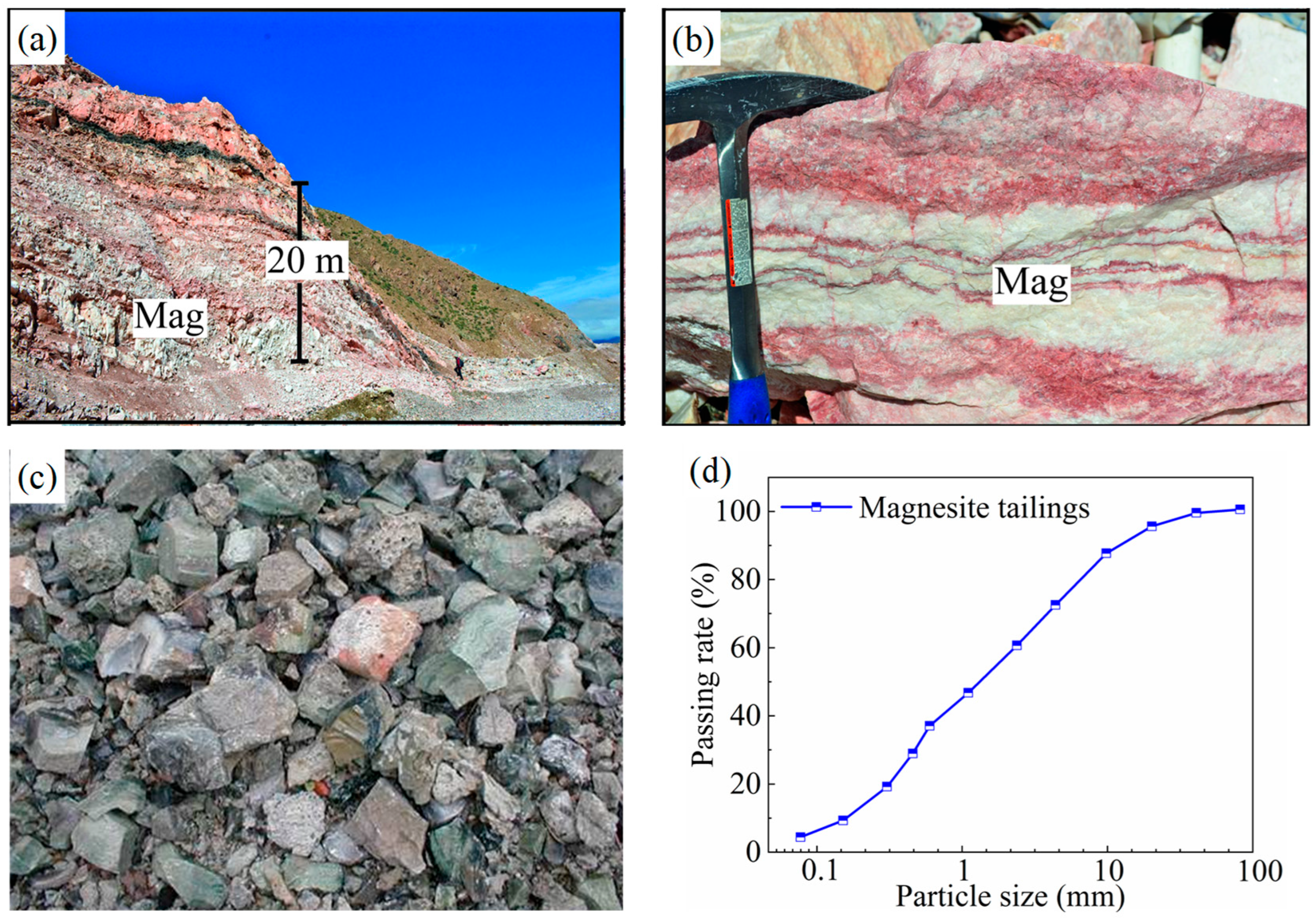
2.1. Raw Materials
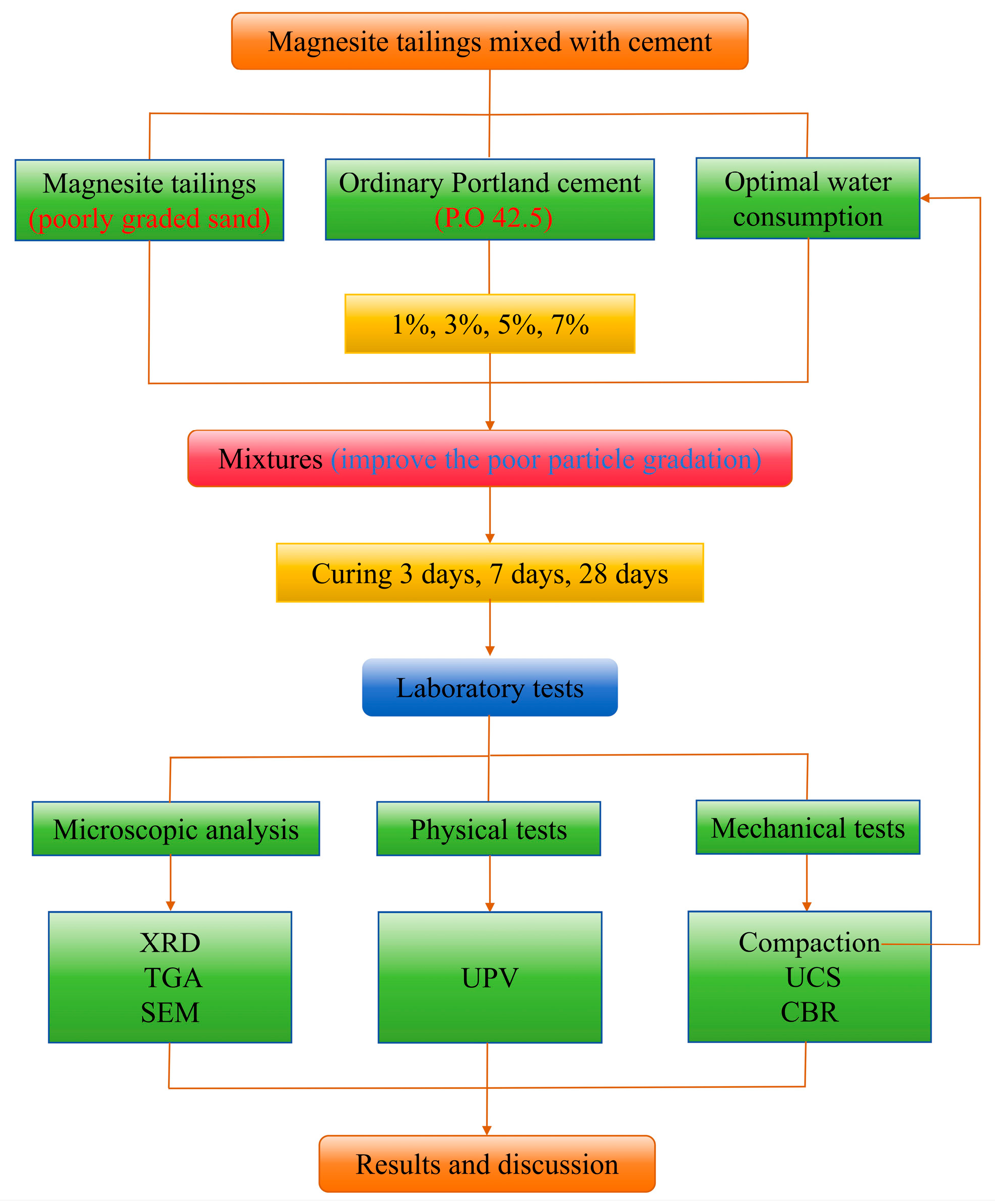
2.2. Specimen Preparation
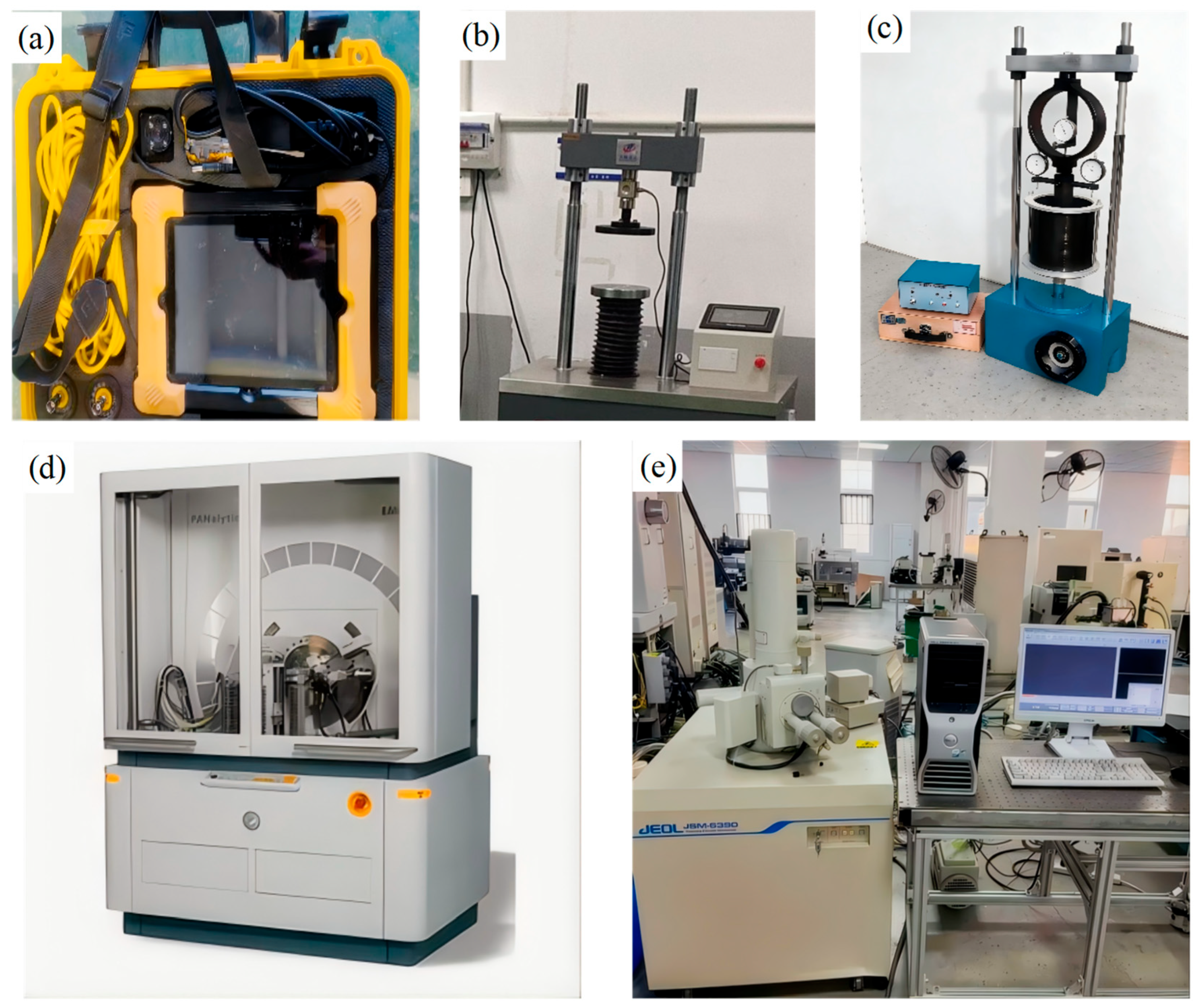
2.3. Test Methods
3. Results and Discussion of Tests
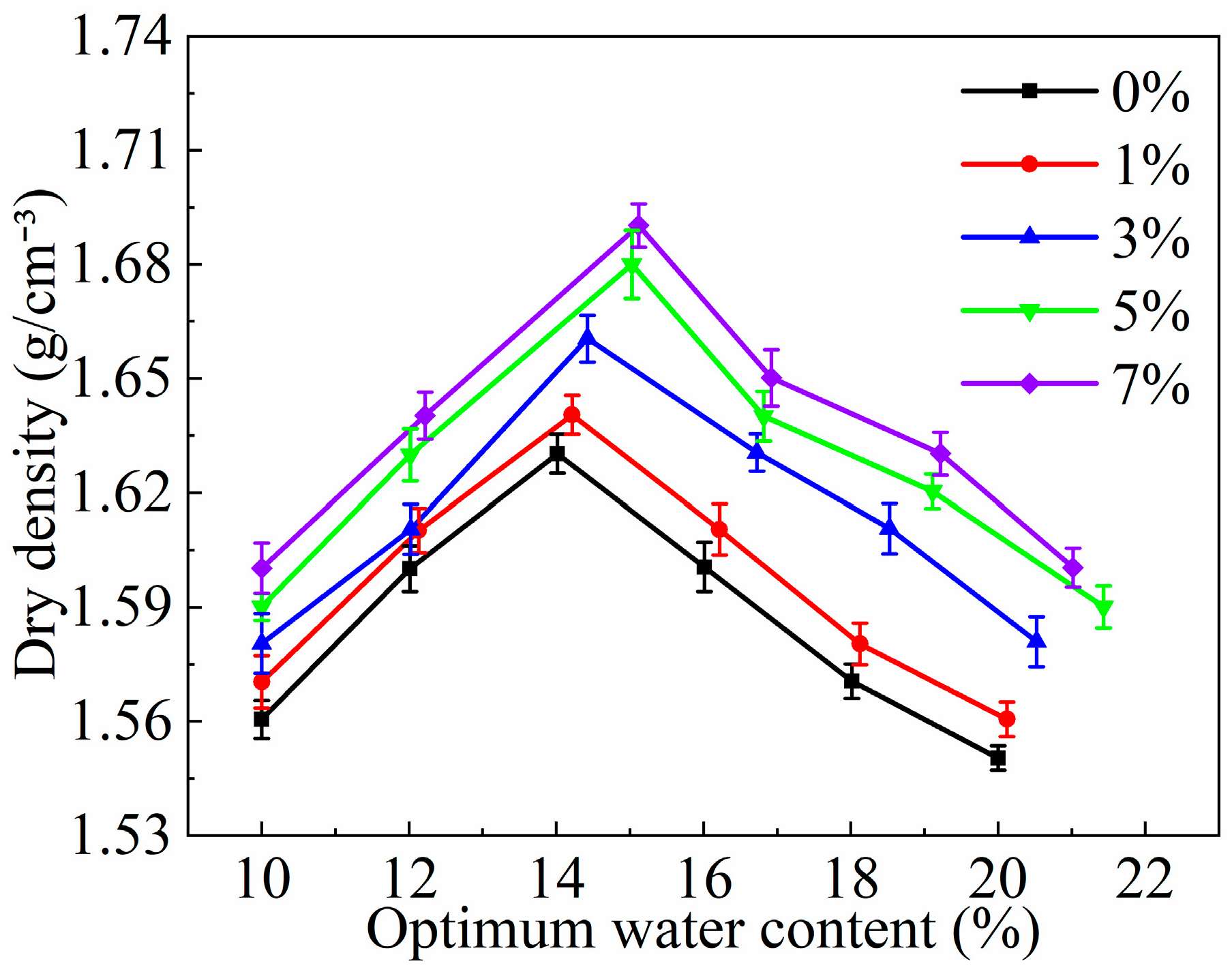
3.1. Compaction Characteristics
3.2. Uniaxial Compressive Strength (UCS) Characteristics
3.3. Wave Characteristics
3.4. California Bearing Ratio (CBR) Characteristics
4. Microscopic Mechanism Analysis
4.1. X-Ray Diffraction (XRD) Analysis
4.2. Thermogravimetric Analysis (TGA)
4.3. Scanning Electron Microscopy (SEM) Results
5. Conclusions
- (1)
- Magnesite tailings exhibit the characteristics of a poorly graded sand with a relatively high proportion of coarse particles. The incorporation of cement significantly enhances the packing structure by filling interparticle voids with fine cement grains and hydration products, resulting in a denser and more stable particle skeleton. This densification effect, quantified by a 3.7% increase in maximum dry density and a 5.1% increase in optimum moisture content with 7% cement, highlights the microstructural basis for improved compaction. With increasing cement content, the combined effects of fine-particle enrichment and hydration-induced bonding further improve compaction behavior. Consequently, both the optimum moisture content and maximum dry density increase with cement dosage, providing a theoretical basis for mixture design and field compaction optimization.
- (2)
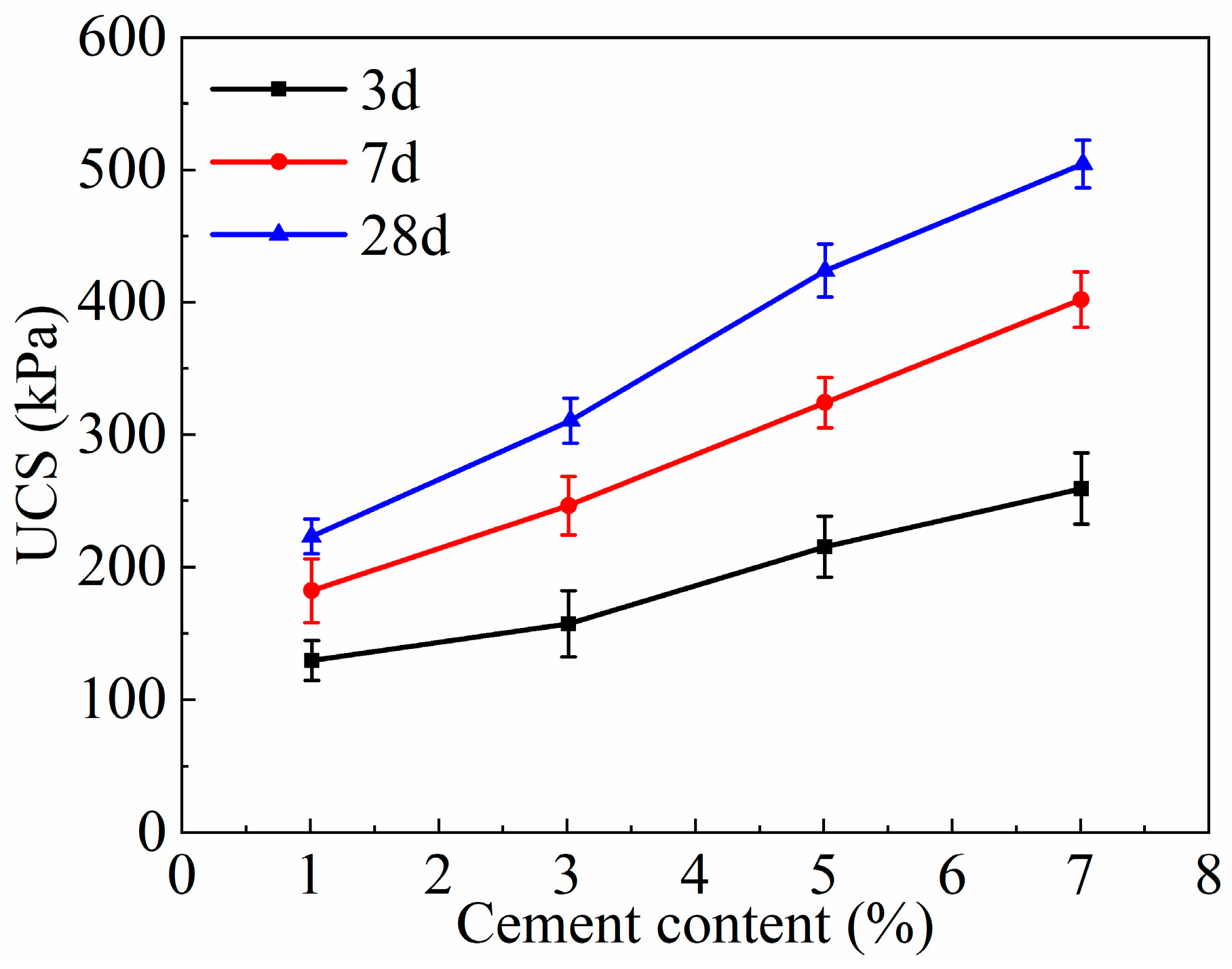
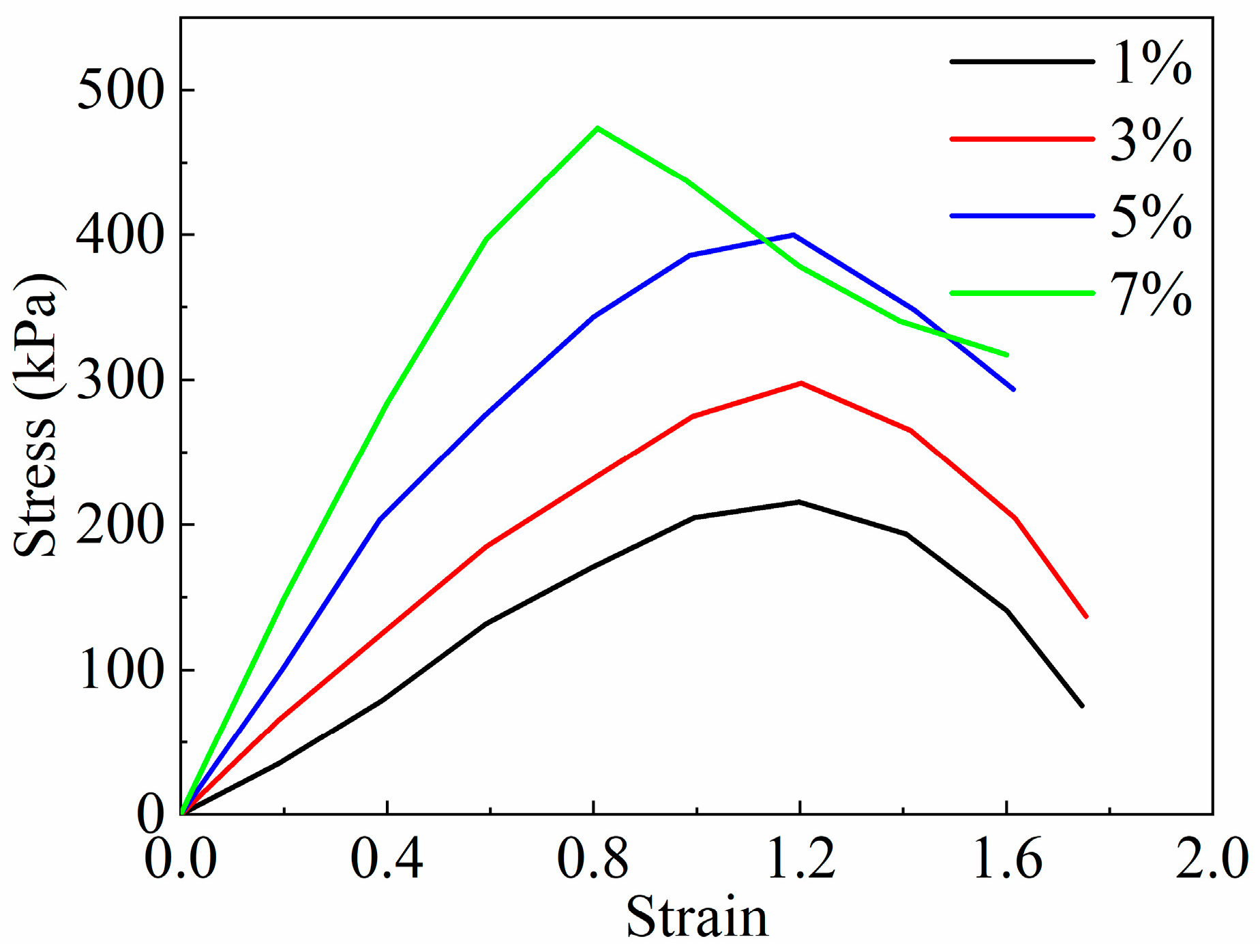
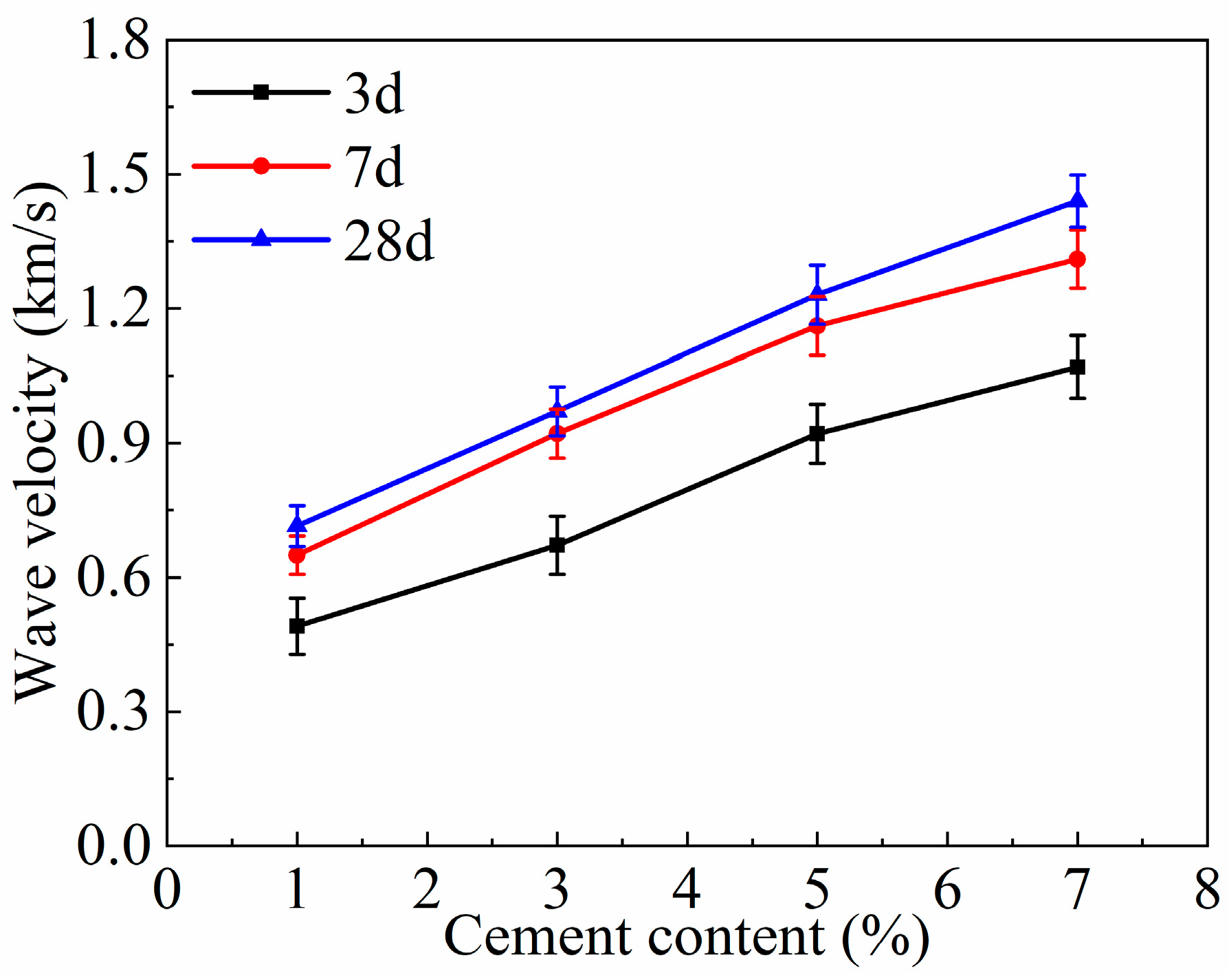
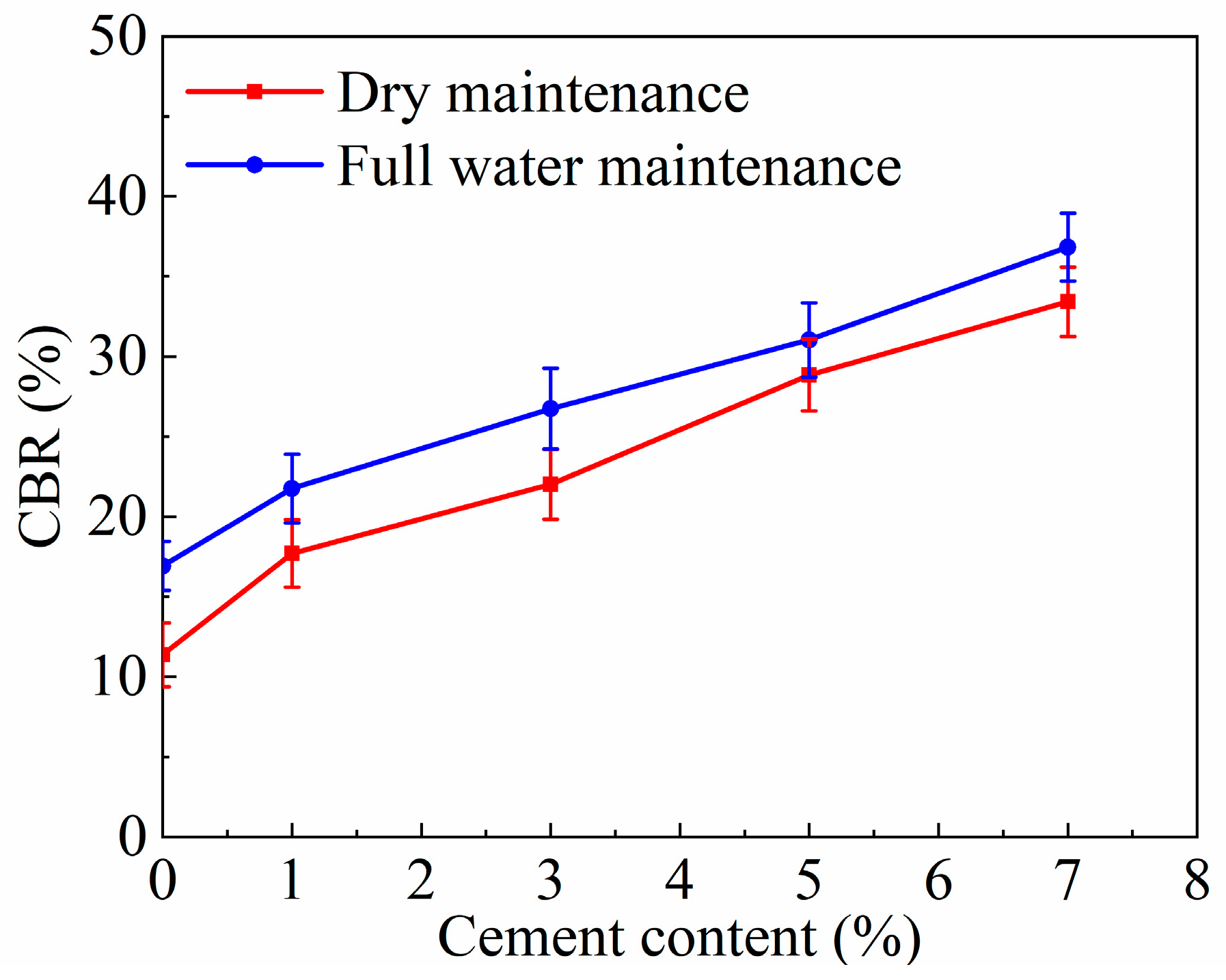
- The mechanical performance of the mixtures improves markedly with increasing cement content. The UCS, CBR, and ultrasonic pulse velocity consistently increase with cement dosage and curing time, indicating enhanced stiffness, strength, and internal compactness. The observed quantitative correlation between UPV and UCS/CBR provides a novel approach to predict mechanical performance through non-destructive testing. This trend is quantitatively demonstrated by strength increases of 100.9%, 121.8%, and 126.3% after 3, 7, and 28 days of curing, respectively, as well as a 119.6% increase in maximum uniaxial stress for the mixture containing 7% cement compared with that containing 1% cement. These results confirm the pronounced strengthening effect of cement incorporation, particularly during early- and mid-term curing stages. Although the mechanical indices remain slightly lower than those of conventional subgrade materials, the results demonstrate that magnesite tailings, when properly stabilized, satisfy the requirements for subgrade fillers. In addition, the mixtures exhibit acceptable resistance to moisture-induced strength degradation, indicating reliable durability under typical service conditions.
- (3)
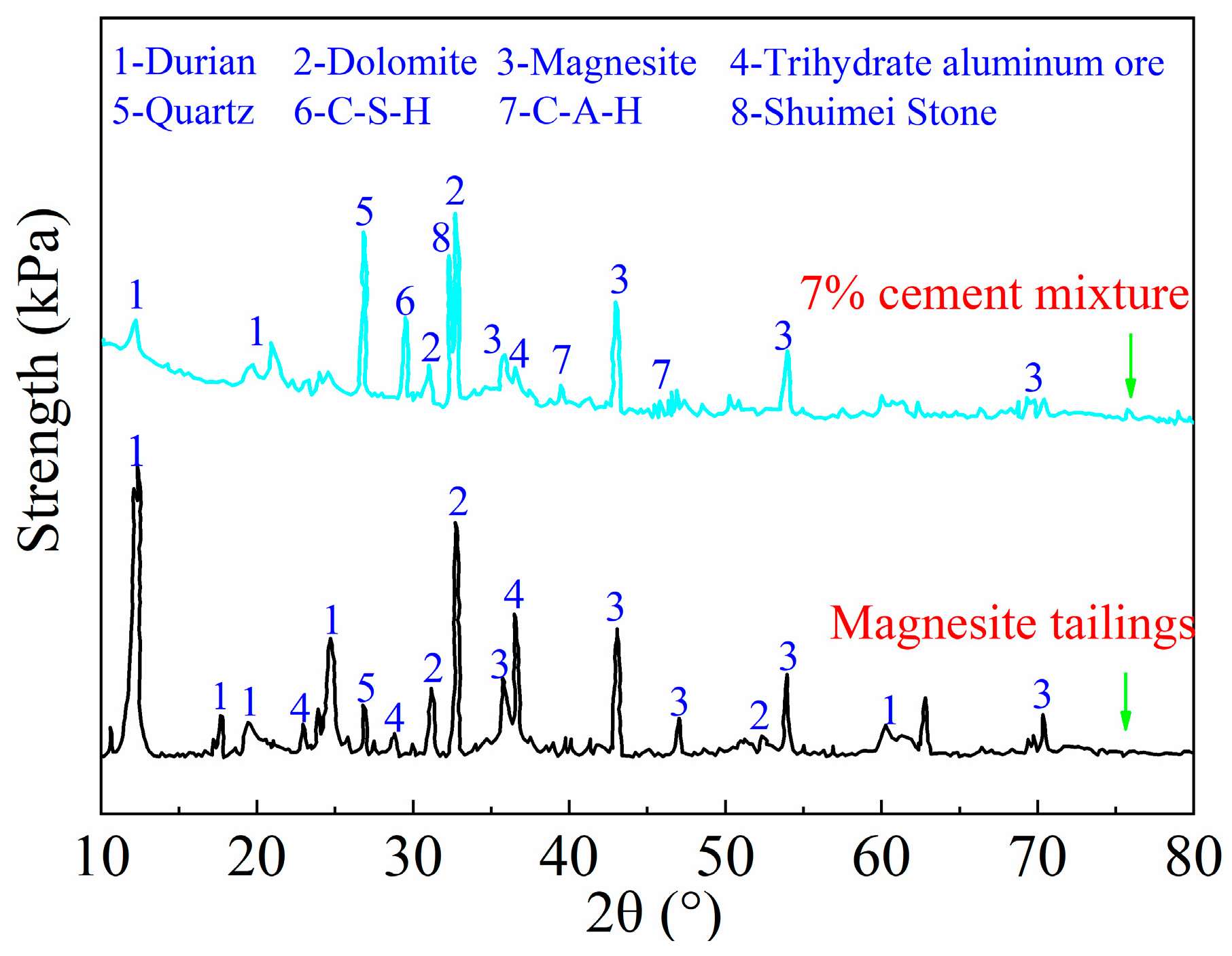
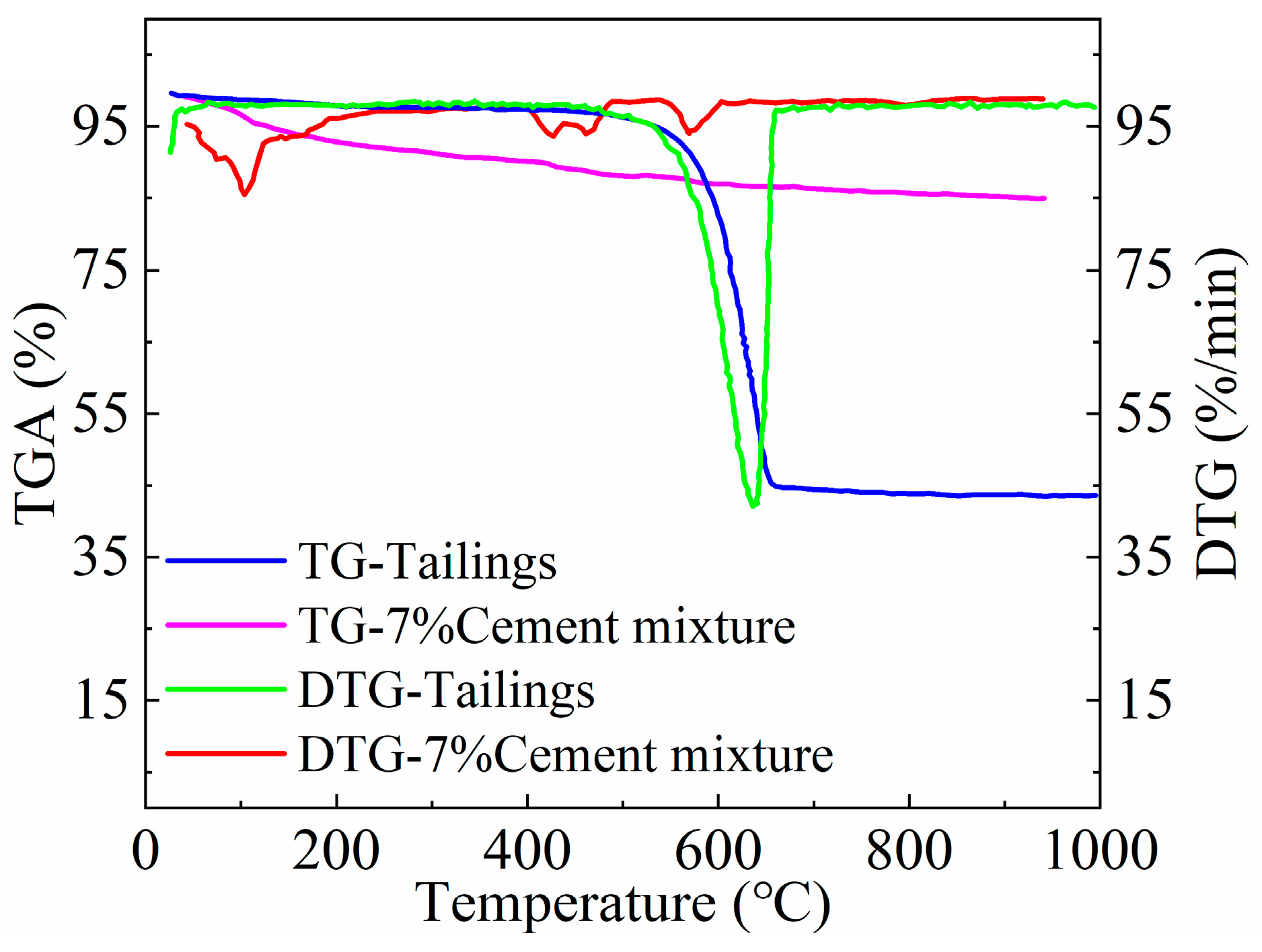
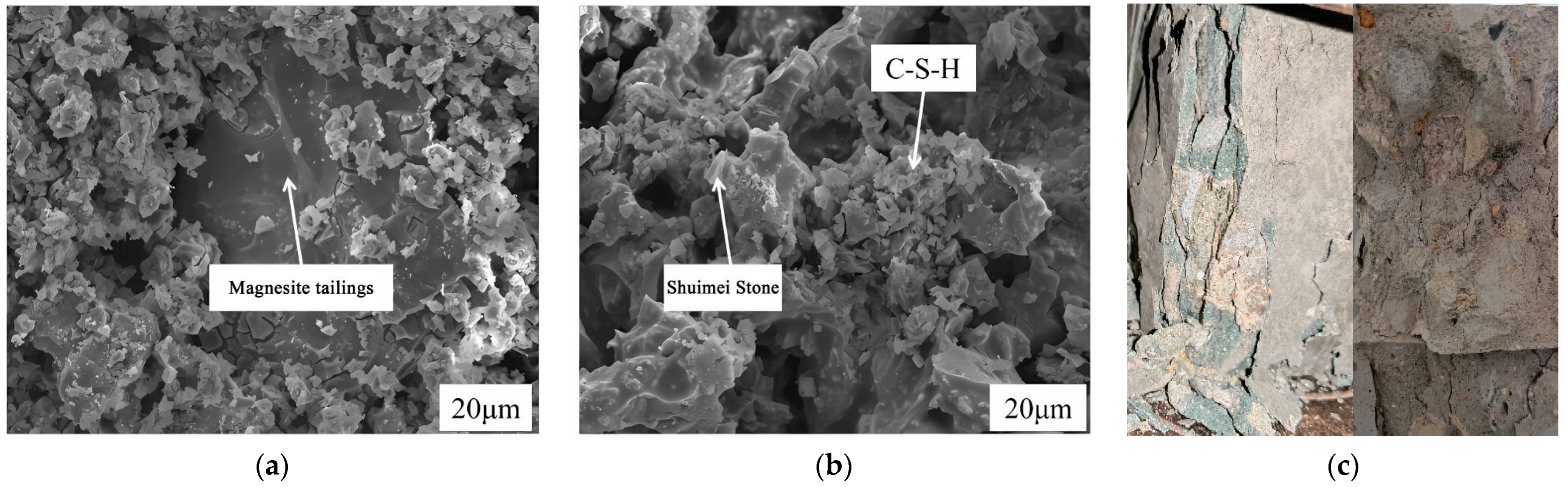
- Microstructural analyses (XRD, TGA, and SEM) confirm the formation of C–S–H, C–A–H, and brucite phases within the cement-stabilized mixtures. These products originate from cement hydration and alkali–magnesite reactions, jointly contributing to strength enhancement. SEM observations further reveal that hydration products bridge adjacent tailings particles and fill internal voids, demonstrating that microstructural densification and improved particle bonding are the dominant mechanisms controlling macro-scale mechanical performance.
Author Contributions
Funding
Data Availability Statement
Acknowledgments
Conflicts of Interest
References
- Silva, D.S.F.; Boisvert, J.B. Mineral resource classification: A comparison of new and existing techniques. J. S. Afr. Inst. Min. Metall. 2014, 114, 265–273. [Google Scholar]
- Eggenkamp, H.G.M.; Marques, J.M. A comparison of mineral water classification techniques: Occurrence and distribution of different water types in Portugal (including Madeira and the Azores). J. Geochem. Explor. 2013, 132, 125–139. [Google Scholar] [CrossRef]
- Wang, J.Z.; Jing, M.C.; Zhao, B.H.; Zhai, W.J.; Cai, S.Q. Research progress of the flotation chemistry of magnesite and its gangue minerals. Chin. J. Nonferrous Met. 2022, 32, 3823–3842. (In Chinese) [Google Scholar]
- Zheng, H.L.; Ma, C.K.; Li, T.Y.; Fu, X.W.; Song, F.Y.; Wang, J.N.; Huang, Y.J.; Zhao, Q.Q. Removal of ammonia nitrogen and phosphate from livestock wastewater by magnesite tailings modified biochar: Performance and mechanisms. Appl. Water. Sci. 2025, 15, 248. [Google Scholar] [CrossRef]
- Chen, X.J.; Wang, R.Q.; Chen, F.X.; Styszko, K. Transport and removal of viruses in soil: Evaluating low-cost filtering materials for groundwater protection. J. Hazard. Mater. 2025, 496, 139538. [Google Scholar] [CrossRef]
- Pugazhendhi, A.; Govindasamy, C.; Sharma, A. Heavy metal accumulation in root and shoot tapioca plant biomass grown in agriculture land situated around the magnesite mine tailings. Environ. Res. 2024, 257, 119287. [Google Scholar] [CrossRef] [PubMed]
- Zhao, G.T.; She, W.; Yang, G.T.; Pan, L.; Cai, D.G.; Jiang, J.Y.; Hu, H. Mechanism of cement on the performance of cement stabilized aggregate for highspeed railway roadbed. Constr. Build. Mater. 2017, 144, 347–356. [Google Scholar] [CrossRef]
- Zhou, X.L.; Chen, Y.; Liu, C.W.; Wu, F. Preparation of artificial lightweight aggregate using alkali-activated incinerator bottom ash from urban sewage sludge. Constr. Build. Mater. 2022, 341, 127844. [Google Scholar] [CrossRef]
- Yin, P.B.; Wang, J.J.; He, W.; Wang, S.Q.; Li, X.; Jia, Z. Machine learning-based study on the mechanical properties and embankment settlement prediction model of nickel-iron slag modified soil. Constr. Build. Mater. 2024, 431, 136468. [Google Scholar] [CrossRef]
- Soe, K.; Yang, R.C.; Zhang, Y.X. A review of recent advances in MgO-Based cementitious composites for green construction: Mechanical and durability aspects. Buildings 2025, 15, 3513. [Google Scholar] [CrossRef]
- Ochoa-Diaz, R. Use of blast furnace dust to improve the properties of granular material for pavements. UIS Ing. 2021, 20, 135–144. [Google Scholar] [CrossRef]
- Zada, U.; Jamal, A.; Iqbal, M.; Eldin, S.M.; Almoshaogeh, M.; Bekkouche, S.R.; Almuaythir, S. Recent advances in expansive soil stabilization using admixtures: Current challenges and opportuni ties. Case Stud. Constr. Mater. 2023, 18, e01985. [Google Scholar] [CrossRef]
- Barwar, A.; Chandrappa, A.K.; Umesh, C.; Sahoo, U.C. Laboratory investigations on stabilization of weak clay soil using rice husk ash and cement. Innov. Infrastruct. Solut. 2022, 7, 327. [Google Scholar] [CrossRef]
- Ahmad, S.; Ghazi, M.S.A.; Syed, M.; Al-Osta, M.A. Utilization of fly ash with and without secondary additives for stabilizing expansive soils: A review. Results Eng. 2024, 22, 102079. [Google Scholar] [CrossRef]
- Vakili, A.H.; Salimi, M.; Keskin, İ.; Jamalimoghadam, M. A systematic review of strategies for identifying and stabilizing dis persive clay soils for sustainable infrastructure. Soil Tillage Res. 2024, 239, 106036. [Google Scholar] [CrossRef]
- Fadugba, O.G.; Adeniran, J.K.; Alaneme, G.U.; Oluyemi-Ayibiowu, B.D.; Omomomi, O.J.; Adetukasi, A.O. Compaction and com pressibility characteristics of snail shell ash and granulated blast furnace slag stabilized local bentonite for baseliner of landfill. Sci. Rep. 2024, 14, 7167. [Google Scholar] [CrossRef]
- Driss, A.A.-E.; Harichane, K.; Ghrici, M.; Gadouri, H. Assessing the effect of moulding water content on the behaviour of lime stabilised an expansive soil. Geomech. Geoengin. 2022, 17, 896–908. [Google Scholar] [CrossRef]
- Pushpakumara, B.H.J.; Mendis, W.S.W. Suitability of rice husk ash (RHA) with lime as a soil stabilizer in geotechnical applications. Int. J. Geo-Eng. 2022, 13, 4. [Google Scholar] [CrossRef]
- Habal, A.H.Y.; Medjnoun, A.; Djerbal, L.; Bahar, R. Mechanical and microstructure behavior of expansive soil treated by lime-activated granulated blast furnace slag. Indian Geotech. J. 2025, 55, 1661–1677. [Google Scholar] [CrossRef]
- Ashfaq, M.; Lal, M.H.; Moghal, A.A.B.; Murthy, V.R. Carbon footprint analysis of coal gangue in geotechnical engineering applications. Indian Geotech. J. 2020, 50, 646–654. [Google Scholar] [CrossRef]
- Sruthi, S.; Gayathri, V. Synthesis and evaluation of eco-friendly, ambient-cured, geopolymer-based bricks using industrial by-products. Buildings 2023, 13, 510. [Google Scholar] [CrossRef]
- Oke, J.A.; Abuel-Naga, H. Engineering and durability properties of sustainable bricks incorporating lime kiln dust, ground granulated blast furnace slag, and tyre rubber wastes. Buildings 2025, 15, 2079. [Google Scholar] [CrossRef]
- Li, B.L.; Tang, Z.Y.; Huo, B.B.; Liu, Z.J.; Cheng, Y.Z.; Ding, B.Z.; Zhang, P. The early age hydration products and mechanical properties of cement paste containing GBFS under steam curing condition. Buildings 2022, 12, 1746. [Google Scholar] [CrossRef]
- Zeng, Q.W.; Gao, P.W.; Li, K.; Dong, G.Q.; Jin, G.L.; Sun, X.W.; Zhao, J.W.; Chen, L.F. Experimental research on the properties and formulation of fly ash based geopolymer grouting material. Buildings 2022, 12, 503. [Google Scholar] [CrossRef]
- El-Attar, M.M.; Ibrahim, H.H.A.; Darwish, S.F.A. Investigating the viability of recycling rice husk ash and plastic bag waste to enhance durability of lightweight concrete. Buildings 2023, 13, 1350. [Google Scholar] [CrossRef]
- Masindi, V. A novel technology for neutralizing acidity and attenuating toxic chemical species from acid mine drainage using cryptocrystalline magnesite tailings. J. Water. Process. Eng. 2016, 10, 66–67. [Google Scholar] [CrossRef]
- Karhu, M.; Lagerbom, J.; Solismaa, S.; Huttunen-Saarivirta, E. Magnesite-rich mining tailings as a raw material for refractory ceramics-microstructural and thermal analysis. Proc. Est. Acad. Sci. 2019, 68, 145–149. [Google Scholar] [CrossRef]
- Cui, X.W.; Chen, M.; Ma, M.Y.; Lv, Z.Y.; Zhang, T. Deep learning-based petrographic analysis of magnesite mine tailings mortar after exposure to elevated temperatures. Constr. Build. Mater. 2025, 492, 142845. [Google Scholar] [CrossRef]
- Shanmugasundaram, V.; Shanmugam, B. Characterisation of magnesite mine tailings as a construction material. Environ. Sci. Pollut. Res. 2021, 28, 45557–45570. [Google Scholar] [CrossRef]
- Shanmugasundaram, V.; Shanmugam, B. Application of cement treated magnesite mine tailings as subgrade. Constr. Build. Mater. 2023, 365, 130064. [Google Scholar] [CrossRef]
- Shanmugasundaram, V.; Shanmugam, B.; Kulanthaivel, P.; Perumal, P. Sustainable reuse of magnesite mine tailings in cement-treated expansive soil for enhanced subgrade performance: Geotechnical and environmental analysis. J. Taibah. Univ. Sci. 2024, 18, 2397861. [Google Scholar] [CrossRef]
- JTG 3430-2020; Test Methods of Soils for Highway Engineering. Industry Standards of the People’s Republic of China: Beijing, China, 2020.
- JTG 3420-2020; Testing Methods of Cement and Concrete for Highway Engineering. Industry Standards of the People’s Republic of China: Beijing, China, 2020.
- GB/T 50123-2019; Standard for Geotechnical Testing Method. Standardization Administration of China: Beijing, China, 2019.
- Ding, S.; Unluer, C.; Li, L.H.; Li, N.; Wang, H.; Hu, Z.L.; Liu, J.P. Sequential mechanisms of swelling and crystallization pressures on microstructure and deformation evolution in cement-based materials mixed with MgO. Constr. Build. Mater. 2025, 490, 142587. [Google Scholar] [CrossRef]
- Zhang, X.W.; Gao, Y.H.; Wang, P.; Li, J.S.; Liu, S.Y.; Lang, L.; Lie, X.W. Experimental study on the synergistic preparation of pavement base material by electrolytic manganese slag-domestic waste incineration bottom slag. Bull. Chin. Ceram. Soc. 2023, 42, 1363–1373. (In Chinese) [Google Scholar] [CrossRef]
- Kutanaei, S.S.; Choobbasti, A.J. Effects of nanosilica particles and randomly distributed fibers on the ultrasonic pulse velocity and mechanical properties of cemented sand. J. Mater. Civil. Eng. 2017, 29, 04016230. [Google Scholar] [CrossRef]
- Zhou, X.L.; Liu, C.W.; Feng, B.; Guo, B.B.; Lu, Y.H.; Zhang, L.W. The effect of dry-wet cycle on cement-based composite filling materials. Chin. J. Eng. 2019, 41, 1609–1617. (In Chinese) [Google Scholar] [CrossRef]
- AASHTO T 99-25; Standard Method of Test for Sieve Analysis of Soils. American Association of State Highway and Transportation Officials: Washington, DC, USA, 2025.
- JTG D30-2015; Specifications for Design of Highway Subgrades. Industry Standards of the People’s Republic of China: Beijing, China, 2015.
- Zhen, Y.J.; Zhang, S.; Luo, Z.L.; Gao, Y.; Wang, Y.B.; Yuan, H.H. Study on physical and mechanical properties of phase change material modified loess subgrade under freeze-thaw cycle. Highway 2022, 67, 36–43. (In Chinese) [Google Scholar]
- Liu, Y.J.; Sun, J.J.; Meng, Q.F. Study on preparation of magnesium silicate cement from magnesite tailings. Bull. Chin. Ceram. Soc. 2013, 32, 1126–1130. (In Chinese) [Google Scholar] [CrossRef]


Disclaimer/Publisher’s Note: The statements, opinions and data contained in all publications are solely those of the individual author(s) and contributor(s) and not of MDPI and/or the editor(s). MDPI and/or the editor(s) disclaim responsibility for any injury to people or property resulting from any ideas, methods, instructions or products referred to in the content. |
© 2025 by the authors. Licensee MDPI, Basel, Switzerland. This article is an open access article distributed under the terms and conditions of the Creative Commons Attribution (CC BY) license.
Share and Cite
Yang, B.; Zheng, T.; Zhao, C.; Chen, L. Mechanical, Physical, and Microstructural Performance of Road Base Materials Prepared with Magnesite Tailings Mixed with Cement. Buildings 2026, 16, 90. https://doi.org/10.3390/buildings16010090
Yang B, Zheng T, Zhao C, Chen L. Mechanical, Physical, and Microstructural Performance of Road Base Materials Prepared with Magnesite Tailings Mixed with Cement. Buildings. 2026; 16(1):90. https://doi.org/10.3390/buildings16010090
Chicago/Turabian StyleYang, Buren, Tengteng Zheng, Caiqi Zhao, and Lihao Chen. 2026. "Mechanical, Physical, and Microstructural Performance of Road Base Materials Prepared with Magnesite Tailings Mixed with Cement" Buildings 16, no. 1: 90. https://doi.org/10.3390/buildings16010090
APA StyleYang, B., Zheng, T., Zhao, C., & Chen, L. (2026). Mechanical, Physical, and Microstructural Performance of Road Base Materials Prepared with Magnesite Tailings Mixed with Cement. Buildings, 16(1), 90. https://doi.org/10.3390/buildings16010090