Article

The Influence of Sand Ratio on the Freeze–Thaw Performance of Full Solid Waste Geopolymer Concrete

1
Northwest Engineering Corporation Limited, Xi’an 710065, China
2
School of Civil Engineering, Chang’an University, Xi’an 710064, China
*
Author to whom correspondence should be addressed.
Buildings 2026, 16(1), 76; https://doi.org/10.3390/buildings16010076
Submission received: 28 November 2025 / Revised: 16 December 2025 / Accepted: 22 December 2025 / Published: 24 December 2025
(This article belongs to the Section Building Materials, and Repair & Renovation)

Abstract

To clarify the effect of sand ratio on the freeze–thaw performance of full solid waste geopolymer concrete (FSWGC) and establish a constitutive model for its post-freeze–thaw mechanical behavior, FSWGC was prepared via alkali activation—using fly ash, slag, silica fume as cementitious materials, and cold-bonded geopolymer lightweight aggregates (CBGLAs) and recycled sand as aggregates. With sand ratios (0.45, 0.55, 0.65) as the core variable, rapid freeze–thaw tests were conducted to measure mass loss, relative dynamic elastic modulus, mechanical properties, and axial compressive stress–strain characteristics of FSWGC. Results show that higher sand ratios significantly aggravate freeze–thaw damage: after 100 cycles, the 0.65 sand ratio specimen has a mass loss rate of 4.61% and a relative dynamic elastic modulus retaining only 34.4% of its initial value, with accelerated strength degradation. This is due to yjr weakened wrapping of recycled sand by cementitious materials, forming a weak interfacial transition zone. The modified Guo constitutive model for FSWGC, and the further established model considering freeze–thaw cycles, accurately describe the stress–strain curve of FSWGC before and after freeze–thaw. This study provides theoretical and experimental support for FSWGC mix optimization, durability design, and mechanical response calculation in cold regions.

1. Introduction

In the field of infrastructure construction, concrete materials face durability challenges [1,2,3]. Specifically, in some cold regions, the expansion of internal microcracks, surface spalling, and deterioration of mechanical properties caused by freeze–thaw action can significantly shorten the service life of engineering structures [4,5,6]. Geopolymer concrete, with advantages such as low carbon emissions, environmental friendliness, and excellent mechanical properties, has gradually become an alternative to traditional cement concrete [7,8,9]. Full-solid-waste geopolymer concrete (FSWGC) is a type of concrete made by replacing cement with geopolymer and natural aggregates with recycled aggregates. It possesses the advantages of a light weight, high strength, and low carbon content, demonstrating broad application prospects in scenarios such as energy-saving buildings and lightweight bridge structures. However, the porous surface of recycled aggregates results in a weak interfacial transition zone between these aggregates and the geopolymer gel [10,11]. Therefore, clarifying the mechanical and durability properties of FSWGC is one of the key steps for promoting its application.
The mechanical properties and freeze–thaw resistance of FSWGC are significantly affected by its mix proportion parameters [12]. Among these, the sand ratio, as a key influencing factor, is directly related to aggregate gradation, the wrapping state of the cementitious paste, and the quality of the interfacial transition zone. Current research mainly focuses on the basic mechanical properties of geopolymer concrete or the impact of single-type aggregates on freeze–thaw performance. The mechanism by which the sand ratio regulates the mechanical properties and freeze–thaw stability of FSWGC remains unclear. Wang et al. [13] prepared geopolymer concrete using phosphogypsum, fly ash, and slag, and found that when the water-cement ratio was 0.34 and the sand ratio was 32.2%, the compressive strength of the concrete exceeded 60 MPa. Zailani et al. [14] developed a geopolymer concrete for repair purposes and studied the effect of different sand ratios on the bonding performance of this material; the study revealed that the bonding strength was optimal when the ratio of cementitious agent to sand was 1:3. Zhang et al. [15] investigated the performance and service life of desert sand concrete under chloride ion erosion and freeze–thaw cycles, and found that as the replacement rate of desert sand increased, the durability of the concrete improved, with its final service life being 1.4 times that of ordinary concrete. Furthermore, most scholars agree that the sand ratio has a significant impact on geopolymer concrete [16,17,18]. Nevertheless, the porous characteristics of recycled aggregates and their weakening effect on the mechanical properties and freeze–thaw resistance of geopolymer concrete remain a research gap.
In addition, the uniaxial compression constitutive relationship, as a core carrier for characterizing the mechanical behavior of concrete, serves as a key theoretical basis for load transfer calculation, deformation prediction, and crack resistance evaluation in structural design [19,20,21]. Current research on the constitutive models of geopolymer concrete mostly focuses on materials with single-type aggregates under normal temperature conditions [22,23]. However, these studies fail to fully consider the unique interfacial transition zone defects of the full solid waste system and also do not incorporate the cumulative effect of freeze–thaw cycles on mechanical parameters. This leads to issues such as large deviations in the peak stage and distorted predictions in the softening stage when traditional models are used to describe the stress–strain curve of FSWGC after freeze–thaw cycles [24,25,26], making it difficult to meet the accuracy requirements for mechanical response in structural design in cold regions [27].
In this study, FSWGC was prepared via alkali activation using fly ash, slag, and silica fume as cementitious materials, and cold-bonded geopolymer lightweight aggregates (CBGLAs) and recycled sand as aggregates. With sand ratios (0.45, 0.55, 0.65) as the core variable, rapid freeze–thaw tests were conducted to measure mass loss, relative dynamic elastic modulus, mechanical properties, and axial compressive stress–strain characteristics. The study aims to clarify the influence mechanism of sand ratio on FSWGC’s freeze–thaw performance and provide a theoretical basis for mix proportion optimization and durability design of cold-region FSWGC projects.

2. Materials and Experimental Design

2.1. Materials

The cold-bonded geopolymer lightweight aggregates (CBGLAs) was prepared using fly ash and slag via disk granulation, and the fine aggregates were recycled sand (fineness modulus 2.23), with key properties shown in Table 1. The binders included S95-grade slag, F-class fly ash, and SF88-grade silica fume, which chemical compositions are listed in Table 2. The alkali activator was a composite solution of NaOH and Na2SiO3 (modulus 1.6), prepared by mixing Na2SiO3 solution (40% mass fraction) with NaOH solid at a ratio of 3.8:1 and cooling for 2 h. The aggregates used in the test are shown in Figure 1.

2.2. Mix Proportions

The mix design varied sand ratios (0.45, 0.55, 0.65) while fixing the water–binder ratio at 0.35, binder–sand ratio at 0.7, and alkali–binder ratio at 0.15. The mix proportions are detailed in Table 3.

2.3. Specimen Preparation

CBGLAs were pre-wetted by soaking in water for 1 h and draining until surface-dry. Concrete was mixed using a forced mixer: binders and sand were first dry-mixed, followed by the addition water and water reducer, stirring for 1 min, and then the addition of the alkali activator solution (slow stirring for 2 min; fast stirring for 1 min). CBGLAs were added last and stirred slowly for 2 min and fast for 2 min. The mixture was poured into the mold, vibrated, covered with plastic film, and cured in a standard indoor environment for 28 days prior to testing.

2.4. Freeze–Thaw Testing

According to the GB/T 50082-2009 standard [28], a rapid freezing–thawing test was carried out using a tester that controls the central temperature of the test piece between −17 °C and 5 °C. Each cycle lasted 3.5 h (2.5 h for freezing and 1 h for thawing). Prismatic specimens with side lengths of 100 mm × 100 mm × 400 mm were used to measure mass loss, relative dynamic elastic modulus, and flexural strength. Cube specimens with side lengths of 100 mm × 100 mm × 100 mm were used to determine compressive strength and splitting tensile strength. Three identical specimens were made for each group of specimens.

2.5. Mechanical Properties Test

The performance tests, including concrete cube compressive strength, splitting tensile strength, flexural strength, and axial compressive strength, were conducted in accordance with GB/T 50081-2019 [29]. The dimensions of the cube compressive strength and splitting tensile strength specimens were 100 mm × 100 mm × 100 mm, the flexural strength test specimens were 100 mm × 100 mm × 400 mm, and the axial compressive strength test specimens were 100 mm × 100 mm × 300 mm. All tests considered the performance after freeze–thaw cycles.
This study has certain limitations that need to be noted for future research: (1) The freeze–thaw test only simulated standard freeze–thaw cycles (temperature −17 °C~5 °C), and did not consider composite environmental factors such as salt freeze–thaw or dry–wet-cycle coupling, which are common in actual cold regions; (2) CBGLAs were self-prepared via disk granulation, and slight differences in particle size distribution may exist between batches, which may lead to minor fluctuations in test results; (3) the maximum number of freeze–thaw cycles was 100, which cannot fully reflect the long-term durability of FSWGC under decades of service in cold regions.

3. Results and Analysis

3.1. Mass Loss and Morphological Damage

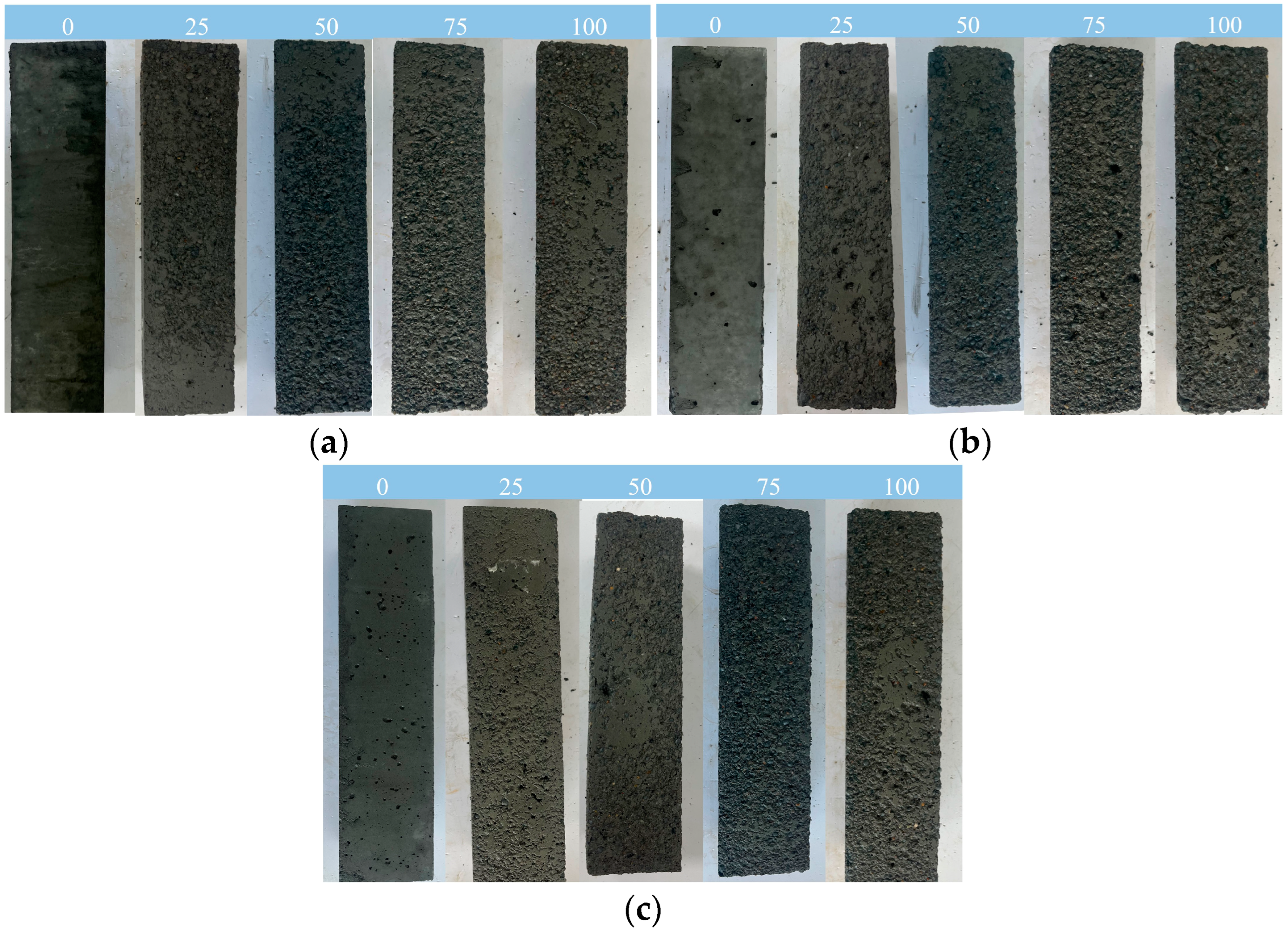
Table 4 and Figure 2 present the mass loss and morphological changes in each specimen after 0–100 freeze–thaw cycles. With the increase in sand ratio, the mass loss rate of FSWGC after freeze–thaw cycles shows a significant upward trend. After 100 freeze–thaw cycles, the mass loss rate of the specimen with a sand ratio of 0.45 is 2.70%, while that of the specimen with a sand ratio of 0.65 reaches 4.61%. Visually, the surface spalling of the specimen with a sand ratio of 0.65 is the most severe, with massive detachment at the corners, while the surface morphology of the specimen with a sand ratio of 0.45 remains relatively intact. This is because the increase in sand ratio reduces the content of lightweight aggregates, and the insufficient binder cannot completely wrap the recycled sand, resulting in a weak interface transition zone, which accelerates damage under freeze–thaw stress [30].

3.2. Relative Dynamic Elastic Modulus

Table 5 presents the relative dynamic elastic modulus (RDEM) of each specimen under different numbers of freeze–thaw cycles. It can be seen that after 100 freeze–thaw cycles, the RDEM values of specimens with sand ratios of 0.45, 0.55, and 0.65 decrease to 59.5%, 55.2%, and 34.4%, respectively, indicating that a higher sand ratio accelerates the accumulation of internal damage and the decline in stiffness. The decrease in RDEM is closely related to the propagation of micro-cracks in the concrete matrix and the increase in pore connectivity.

3.3. Mechanical Properties Degradation

3.3.1. Compressive Strength

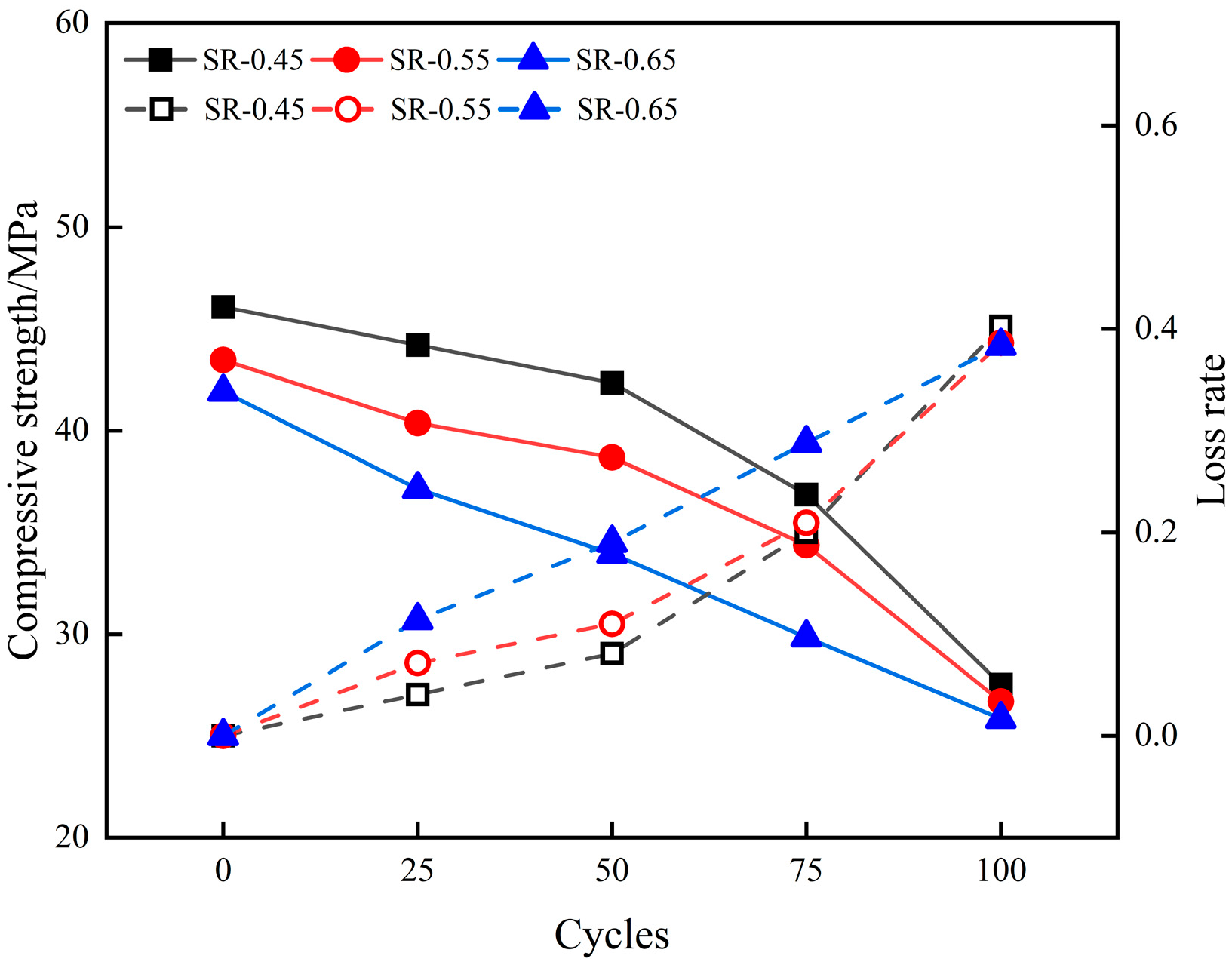
Table 6 and Figure 3 show the cubic compressive strength and its loss rate of FSWGC specimens with different sand ratios after 0 to 100 freeze–thaw cycles. The compressive strength of all specimens significantly decreases with the increase in freeze–thaw cycles. The loss rate analysis indicates that the strength loss is relatively slow in the early cycles, but the loss rate gradually accelerates. The strength loss of SR-0.45 is only 4.0% after 25 cycles, increases to 20.0% after 75 cycles, and rises to 40.2% after 100 cycles, suggesting that the cumulative damage caused by repeated freeze–thaw cycles aggravates the deterioration of the internal microstructure. These findings are consistent with the results of mass loss and relative dynamic elastic modulus, confirming that higher sand ratios significantly reduce the freeze–thaw resistance of FSWGC by promoting the accumulation of internal damage. The initial compressive strength of the SR-0.45 specimen is 46.08 MPa, which decreases to 27.53 MPa after 100 cycles, with a corresponding strength loss rate of 40.2%. The initial compressive strength of the SR-0.65 specimen is 41.92 MPa, which decreases to 25.84 MPa after 100 cycles (loss rate of 38.4%). Higher sand ratios accelerate the decline in compressive strength. After 100 cycles, the compressive strengths of SR-0.45, SR-0.55, and SR-0.65 specimens are 59.7%, 61.4%, and 61.6% of their initial values, respectively. This phenomenon is because with the increase in sand ratio, the content of lightweight aggregates decreases, and the binder cannot completely wrap the recycled sand, forming a weak interface transition zone. Under freeze–thaw stress, micro-cracks in this zone will propagate rapidly, thus accelerating the decline in strength [31].

3.3.2. Splitting Tensile and Flexural Strength

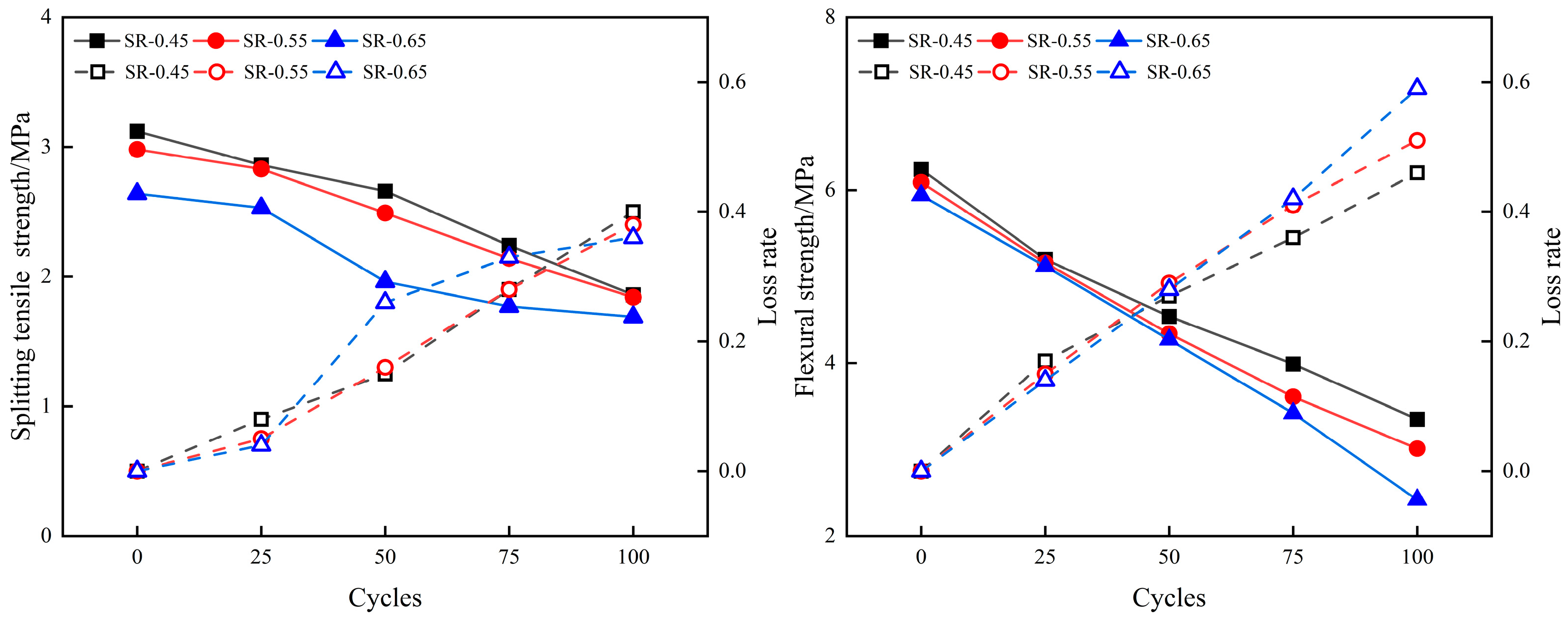
Table 7 and Figure 4 show the decline in splitting tensile strength and flexural strength of FSWGC specimens with different sand ratios after 0 to 100 freeze–thaw cycles. The splitting tensile strength of all specimens significantly decreases with the increase in freeze–thaw cycles. The initial splitting tensile strength of the SR-0.45 specimen is 3.12 MPa, which decreases to 1.86 MPa after 100 cycles, with a corresponding loss rate of 40.4%. Similarly, the splitting tensile strength of the SR-0.65 specimen decreases from 2.64 MPa to 1.69 MPa, with a corresponding loss rate of 35.9%. After 100 cycles, the splitting tensile strengths of SR-0.45, SR-0.55 and SR-0.65 specimens are 59.6%, 61.7% and 64.0% of their initial values, respectively. This is attributed to the weak interface transition zone formed by the insufficient binder wrapping the recycled sand at higher sand ratios, which promotes the propagation of microcracks under freeze–thaw stress. In terms of flexural strength, the initial value of the SR-0.45 sample is 6.24 MPa, which decreases to 3.35 MPa after 100 cycles, with a corresponding loss rate of 46.3%, while the SR-0.65 sample decreases from 5.94 MPa to 2.42 MPa, with a corresponding loss rate of 59.3%. It is worth noting that the flexural strength retention rates of SR-0.45, SR-0.55 and SR-0.65 after 100 cycles are 53.7%, 49.4% and 40.7%, respectively. The more significant decline in the flexural strength of the low sand ratio sample may be related to the higher content of lightweight aggregates, which introduces more pores and weakens the matrix integrity under cyclic freeze–thaw. Consistent with the results of compressive strength, the decline in both splitting tensile strength and flexural strength is accelerated by the increase in sand ratio, which highlights the key role of the quality of interface transition zone in determining the freeze–thaw resistance of FSWGC.

3.4. Axial Compression Performance

3.4.1. Stress–Strain Curve

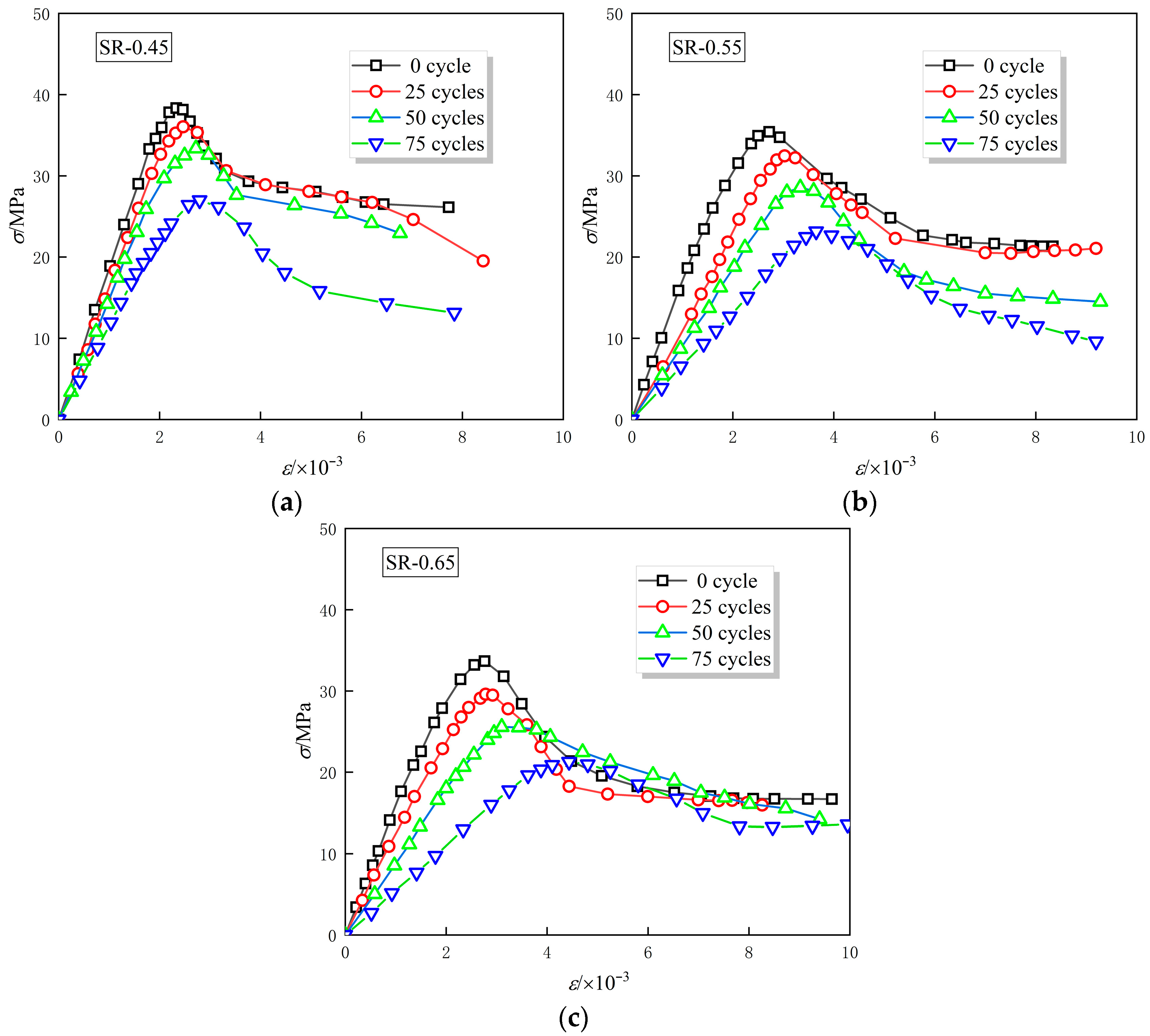
Figure 5 displays the characteristics of stress–strain curves of FSWGC specimens with different sand ratios after 0, 25, 50, and 75 freeze–thaw cycles, and the corresponding mechanical parameters are listed in Table 8, Table 9, Table 10 and Table 11. Overall, freeze–thaw cycles significantly alter the curve morphology, which manifests as a decrease in peak stress (fc), increase in peak strain (εc), and reduction in the slope in the elastic stage (Ec), and the degradation of specimens with higher sand ratios is more remarkable.
Compared with Ren et al. [21]’s research on geopolymer lightweight aggregate concrete, FSWGC’s stress–strain curve shows a steeper descending segment after freeze–thaw cycles, indicating enhanced brittleness. For the SR-0.45 specimen, the fc is 38.34 MPa and the εc is 2.33 × 10⁻³ without freeze–thaw, the ascending segment of the curve is steep, and the descending segment is relatively gentle, showing a certain ductility. After 75 cycles, the fc decreases to 26.99 MPa, the εc increases to 2.79 × 10⁻³, and the Ec decreases from 18.87 GPa to 11.58 GPa. The descending rate after the peak of the curve accelerates, and the brittle characteristics are enhanced. The degradation of the SR-0.65 specimen with a sand ratio of 0.65 is more obvious: the fc is 34.90 MPa and the εc is 2.76 × 10⁻³ after 0 cycle. After 75 cycles, the fc decreases to 21.28 MPa, the εc increases to 4.43 × 10⁻³, and the Ec decreases from 15.96 GPa to 5.48 GPa. The slope of the ascending segment of the curve decreases significantly, and the softening stage after the peak is steeper, indicating that the propagation of internal micro-cracks leads to a substantial attenuation of structural stiffness.
By comparing different sand ratios, it is found that the stress–strain curves of specimens with higher sand ratios (such as SR-0.65) show lower peak stress and gentler ascending segments after freeze–thaw cycles, which is related to the weak interface transition zone and insufficient wrapping of lightweight aggregates caused by the increase in sand ratio. Under freeze–thaw stress, the weak interface zone preferentially produces and connects micro-cracks, accelerating the degradation of matrix stiffness, which manifests as the shortening of the elastic stage of the curve and the increase in peak strain. In addition, ε0.85 (the strain corresponding to 0.85 times the peak stress) increases significantly with the number of cycles. For example, the ε0.85 of SR-0.65 reaches 5.98 × 10⁻³ after 75 cycles, reflecting that although the deformation capacity of the material before failure is improved, the bearing capacity is greatly reduced. This is consistent with the degradation laws of mass loss and dynamic elastic modulus, further verifying that a higher sand ratio promotes the freeze–thaw damage of FSWGC.

3.4.2. Elasticity Modulus

The influence of the number of freeze–thaw cycles and sand ratio on the elastic modulus (Ec) of FSWGC is significantly reflected in the data of Table 8, Table 9, Table 10 and Table 11. For the SR-0.45 specimen with a sand ratio of 0.45, the Ec is 18.87 GPa without freeze–thaw, and it decreases to 11.58 GPa after 75 cycles, with a decrease rate of 38.6%. The Ec of the SR-0.65 specimen with a sand ratio of 0.65 decreases from 15.96 GPa (0 cycle) to 5.48 GPa (75 cycles), with a decrease rate of 65.63%, indicating that a higher sand ratio accelerates the degradation of the elastic modulus. The attenuation of the elastic modulus is directly related to the expansion of micro-cracks induced by freeze–thaw and the enhancement of pore connectivity: the weak interface transition zone formed by recycled sand and binder at a higher sand ratio is more prone to generate micro-cracks under freeze–thaw stress, leading to the continuous decrease in matrix stiffness. This degradation rate is higher than that of ordinary geopolymer concrete, which is attributed to FSWGC’s full-solid-waste composition: the lack of natural aggregates reduces the matrix’s inherent density, and the high sand ratio exacerbates ITZ defects. The accelerated Ec degradation in later cycles is consistent with the cumulative damage theory proposed by Li et al. [3], who emphasized that repeated freeze–thaw cycles promote crack connection and porosity increases.

3.4.3. Peak Stress

Peak stress (fc) is a core indicator for measuring the load-bearing capacity of FSWGC. In the initial state, the peak stress of the SR-0.45 specimen with a sand ratio of 0.45 can reach 38.34 MPa; as the sand ratio increases to 0.65, the peak stress of the SR-0.65 specimen decreases to 34.90 MPa. This change reflects the influence of the wrapping property of the binder system on the initial strength of concrete—under the condition of a high sand ratio, the interface transition zone formed by the recycled sand and binder is more prone to defects, thereby weakening the load-bearing foundation of concrete. After 25 freeze–thaw cycles, the fc of the SR-0.45, SR-0.55, and SR-0.65 specimens decrease to 36.03 MPa, 32.46 MPa, and 29.60 MPa, respectively, with strength loss rates of 6.0%, 8.3%, and 15.2% in sequence; when the number of freeze–thaw cycles reaches 75, the peak stress further attenuates to 26.99 MPa, 23.17 MPa, and 21.28 MPa, and the cumulative strength loss rates increase to 29.6%, 34.6%, and 39.0%, respectively. It can be seen that the peak stress degradation of specimens with a high sand ratio is more significant. This is because under the action of freeze–thaw stress, microcracks will continuously generate in the weak interface transition zone inside the specimen, and these microcracks will gradually connect, destroying the continuity of the concrete matrix and further reducing the effective stress-bearing area of the material. From the perspective of the damage development stage, the peak stress decreases relatively gently in the early stage of freeze–thaw cycles; while in the later stage of the cycles, the attenuation rate accelerates significantly. This phenomenon is closely related to the cumulative effect of freeze–thaw damage: the initially formed microcracks will gradually expand and connect during the cycles, eventually forming macroscopic cracks and greatly weakening the load-bearing capacity of the material.

3.4.4. Peak Point Strain

Peak strain (εc) reflects the deformation characteristics of FSWGC under peak stress, and its variation law is closely related to the number of freeze–thaw cycles and the sand ratio. In the initial state, the εc of the SR-0.45, SR-0.55, and SR-0.65 specimens are 2.33 × 10⁻³, 2.72 × 10⁻³, and 2.76 × 10⁻³ respectively. The initial deformation capacity of specimens with a high sand ratio is slightly higher, mainly because there are more defects at the interface between the lightweight aggregate and the binder inside them, leading to easier deformation of the material in the early stage of stress application. Freeze–thaw cycles significantly increase the peak strain of the specimens: after 25 freeze–thaw cycles, the peak strains εc of the SR-0.45, SR-0.55, and SR-0.65 specimens increase to 2.47 × 10⁻³, 3.03 × 10⁻³, and 2.78 × 10⁻³ respectively, with increases of 6.0%, 11.4%, and 0.7% in sequence; when the number of freeze–thaw cycles reaches 75, the peak strain further rises to 2.79 × 10⁻³, 3.65 × 10⁻³, and 4.43 × 10⁻³, with cumulative increases of 20.0%, 34.2%, and 60.5%, respectively. The peak strain of specimens with a high sand ratio increases more prominently. This is because freeze–thaw action induces the formation of a microcrack network inside the material, resulting in an increase in porosity. During the stress application process, the material needs to undergo greater deformation to coordinate the expansion of microcracks; at the same time, the damage to the interface transition zone weakens the constraint effect of the matrix on the aggregate, further intensifying the development of deformation. It is worth noting that the increase in peak strain and the attenuation of peak stress show a negative correlation. This phenomenon indicates that under the influence of freeze–thaw damage, FSWGC exhibits the characteristic of “decreased load-bearing capacity and enhanced deformation capacity”—although microcracks provide a larger deformation space for the material, they seriously damage the integrity of the structure, eventually leading to a significant reduction in the effective stress-bearing area of the material under peak stress.

4. Uniaxial Compression Constitutive Model

4.1. Classic Model

The uniaxial compressive stress–strain constitutive relationship of concrete is the core basis for structural calculations. Research on ordinary Portland cement concrete in this regard is relatively mature; however, FSWGC integrates the properties of geopolymer and CBGLAs, and the applicability of existing models remains unclear. Therefore, six types of classic concrete constitutive models were selected to verify their suitability by comparing their predicted results with test curves, as shown in Table 12.
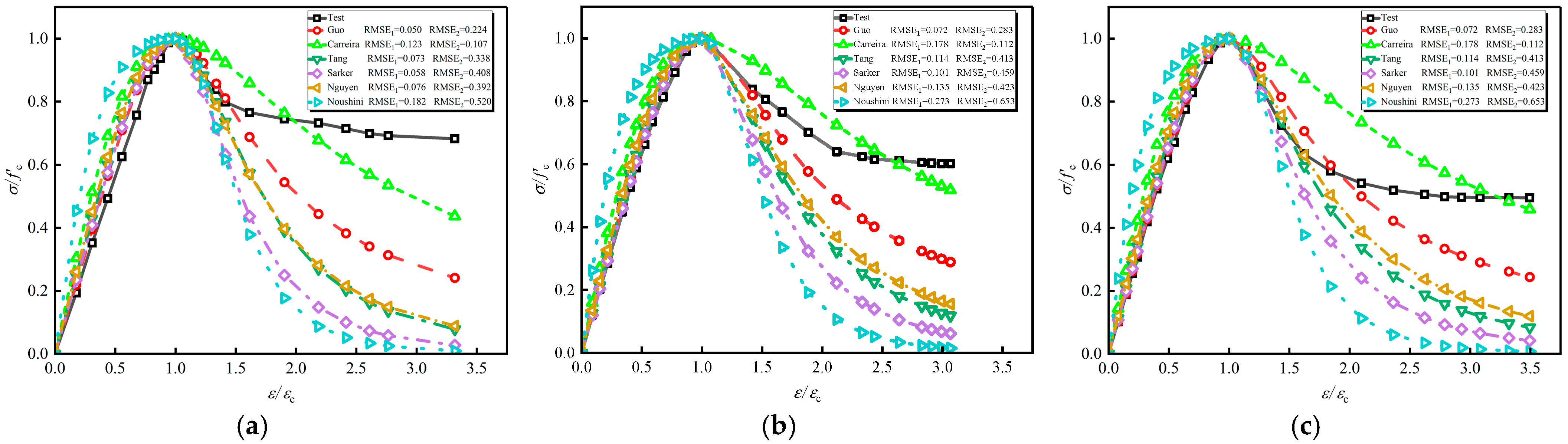
Figure 6 shows a comparison between the predicted results of the classic constitutive model and the test curves of the FSWGC. The ascending stage of the test curves is highly consistent with the predicted results of the Guo model. However, in the descending stage of the test curves, there are significant differences between each model and the experimental results. Among these models, the Carreira model shows a relatively better fitting effect, followed by the Guo model. In contrast, the fitting results of the other models do not match the test curves as well. The significant differences between the descending segments of the test curves in Figure 6 and the prediction results of some classic models are mainly due to the fact that FSWGC contains dual porous aggregates, which makes its interfacial transition zone more complex than that of ordinary concrete or single-aggregate geopolymer concrete. Classic models are established based on non-porous natural aggregates, thus failing to consider the internal water migration and stress concentration at the dual-aggregate interfaces during compression.

4.2. Model Revision

From the test results of the classical constitutive model, it can be seen that, due to the material characteristics of the FSWGC the uniaxial compressive stress–strain full curve is different from that of existing concrete materials. The above six models cannot accurately apply when predicting its constitutive relationship curve. Therefore, the Guo model, which has slightly better overall applicability, is selected for parameter correction as it is suitable for FSWGC. The expression of the corrected model is as shown in Equations (1) and (2):
Ascending phase:
y = a x + 3 2 a x 2 + a 2 x 3
Descending phase:
y = x b ( x 1 ) 2 + x
For each of the test groups of FSWGC, the elastic modulus, tangent modulus correction parameter a, and the axial compressive strength correction parameter b were selected. Through regression analysis, the correction parameter results are as shown in Equations (3) and (4):
a = 2.857 E c / E p + 4.936
b = 0.323 f c 0.795 + 6.336
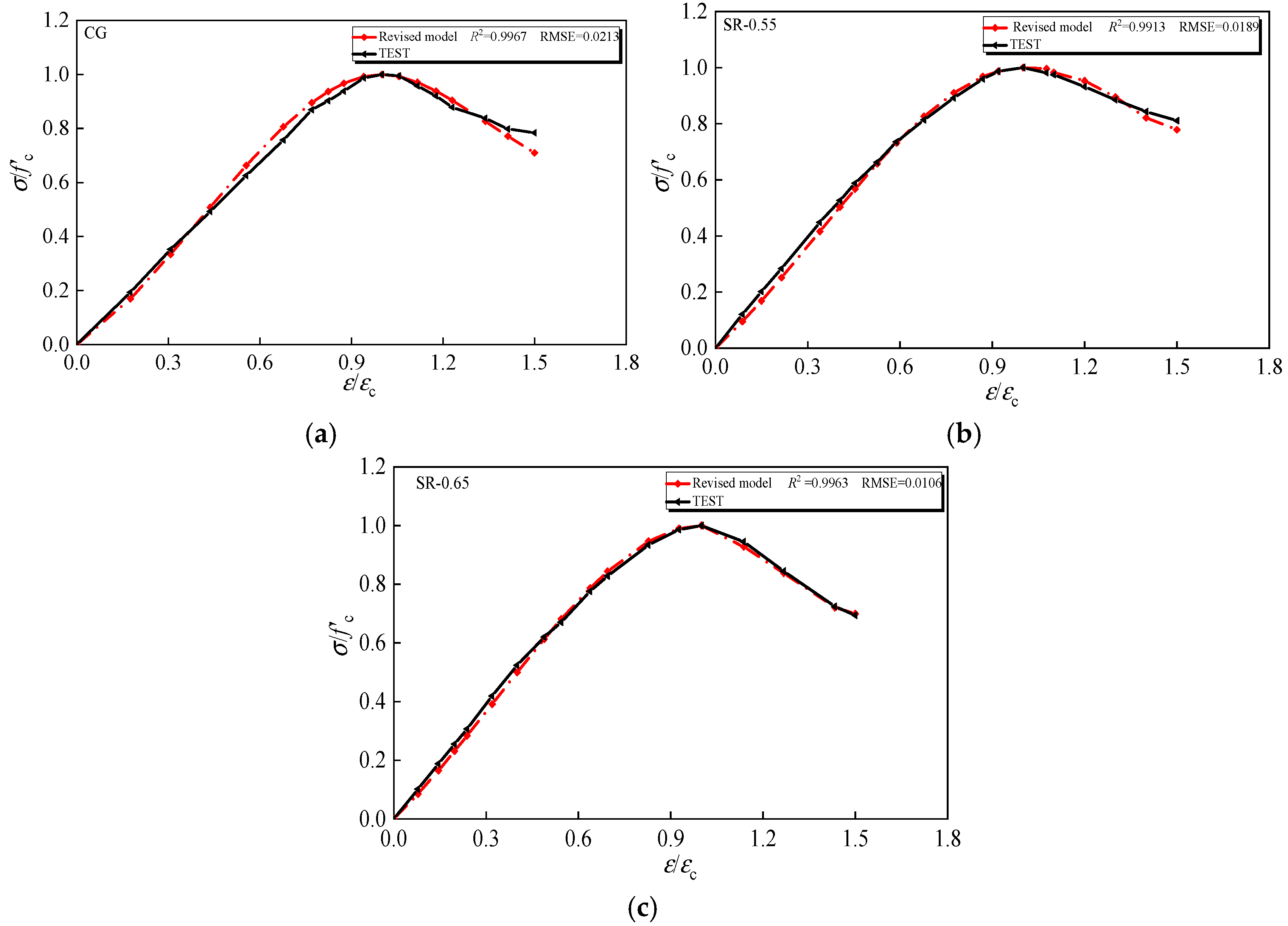
The predicted curve and the test curve after modifying the model parameters are shown in Figure 7. The predicted curve is highly consistent with the test curve, and it can accurately describe the stress–strain relationship of the unbound FSWGC under uniaxial compression.

4.3. The Constitutive Curve Considering Freeze–Thaw Cycles

The stress–strain curves under uniaxial compression under freeze–thaw cycles were subjected to dimensionless processing. The piecewise function curve proposed by Guo was selected. The stress–strain curve models under 25, 50, and 75 freeze–thaw cycles were obtained, respectively. Based on the parameters a and b, and in accordance with the relationships between these parameters and the elastic modulus, the tangent modulus, and the axial compressive strength, they were corrected. Through regression analysis, the calculation formulas for each parameter are determined as follows.
Under the condition of n freeze–thaw cycles, the calculation formulas for parameters a and b are shown in Equations (5) and (6):
a = α 1 E c / E p + α 2
b = β 1 f c 0.795 + β 2
The coefficients of the calculation formulas for the parameters a and b of the Guo model under different numbers of freeze–thaw cycles are shown in Table 13.
For the calculation formulas of parameters a and b in the Guo model, the coefficients were fitted for different numbers of freeze–thaw cycles, as shown in Equations (7)–(10). In this formula, N represents the number of freeze–thaw cycles. It can be observed that the R2 values in the fitted formula are all greater than 0.98, indicating that this fitted formula has a good predictive effect.
α 1 = 2 × 10 6 N 3 + 1.175 × 10 3 N 2 7.05 × 10 2 N 2.857   ( R 2 = 0.999 )
α 2 = 3 × 10 5 N 3 + 1.53 × 10 3 N 2 8.2 × 10 2 N + 4.933   ( R 2 = 0.999 )
β 1 = 4 × 10 7 N 3 1.43 × 10 4 N 2 + 8.43 × 10 3 N 0.323   ( R 2 = 0.994 )
β 2 = 4 × 10 6 N 3 1.92 × 10 3 N 2 + 0.129 N + 6.336   ( R 2 = 0.987 )

5. Conclusions

This study systematically explores the influence of sand ratio on the freeze–thaw performance and mechanical behavior of full solid waste geopolymer concrete (FSWGC) and establishes targeted constitutive models. The key conclusions are as follows:
(1) Sand ratio is a critical factor regulating FSWGC’s freeze–thaw damage, with higher ratios significantly aggravating deterioration. The core mechanism lies in insufficient binder wrapping of recycled sand, forming a weak interfacial transition zone (ITZ) that accelerates crack propagation under freeze–thaw cycles. After 100 cycles, the 0.65 sand ratio specimen exhibits a mass loss rate of 4.61% and severe surface spalling, far worse than the 0.45 sand ratio specimen.
(2) Higher sand ratios accelerate the attenuation of relative dynamic elastic modulus (RDEM) and mechanical strengths. After 100 freeze–thaw cycles, the RDEM of the 0.65 sand ratio specimen drops to 34.4% of the initial value, and its flexural strength loss rate reaches 59.3%, reflecting the high sensitivity of ITZ-dependent performance to sand ratio.
(3) High sand ratios worsen FSWGC’s axial compression performance, characterized by reduced peak stress, increased peak strain, and enhanced brittleness. After 75 cycles, the 0.65 sand ratio specimen’s peak stress and elastic modulus decrease by 39.0% and 65.63%, respectively, indicating inferior load-bearing capacity compared to low sand ratio specimens.
(4) The modified Guo constitutive model and the freeze–thaw cycle-dependent extension accurately describe FSWGC’s stress–strain behavior, solving the prediction deviation of traditional models. These models incorporate dual-aggregate ITZ damage effects, providing reliable theoretical tools for cold-region FSWGC structural design.

Author Contributions

Conceptualization, T.Q. and Y.W.; methodology, Y.W.; validation, T.Q., X.Y. and J.Z.; formal analysis, X.G.; investigation, T.Q.; resources, X.L.; data curation, Y.W.; writing—original draft preparation, Y.W.; writing—review and editing, X.L.; visualization, X.G.; supervision, J.Z.; funding acquisition, T.Q. and X.L. All authors have read and agreed to the published version of the manuscript.

Funding

This research was funded by The “Scientists + Engineers” Team Construction Project of QinChuangYuan in Shaanxi Province, grant number 2025QCY-KXJ-091; Shaanxi Province Key Research and Development Program, grant number 2025CY-YBXM-451, 2024GX-YBXM-177.

Data Availability Statement

The data presented in this study are available on request from the corresponding author.

Conflicts of Interest

Authors Tong Qiu, Xinzhuo Yang, Jian Zhou and Xuan Gao were employed by the company Northwest Engineering Corporation Limited. The remaining authors declare that the research was conducted in the absence of any commercial or financial relationships that could be construed as a potential conflict of interest.

References

  1. Al-Jabari, M. Concrete durability problems: Physicochemical and transport mechanisms. Integral Waterproofing Concr. Struct. 2022, 69–107. [Google Scholar] [CrossRef]
  2. Charalambidi, B.; Markou, P.; Drakakaki, A.; Oungrinis, K.A. Challenges on contemporary architectural technology on durability of reinforced concrete structures. Int. J. Struct. Integr. 2021, 12, 497–510. [Google Scholar] [CrossRef]
  3. Li, S.; Jiang, J.; Geng, Y.; Hu, J.; Sui, S.; Liu, A.; Hu, M.; Shan, Y.; Liu, Z. Application of silane protective materials in the concrete durability improvement in recent years: A review. Eng. Fail. Anal. 2024, 160, 108140. [Google Scholar] [CrossRef]
  4. Peng, R.X.; Qiu, W.L.; Jiang, M. Frost resistance performance assessment of concrete structures under multi-factor coupling in cold offshore environment. Build. Environ. 2022, 226, 109733. [Google Scholar] [CrossRef]
  5. Wu, X.; Zheng, S.; Feng, Z.; Chen, B.; Qin, Y.; Xu, W.; Liu, Y. Prediction of the frost resistance of high-performance concrete based on RF-REF: A hybrid prediction approach. Constr. Build. Mater. 2022, 333, 127132. [Google Scholar] [CrossRef]
  6. Yuan, S.; Li, K.; Luo, J.; Yin, W.; Chen, P.; Dong, J.; Liang, W.; Zhu, Z.; Tang, Z. Research on the frost resistance performance of fully recycled pervious concrete reinforced with fly ash and basalt fiber. J. Build. Eng. 2024, 86, 108792. [Google Scholar] [CrossRef]
  7. Das, S.; Saha, P.; Jena, S.P.; Panda, P. Geopolymer concrete: Sustainable green concrete for reduced greenhouse gas emission–A review. Mater. Today Proc. 2022, 60, 62–71. [Google Scholar] [CrossRef]
  8. Raijiwala, D.B.; Patil, H.S. Geopolymer concrete A green concrete. In Proceedings of the 2010 2nd International Conference on Chemical, Biological and Environmental Engineering, Cairo, Egypt, 2–4 November 2010; pp. 202–206. [Google Scholar]
  9. Shehata, N.; Mohamed, O.A.; Sayed, E.T.; Abdelkareem, M.A.; Olabi, A.G. Geopolymer concrete as green building materials: Recent applications, sustainable development and circular economy potentials. Sci. Total Environ. 2022, 836, 155577. [Google Scholar] [CrossRef]
  10. Ma, Q.; Duan, Z.; Wang, J.; Yin, G.; Li, X. Frost resistance and improvement techniques of recycled concrete: A comprehensive review. Front. Mater. 2024, 11, 1493191. [Google Scholar] [CrossRef]
  11. Zhang, T.; Cui, J.; Chen, M.; Yang, J.; Yan, Z.; Zhang, M. Durability of concrete containing carbonated recycled aggregates: A comprehensive review. Cem. Concr. Compos. 2025, 156, 105865. [Google Scholar] [CrossRef]
  12. Gong, L.; Bu, Y.; Xu, T.; Zhao, X.; Yu, X.; Liang, Y. Research on freeze resistance and life prediction of Desert sand–Crushed stone fine aggregate concrete. Case Stud. Constr. Mater. 2024, 21, e03896. [Google Scholar] [CrossRef]
  13. Wang, Y.; Chen, B.; Liu, N.; Jiang, Z. Utilization of waste phosphogypsum in high-strength geopolymer concrete: Performance optimization and mechanistic exploration. J. Build. Eng. 2024, 98, 111253. [Google Scholar] [CrossRef]
  14. Zailani, W.W.A.; Apandi, N.M.; Adesina, A.; Alengaram, U.J.; Faris, M.A.; Tahir, M.F.M. Physico-mechanical properties of geopolymer mortars for repair applications: Impact of binder to sand ratio. Constr. Build. Mater. 2024, 412, 134721. [Google Scholar] [CrossRef]
  15. Zhang, R.; Li, Z.; Ji, F.; Li, Y.; Li, G.; Zhou, Y.; Zhang, H. Performance study and life prediction of desert sand concrete under chloride salt erosion and freeze-thaw cycle. J. Build. Eng. 2025, 111, 113135. [Google Scholar] [CrossRef]
  16. Zhang, P.; Su, J.; Gao, Z.; Zhang, T.; Zhang, P. Effect of sand–precursor ratio on mechanical properties and durability of geopolymer mortar with manufactured sand. Rev. Adv. Mater. Sci. 2024, 63, 20230170. [Google Scholar] [CrossRef]
  17. Kim, G.W.; Oh, T.; Lee, S.K.; Banthia, N.; Yoo, D.-Y. Development of Ca-rich slag-based ultra-high-performance fiber-reinforced geopolymer concrete (UHP-FRGC): Effect of sand-to-binder ratio. Constr. Build. Mater. 2023, 370, 130630. [Google Scholar] [CrossRef]
  18. Nguyen, K.T.; Le, T.A.; Lee, K. Evaluation of the mechanical properties of sea sand-based geopolymer concrete and the corrosion of embedded steel bar. Constr. Build. Mater. 2018, 169, 462–472. [Google Scholar] [CrossRef]
  19. Li, B.; Chen, Z.; Wang, S.; Xu, L. A review on the damage behavior and constitutive model of fiber reinforced concrete at ambient temperature. Constr. Build. Mater. 2024, 412, 134919. [Google Scholar] [CrossRef]
  20. Yan, L.; Chen, L.; Chen, B.; Fang, Q. Analysis and evaluation of suitability of high-pressure dynamic constitutive model for concrete under blast and impact loading. Int. J. Impact Eng. 2025, 195, 105145. [Google Scholar] [CrossRef]
  21. Wang, C.; Yuan, J.; Zhang, Y.; Ma, Z. Study on the mesoscopic mechanical behavior and damage constitutive model of micro-steel fiber reinforced recycled aggregate concrete. Constr. Build. Mater. 2024, 443, 137767. [Google Scholar] [CrossRef]
  22. Ren, P.; Zhang, W.; Ye, X.; Liu, X. Mechanical properties and constitutive model of geopolymer lightweight aggregate concrete. Buildings 2024, 15, 98. [Google Scholar] [CrossRef]
  23. Yan, T.; Yin, X.; Zhang, X. Impact toughness and dynamic constitutive model of geopolymer concrete after water saturation. Sci. Rep. 2024, 14, 7117. [Google Scholar] [CrossRef] [PubMed]
  24. Zimei, L.; Xueliang, G.; Cairong, L.; Zhengnan, Z.; Yuwei, D.; Haiyan, X. Research progress on freeze–thaw constitutive model of concrete based on damage mechanics. Sci. Eng. Compos. Mater. 2024, 31, 20240020. [Google Scholar] [CrossRef]
  25. Zheng, J.; Qi, L.; Zheng, Y.; Zheng, L. Mechanical properties and compressive constitutive model of steel fiber-reinforced geopolymer concrete. J. Build. Eng. 2023, 80, 108161. [Google Scholar] [CrossRef]
  26. Nematollahi, B.; Qiu, J.; Yang, E.H.; Sanjayan, J. Micromechanics constitutive modelling and optimization of strain hardening geopolymer composite. Ceram. Int. 2017, 43, 5999–6007. [Google Scholar] [CrossRef]
  27. Xu, L.; Wang, J.; Hu, X.; Ran, B.; Wu, T.; Zhou, X.; Xiong, Y. Physical performance, durability, and carbon emissions of recycled cement concrete and fully recycled concrete. Constr. Build. Mater. 2024, 447, 138128. [Google Scholar] [CrossRef]
  28. GB/T 50082-2009; Standard for Test Methods of Long-Term Performance and Durability of Ordinary Concrete. Construction Industry Press: Beijing, China, 2008.
  29. GB/T 50081-2019; Standard for Test Methods of Concrete Physical and Mechanical Properties. Construction Industry Press: Beijing, China, 2018.
  30. Yang, W.; Huang, Y.; Li, C.; Tang, Z.; Quan, W.; Xiong, X. Damage prediction and long-term cost performance analysis of glass fiber recycled concrete under freeze-thaw cycles. Case Stud. Constr. Mater. 2024, 21, e03795. [Google Scholar] [CrossRef]
  31. Ma, F.; Zhang, Y.; Qiao, H.; Liu, H.; Zhang, L. Analysis of damage models and mechanisms of mechanical sand concrete under composite salt freeze–thaw cycles. Constr. Build. Mater. 2024, 429, 136311. [Google Scholar] [CrossRef]
  32. Guo, Z. Principles of Reinforced Concrete; Tsinghua University Press: Beijing, China, 2013. [Google Scholar]
  33. Carreira, D.; Chu, K. Stress-strain relationship for plain concrete in compression. J. Am. Concr. Inst. 1985, 82, 797–804. [Google Scholar]
  34. Tang, Z.; Hu, Y.; Tam, V.; Li, W. Uniaxial compressive behaviors of fly ash/slag-based geopolymer concrete with recycled aggregates. Cem. Concr. Compos. 2019, 104, 103375. [Google Scholar] [CrossRef]
  35. Wu, Z.; Lian, H. High-Performance Concrete; Railway Publishing House: Beijing, China, 1999. [Google Scholar]
  36. Sarker, P. A constitutive model for fly ash-based geopolymer concrete. Archit. Civ. Eng. Environ. 2008, 1, 113–120. [Google Scholar]
  37. Nguyen, K.; Ahn, N.; Le, T. Theoretical and experimental study on mechanical properties and flexural strength of fly ash-geopolymer concrete. Constr. Build. Mater. 2016, 106, 65–77. [Google Scholar] [CrossRef]
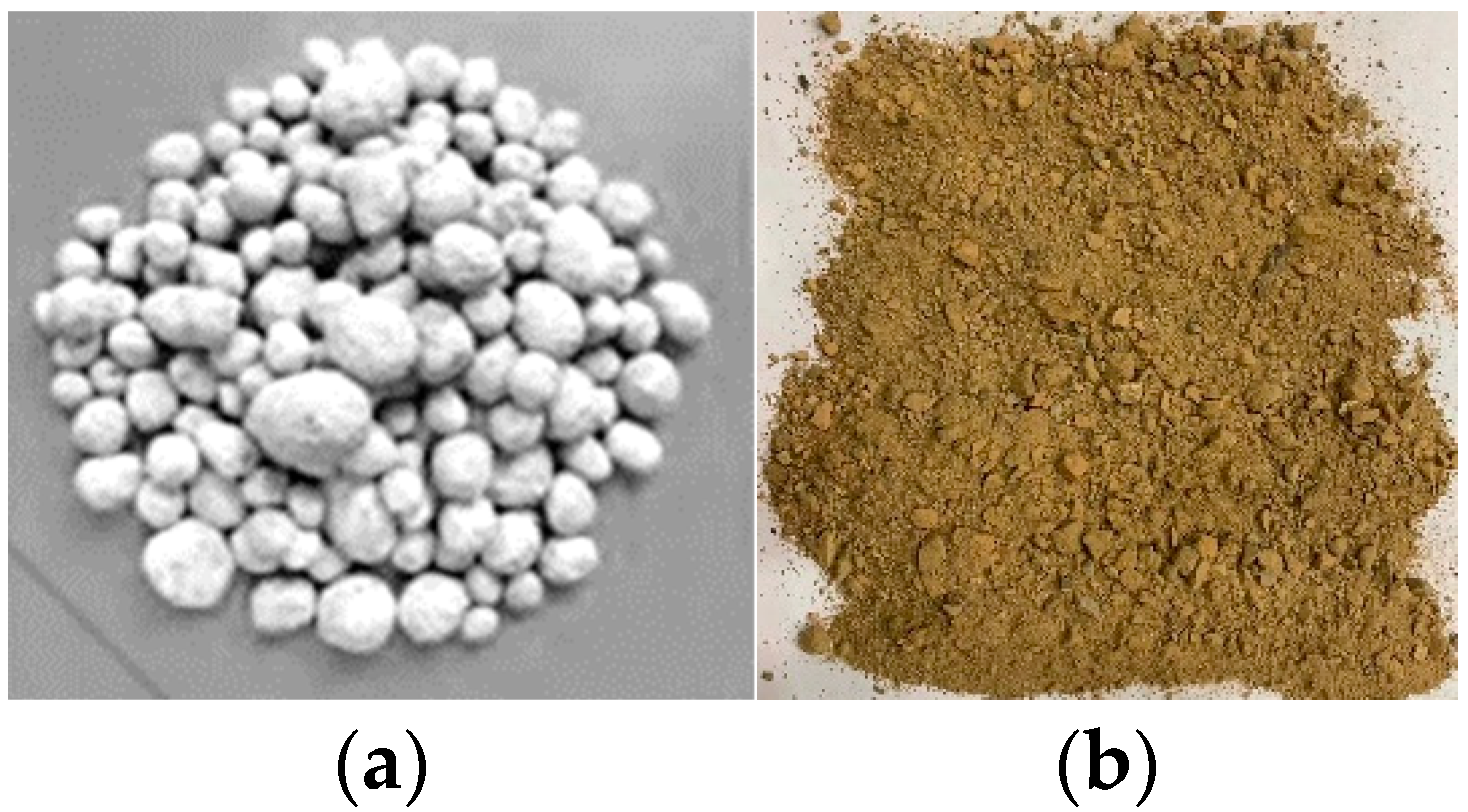
Figure 1. Aggregates used in the test. (a) CBGLAs. (b) Recycled sand.
Buildings 16 00076 g001
Figure 2. Morphological damage. (a) SR-0.45. (b) SR-0.55. (c) SR-0.65.
Buildings 16 00076 g002
Figure 3. Compressive strength and loss rate.
Buildings 16 00076 g003
Figure 4. Splitting tensile and flexural strength.
Buildings 16 00076 g004
Figure 5. Stress–strain curve. (a) SR-0.45. (b) SR-0.55. (c) SR-0.65.
Buildings 16 00076 g005
Figure 6. Model comparison. (a) SR-0.45; (b) SR-0.55; (c) SR-0.65.
Buildings 16 00076 g006
Figure 7. Model revision. (a) SR-0.45; (b) SR-0.55; (c) SR-0.65.
Buildings 16 00076 g007
Table 1. Properties of aggregates.
MaterialsParticle Size
/mm
Bulk Density
/kg·m3
Cylinder Pressure Strength
/MPa
Apparent Density
/kg·m3
1 h Water Absorption
/%
CBGLAs5–15102512.4818379.6
Recycled sand0.15–4.751130-265011.2
Table 2. Chemical compositions of binders (wt/%).
MaterialsSiO2Al2O3Fe2O3CaOK2OMgO
F-class fly ash54.0628.264.526.271.841.29
S95-grade slag32.0815.130.4738.610.438.45
SF88-grade silica fume90.930.803.010.581.051.08
Table 3. Mix proportions of FSWGC (kg/m3).
SampleSlag Fly Ash Silica Fume Recycled Sand Lightweight Aggregate Activator Solution Water Water Reducer
SR-0.45197219226267651645511
SR-0.55226252257195881896313
SR-0.65252281288014322107015
Table 4. Mass loss and morphological damage of specimens with different sand ratios.
SampleMass Loss/%Surface Damage Feature
25 Cycles50 Cycles75 Cycles100 Cycles
SR-0.450.460.901.592.70Slight spalling, smooth surface
SR-0.551.282.032.532.98Local flaking, visible micro-cracks
SR-0.652.773.63.974.61Severe spalling, exposed aggregate
Table 5. Relative dynamic elastic modulus (%).
Sample25 Cycles50 Cycles75 Cycles100 Cycles
SR-0.459287.274.259.5
SR-0.5589.684.167.155.2
SR-0.6583.168.942.934.4
Table 6. Compressive strength under different numbers of cycles (MPa).
Sample0 Cycles25 Cycles50 Cycles75 Cycles100 Cycles
SR-0.4546.0844.2142.3536.8727.53
SR-0.5543.4840.3738.6934.3726.69
SR-0.6541.9237.1433.9629.8525.84
Table 7. Splitting tensile and flexural strength under different numbers of cycles (MPa).
SampleSplitting Tensile StrengthFlexural Strength
0 Cycles25 Cycles50 Cycles75 Cycles100 Cycles0 Cycles25 Cycles50 Cycles75 Cycles100 Cycles
SR-0.453.122.862.662.241.866.245.204.543.993.35
SR-0.552.982.832.492.141.846.095.164.343.613.01
SR-0.652.642.531.961.771.695.945.124.273.422.42
Table 8. The characteristic values of the curve after 0 freeze–thaw cycles.
Samplefc/MPaεc/(×10−3)ε0.85/(×10−3)Ec/GPaEp/GPa
SR-0.4538.342.333.0618.8716.45
SR-0.5535.412.723.7717.9213.02
SR-0.6534.902.763.4915.9612.65
Table 9. The characteristic values of the curve after 25 freeze–thaw cycles.
Samplefc/MPaεc/(×10−3)ε0.85/(×10−3)Ec/GPaEp/GPa
SR-0.4536.032.473.3216.4214.61
SR-0.5532.463.034.1111.0710.73
SR-0.6529.602.783.6912.4110.64
Table 10. The characteristic values of the curve after 50 freeze–thaw cycles.
Samplefc/MPaεc/(×10−3)ε0.85/(×10−3)Ec/GPaEp/GPa
SR-0.4533.372.723.4314.4912.28
SR-0.5528.563.344.228.948.55
SR-0.6525.573.105.018.768.25
Table 11. The characteristic values of the curve after 75 freeze–thaw cycles.
Samplefc/MPaεc/(×10−3)ε0.85/(×10−3)Ec/GPaEp/GPa
SR-0.4526.992.793.7311.589.66
SR-0.5523.173.654.936.466.34
SR-0.6521.284.435.985.484.80
Table 12. Typical constitutive model.
ModelFormulaFeature PointsKey Parameters
Guo [32]Ascending phase:
y = a x + 3 2 a x 2 + a 2 x 3
Descending phase:
y = x b x 1 2 + x
——a = Ec/Ep;
Parameter b is determined based on the concrete grade and the constraint method.
Carreira [33] y = β x β 1 + x β E c = 10,200 f c 1 / 3 ε c = 0.71 f c + 168 × 10 5 x = ε / ε c , y = f c / f c
β = 1 / 1 f c / ε c E c
Tang [34] y = β x β 1 + x k β E c = 2977 f c 0.474 ε c = 2.35 f c 0.45 E c 0.86 β = 1.515 + 0.051 f c ,
Ascending phase: k = 1
Descending phase: k = 1.592 + f c 15 / β
Sarker [35] y = β x β 1 + x k β E c = 2077 f c + 5300 ε c = f c E c β β 1 β = 0.8 + f c 12 ,
Ascending phase: k = 1
Descending phase: k = 0.67 + f c 62
Nguyen [36] y = β x β 1 + x k β E c = 2077 f c + 5300 ε c = f c E c β β 1 β = 0.8 + f c 17 ,
Ascending phase: k = 1
Descending phase: k = 0.67 + f c 62
Noushini [37] y = β x β 1 + x β E c = 4712 f c 11400 ε c = 2.23 × 10 7 E c 1.74 f c 1.98 β = 0.8 + f c 17 ,
Ascending phase: β 1 = 1.02 1.17 E sec E c 0.45
Descending phase: β = β 1 + ϖ + 28 × ς
E sec = f c ε c ς = 0.83 exp 911 f c
ϖ = 7 × 12.4 0.015 f c 0.5
Table 13. Parameter calculation.
Number of Cyclesα1α2β1β2
0−2.8574.933−0.3236.336
25−3.9214.031−0.2104.066
50−3.7253.948−0.0291.224
75−2.4782.7850.147−0.440
Disclaimer/Publisher’s Note: The statements, opinions and data contained in all publications are solely those of the individual author(s) and contributor(s) and not of MDPI and/or the editor(s). MDPI and/or the editor(s) disclaim responsibility for any injury to people or property resulting from any ideas, methods, instructions or products referred to in the content.