Article

When Sound Helps or Hurts: Behavioral and EEG Evidence on the Dual Effects of Indoor Acoustic Environments on Office Work Performance


1
Department of Management Science and Engineering, School of Management, Shanghai University, Shanghai 200444, China
2
Department of Business Administration, School of Management, Shanghai University, Shanghai 200444, China
3
Department of Building Environment and Energy Engineering, The Hong Kong Polytechnic University, Hong Kong 999077, China
4
Shanghai Research Institute of Building Science Co., Ltd., Shanghai 201108, China
*
Author to whom correspondence should be addressed.
Buildings 2026, 16(1), 69; https://doi.org/10.3390/buildings16010069
Submission received: 18 November 2025 / Revised: 11 December 2025 / Accepted: 22 December 2025 / Published: 23 December 2025
(This article belongs to the Section Building Energy, Physics, Environment, and Systems)

Abstract

Prolonged exposure to acoustic environments in office settings may impair employees’ cognitive performance, yet the underlying mechanisms remain contested. This study investigated the dual effects of acoustic intensity and sound type on employees’ performance by integrating behavioral measures, subjective assessments, and neurophysiological evidence. Results demonstrated significant interaction effects: while increasing levels of office noise and music generally impaired accuracy and efficiency, dialog at moderate-to-high intensities (65 dBA and 85 dBA) significantly shortened reaction times compared to the low-intensity condition (45 dBA). Mediation analyses reconciled these patterns by revealing distinct psychological pathways: Tension-Anxiety fully mediated the performance decrement under noise. In contrast, Tension-Anxiety and Anger-Hostility served as partial mediators (29.71%) and suppressors (40.01%) in the relationship between dialog intensity and performance index. Mental workload fully mediated the performance benefits of moderate intensity music. Electroencephalography (EEG) analyses further corroborated the behavioral findings, identifying neurophysiological pathways through which acoustic exposure influenced performance. This study integrated behavioral and neural approaches to provide empirical evidence for optimizing indoor acoustic environments that promote health, comfort, and productivity.

1. Introduction

1.1. Background and Motivation

Acoustic conditions in offices are a key determinant of employee health and productivity, with people spending roughly 80–90% of their time indoors [1,2]. Sound permeates these spaces through transportation noise, ventilation systems, and human speech, forming an omnipresent anthropogenic soundscape whose effects extend well beyond human occupants to disrupt avian and marine mammal communication, migration, and reproduction [3]. The World Health Organization’s synthesis of large-scale epidemiological studies concludes that chronic exposure to indoor environmental noise is associated with auditory fatigue, elevated stress biomarkers, and diminished cognitive performance [2]. A multitask study showed that raising ventilation or traffic noise from 50 to 65 dBA reduced spatial-memory accuracy by 4.4% and slowed reaction times [4], while longitudinal data from office relocations revealed a doubling of self-reported productivity loss attributable to increased noise and reduced speech privacy [5]. Prolonged noise exposure has been linked to auditory harm, heightened stress, and cognitive impairment [6]. Yet, despite extensive inquiry, the cognitive mechanisms by which indoor soundscapes shape work performance remain contested. Clarifying these mechanisms is therefore essential for evidence-based design of healthier and more efficient workplaces.

1.2. Literature Insights on Impact of Acoustic Intensity and Sound Types on Work Performance

Various indoor acoustic environments may have varying effects on the work performance of office employees. Existing research reported conflicting findings on acoustic impacts, often attributed to variations in sound intensity and source type. Moderate sound levels are sometimes associated with improved engagement or creativity, whereas higher sound pressure levels (SPLs) typically degrade attention and task performance [7,8,9]. For instance, Jafari et al. [10] revealed a substantial reduction in mental workload and auditory attention among participants exposed to 95 dBA noise levels. This evidence underscores the necessity of incorporating elevated sound pressure levels into research parameters to comprehensively assess psychophysiological effects. Real-world office-like environments can reach or exceed 85 dBA—for example, underground logistical hubs or temporary construction-site offices—creating complex, high-intensity soundscapes [11,12], These observations motivate examining a realistic SPL range (e.g., 45, 65, 85 dBA) within controlled experiments.
Sound type also matters. In offices, music, dialog, and office noise are common components of the indoor acoustic environment [4,13]. Music has been shown to reduce mind-wandering and sustain attention in low-demand tasks [14,15], but high variability or inappropriate intensity can disrupt recall or continuous processing [16]. Some studies even report negligible detriments to performance or neural measures under background music [17,18,19]. Dialog (such as conversations and laughter among coworkers) and office noise (such as telephone calls) frequently induce annoyance and reduce performance and well-being indicators [20]. Taken together, prior results imply that intensity and type interact, so a unified, factorial framework is needed to resolve inconsistencies and map main and interaction effects on performance.
To address the issue of inconsistency, it is imperative to examine the impact of sound intensity on the work performance of office employees within a unified research framework. From a theoretical perspective, employing a fully controlled simulation with multiple parameters, three sound pressure levels, and three source types allows for systematic, factorial investigation of both main and interaction effects on emotion, cognition, and performance. Such parametric designs yield richer models of auditory distraction than single-factor field studies. From a practical standpoint, different office environments vary widely in acoustic profiles. For example, underground logistics hubs commonly register peak noise levels above 85 dBA, and temporary construction-site offices routinely exceed 85 dBA during heavy machinery operation [21]. These complex, high-intensity real-world conditions justify our choice of 45, 65, and 85 dBA and the inclusion of dialog, music, and noise to capture an ecologically valid range of office soundscapes.

1.3. Role of Emotional States and Mental Workload

Emotion–cognition interaction theory posits that environmental stimuli concurrently modulate emotional states and cognitive processing in a bidirectional manner [22]. Within the office context, emotional states [23] and mental workload [24] have been consistently identified as proximal determinants of work performance. Rather than acting in isolation, these two constructs often function as mediators through which acoustic conditions exert their effects on behavioral outcomes.
Empirical evidence substantiates this mediating role. Dolcos et al. [25] demonstrate that task-irrelevant emotional sounds increase amygdala reactivity while reducing dorsolateral prefrontal activation required for working-memory maintenance, providing a neural route by which negative affect depletes executive resources. Similarly, Fan et al. [26] show that incremental increases in sound pressure levels are associated with elevated heart-rate variability and EEG theta power, markers of autonomic stress, and with longer response times. Mediation analyses in their study indicate that subjective workload statistically transmits the negative effect of sound intensity on performance. Sun et al. [27] further demonstrate that this pathway is moderated by perceived dominance, such that sound intensity impairs auditory recall accuracy primarily when participants report low control. Extending the ecological validity of these mechanisms, Yan et al. [28] find that visual landscape elements influence thermal comfort ratings via pleasure and dominance dimensions, underscoring the cross-modal generality of dimensional emotion mediators. Finally, Fiebig et al. [29] highlight that individual differences in noise sensitivity and momentary affective intensity amplify these pathways, reinforcing the need to measure rather than merely control emotional states and perceived workload.
Taken together, these convergent findings indicate that the impact of office soundscapes on work performance is substantially channeled through emotional states and mental workload. By explicitly modeling both constructs as mediators, our design moves beyond documenting performance decrements to elucidating the affective and cognitive mechanisms through which acoustic stressors produce observable inefficiencies in everyday office tasks.

1.4. Neurocognitive Rationale for Employing EEG in Acoustic Environment Research

Traditional investigations on office acoustic environments have primarily relied on behavioral measures (e.g., task performance, error rates) and self-reported assessments of annoyance or concentration [30]. While these methods have generated valuable findings, they suffer from limitations such as subjective bias, post hoc rationalization, and an inability to capture the dynamic neurocognitive processes underlying performance variation [31]. Consequently, an objective and temporally sensitive methodology is required to uncover how different acoustic environments influence cognition and work outcomes in real time.
With the recent advancements in neurobehavioral research, electroencephalography (EEG) has become an established method for detecting and evaluating brain activity [32,33]. As a non-invasive neural monitoring technique, it offers considerable promise for tracking physiological states in office settings, including alertness, distraction, emotional responses, stress, and mental workload [34,35,36,37]. Empirical studies have shown that oscillatory activity in specific frequency bands serves as a reliable biomarker of cognitive and affective responses to environmental stimuli: increased theta power correlates with mental fatigue [38,39], suppressed alpha power reflects elevated attentional engagement [36,40], and enhanced beta power is associated with stress [41]. These neural signatures provide objective, quantifiable measures of neurophysiological states underlying human–environment interactions. This makes EEG particularly suitable for investigating how noise intensity and type alter neurocognitive functioning in office settings.
Integrating EEG with behavioral performance measures allows for a multi-level assessment of the “when noise helps or hurts” phenomenon. By linking objective neural markers with task outcomes, EEG not only reveals whether certain acoustic environments impair or enhance performance but also explains why these dual effects occur [34,37]. Crucially, integrating EEG with behavioral and self-report measures enables a multi-level, mechanistic analysis: EEG can reveal the proximal neural processes that accompany subjective workload and affective shifts, which in turn predict behavioral outcomes [38,39,40,41]. This contrasts with many prior acoustic-cognition studies that either lacked neural measures or did not test mediation pathways linking neural, subjective, and behavioral levels [30]. This neurocognitive perspective complements traditional experimental designs and provides novel empirical evidence for developing evidence-based strategies to optimize indoor acoustic environments for employee well-being and productivity.

1.5. Research Gaps and Objectives

Despite progress, the existing body of research exhibits several limitations: (1) the relationship between indoor acoustic environments and work performance has not been conclusively established across realistic ranges of sound pressure level and source type variability; (2) the interactive effects of sound pressure level and sound source type have rarely been tested in a systematic factorial design; (3) the mediating roles of emotional states and mental workload in linking acoustic parameters to performance outcomes require stronger, multi-level empirical support; and (4) EEG-based evidence in office acoustic studies is still limited and often disconnected from comprehensive behavioral and mediation analyses.
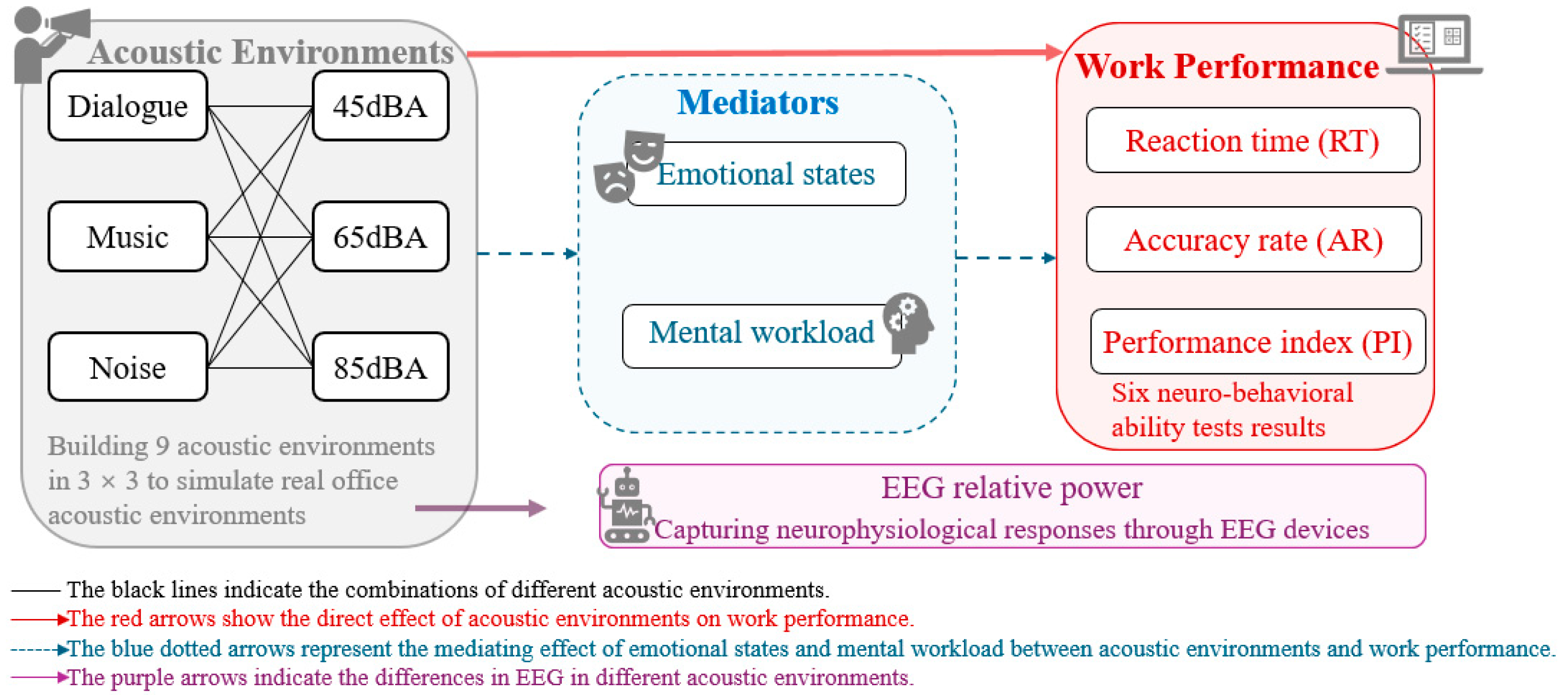
To address these gaps, we conducted a fully controlled 3 × 3 experiment using three SPLs (45, 65, 85 dBA) and three sound types (dialog, music, office noise) as illustrated in Figure 1. Work performance is evaluated across validated tasks tapping attention, memory, and executive function. Emotional states and mental workload are assessed via standardized instruments. Concurrent wearable EEG provides neural correlates of the behavioral effects. This study advances prior acoustic-cognition work in several ways. The study aims to investigate interactive effects of intensity and type on performance and examine whether emotions and workload mediate these relationships. By integrating behavioral performance, standardized self-report mediators, and concurrent EEG, we provide multi-level evidence that makes it possible to test mechanistic mediation chains rather than reporting isolated correlations. Finally, by combining explicit mediation and moderation tests with EEG indices, we aim to identify reproducible neuro-psychological pathways through which acoustic parameters influence performance, moving the field toward predictive and mechanistic explanations that can inform evidence-based indoor acoustic design. The findings may enhance our understanding of the broader effects of sound on ecological and behavioral dynamics, highlighting the importance of harmonizing human and environmental acoustics.

2. Materials and Methods

2.1. Experimental Framework

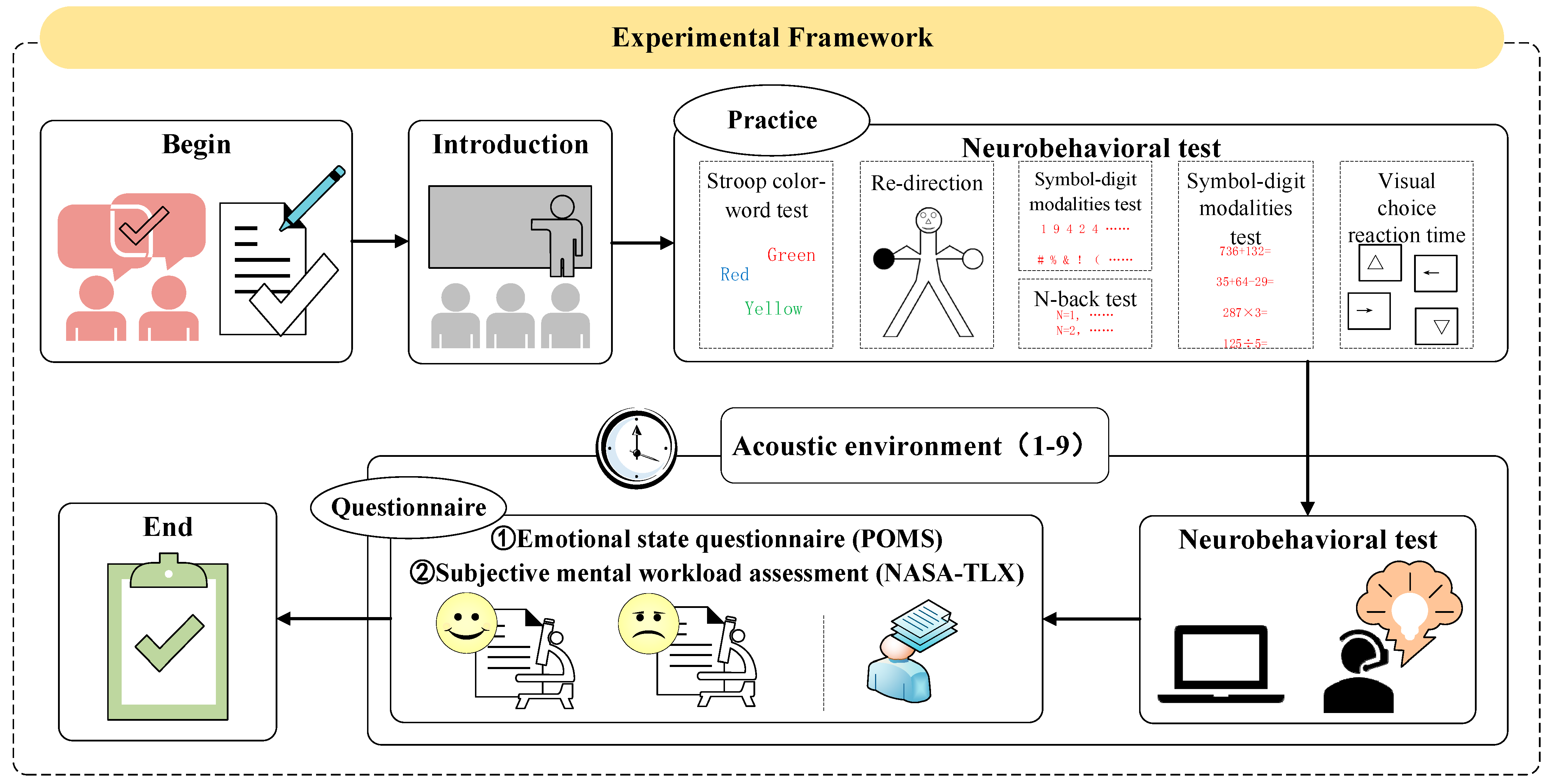
We systematically examined nine acoustic environments combining three sound types (dialog, music, office noise) with three SPLs (45, 65, 85 dBA) in a randomized, within-subjects design. The experimental framework is illustrated in Figure 2. This protocol was approved by the Science and Technology Ethics Committee of Shanghai University.
The experiment comprised two phases: (1) preparation: participants received detailed instructions and practice trials to familiarize themselves with the tasks; (2) testing: participants sequentially completed six neurobehavioral tests, the Profile of Mood States (POMS) questionnaire [42] for emotional states, and the Subjective Evaluation of Brain Load (NASA-TLX Brain Load Scale) [43] for mental workload assessment wearing EEG devices in each acoustic condition. Each 15–18 min test block was followed by a 10 min rest period to mitigate practice and fatigue effects.

2.2. Sound Materials

The experiment was conducted in a controlled office environment (dimensions: 12 m × 8 m × 3.5 m) with background noise maintained at 30 ± 2 dBA. Ambient conditions were regulated at 25 ± 2 °C and 40–60% relative humidity, with sessions conducted from 9:00 AM to 5:00 PM for consistent lighting. Dialog excerpts were selected from “Let’s Not Cause Trouble” performed in Mandarin with neural tone and steady cadence, excluding emotionally charged contents (e.g., laughter, punchlines) to simulate disruptive office conversations. The music selection was Mozart’s “Sonata for Two Pianos in D Major K448” for its structural clarity, emotional neutrality, and established used in cognitive studies [44]. Composite sounds (keyboard typing, mouse clicking, printer operation, phone rings, footsteps, etc.) represented typical office noise.
SPLs were adjusted using Adobe Audition and verified with a calibrated HS5628B sound level meter. Final levels were 45 ± 2.5 dBA, 65 ± 2.5 dBA, and 85 ± 2.5 dBA, delivered via computer speakers.

2.3. Neurobehavioral Test Materials

Cognitive performance was assessed using a computerized test battery developed in E-Prime 3.0 [45], evaluating three core functions that affect office employees’ work performance: attention, memory, and executive function. The test specifications are detailed in Table 1.
Each of the six neurobehavioral tests comprises 20 equally weighted items. Performance was evaluated using two primary metrics: response time (RT), measured as the interval from stimulus presentation to recorded response (in seconds), and accuracy rate (AR), calculated as the percentage of correct responses relative to total trails. Superior performance corresponds to higher AR and lower RT values. To comprehensively assess acoustic environment effects, a unified performance index (PI) was derived through geometric integration of AR and RT metrics, providing a holistic measure of behavioral efficacy. The calculation follows Equation (1) [49]:
P I = A R 0.5 × 1 R T 0.5 2 = A R R T   ,
where PI represents the performance index, AR represents the accuracy rate (%), and RT represents the response time (s).

2.4. Questionnaire Survey Materials

A series of structured questionnaire surveys, as detailed in Table 2, were administered to gather data on psychological responses. Following each experimental session, emotional states were assessed using the Profile of Mood States (POMS) [42], while mental workload was measured with the NASA Task Load Index (NASA-TLX) [43].

2.5. Participants and Apparatus

In total, 17 healthy participants (9 males, 8 females; age range 18–26 years, mean age = 24 years) were recruited based on power analysis principles for within-subject design [51,52]. Although the sample size was modest, the study utilized a rigorous repeated-measures design where each participant contributed data points across all acoustic conditions. This approach effectively controls for inter-individual variability and achieves higher statistical power compared to between-subjects designs. This sample size aligns with established auditory–cognitive studies (e.g., 10 [53], 12 [48], 24 [49]) and achieved adequate statistical power (ηp2 > 0.10 for key interactions). All participants were current graduate students with normal hearing and right-handedness (corrected visual acuity ≥ 1.0). Participants abstained from alcohol, caffeine, and nicotine for 12 h pre-test and confirmed stable emotional states. Auditory function was verified via online audiometry. Participants abstained from alcohol, caffeine, and nicotine for 12 h pre-test and confirmed stable emotional states. Auditory function was verified via online audiometry.
Physiological data were acquired using a 14-channel Emotiv EPOC X EEG headset (128 Hz sampling rate) positioned according to the 10–20 system. Sound exposure levels were measured with a calibrated HS5628B sound level. Participants maintained clean, product-free hair for optimal electrode contact and had no prior exposure to experimental tasks to prevent practice effects.
To minimize fatigue, habituation, and order effects given the multi-condition protocol, conditions and task sequences were randomized across participants using counterbalanced Latin-square blocks [54]. Significant rest breaks were scheduled between blocks (rest length = 10 min) to ensure cognitive recovery. Subjective fatigue was assessed repeatedly using POMS and NASA-TLX scales to allow post hoc control for fatigue in the statistical models.

2.6. EEG Data Process

(1)
Data preprocessing
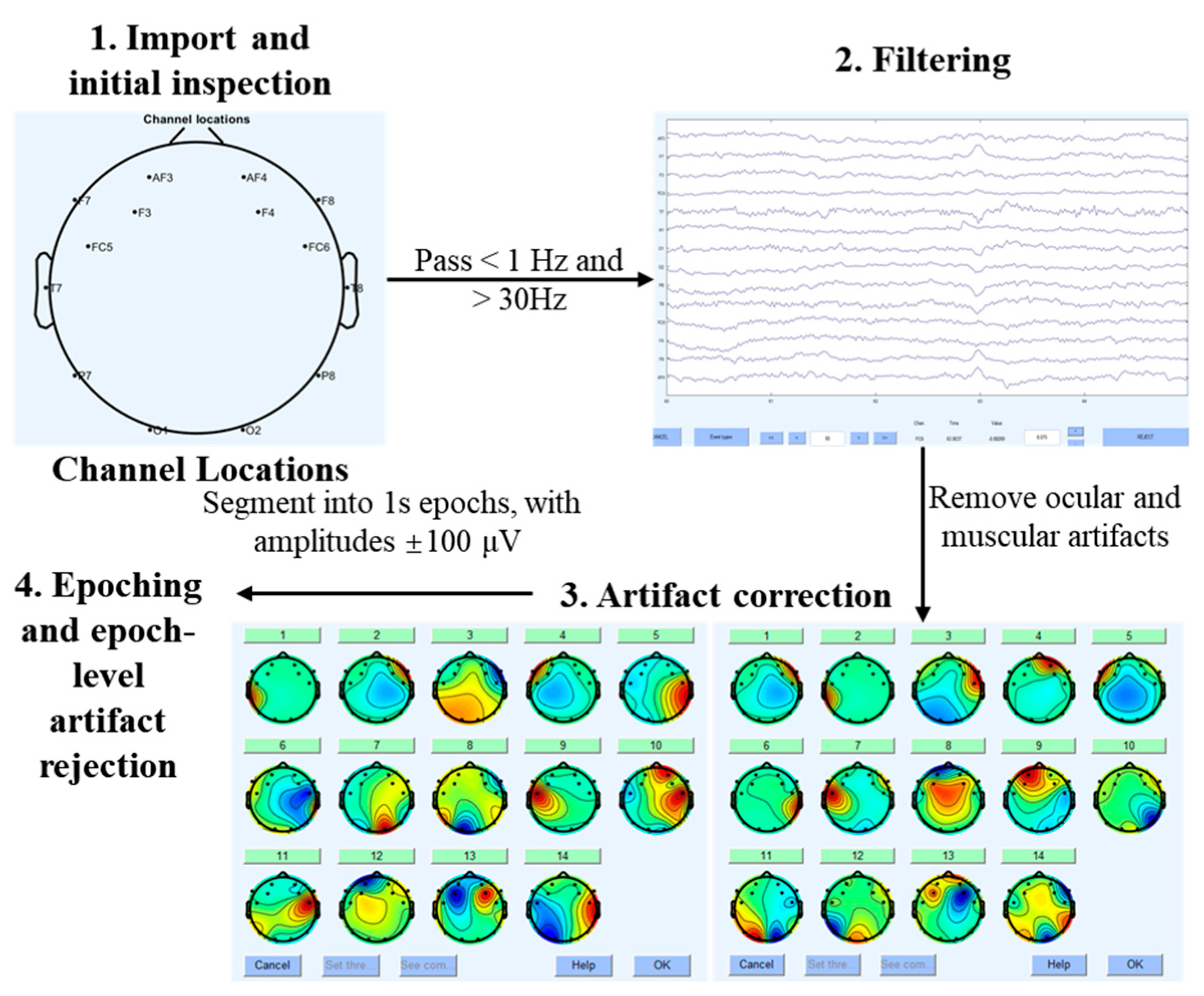
EEG signals, which serve as indicators of brain activity across various regions, are recorded from the scalp using wearable EEG devices [55]. However, due to their low amplitude in the microvolt (μV) range, these raw signals are highly susceptible to a wide range of endogenous and exogenous artifacts. Such contamination can compromise the extraction of meaningful neural features. To mitigate these challenges, our study employs the EEGLAB toolbox in MATLAB R2021a for preprocessing and analysis, as shown in Figure 3. First, a Hamming-windowed sinc finite impulse response filter was applied to the raw data, with a high-pass cutoff frequency set at 1 Hz to eliminate low-frequency drifts and physiological artifacts such as respiration and slow skin potential changes. A low-pass cutoff frequency of 30 Hz was used to remove high-frequency noise, including most eye-moving related artifacts. The frequency range of 4–45 Hz was selected as it sufficiently encompasses the primary neural rhythms involved in the cognitive domains under investigation. Specifically, theta (4–8 Hz), alpha (8–12 Hz), beta (12–30 Hz), and gamma (31–45 Hz) waves consistently link to core cognitive processes such as attention, working memory, and executive control [56]. Delta waves are usually associated with deep sleep, coma, or severe inhibitory states of the brain, and if the study focuses on cognitive responses to the acoustic environment in the waking state, their physiological relevance is low, and exclusion avoids the interference of non-target state EEG signals in the analysis [57]. Additionally, independent component analysis (ICA) was computed on the cleaned, interpolated, and filtered continuous data, and ADJUST was used to flag artifactual components (e.g., blinks, lateral eye movements, muscle movements). Each automatically flagged component was visually inspected and only components confirmed as non-brain were removed, minimizing the risk of over-correction while efficiently eliminating ocular and myogenic artifacts. Finally, the cleaned continuous signal was segmented into non-overlapping 1 s epochs for spectral analysis; epochs containing amplitudes beyond ±100 µV at any channel were excluded. This rigorous artifact rejection procedure resulted in the exclusion of approximately 8.9% of epochs, ensuring high data quality for subsequent analysis. This rejection rate is basically consistent with prior studies utilizing wearable EEG devices [58]. A total of 153 EEG data files were collected.
(2)
Feature extraction
Power spectral densities (PSDs) reveal activated sub-bands in EEG signals through energy distribution characteristics and can be used to evaluate an individual’s mental state [55]. The physical meaning of PSD is the energy per unit frequency, and the total energy in a certain frequency interval can be obtained by integrating the PSD over that interval. As previously mentioned, in the preprocessing stage of EEG signals, after removing internal and external artifacts, the processed 14-channel EEG signals are segmented into time periods representing generalized stationary characteristics, and the entire EEG signal is divided into time segments with a fixed window length of 1 s. The power spectral density of each frequency band is first estimated using the periodogram method. This method realizes the conversion from time-domain characteristics to frequency-domain features by directly performing Fast Fourier Transform (FFT) on a single signal segment and calculating its power spectrum. Specifically, for the i t h time segment, the 14-channel data sets at different moments t form a 14 × T dimensional matrix as follows:
S i = S i 0 , S i t = 1 , S i t = 2 , , S i i = T 1 , i = 1 , , N ,
where T denotes the number of data set instants. A covariance matrix of the vectorized form of the i t h epoch [ s j = v e c ( S j ) ] was calculated using Equation (3):
R i τ = E s i u i s i u i T , i = 1 , , N a n d = 0 , , T 1 ,
where u i represents the mean value of the i t h epoch. Following the calculation of the covariance matrix, the power spectral density matrix for the i t h epoch signal at an arbitrary frequency ω is derived using Equation (4):
P i ω = τ e j ω τ   R i τ , i = 1 , , N ,
where P i ω denotes the power spectral density matrix of the i t h epoch. Equation (4) represents a computation of the autocorrelation function of the EEG signals. Relative power serves as an especially valuable metric for evaluating brain activity levels, as it effectively captures the activation of various frequency bands and is well-suited for EEG analysis across different individuals and experimental settings. The relative power is calculated using Equation (5) as follows:
R P f 1 , f 2 = P f 1 , f 2 P 0.5,30 ,
where P(·) indicates the power, RP(·) indicates the relative power, and f 1 and f 2 indicate the low and high frequency, respectively. Finally, four frequency-domain metrics were extracted from each electrode of the wearable EEG device, yielding a total of 8568 EEG data points for subsequent analysis.

2.7. Statistical Analysis

All statistical analyses were performed using SPSS 26.0 and the EEGLAB toolbox in MATLAB R2021a. A comprehensive, multi-stage statistical approach was employed to evaluate behavioral, subjective, and neurophysiological data.
First, descriptive statistics (means, standard deviations) were calculated for all behavioral and subjective variables. Prior to hypothesis testing, data distributions were examined to ensure compliance with parametric assumptions, including normality (Shapiro–Wilk test) and the absence of significant outliers. To assess the interactive effects of sound type and intensity, a series of two-way repeated-measures ANOVA tests were conducted. When significant interaction effects emerged, simple effects analyses (post hoc comparisons) with Bonferroni correction were used to identify condition-specific differences.
Second, to characterize neural sensitivity to acoustic intensity, Kendall’s tau-b correlations were calculated between intensity and relative EEG power for each of the 14 electrode channels across sound types. This non-parametric method was selected to capture monotonic intensity–neural activity relationships while accommodating potential deviations from normality.
Finally, to evaluate the psychological mechanisms underlying acoustic effects on performance, a series of bootstrap mediation analyses were conducted. This statistical technique tested whether the influence of sound intensity on performance was transmitted through proposed mediators (emotional states and mental workload).

3. Results

3.1. Interaction Effect of Indoor Acoustic Environments on Office Employees’ Work Performance

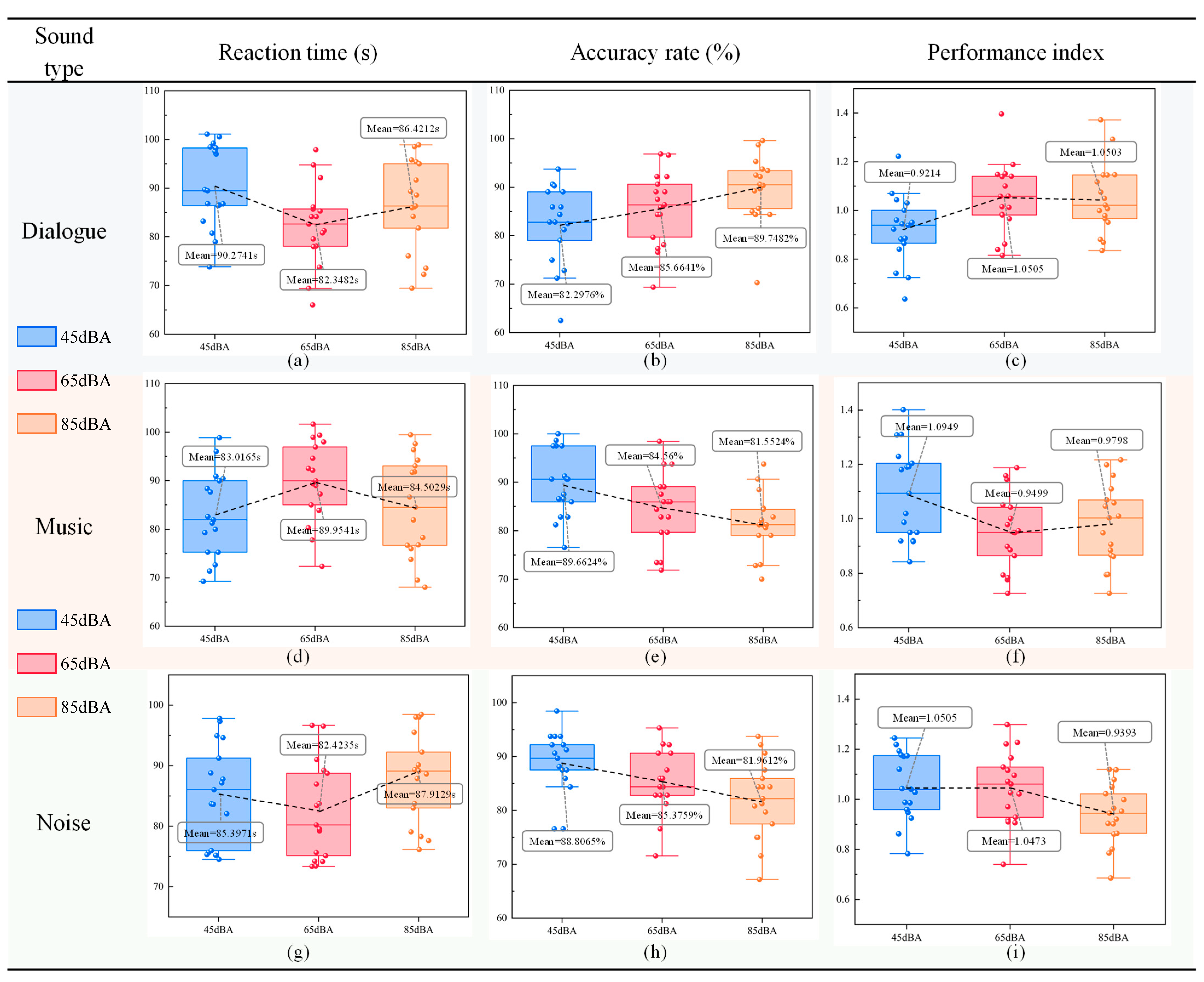
All neurobehavioral data satisfied the assumptions for two-way ANOVA, including continuity of variables, absence of outliers, and normality confirmed by Shapiro–Wilk tests (all p > 0.05). As presented in Figure 4, the mean RT ranged from approximately 82 to 91 s across all sound conditions, indicating that participants responded to all test items within an acceptable time frame. The average AR remained consistently above 80%, suggesting sound comprehension and response reliability. The PI generally exceeded 0.9, indicating high overall task proficiency. These sustained performance levels confirm experimental protocol validity and participant suitability.
A two-way ANOVA was conducted to examine the effects of sound type and sound intensity on RT, AR, and PI (Table 3). No significant main effects of sound type were observed for RT (p = 0.764, η p 2 = 0.017), AR (p = 0.828, η p 2 = 0.012), or PI (p = 0.966, η p 2 = 0.002). Likewise, sound intensity did not exert a significant main effect on RT (p = 0.655, η p 2 = 0.006), AR (p = 0.176, η p 2 = 0.024), or PI (p = 0.478, η p 2 = 0.010). According to conventional benchmarks ( η p 2 = 0.01= small, 0.06 = medium, 0.14 = large), these effect sizes indicate minimal variance explained by either factor in isolation.
In contrast, the interaction between sound type and intensity reached significance for RT (p < 0.001, η p 2 = 0.598), AR (p < 0.001, η p 2 = 0.772), and PI (p < 0.001, η p 2 = 0.741), with effect sizes indicating that this interaction explains the vast majority of the variance in performance. The magnitude of these effects is substantial, accounting for approximately 60% to 77% of the variance in the dependent measures, which surpasses the threshold for a large effect size ( η p 2 = 0.14). This indicates that performance is modulated by the combined influence of sound type and intensity. In summary, although neither sound type nor intensity alone had significant effects, their combination can produce compensatory or exacerbating influences, demonstrating a complex interplay of acoustic factors on work performance.

3.2. Simple Effects Analysis of Sound Type and Intensity

Given the absence of significant main effects but the presence of significant interaction effects, simple effects analyses were conducted to further explore how sound type and intensity jointly influenced work performance. All assumptions of normality, homogeneity of variance, and sphericity were satisfied. The detailed results are summarized in Table 4.
When sound type was held constant, performance varied significantly across intensity levels. Under dialog conditions, RT significantly shortened at 65 dBA (−7.926 s, SE = 1.553, 95% CI [3.774, 12.078], p < 0.001) and 85 dBA (−3.853 s, SE = 1.061, 95% CI [1.017, 6.689], p = 0.007) compared to 45 dBA. Correspondingly, AR significantly increased by 3.366% and 7.451% (p < 0.001), and PI increased by 0.129 (p < 0.001), suggesting that dialog at moderate-to-high intensities can enhance both speed and accuracy. In contrast, music showed a non-linear pattern: RT was prolonged at 65 dBA (+6.938 s, SE = 1.216, 95% CI [−10.187, −3.688], p < 0.001) relative to 45 dBA but shortened at 85 dBA compared with 65 dBA (−5.451 s, SE = 1.183, 95% CI [2.289, 8.613], p = 0.001). Nevertheless, AR and PI consistently decreased with increasing music intensity (all p < 0.001), indicating a significant negative impact on work performance with increasing music intensity. But when the intensity of music increases to a certain extent, the disruptive inhibition on work performance will be relatively weakened. For office noise, RT was significantly faster by 2.974 s at 65 dBA compared to 45 dBA (p = 0.007) but slower at 85 dBA compared with both 45 dBA and 65 dBA (+2.516 s and +5.489 s, both p < 0.01). At 85 dBA, AR and PI declined markedly (−6.845% and −0.111, respectively, both p < 0.001). Moderate-to-low-intensity noise may improve reaction speed through moderate arousal, but high-intensity noise can significantly interfere with work performance, severely impairing accuracy and efficiency.
When intensity was kept constant, the effect of sound type was also evident. At 45 dBA, dialog produced significantly slower RTs and lower AR and PI compared with both music and noise (p < 0.05), indicating that low-intensity speech was particularly disruptive. At a moderate intensity of 65 dBA, dialog yielded faster RT and higher PI than music (p < 0.01), whereas music resulted in slower RT and lower PI than noise (p < 0.01), suggesting that complex music imposes a greater cognitive load than steady office noise under moderate intensity. At 85 dBA, RT did not differ significantly among sound types, but AR and PI were lower under noise compared with dialog (−7.787% and −0.111, both p < 0.001), underscoring the accuracy-impairing effect of intense noise.

3.3. Mediation Analysis of Emotional States

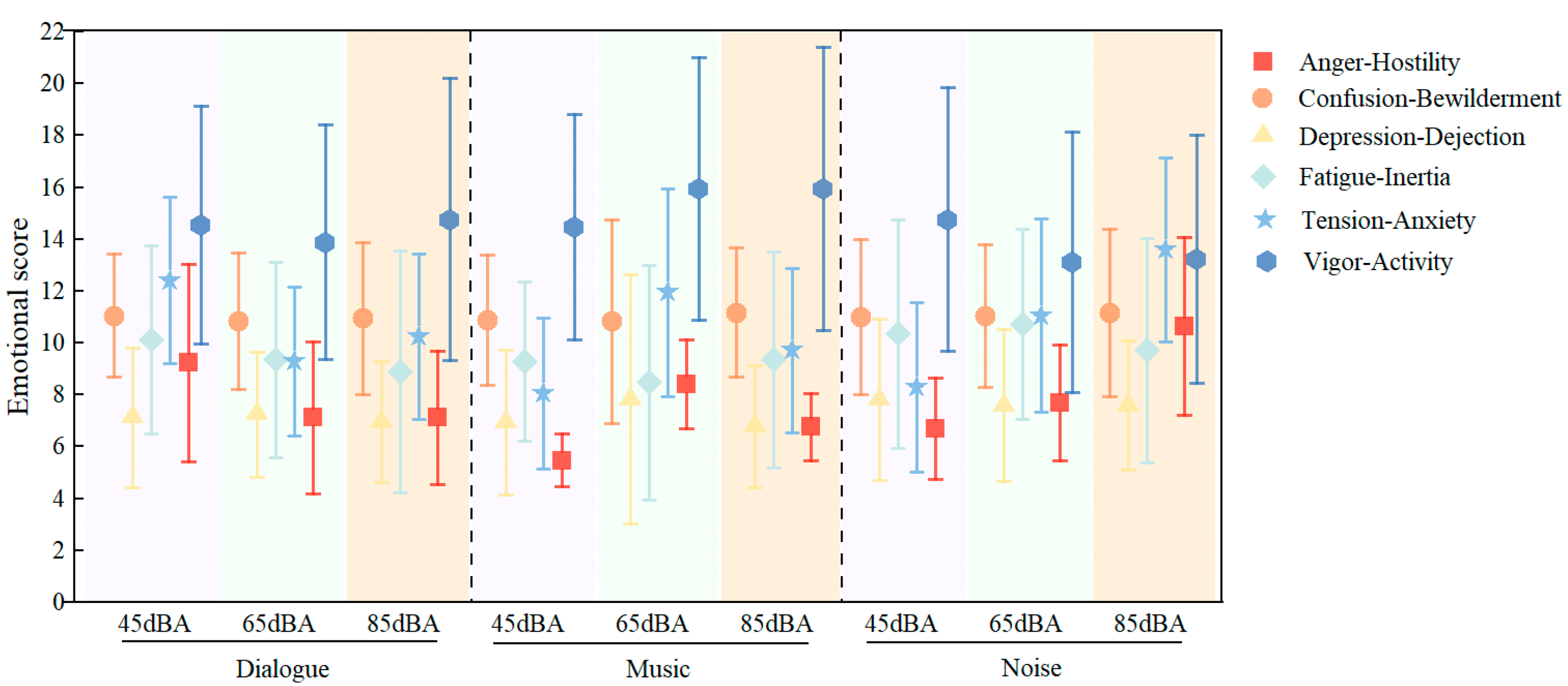
The behavioral impact of office soundscapes is accompanied by systematic changes in emotions. Among the six POMS dimensions (Figure 5), Tension-Anxiety and Anger-Hostility displayed the largest fluctuations across conditions. Specifically, dialog at 45 dBA elicited the highest levels of both emotions, whereas dialog at 65 dBA corresponded to the lowest values. In contrast, noise produced a monotonic increase in both Tension-Anxiety and Anger-Hostility as intensity rose. The remaining four POMS dimensions (Confusion-Bewilderment, Depression-Dejection, Fatigue-Inertia, and Vigor-Activity) exhibited relatively minor or inconsistent changes, suggesting weaker sensitivity to sound variations.
These descriptive patterns were statistically substantiated by a two-way repeated-measures ANOVA (sound type × intensity). As summarized in Table 5, only Tension-Anxiety and Anger-Hostility yielded significant interaction effects (p < 0.05), confirming that these two dimensions are most affected by the combination of sound type and intensity. The absence of significant interactions for the other four emotions indicates that their descriptive fluctuations were not robust enough to reach statistical significance.
Post hoc comparisons further clarified the nature of the significant interactions for Tension-Anxiety and Anger-Hostility. As summarized in Table 6, two main patterns emerged. First, within sound type, dialog at 65 dBA elicited significantly lower negative affect than at 45 dBA. Conversely, noise showed a monotonic trend, with 85 dBA producing significantly higher levels of Tension-Anxiety and Anger-Hostility than both 45 and 65 dBA (F = 27.86 and F = 62.59, all p < 0.001). Music displayed intermediate and less consistent effects, with moderate intensity tending to increase negative emotions relative to low intensity (F = 52.20, p < 0.001). Second, between sound types at fixed intensity, dialog at 45 dBA produced higher levels of negative affect than both music and noise (F = 38.40, p < 0.001). At 65 dBA, dialog was associated with lower tension and hostility than music, while noise produced intermediate values (F = 11.03, p = 0.001). At 85 dBA, noise elicited the highest levels of Tension-Anxiety and Anger-Hostility compared with both dialog and music (F = 20.34 and F = 49.59, all p < 0.001). These patterns suggest that the path through which the sound environment affects emotions varies with the combination of intensity and type, providing strong empirical evidence for incorporating emotions into mediation models.
To test whether these affective shifts transmit acoustic effects to behavior, Bootstrap mediation analysis (5000 samples; bias-corrected 95% CI) was conducted [59,60]. As summarized in Table 7, three robust pathways emerged. First, Tension-Anxiety partially mediated the relationship between dialog intensity and the performance index (PI). Path a from dialog intensity to Tension-Anxiety was marginal (a = −0.0544, p = 0.0538; 95% CI [−0.1098, 0.0009]); path b from Tension-Anxiety to PI (controlling for dialog intensity) was significant (b = 0.0039, p = 0.0002; 95% CI [0.0019, 0.0058]). The indirect effect size (a × b) was significant by bootstrap (indirect effect ab = 0.0002, p = 0.0011; 95% CI [0.0000, 0.0005]), and the direct effect c’ remained significant (c’ = −0.0209, p = 0.0033; 95% CI [−0.0345, −0.0074]). The indirect and direct effects share the same sign, the total effect is significant by bootstrap (c = 0.007, p = 0.0122), indicating partial mediation, and the mediated proportion is 29.71%. Second, Anger-Hostility acted as a suppression mediator between dialog intensity and PI. Path a was marginal (a = −0.0529, p = 0.056; CI [−0.1073, 0.0014]), while path b to PI was highly significant (b = 0.0295, p < 0.001; CI [0.0192, 0.0399]). The indirect effect size (a × b) was significant by bootstrap (indirect effect ab = 0.0016, p = 0.0016; 95% CI [0.0007, 0.0025]), and the direct effect c’ remained significant (p = 0.002). Because the indirect effect (a × b) and direct effect c’ have opposite signs, this pattern indicates a suppression effect, accounting for 40.01% of the total effect size. Third, Tension-Anxiety exhibited a full mediation effect between noise intensity and RT. Path a from noise intensity to Tension-Anxiety was significant (a = 0.1324, p = 0.0001; 95% CI [0.0724, 0.1923]; path b from Tension-Anxiety to RT was significant (b = 1.3229, p = 0.0151; 95% CI [0.2684, 2.3774]. The direct effect c’ remained marginal (c’ = −0.0847, p = 0.3953; 95% CI [−0.2837, 0.1143].

3.4. Mediation Effects of Mental Workload

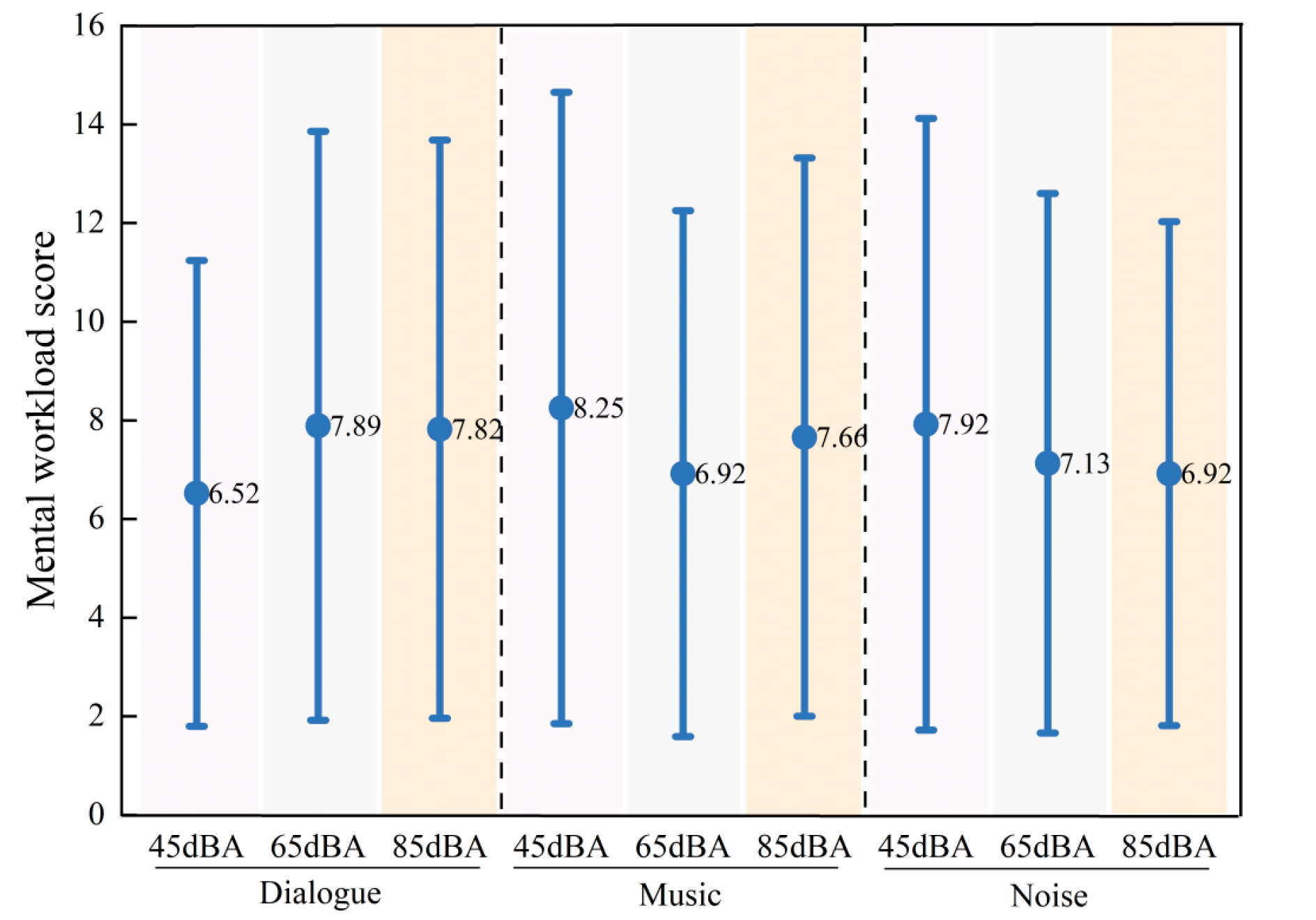
Mental workload refers to the cognitive and attentional resources required to complete a task. The impact of office soundscapes on behavior is accompanied by changes in mental workload. In the NASA-TLX scale (Figure 6), the mental workload showed the most prominent fluctuations under music conditions. Specifically, the mental workload was the lowest at 65 dBA, while 45 dBA and 85 dBA both brought a greater mental workload. In contrast, as the sound intensity increases, the mental workload caused by noise shows a monotonic increase. Although dialog has the lowest mental workload at 45 dBA, its sensitivity to sound changes is weaker as the sound intensity increases.
The mediation tests confirmed that mental workload significantly transmitted the effects of music intensity on performance outcomes. As shown in Table 8, path a from music intensity to mental workload was negative and marginally significant (a = −0.0231, p = 0.0462; 95% CI [−0.0459, −0.0004]). In turn, mental workload positively predicted the performance index (b = 0.0354, p = 0.0351; 95% CI [0.0026, 0.0682]), while the direct effect of music intensity on PI was not significant (c’ = −0.0021, p = 0.1329; 95% CI [−0.0048, 0.0006]). This pattern corresponds to full mediation, in which the impact of music intensity on performance is fully explained by changes in workload.

3.5. Neurophysiological Evidence from EEG

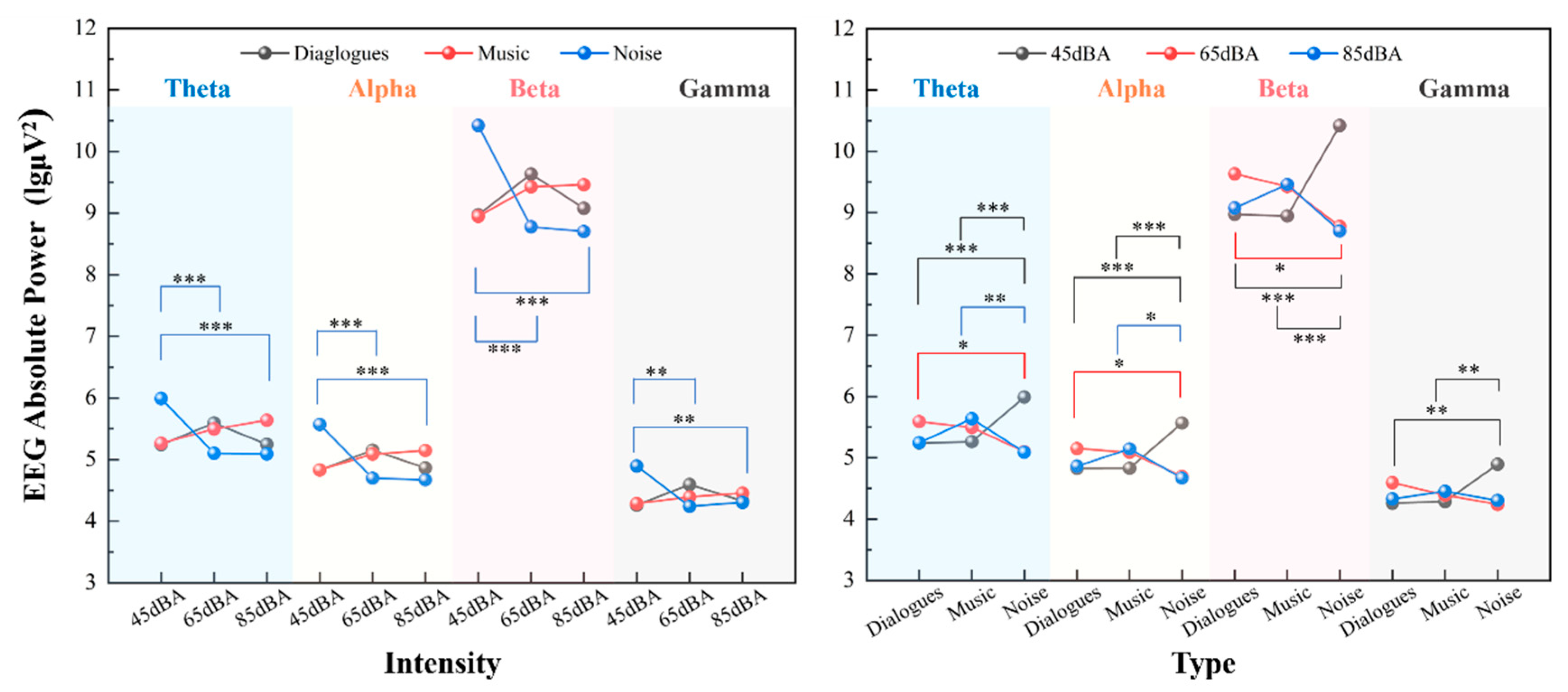
To further elucidate the neural mechanisms underlying acoustic effects on performance, we analyzed absolute EEG power, which is closely related to the cognitive activities of the brain across acoustic environments. A total of 612 EEG data were collected by averaging the power of each frequency band under 14 channels and performing logarithmic transformation to meet the requirements of normality, chi-squared, and independence of observation for ANOVA, and the results are shown in Table 9. Overall EEG power was highest under music (24.15 l g μ V 2 ), intermediate under noise (24.10 l g μ V 2 ), and lowest under dialog (23.94 l g μ V 2 ) , with total power generally decreasing as intensity increased. When broken down by frequency bands, θ, α, and β absolute power reached their highest values under music but were markedly attenuated under dialog, whereas γ power exhibited the opposite trend.
Two-way ANOVA further confirmed that these power differences were driven by interaction effects rather than main effects. As shown in Table 10, sound type and intensity jointly influenced θ, α, β, and γ power (all interaction terms p < 0.001), while neither factor alone produced significant main effects (p > 0.05). Accordingly, follow-up analyses that control for one factor while examining the trend of the other provide a more informative characterization (see Figure 7). Specifically, against the noise background, band power decreased monotonically with increasing intensity (strong negative correlation with noise level); at low intensity (45 dBA), band power in the noise condition exceeded that in the music and dialog conditions, whereas at mid-to-high intensities, the noise condition produced a pronounced reduction in band power and yielded lower power than the music and dialog backgrounds. High-intensity dialog further reduced band power relative to music.
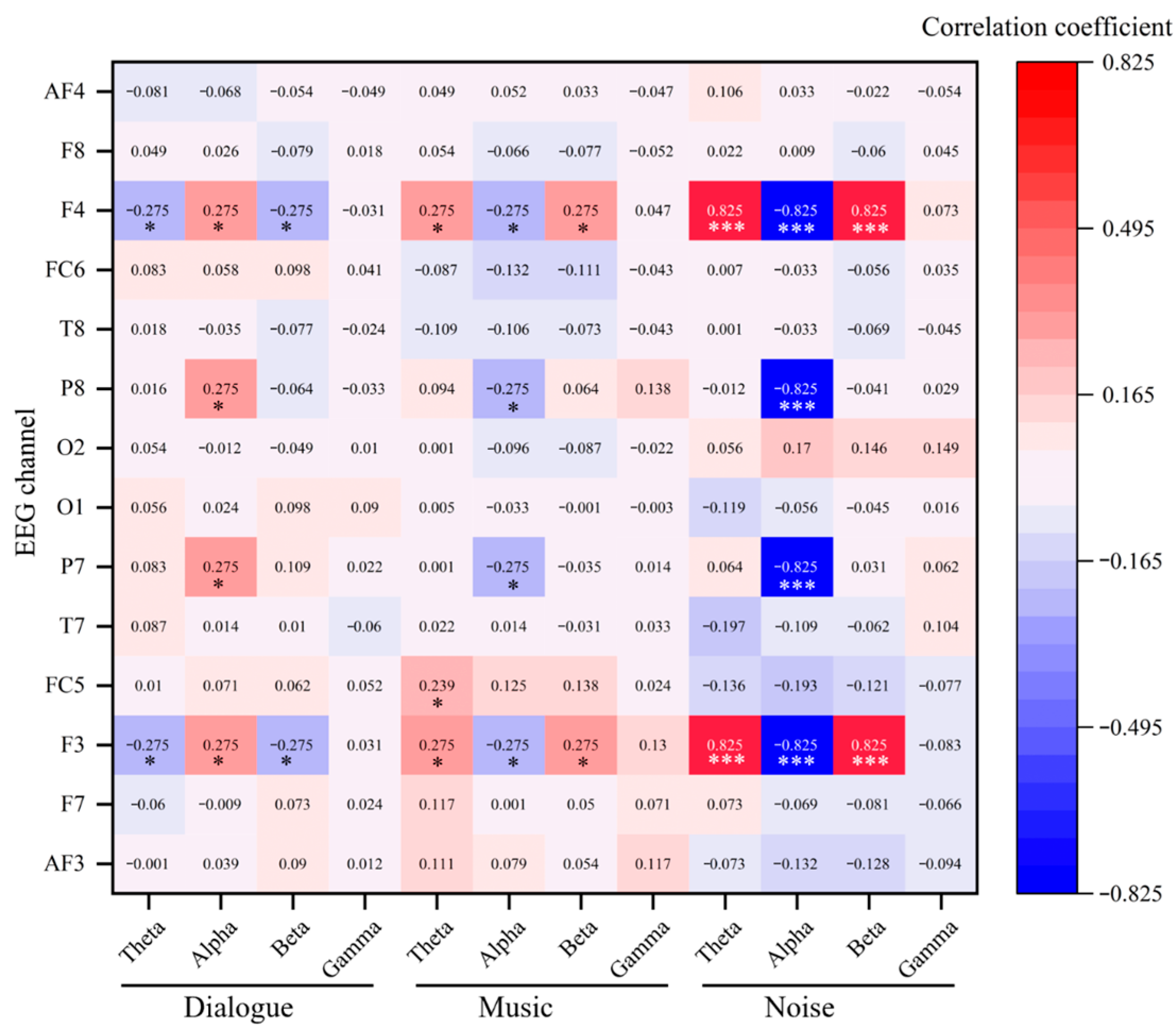
To examine spatial specificity and channel-wise sensitivity, we computed relative band power per channel and treated sound intensity as a continuous predictor. Kendall’s tau-b correlations were performed on 8568 observations across 14 channels within each acoustic context. As shown in Figure 8, significant correlations were primarily clustered at prefrontal electrodes F3 and F4, underscoring the pivotal role of the prefrontal cortex in modulating attention, executive control, and emotion regulation under varying acoustic loads. The additional involvement of parietal sites (P7, P8) suggests that acoustic intensity also prompts a redistribution of attentional resources, consistent with the parietal cortex’s function in spatial perception and resource allocation. Moreover, the emergence of FC5 effects under music indicates that melodic stimulation imposes additional demands on working memory and integrative processing. These spatial patterns highlight that prefrontal regions serve as the primary locus of acoustic sensitivity, while parietal and fronto-central regions provide supplementary adjustments depending on the type of sound.
Beyond these spatial topographies, the correlation patterns also varied systematically across frequency bands, revealing distinct neural strategies for coping with semantic and non-semantic acoustic environments. In the dialog condition, theta and beta power at F3 and F4 decreased as intensity increased (τ = −0.275, p < 0.05), accompanied by elevated alpha power. This combination suggests weakened cognitive control and executive processing, coupled with an inhibitory mechanism reflected in enhanced alpha activity, which is widely interpreted as the brain’s effort to suppress distracting semantic content [61,62,63]. In contrast, both music and noise conditions exhibited the opposite pattern: theta and beta at F3/F4 increased with intensity (e.g., τ = +0.825, p < 0.001 in noise), while alpha power decreased. These positive correlations indicate compensatory arousal and heightened vigilance to maintain performance under escalating non-semantic stimulation, whereas reduced alpha implies less reliance on inhibitory filtering [64]. Taken together, these findings underscore that semantic backgrounds primarily engage alpha-mediated suppression of interference, whereas non-semantic environments evoke theta/beta-driven compensatory activation, reflecting fundamentally different cortical mechanisms for handling acoustic load.

4. Discussion

The present study investigated the interactive effects of sound type and intensity on office work performance, integrating behavioral, psychological, and neurophysiological perspectives. The findings demonstrate that the effects of acoustic environments arise not simply from the decibel level but from the interaction between the semantic nature of the sound and its intensity. Below, we interpret these results through the lens of cognitive inhibition, emotional mediation, and arousal-based neural dynamics.

4.1. Distinct Cognitive Mechanisms

This study found the markedly different behavioral and neurophysiological responses elicited by dialog compared with non-semantic sounds (music and noise). Behavioral results demonstrated that reaction times were substantially slower under low-intensity dialog (45 dBA) but improved as the intensity increased (65 dBA and 85 dBA). This pattern aligns with the irrelevant speech effect; low-level intelligible speech disrupts task performance by engaging the phonological loop and diverting cognitive resources [65]. The EEG correlation analysis provides a mechanistic explanation for this shift. Unlike music and noise, increasing dialog intensity was positively correlated with alpha activity in the prefrontal cortex (F3/F4). Elevated alpha power is widely associated with inhibitory control and sensory gating [66,67], suggesting that the brain actively suppresses auditory processing when speech becomes intense [68]. Consequently, the faster reaction times at high dialog intensities likely reflect a shift from processing the semantic content (at 45 dBA) to employing an inhibitory filtering strategy (at 85 dBA). Importantly, this filtering comes at a psychological cost, evidenced by increased Tension-Anxiety scores.
In contrast, non-semantic sounds exhibited an arousal-driven profile. As intensity increased, alpha power decreased while theta and beta power increased, indicating heightened cortical arousal and vigilance rather than inhibition [69,70]. This elevated arousal initially facilitated reaction speed at moderate levels but became detrimental at high levels, particularly for noise, supporting the notion that the brain employs distinct cortical strategies for handling semantic interference versus energetic masking [71].

4.2. The Mediating Roles of Emotion and Mental Workload

For high-intensity office noise, performance deterioration was fully mediated by Tension-Anxiety, consistent with the classical Arousal Theory: excessive stimulation pushes arousal beyond optimal levels and evokes stress responses [10,72]. EEG results corroborate this pattern. High-intensity noise produced a surge in theta and beta power (associated with vigilance and alertness) accompanied by a sharp reduction in alpha power (associated with relaxation and inhibition) [10,73]. This neural profile is characteristic of hyper-alertness without inhibitory control and mirrors participants’ elevated anxiety ratings [74,75]. Cognitive resources are therefore consumed by managing physiological stress, impairing task accuracy and speed.
A similar, though distinct, affective cost was observed for dialog. Although higher-intensity dialog improved accuracy, mediation results indicate that Anger-Hostility acted as a suppressor variable. While the inhibitory mechanism (elevated alpha) enabled participants to block semantic interference, this required effort and likely induced frustration and tension [76]. This suggests that employees can force themselves to maintain performance under loud speech, but it comes with the cost of accumulating negative affect, potentially increasing long-term burnout risk [77].
For music, the mechanism was distinct. Moderate-intensity music optimized performance, and mediation analysis confirmed that this benefit was transmitted through reduced mental workload. This pattern aligns with the Arousal-Mood Hypothesis, which posits that appropriate non-semantic stimulation can optimize arousal levels and improve mood, thereby freeing up cognitive resources for the primary task [78,79]. EEG evidence further supports this interpretation: unlike the excessive beta/theta activation seen in loud noise, moderate music produced a balanced EEG power profile [80,81]. This implies that moderate music provides enough stimulation to maintain alertness (preventing drowsiness) but does not impose the excessive cognitive load associated with processing semantic speech or managing noise-induced anxiety, allowing for more efficient task processing without the inhibitory costs associated with loud dialog [82].

4.3. Practical Implications for Office Acoustic Design

These findings yield several practical implications for office acoustic design. First, the common practice of simply lowering overall sound levels may be inadequate for ensuring speech privacy. Our results suggest that speech intelligibility is a more critical factor than sound pressure level for speech privacy. Since low-intensity dialog (45 dBA) is highly disruptive due to semantic interference, acoustic design should focus on reducing intelligibility (e.g., through sound masking) rather than merely lowering volume, which might inadvertently make background speech more intelligible [65].
Second, although higher-intensity dialog improved reaction speed, it was associated with increased physiological tension and relied on neural inhibitory mechanisms. Because such states are unsustainable in the long term, the design of “quiet zones” should focus on eliminating intelligible speech rather than merely attenuating volume [65].
Third, moderate-intensity music (65 dBA) emerges as a viable intervention in indoor acoustic design. By reducing mental workload, personally selected music or carefully designed ambient soundscapes could be effectively used to mask distracting conversations in open-plan offices, provided the intensity is maintained within an optimal range to avoid the arousal effects observed at higher levels [83].
Collectively, these insights underscore the importance of designing office soundscapes that consider both acoustic characteristics and their psychological and neurophysiological consequences.

5. Conclusions

This study integrated behavioral measures and neurophysiological evidence to investigate how indoor acoustic environments influence office employees’ work performance. By manipulating both sound intensity and sound type and combining task performance indicators with subjective and EEG assessments, the study provides a multidimensional account of the mechanisms underlying acoustic effects.
At the behavioral level, sound intensity and type jointly shaped performance patterns. Low-intensity dialog (45 dBA) produced the slowest reaction times due to semantic interference, whereas increasing dialog intensity to 65 dBA and 85 dBA significantly improved performance speed. Conversely, high-intensity noise (85 dBA) impaired performance accuracy and speed, while complex music imposes greater cognitive load than steady office noise at moderate levels. Mediation analyses further revealed that these behavioral shifts were transmitted through distinct psychological pathways: Tension-Anxiety fully mediated the detrimental effects of high-intensity noise, while mental workload mediated the benefits of moderate-intensity music. For dialog, Anger-Hostility acted as a suppressor, indicating that performance gains were achieved at the cost of emotional well-being.
Neurophysiological analyses clarified the underlying mechanism. EEG evidence demonstrated that high-intensity semantic dialog triggered an increase in prefrontal alpha activity alongside suppressed theta/beta oscillations, indicating an inhibitory filtering strategy to cope with loud speech. In contrast, non-semantic conditions (music and noise) showed the opposite trend, increasing intensity enhanced theta/beta power and reduced alpha activity, reflecting a mechanism of compensatory arousal to counteract acoustic load. These findings highlight fundamentally different cortical strategies for managing semantic and non-semantic auditory stimulation.
These findings advance theoretical understanding by linking acoustic conditions to performance through an integrated behavioral–cognitive–neural framework. They highlight distinct cortical strategies for handling semantic versus non-semantic stimulation and emphasize the need to move beyond a purely decibel-based perspective. In practice, the results suggest that moderate non-semantic sounds may be harnessed to enhance alertness and productivity, while semantic speech and excessive intensity should be minimized through intelligent acoustic design and management of office spaces.
Several limitations should be acknowledged. The sample was restricted to university staff and students, limiting generalizability across diverse workforces. The experimental sounds were controlled laboratory stimuli, which may not fully capture the variability of real office soundscapes. Future studies should employ larger and more heterogeneous samples, incorporate ecological acoustic settings, and integrate advanced neuroimaging methods to further unravel the mechanisms by which sound environments shape workplace health and efficiency.

Author Contributions

Conceptualization, D.C. and T.L.; methodology, D.C.; software, D.C.; validation, H.H., Y.S. and Y.Z.; formal analysis, H.H.; investigation, Y.S.; resources, D.C.; data curation, W.Z.; writing—original draft preparation, W.Z.; writing—review and editing, D.C.; visualization, W.Z.; supervision, T.L.; project administration, Y.Z.; funding acquisition, D.C. and Y.Z. All authors have read and agreed to the published version of the manuscript.

Funding

This research was funded by the Science and Technology Commission of Shanghai Municipality, grant number 23DZ1202102 and 23DZ1202804.

Institutional Review Board Statement

The study was conducted in accordance with the Declaration of Helsinki, and the protocol was approved by the Ethics Committee of Shanghai University (ECSHU 2023-068) on 15 September 2023.

Informed Consent Statement

Informed consent was obtained from all subjects involved in the study.

Data Availability Statement

The original contributions presented in the study are included in the article, further inquiries can be directed to the corresponding author.

Conflicts of Interest

Author Ying Zhang was employed by the company Shanghai Research Institute of Building Science Co., Ltd. The remaining authors declare that the research was conducted in the absence of any commercial or financial relationships that could be construed as a potential conflict of interest.

References

  1. Zehra, S.; Sharma, D.C. Impact Assessment of Nature Sound on Human Health and Well-Being: A Review. J. Exp. Zool. India 2023, 26, 353–357. [Google Scholar] [CrossRef]
  2. World Health Organization. Burden of Disease from Environmental Noise: Quantification of Healthy Life Years Lost in Europe; World Health Organization: Geneva, Switzerland, 2011. [Google Scholar]
  3. Slabbekoorn, H.; Ripmeester, E.A.P. Birdsong and Anthropogenic Noise: Implications and Applications for Conservation. Mol. Ecol. 2008, 17, 72–83. [Google Scholar] [CrossRef]
  4. Meng, Q.; An, Y.; Yang, D. Effects of Acoustic Environment on Design Work Performance Based on Multitask Visual Cognitive Performance in Office Space. Build. Environ. 2021, 205, 108296. [Google Scholar] [CrossRef]
  5. Kaarlela-Tuomaala, A.; Helenius, R.; Keskinen, E.; Hongisto, V. Effects of Acoustic Environment on Work in Private Office Rooms and Open-Plan Offices–Longitudinal Study during Relocation. Ergonomics 2009, 52, 1423–1444. [Google Scholar] [CrossRef]
  6. Park, S.H.; Shin, H.-K.; Lee, S.-M.; Kim, K.W. Evaluation of the Acoustic Environments of Open-Plan Offices in Korean Public Buildings. J. Acoust. Soc. Korea 2023, 42, 42–49. [Google Scholar]
  7. Haapakangas, A.; Hongisto, V.; Hyönä, J.; Kokko, J.; Keränen, J. Effects of Unattended Speech on Performance and Subjective Distraction: The Role of Acoustic Design in Open-Plan Offices. Appl. Acoust. 2014, 86, 1–16. [Google Scholar] [CrossRef]
  8. Lee, Y.; Nelson, E.C.; Flynn, M.J.; Jackman, J.S. Exploring Soundscaping Options for the Cognitive Environment in an Open-Plan Office. Build. Acoust. 2020, 27, 185–202. [Google Scholar] [CrossRef]
  9. Golmohammadi, R.; Darvishi, E.; Faradmal, J.; Poorolajal, J.; Aliabadi, M. Attention and Short-Term Memory during Occupational Noise Exposure Considering Task Difficulty. Appl. Acoust. 2020, 158, 107065. [Google Scholar] [CrossRef]
  10. Jafari, M.J.; Khosrowabadi, R.; Khodakarim, S.; Mohammadian, F. The Effect of Noise Exposure on Cognitive Performance and Brain Activity Patterns. Open Access Maced. J. Med. Sci. 2019, 7, 2924. [Google Scholar] [CrossRef]
  11. Lee, S.; Hwang, S.; Lee, M.; Lee, S. The Impact of Different Types and Levels of Construction Noise on Physiological Responses: Focusing on Standardization and Habituation. Sustain. Cities Soc. 2024, 112, 105644. [Google Scholar] [CrossRef]
  12. Samardzic, N.; Best, V.; Hammond, C.; Karatas, A.; Esmaeili, B.; Sarsam, H. Construction Site Noise Exposure Assessment Using Binaural Measurements and Analysis. Safety 2024, 10, 92. [Google Scholar] [CrossRef]
  13. Tseng, L.-P.; Chuang, M.-T.; Liu, Y.-C. Effects of Noise and Music on Situation Awareness, Anxiety, and the Mental Workload of Nurses during Operations. Appl. Ergon. 2022, 99, 103633. [Google Scholar] [CrossRef]
  14. Kiss, L.; Linnell, K.J. The Effect of Preferred Background Music on Task-Focus in Sustained Attention. Psychol. Res. 2021, 85, 2313–2325. [Google Scholar] [CrossRef]
  15. Perlovsky, L.I.; Masataka, N.; Cabanac, M. Is Cognitive Dissonance Compatible with Human Evolution? In Proceedings of the 2013 International Joint Conference on Neural Networks, Dallas, TX, USA, 4–9 August 2013; pp. 1–3. [Google Scholar]
  16. Newbold, J.W.; Luton, J.; Cox, A.L.; Gould, S.J. Using Nature-Based Soundscapes to Support Task Performance and Mood. In Proceedings of the 2017 CHI Conference Extended Abstracts on Human Factors in Computing Systems, Denver, CO, USA, 6–11 May 2017; pp. 2802–2809. [Google Scholar]
  17. Burkhard, A.; Elmer, S.; Kara, D.; Brauchli, C.; Jäncke, L. The Effect of Background Music on Inhibitory Functions: An ERP Study. Front. Hum. Neurosci. 2018, 12, 293. [Google Scholar] [CrossRef]
  18. Koo, S. Sound of the Border: Music and Identity of Korean Minority in China; University of Hawaii Press: Honolulu, HI, USA, 2021. [Google Scholar]
  19. Chew, A.S.-Q.; Yu, Y.-T.; Chua, S.-W.; Gan, S.K.-E. The Effects of Familiarity and Language of Background Music on Working Memory and Language Tasks in Singapore. Psychol. Music 2016, 44, 1431–1438. [Google Scholar] [CrossRef]
  20. Di Blasio, S.; Shtrepi, L.; Puglisi, G.E.; Astolfi, A. A Cross-Sectional Survey on the Impact of Irrelevant Speech Noise on Annoyance, Mental Health and Well-Being, Performance and Occupants’ Behavior in Shared and Open-Plan Offices. Int. J. Environ. Res. Public Health 2019, 16, 280. [Google Scholar] [CrossRef] [PubMed]
  21. Zhang, J.; Huang, J.; Wu, Z.; Li, Z. Construction Noise Reduction Research on Rail Transit Projects: A Case Study in China. Buildings 2024, 14, 1678. [Google Scholar] [CrossRef]
  22. Nejati, V. A Structured Framework for Emotion-Cognition Dynamics: Implications for Assessment and Intervention. J. Neural Transm. 2025, 132, 793–802. [Google Scholar] [CrossRef]
  23. Hu, X.; Wang, F.; Zhang, D. Similar Brains Blend Emotion in Similar Ways: Neural Representations of Individual Difference in Emotion Profiles. Neuroimage 2022, 247, 118819. [Google Scholar] [CrossRef] [PubMed]
  24. Longo, L.; Wickens, C.D.; Hancock, G.; Hancock, P.A. Human Mental Workload: A Survey and a Novel Inclusive Definition. Front. Psychol. 2022, 13, 883321. [Google Scholar] [CrossRef] [PubMed]
  25. Dolcos, F.; Iordan, A.D.; Dolcos, S. Neural Correlates of Emotion–Cognition Interactions: A Review of Evidence from Brain Imaging Investigations. J. Cogn. Psychol. 2011, 23, 669–694. [Google Scholar] [CrossRef] [PubMed]
  26. Fan, Y.; Liang, J.; Cao, X.; Pang, L.; Zhang, J. Effects of Noise Exposure and Mental Workload on Physiological Responses during Task Execution. Int. J. Environ. Res. Public Health 2022, 19, 12434. [Google Scholar] [CrossRef]
  27. Sun, Z.; Hu, S.; Xie, S.; Wu, L.; Jiang, C.; Ding, S.; Zhang, Z.; Xu, W.; Li, H. Does Background Sound Impact Cognitive Performance and Relaxation States in Enclosed Office? Build. Environ. 2025, 267, 112313. [Google Scholar]
  28. Yan, T.; Jin, H.; Jin, Y. The Mediating Role of Emotion in the Effects of Landscape Elements on Thermal Comfort: A Laboratory Study. Build. Environ. 2023, 233, 110130. [Google Scholar] [CrossRef]
  29. Fiebig, A.; Jordan, P.; Moshona, C.C. Assessments of Acoustic Environments by Emotions–the Application of Emotion Theory in Soundscape. Front. Psychol. 2020, 11, 573041. [Google Scholar] [CrossRef]
  30. Rachman, Z.; Aletta, F.; Kang, J. Exploring Soundscape Assessment Methods in Office Environments: A Systematic Review. Buildings 2024, 14, 3408. [Google Scholar] [CrossRef]
  31. Torresin, S.; de Souza, L.P.; Dicle, S.Y.; Al-Assaad, D.; Aletta, F.; Balderrama, A.; Bivolarova, M.P.; Lee, P.-J.; Llorca-Bofí, J.; Maula, H. Definition and Performance of Acoustic Personalised Environmental Control Systems (Acoustic PECS): A Systematic Review. Build. Environ. 2025, 282, 3. [Google Scholar] [CrossRef]
  32. Jeon, J.; Cai, H. Classification of Construction Hazard-Related Perceptions Using: Wearable Electroencephalogram and Virtual Reality. Autom. Constr. 2021, 132, 103975. [Google Scholar] [CrossRef]
  33. Chen, J.; Wang, X.; Huang, C.; Hu, X.; Shen, X.; Zhang, D. A Large Finer-Grained Affective Computing EEG Dataset. Sci. Data 2023, 10, 740. [Google Scholar] [CrossRef]
  34. Hwang, S.; Jebelli, H.; Choi, B.; Choi, M.; Lee, S. Measuring Workers’ Emotional State during Construction Tasks Using Wearable EEG. J. Constr. Eng. Manag. 2018, 144, 04018050. [Google Scholar] [CrossRef]
  35. Jebelli, H.; Khalili, M.M.; Hwang, S.; Lee, S. A Supervised Learning-Based Construction Workers’ Stress Recognition Using a Wearable Electroencephalography (EEG) Device. In Proceedings of the Construction Research Congress, New Orleans, LA, USA, 2–4 April 2018; pp. 40–50. [Google Scholar]
  36. Wang, D.; Chen, J.; Zhao, D.; Dai, F.; Zheng, C.; Wu, X. Monitoring Workers’ Attention and Vigilance in Construction Activities through a Wireless and Wearable Electroencephalography System. Autom. Constr. 2017, 82, 122–137. [Google Scholar] [CrossRef]
  37. Wang, D.; Li, H.; Chen, J. Detecting and Measuring Construction Workers’ Vigilance through Hybrid Kinematic-EEG Signals. Autom. Constr. 2019, 100, 11–23. [Google Scholar] [CrossRef]
  38. Li, H.; Wang, D.; Chen, J.; Luo, X.; Li, J.; Xing, X. Pre-Service Fatigue Screening for Construction Workers through Wearable EEG-Based Signal Spectral Analysis. Autom. Constr. 2019, 106, 102851. [Google Scholar] [CrossRef]
  39. Tehrani, B.M.; Wang, J.; Truax, D. Assessment of Mental Fatigue Using Electroencephalography (EEG) and Virtual Reality (VR) for Construction Fall Hazard Prevention. Eng. Constr. Archit. Manag. 2022, 29, 3593–3616. [Google Scholar] [CrossRef]
  40. Ke, J.; Zhang, M.; Luo, X.; Chen, J. Monitoring Distraction of Construction Workers Caused by Noise Using a Wearable Electroencephalography (EEG) Device. Autom. Constr. 2021, 125, 103598. [Google Scholar] [CrossRef]
  41. Chae, J.; Hwang, S.; Seo, W.; Kang, Y. Relationship between Rework of Engineering Drawing Tasks and Stress Level Measured from Physiological Signals. Autom. Constr. 2021, 124, 103560. [Google Scholar] [CrossRef]
  42. Newby, R.W.; Simpson, S. Basketball Performance as a Function of Scores on Profile of Mood States. Percept. Mot. Ski. 1994, 78, 1142. [Google Scholar] [CrossRef]
  43. Hart, S.G.; Staveland, L.E. Development of NASA-TLX (Task Load Index): Results of Empirical and Theoretical Research. Adv. Psychol. 1988, 52, 139–183. [Google Scholar]
  44. Jaiswal, M. Implicit Design Choices and Their Impact on Emotion Recognition Model Development and Evaluation. arXiv 2023, arXiv:2309.03238. [Google Scholar] [CrossRef]
  45. Mathy, F.; Chekaf, M. Experiments and Modeling in Cognitive Science: MATLAB, SPSS, Excel and E-Prim; ISTE Press: London, UK, 2018. [Google Scholar]
  46. Barbarotto, R.; Laiacona, M.; Frosio, R.; Vecchio, M.; Farinato, A.; Capitani, E. A Normative Study on Visual Reaction Times and Two Stroop Colour-Word Tests. Ital. J. Neurol. Sci. 1998, 19, 161–170. [Google Scholar] [CrossRef] [PubMed]
  47. Lang, X.; Wargocki, P.; Liu, W. Investigating the Relation between Electroencephalogram, Thermal Comfort, and Cognitive Performance in Neutral to Hot Indoor Environment. Indoor Air 2022, 32, e12941. [Google Scholar] [CrossRef]
  48. Lan, L.; Lian, Z.; Pan, L.; Ye, Q. Neurobehavioral Approach for Evaluation of Office Workers’ Productivity: The Effects of Room Temperature. Build. Environ. 2009, 44, 1578–1588. [Google Scholar] [CrossRef]
  49. Kim, H.; Hong, T. Determining the Optimal Set-Point Temperature Considering Both Labor Productivity and Energy Saving in an Office Building. Appl. Energy 2020, 276, 115429. [Google Scholar] [CrossRef]
  50. Liu, W.; Zhong, W.; Wargocki, P. Performance, Acute Health Symptoms and Physiological Responses during Exposure to High Air Temperature and Carbon Dioxide Concentration. Build. Environ. 2017, 114, 96–105. [Google Scholar] [CrossRef]
  51. Brysbaert, M. How Many Participants Do We Have to Include in Properly Powered Experiments? A Tutorial of Power Analysis with Reference Tables. J. Cogn. 2019, 2, 16. [Google Scholar] [CrossRef]
  52. Kumle, L.; Võ, M.L.-H.; Draschkow, D. Estimating Power in (Generalized) Linear Mixed Models: An Open Introduction and Tutorial in R. Behav. Res. Methods 2021, 53, 2528–2543. [Google Scholar] [CrossRef]
  53. Vimalanathan, K.; Ramesh Babu, T. The Effect of Indoor Office Environment on the Work Performance, Health and Well-Being of Office Workers. J. Environ. Health Sci. Eng. 2014, 12, 113. [Google Scholar] [CrossRef]
  54. Richardson, J.T. The Use of Latin-Square Designs in Educational and Psychological Research. Educ. Res. Rev. 2018, 24, 84–97. [Google Scholar] [CrossRef]
  55. Jebelli, H.; Hwang, S.; Lee, S. EEG Signal-Processing Framework to Obtain High-Quality Brain Waves from an off-the-Shelf Wearable EEG Device. J. Comput. Civ. Eng. 2018, 32, 04017070. [Google Scholar] [CrossRef]
  56. Ju, J.; Li, H. A Survey of EEG-Based Driver State and Behavior Detection for Intelligent Vehicles. IEEE Trans. Biom. Behav. Identity Sci. 2024, 6, 420–434. [Google Scholar] [CrossRef]
  57. Pieper, K.; Spang, R.P.; Prietz, P.; Möller, S.; Paajanen, E.; Vaalgamaa, M.; Voigt-Antons, J.-N. Working with Environmental Noise and Noise-Cancelation: A Workload Assessment with EEG and Subjective Measures. Front. Neurosci. 2021, 15, 771533. [Google Scholar] [CrossRef]
  58. Becher, A.; Höhne, M.; Axmacher, N.; Chaieb, L.; Elger, C.E.; Fell, J. Intracranial Electroencephalography Power and Phase Synchronization Changes during Monaural and Binaural Beat Stimulation. Eur. J. Neurosci. 2015, 41, 254–263. [Google Scholar] [CrossRef] [PubMed]
  59. MacKinnon, D.P.; Krull, J.L.; Lockwood, C.M. Equivalence of the Mediation, Confounding and Suppression Effect. Prev. Sci. 2000, 1, 173–181. [Google Scholar] [CrossRef] [PubMed]
  60. Zhao, X.; Lynch, J.G., Jr.; Chen, Q. Reconsidering Baron and Kenny: Myths and Truths about Mediation Analysis. J. Consum. Res. 2010, 37, 197–206. [Google Scholar] [CrossRef]
  61. Wiesman, A.I.; Koshy, S.M.; Heinrichs-Graham, E.; Wilson, T.W. Beta and Gamma Oscillations Index Cognitive Interference Effects across a Distributed Motor Network. Neuroimage 2020, 213, 116747. [Google Scholar] [CrossRef]
  62. Melnik, N.; Mapelli, I.; Özkurt, T.E. Modulation of Alpha Oscillations Is Required for the Suppression of Semantic Interference. Neurobiol. Learn. Mem. 2017, 144, 11–18. [Google Scholar] [CrossRef]
  63. Cavanagh, J.F.; Frank, M.J. Frontal Theta as a Mechanism for Cognitive Control. Trends Cogn. Sci. 2014, 18, 414–421. [Google Scholar] [CrossRef]
  64. Picazio, S.; Veniero, D.; Ponzo, V.; Caltagirone, C.; Gross, J.; Thut, G.; Koch, G. Prefrontal Control over Motor Cortex Cycles at Beta Frequency during Movement Inhibition. Curr. Biol. 2014, 24, 2940–2945. [Google Scholar] [CrossRef]
  65. Georgi, M.; Leist, L.; Klatte, M.; Schlittmeier, S.J. Investigating the Disturbance Impact of Background Speech on Verbal and Visual-Spatial Short-Term Memory: On the Differential Contributions of Changing-State and Phonology to the Irrelevant Sound Effect. Audit. Percept. Cogn. 2023, 6, 52–71. [Google Scholar] [CrossRef]
  66. Dou, W.; Morrow, A.; Iemi, L.; Samaha, J. Pre-Stimulus Alpha-Band Phase Gates Early Visual Cortex Responses. Neuroimage 2022, 253, 119060. [Google Scholar] [CrossRef]
  67. Whedon, M.; Perry, N.B.; Bell, M.A. Relations between Frontal EEG Maturation and Inhibitory Control in Preschool in the Prediction of Children’s Early Academic Skills. Brain Cogn. 2020, 146, 105636. [Google Scholar] [CrossRef] [PubMed]
  68. Bonnefond, M.; Jensen, O. Gamma Activity Coupled to Alpha Phase as a Mechanism for Top-down Controlled Gating. PLoS ONE 2015, 10, e0128667. [Google Scholar] [CrossRef]
  69. García, P.S.; Kreuzer, M.; Hight, D.; Sleigh, J.W. Effects of Noxious Stimulation on the Electroencephalogram during General Anaesthesia: A Narrative Review and Approach to Analgesic Titration. Br. J. Anaesth. 2021, 126, 445–457. [Google Scholar] [CrossRef] [PubMed]
  70. Kim, H.; Seo, P.; Choi, J.W.; Kim, K.H. Emotional Arousal Due to Video Stimuli Reduces Local and Inter-Regional Synchronization of Oscillatory Cortical Activities in Alpha-and Beta-Bands. PLoS ONE 2021, 16, e0255032. [Google Scholar] [CrossRef]
  71. Rossi, L.; Prato, A.; Lesina, L.; Schiavi, A. Effects of Low-Frequency Noise on Human Cognitive Performances in Laboratory. Build. Acoust. 2018, 25, 17–33. [Google Scholar] [CrossRef]
  72. Young, C.B.; Raz, G.; Everaerd, D.; Beckmann, C.F.; Tendolkar, I.; Hendler, T.; Fernández, G.; Hermans, E.J. Dynamic Shifts in Large-Scale Brain Network Balance as a Function of Arousal. J. Neurosci. 2017, 37, 281–290. [Google Scholar] [CrossRef]
  73. Vanhollebeke, G.; De Smet, S.; De Raedt, R.; Baeken, C.; van Mierlo, P.; Vanderhasselt, M.-A. The Neural Correlates of Psychosocial Stress: A Systematic Review and Meta-Analysis of Spectral Analysis EEG Studies. Neurobiol. Stress 2022, 18, 100452. [Google Scholar] [CrossRef] [PubMed]
  74. Muhammad, F.; Al-Ahmadi, S. Human State Anxiety Classification Framework Using EEG Signals in Response to Exposure Therapy. PLoS ONE 2022, 17, e0265679. [Google Scholar] [CrossRef]
  75. Hahad, O.; Kuntic, M.; Al-Kindi, S.; Kuntic, I.; Gilan, D.; Petrowski, K.; Daiber, A.; Münzel, T. Noise and Mental Health: Evidence, Mechanisms, and Consequences. J. Expo. Sci. Environ. Epidemiol. 2025, 35, 16–23. [Google Scholar] [CrossRef]
  76. Mennella, R.; Patron, E.; Palomba, D. Frontal Alpha Asymmetry Neurofeedback for the Reduction of Negative Affect and Anxiety. Behav. Res. Ther. 2017, 92, 32–40. [Google Scholar] [CrossRef]
  77. Lainidi, O.; Johnson, J.; Griffin, B.; Koutsimani, P.; Mouratidis, C.; Keyworth, C.; O’Connor, D.B. Associations between Burnout, Employee Silence and Voice: A Systematic Review and Meta-Analysis. Psychol. Health 2025, 1–21. [Google Scholar] [CrossRef]
  78. He, W.-J.; Wong, W.-C.; Hui, A.N.-N. Emotional Reactions Mediate the Effect of Music Listening on Creative Thinking: Perspective of the Arousal-and-Mood Hypothesis. Front. Psychol. 2017, 8, 1680. [Google Scholar] [CrossRef]
  79. Chee, Z.J.; Chang, C.Y.M.; Cheong, J.Y.; Malek, F.H.B.A.; Hussain, S.; de Vries, M.; Bellato, A. The Effects of Music and Auditory Stimulation on Autonomic Arousal, Cognition and Attention: A Systematic Review. Int. J. Psychophysiol. 2024, 199, 112328. [Google Scholar] [CrossRef]
  80. Schubring, D.; Schupp, H.T. Emotion and Brain Oscillations: High Arousal Is Associated with Decreases in Alpha-and Lower Beta-Band Power. Cereb. Cortex 2021, 31, 1597–1608. [Google Scholar] [CrossRef] [PubMed]
  81. Wei, J.; Zou, H.; Tang, Q.; Yao, Z.; Huang, G.; Liang, Z.; Zhang, L.; Ren, L.; Cai, X.; Yao, C. Enhancing Visual Perception by Modulating Prestimulus Alpha and Beta Power with tRNS. Commun. Biol. 2025, 8, 1182. [Google Scholar] [CrossRef] [PubMed]
  82. Gigliotti, M.F.; Lauret, D.; Delevoye-Turrell, Y.N. The Sonic Energy of Background Music Impacts Cognitive Performances: A Behavioral and Physiological Investigation. Cogn. Res. Princ. Implic. 2025, 10, 80. [Google Scholar] [CrossRef] [PubMed]
  83. Chabin, T.; Gabriel, D.; Chansophonkul, T.; Michelant, L.; Joucla, C.; Haffen, E.; Moulin, T.; Comte, A.; Pazart, L. Cortical Patterns of Pleasurable Musical Chills Revealed by High-Density EEG. Front. Neurosci. 2020, 14, 565815. [Google Scholar] [CrossRef]
Figure 1. Research framework.
Buildings 16 00069 g001
Figure 2. Overview of experimental framework.
Buildings 16 00069 g002
Figure 3. EEG data preprocessing workflow.
Buildings 16 00069 g003
Figure 4. Descriptive statistics of neurobehavioral ability test results. Among them: (a) descriptive statistics of reaction time in dialogue; (b) descriptive statistics on the accuracy rate of dialogue; (c) descriptive statistics of performance index of dialogue; (d) descriptive statistics of reaction time in music; (e) descriptive statistics on the accuracy rate of music; (f) Descriptive statistics of performance index of music; (g) descriptive statistics of reaction time in noise; (h) descriptive statistics on the accuracy rate of noise; (i) descriptive statistics of performance index of noise.
Buildings 16 00069 g004
Figure 5. Descriptive statistics of POMS emotion scores across different acoustic conditions.
Buildings 16 00069 g005
Figure 6. Descriptive statistics of mental workload scores across different acoustic conditions.
Buildings 16 00069 g006
Figure 7. Absolute EEG power across frequency bands under different acoustic conditions (“*” indicates p < 0.05, “**” indicates p < 0.01, “***” indicates p < 0.001.).
Buildings 16 00069 g007
Figure 8. Kendall’s tau-b correlations between sound intensity and EEG relative power across 14 channels by acoustic context (“*” indicates p < 0.05, “***” indicates p < 0.001.).
Buildings 16 00069 g008
Table 1. Six selected neurobehavioral tests.
Testing CapabilityTest ItemsDescription
AttentionStroop color–word test [46]Participants identify either font color or word meaning during color–semantic conflict trails.
Re-direction [47]Spatial judgment of schematic figures’ hand positions across varying orientations.
MemorySymbol–digit modalities test [48]Memorize symbol–digit pairs within 60 s, then recall associations.
3-back test [49]Letter matching comparing current stimuli to those presented 3 positions earlier.
ExecutionNumber calculation [50]Timed arithmetic operations including 3-digit + 3-digit addition, combined 2-digit addition/subtraction, and 3-digit ×/÷ 1-digit operations.
Visual choice reaction time [50]Rapid response to directional stimuli (Δ, ←, →) appearing randomly on screen.
Table 2. Questionnaire survey.
Questionnaire ScaleObjectiveNumber of QuestionsDescription
POMSEmotional states30 questions30 items expressing different emotional states with 5-point Likert scale.
NASA-TLXMental workload6 questions6 dimensions including metal demand, physical demand, temporal demand, performance, effort, and frustration with 10-point Likert scale.
Table 3. Two-way ANOVA results for the effects of sound type and sound intensity on work performance.
Dependent VariableSum of SquaresdfMean SquareFSignificance η p 2
Sound typeRT31.070215.5350.2720.7640.017
AR11.96725.9830.1900.8280.012
PI0.00120.0000.0340.9660.002
Sound intensityRT61.615230.8070.4250.6550.006
AR167.130283.5651.7610.1760.024
PI0.03020.0150.7420.4780.010
Type × intensityRT1182.8684295.71723.8270.000 ***0.598
AR1275.9644318.99154.2780.000 ***0.772
PI0.49440.12345.7820.000 ***0.741
Notes: “***” indicates p < 0.001.
Table 4. Simple effect analysis results for sound type and intensity on work performance.
Acoustic Environment(I–J)RTARPI
(I–J)SEp95% CI(I–J)SEp95% CI(I–J)SEp95% CI
Dialoga–b7.9261.5530 ***3.77412.078−3.3660.5250 ***−4.769−1.964−0.1290.0160 ***−0.172−0.087
a–c3.8531.0610.007 **1.0176.689−7.4510.7180 ***−9.37−5.531−0.1290.0190 ***−0.179−0.079
b–c−4.0731.9370.155−9.2511.105−4.0840.60 ***−5.688−2.4800.0251−0.0660.066
Musica–b−6.9381.2160 ***−10.187−3.6885.1020.8250 ***2.8977.3080.1450.0170 ***0.0990.191
a–c−1.4861.5741−5.6942.7228.111.0160 ***5.39410.8260.1150.0260.001 **0.0450.185
b–c5.4511.1830.001 **2.2898.6133.0080.9460.018 *0.4785.537−0.030.0190.428−0.0820.022
Noisea–b2.9740.8240.007 **0.7715.1763.4310.5750 ***1.8934.9680.0030.0161−0.0390.046
a–c−2.5160.5820.002 **−4.072−0.966.8450.980 ***4.2249.4660.1110.0150 ***0.070.153
b–c−5.4890.8890 ***−7.865−3.1133.4150.7440.001 **1.4265.4040.1080.0120 ***0.0760.14
45 dBA1–27.2581.9520.006 **2.04112.474−7.3651.2650 ***−10.746−3.983−0.1740.0250 ***−0.241−0.106
1–34.8771.5070.016 *0.8498.905−6.5091.3130 ***−10.019−2.999−0.1290.0240 ***−0.194−0.065
2–3−2.3811.890.678−7.4332.6720.8561.0281−1.8923.6030.0440.030.466−0.0350.124
65 dBA1–2−7.6061.8290.002 **−12.496−2.7161.1041.4431−2.7544.9620.1010.0260.004 **0.0310.171
1–3−0.0751.9641−5.3265.1750.2880.8761−2.0542.630.0030.0261−0.0670.073
2–37.5311.5540.001 **3.37611.685−0.8161.2821−4.2422.61−0.0970.0230.002 **−0.158−0.037
85 dBA1–21.9181.6950.823−2.6126.4498.1961.630 ***3.83812.5530.070.0270.053−0.0010.142
1–3−1.4921.9071−6.593.6077.7870.8420 ***5.53710.0370.1110.0220 ***0.0530.168
2–3−3.411.7750.218−8.1541.334−0.4091.7431−5.0684.250.040.0230.273−0.020.101
Notes: 1. SE represents the response time standard error. 2. a, b, c represent the sound intensities 45 dBA, 65 dBA, and 85 dBA; 1, 2, 3 represent the sound types dialog, music, and noise. 3. “*” indicates p < 0.05, “**” indicates p < 0.01, and “***” indicates p < 0.
Table 5. Results of the two-way ANOVA examining the interaction effects of sound intensity and type on POMS emotion dimensions.
Emotions Sum of Squares Degree of Freedom Mean SquareFp η p 2
Anger-Hostility893.2034223.3013.10.021 *0.162
Error 14609.6866472.026
Confusion-Bewilderment0.96740.2420.0740.990.005
Error 2210.366643.287
Depression-Dejection7.09841.7750.3770.8240.023
Error 3301.124644.705
Fatigue-Inertia20.41845.1050.6970.5970.042
Error 4468.471647.32
Tension-Anxiety385.137496.28467.1620.000 ***0.808
Error 591.752641.434
Vigor-Activity57.085414.2711.2740.2890.074
Error 6716.6936411.198
Notes: “*” indicates p < 0.05, and “***” indicates p < 0.001.
Table 6. Post hoc comparisons of Tension-Anxiety and Anger-Hostility across sound type and intensity conditions.
Acoustic EnvironmentEmotionsFpPost Hoc Comparison
DialogTension-Anxiety38.94<0.00145 dBA > 85 dBA > 65 dBA
DialogAnger-Hostility44.14<0.00145 dBA > 85 dBA = 65 dBA
MusicTension-Anxiety52.20<0.00165 dBA > 85 dBA > 45 dBA
NoiseAnger-Hostility27.86<0.00185 dBA > 65 dBA > 45 dBA
NoiseTension-Anxiety62.59<0.00185 dBA > 65 dBA > 45 dBA
45 dBATension-Anxiety38.40<0.001Dialog > Noise > Music
65 dBATension-Anxiety11.030.001Music > Noise > Dialog
85 dBAAnger-Hostility20.34<0.001Noise > Dialog > Music
85 dBATension-Anxiety49.59<0.001Noise > Dialog > Music
Table 7. Bootstrap mediation analysis of emotional states between acoustic conditions and work performance.
Dependent VariableEmotionsPathCoefficientTpLLCIULCIEffect Size
Dialog PITension-Anxietya−0.0544−1.97580.0538−0.10980.000929.71% (Partial)
b0.00393.99530.0002 ***0.00190.0058
c’−0.0209−3.110.0033 **−0.0345−0.0074
Dialog PIAnger-Hostilitya−0.0529−1.95780.056−0.10730.001440.01% (Suppression)
b0.02955.75570 ***0.01920.0399
c’0.00393.99530.0002 ***0.00190.0058
Nosie RTTension-Anxietya0.13244.43780.0001 ***0.07240.1923Full Mediation
b1.32292.53010.0151 *0.26842.3774
c’−0.0847−0.85860.3953−0.28370.1143
The 95% CI of all other emotional pathways includes 0, with no significant mediating or suppression.
Notes: “*” indicates p < 0.05, “**” indicates p < 0.01, and “***” indicates p < 0.001.
Table 8. Bootstrap mediation analysis of mental workload between acoustic conditions and work performance.
Dependent VariablePredictive VariablesCorrelation CoefficientCoefficientTpLLCIULCIEffect Size
Music
PI
Mental workloada−0.0231−2.04560.0462 *−0.0459−0.0004Full mediation
b0.03542.16850.0351 *0.00260.0682
c’−0.0021−1.52870.1329−0.00480.0006
The 95% CIs of the remaining paths all contain 0, with no significant mediating or suppression.
Notes: “*” indicates p < 0.05.
Table 9. EEG power in different indoor acoustic environments.
Independent Variable Mean   ±   SD   ( l g μ V 2 ) Total
ThetaAlphaBetaGamma
Noise type
Dialogs5.36 ± (0.12)4.95 ± (0.09)9.23 ± (0.33)4.40 ± (0.12)23.94
Music5.47 ± (0.27)5.02 ± (0.22)9.28 ± (0.76)4.38 ± (0.16)24.15
Noise5.38 ± (0.63)4.97 ± (0.66)9.28 ± (2.48)4.47 ± (0.53)24.10
Noise intensity
45 dBA5.49 ± (0.61)5.07 ± (0.62)9.43 ± (2.39)4.47 ± (0.50)24.46
65 dBA5.40 ± (0.21)4.98 ± (0.18)9.28 ± (0.61)4.41 ± (0.14)24.07
85 dBA5.32 ± (0.20)4.89 ± (0.15)9.08 ± (0.51)4.36 ± (0.17)23.65
Table 10. Two-way ANOVA results for the effect of sound type and intensity on EEG signals.
SourceDependent VariableType III Sum of SquaresdfMean SquareFSignificance
TypeTheta0.300 2 0.150 0.546 0.580
Alpha0.139 2 0.070 0.267 0.766
Beta0.134 2 0.067 0.069 0.933
Gamma0.300 2 0.150 0.623 0.538
IntensityTheta0.769 2 0.384 1.400 0.250
Alpha0.832 2 0.416 1.594 0.207
Beta3.410 2 1.705 1.765 0.175
Gamma0.350 2 0.175 0.727 0.485
Type × IntensityTheta10.583 4 2.646 9.634 0.000 ***
Alpha9.769 4 2.442 9.354 0.000 ***
Beta34.878 4 8.719 9.023 0.000 ***
Gamma5.234 4 1.309 5.428 0.000 ***
Notes: “***” indicates p < 0.001.
Disclaimer/Publisher’s Note: The statements, opinions and data contained in all publications are solely those of the individual author(s) and contributor(s) and not of MDPI and/or the editor(s). MDPI and/or the editor(s) disclaim responsibility for any injury to people or property resulting from any ideas, methods, instructions or products referred to in the content.