Article

Internal Force Distribution Characteristics of Top-Chord-Free Vierendeel-Truss Composite Slab

1
School of Environment and Architecture, University of Shanghai for Science and Technology, Shanghai 200093, China
2
Shanghai Shangrui Real Estate Appraisal Co., Ltd., Shanghai 200125, China
3
The Second Construction Company Ltd., China Construction Eighth Engineering Division, Jinan 250013, China
4
State Key Laboratory of Disaster Reduction in Civil Engineering, Tongji University, Shanghai 200092, China
5
Department of Structural Engineering, Tongji University, Shanghai 200092, China
*
Author to whom correspondence should be addressed.
Buildings 2026, 16(1), 200; https://doi.org/10.3390/buildings16010200 (registering DOI)
Submission received: 3 December 2025 / Revised: 26 December 2025 / Accepted: 29 December 2025 / Published: 2 January 2026
(This article belongs to the Special Issue Advances in Steel and Composite Structures)

Abstract

In modern construction, there is a growing demand for floor systems that offer high spatial efficiency and easy integration of mechanical, electrical, and plumbing (MEP) services. The top-chord-free Vierendeel-truss composite slab (TVCS), which omits the steel top chord and diagonal webs, presents a promising solution by maximizing usable vertical space and accommodating large ducts. Due to the elimination of the steel top chord and diagonal web members, the TVCS differs significantly in structural composition from conventional steel truss–concrete composite floor systems. At present, there is a lack of in-depth research on the mechanical behavior and deformation characteristics of this type of floor system. This study aims to fill this gap by systematically investigating the internal force distribution characteristics of TVCS and establishing a simplified analytical approach for practical engineering. This paper first employs the finite element method to conduct a comprehensive analysis of the bending moments, shear forces, and axial forces in each component of this composite floor system. The results indicate that the internal force distribution in TVCS exhibits substantial differences compared to that in conventional truss-composite floor systems: certain chord members exhibit inflection points; abrupt changes in internal forces occur between adjacent chord segments; and significant differences exist between the internal forces in members near the supports and those near mid-span. For instance, a distinct difference is that chord segments adjacent to the supports contain inflection points, while those near mid-span do not. Subsequently, simplified formulas for calculating the internal forces in the TVCS are proposed and validated against experimental and numerical analysis results. The main technical contribution of this work is providing a practical and efficient calculation tool that simplifies the design process for TVCS, facilitating its safer and wider application.

1. Introduction

The composite floor system combining steel trusses and concrete slabs has become a common structural form in both buildings and bridges. Within this system, the steel truss may adopt various configurations, including planar trusses [1,2,3,4], spatial trusses [5,6], thin-walled trusses [7,8], rebar trusses [9,10,11,12,13], and corrugated-web trusses [14,15,16]. These steel truss may be located below the concrete slab [1], embedded within the concrete slab [9], or positioned above the concrete slab [17], thereby forming various types of steel truss–concrete composite floor system. The existing literature provides relatively comprehensive studies on the mechanical characteristics of these types of composite floor system. Reference [1] investigated the overall structural performance of composite truss girders through experiments and numerical simulations, with a focus on the local behavior of shear connectors, the force transfer mechanism in joint regions, and the composite action between the concrete slab and the steel truss, concluding that the modeling of shear connectors significantly influences the internal force distribution and deformation of the structure. This underscores the critical role of connection design, a topic further explored in studies on dowel shear connectors for slim floors [18] and demountable connections for cold-formed systems [19]. Reference [4] conducted an optimization design of composite floor systems incorporating different beam topologies (open-web beams, truss beams with concrete-filled top chords, and castellated beams), and the results showed that, under the premise of satisfying structural safety requirements, composite floor systems employing truss girders (particularly those with concrete-filled top chords) and castellated beams outperform solid-web beam systems. Similar explorations into optimizing structural efficiency and constructability are evident in research on prefabricated ultra-shallow slabs [20] and innovative modular systems [21]. Reference [5] studied the failure modes, moment–deflection relationships, stress development, and load transfer paths of spatial steel truss–concrete composite floor systems, finding that such floor systems primarily resist bending moments through axial forces in the chords (compression in the top chord and tension in the bottom chord), while the web members mainly carry shear forces. Hybrid trusses with concrete toppings exhibit significantly enhanced flexural strength and stiffness due to the upward shift of the neutral axis. This principle of leveraging composite action is also central to the behavior of novel systems like single-T cold-formed beams [22] and bonded shallow-depth beams [23]. The importance of such detailed mechanical analysis is well recognized. This focus is evidenced by studies investigating the collapse behavior of prefabricated frames [24] and the tensile-shear performance of slab joints [25], as well as by modal analysis techniques that highlight the value of understanding global system response [26].
The gaps between the web members of steel truss composite floor systems can accommodate MEP (mechanical, electrical, and plumbing) service ducts, whereas inclined web members restrict the cross-sectional dimensions of such ducts. Consequently, open-web [27,28] or partially open-web steel truss composite floor systems without diagonal web members have emerged [29], whose mechanical characteristics bear similarities to those of castellated beam composite floor systems [30]. Open-web steel trusses are known as Vierendeel-trusses.
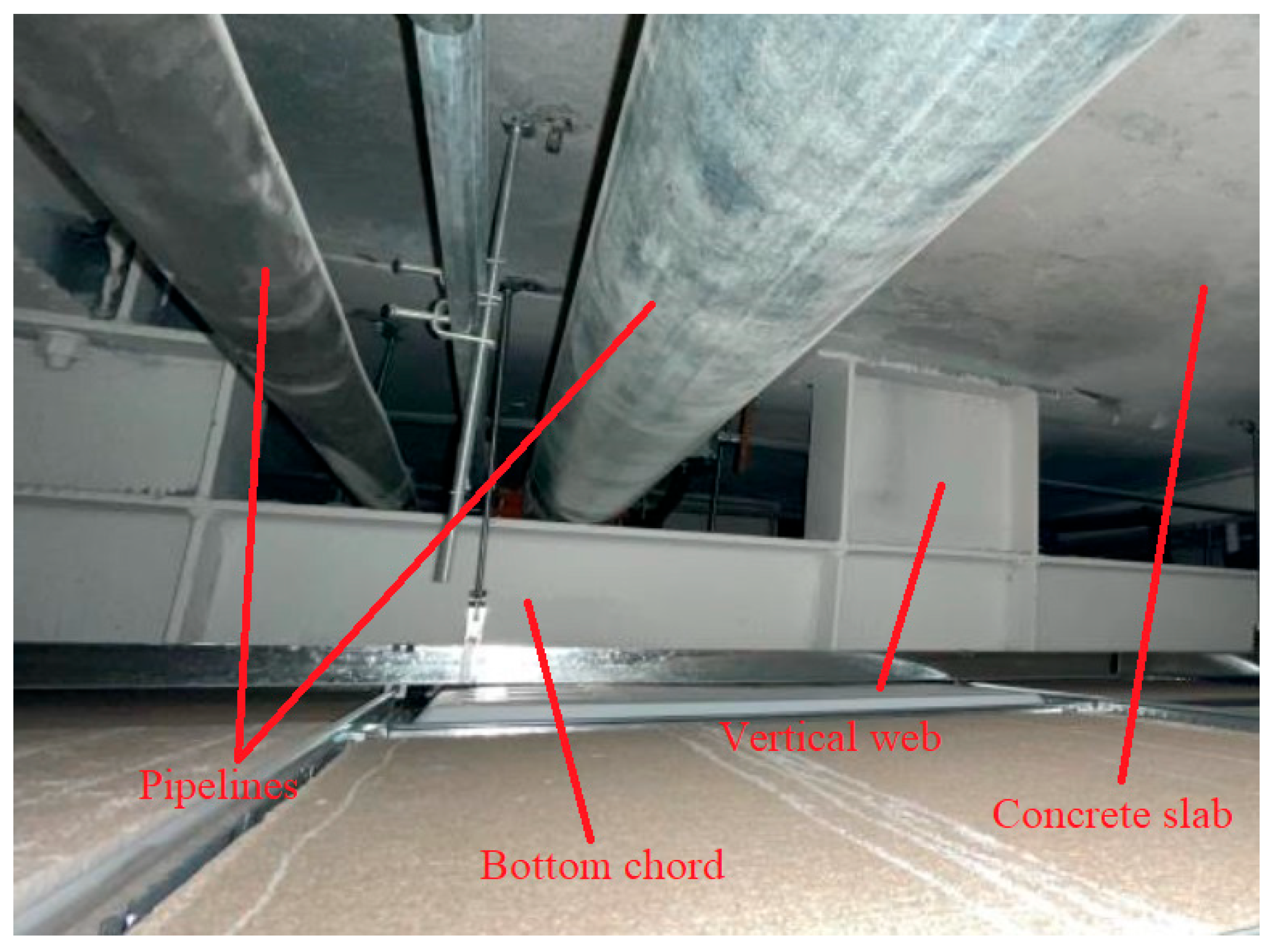
Although the aforementioned trusses vary in form, they share a common feature: their steel truss components all include a steel top chord. Considering that the primary function of the steel top chord is to share compressive stresses with the concrete slab—and given that the contribution of the steel top chord is relatively small [28]—it becomes feasible, on the basis of Vierendeel-truss composite floor systems, to eliminate the steel top chord entirely and use only the concrete slab as the top chord. This novel type of composite floor system is referred to as Top-chord-free Vierendeel-truss Composite Slab (TVCS) [31,32], as shown in Figure 1. Its advantages include maximizing the reduction in structural height occupancy and allowing the passage of a large number of equipment ducts with relatively large cross-sectional dimensions. This conceptual simplification aligns with the pursuit of structural efficiency seen in other composite systems, such as those with web openings [33] or thin concrete-encasement [34]. Reference [31] investigated the failure mode, ultimate load-carrying capacity, and stress distribution of TVCS through experiments and finite element analysis. Based on the assumption of “continuum webs,” analytical expressions for horizontal shear stress, bending moment, axial force, and deflection were derived; however, the study did not investigate the distribution laws of bending moment, shear force, and axial force throughout the entire composite slab system. Reference [32] analyzed the strain distribution characteristics of solid and open segments of the cross-section, examined the influence of concrete strength, steel strength, web width ratio, and web spacing ratio on sectional internal forces and load-carrying capacity, and proposed a modified flexural capacity calculation formula accounting for the web spacing ratio; however, it similarly did not systematically examine the internal force distribution in TVCS. This paper intends to employ the finite element analysis method to comprehensively analyze the distribution laws of shear force, axial force, and bending moment in the concrete slab, steel bottom chord, and all web members of TVCS, in order to identify the weak regions of this composite floor system. Subsequently, a simplified method will be adopted to derive the internal forces in each member of the floor system, thereby providing a corresponding theoretical calculation method for the application of this system (Figure 1).

2. Finite Element Modeling and Internal Force Distribution Characteristics

2.1. Analysis Object

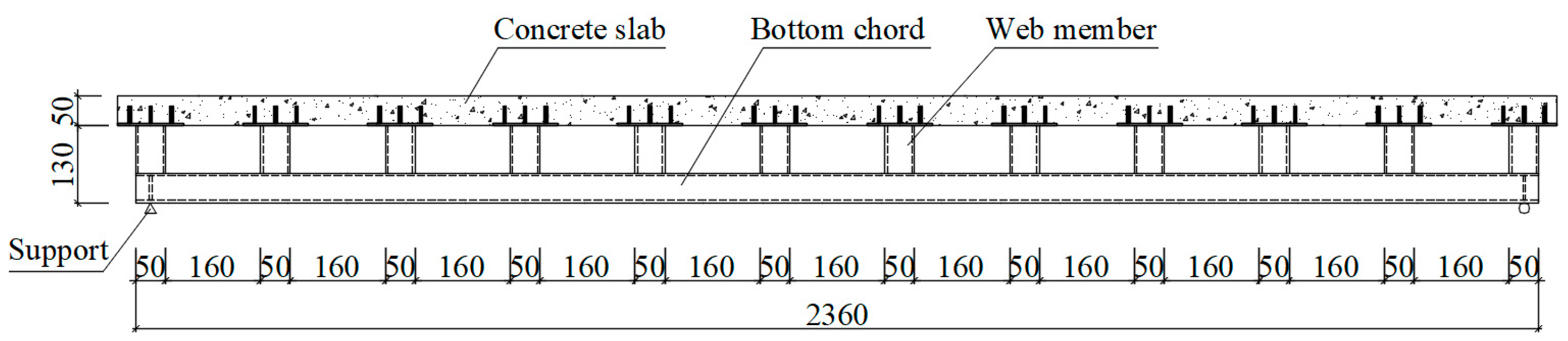
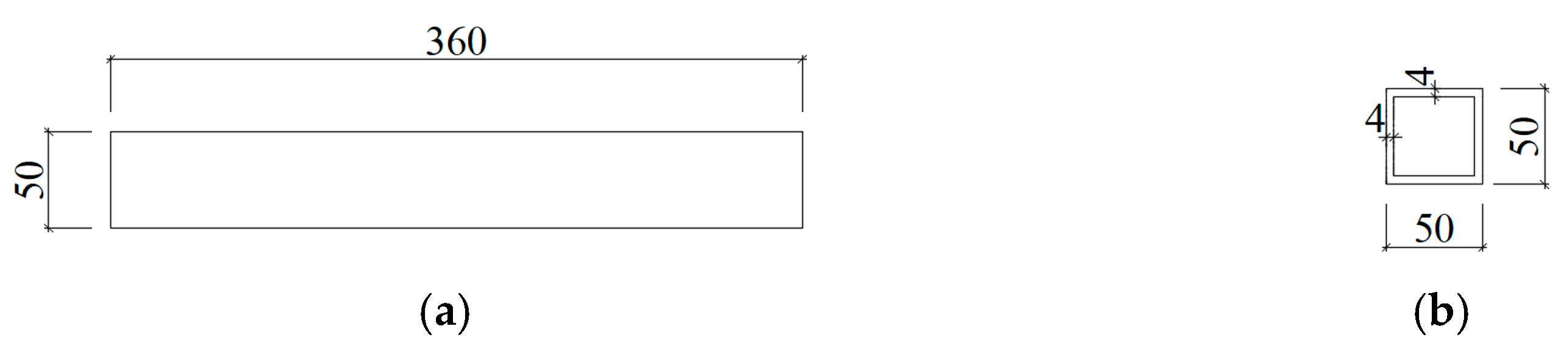
The analysis object follows the dimensions of the TVCS specimen reported in Reference [35], as shown in Figure 2 and Figure 3. With a width of 360 mm and a height thickness of 50 mm, the concrete slab serves as the top chord of the Vierendeel-truss. Twelve web members divide the top and bottom chords into eleven equal segments. Both the web members and the bottom chord are fabricated from square hollow sections with a cross-sectional dimension of 50 × 4. The steel grade is Q235B, and the concrete grade is C40.

2.2. Finite Element Modelling

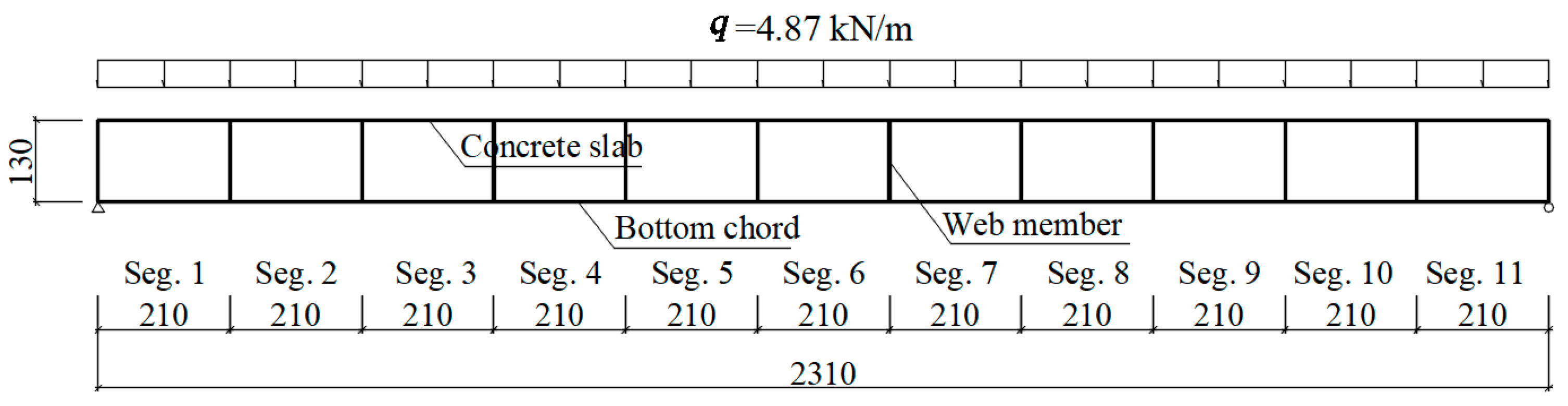
Midas/Gen (Version 9.1.0) was used for finite element modelling. The concrete slab (top chord), web members, and bottom chord were all modeled using beam elements (considering the relatively short length of each member, the influence of shear deformation was included in the calculation of the element stiffness matrix). The length of each member was taken as the centerline distance shown in Figure 2, as illustrated in Figure 4. During modeling, constructional details such as shear studs and web end plates were neglected. The top chord had a rectangular cross-section, while the web members and bottom chord had square tube cross-sections. All members are modeled using linear elastic material models.
The loading was applied as a uniformly distributed load with a magnitude of 4.87 kN/m (including the self-weight of the model and external loads, where the resultant of the external load is 10 kN). All connections between members were assumed to be rigid joints. The support conditions at the bottom were as follows: a pinned support at the left end and a roller support at the right end. An axonometric view of the computational model is shown in Figure 5.

2.3. Analysis of Internal Force Characteristics

2.3.1. Internal Force Analysis Results

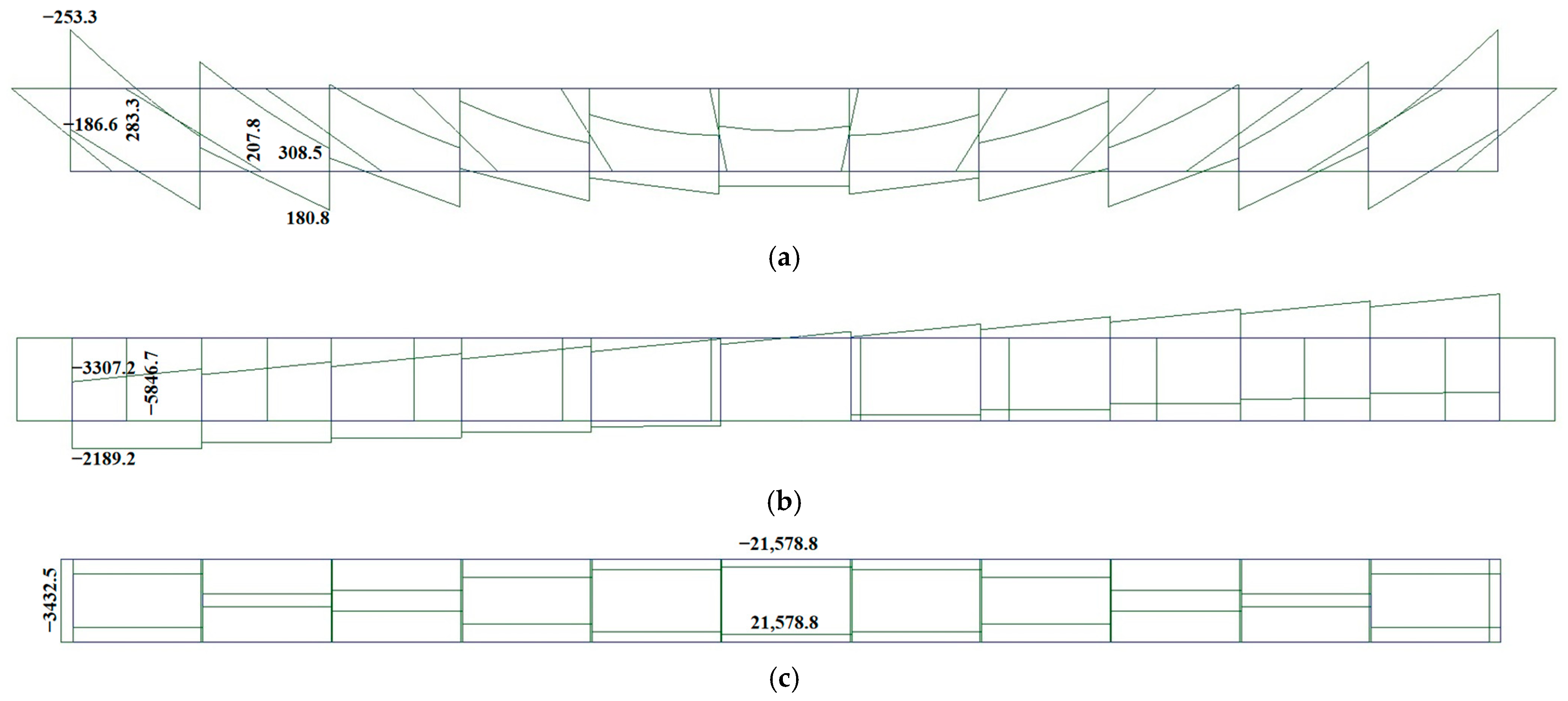
The bending moment, shear force, and axial force diagrams obtained from the aforementioned model are shown in Figure 6. The maximum positive bending moment, maximum negative bending moment, maximum shear force, maximum axial force of the members are all labeled in the figure. The units are N·m for bending moments, and N for axial forces and shear forces.
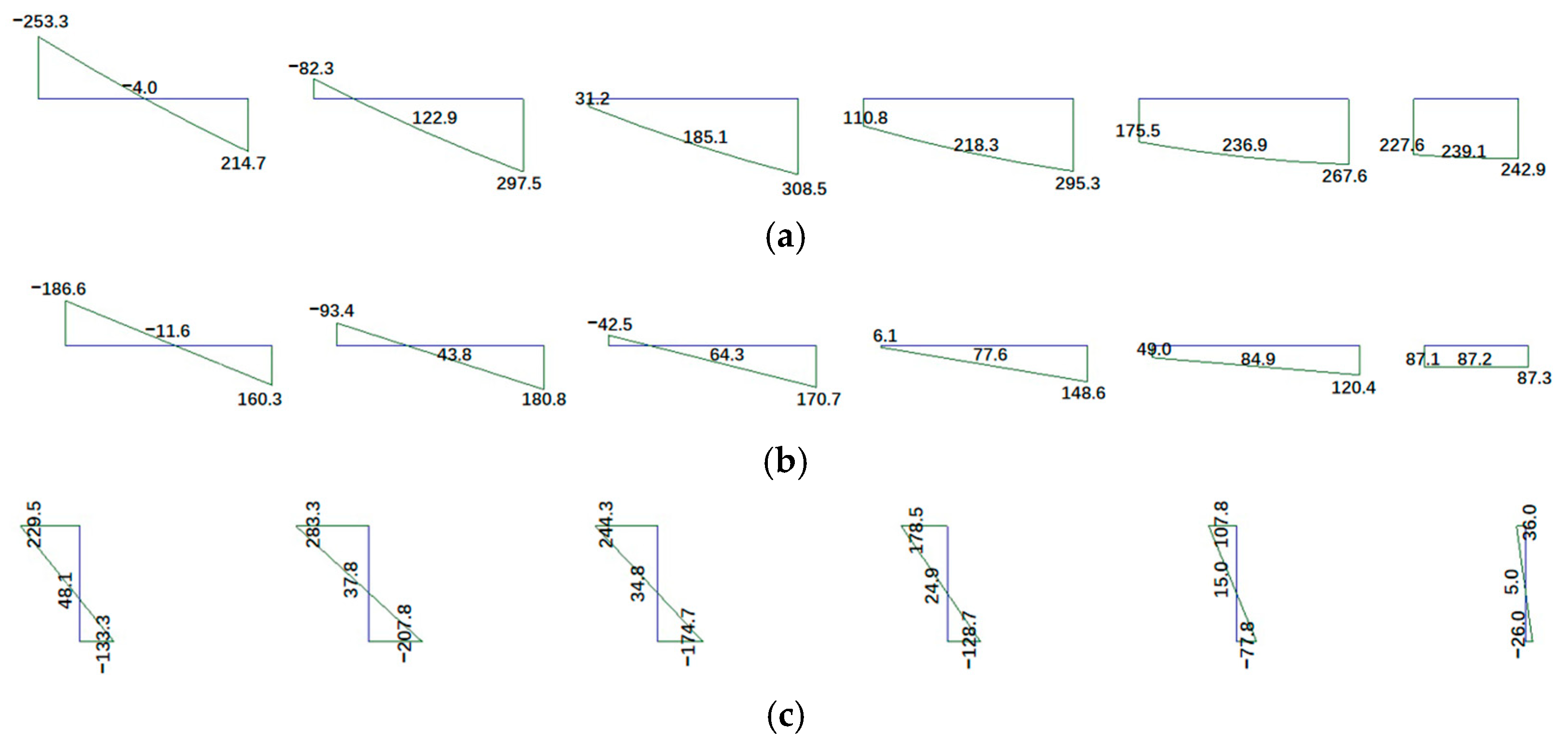
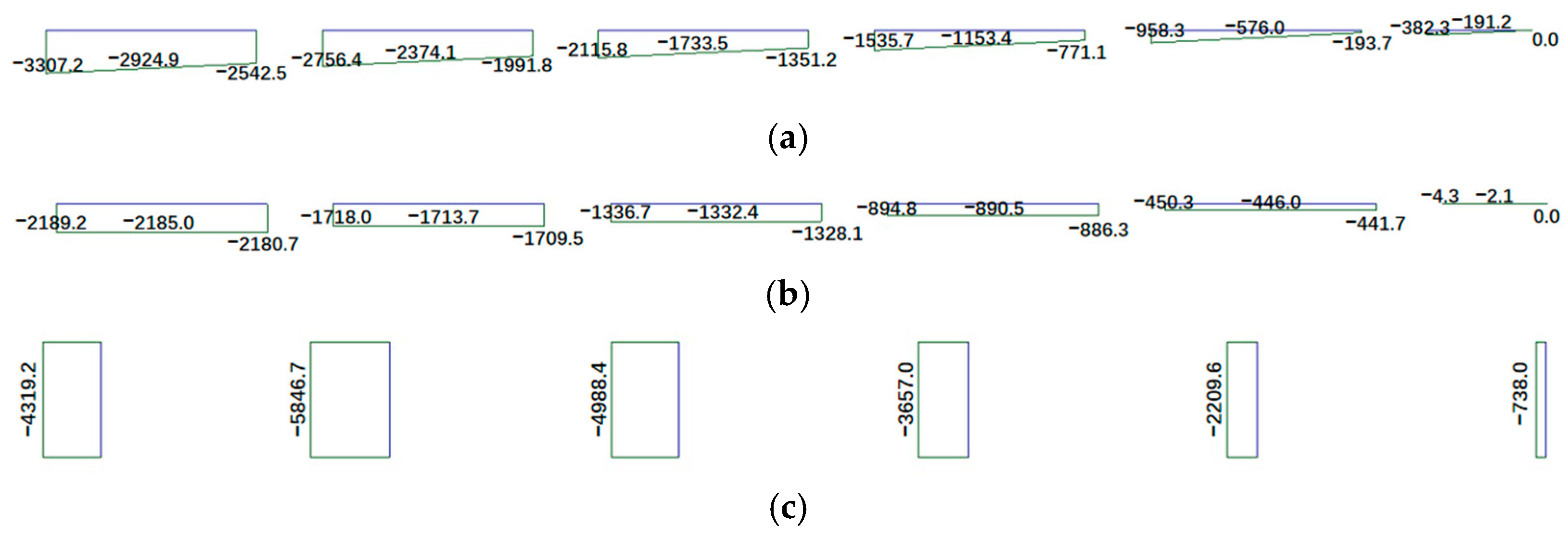
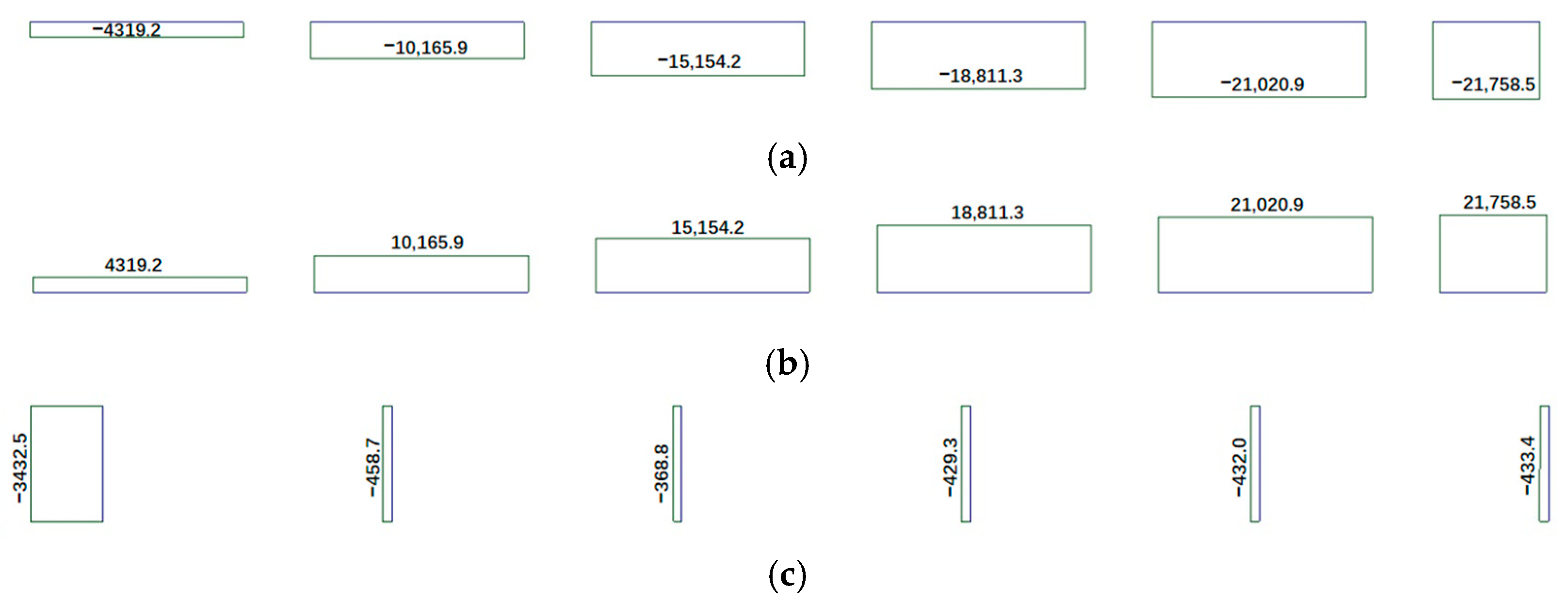
The internal forces displayed in Figure 6 contain considerable information. To present the internal forces in each part of the TVCS more clearly, the internal forces of the top chord (concrete slab), bottom chord, and web members are shown separately in Figure 7, Figure 8 and Figure 9. Due to symmetry, only the left half-span (corresponding to segments 1 to 5 and half of segment 6 in Figure 4) is displayed segment by segment. Moreover, since the lengths of the members are relatively short, the internal forces in the figures are shown only at the ends of the members and do not display the internal forces in the joint regions.

2.3.2. Bending Moment Distribution Characteristics

As can be seen from Figure 7, the bending moment distribution in the TVCS exhibits the following characteristics:
(1) The web members divide the chords into multiple segments; the bending moment diagram remains continuous within each chord segment but exhibits a discontinuity at the location of each web member;
(2) The bending moments in the two chord segments adjacent to the supports (including both top and bottom chords) show large variations and exhibit inflection points, whereas the remaining chord segments are predominantly subjected to positive bending moments;
(3) The maximum negative bending moments in both the top and bottom chords are located at the left end of the first chord segment (the segment immediately adjacent to the support);
(4) The maximum positive bending moments in the top and bottom chords do not occur at mid-span (segment 6 in the figure) but rather appear in segment 3 (top chord) or segment 2 (bottom chord);
(5) The bending moment diagram of each web member exhibits an inflection point. In terms of bending moment magnitude, the overall trend is that web members closer to the supports have larger bending moments than those closer to mid-span; however, the web member with the largest bending moment is not the one at the support but the second web member. The ranking of web members by bending moment magnitude is: 2, 3, 1, 4, 5, 6.

2.3.3. Shear Force Distribution Characteristics

As can be seen from Figure 8, the shear force distribution in the TVCS exhibits the following characteristics:
(1) Compared to the bending moment distribution, the shear force distribution in the chords is more regular: the shear forces in both the top and bottom chords decrease gradually from the supports toward mid-span, with the first chord segment exhibiting the largest shear force and the shear force at mid-span being zero;
(2) Since the uniformly distributed load is applied directly to the top chord, the shear force varies linearly within each segment of the top chord. Within each segment of the bottom chord, the shear force remains constant;
(3) The ranking of web members by shear force magnitude is: 2, 3, 1, 4, 5, 6, which is consistent with the ranking by bending moment magnitude.

2.3.4. Axial Force Distribution Characteristics

As can be seen from Figure 9, the axial force distribution in the TVCS exhibits the following characteristics:
(1) The axial forces in the top chord are all compressive, while those in the bottom chord are all tensile, and both increase gradually from the supports toward mid-span;
(2) Within the same segment, the absolute values of the axial forces in the top and bottom chords are equal;
(3) All web members are subjected to compressive axial forces, with the first web member (the support web) carrying the largest axial force, while the axial forces in the other web members are much smaller than that in web 1.

2.3.5. Overall Internal Force Distribution Characteristics of TVCS

From the above characteristics of bending moment, shear force, and axial force distributions, it can be concluded that the overall internal force distribution in TVCS exhibits the following features:
(1) The internal force distribution in each member of TVCS differs significantly from that in conventional steel truss composite floor systems. Due to the relatively small slenderness ratios of all members and the rigid connections at the joints, the members no longer primarily carry axial forces as in conventional steel trusses. For example, the bending moment at the left end of the first segment of the bottom chord in Figure 7 is 186.6 N·m, and the axial force in this segment in Figure 9 is 4319.2 N. The stresses induced by bending moment and axial force are 17.8 N/mm2 and 5.9 N/mm2, respectively, indicating that the bending moment in TVCS members is no longer a “secondary moment” as in conventional steel truss members;
(2) Based on the internal force values of the web members in Figure 7, Figure 8 and Figure 9, the maximum bending stress and shear stress in the web members are 27.1 N/mm2 and 7.9 N/mm2, respectively, while the maximum axial stress is 4.7 N/mm2 (in the support web) and 0.6 N/mm2 (in the other webs), indicating that the web members are primarily subjected to bending and shear, and the axial stress is negligible except in the support web;
(3) Compared to conventional single-span composite beams, the internal force distribution along the span in the TVCS is considerably more complex. The internal forces (bending moment, shear force, axial force) in adjacent chord segments are discontinuous, i.e., abrupt changes occur at the interfaces between segments. The overall internal force distribution in the chords exhibits the following characteristics: chord segments closer to the supports primarily carry bending moment and shear force, while chord segments closer to mid-span primarily carry bending moment and axial force. The overall internal force distribution in the web members exhibits the following characteristics: web members closer to the supports carry high bending moments, shear forces, and axial forces, while web members closer to mid-span carry only small bending moments, shear forces, and axial forces. The locations of maximum internal forces in various members are listed in Table 1.

2.3.6. Influence of Load Distribution Patterns

The internal force distribution described above corresponds to a uniformly distributed load. Other loading types include half-span uniform loading and two-point concentrated loading, etc. Keeping the analysis model and total load (10 kN) unchanged, the characteristics of the internal force distributions corresponding to various loading types are compared in Table 2, where Mmax1, Mmax2, Mmaxw, Vmax1, Vmax2, Vmaxw, Nmax1, Nmax2 and Nmaxw are the maximum magnitudes of the concrete slab moment, the bottom chord moment, the web member moment, the concrete slab shear force, the bottom chord shear force, the web member shear force, the concrete slab axial force, the bottom chord axial force and the web member axial force, respectively. As shown in Table 2, the internal forces corresponding to half-span uniform loading and two-point concentrated loading are higher than those under full-span uniform loading (with the exception of axial force in the web member, which is slightly lower). This indicates that the loading type has a considerable influence on the magnitude of internal forces in the TVCS.

3. Theoretical Analysis

3.1. Analysis Method

The theoretical analysis focuses on the TVCS subjected to uniformly distributed loading. Based on the above internal force distribution features, the internal forces in TVCS are calculated using the following approach:
(1) The internal forces in the chords are calculated segment by segment, i.e., the internal forces in each chord segment are computed separately;
(2) The shear force is first calculated according to a single-span simply supported beam model and then distributed proportionally between the top and bottom chords using distribution coefficients;
(3) The bending moment in the chords accounts for both global and local bending moments;
(4) The axial forces in the chords are calculated based on the global bending moment and the distance between the top and bottom chords;
(5) Web shear forces are obtained from axial force differences between adjacent chord segments.
(6) Web axial forces arise from chord shear force imbalances.
(7) Web bending moments are estimated from shear forces and assumed inflection point locations.

3.2. Chord Internal Force Calculation

3.2.1. Chord Shear Force Calculation

For a certain TVCS segment, the sum of the shear forces in the top chord (V1) and the bottom chord (V2) equals the total sectional shear force. Suppose the distance from the midpoint of the segment to the left support is x, the total shear force Vp at that section can be calculated according to the simply supported beam model using equilibrium conditions from the support reaction R and x, i.e.,:
V p = R q x = q L 2 q x
V 1 + V 2 = V p
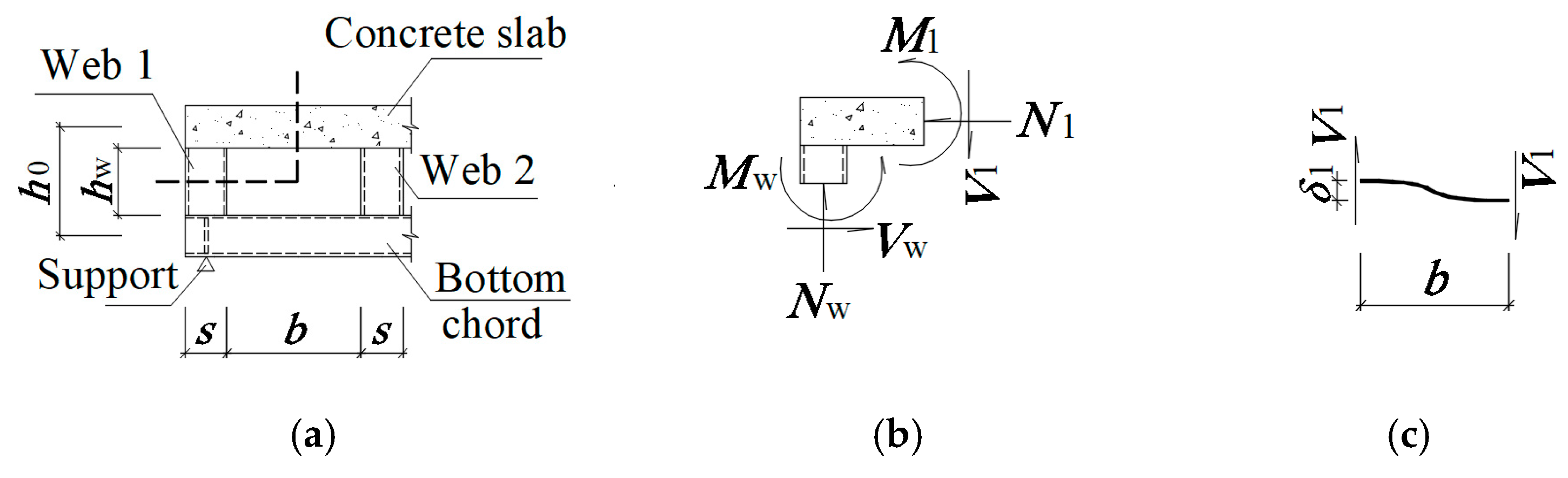
As indicated by the previous analysis, the axial forces in the web members are compressive, and the compressive force in web 1, i.e., the web member at the support, is relatively large. Its compressive deformation will affect the shear force distribution between the top and bottom chords. Figure 10a shows the dimensions of web 1 and segment 1, where b is the clear length of the segment (excluding the joint region), s is the cross-sectional height of the web member, h0 is the distance from the centroid of the concrete slab to the centroid of the bottom chord, and hw is the clear height of the web member.
In case that the compressive deformation of web 1 is neglected, the shear forces in the top and bottom chords can be distributed proportionally according to their flexural rigidities EI, i.e., the shear force distribution coefficients for the top and bottom chords are, respectively:
μ 10 = E 1 I 1 E 1 I 1 + E 2 I 2 ,         μ 20 = E 2 I 2 E 1 I 1 + E 2 I 2 = 1 μ 10
where E1 and E2 are the elastic moduli of the top chord (concrete slab) and the bottom chord, respectively, and I1 and I2 are their respective second moments of area.
Sectioning segment 1 and web 1 along the dashed line in Figure 10a yields the internal forces in the partial top chord and web as shown in Figure 10b, where M1, V1, and N1 are the bending moment, shear force, and axial force in the top chord, respectively, and Mw, Vw, and Nw are the bending moment, shear force, and axial force in web 1, respectively. From vertical equilibrium, the shear force V 1 in the top chord of segment 1 equals the axial force N w in web 1, i.e.,:
V 1 = N w
The vertical bending deformation of the top chord in segment 1 under the shear force V1 is shown in Figure 10c, with a vertical deflection value of:
δ 1 = V 1 k 1
where k 1 is the lateral stiffness of the top chord, k 1 = 12 E 1 I 1 / b 3 .
The vertical compressive deformation of web 1 can be expressed by:
δ w = N w h w E w A w = V 1 h w E w A w = V 1 k w
k w = E w A w h w
where Ew and Aw are the elastic modulus and cross-sectional area of the web member, respectively, and k w is the axial stiffness of the web member.
Considering the compressive deformation of web 1, the total deformation at the right end of segment 1 of the top chord increases from δ 1 to δ 1 , i.e.,
δ 1 = δ 1 + δ w = V 1 k 1 + V 1 k w = V 1 1 1 k 1 + 1 k w = V 1 k 1
where
k 1 = 1 1 k 1 + 1 k w = k 1 k w k 1 + k w
Equation (8) can be interpreted as the lateral stiffness of the top chord being reduced from k 1 to k 1 , with a reduction coefficient of
k r = k 1 k 1 = k w k 1 + k w
Based on the reduction coefficient k r , the shear force distribution coefficients μ 10 for the chords are modified to yield the corrected shear force distribution coefficients for the top and bottom chords as
μ 1 = k r μ 10 = k w k 1 + k w × E 1 I 1 E 1 I 1 + E 2 I 2 ,         μ 2 = 1 μ 1
The shear forces at the midpoints of each segment in the top and bottom chords are respectively
V 1 = μ 1 V p ,       V 2 = μ 2 V p
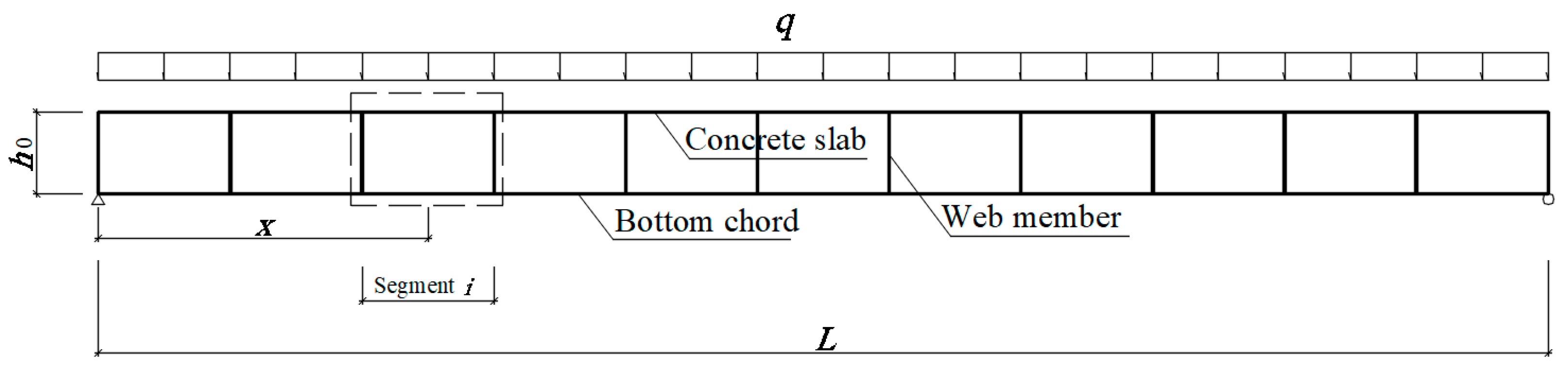
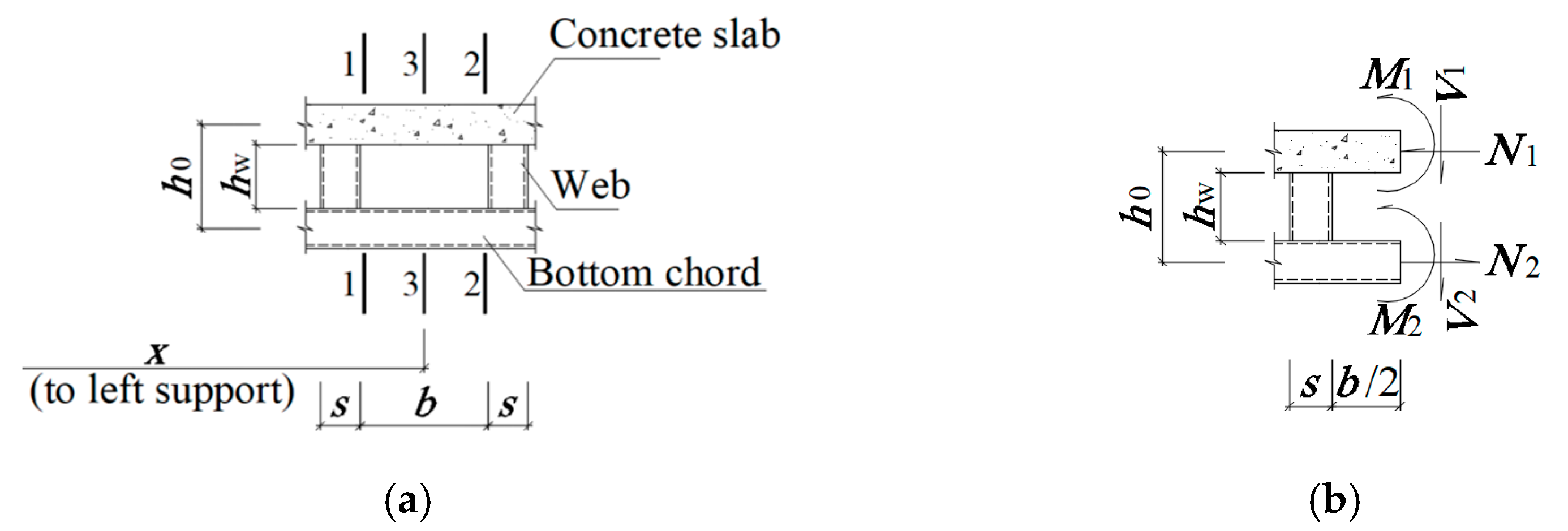
The dashed box in Figure 11 indicates the location of the i-th segment, whose midpoint is at a distance x from the left support. A detailed view of this segment is shown in Figure 12a, where the cross-sections at the left end, right end, and midpoint are labeled 1-1, 2-2, and 3-3, respectively. Sectioning along 3-3 yields the internal force diagram of the chords as shown in Figure 12b. The shear forces V1 and V2 at section 3-3 can be obtained from Equation (12), where Vp is calculated from Equation (1). Since the uniformly distributed load q over the segment acts only on the top chord and not on the bottom chord, the shear forces in the top chord at sections 1-1 and 2-2 are respectively
V 1 L = V 1 + q b 2 ,       V 1 R = V 1 q b 2
The shear forces in the bottom chord at sections 1-1 and 2-2 are respectively
V 2 L = V 2 R = V 2

3.2.2. Chord Bending Moment Calculation

The chord bending moments are calculated under the following assumptions:
(1) The total sectional bending moment Mp is divided into a global bending moment MI and a local bending moment MII, with the distribution coefficient determined by the globality index of the TVCS;
(2) The global bending moment MI is distributed to the top and bottom chords in proportion to their flexural rigidities relative to that of the composite section;
(3) The local bending moment MII is distributed to the top and bottom chords in proportion to their individual flexural rigidities;
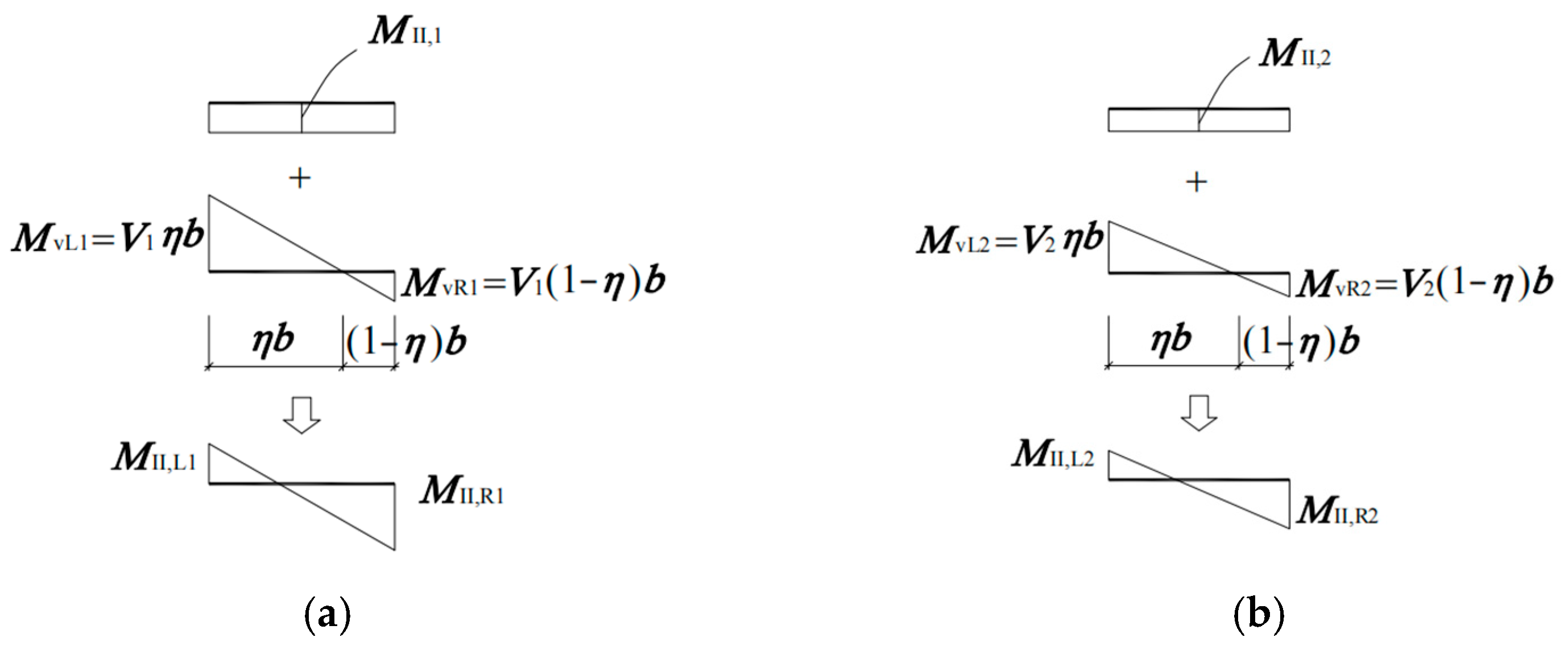
(4) The top and bottom chords also account for additional local bending moments Mv1 and Mv2 corresponding to their shear forces, i.e., secondary bending moments due to shear. Under the action of Mv1 and Mv2, the distance from the inflection point to section 1-1 is assumed to be ηcb, where ηc = 0.5 (for all segments except the first) or 0.58 (for the first segment).
Taking sections 1-1 and 2-2 of an arbitrary segment as shown in Figure 12a as an example, the process for determining the chord bending moments at these two sections according to the above assumptions is as follows.
The first step is to determine the section total bending moments MpL and MpR at sections 1-1 and 2-2, respectively. Adopting the simply supported beam model, the bending moments are derived from equilibrium equations in terms of the support reaction R and the location of each section. Given that the distances of the two sections from the left support are xb/2 and x + b/2, respectively,
MpL and MpR are obtained as follows:
M pL = R x b 2 1 2 q x b 2 2 = q L 2 x b 2 1 2 q x b 2 2 = q 2 x b 2 L x + b 2
M pR = R x + b 2 1 2 q x + b 2 2 = q L 2 x + b 2 1 2 q x + b 2 2 = q 2 x + b 2 L x b 2
Multiplying MpL and MpR by the global bending moment coefficient ζI yields the global bending moments M IL and M IR at sections 1-1 and 2-2, respectively, i.e.,
M IL = ζ I M pL ,   M IR = ζ I M pR
The global bending moment coefficient ζI is determined by the opening ratio of the TVCS elevation. Based on curve-fitting from numerical examples, ζI is taken as 0.974 for this case.
The global bending moments for the top and bottom chords are obtained from M IL and M IR using their respective global bending moment distribution coefficients μ G 1 and μ G 2 , i.e.,
M IL 1 = μ G 1 M IL ,   M IL 2 = μ G 2 M IL
M IR 1 = μ G 1 M IR ,   M IR 2 = μ G 2 M IR
where M IL 1 and M IL 2 are the global bending moments allocated to the top and bottom chords at section 1-1, respectively, and M IR 1 and M IR 2 are those at section 2-2.
The global bending moment distribution coefficients μ G 1 and μ G 2 are calculated as:
μ G 1 = E 1 I 1 S C ,         μ G 2 = E 2 I 2 S C
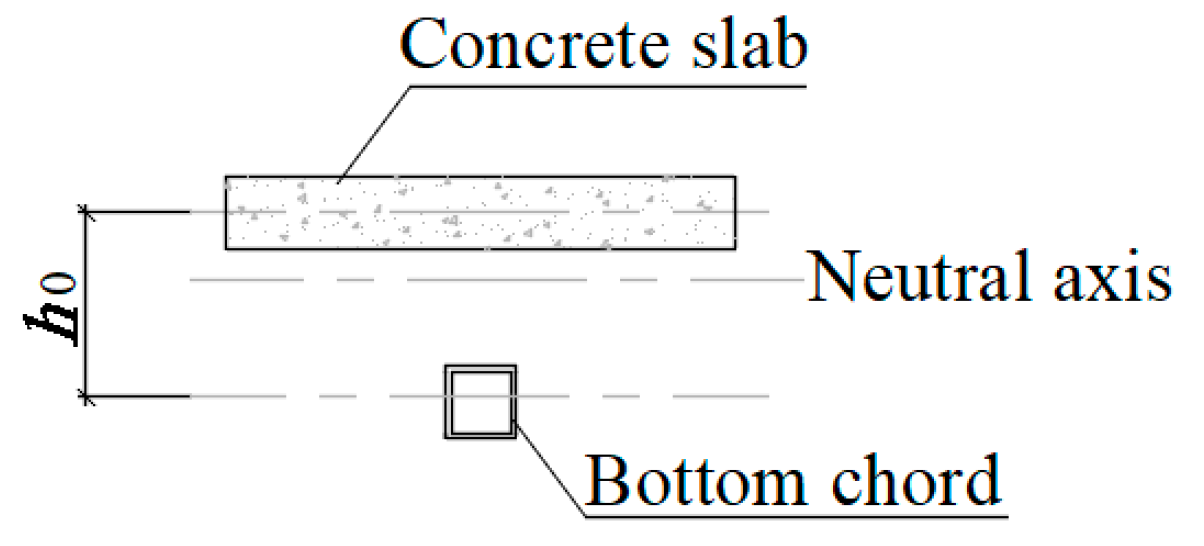
where SC is the flexural rigidity of the composite section formed by the concrete slab and the bottom chord (i.e., the section shown in Figure 13), calculated as
S C = E 1 I 1 + E 2 I 2 + E 1 A 1 E 2 A 2 E 1 A 1 + E 2 A 2 h 0 2
where A 1 and A 2 are the cross-sectional areas of the concrete slab and the bottom chord, respectively.
Next, the local bending moments for the top and bottom chords are determined. For section 3-3 in Figure 12a, the total sectional bending moment is
M p = R x 1 2 q x 2
The sum of the local bending moments in the top and bottom chords is
M II = 1 ζ I M p = 1 ζ I ( R x 1 2 q x 2 )
Distributing M II in proportion to the flexural rigidities of the chords, the local bending moment allocated to the top chord is
M II , 1 = μ 10 M II = E 1 I 1 E 1 I 1 + E 2 I 2 M II
and that allocated to the bottom chord is
M II , 2 = μ 20 M II = E 2 I 2 E 1 I 1 + E 2 I 2 M II
After obtaining the local bending moments of the chords from Equations (24) and (25), additional secondary bending moments due to shear forces must be superimposed in accordance with the aforementioned assumption 4. The secondary bending moments due to shear at sections 1-1 and 2-2 for the top chord are denoted MvL1 and MvR1, respectively, and those for the bottom chord are denoted MvL2 and MvR2, as shown in Figure 14.
Using the shear force values V1 and V2 from Equation (12), the local bending moments at section 1-1 for the top and bottom chords are respectively
M II , L 1 = M II , 1 V 1 η c b
M II , L 2 = M II , 2 V 2 η c b
and those at section 2-2 are respectively
M II , R 1 = M II , 1 + V 1 η c b
M II , R 2 = M II , 2 + V 2 η c b
Adding the global bending moments from Equation (18) to the local bending moments from Equations (26) and (27) yields the calculated bending moments at sections 1-1. The calculated bending moments at section 1-1 for the top and bottom chords are respectively
M L 1 = M II , L 1 + M II , L 1
M L 2 = M II , L 2 + M II , L 2
Adding the global bending moments from Equation (19) to the local bending moments from Equations (28) and (29) yields the calculated bending moments at sections 2-2. The calculated bending moments at section 2-2 for the top and bottom chords are respectively
M R 1 = M II , R 1 + M II , R 1
M R 2 = M II , R 2 + M II , R 2

3.2.3. Chord Axial Force Calculation

As shown in Figure 12b, after the global bending moment MI at section 3-3 is distributed to the top and bottom chords, the remaining portion is balanced by the moment generated by the axial forces in the top and bottom chords, thus
N 1 h 0 = N 2 h 0 = M I M I 1 M I 2
where N 1 and N 2 are the axial forces in the top and bottom chords, respectively, MI1 and MI2 are the global bending moments allocated to the top and bottom chords, respectively, given by:
M I 1 = μ G 1 M I ,     M I 2 = μ G 2 M I
From Equations (34) and (35), N 1 and N 2 can be obtained as follows:
N 1 = N 2 = M I M I 1 M I 2 h 0 = M I h 0 1 μ G 1 μ G 2 = ζ I M p h 0 1 μ G 1 μ G 2
where the total sectional bending moment Mp is determined from Equation (22).

3.3. Web Internal Force Calculation

3.3.1. Web Axial Force and Shear Force Calculation

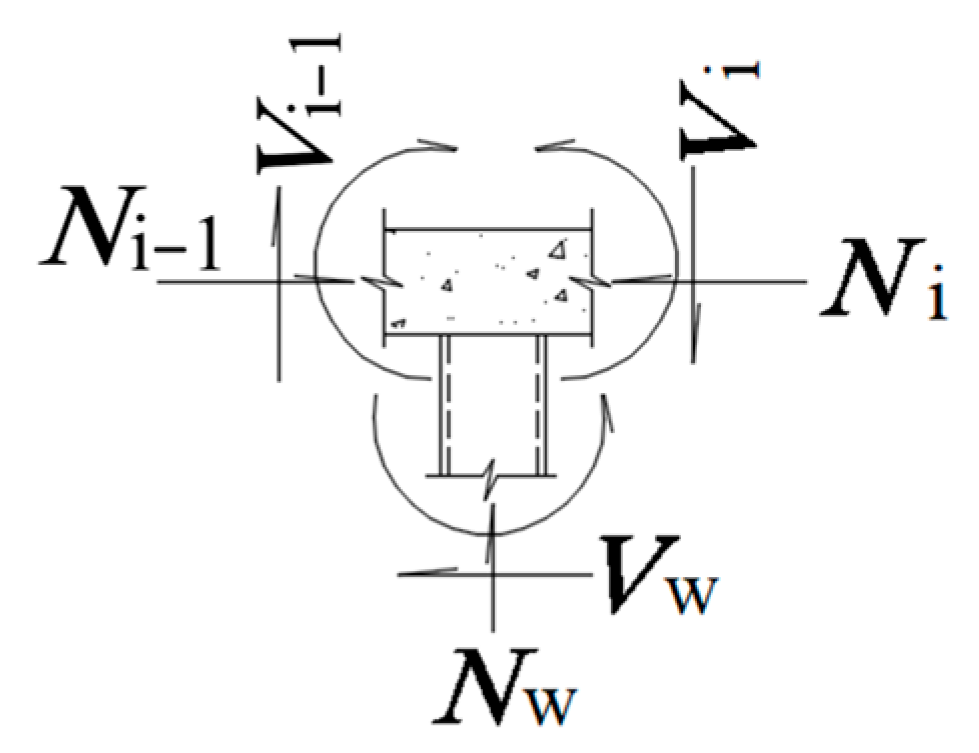
The forces at the top node of a web member are shown in Figure 15, where Ni−1 and Ni are the axial forces in the top chord segments to the left and right of the i-th web member, respectively, Vi−1 and Vi are the shear forces in the top chord segments to the left and right of the web, respectively, Nw and Vw are the axial force and shear force in the web member, respectively. The equilibriums in the vertical and horizontal direction yields
N w = V i V i - 1
V w = N i - 1 N i

3.3.2. Web Bending Moment Calculation

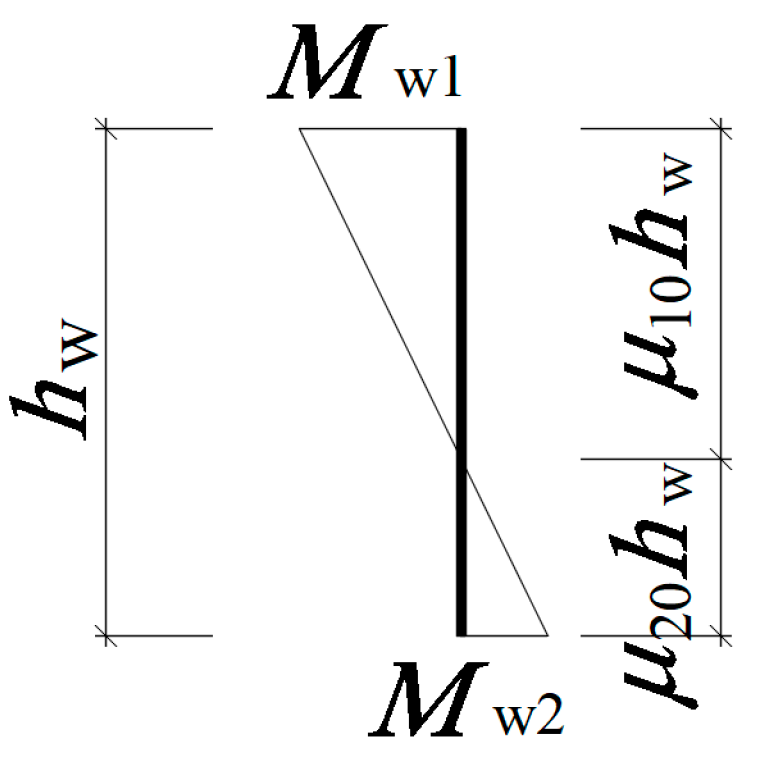
The bending moment diagram of a web member is shown schematically in Figure 16. Assuming that the inflection point is located at a distance μ 10 hw from the top of the web member, where μ 10 is determined from Equation (24), the bending moments at the top and bottom of the web member are respectively:
M w 1 = V w μ 10 h w ,     M w 2 = V w μ 20 h w
Since the above analysis does not account for load eccentricity along the longitudinal axis, appropriate structural detailing measures should be implemented in practical engineering applications to prevent such eccentricity.

4. Results Verification

4.1. Comparison Between Theoretical Analysis and Finite Element Analysis Results

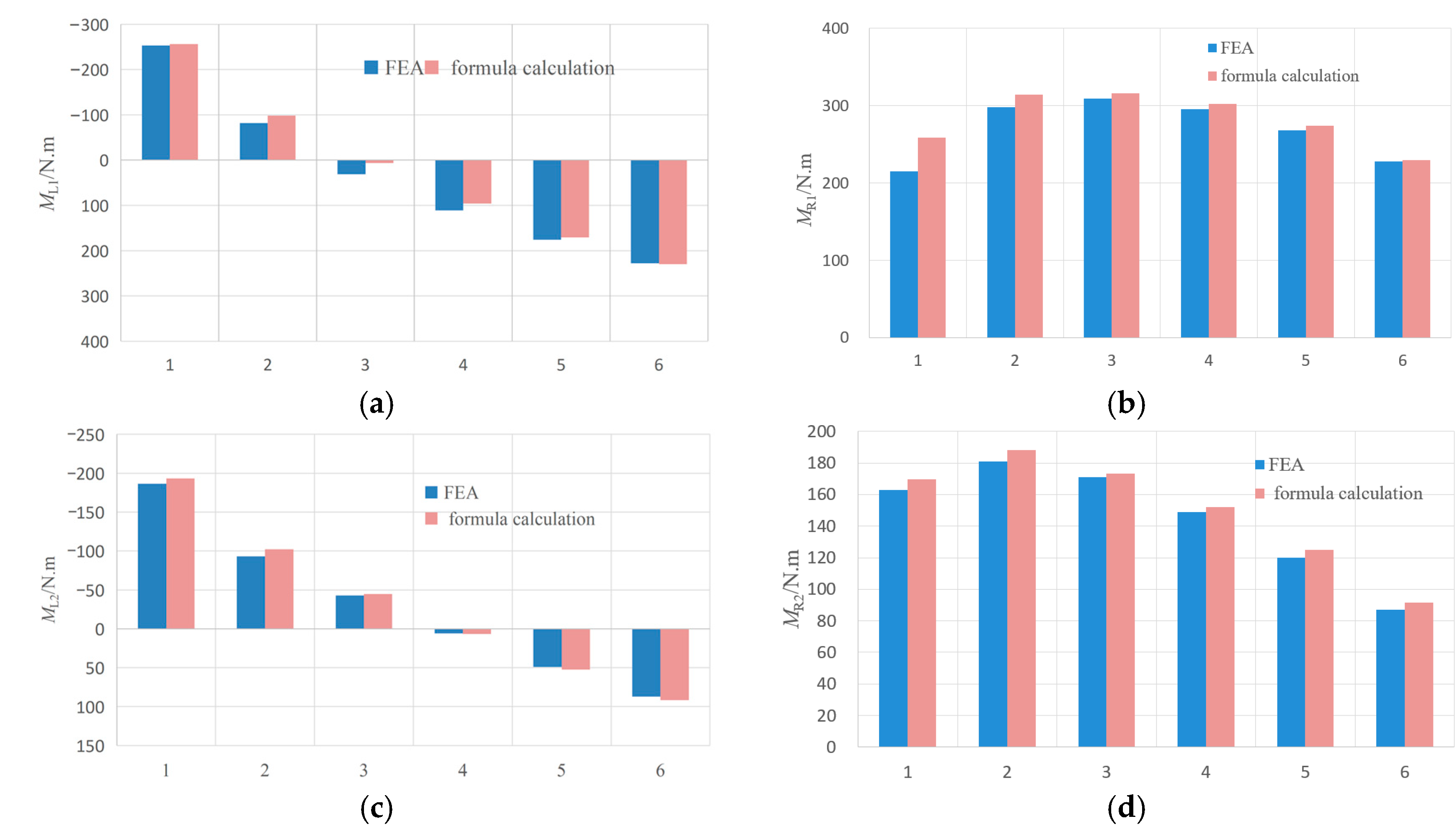
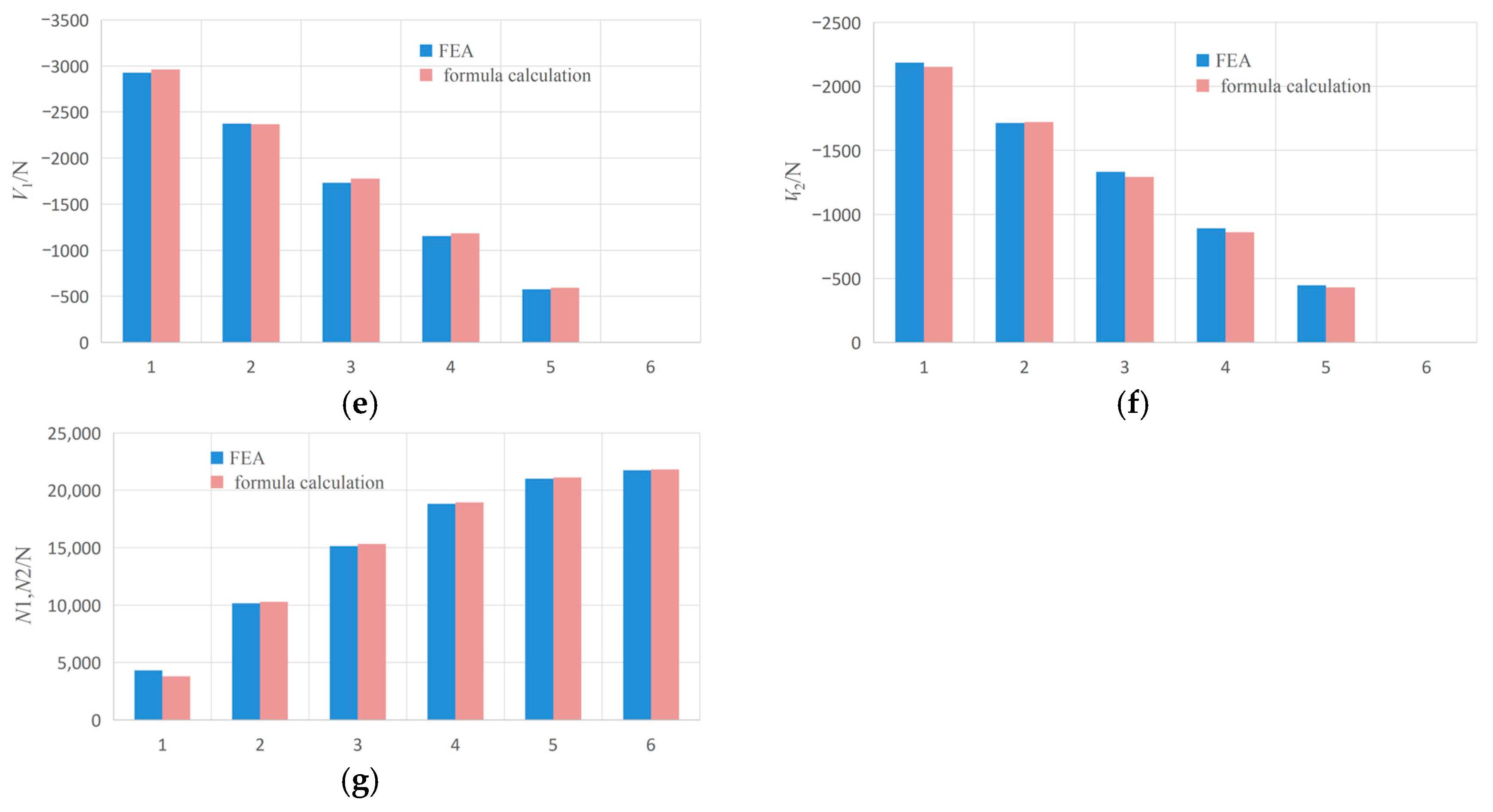
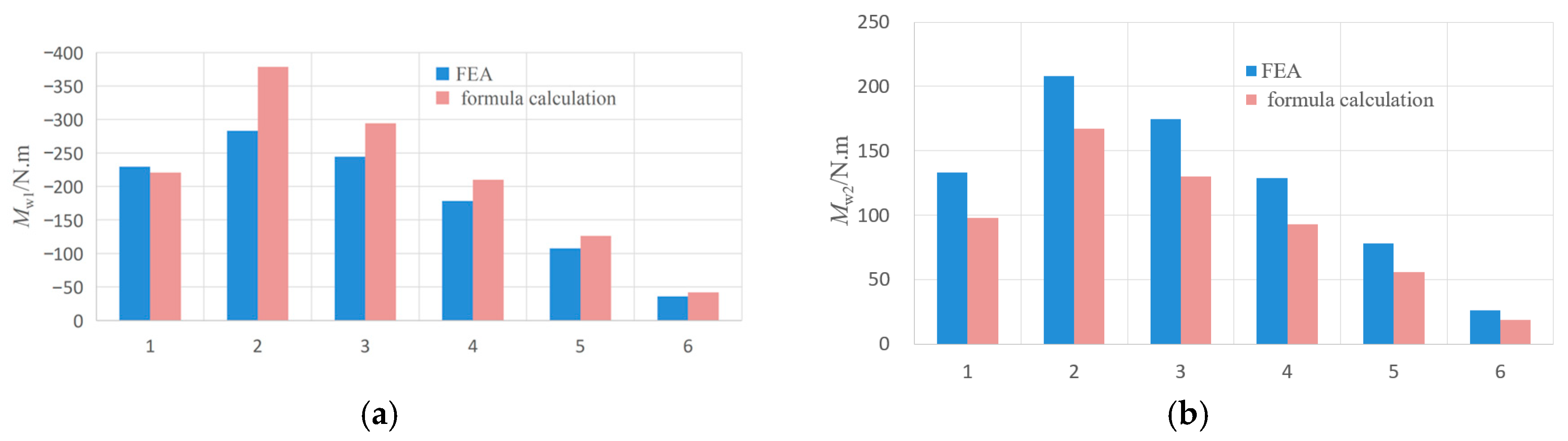
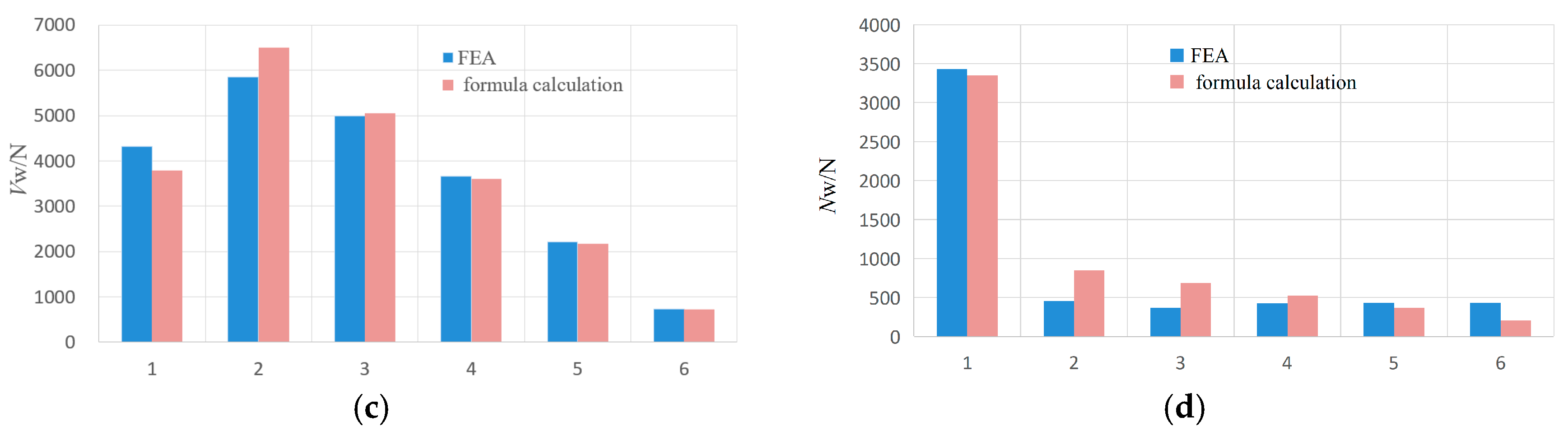
The internal forces in each segment of the chords of the TVCS shown in Figure 2 were calculated using the aforementioned theoretical formulas and compared with the internal force values from the finite element analysis shown in Figure 7, Figure 8 and Figure 9, as presented in Figure 17a–g, where the horizontal axis 1–6 denotes the segment number. Figure 17a shows the bending moment at the left end (section 1-1) of the top chord; Figure 17b shows the bending moment at the right end (section 2-2) of the top chord; Figure 17c shows the bending moment at the left end of the bottom chord; Figure 17d shows the bending moment at the right end of the bottom chord; Figure 17e shows the shear force in the top chord; Figure 17f shows the shear force in the bottom chord; and Figure 17g shows the axial force in the chords (the axial forces in the top and bottom chords of the same segment are equal in magnitude). Furthermore, the internal forces in each web member calculated using the theoretical formulas were compared with the finite element analysis results, as shown in Figure 18a–d, where the horizontal axis denotes the web member number. Figure 18a shows the bending moment at the top of the web members; Figure 18b shows the bending moment at the bottom of the web members; Figure 18c shows the shear force; and Figure 18d shows the axial force.
As can be seen from Figure 17 and Figure 18, except for minor discrepancies in some web moments, theoretical predictions for the chord and web internal forces show close agreement with finite element results.

4.2. Comparison of Various Methods for Internal Force Analysis of TVCS

The above analysis of internal forces in the TVCS employs two approaches, i.e., finite element analysis (FEA) and theoretical formula-based calculations. The FEA presented herein uses one-dimensional elements; alternatively, three-dimensional elements can also be employed for modeling, though at the cost of significantly longer computational time. Table 3 provides a comparative summary of the various methods used for internal force analysis of the TVCS.

4.3. Experimental Validation of Theoretical Analysis Results

4.3.1. Validation of Internal Force Values

The experiment in Reference [35] measured internal forces only in certain members. The measured internal forces in the steel bottom chord are now compared with the results calculated using the internal force formulas proposed in this paper. The corresponding loading stage is the second loading level, with a load value of 10 kN. The comparison of internal forces is shown in Table 4.
As shown in Table 4, the calculated axial forces are in very close agreement with the measured results, while the errors in the end bending moment values are relatively large. Possible reason is that the strain gauges used to measure the end bending moments were located near the connection joints between the webs and chords, where stress concentration is severe. Other contributing factors include cracking and crushing of the concrete slab due to local stress concentrations, as well as potential slip between the web members and the concrete slab.
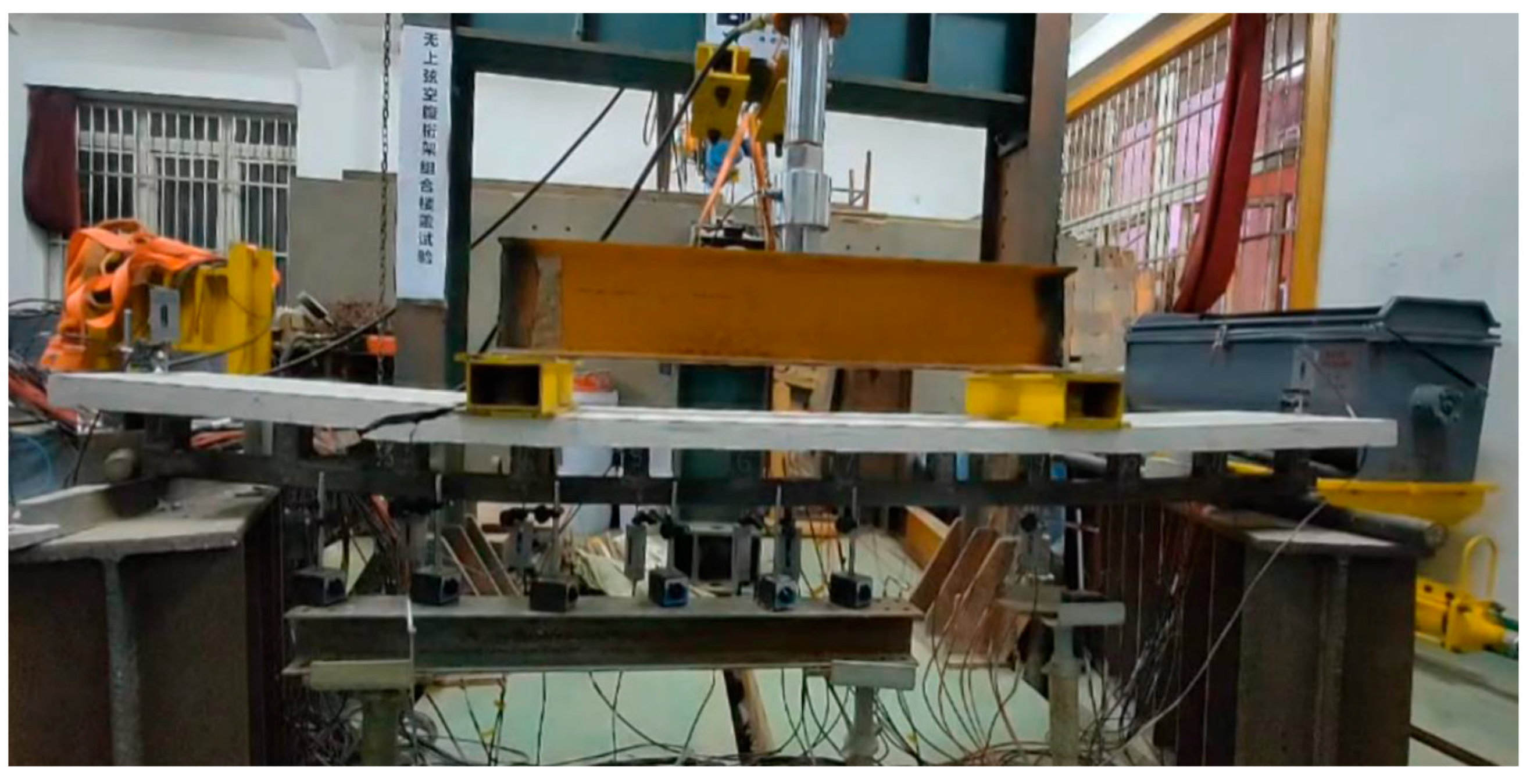
It should be noted that the specimen shown in Figure 19 was tested under two-point loading, whereas the theoretical formulation presented in this paper assumes uniformly distributed loading. Although these two loading schemes lead to different internal force distributions in the members, they exhibit similarities in terms of critical (i.e., vulnerable) regions. Under two-point loading, the segments near the loading points—located within the shear-flexure zone—experience high combined shear forces and bending moments, making them prone to failure. Similarly, under uniform loading, the same regions also develop relatively large global shear forces and bending moments. According to the assumptions of the theoretical model proposed herein, the bending moments and shear forces in the top and bottom chords are derived by first distributing the global bending moment and shear force and then superimposing local effects. Consequently, the chord members in these regions also experience significant internal forces, rendering them similarly susceptible to damage and thus representing critical zones in both loading scenarios.

4.3.2. Validation of Failure Mode

As indicated by the internal force analysis results in Section 2.3 and the comparison in Figure 17, the bending moment in the concrete slab reaches its maximum in Segment 3 (i.e., the segment between webs 3 and 4), and the shear force and axial force in this segment are also relatively large. This location coincides with the failure location observed in the experiment reported in Reference [24]. Figure 19 shows the failure photograph.

5. Conclusions

This paper comprehensively analyzed and compared the internal force distribution characteristics of TVCS using FEA and theoretical analysis methods, leading to the following main conclusions:
(1) The structural behavior of the TVCS differs significantly from that of conventional truss-composite floor systems. For example, the stresses induced by bending moment and axial force at the left end of the first segment of the bottom chord are 17.8 N/mm2 and 5.9 N/mm2, respectively, indicating that the bending moment in TVCS members is no longer a “secondary moment” as in conventional steel truss members. And inflection points are observed in certain chord segments.
(2) Discontinuities in internal forces occur between adjacent chord segments. The overall internal force distribution in the chords shows a distinct pattern: chord segments near the supports primarily resist bending moment and shear force, whereas those near mid-span are dominated by bending moment and axial force. Similarly, in the web members, those located close to the supports carry substantial bending moments, shear forces, and axial forces, while those near mid-span experience only minor internal forces of all three types.
(3) The internal forces predicted by the theoretical formulations proposed in this study show excellent agreement with finite element analysis results. For instance, the calculated axial force in segment 3 (15,313.2 N) matches closely with the FEA value (15,154.2 N). And the locations of peak internal forces align well with experimental observations.
The above conclusions are applicable to single-span TVCS in the elastic stage. Theoretical investigations into multi-span continuous TVCS configurations and the internal force redistribution during the plastic stage remain open topics for future research.
This paper focuses exclusively on the internal force distribution of the TVCS. Further studies are needed to investigate the failure modes, ultimate load-carrying capacity, stiffness, as well as long-term deformation behavior and time-dependent effects such as creep and shrinkage, of this composite floor system.

Author Contributions

Writing—original draft preparation, S.Z.; writing—review and editing, J.X.; conceptualization, J.X.; formal analysis, S.Z.; data curation, W.S., H.Z. and P.L.; investigation, W.W. All authors have read and agreed to the published version of the manuscript.

Funding

The authors received financial support from the National Natural Science Foundation of China (NSFC) via grant number 52378182.

Data Availability Statement

The original contributions presented in this study are included in the article. Further inquiries can be directed to the corresponding author.

Conflicts of Interest

Author Haiyan Zhao was employed by the company Shanghai Shangrui Real Estate Appraisal Co., Ltd. Author Pei Li was employed by the company the Second Construction Company Ltd. The remaining authors declare that the research was conducted in the absence of any commercial or financial relationships that could be construed as a potential conflict of interest.

References

  1. Bujnak, J.; Michalek, P.; Baran, W. Experimental and Theoretical Investigation of Composite Truss Beams. MATEC Web Conf. 2018, 174, 04001. [Google Scholar] [CrossRef]
  2. Machacek, J.; Charvat, M. Design of Shear Connection between Steel Truss and Concrete Slab. Procedia Eng. 2013, 57, 722–729. [Google Scholar] [CrossRef]
  3. Klanšek, U.; Kravanja, S. Cost Estimation, Optimization and Competitiveness of Different Composite Floor Systems—Part 2: Optimization Based Competitiveness between the Composite I Beams, Channel-Section and Hollow-Section Trusses. J. Constr. Steel Res. 2006, 62, 449–462. [Google Scholar] [CrossRef]
  4. Amorim, L.D.S.S.; Nitz, L.D.; Silva, C.G.M.D.; Moraes, S.M.P.D.; Alves, É.C. Comparative Analysis in the Optimum Design of Composite Floor System with Different Beams Topologies. Innov. Infrastruct. Solut. 2025, 10, 88. [Google Scholar] [CrossRef]
  5. Hou, C.; Han, L.-H.; Mu, T.-M.; He, S.-H. Analytical Behaviour of CFST Chord to CHS Brace Truss under Flexural Loading. J. Constr. Steel Res. 2017, 134, 66–79. [Google Scholar] [CrossRef]
  6. Ukleja, J. RC Bridge Span Composed of 3D Prefabricated Steel Truss as a Self-Supporting Formwork. Procedia Eng. 2013, 65, 417–422. [Google Scholar] [CrossRef]
  7. de Seixas Leal, L.A.A.; de Miranda Batista, E. Composite floor system with cold-formed trussed beams and prefabricated concrete slab: Selected and extended contribution of SDSS 2019. Steel Constr. 2020, 13, 12–21. [Google Scholar] [CrossRef]
  8. de Seixas Leal, L.A.A.; de Miranda Batista, E. Experimental Investigation of Composite Floor System with Thin-Walled Steel Trussed Beams and Partially Prefabricated Concrete Slab. J. Constr. Steel Res. 2020, 172, 106172. [Google Scholar] [CrossRef]
  9. Tian, J.; Yan, J.; Hu, K.; Liu, Y.; Guo, H.; Liu, Q. Research on Vertical Mechanical Behavior of Assembled Continuous Span Slabs with Novel High-Strength Bolted Connection. J. Build. Eng. 2025, 113, 114023. [Google Scholar] [CrossRef]
  10. Caprili, S.; Salvatore, W.; Valentini, R. Micro and Macro Structural Investigations on Welded Joints of Composite Truss Steel Concrete Beams. Adv. Mater. Sci. Eng. 2021, 2021, 6183178. [Google Scholar] [CrossRef]
  11. Latour, M.; Monaco, A.; Rizzano, G. Modeling of the Shear Connection Capacity of Hybrid Steel Trussed Composite Beams. In Proceedings of the International Conference on the Durability of Concrete Structures (ICD 2018); di Prisco, M., Menegotto, M., Eds.; Lecture Notes in Civil Engineering; Springer: Cham, Switzerland, 2020; Volume 42, pp. 149–161. [Google Scholar]
  12. Tesser, L.; Scotta, R. Flexural and Shear Capacity of Composite Steel Truss and Concrete Beams with Inferior Precast Concrete Base. Eng. Struct. 2013, 49, 135–145. [Google Scholar] [CrossRef]
  13. Zhang, Z.; Xiao, Y.; Cao, G. Study on Shear Resistance of Composite Interface of Steel Truss Ceramsite Concrete and Finite Element Simulation. Buildings 2025, 15, 981. [Google Scholar] [CrossRef]
  14. Huang, H.; Chen, K.; Wu, Q.; Nakamura, S. Fatigue Performance Test and Numerical Analysis of Composite Girders with CSW-CFST Truss Chords. Appl. Sci. 2022, 12, 5459. [Google Scholar] [CrossRef]
  15. Dong, J.; Chen, Y.; Wu, Q.; Hu, A.; Jiang, R.; Wang, C.; Tong, Z.; Song, H.; Xu, T. Research on Flexural Behavior of Composite Box Continuous Girder with Corrugated Steel Webs and Trusses. Adv. Struct. Eng. 2021, 24, 3580–3593. [Google Scholar] [CrossRef]
  16. Chen, Y.; Dong, J.; Tong, Z.; Jiang, R.; Yue, Y. Flexural Behavior of Composite Box Girders with Corrugated Steel Webs and Trusses. Eng. Struct. 2020, 209, 110275. [Google Scholar] [CrossRef]
  17. Xie, X.; Huang, Y.; Qin, X. A New Composite Truss Bridge and a Study on Its Dynamic Characteristics with FE and Experimental Methods. KSCE J. Civ. Eng. 2021, 25, 931–947. [Google Scholar] [CrossRef]
  18. Xu, X.; Dai, X.; Lam, D. Numerical Modelling and Analysis of Dowel Shear Connector for Composite Slim-Floor Beams. Adv. Struct. Eng. 2025, 28, 2204–2220. [Google Scholar] [CrossRef]
  19. Zuvelek, V.; Curkovic, I.; Skejic, D.; Lukacevic, I. Parametric Finite Element Analyses of Demountable Shear Connection in Cold-Formed Steel-Concrete Composite Beams. Buildings 2024, 14, 324. [Google Scholar] [CrossRef]
  20. Alali, A.A.; Tsavdaridis, K.D. Experimental Investigation on Flexural Behaviour of Prefabricated Ultra-Shallow Steel Concrete Composite Slabs. J. Constr. Steel Res. 2024, 217, 108632. [Google Scholar] [CrossRef]
  21. Liew, J.Y.R.; Chua, Y.S. Innovative Modular Systems for High-Rise Buildings. Eng. Struct. 2025, 323, 119270. [Google Scholar] [CrossRef]
  22. Experimental and Finite Element Evaluations of Single-T Composite Cold-Formed Steel Beam with Concrete Slab-Web of Science Core Collection. Available online: https://webofscience.clarivate.cn/wos/woscc/full-record/WOS:001295417600001 (accessed on 18 December 2025).
  23. Ottmers, C.; Alemayehu, R.W.; Yarnold, M. Evaluating the Composite Behavior Developed through Bond in the Steel-Concrete Interface for Future Hot-Rolled Asymmetric Steel I-Beams. Eng. Struct. 2025, 322, 119185. [Google Scholar] [CrossRef]
  24. Yang, T.; Chen, M.; Pang, R.; Huang, J. Collapse Behavior of Fully Prefabricated Composite Frames with Segmented PC Floor Slabs in a Middle Column Removal Scenario. Eng. Struct. 2024, 318, 118737. [Google Scholar] [CrossRef]
  25. Zhang, Y.; Chang, K.; Yang, Y.; Zhao, G.; Liu, Y. Study on the Tensile and Shear Performances of Fully Precast Partially Composite Floor Slab Joints. Buildings 2024, 14, 1037. [Google Scholar] [CrossRef]
  26. Pedziwiatr, K.; Abramowicz, M. Modal Analysis of Steel-Concrete Composite Floor in the Rfem 6 Software. Civ. Environ. Eng. Rep. 2025, 35, 61–80. [Google Scholar] [CrossRef]
  27. Guo, Y.; Ma, K.; Liu, Z.; Yu, F.; Fang, Q. Experimental and Numerical Investigation of the Prefabricated Steel–Concrete Open-Web Composite Floor with Embedded Chords. J. Constr. Steel Res. 2023, 208, 107995. [Google Scholar] [CrossRef]
  28. Yu, F.; Ma, K.; Yuan, B.; Liu, Z.; Guo, Y.; Wang, Y. Experimental Study of a New Assembled Integral Concrete–Steel Open-Web Sandwich Plate Composite Bridge. Eng. Struct. 2022, 272, 115018. [Google Scholar] [CrossRef]
  29. Nimnim, H.T.; Shaaban, M.Q. Structural Behavior of Composite Steel Truss Concrete Vierendeel Beams. In Proceedings of the 4th International Iraqi Conference on Engineering Technology and Their Applications (IICETA-2021), Al-Najaf, Iraq, 21–22 September 2021; pp. 284–289. [Google Scholar]
  30. Classen, M.; Kurz, W.; Schäfer, M.; Hegger, J. A Mechanical Design Model for Steel and Concrete Composite Members with Web Openings. Eng. Struct. 2019, 197, 109417. [Google Scholar] [CrossRef]
  31. Xu, J.; Zhu, Y.; Wang, Q.; Xu, Y.; Chen, R.; Ma, R. Flexural behavior of open-web composite slab with I-shaped steel bottom chord and vertical flat webs. Structures 2023, 58, 105434. [Google Scholar] [CrossRef]
  32. Xu, J.; Zhao, H.; Chen, R.; Li, P.; Jia, L.; Wang, W. Study on the Mechanical Behavior of Top-Chord-Free Vierendeel-Truss Composite Slabs. Buildings 2024, 14, 3452. [Google Scholar] [CrossRef]
  33. Janiak, T.; Christou, G.; Classen, M. Web Openings in Inverted Steel and Concrete Composite Beams-Experimental Insights and Numerical Simulation. Eng. Struct. 2025, 333, 120127. [Google Scholar] [CrossRef]
  34. Liu, X.-C.; Guo, L.-X.; Chen, X.; Cui, W.-B. Mechanical Performance of Thin Concrete-Encased Honeycomb Steel Composite Beam under Positive Bending. Structures 2025, 80, 109886. [Google Scholar] [CrossRef]
  35. Zhao, H.Y. Study on Top-Chord-Free Verrendeel Truss Composite Slabs Considering Interface Slip. Master’s Thesis, University of Shanghai for Science and Technology, Shanghai, China, 2025. [Google Scholar]
Figure 1. Photo of an actual project employing the TVCS.
Buildings 16 00200 g001
Figure 2. Analysis object [35].
Buildings 16 00200 g002
Figure 3. Member section size [35]. (a) Concrete plate section; (b) Section of bottom chord and webs.
Buildings 16 00200 g003
Figure 4. Analysis model dimensions.
Buildings 16 00200 g004
Figure 5. Analysis model.
Buildings 16 00200 g005
Figure 6. Internal force analysis results. (a) Bending moment diagram; (b) Shear force diagram; (c) Axial force diagram.
Buildings 16 00200 g006
Figure 7. Bending moment diagram. (a) Concrete slab; (b) Bottom chord; (c) Web members.
Buildings 16 00200 g007
Figure 8. Shear force diagram. (a) Concrete slab; (b) Bottom chord; (c) Web members.
Buildings 16 00200 g008
Figure 9. Axial force diagram. (a) Concrete slab; (b) Bottom chord; (c) Web members.
Buildings 16 00200 g009
Figure 10. Web 1 and segment 1. (a) Dimensions of web 1 and segment 1; (b) Internal forces after sectioning; (c) Deformation diagram of the top chord in segment 1.
Buildings 16 00200 g010
Figure 11. Location of the i-th segment.
Buildings 16 00200 g011
Figure 12. Dimensions and internal force schematic of the i-th segment. (a) Segment dimensions; (b) Schematic of chord internal forces.
Buildings 16 00200 g012
Figure 13. Schematic of the composite section.
Buildings 16 00200 g013
Figure 14. Schematic of chord local bending moments. (a) Top chord; (b) Bottom chord.
Buildings 16 00200 g014
Figure 15. Force diagram at the top node of the web member.
Buildings 16 00200 g015
Figure 16. Schematic of web bending moment.
Buildings 16 00200 g016
Figure 17. Comparison of chord internal forces in each segment calculated by the proposed formulas with finite element analysis results. (a) Bending moment at left end (section 1-1) of top chord; (b) Bending moment at right end (section 2-2) of top chord; (c) Bending moment at left end of bottom chord; (d) Bending moment at right end of bottom chord; (e) Shear force in top chord; (f) Shear force in bottom chord; (g) Axial force in the chords.
Buildings 16 00200 g017aBuildings 16 00200 g017b
Figure 18. Comparison of web member internal forces calculated by the proposed formulas with finite element analysis results. (a) Bending moment at the top; (b) Bending moment at the bottom; (c) Shear force; (d) Axial force.
Buildings 16 00200 g018aBuildings 16 00200 g018b
Figure 19. Failure mode of the experiment.
Buildings 16 00200 g019
Table 1. Locations of Maximum Internal Forces in Various Members.
Member TypeLocation of Maximum Negative Bending MomentLocation of Maximum Positive Bending MomentLocation of Maximum Shear ForceLocation of Maximum Axial Force
Concrete SlabLeft end of segment 1Right end of segment 3Left end of segment 1Segment 6 (mid-span)
Bottom ChordLeft end of segment 1Right end of segment 2Left end of segment 1Segment 6 (mid-span)
Web MembersBottom of web 2Top of web 2Web 2Web 1
Table 2. Comparison of internal force distribution characteristics corresponding to various loading types.
Items to Be ComparedUniform Loading
(Full-Span)
Uniform Loading
(Half-Span)
Two-Point
Concentrated Loading
Mmax1/N.m308.5413.8462.6
Mmax2/N.m186.6255.6266.5
Mmaxw/N.m283.3374.6355.5
Vmax1/N3307.24844.34074.1
Vmax2/N2189.23043.92419.2
Vmaxw/N5846.77728.87256.7
Nmax1/N21,758.823,556.027,506.8
Nmax2/N21,758.823,556.027,506.8
Nmaxw/N3432.55077.83202.5
Table 3. Comparison of various methods used for internal force analysis of the TVCS.
Items to Be ComparedFEA
(with One-Dimensional Elements)
FEA
(with Three-Dimensional Elements)
Theoretical
Calculation
AccuracyGoodGoodClose to FEA
Time consumingLessMoreLeast
AdvantagesSimple modeling processNot only determine the internal forces in the members but also obtain the stresses over the cross-section and at the jointsRapidly determine the internal force distribution of the TVCS
DisadvantagesUnable to obtain stresses at the jointsComplex modeling processUnable to obtain stresses at the joints; Not suitable for elasto-plastic analysis
Risk and limitationsMore suitable for internal force analysis but unsuitable for stress analysisIntegration of stresses is required to determine the internal forces in the membersMore suitable for internal force analysis but unsuitable for stress analysis
Table 4. Comparison of internal forces.
Type and Location of Internal ForceResult from
Proposed Calculation
FEA ResultMeasured Result
Axial force in segment 1 (N)3789.74319.23942.0
Axial force in segment 3 (N)15,339.415,154.215,313.2
Bending moment at left end of segment 1 (N·m)−193.4−253.3−132.5
Bending moment at right end of segment 1 (N·m)169.5214.770.0
Disclaimer/Publisher’s Note: The statements, opinions and data contained in all publications are solely those of the individual author(s) and contributor(s) and not of MDPI and/or the editor(s). MDPI and/or the editor(s) disclaim responsibility for any injury to people or property resulting from any ideas, methods, instructions or products referred to in the content.