4.1. The Integration of ISM and DEMATEL Models
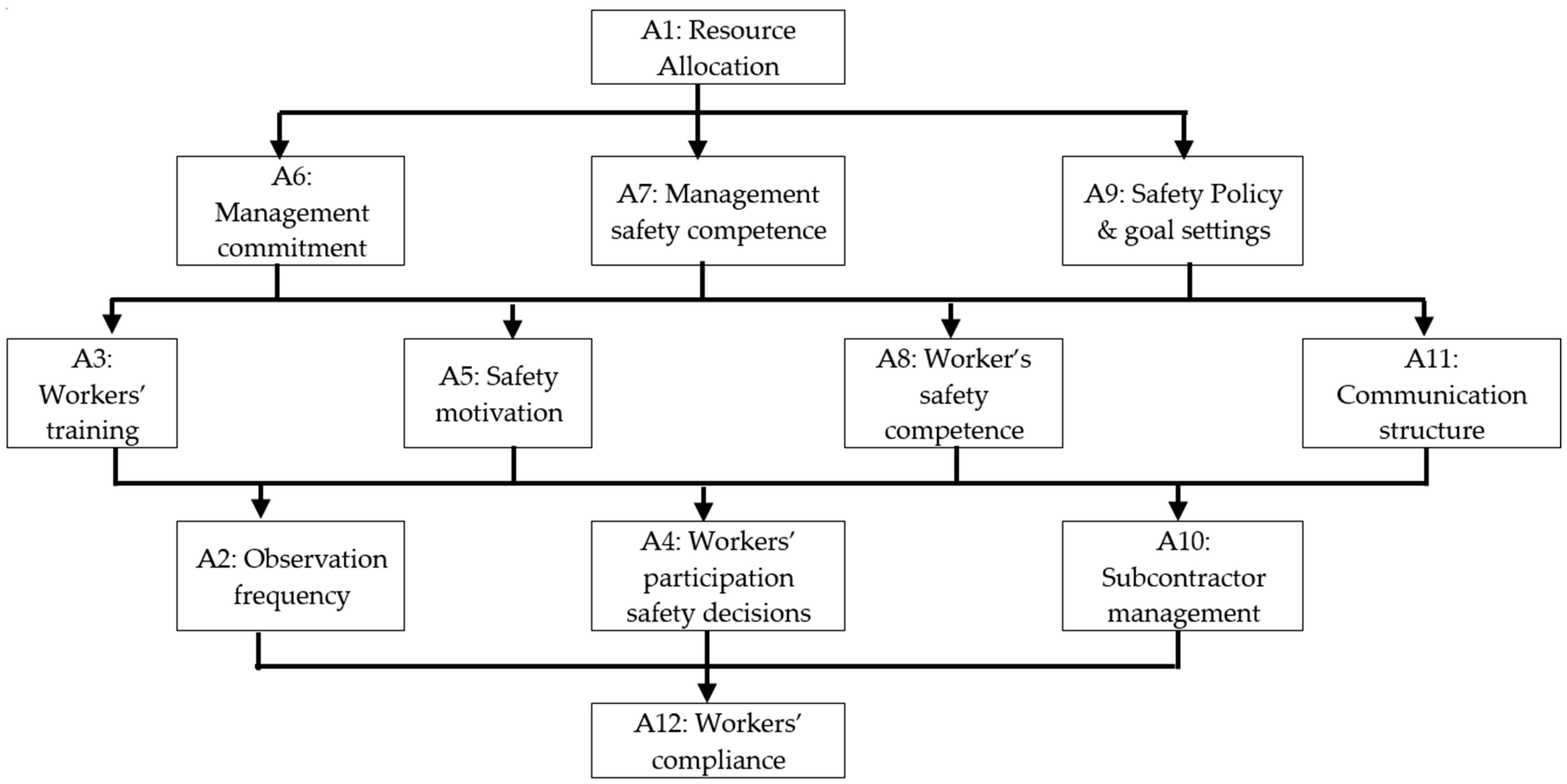
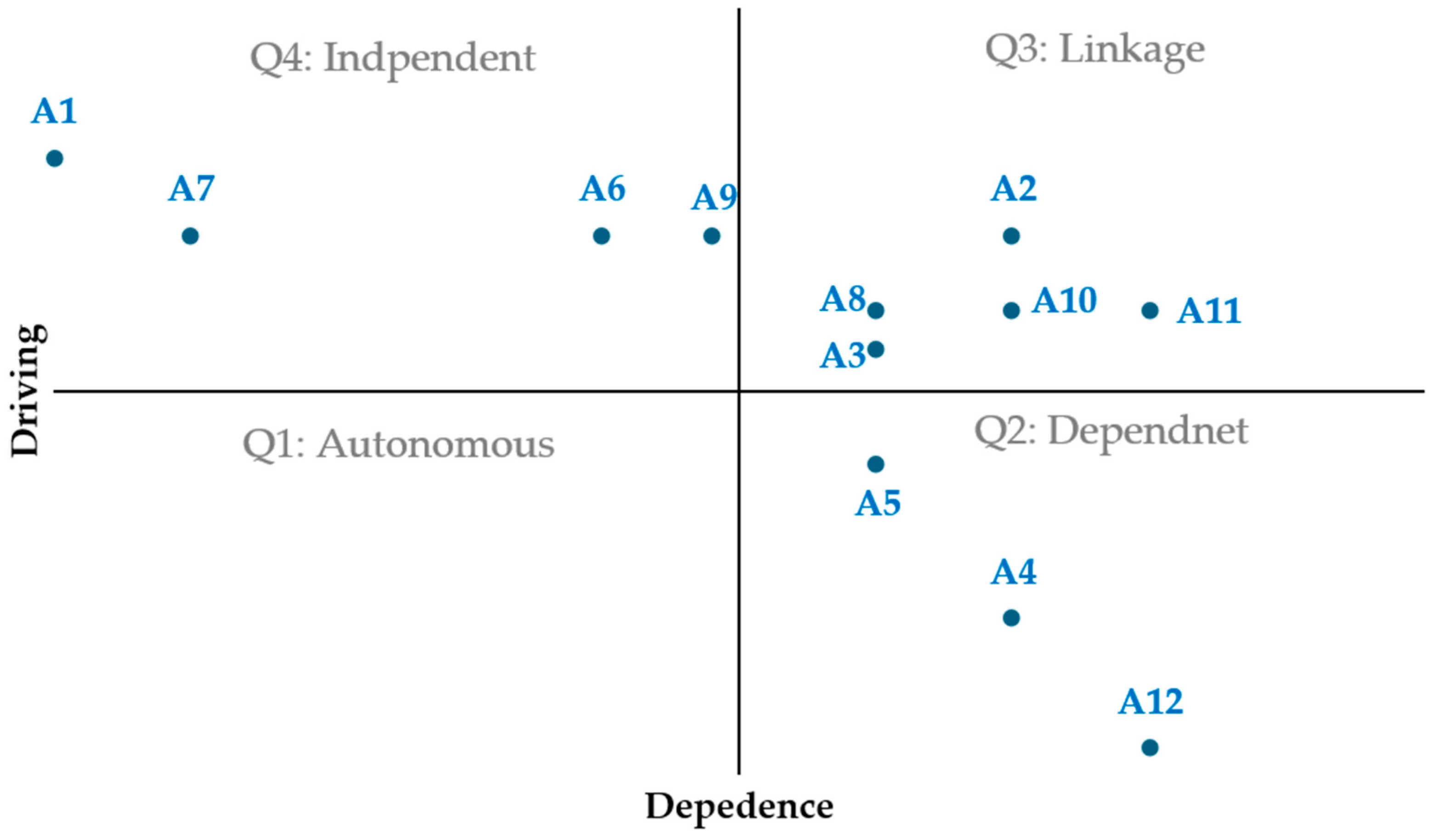
The main objective of the current study is to determine the relations, hierarchy, and the strength of influence of the factors affecting safety level in the construction sector. Therefore, the ISM analysis was used to determine the relationship between the factors and the DEMATEL analysis was applied to quantify the influence of the casual factors affecting safety levels. The ISM analysis reveals a clear, tiered hierarchy of factors affecting safety in the construction sector. At the foundational and strategic level (Levels 4 and 5) they are the Independent Drivers, which possess the highest driving power and lowest dependence. The absolute most critical factor is A1: Resource Allocation (Level 5), which acts as the root cause influencing the success of nearly every other safety measure. In the field of OSH, resource allocation is the fundamental strategic decision-making process by which an organization dedicates its finite assets toward achieving its health and safety goals [
49]. Without adequate resources (funding, personnel, equipment), the quality of policies, management commitment, training programs, and safety observations will all be compromised. Firstly, financial resources (budget) are essential, covering the costs for purchasing high-quality control measures like proper Personal Protective Equipment (PPE) and engineering controls, funding for OSH training, certification programs, and the maintenance of management systems and facilities [
50]. This result is in line with previous studies that concluded that recognize that without earmarked funds, safety measures are under-implemented and accident risk rises [
51,
52]. Secondly, human resources (personnel and expertise) are critical, requiring the allocation of sufficient, qualified safety professionals (such as OSH managers and industrial hygienists) and, crucially, the dedicated, paid time for all employees—from management to frontline workers—to actively participate in safety activities, including training, inspections, and safety committee meetings [
53]. A recent study found that recruitment, selection, and training-oriented HR practices significantly improve workers’ knowledge and awareness of OHS programs, leading to safer behavior in manufacturing and other industries [
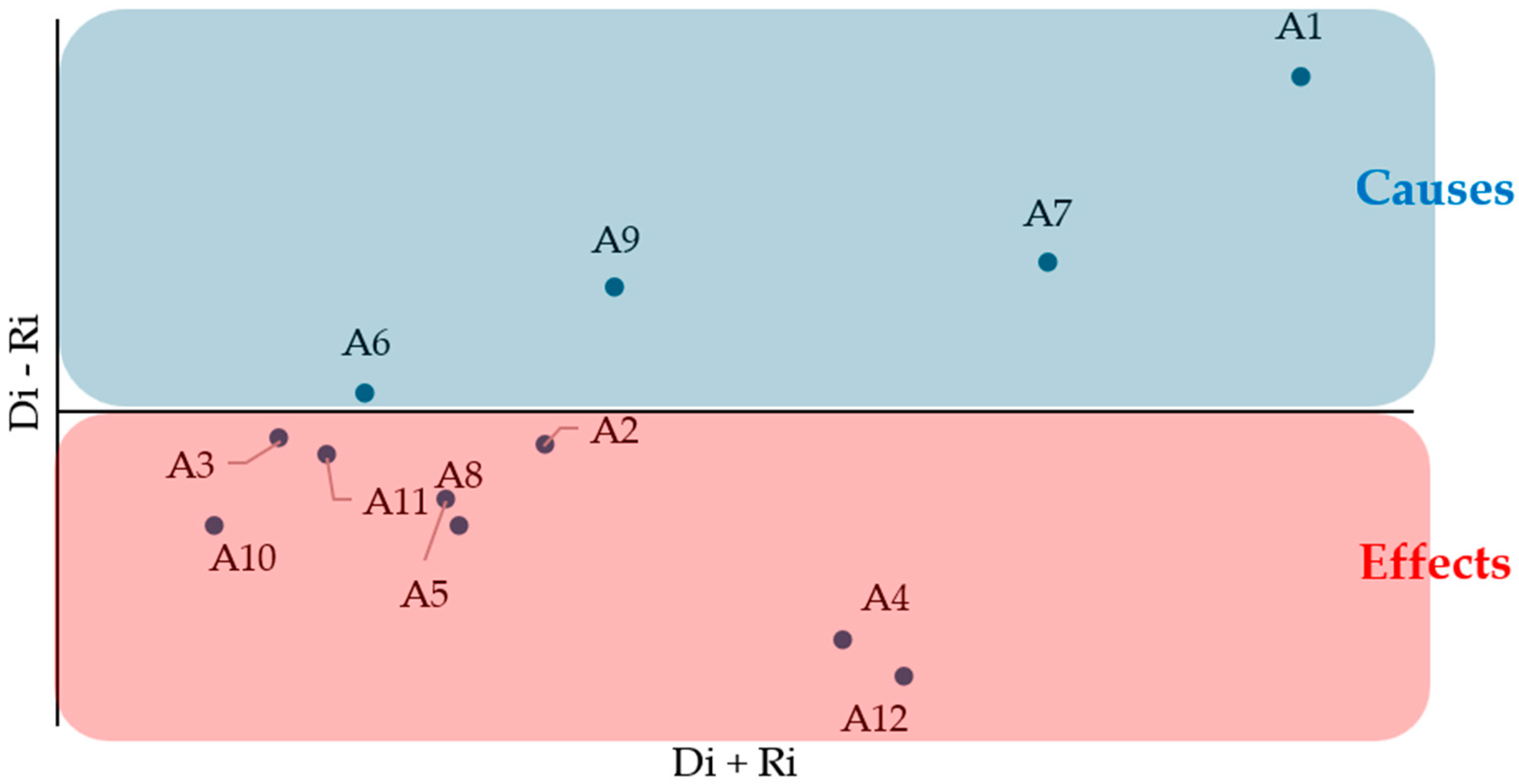
54]. Third, the provision and upkeep of essential safety infrastructure, such as emergency communication systems, first-aid stations, and efficient information systems for documenting and evaluating incident data to support ongoing improvement, requires the allocation of physical and technical resources. Altogether, the allocation of these three resource types determines the true strength and effectiveness of an organization’s OSH management system. Moreover, A1: resource allocation sits at the absolute top of the hierarchy (Level 5). Therefore, improving resource allocation will immediately create a chain reaction, strengthening the other top-tier drivers. The DEMATEL results provide a clear picture of how different organizational factors interact to shape the overall safety level. The prominence values indicate that some factors occupy a more central position in the safety system, whereas the relation values distinguish between those that act primarily as drivers (“cause” factors) and those that function mainly as outcomes (“effect” factors). Resource Allocation (A1) emerges as the most central factor in the network, with the highest prominence (0.850) and a relation value close to zero, and it is classified as a cause factor. This suggests that decisions regarding financial, human, and material resources devoted to safety are foundational and exert influence across the entire system, while being only minimally shaped by other factors. In other words, resourcing appears to be an upstream strategic decision rather than a reactive response to other safety dimensions. This finding supports the view that sustained investment in safety is a precondition for building effective training, observation, and communication practices, rather than a consequence of them.
Key management factors are as follows: A6: Management Leadership and Commitment, A7: Management Safety Proficiency, and A9: Safety Policy and Goal Setting (all level 4). Management must give these fundamental components top priority and make significant investments in order to bring about systemic transformation. Factor A6: Management commitment is crucial because it establishes the organization’s safety culture and values and guarantees that management clearly puts safety ahead of budget and schedule. For instance, in an Asian construction company, management commitment was one of only two factors significantly predicting workers’ safe behavior [
55]. Additionally, in Chinese mining enterprises, safety management commitment increased workers’ safety compliance and participation, partly through better training and safety policies [
56]. The technical capacity for effective implementation is provided by Factor A7: Management Safety Competence, which enables managers to make well-informed decisions, accurately identify hazards, choose suitable controls, and carry out the required supervision and quality training that directly affect A12: Worker Safety Behavior/Compliance. For example, construction research from Malaysia identified safety management competence (planning, budgeting, training, monitoring) as the top core competency of safety managers, directly tied to lower accident rates on sites [
57]. Lastly, Factor A9: Safety Policy acts as the official roadmap and guidance, converting the dedication and proficiency into precise, documented guidelines, protocols, and quantifiable goals that set clear expectations and form the basis for all A3: Workers’ Training and compliance initiatives throughout the site [
58]. In China, stricter, broader, and more technically detailed safety policies show a strong long-term negative correlation with work-related mortality; increasing stringent policies significantly improved production safety [
59]. Without this top-level direction, capability, and commitment, all operational safety initiatives will lack the support, clarity, and resources needed to be sustained which affect the overall safety level [
60]. These results are in line with the DEMATEL results, which stated that management-related attributes also figure prominently among the cause factors. Management Safety Competence (A7) shows a relatively high prominence (0.556), indicating that competent managers who understand safety principles and regulatory requirements influence multiple downstream elements. Similarly, Safety Policy and Goal Setting (A9), with a prominence of 0.427, is another influential driver, implying that clearly articulated safety objectives and formalized policies shape how safety is operationalized in daily activities. Management Commitment and Leadership (A6), though having moderate prominence (0.240), is also categorized as a cause factor; this suggests that visible leadership support acts as a catalyst that channels resources, reinforces policies, and legitimizes safety initiatives. Together, these results indicate that safety performance is strongly conditioned by the way top and middle management frame, resource, and operationalize safety.
Immediately below these are the Linkage Factors (Level 3), characterized by high driving and high dependence. These include A3: Workers’ Training, A8: Workers’ Safety Competence, and the essential A11: Communication Structure. These elements are both strong drivers of the factors at the operational level and results of the strategic level (e.g., training depends on resource allocation). A5: Safety Motivation is another factor at this intermediate level. Although it is very dependent, it is essential for creating an engaged safety culture. The function of element A3: Workers’ Training in creating A8: competence is a crucial Linkage Factor (Level 3) that converts management’s strategic intent into concrete operational capability. A recent study found that construction workers who received safety and health training showed higher safety knowledge, safer behavior, and greater safety awareness than untrained workers [
61]. Workers’ safety competence is a direct and essential factor in improving workers’ compliance [
62]. Training enhances the knowledge required to understand specific construction hazards, legal compliance, and the consequences of unsafe acts. Simultaneously, it develops the necessary practical skills, providing instruction and practice in safe operating procedures (SOPs), correct equipment use (including PPE), and emergency response. Thus, training is the essential vehicle that converts management’s commitment and allocated resources into an empowered and competent workforce, directly enabling the desired outcome of A12: Worker Safety Behavior/Compliance. Factor A11: Communication Structure is considered a Linkage Factor in the construction site safety model because its defining characteristic is having both high driving power and high dependence, making it a critical intermediary between strategy and execution. Several studies found that clear top-down communication of rules, hazards, and expectations improves workers’ understanding of procedures, roles, and safe behavior, boosting performance and motivation [
63,
64]. Additionally, strong bottom-up paths (easy reporting of hazards, near misses, concerns) support awareness, learning from incidents, and a more supportive climate, reducing accidents and disasters. Its high dependence means the quality of communication is highly sensitive to and determined by factors higher up, specifically the formal establishment from A9: Safety Policy and Goal Setting and the time and resources provided by A1: Resource Allocation and A6: Management Commitment and Leadership [
65]. Conversely, its high driving power ensures it is a powerful force for change, acting as the essential channel that transmits safety content for A3: Workers’ Training, thereby building A8: Workers’ Safety Competence, and serving as the primary feedback loop that encourages A4: Workers’ Participation in Safety Decisions [
66]. Thus, the communication structure links the strategic will of management to the operational compliance and behavior of the workers, meaning any issue with communication will immediately disrupt the flow of safety information throughout the entire system.
The factors at Level 2 of the safety hierarchy—Safety Observation Frequency, Workers’ Participation in Safety Decisions, and Subcontractor and Procurement Management—serve as the critical operational bridge between the high-level management commitment and resources (Levels 3, 4, 5) and the lowest level of on-site behavior, Workers’ Compliance (Level 1). Regular observation of site operations offers data and quick feedback for ongoing development [
67]. A case study showed safety performance increasing from 86% to 92.9% over 6 weeks after observation-based feedback, goal-setting, and recognition [
68]. By actively including the workers in danger identification and process creation, Workers’ Participation in Safety Decisions promotes ownership and increases Safety Motivation (Level 3) [
69]. For example, in Malaysian institutions, employee involvement in formulating safety policies, procedures, and decisions was identified as the most important factor for cultivating a strong safety culture and moving toward zero-accident workplaces [
70]. Last but not least, Subcontractor and Procurement Management extends the principal contractor’s control over the entire project ecosystem by ensuring that other parties and acquired materials follow project safety standards. Because subcontractors are so prevalent and have such a big impact on construction sites, it is crucial to manage them well. Subcontractors, particularly smaller businesses, sometimes have varied degrees of safety resources and compliance, which, if improperly managed, can result in inconsistent safety procedures and increased accident rates [
71,
72]. Subcontractors can make up to 90% of the construction workforce and are often small firms with limited safety staff and poorer working conditions, which increases vulnerability to accidents [
73]. Moreover, accident rates for subcontractor employees are frequently higher than for principal contractor staff, linked to economic pressure, long hours, weaker training, and fragmented communication. Together, these Level 2 factors represent the practical, action-oriented mechanisms that translate strategic safety goals into tangible, daily safety performance.
Finally, Factor A12: Worker Safety Behavior/Compliance is categorized in the Dependent Quartile (Level 1) in the ISM analysis. This factor exhibits the highest dependence score and the lowest driving power score. This categorization indicates that rather than being the main forces behind change, compliance and behavior are essentially the results of the whole safety management system, for instance, a worker’s ability to comply is dictated by whether A1: Resource Allocation provides safe equipment and time, whether A6: Management Commitment enforces rules consistently, and whether A3: Workers’ Training has built the necessary A8: Workers’ Safety Competence. Multiple studies show that what workers do (compliance and participation) largely reflects the broader safety management system (SMS) and leadership. Across industries, management commitment, training, rules/procedures, communication, promotion policies, and worker involvement influence safety compliance, often via mediators like safety participation, safety knowledge, or motivation [
74]. The strategic conclusion is obvious: businesses should prioritize addressing the higher-level Independent Drivers and Linkage Factors that regulate and facilitate safe conduct, rather than concentrating on treating the symptoms (worker behavior). In the DEMATEL analysis, Worker Safety Behavior/Compliance (A12) has the lowest prominence (0.009) but the highest relation value (0.675), positioning it as the most downstream element in the network. This implies that worker behavior is largely a product of upstream conditions rather than an autonomous driver of safety outcomes.
4.2. STAMP Analysis of Construction Safety Control Structure
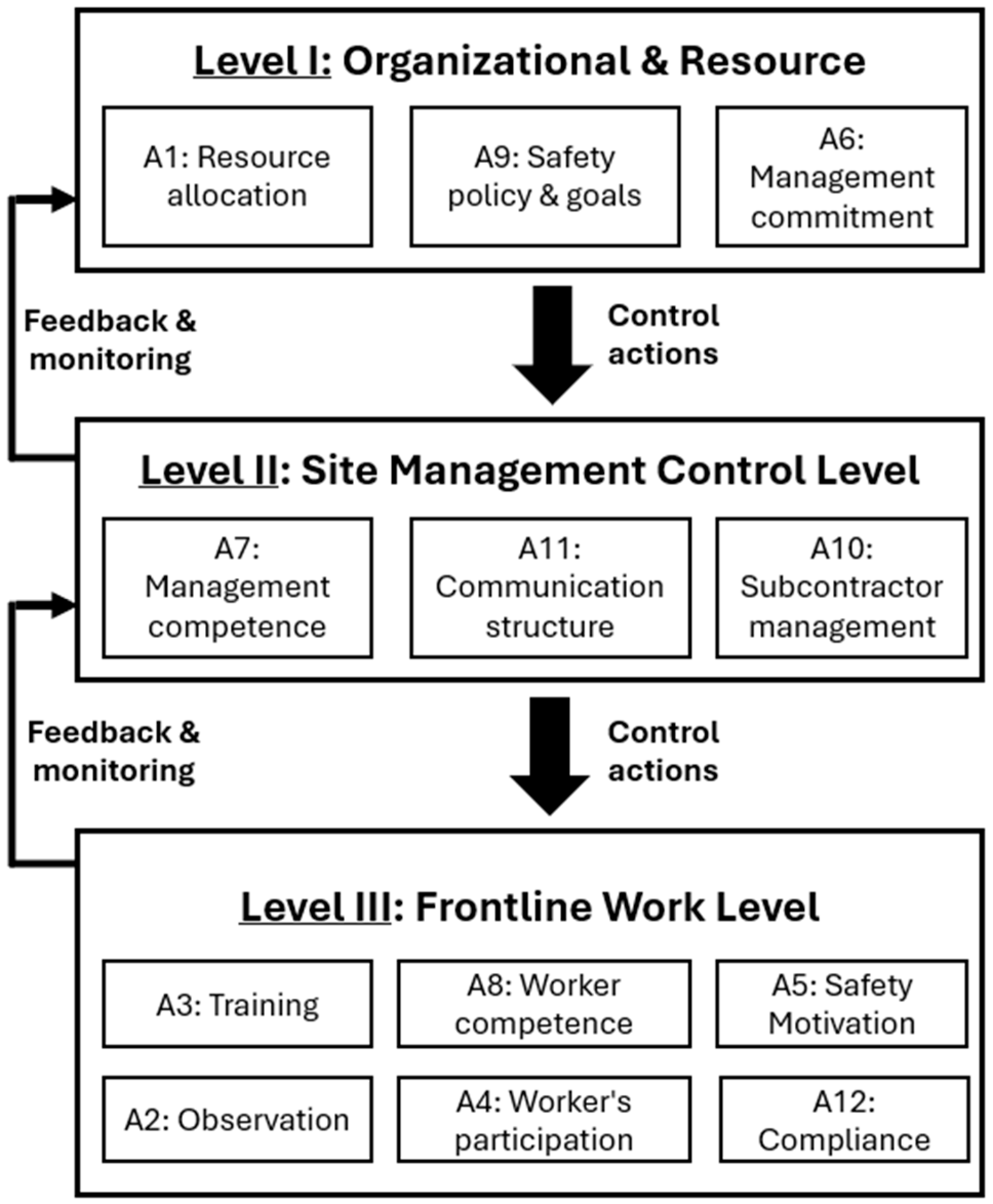
To strengthen the complexity argument and demonstrate how the ISM-identified hierarchical dependencies operate in practice, this section presents a small case-model using the Systems-Theoretic Accident Model and Processes (STAMP) framework [
75]. This case-model illustrates how organizational, management, and frontline safety factors interact through control structures, and feedback loops mechanisms. The STAMP framework conceptualizes safety as an emergent property of a complex socio-technical system where safety is maintained through feedback and control.
Figure 4 presents the hierarchical control structure for the construction safety system, mapping the ISM-identified factors A1 to A12 into three distinct control levels.
The hierarchical levels and control actions:
Level I: Organization and Resource Level: These factors generate control actions that cascade downward, determining how much investment and priority are given to safety initiatives at the site level.
Level II: Site Management Control Level: Site managers translate organizational directives into operational safety management. Site managers receive control actions from Level 1 (e.g., resource availability, policy directives) and issue their own control actions downward regarding task planning, work procedures, and resource deployment. They also receive feedback from the frontline through observations, incident reports, and worker communications.
Level III: Frontline Work Level: At the frontline, workers and their immediate supervisors execute safety practices. Frontline factors are influenced by control actions from Level 2 (training programs, supervision schedules, participation opportunities) and generate feedback upward through observations, near-miss reports, and worker suggestions.
Feedback Loops:
The control structure includes critical feedback paths. First, monitoring feedback from Level 3 to Level 2: Safety observations (A2) and workers’ participation (A4) provide real-time data on work conditions and compliance (A12). Second, escalation feedback from Level 2 to Level 1: Site managers report safety performance, incident trends, and resource constraints through communication structures (A11), informing higher-level decisions on resource allocation (A1) and policy refinement (A9). These feedback loops are essential for adaptive safety management; without them, the system cannot detect and correct deviations from safe performance.