Article

Energy-Based Design for the Seismic Improvement of Historic Churches by Nonlinear Modelling

1
Architecture, Built Environment and Construction Engineering Department, Politecnico di Milano, Piazza Leonardo da Vinci 32, 20133 Milan, Italy
2
Department of Engineering and Architecture, Università degli Studi di Trieste, Via Alfonso Valerio, 6/1, 34137 Trieste, Italy
3
Ing. Michele Santoro, Via Bressanone 2, 71042 Cerignola, Italy
*
Author to whom correspondence should be addressed.
Buildings 2026, 16(1), 12; https://doi.org/10.3390/buildings16010012
Submission received: 6 November 2025 / Revised: 1 December 2025 / Accepted: 17 December 2025 / Published: 19 December 2025
(This article belongs to the Special Issue Modeling and Testing the Performance of Masonry Structures)

Abstract

This study investigates the seismic retrofit of historic single-nave churches through the optimization of roof diaphragms designed to enhance energy dissipation. The proposed strategy introduces a deformable box-type diaphragm above the existing roof, composed of timber panels and steel connectors with a cover of steel stripes, where energy dissipation is concentrated in the connections. The retrofit design is guided by the estimation of Equivalent Damping Ratio (EDR) instead of the usually adopted resistance criterion, considering an energy-based approach to improve global seismic performance while preserving architectural integrity. In this way, the retrofitted configuration of the roof can be considered a damper. Three numerical phases are presented to assess the effectiveness of the equivalent damping-based intervention. In the first one, the seismic response of the initial non-retrofitted configuration is implemented using a 3D linear finite element model subjected to a response spectrum. Subsequently, nonlinear equivalent models subjected to spectrum-compatible accelerograms are implemented, simulating the possible retrofitted configurations of the roofs to detect the optimum damping and finding the corresponding roof diaphragm configuration. In the third one, the response of the detected retrofitted configuration is also evaluated by nonlinear 3D model subjected to accelerograms. The three phases with the relative numerical approaches are here applied to a case study, located in a high seismic hazard area. The results demonstrate that the EDR-based methodology can optimize the retrofitted roof diaphragm configuration; the nave transverse response is improved in comparison with that designed with the traditional approach, considering only the over-strength of the interventions. Comparisons about the approaches based on the EDR and the strength criteria are presented in terms of lateral displacements, in-plane shear acting on the roof diaphragm, and in-plane stresses on the façade.

1. Introduction

Seismic events have affected many countries in recent decades exposing the vulnerability of existing historical religious constructions worldwide. Their construction features have shown several critical behaviors under the seismic loads [1]. Masonry exhibits complex mechanical responses for its non-homogeneous, anisotropic, and nonlinear characteristics with significant difference between the compressive strength and the tensile capacity [2,3,4,5,6]. Moreover, under the seismic action, collapse mechanisms often develop locally, frequently involving out-of-plane rocking of the walls. To mitigate such failures, regulations and practical techniques can be used to promote the achievement of box-like structural behavior through plane and roof diaphragms with reliable connections [7,8,9].
In this context, using materials that are as compatible as possible with the original ones, the realization of deformable and dissipative roof diaphragms offers a promising strategy to improve seismic response by controlling lateral displacements [10]. The adoption of roof-dissipative structures could be preferable in comparison with traditional techniques such as the steel tie rods, which are typically installed along the main structural axes at the floor levels and anchored to masonry walls through steel plates. Even if their primary function is to promote box-like behavior by connecting orthogonal walls, their effectiveness in preventing out-of-plane collapse mechanisms is limited in cases of slender walls, poor masonry quality, or irregular geometries. Therefore, a roof diaphragm that is properly connected to the perimeter walls can be designed to limit lateral displacements without increasing the stresses that act in the plane of seismic-resistant elements [11].
In cases of transverse earthquakes (with respect to the longitudinal axis of the church), the seismic-resistant elements could collapse, resulting in inadequate in-plane shear resistance. Otherwise, the roof structure should contain lateral displacements, avoiding out-of-plane mechanisms [12,13,14].
In the retrofit design, the roof diaphragm can be idealized as being composed of two chords and a shear panel: the chords correspond to the perimeter ring beams, which resist bending, while the panels represent the diaphragm itself, and are responsible for absorbing shear forces and dissipating energy via the connections [15].
Among the most widespread techniques for realizing box-type roof diaphragms, one of the most-adopted option involves the use of multilayer timber panels connected by nailed steel cover stripes [16,17]. This dry-assembly solution is weight-comparable to using multiple layers of planks, while respecting conservative restoration criteria [18]. The most suitable panel type for this application is multilayer timber composed of alternating fiber orientations to ensure adequate in-plane stiffness and shear resistance, e.g., the Cross-Laminated Timber (CLT) panels. OSB panels may also be used in certain cases, but they must be carefully verified to meet design strength requirements. In contrast, microlaminated panels are generally unsuitable due to their unidirectional fiber orientation, which limits their structural performance under seismic loads.
This paper addresses the optimization of panels and connections used to retrofit the roof structure in order to obtain a dissipative roof diaphragm and improve the transverse seismic response of historic single-nave churches. The proposed strategy follows a multi-step methodology, designed with the aim of maximizing energy dissipation [19,20,21,22] through the estimation of the Equivalent Damping Ratio (EDR) [23,24,25].
Therefore, the design and optimization of the retrofitted roof diaphragm solution is based on EDR, in contrast to the over-strength criteria. The novelty of the present research is the optimization of the roof diaphragm, considering it as an energy-dissipating damper to enhance the global seismic response of the church. Unlike traditional approaches based solely on the over-strength of the connections, the proposed strategy emphasizes controlled displacement and energy dissipation. In this way, this study introduces and applies tools for EDR evaluation by distinguishing energy-dissipating connections from those that remain elastic, thereby improving the global seismic response of the church. Among the different approaches about the seismic analyses for this kind of construction [26,27,28,29], the here-adopted methodology follows three phases.
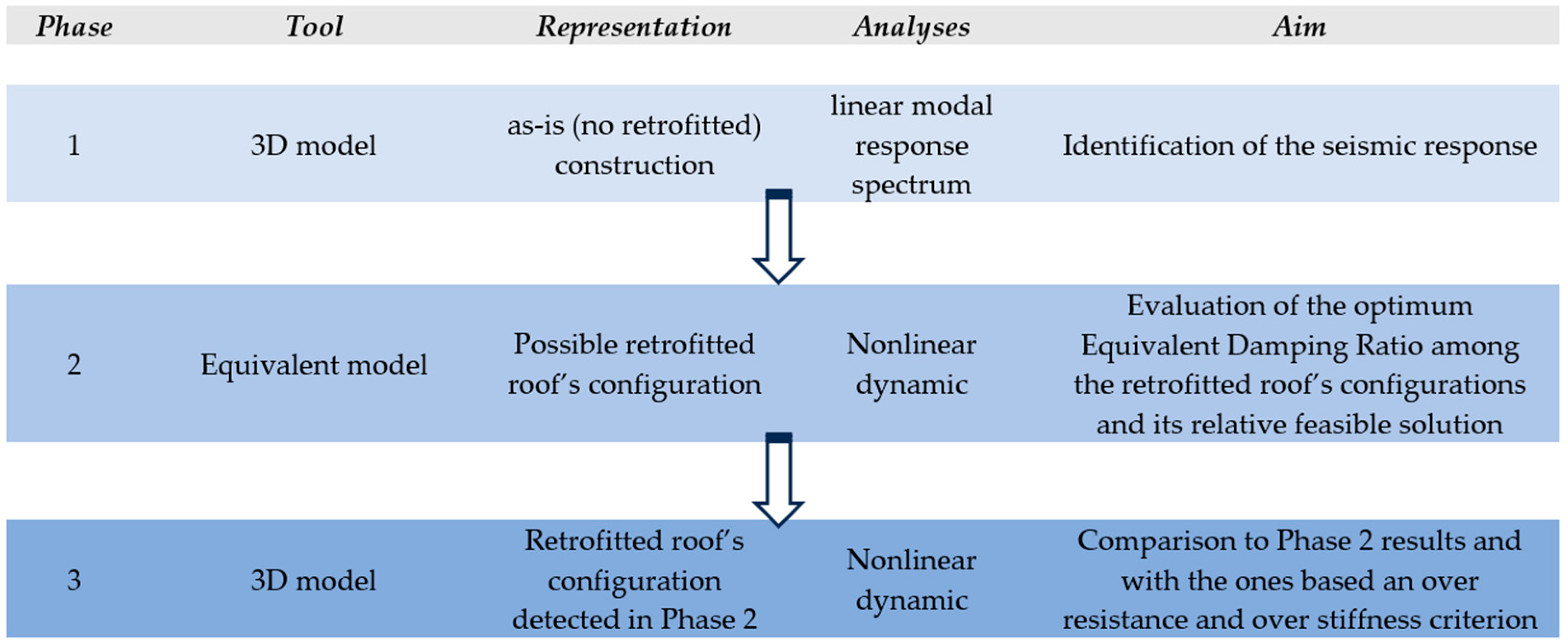
The first phase involves a linear 3D finite element model subjected to response spectrum analysis, which is used to evaluate the seismic demand and identify critical stress distributions.
Subsequently, the second phase involves a nonlinear equivalent model [30,31] that is subjected to seven spectrum-compatible accelerograms [32,33]. This kind of model is used to determine the maximum achievable EDR by simulating different roof diaphragm configurations. The equivalent model has rotational inelastic hinges, accommodating the nonlinear behavior of masonry walls, and shear inelastic hinges, representing the dissipative capacity of the connections [34,35,36,37,38]. When testing different retrofitted configurations of the roof in the damped rocking response, EDR can be computed by comparing the energy dissipated by the roof diaphragm with the maximum strain energy stored both in the masonry and the roof during a seismic event.
Once the optimal EDR is identified, it can be associated with a specific roof stiffness value, which corresponds to a feasible configuration of timber panels and connections [39,40,41]. The detected optimized configuration is then tested in the third phase, where a full 3D retrofit model is implemented. Here, the roof connections are modeled as shear inelastic springs and the masonry walls as base rotational hinges [42,43].
The seismic input remains represented by the same set of spectrum-compatible accelerograms used in the second phase. Figure 1 summarizes the main characteristics of the three phases.
The layout of the present paper is as follows: Section 2 discusses the method for simulating the dissipative response of a historical church with a roof diaphragm using an equivalent model. Section 3 explains the process for evaluating the maximum EDR, adopting a time–histories strategy. Section 4 describes our approach for associating the optimum EDR value to possible configurations of a roof diaphragm. Section 5 applies the previous criteria throughout the three phases in a case study. Section 6 presents the results of this study and provides remarks related to the possible retrofitted configuration obtained. Finally, Section 7 summarizes the EDR-based methodology, highlighting the novelties of this study and suggesting possible future research steps.

2. Damped Rocking Mechanism by Equivalent Finite Element Model

Under the transversal earthquake, a historical single nave church experiences the rocking of the perimeter walls. These walls may occasionally be subjected to demands exceeding their capacity. In such cases, Ref. [42] highlights the beneficial role of damped rocking mechanisms in limiting inertial effects induced by seismic excitation. A key advantage of rocking lies in its ability to stabilize the base shear once the rocking is initiated. Unlike an indefinitely elastic structure, a rocking system maintains a bounded base shear with significant displacements. Therefore, this kind of behavior could offer a reduced seismic demand if helped by additional damping mechanisms capable of dissipating energy through plastic deformations [31].
Considering the case of a transverse seismic response in a single-nave church, where the lateral wall is loaded in its weakest direction, rocking starts around a cylindrical hinge formed at the base edge on the downstream side of the excitation [15,44]. Collapse occurs when the overturning moment exceeds the stabilizing moment provided by gravity loads, due to seismic forces. In this condition, the wall behaves as a rigid body in rotation, resulting in an elastic branch with infinite stiffness. However, given the limited flexural stiffness, the wall will develop lateral displacements before uplift occurs in its base section and rocking is triggered. Under the idealized assumption of infinite masonry strength, the response of the wall remains bilinear elastic [15], with no residual displacement after unloading. Thus, the system is perfectly re-centered. The introduction of an elastic–plastic yielding restraint at the top of the wall alters the system’s behavior, because the response becomes hysteretic and residual displacements may occur after the seismic event [15]. However, the restraint can dissipate a significant portion of the energy introduced into the rocking system, through its hysteretic response.
A more complex structural system can be considered for historical churches under the rocking mechanism [45]. Each system (referred to herein as frames) consists of two portions of longitudinal vertical walls connected by wooden roof trusses, which are subjected to transverse seismic excitation. The two portions of the walls are related to the abutments (if present), or they are represented by the masonry piers between the vertical axes of two consecutive openings.
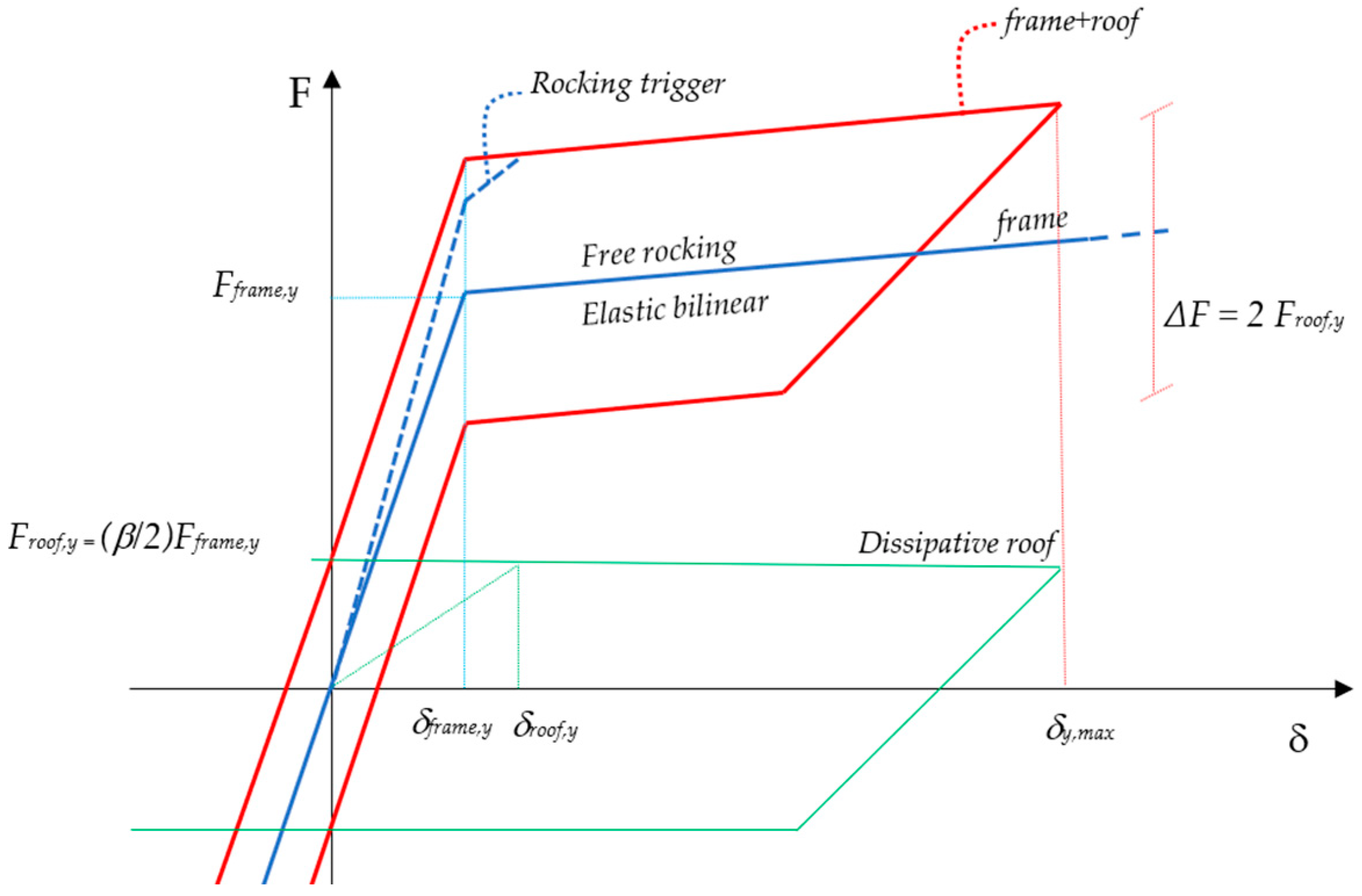
Considering this layout, energy dissipation is not located at the base of the load-bearing masonry elements but rather at the top of the walls. The response of each frame can be described by a flag-shaped diagram, as shown in Figure 2, where the dissipation of the roof diaphragm due to the connections modifies the uncontrolled rocking of the lateral walls [15]. The response is cyclic, and the effect of a dissipating roof is qualitatively like that of a damping device located at the base of the walls. During the initial triggering phase—only in the first loading cycle—the system behaves elastically, with a stiffness equal to the sum of the rocking stiffness and the stiffness of the elastic–plastic device (represented by the roof diaphragm). The transition from purely elastic to plastic behavior depends on the yield displacement of the roof, namely δroof,y.
Once yielding begins, each frame coupled to the relative parts of the dissipative roof follows two plastic branches—loading and unloading—separated by a force gap named ∆F = 2 Froof,y, where Froof,y represents the yield force of the dissipative roof [10]. It is important to underline that the resulting hysteretic model exhibits residual displacements at the end of the seismic excitation, indicating that the system does not fully re-center.
The functioning of the dissipative roof is linked to the force which is able to trigger the walls’ rocking, named Fframe,y, and the corresponding displacement, named δframe,y. Their ratio represents the stiffness of the transverse frame, named Kframe (= Fframe,yframe,y), which depends on the geometrical and mechanical features of the masonry walls and the type of connection between the lateral walls (triumphal arch or wooden truss).
Thus, the initial evaluation of Fframe,y, δframe,y, and Kframe is mandatory: these values come from the stabilizing moments of the two lateral parts of each frame [10,30,46]. From the flag-shaped response (Figure 2), it is possible to define an index of the damping capability of the system, named β (Equation (1)), and an index of the stiffness related to the roof and frame, named k (Equation (2)) [30,44]. The stiffness depends on the ratio Δ (Equation (3)), which is ideally ∆ ≅ 1, so the roof-damper and the frame under rocking provide yields simultaneously. In the design phase, it is possible to set ∆ = 1 to evaluate the stiffness of the roof, Kroof,y, only by changing the hysteretic variable, β (Equations (4) and (5)), within its optimum range, 0–1.5; eventually, it is possible to investigate higher values, representing possible over-stiffness configurations [10,30,44].
β = 2 F r o o f , y F f r a m e , y
K = K r o o f , y K f r a m e , y = F r o o f , y δ r o o f , y ·   δ f r a m e , y F f r a m e , y = β 2 Δ
Δ = δ r o o f , y δ f r a m e , y
K r o o f , y = β · K f r a m e , y 2 Δ
F r o o f , y = β 2 · F f r a m e , y
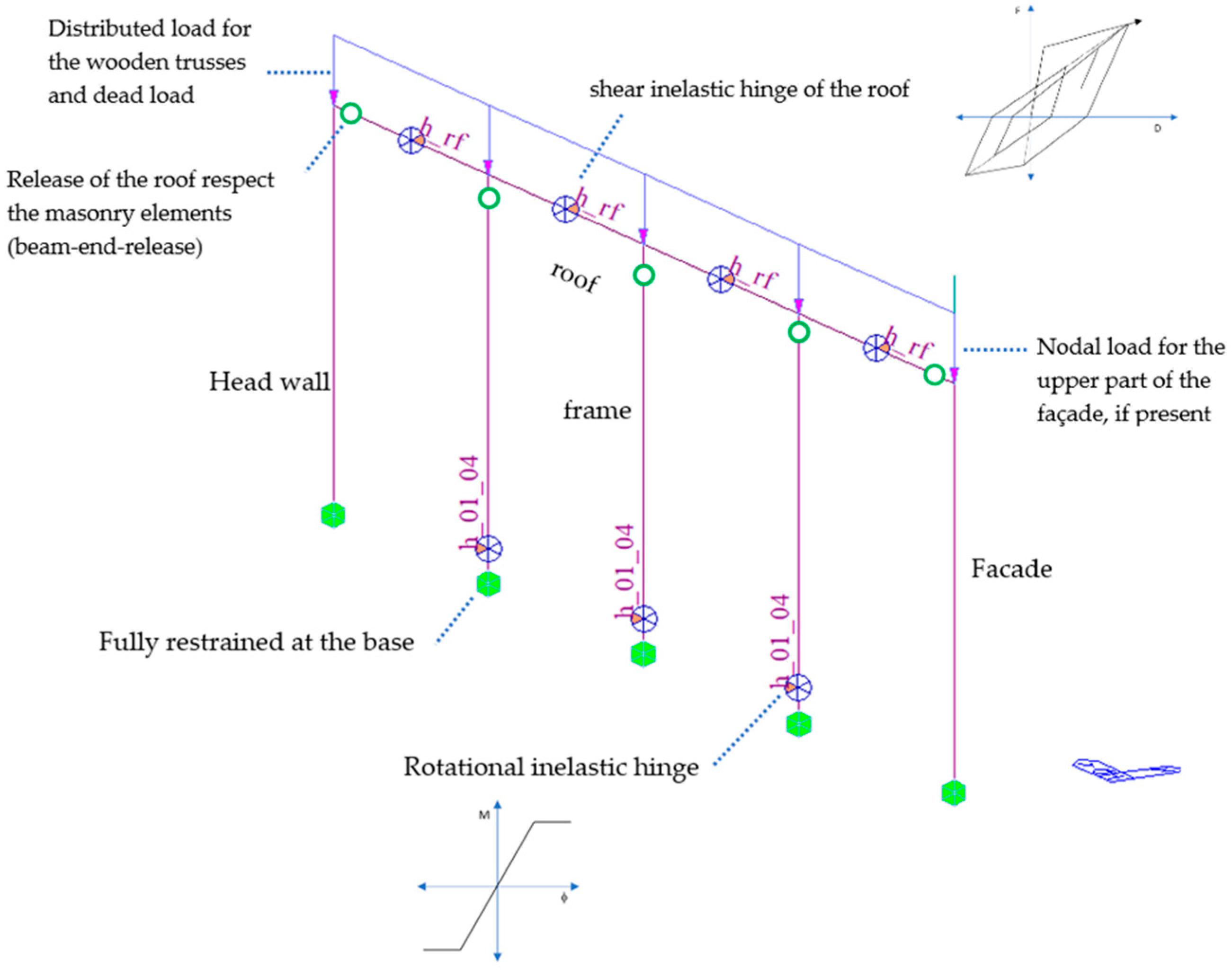
Following the preliminary evaluations, an equivalent frame model is implemented to represent the macro-elements involved in the transverse seismic response. This includes the frames representing the portions of the lateral walls connected by triumphal arches or trusses, façade, head wall, and roof diaphragm. All components are modeled using equivalent beam-type elements, and self-weight is calibrated to match the one of the actual church. The vertical elements have the same flexural inertia as the corresponding portions of the lateral walls they represent, while the roof diaphragm reflects its actual geometry. Arches or wooden trusses are not explicitly modeled. Instead, their effects are represented as distributed loads and masses on the horizontal elements of the diaphragm. Each vertical element is fully restrained at the base, while the roof diaphragm is pinned to the vertical elements, allowing the rocking mechanism of the walls and releasing the bending moment, that would otherwise be transferred to the roof. Therefore, the equivalent model represents the macro-elements involved in the nave transverse seismic behavior. It investigates the seismic response of possible retrofitted configurations without referring to local mechanisms that should be analyzed with 3D detailed models. It also shows the possible activation of the inelastic hinges, leading to energy dissipation in the roof due to the box-like behavior of the retrofitted structure.
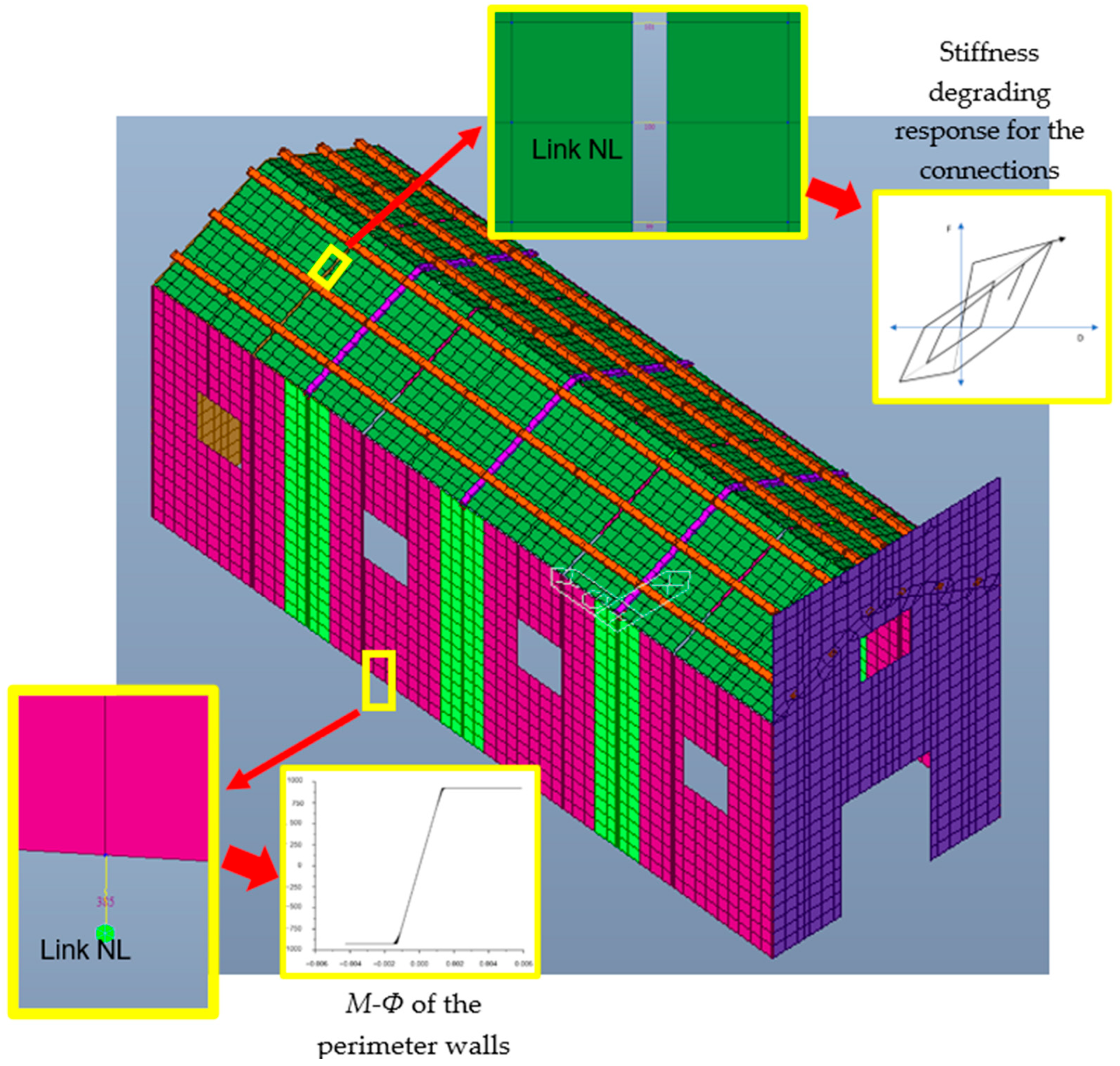
Once an equivalence between mass and inertia with the real structure is verified, the rocking activation force, Fframe,y, is evaluated on the basis of the geometry of the frames and the roof load. Equations (1)–(5) are then applied by varying the hysteretic parameter β within the range 0–1.8, thereby defining the possible stiffness configurations of the roof diaphragm. In the equivalent model (Figure 3), the vertical elements (excluding the facade and head wall, which are significantly stiffer than the frames) have moment–rotation plastic hinges at their base. These hinges do not vary with β, and their parameters are calculated based on the rocking activation force, the corresponding yielding displacement, and the plastic hinge length, representing the seismic transversal response of the perimeter walls [31]. The horizontal elements modelled on the roof are characterized by shear plastic hinges, which vary according to the hysteretic parameter, β [31]. These hinges exhibit stiffness degradation according to [23,24,25,47].
The equivalent model is subjected to a set of seven spectrum-compatible accelerograms. Consequently, it is possible to evaluate, for all the considered seismic time histories, the energy dissipated by the shear hinges of the roof diaphragm, as well as the maximum strain energy stored in both the rotational hinges of the walls and shear hinges of the roof [22,23,24,25]. The evaluation of the dissipated and maximum strain energies for each cycle characterizing the seismic response of the church leads to the estimation of EDR, as detailed in Section 3.

3. Evaluation of the Equivalent Damping Ratio

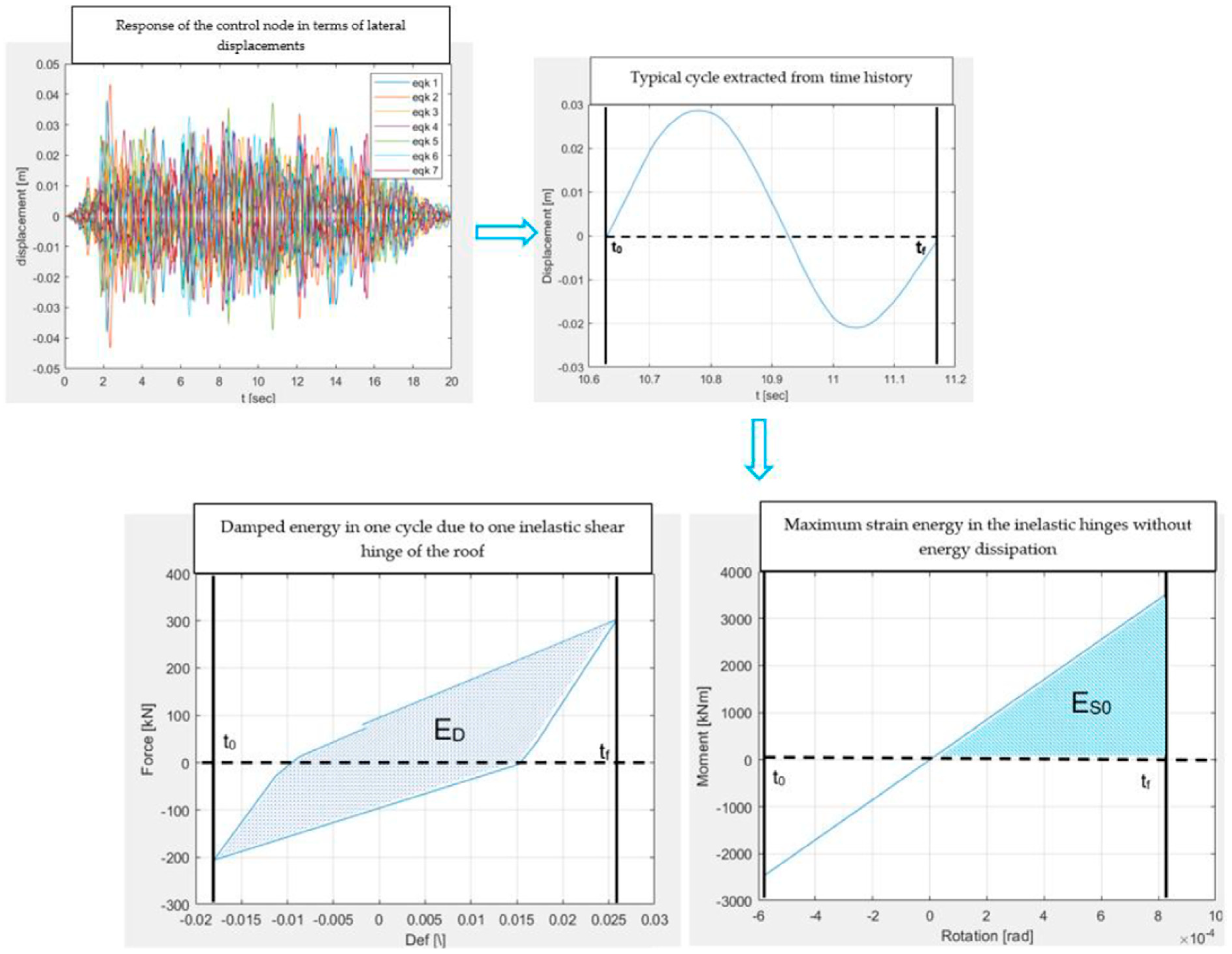
The response of the equivalent model can be analyzed in terms of the time histories of the forces and the lateral displacements of the structure. By referring to the roof’s central node as a control node [24,25], the top displacements can be plotted for the seven considered accelerograms for different values of the hysteretic parameter, β. Each single response is characterized by cycles, identified by initial and final time instants, t0 and tf, respectively. Each cycle contains a maximum positive and a maximum negative lateral displacement (the displacements at t0 and tf are zero by definition). In the range t0tf, we find the following: (i) some inelastic shear hinges of the roof can dissipate energy (elastic–plastic response); (ii) other shear hinges can remain in their elastic field (zero energy dissipation); (iii) the rotational hinges of the frames exhibit elastic response as well [47,48,49].
By dividing the response of the control node’s lateral displacement into a finite number of cycles, the EDR can be computed for each cycle, and summed over all cycles. Specifically, EDR can be evaluated by Equation (6): j is the j-th cycle (for j = 1 ÷ n) extracted from the time–history response; ED,j is the energy dissipated by shear inelastic hinges in the hysteresis loop of the j-th cycle; ES0,j is the strain energy considered when the shear and rotational hinges respond linearly in the j-th cycle. Obviously, the inelastic hinges of the frames can be computed only in terms of ES0,j.
Graphically, Equation (6) evaluates each energetic contribution for every cycle as represented in Figure 4 using a Matlab R2025a code developed by the authors. It is worth nothing that 5% represents the inherent damping of the structure [50,51]. Since the finite element models have been implemented with finite element software Midas Gen 2025 v.1.2, the Matlab code extracts the models’ results in terms of displacements and inelastic hinges responses to evaluate the corresponding EDR for each cycle. Consequently, the overall EDR is calculated for the global structure, and it is plotted as a function of β, allowing the graphical identification of its optimum value βopt.
E D R = 0.05 + 1 4 π j = 1 n E D , j j = 1 n E S 0 , j

4. Technological Solution for the Roof Diaphragm from EDR

Energy dissipation is provided by a box-type roof diaphragm, characterized by wooden-based panels overlayed with the existing roof planks. These panels are interconnected by steel connectors and steel stripes. The dissipative mechanism of the roof is primarily governed by the stripes, as the panels exhibit brittle behavior under shear failure and are unable to accommodate significant plastic deformations. It means that the stripes yield while connectors and panels remain within the elastic range.
Once the optimal value of the hysteretic variable βopt is determined in correspondence with the optimum EDR, the required stiffness and strength of the roof diaphragm can be defined by the previous Equations (4) and (5). Based on these mechanical parameters, a practical technological solution can be designed in terms of the geometry and mechanical properties of the panels, the sections and numbers of steel stripes, and the characteristics and positions of the connectors.
A possible solution is designed starting from the evaluation of the optimal roof diaphragm’s stiffness, Kroof,opt [44]. Considering the roof as an equivalent material for the presence of steel elements and wooden based panels, for βopt and Δ = 1, the corresponding Kroof,opt is given by Equation (7):
K r o o f , o p t =   β o p t ·   K f r a m e , y 2 Δ =   1 k d f + 1 k d t 1 = 5 6 L 3 E w * J i d * + L G w * A * 1
where the following are true:
  • kdf is the diaphragm’s bending stiffness;
  • kdt is the diaphragm’s shear stiffness;
  • Ew* is the diaphragm’s equivalent elastic modulus evaluated by Equation (8);
  • Gw* is the diaphragm’s equivalent shear modulus evaluated by Equation (9);
  • Jid* is the diaphragm’s ideal inertia moment of the section evaluated by Equation (10);
  • A* is the shear equivalent area given by Equation (11).
Moreover, in Equations (7)–(11) the followings symbols are valid:
  • nws is the homogenization coefficient given by the ratio nws = Es/Ew* (Es is the steel elastic modulus);
  • L is the distance between two consecutive frames;
  • Ly is the width of the roof (given by the geometry of the church);
  • i is the spacing of the connectors (depending on the shear afflicted the roof in the equivalent model);
  • kn is the stiffness of a single connector (depending on the type of chosen connector);
  • tw is the thickness of the wooden panels (depending on the technological choice);
  • χ = [6/5(cos2α)] is the shear factor of the cross-section (with χ = 1.2 for rectangular sections);
  • Aw is the cross-section area of the roof diaphragm (depending on the geometry of the church);
  • nn is the number of connectors for each connection stripe (given by the ratio between the spacing of the seismic elements and the spacing of the connectors);
  • ns is the number of the connection stripes for each span (to be evaluated respecting the commercially available dimensions of the panels);
  • As is the cross-section area of the steel stripes covering the heads of the connectors.
E w * n n , n s = L k n n s 2 t w L y c o s α n n + k n L n s E w
G w * n n , n s = L · k n n s 2 t w · L y c o s α n n + k n · L n s G w
J i d * n n , n s = t w L y 3 12 c o s α + n w s 2 A s L y 2 2
A * = A w = t w L y c o s α 6 5 c o s 2 α
n n = F y c V n , u
In a case in which a church is characterized by a head wall, a façade, and more than two frames, the resulting value of Kroof,opt can be adapted by adjusting the number of connection strips, nn [15,44,52]. Additionally, the number of connectors for each of the stripes present in the panel-to-panel connections is defined considering the strength requirement of the roof. In fact, the number of connectors, nn, is calculated from Equation (12) to guarantee that they remain in their elastic field; here, Vn,u is the shear resistance of the single connector [40] and Fyc is the shear force on the roof evaluated from the equivalent model under the seismic loads.
All geometrical and mechanical parameters in Equations (7)–(11) are evaluated considering the geometry and the materials of the church, except for the number of the stripes ns. In particular, the equivalent stiffness of the roof (Equation (7)) can be evaluated on the basis of the mechanical and geometrical properties of the selected timber panels and connections, together with the a priori known geometry of the church. Given the presence of timber panels and steel connections, it is possible to consider the roof diaphragm made of an equivalent material (whose properties are given by Equations (8) and (9)) and as a single element with its equivalent mechanical properties (given by Equations (10) and (11)). Given these characteristics, the stiffness of the retrofitted roof diaphragm can be calculated as a function of a single unknown parameter as the number of steel stripes per span (Equation (12)).
However, ns can be preliminarily set to satisfy the values of Kroof,opt given in Equation (7), due to βopt being in correspondence of the optimal EDR. Once ns is determined, the dimensions of the wooden panels are fixed too and they can be checked against commercially available sizes [53,54].
By adopting Equations (7)–(12), the elastic response of the diaphragm can be distributed between the connectors and the stripes. Its deformability is non-negligible, and plastic behavior is governed by the stripes. Since panel-to-panel connections must be ductile, and the yielding must occur in the steel stripes while the connectors remain in the elastic field, it can be useful consider Equation (12), adopting the value corresponding to the connector’s service load within the elastic range as the shear design force, Vn [40,55,56].
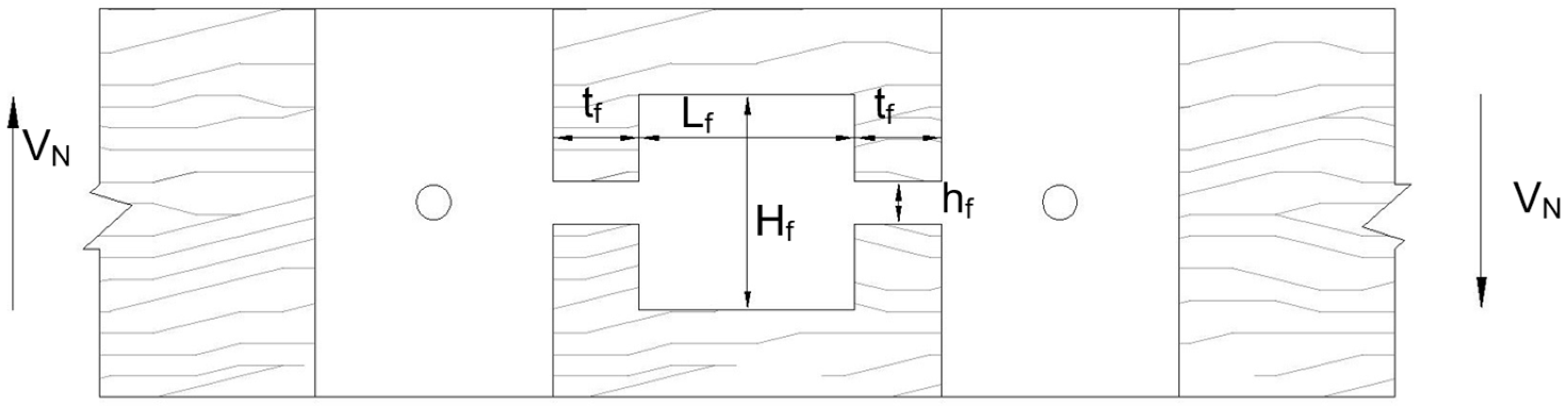
To achieve the desired elastic–plastic behavior, each steel stripe acts as the key dissipative component, characterized by local weakening (Figure 5). Each stripe has stiffness and strength parameters [44], named kf and Fyf, respectively. The stiffness of the strip, combined with that of the nails, contributes to the overall deformability of the connection, while its strength governs the total load-bearing capacity of the system.
At the local weakened zone, the steel stripe can be idealized as a short fully restrained beam at both ends capable of yielding under the force Vn, acting on the connectors [44]. The design of the weakened zone must ensure that the shear failure of the cantilever beams is prevented, and that the response of each steel stripe is controlled by its flexural capacity. The geometry of the weakened zones on the single stripe (Figure 5) can be designed by considering Equations (13)–(18). It is worth nothing that the geometrical parameters tf and hf of Figure 5 control overall deformability. Moreover, Equation (14) describes the elastic rotation of the short beam having length tf and height hf, where εy = 1.96‰ is the typical yield strain of steel and fyd the corresponding yield strength. Equation (15) defines the correspondent elastic slip η s c o r r V and Equation (16) gives the elastic stiffness of the stripe under the shear action; therefore, it is controlled by Vn (because, as already defined, Vn is the service design load of the connectors to remain in their elastic field). Equation (17) defines the ultimate rotation allowed for the activation of the plastic hinge (where εu = 6.75% represents the ultimate design deformation of the steel). Finally, Equation (18) gives the ultimate slip named η u V , allowed by the inelastic hinges’ formation; this value depends on tf and hf.
h f = m a x h f = V n · 3 t f · f y d h f = 2 ·   V n · L f t f · f y d
θ y = ε y t f h f / 2
η s c o r r V = θ y L f
k s c o r r V = V n η s c o r r V
θ u = ε u t f h f / 2
η u V = θ u L f

5. Case Study

5.1. Description

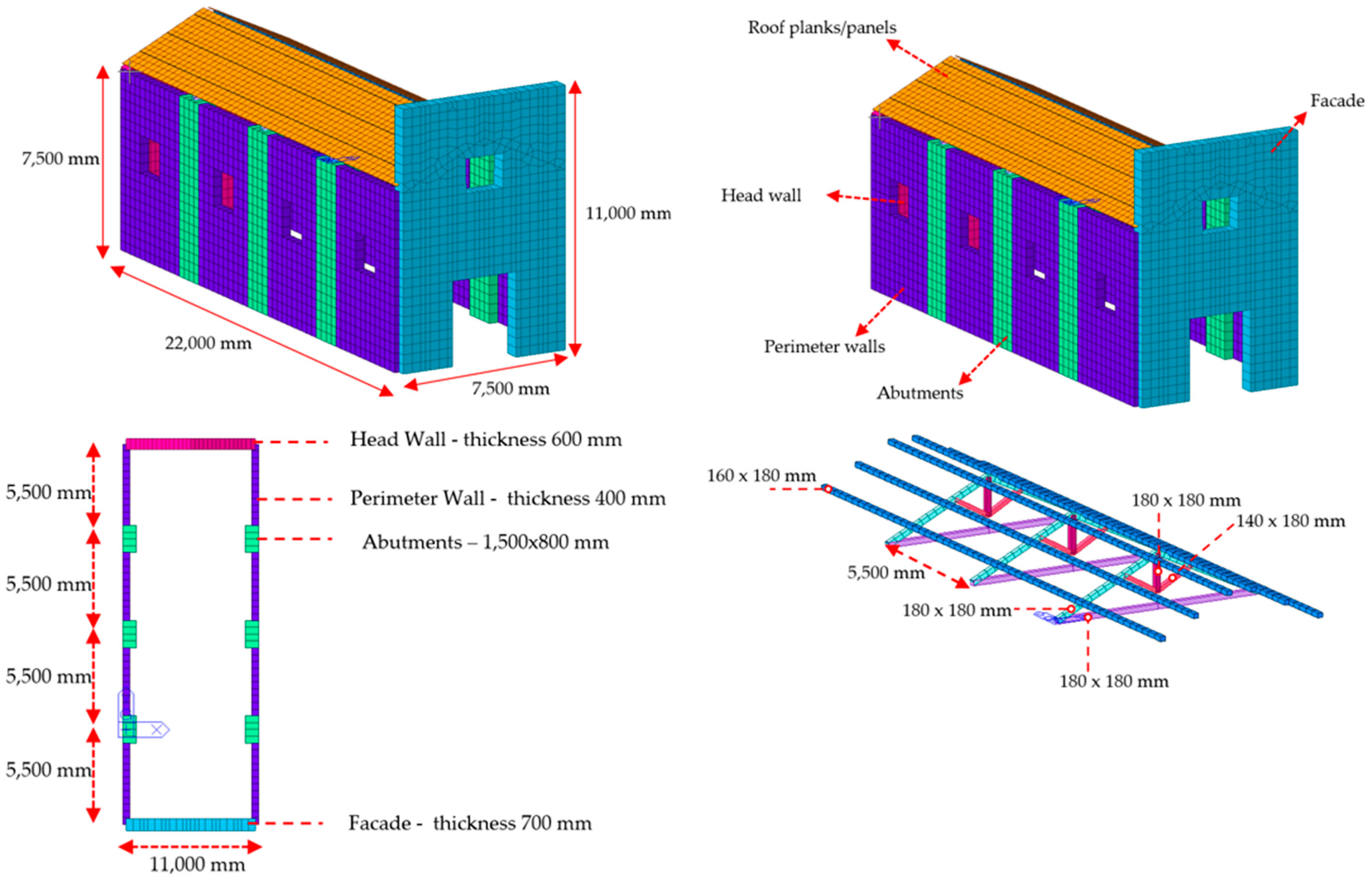
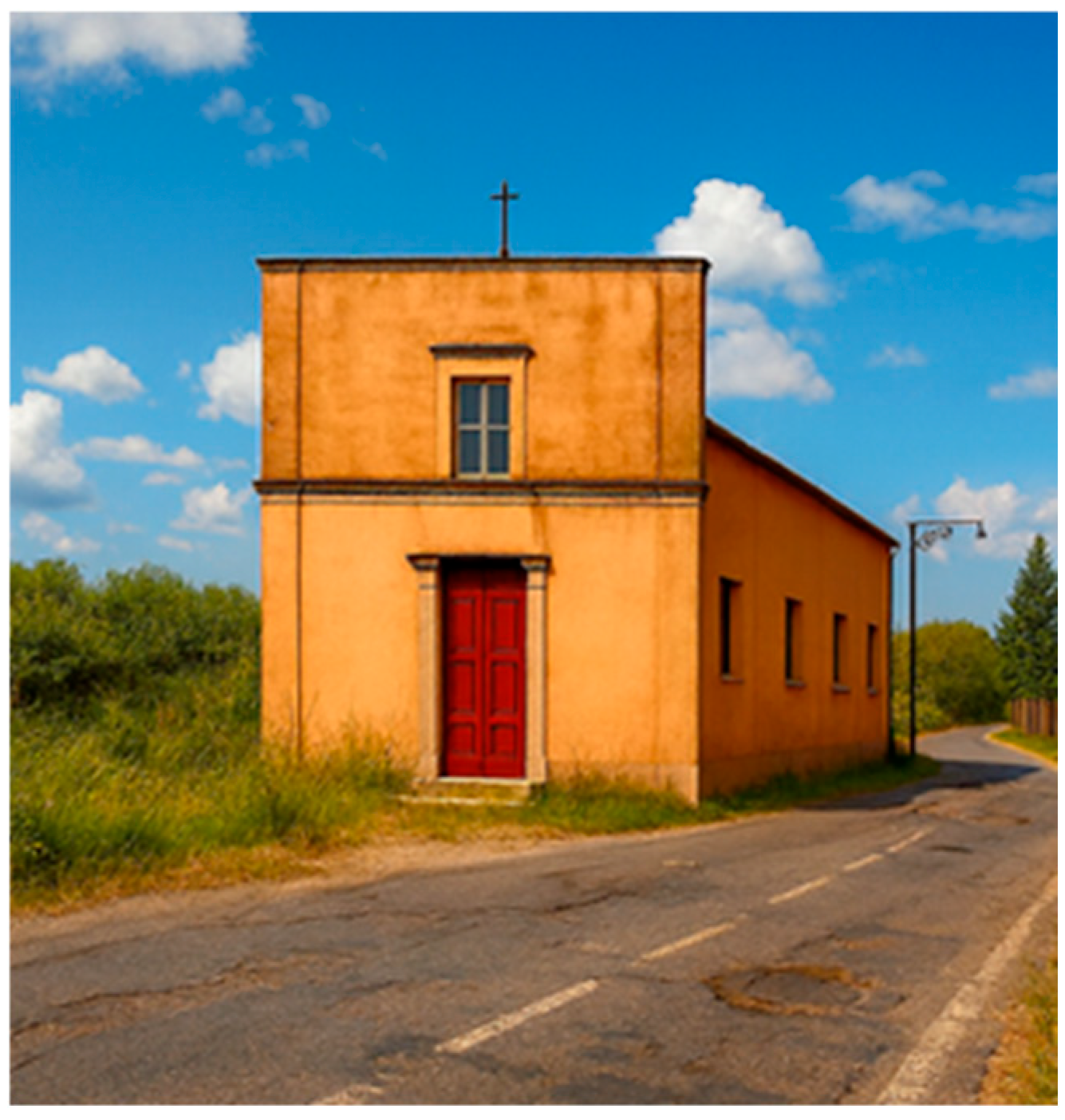
The structure under investigation is a historic church characterized by a rectangular floor plan measuring 22,000 × 7500 mm (Figure 6). The façade wall reaches a height of 11,000 mm and has a thickness of 700 mm. The lateral walls rise to 7500 mm and are 400 mm thick, with localized abutments at the truss bearing points, where the wall thickness increases to 800 mm over a length of approximately 1500 mm. The distance between the abutments is about 5500 mm. The head wall is 600 mm thick and reaches an eaves height of 7500 mm, with a ridge height of approximately 9300 mm. The pre-existing roof diaphragm of the church is the double-pitched roof, composed of timber trusses spaced at 5500 mm intervals. The truss configuration follows a traditional scheme, consisting of rafters, tie beam, king post, and struts. Between adjacent trusses, a secondary timber framework is arranged with spacing of approximately 1400 mm, supporting 20 mm thick timber planks. The masonry of the walls has Young’s modulus E = 1500 MPa, a shear modulus G = 500 MPa, and a self-weight of ρ = 1.8 × 10⁻⁵ N/mm3. The hardwood elements have Young’s modulus parallel to the fibers E0,mean = 10.000 MPa, shear modulus Gmean = 630 MPa, tensile strength parallel to the fibers ft,0,k = 18 MPa, and a self-weight ρw = 5.0 × 10⁻⁶ N/mm3. The original planks are of wood class C16.
The case study is placed in a strong seismic Italian area [57,58] characterized by peak ground acceleration PGA = 0.25 g, return period TR = 475 years, horizontal amplification factor Fo = 2.52, vertical amplification factor Fv = 1.35, and an acceleration–velocity transition period of T*C = 0.297 s. Furthermore, for the selection of the accelerograms with REXEL 3.5 software [33], the following data have also been considered: 5.5 as the minimum magnitude, 6.5 as the maximum magnitude, 0 km as the minimum epicentral distance, and 50 km as the maximum epicentral distance. The accelerometric records considered are taken from the Italian accelerometric database (named by the acronym ITACA) that collects and processes ground-motion recordings from seismic events that have occurred in Italy since 1972. According to [57,58], the average response spectrum of the selected accelerograms should be compatible with the design spectrum prescribed by the design code [57] within the period range 0.2∙T1–2∙T1, where T1 is the fundamental period of the structure. At least seven records are required, and the average spectrum shall not fall below the design spectrum.

5.2. Phase 1: Initial Linear 3D Model

The initial 3D FEM (Figure 7) is implemented using plate elements for the masonry parts and beam and truss elements for the hardwood roof structure. The original roof planks are also modeled with plate elements, considering their offset relative to the wooden beams to match the in situ configuration. The materials are assumed to behave linearly, the vertical elements are fully restrained at the base, the original connections (nails) are not included in the model, and the earthquake is introduced through an elastic response spectrum, following the parameters quoted in Section 5.1.
To improve the seismic response of the church, 57 mm thickness CLT panels (with three layers) are chosen for the diaphragm. These panels are consequently implemented in the 3D FEM as plate elements, with orthotropic linear properties, placed over the pre-existing wooden planks. At this stage, the connections are not included. This approach represents the typical professional practice for seismic evaluation, which aims to reduce computational effort and bases the design primarily on the strength resistance criterion by identifying forces and stresses in the panels and masonry elements.

5.3. Phase 2: Evaluation of EDR from Equivalent Model and Definition of the Connections

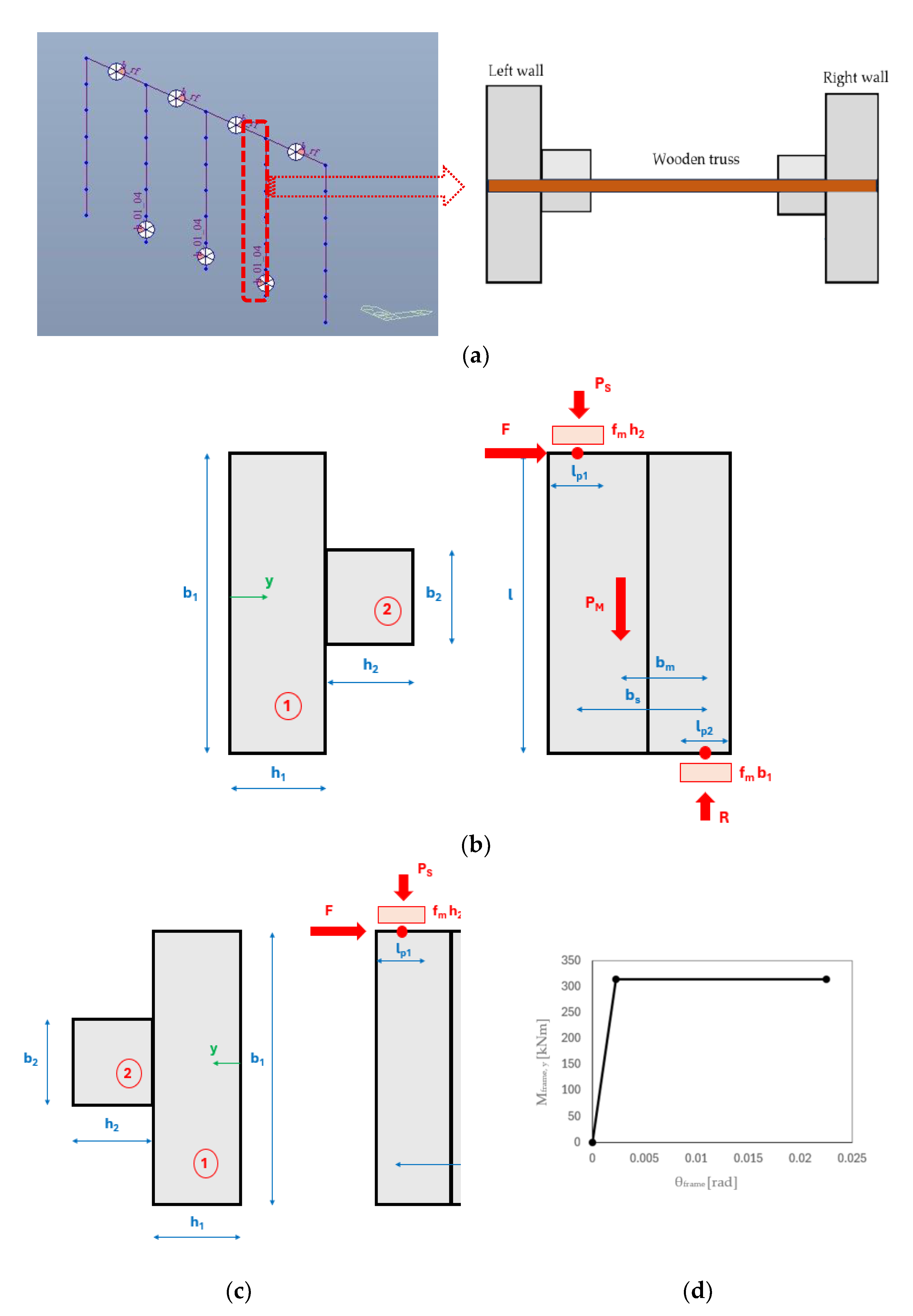
The equivalent model type described in Section 2 is implemented and the parameters of the inelastic hinges for the masonry elements and the wooden based roof are evaluated. Seismic action is represented by spectrum-compatible accelerograms [33]. The rotational hinges at the base of the frames can be assessed, considering that the overturning effect (caused by external forces) is resisted by stabilizing vertical loads due to the self-weight of the walls and roof. The characteristics of the rotational inelastic hinges depend on the geometry and vertical loads, as summarized in Table 1 and shown in Figure 8.
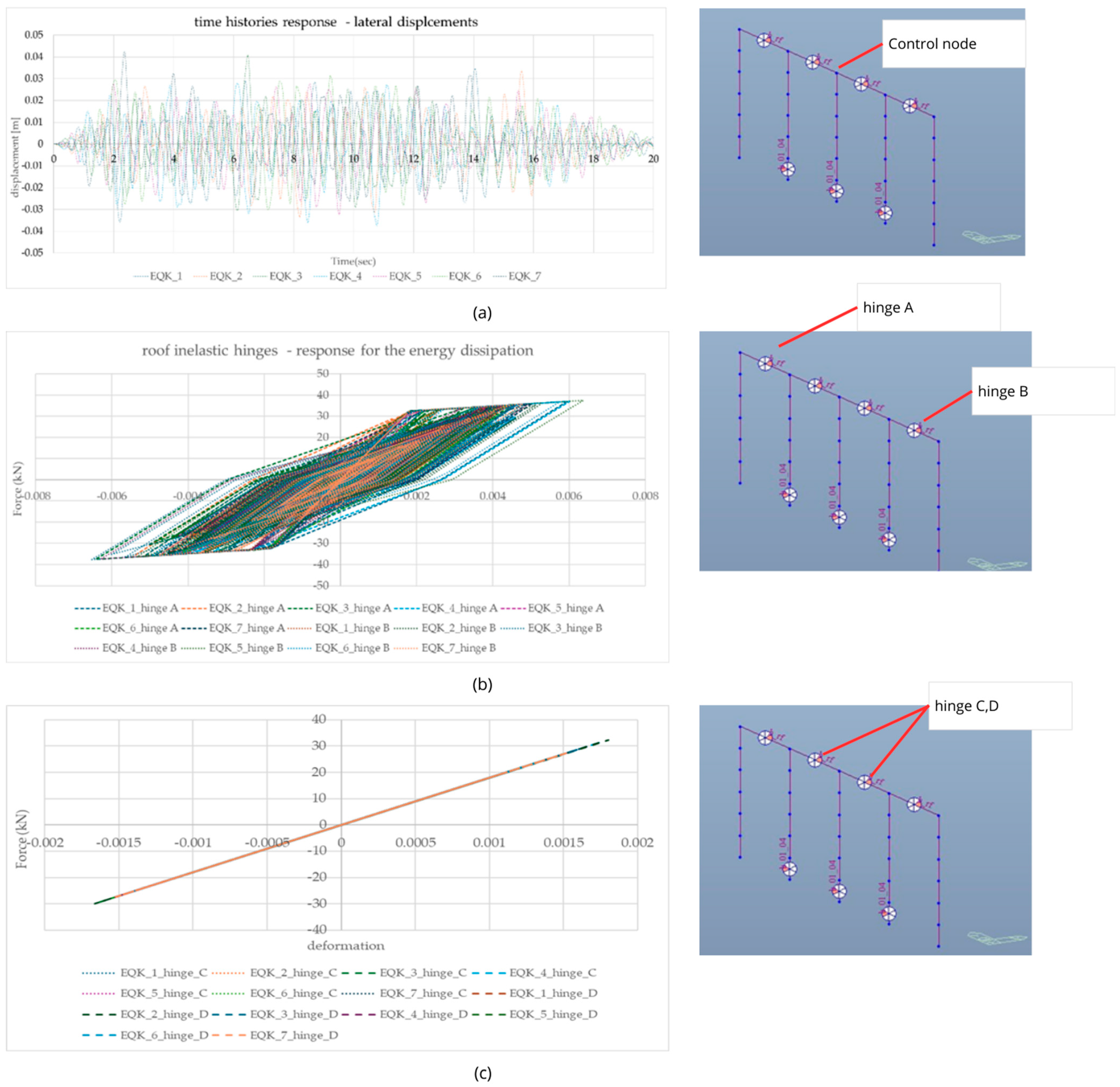
Once the rotational hinges are defined, the diaphragm stiffness is evaluated by varying the hysteretic parameter β in the range 0–1.8, thanks to Equations (1)–(5) of Section 2. Different values of β describe different possible retrofitted configurations of the diaphragm (Table 2) where the connections exhibit a stiffness degradation response [25,59,60]. For the seven selected accelerograms, lateral displacements of the roof are shown in Figure 9a for β = 1.2, while the connections respond in two ways: some hinges can dissipate (Figure 9b, for β = 1.2), while others remain in their elastic regime (Figure 9c, for β = 1.2).
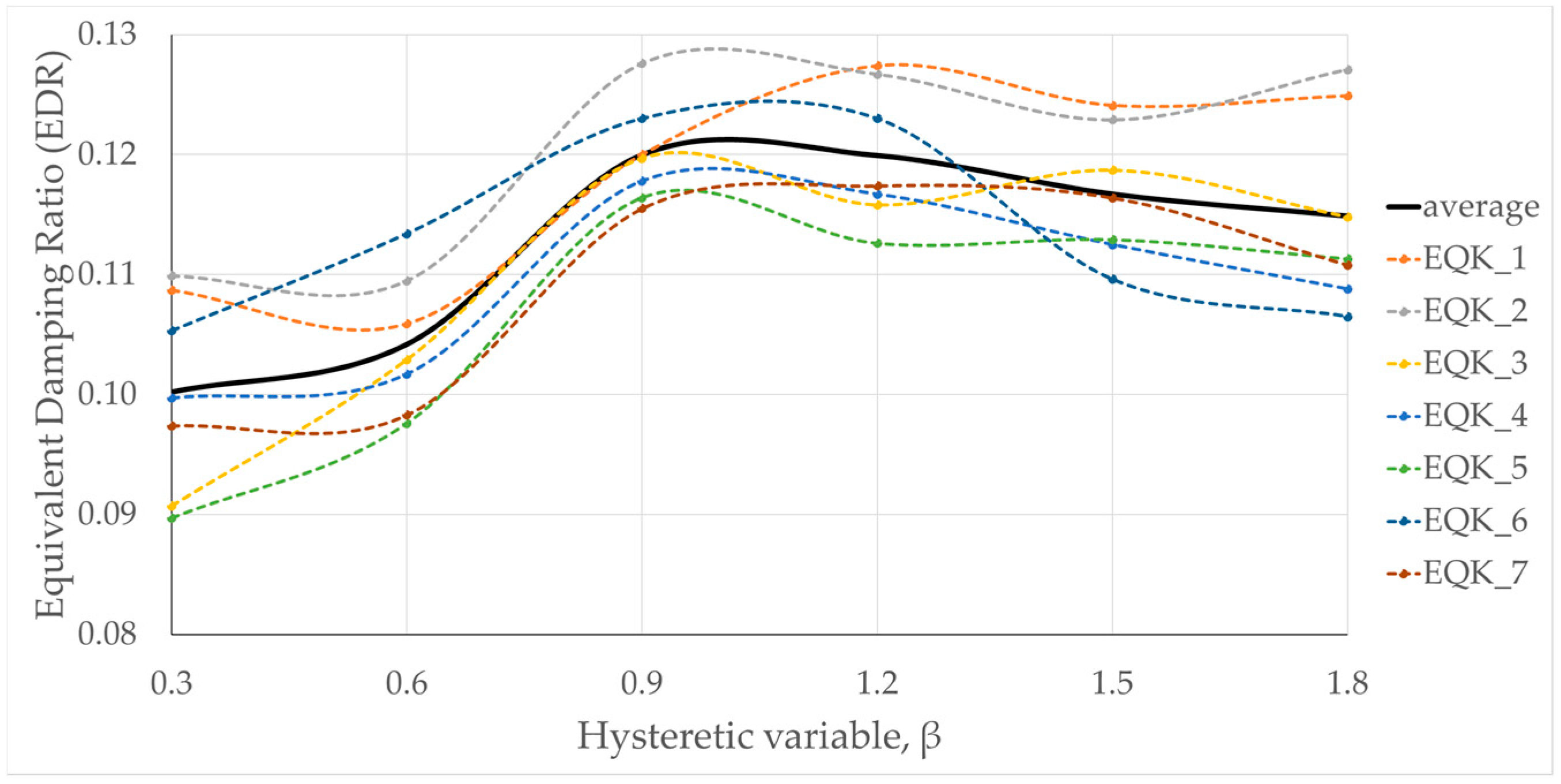
Following the criteria of Section 3 and Equation (6), EDR values are calculated and, for the case study, the optimum value results in βopt = 1.2; beyond this threshold, the EDR trend becomes asymptotic (Figure 10), meaning that, for higher β values, the retrofitted roof configuration shifts to unnecessarily high strength and high stiffness. For βopt = 1.2, by applying Equations (7)–(12), the optimal value of the roof diaphragm stiffness Kroof,opt can be detected as well, considering the shear acting on the roof, as determined for βopt = 1.2, and keeping the connectors within their elastic range. When choosing connectors with an 8 mm diameter, Vn = 1000 N can be adopted in Equations (12)–(18) [40].
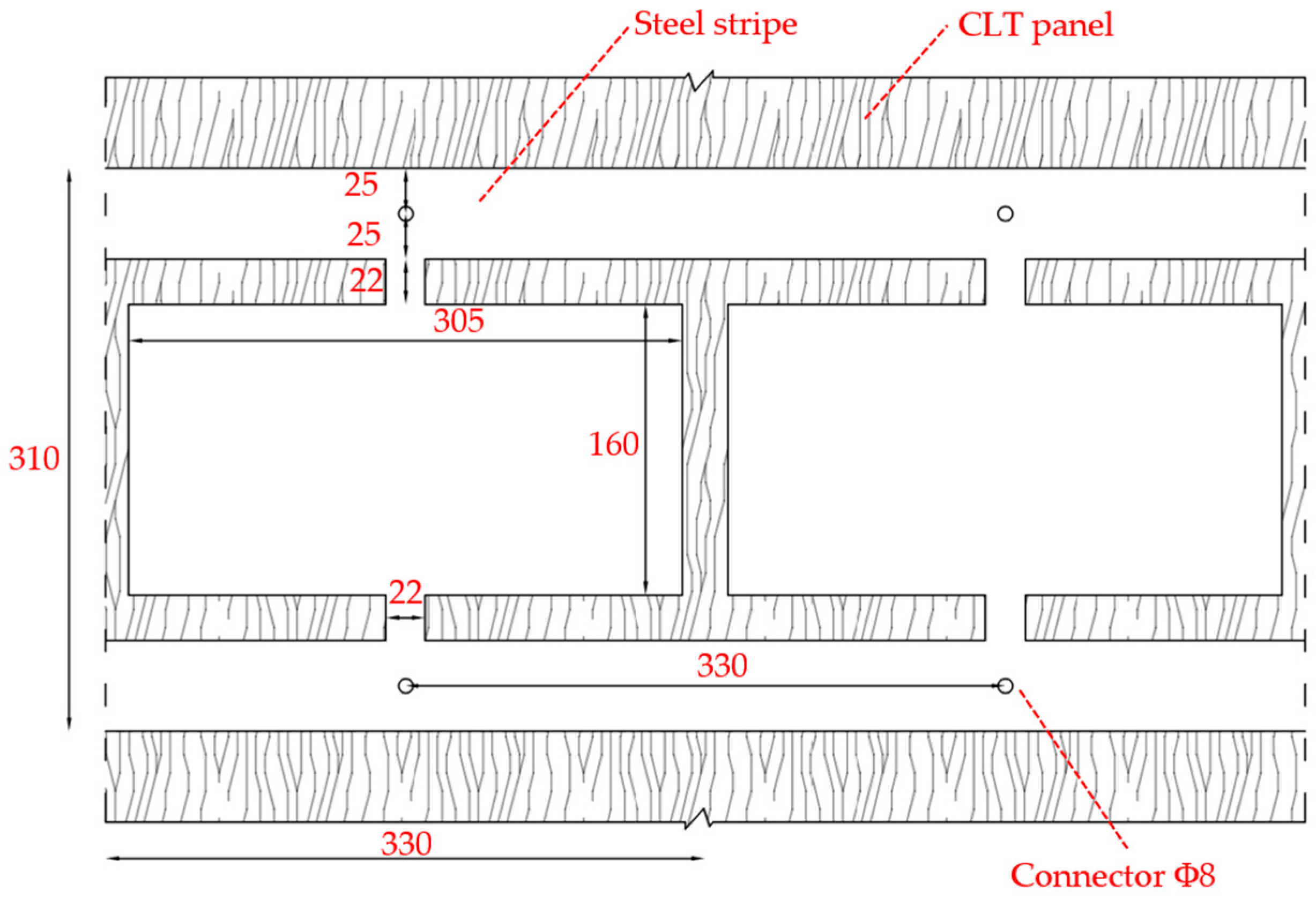
Finally, by Equations (13)–(18), it is possible to determine the geometry of the weakening zones of each stripe, resulting in the following features: (i) CLT panels of C24 wood with three layers of 19 mm thickness each; (ii) connectors with 8.8 steel class [61], 8 mm diameter, 55 mm length, mutual spacing of 300 mm; (iii) S235 steel stripes with a section of 3 × 310 mm and weakening zones characterized by tf = 25 mm, hf = 22 mm, Lf = 160 mm, and Hf = 305 mm (Figure 11). This roof configuration provides an equivalent stiffness Kroof,opt = 1484 N/mm considering the configuration in the literature [44,52], with the presence of the head wall, the façade, and two frames as the vertical macro elements. Since the case study includes an additional frame, it is necessary to distribute the obtained stiffness, Kroof,opt, over the actual roof geometry (22,000 mm length), updating the number of connection stripes accordingly. In this specific case, the number of stripes is set to ns = 5, a value compatible with the commercially available 3700 mm width of the selected CLT panels [53,54].

5.4. Phase 3: Validation of the Optimized Roof Diaphragm by Nonlinear 3D Modeling

In this phase, the 3D nonlinear model of the retrofitted configuration obtained in Phase 2 is implemented (Figure 12). The nonlinear properties of the connections are introduced by springs with the characteristics found for βopt = 1.2 with adapted forces and displacements values for respecting the mesh size of the roof’s plate elements. In the evaluation of the constitutive behavior of inelastic springs, the yield force is associated with the steel stripe, whereas the deformation is governed by the interaction between the stripes and the connectors. The nonlinear properties of the masonry are introduced at the base of the perimeter walls by nonlinear links characterized by moment–rotation (M-θ) relationships already used in Phase 2 (Table 1 and Table 2). This setup allows the simulation of the rocking mechanism and the verification of the dissipative (or the elastic) response of the roof’s connections under the transversal accelerograms, in terms of the yielding status of the inelastic hinges. When the hinges exceeded the elastic range, the roof diaphragm can dissipate energy, reducing both panels and facade’s shear, while keeping the lateral displacements under control with respect to out-of-plane mechanisms.

6. Remarks

The validity of the energy-based approach relying on the optimal EDR is discussed in terms of three dimensionless ratios defined by Equations (19)–(21):
R R =   F x y , R / F x y , S
F R = f v 0 , d / τ x y
D R = δ t a r g e t / δ m a x
where RR is the ratio between the resistance of the wooden based panels Fxy,R and the in-plane shear acting on the panels Fxy,S; FR is the ratio between the admissible in-plane stress fv0,d for the façade’s masonry and the in-plane shear stress acting on the façade τxy; DR is the ratio between the target displacement δtarget and the evaluated displacement δmax from the analyses. The resistance values of the wooden elements are evaluated according to [40,61,62], while those of the masonry come from [57,63]. The target displacement is assumed to be 0.5% of the perimeter walls’ height [52].
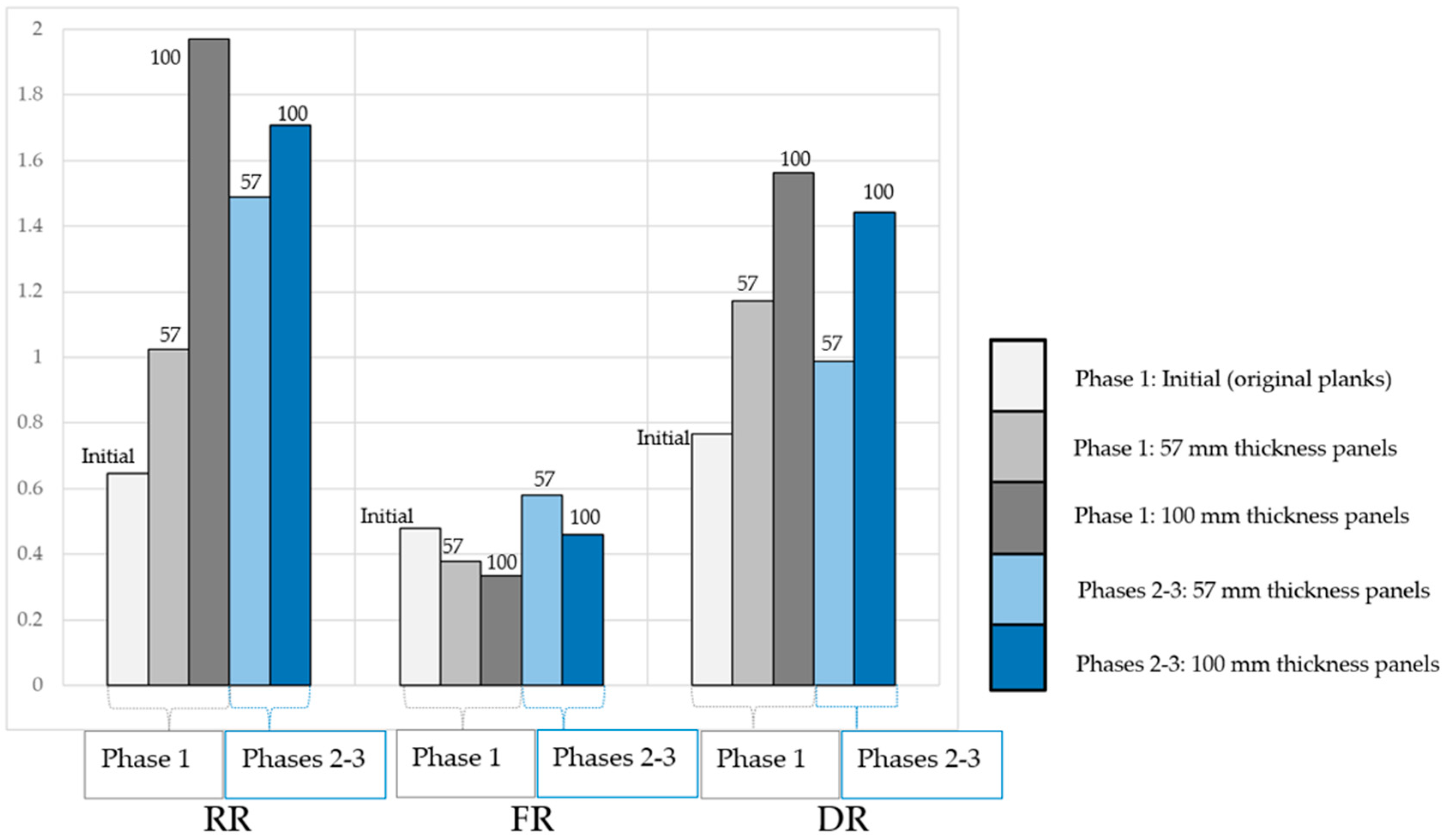
In Phase 1, the response of the non-retrofitted church (with original planks) is characterized by the following values: RR = 0.64 = (31 N/mm)/(48 N/mm), FR = 0.47 = (0.11 MPa)/(0.23 MPa), DR = 0.76 = (37.5 mm)/(49.0 mm). The mechanical verifications of the planks and the masonry are not satisfied. In terms of displacement, the initial configuration shows 0.65% of the perimeter walls’ height, meaning that possible out-of-plane mechanisms could occur.
To improve the seismic response, in Phase 1, a first roof configuration consisting of 57 mm thick CLT panels with three layers is implemented. In this phase, the dissipation of the connections is not yet considered because only the CLT panels are introduced in the model, without the inelastic springs for the connections. The panels are present according to the mesh of the trusses and the walls. The results show that the diaphragm is subjected to high in-plane shear and stress in the plane of the façade, whereas a reduction in the lateral displacement occurs.
The response of this first retrofitted configuration in terms of the previous ratios is as follows: RR = 1.02 = (64 N/mm)/(62.5 N/mm), FR = 0.38 = (0.11 MPa)/(0.29 MPa), and DR = 1.17 = (37.5 mm)/(32.0 mm). This indicates improvements mainly in terms of out-of-plane behavior. However, significant interventions on the façade would be mandatory, and the CLT’s mechanical verifications are very close to the limit near the roof zones adjacent to the façade and head wall, where some shear peaks are present due to the mesh. To avoid this problem, the total diaphragm thickness should be increased to 100 mm, consisting of CLT panels with five layers, 20 mm thickness each, in accordance with the commercially available panels [53]. The adjustment leads to RR = 1.96 = (128 N/mm)/(65 N/mm), FR = 0.33 = (0.11 MPa)/(0.33 MPa), and DR = 1.54 = (37.5 mm)/(24.3 mm). The 100 mm CLT panels configuration increases the overall mass, with implications for the stress distribution across all masonry components, roof planks, and beams.
In Phase 2, approaching the roof’s retrofitted diaphragm configuration based on the EDR, for the 57 mm thickness panel configuration the optimum damping is reached for βopt = 1.2 (previous Figure 10).
Passing to the 3D model of Phase 3 reproducing the optimum configuration detected by Phase 2, the results in terms of RR, FR, and DR are as follows: (i) for 57 mm thickness configuration, RR = 1.49 = (64 N/mm)/(43 N/mm), FR = 0.58 = (0.11 MPa)/(0.19 MPa), DR = 0.99 = (37.5 mm)/(38.0 mm); (ii) for 100 mm thickness, corresponding to an over-stiffness configuration, RR = 1.70 =(128 N/mm)/(75 N/mm), FR = 0.45 = (0.11 MPa)/(0.24 MPa), DR = 1.44 = (37.5 mm)/(26.0 mm).
A comparison between the results of the different phases is shown in Figure 13. Analyzing the ratios, the 57 mm panels configuration maximizes performance according to the energy-based approach in terms of in-plane shear on the roof (RR) and façade (FR), while leading to a more deformable structure (DR). However, the DR value is very close to the unity. Finally, only the damping-based approach reveals that increasing panel thickness (from 3 to 5 layers) is currently unjustified.
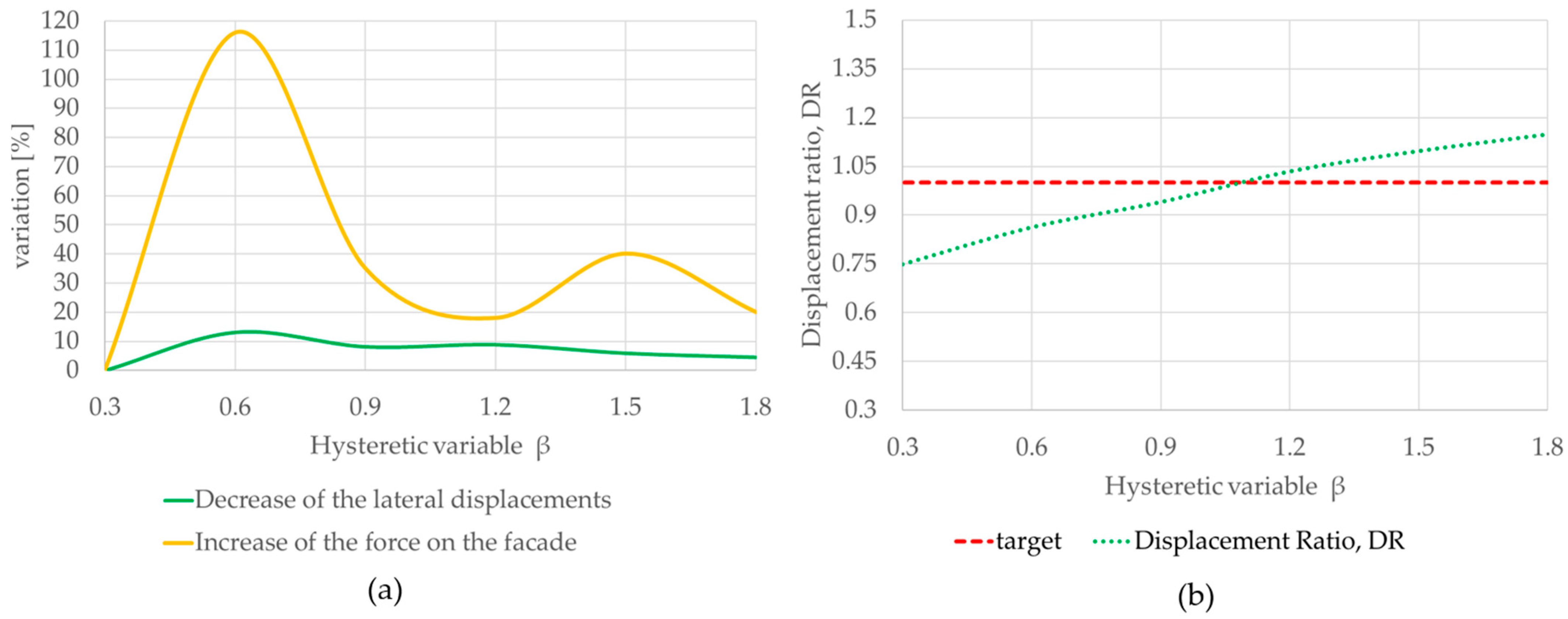
The EDR analysis of Phase 2 shows that slight improvements in lateral displacement occur beyond βopt = 1.2, and an increase in the façade’s in-plane stress is observed as well. The variation in the hysteretic parameter β more afflicts the shear force in the plane of the façade with respect to the lateral displacements. It means that an over-strength and over-stiffness solution leads to significative variation in the stresses on the façade and only a limited benefit against out-of-plane rocking mechanisms affecting the longitudinal perimeter walls of the church. Figure 14a shows the percentage variation in terms of lateral displacements and stress on the façade, with β ranging from 0.3 to 1.8. Figure 14b plots the DR variation, verifying that the intersection between DR and its target value (=1) correctly occurs close to βopt = 1.2.
Considering Figure 14 and the previous Figure 10, for the case study, the largest variations in terms of lateral displacement reduction and in-plane façade stresses occur within the range 0.3 ≤ β ≤ 0.6. Nevertheless, in order to satisfy the displacement limit and prevent out-of-plane mechanisms in the perimeter walls, it is necessary to extend the investigation to higher values of β, up to approximately β = 1.15. Concurrently, the EDR analysis conducted on the seven accelerograms revealed an average trend in which the maximum EDR is attained at β = 1.2. Beyond this optimal value, further improvements in lateral displacement reduction become negligible, while the in-plane stresses of the façade increase by about 20%.
By exploiting this yielding mechanism, the in-plane shear demand on the roof (which governs the mechanical performance of both connectors and panels) is reduced. Consequently, the shear force transferred from the roof to the façade also decreases. Nevertheless, since the roof is conceived as an elastic–plastic energy dissipator, its deformability increases. Therefore, it remains essential to carefully assess the DR value to ensure that the resulting lateral displacement does not exceed the predefined design value.
As previously mentioned, Phase 3 involves the implementation of the configuration identified in Phase 2 within a nonlinear 3D model, where inelastic springs are used to represent roof connections, and rotational springs are placed at the base of the plates to simulate the rocking behavior of the lateral walls.
The first verification is to check whether the inelastic hinges exit their elastic range, dissipating energy and reducing the in-plane shear demand on the panels. These springs must be calibrated based on the characteristics of the stripes, including their localized weakening, so that yielding occurs at a shear load below the service design capacity of the connectors. To this end, Equations (13)–(18) were applied, and the geometry of the weakened zones (Figure 11) has been dimensioned according to Section 4.
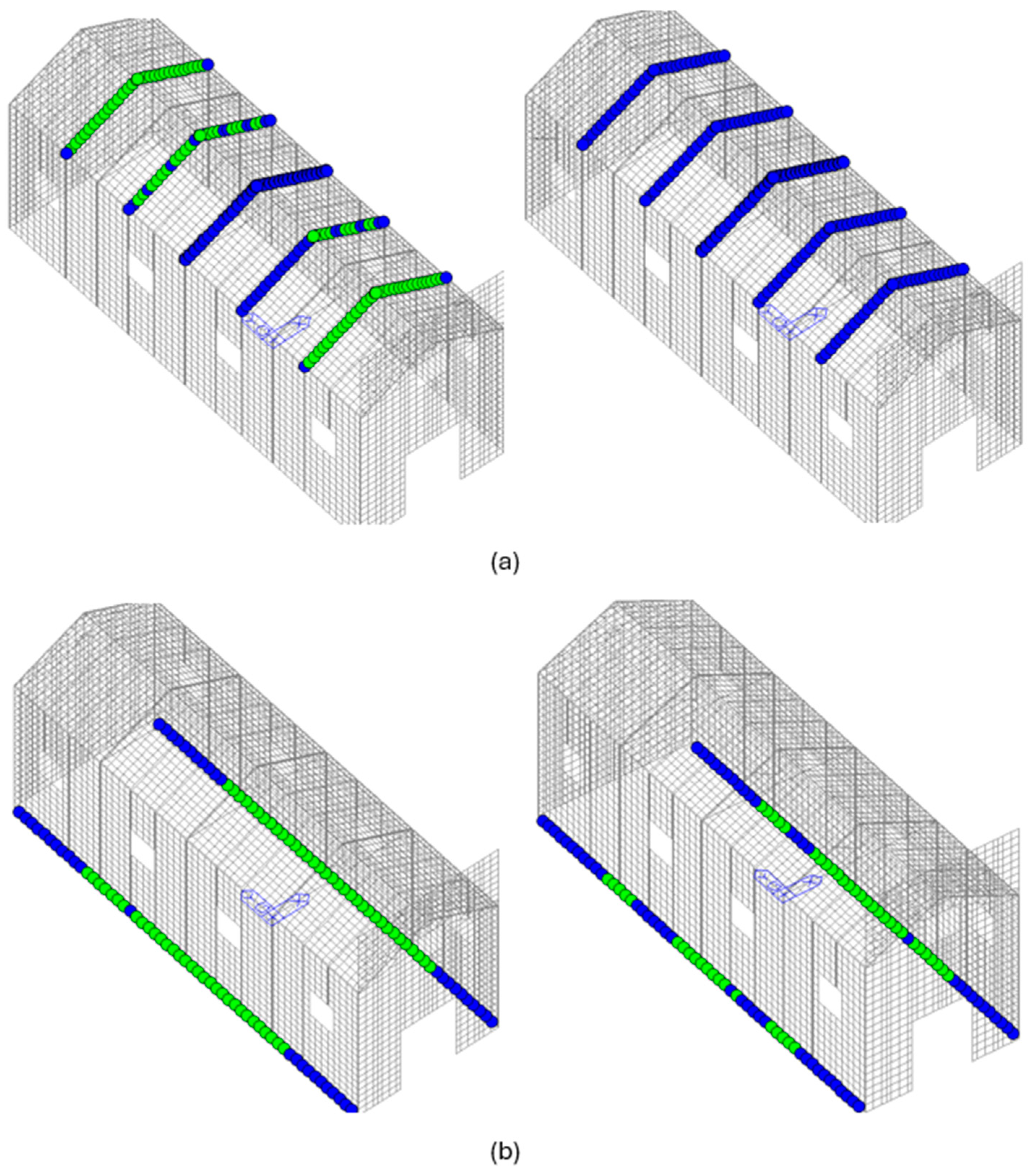
The analysis of the yielding status of plastic hinges, both in the roof and in the masonry walls, reveals that, in the configuration optimized through EDR estimation (Phase 2), the shear hinges near the façade and the head wall undergo yielding, while those in the central part remain within the elastic range, contributing to the EDR only in terms of maximum strain energy. Conversely, the rotational hinges yield in the central portions of the lateral walls, remaining elastic near the head wall and the façade. This behavior reflects the zones of maximum and minimum lateral displacement, respectively, indicating that the masonry hinges operate in opposition to the roof shear hinges. Overall, the plastic hinges in the 3D model of Phase 3 behave consistently with those in the equivalent model of Phase 2 (as shown in the previous Figure 9).
Comparing the behavior of plastic hinges in the optimized configuration with that of an over-strength and over-stiff configuration (both modeled using the nonlinear 3D approach of Phase 3) it is observed that the masonry hinges allow for rocking, thus exhibiting a response like that of the optimized configuration. The roof hinges remain within the elastic range and therefore do not contribute to energy dissipation, resulting in an increased in-plane shear demand on the roof diaphragm, and a higher shear force transferred to the façade, albeit with limited lateral displacement.
Figure 15 illustrates the yielding status of the plastic hinges in the optimized configuration implemented in Phase 3 in the 3D model, based on the optimal EDR βopt = 1.2 of Phase 2, and compares it with the yielding state of the connections in the over-strength and over-stiff configuration.
The equivalent model of Phase 2 reproduces the mass and inertia of the macro-elements of the structure, three-dimensionally present in the model of Phase 3 (specifically: the lateral walls, the roof, the façade, and the head wall). In a qualitative analysis, the equivalent model cannot capture localized stress states, which can instead be investigated with a full 3D nonlinear model. Nevertheless, since the tested equivalent models represent retrofitted configurations with different effectiveness depending on the EDR value, it is possible to compare the nonlinear dynamic response of the equivalent model with the one of the corresponding 3D model (namely Phase 2 and Phase 3, with βopt = 1.2). From this comparison, the following remarks can be made: (i) in the equivalent model, the fundamental period of the structure is 0.28 s, with about 75% of the total mass excited in the fundamental vibration mode orthogonal to the longitudinal axis of the church; (ii) in the 3D model, the fundamental period is approximately 0.32 s, with the corresponding excited mass being lower, around 51% of the total; (iii) the first vibration mode involving mass in the opposite direction (parallel to the longitudinal axis of the church) is the fourth vibration mode in both models; (iv) at the end of the seismic event (for instance under accelerogram 1), the inelastic hinges of the roof located close to the façade and the head wall entered in the plastic range, while the central hinge remains within the elastic field; (v) this is consistent with the 3D model where only the central roof stripes remain elastic; (vi) at the end of the same seismic event, the inelastic hinges of the masonry elements in the equivalent model are outside the elastic range, whereas in the 3D model, all hinges yield except those located within about 3000 mm from the façade and the head wall (this behavior is consistent with the response of the roof, which exhibits energy dissipation in the lateral stripes, while the central ones remain within the elastic range); (vii) finally, both models reach approximately 38 mm lateral displacements—in fact, the DR ratio for the optimized configuration is close to unity. In addition, the equivalent model shows that the roof hinges start yielding and dissipating energy at about 1.95 s from the beginning of the earthquake, while the masonry hinges yield at about 2.12 s, thereby substantially confirming the good agreement between the two approaches.
It is important to note that Phase 1 is the typical approach in professional practice, since the design of the roof’s connections can be performed only in terms of strength because the shear resistance connections should exceed the in-plane shear Fxy,S evaluated in the model. In Phase 1, for the 57 mm thickness CLT panels, the configuration of the panel-to-panel connections should consist of S275 steel stripes with a cross-section of 8 × 100 mm, without weakened zones, and 10 connectors per linear meter (8 mm diameter, and 8.8 steel class [40]). For commercial panel dimensions, six stripes could be placed on the diaphragm, leading to a roof’s stiffness Kroof of approximately 3820 N/mm, evaluated by Equation (7), corresponding to a hysteretic parameter β = 2.8, as evaluated by Phase 2. This significantly exceeds the threshold value required to avoid excessive residual displacements during rocking. Therefore, an only strength-based design of the connections results in an over-strength solution, but also overly stiff configuration. A comparative analysis between Phase 1 and Phase 2 clearly highlights that, by relying on the estimation of EDR, the thickness of the roof diaphragm can be set to 57 mm avoiding the need to investigate up to 100 mm. Moreover, it allows for a reduction in the number of connectors per stripes, passing from 10/m (Phase 1) to 6/m (Phase2, Figure 11). However, particular attention should be paid to the design of the steel stripes, which should be capable of yielding while keeping both the connectors and the panels within the elastic range. This assumption reflects a plausible post-earthquake scenario, in which both panels and connections remain within the elastic regime. Under such conditions, the cover plate—once yielded—could be replaced after removing the initially screwed connectors.
The optimized configuration also represents money saving with respect to the over-strength solution. For the present case study, considering the Italian construction market, some considerations in terms of economic impact of the proposed interventions presented here. Considering about 170 m2 of the roof’s surface distributed over 12 panels, for the over-strength retrofitted roof solution of Phase 1 (with 100 mm panel thickness), the material cost would be approximately EUR 70/m2, whereas the corresponding material cost for the optimized solution (57 mm panel thickness) would be about EUR 50/m2. Including transportation and on-site handling, passing from 57 mm to 100 mm configuration, the overall cost rises from about EUR 60/m2 to EUR 81/m2, increasing the global budget of the retrofitting intervention from EUR 10,200 for 57 mm panels to about EUR 13,900 in the case of 100 mm panels. The economic impact is slightly present in terms of connectors because these elements are purchased by package and not individually. Regarding the cost of connectors, the reduction from about 492 (Phase 1) to about 300 (Phase 2) wood–steel screws (Ø8 mm) corresponds to a maximum saving of about EUR 615. Finally, in terms of steel savings for the panel-to-panel connection stripes, from the over-strength configuration to the optimized one (where weakening cuts are introduced to promote plasticization and damping), the material saving is about 40.7% per linear meter of stripe. Considering a stripe with 100 mm width and 8 mm thickness, this corresponds to a mass reduction of approximately 2.5 kg/m and a cost saving of about EUR 3/m. By applying these values to a 6 stripes 8 m long configuration, the optimized solution leads to an overall saving of about 120 kg of steel and EUR 144.

7. Conclusions

This study presents a retrofit strategy for single-nave masonry churches using wood-based roof diaphragms designed as a distributed damping system from an EDR evaluation. In the proposed approach, EDR represents a design key for the retrofitted roof diaphragms, enabling energy-based optimization, capturing the diaphragm’s dissipative behavior, and maximizing damping. This is in contrast with conventional professional practices, which rely solely on over-strength criteria and overlook the dynamic contribution of controlled plasticity due to the connections of the roof. The equivalent model streamlines the parametric evaluation of connection layouts, and its predictions are validated through nonlinear 3D simulations. The results confirm that targeted plasticization improves seismic performance while maintaining displacements and shear demand within design limits. As a next step in the research on optimizing panel-to-panel connections for roof diaphragms, specific experimental tests on physical specimens could be carried out. Key findings include the following:
  • The equivalent model facilitates rapid parametric analyses of panel-to-panel connection schemes, markedly reducing computational requirements relative to an initial full 3D nonlinear analysis. Moreover, the full 3D model nonlinear analyses have confirmed the results obtained by equivalent model.
  • The concentrated nonlinear properties introduced in the equivalent model are presented with the aim of capturing the overall behavior of the structure and make it possible to evaluate the variations of the lateral displacements, considering that the introduction of a roof diaphragm should avoid out-of-plane mechanisms in the transverse response of the retrofitted church. In fact, this approach is initially adopted in the energy-based comparative analyses to detect the optimum EDR and retrofitted roof stiffness. However, the assumption of concentrated nonlinearities at the base of the walls limits the identification of possible crack patterns in the masonry structure by assuming a priori the position of the plastic hinges. Future works will explore the possibility of incorporating the nonlinear modeling of masonry walls using solid finite elements into the design strategy for the selection of the optimized roof configuration.
  • The method enables the optimization of diaphragm thickness and connector quantity by leveraging the system’s dissipative capacity, an aspect that cannot be captured through conventional strength-based approaches.
  • The retrofitted configuration based on EDR can reduce the thickness of the panels and the number of connectors, thanks to the detection of the connections’ dissipative effects.
  • The numerical approaches discussed here are particularly suitable for single-nave churches, although similar equivalent modeling can be adopted also in case of multi-nave churches with rectangular plans or Basilicas with a cruciform layout. In the case of a cruciform layout, the transverse response of the Basilica could be simulated by modelling all the elements of the church placed between the façade and the triumphal arch, typically located before the transept. Given the different characteristics of the roof between the central nave and the lateral aisles, special care should be taken in the equivalent modeling. Regarding the applicability of the method for the calculation of the EDR, it could be extended to historic buildings with elongated rectangular plans and regular layouts, whose first vibration mode shape involves mainly transverse displacements (perpendicular to the longitudinal axis of the building) and accounts for a significant percentage of the building’s overall mass.

Author Contributions

Conceptualization, N.L., P.C., L.C. and M.S.; methodology, N.L., P.C. and L.C.; validation, N.L. and P.C.; formal analysis, N.L. and M.S.; investigation, N.L., L.C. and M.S.; data curation, N.L. and P.C.; writing—original draft preparation, N.L. and P.C., writing—review and editing, N.L., P.C., L.C. and M.S.; visualization, N.L.; supervision, N.L., P.C. and L.C. All authors have read and agreed to the published version of the manuscript.

Funding

This research received no external funding.

Institutional Review Board Statement

Not applicable.

Informed Consent Statement

Informed consent was obtained from all subjects involved in the study.

Data Availability Statement

The original contributions presented in this study are included in the article. Further inquiries can be directed to the corresponding author.

Acknowledgments

The authors would like to thank A. Franchi from Politecnico di Milano for the contribution to the successful completion of this study.

Conflicts of Interest

The authors declare no conflicts of interest.

References

  1. Benedetti, D.; Petrini, V. Sulla Vulnerabilità Sismica Degli Edifici in Muratura: Un Metodo di Valutazione. L’industria delle Costruzioni 1984, 149, 66–74. [Google Scholar]
  2. Cattari, S.; Calderoni, B.; Caliò, I.; Camata, G.; de Miranda, S.; Magenes, G.; Milani, G.; Saetta, A. Nonlinear Modeling of the Seismic Response of Masonry Structures: Critical Review and Open Issues towards Engineering Practice. Bull. Earthq. Eng. 2022, 20, 1939–1997. [Google Scholar] [CrossRef]
  3. Cundari, G.A.; Milani, G.; Failla, G. Seismic Vulnerability Evaluation of Historical Masonry Churches: Proposal for a General and Comprehensive Numerical Approach to Cross-Check Results. Eng. Fail. Anal. 2017, 82, 208–228. [Google Scholar] [CrossRef]
  4. Ruggieri, S.; Tosto, C.; Rosati, G.; Uva, G.; Ferro, G.A. Seismic Vulnerability Analysis of Masonry Churches in Piemonte after 2003 Valle Scrivia Earthquake: Post-Event Screening and Situation 17 Years Later. Int. J. Archit. Herit. 2022, 16, 717–745. [Google Scholar] [CrossRef]
  5. De Matteis, G.; Criber, E.; Brando, G. Damage Probability Matrices for Three-Nave Masonry Churches in Abruzzi after the 2009 LAquila Earthquake. Proc. Int. J. Archit. Herit. 2016, 10, 120–145. [Google Scholar]
  6. Dias-Oliveira, J.; Rodrigues, H.; Asteris, P.G.; Varum, H. On the Seismic Behavior of Masonry Infilled Frame Structures. Buildings 2022, 12, 1146. [Google Scholar] [CrossRef]
  7. Zizi, M.; Rouhi, J.; Chisari, C.; Cacace, D.; De Matteis, G. Seismic Vulnerability Assessment for Masonry Churches: An Overview on Existing Methodologies. Buildings 2021, 11, 588. [Google Scholar] [CrossRef]
  8. Tena-Colunga, A.; Abrams, D.P. Seismic Behavior of Structures with Flexible Diaphragms. J. Struct. Eng. 1996, 122, 439–445. [Google Scholar] [CrossRef]
  9. Milani, G.; Shehu, R.; Valente, M. Seismic Vulnerability Reduction of Masonry Churches: A Case Study. Proc. Procedia Eng. 2017, 199, 272–277. [Google Scholar] [CrossRef]
  10. Longarini, N.; Crespi, P.; Zucca, M. The Influence of the Geometrical Features on the Seismic Response of Historical Churches Reinforced by Different Cross Lam Roof-Solutions. Bull. Earthq. Eng. 2022, 20, 6813–6852. [Google Scholar] [CrossRef]
  11. Marini, A.; Giuriani, E.P. Transformation of Wooden Roof Pitches into Antiseismic Shear Resistance Diaphragms. In Proceedings of the V International Conference on Structural Analysis of Historical Constructions, New Delhi, India, 6–8 November 2006; MacMillan: New York, NY, USA, 2006. [Google Scholar]
  12. Acito, M.; Magrinelli, E.; Milani, G.; Tiberti, S. Seismic Vulnerability of Masonry Buildings: Numerical Insight on Damage Causes for Residential Buildings by the 2016 Central Italy Seismic Sequence and Evaluation of Strengthening Techniques. J. Build. Eng. 2020, 28, 101081. [Google Scholar] [CrossRef]
  13. Thomoglou, A.K.; Jagadesh, P.; Voutetaki, M.E. Review of Out-of-Plane Strengthening Techniques of Unreinforced Masonry Walls. Fibers 2023, 11, 78. [Google Scholar] [CrossRef]
  14. Hafner, I.; Kišiček, T.; Gams, M. Review of Methods for Seismic Strengthening of Masonry Piers and Walls. Buildings 2023, 13, 1524. [Google Scholar] [CrossRef]
  15. Giuriani, E.; Marini, A. Wooden Roof Box Structure for the Anti-Seismic Strengthening of Historic Buildings. Int. J. Archit. Herit. 2008, 2, 226–246. [Google Scholar] [CrossRef]
  16. D’Arenzo, G.; Rigo, P.; Nicolussi, V.; Pozza, L.; Casagrande, D. Characterisation of the Rigid Diaphragm Conditions for Cross Laminated Timber Floors. Bull. Earthq. Eng. 2025, 23, 1759–1794. [Google Scholar] [CrossRef]
  17. Sharifi, J.; Sharifi, Z.; Berg, S.; Ekevad, M. Diaphragm Shear and Diagonal Compression Testing of Cross-Laminated Timber. SN Appl. Sci. 2021, 3, 842. [Google Scholar] [CrossRef]
  18. Zucca, M.; Reccia, E.; Longarini, N.; Cazzani, A. Seismic Assessment and Retrofitting of an Historical Masonry Building Damaged during the 2016 Centro Italia Seismic Event. Appl. Sci. 2022, 12, 11789. [Google Scholar] [CrossRef]
  19. Soong, T.T.; Dargush, G.F. Passive Energy Dissipation Systems in Structural Engineering; Wiley: Hoboken, NJ, USA, 1997; ISBN 9780471968214. [Google Scholar]
  20. Den Hartog, J.P. Mechanical Vibrations; McGraw-Hill: Columbus, OH, USA, 1956; ISBN 0070163898. [Google Scholar]
  21. Jacobsen, L. Steady Forced Vibrations as Influenced by Damping. Trans. Am. Soc. Mech. Eng. 1930, 52, 169–181. [Google Scholar] [CrossRef]
  22. Jennings, P.C. Equivalent Viscous Damping for Yielding Structures. J. Eng. Mech. Div. 1968, 94, 103–116. [Google Scholar] [CrossRef]
  23. Department of Homeland Security. FEMA 440: Improvement of Nonlinear Static Seismic Analysis Procedures; Federal Emergency Management Agency: Washington, DC, USA, 2005.
  24. FEMA 356. FEMA 356—Prestandard and Commentary for the Seismic Rehabilitation of Buildings; Federal Emergency Management Agency: Washington, DC, USA, 2000.
  25. Applied Technology Council. ATC 40, Seismic Evaluation and Retrofit of Concrete Buildings; Applied Technology Council: Redwood City, CA, USA, 1996; Volume 1. [Google Scholar]
  26. Puncello, I.; Caprili, S. Seismic Assessment of Historical Masonry Buildings at Different Scale Levels: A Review. Appl. Sci. 2023, 13, 1941. [Google Scholar] [CrossRef]
  27. Castellazzi, G.; Cardillo, E.; Lo Presti, N.; D’Altri, A.M.; de Miranda, S.; Bertani, G.; Ferretti, F.; Mazzotti, C. Advancing Cultural Heritage Structures Conservation: Integrating BIM and Cloud-Based Solutions for Enhanced Management and Visualization. Heritage 2023, 6, 7316–7342. [Google Scholar] [CrossRef]
  28. Valente, M.; Milani, G. Damage Survey, Simplified Assessment, and Advanced Seismic Analyses of Two Masonry Churches after the 2012 Emilia Earthquake. Int. J. Arch. Herit. 2018, 13, 901–924. [Google Scholar] [CrossRef]
  29. Kamil, S.S.; Nabilah, A.B.; Karim, I.A.; Alias, A.H.; Mohd Tohir, M.Z. Seismic Performance and Fragility Assessment of Masonry Infilled RC Frames Using a Numerical Approach. Bull. Earthq. Eng. 2025, 1–28. [Google Scholar] [CrossRef]
  30. Preti, M.; Loda, S.; Bolis, V.; Cominelli, S.; Marini, A.; Giuriani, E. Dissipative Roof Diaphragm for the Seismic Retrofit of Listed Masonry Churches. J. Earthq. Eng. 2019, 23, 1241–1261. [Google Scholar] [CrossRef]
  31. Preti, M.; Bolis, V.; Marini, A.; Giuriani, E. Example of the Benefits of a Dissipative Roof Diaphragm in the Seismic Response of Masonry. In Proceedings of the 9th International Conference on Structural Analysis of Historical Constructions 2014, Mexico City, Mexico, 14–17 October 2014. [Google Scholar]
  32. Cacciola, P.; Deodatis, G. A Method for Generating Fully Non-Stationary and Spectrum-Compatible Ground Motion Vector Processes. Soil Dyn. Earthq. Eng. 2011, 31, 351–360. [Google Scholar] [CrossRef]
  33. Iervolino, I.; Galasso, C.; Cosenza, E. REXEL: Computer Aided Record Selection for Code-Based Seismic Structural Analysis. Bull. Earthq. Eng. 2010, 8, 339–362. [Google Scholar] [CrossRef]
  34. Algamati, M.; Al-Sakkaf, A.; Bagchi, A. Energy Dissipation Technologies in Seismic Retrofitting: A Review. Civil. Eng. 2025, 6, 23. [Google Scholar] [CrossRef]
  35. Hossain, A.; Lakshman, R.; Tannert, T. Shear Connections with Self-Tapping Screws for Cross-Laminated Timber Panels. In Proceedings of the Structures Congress 2015, Portland, OR, USA, 23–25 April 2015. [Google Scholar]
  36. Aloisio, A.; Alaggio, R.; Fragiacomo, M. Equivalent Viscous Damping of Cross-Laminated Timber Structural Archetypes. J. Struct. Eng. 2021, 147, 04021012. [Google Scholar] [CrossRef]
  37. Iwan, W.D.; Gates, N.C. The Effective Period and Damping of a Class of Hysteretic Structures. Earthq. Eng. Struct. Dyn. 1979, 7, 199–211. [Google Scholar] [CrossRef]
  38. Chopra, A.K. Dynamics of Structures: Theory and Applications to Earthquake Engineering; Pearson: London, UK, 2017; ISBN 9780134555126. [Google Scholar]
  39. Johansen, K.W. Theory of Timber Connections. IABSE Int. Assoc. Bridge Struct. Eng. 1949, 9, 249–262. [Google Scholar]
  40. CEN EN 1995-1-1; Eurocode 5-Design of Timber Structures-General-Common Rules and Rules for Buildings. The European Union per Regulation: Brussels, Belgium, 2004; Volume 144.
  41. Loss, C.; Hossain, A.; Tannert, T. Simple Cross-Laminated Timber Shear Connections with Spatially Arranged Screws. Eng. Struct. 2018, 173, 340–356. [Google Scholar] [CrossRef]
  42. Longarini, N.; Crespi, P.; Scamardo, M. Numerical Approaches for Cross-Laminated Timber Roof Structure Optimization in Seismic Retrofitting of a Historical Masonry Church. Bull. Earthq. Eng. 2020, 18, 487–512. [Google Scholar] [CrossRef]
  43. Manojlović, D.; Rašeta, A.; Vukobratović, V.; Čeh, A.; Kozarić, L.; Jovanović, Đ.; Starčev-Ćurčin, A. Simulation of Load–Slip Capacity of Timber–Concrete Connections with Dowel-Type Fasteners. Buildings 2023, 13, 1171. [Google Scholar] [CrossRef]
  44. Bolis, V.; Giuriani, E.; Marini, A.; Peretti, M.; Preti, M. Studio del Ruolo del Diaframma di Copertura Nel Comportamento Sismico Degli Archi Diaframma Nella Chiesa Parrocchiale Di Sirmione; Technical Report n. 1; Università di Brescia: Brescia, Italy, 2013. [Google Scholar]
  45. Valente, M.; Milani, G. Damage Assessment and Partial Failure Mechanisms Activation of Historical Masonry Churches under Seismic Actions: Three Case Studies in Mantua. Eng. Fail. Anal. 2018, 92, 495–519. [Google Scholar] [CrossRef]
  46. Giordano, N.; Crespi, P.; Franchi, A. Flexural Strength-Ductility Assessment of Unreinforced Masonry Cross-Sections: Analytical Expressions. Eng. Struct. 2017, 148, 399–409. [Google Scholar] [CrossRef]
  47. Otani, S. Hysteresis models of reinforced concrete for earthquake response analysis. J. Fac. Eng. Univ. Tokyo Series B 1981, 36, 407–441. [Google Scholar]
  48. Takeda, T.; Sozen, M.A.; Nielsen, N.N. Reinforced Concrete Response to Simulated Earthquakes. J. Struct. Div. 1970, 96, 2557–2573. [Google Scholar] [CrossRef]
  49. Jacobsen, L. Damping in Composite Structures. In Proceedings of the 2nd World Conference on Earthquake Engineering, Tokyo, Japan, 11–18 July 1960; p. 2. [Google Scholar]
  50. Lubliner, J.; Oliver, J.; Oller, S.; Oñate, E. A Plastic-Damage Model for Concrete. Int. J. Solids Struct. 1989, 25, 299–326. [Google Scholar] [CrossRef]
  51. Lee, J.; Fenves, G.L. Plastic-Damage Model for Cyclic Loading of Concrete Structures. J. Eng. Mech. 1998, 124, 892–900. [Google Scholar] [CrossRef]
  52. Iuriani, E.P.; Marini, A.; Preti, M. Thin-Folded Shell for the Renewal of Existing Wooden Roofs. Int. J. Archit. Herit. 2016, 10, 797–816. [Google Scholar] [CrossRef]
  53. Rubner Holzbau. Cross Laminated Timber—Technical Specifications; Rubner Holzbau: Bressanone, Italy, 2023. [Google Scholar]
  54. Stora Enso. CLT by Stora Enso—Technical Brochure; Stora Enso: Helsinki, Finland, 2023. [Google Scholar]
  55. Sandhaas, C.; van de Kuilen, J.W.G. Strength and Stiffness of Timber Joints with Very High Strength Steel Dowels. Eng. Struct. 2017, 131, 394–404. [Google Scholar] [CrossRef]
  56. Hong, J.-P.; Barrett, D. Three-Dimensional Finite-Element Modeling of Nailed Connections in Wood. J. Struct. Eng. 2010, 136, 715–722. [Google Scholar] [CrossRef]
  57. DM 17/1/2018; Norme Tecniche per Le Costruzioni. Gazzetta Ufficiale: Livorno, Italy, 2018. (In Italian)
  58. Totani, G.; Monaco, P.; Totani, F.; Lanzo, G.; Pagliaroli, A.; Amoroso, S.; Marchetti, D. Site Characterization and Seismic Response Analysis in the Area of Collemaggio, L’Aquila (Italy). In Proceedings of the 5th International Conference on Geotechnical and Geophysical Site Characterisation, Gold Coast, Australia, 5–9 September 2016; ISC: Tokyo, Japan, 2016; Volume 2. [Google Scholar]
  59. Genshu, T.; Yongfeng, Z. Seismic Force Modification Factors for Modified-Clough Hysteretic Model. Eng. Struct. 2007, 29, 3053–3070. [Google Scholar] [CrossRef]
  60. Clough, R.W. Effect of Stiffness Degradation on Earthquake Ductility Requirements; University of California: Berkeley, CA, USA, 1966. [Google Scholar]
  61. ISO 898-1:2009; Mechanical Properties of Fasteners Made of Carbon Steel and Alloy Steel—Part 1: Bolts, Screws and Studs with Specified Property Classes—Coarse Thread and Fine Pitch Thread. ISO: Geneva, Switzerland, 2009.
  62. ISO/TC 165; Timber Structures. Joints Made with Mechanical Fasteners. Quasi-Static Reversed-Cyclic Test Method. European Standard: Brussels, Belgium, 2019.
  63. Ministero delle Infrastrutture e dei Trasporti. Istruzioni per l’Applicazione dell’Aggiornamento delle “Norme Tecniche per le Costruzioni” di cui al Decreto Ministeriale 17 Gennaio 2018; Ministero delle Infrastrutture e dei Trasporti: Rome, Italy, 2019.
Figure 1. The three phases for the optimization of structural roof configuration based on the evaluation of the Equivalent Damping Ratio.
Buildings 16 00012 g001
Figure 2. Controlled and damped rocking in the nave transversal response for a system consisting of masonry walls and ductile roof diaphragm. Note: the free rocking is plotted in blue, the dissipative effect of the roof is plotted in green and the damped rocking response is plotted in red.
Buildings 16 00012 g002
Figure 3. Representation of the equivalent model with inelastic hinges subjected to a set of response-spectrum-compatible accelerograms.
Buildings 16 00012 g003
Figure 4. Logical path for the evaluation of the EDR adopted in the Matlab code.
Buildings 16 00012 g004
Figure 5. Local weakening, introduced to guarantee energy dissipation within the steel stripes, while keeping the connectors in the elastic range.
Buildings 16 00012 g005
Figure 6. The historic church considered for the case study.
Buildings 16 00012 g006
Figure 7. Phase 1—Case Study: 3D model, plan view, and roof structure details.
Buildings 16 00012 g007
Figure 8. Geometry and loads for the evaluation of the rocking system for the two lateral walls. (a) Equivalent finite element model and schematic plan view for the generic frame. (b) Left wall. (c) Right wall. (d) Behavior of the rotational inelastic hinge at the base of the frame. Note: The equivalent element circled in red in (a) represents the single frame, characterized by the lateral masonry walls indicated by number 1 with the abutments indicated by number 2, interconnected by the truss.
Buildings 16 00012 g008
Figure 9. Phase 2: (a) lateral displacement response for βopt = 1.2; (b) response of the inelastic hinges of the roof during the energy dissipation, βopt = 1.2; (c) elastic response of the roof’s hinge unable to dissipate during the seismic events. Note: in (ac), EQK means accelerogram.
Buildings 16 00012 g009
Figure 10. Phase 2—variation in EDR as a function of the hysteretic parameter, β.
Buildings 16 00012 g010
Figure 11. Phase 2—sketch of the panel-to-panel connections derived from equivalent model and EDR evaluation (measures in mm).
Buildings 16 00012 g011
Figure 12. Phase 3—3D nonlinear model of the retrofitted configuration.
Buildings 16 00012 g012
Figure 13. Comparative representation of the seismic response indices RR, FR, and DR, calculated using the force–resistance-based method (grey bars) and the energy-based method relying on the estimation of the optimum EDR (blue bars).
Buildings 16 00012 g013
Figure 14. Phase 2—(a) progressive percentage decrease in lateral displacements and progressive percentage increase in facade in-plane shear with β; (b) variation in the displacement ratio (target displacement/maximum displacement) versus β.
Buildings 16 00012 g014
Figure 15. Phase 3—status of yielding of the nonlinear hinges: (a) inelastic hinges of the roof: on the left the status in the optimized configuration, on the right the status in an over-stiffness configuration; (b) inelastic hinges of the walls: on the left the status in the optimized configuration, on the right the status in an over-stiffness configuration. Note: green color means activation of inelastic behavior while blue color means the hinge remains within its elastic field.
Buildings 16 00012 g015
Table 1. Data for evaluating the behavior of the frames’ inelastic hinges in the equivalent model.
Geometrical FeaturesLeft WallRight WallSymbolUnit
Section base 155005500b1mm
Section height 1400400h1mm
Section base 215711571b2mm
Section height 2400400h2mm
Frame vertical dimension75007500lmm
Section 1—Area 2,200,0002,200,000A1mm2
Section 2—Area628,571628,571A2mm2
Total Section—Area2,828,5712,828,571Amm2
Section 1—gravity center height200200yG1mm
Section 2—gravity center height600600yG2mm
Total height of the gravity center 289289yGmm
Masonry features
Unit self-weight1.8 × 10−51.8 × 10⁻⁵ρN/mm3
Average compression resistance 4.494.49fmMPa
Loads and reactions
Roof load on the wall13,70013,700PSN
Load of the wall381,900381,900PMN
Base wall reaction395,500395,500RN
Top plasticity length (lp1 ≤ h2)12lp1mm
Base plasticity length (lp2 ≤ h1)5616lp2mm
Rotational equilibrium at the base of the wall
Length of PM483281bMmm
Length of PS772791bSmm
Wall stabilizing moment1.95 × 108 1.18 × 10⁸MstabNmm
Force for the rocking trigger26,00015,700FyN
Inelastic hinge features for each frame
Force for the rocking trigger (yielding force)41,700Fframe,ykN
Stiffness of the frame2473.3Kframe,yN/mm
Lateral displacement (yielding displacement)16.9δframe,ymm
Frames’ height7500hwmm
Overturning moment for the rocking’s activation (yielding moment)3.131 × 10⁸Mframe,yNm
Rotation for the rocking’s activation (yielding rotation)0.00225θframe,yrad
Ultimate rotation0.02250θframe,urad
Table 2. Properties of the shear inelastic hinges for the equivalent model.
Kframe,yFframe,yβΔKroof,yFroof,yδroof,yΔroof,u
[N/mm][N][-][-][N/mm][N][mm][mm]
2473.341,7000.21.0247.3420016.9168.8
2473.341,7000.41.0494.7830016.9168.8
2473.341,7000.61.0742.012,50016.9168.8
2473.341,7000.81.0989.316,70016.9168.8
2473.341,7001.01.01236.720,90016.9168.8
2473.341,7001.21.01484.025,00016.9168.8
2473.341,7001.41.01731.329,20016.9168.8
2473.341,7001.61.01978.633,40016.9168.8
2473.341,7001.81.02226.037,60016.9168.8
Disclaimer/Publisher’s Note: The statements, opinions and data contained in all publications are solely those of the individual author(s) and contributor(s) and not of MDPI and/or the editor(s). MDPI and/or the editor(s) disclaim responsibility for any injury to people or property resulting from any ideas, methods, instructions or products referred to in the content.