Forecasting the Production of Construction Waste and Evaluating the Economic Value of Resource Utilization


Abstract
1. Introduction
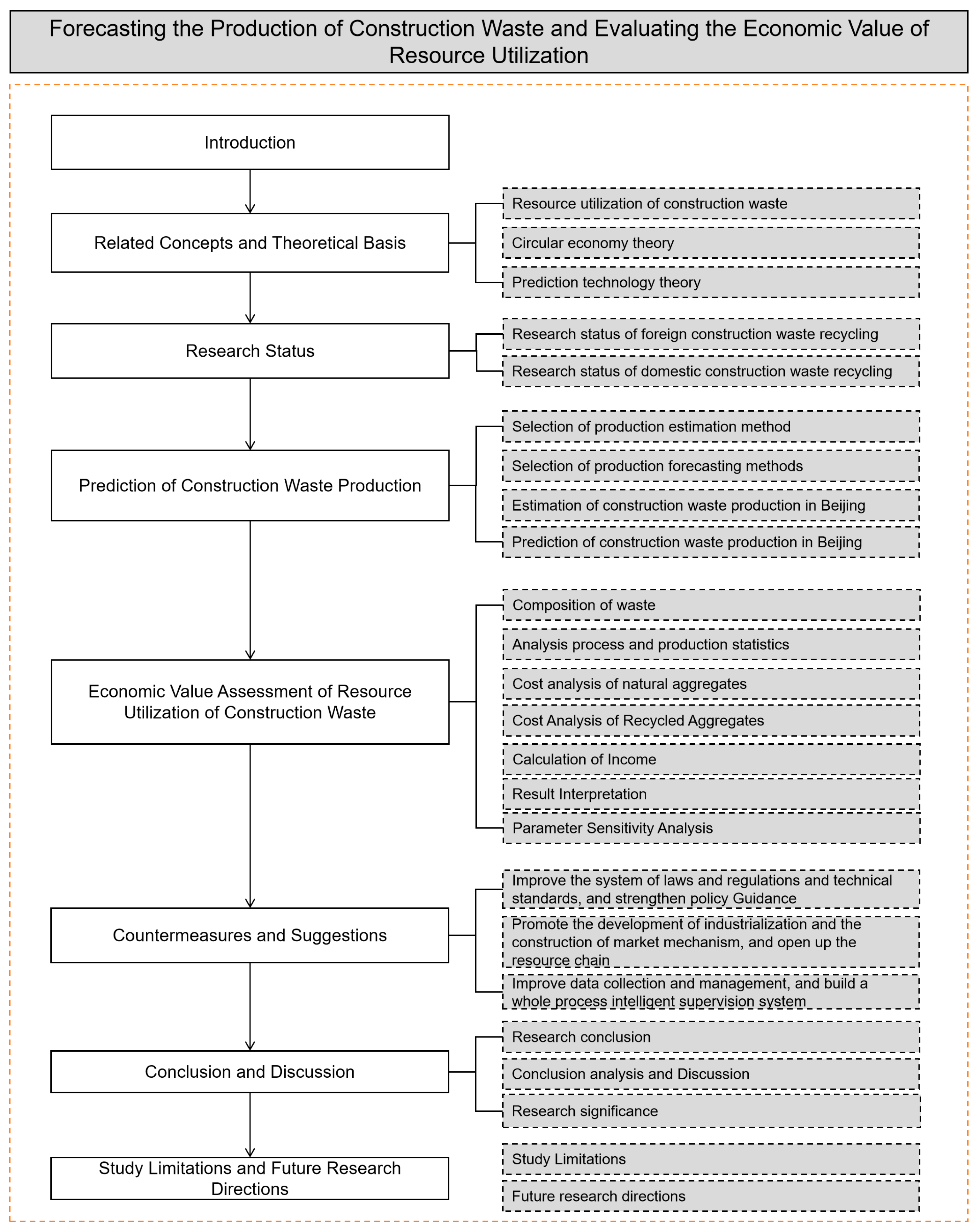
2. Related Concepts and Theoretical Basis
2.1. Resource Utilization of Construction Waste
2.2. Circular Economy Theory
2.3. Prediction Technology Theory
3. Research Status
3.1. Research Status of Foreign Construction Waste Recycling
3.2. Research Status of Domestic Construction Waste Recycling
4. Prediction of Construction Waste Production
4.1. Selection of Production Estimation Method
- (1)
- Field investigation method
- (2)
- Material flow analysis
- (3)
- System modeling method
- (4)
- Yield per unit area method
4.2. Selection of Production Forecasting Methods
- (1)
- Back Propagation neural network prediction model
- (2)
- Multiple regression analysis model
- (3)
- System dynamics prediction model
- (4)
- Gray prediction model
- (5)
- ARIMA prediction model
4.3. Estimation of Construction Waste Production in Beijing
4.3.1. Overview of Research Object
- (1)
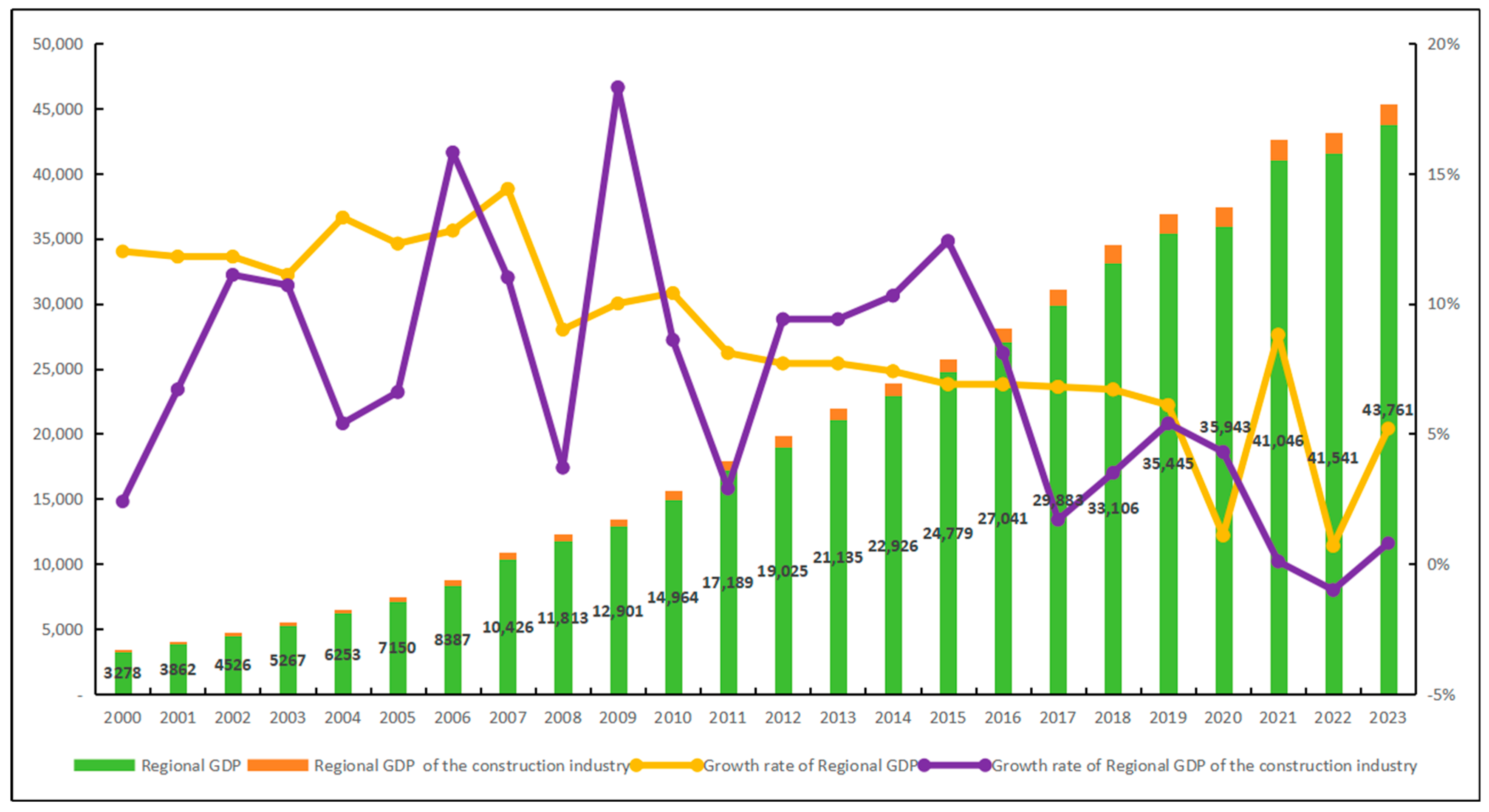
- Beijing’s economic development has entered a new stage of being high-end and service-oriented, and the construction industry is also facing a development trend of transforming towards urban renewal and refined management.
- (2)
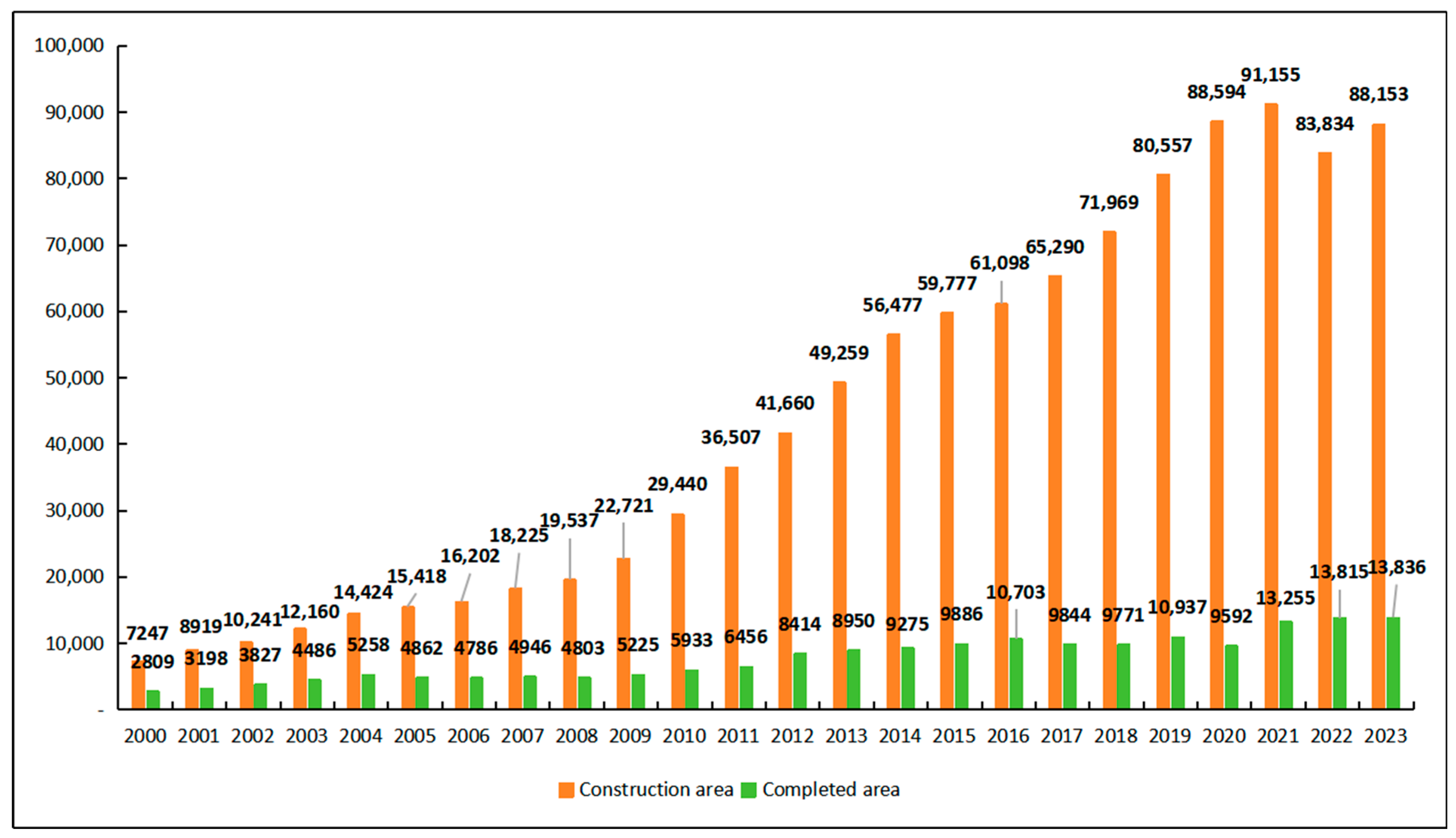
- The growth rate of the construction area in Beijing’s construction industry is much higher than that of the completed area. The continuous increase in projects under construction and the increasing environmental pressure have the practical demand to promote the reduction.
- (3)
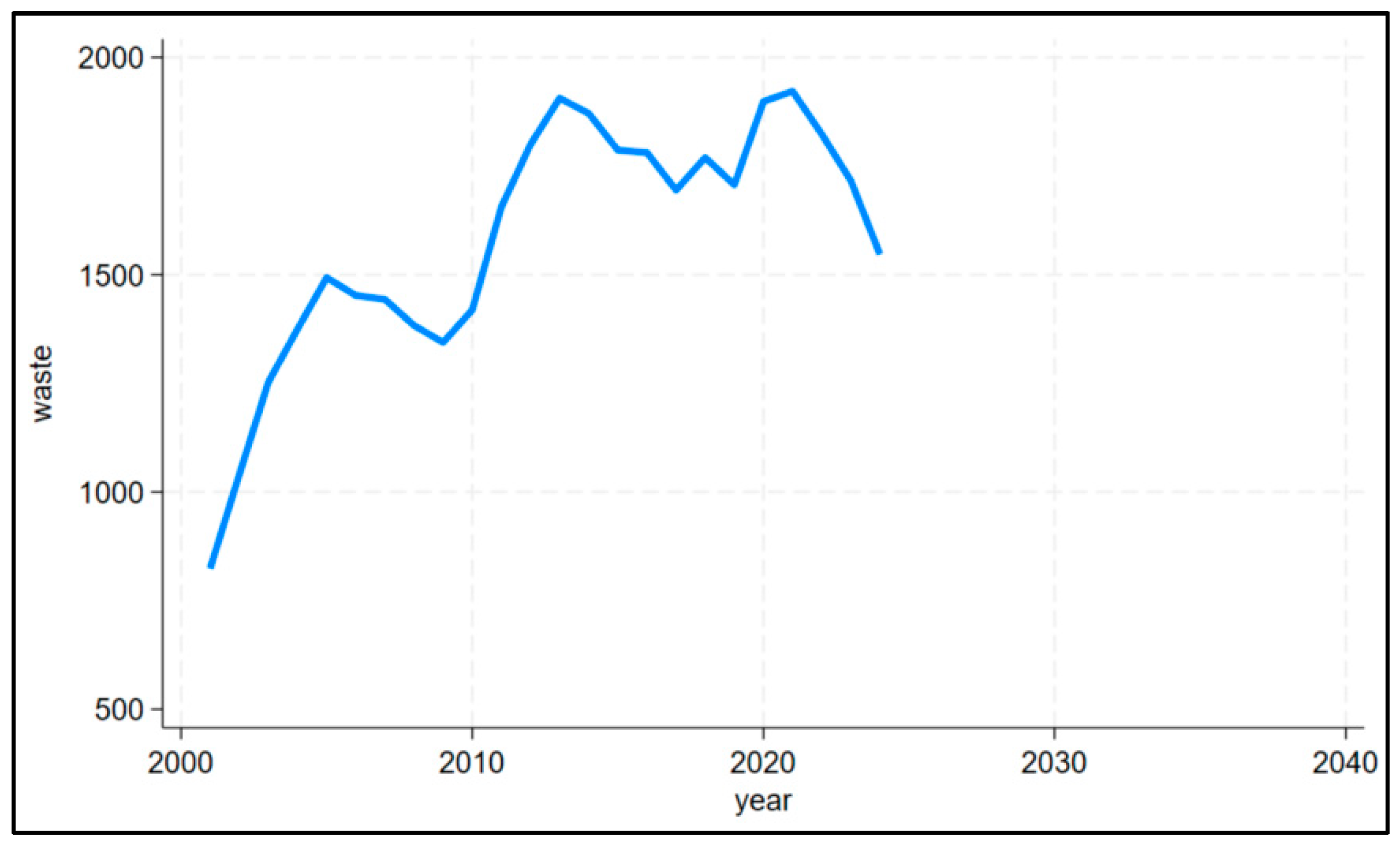
- The production of construction waste in Beijing is much higher than the collection volume of domestic waste, and there is still a large room for improvement in resource utilization.
4.3.2. Data Sources
4.3.3. Production Estimation
- (1)
- Estimation of the production of demolition waste
- (2)
- Estimation of the production of decoration waste
- (3)
- Estimation of the production of construction waste
4.4. Prediction of Construction Waste Production in Beijing
4.4.1. Data Stationarity Test
4.4.2. Dickey–Fuller Test for Unit Root
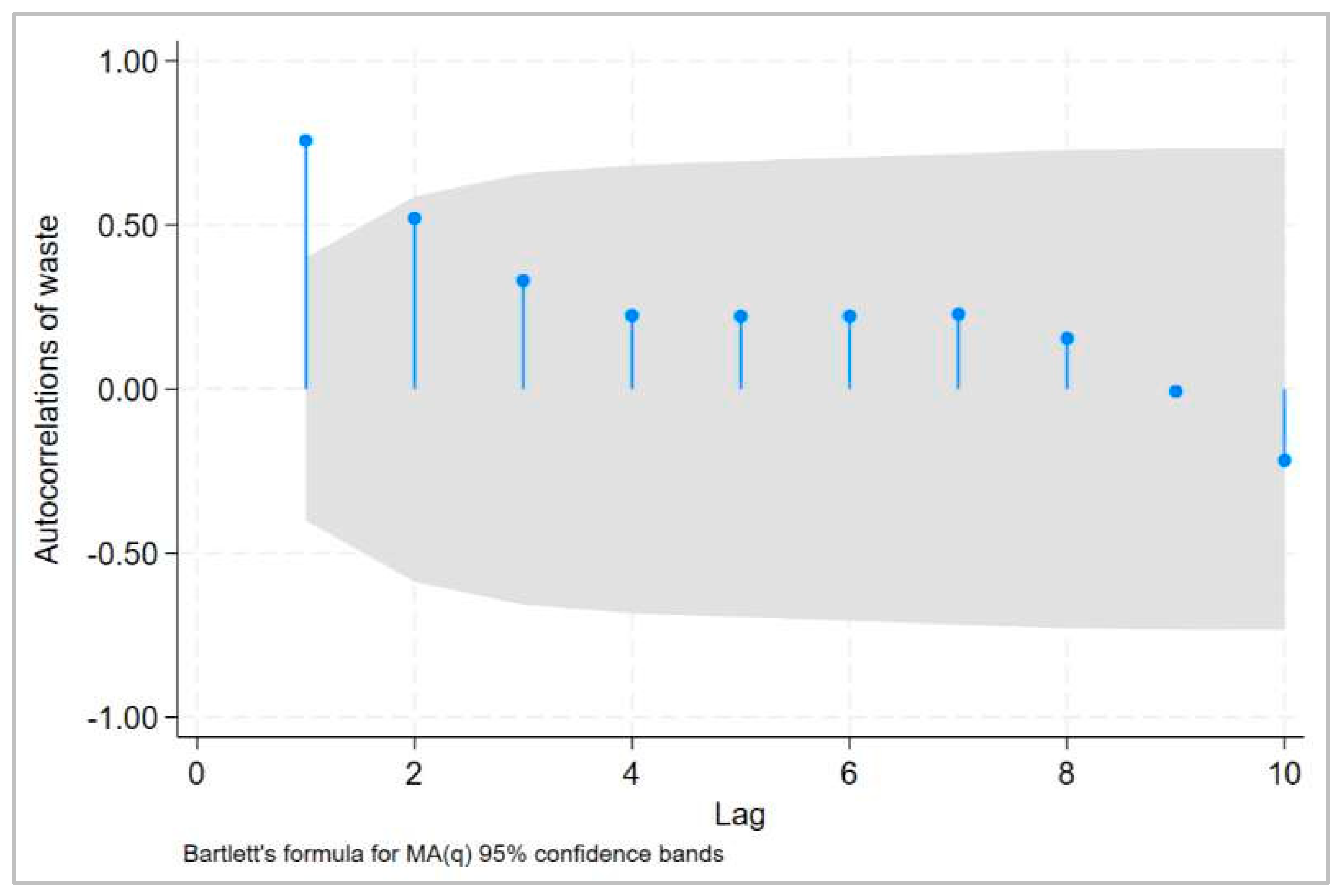
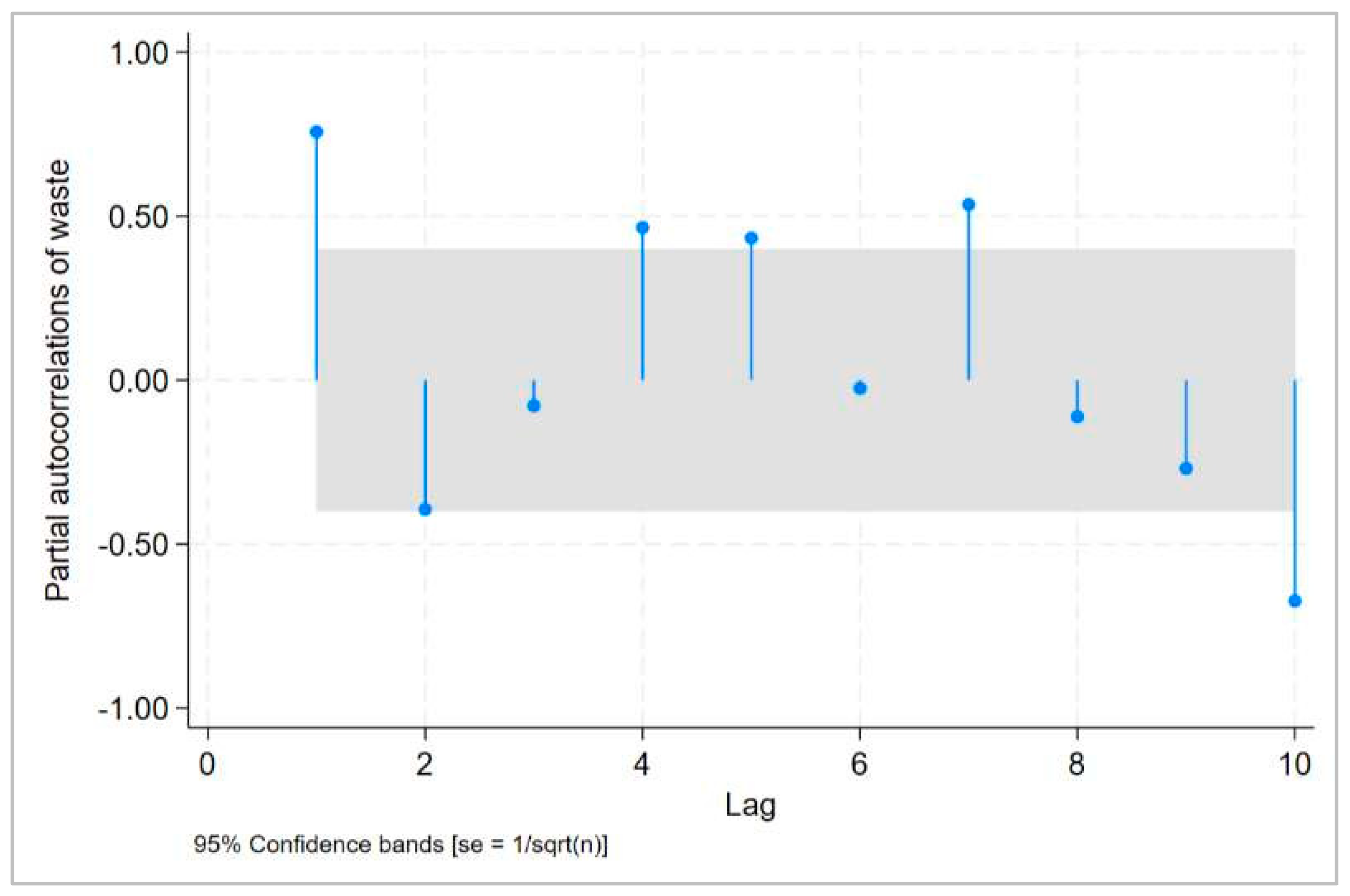
4.4.3. Partial Autocorrelation and Autocorrelation
4.4.4. Akaike Information Criterion and Bayesian Information Criterion
4.4.5. White Noise Verification
4.4.6. Comparison Between RMSE and MAE
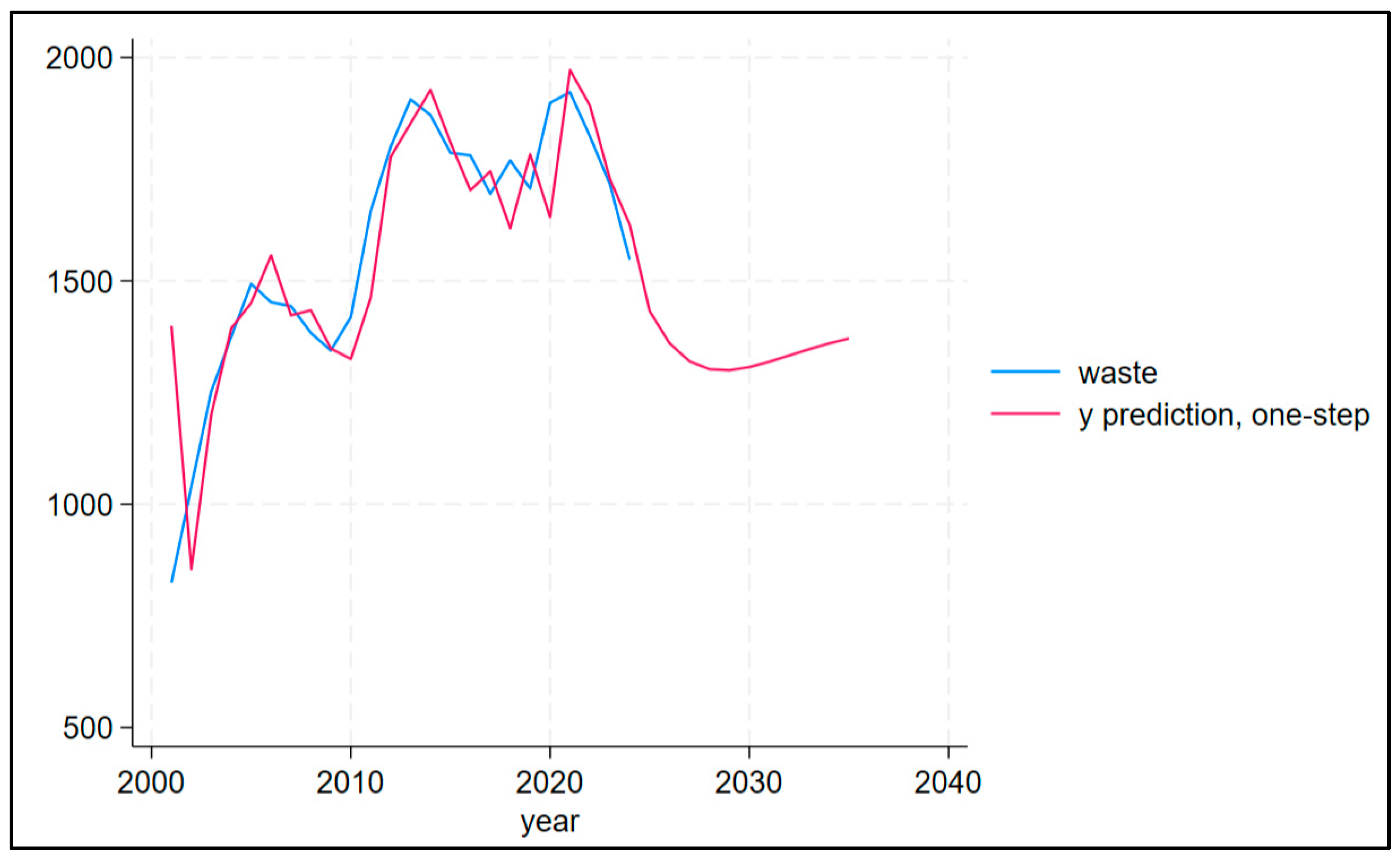
4.4.7. Model Prediction
5. Economic Value Assessment of Resource Utilization of Construction Waste
5.1. Composition of Waste
- (1)
- Demolition waste
- (2)
- Decoration waste
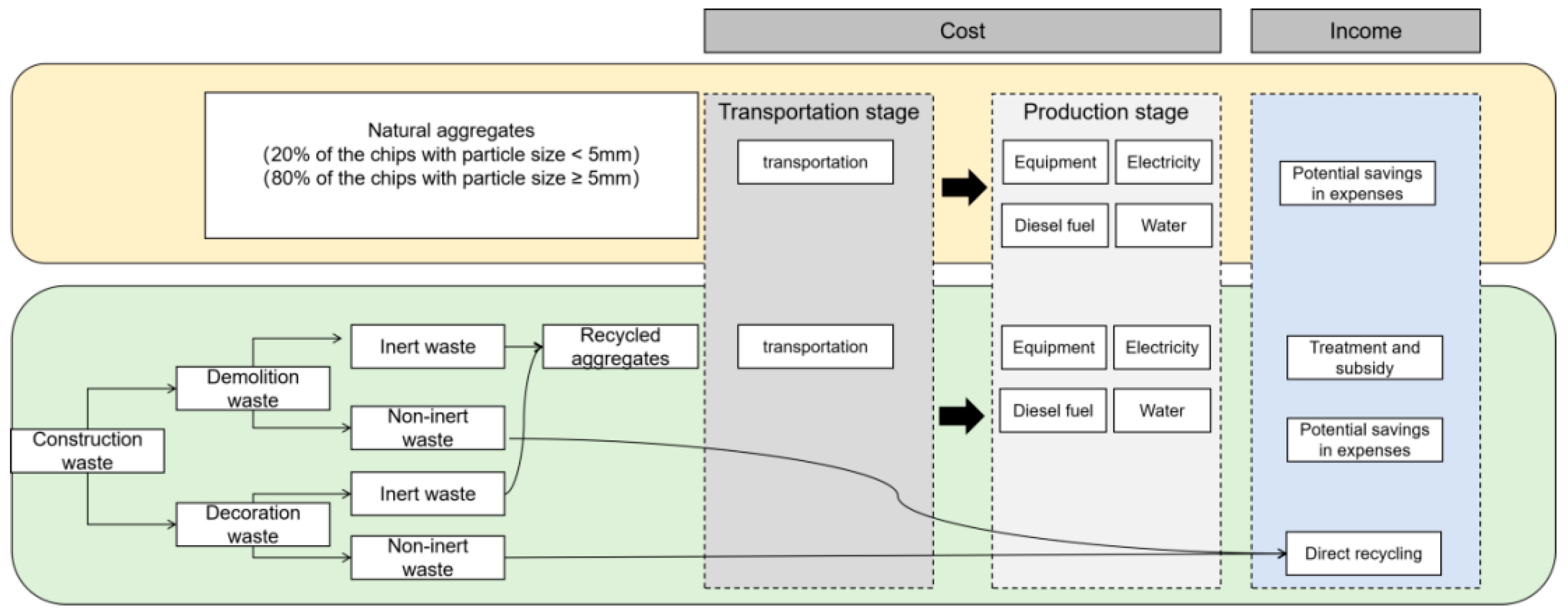
5.2. Analysis Process and Production Statistics
5.3. Cost Analysis of Natural Aggregates
5.3.1. Cost of Transportation Stage for Natural Aggregates
5.3.2. Cost of Production Stage for Natural Aggregates
5.3.3. Total Cost of Natural Aggregates
5.4. Cost Analysis of Recycled Aggregates
5.4.1. Cost of Transportation Stage for Recycled Aggregates
5.4.2. Cost of Production Stage for Recycled Aggregates
5.4.3. Total Cost of Recycled Aggregates
5.5. Calculation of Income
5.5.1. Natural Aggregate
5.5.2. Recycled Aggregates
- (1)
- Inert material treatment and subsidy
- (2)
- Direct recycling of non-inert materials
- (3)
- Sales revenue
5.6. Result Interpretation
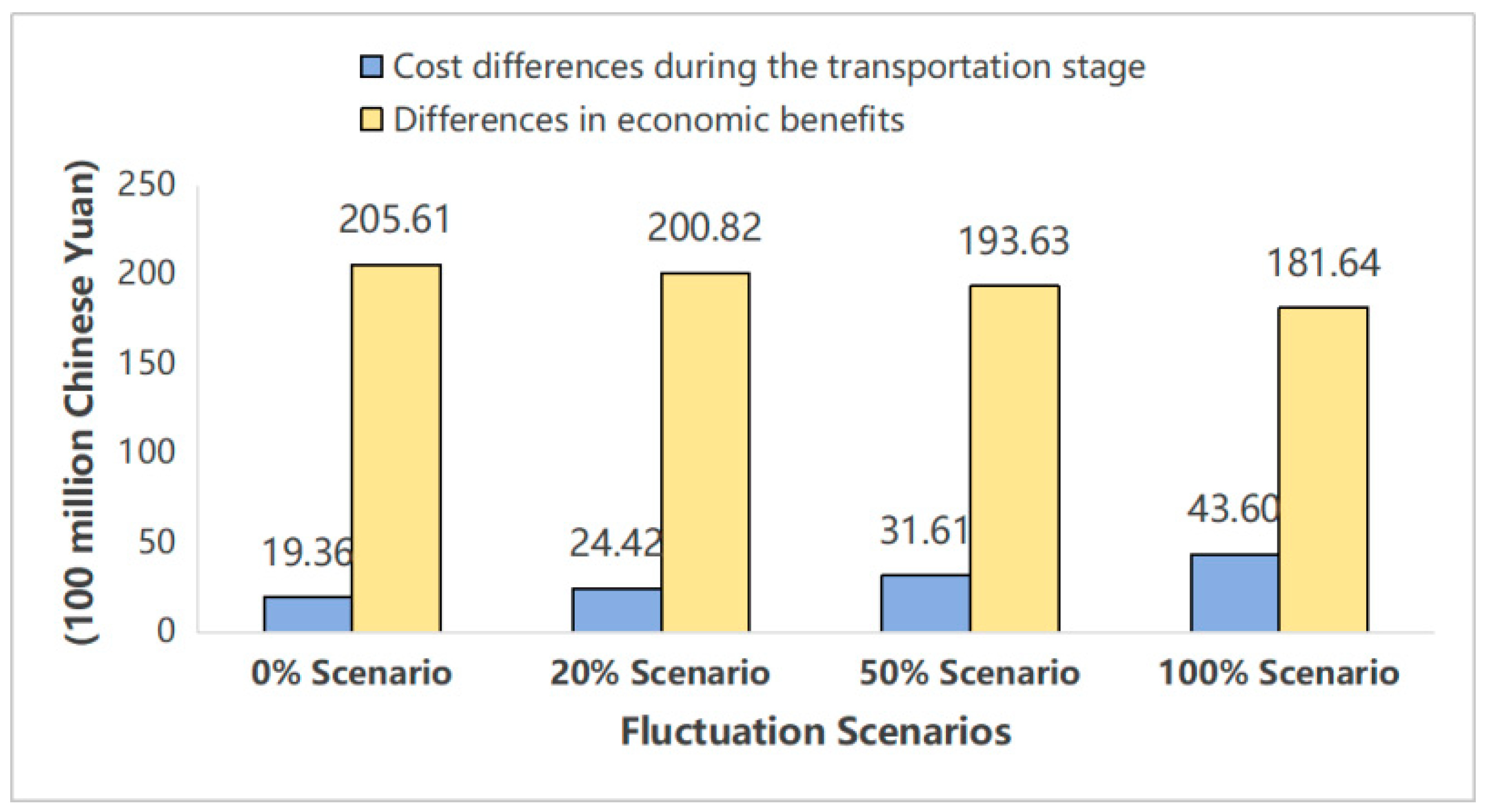
5.7. Parameter Sensitivity Analysis
6. Countermeasures and Suggestions
6.1. Improve the System of Laws, Regulations, and Technical Standards and Strengthen Policy Guidance
6.2. Promote the Development of Industrialization and the Construction of Market Mechanism, and Open up the Resource Chain
6.3. Improve Data Collection and Management, and Build a Whole-Process Intelligent Supervision System
7. Conclusions and Discussion
7.1. Research Conclusions
- The prediction model shows that the output of construction waste in Beijing will gradually decrease steadily in the next decade and may increase in the long run. The results further reflect the comprehensive impact of policy implementation, changes in construction activities, and technological progress.
- The economic benefits of the resource utilization of construction waste are remarkable, and the medium- and long-term environmental benefits are outstanding. From 2025 to 2034, if all construction wastes in Beijing are processed into recycled aggregate, the investment will be higher than that of natural materials in the short term, but in the long run, it will bring about USD 2.998 billion of economic value.
- Based on the prediction results and value evaluation conclusions, this paper puts forward a series of countermeasures and suggestions from the aspects of laws and regulations, technical standards, industrialization development, data management, and intelligent supervision systems, so as to improve the development level of construction waste recycling.
7.2. Conclusion Analysis and Discussion
7.3. Research Significance
8. Study Limitations and Future Research Directions
8.1. Study Limitations
- (1)
- The predictive model itself has certain limitations. This study used the ARIMA model to predict the time series of construction waste production, but this model has significant limitations in application. The ARIMA model is highly sensitive to sudden changes in data related to crises. When faced with external shocks such as epidemic outbreaks, major policy adjustments, and sudden public events, the scale of construction waste generation is prone to irregular fluctuations. At this time, the model finds it difficult to accurately capture the characteristics of data changes, which can lead to significant deviations in prediction results. At the same time, the model is based on the core premise of data stationarity and relies heavily on the periodicity and trend of data sequences. It lacks the ability to actively adapt to complex exogenous shocks, which objectively limits the robustness of the prediction results.
- (2)
- There is uncertainty in parameter estimation. In the process of parameter estimation, in order to focus on core issues and simplify complex real-world scenarios, we have to make standardized assumptions for some parameters, which may not fully match the actual market dynamics, such as the market premium coefficient and cost-sharing ratio of recycled products. The determination of the coefficient of construction waste generation is mainly based on industry’s general standards, without fully considering the impact of specific construction techniques, material usage habits, and management-level differences in Beijing on the parameters, resulting in deviations between parameter estimation results and real market scenarios. This uncertainty will be transmitted to the final result through model calculations, reducing the accuracy of economic value assessments and output forecasting, especially in long-term applications where the cumulative effect of parameter deviations may be more pronounced.
- (3)
- There is a gap between the assumptions used in the model’s construction process and the actual complex system. The prediction model only takes historical production data as the core input and does not fully integrate external shock factors such as macroeconomic fluctuations, construction industry cycle changes, and environmental policy adjustments. It ignores the comprehensive impact of multi-factor interactions on the scale of construction waste generation, which may lead to long-term prediction results deviating from the actual situation. The economic value assessment model does not include implicit costs such as ecological costs and environmental externalities in the accounting system and only focuses on explicit production costs and market benefits, which makes the value assessment results unable to fully reflect the comprehensive benefits of the resource utilization of construction waste.
- (4)
- Regional applicability and sample scope are limited. The research sample is limited to Beijing, which, as the capital and mega-city of China, has unique characteristics in terms of the development level of its construction industry, economic structure, environmental protection policies, and resource endowment. The prediction model and value evaluation system constructed based on the Beijing samples are difficult to directly adapt to other regions, and their conclusions may not be directly applicable to other regions with different levels of economic development or different characteristics of construction industry development. The limitation of the sample size makes the constructed model lack cross-regional universality, making it difficult to support the formulation of differentiated policies at the national level.
8.2. Future Research Directions
- (1)
- Optimize model architecture and parameter estimation methods to enhance prediction robustness. To improve the robustness and prediction accuracy of the model, future research can explore incorporating macroeconomic indicators, the construction industry prosperity index, policy changes, and other exogenous variables into the prediction model. For example, a combination of gray system theory and multiple regression can also be used for prediction to cope with situations where the data volume is limited and fluctuates greatly. Using BIM technology for more refined component-level waste estimations can also improve the accuracy of the input information from the data source.
- (2)
- Establish a comprehensive cost–benefit evaluation system. In terms of economic value assessments, future research should strive to construct a more comprehensive cost–benefit analysis framework, quantifying and accounting for implicit costs such as environmental externalities, ecological costs, carbon emission costs, and social costs. The systematic quantification of the economic, ecological, and social value of the resource utilization of construction waste can provide more comprehensive value references for decision-making.
- (3)
- Expand research on cross-regional comparison and differentiation models. Future research samples should expand their coverage and select regions at different stages of economic development with different characteristics of construction industry development for comparative studies. Through cross-regional data collection and analysis, key regional factors that affect the amount and resource utilization benefits of construction waste can be identified, and differentiated prediction and evaluation models can be constructed. This helps to form more targeted local management strategies and provides more comprehensive empirical support for the formulation of national-level policies.
Author Contributions
Funding
Data Availability Statement
Conflicts of Interest
References
- Solid Waste and Chemicals Management Center; Ministry of Ecology and Environment. Research Report on the Release of National Solid Waste Pollution Prevention and Control Information, 2024. Available online: https://www.meescc.cn/zhxx/zxyw/202505/W020250530336582088864.pdf (accessed on 10 November 2025).
- Fernando Silva, Y.; Delvasto, S.; Valencia, W.; Araya-Letelier, G. Performance of Self-Compacting Concrete with Residue of Masonry and Recycled Aggregate under Sulfate Attack. J. Mater. Civ. Eng. 2024, 36, 113868. [Google Scholar] [CrossRef] [Scilit]
- Silva, Y.F.; Delvasto, S.; Izquierdo, S.; Araya-Letelier, G. Short and long-term physical and mechanical characterization of self-compacting concrete made with masonry and concrete residue. Constr. Build. Mater. 2021, 312, 125382. [Google Scholar] [CrossRef] [Scilit]
- Wang, Y.-S.; Wang, X.-Y. Damage evolution in limestone calcined clay cement (LC3) paste containing recycled glass powder exposed to elevated temperatures. Constr. Build. Mater. 2025, 464, 140140. [Google Scholar] [CrossRef] [Scilit]
- Wang, Y.-S.; Lin, R.; Kim, T.; Lim, J.-Y.; Kwon, S.-J.; Wang, X.-Y. Development and characterization of ternary blended cement incorporating slag and thermally activated waste eggshell: Hydration, microstructure, macro properties, and carbonation durability. Constr. Build. Mater. 2025, 490, 142569. [Google Scholar] [CrossRef] [Scilit]
- Jiang, B.; Huang, H.; Ge, F.; Huang, B.; Ullah, H. Carbon Emission Assessment During the Recycling Phase of Building Meltable Materials from Construction and Demolition Waste: A Case Study in China. Buildings 2025, 15, 456. [Google Scholar] [CrossRef] [Scilit]
- Niekurzak, M.; Lewicki, W.; Wróbel, J. Efficiency Assessment of the Production of Alternative Fuels of High Usable Quality within the Circular Economy: An Example from the Cement Sector. Sustainability 2024, 16, 8762. [Google Scholar] [CrossRef] [Scilit]
- Yu, Y.; Yazan, D.M.; Bhochhibhoya, S.; Volker, L. Towards Circular Economy through Industrial Symbiosis in the Dutch construction industry: A case of recycled concrete aggregates. J. Clean. Prod. 2021, 293, 126083. [Google Scholar] [CrossRef] [Scilit]
- European Union. Directive (EU) 2018/851 of the European Parliament and of the Council of 30 May 2018 Amending Directive 2008/98/EC on Waste. Available online: https://eur-lex.europa.eu/eli/dir/2018/851/oj (accessed on 10 November 2025).
- European Commission. The Circular Economy Action Plan. Available online: https://www.eeas.europa.eu/sites/default/files/ce_action_plan_2.0_cn_0.pdf (accessed on 10 November 2025).
- Aslam, M.S.; Huang, B.; Cui, L. Review of construction and demolition waste management in China and USA. J. Environ. Manag. 2020, 264, 110445. [Google Scholar] [CrossRef] [Scilit]
- Liu, Y.; Qin, H.; Gao, P.; Yang, Y.; Hong, L.; Zhan, B.; Yu, Q.; Guo, B. Overview of waste generation and carbon emissions in the construction industry. In Wastes to Low-Carbon Construction Materials; Woodhead Publishing: Sawston, UK, 2025; pp. 3–27. [Google Scholar] [CrossRef] [Scilit]
- Yu, L. Evaluation of Environmental Effects of Recycled Aggregate Asphalt (Cement) Concrete from Construction Solid Waste Based on Life Cycle Assessment. Master’s Thesis, Nanchang University, Nanchang, China, 2023. [Google Scholar]
- Beijing Review: Circular Economy Promotion Law of the People’s Republic of China. Available online: https://www.peoplechina.com.cn/document/txt/2008-12/04/content_168428.htm (accessed on 10 November 2025).
- Yan, J. On Perfecting the Legal System of Circular Economy in China; Gansu Political Science and Law Institute: Lanzhou, China, 2018. Available online: https://kns.cnki.net/kcms2/article/abstract?v=A8ynNhXZdPmBCJaFI4lLyeXZWJjykpY-ETloXbWFw9NkJ20xhpPpds8ITTs9ZOAuVjP5tZN_0_xAArSFAKSLcdnou95DjDVMLynu0zqPhZuBHwYVRPZ6ypezYfGR2MhDpIRfVU_yA7YHqMwfyE91qFTJmrfNCP6wyo49vTVHlSbpyOl224Kzp1q1SLJpj4kL&uniplatform=NZKPT&language=CHS%20%W%20CNKI (accessed on 10 November 2025).
- Tian, J. Comprehensive Benefit Analysis of Recycled Aggregate Produced by Construction Waste; Chongqing University: Chongqing, China, 2019. [Google Scholar] [CrossRef]
- Xu, L. Evaluation of Incremental Costs and Benefits of Prefabricated Buildings Under the Background of Construction Waste Minimization. Master’s Thesis, Yantai University, Yantai, China, 2025. [Google Scholar]
- Purchase, C.K.; Al Zulayq, D.M.; O’Brien, B.T.; Kowalewski, M.J.; Berenjian, A.; Tarighaleslami, A.H.; Seifan, M. Circular economy of construction and demolition waste: A literature review on lessons, challenges, and benefits. Materials 2022, 15, 76. [Google Scholar] [CrossRef] [Scilit]
- Kabirifar, K.; Mojtahedi, M.; Wang, C.; Tam, V.W.Y. Construction and demolition waste management contributing factors coupled with reduce, reuse, and recycle strategies for effective waste management: A review. J. Clean. Prod. 2020, 263, 121265. [Google Scholar] [CrossRef] [Scilit]
- Abdelli, I.S.; Abdelmalek, F.; Djelloul, A.; Mesghouni, K.; Addou, A. GIS-based approach for optimised collection of household waste in Mostaganem city (Western Algeria). Waste Manag Res. 2016, 34, 417–426. [Google Scholar] [CrossRef] [Scilit]
- Meyer, D.E.; Li, M.; Ingwersen, W.W. Analyzing economy-scale solid waste generation using the United States environmentally-extended input-output model. Resour. Conserv. Recycl. 2020, 157, 104795. [Google Scholar] [CrossRef] [Scilit]
- Brandão, R.; Edwards, D.J.; Hosseini, M.R.; Silva Melo, A.C.; Macêdo, A.N. Reverse supply chain conceptual model for construction and demolition waste. Waste Manag. Res. 2021, 39, 1341–1355. [Google Scholar] [CrossRef] [Scilit]
- Yuan, J.; Zeng, X.; Chen, M. Estimating the construction waste generation in Jinan using the grey system theory. China Environ. Sci. 2020, 40, 3894–3902. [Google Scholar]
- Yin, R.; Wang, Z.; Pang, Y.; Deng, X.; Deng, Q. Analysis and Prediction of Urban Construction Waste Generation Based on System Dynamics Model. Constr. Econ. 2023, 44, 394–400. [Google Scholar] [CrossRef]
- Zhao, Y.; Wang, Q.; Wei, J.; Zhao, L. Research on Calculating Method of the Output of Decoration Waste Based on the Prediction of the Completed Floor Space of Buildings in Wuhan. Environ. Sanit. Eng. 2021, 29, 10–15+21. [Google Scholar] [CrossRef]
- Hu, M.; Peng, F.; Xiang, P. Estimatinon of Construction and Demolition Waste Generation and Site Optimization of Recycling Plants: A Case Study of Chongqing Metropolis, China. Environ. Eng. 2020, 38, 122–127. [Google Scholar] [CrossRef]
- Wang, Z.; Wang, Y.; Qin, F.; Liu, J. Carbon Reduction Potential of Construction Waste Recycling and Spatial Temporal Heterogeneity of Influencing Factors. J. Eng. Manag. 2024, 38, 26–32. [Google Scholar] [CrossRef]
- Yan, H. Hybrid Simulation-Based Benefit Optimization for Construction Waste Resource Recovery Systems. Master’s Thesis, Guangdong University of Technology, Guangzhou, China, 2025. [Google Scholar]
- Lv, S. Research on Construction and Demolition Waste Quantification Based on Project Budget. Master’s Thesis, Beijing Jiaotong University, Beijing, China, 2021. [Google Scholar]
- Sun, K.; Cai, T.; Wang, W.; Wu, X.; Liu, H.; Zheng, G. LSTM-based forecasting for urban construction waste generation. J. East China Jiaotong Univ. 2020, 37, 26–33. [Google Scholar] [CrossRef]
- CJJ/T134-2019; The Technical Standard for Construction Waste Treatment. Ministry of Housing and Urban-Rural Development: Beijing, China, 2019.
- Wang, B.; Sun, J.; Wang, J.; Hou, S. Study on Policies and Countermeasures for the Disposal of Construction and Demolition Waste. Constr. Econ. 2021, 42, 8–13. [Google Scholar] [CrossRef]
- Hu, R. Quantification and Prediction of Construction Waste Generation of New-Constructed Residential Buildings. Master’s Thesis, Wuhan University of Technology, Wuhan, China, 2020. [Google Scholar]
- Wang, L.; Pan, F. Review on the Material Flow Analysis of Environmental System-Social Economic System. Ecol. Econ. 2018, 34, 3. [Google Scholar]
- Zhang, L.; Zhang, B.; Li, L.; Zhao, J. Review of the application of material flow analysis in solid waste management. Solid Waste management. Environ. Sustain. Dev. 2021, 46, 132–138. [Google Scholar] [CrossRef]
- Hu, X. Research on C&D Waste Output Prediction and Resource Utilization Value Assessment: Taking Nanchang as an Example. Master’s Thesis, East China University of Technology, Nanchang, China, 2024. [Google Scholar]
- Hu, Q.; Liu, R.; Su, P.; Huang, J.; Peng, Y. Construction and demolition waste generation prediction and spatiotemporal analysis: A case study in Sichuan, China. Environ. Sci. Pollut. Res. 2023, 30, 41623–41643. [Google Scholar] [CrossRef] [Scilit]
- Akanbi, L.A.; Oyedele, A.O.; Oyedele, L.O.; Salami, R.O. Deep learning model for Demolition Waste Prediction in a circular economy. J. Clean. Prod. 2020, 274, 122843. [Google Scholar] [CrossRef] [Scilit]
- Kern, A.P.; Dias, M.F.; Kulakowski, M.P.; Gomes, L.P. Waste generated in high-rise buildings construction: A quantification model based on statistical multiple regression. Waste Manag. 2015, 39, 35–44. [Google Scholar] [CrossRef] [Scilit]
- Liu, K. Construction and Demolition Waste Governance Comprehensive Benefit Model Simulation and Economic Incentive Policy Research. Master’s Thesis, East China University of Technology, Nanchang, China, 2023. [Google Scholar]
- Gao, X.; Yuan, Y.; Wang, Y.; Yang, T.; Chen, T. Prediction of Construction Waste Generation in China Based on Grey Model and Management Recommendations. Sustainability 2025, 17, 1711. [Google Scholar] [CrossRef] [Scilit]
- Fang, Y.; Shi, X.; Chen, Y.; He, J. Quantity Prediction of Construction and Demolition Waste Using Weighted Combined Grey Theory and Autoregressive Integrated Moving Average Model. Sustainability 2024, 16, 5255. [Google Scholar] [CrossRef] [Scilit]
- Beijing Municipal Commission of Planning and Natural Resources: Beijing Master Plan (2016–2035) [EB/OL]. Available online: https://www.beijing.gov.cn/gongkai/guihua/wngh/cqgh/201907/t20190701_100008.html (accessed on 10 November 2025).
- The People’s Government of Beijing Municipality: Beijing Communication Radio—Beijing Achieves High-Quality Leap in the Context of Volume Reduction [EB/OL]. Available online: https://fgw.beijing.gov.cn/gzdt/fgzs/mtbdx/bzwlxw/202509/t20250922_4207296.htm (accessed on 10 November 2025).
- Yang, K. Research on the Whole Process Treatment and Disposal of Engineering Mud and Engineering Muck. Master’s Thesis, Beijing Jiaotong University, Beijing, China, 2020. [Google Scholar]
- Beijing Municipal Bureau of Statistics. Survey Office of the National Bureau of Statistics in Beijing, Beijing Statistical Yearbook, 2024. Available online: https://nj.tjj.beijing.gov.cn/nj/main/2024-tjnj/zk/indexch.htm (accessed on 10 November 2025).
- National Bureau of Statistics. National Data. Available online: https://data.stats.gov.cn/easyquery.htm?cn=E0101 (accessed on 10 November 2025).
- Zheng, L. Research on the Generation Characteristics and Management Features of Construction Waste in China. Master’s Thesis, Shenzhen University, Shenzhen, China, 2019. [Google Scholar]
- Zhou, T. Research on the Evaluation and Optimization of Construction Waste Resource Management Based on Economic Benefits—Taking Project A as an Example. Master’s Thesis, Zhengzhou University, Zhengzhou, China, 2023. [Google Scholar]
- Liu, Z.; Liu, G.; Xu, J.; Zhang, J. Research on Environmental and Economic Benefits of Brick Aggregate for Road Applications in Bangladesh. J. China Foreign Highw. 2025, 1–6. Available online: https://link.cnki.net/urlid/43.1363.U.20251120.1545.008 (accessed on 25 November 2025).
- Sereewatthanawut, I.; Ajayi, B.O.; Emmanuel, B.M.; Bunphot, A.; Chayutthanabun, A.; Niyomukiza, J.B.; Chinda, T. Sustainable Material Recovery from Demolition Waste: Knowledge Management and Insights from a Public Sector Building Renovation. Buildings 2025, 15, 3167. [Google Scholar] [CrossRef] [Scilit]
- Lu, N.; Zhang, Q.; Zhang, H.; Liu, N. The Economic Benefits Research on Construction Waste Resource Recovery. Value Eng. 2013, 32, 90–92. [Google Scholar] [CrossRef]
- Li, S.; Yi, X.; Chen, J.; Xu, H. Evaluation of the non-market value of the construction waste recycling based on payment card ladder. J. Arid Land Resour. Environ. 2023, 37, 99–108. [Google Scholar] [CrossRef]
- Lin, M. Research on Economic Benefit of Recycling Construction Waste Enterprises—Based on the Analysis of Different Economic Incentive Policies. Master’s Thesis, Xi’an University of Architecture and Technology, Xi’an, China, 2021. [Google Scholar]
- Zhan, J. Study on the Benefits of Resource Utilization of Waste in Municipal Road Reconstruction Projects. Master’s Thesis, Guangzhou University, Guangzhou, China, 2025. [Google Scholar]
- Lü, S.; Jin, Y.; Liu, G.; Ren, F.; Xi, C.; Lu, T.; Zhu, J.; Zhang, C. Characteristics of Residential Decoration Waste Generation and Management Countermeasures: A Case Study on Old Palace Area in DAXING District, BEIJING. Environ. Eng. 2022, 40, 186–192. [Google Scholar] [CrossRef]
- Liu, H. Primary Research of House Decoration Waste Toxicity and Its Treatment. China Resour. Compr. Util. 2005, 24–27. Available online: https://kns.cnki.net/kcms2/article/abstract?v=A8ynNhXZdPmR1npFfhIciwnkb9exY3CQVXLTKJeEPd-66dDpeCqgzTIUzObZU5D1jM6AwV1IixZhblDsvzvIteItbOCmj1ieJNLh3EIl0Xcsn1G719NRvVaPr1xrPHsvR-Bg6P1AoSJHIOfpgCUkKtitfUwcAjZ4OMqcvNIkoOZsnU2rsZDKAQ==&uniplatform=NZKPT (accessed on 10 November 2025).
- Wang, Y.; Zheng, J.; You, F. Review on Enhancement Methods of Recycled Aggregate. Mater. Rep. 2021, 35, 5053–5061. [Google Scholar]
- Zhou, H.; Cui, H.; Li, Y.; Zhao, D.; Zhang, J. Present Situation and Countermeasures of Resource Utilization of Construction Waste. Constr. Sci. Technol. 2022, 81–84. [Google Scholar] [CrossRef]
- GB/T 14684-2022; Sand for Construction. State Administration for Market Regulation: Beijing, China, 2022.
- State Grid. Electricity Price List for Commercial Users of State Grid Beijing Electric Power Company. Available online: http://www.bj.sgcc.com.cn/u/cms/bj/other/202510/cd921acb575346ffbd65f8b57f2f11d9.pdf (accessed on 10 November 2025).
- The People’s Government of Beijing Municipality. Detailed Rules for the Implementation of Urban Water Supply Price Management in Beijing. Available online: https://www.beijing.gov.cn/zhengce/zhengcefagui/202211/t20221129_2867671.html (accessed on 10 November 2025).
- Zhou, M. A Cost Accounting Model and Its Application of Construction and Demolition Waste Recycling. Master’s Thesis, Chongqing University, Chongqing, China, 2018. [Google Scholar]
- China Aggregate Association. National Aggregate Price Release in October 2025. Available online: https://www.zgss.org.cn/gongqiuxinxi/2025/17617.html (accessed on 10 November 2025).
- People’s Daily. The Resource Disposal Rate of Construction Waste in Beijing Will Reach More Than 85% in 2022. Available online: http://zw.china.com.cn/2021-03/26/content_77348551.html (accessed on 10 November 2025).
- China Waste Recycling Network. Latest Detailed List of Various Waste Recycling Prices. Available online: https://www.zgfeipin.cn/expo_17561_1/ (accessed on 10 November 2025).
- Fang, S.; Zou, G.; Wang, H.; Yan, R. Investigation and inspiration on the recycling of foreign construction waste. Highw. Eng. 2017, 42, 154–167. [Google Scholar]
- Patil Yuvraj, R.; Dakwale Vaidehi, A.; Ralegaonkar Rahul, V. Recycling Construction and Demolition Waste in the Sector of Construction. Adv. Civ. Eng. 2024, 6234010. [Google Scholar] [CrossRef] [Scilit]
- The People’s Government of Beijing Municipality. Planning for Prevention and Control of Construction Waste Pollution in Changping District of Beijing (2024–2027). Available online: https://www.beijing.gov.cn/hudong/gfxwjzj/qjzjxx/202409/P020240911582986591658.pdf (accessed on 10 November 2025).
- Dai, T.; Li, Y. Study on Dynamic Evolution of Construction Material Stock in Beijing. Areal Res. Dev. 2019, 38, 39–44+51. Available online: https://kns.cnki.net/kcms2/article/abstract?v=A8ynNhXZdPmEdAzgBYKU0vn0MusoGB6_SfaUJ5WSqF9p0c7XRTMEAl_BqbbQDeXWMI8Hizo3H55ZgCFnzOwbZsGNLLPBmeaynuT91jWkAsnQQtqfP66PIOKYxGHwrGuejLt5QdMz4kpd0CTTH2hO2KaS2PO8y-3Vz_l-zVUSLBg7Xm7r23QuB4fhjwrUizCj&uniplatform=NZKPT (accessed on 10 November 2025).
- Dong, L.; Liu, J.Y.; Zhang, Z.Q.; Zhang, M. Simulation and prediction of construction and demolition waste from urban and rural housing in Beijing based on dynamic material flow analysis. China Environ. Sci. 2025, 45, 2041–2052. [Google Scholar]
- Maged, A.; Elshaboury, N.; Akanbi, L. Data-driven prediction of construction and demolition waste generation using limited datasets in developing countries: An optimized extreme gradient boosting approach. Environ. Dev. Sustain. 2024, 27, 26865–26889. [Google Scholar] [CrossRef] [Scilit]
- Wen, X. BPNN-ABM Based Simulation Research of Urban Construction Waste Recycling Soften Management. Master’s Thesis, Shenzhen University, Shenzhen, China, 2023. [Google Scholar]



| Year | Construction Area | Annual Growth Rate of Construction Area | Completed Area | Annual Growth Rate of Completed Area | Residential Completed Area | Commercial Completed Area |
|---|---|---|---|---|---|---|
| 2024 | 11,309.53 | −9.75% | 1652.53 | −19.08% | 912.76 | 739.77 |
| 2023 | 12,531.34 | −6.01% | 2042.25 | 5.35% | 1135.88 | 906.37 |
| 2022 | 13,333.15 | −5.14% | 1938.48 | −2.29% | 1096.22 | 842.26 |
| 2021 | 14,055.32 | 0.98% | 1983.86 | 28.35% | 981.05 | 1002.81 |
| 2020 | 13,918.64 | 11.22% | 1545.72 | 15.07% | 728.48 | 817.24 |
| 2019 | 12,514.99 | −3.45% | 1343.28 | −13.78% | 583.2 | 760.08 |
| 2018 | 12,962.61 | 4.43% | 1557.9 | 6.22% | 731.2 | 826.7 |
| 2017 | 12,412.74 | −4.34% | 1466.67 | −38.11% | 604.04 | 862.63 |
| 2016 | 12,976 | −0.13% | 2369.95 | −9.94% | 1267.06 | 1102.89 |
| 2015 | 12,993.08 | −4.38% | 2631.45 | −13.84% | 1378.22 | 1253.23 |
| 2014 | 13,588.08 | −2.15% | 3054.12 | 14.54% | 1804.34 | 1249.78 |
| 2013 | 13,886.87 | 5.82% | 2666.35 | 11.52% | 1692.04 | 974.31 |
| 2012 | 13,122.49 | 8.76% | 2390.86 | 6.49% | 1522.72 | 868.14 |
| 2011 | 12,065.38 | 17.13% | 2245.24 | −5.93% | 1316.13 | 929.11 |
| 2010 | 10,300.86 | 5.99% | 2386.71 | −10.90% | 1498.48 | 888.23 |
| 2009 | 9719.08 | −2.95% | 2678.55 | 4.71% | 1613.23 | 1065.32 |
| 2008 | 10,014.32 | −4.06% | 2557.99 | −11.54% | 1399.3 | 1158.69 |
| 2007 | 10,438.65 | −0.43% | 2891.65 | −9.46% | 1853.95 | 1037.7 |
| 2006 | 10,483.53 | −2.47% | 3193.89 | −15.30% | 2193.32 | 1000.57 |
| 2005 | 10,748.5 | 8.23% | 3770.88 | 22.95% | 2841.42 | 929.46 |
| 2004 | 9931.31 | 9.49% | 3066.99 | 18.25% | 2343.95 | 723.04 |
| 2003 | 9070.66 | 20.77% | 2593.65 | 8.77% | 2080.75 | 512.9 |
| 2002 | 7510.75 | 25.88% | 2384.44 | 39.66% | 1926.17 | 458.27 |
| 2001 | 5966.67 | —— | 1707.35 | —— | 1393.43 | 313.92 |
| Year | Construction Waste | Demolition Construction Waste | Decoration Waste | Residential Decoration Waste | Commercial Decoration Waste |
|---|---|---|---|---|---|
| 2024 | 1547.01 | 1526.79 | 20.22 | 9.13 | 11.10 |
| 2023 | 1716.69 | 1691.73 | 24.95 | 11.36 | 13.60 |
| 2022 | 1823.57 | 1799.98 | 23.60 | 10.96 | 12.63 |
| 2021 | 1922.32 | 1897.47 | 24.85 | 9.81 | 15.04 |
| 2020 | 1898.56 | 1879.02 | 19.54 | 7.28 | 12.26 |
| 2019 | 1706.76 | 1689.52 | 17.23 | 5.83 | 11.40 |
| 2018 | 1769.66 | 1749.95 | 19.71 | 7.31 | 12.40 |
| 2017 | 1694.70 | 1675.72 | 18.98 | 6.04 | 12.94 |
| 2016 | 1780.97 | 1751.76 | 29.21 | 12.67 | 16.54 |
| 2015 | 1786.65 | 1754.07 | 32.58 | 13.78 | 18.80 |
| 2014 | 1871.18 | 1834.39 | 36.79 | 18.04 | 18.75 |
| 2013 | 1906.26 | 1874.73 | 31.54 | 16.92 | 14.61 |
| 2012 | 1799.79 | 1771.54 | 28.25 | 15.23 | 13.02 |
| 2011 | 1655.92 | 1628.83 | 27.10 | 13.16 | 13.94 |
| 2010 | 1418.92 | 1390.62 | 28.31 | 14.98 | 13.32 |
| 2009 | 1344.19 | 1312.08 | 32.11 | 16.13 | 15.98 |
| 2008 | 1383.31 | 1351.93 | 31.37 | 13.99 | 17.38 |
| 2007 | 1443.32 | 1409.22 | 34.11 | 18.54 | 15.57 |
| 2006 | 1452.22 | 1415.28 | 36.94 | 21.93 | 15.01 |
| 2005 | 1493.40 | 1451.05 | 42.36 | 28.41 | 13.94 |
| 2004 | 1375.01 | 1340.73 | 34.29 | 23.44 | 10.85 |
| 2003 | 1253.04 | 1224.54 | 28.50 | 20.81 | 7.69 |
| 2002 | 1040.09 | 1013.95 | 26.14 | 19.26 | 6.87 |
| 2001 | 824.14 | 805.50 | 18.64 | 13.93 | 4.71 |
| Model (p, d, q) | AIC Value | BIC Value |
|---|---|---|
| ARIMA (2, 0, 0) | 299.5577 | 304.2699 |
| ARIMA (2, 0, 1) | 301.3432 | 307.2334 |
| ARIMA (1, 0, 1) | 303.1948 | 307.907 |
| ARIMA (3, 0, 0) | 301.0439 | 306.9342 |
| Year | Total Construction Waste | Demolition Construction Waste | Decoration Construction Waste |
|---|---|---|---|
| 2025 | 1432.14 | 1414.30 | 17.84 |
| 2026 | 1360.06 | 1342.73 | 17.33 |
| 2027 | 1319.88 | 1301.78 | 18.10 |
| 2028 | 1302.34 | 1282.70 | 19.64 |
| 2029 | 1299.96 | 1278.41 | 21.55 |
| 2030 | 1306.91 | 1283.41 | 23.50 |
| 2031 | 1318.91 | 1293.62 | 25.29 |
| 2032 | 1332.93 | 1306.15 | 26.78 |
| 2033 | 1347.00 | 1319.06 | 27.94 |
| 2034 | 1359.90 | 1331.13 | 28.77 |
| Type of Material | Proportion (%) | Description |
|---|---|---|
| Concrete block | 46.8 | Inert waste, it is mainly used for the preparation of recycled aggregates. |
| Brick and tile | 32.5 | Inert waste, it can be processed as raw material of recycled bricks and mortars. |
| Mortar | 7.2 | Inert waste, it can be crushed and utilized with concrete blocks. |
| Metal component | 2.8 | Non-inert waste, it mainly consists of steel bars and pipes, which can be directly recycled and smelted. |
| Ceramic tile | 3.6 | Inert waste, it can be used for recycled aggregates or roadbed fillers. |
| Wood waste | 1.5 | Non-inert waste, it can be recycled for biomass energy or board processing. |
| Others | 5.6 | Containing plastic and glass fragments, etc., after sorting, they are classified and utilized. |
| Year | Concrete Block | Brick and Tile | Mortar | Metal Component | Ceramic Tile | Wood Waste | Others |
|---|---|---|---|---|---|---|---|
| 2025 | 661.89 | 459.65 | 101.83 | 39.60 | 50.91 | 21.21 | 79.20 |
| 2026 | 628.40 | 436.39 | 96.68 | 37.60 | 48.34 | 20.14 | 75.19 |
| 2027 | 609.23 | 423.08 | 93.73 | 36.45 | 46.86 | 19.53 | 72.90 |
| 2028 | 600.30 | 416.88 | 92.35 | 35.92 | 46.18 | 19.24 | 71.83 |
| 2029 | 598.30 | 415.48 | 92.05 | 35.80 | 46.02 | 19.18 | 71.59 |
| 2030 | 600.64 | 417.11 | 92.41 | 35.94 | 46.20 | 19.25 | 71.87 |
| 2031 | 605.41 | 420.43 | 93.14 | 36.22 | 46.57 | 19.40 | 72.44 |
| 2032 | 611.28 | 424.50 | 94.04 | 36.57 | 47.02 | 19.59 | 73.14 |
| 2033 | 617.32 | 428.69 | 94.97 | 36.93 | 47.49 | 19.79 | 73.87 |
| 2034 | 622.97 | 432.62 | 95.84 | 37.27 | 47.92 | 19.97 | 74.54 |
| Type of Material | Proportion of Initial Decoration | Proportion of Renovation of Existing Houses | Average Proportion | Description |
|---|---|---|---|---|
| Brick and stone (concrete and brick) | 42.5 | 49.5 | 46.0 | Inert waste |
| Paint residue | 18.3 | 16.5 | 17.4 | Non-inert waste |
| Gypsum product | 10.2 | 11.3 | 10.8 | Inert waste |
| Wood waste | 8.7 | 7.6 | 8.2 | Non-inert waste |
| Metal component | 3.8 | 4.2 | 4.0 | Non-inert waste |
| Plastic waste | 5.6 | 4.9 | 5.3 | Non-inert waste |
| Glass ceramic fragments | 6.1 | 3.7 | 4.9 | Inert waste |
| Paper waste | 2.4 | 1.0 | 1.7 | Non-inert waste |
| Other miscellaneous items | 2.4 | 0.9 | 1.7 | —— |
| Year | Brick and Stone | Paint Residue | Gypsum Product | Wood Waste | Metal Component | Plastic Waste | Glass ceramic Fragments | Paper Waste | Other Miscellaneous Items |
|---|---|---|---|---|---|---|---|---|---|
| 2025 | 8.21 | 3.10 | 1.93 | 1.46 | 0.71 | 0.95 | 0.87 | 0.30 | 0.30 |
| 2026 | 7.97 | 3.02 | 1.87 | 1.42 | 0.69 | 0.92 | 0.85 | 0.29 | 0.29 |
| 2027 | 8.33 | 3.15 | 1.95 | 1.48 | 0.72 | 0.96 | 0.89 | 0.31 | 0.31 |
| 2028 | 9.03 | 3.42 | 2.12 | 1.61 | 0.79 | 1.04 | 0.96 | 0.33 | 0.33 |
| 2029 | 9.91 | 3.75 | 2.33 | 1.77 | 0.86 | 1.14 | 1.06 | 0.37 | 0.37 |
| 2030 | 10.81 | 4.09 | 2.54 | 1.93 | 0.94 | 1.25 | 1.15 | 0.40 | 0.40 |
| 2031 | 11.63 | 4.40 | 2.73 | 2.07 | 1.01 | 1.34 | 1.24 | 0.43 | 0.43 |
| 2032 | 12.32 | 4.66 | 2.89 | 2.20 | 1.07 | 1.42 | 1.31 | 0.46 | 0.46 |
| 2033 | 12.85 | 4.86 | 3.02 | 2.29 | 1.12 | 1.48 | 1.37 | 0.47 | 0.47 |
| 2034 | 13.23 | 5.01 | 3.11 | 2.36 | 1.15 | 1.52 | 1.41 | 0.49 | 0.49 |
| Equipment | Quantity (Units) | Power (kw) | Processing Capacity (t/h) | Unit Price (Ten Thousand CNY) | Type of Energy Consumption |
|---|---|---|---|---|---|
| Excavator | 2 | 214 | —— | 230 | Diesel oil |
| Loader | 2 | 92 | —— | 48 | Diesel oil |
| Vibrating feeder | 2 | 7.4 | 160~210 | 24 | Electricity |
| Hammer crusher | 1 | 264 | 160~210 | 23 | Electricity |
| Shaping crusher | 1 | 220 | 150~200 | 134 | Electricity |
| Sand-making machine | 1 | 320 | 80~120 | 54 | Electricity |
| Crawler conveyor | 2 | 7.5 | 250 | 12 | Electricity |
| Vibrating screen | 2 | 11 | 150~260 | 21 | Electricity |
| Type of Cost | Cost Details (Ten Thousand) | Description of Calculation |
|---|---|---|
| Cost of equipment | 836.95 | Based on the quantity of equipment used in the production stage of natural aggregates, with a depreciation period of 10 years and a legal residual value of 5%. |
| Diesel fuel cost | 23,551.75 | The equipment includes excavators and loaders. The unit fuel consumption for producing natural aggregates is 0.21 kg/t. The density of diesel is 0.85 kg/L. The current national average retail price of No. 0 diesel is 7.95 CNY/L. |
| Electricity cost | 60,187.92 | The bottleneck processing capacity of each device is 120 t per hour, and the unit power consumption is 7.77 kW·h/t. The unit price of industrial electricity during normal times is 0.646/kw·h. |
| Water cost | 153.63 | The national legal average daily working hours are 8 h. The bottleneck processing capacity of each piece of equipment when started simultaneously is 120 tons per hour. With a water consumption of 3 tons per day, 374,700 tons of water is needed to completely treat all inert materials. The unit price of industrial water in Beijing is 4.1 CNY/t. |
| Total cost | 84,730.25 |
| Equipment | Quantity (Units) | Power (kw) | Processing Capacity (t/h) | Unit Price (Ten Thousand CNY) | Type of Energy Consumption |
|---|---|---|---|---|---|
| Loader | 4 | 162 | —— | 230 | Diesel oil |
| Vibrating feeder | 2 | 10.5 | 180~380 | 24 | Electricity |
| Cone crusher | 2 | 220 | 190~490 | 68 | Electricity |
| Jaw crusher | 2 | 130 | 220~380 | 16.8 | Electricity |
| Winnowing machine | 2 | 9.7 | 3~200 | 42 | Electricity |
| Magnetic separator | 2 | 11 | 120~200 | 3 | Electricity |
| Belt conveyor | 4 | 20.5 | 400 | 12 | Electricity |
| Vibrating screen | 4 | 11 | 45~380 | 21 | Electricity |
| Type of Cost | Cost Details (Ten Thousand) | Description of Calculation |
|---|---|---|
| Cost of equipment | 1291.62 | Based on the quantity of equipment used in the production stage of recycled aggregates, with a depreciation period of 10 years and a legal residual value of 5%. |
| Diesel fuel cost | 20,187.22 | The equipment includes loaders. The unit fuel consumption for producing natural aggregates is 0.18 kg/t. The density of diesel is 0.85 kg/L. The current national average retail price of No. 0 diesel is 7.95 CNY/L. |
| Electricity cost | 19,442.94 | The bottleneck processing capacity of each device is 200 t per hour, and the unit power consumption is 2.51 kW·h/t. The unit price of industrial electricity during normal times is 0.646/kw·h |
| Water cost | 184.34 | The national legal average daily working hours are 8 h. The bottleneck processing capacity of each piece of equipment when started simultaneously is 200 tons per hour. With a water consumption of 6 tons per day, the unit price of industrial water in Beijing is 4.1 CNY/t. |
| Total cost | 41,106.14 |
| Potential Savings in Expenses | Treatment and Subsidy | Direct Recycling | Cost | Economic Benefit | |
|---|---|---|---|---|---|
| Recycled aggregates | −64.75 | 62.83 | 94.06 | −34.09 | 58.05 |
| Natural aggregate | −133.10 | —— | —— | −14.46 | −147.56 |
| Difference | 68.35 | 62.83 | 94.06 | −19.36 | 205.61 |
Disclaimer/Publisher’s Note: The statements, opinions and data contained in all publications are solely those of the individual author(s) and contributor(s) and not of MDPI and/or the editor(s). MDPI and/or the editor(s) disclaim responsibility for any injury to people or property resulting from any ideas, methods, instructions or products referred to in the content. |
© 2025 by the authors. Licensee MDPI, Basel, Switzerland. This article is an open access article distributed under the terms and conditions of the Creative Commons Attribution (CC BY) license.
Share and Cite
Wang, Y.; Mu, X.; Hu, G.; Wang, L. Forecasting the Production of Construction Waste and Evaluating the Economic Value of Resource Utilization. Buildings 2026, 16, 13. https://doi.org/10.3390/buildings16010013
Wang Y, Mu X, Hu G, Wang L. Forecasting the Production of Construction Waste and Evaluating the Economic Value of Resource Utilization. Buildings. 2026; 16(1):13. https://doi.org/10.3390/buildings16010013
Chicago/Turabian StyleWang, Yulin, Xianzhong Mu, Guangwen Hu, and Liyuchen Wang. 2026. "Forecasting the Production of Construction Waste and Evaluating the Economic Value of Resource Utilization" Buildings 16, no. 1: 13. https://doi.org/10.3390/buildings16010013
APA StyleWang, Y., Mu, X., Hu, G., & Wang, L. (2026). Forecasting the Production of Construction Waste and Evaluating the Economic Value of Resource Utilization. Buildings, 16(1), 13. https://doi.org/10.3390/buildings16010013