Article

Comparative Sensitivity Analysis of Cooling Energy Factors in West- and South-Facing Offices in Chinese Cold Regions

1
School of Architecture, Henan University of Technology, No. 100 Lianhua Road, Zhengzhou 450001, China
2
Department of Architectural Electrical, Henan University of Technology Design and Research Academy, Zhengzhou 450001, China
*
Author to whom correspondence should be addressed.
Buildings 2025, 15(24), 4545; https://doi.org/10.3390/buildings15244545
Submission received: 6 November 2025 / Revised: 5 December 2025 / Accepted: 8 December 2025 / Published: 16 December 2025
(This article belongs to the Section Building Energy, Physics, Environment, and Systems)

Abstract

This study selects typical existing office buildings in Zhengzhou, a region with a cold climate, as the research object and conducts a comparative analysis of the influencing factors of cooling energy consumption in west-facing and south-facing office spaces. A multi-stage sensitivity analysis methodology integrating global and local sensitivity methods is systematically applied to evaluate 13 key parameters across four categories: building morphology, envelope structure, shading measures, and active design strategies. Five parameters are consistently ranked among the top seven most sensitive parameters for both west- and south-facing orientations: the infiltration rate, the window-to-wall ratio, the cooling setpoint temperature, the number of shading boards, and building width. Two parameters exhibit orientation-specific differences, namely lighting power density and the external wall heat transfer coefficient in west-facing spaces, whereas shading board width and the external window heat transfer coefficient play a greater role in south-facing spaces. Local sensitivity analysis further reveals that within the parameter variation range, the five parameters with higher energy-saving rates for both orientations are air tightness, the window-to-wall ratio, the cooling setpoint temperature, the number of horizontal shading boards, and horizontal shading board width. By increasing the cooling setpoint temperature, south-facing spaces can achieve an energy-saving rate of 25.32%, which is significantly higher than the 21.77% achieved by west-facing spaces. Horizontal shading board width exhibits the most pronounced orientation difference, with south-facing spaces achieving an energy-saving rate of 16.69%, while west-facing spaces only reach 2.97%. The research findings offer quantitative scientific evidence for formulating targeted energy-saving retrofit strategies for existing office buildings in cold climate regions, thereby contributing to the meticulous development of building energy efficiency technologies.

1. Introduction

Global energy consumption continues to escalate, with the building sector accounting for 40% of total energy consumption [1], making it the second-largest energy-consuming sector after the industrial sector. Faced with the dual challenges of an energy crisis and climate change, countries worldwide are increasingly promoting low-carbon, energy-efficient buildings. As the world’s second-largest economy and a leading energy consumer, China’s building energy consumption accounts for approximately 30% of its total [2], showing year-over-year growth. Office buildings, characterized by round-the-clock operations, high-density occupancy, and complex equipment systems, exhibit significantly higher energy consumption per unit area than other building types. With intensifying global warming and urban heat island effects, coupled with continuously increasing internal equipment heat loads, cooling demand in office buildings in cold regions has shown a persistent upward trend. According to statistical data, cooling energy consumption in office buildings in cold climate regions accounts for 30–40% of the annual total energy consumption [3], and the cooling period is extending year by year, making the reduction in cooling energy consumption a critical aspect of building energy efficiency.
Building orientation, as a critical factor influencing energy consumption, has attracted extensive scholarly attention regarding its differential impacts. Through annual energy consumption simulation analysis of typical office buildings in hot-summer and cold-winter regions, Yin et al. [4] found that differences in total energy consumption among office areas with varying orientations can reach 25–35%. Through sensitivity analysis (SA) of university campus office building layouts in Xi’an, Yan et al. [5] demonstrated that building orientation significantly influences cooling, heating, and total energy consumption, with the orientation factor ranking among the most important influencing factors of office building energy consumption. Field measurement studies of high-rise office buildings in Tianjin by Liu et al. [6] revealed that east–west-oriented office spaces exhibit significantly higher energy consumption volatility than north–south-oriented ones, primarily due to greater solar radiation nonuniformity associated with east-west orientations. Xuanyuan et al. [7] further indicate that in cold regions of China, building orientation represents the second-largest energy consumption influencing factor, ranking only after the thermal performance of the building envelope. These studies underscore the importance of building orientation as a critical determinant of energy efficiency in building design.
Existing research generally considers orientation as a variable within the building energy consumption influencing factor system for comprehensive analysis. Scholars typically employ multivariate statistical analysis methods, integrating orientation with other design parameters in multi-factor research frameworks. For instance, Huang et al. [8] included orientation along with 11 variables, such as window-to-wall ratio, shading coefficient, and thermal performance of building envelope, in sensitivity analysis to determine the relative importance of each factor. Similarly, Wang et al. [9] constructed a multiple regression analysis model encompassing 11 variables (e.g., orientation, building envelope, HVAC systems, and lighting systems), treating orientation as a design variable of equal importance to other technical parameters. Chen et al. [10] conducted a comprehensive analysis of orientation along with 25 factors (e.g., window-to-wall ratio, shading design, natural ventilation strategies, and artificial lighting control) and employed Sobol global sensitivity analysis (GSA) methods to evaluate the contribution of each parameter to total energy consumption. Çelik et al. [11] investigated the thermal performance and energy efficiency potential of phase change material (PCM)-integrated shading devices in double-glazed and triple-glazed curtain wall systems. The experiments demonstrated that PCM can effectively mitigate indoor temperature fluctuations through phase change heat storage. The triple-glazed system reduced the maximum temperature difference during heating and cooling cycles from 19.8 °C to 12.4 °C, providing a new technical pathway for passive thermal regulation in buildings. Existing research primarily treats the four orientations (east, south, west, and north) as discrete variables for comparative analysis, guiding the design decision-making for new buildings through energy consumption simulations and measured data. These studies apply to the initial stage of schematic design, comparing different alternatives to determine optimal building layouts and orientations. For existing buildings, orientation represents a fixed condition rather than a variable design element, as spatial configurations and directional relationships are inherently determined upon completion of construction. Existing research rarely treats specific orientations as predetermined conditions for exploring differences in cooling energy consumption-influencing factors, resulting in a lack of targeted theoretical guidance for low-carbon, energy-efficient retrofitting of existing buildings.
Investigation reveals that most office buildings in Zhengzhou are linear structures, with those constructed prior to 2000 generally lacking energy-efficient design features and demonstrating issues such as high energy consumption and suboptimal indoor comfort. The long facades of these linear buildings are predominantly oriented north–south and east–west, a layout profoundly influenced by the urban road system. Located in the Central Plains region, Zhengzhou established a road network framework of “north-south as meridians, east-west as parallels” in the 1954 “Preliminary Plan of Zhengzhou City.” Over the years, the urban road network has developed into a typical “chessboard” layout. For overall urban landscape considerations, the long axes of linear office buildings along streets predominantly follow road orientations, forming typical north–south-oriented buildings with long axes arranged along east–west roads and east-west-oriented buildings with long axes arranged along north–south roads (hereinafter referred to as north–south-oriented buildings and east–west-oriented buildings) [12]. A sampling survey of 40 existing office buildings revealed that west- and south-facing rooms have the highest utilization rates in these two orientations, primarily because south-facing rooms receive better sunlight than north-facing rooms, and west-facing rooms receive longer sunlight exposure during working hours than east-facing rooms. Empirical testing indicates that, under equivalent building systems and similar occupancy patterns, south- and west-facing rooms exhibit notable differences in thermal performance and energy consumption—particularly during the summer cooling period, when distinct characteristics in cooling loads and energy use are evident, consistent with previous research findings [13]. It is necessary to conduct in-depth comparative research on the influencing factors of cooling energy consumption for these two orientations.
Sensitivity analysis has been widely applied in building energy consumption research, primarily encompassing two methods: GSA and local sensitivity analysis (LSA) [14]. Owing to their systematic and quantitative nature, these methods serve as effective tools for identifying key influencing factors. Tian [15] and Hemsat et al. [16] pointed out that sensitivity analysis can effectively quantify the contribution of each design parameter to building energy consumption, possessing higher reliability compared to traditional parametric analysis methods. Through large-scale sensitivity analysis, Kristensen et al. [17] demonstrated that this method can accurately identify key influencing factors in complex multi-parameter coupled systems. The aforementioned related research further underscores the ability of sensitivity analysis to assess the individual impact of parameters and uncover nonlinear interactions among them.
Although sensitivity analysis has achieved fruitful results in building energy consumption research, existing studies still present the following limitations: In orientation-related research, existing literature predominantly treats orientation as a variable design parameter for multi-scheme comparison, yet it lacks in-depth analysis under the fixed orientation conditions of existing buildings. Currently, research on the energy consumption of office buildings in cold climate regions mainly focuses on heating energy consumption or annual energy consumption, with inadequate analysis of the influencing factors of cooling energy consumption. For west-facing and south-facing office spaces in cold climate regions of China, there is a lack of systematic comparative evaluation studies between GSA and LSA, particularly in analyzing the differences in cooling energy consumption influence mechanisms.
In view of this, this study proposes a Multi-stage Sensitivity Analysis (MSA) method, which innovatively integrates GSA and LSA to construct a two-stage analytical framework of “global screening-local refinement”. The core contributions of this method are manifested in three aspects: First, high-sensitivity parameters are screened by integrating three GSA methods, namely the Standardized Regression Coefficient (SRC), the Partial Rank Correlation Coefficient (PRCC), and the Sobol method. Subsequently, LSA is employed to deeply analyze the influence trends and critical thresholds of highly sensitive parameters. The organic combination of GSA and LSA can both comprehensively identify key parameters and accurately identify parameter influence patterns. Second, this is the first systematic comparative study on cooling energy consumption influencing factors for west-facing and south-facing office spaces in cold climate regions, revealing their differential patterns. Third, the key sensitive parameters and their optimal value ranges for west-facing and south-facing orientations are identified, offering precise and operational design guidance strategies for the differentiated energy-saving retrofits of existing office buildings in cold climate regions.

2. Research Methodology

2.1. Research Framework

This study establishes a systematic MSA methodological framework for building energy consumption, as shown in Figure 1, comprising four main components: baseline model construction and validation; parameter selection and sample collection; parametric energy consumption model establishment; and MSA comparative analysis. In the baseline model construction and validation stage, typical cases are selected, temperature and humidity measurements are conducted, and simulation models are developed using the building energy simulation platform Rhino 7 & Grasshopper 1.0, and models are validated in conjunction with local typical climate conditions to provide a reliable foundation for subsequent energy consumption simulation [18]. In the parameter selection and sample collection stage, key design variables influencing cooling energy consumption in office spaces are identified through case studies and established literature references, and their respective parameter variation ranges are defined [19]. Corresponding sampling methods are subsequently applied in conjunction with various sensitivity analysis techniques to determine optimal sample sizes. In the parametric energy consumption model establishment stage, parametric geometric models of west- and south-facing office spaces are constructed based on the Rhino & Grasshopper platform using Ladybug Tools (1.7.25) plugin suite, system configuration information (e.g., occupancy, lighting, and HVAC systems for office spaces) is determined, and cooling energy consumption simulation models are formed.
The fourth component, MSA methodology, constitutes the core of the research and comprises two primary stages. The first stage is the GSA stage, employing three GSA methods—namely, the Standardized Regression Coefficient (SRC), the Partial Rank Correlation Coefficient (PRCC) [20], and variance-based Sobol sensitivity analysis—to evaluate cooling energy consumption in south- and west-facing office spaces. This stage conducts sensitivity ranking for each orientation and focuses on comparative analysis of compositional differences, ranking differences, and influence mechanisms of parameters with notable disparities in high-sensitivity parameters between the two orientations. The second stage is LSA, which conducts an LSA on high-sensitivity parameters of south- and west-facing office spaces. This stage determines the influence trends and optimal design ranges of each parameter and identifies similarities and differences in how identical parameters affect cooling energy consumption across the two orientations. Based on these findings, targeted recommendations are proposed for retrofitting office buildings with different orientations in cold regions.

2.2. Baseline Model Construction and Validation

Cold regions are characterized by cold, dry winters and hot, humid summers, exhibiting distinct continental monsoon climate features. Zhengzhou City is a representative city in cold regions, with a cooling period lasting 4–5 months and substantial cooling demand. The average temperature of the coldest month (January) is approximately −0.2 °C, the average temperature of the hottest month (July) is approximately 27.3 °C, resulting in an extreme temperature variation exceeding 27 °C [21].
The baseline model selects a typical 4-story office building in Zhengzhou with a total area of 8600 m2, a total height of 17.85 m, and an east–west-oriented linear layout. The research focuses on orientation-differentiated energy-saving retrofits of typical existing office buildings in cold climate regions. The selection of research objects adheres to the following principles: (1) The building scale, floor configuration, and structural form conform to the basic characteristics of small and medium-sized office buildings in Zhengzhou around the year 2000; (2) The building plan layout is linear, consistent with the typical form of a large number of existing office buildings in the local area; (3) The envelope materials and thermal performance represent the technical level of that period. Through an investigation of 40 existing office buildings in Zhengzhou, it was determined that the selected case building exhibits good representativeness in terms of construction practices, spatial layout, and usage patterns. Selecting this building as the baseline model enhances the generalizability and applicability of the research findings. Table 1 summarizes the basic information on building construction.
Considering the computational cost and efficiency of building energy consumption simulations, this study adopts a simplified modeling strategy. A middle room on the standard floor (third floor) is selected as the research object. Middle-floor rooms effectively minimize boundary effects caused by heat transfer through the roof and ground floor. The adjacent spaces above and below are occupied by offices of the same type, resulting in relatively small temperature differences, which allow the upper and lower envelope boundaries to be modeled as adiabatic. This method has been widely adopted in research on building energy consumption analysis [22], ensuring simulation accuracy while significantly reducing computational complexity.
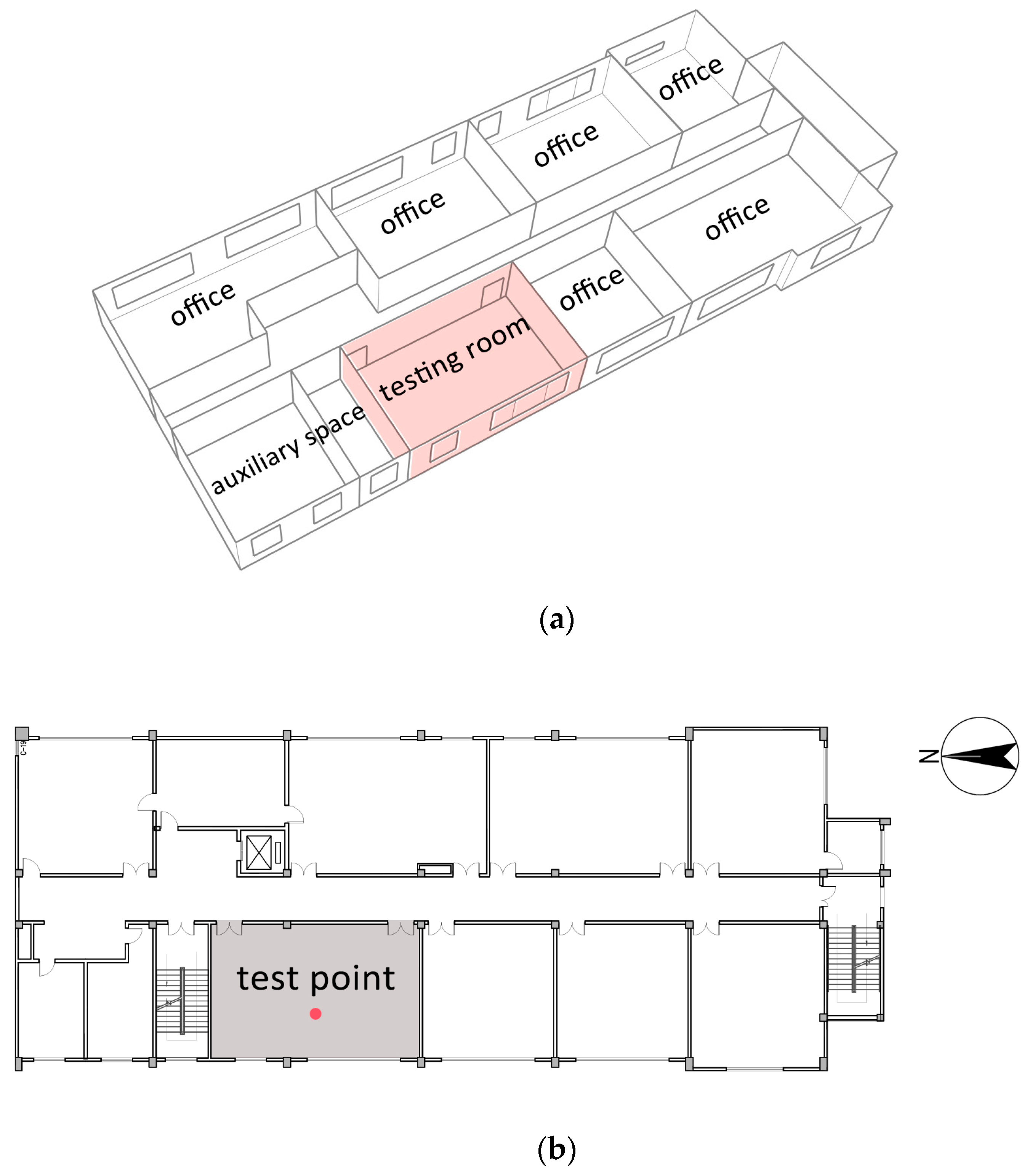
A research office on the third floor of the office building was selected as the test object, as shown in Figure 2a. The room measures 12.3 m in length, 8.0 m in width, and 3.9 m in floor-to-ceiling height, and is primarily designed for multi-occupant office use. Two casement windows are installed on the west side with a window-to-wall ratio of 0.34, and the surrounding environment has no obstructions. Field testing was conducted during the summer, specifically 2–3 August 2024, with all test periods occurring under clear-sky conditions. Test point placement strictly followed the provisions of JGJ/T 177-2009 [23] “Standard for Energy Efficiency Testing of Public Buildings,” with measurement points positioned 1.5 m from the exterior wall and 1.1 m above the ground. The layout of measurement points is illustrated in Figure 2b. Temperature data were collected continuously using HOBO Pro V2 U23-001 (Onset Computer Corporation, Bourne, MA, USA) data loggers, which automatically recorded readings at one-minute intervals. A total of 2880 data points were recorded over two days to obtain a complete and continuous indoor temperature variation curve. The technical parameters of the device are measurement accuracy of ±0.2 °C (within 0–50.0 °C range) and response time of less than 5 min. Before testing, the device was calibrated using a standard temperature source to guarantee the reliability of the measurement data.
The building cooling energy consumption simulation model is constructed using the Rhino & Grasshopper platform with the Ladybug Tools plugin suite to establish performance prediction models. The Honeybee module was employed to interface with the EnergyPlus v22.1.0 simulation engine, serving as the computational core. This platform has been widely applied in international building performance research and possesses good computational accuracy and reliability [24]. Ensuring the accuracy of simulation model validation is critical to the reliability of research outcomes. This study adopts indoor air temperature as the primary validation parameter, evaluating model accuracy by comparing deviations between simulated and measured values. This validation method is widely recognized as a standard methodology in the field of building energy consumption simulation [25].
Model validation is conducted using two primary statistical metrics recommended by ASHRAE Guideline 14-2014 [26]: Normalized Mean Bias Error (NMBE) and Coefficient of Variation in Root Mean Square Error (CVRMSE), calculated through Equations (1) and (2):
N M B E = 1 m × i = 1 N i ( M i S i ) n p × 100 %
C V R M S E = 1 m × i = 1 N i ( M i S i ) 2 n p × 100 %
where Mi represents the i-th measured value, namely indoor temperature data; Si represents the i-th simulated value, namely the indoor temperature at the corresponding moment calculated by the simulation model; Ni represents the total number of data points, namely the total number of measurement moments participating in validation; n represents the sample size, typically equal to Ni; p represents the number of model parameters, typically set to 0 or 1 in building performance simulation; m represents the mean of measured values, namely the arithmetic mean of all Mi.
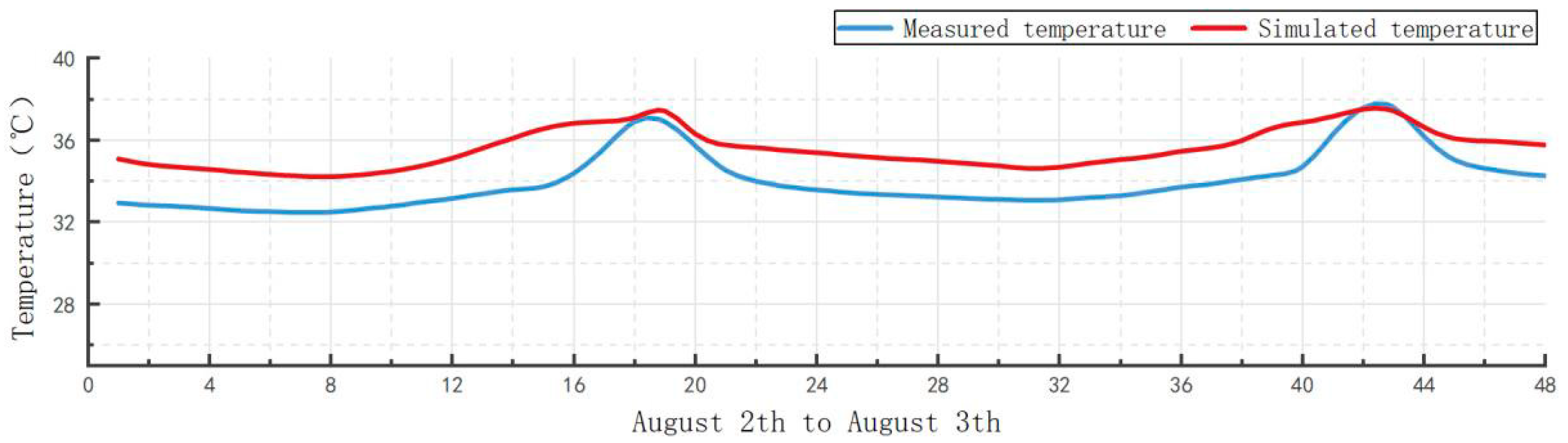
According to the ASHRAE Guideline, simulation results are considered accurate and reliable when the NMBE falls within ±10% and the CVRMSE is within 30%. In this study, both NMBE and CVRMSE values fall within these thresholds, and the simulated and measured data exhibit nearly identical variation patterns, as shown in Table 2 and Figure 3. These results indicate that the selection of simulation software, the parameter settings, and the resulting data are valid and reliable.

2.3. Parameter Selection and Sample Collection

Based on extensive field investigations of existing office buildings in the Zhengzhou area and related literature analysis [3,8,9,21,27,28,29], key design parameters affecting cooling energy consumption in office buildings were systematically identified and categorized. Thirteen core design parameters that significantly affect cooling energy demand were identified and grouped into four major categories: building forms, building envelopes, shading systems, and active design elements. Building form elements include building width and depth, reflecting common plan layout characteristics of office buildings in the Zhengzhou area. Building envelope elements include the window heat transfer coefficient, the window solar heat gain coefficient, the window-to-wall ratio, and the exterior wall heat transfer coefficient, with parameter ranges determined based on the actual construction and energy-efficiency standards for existing buildings in the Zhengzhou area. Shading measures encompass parameters such as width, tilt angle, quantity, and distance from windows for horizontal shading devices [21,30,31], accounting for locally common external shading forms. Active design elements include cooling and heating setpoint temperatures, lighting power density, and infiltration rates, reflecting actual operational characteristics of office buildings. Parameter range determination comprehensively considers the current status level, technological development trends, and economic feasibility of office buildings in the Zhengzhou area. The relevant reference standards and corresponding parameter ranges are summarized in Table 3.
After determining the design variable parameters and their ranges, the selection of the sampling strategy decisively influences the reliability and accuracy of the sensitivity analysis results. Appropriate sampling methods not only ensure a representative distribution of samples within the parameter space but also maximize information extraction efficiency under limited computational resources. Corresponding sampling methods were adopted for different sensitivity analysis methods.
For regression-based sensitivity analysis methods such as SRC and PRCC, the LHS method was employed to generate the dataset. As an enhanced stratified sampling technique, its core mechanism involves dividing the range of each input variable into n non-overlapping strata of equal width, randomly selecting one sample from each stratum, and then randomly permuting the samples to ensure uniform distribution of sample points across the multidimensional parameter space. Compared with traditional Monte Carlo random sampling, LHS offers significant advantages, including greater spatial coverage efficiency, more uniform distributions, and faster statistical convergence, enabling comprehensive coverage of the parameter space with fewer samples and effectively avoiding sample clustering. Regarding sample size setting, regression-based sensitivity analysis methods generally require a sample size ranging from 1.5 to 10 times the number of parameters [38]. To ensure sample sufficiency, this study extracted 200 sets of samples for 13 parameters for testing [39].
For the variance decomposition-based Sobol method, specialized Sobol sampling sequences were employed to construct the dataset. Sampling strategies tailored to this method can effectively exploit its inherent advantages, thereby enhancing the accuracy and credibility of the sensitivity analysis results. For the Sobol method, the theoretical minimum sample size is 2n(k + 1), where n is the total number of input parameters to be analyzed in the model and k is the base sample size for estimating distribution functions. After carefully balancing computational efficiency, estimation accuracy, and statistical reliability, 1892 Sobol samples were selected, ensuring numerical stability and accurate global sensitivity index estimation.

2.4. Energy Consumption Model Establishment

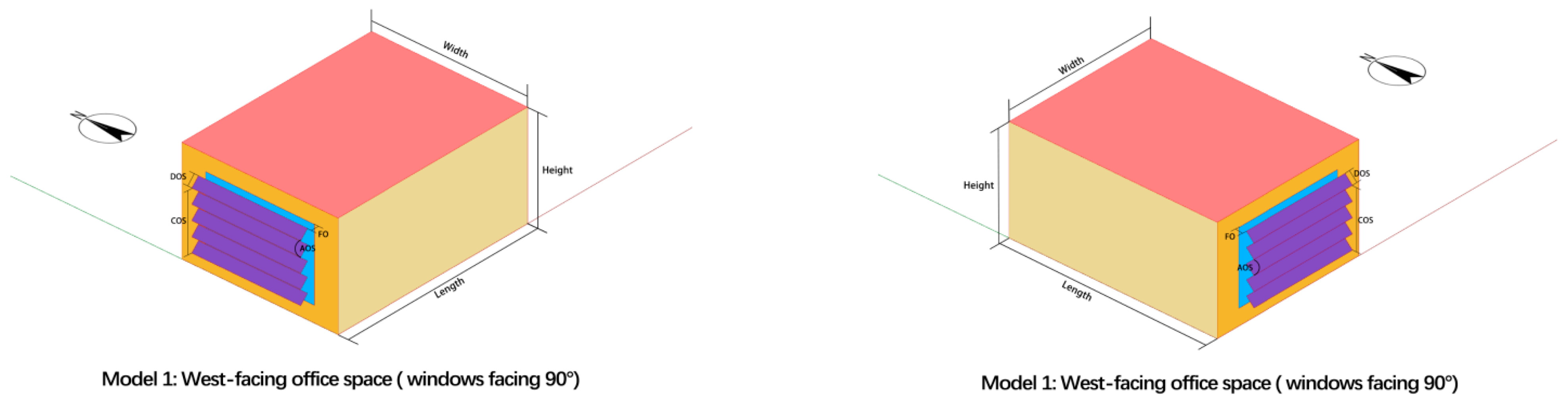
To effectively compare the factors influencing cooling energy consumption between south- and west-facing rooms, two sets of energy consumption simulation models with identical operating condition parameters, except for orientation, were established using the building energy consumption simulation platform, as shown in Figure 4. Model 1 represents the west-facing office space (window angle 90°), and Model 2 is the south-facing office space (window angle 0°). Both models share identical geometric dimensions and construction specifications. The ceilings, floors, and the other three interior wall surfaces are defined as adiabatic boundary conditions, enabling accurate comparison of the differences in cooling energy consumption influencing factors between the two orientations.
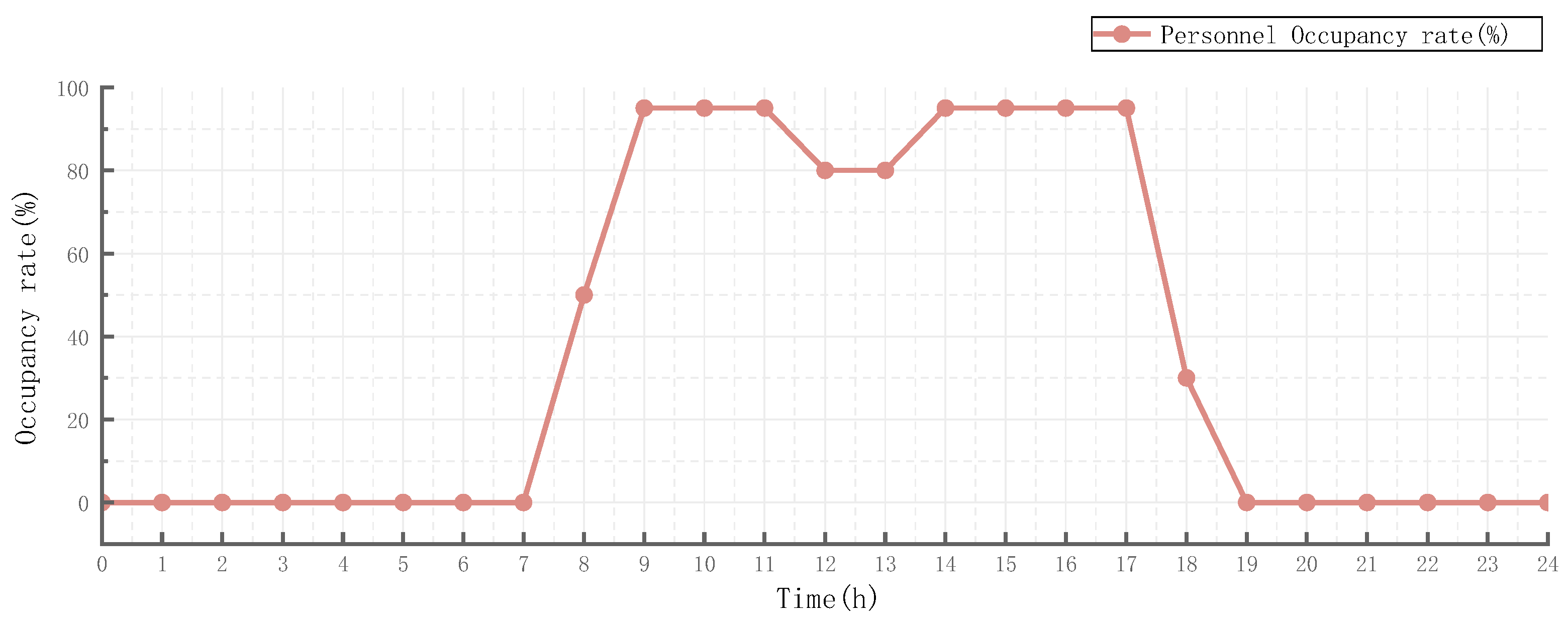
During energy consumption simulation, the meteorological parameter file adopted an EPW format file specific to the Zhengzhou region, obtained from EPWMap, a meteorological data platform associated with Ladybug Tools. This file provides hourly meteorological data for all 8760 h of the year and can accurately represent local climate conditions. To ensure the reliability of the research conclusions, this study adopted the following control measures: (1) In the parametric study, the value ranges of 13 key parameters were determined based on actual survey data of existing buildings in Zhengzhou and relevant code standards (GB 55015-2021, DBJ41/T 075-2016), comprehensively covering the main technical characteristics of office buildings in the region; (2) A standardized occupant density (10 m2/person) was adopted, and occupancy schedules were set according to typical office patterns, as depicted in Figure 5. The lighting system employs an intelligent control strategy, where artificial lighting is activated when the indoor working plane (0.75 m height) illuminance falls below the minimum value of 300 lx, with continuous dimming control based on indoor illuminance. This control strategy maximizes the utilization of natural light resources, reduces unnecessary lighting energy consumption, and accurately reflects the impact of orientation differences on lighting energy consumption. Operation schedules (Monday to Friday, 8:00–18:00) eliminate the influence of usage pattern differences; (3) The adoption of an ideal loads model aims to focus on the influence of envelope and passive design parameters while avoiding interference from HVAC system differences. This method is widely adopted in building energy consumption parametric studies [21]; (4) The settings of internal loads and operation periods strictly follow the “Design Standard for Energy Efficiency of Public Buildings” (GB 50189-2015 [40]) and the “Design Code for Heating Ventilation and Air Conditioning of Civil Buildings” (GB 50736-2012), ensuring the standardization of simulation conditions.
Building thermal parameters and system configurations were established in strict compliance with national and local standards, including GB 55015-2021 “General Code for Building Energy Conservation and Renewable Energy Utilization” and DBJ41/T 075-2016 “Design Standard for Energy Efficiency of Public Buildings in Henan Province,” ensuring the standardization and applicability of simulation models. The parametric building energy consumption simulation workflow constructed based on this platform enables fully automated processing, spanning geometric modeling, batch parameter configuration, automated computation, and result statistical analysis. This integrated approach substantially enhances the efficiency and accuracy of large-scale data processing, providing reliable technical support for accurately identifying the influence mechanism of orientation differences on office building energy consumption.
This study selects the annual cooling energy consumption (kWh/m2) of buildings as the core indicator for evaluating the impact of orientation differences. This indicator can reflect the actual cooling period energy consumption level of building operation and provide direct quantitative evidence for orientation optimization design. Considering the specificity of the research objectives, this study did not include domestic hot water and office equipment energy consumption. Domestic hot water accounts for a small proportion in office buildings and has weak correlation with orientation [21]; office equipment energy consumption is mainly determined by usage patterns, and under controlled variable conditions, the equipment usage is completely identical for both orientation rooms, making their energy consumption differences negligible. This research boundary setting both highlights the specific impact of orientation on cooling energy consumption and ensures the scientific validity and reliability of comparative analysis. By comparing the cooling energy consumption values of west-facing and south-facing rooms, the specific influence degree of orientation factors on different types of building energy consumption can be quantitatively identified.

2.5. Multi-Stage Sensitivity Analysis Method

Sensitivity analysis is a systematic approach for assessing the extent to which variations in input parameters influence model output, aiming to identify the importance of input parameters and their influence patterns. Sensitivity analysis can be divided into GSA and LSA. GSA evaluates the influence of a single parameter on model output under conditions where all design parameters change simultaneously. It can comprehensively consider the sensitivity characteristics of parameters across their entire range of variation, as well as the interactive effects among parameters. However, this method has a high computational cost and struggles to identify specific influence trends or optimal parameter ranges. LSA is typically used to examine the influence of individual parameters on changes in model output while holding other parameters fixed. It has high computational efficiency and can clearly define the influence direction and variation patterns of parameters, but can only reflect parameter sensitivity within local ranges and cannot capture parameter interactions or global sensitivity characteristics.
The MSA method employed in this study integrates GSA and LSA methods [19], effectively overcoming the limitations associated with individual methods while fully capitalizing on their respective technical strengths. This method comprises two stages: in the first stage, multiple GSA techniques are applied to perform sensitivity ranking of design parameters and identify high-sensitivity ones, with the reliability of the screening process improved by comparing results across different methods; in the second stage, LSA is used to analyze the influence trend and optimal design range of the screened high-sensitivity parameters.

2.5.1. Global Sensitivity Analysis

SRC, PRCC, and Sobol methods are three commonly used GSA methods that form a complementary analytical system. SRC is computationally efficient and suitable for linear models, while PRCC extends this capability to nonlinear monotonic models [19]. The Sobol method considers interactions among input parameters and is applicable to nonlinear or non-monotonic models. By systematically integrating the three methods and comparatively validating the results, the risk of overlooking key parameters with a single method can be effectively avoided, thereby offering robust and scientifically sound technical support for subsequent parameter optimization and energy-efficient design decisions.
(1)
Standardized Regression Coefficient and Partial Rank Correlation Coefficient
Both the SRC and PRCC methods are GSA methods based on regression. Specifically, SRC is a GSA method based on linear regression models that quantifies parameter sensitivity by establishing linear relationships between input parameters and output results. A key feature of the SRC method is the standardization of all input variables, enabling comparisons across parameters with different units and scales. The absolute value of the standardized regression coefficient directly reflects the degree of influence of the corresponding parameter on the model output, while the sign indicates the direction of the correlation between the parameter and the output [41]. A higher SRC index value indicates a greater effect of the corresponding parameter on related performance. When the SRC index is positive, it indicates that as the value of the design parameter increases, the related output also increases. Conversely, a negative SRC suggests an inverse relationship between the input parameter and the output response. The mathematical expression of the multiple linear regression model is:
y ( x 1 , x 2 , , x n ) = β 0 + i = 0 n β i x i + ε
where y represents the model output result; β0 represents the intercept term; βi represents the regression coefficient of the i-th parameter; xi represents the i-th input parameter; ε represents the random error term. The equation for the standardized regression coefficient SRC is:
S R C i ( x i , y ) = β i σ i σ y
where σi represents the standard deviation of the i-th parameter; σy represents the standard deviation of the model output. The SRC method features simple calculation with results that are easy to understand, making it particularly suitable for linear or approximately linear model systems.
PRCC is a GSA method based on rank transformation that addresses nonlinearity and non-monotonicity by introducing the concept of “rank difference” [42]. This method first applies a rank transformation to the input parameters and output responses, then calculates the partial correlation coefficient between each parameter and the output while controlling for the effects of other variables. It enables PRCC to effectively capture parameter interactions and nonlinear relationships, thereby enhancing its applicability across diverse scenarios. The PRCC calculation process involves converting input parameters and outputs into rank-ordered sequences, followed by the construction of a symmetric matrix C to characterize the correlations among variables:
C i j = t = 1 N ( r i t μ ) ( r j t μ ) t = 1 N ( r i t μ ) 2 s = 1 N ( r j s μ ) 2 i , j = 1,2 , , k
where rit represents the rank of the i-th variable in the t-th sampling; μ represents the mean rank. Through matrix operations, the partial correlation coefficient matrix B = [bij] = C−1 is obtained, and the PRCC value between the i-th input parameter and the y-th output parameter is:
γ i j = b i , k + 1 b i i b k + 1 , k + 1
The absolute value of the PRCC reflects the degree of sensitivity, while its sign indicates the direction of the correlation. Compared with the SRC method, PRCC demonstrates superior capability in capturing nonlinear and non-monotonic relationships, thereby offering enhanced applicability and reliability when applied to complex engineering problems.
(2)
Sobol Sensitivity Analysis Method
As a GSA method based on variance decomposition, Sobol sensitivity analysis quantifies the contributions of individual parameters and their interactions to model output variance [43]. It applies to nonlinear and non-monotonic models and can identify interactive effects among parameters.
The Sobol method decomposes the total variance of model output into the individual and interactive contributions of each input parameter:
Y = f 0 + i Y ( X i ) + i < j Y ( X i , X j ) + + Y ( X 1 , X 2 , X k )
V ( Y ) = i V i + i < j V i j + + V 12 k
where Vi represents the variance contribution of the i-th parameter to the model output, and Vij represents the contribution of the interaction between the i-th and j-th parameters. Based on variance decomposition, the first-order sensitivity index is:
S i = V i V ( Y )
The total sensitivity index covers the direct and interactive effects:
T i = S i + S i j + + S 12 k
All sensitivity indices satisfy the normalization condition Σi Si + Σi<j Sij + ⋯ + S12…k = 1. The importance of parameter interactions can be determined by comparing Ti and Si.
The Sobol method employs quasi-random Sobol sequence sampling to ensure low discrepancy and rapid convergence. It measures parameter sensitivity via the first-order and total-order indices. The first-order index reflects the direct effect (Si) of a parameter, while the total-order index reflects its direct and interactive effects (Ti). This study selects Ti for sensitivity analysis. By considering a parameter’s direct and interactive effects, Ti reflects its contribution to model output variance, with higher values indicating higher sensitivity [19].
Ti is selected also because the design parameters of building energy consumption systems often exhibit complex nonlinear interactions (e.g., synergy between window-to-wall ratio and shading systems and the mutual influence between airtightness and cooling setpoint temperature). Adopting Si may underestimate the actual importance of parameters with significant interactions, leading to deviations, while Ti comprehensively reflects the overall contribution of parameters to model output variance and more accurately identifies high-sensitivity parameters.

2.5.2. Local Sensitivity Analysis (LSA)

LSA, as the second stage of the MSA methodological framework, specifically focuses on in-depth analysis of the high-sensitivity parameters screened in the first stage by GSA. The specific application process is as follows: First, based on the key parameters identified by GSA results, the influence trends and degrees of high-sensitivity parameters on south-facing and west-facing office spaces are analyzed individually. Under the condition of maintaining other parameters at baseline values, the value of a single parameter is systematically varied, and the corresponding cooling energy consumption output is obtained through building energy consumption simulation. Finally, the quantitative relationship between parameter changes and energy consumption response is analyzed. This method has the advantages of simple operation and easy understanding, which is helpful for comparing the relative importance of different design parameters. It is particularly suitable for studying the influence trends and optimal value ranges of specific parameters within their design range [44].
After obtaining the MSA results, the GSA results and LSA results are compared for the cooling energy consumption indicator to determine the differences in the influence degrees of different design parameters on cooling energy consumption results for west-facing and south-facing office rooms. Through systematic comparative analysis, the importance ranking and influence degrees of sensitivity parameters for different orientations of office rooms across various energy consumption indicators are identified, and the differential sensitivity characteristics of key parameters such as building form elements, envelope thermal properties, shading measures, and active design elements under different orientation conditions are explored. LSA further reveals the influence trends and variation patterns of the screened high-sensitivity parameters within specific value ranges, laying the foundation for determining optimal design parameter ranges. This MSA framework combining GSA and LSA can effectively improve the accuracy and reliability of parameter screening, providing scientific theoretical support and differentiated retrofit measure guidance for the renovation of existing west-facing and south-facing office buildings in cold climate regions.

3. Results and Discussion

3.1. GSA Results and Discussion

This section conducts sensitivity ranking analysis of 13 design parameters for west-facing and south-facing office spaces using three GSA methods: SRC, PRCC, and Sobol. The findings indicate that there exist substantial disparities in both the high-sensitivity parameters and parameter rankings between the two orientations. These disparities originate from the fundamental differences in solar radiation characteristics and heat transfer mechanisms between the two orientations, which offer crucial evidence for differentiated energy-saving retrofit strategies.

3.1.1. SRC, PRCC, and Sobol Sensitivity Analysis Results for West-Facing Buildings

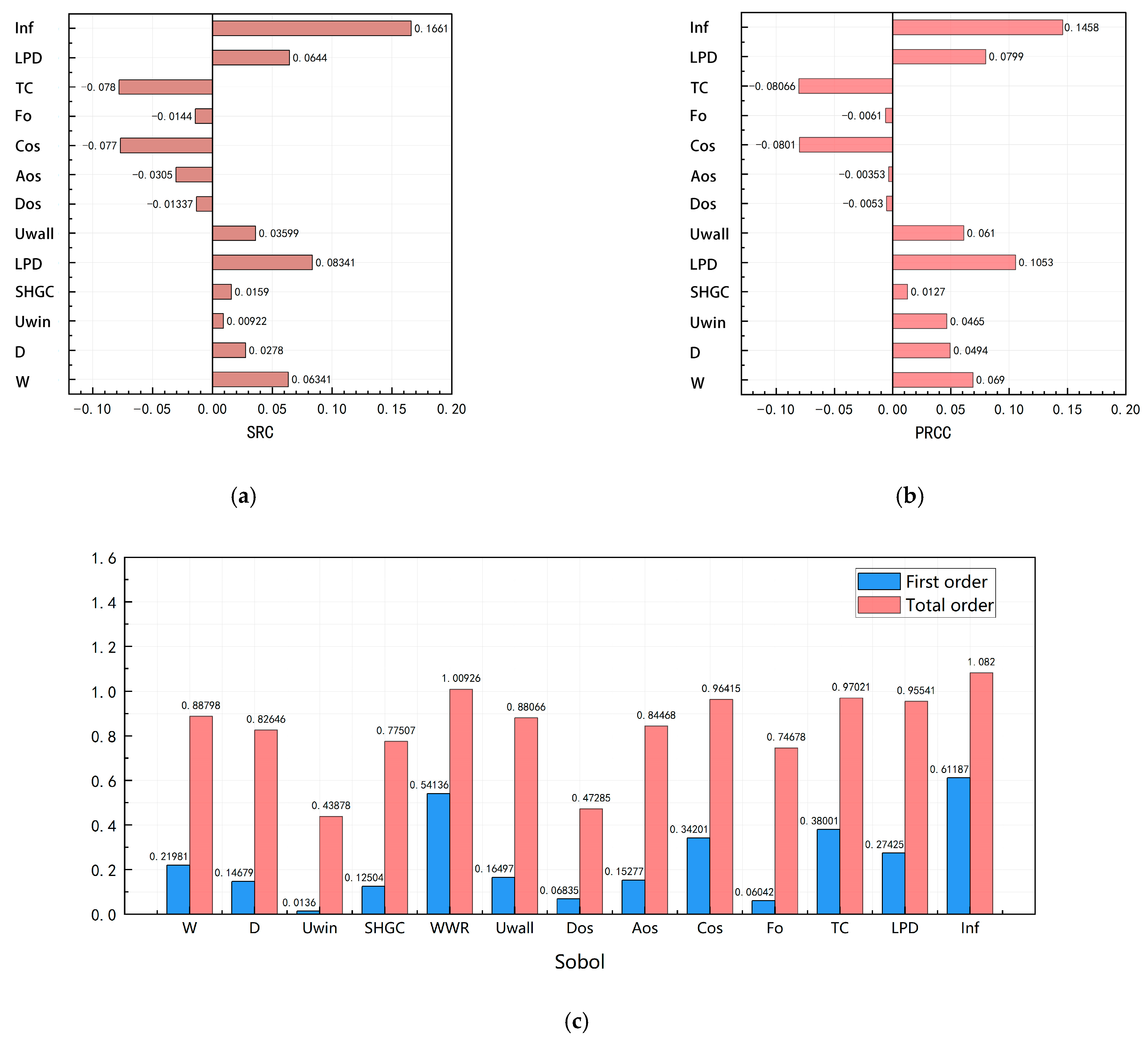
The GSA results for cooling energy consumption of west-facing office spaces are shown in Figure 6 and Table 4. The top 7 most sensitive parameters identified by the three methods rank completely consistently, and the sensitivity ranking of all 13 parameters based on the SRC and Sobol methods is completely consistent. The 7 high-sensitivity parameters with the greatest effects on the cooling energy consumption of west-facing office spaces rank as: infiltration rate > window-to-wall ratio > cooling setpoint temperature > number of horizontal shading boards > lighting power density > building width > exterior wall heat transfer coefficient. All three methods rank the window solar heat gain coefficient, the horizontal shading board width, and the distance of the shading board from the window relatively low, indicating their relatively low effects on the cooling energy consumption of west-facing office spaces.
The SRC and Sobol methods rank the window heat transfer coefficient as the 13th most sensitive, while PRCC ranks it the 9th (0.0465). Meanwhile, PRCC ranks the shading board inclination angle as the 13th most sensitive, whereas the SRC and Sobol methods rank it the 8th (SRC = 0.0305). Despite these large ranking differences in the two parameters across the three methods, their sensitivity is relatively low.
According to Figure 6a,b, the SRC and PRCC methods identify parameters positively correlated with the cooling energy consumption of west-facing office spaces as infiltration rate, lighting power density, exterior wall heat transfer coefficient, window-to-wall ratio, window solar heat gain coefficient, window heat transfer coefficient, building depth, and building width. Thus, the cooling energy consumption increases as these parameters increase. Conversely, parameters negatively correlated with cooling energy consumption in west-facing office spaces include cooling setpoint temperature, number of horizontal shading boards, horizontal shading board inclination angle, distance of shading board from window, and horizontal shading board width. Thus, the cooling energy consumption increases as these parameters decrease.
The Sobol analysis results in Figure 6c show that infiltration rate, window-to-wall ratio, cooling setpoint temperature, and number of horizontal shading boards have high Ti values and relatively high first-order indices. Therefore, these parameters have relatively strong interactions with other parameters. Meanwhile, the window heat transfer coefficient, distance of shading board from window, and shading board width have the lowest Si values, indicating their weak interactions with other parameters and weak independence.

3.1.2. SRC, PRCC, and Sobol Sensitivity Analysis Results for South-Facing Buildings

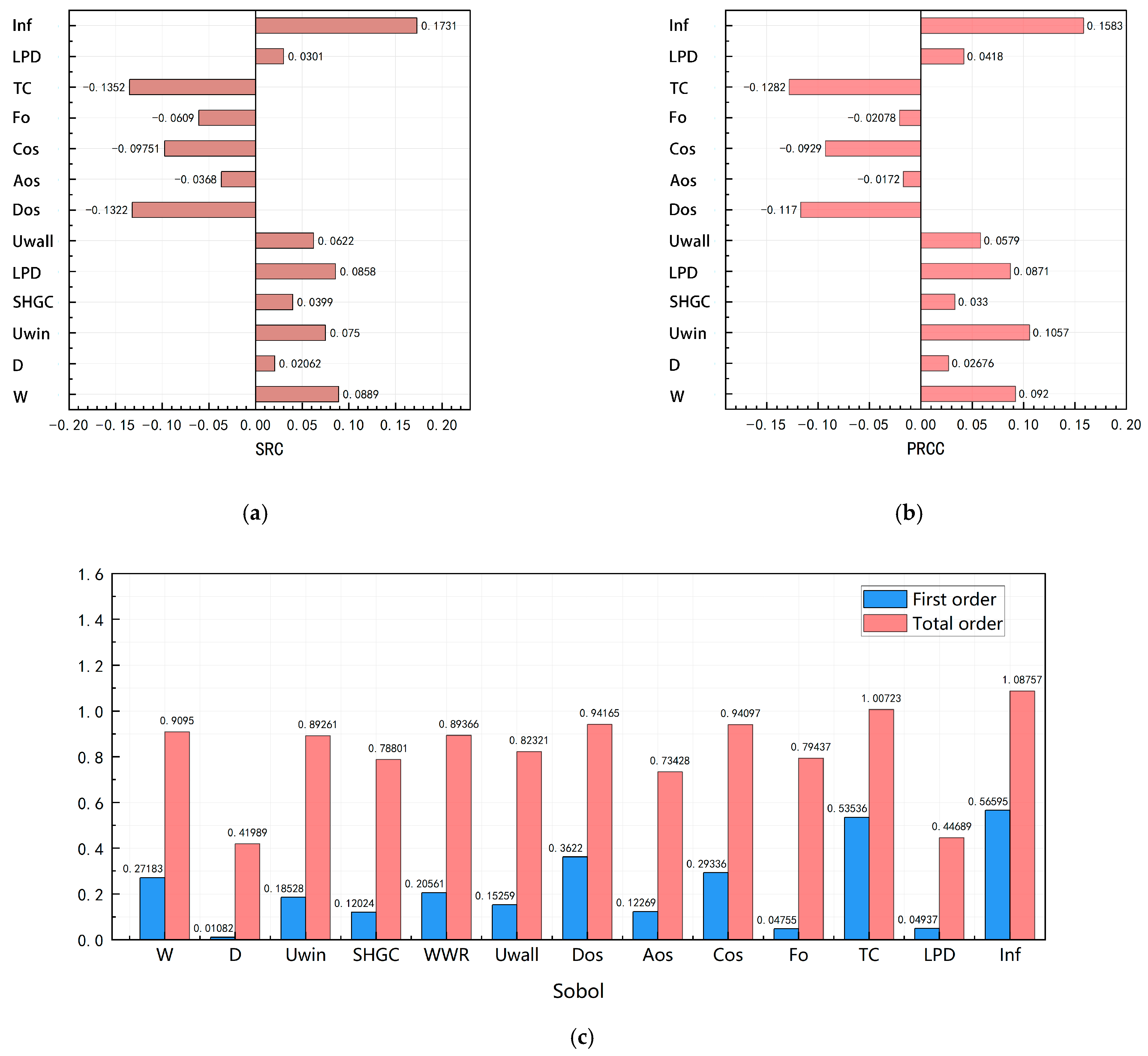
The GSA results for cooling energy consumption in south-facing office spaces are shown in Figure 7 and Table 5. The sensitivity rankings for all 13 parameters based on the SRC and Sobol methods are completely consistent. The sensitivity rankings of the top 3 parameters (infiltration rate, cooling setpoint temperature, and horizontal shading board width) identified by the three methods are completely consistent, indicating that these high-sensitivity parameters have the greatest influence on cooling energy consumption in south-facing office spaces. The 4th to 7th most sensitive parameters are the same across the three methods, but the ranking derived from PRCC differs slightly from those of the SRC and Sobol methods. The SRC and Sobol methods rank these parameters as: number of horizontal shading boards > building width > window-to-wall ratio > window heat transfer coefficient. Therefore, these high-sensitivity parameters have greater effects on cooling energy consumption in south-facing office spaces. The building depth and horizontal shading board inclination angle are ranked relatively low by all three methods, indicating their relatively small effects on cooling energy consumption in south-facing office spaces.
The SRC and PRCC analysis results in Figure 7a,b show that parameters positively correlated with cooling energy consumption in south-facing office spaces include the infiltration rate, lighting power density, exterior wall heat transfer coefficient, window-to-wall ratio, window solar heat gain coefficient, window heat transfer coefficient, building depth, and building width. Thus, the cooling energy consumption increases as these parameters increase. Conversely, parameters negatively correlated with cooling energy consumption include cooling setpoint temperature, number of horizontal shading boards, horizontal shading board inclination angle, distance of shading board from window, and horizontal shading board width. Thus, cooling energy consumption increases as these parameters decrease.
The Sobol analysis results in Figure 7c show that the infiltration rate, cooling setpoint temperature, horizontal shading board width, and number of horizontal shading boards have high Ti values and relatively high first-order indices, indicating their relatively strong interactions with other parameters. Meanwhile, the building depth and lighting power density have the lowest Si values, indicating their weak interactions with other parameters and weak independence.

3.1.3. Comparative Analysis of the GSA Results for West- and South-Facing Office Spaces

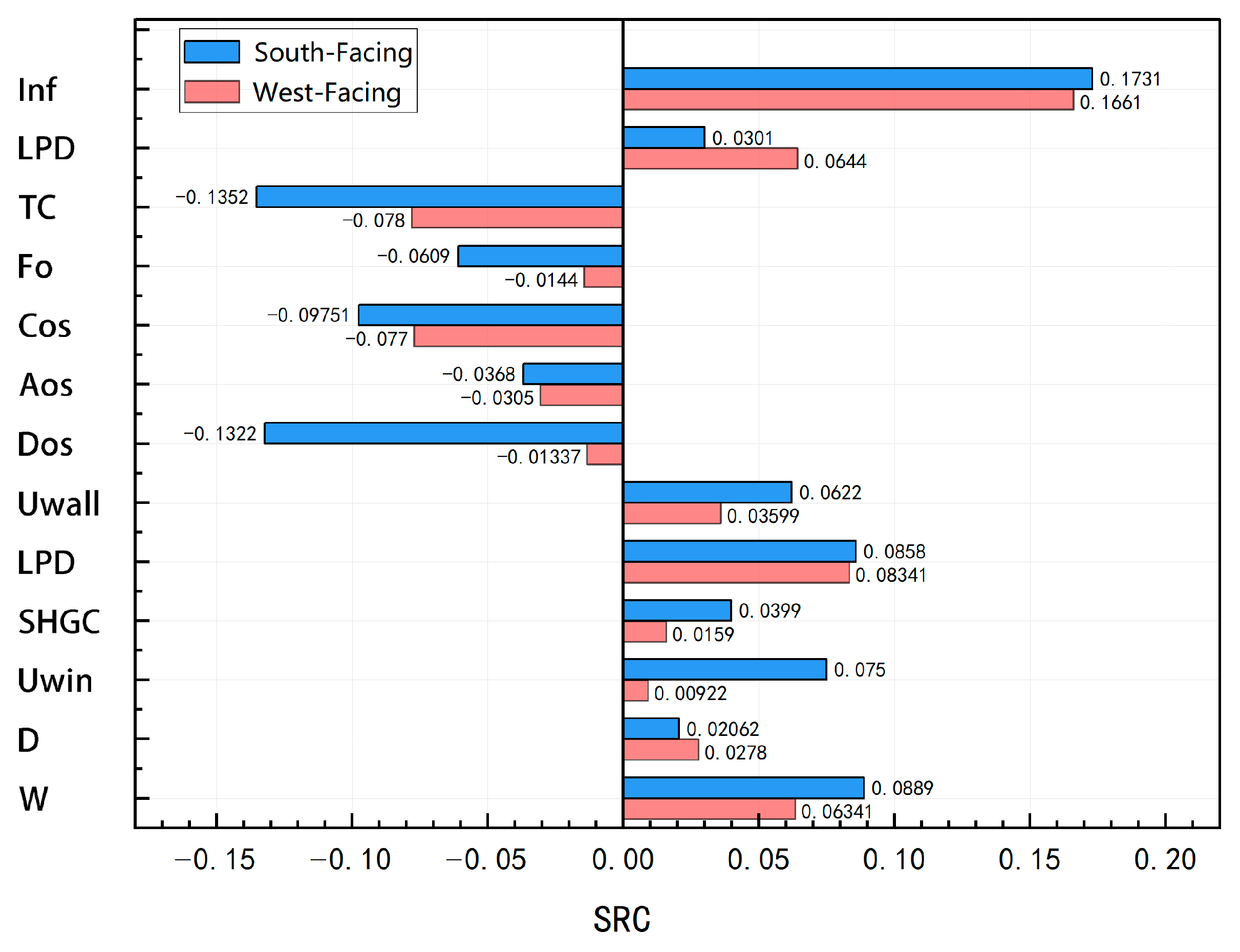
Figure 8 compares the SRC results for cooling energy consumption in south- and west-facing office spaces. Each of the 13 parameters exhibits consistent positive or negative correlations under the two orientations. Among the top 7 high-sensitivity parameters under both orientations (Table 6), 5 are identical, namely, infiltration rate, window-to-wall ratio, cooling setpoint temperature, number of horizontal shading boards, and building width. Thus, these five parameters critically influence cooling energy consumption under both orientations. Specifically, airtightness ranks first under both orientations and should be recognized as a high-priority control factor in energy-efficient building retrofitting. The cooling setpoint temperature ranks 2nd and 3rd for south- and west-facing office spaces, respectively, indicating that reasonably increasing the cooling setpoint temperature can save significant energy, especially for south-facing office spaces. The SRC results of the window-to-wall ratio, building width, and number of shading boards are relatively close, indicating that measures targeting these parameters can effectively enhance energy conservation under both orientations.
The differences in the 7 high-sensitivity parameters between the two orientations are lighting power density and exterior wall heat transfer coefficient for west-facing office spaces and horizontal shading board width and window heat transfer coefficient for south-facing office spaces. Lighting power density ranks 5th for west-facing office spaces and 12th for south-facing office spaces. This difference arises because south-facing office spaces have uniform daylighting throughout the day and can easily meet daytime lighting requirements. In contrast, insufficient natural lighting of west-facing office spaces in the morning increases the frequency of artificial lighting utilization and, thus, heavier cooling loads. The exterior wall heat transfer coefficient ranks 7th and 8th for west- and south-facing office spaces, respectively, indicating its more prominent influence on cooling energy consumption in south-facing office spaces. The horizontal shading board width significantly influences cooling energy consumption in south-facing office spaces (ranking 3rd), while its influence for west-facing office spaces is much less significant (ranking 12th). The window heat transfer coefficient ranks 7th for south-facing office spaces, significantly higher than that for west-facing office spaces (ranking 13th). Thus, the thermal insulation performance of south-facing windows has a more critical influence on energy consumption, as they experience greater thermal effects due to longer solar radiation throughout the day.
The thermal parameters of south- and west-facing windows exhibit systematically different sensitivity. For one thing, the sensitivity of solar heat gain coefficient for west-facing windows ranks higher than that of the heat transfer coefficient, while the opposite pattern is observed for south-facing windows. For another, the sensitivity of parameters related to horizontal shading rank significantly higher for south-facing windows than west-facing ones. This difference stems from the fundamentally different solar radiation characteristics and heat transfer mechanisms of the two orientations. West-facing office spaces are affected by low-angle “western sun” in the afternoon, and the high, concentrated solar radiation intensity leads to significant instantaneous cooling load peaks, making the solar heat gain coefficient a critical control factor. For south-facing office spaces, solar radiation is relatively uniform, with large solar altitude angles and more regular variations, allowing horizontal shading to efficiently intercept direct radiation. As such, cooling loads resulting from heat transfer induced by temperature differences between indoor heat sources and the building envelope dominate, making the window heat transfer coefficient the main parameter affecting cumulative energy consumption.
Based on the above mechanisms, differentiated energy-saving design strategies should be adopted for south- and west-facing office spaces. West-facing spaces should use windows with low solar heat gain coefficients and shading-type glass to block solar radiation heat gain at the source. South-facing spaces should adopt shading and insulation strategies, i.e., optimizing horizontal shading systems while enhancing window thermal insulation (reducing heat transfer coefficient), thereby achieving systematic energy saving.

3.2. LSA Results and Discussion

The GSA-identified top 7 core high-sensitivity parameters are subjected to LSA to determine the trend in each parameter’s effect on cooling energy consumption under south- and west-facing conditions. Specifically, the influence patterns of each parameter on cooling energy consumption are quantified through systematic parameter variation simulation, and energy consumption variation trends and inflection point characteristics are analyzed. The results provide precise parameter guidance for energy-efficient design of buildings with different orientations.

3.2.1. LSA of High-Sensitivity Parameters for West-Facing Office Spaces

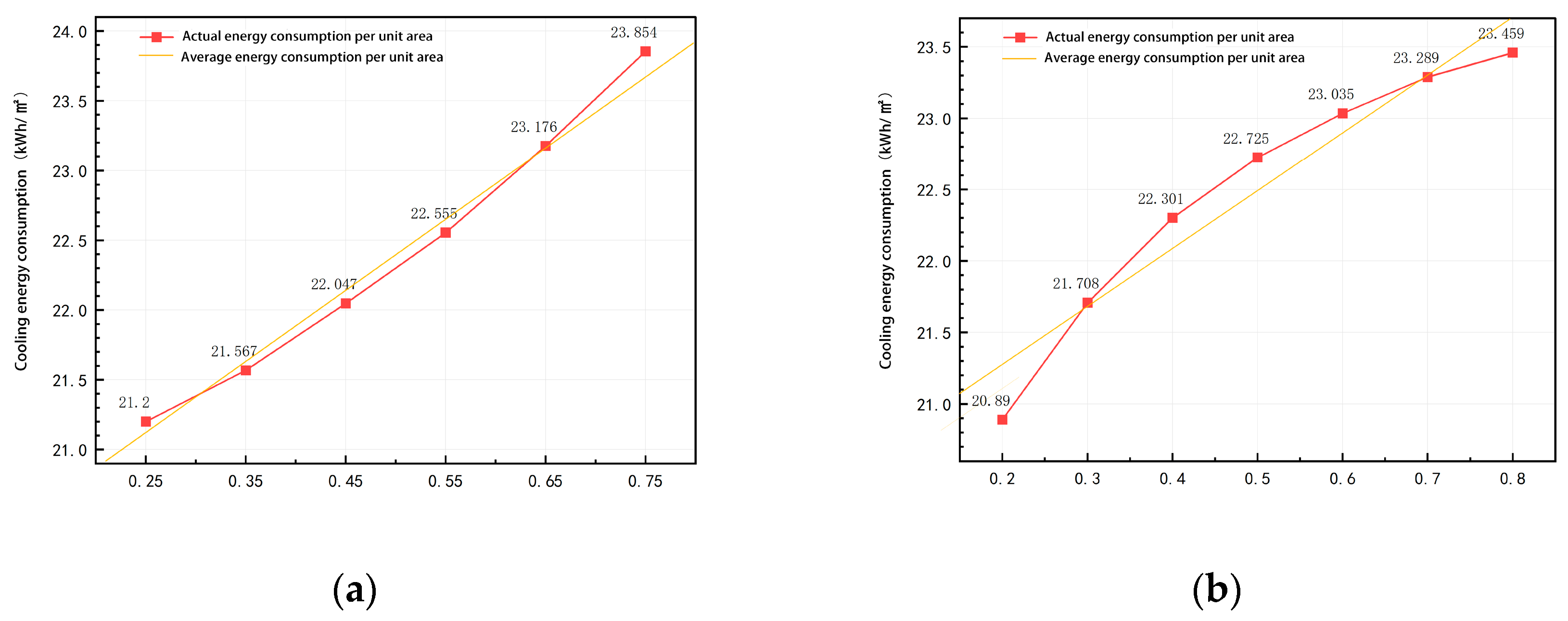
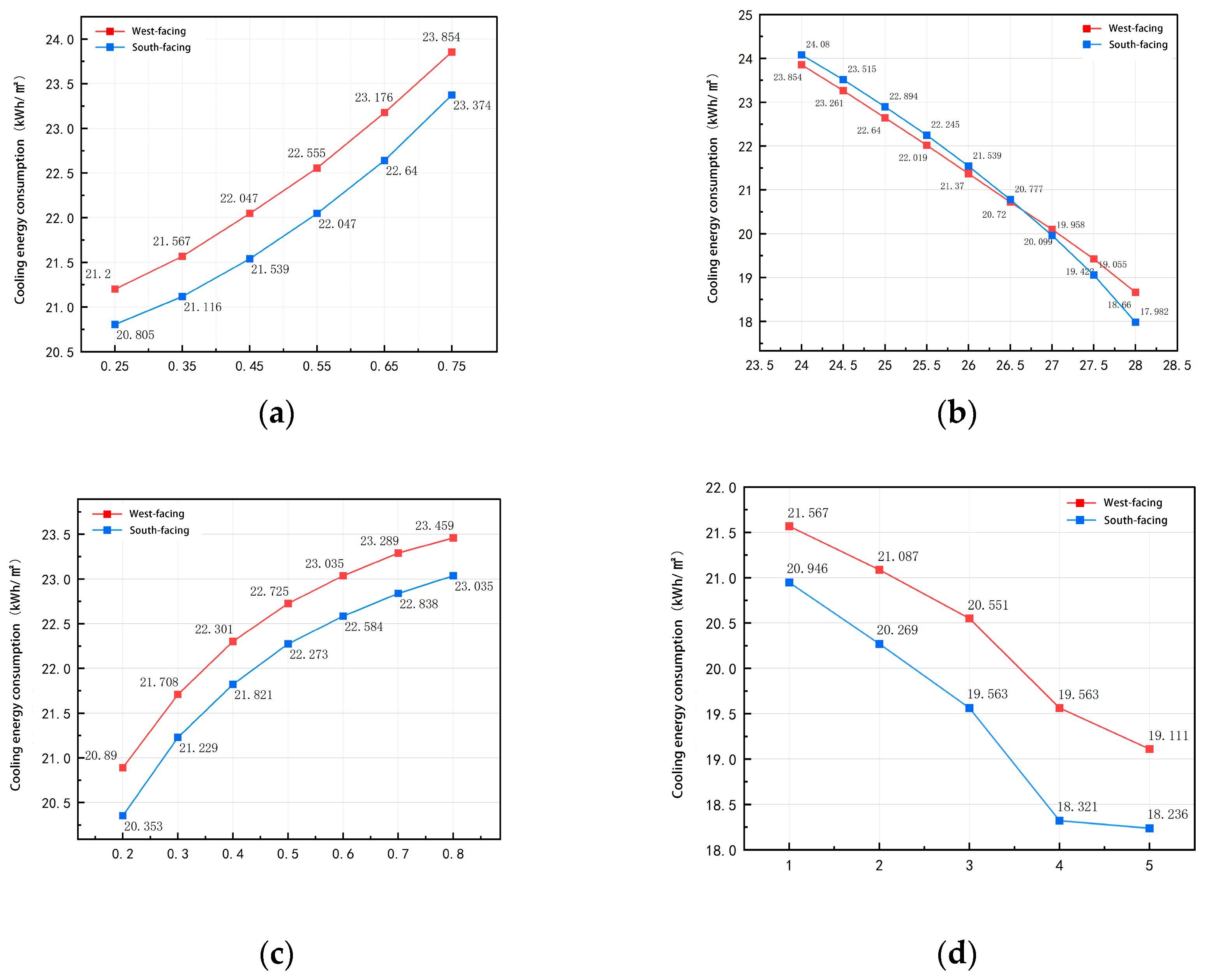
Systematic LSA is conducted on the 7 high-sensitivity parameters (infiltration rate, window-to-wall ratio, cooling setpoint temperature, number of horizontal shading boards, lighting power density, building width, and exterior wall heat transfer coefficient) affecting cooling energy consumption in west-facing office spaces, and the results are shown in Figure 9.
As shown in Figure 9a, infiltration rate exhibits an obvious positive correlation with the cooling energy consumption per unit area in west-facing office spaces. As airtightness increases from 0.25 ac/h to 0.75 ac/h, cooling energy consumption increases by an average of 0.531 kWh/m2 for every 0.1 ac/h increase. Therefore, the airtightness of west-facing office spaces should be strictly controlled within a reasonable range, with lower airtightness being more conducive to energy savings.
As shown in Figure 9b, the window-to-wall ratio exhibits an obvious nonlinear relationship with cooling energy consumption per unit area, with energy consumption rising rapidly at first and then leveling off as the window-to-wall ratio increases. When the window-to-wall ratio is less than 0.5, the curve slope is steep, and cooling energy consumption increases by 0.612 kWh/m2 for every 0.1 increase in the ratio. When the window-to-wall ratio exceeds 0.5, the curve slope decreases significantly, with energy consumption increasing by only 0.245 kWh/m2 for every 0.1 increase in the ratio, indicating that 0.5 represents a critical threshold for the window-to-wall ratio’s impact on cooling energy consumption.
As shown in Figure 9c, cooling energy consumption per unit area exhibits an obvious linear decreasing trend as the cooling setpoint temperature increases, with an overall slope approaching 1, indicating that the cooling setpoint temperature has a significant impact on cooling energy consumption. Therefore, the cooling setpoint temperature in west-facing office spaces should be appropriately increased while ensuring thermal comfort requirements are met.
As shown in Figure 9d, the number of horizontal shading devices has a significant impact on cooling energy consumption per unit area in west-facing office spaces, exhibiting a staged negative correlation. When the number of shading devices increases from 3 to 4, energy consumption decreases by 0.988 kWh/m2, representing the most significant energy-saving effect. When there are fewer than 3 shading devices or when the number increases from 4 to 5, the energy consumption reduction trend is similar, with an average decrease of 0.489 kWh/m2 for each additional shading device.
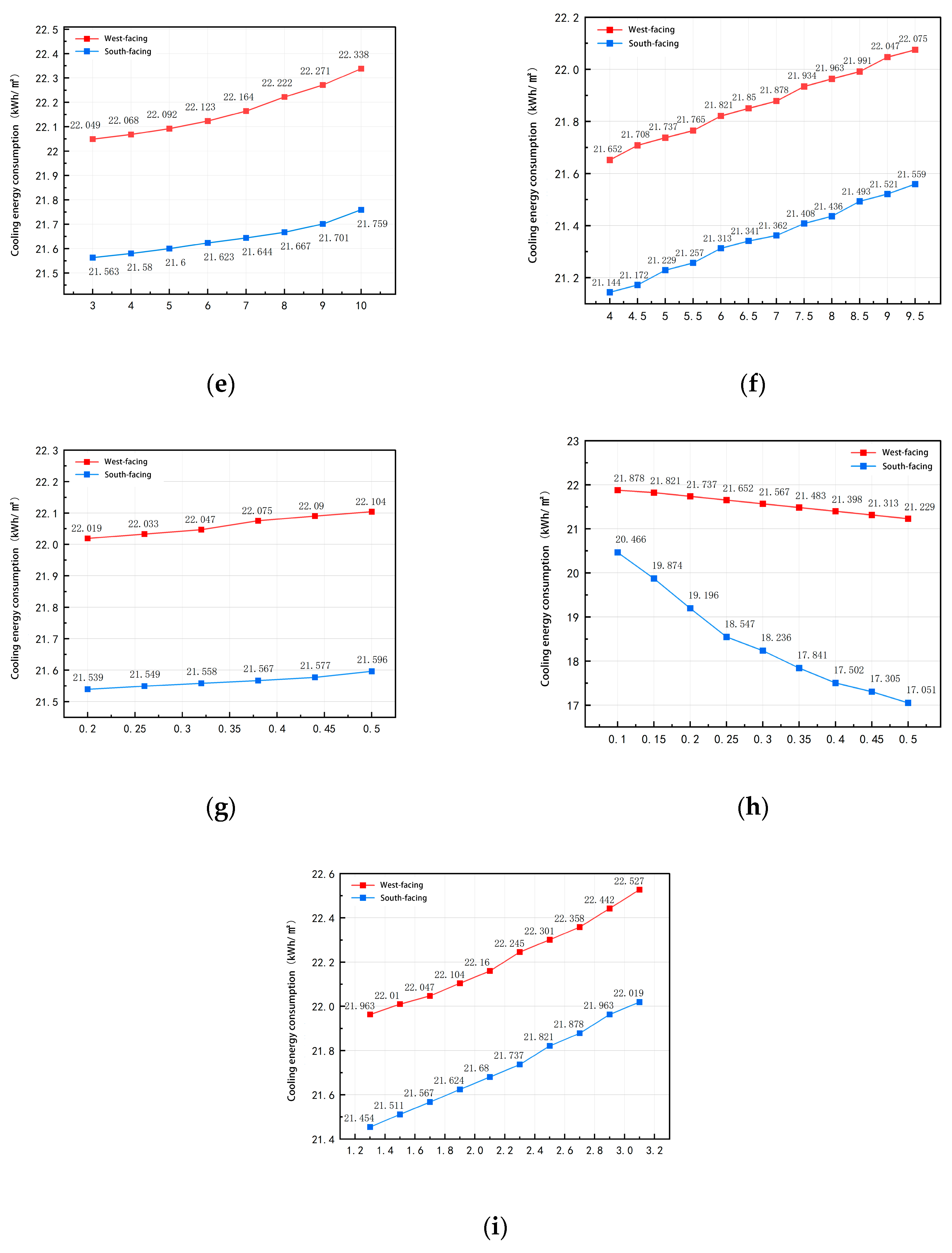
As shown in Figure 9e, cooling energy consumption per unit area exhibits an obvious linear increasing trend as lighting power density increases, with an overall slope approaching 1. On average, cooling energy consumption increases by 0.0385 kWh/m2 for every 0.5 W/m2 increase in lighting power density. Therefore, natural daylighting should be fully utilized through reasonable window-to-floor ratio settings to reduce the duration of artificial lighting use, and energy-efficient lighting fixtures should be adopted to minimize the impact of artificial lighting on cooling energy consumption.
As shown in Figure 9f, building width exhibits an obvious nonlinear relationship with cooling energy consumption per unit area, with energy consumption remaining stable initially and then rising rapidly as building width increases. When the building width of west-facing office spaces is less than 6 m, the curve slope is gradual, and energy consumption increases by 0.025 kWh/m2 for every 1 m increase in width. When the building width exceeds 6 m, the curve slope increases significantly, with energy consumption rising by 0.052 kWh/m2 for every 1 m increase in width, indicating that the building width of west-facing spaces should be reasonably controlled during building design.
As shown in Figure 9g, the exterior wall heat transfer coefficient has a significant impact on cooling energy consumption per unit area, exhibiting a staged positive correlation. When the exterior wall heat transfer coefficient increases from 0.32 W/(m2·K) to 0.38 W/(m2·K), energy consumption increases by 0.028 kWh/m2, with a relatively rapid growth rate in this range. When the exterior wall heat transfer coefficient increases from 0.2 to 0.32 or from 0.38 to 0.5, the energy consumption growth trend is similar, with an average increase of 0.0142 kWh/m2 for every 0.06 W/(m2·K) increase.

3.2.2. LSA of High-Sensitivity Parameters for South-Facing Office Spaces

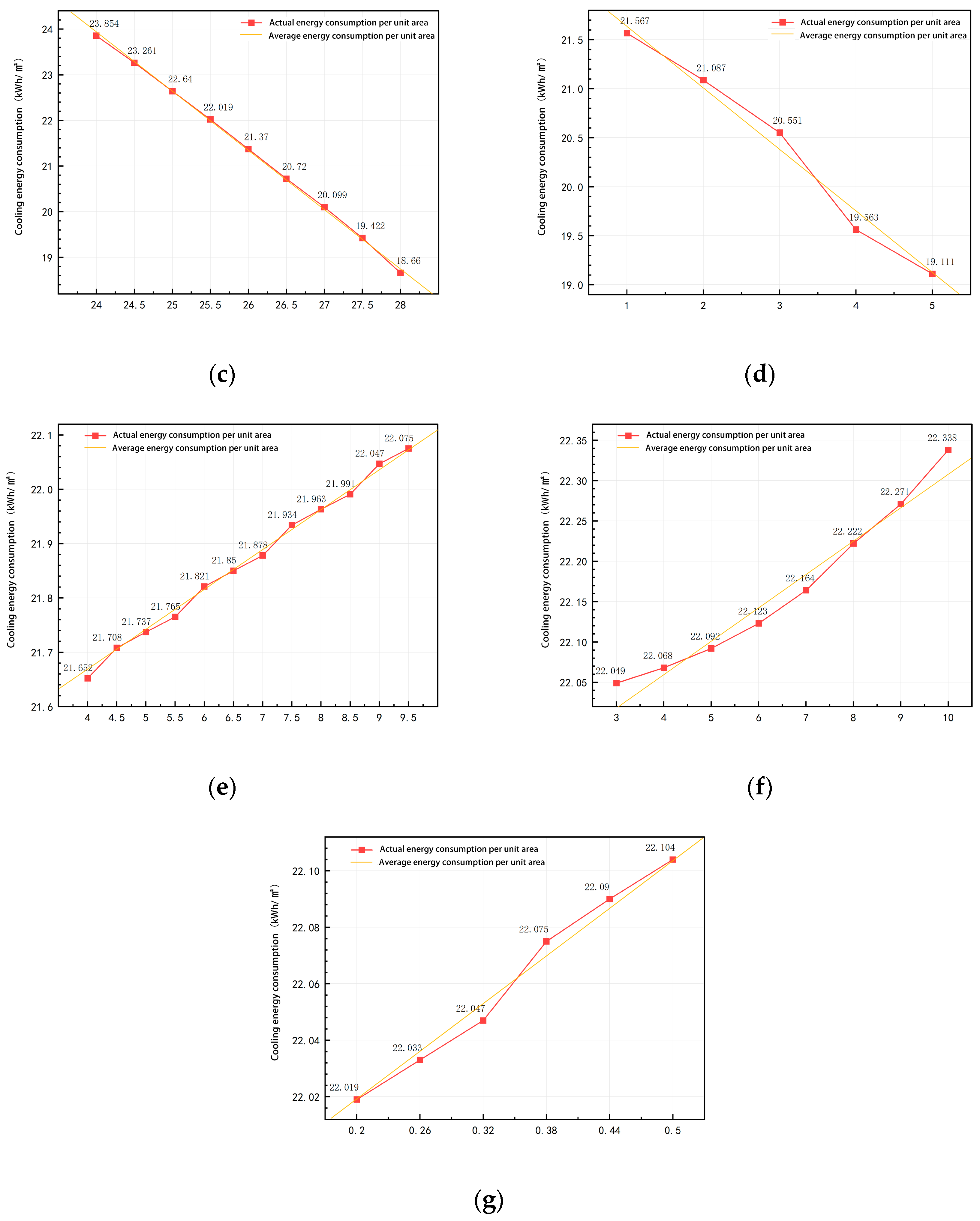
Systematic LSA is conducted on the 7 high-sensitivity parameters (infiltration rate, cooling setpoint temperature, horizontal shading board width, number of horizontal shading boards, building width, window-to-wall ratio, and window heat transfer coefficient) affecting south-facing office space cooling energy consumption, and the results are shown in Figure 10.
As shown in Figure 10a, infiltration rate exhibits an obvious positive correlation with the cooling energy consumption per unit area in south-facing office spaces. As airtightness increases from 0.25 ac/h to 0.75 ac/h, cooling energy consumption increases by an average of 0.514 kWh/m2 for every 0.1 ac/h increase. Therefore, the airtightness of south-facing office spaces should be strictly controlled within a reasonably low range to facilitate energy savings.
As shown in Figure 10b, cooling setpoint temperature exhibits a significant negative correlation with the cooling energy consumption per unit area in south-facing office spaces. From the perspective of slope changes, the rate of energy consumption reduction gradually accelerates as the cooling setpoint temperature increases. With cooling setpoint temperatures below 26 °C, cooling energy consumption decreases by 1.271 kWh/m2 for every 1 °C temperature increase. With cooling setpoint temperatures exceeding 26 °C, the energy consumption reduction rate accelerates significantly, decreasing by 1.779 kWh/m2 for every 1 °C temperature increase. Thus, 26 °C is the threshold for the effect of cooling setpoint temperature on south-facing cooling energy consumption.
As shown in Figure 10c, the cooling energy consumption per unit area in south-facing office spaces exhibits a decreasing trend as horizontal shading board width increases, but the reduction rate gradually slows. From the perspective of slope changes, the curve slope is steep when the shading board width is below 0.25 m, with energy consumption decreasing by 0.640 kWh/m2 for every 0.05 m increase in shading board width. When the shading board width exceeds 0.25 m, the curve slope decreases significantly, with energy consumption decreasing by 0.299 kWh/m2 for every 0.05 m increase in shading board width. Thus, 0.25 m is the threshold for the impact of shading board width on cooling energy consumption.
As shown in Figure 10d, the number of horizontal shading boards significantly influences the cooling energy consumption per unit area in south-facing office space, exhibiting a staged negative correlation. As shading boards increase from 1 to 3, energy consumption decreases by an average of 0.692 kWh/m2 for each additional shading board. As shading boards increase from 3 to 4, energy consumption reduction is most significant, reaching 1.242 kWh/m2. With 5 boards, energy consumption only decreases by 0.085 kWh/m2, indicating the law of diminishing marginal returns as the number of shading boards increases.
As shown in Figure 10e, the cooling energy consumption in south-facing office spaces first rises slowly and then at accelerated rates as building width increases. At small building widths (3 to 8 m), the curve slope is small, with energy consumption increasing by 0.021 kWh/m2 for every 1 m increase in building width. At large building widths (8 to 10 m), the curve slope increases significantly, with energy consumption increasing by 0.046 kWh/m2 for every 1 m increase in building width. Hence, reasonable building widths can effectively suppress cooling energy consumption growth.
As shown in Figure 10f, the window-to-wall ratio exhibits an obvious nonlinear relationship with cooling energy consumption per unit area in south-facing office spaces. From the perspective of slope changes, the energy consumption growth rate gradually slows as the window-to-wall ratio increases. At window-to-wall ratios of 0.2 to 0.5, the curve slope is steep, with energy consumption increasing by 0.522 kWh/m2 for every 0.1 increase in window-to-wall ratio. At window-to-wall ratios of 0.5 to 0.8, the curve slope decreases significantly, with energy consumption increasing by 0.254 kWh/m2 for every 0.1 increase in window-to-wall ratio. Hence, 0.5 is the threshold for the impact of window-to-wall ratio on cooling energy consumption in south-facing office spaces.
As shown in Figure 10g, the cooling energy consumption per unit area in south-facing office spaces increases linearly as the window heat transfer coefficient increases, with cooling energy consumption increasing by an average of 0.063 kWh/m2 for every 0.2 W/(m2·K) increase. Thus, the window heat transfer coefficient significantly influences cooling energy consumption. While satisfying daylighting and ventilation requirements, the window heat transfer coefficient should be strictly kept reasonably low to facilitate energy savings.

3.2.3. Comparative Analysis of the Results Under West- and South-Facing Conditions

The influence mechanisms under different orientations are thoroughly investigated by a comparative analysis of the high-sensitivity parameters. The parameters examined include a category of 5 parameters common to both orientations (infiltration rate, cooling setpoint temperature, window-to-wall ratio, number of horizontal shading boards, and building width) and other category of 4 parameters specific to each orientation (lighting power density and exterior wall heat transfer coefficient for west-facing office spaces and horizontal shading board width and window heat transfer coefficient for south-facing office spaces).
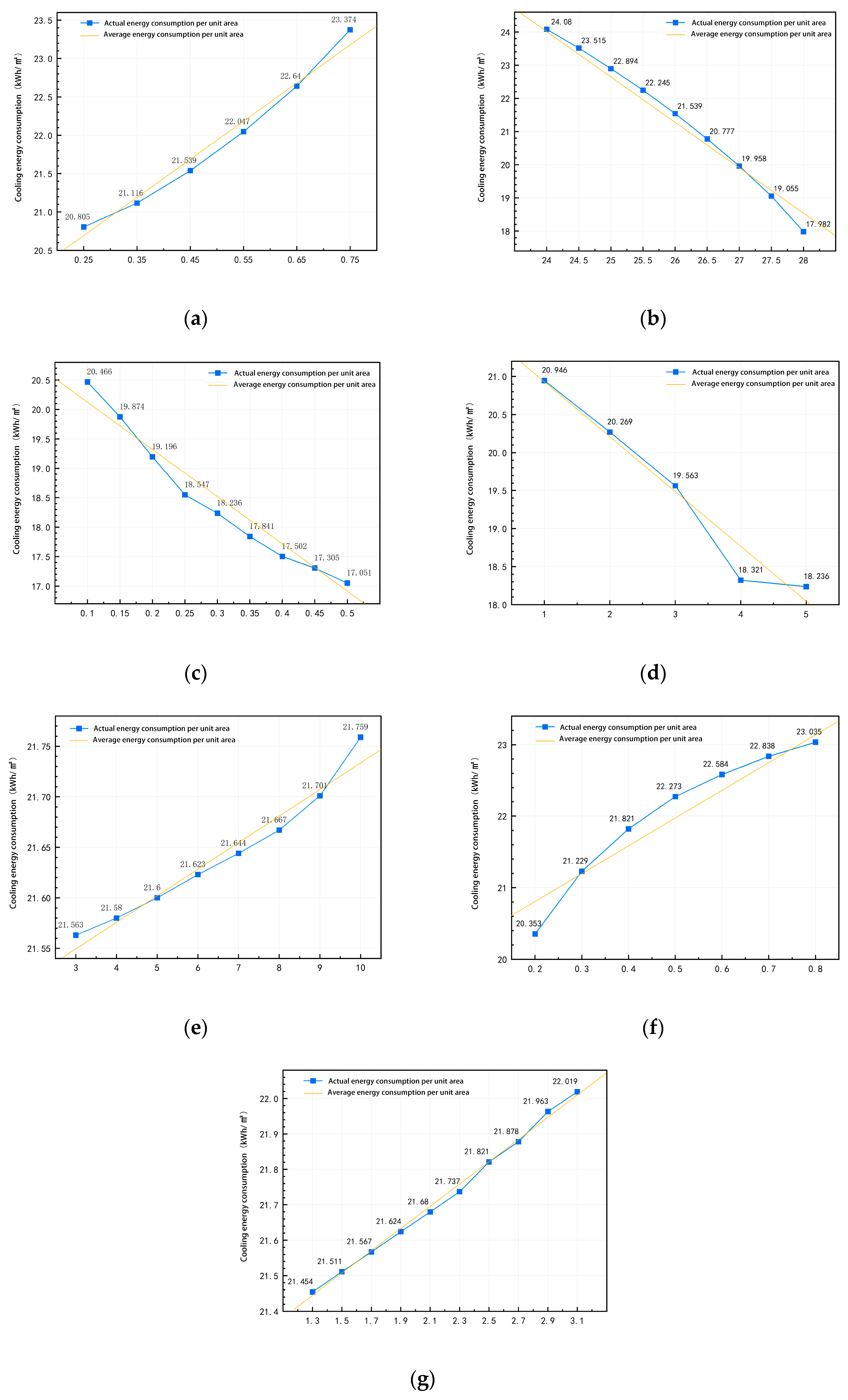
The local sensitivity analysis based on the above nine high-sensitivity parameters is shown in Figure 11, revealing that the overall cooling energy consumption of west-facing rooms is generally higher than that of south-facing rooms. Within the parameter variation range, the five parameters with higher energy-saving rates for both orientation rooms are air tightness, window-to-wall ratio, cooling setpoint temperature, number of horizontal shading boards, and horizontal shading board width. Among these, the first two parameters have the same influence trends on both orientations with relatively similar influence degrees; however, the latter three parameters show significant differences in their impacts on the two orientations.
Figure 11a demonstrates that as air tightness decreases, the cooling energy consumption of south-facing and west-facing rooms declines by 10.99% and 11.13%, respectively, and the reduction rates for both orientations are relatively uniform. This indicates that air-tightness improvement can achieve significant energy-saving effects for both orientations. Combined with the global sensitivity ranking, air tightness should be prioritized as a control measure for reducing cooling energy consumption in both south-facing and west-facing office spaces.
Figure 11b demonstrates that the cooling setpoint temperature exerts a highly significant influence on the cooling energy consumption of both orientations. When the setpoint temperature increases from 24 °C to 28 °C, the cooling energy consumption of south-facing and west-facing rooms decreases by 25.32% and 21.77%, respectively, with the south-facing energy-saving rate higher than the west-facing. The overall reduction rate of west-facing energy consumption is relatively uniform, while the south-facing energy consumption reduction trend accelerates when the cooling temperature exceeds 26 °C. Evidently, south-facing spaces are more sensitive to operational management strategies.
Figure 11c shows that as the window-to-wall ratio decreases from 0.8 to 0.2, the cooling energy consumption of south-facing and west-facing rooms decreases by 11.64% and 10.95%, respectively. This clearly indicates that the window-to-wall ratio exerts a substantial influence on the cooling energy consumption of both orientations. When the window-to-wall ratio is below 0.5, the energy consumption reduction rate accelerates for both orientations. Therefore, rationally controlling the window-to-wall ratio while satisfying daylighting requirements can effectively curtail the cooling energy consumption of both south-facing and west-facing office spaces.
Figure 11d,h show that the two parameters associated with horizontal shading, namely the number and width of shading boards, exert significant influences on reducing cooling energy consumption for both orientations. When the number of shading boards increases from 1 to 5, the cooling energy consumption of south-facing and west-facing office spaces decreases by 12.94% and 11.39%, respectively, with the optimal comprehensive energy-saving benefit achieved when 3–4 boards are installed. When the shading board width increases from 0.1 m to 0.5 m, the cooling energy consumption of south-facing and west-facing office spaces decreases by 16.68% and 2.97%, respectively. This indicates that the energy-saving effect of horizontal shading for south-facing spaces far exceeds that of west-facing spaces. The reason is that west-facing spaces primarily receive low-angle direct radiation in the afternoon, which significantly reduces the interception effect of horizontal shading on solar radiation. However, increasing the number of shading boards can enhance the energy-saving effect of west-facing rooms.

4. Conclusions

This study establishes an MSA framework to identify differences in factors influencing the cooling energy consumption of existing office buildings with fixed orientations in cold regions. Three GSA methods, i.e., SRC, PRCC, and Sobol, are integrated for parameter screening, and the nonlinear characteristics and critical inflection points of the parameters are revealed through LSA. Those results form a complete technical pathway, from key factor identification to optimization strategy formulation. The main research conclusions are as follows:
(1) High-sensitivity parameters in office spaces exhibit significant differences under west- and south-facing conditions. Among the top 7 high-sensitivity parameters under both orientations, 5 parameters are identical (infiltration rate, window-to-wall ratio, cooling setpoint temperature, number of horizontal shading boards, and building width), while 2 differ (lighting power density and the exterior wall heat transfer coefficient under west-facing conditions; shading board width and the exterior window heat transfer coefficient under south-facing conditions). The sensitivity ranking of the solar heat gain coefficient for west-facing windows is higher than that of the heat transfer coefficient, while south-facing spaces exhibit the opposite pattern. Parameters related to horizontal shading show significantly higher sensitivity under south-facing conditions than under west-facing conditions.
(2) Local sensitivity analysis reveals the nonlinear characteristics and critical thresholds of parameter influences. Within the parameter variation range, parameters with higher energy-saving rates include air tightness, the window-to-wall ratio, the cooling setpoint temperature, the number of horizontal shading boards, and horizontal shading board width. Among these, air tightness and the window-to-wall ratio have relatively similar influence trends and degrees on both orientations. As air tightness and the window-to-wall ratio decrease, the cooling energy consumption of both south-facing and west-facing rooms can be reduced by approximately 11%. The cooling setpoint temperature exerts a highly significant impact on the cooling energy consumption of both orientations, with the energy-saving rate for south-facing rooms being higher than that for west-facing rooms. Specifically, the cooling energy consumption of south-facing and west-facing rooms is reduced by 25.32% and 21.77%, respectively. The two parameters related to horizontal shading, namely the number and width of shading boards, have significant effects on reducing cooling energy consumption for both orientations. When the number of shading boards increases from 1 to 5, the cooling energy consumption of south-facing and west-facing office spaces decreases by 12.94% and 11.39%, respectively, and the optimal comprehensive energy-saving benefit is achieved when 3–4 boards are installed. When the shading board width increases from 0.1 m to 0.5 m, the cooling energy consumption of south-facing and west-facing office spaces decreases by 16.68% and 2.97%, respectively.
This study provides scientific evidence and refined guidance for differentiated energy-saving retrofits of existing office buildings with different orientations in cold climate regions. Moreover, the research methods and conclusions can be used as a reference for energy-efficiency designs in similar climate zones. Nevertheless, this study also has certain limitations. The research object is limited to typical linear office buildings in cold climate regions, and the applicability of the conclusions to other climate zones or building types needs further verification; this study focuses on cooling energy consumption and does not include a comprehensive evaluation of heating energy consumption and annual energy consumption. Future research will be deepened in the following directions: (1) establish a comprehensive annual energy consumption evaluation system including heating, cooling, and equipment, thus enabling a comparison of retrofit methods and benefits of buildings with different orientations from a comprehensive system perspective; (2) expand the scope to comparative studies in other climate zones in China to verify the applicability of this research methodological framework and identify differences in parameters for different orientations across climate zones; and (3) apply the research method to different building types to establish systematic correlations between building type, orientation, and energy consumption.

Author Contributions

Conceptualization: H.Z., X.W. and X.W.; methodology, H.Z. and X.W.; software, X.W.; validation, X.W.; data curation, X.W.; writing—original draft preparation, H.Z. and X.W.; writing—review and editing, H.Z. and K.L.; visualization, X.W.; supervision, H.Z., K.L. and B.S. All authors have read and agreed to the published version of the manuscript.

Funding

This research was supported by the Key Science and Technology Research Project of Henan Province (grant no. 252102110346).

Data Availability Statement

The data presented in this study are available on request from the corresponding author.

Conflicts of Interest

The authors declare no conflicts of interest.

References

  1. Cao, X.; Dai, X.; Liu, J. Building energy-consumption status worldwide and the state-of-the-art technologies for zero-energy buildings during the past decade. Energy Build. 2016, 128, 198–213. [Google Scholar] [CrossRef]
  2. Lamberts, R.; Hensen, J.L. Building Performance Simulation for Design and Operation; Spoon Press: London, UK, 2011. [Google Scholar]
  3. Tian, Y.X. Performance Optimization Design for Office Buildings in Cold Regions. Ph.D. Thesis, Tianjin University, Tianjin, China, 2020. [Google Scholar]
  4. Yin, F.; Chu, H.L.; Zhang, J.G.; Fu, L.X.; Zheng, R.J. The Influence of Window Systems on Energy Consumption of Public Buildings using Orthogonal Experiment Method. Bull. Sci. Technol. 2009, 25, 473–476. [Google Scholar] [CrossRef]
  5. Yan, C.Y. Research on Multi-Objective Optimization Design of Xi’an University Student Activity Center Based on Energy Consumption and Thermal Comfort. Master’s Thesis, Chang’an University, Xi’an, China, 2022. [Google Scholar]
  6. Liu, L.; Wu, D.; Li, X.; Hou, S.; Liu, C.; Jones, P. Effect of geometric factors on the energy performance of high-rise office towers in Tianjin, China. Build. Simul. 2017, 10, 625–641. [Google Scholar] [CrossRef]
  7. Xuanyuan, P.S.; Zhang, Y.J.; Yao, J.; Zheng, R.Y. Sensitivity Analysis and Optimization of Energy-Saving Measures for Office Building in Hot Summer and Cold Winter Regions. Energies 2024, 17, 1675. [Google Scholar] [CrossRef]
  8. Huang, M.B. Sensitivity Analysis of Energy Performance for Office Building in Severe Cold Climate. Master’s Thesis, Shenyang Jianzhu University, Shenyang, China, 2017. [Google Scholar]
  9. Wang, W.Y.; Zhu, L.; Zhang, J.Q.; Zhu, X.Z.; Yan, Z.X.; Cao, M.Y. Evaluation of energy retrofits for existing office buildings through uncertainty and sensitivity Analyses: A case study of Tianjin, China. Energy Build. 2025, 325, 115363. [Google Scholar] [CrossRef]
  10. Chen, R.J.; Tsay, Y.S. An Integrated Sensitivity Analysis Method for Energy and Comfort Performance of an Office Building along the Chinese Coastline. Buildings 2021, 11, 371. [Google Scholar] [CrossRef]
  11. Çelik, A.; Mandev, E.; Ersan, O.; Muratçobanoğlu, B.; Ceviz, M.A.; Kara, Y.A. Thermal performance evaluation of PCM-integrated interior shading devices in building glass facades. J. Energy Storage 2025, 113, 115614. [Google Scholar] [CrossRef]
  12. Wang, J.R.; Xu, L.J. Analysis of the Distribution and Evolution Characteristics of Office Space in Zhengzhou Central Urban Area. J. Cap. Norm. Univ. 2017, 38, 62–68. [Google Scholar] [CrossRef]
  13. Chaturvedi, P.K.; Kumar, N.; Lamba, R.; Mehta, K. Multi-objective optimization of glazing and shading configurations for visual, thermal, and energy performance of cooling dominant climatic regions of India. Clean Technol. Environ. Policy 2025, 27, 4909–4932. [Google Scholar] [CrossRef]
  14. Delgarm, N.; Sajadi, B.; Azarbad, K.; Delgarm, S. Sensitivity analysis of building energy performance: A simulation-based approach using OFAT and variance-based sensitivity analysis methods. J. Build. Eng. 2018, 15, 181–193. [Google Scholar] [CrossRef]
  15. Tian, W. A Review of Sensitivity Analysis Methods in Building Energy Analysis. Renew. Sustain. Energy Rev. 2013, 20, 411–419. [Google Scholar] [CrossRef]
  16. Hemsath, T.L.; Bandhosseini, K.A. Sensitivity Analysis Evaluating Building Geometry’s Effect on Energy use. Renew. Energy 2015, 76, 526–538. [Google Scholar] [CrossRef]
  17. Kristensen, M.H.; Petersen, S. Choosing the appropriate sensitivity analysis method for building energy model-based investigations. Energy Build. 2016, 130, 166–176. [Google Scholar] [CrossRef]
  18. McNeil, A.; Jonsson, C.J.; Appelfeld, D.; Ward, G.; Lee, E.S. A Validation of a Ray-Tracing Tool Used to Generate Bi-Directional Scattering Distribution Functions for Complex Fenestration Systems. Sol. Energy 2013, 98, 404–414. [Google Scholar] [CrossRef]
  19. Li, H.; Wang, S.; Cheung, H. Sensitivity analysis of design parameters and optimal design for zero/low energy buildings in subtropical regions. Appl. Energy 2018, 228, 1280–1291. [Google Scholar] [CrossRef]
  20. Gagnon, R.; Gosselin, L.; Decker, S. Sensitivity analysis of energy performance and thermal comfort throughout building design process. Energy Build. 2018, 164, 278–294. [Google Scholar] [CrossRef]
  21. Yan, S.M. Research and Application of Operation Monitoring and Optimization for Near-Zero Energy Office Buildings in Zhengzhou. Master’s Thesis, Zhengzhou University, Zhengzhou, China, 2020. [Google Scholar]
  22. Liang, X.; Zhang, H.; Sun, B.X. Parametric design of photovoltaic louver integrated shading devices for west facade windows of office buildings in central China. J. Asian Archit. Build. Eng. 2024, 24, 924–938. [Google Scholar] [CrossRef]
  23. JGJ/T 177-2009; Standard for Energy Efficiency Test of Public Buildings. China Architecture & Building Press: Beijing, China, 2009.
  24. Pan, Y.Q.; Zhu, M.Y.; Lv, Y.; Yang, Y.K.; Liang, Y.M.; Yin, R.X.; Yang, Y.T.; Jia, X.Y.; Wang, X.; Zeng, F.; et al. Building energy simulation and its application for building performance optimization: A review of methods, tools, and case studies. Adv. Appl. Energy 2023, 10, 100135. [Google Scholar] [CrossRef]
  25. Pernetti, R.; Prada, A.; Baggio, P. On the influence of several parameters in energy model calibration: The case of a historical building. In Proceedings of the First Conference on Building Simulation Applications, Bolzano-Bozen, Italy, 30 January–1 February 2013; pp. 263–272. [Google Scholar]
  26. ASHRAE 14-2014; Measurement of Energy, Demand and Water Savings. ASHRAE: Atlanta, GA, USA, 2014.
  27. Yu, C.; Pan, W.; Bai, Y.F. Sensitivities of energy use reduction in subtropical high-rise office buildings: A Hong Kong case. Energy Build. 2024, 311, 114117. [Google Scholar] [CrossRef]
  28. Liu, M.T. Multi-Objective Optimization-Based Study on the Design of Near-Zero Energy Consumption Office Buildings in Shandong Province. Master’s Thesis, Shandong Jianzhu University, Jinan, China, 2023. [Google Scholar]
  29. Bagholizadeh, M.; Rostamzadeh-Renani, M.; Rostamzadeh-Renani, R.; Toghraie, D. Multi-objective optimization of Venetian blinds in office buildings to reduce electricity consumption and improve visual and thermal comfort by NSGA-II. Energy Build. 2022, 265, 112639. [Google Scholar] [CrossRef]
  30. Jiang, Y.; Qi, Z.X.; Ran, S.L.; Ma, Q.S. A Study on the Effect of Dynamic Photovoltaic Shading Devices on Energy Consumption and Daylighting of an Office Building. Buildings 2024, 14, 596. [Google Scholar] [CrossRef]
  31. Hakimazari, M.; Baghoolizadeh, M.; Sajadi, S.M.; Kheiri, P.; Moghaddam, M.Y.; Rostamzadeh-Renani, M.; Rostamzadeh-Renani, R.; Hamooleh, M.B. Multi-objective optimization of daylight illuminance indicators and energy usage intensity for office space in Tehran by genetic algorithm. Energy Rep. 2024, 10, 3324–3336. [Google Scholar] [CrossRef]
  32. JGJ/T 67-2019; Standard for Design of Office Building. China Architecture Publishing & Media Co., Ltd.: Beijing, China, 2019.
  33. DBJ41/T 075-2016; Henan Province Design Standard for Energy Efficiency of Public Buildings. Zhengzhou University Press: Zhengzhou, China, 2016.
  34. GB/T 51350-2019; Technical Standard for Nearly Zero Energy Buildings. China Architecture & Building Press: Beijing, China, 2019.
  35. GB 55015-2021; General Code for Energy Efficiency and Renewable Energy Application in Buildings. China Architecture Publishing & Media Co., Ltd.: Beijing, China, 2021.
  36. GB 50736-2012; Design Code for Heating, Ventilation and Air Conditioning of Civil Buildings. China Architecture & Building Press: Beijing, China, 2012.
  37. GB/T 50034-2024; Standard for Lighting Design of Buildings. China Architecture Publishing & Media Co., Ltd.: Beijing, China, 2024.
  38. Levy, S.; Steinberg, D.M. Computer experiments: A review. AStA Adv. Stat. Anal. 2010, 94, 311–324. [Google Scholar] [CrossRef]
  39. Zhang, L.; Dong, Z.J.; Liu, F.; Li, H.L.; Zhang, X.M.; Wang, K.; Tian, C.S. Passive solar sunspace in a Tibetan buddhist house in Gannan cold areas: Sensitivity analysis. J. Build. Eng. 2023, 67, 105960. [Google Scholar] [CrossRef]
  40. GB 50189-2015; Design Standard for Energy Efficiency of Public Buildings. China Architecture & Building Press: Beijing, China, 2015.
  41. Pudleiner, D.; Colton, J. Using sensitivity analysis to improve the efficiency of a Net-Zero Energy vaccine warehouse design. Build. Environ. 2015, 87, 302–314. [Google Scholar] [CrossRef]
  42. Saurbayeva, A.; Memon, S.A.; Kim, J. Sensitivity analysis and optimization of PCM integrated buildings in a tropical savanna climate. J. Build. Eng. 2023, 64, 105603. [Google Scholar] [CrossRef]
  43. Sobol, I.M. Global sensitivity indices for nonlinear mathematical models and their Monte Carlo estimates. Math. Comput. Simul. 2001, 55, 271–280. [Google Scholar] [CrossRef]
  44. Silva, A.S.; Ghisi, E. Estimating the sensitivity of design variables in the thermal and energy performance of buildings through a systematic procedure. J. Clean. Prod. 2020, 244, 118753. [Google Scholar] [CrossRef]
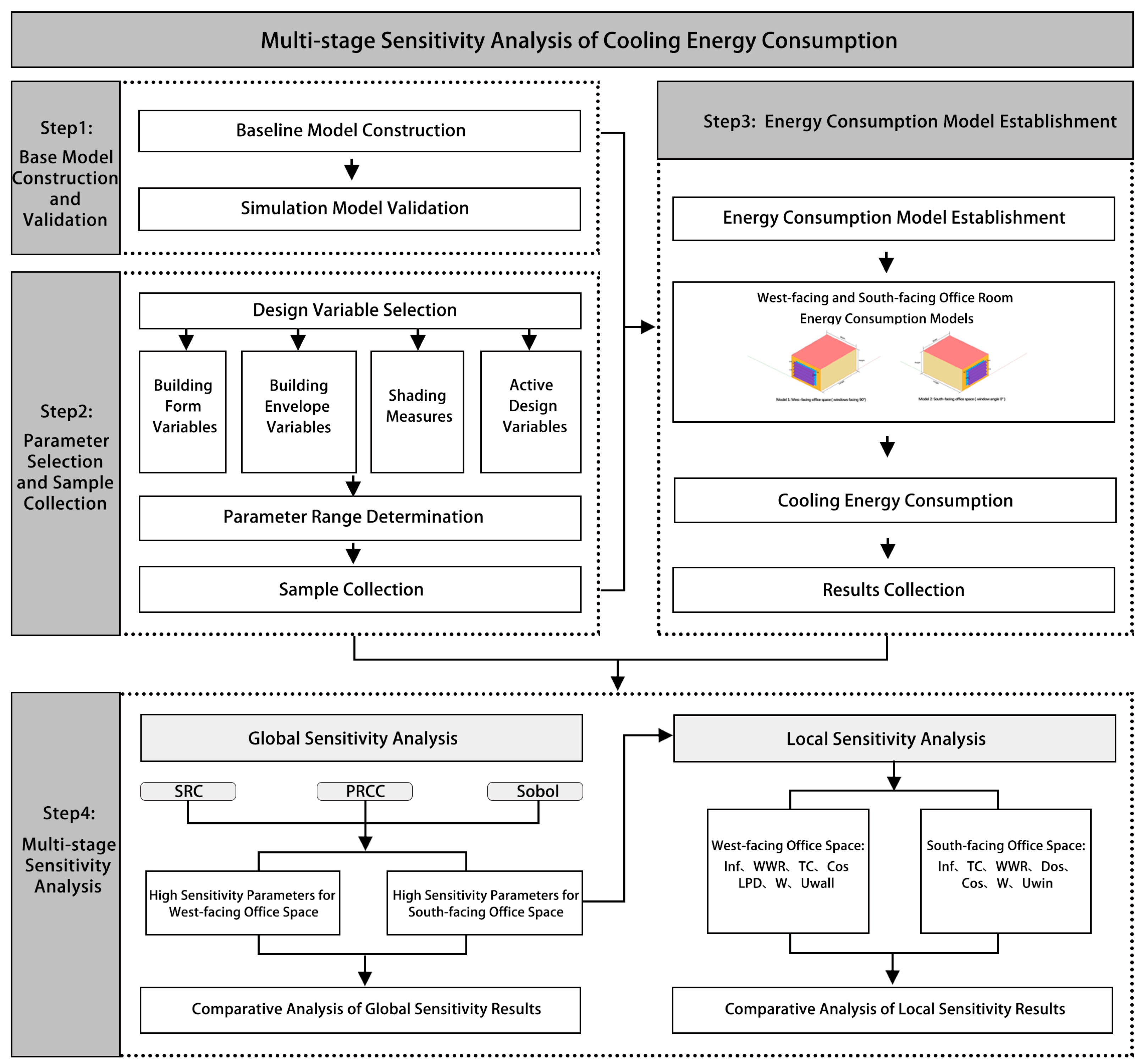
Figure 1. Framework Diagram.
Buildings 15 04545 g001
Figure 2. Test Room and Test Point Information. (a) Test Room Location; (b) Test point location.
Buildings 15 04545 g002
Figure 3. Summer Measured Validation.
Buildings 15 04545 g003
Figure 4. Simulation Models.
Buildings 15 04545 g004
Figure 5. Occupancy Schedule.
Buildings 15 04545 g005
Figure 6. GSA results for west-facing building cooling energy consumption. (a) SRC results. (b) PRCC results. (c) Sobol results.
Buildings 15 04545 g006
Figure 7. GSA results for south-facing building cooling energy consumption. (a) SRC results. (b) PRCC results. (c) PRCC results.
Buildings 15 04545 g007
Figure 8. Comparison of SRC results for cooling energy consumption under west- and south-facing conditions.
Buildings 15 04545 g008
Figure 9. LSA results for the high-sensitivity parameters affecting cooling energy consumption in west-facing office spaces. (a) Inf. (b) WWS. (c) TC. (d) Cos. (e) LPD. (f) W. (g) Uwall.
Buildings 15 04545 g009aBuildings 15 04545 g009b
Figure 10. LSA results of high-sensitivity parameters affecting cooling energy consumption in south-facing office spaces. (a) Inf. (b) TC. (c) Dos. (d) Cos. (e) W. (f) WWS. (g) Uwin.
Buildings 15 04545 g010
Figure 11. Comparative analysis of LSA results under west- and south-facing conditions. (a) Inf. (b) TC. (c) WWR. (d) Cos. (e) W. (f) LPD. (g) Uwall. (h) Dos. (i) Uwin.
Buildings 15 04545 g011aBuildings 15 04545 g011b
Table 1. Construction Materials and Their Properties.
ComponentMaterialThickness (mm)Thermal Conductivity (W/m2 K)Specific Heat (J/kg K)Thermal Resistance (m2·K)/WHeat Transfer Coefficient (W/m2 K)
Exterior WallCement mortar30.9301050.00.0030.486
Aerated concrete block2000.2201158.00.909
Polystyrene board620.0631100.00.984
Cement mortar80.9301050.00.008
Brick101.7402916.00.006
Interior WallCement mortar50.9301074.40.0060.868
Mixed mortar150.9301050.00.017
Aerated concrete block2000.2201158.00.909
RoofCement mortar250.9301050.00.0270.124
C20 fine stone concrete401.510920.00.026
Extruded polystyrene foam plastic board2300.0301380.07.667
Waterproof layer40.1701470.00.024
Cement mortar200.9301050.00.022
Lightweight aggregate concrete300.3001091.00.067
Reinforced concrete1201.740920.00.069
FloorBrick101.740920.00.0064.462
Cement mortar200.9301050.00.022
Reinforced concrete801.740920.00.046
Window6 + 12 + 6 double-glazed hollow glass with a steel frame24---2.800
Table 2. Statistical Indicator Validation Results.
Statistical Indicator Calculated ResultsStandards
2–3 AugustASHRAE Standards
NMBE5.1%<10%
CVRMSE6.4%<30%
Table 3. Parameter Variation Range Input Information.
CategoryParameterSymbolParameter Variation RangeData TypeUnitReference Standard
Building FormBuilding widthW3–10ContinuousmJGJ/T 67-2019 [32]
Building depthD5–10Continuousm[21]
Envelope StructureWindow heat transfer coefficientUwin1.3–3Continuous(W/m2 K)
Window solar heat gain coefficientSHGC0.30–0.9Continuous-DBJ41/T 075-2016 [33]
Window-to-wall ratioWWS0.20–0.8Continuous-GB/T 51350-2019 [34]
Exterior wall heat transfer coefficientUwall0.2–0.5Continuous(W/m2 K)GB 55015-2021 [35]
Shading ElementsShading board widthDos0.1–0.5ContinuousmJGJ/T 67-2019 [21,29,30,32]
Shading board inclination angleAos0, 15, 30, 45Discrete°
Number of shading boardsCos1, 2, 3, 4, 5Discrete-
Distance from the shading board to the windowFo0.1, 0.3, 0.5, 0.7Discretem
Active DesignCooling setpoint temperatureTC24–28Continuous°CGB 50736-2012 [36]
Lighting power densityLPD4–9.5ContinuousW/m2GB 55015-2021
Infiltration rateInf0.25–0.75Continuousac/hGB/T 50034-2024 [37]
Table 4. Parameter importance based on the three GSA methods for west-facing buildings.
ParameterRegressionSobol
SRCPRCCTotal Order
Building width (W)666
Building depth (D)989
Window heat transfer coefficient (Uwin)13913
Window solar heat gain coefficient (SHGC)101010
Window-to-wall ratio (WWS)222
Exterior wall heat transfer coefficient (Uwall)777
Shading board width (Dos)121212
Shading board inclination angle (Aos)8138
Number of shading boards (Cos)444
Distance from shading board to window (Fo)111111
Cooling setpoint temperature (TC)333
Lighting power density (LPD)555
Infiltration rate (Inf)111
Table 5. Parameter importance based on the three GSA methods for south-facing buildings.
ParameterRegressionSobol
SRCPRCCTotal Order
Building width (W)565
Building depth (D)131113
Window heat transfer coefficient (Uwin)747
Window solar heat gain coefficient (SHGC)101010
Window-to-wall ratio (WWS)676
Exterior wall heat transfer coefficient (Uwall)888
Shading board width (Dos)333
Shading board inclination angle (Aos)111311
Number of shading boards (Cos)454
Distance from shading board to window (Fo)9129
Cooling setpoint temperature (TC)222
Lighting power density (LPD)12912
Infiltration rate (Inf)111
Table 6. Comparison of GSA-derived high-sensitivity parameters between west- and south-facing office space.
SortWest-Facing Office SpaceSouth-Facing Office Space
High-Sensitivity Parameters1Infiltration rate (Inf)Infiltration rate (Inf)
2Window-to-wall ratio (WWS)Cooling setpoint temperature (TC)
3Cooling setpoint temperature (TC)Shading board width (Dos)
4Number of shading boards (Cos)Number of shading boards (Cos)
5Lighting power density (LPD)Building width (W)
6Building width (W)Window-to-wall ratio (WWS)
7Exterior wall heat transfer coefficient (Uwall)Window heat transfer coefficient (Uwin)
8Shading board inclination angle (Aos)Exterior wall heat transfer coefficient (Uwall)
9Building depth (D)Distance from shading board to window (Fo)
10Window solar heat gain coefficient (SHGC)Window solar heat gain coefficient (SHGC)
11Distance from shading board to window (Fo)Shading board inclination angle (Aos)
12Shading board width (Dos)Lighting power density (LPD)
13Window heat transfer coefficient (Uwin)Building depth (D)
Disclaimer/Publisher’s Note: The statements, opinions and data contained in all publications are solely those of the individual author(s) and contributor(s) and not of MDPI and/or the editor(s). MDPI and/or the editor(s) disclaim responsibility for any injury to people or property resulting from any ideas, methods, instructions or products referred to in the content.