


Disaster-Adaptive Resilience Evaluation of Traditional Settlements Using Ant Colony Bionics: Fenghuang Ancient Town, Shaanxi, China


Abstract
1. Introduction
2. Literature Review
2.1. Disaster-Adaptive Resilience
2.2. Ant Colony Bionics
3. Methodology
3.1. Construction of the Ant Colony Bionic Resilience Evaluation Model
3.2. Identification of Resilience Indicators
3.3. Quantification of Resilience Indicators
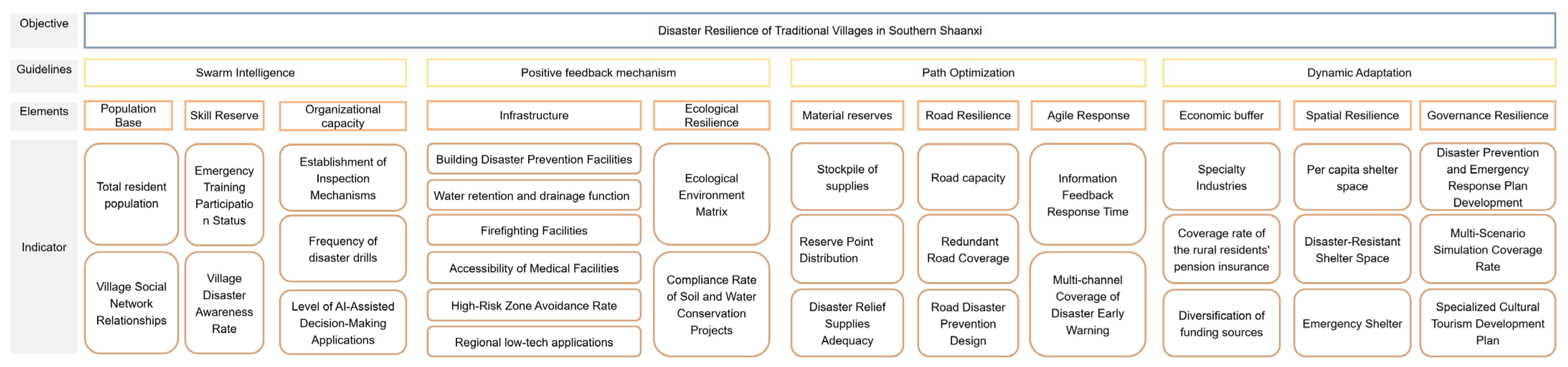
3.4. Establishment of Evaluation Index System
4. Case Study
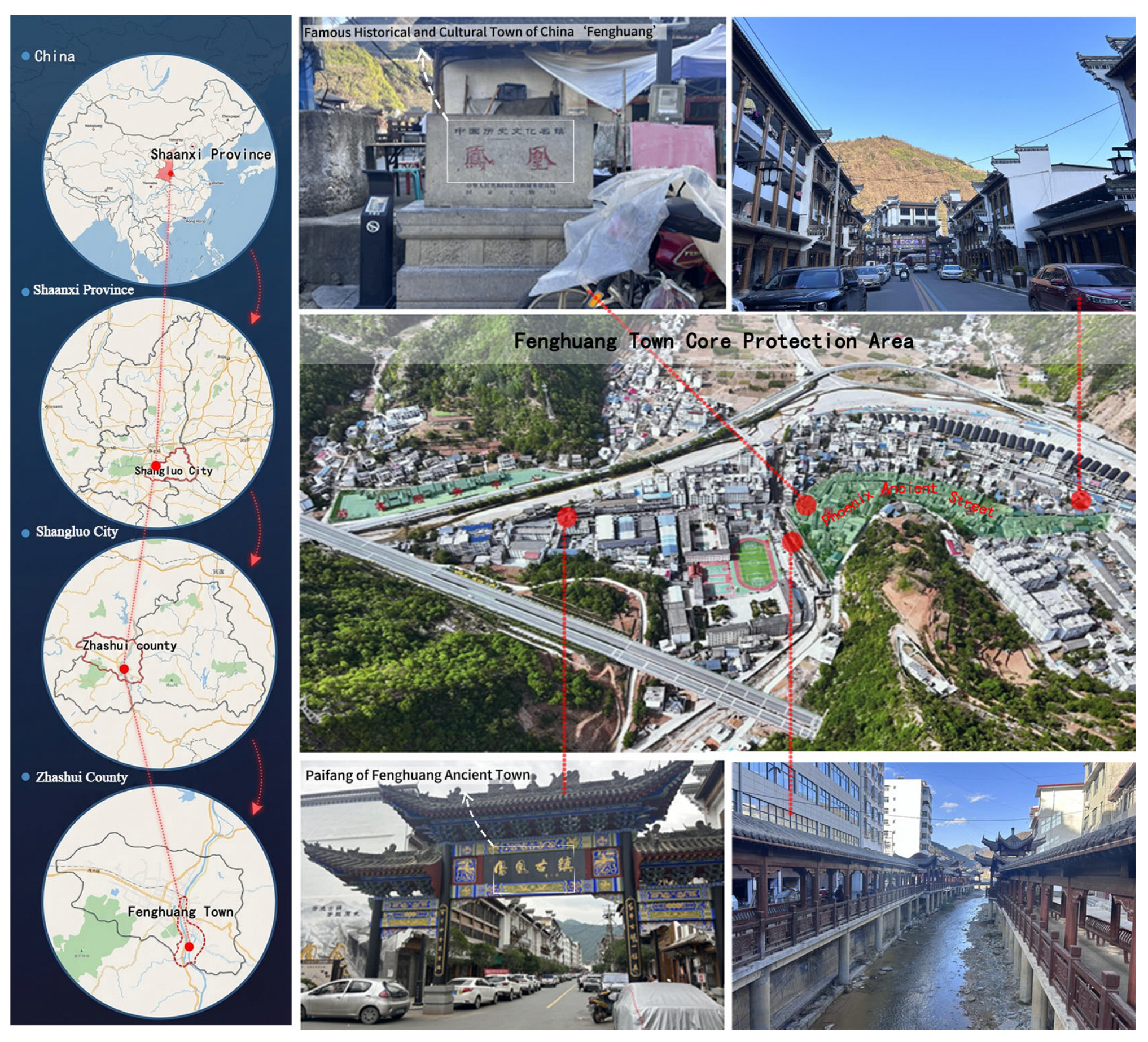
4.1. Study Area
4.2. Date Source
4.3. Resilience Evaluation Results of Fenghuang Ancient Town
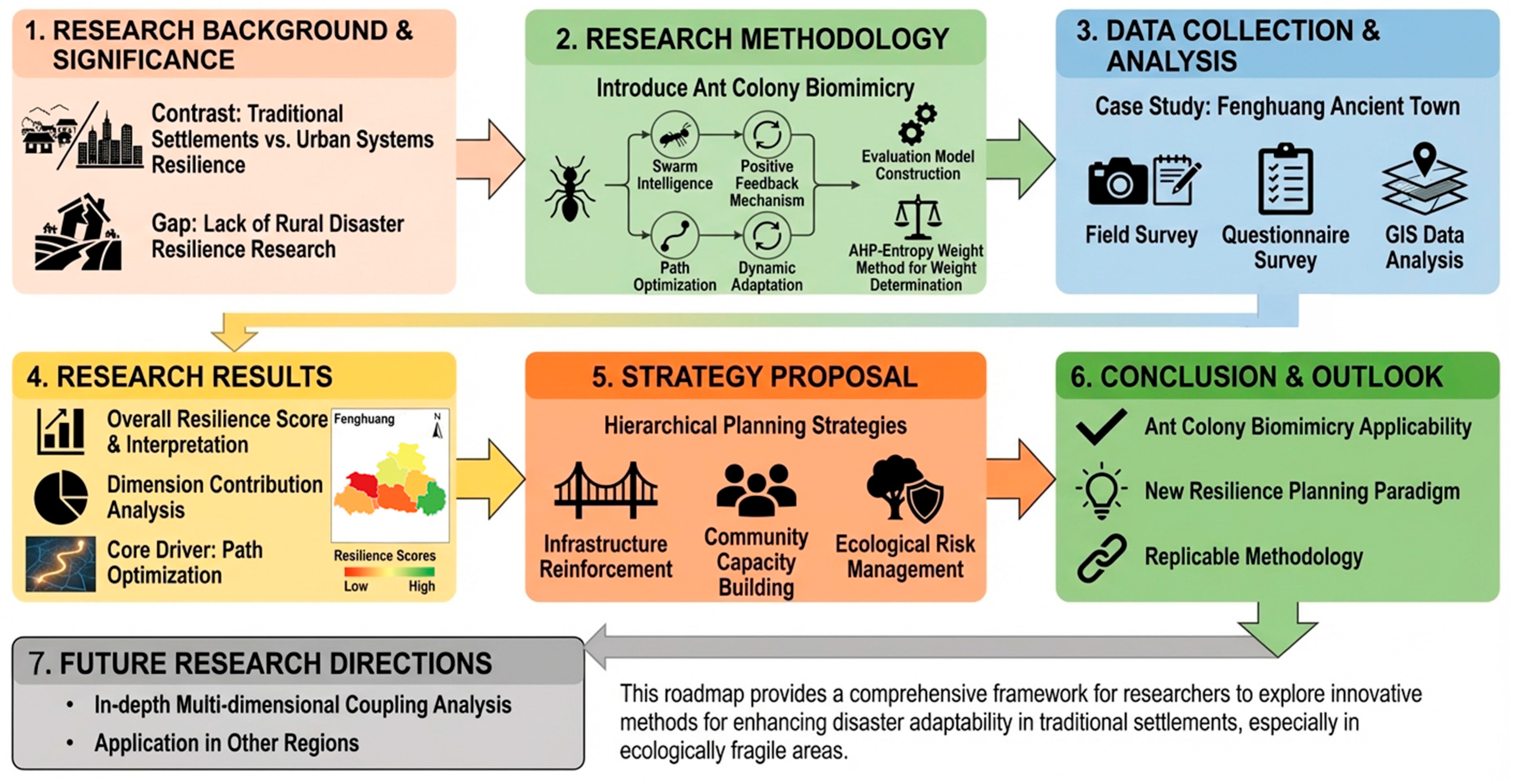
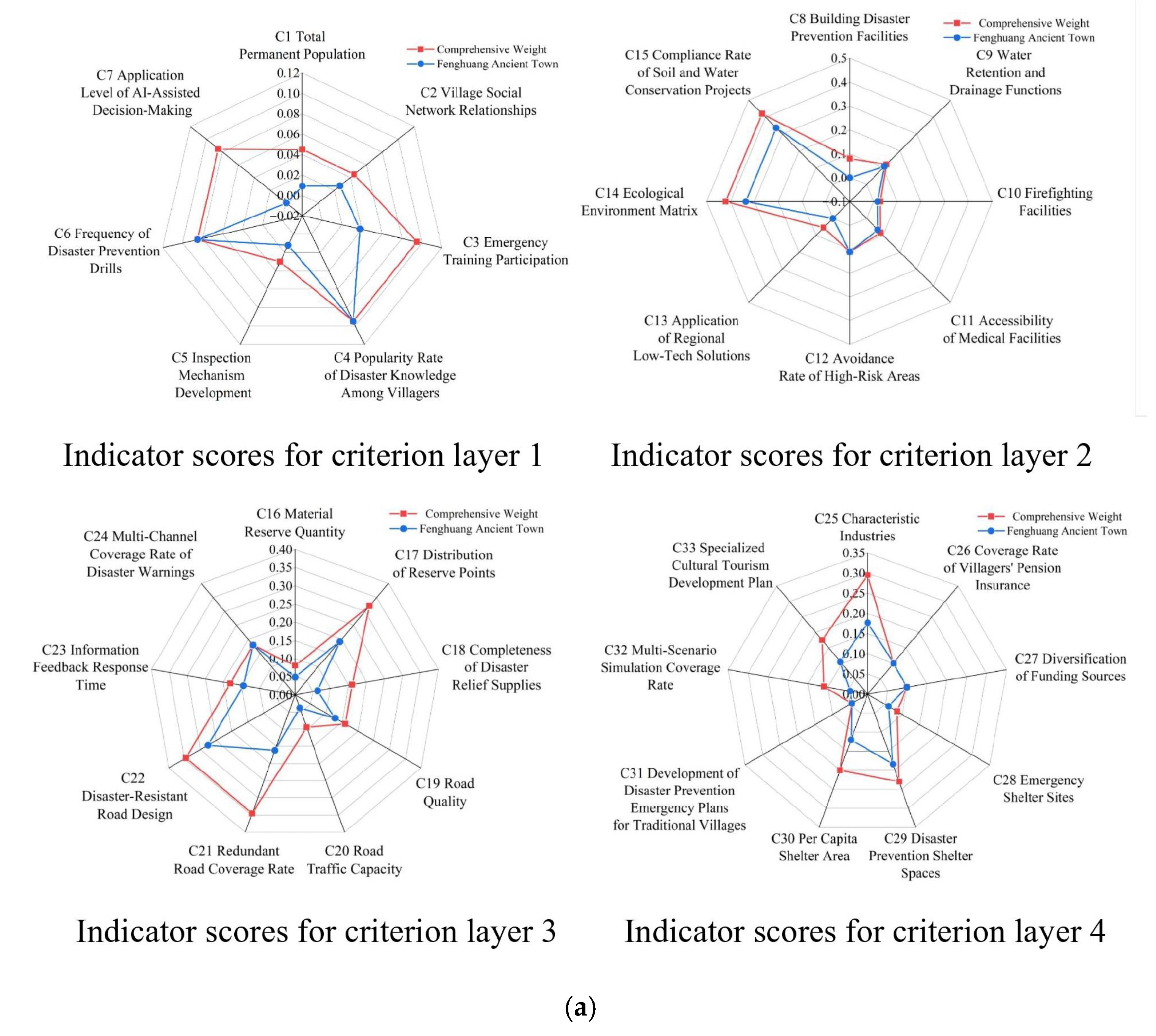
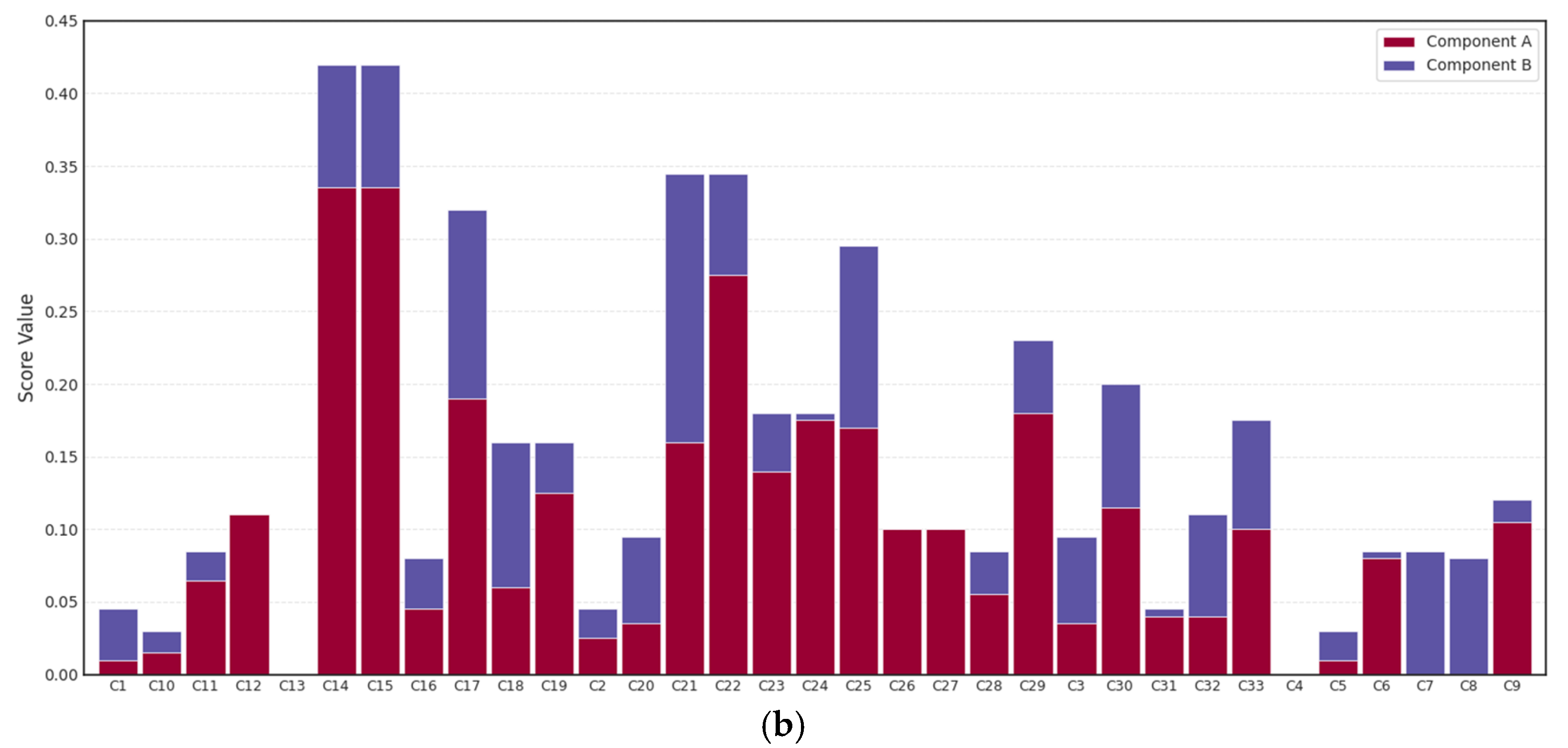
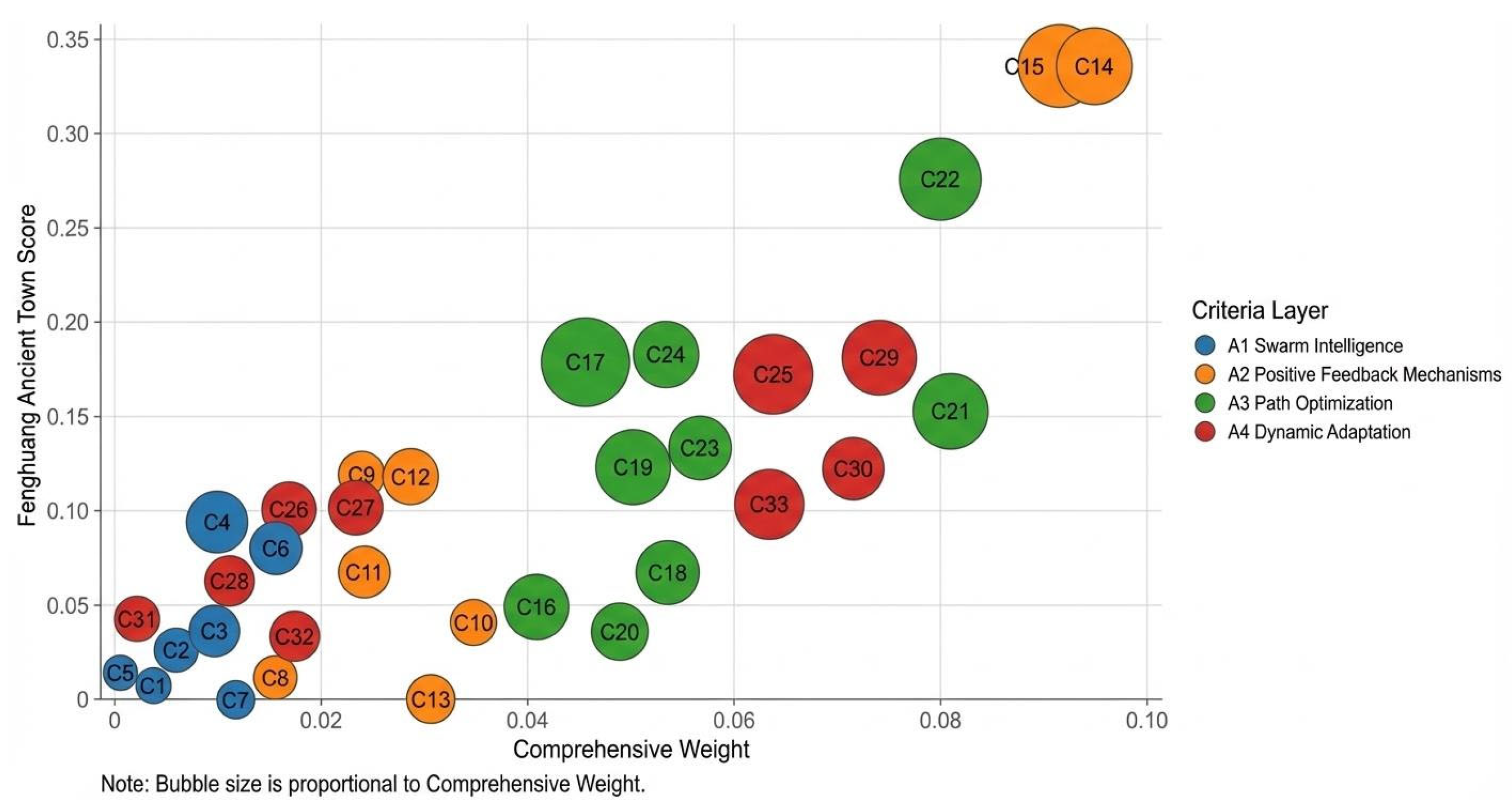
- Comprehensive evaluation results at the criterion level: The scores and contributions of the four bionic dimensions are uneven. The path optimization (A3) dimension has the highest contribution, the positive feedback mechanism (A2) and dynamic adaptation (A4) dimensions have the middle scores, and the group intelligence (A1) dimension has the lowest scores, indicating that the ancient town is weakest in the “human” dimensions, such as community organization, knowledge dissemination, technology application, and intelligent decision-making. These are the key dimensions that lower the overall resilience score. This indicates that the ancient town is weakest in the “human” dimension of community organization, knowledge popularization, technology application, and intelligent decision-making, which is the key dimension that lowers the overall resilience score.
- Analysis of specific results at the indicator level: Strong drivers such as C12 High-Risk Zone Avoidance, C24 Multichannel Early Warning Coverage, and C4 Disaster Knowledge Popularization reflect the traditional disaster-avoidance wisdom accumulated through long-term adaptation. C26 Pension Insurance Coverage Rate and C27 Diversification of Funding Sources showing that social security infrastructure acts as stabilizer of resilience. The major shortcomings include C7 AI-Assisted Decision-Making Application Level, which shows that the emergency management remains traditional, lacking intelligent technologies and routine training. C8 Building Disaster Prevention Facilities scores the lowest score, confirming that the vulnerability of Ming-Qing Dynasty wooden buildings is the main safety hazard. Although path optimization has the highest overall score, key indicators within it, such as C21 Redundant Road Coverage and C20 Road Capacity, remain low, revealing uneven internal performance. C29 Disaster-Prevention and Evacuation Space is limited because the designated school site is not open daily. This institutional constraint reduces the effectiveness of high-quality evacuation resources and prevents full scoring.
4.4. Model Validation and Feedback Analysis
5. Discussion
5.1. Interpretation of Results
- Path Optimization Dominance: Modern Embodiment of Traditional Spatial Wisdom
- 2.
- Weak Swarm Intelligence: Dual Lag in Community Organization and Technology Application
- 3.
- Dilemmas of Positive Feedback Mechanism and Dynamic Adaptation: Imbalance between Static Protection and Dynamic Demand
5.2. Strategies for Enhancing Resilience
- Activate Swarm Intelligence, Build a Community Self-Organization Network Guided by “Pheromones”
- 2.
- Strengthen Positive Feedback Mechanism: Implement Structural Reinforcement and Ecological Regulation Mimicking “Ant Nests”
- 3.
- Optimize Path System: Create a Redundant and Efficient “Ant Path” Transport Network
- 4.
- Enhance dynamic adaptability: Develop resilient management policies that integrate peacetime and disaster preparedness.
6. Conclusions
6.1. Research Summary
- (1)
- Theoretical Innovation and Empirical Value of the Bionic Disaster-Adaptive Resilience Evaluation System
- (2)
- Resilience Enhancement Strategies for Traditional Settlements Based on Bionic Principles
6.2. Prospects
Author Contributions
Funding
Data Availability Statement
Acknowledgments
Conflicts of Interest
Appendix A

| Criterion Layer | Indicator Definition | Data Type |
|---|---|---|
| C1 Total Resident Population | The actual resident population size of a village reflects its human resource base. An excessively small population limits the availability of personnel for emergency response, while an excessively large population intensifies pressure on resources. | Socio-economic Data |
| C2 Village Social Network Relationships | The strength of mutual aid networks formed by clan blood ties. Traditional social capital determines the efficiency of spontaneous rescue efforts during disasters (e.g., neighborhood mutual aid). | Questionnaire Survey Data |
| C3 Emergency Training Participation Status | Proportion of villagers who have participated in disaster preparedness training. Measuring the level of specialization of emergency manpower reserves at the grassroots level | Questionnaire Survey Data |
| C4 Village Disaster Awareness Rate | Percentage of villagers with knowledge of local disaster characteristics, escape routes, and first aid skills. Directly related to the ability to save themselves and each other in times of disaster. | Questionnaire Survey Data |
| C5 Establishment of Inspection Mechanisms | Institutionalized action to regularly identify potential safety hazards. Achieve dynamic prevention and control of early identification and early warning of risks. | Semi-structured interview data |
| C6 Frequency of Disaster Drills | Frequency of organizing emergency drills or public education. To test the feasibility of the plans and to strengthen the population’s awareness of the crisis. | Planning and Management Data |
| C7 AI Level of AI-Assisted Decision-Making Applications | Utilizing technological means to predict disasters and empowering accurate research and judgment of high-risk scenarios. | Semi-structured interview data |
| C8 Building Disaster Prevention Facilities | The extent to which the building complies with the National Seismic Fire Code. Reduced physical vulnerability of disaster-bearing bodies and reduced risk of secondary hazards. | Infrastructure and Facility Data |
| C9 Water Retention and Drainage Function | Ability to manage stormwater flooding using natural topography and engineered facilities | Geospatial data |
| C10 Firefighting Facilities | Key ecological projects to mitigate flooding risks. | Infrastructure and Facility Data |
| C11 Accessibility of Medical Facilities | Degree of completeness of fire escapes, water sources, and equipment. Hardware to contain the spread of fire. | Infrastructure and Facility Data |
| C12 High-Risk Zone Avoidance Rate | Proportion of settlements and farmland away from landslide or flash flood high risk areas. Direct means of spatial planning to avoid primary hazards | Geospatial data |
| C13 Regional Low-Tech Applications | Proportion of settlements and farmland away from areas at high risk of landslides or flash floods. Direct means of spatial planning to avoid primary hazards. | Questionnaire Survey Data |
| C14 Ecological Environment Matrix | Construction/renovation of farmhouses using traditional materials and techniques. Utilizing the low-cost disaster mitigation value of Indigenous Knowledge. | Geospatial data |
| C15 Compliance Rate of Soil and Water Conservation Projects | Soil and water conservation capacity and pollution prevention and control levels. Stabilization of ecosystems is a natural barrier to disaster mitigation, e.g., vegetative soil stabilization reduces landslides. | Geospatial data |
| C16 Stockpile of Supplies | Quality pass rate of projects such as levees, reservoirs and sluices. Artificial intervention strengthens the natural system’s ability to resist disasters. | Socio-economic Data |
| C17 Reserve Point Distribution | Number of days to stockpile supplies to meet basic survival needs after a disaster. Life support capacity to support the golden rescue period. | Semi-structured interview data |
| C18 Disaster Relief Supplies Adequacy | Degree of path efficiency optimization for material point layout. Resource allocation optimization through Ant Colony Algorithm (ACO) simulation. | Planning and Management Data |
| C19 Road Quality | Material types cover six categories and are managed in a standardized manner. It guarantees the effectiveness of material scheduling and avoids material disorganization and failure. | Planning and Management Data |
| C20 Road Capacity | Pavement structural integrity and functional service level. Affects the reliability of passage and rescue speed in times of disaster. | Semi-structured interview data |
| C21 Redundant Road Coverage | Ratio of actual roadway traffic to theoretical carrying capacity. Quantifying Traffic Load States. | Geospatial data |
| C22 Road Disaster Prevention Design | Proportion of alternative roads that can be used as alternative routes to trunk roads | Infrastructure and Facility Data |
| C23 Information Feedback Response Time | Significance: Improvement of the robustness of the road network and guarantee of connectivity in case of disruption at critical nodes. | Semi-structured interview data |
| C24 Multi-Channel Coverage of Disaster Early Warning | Design criteria for bridges/roadbeds to resist flood impacts. Engineering and technical measures to prevent disruption of transportation lifelines due to disasters. | Infrastructure and Facility Data |
| C25 Specialty Industries | Speed of villagers’ feedback on disaster warnings. Shorten the “warning-action” delay and improve response efficiency. | Planning and Management Data |
| C26 Coverage Rate of the Rural Residents’ Pension Insurance | Proportion of villagers reached through electronic versus traditional channels. Solve the problem of “last-mile” access to information. | Socio-economic Data |
| C27 Diversification of Funding Sources | Extent of diversification of farm household income sources. Economic diversity increases resilience to post-disaster recovery and avoids the collapse of a single industry. | Socio-economic Data |
| C28 Emergency Shelter | Percentage of villagers participating in social pension insurance. Social security reduces the risk of returning to poverty due to disasters. | Infrastructure and Facility Data |
| C29 Disaster-Resistant Shelter Space | Proportion of non-government funds involved in disaster prevention inputs. Sustainable development mechanisms for breaking financial constraints. | Geospatial data |
| C30 Per Capita Shelter Space | Temporary settlement space that meets safety norms. Reduce the number of affected people exposed to hazardous environments (e.g., avoid landslide areas, secure evacuation routes). | Infrastructure and Facility Data |
| C31 Disaster Prevention and Emergency Response Plan Development | GIS-based calculation of service coverage for places of refuge. Spatial accessibility equity guarantee (500m emergency/800m fixed refuge circle). | Planning and Management Data |
| C32 Multi-Scenario Simulation Coverage Rate | Match the size of the evacuation space with the evacuated population. Avoid secondary risks (stampedes/epidemics) caused by overcrowding in evacuation spaces. | Semi-structured interview data |
| C33 Specialized Cultural Tourism Development Plan | A democratically negotiated disaster response program. Translating village consensus into institutional resilience. | Planning and Management Data |
References
- Wang, Q.; Zhang, P.; Niu, Z.; Freymueller, J.T.; Lai, X.; Li, Y.; Zhu, W.; Liu, J.; Bilham, R.; Larson, K.M. Present-day crustal movement and tectonic deformation in China continent. Sci. China Ser. D-Earth Sci. 2002, 45, 865–874. [Google Scholar] [CrossRef]
- Pu, J. Promoting the integration of traditional villages into the construction of the symbolic system of Chinese civilization. People’s Trib. 2025, 2025, 52–56. [Google Scholar] [CrossRef]
- McManus, P.; Walmsley, J.; Argent, N.; Baum, S.; Bourke, L.; Martin, J.; Pritchard, B.; Sorensen, T. Rural Community and Rural Resilience: What is important to farmers in keeping their country towns alive? J. Rural Stud. 2012, 28, 20–29. [Google Scholar] [CrossRef]
- Huo, L. Accelerating the construction of harmonious and beautiful villages to vigorously promote rural revitalization. Mod. Rural Technol. 2025, 2025, 108+118. [Google Scholar] [CrossRef]
- Leichenko, B. Climate change and urban resilience. Curr. Opin. Environ. Sustain. 2011, 3, 164–168. [Google Scholar] [CrossRef]
- Allen, C.R.; Birge, H.E.; Bartelt-Hunt, S.; Bevans, R.A.; Burnett, J.L.; Cosens, B.A.; Cai, X.; Garmestani, A.S.; Linkov, I.; Scott, E.A.; et al. Avoiding decline: Fostering resilience and sustainability in midsize cities. Sustainability 2016, 8, 844. [Google Scholar] [CrossRef]
- Heijman, W.; Hagelaar, G.; van der Heide, M. Rural resilience as a new development concept. In EU Bioeconomy Economics and Policies: Volume II; Dries, L., Heijman, W., Jongeneel, R., Purnhagen, K., Wesseler, J., Eds.; Palgrave Macmillan: Cham, Germany, 2019; pp. 195–211. [Google Scholar] [CrossRef]
- Ge, Y.; Xu, Z. On the theory of Holland’s CAS—A new view of study on complex systems. Chin. J. Syst. Sci. 2002, 10, 65–67+75. [Google Scholar] [CrossRef]
- Chen, Z.; Ji, Y.; Zhou, H.; Chen, W. A study on the evolution and adaptation of traditional Chinese villages based on complex adaptative system (CAS). Archit. J. 2014, 11, 57–63. [Google Scholar]
- Jansen, G.L.J. Resilience of Rural Scottish Communities: Community Strengths in a Complex Adaptive Systems Framework. Master’s Thesis, Utrecht University, Utrecht, The Netherlands, 2020. [Google Scholar]
- Liu, M.; Wang, L.; Tian, B. A comparative analysis of the research development and hotspots of urban and rural resilience in China based on CiteSpace knowledge graph mapping. Chin. Overseas Archit. 2025, 2025, 43–48. [Google Scholar] [CrossRef]
- Cui, Y.; Zhai, B.; Villa, D. Resilience analysis of rural settlement morphology from a bionic perspective: A case study of southern Shaanxi, China. Land 2025, 14, 2154. [Google Scholar] [CrossRef]
- Fang, S. Introduction to bionics. Prog. Biochem. Biophys. 1977, 1977, 48–49+2. [Google Scholar]
- Dorigo, M.; Blum, C. Ant colony optimization theory: A survey. Theor. Comput. Sci. 2005, 344, 243–278. [Google Scholar] [CrossRef]
- Hani, Y.; Amodeo, L.; Yalaoui, F.; Chen, H. Ant colony optimization for solving an industrial layout problem. Eur. J. Oper. Res. 2007, 183, 633–642. [Google Scholar] [CrossRef]
- Colorni, A.; Dorigo, M.; Maniezzo, V. Distributed optimization by ant colonies. In Proceedings of the European Conference on Artificial Life (ECAL), Paris, France, 11–13 December 1991; pp. 134–142. [Google Scholar]
- Hfeda, M. Supply Chain Management Optimization Using Meta-Heuristics Approaches Applied to a Case in the Automobile Industry. Master’s Thesis, École de Technologie Supérieure, Montreal, QC, Canada, 2018. [Google Scholar]
- Berkes, F.; Folke, C.; Colding, J. (Eds.) Linking Social and Ecological Systems: Management Practices and Social Mechanisms for Building Resilience; Cambridge University Press: Cambridge, UK, 2000. [Google Scholar]
- Bruneau, M.; Chang, S.E.; Eguchi, R.T.; Lee, G.C.; O’Rourke, T.D.; Reinhorn, A.M.; Shinozuka, M.; Tierney, K.; Wallace, W.A.; von Winterfeldt, D. A framework to quantitatively assess and enhance the seismic resilience of communities. Earthq. Spectra 2003, 19, 733–752. [Google Scholar] [CrossRef]
- Coetzee, C. Towards a Complex Adaptive Systems Paradigm of Disaster Resilience: A Study of Southern African Subsistence Agriculture Communities. PhD Thesis, North-West University, Kirkland, WA, USA, 2016. [Google Scholar]
- Yang, L.; Jiang, X.; Zhang, J. A review on community resilience to natural disaster. J. Catastrophol. 2019, 34, 159–164. [Google Scholar] [CrossRef]
- Cutter, S.L.; Derakhshan, S. Implementing disaster policy: Exploring scale and measurement schemes for disaster resilience. J. Homeland Secur. Emerg. Manag. 2019, 16, 20180029. [Google Scholar] [CrossRef]
- Zhong, M.; Xiao, L.; Zhang, Q.; Wen, J. Influencing factors and quantitative analysis of community resilience to flash floods. Prog. Geogr. 2022, 41, 423–436. [Google Scholar] [CrossRef]
- Wu, W. Research on resilient township construction in southwest ethnic minority areas based on multi-hazard governance. J. China Emerg. Manage. Sci. 2023, 2023, 50–61. [Google Scholar]
- Sung, C.-H.; Liaw, S.-C. A GIS approach to analyzing the spatial pattern of Baseline Resilience Indicators for Community (BRIC). Water 2020, 12, 1401. [Google Scholar] [CrossRef]
- Li, S.; Chen, Y.; Li, Y. Ant Colony Algorithms with Applications; Harbin Institute of Technology Press: Harbin, China, 2004. [Google Scholar]
- Li, W.; Xu, L.; Yang, L.; Liu, W.; Pan, K.; Li, C. Multi field path planning method and experiment of agricultural robot based on improved ant colony algorithm. J. Nanjing Agric. Univ. 2024, 47, 823–834. [Google Scholar] [CrossRef]
- Li, T. The application of improved ant colony algorithm in rural garbage treatment. Hubei Agric. Sci. 2024, 63, 255–259. [Google Scholar] [CrossRef]
- Shen, W.; Fei, J. Optimization of rural express delivery routes based on cyclic pickup and delivery. Shanxi Agric. Econ. 2024, 2024, 9–12+38. [Google Scholar] [CrossRef]
- Gao, X. Optimizing Land Use Allocation Based on Multi-Objective ant Colony Algorithm. Ph.D. Thesis, Wuhan University, Wuhan, China, 2010. [Google Scholar]
- Geng, S.; Hou, H. Optimization of emergency evacuation network based on hybrid decision-making method. J. Ind. Eng. Eng. Manag. 2025, 39, 130–143. [Google Scholar] [CrossRef]
- Dorigo, M.; Birattari, M.; Stutzle, T. Ant colony optimization. IEEE Comput. Intell. Mag. 2006, 1, 28–39. [Google Scholar] [CrossRef]
- Mohan, B.C.; Baskaran, R. A survey: Ant Colony Optimization based recent research and implementation on several engineering domain. Expert Syst. Appl. 2012, 39, 4618–4627. [Google Scholar] [CrossRef]
- Zhang, H.; Sun, J.; Yang, B.; Shi, Y.; Li, Z. Optimal search and rescue route design using an improved ant colony optimization. Inf. Technol. Control 2020, 49, 438–447. [Google Scholar] [CrossRef]
- Zhang, X.; Chen, S.; Cao, Q.; Ren, X. Optimization of emergency supplies paths based on dynamic real-time split deliver. Int. J. Ind. Eng. Comput. 2023, 14, 623–644. [Google Scholar] [CrossRef]
- Xia, Y.; Huang, X.; Kang, C.; Xu, X. Spatial differentiation of accessibility characteristics and influencing factors of traditional villages in Shaanxi Province. J. Northwest Univ. (Nat. Sci. Ed.) 2024, 54, 288–299. [Google Scholar] [CrossRef]
- Du, S. Research on the Location Selection of Urban Emergency Shelters Based on Ant Colony Algorithm. Master’s Thesis, Shanghai Normal University, Shanghai, China, 2018. [Google Scholar] [CrossRef]
- He, Z. The Research of Public Emergency Response System Information Transmission Model. Master’s Thesis, Xi’an University of Architecture and Technology, Xi’an, China, 2010. [Google Scholar]
- Kodaka, A.; Kawasaki, A. An empirical study on visualization of efficiency of disaster warnings to citizens—A social experiment of warning dissemination by loudspeakers and SMS at rural mountainous areas in Thailand. Theory Appl. GIS 2016, 24, 125–135. [Google Scholar] [CrossRef]
- Nicolis, S.C.; Zabzina, N.; Latty, T.; Sumpter, D.J. Collective irrationality and positive feedback. PLoS ONE 2011, 6, e18901. [Google Scholar] [CrossRef]
- Elgezabal, O.; Mirchuk, K.; Singer-Coudoux, K.; Kretschmer, M. Organisational competencies: The essence of emerging resilience. In Proceedings of the 19th European Conference on Management Leadership and Governance, London, UK, 23–24 November 2023; pp. 125–135. [Google Scholar] [CrossRef]
- Jiang, L.; Pei, Y.; Zhao, J. Cloud task assignment strategy based on ant colony optimization algorithm. Comput. Appl. Softw. 2021, 38, 284–287+305. [Google Scholar] [CrossRef]
- Hu, W.; Rui, G. Complexity-oriented compound governance: A possible path of resilience construction in digital countryside. J. Hunan Agric. Univ. (Soc. Sci.) 2023, 24, 64–73. [Google Scholar] [CrossRef]
- ISO 37120:2018(E); International Standard. Sustainable Cities and Communities—Indicators for City Services and Quality of Life. International Organization for Standardization: Geneva, Switzerland, 2018.
- Kim, B.; Lee, G.-S.; Kim, M.; Lee, W.-S.; Choi, H.-S. Developing and applying an urban resilience index for the evaluation of declining areas: A case study of South Korea’s urban regeneration sites. Int. J. Environ. Res. Public Health 2023, 20, 3653. [Google Scholar] [CrossRef]
- Yang, M.; Jiao, M.; Zhang, J. Spatio-temporal analysis and influencing factors of rural resilience from the perspective of sustainable rural development. Int. J. Environ. Res. Public Health 2022, 19, 12294. [Google Scholar] [CrossRef]
- Zhu, X.; Wei, G. Discussion on excellence criteria for dimensionless methods in entropy weight method. Stat. Decis. 2015, 2015, 12–15. [Google Scholar] [CrossRef]
- Guo, J.; Zhang, Z.; Sun, Q. Study and applications of analytic hierarchy process. China Saf. Sci. J. 2008, 18, 148–153. [Google Scholar] [CrossRef]
- Luo, Z.; Wang, T.; Zhou, H. A discuss on the indirect method of a judgement matrix in analytic hierarchy process. Syste. Eng. 1993, 11, 34–41. [Google Scholar]
- Gong, Y. Phoenix Town, Zhashui County, Shaanxi—Research on historical streets by the national center for historical and cultural cities. City Plann. Rev. 2012, 36, 97–98. [Google Scholar]
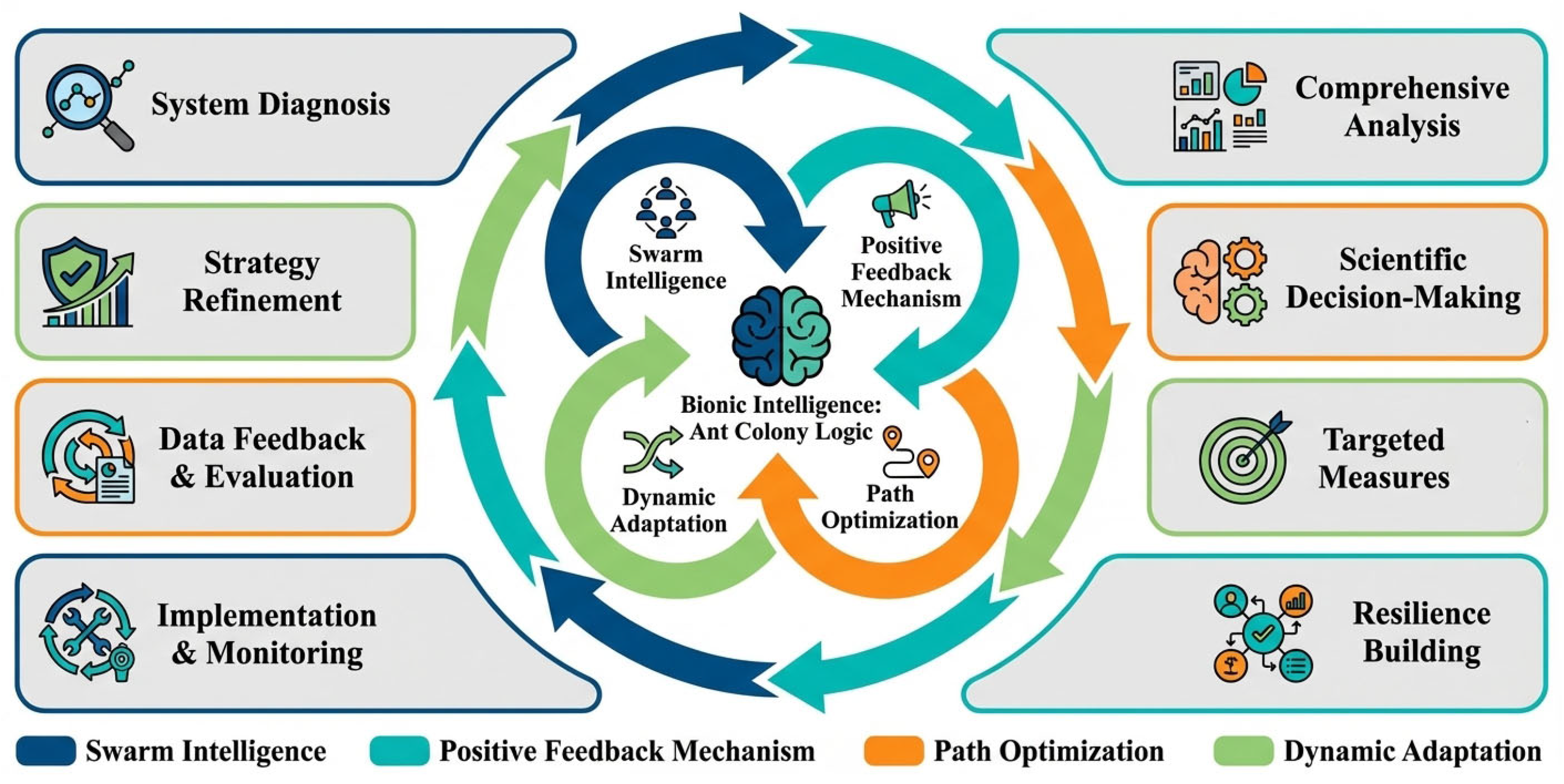
| Ant Colony Behavior | Core Concept | Settlement Correspondence | Academic Support |
|---|---|---|---|
| Shortest Path | Path Optimization | Road Resilience | ACO: [27,34]; Resilience: [35,36] |
| Information Transfer | Positive Feedback Mechanism | Infrastructure, Ecological Base | ACO: [37]; Resilience: [38,39] |
| Distributed Decision-Making | Collective Intelligence | Community Collaboration | ACO: [40]; Resilience: [41] |
| Iteration Frequency | Dynamic Adaptation | Flexible Adjustment | ACO: [42]; Resilience: [43] |
| Matrix Order | 1 | 2 | 3 | 4 | 5 | 6 | 7 | 8 | 9 | 10 | 11 | 12 |
|---|---|---|---|---|---|---|---|---|---|---|---|---|
| RI | 0 | 0 | 0.52 | 0.89 | 1.12 | 1.26 | 1.36 | 1.41 | 1.46 | 1.49 | 1.52 | 1.54 |
| Criterion Layer | Weight | Element Layer | Weight | Indicator Layer | Comprehensive Weight |
|---|---|---|---|---|---|
| Swarm Intelligence A1 | 0.573 | Population Base B1 | 0.018 | C1 Total Resident Population | 0.009 |
| C2 Village Social Network Relationships | 0.009 | ||||
| Skill Reserve B2 | 0.039 | C3 Emergency Training Participation Status | 0.019 | ||
| C4 Village Disaster Awareness Rate | 0.019 | ||||
| Organizational capacity B3 | 0.039 | C5 Establishment of Inspection Mechanisms | 0.006 | ||
| C6 Frequency of Disaster Drills | 0.017 | ||||
| C7 AI Level of AI-Assisted Decision-Making Applications | 0.017 | ||||
| Positive Feedback Mechanism A2 | 17.819 | Infrastructure B4 | 0.096 | C8 Building Disaster Prevention Facilities | 0.016 |
| C9 Water Retention and Drainage Function | 0.024 | ||||
| C10 Firefighting Facilities | 0.006 | ||||
| C11 Accessibility of Medical Facilities | 0.017 | ||||
| C12 High-Risk Zone Avoidance Rate | 0.022 | ||||
| C13 Regional Low-Tech Applications | 0.011 | ||||
| Ecological Resilience B5 | 0.167 | C14 Ecological Environment Matrix | 0.084 | ||
| C15 Compliance Rate of Soil and Water Conservation Projects | 0.084 | ||||
| Path Optimization A3 | 18.955 | Material reserves B6 | 0.111 | C16 Stockpile of Supplies | 0.016 |
| C17 Reserve Point Distribution | 0.064 | ||||
| C18 Disaster Relief Supplies Adequacy | 0.032 | ||||
| Road Resilience B7 | 0.189 | C19 Road Quality | 0.032 | ||
| C20 Road Capacity | 0.019 | ||||
| C21 Redundant Road Coverage | 0.069 | ||||
| C22 Road Disaster Prevention Design | 0.069 | ||||
| Agile Response B8 | 0.073 | C23 Information Feedback Response Time | 0.036 | ||
| C24 Multi-channel Coverage of Disaster Early Warning | 0.036 | ||||
| Dynamic Adaptation A4 | 5.95 | Economic buffer B9 | 0.099 | C25 Specialty Industries | 0.059 |
| C26 Coverage Rate of the Rural Residents’ Pension Insurance | 0.020 | ||||
| C27 Diversification of Funding Sources | 0.020 | ||||
| Spatial Resilience B10 | 0.103 | C28 Emergency Shelter | 0.017 | ||
| C29 Disaster-Resistant Shelter Space | 0.046 | ||||
| C30 Per Capita Shelter Space | 0.040 | ||||
| Governance Resilience B11 | 0.066 | C31 Disaster Prevention and Emergency Response Plan Development | 0.009 | ||
| C32 Multi-Scenario Simulation Coverage Rate | 0.022 | ||||
| C33 Specialized Cultural Tourism Development Plan | 0.035 |
| Criterion Layer | Criterion Layer | Criterion Layer | Data Sources | Fenghuang Ancient Town Score |
|---|---|---|---|---|
| Swarm Intelligence A1 | Population Base B1 | C1 Total Resident Population | ONS county-level population data | 0.009 |
| C2 Village Social Network Relationships | Field survey questionnaires and qualitative interviews (this study) | 0.027 | ||
| Skill Reserve B2 | C3 Emergency Training Participation Status | Annual training records from County Emergency Management Bureau | 0.038 | |
| C4 Village Disaster Awareness Rate | Questionnaire survey results (this study) | 0.095 | ||
| Organizational Capacity B3 | C5 Establishment of Inspection Mechanisms | County government emergency management work report | 0.012 | |
| C6 Frequency of Disaster Drills | Annual drill schedule from County Emergency Management Bureau | 0.085 | ||
| C7 AI Level of AI-Assisted Decision-Making Applications | Technology adoption reports from relevant science and technology departments | 0.000 | ||
| Positive Feedback Mechanism A2 | Infrastructure B4 | C8 Building Disaster Prevention Facilities | Construction Bureau statistics or on-site inspection reports | 0.000 |
| C9 Water Retention and Drainage Function | Functional evaluation report from the Water Resources Bureau | 0.108 | ||
| C10 Firefighting Facilities | Facility distribution statistics from County Fire and Rescue Department | 0.018 | ||
| C11 Accessibility of Medical Facilities | Medical resource statistics from the Health Commission | 0.068 | ||
| C12 High-Risk Zone Avoidance Rate | Regional risk assessment jointly issued by Geological Bureau and Emergency Management Bureau | 0.110 | ||
| C13 Regional Low-Tech Applications | Low-technology application promotion report from Agriculture and Rural Affairs Bureau | 0.000 | ||
| Ecological Resilience B5 | C14 Ecological Environment Matrix | Environmental monitoring data from the Ecology and Environment Bureau | 0.336 | |
| C15 Compliance Rate of Soil and Water Conservation Projects | Monitoring report jointly by Water Resources Bureau and Ecology & Environment Bureau | 0.336 | ||
| Path Optimization A3 | Material Reserves B6 | C16 Stockpile of Supplies | County-level emergency supplies inventory list | 0.048 |
| C17 Reserve Point Distribution | Geographic information data of emergency reserve warehouses | 0.192 | ||
| C18 Disaster Relief Supplies Adequacy | County post-disaster material allocation records | 0.064 | ||
| Road Resilience B7 | C19 Road Quality | Road quality monitoring data from the Transportation Bureau | 0.128 | |
| C20 Road Capacity | Traffic flow statistics from the Transportation Bureau | 0.038 | ||
| C21 Redundant Road Coverage | Special plan for emergency traffic assurance | 0.162 | ||
| C22 Road Disaster Prevention Design | Road design specifications and construction records from transportation authorities | 0.276 | ||
| Agile Response B8 | C23 Information Feedback Response Time | Response time records from the Emergency Command Center | 0.144 | |
| C24 Multi-Channel Coverage of Disaster Early Warning | Early warning system coverage report from Meteorological Bureau and Emergency Management Bureau | 0.180 | ||
| Dynamic Adaptation A4 | Economic Buffer B9 | C25 Specialty Industries | Industry statistical data from County Development and Reform Bureau | 0.177 |
| C26 Coverage Rate of the Rural Residents’ Pension Insurance | Annual statistical data from Social Security Department | 0.100 | ||
| C27 Diversification of Funding Sources | Funding reports from Finance Bureau and Development and Reform Bureau | 0.100 | ||
| Spatial Resilience B10 | C28 Emergency Shelter | Distribution data of emergency shelters from Urban Construction Department | 0.060 | |
| C29 Disaster-Resistant Shelter Space | On-site measurements and design blueprints | 0.184 | ||
| C30 Per Capita Shelter Space | Population data + total shelter area calculation | 0.120 | ||
| Governance Resilience B11 | C31 Disaster Prevention and Emergency Response Plan Development | County government-issued emergency response plans | 0.045 | |
| C32 Multi-Scenario Simulation Coverage Rate | Simulation system coverage rate report from emergency drills | 0.044 | ||
| C33 Specialized Cultural Tourism Development Plan | Special development plan from County Culture and Tourism Bureau | 0.105 |
Disclaimer/Publisher’s Note: The statements, opinions and data contained in all publications are solely those of the individual author(s) and contributor(s) and not of MDPI and/or the editor(s). MDPI and/or the editor(s) disclaim responsibility for any injury to people or property resulting from any ideas, methods, instructions or products referred to in the content. |
© 2025 by the authors. Licensee MDPI, Basel, Switzerland. This article is an open access article distributed under the terms and conditions of the Creative Commons Attribution (CC BY) license (https://creativecommons.org/licenses/by/4.0/).
Share and Cite
Zhang, J.; Zhai, B.; Xiao, C.; Villa, D.; Xu, Y. Disaster-Adaptive Resilience Evaluation of Traditional Settlements Using Ant Colony Bionics: Fenghuang Ancient Town, Shaanxi, China. Buildings 2025, 15, 4523. https://doi.org/10.3390/buildings15244523
Zhang J, Zhai B, Xiao C, Villa D, Xu Y. Disaster-Adaptive Resilience Evaluation of Traditional Settlements Using Ant Colony Bionics: Fenghuang Ancient Town, Shaanxi, China. Buildings. 2025; 15(24):4523. https://doi.org/10.3390/buildings15244523
Chicago/Turabian StyleZhang, Junhan, Binqing Zhai, Chufan Xiao, Daniele Villa, and Yishan Xu. 2025. "Disaster-Adaptive Resilience Evaluation of Traditional Settlements Using Ant Colony Bionics: Fenghuang Ancient Town, Shaanxi, China" Buildings 15, no. 24: 4523. https://doi.org/10.3390/buildings15244523
APA StyleZhang, J., Zhai, B., Xiao, C., Villa, D., & Xu, Y. (2025). Disaster-Adaptive Resilience Evaluation of Traditional Settlements Using Ant Colony Bionics: Fenghuang Ancient Town, Shaanxi, China. Buildings, 15(24), 4523. https://doi.org/10.3390/buildings15244523

