Article

Sustainability and Structural Integrity in Seismic Design: The Role of Reinforcement Ratios in Life Cycle Impact and Building Safety

1
Escuela Superior de Ingeniería y Tecnología (ESIT), Universidad Internacional de La Rioja, 26006 Logroño, La Rioja, Spain
2
Facultad de Ingeniería, Universidad Autónoma de Chile, Talca 3460000, Chile
3
Departamento de Obras Civiles, Facultad de Ciencias de la Ingeniería, Universidad Católica del Maule, Talca 3460000, Chile
4
Institute for Testing of Materials IMS, Bulevar Vojvode Mišića 43, 11000 Belgrade, Serbia
*
Author to whom correspondence should be addressed.
Buildings 2025, 15(24), 4484; https://doi.org/10.3390/buildings15244484
Submission received: 3 November 2025 / Revised: 28 November 2025 / Accepted: 1 December 2025 / Published: 11 December 2025

Abstract

The construction sector faces increasing pressure to decarbonize, as embodied emissions from structural materials often dominate the environmental footprint of reinforced concrete (RC) buildings. Although reinforcement ratios are key drivers of structural capacity, their environmental implications under seismic design remain insufficiently quantified. This study investigates the relationship between longitudinal reinforcement ratios and both seismic performance and life-cycle environmental impacts in RC frame buildings. Three code-compliant reinforcement configurations (1%, 3%, and 5%) were analyzed for three- and nine-story structures designed under Eurocode 8. Mechanical performance was evaluated using nonlinear pushover analysis, while embodied impacts were quantified through Life Cycle Impact Assessment (LCIA) using the ReCiPe 2016 midpoint and endpoint methods. Results show that increasing steel content reduces concrete volume and increases lateral capacity, but may significantly decrease ductility and increase environmental burdens. Optimal performance is achieved with moderate reinforcement ratios, which reduce embodied impacts while preserving seismic safety. Furthermore, reducing the amount of concrete while increasing the amount of steel reduces the weight of structures by between 19% (3 stories) and 22% (9 stories), improving their seismic resistance due to the reduction in seismic forces in areas of moderate seismicity. These findings demonstrate that reinforcement selection introduces a measurable trade-off between structural integrity and sustainability, providing designers with quantitative guidance for low- and medium-rise RC buildings in seismic regions.

1. Introduction

The construction sector is responsible for a substantial share of global energy demand, resource consumption, and greenhouse gas (GHG) emissions, as emphasized across recent governmental policies [1]. Beyond its direct physical impacts on landscapes and ecosystems [2,3], the building sector consumes substantial quantities of raw materials and resources. Beyond operational energy use for lighting, water systems, and HVAC, the environmental burden associated with the manufacture, transport, and assembly of construction materials is substantial [4], and end-of-life processes—particularly waste management—further increase the sector’s footprint [5].
Recent estimates indicate that construction activities account for over 40% of global energy demand, nearly 30% of greenhouse gas emissions, and a significant share of global resource depletion, and approximately 25% of total solid-waste generation and water consumption [6,7,8]. While the operational phase has traditionally received more attention, recent studies show that embodied impacts can represent up to 74% of total life-cycle energy demand and between 55% and 87% of life-cycle GHG emissions [9]. Structural components, especially primary load-bearing systems, are consistently identified as the dominant contributors within these phases [10].
Reinforced concrete (RC) frames remain the predominant structural solution due to their low cost, material availability, and relatively simple construction process. However, these advantages come at the expense of significant embodied environmental impacts, which increase further in seismic regions where structural demands are more stringent [11]. Although seismic protection devices such as base isolation, supplemental damping, and structural walls have been proposed to reduce structural damage and material demand, they are still not widely adopted in typical low- and moderate-seismicity buildings [12].
Most building codes prescribe minimum and maximum longitudinal reinforcement ratios for RC columns. For example, ACI 318 [13] specifies reinforcement ratios from 1% to 8% for columns. Within these bounds, designers may freely select reinforcement ratios based on structural performance criteria [14]. In practice, column reinforcement typically ranges between 1% and 5% [15,16]. However, existing literature provides limited guidance on how changes in reinforcement ratios influence embodied environmental impacts, particularly under seismic design requirements. Most studies have traditionally focused on strength, stiffness, and ductility, while much less attention has been given to the environmental implications of these decisions [17]. Several studies have shown that increasing steel content improves the structural and seismic performance of RC buildings [18]. However, reinforcing steel also has a high embodied environmental impact [19,20,21,22,23,24,25].
Although some works evaluate the structural implications of column sizing and reinforcement detailing, few studies investigate how systematic variations in column dimensions along the building height influence embodied energy and GHG emissions [26,27,28]. This limitation prevents designers from making data-driven decisions when balancing structural performance with sustainability targets.
Previous research shows that flat-slab and beam–slab systems generally require higher reinforcement densities to meet seismic design criteria [12,29]. Nevertheless, there is still no consensus on quantifying the environmental penalty associated with these reinforcement-intensive systems, and comparative analyses remain scarce.
This study addresses the lack of quantitative evidence on how reinforcement ratios influence both the seismic capacity and the embodied environmental impacts of RC buildings. While previous works have examined structural performance or material impacts separately, an integrated assessment remains missing. Here, three reinforcement configurations (1%, 3%, and 5%) are systematically compared under equivalent lateral resistance, adjusting concrete section sizes accordingly. The analysis is performed for representative three- and nine-story RC frames designed for moderate seismicity. By combining nonlinear static analysis with a detailed life cycle assessment (LCA), this research provides insight into the trade-offs between ductility, stiffness, material demand, and environmental burden, thereby offering designers a more informed basis for reinforcement selection in seismic regions.

2. Materials and Methods

2.1. Assumptions

In this study, three- and nine-story RC frame buildings were selected due to the prevalence of similar structures in moderate-seismicity regions worldwide [17,18]. Structural elements (beams and columns) were sized according to ACI 318 (2019) [13], and the resulting dimensions were compared with those obtained using the European concrete standard EC-2 (2013) [30] and the Spanish reinforced concrete code EHE-08 (2008) [31]. Accordingly, several structural configurations that fully comply with governing standards were investigated.
Three target base-shear levels were defined for the three-story building (200, 500, and 800 kN) and three for the nine-story building (400, 1000, and 1400 kN). For each case, three longitudinal reinforcement ratios were considered (1%, 3%, and 5%). To achieve comparable base-shear capacity across reinforcement ratios, column cross-sections were adjusted, resulting in different environmental footprints for each configuration. A reinforcement ratio of 8% was not included, as such an amount of steel is unrealistically high and would disproportionately affect life-cycle impacts.
It must be emphasized that this work does not model real buildings, but controlled parametric structural configurations designed to isolate the effect of longitudinal reinforcement ratios on seismic capacity and environmental impact. The geometries, material properties, and target base-shear values are intentionally standardized to ensure comparability between cases, allowing the influence of reinforcement content to be evaluated independent of architectural layout, functional program, or site-specific constraints. This parametric approach is commonly used in seismic performance studies to avoid artifacts associated with code-dependent minimum dimensions or architectural constraints, and it has been adopted in previous investigations where nonlinear capacity was examined under controlled variations in material or geometry rather than real building layouts [32,33,34]. Such studies focus on capturing the governing structural mechanisms rather than architectural representativeness, which would hinder interpretability of reinforcement-dependent trends.
All models were analyzed considering the requirements of EC-2 (2013) [30], EHE-08 (2008) [31], and ACI 318 (2019) [13]. For structural design, the load combination Q (dead loads determined by the self-weight of the structure, as shown in Table 1) + 0.3 SU (live loads of 200 kg/m2 for residential, small commercial, and administrative use, per CTE-SE-AE) was adopted. Additionally, horizontal seismic forces obtained from Eurocode 8 (2004) [35] for medium soil conditions (class C) were included.
In Eurocode 8 [35], the behavior factor q is an elastic reduction coefficient reflecting the ductile capacity of the structural system. In this study, q0 = 1.3 was adopted to impose uniform elastic seismic demand and avoid assuming high ductility a priori. The actual ductile capacity emerges from the nonlinear pushover curves, where displacement ductility μ = Du/Dy is obtained directly from the simulated structural response rather than imposed in design.
The analyses were performed on a regular RC frame structure without infill walls, designed for medium ductility and using q0 = 1.3. The seismic input considered a ground acceleration of 0.24 g, representative of moderate-seismicity regions in Europe and the Americas.
Table 1 and Table 2 summarize the cases analyzed in terms of reinforcement configuration and column cross-sections. Square column dimensions decrease every three stories. In all cases, a minimum column size of 20 × 20 cm was adopted, in accordance with ACI 318 [13]. Beam dimensions were kept constant across configurations, while reinforcement ratios varied by story. Transverse reinforcement was included in all members using Ø10 @ 15 cm.
Column cross-sections gradually increase toward the lower stories. This vertical gradation reflects cumulative gravity loads and bending demands typical of moment-resisting frames, preventing unrealistic under-dimensioning in low-reinforcement models. Lower reinforcement ratios require larger concrete sections to reach the same target base shear; conversely, higher reinforcement allows smaller sections. Thus, section enlargement is a direct consequence of equal-capacity design, not a modeling artifact.
Table 1 and Table 2 also report percentage variations in concrete and steel relative to the 1% case; these values match the changes in structural weight.
Concrete quantities for each reinforcement ratio were adjusted so that all models achieve comparable lateral capacity while meeting the design requirements of EC-2 [30], EHE-08 [31], and ACI 318 [13].

2.2. Frames Modeling

The static and dynamic behavior of the prototype frames was simulated using SeismoStruct®. Modeling was based on the finite element method (FEM), following established formulations [36,37,38]. Cross-sections and material properties were defined according to Bento et al. [39].
Due to the symmetry and regularity of the frames, the structural system was treated as planar. Columns and beams were represented with nonlinear beam-column elements. Rigid joints were assumed at all nodes, and nonlinear behavior was concentrated in plastic hinges located at the ends of members, each covering approximately 15% of the element length [40,41,42].
This work intentionally adopts simplified structural configurations to isolate the effect of longitudinal reinforcement on seismic response. The aim is not to capture the full complexity of real buildings, but to develop controlled parametric models where variations in reinforcement ratio are the main driver of mechanical performance. Infill walls, slab bending, foundation flexibility, and detailed second-order interactions beyond global P–Δ effects were excluded. As shown in previous studies [12,14], infill panels significantly modify initial stiffness and strength, tend to fail early, and mask the inherent behavior of bare frames. Soil–structure interaction was not considered; only the superstructure above elevation 0 was modeled.
The use of bare-frame models in parametric seismic studies is well established in the literature, especially when the goal is to compare structural configurations under equivalent lateral load capacity [33,34,39]. This modeling strategy captures the essential mechanisms governing ductility, stiffness, and capacity redistribution, while allowing an unbiased comparison of reinforcement-dependent trends.
Second-order P–Δ effects were included due to their relevance in taller structures. The in-plane diaphragm action of slabs was represented as infinitely rigid, consistent with their high horizontal flexural stiffness.
The hysteretic behavior of each member was defined based on geometry, reinforcement ratio, and material properties. Sections were discretized using 300 fibers, a resolution shown to provide accurate numerical convergence. Initial stiffness of members was reduced due to cracking under tension, following ACI 318 [13], EHE-08 [31], and EC-8 [35] provisions. Mean material properties were used; for concrete, the average compressive strength was fc = fc + 8 = 43 MPa. A global damping ratio of 5% was assigned to all models.

2.3. Mechanical Calculations

In accordance with ACI 318 [13], the frames were assumed to serve residential, commercial, or similar purposes. A live load of 2 kN·m−2 was applied. The characteristic concrete strength was fc = 35 MPa, and reinforcing steel strength fyk = 500 MPa.
Structural members were modeled with beam–column finite elements in SeismoStruct® version 2021 [43]. Concrete behavior followed the confined/unconfined constitutive law of Mander et al. [44], while reinforcing steel was modeled using Ferrara’s bilinear formulation [45], enabling explicit representation of yielding and strain hardening.
Nonlinear static (pushover) analyses were performed to evaluate seismic performance. This method, recommended by FEMA 356 [46] and ASCE 41 [47], produces capacity curves relating roof displacement to base shear and identifies maximum lateral resistance beyond which inelastic deformation significantly affects structural response.
Beam–column joints were assumed fully rigid. Following Scott et al. [48], plastic hinges were located near the element ends, while sectional hysteretic response was captured using a fiber model with 300 fibers per section. The lateral load was applied at beam levels.
Displacement and rotation tolerances were set to 10−5, with a maximum of 300 iterations. Material parameters were defined using experimentally validated plasticity and failure thresholds. Standard strain limits from SeismoStruct® version 2021 [43] were adopted for concrete and steel: cracking (0.0001), cover spalling (−0.002), core crushing (−0.0035), creep (0.0025), and steel fracture (0.06). Curvature/rotation capacities were verified using Mergos and Kappos [49], and shear capacity followed EC-8 [35] provisions.
Plastic hinge failure was assumed to concentrate near the ends of each structural member. A triangular lateral load pattern was incrementally applied until instability. The response was controlled by the roof displacement. Finally, the Risk-UE methodology [32] was used to evaluate seismic safety against the capacity curves generated.

2.4. Life Cycle Impact Assessment

2.4.1. Goals and Scope

The goal of this LCA is to evaluate the environmental impact of building structures designed to withstand seismic forces and to compare the effects of different reinforcement ratios. The results may assist designers in making informed decisions from a sustainability perspective.
The adopted strategy consists of analyzing the mechanical response of each structural configuration through its capacity curve. These curves were developed for each model (i.e., building typology, reinforcement ratio, and soil type) and provide both yield and ultimate capacity. These values can be used to classify structural damage according to FEMA [46] guidelines.
Accordingly, the purpose of this LCA is to identify the structural configuration that provides the best mechanical performance while minimizing the environmental footprint. The functional unit therefore corresponds to the environmental impact of the entire building.
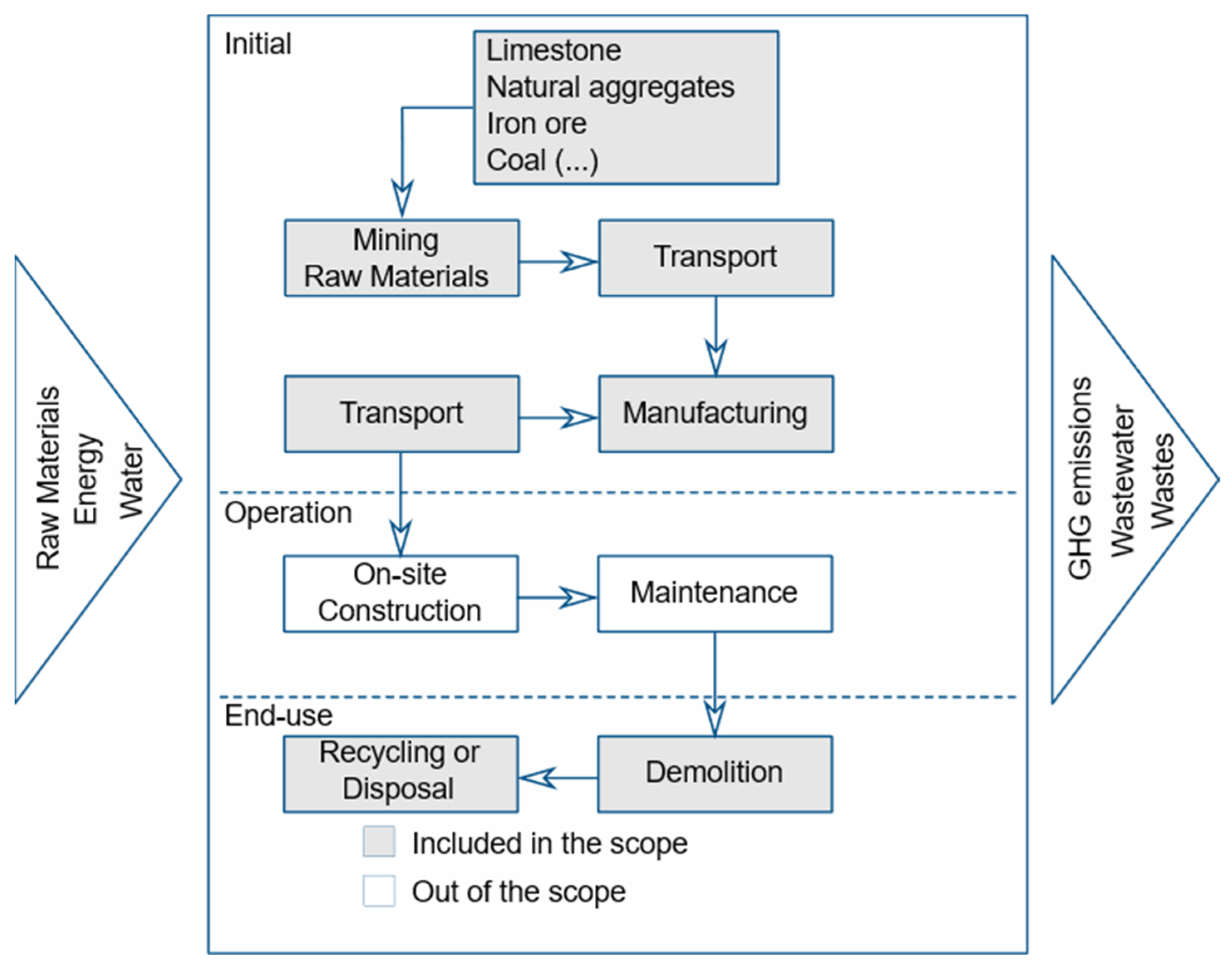
A comprehensive building LCA typically includes all stages of the life cycle—embodied impacts from material production, on-site construction, the operational phase, and end-of-life processes such as demolition and recycling—an approach commonly referred to as cradle-to-grave assessment [50]. However, this study focuses exclusively on structural materials, which contribute minimally during the operational phase, while maintenance requirements are assumed to be similar across all configurations. The environmental impact of on-site construction activities has also been excluded, as it is assumed that the use of heavy machinery does not differ significantly among the cases analyzed [51].
The Life Cycle Assessment performed in this study focuses exclusively on structural materials. This approach is consistent with standard practice in early-stage structural LCA, where the goal is to quantify embodied impacts associated with alternative design configurations rather than to conduct a full cradle-to-grave evaluation. The operational phase is not included because energy consumption, maintenance needs, and use-stage impacts are largely independent of reinforcement ratio and structural sizing choices. This assumption is supported by recent reviews showing that embodied impacts in buildings—especially those associated with concrete and steel production—can account for 40–75% of total life-cycle emissions, often surpassing operational impacts in modern, energy-efficient buildings [52,53]. Furthermore, the growing relevance of embodied emissions in policy, research, and building design has been emphasized in the recent literature, which highlights the need for early-stage material-focused assessments [54]. Material-only LCAs are therefore widely used in parametric studies examining reinforcement levels, section sizing, or material substitutions. Accordingly, restricting the system boundary to material production and end-of-life processes is appropriate for isolating the influence of reinforcement ratios on the environmental performance of RC frame structures.
Therefore, the system boundary is limited to the initial phase, where concrete and steel are produced (including extraction, transport, and manufacturing), and the end-of-life phase, where these materials are recycled and/or disposed of (Figure 1).
At the end-of-use phase, several possible end-of-life pathways for construction materials are currently feasible. Concrete is commonly crushed to recover steel and aggregates (i.e., sand, gravel, fines, and hydrated cement powder). Although steel scrap has high economic value and is fully reusable in steel manufacturing [55], its effective utilization remains limited due to technological constraints and the specific requirements of electric arc furnace processes. Meanwhile, the market for recycled concrete remains underdeveloped. Therefore, for these by-products, the environmental impact of conventional disposal was considered. Conversely, neither environmental burdens nor recycling credits were assigned to steel scrap, following the approach adopted by previous authors [56].
Finally, transportation has a significant influence on the environmental footprint. To account for this factor, an average transport distance of 100 km was assumed for all materials, considering that longer distances typically make logistics economically unfeasible [57].

2.4.2. Life Cycle Inventory

The integrated life cycle inventory (LCI) database Ecoinvent® version 3.6 [58] was used as the source for all LCI data. Inputs include all raw materials (including fuels and water), energy consumption, and transportation between life-cycle stages. Electricity supply corresponds to the total energy demand of the processes and was assumed to follow the world average energy mix. Outputs include emissions to air, water, and soil.
Initially, the LCIA was conducted for both concrete and steel considering 1 ton of material. Subsequently, the total quantities of steel and concrete resulting from the sizing of beams and columns for each building configuration were calculated.
The production of concrete and steel requires distinct material inputs and energy flows, depending on the specific final product.
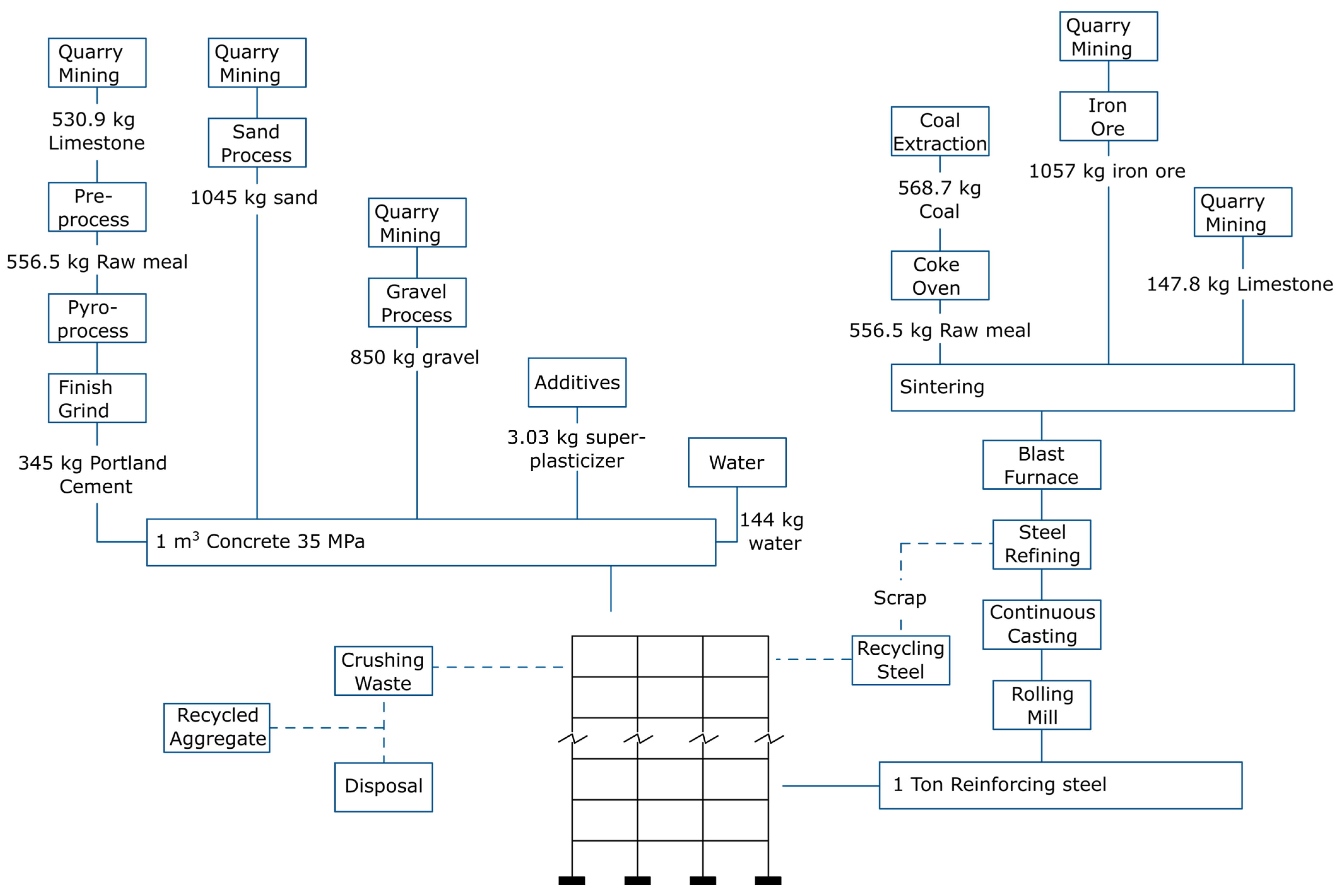
The input–output flows shown in Figure 2 correspond to concrete production, with a free-water-to-cement ratio designed to achieve a minimum compressive strength of 35 MPa. The inventory of input resources (i.e., materials, water, and energy) was obtained from the Ecoinvent version 3.6 [58] database and is consistent with values reported by previous authors [59,60].
The clinker-to-cement process involves three main stages: raw material milling, pyroprocessing, and final grinding of clinker mixed with gypsum and other additives to obtain the finished cement product.
Limestone (up to 80%) is the principal raw material, although other constituents such as silica, kaolinite, and iron-rich clays are commonly incorporated. After the mixture is milled to the required particle size, the thermal process begins. This phase accounts for the largest share of the environmental impact. On the one hand, the energy required to achieve high temperatures is typically supplied by natural gas; on the other hand, CaCO3 decomposes into CaO and CO2, the latter being released into the atmosphere.
It should be noted that several examples of more environmentally friendly cement production technologies have been reported in the literature [61,62]. Nevertheless, the present study considers the conventional cement production route.
Steel reinforcing bars are produced through a hot-rolling process. They are available on the market for direct use or may be further processed into finished products. This steel is used primarily for reinforcing concrete in building construction, but also serves as an intermediate product in wire rod manufacturing.
Rebar steel is mainly produced from limestone, iron ore, and coal. Its manufacture typically involves coke production, sintering, blast furnace operations, basic oxygen furnace or electric arc furnace processes, continuous casting, and hot rolling. In summary, the raw materials are melted in an electric arc furnace, cast into billets, and subsequently hot-rolled into rebars or coils, usually with surface ribs to improve bonding with concrete. The LCI does not include downstream processing beyond the steelworks gate, such as bending, shaping, cutting, or welding. As with concrete, outputs include steel, co-products, and emissions to air, water, and soil.
The life cycle analysis conducted in this study focuses exclusively on materials (Material Flow Analysis—MFA, or partial Life Cycle Inventory—LCI), given that the main objective is to evaluate the quantities of steel and concrete used and their associated pollution and environmental impacts in relation to structural optimization. The purpose of this MFA is to analyze nature-related impacts such as
-
Resource demand (kg of materials, minerals, biomass, water, etc.);
-
Recycling or circularity rates;
-
Carbon footprint of the material;
-
Inventory optimization or more efficient use of materials.
Analysis of input and output flows without translating them into complete environmental impact categories (e.g., CO2 emissions, acidification, eutrophication).

2.4.3. Impact Assessment

In line with previous studies, the assessment of environmental impacts included both a midpoint approach and a damage-oriented impact assessment methodology [63].
For the midpoint assessment, eight environmental impact categories were consid ered: abiotic resource depletion (ARD), acidification (AD), eutrophication (EU), global warming (GW), ozone depletion (OD), photochemical oxidant formation (POC), terrestrial ecotoxicity (TET), and human toxicity (HT). These indicators provide a detailed understanding of the environmental burdens associated with each design alternative.
The calculation methodology used in this study was ReCiPe 2016 at both midpoint and endpoint levels, with normalization factors adopted for a global scale. Midpoint indicators (e.g., global warming, stratospheric ozone depletion, ionizing radiation, ozone formation, fine particulate matter formation) account for 18 environmental impacts along the cause–effect chain. Endpoint indicators aggregate these midpoints to express damages in three areas of protection: ecosystems (EQ), human health (HH), and natural resources (RD) [64].
It should be emphasized that the potential impacts in these areas of protection (EQ, HH, and RD) may vary between locations and depend strongly on the weighting factors used to combine midpoint indicators (e.g., resource extraction, land-use change, or land occupation). Nevertheless, there is broad agreement in the literature that, despite uncertainties in the translation process, endpoint indicators are useful for illustrating the potential contribution of environmental burdens to society [65], especially because the large number of midpoints and their heterogeneous units can confuse decision-makers when only midpoint results are reported [66].

3. Results

3.1. Pushover Analysis

Nonlinear static (pushover) analysis was used to determine the maximum horizontal capacity of the structures, accounting for deformation demands and the evolution of dynamic characteristics. The lateral load distribution was not maintained constant but updated according to relevant mode shapes and participation coefficients, allowing an adaptive representation of structural response.
Pushover analysis estimates the maximum horizontal capacity of a structure by relating lateral resistance to increasing deformation under imposed displacement. The incremental lateral load P applied at each floor is proportional to a nominal pattern Po, such that P = λpo. SeismoStruct® version 2021 [43] was used to perform the simulations, automatically increasing the scale factor λ until either a user-defined limit was reached or numerical instability occurred. A triangular load pattern was adopted in all cases [67].
The methodological basis follows the approaches proposed by Antoniou and Pinho [33] and Ferracuti et al. [34]. This multimodal adaptive method captures structural softening, period elongation, and modifications of inertial forces caused by spectral amplification, providing an accurate description of the progressive loss of stiffness during nonlinear response.
This type of analysis is one of the four procedures incorporated in FEMA 356 [46] and ASCE 41 [47] for performance-based seismic assessment. A detailed description of these procedures can be found in [68,69,70]. All simulations used displacement-controlled pushover analysis and adopted a triangular distribution scaled by a factor λp until structural instability (collapse) was reached [71], monitoring the response at the roof level. The results reveal significant differences in structural behavior as a function of reinforcement ratio. As reinforcement increases, the required concrete sections decrease, reducing overall stiffness. Since larger concrete volumes increase total structural mass, taller frames exhibit greater seismic vulnerability due to the mass-dependent amplification of seismic forces described in Eurocode-8 [35].
The resulting capacity curves allow the assessment of ductility and strength for each configuration listed in Table 1 and Table 2. Plasticity develops primarily due to concrete cracking and reinforcing-steel yielding, and it is modeled through plastic hinges at the ends of members. Consequently, the extension of the post-elastic branch reflects the accumulation of plastic hinges before the onset of global instability.
Table 3 and Table 4 present elastic stiffness, ductility, ultimate capacity and lateral displacements. The ultimate base shear Fu obtained from the analysis closely matches the predefined target values (i.e., 200, 500, and 800 kN for the three-story frames, and 400, 1000, and 1400 kN for the nine-story frames), confirming that all structural configurations achieved similar lateral resistance.
Top-story displacements depend mainly on reinforcement ratio and column cross-section dimensions, while beam dimensions have comparatively minor influence. Except for Case #2 of the nine-story frame, ultimate displacements tend to increase with reinforcement ratio because higher reinforcement ratios allow smaller column sizes, which reduces stiffness and increases drift demand.
Yield displacement also increases in most cases. However, for the 5% reinforcement ratio, a slight reduction in yield displacement is observed in some configurations (i.e., Case #3 for the three-story frame, and Cases #2 and #3 for the nine-story frame). Increasing reinforcement ratio while reducing column cross-section results in weaker sections, which decreases ductility. Conversely, increasing concrete volume yields stiffer systems.
Table 3 summarizes the main results obtained from the pushover analyses: ultimate displacement Du, yield displacement Dy, ultimate base shear Fu, yield base shear Fy, elastic stiffness Kel, and ductility μ = Du/Dy. The base shear calculated using EC-8 is shown in parentheses in the Fu row; this corresponds to the sum of the seismic forces on all floors for soil type C and ground acceleration of 0.24g, a representative value for moderate-seismicity regions in Europe and the Americas. These values allow a comparison between the EC-8 seismic demand and the maximum capacity Fu obtained from pushover analyses.
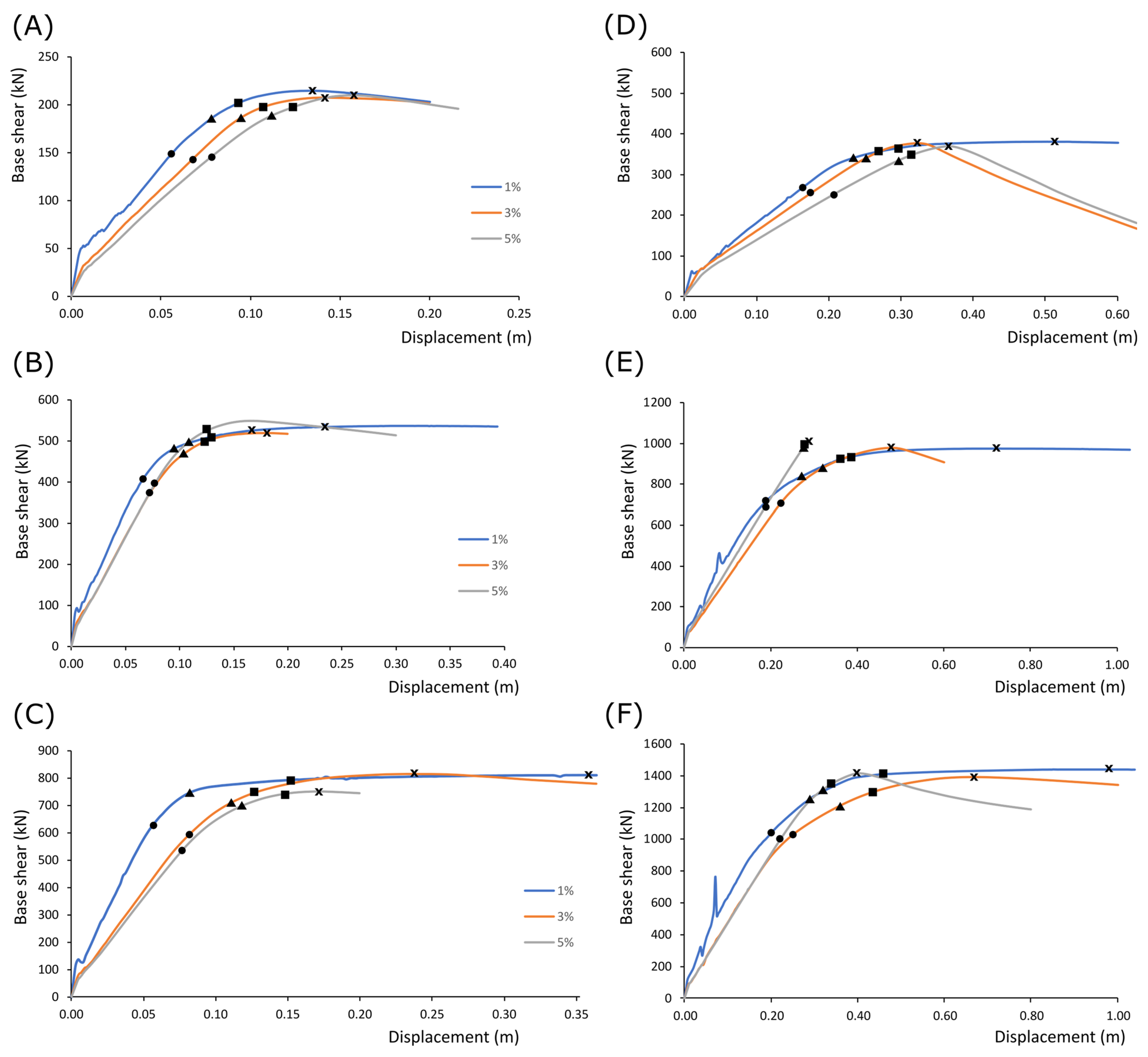
Figure 3 presents the capacity curves obtained using the SeismoStruct® version 2021 [43]. The achieved capacity curves enable assessing the influence of ductility and resistance for each configuration. Plasticity develops primarily through concrete cracking and reinforcing-steel yielding, and it is modeled in each element as plastic hinges. Accordingly, the extension of the post-elastic branch reflects the accumulation of plastic hinges before the structure becomes unstable.
The numerical values summarized in Table 3 and Table 4 provide complementary insights. Rather than simply reporting isolated numbers, they clarify how reinforcement ratio modifies structural performance: increasing the steel ratio reduces concrete volume, which in turn decreases elastic stiffness and ductility. The most notable differences are observed when increasing from 1% to 3%, resulting in reductions of up to 50% in both parameters. Moderate reinforcement ratios are therefore associated with a balanced global response, combining stiffness, deformation capacity and energy dissipation.
The graphs also display the damage states defined by Lagomarsino and Penna [32], using the yielding displacement ( D y ) and ultimate displacement ( D u ) as reference parameters. The four damage states considered are shown below:
Ds1 = 0.7Dy
Ds2 = Dy
Ds3 = Dy + 0.25(DuDy)
Ds4 = Du
representing Ds1 ‘slight’, Ds2 ‘moderate’, Ds3 ‘extensive’, and Ds4 ‘complete’ damage states, respectively.
The reinforcement ratio governs lateral behavior beyond capacity. Higher ratios achieve comparable base shear with smaller column sections, but this reduction in concrete volume produces sharper drift demand and a more brittle post-yield response. Conversely, lower-to-moderate reinforcement ratios maintain larger sections, improve stiffness, distribute plastic hinges more uniformly, and preserve stability throughout the inelastic range.

3.2. Life Cycle Impact Assessment (LCiA)

As several authors have indicated, the environmental impact of the structural frame is typically the largest contributor to the overall building footprint and may even exceed the impact of the operational phase over the building’s life span [10].
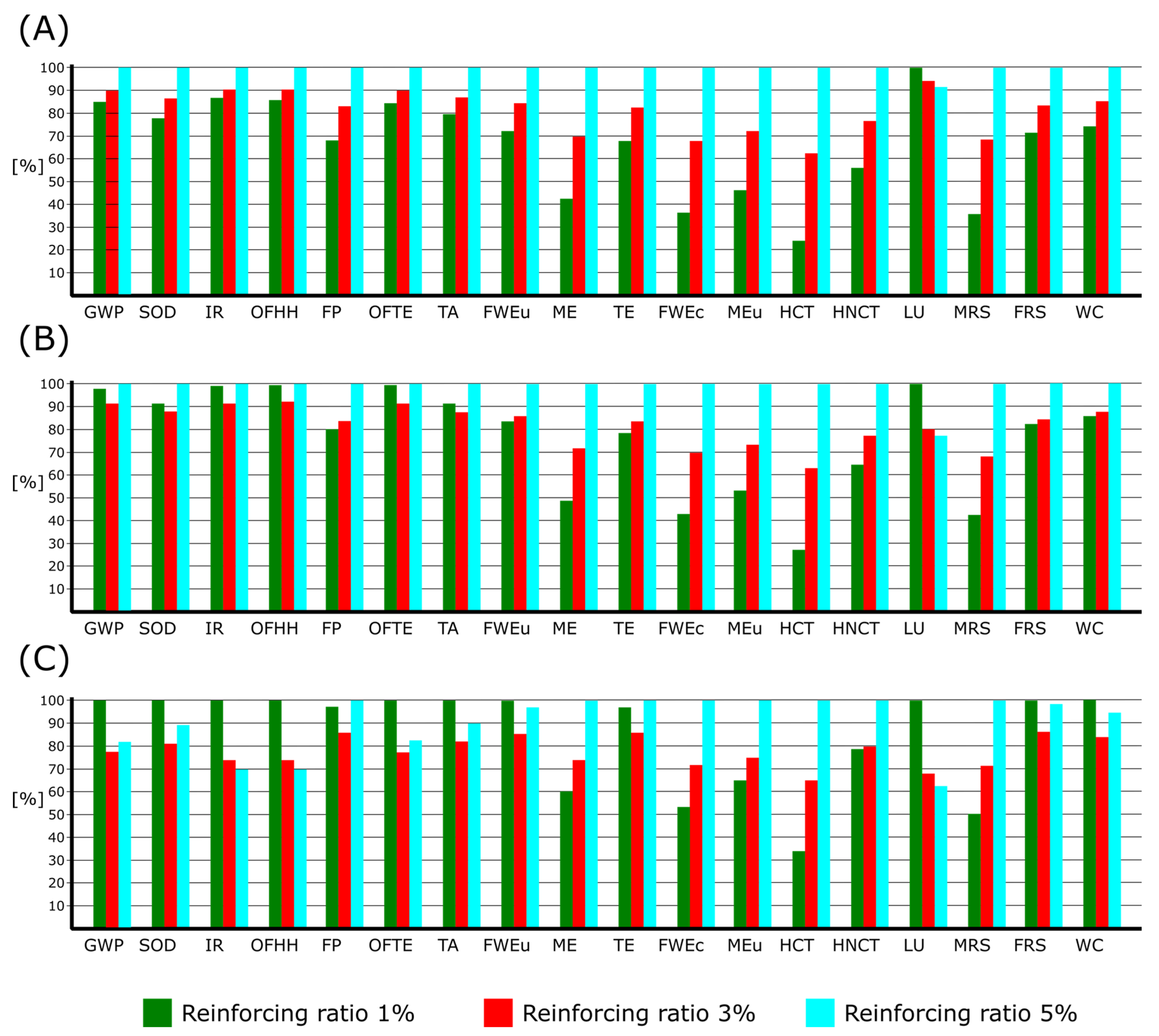
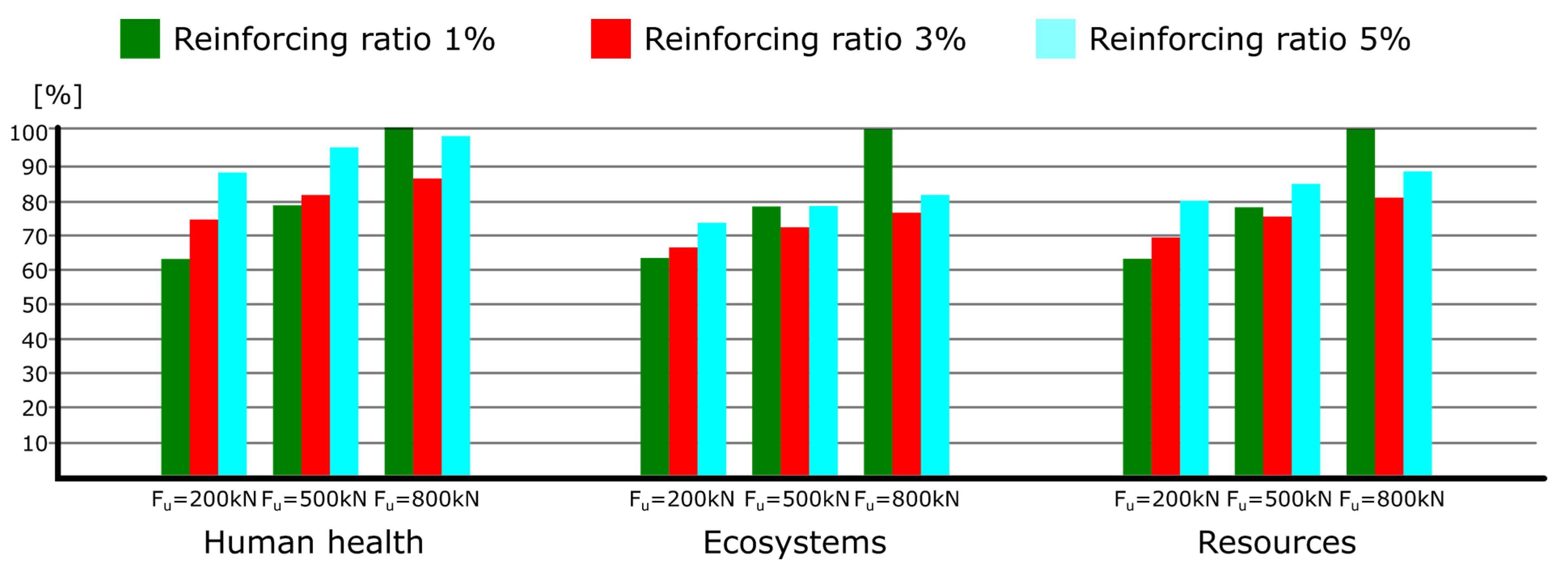
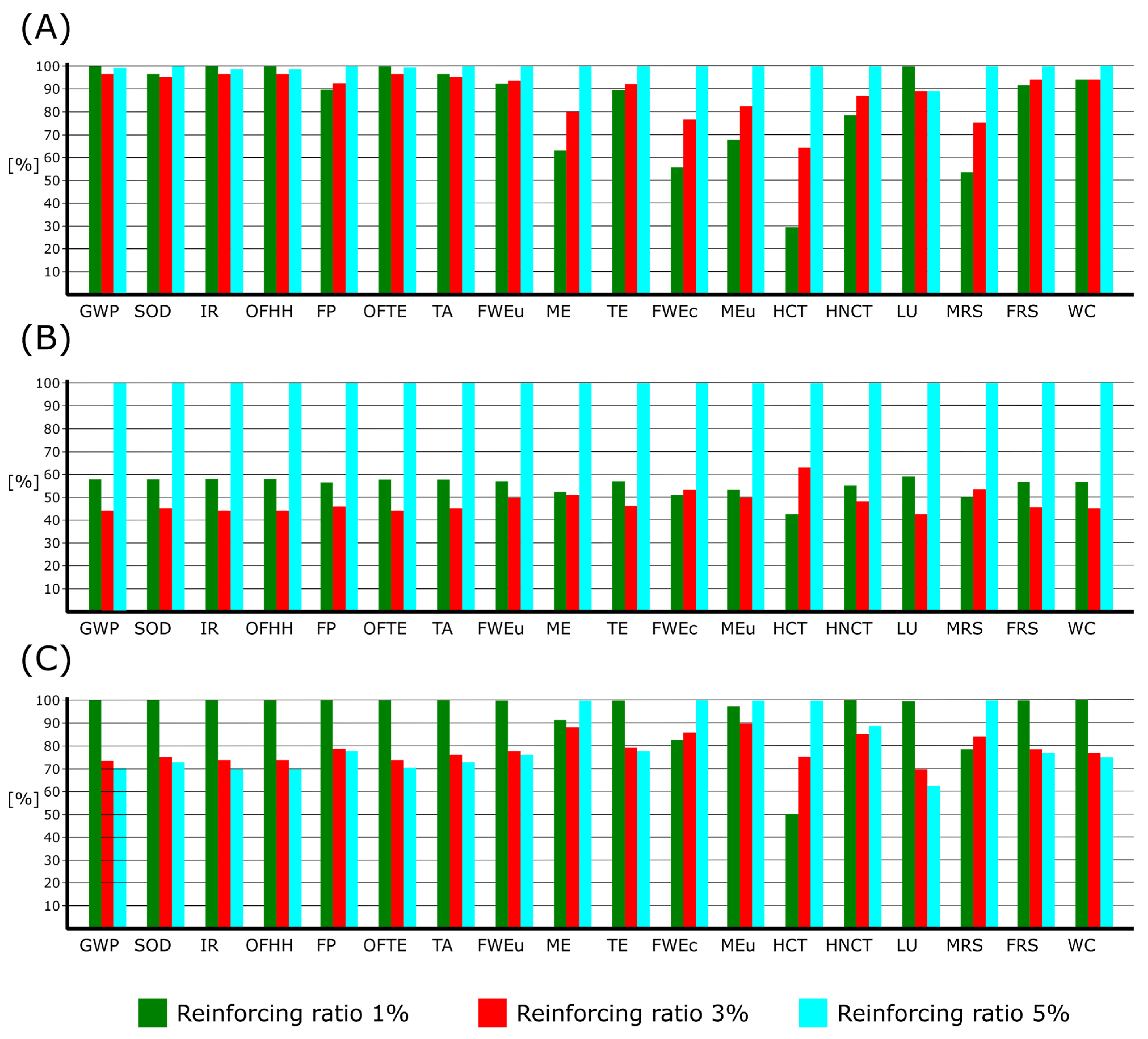
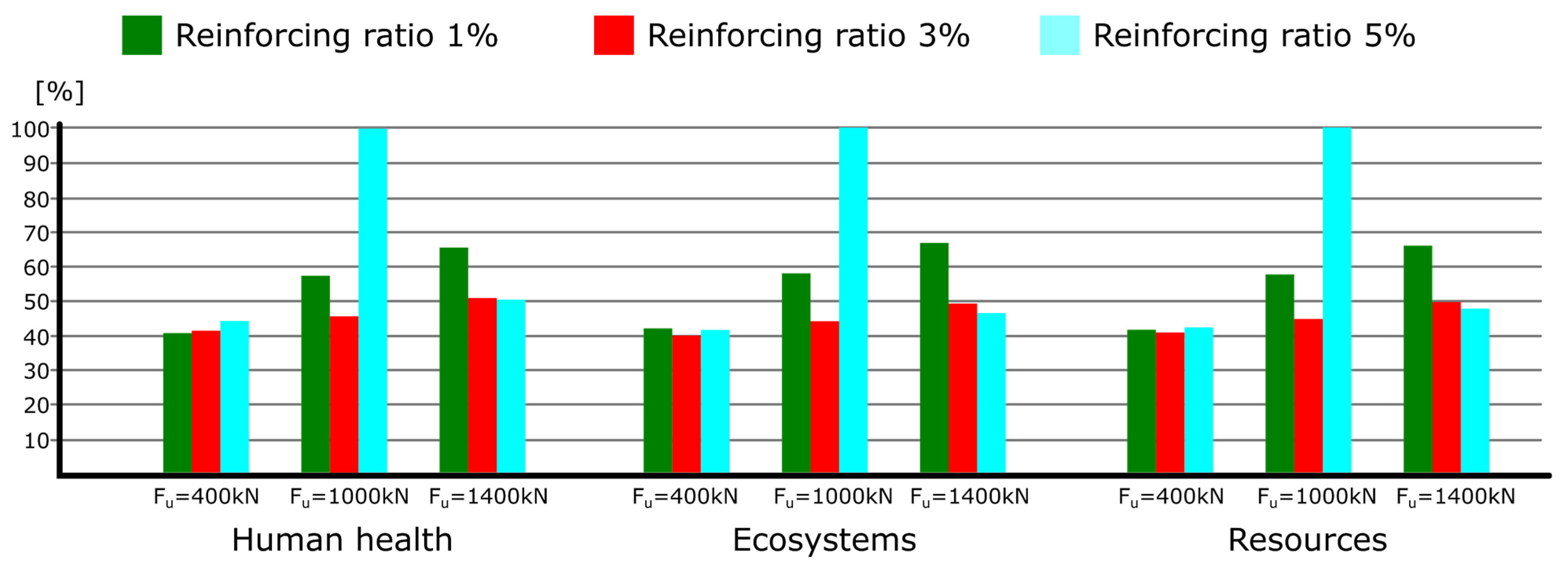
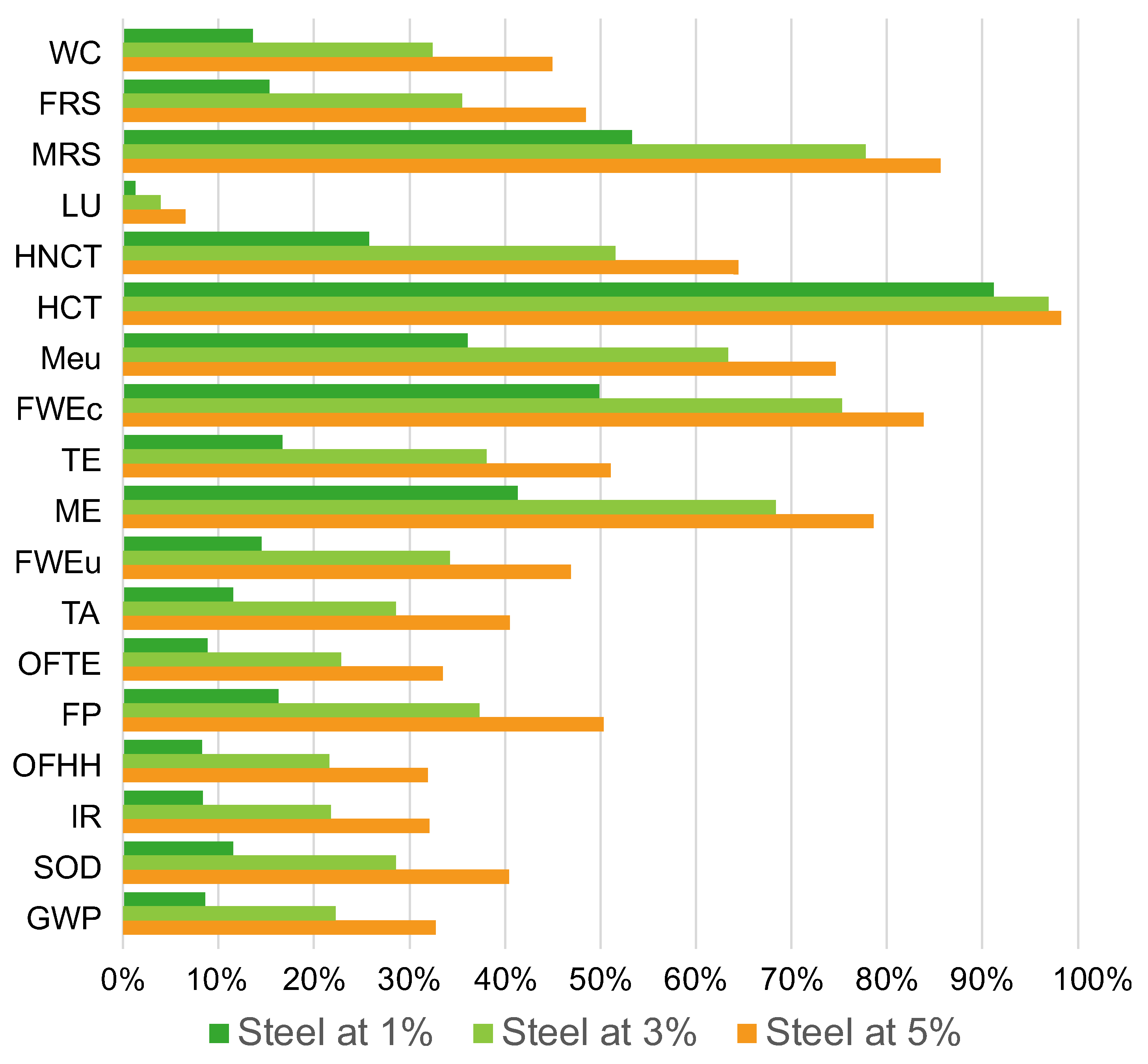
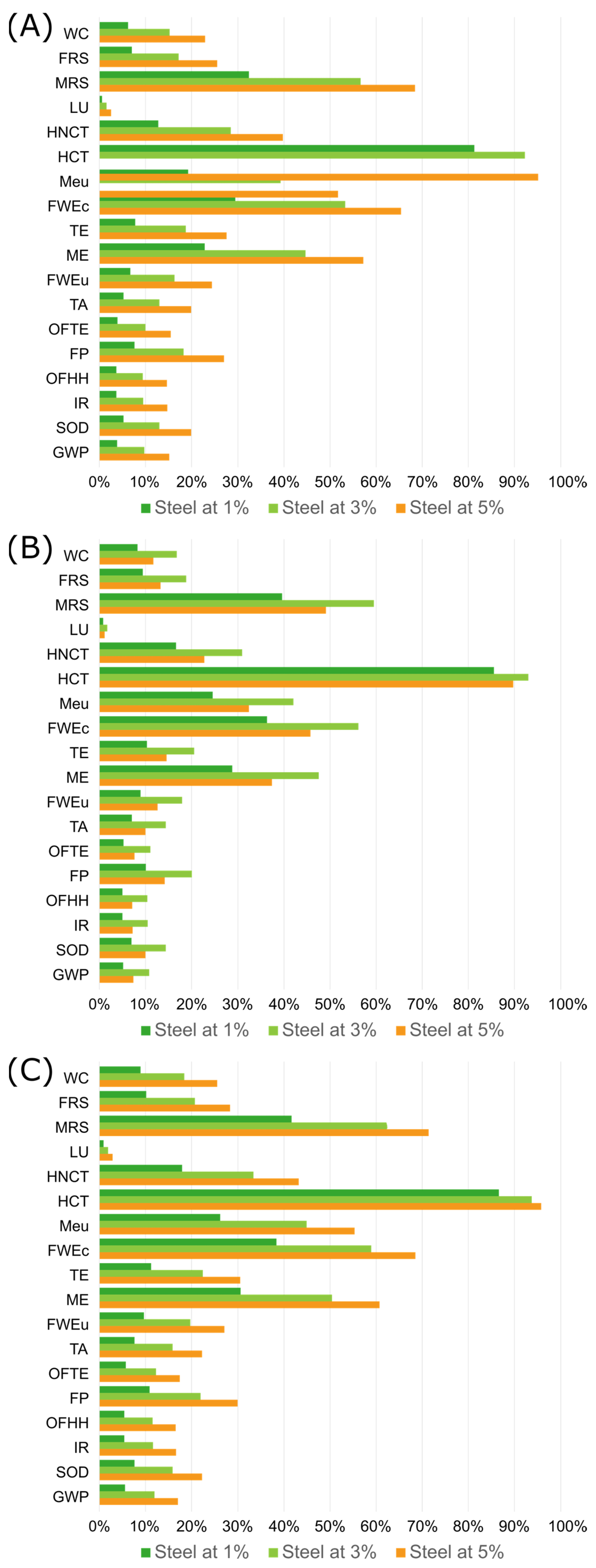
The midpoint and endpoint impacts for each analyzed structure—obtained by summing the impacts of concrete and steel—are presented in Figure 4 and Figure 5 for the three-story frame, and in Figure 6 and Figure 7 for the nine-story frame. The relative contributions of concrete and steel are shown in Appendix A.
Figure 4 and Figure 6 display the midpoint impact categories. For the three-story frame, results show that the lowest environmental impact is clearly obtained with a 1% reinforcement ratio for F u = 200 kN and with 3% reinforcement for F u = 1000 kN. However, for F u = 500 kN, the difference between 1% and 3% reinforcement is not sufficiently pronounced to determine the preferable option. A similar pattern appears in the nine-story frame: while reinforcement ratios of 3% and 5% provide the lowest impacts for F u values of 1000 kN and 1400 kN, respectively, the optimal choice for F u = 400 kN is unclear, as both 1% and 3% lead to comparable results.
Here, F u refers to the maximum horizontal resistance of the frames, corresponding to the ultimate base shear of each structure. It should be noted that the inherent uncertainties of LCIA methods require relatively large differences between cases to allow clear distinctions between alternatives [72].
Previous studies have also shown that concrete—particularly due to its cement content—accounts for the largest share of the total environmental impact of RC buildings [73]. However, this dominance is primarily a consequence of the large quantity of concrete used. On a per-unit-mass basis, steel generates substantially higher environmental damage than concrete. The production of reinforcing steel exhibits a larger environmental footprint, largely due to greenhouse gas emissions, the release of fine particulate matter during processing, and metal emissions from ferrochromium and ferronickel production.
Although both materials are energy-intensive, previous authors have reported that steel production requires up to 4.5 times more primary energy than concrete [74]. Since this energy is predominantly supplied by fossil fuels, midpoint categories associated with global warming potential (GWP) and fossil resource scarcity (FRS) increase considerably. Moreover, these two categories (GWP and FRS) typically receive the highest weighting factors in most green building rating systems, such as LEED, BREEAM, and Green Star [75].
In the analyzed cases, steel is also the main contributor to the endpoint categories related to human health and ecosystem quality when RC structures are assessed [76]. In the case of concrete, emissions of nitrogen oxides (NOx) from fossil fuel combustion during the clinkerization process represent a significant contribution. Additionally, large quantities of water are withdrawn during concrete production and during the extraction of aggregates such as gravel and sand.

4. Conclusions

The present study has shown the mechanical response of two low- and medium-rise frame models under a moderate-intensity earthquake. By varying the concrete cross-sections and reinforcement ratios, an equal lateral resistance was achieved for each frame case. It has been demonstrated that the reinforcement ratio strongly influences the required cross-section of RC structures and, consequently, the associated environmental impact.
In addition, these parameters do not vary in a linear way, which makes it possible to determine an optimal reinforcement ratio for a given base shear capacity.
Considering the values of the environmental assessment, including the quantities of concrete and steel used in each case and the LCIA indicators for human health, ecosystem quality and resource depletion, the three-story frames achieve the lowest environmental impacts for reinforcement ratios of 1%, 1% and 3% when the target base shear is 200, 500 and 800 kN, respectively. For the nine-story frame, target base shears of 400, 1000 and 1400 kN require reinforcement ratios of 1%, 3% and 5%, respectively, to obtain the lowest environmental impacts. These trends are consistent with the results showing that increases in steel content shift midpoint and endpoint indicators toward higher weighted values.
The above results show that the structural behavior of the models depends largely on the amount of steel used, which is inversely correlated with the high embodied environmental impact of reinforcing steel. Therefore, the best-performing solutions—when considering both environmental and structural criteria—are not those with the highest or lowest reinforcement ratios. Rather, the geometry and cross-section sizes of the frames directly affect the performance outcomes of this study. Furthermore, reducing concrete volume decreases structural mass and therefore reduces seismic demand, while the environmental burden of steel becomes dominant in terms of embodied impacts.
As mentioned, increasing steel content in the sections significantly reduces the amount of concrete used, with the most substantial reductions appearing in Case 3, where concrete volume is reduced by more than 50% in the configurations using 5% reinforcement. These reductions are more pronounced in the nine-story models. Conversely, the amount of steel increases more significantly in the three-story models due to the reduction in concrete sections, with the largest increases found in Case 1 and the smallest in Case 3.
Likewise, the decrease in concrete volume and the increase in steel content result in a moderate reduction in the total weight of the structures. The largest reductions are obtained for the 5% reinforcement cases, especially in the nine-story frames. Structural weight decreases by 19% in the three-story models and by 22% in the nine-story models when using 5% reinforcement. These reductions contribute to lowering seismic demand, in line with the mass-dependent formulation of base shear in Eurocode-8.
In the analyzed cases, the structural designs lead to an adequate response of the frame in accordance with the benchmarks stated by Risk-EU. This is corroborated by the maximum base shear and ductility levels obtained, which remain within acceptable performance ranges.
For future studies on this topic, the significant reductions in concrete volume achieved in the reinforcement-balanced solutions may also imply substantial reductions in construction costs and embodied impacts, especially in medium-rise buildings.

Author Contributions

P.M. and D.D.: Conceptualization, Project administration, Formal analysis, Writing—Original Draft. M.P.M., J.F. and M.V.: Writing—Original Draft, Revision—Original Draft. All authors have read and agreed to the published version of the manuscript.

Funding

This research received no external funding.

Data Availability Statement

Data will be made available on request.

Acknowledgments

The authors gratefully acknowledge help and support from the Ministry of Science, Technological Development and Innovation of the Republic of Serbia (Contract number 451-03-136/2025-03/200012).

Conflicts of Interest

The authors declare no conflicts of interest.

Abbreviations

The following abbreviations are used in this manuscript:
AcronymsDescription
ACIAmerican Concrete Institute
ASCEAmerican Society of Civil Engineers
CSoil Class C (Eurocode 8)
CTE-SE-AESpanish Building Code—Structural Safety—Building Actions
EC-2Eurocode 2: Design of Concrete Structures
EC-8Eurocode 8: Design of Structures for Earthquake Resistance
EHE-08Spanish Concrete Standard (2008)
FEMAFederal Emergency Management Agency
fcConcrete Compressive Strength (mean value)
f′cConcrete Compressive Strength (characteristic value)
FRSFossil Resource Scarcity/Depletion
FuUltimate Base Shear
FyYield Base Shear
GHGGreenhouse Gas
GWPGlobal Warming Potential
HCTHuman Toxicity, Cancer
HNCTHuman Toxicity, Non-Cancer
IRIonizing Radiation
LCALife Cycle Assessment
LCiALife Cycle Impact Assessment
LULand Use/Land Occupation
MEMarine Ecotoxicity
MEuMarine Eutrophication
MFAMaterial Flow Analysis
MRSMineral Resource Scarcity/Depletion
OFHHPhotochemical Ozone Formation (Human Health)
OFTEOzone Formation on Terrestrial Ecosystems
ØDiameter of Reinforcing Bar
FPFine Particulate Matter Formation
RCReinforced Concrete
ReCiPeLCIA Method for Midpoint and Endpoint Indicators
Risk-UEEuropean Project for Earthquake Risk Scenarios
SODStratospheric Ozone Depletion
SULive Load (Sobrecarga de Uso)
TATerrestrial Acidification
TETerrestrial Ecotoxicity
FWEcFreshwater Ecotoxicity
FWEuFreshwater Eutrophication
WCWater Consumption

Appendix A

Figure A1. Distribution of environmental midpoint indicators between concrete and steel for three-story frame (equal for cases #1, #2 and #3).
Buildings 15 04484 g0a1
Figure A2. Distribution of environmental midpoint indicators between concrete and steel for a nine-story frame: (A) cases #1, (B) #2 and (C) #3.
Buildings 15 04484 g0a2

References

  1. Schwarz, M.; Nakhle, C.; Knoeri, C. Innovative designs of building energy codes for building decarbonization and their implementation challenges. J. Clean. Prod. 2020, 248, 119260. [Google Scholar] [CrossRef]
  2. Sol, D.; Bartomeus, I.; González-Lagos, C.; Pavoine, S. Urbanisation and the loss of phylogenetic diversity in birds. Ecol. Lett. 2017, 20, 721–729. [Google Scholar] [CrossRef] [PubMed]
  3. Almenar, J.-B.; Petucco, C.; Sonnemann, G.; Geneletti, D.; Elliot, T.; Rugani, B. Modelling the net environmental and economic impacts of urban nature-based solutions by combining ecosystem services, system dynamics and life cycle thinking: An application to urban forests. Ecosyst. Serv. 2023, 60, 101506. [Google Scholar] [CrossRef]
  4. Wiedmann, T.O.; Schandl, H.; Lenzen, M.; Moran, D.; Suh, S.; West, J.; Kanemoto, K. The material footprint of nations. Proc. Natl. Acad. Sci. USA 2015, 112, 6271–6276. [Google Scholar] [CrossRef]
  5. Guo, F.; Wang, J.; Song, Y. How to promote sustainable development of construction and demolition waste recycling systems: Production subsidies or consumption subsidies? Sustain. Prod. Consum. 2022, 32, 407–423. [Google Scholar] [CrossRef]
  6. Hosseinian, S.M.; Ghahari, S.M. The relationship between structural parameters and water footprint of residential buildings. J. Clean. Prod. 2021, 279, 123562. [Google Scholar] [CrossRef]
  7. Akhtar, A.; Sarmah, A.K. Construction and demolition waste generation and properties of recycled aggregate concrete: A global perspective. J. Clean. Prod. 2018, 186, 262–281. [Google Scholar] [CrossRef]
  8. De Barros-Martins, M.A.; Crispim, A.; Liberato-Ferreira, M.; dos Santos, I.F.; Noronha-Motta Melo, M.L.; Mambeli-Barros, R.; Tiago-Filho, G.L. Evaluating the energy consumption and greenhouse gas emissions from managing municipal, construction, and demolition solid waste. Clean. Waste Syst. 2023, 4, 100070. [Google Scholar] [CrossRef]
  9. Kong, M.; Ji, C.; Hong, T.; Kang, H. Impact of the use of recycled materials on the energy conservation and energy transition of buildings using life cycle assessment: A case study in South Korea. Renew. Sustain. Energy Rev. 2022, 155, 111891. [Google Scholar] [CrossRef]
  10. Muñoz, P.; Morales, P.; Letelier, V.; Muñoz, L.; Mora, D. Implications of Life Cycle Energy Assessment of a new school building, regarding the nearly Zero Energy Buildings targets in EU: A case of Study. Sustain. Cities Soc. 2017, 32, 142–152. [Google Scholar] [CrossRef]
  11. Belleri, A.; Marini, A. Does seismic risk affect the environmental impact of existing buildings? Energy Build. 2016, 110, 149–158. [Google Scholar] [CrossRef]
  12. López-Almansa, F.; Domínguez, D.; Benavent-Climent, A. Vulnerability analysis of RC buildings with wide beams located in moderate seismicity regions. Eng. Struct. 2013, 46, 687–702. [Google Scholar] [CrossRef]
  13. ACI 318-19; Building Code Requirements for Structural Concrete and Commentary. American Concrete Institute: Farmington Hills, MI, USA, 2019.
  14. Dominguez-Santos, D.; Ballesteros-Perez, P.; Mora-Melia, D. Structural Resistance of Reinforced Concrete Buildings in Areas of Moderate Seismicity and Assessment of Strategies for Structural Improvement. Buildings 2017, 7, 89. [Google Scholar] [CrossRef]
  15. Xiamuxi, A.; Wang, A.; Yang, B. Optimum reinforcement ratio of axially loaded reinforced concrete-filled square steel tube column. J. Constr. Steel Res. 2023, 203, 107805. [Google Scholar] [CrossRef]
  16. Hasan, H.A.; Karim, H.; Goaiz, H.A.; Cabe, A.M.; Sheikh, M.N.; Hadi, M.N.S. Performance evaluation of normal- and high-strength concrete column specimens reinforced longitudinally with different ratios of GFRP bars. Structures 2023, 47, 1428–1440. [Google Scholar] [CrossRef]
  17. Bastami, M.; Abbasnejadfard, M.; Motamed, H.; Ansari, A.; Garakaninezhad, A. Development of hybrid earthquake vulnerability functions for typical residential buildings in Iran. Int. J. Disaster Risk Reduct. 2022, 77, 103087. [Google Scholar] [CrossRef]
  18. Chen, Y.; Wang, S.; Liu, J.; Wu, H.; Ye, P. Seismic performance and shear capacity theory of assembled steel reinforced recycled concrete frame under earthquake action. Structures 2025, 71, 108106. [Google Scholar] [CrossRef]
  19. Guggemos, A.A.; Horvath, A. Comparison of environmental effects of steel-and concrete-framed buildings. J. Infrastruct. Syst. 2005, 11, 93–101. [Google Scholar] [CrossRef]
  20. Mehra, S.; Singh, M.; Sharma, G.; Kumar, S.; Navishi; Chadha, P. Impact of construction material on environment. In Ecological and Health Effects of Building Materials; Springer International Publishing: Cham, The Netherland, 2021; pp. 427–442. [Google Scholar]
  21. Burgan, B.A.; Sansom, M.R. Sustainable steel construction. J. Constr. Steel Res. 2006, 62, 1178–1183. [Google Scholar] [CrossRef]
  22. Horvath, A.; Hendrickson, C. Steel versus steel-reinforced concrete bridges: Environmental assessment. J. Infrastruct. Syst. 1998, 4, 111–117. [Google Scholar] [CrossRef]
  23. Xing, S.; Xu, Z.; Jun, G. Inventory analysis of LCA on steel- and concrete-construction office buildings. Energy Build. 2008, 40 Pt 7, 1188–1193. [Google Scholar] [CrossRef]
  24. Eckelman, M.J.; Brown, C.; Troup, L.N.; Wang, L.; Webster, M.D.; Hajjar, J.F. Life cycle energy and environmental benefits of novel design-for-deconstruction structural systems in steel buildings. Build. Environ. 2018, 143, 421–430. [Google Scholar] [CrossRef]
  25. Aksel, H.; Eren, Ö. A discussion on the advantages of steel structures in the context of sustainable construction. Int. J. Contemp. Archit. New ARCH 2015, 2, 46–53. [Google Scholar]
  26. Demirel, I.O.; Yakut, A.; Binici, B. Seismic performance of mid-rise reinforced concrete buildings in Izmir Bayrakli after the 2020 Samos earthquake. Eng. Fail. Anal. 2022, 137, 106277. [Google Scholar] [CrossRef]
  27. Le, A.T.; To, M.D.; Vo, N.H. Sustainable concrete using estuarine sand and fly ash with polypropylene fibres. Eur. J. Environ. Civ. Eng. 2025, 1–39. [Google Scholar] [CrossRef]
  28. Le, A.T.; Le, T.T. Predicting flexural strength of steel fiber reinforced concrete using Random Forest and Sobol’s sensitivity analysis. Asian J. Civ. Eng. 2025, 26, 5039–5048. [Google Scholar] [CrossRef]
  29. Ramos, A.; León, J. Clasificación morfológica de los rellenos en el trasdós de bóvedas de fábrica. Inf. Construcción 2013, 65, 471–480. [Google Scholar] [CrossRef]
  30. EN 1992-1-1; Eurocode 2: Design of Concrete Structures—Part 1-1: General Rules and Rules for Buildings. European Committee for Standardization (CEN): Brussels, Belgium, 2013.
  31. EHE-08; Instrucción de Hormigón Estructural. Ministerio de Fomento: Madrid, Spain, 2008.
  32. Lagomarsino, S.; Penna, A. Guidelines for the Implementation of the II Level Vulnerability Methodology. WP4: Vulnerability Assessment of Current Buildings. Technical Presentation RISK-UE Project: An Advanced Approach to Earthquake Risk Scenarios with Application to Different European Towns. 2003. Available online: https://cordis.europa.eu/project/rcn/54199/factsheet/en (accessed on 13 April 2023).
  33. Antoniou, S.; Pinho, R. Development and verification of a displacement-based adaptive pushover procedure. J. Earthq. Eng. 2004, 8, 643–661. [Google Scholar] [CrossRef]
  34. Ferracuti, B.; Pinho, R.; Savoia, M.; Francia, R. Verification of displacement-based adaptive pushover through multi-ground motion incremental dynamic analyses. Eng. Struct. 2009, 31, 1789–1799. [Google Scholar] [CrossRef]
  35. EN 1998-1; Eurocode 8: Design of Structures for Earthquake Resistance—Part 1: General Rules, Seismic Actions and Rules for Buildings. European Committee for Standardization (CEN): Brussels, Belgium, 2004.
  36. Neuenhofer, A.; Filippou, F.C. Evaluation of nonlinear frame finite-element models. J. Struct. Eng. 1997, 123, 958–966. [Google Scholar] [CrossRef]
  37. Spacone, E.; Filippou, F.C.; Taucer, F.F. Fibre beam–column model for non-linear analysis of R/C frames: Part I. Formulation. Earthq. Eng. Struct. Dyn. 1996, 25, 711–725. [Google Scholar] [CrossRef]
  38. Bathe, K.J.; Wilson, E.L. Numerical Methods in Finite Element Analysis; Prentice-Hall: Hoboken, NJ, USA, 1976. [Google Scholar]
  39. Bento, R.; Pinho, R.; Bhatt, C. Using nonlinear static procedures for seismic assessment of the 3D irregular SPEAR building. Earthq. Struct. 2008, 1, 177–195. [Google Scholar] [CrossRef]
  40. Bae, S.; Bayrak, O. Plastic hinge length of reinforced concrete columns. ACI Struct. J. 2008, 105, 290. [Google Scholar] [CrossRef]
  41. Inel, M.; Ozmen, H.B. Effects of plastic hinge properties in nonlinear analysis of reinforced concrete buildings. Eng. Struct. 2006, 28, 1494–1502. [Google Scholar] [CrossRef]
  42. Scott, M.H.; Fenves, G.L. Plastic Hinge Integration Methods for Force-Based Beam. J. Struct. Eng. 2006, 132, 244–252. [Google Scholar] [CrossRef]
  43. SeismoStruct, v2021; A Computer Program for Static and Dynamic Nonlinear Analysis of Framed Structures; Seismosoft: Pavia, Italy, 2021. Available online: https://seismosoft.com/product/seismostruct/ (accessed on 4 November 2025).
  44. Mander, J.B.; Priestley, M.J.; Park, R. Theoretical stress-strain model for confined concrete. J. Struct. Eng. 1988, 114, 1804–1826. [Google Scholar] [CrossRef]
  45. Bosco, M.; Ferrara, E.; Ghersi, A.; Marino, E.M.; Rossi, P.P. Improvement of the model proposed by Menegotto and Pinto for steel. Eng. Struct. 2016, 124, 442–456. [Google Scholar] [CrossRef]
  46. FEMA 356; Prestandard and Commentary for the Seismic Rehabilitation of Buildings. Federal Emergency Management Agency: Washington, DC, USA, 2000.
  47. ASCE/SEI 41-17; Seismic Evaluation and Retrofit of Existing Buildings. American Society of Civil Engineers: Reston, VA, USA, 2017.
  48. Scott, M.H.; Fenves, G.L.; McKenna, F.; Filippou, F.C. Software patterns for nonlinear beam-column models. J. Struct. Eng. 2008, 134, 562–571. [Google Scholar] [CrossRef]
  49. Mergos, P.E.; Kappos, A.J. Estimating fixed-end rotations of reinforced concrete members at yielding and ultimate. Struct. Concr. 2015, 16, 537–545. [Google Scholar] [CrossRef]
  50. Shrestha, J.K. Assessment of energy demand and greenhouse gas emissions in low rise building systems: Case study of five building systems built after the Gorkha Earthquake in Nepal. J. Build. Eng. 2021, 34, 101831. [Google Scholar] [CrossRef]
  51. Li, Y.; Lu, X.; Guan, H.; Ren, P.; Qian, L. Probability-based progressive collapse-resistant assessment for reinforced concrete frame structures. Adv. Struct. Eng. 2016, 19, 1723–1735. [Google Scholar] [CrossRef]
  52. Bn-Mohammed, T.; Greenough, R.; Taylor, S.; Ozawa-Meida, L.; Acquaye, A. Operational vs. embodied emissions in buildings: A review. Energy Build. 2013, 66, 232–245. [Google Scholar] [CrossRef]
  53. Hart, R.; Pomponi, F.; D’Amico, B. Whole-life embodied carbon in multistory buildings: Steel, concrete and timber structures. J. Ind. Ecol. 2021, 25, 403–418. [Google Scholar] [CrossRef]
  54. Lützkendorf, T.; Frischknecht, R.; Balouktsi, M. Embodied carbon in buildings: Guidance and overview. Build. Cities 2022, 3, 198–216. [Google Scholar]
  55. Suer, J.; Traverso, M.; Jäger, N. Review of Life Cycle Assessments for Steel and Environmental Analysis of Future Steel Production Scenarios. Sustainability 2022, 14, 14131. [Google Scholar] [CrossRef]
  56. Pavlović, A.; Donchev, T.; Petkova, D.; Staletović, N. Sustainability of alternative reinforcement for concrete structures: Life cycle assessment of basalt FRP bars. Constr. Build. Mater. 2022, 334, 127424. [Google Scholar] [CrossRef]
  57. Madrid, M.; García-Frómeta, Y.; Cuadrado, J.; María Blanco, J. Análisis de ciclo de vida en bloques de hormigón: Comparación del impacto producido entre bloques tradicionales y con subproductos. Inf. Construcción 2022, 74, e438. [Google Scholar] [CrossRef]
  58. Ecoinvent 3.6; Life Cycle Inventory Database. Ecoinvent Association: Zurich, Switzerland, 2019. Available online: https://ecoinvent.org/database/ (accessed on 4 November 2025).
  59. Farina, I.; Colangelo, F.; Petrillo, A.; Ferraro, A.; Moccia, I.; Cioffi, R. Chapter 24—LCA of concrete with construction and demolition waste, Woodhead Publishing Series in Civil and Structural Engineering. In Advances in Construction and Demolition Waste Recycling; Woodhead Publishing: Delhi, India, 2020; pp. 501–513. [Google Scholar] [CrossRef]
  60. Marceau Medgar, L.; Nisbet Michael, A.; VanGeem Martha, G. Life Cycle Inventory of Portland Cement Manufacture; SN2095b; Portland Cement Association: Skokie, IL, USA, 2006; 69p, Available online: http://www.vangeemconsulting.com/37_Life_Cycle_Inventory_of_Portland_Cement_Manufacture_SN2095b.pdf (accessed on 13 April 2023).
  61. Manjunatha, M.; Preethi, S.; Malingaraya; Mounika, H.G.; Niveditha, K.N.; Ravi. Life cycle assessment (LCA) of concrete prepared with sustainable cement-based materials. Mater. Today Proc. 2021, 47 Pt 13, 3637–3644. [Google Scholar] [CrossRef]
  62. Colangelo, F.; Forcina, A.; Farina, I.; Petrillo, A. Life Cycle Assessment (LCA) of Different Kinds of Concrete Containing Waste for Sustainable Construction. Buildings 2018, 8, 70. [Google Scholar] [CrossRef]
  63. Valderrama, C.; Granados, R.; Cortina, J.L.; Gasol, C.M.; Guillem, M.; Josa, A. Implementation of best available techniques in cement manufacturing: A life-cycle assessment study. J. Clean. Prod. 2012, 25, 60–67. [Google Scholar] [CrossRef]
  64. Hardaker, A.; Styles, D.; Williams, P.; Chadwick, D.; Dandy, N. A framework for integrating ecosystem services as endpoint impacts in life cycle assessment. J. Clean. Prod. 2022, 370, 133450. [Google Scholar] [CrossRef]
  65. De Luca Peña, L.V.; Taelman, S.E.; Préat, N.; Boone, L.; Van der Biest, K.; Custódio, M.; Hernandez Lucas, S.; Everaert, G.; Dewulf, J. Towards a comprehensive sustainability methodology to assess anthropogenic impacts on ecosystems: Review of the integration of Life Cycle Assessment, Environmental Risk Assessment and Ecosystem Services Assessment. Sci. Total Environ. 2022, 808, 152125. [Google Scholar] [CrossRef]
  66. Bare, J.C.; Gloria, T.P. Environmental impact assessment taxonomy providing comprehensive coverage of midpoints, endpoints, damages, and areas of protection. J. Clean. Prod. 2008, 16, 1021–1035. [Google Scholar] [CrossRef]
  67. Brunesi, E.; Nascimbene, R.; Parisi, F.; Augenti, N. Progressive collapse fragility of reinforced concrete framed structures through incremental dynamic analysis. Eng. Struct. 2015, 104, 65–79. [Google Scholar] [CrossRef]
  68. Goel, R.K.; Chopra, A.K. Evaluation of modal and FEMA pushover analyses: SAC buildings. Earthq. Spectra 2004, 20, 225–254. [Google Scholar] [CrossRef]
  69. Hakim, R.A.; Alama, M.S.; Ashour, S.A. Seismic assessment of RC building according to ATC 40, FEMA 356 and FEMA 440, Arab. J. Sci. Eng. 2014, 39, 7691–7699. [Google Scholar]
  70. Lagaros, N.D.; Fragiadakis, M. Evaluation of ASCE-41, ATC-40 and N2 static pushover methods based on optimally designed buildings. Soil Dyn. Earthq. Eng. 2011, 31, 77–90. [Google Scholar] [CrossRef]
  71. Crisfield, M.A. Non-Linear Finite Element Analysis of Solids and Structures; John Wiley & Sons: Hoboken, NJ, USA, 1991. [Google Scholar]
  72. Hoxha, E.; Habert, G.; Lasvaux, S.; Chevalier, J.; Le Roy, R. Influence of construction material uncertainties on residential building LCA reliability. J. Clean. Prod. 2017, 144, 33–47. [Google Scholar] [CrossRef]
  73. Schneider, L.; Berger, M.; Finkbeiner, M. The anthropogenic stock extended abiotic depletion potential (AADP) as a new parameterisation to model the depletion of abiotic resources. Int. J. Life Cycle Assess. 2011, 16, 929–936. [Google Scholar] [CrossRef]
  74. Oladazimi, A.; Mansour, S.; Hosseinijou, S.A. Comparative Life Cycle Assessment of Steel and Concrete Construction Frames: A Case Study of Two Residential Buildings in Iran. Buildings 2020, 10, 54. [Google Scholar] [CrossRef]
  75. Ismaeel, W.S.E. Midpoint and endpoint impact categories in Green building rating systems. J. Clean. Prod. 2018, 182, 783–793. [Google Scholar] [CrossRef]
  76. de Souza, D.M.; Lafontaine, M.; Charron-Doucet, F.; Chappert, B.; Kicak, K.; Duarte, F.; Lima, L. Comparative life cycle assessment of ceramic brick, concrete brick and cast-in-place reinforced concrete exterior walls. J. Clean. Prod. 2016, 137, 70–82. [Google Scholar] [CrossRef]
Figure 1. System boundary.
Buildings 15 04484 g001
Figure 2. Layout of the system boundary for the concrete manufacturing process.
Buildings 15 04484 g002
Figure 3. Capacity curves for a three-story frame for cases (AC) and for a nine-story frame for cases (DF). Levels of damage are represented as follows: ● = Ds1; ▲ = Ds2; ■ = Ds3; X = Ds4.
Buildings 15 04484 g003
Figure 4. Midpoint environmental impacts (ReCiPe 2016) for the three reinforcement ratios. Each category is shown independently to highlight differences between configurations while keeping identical structural capacity. (A) Fu = 200 kN; (B) Fu = 500 kN; (C) Fu = 800 kN.
Buildings 15 04484 g004
Figure 5. Endpoint impacts for cases of a three-story frame.
Buildings 15 04484 g005
Figure 6. Midpoint environmental impacts (ReCiPe 2016) for the three reinforcement ratios. Each category is shown independently to highlight differences between configurations while keeping identical structural capacity. (A) Fu = 400 kN; (B) Fu = 1000 kN; (C) Fu = 1400 kN.
Buildings 15 04484 g006
Figure 7. Endpoint impacts for cases of a nine-story frame.
Buildings 15 04484 g007
Table 1. Description of analyzed cases for three-story frame building models.
Reinforcing
Ratio
StoryColumn Cross-Section [cm]Beam Cross-Section [cm]Structure Weight
[kN]
Case #11%1 to 330 × 30 (8Ø12) a40 × 30 (6Ø16) a953
3% (−15%/+154%) **1 to 323 × 23 (20Ø10) a40 × 30 (18Ø16) a942 (−2%) *
5% (−19%/+308%) **1 to 321 × 21 (20Ø8 + 6Ø16) a40 × 30 (30Ø16) a937 (−2%) *
Case #21%1 to 345 × 45 (18Ø12) a40 × 30 (6Ø16) a1058
3% (−31%/+108%) **1 to 330 × 30 (18Ø14) a40 × 30 (18Ø16) a970 (−9%) *
5% (−36%/+222%) **1 to 327 × 27 (24Ø14) a40 × 30 (30Ø16) a957 (−10%) *
Case #31%1 to 360 × 60 (18Ø16) a40 × 30 (6Ø16) a1205
3% (−46%/+63%) **1 to 335 × 35 (24Ø14) a40 × 30 (18Ø16) a1002 (−17%) *
5% (−52%/+140%) **1 to 330 × 30 (8Ø20 + 10Ø16) a40 × 30 (30Ø16) a985 (−19%) *
a Indicates the configuration of longitudinal reinforcing bars. * Indicates the variation in total structural weight relative to the 1% reinforcement case. ** Indicates the increase/decrease in concrete and steel quantities relative to the 1% reinforcement case.
Table 2. Description of analyzed cases for nine-story frame building models.
Reinforcing
Ratio
StoryColumn Cross-Section [cm]Beam Cross-Section
[cm]
Structure Weight [kN]
Case #11%1 to 350 × 50 (8Ø20) a40 × 30 (6Ø16) a
4 to 640 × 40 (8Ø16) a40 × 30 (6Ø16) a3074
7 to 930 × 30 (8Ø12) a40 × 30 (6Ø16) a
3% (−29%/+114%) **1 to 330 × 30 (18Ø14) a40 × 30 (18Ø16) a
4 to 626 × 26 (18Ø12) a40 × 30 (18Ø16) a2858 (−7%) *
7 to 925 × 25 (6Ø20) a40 × 30 (18Ø16) a
5% (−35%/+228%) **1 to 325 × 25 (10Ø20) a40 × 30 (30Ø16) a
4 to 623 × 23 (34Ø10) a40 × 30 (30Ø16) a2843 (−8%) *
7 to 922 × 22 (16Ø14) a40 × 30 (30Ø16) a
Case #21%1 to 395 × 95 (10Ø32 + 20Ø8) a40 × 30 (6Ø16) a
4 to 675 × 75 (18Ø20) a40 × 30 (6Ø16) a4367
7 to 965 × 65 (28Ø14) a40 × 30 (6Ø16) a
3% (−59%/+24%) **1 to 350 × 50 (6Ø40) a40 × 30 (18Ø16) a
4 to 640 × 40 (6Ø32) a40 × 30 (18Ø16) a3137 (−18%) *
7 to 930 × 30 (18Ø14) a40 × 30 (18Ø16) a
5% (−64%/+80%) **1 to 340 × 40 (10Ø32) a40 × 30 (30Ø16) a
4 to 635 × 35 (20Ø20) a40 × 30 (30Ø16) a3064 (−20%) *
7 to 930 × 30 (22Ø16) a40 × 30 (30Ø16) a
Case #31%1 to 3120 × 120 (18Ø32) a40 × 30 (6Ø16) a
4 to 690 × 90 (10Ø32) a40 × 30 (6Ø16) a4073
7 to 960 × 60 (18Ø16) a40 × 30 (6Ø16) a
3% (−57%/+31%) **1 to 370 × 70 (30Ø25) a40 × 30 (18Ø16) a
4 to 647 × 47 (16Ø16 + 30Ø12) a40 × 30 (18Ø16) a3506 (−14%) *
7 to 940 × 40 (6Ø32) a40 × 30 (18Ø16) a
5% (−69%/+59%) **1 to 350 × 50 (10Ø40) a40 × 30 (30Ø16) a
4 to 640 × 40 (10Ø32) a40 × 30 (30Ø16) a3201 (−22%) *
7 to 930 × 30 (8Ø20 + 10Ø16) a40 × 30 (30Ø16) a
a Indicates the configuration of longitudinal reinforcing bars. * Indicates the variation in total structural weight relative to the 1% reinforcement case. ** Indicates the increase/decrease in concrete and steel quantities relative to the 1% reinforcement case.
Table 3. Ultimate displacement (Du), ultimate resistance (Base Shear (B.S.) (EC-8)) (Fu), yield displacement (Dy), yield resistance (Fy), ductility (μ) and elastic stiffness (Kel) for three-story frame cases.
Reinforcing Ratio
1%3%5%
Case #1Fy (kN)187189190
Fu (kN) B.S.214 (350)208 (342)210 (324)
Dy (m)0.0790.0960.112
Du (m)0.1340.1410.157
Ductility (μ)1.701.471.40
Kel. (kN/m)10,81654474206
Case #2Fy (kN)481469501
Fu (kN) B.S.540 (623)520 (570)550 (566)
Dy (m)0.0950.1040.109
Du (m)0.2340.1800.167
Ductility (μ)2.461.741.52
Kel. (kN/m)24,69012,42110,355
Case #3Fy (kN)744729683
Fu (kN) B.S.809 (887)815 (737)752 (723)
Dy (m)0.0820.1190.111
Du (m)0.3590.2370.171
Ductility (μ) 4.392.001.54
Kel. (kN/m)37,59417,85813,939
Table 4. Ultimate displacement (Du), ultimate resistance (Base Shear (B.S.) (EC-8)) (Fu), yield displacement (Dy), yield resistance (Fy), ductility and elastic stiffness (Kel) for nine-story frame cases.
Reinforcing Ratio
1%3%5%
Case #1Fy (kN)341340335
Fu (kN) B.S.381 (453)378 (420)370 (418)
Dy (m)0.2340.2520.297
Du (m)0.5130.3230.367
Ductility (μ)2.191.291.24
Kel. (kN/m)629733172362
Case #2Fy (kN)841876962
Fu (kN) B.S.976 (1280)978 (924)1011 (903)
Dy (m)0.2730.3220.272
Du (m)0.7200.4790.288
Ductility (μ)2.641.491.06
Kel. (kN/m)13,16873576878
Case #3Fy (kN)125012101307
Fu (kN) B.S.1437 (1573)1393 (1565)1414 (1428)
Dy (m)0.2890.3600.318
Du (m)0.9810.6680.403
Ductility (μ)3.401.861.27
Kel. (kN/m)17,19710,1218420
Disclaimer/Publisher’s Note: The statements, opinions and data contained in all publications are solely those of the individual author(s) and contributor(s) and not of MDPI and/or the editor(s). MDPI and/or the editor(s) disclaim responsibility for any injury to people or property resulting from any ideas, methods, instructions or products referred to in the content.