Article

Quantitative Analysis of Life-Cycle Embodied Carbon in Residential Buildings Under Different Design Patterns

1
School of Architecture, Harbin Institute of Technology, Shenzhen 518055, China
2
School of Future Design, Harbin Institute of Technology, Shenzhen 518055, China
3
School of Architecture and Design, Harbin Institute of Technology, Harbin 150006, China
4
Key Laboratory of Cold Region Urban and Rural Human Settlement Environment Science and Technology, Ministry of Industry and Information Technology, Harbin 150006, China
5
Department of Materials Engineering, Inner Mongolia Vocational College of Chemical Engineering, Hohhot 010011, China
6
Shenzhen Tourism College, Jinan University, Shenzhen 518107, China
7
School of Innovation and Creation Design, Shenzhen Polytechnic University, Shenzhen 518038, China
*
Author to whom correspondence should be addressed.
Buildings 2025, 15(24), 4477; https://doi.org/10.3390/buildings15244477
Submission received: 12 November 2025 / Revised: 5 December 2025 / Accepted: 8 December 2025 / Published: 11 December 2025
(This article belongs to the Section Building Energy, Physics, Environment, and Systems)

Abstract

The building sector is a major source of global carbon emissions, with embodied carbon playing an increasingly critical role. This study quantitatively compares the life-cycle embodied carbon of three residential building design patterns (cast-in situ, CIS; design for disassembly, DfD; and skeleton–infill, SI) under a unified scenario of a 90-year service life with functional renovations every 30 years. A total of 36 cases, derived from twelve prototypical residential designs implemented in each pattern, were evaluated via life-cycle assessment following the EN 15978 standard. The results show that the SI pattern reduces embodied carbon by 45–55% compared to CIS, while the DfD pattern achieves a 35–45% reduction (with SI pattern consistently performing best). Structural system selection also influences outcomes, with shear wall structures reducing emissions by 7–14% compared to frame systems. Plan layout effects were marginal. The analysis indicates that the design pattern is the dominant factor influencing embodied carbon outcomes. SI pattern yields the largest carbon reduction by pairing a long-lived structural frame with flexible infill that extends service life and adaptability, while DfD lowers material demand via component reuse. These findings highlight the substantial benefits of circular design strategies and support a shift toward more adaptable, long-lifespan, and low-carbon residential design.

1. Introduction

The building sector is a significant source of global carbon emissions, accounting for about one-fifth of worldwide emissions [1]. Carbon emissions over a building’s life cycle can be divided into operational carbon (from energy use during building operation) and embodied carbon (generated across all stages from raw material extraction, manufacturing, transport, and construction, to end-of-life processing) [2,3,4]. For decades, extensive research has focused on reducing operational carbon (e.g., energy-efficient design, renewable energy integration), whereas systematic studies on reducing embodied carbon remain noticeably insufficient [5,6,7]. Among the many factors influencing embodied carbon, building service life is paramount: extending a building’s lifespan spreads one-time construction emissions over a longer period and reduces the material production and waste disposal from frequent rebuilds, thereby effectively lowering embodied carbon per unit time [8,9,10,11,12,13]. Studies have shown that lengthening a building’s service life from 50 to 150 years can significantly reduce the average annual embodied carbon; by contrast, short-lived buildings (e.g., 50 years) can accumulate up to three times the emissions of longer-lived ones (e.g., 80 years). In general, the longer the service life, the lower the cumulative embodied carbon [14,15,16]. In other words, extending building lifespan to avoid reconstruction yields significant carbon reduction benefits.
However, in practice, it is difficult for residential buildings to remain “as-built” over the long term, because occupant needs and environmental conditions are constantly changing. Many residential buildings are demolished prematurely, well before reaching their designed lifespan, thus failing to realize the carbon-reduction potential of longer life [11,17,18,19]. This phenomenon is especially pronounced in regions of rapid urbanization. In China, for instance, the average actual service life of residential buildings is only 30–35 years, significantly below the 50-year design lifespan and far lower than the 74–132-year averages in the US and UK [20,21]. The main reasons are: (1) changing occupant requirements, and (2) aging of building systems and equipment, which render a building’s functions obsolete long before the structure itself wears out, leading to whole-building demolition [17,22,23,24]. In China, the premature scrapping of residential buildings has resulted in enormous resource waste and carbon emissions: construction debris now accounts for about 30–40% of urban solid waste in China, yet the recycling rate of construction waste is under 10%, far below the over 90% typical in developed countries [21,25,26,27,28]. This low resource efficiency and the prevalent demolish–rebuild cycle not only waste vast quantities of building materials but also exacerbate carbon emissions in the built environment.
To address these challenges, the field has increasingly emphasized circular design strategies centered on adaptability and longevity. In China, for example, governmental and academic initiatives promote “century-long housing” and high-quality, long-life residential development [29,30,31]. Circular design strategies are now a focal pathway for reducing embodied carbon in residential buildings. A growing body of work demonstrates the mitigation potential of these circular approaches. For example, simulation results show that Design-for-Disassembly (DfD) can reduce embodied carbon by nearly half [32,33]. Similarly, prefabricated modular construction has been shown to cut construction-stage emissions by around 30% [34]. The Skeleton–Infill (SI) system markedly improves adaptability and reduces waste generation over long service lives [35]. Several case studies further validate these findings. Morales-Beltrán et al. achieved approximately a 50% reduction in embodied carbon by redesigning a traditional reinforced concrete structure into a hybrid system following DfD principles [36]. Jang et al. found that modular prefabricated housing emits 36% less embodied carbon in material production and construction than a cast-in-situ (CIS) concrete building [37]. Mayer et al. enhanced the reuse potential of timber wall systems by 35–47% through reversible connections [38]. Violano et al. proposed a prototype dwelling composed of fully recoverable timber components [39]. Collectively, these studies indicate that circular design can deliver substantial embodied-carbon mitigation in residential buildings. At present, circular design in residential buildings has coalesced around several representative patterns. From the standpoint of cast-in-place versus prefabricated component strategies, three design patterns can be distinguished: the conventional Cast-In-Situ (CIS) pattern, the Design-for-disassembly (DfD) pattern, and the Skeleton–Infill (SI) system. These three design patterns exhibit systematic differences in underlying concepts and technical pathways: (1) CIS pattern relies on a monolithic cast-in-place structural system with rigid connections, which has poor adaptability when confronted with changing functional requirements or aging installations, often necessitating destructive demolition and rebuild, with high resource consumption and environmental impact [19,40]; (2) DfD pattern emphasizes reversible connections and non-destructive disassembly of building components at the design stage, so that at end-of-life components can be efficiently recovered and reused rather than discarded [32,41,42,43]. However, this approach mainly focuses on resource recycling at the demolition stage and often does not fully address spatial adaptability and functional updates during the use phase; (3) SI pattern separates a long-lived structural support frame (e.g., the load-bearing structure) from replaceable infill components (e.g., non-structural partitions), enabling flexible reconfiguration of interior space without damaging the primary structure, thereby greatly improving adaptability during use and extending the building’s overall lifespan [44,45]. Crucially, the “disassembly” advocated in the DfD pattern is different from the “demolition” in the CIS pattern: the former is a planned, non-destructive dismantling process aimed at component recovery and reuse, whereas the latter is an irreversible, destructive process that usually results in material waste and environmental burden. Thus, compared to the high-carbon, linear “build–use–demolish” process of the CIS pattern, both DfD and SI patterns improve resource circulation and extend building service life, thereby reducing embodied emissions. Despite these advantages, real-world adoption remains limited: globally, fewer than 1% of new buildings fully adhere to the DfD pattern [46,47,48,49], reflecting barriers such as lagging regulations, limited industry experience, and an underdeveloped supply chain support [50].
Research gaps persist in systematically comparing life-cycle embodied carbon emissions of design patterns such as DfD and SI versus the traditional CIS pattern. The key gaps are: (1) a lack of apples-to-apples comparative studies under unified conditions. Current research has not systematically compared the embodied carbon of CIS, DfD, and SI patterns under a common baseline; especially under high-frequency renovation scenarios, the cumulative carbon divergence between a demolish–rebuild approach and a component-reuse approach has not been quantified. This gap hinders objective evaluation of the actual carbon reduction advantages of DfD and SI relative to CIS and makes it difficult to discern the differences in carbon benefits between DfD and SI. (2) A lack of long-term carbon reduction mechanism assessments from a resource-circulation perspective. Existing embodied carbon studies mostly focus on emissions from initial construction or a single end-of-life event, and do not analyze the dynamic carbon emission patterns over multiple cycles of renovation, recycling, and reuse. Particularly in China’s context of short building lifespans and frequent renewals, there is a shortage of comprehensive evaluations of the carbon offsets and cumulative emissions over long time scales (i.e., extending analysis well beyond the conventional 50-year building lifespan) resulting from material replacement and reuse. In fact, most prior studies limit the analysis to about 50 years or less; thus, it remains unclear how a significantly longer horizon (e.g., 90 years) might alter the comparative outcomes of different design approaches—an issue this study aims to address.
To bridge the above research gaps, this study quantitatively compares the embodied carbon of the three design patterns (CIS, DfD, and SI) in a typical multi-story residential building under unified conditions of building prototype, service life (90 years), and functional renovation cycle (30 years). This study fully considers resource-circulation factors such as material recycling and component reuse, aiming to identify the carbon-reduction benefits of each design pattern and to reveal the key factors influencing embodied carbon emissions. Specifically, the study focuses on the following core questions.
  • Quantitatively compare the embodied carbon emissions of the three design patterns under equivalent conditions.
This question establishes a common basis for comparison by using the same building prototype, service life, and renovation schedule for all cases, eliminating confounding factors. It allows an objective “apples-to-apples” comparison of the actual differences in life-cycle embodied carbon among the CIS, DfD, and SI design patterns.
2.
Identify the carbon reduction mechanisms of the three design patterns from a resource-circulation perspective.
This question extends the analytical horizon to 90 years and simulates multiple renovation scenarios (in 30-year cycles) to examine the dynamic processes of material replacement, component reuse, and carbon accumulation under each design pattern. It reveals how each design pattern affects carbon emissions over a long-time scale from a resource recycling standpoint.
Through this structured research framework, this study provides quantitative evidence to address the embodied carbon problem caused by short residential lifespans and frequent rebuilds. We explicitly adopt a 90-year analysis horizon—nearly double the standard 50-year design life—to capture multiple renovation cycles and long-term effects that shorter studies would miss. The findings offer theoretical and empirical support for transitioning from the traditional linear “build–use–demolish” model toward more sustainable, circular housing design paradigms.

2. Methods

This study draws on a set of twelve prototypical residential building models developed by our research team (Harbin Institute of Technology research team) under a National Natural Science Foundation of China project. Established through adaptability and typological analyses, these models are considered representative of mainstream residential design in contemporary China. The three design patterns described above were applied to each prototype, yielding thirty-six simulated cases (12 × 3). Within the EN 15978 framework, 90-year life-cycle carbon emissions were calculated and subjected to comparative analysis. The following sections detail: the building service-life factor setting, the baseline model acquisition and grouping, and the embodied carbon calculation methods and tools.

2.1. Building Service-Life Factor Setting

We uniformly set the service life of all building cases to 90 years. This 90-year service life encompasses multiple cycles of renovation or rebuilding, allowing a more comprehensive assessment of embodied carbon differences over a long-time horizon. This extended timeframe was chosen to significantly exceed the conventional 50-year building lifespan, in line with emerging “century-long housing” objectives [29,30,31], so that multiple renovation cycles and long-term impacts can be captured. It should be noted that in China’s current context, residential buildings are often demolished after around 30 years of use due to changing functional needs or aging equipment, meaning actual lifespans are far below the 50-year design lifespan [51,52,53,54]. Additionally, statistics show an average residential building lifespan of only about 25–30 years in China [22,55]. Based on these statistics, we introduce a 30-year interval within the 90-year period as a primary cycle for functional updates or rebuilding. This represents a typical renovation cycle for residential buildings. In our model, we assume that every 30 years the building faces functional obsolescence or equipment aging, requiring appropriate renewal measures. Each design pattern addresses this need differently.
Specifically, we consider the embodied carbon of a residential building on a given site over a total period of 90 years, with full demolition events assumed at 30-year intervals based on the typical lifespans of Chinese residential buildings. The scenario assumptions for each design pattern are as follows:
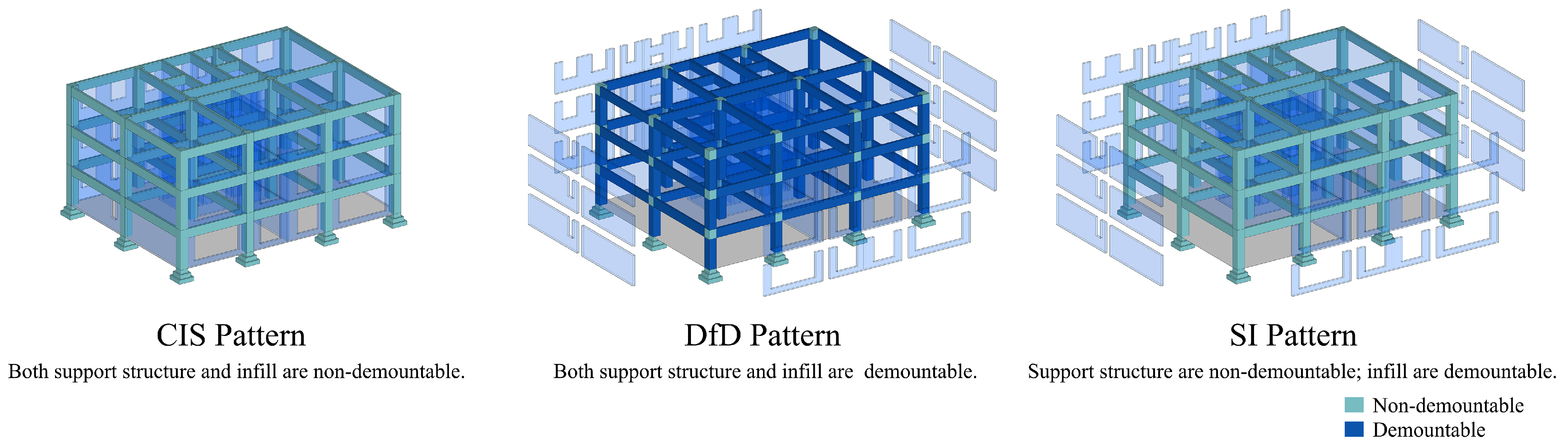
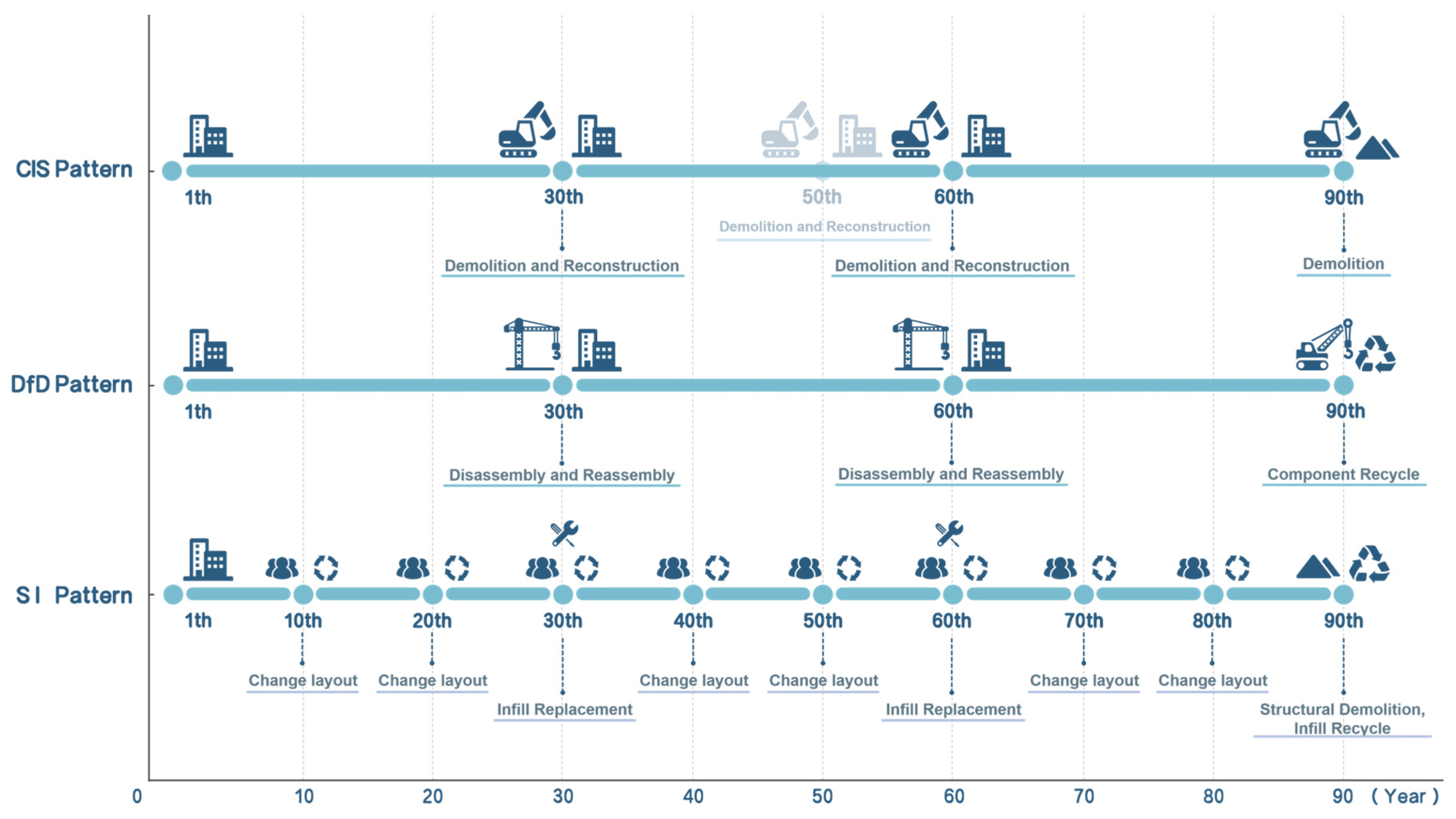
  • CIS (Cast-in-Situ): Utilizes an integral cast-in-situ structure with rigid, irreversible connections. When usage needs change or equipment ages, the building typically can only be dealt with by destructive demolition and complete rebuilding (shown in Figure 1). Over a 90-year life cycle, a CIS residential building is assumed to undergo full demolition and reconstruction at year 30 and again at year 60. Each demolition is carried out destructively, and all resulting debris is treated as construction waste (accounted for with corresponding carbon emissions from waste processing). Therefore, under the CIS pattern, the building undergoes three completely new constructions and three demolitions within 90 years.
  • DfD (Design for Disassembly): Employs a structural system with reversible connections so that it can be taken apart non-destructively at the end of its service life (See Figure 1). Over 90 years, a DfD residential building is assumed to require “rebuilding” at year 30 and year 60 due to functional or equipment obsolescence, but the process is carried out as non-destructive disassembly of the entire structure. The disassembled components can be recovered and reused, reducing the demand for new materials. In other words, the DfD pattern does not avoid mid-life teardown of the building, but through disassemblable design, it turns what would have been one-time disposable materials into reusable components. At the final end-of-life (year 90), the DfD building is also disassembled for component recovery, enabling the reuse of components.
  • SI (Skeleton-Infill): Employs a system where a long-lived structural “skeleton” is separated from easily replaceable “infill” components (Illustrated in Figure 1). The structural support frame has a lifespan of at least 90 years (long-term use), whereas infill components have a lifespan of about 30 years and can be replaced mid-life as needed. Over 90 years, an SI residential building does not require demolition of the main structure; its functional layout can be adjusted at any time, and at years 30 and 60, only the infill components are renewed, with no full teardown or rebuilding. This means that, unlike the CIS and DfD patterns, which require rebuilding the entire structure at intervals, the SI pattern upgrades building performance in each cycle simply by replacing infill components, thus avoiding destructive demolition during the service life.
In summary, the three design patterns exhibit different characteristics over a 90-year life cycle: the CIS pattern undergoes multiple cycles of “demolition and rebuilding”, the DfD pattern undergoes multiple cycles of “disassembly and reassembly” (with component reuse), and the SI pattern features a “long-lived structure with periodic infill replacement” (shown in Table 1 and Figure 2). These contrasting characteristics establish a clear scenario basis for the subsequent embodied carbon comparisons.

2.2. Baseline Model Acquisition and Grouping

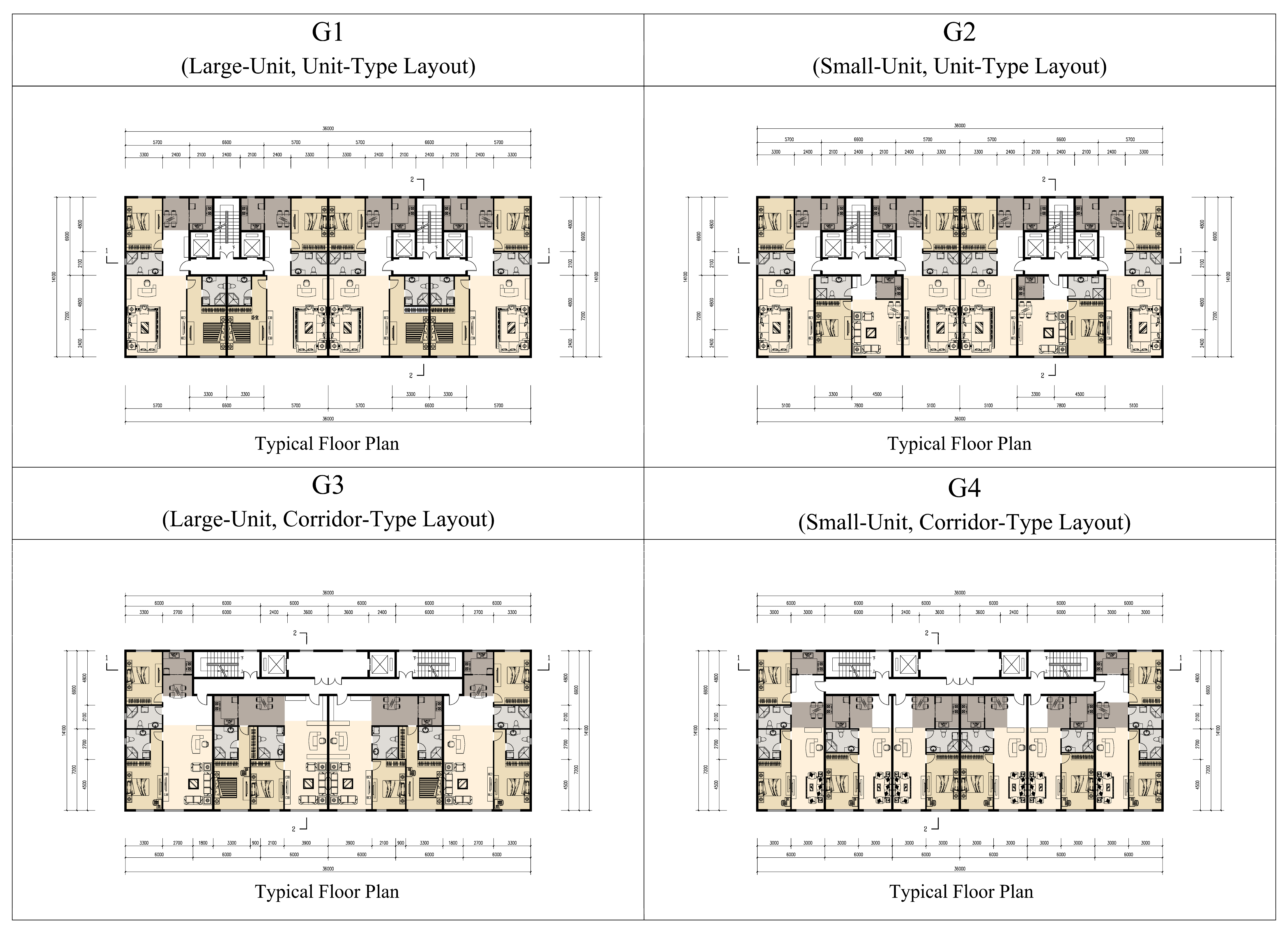
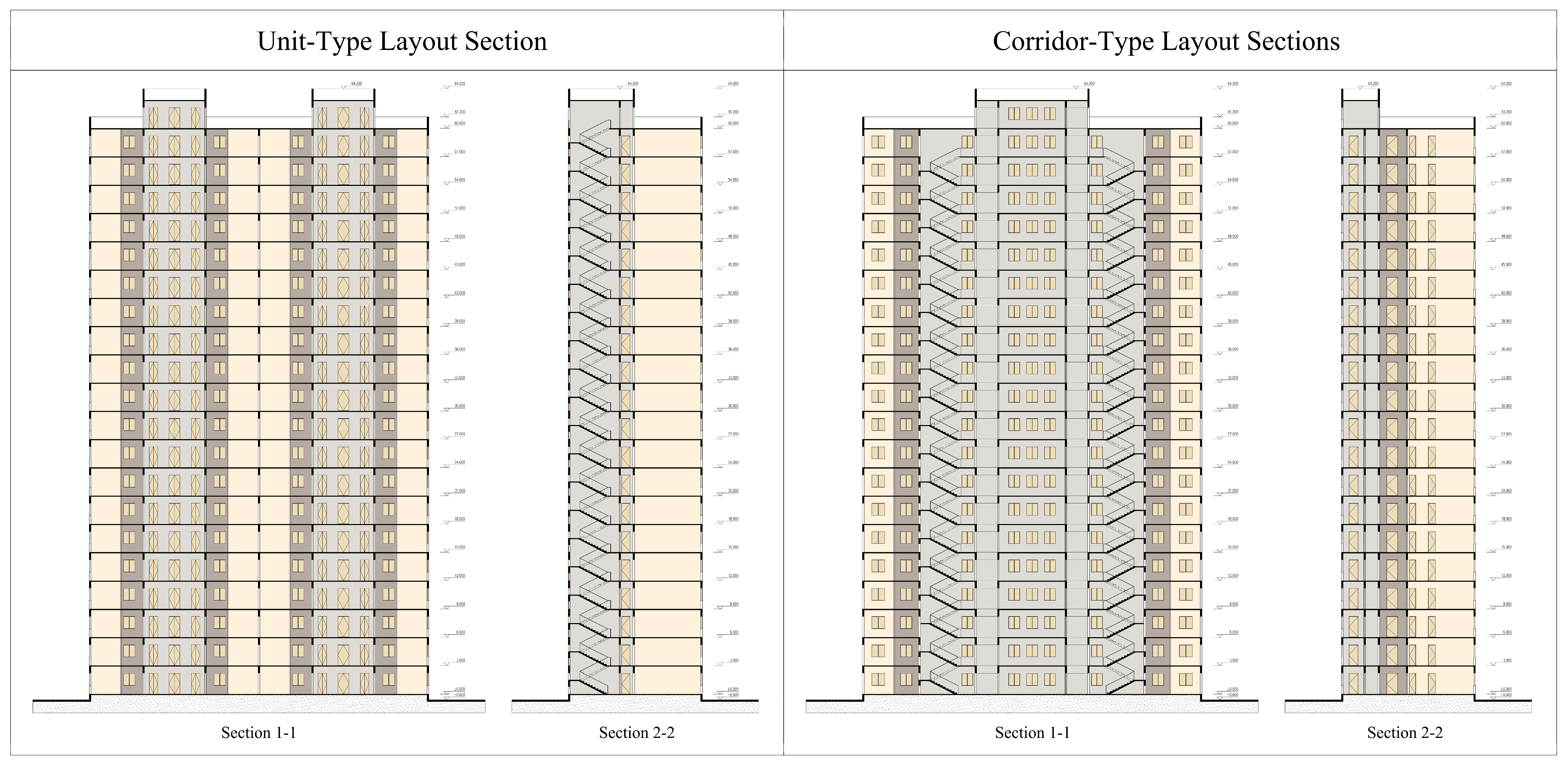
Our residential building sample models were derived from a set of standard models developed by our research team (Harbin Institute of Technology). Between 2018 and 2022, we performed a typological analysis of 954 residential buildings (considering design adaptability and structural types) and established a library of standard models with broad representativeness. These models cover the main current forms of Chinese residential design. They combine 2 circulation layouts (unit-type vs. corridor-type) and 2 dwelling size categories (>90 m2 vs. ≤90 m2) to form 4 basic floor plan types; each layout type can further adopt 3 structural systems (frame, frame–shear wall, or shear wall), yielding a total of 12 distinct sample models [56]. These sample models reflect the key variations in mainstream residential building types and spatial organization. Furthermore, to eliminate the influence of building height on the results, all samples are standardized to 20 stories with a typical floor height of 3 m. The floor plans and sections of 20-story residential buildings for these four layouts are shown in Figure 3 and Figure 4.
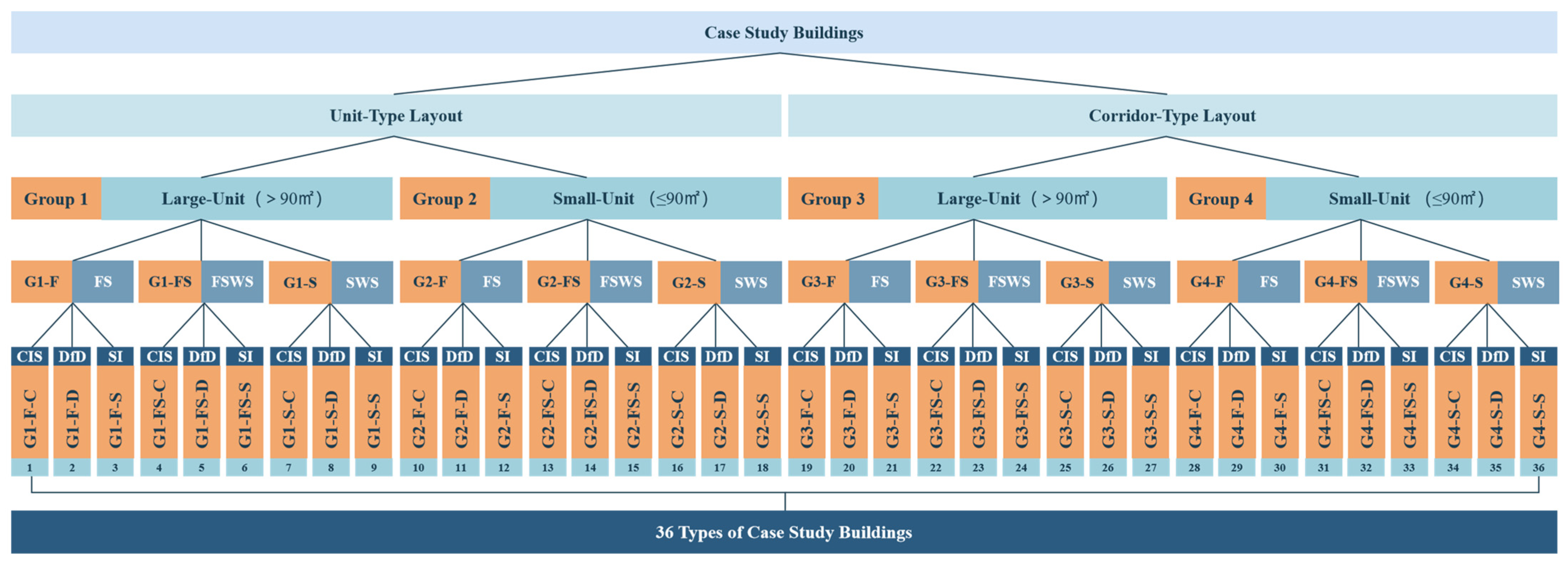
Specifically, based on the different combinations of the 4 layout types and 3 structural types, the models are organized into 4 primary groups by layout (G1, G2, G3, G4). Combining each layout with the 3 structure options produces a comprehensive 4 × 3 matrix of samples (4 layout types × 3 structures), consisting of 12 clearly distinguished subgroups:
  • G1 (Large-Unit, Unit-Type Layout): Dwelling unit area > 90 m2, unit-type (one stair core serving two units per floor), standard floor area ~441.72 m2. This group includes 3 structural variants: G1-F (frame), G1-FS (frame–shear wall), and G1-S (shear wall).
  • G2 (Small-Unit, Unit-Type Layout): Dwelling unit area ≤ 90 m2, unit-type (one stair core serving three units per floor), standard floor area ~441.72 m2. Structural variants include G2-F (frame), G2-FS (frame–shear wall), and G2-S (shear wall).
  • G3 (Large-Unit, Corridor-Type Layout): Dwelling unit area > 90 m2, corridor-type (one stair core serving four units per floor), standard floor area ~414.00 m2. Structural variants include G3-F (frame), G3-FS (frame–shear wall), and G3-S (shear wall).
  • G4 (Small-Unit, Corridor-Type Layout): Dwelling unit area ≤ 90 m2, corridor-type (one stair core serving six units per floor), standard floor area ~414.00 m2. Structural variants include G4-F (frame), G4-FS (frame–shear wall), and G4-S (shear wall).
On this foundation, to study the impact of design patterns on embodied carbon emissions, we applied each of the 3 design patterns (CIS, DfD, SI) to every subgroup model. In this way, each subgroup produces 3 different design pattern schemes, and the 12 subgroups yield a total of 36 independent simulated cases (each case designated with a unique code, see Figure 5). Through this layered grouping experimental design, the study covers a diverse range of residential types and design patterns. This fine-grained classification effectively captures the important differences among unit layout, structural system, and design pattern, providing a solid foundation for a detailed comparison of embodied carbon emissions across the schemes.

2.3. Embodied Carbon Calculation and Tools

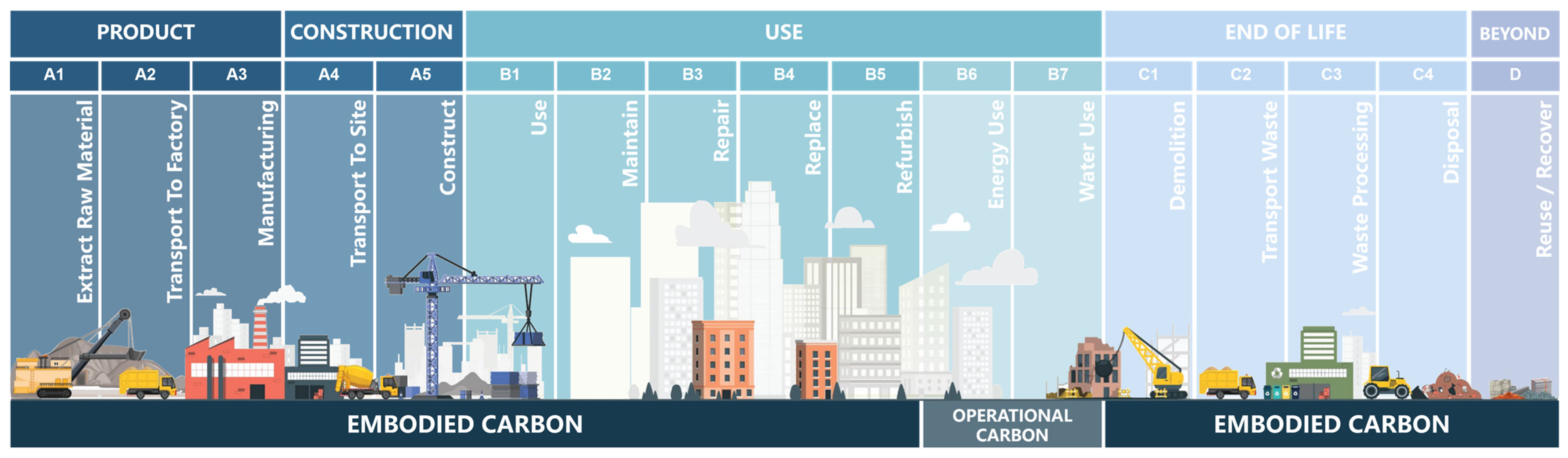
This study calculated embodied carbon emissions for each case following the EN 15978:2011 standard [57]. The assessment boundary covers the product phase (A1–A3), construction phase (A4–A5), use phase (B1–B5, excluding B6 and B7), end-of-life phase (C1–C4), and beyond life-cycle phase (D, representing the carbon benefits from material recycling and reuse), ensuring consistent and reliable data sources [58,59,60,61]. Figure 6 illustrates the life-cycle boundary definitions according to EN 15978. Note that since this study focuses on embodied carbon, operational carbon during the use phase (e.g., HVAC energy use) is not included; however, component maintenance and replacement activities during use are included in the B-phase embodied carbon calculations. In terms of calculation method, we adopted the standard emissions factor approach in line with EN 15978 requirements. All life-cycle phase calculations conform to the EN 15978 specifications. The material carbon emission factors are mainly derived from the Chinese national standard Calculation Standard for Building Carbon Emissions (GB/T 51366–2019) [62]; likewise, carbon emission parameters for phases such as transportation and construction were taken from the recommended values in that standard to ensure data consistency and reliability.
We employed PKPM Green Building Design (PKPM-BES, version 2024) and BIM Base KIT2025 to carry out the simulations. These tools were used to extract the quantities of all structural, enveloped, and non-structural materials. The complete calculation workflow is documented in the Supplementary Materials, where the input spreadsheets and calculation formulas are provided to ensure full reproducibility of the embodied-carbon results. Because current software tools do not yet fully support the modeling of component reuse and replacement processes under circular design scenarios, we complemented the simulations with formula-based calculations to quantify the full life-cycle embodied carbon of the residential buildings. In practice, PKPM was used to perform the primary building carbon simulations, while additional calculations were implemented to account for embodied carbon emissions associated with different component service lives and replacement frequencies. This hybrid workflow enhances data accuracy and enables fine-grained, robust comparisons between the different design patterns.
PKPM-BES offers the following advantages: (1) leveraging BIM integration, it can automatically extract quantities of key structural and envelope materials, reducing manual calculation errors; (2) it supports a carbon factor database based on Chinese standards (e.g., GB/T 51366–2019), facilitating direct alignment with our life-cycle accounting framework. However, PKPM’s functionality is limited in areas such as modeling component reuse and reversible connections, making it difficult to directly capture the component-recycling features of DfD and SI. Thus, we combined PKPM with supplementary calculations to evaluate carbon emissions during component reuse and replacement stages. Specifically, for components that are reused (in DfD cases), we applied a carbon credit equal to the emissions that would have been generated to produce an equivalent new component (avoided emissions), and for infill components that are periodically replaced (in SI cases), we added the embodied carbon of new materials for each replacement cycle. These supplementary calculations follow EN 15978 principles, ensuring that the benefits of component reuse and the impacts of infill replacements are appropriately captured in the life-cycle assessment. For the modular design and component optimization aspects of the DfD and SI cases, we also employed BIM Base KIT2025. This platform excels in prefabricated and modular building design, with strengths mainly in: (1) high-precision BIM-based modeling and 3D visualization of components, accurately depicting the separated structure of the support frame vs. infill system; (2) seamless data integration with PKPM and other mainstream design/analysis software, enabling direct transfer of component information and material properties without redundant modeling or data loss.
In this study, the modular designs for the DfD and SI pattern buildings were first completed in BIM Base KIT2025, and the generated component and material data were directly imported into the PKPM platform to carry out precise life-cycle embodied carbon calculations. Through this integrated approach—combining PKPM’s design and analytical capabilities with BIM Base KIT2025′s modular modeling—we established a complete, accurate, and traceable component data chain at the design simulation stage, providing a robust data foundation for subsequent evaluation of carbon emissions from component replacement and reuse.

2.4. Assumptions and Parameter Settings

To ensure full transparency and consistency, we summarize here all key parameters and assumptions for the LCA. Table 2 lists the base values, assumed ranges, and data sources for parameters used in each life-cycle phase (A1–A5, B1–B5, C1–C4, D). For example, a reference service life of 90 years (range 70–110 years) was used, with renovation intervals of 30 years (range 25–35 years), following EN 15978 guidelines and Chinese practice. We include all structural and non-structural elements (e.g., primary frame, infill partitions, finishes) in the inventory for every case. The use-phase (B1–B5) incorporates scheduled maintenance: non-structural partitions and finishes are replaced at each renovation, and major MEP systems (HVAC, plumbing) are replaced every 30 years, uniformly across CIS, DfD, and SI cases. Importantly, all three design patterns use identical structural layouts: we kept the same spans, column grid, and design loads for CIS, DfD, and SI variants of each prototype, ensuring structural components have the same dimensions and materials. Any additional materials required for DfD connectors or SI skeletons have been accounted for. For instance, specialized DfD connectors (bolts, brackets) were assumed to use an equivalent steel tonnage as conventional welded connections.
We also performed a one-at-a-time sensitivity analysis on these parameters. Table 3 (below) shows the effect on total CO2e of varying each parameter for a representative case (Group G1, frame structure, CIS). The results indicate that service life and renovation interval have the largest impact (changes of ~−14% to +20%), while factors like the recycling rate and transport distance produce only minor variations.

3. Results

3.1. Analysis of Simulation Results

3.1.1. Differences in Embodied Carbon Among Design Patterns

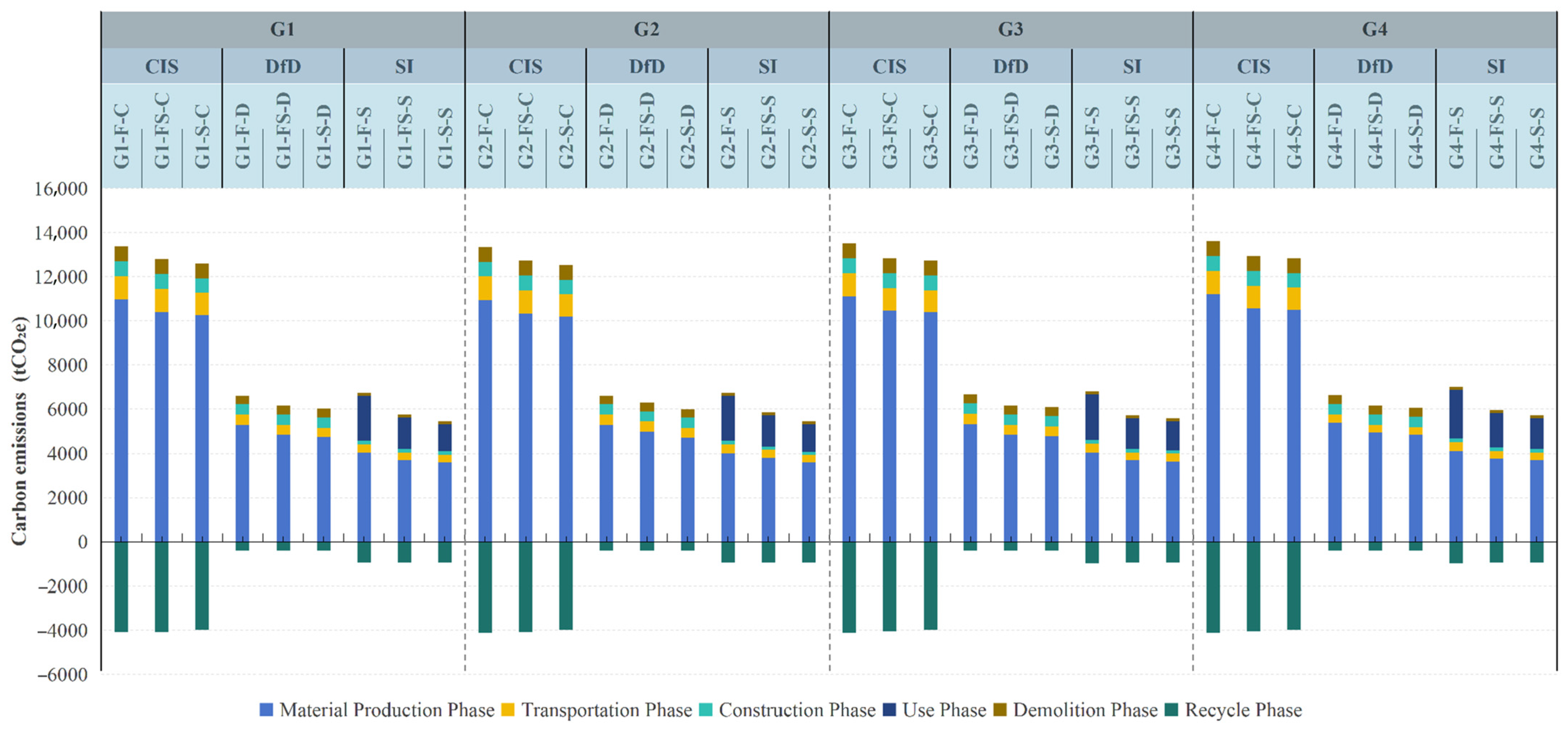
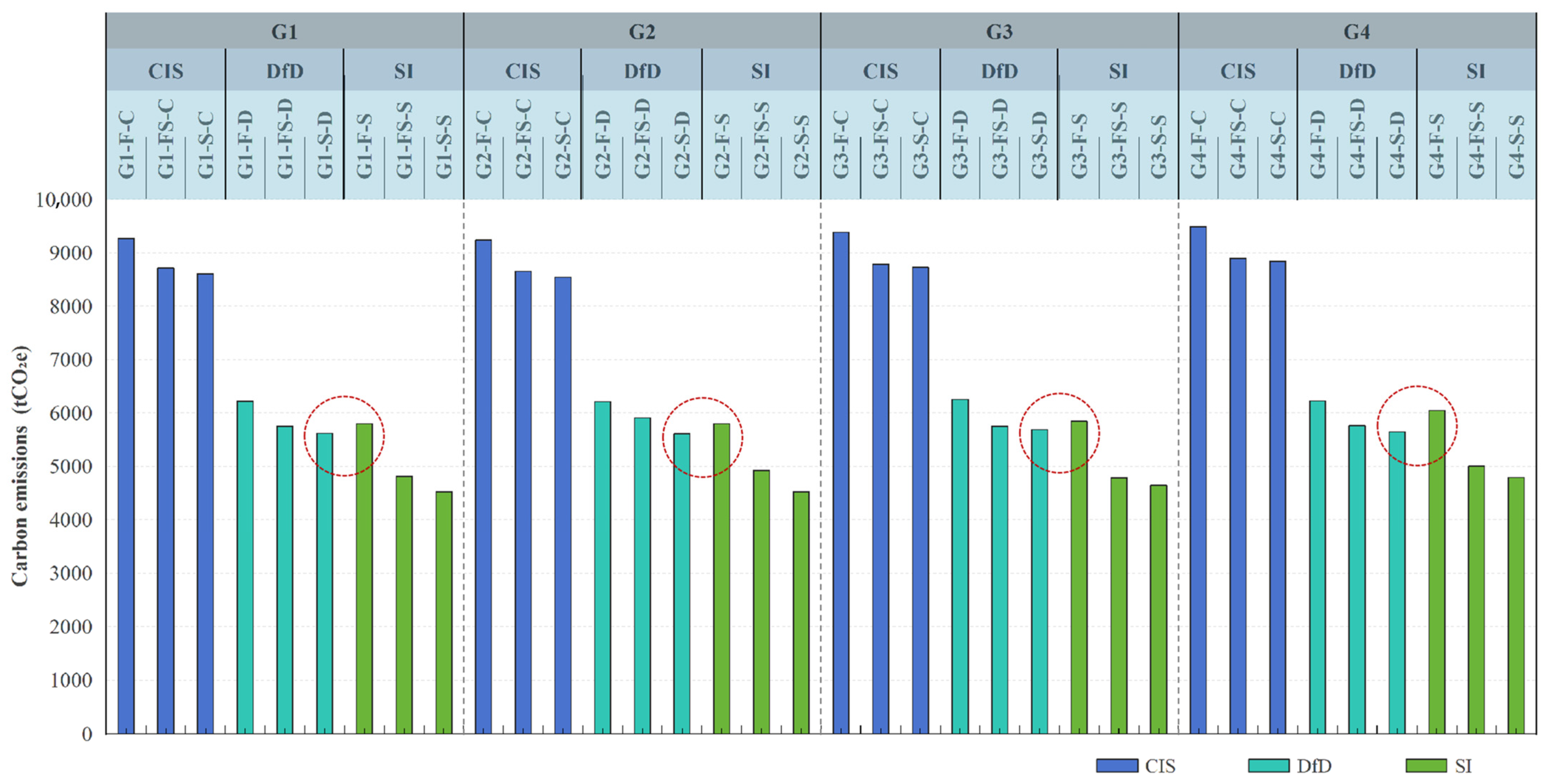
Over the 90-year assessment period, the three design patterns exhibit pronounced differences in life-cycle embodied carbon. Across all 36 simulated residential building cases, the conventional cast-in-situ (CIS) pattern consistently yields the highest embodied carbon, whereas the design-for-disassembly (DfD) and skeleton–infill (SI) patterns achieve substantial reductions (Table 4). For example, in the G1-F group, the total embodied carbon of the CIS case is approximately 9261 t CO2e, compared with 6211 t CO2e for DfD (–33%) and 5792 t CO2e for SI (–50%). Normalized by gross floor area, group G1 has a floor area of ≈441.72 m2 per story (≈8834 m2 for 20 stories), resulting in 90-year embodied carbon intensities of about 1.05 t CO2e/m2 for CIS, 0.70 t CO2e/m2 for DfD, and 0.66 t CO2e/m2 for SI, corresponding to approximately 0.012, 0.008, and 0.007 t CO2e/(m2·year), respectively. Even for corridor-type layouts (groups G3/G4, ≈414.00 m2 per floor, ≈8280 m2 total), CIS still reaches ~1.15 t CO2e/m2 (~0.013 t CO2e/(m2·year)), while DfD and SI remain lower at ~0.75 and ~0.73 t CO2e/m2 (~0.008 t CO2e/(m2·year)). These normalized values confirm that SI has the lowest embodied-carbon intensity and CIS the highest. A similar pattern is observed in groups G2, G3, and G4: all DfD and SI cases emit less embodied carbon than their CIS counterparts, with the CIS–SI gap generally around 45–55% and DfD achieving approximately 35–45% reduction relative to CIS. Although absolute emission levels vary slightly among layout groups (e.g., total emissions in group G4 are ~5% higher than those in group G1 due to layout differences), the carbon-reduction benefits of the DfD and SI patterns remain highly consistent across all scenarios (Figure 7). These differences arise from the distinct rebuilding frequencies and resource-circulation strategies embedded in each design pattern over the 90-year horizon. The CIS pattern undergoes multiple full demolitions and reconstructions, each largely dependent on new material production, leading to repeated accumulation of material-related embodied carbon. The DfD pattern also involves periodic rebuilding, but its reversible connections enable the recovery and reuse of a large share of components, substantially reducing the demand for new materials. In contrast, the SI pattern preserves the primary structural frame throughout the 90-year period and only replaces non-structural infill components, thereby avoiding the additional emissions associated with demolishing and rebuilding the main structure. Consequently, by promoting component reuse (DfD) and eliminating repeated structural rebuilds (SI), the DfD and SI patterns significantly reduce life-cycle embodied carbon at its source.
In general, over the 90-year lifespan, the SI pattern achieved the lowest cumulative embodied carbon, the DfD pattern the second lowest, and the CIS pattern the highest—consistent with findings from earlier studies [42,43,45,60]. This result was robust across different structural types and layouts: the SI pattern yielded roughly 45–55% less embodied carbon than the CIS pattern, and the DfD pattern about 35–45% less. These outcomes provide reliable quantitative evidence in support of low-carbon, circular design approaches for residential buildings, and underscore the significant carbon benefits of the SI and DfD patterns.

3.1.2. Differences in Embodied Carbon Among Structural Types

The structural system of the residential building also affects embodied carbon, though to a much lesser degree than the choice of design pattern. Under identical layout and design pattern conditions, shear wall structures consistently yield lower embodied carbon than frame structures (a reduction on the order of 7–14%), with frame–shear wall structures falling in between; this trend aligns with previous findings in the literature [63,64,65]. For instance, in the G1 group under the CIS pattern, the shear wall scheme (G1-S-C) has ~8605.59 tCO2e over 90 years, about 13% lower than the corresponding frame scheme (G1-F-C, ~9261.42 tCO2e). This trend is also consistent in other groups (as shown in Table 4). The advantage of shear wall systems arises because load-bearing walls share a portion of the structural load, reducing the need for beams and columns and thus lowering the total material requirements and associated emissions. However, compared to the >40% emission reduction achieved by switching the design pattern, the carbon savings from structural system optimization are quite limited (on the order of ~10%). Notably, in all four prototype groups, an SI pattern with a frame structure can even emit more carbon than a DfD pattern with a shear wall structure. For example, in group G1, the SI–frame case (G1-F-S, ≈5791.65 tCO2e) has slightly higher emissions than the DfD–shear wall case (G1-S-D, ≈5613.45 tCO2e; Figure 7). This outcome is due to an interaction between structural form and design pattern: on one hand, shear wall systems under equivalent conditions typically produce less carbon than frame systems; on the other hand, while the SI pattern avoids rebuilding the main structure, a frame structure involves a larger initial material input, whereas the DfD pattern (despite periodic disassembly emissions) significantly lowers new material demand through component reuse. Therefore, an SI pattern using a frame structure may still yield higher emissions than a DfD pattern using a lower-carbon shear wall structure.
Overall, structural system selection does influence embodied carbon, but its mitigation potential is far smaller than that of the design pattern. Within a given design pattern, shear wall structures generally produce about 7–21% lower emissions than frame structures, and around 1.3–5.4% lower than frame–shear wall.

3.1.3. Differences in Embodied Carbon Among Floor Plan Layouts

At the floor-plan level, the four layout types (G1, G2, G3, and G4) show relatively small emission differences, though certain patterns are evident—consistent with prior research [66,67]. The results indicate that (1) corridor-type layouts (groups G3 and G4) tend to have slightly higher embodied carbon than unit-type layouts (G1, G2); and (2) small-unit layouts (G2, G4) have marginally higher emissions than their corresponding large-unit layouts (G1, G3). For example, comparing corridor-type vs. unit-type layouts under the CIS pattern: a corridor-type, large-unit case (G3-F-C) has a 90-year total of ~9379.3 tCO2e, which is about 1.3% higher than a unit-type, large-unit case (G1-F-C, ~9261.4 tCO2e) (Table 4). This difference stems mainly from the extended corridors and exterior walkway in the corridor layout, which increase the envelope and floor slab areas, thereby requiring more structural material. Corridor-type designs also typically feature a higher ratio of exterior wall area, necessitating more carbon-intensive materials (like concrete and steel) and thus elevating embodied carbon. In a similar comparison of small-unit vs. large-unit layouts, small-unit (G2, G4) layouts, having more total units for a given building size, contain significantly more internal partition walls and party walls, leading to slightly higher emissions than the corresponding large-unit (G1, G3) layouts. For instance, in a corridor-type, the CIS small-unit case (G4-F-C) emits ~9484.8 tCO2e, slightly above the large-unit case (G3-F-C, ~9379.3 tCO2e); under the SI pattern, G4-F-S emits ~6043.8 tCO2e, which is also higher than G3-F-S (~5841.3 tCO2e) by <7% (Figure 7).
In summary, while floor plan configuration does have a statistically significant effect on embodied carbon, its impact is relatively limited. Across different unit areas and layout forms, emissions are still primarily governed by the design pattern and structural system; the layout plays a secondary role.

3.2. Differences in Carbon Emissions Under Resource-Circularity Mechanisms

To dissect the sources of carbon reduction in each design pattern, we compared the breakdown of embodied carbon emissions across all life-cycle phases for the three design patterns, thereby highlighting the dynamic carbon profiles under different resource-circulation mechanisms. The results show that in all scenarios, the material production phase (phase A1–A3) is the dominant contributor to embodied carbon. Specifically, under the CIS pattern—owing to multiple full demolitions and rebuilds within 90 years—emissions from material production are extremely high, on average accounting for over 80% of the total. In the DfD and SI patterns, by contrast, component reuse and the avoidance of repeated reconstruction significantly reduce the reliance on new materials, bringing the material production share down to about 65–70% of the total. However, even in these cases, material production remains the largest single contributor to life-cycle embodied carbon emissions. For example, in the G1 group with a frame structure, the CIS case (G1-F-C) emits ~10,962.39 tCO2e from material production, whereas in the DfD (G1-F-D) and SI (G1-F-S) cases, this is reduced to ~5276.50 tCO2e and ~4027.86 tCO2e, respectively (see Table 5). By comparison, the transportation phase (phase A4) and construction phase (phase A5) together account for only about 5% of emissions in all three patterns, and the demolition phase (phase C) is also limited (roughly 2–5% of total emissions).
It is especially noteworthy to examine the differences in the use phase (phase B) among the design patterns. In the CIS pattern, the destructive demolitions and reconstructions at year 30 and year 60 have their associated emissions already counted in the material production phase (phase A3) and demolition phase (phase C) stages. Likewise, in the DfD pattern, the disassembly and reassembly events at years 30 and 60 are accounted for under the construction phase (phase A5) and demolition phase (phase C). As a result, the CIS and DfD patterns incur virtually no additional carbon emissions during the use phase itself. In stark contrast, the SI pattern undergoes substantial infill component replacements at years 30 and 60, which leads to significant emissions in phase B—about 25–30% of the total embodied carbon. For instance, in the G1 group frame structure cases, the SI case (G1-F-S) produces ~2048.95 tCO2e during the use phase, whereas the CIS and DfD cases under the same conditions each emit 0 tCO2e in phase B (Table 5). This highlights that while the SI pattern achieves spatial adaptability through periodic infill upgrades during occupancy, it also incurs a notable carbon cost during the use phase.
Finally, in the recovery phase (beyond life-cycle phase D), we evaluated the carbon offset benefits from recycling waste materials for each design pattern. Emissions in this phase are negative (Table 5), representing avoided embodied carbon emissions due to the reuse of reclaimed materials. The analysis shows that the CIS pattern, having undergone multiple full demolitions, generates the largest quantity of construction waste and therefore yields the greatest carbon emissions in phase D (i.e., the most negative emissions). The DfD and SI patterns produce far less waste, resulting in smaller offset benefits. A further comparison reveals that because the SI pattern’s structural “support” is still a traditional cast-in-situ system, it must be demolished at the end of the 90-year lifespan—hence its cumulative waste generation is slightly higher than that of the DfD pattern. In contrast, the DfD pattern, thanks to its reusable prefabricated components, produces virtually no leftover waste at end-of-life. Simulation data illustrate this trend clearly: in the G1 frame group, the CIS case (G1-F-C) yields approximately –4092.75 tCO2e in the recycling stage, which is a much larger (more negative) credit than that of the SI case (G1-F-S, ~–954.97 tCO2e) and the DfD case (G1-F-D, ~–409.28 tCO2e). Thus, although the SI pattern does generate some waste by the final demolition of its main structure—giving it a smaller carbon credit than the CIS pattern—the fact that many infill components were recycled during its service life means that its overall carbon offset benefit is still slightly higher than that of the DfD pattern (Figure 8).
In summary, the major carbon-saving benefits of the design patterns arise from reducing material production emissions, but the differences in the use and end-of-life phases are also significant. The simulation results reveal that during the use phase, only the SI pattern incurs substantial emissions (due to periodic infill replacement), emphasizing the carbon trade-off it makes to achieve functional adaptability. At the end-of-life, the volume of construction waste generated follows the order CIS > SI > DfD, while the total life-cycle embodied carbon follows CIS > DfD > SI. These results systematically elucidate the emission characteristics and reduction mechanisms of each design pattern across all life-cycle phases.

3.3. Significance Analysis of Influencing Factors

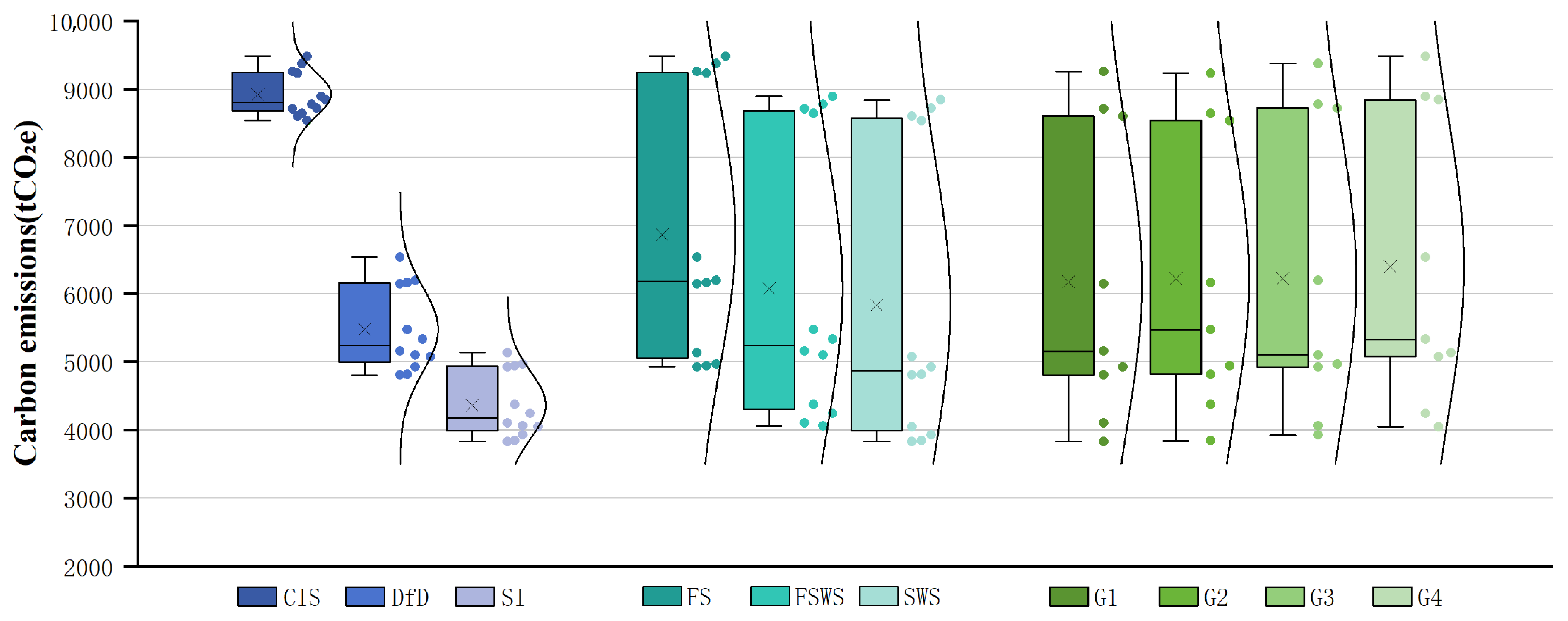
As shown in Figure 9, we used box plots to compare the distributions of 90-year embodied carbon emissions under different design patterns, structural systems, and floor-plan layouts. It can be observed that the differences among the three design patterns (CIS, DfD, and SI) are the most pronounced. The CIS group exhibits the highest embodied carbon emissions, with a median of approximately 8.8 × 10³ tCO2e, which is significantly higher than the medians of the DfD group (~5200 tCO2e) and the SI group (~4200 tCO2e). No outliers appear within any of the design-pattern groups, indicating that all simulated data lie within a reasonable range and there are no statistical anomalies (Figure 9). To formally test these effects, we performed a three-factor ANOVA (pattern × structure × layout) on the 90-year embodied carbon across all 36 cases. The results (Table 6) confirm that the design pattern is overwhelmingly significant (F ≈ 1872, p ≪ 0.001), the structural system is also significant (F ≈ 90, p < 0.001), while floor-plan layout is not significant (p ≈ 0.17). This statistically supports the conclusion that pattern dominates carbon outcomes. In Figure 7 and Table 4, we noted one crossover: G1-S-D (DfD-shear) is slightly lower than G1-F-S (SI-frame). This occurs because the SI-frame case still has a large initial frame (≈5792 tCO2e) despite reuse, whereas the DfD-shear case (≈5613 tCO2e) used a lighter shear-wall structure with extensive reuse. Our analysis makes this explicit.
Overall, the embodied carbon emission distribution for the CIS pattern is clearly shifted upward relative to the other two patterns: the median embodied carbon for the DfD and SI groups is roughly 40% and 50% lower than that of the CIS group, respectively. This result demonstrates that the design pattern is the dominant factor influencing life-cycle embodied carbon in these residential building cases.
The structural system is another important factor affecting the distribution of embodied carbon. The box plots for the three structural categories—frame, frame–shear wall, and shear-wall—show distinct differences in embodied carbon emissions. Specifically, the frame-structure cases have the highest values (median ~6180 tCO2e), the frame–shear wall cases are intermediate (median ~5240 tCO2e), and the shear-wall cases have the lowest emissions (median ~4870 tCO2e). The frame-structure group’s distribution is generally shifted higher (Figure 9). Statistical analysis indicates that under the CIS pattern, using a shear-wall structure instead of a frame can reduce embodied carbon by approximately 10%, and a similar advantage of shear-wall systems is observed under the DfD and SI patterns as well. (The mixed frame–shear wall system yields emissions between those of the frame and shear-wall systems.) Thus, structural system selection does have a significant impact on embodied carbon; however, its influence is much smaller in magnitude than the effect of the design pattern.
By contrast, the floor plan layout has a relatively limited effect on embodied carbon emissions. The emissions of the different layout groups (G1, G2, G3, and G4) are quite close to one another. In fact, the median values for all four layout types cluster around ~5000 tCO2e, and none of the layout groups exhibit any outliers—suggesting that the variability in emissions within each layout category is similar (Figure 9). Notably, the interquartile ranges of the layout groups nearly span the full range of emissions observed across all cases: the lowest values (near the bottom whiskers) correspond to the lowest-emission SI scenarios, and the highest values (upper whiskers) correspond to the highest-emission CIS scenarios. This indicates that changing the floor plan layout does not substantially alter the overall distribution of embodied carbon outcomes. Intra-group differences remain largely driven by the structural system and, especially, the design pattern employed.
In summary, the choice of design pattern emerges as the overriding factor affecting life-cycle embodied carbon in the residential building scenarios, with a far greater impact than either the structural system or the floor plan layout. This finding implies that selecting an appropriate, circular design pattern (along with an efficient structural system) is key to achieving lower embodied carbon in residential buildings.

4. Discussion

4.1. Core Drivers of Carbon Emission Differences

Understanding the core drivers behind the observed differences in embodied carbon is critical for interpreting the results. The disparities in 90-year embodied carbon among the three design patterns (CIS, DfD, and SI) are not random; rather, they are driven by three primary factors: the quantity of material used, the building’s lifespan, and the end-of-life treatment strategy. As shown in Figure 7 and Table 2, the SI pattern yields the lowest cumulative emissions over 90 years, followed by the DfD pattern, with the CIS pattern highest. This ranking reflects the different ways in which each design pattern promotes material recycling and extends the building’s lifespan.
Firstly, the quantity of materials used is a fundamental determinant of embodied carbon. In our study, all simulated cases were based on the same set of building prototypes, so the initial material quantities were comparable within each structural category. The results show that the SI pattern—by enabling long-term use of the main structural frame and only periodic replacement of infill components—significantly reduces the input of new materials needed over multiple renovation cycles. For example, in the G1 group with a frame structure, the SI case (G1-F-S) incurred about 4027.86 tCO2e in material production emissions over 90 years, whereas the CIS case (G1-F-C) incurred 10,962.39 tCO2e (Table 3). The DfD pattern, while still involving periodic disassembly and reassembly, also keeps material-production emissions relatively low by allowing most structural components to be recovered and reused. This demonstrates that reducing the demand for new material production is the most direct way to lower embodied carbon, and both the SI and DfD patterns achieve this through different resource-circulation mechanisms [4,42,43,45].
Secondly, extending the building’s lifespan markedly reduces life-cycle carbon emissions. In the CIS pattern, the inability to adapt to changing needs means the building is completely demolished and rebuilt at year 30 and year 60, leading to a repeated accumulation of embodied carbon. In contrast, the SI pattern’s support–infill separation design allows functional updates to be made without damaging the primary structure, effectively prolonging the building’s overall lifespan and avoiding the large emissions associated with demolition and new construction. The DfD pattern does not significantly extend the physical lifespan of the structure, but by enabling components to be reused across multiple lifecycles, it extends the service life of materials. This outcome is highly consistent with the core principle of the circular economy that advocates extending the useful lifespan of products and materials [68,69,70,71,72].
Lastly, the end-of-life treatment approach has an important influence on embodied carbon. In this study, we accounted for the carbon offset benefits of material recycling in phase D (per EN 15978). As shown in Figure 8, the CIS pattern, which generates a large volume of waste due to multiple demolitions, achieves the highest carbon credit in the recycling phase (e.g., –4092.75 tCO2e for case G1-F-C); however, this benefit cannot compensate for the high emissions resulting from its repeated rebuilds. The DfD pattern—thanks to its non-destructive disassembly and high component reuse rate—produces virtually no waste at end-of-life; its carbon offset in phase D is smaller (since less waste is available to recycle). The SI pattern does produce some waste when the main structure is eventually dismantled at the end of 90 years, but because it avoids any earlier rebuilds, its cumulative life-cycle emissions remain the lowest of the three patterns. These findings indicate that relying solely on end-of-life recycling is not sufficient to achieve significant carbon reductions; it is essential to intervene at the design stage by extending building service life and improving material efficiency in order to realize fundamental emissions cuts.
Overall, the large differences in embodied carbon observed in this study can be attributed to the three key factors discussed above: material intensity, service life, and end-of-life management. By optimizing designs upfront to minimize material requirements, maximize longevity, and enhance resource circularity, the embodied carbon of residential buildings can be significantly reduced.

4.2. Design Implications for Low-Carbon Residential Buildings

This study provides important evidence for low-carbon residential design and policymaking, emphasizing that the choice of design pattern can dramatically reduce embodied carbon. Key implications and recommendations include:
  • Promote longevity and adaptability in design: Adopt modular and disassemblable structural systems to extend the service life of the primary structure (e.g., targeting 90+ years), while allowing internal infill components to be easily replaced or reconfigured. This ensures that buildings can adapt to changing user needs over time without requiring full demolition. Such durability-focused design strategies can reduce the life-cycle embodied carbon of a single residential building by approximately 40–50% (as demonstrated by the DfD and SI cases relative to CIS in our results).
  • Optimize structural systems for material efficiency: Provided that functional and economic requirements can be met, prioritize structural forms that utilize materials more efficiently (for example, choose shear wall structural systems instead of less efficient frame systems where appropriate). This can reduce overall material usage and associated carbon emissions by roughly 7–14% on average (based on our comparative findings for shear wall vs. frame structures). In parallel, encourage the development and use of low-carbon building materials (e.g., blended cements with industrial by-products, high-recycled-content steel) to further decrease carbon emissions during the initial construction phase.
  • Increase resource recycling and reuse rates: Establish and improve building material recycling programs and implement digital tools such as “material passports” to track components throughout their life cycle and facilitate their reuse. In our study, material recycling and reuse at end-of-life provided carbon “credits” (offsets) on the order of 15–25% of total emissions for the DfD and SI patterns, underscoring their importance. However, relying on recycling alone is not sufficient to meet carbon reduction targets; this strategy should be combined with extending the service life of buildings and reducing initial material consumption.
  • Innovate low-carbon materials and processes: Develop and adopt construction materials with lower embodied carbon (for instance, engineered timber or low-clinker concrete mixes), and optimize material manufacturing processes by using cleaner energy sources and more efficient production methods. In parallel, minimize material loss and waste during construction and demolition through better planning and resource management. Together, these measures can further decrease carbon emissions in the material production stage, which remains the largest contributor to life-cycle embodied carbon.
  • Mitigate infill replacement impacts: In the SI pattern, non-structural infill components are replaced periodically (every 30 years in our scenario), which can lead to significant cumulative emissions over time. To reduce this impact, use infill materials that are low-carbon or recyclable (so that removed materials can be repurposed or recycled after each renovation), and design infill components for greater durability to lengthen the replacement cycle. Extending infill service life and utilizing recyclable, low-carbon infill materials can substantially cut down the use-phase embodied carbon in SI buildings.
Overall, these findings urge the building industry to transition away from the traditional “short lifespan, high material consumption” model and toward a “long lifespan, circular reuse” paradigm of low-carbon design. Adopting design patterns that emphasize adaptability and component reuse—combined with the strategic selection of efficient structural systems and materials—represents an effective pathway to substantially lowering embodied carbon in residential buildings.

4.3. Limitations and Future Work

Despite conducting a systematic quantitative analysis of residential life-cycle carbon emissions under different design patterns, this study has several limitations that point to directions for future research:
  • Idealized model assumptions: The study assumes a building service life of 90 years with major renovations or rebuilds every 30 years. This scenario does not fully reflect the actual average lifespan of residential buildings in China (around 30–35 years), and thus may overestimate the long-term carbon reduction potential of the DfD and SI patterns. Future studies should consider performing sensitivity analyses with more realistic service life distributions and renovation frequencies to examine how outcomes change if buildings have shorter (or longer) lifespans than the idealized 90-year horizon used here.
  • Limited case types and scenario coverage: Our simulations focused on a single building type (a typical multi-story apartment prototype) under one set of conditions. We did not consider other building types (e.g., high-rise residential towers or single-family houses), different climate conditions (which could affect material choices and decay rates), or alternative material scenarios (such as designs using mass timber or other low-carbon materials). Follow-up research should extend the analysis to a wider range of building types, climate zones, and material configurations to strengthen the generalizability of the conclusions. In addition, the current resource-circulation analysis centered mainly on end-of-life recycling; future work could incorporate additional factors such as partial upgrades during the use phase, intermediate retrofitting strategies, and broader material circulation networks. These extensions would provide a more comprehensive picture of long-term carbon performance across diverse contexts.
  • Practical implementation challenges: Implementing DfD and SI design patterns in real-world projects faces several hurdles, including higher initial construction costs, limited industry experience with these methods, and insufficient policy incentives or supporting regulations. In this study, we did not model economic or policy factors, but they are critical for real-world adoption. Interdisciplinary research is needed—such as life-cycle cost–benefit analyses (see, e.g., [47] for cost perspectives on circular building), studies of market and user acceptance, and policy simulations—to address these barriers and facilitate wider uptake. Further exploration of mechanisms like material passports, circular-economy business models, and government incentive programs could also support the practical implementation of DfD and SI strategies.
In conclusion (of the discussion), this study provides systematic quantitative evidence linking residential design patterns to life-cycle embodied carbon outcomes. However, additional research and on-the-ground experimentation are needed to validate and expand upon these findings. By broadening the analysis scope (to other building types, climates, and materials) and examining the economic and policy dimensions, future work can enhance both the theoretical understanding and the practical adoption of low-carbon, circular design strategies in the building sector.

5. Conclusions

Under a unified set of assumptions (a 90-year service life with 30-year renovation cycles), this study systematically quantified and compared the life-cycle embodied carbon emissions of three design patterns (CIS, DfD, and SI) in a typical multi-story residential building. The analysis revealed the carbon-reduction benefits and mechanisms of each design pattern under scenarios of frequent renovation, confirming the significant long-term carbon mitigation potential of the DfD and SI patterns. This work helps to fill the gap in existing research, which has lacked long-term, equivalent comparisons of these three design patterns. The main conclusions are summarized as follows:
  • Results of the quantitative comparison under equivalent conditions:
    • Design pattern is the dominant driver of embodied carbon: Relative to the traditional CIS pattern, DfD and SI patterns reduce total life-cycle embodied carbon by approximately 40–50%, with SI achieving the lowest overall emissions. Within the circular design approaches, SI further lowers emissions by about 10–15% compared with DfD.
    • Structural system has a secondary but significant influence: For the same plan layout and design pattern, shear wall structural systems consistently emit ~7–14% less embodied carbon than frame systems, while hybrid frame–shear wall systems fall in between. Although structural optimization yields measurable benefits, its effect is notably smaller than the reductions achieved by adopting circular design patterns.
    • Floor-plan layout has a limited effect: Corridor-type layouts exhibit slightly higher emissions than unit-type layouts (by ~1.3%), and small-unit schemes are marginally higher than large-unit schemes (within ~7%). These results indicate that plan layout is not a primary determinant of embodied carbon compared with the design pattern and structural system.
  • Resource-circulation mechanisms drive carbon differences:
From a resource-circulation standpoint, three factors—material intensity, service life, and end-of-life management—govern embodied-carbon outcomes. In our cases, the material-production phase contributes more than 80% of total embodied carbon and thus remains the largest single source of emissions. Extending service life and achieving high recovery/reuse rates can reduce embodied carbon by approximately 40–55% and 15–25%, respectively, underscoring the necessity of integrating circularity strategies at the design stage.
Through a multi-scenario, multi-factor quantitative comparison, this study substantiates the pronounced long-term environmental advantages of SI and DfD patterns for residential buildings, providing theoretical grounding and empirical evidence to support the promotion of adaptable, long-lived, and low-carbon housing.


Supplementary Materials

The following supporting information can be downloaded at: https://www.mdpi.com/article/10.3390/buildings15244477/s1.

Author Contributions

R.H.: Writing—original draft, Conceptualization, Visualization, Software, Methodology, Investigation, Data curation. R.D.: Writing—review and editing, Supervision, Project administration, Methodology, Data curation. Y.S.: Writing—review and editing, Supervision, Conceptualization, Funding acquisition, Methodology, Writing—original draft. L.C.: Visualization, Software, Investigation. R.Y.: Writing—review and editing, Validation. Q.Z.: Visualization, Investigation. Y.C.: Visualization, Validation. M.J.: Writing—review and editing, Visualization. All authors have read and agreed to the published version of the manuscript.

Funding

This research was funded by the National Natural Science Foundation of China (No. 51878199) and the Natural Science Foundation of the Shenzhen Basic Research Program (No. JCYJ20250604135903005).

Data Availability Statement

All data generated or analyzed in this study are included in this article (in tables and figures) or as Supplementary Files. Detailed Bill-of-Quantities tables for all 12 prototypes and 36 pattern–structure cases are provided in the Supplementary Materials. The PKPM-BES (v2024) and BIM Base KIT2025 (2025) software were used; all input parameters and calculation spreadsheets are supplied in the Supplementary Information for reproducibility.

Acknowledgments

The authors would like to thank their colleagues for their helpful discussions and assistance with data collection and modeling. The authors are also grateful to the anonymous reviewers for their insightful comments, which have helped to improve the quality of this paper.

Conflicts of Interest

The authors declare that they have no known competing financial interests or personal relationships that could have appeared to influence the work reported in this paper.

Abbreviations

The following abbreviations are used in this manuscript:
CISCast-in-Situ
DfDDesign-for-Disassembly
SISkeleton–Infill

References

  1. Masson-Delmotte, V.; Zhai, P.; Pirani, A.; Connors, S.L.; Péan, C.; Berger, S.; Caud, N.; Chen, Y.; Goldfarb, L.; Gomis, M.I.; et al. Climate Change 2021: The Physical Science Basis; Contribution of Working Group I to the Sixth Assessment Report of the Intergovernmental Panel on Climate Change; IPCC: Geneva, Switzerland, 2021; Volume 2, 280p. [Google Scholar]
  2. Akbarnezhad, A.; Xiao, J. Estimation and minimization of embodied carbon of buildings: A review. Buildings 2017, 7, 5. [Google Scholar] [CrossRef]
  3. Khan, S.A.; Alam, T.; Khan, M.S.; Blecich, P.; Kamal, M.A.; Gupta, N.K.; Yadav, A.S. Life cycle assessment of embodied carbon in buildings: Background, approaches and advancements. Buildings 2022, 12, 1944. [Google Scholar] [CrossRef]
  4. Zhai, Y.; Li, Y.; Tang, S.; Liu, Y.; Liu, Y. Lightweight Strategies for Wooden-Structure Buildings Based on Embodied Carbon Emission Calculations for Carbon Reduction. Buildings 2024, 14, 3460. [Google Scholar] [CrossRef]
  5. Bacheva, T.S.; Grau, J.F.R. Embodied Impacts in Buildings: A Systematic Review of Life Cycle Gaps and Sectoral Integration Strategies. Buildings 2025, 15, 1661. [Google Scholar] [CrossRef]
  6. Gao, H.; Wang, X.; Wu, K.; Zheng, Y.; Wang, Q.; Shi, W.; He, M. A review of building carbon emission accounting and prediction models. Buildings 2023, 13, 1617. [Google Scholar] [CrossRef]
  7. Rauf, A. Reducing life cycle embodied energy of residential buildings: Importance of building and material service life. Buildings 2022, 12, 1821. [Google Scholar] [CrossRef]
  8. Lützkendorf, T.; Balouktsi, M. Embodied carbon emissions in buildings: Explanations, interpretations, recommendations. Build. Cities 2022, 3, 964–973. [Google Scholar] [CrossRef]
  9. Železná, J.; Felicioni, L.; Trubina, N.; Vlasatá, B.; Růžička, J.; Veselka, J. Whole life carbon assessment of buildings: The process to define Czech national benchmarks. Buildings 2024, 14, 1936. [Google Scholar] [CrossRef]
  10. Chadchan, J.; Shankar, R. An analysis of urban growth trends in the post-economic reforms period in India. Int. J. Sustain. Built Environ. 2012, 1, 36–49. [Google Scholar] [CrossRef]
  11. Lim, H. Comparative Life Cycle Assessment of Reconstruction and Renovation for Carbon Reduction in Buildings. Buildings 2025, 15, 3388. [Google Scholar] [CrossRef]
  12. Chen, Y.; Zhou, Y.; Feng, W.; Fang, Y.; Feng, A. Factors that influence the quantification of the embodied carbon emission of prefabricated buildings: A systematic review, meta-analysis and the way forward. Buildings 2022, 12, 1265. [Google Scholar] [CrossRef]
  13. Janjua, S.Y.; Sarker, P.K.; Biswas, W.K. Impact of service life on the environmental performance of buildings. Buildings 2019, 9, 9. [Google Scholar] [CrossRef]
  14. Song, Y.; Mithraratne, N.; Zhang, H. Life-time performance of post-disaster temporary housing: A case study in Nanjing. Energy Build. 2016, 128, 394–404. [Google Scholar] [CrossRef]
  15. Rauf, A.; Crawford, R.H. Building service life and its effect on the life cycle embodied energy of buildings. Energy 2015, 79, 140–148. [Google Scholar] [CrossRef]
  16. Ghorbany, S.; Hu, M. A systematic framework to reduce urban embodied carbon emissions using urban scale simulation. NPJ Urban Sustain. 2025, 5, 7. [Google Scholar] [CrossRef]
  17. Silva, A.; de Brito, J.; Thomsen, A.; Straub, A.; Prieto, A.J.; Lacasse, M.A. Causal effects between criteria that establish the end of service life of buildings and components. Buildings 2022, 12, 88. [Google Scholar] [CrossRef]
  18. Galle, W.; De Temmerman, N.; De Meyer, R. Integrating scenarios into life cycle assessment: Understanding the value and financial feasibility of a demountable building. Buildings 2017, 7, 64. [Google Scholar] [CrossRef]
  19. Sodagar, B. Sustainability potentials of housing refurbishment. Buildings 2013, 3, 278–299. [Google Scholar] [CrossRef]
  20. Teng, Y.; Li, Z.; Liu, S.; Tiong, R.L.; Li, T. Revealing the influence mechanism of the service lifespan of residential buildings in China. Habitat Int. 2023, 142, 102947. [Google Scholar] [CrossRef]
  21. Lu, W.; Yuan, H. A framework for understanding waste management studies in construction. Waste Manag. 2011, 31, 1252–1260. [Google Scholar] [CrossRef]
  22. Zhou, W.; Moncaster, A.; Reiner, D.M.; Guthrie, P. Estimating lifetimes and stock turnover dynamics of urban residential buildings in China. Sustainability 2019, 11, 3720. [Google Scholar] [CrossRef]
  23. Mayar, K.; Carmichael, D.G.; Shen, X. Resilience and Systems—A Building structure case Example. Buildings 2023, 13, 1520. [Google Scholar] [CrossRef]
  24. Nowogońska, B. Diagnoses in the aging process of residential buildings constructed using traditional technology. Buildings 2019, 9, 126. [Google Scholar] [CrossRef]
  25. Zhao, W.; Leeftink, R.; Rotter, V. Evaluation of the economic feasibility for the recycling of construction and demolition waste in China—The case of Chongqing. Resour. Conserv. Recycl. 2010, 54, 377–389. [Google Scholar] [CrossRef]
  26. Yuan, H.; Shen, L. Trend of the research on construction and demolition waste management. Waste Manag. 2011, 31, 670–679. [Google Scholar] [CrossRef]
  27. Pan, W.; Zhang, H.; Hei, S.; Yang, Y.; Xu, X.; Zhou, C.; Liu, C.; Li, Z.; Zhang, B.; Sun, L.; et al. Recycling of Building Interior Decoration and Renovation Waste: A Case Study in China. Buildings 2025, 15, 252. [Google Scholar] [CrossRef]
  28. Jiang, B.; Huang, H.; Ge, F.; Huang, B.; Ullah, H. Carbon Emission Assessment During the Recycling Phase of Building Meltable Materials from Construction and Demolition Waste: A Case Study in China. Buildings 2025, 15, 456. [Google Scholar] [CrossRef]
  29. Wang, X.; Yang, L.; Huang, T.; Jun, B.K. A Comparative Study on Unit Plans of Public Rental Housing in China, Japan, and South Korea: Policy, Culture, and Spatial Insights for China’s Indemnificatory Housing Development. Buildings 2025, 15, 3068. [Google Scholar] [CrossRef]
  30. Wang, Q. A Preliminary Long-Term Housing Evaluation System Study in Pearl River Delta, China: Based on Open Building and “Level” Strategy. Buildings 2025, 15, 3153. [Google Scholar] [CrossRef]
  31. Zhou, X.; Ye, F.; Zhang, F.; Wang, D. Analysis and Optimization of Residential Elements from the Perspective of Multi-Child Families in the Yangtze River Delta Region. Buildings 2024, 14, 1649. [Google Scholar] [CrossRef]
  32. Densley Tingley, D. Design for Deconstruction: An Appraisal. Ph.D. Dissertation, University of Sheffield, Sheffield, UK, 2013. [Google Scholar]
  33. Kanters, J. Design for deconstruction in the design process: State of the art. Buildings 2018, 8, 150. [Google Scholar] [CrossRef]
  34. Guo, X.; Li, Y.; Shi, H.; She, A.; Guo, Y.; Su, Q.; Wu, M.; Chen, Y.; Chen, L.; Tao, C. Carbon reduction in cement industry-An indigenized questionnaire on environmental impacts and key parameters of life cycle assessment (LCA) in China. J. Clean. Prod. 2023, 426, 139022. [Google Scholar] [CrossRef]
  35. Yu, F.; Wang, B.; Sheng, J.; Lv, X.; Jin, X.; Chen, G. Adaptive housing with skeleton–infill (SI) system: Strategies and performance of embodied carbon reduction through household layout flexibility. Energy Build. 2025, 329, 115298. [Google Scholar] [CrossRef]
  36. Morales-Beltran, M.; Engür, P.; Şişman, Ö.A.; Aykar, G.N. Redesigning for disassembly and carbon footprint reduction: Shifting from reinforced concrete to hybrid timber–steel multi-story building. Sustainability 2023, 15, 7273. [Google Scholar] [CrossRef]
  37. Jang, H.; Ahn, Y.; Roh, S. Comparison of the embodied carbon emissions and direct construction costs for modular and conventional residential buildings in South Korea. Buildings 2022, 12, 51. [Google Scholar] [CrossRef]
  38. Mayer, M. Adapting residential envelope assemblies for full circularity. J. Phys. Conf. Ser. 2021, 2042, 012170. [Google Scholar] [CrossRef]
  39. Violano, A.; Cannaviello, M. Design process innovation through flexible and circular technological solutions. Vitr. Int. J. Archit. Technol. Sustain. 2022, 7, 60–73. [Google Scholar]
  40. Ullah, H.; Zhang, H.; Huang, B.; Gong, Y. BIM-based digital construction strategies to evaluate carbon emissions in green prefabricated buildings. Buildings 2024, 14, 1689. [Google Scholar] [CrossRef]
  41. Akinade, O.O.; Oyedele, L.O.; Ajayi, S.O.; Bilal, M.; Alaka, H.A.; Owolabi, H.A.; Bello, S.A.; Jaiyeoba, B.E.; Kadiri, K.O. Design for Deconstruction (DfD): Critical success factors for diverting end-of-life waste from landfills. Waste Manag. 2017, 60, 3–13. [Google Scholar] [CrossRef]
  42. Hernández, H. Circular Industrialized Construction: A Perspective Through Design for Manufacturing, Assembly, and Disassembly. Buildings 2025, 15, 2174. [Google Scholar] [CrossRef]
  43. Torres, V.; Íñiguez-González, G.; Blanchet, P.; Giorgio, B. Challenges in the design for disassembly of light timber framing panelized components. Buildings 2025, 15, 321. [Google Scholar] [CrossRef]
  44. Kendall, S. Open building: An approach to sustainable architecture. J. Urban Technol. 1999, 6, 1–16. [Google Scholar] [CrossRef]
  45. Nasreldin, R.; Abdelfattah, D. From Theory to Practice: Assessing the Open Building Movement’s Role in Egypt’s Housing Market over Four Decades. Buildings 2025, 15, 2600. [Google Scholar] [CrossRef]
  46. Bradley, G.; Shell, S.; Esherick, H. Design for deconstruction and materials reuse. Proc. CIB Task Group 2006, 39, 189–209. [Google Scholar]
  47. AlJaber, A.; Alasmari, E.; Martinez-Vazquez, P.; Baniotopoulos, C. Life cycle cost in circular economy of buildings by applying building information modeling (BIM): A state of the art. Buildings 2023, 13, 1858. [Google Scholar] [CrossRef]
  48. Motiei, M.; Iyer-Raniga, U.; Andamon, M.M.; Khodabakhshian, A. Advancing Circular Buildings: A Review of Building Strategies for AEC Stakeholders. Buildings 2024, 14, 2594. [Google Scholar] [CrossRef]
  49. Lara, J.C.F.; El-Fadel, M.; Rauf, A.; Khalfan, M.M.A. Pathways toward Net-zero emissions in the construction industry: A framework integrating circular economy and industry 4.0 innovations. Build. Environ. 2025, 285, 113652. [Google Scholar] [CrossRef]
  50. Liljenström, C.; Malmqvist, T.; Erlandsson, M.; Fredén, J.; Adolfsson, I.; Larsson, G. Byggproduktionens Miljöpåverkan i Förhållande Till Driften; KTH: Stockholm, Sweden, 2014. [Google Scholar]
  51. Cao, Z.; Liu, G.; Duan, H.; Xi, F.; Liu, G.; Yang, W. Unravelling the mystery of Chinese building lifetime: A calibration and verification based on dynamic material flow analysis. Appl. Energy 2019, 238, 442–452. [Google Scholar] [CrossRef]
  52. Li, L.; Gao, L.; Zhang, X.; Xu, H.; Jiang, L. Research on Building’s Carbon Emission Calculation and Reduction Strategy Based on Life Cycle Assessment (LCA) and Building in Formation Modeling (BIM): A Case Study in Beijing, China. Buildings 2025, 15, 1403. [Google Scholar] [CrossRef]
  53. Dong, Y.; Yang, T.; Liu, P.; Xu, Z. Comparing the Standards of Life Cycle Carbon Assessment of Buildings: An Analysis of the Pros and Cons. Buildings 2023, 13, 2417. [Google Scholar] [CrossRef]
  54. Zhang, L.; Cai, Y.; Song, S.; Sun, L. An Urban Renewal Design Method Based on Carbon Emissions and Carbon Sink Calculations: A Case Study on an Environmental Improvement Project in the Suzhou Industrial Investment Science and Technology Park. Buildings 2024, 14, 2962. [Google Scholar] [CrossRef]
  55. Wang, J.; Zhang, Y.; Wang, Y. Environmental impacts of short building lifespans in China considering time value. J. Clean. Prod. 2018, 203, 696–707. [Google Scholar] [CrossRef]
  56. Shao, Y.; Yan, R.; Chen, C. A Quantitative Study on the Openness of Unit Housing in Harbin. Archit. J./Jian Zhu Xue Bao 2022, S1, 81–85. [Google Scholar]
  57. EN 15978:2011; Sustainability of Construction Works—Assessment of Environmental Performance of Buildings—Calculation Method. European Committee for Standardization (CEN): Brussels, Belgium, 2011.
  58. Tirelli, D.; Besana, D. Moving toward net zero carbon buildings to face Global Warming: A narrative review. Buildings 2023, 13, 684. [Google Scholar] [CrossRef]
  59. Kumar, V.; Ricco, M.L.; Bergman, R.D.; Nepal, P.; Poudyal, N.C. Environmental impact assessment of mass timber, structural steel, and reinforced concrete buildings based on the 2021 international building code provisions. Build. Environ. 2024, 251, 111195. [Google Scholar] [CrossRef]
  60. Dani, A.A.; Feng, R.; Fang, Z.; Roy, K. Life Cycle Assessment of a Structural Insulated Panel Modular House in New Zealand. Buildings 2025, 15, 146. [Google Scholar] [CrossRef]
  61. Roberts, M.; Ouellet-Plamondon, C.; Raftery, P. Embodied carbon in mechanical, electrical, and plumbing systems: A critical literature review. Build. Environ. 2025, 275, 112823. [Google Scholar] [CrossRef]
  62. GB/T 51366-2019; Standard for Building Carbon Emission Calculation. Ministry of Housing and Urban-Rural Development of the People’s Republic of China: Beijing, China, 2019.
  63. Almulhim, M.S.; Taher, R. Environmental impact assessment of residential building structural systems: A case study in Saudi Arabia. J. Build. Eng. 2023, 72, 106644. [Google Scholar] [CrossRef]
  64. Han, Y.; Wang, Y.; Zhao, L.; Li, T.; Yang, Z.; Wang, Z.; Wang, H. BIM-Based Analysis and Strategies to Reduce Carbon Emissions of Underground Construction in Public Buildings: A Case on Xi’an Shaanxi, China. Buildings 2024, 14, 2134. [Google Scholar] [CrossRef]
  65. Wang, H.; Zhang, M.; Zhang, J.; Zhang, T.; Wang, Y.; Cai, S. A Study on Carbon Reduction and Emission Mitigation Based on the Optimal Shear Wall Layout Ratio. Buildings 2024, 14, 4033. [Google Scholar] [CrossRef]
  66. Lavagna, M.; Baldassarri, C.; Campioli, A.; Giorgi, S.; Dalla Valle, A.; Castellani, V.; Sala, S. Benchmarks for environmental impact of housing in Europe: Definition of archetypes and LCA of the residential building stock. Build. Environ. 2018, 145, 260–275. [Google Scholar] [CrossRef]
  67. Stephan, A.; Prideaux, F.; Crawford, R.H. EPiC grasshopper: A bottom-up parametric tool to quantify life cycle embodied environmental flows of buildings and infrastructure assets. Build. Environ. 2024, 248, 111077. [Google Scholar] [CrossRef]
  68. Röck, M.; Saade, M.R.M.; Balouktsi, M.; Rasmussen, F.N.; Birgisdottir, H.; Frischknecht, R.; Habert, G.; Lützkendorf, T.; Passer, A. Embodied GHG emissions of buildings–The hidden challenge for effective climate change mitigation. Appl. Energy 2020, 258, 114107. [Google Scholar] [CrossRef]
  69. Di Bari, R.; Belleri, A.; Marini, A.; Horn, R.; Gantner, J. Probabilistic life-cycle assessment of service life extension on renovated buildings under seismic hazard. Buildings 2020, 10, 48. [Google Scholar] [CrossRef]
  70. Costantino, C.; Benedetti, A.C.; Gulli, R. Simplified multi-life cycle assessment at the urban block scale: GIS-based comparative methodology for evaluating energy efficiency solutions. Buildings 2023, 13, 2355. [Google Scholar] [CrossRef]
  71. Macarthur, E.; Heading, H. How the Circular Economy Tackles Climate Change; Ellen MacArthur Found: Cowes, UK, 2019; Volume 1, 71p. [Google Scholar]
  72. Lausselet, C.; Dahlstrøm, O.A.; Thyholt, M.; Eghbali, A.; Schneider-Marin, P. Methods to account for design for disassembly: Status of the building sector. Buildings 2023, 13, 1012. [Google Scholar] [CrossRef]
Figure 1. Schematic diagram of three different design patterns, drawn by the authors.
Buildings 15 04477 g001
Figure 2. Construction activities within the 90-year service life of residential buildings are shown for different patterns, drawn by the authors.
Buildings 15 04477 g002
Figure 3. Typical floor plans for the case study building, drawn by the authors.
Buildings 15 04477 g003
Figure 4. Case study building sections, drawn by the authors.
Buildings 15 04477 g004
Figure 5. Case study building grouping, drawn by the authors.
Buildings 15 04477 g005
Figure 6. Schematic diagram of boundary division for the entire life cycle of buildings according to “EN 15978”, redrawn by the authors.
Buildings 15 04477 g006
Figure 7. Comparison of embodied carbon among different design patterns, drawn by the authors.
Buildings 15 04477 g007
Figure 8. Comparison of embodied carbon emissions across life-cycle phases, drawn by the authors.
Buildings 15 04477 g008
Figure 9. Comparison of carbon-emission box plots, drawn by the authors.
Buildings 15 04477 g009
Table 1. 90-year life-cycle scenario settings and parameter comparison for the three design patterns.
AspectCISDfDSI
Connection methodMonolithic cast-in situ construction (rigid joints)Reversible connections throughoutCast-in-place structure; reversible connections for infill
Structure service life30 years30 years≥90 years
Infill service life30 years30 years30 years
AdaptabilityLow (functional changes typically require full demolition)Low (components are disassemblable, but overall reconfiguration is still complex)High (interior updates achieved via partial infill replacement)
Demolition/renovation methodDestructive demolition: all materials become wasteNon-destructive disassembly: components are reusedStructure: destructive demolition; Infill: disassembled and reused
Key events over 90 yearsYear 30 and 60: full demolition + rebuild; Year 90: final demolitionYear 30 and 60: disassembly + reassembly; Year 90: disassembly for reuseYear 30 and 60: infill replacement; Year 90: structural demolition, infill disassembly and reuse
Table 2. Key parameters and assumptions for life-cycle carbon calculations (Phase A–D).
ParameterPhaseBase Value (Range)Source/Comment
Material emission factorA1–A3Steel: 2.34 tCO2e/t (±10%); Concrete: 0.30 tCO2e/m3 (±10%)GB/T 51366–2019
Transport distance (km)A4,C2100 (50–300)GB/T 51366–2019 recommended values
Transport emission factorA4,C23.34 × 10−4 tCO2e/(t·km) (±10%)GB/T 51366–2019
Construction emission factor A50.075 tCO2e/m2 (±10%)GB/T 51366–2019
Service life (years)B1–B590 (70–110)EN 15978; GB/T 51366–2019
Renovation interval (years)B2–B530 (25–35)Industry data (typical for China)
Infill replacement cycleB4Every 30 years (fixed)Assumed equal to the renovation cycle
Demolition emission factor C10.013 tCO2e/m2 (±10%)GB/T 51366–2019
Recycling rate C1–C4Steel: 90%; Concrete: 70%GB/T 51366–2019
Component reuse credit DSteel: 1.9677 tCO2e/t (±10%); Concrete: 0.0150 tCO2e/m3 (±10%)Calculated from GB/T 51366–2019 factors
Note: All data are aligned with EN 15978 system boundaries and primarily sourced from the Chinese national standard GB/T 51366–2019 for building carbon emissions.
Table 3. Sensitivity analysis (effect on 90-year embodied carbon for a sample case).
ParameterLow ValueBaseHigh ValueEffect on 90-Year CO2e
Service life70 years (–22%)90 years110 years (+22%)–14% to +20% change
Renovation interval25 years (–17%)30 years35 years (+17%)–13% to +20% change
Recycling rate1.1× (+10%)1.0×0.9× (−10%)~±9%
Transport distance50 km100 km300 km~±5%
Emis. factor0.9× (−10%)1.0×1.1× (+10%)~±10%
Table 4. Comparison of embodied carbon among different design patterns.
G1
CISDfDSI
G1-F-CG1-FS-CG1-S-CG1-F-DG1-FS-DG1-S-DG1-F-SG1-FS-SG1-S-S
CE(tCO2e)9261.428713.838605.596210.775750.575613.455791.654813.624519.56
G2
CISDfDSI
G2-F-CG2-FS-CG2-S-CG2-F-DG2-FS-DG2-S-DG2-F-SG2-FS-SG2-S-S
CE(tCO2e)9237.758648.558538.726208.455900.585607.635795.24917.564516.48
G3
CISDfDSI
G3-F-CG3-FS-CG3-S-CG3-F-DG3-FS-DG3-S-DG3-F-SG3-FS-SG3-S-S
CE(tCO2e)9379.268779.478720.676246.655750.465684.265841.314784.554642.38
G4
CISDfDSI
G4-F-CG4-FS-CG4-S-CG4-F-DG4-FS-DG4-S-DG4-F-SG4-FS-SG4-S-S
CE(tCO2e)9484.838893.688841.216224.215762.915647.116043.795004.024787.51
Table 5. Comparison of embodied carbon emissions across life-cycle phases.
G1
CISDfDSI
G1-F-CG1-FS-CG1-S-CG1-F-DG1-FS-DG1-S-DG1-F-SG1-FS-SG1-S-S
CM(tCO2e)10,962.3910,412.2810,279.25276.54854.644722.594027.863705.833605.03
CT(tCO2e)1056.541029.21972.06475.63434.3421.04380.5347.44336.83
CC(tCO2e)667.62667.62667.62467.33467.33467.33155.78155.78155.78
CU(tCO2e)0000002048.951419.051217.27
CD(tCO2e)667.62667.62667.62400.59400.59400.59133.53133.53133.53
CR(tCO2e)−4092.75−4062.9−3980.91−409.28−406.29−398.1−954.97−948.01 −928.88
G2
CISDfDSI
G2-F-CG2-FS-CG2-S-CG2-F-DG2-FS-DG2-S-DG2-F-SG2-FS-SG2-S-S
CM(tCO2e)10,939.1410,347.6310,214.765274.654989.434717.94026.453808.733601.45
CT(tCO2e)1058.281029.63976.26475.8450.06421380.64360.05336.8
CC(tCO2e)667.23667.23667.23467.06467.06467.06155.69155.69155.69
CU(tCO2e)0000002054.271407.721219.33
CD(tCO2e)667.23667.23667.23400.35400.35400.35133.45133.45133.45
CR(tCO2e)−4094.13−4063.17−3986.76−409.41−406.32−398.68−955.30 −948.08−930.24
G3
CISDfDSI
G3-F-CG3-FS-CG3-S-CG3-F-DG3-FS-DG3-S-DG3-F-SG3-FS-SG3-S-S
CM(tCO2e)11,090.3710,469.1610,397.135309.94849.954785.824053.363702.253653.3
CT(tCO2e)1073.791004.13973.59478.55433.21426.76382.84346.57341.41
CC(tCO2e)669.72669.72669.72468.81468.81468.81156.27156.27156.27
CU(tCO2e)0000002077.251386.61288.33
CD(tCO2e)669.72669.72669.72401.82401.82401.82133.94133.95133.95
CR(tCO2e)−4124.34−4033.26−3989.49−412.43−403.33−398.95−962.35−941.09−930.88
G4
CISDfDSI
G4-F-CG4-FS-CG4-S-CG4-F-DG4-FS-DG4-S-DG4-F-SG4-FS-SG4-S-S
CM(tCO2e)11,193.310,580.2810,514.945396.194942.734846.964119.233773.083699.97
CT(tCO2e)1072.351002.12972.63369.39352.34328.07389.61353.93346.28
CC(tCO2e)669.72669.72669.72468.81468.81468.81156.27156.27156.27
CU(tCO2e)0000002206.121526.691381.06
CD(tCO2e)669.72669.72669.72401.85401.85401.85133.95133.95133.95
CR(tCO2e)−4120.26−4028.16−3985.8−412.03−402.82−398.58−961.39−939.90 −930.02
Table 6. ANOVA of effects on 90-year embodied carbon.
SourcedfF Valuep-Value
Design pattern21872.05<0.001
Structural system289.92<0.001
Layout group31.780.174
Disclaimer/Publisher’s Note: The statements, opinions and data contained in all publications are solely those of the individual author(s) and contributor(s) and not of MDPI and/or the editor(s). MDPI and/or the editor(s) disclaim responsibility for any injury to people or property resulting from any ideas, methods, instructions or products referred to in the content.