Systematic Review

Color in Urban Public Spaces: A Systematic Review for Evidence-Based Design

Art Academy of Northeast Agricultural University, Harbin 150030, China
*
Author to whom correspondence should be addressed.
Buildings 2025, 15(24), 4474; https://doi.org/10.3390/buildings15244474
Submission received: 13 November 2025 / Revised: 24 November 2025 / Accepted: 27 November 2025 / Published: 11 December 2025
(This article belongs to the Section Architectural Design, Urban Science, and Real Estate)

Abstract

Color in urban public spaces is often approached as an aesthetic issue, yet it also governs psychological responses, legibility and safety, place identity, and environmental performance. Despite three decades of research, planners and designers still lack measurable, audit-ready guidance that links color decisions to verifiable outcomes. This paper presents a systematic review that consolidates evidence from environmental psychology, architecture and urban design, cultural studies, and building and urban physics. Studies were screened for outdoor or outward-facing settings and for explicitly reported color variables and performance indicators. The findings are organized into four domains in which color operates as a system variable: psychological and physiological effects; cultural expression and place identity; functional zoning and wayfinding; and sustainability and environmental adaptation. Across these domains, the review identifies robust patterns—such as the central role of luminance and saturation in shaping affect, attention, and visibility—while highlighting where outcomes are strongly conditioned by cultural, climatic, and material context. On this basis, the paper proposes an Objective–Strategy–Metric–Validation (OSMV) framework that connects design objectives to color strategies, quantitative metrics (e.g., color difference, contrast, and reflectance measures), and procedures for simulation or field validation. Framed in this way, color emerges not as a decorative accessory but as a measurable design variable that can be integrated into performance-based planning, regulation, and multi-objective optimization of urban public spaces.

1. Introduction

Color in urban public spaces extends far beyond aesthetic enhancement to function as a critical system variable influencing psychological and physiological responses, attention and behavior, spatial legibility and safety, place identity, and thermal environment and energy consumption. In this review, we use the term “colour as a system variable” in a pragmatic systems-engineering sense, referring to aspects of color that can be described by measurable metrics, adjusted through design decisions, and embedded in feedback loops with human perception and performance. The central research question of this review is: How can existing urban color research be translated into actionable, measurable guidelines for urban planning and design? However, prior reviews have largely remained aesthetic- or single-domain-oriented and rarely provide performance-based thresholds, cross-context comparability, or audit-ready procedures that connect color choices to verifiable outcomes in public space. Over the past three decades, research paradigms have evolved from controlled laboratory experiments to immersive virtual reality (VR) and wearable physiological monitoring, integrated with street-view machine learning and architectural/urban-scale physical simulations, providing interdisciplinary evidence and operational frameworks for understanding how color transforms urban experience and system performance [1,2,3,4,5]. Building on this foundation, this review systematically examines why color should be considered a fundamental variable in public space design, identifies which effects demonstrate cross-contextual robustness versus high context-dependency, and explores how empirical evidence can be translated into engineering thresholds, processes, and metrics [1,2,3,6,7,8].
Foundational architectural-color scholarship provides the intellectual ground for this review. Caivano traces the historical development of color research in architecture and environmental design and advances a semiotic program that links perceptual variables with cultural meaning and design decisions [9,10,11]. Earlier functional-color writing by Birren systematically related hue, lightness and chroma to emotional, cognitive and behavioral responses in work, therapeutic and institutional settings, establishing a practical paradigm for “color functionality” that anticipated later empirical research [12,13,14]. Complementing this lineage, Mahnke’s interdisciplinary corpus consolidates evidence on how color affects human response in built environments and sets out functional planning principles that go beyond decoration to health, comfort, and performance [15,16,17,18]. In parallel, Serra Lluch and collaborators analyze color composition and preference structures in architecture using systematized attributes that can be operationalized in design workflows [19,20], while landscape-related work examines chromatic organization with respect to setting and viewpoint [21]. These contributions frame urban color as both a measurable system and a cultural practice, which this review synthesizes into operational guidance.
Responsibility for urban color schemes is shared but led by urban planners and architects as conveners of spatial and cultural objectives; signage and lighting engineers co-own legibility and night-time optics; and facility/maintenance teams own life-cycle control. This division of labor aligns with the framework adopted in this review, where objectives are set by planning and design, strategies are co-developed across disciplines, metrics are instrumentable for audit, and validation includes handover and in-use monitoring [22].
At the individual mechanistic level, color influences emotional valence and arousal through hue, brightness, saturation, and contrast, subsequently affecting attention allocation, risk assessment, and task performance. Classical experimental psychology has established robust associations between brightness and pleasantness, and between saturation and arousal [1]. However, hue effects are context-dependent rather than universally directional: red cues may induce avoidance motivation and impair performance in examination contexts while potentially enhancing detail-oriented tasks compared to blue, whereas blue facilitates divergent and creative thinking [2,3]. Immersive and neurophysiological evidence demonstrates that even blue, typically categorized as a “cool” color, significantly elevates electrodermal responses and alters frontal EEG indicators relative to achromatic/white baselines, highlighting the relativity and baseline sensitivity of color effects [4]. These findings align with cross-cultural landscape research revealing differential emotional and physiological responses to warm/cool color schemes across populations, supporting a “universal principles plus local calibration” design approach [5].
In the empirical corpus, this context-dependence of hue manifests in several ways. Studies that equate luminance contrast while varying hue report mixed and sometimes contradictory preference or arousal effects, with outcomes moderated by task semantics (warning vs. calming settings), background complexity, cultural associations and adaptation state. For this reason, the quantitative guidance in this review is deliberately framed in terms of luminance contrast, ΔE00 and related psychophysical metrics, while hue is treated as a locally calibrated design degree of freedom that must be adjusted to project-specific cultural, climatic and functional contexts rather than prescribed universally.
Environmental-visual research demonstrates that in complex outdoor settings, enhancing target-background salience (quantified through ΔE00 color difference and luminance contrast) improves detection rates and legibility more effectively than pursuing color harmony alone, with this directionality remaining stable across varying background complexity and illuminance conditions [6]. Virtual wayfinding experiments similarly reveal that color-based zone coding significantly reduces immediate wayfinding time and path length, though its contribution to long-term cognitive mapping remains limited [7]. For accessibility and inclusivity, color-only information encoding proves unreliable for individuals with color vision deficiency (CVD), necessitating redundant encoding through color, shape, and text/icon combinations with high luminance contrast as a baseline, while adhering to conservative font size-viewing distance and stroke width ratios [8,23].
Urban color palettes emerge from the coupling of climate, materials, and culture. Cross-city preference studies (Tokyo/Taipei/Tianjin) reveal commonalities amid differences, with universal high preference for white and structural variations elucidated through multidimensional scaling, providing psychological support for dual-layer “universal-local” strategies [24,25]. Field research emphasizes the foundational role of materials and craftsmanship in shaping regional colors (e.g., Mediterranean white/blue, temperate ochre/terracotta), informing anchor colors and component-level area ratios [26]. Computer vision advances have enabled parametric translation from empirical observation to regulation: tri-layer façade parsing and rule-based structure recognition bind primary/secondary/accent colors to semantic components like windows, cornices, and railings, establishing auditable area thresholds and ΔE00 corridors [27]. At the urban scale, street-view analysis combined with crowdsourcing and deep learning validates positive correlations between similarity/balance and perceived safety, vitality, and aesthetic ratings [28,29].
Color parameters, particularly brightness/albedo and nocturnal light color, bridge aesthetic strategies with engineering performance. Increasing roof albedo from 0.08 to 0.30–0.50 significantly reduces cooling loads and peak demand while lowering surface temperatures, with maximum benefits in hot, high-insolation climates [30]. Urban-scale net albedo increases of 0.10–0.20 for roofs and pavements yield concurrent negative radiative forcing and air conditioning cost reductions, achieving both mitigation and adaptation benefits [31]. Recent urban and regional studies on pavement albedo enhancement confirm significant daytime surface cooling and modest near-surface air temperature reductions, while revealing context-sensitive increases in pedestrian mean radiant temperature (MRT) under certain conditions, necessitating coordination with shade provision and ventilation corridors alongside lifecycle glare and maintenance assessments [32,33]. For nocturnal lighting, correlated color temperature (CCT), blue light proportion, shielding/spillage control, and color rendering quality (e.g., TM-30) require integrated optimization within a multi-objective framework balancing visibility, accuracy, and ecological impact [34,35].
This review synthesizes interdisciplinary advances and methodological progress to establish color as a measurable, verifiable, and manageable urban system variable. By integrating salience thresholds (ΔE00, luminance contrast, font size-viewing distance), cultural parameters (area ratios, ΔE00 corridors), and thermal/optical metrics (albedo, CCT, TM-30, glare) as constraints, and implementing evidence pipelines from VR/eye-tracking/physiological monitoring through pilot installations to operational causal evaluation, we ensure traceability and external validity from laboratory evidence to public space implementation [4,6,8,28,29,30,32,33,34]. The proposed “objective-strategy-metric-validation” framework aims to achieve multi-objective optimization across psychological health, wayfinding safety, place identity, and climate resilience.
As shown in Table 1, the sample spans 2012–2025 and multiple regions (Europe, Asia, and Latin America), with citation impact ranging from highly cited foundational studies to recent contributions. The topics cover environmental color and legibility, use and health benefits of small urban green spaces, lighting and women’s safety, brightness/contrast evaluation, thermal perception, and algorithmic palette design. This snapshot complements the detailed search and eligibility protocol in the Methods and helps readers gauge both the breadth and maturity of the literature synthesized here.
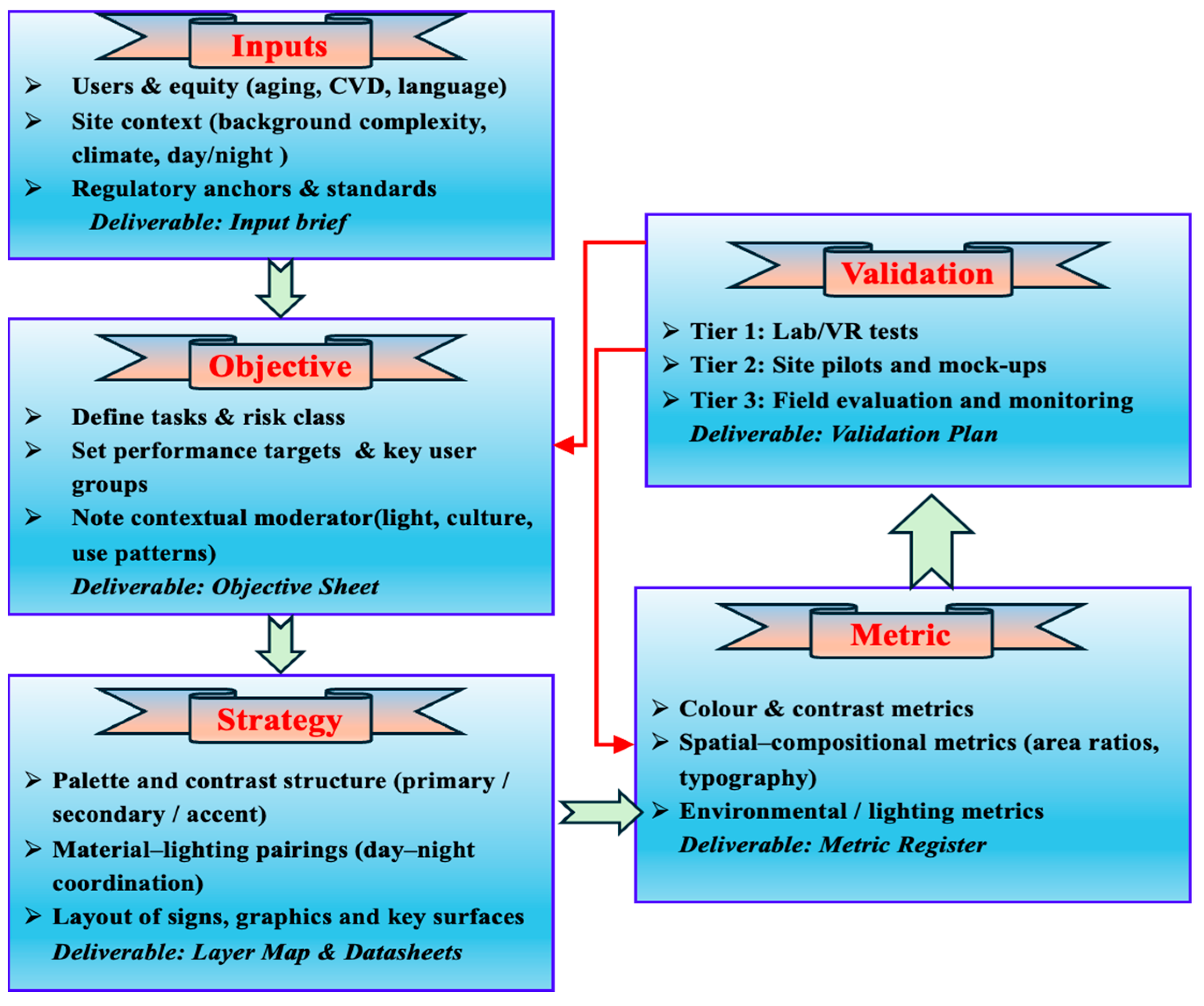
This review advances the field in two ways. First, it integrates dispersed findings from perception and cognition, cultural identity, wayfinding engineering, and environmental performance to treat urban color as a measurable system variable rather than a solely aesthetic choice [45]. Second, it proposes a unifying OSMV workflow—Objective → Strategy → Metric → Validation—that connects project goals to color strategies, to instrumentable metrics (e.g., luminance contrast and ΔE, letter-height–distance coupling, surface reflectance/albedo, and nighttime color-quality indices), and to verification protocols (laboratory/VR/field pilots; before–after or quasi-experimental designs). In Figure 1, the four letters of OSMV correspond to the central boxes labeled “Objective”, “Strategy”, “Metric”, and “Validation”, which are preceded by an “Inputs” block that summarizes contextual evidence and regulatory constraints. Guided by this workflow, our synthesis yields actionable insights and audit-ready criteria for planning, design review, and post-occupancy evaluation. Throughout, we distinguish (i) robust “red-line” requirements that generalize across contexts from (ii) context-calibrated parameters that depend on background complexity, illumination, and cultural semantics. Psychosocial and cultural responses are therefore handled through locally negotiated palette typologies and semantic assessments rather than through universal numerical optimization.
The synthesis indicates that legibility is governed primarily by luminance contrast, with ΔE00 ≈ 18–25 and Weber/Michelson ≥ 0.4–0.6 as conservative bands for identification and wayfinding, while hue benefits remain context-dependent. Cultural identity is operationalized via primary/secondary/accent façade area ratios (accents ~10–15%) and ΔE00 corridors that preserve recognizability while allowing local calibration. Environmental performance is advanced by albedo increases of ~0.10–0.20 for roofs and pavements and by night-time lighting configured with CCT ≤ 3000 K, appropriate TM-30 color-quality ranges, and glare/spill limits. Equity and accessibility are secured through redundant encoding (color + shape + text/icons + luminance contrast). In this framing, color is treated as a measurable system variable; Figure 1 framework specifies how objectives map to strategies, normalized metrics, and tiered validation, and how non-negotiable red-line requirements are distinguished from context-calibrated parameters linked to background complexity, illumination, and cultural semantics, thereby implementing a “universal principles plus local calibration” strategy for culturally diverse and climatically varied settings. These parameter bands are obtained through the multi-step synthesis protocol described in Section 2, in which convergent breakpoints from higher-quality studies are aggregated and then benchmarked against existing signage, accessibility and cool-material standards to ensure that the resulting thresholds are conservative, auditable and technically feasible.
Despite extensive scholarship, prior reviews and practice notes remain fragmented or primarily aesthetic-led. They seldom translate color evidence into measurable thresholds and verification procedures for outdoor public space. Baseline conditions and key moderators—such as background complexity, illumination regime and cultural semantics—are reported inconsistently. Equity provisions for people with color-vision deficiency or low vision are often omitted, and links from laboratory or VR studies to field pilots, operational evaluation and life-cycle maintenance are uneven.
The present review addresses these gaps by synthesizing and operationalising cross-domain evidence for outdoor urban public spaces, by day and by night. Robust findings are consolidated into audit-ready parameters and acceptance bands and organized through the Objective–Strategy–Metric–Verification (OSMV) pathway illustrated in Figure 1. In this framework, Objectives specify the task class and user groups (e.g., wayfinding and egress, placemaking, daytime thermal comfort, night-time visibility), together with deployment context, hypothesized moderators and equity requirements for users with CVD or low vision. Strategies assign roles and constraints to color and light within that context, such as the structure of primary, secondary and accent palettes or rules that prioritize conspicuity over harmony. Metrics translate these strategies into instrumentable variables and conservative bands, including color-difference and luminance-contrast measures, typography geometry, surface reflectance and key night-time lighting indicators. Verification then escalates evidence from controlled laboratory or VR screening, through site pilots with luminance/illuminance and accessibility audits, to quasi-experimental field evaluations linked to explicit decision rules, inspection intervals and maintenance triggers. Inputs in the form of evidence, context and risk flow from left to right towards outputs such as specification sheets, metric registers and validation plans, closing the loop through life-cycle monitoring.
Within this framing, the synthesis indicates several cross-cutting trends. Legibility in public spaces is governed primarily by luminance contrast, while hue effects are strongly context-dependent. Cultural identity can be operationalised via structured façade palettes and area-ratio bands that preserve recognisability yet allow local calibration. Environmental performance is improved by carefully increasing surface reflectance for roofs and pavements and by configuring night-time lighting with warm spectra, adequate color quality and strict limits on glare and spill. Equity and accessibility are secured through redundant encoding, in which color is consistently combined with shape, text or icons and sufficient luminance contrast. Taken together, these elements treat color as a measurable system variable and clarify how Figure 1 maps objectives to strategies, normalized metrics and tiered validation, while distinguishing non-negotiable baseline requirements from context-calibrated parameters linked to background complexity, illumination and cultural semantics.

2. Methods: Review Protocol and Synthesis Approach

2.1. Search Strategy and Identification of Evidence

The review followed a structured protocol designed to identify empirical and practice-oriented studies on color in outdoor urban public spaces. Major bibliographic and technical databases were searched, including Web of Science Core Collection, Scopus, ScienceDirect, Google Scholar and IEEE Xplore. The search window covered publications from 1990 to early 2025, reflecting the period in which laboratory color research, urban design practice and environmental simulation began to converge.
Boolean keyword strings combined four groups of terms: (i) setting terms (“urban”, “city”, “street*”, “square”, “public space”, “facade/façade”, “signage”); (ii) color and appearance terms (“colour/color”, “paint”, “finish”, “albedo”, “light*”); (iii) outcome terms (“perception”, “emotion”, “physiolog*”, “wayfinding”, “safety”, “thermal”, “comfort”, “identity”); and (iv) methodological terms (“experiment*”, “field study”, “mock-up”, “simulation”, “evaluation”). Searches were limited to English-language, peer-reviewed journal articles and conference papers, supplemented by a small number of standards and design guidelines where they reported empirical evidence. All records were imported into a reference manager and de-duplicated before screening.

2.2. Eligibility, Screening and Coding

Screening proceeded in three stages—title, abstract and full text—against pre-specified inclusion and exclusion criteria. Studies were **included** when they met all of the following conditions:
(1)
The setting was an outdoor urban public space or a building-related exterior space (streets, squares, parks, plazas, transport nodes, building facades and signage) or an indoor/VR environment explicitly designed to inform such spaces;
(2)
The study reported human perception, behavior, or environmental performance outcomes relevant to public-space design (e.g., legibility, safety, preference, thermal or lighting performance);
(3)
Color, surface finish or lighting were manipulated or measured as independent variables; and
(4)
Outcomes were reported quantitatively or through systematically coded qualitative data.
Studies were **excluded** if they were indoor-only with no discussion of outdoor transferability, purely theoretical or descriptive essays, or rendering-only studies without photometric or colourimetric calibration. When reports were ambiguous, at least two authors independently screened the full text and reached consensus.
For each included study we coded: (i) bibliographic information; (ii) setting (indoor, outdoor, mixed) and task class (e.g., wayfinding/egress, placemaking, thermal comfort); (iii) method type (laboratory/VR experiment, field mock-up or pilot, quasi-experimental field evaluation, observational study); (iv) participant characteristics where available (including aging and vision diversity); and (v) manipulated or observed variables and outcome measures. Rather than recording every parameter value in Section 2, variables were grouped into a small set of operational categories used throughout the review: luminance contrast, color difference (ΔE, preferably ΔE00), typography geometry (letter-height–distance ratios, stroke-width and spacing rules), surface reflectance/albedo and daytime glare measures, and night-time lighting metrics (illuminance, correlated color temperature, color-quality indices, glare indices and light-spill limits). Potential moderators—including background complexity, illumination regime (day/overcast/night), and cultural or semantic context—were also coded. This coding enabled later synthesis by outcome family and by level (psychological/physiological, cultural identity, functional zoning and wayfinding, environmental adaptation).

2.3. Quality Appraisal, Synthesis and Derivation of Thresholds

Because the corpus spans different disciplines and methods, evidence quality was appraised with criteria tailored to study type. Laboratory and VR experiments were assessed for randomisation or counter-balancing, calibration of stimuli, clarity or preregistration of protocols, and reporting of effect sizes with confidence intervals. Field mock-ups and pilots were assessed for instrument reliability, worst-case testing conditions (e.g., overcast daylight and night-time), and checks for accessibility using color-vision-deficiency filters or aging-vision simulations. Quasi-experimental field evaluations were assessed for design strength (e.g., interrupted time series or difference-in-differences), control of seasonality and secular trends, treatment fidelity and possible spillover effects. Each study was assigned a four-level quality rating (high, moderate, low, unclear), and these ratings are reported in the evidence tables.
Synthesis then proceeded by outcome family rather than by study, using a structured narrative approach. Where measures were commensurable, we did not attempt formal meta-analysis; instead, we identified ranges where multiple high- and moderate-quality studies showed convergent performance breakpoints (for example, rapid drops in legibility or comfort, onset of glare, or plateauing of cooling benefits). From these convergent regions, we derived **conservative threshold bands** for key metrics such as luminance contrast, ΔE00 and albedo, and for lighting parameters relevant to circadian and ecological effects. These bands were subsequently **benchmarked against existing signage, lighting and cool-materials standards**, and, where necessary, adjusted to be at least as conservative as current practice. Sensitivity checks repeated the synthesis after excluding lower-quality or indoor-only studies and considered evidence on aging and maintenance drift (e.g., soiling and UV abrasion) to judge whether deterioration could push performance outside the recommended bands.
In the remainder of the paper, these threshold bands and acceptance ranges are translated, via the OSMV (Objective–Strategy–Metric–Validation) framework, into audit-ready guidance: objectives and strategies are linked to metrics, and these relationships are defined by the derived threshold bands and validation procedures.

3. Psychological and Physiological Effects

3.1. Research Introduction and Theoretical-Measurement Framework

Research on color–psychology relationships in urban public spaces converges on three interconnected stages. Early practitioner–researchers such as Birren already emphasized that color in everyday and clinical environments can modulate mood, arousal and behavior, foreshadowing later experimental paradigms on color therapy and functional color planning [12]. First, variations in color attributes—hue, lightness, saturation, contrast, and overall color complexity or harmony—shape immediate psychological and physiological responses. These responses include changes in emotional valence and arousal, perceived stress, and physiological indicators such as galvanic skin response (GSR), heart rate variability (HRV) and electroencephalography (EEG). Second, these affective and physiological states, in turn, influence behavioral and cognitive performance, including attention allocation, risk perception, task performance and preferred modes of cognitive processing. Classic experimental studies have established fundamental regularities, such as brighter environments tending to support more positive affect and higher saturation levels being associated with increased arousal [1]. They also reveal marked task-by-color interactions: red is more likely to promote detail-oriented processing, vigilance and avoidance motivation, whereas blue tends to facilitate creative thinking and approach motivation [2,3]. However, review and meta-analytic evidence indicate that hue effects are subject to important boundary conditions. Contextual factors (e.g., achievement versus non-achievement settings and levels of cognitive load), the choice of baseline comparison (gray/white/black or alternative hues), and individual as well as cultural differences all moderate both the direction and the magnitude of these effects [46,47]. Figure 1 summarizes this three-stage pathway in a flowchart for clarity.
Regarding measurement approaches, beyond traditional subjective scales (such as PAD scale, SAM scale, and emotional dimension assessments), wearable devices and laboratory physiological measurement techniques (galvanic skin response, heart rate variability, respiratory patterns, EEG spectral analysis) can capture autonomic nervous system and central nervous system activation patterns triggered by color stimuli below the consciousness threshold [4]. Urban-scale studies typically employ street view images combined with computer vision techniques to quantify objective indicators of color complexity, similarity, balance, and compatibility, and conduct statistical association analyses with population perceptual evaluations (sense of safety, aesthetic appeal, vitality); such studies possess high ecological validity but have limitations in causal inference, requiring mutual validation with controlled experimental paradigms [5,48]. Based on this theoretical framework, the present study conducts a systematic analysis from three dimensions: “emotional and stress responses,” “attention and cognitive functions,” and “contextual and individual differences,” and constructs a comprehensive literature evidence table (Table 2) for subsequent in-depth analysis.
Most psychophysiological evidence in this section derives from laboratory/VR exposures; generalization to complex outdoor scenes requires matched baselines (achromatic or luminance-controlled comparators), day/overcast/night audits, and replication in field pilots. In outdoor design, detection and legibility are more reliably improved by target–background salience—quantified via ΔE00 and luminance contrast—than by nominal harmony; hue benefits remain contingent on task semantics and illumination.

3.2. The Causal Chain from Color to Emotion and Stress

Evidence from basic research to applied practice consistently demonstrates that increased brightness enhances pleasantness while increased saturation elevates arousal levels [1], a fundamental principle that manifests diversely across different urban public space contexts. Natural green and blue-green scenes correlate with reduced stress levels and enhanced calming effects, aligning with restorative environment theory, while warm, highly saturated elements significantly boost vitality and positive affect. These two color categories serve different functional demands and should be contextually deployed along a “restoration–activation” continuum. Rapuano et al. [51] demonstrated through urban park comparison experiments that green spaces produce the strongest calming effects, colorful flowers provide activation and recharging effects, while gray hardscape plazas show minimal impact. Physiological evidence confirms that color effects transcend subjective experience: Bower et al. [4] observed increased electrodermal activity, respiratory amplitude, and frontal alpha power changes when comparing blue versus white walls in VR environments, indicating that environmental color rapidly modulates the autonomic nervous system and EEG activity. Notably, although blue is conventionally viewed as calming, saturated blue can still enhance arousal relative to achromatic white baselines, emphasizing effect relativity and the critical role of reference baselines where identical colors may produce opposite effects under different comparison conditions. Cross-cultural evidence reveals important modulation effects. Neale et al. [5] found in US-UK comparative studies that American participants viewing warm and cool gardens showed positive emotional shifts and stress reduction, with warm colors demonstrating superior performance on heart rate variability (HRV) and galvanic skin response (GSR) metrics, while British samples showed weaker overall responses, indicating cultural and regional modulation of color sensitivity and semantic interpretation. Combined with Jonauskaite et al.’s [47] cross-linguistic research, color–emotion mappings exhibit universal patterns while being shaped by language-culture-experience matrices, thus urban color strategies require a dual-track approach of “universal principles plus local calibration.”

3.3. Color Modulation of Attention and Cognitive Processing

In complex urban contexts, color influences attention and cognitive processing through two complementary yet distinguishable channels. The first is the semantic-motivational channel, where socially embedded hue semantics and contextual cues activate approach or avoidance motivation systems, thereby altering information processing orientation; the second is the perceptual-resource channel, where saturation, brightness, and contrast-determined perceptual salience directly governs attention resource allocation and consumption. Key evidence for the former comes from rigorously controlled “task × color” interaction experiments: maintaining constant brightness and saturation, red backgrounds enhance detail sensitivity and proofreading accuracy, while blue backgrounds improve divergent thinking and novel idea generation, indicating bidirectional motivational system modulation between “avoidance/conservative” and “approach/exploratory” modes [3]. Under achievement threat or evaluative semantics, brief red priming significantly impairs subsequent test performance, revealing environmental color’s amplification of motivation-performance coupling [2]. Immersive research provides convergent evidence: even under typically calming blue conditions, relative to achromatic or white baselines, saturated blue triggers autonomic arousal (electrodermal activity, respiratory amplitude) and frontal EEG power increases, demonstrating pronounced effect relativity and baseline dependency—colors influence attention and processing thresholds through differential contrast rather than isolated action [4].
At semi-naturalistic and behavioral levels, urban scenes typically combine high saturation, multiple colors, strong contrasts, and complex forms. While visual salience aids target detection, it also more readily causes involuntary attention capture. Research employing walking-cognitive dual-task paradigms shows that prolonged exposure to complex urban scenes lengthens reaction times and shifts gait strategies toward conservatism, reflecting increased cognitive load and sustained attention resource consumption costs [49]. Large-scale modeling combining street-view imagery with deep learning reveals finer statistical relationships: when building facades and interfaces exhibit high similarity and balance in hue and brightness, overall street evaluations (safety, quality, aesthetics) become more positive; excessive diversity correlates with reduced perceived quality in certain contexts, yet high coordination provides no additional benefits, revealing an inverted-U relationship favoring “moderate diversity” [48]. This evidence indicates that color can function as a selective attention enhancer, improving information accessibility at wayfinding and warning nodes, while potentially amplifying cognitive load in high-density stimulus-overlapping outdoor scenes. Design practice, therefore, requires precise control of contrast thresholds, color quantity, and spatial rhythm to modulate salience, achieving an optimized “legible but not noisy” balance.

3.4. Modulation by Context and Individual Differences

Reference baselines, task semantics, and cultural experience constitute a triple modulation framework for color psychological effects. First, baseline conditions and stimulus intensity determine observable effect directionality: relative to achromatic or low-chroma baselines, highly saturated cool colors may increase arousal and enhance attention, while relative to warm color controls, the same cool colors are more likely to exhibit calming and restorative effects. This phenomenon requires experimental and design reports to specify illuminance and brightness contrast parameters, conducting manipulations under equal illuminance or equal subjective brightness to avoid misattributing brightness differences, material reflections, or glare effects to hue effects [1,4]. Second, semantics and task environments largely determine color’s functional orientation. When spatial narratives involve risk, evaluation, or regulatory contexts (examination waiting areas, security checkpoints, ticket verification, emergency nodes), red more readily triggers avoidance motivation, leading to conservative-cautious processing tendencies and potentially suppressed overall performance; under creative, social, or exploratory semantics (public living rooms, creative markets, children’s activity areas), blue and green better facilitate approach motivation and divergent processing, thereby promoting interaction and innovative output [2,3].
Culture and experience as macro-level modulation factors have been systematically revealed by cross-cultural research: color–emotion mappings exhibit relatively stable universal patterns, yet language, customs, and life experiences alter colors’ emotional valence and symbolic meaning [47]. Garden color comparison experiments with American and British samples showed that American participants experienced significant positive emotional enhancement and stress relief (increased HRV, decreased electrodermal activity) in both warm and cool garden scenes, with stronger warm color effects; British samples showed weaker overall responses, reflecting local preference and familiarity differences [5]. These findings indicate that any color strategy intended for urban public space implementation should undergo semantic calibration through localized A/B testing or small-sample evaluation before deployment, verifying whether color–task matching aligns with expectations and assessing accessibility and comfort thresholds for special populations (elderly, children, color vision deficient individuals, and those with low vision). Additionally, multi-element coupling in urban scenes causes color effects to interact with soundscapes, vegetation coverage, crowd density, surface reflections, and microclimate factors; without methodological isolation and statistical control, color’s main effects are easily overestimated or misinterpreted, representing a key source of heterogeneity across studies [1,4,49].

3.5. Design Translation and Evaluation Methods

Translating psychological mechanisms and empirical evidence into engineering-executable language requires establishing a three-tier objective-strategy-metric framework and reproducible evidence pipeline. At the objective level, specific spaces’ psychological and behavioral demands must be classified into operationalizable design intentions such as “restoration/calming,” “activation/social,” “vigilance/verification,” and “creativity/exploration,” with corresponding color roles in functional hierarchies (primary colors—background atmosphere, auxiliary colors—zone division, accent colors—wayfinding and warning). At the strategy level, existing evidence maps hue, brightness, saturation, and contrast to task requirements: restoration/calming spaces prioritize medium-high brightness, low-to-moderate saturation blue-green palettes, controlling surface highlights and strong reflections to reduce involuntary attention capture; vigilance/verification and high-risk nodes employ warm color high-contrast point reinforcement with strictly limited area and viewing distance ranges to avoid red overload under achievement threat or high-pressure contexts; creative/social scenes overlay limited quantities of highly saturated accents on cool base tones to create moderate diversity while maintaining overall tonal similarity and balance, achieving “interesting but not chaotic” streetscape characteristics [2,3,4,48].
At the metric level, wayfinding and identification tasks should establish minimum legibility thresholds using ΔE00 color difference and luminance contrast, linked with font size, viewing distance, and illuminance; atmosphere control should report effect sizes from subjective emotion scales (PAD/SAM) and physiological indicator change ranges (GSR/HRV/EEG), employing equal illuminance or adaptive brightness control in design validation to ensure causal inference is not confounded by illuminance and glare [1,4]. To enhance external validity and cross-project comparability, a four-stage evidence pipeline is recommended: (1) laboratory controlled experiments verify expected “task × color” interaction directions; (2) VR immersive experiments introduce covariates such as soundscapes, density, and path tasks, collecting combined subjective-behavioral-physiological indicators to test cross-scenario mechanism robustness; (3) field pilot studies using temporary painting or light color projection collect behavioral data on dwell time, path selection, and crowding, while simultaneously recording environmental parameters including illuminance, reflection, and glare; (4) operational tracking and causal evaluation using interrupted time series or difference-in-differences methods identify net effects of color interventions on safety incidents, complaint rates, and satisfaction over weeks to months, quantifying long-term marginal benefits and adaptation effects [2,3,4,48,50]. In terms of equity and accessibility, individuals with color vision deficiencies and low vision should be included in the baseline population. Redundant encoding (color + shape + text + lighting) and a coordinated “font size–distance–contrast” control should be applied to ensure that critical information is not dependent on single hue channels. Through this closed loop of mechanism identification, contextual calibration, and evaluation processes, color design can evolve from aesthetic preference to a verifiable, measurable, and manageable urban health and accessibility strategy. In learning environments, ergonomic studies highlight color’s contribution to visibility, attention, and comfort at the task level, with implications for classroom layouts and circulation zones [52].
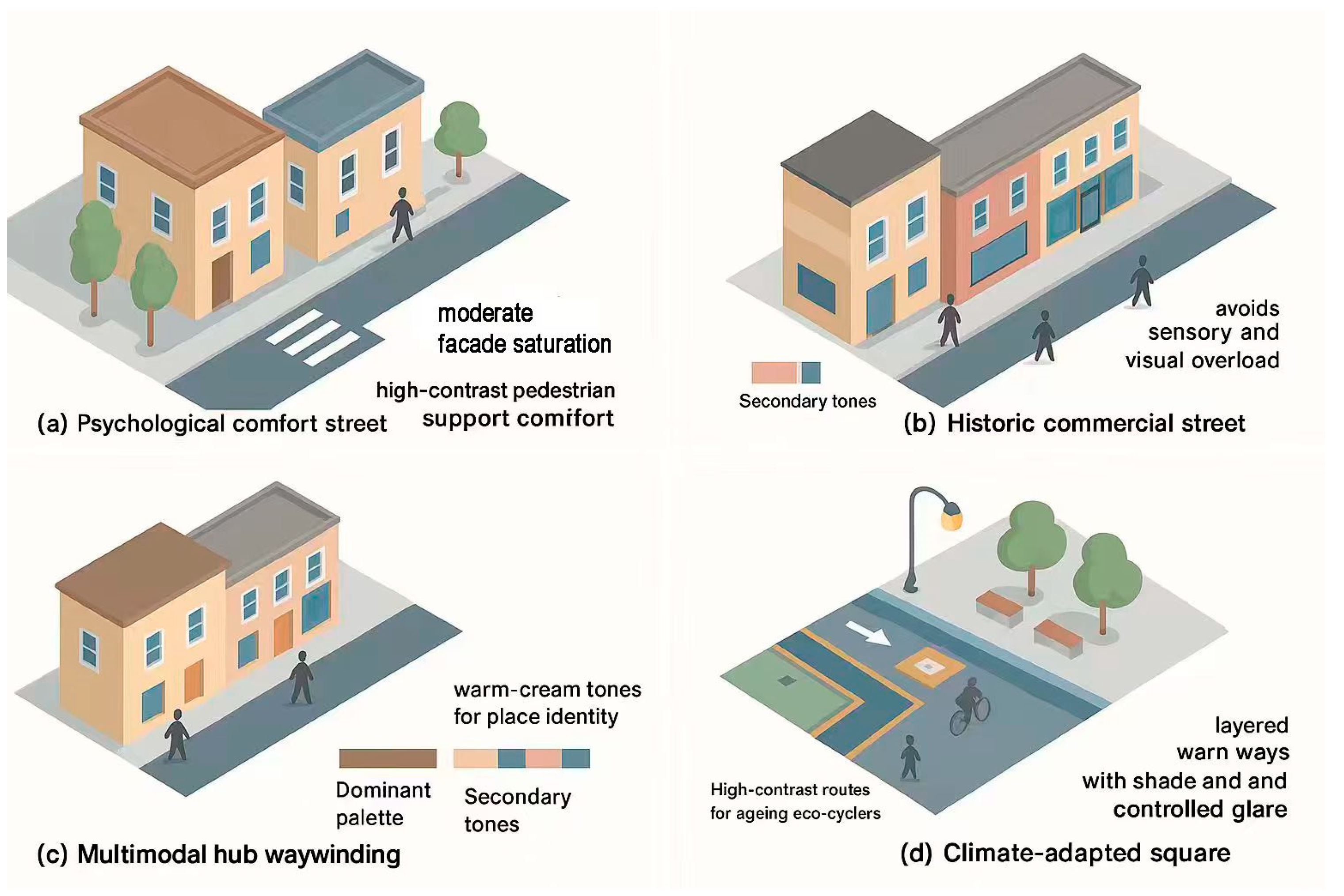
Figure 2a provides a simple streetscape vignette in which moderate façade saturation, warm-toned materials, tree canopies and high-contrast crossings jointly translate the psychological evidence reviewed in this section into an “interesting but not chaotic” public space that supports comfort while preserving alertness and legibility.

4. Cultural Expression & Place Identity

In the cultural and identity domain, architectural color functions as a compositional and communicative resource rather than a purely ornamental choice. Building on Caivano’s semiotic perspective [9,10,11] and empirical analyses by Serra Lluch and colleagues [19,20], effective schemes articulate explicit relationships among value/lightness, chroma, and contextual cues so that legibility is preserved while identity is expressed. Landscape-oriented studies further indicate that chromatic organization should be tuned to setting and viewpoint, reinforcing coherence at street and district scales [21].
Urban color serves as the core visual encoding carrier of “placeness,” bearing the function of translating material properties, climatic conditions, and socio-cultural semantics into recognizable symbolic systems for the public. This system exhibits “dual structure” characteristics: on one hand, it manifests universal cross-cultural preference patterns. Classical studies examining Tokyo, Taipei, and Tianjin revealed that despite regional differences in hue-tone preference curves across the three cities, high preference for white demonstrates cross-cultural consistency, with dual-scaling analysis successfully converting this phenomenon into a comparable statistical coordinate system [24]; on the other hand, it embodies region-specific cultural expressions. Lenclos’s pioneering “color geography” theory, through systematic field investigations, constructed a theoretical coupling model of “color genealogy = cultural background × climatic conditions × material properties,” which has been validated across different climatic zones: white-blue color combinations in Mediterranean regions counter intense solar radiation environments, ochre color systems in temperate towns respond to fired material characteristics, while high-saturation accent colors in oceanic climates compensate for visual needs in low-illumination environments [26]. This empirical framework established the concept of “anchoring colors,” whereby a few dominant colors maintain visual continuity in neighborhoods while low-proportion decorative colors satisfy contemporary expressive needs.
Advances in computer-vision techniques have begun to turn traditional façade color rules into parametric analysis workflows. Façade semantic segmentation can now automatically identify components such as windows, doors, string courses and wall fields, extract dominant and accent colors together with their area proportions, and encode these patterns using color-difference metrics (e.g., ΔE00 in CIELAB space). Three-layer parsing frameworks that distinguish component bands, inter-storey moldings and background wall surfaces, combined with template-matching methods for historic districts, have been shown to robustly recover façade topology and support precise links between color parameters and component semantics [44,45,46,47,48].
In parallel, studies based on street-view imagery and crowdsourced perception have modeled the coupling between façade color structure and public evaluations. These analyses indicate that façade color similarity and visual balance are positively associated with ratings of safety and prosperity [28,29], whereas excessive chromatic diversity reduces the perceived sense of order. At the same time, overly uniform palettes do not yield continuous gains in perceived quality; the most favorable responses tend to occur when a stable dominant palette is combined with a limited set of accent colors [49,50,51,52,53,54].
Table 3 systematically organizes key research evidence in the field of cultural identity and place expression, demonstrating the methodological evolutionary trajectory from traditional field surveys to computer vision analysis. This table encompasses six representative studies spanning from 1994 to 2017, with research scope expanding from single-city cross-cultural comparisons to global big data analysis. From a methodological perspective, early research primarily relied on questionnaire surveys and field observations to establish theoretical frameworks, while recent studies extensively adopt emerging technologies such as deep learning, crowdsourcing perception, and large-scale image analysis. In terms of research outcomes, these studies collectively established the fundamental understanding of “coexistence of cultural universality and regional specificity,” providing a solid theoretical foundation and technical pathway for subsequent parametric design and intelligent governance.
Based on the evidence chain demonstrated in Table 3, the design and governance of “cultural expression—place identity” can be operationalized through three interlocking steps. The anchoring phase integrates historical imagery, documentary records, and field sampling data, determining the site’s primary color domains and their allowable lightness/saturation variation ranges according to Saito’s cross-cultural preference model and Lenclos’s geographical atlas framework, employing CIELAB coordinate systems and ΔE00 thresholds to quantitatively define “color identity” boundaries, distinguishing this approach from traditional perceptual descriptions. The calibration phase applies validated three-layer facade parsing and regular structure template methods to implement component-level semantic segmentation and color clustering of existing streetscapes, calculating area ratios of dominant/auxiliary/accent colors, establishing verifiable compliance boundaries for historic districts, and setting color–material coupling technical constraints in combination with material craft characteristics. The validation phase utilizes street view crowdsourcing data and image learning perception models to conduct external validity assessments of candidate color schemes, quantifying trends in safety, orderliness, and visual quality. In specific scenarios, small-scale pilots can be conducted to verify nighttime color rendering and light pollution boundaries, employing interrupted time series or difference-in-differences methods to identify net effects. Through this closed-loop mechanism, anchoring colors are transformed into “public contracts” that possess both cultural semantics and engineering executability, maintaining neighborhood memory and recognizability while providing measurable flexibility for functional updates. These anchoring–calibration–validation steps map to the OSMV chain and produce audit-ready acceptance bands (ΔE00 and area ratios) for design review and post-occupancy checks.
Addressing “traditional–contemporary” tensions, this framework provides negotiable mediating pathways. To avoid cultural tokenism and selection bias, pilots should include local stakeholders and diverse vision profiles (aging and CVD), and report night-time rendering and glare audits alongside daytime checks. Based on the material-climate-culture triangular model, when cities need to increase light color proportions for energy efficiency and thermal environment objectives, this can be achieved through “fine-tuning” strategies of lightness enhancement and saturation reduction within established color domains, thereby satisfying albedo and glare engineering constraints while maintaining semantic continuity. Conversely, when local culture has rigid demands for high-saturation symbolic colors, these can be limited to component or temporary levels, with visual impact constrained through area limits and street-facing proportions, while statistically maintaining the overall “stable dominant colors + moderate diversity” structure. As demonstrated in Seresinhe et al.’s national study shown in Table 1, crowdsourcing perception and deep learning research indicate that consistent dominant color tones + bilateral similarity + appropriate accent colors can maximize the coexistence interval of “orderliness and recognizability,” while extreme uniformity or extreme mixing lack sustained statistical advantages [28,29]. Therefore, the “authenticity” of cultural expression is not a static replication of historical color palettes, but rather a dynamic calibration process between local statistical characteristics and public perception.
Illustrative example. Figure 2b illustrates a historic commercial street where a restricted dominant palette, controlled accent colors and ΔE00 corridors are applied to façades, shopfronts and street furniture to maintain a recognizable place identity while avoiding both monotonous uniformity and visually noisy patchworks.

5. Functional Zoning and Wayfinding

5.1. Evidence Overview and Design Logic

The core of functional zoning and wayfinding lies in encoding information priorities into color and contrast systems: in open and interference-intensive urban environments, color primarily serves the task of “being recognized” (conspicuity), with “aesthetic appeal” (harmony) as a secondary consideration. This principle has been repeatedly validated in experimental and applied research: in “color-coded building” and virtual environment navigation tasks, using different colors to clearly demarcate functional zones can significantly reduce wayfinding time and path length, though the enhancement of long-term spatial cognitive knowledge is relatively limited, indicating that “color zoning” primarily improves immediate navigation efficiency rather than deep spatial learning capabilities [7]. Image experiments on outdoor signage similarly demonstrate that increasing color difference (ΔE00) and luminance contrast more effectively enhance detection rates and readability than pursuing color harmony, with these thresholds being modulated by background complexity and illumination conditions [55]. On the other hand, inclusive design requires full consideration of the needs of individuals with color vision deficiency (CVD) and low vision: in multi-colored, low-contrast, or glare environments, CVD users are more prone to misjudging color bands and path encoding, necessitating redundant encoding strategies (color + shape + text/icons + lighting) and high-contrast color pair combinations to ensure recognition effectiveness [8,56]. Visual perception research further emphasizes that contrast is the core variable for readability, with hue differences being unreliable when lacking sufficient luminance contrast, particularly for individuals with red-green color deficiency [57,58]. Therefore, urban wayfinding color design should treat conspicuity thresholds (ΔE00, Michelson/Weber luminance contrast, font size-viewing distance ratios) as “hard constraints,” optimizing harmony and local expression while ensuring readability. For a pedestrian-wayfinding sign, a high-contrast case (background ≈ 100 cd/m2, text ≈ 30 cd/m2; Weber ≈ 0.70) supports fast recognition, whereas a low-contrast case (≈0.20) degrades performance even when hue is unchanged [7].
Table 4 summarizes key empirical studies on color applications in functional zoning and wayfinding, demonstrating research progress from virtual environments to actual urban applications. The four studies covered in this table reveal the core mechanisms of color coding in wayfinding systems: significant enhancement of immediate navigation efficiency, the decisive impact of contrast on visibility, and the important value of redundant encoding for inclusive design. These studies provide a solid theoretical foundation for subsequent engineering threshold setting and design practice.
Table 5 provides practice-oriented engineering thresholds and inclusive color configuration schemes, establishing specific color difference and contrast standards for different wayfinding tasks. This table synthesizes the consensus from readability and visualization research regarding contrast prioritization and proposes conservative technical red lines in consideration of urban-scale background complexity, providing quantitative reference criteria for color scheme design in actual projects.

5.2. Design Strategies and Validation Framework

Based on the evidence and threshold analysis from Table 2 and Table 3, three core conclusions can be drawn. First, the conspicuity-first principle: under complex background and strong/backlighting conditions, enhancing ΔE00 and luminance contrast can consistently improve detection rates, first fixation probability, and reading speed, with marginal benefits significantly exceeding those of pursuing visual harmony. Therefore, primary wayfinding elements (directional arrows, numbering, emergency exits) should employ high-contrast pairings (such as dark blue/white, black/yellow) against neutral/dark backgrounds, incorporating borders/shadows to suppress background interference [55,57]. Second, redundant encoding serves as a critical safeguard for inclusivity among CVD and low-vision populations. For individuals with red-green color deficiency, relying solely on hue differentiation can lead to identification failure; incorporating luminance differences, textures/shapes, and text/icons can significantly reduce error rates and response times without negative effects on normal-vision users [8,56,58]. In practical implementation, color coding for transit networks/floors/functional zones should employ dual-channel presentation (color + shape/icons), while reserving unique high-contrast color–shape combinations for high-priority information to prevent obscuration in information-dense environments. Third, threshold-context adaptive adjustment: the baseline ΔE00 and luminance contrast values in the tables represent conservative standards across scenarios, but actual thresholds are influenced by background complexity, surface reflection, and illumination conditions. Under nighttime or low-illumination backgrounds, moderately reduced thresholds can maintain equivalent readability; high-glare or specular reflection surfaces require elevated thresholds and the introduction of light-shielding/anti-glare materials. Additionally, nighttime wayfinding systems must consider CCT and glare effects beyond contrast; following institutional recommendations, ≤3000 K color temperature, full cut-off/spill-light control designs, and moderate brightness can ensure visibility while reducing health and ecological risks, maintaining reading stability with white/yellow high-contrast pairings.
At the engineering implementation level, a “three-tier encoding–four-step validation” strategy is recommended. The three-tier encoding system includes: bottom tier (ground/wall zoning), achieving conflict minimization through high ΔE00 and geometric separation; middle tier (wayfinding signage) employing high luminance contrast and redundant encoding to carry directional and decision information; top tier (contextual cues/branding/cultural elements) presented as low-proportion accents to avoid occupying primary information channels. The four-step validation process encompasses: contrast-viewing distance-illumination controlled experiments under screen/platform conditions for threshold calibration; VR/eye-tracking verification of gaze patterns and response times; on-site pilot installations recording detection rates, error rates, and dwell times; operational A/B testing or before-after comparative analysis using event data and user feedback for closed-loop optimization. For low-vision populations, initial configurations should follow conservative starting points of font size ≥ 1/12–1/14 of viewing distance, stroke thickness ≥ 1/6–1/5 of character height, and line height ≥ 1.2× character height, with subsequent optimization based on empirical testing [23]. Ultimately, conspicuity red lines (ΔE00, luminance contrast, font size-viewing distance ratios) constitute non-negotiable design baselines; pursuing harmony and local expression upon this foundation ensures the functional objectives of “visible, readable, and navigable.” By separating non-negotiable safety baselines from higher-tier branding and placemaking elements, this three-tier encoding and validation system provides a practical way to manage conflicts between legibility, identity, ecological impact and maintenance constraints in real projects.

5.3. Synthesis and Cross-Cutting Insights

Beyond topic-by-topic summaries, this review yields integrative findings that are testable across contexts. Legibility in public spaces is governed primarily by luminance contrast, with hue providing conditional benefits moderated by background complexity. Inclusive design requires redundant coding so that color is paired with shape, text, iconography, or lighting for safety-critical information. The tension between conspicuity and harmony is resolved by layering a high-contrast legibility/safety layer and a placemaking layer whose palettes can vary without eroding readability. Day–night co-design couples finishes and optics to thermal and visual outcomes through reflectance/albedo, CCT, color quality, glare control, and light-spill management. Finally, performance drifts with aging and maintenance; acceptance bands should therefore be coupled with baseline colorimetry and retouch triggers.
From a comparative standpoint, the weight of evidence is not uniform across the four functional domains. The most robust and transferable findings concern legibility/safety and thermal–lighting performance, where repeated field and quasi-experimental studies support relatively conservative threshold bands for luminance contrast, ΔE00, albedo and glare indices. Psychological comfort and well-being effects show clear directional trends but more heterogeneous effect sizes and study designs, so we interpret them as specifying preferred ranges and warning signs rather than hard limits. Cultural expression and place identity are supported mainly by qualitative, historical and mixed-methods work, which yields palette typologies and compositional rules but does not justify universal numeric thresholds. The OSMV framework, therefore, treats these domains differently: first establishing minimum safety and performance bands, and then using the softer evidence to structure objectives and palette strategies within those bands.
Illustrative example. Figure 2c shows a multimodal station in which color and contrast layers are used to separate circulation routes, platforms and service areas, and where redundant encoding (color + form + pictograms) ensures that key wayfinding information remains accessible for users with color-vision deficiency and aging vision.

6. Sustainability and Environmental Adaptation

This section reframes sustainability and environmental adaptation as two sets of objectives that can be verified in practice: (i) daytime thermal and visual performance, and (ii) night-time visibility, health/ecology and light-spill control. In line with the OSMV workflow, we state objectives, select layered strategies, bind them to instrumentable metrics, and indicate how they are validated in pilots and field operations.

6.1. From Buildings to Cities: Multi-Scale Evidence of Albedo, Energy Consumption and Heat Islands

Urban public space color within the sustainability framework not only affects visual aesthetics and readability but also exerts systematic impacts on building energy consumption, urban heat island intensity, and nighttime ecosystems through surface solar reflectance and spectral characteristics. Research indicates that rooftops and paved surfaces account for approximately 60% of urban exposed surfaces (rooftops ~20–25%, pavements ~40%), making “roof brightening + pavement brightening” through enhanced surface albedo one of the highest unit-area benefits, rapidly deployable passive cooling strategies [20]. At the building scale, field measurements and simulation evidence demonstrate that increasing roof albedo can substantially reduce building air conditioning loads: elevating roof albedo from typical values of 0.08 to 0.3–0.5 can reduce air conditioning cooling energy consumption by approximately 20–90%, decrease peak cooling demand by about 11–27%, and significantly lower roof surface temperatures [19]. These energy reduction and cooling effects are most pronounced in hot, high-insolation regions. Urban-scale research further confirms the collective effects of high-albedo strategies: broadly increasing average urban roof and pavement albedo by approximately 0.1 (through promoting high-reflective materials, increasing roof and pavement albedo by about 0.25 and 0.15, respectively) results in significant summer reductions in near-surface urban air temperature, with corresponding decreases in total air conditioning demand and costs. Simultaneously, due to reduced solar radiation absorption by the surface-troposphere system, negative radiative forcing effects are produced, equivalent to offsetting billions of tons of CO2 greenhouse gas emissions [20]. This “urban brightening” pathway provides dual benefits of climate change mitigation and extreme heat adaptation: locally alleviating urban heat stress, reducing peak air conditioning loads and improving air quality, while macroscopically providing some offset to global warming.
This strategy is technically and economically feasible, primarily involving changes in color coatings and material selection rather than expensive system upgrades (such as adopting cool roofs/cool pavements with high-reflective coatings, light-colored exterior wall coatings, or high-reflective roofing membranes). It should be noted that the specific benefits of increased albedo vary with climate zones, building envelope characteristics, roof construction, and shading conditions; design should incorporate local typical meteorological year data for energy consumption simulation and sensitivity analysis. The Phoenix “cool pavement” pilot study provides empirical support: roads coated with high-reflective coatings showed average daytime surface temperature reductions of approximately 6 °C compared to aged black asphalt, with limited impact on near-surface air temperature [59]. Subsequent monitoring revealed that new-generation high-reflective coatings maintained stable road surface cooling effects across multiple communities, but coating albedo declined with dust accumulation and wear, with absolute albedo values dropping an average of 5–12% within seven months, necessitating regular cleaning and recoating schedules to maintain performance [32]. Synthesizing multi-scale building and urban evidence, an actionable heat mitigation strategy emerges: high-temperature, high-insolation cities should prioritize roof brightening, while neighborhood renewal should adopt high-reflective pavements combined with tree shade coverage and ventilation corridors to synergistically reduce pedestrian mean radiant temperature (MRT) and thermal stress during extreme heat periods.
Daytime performance is characterized by surface reflectance/albedo (for radiant load and legibility background), disability/discomfort glare checks at critical viewpoints, and luminance contrast for safety/wayfinding tasks placed in sunlit contexts. These variables are recorded with calibrated instruments and tied to acceptance bands defined at project start; baseline colorimetry plates are archived to monitor drift (ΔE00) due to soiling and UV exposure. Validation proceeds from laboratory/VR screening of contrast and glare scenes to site mock-ups tested under worst-case overcast and clear-sky conditions, before city-scale deployment. Because the magnitude of these cooling and energy benefits depends strongly on local climate, sky conditions and urban morphology, the suggested albedo ranges are framed as climate-sensitive starting bands that should be verified by local simulation or monitoring before large-scale deployment.

6.2. Nighttime Light Color, Color Rendering and Ecology: From “Being Visible” to “Being Seen Correctly”

Night-time sustainability in public spaces pursues three concurrent objectives: adequate visibility for safety and recognition, ecological and human-health protection, and the prevention of sky glow and light trespass. Consistent with the OSMV workflow, strategies couple finishes with optics rather than treating lighting in isolation. We therefore specify full cut-off or well-shielded luminaires, task-focused distributions, and finishes whose night appearance preserves figure–ground contrast without excessive luminance. These strategies are audited with instrumentable metrics rather than narrative principles.
Metrics and acceptance bands are defined per task: (i) horizontal and vertical illuminance at pedestrian and sign planes; (ii) correlated color temperature and color quality (TM-30 Rf/Rg) appropriate to recognition without over-cool appearance; (iii) glare control at observer positions using UGR or TI; and (iv) property-line spill limits to protect neighbors and ecology. For legibility tasks, luminance contrast (Weber or Michelson) remains primary, with hue assisting conditionally; baseline colorimetry plates are archived to track ΔE00 drift of finishes. Worst-case test points are pre-declared and sampled during pilots and at handover so that results are auditable and comparable across sites.
Validation escalates with risk and cost. Tier 1 screens candidate palettes and optics in laboratory/VR tasks (search, recognition) with preregistered protocols and effect sizes; Tier 2 verifies mock-ups on site under worst-case overcast and night conditions using luminance cameras or photometers and accessibility checks (aging-vision and color-vision-deficiency filters); Tier 3 evaluates operational impact with interrupted time-series or difference-in-differences designs and links outcomes with maintenance logs. Decision rules are tied to acceptance bands, including inspection intervals and retouch triggers when ΔE00 or luminance-contrast drift exceeds thresholds. This layered approach keeps the legibility/safety layer conspicuous while allowing placemaking palettes to vary without eroding readability.
Sustainable management of urban environmental color also encompasses optimization of nighttime artificial light environments: unlike daytime reliance on high albedo for thermal environment improvement, nighttime primarily involves multi-objective trade-offs between lighting correlated color temperature (CCT) and blue light content, luminaire shielding and light control (full cutoff), and light source color rendering quality. The American Medical Association (AMA) 2016 policy report recommends that outdoor road lighting should prioritize warm color temperature light sources ≤ 3000 K, and through good shielding design and nighttime time-division dimming, reduce glare impacts on driving safety and human circadian rhythm disruption; under the premise of meeting visual task requirements, minimize exposure to cool white light with high blue light content [60]. The International Commission on Illumination (CIE) 2019 position statement clarifies that “blue light hazard” (BLH) should be limited to describing photochemical damage risk to the retina from high-intensity light exposure [61]. Under normal lighting use conditions, general LED white light sources do not cause substantial harm to human retina, but when exposure levels approach safety thresholds for extended periods, vigilance is still required along with adherence to good lighting design principles [34].
In practice, nighttime lighting optimization does not simply involve comprehensively reducing color temperature or brightness, but rather comprehensively evaluating human visual needs, health impacts, and ecological environment within the same framework. Specific strategies include: adopting lower correlated color temperature light sources (typically ≤ 3000 K) to reduce blue light proportion in the spectrum, selecting full cutoff luminaires to prevent light pollution spillage, providing appropriate illumination levels meeting visual task requirements combined with graduated dimming during late night periods, while utilizing advanced color rendering evaluation methods such as ANSI/IES TM-30 to ensure good visibility and accurate color presentation of key targets including road surfaces, traffic signs, and pedestrian skin tones [35]. Recent industry standards tend toward quantified implementation of these principles, such as the North American DLC consortium’s LUNA technical specification emphasizing “low light pollution and high visibility” indicators for outdoor lighting products, strictly limiting upward light and glare while considering impacts on insects and other wildlife, aiming to achieve “visible, accurate, low-impact” lighting effects. Compliance is checked at declared test points for horizontal and vertical illuminance, CCT and TM-30 Rf/Rg, glare at observer positions (UGR/TI), property-line spill, and figure–ground contrast; results are recorded at handover for life-cycle drift monitoring.
Truly sustainable “urban nightscape” does not involve unilaterally reducing brightness or suppressing color temperature, but rather achieving the lighting objective of “seeing what should be seen at the minimum necessary brightness, at the right time and place” through scientific light distribution design, light shielding and control, intelligent dimming, and color rendering quality management. From daytime high-albedo cooling to nighttime low color temperature, strict light shielding, and high color rendering quality control, a complete urban color-light environment strategy can achieve multi-objective optimization balance among energy conservation, thermal comfort, human health, and ecological protection.
Aging and maintenance are explicitly integrated. Pollution and abrasion shift reflectance and chroma, which can degrade luminance contrast and legibility over time. Projects, therefore, specify inspection intervals and retouch triggers tied to contrast and ΔE00 drift, and link field performance with maintenance logs to close the life-cycle loop.
Takeaway. Sustainability and adaptation are operational only when objectives, strategies, and metrics are stated in verifiable terms. Daytime outcomes are driven by reflectance/albedo and glare management; night-time outcomes by illuminance, CCT and color quality, glare control, and spill limits. These domains are audited with the same OSMV chain used elsewhere in the paper and fed back into acceptance bands and maintenance plans.
Compliance is checked at declared test points for horizontal/vertical illuminance, CCT, TM-30 Rf/Rg, glare (UGR/TI), property-line spill, and figure–ground contrast; results are recorded at handover for life-cycle drift monitoring.
Synthesizing existing evidence, legibility is predominantly governed by luminance contrast rather than hue; for signage and wayfinding tasks, conservative ranges of ΔE00 ≈ 18–25 and Michelson/Weber ≥ 0.4–0.6 are recommended. Regarding the thermal environment, an albedo increase of approx. 0.10–0.20 typically yields significant surface cooling and energy consumption benefits. These conclusions show high consistency across studies and across a range of cultural and climatic contexts, but hue effects are highly sensitive to task semantics, lighting regimes, and background complexity; therefore, local calibration within these thresholds is necessary. The main limitations involve differences in baseline control and ΔE00/contrast drift caused by material aging; to address this, re-measurement and recalibration will be conducted on a semi-annual to annual basis during the operational phase.
Figure 2d depicts a public square that combines high-albedo paving, shaded seating zones, vegetated edges and layered warm-CCT lighting. The vignette visualizes how the proposed daytime albedo and nighttime lighting bands can be implemented to reduce heat stress, maintain visual comfort and limit ecological disturbance.

7. The OSMV Framework: From Objectives to Validation

7.1. Objectives

The OSMV framework condenses the review findings into a sequence of design and governance decisions. The first step is to make design intent explicit and testable. For each project, an “objective sheet” specifies what the public space must achieve and for whom, drawing on the outcome families synthesized in Section 3, Section 4, Section 5 and Section 6. Typical objectives include, for example, providing restorative or activating environments, securing legible and inclusive wayfinding and safety cues, reinforcing cultural identity, or improving thermal comfort and night-time visibility under given climatic and regulatory constraints. Each objective also records the relevant user groups (including people with color-vision deficiency or low vision), the spatial and temporal scope (daytime, night-time, seasonal), and key contextual moderators such as background complexity, illumination regime and cultural semantics. This step turns general aspirations such as “pleasant”, “vibrant”, “safe” or “recognizable” into a finite set of performance questions that can later be answered with observable evidence.

7.2. Strategies

The strategy layer translates objectives into coordinated design moves. Rather than prescribing single “correct” colors, the framework organizes decisions into palette structure, contrast relationships and material–lighting pairings. For a given set of objectives and constraints, designers select the roles of primary, secondary and accent colors; define how these are distributed across façades, ground surfaces, street furniture and signage; and specify how day- and night-time schemes are coupled so that finishes and optics work together. Strategies also identify non-color variables that must be co-ordinated with color, such as typography, iconography and the geometric hierarchy of elements. In this way, the strategy layer acts as a bridge between high-level intent and the more technical metrics discussed below.

7.3. Metrics

Metrics make strategies auditable. Building on the evidence summarized in Table 1, Table 2, Table 3 and Table 4, the framework groups metrics into a concise register rather than an exhaustive checklist. Color- and contrast-related metrics include bands for color-difference and luminance contrast that support legibility, conspicuity and place identity. Spatial-compositional metrics cover façade area ratios, the distribution of palette roles and basic typography geometry (e.g., letter-height–distance rules). Environmental metrics include daytime reflectance and albedo indicators, as well as night-time lighting metrics such as illuminance, correlated color temperature and color-rendering quality. For each metric family, the register records the preferred measurement method, indicative threshold bands derived from the literature and from this review, and any notes on aging, maintenance and equity considerations. The purpose is not to propose a new prescriptive standard, but to provide a compact set of measurable levers that link directly back to the four evidence domains.

7.4. Validation

The validation step closes the loop between design intent and realized performance. OSMV adopts a tiered approach that escalates the level of evidence with risk, cost and scale. Tier 1 involves laboratory or VR experiments and analytic simulations that test whether proposed strategies meet basic perceptual and environmental criteria under controlled conditions. Tier 2 uses temporary site pilots or mock-ups to check legibility, accessibility and environmental performance in situ, using the same metrics and instruments that will later support operations. Tier 3 comprises quasi-experimental field evaluations, post-occupancy studies and routine monitoring in completed spaces, where changes in use, aging and maintenance can be tracked against the original objectives and threshold bands. Across tiers, the framework encourages the specification of explicit decision rules (e.g., acceptance criteria, inspection intervals, retouch triggers), so that color in public spaces is managed as an ongoing performance variable rather than a one-off esthetic choice.

8. Conclusions

This review set out to address a practical gap in the literature on color in urban public spaces. Although many studies have examined color preferences, perception and environmental performance, designers and regulators still lack integrated, audit-ready guidance that links color decisions to verifiable outcomes in real outdoor settings. By treating color as a measurable system variable rather than a purely aesthetic attribute, the paper consolidates scattered evidence into a coherent basis for performance-based design and governance.
The first contribution is a cross-domain synthesis of how color operates in four key application areas: psychological and physiological effects, cultural expression and place identity, functional zoning and wayfinding, and sustainability and environmental adaptation. Across these domains, the review distinguishes robust patterns—such as the central role of luminance and saturation in shaping affect, attention and legibility—from findings that are strongly conditioned by context, baseline choices and cultural meaning. This organization helps clarify which results are transferable across projects and which require local calibration.
The second contribution is the formulation of the Objective–Strategy–Metric–Validation (OSMV) framework, which connects high-level design intent to concrete implementation and evaluation steps. Objectives articulate the performance goals and user groups for a project. Strategies translate these goals into coordinated palette, contrast and material–lighting decisions. Metrics provide a compact register of measurable levers that can be monitored over the life cycle of a space. Validation links laboratory and VR experiments, site pilots and operational monitoring into a tiered pathway for evidence building. Together, these elements provide a common language for planners, designers, engineers and regulators to negotiate and audit color-related decisions.
A third contribution lies in the translation of research findings into parameterised prescriptions that can be applied without relying on copyrighted images. Instead of proposing a single prescriptive standard, the review offers indicative bands and relationships that can be adapted to different climatic, cultural and regulatory contexts while maintaining equity for users with color-vision deficiency or low vision. This approach is intended to support both everyday design practice and the development of more explicit color-related clauses in guidelines, standards and audits.
Future work should extend and stress-test this framework. Methodologically, there is a need for more studies that link controlled experiments, immersive simulations and longitudinal field observations using common metrics, including under-represented regions and user groups. Substantively, promising directions include integrating color decisions more tightly with health and well-being agendas, biodiversity and dark-sky protection, and data-driven planning tools such as street-view analytics and digital twins. Advancing along these lines would allow color in urban public spaces to be managed as an ongoing performance variable, supporting comfort, safety, identity and environmental adaptation in a transparent and accountable way.


Supplementary Materials

The following supporting information can be downloaded at: https://www.mdpi.com/article/10.3390/buildings15244474/s1, PRISMA-S Checklist.

Author Contributions

X.C.: conceptualization, methodology, formal analysis, literature search and data curation, writing—original draft, writing—review and editing, project administration. G.Z.: funding acquisition, supervision, validation, conceptualization, writing—review and editing. M.X.: investigation and resources, data curation, visualization, writing—review and editing. All authors have read and agreed to the published version of the manuscript.

Funding

This research received no external funding.

Data Availability Statement

The original contributions presented in this study are included in the article/Supplementary Materials. Further inquiries can be directed to the corresponding author.

Acknowledgments

The authors used Deepseek during the preparation of this manuscript solely for auxiliary purposes in organizing and structuring complex revision ideas. All text and research findings were generated by the authors, who assume full accountability for the article’s content.

Conflicts of Interest

The authors declare no conflicts of interest.

References

  1. Valdez, P.; Mehrabian, A. Effects of color on emotions. J. Exp. Psychol. Gen. 1994, 123, 394–409. [Google Scholar] [CrossRef]
  2. Elliot, A.J.; Maier, M.A.; Moller, A.C.; Friedman, R.; Meinhardt, J. Color and psychological functioning: The effect of red on performance attainment. J. Exp. Psychol. Gen. 2007, 136, 154–168. [Google Scholar] [CrossRef] [PubMed]
  3. Mehta, R.; Zhu, R.J. Blue or red? Exploring the effect of color on cognitive task performances. Science 2009, 323, 1226–1229. [Google Scholar] [CrossRef] [PubMed]
  4. Bower, I.S.; Clark, G.M.; Tucker, R.; Hill, A.T.; Lum, J.A.G.; Mortimer, M.A.; Enticott, P.G. Built environment color modulates autonomic and EEG indices of emotional response. Psychophysiology 2022, 59, e14121. [Google Scholar] [CrossRef] [PubMed]
  5. Neale, C.; Griffiths, A.; Chalmin-Pui, L.S.; Mendu, S.; Boukhechba, M.; Roe, J. Color aesthetics: A transatlantic comparison of psychological and physiological impacts of warm and cool colors in garden landscapes. Wellbeing Space Soc. 2021, 2, 100038. [Google Scholar] [CrossRef]
  6. Fairchild, M.D. Visual and photographic assessment of wine color. Color Res. Appl. 2023, 48, 21–31. [Google Scholar] [CrossRef]
  7. Jansen-Osmann, P.; Wiedenbauer, G. Wayfinding Performance in and the Spatial Knowledge of a Color-Coded Building for Adults and Children. Spat. Cogn. Comput. 2004, 4, 337–358. [Google Scholar] [CrossRef]
  8. Szafir, D.A. Modeling Color Difference for Visualization Design. IEEE Trans. Vis. Comput. Graph. 2018, 24, 392–401. [Google Scholar] [CrossRef]
  9. Caivano, J.L. Research on color in architecture and environmental design: Brief history, current developments, and possible future. Color Res. Appl. 2006, 31, 350–363. [Google Scholar] [CrossRef]
  10. Caivano, J.L. Investigación Sobre los Objetos Visuales Desde un Punto de Vista Semiótico, con Particular Énfasis en los Signos Visuales Producidos por la Luz: Color y Cesía; Cuadernos de la Facultad de Humanidades y Ciencias Sociales—Universidad Nacional de Jujuy: Jujuy, Argentina, 2001; pp. 85–99. Available online: http://www.redalyc.org/articulo.oa?id=18501706 (accessed on 26 November 2025).
  11. Caivano, J. La compleja relación con el color de uno de los maestros de la arquitectura moderna: Nueva edición de la “Policromía arquitectónica” de Le Corbusier. 47 al Fondo 2008, 12, 48–51. [Google Scholar]
  12. Birren, F. A colorful environment for the mentally disturbed. Art Psychother. 1973, 1, 255–259. [Google Scholar] [CrossRef]
  13. Birren, F. Color Psychology and Color Therapy; a Factual Study of the Influence of Color on Human Life; McGraw-Hill: Columbus, OH, USA, 1950. [Google Scholar]
  14. Birren, F. Color: A Survey in Words and Pictures, from Ancient Mysticism to Modern Science; University Books: New York, NY, USA, 1963. [Google Scholar]
  15. Mahnke, F.H. Color, Environment and Human Response: An Interdisciplinary Understanding of Color and Its Use as a Beneficial Element in the Design of the Architectural Environment; Van Nostrand Reinhold: New York, NY, USA, 1996. [Google Scholar]
  16. Meerwein, G.; Rodeck, B.; Mahnke, F.H. Color–Communication in Architectural Space; Birkhäuser: Basel, Switzerland, 2007. [Google Scholar] [CrossRef]
  17. Mahnke, F.H.; Mahnke, R.H. Color in Man-Made Environments; Van Nostrand Reinhold: New York, NY, USA, 1982. [Google Scholar]
  18. Dalke, H.; Little, J.; Niemann, E.; Camgoz, N.; Steadman, G.; Hill, S.; Stott, L. Colour and lighting in hospital design. Opt. Laser Technol. 2006, 38, 343–365. [Google Scholar] [CrossRef]
  19. Serra, J.; García, Á.; Torres, A.; Llopis, J. Color composition features in modern architecture. Color Res. Appl. 2012, 37, 126–133. [Google Scholar] [CrossRef]
  20. Serra, J.; Gouaich, Y.; Manav, B. Preference for accent and background colors in interior architecture in terms of similarity/contrast of natural color system attributes. Color Res. Appl. 2022, 47, 135–151. [Google Scholar] [CrossRef]
  21. Melman, R.; Lombardi, R. Clorindia Domestica: Studies of Architectural Chromatic Organization in Relation to Landscape; AIC International Meeting: Buenos Aires, Argentina, 2020; p. 7. [Google Scholar]
  22. Mora, L.; Gerli, P.; Ardito, L.; Messeni Petruzzelli, A. Smart city governance from an innovation management perspective: Theoretical framing, review of current practices, and future research agenda. Technovation 2023, 123, 102717. [Google Scholar] [CrossRef]
  23. Legge, G.E.; Bigelow, C.A. Does print size matter for reading? A review of findings from vision science and typography. J. Vis. 2011, 11, 8. [Google Scholar] [CrossRef]
  24. Saito, M. A cross-cultural study on color preference in three Asian cities: Comparison between Tokyo, Taipei and Tianjin. Jpn. Psychol. Res. 1994, 36, 219–232. [Google Scholar] [CrossRef]
  25. Saito, M. Comparative studies on color preference in Japan and other Asian regions, with special emphasis on the preference for white. Color Res. Appl. 1996, 21, 35–49. [Google Scholar] [CrossRef]
  26. Lenclos, J.-P. Colors of the World: The Geography of Color; W.W. Norton & Co.: New York, NY, USA, 2004; p. 288. Available online: https://archive.org/details/colorsofworldgeo0000lenc (accessed on 26 November 2025).
  27. Mathias, M.; Martinović, A.; Van Gool, L. ATLAS: A Three-Layered Approach to Facade Parsing. Int. J. Comput. Vis. 2016, 118, 22–48. [Google Scholar] [CrossRef]
  28. Salesses, P.; Schechtner, K.; Hidalgo, C.A. The Collaborative Image of The City: Mapping the Inequality of Urban Perception. PLoS ONE 2013, 8, e68400. [Google Scholar] [CrossRef]
  29. Seresinhe, C.I.; Preis, T.; Moat, H.S. Using deep learning to quantify the beauty of outdoor places. R. Soc. Open Sci. 2017, 4, 170170. [Google Scholar] [CrossRef] [PubMed]
  30. Synnefa, A.; Santamouris, M.; Akbari, H. Estimating the effect of using cool coatings on energy loads and thermal comfort in residential buildings in various climatic conditions. Energy Build. 2007, 39, 1167–1174. [Google Scholar] [CrossRef]
  31. Akbari, H.; Menon, S.; Rosenfeld, A. Global cooling: Increasing world-wide urban albedos to offset CO2. Clim. Change 2009, 94, 275–286. [Google Scholar] [CrossRef]
  32. Schneider, F.A.; Ortiz, J.C.; Vanos, J.K.; Sailor, D.J.; Middel, A. Evidence-based guidance on reflective pavement for urban heat mitigation in Arizona. Nat. Commun. 2023, 14, 1467. [Google Scholar] [CrossRef]
  33. Gaston, K.J.; Visser, M.E.; Hölker, F. The biological impacts of artificial light at night: The research challenge. Philos. Trans. R. Soc. B Biol. Sci. 2015, 370, 20140133. [Google Scholar] [CrossRef]
  34. CIE Board of Administration. CIE position statement on the blue light hazard. Color Res. Appl. 2019, 44, 672–673. [Google Scholar] [CrossRef]
  35. Royer, M.P. Tutorial: Background and Guidance for Using the ANSI/IES TM-30 Method for Evaluating Light Source Color Rendition. LEUKOS 2022, 18, 191–231. [Google Scholar] [CrossRef]
  36. Jaglarz, A. Perception of Color in Architecture and Urban Space. Buildings 2023, 13, 2000. [Google Scholar] [CrossRef]
  37. Yi, F.; Kang, J. Impact of environment color on individual responses in public spaces of shopping malls. Color Res. Appl. 2020, 45, 512–526. [Google Scholar] [CrossRef]
  38. Peschardt, K.K.; Schipperijn, J.; Stigsdotter, U.K. Use of Small Public Urban Green Spaces (SPUGS). Urban For. Urban Green. 2012, 11, 235–244. [Google Scholar] [CrossRef]
  39. Hua, J.; Ren, C.; Yin, S.; Chen, W.Y. Effects of urban greenspaces on public health and wellbeing: Serial mediation model of objective and subjective measures. Urban For. Urban Green. 2025, 106, 128753. [Google Scholar] [CrossRef]
  40. Sadeghi, A.R.; Baghi, E.S.M.S.; Shams, F.; Jangjoo, S. Women in a safe and healthy urban environment: Environmental top priorities for the women’s presence in urban public spaces. BMC Women’s Health 2023, 23, 163. [Google Scholar] [CrossRef] [PubMed]
  41. Jia, Y.; Mingyan, B. Comprehensive Evaluation Model of Display Brightness in Public Space of Urban Community. Light Eng. 2023, 31, 96–105. [Google Scholar] [CrossRef]
  42. Qin, H.; Chen, J.; Niu, J.; Huo, J.; Wei, X.; Yan, J.; Han, G. The effects of brightness and prominent colors on outdoor thermal perception in Chongqing, China. Int. J. Biometeorol. 2024, 68, 1143–1154. [Google Scholar] [CrossRef]
  43. Zhang, L.; Kim, C. Chromatics in Urban Landscapes: Integrating Interactive Genetic Algorithms for Sustainable Color Design in Marine Cities. Appl. Sci. 2023, 13, 10306. [Google Scholar] [CrossRef]
  44. Huerta, C.M. Understanding the pathways between the use of urban green spaces and self-rated health: A case study in Mexico City. PLoS ONE 2023, 18, 20. [Google Scholar] [CrossRef]
  45. Liu, Y.; Kang, J.; Zhang, Y.; Wang, D.; Mao, L. Visual comfort is affected by urban colorscape tones in hazy weather. Front. Archit. Res. 2016, 5, 453–465. [Google Scholar] [CrossRef]
  46. Wilms, L.; Oberfeld, D. Color and Emotion: Effects of Hue, Saturation, and Brightness. Psychol. Res. 2018, 82, 896–914. [Google Scholar] [CrossRef]
  47. Jonauskaite, D.; Parraga, C.A.; Quiblier, M.; Mohr, C. Feeling Blue or Seeing Red? Similar Patterns of Emotion Associations with Colour Patches and Colour Terms. i-Perception 2020, 11, 1–24. [Google Scholar] [CrossRef]
  48. Song, M.; Xiao, Y. Does Streetscape Color Matter for Urban Perceptions? A Deep Learning Approach to Street View Images. Land Use Policy 2025, 155, 107581. [Google Scholar] [CrossRef]
  49. Palmer, S.E.; Schloss, K.B. An Ecological Valence Theory of Human Color Preference. Proc. Natl. Acad. Sci. USA 2010, 107, 8877–8882. [Google Scholar] [CrossRef] [PubMed]
  50. Burtan, D.A.; Joyce, K.P.; Burn, J.F.; Handy, T.C.; Ho, S.; Leonards, U. The Nature Effect in Motion: Visual Exposure to Environmental Scenes Impacts Cognitive Load and Human Gait Kinematics. R. Soc. Open Sci. 2021, 8, 201100. [Google Scholar] [CrossRef] [PubMed]
  51. Rapuano, M.; Ruotolo, F.; Ruggiero, G.; Masullo, M.; Maffei, L.; Galderisi, A.; Palmieri, A.; Iachini, T. Spaces for Relaxing, Spaces for Recharging: How Parks Affect People’s Emotions. J. Environ. Psychol. 2022, 81, 101809. [Google Scholar] [CrossRef]
  52. Gaudiot, D.; Pernão, J. The Contribution of the Built Environment to the Success of Learning: The Role of Colour in the Ergonomics of Educational Spaces. In Advances in Human Factors in Architecture, Sustainable Urban Planning and Infrastructure; Charytonowicz, J., Ed.; Springer International Publishing: Cham, Switzerland, 2020; pp. 168–174. [Google Scholar] [CrossRef]
  53. Martinović, A.; Mathias, M.; Weissenberg, J.; Van Gool, L. A Three-Layered Approach to Facade Parsing. Lect. Notes Comput. Sci. 2012, 7578, 416–429. [Google Scholar] [CrossRef]
  54. Tyleček, R.; Šára, R. Spatial Pattern Templates for Recognition of Objects with Regular Structure. Lect. Notes Comput. Sci. 2013, 8142, 364–374. [Google Scholar] [CrossRef]
  55. Yi, J.H.; Jeon, J. A study on color conspicuity and color harmony of wayfinding signs according to outdoor environment types. Color Res. Appl. 2022, 47, 1259–1294. [Google Scholar] [CrossRef]
  56. Szafir, D.A. The good, the bad, and the biased: Five ways visualizations can mislead (and how to fix them). Interactions 2018, 25, 26–33. [Google Scholar] [CrossRef]
  57. Arditi, A. Making Text Legible: Designing for People with Partial Sight; Lighthouse International: New York, NY, USA, 2009; Available online: http://www.lighthouse.org/accessibility/legible/ (accessed on 26 November 2025).
  58. Wong, B. Points of view: Color blindness. Nat. Methods 2011, 8, 441. [Google Scholar] [CrossRef]
  59. Elmagri, H.; Kamel, T.M.; Ozer, H. Assessment of the effectiveness of cool pavements on outdoor thermal environment in urban areas. Build. Environ. 2024, 226, 112095. [Google Scholar] [CrossRef]
  60. Motta, M.E. We’re All Healthier Under a Starry Sky. AMA J. Ethics 2024, 26, E804–E810. [Google Scholar] [CrossRef]
  61. Miller, C.C.; Larason, T.C.; Poster, D.L.; Obeng, Y.; Postek, M.T.; Cowen, T.E.; Martinello, R.A. Innovative approache to combat healthcare-associated infections using standards developed through industry and U.S. federal collaboration. In Proceedings of the 29th CIE Session (CIE x046:2019, OP23), Washington, DC, USA, 14–22 June 2019; CIE: Washington, DC, USA, 2019. [Google Scholar] [CrossRef]
Figure 1. The proposed OSMV (Objective → Strategy → Metric → Validation) workflow for urban color design. The acronym refers to the four central stages that follow the initial “Inputs” block in the diagram—Objectives, Strategy, Metric and Validation—which link contextual evidence to measurable metrics and validation protocols.
Buildings 15 04474 g001
Figure 2. Illustrative urban-color vignettes for psychological comfort, place identity, wayfinding and environmental adaptation. Illustrative urban-color vignettes corresponding to the four functional domains discussed in Section 3, Section 4, Section 5 and Section 6: (a) a neighborhood pocket street where façade palettes, tree canopies and warm accent lighting are tuned to support psychological comfort while maintaining target–background contrast; (b) a historic street in which dominant and accent tones are controlled within ΔE00 and area-ratio corridors to express local identity without visual clutter; (c) a multimodal transport hub where color and contrast layers encode functional zoning and wayfinding information for users with diverse visual abilities; and (d) a public square combining high-albedo pavements, shaded seating and layered warm-CCT lighting to balance thermal adaptation, visual comfort and ecological considerations.
Buildings 15 04474 g002
Table 1. Overview of selected studies included in the synthesis.
ReferenceYearAuthors’ Country/RegionTopic/SettingCitation Count
Jaglarz, Buildings [36]2023Poland (Wrocław)Perception of color harmony and contextual fit in architecture and urban space; survey of architecture students assessing whether building color schemes27
Yi & Kang, Color Research & Application [37]2020United Kingdom (UCL)Environmental color in shopping-mall public spaces and users’ affective/behavioral responses15
Peschardt et al., Urban Forestry & Urban Greening (SPUGS) [38]2012Denmark (Copenhagen)Use patterns of small public urban green spaces (behavior mapping/surveys)440
Hua et al., Urban Forestry & Urban Greening [39]2025Multinational (China/Australia)Greenspace → perceived quality/use → health (serial mediation)2
Sadeghi et al., BMC Women’s Health [40]2023Middle East (authors’ affiliations)Environmental priorities for women’s presence/safety in public spaces7
Han, Yu & Bi, Light & Engineering [41]2023ChinaComprehensive evaluation model for display/sign brightness in community public spaces2
Qin et al., International Journal of Biometeorology [42]2024China (Chongqing)Effects of surface brightness and prominent colors on outdoor thermal perception5
Zhang & Kim, Applied Sciences [43]2023China/KoreaInteractive genetic algorithms for sustainable urban/marine-city color design29
Huerta, PLOS ONE [44]2023Mexico (Mexico City)Pathways between use of urban green spaces and self-rated health (SEM)5
Table 2. Representative studies on color in urban/built contexts and psychological impacts.
Author (Year)Study ContextColor Properties (Hue/Brightness/Saturation/Contrast)Sample & MethodPsychological MeasuresKey Findings
Valdez & Mehrabian (1994) [1]Lab; color chipsSystematic variation in H/S/B~100; affect ratings (PAD)Pleasure, Arousal, DominanceHigher lightness correlates with pleasure, and higher saturation with arousal; these patterns guide urban color assessment.
Elliot et al. (2007) [2]Lab; achievement contextBrief red prime vs. controlMultiple experimentsTest performance; avoidance/approachIn achievement-threat settings, red tends to elicit avoidance motivation and reduce performance, contingent on context.
Mehta & Zhu (2009) [3]Lab; task roomsRed vs. Blue (brightness/sat. controlled)6 exps; N > 600Creativity vs. detail accuracyTask–color interaction: red supports detail and accuracy, while blue supports creativity; this pattern is replicated.
Wilms & Oberfeld (2018) [46]Review/metaHue/Sat/Brightness (varied)Review/psychophysiologyEmotion (PAD), physiologyReviews show robust main effects for lightness and saturation, whereas hue depends on semantics and situational context.
Bower et al. (2022) [4]VR built room (blue vs. white)Blue vs. achromatic baselinen = 18; 2 min VR; EEG, GSR, respirationAutonomic arousal; EEG bandsBlue walls produce higher GSR, respiration amplitude, and frontal alpha than white, indicating physiological modulation by ambient color.
Neale et al. (2021) [5]Garden videos (US vs. UK)Warm (red/yellow) vs. Cool (blue/purple)n ≈ 200; 3 min exposure; HRV, GSR + moodMood (UWIST), stress physiologyU.S. samples: warm and cool gardens elevate positive affect and reduce stress, with larger HRV/GSR gains for warm colors; U.K. effects are weaker, suggesting cultural modulation.
Jonauskaite et al. (2020) [47]Cross-cultural color–emotionMultiple languages/countriesLarge-N onlineColor–emotion mappingColor–emotion links are partly universal but moderated by language, cultural semantics, and social norms.
Palmer & Schloss (2010) [49]Lab; EVTStimulus–affect mappingMultiple studiesPreference via ecological valenceEcological Valence Theory: preferences reflect learned associations with beneficial or harmful objects, explaining urban “narrative colors.”
Burtan et al. (2021) [50]Real scenes; walking tasksNatural vs. urban visual exposure (colorful/complex)Lab + field; gait + RTCognitive load; gait kinematicsUrban scenes consume more cognitive resources (slower reaction time, more cautious gait); high complexity and contrast further increase load.
Song & Xiao (2025) [48]City streets (DL on SVIs)Colorfulness, diversity, similarity, balance, compatibility~10 k street images; DL + ratingsSafety/wealth/visual qualitySimilarity and balance improve appraisals; excessive diversity can reduce ratings; perceived compatibility shows no reliable link to safety or prosperity.
Table 3. Cultural identity and method evidence.
Key Study (Author, Year)ScopeHowCultural OutcomesNotes
Saito (1994) [24]Tokyo/Taipei/TianjinCross-cultural color-preference survey; Dual ScalingCity-specific preference curves; white consistently high across citiesFoundational cross-cultural evidence for “universal + local” strategy.
Lenclos & Lenclos (2004) [26]Global (vernacular)Geography of color (field atlas)Palette as culture × climate × material; defines anchor colorsAtlas informing conservation/design guidelines.
Martinović et al. (2012) [53]Heritage/streetscapesThree-layered façade parsing (semantic components)Component-level recovery enables color–element bindingECCV; robust on historic streets.
Tyleček & Šára (2013) [54]Urban façadesSpatial Pattern Templates; CMP Facade datasetRegular-structure recognition supports color area quantificationDataset/method widely used for façade analysis.
Salesses et al. (2013) [28]Multiple citiesCrowdsourcing + Street View; perception mappingPerceived safety/wealth linked to visual cues; supports statistical city imagePLOS ONE; basis for data-driven identity.
Seresinhe et al. (2017) [29]UK (nationwide)Deep learning + millions of images; scenicness predictionBalanced natural/built palettes correlate with higher scenic ratingsR. Soc. Open Sci.; large-scale aesthetic model [6].
Table 4. Key studies on color for functional zoning & wayfinding.
Key Study (Author, Year)ContextColor ConditionsWayfinding OutcomesMethodMain Findings
Jansen-Osmann & Wiedenbauer (2004) [7]Color-coded building (VE)Zone color vs. monochrome↓ travel time, ↓ path length; limited gain in survey knowledgeVirtual navigation experimentsColor-coded zones speed immediate wayfinding; benefits diminish for configurational learning [1].
Yi & Jeon (2022) [55]Outdoor signs (images)Conspicuity vs. harmony (ΔE, luminance contrast varied)↑ detection & legibility with higher contrast; environment moderates thresholdsImage-based psychophysicsConspicuity (ΔE/contrast) outperforms harmony for visibility; thresholds depend on background complexity/illumination [2].
Szafir (2018) [8]Information displays (review/empirical)CVD-safe encodings vs. hue-only↓ errors with redundant channels & luminance contrastIEEE TVCG review + studiesFor CVD, luminance contrast & redundant coding beat hue-only encodings; avoid red–green collisions [4].
Wong (2011) [58]Scientific figures (practice note)Color palettes & CVDPractical palette guidance (e.g., blue–orange)Nature Methods point of viewCVD-friendly palettes and redundancy reduce misinterpretation [6].
The text clarifies that ↓ signifies optimization/positive results (e.g., lower time/errors), and ↑ signifies increase/improvement in a metric.
Table 5. Engineering thresholds & inclusive palettes (practice-oriented).
Design TaskMin Color DifferenceLuminance ContrastInclusive Palette (CVD-Friendly)Redundancy
Ground zoning (pedestrian vs. cycle)ΔE00 ≥ 20≥0.5 (Michelson)Blue vs. Orange; Blue-green vs. MagentaColor + shape + text
Crosswalk/traffic calmingΔE00 ≥ 25≥0.6Black/Deep gray vs. White/YellowHigh-contrast striping + lighting
Outdoor directional signsΔE00 ≥ 18≥0.4Dark Blue vs. White; Black vs. YellowLarge icons + arrows
Emergency/egressΔE00 ≥ 22≥0.5Green vs. WhitePictograms + text
Disclaimer/Publisher’s Note: The statements, opinions and data contained in all publications are solely those of the individual author(s) and contributor(s) and not of MDPI and/or the editor(s). MDPI and/or the editor(s) disclaim responsibility for any injury to people or property resulting from any ideas, methods, instructions or products referred to in the content.