Spatio-Temporal Distribution Patterns and Evolutionary Mechanisms of Ancient Architecture in the Yangtze River Basin

 ,
,
Abstract
1. Introduction
2. Data Sources and Research Methods
2.1. Data Sources
2.2. Research Methods
2.2.1. Nearest Neighbor Index
2.2.2. Kernel Density Estimation
2.2.3. Geographic Concentration Index
2.2.4. Imbalance Index
2.2.5. Standard Deviational Ellipse (SDE)
2.2.6. Historical Document Analysis and Spatial Pattern Corroboration
3. Results and Discussions
3.1. Distribution Clustering Types
3.1.1. Overall Distribution Pattern
3.1.2. Historical Drivers of the Bipolar Structure
3.1.3. Mechanisms of Regional Differentiation
3.2. Distribution Evenness
3.3. Historical Formation and Evolution of Spatial Patterns
3.3.1. Temporal Distribution Characteristics
3.3.2. Period-Based Spatial Evolution
3.3.3. Directional Shift and Centroid Movement
4. Conclusions
- (1)
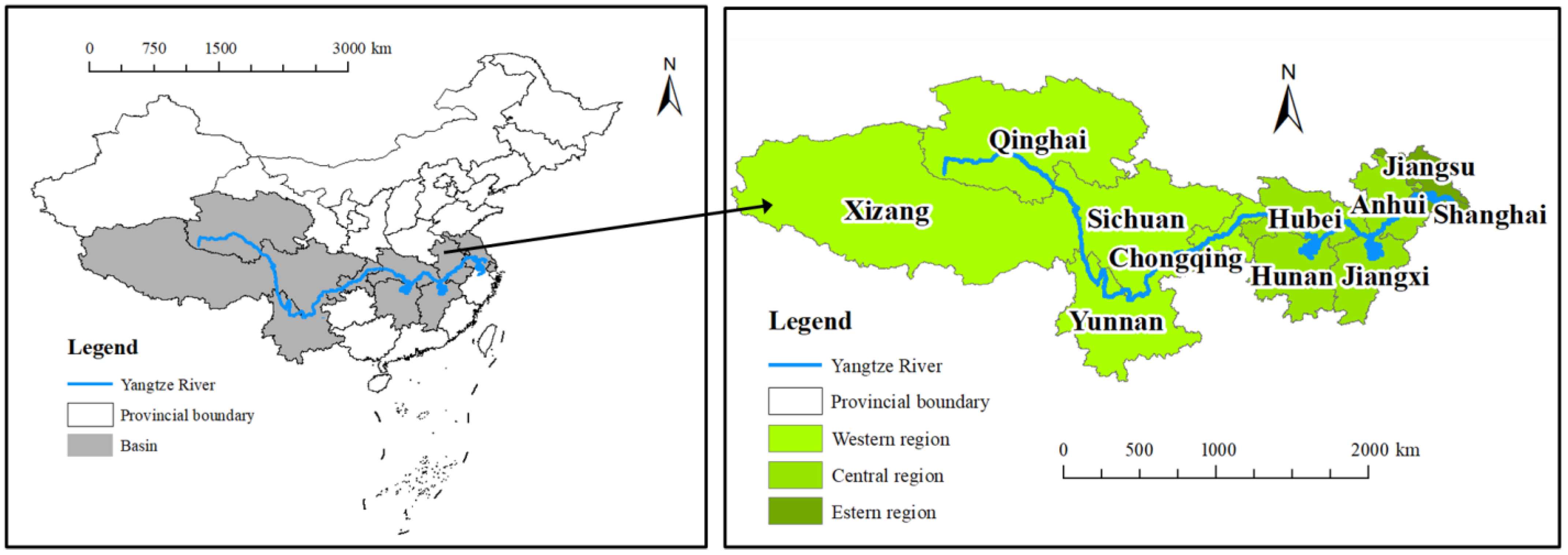
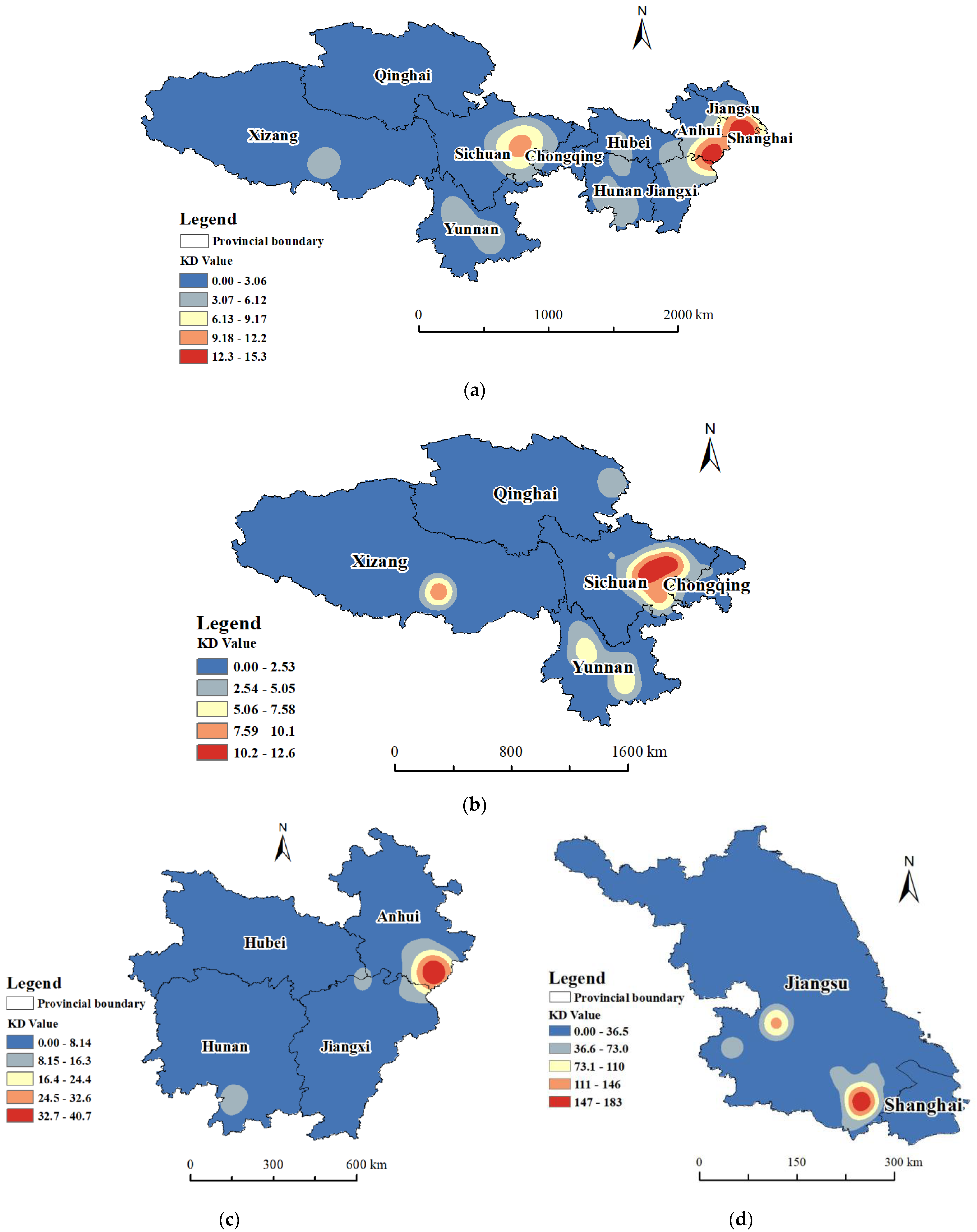
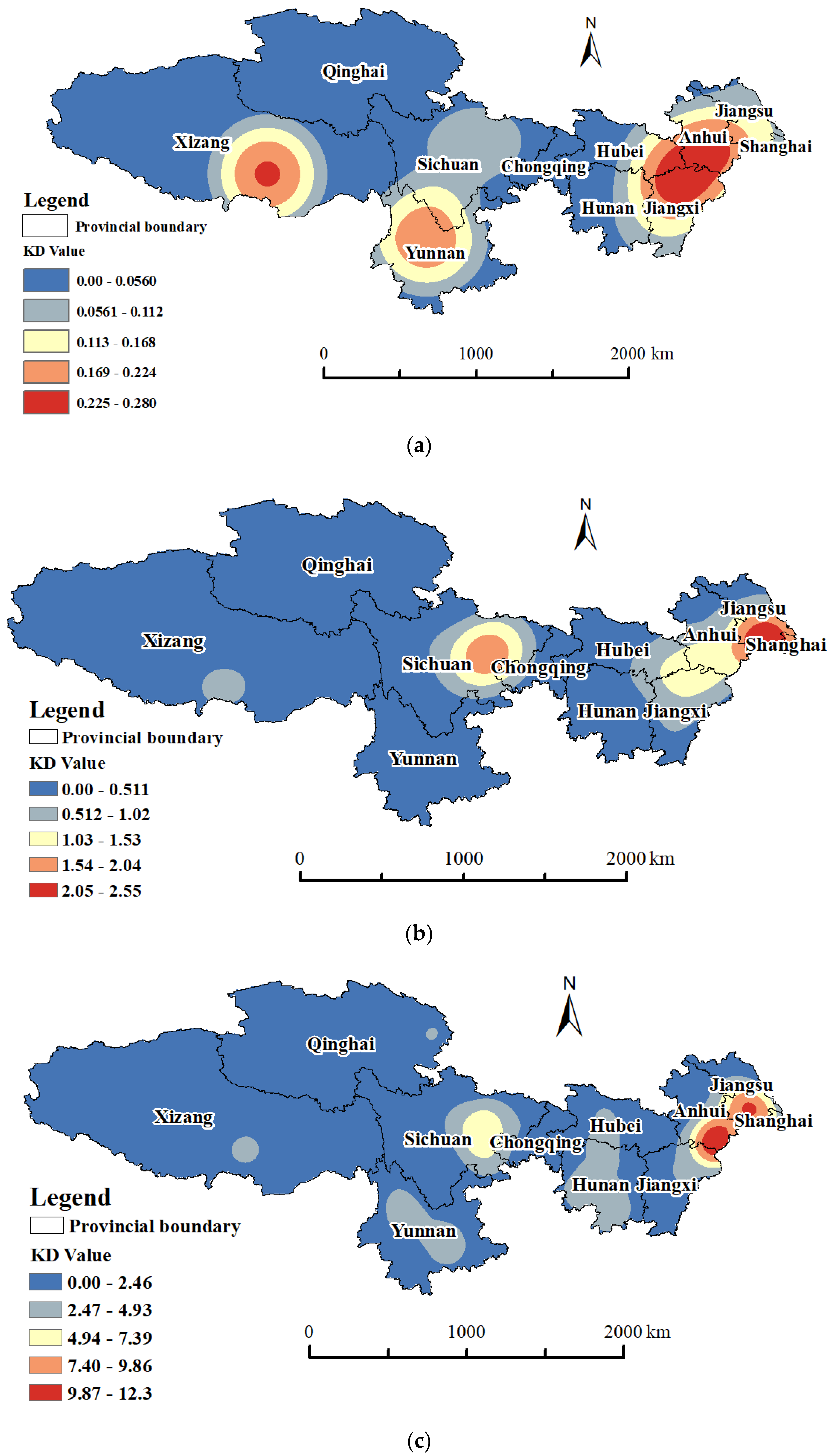
- The spatial distribution exhibits a significant “multi-center agglomeration and axial diffusion” pattern. At the whole-basin scale, ancient architecture shows a clustered distribution (NNI = 0.381), forming a dual-core structure with the Jiangsu–Anhui region in the lower reaches as the primary core and the Sichuan Basin as the secondary core. The central region displays a transitional clustered–random state, while the western region, though sparsely populated, also shows local clustering, collectively reflecting a pattern of local concentration within global dispersion.
- (2)
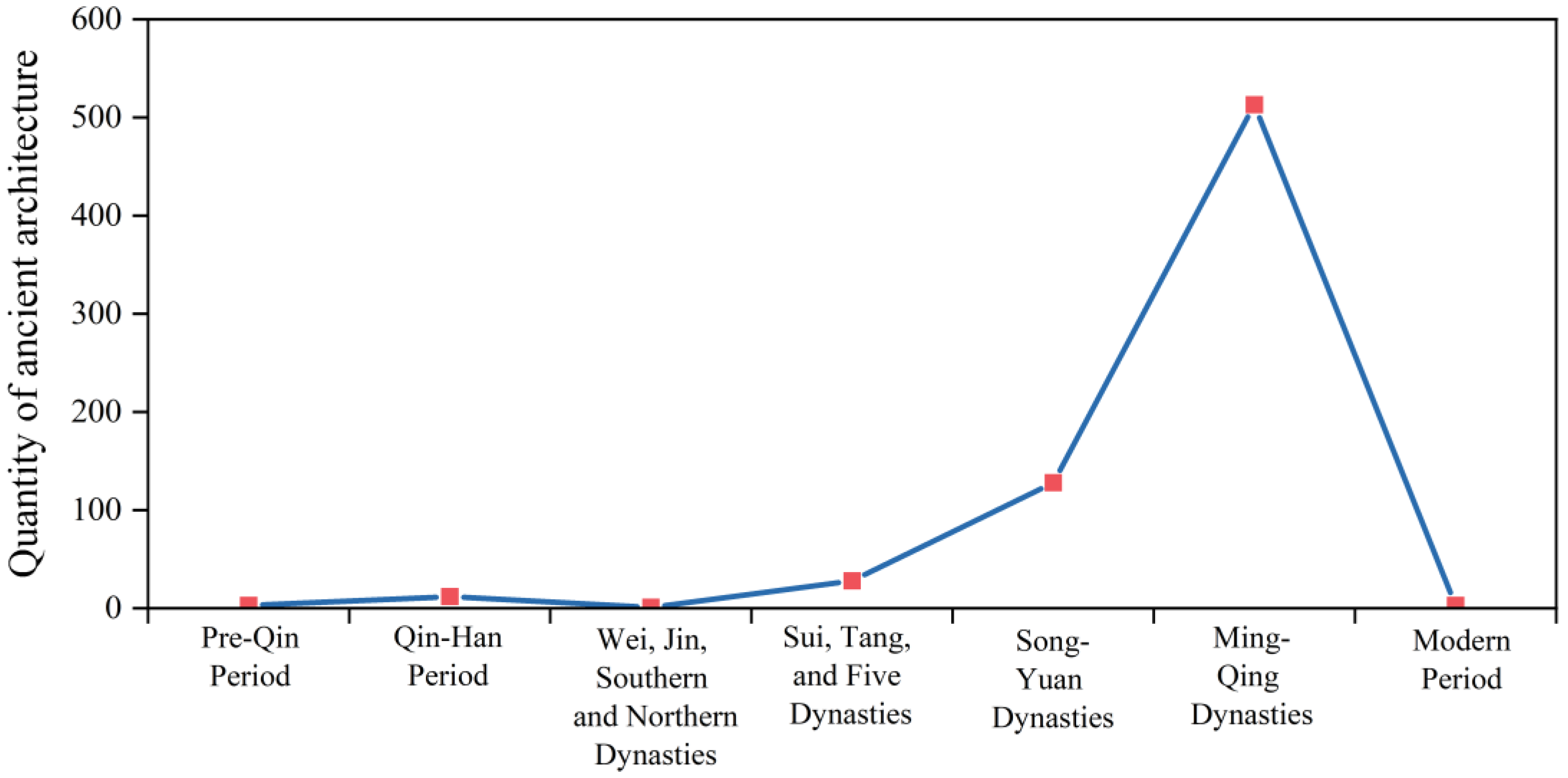
- The study establishes a critical quantitative baseline for the heritage stock, confirming a temporal pyramid dominated by Ming–Qing (74.56%) and Song–Yuan (18.60%) structures. While this trend aligns with the expected survival bias for wooden architecture, our analysis delves deeper to explicate its specific drivers: the technological leap from the Yingzao Fashi that enhanced Song–Yuan preservation, and the unprecedented construction boom during the Ming–Qing era fueled by economic center migration. This temporal characterization is not trivial, as it provides the essential context for interpreting the spatial patterns; the identified “dual-core structure” is primarily a phenomenon of these most-represented periods.
- (3)
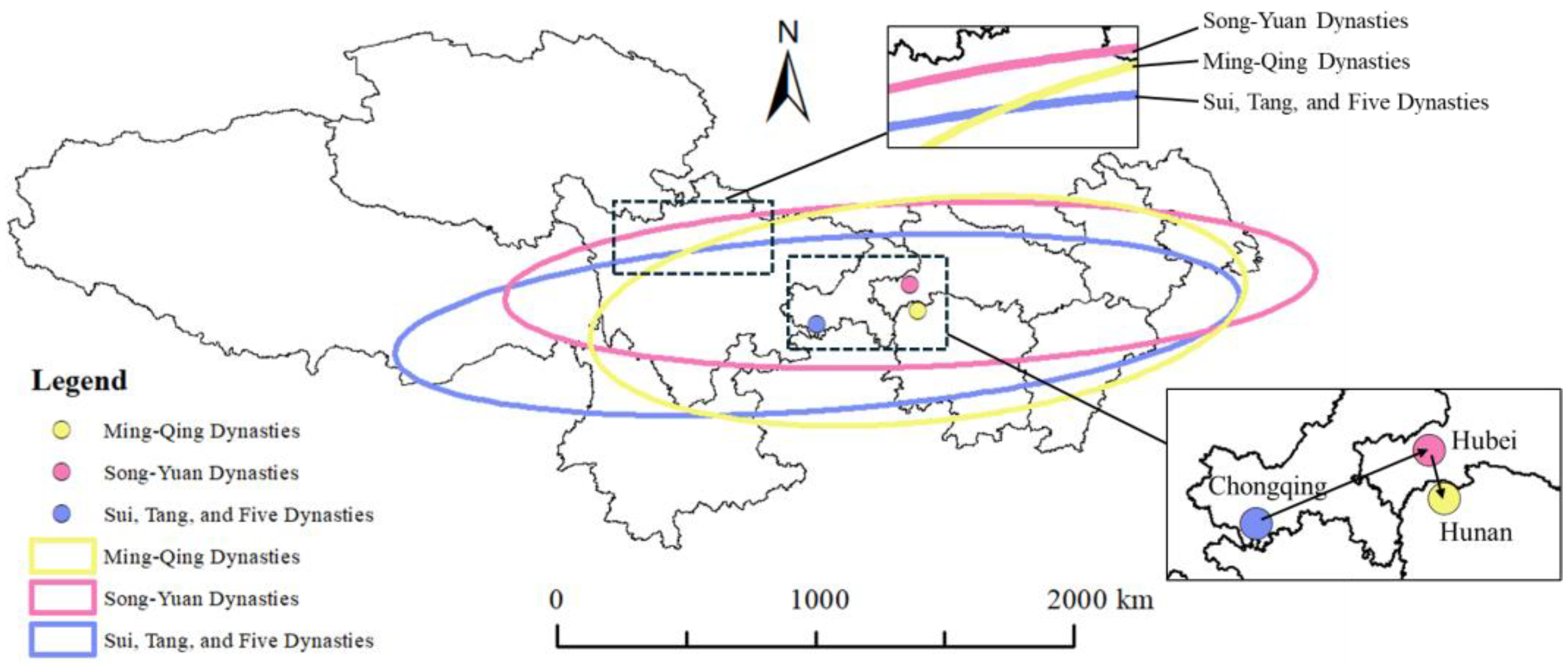
- The spatio-temporal evolution follows a trajectory from “marginal aggregation” to “dual-core structure” and finally to “axial diffusion.” This evolution is deeply rooted in macroscopic historical processes. The southward migration of the economic center, the development of the water transport network, and the standardization of building techniques provided the foundational momentum. At a regional level, diverse social adaptations—such as the integration of merchant capital with gentry culture in the east, cultural convergence in the central transition zone, and responses to the natural environment and sacred spatial order in the west—collectively shaped this distinctive evolutionary path.
- (4)
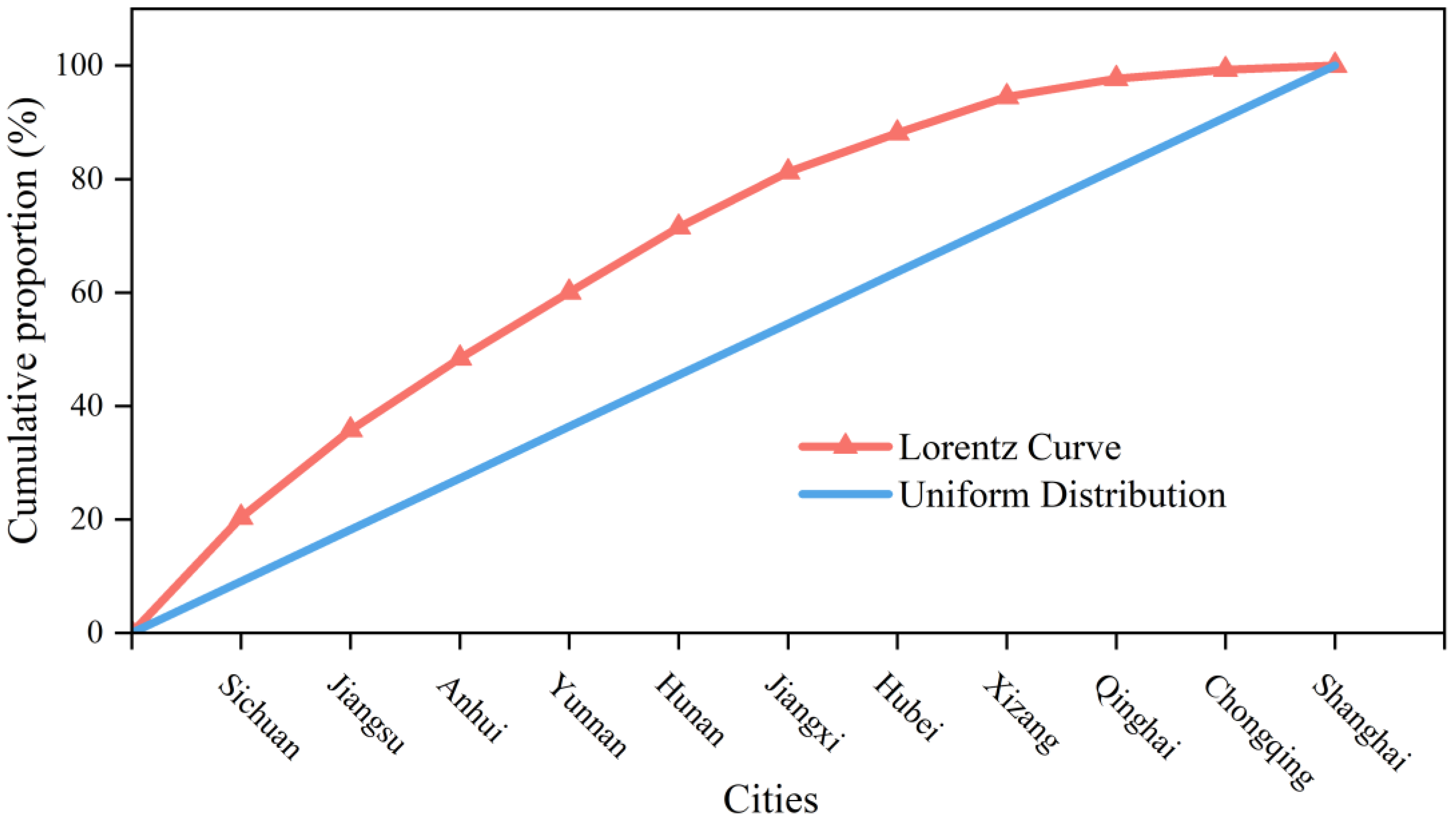
- The spatial equilibrium analysis reveals a significant imbalance, influenced by both historical processes and modern administrative divisions. The Gini coefficient of 0.393 and the distinct Lorenz curve confirm the unevenness of the distribution. The core areas (Sichuan, Jiangsu, Anhui) are concentrated in historically developed agricultural civilization zones, while the apparent scarcity in the peripheral areas (e.g., Qinghai, Chongqing, Shanghai) is not solely due to a lack of heritage but is also related to factors such as different civilizational forms (e.g., pastoralism in Qinghai) and the small areal extent of modern administrative divisions, which can obscure the true cultural geography.
Author Contributions
Funding
Data Availability Statement
Acknowledgments
Conflicts of Interest
References
- Wang, B.; Dai, L.; Liao, B. System Architecture Design of a Multimedia Platform to Increase Awareness of Cultural Heritage: A Case Study of Sustainable Cultural Heritage. Sustainability 2023, 15, 2504. [Google Scholar] [CrossRef]
- Chen, J.; Zhou, Y.; Liu, D. Analysis of spatio-temporal distriburion characteristics of ancient architecture heritage in China. J. Arid Land Resour. Environ. 2018, 32, 194–200. (In Chinese) [Google Scholar] [CrossRef]
- Huang, C. A comprehensive review of deep learning applications in ancient architecture preservation and analysis. In Proceedings of the 5th International Scientific and Practical Conference “Problems of Science Development in the Context of Global Transformations”, Zagreb, Croatia, 1–4 October 2024; p. 230. [Google Scholar]
- Chen, C.; Zhao, W.; Xia, Y.; Gu, Q.; Li, H.; Cao, X.; Zhao, Y.; Liang, C.; Zhang, X. Holocene climatic transition in the Yangtze River region and its impact on prehistoric civilizations. Catena 2024, 238, 107886. [Google Scholar] [CrossRef]
- Wang, Y.; Wang, N.; Zhao, X.; Liang, X.; Liu, J.; Yang, P.; Wang, Y.; Wang, Y. Field model-based cultural diffusion patterns and GIS spatial analysis study on the spatial diffusion patterns of Qijia Culture in China. Remote Sens. 2022, 14, 1422. [Google Scholar] [CrossRef]
- Fu, J.; Mao, H. Study on the spatiotemporal distribution patterns and influencing factors of cultural heritage: A case study of Fujian Province. Herit. Sci. 2024, 12, 324. [Google Scholar] [CrossRef]
- Gao, M.; Bai, Q.; Lyu, H.; Zhang, L. Spatiotemporal evolution and human-environment relationships of early cultural sites from the Longshan to Xia-Shang periods in Henan Province, China. Npj Herit. Sci. 2025, 13, 74. [Google Scholar] [CrossRef]
- Wang, Y.; Dong, Y. Ontology Construction of Digitization Domain for Ancient Architecture. Appl. Sci. 2024, 14, 7651. [Google Scholar] [CrossRef]
- Han, K.; Teri, G.; Cheng, C.; Tian, Y.; Huang, D.; Ge, M.; Fu, P.; Luo, Y.; Li, Y. Evaluation of commonly used reinforcement materials for color paintings on ancient wooden architecture in China. Herit. Sci. 2024, 12, 122. [Google Scholar] [CrossRef]
- Shi, Y.; Guo, M.; Zhou, J.; Liang, X. Analysis of static stiffness properties of column-architrave structures of ancient buildings under long term load-natural aging coupling. Structures 2024, 59, 105688. [Google Scholar] [CrossRef]
- Nie, X.; Ma, M.; Ji, J.; Zheng, L. The spatial distribution of traditional intangible cultural heritage medicine of China and its influencing factors. Herit. Sci. 2023, 11, 90. [Google Scholar] [CrossRef]
- Liu, B.; Wu, C.; Xu, W.; Shen, Y.; Tang, F. Emerging trends in GIS application on cultural heritage conservation: A review. Herit. Sci. 2024, 12, 139. [Google Scholar] [CrossRef]
- Luo, L.; Wang, X.; Guo, H.; Lasaponara, R.; Shi, P.; Bachagha, N.; Li, L.; Yao, Y.; Masini, N.; Chen, F.; et al. Google Earth as a Powerful Tool for Archaeological and Cultural Heritage Applications: A Review. Remote Sens. 2018, 10, 1558. [Google Scholar] [CrossRef]
- Santos, B.; Gonçalves, J.; Almeida, P.G.; Martins-Nepomuceno, A.M.T. GIS-based inventory for safeguarding and promoting Portuguese glazed tiles cultural heritage. Herit. Sci. 2023, 11, 133. [Google Scholar] [CrossRef]
- Arrighi, C.; Ballio, F.; Simonelli, T. A GIS-based flood damage index for cultural heritage. Int. J. Disaster Risk Reduct. 2023, 90, 103654. [Google Scholar] [CrossRef]
- Gaddi, R.; Cacace, C.; Di Menno Di Bucchianico, A. The risk assessment of surface recession damage for architectural buildings in Italy. J. Cult. Herit. 2022, 57, 118–130. [Google Scholar] [CrossRef]
- Huang, Y. Bibliometric analysis of GIS applications in heritage studies based on Web of Science from 1994 to 2023. Herit. Sci. 2024, 12, 57. [Google Scholar] [CrossRef]
- Wang, X.; Zhang, J.; Cenci, J.; Becue, V. Spatial distribution characteristics and influencing factors of the world architectural heritage. Heritage 2021, 4, 2942–2959. [Google Scholar] [CrossRef]
- Liang, Y.; Yang, R.; Wang, P.; Yang, A.; Chen, G. A quantitative description of the spatial–temporal distribution and evolution pattern of world cultural heritage. Herit. Sci. 2021, 9, 80. [Google Scholar]
- Lu, Y.; Han, Q.; Zhang, Z.; Sun, Z.; Dai, J. Spatiotemporal Distribution and Evolution of Global World Cultural Heritage, 1972–2024. ISPRS Int. J. Geo-Inf. 2025, 14, 190. [Google Scholar] [CrossRef]
- Tsarenko, S. Modeling the paths of ethno-political traditions and building cultural routes by means of ethnodesign and GIS. Cult. Contemp. 2024, 26, 21–30. [Google Scholar] [CrossRef]
- Zhang, J.; Sun, H.; Xu, S.; Aoki, N. Analysis of the Spatial and Temporal Distribution and Reuse of Urban Industrial Heritage: The Case of Tianjin, China. Land 2022, 11, 2273. [Google Scholar] [CrossRef]
- Jiang, L.; Cai, J. Research on the spatial and temporal distribution and evolution characteristics of ancient architectural heritage in Southeastern Zhejiang. Sustainability 2023, 15, 16618. [Google Scholar] [CrossRef]
- Xu, Z.; Tian, G.; Wei, K.; Ma, Y.; Zhang, S.; Huang, Y.; Yao, X. The influence of environment on the distribution characteristics of historical buildings in the Songshan Region. Land 2022, 11, 2094. [Google Scholar] [CrossRef]
- Gao, H.; Wang, Y.; Zhang, H.; Huang, J.; Yue, X.; Chen, F. Spatial distribution and typological classification of heritage buildings in Southern China. Buildings 2023, 13, 2025. [Google Scholar] [CrossRef]
- Wei, K.; Jiang, X.; Zhu, R.; Duan, X.; Yang, J. Spatial and Temporal Distribution Characteristics of Heritage Buildings in Yangzhou and Influencing Factors and Tourism Development Strategies. Buildings 2025, 15, 1081. [Google Scholar] [CrossRef]
- Chen, M.; Wang, J.; Sun, J.; Ye, F.; Zhang, H. Spatio-temporal distribution characteristics of intangible cultural heritage and tourism response in the Beijing–Hangzhou Grand Canal basin in China. Sustainability 2023, 15, 10348. [Google Scholar] [CrossRef]
- Wang, J.; Chen, M.; Zhang, H.; Ye, F. Intangible Cultural Heritage in the Yangtze River Basin: Its Spatial Distribution Characteristics and Influencing Factors. Sustainability 2023, 15, 7960. [Google Scholar] [CrossRef]
- Wang, X.; Zhang, T.; Duan, L.; Liritzis, I.; Li, J. Spatial distribution characteristics and influencing factors of intangible cultural heritage in the Yellow River Basin. J. Cult. Herit. 2024, 66, 254–264. [Google Scholar] [CrossRef]
- Dong, B.; Bai, K.; Sun, X.; Wang, M.; Liu, Y. Spatial distribution and tourism competition of intangible cultural heritage: Take Guizhou, China as an example. Herit. Sci. 2023, 11, 64. [Google Scholar] [CrossRef]
- Hu, C.; Liu, W.; Jia, Y.; Jin, Y. Characterization of Territorial Spatial Agglomeration Based on POI Data: A Case Study of Ningbo City, China. Sustainability 2019, 11, 5083. [Google Scholar] [CrossRef]
- Zhang, X.; Xiang, H.; Liu, R. Spatial pattern and influencing factors of intangible cultural heritage of music in Xiangxi, central China. Herit. Sci. 2022, 10, 39. [Google Scholar] [CrossRef]
- Zhang, J.; Cenci, J.; Becue, V.; Koutra, S. Analysis of spatial structure and influencing factors of the distribution of national industrial heritage sites in China based on mathematical calculations. Environ. Sci. Pollut. Res. 2022, 29, 27124–27139. [Google Scholar] [CrossRef] [PubMed]
- Ju, X.; Yang, C.; Zhao, M.; Xu, Y.; Zhou, D.; Zhang, Y. Spatial distribution characteristics and influencing factors of traditional villages in Zhejiang, Anhui, Shaanxi, Yunnan Provinces. Econ. Geogr. 2022, 42, 222–230. [Google Scholar]
- Bian, J.; Chen, W.; Zeng, J. Spatial Distribution Characteristics and Influencing Factors of Traditional Villages in China. Int. J. Environ. Res. Public Health 2022, 19, 4627. [Google Scholar] [CrossRef] [PubMed]
- Hai, T. Spatial distributive characteristics and its influencing factors of traditional villages in Beijing-Tianjin-Hebei Region. Econ. Geogr. 2020, 40, 143–149. [Google Scholar]
- Pommerening, A.; Szmyt, J.; Zhang, G. A new nearest-neighbour index for monitoring spatial size diversity: The hyperbolic tangent index. Ecol. Model. 2020, 435, 109232. [Google Scholar] [CrossRef]
- Han, S.; Xu, P.; Ma, P. Temporal and spatial distribution of intangible cultural heritage and its influencing factors in Jiangsu Province. Sci. Geogr. Sin. 2021, 41, 1598–1605. [Google Scholar] [CrossRef]
- Chu, D.; Huang, C.; Lin, F. Spatio-temporal evolution characteristics of cultural heritage sites and their relationship with natural and cultural environment in the northern Fujian, China. Herit. Sci. 2024, 12, 210. [Google Scholar] [CrossRef]
- Zhang, Z.; Cui, Z.; Fan, T.; Ruan, S.; Wu, J. Spatial distribution of intangible cultural heritage resources in China and its influencing factors. Sci. Rep. 2024, 14, 4960. [Google Scholar] [CrossRef]
- Li, C.; Qian, Y.; Li, Z.; Tong, T. Identifying factors influencing the spatial distribution of minority cultural heritage in Southwest China. Herit. Sci. 2024, 12, 117. [Google Scholar] [CrossRef]
- Stief, A.; Baranowski, J. Fault diagnosis using Interpolated Kernel Density Estimate. Measurement 2021, 176, 109230. [Google Scholar] [CrossRef]
- Zhao, Y.; Wu, Q.; Wei, P.; Zhao, H.; Zhang, X.; Pang, C. Explore the Mitigation Mechanism of Urban Thermal Environment by Integrating Geographic Detector and Standard Deviation Ellipse (SDE). Remote Sens. 2022, 14, 3411. [Google Scholar] [CrossRef]
- Lefever, D.W. Measuring geographic concentration by means of the standard deviational ellipse. Am. J. Sociol. 1926, 32, 88–94. [Google Scholar] [CrossRef]
- Deng, G.; Chen, H.H.; Li, J.; Wu, D.; Xu, X.L. Exploring the spatiotemporal evolution and risk factors for total factor energy productivity in Guangdong Province, China. J. Environ. Manag. 2025, 373, 123395. [Google Scholar] [CrossRef]
- Fang, X. The Book of Jin; Shanghai Hanfen Pavilion Photocopying: Shanghai, China, 646; Volume 64. [Google Scholar]
- Han, Y. Preface to the Tang Dynasty Han Changli Corpus; The Commercial Press: Shanghai, China, 1934; Volume 19, ISBN 10186-686. [Google Scholar]
- Sima, Q. Volume 29: Treatise on Rivers and Canals. In The Records of the Grand Historian (Shiji); Zhonghua Book Company: Beijing, China, 2019; Volume 29, ISBN 9787101142365. [Google Scholar]
- Sima, Q. Volume 129: Biographies of Merchants. In The Records of the Grand Historian (Shiji); Zhonghua Book Company: Beijing, China, 2019; Volume 129, ISBN 9787101142365. [Google Scholar]
- Fan, Y. The Book of the Later Han; Zhonghua Book Company: Beijing, China, 2016; Volume 86, ISBN 9787101113594. [Google Scholar]
- Li, J. Yingzao Fashi; Chongqing Publishing House: Chongqing, China, 2018; ISBN 9787229136130. [Google Scholar]
- Dai, S. The Book of Rites (Li Ji); Zhonghua Book Company: Beijing, China, 2017; ISBN 9787101128567. [Google Scholar]
- Fan, C. Gazetteer of Wu Prefecture (Wu Jun Zhi); Jiangsu Ancient Books Publishing House: Nanjing, China, 1998; Volume 50, ISBN 9787806430972. [Google Scholar]
- Tuo, T. History of Song; Zhonghua Book Company: Beijing, China, 1985; Volume 247, ISBN 9787101003239. [Google Scholar]



| Region | NNI | Z | Distribution Types | G0 | G |
|---|---|---|---|---|---|
| Whole basin | 0.381 | −31.074 | Clustered distribution | 30.15 | 35.69 |
| Western region | 0.411 | −19.42 | Clustered distribution | 44.72 | 56.88 |
| Central region | 0.555 | −14.23 | Clustered–Random distribution | 50.00 | 51.14 |
| Eastern region | 0.511 | −9.86 | Clustered–Random distribution | 70.71 | 95.60 |
| Period | NNI | Z | Distribution Types | G0 | G |
|---|---|---|---|---|---|
| Sui, Tang, and Five Dynasties | 0.584 | −4.213 | Clustered–Random distribution | 37.80 | 40.41 |
| Song–Yuan Dynasties | 0.498 | −10.873 | Clustered distribution | 30.15 | 38.58 |
| Ming–Qing Dynasties | 0.408 | −25.660 | Clustered distribution | 30.15 | 35.87 |
Disclaimer/Publisher’s Note: The statements, opinions and data contained in all publications are solely those of the individual author(s) and contributor(s) and not of MDPI and/or the editor(s). MDPI and/or the editor(s) disclaim responsibility for any injury to people or property resulting from any ideas, methods, instructions or products referred to in the content. |
© 2025 by the authors. Licensee MDPI, Basel, Switzerland. This article is an open access article distributed under the terms and conditions of the Creative Commons Attribution (CC BY) license (https://creativecommons.org/licenses/by/4.0/).
Share and Cite
Li, C.; Ren, K.; Xu, X.; Kuang, K.; Yang, H.; Lam, J.F.I. Spatio-Temporal Distribution Patterns and Evolutionary Mechanisms of Ancient Architecture in the Yangtze River Basin. Buildings 2025, 15, 4466. https://doi.org/10.3390/buildings15244466
Li C, Ren K, Xu X, Kuang K, Yang H, Lam JFI. Spatio-Temporal Distribution Patterns and Evolutionary Mechanisms of Ancient Architecture in the Yangtze River Basin. Buildings. 2025; 15(24):4466. https://doi.org/10.3390/buildings15244466
Chicago/Turabian StyleLi, Chunjie, Kexin Ren, Xiao Xu, Kaicong Kuang, Huaxiang Yang, and Johnny F. I. Lam. 2025. "Spatio-Temporal Distribution Patterns and Evolutionary Mechanisms of Ancient Architecture in the Yangtze River Basin" Buildings 15, no. 24: 4466. https://doi.org/10.3390/buildings15244466
APA StyleLi, C., Ren, K., Xu, X., Kuang, K., Yang, H., & Lam, J. F. I. (2025). Spatio-Temporal Distribution Patterns and Evolutionary Mechanisms of Ancient Architecture in the Yangtze River Basin. Buildings, 15(24), 4466. https://doi.org/10.3390/buildings15244466