Systematic Review

Urban Building Carbon Sinks Under the Carbon Neutrality Goal: Research Hotspots, Measurement Frameworks, and Optimization Strategies

1
School of Architecture and Landscape Architecture, University of Edinburgh, Edinburgh EH1 1JZ, UK
2
School of Architecture and Urban Planning, Huazhong University of Science and Technology (HUST), Wuhan 430074, China
*
Author to whom correspondence should be addressed.
Buildings 2025, 15(24), 4445; https://doi.org/10.3390/buildings15244445
Submission received: 14 November 2025 / Revised: 2 December 2025 / Accepted: 4 December 2025 / Published: 9 December 2025

Abstract

In the context of urban carbon neutrality, buildings are shifting from carbon emission sources to potential urban carbon-sink units. Yet existing studies mostly examine single materials or isolated technologies, and a systematic integration of building carbon sinks is still missing. To address this gap, this study reviews literature from 2007–2025 using statistical analysis, bibliometrics, and network analysis to identify research priorities, technological pathways, and development trends. The results show that: (1) Publications have grown steadily, surging after 2020; research has evolved from material carbonation mechanisms to building-system carbon sinks and then to active carbon-capture technologies, indicating strong multidisciplinary integration. (2) A three-stage framework for quantifying and monitoring building carbon sinks has been formed, but current methods differ by scale and no unified standard exists for urban building carbon-sink assessment. (3) A life-cycle enhancement strategy is summarized, including improving carbonation performance with solid-waste utilization, increasing building exposure area, integrating ecological attached sinks with active capture technologies, and reusing crushed construction waste. This review integrates fragmented findings on the carbon-sequestration efficiency of urban buildings and provides references for future urban emission reduction and climate-neutrality goals.

1. Introduction

Global climate change is one of the most severe challenges to sustainable development faced by human society, with its root cause being the excessive emissions of greenhouse gases, particularly carbon dioxide (CO2) [1]. In response to this crisis, achieving carbon neutrality has become a shared global goal, forming a broad consensus under frameworks such as the Paris Agreement [2]. As the center of global population and economic activities, cities are the primary sources of energy consumption and carbon emissions, contributing to approximately 75% of global CO2 emissions [3]. In this context, the building sector has garnered significant attention due to its substantial carbon footprint throughout its entire lifecycle (from material production, construction, operation, to demolition) [4]. Traditional decarbonization pathways for buildings mainly focus on improving energy efficiency and utilizing renewable energy to reduce emissions from buildings as “carbon sources”.
Building carbon sinks represent one of the key methods for long-term carbon storage, achieved by absorbing and fixing CO2 in the atmosphere throughout the entire lifecycle of buildings. Buildings, with their unique material structures and energy metabolism characteristics in urban ecosystems, play a pivotal role in the carbon cycle, influenced by the materials used, spatial forms, and functional systems [5]. Through carbonation reactions at the material level, ecological integration in building design, and emerging active carbon capture technologies, buildings can participate in carbon absorption and sequestration processes at different scales [6]. The concept of viewing buildings as “carbon sink units” expands the traditional definition of buildings solely as energy consumers and carbon emitters, transforming them into potential “artificial carbon sink systems” that play an important role in achieving carbon neutrality [7]. Building carbon sinks not only help mitigate the rise of CO2 concentrations in urban environments but also offer additional benefits, such as extending material lifespan, improving microclimates, and enhancing ecological service value [8]. With the rapid development of low-carbon and negative-carbon building concepts, research on building carbon sinks is increasingly becoming an important topic at the intersection of architecture, materials science, and environmental engineering, with theoretical refinement and technological innovation holding profound significance for achieving sustainable urban transformation.
Although the concept of building carbon sinks holds great potential, current research is still in an exploratory stage and the knowledge system remains fragmented across scales and disciplines. At the material scale, cement and concrete studies have demonstrated that carbonation can provide a non-negligible global carbon sink and that engineered mineral carbonation can intentionally enhance CO2 uptake in cement-based materials [9,10]. At the same time, research on recycled concrete aggregates and accelerated carbonation has shown that demolition waste can both be upgraded and used as a medium for additional CO2 sequestration [11,12]. At the building and urban scales, studies on green roofs, green façades, and broader urban green infrastructure have quantified carbon sequestration, microclimate regulation, and co-benefits of nature-based solutions [13,14,15]. Meanwhile, life-cycle and embodied-carbon studies have provided systematic approaches for evaluating building-related emissions, but they primarily treat buildings as carbon sources rather than potential carbon sinks [16,17]. As a result, despite progress at each scale, there is limited integration among material-level carbonation, nature-based solutions, and building-system technologies, leaving a fragmented understanding of how these components can work together within real building or urban systems.
This fragmentation leads to several methodological bottlenecks. First, there is still no unified standard or systematic framework for measuring and assessing building carbon sinks. Laboratory-scale methods that quantify CO2 uptake in cementitious materials—such as controlled accelerated carbonation testing—are not directly compatible with field-scale monitoring of building or district carbon fluxes, making cross-scale coupling difficult [11,17]. Second, many studies focus on a single stage of the building life cycle, resulting in incomplete “cradle-to-grave” or “cradle-to-cradle” carbon-sink accounting. Reviews of embodied carbon in buildings have similarly highlighted inconsistencies in system boundaries, data sources, and methodological choices, which hinder comparability and the establishment of benchmarks [16,17]. Third, passive carbonation strategies (e.g., natural or accelerated carbonation of concrete and recycled aggregates) and active or semi-active carbon-capture approaches (e.g., building-integrated capture systems, carbon-storing binders, biotic building envelopes) are often studied in isolation, and their synergies within building systems remain poorly examined [12,18]. These issues make it difficult to objectively compare technological pathways, evaluate life-cycle carbon-sink performance, and translate research outcomes into design guidelines and policies.
Against this background, there is a pressing need for a systematic and comparative review that integrates these fragmented research efforts under a unified urban building carbon-sink framework. Based on literature from 2007 to 2025 in the Web of Science Core Collection, this paper applies statistical analysis, bibliometric and network analysis, and qualitative synthesis to: (1) quantify development trends in the field, including annual publication patterns, collaborative networks, and the evolution of research hotspots; (2) construct a multi-scale technical framework that integrates material-level carbon sinks, spatial-design carbon sinks, and active carbon-capture technologies, clarifying their mechanisms and interactions; (3) systematically compare measurement and monitoring methods from material scale, building-system scale, to active-technology scale; and (4) summarize life-cycle optimization strategies while identifying key bottlenecks and future development directions. By doing so, this study aims to help transform the field from isolated case studies into a coherent knowledge system for urban building carbon sinks, providing theoretical support and practical references for architects, engineers, and policymakers working toward negative-carbon buildings.

2. Materials and Methods

2.1. Search Methodology

A topic search was conducted using the Web of Science (WOS) and Scopus core collection databases. To identify literature related to building carbon sinks, we selected terminology describing near-natural environmental processes—such as carbon sink, carbon storage, and active capture—and referenced keyword systems proposed in recent comprehensive reviews on carbon sequestration in the built environment [19]. These studies provide a broader and more systematic foundation for defining search terms related to carbon storage mechanisms, bio-based materials, mineral carbonation, and building-scale sequestration pathways.
Furthermore, the search-term development and the database selection followed widely adopted methodological guidelines for systematic literature reviews. Recommendations by Arksey & O’Malley [20] for scoping systematic searches, Xiao & Watson [21] for structured multi-step search strategy development, and Cooper [22] for research synthesis were used as methodological references to improve transparency and reproducibility of the search protocol.
The restricted search string was defined as follows:
TS = ((“building” OR “architecture” OR “construction”) AND (“carbon sink” OR “carbon sequestration” OR “CO2 uptake” OR “carbon storage”) AND (“measurement” OR “model” OR “quantification” OR “life cycle assessment” OR “LCA” OR “simulation”)).
The final data collection was completed on 18 September 2025.

2.2. Inclusion Criteria

For quality assessment of retrieved literature, the titles and abstracts of all identified publications were independently screened by the first two authors. Full texts were downloaded for studies meeting the following inclusion criteria:
  • The research focuses on carbon sink technologies or materials related to buildings.
  • The study involves measurement or evaluation methods for building carbon sinks.
  • The article is a peer-reviewed academic publication.
Studies that did not meet these criteria were excluded. In particular, papers that broadly mentioned the effectiveness of carbon sinks in urban buildings without in-depth analysis were removed. The overall screening and eligibility assessment followed the PRISMA 2020 guidelines for systematic reviews [23], and reviewer agreement procedures referenced in the Cochrane Handbook [24] as well as methods proposed by Booth et al. [25]. The PRISMA Checklist is provided in the Supplementary Materials.
These methodological sources ensured transparent inclusion/exclusion decisions, minimized selection bias, and improved reliability of screening outcomes.
Any disagreements or ambiguities among co-authors were discussed thoroughly until consensus was reached.

2.3. Literature Statistical Analysis Combined with Qualitative Analysis

First, Section 3 reports two statistical analyses: (1) A descriptive analysis—conducted via statistical methods—covering annual publication trends, geographical and national distributions, source journals, research institutions, and authorship patterns; (2) Early research focused primarily on the materials scale, aiming to optimize the carbon sequestration efficiency of cement-based materials through “accelerated carbonization” technology. Subsequently, the research expanded to the building system scale, combining building envelopes such as green roofs with the concept of “biocarbon” to assess their comprehensive carbon sequestration capacity. Ultimately, the research has moved towards a new paradigm of proactive carbon sequestration, which aims to transform buildings from single carbon emission sources into living systems capable of actively capturing and storing carbon dioxide through the deep integration of ecology and architecture, thus achieving a complete strategic upgrade from materials science to systems engineering.
To further elucidate the relationship between buildings and carbon sinks, this study investigated multiple aspects of the built environment. Section 4 summarizes the three major dimensions of building carbon sinks. Section 5 systematically classifies and reviews existing measurement and monitoring methods, based on statistical categorization of the methodologies reported in each paper’s Methods section. Section 6 synthesizes research on integrated design strategies linking building systems and urban carbon sinks.
Finally, Section 7 and Section 8 discuss potential future research directions and existing challenges. To promote public participation in the design and implementation of building carbon sinks, a theoretical framework was proposed, accompanied by critical reflections on current limitations.

2.4. Summary of the Methodological Workflow

To improve transparency, the research procedure in this review followed the following sequential steps: (1) Database selection and search-term construction based on prior carbon sequestration reviews and systematic search guidelines [19,20,21,22]. (2) Execution of the database search using the predefined Boolean string. (3) Deduplication of all retrieved records. (4) Title and abstract screening according to predefined criteria. (5) Full-text evaluation following PRISMA 2020 procedures [23]. (6) Data extraction and coding of carbon sink mechanisms, research scale, and measurement methods. (7) Descriptive statistics and qualitative synthesis based on established mixed-method review techniques [25].

3. A Literature Review on Urban Building Carbon Sequestration Research

3.1. Literature Statistical Analysis

3.1.1. Reference Resource

To conduct this study, we retrieved 3783 publications from the WOS and Scopus Core Collection databases covering the period from 2007 to 2025. Each article’s title and abstract were carefully reviewed, and irrelevant studies were removed. After de-duplication, 3714 unique documents remained. Following keyword screening for building carbon sink and building construction, 2021 studies met the inclusion criteria for detailed review. After full-text screening, 135 papers were ultimately included in the final systematic mapping process (Figure 1).

3.1.2. Annual Publication Trends

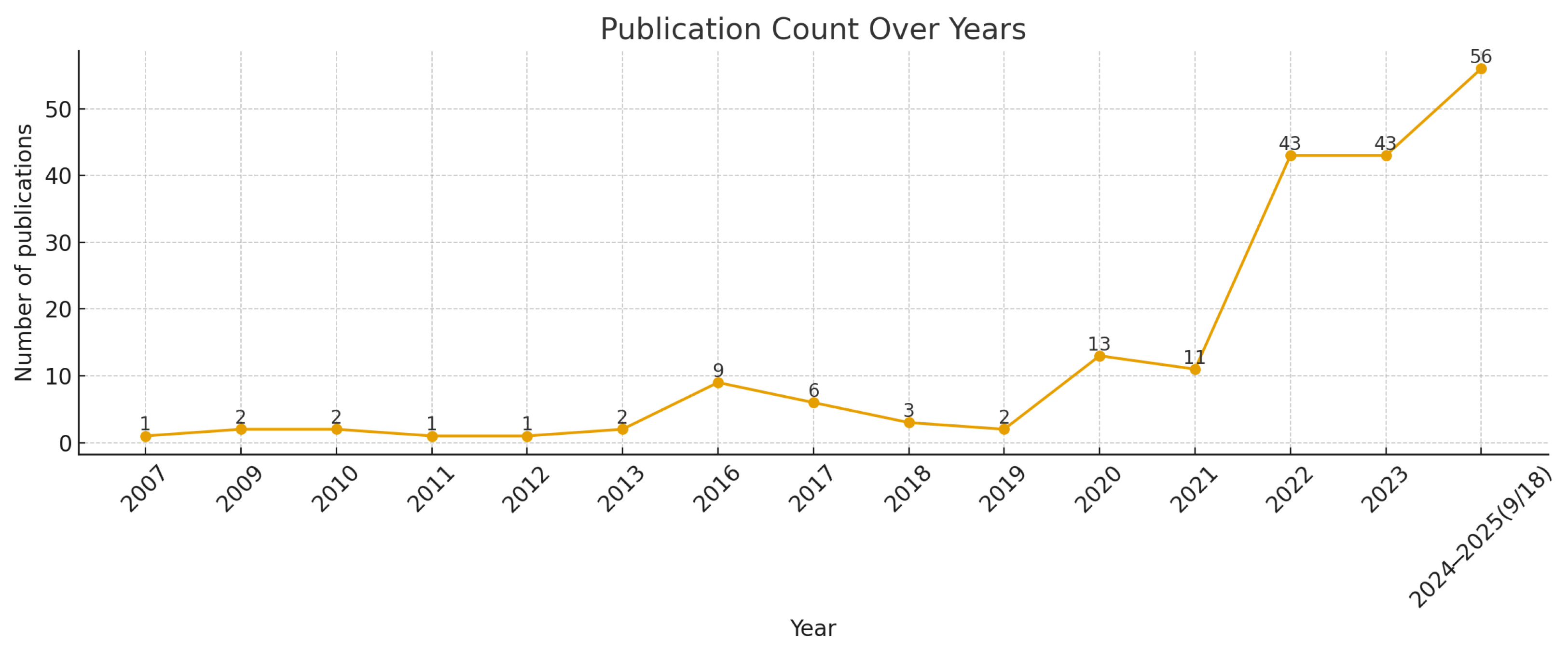
Publications on urban building carbon sink capacity have increased steadily year by year, with particularly rapid growth after 2020. Between 2020 and 18 September 2025, 166 papers were published—almost six times the total from 2007–2020 (29 papers) (Figure 2). This rapid surge reflects the growing recognition of urban building carbon sinks not only as an intrinsic performance of the built environment but also as an essential strategy for environmental protection and carbon neutrality.

3.1.3. Geographical Distribution of Studies

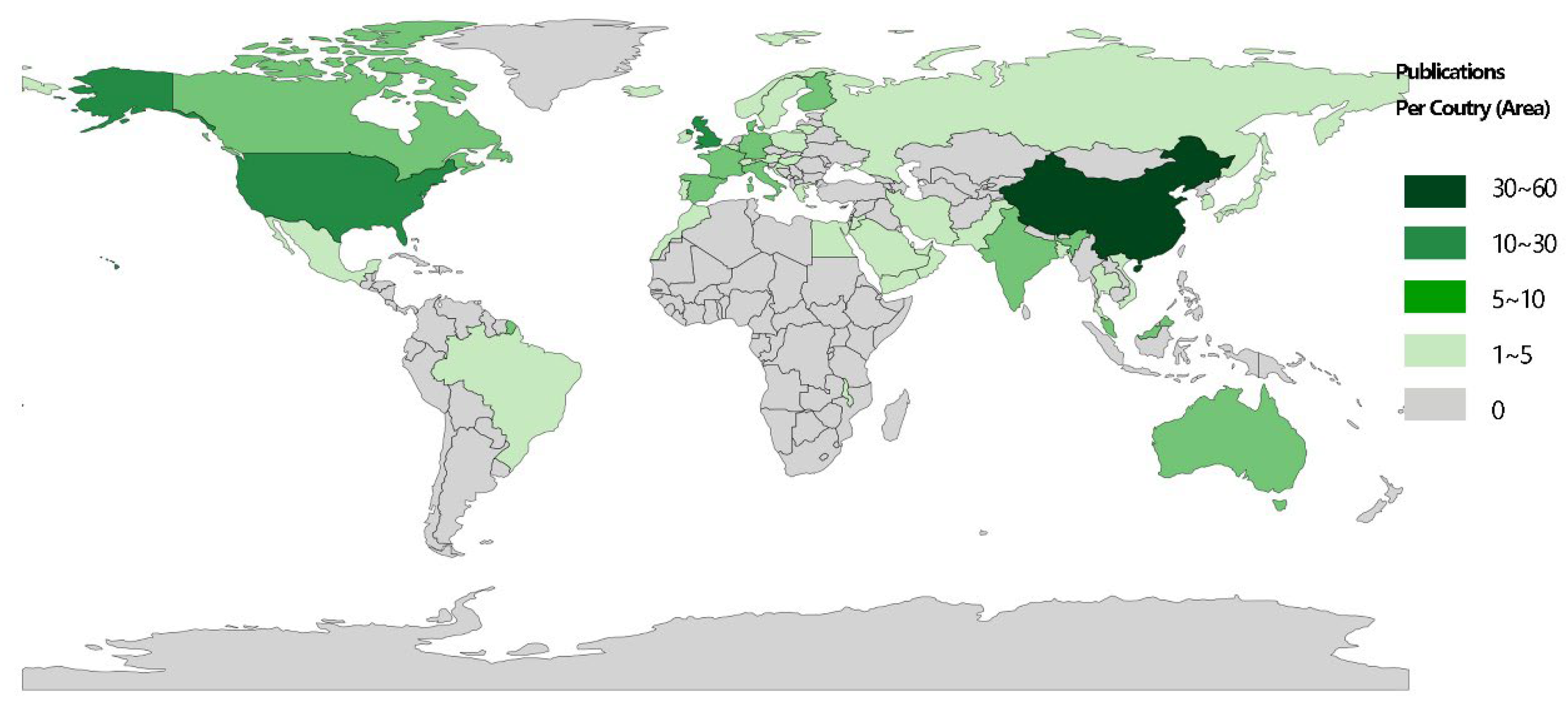
Publications originated from 40 countries and regions worldwide (Figure 3). The most active research regions were Asia (35%), Europe (28%), and North America (23%), while Africa (6%), Oceania (5%), and South America (3%) contributed smaller shares—indicating global but regionally uneven engagement in this research area.
China, Nordic countries, and the United States emerged as major contributors, with China accounting for 30% of all publications—making it the leading country in the field. Two factors may explain the observed geographic concentration: (1) The search was restricted to English-language journals, potentially underrepresenting non-English research. (2) There is a relatively larger research community in China focused on building carbon sink technologies.

3.1.4. Institutional Contributions

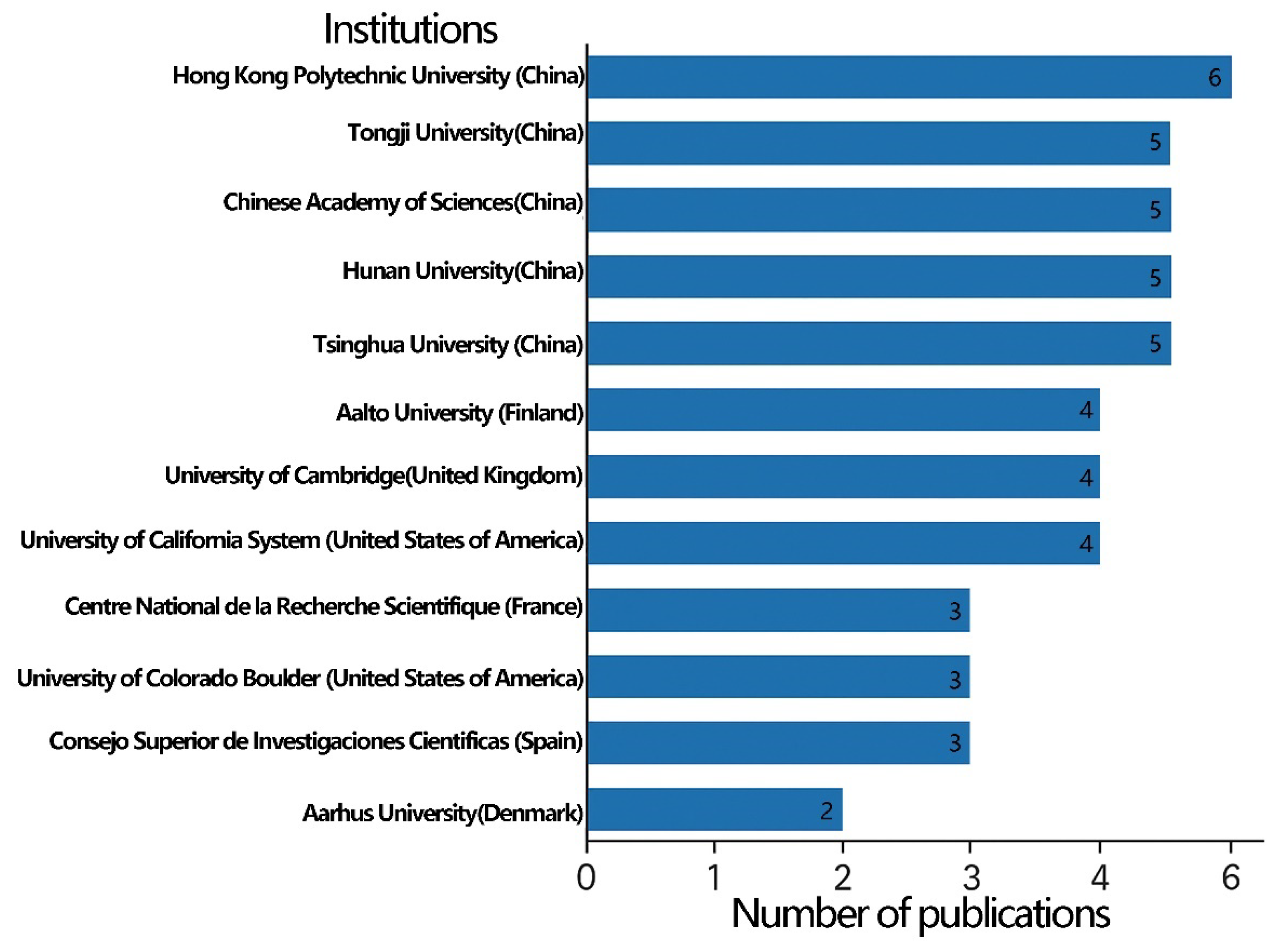
The 12 most productive institutions in building carbon sink research from 2007 to 2025. Chinese research institutions clearly dominate this domain (Figure 4). The Hong Kong Polytechnic University leads with six publications. Tongji University, the Chinese Academy of Sciences, Hunan University, and Tsinghua University each published five papers, underscoring the strong research capacity of Chinese universities and national institutes. Outside China, Aalto University (Helsinki, Finland), the University of Cambridge (Cambridge, UK), and the University of California system (Oakland, CA, USA) each contributed four papers, highlighting Europe’s and North America’s sustained engagement. CNRS (Paris, France), University of Colorado Boulder (Boulder, CO, USA), and CSIC (Madrid, Spain) each published three papers, while Aarhus University (Aarhus, Denmark) contributed two. Overall, these results demonstrate broad international collaboration and the remarkable prominence of Chinese institutions in advancing this field.

3.2. Literature Analysis: Analysis of Carbon Sequestration Processes

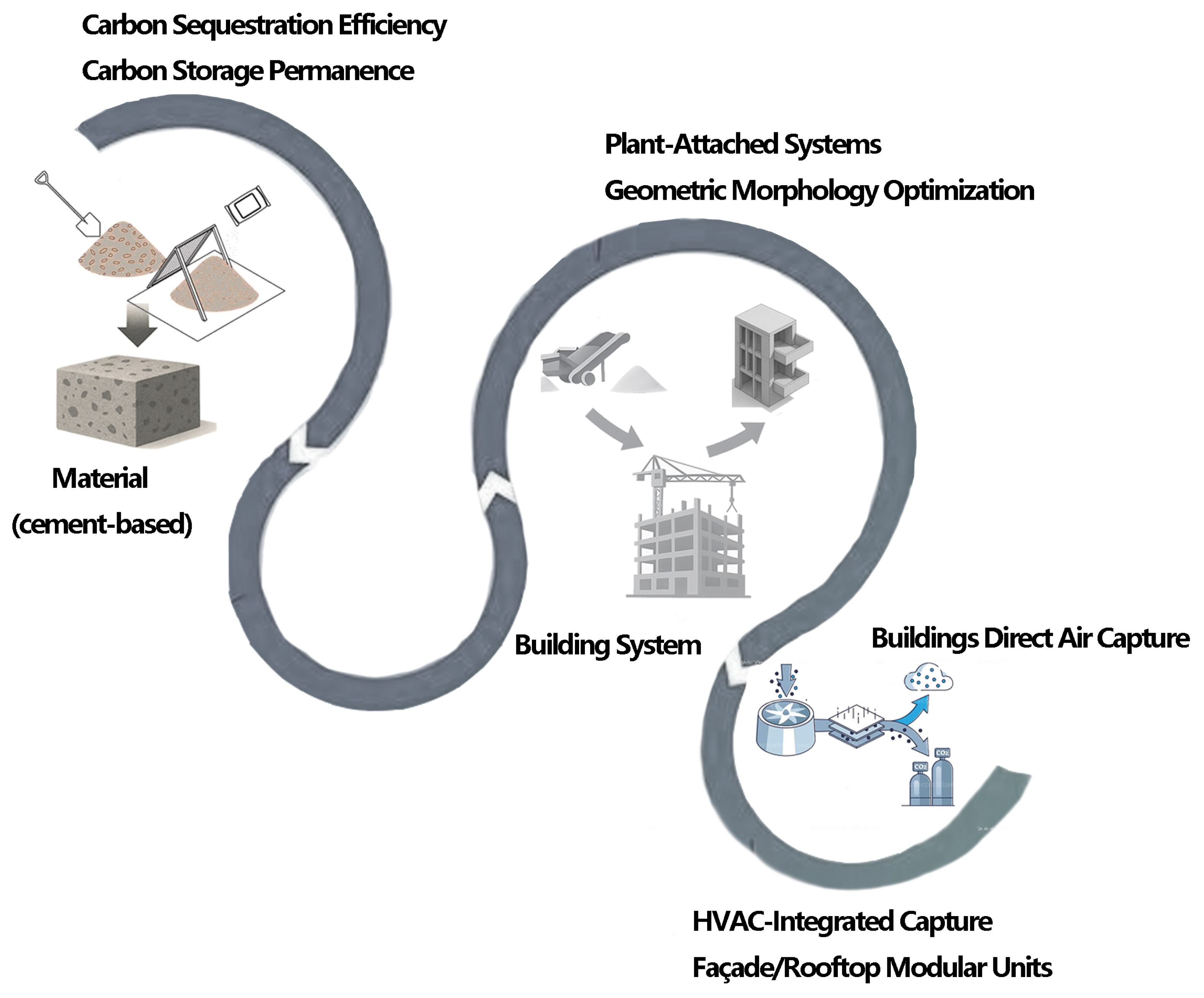
Based on the aforementioned systematic review of literature statistics and content analysis, this study identifies three distinct evolutionary stages in the field of urban building carbon sequestration. This finding not only reveals the historical trajectory of research hotspots in this field but, more importantly, highlights its overall trend of deepening development from the micro-level of technology to the macro-level of systems. By deeply analyzing the core issues, technological paths, and research paradigms of each stage, we can clearly observe how this field has evolved from initial basic research in materials science to integrated applications in building systems, ultimately moving towards a complete evolutionary process of proactive building carbon sequestration.
Specifically, these three stages exhibit clear logical progression (Figure 5). The first stage, centered on materials science, focused on the carbonization mechanism and performance optimization of cement-based materials, establishing a solid theoretical foundation. The second stage broke through the limitations of the materials scale, expanding the research perspective to the building system level, exploring the organic integration of green infrastructure and the building itself. The third stage further leaps to proactive building carbon sequestration, emphasizing the development of ventilation systems and various facilities within buildings in conjunction with the building structure to achieve proactive carbon sequestration. Each evolutionary stage achieves breakthroughs in research paradigm and methodological innovation based on the previous stage, reflecting the continuous improvement and deepening of the knowledge system in this field.

4. Evolution of Research Hotspots in Urban Building Carbon Sinks

4.1. Carbon Sinks in Building Materials

4.1.1. Carbon Sink Mechanisms of Different Materials

Research on building-related carbon sinks indicates that the physicochemical properties of materials fundamentally determine their carbon fixation potential and mechanisms. Existing studies generally classify carbon sink materials into three categories: bio-based materials, natural mineral materials, and artificial mineral-based composite materials. Among them, concrete—the representative of the third category—has increasingly become the focus of recent research (Table 1), owing to the significant differences among materials in carbon sequestration efficiency, applicability, and sustainability.
Bio-based materials (e.g., wood, bamboo, and agricultural by-products) store carbon through photosynthetic CO2 uptake during plant growth and thus exhibit high carbon storage density [26]. However, their long-term carbon retention is limited; biodegradation and reduced durability over extended service periods can diminish their storage stability [27]. Moreover, their sequestration potential is constrained by land availability and forestry resources, making them insufficient for large-scale urban construction needs [28].
Natural mineral materials—such as magnesium-based minerals and carbonate rocks—achieve long-term geological carbonation through mineral carbonation [29]. Despite excellent storage stability, their carbonation reactions proceed slowly under natural conditions and require thermal, mechanical, or chemical activation to improve kinetics. Limited resource availability and energy-intensive processing and transportation may offset their life-cycle carbon benefits, restricting large-scale practical application.
Although concrete production—particularly cement calcination—is a major CO2 emission source [30], concrete can reabsorb CO2 through natural carbonation during hardening and service life, functioning simultaneously as an emitter and a latent carbon sink. Its advantages as a carbon-sink material are threefold. First, as the most widely used construction material globally, accounting for over 70% of total building material mass [31], even its relatively low unit uptake yields substantial carbon sequestration at the urban scale [9]. Second, carbonation reactions continually convert atmospheric CO2 into stable calcium carbonate throughout hardening and service stages, enabling in-service carbon fixation [32]. Third, its carbon sink performance can be enhanced through mineral admixtures, alkaline industrial by-products, and nano-additives, which optimize pore structure and reaction kinetics [33]. Additionally, concrete production aligns well with existing urban construction systems, unlike bio-based materials—requiring entirely new supply chains—or natural minerals, which demand new extraction and processing infrastructures.
Considering carbon storage stability, reaction controllability, scalability to urban applications, and industrial compatibility, concrete is positioned as the core material within building-sector carbon sink systems. This centrality not only explains its prominence in current research but also establishes a basis for future integration with building systems and active carbon capture strategies.

4.1.2. Carbon Sink Mechanism of Concrete

As shown in Equation (1), calcium hydroxide reacts with CO2 to form CaCO3. And Equation (2) demonstrates the decalcification of C–S–H during carbonation.
Following hydration, concrete generates abundant alkaline products—primarily calcium hydroxide (Ca(OH)2) and calcium silicate hydrate (C–S–H)—which provide the essential reactants for subsequent carbonation processes. When atmospheric CO2 diffuses into concrete through its pore network, it reacts with these phases to form stable calcium carbonate (CaCO3). The reactions are expressed as:
Ca ( OH ) 2 + CO 2 CaCO 3 + H 2 O ,
C S H + CO 2 CaCO 3 + SiO 2 H 2 O ,
These reactions not only achieve CO2 fixation but also generate silica gel, which fills internal pores and improves the microstructure and durability of concrete.

4.2. Building-Scale Carbon Sinks: Intrinsic and Attached Design Strategies

At the spatial and system scales, carbon sink mechanisms extend the inherent CO2 absorption capacity of materials to architectural and environmental contexts. In contrast to single-material sinks, system-level carbon sinks emphasize how geometric configuration, surface interfaces, exposure conditions, and ecological attachments amplify carbon capture performance [5]. Through integrated architectural design and optimization of building envelopes, buildings can passively strengthen carbon uptake, facilitating a cross-scale transition from material-level to system-level sinks.

4.2.1. Carbon Sink Processes in Building Structures: Design Optimization for the Building Itself

Carbon sink processes within building structures primarily arise from the carbonation of concrete components, which exhibit distinct geometric and volumetric effects at the architectural scale. The spatial configuration and form of structural elements directly influence CO2 exposure and, consequently, overall sequestration efficiency.
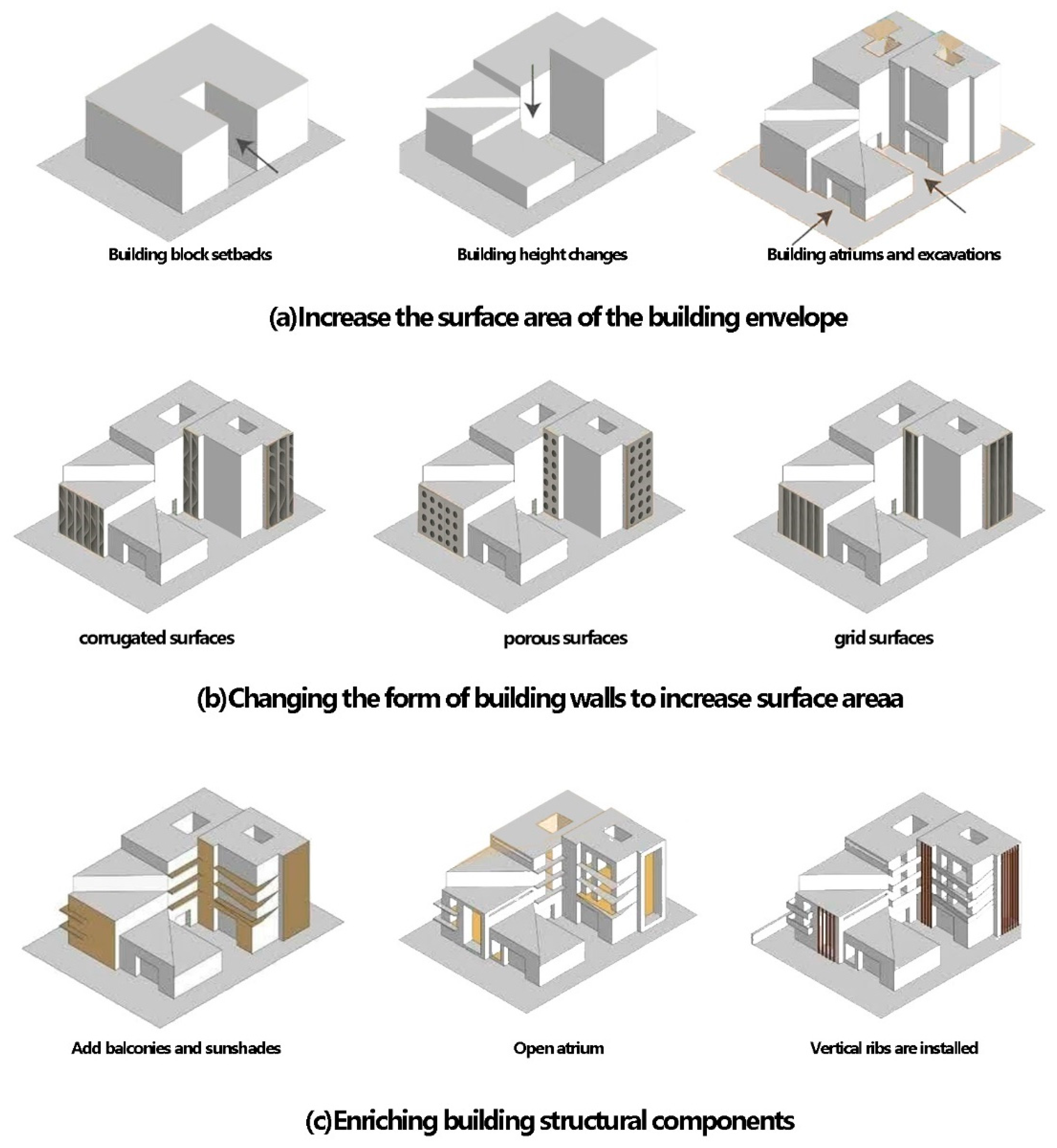
CO2 diffuses through exposed surfaces of the building envelope and reacts with alkaline phases in concrete, forming stable CaCO3 deposits (Figure 6a). Studies demonstrate that increasing exposed surface area by 20–30% can enhance carbonation rates by approximately 15–25%, substantially improving life-cycle carbon storage [34].
Design strategies such as porous walls, gridded façades, and corrugated surfaces (Figure 6b) effectively enlarge CO2 contact interfaces. Porous concrete walls, for example, expand reaction surfaces and introduce a three-dimensional diffusion network, enabling carbonation to penetrate deeper into structural components [35].
Exposed vertical and horizontal elements—such as columns, shading panels, and fins—also contribute significantly to surface carbonation (Figure 6c). Features like protruding ribs or fins enhance local air turbulence, accelerate CO2 transport, and reduce moisture retention on surfaces, thereby improving carbonation conditions [36].
Carbonation exhibits pronounced spatiotemporal dynamics over a building’s life cycle. In early stages, carbonation is concentrated on exposed surfaces; over time, the reaction front progresses inward. Exterior walls, balconies, and shading devices carbonize more rapidly due to elevated CO2 exposure, whereas interior and core structural elements exhibit slower carbonation rates [37].

4.2.2. Carbon Sinks via Building Attachments: Vegetation, Moist Substrates, and Photocatalytic Interfaces

Beyond the structural body, the external surfaces and attached systems of buildings also offer considerable carbon sink potential. As the main interface between buildings and the atmosphere, the building envelope can be transformed from an inert shell into an active carbon-absorbing surface through plant-based symbiotic systems, moist porous substrate adsorption layers, and photocatalytic materials [8].
  • Vegetation-Based Attachment Systems: Leaf-Surface Carbon Uptake and the “Biological Pump” Effect
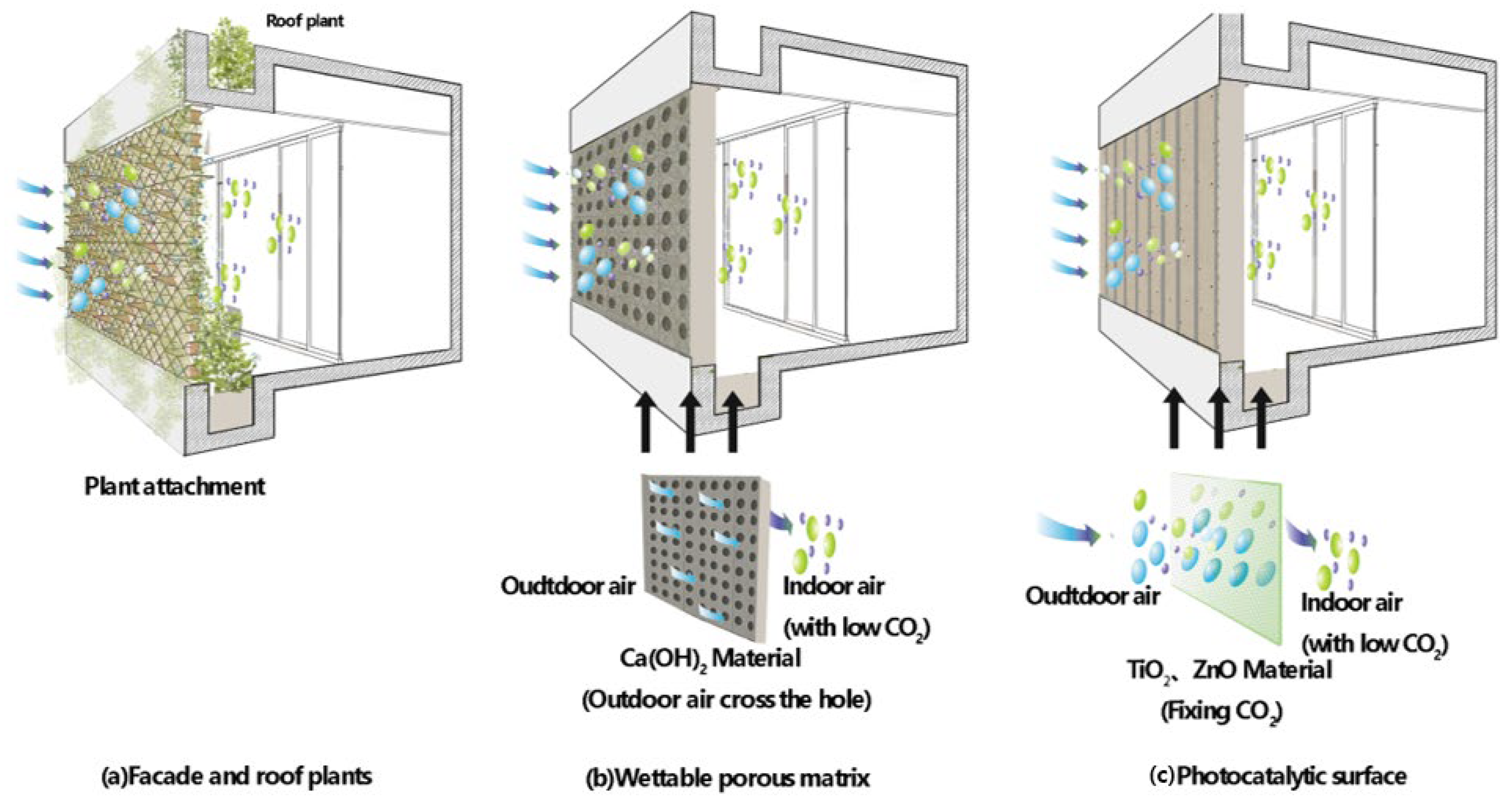
Plants are one of the most efficient natural carbon fixation mechanisms, converting atmospheric CO2 into organic carbon via photosynthesis. “Building–plant coupled systems”, such as vertical greenery, green façades, and rooftop ecosystems (Figure 7a), significantly increase carbon absorption per unit building surface area while enabling additional sequestration through rhizospheric microbial mineralization [38]. Empirical studies show that vertical greening systems can achieve 0.44–3.18 kg CO2-eq/m2·year of carbon uptake through biomass accumulation [39]. These systems also improve microclimate regulation, thermal comfort, and air quality, providing ecological and architectural co-benefits.
2.
Moist Porous Substrate Systems: Passive Adsorption and Mineralization Interfaces
Moist porous substrate systems enhance the carbon sink capacity of building envelopes through combined physical adsorption and chemical mineralization (Figure 7b). Substrates containing Ca(OH)2 undergo in situ carbonation, converting CO2 into solid CaCO3 for long-term storage [40]. Recent studies show that alkaline or hydroxide-loaded sponge-like materials selectively adsorb CO2 while allowing gases such as N2 to pass through, converting the captured CO2 into mineral carbonates during regeneration cycles [41]. These systems are suitable for high-rise façades or non-vegetated zones, functioning as cladding layers that integrate thermal and acoustic insulation with passive carbon sequestration.
3.
Photocatalytic Surfaces: Artificial “Leaf” Systems for CO2 Conversion
Photocatalytic surfaces imitate natural photosynthesis, converting the building exterior into an artificial carbon-fixing interface (Figure 7c). Photocatalysts such as TiO2 and ZnO use solar radiation to catalyze reactions between CO2 and water vapor, generating carbonate deposits and other stable products. Practical applications demonstrate that TiO2-coated façades not only fix carbon but also remove air pollutants, acting as dual-function purification surfaces [42]. These functional envelopes thus shift buildings from passive sinks to active atmospheric remediation systems, offering a promising pathway for urban carbon cycle management and net-zero architecture.

4.3. Active Carbon Capture in Buildings: From Spatial Devices to Urban Carbon-Cycle Nodes

While passive carbon-sink strategies—such as accelerated carbonation and biogenic sequestration—offer noteworthy potential, their fixation capacity and reaction rate are fundamentally limited by material chemistry, the exposed surface area of structural components, and environmental conditions such as temperature and humidity. These intrinsic constraints create a performance ceiling that prevents passive methods from achieving full life-cycle carbon neutrality or net-negative emissions. When the sequestration potential of materials alone becomes insufficient, a more proactive and controllable approach—Active Carbon Capture in Buildings—becomes necessary.
In contrast to natural carbonation, which depends on spontaneous contact between CO2 and material surfaces, active carbon-capture systems use mechanical components to drive airflow, selectively capture CO2, and enable controlled release or utilization. This shift transforms buildings from passive absorbers into operational carbon-management infrastructures [43,44]. Its importance lies in extending carbon management beyond embodied carbon to encompass operational emissions and avoided emissions at the urban-metabolic scale, thereby broadening the role of architecture in achieving full life-cycle carbon neutrality.

Active Carbon Capture: Principles and Building Integration

Direct Air Capture (DAC) technologies actively remove low-concentration atmospheric CO2 (≈0.04%) by drawing ambient air through systems equipped with high-selectivity sorbent or absorbent materials. Air is delivered into the capture unit via fans, ventilation shafts, or pressure differentials, where CO2 molecules are bound while other gases pass through. The captured CO2 is subsequently released through heating, pressure reduction, or electrochemical regeneration for reuse or storage [45]. DAC mechanisms fall into two broad categories. As shown in Equation (3), Liquid absorption commonly uses strong alkaline solutions (e.g., NaOH, KOH) to react with CO2, forming carbonates or bicarbonates:
CO 2   +   2 NaOH     Na 2 CO 3   +   H 2 O
This method offers fast kinetics and high absorption capacity, suitable for centralized DAC facilities. Equations (4) and (5) demonstrate that solid adsorption employs amine-functionalized porous materials, metal–organic frameworks (MOFs), or alkaline oxides to reversibly bind CO2:
R NH 2   +   CO 2     R NH COOH
MgO + CO 2     MgCO 3
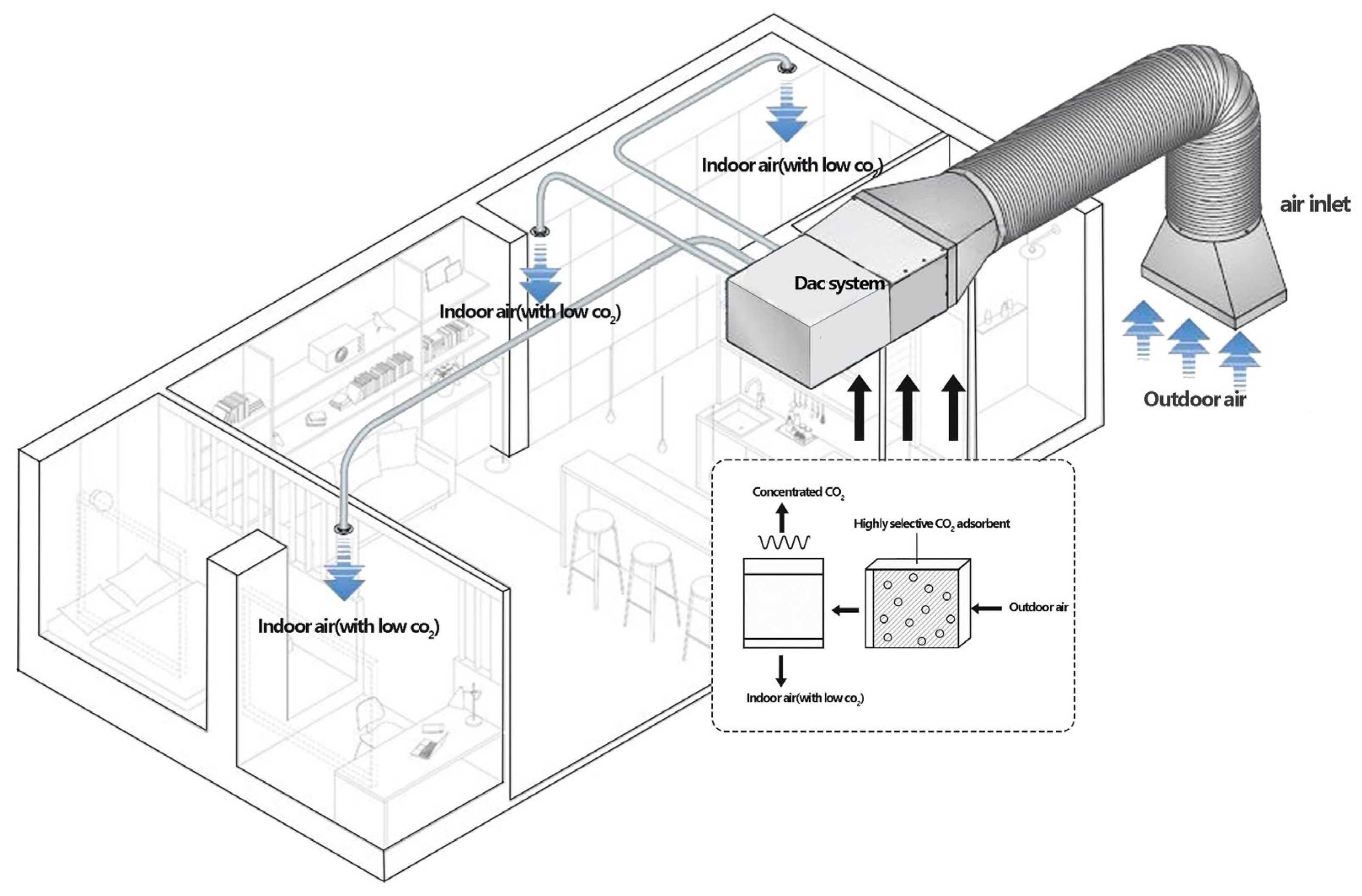
Unlike passive carbonation, these sorbents can be regenerated via thermal or pressure-swing processes and reused for hundreds of cycles, improving efficiency and reducing costs [46]. Integrating DAC systems into buildings extends architectural functionality, transforming structures into active nodes of the urban carbon cycle. Several design pathways enable this integration. One approach embeds DAC modules into natural or mechanical ventilation systems so that incoming air passes through capture units before entering indoor spaces (Figure 8). This method achieves CO2 removal while maintaining the building’s external appearance and is especially suitable for large public and commercial buildings with continuous air flows [46].
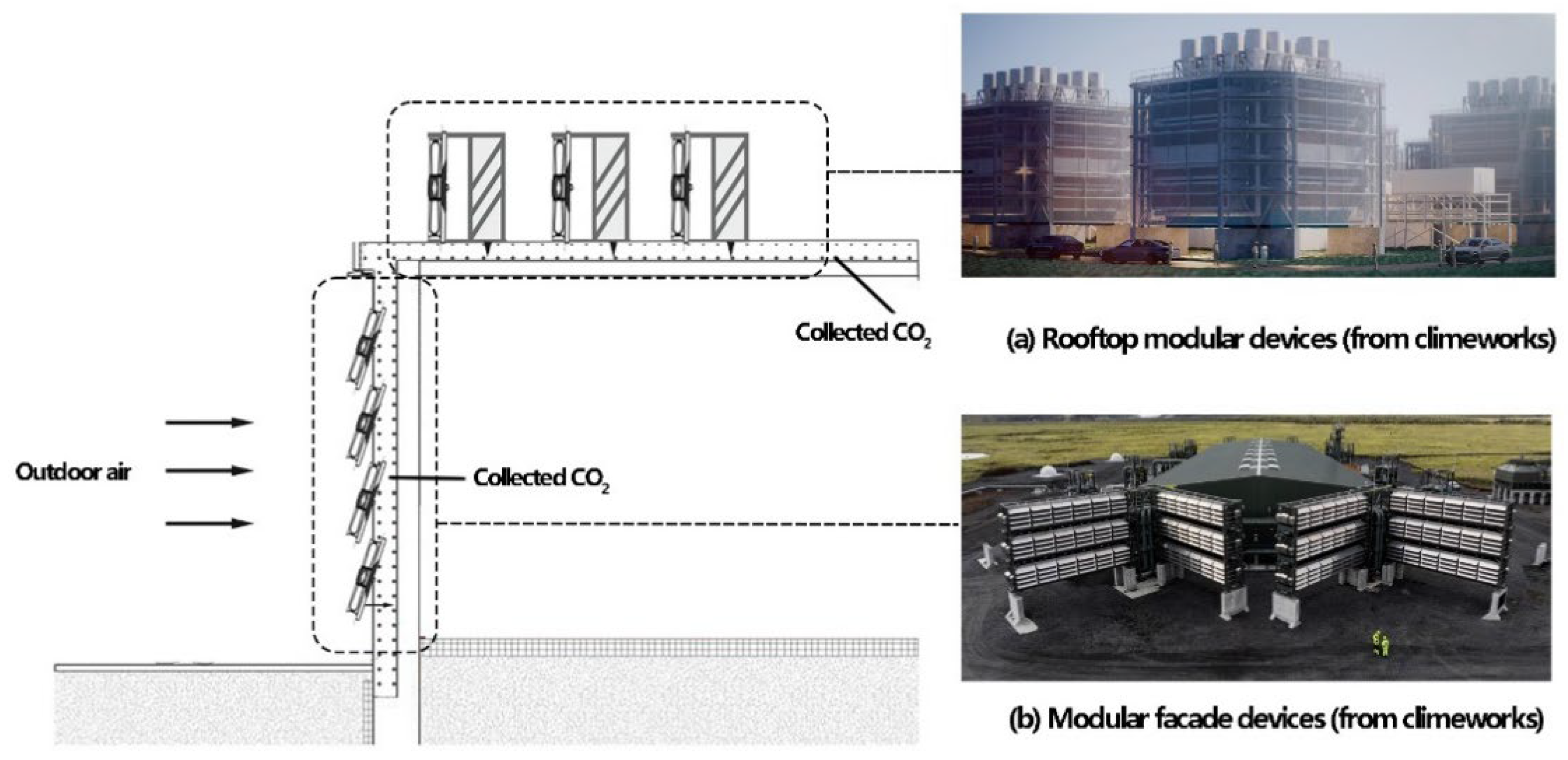
Another strategy installs modular DAC units on façades, rooftops, or curtain walls, enabling buildings to operate as “carbon-capture towers” that continuously extract CO2 from surrounding air (Figure 9). This “skin-based” approach views the building envelope as an active air-management interface rather than relying solely on material porosity or reactivity [47]. A representative real-world example is the Climeworks facility in Iceland, where modular collectors capture CO2 directly from air and store it underground through mineralization, illustrating the feasibility of decentralized building-integrated capture systems.
Despite their promise, building-integrated DAC systems face several challenges (Table 2). First, DAC remains energy-intensive and costly, with current capture costs reaching several hundred U.S. dollars per ton of CO2 [48]. The process requires continuous high-temperature heat and electricity, placing significant burdens on building energy systems. Moreover, these energy needs are highly dependent on the carbon intensity of the energy supply, with systems powered by fossil fuels failing to deliver net-negative emissions. Only DAC systems using renewable or low-carbon energy sources can truly achieve net-negative emissions, while fossil-based energy inputs may diminish or even reverse the CO2 capture benefits [49].
Second, the integration of DAC modules into HVAC systems requires considerable spatial allocation and increases building energy consumption by 10–15%, alongside higher maintenance demands [50]. This highlights the feasibility concerns, as widespread adoption may not be viable without substantial infrastructural adjustments and energy efficiency improvements. Additionally, long-term operational costs remain uncertain, with capital investment still high for the initial installation, though advances in system optimization and the integration of renewable energy sources could help bring costs down to USD 200–400 per ton of CO2 by 2030 [43].
Third, effective carbon removal requires secure transport, storage, or utilization pathways—capacities that most buildings currently lack [51]. The infrastructure for safely and reliably transporting and storing the captured CO2 is often unavailable, making the integration of DAC systems into urban environments more complex and less feasible in some cases. Furthermore, MRV (Measurement, Reporting, and Verification) methodologies for DAC remain subject to significant uncertainties. Accurately measuring CO2 removal, accounting for potential leakage, and validating the carbon captured under varying environmental conditions remain challenges. Robust and standardized MRV protocols are critical for ensuring that DAC systems deliver their claimed carbon sequestration potential.
Despite these challenges, DAC integration expands architectural carbon-sink strategies beyond material optimization or vegetative absorption. It redefines buildings as environmentally responsive infrastructures that interact dynamically with energy systems, urban carbon networks, and industrial carbon cycles. However, its success hinges on overcoming these technical and economic hurdles, along with improving the transparency and reliability of MRV systems. Ultimately, while active carbon capture represents a technological breakthrough, it also necessitates a paradigm shift in architecture and urban planning, positioning buildings not just as passive consumers of energy but as active participants in climate governance and carbon-neutral urban development [52].

5. Measurement Framework of Urban Building Carbon Sinks

Research on building carbon sinks depends not only on advances in materials, systems, and technologies, but also on rigorous, systematic, and comparable measurement methods that form the basis for scientific evaluation and design optimization. From microscopic material reactions to macroscopic building systems and active carbon-capture devices, carbon fixation, adsorption, and transformation involve multi-level and multi-scale processes [7]. This chapter reviews existing measurement approaches across three levels—materials, architectural systems, and active capture devices—to clarify their applicability, strengths, and limitations (Table 3).

5.1. Carbon Measurement Methods at the Material Level

At the material scale, the primary goal is to characterize the microscopic mechanisms, reaction kinetics, and storage potential of carbon fixation [9] (Table 4). Methods derived from materials science and physical chemistry are used to evaluate how composition, porosity, alkalinity, and additives influence carbonation performance [30].
As shown in Equation (6), TGA is a benchmark technique for quantifying carbonate content. Under controlled heating, the decomposition of CaCO3,
CaCO 3     CaO + CO 2
produces a characteristic mass loss corresponding to fixed CO2. Zhan et al. measured CO2-cured recycled aggregates using TGA and reported a fixation rate of up to 4.5 wt%, equivalent to ~45 kg CO2 per ton of aggregate [53]. Although highly accurate and reproducible, TGA is destructive and cannot capture macrostructural effects.
XRD identifies crystalline phases through diffraction patterns, with each CaCO3 polymorph exhibiting distinct peaks. Rostami et al. [52] found substantially increased calcite peaks in CO2-cured concrete compared with steam-cured samples. Quantitative refinement indicated 12.8 wt% calcite in CO2-cured concrete versus 3.6 wt% in steam-cured specimens, equivalent to ~90 kg CO2/m3 additionally sequestered. XRD is authoritative for crystalline phase identification but limited for amorphous carbonation products.
FTIR characterizes chemical bonds through infrared absorption. Carbonate ions show characteristic peaks at 710 cm−1, 875 cm−1, and 1420–1480 cm−1. Ashraf and Olek observed that peaks at 875 and 1450 cm−1 increased with carbonation duration, with normalized areas rising from 0.05 to 0.35, corresponding to 0.12 g CO2 per g Ca(OH)2 fixed [54]. FTIR is rapid and effective for qualitative analysis and process monitoring but less precise quantitatively.
Chemical titration quantifies carbonate content through acid–base neutralization. Steinour established the theoretical basis linking titration results to the stoichiometry of calcium phases and CO2 reactions [55]. Although inexpensive and suitable for bulk screening, titration offers lower accuracy compared with instrumental methods.
In material-level carbon assessments, multiple techniques are often combined to obtain robust results. Global studies show that while cement production emitted ~381 Gt CO2 from 1930 to 2013, cement carbonation reabsorbed ~165 Gt CO2, demonstrating concrete’s substantial yet underrecognized role as a global carbon sink [52].

5.2. Carbon Measurement at the Building-System Level

At the system scale, carbon measurement focuses on macro-level carbon balance, accounting for carbonation depth, vegetation uptake, and surface adsorption within architectural environments [5] (Table 5). These methods rely heavily on in situ monitoring, sensor networks, and field observations to reveal how geometry, exposure conditions, and climate influence overall sequestration potential [56].
The phenolphthalein indicator remains widely used on construction sites to visualize carbonation depth via pH-induced color change. Villain et al. demonstrated strong agreement between phenolphthalein and TGA results, though humidity variations may cause deviations of up to 20% [57].
Gas exchange chambers provide direct measurement of CO2 flux across building surfaces. Teemusk and Mander (2019) applied this method to green roofs in Estonia, observing consistent daytime CO2 uptake and slight emissions during drought or nighttime periods [58]. The technique offers realistic environmental data and bridges laboratory and field evaluations.
Embedded sensors enable long-term monitoring by measuring pH or CO2 within concrete. Figueira’s fiber-optic pH system captured carbonation-front movement in real time and revealed the influence of environmental fluctuations on carbonation rates [59], providing valuable input for digital carbon management and service-life prediction.
Model-based estimation integrates material carbonation, vegetation absorption, and building parameters into life-cycle assessments. Fick’s second-law-based models have shown high predictive accuracy; for example, an analysis of 72,860 buildings in Zhengzhou (203 km2) estimated total sequestration at 1.65 Mt CO2 [60].
Remote sensing methods estimate biomass and carbon stocks using LiDAR or multispectral imagery. Nowak et al. achieved >85% accuracy in urban vegetation assessments [61], and in Shenyang (45,500 ha), remote sensing indicated 1.70 Mt CO2 sequestered—equivalent to 4.39% of annual fossil-fuel emissions [62].
At the system level, carbon measurement expands from material-scale testing to whole-building analysis, requiring integration of geometry, environmental exposure, and ecological elements [57,58,59]. Nevertheless, many current evaluations remain model-dependent and thus retain considerable uncertainty.

5.3. Measurement Methods for Building-Integrated Active Carbon Capture

Unlike passive mechanisms, active carbon capture (DAC) uses mechanically driven physical or chemical processes to extract CO2 directly from ambient air [7,45] (Table 6). Accordingly, performance evaluation focuses on capture efficiency, energy consumption, adsorption capacity, operational stability, and system-level carbon balance [9].
Mass balance calculations, grounded in mass conservation, quantify captured CO2 using differences between inlet and outlet concentrations. Wurzbacher et al. applied this method to a temperature–vacuum swing DAC system and recorded ~1 mmol CO2 per g sorbent per cycle under ambient conditions [63], enabling real-time operational assessment.
The breakthrough curve method, a fundamental sorbent-evaluation technique, plots outlet concentration against time as CO2 flows through a fixed-bed reactor. Sinha et al. reported that mmen–Mg2(dobpdc) achieved more than double the dynamic adsorption capacity of MIL-101(Cr)-PEI-800 at 400 ppm CO2, demonstrating superior sorbent performance [64]. This approach is essential for sorbent screening and kinetic modeling.
Non-dispersive infrared (NDIR) gas analysis detects CO2 via its characteristic absorption at 4.26 μm. Chen et al. evaluated commercial NDIR devices and found accuracy within ±1.5% FS and response times below 30 s, meeting the monitoring requirements of building-integrated DAC systems [65]. Owing to their precision and stability, NDIR sensors are indispensable for performance evaluation and process control.
Building-integrated DAC systems exhibit exceptionally high carbon-removal efficiency. Studies indicate that amine-based systems can capture 50–80 kg CO2 m−2·yr−1, validated through multiple demonstration projects [66], whereas conventional concrete carbonation captures only 5–15 kg CO2 m−3 yr−1 under standard conditions [9]. Economically, current capital costs for building-integrated DAC range from USD 600–900 per t CO2 per yr capacity, with operating costs of USD 150–300 per t CO2 [4]. Although initial investment remains high, DAC efficiency—30–50 times greater than passive pathways—provides significant long-term environmental benefits. With continued optimization and greater use of renewable energy, total costs are projected to decline to USD 200–400 per t CO2 by 2030 [44].

6. Life-Cycle Optimization Design of Urban Building Carbon Sinks

6.1. Material Production Phase: Feedstock Selection and Mix Design

The starting point of a building’s carbon-sink capacity lies in material production. At this stage, feedstock choices, microstructural tuning, and additives jointly optimize the system—controlling initial emissions while laying the groundwork for subsequent carbon fixation.
Partial clinker substitution with industrial by-products (e.g., steel slag, fly ash, ground granulated blast-furnace slag) can markedly reduce calcination emissions and strengthen later-age carbonation via latent hydraulic/pozzolanic activity. Under accelerated carbonation, replacing 35% cement with steel slag has been shown to absorb up to 15 wt% CO2 (equivalent to 15 g CO2 per 100 g of material) while improving later strength [67].
Moderate porosity promotes CO2 ingress and carbonation depth, excessive porosity, however, compromises mechanics. A hybrid pore system—coordinating micro- (µm) and meso-/nano-pores—balances uptake and strength. mesopores of 5–50 nm as dominant CO2 transport channels, with mesopore volume fraction directly linked to carbonation rate [68]. For reference, 5–50 nm is the size range of many viruses or fine smoke particles—small enough for CO2 molecules to move easily through these pores.
Incorporating reactive MgO or Ca–Mg oxides boost carbonation kinetics and storage via mineral carbonation, forming stable carbonates and prolonging sequestration lifetimes. Reviews report that mixing 10–50% reactive MgO (RMC) can increase CO2 uptake by 20–35% within 7–56 days, with 28-day carbonation degrees ranging from ~4% to 46% depending on mixture and curing conditions [69]. This means the material can absorb CO2 equal to about one-fifth to one-third of its own weight in just a few weeks.

6.2. Design and Construction Phase: Spatial Geometry and Structural Strategies

Whether material-level potential scales up to spatial-level performance depends on form, structural system, massing, and construction methods, which together govern contact area, diffusion pathways, and reaction efficiency.
Carbonation is an interface-controlled process; larger surface-to-volume (S/V) ratios accelerate uptake. Industry practice indicates that doubling S/V can raise unit-volume CO2 uptake rate by ~60–120%, especially in thin plates, grids, and perforated morphologies with high exposure [70].
Long-span grids, double shells, and porous partitions both reduce concrete volume and lengthen airflow paths, thereby expanding exposed area and promoting diffusion/mineralization. Quantitatively, prefabricated elements can reach unit-area uptake of ~20 g·m−2·y½; Twenty grams is roughly the weight of a small spoonful of sugar. with geometric optimization, unit-volume uptake increases by ~30–50% over conventional members [71].
Factory prefabrication plus controlled carbonation converts high-S/V designs into measurable sink capacity. Reports indicate ~35% CO2 fixation in precast production with simultaneous early-strength gains [72]. This means each 1 kg element can bind about 0.35 kg of CO2, roughly the weight of a typical 500-mL water bottle. Further, ~20% pre-drying (moisture loss) followed by ~16 h accelerated carbonation markedly elevates uptake and strength development [73]. 16 h is about half a day, showing that substantial CO2 storage can occur in a very short period.
Bottom line: design–construction optimization is a systems-level spatial engineering task that amplifies material-scale sinks into durable building-scale performance.

6.3. Operations Phase: Dynamic Cycling and Replaceability

The operations and maintenance phase is the longest and central to the dynamic evolution of sink performance. Unlike earlier static fixation, O&M strategies emphasize continuous uptake, replaceable components, and iterative upgrades.
Circular-economy frameworks enable reversible envelopes (e.g., façade panels removable after ~20 years) for factory re-carbonation, extending sink functionality via repeated cycles [74]. A 20-year cycle aligns with common façade renovation intervals, meaning re-carbonation can occur without additional maintenance burden.
Prefabricated add-on layers (vegetation, photocatalytic coatings, CO2-sorptive membranes) can be seasonally or climatically tuned. TiO2-coated façades have been reported to reduce ambient CO2 by ~5–10% over one year while delivering co-benefits in air quality [75]. This is equivalent to lowering the CO2 concentration of a typical room by about one-twentieth to one-tenth, which is significant at an urban scale.
Integrating DAC modules with HVAC allows indoor CO2 capture and transfer to exterior adsorption/mineralization units. Energy–carbon analysis suggests that, despite ~10–15% additional energy use, a single office building can achieve net-negative annual emissions under appropriate operating regimes and clean power supply [76]. This is roughly comparable to the additional energy used during a peak summer month of air-conditioning.

6.4. End-of-Life: Demolition and Regeneration to Extend the Carbon Cycle

The end of service does not end sequestration. Appropriate deconstruction and valorization strategies prolong storage and supply feedstock for the next material cycle.
Crushed debris exhibits vastly increased specific surface area, yielding faster, deeper carbonation than intact members. Under flue-gas–like conditions, recycled aggregates carbonate ~5–8× faster than natural aggregates [77].
Re-introducing crushed carbonated concrete or carbonate fines into new mixes—e.g., using carbonated recycled powder as hydrate nucleants—accelerates hydration and raises early-age carbonation uptake by ~12% [78]. This means that for every 100 g of CO2 fixed, an extra 12 g is stored, about the weight of a small coin (≈8–10 g).
LCA-guided pathways. Life-cycle assessment differentiates end-of-life options; compared with landfilling, carbonation treatment of recycled aggregates can deliver >50% emission reductions [79]—a decision-grade basis for demolition planning. equivalent to avoiding the CO2 emissions generated by driving a gasoline car for roughly 4000–5000 km.

7. Outlook and Challenges

7.1. Public Awareness and Societal Alignment

Scaling architectural carbon sinks are as much a societal shift as a technological one. The “active carbon uptake” role of buildings remains poorly recognized by users, developers, and policymakers, limiting value capture [8]. Educational programs, policy incentives, and market mechanisms are needed to forge consensus and accelerate deployment.

7.2. Toward Multi-Pathway Synergy and Integration

Future progress requires integrated, multi-pathway systems beyond single-technology optimization [80]. Coupling passive carbonation with active capture can close the loop across materials–structures–devices. For example, DAC-captured CO2 can feed accelerated carbonation of precast elements, achieving capture–utilization–re-sequestration cycles [81]. Combining PV, photocatalysis, and vegetative systems enables multifunctional skins delivering power generation, carbon uptake, and shading [81]—an energy–carbon–form co-design paradigm.

7.3. Robust Measurement and Standardized MRV

A lack of standardized measurement, reporting, and verification (MRV) is a key bottleneck. Lab rates rarely map directly to component/building scales, and urban models often lack ground-truthing, yielding divergent results [82].
Future work should establish digital-twin platforms with IoT sensing for real-time sequestration monitoring and multi-source data fusion to calibrate models across scales [83]. Joint standards from academia, industry, and government are essential to give architectural carbon sinks policy recognition and market tradability.

7.4. Study Limitations and Future Directions

This study primarily centers on the building body, with limited scope on cross-domain couplings (energy, waste, climate systems). Future research should strengthen links with urban energy networks, waste-heat recovery, and solid-waste circularity [84]. As sources are predominantly English-language, regional/non-English work may be underrepresented; expanding coverage and integrating empirical datasets will enrich the knowledge graph. Finally, deeper integration of LCA with energy–carbon coupled models is needed to support the transition from low-carbon to net-negative buildings and to maximize life-cycle sequestration.

8. Conclusions

Drawing on a statistical analysis and systematic review of the 2007–2025 literature, this paper elucidates research characteristics and trends in building carbon sinks, summarizing global hotspots, methodologies, and challenges. The main conclusions are:
  • Rapid growth with cross-disciplinary convergence. The field has accelerated since 2020, with leading contributions from China, the United States, and Nordic countries. Building carbon sink research now spans materials science, environmental engineering, building technology, and ecology, forming a robust interdisciplinary landscape.
  • Thematic evolution mirrors rising technical maturity. Research has progressed from material-level carbonation mechanisms to building-system passive sinks, and now to active capture integration—broadening from single-material performance to spatial design and system optimization driven by carbon-neutrality goals.
  • Multi-scale measurement remains challenging. Material-level methods (e.g., TGA, XRD) and system-level field techniques (e.g., phenolphthalein, static chambers) coexist with mass-balance approaches for active capture. Yet a cross-scale standardized MRV framework is still lacking, limiting comparability and synthesis.
  • Life-cycle optimization is the key lever. Enhancing sink capacity requires systemic strategies spanning material production (optimized mixes, industrial by-products), design & construction (geometry to increase exposure), operations (ecological attachments and DAC coupling), and end-of-life (reuse and re-carbonation of wastes);
  • Future direction: active integration and urban-scale benefits. With maturing DAC and related technologies, buildings can become active infrastructures for urban carbon regulation. Improved LCA practice will underpin optimized design toward net-zero/negative outcomes.
Building carbon sinks are evolving toward more systemic and integrated paradigms that are central to climate action and sustainable urbanism. As attention shifts from mere emission reduction to enhanced carbon uptake, the technologies and applications discussed here are poised for broader impact and deployment.

Supplementary Materials

The following supporting information can be downloaded at: https://www.mdpi.com/article/10.3390/buildings15244445/s1, The PRISMA Checklist for this systematic review is provided as Supplementary Material.

Author Contributions

This study was conducted through a collaborative effort among all authors, each contributing to different aspects of the research. The roles and responsibilities of each author are outlined as follows: Conceptualization, T.L. and C.Z.; methodology, C.Z.; software, T.L.; validation, T.L. and C.Z.; formal analysis, T.L. and C.Z.; investigation, T.L. and C.Z.; resources, T.L. and C.Z.; data curation, T.L. and C.Z.; writing—original draft preparation, T.L. and C.Z.; writing—review and editing, T.L. and C.Z.; visualization, T.L. and C.Z.; supervision, T.L. and C.Z.; project administration, T.L. and C.Z.; funding acquisition, T.L. and C.Z. All authors have read and agreed to the published version of the manuscript.

Funding

This research received no external funding.

Data Availability Statement

No new data were created or analyzed in this study.

Conflicts of Interest

The authors declare no conflicts of interest.

References

  1. IPCC. Climate Change 2022: Mitigation of Climate Change; Cambridge University Press: Cambridge, UK, 2022; pp. 863–953. [Google Scholar]
  2. UNFCCC. The Paris Agreement. Available online: https://unfccc.int/process-and-meetings/the-paris-agreement/the-paris-agreement (accessed on 2 November 2025).
  3. Seto, K.C.; Dhakal, S. Human settlements, infrastructure and spatial planning. In Climate Change 2014: Mitigation of Climate Change, 1st ed.; Edenhofer, O., Pichs-Madruga, R., Sokona, Y., Eds.; Cambridge University Press: Cambridge, UK, 2014; pp. 923–1000. [Google Scholar]
  4. IEA. Energy Technology Perspectives 2023; International Energy Agency: Paris, France, 2023; pp. 280–348. [Google Scholar]
  5. Churkina, G.; Organschi, A.; Reyer, C.P.O.; Ruff, A.; Vinke, K.; Liu, Z.; Reck, B.K.; Graedel, T.E.; Schellnhuber, H.J. Buildings as a global carbon sink. Nat. Sustain. 2020, 3, 269–276. [Google Scholar] [CrossRef]
  6. Keith, D.W.; Holmes, G.; Angelo, D.S.; Heidel, K. A process for capturing CO2 from the atmosphere. Joule 2018, 2, 1573–1594. [Google Scholar] [CrossRef]
  7. Pomponi, F.; Hart, J.; Arehart, J.H.; D’Amico, B. Buildings as a global carbon sink? A reality check on feasibility limits. One Earth 2020, 3, 157–161. [Google Scholar] [CrossRef]
  8. Perini, K.; Rosasco, P. Cost–benefit analysis for green façades and living wall systems. Build. Environ. 2013, 70, 110–121. [Google Scholar] [CrossRef]
  9. Xi, F.; Davis, S.J.; Ciais, P.; Crawford-Brown, D.; Guan, D.; Pade, C.; Shi, T.; Syddall, M.; Lv, J.; Ji, L.; et al. Substantial global carbon uptake by cement carbonation. Nat. Geosci. 2016, 9, 880–883. [Google Scholar] [CrossRef]
  10. Huang, L.; Ma, B.; Chen, Z.; Guo, X.; Zhang, Y. Cement and concrete as carbon sinks: Transforming a climate challenge into a carbon storage opportunity. Carbon Capture Sci. Technol. 2025, 16, 100490. [Google Scholar] [CrossRef]
  11. Pu, Y.; Shao, Y.; Wu, H.; Wang, L. Accelerated carbonation technology for enhanced treatment of recycled concrete aggregates: A state-of-the-art review. Constr. Build. Mater. 2021, 282, 122671. [Google Scholar] [CrossRef]
  12. Feng, R.; Xian, X. A review for accelerated carbonation improvement of recycled concrete coarse aggregates and the meta-analysis of environmental benefit assessment and cost analysis of concrete so produced. J. Build. Eng. 2025, 106, 112649. [Google Scholar] [CrossRef]
  13. Saadatian, O.; Sopian, K.; Salleh, E.; Lim, C.H.; Riffat, S.; Saadatian, E.; Sulaiman, M.Y. A comprehensive review of carbon dioxide reduction from green roofs. Renew. Sustain. Energy Rev. 2013, 23, 273–290. [Google Scholar]
  14. Pérez, G.; Coma, J.; Sol, S.; Cabeza, L.F. Green roofs and facades: A comprehensive review. Renew. Sustain. Energy Rev. 2014, 39, 139–165. [Google Scholar] [CrossRef]
  15. Hautamäki, R.; Lehvävirta, S. How urban green infrastructure contributes to carbon neutrality. Build. Cities 2025, 6, 145–164. [Google Scholar] [CrossRef]
  16. Pomponi, F.; Moncaster, A. Scrutinising embodied carbon in buildings: The next performance gap made manifest. Renew. Sustain. Energy Rev. 2018, 81, 2431–2442. [Google Scholar] [CrossRef]
  17. De Wolf, C.; Pomponi, F.; Moncaster, A. Measuring embodied carbon dioxide equivalent of buildings: A review and critique of current industry practice. Energy Build. 2017, 140, 68–80. [Google Scholar] [CrossRef]
  18. Chhabra, J.; Rakha, T. Building-integrated carbon sequestration techniques: Towards mitigating climate change. In Proceedings of the ACSA/AIA Intersections Conference, Washington, DC, USA, 30 September–2 October 2020. [Google Scholar]
  19. Arehart, J.H.; Hart, J.L.; Pomponi, F. Carbon sequestration and storage in the built environment: A review. Renew. Sustain. Energy Rev. 2021, 137, 110–120. [Google Scholar] [CrossRef]
  20. Arksey, H.; O’Malley, L. Scoping studies: Towards a methodological framework. Int. J. Soc. Res. Methodol. 2005, 8, 19–32. [Google Scholar] [CrossRef]
  21. Xiao, Y.; Watson, M. Guidance on conducting a systematic literature review. J. Plan. Educ. Res. 2019, 39, 93–112. [Google Scholar] [CrossRef]
  22. Cooper, H. Research Synthesis and Meta-Analysis: A Step-by-Step Approach, 5th ed.; Sage Publications: Thousand Oaks, CA, USA, 2016; pp. 1–320. [Google Scholar]
  23. Page, M.J.; McKenzie, J.E.; Bossuyt, P.M.; Boutron, I.; Hoffmann, T.C.; Mulrow, C.D.; Shamseer, L.; Tetzlaff, J.M.; Akl, E.A.; Brennan, S.E.; et al. The PRISMA 2020 statement: An updated guideline for reporting systematic reviews. BMJ 2021, 372, n71. [Google Scholar] [CrossRef]
  24. Chandler, J.; Cumpston, M.; Li, T.; Page, M.J.; Welch, V.J. Cochrane Handbook for Systematic Reviews of Interventions; Wiley: Hoboken, NJ, USA, 2019. [Google Scholar]
  25. Booth, A.; Sutton, A.; Clowes, M.; James, M.M.-S. Systematic Approaches to a Successful Literature Review, 3rd ed.; SAGE: Los Angeles, CA, USA, 2022. [Google Scholar]
  26. Freitas, J.A., Jr.; Sanquetta, C.R.; Iwakiri, S.; de Mello Maron da Costa, M.D. The use of wood construction materials as a way of carbon storage in residential buildings in Brazil. Int. J. Constr. Manag. 2021, 21, 292–298. [Google Scholar] [CrossRef]
  27. Wang, J.Y.; Stirling, R.; Morris, P.I.; Taylor, A.; Lloyd, J.; Kirker, G.; Lebow, S.; Mankowski, M.E. Durability of mass timber structures: A review of the biological risks. Wood Fiber Sci. 2018, 50, 110–127. [Google Scholar] [CrossRef]
  28. Chilton, K.; Campoe, O.; Allan, N.; Hinkle, H. Increasing carbon sequestration, land-use efficiency, and building decarbonization with short rotation Eucalyptus. Sustainability 2025, 17, 1281. [Google Scholar] [CrossRef]
  29. Sanna, A.; Uibu, M.; Caramanna, G.; Kuusik, R.; Maroto-Valer, M.M. A review of mineral carbonation technologies to sequester CO2. Chem. Soc. Rev. 2014, 43, 8049–8080. [Google Scholar] [CrossRef]
  30. Andrew, R.M. Global CO2 emissions from cement production. Earth Syst. Sci. Data 2018, 10, 195–217. [Google Scholar] [CrossRef]
  31. Habert, G.; Miller, S.A.; John, V.M.; Provis, J.L.; Favier, A.; Horvath, A.; Scrivener, K.L. Environmental impacts and decarbonization strategies in the cement and concrete industries. Nat. Rev. Earth Environ. 2020, 1, 559–573. [Google Scholar] [CrossRef]
  32. Yang, K.H.; Seo, E.A.; Tae, S.H. Carbonation and CO2 uptake of concrete. Environ. Impact Assess. Rev. 2014, 46, 43–52. [Google Scholar] [CrossRef]
  33. United Nations Environment Programme (UNEP); Scrivener, K.L.; John, V.M.; Gartner, E.M. Eco-efficient Cements: Potential Economically Viable Solutions for a Low-CO2 Cement-Based Materials Industry. Cem. Concr. Res. 2018, 114, 2–6. [Google Scholar] [CrossRef]
  34. Pade, C.; Guimaraes, M. The CO2 uptake of concrete in a 100-year perspective. Cem. Concr. Res. 2007, 37, 1348–1356. [Google Scholar] [CrossRef]
  35. Šavija, B.; Schlangen, E. Carbonation of cement paste: Understanding, challenges, and opportunities. Constr. Build. Mater. 2016, 117, 285–301. [Google Scholar] [CrossRef]
  36. Shah, V.; Bishnoi, S. Understanding the process of carbonation in concrete using numerical modeling. J. Adv. Concr. Technol. 2021, 19, 1148–1161. [Google Scholar] [CrossRef]
  37. Saura Gómez, P.; Sánchez Montero, J.; Torres Martín, J.E.; Chinchón-Payá, S.; Rebolledo Ramos, N.; Galao Malo, Ó. Carbonation-induced corrosion of reinforced concrete elements according to their positions in the buildings. Corros. Mater. Degrad. 2023, 4, 345–363. [Google Scholar] [CrossRef]
  38. Ottelé, M.; Perini, K.; Fraaij, A.L.A.; Haas, E.M.; Raiteri, R. Comparative life cycle analysis for green façades and living wall systems. Energy Build. 2011, 43, 3419–3429. [Google Scholar] [CrossRef]
  39. Marchi, M.; Pulselli, R.M.; Marchettini, N.; Pulselli, F.M.; Bastianoni, S. Carbon dioxide sequestration model of a vertical greenery system. Ecol. Model. 2015, 306, 46–56. [Google Scholar] [CrossRef]
  40. Criado, Y.A.; Abanades, J.C. Carbonation rates of dry Ca(OH)2 mortars for CO2 capture applications at ambient temperatures. Ind. Eng. Chem. Res. 2022, 61, 14804–14812. [Google Scholar] [CrossRef]
  41. Zick, M.E.; Pugh, S.M.; Lee, J.H.; Forse, A.C.; Milner, P.J. Carbon dioxide capture at nucleophilic hydroxide sites in oxidation-resistant cyclodextrin-based metal–organic frameworks. Angew. Chem. 2022, 134, e202206718. [Google Scholar] [CrossRef]
  42. Wei, Y.; Meng, H.; Wu, Q.; Bai, X.; Zhang, Y. TiO2-based photocatalytic building material for air purification in sustainable and low-carbon cities: A review. Catalysts 2023, 13, 1466. [Google Scholar] [CrossRef]
  43. Fasihi, M.; Efimova, O.; Breyer, C. Techno-economic assessment of CO2 direct air capture plants. J. Clean. Prod. 2019, 224, 957–980. [Google Scholar] [CrossRef]
  44. Sanz-Pérez, E.S.; Murdock, C.R.; Didas, S.A.; Jones, C.W. Direct capture of CO2 from ambient air. Chem. Rev. 2016, 116, 11840–11876. [Google Scholar] [CrossRef] [PubMed]
  45. Goeppert, A.; Czaun, M.; Prakash, G.S.; Olah, G.A. Air as the renewable carbon source of the future: An overview of CO2 capture from the atmosphere. Energy Environ. Sci. 2012, 5, 7833–7853. [Google Scholar] [CrossRef]
  46. Kner, K.S. The thermodynamics of direct air capture of carbon dioxide. Energy 2013, 50, 38–46. [Google Scholar] [CrossRef]
  47. Zhang, J.; Müller, T.E.; Thenert, K.; Kleinekorte, J.; Meys, R.; Sternberg, A.; Bardow, A.; Leitner, W. Sustainable conversion of carbon dioxide: An integrated review of catalysis and life cycle assessment. Chem. Rev. 2018, 118, 434–504. [Google Scholar]
  48. Ghiat, I.; Abdullatif, Y.M.; Bicer, Y.; Amhamed, A.I.; Al-Ansari, T. Integrating direct air capture and HVAC systems: An economic perspective on cost savings. Syst. Control Trans. 2025, 1, 687–691. [Google Scholar]
  49. Smith, P.; Davis, S.J.; Creutzig, F.; Fuss, S.; Minx, J.; Gabrielle, B.; Kato, E.; Jackson, R.B.; Cowie, A.; Kriegler, E.; et al. Biophysical and economic limits to negative CO2 emissions. Nat. Clim. Change 2016, 6, 42–50. [Google Scholar] [CrossRef]
  50. Bui, M.; Adjiman, C.S.; Bardow, A.; Anthony, E.J.; Boston, A.; Brown, S.; Fennell, P.S.; Fuss, S.; Galindo, A.; Hackett, L.A.; et al. Carbon capture and storage (CCS): The way forward. Energy Environ. Sci. 2018, 11, 1062–1176. [Google Scholar] [CrossRef]
  51. Terlouw, T.; Treyer, K.; Bauer, C.; Mazzotti, M. Life cycle assessment of direct air carbon capture and storage with low-carbon energy sources. Environ. Sci. Technol. 2021, 55, 11397–11411. [Google Scholar] [CrossRef] [PubMed]
  52. Rostami, V.; Shao, Y.; Boyd, A.J. Carbonation curing versus steam curing for precast concrete production. J. Mater. Civ. Eng. 2012, 24, 1221–1229. [Google Scholar] [CrossRef]
  53. Zhan, B.; Poon, C.S.; Liu, Q.; Kou, S.; Shi, C. Experimental study on CO2 curing for enhancement of recycled aggregate properties. Constr. Build. Mater. 2014, 67, 3–7. [Google Scholar] [CrossRef]
  54. Ashraf, W.; Olek, J. Carbonation behavior of hydraulic and non-hydraulic calcium silicates: Potential of utilizing low-lime calcium silicates in cement-based materials. J. Mater. Sci. 2016, 51, 6173–6191. [Google Scholar] [CrossRef]
  55. Steinour, H.H. Some effects of carbon dioxide on mortars and concrete—Discussion. J. Am. Concr. Inst. 1959, 30, 905–907. [Google Scholar]
  56. Matthews, H.D.; Caldeira, K. Stabilizing climate requires near-zero emissions. Geophys. Res. Lett. 2008, 35, L04705. [Google Scholar] [CrossRef]
  57. Villain, G.; Thiery, M.; Platret, G. Measurement methods of carbonation profiles in concrete: Thermogravimetry, chemical analysis and gammadensimetry. Cem. Concr. Res. 2007, 37, 1182–1192. [Google Scholar] [CrossRef]
  58. Teemusk, A.; Kull, A.; Kanal, A.; Mander, Ü. Environmental factors affecting greenhouse gas fluxes of green roofs in temperate zone. Sci. Total Environ. 2019, 694, 133699. [Google Scholar] [CrossRef]
  59. Figueira, R.B. Electrochemical sensors for monitoring the corrosion conditions of reinforced concrete structures: A review. Appl. Sci. 2017, 7, 1157. [Google Scholar] [CrossRef]
  60. Zhao, R.; Huang, X.; Xue, J.; Guan, X. A practical simulation of carbon sink calculation for urban buildings: A case study of Zhengzhou in China. Sustain. Cities Soc. 2023, 99, 104980. [Google Scholar] [CrossRef]
  61. Nowak, D.J.; Greenfield, E.J.; Ash, R.M. Annual biomass loss and potential value of urban tree waste in the United States. Urban For. Urban Green. 2019, 46, 126469. [Google Scholar] [CrossRef]
  62. Li, P.; Shi, T.; Bing, L.; Wang, Z.; Xi, F. Calculation method and model of carbon sequestration by urban buildings: An example from Shenyang. J. Clean. Prod. 2021, 317, 128450. [Google Scholar] [CrossRef]
  63. Wurzbacher, J.A.; Gebald, C.; Piatkowski, N.; Steinfeld, A. Concurrent separation of CO2 and H2O from air by a temperature–vacuum swing adsorption/desorption cycle. Environ. Sci. Technol. 2012, 46, 9191–9198. [Google Scholar] [CrossRef] [PubMed]
  64. Sinha, A.; Darunte, L.A.; Jones, C.W.; Realff, M.J.; Kawajiri, Y. Systems design and economic analysis of direct air capture of CO2 through temperature vacuum swing adsorption using MIL-101(Cr)-PEI-800 and mmen-Mg2(dobpdc) MOF adsorbents. Ind. Eng. Chem. Res. 2017, 56, 750–764. [Google Scholar] [CrossRef]
  65. Chen, L.; Yang, A. Assessing the net carbon removal potential by a combination of direct air capture and recycled concrete aggregates carbonation. Resour. Conserv. Recycl. 2025, 212, 107940. [Google Scholar] [CrossRef]
  66. McQueen, N.; Gomes, K.V.; McCormick, C.; Blumanthal, K.; Pisciotta, M.; Wilcox, J. A review of direct air capture (DAC): Scaling up commercial technologies and innovating for the future. Prog. Energy 2021, 3, 032001. [Google Scholar] [CrossRef]
  67. Wang, X.; Ni, W.; Li, J.; Zhang, S.; Hitch, M.; Pascual, R. Carbonation of steel slag and gypsum for building materials and associated reaction mechanisms. Cem. Concr. Res. 2019, 125, 105893. [Google Scholar] [CrossRef]
  68. Ashraf, W. Carbonation of cement-based materials: Challenges and opportunities. Constr. Build. Mater. 2016, 120, 558–570. [Google Scholar] [CrossRef]
  69. Haque, M.A.; Dai, J.G.; Zhao, X.L. Magnesium cements and their carbonation curing: A state-of-the-art review. Low-Carbon Mater. Green Constr. 2024, 2, 2. [Google Scholar] [CrossRef]
  70. CSHub/MIT. Interim Report: Accounting for Carbon Uptake in the EPDs of Cement-Based Products; MIT Concrete Sustainability Hub: Cambridge, MA, USA, 2024; pp. 1–50. [Google Scholar]
  71. Wei, Y.; Cao, X.; Wang, G.; Zhang, M.; Lv, Z. Study on carbon fixation ratio and properties of foamed concrete. Materials 2023, 16, 3441. [Google Scholar] [CrossRef] [PubMed]
  72. Ellis, B.R.; Li, V.C.; Skerlos, S.J.; Zhang, D.; Hu, W.H.; Lim, T.; Wu, H.; Adeoye, J.; Neves, A., Jr. Storing CO2 in Built Infrastructure: CO2 Carbonation of Precast Concrete Products; Technical Report; University of Michigan: Ann Arbor, MI, USA, 2023. [Google Scholar]
  73. Han, X.; Yan, J.; Huo, Y.; Chen, T. Effect of carbonation curing regime on 3D printed concrete: Compressive strength, CO2 uptake, and characterization. J. Build. Eng. 2024, 98, 111341. [Google Scholar] [CrossRef]
  74. Xu, Y.; Han, X.; Cao, X.E. Comprehensive performance evaluation of HVAC systems integrated with direct air capture of CO2 in various climate zones. Build. Environ. 2024, 266, 112048. [Google Scholar] [CrossRef]
  75. López, L.R.; Dessì, P.; Cabrera-Codony, A.; Rocha-Melogno, L.; Kraakman, N.J.; Balaguer, M.D.; Puig, S. Indoor CO2 direct air capture and utilization: Key strategies towards carbon neutrality. Clean. Eng. Technol. 2024, 20, 100746. [Google Scholar] [CrossRef]
  76. Shen, Y.; Wang, Q.; Lu, L.; Yang, H. Recent progress in indoor CO2 capture for urban decarbonization. Nat. Cities 2024, 1, 501–511. [Google Scholar] [CrossRef]
  77. Jeon, M.K.; Kim, J.; Ham, S.M.; Kim, S.; Han, A.T.; Kim, H.; Kwon, T.H. CO2 treatment of recycled concrete aggregates with high mortar contents: From finding optimal treatment condition, quality enhancement, to life cycle assessment. Constr. Build. Mater. 2024, 447, 137953. [Google Scholar] [CrossRef]
  78. Zhang, T.; Chen, M.; Wang, Y.; Zhang, M. Roles of carbonated recycled fines and aggregates in hydration, microstructure and mechanical properties of concrete: A critical review. Cem. Concr. Compos. 2023, 138, 104994. [Google Scholar] [CrossRef]
  79. Pu, Y.; Li, L.; Shi, X.; Wang, Q.; Abomohra, A. A comparative life cycle assessment on recycled concrete aggregates modified by accelerated carbonation treatment and traditional methods. Waste Manag. 2023, 172, 235–244. [Google Scholar] [CrossRef]
  80. Myint, N.N.; Shafique, M.; Zhou, X.; Zheng, Z. Net zero carbon buildings: A review on recent advances, knowledge gaps and research directions. Case Stud. Constr. Mater. 2025, 3, e04200. [Google Scholar] [CrossRef]
  81. Wang, W.; Yang, H.; Xiang, C. Green roofs and facades with integrated photovoltaic system for zero energy eco-friendly building—A review. Sustain. Energy Technol. Assess. 2023, 60, 103426. [Google Scholar] [CrossRef]
  82. Audus, H.; Riemer, P.W.; Ormerod, W.G. The IEA Greenhouse Gas R&D Programme; CRE: Gloucestershire, UK, 2024; pp. 1–75. [Google Scholar]
  83. Alnaser, A.A.; Maxi, M.; Elmousalami, H. AI-powered digital twins and Internet of Things for smart cities and sustainable building environment. Appl. Sci. 2024, 14, 12056. [Google Scholar] [CrossRef]
  84. Yang, T.; Dong, Y.; Tang, B.; Xu, Z. Developing a dynamic life cycle assessment framework for buildings through integrating building information modeling and building energy modeling program. Sci. Total Environ. 2024, 946, 174284. [Google Scholar] [CrossRef] [PubMed]
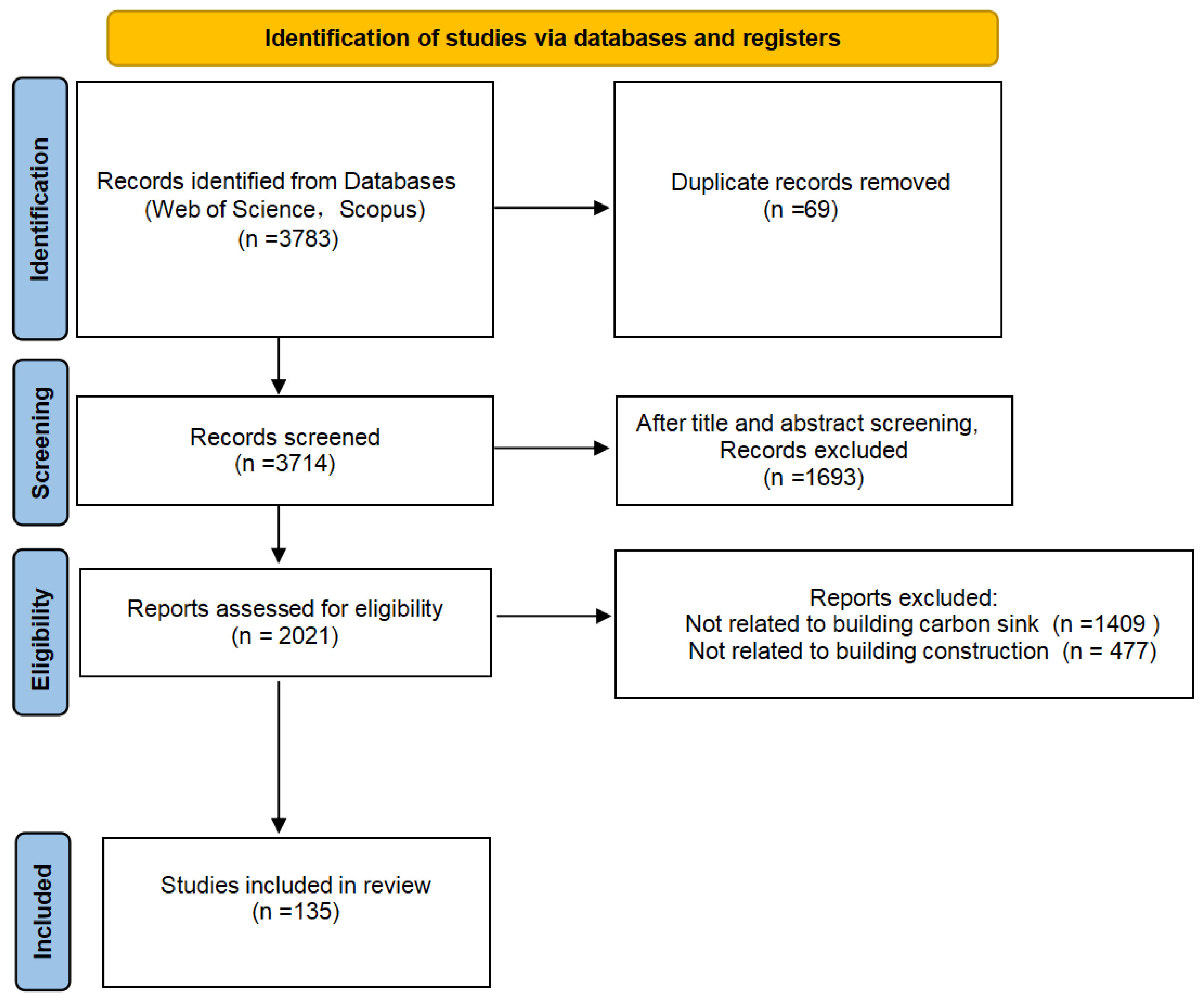
Figure 1. Illustrates the document screening workflow in accordance with the PRISMA Statement.
Buildings 15 04445 g001
Figure 2. Annual publications from 2007 to 18 September 2025.
Buildings 15 04445 g002
Figure 3. Global distribution of retrieved studies.
Buildings 15 04445 g003
Figure 4. Top 12 most productive institutions on carbon sinks in urban buildings during the period of 2007–2025.
Buildings 15 04445 g004
Figure 5. The Progression of Carbon Sink in Architecture.
Buildings 15 04445 g005
Figure 6. Common strategies to optimize the carbon sink performance of building structures: (a) Increasing building envelope surface area; (b) Modifying wall geometry to enhance carbonation efficiency; (c) Incorporating diverse structural elements to promote CO2 diffusion.
Buildings 15 04445 g006
Figure 7. Three main carbon sink strategies for building attachments: (a) Plant-based attachment systems via photosynthetic carbon fixation; (b) Moist porous substrate systems for passive adsorption and mineralization; (c) Photocatalytic surfaces for CO2 conversion and carbonate formation.
Buildings 15 04445 g007
Figure 8. HVAC-integrated carbon-capture system within building ventilation networks.
Buildings 15 04445 g008
Figure 9. Façade and Rooftop Modular Systems.
Buildings 15 04445 g009
Table 1. Comparison of carbon sequestration from different building materials.
Material TypeCarbon Sink MechanismAdvantagesLimitationsApplicability at Urban Scale
Bio-based materials (e.g., wood, bamboo, agricultural by-products)Absorb atmospheric CO2 through photosynthesis during plant growth and store it as biogenic carbonHigh carbon storage density; renewable; strong ecological benefitsProne to degradation; limited durability; high fire risk; constrained by land and forestry resources, making large-scale use difficultModerate to low
Natural mineral materials (e.g., magnesite, carbonate rocks)Combine with CO2 through mineral carbonation to form stable carbonate mineralsHigh carbon storage stability; capable of long-term sequestrationSlow natural carbonation rate; limited availability; high energy consumption in processing and transportationModerate
ConcreteReacts with atmospheric CO2 during hardening and service life, forming calcium carbonate mineralsLargest global usage; significant scale effect; stable carbon storage; carbonation rate and capacity can be enhanced through material designLow unit carbon uptake; high emissions during productionHigh
Table 2. Comparison of Passive and Active Carbon Capture Strategies.
Comparison MetricPassive Carbon Sink StrategiesActive Carbon Capture (DAC) Strategies
CostLow cost, primarily driven by materials (e.g., concrete, vegetation) and maintenance over the life cycleHigh initial investment (USD 600–900/t CO2/yr), but higher capture efficiency
Capture RateLow capture rate, typically 5–15 kg CO2/m3·yr (e.g., concrete)High capture rate, typically 50–80 kg CO2/m2·yr (e.g., amine-based DAC systems)
Life-cycle StorageLong-term storage (decades to centuries), but influenced by environmental changesHigh short-term capture efficiency, but requires efficient storage, transport, and utilization systems
Practical ConstraintsLimited by building design, material availability, climate impacts, and construction complexityHigh energy consumption and operational costs, reliance on stable low-carbon energy, MRV uncertainties
ApplicabilityWidely applicable to large-scale infrastructure (e.g., urban buildings, green infrastructure)Suitable for specific high-efficiency areas, such as building facades and industrial zones
Energy DemandNo additional energy requirements, mainly influenced by natural environment and building designHigh energy demand, reliant on renewable energy to ensure net-negative emissions
Technology MaturityMature technology, widely applied in architectural design and urban greeningStill under development and demonstration, facing challenges with integration and scalability
Long-term FeasibilityStrong sustainability, relying on natural processes (e.g., plant photosynthesis, carbonation)Requires optimization of energy consumption, cost reduction, and MRV system improvement for widespread deployment
Table 3. Summary and Comparison of Carbon Capture Methods.
Method TypeKey MethodsAdvantagesChallenges
Material-levelTGA, XRD, FTIR, Chemical TitrationHigh precision, suitable for lab-scale studiesDoes not capture environmental effects
System-levelPhenolphthalein, Gas Exchange, SensorsReal-world performance, applicable at building scaleEnvironmental interference, high cost
Active Carbon Capture (DAC)Mass Balance, Breakthrough Curve, NDIR GasHigh efficiency, direct CO2 removalHigh energy demand, complex integration
Table 4. Principal Methods for Material-Level Carbon Measurement.
MethodTechnical PrincipleApplicable ObjectAdvantagesLimitations
Thermogravimetric Analysis (TGA)Measures sample mass change with temperature/time; calculates CO2 fixation from carbonate decomposition lossConcrete powder, mineral admixturesHigh precision; quantitative; allows kinetic analysisDestructive; requires sample grinding
X-ray Diffraction (XRD)Identifies crystalline phases (e.g., CaCO3, MgCO3) via diffraction patternsCarbonated concrete, mineral-sequestration materialsStrong phase identification; semi-quantitativeInsensitive to amorphous phases; costly instrumentation
Fourier Transform Infrared Spectroscopy (FTIR)Detects characteristic C=O vibration bands in CO32− groups to determine bonding statesCement hydrates, alkali-activated materialsHigh sensitivity; simple preparationLow quantitative precision; requires calibration curves
Chemical TitrationQuantifies carbonate via acid-base neutralization or precipitationCement paste, industrial residuesLow-cost, simple, fast screeningInterference from impurities; subjective endpoint
Table 5. Principal Methods for Building-System -Level Carbon Measurement.
MethodTechnical PrincipleApplicable ObjectAdvantagesLimitations
Phenolphthalein IndicatorDetects carbonation depth via color change (pink → colorless below pH 10.2)Concrete walls, beams, columnsFast, low-cost, intuitiveSemi-quantitative; destructive; humidity-sensitive
Gas Exchange ChamberMonitors CO2 concentration change inside a sealed chamber over timeGreen façades, carbonated surfacesDirect CO2 flux; real-environment dataMicroenvironment disturbance; small sampling area
Embedded SensorsMeasures pH/CO2 inside concrete over time via micro-sensorsInfrastructure, long-term monitoringIn situ, continuous, non-destructiveHigh cost; limited sensor lifespan
Model EstimationUses building or urban-scale models to estimate total sequestrationSingle buildings or citiesIntegrates multiple factors; macro insightsDependent on assumptions; uncertainty high
Remote SensingUses LiDAR or hyperspectral imaging to infer biomass/carbon stockGreen roofs, urban forestsWide coverage, repeatable, scalableIndirect; requires ground validation
Table 6. Principal Methods for Evaluating Active Carbon-Capture Performance.
MethodTechnical PrincipleApplicable ObjectAdvantagesLimitations
Mass BalanceCalculates total captured CO2 via inlet–outlet concentration difference and airflow rateBuilding-integrated DAC unitsSimple, real-time, system-level assessmentRequires airtight operation
Breakthrough CurveTracks outlet CO2 concentration vs. time in adsorption beds (S-shaped curve)Sorbent testing, adsorption modulesHigh precision; kinetic parametersLab-scale; not for large systems
NDIR Gas AnalysisMeasures CO2 via IR absorption at 4.26 μmAll CO2-monitoring processesHigh accuracy; fast response; compactHigh cost; periodic calibration
Disclaimer/Publisher’s Note: The statements, opinions and data contained in all publications are solely those of the individual author(s) and contributor(s) and not of MDPI and/or the editor(s). MDPI and/or the editor(s) disclaim responsibility for any injury to people or property resulting from any ideas, methods, instructions or products referred to in the content.