Interpretation of the Pile Static Load Test Using Artificial Neural Networks


Abstract
1. Introduction
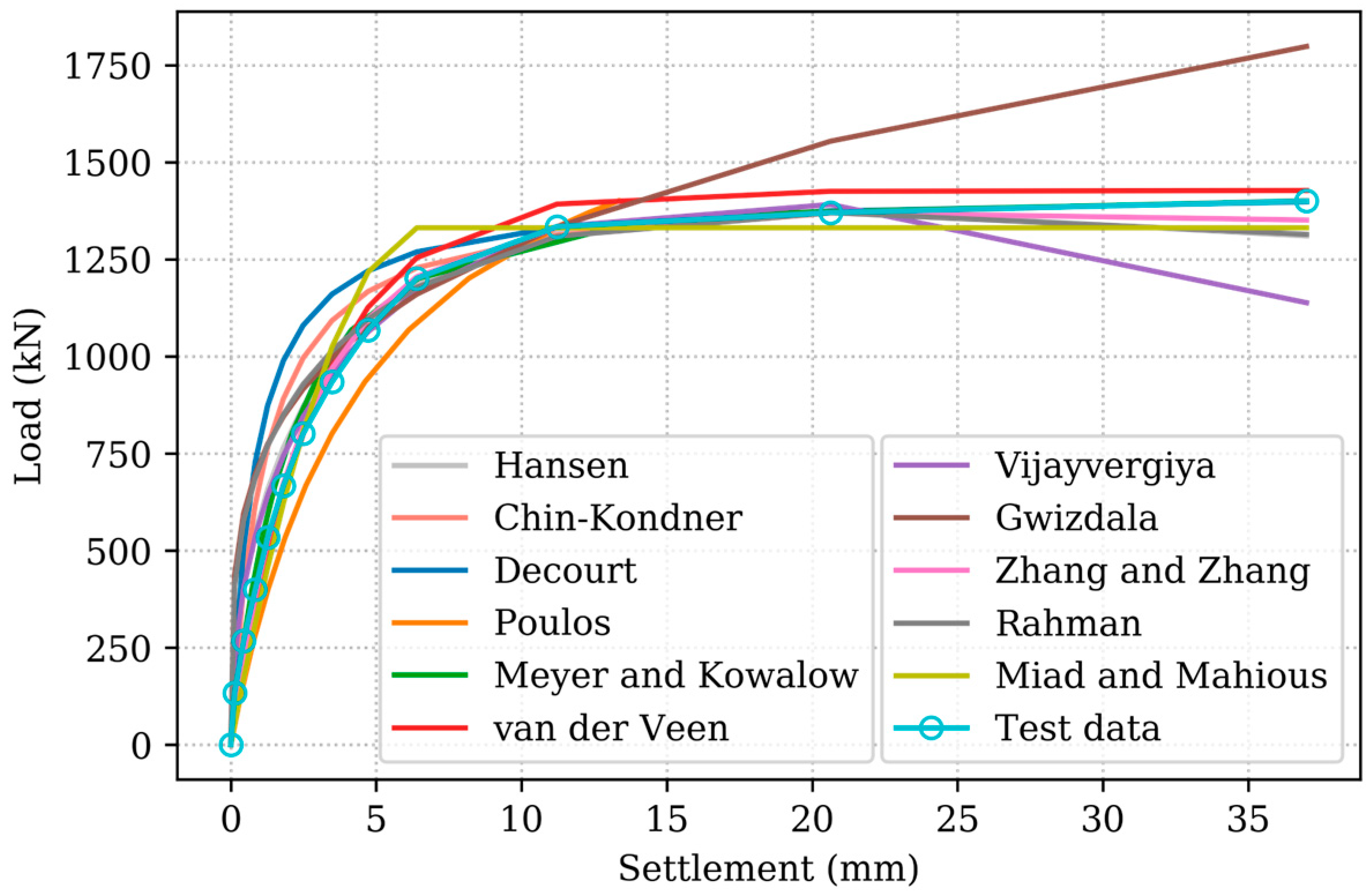
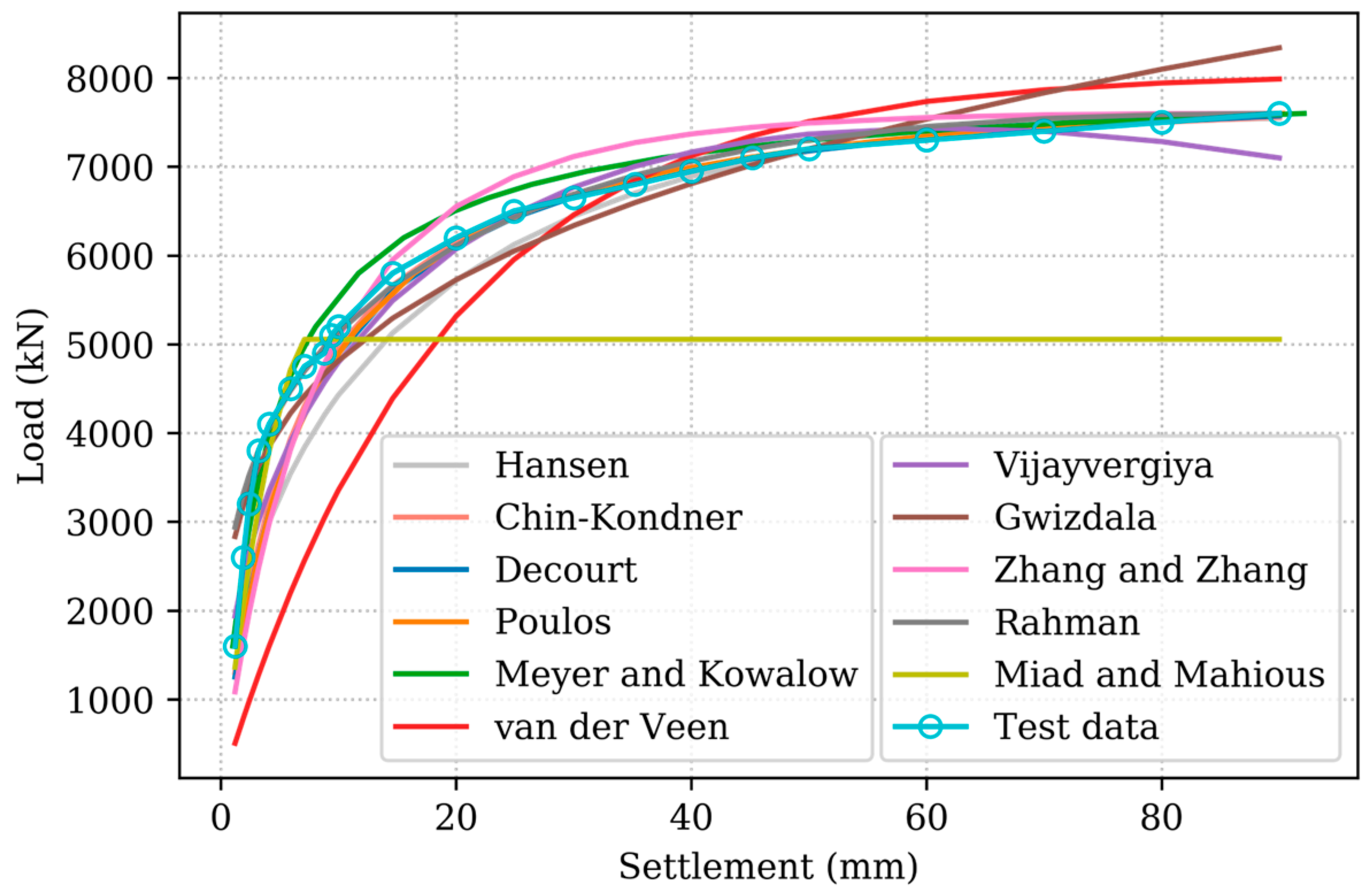
2. Methods That Determine Load-Movement Relation to Ultimate Bearing Capacity from Load-Movement Records of a Static Loading Test
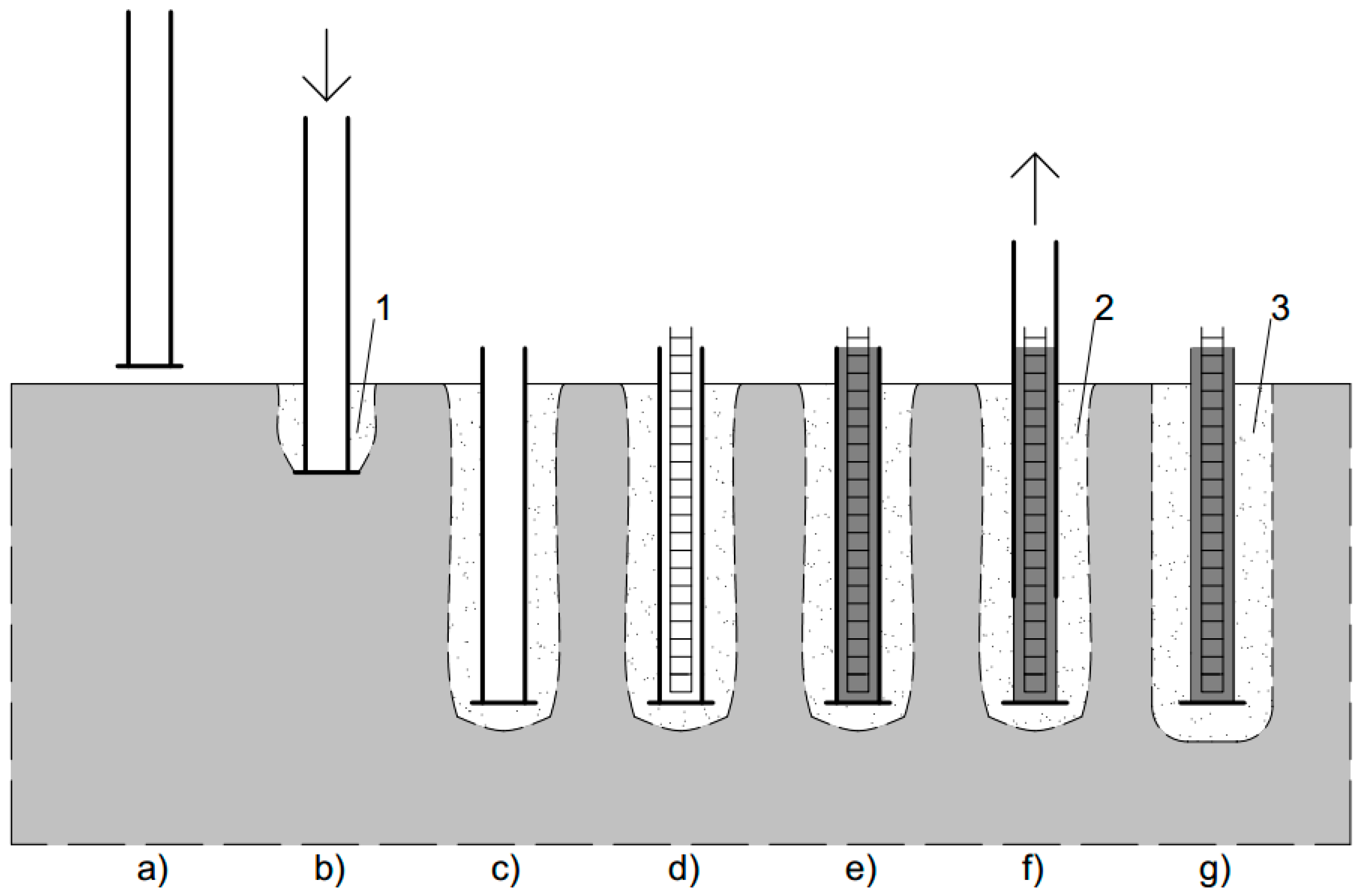
2.1. Driven Piles Formed into Subgrade Construction Technology
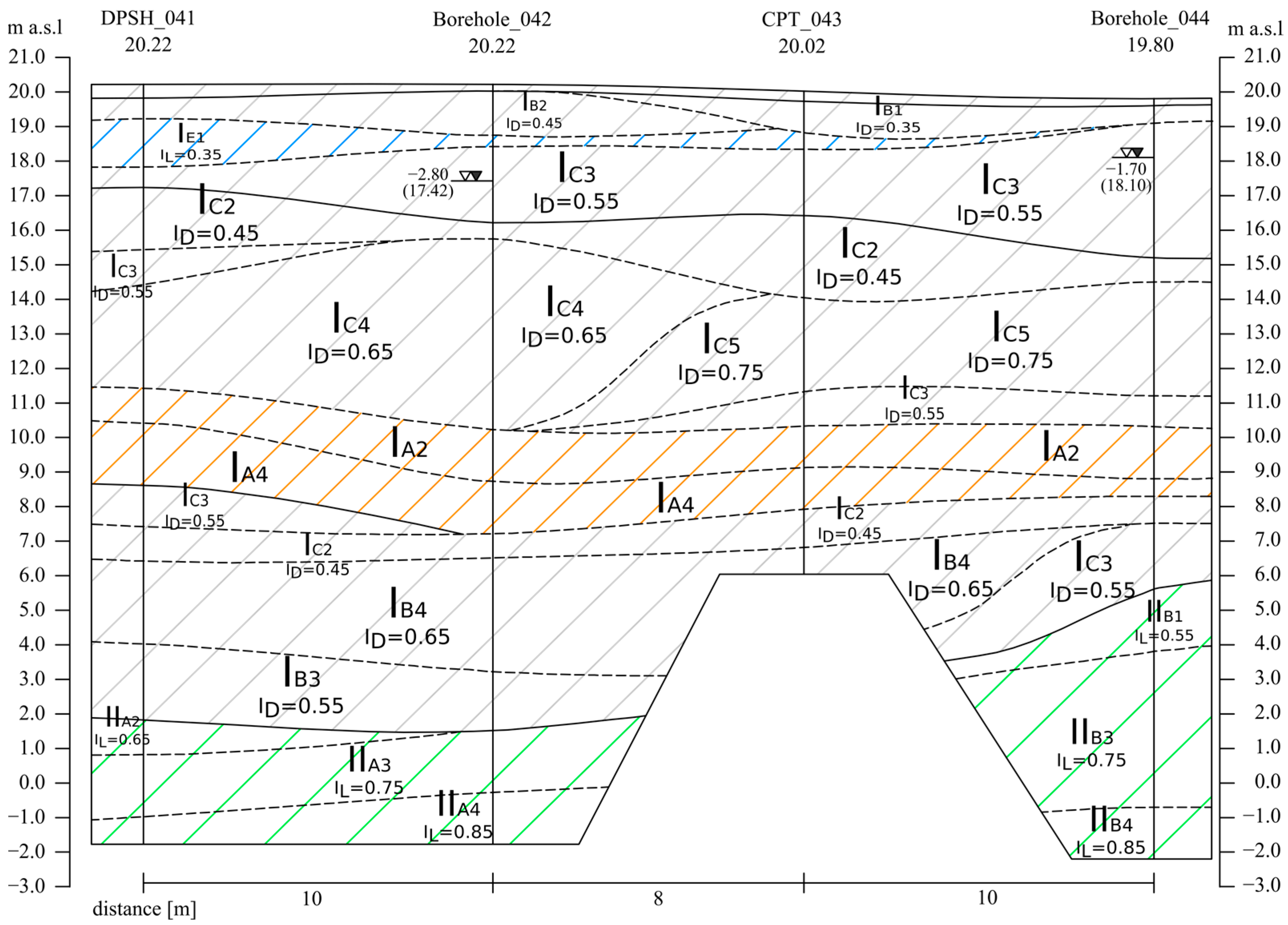
2.2. Geological Condition of Tested Area
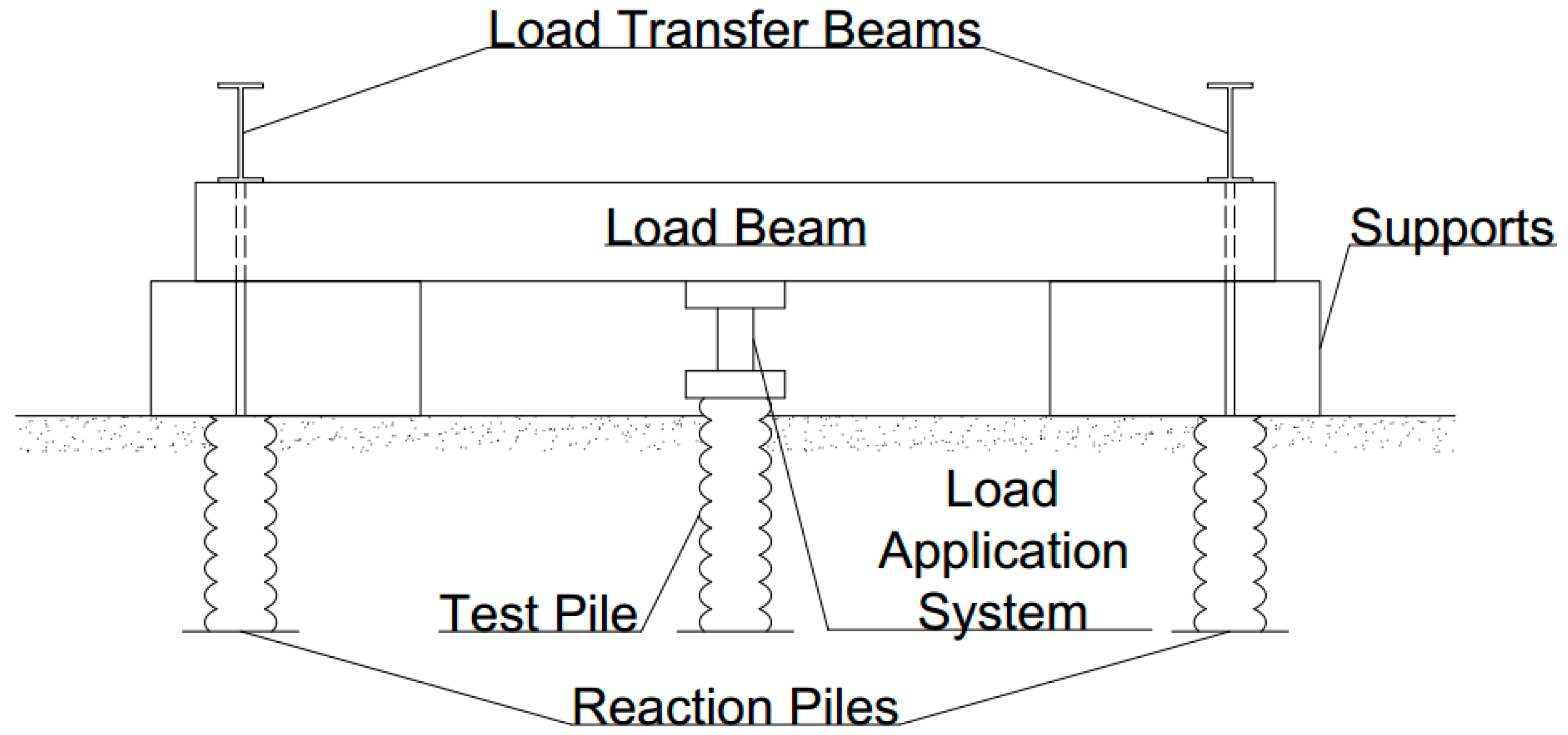
2.3. Description of SLT
3. Interpretation of the Static Pile Load Test Using Artificial Neural Networks
3.1. Meyer and Kowalow Representation of a Static Load Test as a Direct Problem
3.2. Existing Methods of Finding Meyer and Kowalow Curve Coefficients
- Determining the possible range of M-K curve parameters, consistent with their physical interpretation (three parameters according to Formula (8) or five parameters according to Formula (22) for the generalized version).
- Selecting the “sample” values of the triplets (or fives) using any method that provides representative “coverage” of their physical range of variability.
- Performing the calculations “directly” according to Formula (7) or (20), to obtain a database with Formula (10) or (24) for ANN training.
- Dividing the database into a subset used for network training and a subset used for testing the network’s response.
- Training the inverse networks for all M-K curve parameters according to Formula (12) or (24) until the network’s response error for the testing set starts to increase.
3.3. Identification of Meyer and Kowalow Curve Coefficients as an Inverse Problem Solved with Artificial Neural Networks
3.3.1. Computation Steps to Be Executed
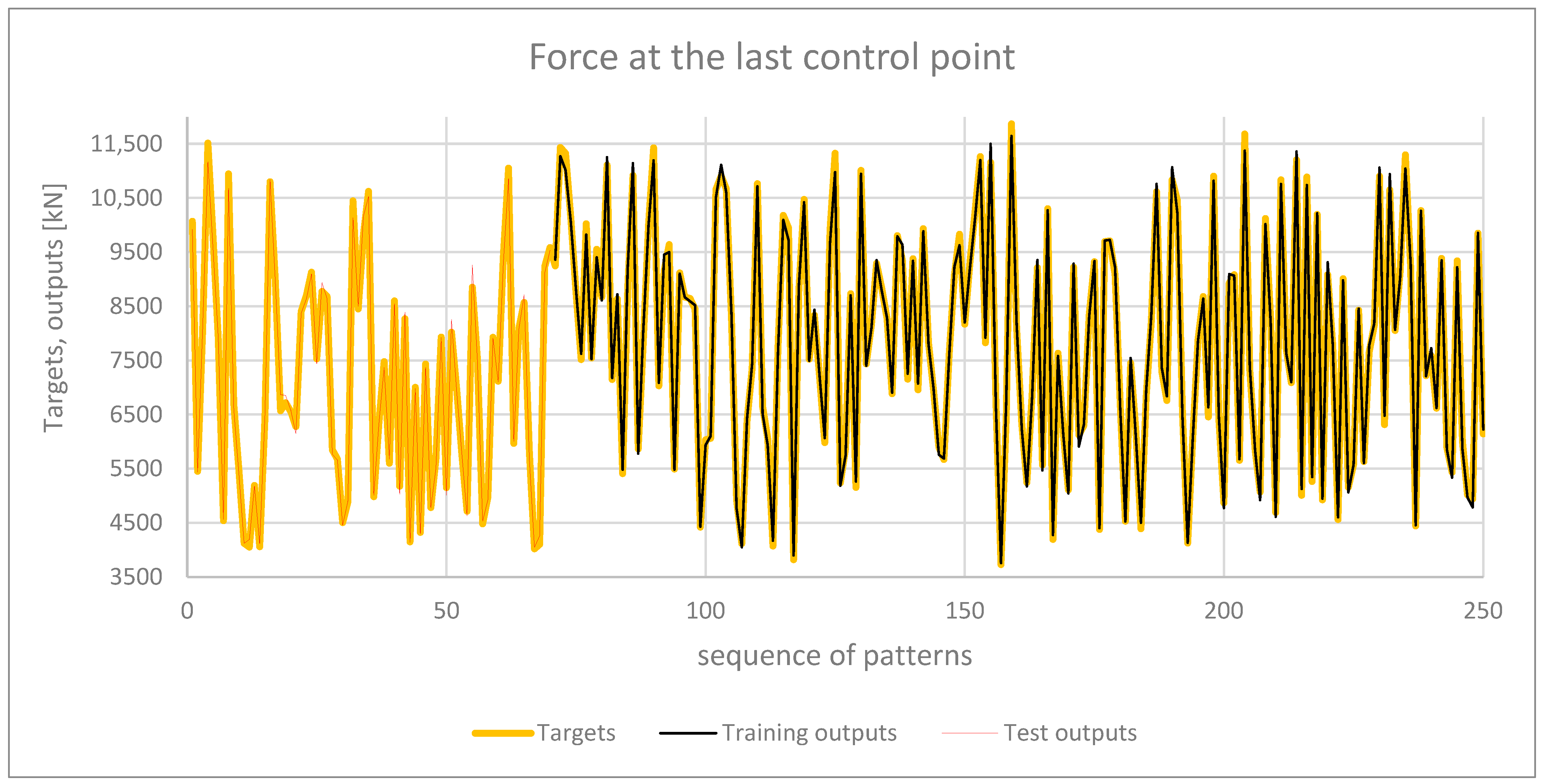
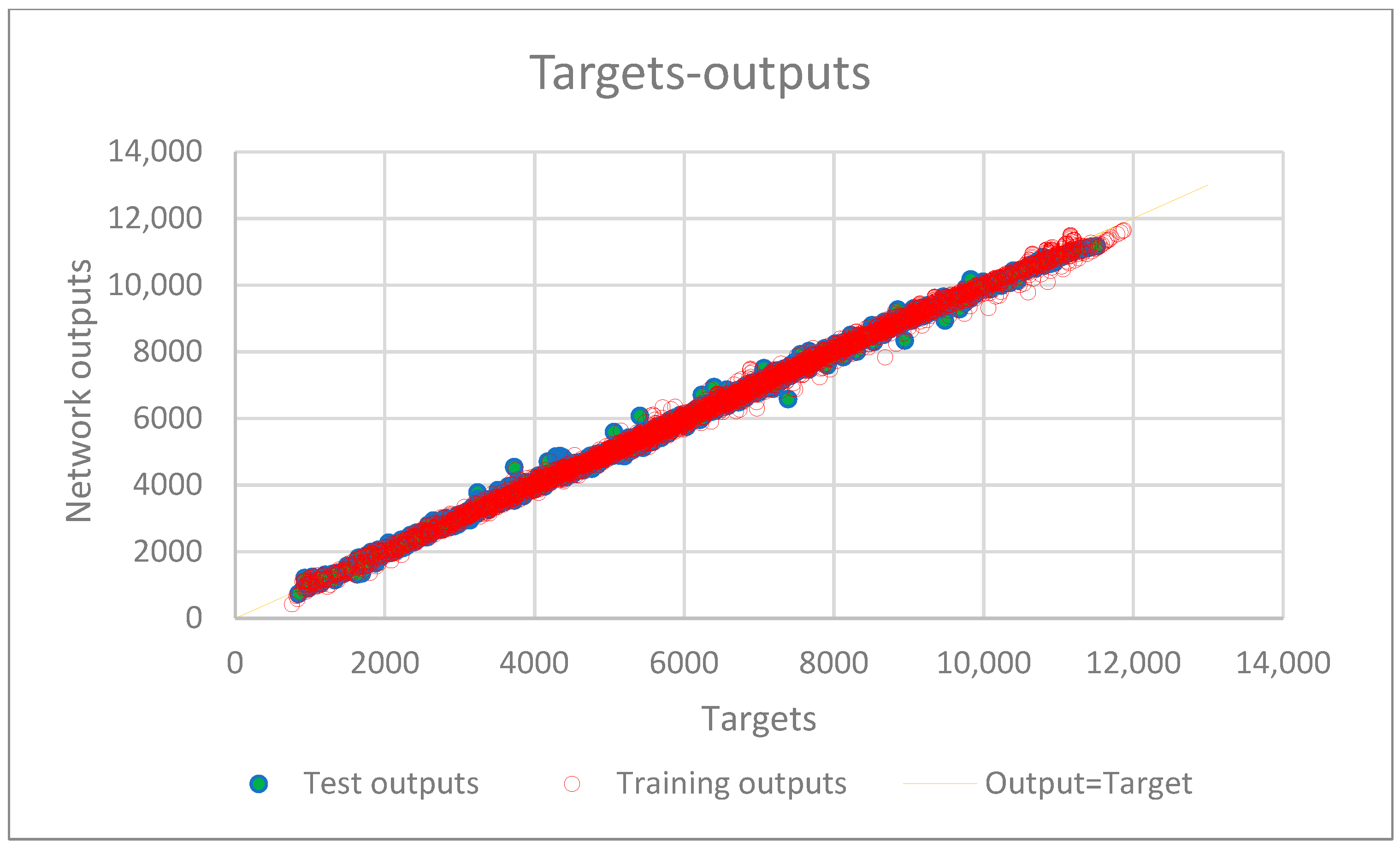
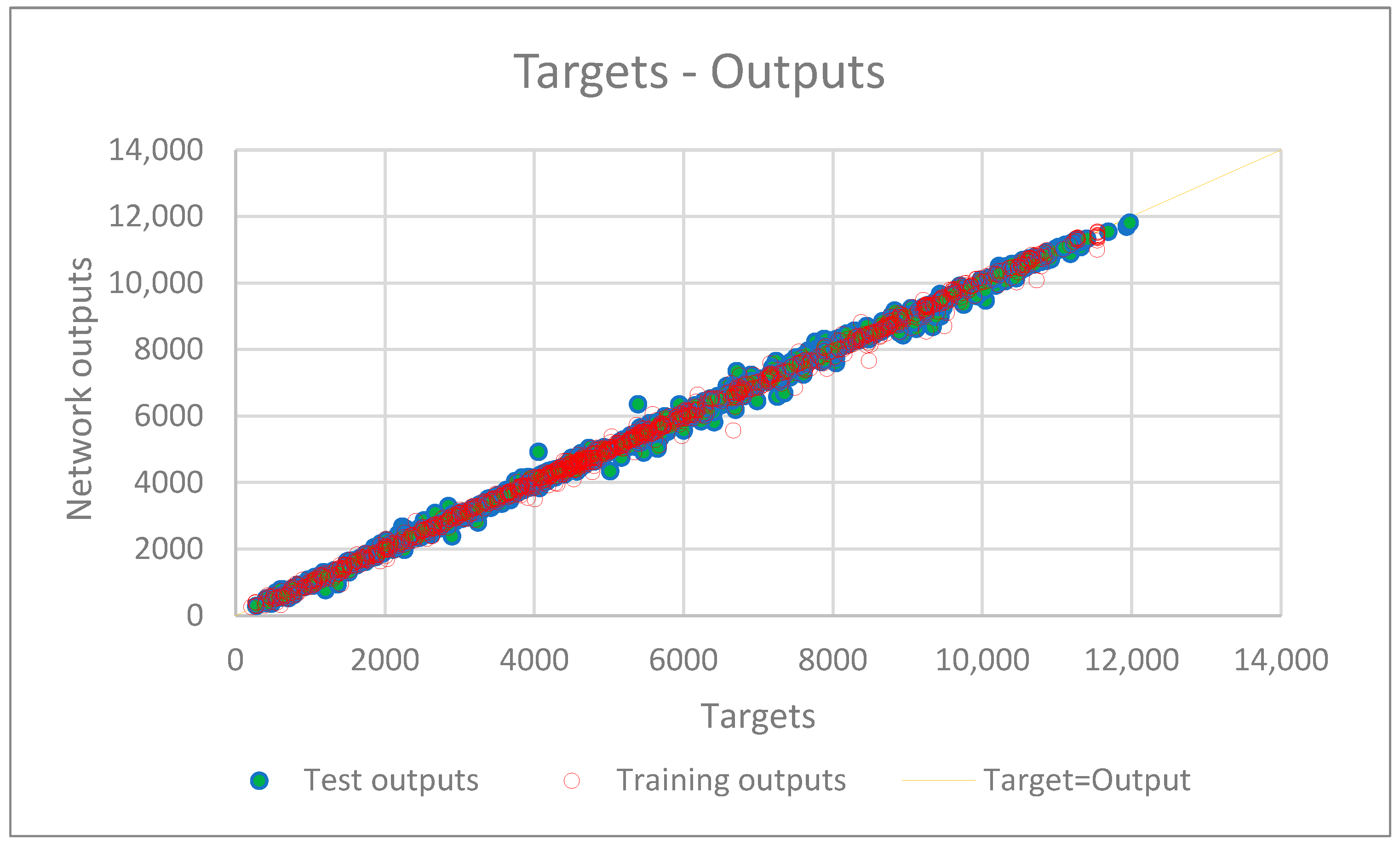
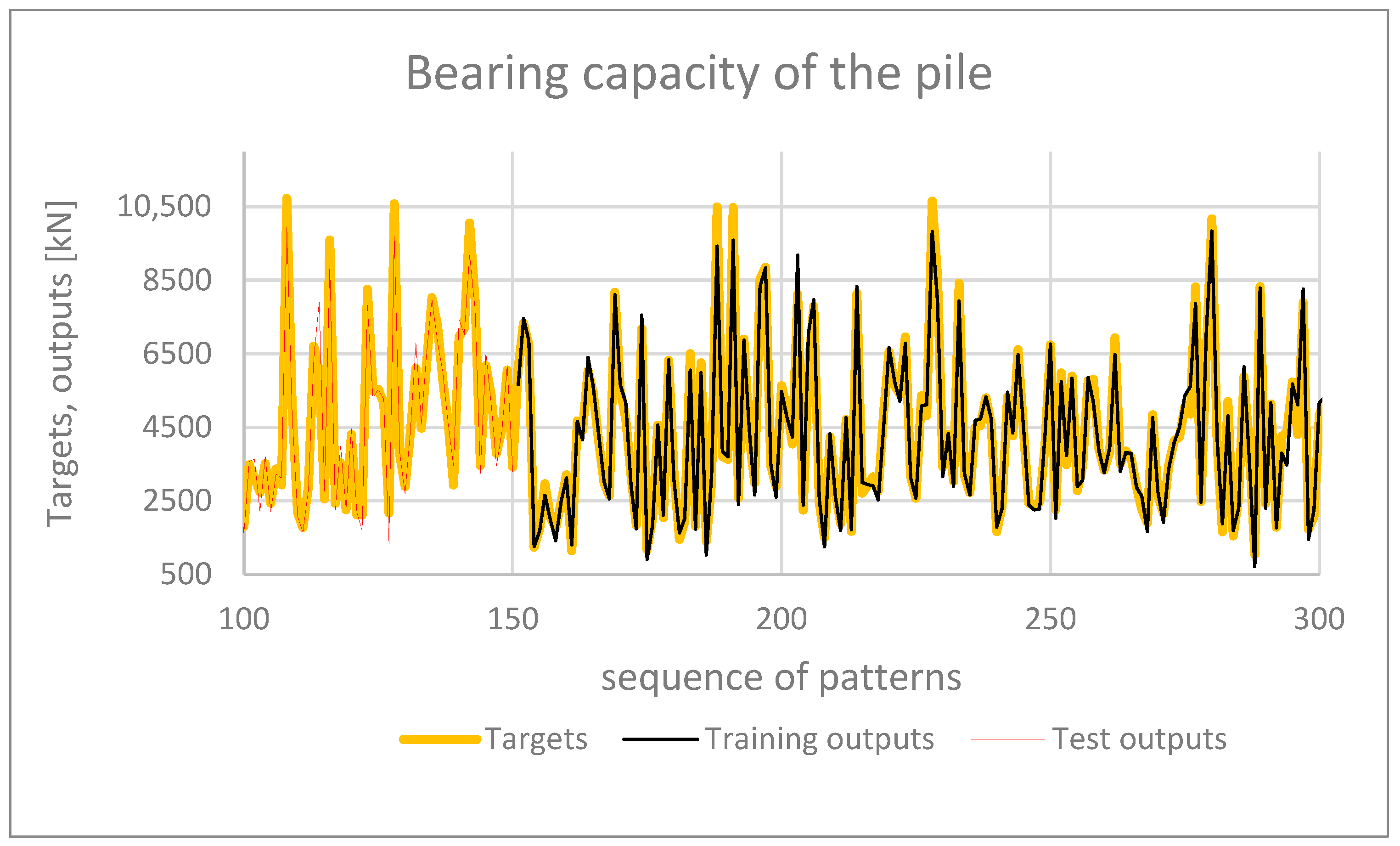
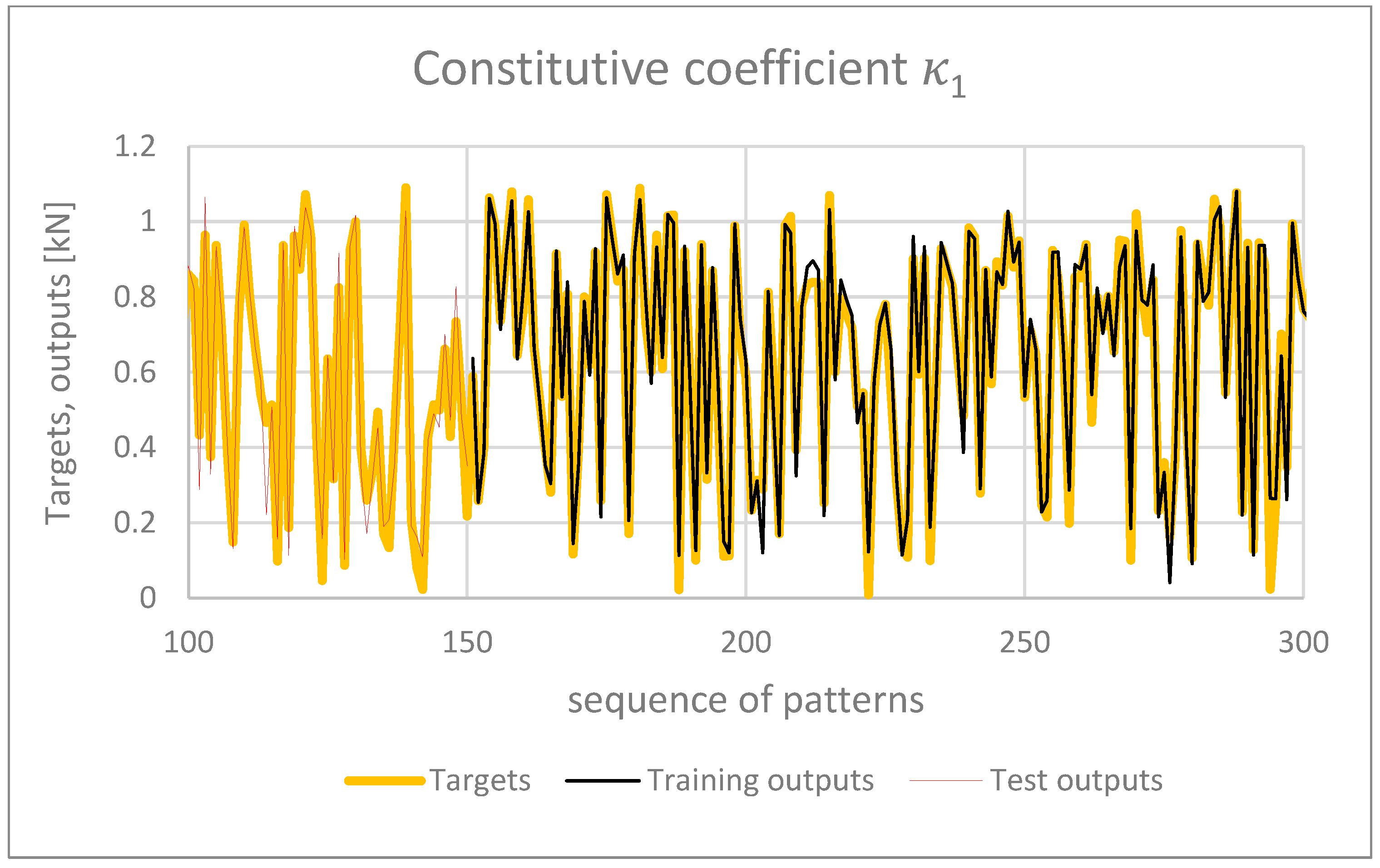
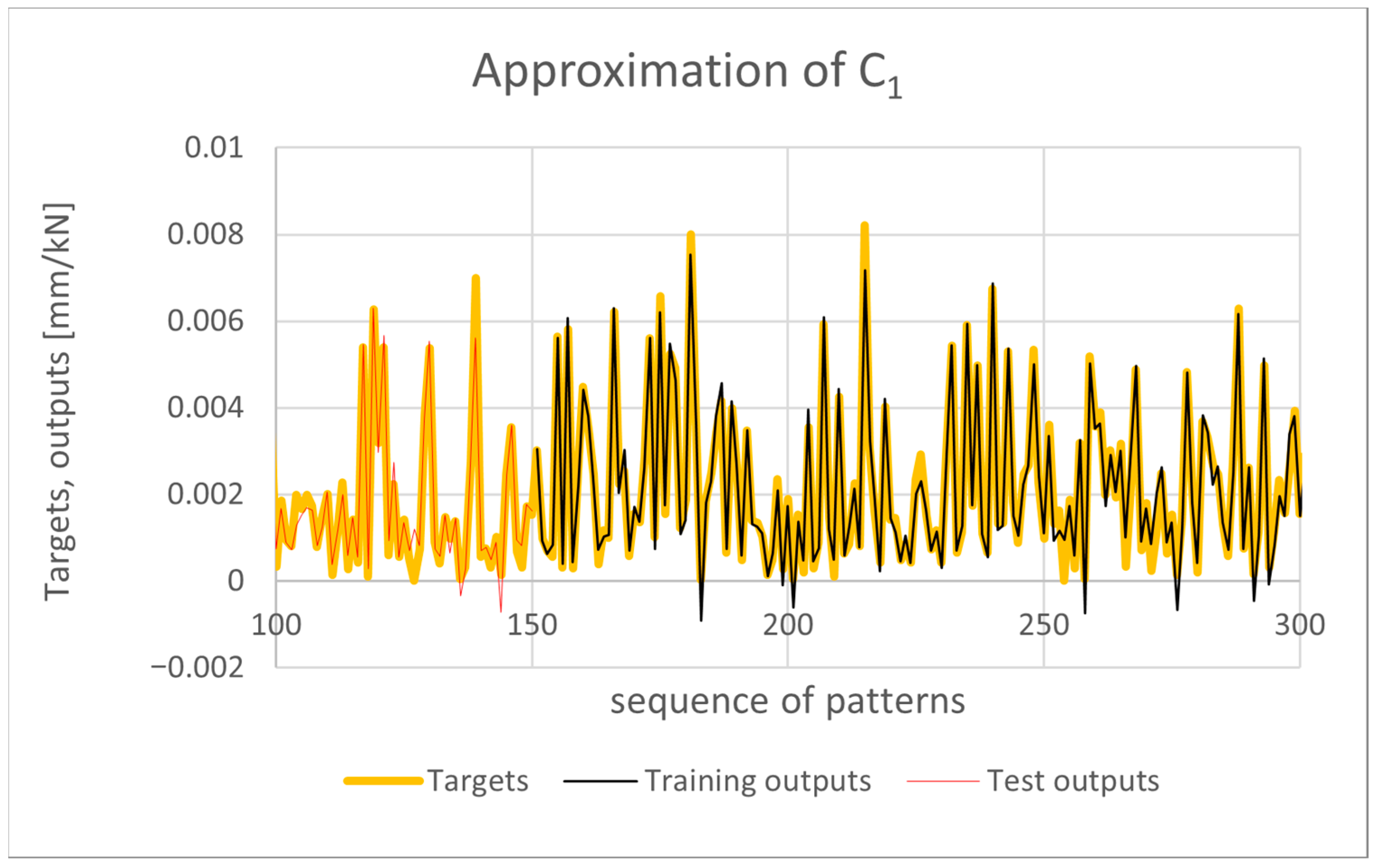
3.3.2. Results of the Computations Executed According the Proposed Scheme
Neural Network for Direct Problem and Testing Patterns Used
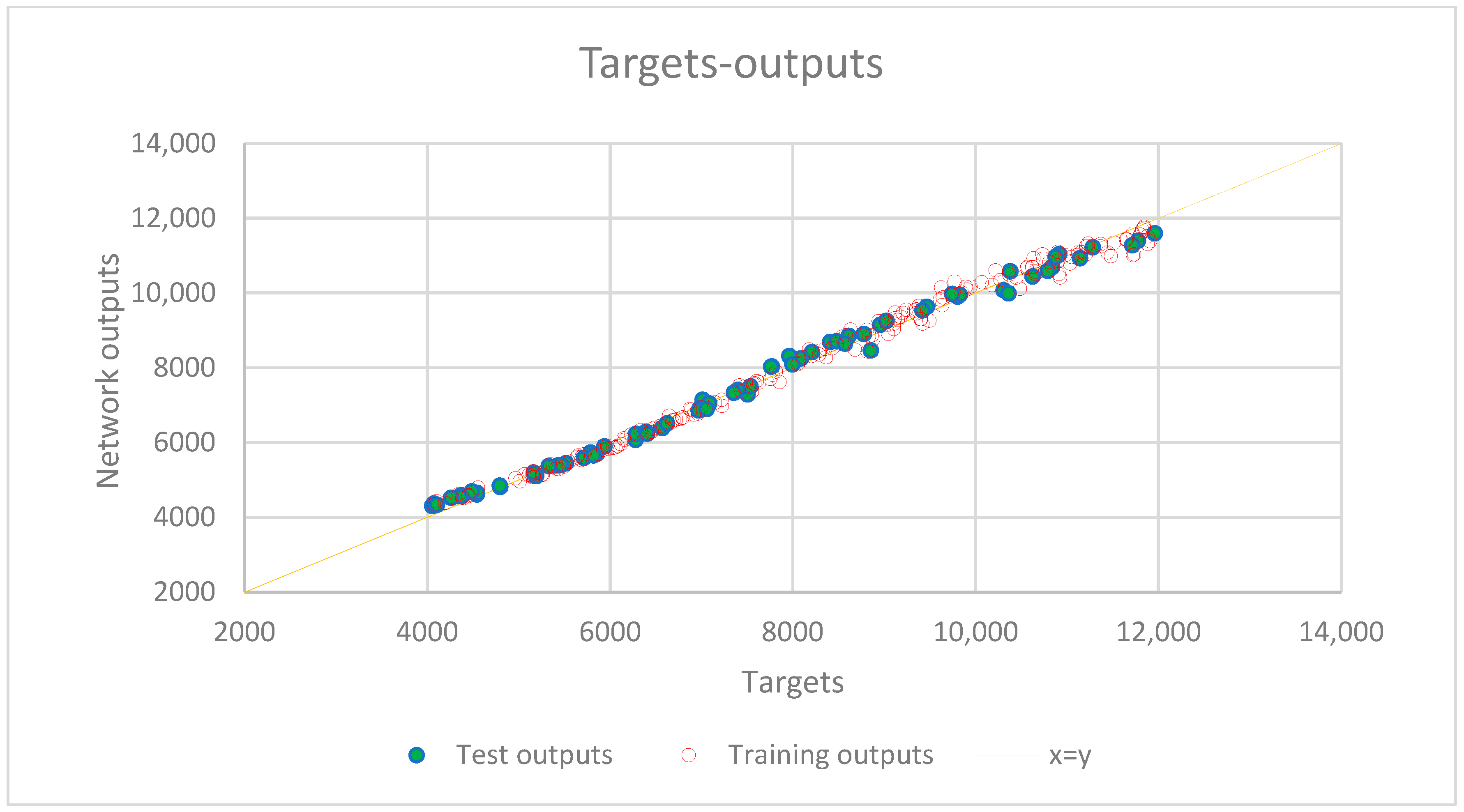
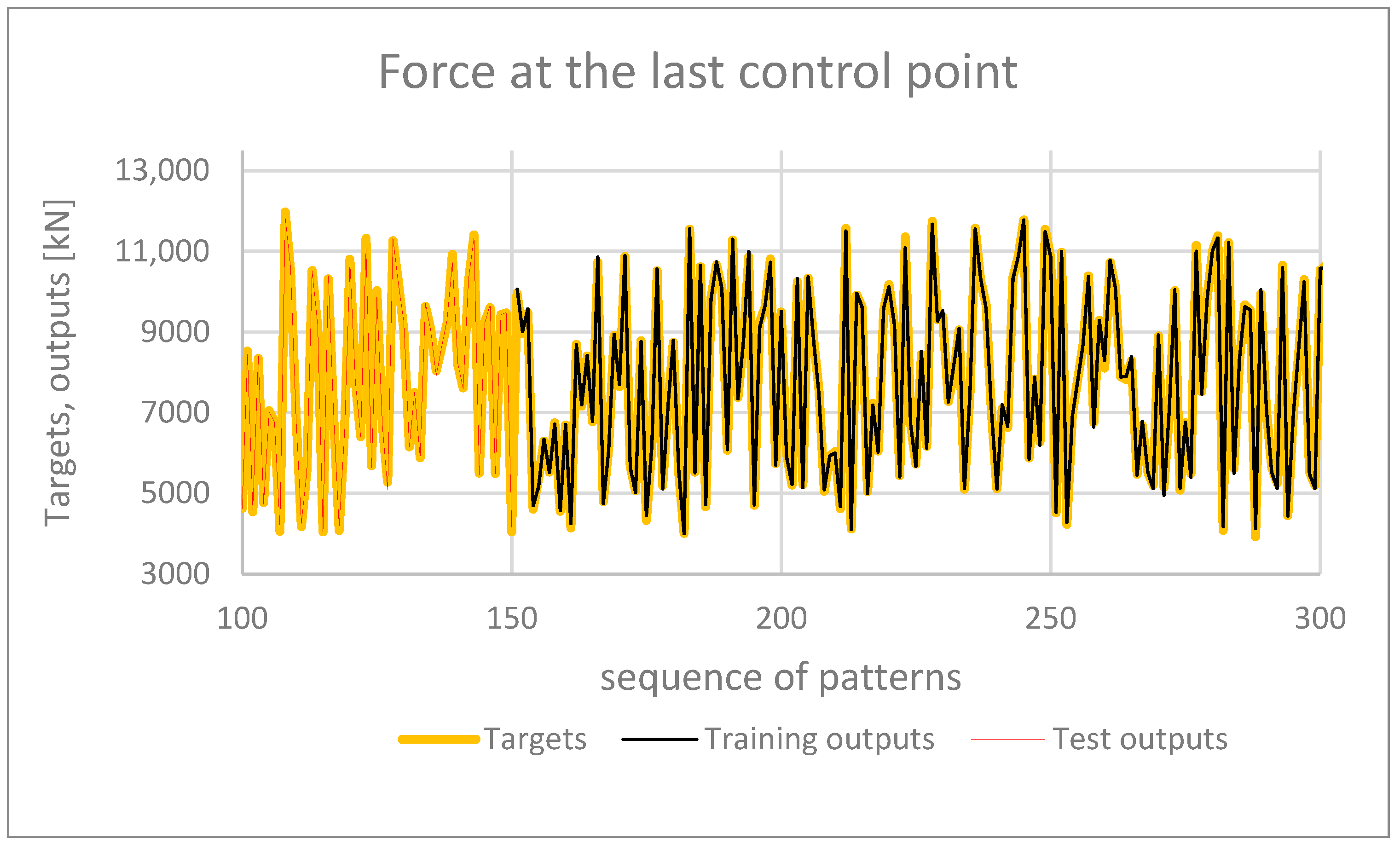
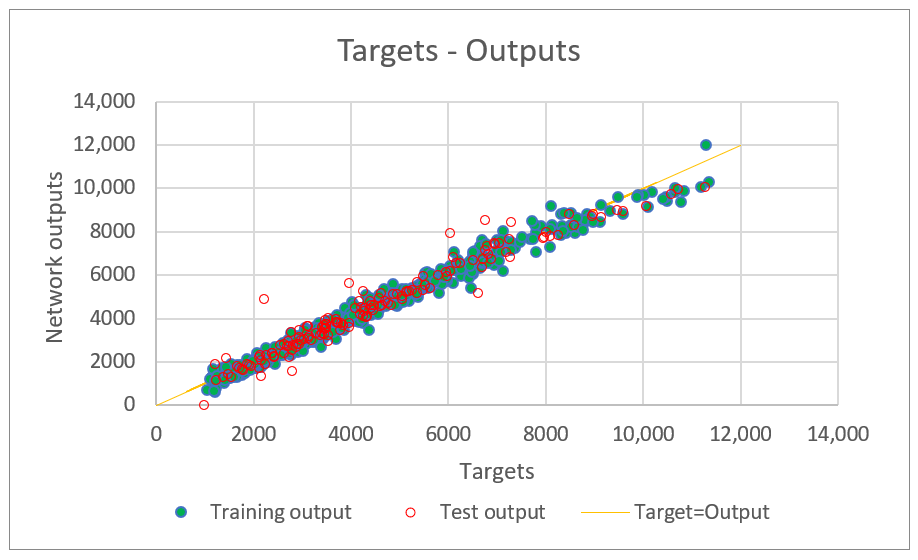
- Trial values of are randomly selected in the range from 4000 kN to 12,000 kN;
- Trial values of constitutive coefficients, , are randomly selected in the range from 0.0 to 2.0;
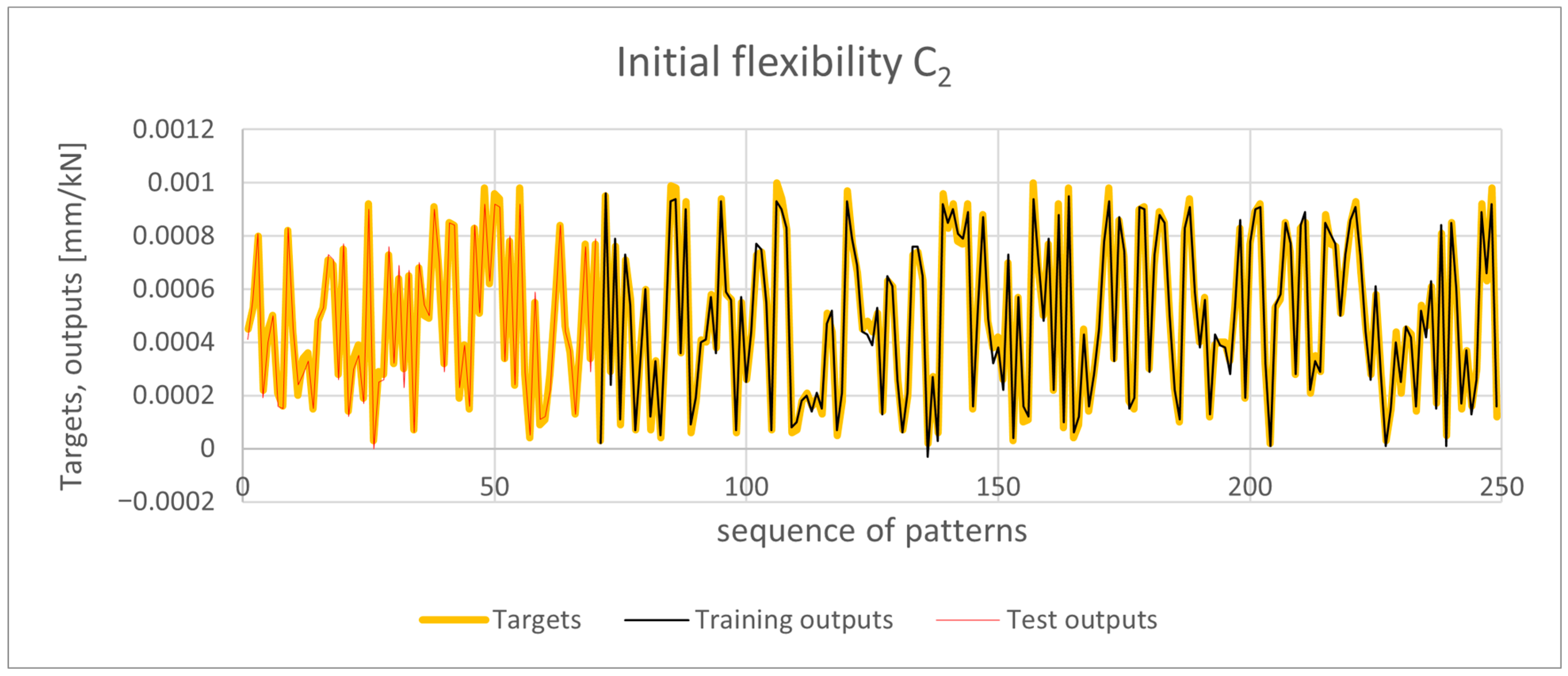
- Trial values of initial flexibility, , are randomly selected in the range from 0.0000001 mm/kN to 0.001 mm/kN.
Training Description
Neural Network for Inverse Problem
3.4. Separation of the Pile Load Capacity into the Bearing Capacity of the Base and the Bearing Capacity of the Shaft by the Meyer and Kowalow Approach
3.5. Separation of the Pile Load Capacity into the Bearing Capacity of the Base and the Bearing Capacity of the Shaft According to the Adopted Constitutive Hypothesis
3.6. Trace of the Assumed Constitutive Hypothesis in the Results of the Static Test and Its Identification Using Inverse ANN and the Modified Meyer and Kowalow Curve
3.6.1. Computational Steps to Be Executed
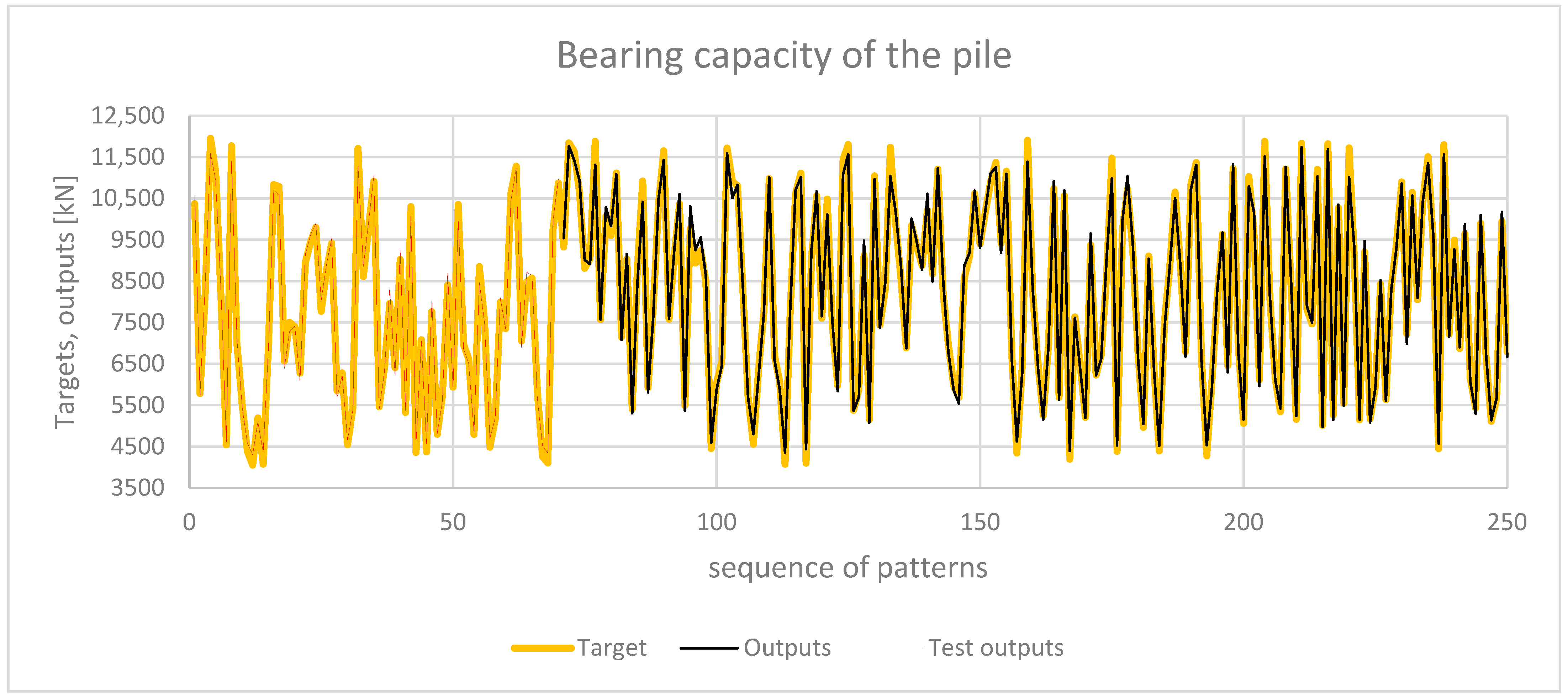
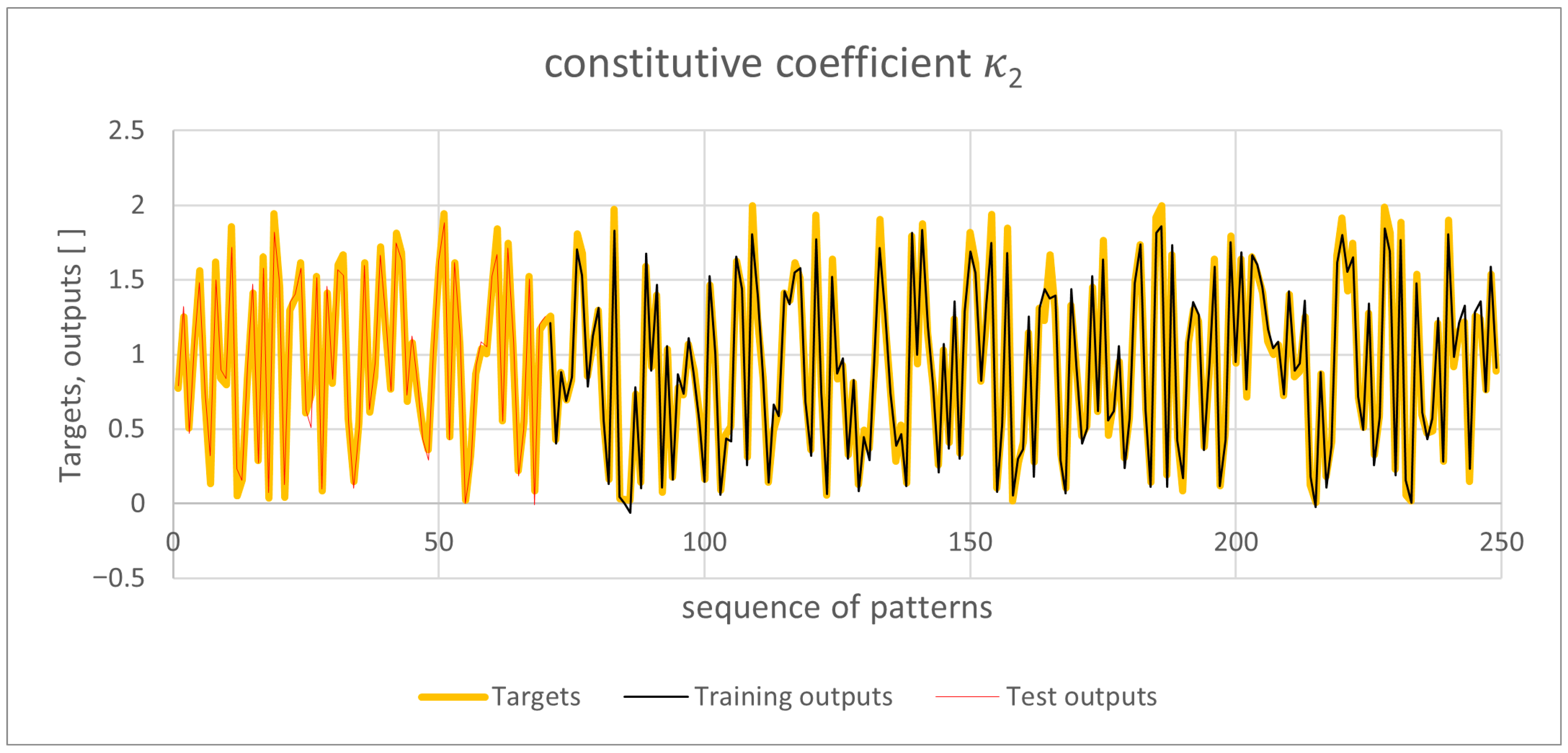
3.6.2. Results of the Computations Executed According to the Proposed Scheme
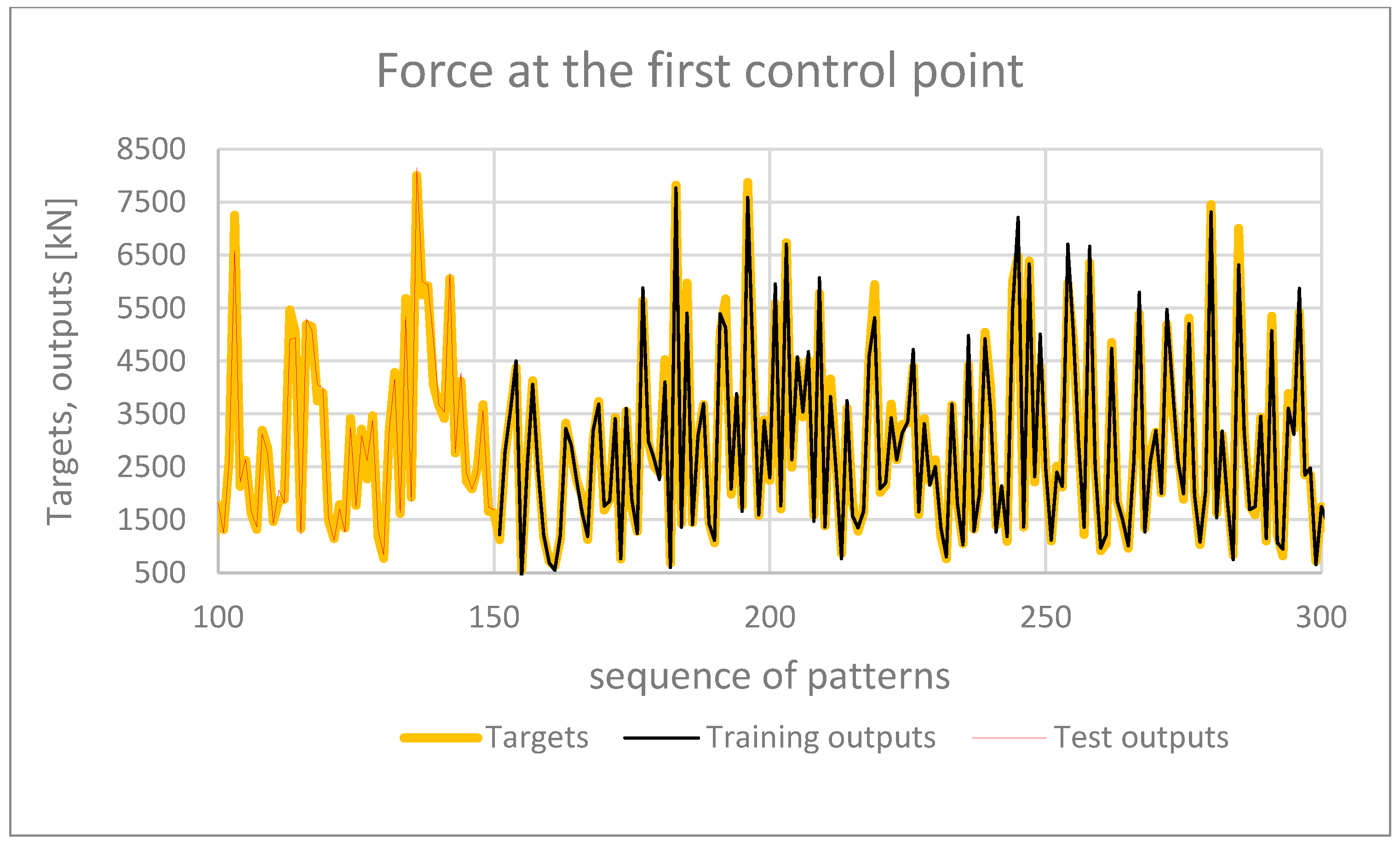
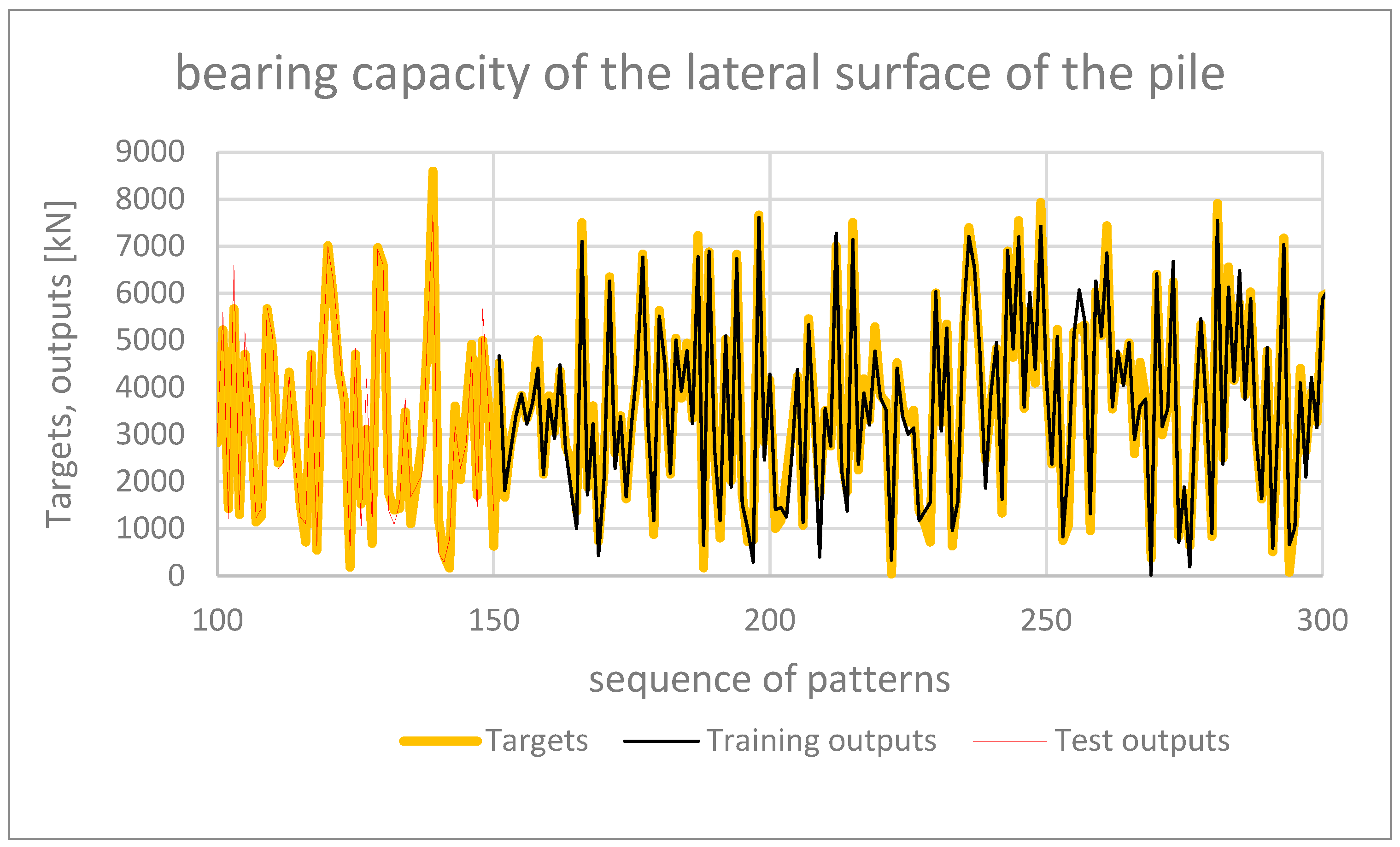
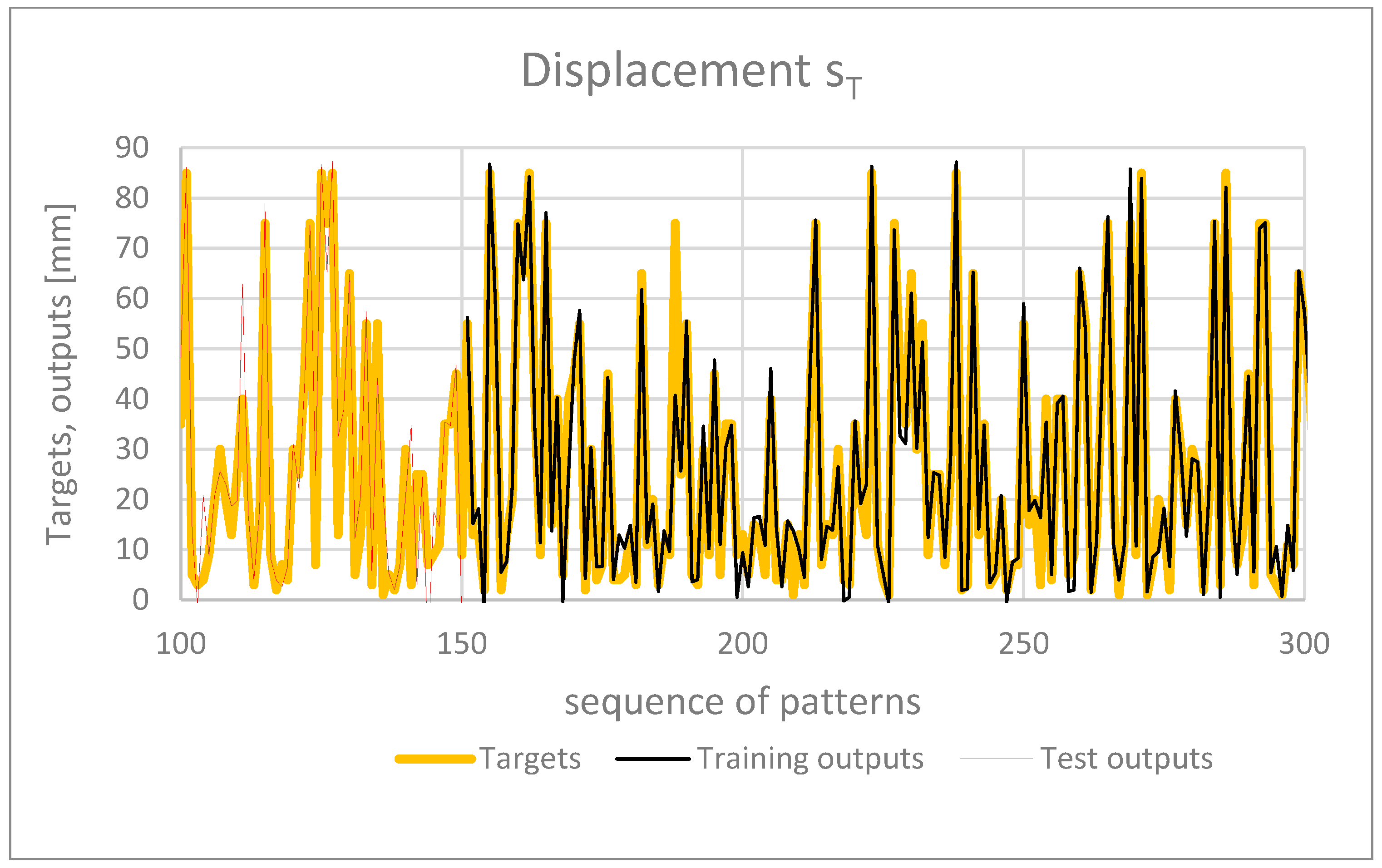
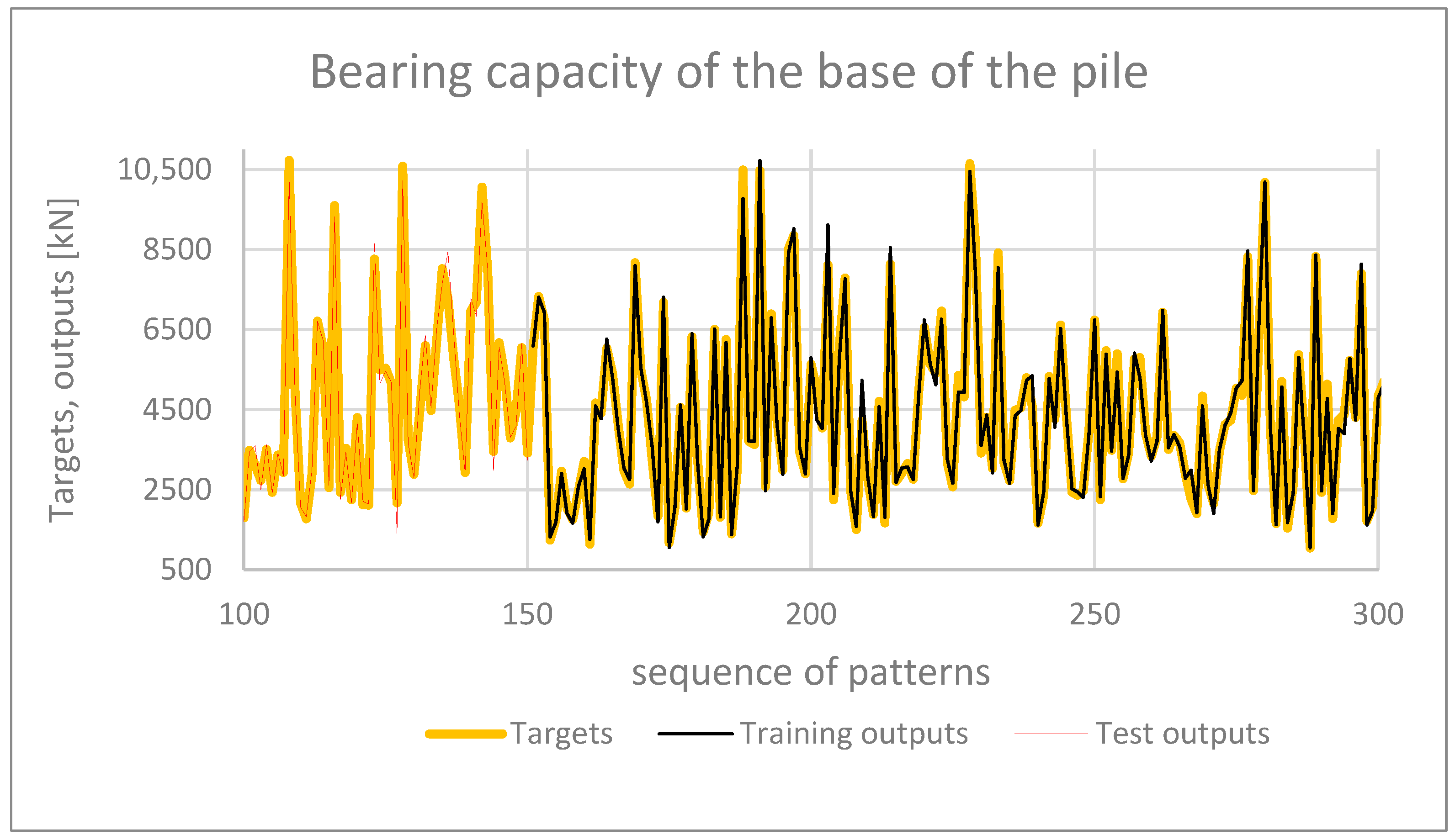
- Trial values of are randomly selected in the range from 2000 kN to 8000 kN;
- Trial values of constitutive coefficients are randomly selected in the range from 0.0 to 2.0;
- Trial values of initial flexibility are randomly selected in the range from 0.0000001 mm/kN to 0.001 mm/kN;
- Trial values of the bearing capacity of the lateral surface are randomly selected in the range from 2000 kN to 8000 kN;
- Trial values of displacement at which the bearing capacity of the lateral surface is exhausted are randomly selected in the range from 0.0 mm to 80 mm.
4. Discussion and Conclusions
Author Contributions
Funding
Institutional Review Board Statement
Informed Consent Statement
Data Availability Statement
Acknowledgments
Conflicts of Interest
Abbreviations
| SLT | Static Loading Test |
| ANN | Artificial Neural Network |
| FEM | Finite Element Method |
| DEM | Discrete Element Method |
| FDM | Finite Difference Method |
| M-K | Meyer and Kowalow (proposal of the Q-s description curve) |
References
- Fellenius, B.H. Basics of Foundation Design; Electronic Ed.; Fellenius.net: Calgary, AB, Canada, 2025. [Google Scholar]
- Bouafia, A. Contribution of the Standard Penetration Test SPT to the Design of Pile Foundations in Sand—Practical Recommendations. J. Eng. Res. 2022, 11, 55–68. [Google Scholar] [CrossRef]
- Fellenius, B.H. Capacity and Load Movement of a CFA Pile: A Prediction Event. In Foundation Engineering in the Face of Uncertainty; American Society of Civil Engineers: San Diego, CA, USA, 4 March 2013; pp. 707–719. [Google Scholar]
- Fellenius, B.H. Report on the B.E.S.T. Prediction Survey of the 3rd CBFP Event. In Proceedings of the 3rd Bolivian International Conference on Deep Foundations, Santa Cruz de la Sierra, Bolivia, 27–29 April 2017; Volume 3, pp. 7–25. [Google Scholar]
- Fellenius, B.H.; Rahman, M.M. Load-Movement Response by t-z and q-z Functions. Geotech. Eng. J. SEAGS AGSSEA 2019, 50, 11–19. [Google Scholar] [CrossRef]
- Gwizdała, K. The Analysis of Pile Settlement Employing Load-Transfer Functions; Zeszyty Naukowe No. 532; Technical University of Gdansk: Gdansk, Poland, 1996; p. 192. (In Polish) [Google Scholar]
- UniSoft GS UniPile. UniSoft Geotechnical Solutions Ltd. Available online: https://www.unisoftgs.com/ (accessed on 1 October 2025).
- PN-83/B-02482; Building Foundations—Capacity of Piles and Pile Foundations. Polish Committee for Standardization (PKN): Warszawa, Poland, 1983. (In Polish)
- Brinch Hansen, J. Danish Geotechnical Institute Bulletin; Danish Geotechnical Institute: Lyngby, Denmark, 1961; Volume 11, pp. 1–10. [Google Scholar]
- Brinch Hansen, J. Discussion of “Hyperbolic Stress-Strain Response: Cohesive Soils”. J. Soil Mech. Found. Div. 1963, 89, 241–242. [Google Scholar] [CrossRef]
- Brinch Hansen, J. Danish Geotechnical Institute Bulletin; Danish Geotechnical Institute: Lyngby, Denmark, 1970; Volume 28, pp. 1–21. [Google Scholar]
- Chin, F.K. Estimation of the Ultimate Load of Piles from Tests Not Carried to Failure. In Proceedings of the Second Southeast Asian Conference on Soil Engineering, Singapore, 11 June 1970; pp. 81–92. [Google Scholar]
- Chin, F.K. Discussion on Pile Tests—Arkansas River Project. J. Soil Mech. Found. Div. 1971, 97, 930–932. [Google Scholar] [CrossRef]
- Décourt, L. Behavior of Foundations under Working Load Conditions. In Proceedings of the 11th Pan-American Conference on Soil Mechanics and Geotechnical Engineering, Foz DoIguassu, Brazil, 8–12 August 1999; Volume 4, pp. 453–488. [Google Scholar]
- Décourt, L. Loading Tests: Interpretation and Prediction of Their Results; ASCE GeoInstitute: New Orleans, LA, USA, 2008; pp. 452–470. [Google Scholar]
- Poulos, H.G. Practical Design Procedures for Piled Raft Foundations. In Design Applications of Raft Foundations; Hemsley, J.A., Ed.; Thomas Telford Publishing: London, UK, 2010; pp. 425–468. ISBN 0-7277-2765-6. [Google Scholar]
- Meyer, Z.; Kowalów, M. Model of the curve approximating the results of static pile tests. Inżynieria Morska i Geotechnika 2010, 3, 438–446. (In Polish) [Google Scholar]
- van der Veen, C. The Bearing Capacity of a Pile. In Proceedings of the 3rd International Conference on Soil Mechanics and Foundation Engineering, Zurich, Switzerland, 16 August 1953; Volume 2, pp. 84–90. [Google Scholar]
- Vijayvergiya, V.N. Load Movement Characteristics of Piles; ASCE: Los Angeles, CA, USA, 1977; pp. 269–284. [Google Scholar]
- Zhang, C.; Yu, J.; Huang, M. Winkler Load-Transfer Analysis for Laterally Loaded Piles. Can. Geotech. J. 2016, 53, 1110–1124. [Google Scholar] [CrossRef]
- Bouafia, A.; Lynda, H.; Ali, M.; Sail, Y. Experimental analysis of load-settlement behaviour of single piles—Feedback and practical recommendation. Algér. Équip. 2022, 67, 84–98. (In French). Available online: https://portal.issn.org/resource/ISSN/2716-7801 (accessed on 1 October 2025).
- Meyer, Z.; Stachecki, K. An Attempt to Analytically Determine Course of the Continuous Q-S Curve in Case of Changed Pile Length or Diameter. Archit. Civ. Eng. Environ. 2023, 16, 119–126. [Google Scholar] [CrossRef]
- Gwizdała, K.; Więcławski, P. Displacement Piles—Classification and New Methods for the Calculation of Bearing Capacity. SREES 2020, 29, 308–318. [Google Scholar] [CrossRef]
- Więcławski, P. Polish Experience in the Assessment of Pile Bearing Capacity and Settlement of the Pile Foundation; Gdansk University of Technology: Gdansk, Poland, 2016. [Google Scholar]
- Góral, A.S.; Wojciechowski, M. Joint Application of the Finite Element Method and Artificial Neural Network in the Identification of Parameters of Layered Pavement. Acta Sci. Polonorum. Archit. 2025, 24, 123–141. [Google Scholar] [CrossRef]
- Xiao, F.; Mao, Y.; Tian, G.; Chen, G.S. Partial-Model-Based Damage Identification of Long-Span Steel Truss Bridge Based on Stiffness Separation Method. Struct. Control. Health Monit. 2024, 2024, 14. [Google Scholar] [CrossRef]
- Meyer, Z.; Szmechel, G. Selection of a Function Approximating the Parameters of the Load-Settlement Curve Model for Precast Piles Based on Static Load Tests. Bud. Archit. 2013, 12, 105–112. (In Polish) [Google Scholar] [CrossRef]
- Meyer, Z.; Szmechel, G. Determination of Pile Shaft Resistance Based on Static Pile Load Tests. Inżynieria Morska Geotech. 2015, 3, 441–444. (In Polish) [Google Scholar]
- Szmechel, G.; Meyer, Z. Problems with Pile Dimensioning Guidelines. Inżynieria Morska Geotech. 2015, 3, 444–449. (In Polish) [Google Scholar]
- Meyer, Z.; Szmechel, G. Assessment of the Possibility of Using Static Test Loads to Determine the Bearing Capacity of the Pile Shaft and Base. Inżynieria Morska Geotech. 2018, 3, 220–224. (In Polish) [Google Scholar]
- Siemaszko, P.; Meyer, Z. Static Load Test Curve Analysis Based on Soil Field Investigations. Bull. Pol. Acad. Sci. Tech. Sci. 2019, 67, 329–337. [Google Scholar] [CrossRef]
- Meyer, Z.; Stachecki, K. Analysis of the Static Load Test Results Referred to Limit the Bearing Capacity of a Pile. IOP Conf. Ser. Mater. Sci. Eng. 2020, 960, 022101. [Google Scholar] [CrossRef]
- Meyer, Z.; Stachecki, K. Interpretation of Static Load Test Results. Inżynieria Morska Geotech. 2020, 5, 222–229. (In Polish) [Google Scholar]
- Siemaszko, P.; Meyer, Z. Analysis of the Pile Skin Resistance Formation. Stud. Geotech. Mech. 2021, 43, 380–388. [Google Scholar] [CrossRef]
- Cichocki, P. Analysis of the Cooperation of a Piled Raft Foundation with a Subsoil Taking into Account the Resistance of Skin and Pile Base Caused by Settlement. Ph.D. Thesis, Zachodniopomorski Uniwersytet Technologiczny w Szczecinie, Szczecin, Poland, 2018. (In Polish). [Google Scholar]
- Meyer, Z.; Stachecki, K. Analysis of pile static test load curve conversion in the case of changed diameter and length. Mosty 2021, 3, 22–25. (In Polish) [Google Scholar]
- Qnet2000; Shareware 2000; Vesta Services Inc.: Jacksonville, FL, USA, 2000.
- Czado, B. Analysis of the Bearing Capacity of Foundation Piles Based on Field Soil Tests with a CPTU Static Probe. Ph.D. Thesis, Politechnika Krakowska, Kraków, Poland, 2014. (In Polish). [Google Scholar]
- Meyer, Z.; Żarkiewicz, K. Analysis of the Resistance Distribution on the Shaft and Base of a Concrete Column Based on the Results of a Static Load Test; XX Regional Problems of Environmental Engineering. Monografia; Zachodniopomorski Uniwersytet Technologiczny w Szczecinie. Katedra Geotechniki: Szczecin, Poland, 2012. (In Polish) [Google Scholar]
- Meyer, Z.; Żarkiewicz, K. The analysis of the skin friction and the base resistance mobilisation of the pile based on the model tests. Inżynieria Morska Geotech. 2015, 3, 350–354. (In Polish) [Google Scholar]
- Meyer, Z. Use of static pile test results to determine mobilization of base and shaft resistance 2017. This was workshop meeting organized by Polish Association of Construction Engineers and Technicians, Poland, Publisher: Polski Związek Inżynierów i Techników budownictwa, Title of workshop/conference: XXXII Warsztaty Pracy Projektanta Konstrukcji (eng. XXXII Structural Designers Workshop). Available online: https://builderpolska.pl/2017/03/30/xxxii-ogolnopolskie-warsztaty-pracy-projektanta-konstrukcji/ (accessed on 1 October 2025).
- Żarkiewicz, K. Skin friction and toe resistance calculation based upon static pile load test. Inżynieria Morska Geotech. 2018, 3, 224–229. (In Polish) [Google Scholar]



| No. | Author | Mathematical Procedure | Reference | |||
|---|---|---|---|---|---|---|
| 1 | Hansen (1963) | [9,10,11] | ||||
| versus settlement graph | ||||||
| 2 | Chin-Kondner (1970) | [12,13] | ||||
| versus settlement graph | ||||||
| 3 | Decourt (1999) | [14,15] | ||||
| versus settlement graph | ||||||
| 4 | Poulos (2000) | —constant hyperbolic coefficient | [16] | |||
| 5 | Meyer and Kowalow (2010) | [17] | ||||
| direct formula | reversible formula | |||||
| —dimensionless parameter defining the resistance distribution at the base and the shaft of the pile | ||||||
| 6 | van der Veen (1953) | —coefficient that influences the shape of the load-settlement curve > 0 | [18] | |||
| 7 | Vijayvergiya (1977) | —function coefficient > 0 | [19] | |||
| 8 | Gwizdala (1996) | ≤ 1 | [6] | |||
| 9 | Zhang and Zhang (2012) | [20] | ||||
| 10 | Rahman (2019) | —function coefficient > 1.0 | [5] | |||
| 11 | Attributed to Miad and Mahious (2021) | [2,21] | ||||
| —reference settlement defined as threshold of full —initial vertical pile stiffness | ||||||
| Soil Layer | Soil Condition | Natural Moisture Content | Unit Weight | Cohesion | Friction Angle | CPT Cone Resistance | Oedometric Modulus from CPT | Oedometric Modulus from Polish Codes | Filtration Ratio | |
| Compaction Rate | Plasticity Rate | |||||||||
| ID | IL | Wn [%] | γ [kN/m3] | c [kPa] | Phi [] | qc [MPa] | M0 [MPa] | M0 [MPa] | k [m/Day] | |
| I A2 | - | ≥0.35 | 23.4 ÷ 43.9 | 16.6 | 6.3 | 8.0 | 0.3 ÷ 1.0 | 3.0 ÷ 12.0 | 12.0 | - |
| I A4 | ~0.35 | - | 14.3 ÷ 28.7 | 8.2 | - | 24.8 | 1.0 ÷ 5.0 | 10.0 ÷ 35.0 | 40.0 | - |
| I B1 | 0.35 | - | 25.0 | 9.5 | - | 29.7 | 2.5 ÷ 4.0 | 20.0 ÷ 30.0 | 45.0 | 0.1 ÷ 1 |
| I B2 | 0.45 | - | 24.6 | 9.5 | - | 30.2 | 4.0 ÷ 6.0 | 30.0 ÷ 50.0 | 55.0 | 1 ÷ 10 |
| I B3 | 0.55 | - | 23.5 | 9.6 | - | 30.7 | 6.0 ÷ 9.0 | 40.0 ÷ 60.0 | 65.0 | 1 ÷ 10 |
| I B4 | 0.66 | - | 23.0 | 9.6 | - | 31.2 | 9.0 ÷ 14.0 | 55.0 ÷ 80.0 | 80.0 | 1 ÷ 10 |
| I C2 | 0.45 | - | 22.5 | 10.2 | - | 32.7 | 5.0 ÷ 8.0 | 35.0 ÷ 60.0 | 85.0 | 10 ÷ 25 |
| I C3 | 0.55 | - | 21.0 | 10.3 | - | 33.3 | 8.0 ÷ 12.0 | 55.0 ÷ 75.0 | 100.0 | 10 ÷ 25 |
| I C4 | 0.65 | - | 20.0 | 10.4 | - | 33.9 | 12.0 ÷ 17.0 | 75.0 ÷ 95.0 | 120.0 | 10 ÷ 25 |
| I C5 | 0.75 | - | 19.0 | 10.7 | - | 34.5 | 17.0 ÷ 25.0 | 95.0 ÷ 125.0 | 140.0 | 10 ÷ 25 |
| I E1 | - | 0.35 | 19.7 ÷ 31.9 | 20.0 | 11.9 | 12.4 | 0.4 ÷ 0.8 | 5.0 ÷ 15.0 | 20.0 | 0.1 ÷ 1 |
| II A2 | 0.65 | - | 23.0 | 9.6 | - | 31.2 | 9.0 ÷ 14.0 | 55.0 ÷ 80.0 | 80.0 | 1 ÷ 10 |
| II A3 | 0.75 | - | 22.5 | 10.2 | - | 31.6 | 14.0 ÷ 22.0 | 80.0 ÷ 100.0 | 95.0 | 1 ÷ 10 |
| II A4 | 0.85 | - | 22.0 | 10.2 | - | 32.1 | >22.0 | >100.0 | 110.0 | 1 ÷ 10 |
| II B1 | 0.55 | - | 21.0 | 10.3 | - | 33.3 | 8.0 ÷ 12.0 | 55.0 ÷ 75.0 | 100.0 | 10 ÷ 25 |
| II B3 | 0.75 | - | 19.0 | 10.7 | - | 34.5 | 17.0 ÷ 25.0 | 95.0 ÷ 125.0 | 140.0 | 10 ÷ 25 |
| II B4 | 0.85 | - | 18.0 | 10.8 | - | 35.2 | >25.0 | >125.0 | 165.0 | 10 ÷ 25 |
| Legend | ||||||||||
| Soil Layer | Soil Type (in Polish) | Soil Type (in English) | ||||||||
| I A2 | G(pi)H, (pi)H, G(pi)zH, G(pi)H//(pi), G(pi)H//P(pi) | Clayey silt, silty sand, silty clay with sand—with humous soil, silty sand | ||||||||
| I A4 | PdH, PsH, P(pi)H | Fine sand, medium sand, silty sand—with humous sand | ||||||||
| I B1 | P(pi), Pd | Silty sand, fine sand | ||||||||
| I B2 | Pd, P(pi) | Fine sand, silty sand | ||||||||
| I B3 | Pd | Fine sand | ||||||||
| I B4 | Pd | Fine sand | ||||||||
| I C2 | Ps, Pr | Medium sand, coarse sand | ||||||||
| I C3 | Ps, Pr | Medium sand, coarse sand | ||||||||
| I C4 | Ps, Pr | Medium sand, coarse sand | ||||||||
| I C5 | Ps, Pr | Medium sand, coarse sand | ||||||||
| I E1 | G(pi), Gp, Pg | Clayey silt, clayey sand, slightly clayey sand | ||||||||
| II A2 | Pd | Fine sand | ||||||||
| II A3 | Pd | Fine sand | ||||||||
| II A4 | Pd | Fine sand | ||||||||
| II B1 | Ps, Pr | Medium sand, coarse sand | ||||||||
| II B3 | Ps, Pr | Medium sand, coarse sand | ||||||||
| II B4 | Ps, Pr | Medium sand, coarse sand | ||||||||
| Network Definition | Training Controls | ||
| Network Layers | 3 | Max Iterations | 10,000,000 |
| Input Nodes | 3 | Learn Control Start | 10,001 |
| Output Nodes | 20 | Learn Rate | 0.022258 |
| Hidden Nodes | 5 | Learn Rate Max | 0.30 |
| Transfer Functions | Sigmoid | Learn Rate Min | 0.001 |
| Connections | 115 | Momentum | 0.80 |
| Training Patterns | 180 | Patterns per Update | 180 |
| Test Patterns | 70 | FAST-Prop | 0.00 |
| Network Size (Bytes) | 56,842 | Screen Update | 5 |
| AutoSave Rate | 500 | Tolerance | 0.000 |
| Training Results | |||
| RMS Error | Correlation | Tol. Correct | |
| Training Set | 0.012280 | 0.99744 | - |
| Test Set | 0.012480 | 0.99744 | - |
| Network Definition | Training Controls | ||
| Network Layers | 3 | Max Iterations | 10,000,000 |
| Input Nodes | 20 | Learn Control Start | 1001 |
| Output Nodes | 3 | Learn Rate | 0.001008 |
| Hidden Nodes | 5 | Learn Rate Max | 0.30 |
| Transfer Functions | Sigmoid | Learn Rate Min | 0.001 |
| Connections | 115 | Momentum | 0.80 |
| Training Patterns | 180 | Patterns per Update | 180 |
| Test Patterns | 70 | FAST-Prop | 0.00 |
| Network Size (Bytes) | 39,230 | Screen Update | 5 |
| AutoSave Rate | 500 | Tolerance | 0.000 |
| Training Results | |||
| RMS Error | Correlation | Tol. Correct | |
| Training Set | 0.021015 | 0.994866 | - |
| Test Set | 0.021131 | 0.994343 | - |
| Network Definition | Training Controls | ||
| Network Layers | 4 | Max Iterations | 10,000,000 |
| Input Nodes | 5 | Learn Control Start | 10,001 |
| Output Nodes | 20 | Learn Rate | 0.001001 |
| Hidden Nodes | 20 | Learn Rate Max | 0.30 |
| Transfer Functions | Sigmoid | Learn Rate Min | 0.001 |
| Connections | 350 | Momentum | 0.80 |
| Training Patterns | 550 | Patterns per Update | 550 |
| Test Patterns | 150 | FAST-Prop | 0.00 |
| Network Size (Bytes) | 175,514 | Screen Update | 5 |
| AutoSave Rate | 500 | Tolerance | 0.000 |
| Training Results | |||
| RMS Error | Correlation | Tol. Correct | |
| Training Set | 0.009909 | 0.998469 | - |
| Test Set | 0.010838 | 0.998195 | - |
| Network Definition | Training Controls | ||
| Network Layers | 4 | Max Iterations | 10,000,000 |
| Input Nodes | 20 | Learn Control Start | 10,001 |
| Output Nodes | 3 | Learn Rate | 0.001565 |
| Hidden Nodes | 20 | Learn Rate Max | 0.30 |
| Transfer Functions | Sigmoid | Learn Rate Min | 0.001 |
| Connections | 330 | Momentum | 0.80 |
| Training Patterns | 550 | Patterns per Update | 550 |
| Test Patterns | 150 | FAST-Prop | 0.00 |
| Network Size (Bytes) | 152,930 | Screen Update | 5 |
| AutoSave Rate | 500 | Tolerance | 0.000 |
| Training Results | |||
| RMS Error | Correlation | Tol. Correct | |
| Training Set | 0.024820 | 0.992054 | - |
| Test Set | 0.061957 | 0.947312 | - |
| Network Definition | Training Controls | ||
| Network Layers | 4 | Max Iterations | 10,000,000 |
| Input Nodes | 20 | Learn Control Start | 10,001 |
| Output Nodes | 2 | Learn Rate | 0.001000 |
| Hidden Nodes | 20 | Learn Rate Max | 0.30 |
| Transfer Functions | Sigmoid | Learn Rate Min | 0.001 |
| Connections | 320 | Momentum | 0.80 |
| Training Patterns | 550 | Patterns per Update | 250 |
| Test Patterns | 150 | FAST-Prop | 0.00 |
| Network Size (Bytes) | 131,908 | Screen Update | 5 |
| AutoSave Rate | 500 | Tolerance | 0.000 |
| Training Results | |||
| RMS Error | Correlation | Tol. Correct | |
| Training Set | 0.047994 | 0.968974 | - |
| Test Set | 0.061935 | 0.949299 | - |
| Network Definition | Training Controls | ||
| Network Layers | 4 | Max Iterations | 10,000,000 |
| Input Nodes | 20 | Learn Control Start | 10,001 |
| Output Nodes | 1 | Learn Rate | 0.001038 |
| Hidden Nodes | 20 | Learn Rate Max | 0.30 |
| Transfer Functions | Sigmoid | Learn Rate Min | 0.001 |
| Connections | 310 | Momentum | 0.80 |
| Training Patterns | 550 | Patterns per Update | 550 |
| Test Patterns | 150 | FAST-Prop | 0.00 |
| Network Size (Bytes) | 141,246 | Screen Update | 5 |
| AutoSave Rate | 500 | Tolerance | 0.000 |
| Training Results | |||
| RMS Error | Correlation | Tol. Correct | |
| Training Set | 0.016170 | 0.993935 | - |
| Test Set | 0.029605 | 0.980966 | - |
| Network Definition | Training Controls | ||
| Network Layers | 4 | Max Iterations | 10,000,000 |
| Input Nodes | 20 | Learn Control Start | 10,001 |
| Output Nodes | 1 | Learn Rate | 0.001504 |
| Hidden Nodes | 20 | Learn Rate Max | 0.30 |
| Transfer Functions | Sigmoid | Learn Rate Min | 0.001 |
| Connections | 310 | Momentum | 0.80 |
| Training Patterns | 550 | Patterns per Update | 550 |
| Test Patterns | 150 | FAST-Prop | 0.00 |
| Network Size (Bytes) | 141,246 | Screen Update | 5 |
| AutoSave Rate | 500 | Tolerance | 0.000 |
| Training Results | |||
| RMS Error | Correlation | Tol. Correct | |
| Training Set | 0.018229 | 0.994051 | - |
| Test Set | 0.032264 | 0.981887 | - |
Disclaimer/Publisher’s Note: The statements, opinions and data contained in all publications are solely those of the individual author(s) and contributor(s) and not of MDPI and/or the editor(s). MDPI and/or the editor(s) disclaim responsibility for any injury to people or property resulting from any ideas, methods, instructions or products referred to in the content. |
© 2025 by the authors. Licensee MDPI, Basel, Switzerland. This article is an open access article distributed under the terms and conditions of the Creative Commons Attribution (CC BY) license (https://creativecommons.org/licenses/by/4.0/).
Share and Cite
Góral, A.S.; Lefik, M. Interpretation of the Pile Static Load Test Using Artificial Neural Networks. Buildings 2025, 15, 4414. https://doi.org/10.3390/buildings15244414
Góral AS, Lefik M. Interpretation of the Pile Static Load Test Using Artificial Neural Networks. Buildings. 2025; 15(24):4414. https://doi.org/10.3390/buildings15244414
Chicago/Turabian StyleGóral, Artur Sławomir, and Marek Lefik. 2025. "Interpretation of the Pile Static Load Test Using Artificial Neural Networks" Buildings 15, no. 24: 4414. https://doi.org/10.3390/buildings15244414
APA StyleGóral, A. S., & Lefik, M. (2025). Interpretation of the Pile Static Load Test Using Artificial Neural Networks. Buildings, 15(24), 4414. https://doi.org/10.3390/buildings15244414