Evaluation of Residents’ Satisfaction with Cultural Spaces in Historic Districts Based on ERG Theory—A Case Study of Longweiguan Historic and Cultural District in Dali City, China


Abstract
1. Introduction
2. Literature Review
2.1. ERG Theory and Its Application (Theoretical Basis)
2.2. Need Elements for Satisfaction in Historic Districts (Research Content)
2.3. Research Methods and Optimization of Historic District Satisfaction (Research Methods)
3. Materials and Methods
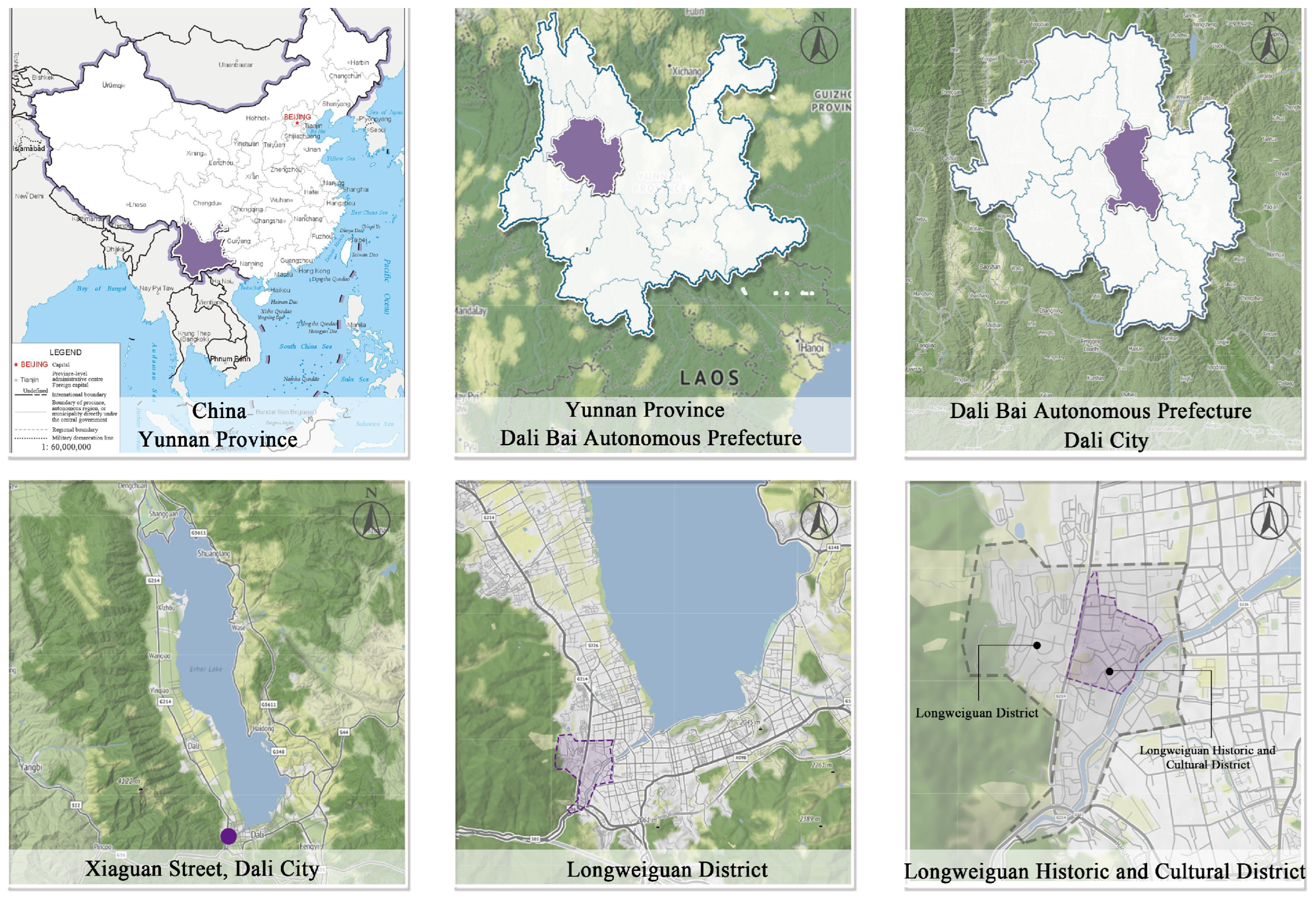
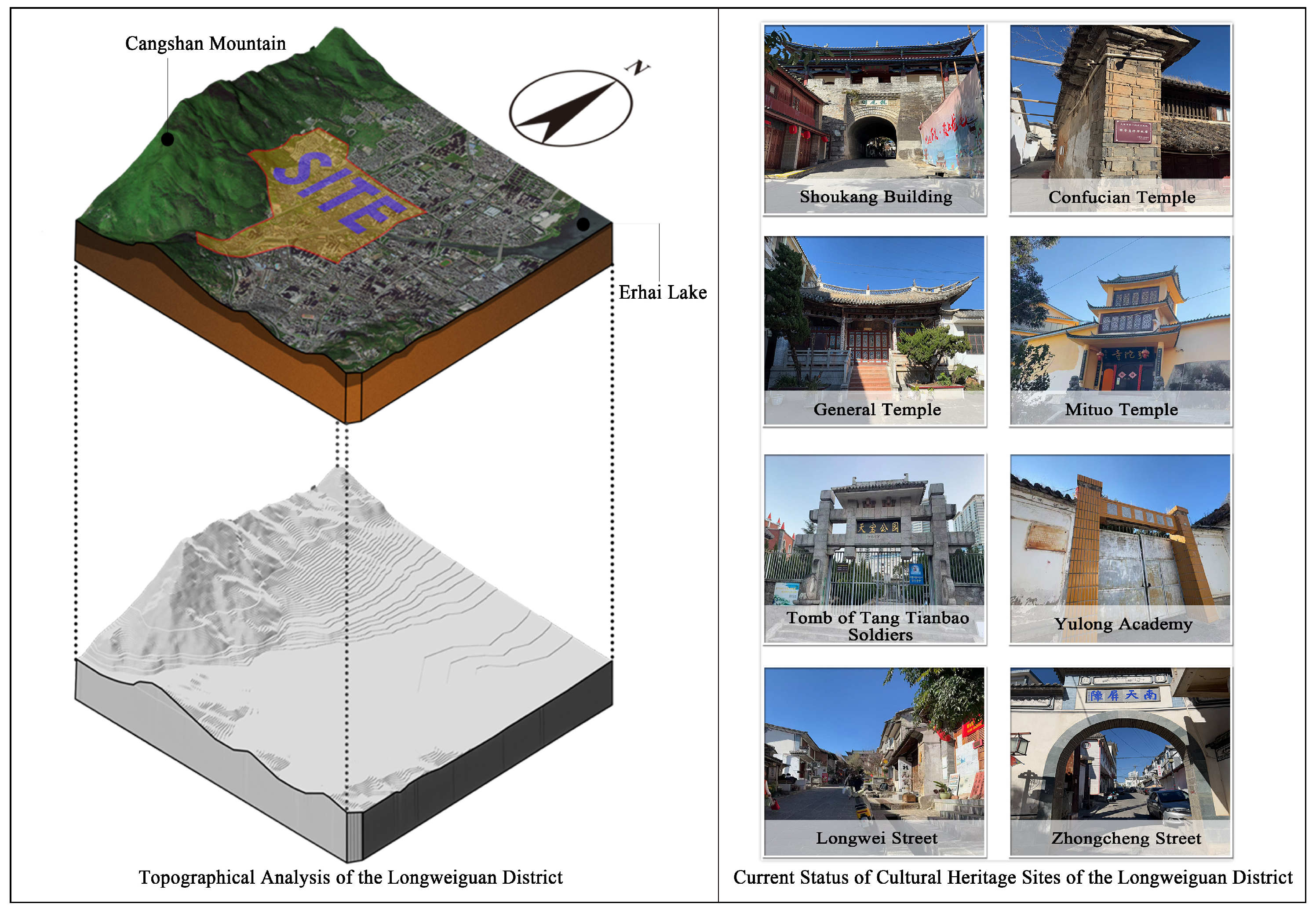
3.1. Research Area
3.2. Definition of Cultural Space Concept
3.2.1. Concept and Type of Cultural Space
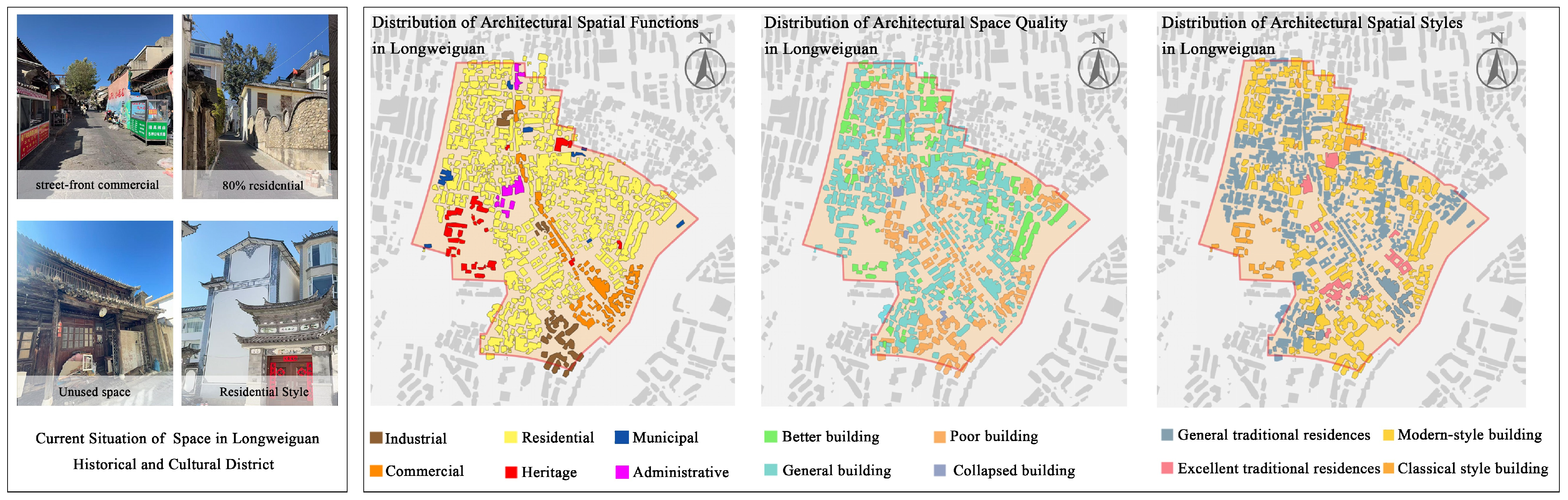
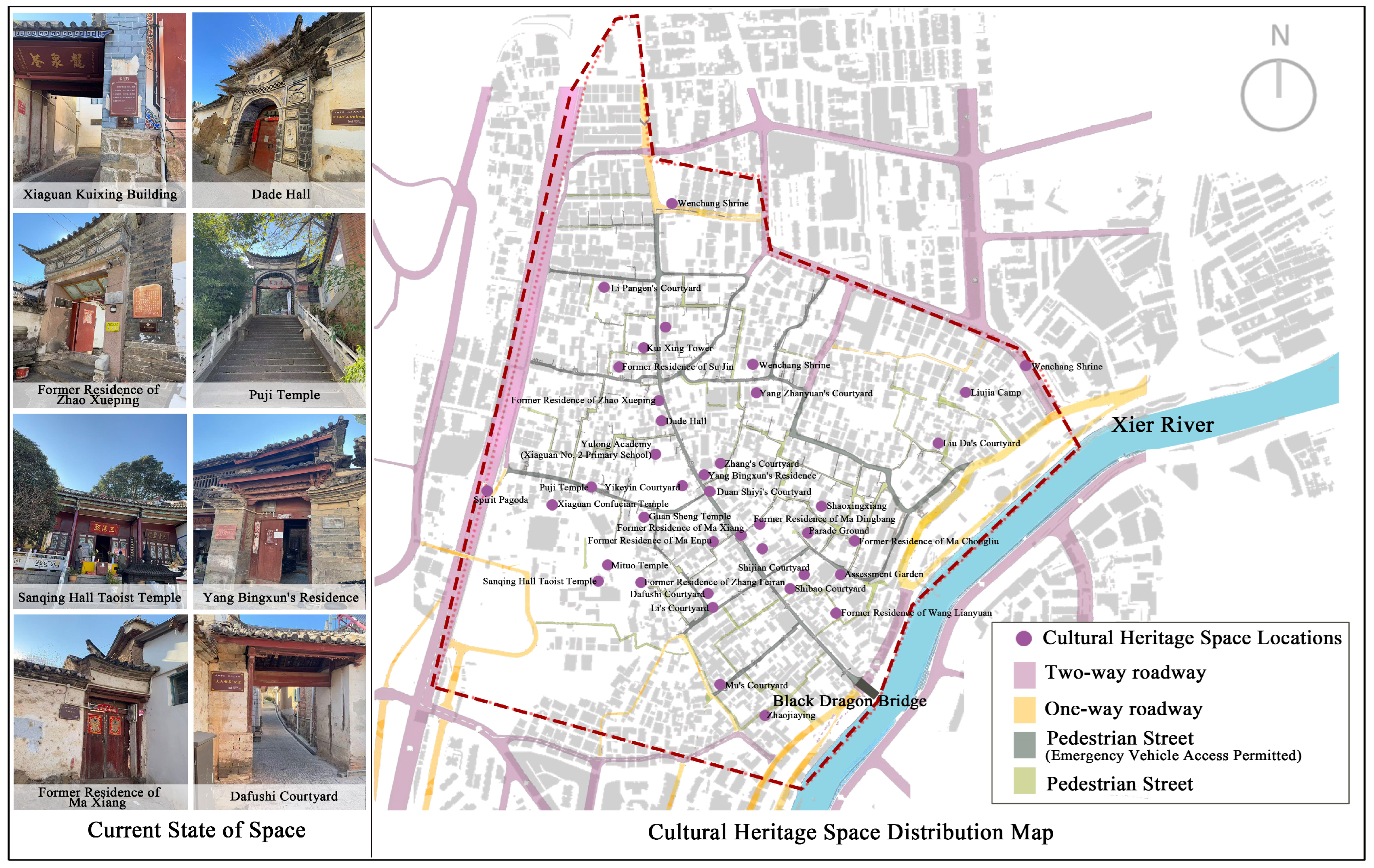
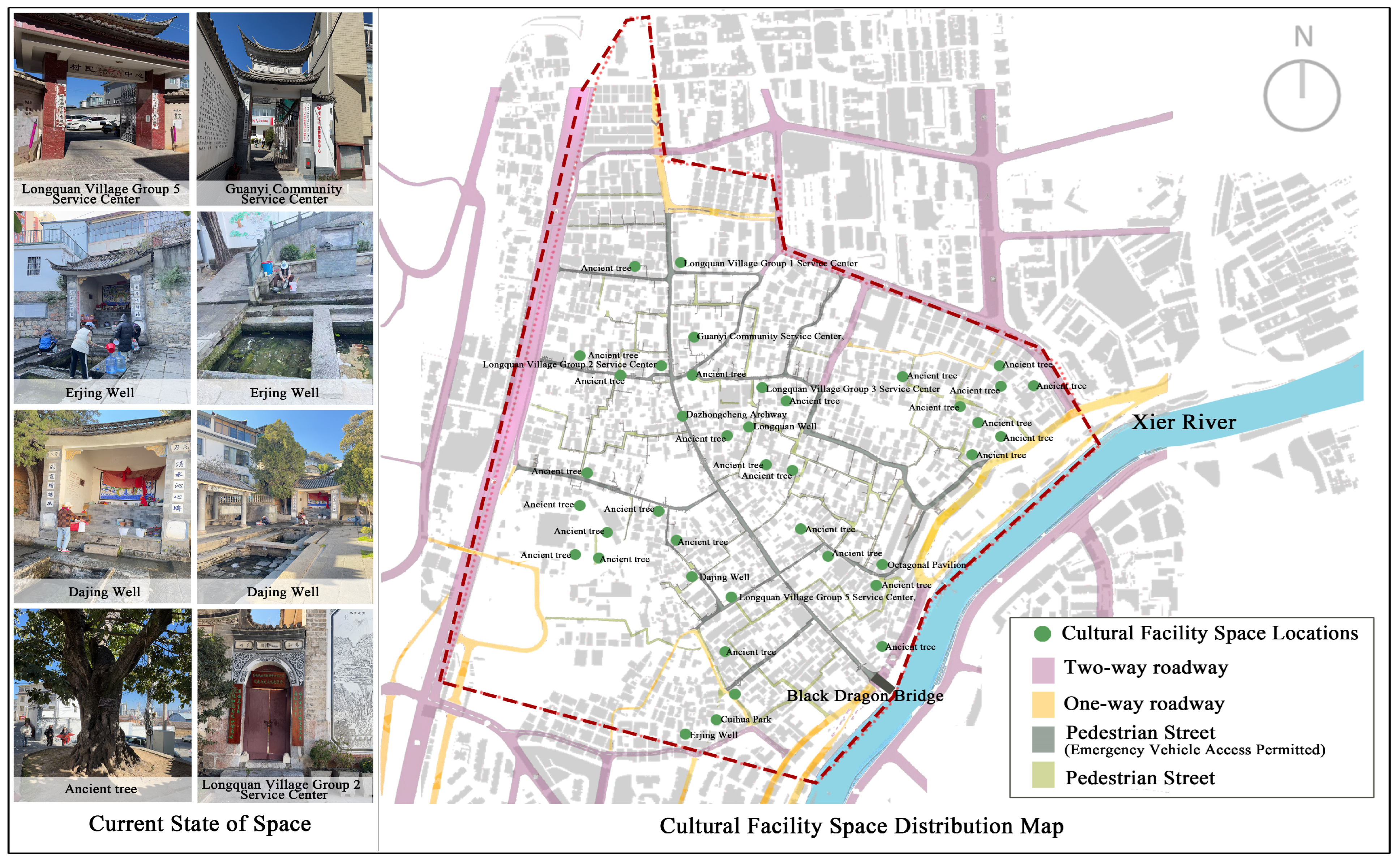
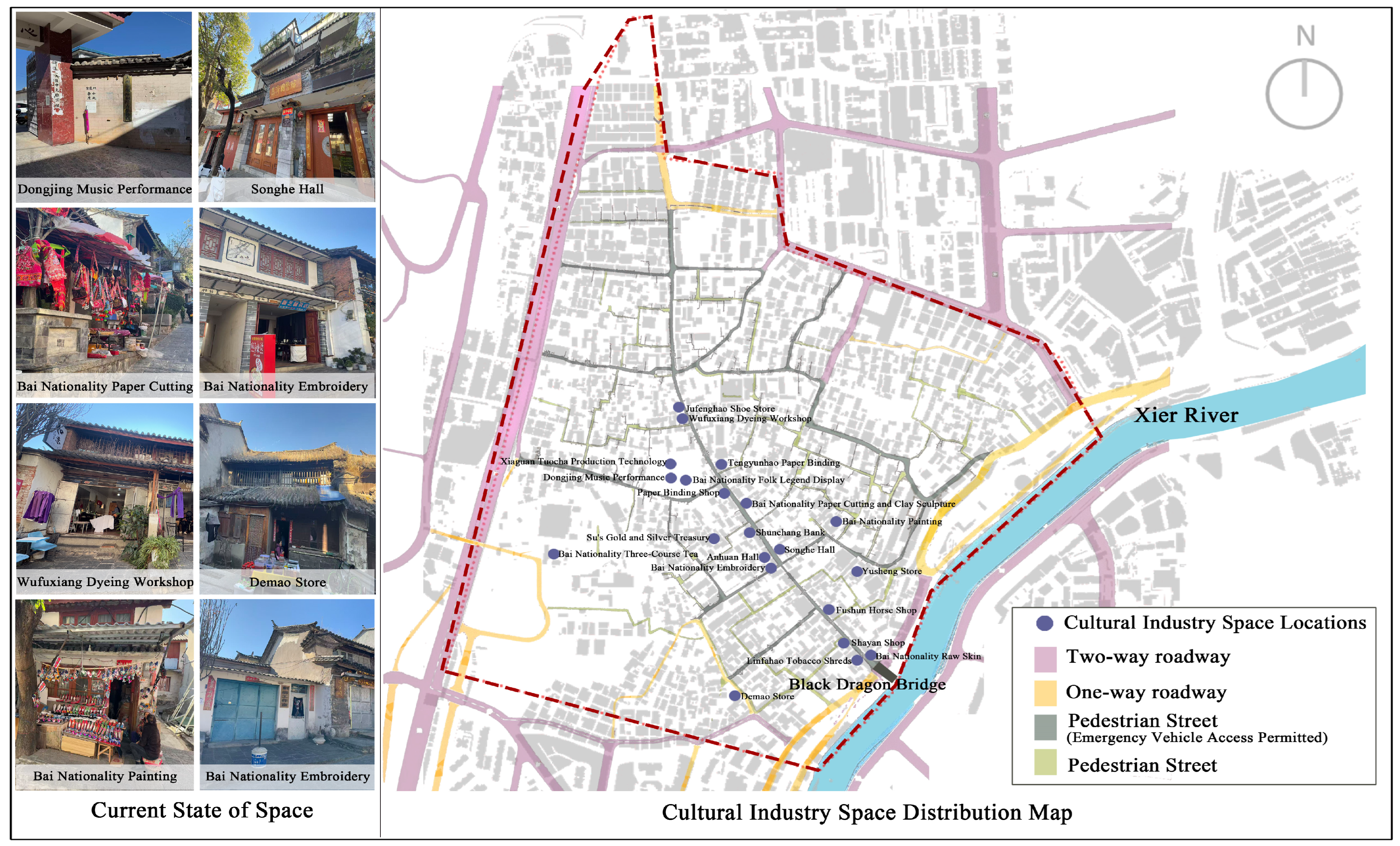
3.2.2. Current Situation of Cultural Spaces in Longweiguan
3.3. Research Methods and Data Collection
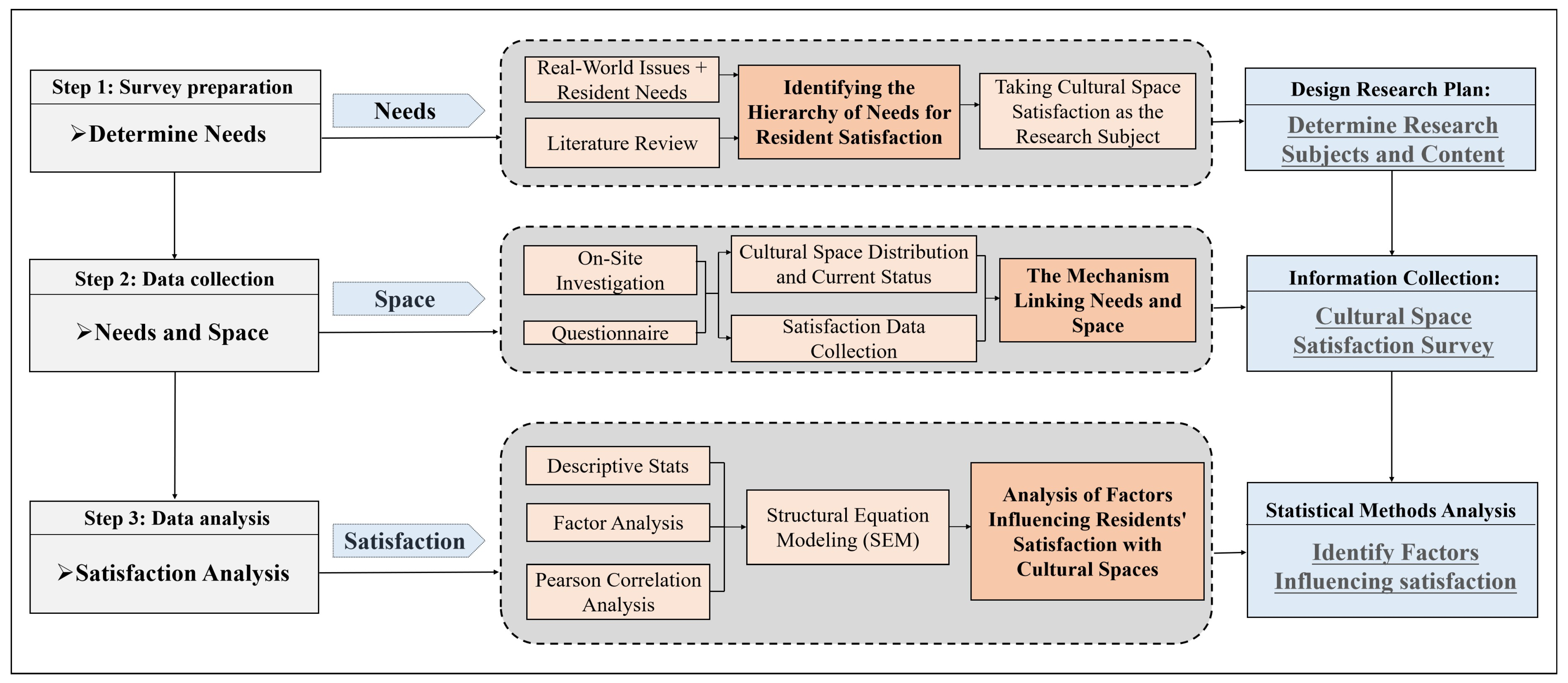
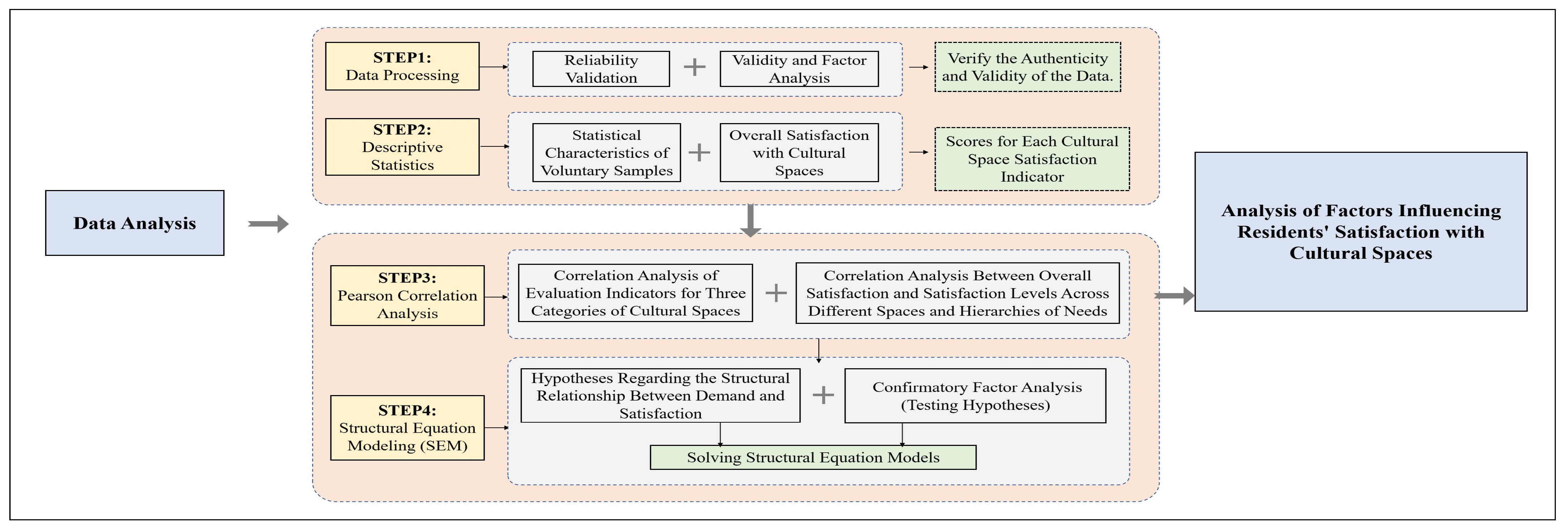
3.3.1. Research Methods
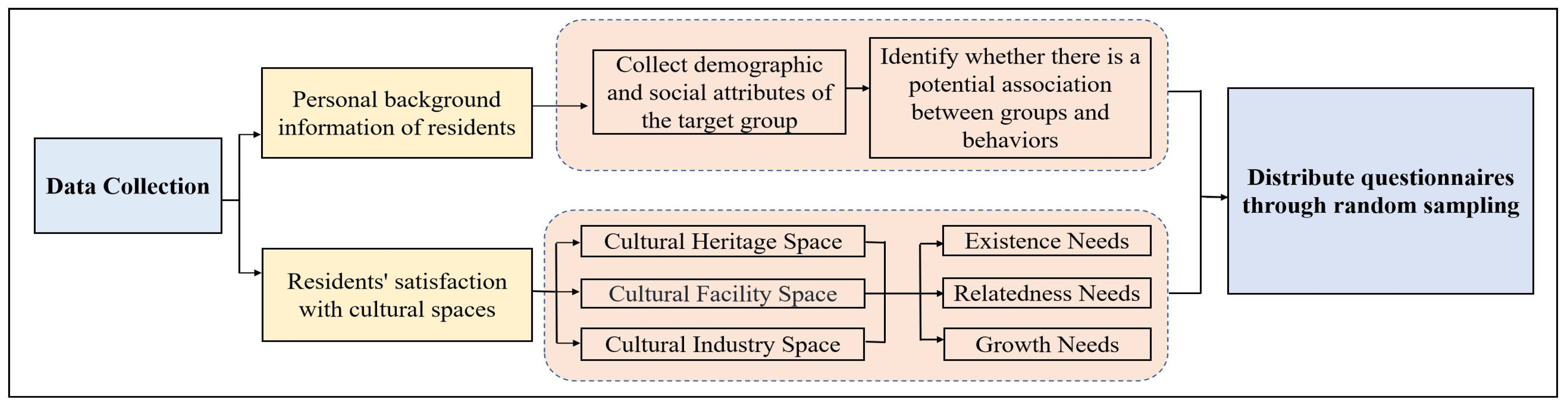
3.3.2. Data Collection
3.4. Analysis of Residents’ Needs and Satisfaction Connection Mechanism Based on ERG Theory
3.4.1. Manifestations of Residents’ Needs for Cultural Spaces Under ERG Theory
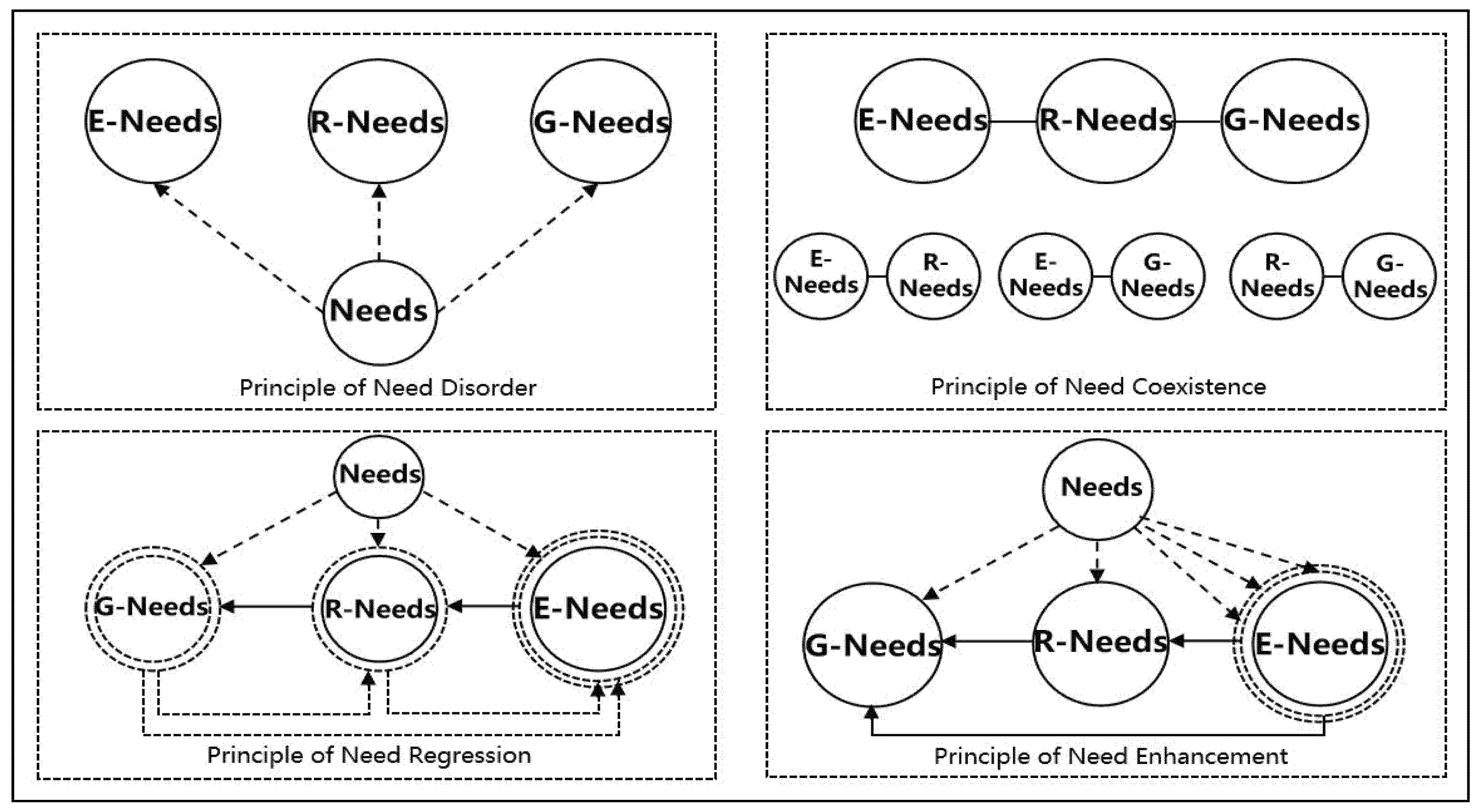
3.4.2. Applicability of ERG Theory Principles to Residents’ Needs Characteristics
3.4.3. Connection Path Between Need Satisfaction and Residents’ Satisfaction
3.5. Construction of Evaluation System
4. Results and Analysis
4.1. Data Reliability Verification
4.2. Validity and Factor Analysis
4.3. Measurement of Current Satisfaction Status with Cultural Spaces
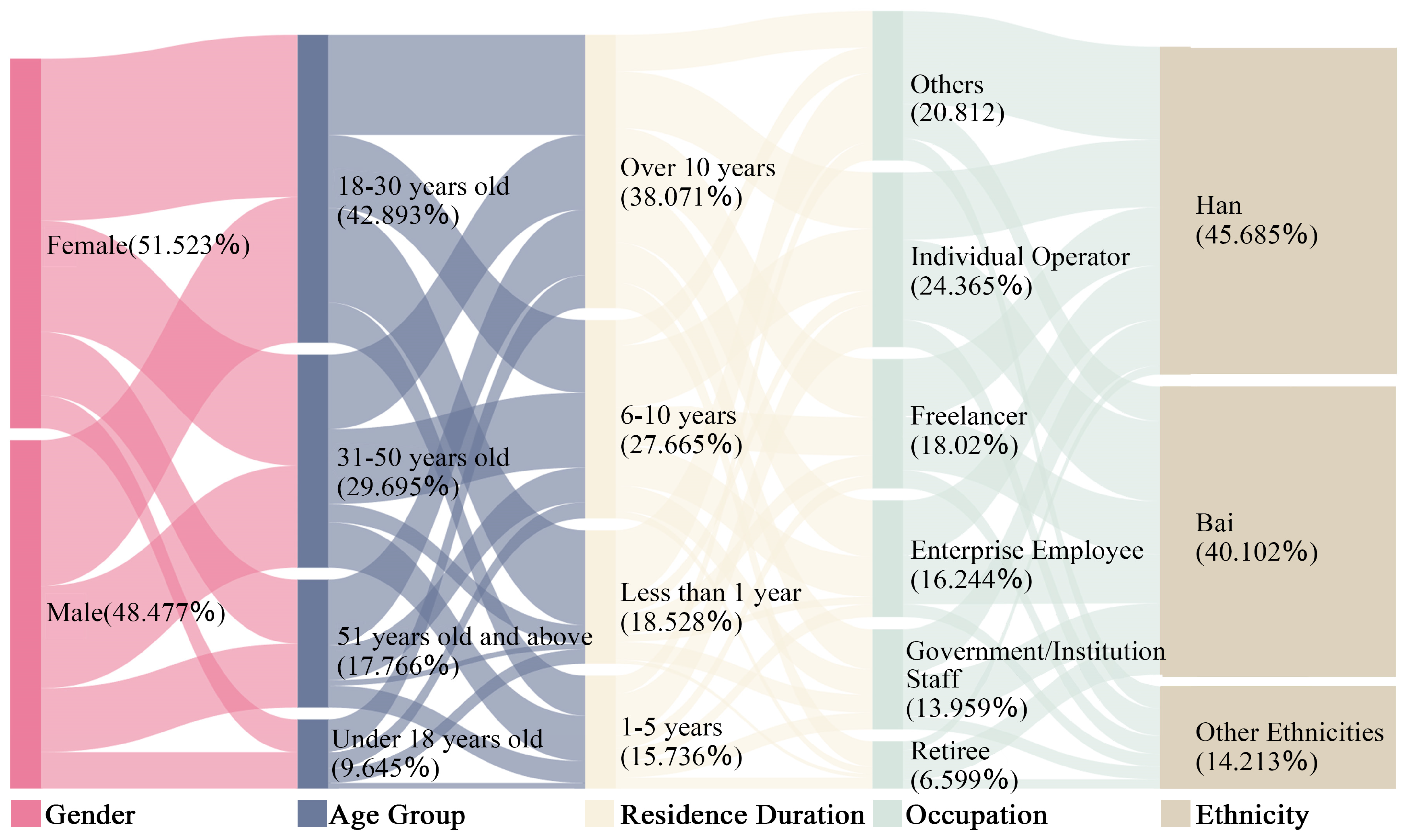
4.3.1. Statistical Characteristics of Voluntary Samples
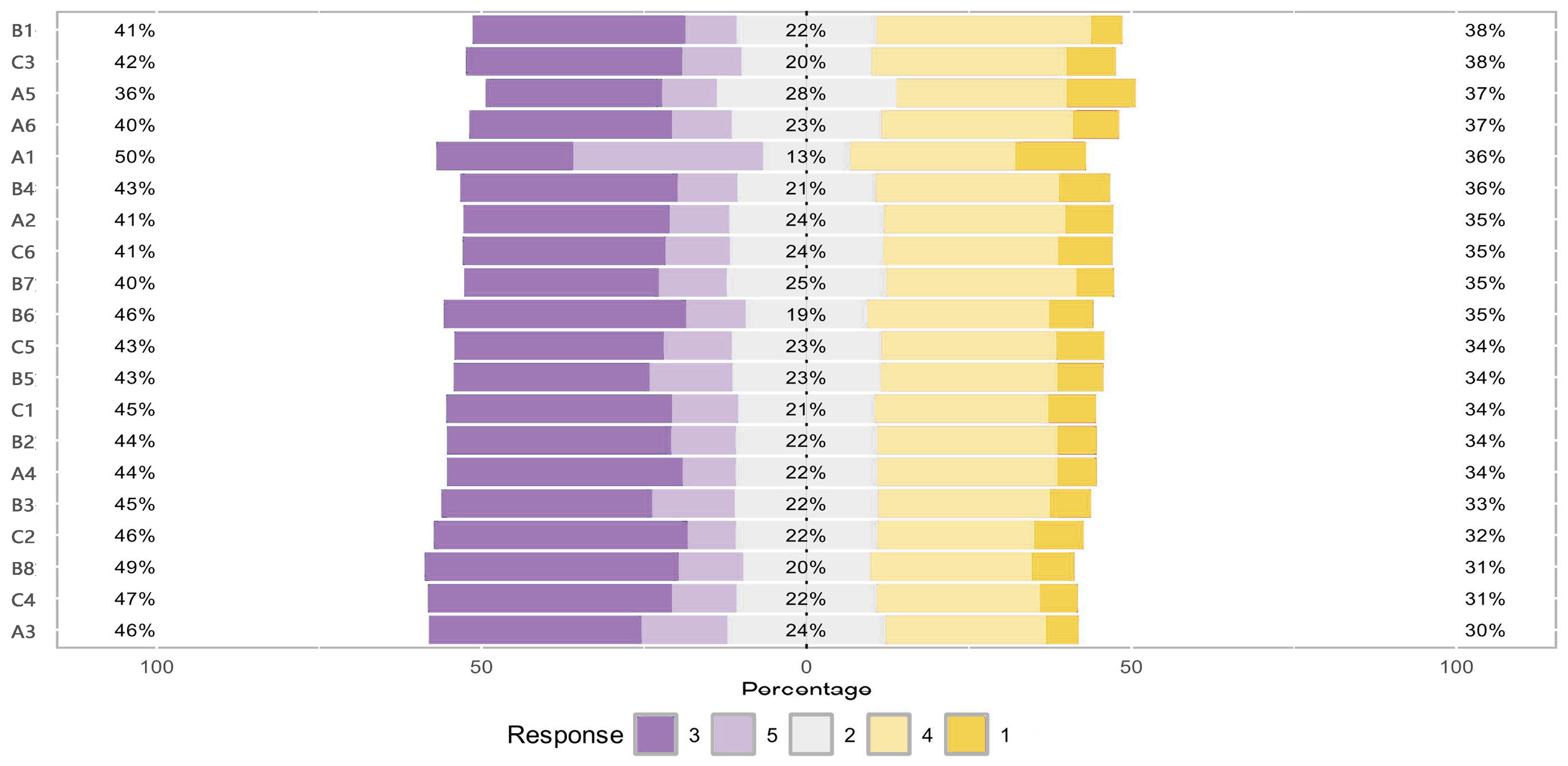
4.3.2. Overall Characterization of Satisfaction
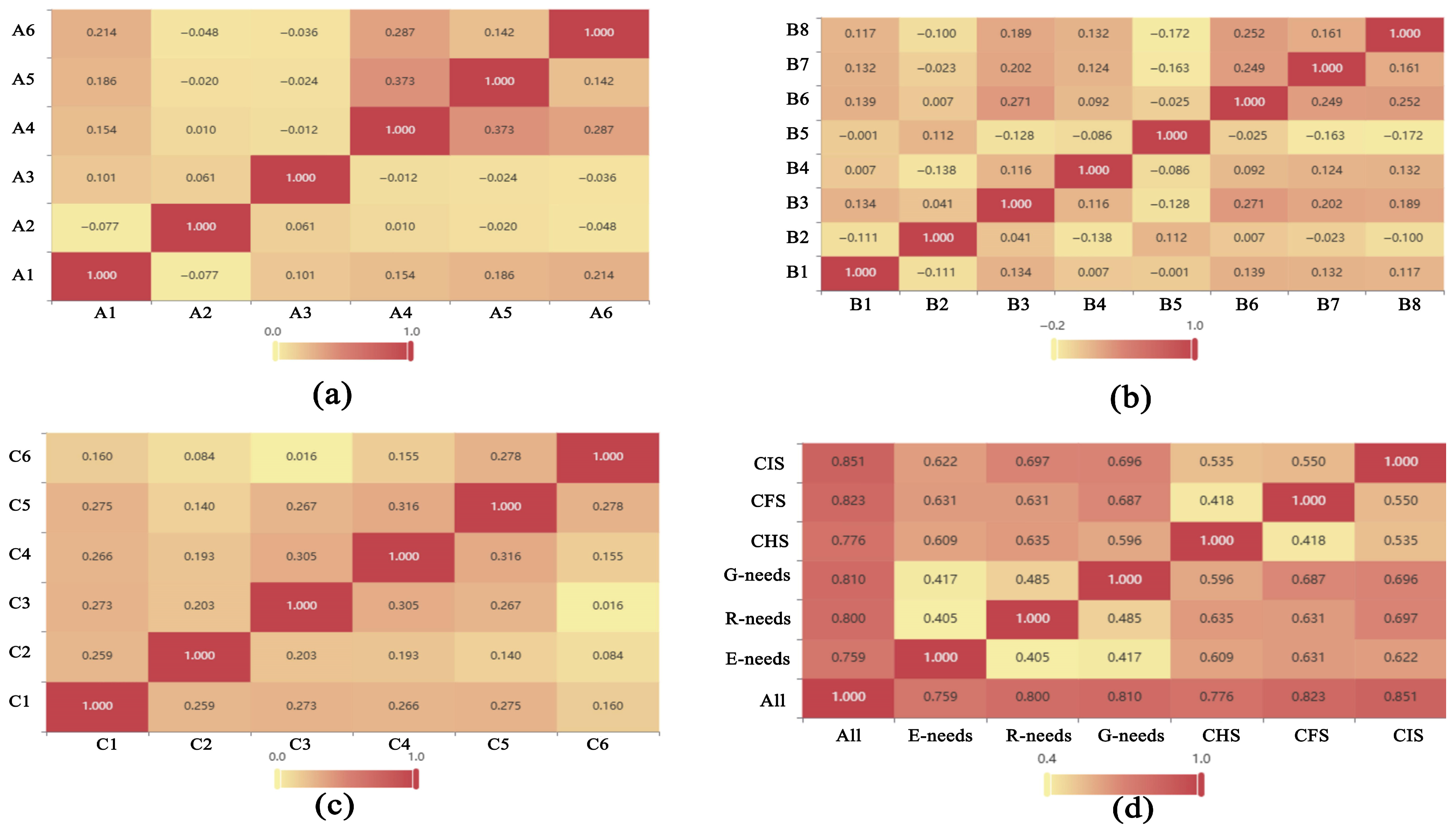
4.4. Correlation Analysis of Residents’ Satisfaction
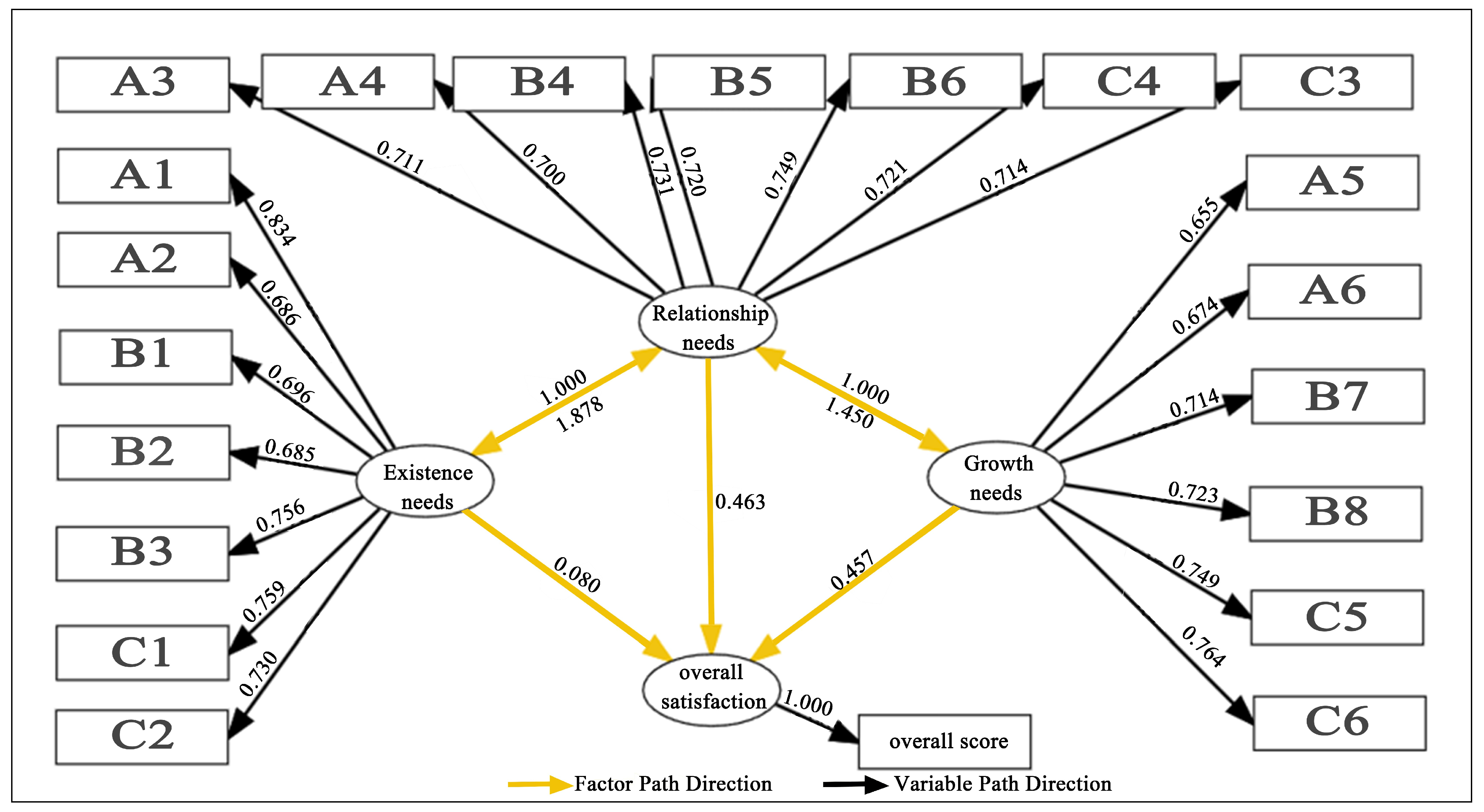
4.5. Establishment and Analysis of Structural Equation Modeling (SEM)
4.5.1. Establishment of SEM
4.5.2. Confirmatory Factor Analysis
4.5.3. Solution of SEM
4.5.4. Analysis of Influencing Factors on Residents’ Satisfaction with Cultural Spaces
5. Discussion
5.1. Research Findings
5.2. Optimization Strategies
5.3. Limitations
- (1)
- Single-case Analysis of the Study: The research samples are concentrated in the specific area of Longweiguan, making it difficult to cover the differences in needs of districts with different levels of commercial development and historical and cultural accumulation.
- (2)
- Absence of Longitudinal Data: This study uses cross-sectional data for analysis, which can only capture the demand status of residents in the Longweiguan Historic District at a specific time node and cannot reflect the dynamic evolution process of needs over time.
- (3)
- Reliance on Self-reported Perceptions: The measurement of some indicators (such as B8 Cultural Innovation) relies on residents’ subjective perceptions, which are affected by factors such as residents’ age and educational level. It is difficult to fully judge residents’ true satisfaction, and there is a lack of quantitative data support for objective innovation achievements.
- (4)
- Potential Impact of Seasonal or Tourism-related Fluctuations: Longweiguan, as a tourism-oriented historic district, is affected by seasonal tourism fluctuations. The changes in tourist flow, commercial activities, and living environment may influence residents’ demands and satisfaction, which is not considered in this study.
6. Conclusions
- (1)
- Residents’ overall satisfaction with cultural spaces is above average. Among the demand levels, relatedness needs have the strongest driving effect on satisfaction, which is directly related to the social and emotional value carried by historic districts. However, the satisfaction with growth needs is the lowest, exposing the inadequacy of spaces in meeting residents’ demands for self-improvement.
- (2)
- Existence needs directly affect satisfaction through basic elements such as spatial safety and indirectly strengthen relatedness needs through the path of “safety foundation to social willingness”. This confirms that the demand levels are not isolated but have a linkage effect.
- (3)
- Cultural industry spaces have become a bottleneck for improving satisfaction due to the disconnection between innovative practices and residents’ participation. Cultural industry spaces should be the core carriers for activating growth needs. However, due to the lack of synergy between innovative initiatives and residents’ engagement, they fail to effectively meet the demands of original residents. This not only reduces the satisfaction with growth needs but also becomes a key obstacle restricting the improvement of overall satisfaction.
Author Contributions
Funding
Institutional Review Board Statement
Informed Consent Statement
Data Availability Statement
Acknowledgments
Conflicts of Interest
Abbreviation
| SEM | Structural Equation Modeling |
Appendix A

| Indicator | Indicator Description |
|---|---|
| A1 Spatial Safety | Sound building structure and complete fire-fighting facilities |
| A2 Supporting Completeness | Equipped with rest areas, sanitation facilities, barrier-free facilities, etc. |
| A3 Cultural Identity | Display local historical culture and traditional crafts to enhance residents’ pride and identity in local culture |
| A4 Social Interaction | Provide venues and opportunities for people to communicate and interact |
| A5 Cultural Education | Possess educational functions, using new communication technologies to enable people to deeply understand historical and cultural knowledge through exhibitions, explanations, etc. |
| A6 Cultural Utilization | Innovative utilization of cultural heritage spaces, transformed into venues with modern cultural functions |
| B1 Spatial Practicality | Reasonable spatial layout, clear division of functional areas, and complete facilities |
| B2 Traffic Accessibility | Convenient transportation between the space and residents’ residences, easily accessible location, and sufficient parking spaces |
| B3 Spatial Comfort | A comfortable environment that allows residents to feel physically and mentally pleasant when participating in activities and willing to stay for a long time |
| B4 Social Diversity | Provide various types of cultural activities to meet the interests and hobbies of different residents |
| B5 Cultural Sharing | Cultural resources and tools are open to residents with a sound sharing mechanism |
| B6 Cultural Cohesion | Attract a large number of residents to participate, promote communication and cooperation among residents, and enhance cultural cohesion |
| B7 Cultural Improvement | Cultural activities can help residents learn new skills, improve personal abilities, and achieve self-growth |
| B8 Cultural Innovation | Integration of diverse cultures and organization of creative activities |
| C1 Economic Effectiveness | Provide employment opportunities, increase residents’ income, and drive economic development |
| C2 Spatial Applicability | Comfortable and safe working environment for traditional handicraft workshops, with good tools and equipment, and workplaces meeting safety standards |
| C3 Cultural Participation | Residents’ participation in traditional handicraft inheritance activities and cultural popularization activities |
| C4 Cultural Belonging | Residents are proud of traditional handicraft workshops and intangible cultural heritage inheritance, willing to recommend them to the outside world, and have a strong sense of identity |
| C5 Cultural Inheritance | Provide inheritance spaces for traditional craftsmen, with organized master–apprentice inheritance activities or skill displays |
| C6 Innovative Development | Development of cultural and creative products inspired by ethnic culture, transformation of traditional handicraft workshops and time-honored stores |
References
- Ye, J.; Li, S.; Chen, Y.; Ma, Y.; Chen, L.; He, T.; Zheng, Y. A Study of the Effects of Historical Block Context on Soundscape Perception. Buildings 2024, 14, 621. [Google Scholar] [CrossRef]
- Song, Y.; Han, C.; Zhao, Y. A Study on Tourist Satisfaction Based on the Conservation and Reuse of Alleyway Spaces in Urban Historic Neighborhoods. Buildings 2024, 14, 1324. [Google Scholar] [CrossRef]
- Aloshan, M.; Elghonaimy, I.; Mesbah, E.; Gharieb, M.; Heba, K.M.; Alhumaid, M.H. Strategies for the Preservation of Historic Areas within Existing Middle Eastern Cities: The Case of Historic Jeddah. Buildings 2024, 14, 717. [Google Scholar] [CrossRef]
- Yang, W.; Fan, B.; Tan, J.; Lin, J.; Shao, T. The spatial perception and spatial feature of rural cultural landscape in the context of rural tourism. Sustainability 2022, 14, 4370. [Google Scholar] [CrossRef]
- Lou, S.; Chen, Y.; Feng, J.; Zhang, L. Reconstruction of rural cultural space and planning base on the perspective of “Social-Spatial” theory: A case study in Zhuma Township, Zhejiang Province. Buildings 2025, 15, 671. [Google Scholar] [CrossRef]
- Zhang, X.; Ren, Y.; Lv, J.; Geng, Y.; Su, C.; Ma, R. Morphological Evolution and Socio-Cultural Transformation in Historic Urban Areas: A Historic Urban Landscape Approach from Luoyang, China. Buildings 2025, 15, 1373. [Google Scholar] [CrossRef]
- Zhang, F.; Zhang, P.; Wu, M.; Wang, T.; Gao, L.; Cheng, Y. Study on the Demand and Supply of Cultural Space for Different Groups of People from the Perspective of Sustainable Community Development: A Case Study from the Hanzhong Section of the Hanjiang River Basin, China. Buildings 2024, 14, 987. [Google Scholar] [CrossRef]
- Jiang, Y.; Chen, L.; Xie, Y.; Li, Y.; Li, T. subjective well-being of historical neighborhood residents in Beijing: The impact on the residential environment. Sustainability 2023, 15, 1847. [Google Scholar] [CrossRef]
- Nomura, R.; Shan, S.; Mori, S. Analyzing spatial structure of traditional houses in old towns with tourism development and its transformation toward sustainable development of residential environments in Hexia Old Town, in China. Sustainability 2018, 10, 3809. [Google Scholar] [CrossRef]
- Caulton, J.R. The development and use of the theory of ERG: A literature review. Emerg. Leadersh. Journeys 2012, 5, 2–8. [Google Scholar]
- Liu, Y. ERG Theory. In The ECPH Encyclopedia of Psychology; Springer: Berlin/Heidelberg, Germany, 2025; pp. 477–478. [Google Scholar]
- Farhad, S.; Maghsoodi Tilaki, M.J.; Hedayati Marzbali, M. Architectural identity and place attachment in historic neighbourhoods: An empirical study in Sanandaj, Iran. J. Place Manag. Dev. 2021, 14, 148–162. [Google Scholar] [CrossRef]
- Lewicka, M. Place attachment, place identity, and place memory: Restoring the forgotten city past. J. Environ. Psychol. 2008, 28, 209–231. [Google Scholar] [CrossRef]
- Ji, X.; Du, Y.; Li, Q. How does the historic built environment influence residents’ satisfaction? Using gradient boosting decision trees to identify critical factors and the threshold effects. Sustainability 2024, 16, 120. [Google Scholar] [CrossRef]
- Zhang, D.; Xu, S. Humanistic needs and satisfaction study of multi-users in historic districts based on cognitive psychology. Psychiatr. Danub. 2021, 33, 681–693. [Google Scholar]
- Cheung, C.; Takashima, M.; Choi, H.; Yang, H.; Tung, V. The impact of COVID-19 pandemic on the psychological needs of tourists: Implications for the travel and tourism industry. J. Travel Tour. Mark. 2021, 38, 155–166. [Google Scholar] [CrossRef]
- McPhee, D.; Julien, M.; Miller, D.; Wright, B. Smudging, connecting, and dual identities: Case study of an aboriginal ERG. Pers. Rev. 2017, 46, 1104–1119. [Google Scholar] [CrossRef]
- Jiali, W.; Tao, Y. Reflections on the Dilemma of Residential Area Regeneration in Historic Districts Based on ERG Theory: A Case Study of Diaoyutai Historic District in Nanjing. China City Plan. Rev. 2025, 34. [Google Scholar] [CrossRef]
- Liu, M.; Shi, Y.; Xu, J.; Huang, Z. Evaluating user experience in cultural tourism settings: A Servicescape–ERG–RIPA model based on resident and tourist perspectives in Suzhou’s Shuangta market. J. Asian Archit. Build. Eng. 2025, 1–21. [Google Scholar] [CrossRef]
- Abusaada, H.; Elshater, A. Improving visitor satisfaction in Egypt’s Heliopolis historical district. J. Eng. Appl. Sci. 2021, 68, 19. [Google Scholar] [CrossRef]
- Mansouri, M.; Ujang, N. Tourist’Expectation and Satisfaction Towards Pedestrian Networks in The Historical District of Kuala Lumpur, Malaysia. Asian Geogr. 2016, 33, 35–55. [Google Scholar] [CrossRef]
- Jiang, W.; Timmermans, H.J. Residential satisfaction in renovated historic blocks in two Chinese cities. Prof. Geogr. 2021, 73, 333–347. [Google Scholar] [CrossRef]
- Davoodi, T.; Dağlı, U.U. Exploring the determinants of residential satisfaction in historic urban quarters: Towards sustainability of the Walled City Famagusta, North Cyprus. Sustainability 2019, 11, 6261. [Google Scholar] [CrossRef]
- Huete Alcocer, N.; López Ruiz, V.R. The role of destination image in tourist satisfaction: The case of a heritage site. Econ. Res.-Ekon. Istraživanja 2020, 33, 2444–2461. [Google Scholar] [CrossRef]
- Pham, T.S.; Tran, T.M.H. Tourist Satisfaction with Heritage Tourism Destinations in Vietnam. In Heritage Tourism: Vietnam and Asia; Springer: Berlin/Heidelberg, Germany, 2025; pp. 121–139. [Google Scholar]
- Hernandez-Rojas, R.D.; del Río, J.A.J.; Fernández, A.I.; Vergara-Romero, A. The cultural and heritage tourist, SEM analysis: The case of The Citadel of the Catholic King. Herit. Sci. 2021, 9, 52. [Google Scholar] [CrossRef]
- Yu, W.; Zhu, H.; Zhang, S. Sustainable development and tourists’ satisfaction in historical districts: Influencing factors and features. J. Resour. Ecol. 2021, 12, 669–681. [Google Scholar] [CrossRef]
- Al-Ali, A.; Maghelal, P.; Alawadi, K. Assessing neighborhood satisfaction and social capital in a multi-cultural setting of an Abu Dhabi neighborhood. Sustainability 2020, 12, 3200. [Google Scholar] [CrossRef]
- Xu, S.; Chen, M.; Yuan, B.; Zhou, Y.; Zhang, J. Resident Satisfaction and Influencing Factors of the Renewal of Old Communities. J. Urban Plan. Dev. 2024, 150, 04023061. [Google Scholar] [CrossRef]
- Mehmood, S.; Liang, C.; Gu, D. Heritage image and attitudes toward a heritage site: Do they really mediate the relationship between user-generated content and travel intentions toward a heritage site? Sustainability 2018, 10, 4403. [Google Scholar] [CrossRef]
- Chen, T.; Luh, D.; Hu, L.; Shan, Q. Exploring factors affecting residential satisfaction in old neighborhoods and sustainable design strategies based on post-occupancy evaluation. Sustainability 2023, 15, 15213. [Google Scholar] [CrossRef]
- Chen, J.; Pellegrini, P.; Wang, H. Comparative residents’ satisfaction evaluation for socially sustainable regeneration—The case of two high-density communities in Suzhou. Land 2022, 11, 1483. [Google Scholar] [CrossRef]
- Gu, S.; Li, J.; Wang, M.; Ma, H. Post-Renewal Evaluation of an Urbanized Village with Cultural Resources Based on Multi Public Satisfaction: A Case Study of Nantou Ancient City in Shenzhen. Land 2023, 12, 211. [Google Scholar] [CrossRef]
- Cai, Y.; Zhou, M.; Wu, Q. Research on the Construction Method of Cultural Visiting Routes Based on the Coupling Coordination Degree Model: A Case Study of Zhongshan Road Historical and Cultural Block, Xiamen, China. Buildings 2024, 14, 4069. [Google Scholar] [CrossRef]
- Jiang, S.; Liu, J. Comparative study of cultural landscape perception in historic districts from the perspectives of tourists and residents. Land 2024, 13, 353. [Google Scholar] [CrossRef]
- Abd Aziz, N.; Muslichah, I.; Ngah, A.H. Understanding factors influencing community life satisfaction towards sustainable heritage tourism destination: The case of Yogyakarta, Indonesia. J. Sustain. Sci. Manag. 2020, 15, 37–51. [Google Scholar]
- Peng, W.; Huang, Y.; Li, C.; Wang, Y. Exploration of Resident Satisfaction and Willingness in the Renovation of a Typical Old Neighborhood. Buildings 2025, 15, 293. [Google Scholar] [CrossRef]
- Chu, H.; Wang, H.; Chen, Y. Tourist Satisfaction Evaluation of Historical and Cultural Neighborhoods Based on Scene Theory. In Proceedings of the 2023 International Conference on Culture-Oriented Science and Technology (CoST), Xi’an, China, 11–14 October 2023; pp. 391–396. [Google Scholar]
- Lu, Y.; He, M.-e.; Liu, C. Tourism competitiveness evaluation model of urban historical and cultural districts based on multi-source data and the AHP method: A case study in Suzhou Ancient City. Sustainability 2023, 15, 16652. [Google Scholar] [CrossRef]
- Zeng, Y.; Chen, B. Evaluation of Aging-Friendly Public Spaces in Old Urban Communities Based on IPA Method—A Case Study of Shouyi Community in Wuhan. Buildings 2024, 14, 2362. [Google Scholar] [CrossRef]
- Wu, Z.; Mao, M.; Yang, J.; Peng, C.; Zha, H. Street Vitality Evaluation of the Mengzi East Street Historical District Based on Space Syntax and POI Big Data. Buildings 2025, 15, 2896. [Google Scholar] [CrossRef]
- Rasoolimanesh, S.M.; Seyfi, S.; Rather, R.A.; Hall, C.M. Investigating the mediating role of visitor satisfaction in the relationship between memorable tourism experiences and behavioral intentions in heritage tourism context. Tour. Rev. 2022, 77, 687–709. [Google Scholar] [CrossRef]
- Kline, P. An Easy Guide to Factor Analysis; Routledge: London, UK, 2014. [Google Scholar]
- Qi, Y.; Yue, L.; Guo, T.; Zhou, D.; Ren, Y.; Wang, M.; Liu, Y.; Yang, Y. A Study on the Perception of Local Characteristics in Cultural Street Vending Spaces, Taking Xi’an Baxian Temple as an Example. Buildings 2024, 14, 192. [Google Scholar] [CrossRef]
- Benesty, J.; Chen, J.; Huang, Y.; Cohen, I. Pearson correlation coefficient. In Noise Reduction in Speech Processing; Springer: Berlin/Heidelberg, Germany, 2009; pp. 1–4. [Google Scholar]
- Ullman, J.B.; Bentler, P.M. Structural equation modeling. In Handbook of Psychology, 2nd ed.; Wiley Online Library: Hoboken, NJ, USA, 2012; p. 2. [Google Scholar]
- Hu, X.; Nakayama, T. Empirical Research on the Life Satisfaction and Influencing Factors of Users of Community-Embedded Elderly Care Facilities. Buildings 2025, 15, 894. [Google Scholar] [CrossRef]
- Chen, J.; Li, X.; Chen, J.; Xu, L.; Feng, H.; Zhu, R. Identifying and Prioritising Public Space Demands in Historic Districts: Perspectives from Tourists and Local Residents in Yangzhou. Land 2025, 14, 1921. [Google Scholar] [CrossRef]
- Lee, S.-W.; Seow, C.-W.; Xue, K. Residents’ sustainable city evaluation, satisfaction and loyalty: Integrating importance-performance analysis and structural equation modelling. Sustainability 2021, 13, 6766. [Google Scholar] [CrossRef]
- Li, Y.; Tang, H. Health-Oriented Evaluation and Optimization of Urban Square Space Elderly Suitability: A Case Study of Yiyang City Center. Buildings 2024, 14, 2482. [Google Scholar] [CrossRef]
- Ma, Y.; Wang, S.; Wang, Z.; Chen, G. Contemporary demands of scenes in urban historic conservation areas: A case study of subjective evaluations from Foshan, China. Buildings 2024, 14, 2837. [Google Scholar] [CrossRef]
- Chen, Z.; Jin, M.; Zuo, Y.; Ding, P.; Shi, X. The Effect of Soundscape on Sense of Place for Residential Historical and Cultural Areas: A Case Study of Taiyuan, China. Buildings 2024, 14, 1394. [Google Scholar] [CrossRef]
- Gong, C.; Ran, R.; Hu, C. Cognitive Differences Between Residents and Merchants in Ciqikou Mountainous Historic Districts Oriented by the Living Development–Authenticity Preservation Framework. Buildings 2025, 15, 3274. [Google Scholar] [CrossRef]
- Liu, C.; Zhao, J. Research on the Evaluation System of Urban Street Alfresco Spaces Based on an AHP–Entropy Method: A Case Study of Daxue Road in Shanghai. Buildings 2025, 15, 2840. [Google Scholar] [CrossRef]
- Huang, D.; Gong, W.; Wang, X.; Liu, S.; Zhang, J.; Li, Y. A Cognition–Affect–Behavior Framework for Assessing Street Space Quality in Historic Cultural Districts and Its Impact on Tourist Experience. Buildings 2025, 15, 2739. [Google Scholar] [CrossRef]
- She, H.; Sun, J.; Zeng, Y.; Tu, W.; Ao, G.; Shang, W. Walkability Evaluation of Historical and Cultural Districts Based on Multi-Source Data: A Case Study of the Former Russian Concession in Hankou. Buildings 2025, 15, 1603. [Google Scholar] [CrossRef]
- He, J.; Zhou, D.; Dai, J. Study on Evaluation System of Urban Elderly Living Related Facilities Based on Demand Theories. Archit. J. 2020, 2, 37–44. [Google Scholar]
- Zhang, F.; Qin, X.; Song, P.; Liu, W.; Qian, H.; Qiu, B. Cultural Mapping and Evaluation of Old Urban Open Spaces: A Case Study of Nanjing’s Old City, China. Buildings 2025, 15, 3318. [Google Scholar] [CrossRef]
- Yang, Y.; Du, S.; Xiao, Y. Identification of Spatial Influencing Factors and Enhancement Strategies for Cultural Tourism Experience in Huizhou Historic Districts. Buildings 2025, 15, 1568. [Google Scholar] [CrossRef]
- Bykowa, E.; Dyachkova, I. Modeling the size of protection zones of cultural heritage sites based on factors of the historical and cultural assessment of lands. Land 2021, 10, 1201. [Google Scholar] [CrossRef]
- He, C.; Liang, Y.-W.; Zhang, S.-Y. A Study on the Spatial Structures and Mechanisms of Intangible Cultural Heritage and Traditional Villages in the Dongting Lake Basin. Buildings 2024, 14, 1736. [Google Scholar] [CrossRef]


| Type | Value | Concept | Representative Form |
|---|---|---|---|
| Cultural Heritage Space | Historical and Cultural Value | Historical and cultural heritages with preservation value and their related spaces | ancient ruins, ancient buildings, former residences of celebrities, temples, churches, etc. |
| Cultural Facility Space | Public Service Value | Various places and community cultural centers that meet the daily needs of residents’ public cultural life | activity centers, community parks, squares, ancient wells, famous ancient trees |
| Cultural Industry Space | Practical Inheritance Value | Business and inheritance places led by cultural exploration, inheritance, creativity, and transformation | traditional handicraft workshops, time-honored stores, intangible cultural heritage inheritance venues |
| Cultural Space | Quantity | Name |
|---|---|---|
| Cultural Heritage Space | 40 | Shoukang Building, Xiaguan Kuixing Building, Former Residence of Ma Chongliu, Parade Ground, Former Residence of Zhao Xueping, Yulong Academy, Guansheng Temple, Assessment Garden, Li Pangen’s Courtyard, Former Residence of Su Jin, Yang Zhanyuan’s Courtyard, Dade Hall, Zhang’s Courtyard, Yikeyin Courtyard, Yang Bingxun’s Residence, Duan Shiyi’s Courtyard, Site of Former Residence of Ma Enpu, Former Residence of Ma Xiang, Former Residence of Ma Dingbang, Former Residence of Zhang Feiran, Dafushi Courtyard, Li’s Courtyard, Shibao Courtyard, Shaoxingxiang, Shijian Courtyard, Former Residence of Wang Lianyuan, Mu’s Courtyard, Zhaojiaying, Liu Da’s Courtyard, Liujia Camp, Wenchang Shrine (3), Christian Church, Xiaguan Confucian Temple, Puji Temple, Mituo Temple, Spirit Pagoda, Sanqing Hall Taoist Temple |
| Cultural Facility Space | 39 | Octagonal Pavilion, Dajing Well, Erjing Well, Longquan Well, Dazhongcheng Archway, Cuihua Park, Longquan Village Group 5 Service Center, Longquan Village Group 3 Service Center, Guanyi Community Service Center, Longquan Village Group 1 Service Center, Longquan Village Group 2 Service Center, 28 Ancient Trees |
| Cultural Industry Space | 21 | Jufenghao Shoe Store, Wufuxiang Dyeing Workshop, Tengyunhao Paper Binding, Shunchang Bank, Su’s Gold and Silver Treasury, Songhe Hall, Anhuan Hall, Yusheng Store, Fushun Horse Shop, Shayan Shop, Linfahao Tobacco Shreds, Demao Store, Paper Binding Shop, Intangible Cultural Heritage Inheritance and Display Venues (Xiaguan Tuocha Production Technology, Dongjing Music Performance, Bai Nationality Folk Legend Display, Bai Nationality Three-Course Tea, Bai Nationality Paper Cutting and Clay Sculpture, Bai Nationality Painting, Bai Nationality Embroidery, Bai Nationality Raw Skin) |
| Type Layer | Criterion Layer | Indicator Layer | Indicator Reference Sources |
|---|---|---|---|
| A Cultural Heritage Space | Existence Needs | A1 Spatial Safety | Chen Jizhou, (2025) [48]; Say-Wah Lee, (2021) [49]; Gu Siming, (2023) [33]; Li Yuhua, (2024) [50] |
| A2 Supporting Completeness | Chen Jizhou, (2025) [48]; Ma Yue, (2024) [51]; Liu Mingyuan, (2025) [19]; Say-Wah Lee, (2021) [49] | ||
| Relatedness Needs | A3 Cultural Identity | Ma Yue, (2024) [51]; Chen Zichu, (2024) [52]; Say-Wah Lee, (2021) [49] | |
| A4 Social Interaction | Chen Jizhou, (2025) [48]; Liu Mingyuan, (2025) [19]; Gu Siming, (2023) [33] | ||
| Growth Needs | A5 Cultural Education | Ma Yue, (2024) [51]; Say-Wah Lee, (2021) [49]; Gu Siming, (2023) [33] | |
| A6 Cultural Utilization | Ma Yue, (2024) [51]; Davoodi Tina, (2019) [23] | ||
| B Cultural Facility Space | Existence Needs | B1 Spatial Practicality | Ma Yue, (2024) [51]; Liu Mingyuan, (2025) [19]; Gong Cong, (2025) [53]; Liu Chenxi, (2025) [54] |
| B2 Traffic Accessibility | Chen Jizhou, (2025) [48]; Ma Yue, (2024) [51]; Gong Cong, (2025) [53]; Huang Dongsheng, (2025) [55] | ||
| B3 Spatial Comfort | Chen Jizhou, (2025) [48]; Liu Mingyuan, (2025) [19]; Davoodi Tina, (2019) [23]; She Haoran, (2025) [56] | ||
| Relatedness Needs | B4 Social Diversity | Ma Yue, (2024) [51]; Liu Mingyuan, (2025) [19]; He Jing, (2020) [57]; Say-Wah Lee, (2021) [49] | |
| B5 Cultural Sharing | Ma Yue, (2024) [51]; Davoodi Tina, (2019) [23]; Ji Xian, (2024) [14] | ||
| B6 Cultural Cohesion | He Jing, (2020) [57]; Ji Xian, (2024) [14]; Zhang Fan, (2025) [58] | ||
| Growth Needs | B7 Cultural Improvement | Liu Mingyuan, (2025) [19]; Gong Cong, (2025) [53]; Davoodi Tina, (2019) [23]; Yang Yue, (2025) [59] | |
| B8 Cultural Innovation | Liu Mingyuan, (2025) [19]; Say-Wah Lee, (2021) [49]; Gu Siming, (2023) [33] | ||
| C Cultural Industry Space | Existence Needs | C1 Economic Effectiveness | Ma Yue, (2024) [51]; Elena Bykowa, (2021) [60]; Gu Siming, (2023) [33] |
| C2 Spatial Applicability | Chen Jizhou, (2025) [48]; Liu Mingyuan, (2025) [19]; Elena Bykowa, (2021) [60] | ||
| Relatedness Needs | C3 Cultural Participation | Ma Yue, (2024) [51]; Say-Wah Lee, (2021) [49] | |
| C4 Cultural Belonging | Liu Mingyuan, (2025) [19]; Chen Zichu, (2024) [52] | ||
| Growth Needs | C5 Cultural Inheritance | Say-Wah Lee, (2021) [49]; Elena Bykowa, (2021) [60]; Gu Siming, (2023) [33] | |
| C6 Innovative Development | Ma Yue, (2024) [51]; Liu Mingyuan, (2025) [19]; Gong Cong, (2025) [53] |
| Dimension | Cronbach’s α Coefficient | Standardized Cronbach’s α Coefficient | Number of Items | Sample Size |
|---|---|---|---|---|
| Cultural heritage space | 0.855 | 0.854 | 6 | 394 |
| Cultural facilities space | 0.892 | 0.893 | 8 | 394 |
| Cultural industries space | 0.877 | 0.877 | 6 | 394 |
| Overall | 0.953 | 0.953 | 20 | 394 |
| KMO Test and Bartlett’s Test | ||
|---|---|---|
| KMO value | 0.974 | |
| Bartlett’s Test of Sphericity | Approximate Chi-square | 4608.049 |
| df | 190 | |
| p | 0.000 *** | |
| Factor Loading Coefficient Table After Rotation | Communality (Common Factor Variance) | ||||
|---|---|---|---|---|---|
| Factor Loading Coefficients After Rotation | |||||
| Factor 1 | Factor 2 | Factor 3 | Factor 4 | ||
| A1 | 0.398 | 0.399 | 0.451 | 0.462 | 0.734 |
| A2 | 0.245 | 0.41 | 0.328 | 0.46 | 0.548 |
| A3 | 0.588 | 0.362 | 0.403 | −0.018 | 0.639 |
| A4 | 0.478 | −0.092 | 0.606 | 0.4 | 0.764 |
| A5 | 0.228 | 0.184 | 0.162 | 0.823 | 0.789 |
| A6 | 0.26 | 0.256 | 0.709 | 0.175 | 0.667 |
| B1 | 0.306 | 0.711 | 0.239 | 0.168 | 0.684 |
| B2 | 0.198 | 0.425 | 0.675 | 0.152 | 0.698 |
| B3 | 0.48 | 0.589 | 0.194 | 0.229 | 0.668 |
| B4 | 0.649 | 0.196 | 0.418 | 0.102 | 0.646 |
| B5 | 0.242 | 0.562 | 0.42 | 0.284 | 0.631 |
| B6 | 0.561 | 0.439 | 0.147 | 0.307 | 0.622 |
| B7 | 0.578 | 0.402 | 0.055 | 0.328 | 0.606 |
| B8 | 0.489 | 0.356 | 0.147 | 0.438 | 0.579 |
| C1 | 0.54 | 0.301 | 0.313 | 0.335 | 0.592 |
| C2 | 0.623 | 0.29 | 0.239 | 0.233 | 0.584 |
| C3 | 0.596 | 0.202 | 0.294 | 0.265 | 0.553 |
| C4 | 0.7 | 0.205 | 0.2 | 0.227 | 0.623 |
| C5 | 0.574 | 0.222 | 0.278 | 0.38 | 0.6 |
| C6 | 0.521 | 0.265 | 0.268 | 0.458 | 0.623 |
| Information | Option | Frequency | Percentage (%) | Cumulative Percentage (%) |
|---|---|---|---|---|
| Gender | Female | 203 | 51.523 | 51.523 |
| Male | 191 | 48.477 | 100 | |
| Age Group | From 18 to 30 years old | 169 | 42.893 | 42.893 |
| From 31 to 50 years old | 117 | 29.695 | 72.589 | |
| 51 years old and over | 70 | 17.766 | 90.355 | |
| Under 18 years old | 38 | 9.645 | 100 | |
| Residence Duration in Longweiguan | Over 10 years | 150 | 38.071 | 38.071 |
| From 6 to 10 years | 109 | 27.665 | 65.736 | |
| Less than 1 year | 73 | 18.528 | 84.264 | |
| From 1 to 5 years | 62 | 15.736 | 100 | |
| Occupation | Individual Operator | 96 | 24.365 | 24.365 |
| Others | 82 | 20.812 | 45.178 | |
| Freelancer | 71 | 18.02 | 63.198 | |
| Enterprise employee | 64 | 16.244 | 79.442 | |
| Government/Institution Staff | 55 | 13.959 | 93.401 | |
| Retiree | 26 | 6.599 | 100 | |
| Ethnicity | Han | 180 | 45.685 | 45.685 |
| Bai | 158 | 40.102 | 85.787 | |
| Other Ethnicities | 56 | 14.213 | 100 | |
| Total | 394 | 100.000 | 100.000 | |
| Variable Name | Sample Size | Max | Min | Avg | Sigma | Median | Variance | Kurtosis | Skewness | Coefficient of Variation (CV) |
|---|---|---|---|---|---|---|---|---|---|---|
| Satisfaction of Cultural heritage space | 394 | 5 | 1 | 3.145 | 0.86 | 3.167 | 0.739 | −0.648 | −0.266 | 0.273 |
| Satisfaction of Cultural facilities space | 394 | 5 | 1 | 3.14 | 0.808 | 3.25 | 0.653 | −0.412 | −0.179 | 0.257 |
| Satisfaction of Cultural industries space | 394 | 5 | 1 | 3.09 | 0.845 | 3.167 | 0.714 | −0.363 | −0.264 | 0.273 |
| Overall satisfaction | 394 | 5 | 1 | 3.126 | 0.792 | 3.225 | 0.628 | −0.54 | −0.251 | 0.253 |
| Variable Name | Sample Size | Max | Min | Avg | Sigma | Median | Variance | Kurtosis | Skewness | Coefficient of Variation (CV) |
|---|---|---|---|---|---|---|---|---|---|---|
| Existence Needs | 394 | 5 | 1 | 3.167 | 0.853 | 3.286 | 0.728 | −0.677 | −0.289 | 0.269 |
| Relatedness Needs | 394 | 5 | 1 | 3.128 | 0.812 | 3.143 | 0.659 | −0.387 | −0.181 | 0.260 |
| Growth Needs | 394 | 5 | 1 | 3.077 | 0.827 | 3.167 | 0.684 | −0.505 | −0.106 | 0.269 |
| Overall Satisfaction | 394 | 5 | 1 | 3.126 | 0.792 | 3.225 | 0.628 | −0.54 | −0.251 | 0.253 |
| Question Number | Assumption |
|---|---|
| H1 | Existence needs have a significantly positive impact on overall satisfaction. |
| H2 | Relationship needs have a significantly positive impact on overall satisfaction. |
| H3 | Growth needs have a significantly positive impact on overall satisfaction. |
| H4 | Existence needs have a significantly positive impact on relationship needs. |
| H5 | Growth needs have a significantly positive impact on relationship needs. |
| H6 | Relationship needs have a significantly positive impact on growth needs. |
| H7 | Relationship needs have a significantly positive impact on existence needs. |
| Factor | Variable | Standardized Loading Coefficient | p |
|---|---|---|---|
| Factor 1 | Overall Satisfaction Score | 0.946 | - |
| Factor 2 | A1 B1 B2 B3 A2 C1 C2 | 0.812 0.697 0.695 0.747 0.695 0.743 0.72 | - 0.000 *** 0.000 *** 0.000 *** 0.000 *** 0.000 *** 0.000 *** |
| Factor 2 | A3 A4 B4 B5 B6 C3 C4 | 0.703 0.695 0.72 0.714 0.728 0.706 0.708 | - 0.000 *** 0.000 *** 0.000 *** 0.000 *** 0.000 *** 0.000 *** |
| Factor 4 | A5 A6 B7 B8 C5 C6 | 0.66 0.677 0.698 0.703 0.725 0.737 | - 0.000 *** 0.000 *** 0.000 *** 0.000 *** 0.000 *** |
| Factor | Average Variance Extracted (AVE) Value | Composite Reliability (CR) Value |
|---|---|---|
| Factor 1 | 0.896 | 0.896 |
| Factor 2 | 0.544 | 0.891 |
| Factor 3 | 0.505 | 0.877 |
| Factor 4 | 0.49 | 0.852 |
| χ2 | df | p | χ2/df | GFI | RMSEA | RMR | CFI | NFI | NNFI |
|---|---|---|---|---|---|---|---|---|---|
| - | - | >0.05 | <3 | >0.9 | <0.10 | <0.05 | >0.9 | >0.9 | >0.9 |
| 563.518 | 182 | 0.000 *** | 3.096 | 0.913 | 0.073 | 14.227 | 0.939 | 0.913 | 0.93 |
| approach | ideal | ideal | not ideal | ideal | ideal | ideal |
| Factor (Latent Variable) | → | Analysis Item (Manifest Variable) | Non-Standardized Coefficient | Standardized Coefficient | SE | Z | p |
|---|---|---|---|---|---|---|---|
| Existence needs | → | overall satisfaction | 1.144 | 0.08 | 0.261 | 4.389 | 0.000 *** |
| Relationship needs | → | overall satisfaction | 9.446 | 0.463 | 0.183 | 51.587 | 0.000 *** |
| Growth needs | → | overall satisfaction | 9.701 | 0.457 | 0.176 | 55.173 | 0.000 *** |
| Existence needs | → | Relationship needs | 1.319 | 1.878 | 0.066 | 19.928 | 0.000 *** |
| Growth needs | → | Relationship needs | 1.51 | 1.45 | 0.045 | 33.832 | 0.000 *** |
| Relationship needs | → | Growth needs | 0.96 | 1 | 0.074 | 13.046 | 0.000 *** |
| Relationship needs | → | Existence needs | 1.424 | 1 | 0.086 | 16.513 | 0.000 *** |
Disclaimer/Publisher’s Note: The statements, opinions and data contained in all publications are solely those of the individual author(s) and contributor(s) and not of MDPI and/or the editor(s). MDPI and/or the editor(s) disclaim responsibility for any injury to people or property resulting from any ideas, methods, instructions or products referred to in the content. |
© 2025 by the authors. Licensee MDPI, Basel, Switzerland. This article is an open access article distributed under the terms and conditions of the Creative Commons Attribution (CC BY) license (https://creativecommons.org/licenses/by/4.0/).
Share and Cite
Tang, Z.; Zhang, D.; Zhang, L.; Qi, Y.; Wang, M. Evaluation of Residents’ Satisfaction with Cultural Spaces in Historic Districts Based on ERG Theory—A Case Study of Longweiguan Historic and Cultural District in Dali City, China. Buildings 2025, 15, 4413. https://doi.org/10.3390/buildings15244413
Tang Z, Zhang D, Zhang L, Qi Y, Wang M. Evaluation of Residents’ Satisfaction with Cultural Spaces in Historic Districts Based on ERG Theory—A Case Study of Longweiguan Historic and Cultural District in Dali City, China. Buildings. 2025; 15(24):4413. https://doi.org/10.3390/buildings15244413
Chicago/Turabian StyleTang, Zitong, Dingqing Zhang, Lu Zhang, Yingtao Qi, and Mengying Wang. 2025. "Evaluation of Residents’ Satisfaction with Cultural Spaces in Historic Districts Based on ERG Theory—A Case Study of Longweiguan Historic and Cultural District in Dali City, China" Buildings 15, no. 24: 4413. https://doi.org/10.3390/buildings15244413
APA StyleTang, Z., Zhang, D., Zhang, L., Qi, Y., & Wang, M. (2025). Evaluation of Residents’ Satisfaction with Cultural Spaces in Historic Districts Based on ERG Theory—A Case Study of Longweiguan Historic and Cultural District in Dali City, China. Buildings, 15(24), 4413. https://doi.org/10.3390/buildings15244413