
Article

Influence of Key Paraments on the Compressive Behaviour of Concrete-Filled Multi-Cell Pultruded Square Columns Reinforced with Lattice-Webs

1
School of Architectural Engineering, Jinling Institute of Technology, Nanjing 211169, China
2
College of Civil Engineering, Nanjing Tech University, Nanjing 211816, China
3
Department of Civil Engineering and Architecture, Anhui University of Technology, Maanshan 243099, China
*
Author to whom correspondence should be addressed.
Buildings 2025, 15(23), 4352; https://doi.org/10.3390/buildings15234352 (registering DOI)
Submission received: 17 October 2025 / Revised: 12 November 2025 / Accepted: 25 November 2025 / Published: 1 December 2025
(This article belongs to the Section Building Structures)

Abstract

Concrete-filled multi-cell pultruded tubular columns reinforced with lattice-webs (MCPLs) have shown delayed local buckling and a greater confinement effectiveness than concrete-filled pultruded columns (CPCs). However, the anomalous load reduction observed with thicker face sheets highlights the complex influence of fibre layups, while the influence of concrete strength has remained ignored. Therefore, a total of six specimens in three groups were examined in this study to investigate the influence of fibre layup (including pultruded tube thickness and fibre orientation) and concrete strength on the axial compressive behaviour of MCPLs. It was found that all specimens showed a pseudo-ductile behaviour, and the failure modes were significantly affected by the fibre orientations. In addition, MCPLs confirmed a significant confinement, achieving a 76.74% concrete strength enhancement. While improved interface bonding was observed, increasing concrete strength or decreasing tube thickness resulted in lower strength enhancements of 34.65% and 68.60%, respectively. The application of uniaxial hoop fibres improved the confinement effectiveness greatly, showing the highest 81.17% strength enhancement but a lower load-bearing capacity. Furthermore, it was found that the ultimate axial strain of MCPLs was controlled by the related hollow multi-cell composite tubes. Thus, an optimized design-oriented model using the analysis of experimental data was introduced for predicting the compressive behaviour of the filled concrete in MCPLs. The predictions aligned well with the experimental results, offering practical guidance for engineering design.

1. Introduction

Fibre-reinforced plastic (FRP) composite tubes have been widely adopted in sustainable marine construction, offering an extended service life and reduced ecological impact owing to their high strength-to-weight ratio [1,2], excellent corrosion resistance [3], and designability [4,5,6,7,8]. The combination of FRP tubes and concrete (CFFTs) produces a synergistic effect that significantly improves structural performance in aggressive marine conditions and enables innovative structural configurations [9]. In CFFTs, FRP tubes are used as a form that stays permanently to confine the concrete and act as a tensile reinforcement [10,11,12,13]. An experimental investigation on the compressive behaviour of CFFTs was carried out by Thomas [14,15]. The results demonstrated that the axial compressive behaviour is highly sensitive to the fibre orientation, and a configuration with 88° fibres achieved a concrete strength enhancement of 2.89%, whereas the 45° fibre orientation yielded only a 0.63% increase. Filament winding tubes have been widely used in CFFTs due to their high hoop fibre volume ratio [16,17,18,19]. However, a fibre alignment parallel to the specimens’ longitudinal axis could not be achieved due to the nature of the filament winding process. Filament winding tubes exhibited a low axial stiffness [20]. As structures in marine environments would experience the combined effects of flexural deformation and eccentric compression during service [21], sufficient axial stiffness was necessary. Increasing the thickness of filament winding tubes enhanced the axial stiffness effectively, though it would lead to a substantial cross-sectional dimension and exacerbate the difficulty of application in civil engineering [22].
Pultruded tubes have been widely used in all-composite structures [22,23,24,25,26,27,28] due to their high axial stiffness. Additionally, advancements in the pultrusion process have significantly reduced the costs of FRP manufacturing [29,30], enhancing the competitiveness and preference of pultruded tubes in marine engineering applications. However, premature shear failure and a low confinement effectiveness [31] were observed in the concrete-filled pultruded columns (CPCs), as the fibre was mainly aligned along the axial direction [32]. Externally wrapped woven fabrics have positive effects on increasing the confinement effectiveness of CPCs [33], but the limited corner radius of square sections [34] induced premature delamination, resulting in the insufficient utilization efficiency of woven fabrics and obvious local buckling. The multi-cell structure proved to be positive for delaying the local buckling and increasing the confinement effectiveness [35]. Ozbakkaloglu [36] proposed a multi-cell column formed by internal tubes, and an axial compressive experimental study was conducted in addition to CPC specimens, showing a much better compressive behaviour. However, the related manufacturing process of the multi-cell specimens was relatively complex and was hardly applied in rapid construction. Huang [37,38] proposed novel FRP-confined concrete-encased cross-shaped steel columns, in which the multi-cell structure was formed by installing a cross-shaped steel section in the FRP tubes. The result revealed that the steel section that was filled delayed the local buckling of FRP tubes, and thus the concrete was effectively confined. However, the cross-shaped steel section degraded the corrosion resistance of the structure, and the applications in ocean construction were limited.
Yang [39] proposed a novel concrete-filled multi-cell pultruded column (MCPL) based on the lattice structure. The lattice-webs, face sheets, and pultruded tubes were integrally formed into the lattice structures via vacuum-assisted resin infusion moulding [40,41,42]. This approach solved the manufacturing complexity of multi-cell specimens for rapid construction and enables applications in ocean engineering. In addition, the confinement effect provided by the lattice-webs resulted in superior interface bonding and a more progressive failure behaviour compared to CPCs, leading to an increase in confined concrete strength of up to 36.77% [39]. It was noted that thicker face sheets adversely affected the structural performance of MCPLs in Yang’s study [39]. The conclusion was different from the normal conclusion in the literature [11], in which an increased face sheet thickness provided the most significant improvement in both strength and ductility. The reason given was that the application of biaxial woven fabric reinforcements resulted in excessive axial fibres on the outer face without correspondingly strengthening the lattice-web support, thereby exacerbating face sheet instability [27,39].
However, Yang’s experimental program [39] was limited to the use of a nominally identical fibre layup in all the tested MCPLs. Given the critical role of confinement and axial resistance provided by the hollow multi-cell GFRP pultruded tubes, coupled with their significant contribution of approximately 30% to the total load capacity [18], the effects of various parameters of the fibre layup, including the fibre orientation and the thickness of the pultruded tubes, demand clarification. Moreover, existing models established by Teng [43] emphasized the dominant role of the confinement stiffness ratio in the compressive performance of composite columns. However, the proposed model in the literature [39] neglected the variation in concrete strength, and the variation significantly affected the value of the confinement stiffness ratio. Given that the structural performance of CFFT specimens has been demonstrated to be sensitive to concrete strength [44,45], it is essential to study its influence on the behaviour of MCPLs.
Therefore, to further investigate the mechanisms behind the compressive behaviour of MCPLs, axial compression tests were conducted. The experimental program emphasized the confinement effects of the multi-cell pultruded tubes on concrete. The key parameters, including the pultruded tube thickness, woven fabric fibre orientation, and concrete strength, were incorporated as the primary test variables. Based on the experimental results, an optimized design-oriented model integrating these three factors has been developed to evaluate the compressive behaviour of confined concrete in MCPLs. The details of the experimental program and results are presented and discussed in this paper.

2. Experimental Program

2.1. Specimens and Materials

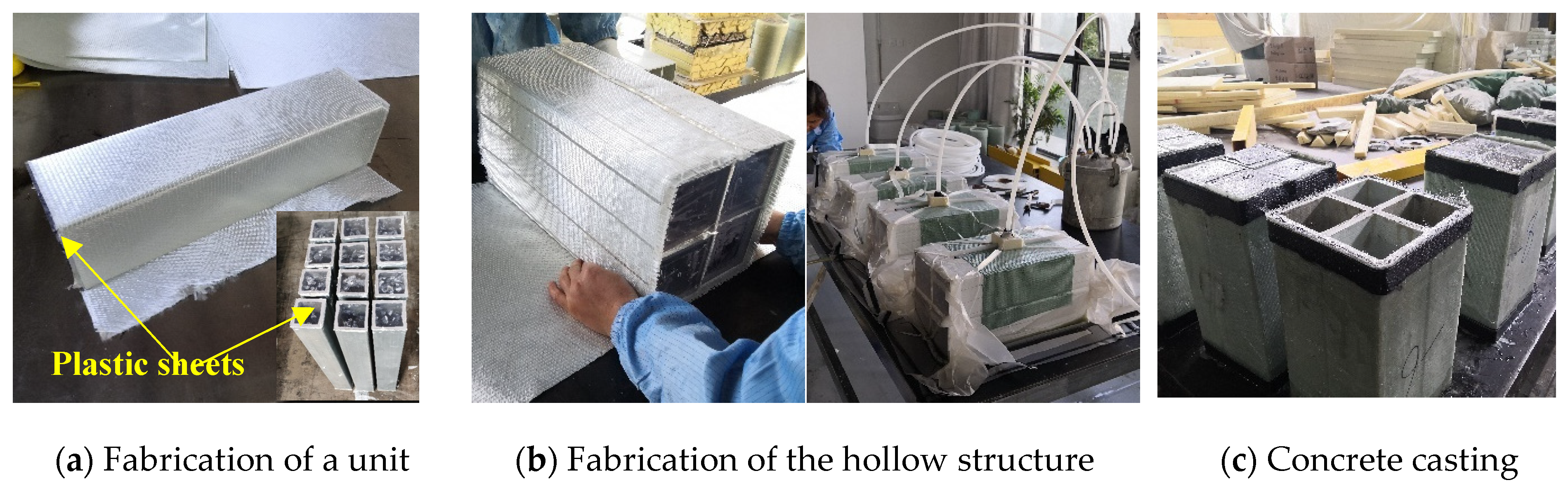
Six specimens were fabricated and subjected to axial compression tests to assess the influence of concrete strength, pultruded tube thickness, and fibre orientation. All specimens featured standardized dimensions of 400 mm height and 210 mm diameter, with a 3 mm corner radius. Each member consisted of pultruded tubes, woven fabrics, and infill concrete. Figure 1 illustrates the specimen configurations. The face sheets consisted of pultruded tubes adhesively bonded to outer woven fabrics (named outer facing layers). The webs consisted of pultruded tubes with the woven fabrics (named interior facing layers) positioned between them. Lattice-webs, which refer to woven fabrics positioned between the tubes, essentially consist of two integrated interior facing layers. Figure 2 exhibits the fabrication process of the MCPLs. After sealing the pultruded tube ends with plastic sheets, the individual square section was externally confined using GFRP woven fabrics to form a unit (Figure 2a). Four such units were then assembled and integrally wrapped with woven fabric, followed by co-curing through vacuum-assisted resin infusion moulding (VARIM) under 0.8 bar vacuum at 30 °C for 6 h (Figure 2b). Finally, C30 concrete was cast into the cavities to complete the MCPL specimens (Figure 2c). It is noted that the C30 concrete in this study was produced using the same raw materials and strict curing conditions as the C60 concrete reported in the literature [39]. The only variable was the mix proportion designed to achieve the different strength grades.
Specimens were divided into three groups on the basis of different fibre orientations and the pultruded tube thickness. Each group consisted of two members differing only in lattice-web and face sheet thickness, sharing an identical woven fabric volume. This controlled approach follows methodologies established in prior studies [13,19] to assess the influence of fibre layup. All specimens were uniquely identified to distinguish differentiating varieties: “AC” denoted the MCPL specimens in this paper; “L” and subsequent numbers denoted the lattice-web thickness; “F” and subsequent numbers denoted the face sheet thickness; “H” represented that woven fabrics in specimens were a composite of uniaxial hoop fibres, while all others were composite of biaxial fibres; “T4” represented that the thickness of pultruded tubes was 4 mm, while all others used 6 mm; “C30” represented the use of C30 concrete as the filling material. Since all specimens utilized C30 concrete, this identifier was included to maintain a consistent naming convention and to serve as the baseline configuration. Additionally, control specimens MCP-L2-F4 and MCP-L4-F3 from the literature [39] were included. Having the identical lattice structure, the control group served as a reference for comparing the compressive response with the AC-C30 group to study the influence of concrete strength. Table 1 presents the detailed specifications of each specimen. Furthermore, the compressive performance of the C30 concrete-filled pultruded tubes (CPC-C30) was compared with that of the C60 concrete-filled pultruded tubes (SCP) in the literature [39] to evaluate the influence of key parameters on the improvement of the lattice structure.
The pultruded tubes in MCPLs were supplied by the Kangte Corporation, featuring a 400 mm height and a 100 mm outer diameter. All pultruded tubes featured an identical fibre layout and were manufactured with 3 mm radius corners. The pultruded tubes were designed in two thicknesses of 4 mm and 6 mm. Biaxial glass fibres impregnated in an unsaturated polyester resin matrix were employed in the reinforcements, reaching a 55% fibre volume fraction [39]. In addition, the uniaxial hoop E-glass fibres in orientation [90°] were designed for the group AC-H. The measurement results of layer thicknesses were 0.5 mm for biaxial fabrics and 0.25 mm for uniaxial fabrics.
Coupon specimens of the pultruded profiles and woven fabrics were manufactured and tested in accordance with the related standards [46,47,48,49]. The axial elastic modulus was 22.92 GPa for the (±45°) fabric, 26.16 GPa for the (0, 90°) fabric, 18.03 GPa for the pultruded tubes, and 3.15 GPa for the uniaxial fabrics. The full set of properties for the biaxial fabrics and pultruded tubes can be found in the literature [39], while the properties for the uniaxial fabrics are provided in Table 2. A uniform batch of ready-mixed self-compacting concrete was employed for all specimens fabricated in this study. The properties of concrete were determined through ASTM C39/C39M [20], and the mean compressive strength of C30 concrete was determined to be 31.86 MPa. The properties of each material are given in Table 2.

2.2. Loading Process and Instruments

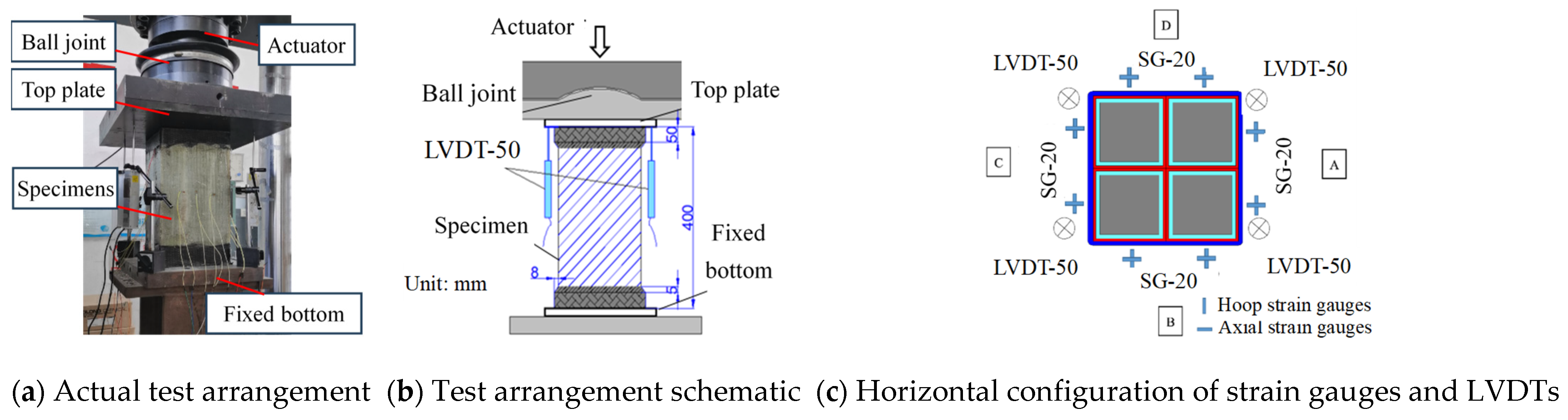
Axial compression tests were performed at Nanjing Tech University under displacement control (0.25 mm/min) using a 5000 kN universal testing frame (Wance, Shenzhen, China). A ball joint was installed on the loading plate with a stationary plate placed on the support plate, maintaining concentric vertical compression throughout testing. The experimental setup and instrumentation are exhibited in Figure 3. Axial displacements of the MCPLs were obtained using symmetrically mounted linear variable differential transformers with a range of ±50 mm (LVDT-50) installed under the loading plates. Average axial strains were calculated according to LVDT readings. Additionally, eight SG-20 strain gauges (20 mm gauge length) were mounted at the middle of the face sheets to verify axial strain values determined based on the LVDTs. Additionally, the strain gauges were used to assess the lateral deformation of the specimens. All LVDTs and strain gauges were calibrated by the manufacturer prior to testing, with reported accuracies of ±0.1%.

3. Results and Discussion

3.1. Failure Modes

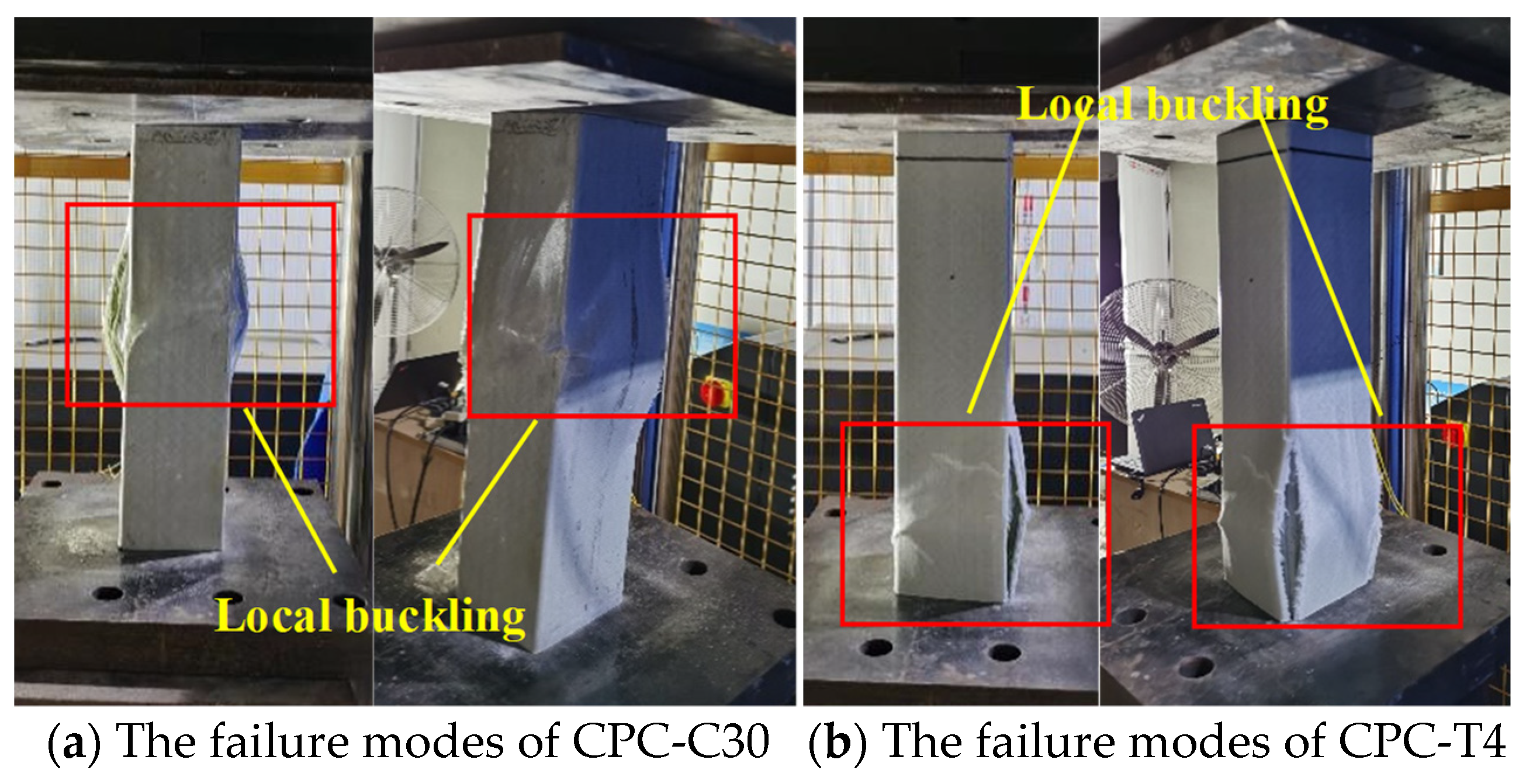
The failure modes of CPCs are shown in Figure 4. It was obvious that the specimen CPC-C30 exhibited brittle failure behaviour with local damage at the mid-span region of the specimens, similar to the SCP in the literature [39]. A thinner flange exacerbated the brittle failure behaviour, and earlier local buckling at the end of the CPC-T4 was observed in Figure 4b, with an immediate drop in load.
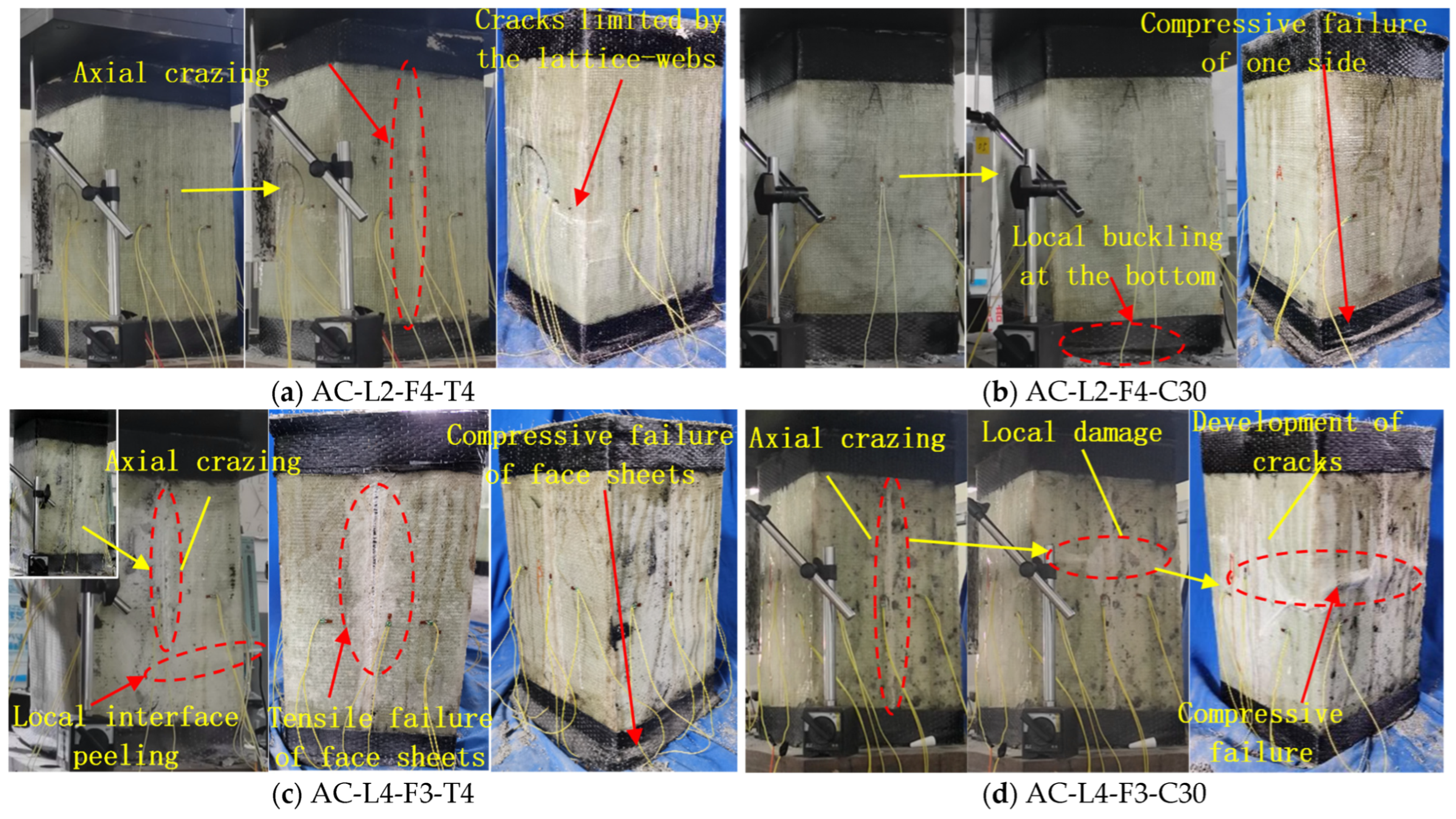
The typical failure modes of multi-cell specimens with different concrete strengths, fibre orientations, and pultruded tube thicknesses are exhibited in Figure 5. It was found that all specimens failed in a progressive manner with significant signs prior to the failure, showing a pseudo-ductile failure behaviour. This response is consistent with that observed in the control specimens MCP-L4-F3 and MCP-L2-F4 [39], confirming the repeatability of the compressive behaviour. The results further validate that the lattice-web reinforcements contributed to greater ductile failure behaviour.
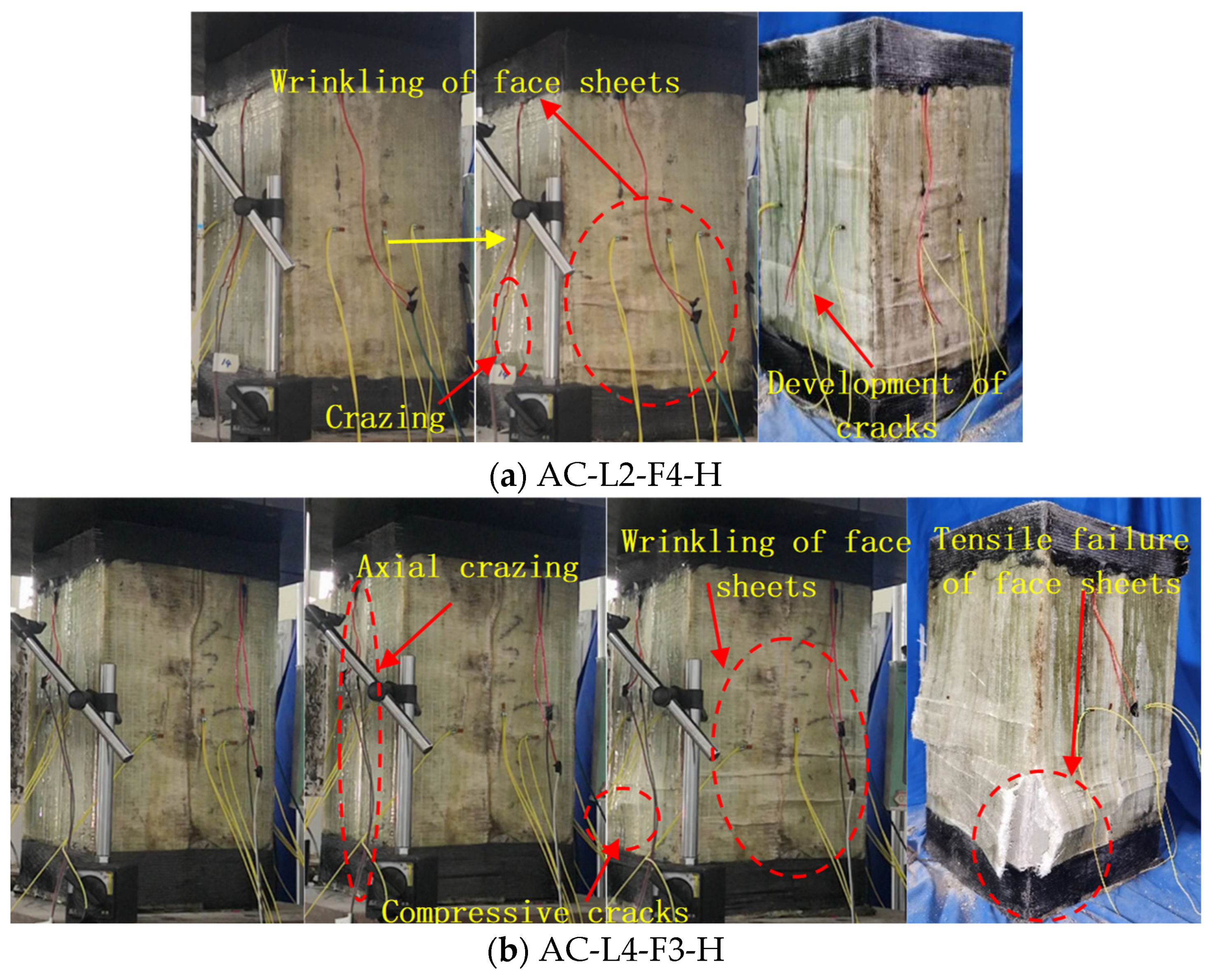
The failure behaviour of AC-L2-F4-T4 was exhibited in Figure 5a. Axial crazing was observed, revealing the local tensile damage in the face sheets. Upon attaining the peak load, the face sheets exhibited localized buckling accompanied by compressive cracking. The specimens maintained residual strength after initial cracking, as the lattice-webs effectively restrained the propagation of compressive cracks. Concrete and face sheets experienced compressive failure at the ultimate state, accompanied by a sharp drop in applied load, indicating the failure of the specimens. For specimen AC-L2-F4-C30, a certain degree of eccentricity occurred during the loading process due to installation errors. The bottom of the specimens exhibited premature local buckling behaviour (Figure 5b). The residual bearing capacity was sustained by the lattice-webs, and crack progression was still effectively limited. Upon attaining the ultimate load, compressive damage was observed in the concrete and one-sided face sheets, and the load dropped sharply. As an obvious progressive failure process was also observed at the eccentric compression statement, it was denoted that the multi-cell structure with lattice-web reinforcements significantly enhanced specimen ductility.
The failure modes of AC-L4-F3-T4 were shown in Figure 5c, and obvious crazing along the axial direction was observed. With the load applied, the number and the width of the crazing kept increasing until the peak load, and slight interface peeling with the local buckling of face sheets occurred subsequently. An analysis of the crazing progression confirmed that fibre tensile damage happened prior to the local buckling, demonstrating effective fibre stress utilization and enhanced concrete confinement effectiveness. When reaching the ultimate load, tensile cracks occurred, decreasing the confining stress on the concrete. The concrete and face sheets failed subsequently due to the compressive damage. AC-L4-F3-C30 and AC-L4-F3-T4 shared similar modes of failure, as shown in Figure 5d. Axial crazing occurred and developed with an increase in the applied load. Bulging deformation developed in the face sheets preceding the peak load, indicating the interface peeling, and cracks initiated subsequently. The crack progression was then constrained by the lattice-webs, and the residual strength was maintained. Upon attaining the ultimate load, both the confined concrete and face sheets experienced compressive damage.
In general, the influence of the pultruded tube thickness and the strength of concrete on the failure modes of the MCPLs are not obvious. Thicker lattice-web reinforcements extended the failure progression and showed more pronounced pseudo-ductile behaviour. In addition, it was found that decreasing the pultruded tube thickness delayed the initiation of interface peeling. The reason is that the volume ratio of axial fibres was decreased and thus delayed the instability of the face sheets [50]. Moreover, it was found that increasing the confined concrete strength improved the severity of interface peeling without bulging deformation, revealing a better interface bonding performance.
Figure 6 exhibits the failure characteristics of uniaxial fibre-reinforced specimens. Compared to specimens reinforced with biaxial fibres, specimens AC-L2-F4-H and AC-L4-F3-H had a more significant progressive failure process, with no obvious delamination found before the peak load. The result demonstrated that uniaxial hoop fibre reinforcements postponed premature local buckling in face sheets, consequently enhancing interfacial peeling resistance. The failure characteristics of AC-L2-F4-H were exhibited in Figure 6a. Only slight noise was heard before the peak load, and crazing was initiated subsequently, along with the wrinkling of face sheets. With the load applied, compressive cracks in the face sheets occurred. Constrained by the lattice-webs, the compressive cracks developed slowly, and the number of the cracks increased with the load applied. Specimens kept maintaining a certain bearing capacity until the ultimate load and failed subsequently with the compressive damage of concrete and face sheets. The failure mode of AC-L4-F3-H is shown in Figure 6b. Local axial crazing was initiated before the peak load, and crazing formation showed quantitative growth with increasing load, indicating the tensile damage of the hoop fibres. The full utilization of fibre tensile strength was achieved, and specimens showed effective confining on the filled concrete. After the peak load, several compressive cracks of the face sheets appeared successively, while the lattice-web reinforcements maintained structural load-bearing capacity. Upon attaining the ultimate load, fibre tensile damage initiated, leading to a subsequent reduction in the confinement effectiveness. Failure modes were dominated by concrete compressive damage. In general, it was confirmed that the lattice structure mitigated the brittle failure behaviour in the pultruded tubes filled with concrete, and thicker lattice-web-reinforced specimens exhibited an improved ductile behaviour under a compressive load. Moreover, applications of uniaxial fibres improved the pseudo-ductile behaviour of MCPLs, and specimens had a better confinement effectiveness due to the sufficient utilization of hoop fibres.

3.2. Dilation Behaviour of MCPLs

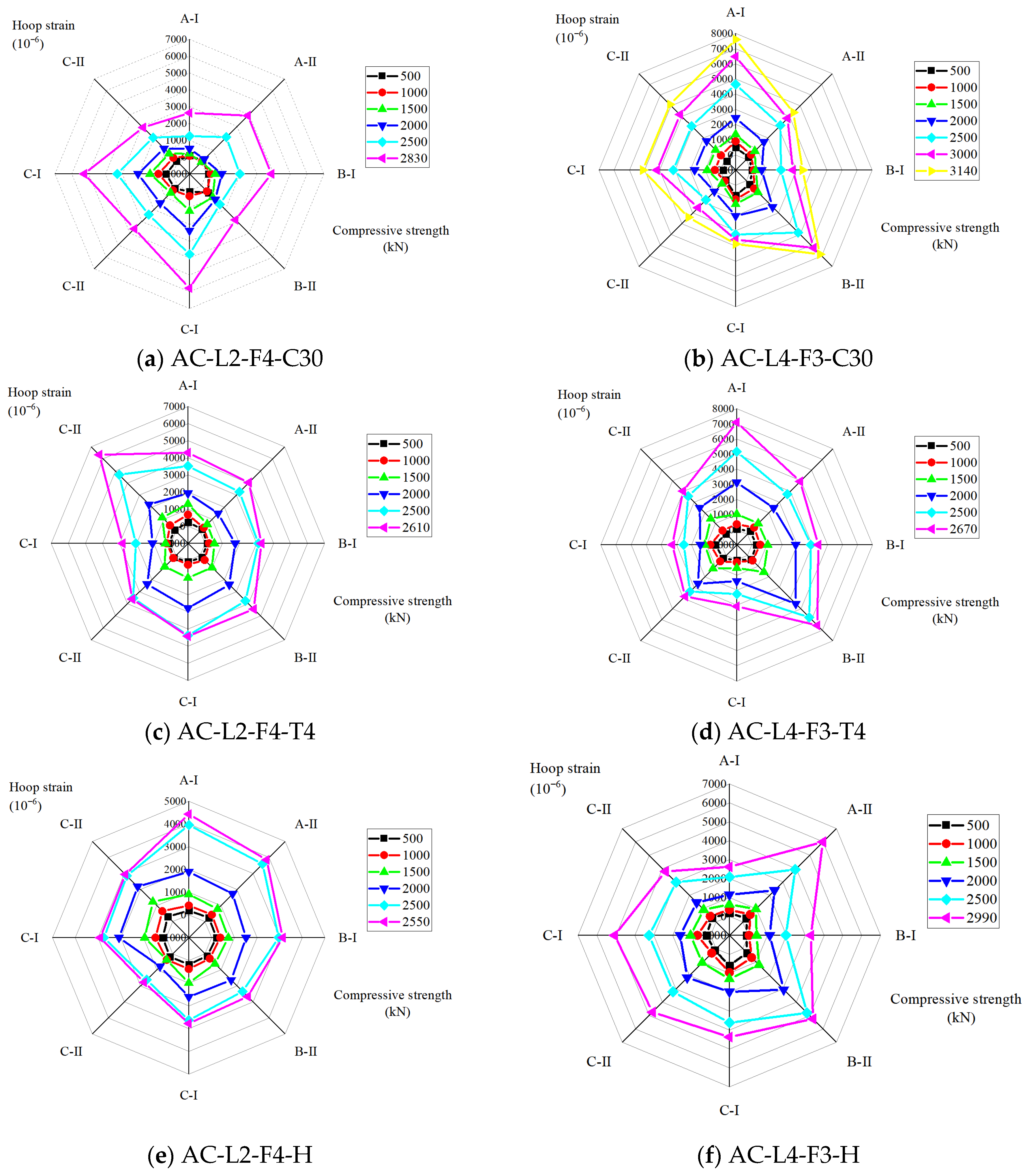
The hoop distributions of MCPLs are shown in Figure 7 to study the dilation behaviour of MCPLs. Hoop strain measurements were obtained from eight hoop strain gauges mounted on the face sheets at four sides prior to peak load attainment. The nomenclatures X-I and X-II denote strain values recorded at 1/4 and 3/4 positions along each side (X = A, B, C, D), as shown in Figure 3. The hoop strain distribution was relatively uniform at the initiation stage, and the observed face sheet deformation primarily resulted from Poisson’s ratio effects. With an increased applied load, the concrete undergoes uneven deformation, accompanied by local compressive damage and obvious irregular distributions in the hoop strain. By comparing the hoop strain distributions of each specimen, the following conclusions can be obtained: (1) the increased face sheet thickness improved the uneven transverse deformation; (2) for specimens sharing an identical lattice structure, the application of hoop uniaxial fibres delayed the instability of the face sheets, thus improving the irregular distributions in the hoop strain; (3) decreasing the pultruded tube thickness weakened the confinement stiffness of the filled concrete but enhanced the stability of face sheets, thus improving the irregular distributions in the hoop strain; (4) while increasing the concrete strength decreased the confinement effectiveness of the specimens showing a lower average hoop strain value, the control specimens showed better uniform deformation than AC-L4-F3-C30 and AC-L2-F4-C30; (5) for specimens sharing an identical face sheet thickness, a reduced concrete strength enlarged the transverse deformation of the specimens, correlating with higher hoop strain measurements in face sheets, which aligned with findings reported by Ozbakkaloglu’s study [15]; (6) increasing the face sheet thickness improved the confinement stiffness but decreased the average hoop strains due to the negative effects of excessive axial fibre volume; (7) increasing the lattice-web thickness enhanced the stability of the face sheets and resulted in a higher peak load and greater average hoop strain value, showing a better confinement effectiveness.
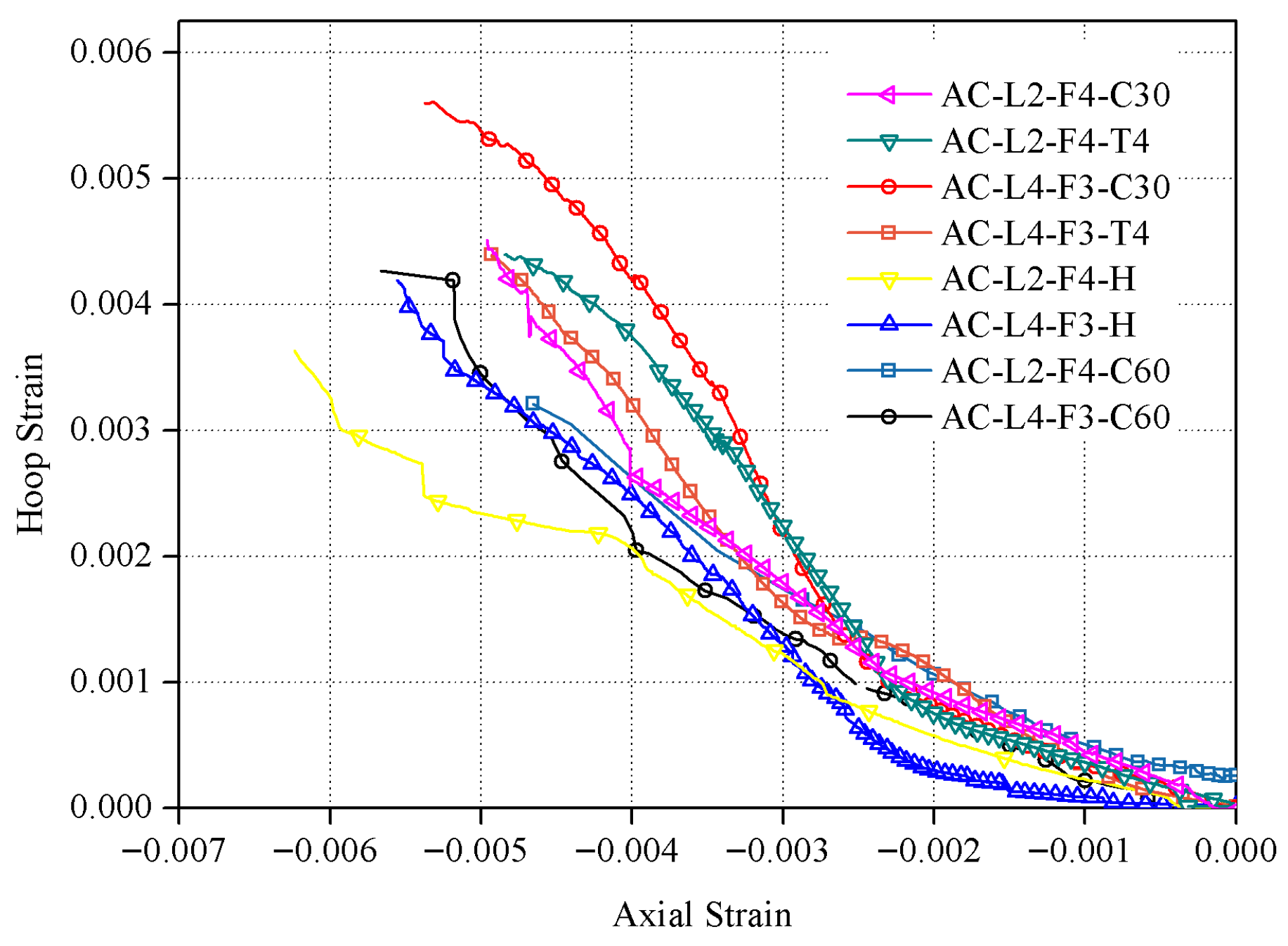
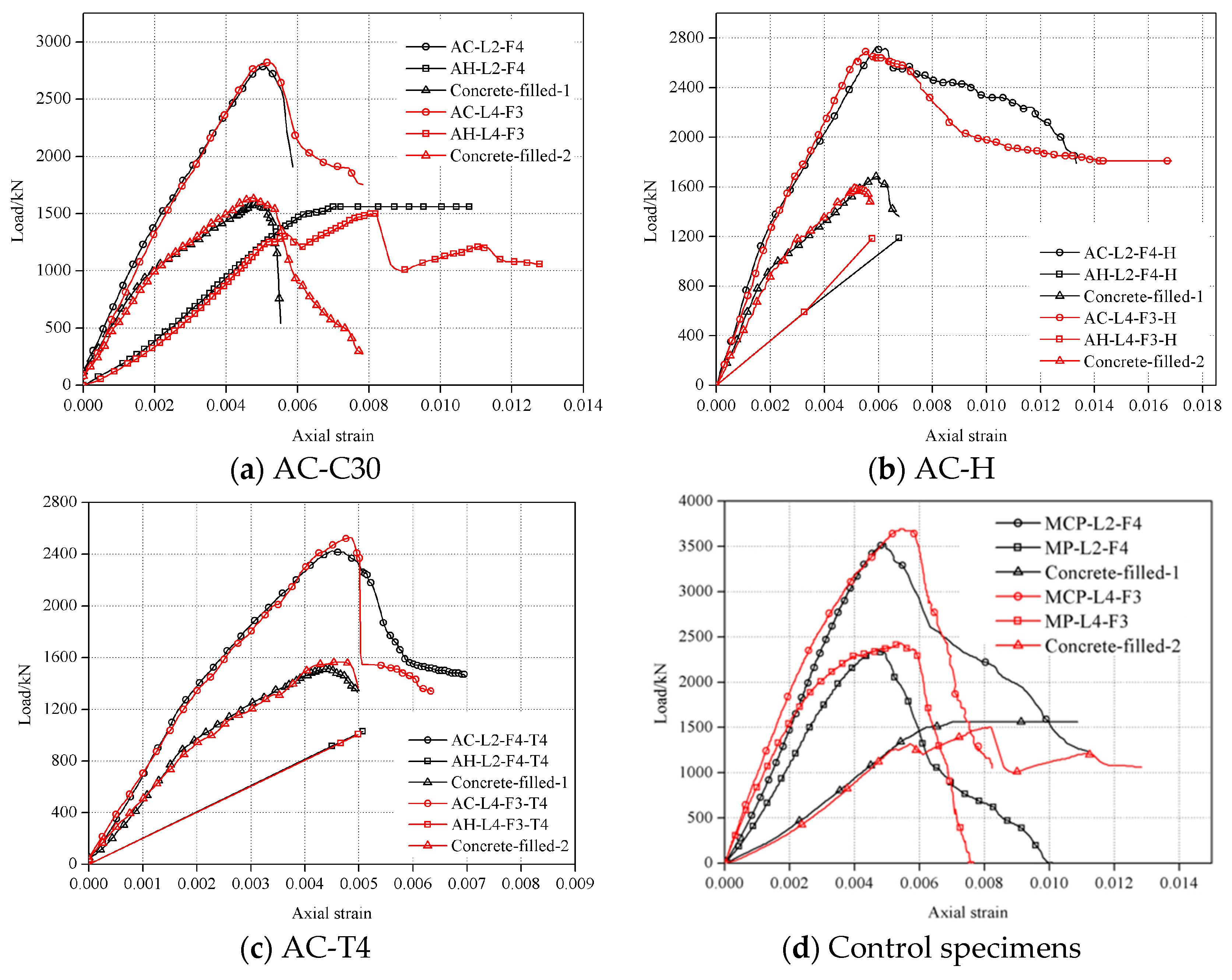
The dilation response of MCPLs was further analyzed through axial–hoop strain curves, as shown in Figure 8. The axial strain values were derived as averages from axial gauges installed on the face sheets. As obvious interface peeling occurred, especially after the development of the compressive cracks, the strain measurements were terminated upon reaching the peak loads. According to Figure 8, a linear response was found at the initial stage, and the hoop strain was mainly caused by Poisson’s effect. As Poisson’s ratio of specimens reinforced with uniaxial fibres was lower than that of specimens reinforced with biaxial fibres, a low hoop strain value was also observed at the initial stage. With the load applied, the plastic deformation of concrete occurred, and the transverse expansion of concrete was limited solely by the face sheets, leading to the rapid increase in the hoop strain value. Compared to 4 mm lattice-web-reinforced specimens, a lower slope of the axial–hoop strain curves was found in the 4 mm face sheet-reinforced specimens, revealing a better confinement stiffness under the same axial load. For specimens sharing an identical concrete strength, the slope of the specimens with 6 mm pultruded tubes showed a higher slope than specimens with 4 mm pultruded tubes. It was denoted that reducing the face sheet thickness directly decreased the axial fibre content and simultaneously enhanced the confinement stiffness. AC-L4-F3-H and AC-L2-F4-H had the lowest slope, and the result revealed that uniaxial fibre reinforcements further enhanced the confinement effectiveness of the specimens.
At the peak load, the lower hoop strain and similar axial strain in control specimens, which shared an identical composite tube with the AC-C30 specimens, indicated a reduced activation of confinement and thus a lower confinement effectiveness. AC-T4 showed lower axial and hoop strain values at the peak point than AC-C30. As specimens had an identical face sheet thickness, this result indicates a better confinement effectiveness in the AC-C30 specimen. The reason is that the too thin pultruded tubes reduced the deformability of the multi-cell structure, thus resulting in the premature failure of the specimens. For specimens reinforced with uniaxial fibres, the lowest hoop strain and highest axial value were found. Given that AC-H had identical concrete to the baseline, its limited volumetric dilation directly contributed to the highest confinement effectiveness.

3.3. Load–Axial Strain Curves

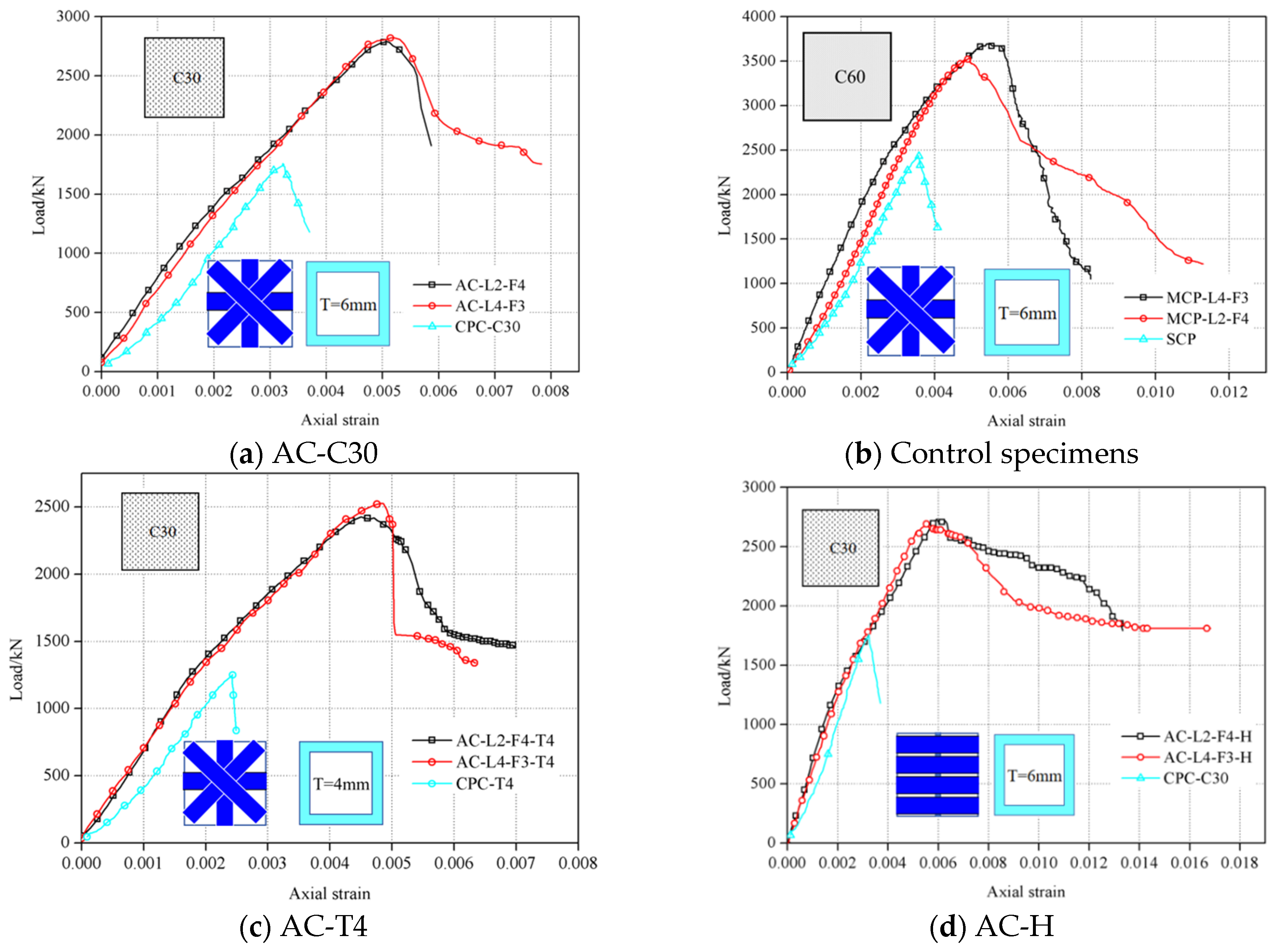
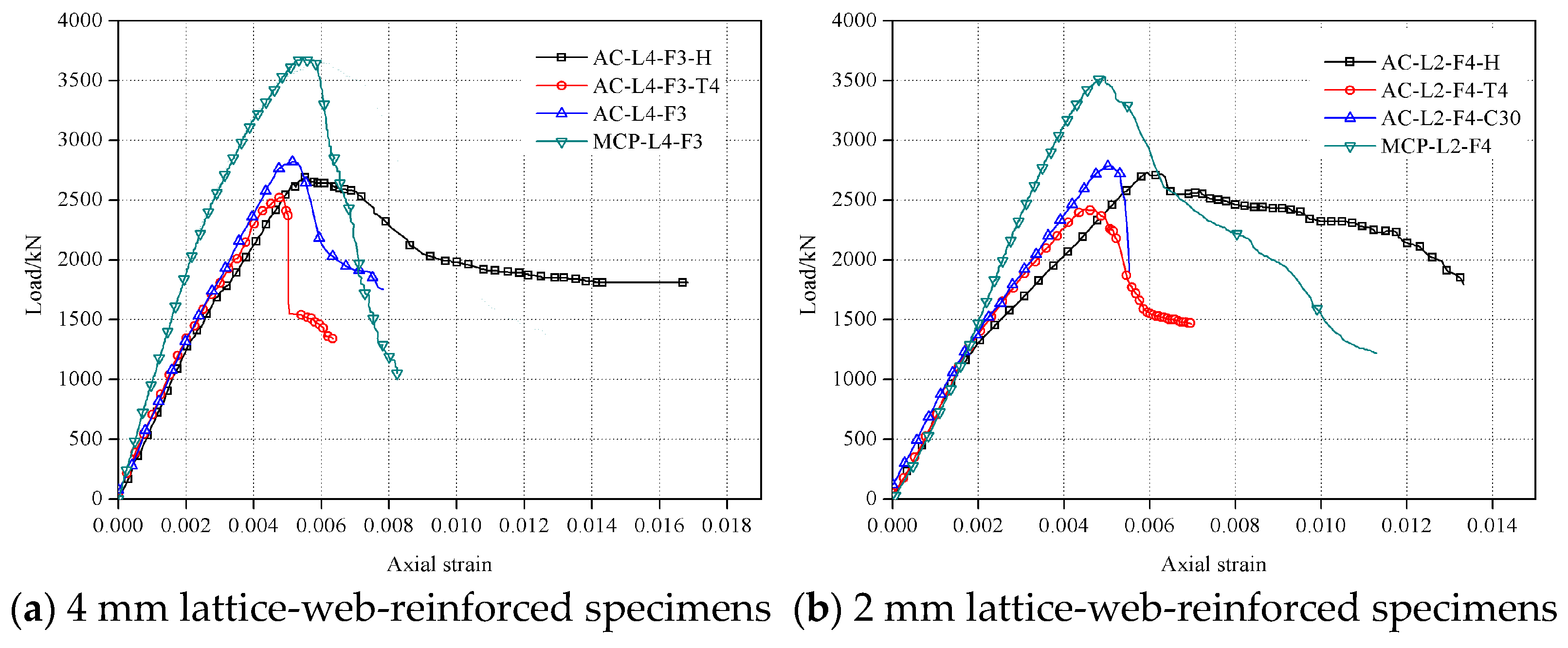
Figure 9 presents the load–axial strain behaviour of composite columns, where strain measurements were acquired using LVDTs. Remarkably, the peak loads of CPCs in Figure 9 scaled up 4 times. The specimens displayed an almost linear load–axial strain behaviour prior to peak load, followed by an abrupt drop, revealing brittle failure behaviour and the insufficient confinement of concrete. The results indicated that the specimens fabricated with 6 mm pultruded tubes exhibited a greater peak load and enhanced deformation capability, revealing that thicker pultruded tubes significantly enhanced the mechanical properties.
The bilinear response was shown in MCPLs, revealing an effective confinement of the filled concrete, and the load fluctuation can be found in the descending stage, showing pseudo-ductile behaviour. Linear responses were found at the initiation of the curves, and the material was in the elastic stage. With the load applied, the nonlinear deformation of concrete increases and the face sheets deformed in coordination with the concrete, showing passive confinement. The curves behaved in a nonlinear response and kept increasing to the peak point. Compressive cracks occurred, and the development was constrained by the lattice-webs, showing load fluctuation. Thicker lattice-web reinforcements exhibited a higher peak load and greater displacement in the application of biaxial fibre reinforcements. The result confirmed that thicker lattice-webs proved more effective for load capacity optimization than the face sheet thickness increment. Different from the specimens reinforced with biaxial fibres, AC-L2-F4-H showed a better structural performance than the AC-L4-F3-H. The reason is that the application of uniaxial hoop fibres postponed face sheet buckling, and increasing the face sheet thickness significantly enhanced the deformability. In addition, increased lattice-web thicknesses have a minimal impact on the axial stiffness but have obvious negative effects on the confinement stiffness. Therefore, increasing the thickness of the face sheets showed a more effective strategy for optimizing load capacity, drawing a conclusion opposite to the previous study about MCPLs.
A deeper analysis of the MCPLs’ compressive behaviour was conducted using the following key data derived from load–axial strain curves: (1) the peak load Fcp and related axial strain εcp; (2) the yield load Fcy and related axial strain εcy, which were employed using the equivalent area method [32]; (3) the ultimate load Fcu (taken as 85% maximum load value at the descending stage) and related axial strain εu; and (4) the ductility coefficient μc, which was defined as μc = εcu/εcy [32]. A summary of the results can be found in Table 3, and the influence of the design variables on the same lattice structures is shown in Figure 10.

3.3.1. Influence of the Concrete Strength

The influence of the concrete strength on the MCPL structural performance can be assessed by comparing group AC-C30 and control specimens. It was obvious that the specimens exhibited a greater load-bearing capacity with higher concrete strength. The maximum values were recorded as 3485 kN for MCP-L2-F4 and 3682 kN for MCP-L4-F3, much higher than those of AC-L2-F4-C30 (2790 kN) and AC-L4-F3-C30 (2824 kN). In addition, the εcp of MCP-L2-F4 and MCP-L4-F3 were 0.004783 and 0.005692, which were similar to those of AC-L2-F4-C30 (0.005121) and AC-L4-F3-C30 (0.005168). The result revealed that concrete strength has less influence on the peak deformability of MCPLs. Moreover, it was noted that MCP-L2-F4 exhibited a 12.5% higher ductility coefficient (1.331) compared to AC-L2-F4-C30 (1.183). Similarly, MCP-L4-F3 (1.906) also showed a 47.1% higher value than the 1.296 in AC-L4-F3-C30. Since MCP-L2-F4 and AC-L2-F4-C30 (as well as MCP-L4-F3 and AC-L4-F3-C30) shared an identical lattice structure, this direct comparison indicates that the increase in concrete strength contributed to an improvement in the pseudo-ductile characteristic. The reason is that the lattice structure effectively restrained the out-of-plane displacement of the pultruded tubes before the peak points, consequently minimizing the effects of differential concrete dilation on the axial response. Following the degradation of confinement due to this failure, the influence of concrete strength on transverse dilation and ductility became significant. Specifically, C30 concrete developed plastic transverse deformation earlier than C60 concrete, which promoted the greater out-of-plane displacement of the tubes, thereby aggravating premature local buckling and inducing brittle failure.

3.3.2. Influence of the Pultruded Tube Thickness

The specimens AC-T4 and AC-C30, which shared an identical concrete strength and fibre orientation, were studied to investigate the influence of the pultruded tube thickness. It was confirmed that decreasing the pultruded tube thickness mitigated the compression resistance, with AC-L2-F4-T4 (2723 kN) and AC-L4-F3-T4 (2696 kN) exhibiting lower values than AC-L2-F4-C30 and AC-L4-F3-C30, respectively. Moreover, decreasing the pultruded tube thickness weakened the bending stiffness of the face sheets, and premature failure occurred, resulting in a reduced peak deformability. According to Table 4, the maximum axial strain value of AC-T4 at the peak point was 0.005358, lower than the minimum value of AC-C30 (0.005654 for AC-L2-F4-C30). It was noted that decreasing the pultruded tube thickness enhanced the pseudo-ductile behaviour of specimens, with an average value of 1.302 for AC-T4 and 1.239 for AC-C30. Within the MCPL configuration, the use of thinner pultruded tubes, which have a lower axial fibre volume, facilitates more effective restraint from the lattice-webs and thereby enhanced the pseudo-ductility.

3.3.3. Influence of Fibre Orientations

The specimens AC-H and AC-C30, which shared an identical concrete strength and pultruded tube thickness, were studied to investigate the influence of the fibre orientations. According to Figure 10, biaxial woven fabric reinforcements demonstrated a superior load-bearing enhancement than uniaxial hoop fibre reinforcements. The peak loads of AC-L2-F4-H and AC-L4-F3-H were 2696 kN and 2723 kN, lower than those of AC-C30. However, it was found that the application of the hoop uniaxial fibres improved the ductile behaviour and deformability. The ductility coefficient and the axial strain at the peak load of AC-L2-F4-H were 1.926 and 0.01068, showing higher values than the 2 mm lattice-web-reinforced specimens; the ductility coefficient and the axial strain at the peak load of AC-L4-F3-H were 1.543 and 0.008128, higher than the 4 mm lattice-web-reinforced specimens. The reason was the low Poisson ratio of uniaxial fibres, which limited the out-of-plane deformation and delamination in face sheets. However, the low axial stiffness of hoop-oriented uniaxial fibres limited the effectiveness of increased lattice-web thickness in improving load resistance. Furthermore, over-thickened lattice-webs diminished the confinement stiffness.

3.4. Load–Strain Responses of the Confined Concrete

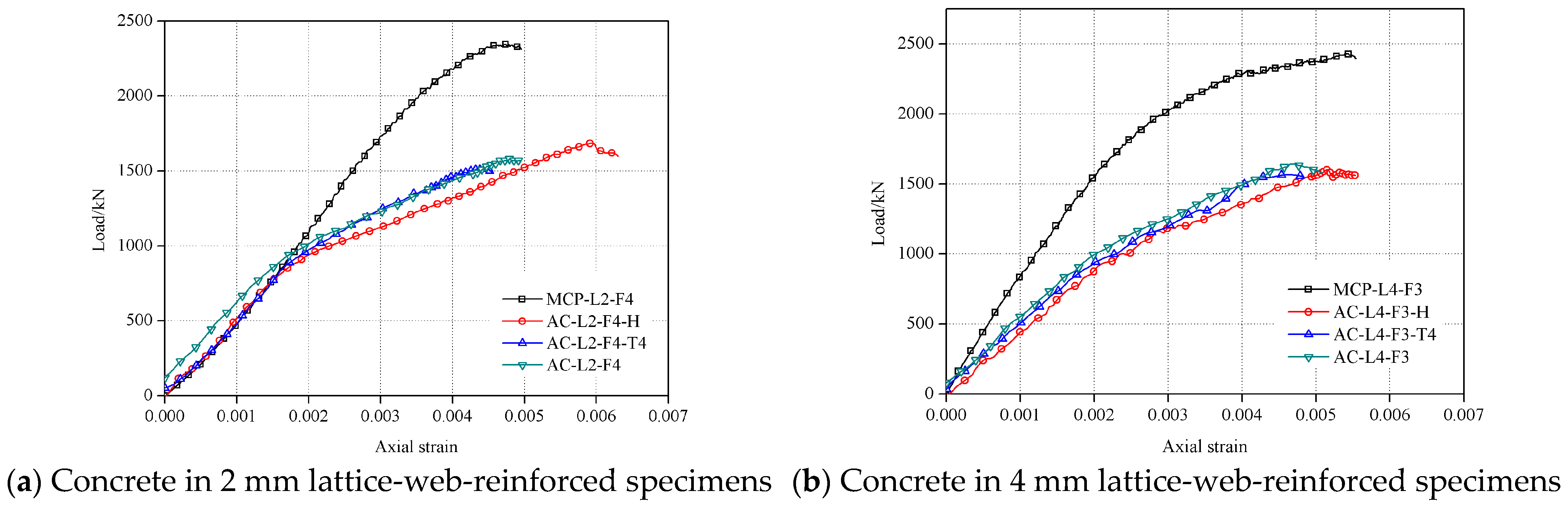
As the load–strain responses of the confined concrete were challenging to experimentally determine, properly dissecting the specimens into multiple segments was adopted for analysis. The load-bearing capacity attributed to the concrete in CPCs was derived by subtracting the load of pultruded tubes from the total specimen resistance. The load-bearing capacity of the normal hollow pultruded tubes was determined through experiments and the literature [51]. The concrete’s contribution to the compressive load in MCPLs was determined by subtracting the resistance of the hollow multi-cell pultruded tubes from the overall specimen resistance. The existing analytical models [51] provide validated methods for predicting the load-bearing capacity of hollow multi-cell pultruded structures. The theoretical results for hollow multi-cell pultruded tubes in AC-H and AC-T4 are shown in Table 4, where the “AH” refers to the related hollow pultruded multi-cell; ε(w)x represents the axial strain in the w-th monolayer composite plane prior to damage initiation; F(w=1) represents the axial load in the w-th monolayer composite plane prior to damage initiation; and Fpcr is the control buckling load after the first-ply failure. The load-bearing capacity of the hollow multi-cell pultruded structures was adopted as the F(w) lower than the control buckling load. If the control buckling load was lower than F(w=1), it was confirmed that buckling failure occurred after the in-plane damage of the composite planes. Thus, the load-bearing capacity of the hollow multi-cell pultruded structures was adopted as the F(w=1). The results were shown in Table 4 with the final adopted load emphasized in bold.
The calculation diagrams and the load–axial strain curves of confined concrete are exhibited in Figure 11. Moreover, the compressive strength of the confined concrete σc and enhancement ratio Ψ = (σcσc0)/σc0 were also adopted (σc0 was the compressive strength of plain concrete) to study the influence of different parameters on the confined concrete strength, as shown in Table 3. It was found that the concrete strength of AC-H, AC-C30, and AC-T4 was about 47.45~61.15 MPa, showing effective confining compared to SCP. Notably, the enhancement ratios (62.47–81.17%) exhibited a substantial increase compared to the control specimens. The result revealed that the concrete in MCPLs can be effectively confined under different parameters. Decreasing the concrete strength improved the confinement effectiveness, resulting in a higher concrete strength enhancement ratio.
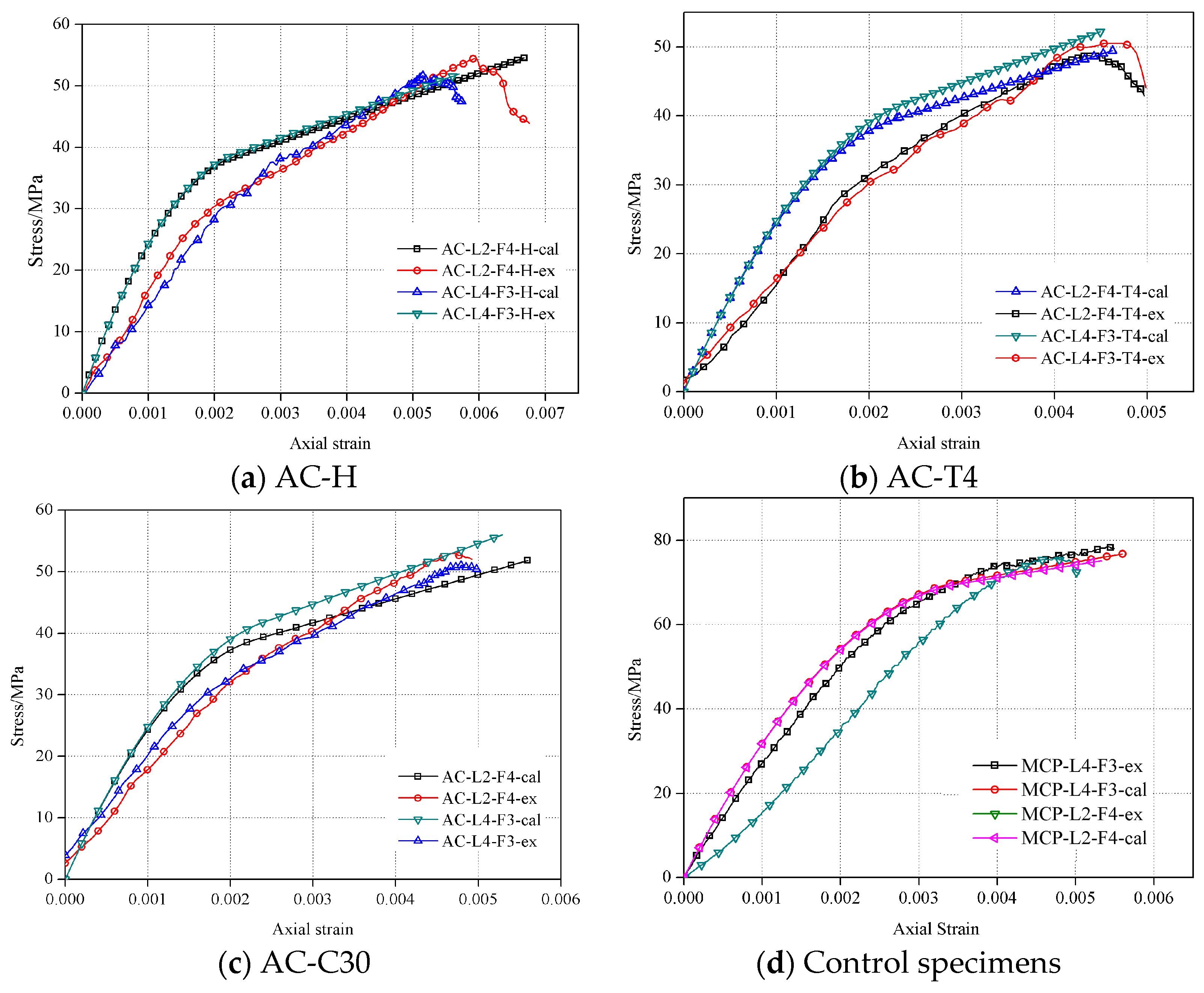
To further study the influence of key parameters on the compressive behaviour of confined concrete, Figure 12 presents the corresponding stress–strain relationships. According to Section 3.1, the pultruded tubes failed after the compressive damage of confined concrete. Therefore, the axial stress–strain curves were halted at the peak point. It was found that the curves of the multi-cell structure exhibited bilinear responses, indicating effective confining. When reaching the peak points, the axial strains of AC-C30, AC-T4, AC-H, and control specimens were 0.005140, 0.004802, 0.005904, and 0.005237. The result confirmed that both increasing the pultruded tube thickness and applying uniaxial fibres improved the peak deformability of specimens, while the influence of concrete strength was subtle. For the 2 mm lattice-web-reinforced specimens, the concrete strength in AC-C30 (48.96 MPa) was lower than that in AC-H (54.35 MPa). For the 4 mm lattice-web-reinforced specimens, the concrete strength in AC-C30 was 52.94 MPa and was similar to 51.52 MPa in AC-H. It was found that increasing the lattice-web thickness reduced the negative influence of biaxial woven fabrics on the local buckling. As a result, the confinement effectiveness was considerably improved, particularly evidenced by the notable increase in the concrete compressive strength. Moreover, the average strength of AC-T4 was about 50.16 MPa, lower than AC-H and AC-C30. The application of 4 mm thick pultruded tubes decreased the deformability of the confined concrete, and confined concrete demonstrated a relatively low strength despite possessing a high confining effectiveness.

4. Theoretical Analysis

Based on the literature [39,43], the theoretical models for FRP-confined concrete can be characterized by the following:
σ c = E c ε c ( E c E 2 ) 2 4 f 0 ε 2 c       for   0 ε c ε t
σ c = f 0 + E 2 ε c             for   ε t ε c ε cu
ε t = 2 f 0 E c E 2
E 2 = f cc f c 0 ε cu
ε cu / ε c 0 = 0.8 + 6.99 f l , a f c 0 ε h , rup ε c 0 0.45
f cc f c 0 = 1 + 3.3 k s f l , a f co       for   f l , a / f c 0 > 0.07
f la = 2 t face 2 L E face ε h , rup
k s = 1 L 2 r 2 3 L 2 ( 4 π ) r 2
The mechanical parameters are defined as follows: σc and εc represent the axial stress and corresponding strain in confined concrete; εt denotes the axial strain at the inflection point; Ec indicates the initial modulus of the plain concrete; E2 is the slope of the second ascending segment; fc0 is the axial compressive stress of plain concrete; fl,a is the measured hoop stress in the face sheets; Eface represents the Young’s modulus of the face sheets; tface is the face sheet thickness; L is the cross-sectional dimension of the confined concrete; εh,rup is the actual hoop rupture strain; fcc represents the peak axial compressive stress of confined concrete and εcu is the related axial strain; ks represents the modified effective confining coefficient [39]; R represents the corner radius of the concrete; and εc0 represents the ultimate axial compressive strain of plain concrete, approximately 0.0026 for C60 and 0.0022 for C30, which can be expressed as follows [52]:
ε c 0 = 0.000937 f c 0 4
The experimental results in Section 3.2 revealed that the actual hoop rupture strain remained below the material’s ultimate tensile strain. Therefore, the compressive stress calculated by the ultimate strain of the material is inaccurate, and the average rupture strain εh,rup, which was taken as 0.63 of the material’s ultimate strain, was used [43]. However, the hoop rupture strain of MCPLs was inconsistent depending on different lattice structures, reminding us that averaged values are ineffective for evaluating parameter influences. Yang [39] proposed a closed-form equation employing the concept of the confinement stiffness ratio λ to calculate the hoop rupture strain of different specimens, and the λ can be expressed as follows:
λ = E face A f E ribs A r
where Eface is the hoop tensile modulus of face sheets and Eribs is the axial compressive modulus of the ribs, which were both calculated based on the Classical Laminate Theory [39]; and Af and Ar are the areas of the face sheets and the ribs. It was found that the influences of the thickness of the face sheets, lattice-webs, and pultruded tubes, as well as the fibre orientation, were all taken into account, while the influence of the concrete strength was ignored. Zhang [13] et al. established a relationship between the confinement stress and confined concrete strength for rectangular sections, which demonstrated a good agreement with tests. However, the related model was primarily developed for single-tube sections.
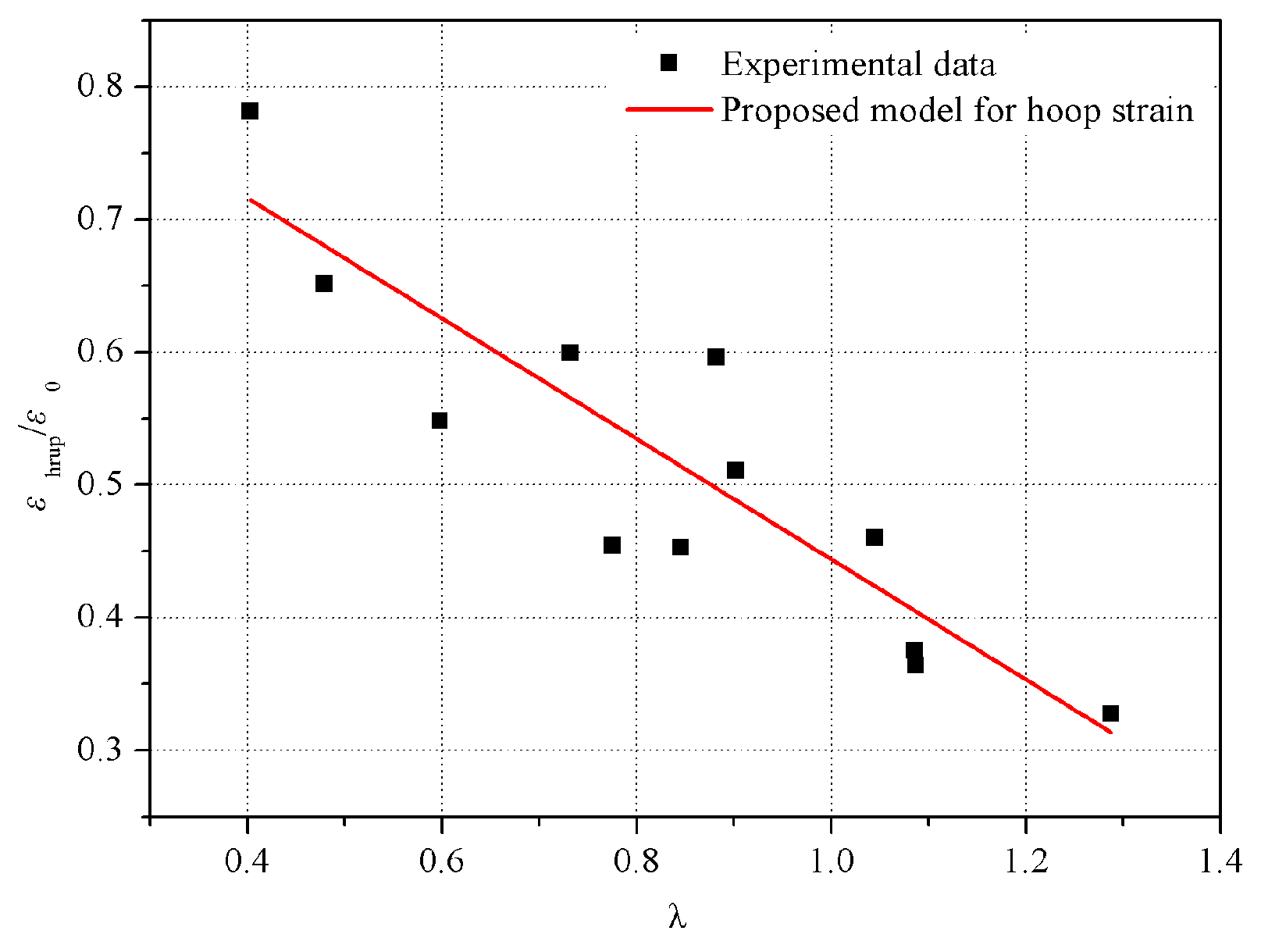
According to the analysis in Section 3, increasing the concrete strength decreased the hoop rupture strain, and thus a dimensionless parameter was introduced to modify the equation, expressed as follows:
λ = f c f Cu E face A f E ribs A r
where fc is the calculated compressive strength of plain concrete; and fCn is the compressive strength of normal unconfined concrete, which is equal to 59.65 MPa [39] in this paper. Based on the fitting of the experimental data in this paper and the literature [39], Figure 13 presents the relationship between λ and hoop rupture strain using an ordinary linear regression analysis. εh0 is the ultimate tensile strain of the face sheets taken as the average value of the ultimate circumferential strain of each layer of fibre cloth and the extruded profile, and the result is shown in Table 5. This curve can be approximated mathematically as follows:
ε h , rup ε h 0 = 0.453 λ + 0.897
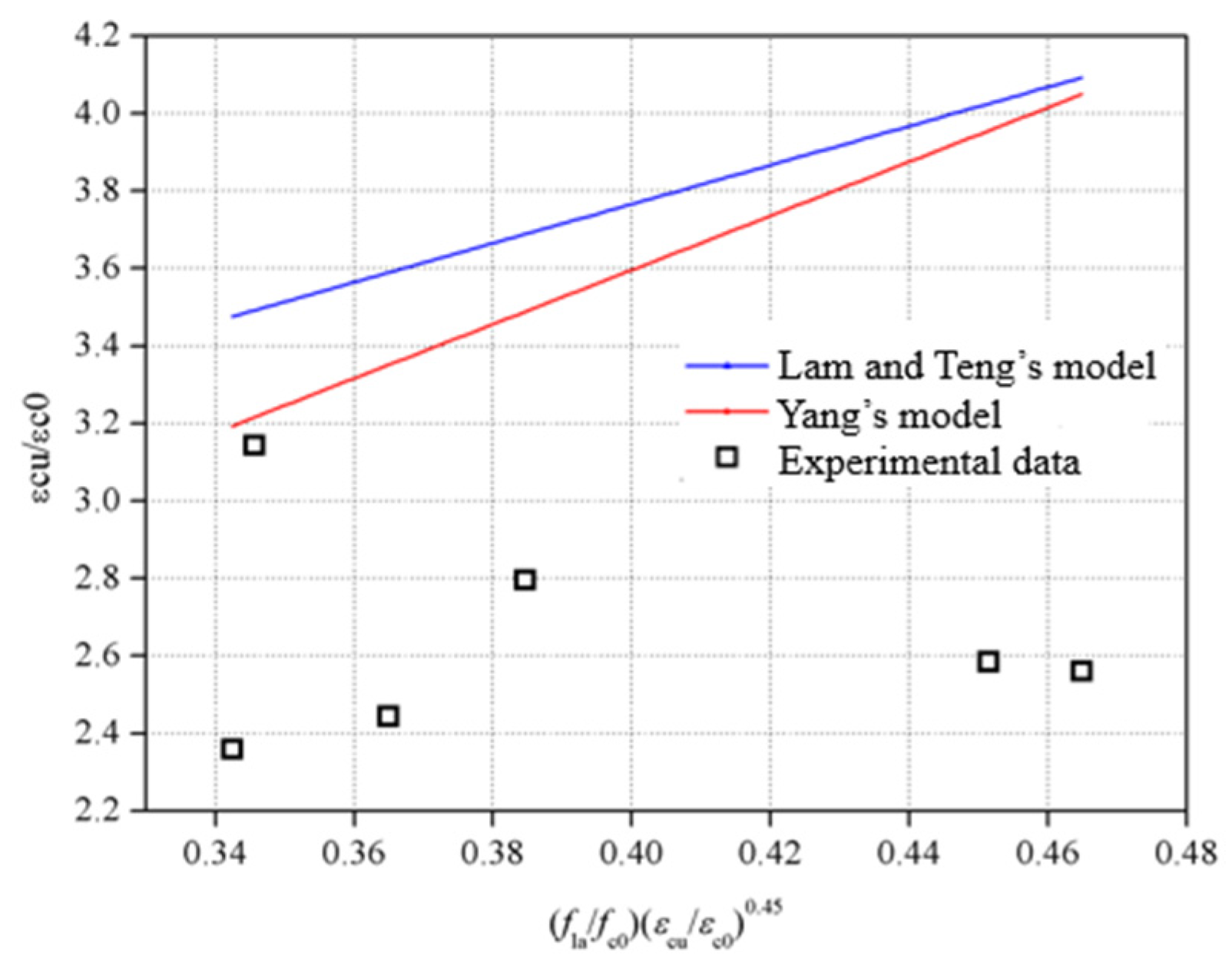
By substituting Equation (12) into Equations (5) and (6), the peak compressive strength and related axial strain of the confined concrete can be obtained. However, it was found that the calculated stress based on the Lam and Teng’s model [43] was inconsistent with the test date, while the calculated strain was much higher than the data. The optimized Yang’s model was also adopted [39], and the calculated results are still not in agreement with those from the experiments, as shown in Figure 14, with errors reaching up to 100% in some cases. The reason is that the application of pultruded tubes aggravated the brittleness of the specimens, thus leading to reduced deformation.
According to Figure 11, it was noted that the specimens exhibited a reduced ultimate axial strain compared to hollow multi-cell pultruded tubes, since the transverse expansion of the concrete induced the out-of-plane deformation of the face sheets. Lattice-web reinforcements increased the critical buckling resistance of the face sheets in multi-cell specimens, and the axial strain at the peak strength of confined concrete is similar to that of the corresponding hollow multi-cell specimens. In addition, according to the results in Section 3.3.1, the influence of concrete strength on the deformation is relatively small, and the axial strain at the peak strength of concrete is mainly controlled by the hollow multi-cell pultruded tubes. Therefore, the axial strain of confined concrete at the peak load is presumed to match the ultimate strain of the multi-cell hollow pultruded tubes. The εcu can be expressed as follows:
ε cu = min ε w x k
Therefore, the stress–strain model of confined concrete can be adopted as shown in Figure 15, and the detailed results are exhibited in Table 5.
Moreover, the axial peak load Pca of the MCPLs was obtained following Equation (14). Fh was the theoretical result of the axial load, and can be adopted from Section 3.4 and the literature [51]; Ac was the compressive area of the confined concrete.
P ca = A c ε c u + F h
The experimental data in the literature [39] and a comparison with the proposed model were also studied, as shown in Table 6.
It is obvious that the results align well with the experimental results (average errors within 10%), validating the reliability of the proposed theoretical model. In addition, according to Table 6, the performance differences among the three parameters demonstrate a clear load capacity trend (AC-C60 > AC-C30 > AC-H > AC-T4). The close agreement between the trend and the test results indicates a systematic effect of the design parameters, thereby verifying the rationality of the experiment. However, since the results were calculated through a statistical analysis of the experimental data, some of the data exhibit considerable errors, particularly in the hoop strain measurements. Therefore, a large amount of experimental and numerical data will be explored to accurately determine the analytical model in further study.

5. Conclusions

This paper has presented the influence of key parameters on the compressive behaviour of MCPLs through axial compression experiments, and the main conclusions are as follows:
1. MCPL specimens exhibited concrete compressive failure modes preceded by distinct warnings. Biaxial fibre-reinforced specimens with thicker lattice-webs exhibited greater ductile characteristics. For specimens sharing the same lattice structure, enhancing the concrete strength improved the pseudo-ductile behaviour, yet it minimally affected the peak deformability. Reducing the pultruded tube thickness improved the pseudo-ductile compressive behaviour of MCPLs but resulted in a reduced peak deformability. Uniaxial fibre-reinforced specimens showed an improved pseudo-ductile behaviour, while a thicker face sheet reinforcement showed a higher ductility coefficient.
2. The concrete in the MCPL specimen was all sufficiently confined, showing an orderly hoop strain response. Biaxial fibre-reinforced specimens with thicker lattice-webs showed an improved interface bonding performance and higher confinement effectiveness. For specimens sharing the same lattice structure, increasing the concrete strength improved the interface peeling resistance but decreased the confinement effectiveness; decreasing the pultruded tube thickness delayed the interface peeling onset, while the confinement effectiveness was weakened owing to the early fracture of face sheets. Hoop uniaxial fibre reinforcements further delayed the instability of the face sheets, and increasing the face sheet thickness provided an enhanced confinement effectiveness.
3. The load-bearing capacity of concrete-filled pultruded tubes was effectively improved by the lattice structure. Increasing the concrete strength resulted in a considerably high peak load but reduced the improvement effectiveness. Decreasing the pultruded tube thickness had negative effects on the load-bearing capacity, showing a lower peak load and lower concrete strength. Hoop uniaxial fibre reinforcements improved the premature local buckling, thus showing the higher strength of the confined concrete. Increasing the thickness of lattice-webs mitigated the adverse effects of biaxial woven fabrics on local buckling, thus significantly enhancing the concrete strength and showing the maximum peak load.
4. Using the confinement stiffness ratio concept, an optimized analytical model was developed to assess the hoop rupture strain, accounting for various influencing parameters. The axial strain of MCPLs was defined using a modified version of the strain measured from the related hollow multi-cell tubes, and the optimized design-oriented model was proposed to predict the axial stress–strain of the MCPLs. The predictions aligned well with the experimental results. It should be noted, however, that the theoretical analysis in this study is primarily based on experimental data, and an empirical relationship was employed to define the axial/hoop strain of the MCPLs. To establish a more universally applicable theoretical model for hoop strain, future work will involve a detailed numerical analysis that considers large deformation effects, material nonlinearities, and contact behaviour. Furthermore, the theory of beams on elastic foundations will be employed to quantify the influence of concrete dilation on the axial response of the specimens.

Author Contributions

Conceptualization, writing—original draft preparation, writing—review and editing, L.Y.; writing—reviewing and editing, validation, S.W.; resources, supervision, H.F.; testing, methodology, Y.S.; methodology, data curation, H.X.; methodology, investigation, C.C. All authors have read and agreed to the published version of the manuscript.

Funding

The research described in this study was funded by the National Natural Science Foundation of China (Grant No.: 52378241), National Key Research and Development Program of China (Grant No.: 2023YFB3711600), and Jinling Institute of Technology Project (jit-b-202410).

Data Availability Statement

The original contributions presented in this study are included in the article. Further inquiries can be directed to the corresponding author.

Conflicts of Interest

We declare that we have no conflicts of interest.

References

  1. Vanevenhoven, L.M.; Shield, C.K.; Bank, L.C. LRFD Factors for Pultruded Wide-Flange Columns. J. Struct. Eng. 2010, 136, 554–564. [Google Scholar] [CrossRef]
  2. Osei-Antwi, M.; De Castro, J.; Vassilopoulos, A.P.; Keller, T. Structural limits of FRP-balsa sandwich decks in bridge construction. Compos. Part B Eng. 2014, 63, 77–84. [Google Scholar] [CrossRef]
  3. Hadi, M.N.S.; Hasan, H.A.; Sheikh, M.N. Experimental Investigation of Circular High-Strength Concrete Columns Reinforced with Glass Fiber-Reinforced Polymer Bars and Helices under Different Loading Conditions. J. Compos. Constr. 2017, 21, 04017005. [Google Scholar] [CrossRef]
  4. Zhu, R.; Li, F.; Zhang, D.; Tao, J. Effect of Joint Stiffness on Deformation of a Novel Hybrid FRP–Aluminum Space Truss System. J. Struct. Eng. 2019, 145, 04019123. [Google Scholar] [CrossRef]
  5. Xing, J.; Geng, P.; Yang, T. Stress and deformation of multiple winding angle hybrid filament-wound thick cylinder under axial loading and internal and external pressure. Compos. Struct. 2015, 131, 868–877. [Google Scholar] [CrossRef]
  6. Zhu, Z.; Fang, H.; Shi, H.; Yang, C.; Han, J.; Chen, C. Flexural property study of multiaxial fiber reinforced polymer sandwich panels with pultruded profile cores. Thin-Walled Struct. 2023, 189, 110910. [Google Scholar] [CrossRef]
  7. Shi, H.; Wei, X.; Fang, H.; Yang, C.; Tang, B. Shear behavior of multi-axial fiber reinforced composite sandwich structures with pultruded profile core. Case Stud. Constr. Mater. 2022, 17, e01652. [Google Scholar] [CrossRef]
  8. Zhou, S.; Fang, H.; Zhang, X.; Zhu, L.; Wang, S. Ship collision performance of a flexible anti-collision device designed with fiber-reinforced rubber composites. Eng. Struct. 2024, 302, 117472. [Google Scholar] [CrossRef]
  9. Val, D.V. Reliability of Fiber-Reinforced Polymer-Confined Reinforced Concrete Columns. J. Struct. Eng. 2003, 129, 1122–1130. [Google Scholar] [CrossRef]
  10. Khan, Q.S.; Sheikh, M.N.; Hadi, M.N.S. Axial-Flexural Interactions of GFRP-CFFT Columns with and without Reinforcing GFRP Bars. J. Compos. Constr. 2017, 21, 04016109. [Google Scholar] [CrossRef]
  11. Zhang, B.; Yu, T.; Teng, J.G. Behavior of Concrete-Filled FRP Tubes under Cyclic Axial Compression. J. Compos. Constr. 2015, 19, 04014060. [Google Scholar] [CrossRef]
  12. Zhang, C.; Chen, Y.; Dou, M. Axial Compression Behaviour and Modelling of Pultruded Basalt-Fibre-Reinforced Polymer (BFRP) Tubes. Buildings 2023, 13, 1397. [Google Scholar] [CrossRef]
  13. Zhang, X.; Wei, Y.; Kong, W.; Guo, Z.; Xing, Z.; Chen, Y. Axial compression failure analysis of seawater sea-sand recycled aggregate concrete filled pultruded GFRP tubular column. Eng. Fail. Anal. 2025, 182, 110143. [Google Scholar] [CrossRef]
  14. Vincent, T.; Ozbakkaloglu, T. Influence of fiber orientation and specimen end condition on axial compressive behavior of FRP-confined concrete. Constr. Build. Mater. 2013, 47, 814–826. [Google Scholar] [CrossRef]
  15. Ozbakkaloglu, T. Compressive behavior of concrete-filled FRP tube columns: Assessment of critical column parameters. Eng. Struct. 2013, 51, 188–199. [Google Scholar] [CrossRef]
  16. Liu, K.C.; Jiang, C.; Yu, T.; Teng, J.G. Compressive behaviour of elliptical FRP tube-confined concrete columns. Compos. Struct. 2023, 303, 116301. [Google Scholar] [CrossRef]
  17. Masmoudi, R.; Abouzied, A. Flexural Performance and Deflection Prediction of Rectangular FRP-Tube Beams Fully or Partially Filled with Reinforced Concrete. J. Struct. Eng. 2018, 144, 04018067. [Google Scholar] [CrossRef]
  18. Li, G.; Maricherla, D.; Singh, K.; Pang, S.S.; John, M. Effect of fiber orientation on the structural behavior of FRP wrapped concrete cylinders. Compos. Struct. 2006, 74, 475–483. [Google Scholar] [CrossRef]
  19. Huang, D.; Lin, C.; Liu, Z.; Lu, Y.; Li, S. Compressive behaviors of steel fiber-reinforced geopolymer recycled aggregate concrete-filled GFRP tube columns. Structures 2024, 66, 106829. [Google Scholar] [CrossRef]
  20. Mandal, S.; Fam, A. Modeling of Prestressed Concrete-Filled Circular Composite Tubes Subjected to Bending and Axial Loads. J. Struct. Eng. 2006, 132, 449–459. [Google Scholar] [CrossRef]
  21. Feng, P.; Li, Z.; Wang, J.; Liu, T. Novel joint for pultruded FRP beams and concrete-filled FRP columns: Conceptual and experimental investigations. Compos. Struct. 2022, 287, 115339. [Google Scholar] [CrossRef]
  22. Khennane, A. Filament winding processes in the manufacture of advanced fibre-reinforced polymer (FRP) composites. Adv. Fibre-Reinf. Polym. Compos. Struct. Appl. 2013, 187–206. [Google Scholar] [CrossRef]
  23. Zou, X.X.; Wang, J.Q. Experimental study on joints and flexural behavior of FRP truss-UHPC hybrid bridge. Compos. Struct. 2018, 203, 414–424. [Google Scholar] [CrossRef]
  24. Wu, C.; Tian, J.; Ding, Y.; Feng, P. Axial compression behavior of pultruded GFRP channel sections. Compos. Struct. 2022, 289, 115438. [Google Scholar] [CrossRef]
  25. Han, J.; Zhang, X.; Xie, Z.; Fang, H.; Qi, Y.; Song, W. Bearing Capacity and Reinforced Measures of Bolted Joints for Pultruded Composite Square Tubes. Materials 2025, 18, 2936. [Google Scholar] [CrossRef]
  26. Zhu, Y.; Gribniak, V.; Ding, C.; Zhu, H.; Chen, B. The Material Heterogeneity Effect on the Local Resistance of Pultruded GFRP Columns. Mater. 2024, 17, 153. [Google Scholar] [CrossRef] [PubMed]
  27. Al-saadi, A.U.; Aravinthan, T.; Lokuge, W. Effects of fibre orientation and layup on the mechanical properties of the pultruded glass fibre reinforced polymer tubes. Eng. Struct. 2019, 198, 109448. [Google Scholar] [CrossRef]
  28. Xie, L.; Bai, Y.; Qi, Y.; Caprani, C.; Wang, H. Effect of width-thickness ratio on capacity of pultruded square hollow polymer columns. Proc. Inst. Civ. Eng. Struct. Build. 2018, 171, 842–854. [Google Scholar] [CrossRef]
  29. Alhawamdeh, M.; Alajarmeh, O.; Aravinthan, T.; Shelley, T.; Schubel, P.; Mohammad, A.; Zeng, X. Modelling flexural performance of hollow pultruded FRP profiles. Compos. Struct. 2021, 276, 114553. [Google Scholar] [CrossRef]
  30. Poodts, E.; Minak, G.; Dolcini, E.; Donati, L. FE analysis and production experience of a sandwich structure component manufactured by means of vacuum assisted resin infusion process. Compos. Part B Eng. 2013, 53, 179–186. [Google Scholar] [CrossRef]
  31. Bai, Y.; Keller, T. Shear Failure of Pultruded Fiber-Reinforced Polymer Composites under Axial Compression. J. Compos. Constr. 2009, 13, 234–242. [Google Scholar] [CrossRef]
  32. Guo, Z.; Xia, L.; Lin, Q.; Chen, Y. Test on mechanical behavior of pultruded concrete-filled GFRP tubular short columns after elevated temperatures. Compos. Struct. 2021, 257, 113163. [Google Scholar] [CrossRef]
  33. Guo, Z.; Xue, X.; Ye, M.; Chen, Y.; Li, Z. Experimental research on pultruded concrete-filled GFRP tubular short columns externally strengthened with CFRP. Compos. Struct. 2021, 255, 112943. [Google Scholar] [CrossRef]
  34. Wang, L.M.; Wu, Y.F. Effect of corner radius on the performance of CFRP-confined square concrete columns: Test. Eng. Struct. 2008, 30, 493–505. [Google Scholar] [CrossRef]
  35. Qiu, N.; Gao, Y.; Fang, J.; Feng, Z.; Sun, G.; Li, Q. Crashworthiness analysis and design of multi-cell hexagonal columns under multiple loading cases. Finite Elem. Anal. Des. 2015, 104, 89–101. [Google Scholar] [CrossRef]
  36. Ozbakkaloglu, T.; Oehlers, D.J. Manufacture and testing of a novel FRP tube confinement system. Eng. Struct. 2008, 30, 2448–2459. [Google Scholar] [CrossRef]
  37. Huang, L.; Yu, T.; Zhang, S.S. FRP-Confined concrete-encased cross-shaped steel columns: Effects of key parameters. Compos. Struct. 2021, 272, 114252. [Google Scholar] [CrossRef]
  38. Huang, L.; Yu, T.; Zhang, S.S.; Wang, Z.Y. FRP-confined concrete-encased cross-shaped steel columns: Concept and behaviour. Eng. Struct. 2017, 152, 348–358. [Google Scholar] [CrossRef]
  39. Yang, L.; Fang, H.; Xie, H.; Li, B. Compressive behaviour of concrete-filled multi-cell GFRP pultruded square columns reinforced with lattice-webs. Eng. Struct. 2023, 279, 115584. [Google Scholar] [CrossRef]
  40. Yang, L.; Li, X.; Fang, H.; Liu, W.; Hong, J.; Hui, D.; Gaff, M. Compressive behaviour of wood-filled GFRP square columns with lattice-web reinforcements. Constr. Build. Mater. 2021, 310, 125129. [Google Scholar] [CrossRef]
  41. Shi, H.; Liu, W.; Fang, H.; Bai, Y.; Hui, D. Flexural responses and pseudo-ductile performance of lattice-web reinforced GFRP-wood sandwich beams. Compos. Part B Eng. 2017, 108, 364–376. [Google Scholar] [CrossRef]
  42. Chen, J.; Fang, H.; Zhuang, Y.; Shen, Z.; He, W. Lateral compressive behavior of multi-layer lattice-web reinforced composite cylinders. Eng. Struct. 2024, 306, 117834. [Google Scholar] [CrossRef]
  43. Lam, L.; Teng, J.G. Design-oriented stress-strain model for FRP-confined concrete. Constr. Build. Mater. 2003, 17, 471–489. [Google Scholar] [CrossRef]
  44. Muttashar, M.; Manalo, A.; Karunasena, W.; Lokuge, W. Influence of infill concrete strength on the flexural behaviour of pultruded GFRP square beams. Compos. Struct. 2016, 145, 58–67. [Google Scholar] [CrossRef]
  45. Guo, Z.; Zhu, Y.; Chen, Y.; Zhao, Y. Test on residual ultimate strength of pultruded concrete-filled GFRP tubular short columns after lateral impact. Compos. Struct. 2021, 260, 113520. [Google Scholar] [CrossRef]
  46. ASTM D 3039/D 3039M–14; Standard Test Method for Tensile Properties of Polymer Matrix Composite Materials. ASTM: West Conshohocken, PA, USA, 2014.
  47. ASTM:D5379; Standard Test Method for Shear Properties of Composite Materials by the V-Notched Beam Method. ASTM: West Conshohocken, PA, USA, 2012.
  48. ASTM D695; Standard Test Method for Compressive Properties of Rigid Plastics. ASTM: West Conshohocken, PA, USA, 2015.
  49. Khalilabad, E.H.; Emparanza, A.R.; De Caso, F.; Roghani, H.; Khodadadi, N.; Nanni, A. Characterization Specifications for FRP Pultruded Materials: From Constituents to Pultruded Profiles. Fibers 2023, 11, 93. [Google Scholar] [CrossRef]
  50. Fam, A.; Flisak, B.; Rizkalla, S. Experimental and analytical modeling of concrete-filled fiber-reinforced polymer tubes subjected to combined bending and axial loads. ACI Struct. J. 2003, 100, 499–509. [Google Scholar]
  51. Yang, L.; Fang, H.; Xie, H.; Zhang, X.; Hui, D. Compressive behaviour of multi-cell GFRP pultruded square columns reinforced with lattice-webs. Thin-Walled Struct. 2023, 184, 110445. [Google Scholar] [CrossRef]
  52. Popovics, S. A numerical approach to the complete stress-strain curveof concrete. Cem. Concr. Res. 1973, 3, 583–599. [Google Scholar] [CrossRef]
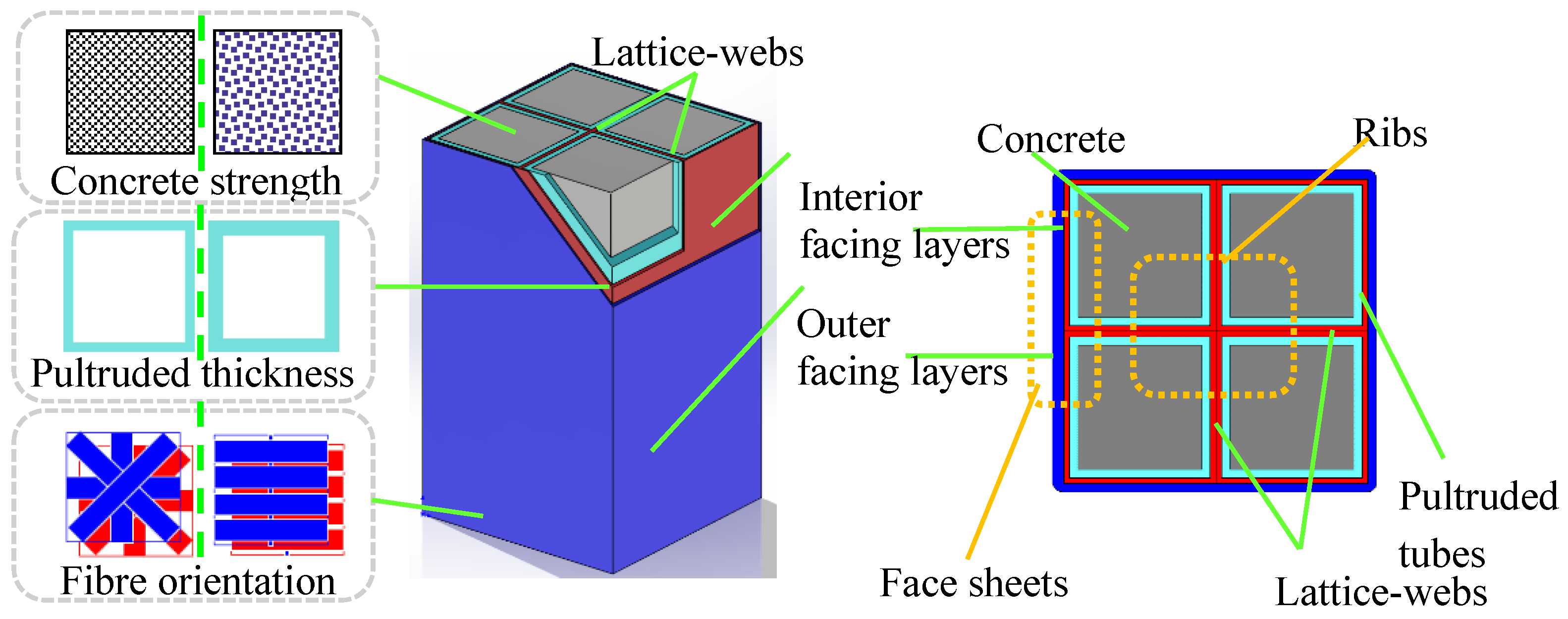
Figure 1. The MCPL configuration.
Buildings 15 04352 g001
Figure 2. Fabrication of MCPLs.
Buildings 15 04352 g002
Figure 3. Experimental setup and instrumentation.
Buildings 15 04352 g003
Figure 4. The failure modes of CPCs.
Buildings 15 04352 g004
Figure 5. Failure modes of AC-C30 and AC-T4.
Buildings 15 04352 g005
Figure 6. Failure modes of specimens AC-H.
Buildings 15 04352 g006
Figure 7. Hoop strain distributions for MCPLs.
Buildings 15 04352 g007
Figure 8. The axial–hoop strain curves for MCPL specimens.
Buildings 15 04352 g008
Figure 9. Load–axial strain curves for MCPL specimens.
Buildings 15 04352 g009
Figure 10. Influence of key parameters on the structural behaviour of MCPLs.
Buildings 15 04352 g010
Figure 11. Load–axial strain curves of confined concrete in MCPL specimens.
Buildings 15 04352 g011
Figure 12. Influence of key parameters on load–strain curves of confined concrete in MCPLs.
Buildings 15 04352 g012
Figure 13. Peak hoop strain ratios versus confinement stiffness ratios.
Buildings 15 04352 g013
Figure 14. Assessment of axial strain prediction models.
Buildings 15 04352 g014
Figure 15. Validation of theoretical models for confined concrete.
Buildings 15 04352 g015
Table 1. Details of GFRP pultruded square specimens.
GroupLabelDimension (mm)Interior Facing LayersOuter Facing LayersConcreteSection Configuration
HLrT
CPCCPC-C3040010036 C30Buildings 15 04352 i001
CPC-T440010034--C30
Control SpecimensSCP40010036--C30
MCP-L2-F440021036(±45°)2[(0, 90°)2/(±45°)]2C60Buildings 15 04352 i002
MCP-L4-F34002103[(±45°)2/(0°/90°)2](±45°)2C60
AC-C30AC-L2-F4-C304002103(±45°)2[(0, 90°)2/(±45°)]2C30Buildings 15 04352 i003
AC-L4-F3-C304002103[(±45°)2/(0°/90°)2](±45°)2C30
AC-HAC-L2-F4-H4002103(0)2(0)6C30
AC-L4-F3-H4002103(0)4(0)2C30
AC-T4AC-L2-F4-T440021034(±45°)2[(0, 90°)2/(±45°)]2C30
AC-L4-F3-T44002103[(±45°)2/(0°/90°)2](±45°)2C30
Table 2. Structural performance of constituent materials.
Properties(0°)Concrete C30
MeanStandard DeviationMeanStandard Deviation
Axial compressionStrength (MPa)9.881.0231.861.13
Young’s modulus (GPa)3.150.6331.150.81
Transverse compressionStrength (MPa)181.228.26--
Young’s modulus (GPa)26.164.63--
Axial tensile strength (MPa)50.412.94--
Transverse tensile strength (MPa)330.5111.63--
Shear modulus (GPa)6.510.83--
Poisson’s ratioυ120.030.20
υ210.300.20
Table 3. Key test results of concrete-filled composite specimens.
Labelσc
(MPa)
Ψ
(%)
Favp
(kN)
εavp
(10−6)
Favu
(kN)
εavu
(10−6)
Favy
(kN)
εavy
(10−6)
μ
SCP60.110.1812609.73564518.33773582.534311.091
CPC-C3028.53−4.900437.533156371.93358415.6531371.070
CPC-T429.53−1.567308.92415266.52366298.322991.020
AC-L2-F4-C3048.9663.202790512123715654272847781.183
AC-L4-F3-C3052.9476.47282451682400577326234455 1.296
MCP-L2-F477.2929.833485498329625721335042971.331
MCP-L4-F380.1634.653682569231306978297336621.906
AC-L2-F4-H54.3581.1727236043231510,68125995543 1.926
AC-L4-F3-H51.5271.73269655152289812826355265 1.543
AC-L2-F4-T448.7462.472426454420925358228541921.278
AC-L4-F3-T450.5868.602529482522725020209137861.326
Table 4. Calculation results of hollow multi-cell pultruded tubes.
Labelε(w=1) x
(10−6)
F(w=1)
(kN)
ε(w=2) x
(10−6)
F(w=2) (kN)ε(w=3) x
(10−6)
F(w=3) (kN)ε(w=4) x
(10−6)
F(w=4) (kN)Fpcr
(kN)
AH-L2-F4-H3250590325459267601188 1487
AH-L4-F3-H3254589.653257589.9057601184--1522
AH-L2-F4-T450691029521410566713122868031237493.38
AH-L4-F3-T4498710075436107159911119--501.47
Table 5. Results of the calculation.
LabelE2 (MPa)εtεh0εh,rup
AC-L2-F4-T44941.230.0023944 0.0088120.004810
AC-L4-F3-T44207.580.0023263 0.0078000.005305
AC-L2-F4-H3679.540.0022796 0.0098420.003987
AC-L4-F3-H3856.580.0022950 0.0092290.004367
AC-L2-F4-C304911.880.0023916 0.0079820.004998
AC-L4-F3-C303898.610.0022987 0.0071820.005133
MCP-L2-F43247.090.0035464 0.0079820.003320
MCP-L4-F33084.610.0035292 0.0071820.004060
Table 6. Quantitative validation of theoretical predictions.
LabelActual Hoop Rupture Strain (10−6)Ultimate Axial Strain
(10−6)
Ultimate Stress of Concrete
(MPa)
Peak Loads of MCPLs
(kN)
εcaεexca − εex)/εexεcaεexca − εex)/εexσcaσex(σcaσex)/σexPcaPex(FcaFex)/Fex
AC-L2-F4-T44810403519.2%450947184.43%52.28 48.74−7.26%26482426−9.17%
AC-L4-F3-T4530550824.39%464448864.95%49.54 50.582.06%25412529−0.500%
AC-L2-F4-H398736898.08%67596287−7.51%54.87 54.35−0.960%28872723−6.05%
AC-L4-F3-H436741774.55%57595592−2.99%52.21 51.52−1.34%28012696−3.90%
AC-L2-F4-C30499845809.13%53345121−4.16%56.20 48.96−14.8%31452790−12.7%
AC-L4-F3-C3051335612−8.54%56025168−8.40%51.84 52.942.08%30162824−6.79%
MCP-L2-F43320298811.1%53344983−7.04%76.32 77.290.0900%37683485−8.12%
MCP-L4-F340604304−5.67%560256921.58%76.28 80.16−4.26%37733682−2.47%
Noted: The Mean Absolute Percentage Error (MAPE) is also included, and the MAPEs of the hoop rupture strain, ultimate axial strain, ultimate stress of concrete, and peak loads of MCPLs were 5.28%, −2.39%, 3.04%, and −6.02%, respectively.
Disclaimer/Publisher’s Note: The statements, opinions and data contained in all publications are solely those of the individual author(s) and contributor(s) and not of MDPI and/or the editor(s). MDPI and/or the editor(s) disclaim responsibility for any injury to people or property resulting from any ideas, methods, instructions or products referred to in the content.