Article

Seismic Damage Assessment of Minarets: Insights from the 6 February 2023 Kahramanmaraş Earthquakes, Türkiye


by
Pınar Usta Evci
1,
Ali Ekber Sever
1,
Elifnur Şakalak
1,
Shaghayegh Karimzadeh
2,* and
Paulo B. Lourenço
2
1
Civil Engineering Department, Technology Faculty, Isparta University of Applied Sciences, Isparta 32040, Türkiye
2
ISISE, ARISE, Department of Civil Engineering, University of Minho, Azurém, 4800-058 Guimarães, Portugal
*
Author to whom correspondence should be addressed.
Buildings 2025, 15(23), 4358; https://doi.org/10.3390/buildings15234358 (registering DOI)
Submission received: 28 October 2025 / Revised: 24 November 2025 / Accepted: 28 November 2025 / Published: 1 December 2025
(This article belongs to the Section Construction Management, and Computers & Digitization)

Abstract

Minarets, with their tall spires and intricate architectural designs, stand as iconic symbols of religious and cultural identity in many regions worldwide. Their slender profiles and unique structural characteristics make them particularly vulnerable to seismic forces during earthquakes. Türkiye, a country rich in history and culture, was struck by two devastating earthquakes of M7.7 and M7.6 on 6 February 2023. The epicenters were in the Pazarcık and Elbistan districts of Kahramanmaraş province. These earthquakes severely affected the city’s 11 districts, causing significant structural damage. Among the affected structures were the iconic symbols of the city’s architectural heritage, the minarets. This study investigates seismic damage to minarets incurred during the 2023 earthquakes, focusing specifically on the Four-Legged Minaret located in the province of Diyarbakır. For this purpose, modal and nonlinear time history analyses were performed on the historical Four-Legged Minaret. The analysis results indicate that the Pazarcık earthquake produced higher base shear forces and peak displacement values compared to the Elbistan earthquake. Stress concentrations were predominantly observed in the transition zone between the minaret’s base and cylindrical body. The damage patterns obtained from numerical simulations showed strong agreement with field observations. The study emphasizes the critical importance of using site-representative seismic inputs, and, at the same time, identifies vulnerable regions that should be prioritized in conservation and strengthening efforts for slender historical masonry structures.

1. Introduction

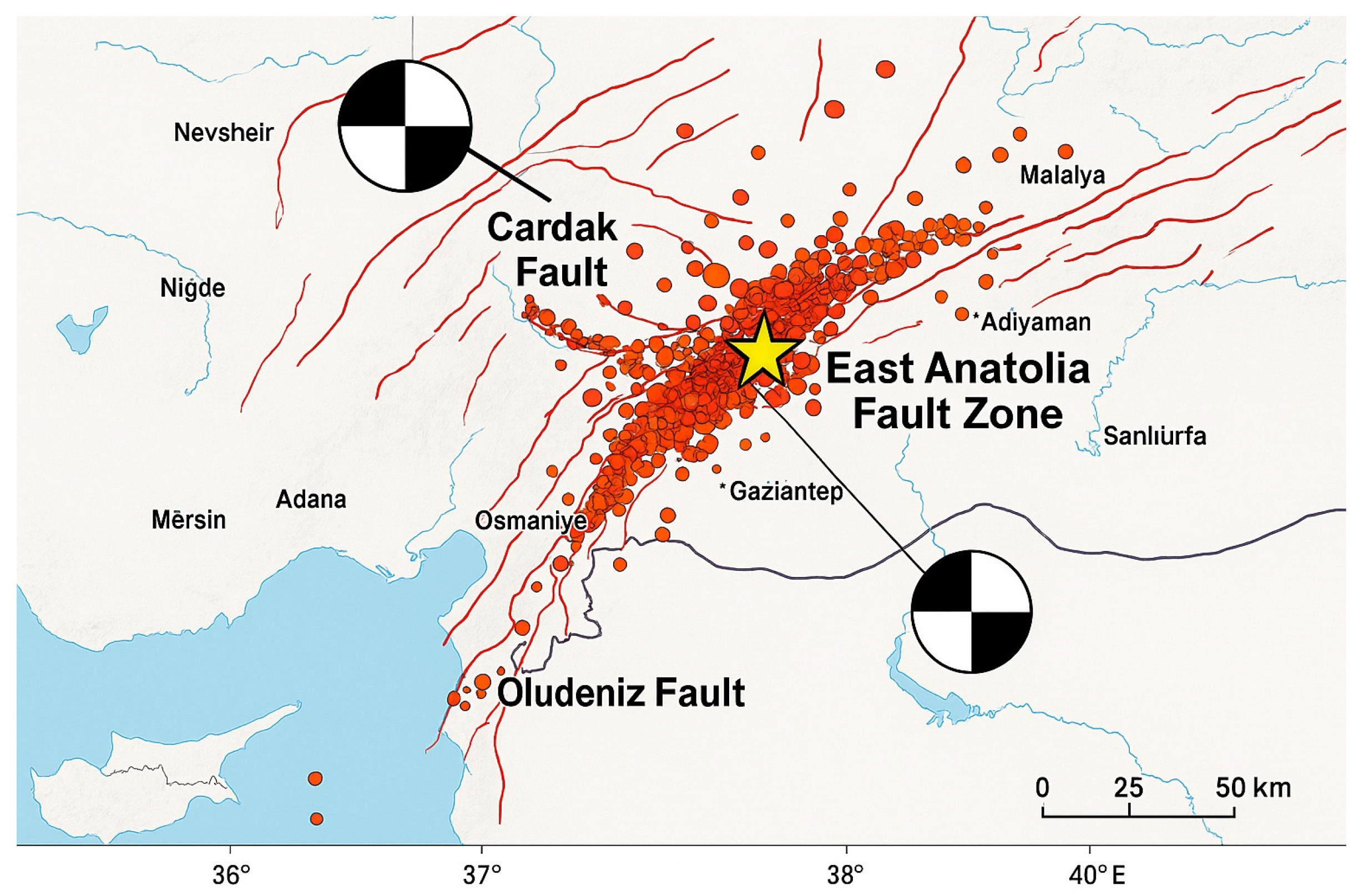
Many devastating earthquakes occurred in Türkiye, which is located between the Eurasian, African, and Arabian plates. The North Anatolian Fault Zone (NAFZ), East Anatolian Fault Zone (EAFZ), and West Anatolian Fault Zone (WAFZ), which together form Türkiye’s primary fault system, are responsible for the accumulation of tectonic stress that ultimately leads to the occurrence of earthquakes (Figure 1). On 6 February 2023, two earthquakes happened on the EAFZ. The first, a magnitude of M7.7 event, struck at 04:17 local time with its epicenter in Pazarcık (Kahramanmaraş), followed by a second earthquake at 13:24 with a magnitude of M7.6 and its epicenter in Elbistan (Kahramanmaraş). While the Pazarcık earthquake happened at a depth of 8.6 km, the Elbistan earthquake occurred at a depth of 7.0 km. Both events were characterized by a left-lateral strike-slip mechanism. The first earthquake ruptured approximately 400 km along five distinct segments of the EAFZ, including Amanos, Pazarcık, Erkenek, Sakçagözü, and Narlı segments. The second event occurred farther north, rupturing a 200 km fault segment near Elbistan, including the Çardak and Doğanşehir segments [1]. The earthquakes were followed by numerous aftershocks of large magnitudes. Figure 2 shows the epicenter of the earthquakes and the distribution of aftershocks. As a result of these earthquakes, widespread destruction and loss of life occurred in 11 provinces (Kahramanmaraş, Hatay, Gaziantep, Adıyaman, Malatya, Kilis, Şanlıurfa, Adana, Osmaniye, Diyarbakır, Elazığ), home to approximately 15 million people.
Figure 2. Seismic activity associated with the 6 February 2023 earthquakes in southeastern Türkiye. The black star marks the Pazarcık (M7.7) epicenter, and the orange star indicates the Elbistan (M7.6) epicenter [2].
Buildings 15 04358 g002
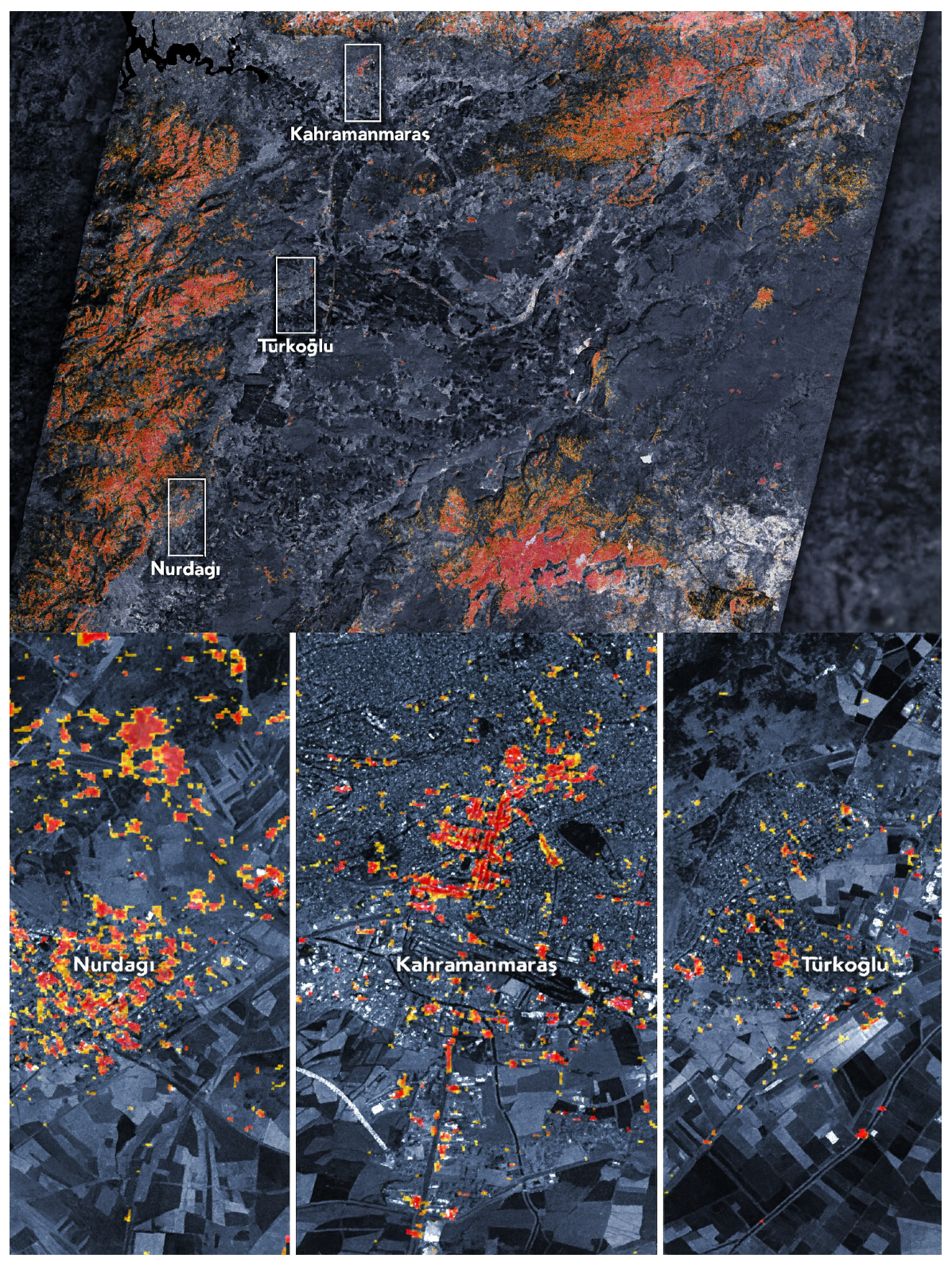
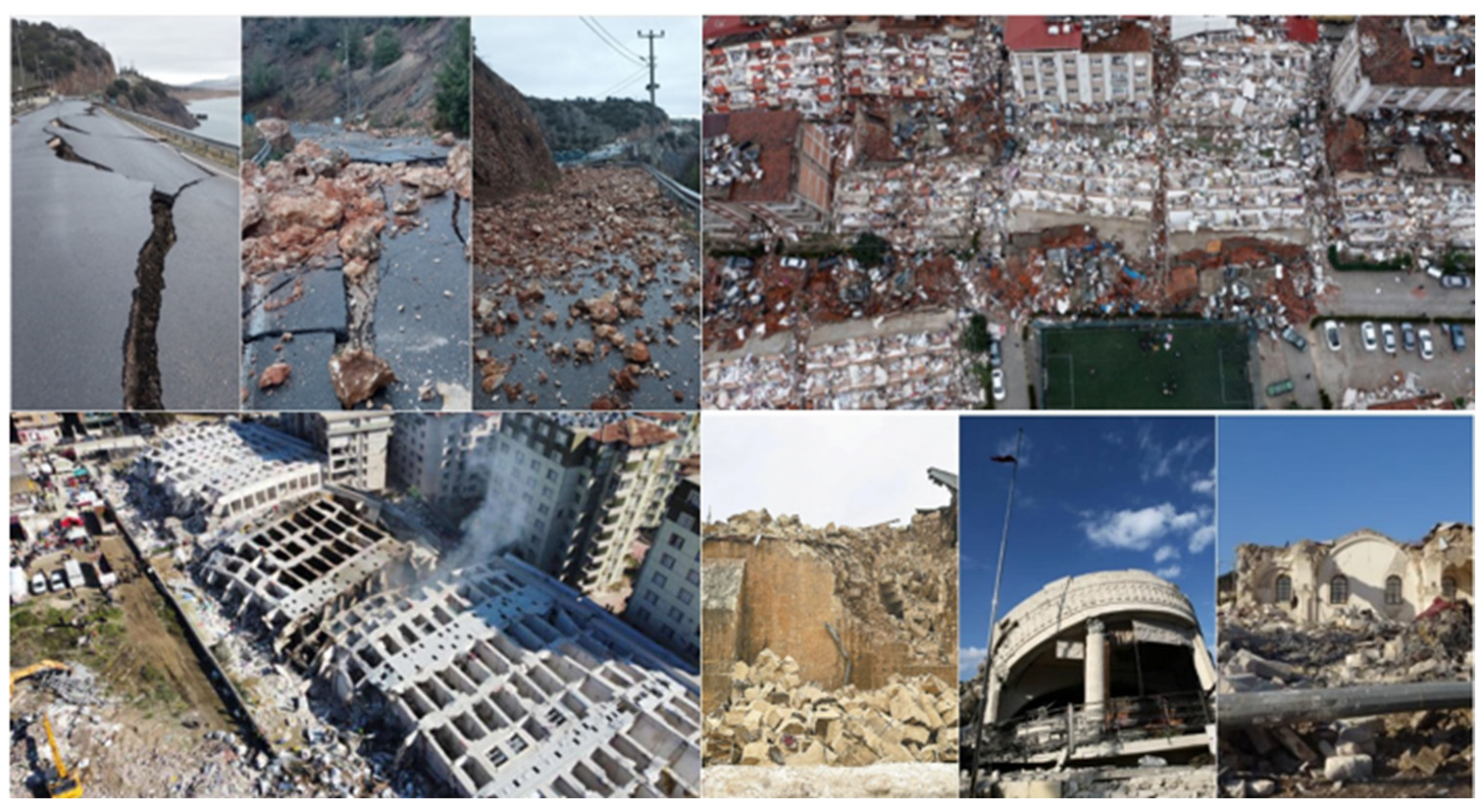
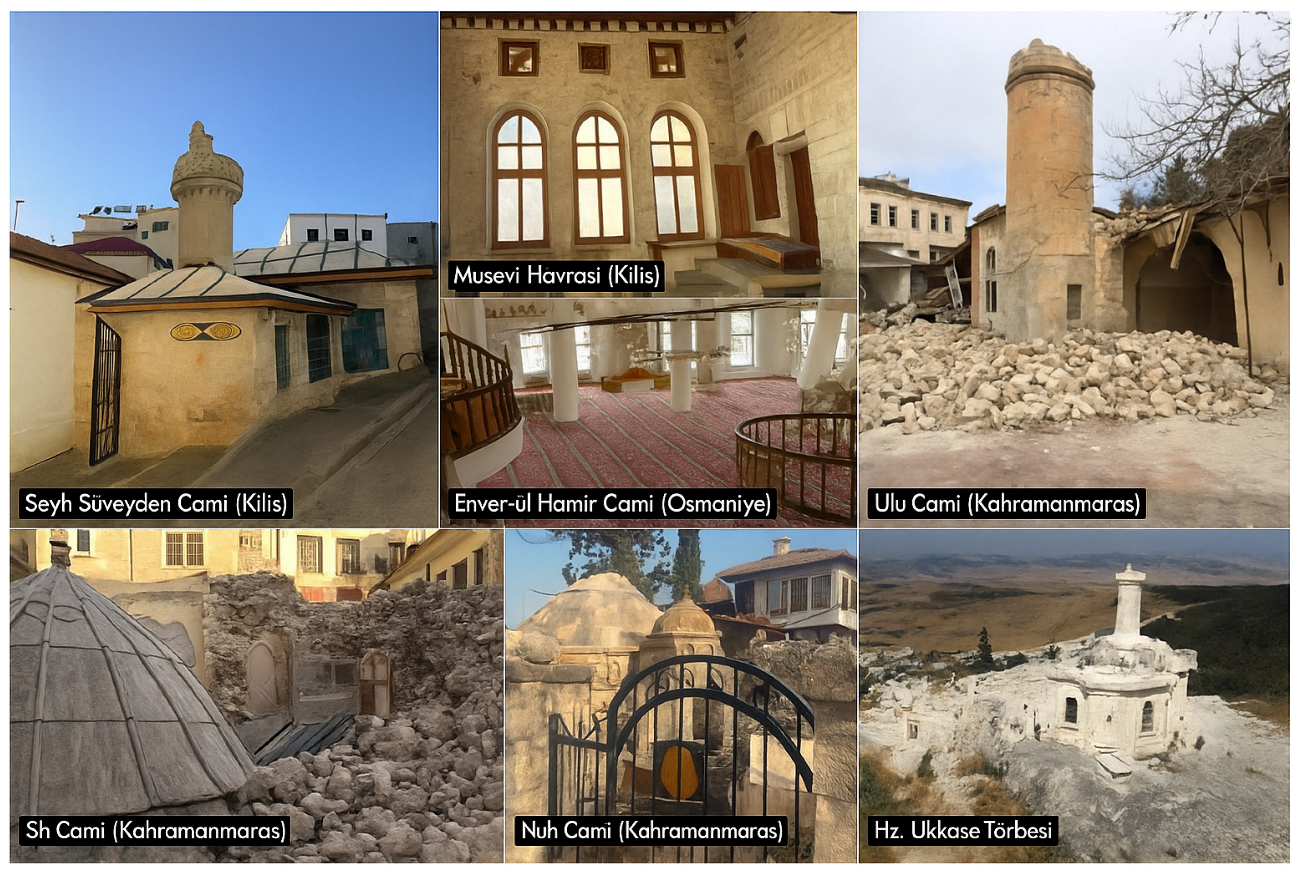
Figure 3 shows the distribution of the damage caused by the 2023 Türkiye earthquakes obtained through NASA satellite data [3]. On 8 February 2023, data was assembled by the PULSAR-2 radar instrument on the Japan Aerospace Exploration Agency (JAXA) Advanced Land Observation Satellite-2 (ALOS-2) [4]. The collected data were processed in cooperation with NASA’s Jet Propulsion Laboratory and Caltech (California Institute of Technology), and a damage map caused by earthquakes was created by the Singapore Earth Observatory-Remote Sensing Laboratory [5]. Approximately 51,000 people lost their lives, and 110,000 people were injured. According to the statements of the Ministry of Environment, Urbanization, and Climate Change [6], 36,932 buildings in the region collapsed during the earthquakes. At the end of 8 months, 311,000 buildings became unusable due to the damage they received. Examples of the widespread destruction caused by the 2023 earthquakes in the region, including surface ruptures, landslides, and the collapse of residential, historical, and public buildings, are given in Figure 4. Among them, many masonry buildings were destroyed and damaged. Figure 5 shows some of the collapsed and damaged historical buildings in the 11 districts affected by the earthquakes.
Figure 3. The spatial distribution of the damage caused by the 2023 Türkiye earthquakes. The damaged areas are shown in red (most damaged) to yellow (least damaged) [3].
Buildings 15 04358 g003
Figure 4. Examples of the widespread destruction caused by the 2023 earthquakes in the region, including surface ruptures, landslides, and the collapse of residential, historical, and public buildings [7].
Buildings 15 04358 g004
Figure 5. Examples of historical buildings damaged or destroyed in the 11 provinces impacted by the 6 February 2023 Kahramanmaraş earthquakes [8].
Buildings 15 04358 g005
Ersoy [9] conducted a field study on the effects of the Kahramanmaraş earthquakes on the historical buildings located around Antakya Kurtuluş Street. The findings revealed that one of the most common types of damage was the out-of-plane movement of the walls. Demir et al. [10] examined the masonry structures that were damaged in the 2023 Türkiye earthquakes. They observed that damage occurred in the form of shear cracks, out-of-plane movements, and overturning due to poor mortar quality, structural element weaknesses, weak connections, inadequate diaphragms, and incompatibility between different parts. Avcil et al. [11] investigated the structural damage in Kahramanmaraş city following the 6 February 2023 earthquakes and found that non-retrofitted buildings with poor construction practices experienced extensive failures, especially in load-bearing elements. These structures were built due to the work of local craftsmen. Çambay [12] conducted a damage assessment of masonry buildings in Adıyaman province and concluded that deficiencies in material quality and detailing significantly contributed to the heavy damage observed in traditional structures. Mercimek [13] analyzed the seismic failure modes of masonry structures and identified predominant collapse mechanisms such as out-of-plane wall failure, diaphragm instability, and pounding effects between adjacent buildings. Güleç [14] examined the effects of the Kahramanmaraş earthquake on masonry buildings and highlighted that the absence of reinforcement and deterioration in mortar properties made these structures highly susceptible to collapse. Arkan et al. [15] investigated the damage to the load-bearing walls of masonry buildings affected by the 2023 Türkiye earthquakes. They identified the primary causes of the damage as inadequate use of horizontal/vertical bond beams, poor masonry work, use of more than one different wall material together, heavy soil layers added to the roof, and use of low-strength mortar. Kocaman [16] conducted a field survey for the performance evaluation of some of the historical masonry mosques and minarets in 11 different provinces that were exposed to the 6 February 2023 earthquakes. It was determined that dome collapses, minaret damage, and load-bearing walls failures are common in historical mosques. The author also observed that minaret damage was concentrated in the cone parts and transition areas. The study by Onat et al. [17] examined the seismic behavior of the historical Yusuf Pasha Mosque, which was affected by the 6 February 2023 earthquakes. The authors used non-destructive methods to determine the material properties of the structure. They performed nonlinear time history analyses using eight earthquake records and found that the observed cracks aligned well with the analysis results. Dedeoglu et al. [18] examined the seismic behavior of the historical Ahi Musa Mosque in Elazığ province. They used the acceleration records of the Pazarcık and Elbistan earthquakes that occurred on 6 February 2023. They performed a nonlinear time history analysis of the building models. They found that the absolute displacement and base shear force values were greater in the Pazarcık earthquake than in the Elbistan earthquake. Under the applied seismic effects, the maximum and minimum principal stresses were obtained in similar regions of the structure, indicating that both tensile and compressive demands tend to accumulate in the same critical zones.
They found that there should be no collapse in this historical mosque. Nasery [19] investigated the causes of structural damage on the entrance gate of the Harran Grand Mosque due to the 6 February 2023 earthquake. For this purpose, a finite element model of the building was developed using the Abaqus program, and static and nonlinear dynamic analyses were performed. The results revealed that the earthquake caused the out-of-plane failure of the entrance arches, leading to collapse. Çavuşlu [20] carried out settlement creep and seismic analysis of the single-span historical Çüngüş Bridge in Diyarbakır province, subjected to the 2023 earthquake records. The creep analysis revealed that the greatest damage and deformation occurred in the arch section of the bridge. Seismic analysis showed that earthquakes had a significant impact on the seismic safety of the historical bridge. Kahya et al. [21] investigated the possible causes of damage to masonry structures as a result of the 2023 Türkiye earthquakes. They also performed a nonlinear finite element analysis of a historical building in Hatay. The results showed that the structure, while heavily damaged during the 6 February 2023 Pazarcık and Elbistan earthquakes, did not collapse; however, partial collapse occurred during the Defne earthquake in Hatay on 20 February 2023. Pouraminian [22] examined the safety of historic brick minarets under multi-hazard conditions using a reliability-based approach. The author evaluated the performance of the minarets, particularly under earthquake and wind loads, and highlighted the need for protective measures by demonstrating that structural safety was inadequate in certain situations. Pouraminian et al. [23] assessed the structural safety of the Bistoon historic arch bridge using reliability-based methods. Their numerical analysis determined that the bridge had inadequate safety under certain loading scenarios and indicated the need for strengthening.
There are various studies in the literature on the Four-Legged Minaret; these studies evaluated the structural behavior of the minaret, ground conditions, and damage with different methods. Kazaz et al. [24] evaluated the cracking behavior of the historic Four-Legged Minaret in Diyarbakır using numerical analysis. Their analysis, using a finite element model based on data obtained from the actual structure, revealed that cracks were particularly concentrated in the base-body junction area, indicating that this area was structurally weak. Uğurlu and Karaşin [25] assessed the structural damage to the Four-Legged Minaret using field observations and documentary data. They analyzed in detail the cracks and deformations observed in the minaret’s supporting piers, demonstrating that damage was related to the effects accumulated over time and past earthquakes. Kazaz et al. [26] evaluated the seismic behavior of the Four-Legged Minaret. As a result of the analysis performed under different earthquake scenarios, they determined that the four-legged geometric system provides a certain level of rigidity, but the likelihood of local damage is high, especially at the connection points.
Unlike previous studies on the Four-Legged Minaret, which mainly examined its general seismic behavior, assessed structural damage using simplified assumptions, or numerically evaluated pre-existing cracks, this study provides the first post-earthquake seismic assessment using site-representative ground motion records from the 6 February 2023 Kahramanmaraş earthquakes. Earlier works did not incorporate real recorded motions or validate numerical predictions against observed post-earthquake damage, leaving a significant gap in understanding the actual seismic performance of the structure. By integrating these real earthquake recordings with a refined layered-shell finite element model and observed damage patterns, the present work offers a novel, data-driven understanding of the damage mechanisms affecting this unique historical structure [24,25,26].
This study offers a novel contribution by conducting a detailed seismic performance assessment of the historical Four-Legged Minaret in Diyarbakır, one of the most iconic and structurally unique minarets in Türkiye, damaged during the 6 February 2023 Kahramanmaraş earthquakes. For this purpose, this research utilizes ground motion records obtained from a seismic station located in proximity to the minaret, thereby ensuring site-representative seismic input in the analysis. A finite element model was developed using SAP2000 V23 [27], and both modal and nonlinear time history analyses were performed to investigate the dynamic behavior and damage mechanisms of the structure. The paper is structured to begin with a regional seismic overview and observed minaret damages, followed by the presentation of the case study, modeling methodology, and numerical results. In addition to identifying the most vulnerable parts of the minaret, the study provides valuable insights into the seismic behavior of tall, slender masonry structures, contributing to the preservation and seismic safety assessment of cultural heritage.

2. Effects of the 2023 Kahramanmaraş (Türkiye) Earthquakes on Minarets
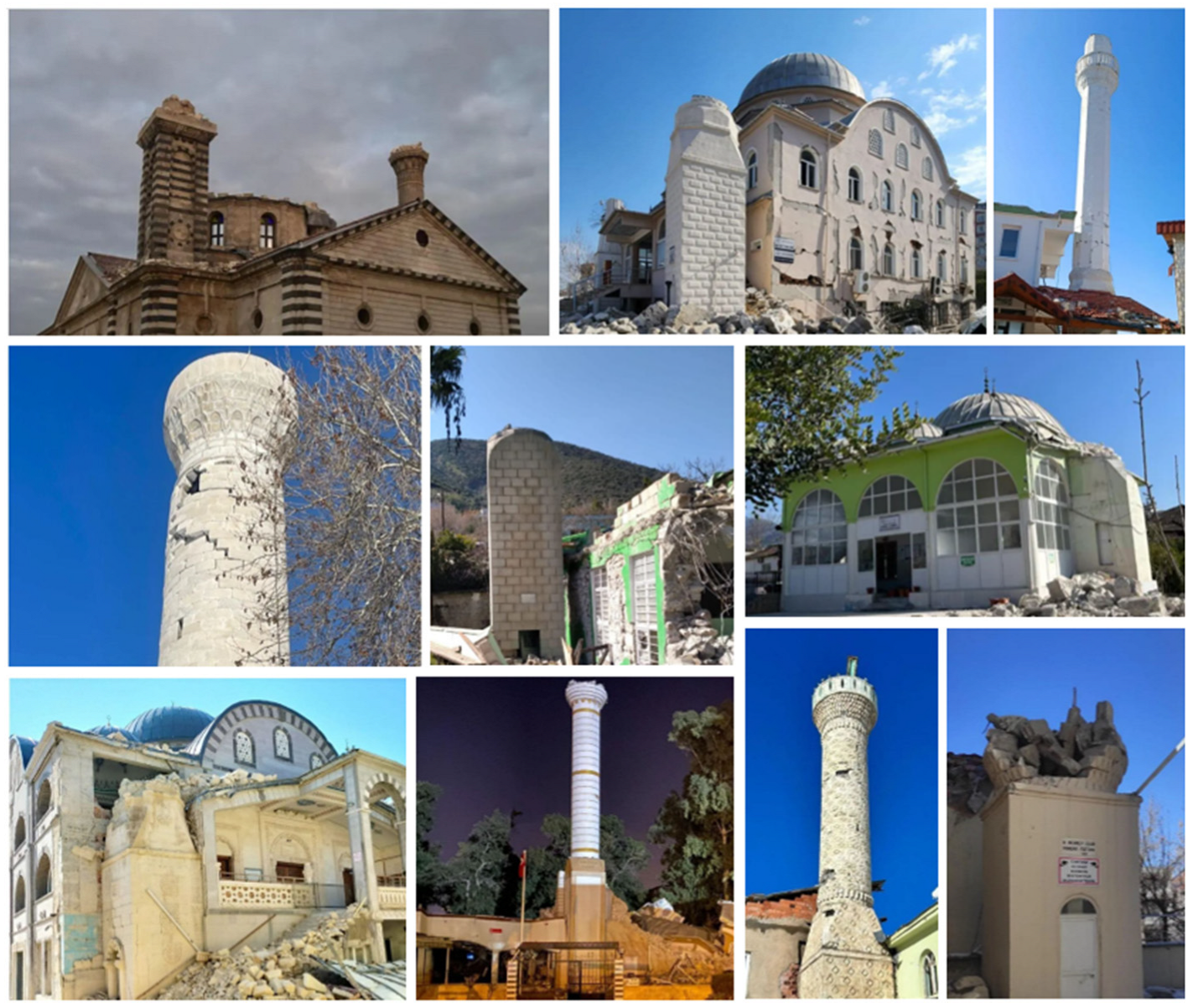
The epicenters of the 2023 Türkiye earthquakes were near populated areas, intensifying the impact on structures throughout the city. While buildings of various construction types suffered damage, the focus here is on the minarets. Minarets exhibit distinct structural features that differentiate them from conventional buildings and pose specific challenges in earthquake-prone regions. Minarets generally have a geometric structure with polygonal or circular cross-sections. As tall and slender structures, they are particularly vulnerable to horizontal loading. Generally, their structural forms show geometric changes in different ways. In regions where geometric changes occur, stress concentrations appear under lateral loads such as earthquakes. As a result, when the carrying capacity is exceeded, damage and often collapse occur in areas of geometric changes. Past earthquakes caused various types of damage to minaret structures, depending on their design, construction quality, and seismic vulnerability. The observed damage can be classified into three categories: (a) cracking, (b) residual displacements, and (c) toppling. During the 2023 earthquakes, one of the most common forms of damage observed was cracking. These cracks ranged from superficial fissures to more severe fractures, compromising the structural integrity of the affected minarets. In parallel, some minarets experienced significant residual displacement at their bases, indicating the inability of the foundation to withstand the lateral forces exerted during the earthquakes. This displacement not only affects the stability of the minaret but also poses a safety risk to surrounding structures and individuals. Lastly, minarets were observed to topple over entirely. This catastrophic failure not only results in the loss of a cultural and religious landmark but also highlights the need for improved seismic resilience in minaret design and construction. Some of the minarets damaged during the 2023 Türkiye earthquakes are shown in Figure 6.
Figure 6. Examples of minarets damaged in the 2023 Türkiye earthquakes [28].
Buildings 15 04358 g006
There are many studies about the behavior of masonry minarets under seismic effects. Within this context, Erkek and Yetkin [29] examined the seismic performance of the historical Envarul Hamit Mosque, which was heavily damaged in the 6 February 2023 earthquakes, using both horizontal components of the first earthquake. From the analysis, peak displacement, base shear force, principal stresses, and plastic deformation parameters were obtained and evaluated. The authors compared the analysis results with the actual damage suffered by the historical building. They found that the maximum principal stresses were obtained in the cross-section transition zone of the historical minaret. Their findings revealed that, in the nonlinear analysis, the historical minaret collapsed from the upper transition section. Nasery [30] examined the post-earthquake situation of the Harran Ulu Mosque (Great Mosque) minaret, which was severely damaged. A three-dimensional model was developed to determine the damage status and crack propagation in inaccessible parts of the minaret. The authors used laser scanning and digital oblique photogrammetry to detect cracks and damage areas in inaccessible areas of the minaret by navigating the 3D model. Işık et al. [31] investigated the seismic damage that occurred to minarets and mosques during the Kahramanmaraş earthquake of 6 February 2023. As a result of field research, they observed significant damage and collapses due to the earthquakes.
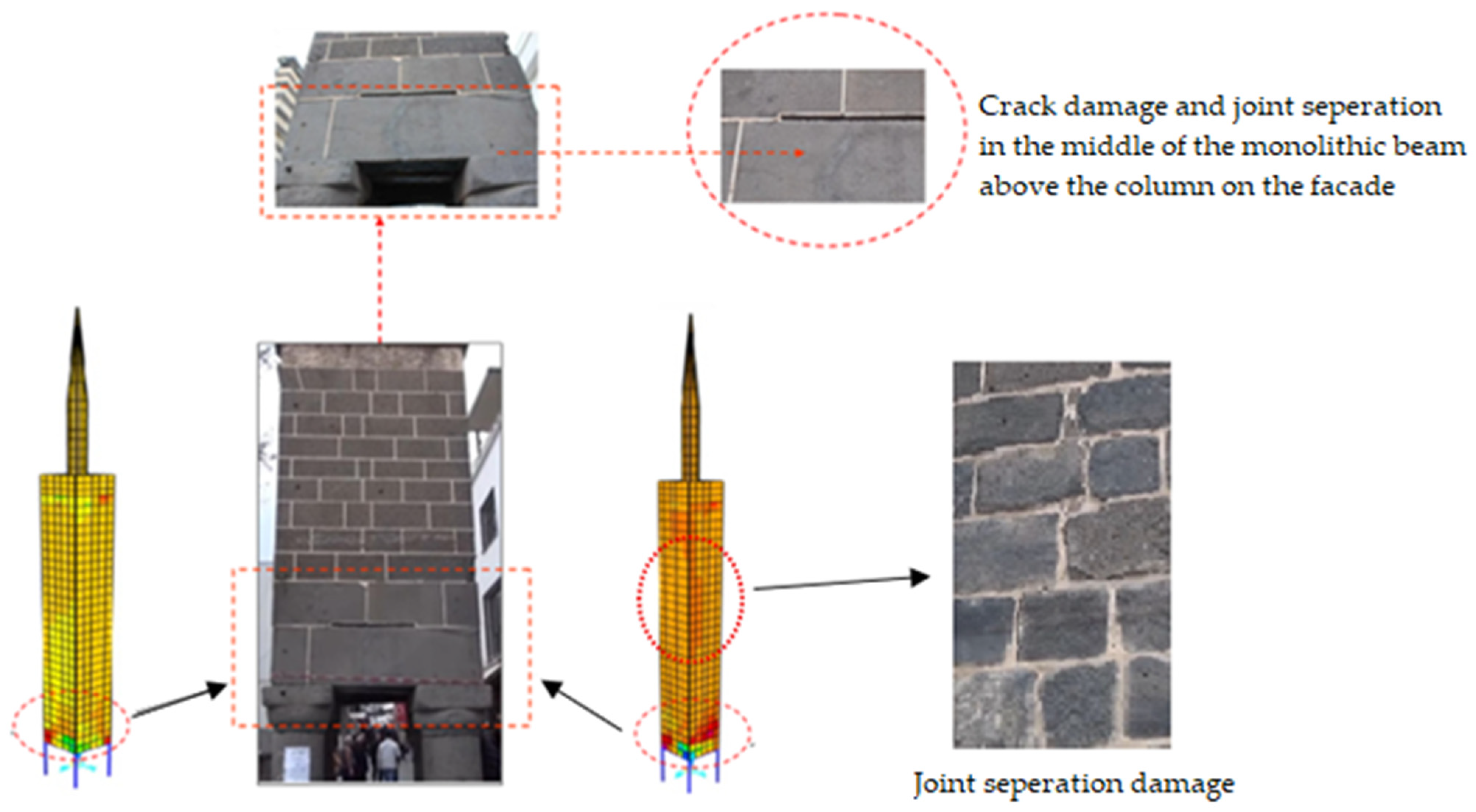
Recent field reports confirm that the Four-Legged Minaret sustained damage during the 6 February 2023 Kahramanmaraş earthquakes. According to the post-earthquake assessment conducted by local authorities, a pre-existing vertical crack along the monolithic beam above the northern façade column extended further, and new separations developed along the joints above this beam. Similar vertical cracks were observed on the eastern façade column’s beam, with accompanying upward joint separations. On the southern façade, minor joint separations were also identified [32]. Finally, following the 6 February 2023 earthquakes, a damage survey conducted around the minaret identified a vertical crack above the monolithic beam supported by the four columns, joint separations on the north, east, and south façades, and minor openings in the upper parts of the structure. These observations highlighted the seismic vulnerability of the minaret and motivated its selection as the focus of the numerical analysis presented in this study.

3. Numerical Modeling of the Selected Minaret

3.1. Case Study: The Four-Legged Minaret
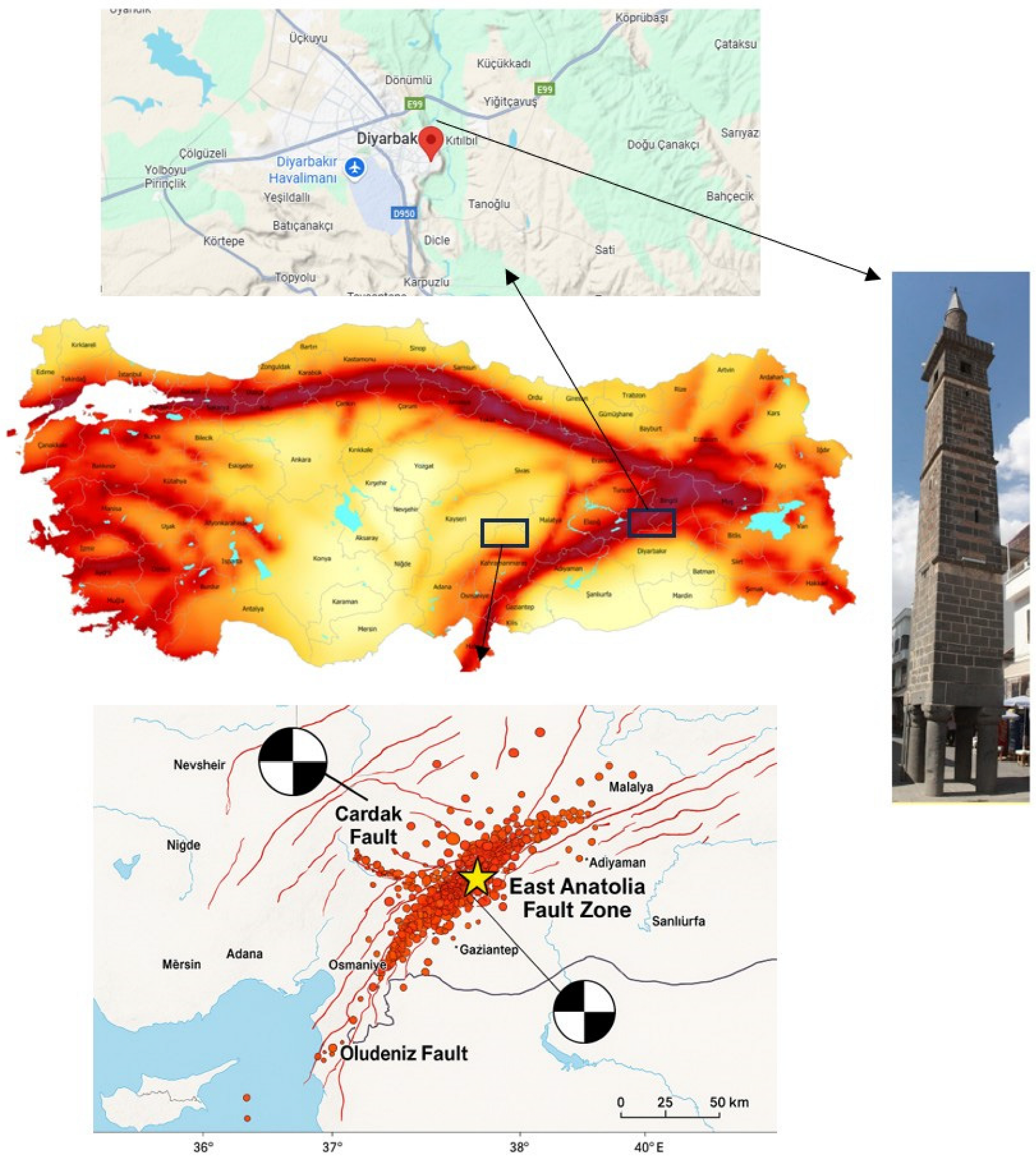
The Four-Leg Minaret was built in the year 906 Hijri (1500 AD) by Sultan Kasım, the ruler of the Akkoyunlu dynasty, as stated in the inscriptions of the mosque. This is one of the most fascinating structures in Diyarbakır. Apart from its main body, the minaret stands out distinctly from others, resting on four plain columns and capitals. The Türkiye earthquake hazard map, the 2023 earthquake epicenters, and the location of the historical minaret are shown in Figure 7.
Figure 7. Türkiye earthquake hazard map with a 475-year return period [1], showing the epicenters of the 6 February 2023 earthquakes and the location of the historical Four-Legged Minaret in Diyarbakır. The zoomed-in satellite view and photograph of the minaret are also included for reference.
Buildings 15 04358 g007
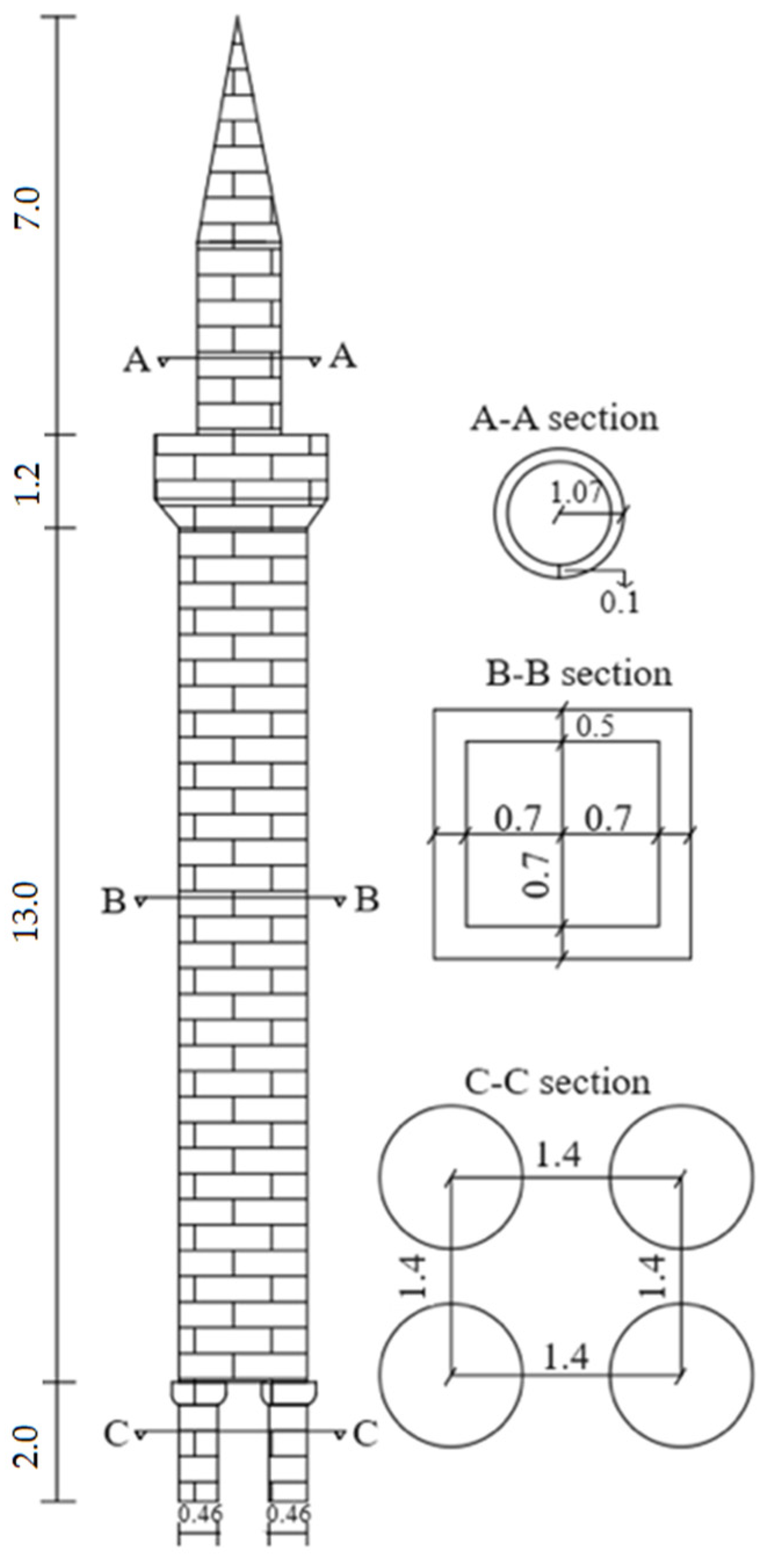
The minaret belongs to the Şeyh Mutahhar Mosque, located in the city center of Diyarbakır, within the historical walls known as the Sur, which is home to many historical buildings. The square body of the minaret is made of black and white ashlar stones and has an inscription on it. The upper cylindrical section, however, resembles other square-bodied minarets in Diyarbakır. Although square-bodied minarets are common in Diyarbakır and its surroundings, none of them is supported by four columns. In this respect, the Şeyh Mutahhar Mosque Minaret remains a unique example [33]. The elevation and cross-sections at different heights of the minaret are shown in Figure 8.

3.2. Finite Element Modeling of the Minaret
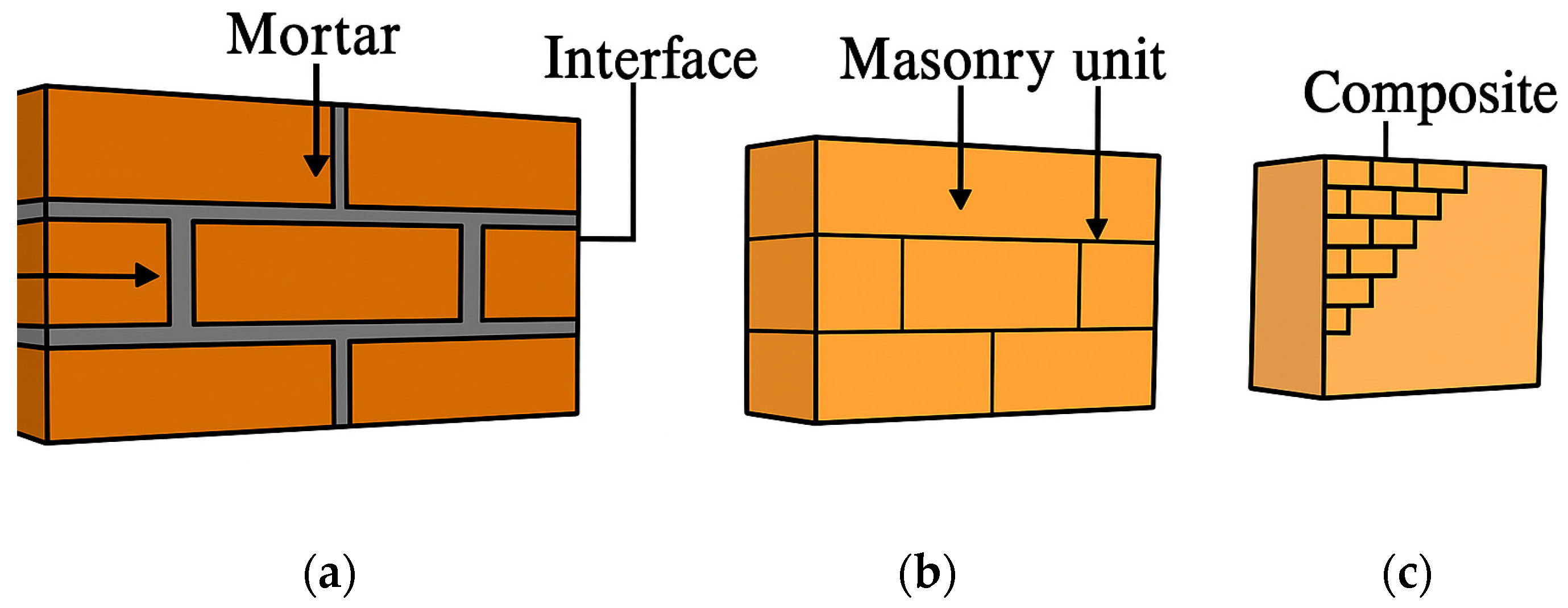
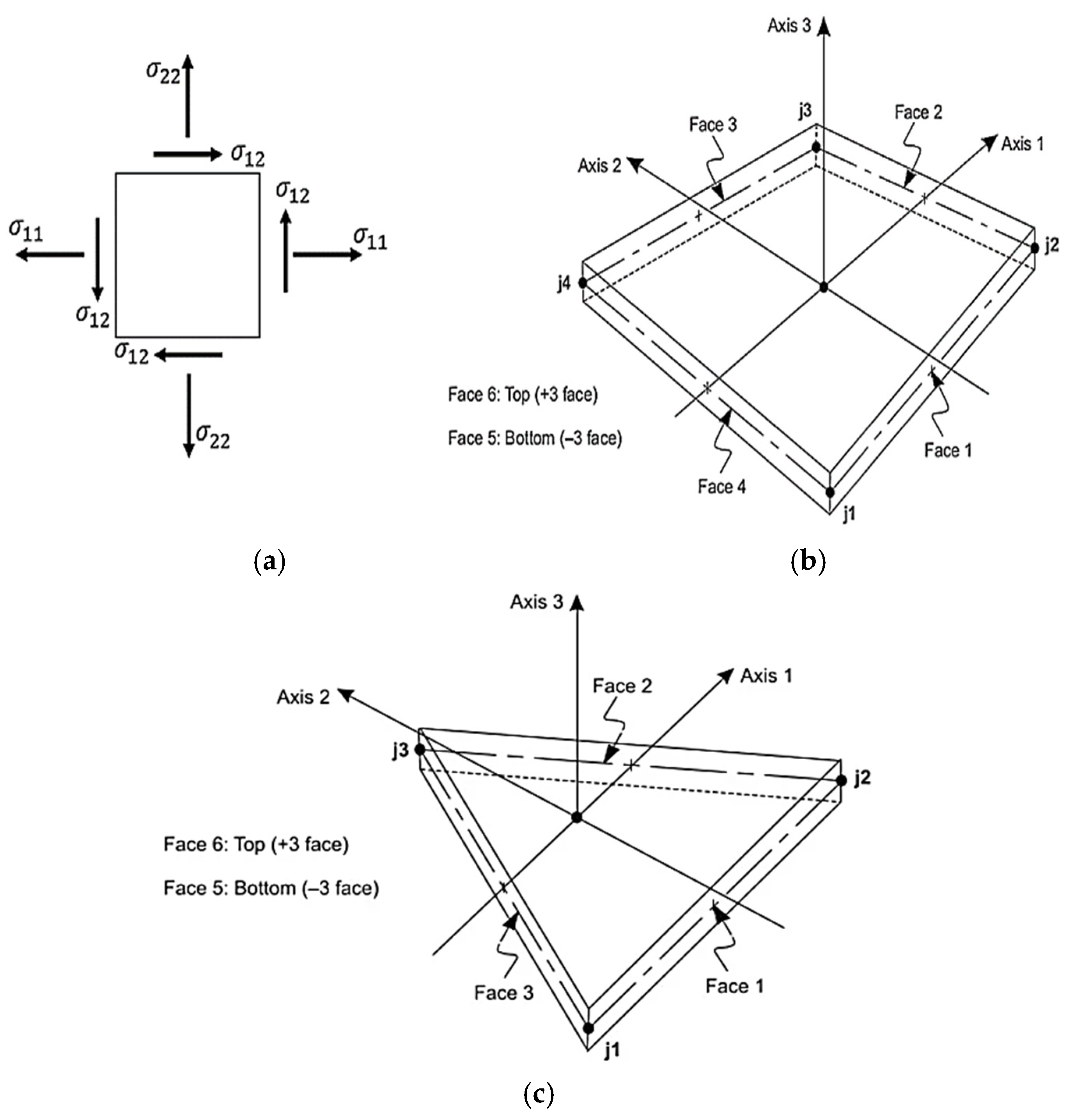
For numerical modeling of masonry structures, three separate modeling approaches are commonly used, which are called simplified micro-modeling, detailed micro-modeling, and macro-modeling (Figure 9), depending on the size of the structural system and accuracy sought [34]. In simplified micro-modeling, the masonry units are expanded by half of the mortar layer, so that the mortar is neglected, and the masonry units are separated from each other by interface lines. On the other hand, in detailed micro-modeling, the material properties of the masonry units and the mortar are evaluated separately. In macro modeling, masonry is considered composite without distinction between unit and mortar. Macro modeling technique is generally used in the examination of large building systems, as it greatly shortens the solution time and material data needed. Several studies used this approach in assessing the seismic performance of masonry structures [35,36,37,38,39,40,41]. In this case, the relationship between the mortar and the masonry unit is neglected, while the material is treated as a composite [42]. In this study, the minaret was modeled using layered shell elements in the SAP2000 computer program. Figure 10 shows the shell elements used in the modeling process. In the subsequent analyses, the numerical solution procedures were defined as follows: the modal analysis was conducted using a quasi-static eigenvalue extraction procedure, and the nonlinear time-history analyses were performed using an implicit direct-integration scheme available in SAP2000.
Figure 9. Modeling methods for masonry structures, including (a) detailed micro, (b) simplified micro, and (c) macro approaches [34].
Buildings 15 04358 g009
Figure 10. Shell elements used in the minaret model: (a) stress components in a shell element; (b) quadrilateral shell element, and (c) triangular shell element [27].
Buildings 15 04358 g010

3.2.1. Material Properties

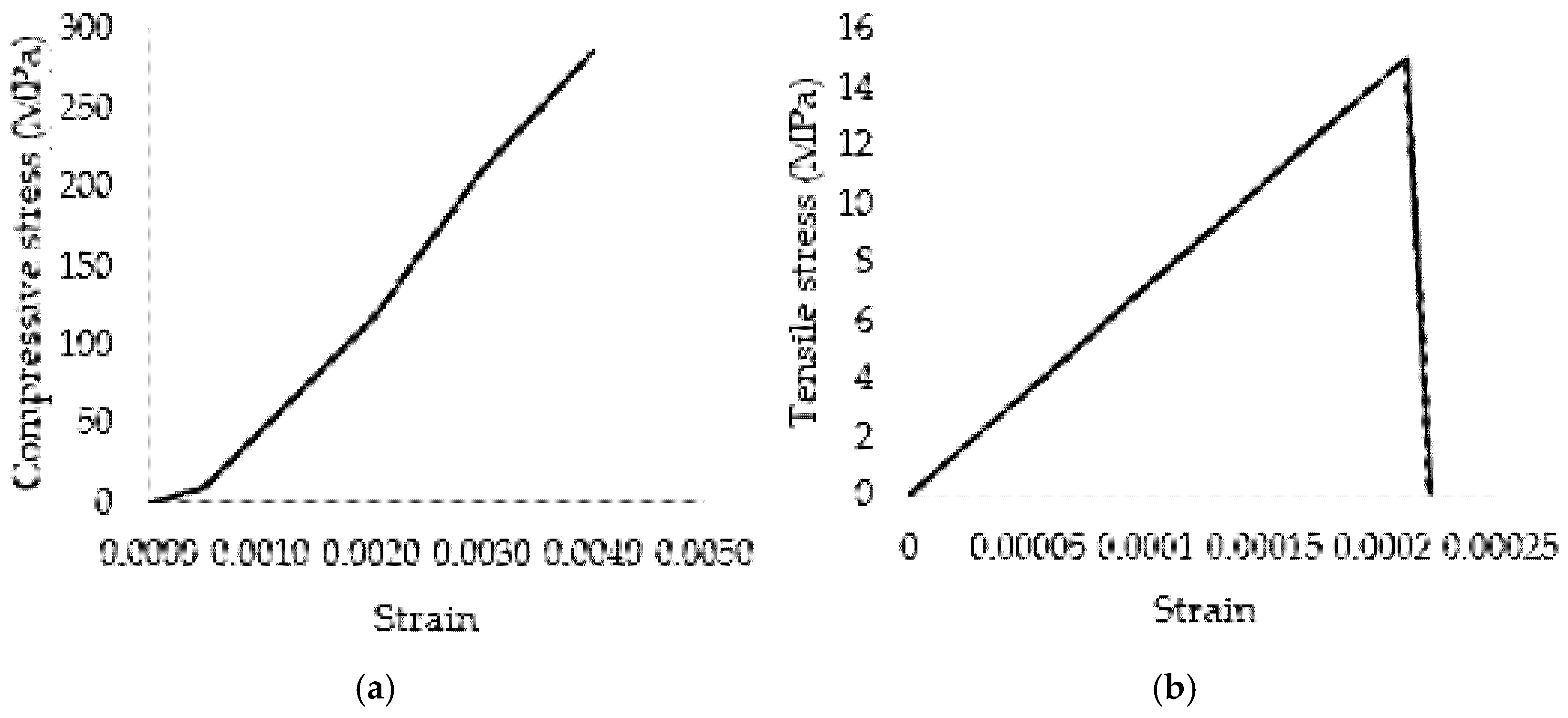
Accurate selection of material properties is essential for the analysis of historical structures, such as minarets, due to their long and complex history. Due to the difficulties in determining the material properties of these structures, relevant values were adopted based on a review of existing studies. Table 1 presents the basic physical and mechanical properties of the materials considered in this research. Additionally, Figure 11 depicts the axial stress–strain utilized for the masonry material in the SAP2000 analysis.
Figure 11. Stress–strain curves for basalt stone, with (a) compressive behavior and (b) tensile behavior [43].
Buildings 15 04358 g011
Table 1. Properties of the material used [43].
MaterialModulus of Elasticity (MPa)Poisson’s RatioUnit Weight (kN/m3)
Basalt stone71,4000.1525

3.2.2. Finite Element Meshing

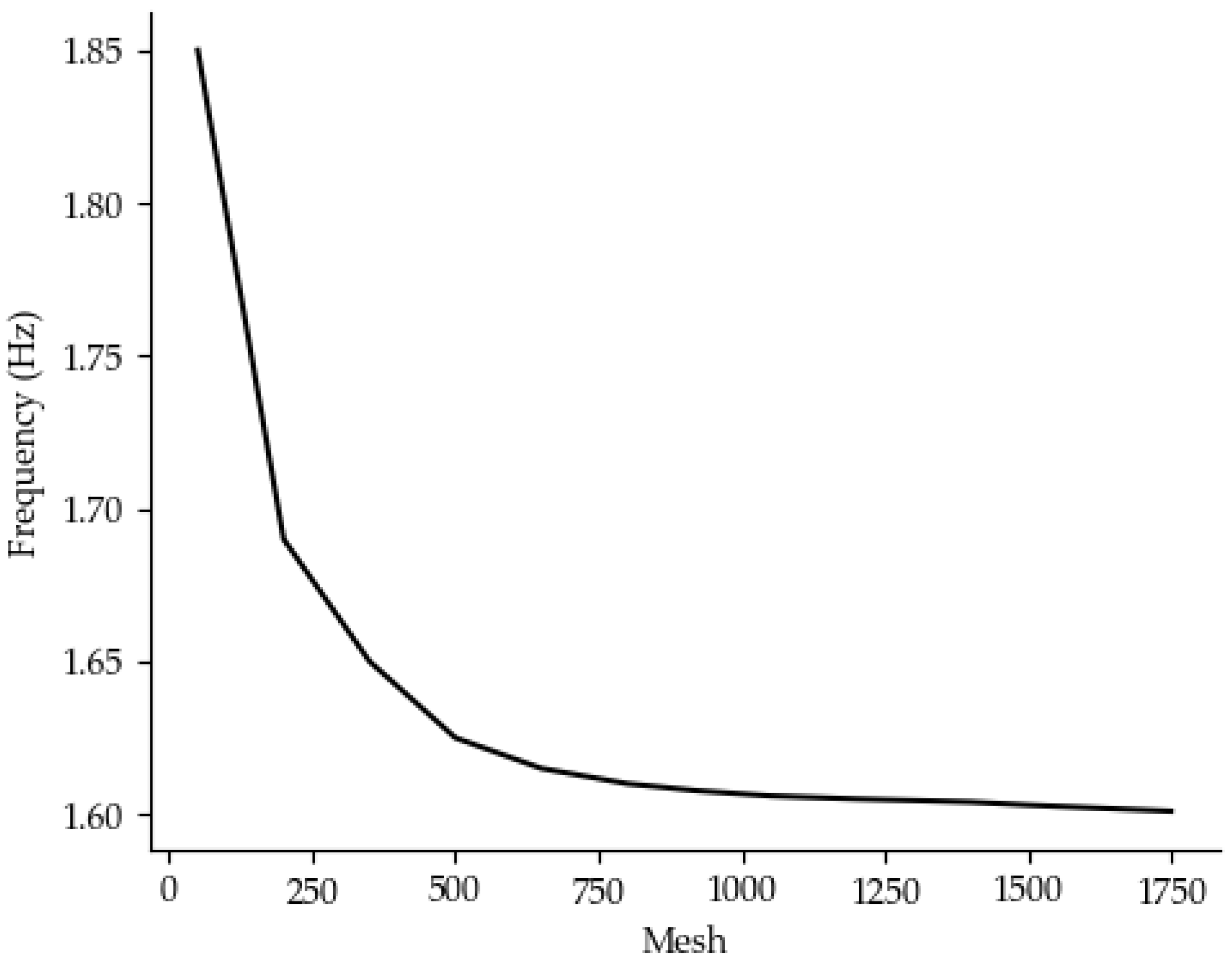
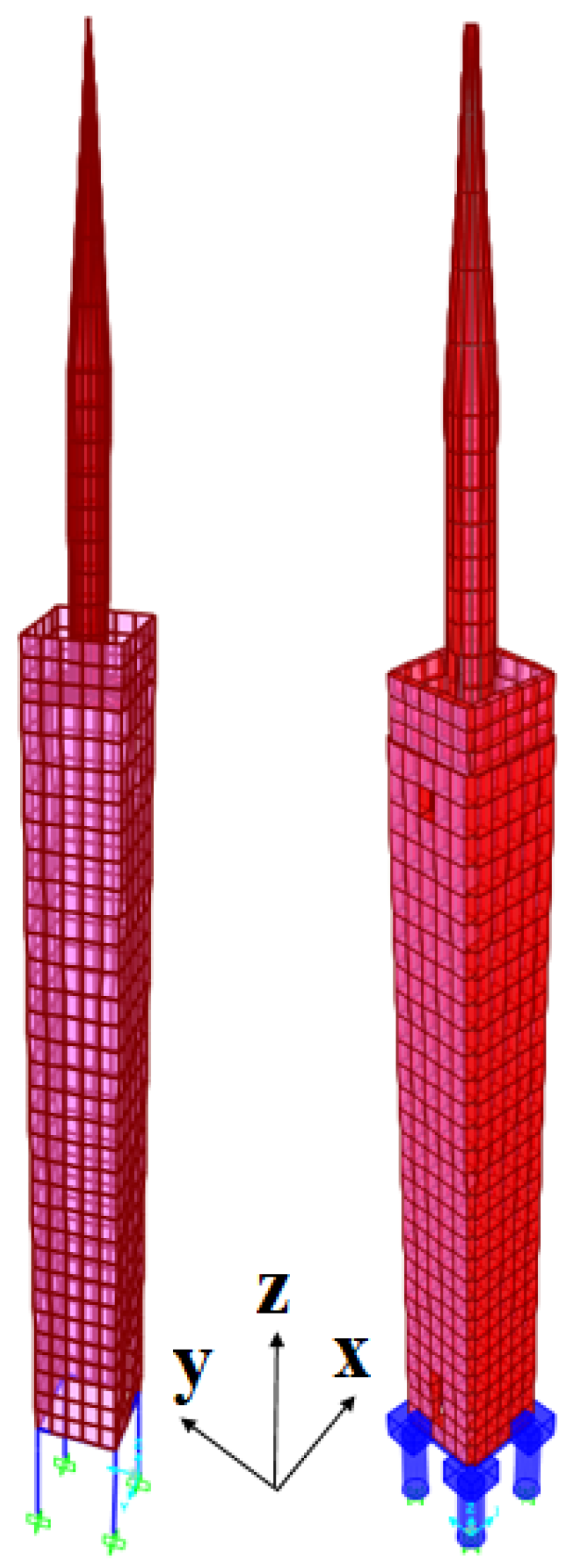
Mesh discretization is critical for the accurate prediction of stresses and displacements. A mesh-convergence study based on the first natural frequency (Figure 12) was conducted: the computed frequency decreases rapidly with refinement and stabilizes for meshes exceeding ~900 elements. Accordingly, a discretization of 922 shell elements was adopted as a compromise between accuracy and computational cost. To capture nonlinear through-thickness behavior, each shell element was modeled in SAP2000 as a layered section with five through-thickness layers. This spatial and thorough-thickness resolution was deemed adequate for the purposes of this study and was employed in all subsequent analyses. The adopted finite-element model is shown in Figure 13.

4. Input Ground Motion Dataset

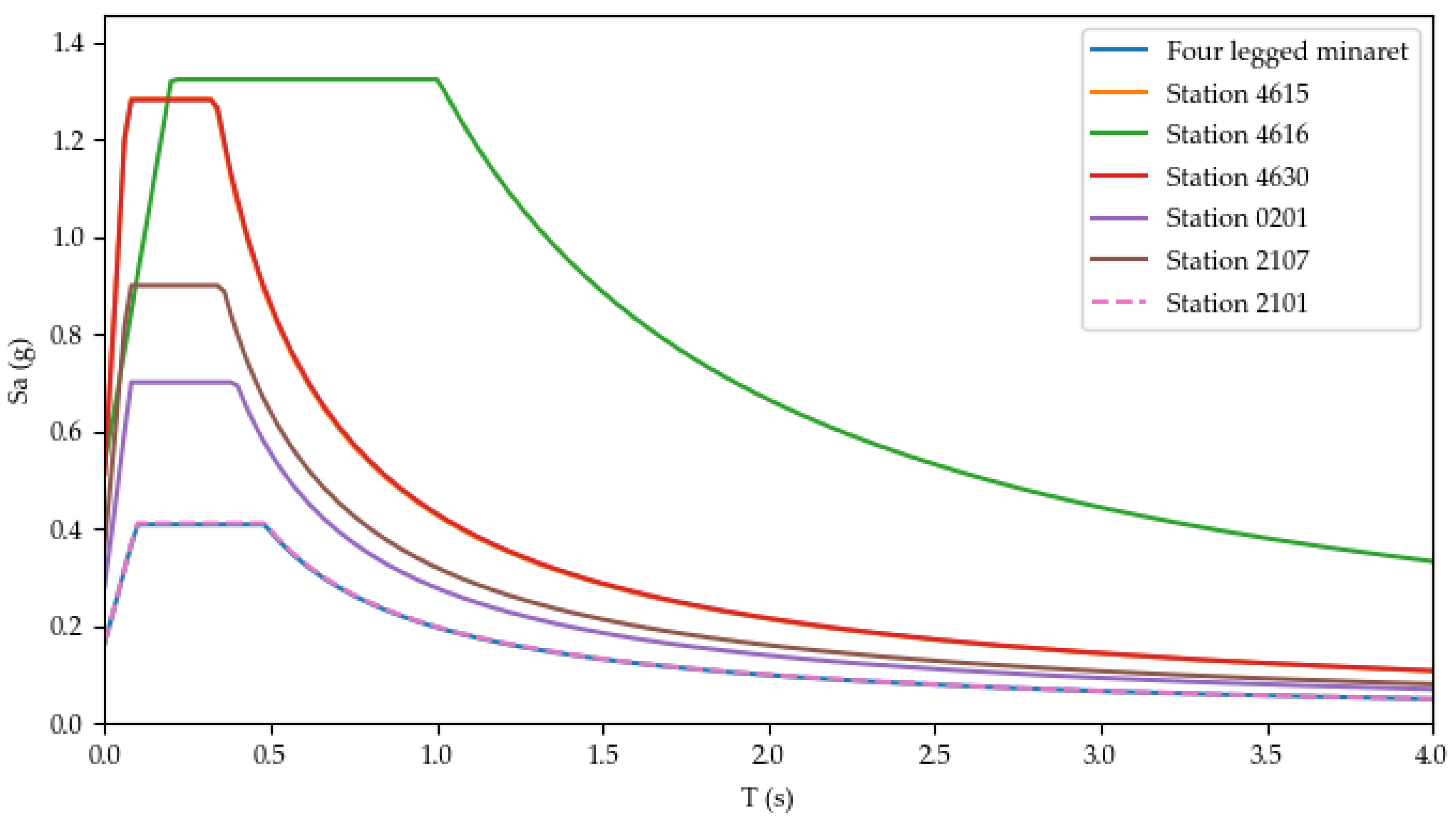
Since no earthquake ground-motion records exist at the structure’s location, the study first defined the site-specific 475-year code spectrum in accordance with the Turkish Building Earthquake Code [44]. Six nearby strong-motion stations that recorded the 2023 Kahramanmaraş earthquake were then selected, and their 475-year code spectra [1] were compared with the site spectrum to identify the station that best represents the structural site.
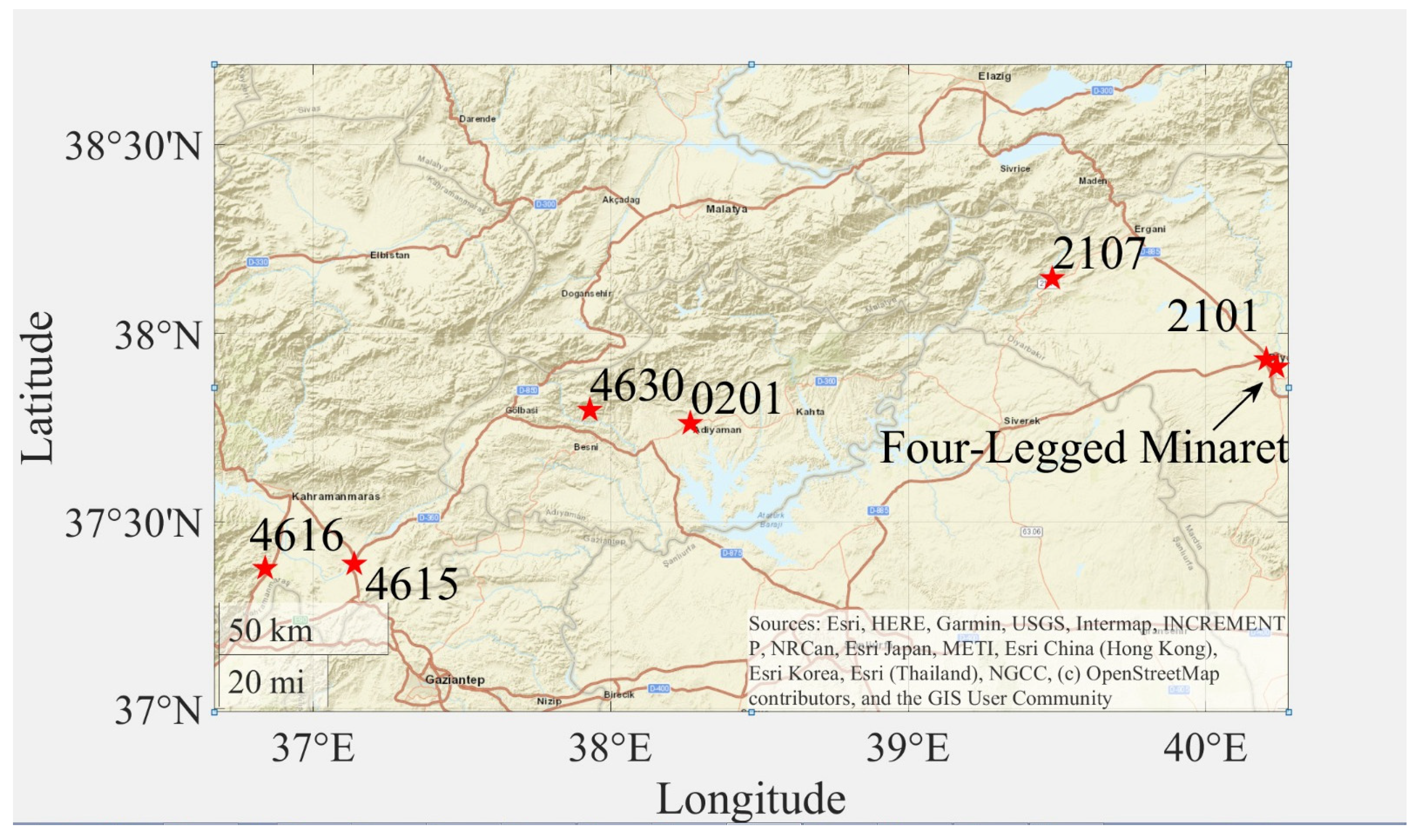
Figure 14 presents the locations of the five strong motion stations used for spectral comparison, along with the position of the Four-Legged Minaret. These stations were selected based on proximity and site-condition compatibility with the target structure. Figure 15 compares the elastic site-specific horizontal acceleration response spectrum (Sa) of the Four-Legged Minaret with the 475-year code spectra from the six nearest seismic stations (IDs 4616, 0201, 2101, 4615, 4630, and 2107). The minaret’s site-specific spectrum (blue curve) aligns most closely with that of station 2101 (pink dashed line), whereas the spectra from the other stations (various colors) show less agreement. This close match is evident across both short and long periods.
The minaret is located in the city center of Diyarbakır, and station 2101, approximately 5 km away, is the nearest strong-motion station. Table 2 presents the key information from station 2101 for the two successive earthquakes: Pazarcık and Elbistan. In this table, PGA represents the peak ground acceleration, PGV denotes the peak ground velocity, and RJB refers to the Joyner–Boore distance. ZC represents the soil class in the form of very dense sand, gravel, and hard clay layers or weathered, very cracked, weak rocks. VS30 represents the average shear wave velocity in the top 30 m of the ground from the surface. Station 2101 exhibits a soil profile very similar to that of the minaret site, with comparable VS30 values of 519 m/s and 502 m/s, respectively. It is also noted that the PGA values are taken directly from the AFAD recorded accelerograms (station 2101) without any additional filtering, and their low amplitudes are consistent with the large source-to-site distances (>200 km) from the 6 February 2023 earthquakes.
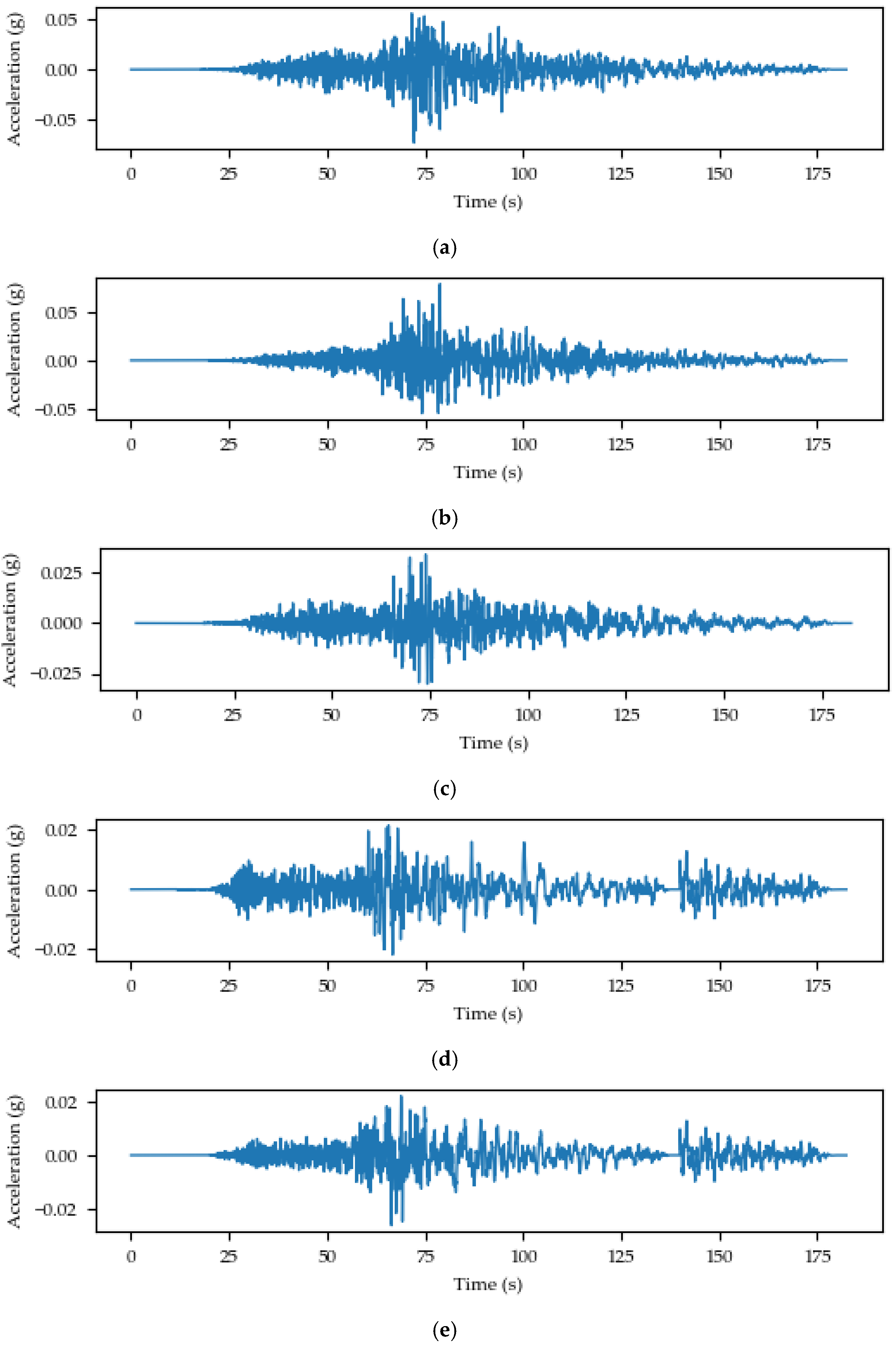
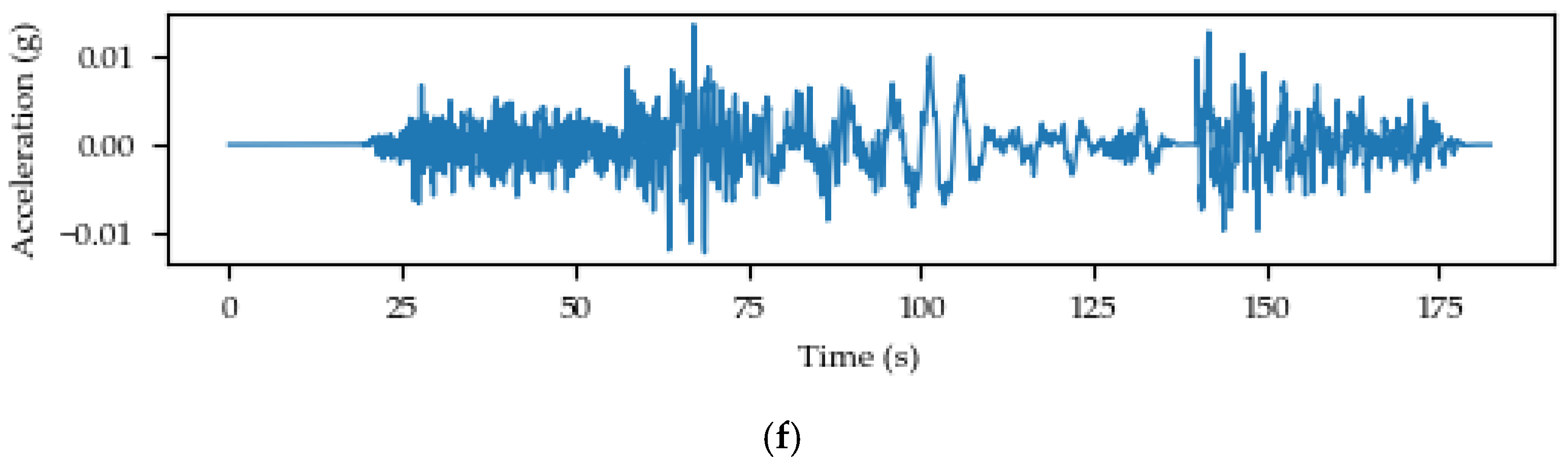
Given its proximity and comparable site conditions, the acceleration records from station 2101 are well-suited to represent the local seismic environment of the minaret. Consequently, the recorded acceleration time series from station 2101 is used for the nonlinear time-history analysis of the structure, as shown in Figure 16.
Figure 15. Comparison of the site-specific 475-year return-period elastic response spectra derived from [44] for the Four-Legged Minaret and for the selected six nearby strong-motion stations (IDs 4615, 4616, 4630, 0201, 2107, 2101) that recorded the 2023 Kahramanmaraş earthquakes.
Buildings 15 04358 g015
Figure 16. Acceleration time-series at station 2101 for (a) Pazarcık east–west component, (b) Pazarcık north–south component, (c) Pazarcık up-down component, (d) Elbistan east–west component, (e) Elbistan north–south component, and (f) Elbistan up-down component.
Buildings 15 04358 g016aBuildings 15 04358 g016b

5. Results and Discussion

5.1. Modal Analysis

Modal analysis was performed to obtain the fundamental frequencies, mode shapes, and mass participation ratios of the Four-Legged Minaret. These parameters are critical for evaluating the dynamic behavior of the structure and for ensuring the accuracy of the nonlinear time history analyses. In particular, the identified mode shapes reveal the likely deformation patterns under seismic loading, while the cumulative mass participation factors confirm that a sufficient number of modes have been included in the analysis. Moreover, the numerically obtained fundamental frequency was compared with empirical estimates from formulas available in the literature for masonry towers.
While performing modal analysis, solutions were made for 12 modes. The ratios of effective masses to the total mass of the minaret (mass participation ratios) in cumulative form are shown in Table 3. The results indicate that the first seven modes capture more than 95% of the total mass in the X direction, while in the Y direction, this threshold is already exceeded by the sixth mode. For the vertical direction (Z), significant mass participation starts from the 10th mode and reaches more than 95% by the 12th mode. These results confirm that the finite element model adequately represents the global dynamic behavior of the structure and that the selected number of modes is sufficient for reliable nonlinear time history analyses.
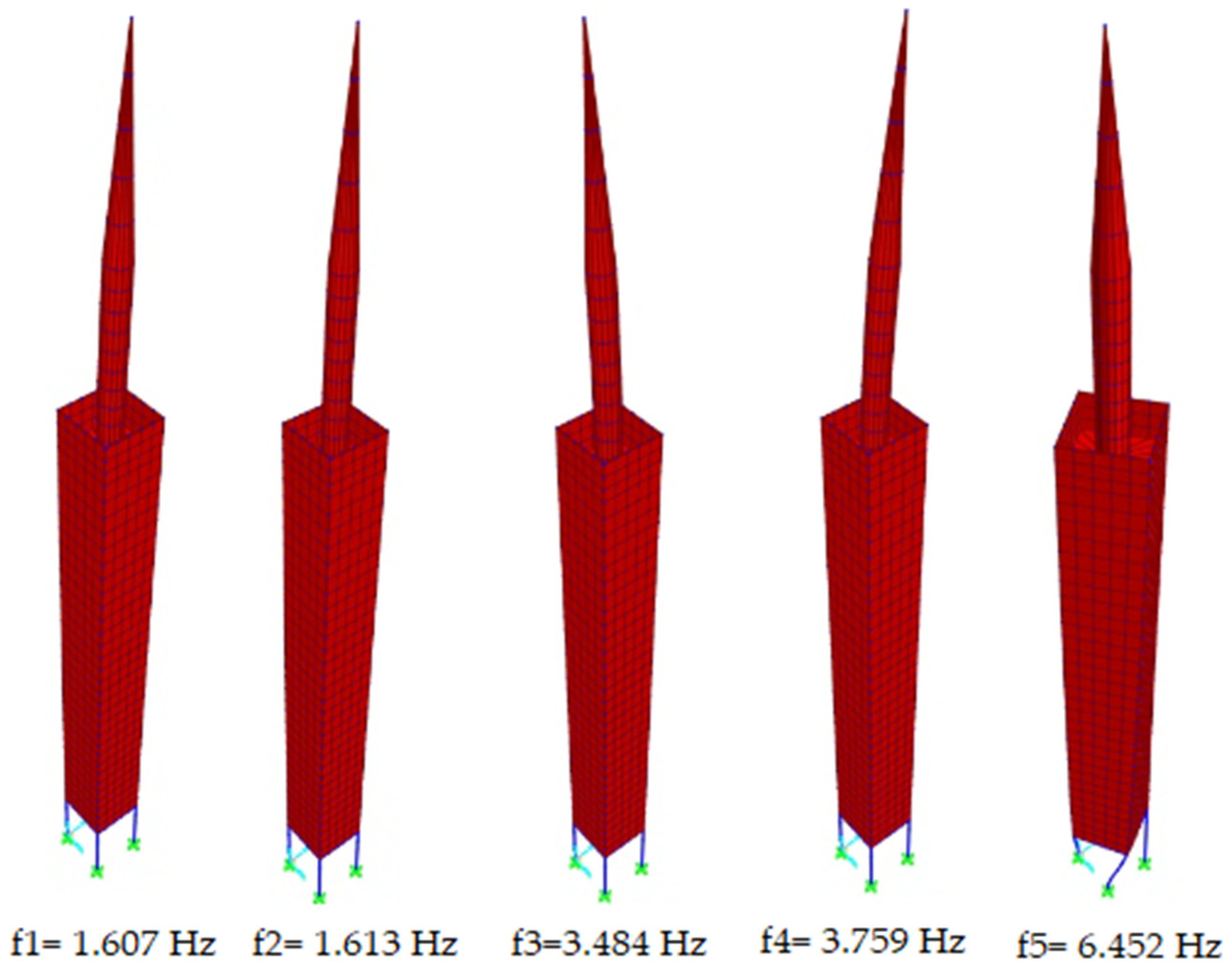
The first five mode shapes obtained as a result of the modal analysis are given in Figure 17. As observed in Figure 17, the differences between f1 and f2, as well as between f3 and f4, arise from the geometric irregularities and stiffness asymmetry of the Four-Legged Minaret. Although the structure exhibits a nearly square plan, the transition from the four-legged base to the cylindrical shaft introduces stiffness variations in the two horizontal directions. This causes small differences in the natural frequencies associated with lateral bending in the X and Y directions. Similarly, the third and fourth modes reflect higher-order bending responses, where slight irregularities in geometry and mass distribution result in different vibration characteristics.
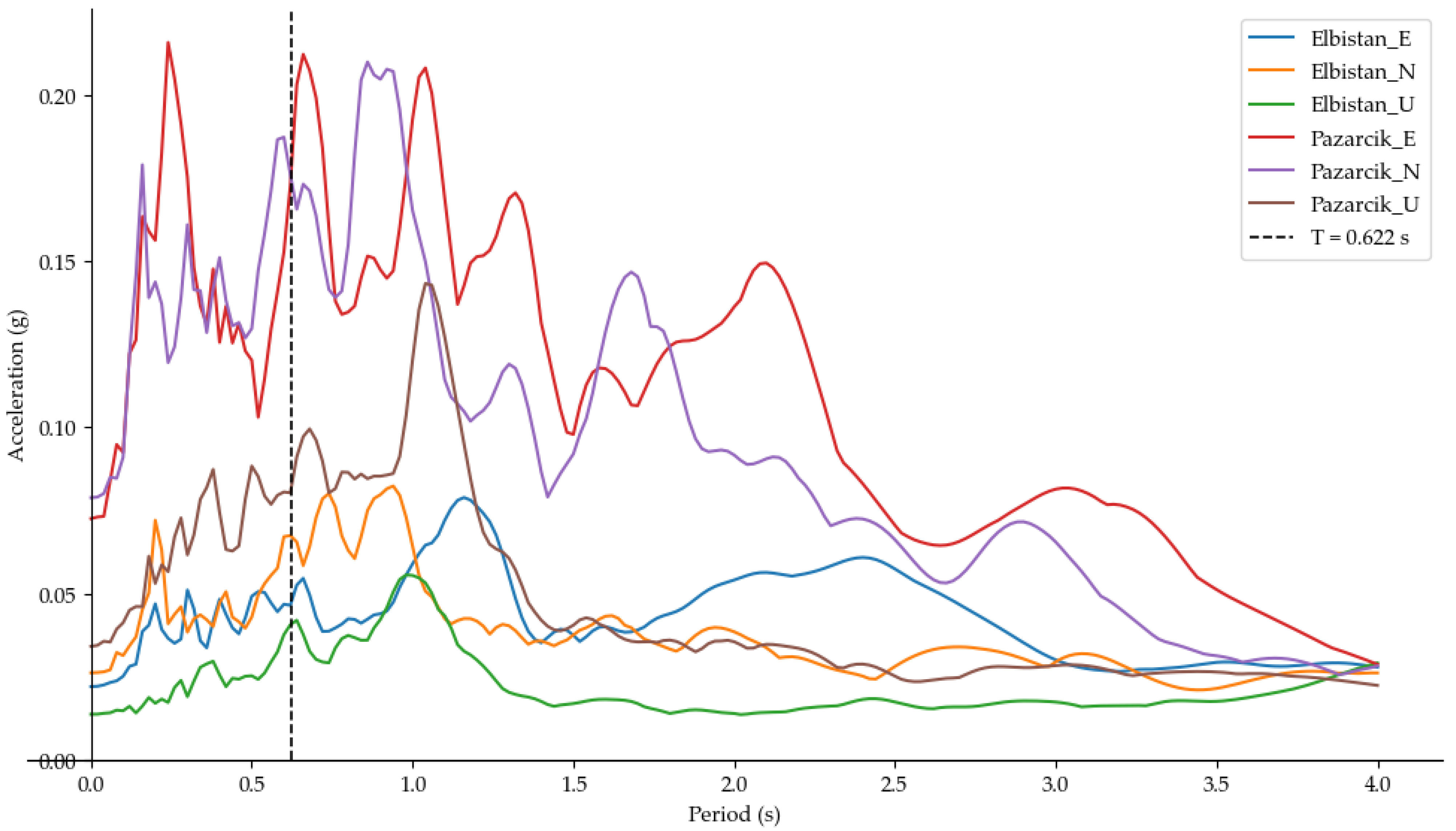
To further interpret the dynamic characteristics identified through the modal analysis, the acceleration response spectra recorded at station 2101 for the Elbistan and Pazarcık earthquakes are presented in Figure 18, where the period T = 0.622 s corresponds to the fundamental period of the analyzed minaret. The results indicate that, around the fundamental period of the structure, the Pazarcık earthquake record exhibits higher spectral amplitudes than the Elbistan earthquake record at this station, which is the closest to the minaret.
Table 4 compares the fundamental frequency obtained from the numerical model (f1 = 1.607 Hz) with the values calculated using empirical formulas available in the literature for masonry towers (NTC08 [45], Shakya et al. [46], Ranieri and Fabbrocino [47], Faccio et al. [48], Testa [49], Diaferio [50]). As shown, the empirical estimates vary between 1.911 Hz and 2.571 Hz, which are systematically higher than the numerical value. This discrepancy, as shown by f1/f* ratio in Table 4, can be attributed to the geometric particularities of the Four-Legged Minaret, especially the transition from the four-legged base to the cylindrical shaft, which introduces additional flexibility not explicitly captured by the simplified height-based empirical formulas. Nevertheless, the numerical result remains in the same order of magnitude as the empirical estimates, thereby confirming the reliability of the finite element model and its ability to represent the dynamic behavior of the minaret.
Table 4. Fundamental frequencies were calculated according to formulas suggested in the literature.
ReferenceSuggested FormulaEstimated Fundamental Frequency, f* (Hz)f1/f*
NTC08 [45]f (H) = 1 0.05   H 3 / 4 1.9110.84
Shakya et al. [46]f (H) = 1 0.0151   H 1.08 2.2510.71
Ranieri and Fabbrocino [47]f (H) = 1 0.01137   H 1.138 2.4930.64
Faccio et al. [48]f (H) = 1 0.0187   H 2.3350.69
Testa [49]f (H) = 42.12 1 H 0.893 2.5710.63
Diaferio et al. [50]f (H) = 28.35 1 H 0.83 2.1080.76
f (H) = 135.343 1 H 1.32 2.1700.74

5.2. Nonlinear Time History Analysis

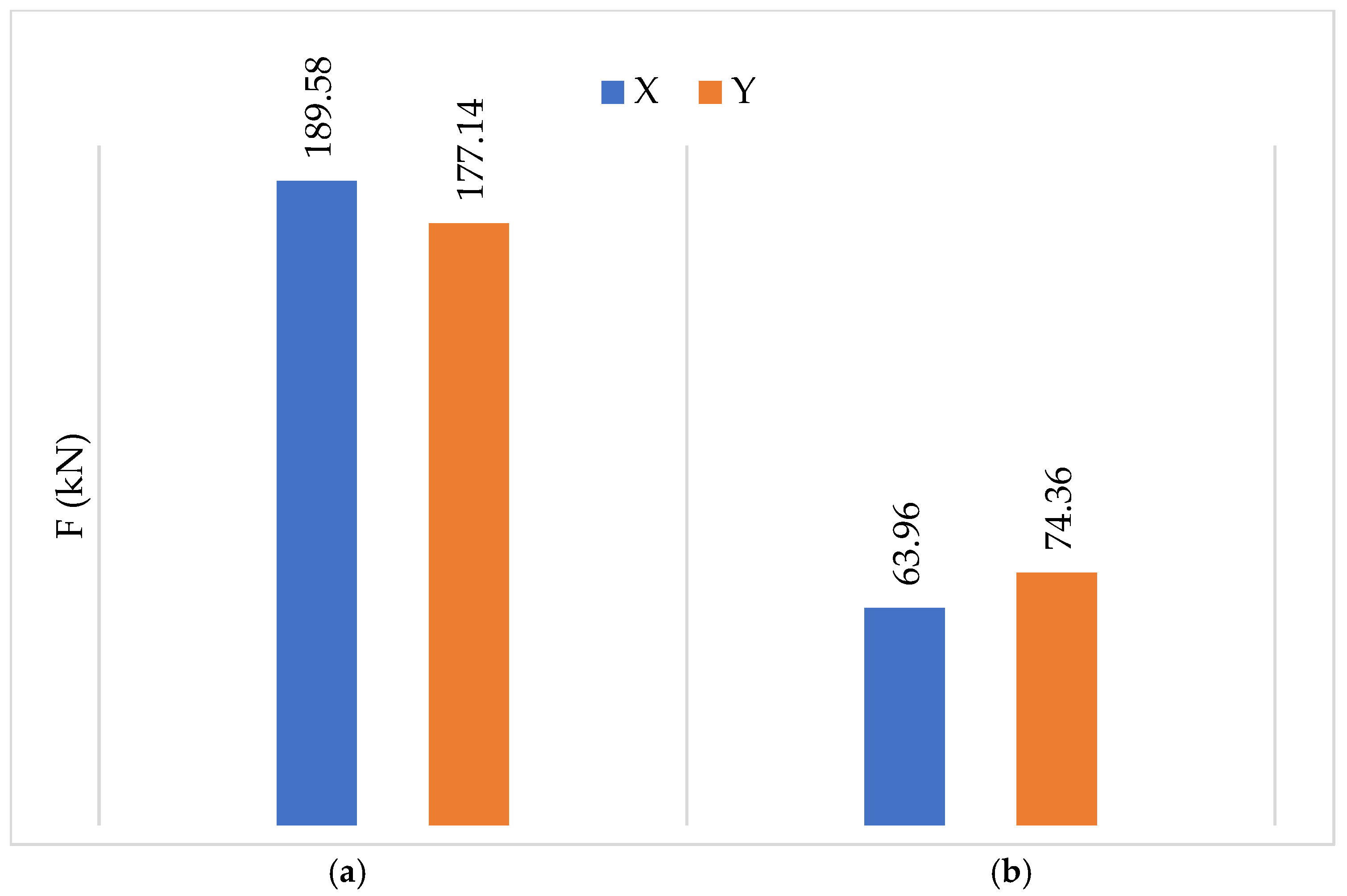
Nonlinear time history analysis was performed using the finite element model developed in the SAP2000 V23 software, using the acceleration records presented in Figure 16. In all nonlinear time-history analyses, geometric nonlinearity (large-displacement effects) was not activated, as the expected lateral deformations were small compared with the height of the structure. A Rayleigh damping ratio of 5% was adopted in line with previous studies involving historical masonry structures [35,36]. The resulting maximum base shear forces are given in Figure 19. The base shear forces resulting from the Pazarcık earthquake are approximately three times higher in the X direction and 2.4 times higher in the Y direction compared to those from the Elbistan earthquake.
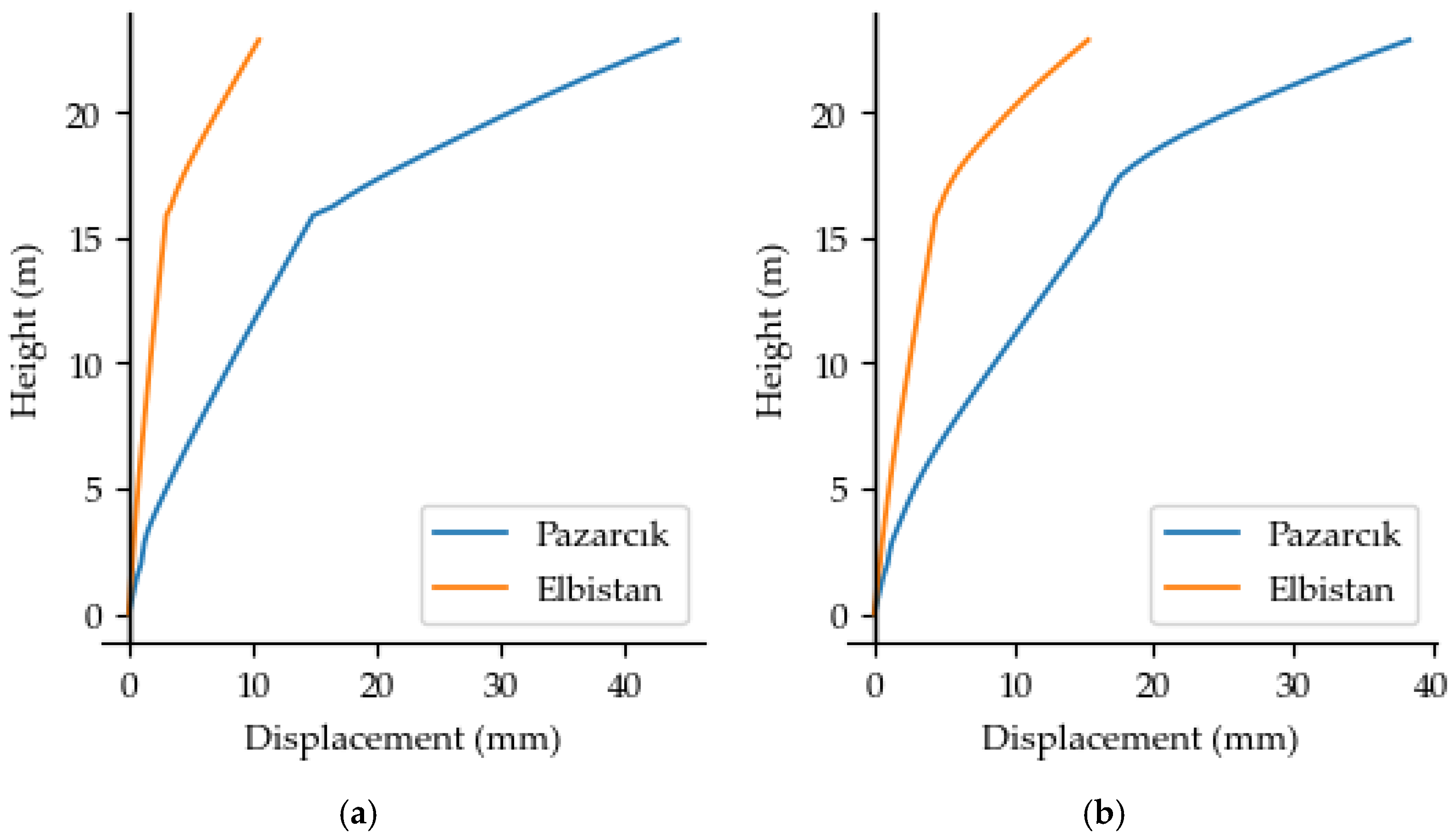
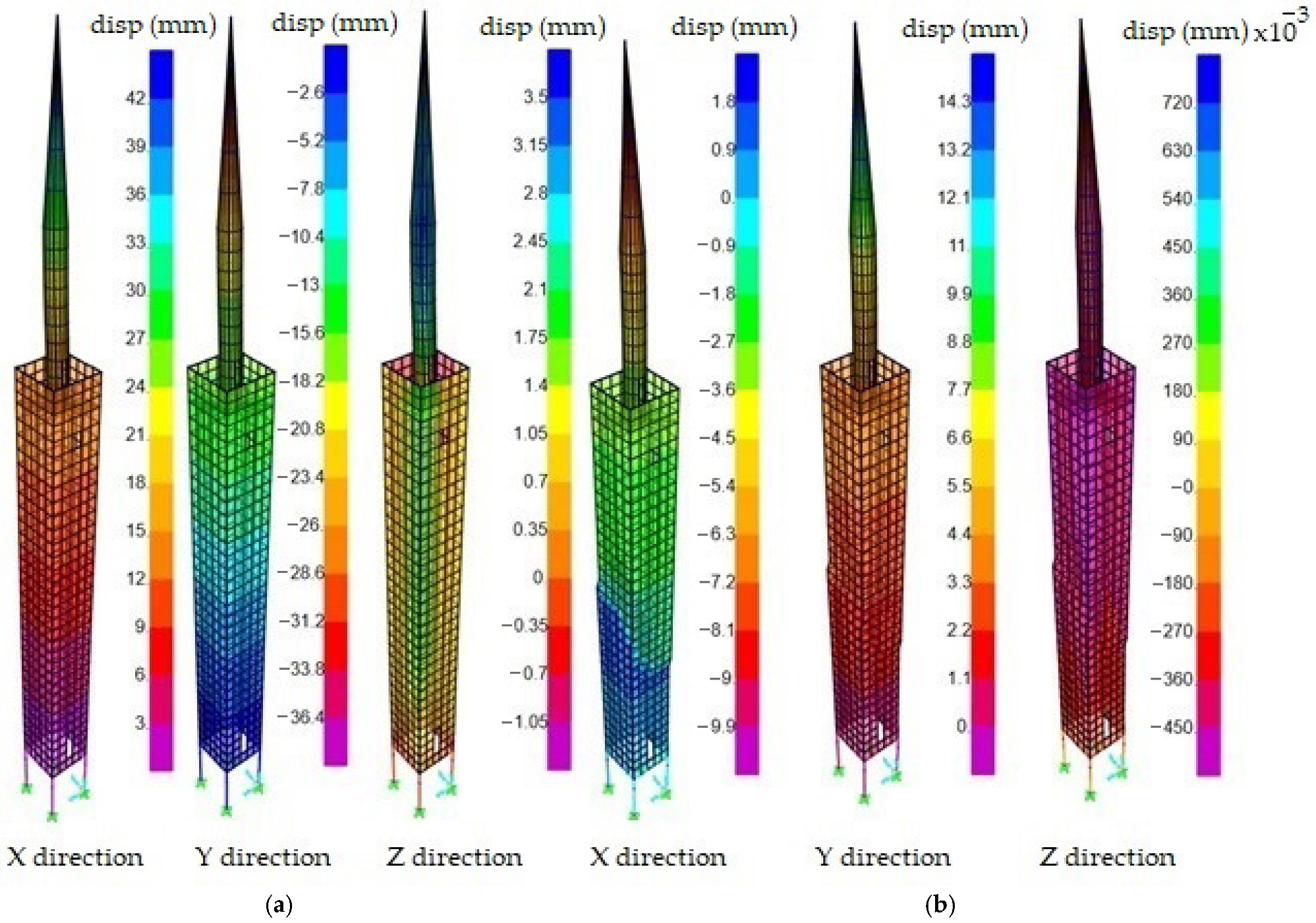
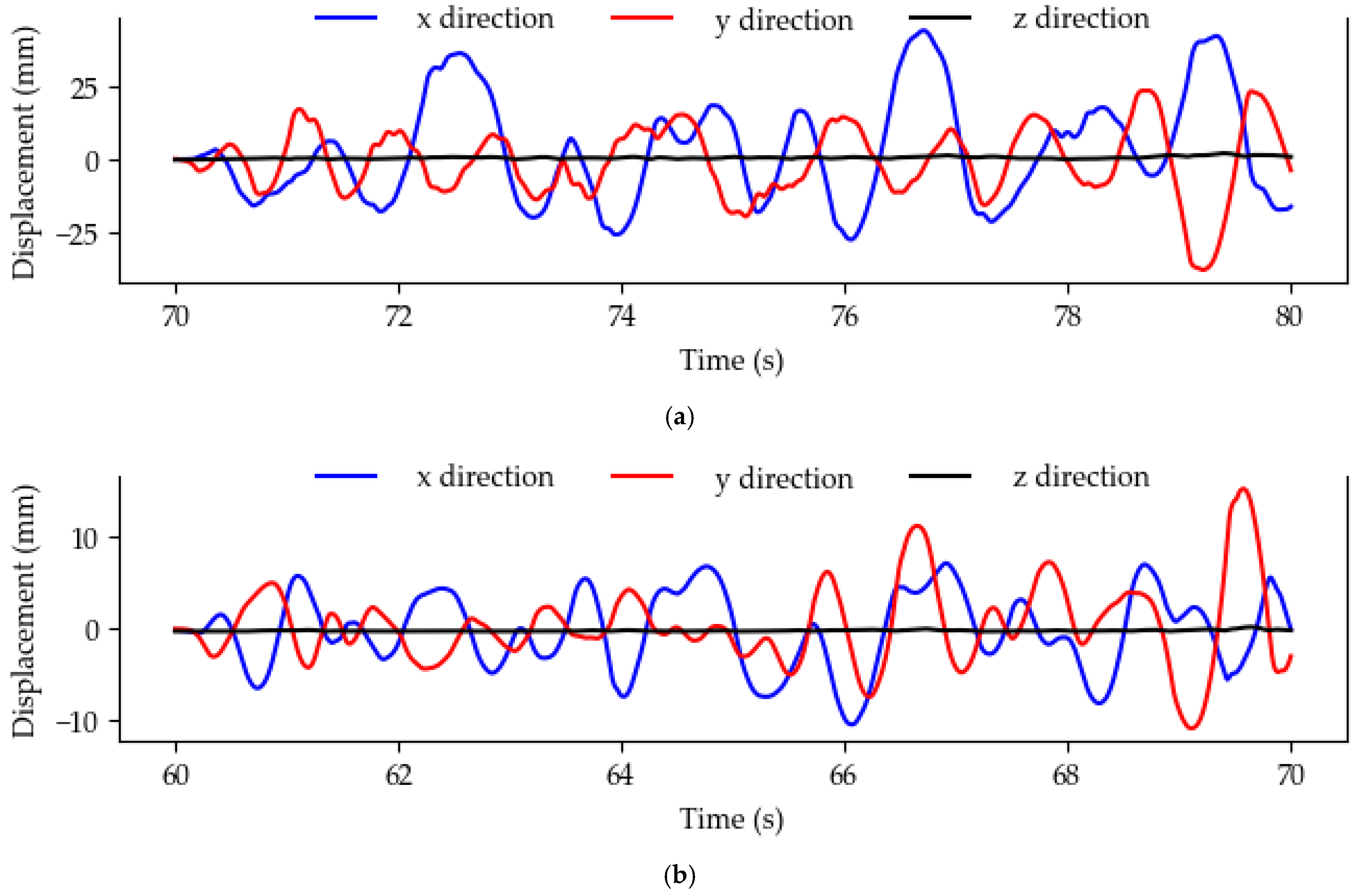
Figure 20 illustrates the variation in displacement with height in the X and Y directions for the four-legged minaret under the 2023 Pazarcık and Elbistan earthquakes. Displacements increase with elevation in both cases, reaching their maximum values near the top of the structure. The maximum horizontal displacements during the Pazarcık earthquake (44.3 mm in the X direction and 38.3 mm in the Y direction) were considerably larger than those obtained for the Elbistan earthquake (10.5 mm and 15.3 mm, respectively). This difference is primarily attributed to the ground motion characteristics of the two events rather than to structural properties. As shown in Table 2, the Pazarcık records exhibit significantly higher PGA and PGV values compared to the Elbistan event, leading to stronger seismic demands on the structure. Therefore, the larger displacements observed under the Pazarcık earthquake result from the higher input motion intensity, while the structural response patterns remained consistent in both cases. The maximum horizontal displacement during the Pazarcık earthquake was approximately 44.3 mm in the X direction and 38.3 mm in the Y direction. In contrast, the corresponding values for the Elbistan earthquake were 10.5 mm and 15.3 mm, respectively. From a spectral perspective, the dominant periods of the input ground motions fall within the range of the fundamental and higher modes of the minaret (around 0.6 s), as identified in the modal analysis. In particular, the horizontal components of the Pazarcık earthquake contain stronger spectral amplitudes around these periods compared to the Elbistan earthquake (see Figure 18), which explains the larger displacements recorded during the 70–80 s interval. Conversely, the lower spectral demand of the Elbistan event around the structure’s natural periods resulted in smaller peak displacements, observed between 60 and 70 s. As illustrated in Figure 18, the spectral acceleration at the fundamental period of the minaret (T = 0.622 s) is significantly higher for the Pazarcık motion, confirming that the larger dynamic response of the structure is primarily governed by resonance effects between the input motion and the minaret’s first mode This highlights the direct relationship between the dynamic properties of the minaret and the spectral characteristics of the input ground motions. These findings indicate that the Pazarcık earthquake induced significantly greater horizontal displacements, highlighting its more severe dynamic impact on the minaret. Figure 21 presents the relative displacement contours in all three directions, further illustrating the spatial distribution of the seismic response. Finally, Figure 22 presents the displacement time-history at the peak of the minaret, clearly illustrating the periods during which the maximum displacements occurred.
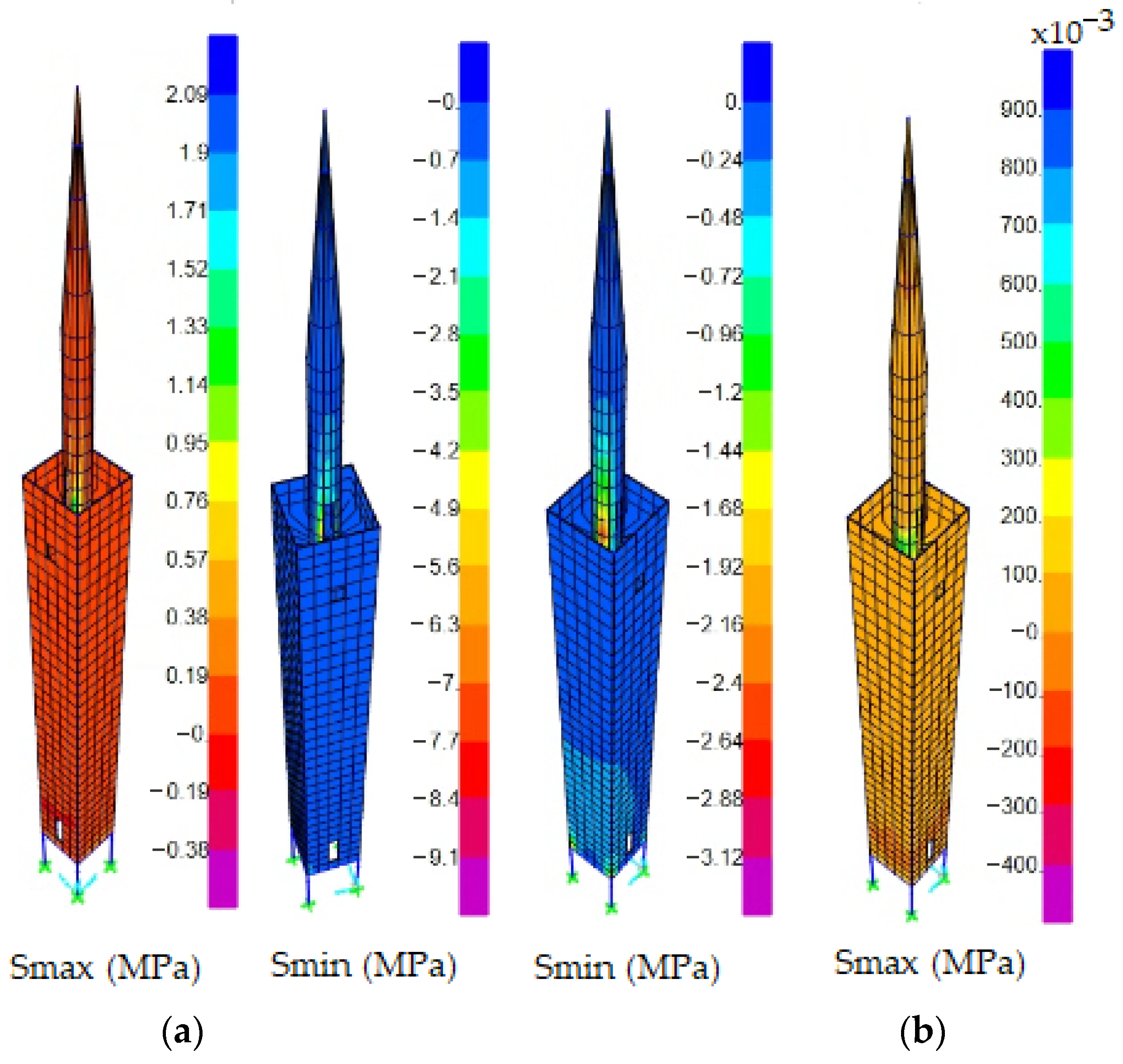
Table 5 presents the maximum stress values obtained from the nonlinear time-history analyses using the Pazarcık and Elbistan earthquake records. Smax and Smin represent the maximum and minimum principal stresses, respectively. The results indicate that the Pazarcık earthquake induced significantly higher stress demands on the minaret compared to the Elbistan event. Specifically, the maximum principal stress (Smax) reached 2.252 MPa during the Pazarcık earthquake record, compared to 0.862 MPa for the Elbistan earthquake record. Similarly, the minimum principal stress (Smin) increased from 3.352 MPa in the Elbistan case to 9.104 MPa in the Pazarcık case, highlighting the greater severity of the latter. These outcomes are consistent with the spectral results presented in Figure 18.
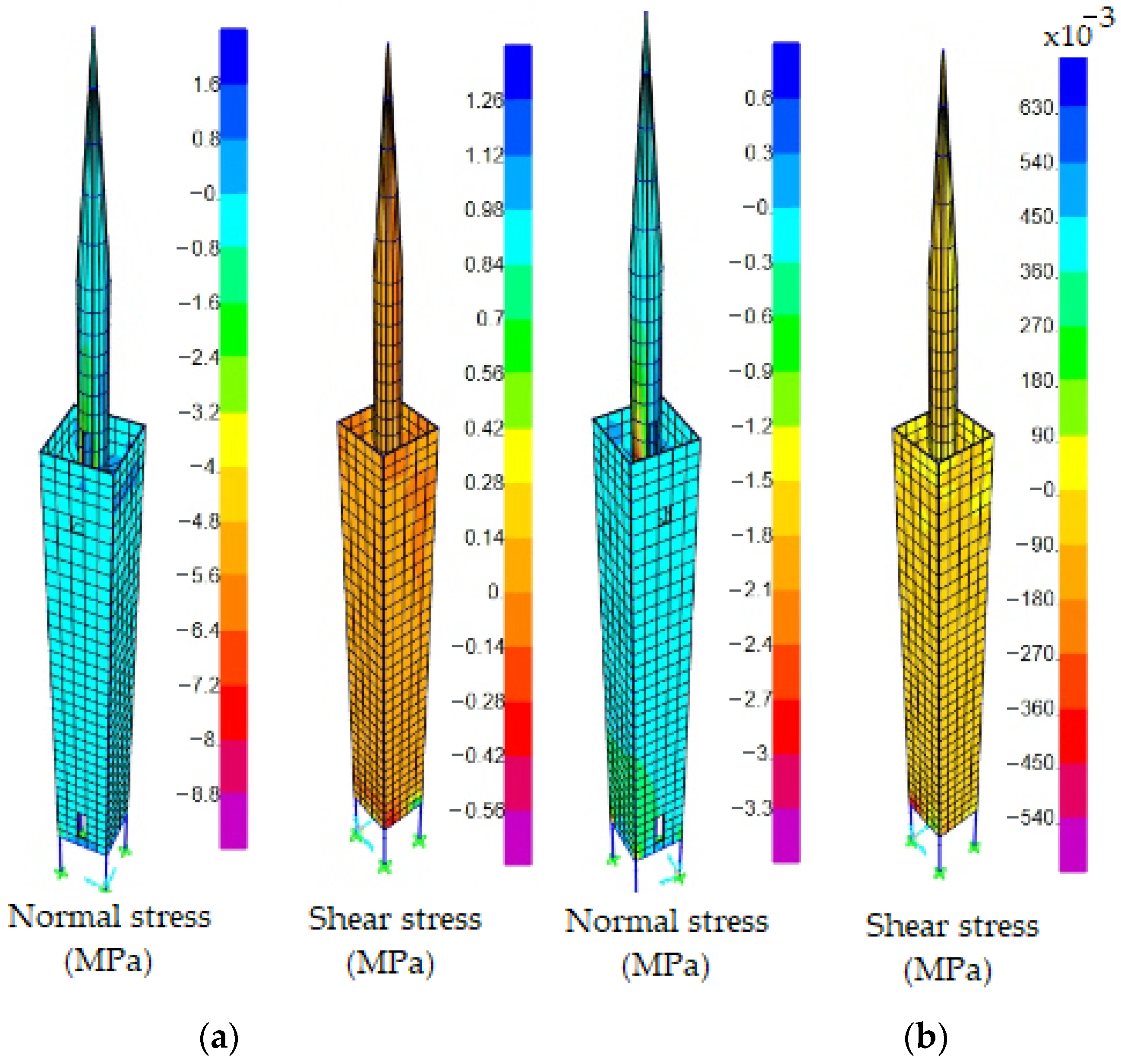
Figure 23 illustrates the maximum and minimum principal stress contours under both earthquake loadings, showing that the highest stress concentrations occur around the door openings within the transition zone of the cylindrical body. Similarly, Figure 24 presents the normal stress distribution, revealing that the largest normal stresses for both earthquakes also occurred in the same transition region near the doorway sections. In these areas, normal stresses increased significantly, with compressive stresses reaching up to 9 MPa during the Pazarcık earthquake. Shear stress concentrations were also notable, particularly in the lower part of the transition zone. A similar stress distribution was detected in the Elbistan earthquake; however, the stress values calculated in this earthquake were at lower levels compared to the values obtained during the Pazarcık earthquake. These results highlight the structural vulnerability of transition zones, where abrupt changes in geometry and stiffness occur under seismic loading, identifying them as critical regions in terms of structural integrity and safety.
Figure 25 illustrates the damage propagation observed in the minaret as a result of nonlinear dynamic analysis, highlighting the crack formation above the entrance and the joint separation in the middle and upper parts of the structure, which are consistent with the observed damage patterns. These analyses, performed using seismic records from the Kahramanmaraş earthquakes (Pazarcık and Elbistan), revealed significant stress concentrations that contributed to cracking. The simulation results identified critical stress regions, particularly areas where tensile stress concentrations exceed the cracking threshold and where joint-opening tendencies develop under dynamic loading, and these numerical crack patterns align well with the damage observed in the field. Post-earthquake inspections confirmed a vertical crack along the monolithic beam supported by the columns on the north and east facades, along with new separations along the joints extending upward from the beam. Additional minor joint separations were also recorded on the south facade. As shown in this figure, there is a strong correlation between the numerical predictions and the actual damage patterns, validating the simulation’s ability to capture the structural response of the minaret under seismic loading.
It is noted that, in this study, no damage mechanics model was implemented; therefore, the reported stresses correspond to the direct tensor components from the finite element analysis and are not interpreted through invariant-based damage formulations.
Several physical mechanisms underlie the damage concentration in the transition zone. First, the abrupt transition from the four-legged base to the single cylindrical body creates a significant stiffness discontinuity, causing horizontal loads to concentrate in this region. Second, the body above the beam, supported by four stone columns, presents a more limited load path under earthquake impact, increasing local bending moments and shear forces. Third, the transition zone is simultaneously subjected to both axial compression from the upper body and earthquake-induced horizontal bending demands, which contribute to the development of high principal stress gradients and crack initiation. Finally, because the masonry and joints in this zone are subjected to simultaneous bending and shear, the stress concentration is further amplified due to the low tensile strength of the material. These combined effects explain why the transition zone experiences the highest stress demand and why the numerical analysis results are in high agreement with the earthquake damage observed in the field. We also note that due to limited accessibility during the post-earthquake field survey, no direct photographs could be obtained for the rectangular–cylindrical transition zone. Nevertheless, the numerical results indicating high stress concentrations in this area are consistent with the expected behavior at this geometric discontinuity.
Finally, the findings highlight the vulnerability of minarets to a wide range of dynamic responses during earthquakes, spanning from elastic deformations to extensive damage or even collapse. Although strong resonance effects were not explicitly observed in this case study, the slender and elongated geometry of minarets makes them particularly susceptible to dynamic amplification when their fundamental period approaches the dominant period of the input motion. The recordings at the nearby station show that the ground motion from the Pazarcık earthquake exhibits notably higher spectral amplitudes than that of the Elbistan event across all three components, with pronounced peaks occurring near the fundamental period of the structure. This spectral amplification likely contributed to the larger horizontal displacements observed during the Pazarcık earthquake. Hence, the intensified structural response of the minaret can be attributed to the combined influence of higher ground motion intensity and partial resonance effects near its fundamental period.

6. Conclusions

This study presented a comprehensive seismic performance assessment of the historical Four-Legged Minaret in Diyarbakır, Türkiye, in light of the 6 February 2023 Kahramanmaraş earthquakes. A detailed finite element model was developed in SAP2000 using shell elements and appropriate boundary conditions. Site-specific ground motion records, obtained from the nearest station (2101) with compatible site conditions, were used to perform nonlinear time history analyses. The reliability of the numerical approach was validated by comparing simulation results with post-earthquake field observations.
The analyses yielded several critical findings:
  • Modal analysis showed a fundamental period of 0.622 s, consistent with the slender and flexible structure of the minaret. Nonlinear dynamic analyses revealed that the Pazarcık record generated significantly higher horizontal demands than the Elbistan record. Horizontal displacements increased along the height, with the largest values occurring at the top. Displacements in the X and Y directions were similar, while vertical values remained lower.
  • The regions with the highest normal and shear stresses are the transition zones, particularly at the beginning of the cylindrical body. These regions are prime targets for strengthening because they coincide with the damage observed in the field; the principal stresses are also concentrated in the same region.
  • Damage patterns obtained from numerical analyses showed high agreement with field observations and validated the representativeness of the used modeling approach and the selected ground motions.
  • The transition from the square base to the cylindrical upper body created a distinct geometric discontinuity, leading to stress accumulation and joint separation under earthquake effects. This behavior was clearly evident both in the analyses and in the field damage.
  • The monolithic beam supported by four stone columns acted as a stress amplifier under dynamic loads, creating a local stiffness discontinuity at the base. This explains the root cause of the cracks observed on the beam after the earthquake.
In addition to these findings, several inherent characteristics of minarets, such as their high slenderness ratios, brittle masonry materials, inadequate foundation systems, and heavy ornamental elements, further increase their seismic vulnerability by amplifying structural demands during strong shaking. Although resonance was not observed in this study, it remains a concern for tall and slender masonry structures whose natural periods may coincide with dominant ground motion frequencies. In such cases, amplified displacements and internal forces may occur, raising the likelihood of damage or collapse.
Despite the robustness of the methodology, certain limitations should be acknowledged. The material properties were taken from the literature rather than in situ tests, which introduces uncertainty in representing the true behavior of the masonry and affects the precision of conservation decisions. The seismic input was also limited to two recorded motions from a nearby station. Future studies should use a broader set of site-specific or physics-based simulated ground motions and incorporate experimentally calibrated material models and soil structure interaction. These enhancements would enable more reliable evaluations of seismic vulnerability and support better targeted strengthening strategies for conservation. It should also be noted that the two earthquake records were applied independently in this study; however, future work should incorporate sequential input motions to better capture cumulative damage effects, including the potential propagation of cracks initiated during the first event. Finally, although geometric nonlinearity was not included due to the negligible lateral displacements observed, future studies should incorporate geometric nonlinear effects to assess potential differences in response under stronger near-field shaking scenarios.

Author Contributions

Conceptualization, P.U.E., A.E.S., E.Ş. and S.K.; methodology, A.E.S., P.U.E. and S.K.; software, A.E.S. and P.U.E.; validation, A.E.S., E.Ş. and P.U.E.; investigation, A.E.S. and P.U.E.; resources, P.U.E.; data curation, P.U.E.; writing—original draft preparation, A.E.S., E.Ş. and S.K.; writing—review and editing, P.U.E., A.E.S., S.K. and P.B.L.; visualization, A.E.S. and E.Ş.; supervision, P.U.E., S.K. and P.B.L.; project administration, P.U.E. All authors have read and agreed to the published version of the manuscript.

Funding

This study has been partly funded by the STAND4HERITAGE project that has received funding from the European Research Council (ERC) under the European Union’s Horizon 2020 research and innovation program (Grant agreement No. 833123), as an Advanced Grant. This work was supported by FCT/MCTES under the R&D Unit Institute for Sustainability and Innovation in Structural Engineering (ISISE), under reference UID/4029/2025, and under the Associate Laboratory Advanced Production and Intelligent Systems ARISE under reference LA/P/0112/2020.

Data Availability Statement

The data that support the findings of this study are available from the corresponding author upon reasonable request.

Acknowledgments

This study has been partly funded by the STAND4HERITAGE project that has received funding from the European Research Council (ERC) under the European Union’s Horizon 2020 research and innovation program (Grant agreement No. 833123), as an Advanced Grant. This work was supported by FCT/MCTES under the R&D Unit Institute for Sustainability and Innovation in Structural Engineering (ISISE), under reference UID/4029/2025, and under the Associate Laboratory Advanced Production and Intelligent Systems ARISE under reference LA/P/0112/2020.

Conflicts of Interest

On behalf of all authors, the corresponding author states that there are no conflicts of interest.

Abbreviations

The following abbreviations are used in this manuscript:
NAFZNorth Anatolian Fault Zone
EAFZEast Anatolian Fault Zone
WAFZWest Anatolian Fault Zone
JAXAJapan Aerospace Exploration Agency
ALOS-2Advanced Land Observation Satellite-2
NASANational Aeronautics and Space Administration
CaltechCalifornia Institute of Technology
AFADDisaster and Emergency Management Presidency
SAP2000Structural Analysis Program 2000
PGAPeak Ground Acceleration
PGVPeak Ground Velocity
MMoment Magnitude
Vs30Average Shear Wave Velocity in the top 30 m of the soil
ZCLocal Soil Class
RJBJoyner and Boore Distance
SaSpectral Acceleration
SmaxMaximum Principal Stress
SminMinimum Principal Stress

References

  1. Disaster and Emergency Management Presidency. Earthquake. 2023. Available online: https://tadas.afad.gov.tr/ (accessed on 2 March 2023).
  2. Pamukçu, O.A.; Çırmık, A.; Gönenç, T.; Uluğtekin, M. Bölüm I Yerfiziği Anabilim Dali Deprem Ön Değerlendirme Raporu; Dokuz Eylül University: Konak, Turkey, 2023. [Google Scholar]
  3. NASA Earth Observatory. Earthquake Damage in Turkey. Available online: https://earthobservatory.nasa.gov/images/150949/earthquake-damage-in-turkiye (accessed on 27 November 2025).
  4. Japan Aerospace Exploration Agency (JAXA); Japan. Available online: https://global.jaxa.jp/ (accessed on 27 November 2025).
  5. Singapore Earth Observatory—Remote Sensing Laboratory; Singapore. Available online: https://earthobservatory.sg/research/centres-labs/eos-rs (accessed on 27 November 2025).
  6. Ministry of Environment, Urbanization and Climate Change; Türkiye. Available online: https://csb.gov.tr/en (accessed on 27 November 2025).
  7. Hasar Tespit Sistemi. Available online: https://hasartespit.csb.gov.tr/ (accessed on 4 August 2025).
  8. Ministry of Culture and Tourism of the Republic of Turkey; General Directorate of Foundations of the Republic of Turkey. Earthquake Special; Ministry of Culture and Tourism: Ankara, Turkey, 2023.
  9. Ersoy, S. Evaluation of the Cultural Heritage Buildings in an Ancient District of Antakya after the Kahramanmaras Earthquakes (Mw 7.7 and Mw 7.6). J. Build. Pathol. Rehabil. 2023. [Google Scholar] [CrossRef]
  10. Demir, A.; Celebi, E.; Ozturk, H.; Ozcan, Z.; Ozocak, A.; Bol, E.; Sert, S.; Sahin, F.Z.; Arslan, E.; Yaman, Z.D.; et al. Destructive Impact of Successive High Magnitude Earthquakes Occurred in Türkiye’s Kahramanmaraş on February 6, 2023. Bull. Earthq. Eng. 2025, 23, 893–919. [Google Scholar] [CrossRef]
  11. Avcil, F.; Işık, E.; İzol, R.; Büyüksaraç, A.; Arkan, E.; Arslan, M.H.; Aksoylu, C.; Eyisüren, O.; Harirchian, E. Effects of the February 6, 2023, Kahramanmaraş Earthquake on Structures in Kahramanmaraş City. Nat. Hazards 2024, 120, 2953–2991. [Google Scholar] [CrossRef]
  12. Çambay, E. Damage Assessment of Masonry Structures in Adyaman Province After Kahramanmaraş Earthquakes (February 6, 2023). Firat Univ. J. Exp. Comput. Eng. 2023, 2, 117–123. [Google Scholar] [CrossRef]
  13. Mercimek, Ö. Seismic Failure Modes of Masonry Structures Exposed to Kahramanmaraş Earthquakes (Mw 7.7 and 7.6) on February 6, 2023. Eng. Fail. Anal. 2023, 151, 107422. [Google Scholar] [CrossRef]
  14. Güleç, A. Kahramanmaraş Depreminin Yığma Yapılar Üzerindeki Etkilerinin Araştırılması. Gazi J. Eng. Sci. 2024, 9, 634–650. [Google Scholar] [CrossRef]
  15. Arkan, E.; Işik, E.; Avcil, F.; İzol, R.; Büyüksaraç, A. Seismic Damages in Masonry Structural Walls and Solution Suggestions. Acad. Platf. J. Nat. Hazards Disaster Manag. 2023, 4, 49–64. [Google Scholar] [CrossRef]
  16. Kocaman, İ. The Effect of the Kahramanmaraş Earthquakes (Mw 7.7 and Mw 7.6) on Historical Masonry Mosques and Minarets. Eng. Fail. Anal. 2023, 149, 107225. [Google Scholar] [CrossRef]
  17. Onat, O.; Deniz, F.; Özmen, A.; Özdemir, E.; Sayın, E. Performance Evaluation and Damage Assessment of Historical Yusuf Ziya Pasha Mosque after February 6, 2023 Kahramanmaras Earthquakes. Structures 2023, 58, 105415. [Google Scholar] [CrossRef]
  18. Dedeoğlu, İ.Ö.; Yetkin, M.; Erkek, H.; Calayır, Y. Nonlinear Earthquake Response of the Historic Ahi Musa Masjid. In Proceedings of the 3rd International Civil Engineering and Architecture Congress, Trabzon, Turkey, 12–14 October 2023. [Google Scholar]
  19. Nasery, M.M. Investigating of the Reasons for the Collapse on the Entrance Arches of the Harran Grand Mosque (Ulu Cami) During the Kahramanmaraş Earthquakes (Mw 7.7 and Mw 7.6). Civ. Eng. Beyond Limits 2023, 4, 1–8. [Google Scholar] [CrossRef]
  20. Çavuşlu, M. Assessing Seismic Crack Performance of Diyarbakır Çüngüş Masonry Stone Bridge Considering 2023 Kahramanmaraş, Hatay, Malatya, Gaziantep Earthquakes. Bitlis Eren Üniversitesi Fen Bilim. Derg. 2023, 12, 544–556. [Google Scholar] [CrossRef]
  21. Kahya, V.; Genç, A.F.; Sunca, F.; Roudane, B.; Altunişik, A.C.; Yilmaz, S.; Günaydin, M.; Dok, G.; Kirtel, O.; Demir, A.; et al. Evaluation of Earthquake-Related Damages on Masonry Structures Due to the 6 February 2023 Kahramanmaraş-Türkiye Earthquakes: A Case Study for Hatay Governorship Building. Eng. Fail. Anal. 2024, 156, 107855. [Google Scholar] [CrossRef]
  22. Pouraminian, M. Multi-hazard reliability assessment of historical brick minarets. J. Build. Pathol. Rehabil. 2022, 7, 10. [Google Scholar] [CrossRef]
  23. Pouraminian, M.; Pourbakhshian, S.; Noroozinejad Farsangi, E.; Berenji, S.; Keyani Borujeni, S.; Moosavi Asl, M.; Mohammad Hosseini, M. Reliability-based safety evaluation of the BISTOON historic masonry arch bridge. Civ. Environ. Eng. Rep. 2020, 30, 87–110. [Google Scholar] [CrossRef]
  24. Kazaz, İ.; Gülkan, P.; Kazaz, E. Numerical Assessment of Cracks on a Freestanding Masonry Minaret. Int. J. Archit. Herit. 2021, 15, 526–547. [Google Scholar] [CrossRef]
  25. Uğurlu, M.A.; Karasin, A. Evaluation of the Structural Damages of the Four-Legged Minaret. In Proceedings of the 12th International Congress on Advances in Civil Engineering, İstanbul, Turkey, 21–23 September 2016. [Google Scholar]
  26. Kazaz, İ.; Akansel, V.; Gülkan, P.; Kazaz, E. Seismic Behavior of a Four-Legged Masonry Minaret. In Proceedings of the 15th World Congress on Earthquake Engineering, Lisbon, Portugal, 24–28 September 2012. [Google Scholar]
  27. Computers and Structures, Inc. SAP2000: Integrated Finite Element Analysis and Design of Structures—Basic Analysis Reference Manual; Computers and Structures, Inc.: Walnut Creek, CA, USA, 2016. [Google Scholar]
  28. Earthquake Database. 2023. Available online: https://earthquakedatabase.com/ (accessed on 15 January 2024).
  29. Erkek, H.; Yetkin, M. Assessment of the Performance of a Historic Minaret during the Kahramanmaraş Earthquakes (Mw 7.7 and Mw 7.6). Structures 2023, 58, 105620. [Google Scholar] [CrossRef]
  30. Nasery, M.M. Post-Earthquake Damage Assessment of Inaccessible Areas in the Harran Grand Mosque (Ulu Cami) Minaret Using Digital Twin Modeling. In Proceedings of the 3rd International Civil Engineering and Architecture Congress, Trabzon, Turkey, 12–14 October 2023. [Google Scholar]
  31. Işık, E.; Avcil, F.; Arkan, E.; Büyüksaraç, A.; İzol, R.; Topalan, M. Structural Damage Evaluation of Mosques and Minarets in Adıyaman Due to the 06 February 2023 Kahramanmaraş Earthquakes. Eng. Fail. Anal. 2023, 151, 107345. [Google Scholar] [CrossRef]
  32. Medyascope Deprem Bölgesinde—Ferit Aslan Diyarbakır’dan Bildiriyor: Surlar, Dört Ayaklı Minare ve Tarihi İki Cami Depremde Zarar Gördü. Available online: https://medyascope.tv/2023/03/01/medyascope-deprem-bolgesinde-ferit-aslan-diyarbakirdan-bildiriyor-surlar-dort-ayakli-minare-ve-tarihi-iki-cami-depremde-zarar-gordu/ (accessed on 24 July 2025).
  33. Sözen, M. Anadoluʾda Akkoyunlu Mimarisi; Türkiye Turing ve Otomobil Kurumu: Istanbul, Turkey, 1981.
  34. Lourenço, P.B. Computational Strategy for Masonry Structures; Delft University of Technology: Delft, The Netherlands, 1996. [Google Scholar]
  35. Hoveidae, N.; Fathi, A.; Karimzadeh, S. Seismic Damage Assessment of a Historic Masonry Building under Simulated Scenario Earthquakes: A Case Study for Arge-Tabriz. Soil Dyn. Earthq. Eng. 2021, 147, 106732. [Google Scholar] [CrossRef]
  36. Karimzadeh, S.; Funari, M.F.; Szabó, S.; Hussaini, S.M.S.; Rezaeian, S.; Lourenço, P.B. Stochastic Simulation of Earthquake Ground Motions for the Seismic Assessment of Monumental Masonry Structures: Source-Based vs Site-Based Approaches. Earthq. Eng. Struct. Dyn. 2024, 53, 303–330. [Google Scholar] [CrossRef]
  37. Caicedo, D.; Tomić, I.; Karimzadeh, S.; Bernardo, V.; Beyer, K.; Lourenço, P.B. Collapse Fragility Analysis of Historical Masonry Buildings Considering In-Plane and out-of-Plane Response of Masonry Walls. Eng. Struct. 2024, 319, 118804. [Google Scholar] [CrossRef]
  38. Erkut, S. Nonlinear Seismic Response of a Masonry Arch Bridge. Earthq. Struct. 2016, 10, 483–494. [Google Scholar] [CrossRef]
  39. Zampieri, P.; Zanini, M.A.; Modena, C. Simplified Seismic Assessment of Multi-Span Masonry Arch Bridges. Bull. Earthq. Eng. 2015, 13, 2629–2646. [Google Scholar] [CrossRef]
  40. Özmen, A.; Sayın, E. Seismic Assessment of a Historical Masonry Arch Bridge. J. Struct. Eng. Appl. Mech. 2018, 1, 95–104. [Google Scholar] [CrossRef]
  41. Özmen, A.; Sayın, E. Seismic Response of a Historical Masonry Bridge under near and Far-Fault Ground Motions. Period. Polytech. Civ. Eng. 2021, 65, 946–958. [Google Scholar] [CrossRef]
  42. Özmen, A.; Sayin, E. Tarihi Yiğma Bir Köprünün Deprem Davranişinin Değerlendirilmesi. Nigde Omer Halisdemir Univ. J. Eng. Sci. 2020, 9, 956–965. [Google Scholar] [CrossRef]
  43. Xu, R.; Jin, Y.; Zhang, Y. Experimental Research on Brittleness and Rockburst Proneness of Three Kinds of Hard Rocks under Uniaxial Compression. Adv. Civ. Eng. 2021, 2021, 8891633. [Google Scholar] [CrossRef]
  44. Disaster; Presidency, E.M. Turkey Building Earthquake Regulation; 2018. Available online: https://www.resmigazete.gov.tr/eskiler/2018/03/20180318M1-2.htm (accessed on 27 November 2025).
  45. Ministero delle Infrastrutture. Norme Tecniche per le Costruzioni; D.M. 14/01/2008, Gazzetta Ufficiale 2008, 29 (04.02.2008), Suppl. Ord. 30; Ministero delle Infrastrutture: Rome, Italy, 2008.
  46. Shakya, M.; Varum, H.; Vicente, R.; Costa, A. Empirical formulation for estimating the fundamental frequency of slender masonry structures. Int. J. Archit. Herit. 2016, 10, 55–66. [Google Scholar] [CrossRef]
  47. Ranieri, C.; Fabbrocino, G. Il periodo elastico delle torri in muratura: Correlazioni empiriche per la previsione. In Proceedings of the XIV Convegno ANIDIS, L’Ingegneria Sismica in Italia, Bari, Italy, 8–12 September 2011. [Google Scholar]
  48. Faccio, P.; Podestà, S.; Saetta, A. Campanile della Chiesa di Sant’Antonin, Esempio 5. In Linee Guida per la Valutazione e Riduzione del Rischio Sismico del Patrimonio Culturale Allineate Alle Nuove Norme Tecniche per le Costruzioni (D.M. 14/01/2008); Gangemi Editore: Rome, Italy, 2011. [Google Scholar]
  49. Testa, F.; Barontini, A.; Lourenço, P.B. Development and validation of empirical formulations for predicting the frequency of historic masonry towers. Int. J. Archit. Herit. 2024, 18, 1164–1184. [Google Scholar] [CrossRef]
  50. Diaferio, M.; Foti, D.; Potenza, F. Prediction of the fundamental frequencies and modal shapes of historic masonry towers by empirical equations based on experimental data. Eng. Struct. 2018, 156, 433–442. [Google Scholar] [CrossRef]
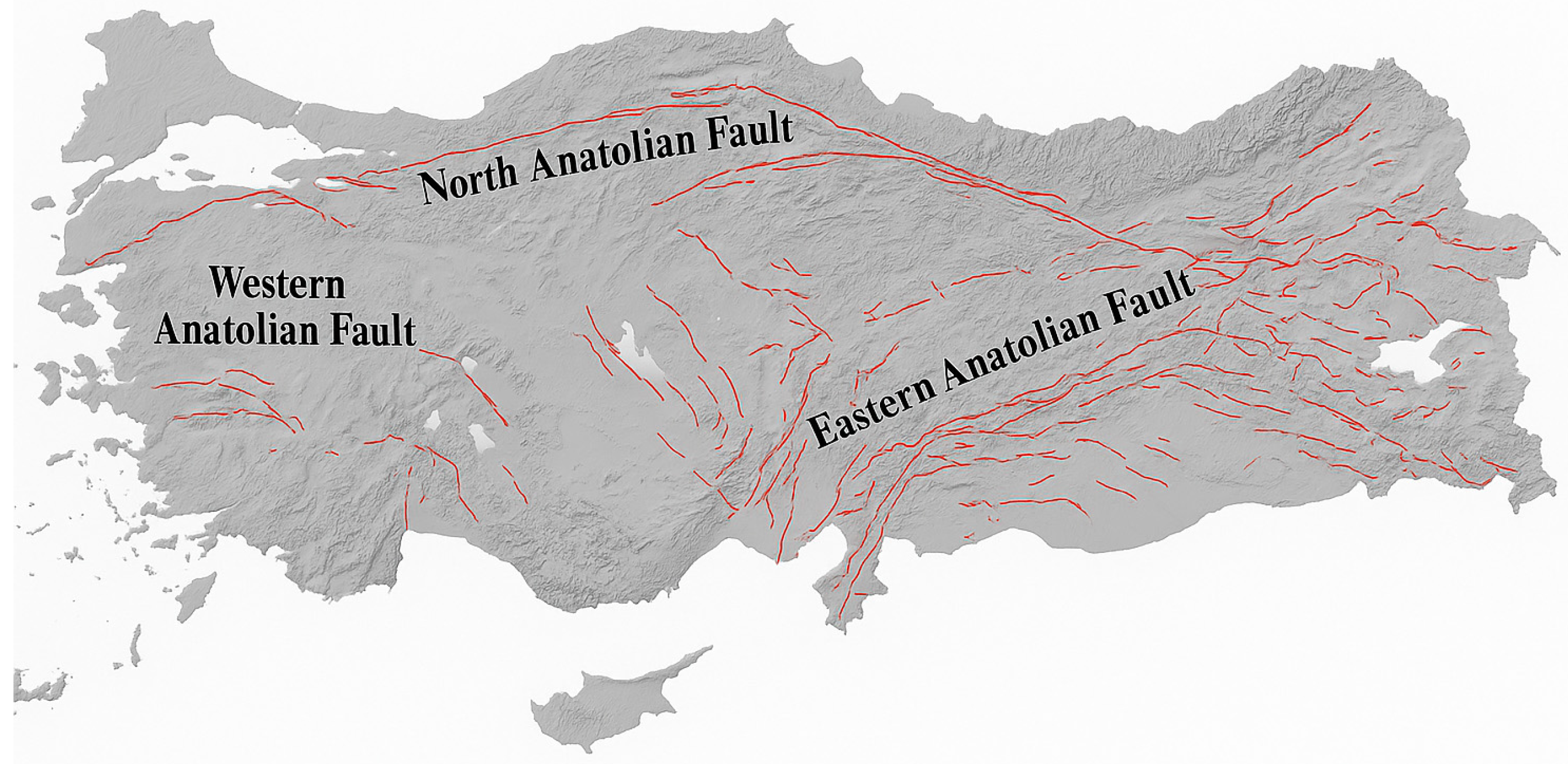
Figure 1. Türkiye’s main fault lines.
Buildings 15 04358 g001
Figure 8. Geometric features of the minaret (m).
Buildings 15 04358 g008
Figure 12. Mesh convergence study for the first natural frequency.
Buildings 15 04358 g012
Figure 13. Finite element model of the minaret.
Buildings 15 04358 g013
Figure 14. Locations of the five strong motion stations used for spectral comparison (0201, 2101, 2107, 4615, 4616, 4630) and the position of the Four-Legged Minaret.
Buildings 15 04358 g014
Figure 17. First five mode shapes and frequency values.
Buildings 15 04358 g017
Figure 18. Comparison of the acceleration response spectra at station 2101 for the three orthogonal components (east–west: E, north–south: N, and vertical: U) recorded during the Elbistan and Pazarcık earthquakes. The black dashed line at T = 0.622 s denotes the fundamental period of the analyzed structure.
Buildings 15 04358 g018
Figure 19. Maximum base shear forces obtained from the nonlinear time history analyses under the 2023 (a) Pazarcık and (b) Elbistan earthquakes.
Buildings 15 04358 g019
Figure 20. Absolute maximum displacement versus height from analyses using the 2023 Pazarcık and Elbistan earthquakes: (a) X direction; (b) Y direction.
Buildings 15 04358 g020
Figure 21. Contour plots of relative displacements in the X, Y, and Z directions (in mm) under the 2023 (a) Pazarcık and (b) Elbistan earthquakes.
Buildings 15 04358 g021
Figure 22. Displacement time-history graph at the top of the minaret under the 2023 (a) Pazarcık and (b) Elbistan earthquakes.
Buildings 15 04358 g022
Figure 23. Contours of maximum and minimum principal stresses under the 2023 (a) Pazarcık and (b) Elbistan earthquakes.
Buildings 15 04358 g023
Figure 24. Contours of normal and shear stresses under the 2023 (a) Pazarcık and (b) Elbistan earthquakes.
Buildings 15 04358 g024
Figure 25. Comparison of crack propagation obtained from nonlinear dynamic analysis and observed damage from the 6 February 2023 Türkiye earthquakes.
Buildings 15 04358 g025
Table 2. Information on the selected records of the 2023 Kahramanmaraş earthquakes.
ParameterPazarcık-EWPazarcık-NSPazarcık-UDElbistan-EWElbistan-NSElbistan-UD
Station Code2101
VS30 (m/s)519
Local Soil ClassZC
RJB (km)216.91255.40
PGA (g)0.0720.0780.0340.0220.0260.0136
PGV (cm/s)13.2717.815.637.768.175.72
Table 3. Cumulative mass participation ratios.
ModeFrequency (Hz)Cumulative Mass Participation Ratio
X DirectionY DirectionZ Direction
11.6070.7260.0000.000
21.6130.7260.7330.000
33.4840.7750.7330.000
43.7590.7750.7810.000
56.4520.7750.7810.000
67.9370.7750.9820.000
78.0000.9830.9820.000
815.8730.9830.9850.000
916.3930.9850.9850.000
1020.0000.9850.9850.950
1120.8330.9970.9850.955
1220.8330.9970.9970.955
Table 5. Maximum stresses resulting from the nonlinear time history analysis.
StressPazarcıkElbistan
Smax (MPa)2.2520.862
Smin (MPa)9.1043.352
Disclaimer/Publisher’s Note: The statements, opinions and data contained in all publications are solely those of the individual author(s) and contributor(s) and not of MDPI and/or the editor(s). MDPI and/or the editor(s) disclaim responsibility for any injury to people or property resulting from any ideas, methods, instructions or products referred to in the content.