Article

Aerodynamic Performance of Buildings with Balconies and HAWT Mounted on the Roof

by
Mario A. Aguirre-López
1,
Filiberto Hueyotl-Zahuantitla
1,2,
Pedro Martinez-Vazquez
3,*,
Charalampos Baniotopoulos
3,4 and
Orlando Díaz-Hernández
1
1
Faculty of Sciences in Physics and Mathematics, Autonomous University of Chiapas, Tuxtla Gutiérrez 29050, Mexico
2
Secretariat of Science, Humanities, Technology and Innovation, Mexico City 03940, Mexico
3
School of Engineering, University of Birmingham, Birmingham B15 2TT, UK
4
Civil Engineering Institute (IIC), École Polytechnique Fédérale de Lausanne, CH-1015 Lausanne, Switzerland
*
Author to whom correspondence should be addressed.
Buildings 2025, 15(23), 4325; https://doi.org/10.3390/buildings15234325 (registering DOI)

Submission received: 28 October 2025 / Revised: 22 November 2025 / Accepted: 26 November 2025 / Published: 28 November 2025
(This article belongs to the Special Issue Wind Load Effects on High-Rise and Long-Span Structures: 2nd Edition)

Abstract

The increasing complexity of tall buildings demands higher performance in serviceability and resilience, particularly regarding airflow control to reduce vibration-inducing forces. On the other hand, harnessing wind energy in suburban environments remains a challenge for sustainable city planning. This study examines airflow around a tall building designed for vertical wind farming, incorporating passive flow-control balconies and a roof-mounted horizontal-axis wind turbine (HAWT). Using 3D-resolved flow simulations, we analyse configurations with a 3-blade HAWT placed at varying heights and combined with different balcony types. The results show that turbine height has a stronger influence on rotational performance and near-wake dynamics than balcony geometry, while the mid-wake depends primarily on the building itself. We also find that shorter turbines reduce material and maintenance costs while maintaining similar power output at 30 rpm, whereas taller turbines offer only marginal safety improvements at roof level. Overall, the prototypes demonstrate the feasibility of combining facade roughness with on-site wind harvesting to maximise energy capture without duplicating infrastructure in suburban contexts.

1. Introduction

The dynamic response of structures exposed to wind has been much investigated in the past. The early works by Davenport [1] around the gust load factor enabled separating static and dynamic wind effects, with the later further sub-divided into background and resonant effects. Those concepts have been extended in various ways, taking the form of quasi-static methods such as the gust response factor [2], generalised gust factor [3], effective static load distribution [4], and equivalent static wind load [5]. Those works are mainly devoted to buildings, although similar concepts have been used to study other type of fluid–structure interactions such as those reported in [6,7,8], covering all roofs, bridges, and clean energy infrastructure. These works provide a broader perspective including numerical and experimental techniques, and practical recommendations for design.
Further analysis and design sophistication has taken place to assess the potential of clean energy technologies within the build environment. For example, ref. [9] developed a method to merge buildings and terrain topologies for a simplified urban digital surface roughness that could reduce computational cost associated with CFD simulations. Although not explicitly mentioned in [9], their approach could merge with existing air flow models [10] and estimate the effect of topography on local wind speed. Such research outputs naturally connect with separate developments that explore the potential yield of micro and small wind turbines in urban areas to identify ways to evaluate the urban wind environment and wind resource while advancing wind-turbine design and future emerging technologies [11,12,13]. Further research [14] scrutinises renewable and more sustainable energy systems originally applied for electrical generation, ventilation, pollution dispersion, cooling, and dehumidification to determine how such technologies could transfer to high-rise buildings [15,16], including the quantification of annual energy outputs and the related cost–benefit.
In recent years, CFD simulations around wind–structure interactions have explored novel methods to use wind as an active agent to improve building’s aerodynamic performance, modify air quality, and end electricity generation. For example, ref. [17] analysed the impact of outlet openings on the ventilation performance of a single-zone isolated building with a wind catcher. The results show that that a one-sided wind-catcher and window provides better indoor air quality and air change efficiency compared to using two-sided wind-catchers. Through a similar study but focused on thermal comfort, ref. [18] designed a wind-catcher with single-stage direct-air evaporative cooling that could be adopted for indoor air conditioning. Along similar lines but looking into clear energy resources, ref. [19] performed a computational study to test a horizontal axis wind turbine (HAWT) inside the throat of a wind power generation system (Invelox) to find that, while energy could be harvested, reducing the spacing for the HAWT to operate increases the pressure drop, to the detriment of the overall performance.
The progress and potential of wind resource exploitation in urban and suburban areas is presented in [20]. The study highlights small wind turbines (SWTs) as an alternative to conventional large-scale wind farms to bring clean energy closer to where it is needed, avoiding transportation and costly infrastructure. Notwithstanding urban areas being characterised by lower wind speed and higher turbulence, leading to complex interactions with buildings [21], research has shown that strategic deployment of SWTs could increase the wind speed, and hence energy flow, by about 20% while reducing turbulence and structural fatigue compared with the effects observed on wind farms located outside urban areas [22]. This has motivated the development of new technologies to further integrate sustainability into the design of tall buildings that are better equipped for wind energy collection. VAWTs are the most common technology of this kind implemented in urban habitats, yet HAWTs offer alternatives that have proven to be effective in certain scenarios. The infrastructure required to install WTs often involves hybrid steel towers, although more recently, we have seen this equipment integrated into building facades or discretely mounted on roofs [23,24,25,26]. Readers are referred to [27] for further details on wind energy infrastructure and its influence on structural performance.
In this work, we intend to contribute to the state of art of energy harnessing by analysing the numerical flow pattern produced by a HAWT located on the roof of a detached tall building, assuming that it is located in a suburban area fully exposed to the flow of wind. Thus, we have selected this scenario instead of urban areas, since new buildings equipped with wind turbines would be more likely to operate in those areas to confirm the predicted aerodynamic performance and address any potential hazards before moving them into more dense populations. To this end, we present a parametric study to assess the flow and quantification of energy across facades.
This paper is organised as follows. Section 2 presents the CFD model developed and its corresponding validation. Section 3 outlines the main findings and discusses their broader implications. Finally, Section 4 offers concluding remarks.

2. Methodology

2.1. Wind Turbines and Buildings Models

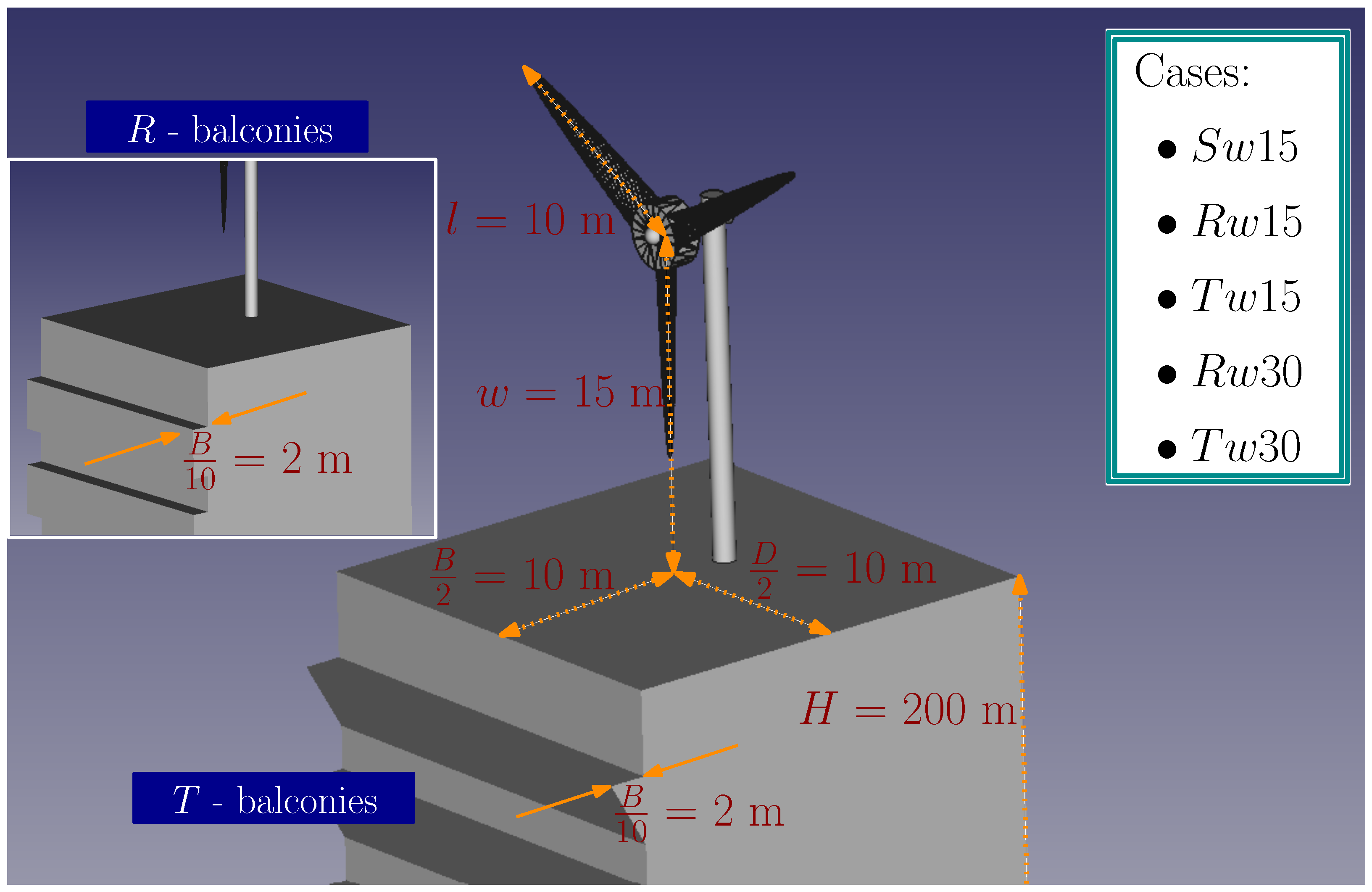
The buildings prototype considered for this study has a squared base of 20 m × 20 m ( B × D ) and a 200 m height (H). The roughness of the facades is modified to observe changes on the pressure field; this includes a smooth surface and two other cases, each with 40 triangular or rectangular equispaced balconies on the front side. These geometries have been implemented in a previous study [28] to quantify the impact of the wind regime around the building.
The model is equipped with a generic 3-blade HAWT model pulled from the GRABCAD repository [29], located on the roof at a certain height from the roof level. The rotation axis of the turbine is fixed to the same direction of the mainstream flow, i.e., no orientation system is considered in the HAWT. Figure 1 provides an overview of the cases considered in this study.

2.2. Numerical Scheme

We used OpenFOAM (version v2012, december 2020, released by OpenCFD Ltd.—ESI Group, mainly located in Bracknell, England) [30] for our numerical study. This software solves the Navier–Stokes equations via the finite-volume method, using Reynolds-averaged simulations (RASs) with the well-known k ω SST as the turbulence model [31,32], which combines the k ω model close to solid bodies and the k ϵ model in free-stream.
The discretised equations result in an algebraic system of equations treated with a conditionally stable second-order implicit backward for the time scheme, Gauss linear versions for gradient, divergence, and Laplacian schemes, and linear interpolation for transforming the cell-centred quantities to face centres. We used the PIMPLE algorithm [33] to solve those equations, which combines the PISO and SIMPLE algorithms, allowing us to reproduce the mobility of solid objects and efficiently capture their effects in the flow. All of these considerations and parameters are consistent with the common setups and suggestions found in the literature [34].

2.3. Meshing Details, Initial and Boundary Conditions

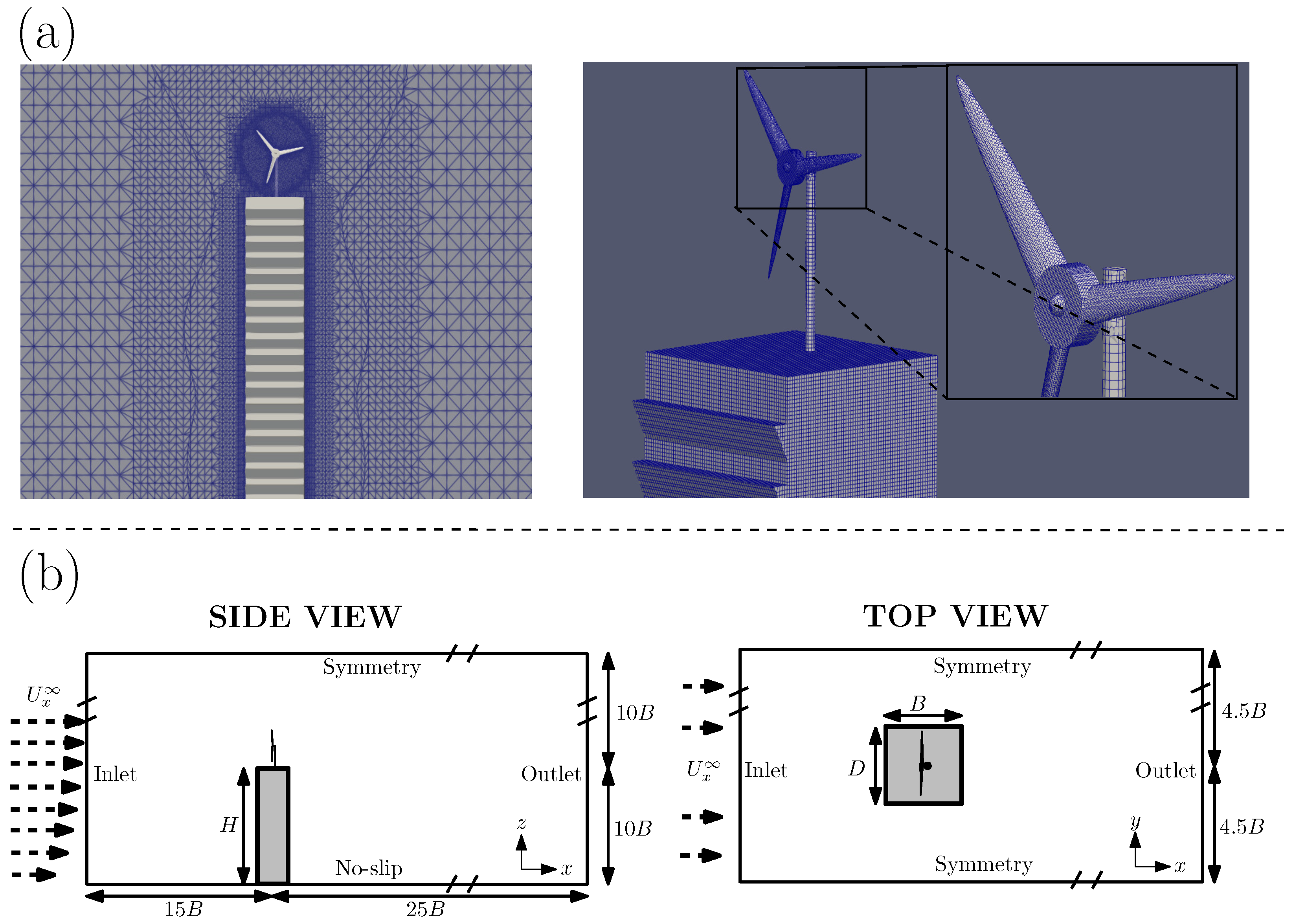
The simulated scenario of a tall building located in a suburban area precludes significant blockage effects and wake alterations at leeward that could influence the airflow on the roof. Figure 2 illustrates the computational array representing this scenario, indicating the type of boundaries at each limit of the array.
A Robin boundary condition was applied at the outlet. As the inflow boundary condition, we used a log-law type ground-normal profile for both, stream-wise velocity ( U x ), turbulent kinetic energy (k), and dissipation rate ( ω ) based on Equations (1)–(3) [35],
U x = U * κ ln z d + z 0 z 0 ,
k = ( U * ) 2 β m β 1 ln z d + z 0 z 0 + β 2 ,
ω = U * κ β m 1 z d + z 0 ,
with κ as the von Kármán constant, z 0 as the length of aerodynamic roughness (in m), d as the height of the normal ground displacement (in m), β m as an empirical model constant, β 1 and β 2 as curve fitting coefficients, and U * as the friction velocity, calculated as follows:
U * = U x r e f κ ln z r e f + z 0 z 0 ,
where U x r e f is the reference wind speed for the mean streamwise flow at reference height z r e f . Table 1 summarises the values used in this parametrisation for Equations (1)–(4).
The computational domain starts with a regular grid spanning the computational domain; the mesh is disrupted near the building and the turbine by means of the SnappyHexMesh utility, leading to a similar number of cells for all model configurations, as shown in Table 2. Only small variations were recorded when changing the types of balconies and the tower supporting the turbine. The number of cells that define the turbine in each case is about 4% of the total.
Each run was initialised with an air flow following the numerical scheme described in Section 2.2 in a non-transient environment, via the solver simpleFOAM, for 135 s. Then, the fields were mapped to perform the transient simulation in pimpleFOAM for 180 s, which has been shown to appropriately capture the average pressures on a similar building [28]. Throughout the process, the Courant number was kept below 0.9 by adjusting the time step. Our numerical settings and initial conditions are in line with suggestions found in the literature [34].

2.4. Model Validation

Further to the above parameter validation, a simultaneous test was carried out for the CAARC building benchmark, whose dimensions and parameter values are given in Table 3, and in accordance with [34,36].
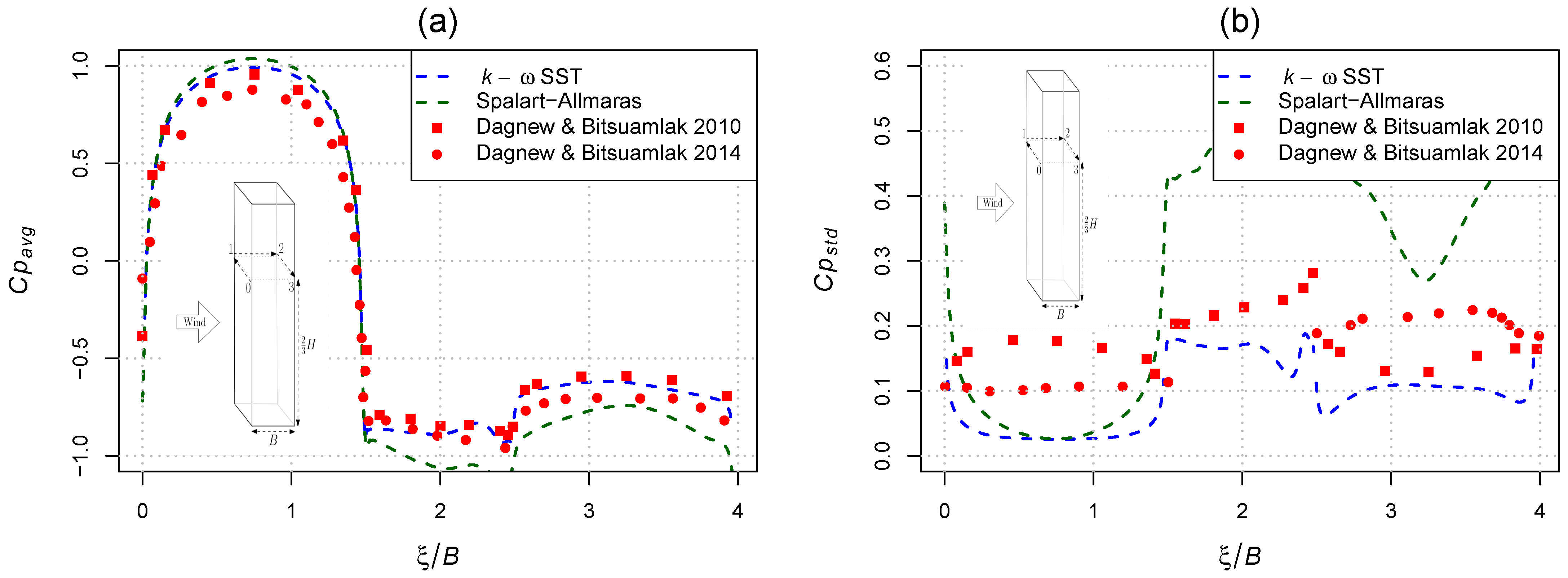
The results of this validation are shown in Figure 3, where the C p -values obtained with our k ω SST model are compared with (i) equivalent results reported in separate studies using similar conditions but considering the Spalart–Allmaras model [37], (ii) results from experimental measures [38], and (iii) an approach using LES [39]. The experimental setup in [38] consisted of a 1:400 scale wind tunnel aerodynamic model considering an isolated building and four additional cases considering an adjacent smaller building. The reference height in this experiment was z r e f = 1.22 m, capturing an inflow power-law profile with an exponent value of 0.16 and a inflow reference velocity U x r e f = 12.12 m/s that leads to Re r e f = 3 × 10 5 . The data in Figure 3 was mapped from [34] (Figures 9 and 10) using PlotDigitzer [40].
In turn, the relative-pressure coefficient ( C p ), as a dimensionless number that describes the relative pressures in a flow by comparing the local pressure to a free-stream pressure, p , is a crucial tool for comparing pressure loads, analysing aerodynamics, and understanding how pressure changes around an object or within a flow. It is computed using the following formula:
C p = p p 0.5 ρ ( U x , z = H ) 2 ,
where ρ is the fluid density, U x , z = H is the inflow wind speed for the mean streamwise flow at the height of the building H, and p is set to zero in OpenFOAM calculations due to the incompressibility of the flow.
The results show that our methodology fits the experimental results better than the those based on the Spalart–Allmaras model and those derived from the method employed by Dagnew and Bitsuamlak.

3. Results

3.1. Inflow at the Turbine

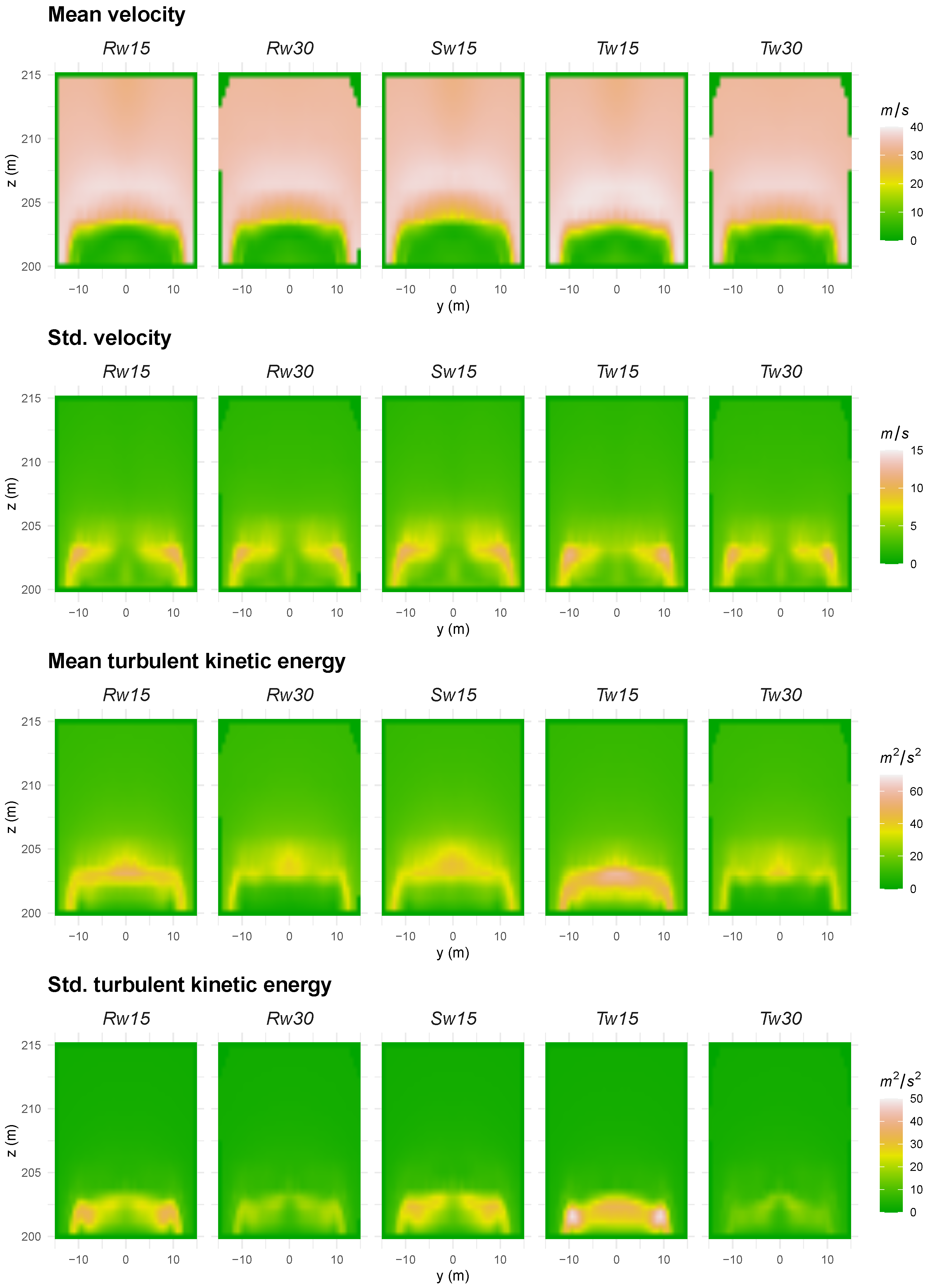
The features of the fluid approaching the wind turbine are shown in Figure 4. The length of the blades l is of 10 m, and the rotor (w) is located at z = 215 m, which defines an asymmetric arrangement that experiences some vertical asymmetry on the frontal facade of the building. This is more notorious in the time-averaged variables (U and k), while the flow dispersion (std. deviation values) is more pronounced below z = 205 m. This implies that non-vertical asymmetry occurs for the turbines centred at z = 230 m. Note that configurations labelled w = 15 m and T w 15 produce lower vertical asymmetry, concentrating the bulk of velocity and energy dissipation near the roof.
For this study, we considered a constant HAWT’s angular velocity of Ω = 30 rpm ( π rad/s) which, under working conditions, undergoes a tip-speed ratio of
T S R = velocity of the turbine velocity of the free - stream = Ω · l U z t u r b i n e π rad / s · 10 m 30.55 m / s 1 ,
which is far from optimal for HAWTs ( T S R = 6–8 units). The selection of the turbine was based on public acceptance, bearing in mind that large turbines moving at high rotational velocities are poorly received by citizens in suburban and urban areas because they are considered hazardous [41,42]. These operational conditions move the power coefficient from its optimum, which should be about C p p o w e r = 0.59 and in accordance with Betz’s Law, leading to a power generation of:
E a v a i l a b l e = 0.5 C p p o w e r ρ A U z t u r b i n e 3 1000 3300 kW .
The health and safety implications for people walking on the roof of the building, such as maintenance personnel, are minimal (at x = 5 m). This because the dominating average velocity at z < 202 m is about 5 m/s, notwithstanding the standard deviation increase at the centre of the building ( y = 0 m) and at the flanks ( y = ± 10 m). The implications of the prototype arrangement in the neighbourhood of the HAWT are covered in Section 3.2 and Section 3.3.

3.2. Pressure and Power Generation on the Turbine

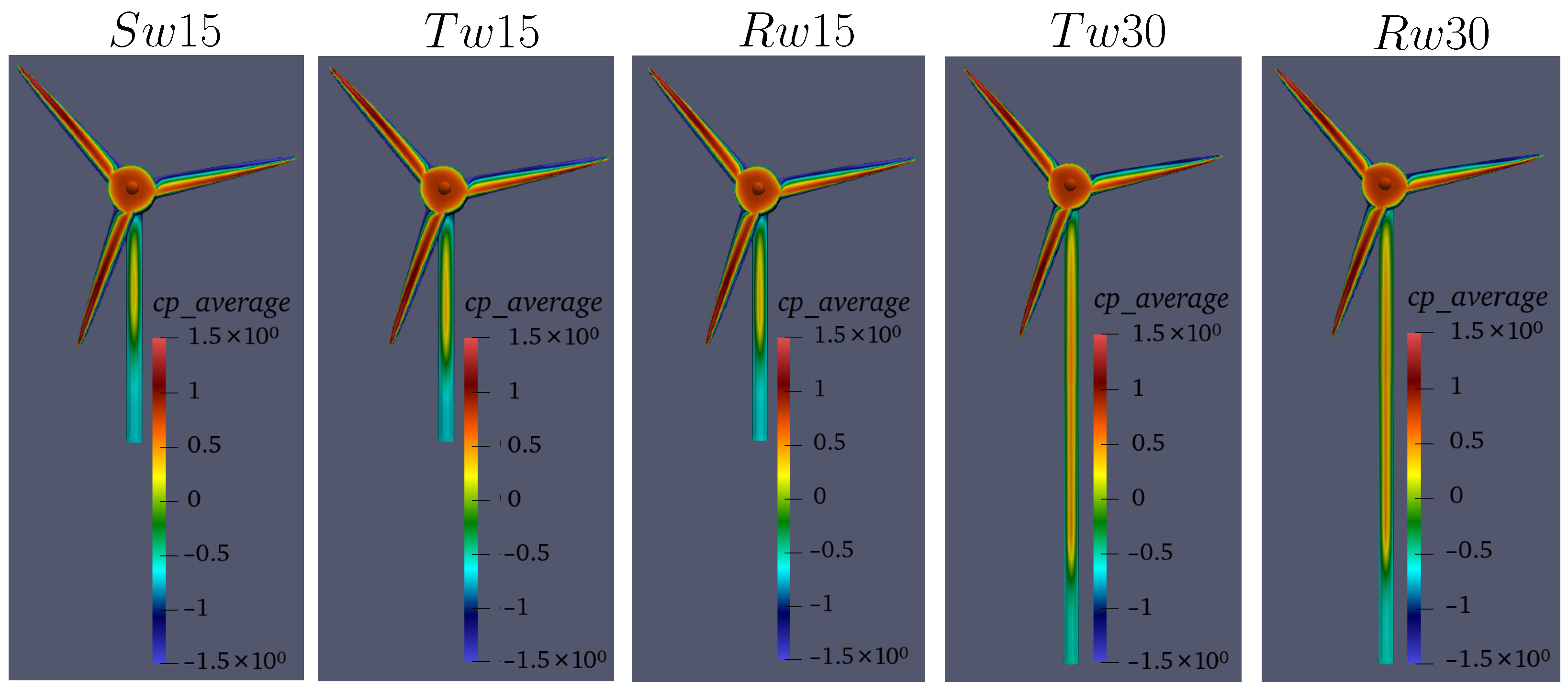
Figure 5 shows the time-averaged pressure on the front side of the HAWT in terms of its C p . Averaged values of about 0.7 are reported on the rotor, with higher pressures of up to 1.5 units taking place towards the tips of the blades. These results replicate across the various building–turbine configurations. On the other hand, the cylindrical tower supporting the turbine (turbine’s basis) is exposed to lower pressures, lying below 0.5 units for configurations where the rotor is located 15 m above the building roof, and below 1 unit for turbines whose rotor is placed at 30 m. In all cases, the lower part of the tower, approximately 4 m, is not exposed to high pressure. This sheltering effect is more prominent on buildings without balconies, see for example S w 15 , where the lower range of pressures extends to about 5 m from the roof level. This indicates that the turbine pole will be subjected to greater pressure in buildings with balconies, as they modify the boundary layer.
Table 4 summarises the results obtained in terms of standard deviation and maximum values recorded on the surface of the HAWT. These results could inform structural designers and blade manufacturers who will observe that the maximum reported C p -value exceeds 30 units (about 22,000 Pa in excess of the reference pressure) across all wind turbine configurations. The HAWT system must withstand pressure bursts of this magnitude on the edge of the blades and avoid abrupt accelerations, keeping the turbine rotation within a safe range. Table 4 also shows that the standard deviation of pressure remains within a minimum (0.75 units) on the front side of any turbine, with slight variations in peak values (1.22–1.27 units) around the central regions of the blades. No significant patterns can be observed from the reported results.
A quick estimation of power generated is based on the assumed Ω and the averaged thrust T computed based on the pressure shown in Figure 5, using the approximation E g e n e r a t e d = T e f f · Ω 610 kW. This value considers T e f f α T l e f f , l e f f = σ l , α = 0.2 as the tangential ratio to the main-stream, and σ = 0.6 as the coefficient of an effective level arm, see [43]. Therefore, the ratio between the operational and optimal energy harvesting is about
E g e n e r a t e d E a v a i l a b l e 0.18 ,
which express the generated C p p o w e r , being about 0.41 units below Betz’s limit. Together with the TSR value, this constraint can reduce public criticism while guaranteeing achievable rotation under safe structural conditions against peak pressures.

3.3. Wake Effects

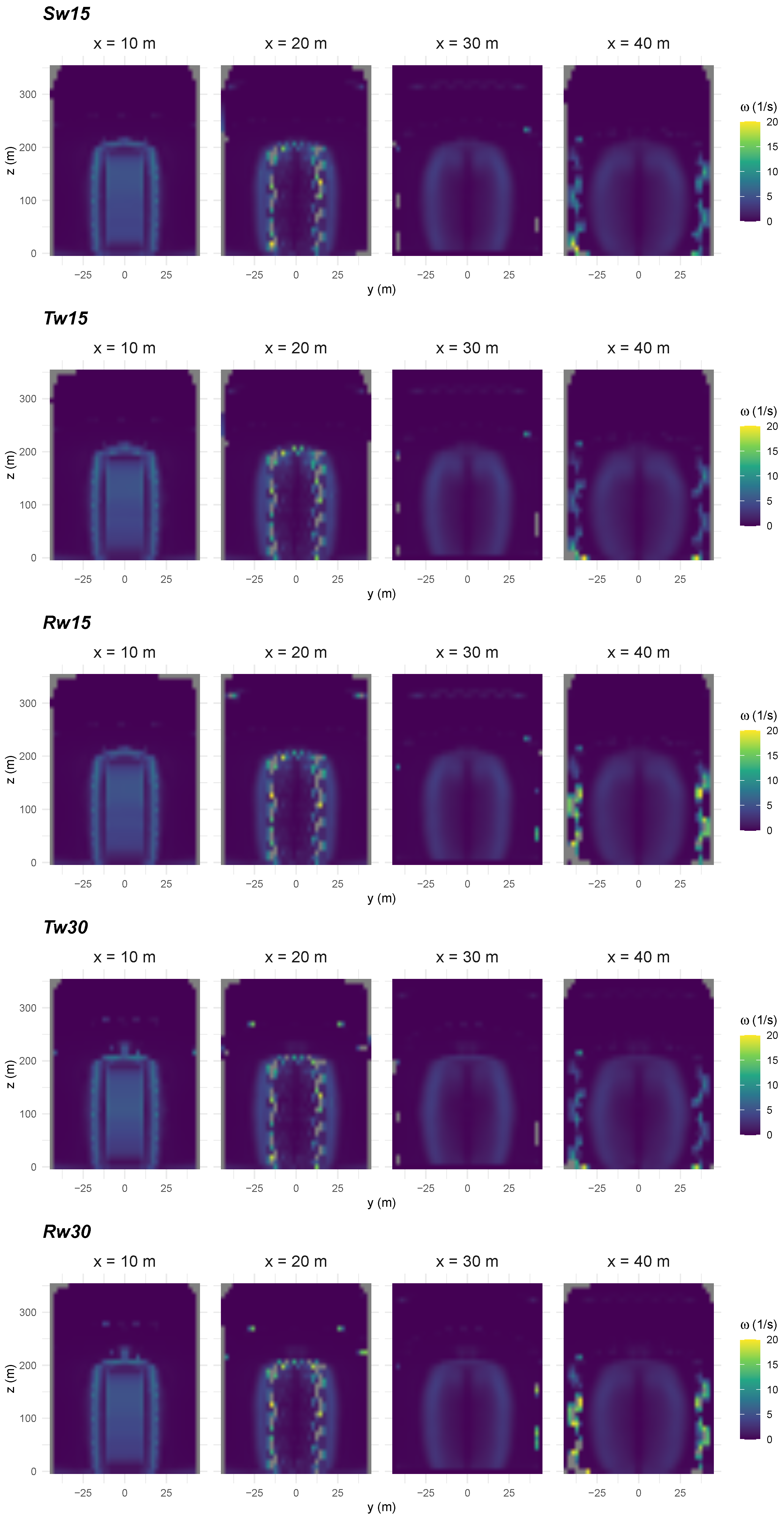
Figure 6 shows the flow behaviour in the near- to middle-wake, i.e., the region spanning 10 m to 40 m past the location of the wind turbine. This figure shows that all building–turbine configurations have a similar flow-averaged circulation pattern, having two alternating stages, one of lateral dispersion (at x = 10 and 20 m) and another of agglomeration (at x = 20 and 40 m). Specifically, at x = 20 m (10 m behind the building), an increase in vorticity ( ω ) occurs at 2–5 m from the lateral faces of the buildings, corresponding to the coordinates y = 10 m and y = 10 m. Beyond that layer, the vortices spread laterally, transferring kinetic energy that re-attaches the main-stream flow at x = 40 m, cascading into a second agglomeration of circulation approximately at 25–35 m behind the building. Vorticity values in those agglomerations exceed 10 s−1, corresponding to gusty and uncomfortable turbulence, with strong swirls going over 20 s−1. Configurations with rectangular balconies produced larger re-circulation, followed by the building without balconies. In this regard, the use of land in those zones should be carefully planned, avoiding adjacent pedestrian walkways or fragile structures. Nevertheless, such building configuration appears suitable for improving air quality, regardless of the HAWT, enhancing vertical mixing of air via upward transport of pollutants from near-ground level to higher altitudes [44] and improving the air quality at the pedestrian level behind it. Urban planners could design suitable corridors between high buildings by channelling and redirecting the main-stream flow.
In spite of a small increase in vorticity observed in some configurations at z ≈ 250–300 m at x = 20 m, the effects discussed above tend to concentrate between the building’s basis ( z = 0 m) and roof ( z = 200 m). Therefore, the effect of the HAWT is reduced to a local decrease in the zone z = 170–200 m at x = 20 m, which is limited at the top by the base of the turbine tower. Although that disruption mitigates turbulent flow (>5 s−1) to enabling moderate gusts (1–5 s−1), the surrounding circulation minimises its impact and hence is not a factor determining the safe allocation of structures behind the building.
Finally, the effect of the turbine height is tangible in the nearest wake only, causing a local increase in the projection of the turbine base along the x-axis in case T w 30 . On the other hand, and unlike the smooth facade ( S w 15 ), the addition of balconies to the front facade (windward) also causes a slight increase in vorticity in the immediate wake. These effects, which disrupt the calm urban breeze and introduce moderate gusts and turbulence, make the building’s terrace unsafe to pedestrians; therefore, extreme precautions must be taken to mitigate this.

4. Conclusions

The aerodynamic performance of buildings with balconies and a HAWT on their upper roof was studied by considering various configurations of balconies that modify the surface roughness. The results indicate that the flow around the turbine is mainly disturbed by the height at which the HAWT is located so that the higher the turbine, the lower the energy dissipation. However, pedestrian comfort on the frontal roof of the building is not particularly altered by the presence of the turbine, which contrasts with the rear side, where the height of the turbine induces strong eddies.
From a structural point of view, the turbine’s basis must withstand larger pressures as the height of the tower increases; therefore, the turbine and blades acts as a shield mechanism. Notwithstanding, the average pressure on the turbine itself was found to be similar for all the building–turbine configurations, which enabled us to conclude that turbines centred at z = 215 m optimise the costs of building material and structural maintenance with the same level of power generation, whereas those centred at z = 230 m slightly improve the security conditions on the roof level.
In spite of the larger re-circulation produced by buildings with rectangular balconies, wake conditions have proved to be similar across all the configurations, characterised by sequences of lateral agglomeration and dispersion of vorticity mainly defined by the size of the building. This pattern of flow circulation could help designers and urban planners visualising more modern architecture whereby the wind flow around buildings is passively controlled. This and on-going research shows that wind turbines mounted on buildings could help to harvest wind energy due to sustained velocity around roofs and specific locations on facades. Notwithstanding that these findings could help to mitigate energy demands, they must be accompanied with the scrutiny of wind disturbances in surrounding areas, taking into account pedestrian comfort and air quality. The structural performance of buildings is not affected by the presence of HAWT since the cut-off velocity of the devices prevents operation, i.e., damage, under high wind speeds.

Author Contributions

Conceptualization, M.A.A.-L. and P.M.-V.; Data curation, M.A.A.-L.; Formal analysis, M.A.A.-L., F.H.-Z., P.M.-V., and C.B.; Funding acquisition, M.A.A.-L., F.H.-Z., and C.B.; Investigation, M.A.A.-L. and P.M.-V.; Methodology, M.A.A.-L. and P.M.-V.; Project administration, F.H.-Z. and P.M.-V.; Resources, M.A.A.-L. and P.M.-V.; Software, M.A.A.-L.; Supervision, F.H.-Z. and C.B.; Validation, P.M.-V., C.B., and O.D.-H.; Visualization, M.A.A.-L.; Writing—original draft, M.A.A.-L. and P.M.-V.; Writing—review and editing, F.H.-Z., C.B., and O.D.-H. All authors have read and agreed to the published version of the manuscript.

Funding

This research was funded by Secretariat of Science, Humanities, Technology, and Innovation (SECIHTI) of Mexico—grant number 839412. The authors gratefully acknowledge the support of The Royal Society towards the mobility grant IES\R1\241091.

Data Availability Statement

The data presented in this study are available upon request from the corresponding author. The data are not publicly available due to their large size.

Acknowledgments

The authors thankfully acknowledge the computer resources, technical expertise, and support provided by the Laboratorio Nacional de Supercómputo del Sureste de México, SECIHTI member of the Network of National Laboratories. The second author thanks FCFM-UNACH and the support from SECIHTI through the program “Investigadoras e investigadores por México”, Cátedra 873.

Conflicts of Interest

The authors declare no conflicts of interest.

Nomenclature

List of abbreviations and symbols used throughout this paper.
AbbreviationsDescription
CAARCCommonwealth Advisory Aeronautical Research Council
CFDComputational Fluid Dynamics
HAWTHorizontal-Axis Wind Turbine
LESLarge Eddy Simulation
PIMPLEPressure-Implicit with Splitting of Operators + SIMPLE
PISOPressure-Implicit with Splitting of Operators
RASReynolds-Averaged Simulations
RMSRoot Mean Square
R-balconiesRectangular balconies
R15Building model with R-balconies, and a HAWT
at 15 m over the roof
R30Building model with R-balconies, and a HAWT
at 30 m over the roof
SIMPLESemi-Implicit Method for Pressure-Linked Equations
SSTShear Stress Transport
SWTsSmall Wind turbines
S15Building model without balconies, and a HAWT
at 15 m over the roof
TSRTip-Speed Ratio
T-balconiesTriangular balconies
T15Building model with T-balconies, and a HAWT
at 15 m over the roof
T30Building model with T-balconies, and a HAWT
at 30 m over the roof
VAWTsVertical-Axis Wind Turbines
WTsWind Turbines
SymbolDescriptionUnits
BWidth of the building[m]
DDepth of the building[m]
HHeight of the building[m]
wHeight to the turbine axis from the roof[m]
kTurbulent kinetic energy[m2/s2]
ω Specific turbulent dissipation rate[1/s]
ϵ Dissipation rate of turbulent kinetic energy[m2/s3]
U x Stream-wise velocity at the inlet[m/s]
U x , z = H U x at height z = H [m/s]
U z t u r b i n e U x at the turbine[m/s]
ρ Fluid density[kg/m−3]
U * Friction velocity[m/s]
β m Empirical model constant(Dimensionless)
β 1 , β 2 Curve fitting coefficients(Dimensionless)
κ von Kármán constant(Dimensionless)
z 0 Length of aerodynamic roughness[m]
dHeight of the normal ground displacement[m]
z r e f Reference height[m]
U x r e f Stream-wise velocity at z r e f [m/s]
R e r e f Reynolds number at z r e f (Dimensionless)
ξ Auxiliary variable of distance[m]
p Free-stream pressure[Pa]
pLocal pressure[Pa]
C p Relative-pressure coefficient(Dimensionless)
lLength of the blades[m]
x , y , z x , y , z coordinates[m]
Ω Angular velocity[rpm]
C p p o w e r Power coefficient(Dimensionless)
UVelocity[m/s]
E a v a i l a b l e Power available[kW]
E g e n e r a t e d Power generated[kW]
TAveraged thrust[N]
T e f f Effective torque[N m]
l e f f Effective blade length[m]
α Tangential ratio to the main-stream(Dimensionless)
β Coefficient of an effective level arm(Dimensionless)

References

  1. Davenport, A.G. Gust Loading Factors. J. Struct. Div. 1967, 93, 11–34. [Google Scholar] [CrossRef]
  2. Zhou, Y.; Kareem, A. Gust Loading Factor: New Model. J. Struct. Eng. 2001, 127, 168–175. [Google Scholar] [CrossRef]
  3. Piccardo, G.; Solari, G. 3D Wind-Excited Response of Slender Structures: Closed-Form Solution. J. Struct. Eng. 2000, 126, 936–943. [Google Scholar] [CrossRef]
  4. Holmes, J. Effective static load distributions in wind engineering. J. Wind. Eng. Ind. Aerodyn. 2002, 90, 91–109. [Google Scholar] [CrossRef]
  5. Chen, X.; Kareem, A. Equivalent Static Wind Loads on Buildings: New Model. J. Struct. Eng. 2004, 130, 1425–1435. [Google Scholar] [CrossRef]
  6. Patruno, L.; Ricci, M.; de Miranda, S.; Ubertini, F. Equivalent Static Wind Loads: Recent developments and analysis of a suspended roof. Eng. Struct. 2017, 148, 1–10. [Google Scholar] [CrossRef]
  7. Stathopoulos, T.; Baniotopoulos, C. Wind Effects on Buildings and Design of Wind-Sensitive Structures; CISM International Centre for Mechanical Sciences; Springer: Vienna, Austria, 2007. [Google Scholar]
  8. Baniotopoulos, C.; Borri, C.; Stathopoulos, T. Environmental Wind Engineering and Design of Wind Energy Structures; CISM International Centre for Mechanical Sciences; Springer: Vienna, Austria, 2011. [Google Scholar]
  9. Simões, T.; Estanqueiro, A. A new methodology for urban wind resource assessment. Renew. Energy 2016, 89, 598–605. [Google Scholar] [CrossRef]
  10. RenSMART. The NOABL Model. 2025. Available online: https://rensmart.com/Information/NOABLModel (accessed on 10 July 2025).
  11. Drew, D.; Barlow, J.; Cockerill, T. Estimating the potential yield of small wind turbines in urban areas: A case study for Greater London, UK. J. Wind. Eng. Ind. Aerodyn. 2013, 115, 104–111. [Google Scholar] [CrossRef]
  12. Škvorc, P.; Kozmar, H. Wind energy harnessing on tall buildings in urban environments. Renew. Sustain. Energy Rev. 2021, 152, 111662. [Google Scholar] [CrossRef]
  13. Watson, S.; Moro, A.; Reis, V.; Baniotopoulos, C.; Barth, S.; Bartoli, G.; Bauer, F.; Boelman, E.; Bosse, D.; Cherubini, A.; et al. Future emerging technologies in the wind power sector: A European perspective. Renew. Sustain. Energy Rev. 2019, 113, 109270. [Google Scholar] [CrossRef]
  14. Ishugah, T.; Li, Y.; Wang, R.; Kiplagat, J. Advances in wind energy resource exploitation in urban environment: A review. Renew. Sustain. Energy Rev. 2014, 37, 613–626. [Google Scholar] [CrossRef]
  15. Vita, G.; Šarkić Glumac, A.; Hemida, H.; Salvadori, S.; Baniotopoulos, C. On the Wind Energy Resource above High-Rise Buildings. Energies 2020, 13, 3641. [Google Scholar] [CrossRef]
  16. Acosta, J.L.; Combe, K.; Djokic, S.Z.; Hernando-Gil, I. Performance Assessment of Micro and Small-Scale Wind Turbines in Urban Areas. IEEE Syst. J. 2012, 6, 152–163. [Google Scholar] [CrossRef]
  17. Montazeri, H.; Montazeri, F. CFD simulation of cross-ventilation in buildings using rooftop wind-catchers: Impact of outlet openings. Renew. Energy 2018, 118, 502–520. [Google Scholar] [CrossRef]
  18. Foroozesh, J.; Hosseini, S.; Ahmadian Hosseini, A.; Parvaz, F.; Elsayed, K.; Uygur Babaoğlu, N.; Hooman, K.; Ahmadi, G. CFD modeling of the building integrated with a novel design of a one-sided wind-catcher with water spray: Focus on thermal comfort. Sustain. Energy Technol. Assess. 2022, 53, 102736. [Google Scholar] [CrossRef]
  19. Ghorani, M.M.; Karimi, B.; Mirghavami, S.M.; Saboohi, Z. A numerical study on the feasibility of electricity production using an optimized wind delivery system (Invelox) integrated with a Horizontal axis wind turbine (HAWT). Energy 2023, 268, 126643. [Google Scholar] [CrossRef]
  20. Stathopoulos, T.; Alrawashdeh, H.; Al-Quraan, A.; Blocken, B.; Dilimulati, A.; Paraschivoiu, M.; Pilay, P. Urban wind energy: Some views on potential and challenges. J. Wind. Eng. Ind. Aerodyn. 2018, 179, 146–157. [Google Scholar] [CrossRef]
  21. Gkantou, M.; Rebelo, C.; Baniotopoulos, C. Life Cycle Assessment of Tall Onshore Hybrid Steel Wind Turbine Towers. Energies 2020, 13, 3950. [Google Scholar] [CrossRef]
  22. Mertens, S. Wind energy in urban areas: Concentrator effects for wind turbines lose to buildings. Refocus 2002, 3, 22–24. [Google Scholar] [CrossRef]
  23. Tablada, A.; Kosorić, V. 11—Vertical farming on facades: Transforming building skins for urban food security. In Rethinking Building Skins; Gasparri, E., Brambilla, A., Lobaccaro, G., Goia, F., Andaloro, A., Sangiorgio, A., Eds.; Woodhead Publishing Series in Civil and Structural Engineering; Woodhead Publishing: Sawston, UK, 2022; pp. 285–311. [Google Scholar] [CrossRef]
  24. Shahda, M.M.; Megahed, N.A. Post-pandemic architecture: A critical review of the expected feasibility of skyscraper-integrated vertical farming (SIVF). Archit. Eng. Des. Manag. 2023, 19, 283–304. [Google Scholar] [CrossRef]
  25. Xie, S.; Martinez-Vazquez, P.; Baniotopoulos, C. Wind Flow Characteristics on a Vertical Farm with Potential Use of Energy Harvesting. Buildings 2024, 14, 1278. [Google Scholar] [CrossRef]
  26. Xie, S.; Martinez-Vazquez, P.; Baniotopoulos, C. Experimental Measurements of Wind Flow Characteristics on an Ellipsoidal Vertical Farm. Buildings 2024, 14, 3646. [Google Scholar] [CrossRef]
  27. Kumar, R.; Raahemifar, K.; Fung, A.S. A critical review of vertical axis wind turbines for urban applications. Renew. Sustain. Energy Rev. 2018, 89, 281–291. [Google Scholar] [CrossRef]
  28. Aguirre-López, M.A.; Hueyotl-Zahuantitla, F.; Martínez-Vázquez, P. Passive Control Measures of Wind Flow around Tall Buildings. Buildings 2024, 14, 1514. [Google Scholar] [CrossRef]
  29. Stratasys Inc. Free CAD Designs. Files & 3D Models: The Grabcad Community Library. 2025. Available online: https://grabcad.com/library/small-wind-turbine-blades-1 (accessed on 24 June 2025).
  30. OpenFOAM. OpenCFD Release OpenFOAM v2012; OpenCFD Ltd.: Bracknell, UK, 2020. [Google Scholar]
  31. OpenFOAM: API Guide v2012—The Open Source CFD Toolbox. OpenFOAM: API Guide: kOmegaSST. 2018. Available online: https://www.openfoam.com/documentation/guides/v2012/api/classFoam_1_1RASModels_1_1kOmegaSST.html (accessed on 10 September 2025).
  32. Langley Research Center—Turbulence Modeling Resource. Menter Shear Stress Transport Model. 2024. Available online: https://turbmodels.larc.nasa.gov/sst.html (accessed on 10 September 2025).
  33. OpenFOAM v2112. pimpleFOAM Solver. 2018. Available online: https://www.openfoam.com/documentation/guides/latest/doc/guide-applications-solvers-incompressible-pimpleFoam.html (accessed on 10 September 2025).
  34. Thordal, M.S.; Bennetsen, J.C.; Koss, H.H.H. Review for practical application of CFD for the determination of wind load on high-rise buildings. J. Wind. Eng. Ind. Aerodyn. 2019, 186, 155–168. [Google Scholar] [CrossRef]
  35. OpenFOAM v2112. ATM Boundary Layer. 2018. Available online: https://www.openfoam.com/documentation/guides/latest/doc/guide-bcs-inlet-atm-atmBoundaryLayer.html (accessed on 10 September 2025).
  36. Huang, S.; Li, Q.; Xu, S. Numerical evaluation of wind effects on a tall steel building by CFD. J. Constr. Steel Res. 2007, 63, 612–627. [Google Scholar] [CrossRef]
  37. Spalart, P.; Allmaras, S. A one-equation turbulence model for aerodynamic flows. In Proceedings of the 30th Aerospace Sciences Meeting and Exhibit, Reno, NV, USA, 6–9 January 1992; American Institute of Aeronautics and Astronautics: Reston, VA, USA, 1992; pp. 1–22. [Google Scholar] [CrossRef]
  38. Dagnew, A.K.; Bitsuamlakb, G.T. LES evaluation of wind pressures on a standard tall building with and without a neighboring building. In Proceedings of the Fifth International Symposium on Computational Wind Engineering, Chapel Hill, NC, USA, 23–27 May 2010. [Google Scholar]
  39. Dagnew, A.K.; Bitsuamlakb, G.T. Computational evaluation of wind loads on a standard tall building using LES. Wind. Struct. 2014, 18, 567–598. [Google Scholar] [CrossRef]
  40. PlotDigitizer: Version 3.1.6. 2025. Available online: https://plotdigitizer.com (accessed on 10 September 2025).
  41. Knopper, L.D.; Ollson, C.A.; McCallum, L.C.; Whitfield Aslund, M.L.; Berger, R.G.; Souweine, K.; McDaniel, M. Wind Turbines and Human Health. Front. Public Health 2014, 2, 63. [Google Scholar] [CrossRef]
  42. Fuglseth, G. Mythbusting: “Wind Power Is Unreliable, Inefficient and Harmful to Nature”. 2024. Available online: https://www.statkraft.com/newsroom/explained/mythbusting-wind-power-is-unreliable-inefficient-and-harmful-to-nature/ (accessed on 10 September 2025).
  43. Burton, T.; Jenkins, N.; Sharpe, D.; Bossanyi, E. Aerodynamics of Horizontal Axis Wind Turbines. In Wind Energy Handbook; John Wiley & Sons, Ltd.: Hoboken, NJ, USA, 2011; Chapter 3; pp. 39–136. [Google Scholar] [CrossRef]
  44. Hang, J.; Li, Y.; Buccolieri, R.; Sandberg, M.; Di Sabatino, S. On the contribution of mean flow and turbulence to city breathability: The case of long streets with tall buildings. Sci. Total Environ. 2012, 416, 362–373. [Google Scholar] [CrossRef]
Figure 1. Schematisation and list of models, categorised by the type of balconies (R = rectangular, T = triangular, and S = without balconie); and by the height w from the top of the building to the centre of the turbine.
Buildings 15 04325 g001
Figure 2. Mesh and boundary conditions. (a) Zoom of the grid at the building and the HAWT. (b) Dimensions and type of boundaries of the array.
Buildings 15 04325 g002
Figure 3. Comparison of pressure coefficient around the CAARC building at 2 3 H ; squares represent experimental data, while circles represent numerical data from LES, both taken from [34]. (a) Average, (b) RMS. The auxiliary variable of distance ξ goes around the building, as shown in the inset building silhouette [38,39].
Buildings 15 04325 g003
Figure 4. Frontal view of the flow before passing the HAWT ( x = 5 m) over the top of the building ( z = 200 m) for the considered configurations in terms of the mean and standard deviation (in time) of the velocity (U) and the turbulent kinetic energy (k). The green framing around each picture denotes the image cut, so it is not part of the flow data.
Buildings 15 04325 g004
Figure 5. Frontalview of the pressure coefficient on the HAWT for the building–turbine configurations. Since the HAWT’s rotation, the values shown were averaged in ParaVIEW by taking the turbine as the frame of reference.
Buildings 15 04325 g005
Figure 6. Frontal view of vorticity behaviour from 10 m to 40 m past the building–turbine configurations. The point (0,0,0) defines the centre of the building’s basis, so the slice x = 10 m corresponds to the rear side of the building. Gray zones at the borders of the images are due to lack of cells for the interpolation.
Buildings 15 04325 g006
Table 1. Inflow parameters.
ParameterValue
U x r e f 20 m/s
z r e f 10 m
κ 0.4 (dimensionless)
z 0 0.03 m
d0.03 m
β m 0.01 (dimensionless)
β 1 −0.05 (dimensionless)
β 2 1 (dimensionless)
Table 2. Number of cells for each model configuration.
Model# Cells
S151,419,330
T151,489,959
R151,482,585
T301,509,883
R301,502,467
Table 3. Parameters defining the CAARC case and its inflow.
MeasuresInflow
ParameterValueParameterValue
B30.80 m U x r e f 14.5 m/s
D45.72 m z r e f 7 m
H183.88 m κ 0.4 (dimensionless)
z 0 0.013 m
d0.013 m
β m 0.01 (dimensionless)
β 1 −0.05 (dimensionless)
β 2 1 (dimensionless)
Table 4. Maximum and standard deviation of pressure on the frontal side of the HAWT in terms of the averaged C p for the different building–turbine configurations.
CaseStd. ValuesMax. Values
S w 15 0.75–1.2727–31
T w 15 0.75–1.2727–31
R w 15 0.75–1.2627–31
T w 30 0.75–1.2226–31
R w 30 0.75–1.2727–31
Disclaimer/Publisher’s Note: The statements, opinions and data contained in all publications are solely those of the individual author(s) and contributor(s) and not of MDPI and/or the editor(s). MDPI and/or the editor(s) disclaim responsibility for any injury to people or property resulting from any ideas, methods, instructions or products referred to in the content.