Article

An Elastoplastic Theory-Based Load-Transfer Model for Axially Loaded Pile in Soft Soils
1
School of Highway, Chang’an University, Xi’an 710064, China
2
Guangdong Provincial Road and Bridge Construction and Development Co., Ltd., Guangzhou 510623, China
*
Author to whom correspondence should be addressed.
Buildings 2025, 15(23), 4300; https://doi.org/10.3390/buildings15234300
Submission received: 1 November 2025 / Revised: 18 November 2025 / Accepted: 19 November 2025 / Published: 27 November 2025

Abstract

This study proposes the insufficient prediction accuracy of load–displacement behavior for pile foundations in soft soil regions by proposing an elastoplastic load-transfer model applicable to axially loaded piles in soft clay, aiming to enhance the prediction capability of shaft resistance mobilization. The model systematically incorporates the elastoplastic shear deformation of the soil within the plastic zone adjacent to the pile shaft and the small-strain stiffness degradation of the soil in the elastic zone. The elastoplastic constitutive relationship in the plastic zone is formulated using critical state theory, plastic potential theory, and the associated flow rule, whereas the nonlinear elastic shear deformation in the elastic zone is described based on Hooke’s law combined with a small-strain stiffness degradation model. The developed load-transfer function is embedded into an iterative computational framework to obtain the load–displacement response of piles in multilayered soft soils. The model is validated using field pile test data from Louisiana and Shanghai. The results show that the proposed model can reasonably reproduce the elastoplastic τ z evolution along the pile shaft and provides a theoretically robust and practically applicable method for predicting the settlement behavior of piles in clayey soils. This approach offers significant engineering value for optimizing pile design, evaluating bearing capacity, and developing cost-efficient foundation solutions in soft soil regions. Nevertheless, the current applicability of the model is primarily limited to short and medium-length piles in saturated normally consolidated clay. Future work will focus on incorporating strain-softening mechanisms and extending the model to a wider range of soil types.

1. Introduction

The load-transfer method is a widely employed and practical approach for characterizing the load–displacement behavior of vertically loaded individual piles [1]. The load-transfer method, initially proposed to analyze the load-transfer behavior of the pile and predict the load–displacement behaviors of piles. The method simplifies the pile–soil model by discretizing the pile shaft into a series of elastic elements, which are connected to the surrounding soil through nonlinear springs, thereby reasonably simulating the nonlinear load-transfer behavior at the pile–soil interface [2]. Due to its well-established theoretical foundation and relatively low computational demand compared with finite element methods (FEM) [2,3,4,5] and boundary element methods (BEM) [6,7,8,9,10,11], the load-transfer method has long remained a popular approach for modeling the load–displacement behavior of axially loaded single piles.
A core component of this method is the load-transfer function along the pile shaft, which characterizes the τ z behavior of piles embedded in soil [5]. Owing to the complexity of pile–soil interaction, developing a reliable load-transfer function has long been a major challenge in pile foundation engineering. The rationality of the load-transfer function directly determines the accuracy of the computational results. Over the past several decades, researchers have proposed various types of load-transfer functions from different perspectives, which can generally be classified into three categories: (1) curve-fitting approaches to approximate the τ z behavior; (2) simplified representations of the τ z curve using polygonal lines; (3) theoretically derived τ z relationships by idealizing the pile–soil system as a concentric cylinder, in which shear stress transfer induces displacement of the surrounding soil. Furthermore, these three approaches will be discussed and explained in the following sections.
In the first category, the hyperbolic and exponential type is commonly applied [12,13,14,15,16], which can show the hardening and the nonlinear elastic–plastic behavior of the pile–soil system. To consider the phenomenon of pile side friction softening, some researchers have modified the conventional hyperbolic model [17], or employing exponential function models [18]. Although these functions can effectively capture the relationship between skin friction and pile–soil relative displacement, the computational accuracy remains limited due to the nature of the hyperbolic form, and the rigorous scientific manner is lacking in the derivation.
In the second category, commonly used models include the bilinear and trilinear types. The bilinear model primarily comprises the linear elasticity-hardening model and the ideal elastoplastic model. The advantage of this approach lies in its ability to directly obtain analytical solutions through solving differential equations. However, although the piecewise linear form can reflect the elastoplastic characteristics of the pile–soil interface, it fails to capture the development of plastic deformation and thus deviates from the actual τ z curve.
The third category is based on theoretical derivations, which assume that the soil surrounding a loaded pile primarily undergoes shear deformation, while no relative displacement occurs at the pile–soil interface. The pile–soil system is considered an ideal concentric cylindrical body where shear stress transmission leads to soil developing shear deformation, thereby deducing the τ z curve. This concept was derived from both experimental and theoretical analyses by Cooke (1974) [19]. Based on the theory, Randolph and Worth (1978) [20] established a constitutive equation representing the linear elastic characteristics of the pile–soil system. Kraft et al. (1981) [21] improved this model by introducing the tangent modulus, which not only considers linear characteristics but also nonlinear characteristic, while approximately accounting for radial non-uniformity of the soil around pile shaft. Guo and Randolph (1997) [22] extended its applicability to accommodate non-homogeneous soil. Guo (2000) [23] proposed rigorous closed-form solutions that account for the non-homogeneity of the soil profile with a nonzero shear modulus at the ground surface, thereby capturing the nonlinear elastic characteristics of the pile τ z response. Based on a generalized Winkler-type model for pile–soil and pile–soil–pile interaction analysis, Mylonakis and Gazetas (1998) [24] proposed a theoretical load-transfer model to predict the load–settlement characteristics for pile groups. Wang et al. (2012) [25] employed an exponential curve to characterize the nonlinear relationship between skin friction at the pile–soil interface and the relative displacement, while the deformation of the surrounding soil was still evaluated using the elastic theoretical approach. Zhu and Chang (2002) [26] introduced a new load-transfer function along bored piles, considering modulus degradation to represent the nonlinear elastic τ z characteristics. The advantage of this method lies in its ability to incorporate various parameters affecting the τ z response, such as the length-diameter ratio of the pile, the stiffness between the pile and soil, and Poisson’s ratio of the soil. However, its limitation lies in the relatively difficult determination of parameters and fails to account for the softening characteristics of the τ z curve. Mu et al. (2017) [27] adopted the method to predict the load–settlement behavior of pile groups to avoid complex integration processes in calculating the load–settlement response of the piled raft foundation. Gharibreza et al. (2024) [28] showed an analytical solution to investigate the load-carrying characteristics of single piles embedded in unsaturated soils, accounting for the effect of groundwater level on the pile’s response.
However, most load-transfer models are empirical and neglect the plastic deformation at the pile–soil interface, lacking rigorous theoretical derivation. Therefore, it is urgent and important to study the pile–soil interaction mechanism and propose a rigorous theoretical load-transfer model for axially loaded single pile [29]. The comparison of cited studies is shown in Table 1.
This paper proposes a theoretical load-transfer model for load–displacement behavior of axially loaded piles, which was founded on a rigorous elastoplastic load-transfer function. The critical state soil mechanics, the plastic potential theory, and the associated flow rule are employed to construct a constitutive function that captures the elastoplastic shear behavior within the thin plastic zone in contact with the pile. The nonlinear elastic shear deformation of the soil outside the plastic zone is modeled by the theory of small-strain stiffness, which effectively accounts for shear modulus degradation with the shear deformation in the elastic zone. By formulating an incremental load-transfer function for the pile shaft, the load-transfer model can accurately reproduce the τ z behavior of pile–soil system for axially loaded piles. The proposed load-transfer function is implemented into an iterative load-transfer algorithm for multilayer soils to predict the elastoplastic load–displacement behavior of axially loaded single piles. Considering the growing engineering demands in soft soil areas, the method presented in this study has the potential to significantly reduce construction costs. This aligns with the principles of sustainable development and contributes toward achieving carbon neutrality. The validity of the model is demonstrated by comparing with two pile tests conducted in soft soils in Shanghai, China, and Louisiana, USA.

2. Theoretical Background and Modeling

2.1. Pile–Soil Interaction Analysis

The objective of this study is to predict the load–settlement response of axially loaded piles. In the proposed load-transfer model, the pile–soil interaction is idealized as a system of nonlinear springs, and the load-transfer function ( τ z curve), which characterizes this interaction mechanism, is therefore the central focus of the research. The vertical displacement of a pile cross-section is considered as the sum of the relative slip at the pile–soil interface and the shear deformation of the surrounding soil. In practice, however, pile surfaces are generally rough and subjected to substantial lateral pressure at the pile–soil interface, which greatly restricts relative sliding between the pile and the soil [29]. For the sake of simplification, the relative slip is thus neglected in this study, implying that the vertical displacement of a pile cross-section is assumed to equal the combined shear deformations of the soil in both the elastic and plastic zones.
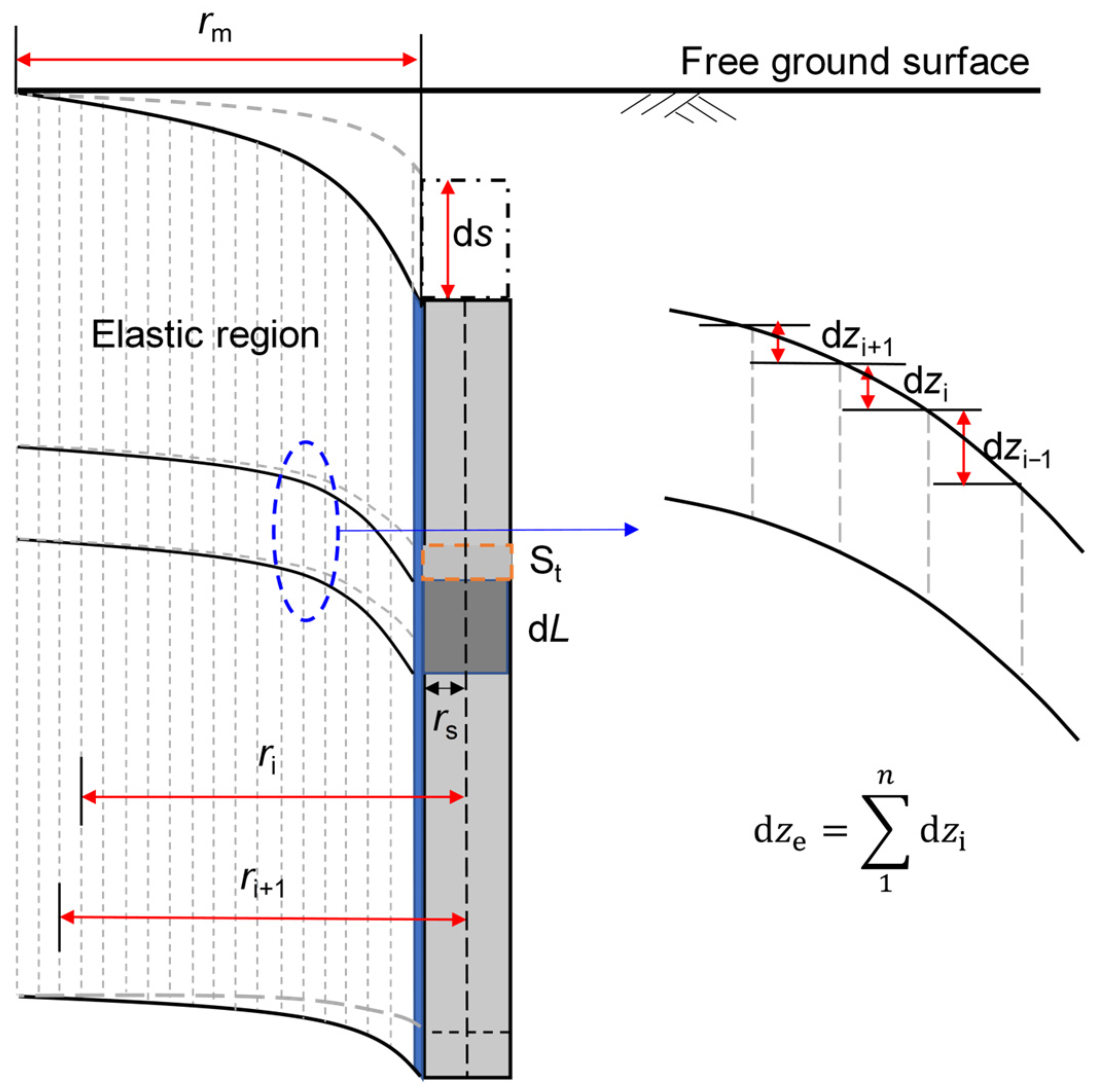
The shear deformation within the narrow band adjacent to the pile shaft is significantly larger than that in the outer soil. Similar observations were reported by Tehrani et al. (2016) [30] and DeJong et al. (2006) [31], who found that shear deformation is predominantly concentrated in this region. In the present study, this region is referred to as the plastic zone (see Figure 1). The soil outside the plastic zone also experiences shear strain, though to a much smaller extent, and is therefore defined as the elastic zone. As illustrated in Figure 1, the vertical displacement of a pile cross-section is equal to the sum of the vertical shear deformations of the soils in both the elastic and plastic zones, which can be expressed as follows [20]:
z = z e + z p
where z denotes the total axial displacement of the pile segment; z e denotes the total vertical displacement of the soil in the elastic zone along the pile shaft; z p denotes the total vertical displacement of the soil in the plastic zone along the pile shaft. Equation (1) can be expressed in incremental form as follows:
d z = d z e + d z p
where d z is the total displacement increment in the pile segment; d z e is the shear displacement increment in soil in the elastic zone; d z p is the shear displacement increment in soil in the plastic zone.
The stress state of the soil around the pile shaft is relatively complicated. Owing to the symmetry of soil deformation around the pile, and by neglecting the lateral expansion of the pile shaft as well as the interaction between adjacent soil layers in accordance with the load-transfer method, the stress state of soil along the pile shaft could be simplified to the normal stress ( σ ) in radial direction and the shear stress ( τ ) in the vertical direction, as illustrated in Figure 1. In this way, the soil around the pile is assumed to be under a simple shear state, which was also adopted in the analysis conducted by Li et al. (2023) [32]. Outside the plastic zone, the vertical shear stress propagates radially in the radial direction, where the shear stress of soil with different radial distances from the pile side can be determined using the formulation proposed by Randolph et al. (1978) [20] as
τ ( r ) = r 0 r τ
where is the vertical shear stress along the pile side; r 0 is the radius of the pile; r is the τ distance between the soil element location and the pile axis.

2.2. Load-Transfer Model Development

The soil within the plastic zone undergoes significant shear deformation, resulting in elastoplastic behavior. To present the elastoplastic deformation of the soil in the plastic zone, the study establishes the critical state line and the plastic yield surface in the σ τ space based on the critical state theory, the plastic potential theory, and associated flow rules. Subsequently, the equations for elastoplastic deformation in the plastic zone can be established. The shear deformation in the elastic zone outside the plastic zone is relatively small and can be treated as elastic. Due to the radial diffusion of shear stress around the pile, the shear strain in soil farther from the pile axis is minimal. Accordingly, the nonlinear elastic shear deformation in the elastic zone is presented using Hooke’s Law in conjunction with the theory of small-strain stiffness. The elastoplastic load-transfer model for the pile can be established by combining the elastoplastic deformation equation in the plastic zone and the nonlinear elastic deformation equation in the elastic zone.

2.2.1. Elastoplastic Deformation in Plastic Zone

When the pile shaft undergoes axial deformation under loading, excess pore water pressure is generated in the surrounding soil. It will gradually dissipate and will not have a significant impact on the shear characteristics of the soil in the plastic zone. Correspondingly, the results of the pile tests are generally obtained for a long time after each loading, indicating that the excess pore water pressure has dissipated. In engineering practice, the superstructure is gradually constructed after the construction of the pile foundation, which can also be regarded as a slow loading process. Therefore, the shear deformation of soil in the plastic zone develops in the drainage state in the model.
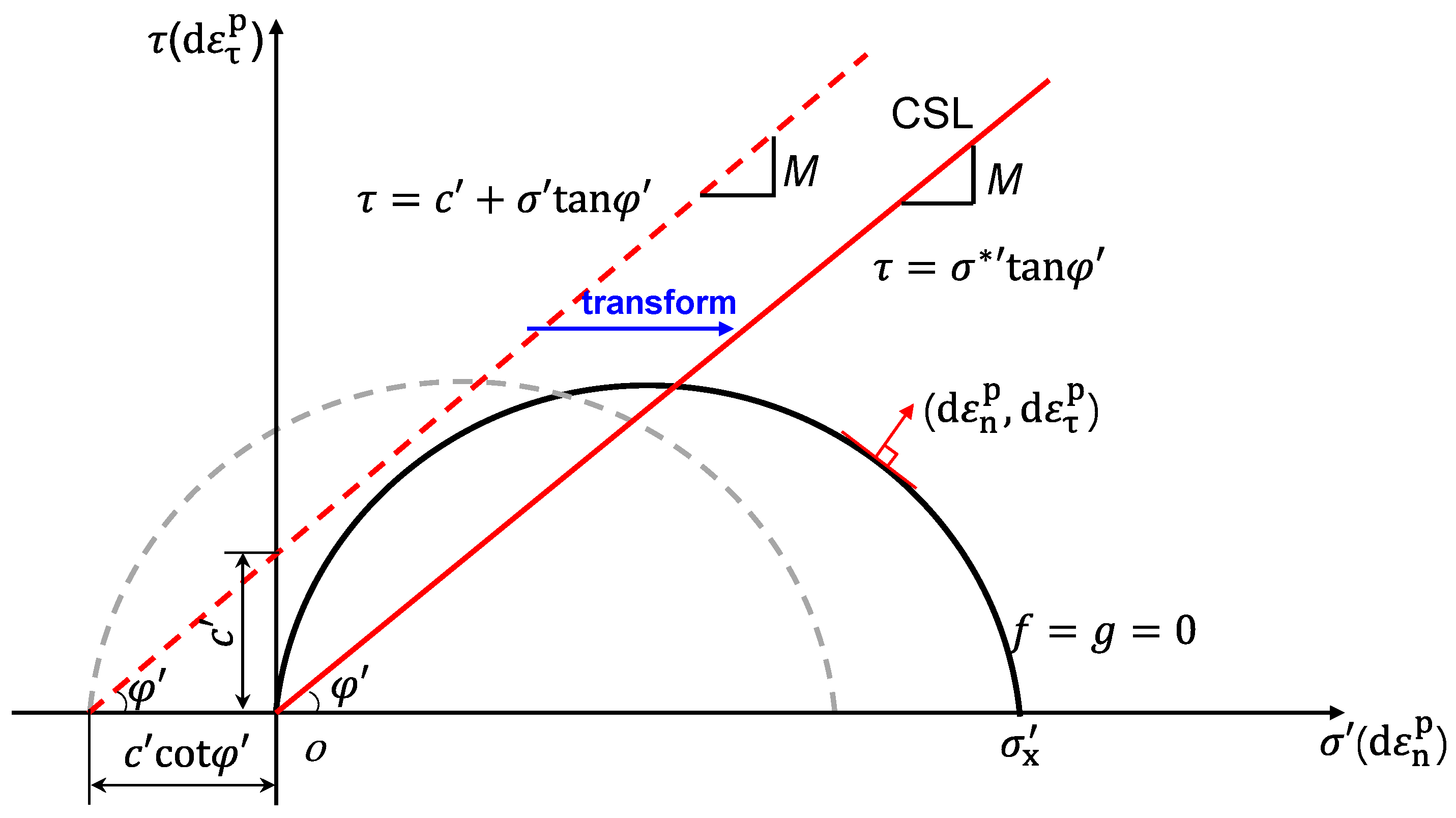
According to the Mohr–Coulomb theory, the maximum shear stress in the plastic zone is governed by the effective cohesion and the effective internal friction angle of soil. The presence of cohesion causes the critical state line not to pass through the origin. For simplicity, the critical state line is shifted to the right, accompanied by a corresponding move of the yield surface, which does not affect the results. Consequently, the stress variables after this shift can be represented as follows. The altered normal stress is written as
σ * = σ + c c o t φ
where σ is the effective normal stress; σ * is the transformed effective normal stress; and c and φ are the effective cohesion and friction angle, respectively. The maximum shear stress that can be achieved at the pile–soil interface can be expressed by the Mohr–Coulomb law as
τ u = σ * t a n φ
where σ is the transformed effective normal stress, φ are the effective stress, friction angle, and τ u is the ultimate shear stress at the pile–soil interface. Figure 2 illustrates the plastic yield surface and critical state line, along with their transformations in the σ τ coordinate system.
The plastic potential theory indicates that elastic deformation develops within the yield surface. In this study, Hooke’s Law is applied to describe the elastic constitutive relationship of soil within the yield surface. The incremental form of the elastic constitutive relationship can be expressed as
d ε n e d ε τ e = C s 1 + e 0 σ 0 0 2 C s 1 + v 1 + e 0 σ d σ d τ
where v is the Poisson’s ratio of soil. The detailed derivations for Equation (6) are shown in Appendix A.
Outside the yield surface, the soil undergoes plastic deformation as the stress state changes. A rigorous derivation is conducted based on the theory of the plastic potential, which requires that the plastic strain increment vector be orthogonal to the plastic potential surface, which gives
d σ d τ × d ε n p d ε t p = 1
Adopting the associated flow rule, the yield function can be written as follows:
f = τ 2 + M 2 σ * 2 M 2 σ x σ * = 0
where σ x is the value of σ when τ = 0 on the yield surface.
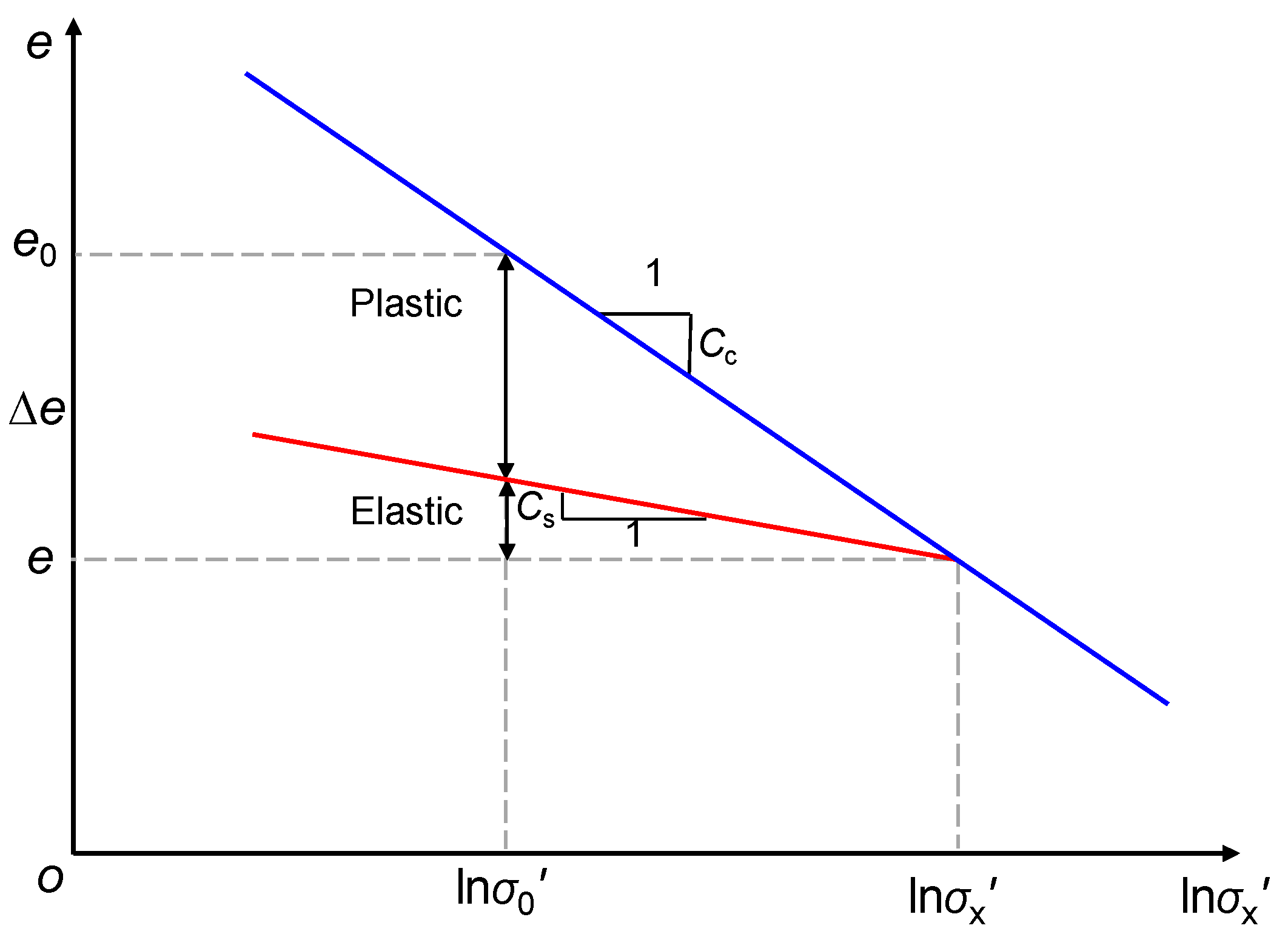
The behavior of the soil surrounding piles under normal stress can be considered to be consistent with the behavior in confined compression tests. Thus, it is used to derive the strain-hardening rule. Figure 3 illustrates the simplified linear compression and swelling curves of the soil obtained from confined compression tests. From the figure, the following equation can be derived:
ε n p = C c C s 1 + e 0 l n σ x σ 0
where e 0 is the initial porosity of soils; ε n e is the elastic normal strain; ε n p is the plastic normal strain; C c and C s These are the compression index and swelling index, respectively. In this case, the plastic strain becomes a hardening parameter in this elastoplastic model. By solving by associating Equations (7) and (9), the complete yield surface can be determined. The yield function with the hardening parameter (i.e., plastic normal strain) is expressed as
f = C c C s 1 + e 0 l n σ * σ 0 + C c C s 1 + e 0 l n 1 + τ 2 M 2 σ *′ ε n p = 0
where M is the slope of the critical state line, that is τ = M σ * at the failure of soils around the pile shaft.
The associated flow rule and normal condition give the following:
d ε n p = Λ f σ
d ε τ p = Λ f τ
According to the consistency condition, the plastic stiffness matrix can be derived by calculating d f = 0 in Equation (10) and combining Equations (11) and (12) as follows:
d ε n p d ε τ p = C c C s 1 + e 0 2 τ M 2 σ * 2 + τ 2 M 2 σ * 2 τ 2 2 σ * τ 1 1 2 τ σ * M 2 σ * 2 τ 2 d σ d τ
The incremental total strain is equal to the sum of plastic strain and elastic strain:
d ε n d ε τ = d ε n p d ε τ p + d ε n e d ε τ e
Combining Equations (6), (13) and (14), the elastoplastic relationship between the incremental stress and the incremental displacement is obtained as
d ω n d ω τ = b D n n D n s D s n D s s d σ d τ
where b is the radial thickness of the plastic zone adjacent to the pile shaft. The thickness is generally considered to be 3–6 mm in clay [33,34].
The constant normal stress conditions in the thin plastic zone give
d σ = 0
Combining Equations (15) and (16), the incremental constitutive equation is derived as
d z p = b 2 C s 1 + ν 1 + e 0 σ + C c C s 1 + e 0 4 τ 2 σ * M 4 σ * 4 τ 4 d τ
The detailed derivation process of the constitutive relationship in the plastic zone can be found in Appendix A.

2.2.2. Shear Deformation in Elastic Zone

In addition to the elastoplastic shear deformation of soil in the plastic zone, the shear deformation of soil outside the plastic zone also contributes to the displacement of the pile. Since elastoplastic deformation is generally assumed to occur in the plastic zone, the soil outside the plastic zone is considered to undergo elastic shear deformation. The theory of small-strain stiffness indicates that the shear modulus gradually decreases with the increase in the shear strain, especially in the small-strain stage [35,36,37]. Therefore, the attenuation of shear modulus is introduced in the elastic zone to reflect the nonlinear stress–strain constitutive relationship of elastic zone. Brinkgreve et al. (2016) [38] proposed the empirical equations to present the shear modulus attenuation as follows:
G s G 0 = 1 1 + α γ y 0.7
where G 0 is the initial shear modulus; α is the fitting parameter; y 0.7 is the shear strain corresponding to 0.7 G 0 ; G s and γ are the current shear modulus and shear strain, respectively. G 0 and y 0.7 can be expressed by empirical relations as
G 0 r e f = 33 2.97 e 0 2 1 + e 0
G 0 = G 0 r e f c c o s φ σ s i n φ c c o s φ + σ r e f s i n φ m
y 0.7 = 1 9 G 0 2 c 1 + c o s 2 φ σ 1 + 1 K 0 s i n 2 φ
where G 0 r e f is the initial reference shear modulus, e is the porosity of soils, m is the stress correlation coefficient, p is the effective mean stress, p r e f is the reference mean stress, σ is the effective normal stress, and K 0 is the coefficient of earth pressure at rest.
Randolph et al. (1978) [20] proposed a calculation method to calculate the elastic shear deformation of soils in the elastic zone. It can be expressed in incremental form as
d z e = r 0 G s l n r m r s d τ
where d z e is the shear deformation increment in the elastic zone; G s is the shear modulus of soil in the elastic zone; r m is the influence range of pile displacement; r s is the pile radius.
In the elastic zone, the shear stresses induced by the displacement of the pile shaft are transmitted to the surrounding soil. Thus, the shear stress decreases with the increase in the wheelbase away from the pile; the corresponding shear strain also shows the same trend. Consequently, the shear modulus changes with the size of the radial distance from the pile. To realize the fast speed and convenience of calculation, the elastic zone is partitioned along the radial direction. The shear modulus in each zone is equal and decays independently with the increase in shear strain in the block. As illustrated in Figure 4, the elastic zone is equally divided into n sub-zones. Theoretically, a larger value of n means a higher computational accuracy. However, in practical calculations, excessively large values of n do not significantly impact the results. The shear deformation of soil in the elastic zone is the sum of the deformation of all small zones. The decay of the shear modulus can be manifested in an incremental model through continuous updates. Figure 4 illustrates the portioned elastic zones and their deformation relationships. Specifically, the deformation behavior in the elastic zone can be expressed as follows:
d z e = 1 n r 0 G s i l n r i r i 1 d τ
γ i = z e i / ( r m n )
where r m is the influence range of pile displacement; z e i and γ i are the corresponding shear deformation and strain of the elastic partition; n is the number of elastic discriminating blocks; r i is the distance between the outer edge of the partition and the axis of the pile; d z e i and d z e are the corresponding shear deformation increment in the elastic partition and the total elastic deformation increment, respectively. The influence range of pile displacement is given as follows [39]:
r m = 2.5 L ρ m 1 v m
where ρ m is modified inhomogeneity factor and v m is the average value of Poisson’s ratio of multilayer soils around piles.

3. Load-Transfer Function Along Pile Side and Parameter Analysis

3.1. Load-Transfer Function Along Pile Side

The load-transfer function is the key point of the load-transfer method. For piles without a rigid support on their tip, the load-transfer function along the pile shaft exerts a more significant influence on the load–settlement behavior of the pile than the load-transfer function at the pile base. Based on the above analysis, the vertical displacement of any position on the pile shaft is equal to the sum of the shear deformation of soil in the plastic zone and soil in the elastic zone. The elastoplastic shear deformation occurs in the plastic zone, and its overall shear deformation can be calculated by Equation (17). The elastic shear deformation occurs in the elastic zone, and the total shear deformation can be calculated by Equation (23). Therefore, the load-transfer function along the pile side in incremental form can be expressed as
d z = b 2 C s 1 + ν 1 + e 0 σ + C c C s 1 + e 0 4 τ 2 σ * M 4 σ * 4 τ 4 + 1 n r 0 G s i l n r i r i 1 d τ
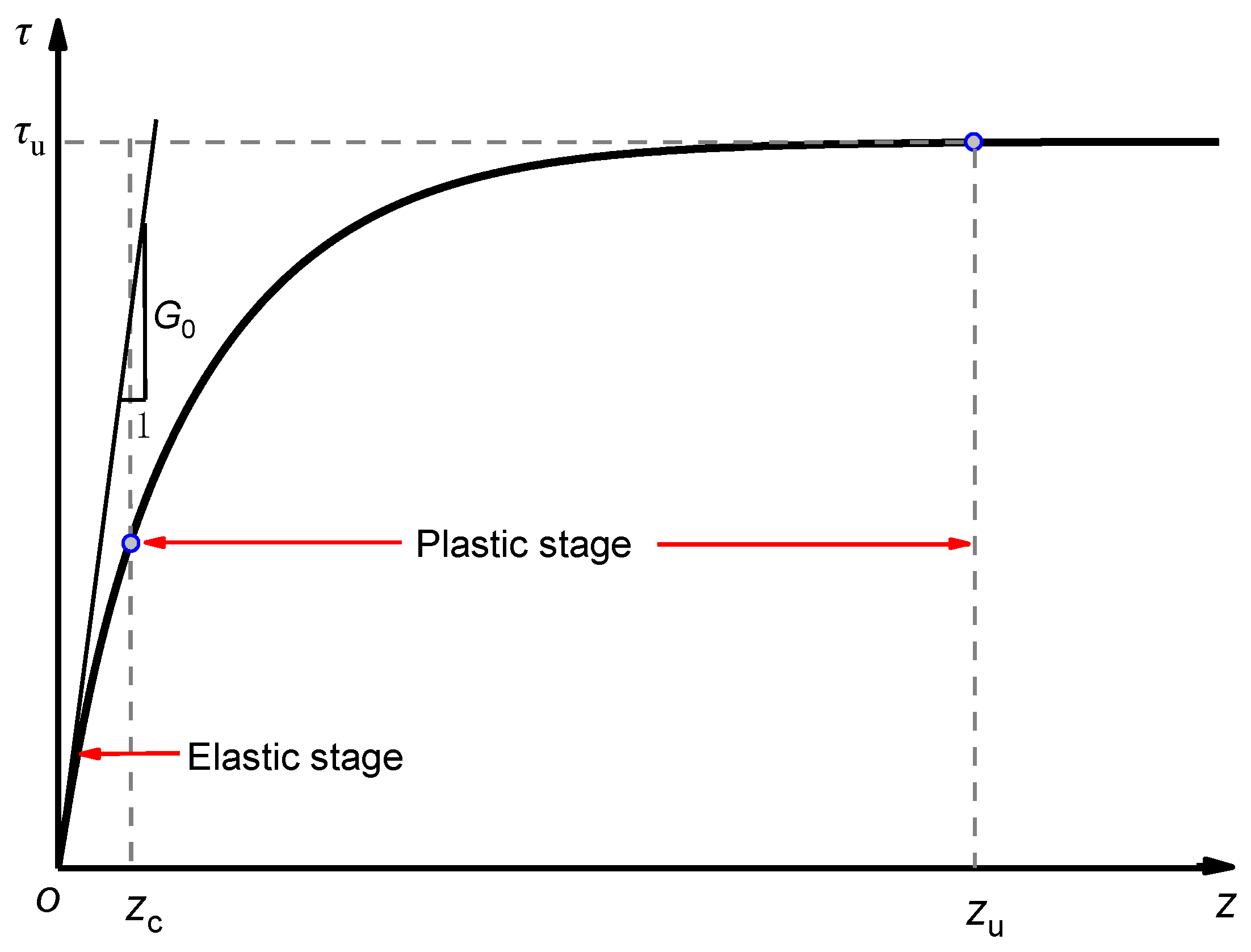
Figure 5 shows the schematic of τ z curve for pile shaft. The initial slope of the curve is governed by the initial shear modulus of the soil surrounding the pile shaft when relative displacement at the pile–soil interface first develops. When the value of pile deformation is between 0 z c , the τ z curve is approximately linear. During this stage, with the increase in pile displacement, elastic and plastic deformations occur at the same time, but elastic deformation dominates. For convenience, this interval is referred to as the elastic stage. As the displacement continues to increase, the curve exhibits pronounced nonlinearity, and the plastic deformation develops faster, and the slope of the τ z curve becomes smaller gradually. Consequently, this stage of z c z u is defined as the plastic stage, where the plastic deformation gradually reaches the predominant part of the overall deformation. When the displacement reaches the displacement z u , the pile side resistance reaches the ultimate value τ u . Beyond this point, the soil surrounding the pile shaft enters a critical state, and the pile side resistance ceases to increase with further relative displacement, instead remaining constant at its maximum value.
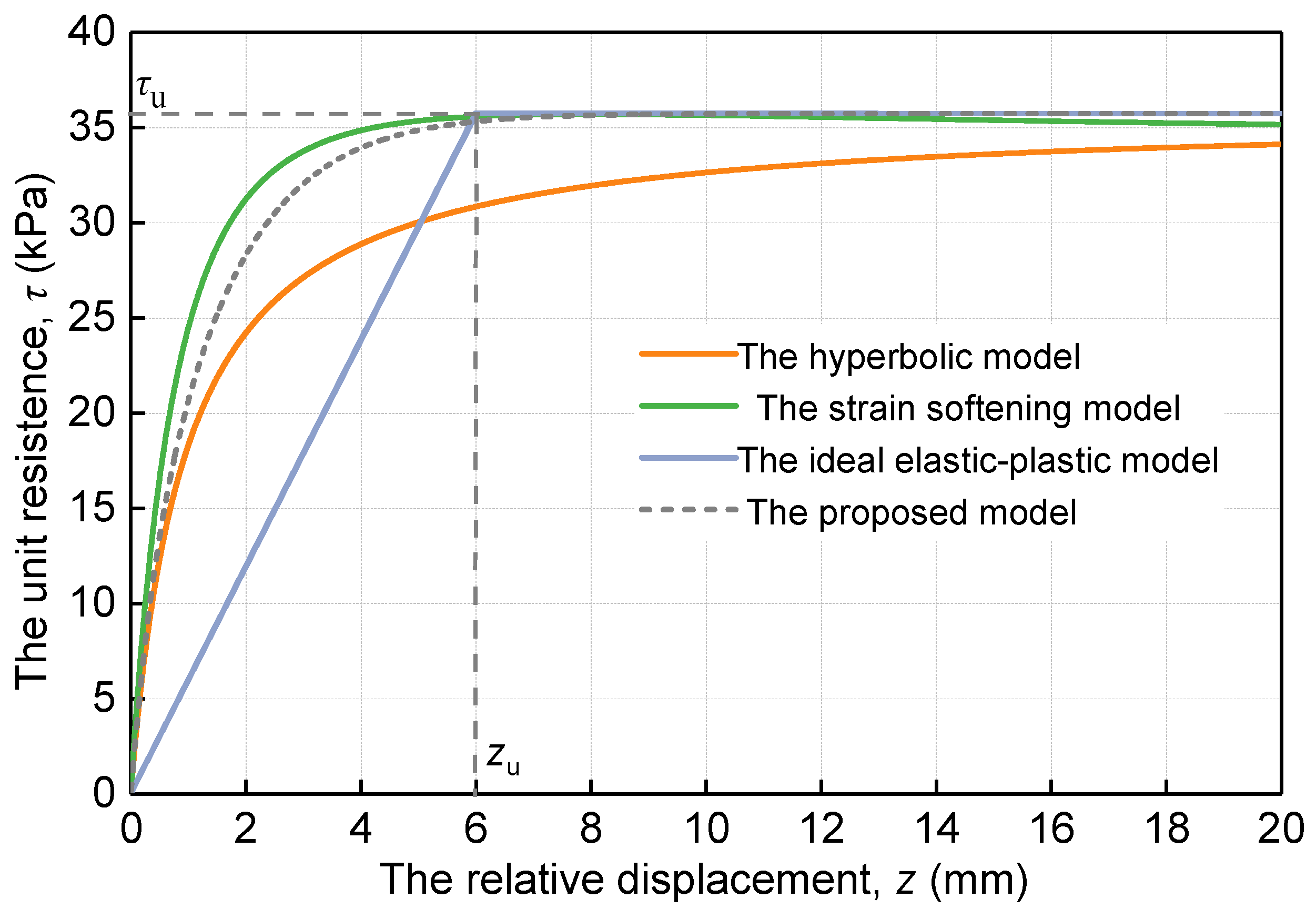
The hyperbolic load-transfer function is widely adopted owing to its simplicity and its ability to capture the nonlinear stress–strain behavior of the soil surrounding the pile shaft. By contrast, the elastoplastic model developed in this study is derived from the fundamental principles of critical state soil mechanics, thereby ensuring a sound theoretical basis. In comparison, the hyperbolic load-transfer function is largely empirical. Empirical pile side load-transfer functions also include the ideal elastoplastic type and the strain-softening type. To investigate the differences among these load-transfer functions, τ z curves are compared using identical parameter values: c = 13   k P a , φ = 20 , b = 4   m m , C c = 0.3120 , C s = 0.0412 and e 0 = 0.9 . The radius of the pile shaft is assumed to be 0.5 m. Poisson’s ratio and natural stress of soils surrounding the pile are assumed to be 0.3 and 95 kPa, respectively. The τ z curves of four models are shown in Figure 6.
Figure 6 shows that although the initial tangential slope and the maximum unit side resistance of the hyperbolic model are identical to those of the proposed model, a significant difference arises during the plastic deformation stage. In particular, the hyperbolic model lacks a distinct critical displacement point at which the ultimate unit resistance is reached [20,22]. Instead, the resistance value approaches the maximum only asymptotically as the relative displacement becomes very large. As a result, the model tends to underestimate the actual side friction resistance. Similarly, the load-transfer function incorporating strain-softening remains essentially empirical: its softening stage is still an empirical fit to observed data, even though its numerical predictions may be close to those of the proposed model [31,32].
The ideal elastoplastic model, although it can obtain an analytical solution for the load-transfer equation, completely fails to simulate the plastic deformation development stage of the pile–soil interface, with too large differences from reality. The fitting curve forms limit their adaptability. In contrast, the proposed elastoplastic model, based on the critical soil mechanics, the theory of plastic potential, the associated flow rule, and the theory of small-strain stiffness, can effectively represent the elastoplastic shear deformation behaviors of the soils around piles, making it more scientifically grounded.

3.2. Parameter Analysis

In the incremental load-transfer function along pile shaft, there are many crucial parameters associated with soil characteristics and pile–soil interaction, such as C c , C s , e 0 , c , φ , b , σ , and G s i . Although c , φ do not appear directly in the formula, they are presented in the critical state parameters M. It is noted that the shear modulus G s i is also an important parameter, which is changing with the stress state of soil around pile shaft from the initial value G 0 . It is related to the internal friction angle and the initial void ratio of soils around the pile, as shown in Equations (19) and (20). Since c has a self-evident impact on the load-transfer function, mainly reflected in the maximum resistance at the pile side surface on the critical state, they will not be further analyzed here. It will analyze the influence of C c , C s , e 0 , φ , G 0 , σ , and b on the load-transfer function, which is mainly illustrated in the τ z curve. The reference values of the parameters are assumed to be b = 4   m m , C c = 0.3120 , C s = 0.0412 , e 0 = 0.9 , c = 13   k P a , φ = 22 , and σ = 75   k P a . The radius of the pile shaft is assumed to be 0.5 m.
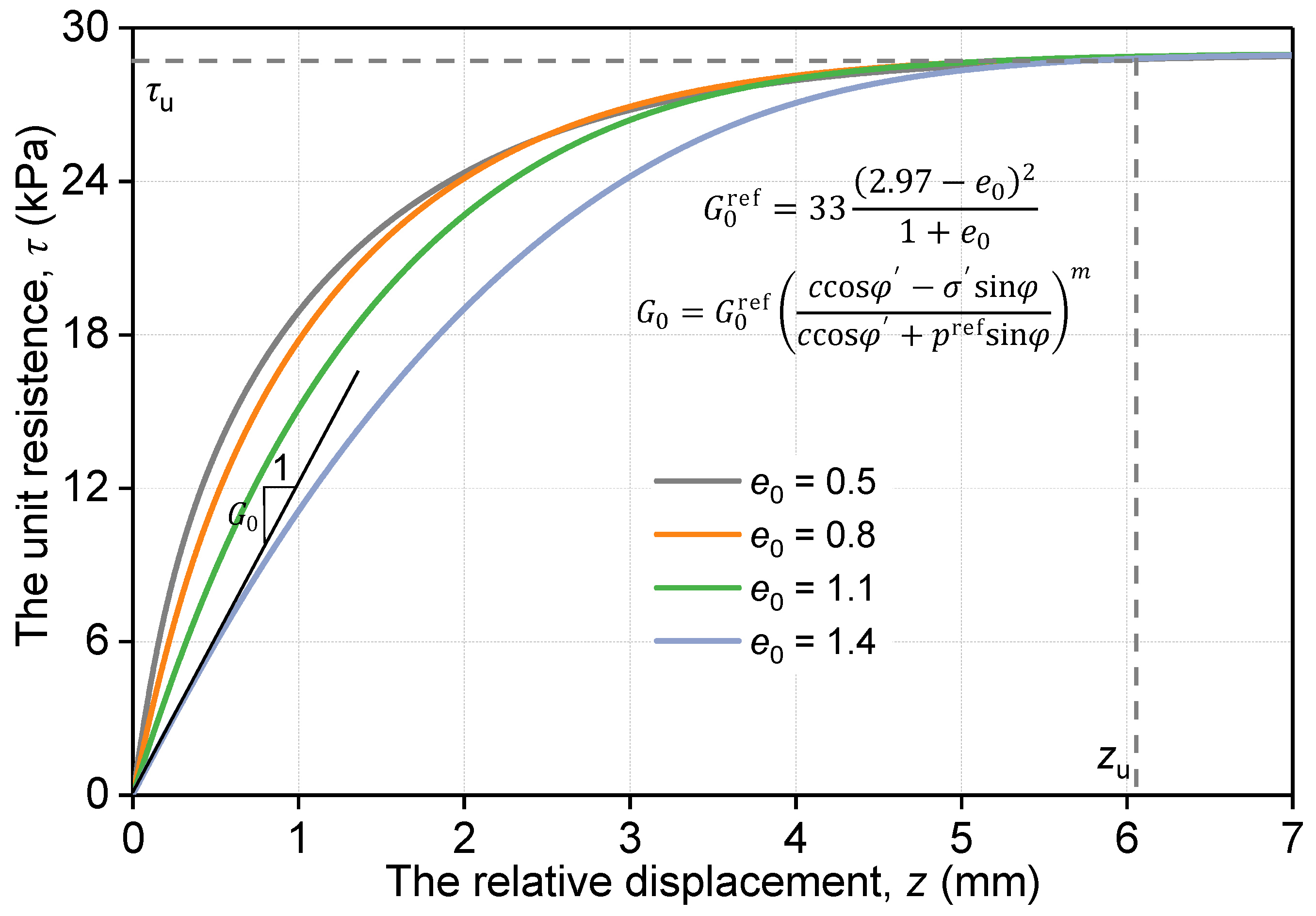
For analyzing the effect of soil initial void ratio on the load-transfer function, the initial void ratio is assumed to be 0.5, 0.8, 1.1, and 1.4 to plot the τ z curve. Figure 7 demonstrates that the effect of initial void ratio on the curve is obvious, mainly manifested in the stage of plastic deformation, continuously developing. Before the shear stress reaches its maximum value, the larger initial void ratio leads to a smaller shear stress. The main reason for this is the large influence of the initial void ratio on the initial shear modulus, as shown in Equation (20). In addition, the initial void ratio also affects the constitutive relationship of the plastic zone as expressed in Equation (17). Overall, the initial void ratio has a great influence on the τ z curve, mainly presented in the plastic deformation developing stage. Specifically, a larger initial void ratio results in a smaller initial shear modulus, corresponding to a lower initial tangent slope of the curve, as illustrated in Figure 7.
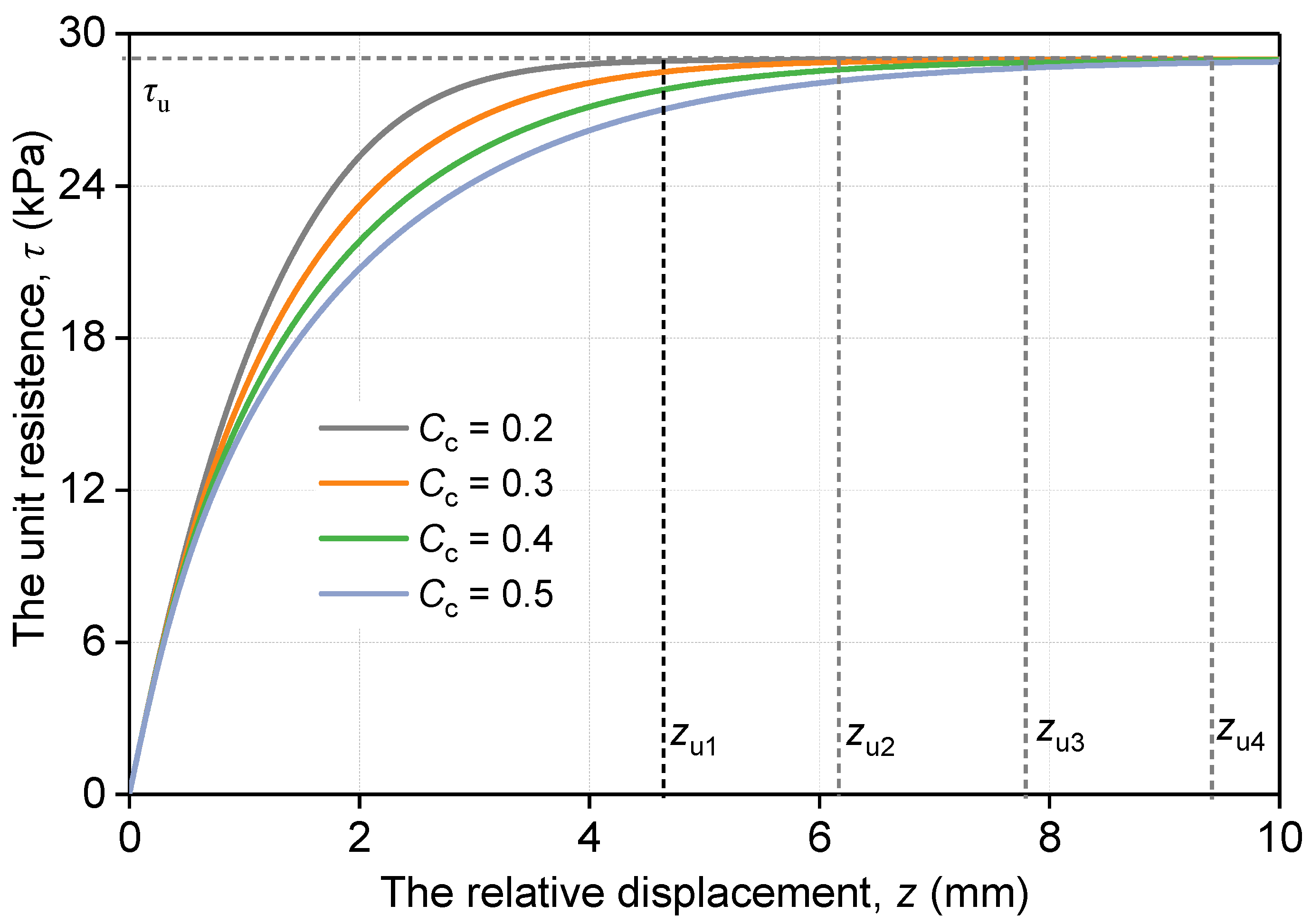
Cc and Cs are applied to derive the strain-hardening law in the model. Their influence on the load-transfer function is primarily represented by their difference. They have significant impacts on the elastoplastic deformation of soils in the plastic zone. As a consequence, we maintain the value of Cs constant while only altering the value of Cc to examine their effect on the τ z curve. Figure 8 highlights the fact that the impact of soil compression index on the τ z curve is primarily shown in the stage of plastic deformation development. In contrast to the case with the initial void ratio, altering the compression index does not influence the initial slope of the τ z curve. Moreover, in the plastic deformation developing stage, the increase in compression index leads to a decrease in shear stress. Consequently, a higher compression index extends the plastic development stage, requiring a larger vertical relative displacement to mobilize the ultimate shear stress along the pile surface.
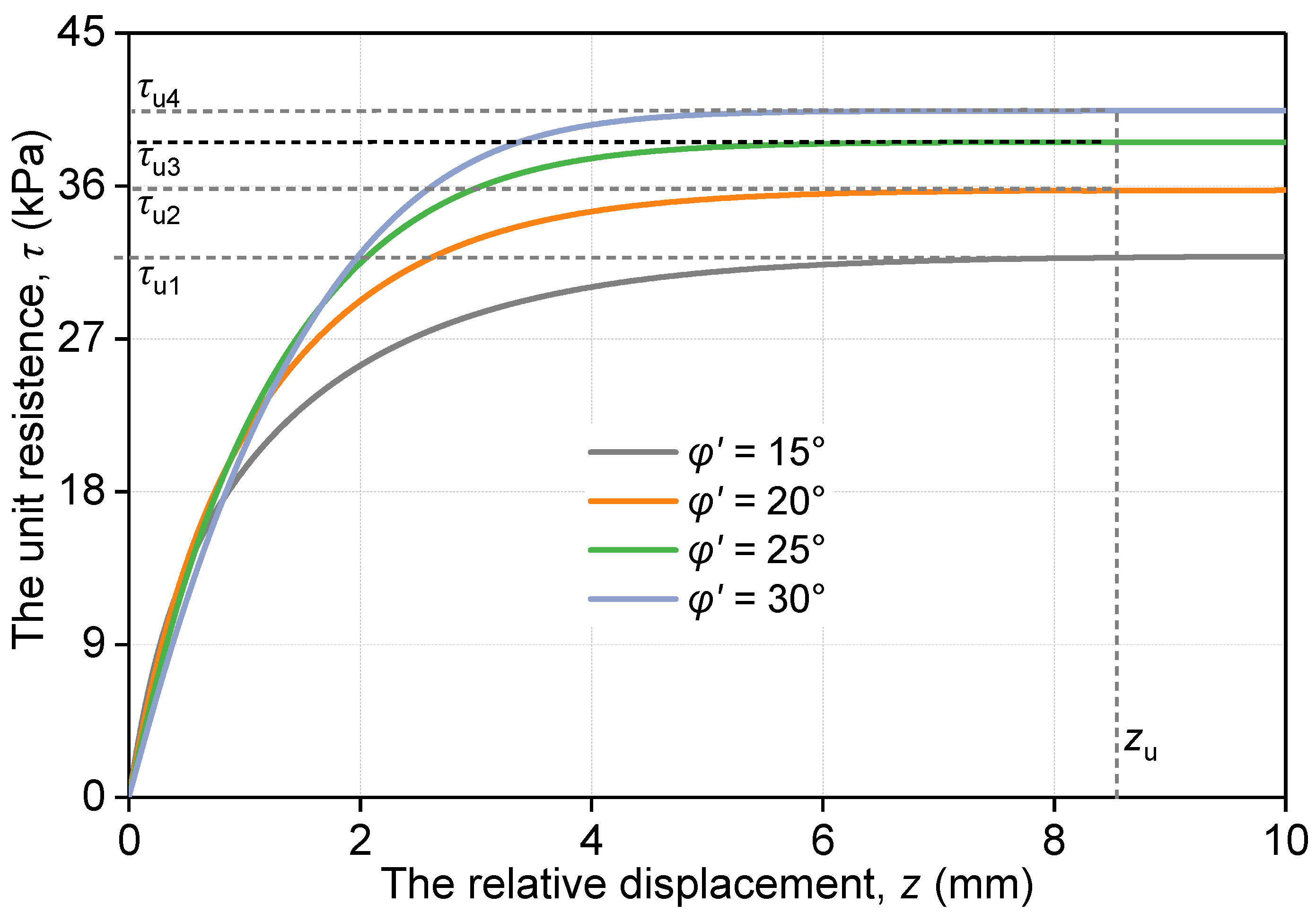
To examine the influence of the internal friction angle on the load-transfer function, values of 15 ° , 20 ° , 25 ° , and 30 ° are assumed to generate the τ z curves shown in Figure 9. The results reveal that increasing the internal friction angle leads to higher shear stress across the entire τ z curve. Although the internal friction angle has an impact on the initial shear modulus, it does not have a great effect on the initial slope of the curve, as shown in the curve. Equation (26) indicates that the effect of the internal friction angle on the τ z curve is primarily represented by the critical state parameter M. As illustrated in Figure 9, a larger internal friction angle produces a higher ultimate shear stress along the pile surface, which is consistent with the Mohr–Coulomb law.
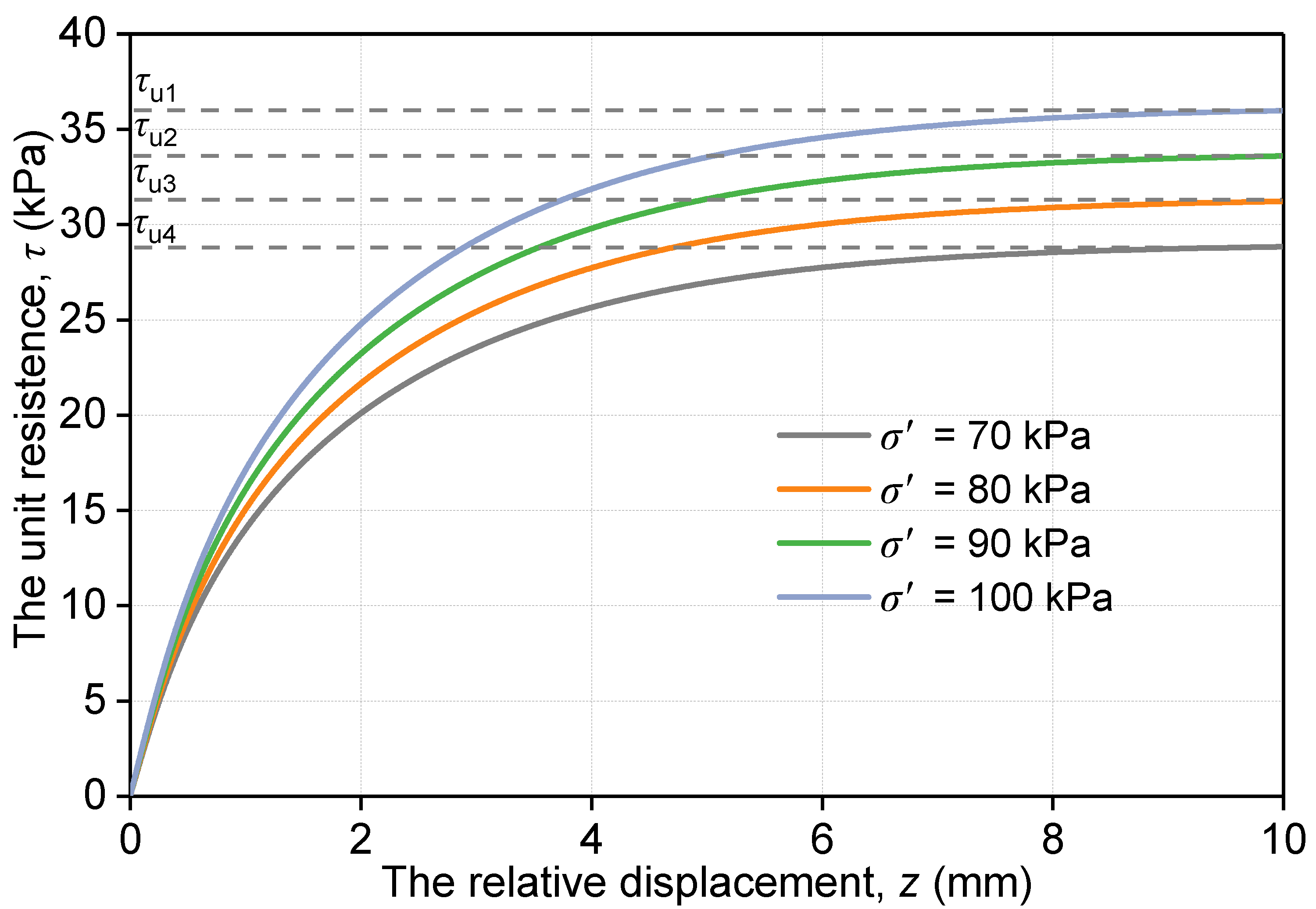
The effective normal stress state in the soil surrounding the pile influences not only the elastic–plastic deformation of the soil within the plastic zone but also determines the shear modulus of the soil in the elastic zone. To reflect the impact of the effective normal stress state in the soil surrounding the pile on the load-transfer function of the pile, the effective normal stress was assumed at 70 kPa, 80 kPa, 90 kPa, and 100 kPa, respectively, to analyze the effect of effective normal stress on the τz curve, as shown in Figure 10. In the picture, the changes in effective normal stress affect the development process of plastic deformation and the ultimate shear stress in the τ z curve. Specifically, higher effective normal stress leads to greater shear stress along the pile shaft. At the same time, effective normal stress also controls the evolution of the shear modulus in the elastic zone: a higher effective normal stress corresponds to a higher initial shear modulus, resulting in smaller shear deformation of the soil around the pile under the same applied shear stress. This mechanism explains why the bearing capacity of soils surrounding piles increases with depth.
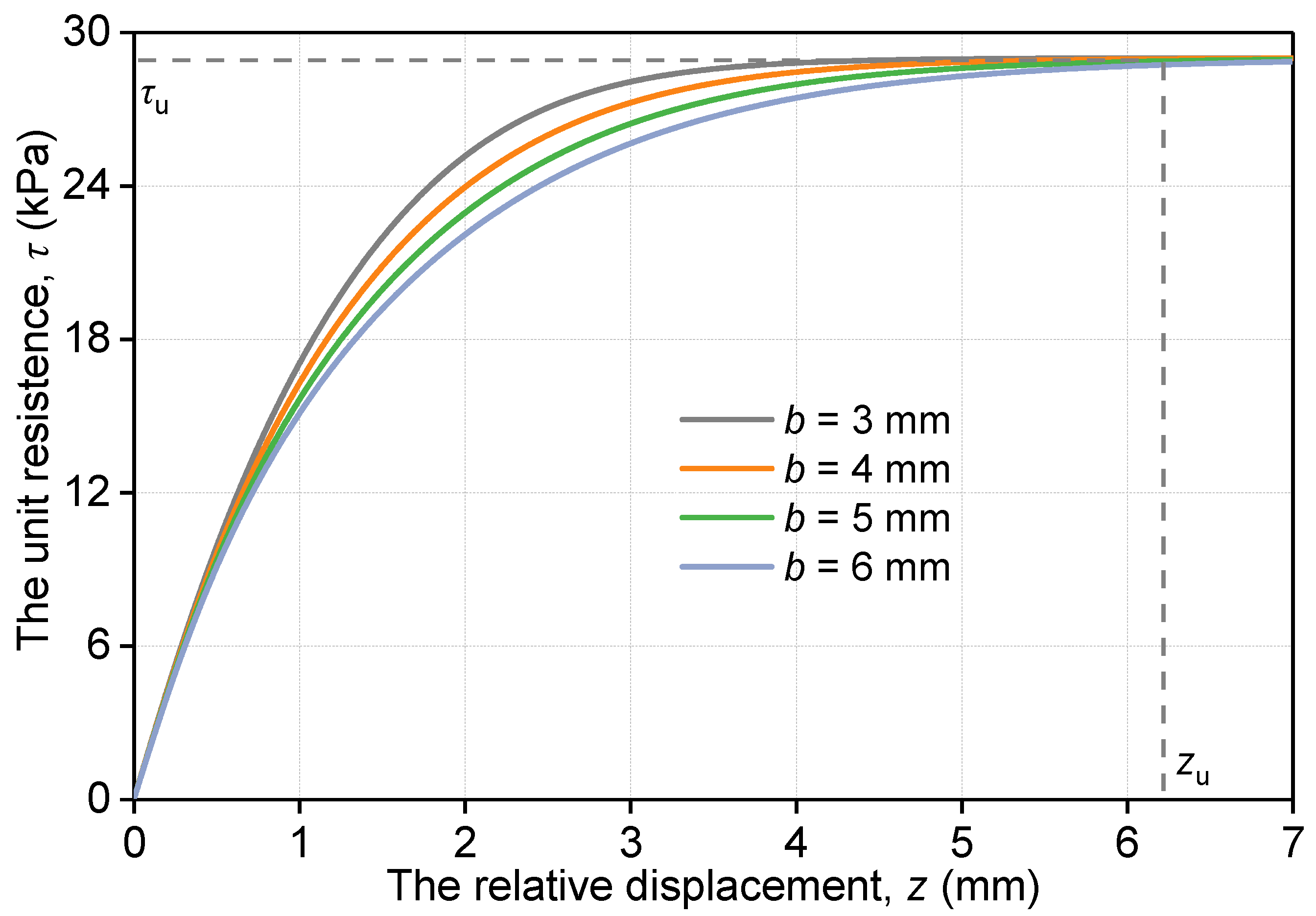
The thickness of the plastic zone in the soil surrounding the pile determines the extent to which the elastic–plastic deformation of the plastic zone contributes to the vertical displacement of the pile segment. In clay, the plastic zone thickness is generally considered to range between 3 and 6 mm [33,34]. Although the plastic zone is relatively thin compared with the elastic zone and exhibits only a narrow variation range, it nonetheless influences the vertical displacement of the pile segment and, consequently, the overall settlement of the pile. Therefore, the thickness of the plastic zone was set at 3 mm, 4 mm, 5 mm, and 6 mm, respectively, to study the effect of the plastic zone thickness on the τ z curve of the pile shaft. As can be seen from Figure 11, the thickness of the plastic zone only affects the development process of the plastic deformation in the τ z curve, with no impact on the initial stiffness or the maximum shear stress. A larger plastic zone results in slower growth of shear stress along the pile shaft and greater elastoplastic shear deformation in the surrounding soil.

4. Iterative Algorithms for Load–Displacement Response of Single Pile

The incremental elastoplastic load-transfer function captures both the attenuation of the shear modulus and the progressive development of shear deformation in the soil surrounding the pile shaft [32]. The displacement at the pile head is equal to the sum of the elastic compression of the pile shaft and the compression of the pile subsoil. By incorporating the elastic compression of the pile with the elastoplastic load-transfer functions for both the pile shaft and pile base into the load-transfer procedure, the load–displacement curve at the pile head can be obtained.
The interaction mechanics between the soil beneath the pile tip and the pile body are also a critical factor in predicting the load–settlement behavior of piles. Displacement at the pile tip induces compressive deformation of the underlying soil, which in turn may generate shear action within the soil mass. For friction piles, however, the downward displacement at the tip is usually limited. The compressive and shear characteristics of the soil beneath the pile tip can therefore be described using a unified curve. The bilinear hardening model proposed by Zhang et al. (2012) [17] effectively captures the compressibility of the soil beneath the pile tip. In this study, the bilinear hardening model is adopted, which can be expressed as follows:
τ b = k 1 s b ,   s b < s b u k 1 s b u + k 2 s b s b u ,   s b s b u
where τ b is the unit resistance at pile bottom, k1 and k2 are the slopes of the simplified compression curve for soils under the pile tip, and S b u is the displacement of the pile tip corresponding to the transition point between the two simplified compression curves for soil under the pile tip.
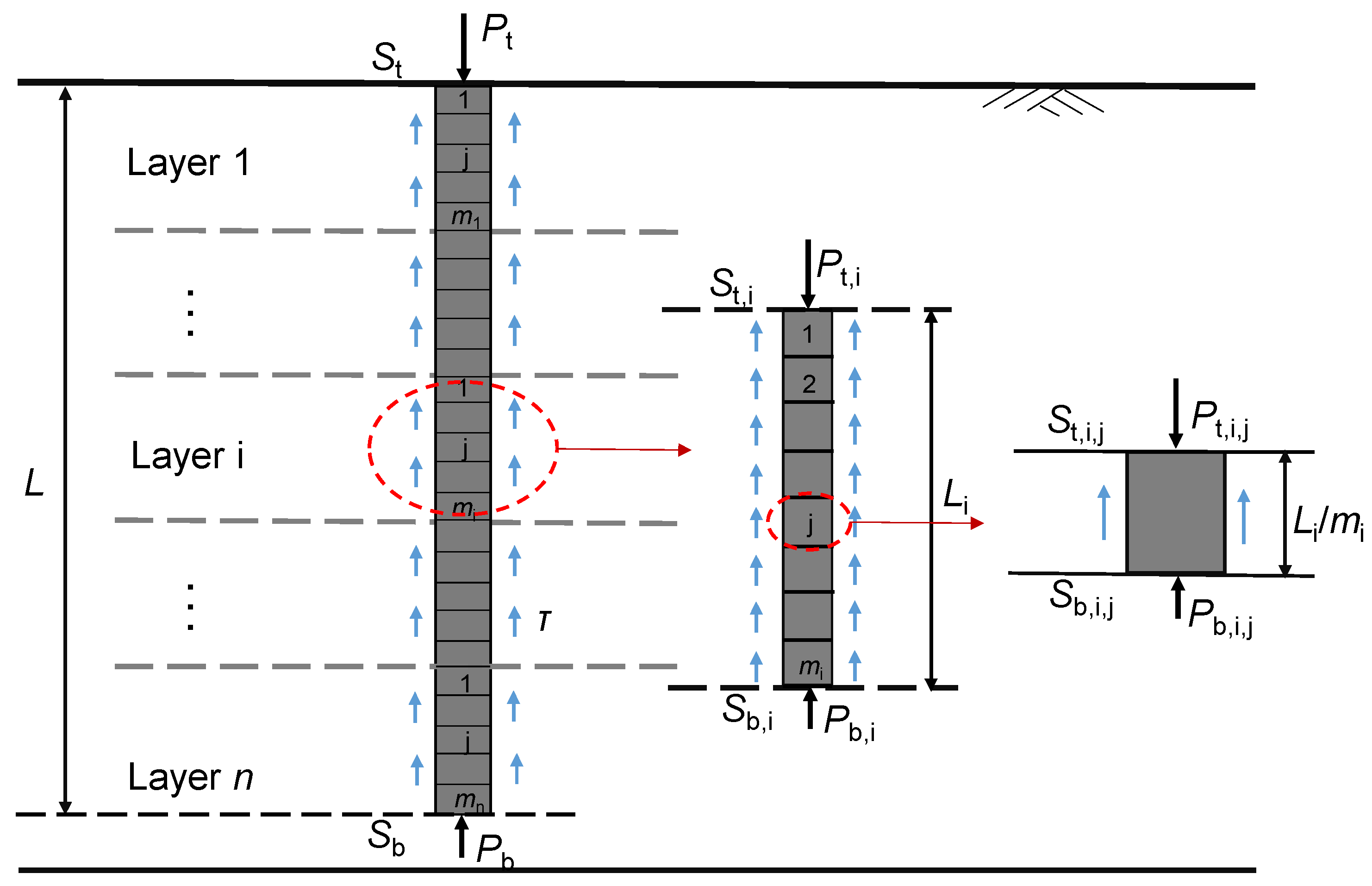
Figure 12 illustrates the load-transfer process of piles embedded in multilayered soils. The load applied at the pile head is progressively transmitted through the pile shaft to both the soil beneath the pile tip and the surrounding soil. Accordingly, given a set of loads or displacements at the pile tip, the load–displacement response at the pile head can be inversely determined. The proposed incremental load-transfer function is incorporated into the developed load-transfer program, enabling efficient computation of the load–displacement behavior of single piles embedded in multilayered soils.
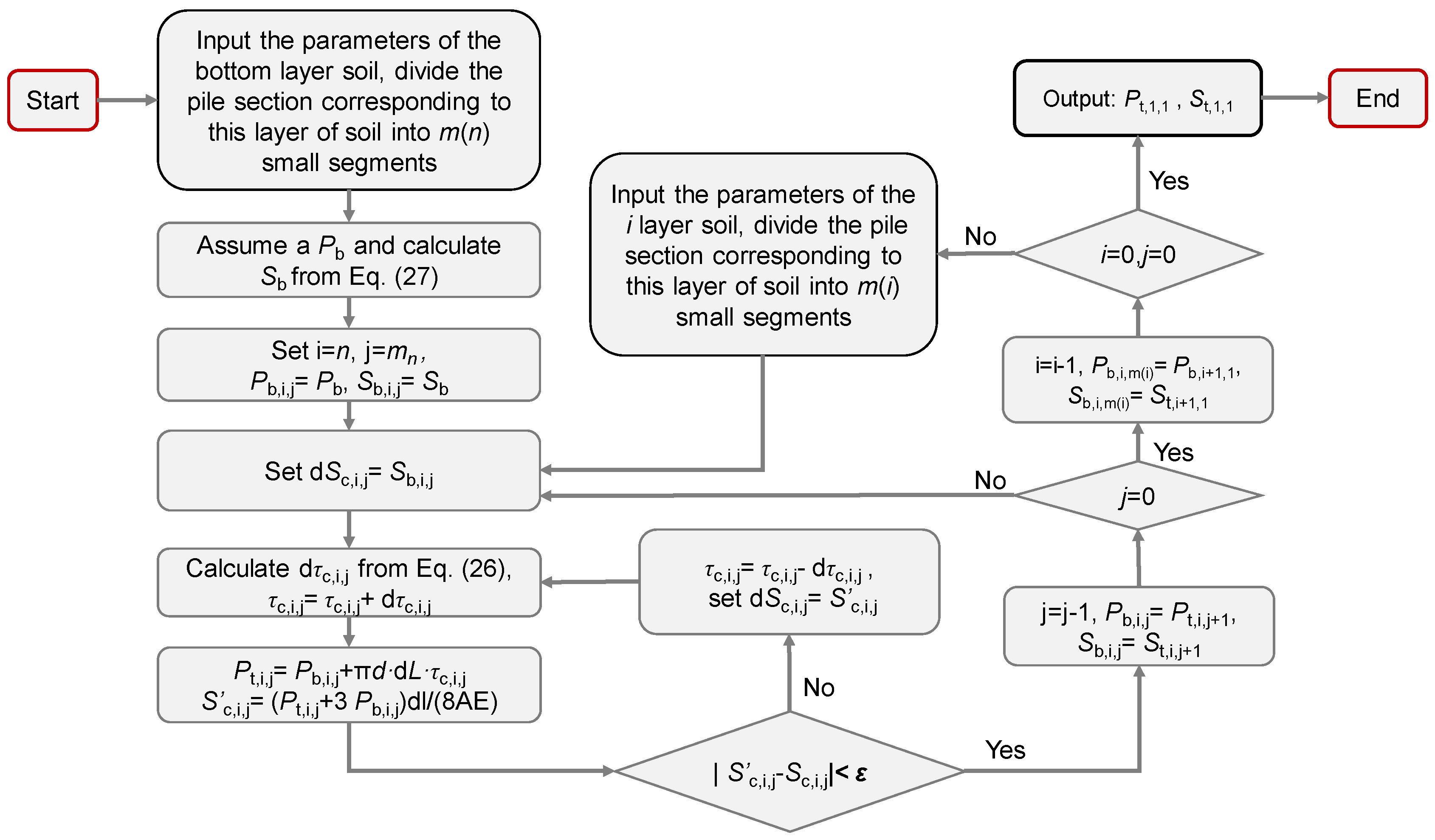
Figure 13 shows the flow chart for the implementation of the proposed elastoplastic model in the load-transfer method. The detailed calculation process is described as follows:
  • Input the soil parameters of the lowest layer, and divide the pile segment corresponding to the lowest layer into n equal segments with the length of L n / m n . If mn is large enough, the accuracy of the result can be guaranteed. The soil in the elastic zone is divided into x blocks along the radial direction, with the length of ( r m r 0 ) / x ;
  • Assume a Pb and calculate Sb from Equation (27);
  • Set i = n , j = m n , P b , i , j = P b , S b , i , j = S b .
  • Calculate the shear modulus and shear displacement corresponding to each small strip in the elastic zone from Equations (19)–(24);
  • Set d S c , i , j = d S b , i , j . Where d S c , i , j represents the vertical displacement increment occurring at the midpoint of the j pile segment corresponding to the i layer of soil
  • Calculate d τ c , i , j from Equation (26). and update the shear stress at the middle point of the pile section: τ c , i , j = τ c , i , j + d τ c , i , j
  • Calculate the load at the top of the pile segment and the displacement at the middle point of the pile segment according to the load on the top and bottom of the pile segment and the elastic modulus of the pile shaft: P t , i , j = P b , i , j + 2 π r s d L τ c , i , j , S c , i , j = ( p t , i , j + 3 p b , i , j ) d L τ c , i , j
  • Check if S c , i , j S c , i , j < ε , where ε is an allowable error, e.g., 10 10 m. If the discrepancy exceeds the specified tolerance, reset d S c , i , j = d S c , i , j , repeat steps 6–8
  • Update j = j 1 , and check if j 0 , set P b , i , j = P b , i , j + 1 , S b , i , j = S b , i , j + 1 , repeat steps 5–9.
  • Update i = i 1 , and check if i 0 , set P b , i , m ( i ) = P b , i + 1 , 1 , S b , i , m ( i ) = S b , i + 1 , 1 , input the soil parameters of the i layer soil, and divide the pile segment corresponding to the i layer soil into n equal segments with the length of Limi. Repeat steps 5–10.
  • Output P t , 1 , 1 , S t , 1 , 1 , set P t = P t , 1 , 1 , S t = S t , 1 , 1
  • Repeat steps 1–11 with a group of Pb to obtain the load–displacement curve of a single pile.
The load–displacement behavior of a single pile is governed by the shear deformation of the surrounding soil in both the elastic and plastic zones. The pile displacement results from the interaction and compatibility of deformation between the pile shaft and the adjacent soil. By incorporating the elastoplastic load-transfer function for the pile shaft into the load-transfer method and applying the above computational procedure, the load–displacement curve of a single pile can be derived.

5. Model Validation

By incorporating the elastic compression of the pile with the elastoplastic load-transfer functions for both the pile shaft and pile base into the load-transfer procedure, the load–displacement curve at the pile head can be obtained. By incorporating the elastoplastic load-transfer function into the load-transfer method, the load–displacement behavior of single piles can be predicted. In this section, the proposed model is applied to simulate the load–displacement response of single piles in Louisiana soft soils and Shanghai soft soils. The experimental load–displacement curve for the Louisiana case was reported by Haque et al. (2014) [40], while the second case is derived from an in situ single pile test conducted in Shanghai.

5.1. Case 1: Pile in Louisiana Soft Soil

Haque et al. (2014) [40] reported two instrumented test piles (TP-1 and TP-2) installed at the new Bayou Lacassine Bridge on Highway 14 in Jefferson Davis Parish, Louisiana. TP-1 was selected as Case 1 to validate the proposed elastoplastic load-transfer model. The region is characterized by a coastal plain geomorphology with relatively young sedimentary formations, consisting primarily of surficial deposits of loose sand, clay, and silt. The shallow groundwater table poses specific construction requirements, particularly for bored piles, where dewatering measures may be necessary. Overall, as the subsurface stratigraphy is dominated by relatively deep sand-clay deposits, pile foundation design must account for soil permeability, stiffness, and groundwater pressure. The test pile is a square prestressed concrete (PSC) pile with an outer width of 0.76 m and an inner diameter of 0.42 m. The total pile length is 22.86 m, with the lower 21 m embedded in the soil. The remaining upper portion is reserved for static load testing, which also minimizes end effects.
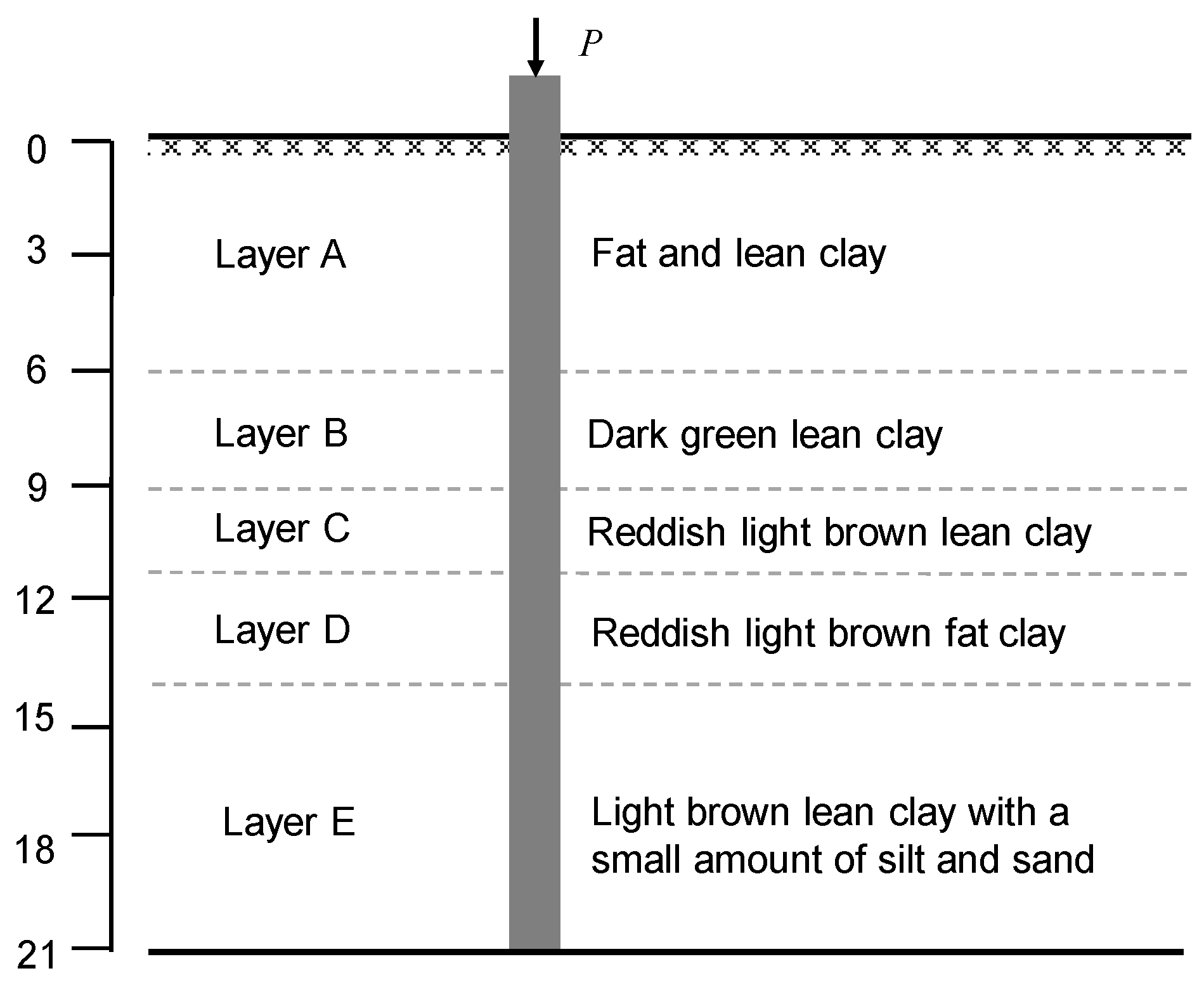
The properties of the multilayer soil around the pile shaft are obtained by an in situ penetrating operation. Figure 14 shows the soil profile at Louisiana: the top fat and lean clay layer of 6 m, followed by a dark green lean clay layer of 3 m, a reddish light brown lean clay layer of 2 m, a reddish light brown lean clay layer of 2 m, and a light brown lean clay with a small amount of silt and sand layer of 7 m to a depth of 21 m. The Young’s modulus of pile can be considered as Ep = 20 GPa and Poisson’s ratio and effective weight of soil can be assumed to be v s = 0.3 , γ = 10   k N / m 3 [40]. In Table 2, other parameters of soil properties used in the model were reported by Abu-Farsakh et al. (2015) [3], some of which need to be obtained by conversion.
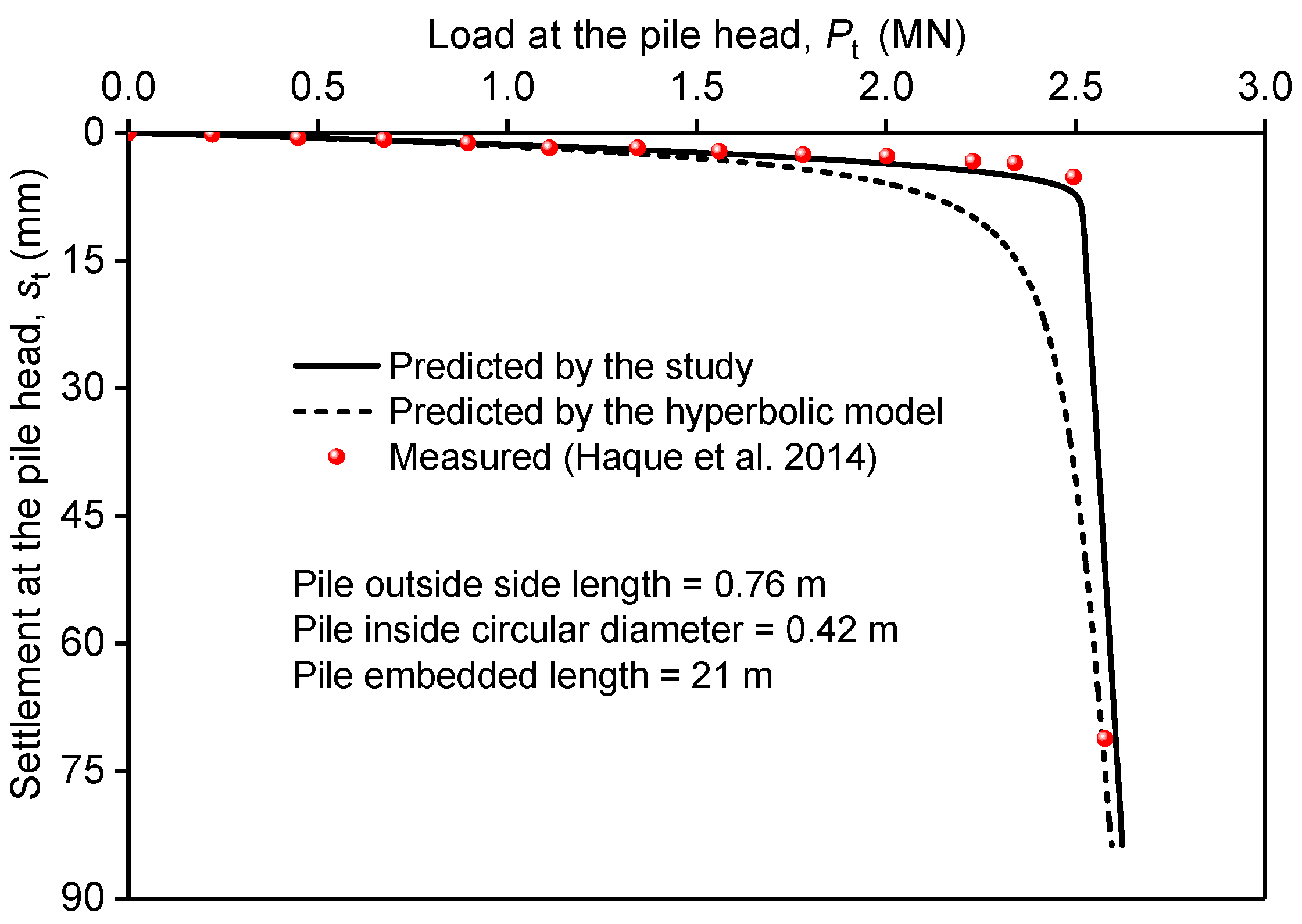
Figure 15 illustrates that the load–displacement curve predicted by the proposed elastoplastic load-transfer model closely matches the measured pile test data reported by Haque et al. (2014) [40]. Prior to a relative pile–soil displacement of approximately 7 mm, the predicted curve shows excellent agreement with the experimental measurements. When the pile–soil relative displacement exceeds 7 mm, the predicted values slightly overestimate the measured data. This indicates that beyond the critical displacement, the axial bearing capacity of the pile no longer increases significantly, implying that the pile’s side resistance has reached its ultimate limit.
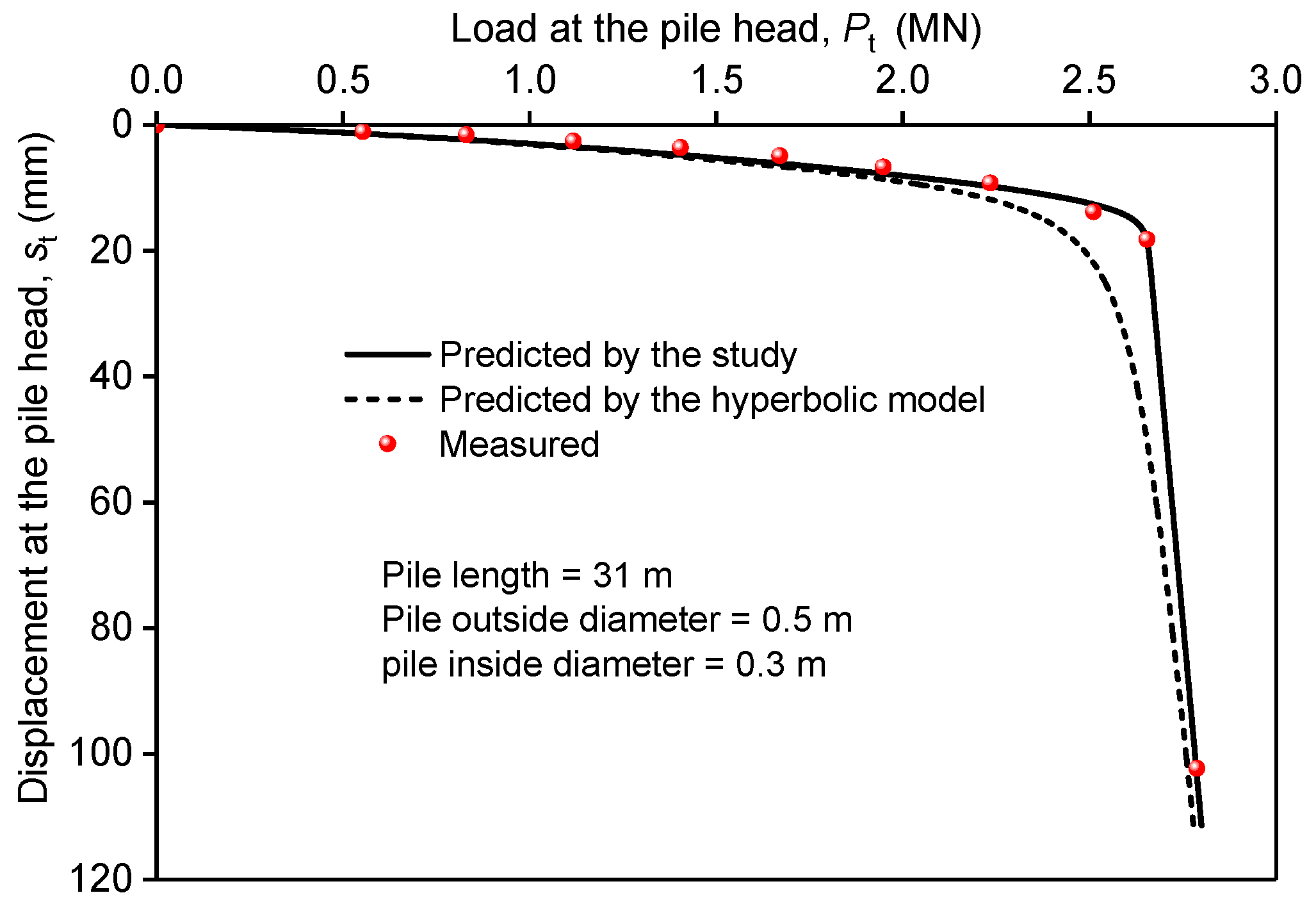
For comparison, a hyperbolic load-transfer model was also employed to predict the pile’s load–displacement response. As shown in Figure 15, the τ z curve predicted by the hyperbolic model shares the same initial slope and ultimate bearing capacity as the proposed model. Nevertheless, the hyperbolic model curve is substantially lower than that of the proposed model and deviates notably from the experimental data. The primary difference between the two models occurs in the mid-section of the load–displacement curve. The underestimation of the pile’s bearing capacity by the hyperbolic model may lead to overly conservative pile designs and reduced economic efficiency. In contrast, the proposed elastoplastic model provides a more accurate prediction of the pile’s load–displacement response and demonstrates a strong capability in capturing the load–settlement behavior of axially loaded single piles.

5.2. Case 2: Pile in Shanghai Soft Soil

The test pile site is located in Xinqiao Town, Songjiang District, Shanghai. The soil in this region is typical estuarine sediment, predominantly soft clay. For high-rise buildings in this area, pile foundations are commonly employed. A total of six piles were included in the single pile test, among which three were bored piles and the remaining three were prestressed concrete (PHC) pipe piles. Considering that the proposed model does not account for soil softening, predictions for shorter piles are expected to be more accurate. Therefore, a shorter PHC pipe pile is selected as a representative example to demonstrate the validity of the proposed elastoplastic model.
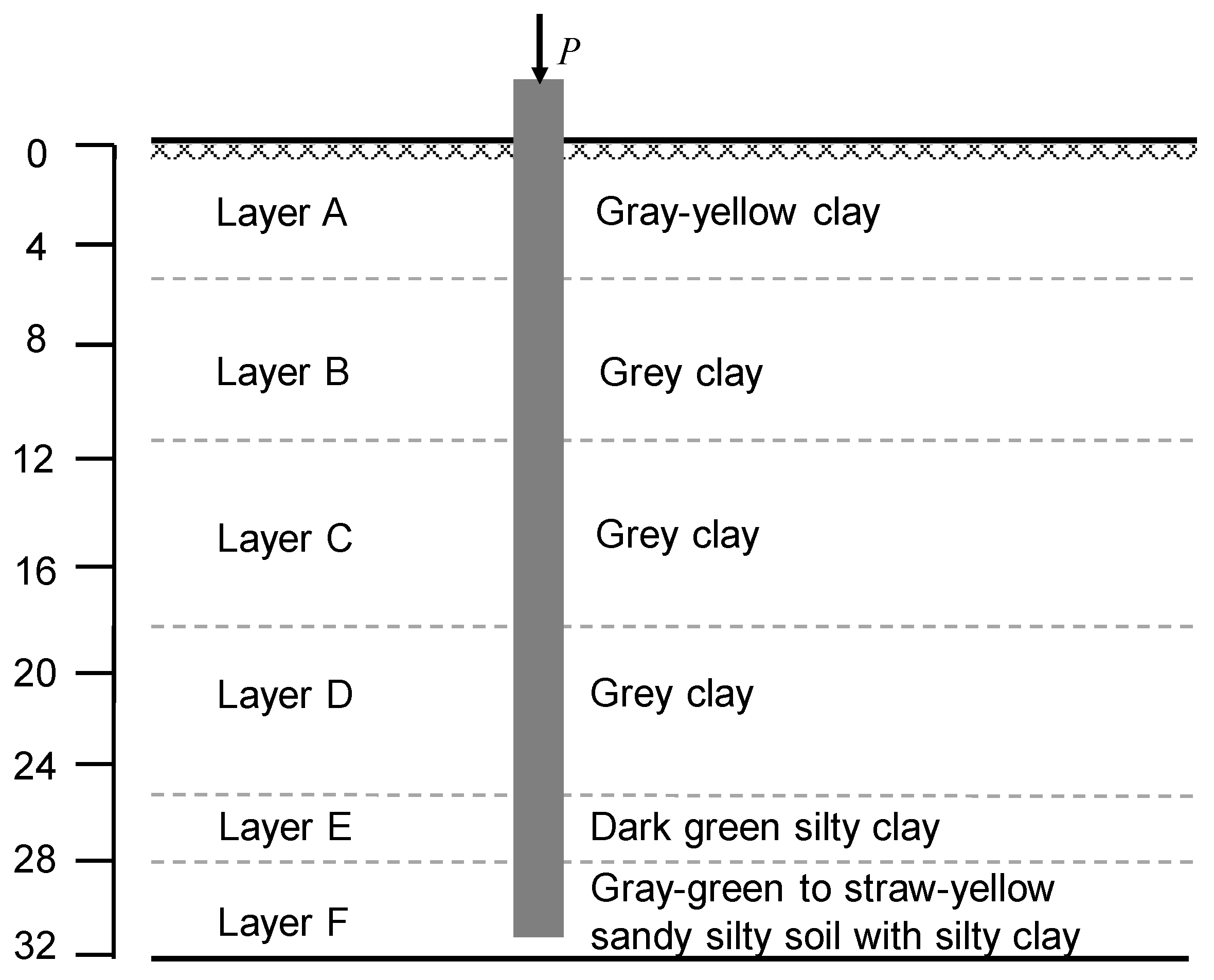
The test pipe pile, which was installed in multilayer clay with different soil properties, has an outer diameter of 500 mm, an inner diameter of 300 mm, and a total length of 31 m. Due to the small area of the pipe pile end, the bearing capacity of the pile is mainly provided by pile side resistance. As shown in Figure 16, the pile side clay layer from top to bottom is successively a grayish-yellow clay layer of 7.6 m, three grayish-green silty clay layers of 5.3 m, 5.9 m, 6.8 m, respectively, a dark green silty clay layer of 2.4 mm, and a grayish-green sandy silt with a silty clay layer of 3 m. The soil parameters of each soil layer can be shown in Table 3. Young’s modulus value of the concrete pipe pile is assumed to be Ep = 38 GPa. Poisson’s ratio value of soil can be assumed as v = 0.3.
In Figure 17, the prediction curve derived from the proposed load-transfer model aligns closely with the measured data. Prior to a relative displacement of approximately 15 mm at the pile top, although the predicted curve does not exactly coincide with the measured values, it remains in close proximity, demonstrating strong predictive capability. Beyond the 15 mm threshold, the load-transfer model continues to provide a reliable fit to the observed behavior. In contrast, the traditional hyperbolic load-transfer model exhibits significant limitations in predicting the pile load–settlement response, and most studies have also noted that it often underestimates the pile side resistance during the plastic stage [20,22]. Moreover, although the ideal elastoplastic model can provide an analytical solution, it also fails to accurately simulate the development of plastic deformation at the pile–soil interface [31,33,34]. The results from the hyperbolic model show substantial deviations from the experimental data, consistently underestimating the measured values, as seen in the figure. Overall, the proposed elastoplastic load-transfer model exhibits superior predictive accuracy compared to the hyperbolic model. This validation confirms that a load-transfer model based on critical state theory, plastic potential, associated flow rule, and small-strain stiffness can more accurately predict the pile’s load–settlement behavior, offering reliable guidance for the design of pile foundations.
The core innovation of the τ z model lies in its theoretical integration and comprehensive deformation description. By combining critical state soil mechanics, plastic potential theory, and associated flow rules, it establishes an elastic–plastic shear deformation equation for the pile–soil interface, accounting for both nonlinear behavior in the elastic zone and stress characteristics in the plastic stage, thereby achieving high-accuracy bearing capacity predictions and improved engineering economy. However, the model still has limitations, including restricted applicable scenarios and geological conditions, high demands for key parameter determination, and a lack of systematic comparative validation with other τ z models. Further work is needed to expand its applicability and provide guidance on parameter selection and comparative studies.

6. Summary and Conclusions

This paper proposes a theoretical load-transfer model to represent the elastoplastic load–displacement behavior of an axially loaded single pile, employing a rigorous elastoplastic load-transfer function for the pile shaft. To capture the elastoplastic response of shear deformation within the plastic zone, critical state theory, plastic potential, and the associated flow rule are applied to determine the soil’s elastoplastic deformation in this region. The soil outside the plastic zone is assumed to behave elastically. Hooke’s Law, combined with the small-strain stiffness theory, is used to derive the nonlinear elastic deformation of the soil in the elastic zone. Parametric analyses are conducted to investigate the influence of key soil parameters on the τ z behavior. Field tests on piles in Louisiana soils and Shanghai soft soils validate the proposed model’s capability to accurately predict the elastoplastic load–displacement response of axially loaded single piles.
The proposed load-transfer function, grounded in the elastoplastic theory, outperforms the hyperbolic function in terms of presenting the elastoplastic τ z characteristics for pile. The parameters used in the model include the common pile and soil properties, which can be obtained from the common experiment in situ or laboratory. The results reveal that the soil parameters ( C c , C s , e 0 , φ , G 0 , and b) significantly influence the τ z curve for pile shaft. Parameters look like this:
  • The parameter φ′ primarily influences the ultimate unit resistance, while the parameters Cc, Cs, and b mainly influence the phase of rising shear stress in the τz curve.
  • The Parameter e0, by influencing G0, has a significant effect on the initial slope of the τz curve. The validating results indicated that the model can represent the elastoplastic load–displacement curve of a single pile very well.
For super-long piles, the degree of side resistance mobilization in the upper portion of the pile shaft is significantly greater than that in the lower portion, making the strain-softening characteristics of the surrounding soil a critical factor in the pile’s load–displacement behavior.
Future research should consider systematically incorporating soil strain-softening parameters into the elastoplastic load-transfer model in order to more accurately simulate the load–displacement response of super-long piles during the plastic stage of the surrounding soil. By including the strain-softening effect, the model can capture the nonlinear behavior in which the soil shear strength gradually decreases with increasing relative displacement.

Author Contributions

Conceptualization, Y.X.; Methodology, Y.X., X.H. and L.L.; Software, X.H.; Validation, D.Z. and L.L.; Formal analysis, Y.X. and L.L.; Resources, H.L. and L.L.; Data curation, D.Z.; Writing—original draft, D.Z.; Writing—review & editing, Y.X.; Visualization, H.L.; Supervision, H.L.; Project administration, D.Z. and X.H. All authors have read and agreed to the published version of the manuscript.

Funding

The authors acknowledge the financial support provided by the National Natural Science Foundation of China (Grant No. 52578385), the Special Support Project of China Postdoctoral Foundation (2023T160560), the Fundamental Research Funds for the Central Universities, CHD (Grant No. 300102212303).

Data Availability Statement

All the data, models, or code generated or used during the study are available from the corresponding author by reasonable request.

Conflicts of Interest

Author Yijun Xiu was employed by the company Guangdong Provincial Road and Bridge Construction and Development Co., Ltd. The remaining authors declare that the research was conducted in the absence of any commercial or financial relationships that could be construed as a potential conflict of interest.

Appendix A. Derivations for the Scalar Multiplier Λ and the Determination of dεne and dετe

The plastic consistency condition of the proposed model can be written as
d f = f σ d σ + f τ d τ + f ε n p d ε n p = 0
Combining with Equations (16) and (17) and the above equation, the scalar multiplier Λ can be obtained as
Λ = f σ d σ + f τ d τ f ε n p f σ
where ε n p is the normal plastic strain of soil in the pile–soil interface.
In accordance with the confined compression test of soil depicted in Figure 3, differentiating Equation (13) yields
d ε n e = C s 1 + e 0 d σ σ
Generalized Hooke’s Law leads to
d ε n e = 1 E d σ
d ε τ e = 1 G d τ
In isotropic materials, the relationship between the shear modulus and Young’s modulus can be expressed as
G = E 2 1 + ν
Combining the above equations, the constitutive equation of the elastic deformation part in the pile–soil interface is expressed as
d ε n e = C s 1 + e 0 σ d σ
d ε τ e = 2 C s 1 + v 1 + e 0 σ d τ

References

  1. Coyle Harry, M.; Reese Lymon, C. Load Transfer for Axially Loaded Piles in Clay. J. Soil Mech. Found. Div. 1966, 92, 1–26. [Google Scholar] [CrossRef]
  2. Basu, P.; Prezzi, M.; Salgado, R.; Chakraborty, T. Shaft resistance and setup factors for piles jacked in clay. J. Geotech. Geoenviron. Eng. 2014, 140, 04013026. [Google Scholar] [CrossRef]
  3. Abu-Farsakh, M.Y.; Rosti, F.; Souri, A. Evaluating pile installation and subsequent thixotropic and consolidation effects on setup by numerical simulation for full scale pile load tests. Can. Geotech. J. 2015, 52, 1734–1746. [Google Scholar] [CrossRef]
  4. Li, L.; Chen, S.; Zhang, Z. A numerical study on installation effects and long-term shaft resistance of pre-bored piles in cohesive soils. Transp. Res. Rec. 2019, 2673, 494–505. [Google Scholar] [CrossRef]
  5. Yao, C.; Zhong, H.; Zhu, Z. Development of a large shaking table test for sand liquefaction analysis. Lithosphere 2024, 2024, lithosphere_2024_137. [Google Scholar] [CrossRef]
  6. Poulos, H.G.; Davis, E.H. Pile Foundation Analysis and Design; Wiley: New York, NY, USA, 1980; Volume 397, pp. 233–248. [Google Scholar]
  7. Mandolini, A.; Viggiani, C. Displacement of piled foundations. Géotechnique 1997, 47, 791–816. [Google Scholar] [CrossRef]
  8. Ai, Z.Y.; Cheng, Y.C. Analysis of vertically loaded piles in multilayered transversely isotropic soils by BEM. Eng. Anal. Bound. Elem. 2013, 37, 327–335. [Google Scholar] [CrossRef]
  9. Ai, Z.Y.; Han, J. Boundary element analysis of axially loaded piles embedded in a multi-layered soil. Comput. Geotech. 2009, 36, 427–434. [Google Scholar] [CrossRef]
  10. Basack, S.; Sen, S. Numerical solution of single pile subjected to simultaneous torsional and axial loads. Int. J. Geomech. 2014, 14, 06014006. [Google Scholar] [CrossRef]
  11. Liang, F.; Song, Z. BEM analysis of the interaction factor for vertically loaded dissimilar piles in saturated poroelastic soil. Comput. Geotech. 2014, 62, 223–231. [Google Scholar] [CrossRef]
  12. Fleming, W.G.K. A new method for single pile settlement prediction and analysis. Géotechnique 1992, 42, 411–425. [Google Scholar] [CrossRef]
  13. Lee, K.M.; XIao, Z.R. A simplified nonlinear approach for pile group settlement analysis in multilayered soils. Can. Geotech. J. 2001, 38, 1063–1080. [Google Scholar] [CrossRef]
  14. Zhang, Q.Q.; Zhang, Z.M.; He, J.Y. A simplified approach for settlement analysis of single pile and pile groups considering interaction between identical piles in multilayered soils. Comput. Geotech. 2010, 37, 969–976. [Google Scholar] [CrossRef]
  15. Xu, H.F.; Zhang, J.X.; Liu, X.; Geng, H.S.; Li, K.L.; Yang, Y.H. Analytical Model and Back-Analysis for Pile-Soil System Behavior under Axial Loading. Math. Probl. Eng. 2020, 2020, 1369348. [Google Scholar] [CrossRef]
  16. Li, Z.; Liu, S.; Wu, K.; Lu, T. Analysis on response of a single pile subjected to tension load considering excavation effects. Appl. Sci. 2022, 12, 6717. [Google Scholar] [CrossRef]
  17. Zhang, Q.Q.; Zhang, Z.M. A simplified nonlinear approach for single pile settlement analysis. Can. Geotech. J. 2012, 49, 1256–1266. [Google Scholar] [CrossRef]
  18. Li, L.; Li, J.; Sun, D.A.; Gong, W. Semi-analytical approach for time-dependent load-settlement response of a jacked pile in clay strata. Can. Geotech. J. 2017, 54, 1682–1692. [Google Scholar] [CrossRef]
  19. Cooke, R.W. The settlement of friction pile foundations. In Proceedings of the Conference on Tall Buildings, Jakarta, Indonesia, 9–11 December 1974. [Google Scholar]
  20. Randolph, M.F.; Wroth, C.P. Analysis of deformation of vertically loaded piles. J. Geotech. Eng. Div. 1978, 104, 1465–1488. [Google Scholar] [CrossRef]
  21. Kraft, L.M., Jr.; Ray, R.P.; Kagawa, T. Theoretical t-z curves. J. Geotech. Eng. Div. 1981, 107, 1543–1561. [Google Scholar] [CrossRef]
  22. Guo, W.D.; Randolph, M.F. Vertically loaded piles in non-homogeneous media. Int. J. Numer. Anal. Methods Geomech. 1997, 21, 507–532. [Google Scholar] [CrossRef]
  23. Guo, W.D. Vertically loaded single piles in Gibson soil. J. Geotech. Geoenviron. Eng. 2000, 126, 189–193. [Google Scholar] [CrossRef]
  24. Mylonakis, G.; Gazetas, G. Settlement and additional internal forces of grouped piles in layered soil. Géotechnique 1998, 48, 55–72. [Google Scholar] [CrossRef]
  25. Wang, Z.; Xie, X.; Wang, J. A new nonlinear method for vertical settlement prediction of a single pile and pile groups in layered soils. Comput. Geotech. 2012, 45, 118–126. [Google Scholar] [CrossRef]
  26. Zhu, H.; Chang, M.F. Load transfer curves along bored piles considering modulus degradation. J. Geotech. Geoenviron. Eng. 2002, 128, 764–774. [Google Scholar] [CrossRef]
  27. Mu, L.; Chen, Q.; Huang, M.; Basack, S. Hybrid approach for rigid piled-raft foundations subjected to coupled loads in layered soils. Int. J. Geomech. 2017, 17, 04016122. [Google Scholar] [CrossRef]
  28. Gharibreza, Z.; Ghazavi, M.; El Naggar, M.H. Load-Settlement Analysis of Axially Loaded Piles in Unsaturated Soils. Water 2024, 16, 337. [Google Scholar] [CrossRef]
  29. Zhu, Z.; Wang, C.; Zhao, J.; Gu, X.; Zhang, X. Coupling fabric evolution with critical state in DEM simulations of sand liquefaction. Soil Dyn. Earthq. Eng. 2026, 200, 109889. [Google Scholar] [CrossRef]
  30. Tehrani, F.S.; Han, F.; Salgado, R.; Prezzi, M.; Tovar, R.D.; Castro, A.G. Effect of surface roughness on the shaft resistance of non-displacement piles embedded in sand. Géotechnique 2016, 66, 386–400. [Google Scholar] [CrossRef]
  31. Dejong, J.T.; White, D.J.; Randolph, M.F. Microscale observation and modeling of soil-structure interface behavior using particle image velocimetry. Soils Found. 2006, 46, 15–28. [Google Scholar] [CrossRef]
  32. Li, L.; Lai, N.; Zhao, X.; Zhu, T.; Su, Z. A generalized elastoplastic load-transfer model for axially loaded piles in clay: Incorporation of modulus degradation and skin friction softening. Comput. Geotech. 2023, 161, 105594. [Google Scholar] [CrossRef]
  33. Morgenstern, N.R.; Tchalenko, J.S. Microscopic structures in kaolin subjected to direct shear. Géotechnique 1967, 17, 309–328. [Google Scholar] [CrossRef]
  34. Thakur, V. Strain Localization in Sensitive Soft Clays. Ph.D. Thesis, Norwegian University of Science and Technology, Trondheim, Norway, 2007. [Google Scholar]
  35. Jardine, R.J.; Potts, D.M.; Fourie, A.B.; Burland, J.B. Studies of the influence of non-linear stress–strain characteristics in soil–structure interaction. Géotechnique 1986, 36, 377–396. [Google Scholar] [CrossRef]
  36. Powell, J.J.M. Assessment of ground stiffness from field and laboratory tests. In Proceedings of the 10th European Conference on SMFE, Florence, Italy, 26–30 May 1991; Volume 1, pp. 153–156. [Google Scholar]
  37. Pinto, C.S.; Abramento, M. Pressuremeter tests on gneissic residual soil in Sao Paulo 1999, Brazil. In Proceedings of the International Conference on Soil Mechanics and Foundation Engineering, Hamburg, Germany, 8–12 August 1999; pp. 175–176. [Google Scholar]
  38. Brinkgreve, R.B.J.; Kumarswamy, S.; Swolfs, W.M.; Waterman, D.; Chesaru, A.; Bonnier, P.G. PLAXIS 2016; PLAXIS BV: Delft, The Netherlands, 2016. [Google Scholar]
  39. Lee, C.Y. Displacement of pile group-practical approach. J. Geotech. Eng. 1993, 119, 1449–1461. [Google Scholar] [CrossRef]
  40. Haque, M.N.; Abu-Farsakh, M.Y.; Chen, Q.; Zhang, Z. Case study on instrumenting and testing full-scale test piles for evaluating setup phenomenon. Transp. Res. Rec. 2014, 2462, 37–47. [Google Scholar] [CrossRef]
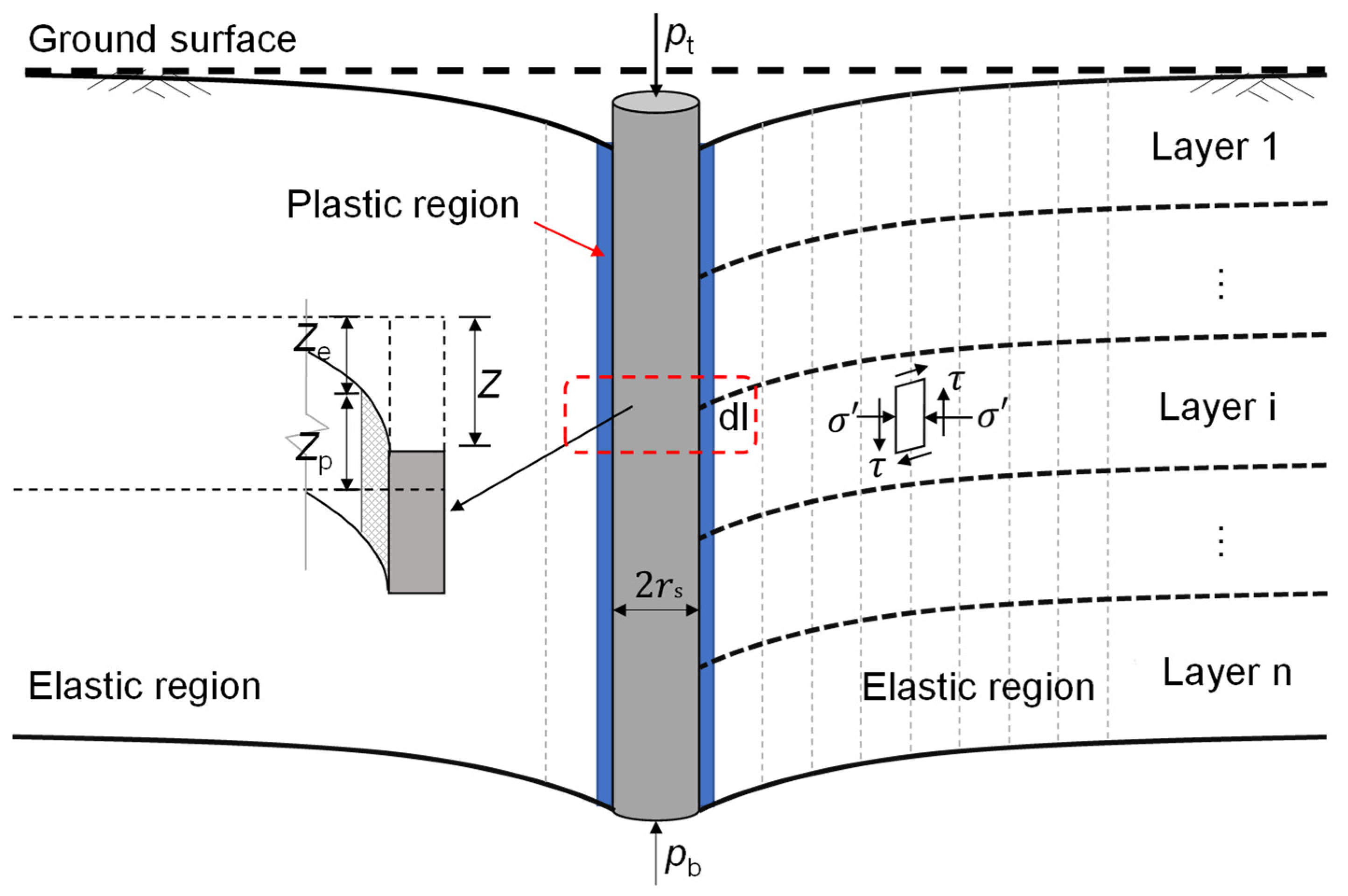
Figure 1. Deformation of individual pile under axial loading and interaction with the surrounding soils.
Buildings 15 04300 g001
Figure 2. The schematic of plastic potential and yield surface.
Buildings 15 04300 g002
Figure 3. e l n σ relationships of isotropic compression and swelling tests.
Buildings 15 04300 g003
Figure 4. Schematic diagram of elastic zone of pile side soil.
Buildings 15 04300 g004
Figure 5. Schematic diagram of τ z curve.
Buildings 15 04300 g005
Figure 6. Schematic of τ z curves based on the proposed and other models.
Buildings 15 04300 g006
Figure 7. τ z curve with different initial void ratios.
Buildings 15 04300 g007
Figure 8. τ z curve with different compression indexes.
Buildings 15 04300 g008
Figure 9. τ z curve with different internal friction angles.
Buildings 15 04300 g009
Figure 10. τ z curve with different effective normal stress.
Buildings 15 04300 g010
Figure 11. τ z curve with different thickness of the plastic zone.
Buildings 15 04300 g011
Figure 12. Schematic of the load-transfer method in multilayer clay.
Buildings 15 04300 g012
Figure 13. Flow chart for the implementation of proposed elastoplastic model in the load-transfer method.
Buildings 15 04300 g013
Figure 14. Soil profile of the Louisiana soil at the pile location.
Buildings 15 04300 g014
Figure 15. Predicted and measured load–displacement curves of pile in Louisiana soft soil [40].
Buildings 15 04300 g015
Figure 16. Soil profile of Shanghai soft soil at pile location.
Buildings 15 04300 g016
Figure 17. Predicted and measured load–displacement curves of a pile in Shanghai soft soil.
Buildings 15 04300 g017
Table 1. Table of comparison of cited studies.
StudyMethod CategoryAssumption
Coyle & Reese [1]Load-transfer methodElastic pile discretization, nonlinear soil springs
Randolph & Wroth [20]Theoretical derivationConcentric cylinder idealization, elastic soil deformation
Kraft et al. [21]Theoretical derivationElastic–plastic transition, tangent modulus correction
Zhu & Chang [26]Theoretical and Curve fittingModulus degradation, nonlinear elasticity
Wang et al. [25]Curve fittingElastic soil deformation, exponential friction–displacement
relation
Table 2. Parameters of Louisiana soft soil at pile location [40].
LayerDepth (m)C′ (kPa)φ′ (°)CcCse0OCR
A0–610240.17980.03000.742.3
B6–99260.17980.03000.572.0
C9–119280.17980.03000.651.8
D11–1410230.12910.04370.601.4
E14–219200.21430.03221.001.0
Table 3. Parameters of Shanghai soft soil at pile location.
LayerDepth (m)c’ (kPa)φ’ (°)Ccγ’ (kN/m3)Cse0OCR
10–5.314240.23999.490.03100.72.1
25.3–11.212250.253380.03270.82.0
311.2–189200.22876.70.03250.72.3
418–25.611260.29178.10.03320.92.2
525.6–2812230.22917.90.03310.81.6
628–3110220.23288.20.02900.71.4
Disclaimer/Publisher’s Note: The statements, opinions and data contained in all publications are solely those of the individual author(s) and contributor(s) and not of MDPI and/or the editor(s). MDPI and/or the editor(s) disclaim responsibility for any injury to people or property resulting from any ideas, methods, instructions or products referred to in the content.