Article

Analysis of the Influence of Traveling Wave Effect on Flat Grid with Different Three-Dimensional Sizes


1
School of Civil Engineering, Hebei University of Architecture, Zhangjiakou 075000, China
2
Hebei Innovation Center of Prefabricated Construction and Underground Engineering, Zhangjiakou 075000, China
3
Hebei Key Laboratory of Diagnosis, Reconstruction and Anti-Disaster of Civil Engineering, Zhangjiakou 075000, China
4
China Academy of Building Research, Beijing 100013, China
*
Author to whom correspondence should be addressed.
Buildings 2025, 15(23), 4252; https://doi.org/10.3390/buildings15234252
Submission received: 24 October 2025 / Revised: 22 November 2025 / Accepted: 24 November 2025 / Published: 25 November 2025
(This article belongs to the Section Building Structures)

Abstract

To investigate the relationship between the three-dimensional size of a structure and the impact of the traveling wave effect, models derived from an orthographic quadrangle flat grid based on a practical engineering case were established and validated. The plane size (ranging from 30 m to 90 m), height (ranging from 0 m to 9 m), and space of the supporting columns (ranging from 6 m to 12 m for peripheral columns and from 18 m to 24 m for internal columns) were changed. The time history method was used to perform a statistical analysis of the proportion and distribution of special bars and to investigate their seismic response under multiple-support excitation along the length of the structure and single excitation. The results show that an increase in the structural length and decreases in the structural span and the height and distance of the columns lead to an increase in the traveling wave effect, with special bars spreading from the supports to the peripheries and from the edge to the middle along the span. It is concluded that the traveling wave effect can be regarded as an additional dynamic load according to the excitation time differences among supporting columns along the propagation direction of the seismic wave, which spreads from supports to peripheries in a manner similar to energy radiation. The smaller the apparent wave velocity, the larger the time difference, the larger the additional dynamic load, and the larger the degree and range of the traveling wave effect. Increasing the plane and the height and space of the supporting columns to certain sizes will lead to a decrease in the traveling wave effect due to its limited range.

1. Introduction

Flat grid shells are widely used in large public buildings such as gas stations, stations, gymnasiums, and industrial plants due to their excellent performance and large spatial span. As spatial structures, their seismic importance and complexity have long been a continuous focus of the industry [1,2,3,4]. Given that such structures generally have large planar dimensions, it is widely acknowledged that the spatial characteristics of ground motion must be considered in their seismic response analysis [5]. China’s current *Building Seismic Design Standard* explicitly states that spatial structures with very large planar projection dimensions (defined in the code as structures with a span greater than 120 m, a length greater than 300 m, or a cantilever greater than 40 m) should undergo seismic calculations using single-point uniform input, multi-point input, multi-directional single-point input, or multi-directional multi-point input, depending on their structural form and support conditions. When using multi-point input, the traveling wave effect of earthquakes and local site effects should be considered [6].
However, numerous studies in recent years have confirmed that the scope and influencing factors of multi-point input analysis are not limited to these provisions. For example, regarding the minimum planar size requiring consideration of the traveling wave effect, existing studies on various structural forms such as single-layer cylindrical lattice shells, double-layer flat grid shells, and double-layer cylindrical lattice shells have all indicated that the current regulations need improvement, but no unified quantitative conclusions have been reached [7,8,9]. Concerning the influence of apparent wave velocity on multi-point input, it is generally agreed that a smaller apparent wave velocity leads to a more pronounced traveling wave effect. However, Qin Jun [10], Gu Zhenyuan [11], Li Xuchun [12], and Zhou Xiaolong [13] obtained different critical apparent wave velocity conclusions through analyses of single-layer cylindrical lattice shells, flat grid shells, double-arch-supported steel structures, and double-layer cylindrical lattice shells, respectively. Regarding the influence of lower supporting structures on multi-point input, Zhao Yongquan [14], Shang Huijie [15], Yu Yousheng [16], and others have expressed different opinions on whether the lower structures can be omitted to simplify calculations. These findings indicate that the current code’s provisions on the size definition of spatial structures and the conditions for multi-point input calculations still need refinement.
This paper takes simplified models of flat grid shells with the same dimensions as complex engineering prototypes as the analysis objects. By separately changing their planar dimensions and the height and spacing of lower supporting columns, and by conducting comparative analyses of multi-point input with varying apparent wave velocities and uniform input under excitation and propagation along the length direction (X-direction), this study aims to explore the influence laws of various factors on the results of multi-point input analysis. The novelty of this study lies in the development of a simplified flat grid model that closely replicates the dynamic characteristics and traveling wave effect behavior observed in actual engineering structures. By maintaining consistent analytical variables (planar dimensions, column height, and column spacing) while systematically varying them to expand the analysis sample size, the validation and derivation of more precise patterns governing traveling wave effects through comprehensive multivariable influence analysis is enabled.

2. Calculation Model

2.1. Structural Model

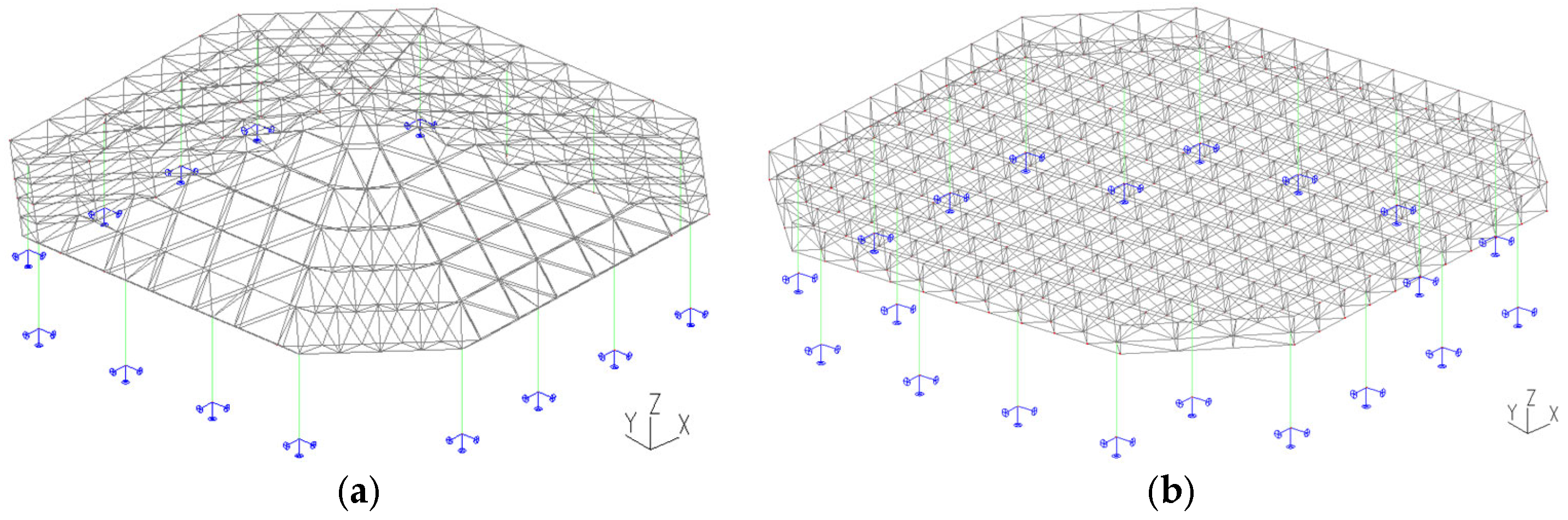
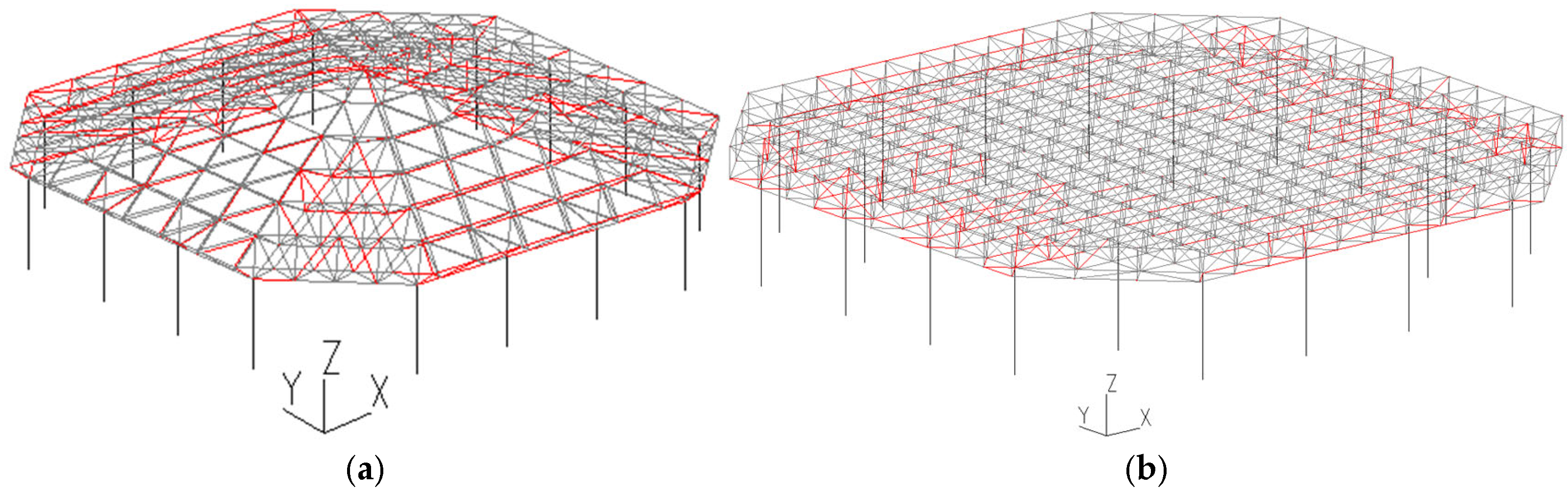
A hot spring pavilion in Huailai County, Hebei Province, features a roof structure consisting of a 30 m × 30 m orthogonally placed triangular pyramid sloped roof hollow circular grid shell, as shown in Figure 1a. The lower part is supported by reinforced concrete square columns around the perimeter, with a column height of 5 m, a column cross-sectional dimension of 800 mm × 800 mm, and a column spacing of 6 m. According to the design specifications, the dead load is taken as 0.3 kN/m2, the live load as 0.5 kN/m2, the basic wind pressure as 0.55 kN/m2, the seismic fortification intensity is Grade 8 (0.2 g), the design earthquake group is the second group, and the site category is Class III. As specified in Clause 4.1.6 of the Chinese “Code for Seismic Design of Buildings” (GB 50011-2010) [6], site classification is determined by both the equivalent shear wave velocity of the soil layers and the site overburden thickness. A Site Class III site refers to one that either has an overburden thickness greater than 50 m when the shear wave velocity ranges from 150 to 250 m/s, or has an overburden thickness between 15 and 80 m when the shear wave velocity is less than 150 m/s.
To facilitate parameter variation, an orthogonally placed square pyramid flat grid shell with the same planar dimensions and lower supports was constructed, as shown in Figure 1b. To ensure similar dynamic characteristics between the two models, a support column was added at each of the four corners, 6 m away from both sides. The first 10 natural vibration frequencies and mode shapes of the two models are shown in Table 1.

2.2. Seismic Wave Input Model

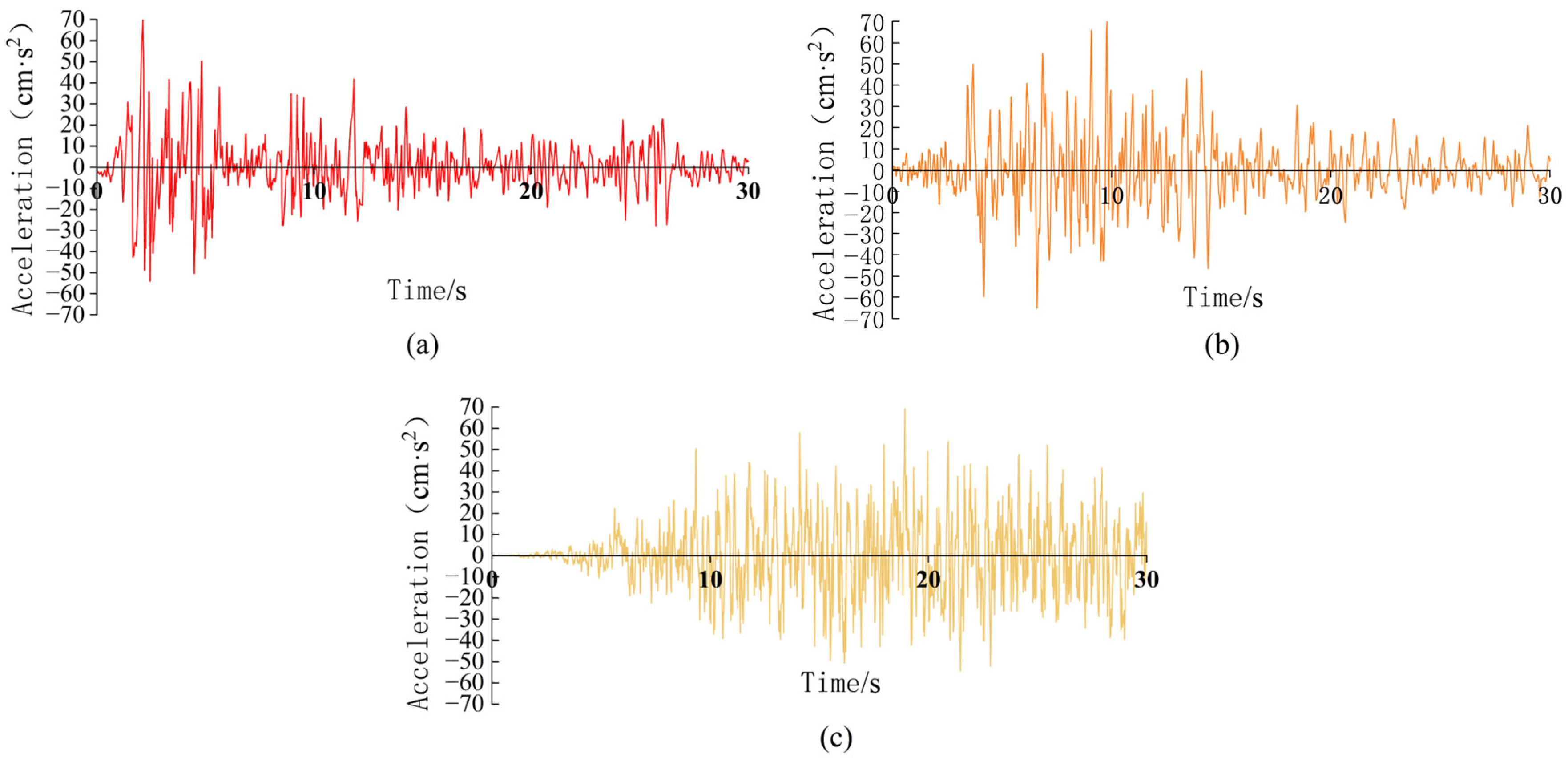
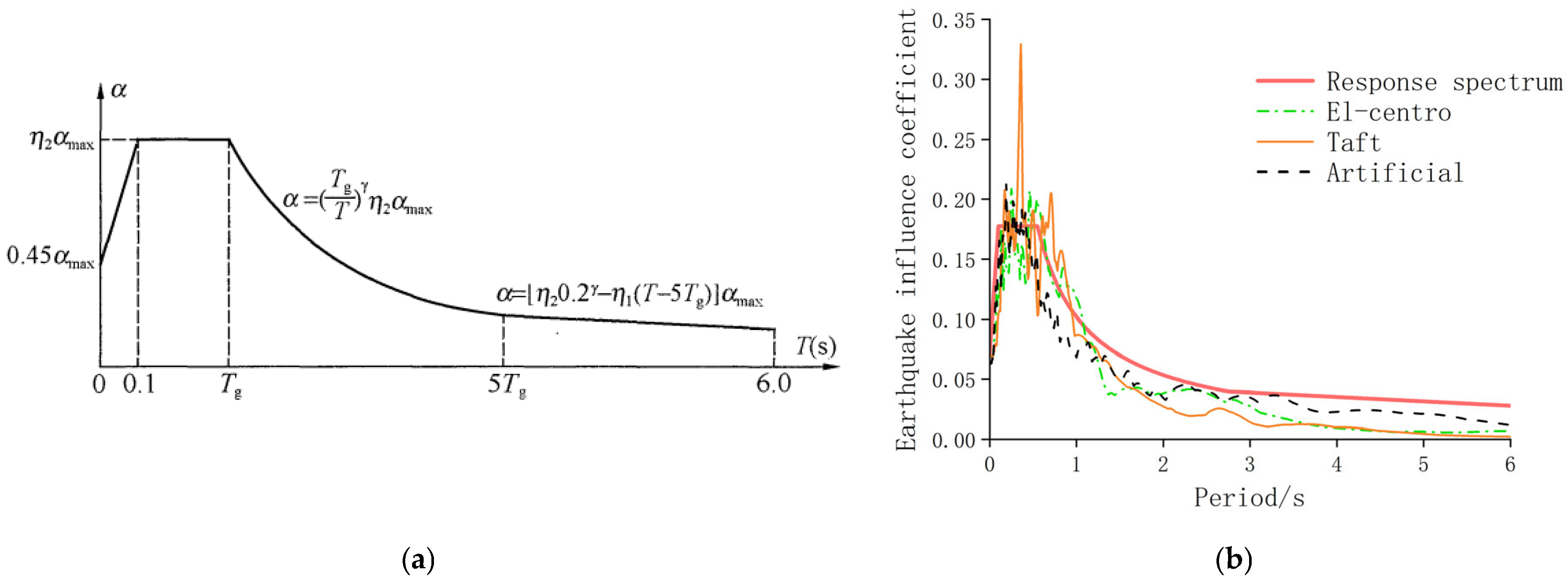
The finite element software ANSYS (Ansys 2023 R2, Ansys Inc., Canonsburg, PA, USA) was used to simulate the time-history analysis method for multi-point excitation and uniform excitation. The direct displacement input method was adopted, where displacement time-histories were input at the structural supports. By adjusting the input time difference of each support, seismic response simulations of multi-point input with different apparent wave velocities and uniform input were achieved. Both the excitation direction and propagation direction were along the length direction (X-direction) [17,18]. The seismic wave selection comprised two natural records—El-Centro (recorded on 18 May 1940, at the El Centro Seismic Station, magnitude 7.1, peak acceleration 342 cm/s2, time interval 0.02 s) and Taft (recorded on 21 July 1952, at the Taft station in Kern County, magnitude 7.6, peak acceleration 176 cm/s2, time interval 0.02 s)—along with one artificially generated seismic record, which were all chosen based on the same seismic design grouping and site classification. The seismic records were scaled proportionally after adjusting the peak acceleration to 70 cm/s−2. The effective wavelength was truncated according to the code, and the spectral characteristics were verified. The effective wavelength began at the first instance of reaching 10% of the peak value and ended at the last instance of reaching 10% of the peak value. The spectrum was plotted according to the maximum seismic influence coefficient αmax (set to 0.16 based on Grade 8), along with the adjustment coefficient for the slope of the straight descending segment η1 ( η 1 = 0.02 + 0.05 ξ 4 + 32 ξ ), the attenuation exponent for the curved descending segment γ ( γ = 0.9 + 0.05 ξ 0.3 + 6 ξ ), the characteristic period Tg (set to 0.55 s based on the second group and Class III), and the damping adjustment coefficient η2 ( η 2 = 1 + 0.05 ξ 0.08 + 1.6 ξ ), which were figured out by intensity, site category, design earthquake grouping, structural natural vibration period, and damping ratio, Where ξ was the structural damping ratio.
As shown in Figure 2 and Figure 3, the mean maximum deviation of the spectral curves of the three time-history waves from the seismic influence coefficients of the response spectrum at the fundamental modal periods of the structure is 3.69%, which satisfies the statistical requirement of being less than 20%. The representative value of gravity load was taken as the dead load, and the damping ratio ξ for the composite structure was selected as 0.035, as recommended by the code. The Rayleigh damping model was adopted, with the target periods set to T1 through T10 of the structural prototype. The resulting damping coefficients α and β were 1.23 and 8 × 10⁻⁴, respectively.
Due to the small planar size of the engineering prototype and the uniform site conditions, the seismic wave input model no longer considers local site effects. As previously mentioned, there is still no unified conclusion on the critical apparent wave velocity requiring consideration of the traveling wave effect. Therefore, this paper selects multiple apparent wave velocities—50 m·s−1, 300 m·s−1, 600 m·s−1, 1200 m·s−1, 1800 m·s−1, and 2400 m·s−1—for numerical simulations of multi-point excitation, and compares the results with those of uniform input (0 m·s−1) analysis. The traveling wave effect coefficient is defined as:
ζ = S multi / S uni
Among them, Smulti represents the peak internal force of a member under multi-point input seismic response, and Suni represents the peak internal force of the member under uniform input seismic response. For members with a traveling wave effect coefficient ζ = Smulti/Suni, their internal forces under multi-point input are significantly greater than those under uniform input, indicating that the traveling wave effect cannot be ignored. Such members are termed “special members,” and the influence law of the traveling wave effect is investigated through their proportion and distribution [19,20,21].

2.3. Comparative Analysis Between Engineering Prototype and Simplified Flat Grid Shell

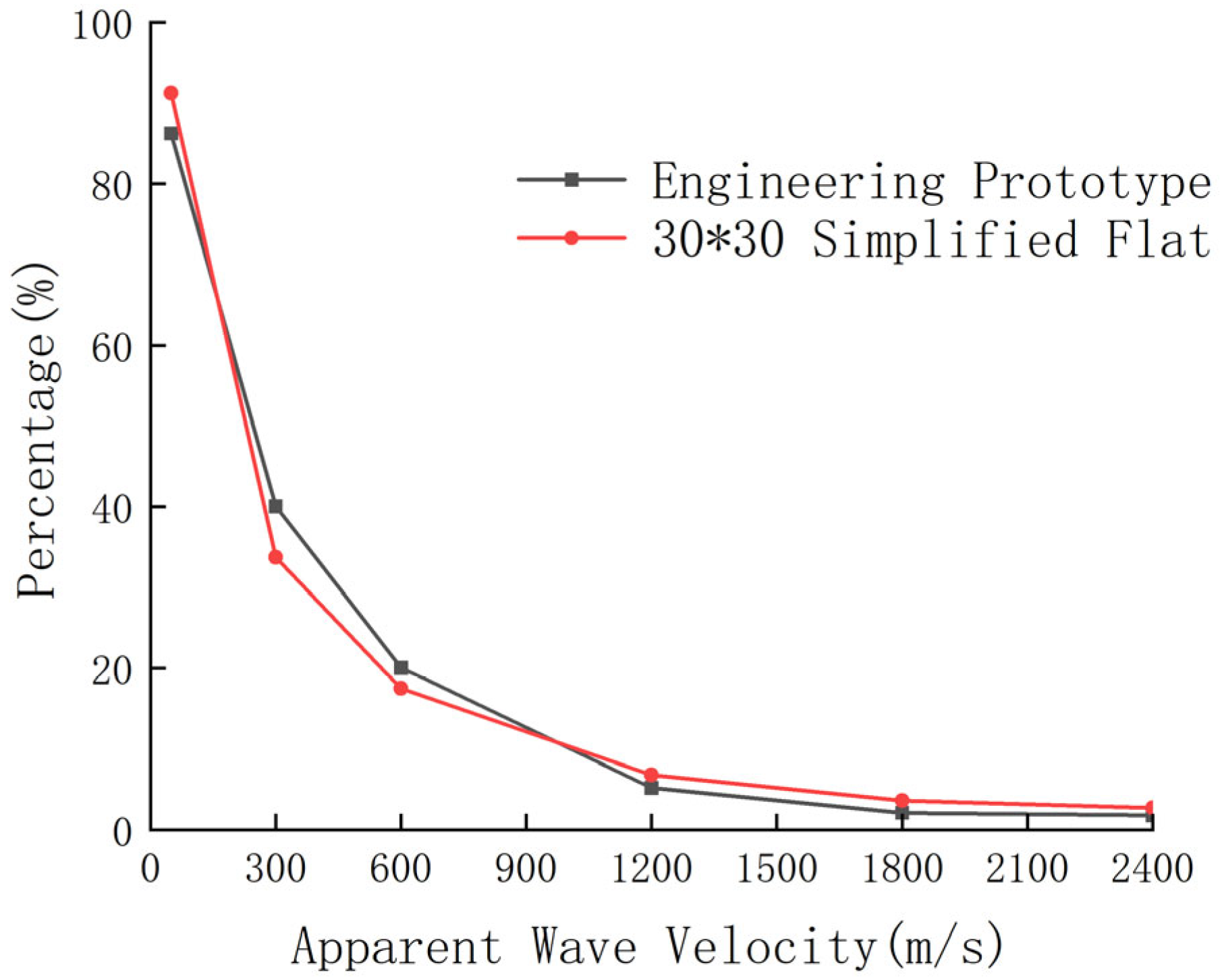
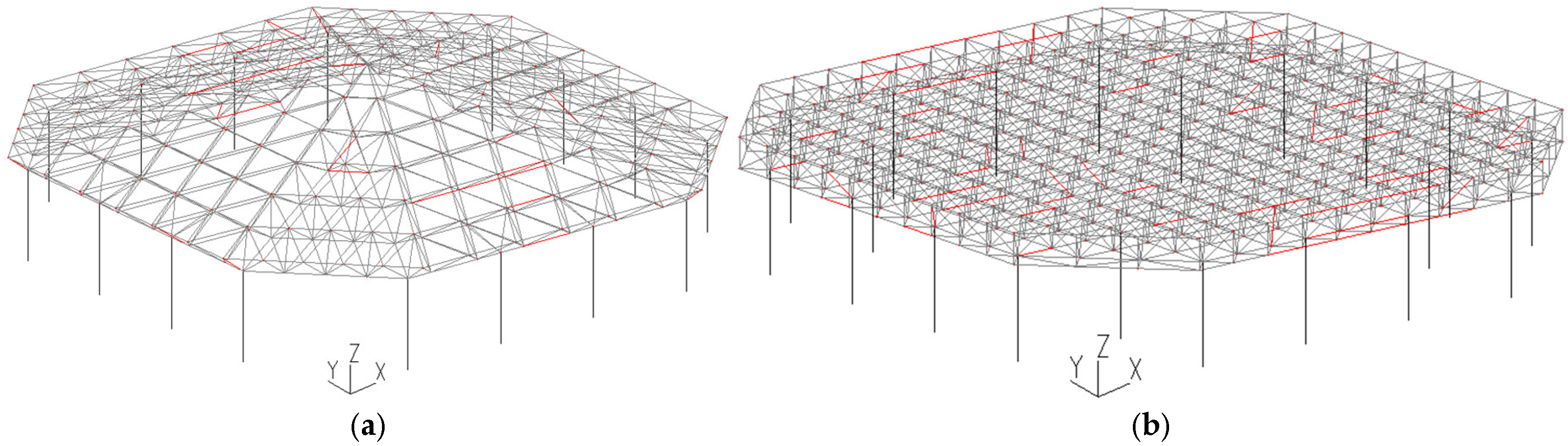
The envelope values of the proportion of special members in the two models under three seismic wave excitations are shown in Figure 4. Both exhibit the general pattern that the larger the apparent wave velocity, the smaller the proportion, and the proportions under each apparent wave velocity are relatively close. Figure 5 and Figure 6 display the distribution positions of special members (red members) in the two models under El-centro wave excitation with apparent wave velocities of 600 m·s−1 and 1800 m·s−1. Horizontal comparison shows that special members are concentrated near the supports, while vertical comparison reveals that both exhibit a tendency for special members to spread from the supports to the periphery and from the span edges to the mid-span as the apparent wave velocity decreases. This validates the rationality of the simplified flat grid shell, and subsequent studies will use this structure as the analysis object.

3. Analysis of Traveling Wave Effect in Flat Grid Shells with Different Planar Dimensions

Taking 30 m as a magnitude level, flat grid shells with spans and lengths of 30 m × 60 m, 30 m × 90 m, 60 m × 30 m, 60 m × 60 m, 60 m × 90 m, 90 m × 30 m, 90 m × 60 m, and 90 m × 90 m were constructed. The edge column spacing, middle column spacing, and column dimensions were consistent with those of the 30 m × 30 m grid shell.
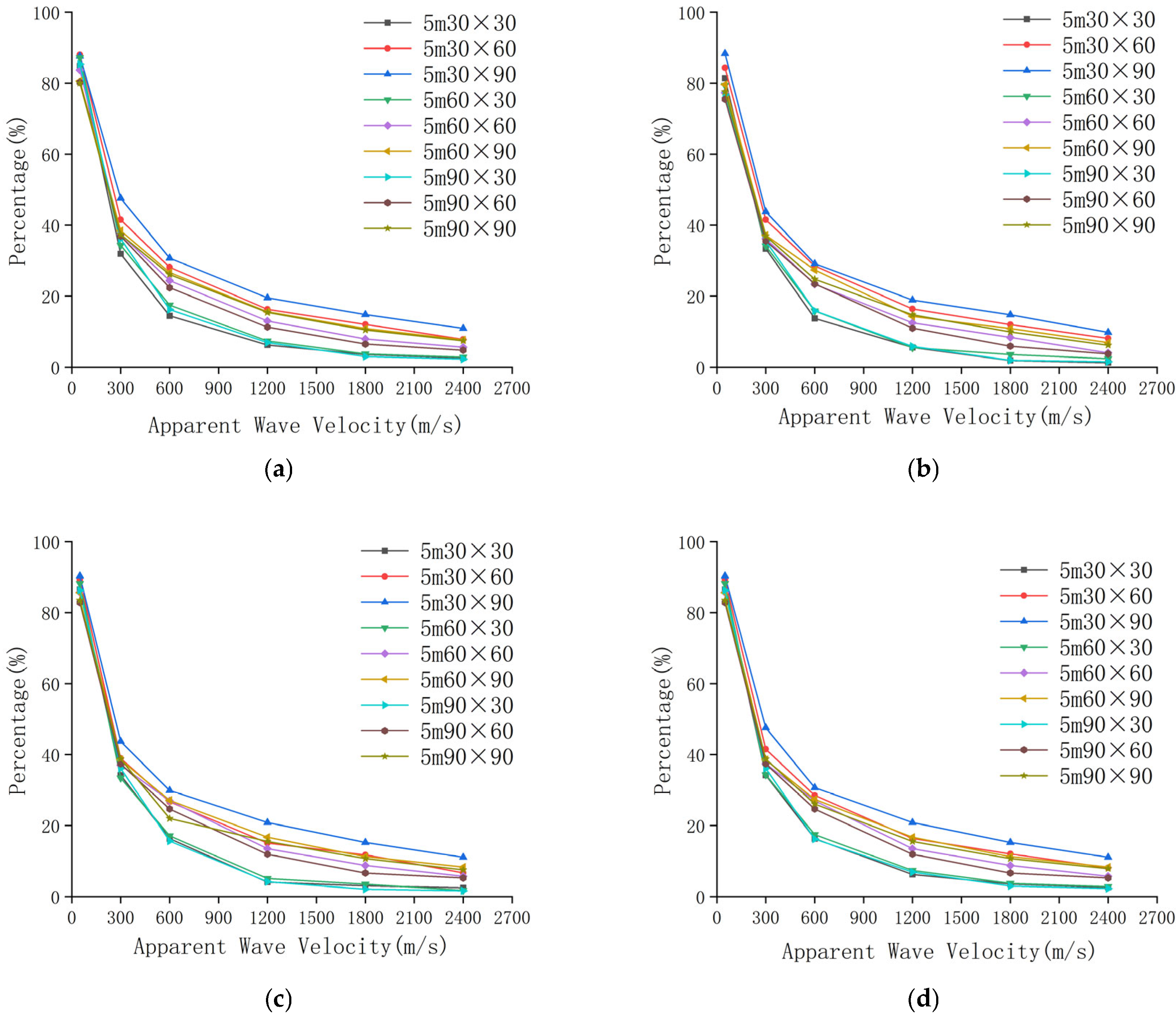
Table 2 and Table 3, and Figure 7 present the statistical results of the proportion of special members in the nine groups of models under three seismic waves with various apparent wave velocities. In addition to the general rule that larger apparent wave velocities correspond to smaller proportions, comparative analysis under the same apparent wave velocity shows that for structures with the same span but different lengths, the proportion of special members increases with the increase in structural length, indicating that the traveling wave effect becomes more pronounced. However, when comparing structures with different spans but the same length, the proportion of special members decreases with the increase in structural span in most cases, which does not align with the conventional understanding that “the larger the planar size, the more pronounced the traveling wave effect.”
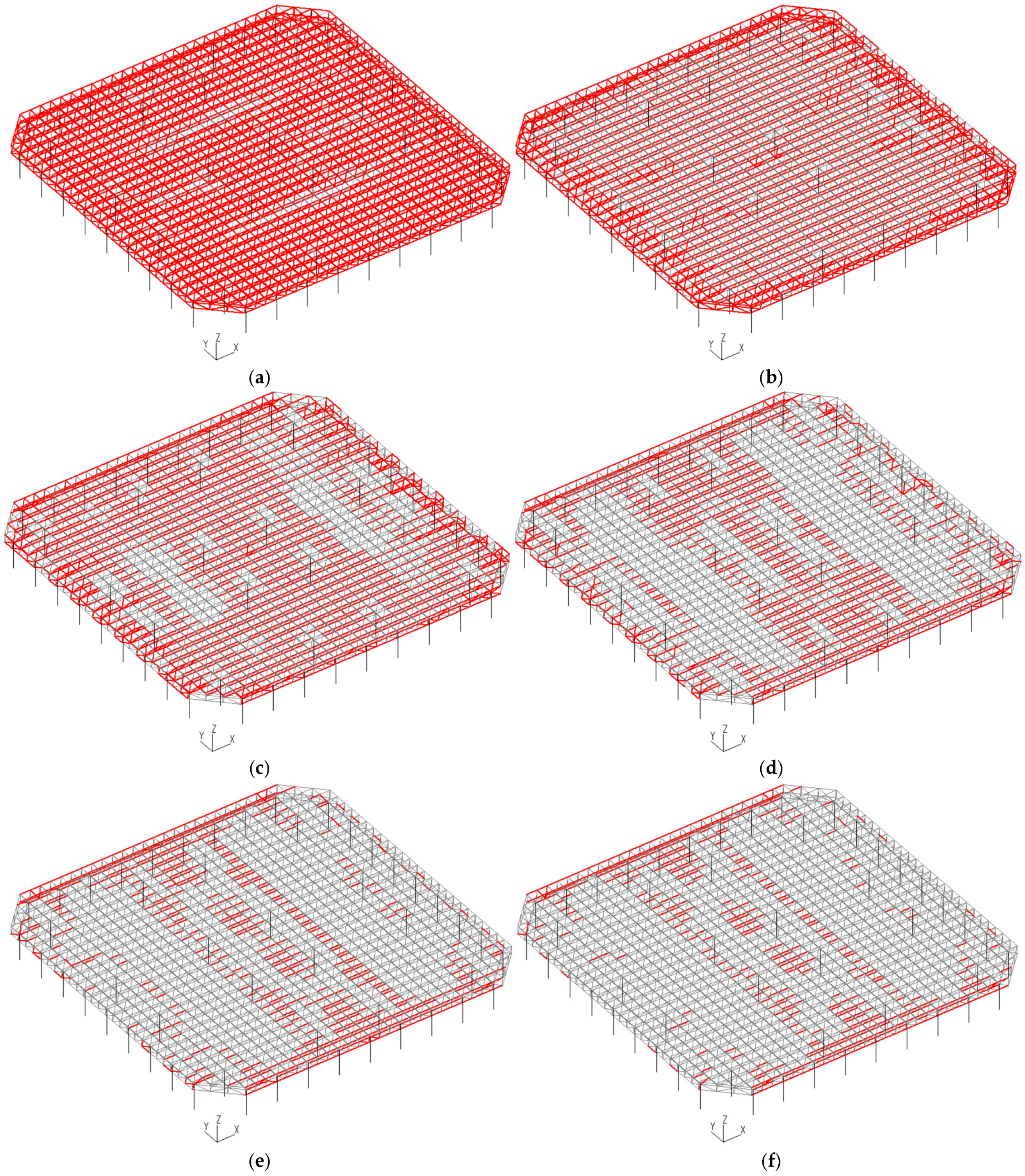
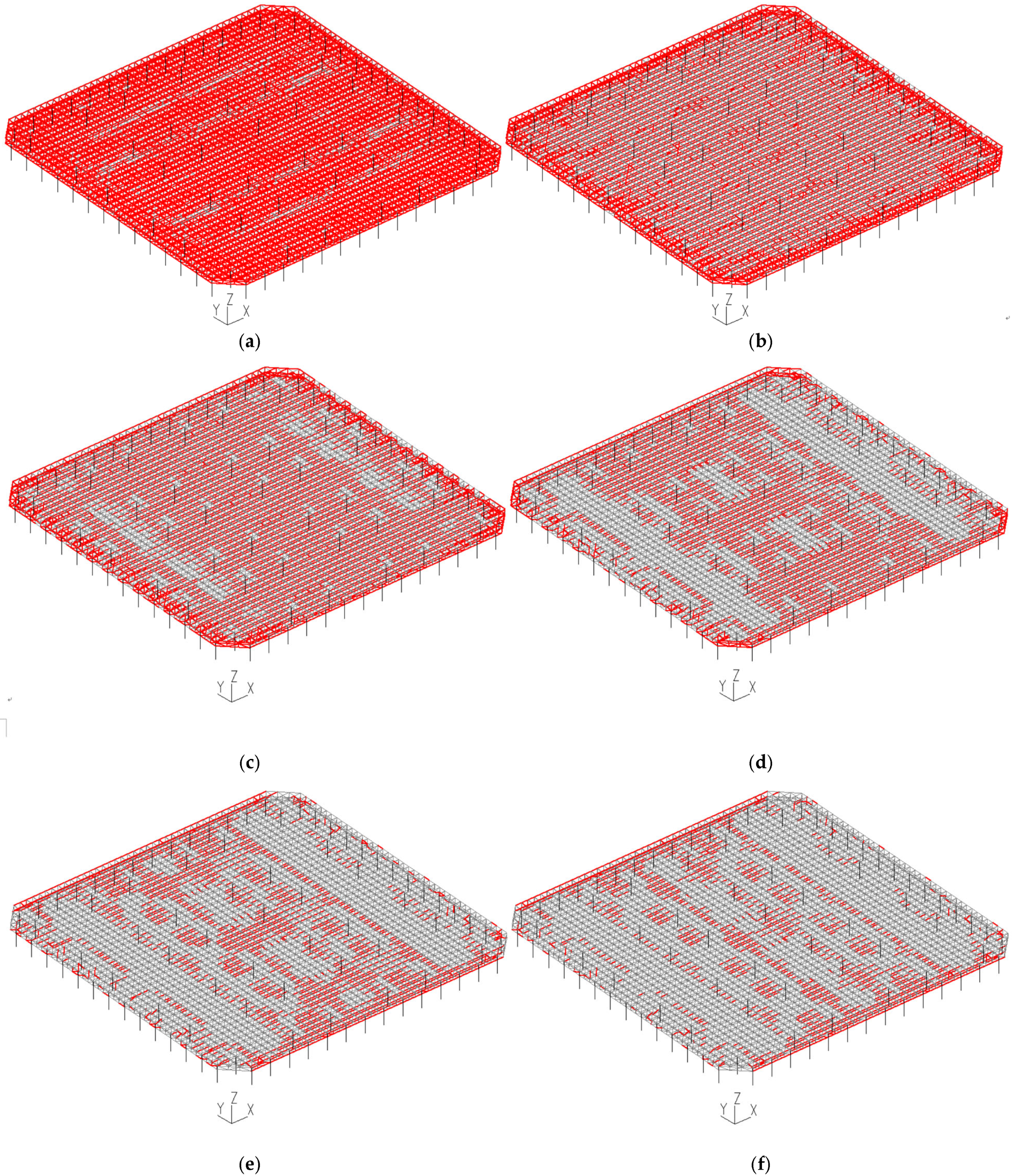
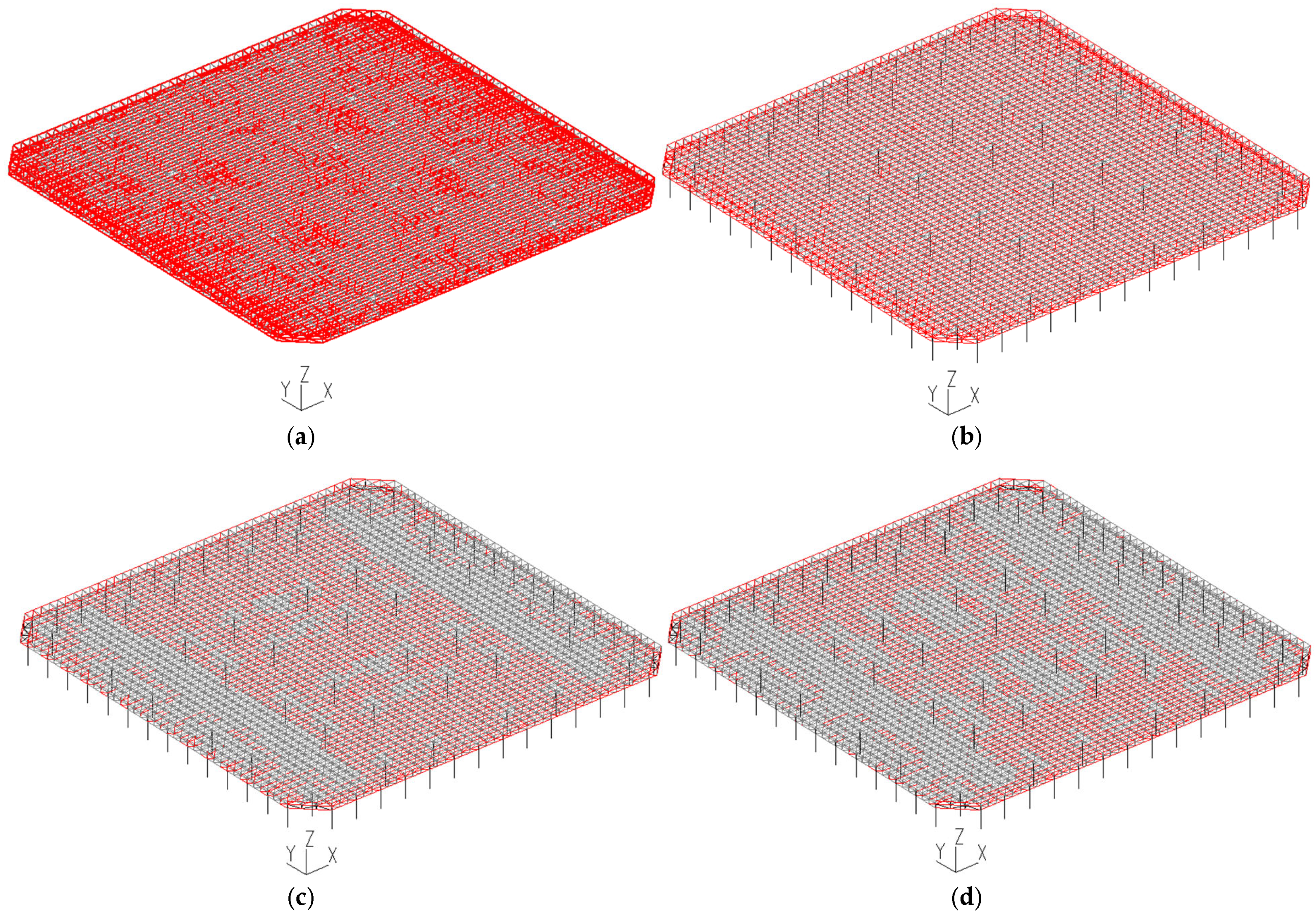
To further investigate the influence of structural planar dimensions on the traveling wave effect, statistical analyses were conducted on the distribution of special members in each model under different apparent wave velocities. Due to space limitations, only the distribution diagrams of the 60 m × 60 m and 90 m × 90 m models are presented in Figure 8 and Figure 9. It can be observed that, following the general rule that the traveling wave effect increases with decreasing apparent wave velocity, special members exhibit a tendency to spread from the support points to the periphery and from the span edges to the mid-span. Close observation of the distribution diagrams at high apparent wave velocity (2400 m·s−1) also reveals that the spread of special members originates from the supports along the length direction. This suggests that support columns along the seismic motion propagation direction generate additional dynamic loads due to excitation time differences, and the resulting traveling wave effect radiates from the support columns to the surrounding areas in a manner similar to energy radiation. The smaller the apparent wave velocity, the larger the time difference and additional dynamic loads, and thus the wider the influence range of the traveling wave effect. This conclusion explains why the traveling wave effect is related to structural length but has no obvious correlation with structural span.

4. Analysis of Traveling Wave Effect in Flat Grid Shells with Different Column Heights

If the above conclusion holds, it can be further inferred that the traveling wave effect radiates from the supports distributed along the seismic wave propagation direction, and its radiation range is related to the apparent wave velocity. Therefore, the higher the lower supporting structures, the smaller the traveling wave effect on the upper roof structure. To verify this, the heights of the lower support columns in each model were adjusted to 0 m (analyzing only the roof), 3 m, 7 m, and 9 m, respectively, and the proportion and distribution of special members under three seismic wave excitations were statistically analyzed.
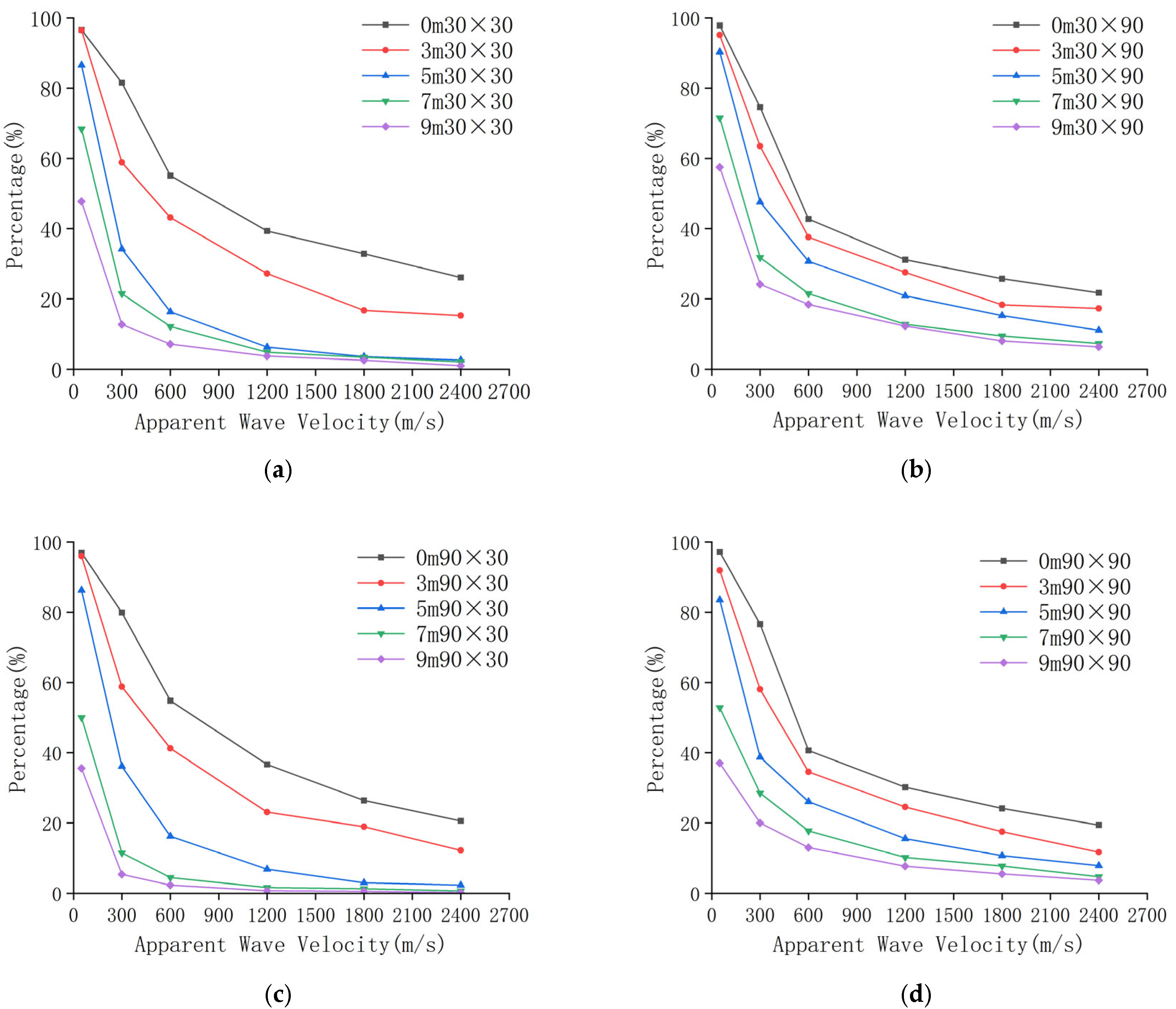
Table 4 and Table 5 present the envelope values of the proportion of special members in grid shells with different planar dimensions and column heights. The variation trends of the proportion of special members in four planar dimensions (30 m × 30 m, 30 m × 90 m, 90 m × 30 m, and 90 m × 90 m) are shown in Figure 10. It can be observed that when the structural planar dimension and apparent wave velocity are constant, the proportion of special members decreases with the increase in support column height, indicating that the influence of the traveling wave effect on the roof decreases accordingly. Figure 11 and Figure 12 show the distribution positions of special members in the 60 m × 60 m and 90 m × 90 m models at an apparent wave velocity of 600 m·s−1 under different column heights. As the column height decreases, the same trend as previously described (“special members spread from the supports to the periphery and from the span edges to the mid-span”) is observed. This confirms the above inference and indirectly indicates that the seismic calculation of such roof structures cannot ignore the influence of the synergistic effect between the lower structures and the roof.

5. Analysis of Traveling Wave Effect in Flat Grid Shells with Different Support Column Spacings

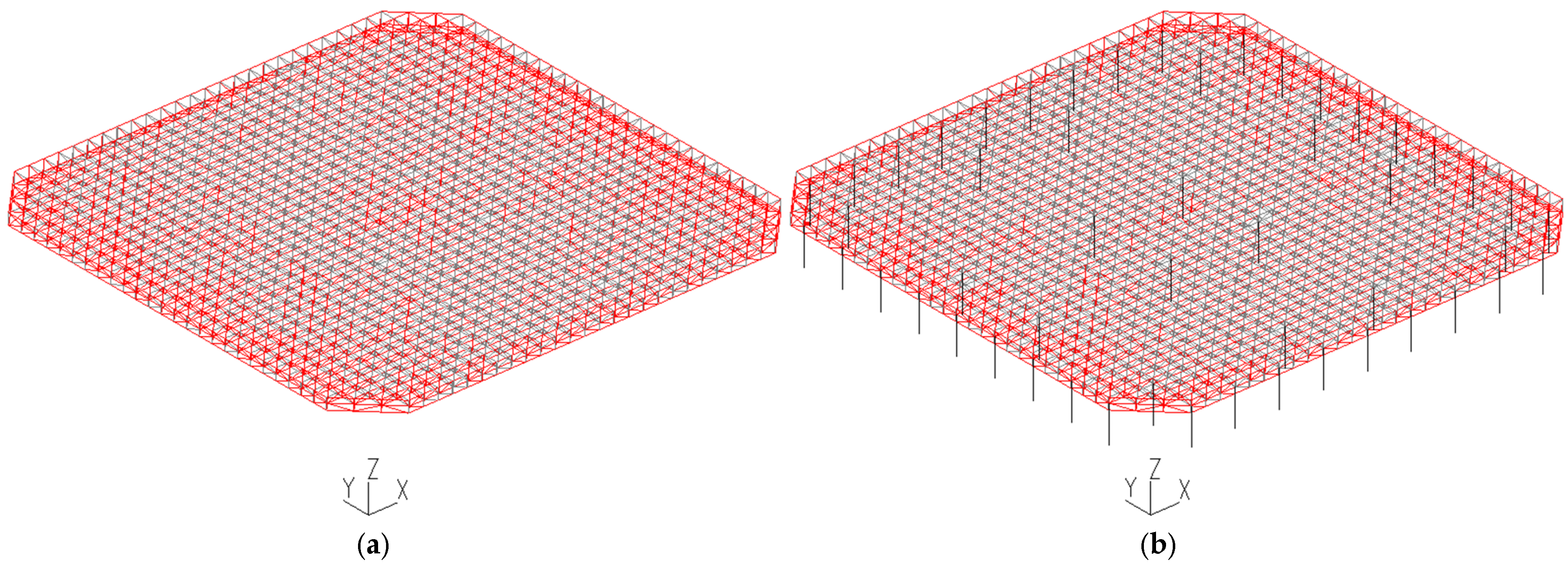
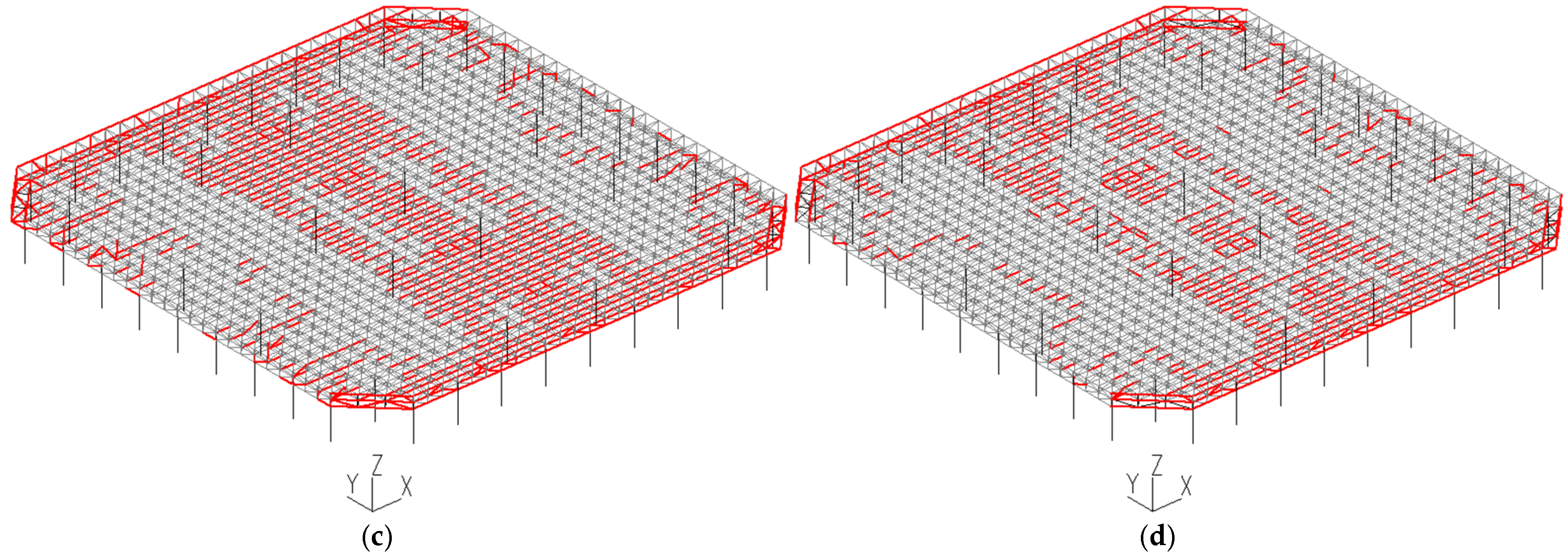
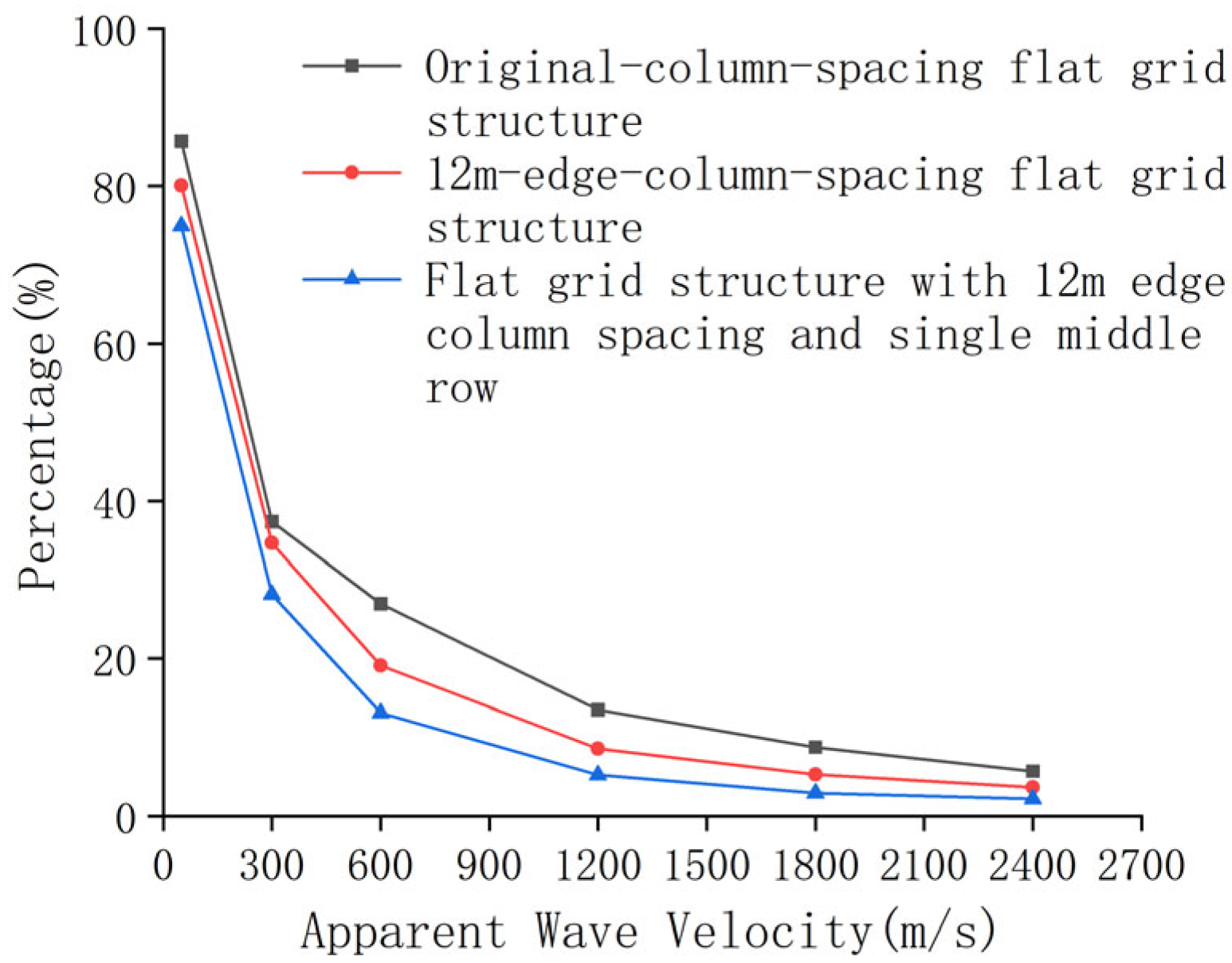
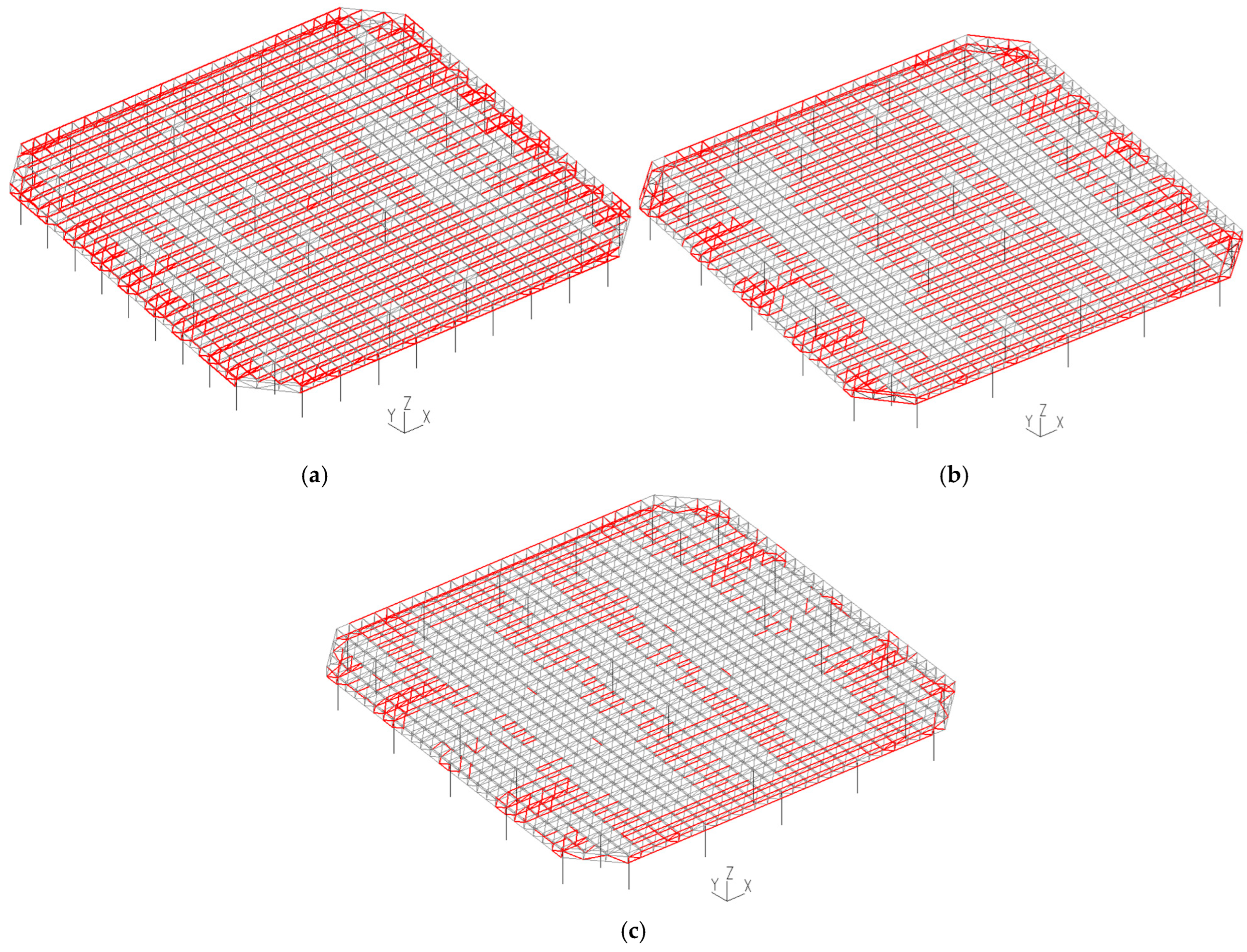
Based on the above conclusions, it can be inferred that increasing the support spacing does not alter the radiation range of the traveling wave effect from individual support points, but the overall reduction in the number of supports will lead to a decrease in the radiation range of the traveling wave effect. To verify this, take a flat grid shell with a planar dimension of 60 m × 60 m and a column height of 5 m as an example. The edge support columns were first adjusted from the original column spacing of 6 m to 12 m, and the two rows of middle columns at the 24 m and 36 m positions along the length were reduced to a single row at the 30 m position. The envelope values of the proportion of special members in the three models were statistically analyzed, along with the distribution of special members at an apparent wave velocity of 600 m·s−1, as shown in Figure 13 and Figure 14.
As indicated in Figure 13, increasing the column spacing leads to a reduction in the proportion of special members, suggesting that the traveling wave effect decreases accordingly. Comparing Figure 14a,b, it can be seen that the reduction in special members occurs near the edge supports along the length direction. Comparing Figure 14b,c, the reduced area of special members is concentrated near the middle row of support columns. Both phenomena correspond to the increase in support column spacing. This confirms the above inference.

6. Conclusions

Through comparative seismic response analyses of flat grid shells with different planar dimensions, support column heights, and column spacings under multi-apparent-wave-velocity multi-point input and uniform input along the structural length direction, the following conclusions are drawn:
(1).
From the seismic response laws of flat grid shells with different planar dimensions (ranged from 30 m to 90 m), statistical analysis of the proportion of special members reveals that the traveling wave effect becomes more pronounced as structural length increases. However, in most cases, increasing the structural span reduces this effect. The distribution of special members shows that as the apparent wave velocity decreases, these members spread from support points to the periphery and from the span edges toward the mid-span;
(2).
Comparing the seismic response laws of flat grid shells with different column heights (range from 0 m to 9 m), it is found that the traveling wave effect becomes more significant as column height decreases. Similarly, special members exhibit a spreading trend from support points to the periphery and from span edges to the mid-span;
(3).
Analysis of the seismic response laws for flat grid shells with different column spacings (ranged from 6 m to 12 m for peripheral columns and from 18 m to 24 m for internal columns) indicates that increasing the spacing of either edge columns or middle columns reduces the influence of the traveling wave effect near these columns;
(4).
In summary, the traveling wave effect can be regarded as an additional dynamic load generated by support columns along the seismic wave propagation direction due to excitation time differences. These loads radiate outward from the support columns in a manner similar to energy radiation. A smaller apparent wave velocity leads to a larger time difference, greater additional dynamic loads, and a wider influence range of the traveling wave effect. Due to the limited influence range, when the structural span or height exceeds a certain size, further increases will reduce the overall impact of the traveling wave effect on the structure;
(5).
Regarding the traveling wave effect analysis for flat grid structures with varying column heights, the variation in substructural stiffness induced by changes in column height may represent the underlying mechanism for the observed alterations in the traveling wave effect patterns, which will be worth further in-depth investigation.
This study has the following limitations: The analysis is confined to a square pyramid flat grid structure with a specific configuration and topology. Consequently, other structural forms and topological layouts of grid systems are needed for further verifying the above conclusion.

Author Contributions

Conceptualization, X.Z.; methodology, Z.Z.; software, J.J.; resources, W.C.; data curation, Z.K.; writing—original draft, J.W.; writing—review and editing, Z.Z. All authors have read and agreed to the published version of the manuscript.

Funding

This research was funded by National Natural Science Foundation of China, grant number 52078476; Zhangjiakou Science and Technology Bureau, grant number 2511025A. The APC was funded by National Natural Science Foundation of China and Zhangjiakou Science and Technology Bureau.

Data Availability Statement

The original contributions presented in this study are included in the article. Further inquiries can be directed to the corresponding author.

Conflicts of Interest

The authors declare no conflicts of interest.

References

  1. Wang, J.; Song, T.; Zhao, J.; Liu, F.; Zhao, P.; Ma, M. Innovation and practice of spatial structures in China. Build. Sci. 2018, 34, 1–11. (In Chinese) [Google Scholar]
  2. Wang, Y.; Zhao, B.; Ding, D.; Chen, Z.; Jiang, Y.; Shi, Y. Analysis of multi-point seismic input response of steel structure of Hefei Xinqiao international airport terminal. Space Struct. 2013, 19, 74–80. (In Chinese) [Google Scholar]
  3. Cao, Z.; Zhang, Y.; Xue, S.; Li, X. Progress and application of spatial structure analysis in China in the past 20 years. Build. Struct. 2014, 44, 27–32. (In Chinese) [Google Scholar]
  4. Shi, G.; Chen, J.; Chen, H. Research progress on collaborative work between upper long-span steel structures and lower concrete structures. Steel structure engineering research (10). In Proceedings of the 14th Academic Exchange Conference and Teaching Seminar of the Structural Stability and Fatigue Branch of the China Steel Structure Association (ISSF-2014), Hefei, China, 21–24 August 2014; Editorial Department of Steel Structures: Beijing, China, 2014; pp. 48–60. (In Chinese). [Google Scholar]
  5. Zucca, M.; Crespi, P.; Tropeano, G.; Simoncelli, M. On the influence of shallow underground structures in the evaluation of the seismic signals. Ing. Sismica 2021, 38, 23–35. [Google Scholar]
  6. GB/T50011; 2010 Code for Seismic Design of Buildings. Standardization of Engineering Construction: Beijing, China, 2024. (In Chinese)
  7. Su, T.; Qin, N.; Wang, T. Seismic response analysis of super-long reticulated shell structures. J. Hebei United Univ. (Nat. Sci. Ed.) 2015, 37, 80–88, 105. (In Chinese) [Google Scholar]
  8. Huang, Z.; Xue, S.; Li, X. Analysis on the seismic response characteristics of super-long grid structures under multi-dimensional and multi-point Inputs. In Proceedings of the 10th National Academic Symposium on Modern Structural Engineering, Shanghai, China, 23–26 July 2010; Industrial Building Magazine: Beijing, China, 2010; pp. 799–805. (In Chinese). [Google Scholar]
  9. Zhou, X.; Guo, Q.; Li, Y.; Zhang, Y.; Hu, J.; Wang, J. Minimum planar dimension of double-layer cylindrical reticulated shells considering traveling wave effect. Ind. Build. 2022, 52, 77–82. (In Chinese) [Google Scholar]
  10. Qin, J. Analysis and Experimental Study on Seismic Performance of Super-Long Single-Layer Cylindrical Reticulated Shells Under Traveling Wave Effect; Beijing University of Technology: Beijing, China, 2012. (In Chinese) [Google Scholar]
  11. Gu, Z.; Tang, T.; Xu, Y.; Wu, K. Random seismic response of long-span isolated structures under rare earthquakes. Sci. Technol. Eng. 2019, 19, 281–287. (In Chinese) [Google Scholar]
  12. Li, X. Multi-Dimensional and Multi-Point Seismic Response Analysis of Long-Span Steel Structures Supported by Double Arches; South China University of Technology: Guangzhou, China, 2014. (In Chinese) [Google Scholar]
  13. Zhou, X.; Jia, J.; Zhou, Z.; Hao, Y.; Liu, H.; Chen, H.; Hu, J. Analysis on the critical apparent wave velocity of double-layer cylindrical reticulated shells considering traveling wave effect. Ind. Build. 2023, 53, 129–132, 50. (In Chinese) [Google Scholar]
  14. Zhao, Y.; Ren, Y.; Ren, Y. Analysis on the synergistic effect of long-span grid structures and their supporting structures. Build. Struct. 2014, 44, 49–53. (In Chinese) [Google Scholar]
  15. Shang, H. Seismic Response Analysis of Long-Span Grid Structures Under Multi-Dimensional and Multi-Point Inputs; Xi’an University of Architecture and Technology: Xi’an, China, 2014. (In Chinese) [Google Scholar]
  16. Yu, Y.; Li, Z.; Hu, H.; Wang, Z. Design and analysis of special-shaped grid structure of Qingdao Fangxing Exhibition Hall. Build. Struct. 2017, 47, 25–29, 19. (In Chinese) [Google Scholar]
  17. Wang, J.; Zhou, X.; Mao, L.; Hu, H. Comparative Study of Ground Motion Input Methods for Seismic Analysis of Underground Structures. Mod. Tunn. Technol. 2015, 52, 103–109. (In Chinese) [Google Scholar]
  18. Zhang, Y. Seismic Analysis of a Steel Roof with Prestressed Cable Network Using ANSYS. Build. Struct. 2012, 42, 658–661. (In Chinese) [Google Scholar]
  19. Zhao, X.; Shang, H. Seismic response analysis of long-span grid structures under multi-point excitation. J. Guangxi Univ. (Nat. Sci. Ed.) 2015, 40, 66–72. (In Chinese) [Google Scholar]
  20. Shen, S.; Zhang, W.; Zhu, D.; Qian, J.; Pei, Y. Seismic response analysis of long-span hangar structures under multi-point input. China Civ. Eng. J. 2008, 2, 17–21. (In Chinese) [Google Scholar]
  21. Ke, S. Seismic Response Analysis of Long-Span Spatial Grid Structures Under Multi-Point Input; Institute of Engineering Mechanics, China Earthquake Administration: Harbin, China, 2009. (In Chinese) [Google Scholar]
Figure 1. Structural Model: (a) Structural prototypes; (b) Structural models for analysis.
Buildings 15 04252 g001
Figure 2. Acceleration time history curve: (a) El-Centro wave acceleration time history curve; (b) Taft wave acceleration time history curve; (c) Artificial wave acceleration time history curve.
Buildings 15 04252 g002
Figure 3. Time history curve of earthquake influence coefficient: (a) Standardized Response Spectrum Curve; (b) Seismic Spectrum Verification.
Buildings 15 04252 g003
Figure 4. Statistics of the proportion of special members under different apparent wave velocities.
Buildings 15 04252 g004
Figure 5. Distribution positions of special members with a visual wave velocity of 600 m·s−1 (red: special members; gray: conventional members): (a) Engineering prototype 30 m × 30 m; (b) Simplified model 30 m × 30 m.
Buildings 15 04252 g005
Figure 6. Distribution positions of special members with a visual wave velocity of 1800 m·s−1 (red: special members; gray: conventional members): (a) Engineering prototype 30 m × 30 m; (b) Simplified model 30 m × 30 m.
Buildings 15 04252 g006
Figure 7. Statistics of the proportion of special members in structural models with different plane sizes: (a) Statistics on the proportion of special members under Elcentro waves; (b) Statistics on the proportion of special members under Taft waves; (c) Statistics on the proportion of special members under artificial waves; (d) Statistics on the proportion of special members with envelope values of three seismic waves.
Buildings 15 04252 g007
Figure 8. Distribution positions of special members under different apparent wave velocities (60 m × 60 m, red: special members; gray: conventional members): (a) Apparent wave velocity 50 m·s−1; (b) Apparent wave velocity 300 m·s−1; (c) Apparent wave velocity 600 m·s−1; (d) Apparent wave velocity 1200 m·s−1; (e) Apparent wave velocity 1800 m·s−1; (f) Apparent wave velocity 2400 m·s−1.
Buildings 15 04252 g008
Figure 9. Distribution positions of special members under different apparent wave velocities (90 m × 90 m, red: special members; gray: conventional members): (a) Apparent wave velocity 50 m·s−1; (b) Apparent wave velocity 300 m·s−1; (c) Apparent wave velocity 600 m·s−1; (d) Apparent wave velocity 1200 m·s−1; (e) Apparent wave velocity 1800 m·s−1; (f) Apparent wave velocity 2400 m·s−1.
Buildings 15 04252 g009
Figure 10. Statistics of the proportion of column height variation in the same plane size structural model S ζ ≥ 1.2: (a) Structural plane size 30 m × 30 m; (b) Structural plane size 30 m × 90 m; (c) Structural plane size 90 m × 30 m; (d) Structural plane size 90 m × 90 m.
Buildings 15 04252 g010
Figure 11. Distribution of Special Members with Structural Plane Dimensions (60 m × 60 m) and a Visual Wave Velocity of 600 m·s−1 (red: special members; gray: conventional members): (a) Distribution position of special members with column height (0 m); (b) Distribution position of special members with a column height of 3 m; (c) Distribution position of special members with column height (7 m); (d) Distribution position of special members with a column height of 9 m.
Buildings 15 04252 g011aBuildings 15 04252 g011b
Figure 12. Distribution of Special Members with Structural Plane Dimensions (90 m × 90 m) at a Wave Velocity of 600 m·s−1 (red: special members; gray: conventional members): (a) Distribution position of special members with column height (0 m); (b) Distribution position of special members with a column height of 3 m; (c) Distribution position of special members with column height (7 m); (d) Distribution position of special members with a column height of 9 m.
Buildings 15 04252 g012
Figure 13. Envelope values of the proportion of special members in flat grid structures with different column spacings and plane dimensions of 60 m × 60 m.
Buildings 15 04252 g013
Figure 14. Distribution positions of special members in flat grid structures with different column spacings and plane dimensions of 60 m × 60 m at a visual wave velocity of 600 m·s−1 (red: special members; gray: conventional members): (a) Distribution position of special members in the original column spacing flat grid structure; (b) Distribution position of special members in the flat grid with increased column spacing to 12 m; (c) The distribution position of special members in the flat grid structure with increased column spacing to 12 m and reduced middle columns to a row.
Buildings 15 04252 g014
Table 1. First 10 natural frequencies, formations of the structure, effective masses and their directions.
Serial NumberEngineering PrototypesSimplify the Flat Rack
Frequency/HzFormationEffective Mass/tDirection of Effective MassFrequency/HzFormationEffective Mass/tDirection of Effective Mass
13.88Vertical vibration65.78Z3.91Vertical vibration45.19Z
25.06Lateral torsion38.47Y6.70Lateral torsion173Y
35.07Longitudinal translation and torsion39.2X6.70Longitudinal translation and torsion173X
46.64Transverse translation and torsion138Y7.50Transverse translation and torsion29.28Y
56.64Longitudinal translation and torsion138X7.50Longitudinal translation and torsion29.28X
66.97Lateral torsion3.18 × 10−2Y8.35Lateral torsion0-
77.69Vertical torsion2.53 × 10−4Z9.39Lateral torsion0-
87.92Lateral torsion2.92 × 10−4Y10.72Vertical torsion0-
910.03Vertical torsion2.55X11.10Longitudinal translation and torsion32.15X
1010.04Lateral torsion2.49Y11.10Transverse translation and torsion32.15Y
Table 2. Statistics of the proportion of special members under different apparent wave velocities with ζ ≥ 1.2 (%).
Span × LengthThe Total Number of MembersEl-Centro Apparent Wave Velocity (m·s−1)Taft Apparent Wave Velocity (m·s−1)
5030060012001800240050300600120018002400
30 × 30204884.8231.9114.456.243.532.6081.3933.3713.725.511.871.25
30 × 604340 88.0241.5028.1016.3012.067.7784.2841.5528.5316.3711.968.10
30 × 90588887.6247.5830.6919.4914.8010.9488.4143.8229.1418.8714.779.75
60 × 30434087.1834.3617.467.323.732.8379.4034.1815.855.503.532.36
60 × 60818083.7037.3924.3712.987.925.5677.2936.2323.3612.518.374.03
60 × 9012,02080.6138.4126.6715.6010.857.6779.6237.1527.3614.3110.886.89
90 × 30588885.3536.1716.226.862.982.2876.7135.5315.905.831.921.50
90 × 6012,02080.2336.9422.3711.276.494.7475.4835.5823.4710.965.883.73
90 × 9017,60080.0037.3526.0815.4210.457.4177.5536.9424.7914.769.876.16
Table 3. Statistics of the proportion of special members under different apparent wave velocities with ζ ≥ 1.2 (%).
Span × LengthThe Total Number of MembersArtificial Wave Apparent Wave Velocity (m·s−1)Envelope Value Apparent Wave Velocity (m·s−1)
5030060012001800240050300600120018002400
30 × 30204886.5634.2216.324.063.032.4986.5634.2216.326.243.532.60
30 × 60434089.3138.9226.7015.1211.756.6689.3141.5528.5316.3712.068.10
30 × 90588890.3143.7329.9420.8815.2611.0990.3147.5830.6920.8815.2611.09
60 × 30434088.2033.4617.135.103.471.7280.2234.3617.467.323.732.83
60 × 60818085.7137.0526.9613.518.765.7085.7137.3926.9613.518.765.70
60 × 9012,02085.6138.5527.1216.7311.258.2985.6138.5527.3616.7311.258.29
90 × 30588886.2736.1515.674.482.072.7086.2736.1716.226.862.982.70
90 × 6012,02082.8237.4124.6811.936.625.2282.8237.4124.6811.936.625.22
90 × 9017,60083.4937.7721.9815.5310.687.5183.4938.7726.0815.5310.687.51
Table 4. Statistics of the proportion of column height variation in different plane size structural models with ζ ≥ 1.2 (%).
Span × LengthTotal Number of PolesColumn Height (0 m) Apparent Wave Velocity (m·s−1)Column Height (3 m) Apparent Wave Velocity (m·s−1)
5030060012001800240050300600120018002400
30 × 30230096.5781.5555.0939.3532.8526.0996.4758.8443.1927.2316.7415.28
30 × 60434096.0172.8646.9535.8028.1523.2594.3061.9340.3428.8819.0417.71
30 × 90588897.8274.5542.7431.1525.7321.7395.3263.4637.5927.5418.3317.31
60 × 30434095.6680.0353.6838.6429.3923.7593.5254.2941.9826.1017.7513.40
60 × 60818097.0073.9647.2246.1834.3720.3493.0557.5638.6726.3318.4413.75
60 × 9012,02096.3672.6140.4229.9623.9519.4491.2158.7035.0524.2818.8612.80
90 × 30588896.9479.9154.8036.6626.3920.5995.9558.8041.2323.0818.9612.23
90 × 6012,02095.9369.8942.7831.1823.5418.5090.9754.7436.8124.4417.6311.60
90 × 9017,60097.1876.6140.6330.1924.1319.4191.8758.0834.5624.5417.5511.72
Table 5. Statistics of the proportion of column height variation in different plane size structural models with ζ ≥ 1.2 (%).
Span × LengthTotal Number of PolesColumn Height (7 m) Apparent Wave Velocity (m·s−1)Column Height (9 m) Apparent Wave Velocity (m·s−1)
5030060012001800240050300600120018002400
30 × 30230068.4321.4812.174.783.361.0947.7412.707.133.742.550.98
30 × 60434066.7428.1817.8110.077.835.1653.3519.9514.848.855.374.39
30 × 90588871.5531.7921.4712.779.447.3057.5124.1518.4412.268.036.35
60 × 30434051.9115.627.102.671.551.0138.188.203.501.341.980.69
60 × 60818054.0125.2213.445.543.592.6941.5015.499.805.574.212.64
60 × 9012,02059.4329.6018.7211.918.115.5742.1322.2815.669.786.234.68
90 × 30588850.0011.454.451.631.270.6535.565.372.310.710.540.24
90 × 6012,02050.2223.4812.485.463.082.6237.8514.919.335.373.032.50
90 × 9017,60052.8328.5117.7810.187.764.7137.0820.0013.017.715.503.68
Disclaimer/Publisher’s Note: The statements, opinions and data contained in all publications are solely those of the individual author(s) and contributor(s) and not of MDPI and/or the editor(s). MDPI and/or the editor(s) disclaim responsibility for any injury to people or property resulting from any ideas, methods, instructions or products referred to in the content.