
Article

Eco-Friendly Design and Practice of Integrating Agricultural and Fishery Waste into Modern Architecture

College of Arts and Design, Jimei University, Xiamen 361021, China
*
Author to whom correspondence should be addressed.
These authors contributed equally to this work.
Buildings 2025, 15(22), 4109; https://doi.org/10.3390/buildings15224109
Submission received: 17 October 2025 / Revised: 8 November 2025 / Accepted: 11 November 2025 / Published: 14 November 2025
(This article belongs to the Special Issue Trends and Prospects in Sustainable Green Building Materials)

Abstract

This study employs a practice-oriented research method, emphasizing practical application rather than laboratory testing, and was conducted in Pingtung County, Taiwan, from 2017 to 2023. The practical results of the five case studies demonstrate that (1) eco-friendly buildings integrating agricultural and fishery waste overcome the obstacles of obtaining building permits and (2) the carbon emissions of exterior walls made of pozzolana are only 44% of those of reinforced concrete. This study contributes to understanding the contemporary characteristics of sustainable buildings and provides directly applicable insights into and suggestions on how buildings can actively utilize local materials.

1. Introduction

From the perspective of human geography, cities are the most ambitious expression of humankind’s desire to achieve perfect harmony between one’s physical environment and social ties, but houses in both cities and the surrounding countryside are full of chaos. A building built by human occupants to protect against chaos is also a permanent reminder of humanity’s trauma [1]. Therefore, nature is transformed by a variety of human efforts to escape its threats. In order to escape the natural world’s unreliability and cruelty, humans must create a more stable artificial world and use this to connect with nature [2]. Exploring human beings’ adaptation and self-construction in the face of environmental threats is the core of geography, and the key to this exploration is the continuously evolving relationship between humans and the environment [3].
Humans build residences out of fear of natural disasters, but the metropolis is another site of disaster [2]; throughout history, large cities such as Rome [4], Loyang (China) [5], and Tokyo (Japan) [6] have all experienced devastating fires. In response, regulations for disaster prevention controls stipulated the use of non-combustible building materials [7] and prohibited windows [8] in order to prevent the spread of fire in densely built cities. Due to this control over building materials and forms, cities have been shaped into places full of both highly dense buildings and fear, a fear that comes from the threat of natural disasters and keeps us away from nature. Architecture in cities is viewed by human geographers as a source of fear [1], while scholars of political economic geography view it as a tool for capital accumulation and centralized governance.
Harvey [9] pointed out that the modernization of Paris completely transformed the relationship between man and nature. In the early 17th and 18th centuries, the urban expansion of Paris made the city more chaotic [10], despite further standardizing architectural styles and materials. However, urban renewal in the 19th century was completely embedded in political and economic practices. In Paris, building materials were chosen for fire protection, but with a focus on protecting assets (houses were rented out at a high profit at that time); specifying bricks and stones as building materials worked to maintain tax revenue and mobilize capital to invest in destruction and reconstruction. The materials of the city’s buildings have since changed from wood, bamboo, stone, and brick to glass, steel, and concrete. Centralized city governance created the transformation and modernization of Paris; all buildings went up in compliance with regulations, and nature was constructed according to specific categories, such as lakeside areas suitable for picnics or quiet country roads that were carefully arranged in specific spaces [9]. Therefore, after Paris’ transformation, it became a “modern city” that countries all over the world are still trying to emulate.
The image of Paris’ urban upgrading opened up the bourgeois imagination towards exercising power over space and was a key intersection between building materials and political economy. The transformation from natural materials to artificial materials is not only an urban renewal of architectural appearance, but also a metaphor for centralized governance and capital accumulation. The idea that urban renewal equals the renewal of forms and materials was successfully shaped in Paris, and this image was promoted around the world through the World Expo, influencing urban renewal in key cities such as London, Manchester, Liverpool, Berlin, Vienna, New York, Hong Kong, and Tokyo [11,12].
Observing the evolving relationship between humans and the environment from the perspective of urban renewal, fires have been controlled through the use of non-combustible materials such as reinforced concrete, but the biggest problems at present are disasters caused by the inability of the artificial environment to adapt to climate change. Paradoxically, the massive consumption by this artificial environment of natural resources is also the initiator of climate change. Even though the trend of returning to nature is spreading around the world, scholars continue to propose new building materials, showing that human beings urgently need to find breakthrough points in their adaptation and self-construction in the face of environmental threats. Recent research has sought explanations for environmental adaptations in vernacular architecture, such as the resilience of buildings to natural disasters [13]. However, such studies employ a historical review approach, providing explanations based on existing conditions, which is entirely different from explanations derived through practice. This is because the construction process involves numerous variables, such as climate, craftspeople, and materials, all of which influence the final outcome of the building. Focusing solely on the result and interpreting it in a way that prioritizes the outcome over the process can lead to errors in practical application.
Another type of research combines technological trends. This type of research uses technology and material testing through practices such as mixing rice husks with concrete and using 3D printing to obtain experimental parameters for new building materials with low environmental impact [14]. Such research offers more architectural diversity, providing modern versions of vernacular architecture. However, the problem lies in the industrial technology-based practices employed, which create high economic barriers, making construction costs unaffordable for the average person. Furthermore, high-tech construction techniques sever the connection between people, architecture, and the environment, for example, by touting low-labor machine replacement [15] or high-efficiency time control [16].
Projecting building materials back to nature has been a significant trend in recent years, including the thermal insulation of rice husks [17,18,19,20,21,22], the fire-retardant, moisture-proof, and insulating properties of oyster shells powder [23,24,25,26], and the use of natural bamboo (or fibers) for structural resilience [27,28]. These materials, with their advantages of biodegradability, ease of application, and environmental friendliness, pose a competitive challenge to non-degradable thermoplastics. Moreover, raw materials are not simply used as tools to construct a building, but also as a strategy for social engagement, sustainable development, and cultural continuity [29]. The social functions inherent in the construction process cannot be replaced by machinery, nor can they disappear.
Our previous study points out that using natural materials to respond to the geographical characteristics of buildings is a direction of architectural thinking. Using mainly local materials to construct a building can achieve circular economic and near-zero emissions goals [30]. In this study, we take a more cutting-edge approach to discussing the decoupling of modern building materials from the environment and how to reconnect them. This study delves deeper into the social constraints of the construction industry, presenting concrete data to demonstrate that environmental friendliness is not just a slogan, but something that can be practiced in every building. This study advocates that overcoming the capital accumulation and centralized management of building materials is the core of the problem, and does so specifically by using natural materials in construction, which is also the most direct way to restore the relationship between humanity and nature.
Academics studying global environmental change are increasingly focusing on new strategies for turning local knowledge into action [30,31,32,33,34,35,36]. Building insulation materials made from agricultural waste can produce products with less impact on the environment and make full use of natural resources [37,38]. However, the latest research points out that if the laws and regulations set by the government are not updated to adapt to environmental changes, buildings may not be able to cope with environmental disasters [39]. In addition, in areas prone to natural disasters, building materials should respond to environmental characteristics. Recent research often considers climate change-related disasters as variables, such as heat resistance and energy reduction as indicators of resilience. It also draws on traditional architectural methods, such as the use of thick walls and roofs for insulation, optimized orientation to reduce solar radiation absorption, and natural ventilation in India [40]. Another type is inland disasters, such as those in Nepal and the Eastern Black Sea region of Turkey, which face natural disasters like earthquakes and landslides. These are addressed with passive design strategies, emphasizing adaptation to local conditions [13]. The small islands of Bangladesh have enhanced their resilience to cyclones, largely thanks to local wisdom in dealing with periodic disasters. These accumulated, traditional strategies are dynamic and constantly influenced by internal creativity, experimentation, and interaction with external systems [41]. The lesson of vernacular architecture is that we must pay attention to the differences in geographical conditions and adapt our governance methods to local conditions. Governments should also adopt non-destructive reconstruction models to achieve the goal of sustainable development.
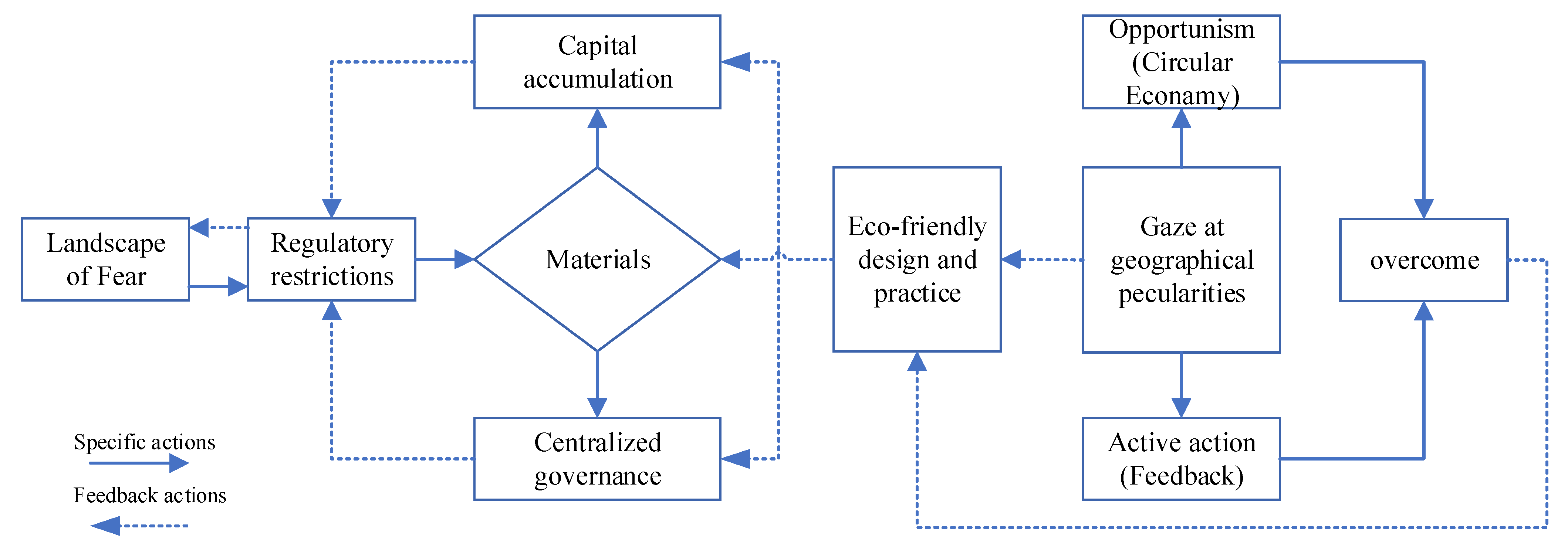
History reveals that opportunism and positive action can enable mankind to create new situations out of fragility, and fishing villages have the oldest of this survival wisdom [42]. The sense of crisis brought about by climate change promotes opportunities and supports global action [43,44]. The global net-zero emissions goal necessitates less production and consumption [45], and is therefore also an important opportunity to promote the transformation of buildings, which must be coordinated with positive action. Based on previous research results [30], this study claims that focusing on geographical features and actively seeking out natural materials can break the cycle of capital accumulation, while being able to move beyond regulations and respond to disasters can help to break through outdated centralized governance thinking (Figure 1). The ultimate goal is to eliminate the fear of dense residential landscapes in cities.

2. Materials and Methods

2.1. Study Area

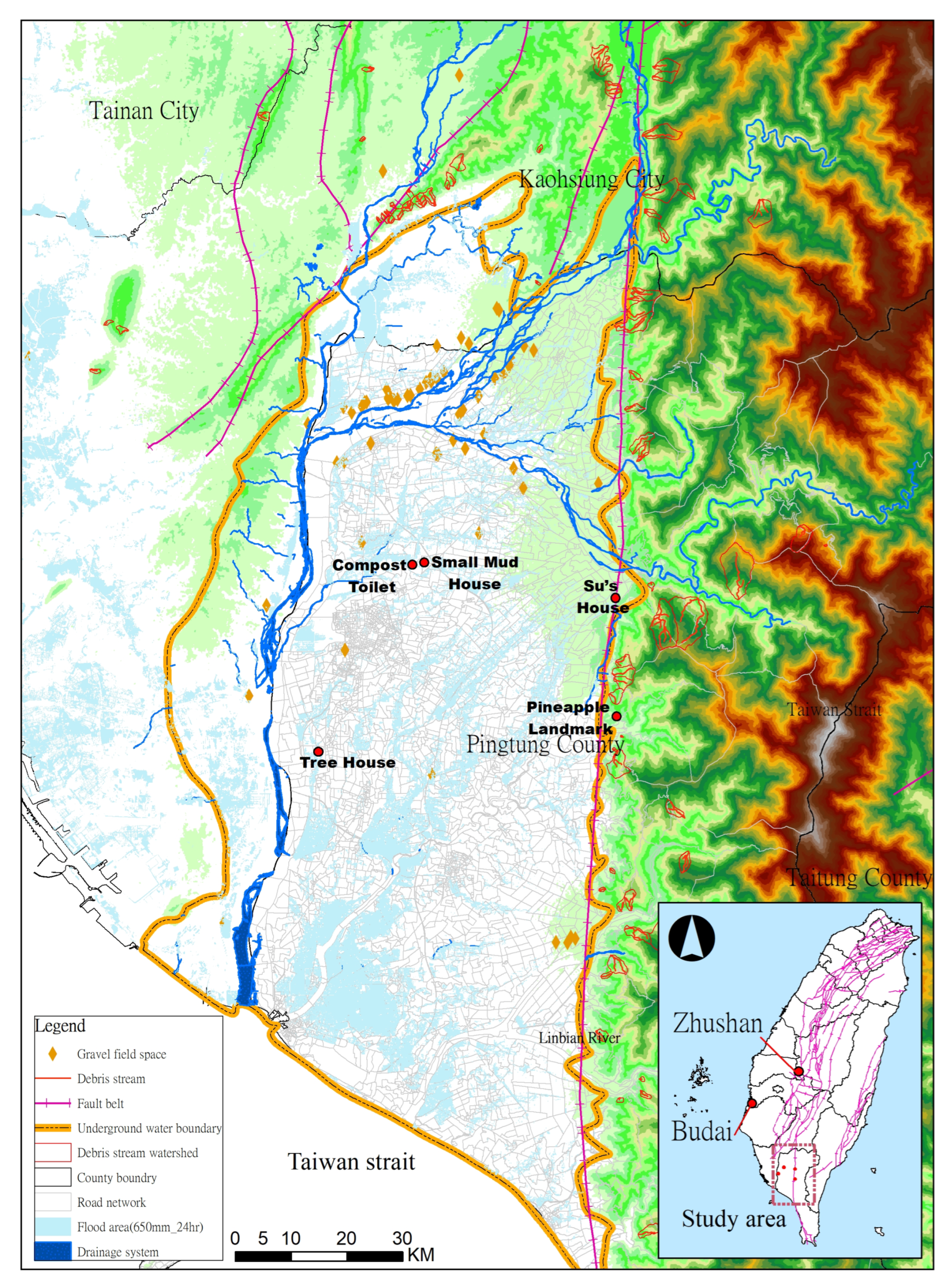
The geographical location of Taiwan’s main island is 120° E to 122° E longitude and 22° N to 25° N latitude. Taiwan is shaped like a sweet potato, with a total length of about 400 km from north to south (Figure 2); plains account for only 30% of the island [46], but this area is subject to the threat of typhoons year-round [47,48,49]. As the plain is located between a fault zone and a trench, it forms a complete geographical area [50,51,52]. This paper’s case studies are located within Pingtung County in southern Taiwan (Figure 2), where the plain terrain is flat and the climate is simultaneously hot and rainy. According to weather station data from 1 to 3 pm on July 7, the temperature on the plain reached 35.5 °C and the relative humidity was 61% [53]. In contrast, the high temperature in the mountainous area reached 36.6 °C and the relative humidity was 37% [54]. The typhoon period spans June to September, with high summer temperatures, and the latest research reports show that hot summers may be extended due to climate change [48,55,56].
In this study, the distribution of the research cases also has its particularities. Two cases are adjacent to fault zones [57,58,59,60,61], where earthquakes and young geology lead to the threat of debris flow near the mountains. The plain area often faces floods, while the top of the alluvial fan is full of sand and gravel from the mountains (Figure 2).

2.2. Practice and Materials

“There are increasing calls from the global environmental change research community for new strategies for translating knowledge into action” [31]. This gap between local knowledge and contemporary action must be filled through active practice. Our strategy was to modify bamboo weaving with pozzolana technology, as well as to improve fire-resistant and seismic properties to meet code requirements and obtain building permits.
This study adopts a practice-based research methodology, emphasizing real-world application rather than lab testing (Tables S1 and S2). The structure of a braided Bamboo with Pozzolana wall was applied to outdoor landscape facilities, which do not require building permits but have the attributes of buildings. They are a kind of interaction between people and nature, an intermediary space. In this study, three landscape facilities were built over a period of three years to observe the waterproof and earthquake-resistant performance of the Bamboo with Pozzolana walls.
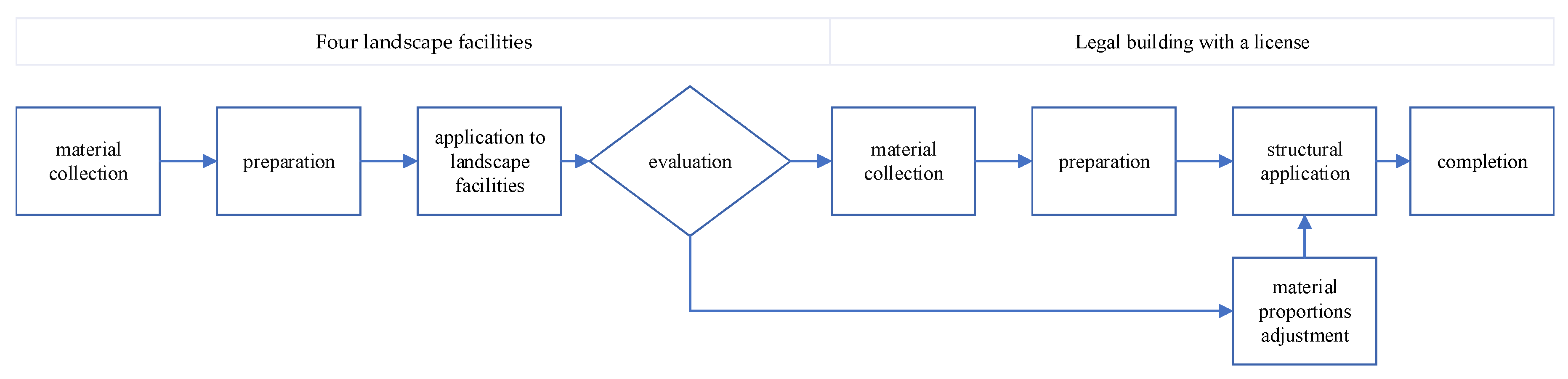
In the second stage, the wall structures made of bamboo and pozzolana were put into practice in a building. Through prior communication with the construction management unit, we ensured that the design was fully compliant with the building regulations and signed and endorsed by the architect, as well as obtaining a construction license after a strict review process. In the construction stage, we cooperated with the construction company and then carried out the rigorous process of contracting, material preparation, construction, acceptance, and obtaining a use license (Figure 3).
This study chose to use the bamboo species Phyllostachys reticulata (Rupr.) K. Koch (called Guizhou in Taiwan), where “reticulata” means “reticulated”. Due to its good material properties, high toughness, and ease of processing, this is the bamboo species most used by the construction industry in Taiwan. The bamboo strips were made from Osmanthus-variety bamboo in Zhushan, Nanto County, central Taiwan. The strips were about 2.5 cm wide, 0.5 cm thick, and 240 cm long (Table 1), made of original materials without being preserved, smoked, or modified in any way. In the five case studies, bamboo strips were woven in different ways, including bolting, iron wire binding, and relying on friction to fix the bamboo strips. While we wove them into exterior walls, following traditional Taiwanese construction methods to create Bamboo with Pozzolana walls, these strips can also be perforated or combined with glass bottles to create indoor lighting. Most of the used building materials were derived from agricultural and fishing waste (Table 2), such as coconut fiber, hemp plant fiber, dry straw, rice husk, and oyster powder, while the other employed materials were waterproof powder, color powder, adhesive, and lime, deployed for connection and bonding in building construction Detailed instructions on mixing materials (Table 3), tools proportions, and basic descriptions of the cases are available in published article [30].

3. Results

3.1. Gazing at the Peculiarities of Geography and Obstacles to Transformation

Taiwan’s geographical location has its own particularities. The island has a tropical monsoon climate, with heavy rainfall concentrated between May and October, and concrete buildings in Taiwan are prone to cracks under the influence of frequent earthquakes. Crack formation is the main defect found in concrete structures. Once cracks appear, they will cause internal water seepage or leakage [62], and in the long run, chemicals within the concrete will seep into the water and accelerate the corrosion of steel. In this corrosive environment, the durability of reinforced concrete is reduced, causing irreversible effects and resulting in damage to the overall structure [63]. Moreover, cracks can also cause water leakage problems inside buildings. Therefore, dealing with the leakage problems of concrete building exterior walls has been a hot topic in Taiwan’s academic construction circles for many years [62,64,65,66,67,68].
Before the rise of modern cities, Taiwanese residents mixed lime, glutinous rice slurry (or sugar), and sand together as a binding material, which was widely used to build exterior walls, bridges, and other masonry structures (called “San-Ho-Tu) [69], and applied to bamboo walls to isolate the bamboo from moisture and help it resist the hot and humid climate [70,71]. Traditional buildings use exterior walls made of bamboo and pozzolana, called “Bamboo with Pozzolana walls”, which are not only tough but also breathable [72]. Research also points out that this combination of natural materials is environmentally sustainable [73]. Bamboo with Pozzolana walls is earthquake-, humidity-, and heat-resistant, and can adapt to the rain and heat of the island’s climate. The Bamboo with Pozzolana house is Taiwanese vernacular and representative of resilient architecture. Bamboo grows across a wide range, but the warm and humid environment between the equator and Tropic of Cancer is the most important growth area. The bamboo forest on the main island of Taiwan accounts for approximately 4.24% of the total area of the island, and traditional Taiwanese buildings use a large amount of bamboo materials [74]. Alongside its rapid growth, short growth period, strong self-renewal ability, high biological quantity, and other characteristics, bamboo itself has obvious environmental benefits in terms of carbon sequestration capabilities [75].
However, the traditional composite building structure of Bamboo with Pozzolana walls, a wooden structure, and adobe brick walls has not been approved by the construction management unit, nor can it become a legal “building”. Because such “illegal construction” cannot pass an architect’s structural safety assessment, it cannot obtain a legal building certificate or a bank loan to finance its construction; instead, it faces the threat of demolition at any time while also requiring the payment of housing taxes. If this type of building is not an illegal construction, it may be banned because of its cultural value and designated for historic property protection [76,77,78].
It has become even more impossible for traditional buildings to obtain legal building permits since the 921 earthquake in 1999, because such buildings cannot be certified as earthquake-resistant [79]. After the earthquake, the government specifically improved the seismic design strength of buildings and required the load-bearing capacity of public facilities to increase by 25% [79,80]. Official buildings with Bamboo with Pozzolana walls began to be viewed from the perspective of cultural heritage [78,81,82,83,84,85,86]. Although the revitalization of Taiwan’s cultural heritage has been emphasized in recent years, these buildings are still ultimately deployed in a performative nature. Instead, the sense of distance between wooden and bamboo buildings has been consolidated, and their sustainable recycling functions such as use, maintenance, replacement, and renewal in daily life have been lost. Moreover, as they cannot become legal buildings, low-cost and energy-saving natural structures cannot be effectively promoted.
It is important to look into natural solutions and treatments that have a lower impact on the environment [37]. The inconsistency between building regulations and environmental sustainability has been questioned by advocates of vernacular architecture over the last century [87,88,89]. However, there are various bottlenecks in promoting sustainable construction processes [90], and even residential builders do not have confidence in their own practice. The main reason for this is that architectural education does not systematically produce the necessary knowledge base in practice [91], with the design and practice of construction practitioners being key to promoting the sustainable development of regulations and construction [90]. The most common problem is a lack of messaging that actually encourages implementing these practices, clarifies the rationale behind the practices, and presents the benefits of driving change [91].

3.2. Factors That Resist Architectural Renewal and Evolution

The fear of spectacle originates from the unchanging parts of concrete reality; the destruction caused by urban fires is one of them, and laws and regulations can reduce anxiety. Once people learn to adapt to or ignore regulations, they will not realize the pressure these regulations cause [1]. Therefore, in the historical context of urban governance, the effect of centralized governance can be achieved by using the restricting power regulations. However, the goal of capital accumulation has led to the stagnation of architectural renewal.
Fire protection regulations restrict material use. Guided by the government’s control of materials and construction manufacturers, reinforced concrete has become the dominant building material. Whether through restoration or new construction, Taiwan’s construction industry has always been the driving force behind the entire economic system. Sand and gravel mainly come from river dredging, which is low-cost and has the lowest construction threshold. The government uses infrastructure construction to increase the domestic market demand for reinforced concrete and control the price of materials. Therefore, the architectural gene of reinforced concrete dominates the appearance of Taiwan’s architecture.
Pingtung County (Figure 2) has been an important sand and gravel production center in Taiwan since the 1960s [92], with its quarries accounting for one-third of Taiwan’s total sand and gravel output [47,93]. However, under pressure due to serious illegal sand and gravel mining, in 1993, Executive Yuan announced the “Improvement Plan to Suppress Illegal Sand and Gravel Mining”, prohibiting mining to protect the environmental watershed, although this caused backlash from interest groups. Typhoon Morakot in 2008 produced a large amount of sand and gravel in various river basins in Pingtung County, which gave the government and interest groups an opportunity to promulgate the “Pingtung County Special Tax Autonomous Regulations on the Landscape Maintenance Regulations of Soil and Stone Collection” after the end of the special regulations on storm disasters [94]. This legislation enables the government to grant legal rights to sand and gravel mining, which the government then collects taxes on. Statistics on dredging projects over the years [95] indicate that the amount of dredging increased again after the announcement of the soil and stone tax regulations, which shows that after sand and gravel are mined in accordance with the law, more of the materials are needed.
A case study of the mining industry in Peru points to the phenomenon of stonescapes arising from sand and gravel mining [96]. Pingtung County’s sand and gravel yards, gravel truck lanes, etc., located along the river basin, are by-products of Taiwan’s construction industry, dredging’s main economic driver, and governments have passed many local legal de- and re-regulation measures. Division of labor and geographical characteristics strengthen profit conditions in fixed space [47], and when material restrictions are combined with building regulations, architectural evolution is halted, further highlighting the influence of capital accumulation. Therefore, the influence of capital accumulation has become the biggest obstacle to architectural evolution. Even though Taiwan has already implemented green building indicators, builders mostly apply for them as gimmicks—for example, to obtain building area bonuses and promote their achievement of green building indicators. The focus of construction companies’ promotions is on the selection of building materials such as paint, doors, windows, and toilets with green building labels, while consumers also purchase construction company products in order to obtain incentives, subsidies, and tax reduction measures [97].
When Su’s House is completed, the owner also hopes to apply for a green building label. However, they must pay high testing and certification costs. This shows that the green building regulations promoted in Taiwan have not achieved the effect of promoting sustainable building renewal and evolution. On the contrary, the promotion of this policy has become a marketing theme, causing green buildings to become a commercial trend.

3.3. Overcome the Monopoly of Materials

In the first three landscape facility cases in this study, their thin shell shape and the nature of the bamboo strips work well together. Due to the strong bond between the bamboo and pozzolana, there were no structural cracks or leaks during construction in all three cases. In particular, the tree house experienced the Meino earthquake in 2016 (6.6 Richter scale earthquake, the deadliest since the 921 earthquake) and was unscathed.
Rice husk’s function is to reduce the weight of pozzolana, and together with coconut fiber and straw, these fiber materials are all locally sourced. Pingtung County is the main production area of coconut and rice in Taiwan, and agricultural waste materials are easy to obtain, stable, cheap, large in quantity, can be used for a long time, and are not subject to monopolies. Bamboo strips come from central Taiwan, as Nantou Zhushan is another main Taiwanese bamboo production area. The bamboo produced is of high quality, abundant in output, and part of a complete processing chain, with many manufacturers and no monopolies. In the case of the Small Mud House, when all the rice straw on the roof was removed and ready to be replaced, there happened to be heavy rainfall in May (Table 4f). The two consecutive months of heavy rain caused severe moisture build-up in the wall and its eventual collapse (Table 4g).
The failure of the Small Mud House has three causes. First is the design fault. The design phase failed to account for the potentially catastrophic consequences of sudden downpours, and as a result, the roof slope was insufficient, preventing the rapid drainage of large amounts of rainwater. Second, the straw, after absorbing water, could not dry quickly, leading to biodegradation and roof damage and necessitating the replacement of the roofing material. Third are the high-humidity conditions. Although the exterior walls themselves functioned normally, the replacement of the straw coincided with continuous heavy rainfall, leaving the walls without proper protection. In the high-humidity environment, the clay walls absorbed moisture from the air, causing them to soften and ultimately leading to the collapse of the roof structure.
Half a year later, the Small Mud House began to be dismantled. All the bamboo materials were close to rotting, rice husks and microorganisms were mixed in the soil, and there were many scarab family larvae in the accumulated straw (Table 4h).

3.4. Overcome Legal Restrictions

Looking back at the history of Taiwan’s building regulations, in 1900, the Japanese colonial government first promulgated rules for Taiwan’s buildings and urban spatial layout. Subsequently, in 1907 and 1937, respectively, house-building regulations and urban planning orders were issued, with particular emphasis on sanitation, fire prevention, and earthquake management. They also stipulated that structural materials were to be limited to stone, brick, earth, wood, concrete, and metal; roof construction be limited to fireproof materials such as tiles and metal in the name of fire protection; the installation of firewalls; and restrictions on building height and road width in front of buildings. The purpose of the regulations was to prevent the spread of fires in the city and ensure that disaster relief could be provided [98].
According to Taiwan’s building regulations, a building’s distance from its neighbors must comply with fire protection regulations. If it is immediately adjacent to the property boundary, no openings are allowed. The exterior walls must also be of fire-resistant construction [99], with exterior walls set back within 1.5 m requiring one hour of fire resistance. It was also demonstrated that external walls with a setback of less than 3 m must have a half-hour fire resistance certificate [99]. Certification of fire-resistant materials must also be approved by the competent authority, but the application process is time-consuming and costly.
This study is based on the results of bamboo [100,101] and pozzolana [102,103,104] materials in tests conducted by academic institutions in Taiwan. The construction technique was practiced in five case studies according to local conditions. Therefore, the tests are of on-site practice, rather than laboratory tests. This research into construction practice was conducted with the aim of passing the review of government regulations and obtaining legal building use permits. In the end, Su’s House successfully broke through the regulatory restrictions and obtained a usage license in May 2022.

4. Discussion

4.1. Promoting the Evolution of Architecture: An Intermediate Eco-Friendly Landscape

The occurrence of natural disasters is the result of the interaction and conflict between geophysical events and human resource management systems [6]. The construction of disaster avoidance spaces by humans can be seen as an adaptive response to nature, as well as the starting point of architectural evolution. Architectural knowledge is accumulated through constant adjustments and actions, and then fed back into action, forming an evolutionary process.
One research challenge at the end of the last century was human-induced global environmental change [105]. Recently, the challenge has been not adapting passively but acting proactively, resisting climate change and creating alternatives [31,106,107]. However, when governments use regulations to restrict building materials, they limit the basis for architectural evolution. Evolution is a keyword that represents human beings’ ability to protect themselves, and it is also an indicator that promotes the harmonious development of the relationship between humanity and the Earth.
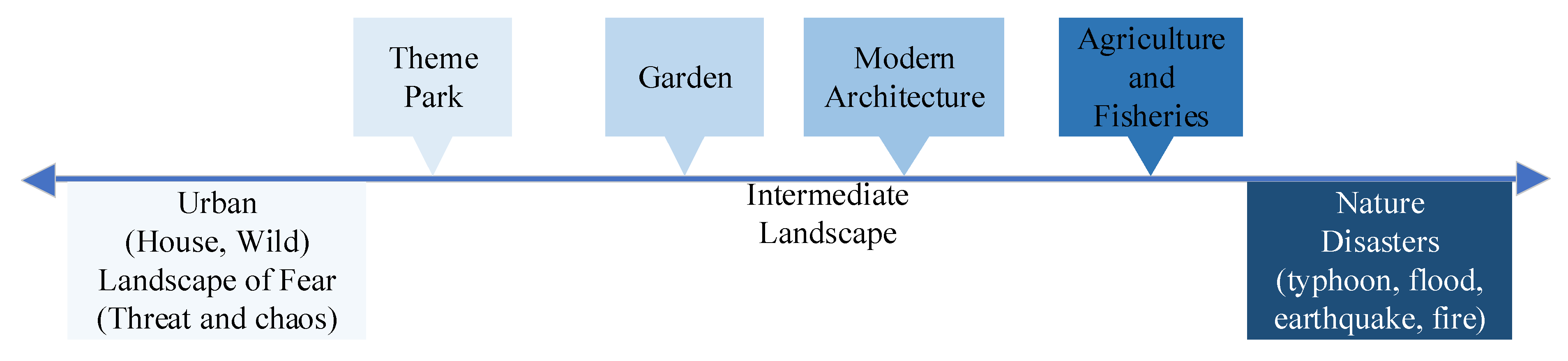
The ideas brought by being close to nature promote the evolution of architecture and form an intermediate landscape which contains both the essence of geography and the desire to return to nature.
The five cases in this study are all located on the edge of the city, having a dual geographical essence of escaping from nature and desiring to return to nature. The extensive use of bamboo strips instead of steel bars has great practical significance in reducing energy consumption and carbon emissions [100,101]. It is a metaphor for returning from modernity to the pre-modern essence of human culture, a natural culture that realizes the possibility and realizability of intermediate landscapes [2,108,109] in practice (Figure 4).

4.2. Integrating Agricultural and Fishery Waste for Sustainable Development

Vernacular architecture comes from natural materials and primitive construction methods. It does naturally not cause harm to the environment in the cycle of small-scale mining and discarding, and has therefore become a model for many sustainable designs. However, the conventional wisdom contained therein, as well as the design and management factors involved, are sometimes overlooked [110]. Ecologist Eugene P. Odum believes that the planning and growth of great cities ignores the fact that they are parasitic on the countryside, which provides food, water, and air and digests large amounts of waste for the city [111].
Odum pointed out the hidden unequal relationship between the city and the countryside, that is, that the operation of the city cannot be separated from the resources of the countryside. This concept can prompt us to take advantage of the opportunity of the circular economy to reverse this unequal relationship.
Urban buildings use a large amount of concrete as their main material, and mining in rivers and mountains causes damage to the landscape [96], soil and water conservation, and ecology [112]; generates large amounts of carbon emissions [113,114,115]; and requires the final disposal of construction waste [116,117,118]. Burying waste is expensive, and eventually there will be the problem of insufficient space [117,119,120]. Moreover, whether it is carbon emissions or the final treatment of waste, the burden is still borne by the countryside, which is the most unequal spatial state.
The circular economy focuses on the extraction of minimal resources [45]. Therefore, sustainable sources and a circular lifecycle can both achieve the goals of a circular economy. This case study replaces inorganic materials with natural fibers or biological waste, making it a “biocomposite material” [121,122]. Other researchers have also used agricultural waste such as wheat husks as substitutes, and experimental results show that they have excellent physical properties [123]. Its advantages include biodegradability, reduced carbon emissions, environmental friendliness, and reduced waste. It represents a highly promising bio-based material construction method.
This study converts waste from the agricultural industry and fishing villages into eco-friendly building materials, and waste such as rice straw, rice husks, oyster shells, and coconut fibers can be utilized in an endless supply. In particular, raw materials from non-renewable sources should be replaced with those from widely available or non-depletable sources [124]. Therefore, even if the buildings are frequently repaired or renovated, there will be no problems due to material monopolies.
Taking the oyster shell powder used in this study as an example, numerous studies have been conducted on shell powder as a substitute for limestone [125,126,127,128]. The export of rural materials to the city not only solves the final disposal of rural waste [127,129], but can also significantly reduce carbon dioxide emissions per unit strength of mortar [130]. Urban buildings also have eco-friendly aspects such as toughness, ventilation, and heat dissipation (Figure 5). Buildings with eco-friendly materials in cities illuminate the breadth of the spectrum brighter and more colorfully.

4.3. Focusing on the Practice and Implementation of Low-Carbon Buildings

In terms of engineering, Su’s House adopts a light steel structure. Studies have shown that wood-structure buildings and light-steel-structure buildings are inherently good low-carbon buildings. In the calculation of Taiwan’s Low Embodied-carbon Building Rating (LEBR), they can naturally obtain the highest evaluation level, 1+ [131].
In this study, all five cases used pozzolana instead of concrete for their exterior walls. Taking Su’s House as an example, the total area of the exterior walls was 301 square meters. According to the calculation results of Taiwan’s Low Embodied-carbon Building Rating System [131], greenhouse gas emission coefficient [132], and Research on the Planning of Green Building Label Carbon Footprint Labelling System [133], the carbon emissions of the pozzolana exterior walls of Su’s House were only 44% of those of conventional reinforced-concrete walls (Table 5).
The study area is located south of the Tropic of Cancer, in the tropics, and is also in the earthquake and typhoon zone. The earthquake-resistant design of the lightweight structure may have important reference value for the architecture of Nepal and the Eastern Black Sea region of Turkey [13] and islands affected by tropical cyclones [41]. Furthermore, the study indicate the importance of exterior wall’s thermal mass for the energy performance of a building, especially for a city located in a hot climate zone [134]. The design of building exterior walls affects overall energy consumption, so in hot Taiwan, the energy-saving design of building exterior walls is subject to regulations [135]. The thermal insulation performance of multi-layer materials with pozzolana as the main component has been confirmed in recent years [136,137]. The pozzolana wall may also be tried in the high-temperature area, India [40].

5. Conclusions

In human geography, “sense of place” refers to the process of assigning meaning to a specific location through subjective geographical knowledge. This study focuses on earthquake- and typhoon-prone areas, utilizing local agricultural and fishery waste as building materials. Through design and practice, this study explores resilient architecture as a form of human refuge. Case studies demonstrate that valuing the uniqueness of local materials and integrating them into architectural design can effectively reduce carbon emissions by 56%, thus contributing to achieving the social goal of net-zero waste. Architecture primarily composed of natural materials represents a successful evolution of vernacular architecture, which this study refers to as intermediate landscape. It not only harmonizes architectural, natural, landscape, and ecological factors, but also constructs a sense of place between the urban and natural worlds through eco-friendly architecture.

Supplementary Materials

The following supporting information can be downloaded at: https://www.mdpi.com/article/10.3390/buildings15224109/s1, Table S1: Construction process of five case; Table S2: Key metrics comparison of five study cases.

Author Contributions

Conceptualization, S.-C.T.; data curation, S.-C.T.; formal analysis, S.-C.T. funding acquisition, X.-D.W.; investigation, S.-C.T.; methodology, S.-C.T.; project administration, S.-C.T. and X.-D.W.; resources, S.-C.T.; software, S.-C.T.; supervision, S.-C.T. and X.-D.W.; validation, S.-C.T.; visualization, S.-C.T.; writing—original draft, S.-C.T.; writing—review and editing, S.-C.T. All authors have read and agreed to the published version of the manuscript.

Funding

This research was funded by the Fujian Provincial Federation of Social Sciences: A Study on the Form and Culture of Firewalls in Traditional Chinese Architecture from the Perspective of Migration, grant number: FJ2021B177.

Institutional Review Board Statement

This study was approved by the Science and Technology Ethics Committee at Jimei University (JMU202307039) (1 August 2022). No harm was caused to the participants during the study.

Informed Consent Statement

Informed consent was obtained from all subjects involved in the study.

Data Availability Statement

The original contributions presented in the study are included in the article; further inquiries can be directed to the corresponding author.

Acknowledgments

The authors of this study sincerely thank all the volunteers who participated in the construction of the natural buildings, including Tian, Yi-Shan; Tian, Tian; Fiona Ye; Chang, Sheng-San, Chang Li; teachers and students of Linyun Elementary School in 2017; Su’s family; and MingChuan Ecological Leisure Farm.

Conflicts of Interest

The authors declare no conflicts of interest.

References

  1. Tuan, Y.-F. Landscapes of Fear; University of Minnesota Press: Minneapolis, MN, USA, 1979. [Google Scholar]
  2. Tuan, Y.-F. Escapism; New Century Publishing Co., Ltd.: Taipei, Taiwan, 2006. [Google Scholar]
  3. Barrows, H.H. Geography as human ecology. Ann. Assoc. Am. Geogr. 1923, 13, 1–14. [Google Scholar] [CrossRef]
  4. Carcopino, J. Daily Life in Ancient Rome: The People and the City at the Height of the Empire; Yale University Press: New Haven, CT, USA, 1940. [Google Scholar]
  5. Gernet, J. Daily Life in China on the Eve of the Mongol Invasion, 1250–1276; Stanford University Press: Stanford, CA, USA, 1962. [Google Scholar]
  6. Burton, I.; Kates, R.W.; White, G.F. The Environment as Hazard; Linking Publishing Company: Taipei, Taiwan, 2011; pp. xxii–xxiii. [Google Scholar]
  7. Pendrill, C. London Life in the 14th Century; George Allen & Unwin: London, UK, 1925. [Google Scholar]
  8. Garrioch, D. 1666 and London’s Fire History: A Re-Evaluation. Hist. J. 2016, 59, 319–338. [Google Scholar] [CrossRef]
  9. Harvey, D. Paris, Capital of Modernity; Socio Publishing: Taipei, Taiwan, 2007. [Google Scholar]
  10. Tuan, Y.-F. Landcsape of Fear; National Compilation and New Century Publishing Co., Ltd.: Taipei, Taiwan, 2008. [Google Scholar]
  11. Hsia, C.-J. The Myth of Modernity—Creative Destruction. Paris: Capital of Modernity; Socio Publishing: Taipei, Taiwan, 2006. [Google Scholar]
  12. Hu, C.-F. Life in Paris. Paris: Captial of Modernity; Socio Publishing: Taipei, Taiwan, 2006; pp. 6–12. [Google Scholar]
  13. Diaz Avila, L. Resilience: Insights from Vernacular Architecture. Master’s Thesis, Delft University of Technology, Delft, The Netherlands, 2025. [Google Scholar]
  14. Zavaleta, D.; Quispe, A.; Rojas, O.; Silva, G.; Kim, S.; Nakamatsu, J.; Ruiz, G.; Pando, M.A.; Aguilar, R. 3D-printing of a basic housing unit prototype using earthen-based matrices stabilized with rice husk fibers. J. Build. Eng. 2025, 103, 112111. [Google Scholar] [CrossRef]
  15. Molitch-Hou, M. Apis Cor Mobile 3D Printer Seeks to Bring 3D Printed Construction on Site 2015. Available online: https://3dprintingindustry.com/news/apis-cor-mobile-3d-printer-seeks-to-bring-3d-printed-construction-on-site-59364/ (accessed on 30 October 2025).
  16. Valdivieso, C. ICON Unveils its New Robotic Home 3D Printer, Vulcan II 2019. Available online: https://www.3dnatives.com/en/vulcan-ii-140320195/ (accessed on 31 October 2025).
  17. Pascual, A.M.; Romero, M.L.; Serra, E.; Guerrero, J.C.; Perez, R. Sustainable insulation panel for buildings made of rice husks and posidonia. Constr. Build. Mater. 2024, 445, 137983. [Google Scholar] [CrossRef]
  18. Cigarruista Solís, L.; Chen Austin, M.; Deago, E.; López, G.; Marin-Calvo, N. Rice Husk-Based Insulators: Manufacturing Process and Thermal Potential Assessment. Materials 2024, 17, 2589. [Google Scholar] [CrossRef]
  19. Marques, B.; Almeida, J.; Tadeu, A.; António, J.; Santos, M.I.; de Brito, J.; Oliveira, M. Rice husk cement-based composites for acoustic barriers and thermal insulating layers. J. Build. Eng. 2021, 39, 102297. [Google Scholar] [CrossRef]
  20. Ijjada, N.; Nayaka, R.R. Review on properties of some thermal insulating materials providing more comfort in the building. Mater. Today Proc. 2022, 58, 1354–1359. [Google Scholar] [CrossRef]
  21. Do, N.H.; Can, N.N.; Le, P.K. Thermal insulation of flame retardant silica aerogel composites from rice husk ash and plastic waste fibers. J. Inorg. Organomet. Polym. Mater. 2024, 34, 522–532. [Google Scholar] [CrossRef]
  22. Ma, W.; Kolb, T.; Ruether, N.; Meinlschmidt, P.; Chen, H.; Yan, L. Physical, Mechanical, thermal and fire behaviour of recycled aggregate concrete block wall system with rice husk insulation. Energy Build. 2024, 320, 114560. [Google Scholar] [CrossRef]
  23. Ren, D.; Deng, S.; Lv, Y.; Li, C.; Yang, Q.; Lai, F.; Li, J. Study on fire resistance and mechanical properties of modified recycled waste oyster powder in asphalt binder. J. Appl. Polym. Sci. 2024, 141, e55504. [Google Scholar] [CrossRef]
  24. Kim, H.-N.; Jung, U.-I.; Kim, B.-J. Evaluation of strength and fire resistance performance of mortar mixed with oyster shell and egg shell. J. Korean Recycl. Constr. Resour. Inst. 2023, 11, 560–567. [Google Scholar]
  25. Kim, S.-C. Process technology for development and performance improvement of medical radiation shield made of eco-friendly oyster shell powder. Appl. Sci. 2022, 12, 968. [Google Scholar] [CrossRef]
  26. Huang, B.; Qu, J.; Li, G.; Zhang, H.; Geng, Y.; Liu, L.; Wang, S.; Jiao, C.; Chen, X. Green flame retardant strategy for thermoplastic polyurethanes: Sustainable utilization of oyster shell waste through chitosan extraction combined with phytic acid and Prussian blue. Polym. Degrad. Stab. 2025, 241, 111621. [Google Scholar] [CrossRef]
  27. Li, Z.; Chen, C.; Xie, H.; Yao, Y.; Zhang, X.; Brozena, A.; Li, J.; Ding, Y.; Zhao, X.; Hong, M.; et al. Sustainable high-strength macrofibres extracted from natural bamboo. Nat. Sustain. 2022, 5, 235–244. [Google Scholar] [CrossRef]
  28. Saadun, N.S.; Majid, M.A.; Ismail, M.H.; Adnan, S.H. (Eds.) An overview on physical and mechanical properties of bamboo as a natural reinforcement in concrete. In IOP Conference Series: Earth and Environmental Science; IOP Publishing: Bristol, UK, 2022. [Google Scholar]
  29. Golden, E.M. Building from Tradition: Local Materials and Methods in Contemporary Architecture; Routledge: London, UK, 2017. [Google Scholar]
  30. Tsai, S.-C.; Zhang, X.-F.; Chang, Y.-T. Toward Nearly Zero-Waste Architecture: Innovation, Application, and Practice of Construction Methods Using Natural Materials. Buildings 2024, 14, 1584. [Google Scholar] [CrossRef]
  31. O’Brien, K. Global environmental change III: Closing the gap between knowledge and action. Prog. Hum. Geogr. 2013, 37, 587–596. [Google Scholar] [CrossRef]
  32. Seino, S.; Kojima, A.; Hinata, H.; Sn, M.; Isob, A. Multi-sectoral research on East China sea beach litter based on oceanographic methodology and local knowledge. J. Coast. Res. 2009, 2, 1289–1292. [Google Scholar]
  33. Takefuji, Y. How to build disaster-resilient cities and societies for making people happy. Build. Environ. 2023, 228, 109845. [Google Scholar] [CrossRef]
  34. Tsai, S.-C.; Lee, S.-H. Disaster-Resilient Communities on Flood Plains and Their Agricultural Regeneration: A Case Study in Meinong Plain, Taiwan. Water 2022, 14, 1736. [Google Scholar] [CrossRef]
  35. Lebel, L. Local knowledge and adaptation to climate change in natural resource-based societies of the Asia-Pacific. Mitig. Adapt. Strateg. Glob. Change 2013, 18, 1057–1076. [Google Scholar] [CrossRef]
  36. Blaikie, P.; Brown, K.; Stocking, M.; Tang, L.; Dixon, P.; Sillitoe, P. Knowledge in action: Local knowledge as a development resource and barriers to its incorporation in natural resource research and development. Agric. Syst. 1997, 55, 217–237. [Google Scholar] [CrossRef]
  37. Rodríguez Neira, K.; Cárdenas-Ramírez, J.P.; Rojas-Herrera, C.J.; Haurie, L.; Lacasta, A.M.; Torres Ramo, J.; Sánchez-Ostiz, A. Assessment of Elaboration and Performance of Rice Husk-Based Thermal Insulation Material for Building Applications. Buildings 2024, 14, 1720. [Google Scholar] [CrossRef]
  38. Ye, M. Bamboo house design. J. Res. Lett. 2011, 18, 33–36. [Google Scholar]
  39. Wang, C.; Antos, S.E.; Gosling-Goldsmith, J.G.; Triveno, L.M.; Zhu, C.; von Meding, J.; Ye, X. Assessing Climate Disaster Vulnerability in Peru and Colombia Using Street View Imagery: A Pilot Study. Buildings 2024, 14, 14. [Google Scholar] [CrossRef]
  40. Vakharia, M.N.; Joshi, M. Climate-responsive wada architecture: A bioclimatic design for climate change resilience. J. Asian Arch. Build. Eng. 2025, 24, 3426–3439. [Google Scholar] [CrossRef]
  41. Haque, S.B.; Hoque, M.M. (Eds.) Learning from vernacular building practices in achieving disaster resilience: Case study of the coastal island of Sandwip, Bangladesh. In Proceedings of the International Seminar on Vernacular Settlements, Bangkok, Thailand, 9–10 November 2023. [Google Scholar]
  42. Fagan, B. Fishing: How the Sea Fed Civilization; Gūsa Press, Walkers Cultural Enterprise Ltd.: New Taipei City, Taiwan, 2022. [Google Scholar]
  43. IPCC. Global Warming of 1.5 °C: The Intergovernmental Panel on Climate Change; 2018. Available online: https://www.ipcc.ch/sr15/ (accessed on 30 March 2024).
  44. UNCC. Key Aspects of the Paris Agreement Paris, France: United Nations Framework Convention on Climate Change (UNFCCC). 2015. Available online: https://unfccc.int/most-requested/key-aspects-of-the-paris-agreement (accessed on 30 March 2024).
  45. Boulding, K.E. The economics of the coming spaceship earth. In Environmental Quality in a Growing Economy; Jarrett, H., Ed.; Johns Hopkins University Press: Baltimore, MD, USA, 1966; pp. 3–14. [Google Scholar]
  46. Ou, S. Ayasaka Ichiro and the Development of Geology Research in Modern Taiwan. J. Twn. His. 2020, 71, 53–102. [Google Scholar]
  47. Tsai, S. Theory on Adaptive Mode and Creative Destruction Under the Shift-Reset: A Case Study of Water Distribution in Pingtung Plain; National Taiwan Normal University: Taipei, Taiwan, 2020. [Google Scholar]
  48. Wu, R.-S.; Liu, J.-S.; Chang, S.-Y.; Hussain, F. Modeling of Mixed Crop Field Water Demand and a Smart Irrigation System. Water 2017, 9, 885. [Google Scholar] [CrossRef]
  49. Wu, C.-C.; Yen, T.-H.; Huang, Y.-H.; Yu, C.-K.; Chen, S.-G. Statistical Characteristic of Heavy Rainfall Associated with Typhoons near Taiwan Based on High-Density Automatic Rain Gauge Data. Bull. Am. Meteorol. Soc. 2016, 97, 1363–1375. [Google Scholar] [CrossRef]
  50. Shyu, J.H.; Sieh, K.; Chen, Y.; Lee, C.; Wang, Y.; Ota, Y.; Lee, J.; Sung, Q.; Rubin, C. A Preliminary Neotectonic Map of Taiwan, and Its Implications for Future Destructive Earthquakes. AGU Fall Meeting Abstracts; American Geophysical Union: San Francisco, CA, USA, 2001. [Google Scholar]
  51. Shyu, J.B.H.; Chuang, Y.R.; Chen, Y.L.; Lee, Y.R.; Cheng, C.T. A new on-land seismogenic structure source database from the Taiwan earthquake model (TEM) project for seismic hazard analysis of Taiwan. Terr. Atmos. Ocean Sci. 2016, 27, 311–323. [Google Scholar] [CrossRef]
  52. He, C. Introduction to Geology of Taiwan—Description of Geological Map of Taiwan; Central Geological Survey, Ministry of Economic Affairs: Taipei, Taiwan, 1986. [Google Scholar]
  53. Central Weather Administration. Observation Data of Pingtung Station Taiwan: Central Weather Administration. 2024. Available online: https://www.cwa.gov.tw/V8/C/W/OBS_Station.html?ID=C0R17 (accessed on 8 July 2024).
  54. Central Weather Administration. Observation Data of Sandimen Station Taiwan: Central Weather Administration. 2024. Available online: https://www.cwa.gov.tw/V8/C/W/OBS_County.html?ID=10013 (accessed on 8 July 2024).
  55. Juan, Y.-K.; Chen, Y.; Lin, J.-M. Greywater Reuse System Design and Economic Analysis for Residential Buildings in Taiwan. Water 2016, 8, 546. [Google Scholar] [CrossRef]
  56. National Science and Technology Council, Ministry of Environment. National Science Report on Climate Change 2024: Phenomenon, Impacts and Adaptation; National Science and Technology Council: Taipei, Taiwan, 2024. [Google Scholar]
  57. Lallemand, S. Was the 1999 Chi-Chi earthquake in Taiwan a “subduction earthquake”? Terr. Atmos. Ocean. Sci. 2000, 11, 709–720. [Google Scholar] [CrossRef]
  58. Wang, J.-H. Studies of Earthquake Energies in Taiwan: A Review. Terr. Atmos. Ocean. Sci. 2016, 27, 1–19. [Google Scholar] [CrossRef]
  59. Li, D.; Tan, Q.; Yin, J.; Jian, Y. Analysis on the impact of Taiwan far-field earthquakes on the disaster avoidance behavior of people in high-rise buildings in large cities in southeast China. Geomat. Nat. Hazards Risk 2022, 13, 2006–2023. [Google Scholar] [CrossRef]
  60. Rau, R.-J.; Lee, J.-C.; Ching, K.-E.; Lee, Y.-H.; Byrne, T.B.; Chen, R.-Y. Subduction-continent collision in southwestern Taiwan and the 2010 Jiashian earthquake sequence. Tectonophysics 2012, 578, 107–116. [Google Scholar] [CrossRef]
  61. Lin, T.-L.; Wu, Y.-M.; Chen, D.-Y.; Hsiao, N.-C.; Chang, C.-H. Magnitude Estimations in Earthquake Early Warning for the 2010 JiaSian, Taiwan, Earthquake. Seism. Res. Lett. 2011, 82, 201–206. [Google Scholar] [CrossRef]
  62. Chen, S.-S. Causes and Strategies for Waterproofing and Efflorescence of Buildings of Tainan City Government Fire Bureau; National Cheng Kung University: Tainan, Taiwan, 2022. [Google Scholar]
  63. Otieno, M.B.; Alexander, M.G.; Beushausen, H.D. Corrosion in cracked and uncracked concrete—Influence of crack width, concrete quality and crack reopening. Mag. Concr. Res. 2010, 62, 393–404. [Google Scholar] [CrossRef]
  64. Ruan, D.-L. Improvement of Efflorescence Inhibitors for Mortar; National Yunlin University of Science and Technology: Yunlin, Taiwan, 2018. [Google Scholar]
  65. Tsai, C.-L. Renovation of Brick Wall with Efflorescence Under Aluminum Window Frame; National Yunlin University of Science and Technology: Yunlin, Taiwan, 2017. [Google Scholar]
  66. Wen, T.-T. The Causes and Prevention for Water Leakage of Window Frame; National Taipei University of Technology: Taipei, Taiwan, 2019. [Google Scholar]
  67. Chen, C.-S. A Practical Approach of Wall-Mold Removal for Existing RC Buildings in Taiwan; Chaoyang University of Technology: Taichung, Taiwan, 2020. [Google Scholar]
  68. Chiang, W.-K. A Knowledge Management System for Building Efflorescence Remediation Method; National Chiao Tung University: Sinchu, Taiwan, 2010. [Google Scholar]
  69. Chang, C.-J. Study on Mix Proportioning and Engineering Behavior for San-Ho-Tu Material; National Taiwan University of Science and Technology: Taipei, Taiwan, 2002. [Google Scholar]
  70. Wang, Y.X.; Zhou, B.; Shi, Y. Thermal Comfort Test of Bamboo Plaiting Mudwalls Adapted to Traditional Residential Buildings in Sichuan Basin and Application Prospect; Industrial Construction: Beijing, China, 2020; pp. 981–986. [Google Scholar]
  71. Wang, Y.; Shi, Y.; Zhou, B. Improvement of the Hygrothermal Performance of Mud-coated Material Used in Traditional Bamboo-woven Mud Walls. Int. J. Arch. Herit. 2023, 17, 1630–1647. [Google Scholar] [CrossRef]
  72. Xie, J.Y. Wall Constructions Research of Traditonal Dwellings in the Linpan Region in the West Sichuan. Ph.D. Thesis, Southwest Jiaotong University, Chengdu, China, 2016. [Google Scholar]
  73. Jeng, J.-I. An Investigation and Analysis on the Destructive Factors of In-Filled Wattle and Daub Walls within Chuan-dou Timber Frames in Yunlin, Chiayi and Tainan Regions of Taiwan; National University of Kaohsiung: Kaohsiung, Tiawan, 2007. [Google Scholar]
  74. Wang, H.-Y. A Preliminary Discussion About the Image and Technological Inheritance of Native Bamboo Architecture in Taiwan—As Traditional Bamboo House and The Bamboo Frame of D.Z. Architects & Associates An Example; National Yunlin University of Science and Technology: Yunlin, Taiwan, 2020. [Google Scholar]
  75. Wang, Y.-Z. Above Ground Biomass and Carbon Sequestration of Moso Bamboo and Makino Bamboos. Huagang J. Agric. Sci. 2009, 24, 49–68. [Google Scholar] [CrossRef]
  76. Lin, Y.-J.; Zhang, J.-X.; Chen, B.-N. Comparison Study of Earthquake Damage and Performance for Two Types of Historic Japanese Wooden Building- Illustrated with Two Cases in Shin-Dong Elementary School. J. Archit. 2013, 84, 107–122. [Google Scholar]
  77. Yi, S.-Y.; Wei, G.-F.; Zhang, B.-J.; Liu, X.-B. Experimental Study on The Recipes of the Traditional Tabia of China. J. Northwest Minzu Univ. (Nat. Sci.) 2019, 40, 31–41. [Google Scholar]
  78. Kuo, K.-C.; Sun, J.-C.; Yao, G.C. Seismic Evaluation of Historic Japanese Wooden Buildings–Examples of School Offices. J. Archit. 2015, 94, 1–21. [Google Scholar] [CrossRef]
  79. Lin, K.H.E.; Lin, T.-H.; Chang, Y.-C.; Yeh, C.-H.; Liu, G.-Y.; Chang, C.-H. Earthquake, Housing Damage, and Fatality: A Causal-effect Analysis of Seismic Risk in Chi-Chi Earthquake. City Plan. 2017, 44, 83–112. [Google Scholar]
  80. Public Construction Commission Executive Yuan. After the 921 Earthquake, the Earthquake Resistance of Public Facilities in Our Country Has Been Improved; Public Construction Commission Executive Yuan: Taipei, Taiwan, 2011. Available online: https://www.pcc.gov.tw/News_Content.aspx?n=C61062639C0CD29F&sms=21EF9CF82726C1BB&s=18829776AD60139D (accessed on 10 May 2024).
  81. Wang, C-F. Establishing an Analysis Protocol for Traditional Earth Building Materials. J. Cult. Herit. Conserv. 2020, 51, 7–26. [Google Scholar] [CrossRef]
  82. Wang, C-F. Study of the Earth Composition of Adobe Walls and Bamboo-Daub Walls—A Case Study of Traditional Buildings, Yunlin County and Chiayi County. J. Cult. Herit. Conserv. 2020, 52, 7–26. [Google Scholar] [CrossRef]
  83. Chen, Y.-Y. Assessment and Calculation of Horizontal Resistance for Japanese Mud-Plastered Wall; National Cheng Kung University: Tainan, Taiwan; Taipei, Taiwan, 2008. [Google Scholar]
  84. Su, Y.-L. Rotational Strengthening Method of Wood Frame Joint Used in Japanese Wooden Buildings; National Cheng Kung University: Tainan, Taiwan; Taipei, Taiwan, 2007. [Google Scholar]
  85. Chen, C.-C. Structural Behaviors and Strength Evaluation of Japanese Style Bamboo-Mud-Walls Under Horizontal Cyclic Loading; National Cheng Kung University: Tainan, Taiwan, 2007. [Google Scholar]
  86. Meng-Ting, T. Experimental Study and Equivalent Bracing Simulation for the Bamboo Mud-Wall of Japanese Wooden Buildings; National Cheng Kung University: Tainan, Taiwan; Taipei, Taiwan, 2006. [Google Scholar]
  87. Building Green Inc. Bringing Building Codes into Compliance with Sustainability. Build. Green 1998. Available online: https://www.buildinggreen.com/news-analysis/bringing-building-codes-compliance-sustainability (accessed on 10 May 2024).
  88. Eisenberg, D. Sustainability and Building Codes 2014. Available online: https://www.greenhomebuilding.com/articles/buildingcode.htm (accessed on 2 June 2024).
  89. Evans, I.; Smith, M.; Smiley, L.; Bednar, D. The Hand-Sculpted House: A Practical and Philosophical Guide to Building a Cob Cottage; Freedom Hill Cultural and Creative Enterprise & Hiking Culture Business Co., Ltd.: Taipei, Taiwan, 2015. [Google Scholar]
  90. Davies, O.; Davies, I. Barriers to implementation of sustainable construction techniques. MAYFEB J. Environ. Sci. 2017, 2, 1–9. [Google Scholar]
  91. Tomkiewicz, H.S. Barriers to Implementation of Sustainable Construction Practices in the Homebuilding Industry: A Case study of Rochester, NY. Ph.D. Thesis, University of Nebraska-Lincoln, Lincoln, NE, USA, 2011. [Google Scholar]
  92. Chen, Q.-K.; Wu, G.-Y. The history of Ligang Township; Ligang Township: Pingtung, Taiwan, 2005. [Google Scholar]
  93. Institute ITR. Report on the Construction Plan of the Distribution Map of Onshore sand and Gravel Resources in Southern Taiwan (Project Scope: Chiayi, Tainan, Kaohsiung and Pingtung Areas); Ministry of Economy Mining Division: Taipei, Taiwan, 2002. [Google Scholar]
  94. Pingtung County Special Tax Autonomous Regulations on the Landscape Maintenance Regulations of Soil and Stone Collection, No. 10306093700 Orde. 2014. Available online: https://ptlaw.pthg.gov.tw/LawContent.aspx?id=GL000241 (accessed on 10 May 2024).
  95. County, P. Pingtung County Air Pollution Prevention and Control Plan (104–108 Edition); Environmental Protection Bureau: Pingtung County, Taiwan, 2017. [Google Scholar]
  96. Budds, J.; Hinojosa, L. Restructuring and Rescaling Water Governance in Mining Contexts: The Co-Production of Waterscapes in Peru. Water Altern. 2012, 5, 119–137. [Google Scholar]
  97. Lan, S.H.; Hsieh, M.Y.; Hsu, Y.H. The Impact Factor Evaluate of Popularizing Strategies of Green Building. J. Archit. 2014, 89, 195–209. [Google Scholar] [CrossRef]
  98. Jr-Hau, T. Research on the Historical Process of Urban Planning Legislation of Taiwan During the Japanese Reign; Chinese Culture University: Taipei, Taiwan, 2000. [Google Scholar]
  99. Construction and Planning Agency, Taiwan Architecture & Building Center. Chapter of Construction in Building Technical Regulations; Construction and Planning Agency, Taiwan Architecture & Building Center: Taipei, Taiwan, 2020. [Google Scholar]
  100. Li, J.; Sun, Q.; Yao, Q.; Wang, J.; Han, S.; Jin, C. Fabrication of Robust Superhydrophobic Bamboo Based on ZnO Nanosheet Networks with Improved Water-, UV-, and Fire-Resistant Properties. J. Nanomater. 2015, 2015, 431426. [Google Scholar] [CrossRef]
  101. Seike, K. The Art of Japanese Joinery; Weatherhill Tankosha: New York, NY, USA, 1977. [Google Scholar]
  102. Ching-Chung, W. Study on the Relation Between Compressive Strength and Mixing Proportion of San-Ho-Tu; National Chiayi University: Chiayi City, Taiwan, 2007. [Google Scholar]
  103. Tsai, H.-S. Sustainable Oyster Shell Material: Modern Pozzolana—Take Tainan Anping as an Example; National Cheng Kung University: Tainan, Taiwan, 2022. [Google Scholar]
  104. Yan-Kai, Y. A Study for Mix Proportion Analysis and Engineering Properties of Mortar; National Cheng Kung University: Tainan, Taiwan, 2007. [Google Scholar]
  105. Stern, P.C.; Young, O.R.; Druckman, D.E. Global Environmental Change: Understanding the Human Dimensions; National Academy Press: Washington, DC, USA, 1992. [Google Scholar]
  106. O’Brien, K. Global environmental change II: From adaptation to deliberate transformation. Prog. Hum. Geogr. 2012, 36, 667–676. [Google Scholar] [CrossRef]
  107. O’Brien, K. Responding to environmental change: A new age for human geography? Prog. Hum. Geogr. 2011, 35, 542–549. [Google Scholar] [CrossRef]
  108. Marx, L. The machine in the garden. New Engl. Q. 1956, 29, 27–42. [Google Scholar] [CrossRef]
  109. Marx, L. The Machine in the Garden: Technology and the Pastoral Ideal in America; Oxford University Press: New Your, NY, USA, 2000. [Google Scholar]
  110. Sara, G.; Sinwon, K. The Role of Guadua Bamboo in South America—From Vernacular Architecture to Sustainable Building Material. J. Korean Soc. Des. Cult. 2020, 26, 265–278. [Google Scholar]
  111. Odum, E.P. Ecology and Our Endangered Life-Support System; Sinauer Assoc. Inc.: Sunderland, MA, USA, 1989. [Google Scholar]
  112. Lee, Y.-J. Stone Dreams: The Political Ecological Analysis of Taiwan’s Gravel Industry; National Taiwan University: Taipeu, Tainwan, 2007. [Google Scholar]
  113. Hasanbeigi, A.; Price, L.; Lin, E. Emerging energy-efficiency and CO2 emission-reduction technologies for cement and concrete production: A technical review. Renew. Sustain. Energy Rev. 2012, 16, 6220–6238. [Google Scholar]
  114. Akan, M.Ö.A.; Dhavale, D.G.; Sarkis, J. Greenhouse gas emissions in the construction industry: An analysis and evaluation of a concrete supply chain. J. Clean. Prod. 2017, 167, 1195–1207. [Google Scholar] [CrossRef]
  115. Barcelo, L.; Kline, J.; Walenta, G.; Gartner, E. Cement and carbon emissions. Mater. Struct. 2014, 47, 1055–1065. [Google Scholar] [CrossRef]
  116. Fikri Hasmori, M.; Faizul Md Zin, A.; Nagapan, S.; Deraman, R.; Abas, N.; Yunus, R.; Klufallah, M. The on-site waste minimization practices for construction waste. IOP Conf. Ser. Mater. Sci. Eng. 2020, 713, 012038. [Google Scholar] [CrossRef]
  117. Osmani, M. (Ed.) Construction waste. In Waste; Elsevier: New York, NY, USA, 2011. [Google Scholar]
  118. Llatas, C.; Bizcocho, N.; Soust-Verdaguer, B.; Montes, M.V.; Quiñones, R. An LCA-based model for assessing prevention versus non-prevention of construction waste in buildings. Waste Manag. 2021, 126, 608–622. [Google Scholar] [CrossRef]
  119. Erlandsson, M.; Levin, P. Environmental assessment of rebuilding and possible performance improvements effect on a national scale. Build. Environ. 2005, 40, 1459–1471. [Google Scholar] [CrossRef]
  120. Hsiao, T.Y.; Huang, Y.T.; Yu, Y.H.; Wernick, I.K. Modeling materials flow of waste concrete from construction and demolition wastes in Taiwan. Resour. Policy 2002, 28, 39–47. [Google Scholar] [CrossRef]
  121. Manu, T.; Nazmi, A.R.; Shahri, B.; Emerson, N.; Huber, T. Biocomposites: A review of materials and perception. Mater. Today Commun. 2022, 31, 103308. [Google Scholar] [CrossRef]
  122. Mohammed, A.A.; Omran, A.A.B.; Hasan, Z.; Ilyas, R.; Sapuan, S. Wheat biocomposite extraction, structure, properties and characterization: A review. Polymers 2021, 13, 3624. [Google Scholar] [CrossRef]
  123. Kizinievič, O.; Kizinievič, V.; Trambitski, Y.; Grubliauskas, R.; Gencel, O.; Malaiškienė, J.; Astrauskas, T. Lightweight composite materials made of paper sludge and corn starch. Ind. Crops Prod. 2024, 208, 117847. [Google Scholar] [CrossRef]
  124. Berge, B. Ecology of Building Materials; Routledge: London, UK, 2007. [Google Scholar]
  125. Her, S.; Park, T.; Zalnezhad, E.; Bae, S. Synthesis and characterization of cement clinker using recycled pulverized oyster and scallop shell as limestone substitutes. J. Clean. Prod. 2021, 278, 123987. [Google Scholar] [CrossRef]
  126. Ha, S.; Lee, J.W.; Choi, S.-H.; Kim, S.-H.; Kim, K.; Kim, Y. Calcination characteristics of oyster shells and their comparison with limestone from the perspective of waste recycling. J. Mater. Cycles Waste Manag. 2019, 21, 1075–1084. [Google Scholar] [CrossRef]
  127. Mo, K.H.; Alengaram, U.J.; Jumaat, M.Z.; Lee, S.C.; Goh, W.I.; Yuen, C.W. Recycling of seashell waste in concrete: A review. Constr. Build. Mater. 2018, 162, 751–764. [Google Scholar] [CrossRef]
  128. Véliz, K.D.; Wagemann, E.; Espinoza, L.; Prieto, A.; Cabargas, N.; Brescia-Norambuena, L.; Fredes, C. Life Cycle Assessment and Sustainability in Eco-Concrete with Seashell Waste: A Systematic Literature Review. Sustainability 2025, 17, 9549. [Google Scholar] [CrossRef]
  129. Peceño, B.; Alonso-Fariñas, B.; Vilches, L.; Leiva, C. Study of seashell waste recycling in fireproofing material: Technical, environmental, and economic assessment. Sci. Total Environ. 2021, 790, 148102. [Google Scholar] [CrossRef]
  130. Han, Y.; Lin, R.; Wang, X.-Y. Performance of sustainable concrete made from waste oyster shell powder and blast furnace slag. J. Build. Eng. 2022, 47, 103918. [Google Scholar] [CrossRef]
  131. Interior Ministry Building Research Institute. Manual of Low Embodied-Carbon Building Rating System; Interior Ministry Building Research Institute: Taipei, Taiwan, 2023. [Google Scholar]
  132. Ministry of Environment. Greenhouse Gas Emission Coefficient; Ministry of Environment: Taipei, Taiwan, 2024. [Google Scholar]
  133. Interior Ministry Building Research Institute. Green Building Label Carbon Footprint Labelling System; Interior Ministry Building Research Institute: Taipei, Taiwan, 2014. [Google Scholar]
  134. Kahhat, R.; Crittenden, J.; Sharif, F.; Fonseca, E.; Li, K.; Sawhney, A.; Zhang, P. Environmental impacts over the life cycle of residential buildings using different exterior wall systems. J. Infrastruct. Syst. 2009, 15, 211–221. [Google Scholar] [CrossRef]
  135. Interior Ministry Building Research Institute. A Study on the Classification of Building Energy Consumption Surveys and Residential Energy Consumption Surveys; Chinese Construction Center Foundation: Taipei, Taiwan, 2009. [Google Scholar]
  136. Annaba, K.; Belarouf, S.; El Wardi, F.Z.; Ibaaz, K.; Cherkaoui, M.; Florence, C.; Colin, J.; Mege, R.; El Mendili, Y. Harnessing Natural Pozzolan for Sustainable Heating and Cooling: Thermal Performance and Building Efficiency in Moroccan Climates. Buildings 2024, 14, 2633. [Google Scholar] [CrossRef]
  137. Toufigh, V.; Pachideh, G. Cementitious mortars containing pozzolana under elevated temperatures. Struct. Concr. 2022, 23, 3294–3312. [Google Scholar] [CrossRef]
Figure 1. Study diagram.
Buildings 15 04109 g001
Figure 2. Study area.
Buildings 15 04109 g002
Figure 3. Practice process.
Buildings 15 04109 g003
Figure 4. Spatial sequence of eco-friendly buildings.
Buildings 15 04109 g004
Figure 5. Materials and ventilation design instructions for Su’s House.
Buildings 15 04109 g005
Table 1. Bamboo-woven wall details.
Buildings 15 04109 i001Buildings 15 04109 i002Buildings 15 04109 i003Buildings 15 04109 i004
Bamboo strip (a)Bamboo strips locked with bolts (b)Complete bamboo wall (c)Bamboo plastering with pozzolana (d)
Buildings 15 04109 i005Buildings 15 04109 i006Buildings 15 04109 i007Buildings 15 04109 i008
Bamboo strips with iron wire binding, and relying on friction to fix the bamboo strips (e)Exterior wall openings and eaves (f)Bamboo strips connected to the basic structure (g)Bamboo strips and glass bottles combined (h)
Table 2. Material list of agricultural and fishery production waste.
FunctionAgriculturalFisheryOther
pozzolana mixing materialsclayoyster shell powderadhesive, lime
hardness-reinforcing material--sand
toughness-enhancing materialdry straw, rice husk, hemp plant fiber, coconut fiber-
roof covering materialrice straw, wheat straw, banana leaf, betel leaf, teak leaf-glass bottle, aluminum plastic film
pozzolana dyeing--colored powder (iron oxide powder)
waterproof materiallinseed oil-waterproof powder (reservoir sediment)
Table 3. Material descriptions.
Buildings 15 04109 i009Buildings 15 04109 i010Buildings 15 04109 i011Buildings 15 04109 i012
Buildings 15 04109 i013Buildings 15 04109 i014Buildings 15 04109 i015Buildings 15 04109 i016
Oyster shell burnt ash used as exterior wall coating (a)Coconut fiber mixed into pozzolana to increase toughness (b)Rice straw used as roof covering (c)Glass bottles used for roof lighting (d)
Table 4. The construction and collapse process of the Small Mud House.
Buildings 15 04109 i017Buildings 15 04109 i018Buildings 15 04109 i019Buildings 15 04109 i020
Mud wall, completed in September 2019 (a)Lime exterior wall under construction, October 2019 (b)Completed lime exterior, October 2019 (c)Wheat grows on the straw roof, September 2020 (d)
Buildings 15 04109 i021Buildings 15 04109 i022Buildings 15 04109 i023Buildings 15 04109 i024
Removing straw from the roof, May 2022 (e)After heavy rainfall, July 2022 (f)Complete collapse, September 2022 (g)Collapsed mud walls hide scarab family larvae December (h)
Table 5. Carbon emission calculation of Su’s House exterior walls.
Construction MethodsMaterial NameUnitAmountCarbon Emissions per Unit (kgCO2e/m2)Total Emissions (kgCO2e/m2)Reference Standard
Conventional construction methods15 cm concrete exterior wallm230173.6722,174.672023 (p. 55) [131]
RC exterior wall coating (base mortar + waterproof coating)m230117.165165.162023 (p. 52) [131]
RC interior wall coating (1:2 cement mortar)m230112.863870.86
Paint (interion and exterior)m2301 × 21.39836.782023 (p. 51) [131]
Total 32,047.47kgCO2e/m2
pozzolana exterior wallPhyllostachys reticulata (Rupr.) K. Kochm3301 × 0.005−763.45−1148.992014 (reference to wood, p. 27) [133]
Coconut fiber *m3301 × 0.1/80−763.45−287.25
Rice husk **m3301 × 0.4/105−763.45−875.42
Lime powder (11 kg per m2)ton301 × 11/10000.752.482024 (p. 6) [132]
Polymer-resin-modified cement (9 kg per m2)ton301 × 9/1000968.42623.402023 (reference to white cement, p. 49) [131]
Waterproof coating + color powder top layer 2 mm (four layers)m2301 × 444816.002014 (p. 31) [133]
1:2 cement mortar + color powder surface layerm230112.863870.862023 (p. 49) [131]
The inner side of the exterior wall made of pozzolana (calcium silicate board partition wall, 9 cm thick)9 mm thick calcium silicate board (double-sided)m230117.125153.122014 (p. 32) [133]
Channel steel 65 × 40 mm (top and bottom)
C-shaped uprights 60 × 30 × 1.6 mm @ 600 mm
50 mm glass wool
Soil plastering (single-sided)
Paint (single-sided)
Total 14,154.20kgCO2e/m2
Note: * The loose (uncompacted) rice husk concentration is approximately 90–120 kg/m3,This study uses an average value of 105 kg/m3 for calculations. ** The loose (uncompacted) Coconut fiber concentration is approximately 60–100 kg/m3,This study uses an average value of 80 kg/m3 for calculations.
Disclaimer/Publisher’s Note: The statements, opinions and data contained in all publications are solely those of the individual author(s) and contributor(s) and not of MDPI and/or the editor(s). MDPI and/or the editor(s) disclaim responsibility for any injury to people or property resulting from any ideas, methods, instructions or products referred to in the content.