



Protection of Low-Strength Shallow-Founded Buildings Around Deep Excavation: A Case Study in the Yangtze River Soft Soil Area

 ,
,
Abstract
1. Introduction
2. Project Description
2.1. Project Profile
2.2. Engineering Geological Conditions
2.3. Existing Building Conditions
2.4. Ground Improvement Before Trenching Construction and Excavation
3. Investigation of Building Safety Issues and Strengthening Technology
3.1. Survey of Building Safety Issues
3.2. Investigation of Building Strengthening Technology
3.2.1. Rock-Socketed Pile and Box Foundation Underpinning
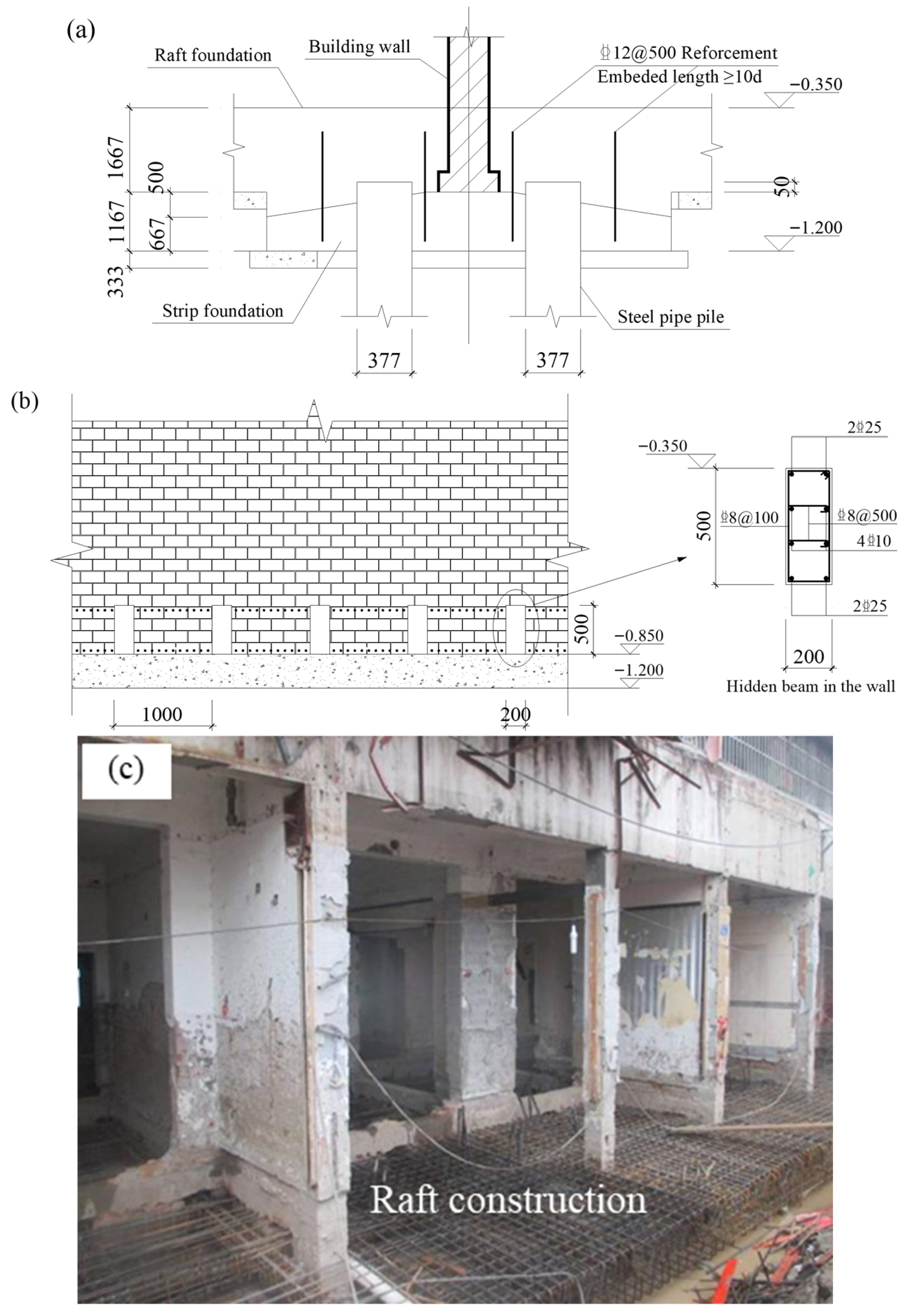
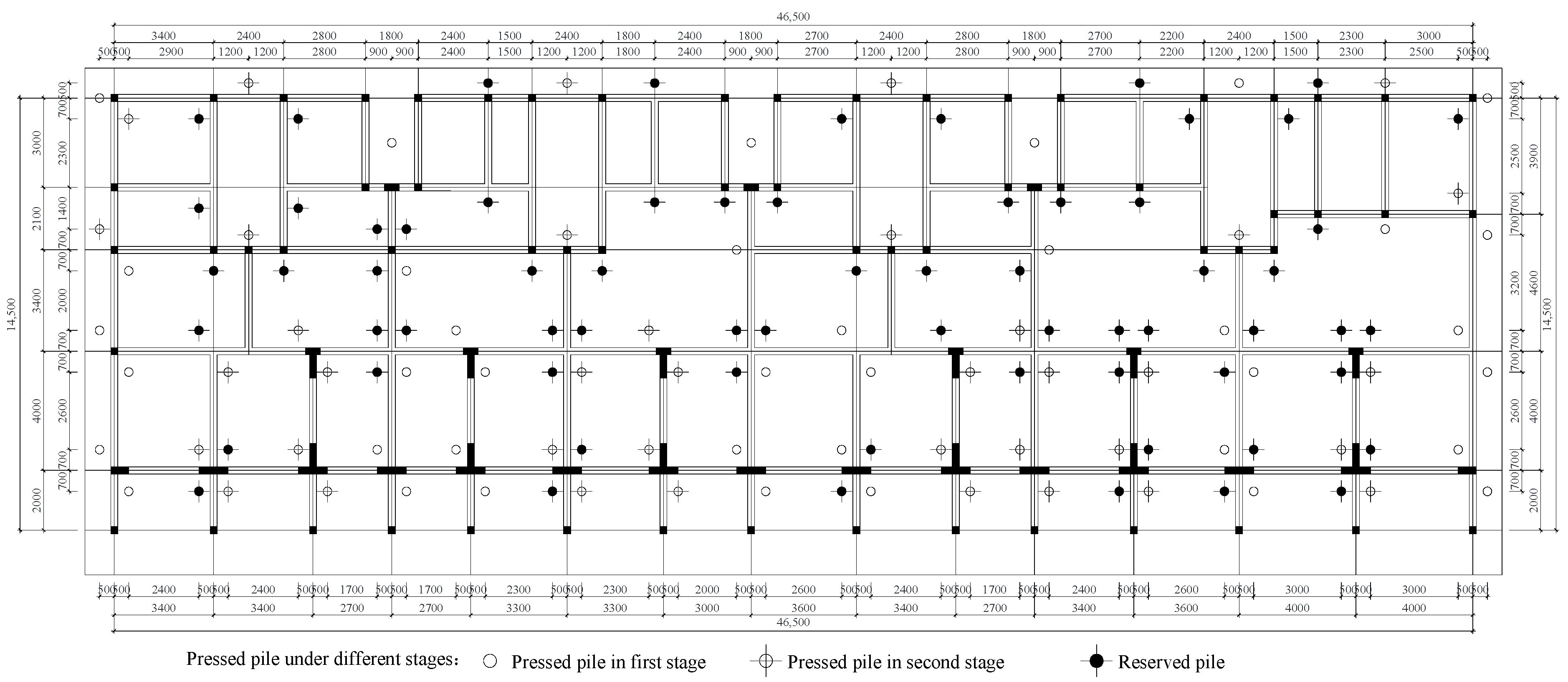
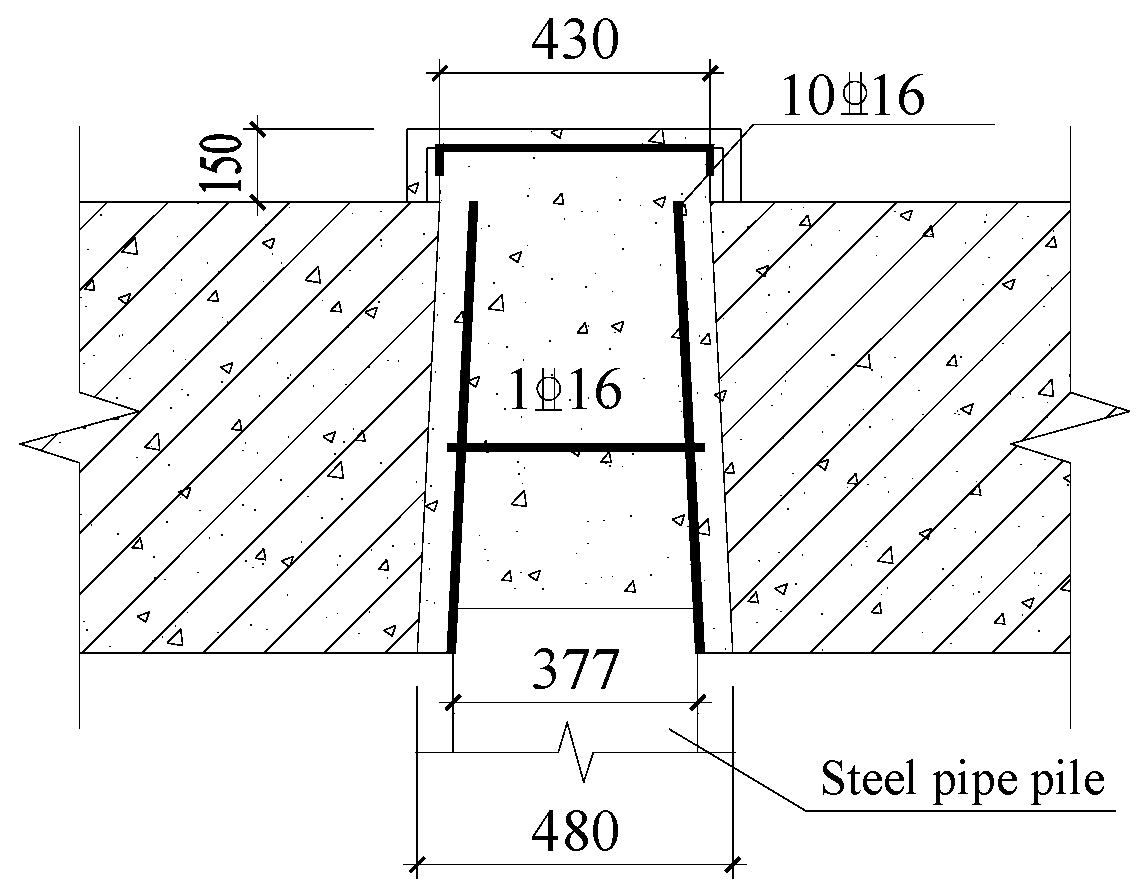
3.2.2. Anchor Static Pressure Steel Pipe Pile Strengthening
3.2.3. Comparison of Two Strengthening Schemes
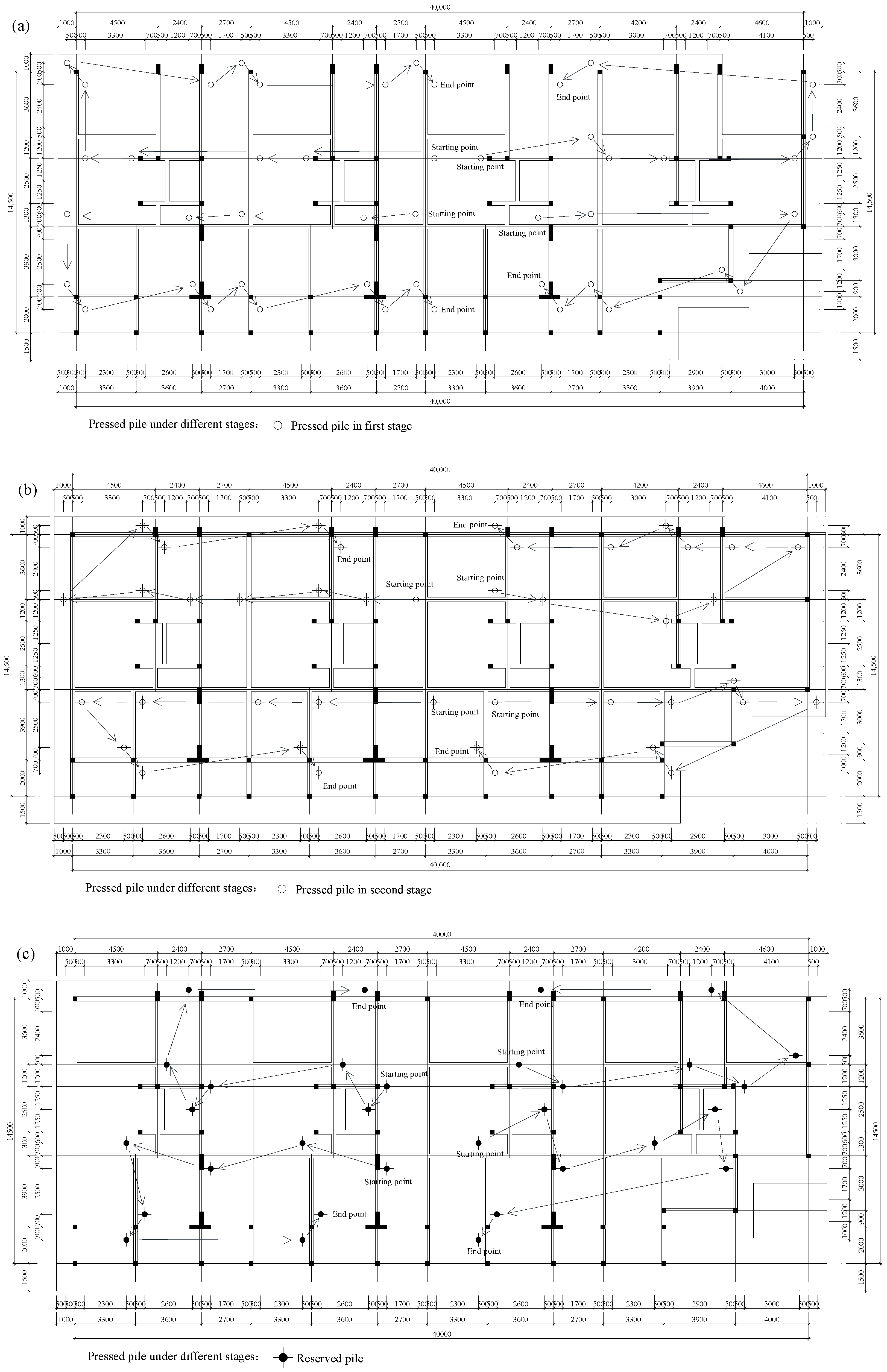
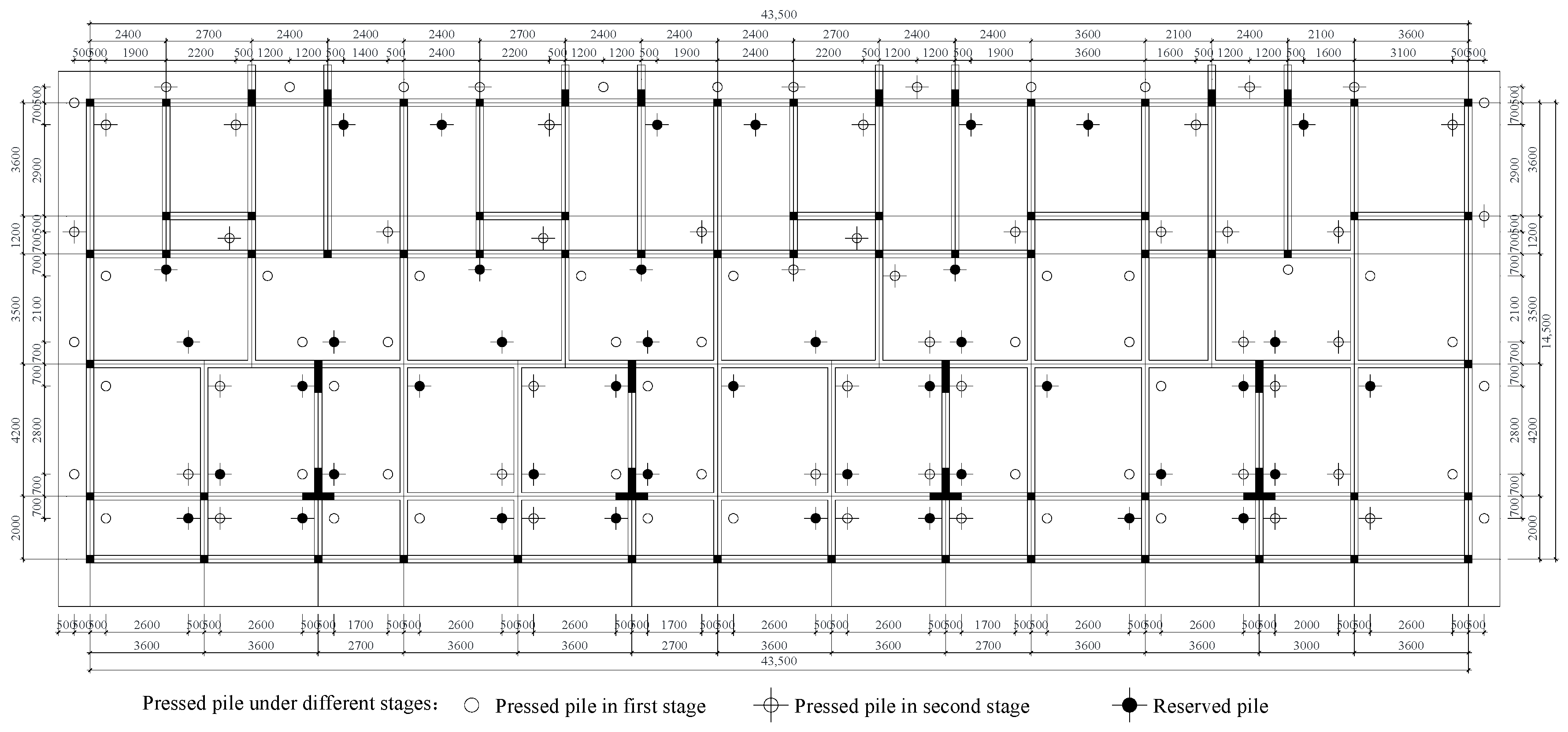
3.3. Construction Process of Anchor Static Pressure Pile
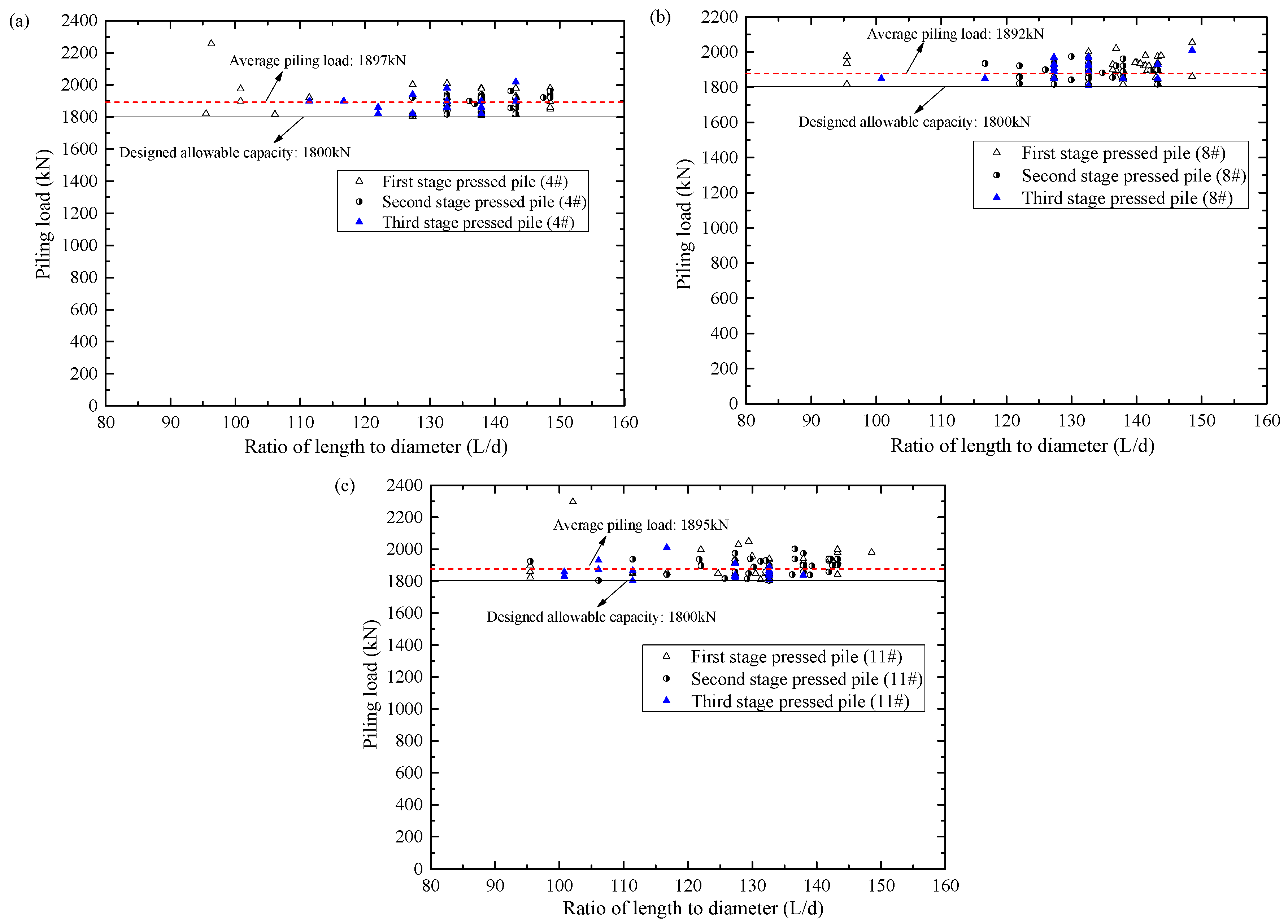
3.4. Bearing Capacity of Static Pressure Pile
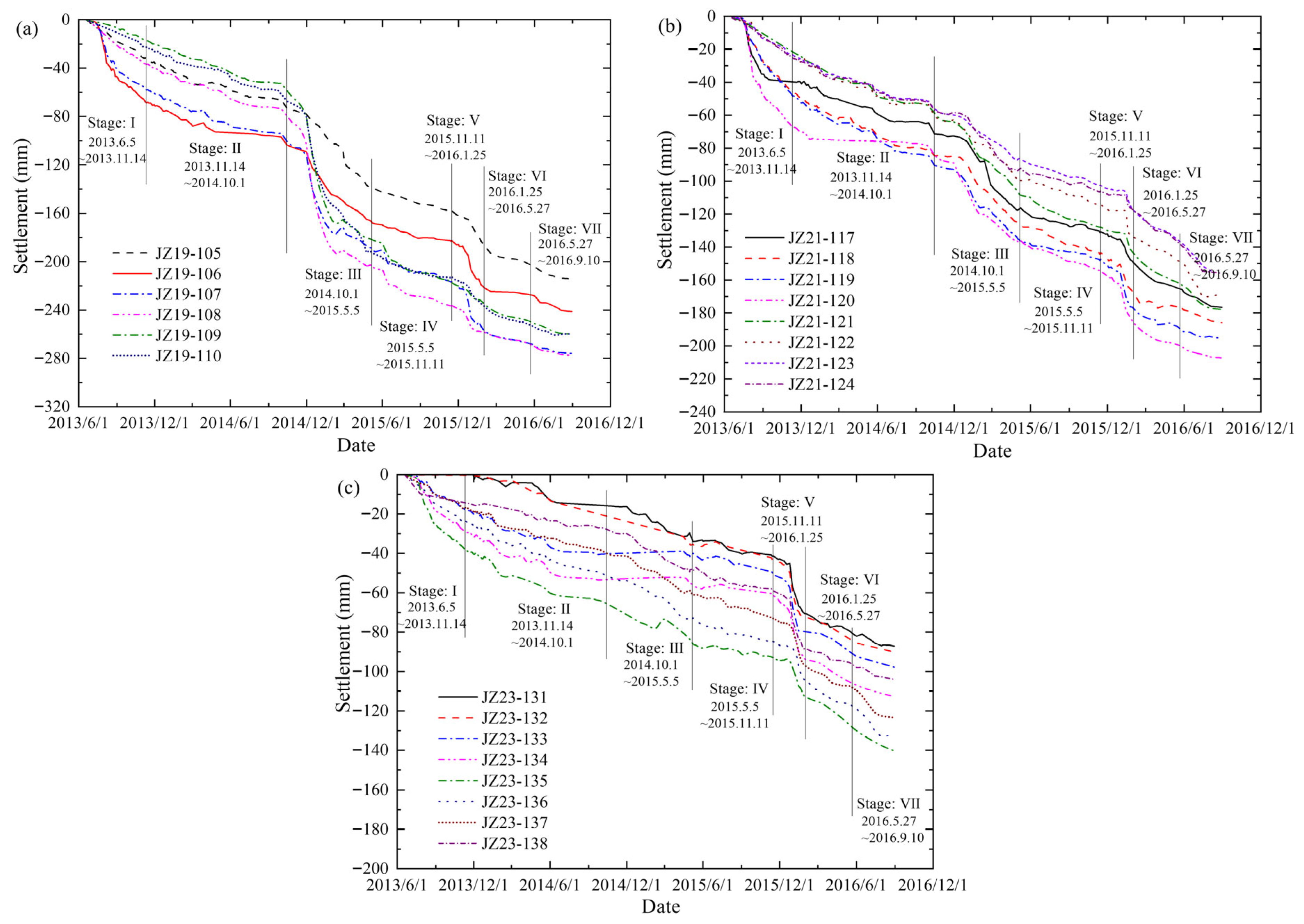
4. Discussion of Building Response Based on Field Monitoring
5. Conclusions
Author Contributions
Funding
Data Availability Statement
Conflicts of Interest
References
- Ou, C.Y.; Teng, F.; Li, C.W. A simplified estimation of excavation-induced ground movements for adjacent building damage potential assessment. Tunn. Undergr. Space Technol. 2020, 106, 103561. [Google Scholar] [CrossRef]
- Tan, Y.; Fan, D.; Lu, Y. Statistical analyses on a database of deep excavations in Shanghai soft clays in China from 1995–2018. Pract. Period. Struct. Des. Constr. 2022, 27, 04021067. [Google Scholar] [CrossRef]
- Finno, R.J.; Bryson, L.S. Response of building adjacent to stiff excavation support system in soft clay. J. Perform. Constr. Facil. 2002, 16, 10–20. [Google Scholar] [CrossRef]
- Tan, Y.; Li, X.; Kang, Z.; Liu, J.; Zhu, Y. Zoned excavation of an oversized pit close to an existing metro line in stiff clay: Case study. J. Perform. Constr. Facil. 2015, 29, 04014158. [Google Scholar] [CrossRef]
- Liao, S.M.; Wei, S.F.; Shen, S.L. Structural responses of existing metro stations to adjacent deep excavations in Suzhou, China. J. Perform. Constr. Facil. 2016, 30, 04015089. [Google Scholar] [CrossRef]
- Zhou, S.; Di, H.; Xiao, J.; Wang, P. Differential settlement and induced structural damage in a cut-and-cover subway tunnel in a soft deposit. J. Perform. Constr. Facil. 2016, 30, 04016028. [Google Scholar] [CrossRef]
- Chen, R.P.; Lin, X.T.; Kang, X.; Zhong, Z.Q.; Liu, Y.; Zhang, P.; Wu, H.N. Deformation and stress characteristics of existing twin tunnels induced by close-distance EPBS under-crossing. Tunn. Undergr. Space Technol. 2018, 82, 468–481. [Google Scholar] [CrossRef]
- Bryson, L.S.; Kotheimer, M.J. Cracking in walls of a building adjacent to a deep excavation. J. Perform. Constr. Facil. 2011, 25, 491–503. [Google Scholar] [CrossRef]
- Tan, Y.; Jiang, W.Z.; Rui, H.S.; Lu, Y.; Wang, D.L. Forensic geotechnical analyses on the 2009 building-overturning accident in Shanghai, China: Beyond common recognitions. J. Geotech. Geoenviron. Eng. 2020, 146, 05020005. [Google Scholar] [CrossRef]
- Boscardin, M.D.; Cording, E.J. Building response to excavation-induced settlement. J. Geotech. Eng. 1989, 115, 1–21. [Google Scholar] [CrossRef]
- Finno, R.J.; Voss, F.T., Jr.; Rossow, E.; Blackburn, J.T. Evaluating damage potential in buildings affected by excavations. J. Geotech. Geoenviron. Eng. 2005, 131, 1199–1210. [Google Scholar] [CrossRef]
- Son, M.; Cording, E.J. Estimation of building damage due to excavation-induced ground movements. J. Geotech. Geoenviron. Eng. 2005, 131, 162–177. [Google Scholar] [CrossRef]
- Kotheimer, M.J.; Bryson, L.S. Damage approximation method for excavation-induced damage to adjacent buildings. Contemp. Top. Ground Modif. Probl. Soils Geo-Support 2009, 115, 65–72. [Google Scholar]
- Laefer, D.F.; Ceribasi, S.; Long, J.H.; Cording, E.J. Predicting RC frame response to excavation-induced settlement. J. Geotech. Geoenviron. Eng. 2009, 135, 1605–1619. [Google Scholar] [CrossRef]
- Goh, K.H.; Mair, R.J. Response of framed buildings to excavation-induced movements. Soils Found. 2014, 54, 250–268. [Google Scholar] [CrossRef]
- Tan, Y.; Huang, R.; Kang, Z.; Bin, W. Covered semi-top-down excavation of subway station surrounded by closely spaced buildings in downtown Shanghai: Building response. J. Perform. Constr. Facil. 2016, 30, 04016040. [Google Scholar] [CrossRef]
- Kog, Y.C. Excavation-induced settlement and tilt of a 3-story building. J. Perform. Constr. Facil. 2017, 31, 04016080. [Google Scholar] [CrossRef]
- Tan, Y.; Lu, Y. Responses of shallowly buried pipelines to adjacent deep excavations in Shanghai soft ground. J. Pipeline Syst. Eng. Pract. 2018, 9, 05018002. [Google Scholar] [CrossRef]
- Li, H.; Tang, Y.; Liao, S.; Shen, M. Structural response and preservation of historic buildings adjacent to oversized deep excavation. J. Perform. Constr. Facil. 2021, 35, 04021095. [Google Scholar] [CrossRef]
- Liu, J.C.; Tan, Y.; Liao, S.M. Protection of a 193.5-m high concrete tube-shaped TV tower close to subway excavations. J. Perform. Constr. Facil. 2023, 37, 04023043. [Google Scholar] [CrossRef]
- Hsieh, P.G.; Ou, C.Y.; Hsieh, W.H. Efficiency of excavations with buttress walls in reducing the deflection of the diaphragm wall. Acta Geotech. 2016, 11, 1087–1102. [Google Scholar] [CrossRef]
- Ou, C.Y.; Hsieh, P.G.; Lin, Y.L. Performance of excavations with cross walls. J. Geotech. Geoenviron. Eng. 2010, 137, 94–104. [Google Scholar] [CrossRef]
- Farzi, M.; Pakbaz, M.S.; Aminpour, H.A. Selection of support system for urban deep excavations: A case study in Ahvaz geology. Case Stud. Constr. Mater. 2018, 8, 131–138. [Google Scholar] [CrossRef]
- Lim, A.; Ou, C.Y.; Hsieh, P.G. Investigation of the integrated retaining system to limit deformations induced by deep excavation. Acta Geotech. 2017, 13, 973–995. [Google Scholar] [CrossRef]
- Hsieh, H.S.; Lu, Y.C.; Lin, T.M. Effects of joint details on the behavior of cross walls. J. Geoengin. 2008, 3, 55–60. [Google Scholar]
- Wu, S.H.; Ching, J.; Ou, C.Y. Predicting wall displacements for excavations with cross walls in soft clay. J. Geotech. Geoenviron. Eng. 2012, 139, 914–927. [Google Scholar] [CrossRef]
- Lim, A.; Ou, C.Y.; Hsieh, P.G. An innovative earth retaining supported system for deep excavation. Comput. Geotech. 2019, 114, 103135. [Google Scholar] [CrossRef]
- Giardina, G.; Hendriks, M.A.; Rots, J.G. Damage functions for the vulnerability assessment of masonry buildings subjected to tunneling. J. Struct. Eng. 2014, 141, 04014212. [Google Scholar] [CrossRef]
- Han, J.; Ye, S.L. A field study on the behavior of a foundation underpinned by micropiles. Can. Geotech. J. 2006, 43, 30–42. [Google Scholar] [CrossRef]
- Thorburn, S.; Littlejohn, G.S. Underpinning and Retention; CRC Press: Boca Raton, FL, USA, 2014. [Google Scholar]
- Azadi, M.R.; Taghichian, A.; Taheri, A. Optimization of cement-based grouts using chemical additives. J. Rock Mech. Geotech. Eng. 2017, 9, 623–637. [Google Scholar] [CrossRef]
- GB50292-2015; Standard for Appraiser of Reliability of Civil Buildings. China Architecture & Building Press: Beijing, China, 2015.
- GB50007-2011; Code for Design of Building Foundation. Ministry of Housing and Urban-Rural Development of the People’s Republic of China, China Architecture & Building Press: Beijing, China, 2011.
- Nicholson, P.J.; Pinyot, D.E. The evolution of micropiles in America. In Proceedings of the 7th International Workshop on Micropiles, Schrobenhausen, Germany, 3–7 May 2006. [Google Scholar]
- Fross, M. 35 years of application of micropiles in Austria. In Proceedings of the 7th International Workshop on Micropiles, Schrobenhausen, Germany, 3–7 May 2006. [Google Scholar]
- CABR. Design Software JCCAD for Independent Foundation, Strip Foundation, Reinforced Concrete Pile Foundation and Raft Foundation; China Academy of Building Research: Beijing, China, 2010. [Google Scholar]
- HighwaysAgency. Manual of Contract Documents for Highway Works: Notes for Guidance of the Specification for Highway Works; Department for Transportation: London, UK, 2009.
- D1143/D1143M-07(2013); Standard Test Methods for Deep Foundations under Static Axial Compressive Load. ASTM International: West Conshohocken, PA, USA, 2013.
- Bagheri, M.; Malidarreh, N.R.; Ghaseminejad, V.; Asgari, A. Seismic resilience assessment of RC superstructures on long–short combined piled raft foundations: 3D SSI modeling with pounding effects. Structures 2025, 81, 110176. [Google Scholar] [CrossRef]
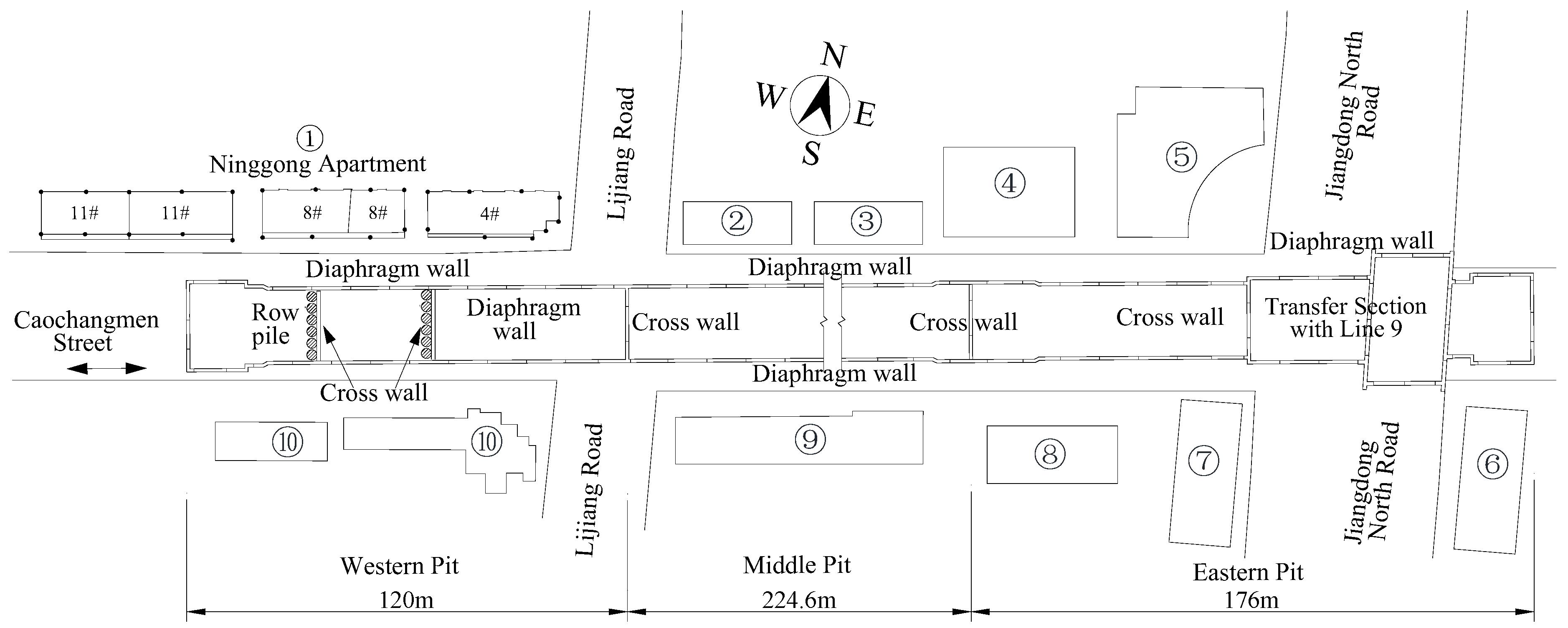
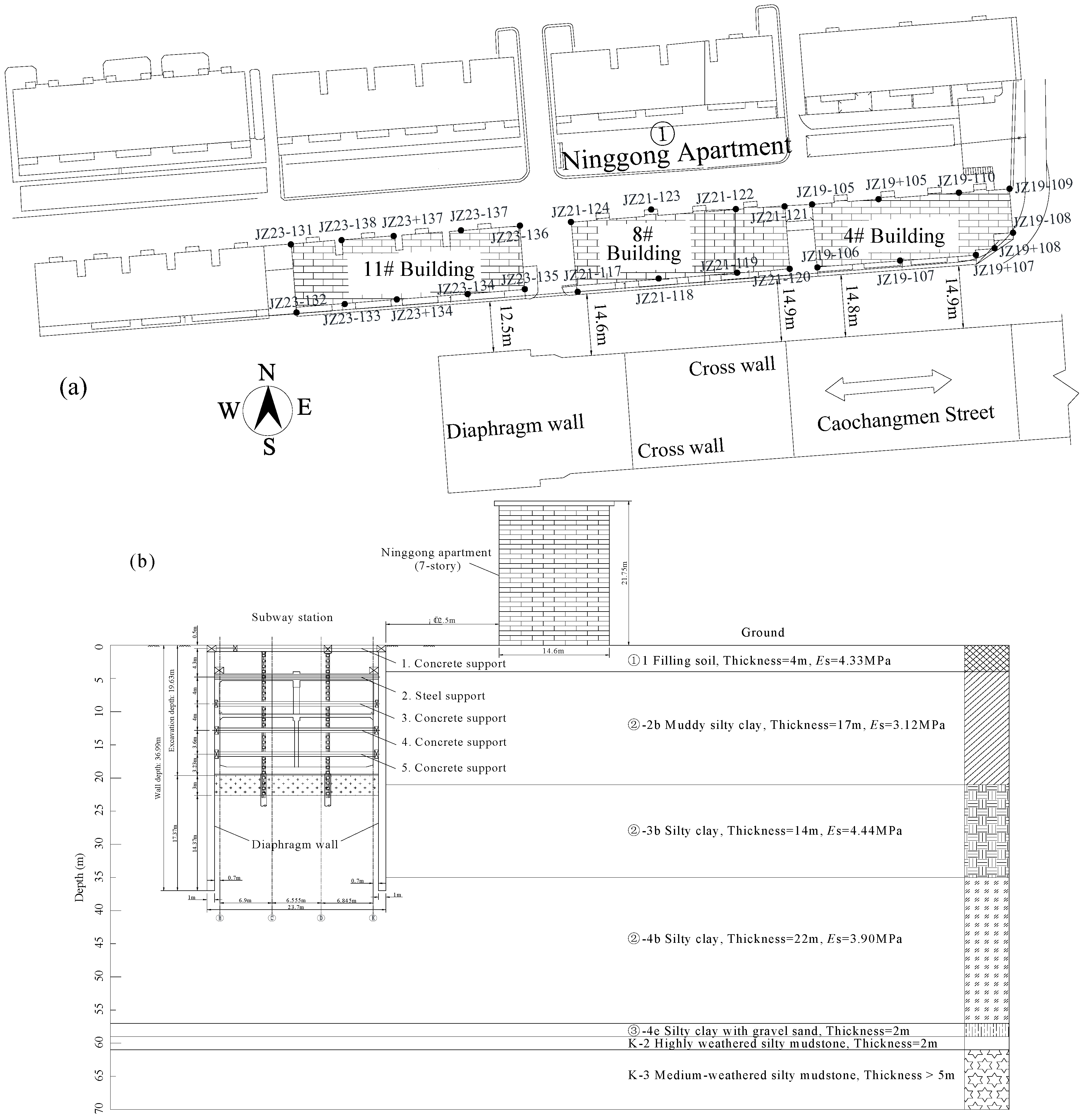
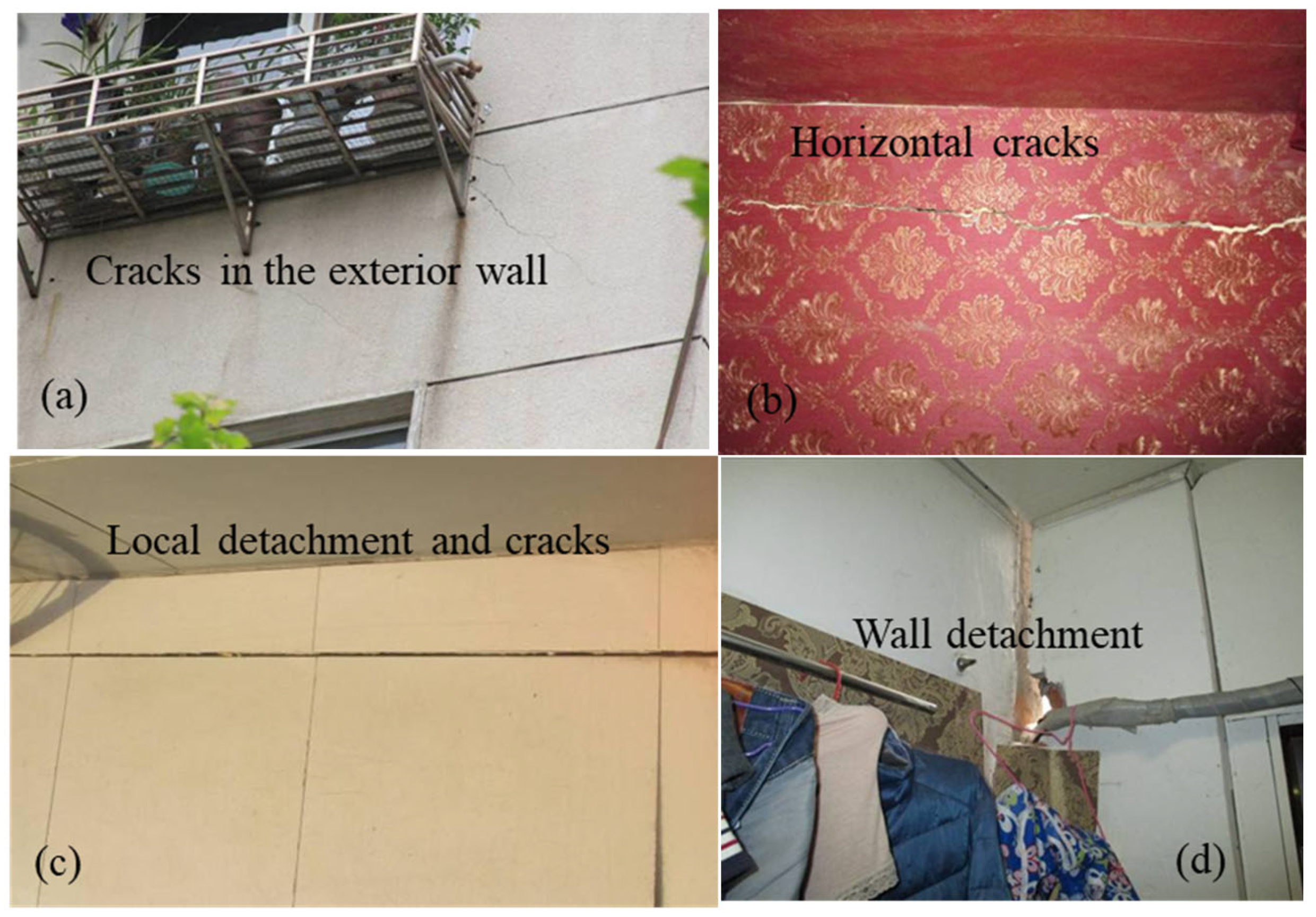
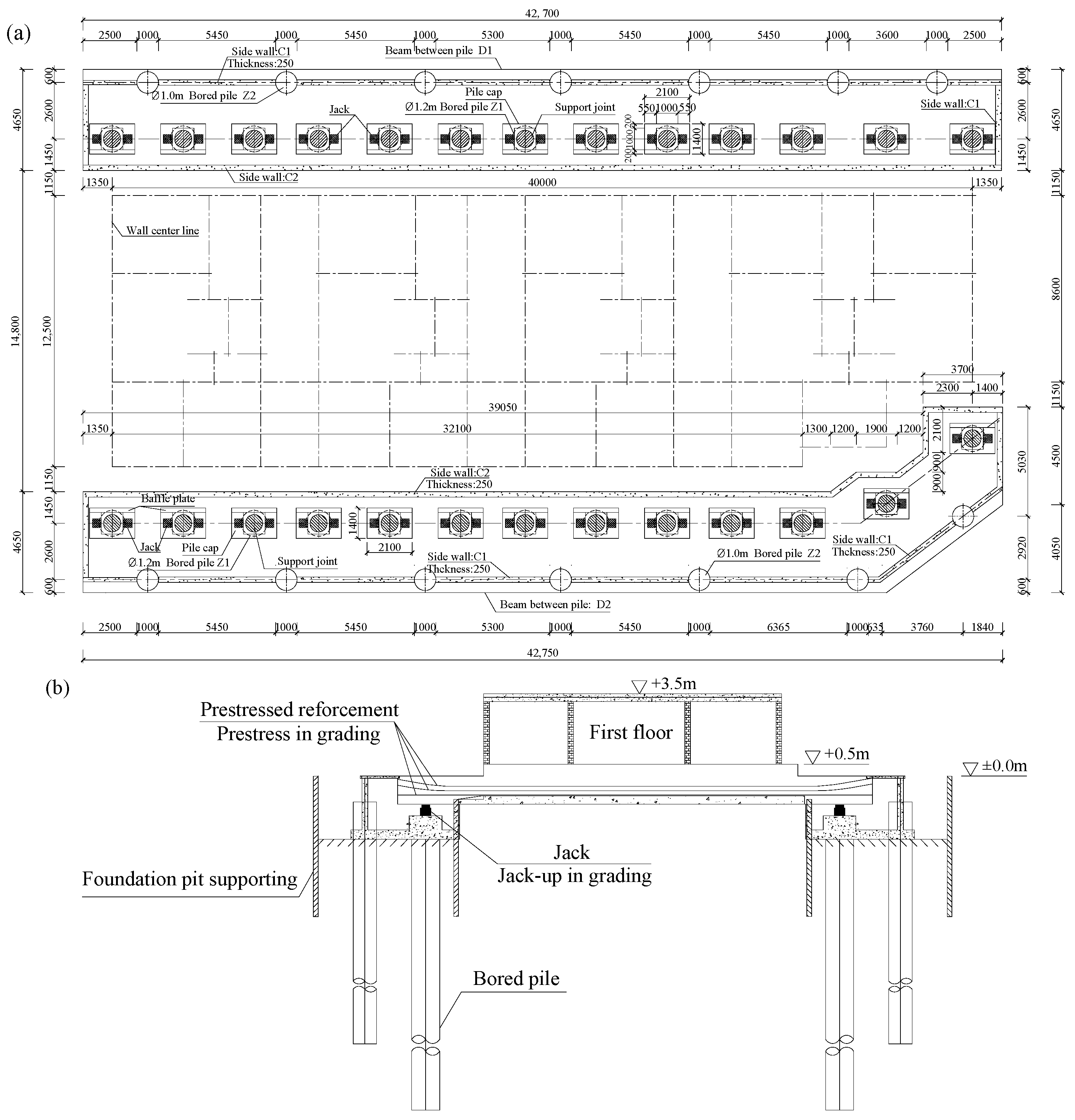
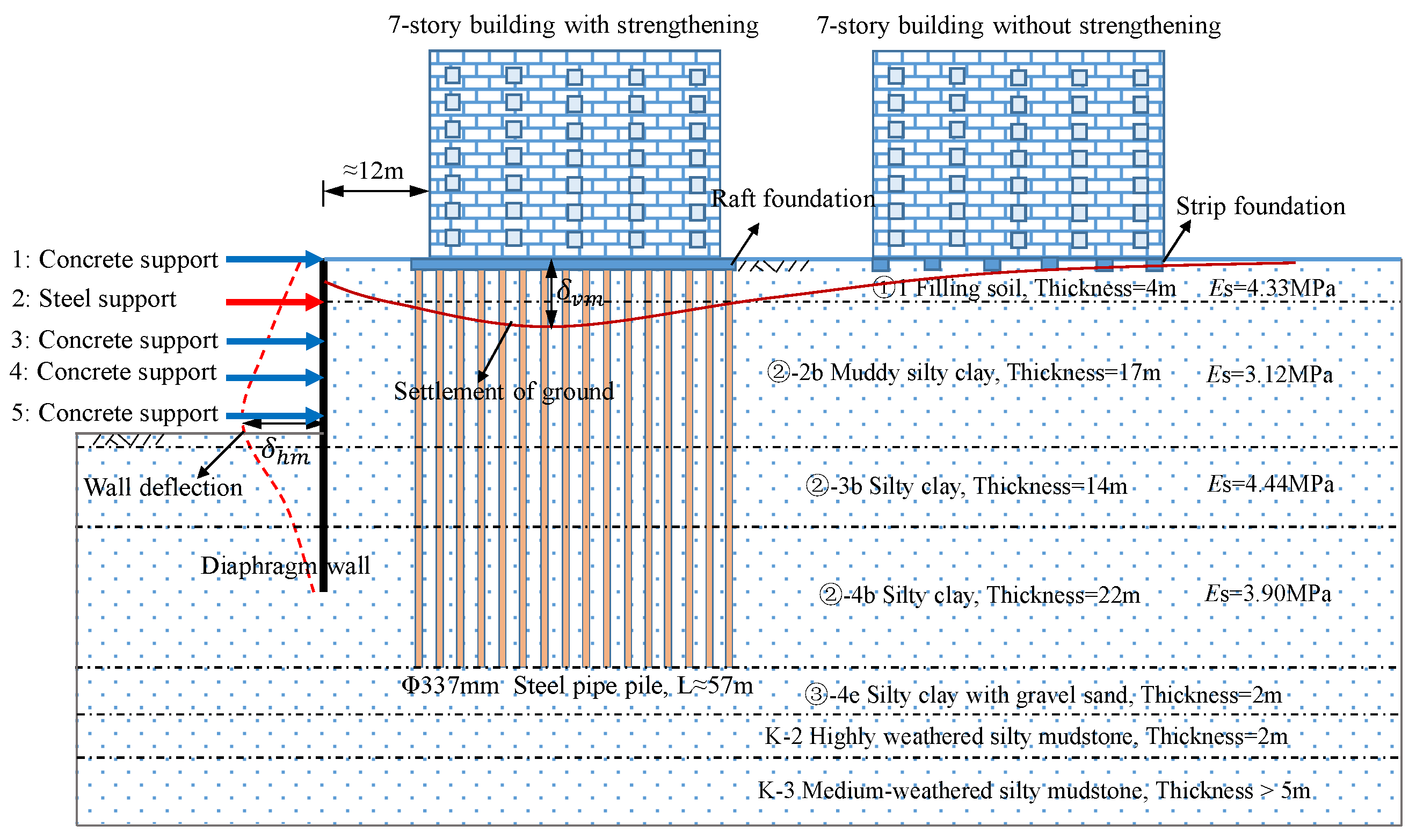

| Layer No. | Soil | Elevation of Layer Base (m) | γ /kN/m3 | c /kPa | φ /° | Es/MPa | SPT | UCS /MPa | IP | IL |
|---|---|---|---|---|---|---|---|---|---|---|
| ① | Filling soil | 4 | 19.3 | 16.1 | 15.1 | 4.33 | 4 | / | 15.5 | 0.59 |
| ②-2b | Silty clay and muddy silty clay | −15.65 | 18.1 | 12.7 | 17.3 | 3.12 | 2.3 | / | 15.8 | 1.1 |
| ②-3b | Silty clay mixed with silt | −28.25 | 18.3 | 11.6 | 21.3 | 4.44 | 6.6 | / | 12.7 | 1.06 |
| ②-4b | Silty clay | −51.65 | 18.3 | 14.4 | 18.9 | 3.9 | 8.1 | / | 14.8 | 0.92 |
| ③-4e | Silty clay with gravel sand | −53.55 | 19.5 | 18 | 25 | / | / | / | / | / |
| K-2 | Strongly weathered silty mudstone, muddy siltstone | −55.25 | 21.0 | 272 | 32 | / | / | / | / | / |
| K-3 | Moderately weathered silty mudstone, muddy siltstone | −60 | 24.4 | 348 | 40 | / | / | 15.69 | / | / |
| Position | Ground Floor (Street Shops/Commercial Units) | Second to Seven Floors |
|---|---|---|
| Safety issues |
|
|
| Assessment conclusion | The buildings were classified as a grade of Csu, indicating an existing security threat. This assessment was based on their tilt rates (3.3‰ for building #4, 2.3‰ for #8, and 3.6‰ for #11), which are close to the 4‰ limit specified in the code (GB50007-2011) for buildings ≤ 24 m in height, and a maximum crack width of 2.6 mm, which is near the 3 mm limit. | |
| The Percentage of Load Undertaken by Pile | The Percentage of Load Undertaken by Raft | Maximum Settlement Value/mm |
|---|---|---|
| 0 | 100% | 300 |
| 25% | 75% | 134 |
| 50% | 50% | 68 |
| 75% | 25% | 44 |
| Category | Static Pressure Piles of 4# | Static Pressure Piles of 8# | Static Pressure Piles of 11# |
|---|---|---|---|
| Pressed length/m | 36~56 | 36~56 | 36~56 |
| Final installation load/kN | 1802~2257 | 1809~2054 | 1803~2297 |
| Soil plug length/m | 21.4~29.7 | 21.0~32.2 | 20.8~29.5 |
| Building | Pile No. | Pile Length/m | Final Installation Loads/kN | Maximum Test Load/kN | Maximum Settlement/mm |
|---|---|---|---|---|---|
| 4# | 17# pile | 42 | 1922 | 1800 | 24.9 |
| 11# pile | 56 | 1861 | 1800 | 30.4 | |
| 13# pile | 50 | 1898 | 1800 | 27.3 | |
| 8# | 23# pile | 56 | 2054 | 1800 | 26.6 |
| 44# pile | 54.2 | 1980 | 1800 | 28.3 | |
| 11# | 10# pile | 50 | 1803 | 1800 | 25.6 |
| 32# pile | 36 | 1859 | 1800 | 28.8 |
| No. | Stage | Stage I | Stage II | Stage III | Stage IV | Stage V | Stage VI | Stage VII |
|---|---|---|---|---|---|---|---|---|
| Duration | 2013.6.5~ 2013.11.14 | 2013.11.14~ 2014.10.1 | 2014.10.1~2015.5.5 | 2015.5.5~ 2015.11.11 | 2015.11.11~2016.1.25 | 2016.1.25~ 2016.5.27 | 2016.5.27~2016.9.10 | |
| 4# | Cumulative settlement (mm) | −17.08~ −68.10 | −52.36~ −97.02 | −138.90~ −202.52 | −158.11~ −236.22 | −183.30~ −258.08 | −203.08~ −268.94 | −214.08~ −277.60 |
| Stage settlement (mm) | −17.08~ −68.10 | −28.92~ −39.14 | −69.38~ −129.49 | −16.09~ −36.03 | −14.94~ −37.32 | −8.48~ −19.78 | −7.44~ −13.37 | |
| Average rate (mm/d) | −0.11~ −0.43 | −0.09~ −0.12 | −0.32~ −0.60 | −0.09~ −0.19 | −0.20~ −0.50 | −0.07~ −0.16 | −0.07~ −0.13 | |
| 8# | Cumulative settlement (mm) | −23.00~ −48.48 | −51.32~ −84.65 | −85.87~ −135.96 | −102.79~ −153.84 | −115.83~ −182.70 | −137.88~ −200.42 | −155.19~ −207.27 |
| Stage settlement (mm) | −23.00~ −48.48 | −11.08~ −36.17 | −34.55~ −57.78 | −12.00~ −19.91 | −9.83~ −28.86 | −11.62~ −23.09 | −4.86~ −19.96 | |
| Average rate (mm/d) | −0.14~ −0.30 | −0.04~ −0.11 | −0.16~ −0.27 | −0.06~ −0.11 | −0.13~ −0.39 | −0.09~ −0.19 | −0.05~ −0.19 | |
| 11# | Cumulative settlement (mm) | −14.85~ −38.23 | −26.79~ −63.71 | −40.87~ −84.84 | −58.00~ −92.44 | −69.81~ −111.31 | −81.41~ −130.62 | −87.12~ −140.21 |
| Stage settlement (mm) | −14.85~ −38.23 | −11.94~ −25.79 | −21.13~ −23.67 | −5.02~ −12.33 | −18.11~ −31.39 | −9.07~ −19.31 | −5.40~ −9.59 | |
| Average rate (mm/d) | −0.09~ −0.24 | −0.04~ −0.08 | −0.10~ −0.11 | −0.03~ −0.07 | −0.24~ −0.42 | −0.07~ −0.16 | −0.05~ −0.09 |
Disclaimer/Publisher’s Note: The statements, opinions and data contained in all publications are solely those of the individual author(s) and contributor(s) and not of MDPI and/or the editor(s). MDPI and/or the editor(s) disclaim responsibility for any injury to people or property resulting from any ideas, methods, instructions or products referred to in the content. |
© 2025 by the authors. Licensee MDPI, Basel, Switzerland. This article is an open access article distributed under the terms and conditions of the Creative Commons Attribution (CC BY) license (https://creativecommons.org/licenses/by/4.0/).
Share and Cite
Xu, J.; Deng, H.; Liu, Z.; Dai, G.; Ke, L.; Guo, X.; Zhang, Z. Protection of Low-Strength Shallow-Founded Buildings Around Deep Excavation: A Case Study in the Yangtze River Soft Soil Area. Buildings 2025, 15, 4094. https://doi.org/10.3390/buildings15224094
Xu J, Deng H, Liu Z, Dai G, Ke L, Guo X, Zhang Z. Protection of Low-Strength Shallow-Founded Buildings Around Deep Excavation: A Case Study in the Yangtze River Soft Soil Area. Buildings. 2025; 15(22):4094. https://doi.org/10.3390/buildings15224094
Chicago/Turabian StyleXu, Jiang, Huiyuan Deng, Zhenrui Liu, Guoliang Dai, Lijun Ke, Xia Guo, and Zhitong Zhang. 2025. "Protection of Low-Strength Shallow-Founded Buildings Around Deep Excavation: A Case Study in the Yangtze River Soft Soil Area" Buildings 15, no. 22: 4094. https://doi.org/10.3390/buildings15224094
APA StyleXu, J., Deng, H., Liu, Z., Dai, G., Ke, L., Guo, X., & Zhang, Z. (2025). Protection of Low-Strength Shallow-Founded Buildings Around Deep Excavation: A Case Study in the Yangtze River Soft Soil Area. Buildings, 15(22), 4094. https://doi.org/10.3390/buildings15224094

