1. Introduction
In recent years, with the growing demand for infrastructure construction and the popularization of prefabricated bridge construction technology [
1,
2,
3,
4], the automation level of rebar processing and welding in prefabricated girders has attracted considerable attention [
5]. The traditional manual-dominated stirrup processing [
6,
7] and framework welding processes suffer from cumbersome procedures, high labor intensity, and poor quality consistency [
8,
9], which are difficult to meet the requirements of modern bridge engineering for high efficiency, safety, and green construction [
10].
Currently, the management level of prefabricated component yards in China is in a critical stage of transition from extensive management to refined management. With the rapid development of construction industrialization, while many prefabricated yards have achieved large-scale production, they also expose some common management problems. On the one hand, some leading modern enterprises have introduced digital tools, such as a Manufacturing Execution System (MES) [
11] and Building Information Modeling (BIM) [
12,
13], realizing online management of production progress, material inventory, and quality traceability. Automated production lines have significantly improved efficiency and quality control capabilities. In addition, the industry generally faces bottlenecks, including low cross-departmental collaboration efficiency, insufficient standardization, and a shortage of professional compound talents. In the future, promoting the construction of smart factories, strengthening the whole-process data-driven decision making [
14,
15], and establishing a sound industry standard system will be the core directions to improve the overall management efficiency of prefabricated yards [
16,
17], ensure product quality, and delivery cycle.
Driven by the concepts of intelligent construction and digital construction, rebar processing in prefabricated girder yards is gradually moving toward mechanization, automation, and intelligence. Domestic and foreign studies have shown that automated welding [
18,
19,
20,
21] and intelligent logistics technologies can significantly improve production efficiency and welding quality and reduce human errors, and have achieved good application results in fields such as steel bridge manufacturing. However, systematic and full-process automated research on rebar processing for prefabricated bridge girders is still insufficient. Existing technologies mostly focus on single equipment or partial processes [
22], and no promotable overall solution has been formed yet.
Environmental concerns stem from the increasing utilization of automated technologies, and recycling the E-waste in prefabricated construction is a promising way out [
23]. Prefabricated components in smart yards or emerging structural systems should also pay much more attention to their seismic performance [
24,
25,
26,
27]. Moreover, the behavior of composite connectors at elevated temperatures is relevant to heat input and thermal cycle input during automated welding [
28]. A combined test and FE validation framework can communicate transferability beyond a single site [
29]. A recent study showed that composite frames under fire loading exhibit connection response shifts under thermal cycles and that documenting these shifts alongside controls for heat input improves acceptance confidence without meaningfully increasing production time [
30].
Based on this, relying on the G107 National Highway Reconstruction Project, this study develops a full-process automated logistics system covering “bending–delivering–welding–storage”, integrating key technologies such as three-in-one integrated stirrup bending, accurate positioning of internal-penetrating longitudinal rebars, and laser-adaptive welding. This realizes the mechanization, intelligence, and standardization of prefabricated girder reinforcement cage processing. This paper aims to systematically elaborate on the construction ideas and key equipment of this system and verify its advantages in improving efficiency, reducing costs, and ensuring quality through engineering applications, so as to provide new ideas and practical support for intelligent construction of bridge engineering.
2. Significance and Necessity of Transformation
2.1. Stirrup Manufacturing
Stirrups are important rebar components in reinforced-concrete structures, used to fix longitudinal bearing force reinforcement and bear part of the shear and torque. The manual stirrup manufacturing process usually includes the following steps: calculating the blanking length of stirrups, which requires considering the rebar diameter, bending adjustment value, and lap length required for joints; adjusting the rebar bending machine, and setting the bending axis, stop axis, and travel switch according to the shape, size, and bending angle of the stirrups; and, finally, workers feed the cut straight rebar segments into the stirrup bending machine, which clamps the rebars mechanically and bends them sequentially at the specified positions according to the preset program. However, during the operation, workers are highly involved, which easily leads to precision problems of the produced products due to insufficient experience. Moreover, the risk coefficient for personal safety during operation cannot be ignored, and there are significant potential safety hazards in the production process.
Stirrup manufacturing must comply with the Code for Acceptance of Construction Quality of Concrete Structures, with a core five-step process: first, selecting the corresponding rebars and conducting “three inspections” (appearance inspection, quality document review, and mechanical property test) before storage; second, straightening the rebars using numerical control equipment and controlling the elongation and straightness; third, calculating the cutting length based on the formula “design perimeter–bending extension” and ensuring precision with numerical control cutting machines; fourth, controlling the bending angle, bending radius, and hook parameters according to the design shape; and, finally, sampling and inspecting dimensions, angles, etc., and storing the qualified stirrups by specification with proper elevation. Precision and structural performance are guaranteed throughout the process.
2.2. Differences Between Different Stirrup Connection Methods
There are three main connection methods for stirrups: traditional hooked binding, mechanical connection, and welding (such as resistance spot welding and flash butt welding).
Traditional hooked binding requires on-site processing, with cumbersome and time-consuming procedures. In addition, the overlapping parts of composite stirrups are numerous, causing rebar waste, and the multiple hooks hinder concrete vibration.
A rebar mechanical connection includes three types: a straight thread connection, a tapered thread connection, and a sleeve extrusion connection. It has no restrictions on the application scope in rebar connection projects. With low operation, ordinary rebar workers can carry out operations in various construction environments. It has excellent force transmission performance and a super-strong connection effect, with stable and controllable joint quality. However, the overall construction cost is relatively high; compared with the binding lap and welding connection, the proportion of material cost is higher.
Welded stirrups can be produced in factories, eliminating the need for hooks and overlapping rebars. The processing efficiency reaches 140–210 pieces per hour, and the installation efficiency is 1.3–2.0 times that of traditional methods. The strength of the welding points meets the anchorage requirements and is even better than that of hooks when the protective layer falls off. The shear capacity of short columns is higher, the hysteretic curve and ductility are similar to those of traditional stirrups, the energy dissipation is slightly better, and the strength attenuation is slower. Moreover, as the ratio of shear span to effective depth increases and the stirrup ratio improves, the seismic performance is significantly enhanced. However, if the lap length is ≤30 mm, weld tearing may occur, so parameters need to be controlled.
2.3. Differences Between Manual Welding and Automated Welding
Arc welding, as a traditional welding method, is one of the most important methods for connecting metal materials in industrial production. Manual arc welding has strict requirements for operators; improper operation will lead to obvious nonlinear characteristics of the welding torch trajectory, and the weld surface morphology shows typical inhomogeneity, causing secondary damage to the base metal surface. In addition, according to the research report by Ding Fei and other scholars, it is very difficult for manual welding to control the temperature. However, automated welding technology uses robots, intelligent control systems, and advanced sensing equipment to realize automated welding operations through programming. Compared with traditional manual welding technology, automated welding significantly improves welding efficiency and precision and reduces construction risks. At the same time, the mechanical arm of the automated welding robot has multi-axis movement functions, which can realize high-precision tracking of welding paths and flexible welding of complex structures [
31]. Cooperation between synchronized robotic arms would largely increase the accessibility, thus making a complex welding job possible [
32]. The control module and sensors on the top of the equipment can monitor parameters in real time, such as current, voltage, and temperature during the welding process, and make dynamic adjustments according to the actual situation.
Manual welding relies on the experience of welders for operation, using tools such as temperature-adjustable electric soldering irons and solder suction electric soldering irons. The allowable temperature deviation is ±5 °C, and it is difficult to accurately control the welding time (usually required to be ≤3 s). The quality is easily affected by human factors, and defects such as cold soldering and bridging are prone to occur. For inspection, welders need to conduct self-inspection first, followed by manual quality inspection, and sampling for mechanical property testing, with low efficiency. It is suitable for scenarios such as small-batch bulk materials, component repair, or military product development. Automated welding relies on robots and intelligent control systems, plans paths through 3D modeling, with controllable average deviation, and monitors parameters in real time, such as current, voltage, and molten pool temperature. The heat input is uniform and stable, and dynamic deviation correction is realized with the help of laser sensors and infrared thermometers. Data are recorded and traceable in real time. For acceptance, automated scanning and non-destructive testing are used, with high efficiency and stable quality. It can adapt to complex structures such as steel bridges and harsh environments, such as high altitudes and low temperatures, reducing manual risks.
3. Project Overview
The G107 National Highway Reconstruction Project is a rapid reconstruction project of the Dongxihu Section (from Gaoqiao Second Road to Etouwan) in Wuhan. The main line is an urban expressway and a first-class highway (the auxiliary road is an urban arterial road), adopting the form of “elevated expressway and ground auxiliary road”. The contracted amount of the project is approximately CNY 243.3 million. In terms of construction scale, the total length of the main line bridge is 3.423 km (including 0.93 km of ramps), including a four-ring interchange (3.2 km of ramps). The construction content includes municipal infrastructure projects, such as roads, bridges, drainage, sponge cities, and greening. In terms of construction deployment, the project is divided into multiple work zones (four for roads, five for bridges, and two for prefabrication yards), equipped with 22 construction teams, 5 standardized rebar processing yards, and 3 girder-delivering points. The second section of the G107 National Highway Reconstruction Project adopts the full prefabricated assembly bridge technology, which is the first application of smart girder yard technology and full prefabricated bridge construction technology in Hubei Province and the first application in the company. It is positioned as a benchmark project of the company, requiring the organization of high-level observation meetings, promotion of intelligent construction, and striving for the National Excellent Project Award. Moreover, the construction period is tight, and the requirements for digital and intelligent construction are high, so it is necessary to develop efficient construction and digital intelligence empowerment technologies.
4. Analysis of Influencing Factors on Stirrup and Welding Quality
4.1. Factors Influencing Stirrup Quality
4.1.1. Manual Processing Precision
Cutting precision is the source and foundation of determining stirrup quality. Therefore, the difference in precision between manual cutting and mechanical automated cutting leads to a significant difference in the final stirrup quality. The precision of mechanical cutting can usually be controlled at the millimeter level, which means that the length of the straight segment of each stirrup and the length of the straight segment of the 135° hook can strictly meet the requirements of the design drawings. The precise dimensions ensure that the stirrups can be accurately installed in the predetermined positions, avoiding installation difficulties or uneven thickness of the protective layer caused by dimensional deviations. In addition, the forming quality of mechanical cutting is stable, with strong batch consistency. High-precision cutting ensures the consistency of the initial conditions of all stirrups, which makes the shape and size of the stirrups produced in large batches highly uniform, greatly improving the standardization level of component production and ensuring the homogeneity and reliability of the overall project quality. In contrast, during manual rebar cutting, it is easy to have inaccurate angle control, leading to difficulties in ensuring the hook angle and straight segment length during subsequent bending forming, which affects the anchorage effect. In addition, the cutting machine produces extremely harsh, high-intensity noise during operation; long-term exposure of workers without hearing protection will lead to irreversible hearing loss, and even occupational noise-induced deafness. Protecting personal safety is the most critical link in production, so it is imperative to replace manual work with intelligence.
During manual cutting, wear of the grinding wheel and uneven cutting force easily lead to stirrup length deviation (exceeding ±1.5 mm), burrs at the cut, or oblique cutting, which affects the fitting degree of subsequent lap joints. If the parameters of mechanical processing are improperly set (e.g., the bending angle does not match the rebar material), it will cause the deviation of the stirrup hook angle (exceeding 1°), weakening the anchorage capacity.
4.1.2. Manual Installation Process
As a key component in reinforced concrete structures that bears shear force and restrains the core concrete, the quality of the stirrup installation process is directly related to the safety and durability of the structure. There are two installation methods: manual installation and mechanical automated installation, which are interdependent but distinct. In automated installation, integrated forming and positioning are realized: the automated stirrup-forming machine directly bends the coiled rebars into the required shape continuously, and the mechanical arm or special device performs precise positioning and automatic welding. However, manual installation requires step-by-step operations of “measuring–cutting–bending–binding”. According to the drawings, workers measure, mark, cut, or bend the rebars, and finally bind and fix them on site.
Positioning datum deviation: If the distance between the main reinforcement in slabs and the wall/beam edge exceeds the specification value of 50–100 mm, or the starting position of the stirrups at the beam support exceeds 50 mm, the weak stress areas of the components will lack effective restraint. If the rebar layer sequence is reversed at the intersection of primary and secondary beams (e.g., primary beam rebars are placed above secondary beam rebars), it will break the load transmission path of “slab → secondary beam → primary beam”, leading to structural stress disorder.
Binding process defects: An insufficient number of binding points (the standard requires three points: the center and two ends) or uneven binding force (too loose leads to displacement; too tight causes plastic deformation of rebars) will cause the stirrups to loosen or shift during concrete pouring or vibration. If the double-layer rebar mesh in the foundation slab is not provided with supporting feet as required (or the size of the supporting feet is inconsistent, or the binding is not firm), it will lead to a reduction in the spacing of the rebar mesh, weakening the bearing capacity of the section.
4.2. Factors Influencing Welding Quality
4.2.1. Personnel Operation
The core factor affecting the quality of stirrup welding is the operator’s control of welding parameters. If the current parameter is beyond the reasonable range, an excessively large current is likely to cause defects such as rebar burn-through and undercut, while an excessively small current leads to insufficient weld penetration and cold welding. The welding electrode designation must match the grade of the rebar used for the stirrups accurately; otherwise, the weld strength will not match the rebar itself, violating the principle of strength coordination. Failure to thoroughly clean the rust and oil stains in the rebar welding area before welding or to timely treat the welding slag and repair the missing welds after welding will increase the hidden dangers of welding quality. Uncertified operators or those with insufficient operational proficiency are prone to problems such as fluctuating welding speed and electrode angle deviation, leading to a decline in the consistency of weld quality.
4.2.2. Operator’s Quality Awareness
Operators’ understanding of regulatory standards directly impacts the quality of stirrup welding. Failure to fully grasp relevant standards (such as the Code for Acceptance of Concrete Structures (GB 50204)) can easily lead to overlooking critical technical requirements (e.g., double-sided welding for seismic stirrups) or ambiguous interpretations of acceptance criteria (e.g., weld appearance quality and dimensional deviations). This ultimately results in non-compliant welds entering subsequent construction phases. A weak sense of responsibility easily breeds the mentality of taking chances, which is manifested in deliberately shortening the designed weld length and reducing the number of welding points in concealed parts, such as beam–column joints, to simplify the operation process. The lack of process self-inspection awareness makes the key links, such as post-welding appearance inspection and parameter review, a mere formality, failing to detect and correct weld defects in a timely manner. Insufficient attention to the structural safety risks caused by welding defects (e.g., weld cracking leading to shear failure of components) will reduce the operational rigor and even ignore the hidden dangers of batch welding quality, posing a threat to the overall safety of the structure.
5. Intelligent Stirrup Processing and Welding Technology
5.1. Intelligent Stirrup Processing Technology
5.1.1. Three-in-One Stirrup Bending Station
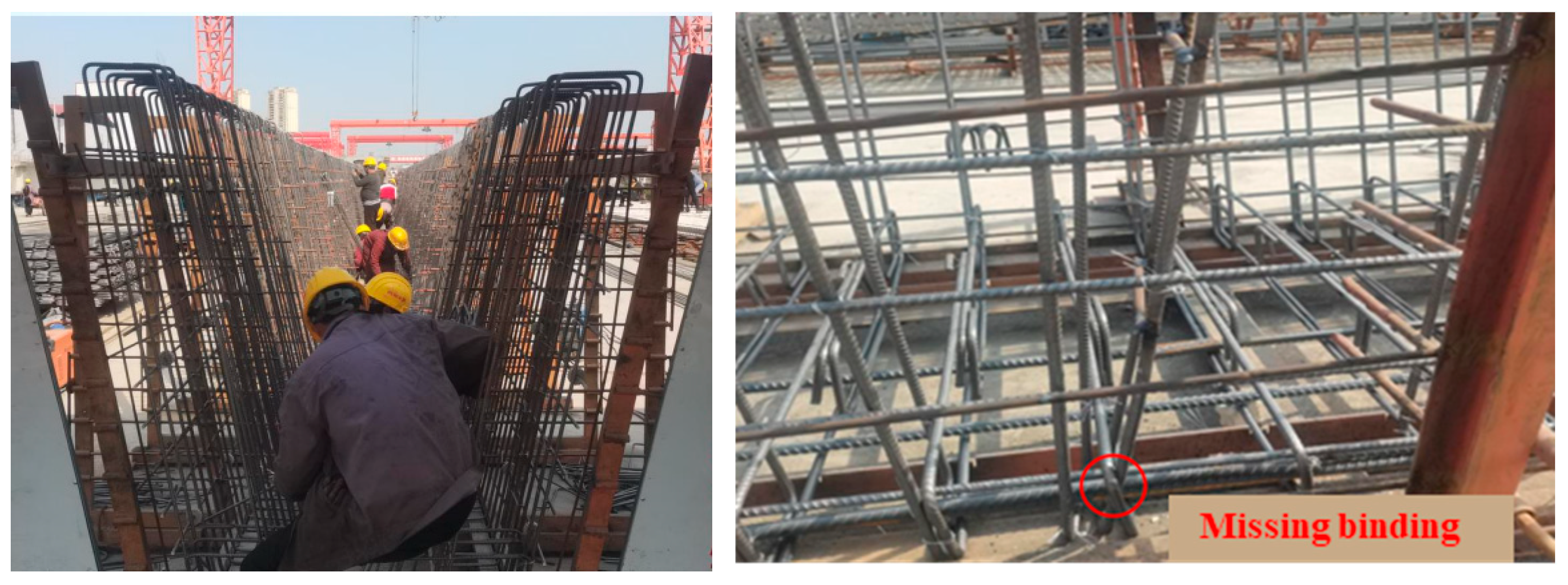
The traditional prefabricated small box girder stirrup construction consists of a total of three stirrups on the left and right web and the bottom slab, which are formed by manual binding as shown in
Figure 1. This method is labor-intensive and prone to issues, such as missing binding and dimensional errors, resulting in inconsistent product quality.
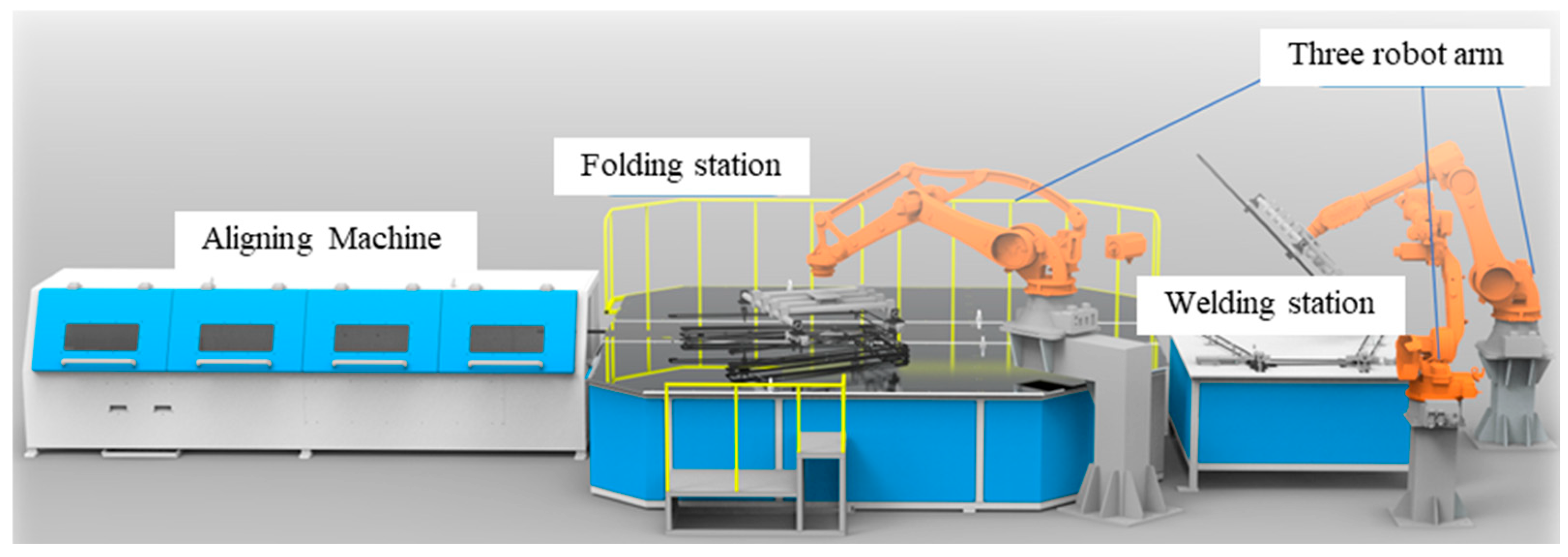
To address this, we developed a Three-in-One Stirrup Bending Station, which fundamentally improves the processing techniques for stirrups in the bottle-shaped slabs and webs of precast beams as shown in
Figure 2. The workstation is composed of a multi-axis straightening mechanism, a bending and welding workbench, and three mechanical arms, which can complete the processing of a single three-in-one stirrup at one time within 60 s.
For the record, the three-in-one bending method can consistently produce identical stirrups as long as the prior setting is completed, indicating that the raw material bending precision from primary tools is no longer a concern.
5.1.2. Dual-Power Four-Axis Straightening System
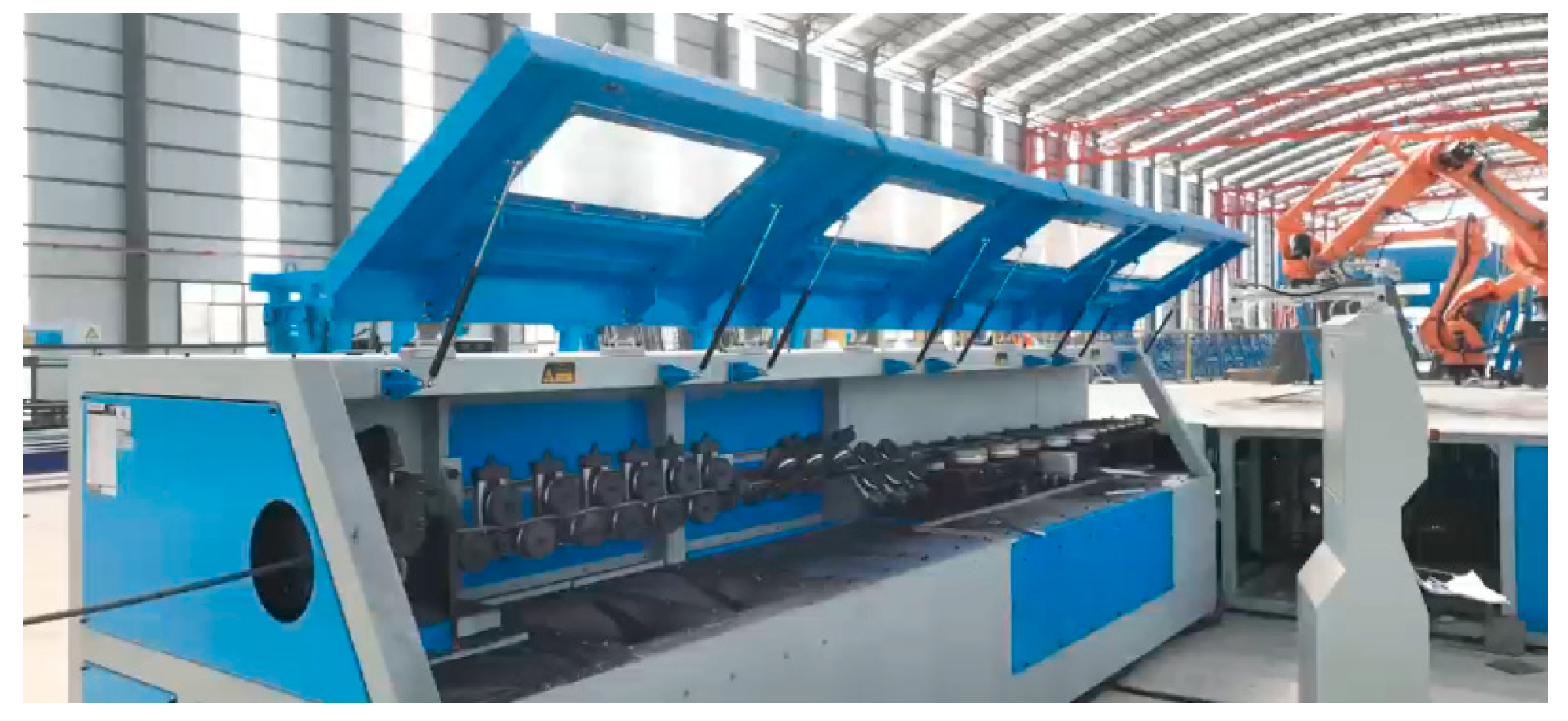
The multi-axis straightening mechanism adopts the dual-power traction and four-wheel set straightening linkage control technology. The dual-power traction device realizes the stable conveying of rebars, and the four-wheel set applies straightening force from multiple directions, ensuring that the straightening process is controllable and repeatable as shown in
Figure 3. This resolves the issue of local bending of rebars and uneven stress distribution in traditional straightening, realizing all-around precise straightening of coiled threaded rebars.
5.1.3. Integrated Stirrup Bending Workbench
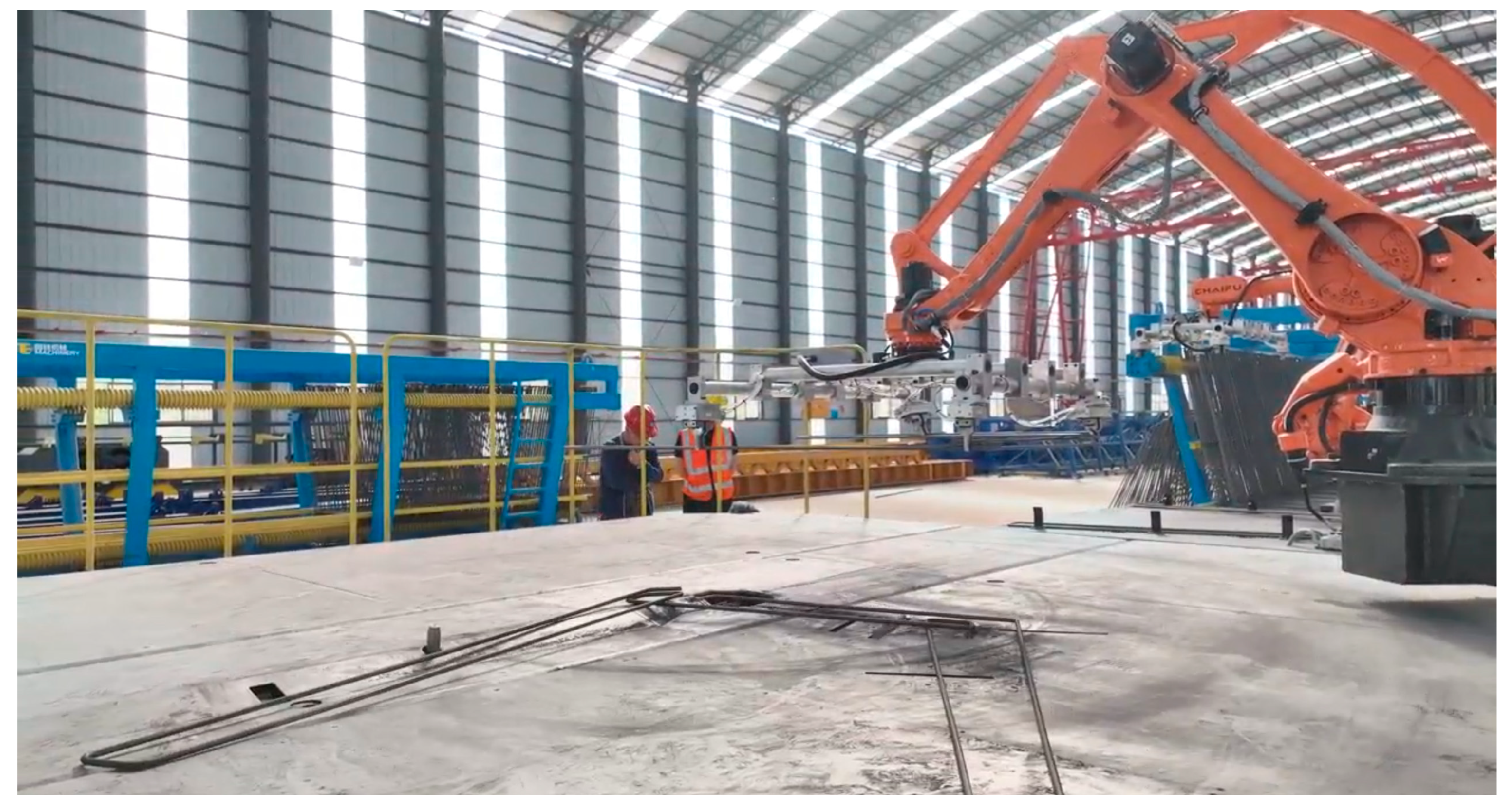
An innovative integrated bending technology for single rebars was developed with an integrated stirrup bending workbench as shown in
Figure 4. Based on data-driven, the rebars are processed and completed in one continuous operation. The three-in-one stirrup method breaks through the limitations of traditional segmental processing and splicing forming, significantly reducing the process connection error and improving the forming consistency. The continuous bending process completes the processing of a single stirrup at one time within 60 s, which can reduce the rebar consumption by about 1%. Taking the Wuhan Sixth Ring Road Project as an example, the rebar saving exceeds 50 tons. The promotion of this technology can effectively reduce labor intensity and stabilize production quality, with good promotion prospects.
Based on the former three steps, the standardized procedures can produce nearly identical stirrups with negligible manufacturing error. The high consistency in the size and shape of the produced stirrups is critical to achieve subsequent automated welding because the stirrups and the longitudinal rebars should be in close contact, while the intersecting welding node in between should be firmly clamped to facilitate efficient robotic arm interactions.
5.1.4. Multi-Process Automated Stirrup Transfer System
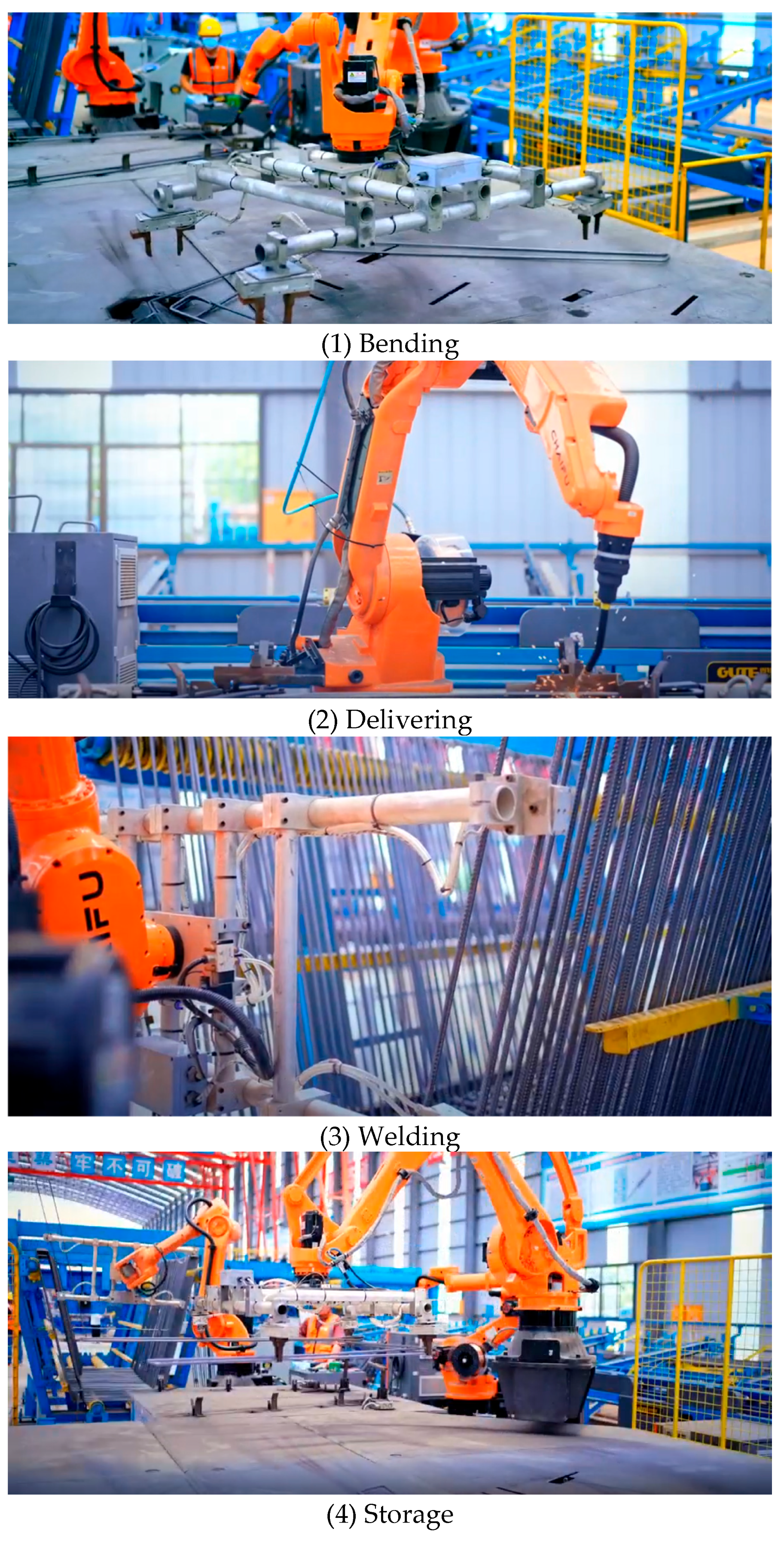
A full-process automated logistics system covering “bending–delivering–welding–storage” was constructed as shown in
Figure 5. Unmanned production is realized through the collaborative operation of three mechanical arms, which significantly simplifies the production process and reduces human errors. The transfer mechanical arm accurately transfers the bent stirrups to the welding workbench, the welding mechanical arm performs joint welding, and then the grabbing mechanical arm completes the automatic storage. To improve the positioning precision and versatility, a positioning welding fixture applicable to the processing of stirrups with different cross-sectional specifications is developed in this system: the shape positioning is combined with the inner-frame servomotor variable-diameter positioning, and then the welding robot performs the welding operation.
5.2. Intelligent Stirrup Welding Technology
5.2.1. Intelligent Reinforcement Cage Welding Station
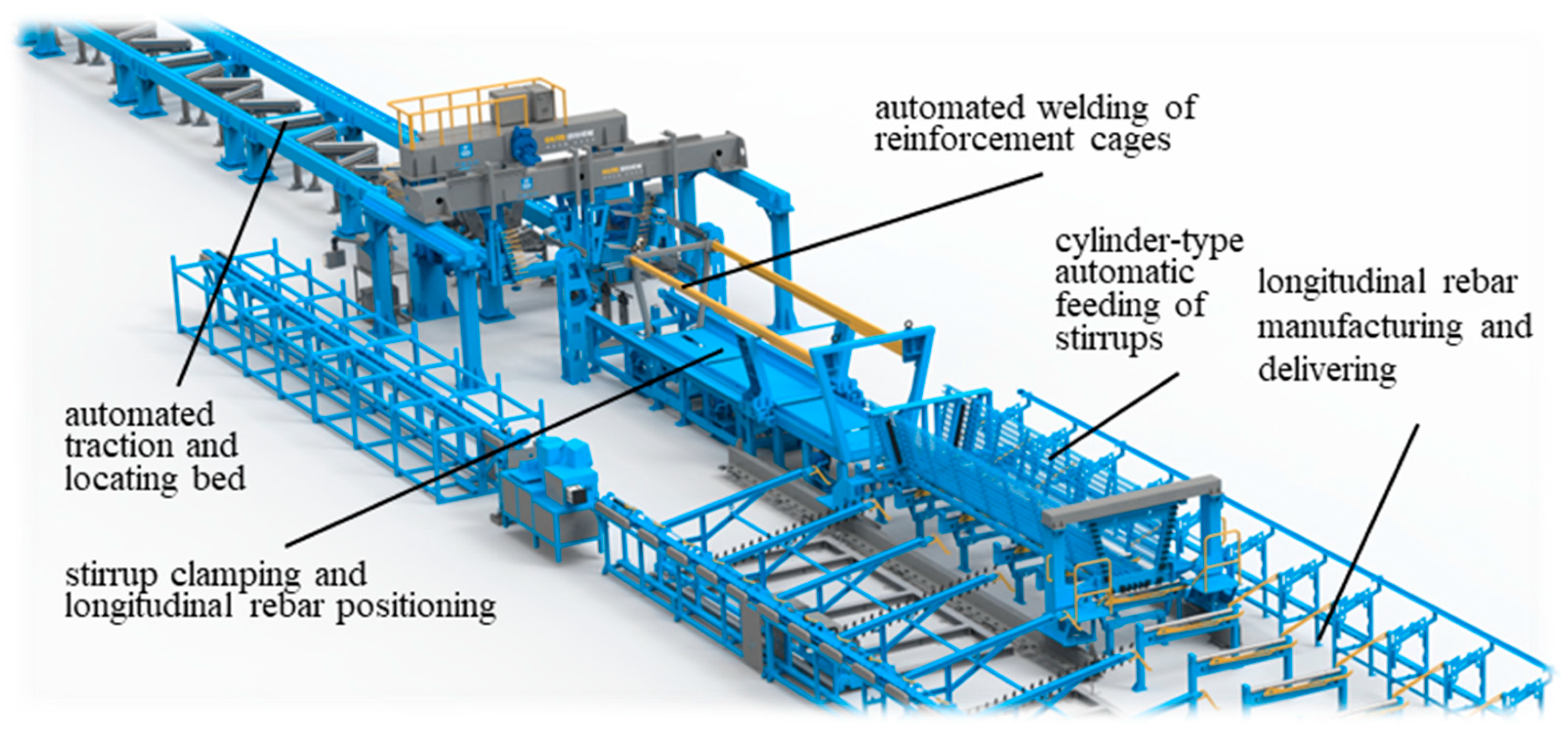
At present, the formation of reinforcement cages is still dominated by manual work, with insufficient application of automation, resulting in high labor input and high labor intensity in the production process. To solve this problem, an innovative Intelligent Reinforcement Cage Welding Station was developed as shown in
Figure 6, which is composed of nine mechanisms: longitudinal rebar production and a transmission mechanism, a gantry reinforcement cage traction mechanism, a longitudinal rebar conduit mechanism, a magazine silo and mobile platform, a stirrup stripping mechanism, a stirrup clamping and longitudinal rebar positioning mechanism, a reinforcement cage automatic welding mechanism, and a longitudinal rebar support roller mechanism.
The Intelligent Reinforcement Cage Welding Station includes five steps: longitudinal rebar manufacturing and delivery; cylinder-type automatic feeding of stirrups; stirrup clamping and longitudinal rebar positioning; automated welding of reinforcement cages; and automated traction and location bed on the production line.
5.2.2. Longitudinal Rebar Manufacturing and Delivery
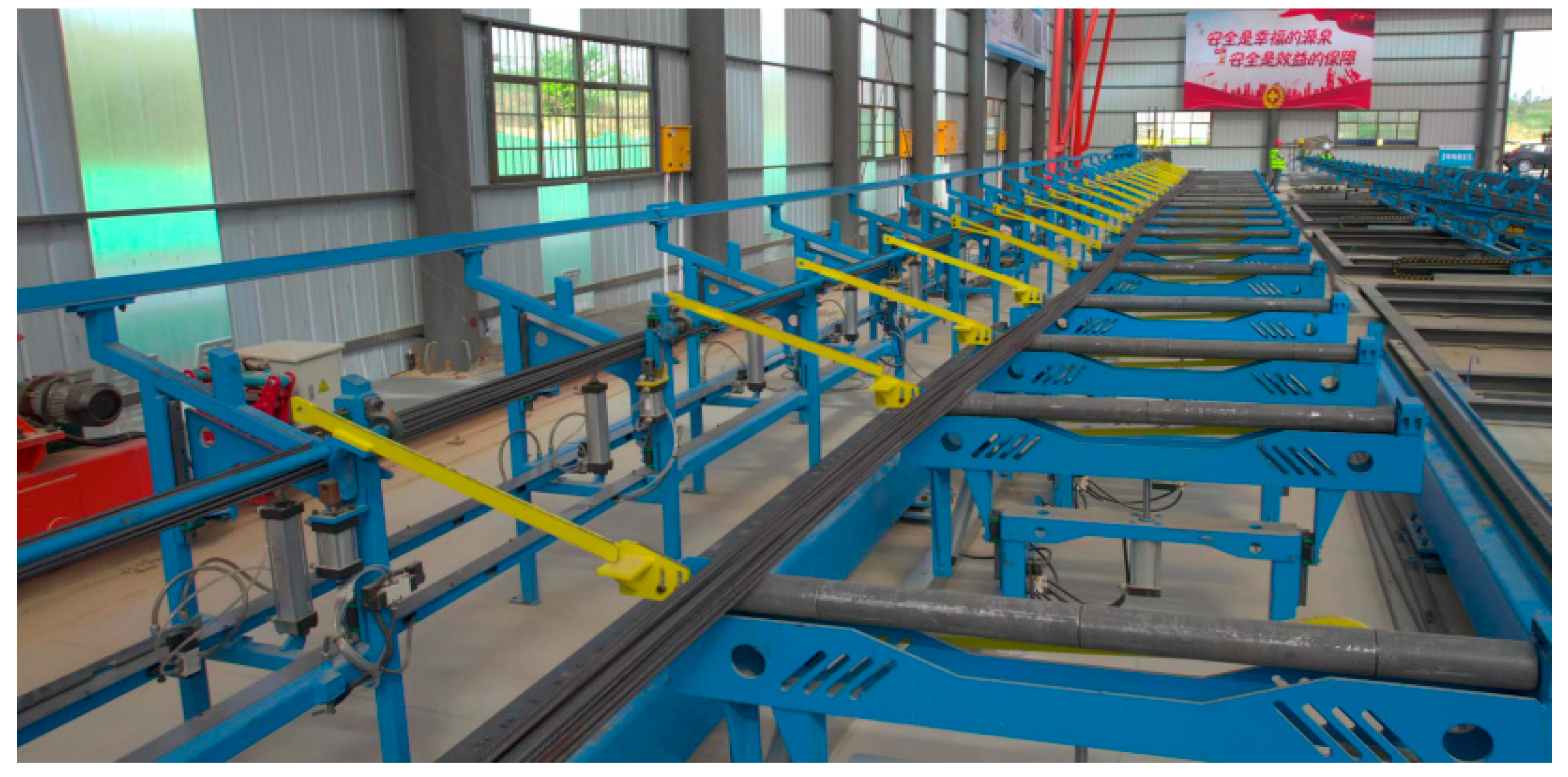
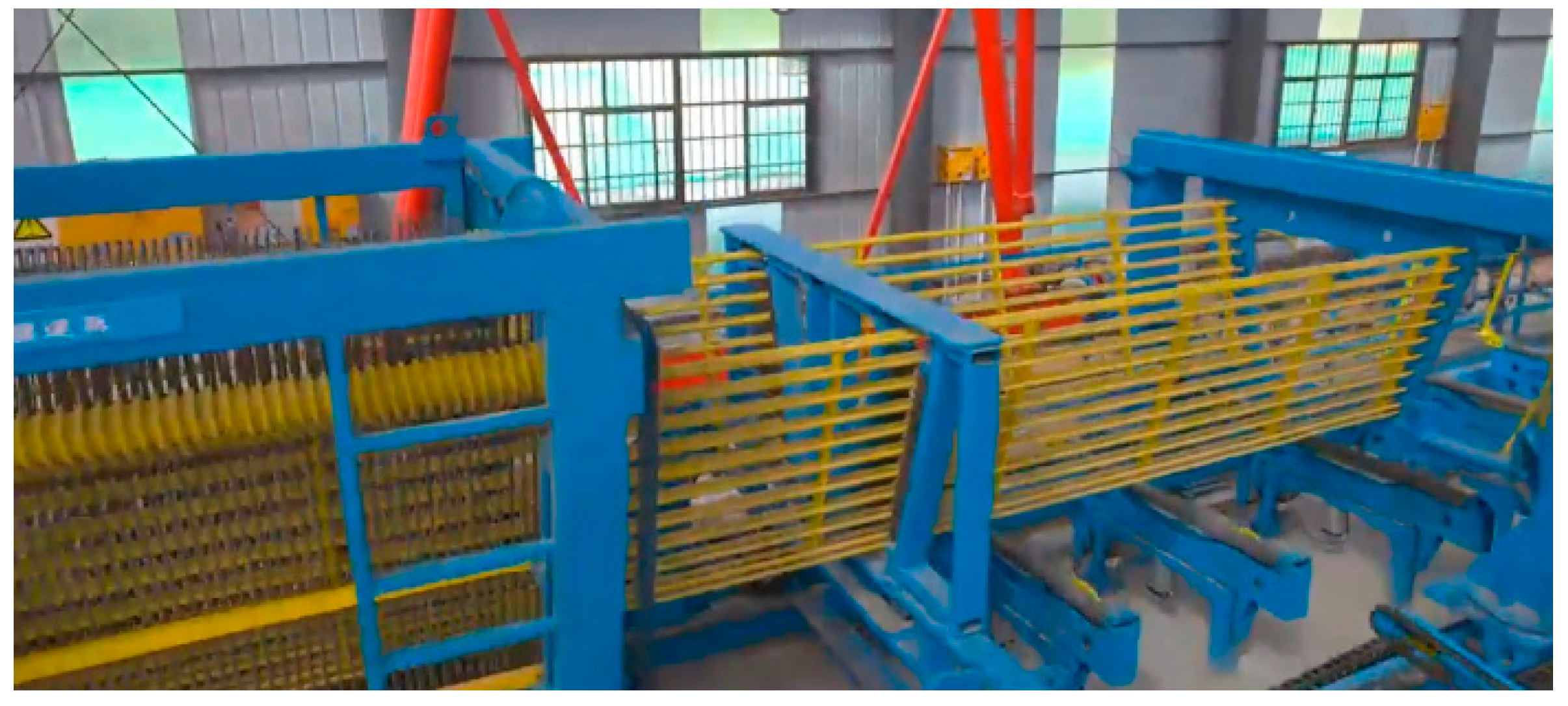
After butt welding, slag scraping, and fixed-length cutting, the rebars are flipped to transfer the silo for storage. The silo is moved forward by a motor, and feeding is completed through the chain slot. After the wires are straightened and cut, they are stored in the finished product silo, and the feeding is completed by the lifting of the material turning mechanism as shown in
Figure 7.
5.2.3. Cylinder-Type Automatic Feeding of Stirrups
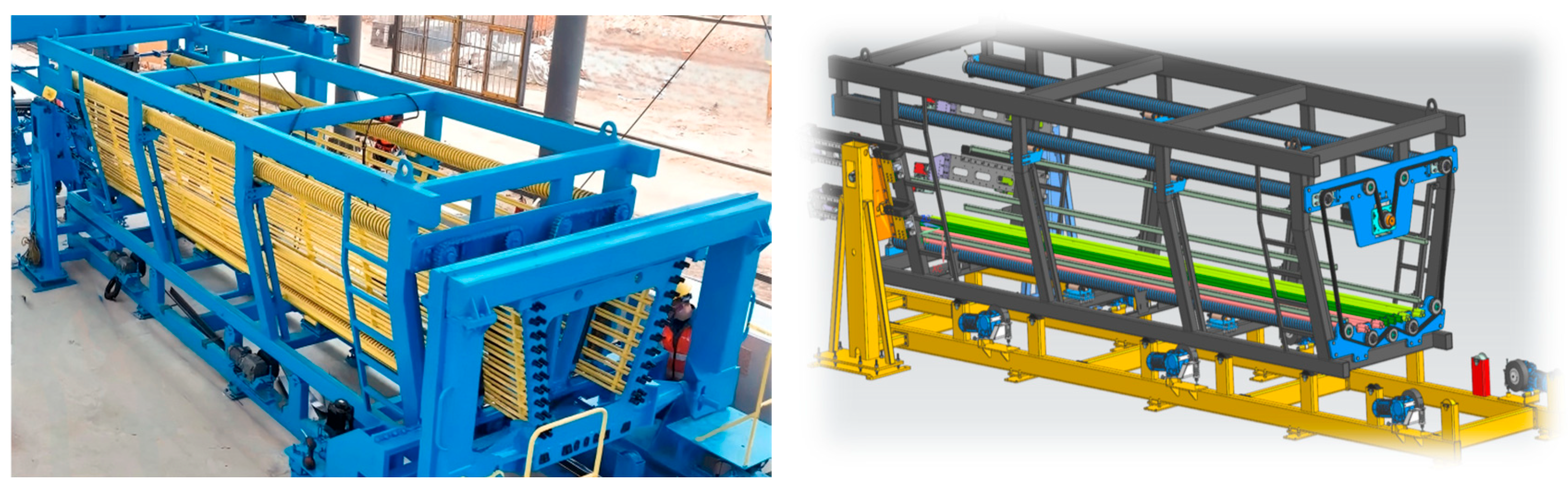
The cylinder-type automatic stirrup feeding technology was developed to realize the automatic loading and unloading of finished stirrups and the standardized arrangement of the reinforcement cage for the entire box girder as shown in
Figure 8. This solves the problems of large floor space for stirrup installation and cumbersome assembly procedures in traditional operations. The detailed parameters of the processed rebars are listed in
Table 1. During operation, the rotating cylinder power mechanism controls the stable and orderly conveying of stirrups to the stripping starting position, realizing the automatic feeding of finished stirrups in a specific order.
5.2.4. Stirrup Clamping and Longitudinal Rebar Positioning
The intelligent material distribution technology for stirrup frames was independently developed, and an integrated process of “automatic delivering–numerical control stripping–stirrup positioning” was innovatively developed. The infrared sensing module accurately captures the edge of the stirrups, and four sets of clamping jaws are linked collaboratively according to the infrared sensing feedback to stably grasp a single stirrup and drag it to the welding area at a uniform speed, realizing the automated and precise feeding of stirrups.
In the precise positioning of components, the “cylinder-type silo” is linked with the stripping mechanism; the stirrups are delivered outward along the track; and the stripping mechanism identifies and grabs the stirrups and moves them to the specified position.
In the threading and layout of longitudinal rebars, the straightening machine automatically cuts the longitudinal rebar components to a fixed length, and feeding is realized through the chain slot; the longitudinal rebar conduits are threaded into the magazine according to the fixed track; and the longitudinal rebars are locked at the traction mechanism as shown in
Figure 9.
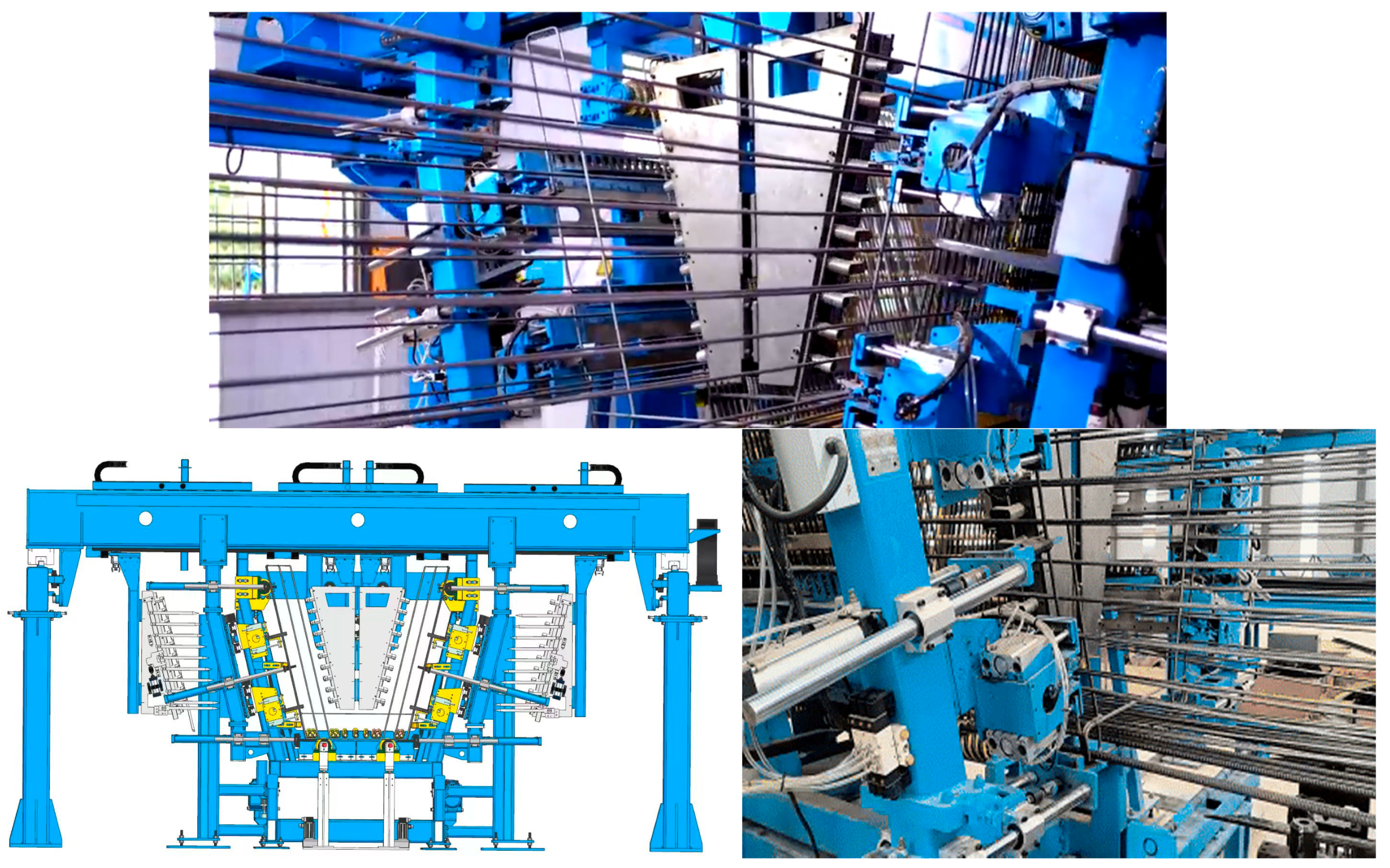
The internal-penetrating longitudinal rebar precise positioning technology was independently developed as shown in
Figure 10. Relying on the collaborative operation of the stirrup clamping and longitudinal rebar positioning mechanism, efficient and repeatable longitudinal rebar positioning is realized. The inner/outer positioning mechanisms fix the longitudinal position of the web in a “push–pull combination” manner; the bottom positioning mechanism calibrates the position of the bottom slab longitudinal rebars in a “pressing and lifting” manner. This enables zero-gap contact and precise alignment between the longitudinal rebars and stirrups in the welding area, making the whole process adaptive to different geometric parameters of rebars, providing a stable benchmark for the subsequent welding process, and improving the welding quality and process continuity. This technology completes the positioning operation in a system composed of a positioning gantry, inner/outer longitudinal rebar positioning mechanisms, longitudinal rebar pressing mechanisms, and longitudinal rebar lifting mechanisms. The positioning gantry realizes the millimeter-level positioning of stirrups with the help of servomotors and guide rail racks.
5.2.5. Automated Welding of Reinforcement Cages
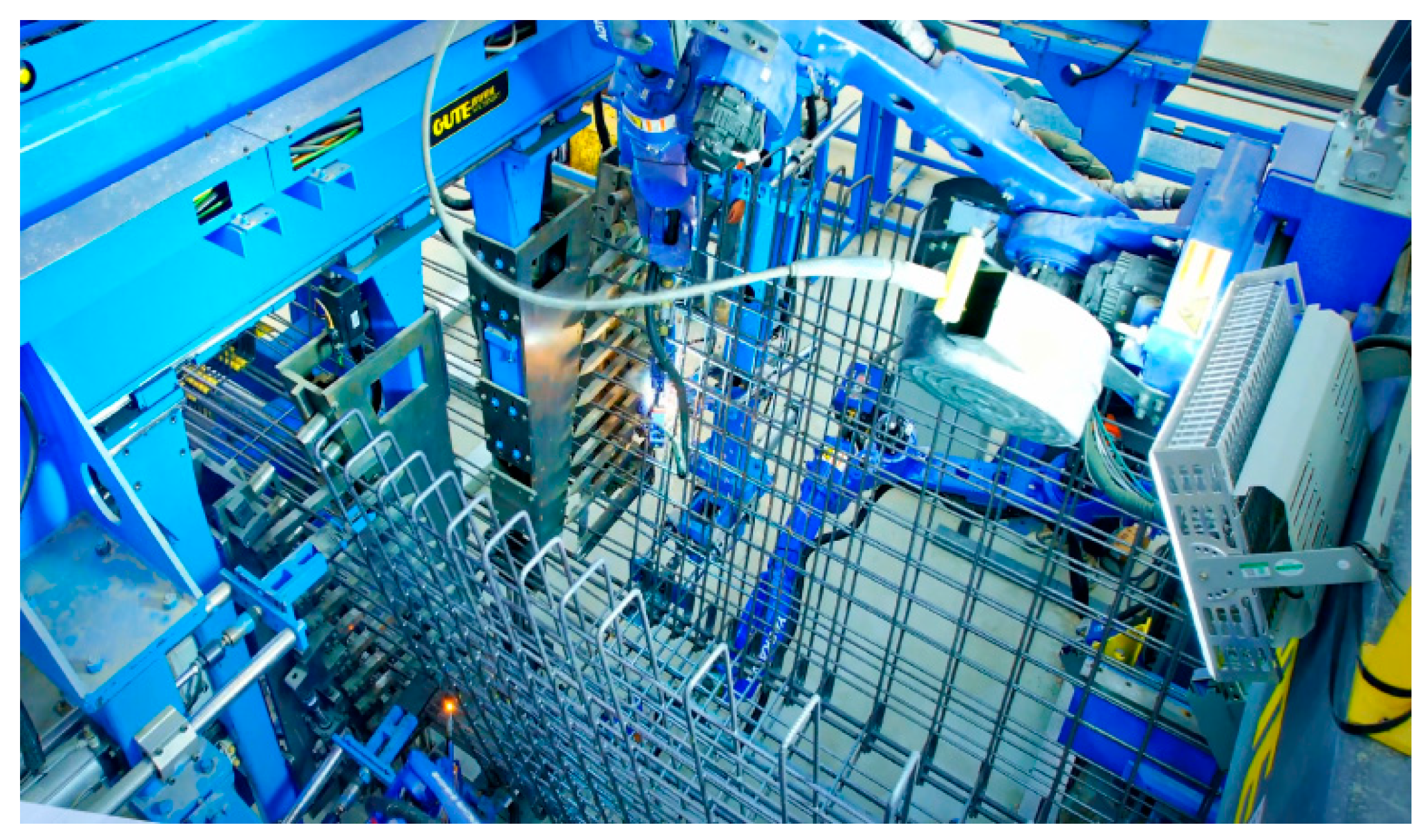
The laser-adaptive positioning welding technology was developed, which is equipped with a laser weld automatic tracking system to scan the operation area in real time and accurately identify the spatial coordinates of the welding points. The optimal welding path is planned through a preset algorithm, guiding the welding torch to complete the full-process automated welding operation along the planned trajectory. The stepping traction device realizes the assembly line operation of reinforcement cage welding as shown in
Figure 11.
The laser system identifies the weld position in real time and dynamically adjusts the welding parameters, solving problems such as weld deviation and insufficient penetration in manual welding. The traction device drags the welded rebar components to move at a fixed length, enabling the smooth formation of the reinforcement cages and adapting to the processing needs of reinforcement cages for variable-section girders. This technology saves 70% of the labor for rebar processing, with a 100% qualification rate of quality inspection parameters.
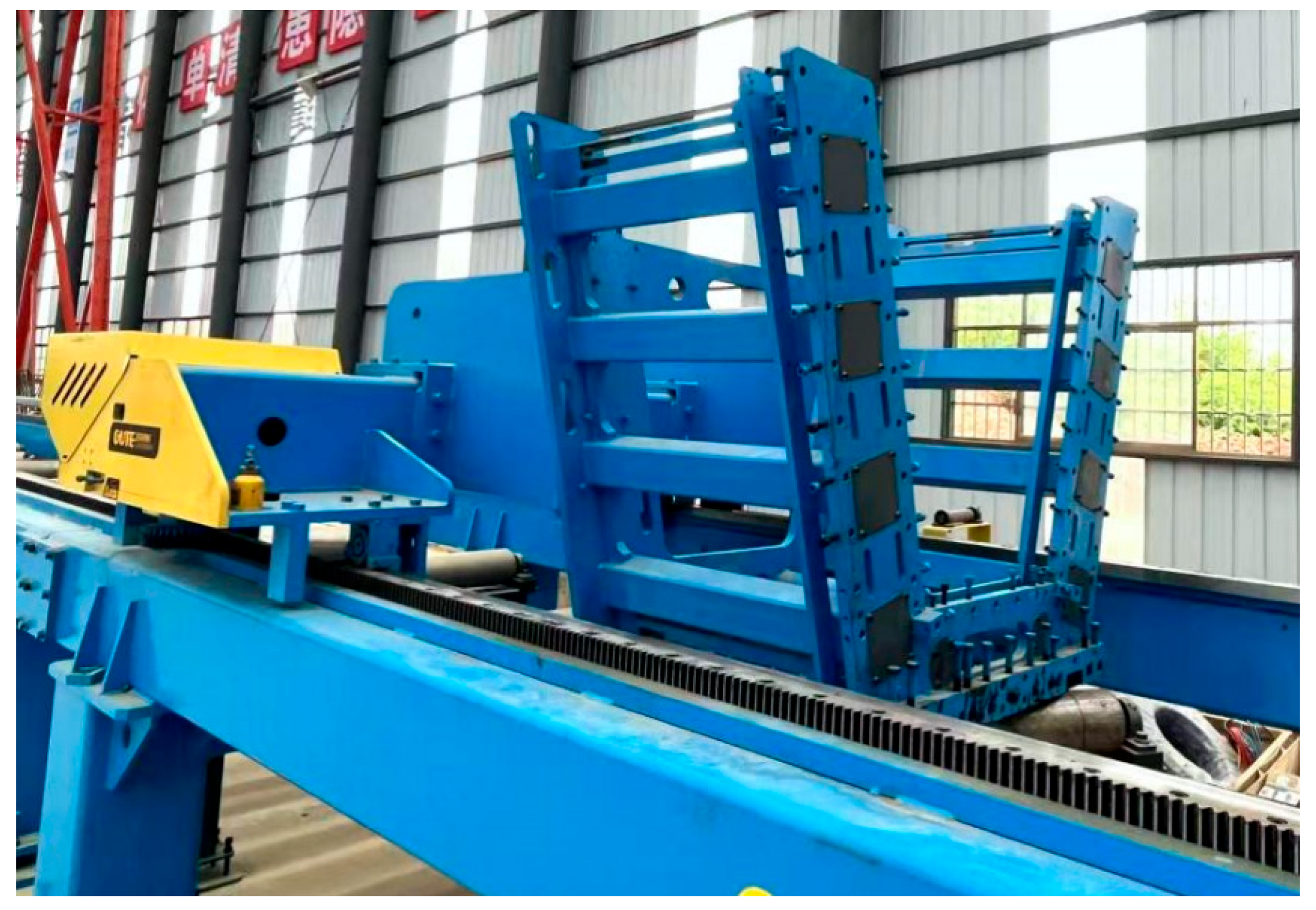
5.2.6. Gantry Reinforcement Cage Traction Mechanism
The reinforcement cage traction device drags the welded rebar components to move in a stepping manner, enabling the smooth formation of the reinforcement cages and adapting to the processing needs of reinforcement cages for variable-section girders as shown in
Figure 12. Performance comparison of smart yards versus manual yards is shown in
Table 2.
5.3. Weld Seam Quality Control and Performance Comparison Analysis
To ensure the weld seam quality, correlation analysis between process parameters was conducted using trial tests, and the results are listed in
Table 3. In practice, several measures are taken to improve the overall weld seam quality.
For electrical circuit safety, we implemented dedicated circuits with smart power distribution systems, and we established exclusive power channels for different robotic arms (e.g., welding, rebar-tying, concrete-pouring arms) to prevent overload risks from power stacking.
For spark control, we deployed specialized welding tip cleaners that automatically removed residual slag and dust after each welding operation. This can reduce abnormal sparks caused by debris and mitigate spark hazards.
For ventilation, we adopted a full-through natural ventilation layout across the facility, complemented by precisely positioned exhaust fans and vents near welding stations. This dual-mode system (natural + targeted extraction) accelerates fume removal and optimizes the working environment.
6. Conclusions
Taking the rebar processing of prefabricated girders as the research object, this paper summarizes the shortcomings of conventional processes. Relying on actual engineering scenarios, it developed a full-process automated logistics system covering “bending–delivering–welding–storage” and constructed key equipment such as the Three-in-One Stirrup Bending Workstation, Intelligent Reinforcement Cage Welding Station, and Laser-Adaptive Positioning Welding Technology. The application of these technologies leads to the following conclusions:
(1) Manual binding and welding are time-consuming and labor-intensive, with difficult quality control and potential safety hazards, so intelligent upgrading is urgently needed.
(2) This system can realize the whole-process automated and standardized construction of reinforcement cages, with a 100% qualification rate of quality inspection parameters such as rebar spacing, effectively eliminating quality risks. It practically promotes the mechanized and intelligent transformation of rebar processing and welding.
(3) The application results of the G107 National Highway Reconstruction Project show that compared with traditional prefabrication yards, this technology can reduce the site footprint by 27%, labor input by 40%, and construction duration by 60%, save CNY 3.38 million per thousand girders, and is expected to reduce rebar consumption by 50 tons. It provides a promotable technical pathway for the intelligent construction of bridge engineering.
Author Contributions
Conceptualization, S.G. and Y.L.; Methodology, S.G., X.D. and Y.L.; Software, X.D., Y.W., H.T., S.L. and W.Z.; Validation, S.L.; Formal analysis, B.T.; Investigation, X.D., Y.W., H.T., S.L., W.Z. and B.T.; Resources, Y.W., H.T., S.L. and W.Z.; Data curation, Y.W., H.T., W.Z. and B.T.; Writing—original draft, S.G.; Writing—review & editing, B.T. and Y.L.; Visualization, Y.L.; Project administration, S.G. and X.D. All authors have read and agreed to the published version of the manuscript.
Funding
This research was funded by the National Key Research and Development Program of China (2024YFC3809400).
Data Availability Statement
The original contributions presented in this study are included in this article. Further inquiries can be directed to the corresponding author.
Conflicts of Interest
Authors Shiyu Guan, Xuyang Duan, Hui Tang, Songwei Li and Wei Zhou were employed by the company China Construction Third Bureau First Engineering Co., Ltd. Author Yuanhang Wang was employed by the company China Construction Third Engineering Bureau (Shenzhen) Co., Ltd. The remaining authors declare that this research was conducted in the absence of any commercial or financial relationships that could be construed as potential conflicts of interest.
References
- Liu, Y.; Li, H.; Liang, F.; Bao, Y.; Wang, W.; Au, F.T.K. Conceptual shaking table tests for resilient segmental bridge columns with resettable sliding joints. Eng. Struct. 2024, 317, 118596. [Google Scholar] [CrossRef] [Scilit]
- Liu, Y.; Yuan, Y.; Liang, F.; Au, F.T.K. Resetting response of precast segments with gently keyed interface under seismic action. Earthq. Eng. Struct. Dyn. 2020, 50, 601–618. [Google Scholar] [CrossRef] [Scilit]
- Liu, Y.Q.; Liang, F.; Au, F.T.K. Experimental study of durable low-friction concrete contacts for precast segmental columns with resettable sliding joints. Constr. Build. Mater. 2022, 318, 126192. [Google Scholar] [CrossRef] [Scilit]
- Liu, Y.Q.; Liang, F.; Au, F.T.K. Precast segmental bridge columns with resettable sliding joints—An inspiration from ancient Chinese pagodas. Structures 2021, 33, 615–626. [Google Scholar] [CrossRef] [Scilit]
- Wu, H.; Zhang, W.; Lu, W.; Chen, J.; Bao, J.; Liu, Y. Automated part placement for precast concrete component manufacturing: An intelligent robotic system using target detection and path planning. J. Comput. Civ. Eng. 2025, 39, 04024044. [Google Scholar] [CrossRef] [Scilit]
- Sun, T.; Fan, Q.; Shao, Y. Deep learning-based rebar detection and instance segmentation in images. Adv. Eng. Inform. 2025, 65, 103224. [Google Scholar] [CrossRef] [Scilit]
- Lv, H.; Li, H.; Qin, F.; Li, F.; Ismail, A. Intelligent production system architecture and workstation for Stirrups. In Artificial Intelligence, Medical Engineering and Education; IOS Press: Amsterdam, The Netherlands, 2025; pp. 143–149. [Google Scholar]
- Wang, W.; Zhang, X.d.; Wang, H.x.; Zhang, B.; Dong, H.; Liu, Y.q. Shear behavior of bolted connectors with double embedded nuts in composite beams with steel-fiber reinforced concrete SFRC slabs. Struct. Concr. 2025, 26, 5165–5186. [Google Scholar] [CrossRef] [Scilit]
- Wang, W.; Zhang, X.-D.; Wang, H.-X.; Zhang, B.; Liu, Y.-Q. Shear behavior and design of double embedded nuts bolted connectors in negative moment regions of steel-SFRC composite beams. Structures 2025, 74, 108576. [Google Scholar] [CrossRef] [Scilit]
- Tan, Y.; Yu, D.; Yang, S.; Gai, T.; Wang, C. Precast concrete component yard layout optimization considering safety and efficiency. J. Asian Archit. Build. Eng. 2024, 24, 2800–2816. [Google Scholar] [CrossRef] [Scilit]
- Wang, J.; Wang, X.; Dong, S. Construction of MBSE-based smart beam yard system. In Proceedings of the International Conference on Smart Transportation and City Engineering (STCE 2023), Chongqing, China, 16–18 December 2023; pp. 387–394. [Google Scholar]
- Gao, M.Y.; Han, C.; Yang, Y.; Tiong, R.L.K. Integration of BIM and RFID-Sensing Technology for Automated Progress Monitoring in Modular Construction. In Proceedings of Proceedings of the 41st International Symposium on Automation and Robotics in Construction, Lille, France, 3–5 June 2024. [Google Scholar]
- Wang, D.; Hu, Y. Research on the intelligent construction of the rebar project based on BIM. Appl. Sci. 2022, 12, 5596. [Google Scholar] [CrossRef] [Scilit]
- Du, J.; Zhang, J.; Castro-Lacouture, D.; Hu, Y. Lean manufacturing applications in prefabricated construction projects. Autom. Constr. 2023, 150, 104790. [Google Scholar] [CrossRef] [Scilit]
- Liu, T.; Zhu, C.; Tong, Z.; Luo, D. Research on smart manufacturing technology of reinforcing bars for bridge precast concrete structure. J. Phys. Conf. Ser. 2024, 2775, 012028. [Google Scholar] [CrossRef] [Scilit]
- Ou, H.; Liu, J.; Tan, Z.; Zhang, W.; Wang, D. Optimizing Production through Digitalization: A Case Study on Smart Manufacturing in Port Machinery. In Proceedings of the 2024 IEEE International Conference on Advanced Information, Mechanical Engineering, Robotics and Automation (AIMERA), Wulumuqi, China, 18–19 May 2024; pp. 343–350. [Google Scholar]
- Ye, J.; Zhao, X. Research of smart production and installation planning of prefabricated beams for prefabricated bridges. In Constructional Engineering and Ecological Environment; CRC Press: Boca Raton, FL, USA, 2023; pp. 107–113. [Google Scholar]
- Wang, B.; Hu, S.J.; Sun, L.; Freiheit, T. Intelligent welding system technologies: State-of-the-art review and perspectives. J. Manuf. Syst. 2020, 56, 373–391. [Google Scholar] [CrossRef] [Scilit]
- Sarkar, S.S.; Das, A.; Paul, S.; Ghosh, A.; Mali, K.; Sarkar, R.; Kumar, A. Infrared imaging based machine vision system to determine transient shape of isotherms in submerged arc welding. Infrared Phys. Technol. 2020, 109, 103410. [Google Scholar] [CrossRef] [Scilit]
- Huang, Y.; Gao, X.; Ma, B.; Liu, G.; Zhang, N.; Zhang, Y.; You, D. Optimization of weld strength for laser welding of steel to PMMA using Taguchi design method. Opt. Laser Technol. 2021, 136, 106726. [Google Scholar] [CrossRef] [Scilit]
- Saicharan, K.; Sai, M.K.; Chandrasekhar, P.; Gopinath, A.; Selvaraj, S.K. A concise approach to designing an intelligent welding station system platform. Int. J. Interact. Des. Manuf. (IJIDeM) 2022, 1–13. [Google Scholar] [CrossRef] [Scilit]
- Chea, C.P.; Bai, Y.; Pan, X.; Arashpour, M.; Xie, Y. An integrated review of automation and robotic technologies for structural prefabrication and construction. Transp. Saf. Environ. 2020, 2, 81–96. [Google Scholar] [CrossRef] [Scilit]
- Ahmad, F.; Qureshi, M.I.; Rawat, S.; Alkharisi, M.K.; Alturki, M. E-waste in concrete construction: Recycling, applications, and impact on mechanical, durability, and thermal properties—A review. Innov. Infrastruct. Solut. 2025, 10, 246. [Google Scholar] [CrossRef] [Scilit]
- Raza, M.U.; Butt, F.; Ahmad, F.; Waqas, R.M. Seismic safety assessment of buildings and perceptions of earthquake risk among communities in Mingora, Swat, Pakistan. Innov. Infrastruct. Solut. 2025, 10, 1–18. [Google Scholar] [CrossRef] [Scilit]
- Dong, H.; Fan, G.; Huang, J.; Han, Q.; Du, X. Shaking table tests of the influence of pile-soil interaction on seismic responses of self-centering rocking bridge piers. Soil Dyn. Earthq. Eng. 2026, 200, 109837. [Google Scholar] [CrossRef] [Scilit]
- Jia, Z.; Wen, J.; Hu, M.; Han, Q.; Bi, K. Seismic response of rocking bridge systems under three-dimensional ground motions. Eng. Struct. 2025, 322, 119162. [Google Scholar] [CrossRef] [Scilit]
- Ni, Y.; Hu, M.; Jia, Z.; Han, Q. Shear Behavior of Y-Shaped Perfobond Rib Shear Connector with UHPC Grout. J. Struct. Eng. 2024, 150, 04024102. [Google Scholar] [CrossRef] [Scilit]
- Davoodnabi, S.M.; Mirhosseini, S.M.; Shariati, M. Analyzing shear strength of steel-concrete composite beam with angle connectors at elevated temperature using finite element method. Steel Compos. Struct. 2021, 40, 853–868. [Google Scholar] [CrossRef]
- Shariati, M.; Raeispour, M.; Naghipour, M.; Kamyab, H.; Memarzadeh, A.; Nematzadeh, M.; Toghroli, A. Flexural behavior analysis of double honeycomb steel composite encased concrete beams: An integrated experimental and finite element study. Case Stud. Constr. Mater. 2024, 20, e03299. [Google Scholar] [CrossRef] [Scilit]
- Nouri, K.; Sulong, N.; Ibrahim, Z.; Shariati, M. Behaviour of novel stiffened angle shear connectors at ambient and elevated temperatures. Adv. Steel Constr. 2021, 17, 28–38. [Google Scholar]
- Sharma, A.; Chaturvedi, R.; Sharma, K.; Binhowimal, S.A.; Giri, J.; Sathish, T. Enhancing weld quality of novel robotic-arm arc welding: Vision-based monitoring, real-time control seam tracking. Ain Shams Eng. J. 2024, 15, 103109. [Google Scholar] [CrossRef] [Scilit]
- Li, X. Research on the development of robotic arm technology. In Proceedings of the 2nd International Conference on Mechatronic Automation and Electrical Engineering (ICMAEE 2024), Nanjing, China, 22–24 November 2024; pp. 17–21. [Google Scholar]
| Disclaimer/Publisher’s Note: The statements, opinions and data contained in all publications are solely those of the individual author(s) and contributor(s) and not of MDPI and/or the editor(s). MDPI and/or the editor(s) disclaim responsibility for any injury to people or property resulting from any ideas, methods, instructions or products referred to in the content. |
© 2025 by the authors. Licensee MDPI, Basel, Switzerland. This article is an open access article distributed under the terms and conditions of the Creative Commons Attribution (CC BY) license (https://creativecommons.org/licenses/by/4.0/).




 and
and