

Technical Mediation and Human Presence: A Study on Policy Evolution and Development Pathways of Future Communities

Abstract
1. Introduction
1.1. Background and Issues
1.2. Review of Literature and Research Gaps
2. Data and Methods
2.1. Research Method
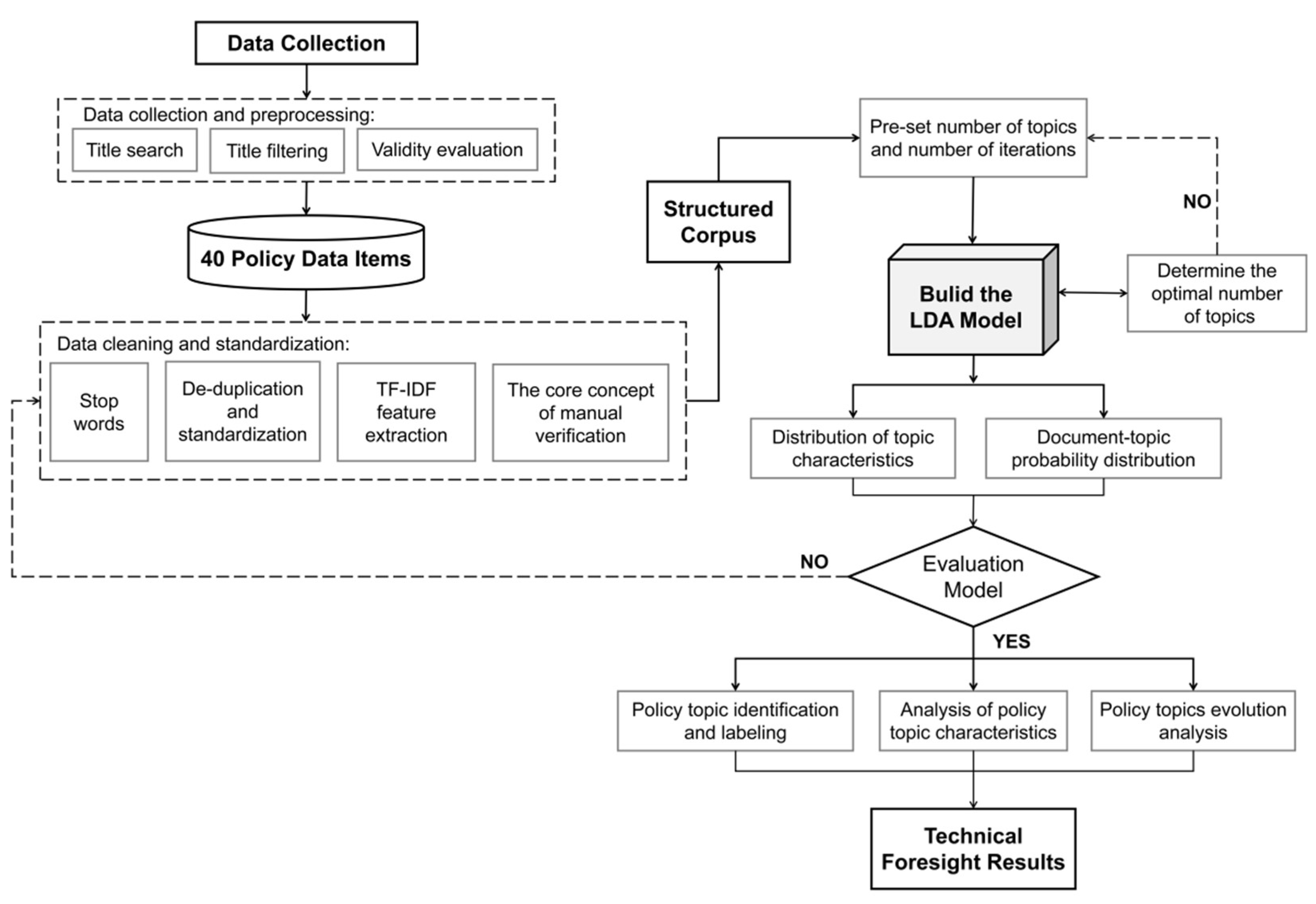
2.2. Data Sources and Cleaning
- Temporal Scope: Policies published via official Chinese government channels between January 2014 and December 2024;
- Document Selection Criteria:
- Inclusion: current effective notices and guidelines with titles explicitly containing Community, Future Community, Urban planning, or Residential area, etc.;
- Exclusion: approvals, meeting briefings, and forwarded documents;
- Screening Process: The research team selected the policies through information retrieval and manual review (prioritizing those with strong guidance significance and high representativeness based on existing studies). Strong Guidance Significance: Defined as clear, objective criteria, either “national-level authority” or “local pioneering initiatives adopted by higher-level policies” (for example, Shanghai 15-Minute Community Life Circle Planning Guidelines); High Representativeness: Policies that are frequently cited or used as models in the policy documents of other regions (for example, Zhejiang Province’s Future Community Guidelines have influenced subsequent policies in multiple provinces).
- This yielded 40 policy samples comprising:
- Types: Planning guidelines, technical standards, construction manuals;
- Administrative Levels:
- National-level: 14 documents;
- Local-level: 26 documents (see Table 1 for the whole dataset).
- Stop Word Removal and Standardization:
- Utilized the HIT Stop Words List (Harbin Institute of Technology) and a custom stop word list (e.g., own, village, article, urban–rural, industry, development).
- Performed cross-regional term alignment: Unified localized phrases like Zhejiang’s and Chengdu’s “Nine Major Scenes” under the standardized label “Scenes”.
- TF-IDF Keyword Extraction:
- Applied the TF-IDF algorithm to identify high-frequency terms
- Manually validated core concepts (e.g., public services, embedded, elder care, sharing)
- The total keyword frequency count has been finalized at 11,728
- Policy Version Tagging:
- Marked the key version changes (2014–2024) based on the iterative nature of the policies (e.g., Documented revisions of Shanghai 15-Minute Community Life Circle Planning Guidelines).
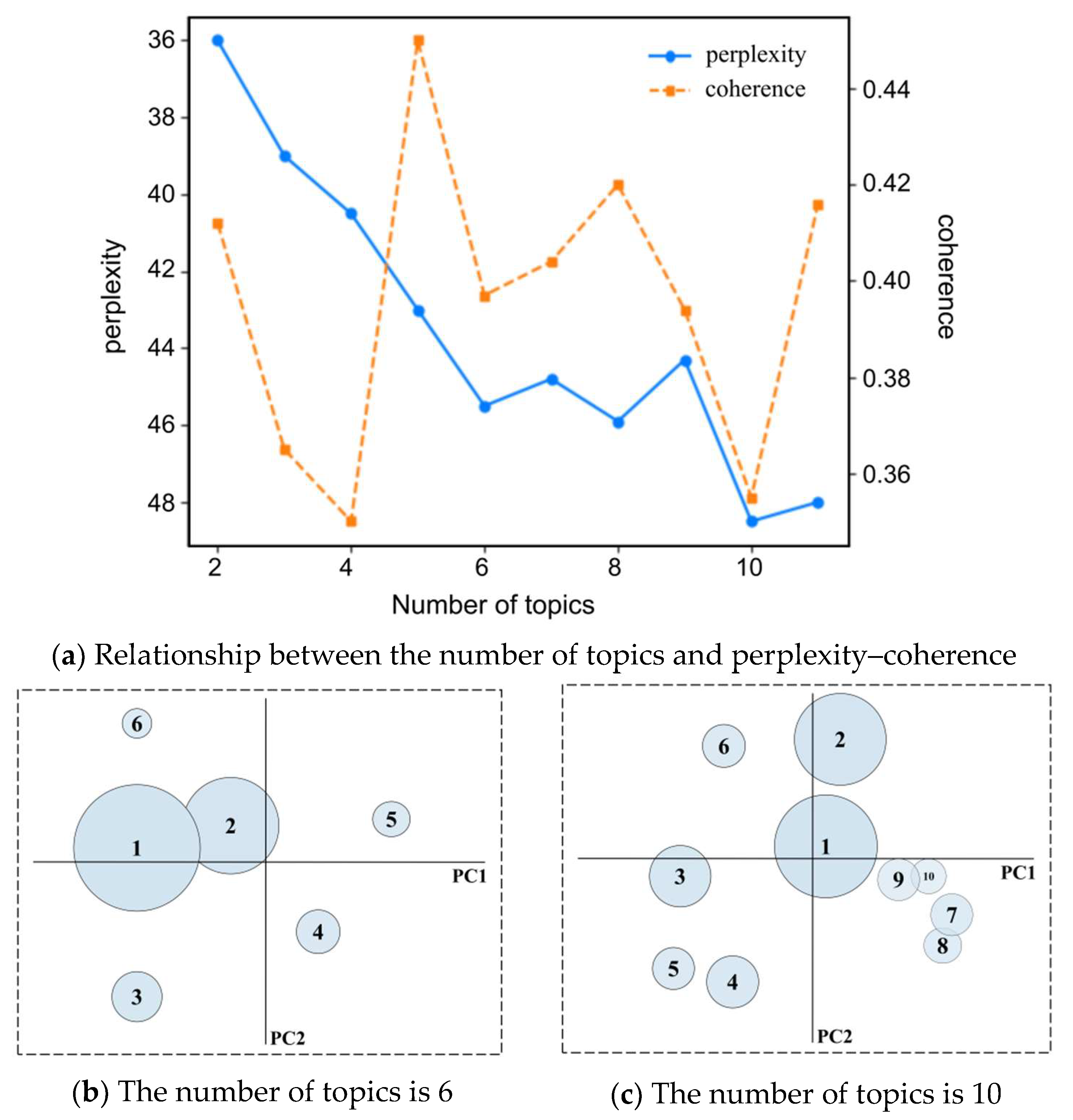
2.3. Topic Modeling Construction
- Iteration Calibration
- 2.
- Hyperparameter Tuning
- 3.
- Validation Framework
3. Deconstructing Community Policy Discourse
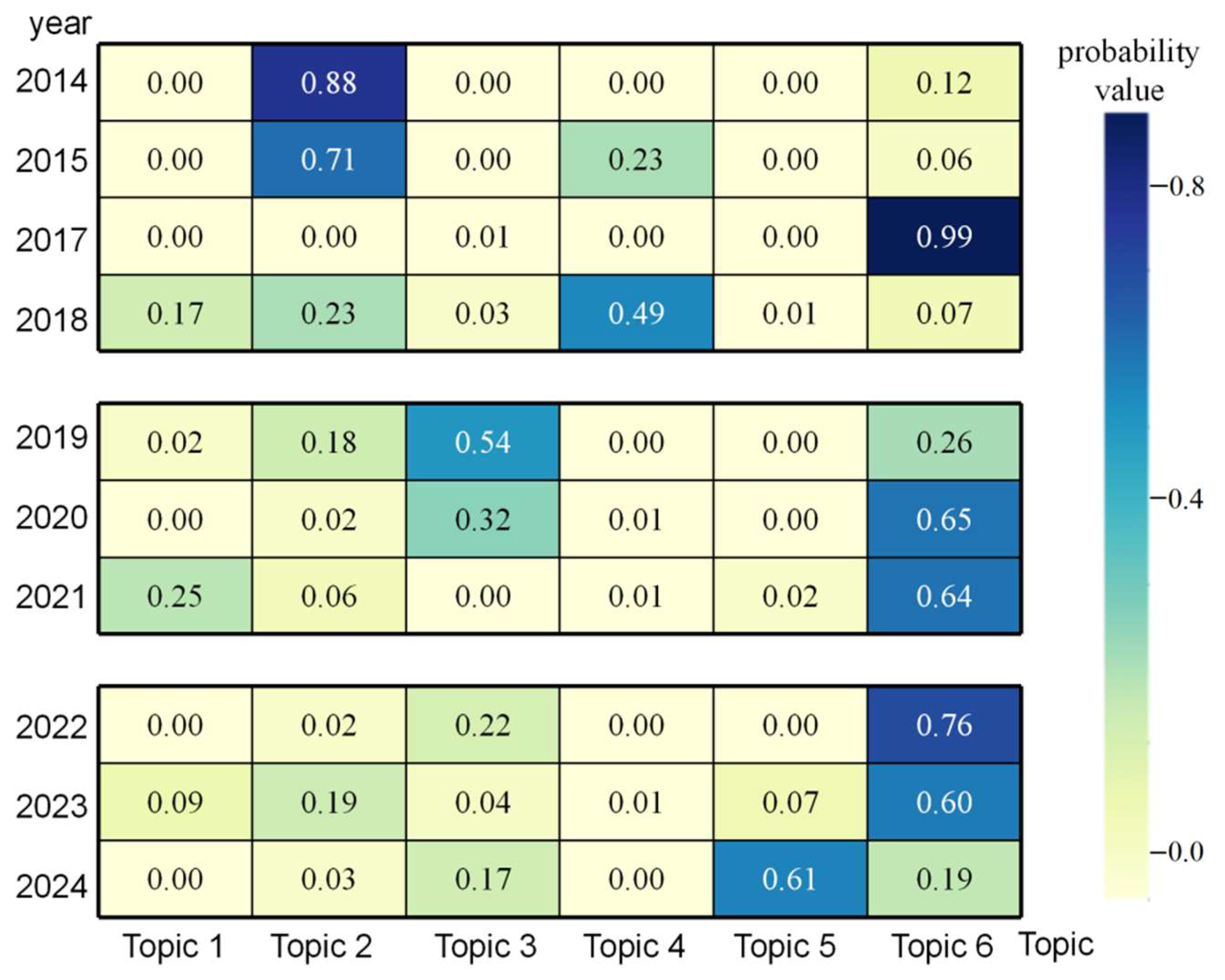
3.1. Policy Topic Identification and Labeling
- Topic 1: Quality Enhancement;
- Topic 2: Technical Foundation;
- Topic 3: Intelligent Operations and Maintenance;
- Topic 4: Green and Low-Carbon;
- Topic 5: All-Age Friendliness;
- Topic 6: Community Services.
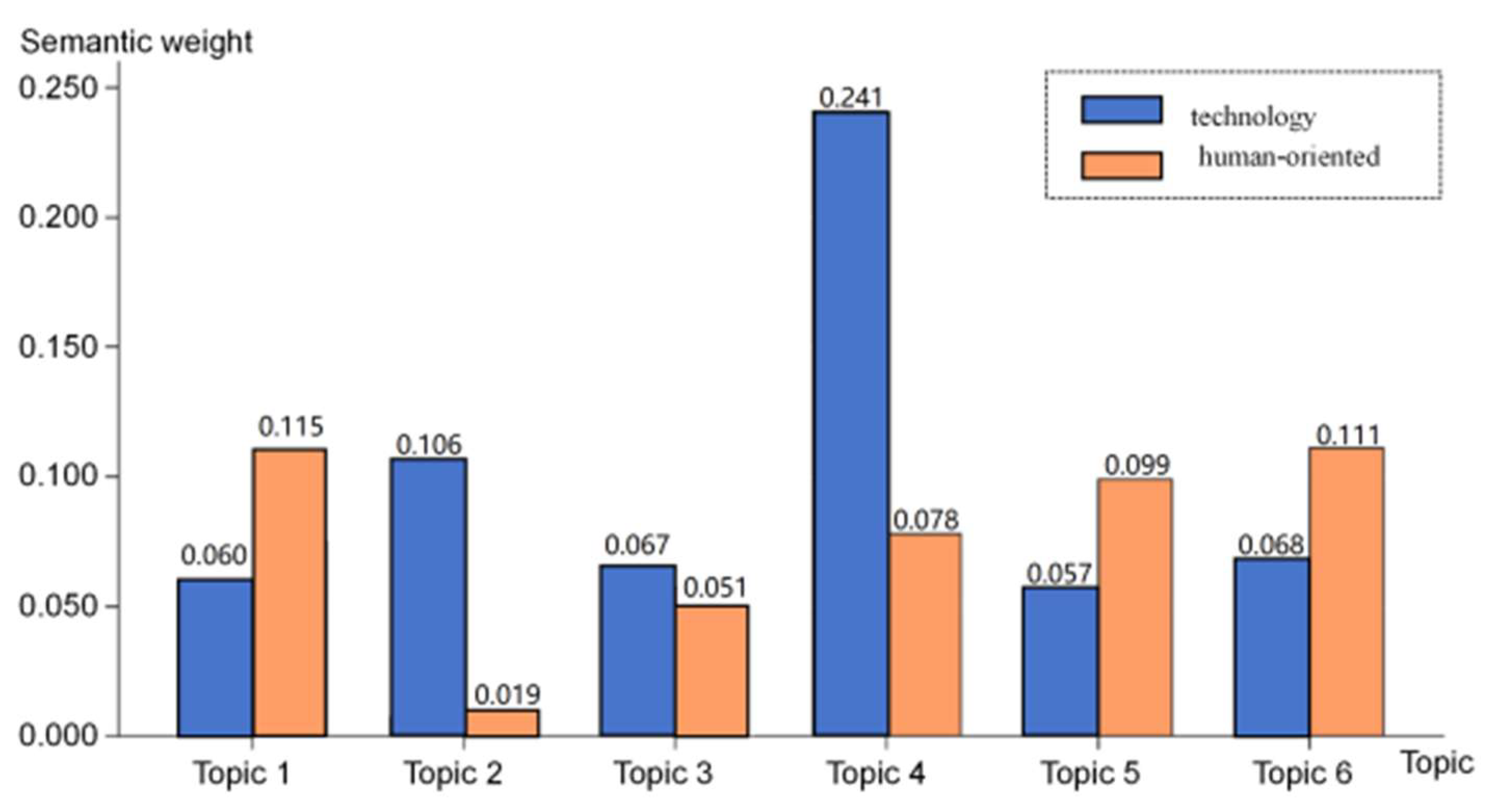
3.2. Analysis of Policy Topic Characteristics
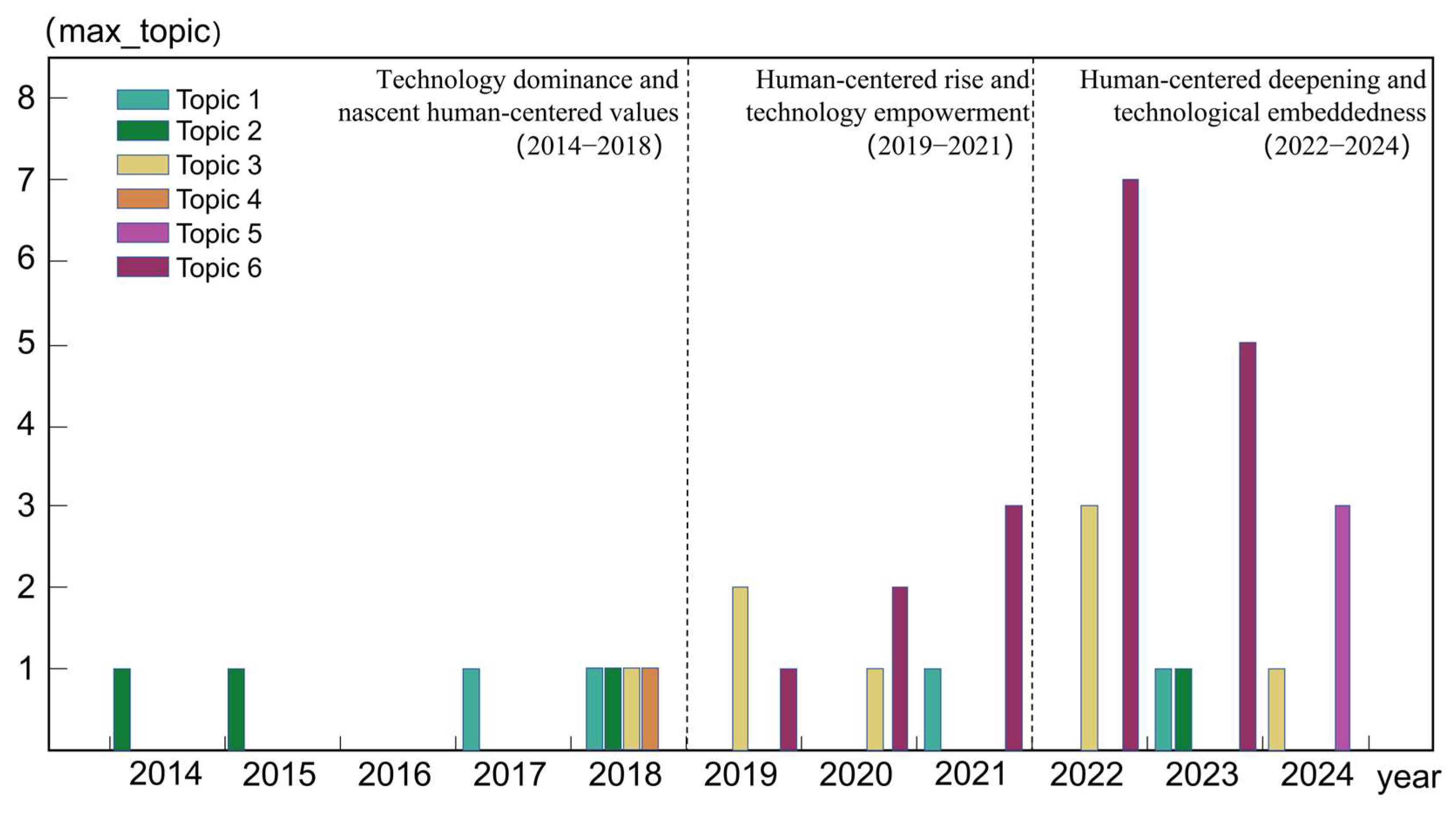
3.3. Policy Topics Evolution Analysis
- 2014–2018: Technology Dominance and Nascent Human-Centered Values
- 2.
- 2019–2021: Human-Centered Rise and Technology Empowerment
- 3.
- 2022–2024: Human-Centered Deepening and Technological Embeddedness
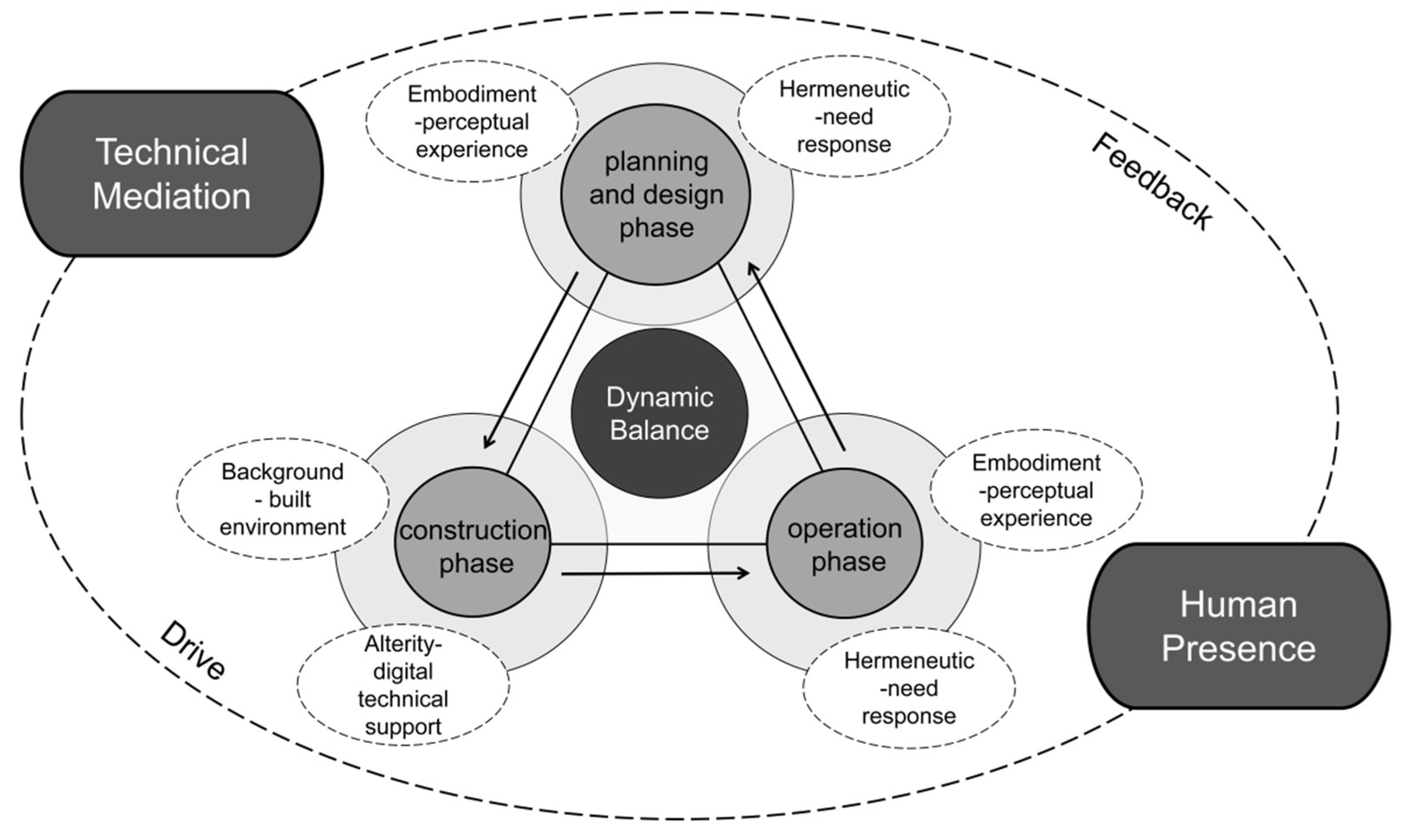
4. Technical Mediation and Human Presence: Development Pathways for Future Communities
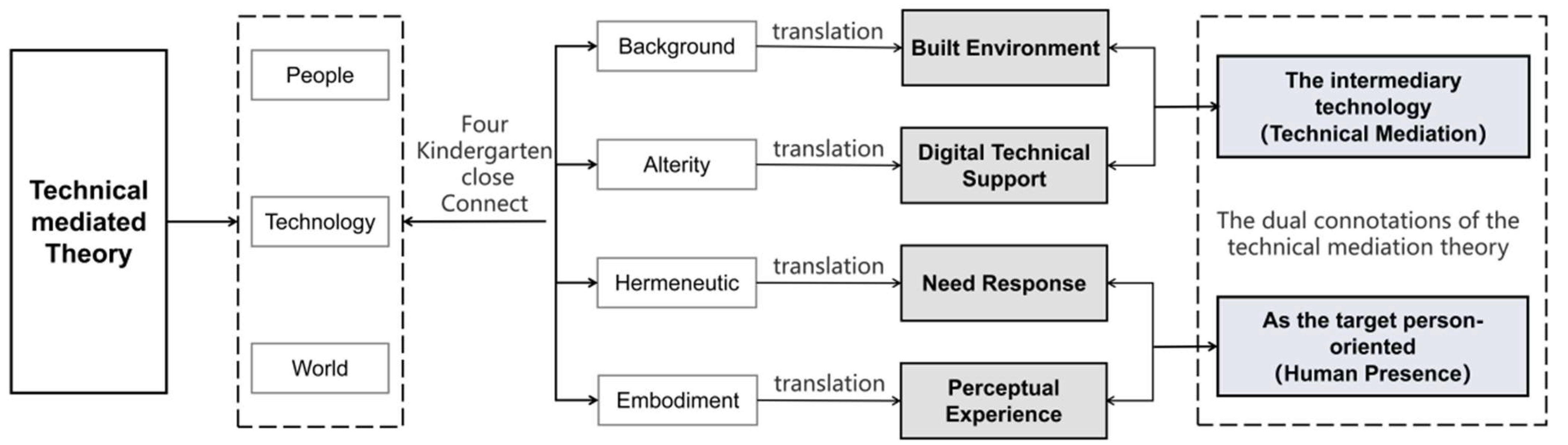
4.1. Theoretical Foundation
4.2. Analysis of the Correlation Between Nine Major Scenes and the Core Framework
- Background: Built Environment;
- Alterity: Digital Technical Support;
- Hermeneutics: Need Response;
- Embodiment: Perceptual Experience.
4.3. The Interactive Evolution of Technical Mediation and Human Presence
5. Discussion
- (1)
- Theoretical Construction and Practical Pathways
- (2)
- International Reference and Local Innovation
6. Conclusions
Author Contributions
Funding
Data Availability Statement
Conflicts of Interest
Appendix A

| Serial | Enactment Date | Title |
|---|---|---|
| 1 | May 2014 | ‘Guidelines for the Construction of Smart Communities (Trial Version)’ |
| 2 | June 2017 | ‘Opinions on Strengthening and Improving Urban and Rural Community Governance’ |
| 3 | February 2019 | ‘Guidelines of the Ministry of Housing and Urban-Rural Development on Jointly Creating a Better Environment and a Happy Life in the Construction and Improvement of Urban and Rural Living Environment’ |
| 4 | January 2024 | ‘Design Guidelines for Embedded Services in Urban Communities (Trial Version)’ |
| 5 | November 2023 | ‘Opinions on Further Promoting the Construction of Smart Communities’ |
| 6 | May 2022 | ‘Implementation Plan for Urban Community Embedded Service Facilities Construction Project’ |
| 7 | July 2024 | ‘Guidelines for the Promotion of Future Community Construction on a Wider Scale’ |
| 8 | December 2020 | ‘Green Community Action Plan’ |
| 9 | July 2020 | ‘Notice on the Establishment of Model National Age-Friendly Communities’ |
| 10 | January 2022 | ‘‘Plan for the Construction of Urban and Rural Community Service Systems in the 14th Five-Year Plan’ |
| 11 | July 2021 | ‘Technical Guidelines for the Planning of Community Living Circles’ |
| 12 | December 2021 | ‘Construction Guidelines for Complete Residential Communities’ |
| 13 | December 2018 | ‘Nanjing 15 min Community Life Circle Planning Guidelines’ |
| 14 | June 2023 | ‘Urban Residential Area Planning and Design Standard GB50180-2018 [37]’ |
| 15 | August 2023 | ‘Action Plan for New Community Infrastructure’ |
| 16 | January 2021 | ‘Shanghai 15 min Community Life Circle Planning Guidelines’ |
| 17 | February 2019 | ‘Work Plan for Pilot Construction of Future Communities in Zhejiang Province’ |
| 18 | September 2019 | ‘Urban Design Guidelines for New Residential Communities in Tianjin’ |
| 19 | January 2020 | ‘Controlled Detailed Planning for the Starting Area of Hebei Xiong’an New Area’ |
| 20 | April 2023 | ‘Standards for Creating Green and Complete Residential Communities in Hunan Province (Trial)’ |
| 21 | April 2023 | ‘Action Plan for Creating Green Complete Residential Communities in Hunan Province’ |
| 22 | August 2022 | ‘Two-year Action Plan for the construction of “One Circle, Two Sites and Three Roads” (2018–2019)’ |
| 23 | April 2018 | ‘Henan Province’s 14th Five-Year Plan for the Construction of Urban and Rural Community Service System’ |
| 24 | July 2022 | ‘Construction Guidelines for Near-Zero Carbon Communities’ |
| 25 | December 2022 | ‘Implementation Plan for Green Community Creation in Guangdong Province’ |
| 26 | May 2021 | ‘Hainan Province Urban and Rural Community Service System Construction Plan (2022–2025)’ |
| 27 | June 2022 | ‘Construction Guidelines for Future Park Communities in Chengdu’ |
| 28 | March 2022 | ‘Chengdu Future Park Community Planning Guidelines’ |
| 29 | July 2024 | ‘Notice on the 14th Five-Year Plan for the Construction of Urban and Rural Community Service System in Chongqing (2021–2025)’ |
| 30 | August 2022 | ‘Five Years of Guizhou’s People-oriented New Urbanization Strategy’ |
| 21 | December 2022 | ‘14th Five-Year Plan for the Construction of Urban and Rural Community Service System in Gansu Province’ |
| 32 | July 2022 | ‘14th Five-Year Plan for the Construction of Urban and Rural Community Service System in Liaoning Province’ |
| 33 | May 2022 | ‘Shenyang City 14th Five-Year Plan for the Construction of Urban and Rural Community Service System’ |
| 34 | March 2023 | ‘Implementation Plan for Pilot Work of Complete Community Construction in Ningxia Hui Autonomous Region’ |
| 35 | March 2024 | ‘Notice of Shaanxi Province on the Construction of Embedded Civil Affairs Service Facilities in Urban Communities’ |
| 36 | December 2023 | ‘Pilot Work Plan for Promoting the Construction of Complete Communities’ |
| 37 | July 2024 | ‘Guidelines for the Promotion of Future Community Construction on a Wider Scale’ |
| 38 | October 2024 | ‘Technical Guidelines for Good Communities’ |
| 39 | April 2024 | ‘Action Plan for 15-Minute Community Life Circle in Shanghai 2024’ |
| 40 | December 2020 | ‘Standards for the Construction of Child-Friendly Communities in China’ |
References
- Meng, Y.; Huang, L. Reflection and Practice of Design in Sustainable Community Building. In International Conference on Human-Computer Interaction; Springer Nature Switzerland: Cham, Switzerland, 2024; Volume 15374. [Google Scholar]
- Nimish, B. From smart to empathic cities. Front. Archit. Res 2021, 10, 3–16. [Google Scholar]
- Alibrandi, U. Risk-Informed Digital Twin of Buildings and Infrastructures for Sustainable and Resilient Urban Communities. ASCE-ASME J. Risk Uncertain. Eng. Syst. Part A Civ. Eng. 2022, 8, 3. [Google Scholar] [CrossRef]
- Lv, S.; Xie, S. Artificial intelligence in the digital twins: State of the art, challenges, and future research topics. Digit. Twin 2024, 1, 1. [Google Scholar] [CrossRef]
- Attaran, M.; Celik, B. Digital Twin: Benefits, use cases, challenges, and opportunities. Decis. Anal. J. 2023, 6, 100165. [Google Scholar] [CrossRef]
- Fasoli, M. The Overuse of Digital Technologies: Human Weaknesses, Design Strategies and Ethical Concerns. Philos. Technol. 2021, 34, 1–19. [Google Scholar] [CrossRef]
- Abu, T.; Muhammad, A.; Rachzief, E. Technocratic Development Planning Policies. Int. J. Pap. Public Rev. 2020, 1, 12–20. [Google Scholar] [CrossRef]
- Mathura, S.; Arunkumar, T. The impact of digital technology, social media, and artificial intelligence on cognitive functions: A review. Front. Cogn. 2023, 2. [Google Scholar]
- Hebinck, P.; Smith, L.; Aliber, M. Beyond technocracy: The role of the state in rural development in the Eastern Cape. South Afr. Land Use Policy 2023, 126. [Google Scholar]
- Zhao, B.; Xu, L.; Fang, Y.; Wang, C.; Huang, M. Research on the open space ratios of residential plots in major Chinese cities meeting public centralized green space standard. Sci. Rep. 2025, 15, 34685. [Google Scholar] [CrossRef]
- Ragnedda, M.; Ruiu, M.; Addeo, F. The self-reinforcing effect of digital and social exclusion: The inequality loop. Telemat. Inform. 2022, 72, 101852. [Google Scholar] [CrossRef]
- Hyesun, C.; Prabu, D.; Tsai, W. Acceptance of AI-powered facial recognition technology in surveillance scenarios: Role of trust, security, and privacy perceptions. Technol. Soc. 2024, 79, 102721. [Google Scholar] [CrossRef]
- Xia, X.; Zhu, M. The impact of digital literacy on older adults’ utilization of community-based home care services: A cross-sectional study. BMC Health Serv. Res. 2025, 25, 1367. [Google Scholar] [CrossRef] [PubMed]
- Cheng, C.; Li, D. From the perspective of community development theory, the theoretical implications and construction directions of future communities. J. Guizhou Norm. Univ. (Soc. Sci.) 2024, 4, 45–54. [Google Scholar]
- Liu, K.; Yoon, H. Research on Urban Renewal Design in the Context of the Future Community Concept. Sustain. Environ. 2024, 9, 4. [Google Scholar] [CrossRef]
- Wu, D.; Xie, W.; Chen, C. Research on the Construction of Future Communities in Zhejiang Province from the Perspective of Typical Cases. Mod. Urban Res. 2021, 10, 21–29. [Google Scholar]
- Ma, Z. Digital Age Transformation of Community Governance and New Fields of Community Media: An Analysis Based on Typical Cases of Future Communities in Zhejiang Province. Future Commun. 2023, 30, 35–40. [Google Scholar]
- Du, P. Future Communities: Global Concepts and Six Samples of Urban Renewal; Zhejiang University Press: Hangzhou, China, 2021. [Google Scholar]
- Zhao, N.; Wen, H.; Liu, Y.; Zhu, Y. From the application of a single technology to multi-dimensional digital empowerment: The evolution of the connotation and policy implementation in Future Community construction. J. Urban Stud. 2025, 46, 46–53. [Google Scholar]
- Li, M.; Geng, L.; Wang, Y. Analysis of Key Points for the Preliminary Planning of BIM Technology Application in Future Community Projects. Eng. Technol. Res. 2020, 5, 224–225. [Google Scholar]
- Zheng, J.; Wang, C.; Chen, X.; Lu, Z. The governance scenarios, spatial production and community formation of future communities. Urban Dev. Stud. 2025, 32, 8–12. [Google Scholar]
- Mu, Y. Cross-Border Collaboration: Research on the Platform-Based Operating Mechanism of Social Organizations Participating in Community Governance; Jilin University: Changchun, China, 2024. [Google Scholar]
- Zhu, L.; Xie, Y.; Liu, X.; Sha, Y.; Lin, L. A Study on the Driving Mechanism of Future Community Building in China from the Perspective of Resident Participation. Buildings 2025, 15, 1203. [Google Scholar] [CrossRef]
- Jelodar, H.; Wang, Y.; Yuan, C.; Xia, H.; Jiang, X.; Li, Y.; Zhao, L. Latent Dirichlet allocation (LDA) and topic modeling: Models, applications, a survey. Multimed. Tools Appl. 2019, 78, 15169–15211. [Google Scholar] [CrossRef]
- Chen, Z.; Doss, H. Inference for the Number of Topics in the Latent Dirichlet Allocation Model via Bayesian Mixture Modeling. J. Comput. Graph. Stat. 2019, 28, 567–585. [Google Scholar] [CrossRef]
- Yu, D.; Xiang, B. Discovering topics and trends in the field of Artificial Intelligence: Using LDA topic modeling. Expert Syst. Appl. 2023, 225, 120114. [Google Scholar] [CrossRef]
- Lee, H.; Ostwald, J. Latent Dirichlet Allocation (LDA) topic models for Space Syntax studies on spatial experience. City Territ. Archit. 2024, 11, 3. [Google Scholar] [CrossRef]
- Wu, J.; Wu, G.; Wang, S. A Competency Mining Method Based on Latent Dirichlet Allocation (LDA) Model. J. Phys. Conf. Ser. 2020, 1682. [Google Scholar] [CrossRef]
- Prathamesh, M.; George, K.; Ganga, P. A Latent Dirichlet Allocation (LDA) Semantic Text Analytics Approach to Explore Topical Features in Charity Crowdfunding Campaigns. Asian J. Econ. Bus. Account. 2024, 24, 1–10. [Google Scholar] [CrossRef]
- Zang, X.; Lu, T.; Hou, X.; Xu, D.; Xiao, P.; Na, L. Multi-dimensional deconstruction and theme evolution of China’s energy policy. Energy Policy 2025, 201, 114575. [Google Scholar] [CrossRef]
- Xie, R.; Chu, S.; Chiu, D.; Wang, Y. Exploring Public Response to COVID-19 on Weibo with LDA Topic Modeling and Sentiment Analysis. Data Inf. Manag. 2020, 5, 86–99. [Google Scholar] [CrossRef]
- Nørskov, M. Revisiting Ihde’s Fourfold “Technological Relationships”: Application and Modification. Philos. Technol. 2015, 28, 189–207. [Google Scholar] [CrossRef]
- Zha, B. Thinking Essence, Thinking Technology: A Response to Don Ihde’s Charge. Open J. Stud. Philos. 2020, 4, 1–10. [Google Scholar] [CrossRef]
- Ye, L.; Lin, A. From the Characteristics of the Subject to the Interactive Process: Research on the Human Machine Communication Based on Technology Mediation Theory. J. Mass Commun. 2025, 3, 69–82. [Google Scholar]
- Luan, T. The Hidden Dimensions of Human–Technology Relations. Philos. Technol. 2020, 33, 141–165. [Google Scholar] [CrossRef]
- Don, I. Technology and the Lifeworld: From Garden to Earth; Peking University Press: Beijing, China, 2012. [Google Scholar]
- GB50180-2018; Urban Residential Area Planning and Design Standard. China Architecture and Building Press: Beijing, China, 2018.


| Serial | Enactment Date | Title |
|---|---|---|
| 1 | May 2014 | ‘Guidelines for the Construction of Smart Communities (Trial Version)’ |
| 2 | January 2024 | ‘Design Guidelines for Embedded Services in Urban Communities (Trial Version)’ |
| 3 | January 2022 | ‘Plan for the Construction of Urban and Rural Community Service Systems in the 14th Five-Year Plan’ |
| 4 | July 2021 | ‘Technical Guidelines for the Planning of Community Living Circles’ |
| 5 | December 2021 | ‘Construction Guidelines for Complete Residential Communities’ |
| 6 | September 2019 | ‘Urban Design Guidelines for New Residential Communities in Tianjin’ |
| 7 | January 2020 | ‘Controlled Detailed Planning for the Starting Area of Hebei Xiong’an New Area’ |
| 8 | April 2023 | ‘Action Plan for Creating Green Complete Residential Communities in Hunan Province’ |
| 9 | June 2022 | ‘Construction Guidelines for Future Park Communities in Chengdu’ |
| 10 | July 2024 | ‘Guidelines for the Promotion of Future Community Construction on a Wider Scale’ |
| 11 | May 2022 | ‘Guide for the Pilot Construction of Low-Carbon Communities’ |
| 12 | February 2019 | ‘Work Plan for Pilot Construction of Future Communities in Zhejiang Province’ |
| 13 | December 2020 | ‘Standards for the Construction of Child-Friendly Communities in China’ |
| 14 | July 2022 | ‘Construction Guidelines for Near-Zero Carbon Communities’ |
| 15 | October 2024 | ‘Technical Guidelines for Good Communities’ |
| Topic Number | Topic Naming | Key Phrase Group (Fifteen Items) |
|---|---|---|
| Topic 1 | Quality Enhancement | Setting 0.019, Element 0.019, Configuration 0.010, Indicator 0.010, Space 0.010, Facility 0.007, Planning 0.007, Construction 0.007, Minute 0.006, Layout 0.005, Community 0.034, Service 0.023, Life Circles 0.009, Demand 0.005, Quality 0.004 |
| Topic 2 | Technical Foundation | Facility 0.022, Residential area 0.013, Land use 0.012, Supporting facility 0.007, Green space 0.005, Roads 0.005, Access point 0.004, Street 0.005, Pedestrian 0.006, Scale 0.006, Area 0.007, Planning 0.008, Function 0.005, Public 0.011, Activity 0.008 |
| Topic 3 | Intelligent Operations and Maintenance | Wisdom 0.007, System 0.005, Platform 0.003, Technology 0.003, Data 0.003, Indicator 0.004, Innovation 0.004, Management 0.006, Construction 0.018, Ecology 0.005, Community 0.042, Future 0.006, Culture 0.006, Sharing 0.003, Scenario 0.003 |
| Topic 4 | Green and Low-Carbon | Construction 0.054, Low-carbon 0.037, Pilot 0.036, Emission 0.034, Zero-carbon 0.021, Standard 0.013, Energy 0.008, Transformation 0.009, Building 0.008, Emission reduction 0.005, New energy 0.004, Accounting 0.007, Demonstration 0.005, Community 0.064, Green 0.014 |
| Topic 5 | All-Age Friendliness | Embedded 0.012, Facilities 0.011, Service facilities 0.010, Shelter 0.004, Resilience 0.004, Operation 0.004, Coordination 0.004, Assurance 0.005, Community 0.050, Services 0.020, Children 0.006, Elderly care 0.005, Infants 0.004, Place 0.005, Demand 0.009 |
| Topic 6 | Community Services | Construction 0.024, Facilities 0.007, Promotion 0.007, Governance 0.005, Systematization 0.005, Improvement 0.006, Mechanism 0.006, Wisdom 0.005, Resources 0.003, Community 0.066, Participation 0.004, Service 0.024, Community Service 0.009, Public service 0.004, Grassroots 0.004 |
| Human- Technology Relations | Interpretation and Deepening of Alexander’s Thought | The Correspondence Between Ihde’s Relational Model and Architecture |
|---|---|---|
| Background | 1. Expand the scope of analysis and reveal that “unnamed traits” rely on reliable and non-interfering technical backgrounds (such as temperature and humidity, clean air); 2. Shift the focus from “buildings” to “technical environment” and criticize the systemic flaws of the technological domination. | 1. Technology is transformed into a continuously operating infrastructure or environmental conditions; 2. The physical entities of buildings and the supporting environment constitute the material foundation for the existence of buildings, providing stable support for human activities. |
| Alterity | 1. Detailed critique of “lifeless” architecture: If architecture functions as an “alien other”, it will sever the connection between humans and the world. 2. Elevate the esthetic critique of “differently constructed” architecture to a critique of harmful intermediary relationships, applicable to technocratic governance or formalist design. | 1. Technology is regarded as an “independent, opposing other”, especially the digital intelligent systems in architecture; 2. These systems have their own rules and life cycles, and their operation may not be in sync with user needs. The core is to provide efficient services. |
| Hermeneutic | 1. Deepen the cognitive guiding role of “pattern language”: The architectural environment, like “text”, conveys information and guides behavior through its form; 2. Elevate “pattern language” from a design catalog to a phenomenological theory of spatial narrative. | 1. Technology is “the medium for interpreting information and generating meaning”; 2. It helps humans understand the non-material needs of the environment (such as spirit, culture, and emotion), making the latent needs perceivable and operable. |
| Embodiment | 1. Deepen the “anonymous trait” experience mechanism: Successful architectural elements seamlessly integrate with the human body and “retreat to the background of consciousness”; 2. Transform the overall judgment of “sensory alignment” into a precise description of “perceptual transparency”. | 1. Pursuing the harmonious coexistence of technology and human sensory organs; 2. Technology, as a natural extension of human perception and action, realizes intuitive interaction, deepens environmental perception, and creates healthy and diverse architectural experiences. |
| Future Neighborhood Scenes | |
| B | Comprehensive service facilities: community service center, community affairs processing center, community living rooms, etc.; shared spaces: distributed outdoor social spaces, covered corridors, social restaurants, etc.; Diversified housing: commercial housing, affordable housing, public rental housing, co-living apartments, etc.; shared services platform: neighborhood swap stations, smart emergency supply lockers, etc. |
| A | Community digital interaction platform: online activity booking, neighborhood social apps, etc.; digital repository of the community. |
| H | Needs for intergenerational integration; needs for unplanned social encounters; needs for mutual support; Needs for cultural identity. |
| E | Community activities: cultural and historical collection activities, festival celebrations, etc.; daily interactions: casual conversations, strolls, and other routine activities, etc.; mutual aid experiences: neighborhood support initiatives, pet-related social experiences/activities facilitated by pets to promote interaction, etc. |
| Future Education Scenes | |
| B | Learning spaces: community libraries, kindergarten, primary and secondary school intergenerational learning areas, cross-generation workshops, etc.; Ecological experience spaces: wetland education gardens, insect observation walkways, etc.; Traditional cultural spaces: living heritage markets for intangible cultural heritage, folk craft workshops, etc.; Cultural memory carriers: community museums, etc. |
| A | AI-powered personalized learning platforms, VR immersive classrooms; remote education systems; visualized traditional craftsmanship networks. |
| H | Needs for lifelong learning across all ages; needs for boundary-free learning; needs for embodied cognition; needs for meaning construction; needs for technology domestication. |
| E | personalized learning; remote learning experiences; VR classroom experiences; community artisan craft experiences; digital detox and meditation experiences; children’s activities and interest development; customized course pushing, etc. |
| Future Entrepreneurship Scenes | |
| B | Core incubation carriers: makerspaces, incubation bases, sci-tech innovation labs, entrepreneurship service centers, etc.; shared workspaces: co-living apartments, modular reconfigurable offices and furniture, etc.; achievement demonstration spaces, etc. |
| A | Scientific research platforms; one-stop entrepreneurship service platforms; on-demand rental systems for experimental technical equipment: 3D printers, laser cutters, etc.; optimization technique of workstation allocation using spatial heatmaps. |
| H | Needs for flexible office arrangements; needs for cross-boundary collaboration; needs for low-cost startup; needs for risk resilience support; needs for resource connection; needs for community integration. |
| E | Flexible rental of workstations or meeting rooms; easy access to entrepreneurial resources and services; open and accessible entrepreneurship services, etc. |
| Future Health Scenes | |
| B | Fitness and exercise spaces: gymnasium, sports fields, intergenerational fitness zones, etc.; healthcare spaces: community health centers, daytime care centers, etc.; therapeutic environment spaces: healing landscape gardens, meditation trails, etc.; accessibility facilities: barrier-free pathways, all-age-friendly ramps, etc. |
| A | Smart medical wearables; online consultation systems; health data management platforms; data firewalls; real-time monitoring systems. |
| H | Needs for full-life-cycle health management; needs for data security assurance; Needs for non-medical health support; Needs for health equity realization; needs for life meaning enrichment. |
| E | Prevention-diagnosis-rehabilitation full-process care experience; non-medical rehabilitation experiences: spaces, landscapes, social interactions, etc.; age-appropriate motion-sensing games, etc. |
| Future Transportation Scenes | |
| B | Green travel networks: narrow streets and dense road network, multi-level greenways, charging piles, etc.; Transportation hub nodes: community micro-hubs, TOD mixed-use development, etc.; human-centered facilities: bike sharing, shaded rest waiting shelters, child-friendly zebra crossings, etc. |
| A | Smart parking systems; real-time bus scheduling apps; shared mobility platforms. |
| H | Needs for safety and resilience; needs for all-age inclusivity; needs for efficiency and convenience; needs for comfort experience; needs for community identity. |
| E | All-age safe travel assurance: barrier-free access for disabled individuals, etc.; green corridor and slow-traffic experiences; the convenient transfer experience of the community: walking, cycling, public transport, etc. |
| Future Governance Scenes | |
| B | Deliberation and consultation spaces: community meeting halls, shared lounges, online-offline discussion spaces, etc.; property management office; community security office, etc. |
| A | Digital governance platform; smart property management system: smart access control, parking systems, intelligent security monitoring, etc.; online deliberation platform; disconnection emergency response system. |
| H | Needs for transparent supervision; needs for cultural identity; needs for democratic participation; needs for flexible and efficient mechanisms; needs for co-construction, co-governance, and shared benefits. |
| E | Public affairs tracking: public fund flows, incident handling progress, etc.; smart steward experience; democratic participatory deliberation, etc. |
| Future Service Scenes | |
| B | Commercial facilities: banks, shopping malls, supermarkets, cafés, etc.; dining services: breakfast restaurants, community canteens, etc.; daily services: markets, postal services, repair shops, laundromats, pharmacies, etc.; Communications and home services: telecommunications service points, housekeeping service points, etc. |
| A | “Integrated Online Government Services” and online service platforms; all-in-one daily service APP; Digital business service platforms; Community group purchasing and e-commerce. |
| H | Needs for functional comprehensiveness; needs for diverse consumption scenarios; needs for cultural and creative expression; needs for payment inclusivity; needs for all-age inclusivity. |
| E | Leisure consumption experiences: shopping, watching shows, coffee, etc.; diverse payment experiences: cash, QR code, facial recognition, self-checkout, etc.; unmanned delivery experience, etc. |
| Future Low-Carbon Scenes | |
| B | Passive energy-saving housing; resource recycling facilities: waste sorting stations, rainwater harvesting gardens, greywater irrigation systems, etc.; low-carbon energy facilities: building-integrated photovoltaics, district energy stations, etc.; ecological resilience spaces: community agricultural greening, disaster prevention refuge lawns, sponge-type green space vertical greening, etc. |
| A | Environmental monitoring systems; equipment system performance testing; building intelligence; Energy-saving management systems. |
| H | Needs for ecological resilience; needs for all-age-friendly environments; needs for low-cost maintenance; needs for disaster emergency response; needs for cultural identity. |
| E | Green residential experience; local plant and crop experiences; ecological green space landscape experiences; daily leisure spaces with hidden emergency functions, etc. |
| Future Architectural Scenes | |
| B | spatial organization models: five-minute life circle units, mixed-use blocks, etc.; Community public spaces: green spaces and squares, community parks, multi-functional activity rooms, community development centers, public benefit activities spaces, etc.; green low-carbon buildings: energy-efficient buildings, prefabricated buildings, etc. |
| A | Geographic information systems and spatial analysis technology; Building Information Modeling (BIM); prefabricated construction technology; Smart construction site sensors and AI monitoring. |
| H | Needs for green ecology; needs for energy saving and safety; needs for comfort and convenience; needs for regional culture; needs for participation and social interaction. |
| E | Community planning and design VR/AR experience; community energy consumption simulation experience; comfortable living environment experience, etc. |
Disclaimer/Publisher’s Note: The statements, opinions and data contained in all publications are solely those of the individual author(s) and contributor(s) and not of MDPI and/or the editor(s). MDPI and/or the editor(s) disclaim responsibility for any injury to people or property resulting from any ideas, methods, instructions or products referred to in the content. |
© 2025 by the authors. Licensee MDPI, Basel, Switzerland. This article is an open access article distributed under the terms and conditions of the Creative Commons Attribution (CC BY) license (https://creativecommons.org/licenses/by/4.0/).
Share and Cite
Xu, L.; Song, S.; Shu, P.; Ren, D. Technical Mediation and Human Presence: A Study on Policy Evolution and Development Pathways of Future Communities. Buildings 2025, 15, 4027. https://doi.org/10.3390/buildings15224027
Xu L, Song S, Shu P, Ren D. Technical Mediation and Human Presence: A Study on Policy Evolution and Development Pathways of Future Communities. Buildings. 2025; 15(22):4027. https://doi.org/10.3390/buildings15224027
Chicago/Turabian StyleXu, Liang, Shangkai Song, Ping Shu, and Dengjun Ren. 2025. "Technical Mediation and Human Presence: A Study on Policy Evolution and Development Pathways of Future Communities" Buildings 15, no. 22: 4027. https://doi.org/10.3390/buildings15224027
APA StyleXu, L., Song, S., Shu, P., & Ren, D. (2025). Technical Mediation and Human Presence: A Study on Policy Evolution and Development Pathways of Future Communities. Buildings, 15(22), 4027. https://doi.org/10.3390/buildings15224027