Experimental Study on Mechanical Properties of Waste Steel Fiber Polypropylene (EPP) Concrete

Abstract
1. Introduction
2. Materials and Specimens
2.1. Raw Materials
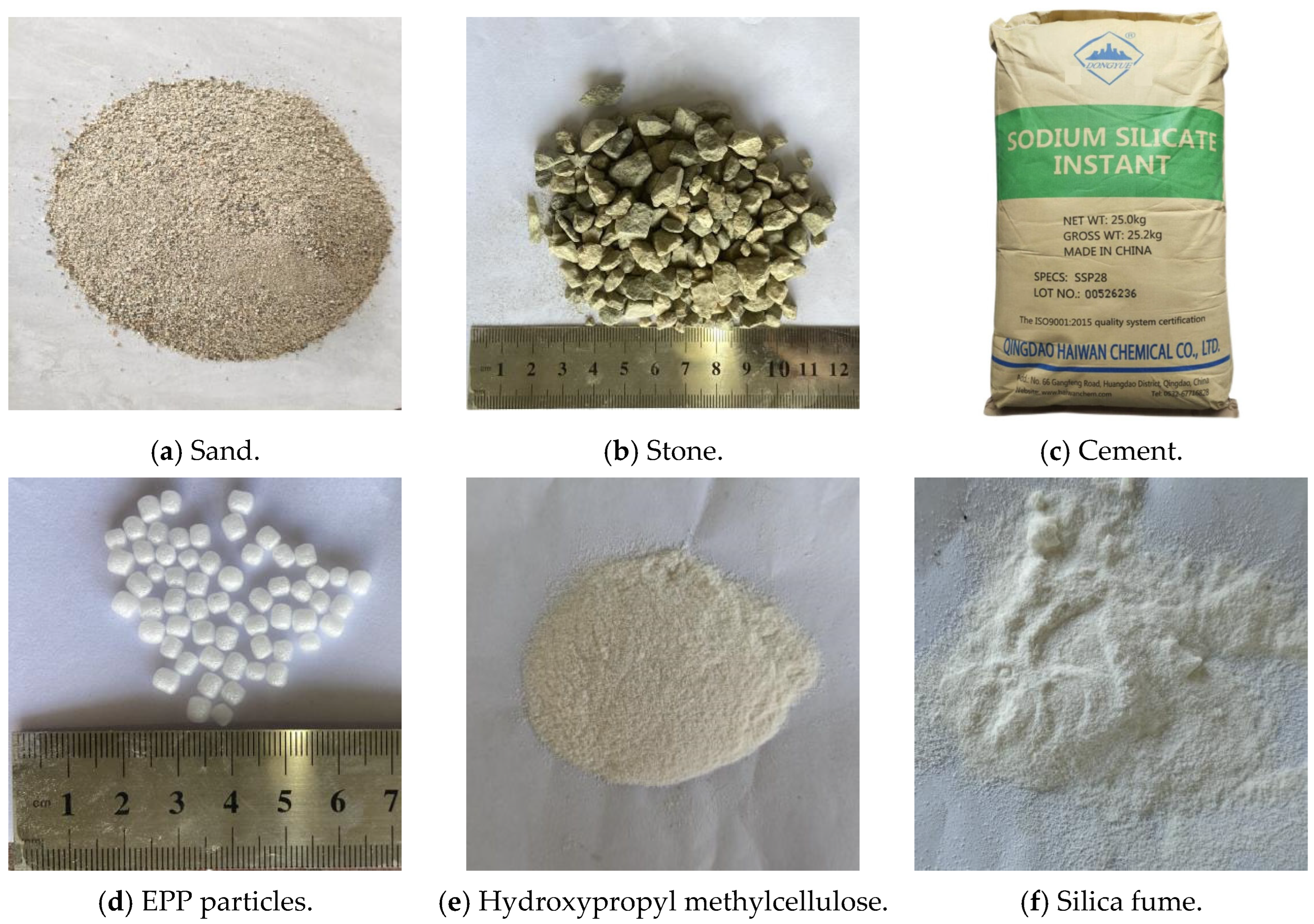
2.1.1. Cement
2.1.2. Aggregates and Water
2.1.3. Superplasticizer
2.1.4. Silica Fume
2.1.5. Cellulose Ether
2.1.6. EPP Particles
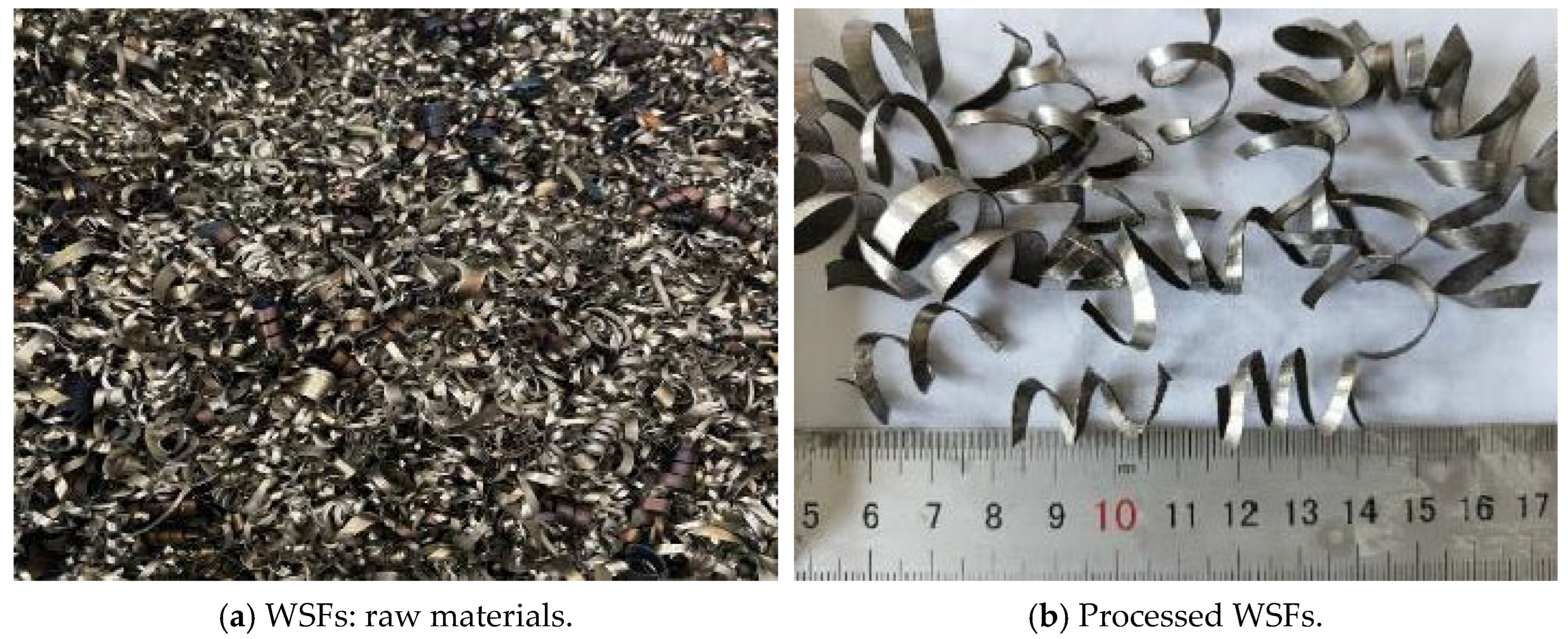
2.1.7. Waste Steel Fibers (WSFs)
2.2. Mix Proportion Design of Specimens
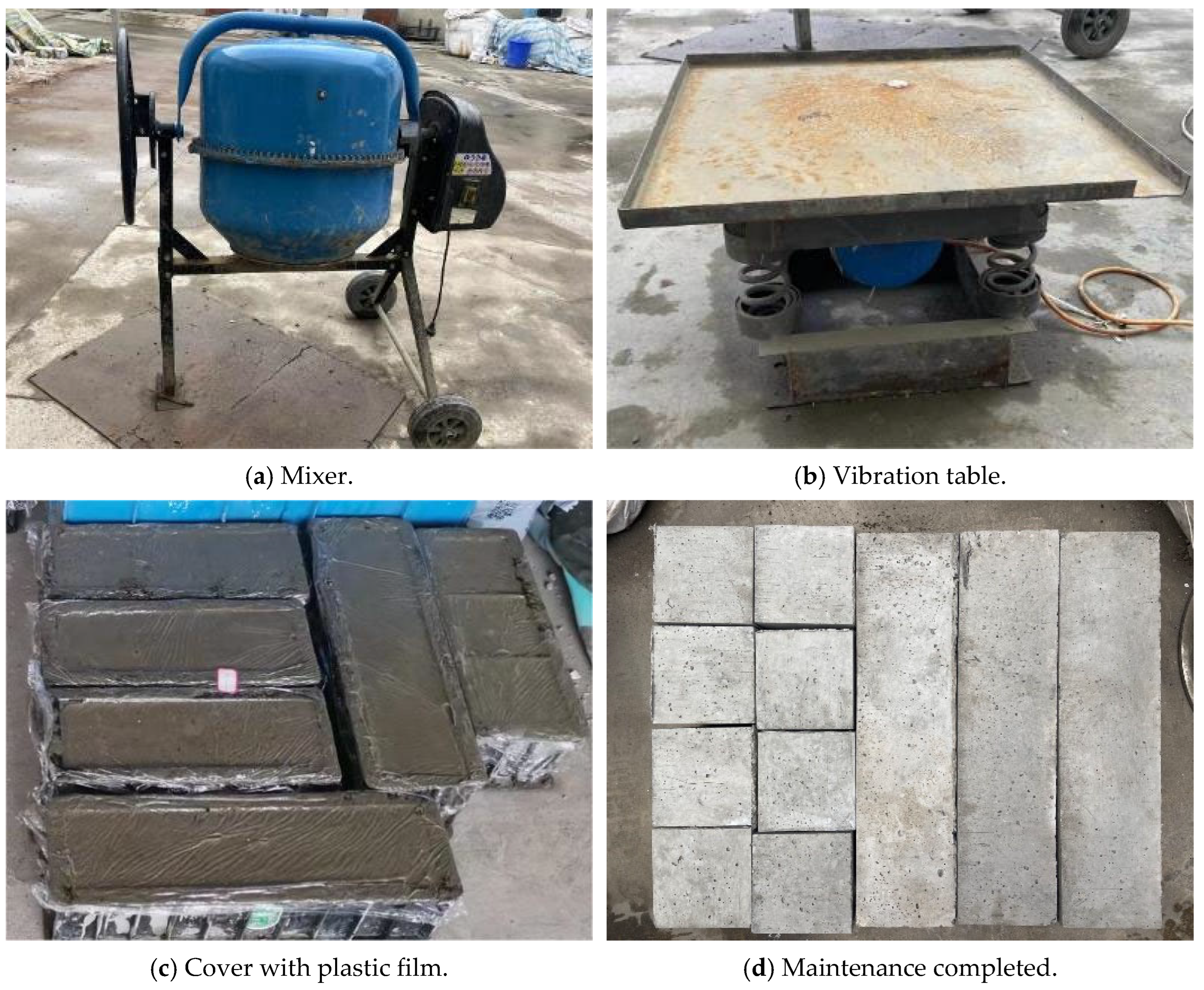
2.3. Specimen Preparation and Curing
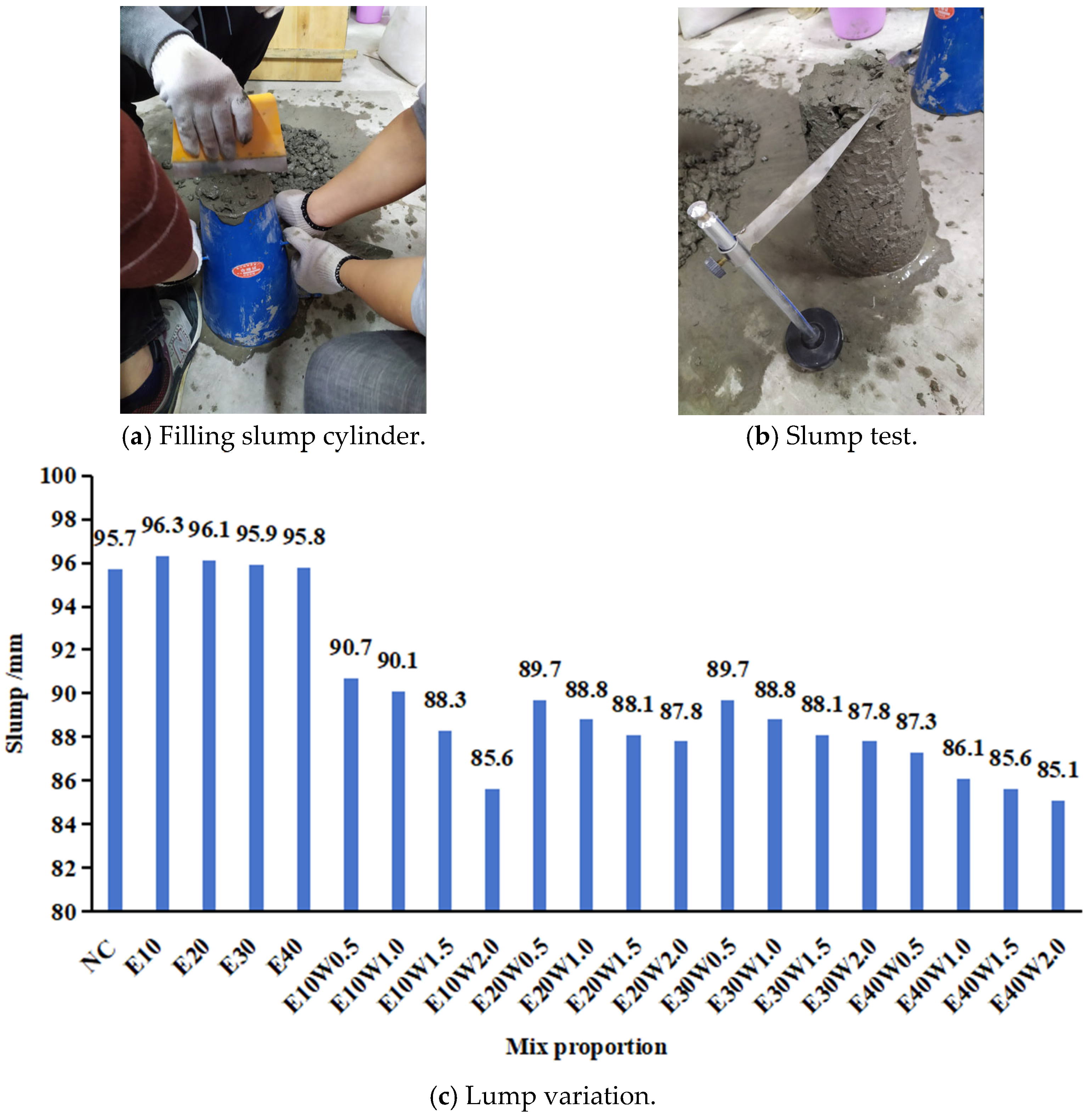
2.4. Slump Test of Mixture
3. Experimental Procedure and Failure Phenomena
3.1. Cube Compressive Strength Test
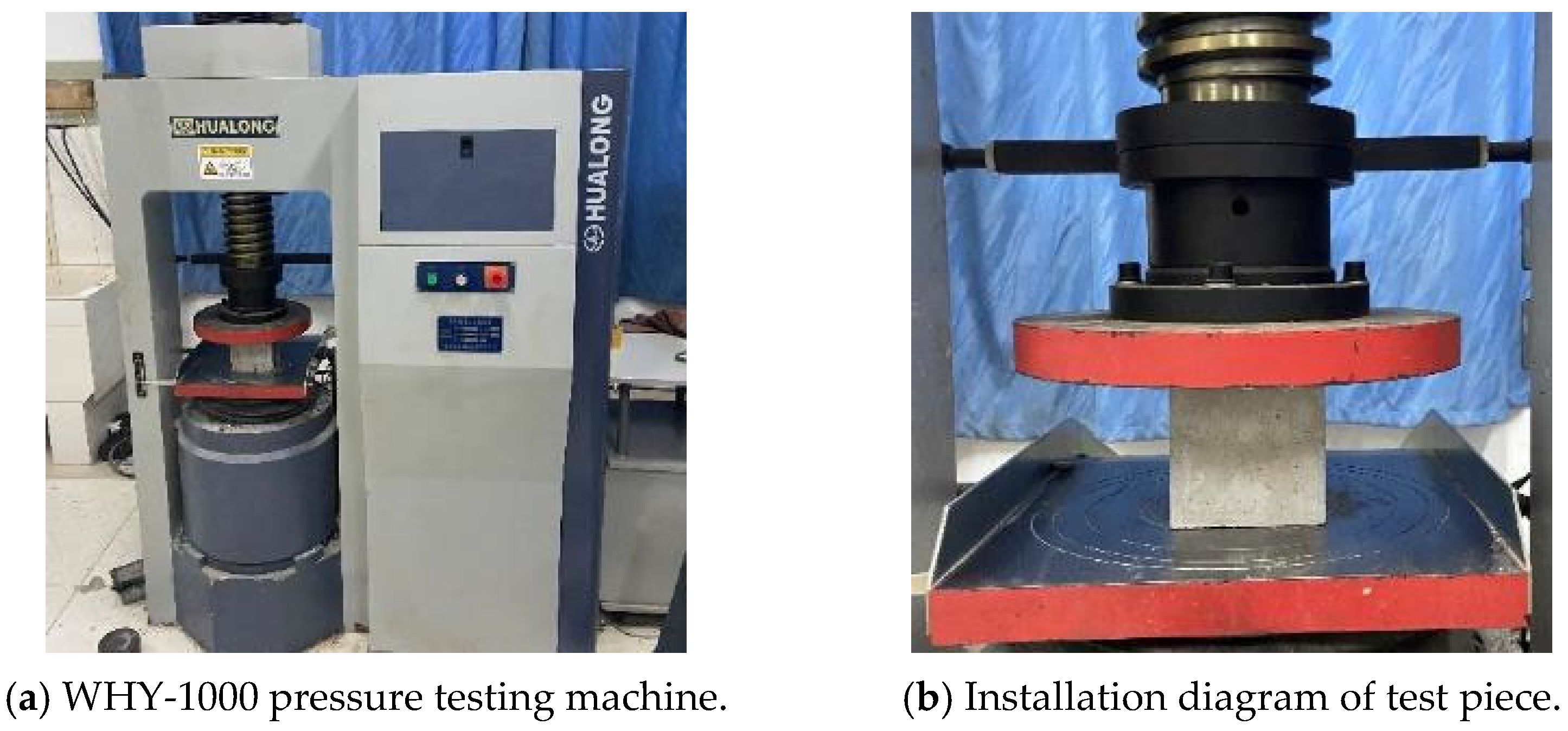
3.1.1. Testing Procedure
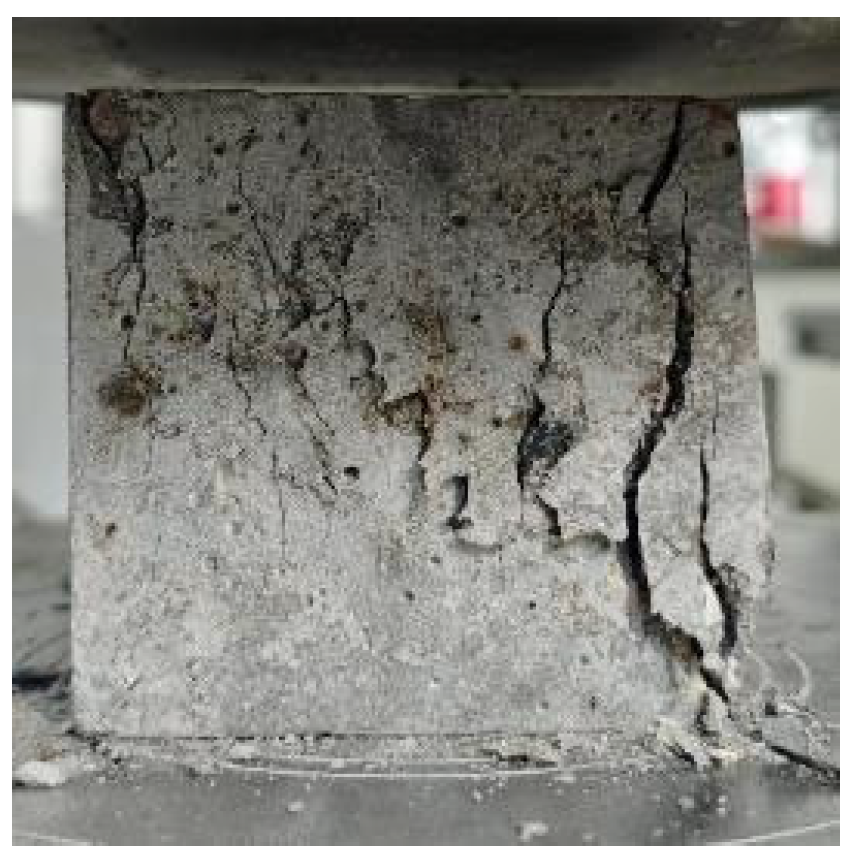
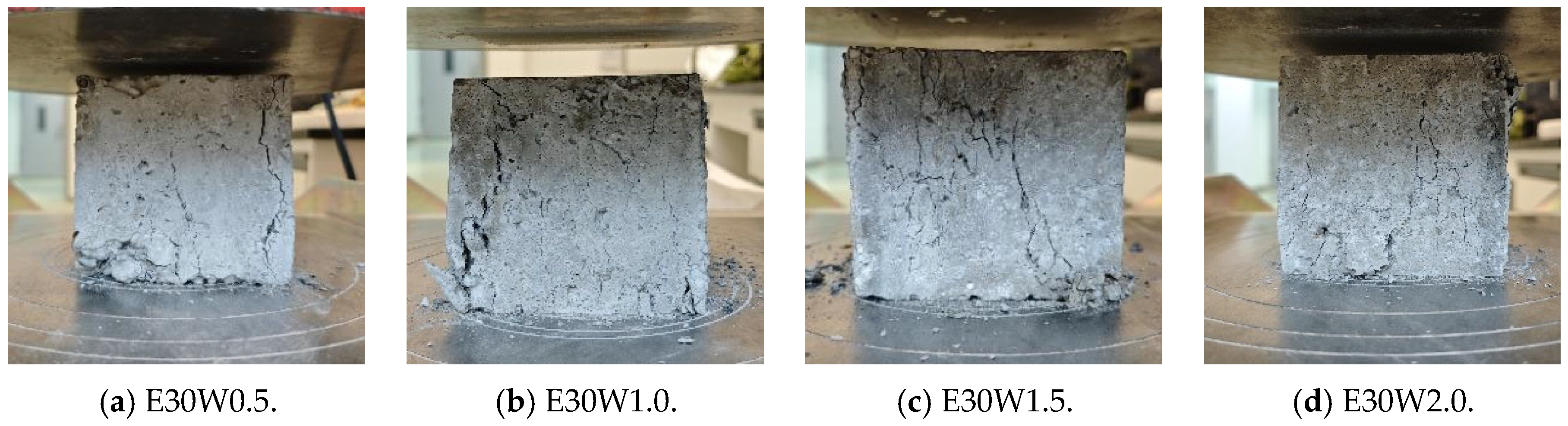
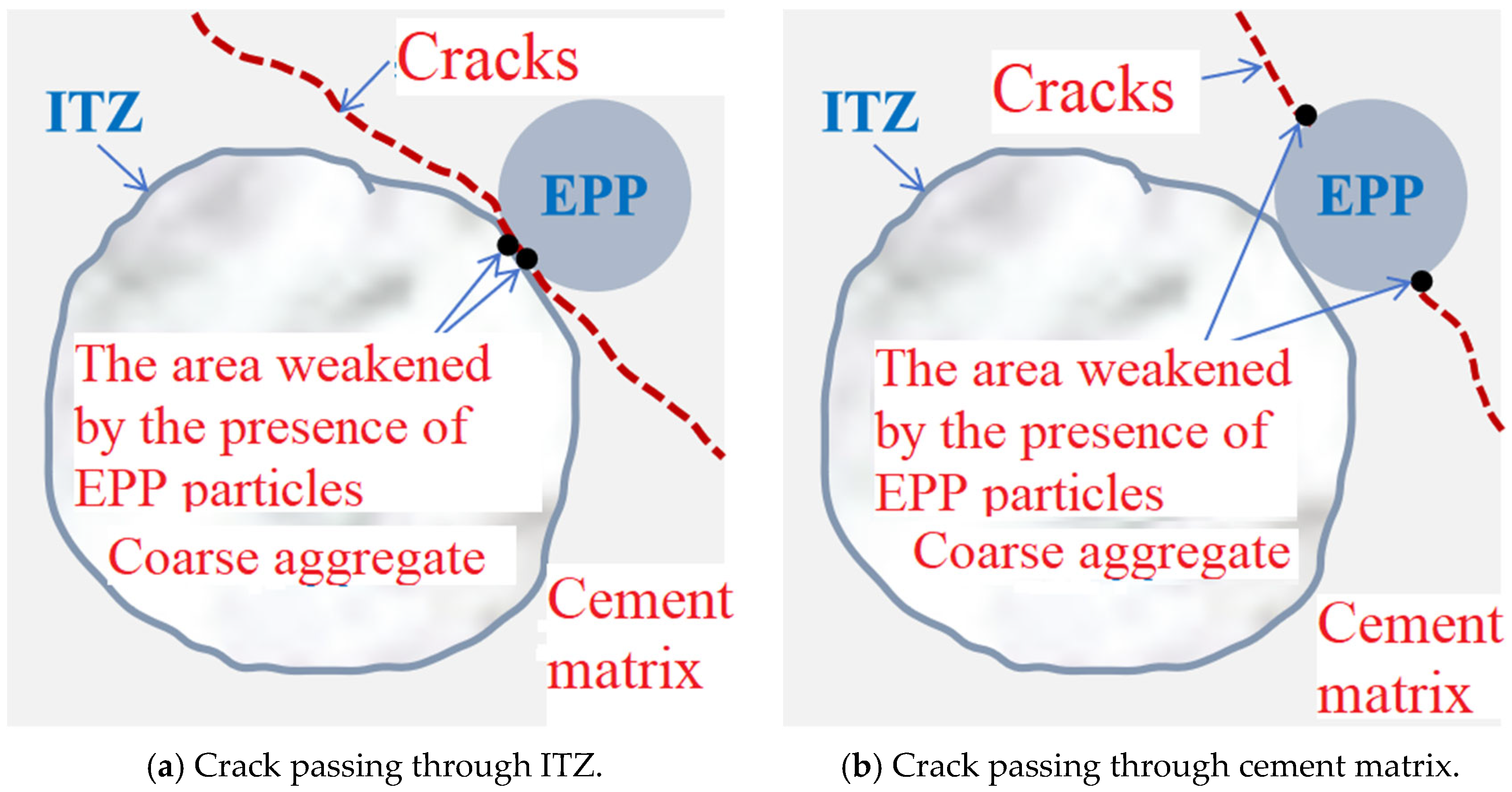
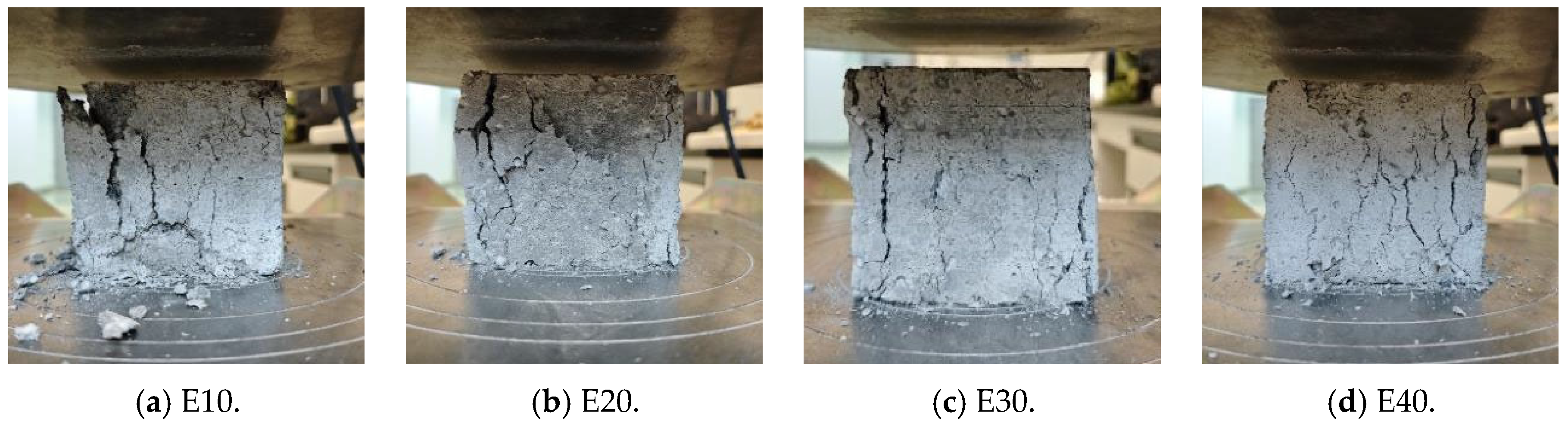
3.1.2. Test Piece Failure Mode
3.2. Splitting Tensile Test
3.2.1. Testing Procedure
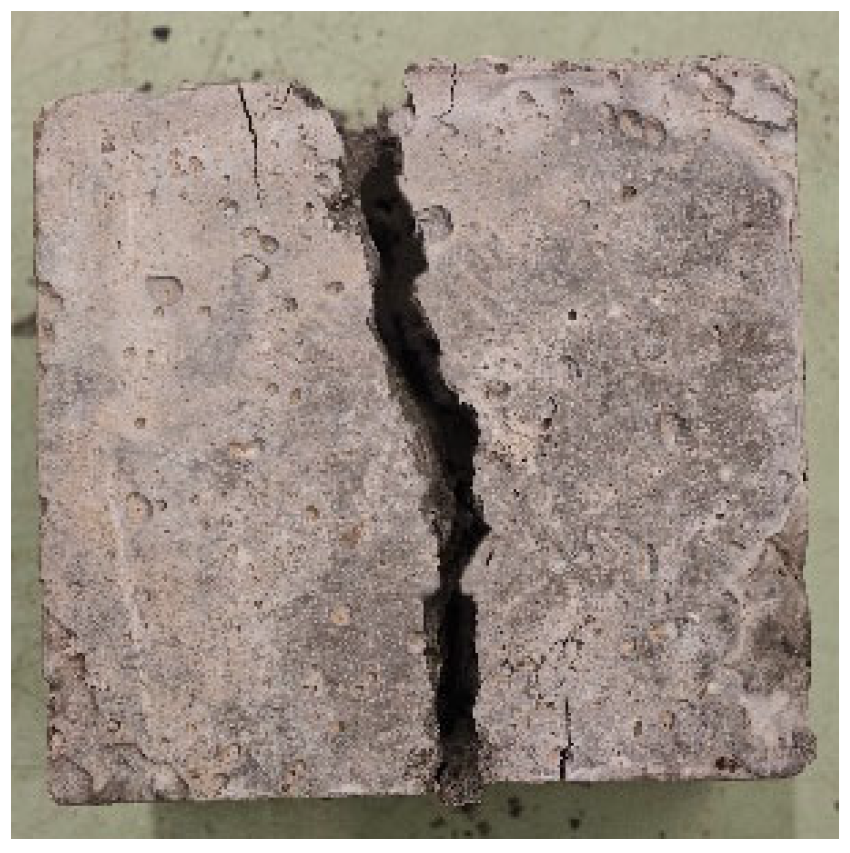
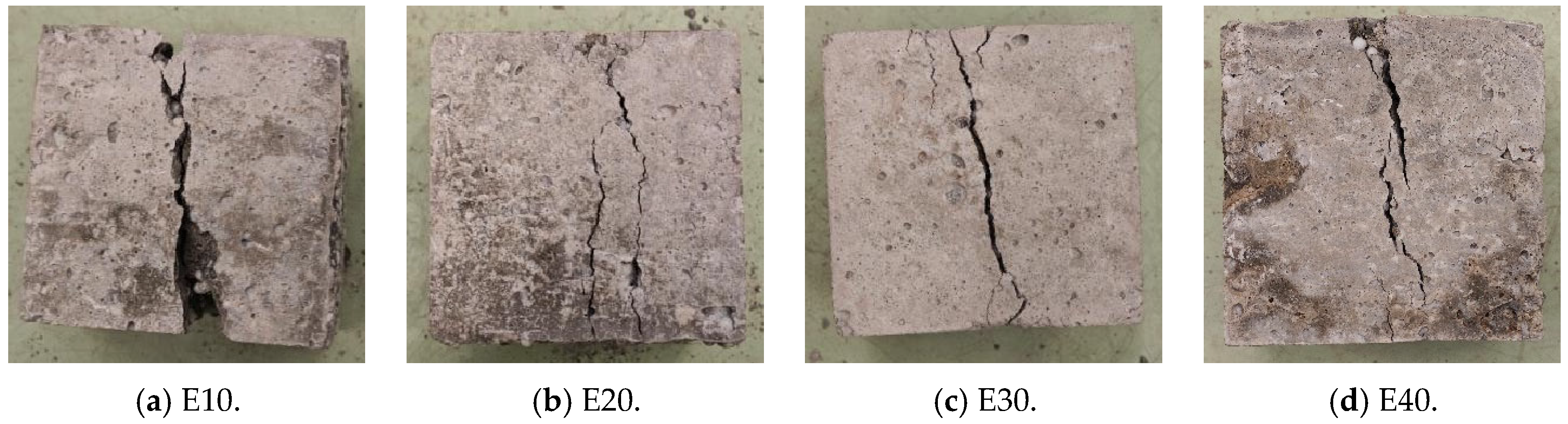
3.2.2. Failure Modes of Specimens
3.3. Flexural Test
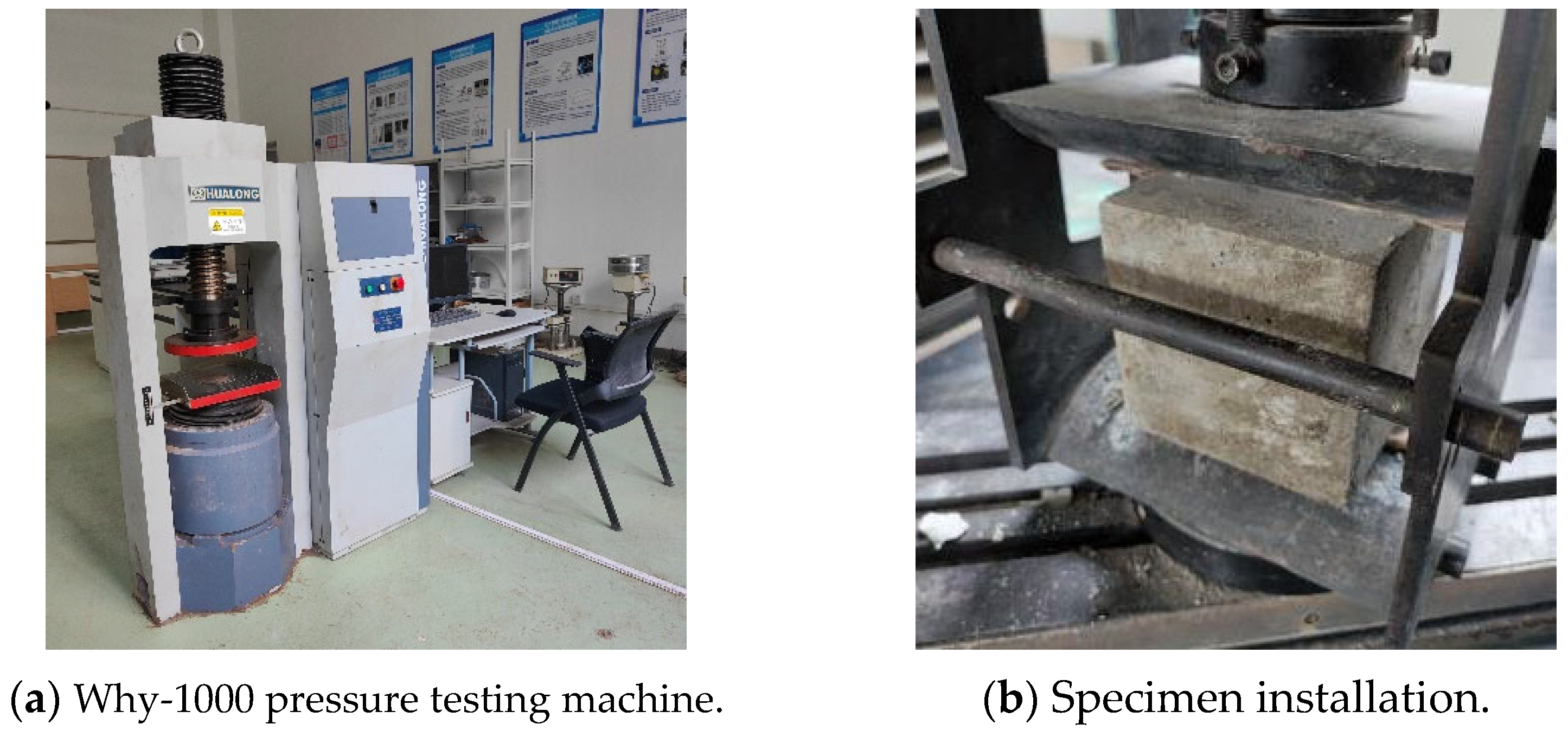
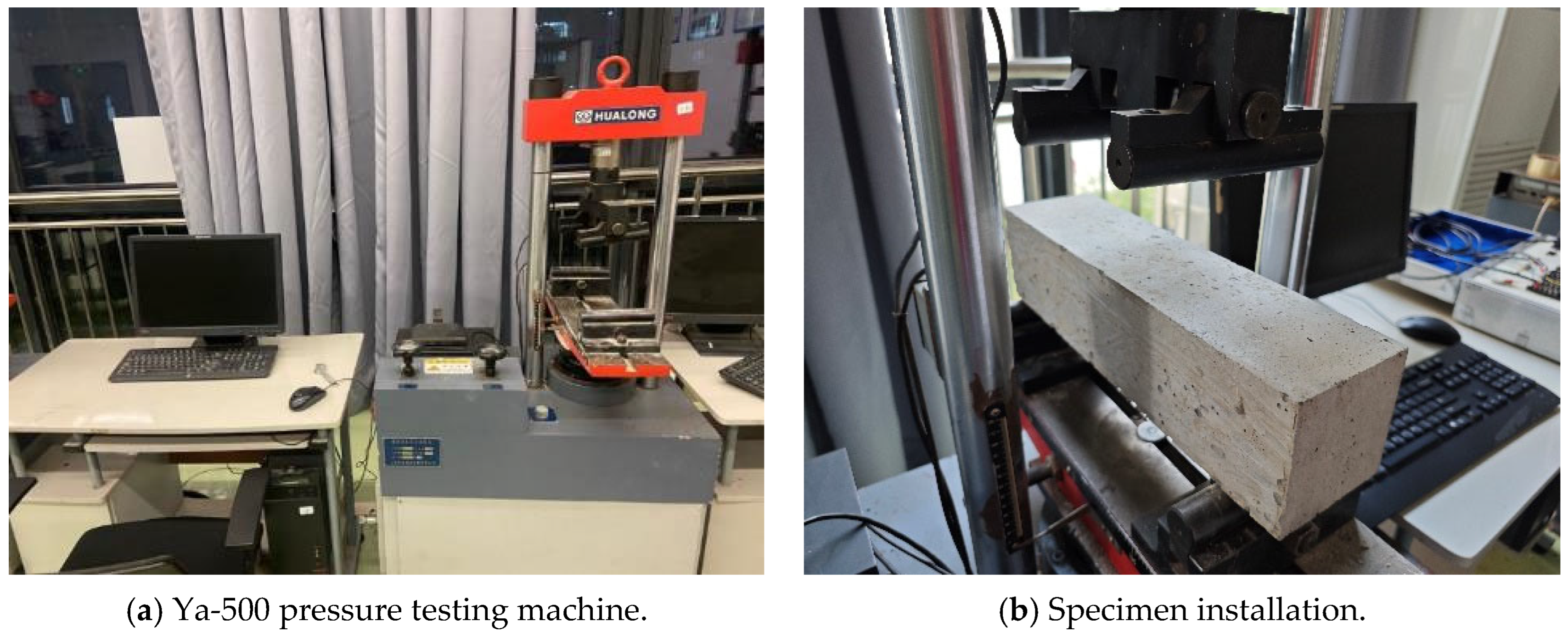
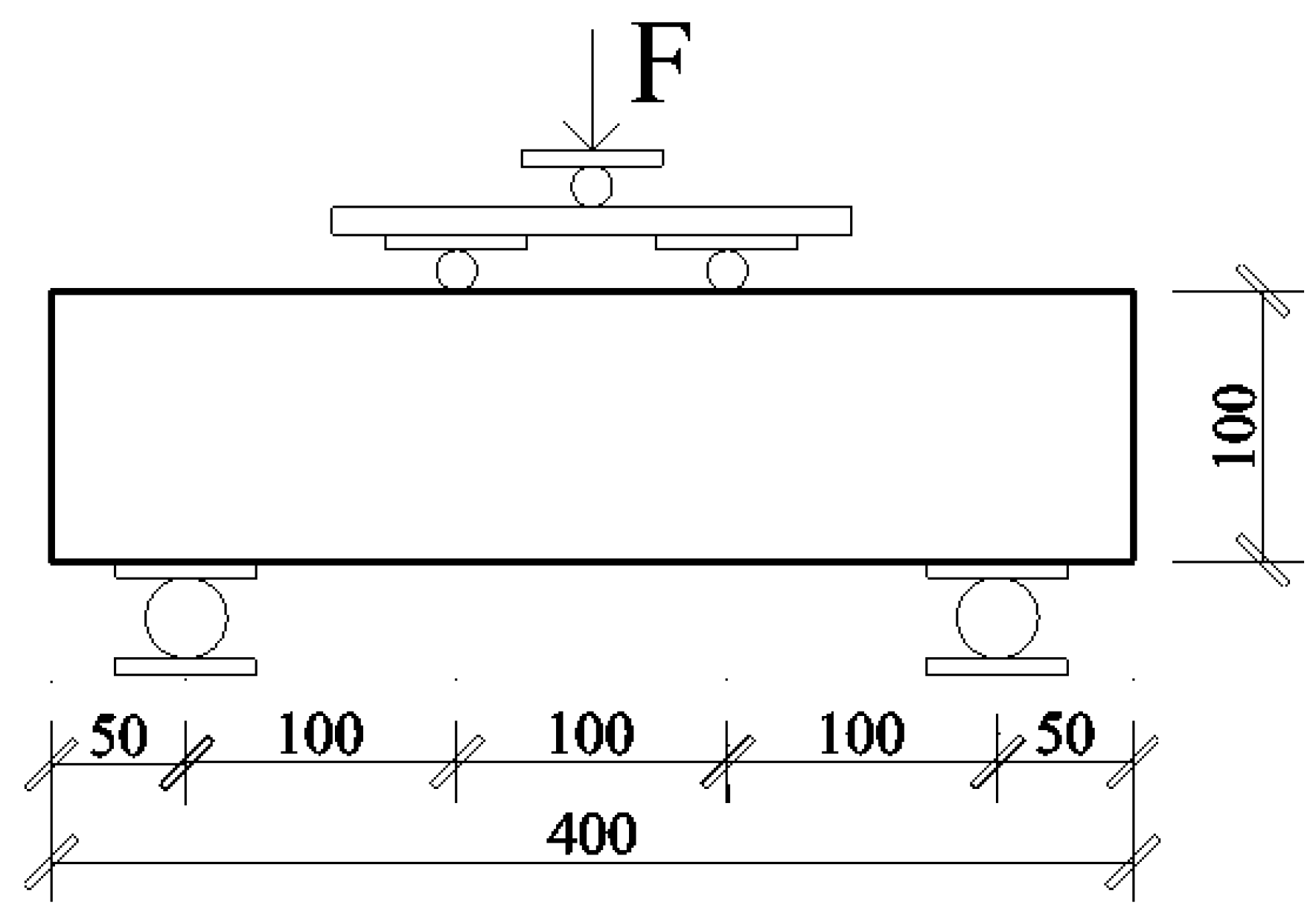
3.3.1. Testing Procedure
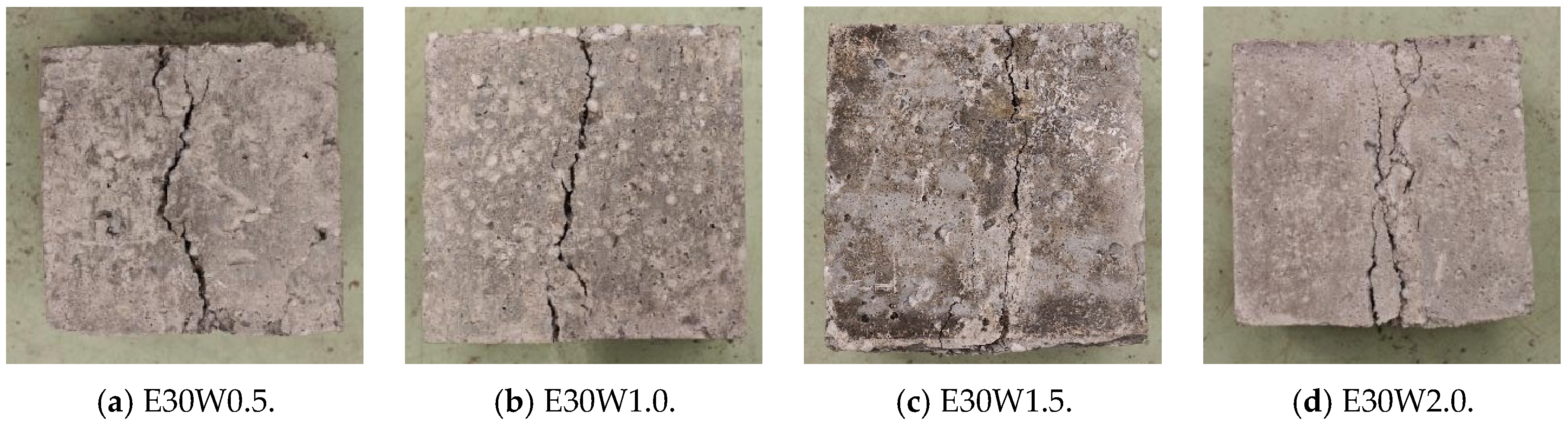
3.3.2. Flexural Failure Modes
4. Analysis of Factors Affecting Strength
4.1. Cubic Compressive Strength
4.1.1. Effect of EPP Content
4.1.2. Effect of WSF Content
4.2. Splitting Tensile Strength
4.2.1. Effect of EPP Content
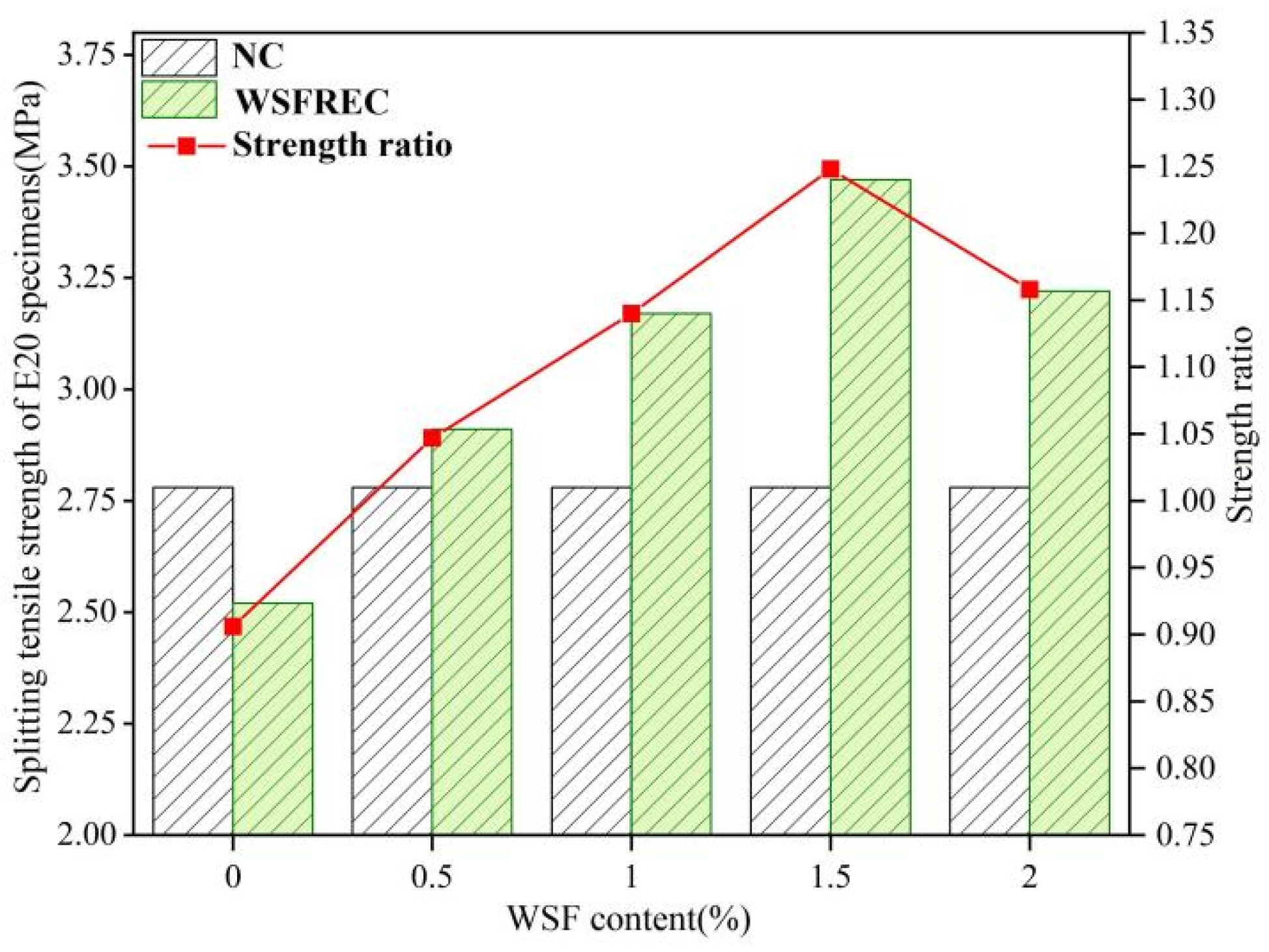
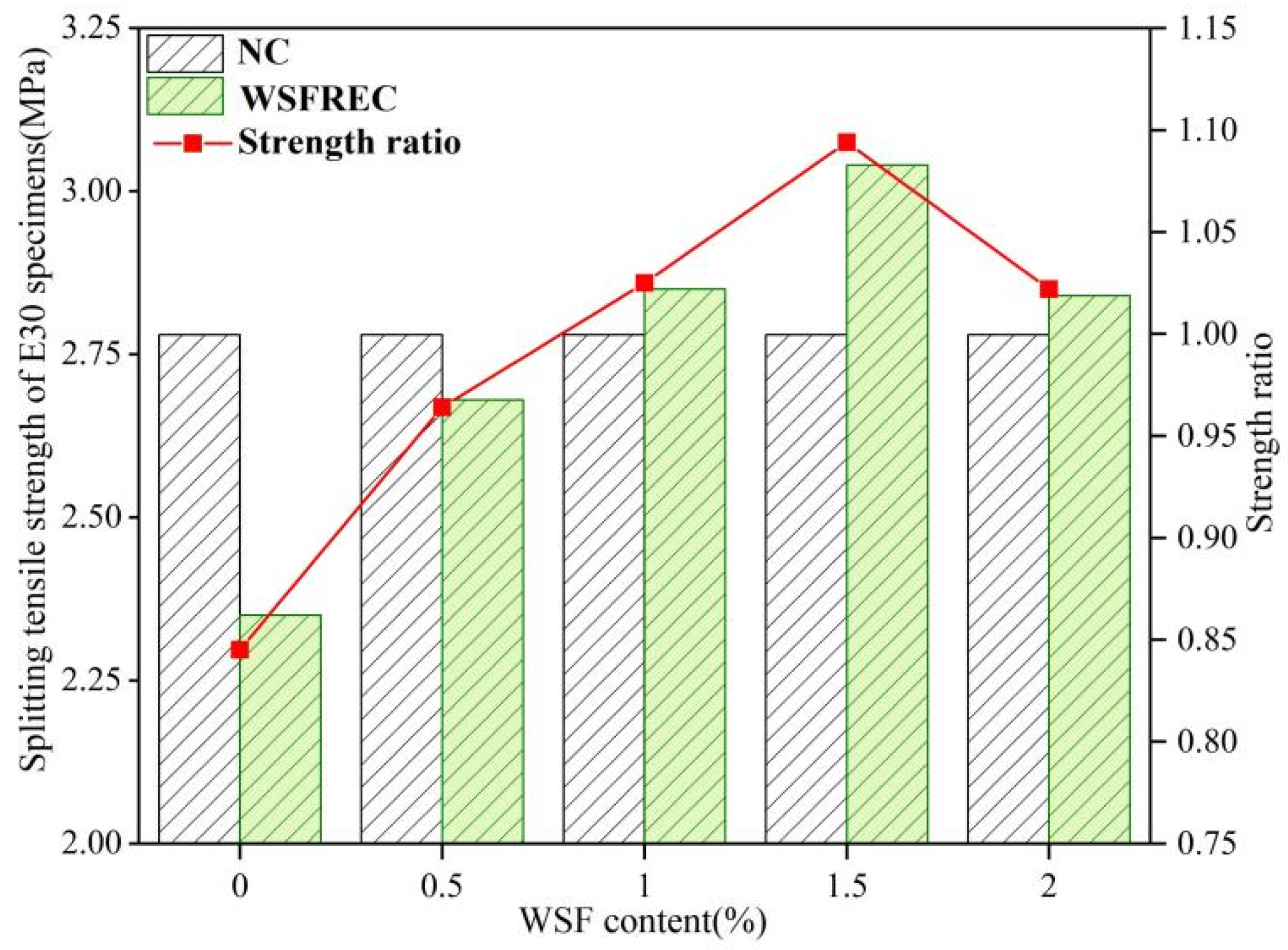
4.2.2. Effect of WSF Content
4.2.3. Analysis of Tensile–Compressive Ratio
4.3. Flexural Strength
4.3.1. Effect of EPP Content
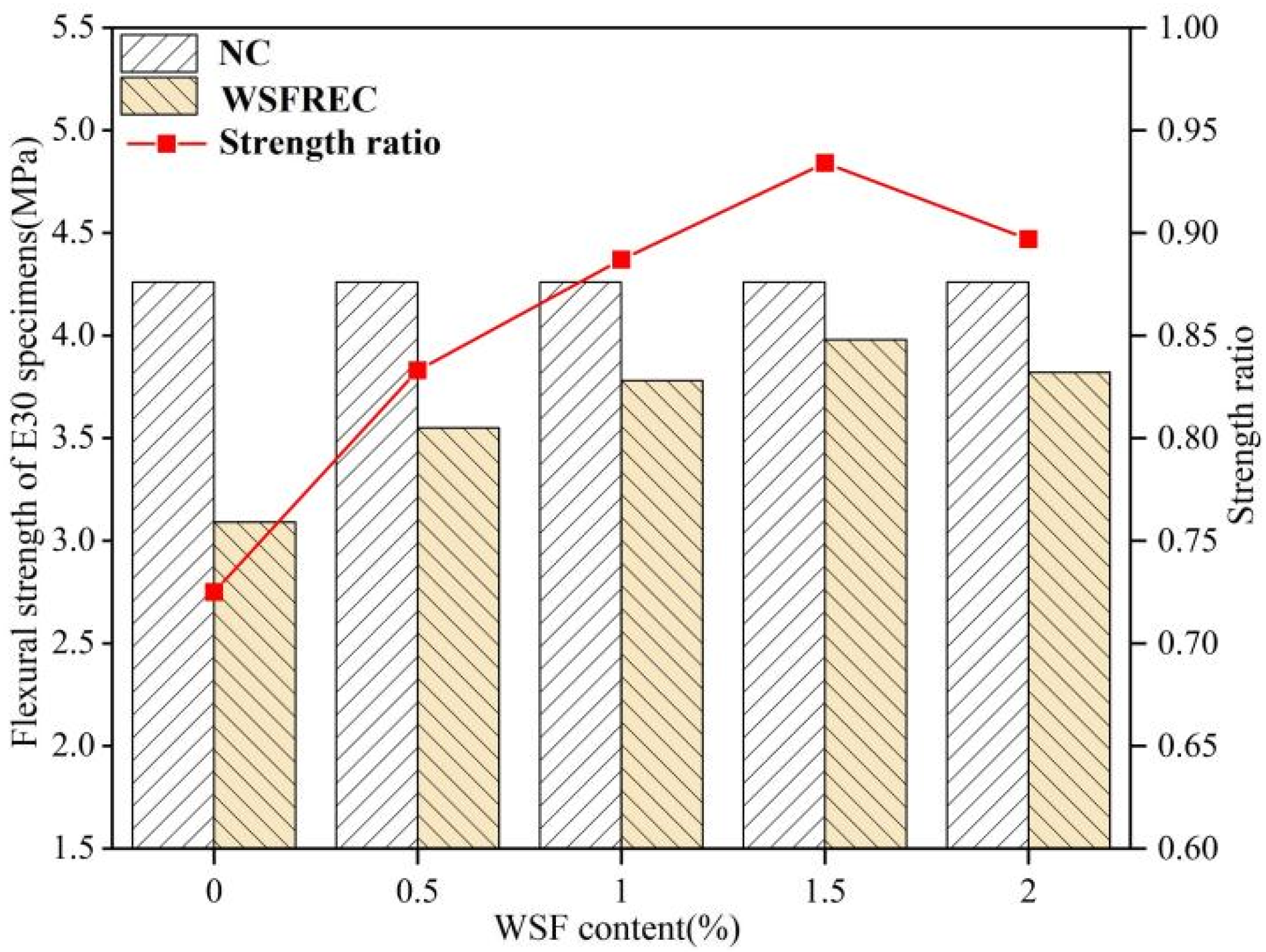
4.3.2. Effect of WSF Content
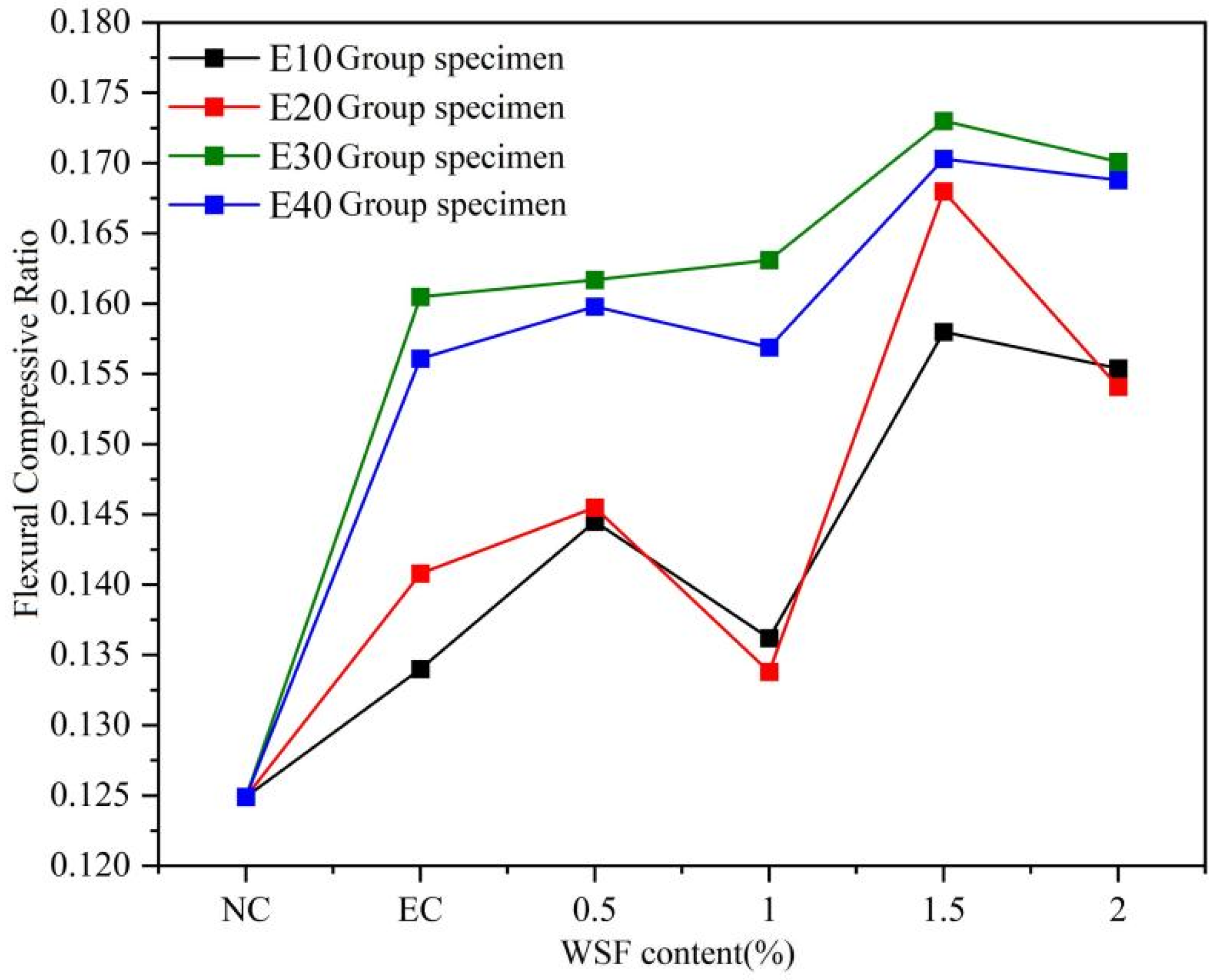
4.3.3. Analysis of Flexural–Compressive Ratio
5. Analysis of WSFREC’s Enhancement Mechanism
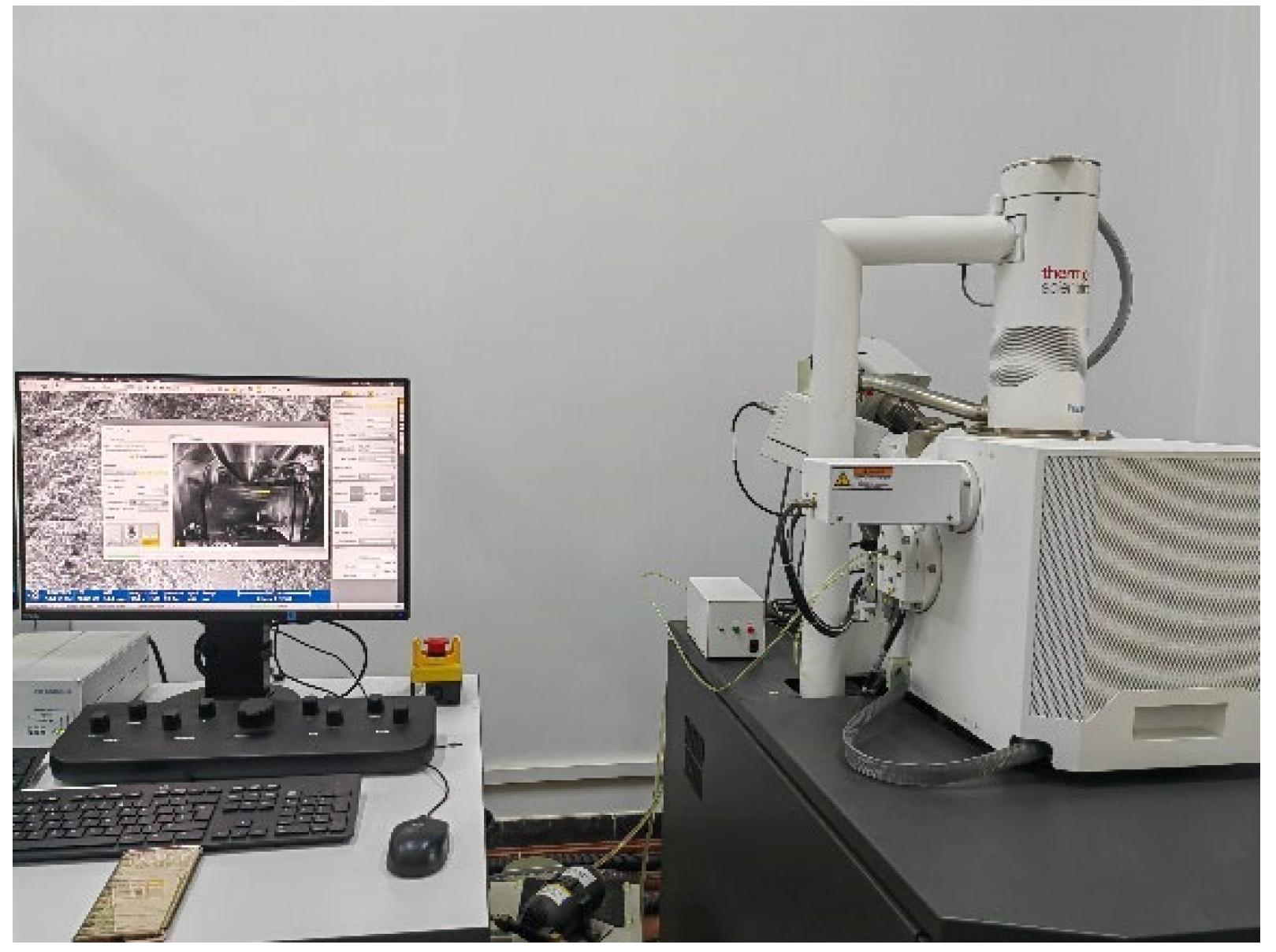
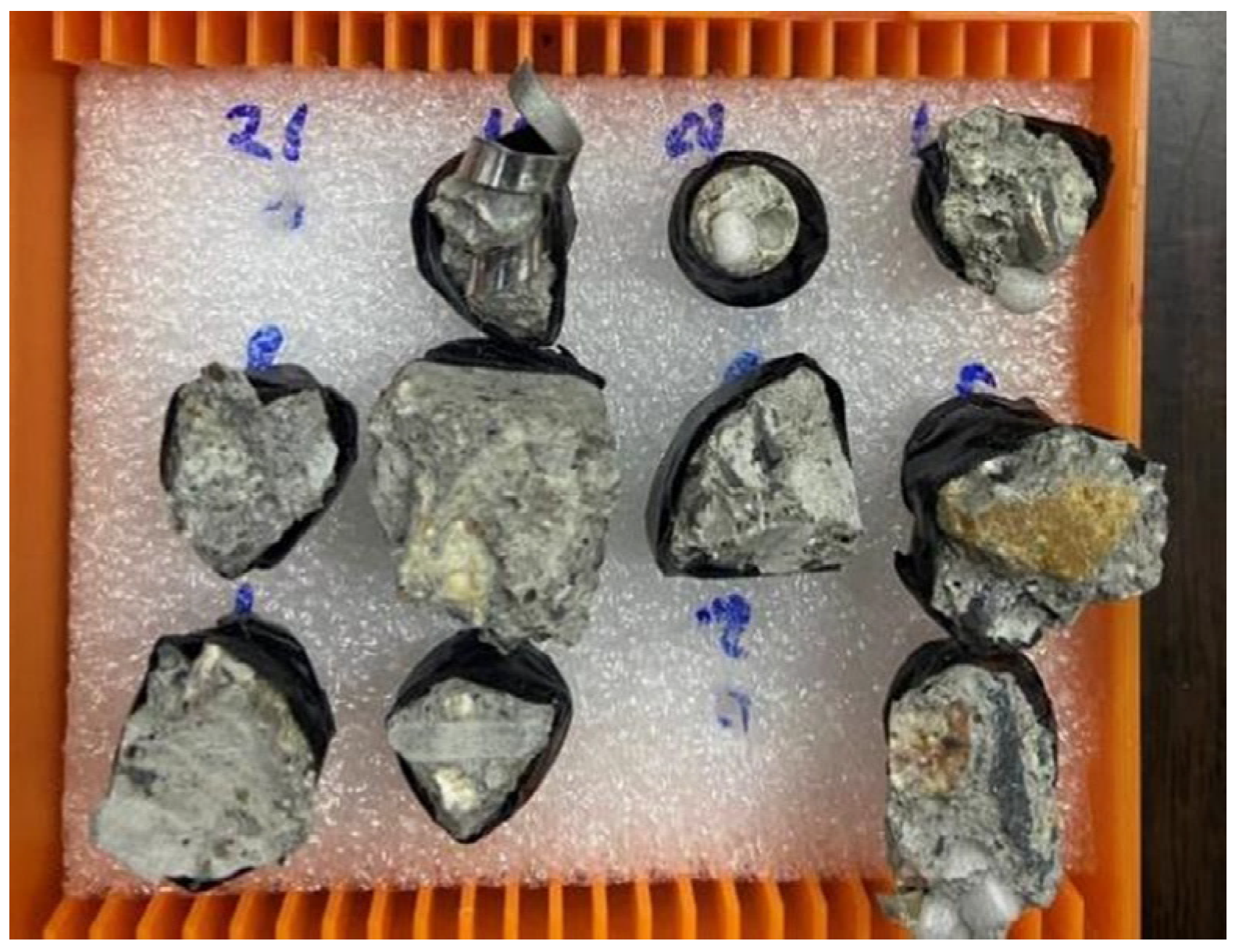
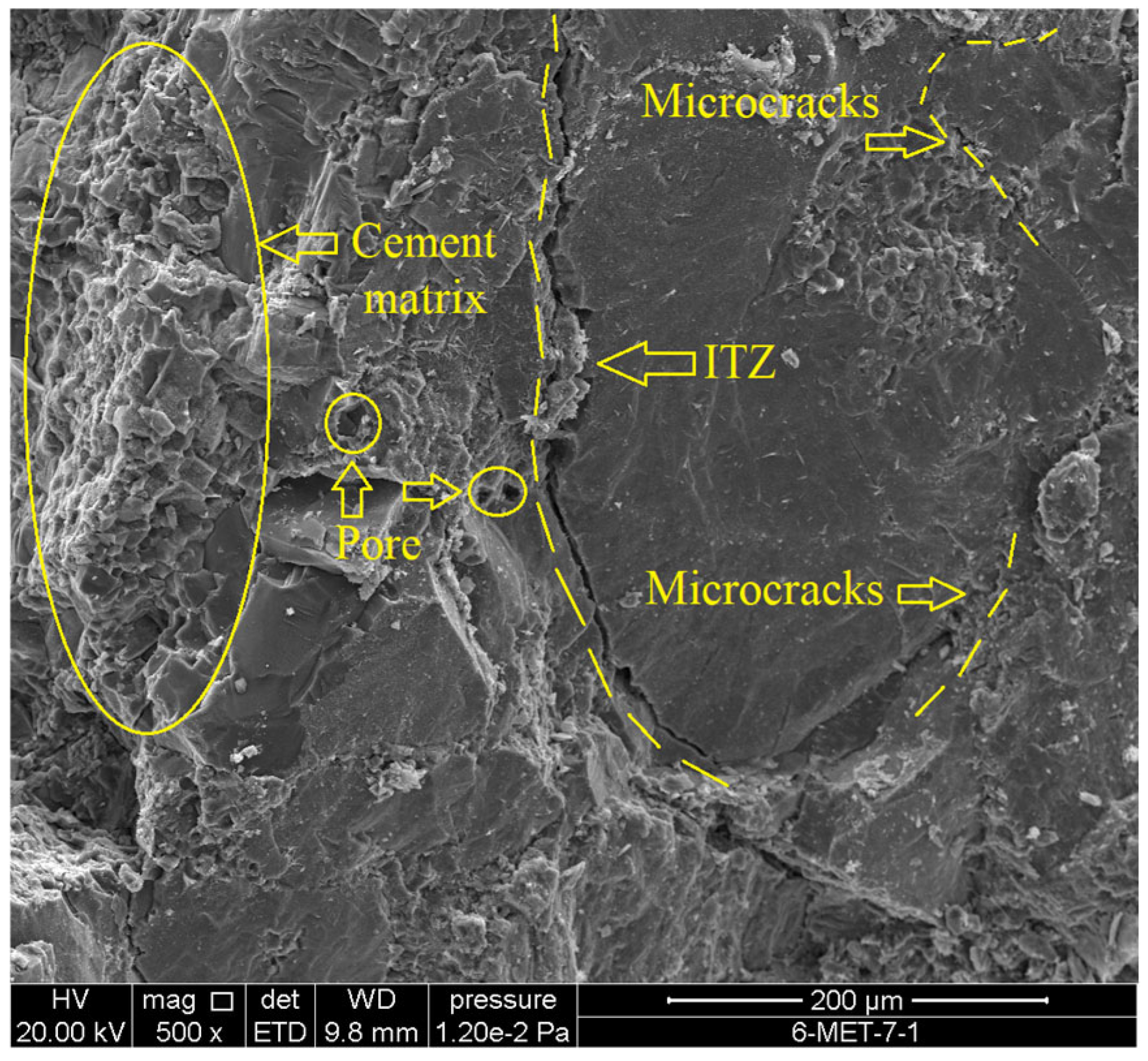
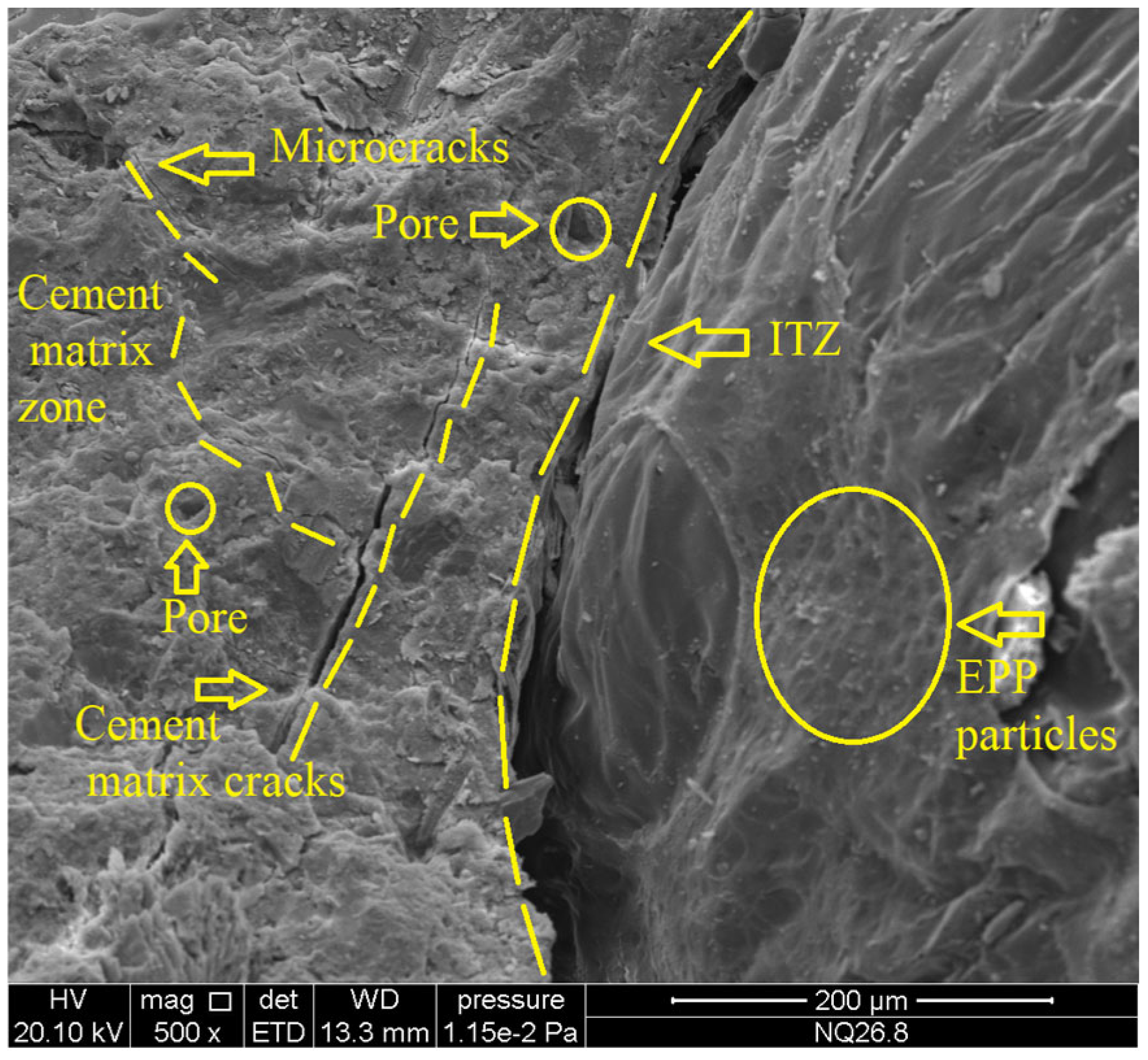
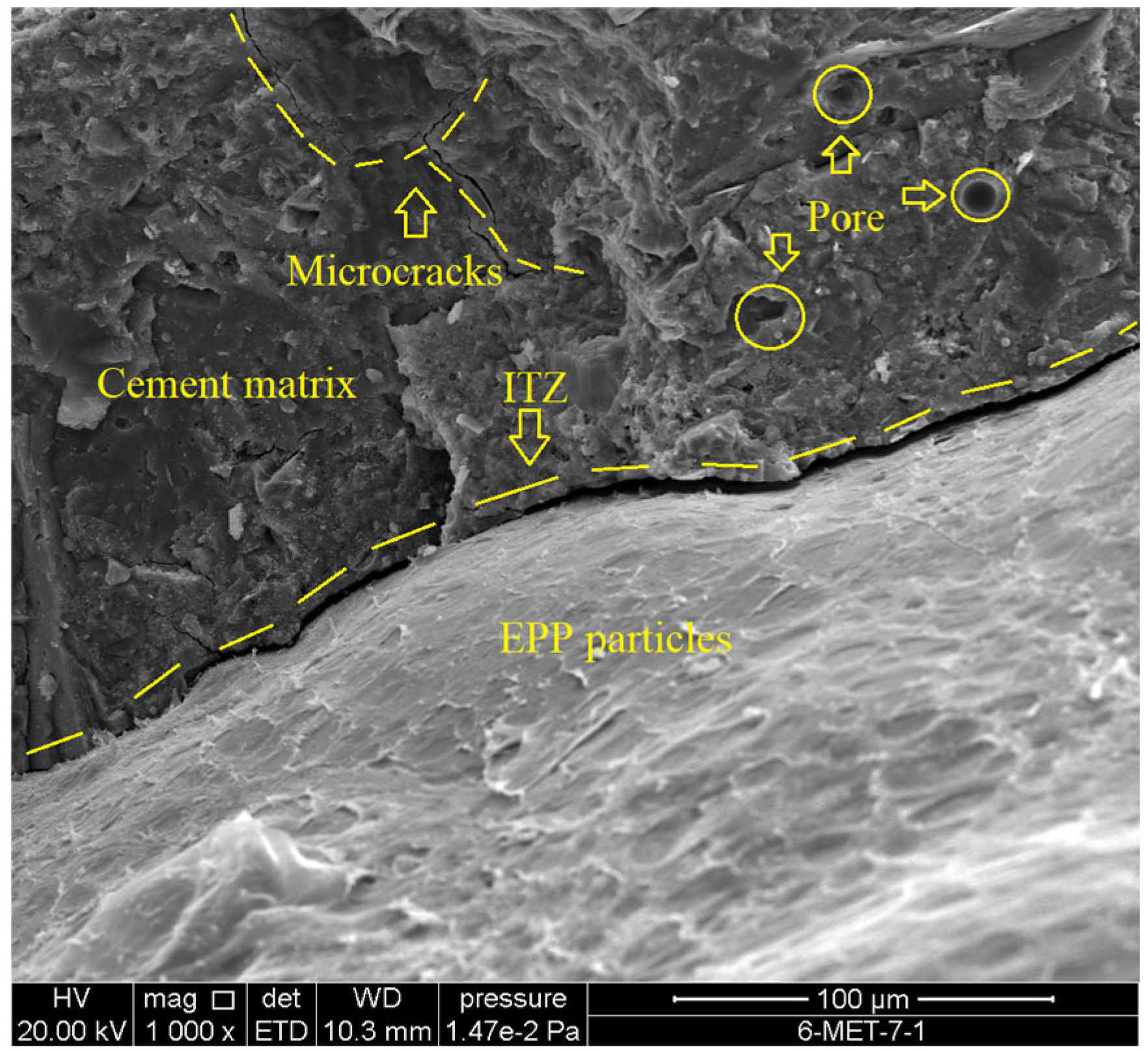
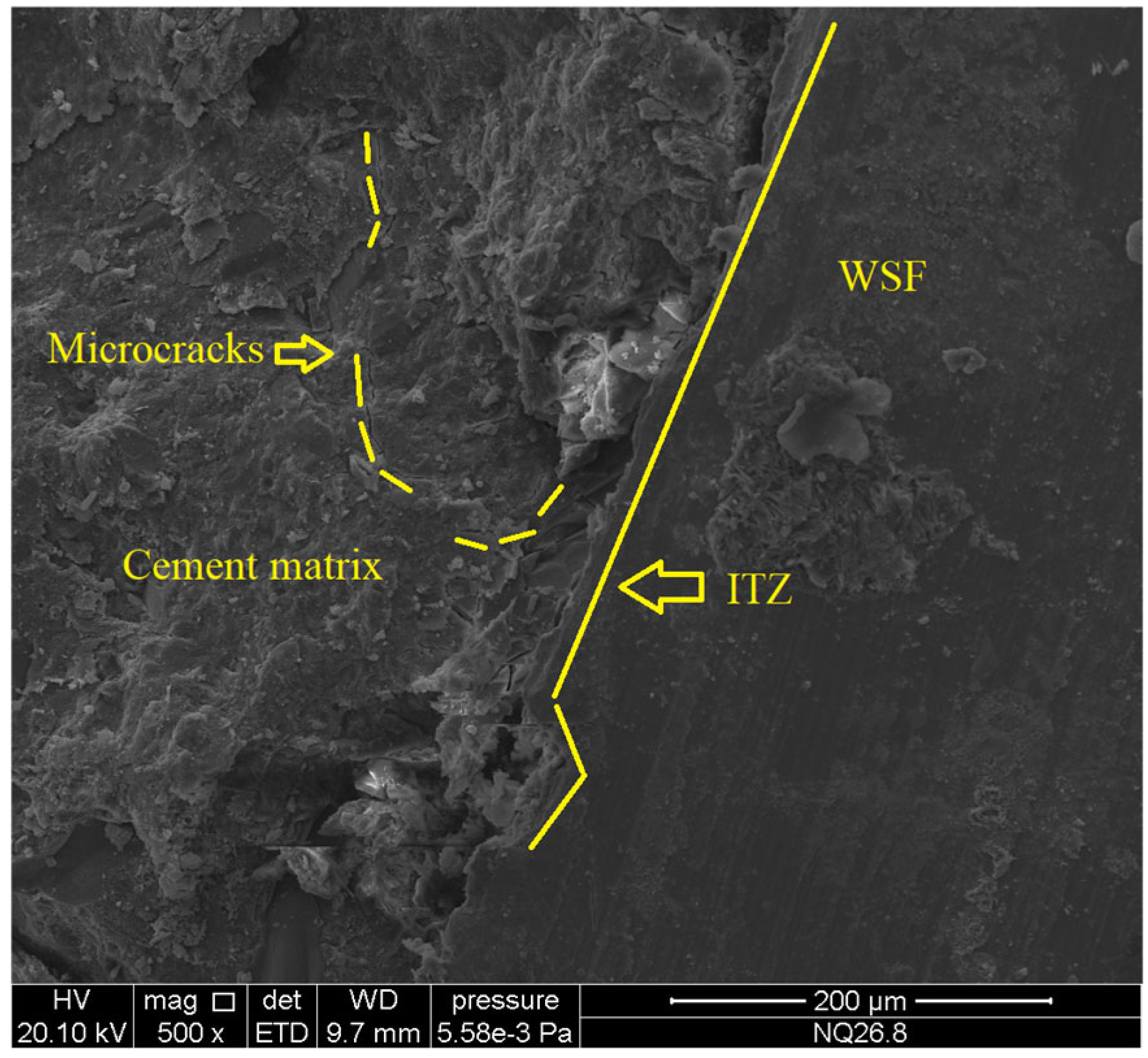
Microstructural Study of WSFREC
6. Conclusions
- (1)
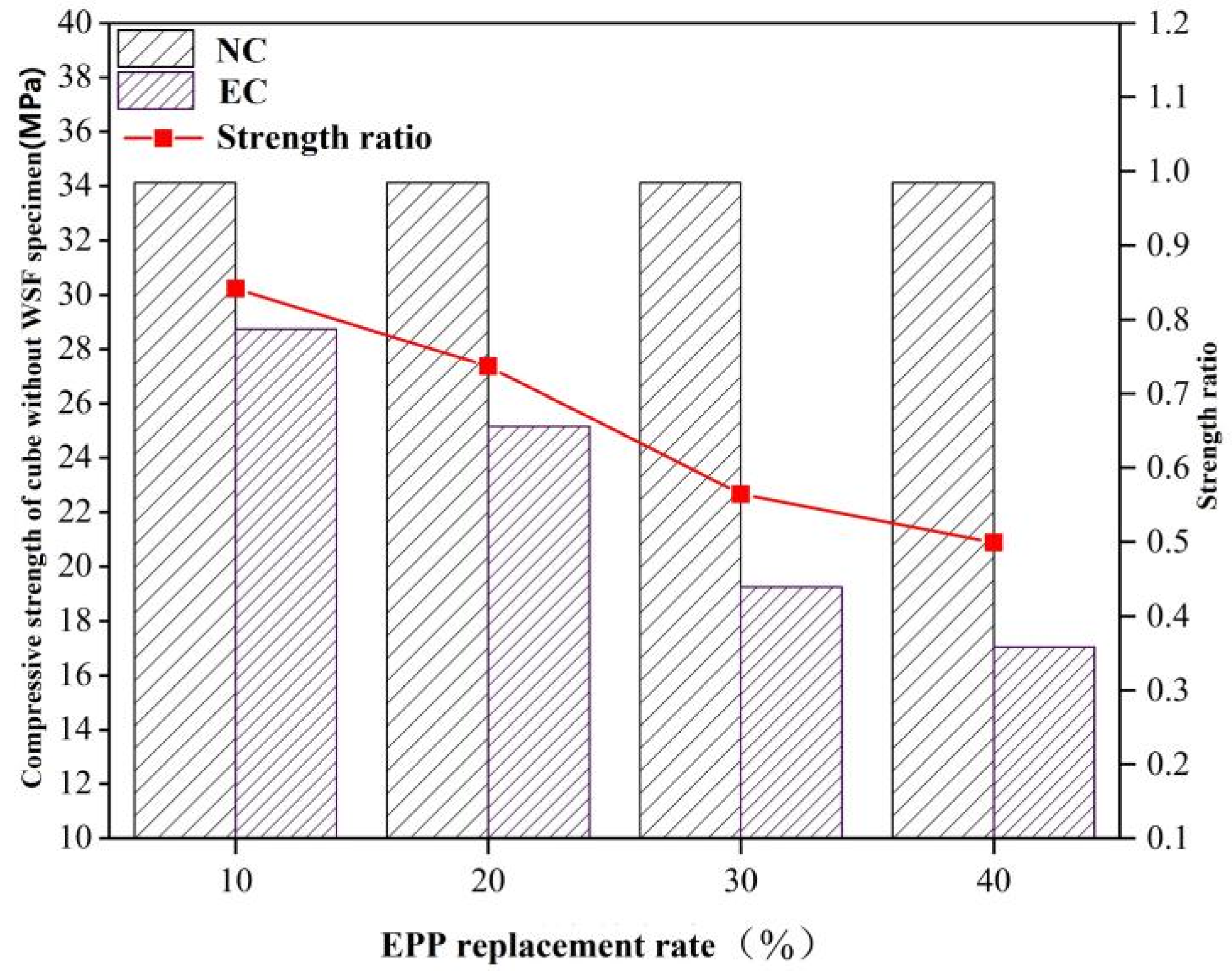
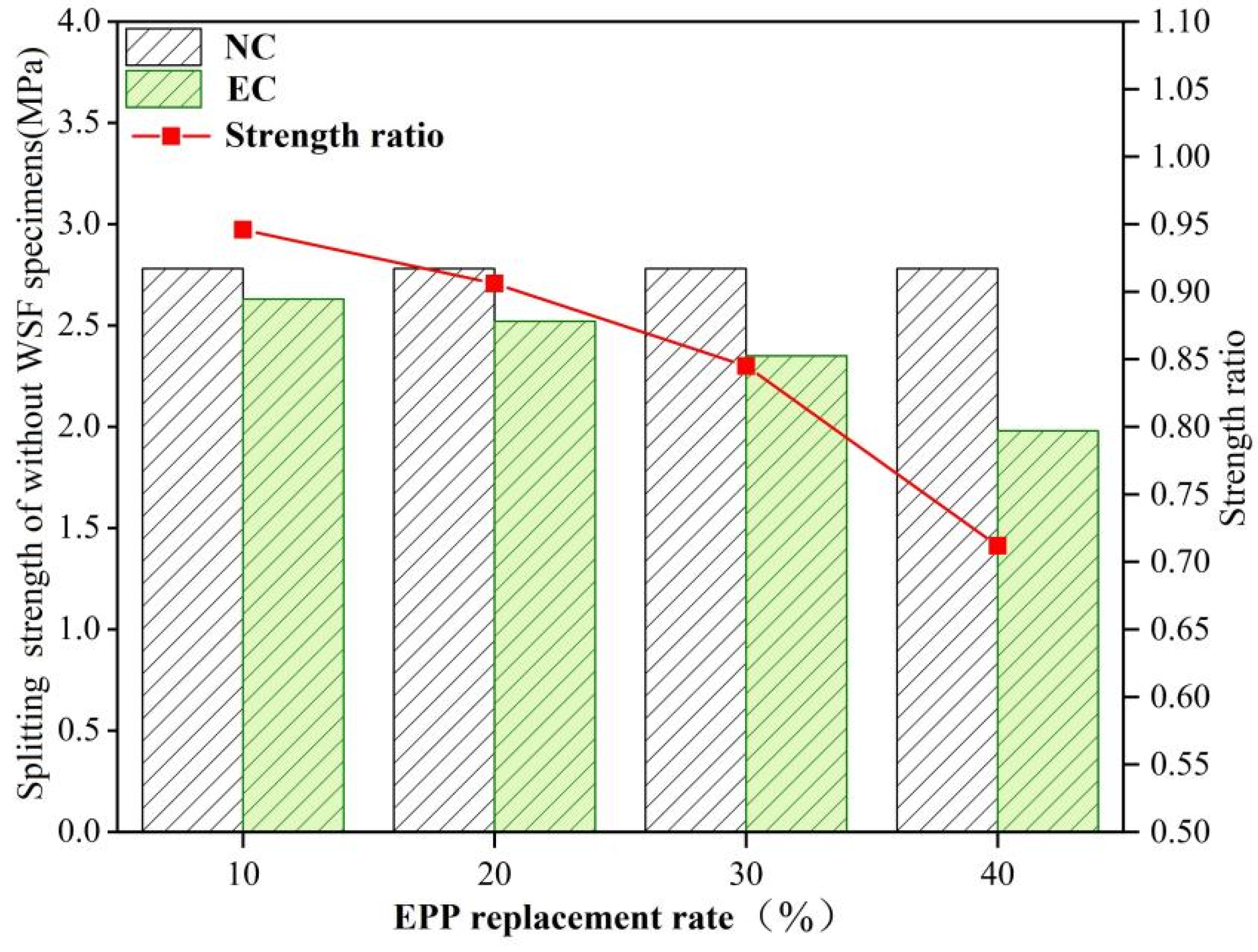
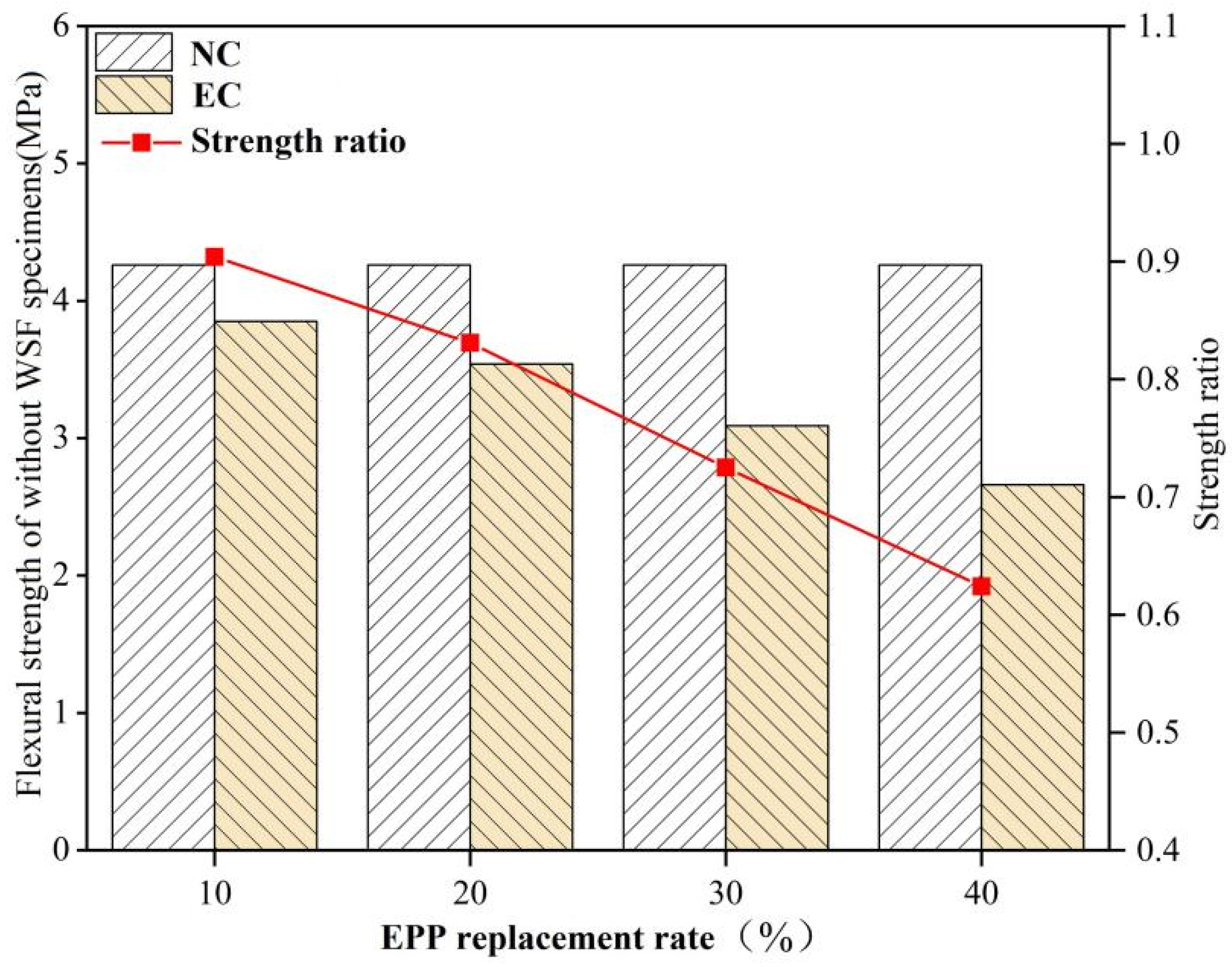
- The cube compressive strength, splitting tensile strength, and four-point flexural strength of EC decreased with the increase in EPP particle substitution rate, and the weakening of cube compressive strength was very significant. However, the addition of EPP particles also improved the toughness of concrete to varying degrees. When the EPP particle substitution rate was 30%, the toughness of concrete was the best.
- (2)
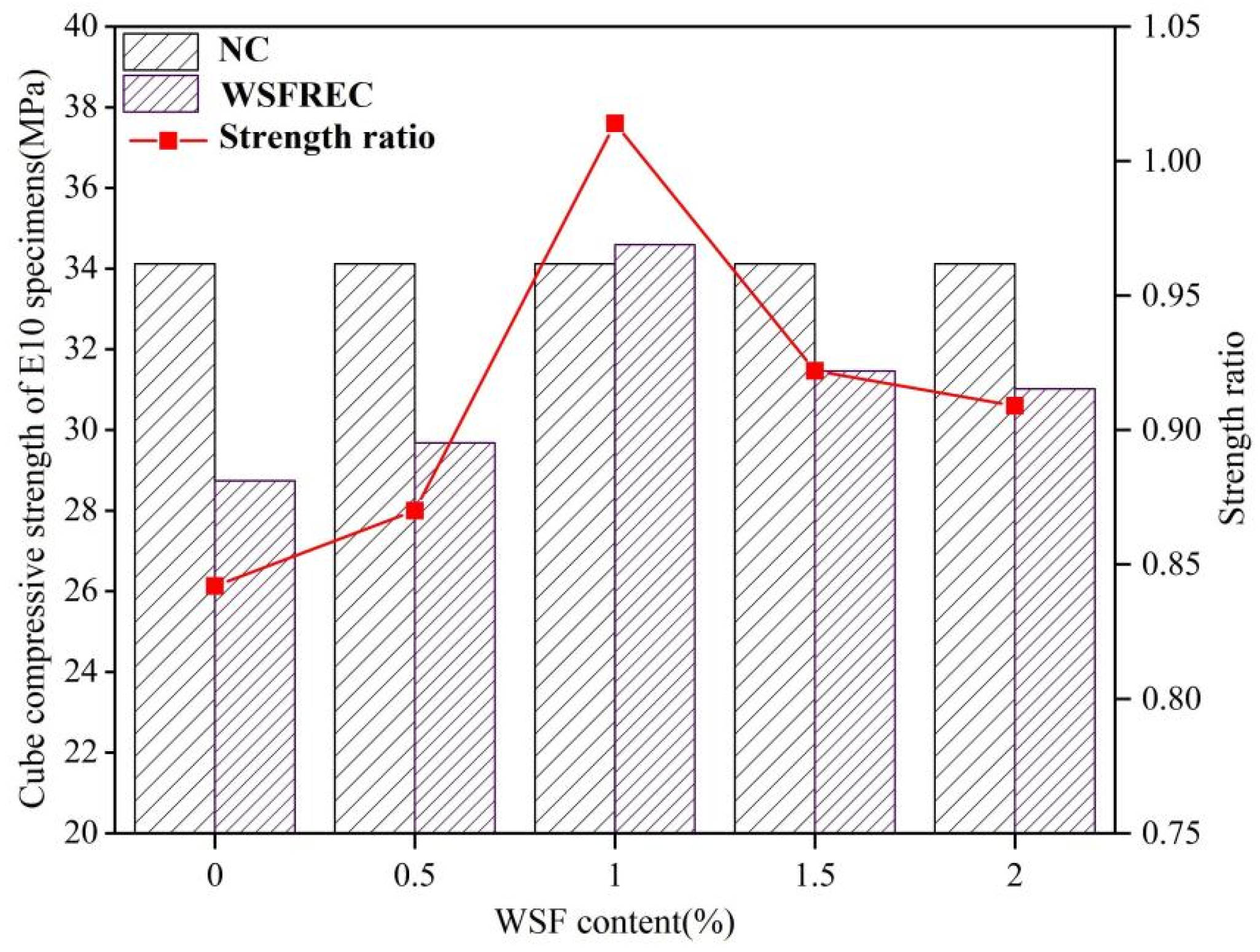
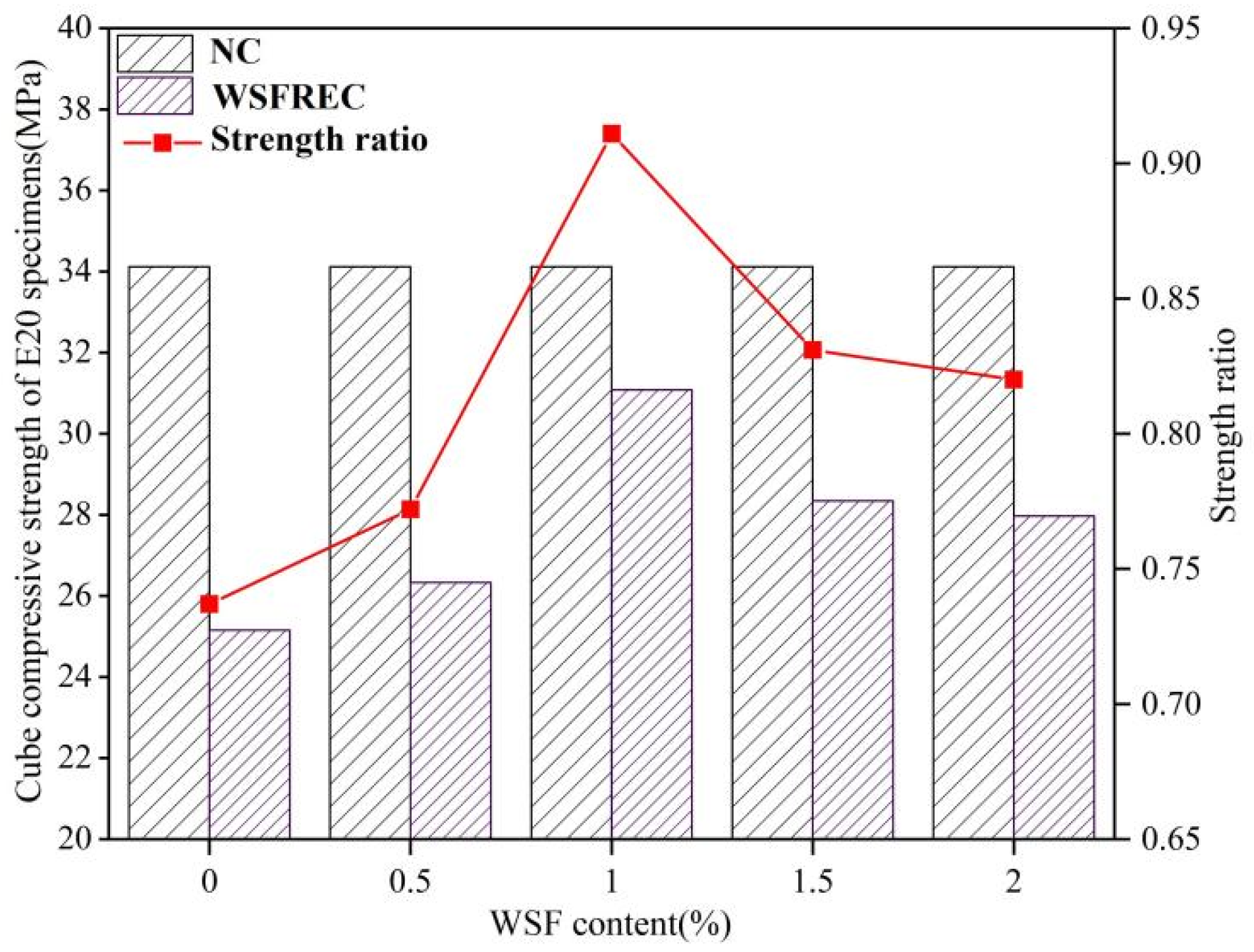
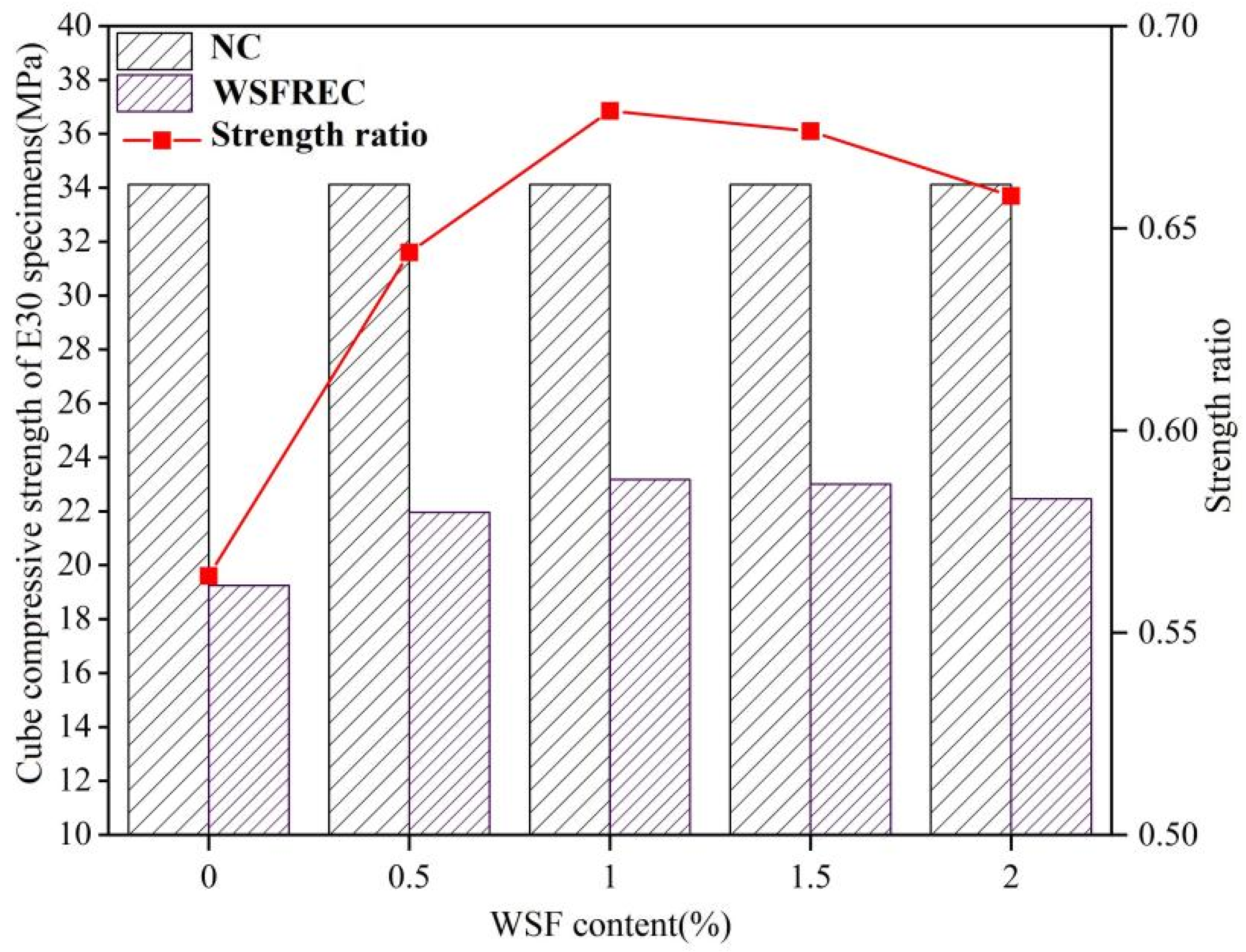
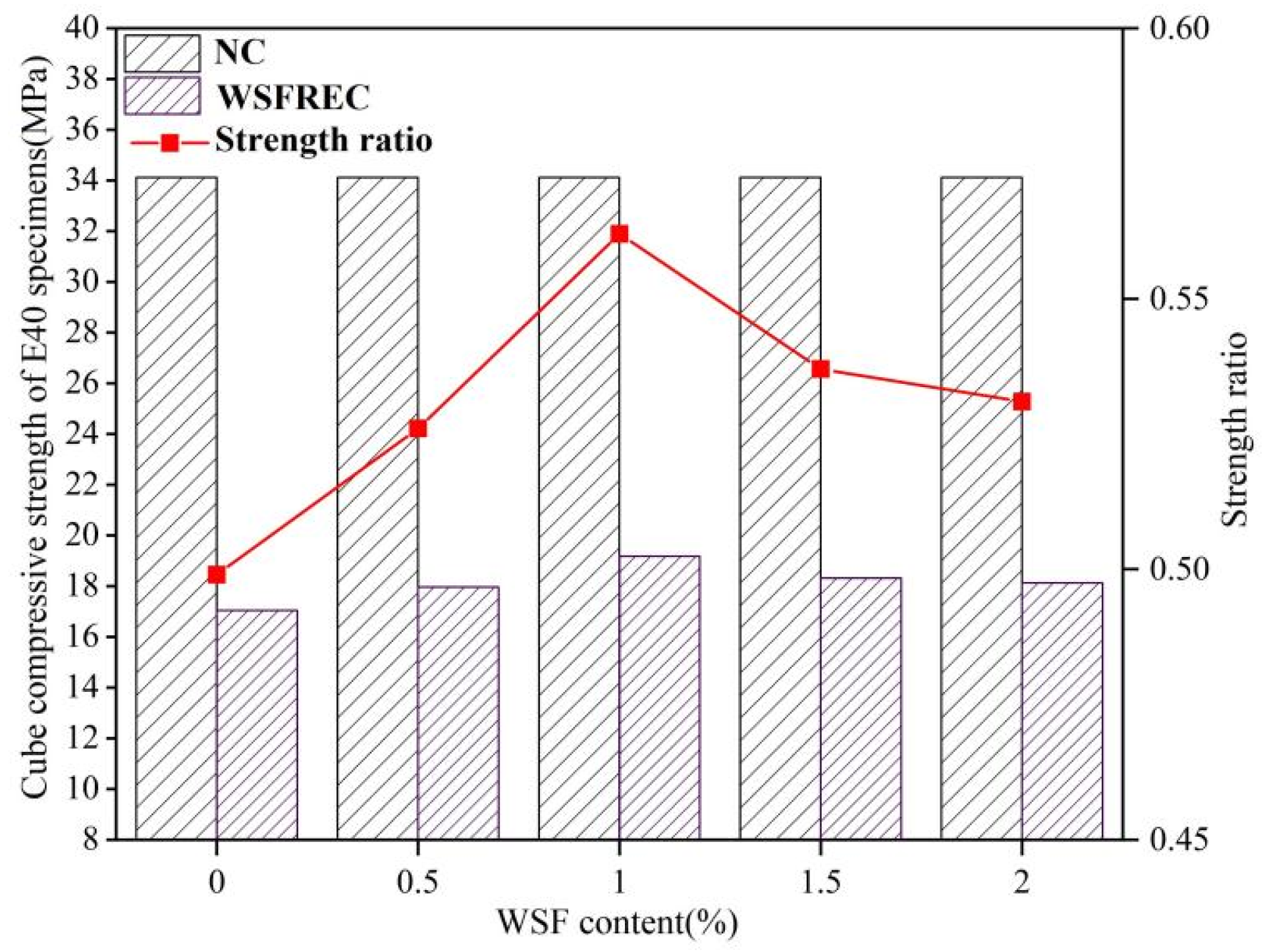
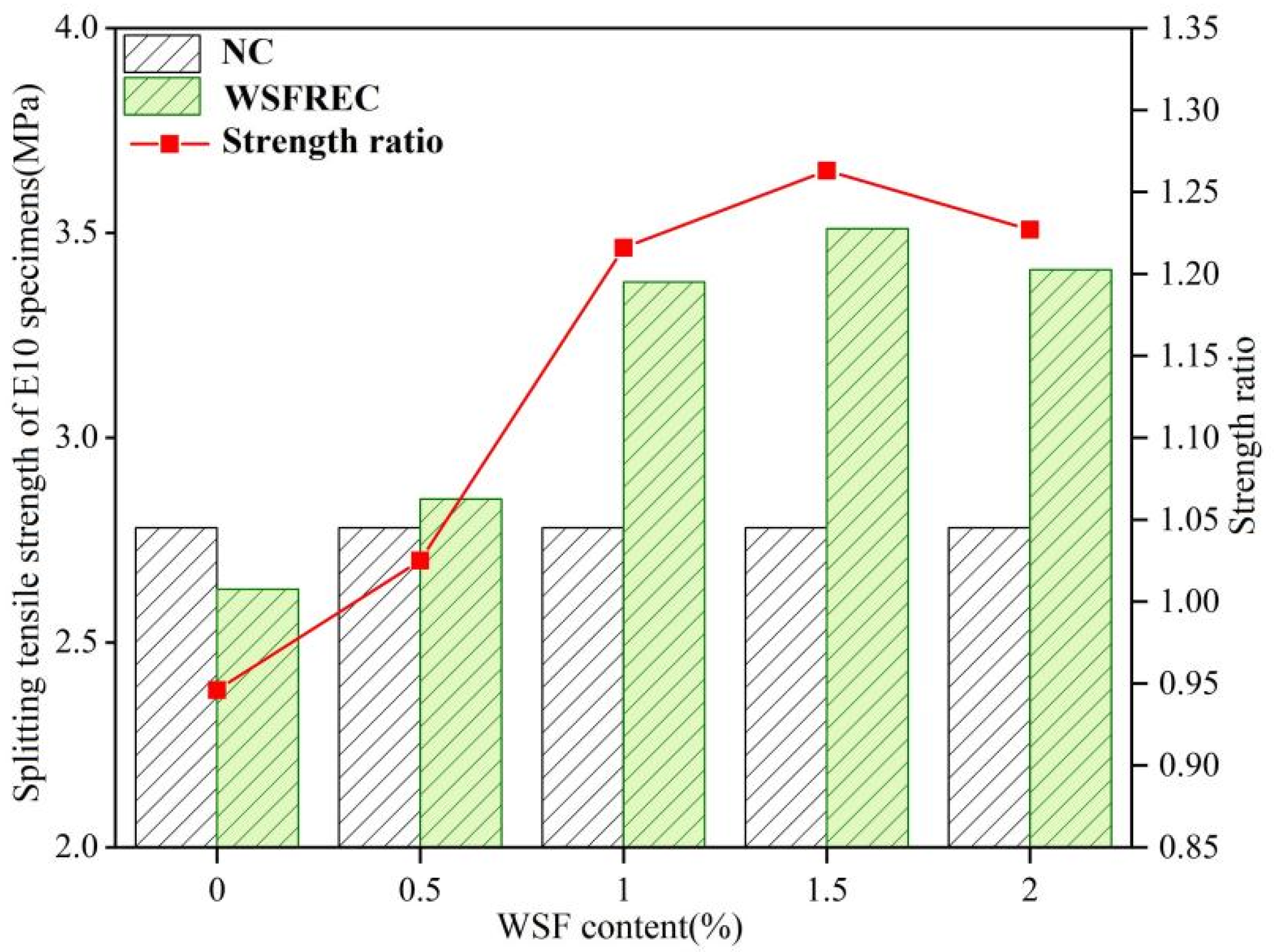
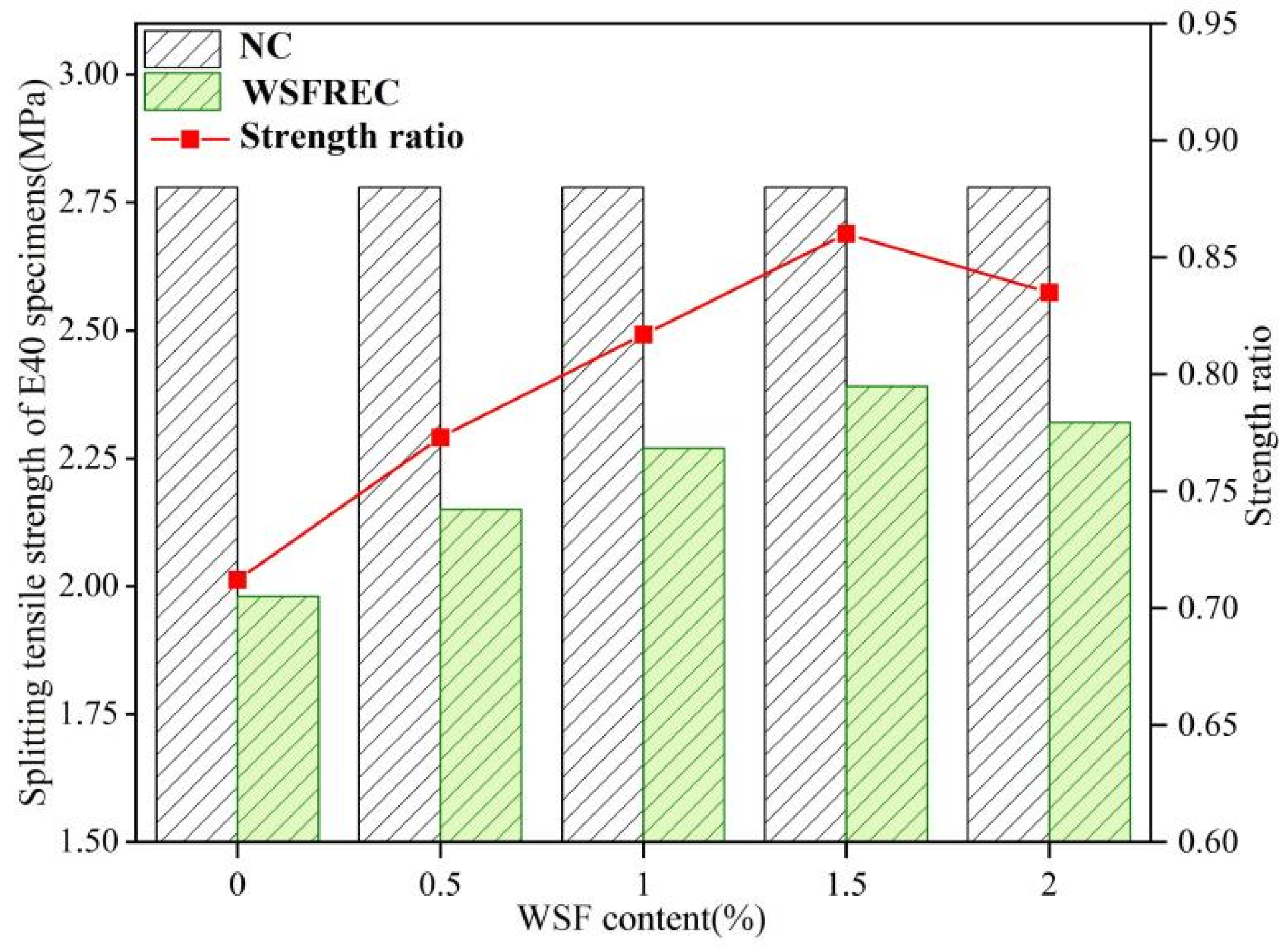
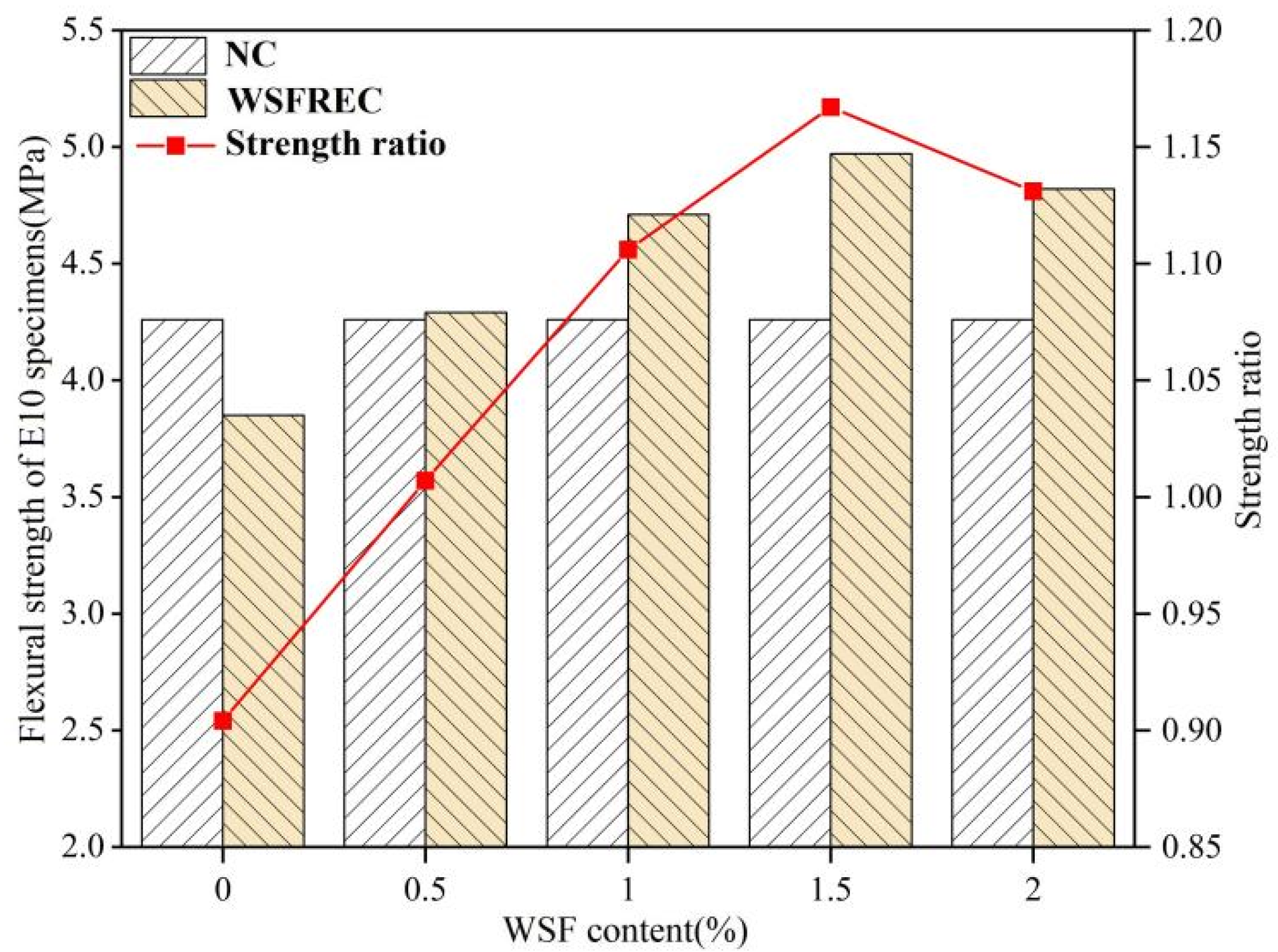
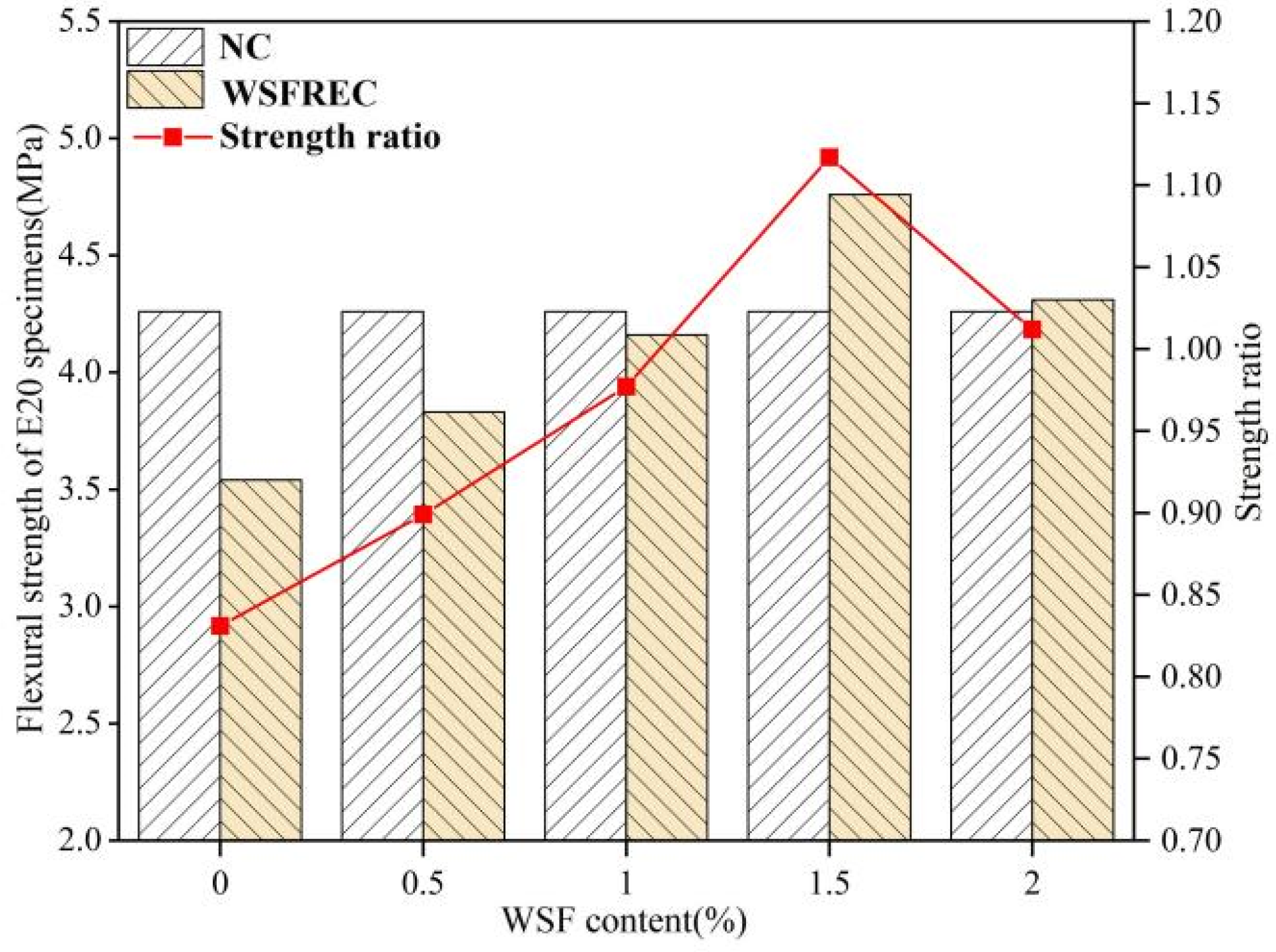
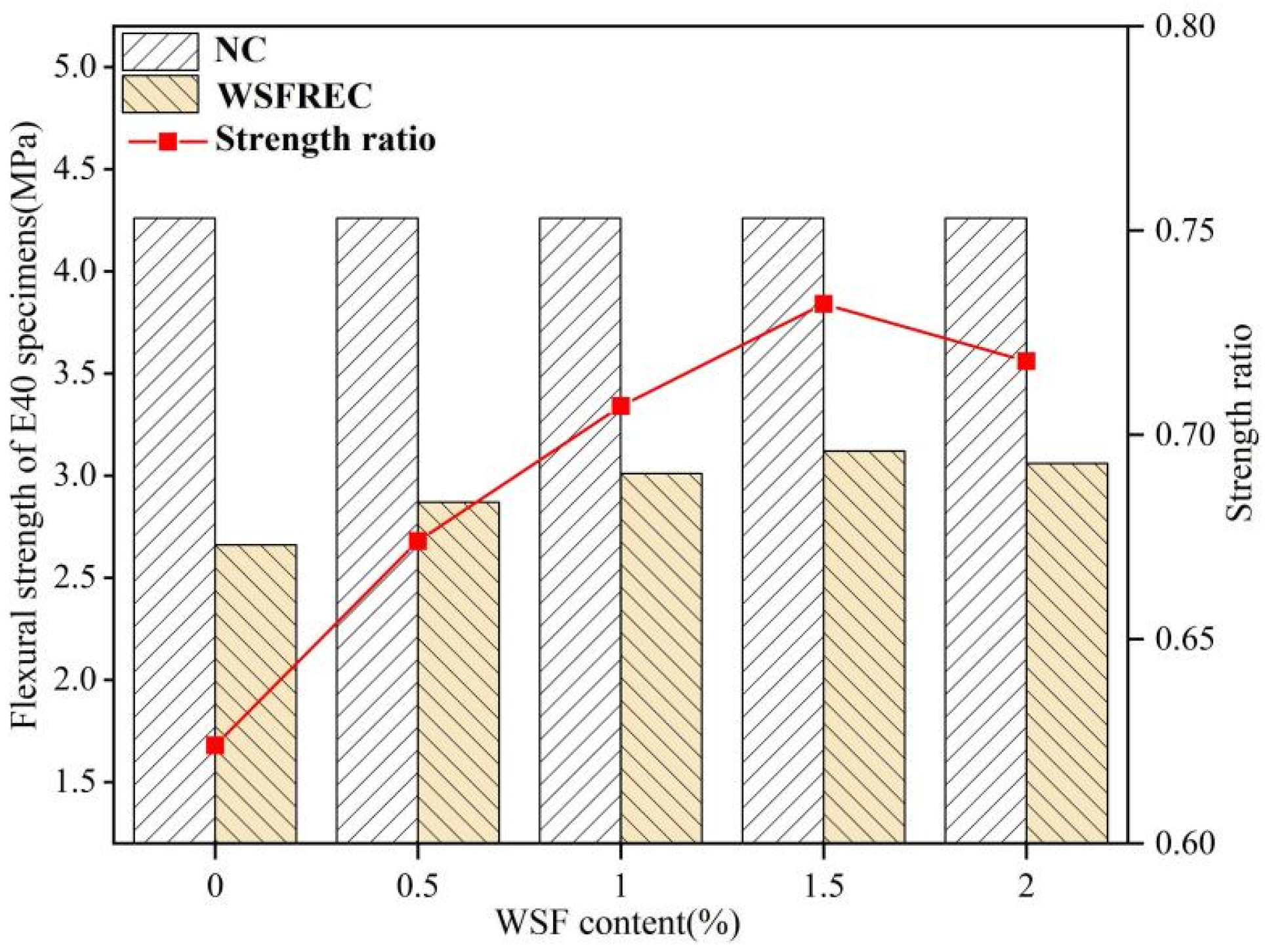
- The improvement effect of WSF on the splitting tensile and flexural strength of EC was significant, but its effect on enhancing the compressive strength of concrete cubes was limited. When the EPP substitution rate was low, the strength of WSFREC was similar to that of plain concrete. The improvement effect of WSF on high-substitution-rate EC was relatively limited, and it had the best compatibility with E20 concrete. In the E20 group, when the content of WSF was 1.5%, the splitting tensile strength, flexural strength, and cubic compressive strength of WSFREC increased by 37.7%, 34.46%, 23.58%, and 20.50%, respectively, compared to the EC of the same group. The experimental results fully demonstrate that the addition of WSF effectively compensates for the strength loss caused by EPP particles on concrete, thereby improving the overall performance of concrete.
- (3)
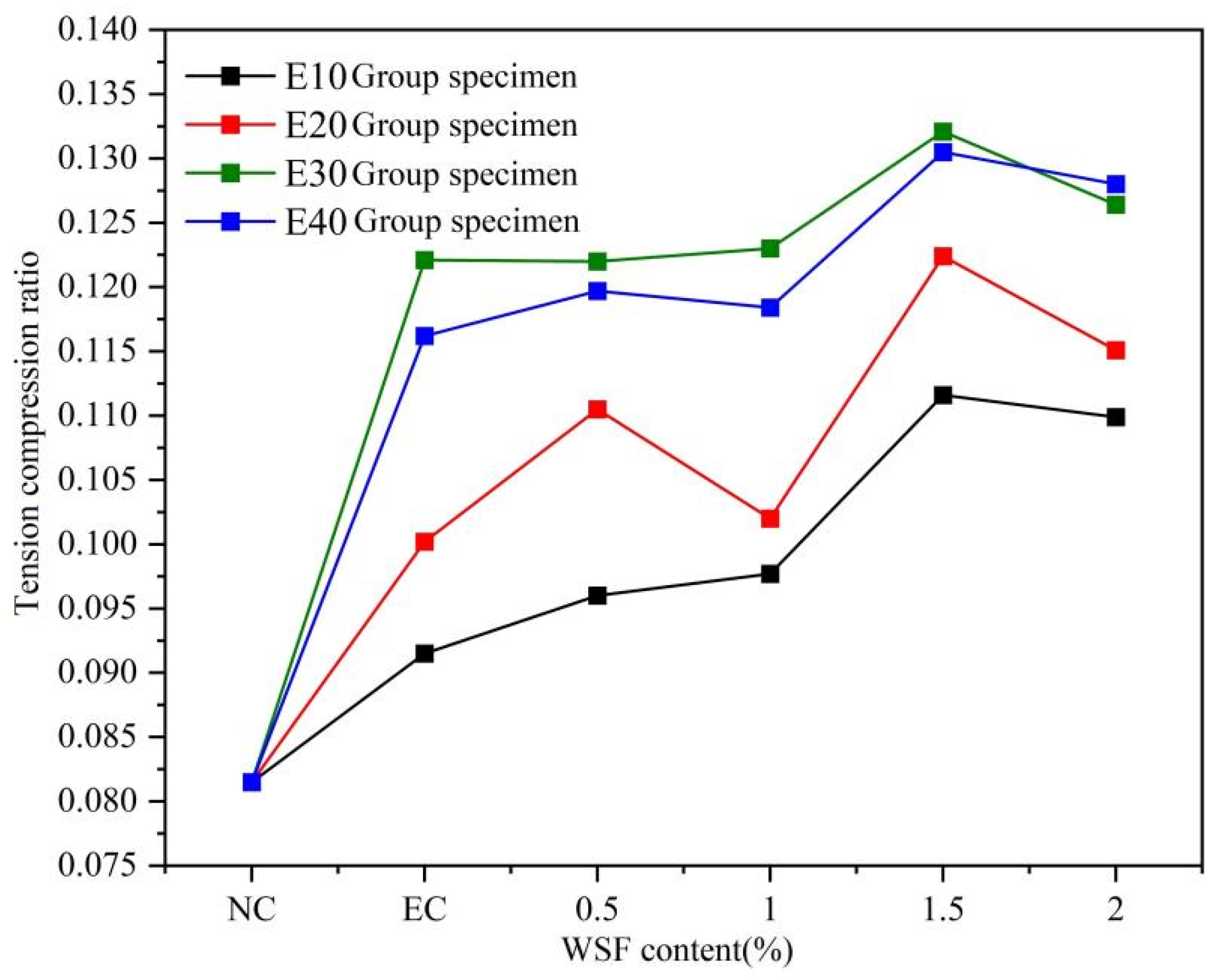
- After adding WSF to concrete, the specimens exhibited obvious ductility characteristics in compression failure. Through analysis of the tensile compression ratio and flexural compression ratio, it was found that WSF has a significant toughening effect on EC. The experimental results show that the optimal dosage of WSF is 1.5%. If the dosage of WSF in concrete is too high, it will entangle and form clusters with uneven distribution, which will reduce the mechanical properties of the concrete.
- (4)
- Through scanning electron microscopy testing of the WSFREC matrix, the morphology of the transition zone and WSF at the concrete interface was observed. It was found that the addition of EPP particles reduced the compactness of the concrete to a certain extent, leading to an increase in harmful structures such as microcracks and pores, but a decrease in the number of macroscopic cracks. However, when WSF was added, the concrete matrix became denser, resulting in a significant reduction in the number of EC harmful structures, and the mechanical and ductility properties of WSFREC significantly improved.
- (5)
- The current research primarily focuses on the short-term mechanical properties of WSFREC. However, in practical engineering applications, concrete structures are exposed to various environmental factors, such as freeze–thaw cycles, chemical corrosion, and carbonation, over an extended period. Therefore, it is necessary to conduct long-term durability tests to evaluate the performance degradation of WSFREC under different environmental conditions. This will provide crucial information for predicting the service life of concrete structures constructed using this material.
Author Contributions
Funding
Data Availability Statement
Acknowledgments
Conflicts of Interest
References
- Wongkvanklom, A.; Posi, P.; Khotsopha, B.; Ketmala, C.; Pluemsud, N.; Lertnimoolchai, S.; Chindaprasirt, P. Structural Lightweight Concrete Containing Recycled Lightweight Concrete Aggregate. KSCE J. Civ. Eng. 2018, 22, 3077–3084. [Google Scholar] [CrossRef]
- Ebead, U.A.; Shrestha, K.C.; Saeed, H. Development of high-strength lightweight non-autoclaved aerated concrete. Proc. Inst. Civ. Eng.-Struct. Build. 2020, 173, 705–714. [Google Scholar] [CrossRef]
- Sasaki, T.; Higashiyama, H.; Mizukoshi, M. Flexural Behavior and Benefits of Polypropylene Fiber-Reinforced Concrete for Concrete Pavement. ACI Mater. J. 2023, 120, 219–230. [Google Scholar] [CrossRef]
- Tran, M.V.; Cu, Y.T.H.; Le, C.V.H. Rheology and shrinkage of concrete using polypropylene fiber for 3D concrete printing. J. Build. Eng. 2021, 44, 103400. [Google Scholar] [CrossRef]
- Abdouss, M.; Shokri, A.; Karimi, M.M.; Zargaran, M. Plasma Oxidation of Polypropylene Fibers for Concrete Reinforcement. Russ. J. Appl. Chem. 2022, 95, 366–378. [Google Scholar] [CrossRef]
- Abousnina, R.; Premasiri, S.; Anise, V.; Lokuge, W.; Vimonsatit, V.; Ferdous, W.; Alajarmeh, O. Mechanical Properties of Macro Polypropylene Fibre-Reinforced Concrete. Polymers 2021, 13, 4112. [Google Scholar] [CrossRef]
- Ren, G.S.; Zhao, H.; Gao, X.J. Using marine waste enteromorpha prolifera powder as a sustainable internal curing agent to mitigate autogenous shrinkage of UHPC. Sustain. Mater. Technol. 2025, 44, e01390. [Google Scholar] [CrossRef]
- Ahmat, A.M.; Alengaram, U.J.; Shamsudin, M.F.; Alnahhal, A.M.; Ibrahim, M.S.I.; Ibrahim, S.; Rashid, R.S.M. Assessment of sustainable eco-processed pozzolan (EPP) from palm oil industry as a fly ash replacement in geopolymer concrete. Constr. Build. Mater. 2023, 387, 131424. [Google Scholar] [CrossRef]
- Jili, C.; Lu, J.F.; Lu, H.Y.; Miao, Z.H. Research on Energy Absorption Characteristics of Polypropylene Foam Concrete Buffer Layer in High Ground Stress Soft Rock Tunnel. Appl. Sci. 2024, 14, 1544. [Google Scholar] [CrossRef]
- Lin, Y.; Alengaram, U.J.; Ibrahim, Z.; Ibrahim, M.S.I.; Alnahhal, A.M.; Srinivas, M.K. Toughness improvement of low strength ceramsite lightweight concrete by polypropylene fiber and recycled rubber particle. Constr. Build. Mater. 2024, 411, 134344. [Google Scholar] [CrossRef]
- Ghone, M.O.; Basir, A.; Shaikh, F.U.A.; Chen, W.S. Research and Statistical Analysis on Impact Resistance of Steel Fiber Expanded Polystyrene Concrete and Expanded Polystyrene Concrete. Constr. Build. Mater. 2024, 422, 135716. [Google Scholar] [CrossRef]
- Faraj, R.H.; Sherwani, A.F.H.; Daraei, A. Mechanical, fracture and durability properties of self-compacting high strength concrete containing recycled polypropylene plastic particles. J. Build. Eng. 2019, 25, 100808. [Google Scholar] [CrossRef]
- Tavakkoli, A.; Mousavi, S.Y. Fiber-reinforcement high-strength concrete made with expanded perlite powder. Eur. J. Environ. Civ. Eng. 2022, 26, 6265–6280. [Google Scholar] [CrossRef]
- Guo, X.Y.; Singh, S.K.; Zhou, C.C.; Ling, X.C.; Li, J.M.; Fan, C.G. Preparation and Characterization of Lightweight Wall Materials Based on a Binder Mainly Including Phosphor-gypsum. J. Adv. Concr. Technol. 2020, 18, 689–698. [Google Scholar] [CrossRef]
- Morsali, V.; Behnamfar, F. Seismic damage-based design of steel moment frames. Eur. J. Environ. Civ. Eng. 2019, 5, 1585963. [Google Scholar] [CrossRef]
- Qiang, H.L.; Feng, P.; Qu, Z. Seismic responses of postyield hardening single-degree-of-freedom systems incorporating high-strength elastic material. Earthq. Eng. Struct. Dyn. 2019, 48, 611–633. [Google Scholar] [CrossRef]
- Riyar, R.L.; Bhowmik, S. Fracture performance study of polypropylene-enforced steel slag concrete. Constr. Build. Mater. 2025, 474, 141006. [Google Scholar] [CrossRef]
- Liu, Y.Z.; Wang, L.; Cao, K.; Sun, L. Review on the Durability of Polypropylene Fibre-Reinforced Concrete. Adv. Civ. Eng. 2021, 2021, 6652077. [Google Scholar] [CrossRef]
- Saheed, S.; Abd Aziz, F.N.A.; Amran, M.; Vatin, N.; Fediuk, R.; Ozbakkaloglu, T.; Murali, G.; Mosaberpanah, M.A. Structural Performance of Shear Loaded Precast EPS-Foam Concrete Half-Shaped Slabs. Sustainability 2020, 12, 9679. [Google Scholar] [CrossRef]
- Cao, T.A.; Nguyen, M.T.; Pham, T.H.; Nguyen, D.N. Experimental Study on Flexural Behavior of RC-UHPC Slabs with EPS Lightweight Concrete Core. Buildings 2023, 13, 1372. [Google Scholar] [CrossRef]
- Sartorti, A.L.; Pinheiro, L.M.; Carrazedo, R.; Fraga, I.F.; Barboza, L.D.; Christoforo, A.L. Comportamento dinâmico de lajes maciças de concreto leve com pérolas de EPS. Mater.-Rio Jan. 2024, 2, e20240029. [Google Scholar]
- Mehrab, A.H.; Amirfakhrian, S.; Esfahani, M.R. Fracture characteristics of various concrete composites containing polypropylene fibers through five fracture mechanics methods. Mater. Test. 2023, 65, 10–32. [Google Scholar] [CrossRef]
- Kumar, P.K.; Chinnaraju, K. Comparative Experimental Investigation on Foam Concrete with Polypropylene Fiber and Carbon Fiber. Rev. Romana Mater.-Rom. J. Mater. 2022, 52, 265–277. [Google Scholar]
- Aboutair, W.; Chaid, R.; Perrot, A. Impact of the nature of fibers on the physicomechanical behavior and durability of cement matrices. Iran. J. Sci. Technol.-Trans. Civ. Eng. 2021, 45, 1467–1482. [Google Scholar] [CrossRef]
- Hussain, I.; Ali, B.; Akhtar, T.; Jameel, M.S.; Raza, S.S. Comparison of mechanical properties of concrete and design thickness of pavement with different types of fiber-reinforcements (steel, glass, and polypropylene). Case Stud. Constr. Mater. 2021, 13, e00429. [Google Scholar] [CrossRef]
- Zhong, C.L.; Liu, M.; Zhang, Y.L.; Wang, J.; Liang, D.; Chang, L.Y. Study on Mechanical Properties of Hybrid Polypropylene-Steel Fiber RPC and Computational Method of Fiber Content. Materials 2020, 13, 2243. [Google Scholar] [CrossRef] [PubMed]
- Deng, F.Q.; Cao, C.; Xu, L.H.; Chi, Y. Interfacial bond characteristics of polypropylene fiber in steel/polypropylene blended fiber reinforced cementitious composite. Constr. Build. Mater. 2022, 341, 127897. [Google Scholar] [CrossRef]
- Mehrab, A.H.; Esfahani, M.R. Experimental Study on Size Effect and Fracture Properties of Polypropylene Fiber Reinforced Lightweight Aggregate Concrete. Period. Polytech.-Civ. Eng. 2022, 66, 1278–1293. [Google Scholar]
- Singh, N.K.; Rai, B. Assessment of synergetic effect on microscopic and mechanical properties of steel-polypropylene hybrid fiber reinforced concrete. Struct. Concr. 2021, 22, 516–534. [Google Scholar] [CrossRef]
- He, F.; Biolzi, L.; Carvelli, V.; Feng, X. A review on the mechanical characteristics of thermally damaged steel and polypropylene hybrid fiber-reinforced concretes. Arch. Civ. Mech. Eng. 2024, 24, 69. [Google Scholar] [CrossRef]
- Ul Islam, S.; Waseem, S.A. An experimental study on mechanical and fracture characteristics of hybrid fibre reinforced concrete. Structures 2024, 68, 107053. [Google Scholar] [CrossRef]
- Yildizel, S.A.; Uzun, M.; Arslan, M.A.; Ozbakkaloglu, T. The prediction and evaluation of recycled polypropylene fiber and aggregate incorporated foam concrete using Artificial Neural Networks. Constr. Build. Mater. 2024, 411, 134646. [Google Scholar] [CrossRef]
- Aslani, F.; Liu, Y.N.; Wang, Y. Flexural and toughness properties of NiTi shape memory alloy, polypropylene and steel fibres in self-compacting concrete. J. Intell. Mater. Syst. Struct. 2020, 31, 3–16. [Google Scholar] [CrossRef]
- Bhat, M.D.; Rehman, M.U.; Shafi, I.; Parveen, A.; Fayaz, A.; Malik, B.A.; Bashir, F. The Effect of Polypropylene and Steel Fibers on the Properties of Concrete at Normal and Elevated Temperatures—A Review. Iran. J. Sci. Technol.-Trans. Civ. Eng. 2022, 46, 1805–1823. [Google Scholar] [CrossRef]
- Bhogone, M.V.; Pazhankave, S.S.; Subramaniam, K.V. Cohesive stress and fiber pullout behavior in fracture response of concrete with steel and macropolypropylene hybrid fiber blends. Fatigue Fract. Eng. Mater. Struct. 2021, 44, 3042–3055. [Google Scholar] [CrossRef]
- Sadowska-Buraczewska, B.; Szafraniec, M.; Barnat-Hunek, D.; Łagód, G. Flexural Behavior of Composite Concrete Slabs Made with Steel and Polypropylene Fibers Reinforced Concrete in the Compression Zone. Materials 2020, 13, 3616. [Google Scholar] [CrossRef]
- Wu, H.; Zhang, Y.; Yao, K.; Yang, B. Failure process of steel-polypropylene hybrid fiber-reinforced concrete based on numerical simulations. Sci. Eng. Compos. Mater. 2022, 29, 299–311. [Google Scholar] [CrossRef]
- Kos, Z.; Kroviakov, S.; Kryzhanovskyi, V.; Hedulian, D. Strength, Frost Resistance, and Resistance to Acid Attacks on Fiber-Reinforced Concrete for Industrial Floors and Road Pavements with Steel and Polypropylene Fibers. Materials 2022, 15, 8339. [Google Scholar] [CrossRef]
- Gao, Y.; Wang, B.; Liu, C.; Hui, D.; Xu, Q.; Zhao, Q.; Wei, J.; Hong, X. Experimental study on basic mechanical properties of recycled steel fiber reinforced concrete. Rev. Adv. Mater. Sci. 2022, 611, 417–429. [Google Scholar] [CrossRef]
- Yan, J.; Gao, Y.; Tang, M.; Ding, N.; Xu, Q.; Peng, M.; Zhao, H. Experimental study on the mechanical properties of recycled spiral steel fiber-reinforced rubber concrete. Buildings 2024, 14, 897. [Google Scholar] [CrossRef]
- Yan, J.Q.; Gao, Y.T.; Fan, T.; Xu, Q.; Yuan, W.G.; Zhao, X. Experimental Study on Flexural Performance of Recycled Steel Fiber Concrete Beams. Buildings 2023, 13, 3046. [Google Scholar] [CrossRef]
- Yang, D.; Ren, X.P.; Gao, Y.T.; Fan, T.; Li, M.S.; Lv, H. Study on the Basic Mechanical Properties of Waste Steel Fiber Reinforced Concrete After High-Temperature Exposure. Buildings 2025, 15, 1025. [Google Scholar] [CrossRef]
- Yang, C.X.; Nan, Z.; Huo, Y.J.; Yang, Y.H.; Xu, P.; Xiao, Y.H.; Fang, Y.N.; Meng, K.P. Design, characterisation, and crushing performance of hexagonal-quadrilateral lattice-filled steel/CFRP hybrid structures. Compos. Part B Eng. 2025, 304, 112631. [Google Scholar] [CrossRef]
- Yang, G.; Zhao, H.T.; Hu, Z.L.; Zhang, W.W.; Xiang, Y.; Jin, M.; Wan-Wendner, R.; Liu, J.P. Prediction of restrained stress for UHPC: Considering relationship between long-term and in-situ creep. Constr. Build. Mater. 2025, 484, 141722. [Google Scholar] [CrossRef]
- Sha, F.; Wang, Q.F.; Wang, N.N.; Liu, F.H.; Ni, L.J. Performance of underwater shield synchronous double-liquid plastic grout with high W/C and volume ratio. Constr. Build. Mater. 2025, 465, 140172. [Google Scholar] [CrossRef]
- Niu, Y.H.; Wang, W.W.; Su, Y.T.; Jia, F.R.; Long, X. Plastic damage prediction of concrete under compression based on deep learning. Acta Mech. 2024, 235, 255–266. [Google Scholar] [CrossRef]
- Long, X.; Li, H.; Iyela, P.M.; Kang, S. Predicting the bond stress-slip behavior of steel reinforcement in concrete under static and dynamic loadings by finite element, deep learning and analytical methods. Eng. Fail. Anal. 2024, 161, 108312. [Google Scholar] [CrossRef]
- Zhang, W.; Yang, X.Z.; Lin, J.W.; Lin, B.Q.; Huang, Y.Q. Experimental and numerical study on the torsional behavior of rectangular hollow reinforced concrete columns strengthened By CFRP. Structures 2024, 70, 107690. [Google Scholar] [CrossRef]
- Gao, D.Y.; Li, Z.Y.; Ding, C.; Yu, Z.Y. Uniaxial tensile stress-strain constitutive relationship of 3D/4D/5D steel fiber-reinforced concrete. Constr. Build. Mater. 2025, 470, 140539. [Google Scholar] [CrossRef]
- Sun, L.; Wang, X.Y.; Zhang, C.W. Three-dimensional high fidelity mesoscale rapid modelling algorithm for concrete. Structures 2024, 70, 107561. [Google Scholar] [CrossRef]
- Zhang, W.; Liu, X.; Huang, Y.Q.; Tong, M.N. Reliability-based analysis of the flexural strength of concrete beams reinforced with hybrid BFRP and steel rebars. Arch. Civ. Mech. Eng. 2022, 22, 171. [Google Scholar] [CrossRef]
- Yao, Y.F.; Huang, H.; Zhang, W.; Ye, Y.X.; Xin, L.; Liu, Y. Seismic performance of steel-PEC spliced frame beam. J. Constr. Steel Res. 2022, 197, 107456. [Google Scholar] [CrossRef]
- Yao, Y.F.; Zhou, L.Q.; Huang, H.; Chen, Z.; Ye, Y.X. Cyclic performance of novel composite beam-to-column connections with reduced beam section fuse elements. Structures 2023, 50, 842–858. [Google Scholar] [CrossRef]
- Chatbi, M.; Krour, B.; Benatta, M.A.; Harrat, Z.R.; Amziane, S.; Bouiadjra, M.B. Bending analysis of nano-SiO2 reinforced concrete slabs resting on elastic foundation. Struct. Eng. Mech. 2022, 84, 685–697. [Google Scholar]
- Maqsood, Z.; Koseki, J.; Kyokawa, H. Mechanical behaviour and stress-strain recovery characteristics of expanded polypropylene. Geosynth. Int. 2022, 31, 18–30. [Google Scholar] [CrossRef]
- Wang, Y.S.; Zhuang, X.S. Experimental Study on Mechanical Properties of Graded EPS-Steel Fiber-Reinforced Concrete. Appl. Sci. 2025, 15, 1980. [Google Scholar] [CrossRef]
- Chen, B.; Liu, J.Y. Properties of lightweight expanded polystyrene concrete reinforced with steel fiber. Cem. Concr. Res. 2004, 34, 1259–1263. [Google Scholar] [CrossRef]
- Lu, J.F.; Li, M.R.; Wang, K.; Hu, Y.P. Study on static and dynamic mechanical properties of polyvinyl alcohol fiber EPP concrete as buffer layer of high geo-stress soft rock tunnel. Tunn. Undergr. Space Technol. 2025, 163, 106763. [Google Scholar] [CrossRef]
- Gaddafi, A.K.F.; Alengaram, U.J.; Bunnori, N.M.; Muhammad, S.I.I.; Ibrahim, S.; Sumesh, M. Mechanical properties, flexural behaviour, and ductility characteristics of fibre-reinforced geopolymer mortar. Constr. Build. Mater. 2023, 403, 133109. [Google Scholar] [CrossRef]












| Alkali Content (%) | Fineness (%) | Specific Surface Area (m2/kg) | Setting Time (min) | Compressive Strength (MPa) | Flexural Strength (MPa) | |||
|---|---|---|---|---|---|---|---|---|
| Initial | Final | 3d | 28d | 3d | 28d | |||
| 0.46 | 0.5 | 377 | 236 | 294 | 25.3 | 50.8 | 5.5 | 8.3 |
| Moisture Content (%) | Water Reducing (%) | Alkali Content (%) | Na2SO4 (%) | Cl− (%) |
|---|---|---|---|---|
| 0.88 | 27 | 1.01 | 1.64 | 0.01 |
| SiO2 (%) | Cl− (%) | Water Demand Ratio (%) | Specific Surface Area (m2/g) |
|---|---|---|---|
| 98.1 | 0.01 | 112 | 21 |
| Type | Methoxyl Group (%) | Hydroxypropyl (%) | Condensation Temperature (°C) | Transmittance (%) | Ash Content (%) | Water Content (%) | Viscosity (MPa.s) |
|---|---|---|---|---|---|---|---|
| Hydroxypropyl methylcellulose | 28.5 | 9.4 | 62 | 92 | 3.5 | 5 | 197,000 |
| Density (kg/m3) | Length (mm) | Thickness (mm) | Elastic Modulus (MPa) | Tensile Strength (MPa) |
|---|---|---|---|---|
| 7850 | 30–40 | 0.75 | 2.05 × 10⁵ | ≥380 |
| Group Name | Specimen Number | Quantity of Various Materials Used (kg/m3) | |||||||||
|---|---|---|---|---|---|---|---|---|---|---|---|
| Cement | Sand | Stone | Water | EPP | Silica Fume | Cellulose Ether | Superplasticizer | WSF | |||
| % | kg | ||||||||||
| Without WSF | NC | 339 | 653 | 1230 | 185 | 0 | 0 | 0 | 0 | 0 | 0 |
| E10 | 339 | 653 | 1107 | 185 | 10 | 1.04 | 35 | 3.39 | 3.5 | 0 | |
| E20 | 339 | 653 | 984 | 185 | 20 | 2.08 | 35 | 3.39 | 3.5 | 0 | |
| E30 | 339 | 653 | 861 | 185 | 30 | 3.25 | 35 | 3.39 | 3.5 | 0 | |
| E40 | 339 | 653 | 738 | 185 | 40 | 4.29 | 35 | 3.39 | 3.5 | 0 | |
| E10 Group | E10W0.5 | 339 | 653 | 1107 | 185 | 10 | 1.04 | 35 | 3.39 | 3.5 | 39 |
| E10W1.0 | 339 | 653 | 1107 | 185 | 10 | 1.04 | 35 | 3.39 | 3.5 | 78 | |
| E10W1.5 | 339 | 653 | 1107 | 185 | 10 | 1.04 | 35 | 3.39 | 3.5 | 117 | |
| E10W2.0 | 339 | 653 | 1107 | 185 | 10 | 1.04 | 35 | 3.39 | 3.5 | 157 | |
| E20 Group | E20W0.5 | 339 | 653 | 984 | 185 | 20 | 2.08 | 35 | 3.39 | 3.5 | 39 |
| E20W1.0 | 339 | 653 | 984 | 185 | 20 | 2.08 | 35 | 3.39 | 3.5 | 78 | |
| E20W1.5 | 339 | 653 | 984 | 185 | 20 | 2.08 | 35 | 3.39 | 3.5 | 117 | |
| E20W2.0 | 339 | 653 | 984 | 185 | 20 | 2.08 | 35 | 3.39 | 3.5 | 157 | |
| E30 Group | E30W0.5 | 339 | 653 | 861 | 185 | 30 | 3.25 | 35 | 3.39 | 3.5 | 39 |
| E30W1.0 | 339 | 653 | 861 | 185 | 30 | 3.25 | 35 | 3.39 | 3.5 | 78 | |
| E30W1.5 | 339 | 653 | 861 | 185 | 30 | 3.25 | 35 | 3.39 | 3.5 | 117 | |
| E30W2.0 | 339 | 653 | 861 | 185 | 30 | 3.25 | 35 | 3.39 | 3.5 | 157 | |
| E40 Group | E40W0.5 | 339 | 653 | 738 | 185 | 40 | 4.29 | 35 | 3.39 | 3.5 | 39 |
| E40W1.0 | 339 | 653 | 738 | 185 | 40 | 4.29 | 35 | 3.39 | 3.5 | 78 | |
| E40W1.5 | 339 | 653 | 738 | 185 | 40 | 4.29 | 35 | 3.39 | 3.5 | 117 | |
| E40W2.0 | 339 | 653 | 738 | 185 | 40 | 4.29 | 35 | 3.39 | 3.5 | 157 | |
| Group Name | Specimen Number | Cube Compressive Strength (MPa) | Splitting Compressive Strength (MPa) | Tensile–Compressive Ratio |
|---|---|---|---|---|
| Without WSF | NC | 34.12 | 2.78 | 0.081 |
| E10W0 | 28.74 | 2.63 | 0.092 | |
| E20W0 | 25.15 | 2.52 | 0.100 | |
| E30W0 | 19.25 | 2.35 | 0.122 | |
| E40W0 | 17.04 | 1.98 | 0.116 | |
| E10 Group | E10W0.5 | 29.68 | 2.85 | 0.096 |
| E10W1.0 | 34.59 | 3.38 | 0.098 | |
| E10W1.5 | 31.46 | 3.51 | 0.112 | |
| E10W2.0 | 31.02 | 3.41 | 0.110 | |
| E20 Group | E20W0.5 | 26.33 | 2.91 | 0.111 |
| E20W1.0 | 31.08 | 3.17 | 0.102 | |
| E20W1.5 | 28.34 | 3.47 | 0.122 | |
| E20W2.0 | 27.97 | 3.22 | 0.115 | |
| E30 Group | E30W0.5 | 21.96 | 2.68 | 0.122 |
| E30W1.0 | 23.18 | 2.85 | 0.123 | |
| E30W1.5 | 23.01 | 3.04 | 0.132 | |
| E30W2.0 | 22.46 | 2.84 | 0.126 | |
| E40 Group | E40W0.5 | 17.96 | 2.15 | 0.120 |
| E40W1.0 | 19.18 | 2.27 | 0.118 | |
| E40W1.5 | 18.32 | 2.39 | 0.130 | |
| E40W2.0 | 18.13 | 2.32 | 0.128 |
| Group Name | Specimen Number | Cube Compressive Strength (MPa) | Splitting Compressive Strength (MPa) | Tensile–Compressive Ratio |
|---|---|---|---|---|
| Without WSF | NC | 34.12 | 4.26 | 0.1249 |
| E10W0 | 28.74 | 3.85 | 0.1340 | |
| E20W0 | 25.15 | 3.54 | 0.1408 | |
| E30W0 | 19.25 | 3.09 | 0.1605 | |
| E40W0 | 17.04 | 2.66 | 0.1561 | |
| E10 Group | E10W0.5 | 29.68 | 4.29 | 0.1445 |
| E10W1.0 | 34.59 | 4.71 | 0.1362 | |
| E10W1.5 | 31.46 | 4.97 | 0.1580 | |
| E10W2.0 | 31.02 | 4.82 | 0.1554 | |
| E20 Group | E20W0.5 | 26.33 | 3.83 | 0.1455 |
| E20W1.0 | 31.08 | 4.16 | 0.1338 | |
| E20W1.5 | 28.34 | 4.76 | 0.1680 | |
| E20W2.0 | 27.97 | 4.31 | 0.1541 | |
| E30 Group | E30W0.5 | 21.96 | 3.55 | 0.1617 |
| E30W1.0 | 23.18 | 3.78 | 0.1631 | |
| E30W1.5 | 23.01 | 3.98 | 0.1730 | |
| E30W2.0 | 22.46 | 3.82 | 0.1701 | |
| E40 Group | E40W0.5 | 17.96 | 2.87 | 0.1598 |
| E40W1.0 | 19.18 | 3.01 | 0.1569 | |
| E40W1.5 | 18.32 | 3.12 | 0.1703 | |
| E40W2.0 | 18.13 | 3.06 | 0.1688 |
Disclaimer/Publisher’s Note: The statements, opinions and data contained in all publications are solely those of the individual author(s) and contributor(s) and not of MDPI and/or the editor(s). MDPI and/or the editor(s) disclaim responsibility for any injury to people or property resulting from any ideas, methods, instructions or products referred to in the content. |
© 2025 by the authors. Licensee MDPI, Basel, Switzerland. This article is an open access article distributed under the terms and conditions of the Creative Commons Attribution (CC BY) license (https://creativecommons.org/licenses/by/4.0/).
Share and Cite
Zhao, Y.; Ren, X.; Gao, Y.; Li, Y.; Li, M. Experimental Study on Mechanical Properties of Waste Steel Fiber Polypropylene (EPP) Concrete. Buildings 2025, 15, 2680. https://doi.org/10.3390/buildings15152680
Zhao Y, Ren X, Gao Y, Li Y, Li M. Experimental Study on Mechanical Properties of Waste Steel Fiber Polypropylene (EPP) Concrete. Buildings. 2025; 15(15):2680. https://doi.org/10.3390/buildings15152680
Chicago/Turabian StyleZhao, Yanyan, Xiaopeng Ren, Yongtao Gao, Youzhi Li, and Mingshuai Li. 2025. "Experimental Study on Mechanical Properties of Waste Steel Fiber Polypropylene (EPP) Concrete" Buildings 15, no. 15: 2680. https://doi.org/10.3390/buildings15152680
APA StyleZhao, Y., Ren, X., Gao, Y., Li, Y., & Li, M. (2025). Experimental Study on Mechanical Properties of Waste Steel Fiber Polypropylene (EPP) Concrete. Buildings, 15(15), 2680. https://doi.org/10.3390/buildings15152680