Article

Dynamic Properties of Steel-Wrapped RC Column–Beam Joints Connected by Embedded Horizontal Steel Plate: Experimental Study

1
Shaanxi Key Laboratory of Safety and Durability of Concrete Structures, Xijing University, Xi’an 710123, China
2
Northwest Engineering Corporation Limited, Xi’an 710065, China
3
School of Infrastructure Engineering, Dalian University of Technology, Dalian 116024, China
*
Author to whom correspondence should be addressed.
Buildings 2025, 15(15), 2657; https://doi.org/10.3390/buildings15152657
Submission received: 7 July 2025 / Revised: 23 July 2025 / Accepted: 25 July 2025 / Published: 28 July 2025

Abstract

The performance of reinforced concrete (RC) frame structures will gradually decrease over time, posing a threat to the safety of buildings. Although the performance of some buildings may still meet the safety requirements, they cannot meet new usage requirements. Therefore, this paper proposes a new-type joint to promote the development of research on the reinforcement and renovation of RC frame structures in response to this situation. The RC beams and columns of the joints are connected by embedded horizontal steel plate (a single plate with dimension of 150 mm × 200 mm × 5 mm), and the beams and columns are individually wrapped in steel. Through conducting low cyclic loading tests, this paper analyzes the influence of carrying out wrapped steel treatment and the thickness of wrapped steel of the beam and connector on mechanical performance indicators such as hysteresis curve, skeleton curve, stiffness, ductility, and energy dissipation. The experimental results indicate that the reinforcement using steel plate can significantly improve the dynamic performance of the joint. The effect of changing the thickness of the connector on the dynamic performance of the specimen is not significant, while increasing the thickness of wrapped steel of beam can effectively improve the overall strength of joint. The research results of this paper will help promote the application of reinforcement and renovation technology for existing buildings, and improve the quality of human living.

1. Introduction

Reinforced concrete frame structure is a structure type that is currently used in a large number of urban buildings due to its advantages of large space and reliable performance. However, after long-term use, the performance of reinforced concrete structures will be affected by earthquakes, wind, environment, and other effects. Therefore, the material properties will inevitably degrade, which will lead to a decline in the bearing capacity of the structure and deterioration of the performance of the use of the structure. Even though the safety of some structures is still reliable, their serviceability at the time of construction does not meet the new requirements. In the face of these circumstances, retrofitting reinforcement is an effective way to improve the safety and serviceability of reinforced concrete frame structures [1,2,3,4].
Currently, the main reinforcement methods for reinforced concrete frame structures include the enlarged section method (ESM), steel-wrapped reinforcement method, and fiber-reinforced polymers method (FRPM). Chen et al. [5] investigated the application of ESM on the reinforcement of T-shaped beams. The results showed that this method could improve the bearing capacity of beam and satisfy the requirements of the usage. Zhong et al. [6] investigated the properties of an eccentric compression column reinforced by the ESM. The result indicated that the reinforced column had better load-bearing capacity, and compared with a standard specimen, the ultimate compressive performance was improved. Fathalla et al. [7] used fiber-reinforced concrete jackets to strengthen the shear performance of a deep beam. The results showed that thicker jackets would reduce the number of cracks and enhance the mechanical performance of the specimen. Saeed et al. [8] introduced a method to strengthen slabs using a new-type concrete jacket and anchors. The research indicated that this reinforcement treatment could effectively improve the load capacity and prevent the failure of bonding between the old and new concrete. Zhang et al. [9] analyzed the axial compression performance of RC columns reinforced by basalt textile-reinforced fine concrete (BTRC) jackets, and they found that load capacity and ductility were improved with the increase in jacket layers. Madani et al. [10] examined the mechanical performance of a beam reinforced using BTRC, and the outcomes indicated that fiber-reinforced polymer (FRP) could enhance the strength of the beam under high temperature. Armonico et al. [11] found that smart FRPs could effectively limit the development of cracks in a beam. Gao et al. [12] introduced a theoretical model to predict the slip between the FRP plate and steel plate of RC joints. The results showed that the model is reliable and can effectively predict the load–slip relationship at the loading end of FRP plates. However, among these reinforcement methods, the ESM affects the use space of buildings and has a long construction period, which is not conducive to the promotion of utilization. The FRPM has the advantages of convenient construction, light weight, and good corrosion resistance, but due to the characteristics of the material itself, fibers are susceptibility to high temperature and the strength utilization is low. The construction process of steel-wrapped reinforcement is more convenient, the construction period is shorter, and the bearing capacity of the component/structure can be effectively improved after reinforcement. Therefore, this paper mainly introduces the research of steel-wrapped reinforcement method.
Research has been carried out on reinforcing RC structures using the steel-wrapped reinforcement method. Giménez et al. [13] investigated the mechanical performance of RC columns reinforced using steel cages. The results indicated that the bearing capacity increased with the increase in the number of strips. Jia et al. [14] used software to analyze the displacement and acceleration of a column encased by a steel jacket under the action of explosion. They found that the increase in steel thickness could reduce the plastic deformation and improve the blast resistance. Some researchers have also studied the properties of RC beams reinforced by a steel jacket. Su et al. [15] studied the ductility of RC beams with different arrangements of bolted side-plated steel (BSP). The results showed that the BSP had significant effect on the yield ratio and displacement ductility. Alam et al. [16] used connector systems to strengthen the bonding effect between wrapped steel and RC beams. The results indicated that the connectors could effectively enhance the bonding strength and prevent the early debonding of steel plates. At the same time, steel plates also have good reinforcing effect for concrete beams made with new materials or new methods [17,18]. Santarisiero et al. [19] used steel jackets to strengthen RC joints. The results indicated that the mechanical properties of retrofitted joints were significantly improved. Deng et al. [20] investigated the performance of joints retrofitted with steel plate, steel cages, and steel haunches. They found that the strengthening effect of steel plate and cages had better deformation capacity and bearing power. Nicoletti et al. [21] proposed a nomogram method that could estimate the size of RC joints and the number of stirrups, which effectively reduced the design workload of the RC structure. Shen et al. [22] used mechanically anchored diagonal bars to improve the seismic properties of RC joints. The results showed that increasing the spacing of planting bar could improve the bearing capacity and stiffness of joints, but it is easy to cause shear failure. Yu et al. [23] investigated the properties of joint formed by RC columns strengthened by steel pipe and RC beams. The research indicated that this connection method could effectively enhance the rigidity and energy dissipation capacity of the new-type joint. Nguyen et al. [24] studied the mechanical performance of joints consisting of a steel beam and an RC column. The investigation indicated that the shear deformation of section steel had significant influence on the integrity of the specimen. Yu et al. [25] analyzed the seismic design method of a joint consisting of an RC beam and a column encased by steel plate, and a new stress–strain curve was given based on the experimental results and theoretical analysis. These research results demonstrate that the reinforcement of RC members using steel plates can effectively improve the mechanical performance. However, there is limited research on the addition of new beams to existing RC columns, which is the focus of this paper.
The specimen studied in this paper is characterized by the reinforcement of RC columns using steel plate, and then longitudinal reinforcement of the beam is welded onto the wrapped steel of the column using an embedded horizontal steel plate (connector); finally, steel plate is used to wrap the beam and welded onto the wrapped steel of the column. The influence of parameters such as the thickness of the connector and wrapped steel of beam on the dynamic performance of the specimen is investigated through low cyclic loading tests. It should be noted that this study considered only lateral dynamic load and not vertical dynamic load. The research objective of this paper is to solve the engineering problem of adding beams when retrofitting existing RC structures. Through the study of this paper, a new method can be provided for the reinforcement and renovation of existing buildings.
In Table 1, some abbreviations are used to briefly describe the relevant content.

2. Experimental Design

2.1. Design Condition

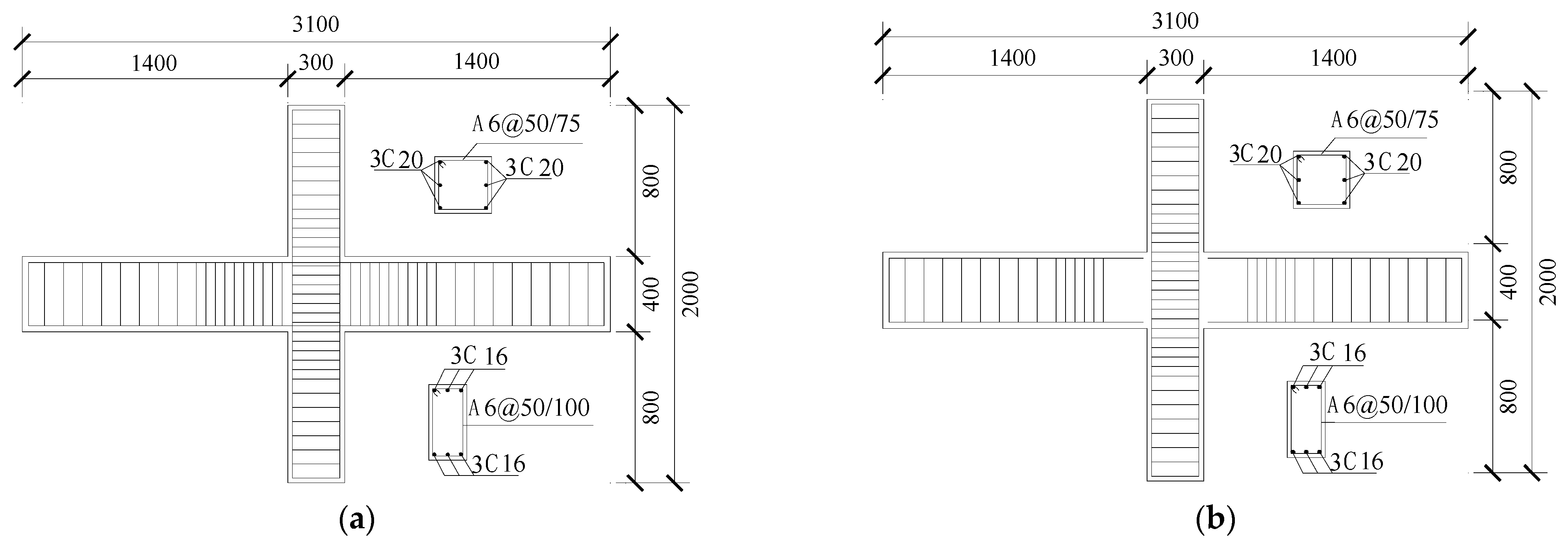
Four joints, including one cast-in-place reinforced concrete joint and three new-type joints, are designed in this paper. The cast-in-place reinforced concrete joint is numbered RC, while new-type joints are numbered WxIy based on the thickness of the EHSP and WSB, in which Wx and Iy denote the thicknesses of the WSB and EHSP as x and y, respectively. For example, W3I5 indicates that the thicknesses of the WSB and EHSP are 3 mm and 5 mm, respectively. The lengths of the wrapped steel, which are calculated to ensure that no bending failure and shear failure will occur in the beams and columns at the edge of the wrapped steel, are 750 mm and 1500 mm, respectively. The reinforced concrete portions of all specimens are designed and reinforced based on the specification of Chinese Code GB/T 50010-2010 [26]. The section dimensions of beams and columns are 200 mm × 400 mm and 300 mm × 300 mm, respectively, and the concrete cover depth is 10 mm. Strength grade of longitudinal reinforcement of the beam and column are HRB400 and HRB500, respectively, and the stirrups adopts HPB300 grade steel bar. Considering the characteristics of the RC structures, the concrete strength grade for beams and columns are C40 and C50, respectively [27]. Six longitudinal bars with a diameter of 16 mm are arranged in the beam, and the diameter and spacing of the stirrups is A6@50/100. Six longitudinal bars with a diameter of 20 mm are arranged in the column, and the diameter and spacing of the stirrup is A6@50/75. The length of reinforcement zone for the beam and column ends is 500 mm. The meaning of A, 6, X and Y in A6@X/Y is that the strength grade of the stirrup is HPB300, the diameter is 6mm, the spacing of the stirrup in the reinforcement zone is X mm, and the spacing of the stirrup in other positions is Y mm. The dimensions and reinforcement of joints are given in Figure 1, and the specific design situation is shown in Table 2.
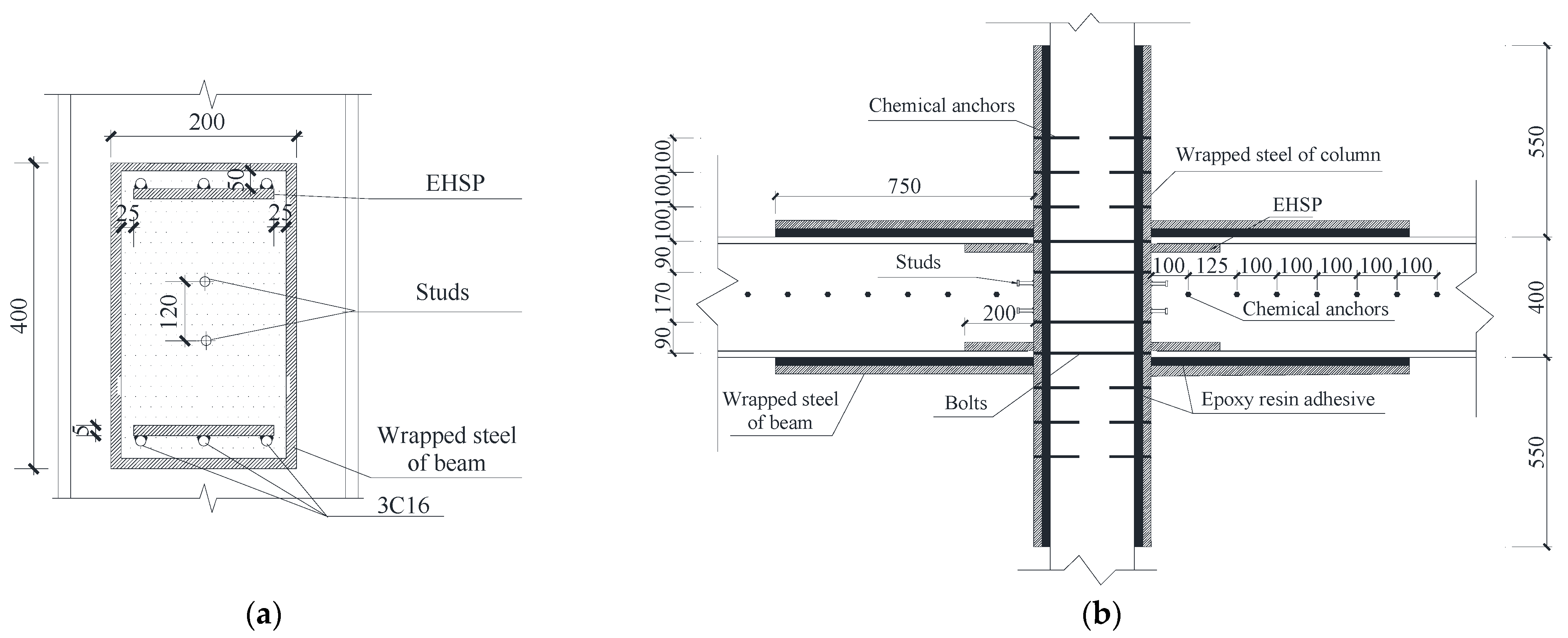
The EHSP connects the wrapped steel of columns and the load-bearing steel bars of beams through welding, as shown in Figure 2a. The EHSP and WCB could effectively realize the connection effect of beam and column, and enhance the integrity of joints [28]. M10 chemical anchor bolts with a strength grade of 5.8 are arranged on the columns to prevent the shedding of wrapped steel. M8 chemical anchor bolts of grade 5.8 are arranged in the middle of beams to improve the bonding effect between the wrapped steel and concrete. Eight through-length bolts are used to fix the wrapped steel onto the concrete of core area to ensure mechanical performance. Two studs are arranged on both sides of column to ensure the cooperative work of beam and column. The constructional form of the specimen is shown in Figure 2b.
In order to ensure the wrapped steel and concrete work together, the gap between the two is injected with adhesive. The epoxy resin adhesive used in this paper was produced by Shanghai Niugu Construction Technology Co., and it meets the requirements of Chinese Code GB 50728-2011 [29]. When using this adhesive, mix A adhesive and B adhesive in the ratio of 2:1, and then stir for 2 min until the mixture is homogeneous.

2.2. Manufacture of Specimen

Specimen fabrication mainly includes pasting strain gauges, binding steel cages, pouring concrete, and pasting external steel plates, etc. The specific steps are described below:
(1) Pasting of strain gauges and assembling of reinforcement
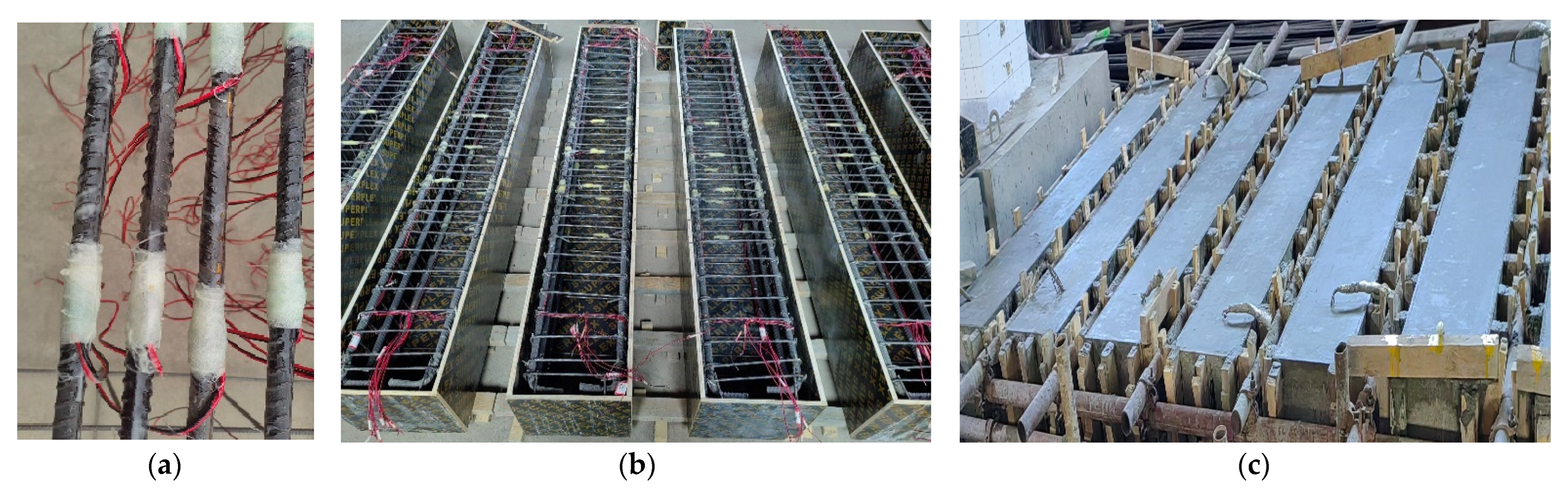
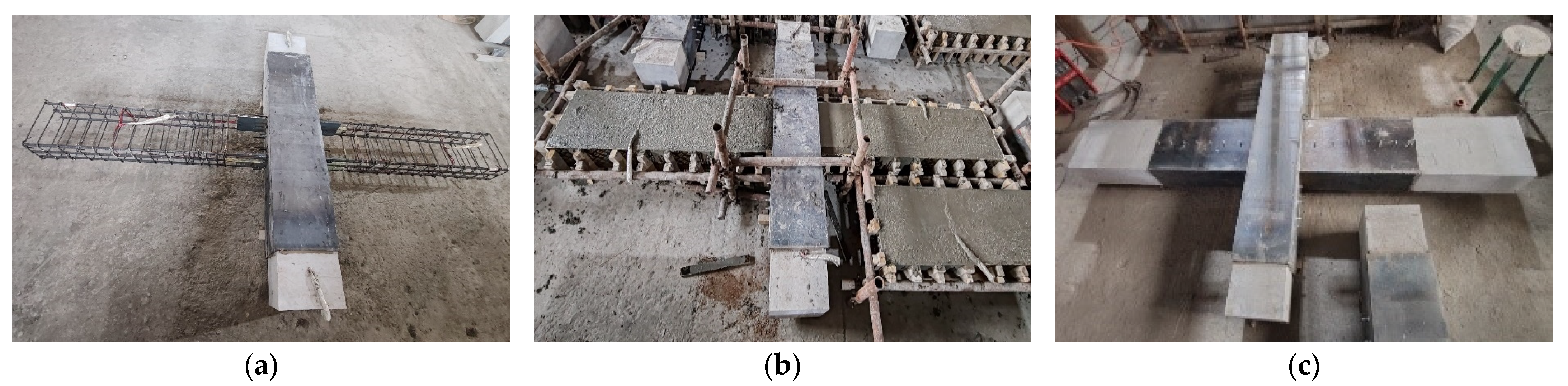
After the reinforcement bars are undercut, the strain gauge is firstly affixed (Figure 3a). It should be pointed out that in order to ensure that the strain gauge will not be invaded by water when pouring concrete, the strain gauge is wrapped in gauze covered with epoxy resin after it is pasted onto the steel bar. Then the reinforcement cages of beams and columns are tied, and the formwork of column reinforcement cages is carried out and the concrete is poured (Figure 3b,c).
(2) The process of wrapped steel treatment and casting of beam concrete
Once the concrete is well cured, the columns are wrapped with steel plate. Firstly, epoxy resin adhesive is applied to the corresponding position of the specimen, and after the steel plate is pasted, holes are punched in the concrete by impact drill, and chemical anchor bolts are implanted for fixing. The EHSP and longitudinal bars of the beam are then sequentially welded, as shown in Figure 4a. After the completion of the above steps, the concrete of the beams is poured, wrapped with steel plate, and finally the steel jackets wrapping the beams and columns are welded together (Figure 4b,c).

2.3. Material Properties

The material property tests mainly include compression tests of concrete cube and tensile tests of steel reinforcement and steel plate, which are all carried out on an MTS 2000 kN universal testing machine.

2.3.1. Concrete

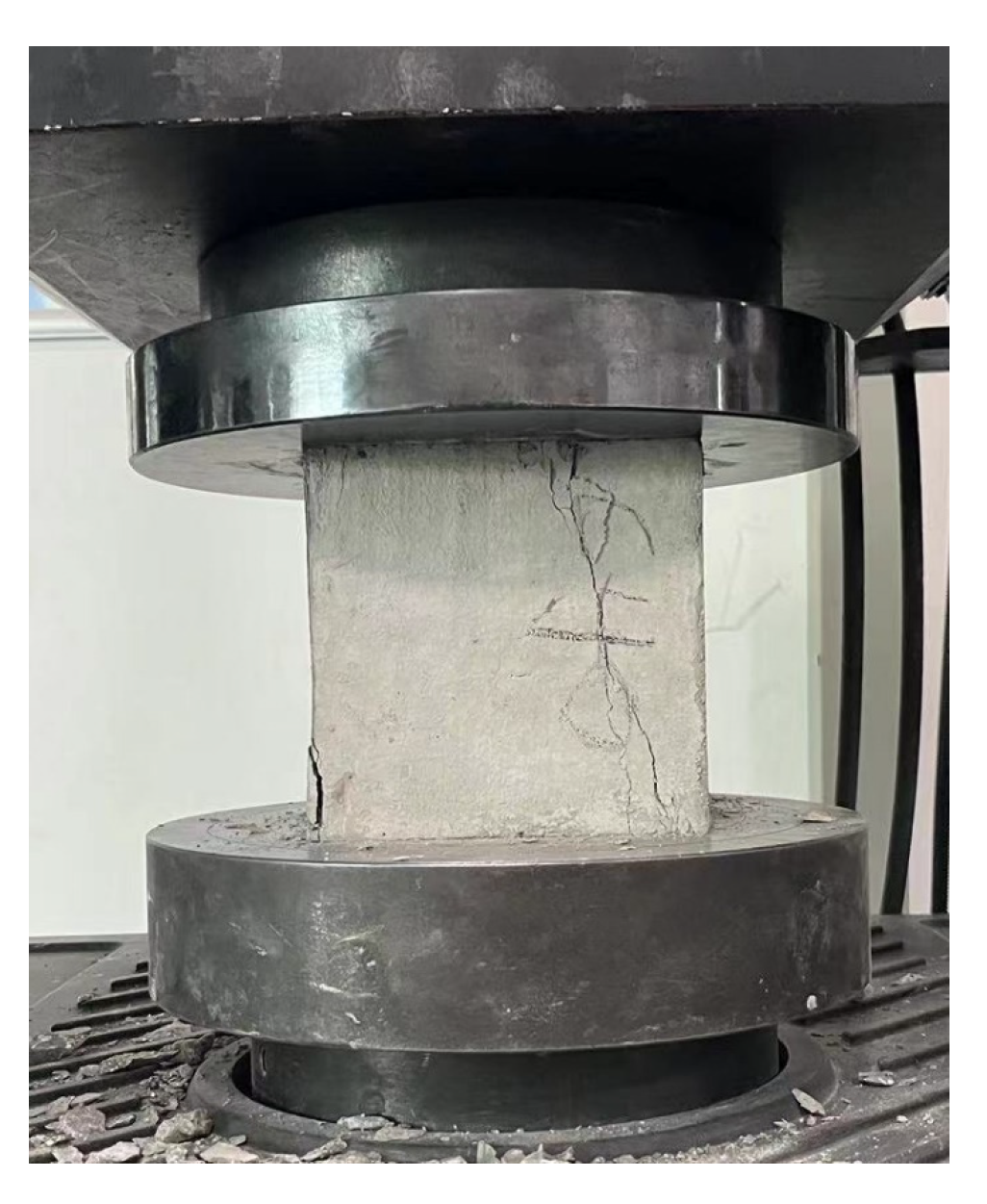
Since the construction sequence of the RC joint and new-type joints is different, the concrete needs to be poured in batches. The first batch is used to pour the concrete of the RC joint and columns of new-type joints, and the concrete cube of beam and column are numbered as C40-1 and C50, respectively. The second batch is used to pour the beam concrete of new-type joints with a number of C40-2. According to Chinese Code GB/T 50081-2019 [30], the concrete cubes reserved for each batch have a size of 150 mm × 150 mm × 150 mm and are tested for compression strength. The damage phenomena and the mechanical performance are shown in Figure 5 and Table 3, respectively. The failure patterns of all the cubes of different batches and strength grade are similar, and the mechanical properties of different batches of concrete (same strength grade) are basically the same, which can ensure the stability of the specimen performance.

2.3.2. Steel Bar and Steel Plate

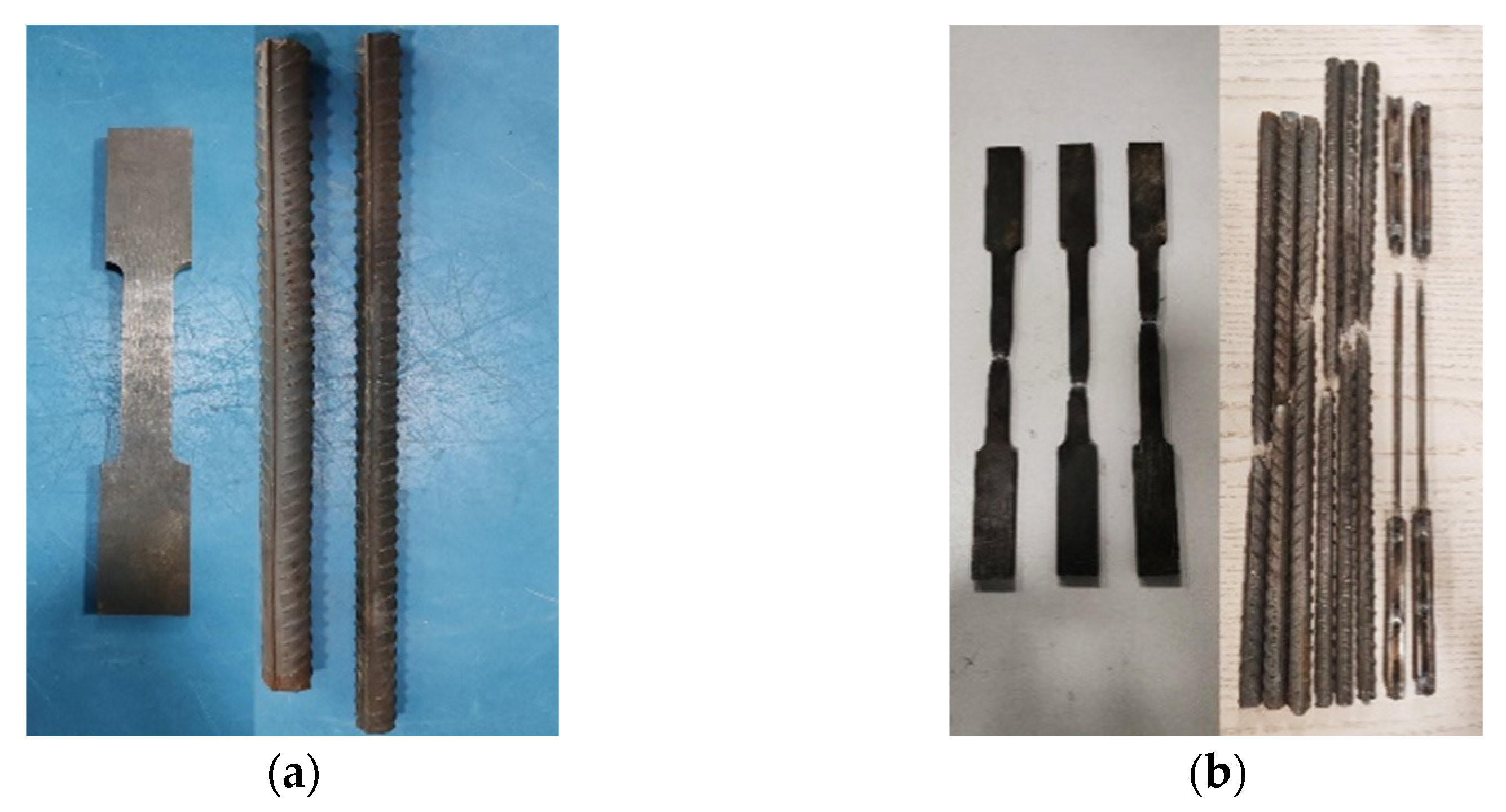
The performance of reinforcement and steel plate are conducted based on Chinese Codes GB 1499.2-2018 [31] and GB/T 228.1-2021 [32]. Three specimens of each material are reserved for testing, as shown in Figure 6a. The loading rate of test is 1.2 kN/s, and the test will be ended after the fracture occurred. The damage phenomenon of specimen is given in Figure 6b, and the failure primarily occurred in the mid-section. In the loading process, the specimen will gradually shrink with the increase in load, resulting in elevated stress coupled with reduced bearing area.
The results are given in Table 4 and Table 5. According to the specification requirements in the previous section, the elasticity modulus and elongation of steel should be in a range of 200–210 GPa and 15–30%, respectively. Therefore, the test results confirm the studied materials meet the application requirements.

2.4. Testing Scheme

2.4.1. Loading Equipment

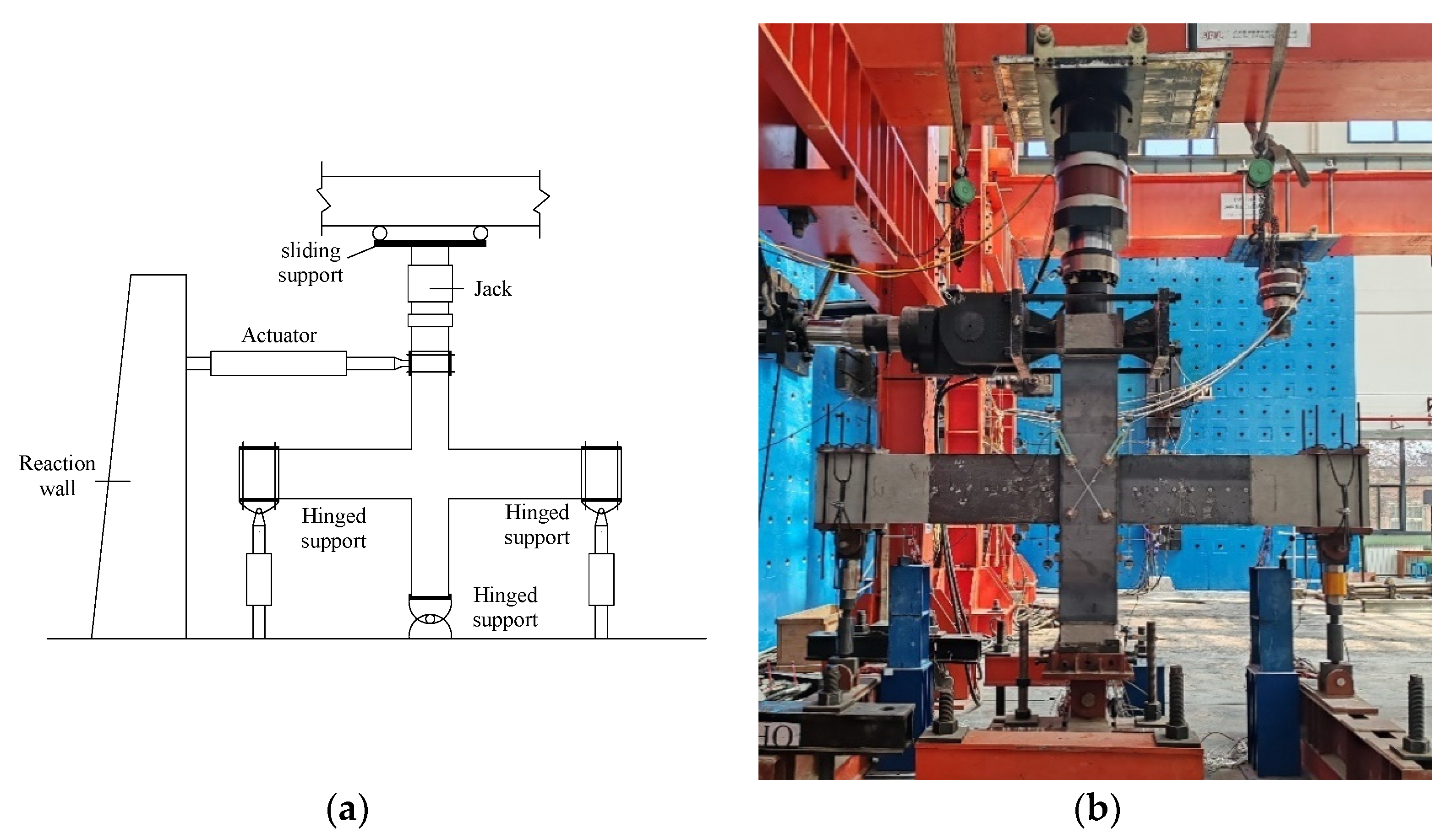
The loading test setup used in this paper is given in Figure 7. During the loading process, hinged bearings are set at the beam end and column base, and the column top adopts sliding bearings, which can move horizontally as the specimen deforms. Horizontal loads are provided by MTS electro-hydraulic servo actuators with a maximum applied load of 100 t, and vertical load is applied using a 100 t hydraulic jack. At the beginning of the loading process, the vertical load is first applied at a rate of 1 kN/s and the axial compressive stress is kept constant during the test. Horizontal loads are applied by the actuator in accordance with a predetermined loading regime with push loads positive and pull loads negative.

2.4.2. Loading Scheme

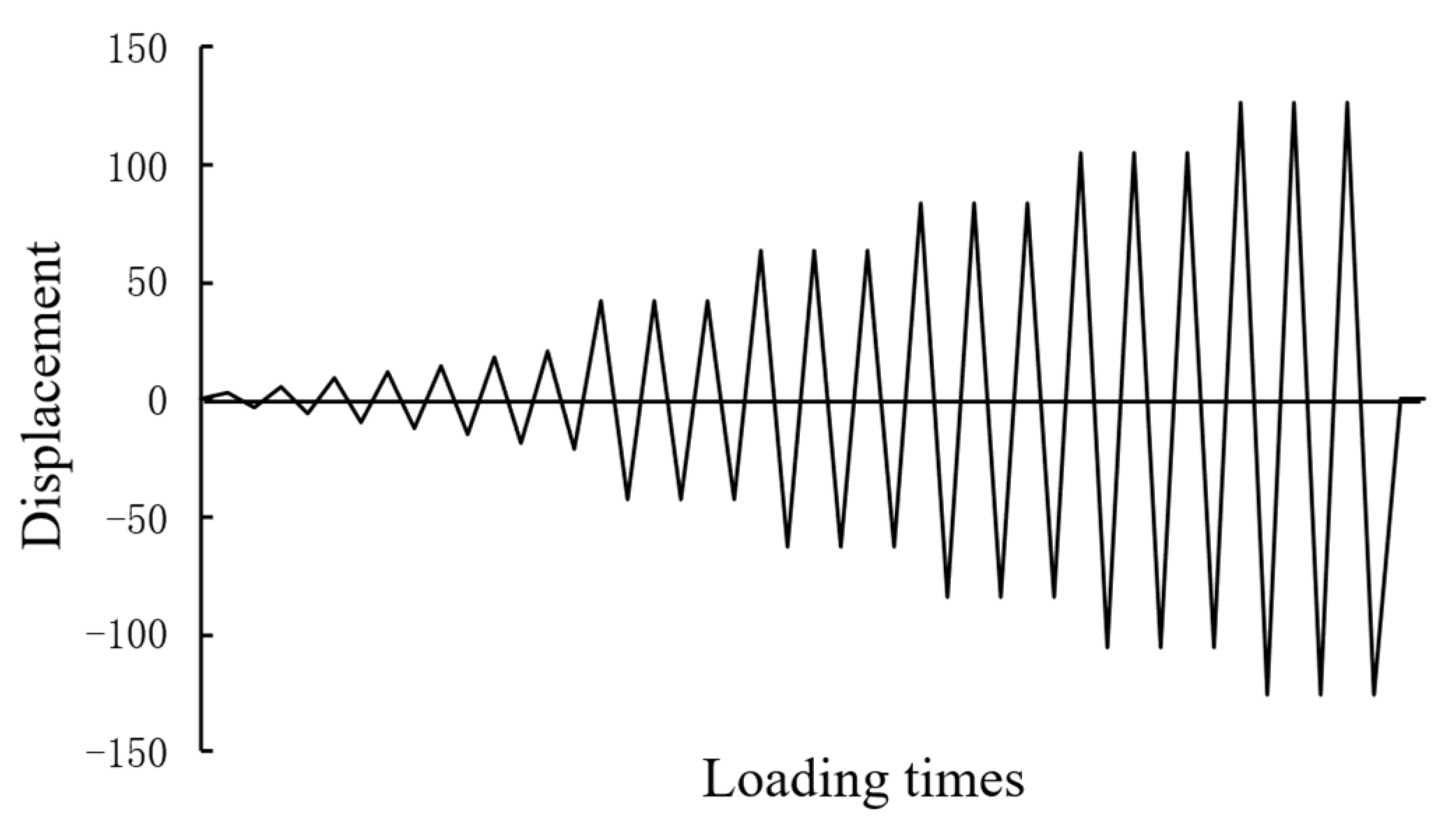
Considering the specification of Chinese Code JGJ/T 101-2015 [33], the horizontal loading is applied using the displacement control method and the loading regime is shown in Figure 8.
At the beginning of loading, each displacement increment is set to 3 mm and each displacement value is loaded cyclically for one time. When the specimens reach their yield state, the displacement increment of the RC specimen is increased to 21 mm, while for the new-type joint this value is increased to 15 mm. In the yield state, each displacement value is loaded cyclically for three times. This is because through the finite element analysis prior to the test, the load capacity of the new-type joint decreases faster than the RC joint after cracks occur in the welds of wrapped steel. If a displacement increment of 21 mm is still used, it will result in too little test data for the new-type joint, which is unfavorable for the analysis of experimental data.
Specimen damage accumulates as the loading proceeds, and the bearing capacity reduction rate exhibits gradual acceleration. Therefore, when any one of the following conditions is satisfied, it is considered that the specimen has been damaged and the test should be stopped: (1) oblique cracks with large width appear in the core area or at the end of the beam; (2) the overall lateral deformation is too large, meaning that the stiffness of the specimen has significantly decreased; (3) the specimen retains 85% of its ultimate bearing capacity.

3. Damage Phenomena and Analysis

Displacement is used as a criterion for classification when presenting the damage phenomenon of joints. When a partially loaded displacement does not appear in the presentation of damage process of the specimen, it means that the test phenomenon is not significant in the case of that loaded displacement.

3.1. RC Specimen

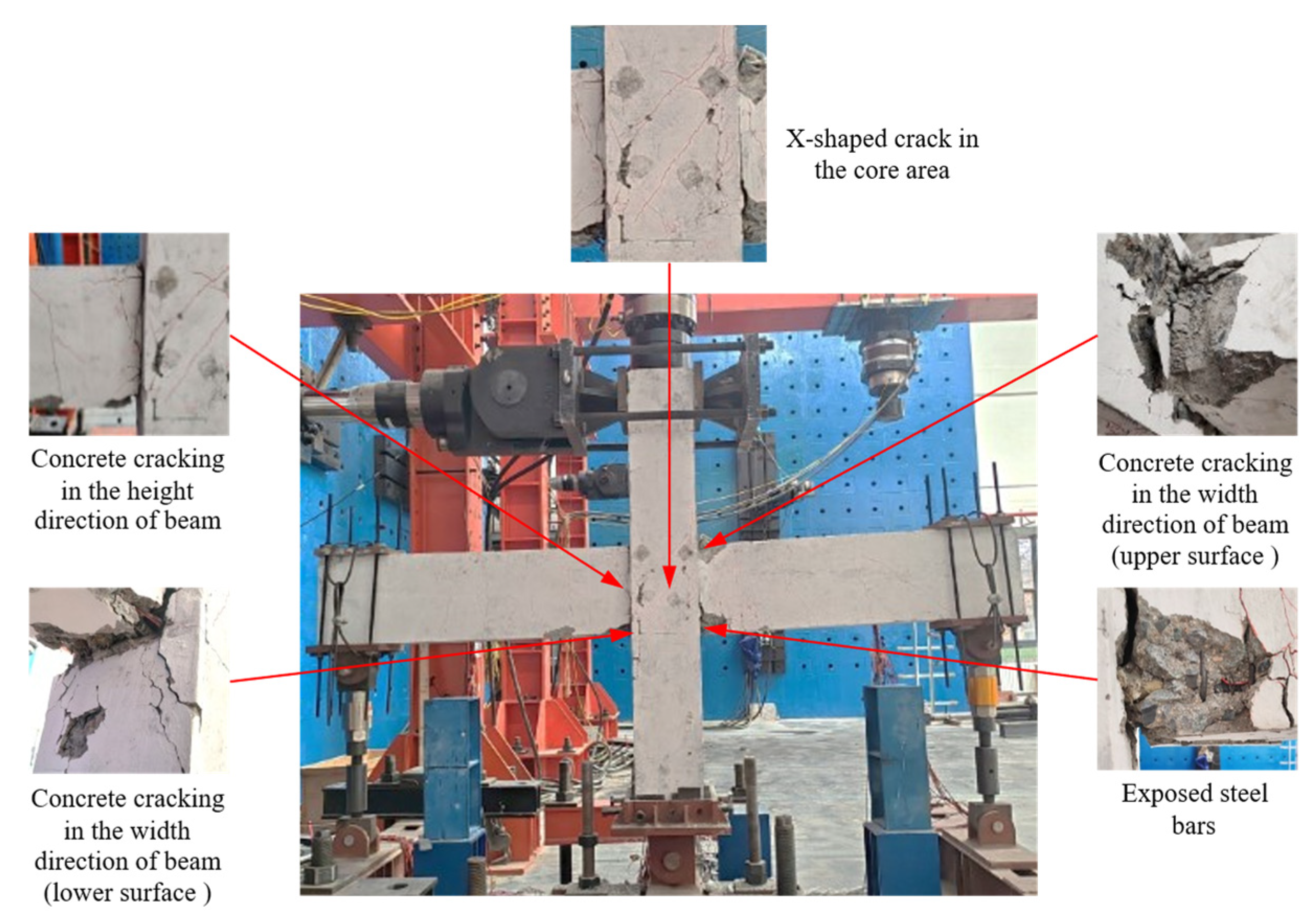
Final failure mode of the RC joint is photographically captured in Figure 9, while Table 6 chronologically records damage evolution.

3.2. Specimen W3I5

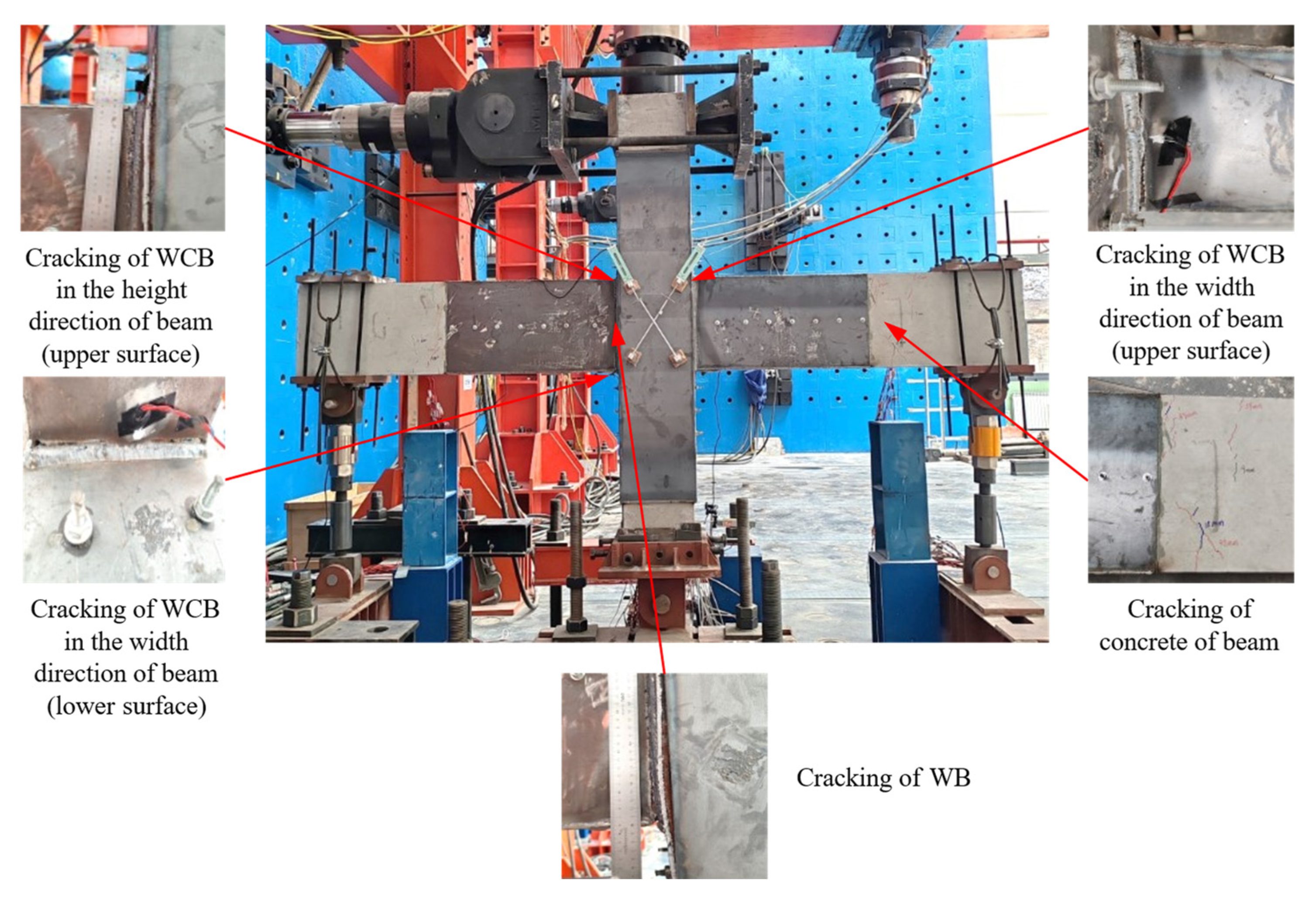
Final failure mode of the RC joint is photographically captured in Figure 10, while Table 7 chronologically records damage evolution.

3.3. Specimen W2I5

Final failure mode of the RC joint is photographically captured in Figure 11, while Table 8 chronologically records damage evolution.

3.4. Specimen W3I3

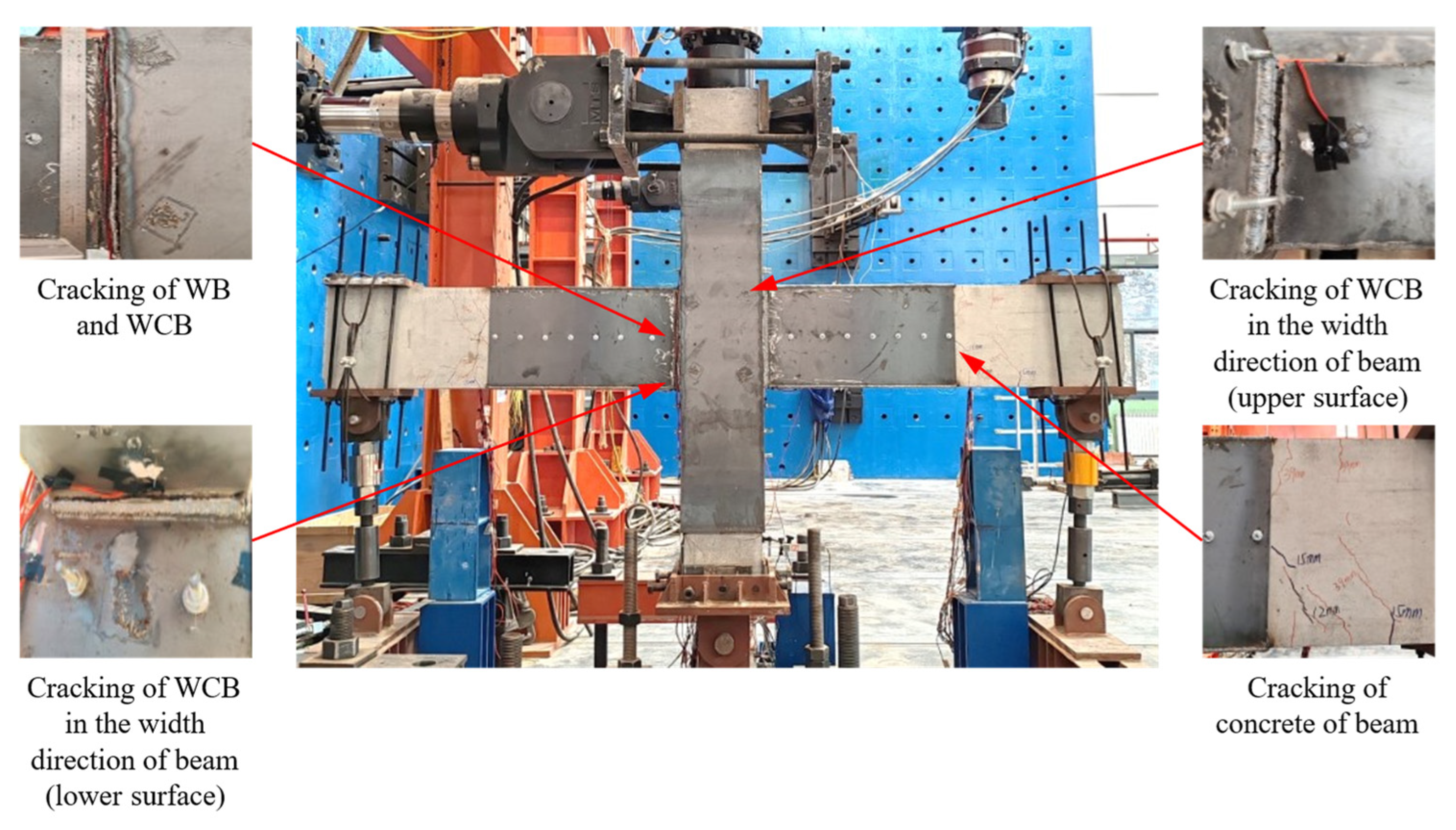
Final failure mode of the RC joint is photographically captured in Figure 12, while Table 9 chronologically records damage evolution.

3.5. The Analysis of Failure Phenomena

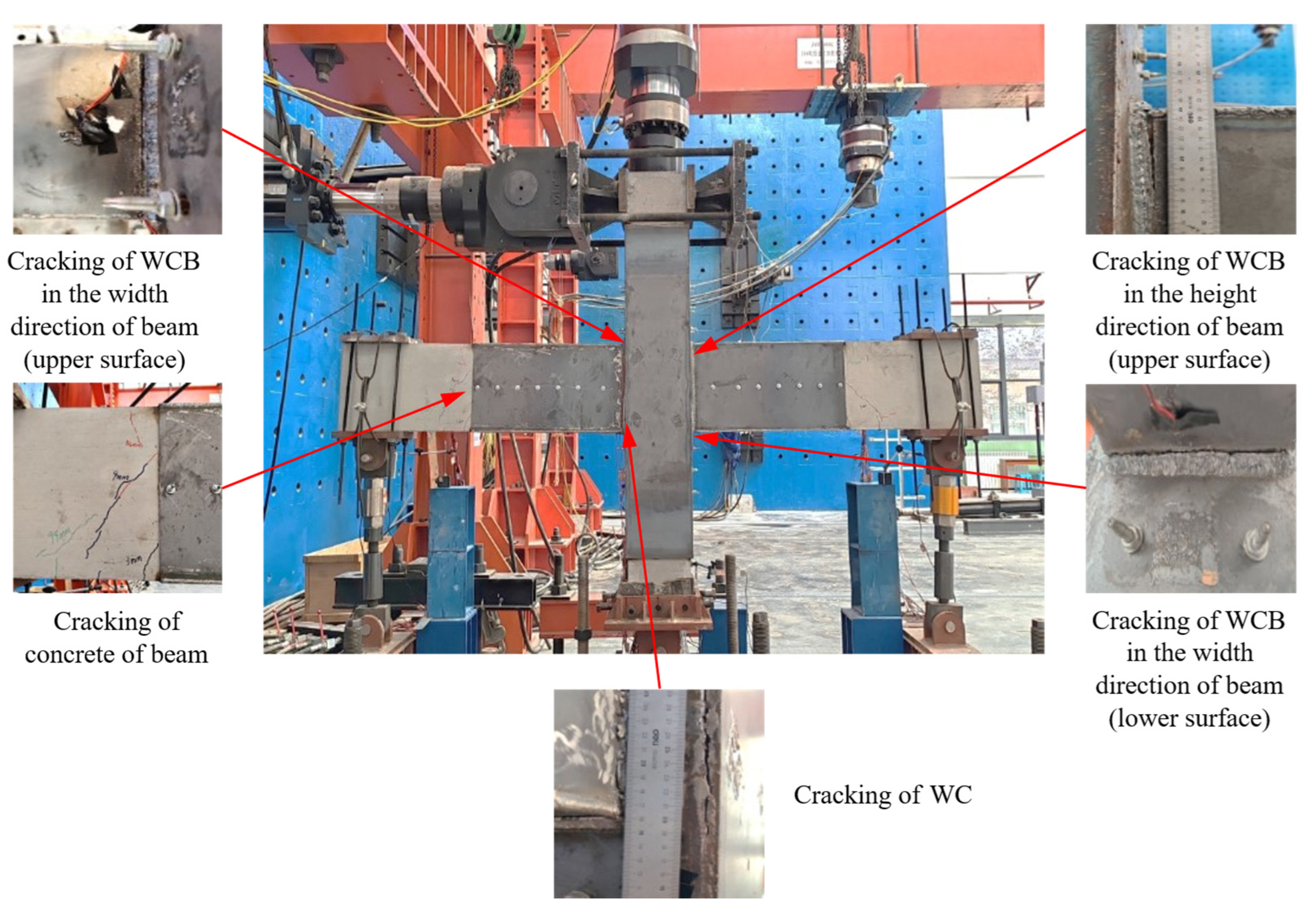
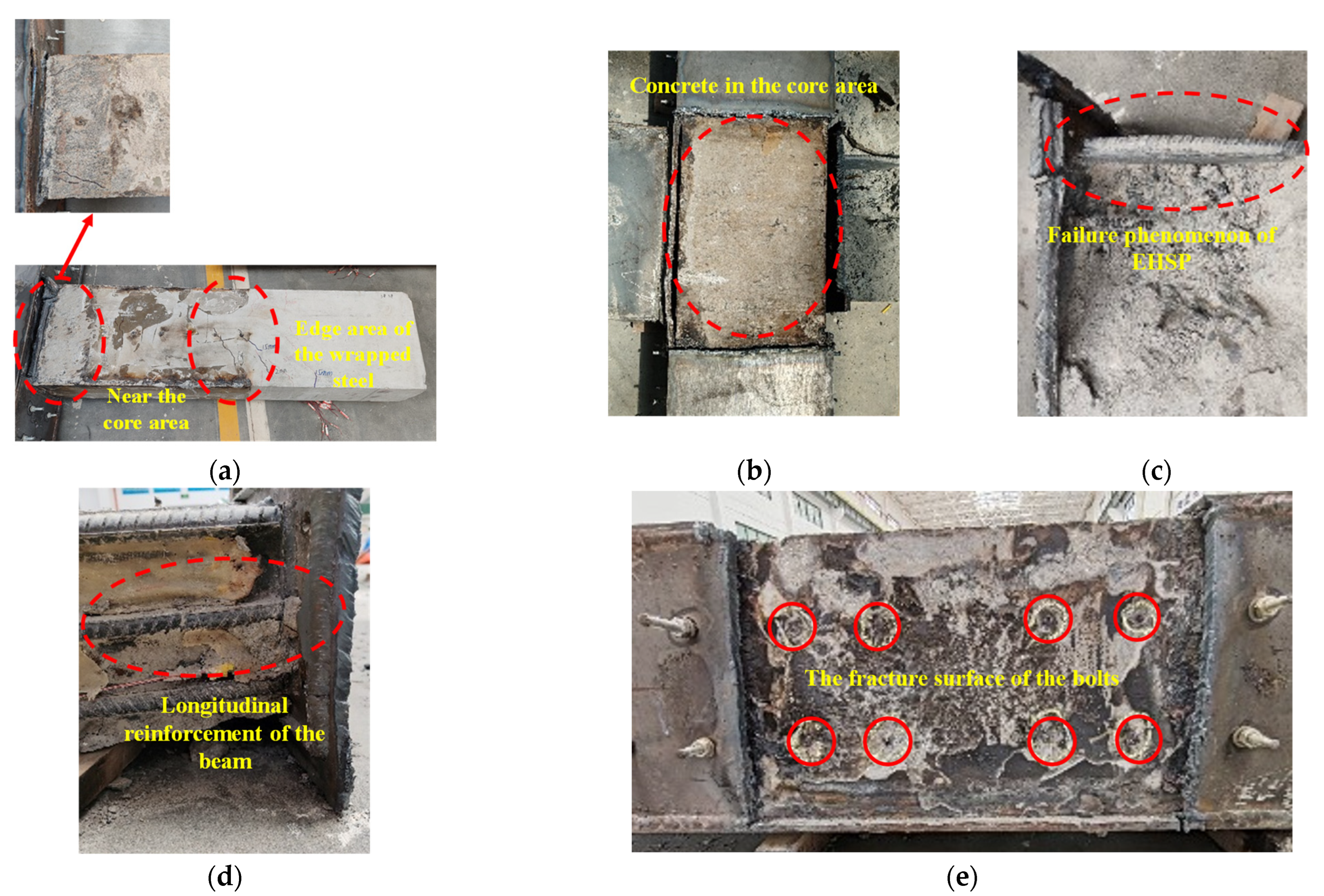
To better investigate the failure mechanism of joints, the steel plate adjacent the core area is cut to study the final phenomena of concrete, EHSP, and rebars. Considering that the RC joint shows the typical failure mode of reinforced concrete frame joints, this paper only analyzes the failure mode of new-type joints.
(1) The RC joint shows typical failure modes of reinforced concrete frame joints, and the beam end and core area are seriously damaged. For new-type joints, the cracks mainly appear in the beam ends on both sides of the joints and surfaces above and below the core area, which is the main cause of the bulge of the steel plate (Figure 13a). The damage of column concrete is not obvious, and no visible cracks appear, as shown in Figure 13b. This is due to the fact that the restriction of wrapped steel increases the deformation capacity of concrete, and then improves the crack resistance.
(2) Although the failure of wrapped steel and welds near the core area is serious, the internal steel bars and EHSP do not deform too much, and the welds between the steel bars and EHSP do not crack (Figure 13c,d). At the same time, the strain of strain gauges of the EHSP and steel bars also shows that these two parts are less stressed during the test. This is mainly due to the change of force transmission path after the wrapped steel treatment. After the beam of new-type joints is stressed, the load is transmitted to the WSC through the steel and weld, and the WSC then transmits the load to the anchor bolts and WC. Before the cracking of the WCB and WB, the wrapped steel associated with the weld seam constitutes the dominant load-bearing system. After the cracks appeared and developed, the capacity exhibits precipitous degradation. Before the failure of the reinforced concrete part, the test has met the end conditions.
(3) In addition to the wrapped steel, the bolts that enhance the connection effect between the WSC and column are all broken. This is because after the failure of wrapped steel, the RC part of the beam still maintains good integrity, and the load is transmitted to the column through the tensile shear effect, leading to the failure of the bolts (Figure 13e).

4. Analysis of Testing Results

4.1. Hysteretic Curves

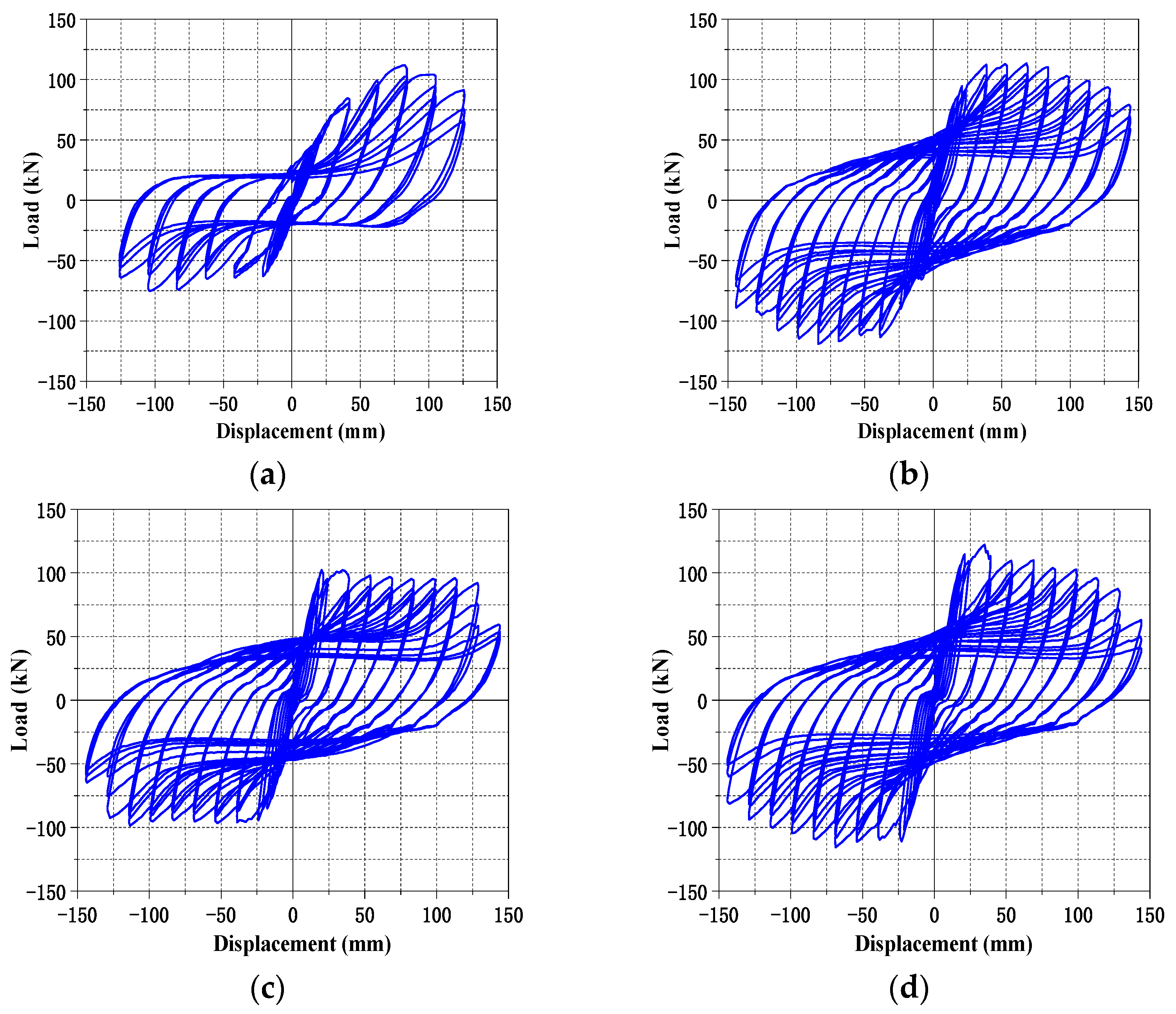
Hysteresis curves are usually used to describe the dynamic performance of structures or components, which can reflect the important characteristics of stiffness degradation, strength degradation, and energy dissipation capacity. In this paper, through the horizontal low cyclic loading test of the specimen, the hysteresis curves shown in Figure 14 are obtained. It can be concluded from the figure:
(1) At the beginning of the test, the shape of the hysteresis curve of the RC joint and new-type joints is basically a straight line, indicating that the joint is in the elastic stage. With the increase in loading displacement, the growth trend of the hysteresis curve slows down, indicating that the damage of the specimen gradually accumulates, resulting in a gradual decrease in stiffness and a gradual decrease in bearing capacity.
(2) The hysteresis curves of the RC joint and new-type joints are Z-shaped and inverse S-shaped, respectively, meaning that these two type specimens are affected by slip during loading, but the slip section of the RC joint is longer. This is due to the fact that in the late loading of the RC joint, the damage to the rebars and concrete is more serious, while for the new-type joints, the integrity of the specimen can be guaranteed in the whole loading process due to the existence of wrapped steel.
(3) The hysteresis curve of the RC joint shows an obvious pinching phenomenon in the middle section, showing that its capacity of energy dissipation is weak. The curves of new-type joints are relatively full, indicating that even if it is affected by slip, the wrapped steel has better material properties than reinforced concrete, so its pinch phenomenon is not obvious, which ensures better energy dissipation capacity.
(4) The hysteresis curves of W3I5 and W3I3 are similar, meaning that the influence of EHSP thickness is small. Compared with W2I5, the bearing capacity of W3I5 is higher, indicating that the strength demonstrates positive dependence on WSB thickness.

4.2. Skeleton Curve

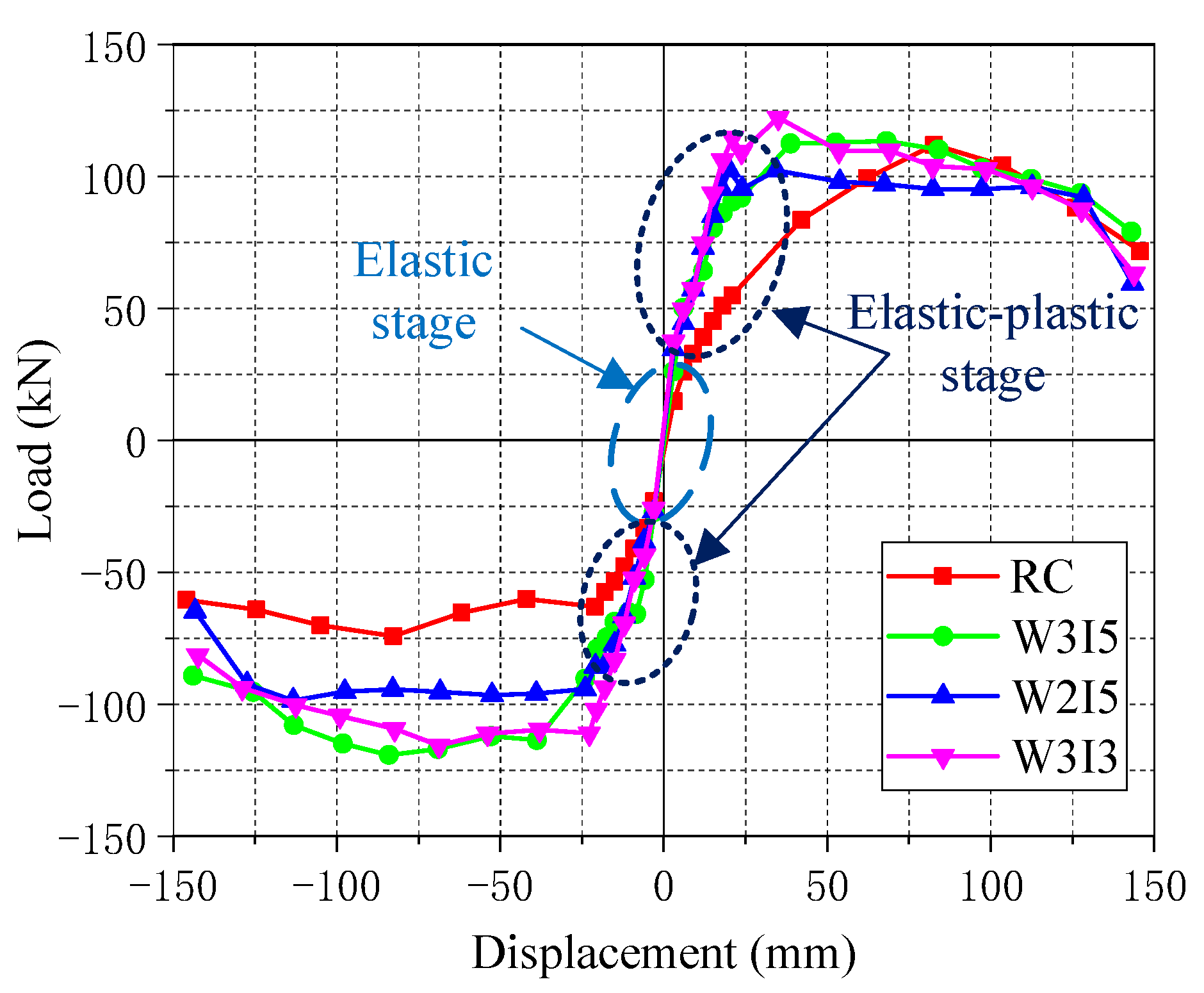
The skeleton curve is defined by connecting peak points of successive hysteresis loops, which reflects the gradual degradation of stiffness and the attenuation of the strength of the component during the whole testing process (Figure 15). It can be found that:
(1) The skeleton curves of all joints are S-shaped, and the curves are linear at the beginning of the test, indicating that the specimens are at a period of elastic state. As the test progresses, the curves of all specimens increase first and then decrease with the accumulation of damage. Skeleton curve analysis confirms lower secant stiffness in conventional RC joints versus innovative alternatives throughout loading cycles before reaching the maximum value. After reaching the maximum value, the curve of the RC joint decreases rapidly, while the curve of new-type joints decreases more slowly. It shows that after the treatment of wrapped steel, the integrity is better and the failure process is slower.
(2) The maximum load of the RC joint is 111.95 kN, which is reduced by 6.5%, −8.6%, and 9.2%, respectively, compared with W3I5, W2I5, and W3I3, indicating that the bearing capacity of the specimen has been significantly improved after the reinforcement of wrapped steel. It should be noted that due to the initial micro-cracks in the WCB of the W2I5 specimen, the damage occurred prematurely during the loading process, leading to the low bearing capacity of joints.
(3) For the new-type joints, the carrying capacity of W3I5 and W3I3 is 119.20 kN and 122.20 kN, respectively, and the difference between the two is small, indicating that the carrying capacity is less affected by EHSP thickness. The bearing capacity of W3I5 and W3I3 is significantly greater than that of W2I5, indicating that the influence of WSB thickness is more obvious, which is also consistent with the failure phenomena of new-type joints. The smaller the thickness of the WSB, the more difficult it is to guarantee the quality of weld. After the WCB is destroyed, the WC is subsequently destroyed, resulting in the destruction of the specimen.

4.3. Ductility Analysis

Ductility denotes the capacity of a structural system to sustain substantial inelastic deformation beyond the yield point without brittle fracture. The deformation capacity of structures or components is usually expressed by the ductility coefficient, which is a code-mandated parameter for dynamic performance quantification. In this paper, the displacement ductility coefficient is used as an index to measure the ductility of joints. The calculation formula is expressed in Equation (1):
μ = Δ u Δ y
where μ is the ductility factor. Δ u and Δ y are the maximum and yield displacement, respectively.
The general yield bending moment method is used to establish the yield load, and the yield displacement can be obtained after the yield load is determined. The characteristic loads and displacements are given in Table 10. Accounting for bidirectional asymmetry in load-deformation response during cyclic testing, the data in the table are averages.
The analysis of the maximum load has been introduced in the previous section, so this section only analyzes other content. The characteristic load and displacement of the new-type joints are larger than the results of the RC joint, which shows that the wrapped steel can effectively improve the stress and deformation characteristics. This is mainly due to the fact that compared to reinforced concrete materials, the mechanical properties of steel plate have a greater advantage. The steel plate, which is on the outside of the specimen, is the first part to bear the load. By comparing the yield load and maximum load ratio, it can be found that the ratio of the RC specimen is small, and the new-type joints reach the maximum load value soon after yielding. This is because before the new-type joints reach the maximum load, the cracks mainly appear at the weld, and after the cracks appear, the steel plate cannot bear more load.
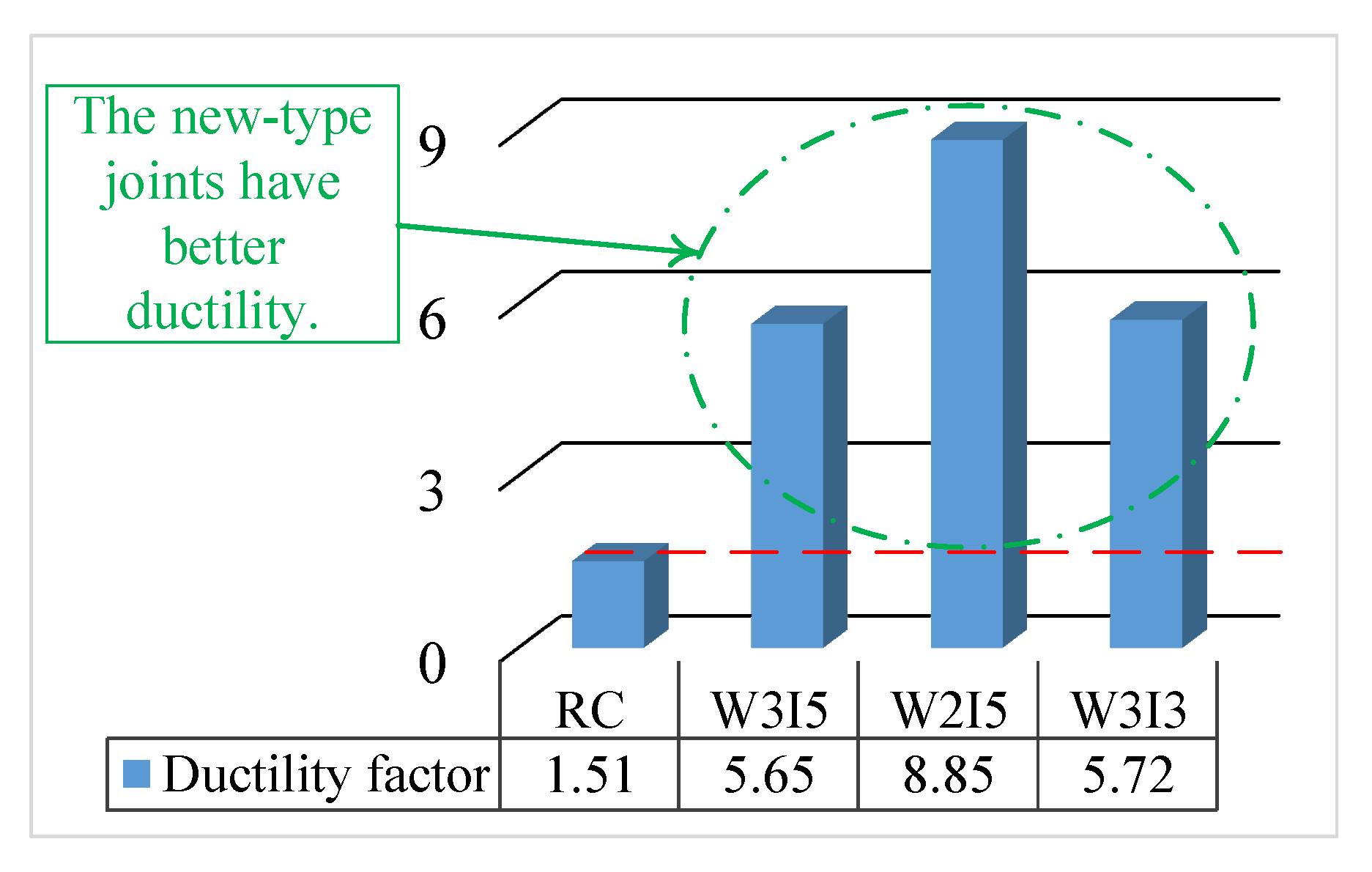
In Figure 16, the ductility of specimen has been obtained through the calculation of Equation (1). It can be concluded that:
(1) The RC joint demonstrates significantly reduced ductility capacity relative to new-type joints. This is because the main force part of the RC joint is reinforced concrete. Under the action of repeated load, rapid destruction of concrete occurs, which leads to the rapid accumulation of damage of the specimen; thus, the specimen soon reaches the yield displacement and the maximum displacement. For the new-type joints, the wrapped steel and weld are the main parts to bear the external load; thus, the failure process is relatively slow, and the loading displacement of yield load is relatively large. Even if the specimen has been yielded, because the properties of steel plate are better than those of reinforced concrete, the maximum load is also larger.
(2) The ductility coefficients of W3I5 and W3I3 are 5.65 and 5.72, respectively, indicating that EHSP thickness has little influence on the ductility coefficient. The value of W2I5 is much higher than that of the other two new-type joints, indicating that the main factor affecting the ductility factor is WSB thickness. This is because the failure of new-type joints is concentrated on the beam. The larger the thickness of the WSB, the greater the overall stiffness of the beam, and the faster the specimen will reach the maximum load after yielding.

4.4. Rigidity Degeneration

Rigidity degradation describes the gradual decrease in structural rigidity after experiencing cyclic loading. It reflects the deformability and stability of a joint under cyclic loading. It is usually evaluated by comparing the stiffness values of each loading stage during the testing process. The degree of rigidity degradation can help to determine the durability of the specimen and the reliability after long-term use. The calculation method is given as:
K i = P i Δ i
in which P i and Δ i are the load and displacement values corresponding to the highest point of the i-th level hysteresis loop, respectively. K i is the rigidity under the i-th cycle.
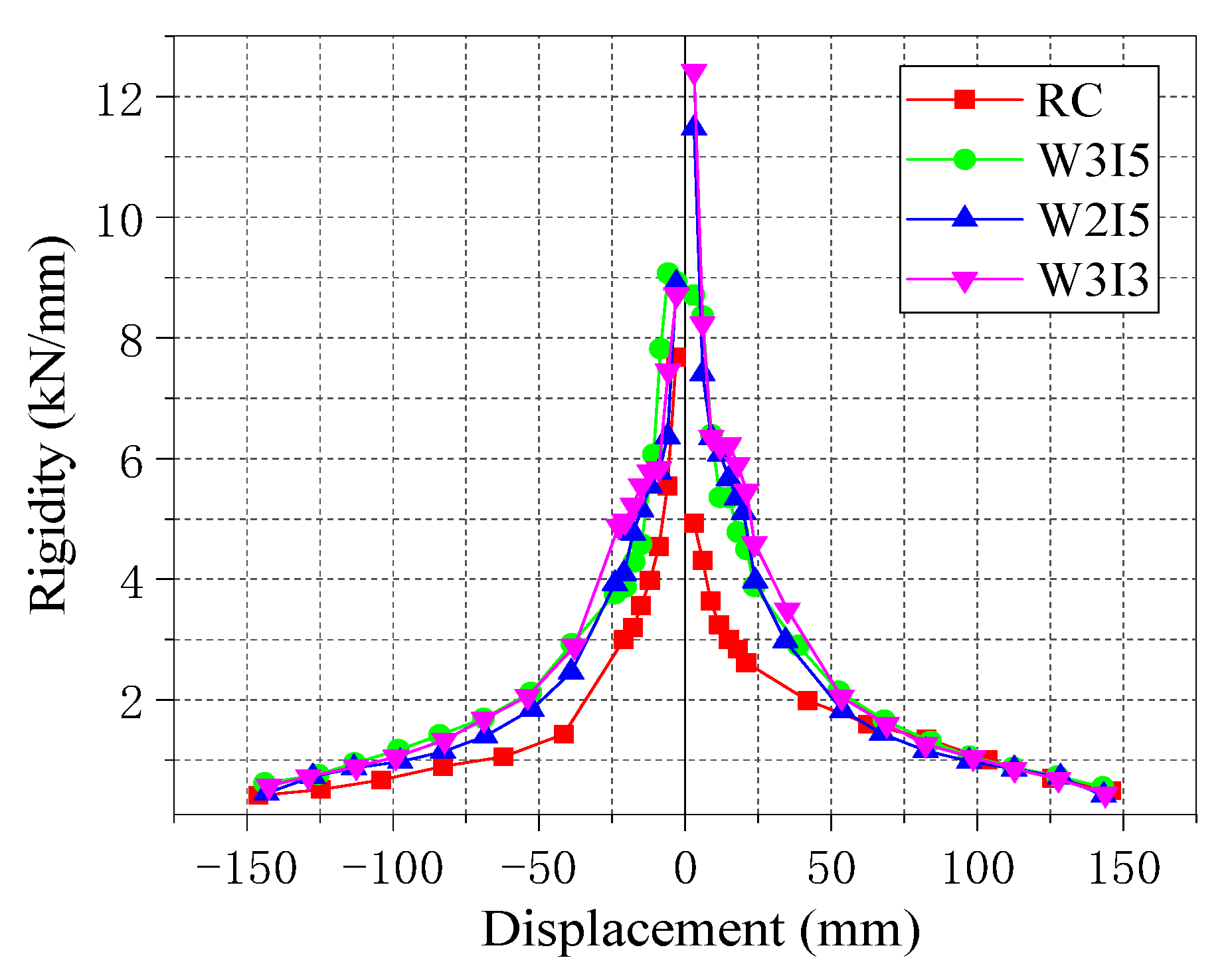
The rigidity degradation curve calculated by Equation (2) is shown in Figure 17. By comparing the curves in the figure, it can be concluded that:
(1) From the overall trend of the rigidity degradation curves, it can be found that increasing loading displacement reduces rigidity in all specimens. At the beginning of the test, the rigidity of joints is not much different, meaning that there is basically no damage in the joints and the specimen is at a period of elastic state. When loaded to the middle stage, the curve decline rate of the RC joint is obviously larger than that of new-type joints. This is due to the fact that the RC joint begins to fail, leading to a rapid decrease in rigidity. In the later stage of the test, the rigidity degradation of the joints is basically the same, meaning that the rigidity of new-type joints is basically the same as that of the RC joint after the failure of the wrapped steel and weld.
(2) The rigidity degradation curve of W2I5 is basically below the degradation curves of the other two new-type joints, indicating that the thickness of the WSB has a certain influence on the rigidity of the specimen. The curves of W3I5 and W3I3 are basically the same, meaning that the effect of EHSP thickness on the rigidity is not obvious. This is because the failure of new-type joints is mainly concentrated in the WC and WCB, and the greater the thickness of the WSB, the greater the stiffness of the beam, and the better the integrity of the specimen.

4.5. Energy Dissipation Capacity

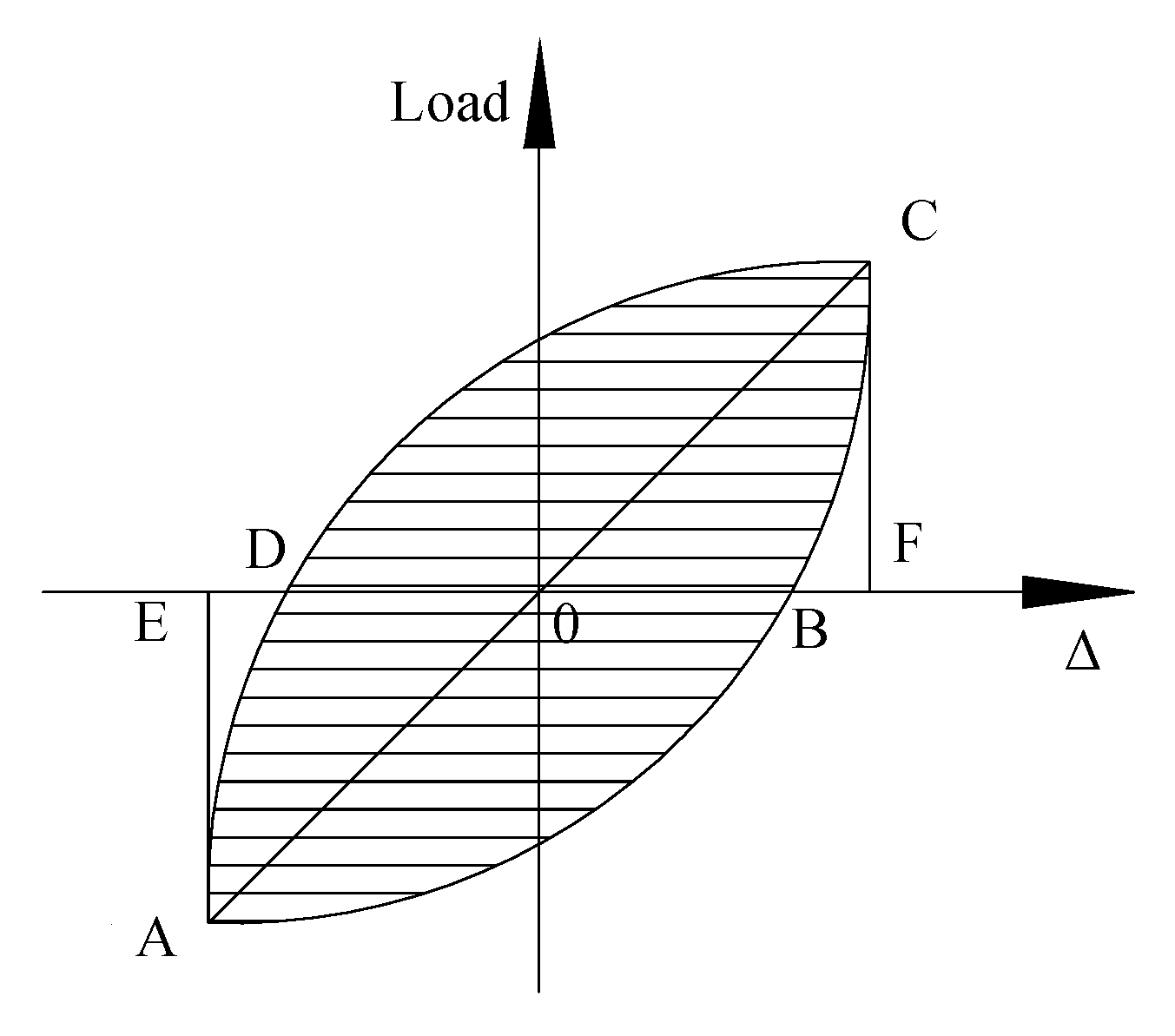
The energy dissipation performance represents the energy absorbed and consumed by a specimen under the loading process. Good energy dissipation performance helps the structure to protect other important parts from damage under dynamic loads such as earthquakes. Here, the equivalent viscous damping coefficient serves as the primary indicator of specimen energy dissipation capacity. Higher coefficient values correspond directly to superior energy dissipation performance in structures or components, thus reflecting better dynamic performance. The calculation method is given in Figure 18.
According to Figure 18, the coefficient is defined by:
h e = 1 2 π × S A B C D S O C F + S O A E
where S A B C D is the area of hysteresis loop in the first cycle of a certain level. S O C F and S O A E are the area enclosed by the specimen when it reaches the same displacement in both push and pull directions.
However, only single-cycle energy dissipation is measured in this method, while the cumulative energy effects are neglected. Therefore, this paper uses Equation (4) to calculate the cumulative hysteretic energy dissipation.
E s u m = i = 1 n E i = i = 1 n j = 1 m E i j
in which i, n, j, and m are loading level, total loading level, number of loading cycles, and total number of loading cycles in loading level i.
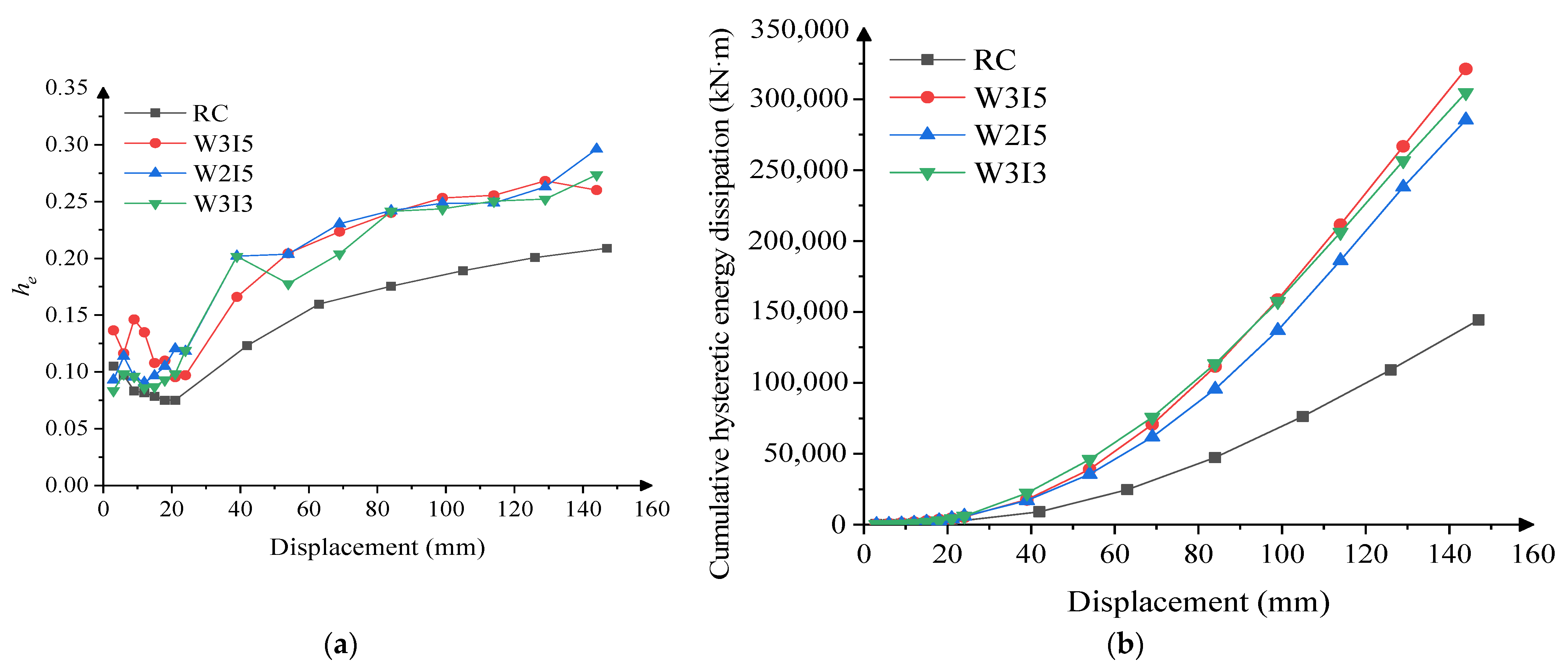
Through the above calculation, the equivalent viscous damping coefficient curve and the cumulative hysteretic energy dissipation curve of the specimen can be obtained, as shown in Figure 19.
It can be seen from Figure 19a that with the test going on, the he of each cycle becomes larger and larger. The he of the RC joint is in the range of 0.123~0.209, while for W3I5, W2I5, and W3I3 this value is between 0.166~0.268, 0.202~0.296, and 0.202~0.274, respectively, meaning that the energy dissipation capacity of new-type joints after wrapped steel treatment is stronger than that of the RC joint. After the loading displacement reaches 54 mm, the he of new-type joints increases significantly, showing that the hysteresis curve becomes fuller due to the confining action of steel jacketing. The he of each new-type joint is basically the same, meaning that the effect of WSB and EHSP thickness on the energy dissipation capacity is not obvious.
In Figure 19b, the cumulative hysteretic energy dissipation curves of all specimens show a trend of slow growth first and then rapid growth. The total energy consumption of the RC joint is significantly smaller than that of new-type joints. This is because the core area is seriously damaged when the RC joint is destroyed, which greatly reduces the energy dissipation capacity of specimen. The rising process of the cumulative hysteretic energy dissipation curve of new-type joints is relatively stable. This is because the stiffness of steel plate is large, and more energy is needed to produce the same displacement. Compared with W2I5 and W3I3, the total energy consumption of W3I5 increased by 12.57% and 5.43%, respectively, indicating that increasing the amount of steel used in the specimen can significantly increase the cumulative energy consumption. The cumulative hysteretic energy dissipation capacity of W3I3 is better than that of W2I5, meaning that the influence of WSB thickness is greater than that of EHSP thickness. This is because the beam of new-type joints can still maintain good integrity during the loading process, and the stress of the EHSP is not large.

5. Conclusions

In this paper, the mechanical properties of a reinforced concrete frame joint reinforced by steel plate under low cyclic loading are studied. By comparing the differences of dynamic parameters such as failure characteristics, bearing capacity, hysteresis curve, skeleton curve, ductility, stiffness degradation, and energy dissipation capacity between new-type joints and RC joints, the influence of wrapped steel, EHSP thickness, and WSB thickness on the dynamic performance of specimens are analyzed. The following conclusions can be drawn:
(1) The failure phenomena of the RC joint show a typical failure form of frame joints. After the reinforcement treatment, the main damage of specimens is concentrated on the WCB and WC, and the damage of the reinforced concrete part is not obvious. It shows that the steel plate changes the force transmission path of the joint, and the steel plate and the weld are first stressed. After the deformation of steel plate and the cracking of the weld, the bearing capacity of the specimen decreases rapidly and reaches the failure criteria of the test.
(2) The bearing capacity of new-type joints is significantly greater than that of the RC joint, and the bearing capacity of W3I3 is 9.2% higher than that of the RC joint. This is because the wrapped steel restricts the deformation of the reinforced concrete part, while the reinforced concrete part limits the buckling of the steel plate. The performance of the material has been fully utilized, so the bearing capacity of specimen is significantly improved. The bearing capacity of W3I5 and W3I3 is greater than that of W2I5, indicating that the thickness of the WSB has a great influence on the bearing capacity, while the thickness of the EHSP has little effect.
(3) Compared with the RC joint, the ductility of new-type joints is higher, meaning that the wrapped steel treatment can improve the ductility of the specimens. The ductility of W3I3 and W3I5 is lower than that of W2I5 when the thickness of the EHSP is the same. This is because when the thicker steel plate is subjected to external force, its internal stress distribution is more complex, and it is easier to reach the ultimate strength of the material; thus, brittle fracture occurs, resulting in smaller ductility. The ductility coefficients of W3I3 and W3I5 are not much different, indicating that the EHSP has little effect on ductility.
(4) The rigidity of new-type joints is greater than that of the RC joint, indicating that the wrapped-steel treatment can effectively improve the rigidity of the specimen in the loading stage. The rigidity degradation curves of the three new-type joints are not much different, indicating that the thickness of the EHSP and WSB has little effect on the stiffness of the specimen.
(5) Because the main bearing part is the steel plate, the energy dissipation capacity of the new-type joints is obviously better than that of the RC joint. The energy dissipation capacity of W3I5 and W3I3 is greater than that of W2I5, indicating that the thickness of the WSB has a greater influence on the energy dissipation capacity, and the influence of EHSP thickness is very small.
The research results of this paper have certain engineering significance for promoting the development of RC structure reinforcement and reconstruction. However, due to the limitation of time and funds, only the influence of WSB and EHSP thickness on the dynamic performance of specimens is considered. Combined with the failure phenomena of the specimens, in the subsequent research process, we will continue to analyze the influence of factors such as reinforcement at the WCB, steel length, material strength, etc., and further explore the mechanical properties of the new-type joint.

Author Contributions

Conceptualization, J.W. (Jian Wu) and W.D.; methodology, J.Z.; software, M.M.; validation, Y.W. and C.W.; formal analysis, M.M.; investigation, C.W.; resources, J.W. (Jian Wu); data curation, J.W. (Jianhui Wang); writing—original draft preparation, M.M.; writing—review and editing, J.W. (Jian Wu); visualization, W.D.; supervision, J.W. (Jian Wu); project administration, J.W. (Jian Wu); funding acquisition, J.Z. All authors have read and agreed to the published version of the manuscript.

Funding

This research was funded by Shaanxi Provincial Department of Education Government-Enterprise Joint Funding Project (22JE017) and the Scientific Research Foundation for High-level Talents (XJ17T08).

Institutional Review Board Statement

Not applicable.

Informed Consent Statement

Not applicable.

Data Availability Statement

The original contributions presented in this study are included in the article. Further inquiries can be directed to the corresponding authors.

Acknowledgments

The authors would like to thank the Shaanxi Key Laboratory of Safety and Durability of Concrete Structures for the project testing.

Conflicts of Interest

Author Jian Zhou was employed by the company Northwest Engineering Corporation Limited. The remaining authors declare that the research was conducted in the absence of any commercial or financial relationships that could be construed as a potential conflict of interest.

References

  1. Abo-Zaid, L.; Hassan, A.; Abdel-Hafez, L.M. Repairing post-heated L-shaped RC columns with advanced thin concrete jacketing. Constr. Build. Mater. 2019, 221, 573–585. [Google Scholar] [CrossRef]
  2. Ali Dadvar, S.; Mostofinejad, D.; Bahmani, H. Strengthening of RC columns by ultra-high performance fiber reinforced concrete (UHPFRC) jacketing. Constr. Build. Mater. 2020, 235, 117485. [Google Scholar] [CrossRef]
  3. Beschi, C.; Meda, A.; Riva, P. Column and joint retrofitting with high performance fiber reinforced concrete jacketing. J. Earthq. Eng. 2011, 15, 989–1014. [Google Scholar] [CrossRef]
  4. Meda, A.; Mostosi, S.; Rinaldi, Z.; Riva, P. Corroded RC columns repair and strengthening with high performance fiber reinforced concrete jacket. Mater. Struct. 2016, 49, 1967–1978. [Google Scholar] [CrossRef]
  5. Chen, X.Y.; Fan, P.Y.; Cao, H.S.; Qian, W.; Jiang, S.H. Application of external prestressing combined with enlarged section method to reinforce T-beam of approach bridge to reduce seawater corrosions. Desalin. Water Treat. 2022, 267, 161–166. [Google Scholar] [CrossRef]
  6. Zhong, S.; Hu, X.P.; Peng, G.; Hou, J.P. The effect of section enlargement with cementitious grout on the eccentric compression behavior of RC columns. KSCE J. Civ. Eng. 2024, 28, 3378–3393. [Google Scholar] [CrossRef]
  7. Fathalla, E.; Mihaylov, B. Shear behaviour of deep beams strengthened with high-strength fiber reinforced concrete jackets. Eng. Struct. 2025, 325, 119404. [Google Scholar] [CrossRef]
  8. Saeed, F.H.; Hejazi, F.; Rashid, R.S.M. Strengthening of reinforced concrete slabs using carbon fiber reinforced polymers rods and concrete jacket with a mechanical anchorage system. Constr. Build. Mater. 2024, 440, 137464. [Google Scholar] [CrossRef]
  9. Zhang, Q.; Yang, Q.C.; Gu, X.L.; Jiang, Y. Study on axial compression properties of concrete columns wrapped with basalt textile-reinforced fine concrete (BTRC) jackets. Constr. Build. Mater. 2023, 363, 129089. [Google Scholar] [CrossRef]
  10. Madani, S.A.; Hatami, S.; Farahbod, F.; Ashtiani, M.J. FRP strip wraps for enhancing the fire resistance of RC beams strengthened with CFRP sheets bonded using the EBROG method: An experimental study. Structures 2024, 65, 106765. [Google Scholar] [CrossRef]
  11. Armonico, A.; Ferrier, E.; Michel, L. Smart monitoring of RC T beams strengthened by external bonded FRP. Procedia Struct. 2024, 64, 604–611. [Google Scholar] [CrossRef]
  12. Gao, X.H.; Gao, L.; Zhang, F. A new bond-slip model of hybrid bonded FRP-to-concrete joints. KSCE J. Civ. Eng. 2023, 27, 270–284. [Google Scholar] [CrossRef]
  13. Giménez, E.; Adam, J.M.; Ivorra, S.; Calderón, P.A. Influence of strips configuration on the behaviour of axially loaded RC columns strengthened by steel angles and strips. Mater. Des. 2009, 30, 4103–4111. [Google Scholar] [CrossRef]
  14. Jia, H.Y.; Wei, H.C.; Li, J.; Cui, S.G.; Xu, L.; Zheng, S.X. Blast resistance of steel jacket reinforced double-column bridge pier. Eng. Struct. 2025, 329, 119882. [Google Scholar] [CrossRef]
  15. Su, R.K.L.; Siu, W.H.; Smith, S.T. Effects of bolt–plate arrangements on steel plate strengthened reinforced concrete beams. Eng. Struct. 2010, 32, 1769–1798. [Google Scholar] [CrossRef]
  16. Alam, M.A.; Sami, A.; Mustapha, K.N. Embedded connectors to eliminate debonding of steel plate for optimal shear strengthening of RC beam. Arab. J. Sci. Eng. 2017, 42, 4053–4068. [Google Scholar] [CrossRef]
  17. Aldhafairi, F.; Hassan, A.; Abd-EL-Hafez, L.M.; Abouelezz, A.E.Y. Different techniques of steel jacketing for retrofitting of different types of concrete beams after elevated temperature exposure. Structures 2020, 28, 713–725. [Google Scholar] [CrossRef]
  18. Zhang, S.H.; He, M.S.; Ding, Y.Z.; Li, Y.C. Study on the effect of pre-stressed level on the force performance of wedge steel plate jacket and steel wire mesh-PCM strengthened RC beams. Structures 2023, 57, 105283. [Google Scholar] [CrossRef]
  19. Santarsiero, G.; Masi, A. Seismic performance of RC beam–column joints retrofitted with steel dissipation jackets. Eng. Struct. 2015, 85, 95–106. [Google Scholar] [CrossRef]
  20. Deng, B.Y.; Liu, X.; Yu, K.Q.; Li, L.Z.; Chen, Y. Seismic retrofitting of RC joints using steel cage and haunch with bolted steel plate. Structures 2022, 43, 285–298. [Google Scholar] [CrossRef]
  21. Nicoletti, V.; Carbonari, S.; Gara, F. Nomograms for the pre-dimensioning of RC beam-column joints according to Eurocode 8. Structures 2022, 39, 958–973. [Google Scholar] [CrossRef]
  22. Shen, X.Y.; Li, B.; Chen, Y.T.; Tizani, W.; Jiang, Y. Relocating plastic hinges in reinforced concrete beam-column joints by mechanically anchored diagonal bars. Eng. Struct. 2022, 251, 113468. [Google Scholar] [CrossRef]
  23. Yu, F.; Wu, C.Z.; Xu, B.; Guan, Y.C.; Zhu, X.H.; Yuan, F. Study on shear bearing capacity of PVC-CFRP confined concrete column-RC beam exterior joint with core steel tube. Constr. Build. Mater. 2024, 410, 134197. [Google Scholar] [CrossRef]
  24. Nguyen, V.P.; Nguyen, Q.H.; Couchaux, M.; Aribert, J.M.; Hjiaj, M. Hybrid steel beam to exterior RC column joints with encased steel profile. Eng. Struct. 2024, 306, 117624. [Google Scholar] [CrossRef]
  25. Yu, F.; Tan, S.Y.; Guan, Y.C.; Fang, Y. Seismic design of PCCC column to RC beam joint with core steel tube. Structures 2025, 77, 109141. [Google Scholar] [CrossRef]
  26. GB/T 50010-2010; Code for Design of Concrete Structures. China Construction Industry Press: Beijing, China, 2024.
  27. Bagheri, M.; Ebadi, M.; Samali, B. Effect of seismic soil–pile–structure interaction on mid- and high-rise steel buildings resting on a group of pile foundations. Int. J. Geomech. 2025, 18, 04018103. [Google Scholar] [CrossRef]
  28. Asgari, A.; Bagheri, M.; Hadizadeh, M. Advanced seismic analysis of soil-foundation-structure interaction for shallow and pile foundations in saturated and dry deposits: Insights from 3D parallel finite element modeling. Structures 2024, 69, 107503. [Google Scholar] [CrossRef]
  29. GB 50728-2011; Technical Code for Safety Appraisal of Engineering Structural Strengthening Materials. China Construction Industry Press: Beijing, China, 2014.
  30. GB/T 50081-2019; Standard for Test Methods of Concrete Physical and Mechanical Properties. China Construction Industry Press: Beijing, China, 2019.
  31. GB/T 1499.2-2018; Steel for the Reinforcement of Concrete—Part2: Hot Rolled Ribbed Bars. China Construction Industry Press: Beijing, China, 2018.
  32. GB/T 228.1-2021; Metallic Materials—Tensile Testing-Part 1: Method of Test at Room Temperature. China Construction Industry Press: Beijing, China, 2021.
  33. JGJ/T 101-2015; Specification for Seismic Test of Buildings. China Construction Industry Press: Beijing, China, 2015.
Figure 1. The dimension and distributed steel of the joints: (a) RC specimen; (b) new-type specimen.
Buildings 15 02657 g001
Figure 2. The structural form of new-type joint: (a) sectional drawing of the beam; (b) sectional view of the specimen.
Buildings 15 02657 g002
Figure 3. Preliminary work for the specimen production: (a) pasting of strain gauges; (b) assembling of reinforcement; (c) casting of column concrete.
Buildings 15 02657 g003
Figure 4. Beam treatment: (a) connection of column, EHSP, and beam; (b) casting of beam concrete; (c) treatment of wrapped steel.
Buildings 15 02657 g004
Figure 5. Failure phenomenon of cube.
Buildings 15 02657 g005
Figure 6. The testing of reinforcement and steel plate: (a) before testing; (b) after testing.
Buildings 15 02657 g006
Figure 7. The testing device: (a) schematic drawing; (b) actual loading photograph.
Buildings 15 02657 g007
Figure 8. The loading regime.
Buildings 15 02657 g008
Figure 9. The failure phenomena of the RC specimen.
Buildings 15 02657 g009
Figure 10. The failure phenomena of W3I5 specimen.
Buildings 15 02657 g010
Figure 11. The failure phenomena of W2I5 specimen.
Buildings 15 02657 g011
Figure 12. The failure phenomena of W3I3 specimen.
Buildings 15 02657 g012
Figure 13. The damage phenomena of the core area: (a) the beam concrete; (b) concrete in the core area; (c) EHSP; (d) the rebars of beam; (e) the bolts.
Buildings 15 02657 g013
Figure 14. The hysteretic curves of joints: (a) RC; (b) W3I5; (c) W2I5; (d) W3I3.
Buildings 15 02657 g014
Figure 15. Skeleton curves of all the joints.
Buildings 15 02657 g015
Figure 16. Ductility factors of all the joints.
Buildings 15 02657 g016
Figure 17. Rigidity degeneration of the joints.
Buildings 15 02657 g017
Figure 18. Schematic diagram of calculation method for he.
Buildings 15 02657 g018
Figure 19. The graphs of (a)   h e and (b) cumulative hysteretic energy dissipation.
Buildings 15 02657 g019
Table 1. Technical terms and abbreviations.
AbbreviationTechnical TermAbbreviationTechnical Term
RCReinforced concreteEHSPEmbedded horizontal steel plate
WSCWrapped steel of the columnWSBWrapped steel of the beam
WCWeld seam of steel plate encasing the columnWCBWeld seam connecting the wrapped steel of column and beam
WBWeld seam of steel plate encasing the beam
Table 2. Design parameters of the specimens.
NumberThe Length of Beam (mm)The Height of Column (mm)The Length of Wrapped Steel (mm)EHSP (mm)The Thickness of Wrapped Steel (mm)
BeamColumnLengthThicknessBeamColumn
RC14002000------
W3I575015002005310
W2I575015002005210
W3I375015002003310
Table 3. The testing results of cube.
Batches of ConcreteComponentCompressive Strength (N/mm2)Elastic modulus (N/mm2)
1Beam48.303.43 × 104
Column56.103.55 × 104
2Beam46.603.40 × 104
Table 4. The performance parameters of rebar.
TypeDiameter
(mm)
Yield Strength
(MPa)
Ultimate Strength
(MPa)
Elastic Modulus
(MPa)
Percentage Elongation
(%)
Stirrup63825362.10 × 10516.2
Longitudinal bar164646342.06 × 10532.9
205727362.06 × 10528.9
Table 5. The performance parameters of steel plate.
Thickness
(mm)
Yield Strength
(MPa)
Ultimate Strength
(MPa)
Elastic Modulus
(MPa)
Percentage Elongation
(%)
23464592.06 × 10527.2
34205032.06 × 10528.6
53334442.06 × 10534.7
103594252.06 × 10535.1
Table 6. The failure process of RC specimen.
DisplacementExperimental Phenomenon
3–6 mmA 100 mm vertical crack was observed on the left beam, which was 250 mm from the core area.
9 mmThree cracks (two vertical and one horizontal) appeared on the left beam and in the core area, respectively. In the right beam, one diagonal crack could be observed and the length and width were increasing during the loading process.
21 mmTwo horizontal cracks and three diagonal cracks with a length of 70 mm appeared in the core area.
The specimen was yielded.
42 mmThe crack in the right beam end extended upwards for a length of 200 mm. New vertical and diagonal cracks on the left and right beams close to the core area continued to appear.
63 mmCracks presented on the left beam increased in length and width, with the result that the cracks near the upper part of core area eventually penetrated. A vertical crack with a length of 120 mm appeared in the right beam at a distance of 20 mm from the core area and progressed to the underside of beam. Concrete started to spall on the right beam end.
84 mmThe lower portion of the right beam, which was 300 mm from the core area, was completely cracked, and the lower portion of the left beam end cracked through. The core area showed x-shaped cross-cracks, and the concrete of the lower right side of core area was cracked and spalling.
105 mmSevere concrete spalling in the lower portion of beams end could be observed.
147 mmConcrete continued to spall near the core area, and exposed rebar was visible.
At this time, the load dropped below 85% of bearing capacity, and the specimen showed clear signs of damage.
The specimen was failed.
Table 7. The failure process of W3I5 specimen.
DisplacementExperimental Phenomenon
3–6 mmCompressive forces produced audible cracking in the concrete of the right beam.
9 mmIn the left beam, the squeezing sound of concrete increased and a 10 mm long diagonal crack appeared.
21–24 mmIn the concrete of the right beam, one 50 mm long crack appeared.
The specimen was yielded.
39 mmCracking occurred in the WCB at the right corner of core area and there was a bulge in wrapped steel plate above the beam.
54 mmThe core area made a large deformation sound and the WCB in the left corner cracked.
84 mmChemical anchors installed in the column adjacent to the core area had undergone a deformation of 6 mm, and the deformation of the second row of chemical anchors was small. The epoxy resin adhesive of the core area failed, and the deformation of steel plate was large. Cracks appeared in the WCB on the upper part of the core area.
99 mmCracks with a length of 100 mm and 20 mm appeared on the left and right WB of the core area, respectively. Diagonal cracking (10 mm length) appeared in the left and right beams, and the length of crack in the WCB continued to increase.
114 mmThe steel-wrapped area continued to make sounds, and the cracks on the concrete without the reinforcement of steel plate of the beam no longer developed.
129 mmThe left WCB adjacent to the core area was all cracked. The length of the WC cracks on both sides of the core area developed to 250 mm.
144 mmThe crack length of the WC on the left side of the core area was 340 mm (the highest part of the crack was 80 mm higher than the upper edge of the beam), and the length of the WC crack on the right side was 280 mm (the highest part of the crack was 15 mm higher than the upper edge of the beam).
At this time, the load dropped below 85% of bearing capacity, and the specimen showed clear signs of damage.
The specimen was failed.
Table 8. The failure process of W2I5 specimen.
DisplacementExperimental Phenomenon
9 mmA vertical crack measuring 8 mm in length developed in the concrete of the right beam.
15 mmThe chemical anchors adjacent to the core area on the left side of the column had a small deformation. Three micro-cracks measuring 10 mm developed in the concrete of the right beam.
21 mmCracking of epoxy resin adhesive of the WSC could be observed. There was an unobvious crack in the WCB at the lower left corner of the core area.
24 mmThe deformation of concrete and steel plates generated audible grinding, and the chemical anchors in the right corner of the core area were loosened.
The specimen was yielded.
39 mmThe left and right WCB in the lower corner of the core area showed cracks of 25 mm and 20 mm in length, respectively. The upper part of the beam adjacent to the core area showed obvious bulges. New cracks could be observed on the concrete of the beams, but the length remained basically unchanged after the cracks appeared.
54 mmThe cracks of the WCB continued to develop, and an oblique crack measuring 15 mm could be seen on the concrete of the left beam.
69 mmThe crack length of the WCB developed to 40 mm in the direction of beam height.
84 mmThe nuts of the first row of chemical anchors near the core area on the left side of the column deformed outward by 5 mm, and the second row of chemical anchors deformed slightly.
114 mmOn both sides of the column, two cracks with length of 190 mm and 140 mm appeared in the WC. In the direction of beam height, the crack lengths of the WCB on both sides of core area were 95 mm, 100 mm, 80 mm, and 80 mm, respectively.
129 mmThe specimen made a large sound of steel fracture, and the cracks of the WCB in the width direction of beam were connected. The crack of the WC on the left side of the column was 50 mm higher than the top of the beam, 70 mm lower than the bottom of the beam, and these two values of crack length were both 60 mm.
144 mmThe cracks of the WCB ran through, and the concrete of the beam near the core area was crushed.
At this time, the load dropped below 85% of bearing capacity, and the specimen showed clear signs of damage.
The specimen was failed.
Table 9. The failure process of W3I3 specimen.
DisplacementExperimental Phenomenon
3–9 mmThe sound of concrete deformation in the range of wrapped steel reinforcement could be heard.
12 mmTwo diagonal cracks with a length of 10 mm and 8 mm appeared in the concrete of the left and right beams, respectively.
15 mmThe length of the existing cracks gradually increased, and new cracks appeared. When the loading displacement increased, the extrusion sound of concrete also increased gradually.
18–24 mmThe first row of chemical anchors of the columns and beams adjacent to the core area had a small deformation.
The specimen was yielded.
39 mmThere were many vertical and oblique cracks appearing on the concrete of the beams. The deformation sound of chemical anchors could be heard, and the first row of chemical anchors on the column was deformed.
54 mmA crack measuring 20 mm appeared in the WCB, and obvious bulging deformation was observed in the wrapped steel of the beam near the upper-right section of the core area.
69 mmThe nuts of the chemical anchors of the column adjacent to the core area had a deformation of about 8 mm outward. The beam end at the upper right of the core area was obviously convex in the height and width direction of the beam. The WCB in both sides of the core area had a crack of 40 mm in length.
84 mmThere was no visible test phenomenon, but the sound of steel plate deformation could be heard.
99 mmAudible concrete crushing accompanied by visible bulging in the WSC near the core area could be observed.
114 mmThere were two cracks with lengths of 190 mm and 200 mm appearing in the WSB adjacent to the core area. The length of the existing crack in the WCB developed to 40 mm.
129 mmThe crack of the WCB in the width direction of the lower right corner of core area ran through. The crack of the WC of the left side of the column was located 90 mm above the beam top and 80 mm below the beam bottom.
144 mmThe crack of the WCB in the width direction of the upper left corner of the beam adjacent to the core area ran through, and the crack length of the WCB in the width direction of the lower left corner of the beam was 120 mm. The WB adjacent to the core area was completely cracked in the beam height direction.
At this time, the load dropped below 85% of bearing capacity, and the specimen showed clear signs of damage.
The specimen was failed.
Table 10. The characteristic loads and characteristic displacements of specimens.
SpecimenLoad (kN)Displacement (mm)
YieldMaximumUltimateYieldMaximumUltimate
RC69.2993.6280.9033.6493.30125.18
W3I591.52116.3094.5322.4076.10126.54
W2I585.02100.4462.0916.2066.70143.32
W3I3105.69118.9198.2819.8851.92113.76
Disclaimer/Publisher’s Note: The statements, opinions and data contained in all publications are solely those of the individual author(s) and contributor(s) and not of MDPI and/or the editor(s). MDPI and/or the editor(s) disclaim responsibility for any injury to people or property resulting from any ideas, methods, instructions or products referred to in the content.