Article

Interdisciplinarity in the Built Environment: Measurement and Interdisciplinary Topic Identification

School of Management, Xi’an University of Architecture and Technology, Xi’an 710055, China
*
Authors to whom correspondence should be addressed.
Buildings 2024, 14(12), 3718; https://doi.org/10.3390/buildings14123718

Submission received: 14 October 2024 / Revised: 12 November 2024 / Accepted: 19 November 2024 / Published: 21 November 2024
(This article belongs to the Collection Buildings, Infrastructure and SDGs 2030)

Abstract

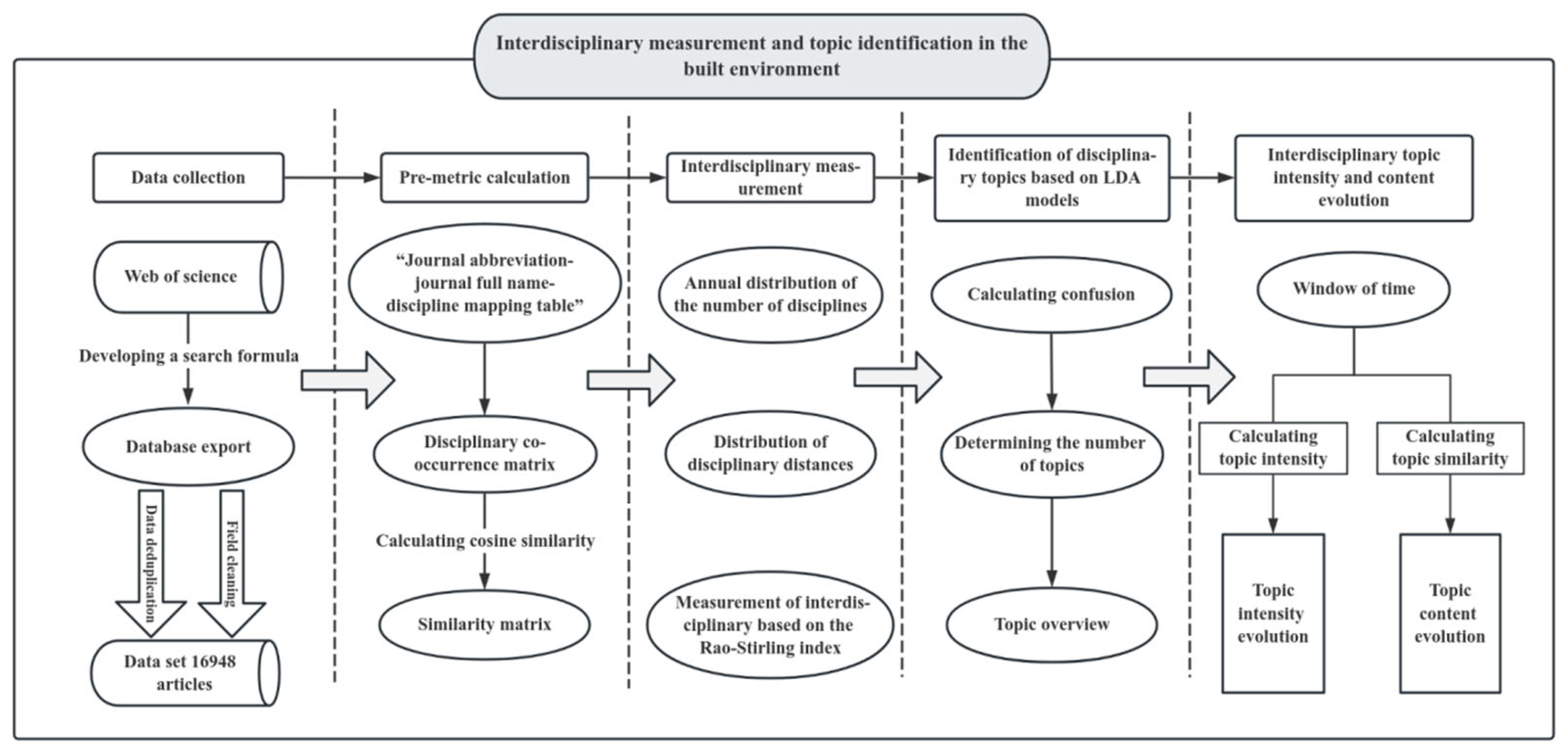
Interdisciplinary research plays a crucial role in addressing the intricate scientific and social challenges confronting society. The field of built environment, as an interdisciplinary discipline, has benefitted from cross-pollination with various fields such as architecture, environment, medicine, and psychology, leading to a range of interdisciplinary advancements. Nevertheless, there remains a gap in the systematic documentation of interdisciplinary outcomes within this field. This paper utilized the cosine index and the Rao–Stirling index to assess the level of interdisciplinarity within the built environment field. This was followed by the screening of literature achievements with a high interdisciplinary nature, the identification of interdisciplinary topics based on the latent Dirichlet allocation (LDA) model, and the analysis of the evolution path of interdisciplinary topics based on time series. The results demonstrate that the field of built environment exhibits a high degree of interdisciplinary integration, with the most prevalent crossovers observed with medicine, psychology, and public health science, and fewer crossovers with electrochemistry, crystallography, and nanotechnology, which represent potential emerging directions. Over the past three decades, 17 core interdisciplinary topics have emerged in the field, and the overall evolutionary trend over time has been one of divergence, followed by contraction and then divergence. This study provides scholars with up-to-date knowledge from an interdisciplinary perspective, and facilitates the development of interdisciplinary research and cooperation in this field.
Keywords: built environment; indoor air quality; indoor environment; interdisciplinary measurement; topic identification; topic evolution; LDA modeling built environment; indoor air quality; indoor environment; interdisciplinary measurement; topic identification; topic evolution; LDA modeling