You are currently viewing a new version of our website. To view the old version click .
Buildings
  • Article
  • Open Access

12 July 2023

Experimental Research Studies on Seismic Behaviour of Confined Masonry Structures: Current Status and Future Needs

,
,
,
,
and
1
Institute of Engineering, Universidad Nacional Autónoma de México, Mexico City 04510, Mexico
2
Department of Civil Engineering, University of British Columbia, Vancouver, BC V6T 1Z4, Canada
3
Department of Civil Engineering, Gonzaga University, Spokane, WA 99258, USA
4
Department of Engineering, Pontificia Universidad Católica del Perú, San Miguel, Lima 15088, Peru
This article belongs to the Special Issue Seismic Behaviour of Reinforced and Confined Masonry Buildings

Abstract

Confined masonry (CM) is a construction system that consists of loadbearing masonry wall panels enclosed by vertical and horizontal reinforced concrete confining elements. The presence of these confining elements distinguishes CM from unreinforced masonry systems, and makes this technology suitable for building construction in regions subject to intense seismic or wind activity. CM construction has been used in many countries and regions, and has performed well in past earthquakes. The purpose of this paper is to review experimental research studies related to the seismic in-plane and out-of-plane behaviour of CM structures. The authors identify the key design and construction parameters considered in previous research studies and perform statistical analyses to establish their influence on the seismic performance of CM walls. For the purposes of this study, the authors compiled databases of previous experimental studies on CM wall specimens, which were used for statistical analyses. Finally, the paper discusses research gaps and the need for future research studies that would contribute to the understanding of seismic behaviour and failure mechanisms of CM walls.

1. Introduction

Confined masonry (CM) systems consist of load-bearing masonry walls which are constructed first, one floor at a time, followed by cast-in-place reinforced concrete (RC) tie-columns. Finally, RC tie beams are constructed on top of the walls, simultaneously with the floor/roof slab construction. Horizontal and vertical RC confining elements (tie beams and tie-columns) provide confinement to the masonry walls and contribute significantly to their lateral load resistance due to in-plane and out-of-plane seismic actions. Key concepts related to design and construction of CM structures are presented elsewhere [1,2,3].
The first reported use of CM construction was in the reconstruction of buildings destroyed by the 1908 Messina, Italy earthquake (M 7.2), which caused over 70,000 fatalities. The evidence from numerous past earthquakes affecting some of the most seismically prone areas of the world confirmed good performance of CM structures that were designed and constructed according to the codes [3,4]. Although CM buildings experienced damage in a few severe earthquakes, such as the 2010 Maule, Chile earthquake (M 8.8), the collapse of these buildings has rarely occurred, and the number of fatalities and volume of overall losses have been small given the earthquake intensity [5]. Many earthquake engineers believe that CM technology represents a viable alternative to the new construction of inadequately engineered reinforced concrete (RC) frames with masonry infills and/or unreinforced masonry (URM) construction. The detailing of reinforcement in CM structures is simpler compared to in RC frames, because more advanced design procedures and careful detailing of reinforcement in beams and columns is needed to achieve ductile seismic performance of RC frames. CM construction is clearly superior in terms of seismic performance compared to URM construction, due to the presence of RC confining elements. A few international initiatives have been directed at promoting CM construction for application in seismically prone countries and regions without prior experience related to CM technology [6].
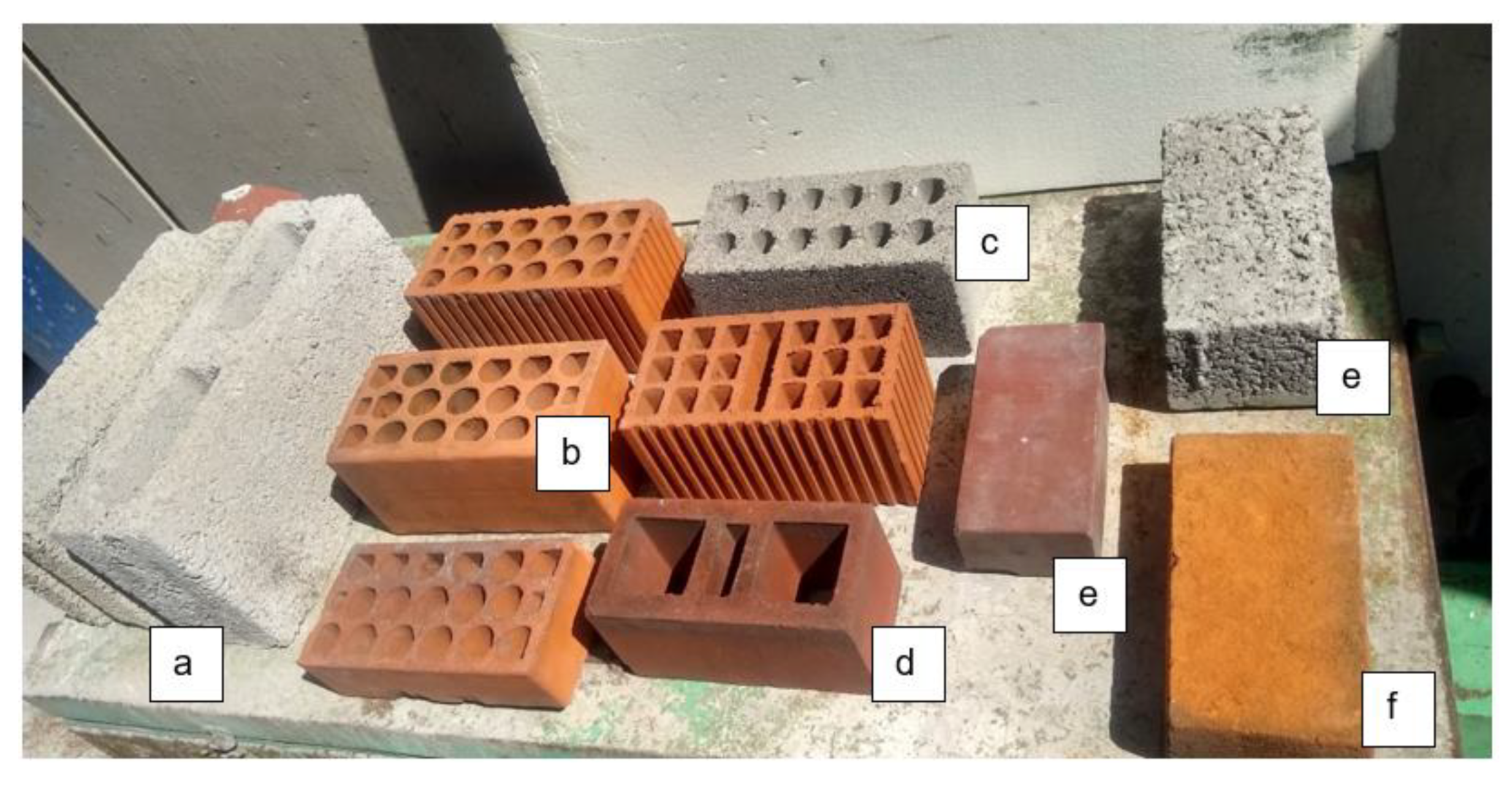
CM construction has been practised in a number of European countries (Italy, Slovenia, Croatia, North Macedonia, Romania, and Serbia), as well as in Latin America (Mexico, Chile, Peru, Colombia, Argentina, and Venezuela), the Middle East (Iran, Algeria, and Morocco), South Asia (Indonesia), and the Far East (China). The combined population of countries in which CM construction has been practised is over 3.5 billion (nearly one-half of the world’s population) and spans five continents [7]. Examples of global CM applications have been documented by Brzev and Mitra [1]. A review of international seismic design codes and guidelines for CM buildings was presented by Brzev et al. [8]. Based on the review of global CM design and construction practices, it can be concluded that the differences are not significant. The main source of variation is related to the application of different masonry units, ranging from solid clay bricks to multi-perforated clay blocks (also known as modular blocks) and hollow/solid concrete blocks. The size of masonry units, often limited by local masonry manufacturing practices, influences the wall thickness and the size of RC confining elements. Secondly, the type of masonry unit also influences the interface between masonry wall and adjacent RC tie-columns (toothing or reinforcing bars). Since different construction practices may influence the seismic behaviour of CM walls, the results of statistical analysis of experimental data based on the testing of CM specimens constructed using different masonry units need to be used to establish various prediction models.
This paper presents an overview of previous experimental research studies related to the behaviour of CM wall structures subjected to the effects of axial loading, flexure and shear due to in-plane and out-of-plane seismic actions and complements previous review studies on the behaviour of CM structures under in-plane seismic actions [9]. Comprehensive research studies on seismic behaviour of CM structures performed mainly in Latin American countries, e.g., Mexico, Peru, and Chile from the 1960s to the present were considered in this study. The authors also acknowledge the contributions to research and the state of practice of CM construction by researchers from other Latin American countries not included in the paper, e.g., Argentina, Colombia, Venezuela, etc. Selected experimental studies performed in other countries and regions have also been considered in this paper. The following text provides a historic overview of research studies on structural and seismic performance of CM structures from Mexico, Peru, and Chile.
Formal investigations on the behaviour of masonry structures in Mexico began after the 1957 earthquake. Early research studies were focused on axial strength of masonry walls [10], the effect of eccentric axial forces [11,12], and ductility [11,13]. Subsequently, extensive research efforts have been directed towards studying the mechanical properties of masonry components [14], cracking of walls due to differential settlements [15], and the behaviour of walls under cyclic loading [16]. The results of previous Mexican research studies were summarised in a report, which also included some post-earthquake observations and design recommendations [17]. A major analytical research study was subsequently performed [18].
The performance of high-strength reinforcing bars for masonry walls was studied [19,20], along with different reinforcing strategies [21,22,23]. Expressions for estimating the contribution of horizontal reinforcement were proposed based on the Mexican research studies [24,25,26,27]. Strategies for the retrofitting and design of CM shear walls with external welded wire mesh were explored [28,29,30]. In 1991, the National Centre for Disaster Prevention (CENAPRED) was created in Mexico City. New facilities included the fully equipped Structures Laboratory donated by the Japanese government, which greatly enhanced experimental research capabilities. In 1997, the first shaking table in Mexico, donated by the Kajima Technical Research Institute of Japan, was inaugurated at UNAM (4 m × 4 m dimensions, five degrees of freedom, 20-ton load capacity), and the first CM building model was tested in 1999 [31].
The results of previous investigations culminated in the development of a new design code for CM structures [32]. Active research in the subsequent years led to the development of subsequent edition of the code in 2017 [33,34]. Shear strength design provisions for CM walls were fully revised based on several research studies [35,36,37,38,39]. The contribution of joint reinforcement to the shear resistance of CM walls was also studied [40,41]. Design expressions for masonry walls supported by beams and the related numerical models were developed [42,43,44]. A state-of-the-art approach for analysis and design of masonry structures, including CM structures, was presented in major publications [45,46]. Shaking-table investigations have continued to produce much-needed data on the seismic behaviour of mid-rise CM structures [47,48,49]. Performance of CM walls under out-of-plane lateral loading and the corresponding design approaches have been extensively studied in recent years [50].
The first application of CM construction in Peru was reported in the 1940s. Experimental testing of masonry wall specimens started after the inauguration of the Structures Laboratory of the Catholic University of Peru (PUCP) in 1979 [51]. Professor Angel San Bartolomé conducted several experimental studies on CM walls, including the effect of horizontal reinforcement and the level of axial load on the response of walls subjected to lateral cyclic loading, as well as the effect of in-plane slenderness [52,53]. Shaking-table testing of a half-scale three-storey CM building was performed [54]. Another study was focused on the comparison of behaviour of CM walls with toothed masonry-concrete interface versus the walls with horizontal steel dowels. The study was motivated by the good performance of CM walls with horizontal dowels in the 1985 Llolleo, Chile earthquake. The Japan–Peru Centre for Seismic Research and Disaster Mitigation (UNI-CISMID) was inaugurated in 1989 and included a strong wall facility, which enabled pseudo-dynamic testing of multi-storey CM walls [55]. A historic overview of research and code development related to CM structures in Peru was presented by Quiun and Santillán [56].
CM construction has been practiced in Chile since the 1930s, and has demonstrated good seismic performance in numerous damaging earthquakes [5,57]. Experimental studies on 22 CM wall specimens subjected to in-plane reversed cyclic loading performed in the 1990s were used to develop an analytical model for predicting nonlinear behaviour of CM structures [58]. Another experimental study was performed on CM walls with openings subjected to reversed cyclic loading and it involved the testing of 16 full-size specimens. A few research studies have been performed focusing on the effect of wall density on the seismic vulnerability of CM buildings in Chile [59,60], and the prediction of seismic displacement demands in CM structures [61].
The paper presents a review of previous experimental research studies related to the behaviour of CM wall structures subjected to axial loading, flexure, and shear due to in-plane and out-of-plane seismic actions. Experimental databases were compiled and analysed to identify relevant design and construction parameters and their influence on the seismic behaviour of CM buildings. A few other important design and construction aspects, such as the influence of masonry materials, the effect of openings in CM walls, and the interface between the masonry and adjacent RC confining elements, are also discussed. This paper is focused on engineered CM structures designed according to the applicable codes and guidelines, as opposed to non-engineered CM construction practices, which are not compliant with the design codes/guidelines, but are found in many countries.

2. In-Plane Shear Behaviour

CM walls subjected to in-plane lateral loads most often experience behaviour leading to a diagonal tension shear failure mechanism [62]. This mechanism is characterised by the development of inclined cracks in the masonry walls that ultimately propagate into the RC confined elements and culminate in failure [3] (Figure 1). It is important to note that some codes, e.g., the Mexican [33] and Peruvian [63] ones, define the shear strength of CM walls without horizontal reinforcement as the strength at the onset of cracking (stage 1), while the maximum shear strength while considering steel contribution (stage 2) is used for the design of walls with horizontal reinforcement. The shear strength of a CM wall, v R , is determined as the sum of several components, including masonry, v m , axial stress, v p , and horizontal reinforcement, v s , as follows:
v R = v m + v p + v s
Figure 1. Mechanism of shear resistance for a CM wall panel: (1) the onset of diagonal cracking; (2) maximum shear strength; and (3) failure (reprinted from [3] with permission of the publisher, the Earthquake Engineering Research Institute). Note that the force–displacement curve shows a CM wall (solid line) and a URM wall (dashed line).
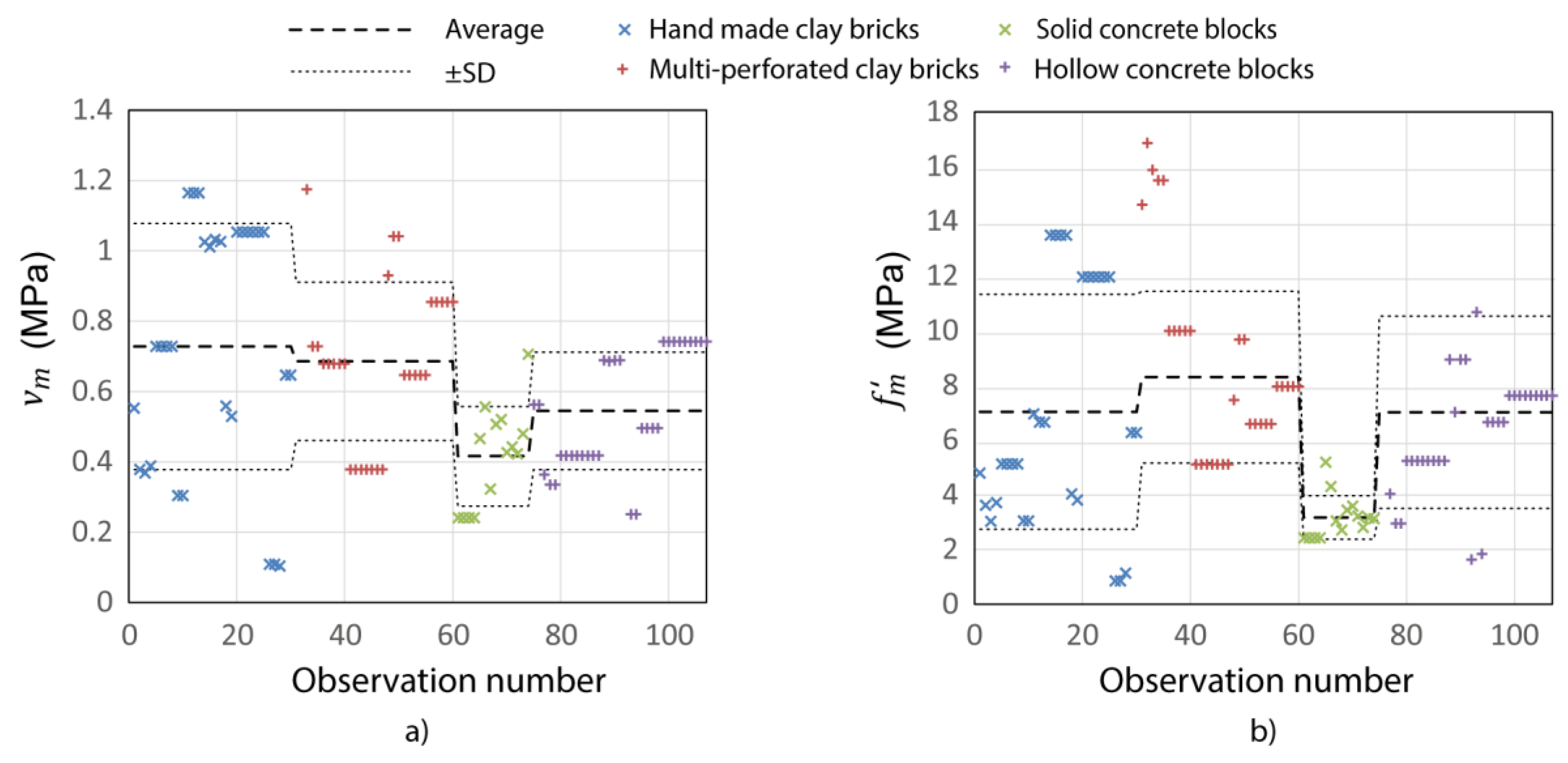
A review of the key parameters influencing the shear strength of CM walls is presented in this section, primarily based on the findings of previous international research studies. The authors also performed a statistical analysis using a database compiled by Treviño [64], which contains detailed data on 104 CM wall specimens from 26 experimental studies performed in Mexico, Peru, Venezuela and Chile [13,16,65,66,67,68,69,70,71,72,73,74,75,76,77,78,79,80,81,82,83,84,85,86,87,88] (see Table A1 and Table A2 in Appendix A for more information). The test specimens were subjected to either monotonic or reversed cyclic lateral loading, subjected to different axial stress levels, with different wall dimensions, masonry material properties (masonry units and mortar), as well as RC tie-column materials and reinforcement. All of the specimens included in the database were solid walls (i.e., without openings). The experimental data were used to establish relationships between different specimen design parameters and masonry strength, using a simple univariate analysis.

2.1. Masonry Component

It has been recognised by numerous researchers that several parameters influence the shear strength of unreinforced masonry, v m , including the wall’s aspect ratio ( H / L ), shear–moment interaction, and the level of axial stress. For the purpose of this study, the masonry component of shear strength can be presented in the following form:
v m = a v m f
where 𝑎 is an empirical constant, which is usually in the range from 0.3 to 0.5 (based on previous research studies), v m is the diagonal compression strength, and f is a factor that considers the wall’s aspect ratio.

2.1.1. The Effect of Masonry Tensile Strength

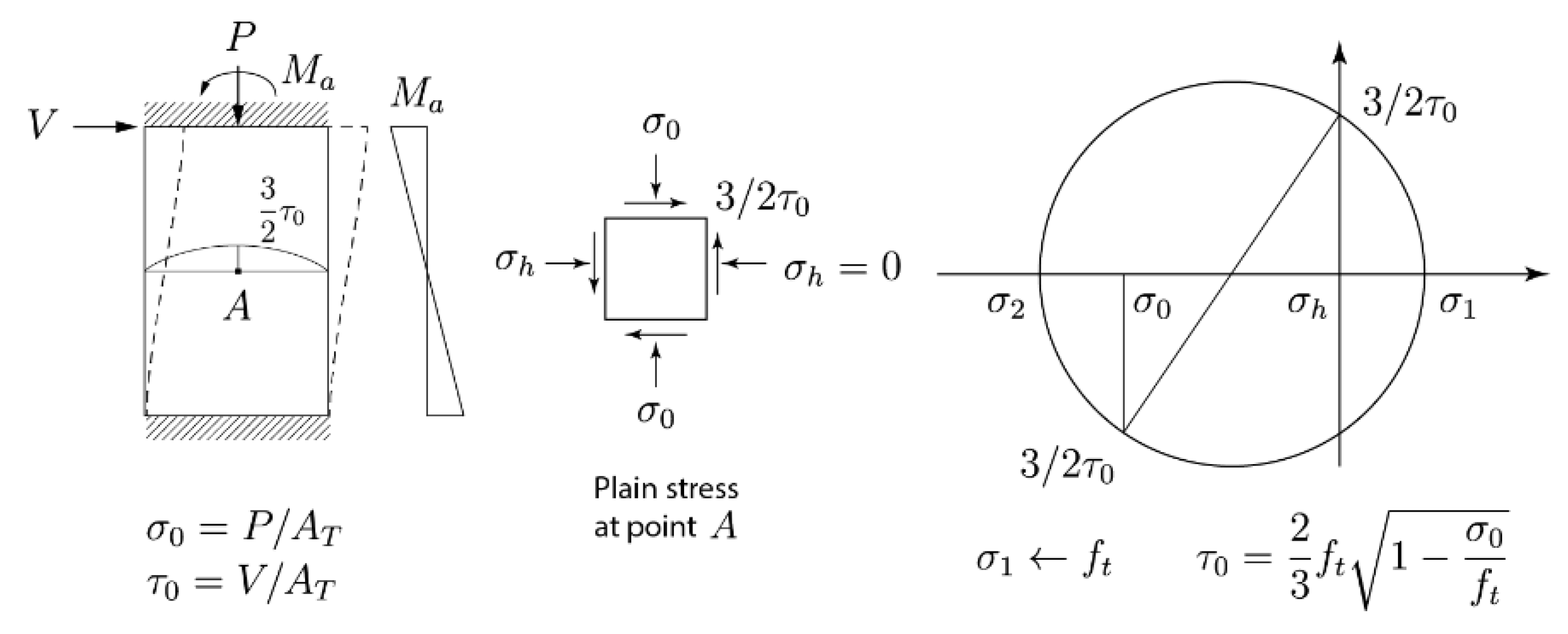
The notion that the shear strength of a wall at the onset of cracking is related to the tensile strength of the masonry and the corresponding axial stress is based on the stress analysis at the section located at the centre of the wall [89] (Figure 2). Shear strength is calculated by setting the principal tensile stress to be equal to the tensile strength of the masonry, f t , which can be determined experimentally. In a hypothetical situation, a wall is not subjected to axial compression, and the shear strength of the masonry depends only on the tensile strength of the masonry. The shear strength of the masonry, v m , can be determined by performing diagonal compression tests. Alternatively, it can be estimated as a function of f m , where f m denotes the compression strength of the masonry (which can be determined based on either the gross or net area of the section).
Figure 2. Masonry shear strength τ 0 as a function of the axial stress σ 0 ; diagonal tension shear mechanism.
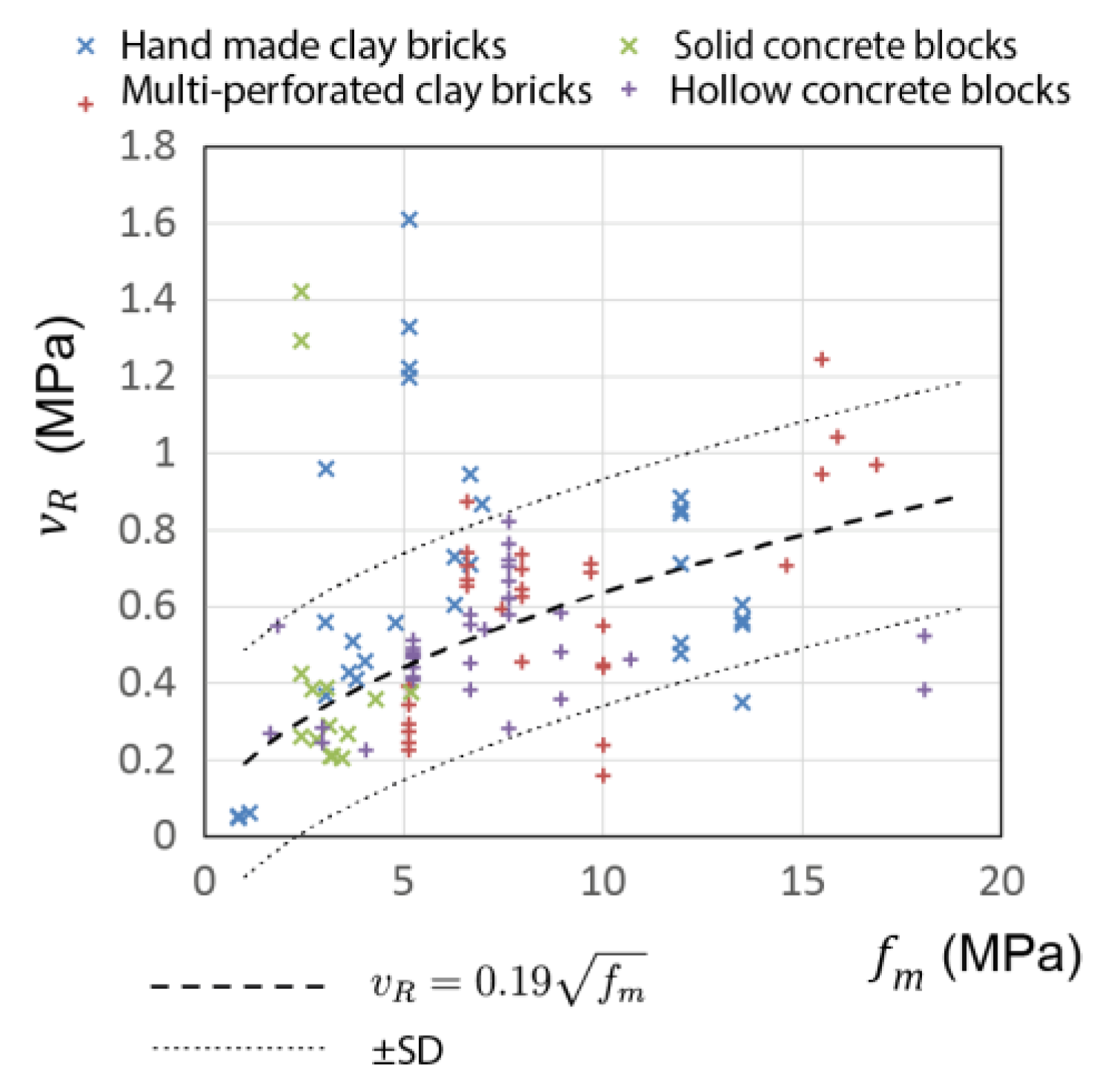
The above-mentioned experimental database [64] was used to establish a relationship between the CM shear strength, v R , and the compression strength of the masonry, f m , as shown in Figure 3. It was shown that the following power function
v R = a 1 f m a 2
offers the best fit for the input data, with a 1 = 0.19 and a 2 = 0.52 . Note that the exponent a 2 = 0.52 shows that the masonry shear strength is directly proportional to the square root of the compressive strength of the masonry, f m ; this is similar to the findings of previous studies on RM walls [90].
Figure 3. Relation between CM shear strength, v R , and the masonry compressive strength, f m (data from [64]).
The above equation can be presented in a form suitable for design applications, as follows:
v R = 0.19 f m

2.1.2. The Effect of Wall Aspect Ratio

An equation for the f factor, can be presented in the following form
f = b c M V L ; M V L < 1
where b and c are empirical constants determined through experimental studies. For example, D’Amore and Decanini [91] analysed the results of past experimental studies on 58 CM wall specimens with aspect ratios ranging from 0.62 to 2.95; of these, 39 specimens were subjected to reversed cyclic loading and 19 specimens were subjected to monotonic loading. The results indicated that shear resistance of CM walls should be reduced for slender walls ( H / L > 1 ) in order to take into account shear–moment interaction. They proposed a factor similar to the one defined in Equation (5), where b = 1.35 and c = 0.35 .
Alvarez [92] analysed the experimental results for 17 walls tested under reversed cyclic lateral loading in Mexico, Peru, and Chile. It was argued that, since the aspect ratio changes the internal stress distribution in a wall, it can be expected that the shear strength of walls with different aspect ratios should be different. The research study also confirmed that flexural deformation was more significant in slender walls, and that the shear strength can be expected to decrease with increasing aspect ratio, even when the failure mechanism does not change. The study also indicated an increase in the shear strength of walls with lower aspect ratios. Based on the findings of the study, Alvarez proposed an f factor similar to that in Equation (5); however, the aspect ratio H / L was used instead of the shear span ratio M / V L , and the following coefficients were used: b = 1.35 and c = 0.35 .
The following equations were proposed by Pérez Gavilán, Flores, and Alcocer [35] based on the results of an experimental research program performed on CM walls:
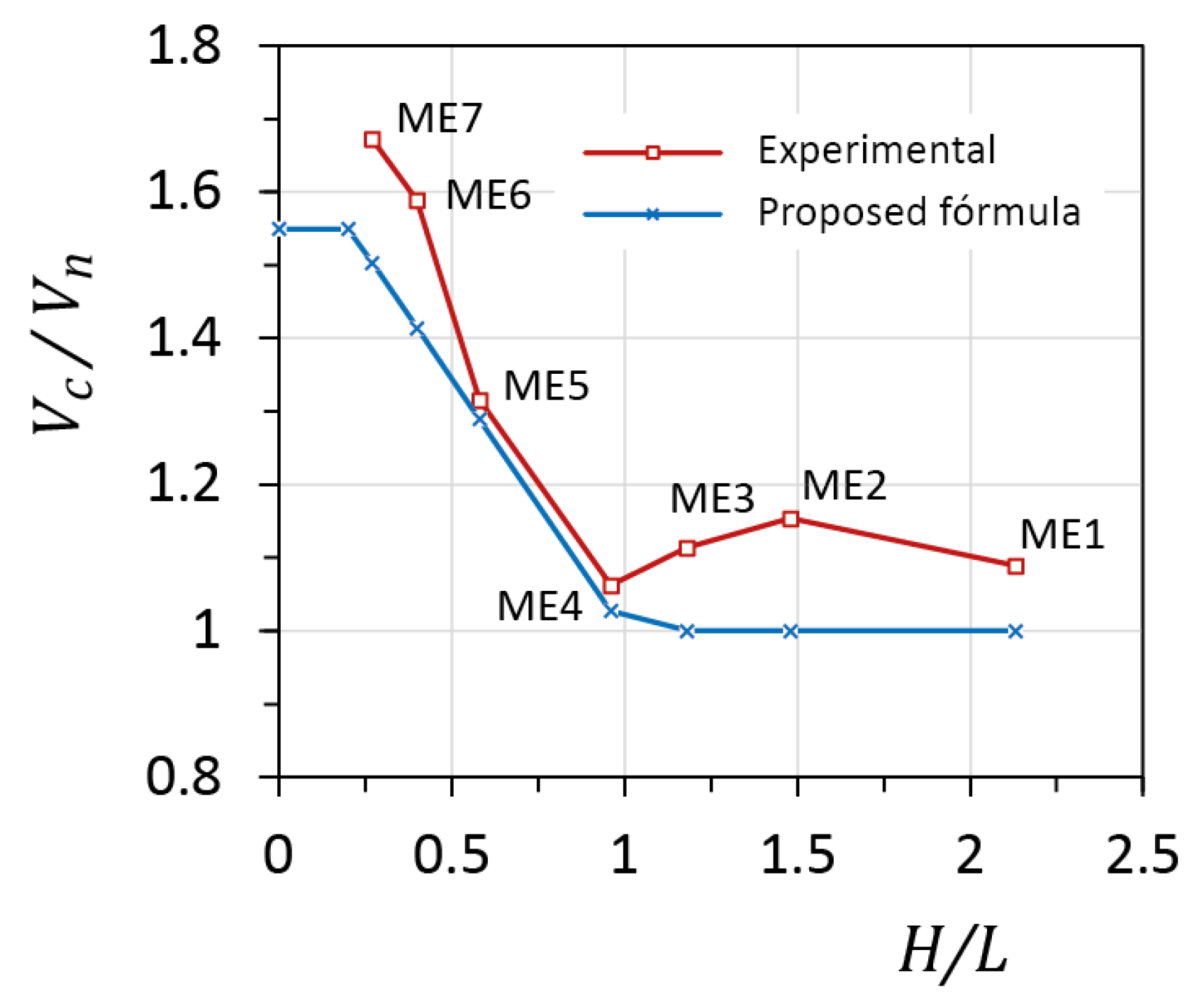
f = 1.55 f = 1.69 0.69 h e / L f = 1 h e / L < 0.2 0.2 h e / L 1 h e / L > 1
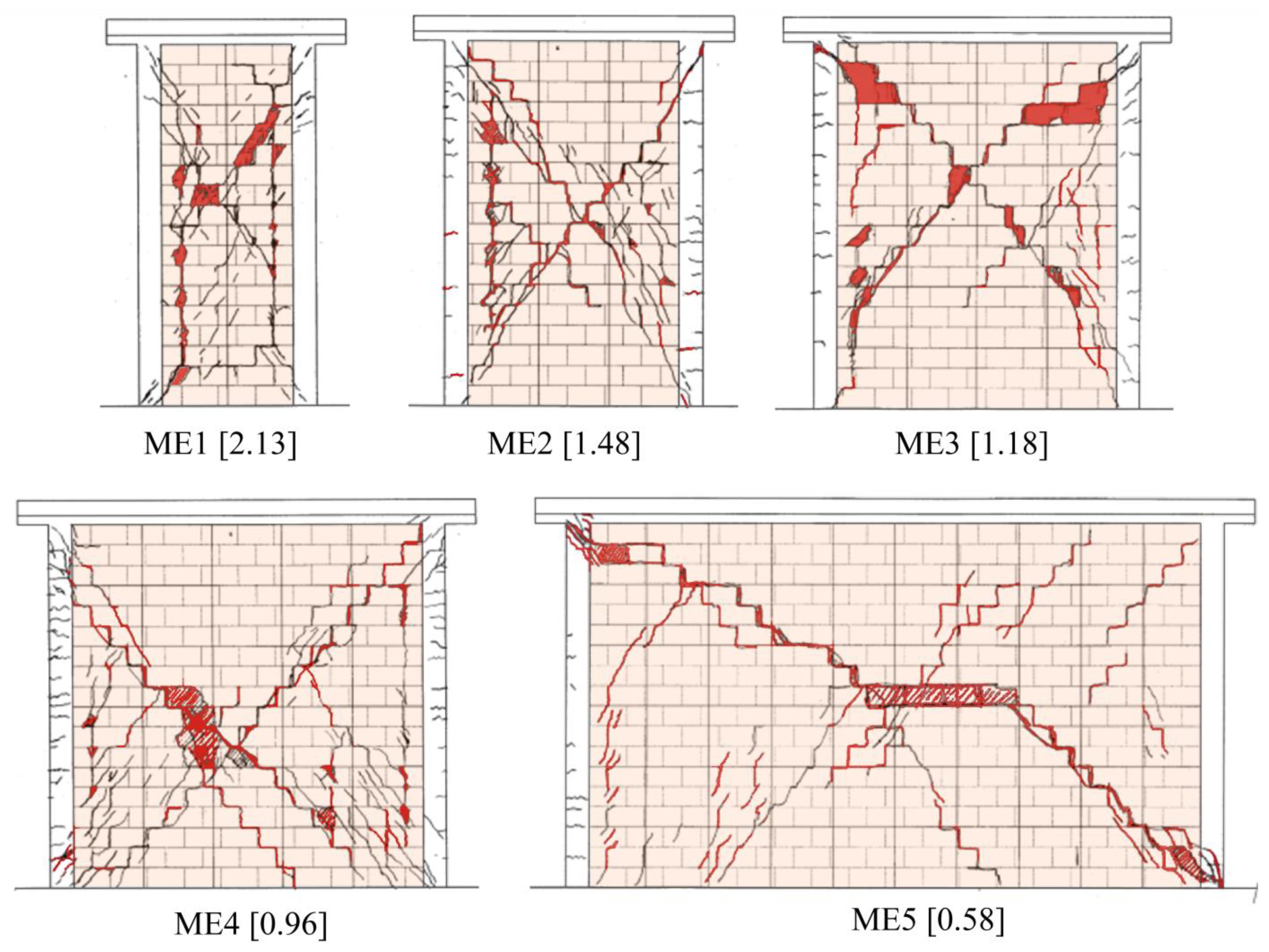
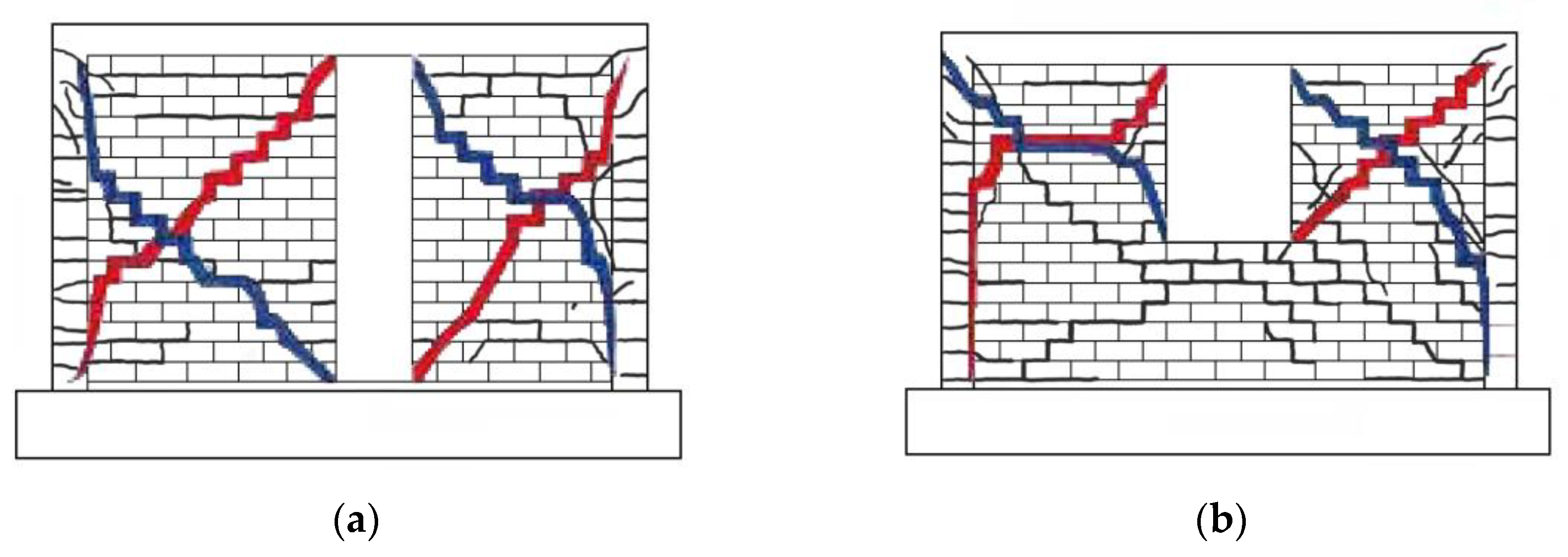
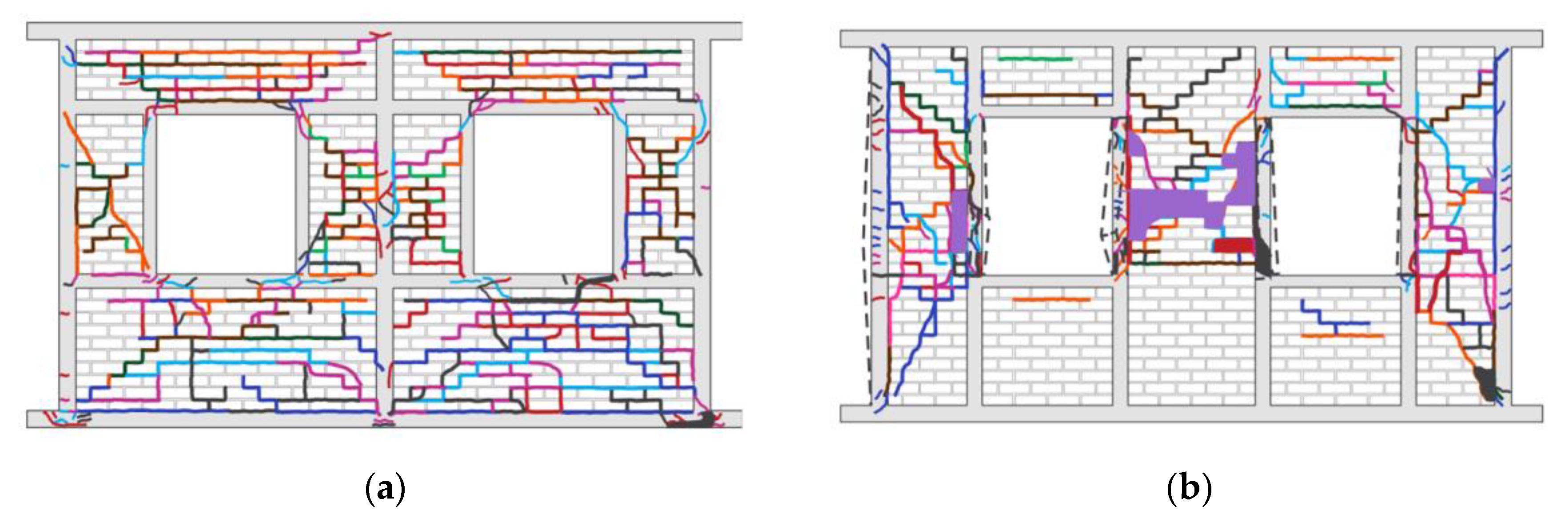
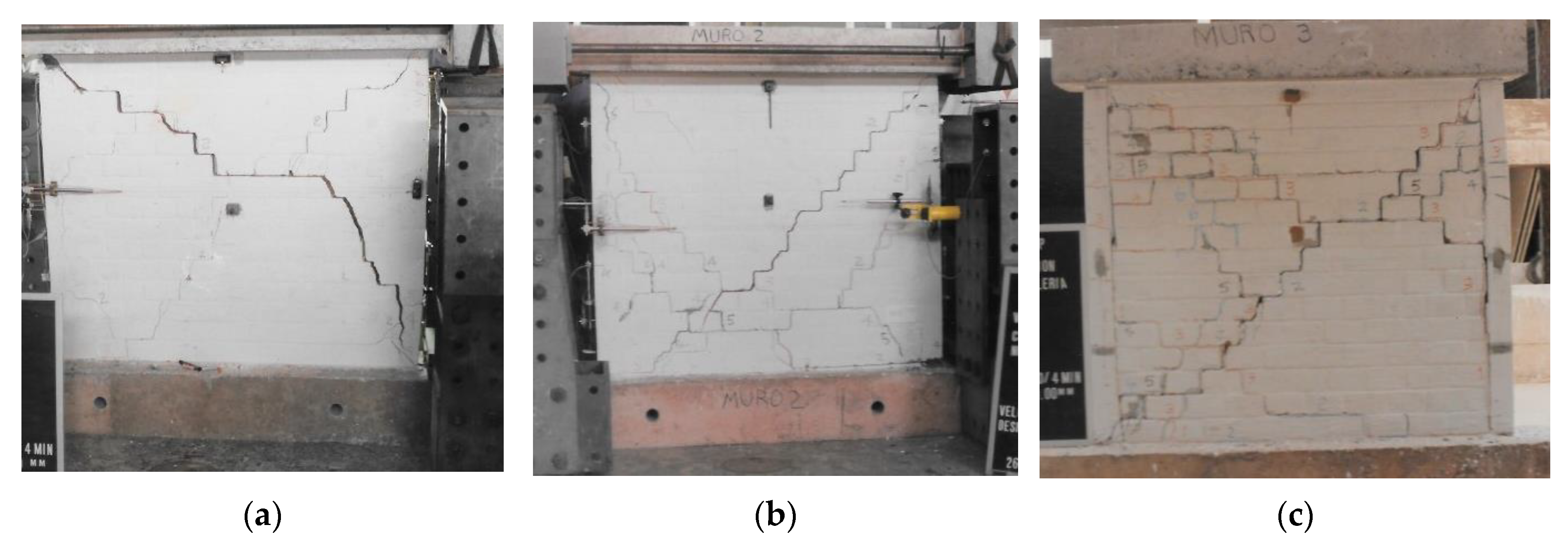
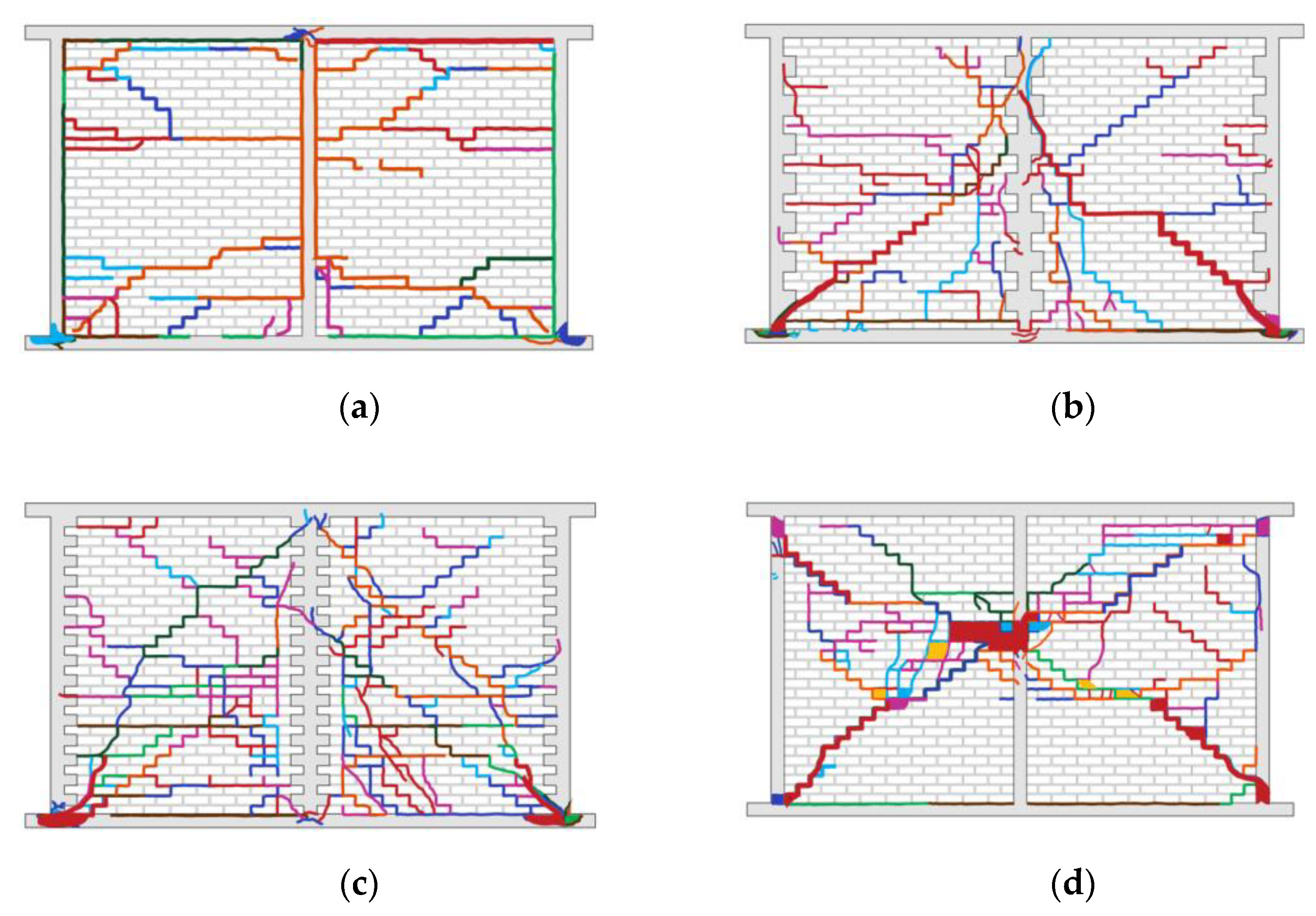
It can be seen that, according to the proposed equation, the values b = 1.69 and c = 0.69 should be used in Equation (5). The 𝑓 factor, as presented above, was incorporated in the latest Mexican masonry design code [33] as a multiplier in the shear resistance equation for CM walls. However, in the formula in the Mexican code, the f factor is also applied to the axial stress component, that is, ( a v m + d σ 0 ) f , where the axial component d σ 0 will be discussed later in this section. The experimental results and the proposed formula are plotted in Figure 4. The CM specimens at the ultimate stage of testing are shown in Figure 5.
Figure 4. Experimental versus predicted shear resistance at the onset of cracking (adapted from [35]).
Figure 5. Damage patterns for various test specimens at the end of the test (the corresponding aspect ratios are shown in brackets) (adapted from [35]).
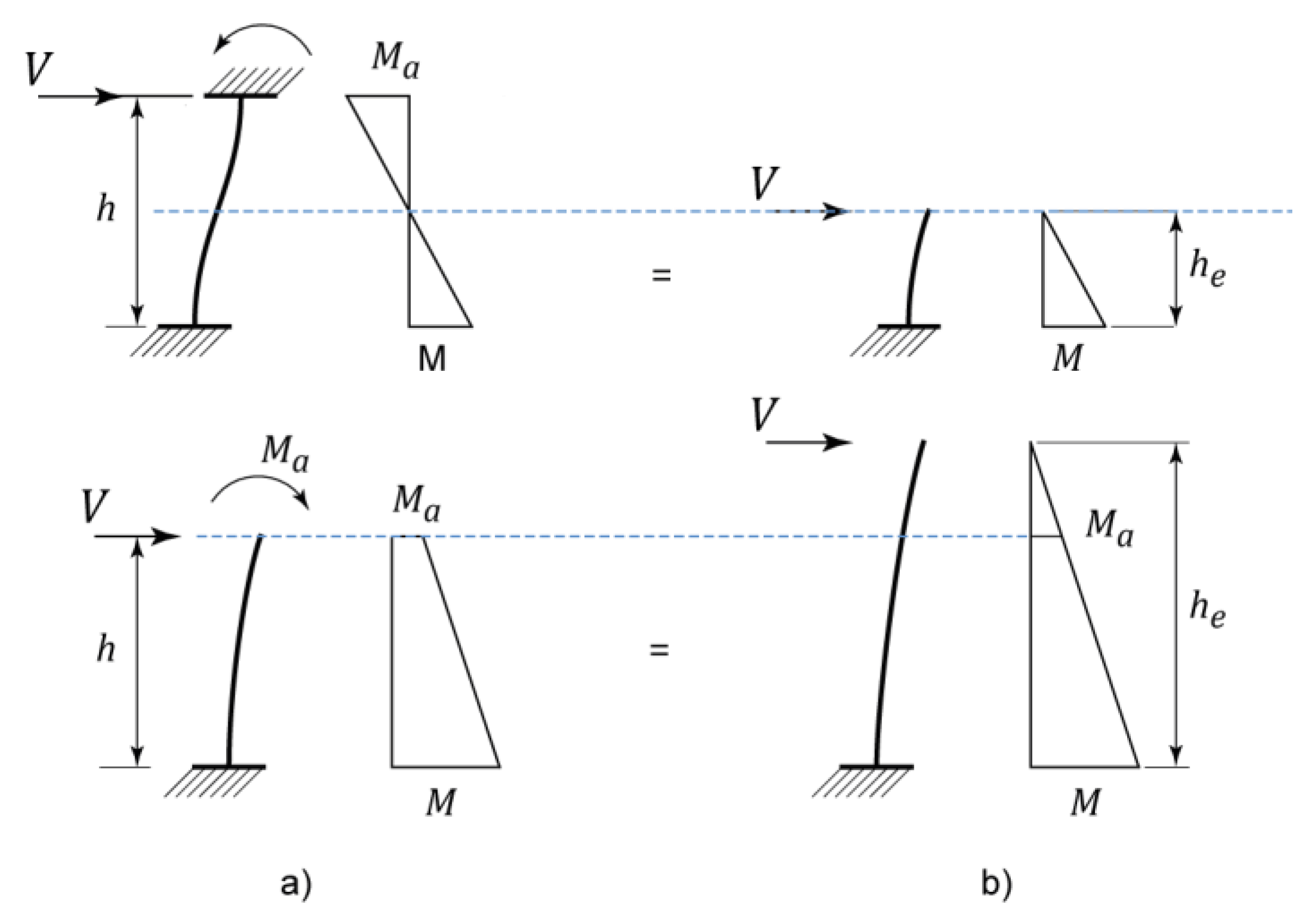
Marques and Lourenço [9] also reviewed test data from previous research studies and confirmed the effect of aspect ratio on the shear strength of masonry; however, the effect of wall aspect ratio was considered an independent term, as opposed to a multiplier for the overall shear strength, which is used in the Mexican masonry code [33] and in design provisions for reinforced masonry (RM) walls in several international design codes. Past research studies have shown that shear span ratio ( M / V L ) is a more useful parameter than the aspect ratio ( H / L ), because it is able to account for different boundary conditions when M / V is considered to be the effective wall height, see Figure 6 [35]. Note that 𝑉 is the applied shear force, 𝑀 is the bending moment acting on the wall section under consideration (usually located at the base of the wall), and L denotes the length of the wall.
Figure 6. Effective height for different boundary conditions: (a) actual boundary conditions and (b) the corresponding effective heights h e / L = M / V L (adapted from [35]).

2.1.3. Shear–Moment Interaction

Boundary (end support) conditions in masonry shear walls may range from a cantilever condition (fixed at the base and free at the top), which corresponds to single-curvature bending, to a fixed–fixed condition (i.e., with both ends fixed), which corresponds to double-curvature bending (see Figure 6). It appears that the presence of a bending moment at the top causes a decrease in the shear resistance of a masonry wall. Unfortunately, experimental research evidence related to this topic is very limited, at least in the context of CM walls. The Peruvian masonry design code [63] included a reduction in the shear strength for slender walls ( H / L > 1 ) due to the moment at the top of the wall, based on the results of a numerical study [93].
Based on a review of the experimental data related to 58 CM walls, D’Amore and Decanini [91] proposed a factor to account for shear–moment interaction in walls with aspect ratio H / L > 1 . The proposed factor resulted in a decrease in the shear strength due to an increase in the bending moment at the top.
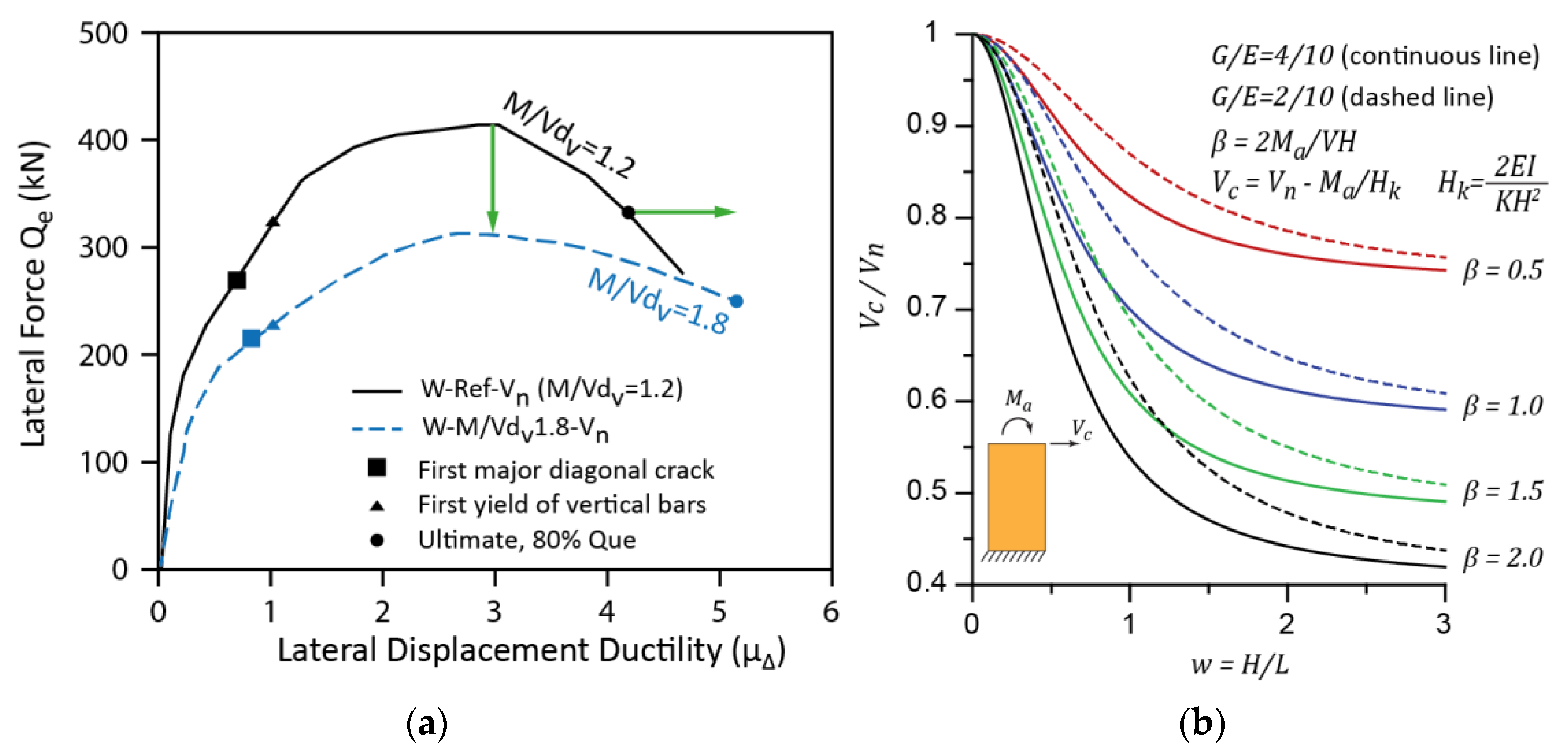
The effect of shear–moment interaction was examined in an experimental study on five fully grouted RM walls with H / L = 1 [94]. The results indicated the effect of M / V L ratio on the shear resistance and ductility of the test specimens (Figure 7a). The specimen with M / V d v = 1.2 (corresponding to M / V L = 1.25 , solid line) attained a shear capacity that was by approximately 25.0% higher than the corresponding capacity of an otherwise identical specimen with M / V d v = 1.8 . It was also observed that the specimen with a lower shear capacity demonstrated a somewhat higher ductility.
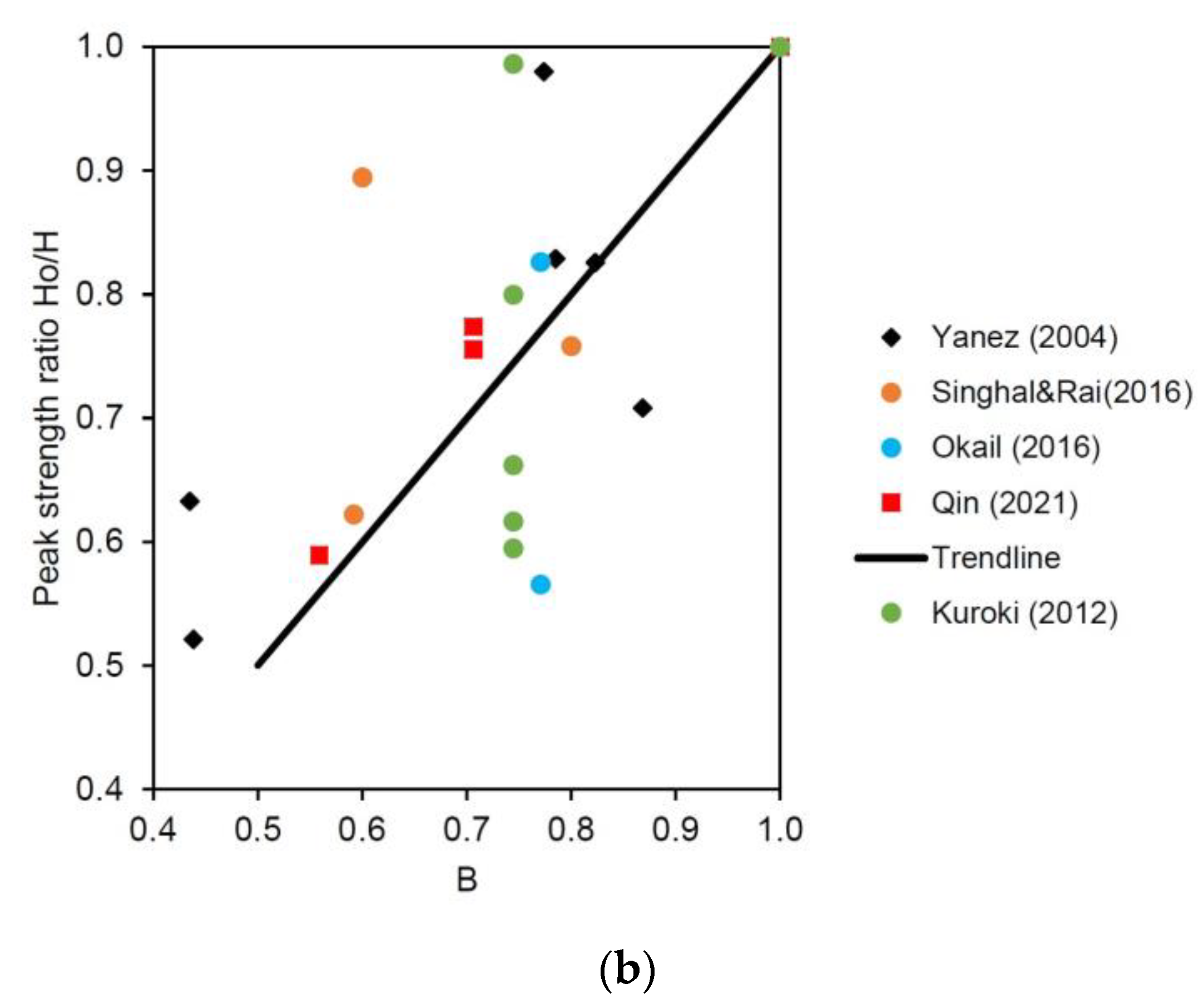
Figure 7. Moment–shear interaction in masonry walls: (a) the effect of shear span ratio on the shear resistance of RM walls (adapted from [94]) and (b) the effect of moment at the top on the normalised shear resistance of CM walls with different aspect ratios (adapted from [39]).
Pérez Gavilán [39] proposed an approach for reducing the shear strength of CM walls, based on the hypothesis that diagonal cracking occurs when a threshold lateral displacement is attained, regardless of whether the lateral displacement is due to lateral force, bending moment, or both. An experimental study on six CM wall specimens subjected to reversed horizontal cyclic loading and bending moment at the top was performed to verify the proposed hypothesis. The ratio of the shear resistance with a moment on top of the wall, V c , and the shear resistance without moment at the top (cantilever condition), V n , is shown on the vertical axis in Figure 7b, while the aspect ratio of the wall ( w ) is shown on the horizontal axis. The key parameter affecting the extent of reduction in shear strength is a normalised moment β (ratio of bending moment at the top of the wall and the moment corresponding to the fixed–fixed condition). Note that β = 1 corresponds to the fixed–fixed condition (double-curvature bending), while β = 0 corresponds to the cantilever condition. Figure 7b shows the results for single curvature bending. The results also depend somewhat on the ratio of the moduli of rigidity and elasticity for masonry G / E , which ranged from 0.2 to 0.4 (see dashed and solid lines on Figure 7b). It can be seen from the diagram that V c / V n ratio rapidly increases when aspect ratio ( w ) is less than 1.0 (squat walls); therefore, the effect of shear–moment interaction is insignificant for squat walls. However, a significant decrease in the V c / V n values can be observed when w increases from 1.0 to 3.0; this effect is particularly pronounced for higher β values (1.0 to 2.0), which may correspond to walls in multi-storey buildings. Based on the analyses of several real-life structures, the results of another research study [95] pointed out that shear–moment interaction term may be important for squat walls with aspect ratios in the range from 0.5 to 1.0. Note that slender walls are usually not affected by shear–moment interaction because they typically experience double-curvature bending.

2.2. The Axial Stress Component

An interaction between compression and shear stresses in masonry walls is well established [96]. Low to moderate axial compression enhances the shear strength of masonry walls by delaying the onset of cracking in the wall, because axial compression causes a decrease in the magnitude of principal tensile stress. An experimental study on RM wall specimens [97] showed that a relatively modest increase in axial compression stress from 0 to 2.5% of the masonry compression strength f m resulted in an increase in the wall shear resistance of more than 20%. It was also observed that RM walls subjected to higher axial compression stresses had a reduced post-cracking deformation capacity, thereby resulting in a more brittle failure mechanism. Based on the statistical analysis of test data on RM shear walls, Anderson and Priestley [98] recommended taking the axial stress component of the masonry shear strength to be 25% of the applied axial stress due to wall self-weight and tributary load from the floors and roof; this was incorporated in the Canadian masonry design code CSA S304-14 [99]. Several research studies on RM shear walls have confirmed a positive effect of axial compression on the masonry shear resistance. In the post-cracking stage, axial compression in the wall causes a delay in the initiation of diagonal cracks, controls the crack width, and improves the force transfer through an aggregate interlocking mechanism [97,100].
According to the New Zealand masonry code (NZS 4230 2004) [101], which is mostly focused on the design of RM walls, axial compression is transmitted from the top to the base of an RM wall by means of a compression strut inclined under an angle 𝛼 with regard to the wall axis, with a magnitude that depends on the boundary conditions (cantilever/fixed). The horizontal component of the strut force ( tan α σ 0 ) is taken as the axial stress component of the wall’s shear resistance.
The axial stress component of the shear strength for a CM wall has been found to have a significant effect on its shear strength [9,13,102], and can be presented as follows:
v p = d σ 0
where d is an empirical constant, usually in the range from 0.2 to 0.4, but it may be taken to be equal to 0.4, while σ 0 denotes the axial stress applied to the wall.
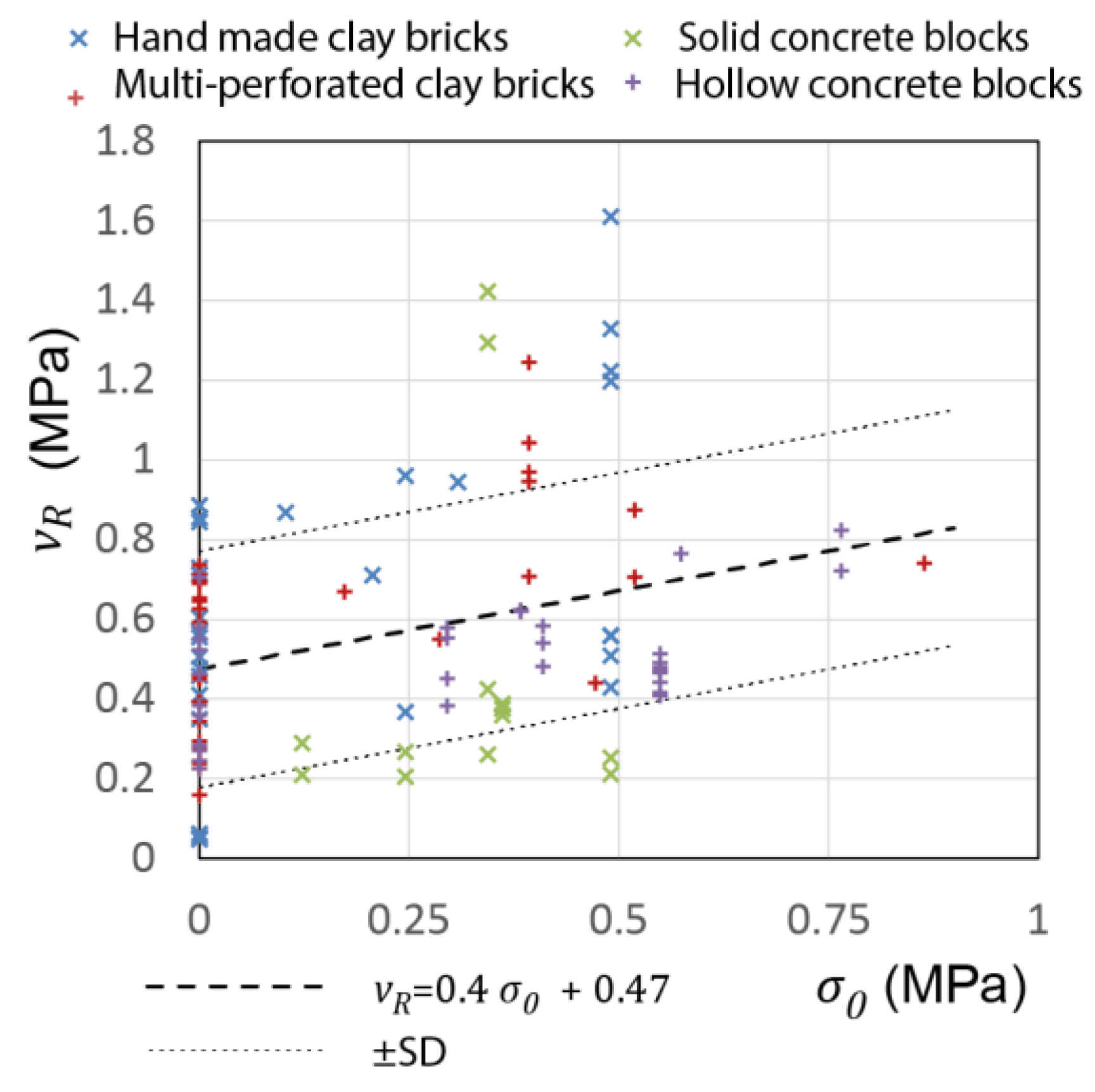
An experimental database [64] was used to establish a relationship between the CM shear strength v R and compressive stress σ 0 , as shown in Figure 8. It should be noted that 104 data points were considered; of these, 48 points corresponded to specimens that were not subjected to axial compression. It was shown that the following linear function
v p = d 1 σ 0 + d 2
offers the best fit for the given data when d 1 = 0.3952 (rounded to 0.40) and d 2 = 0.4743 (rounded to 0.47). Note that the independent term d 2 denotes an average shear stress resistance of the CM wall without axial stress.
Figure 8. The effect of axial stress on the masonry shear strength in CM walls based on statistical analysis of experimental data [64].

2.3. Contribution of Horizontal Reinforcement

CM walls may include horizontal reinforcement, usually in the form of ladder-type wire, known as joint reinforcement (JR), which is anchored into the RC tie-columns. The contribution of the reinforcement to the shear strength of a CM wall, 𝑣R, can be presented as follows:
v s = e ρ h f y h
where e is an empirical constant, ρ h is the horizontal reinforcement ratio, and f y h is the steel yield strength for JR. For RM walls, the value of e is typically in the range from 0.4 to 0.8 [99,101,103]. It should be noted that in RM walls, the main horizontal reinforcement contributing to the shear resistance comes in the form of reinforcing bars, similar to those used in RC structures, although JR may also be provided for non-structural purposes. In Mexico, ladder-type JR is no longer used, because it was shown that welded cross wires tended to fail, and small-diameter, high-strength bars ( f y h = 600 MPa) are currently used.
Several researchers have proposed mechanical models for predicting the contribution of horizontal reinforcement to CM shear strength [104,105]; however, the accepted model is still mostly empirical, that is, it is based on the experimental evidence [16,25,26,90,106,107,108].
The contribution of horizontal reinforcement to the shear strength of RM and CM walls was determined based on the assumption of a single diagonal crack inclined under a 45° angle with respect to the horizontal axis [98]. It is considered that horizontal reinforcement is engaged in resisting internal tensile stresses in the wall only after the first crack extends in an incline relative to the reinforcement [107]; this was verified by measuring tensile strain in the JR in an experimental study [40]. When a CM wall experiences the sliding failure mode, JR is no longer effective at resisting shear stress, but it could enhance the wall’s lateral drift capacity [49]. A review of the results of previous experimental studies on CM walls showed that JR does not seem to increase their ductility [109].
Matsumura [90] suggested that the contribution of horizontal reinforcement in RM walls depends on the masonry compression strength, f m . The same finding was later confirmed by an experimental research study on CM walls, which also revealed an upper limit for the amount of JR (expressed as a function of the f m ), beyond which it is not possible to attain a further strength increase [40]. As a consequence, CM walls with a low masonry compression strength, f m , may experience only a marginal increase in shear strength due to the use of JR. However, JR could be effective at increasing their displacement capacity.
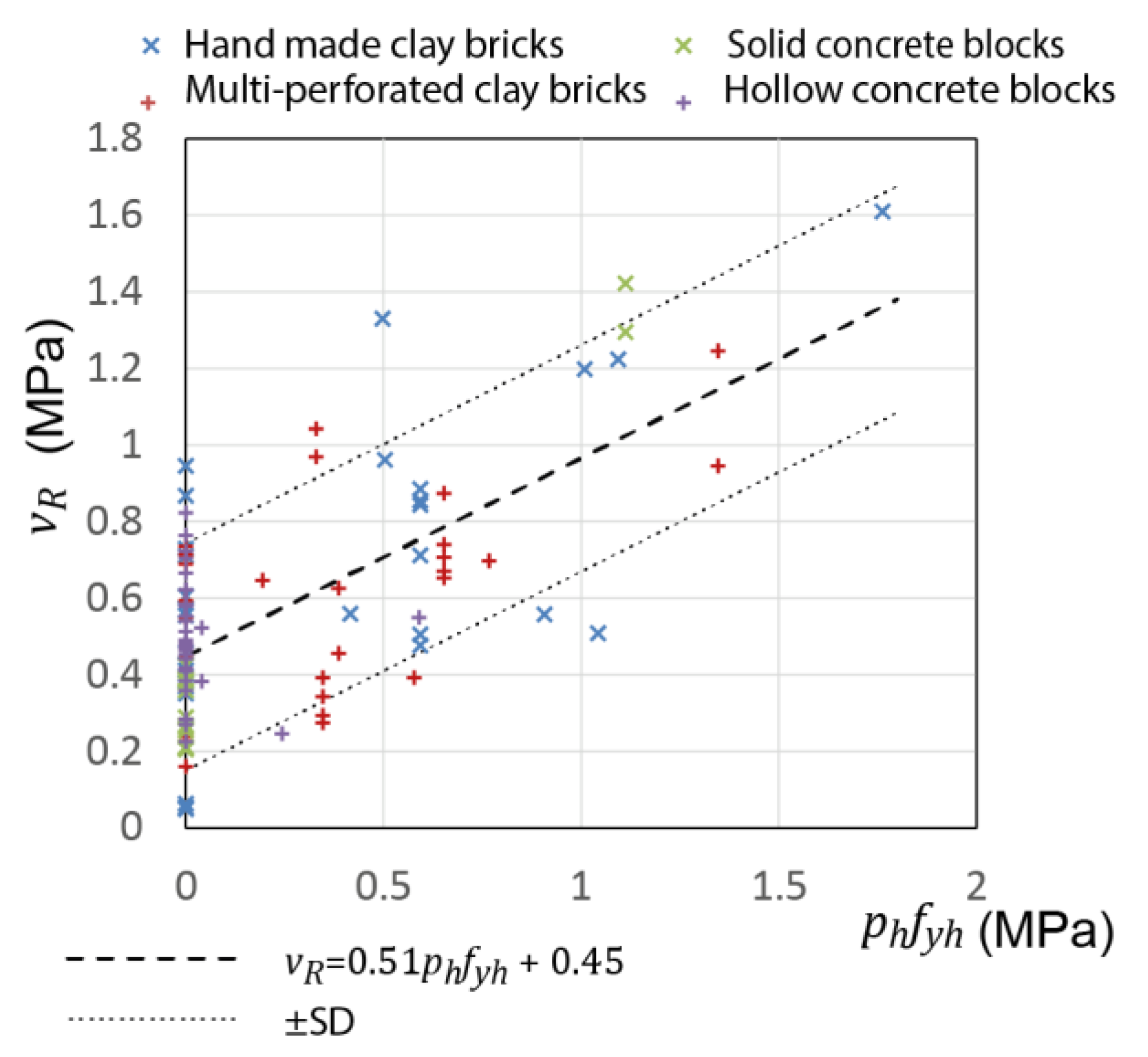
An experimental database [64] was used to estimate the contribution of JR to the shear strength of the steel component of CM, as shown in Figure 9. It should be noted that 104 data points in total were considered in the statistical analysis; of these, 69 points corresponded to specimens without JR.
Figure 9. The effect of horizontal joint reinforcement (JR) on CM shear strength (based on the experimental database [64]).
It was shown that the following linear function provided the best fit:
v s = e 1 ρ h f y h + e 2
where e 1 = 0.5186 (rounded to 0.51) and e 2 = 0.447 (rounded to 0.45); hence, 0.5 is recommended as a reasonable value for e 1 in Equation (10).

2.4. The Effect of RC Tie-Columns

RC tie-columns are important components of CM walls, and influence their in-plane shear strength and lateral displacement capacity. Research studies have shown that the tie-columns prevent wall disintegration and provide additional shear capacity in the post-cracking stage. Borah, Kaushik and Singhal [110] performed an experimental study on six half-scaled CM wall specimens subjected to reversed cyclic loading to examine the effect of the amount of longitudinal reinforcement in RC tie-columns on the shear and lateral displacement capacity of CM walls. The longitudinal reinforcement ratio in tie-columns ranged from 0.7% to 1.0%. The results indicated a significant increase both in the shear and displacement capacity by more than 40% in non-squat CM wall specimens, while in the squat specimens there was no significant difference in shear capacity, but the displacement capacity doubled in the specimen with a higher longitudinal reinforcement ratio.
Based on the statistical analysis of the experimental test data, several researchers concluded that longitudinal reinforcement in tie-columns has a significant effect on the CM shear resistance [24,102,111,112]. Marques and Lourenço [9] also analysed a significant amount of test data, but did not establish a significant relation between the tie-column longitudinal reinforcement and the shear resistance of CM walls.
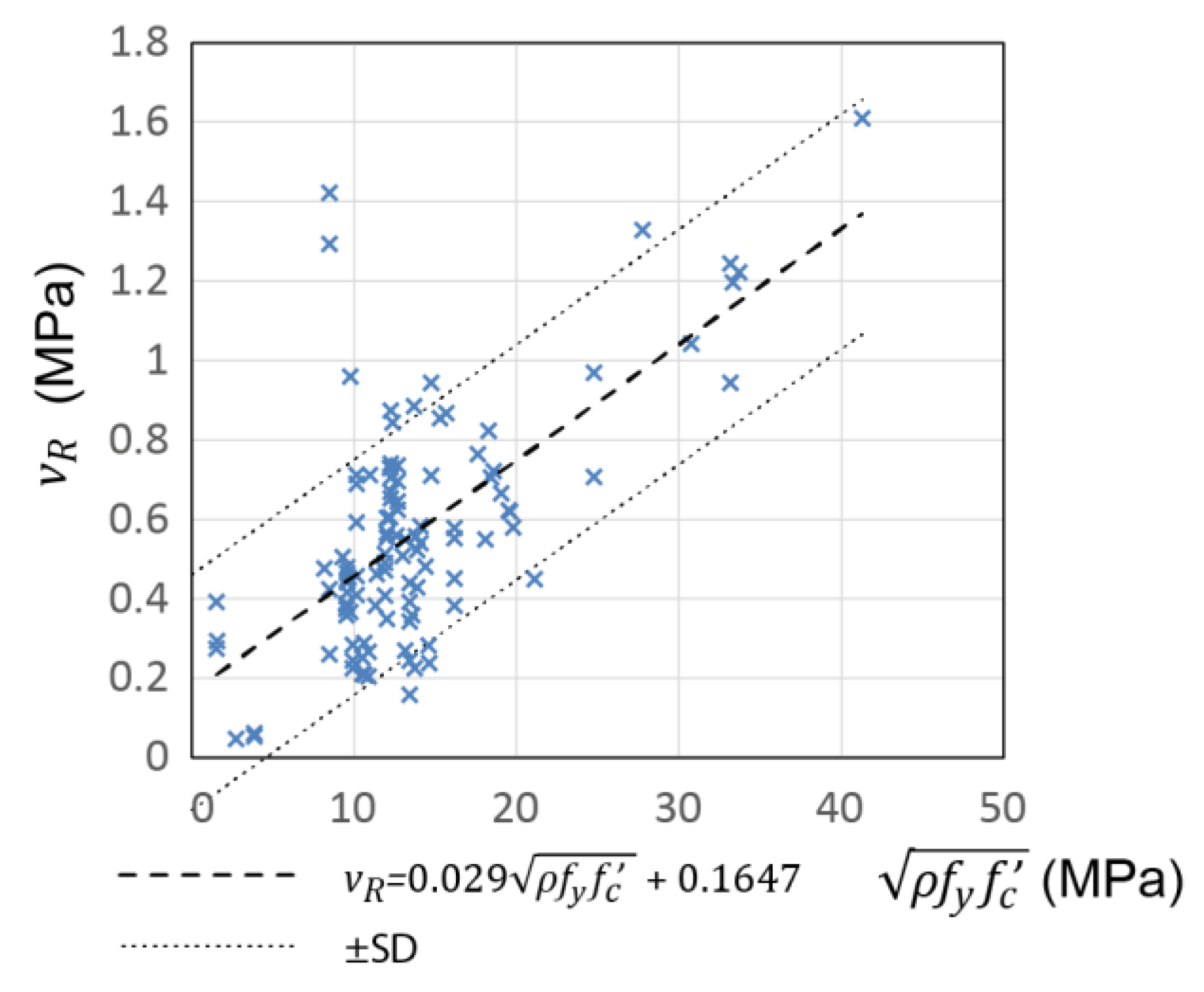
The main design parameters related to RC tie-columns are longitudinal reinforcement ratio ρ , steel yield strength f y , and concrete compressive strength f c . Using the same parameter (   ρ f y f c     ) as Riahi, Elwood and Alcocer [102], the following linear model was fitted to predict the shear strength of CM walls based on the available data:
v R = f 1 ρ f y f c + f 2
The regression analysis showed that f 1 = 0.029 and f 2 = 0.1647 offer the best fit. A chart presenting the test data and the fitted model is shown in Figure 10. The diagram shows that longitudinal reinforcement in RC tie-columns has a significant influence on the shear strength of CM walls.
Figure 10. The effect of RC tie-columns on the shear strength of CM walls (experimental data [64]).

2.5. Multivariate Model

A multivariate linear model was created to identify the statistical significance of the key variables discussed in this section and their corresponding coefficients, i.e., v m , σ , H / L , ρ h f y h and   ρ f y f c . The products v m × H / L and σ × H / L were initially also considered, because the factor f depends on the H / L ratio and is usually applied when the masonry shear strength, v m , and axial stress, σ 0 , are considered together; however, these variables were ultimately omitted from the model, because their influence was very small. The multivariate analysis, carried out using the STATA statistical analysis program, resulted in the following model:
v R = a v m + b σ + c H L + d ( ρ y f y h ) + e ρ f y f c
The results are presented in Table 1, showing the coefficients for each variable, the Pearson’s significance p, where the variable is indicated to be statistically significant when p < 0.05, and 95% Confidence Interval.
Table 1. Multivariate analysis of shear strength, v R .
It can be seen from the table that the correlation coefficient is R 2 = 0.726 , which indicates a satisfactory prediction, and that all variables are statistically significant. A negative 𝑐 value indicates that the shear strength decreases with aspect ratio. The same model, as described in Equation (12), was developed using f m instead of v m , which resulted in a coefficient a = 0.06 and the R 2 = 0.67 . It can be concluded that v m is a better predictor of shear strength, v R , than f m .
It should be noted that the proposed multivariate model is different from the models developed by other researchers, e.g., a model by Marques and Lourenco [9] developed based on an experimental database of 104 CM wall specimens. These models are similar in that they take into account the effect of masonry shear strength, axial compression stress in the wall, and aspect ratio; however, the proposed model also takes into account the effect of horizontal wall reinforcement and the amount of longitudinal reinforcement in RC tie-columns, while [9] accounts for a ratio between the masonry wall area and the total CM wall area. Another model, developed by Riahi, Elwood, and Alcocer [102], is based on a regression analysis of an experimental database consisting of 102 CM wall specimens, and considers the effect of masonry shear strength, axial compression stress, and the effect of longitudinal reinforcement in RC tie-columns. The model does not take into account the influence of wall aspect ratio and horizontal wall reinforcement, since the results of the regression analyses indicated that their influence was insignificant. It should be noted that the experimental data used for all three models included research from different countries and regions, with the greatest number of studies (and their corresponding data points) coming from Latin American countries; this can be attributed to the significant scale of experimental research studies in that region.

2.6. Lateral Displacement/Drift Capacity

CM walls, when subjected to in-plane lateral loads, usually demonstrate a shear-dominant behaviour; this can be attributed to the relatively low aspect ratio, absence of horizontal reinforcement, and a design approach that does not require the development of a flexural failure mechanism. It is well established that a shear-dominant failure mechanism is force controlled and is characterised by a limited lateral displacement/drift capacity. However, RM shear walls with shear-dominant behaviour have demonstrated a significant displacement/drift capacity beyond the cracking stage, as shown by previous experimental studies [97,107,113]; this can be partially attributed to the presence of horizontal reinforcement in these walls.
Pérez Gavilán [109] reviewed the results of five experimental studies from Mexico employing 26 full-size CM wall specimens that were subjected to reversed cyclic loading [26,35,40,41,65]. The specimens were constructed using different types of masonry unit, including solid clay bricks, multi-perforated clay blocks, and hollow concrete blocks. The majority of the specimens were reinforced with horizontal JR according to the requirements of the Mexican masonry code [32]. Lateral drift ratios were determined for each specimen at the following critical stages (see Figure 1): the onset of cracking, peak shear capacity ( γ R ), and the ultimate drift capacity ( γ U ) at failure, which corresponds to the force at 80% of peak capacity. The drift ratios at the peak shear capacity ( γ R ) varied from 0.24 to 1.0%, while the maximum drift capacity ( γ U ) ranged from 0.40 to 2.06%. The study showed that the drift capacity was significantly influenced by the presence of horizontal reinforcement and the type of masonry unit. It was observed that the specimens constructed using hollow concrete blocks demonstrated lower drift capacity than other specimens.
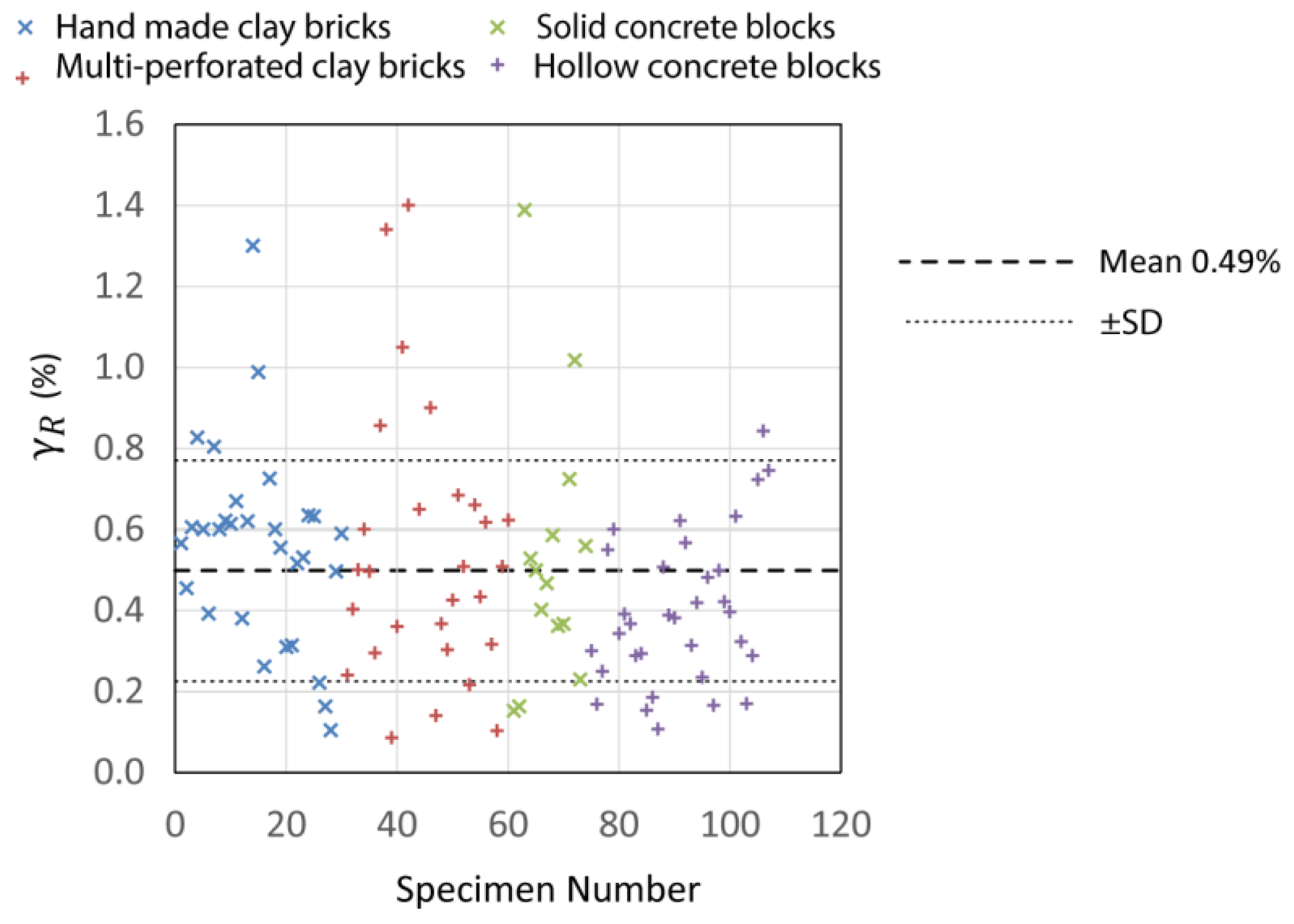
Figure 11 shows the drift ratios at peak strength ( γ R ) for the specimens from the experimental database [64], with a mean drift capacity of 0.49%.
Figure 11. Drift ratios at peak strength ( γ R ) based on the experimental data [64].
Several authors have proposed a reduction in the masonry shear strength based on the requirement for ductility in RM shear walls [98,114]. Note that RM shear walls are usually designed to achieve a flexural failure mechanism, in which a plastic hinge develops at the base of the wall. In such a scenario, flexural–shear cracks widen after a few loading cycles, which causes a decrease in the wall shear resistance due to a loss of aggregate interlock shear mechanism. The same phenomenon was reflected in the conceptual model for concrete shear strength proposed by the Applied Technology Council [115], but it is not representative of CM walls. Although the CM walls may attain high ductility [109], these walls usually experience shear failure. Riahi, Elwood and Alcocer [102] observed an inverse relationship between the displacement ductility and the peak shear strength in CM walls; however, it was observed that the ductility depends on the type of masonry unit.

3. Behaviour of CM Walls Subjected to Combined Axial Compression and In-Plane Flexure

CM walls subjected to combined axial and in-plane lateral loading usually do not develop a flexural failure mechanism, because the diagonal tension shear mechanism which was discussed in the previous section is the most prevalent. The design of CM walls for flexure under seismic conditions is different from the seismic design of RM shear walls, which are explicitly designed to experience flexural failure according to the Capacity Design approach, e.g., in the USA, Canada, and New Zealand [101]. Design provisions are also based on extensive research studies on the flexural behaviour of these walls in the countries in which RM construction has been practised [98,116,117]. The flexural strength of CM shear walls can be estimated based on the assumptions of flexure theory, such as the plane deformation of the horizontal section of a wall, and an equivalent rectangular stress block simulating the distribution of compression stresses. This section discusses the behaviour of CM walls when subjected to combined axial load and flexure, based on the evidence from experimental studies, and approaches for estimating their strength for design purposes.

3.1. Experimental Research Studies

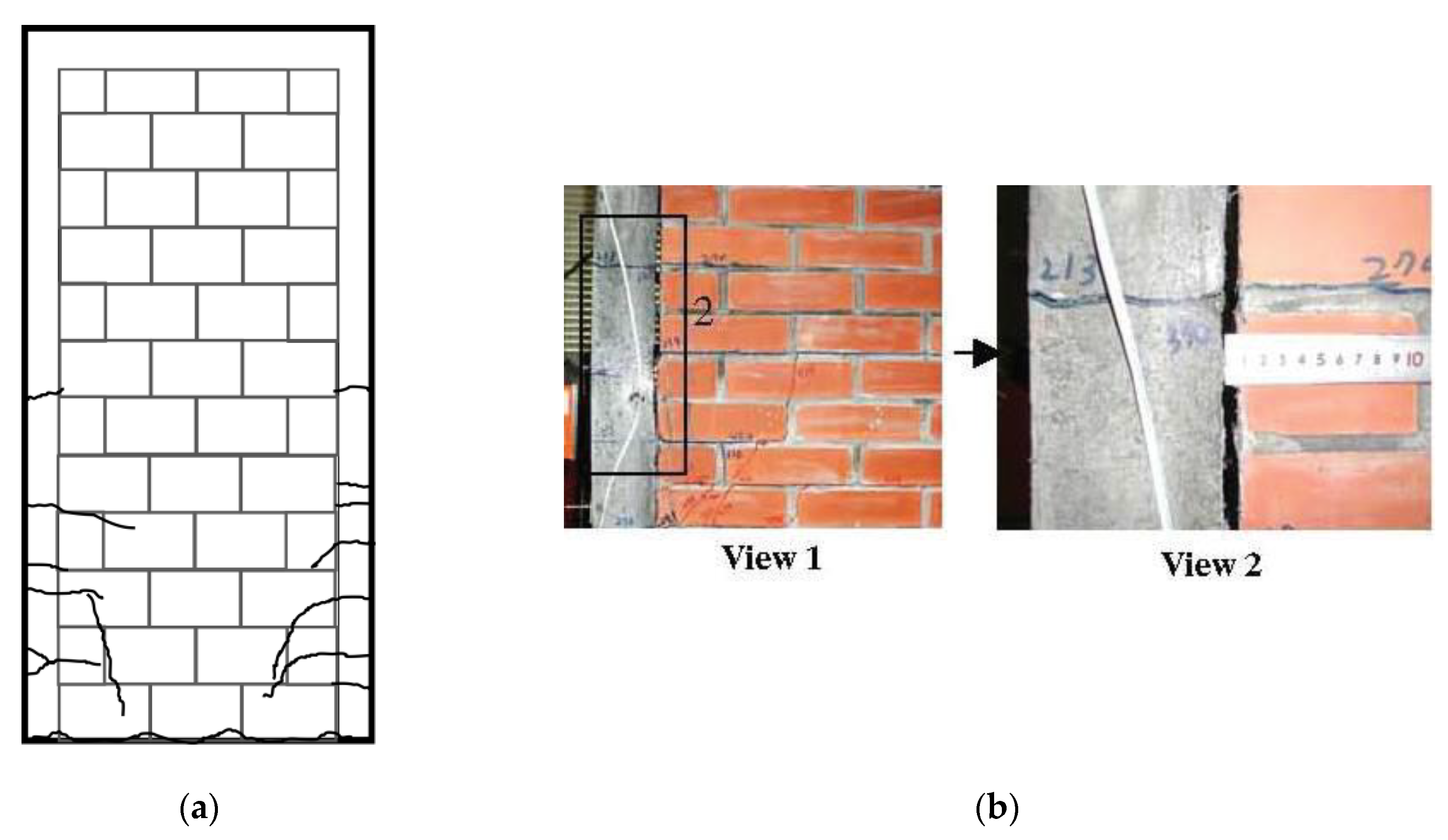
Yielding of the longitudinal reinforcement, development of horizontal cracks in RC tie-columns and concrete crushing at their base are characteristic for flexure-dominant behaviour in CM walls (Figure 12a). In slender walls (with an aspect ratio of 1.0 or higher) vertical cracks develop close to the interface between the masonry panel and adjacent RC tie-columns [118]. The cracks occurred due to the bond pattern used and the non-uniform vertical deformation of the wall. Vertical cracks in slender walls were also reported in [35] (damage patterns for specimens ME1 and ME 2 are shown in Figure 5). The specimens attained high levels of displacement ductility, ranging from 5.65 to 10.45 (ductility was determined according to [119]). As expected, it was observed that the flexural strength increased with increasing axial stress level, as expected.
Figure 12. Flexural behaviour of CM shear walls observed in experimental studies: (a) damage pattern in specimen M5 at a displacement ductility of 6.0 (adapted from [118]), and (b) separation of RC tie-columns from the masonry panel and horizontal cracks [120].
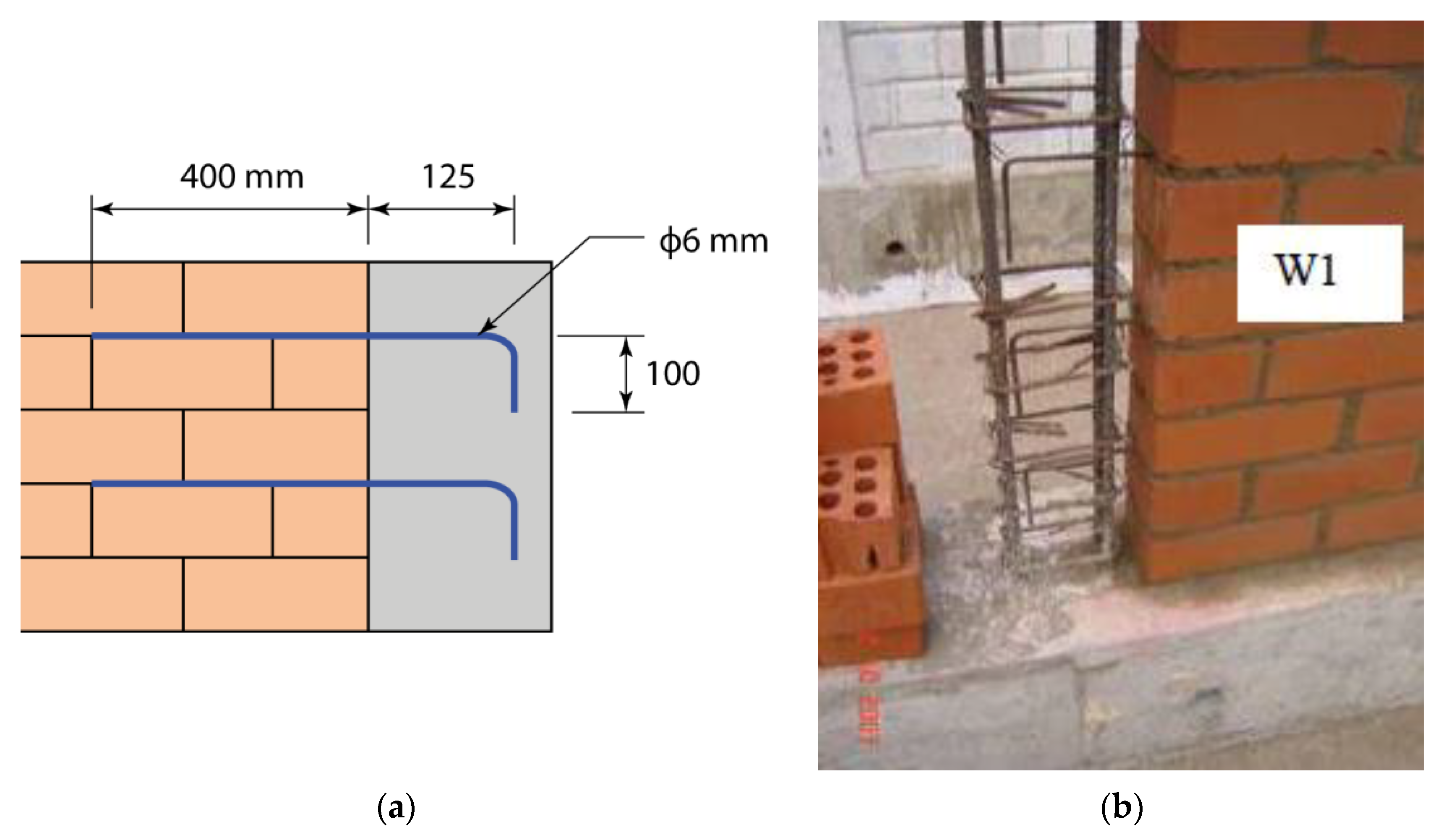
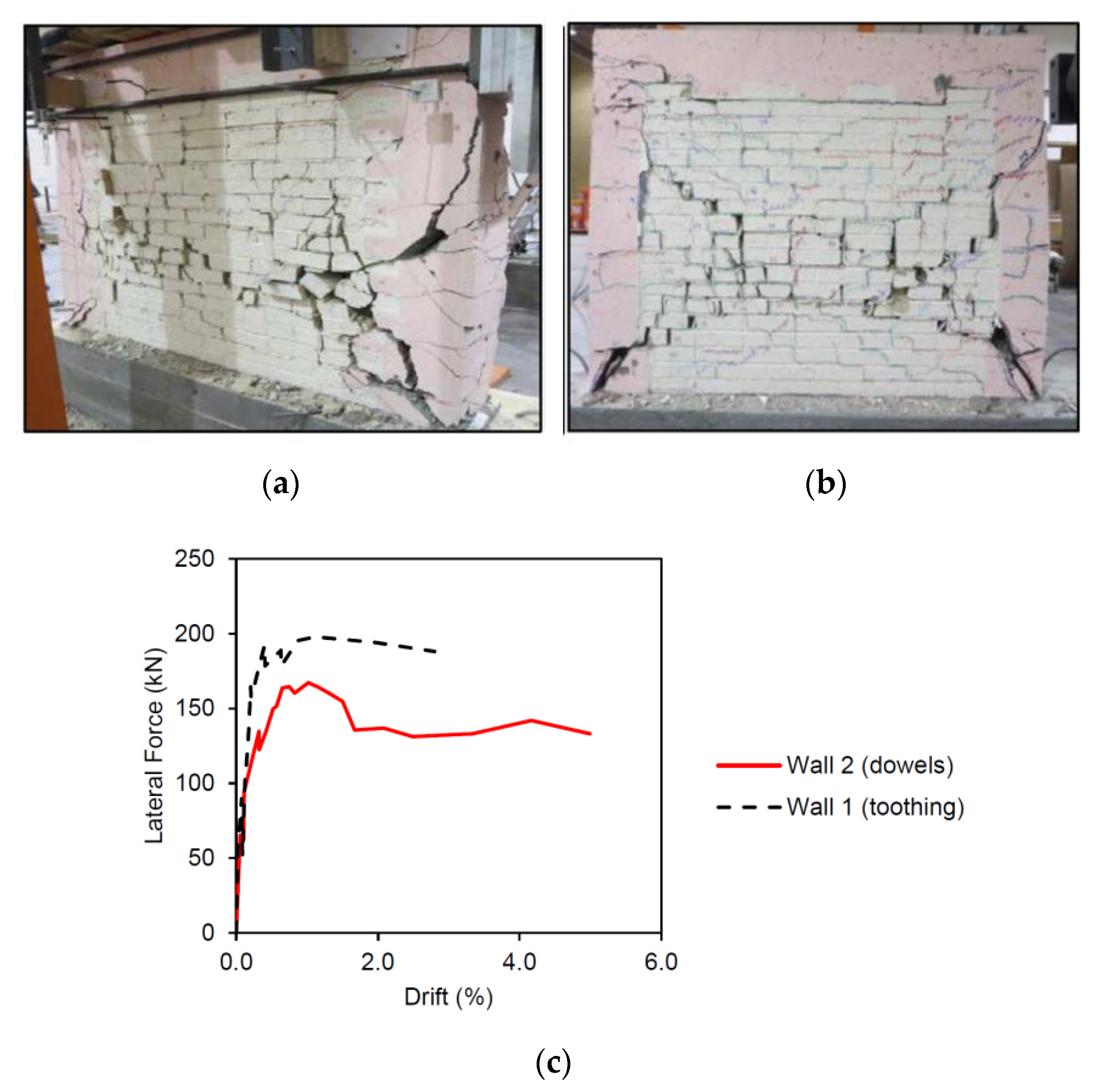
Yoshimura et al. [120] identified the separation of RC tie-columns from the masonry panel as the cause of early failure of CM walls subjected to intense earthquakes (Figure 12b). They conducted an experimental study to investigate the performance of CM walls with two types of reinforcement aimed at preventing the separation of tie-columns from masonry panels. The program included 28 full-size wall specimens; of these, eight specimens had U-shaped steel reinforcing bars (dowels) extending from the wall into the tie-columns, another eight specimens had straight horizontal dowels, while the remaining specimens had no horizontal reinforcement at the interface. The boundary conditions were fixed–fixed (causing double-curvature bending) or cantilever (single-curvature bending). In addition, the specimens were subjected to two different levels of axial load.
The researchers classified failure modes into flexural failure, diagonal tension shear failure, and combined shear and flexural failure. Of the 28 specimens, 13 specimens were designed to experience flexural failure; however, only five specimens failed via pure flexure. One experienced combined shear and flexural failure, two experienced a flexure–sliding failure, and four specimens underwent shear failure. The flexure–shear mode of failure was expected for two specimens, but those walls experienced shear failure. In contrast, the researchers predicted that 13 specimens would experience shear failure, but 10 specimens experienced shear failure, while the remaining specimens experienced a flexure–sliding failure. It should be noted that the specimens were designed according to the Japanese masonry code.
The specimens with cantilever boundary conditions initially showed flexural behaviour, but ultimately experienced either sliding or shear failure. Unreinforced CM walls with fixed–fixed boundary conditions and without dowels at the tie-column-to-masonry-panel interface did not experience separation of RC tie-columns from the masonry panel, but the specimens with the cantilever boundary conditions and without dowels showed signs of separation. The study showed that the dowels (U-shaped or straight bars) were effective at preventing the separation of tie-columns from the masonry panels.
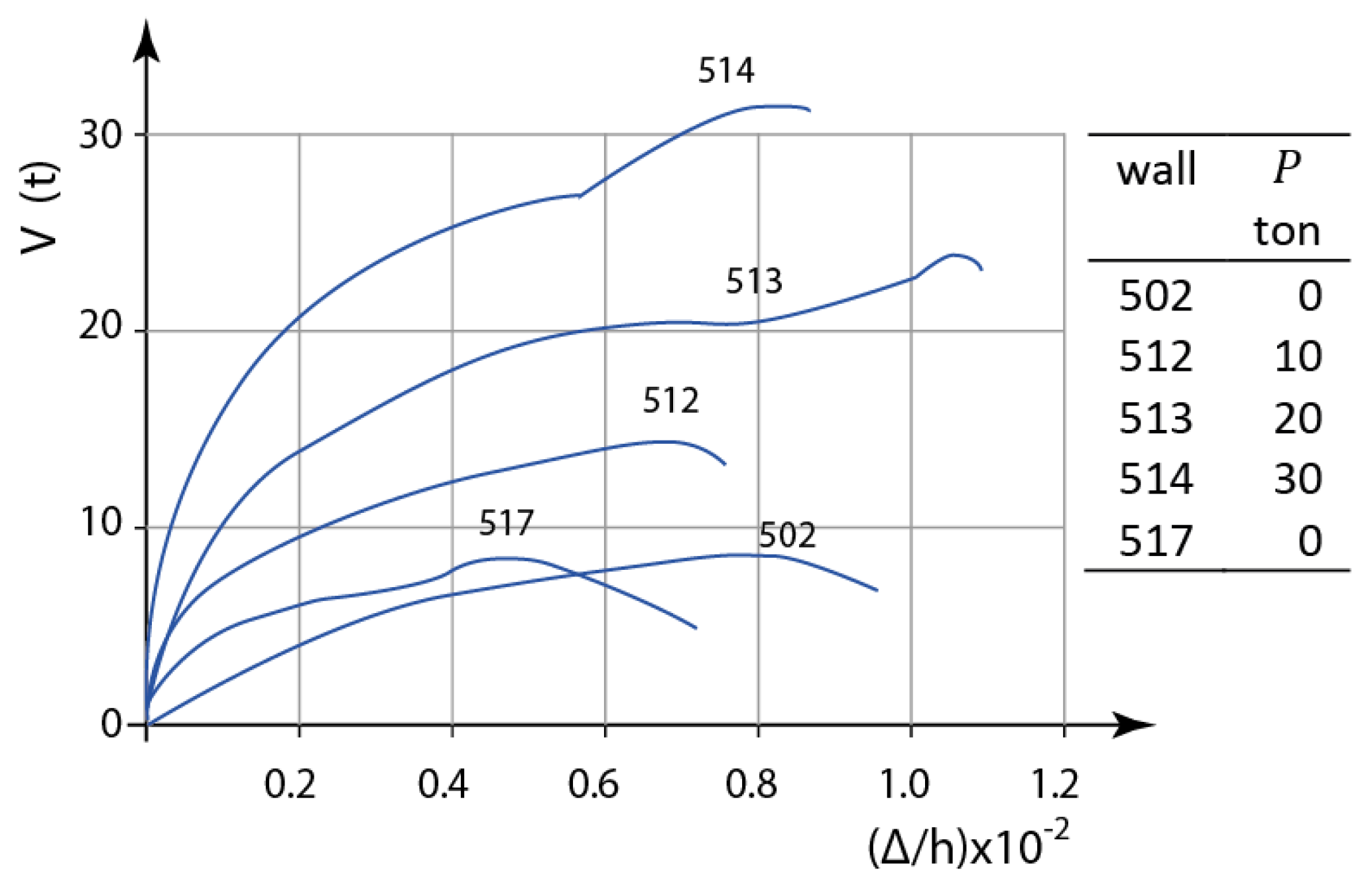
Meli and Salgado [13] carried out one of the first experimental studies on the behaviour of CM walls subjected to lateral loading. The study included 46 CM specimens subjected to monotonic static loading; of these, five specimens experienced flexural failure (#502, #512, #513, #514, and #517). All walls had a cantilever boundary condition, but they were subjected to different levels of applied axial compression. The specimen dimensions (length × width) were 2 m × 2 m, and hollow concrete blocks were used for construction. RC tie-columns were in the form of two 9.5 mm diameter longitudinal reinforcement bars, made of steel with 420 MPa nominal yield strength. The relatively low longitudinal reinforcement ratio in the tie-columns was most likely responsible for the flexure-dominant behaviour and failure in these walls. The experimental results, in the form of lateral-force-versus-drift ratio, are presented in Figure 13. It can be seen from the chart that the specimens subjected to higher axial load (e.g., #513 and #514) demonstrated higher shear capacity compared to the specimens with lower axial stress levels (e.g., specimens #502 and #517).
Figure 13. Shear-force-versus-drift ratio for the CM wall specimens with flexure-dominant behaviour (adapted from [13]).
Two research studies involved the performance of shaking table tests on CM building models with walls designed to undergo flexural failure [54,121]. San Bartolome et al. [54] tested a three-storey, half-scale CM building model that experienced flexural cracking at the base of the walls due to the yielding of the vertical reinforcement in the tie-columns, until ultimately the walls experienced shear failure. Bustos et al. [121] tested a two-storey, half-scale CM building model. The response was initially characterised by flexural cracking at the base of the tie-columns, followed by sliding cracks in the lower portion of the walls on the first storey level, but the model ultimately experienced a flexural failure mechanism.
Varela-Rivera et al. [122] tested seven CM wall specimens made of autoclaved aerated concrete (AAC) units. Three specimens (M5 to M7) were identical, and were designed to experience flexural behaviour, but were subjected to different axial compression stresses. The walls had an aspect ratio of 2.26 and were subjected to different axial compression stresses: 0.24, 0.47 and 0.71 MPa. The performance of these specimens was characterised by the yielding of the longitudinal reinforcement, and the appearance of horizontal cracks near the base and inclined shear cracks that eventually propagated through the tied columns before failure took place. As expected, the flexural strength of the walls increased with increasing axial stress level. Flexural strength predictions based on the equivalent rectangular stress showed excellent agreement with the experimental results. It was also observed that the ductility increased with decreasing axial compression stress.
In another experimental study, specifically focused on the flexural behaviour of CM walls [118], six CM wall specimens were constructed using multi-perforated clay blocks with different aspect ratios (1.1, 1.5 and 2.4) and axial stress levels (0.24, 0.47, and 0.71 MPa). Longitudinal reinforcement in the tie-columns was in the form of a single 9.5 mm diameter steel bar with a nominal yield strength of 412 MPa, but no transverse reinforcement was provided. The flexural strength predictions were made based on the flexural theory, with a rectangular stress block for the compression zone and considering the effect of strain hardening in tension steel, and were in excellent agreement with the experimental results. It should be noted that in all cases, the neutral axis depth at the ultimate stage was rather small (it was located within the tie-column).

3.2. Estimating the Moment Resistance of CM Walls Subjected to a Combination of Axial Load and Flexure

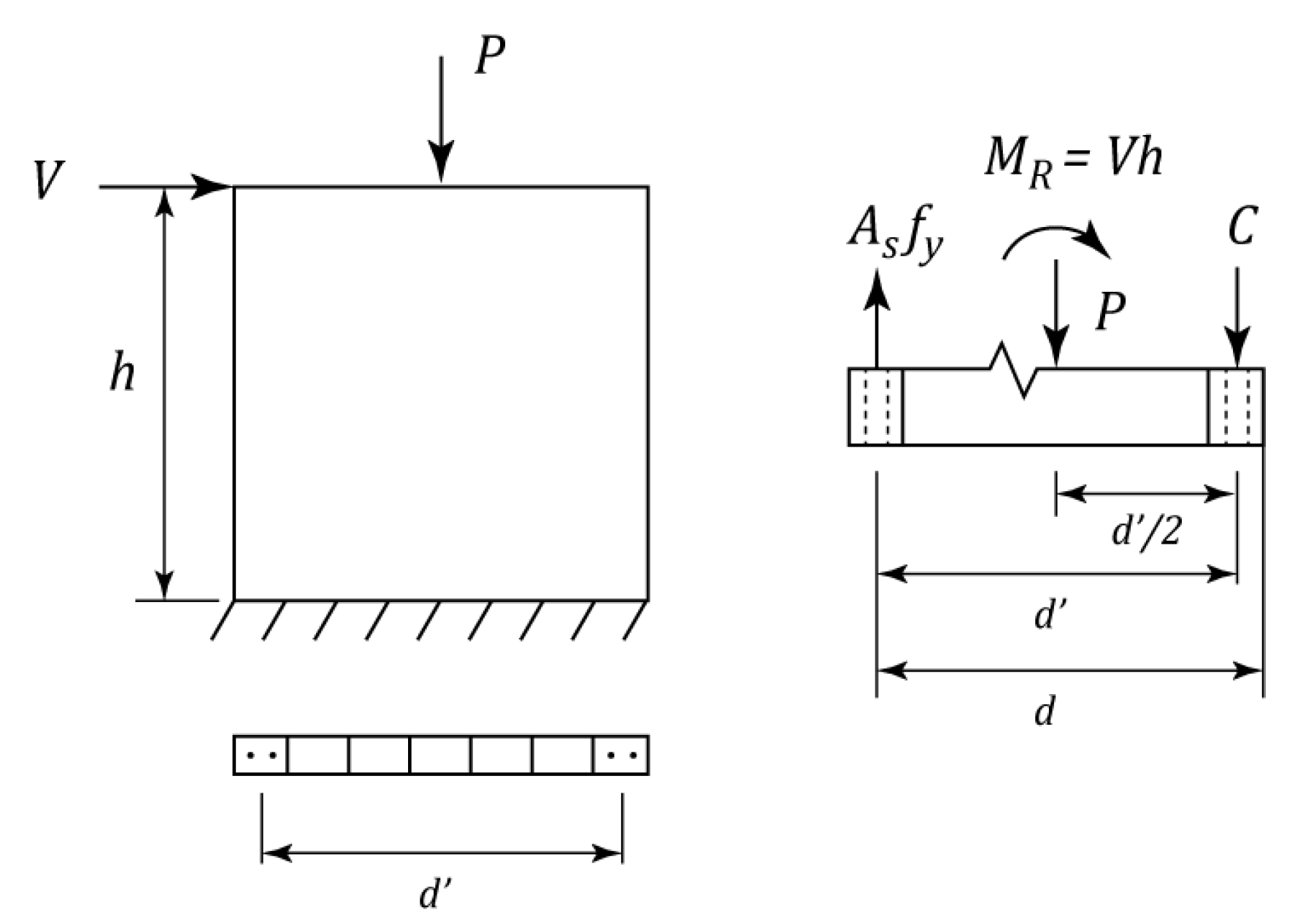
Based on the results of their experimental study, Meli and Salgado [13] proposed Equation (13) for predicting the moment resistance, M R , of CM walls subjected to axial load, P , using a few simplifying assumptions. For example, it was assumed that longitudinal reinforcement in tie-columns would yield both tension and compression (Figure 14).
M R = A s f y d + P d 2
where A s is the area of longitudinal reinforcement in RC tie-columns, f y is steel yield strength, d is the distance between the longitudinal reinforcement centroids of the tied columns, and P is the axial force.
Figure 14. Moment resistance for CM walls subjected to combined axial load and flexure (adapted from [13]).
Subsequently, the same researchers [15] proposed a set of Equations (14)–(16) for the moment resistance of CM walls subjected to axial load and flexure, as follows:
M R = M 0 + 0.28 P d                                                             i f   P P R / 3
M R = 1.5 M 0 + 0.14 P d 1 P P R                       i f   P > P R / 3      
M 0 = A s f y d
where d is the effective length of the wall section (distance from the centroid of tension steel to the extreme compression fibre), and d is the distance between the longitudinal reinforcement centroids of the tie-columns. Note that P is the applied axial force, while P R is the axial load resistance.
The above equations were later incorporated into the Mexican masonry code, with a few changes in the coefficient values, e.g., the value 0.28 in Equation (14) was changed to 0.30, while the value 0.14 in Equation (15) was changed to 0.15 [32,33].
Marques and Lourenço [9] performed a review of moment resistance ( M R ) design equations from the Mexican masonry design code. They concluded that the equations provide a good estimate when the wall aspect ratio is equal to 1.0, but the estimates are less accurate for other aspect ratio values. They proposed an alternative, Equation (17), based on the flexure theory adapted from Tomaževič [123], which is applicable to the CM walls subjected to low axial stress levels. A uniform stress distribution based on the equivalent rectangular compression stress block was assumed for the compression zone of the wall section, with the stress intensity to be determined based on the lesser of design compressive strength for masonry or concrete.
Neutral axis depth, x , is determined from Equation (18) assuming that longitudinal steel in tie-columns A s yields in tension (yield strength f y ), but the contribution of longitudinal reinforcement in compression has been ignored, as follows:
M R = A s f y d 0.4 x + P L 2 0.4 x
x = P + A s f y 0.8 η f f m t
where L and t . denote the wall length and thickness, respectively, and η f is the multiplier for the equivalent rectangular stress block, taken to be equal to 0.85. The proposed equation was verified for 13 CM wall specimens on the basis of three experimental studies.

3.3. The Effect of Axial Stress and Wall Aspect Ratio H / L

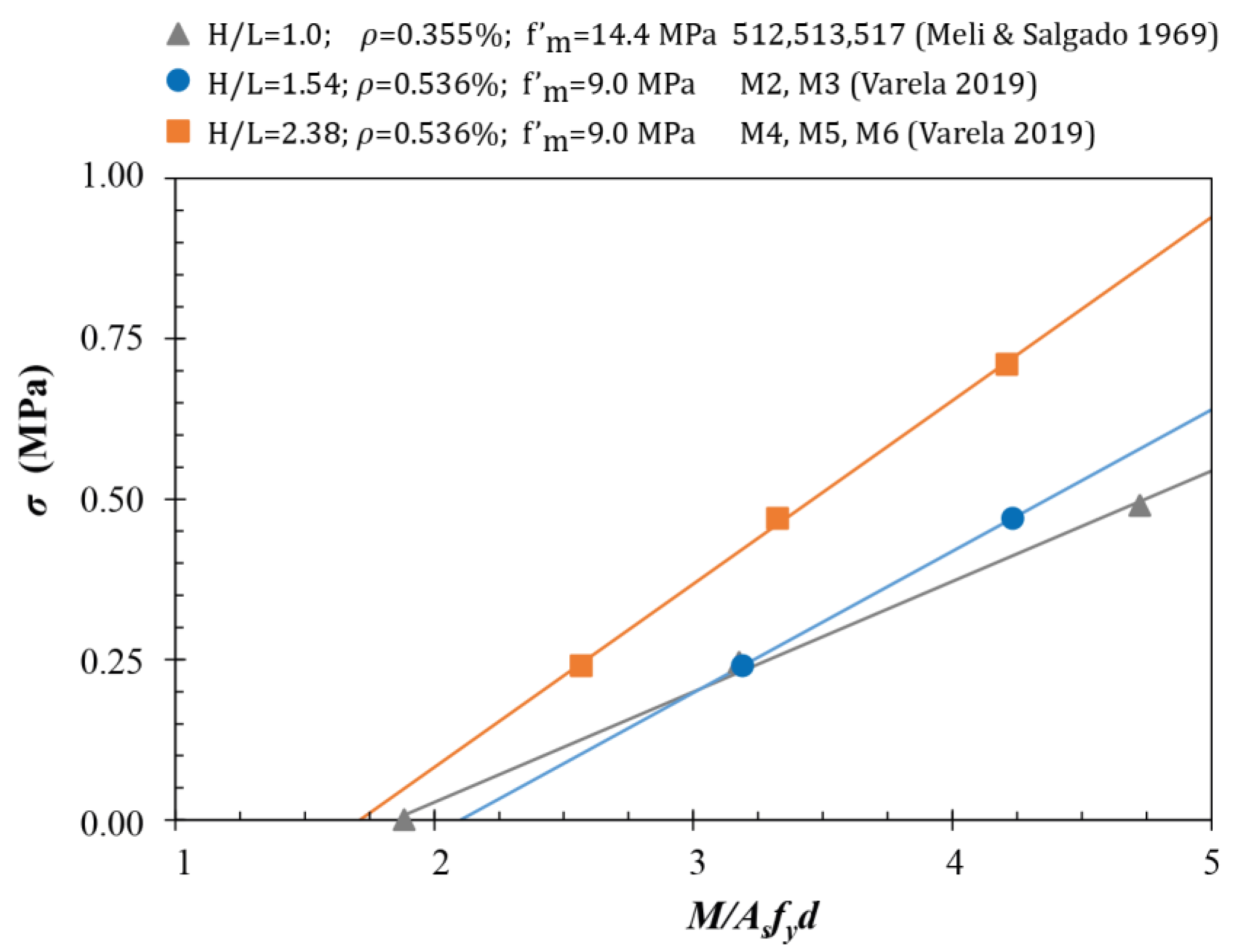
The effect of the axial stress and wall aspect ratio on the flexural strength of CM walls was studied by analysing results for eight wall specimens from two experimental research studies performed in Mexico, as shown in Figure 15 [13,122]. It can be seen from the chart that normalised moment resistance increased with increasing level of axial stress, which is in line with the design equations for walls subjected to relatively low levels of axial stress; however, it appears that the effect of higher axial stress levels is more significant in slender walls, e.g., for an H / L value of 2.38.
Figure 15. A relation between the normalised moment resistance and axial stress for 8 CM test specimens [13,122].

3.4. Key Factors Influencing the Occurrence of Shear- and Flexure-Dominant Failure in CM Walls

A discussion related to the shear and flexural behaviour of CM walls due to in-plane seismic actions was presented in the previous sections. The criteria for the occurrence of failure mechanisms (flexural or shear) in CM walls are important for both researchers and design engineers. Formally, flexural failure is achieved when the following condition is met:
M R M V < 1.0
where M R is the moment resistance of the wall and M v = V R H is the overturning moment due to the wall’s shear resistance, V R . Observations from previous experimental studies indicate that walls subjected to lateral loading may simultaneously experience damage patterns characteristic of both flexure- and shear-dominant behaviour. The predominant damage pattern may be either diagonal tension cracking (shear related) or a flexure-related damage pattern, such as horizontal cracking and toe-crushing. The predominant damage pattern and failure mechanism depend on the ratio of flexural and shear resistance, as shown in Equation (19), and a combination of damage patterns characteristic of both mechanisms may be expected when the ratio is close to 1.0.
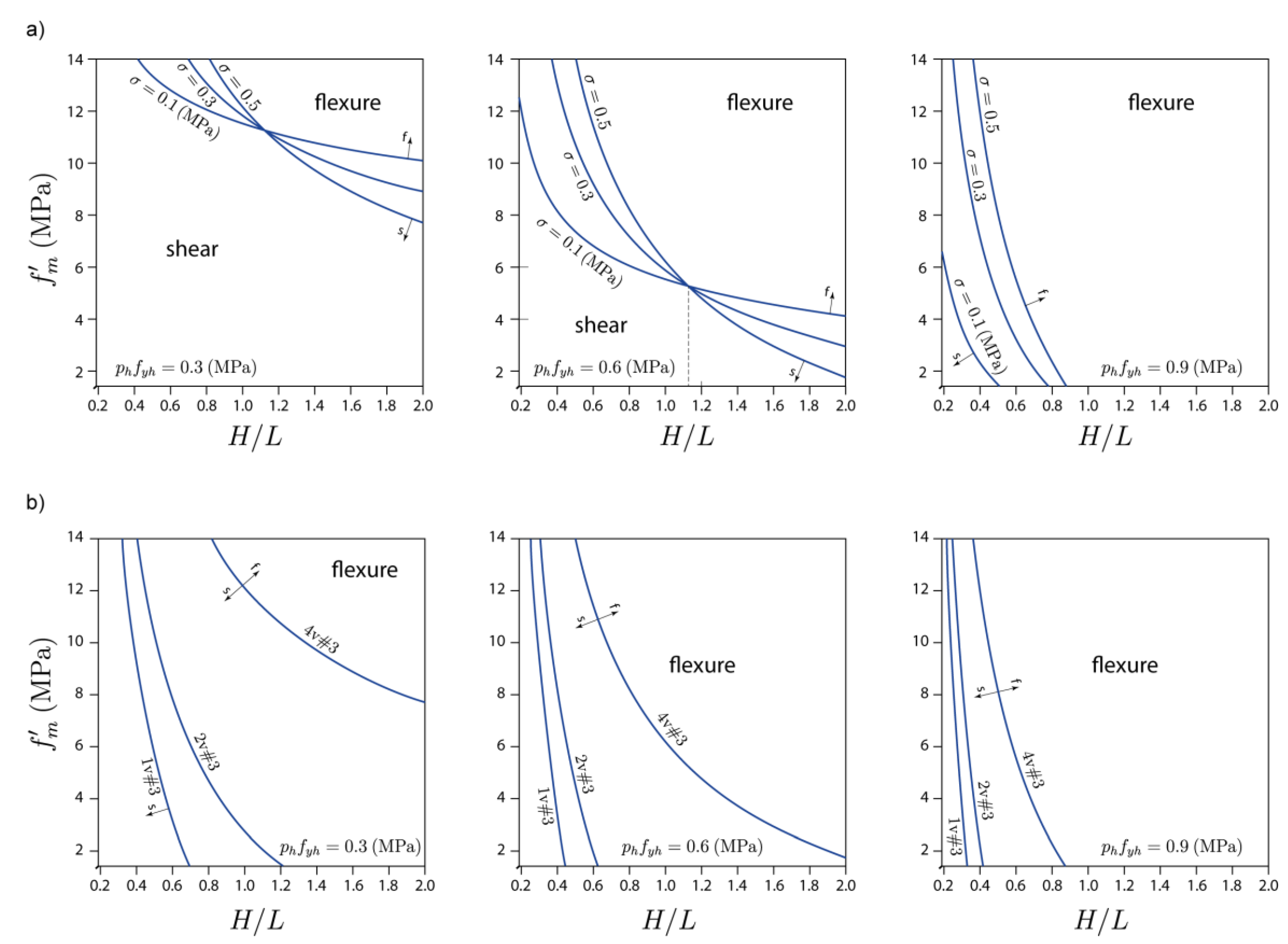
A parametric study was performed to identify the key parameters and to quantify the effect of different combinations of parameters on the occurrence of a shear- or flexure-dominant failure mode, the results of which are presented in Figure 16. Shear and flexural resistance values were determined using the following equations:
V R = v R t L
M R = A s f y d + 0.3 P d ,
where v R was obtained by applying the regression model discussed in Section 2.5. Flexural resistance M R was calculated based on the Mexican code discussed earlier in this section (for P / P R < 1 / 3 ) , where d = L h c , d = L h c / 2 , h c is the tie-column length parallel to the wall length, and P = σ t L .
Figure 16. Key parameters that influence the occurrence of flexural or shear failure with variable amount of horizontal reinforcement ρ h f y h : (a) constant ratio of longitudinal reinforcement in tie- columns ( ρ = 0.01583), and (b) constant axial stress ( σ = 0.5 MPa).
The six charts presented in Figure 16 are organised into two parts (Figure 16a and Figure 16b, respectively). For analyses performed in Figure 16a, the longitudinal reinforcement ratio in the tie-columns is constant: ρ = 0.01583 (4 #3 bars), while for the charts shown in Figure 16b, the axial stress value is constant: σ = 0.5 MPa. The charts were produced for three different horizontal reinforcement ratios: p h f y h = 0.3, 0.6, 0.9 MPa.
Each chart shows a relationship between the masonry compression strength f m and the H / L ratio, depending on other relevant parameters. It can be seen that the curves (characterised by M R / M v = 1 ) divide each chart into two regions, namely, (i) M R / M v < 1 , associated with flexural failure, and (ii) M R / M v > 1 , associated with shear failure. Three curves are shown on each chart. For the charts shown in Figure 16a, each curve corresponds to a different axial stress σ = 0.1 ,   0.2 ,   0.3 MPa, while for the charts shown in Figure 16b, the curves correspond to different longitudinal reinforcement ratios in tie-columns: ρ = 0.00396 (one #3 bar), 0.00792 (two #3 bars), and 0.01583 (four #3 bars). Note that the analyses were performed assuming a tie-column size of 12 × 15 cm. The diagonal compression stress v m was approximated using linear interpolation for the corresponding f m values. For example, for f m = 3 MPa, the corresponding v m = 0.3 MPa, while for f m = 14 MPa, the corresponding v m = 1 MPa. This substitution allowed the use of a single material strength parameter, f m , in the analyses. Since the M R / M v ratio depends on H and t (or H and L ) independently, the charts were produced for H = 250 cm (storey height).
The study showed that the following five parameters govern the occurrence of the flexural and shear failure mechanisms: axial stress,   σ , shear and compression strength of the masonry, expressed in terms of f m , the amount of horizontal reinforcement, ρ h f y h , wall aspect ratio, H / L , and tie-column longitudinal reinforcement ratio,   ρ . The most influential parameter related to flexural failure appears to be the amount of horizontal reinforcement, followed by the strength of the masonry and the wall aspect ratio. As expected, slender walls tend to undergo flexural failure, and higher masonry strength also promotes flexural failure.
It can be seen from the charts that axial stress has a smaller impact on the failure mechanism (shear- or flexure-dominant). It was observed that an increase in axial stress causes an increase in both shear and flexural wall strengths, but to a different extent. It can be seen from Figure 16a that on each chart there is a “critical” H / L ratio value, close to 1.0, which varies with the amount of horizontal reinforcement and determines whether changes in axial stress will cause flexural or a shear failure. For example, when ρ h f y h = 0.6 MPa, the critical aspect ratio is H / L = 1.12 . Considering the curve corresponding to σ = 0.3 MPa as a reference, it can be observed that when the axial stress increases from 0.3 to 0.5 MPa, flexural failure can be expected for walls with H / L > 1.12, because the shear resistance increases more rapidly than the flexural resistance, but the opposite is true for walls with H / L < 1.12. Furthermore, walls with the critical value of aspect ratio do not change their failure mechanism depending on the level of axial stress.
Longitudinal reinforcement ratio ρ causes an increase in both the flexural and shear resistance of CM walls; however, in this case, it is evident that the rate at which the flexural resistance increases is much higher than that of the shear resistance. This implies that an increase in the longitudinal reinforcement ratio promotes shear failure. The effect of longitudinal reinforcement ratio,   ρ , is less important when the horizontal reinforcement ratio, ρ h f y h , increases.
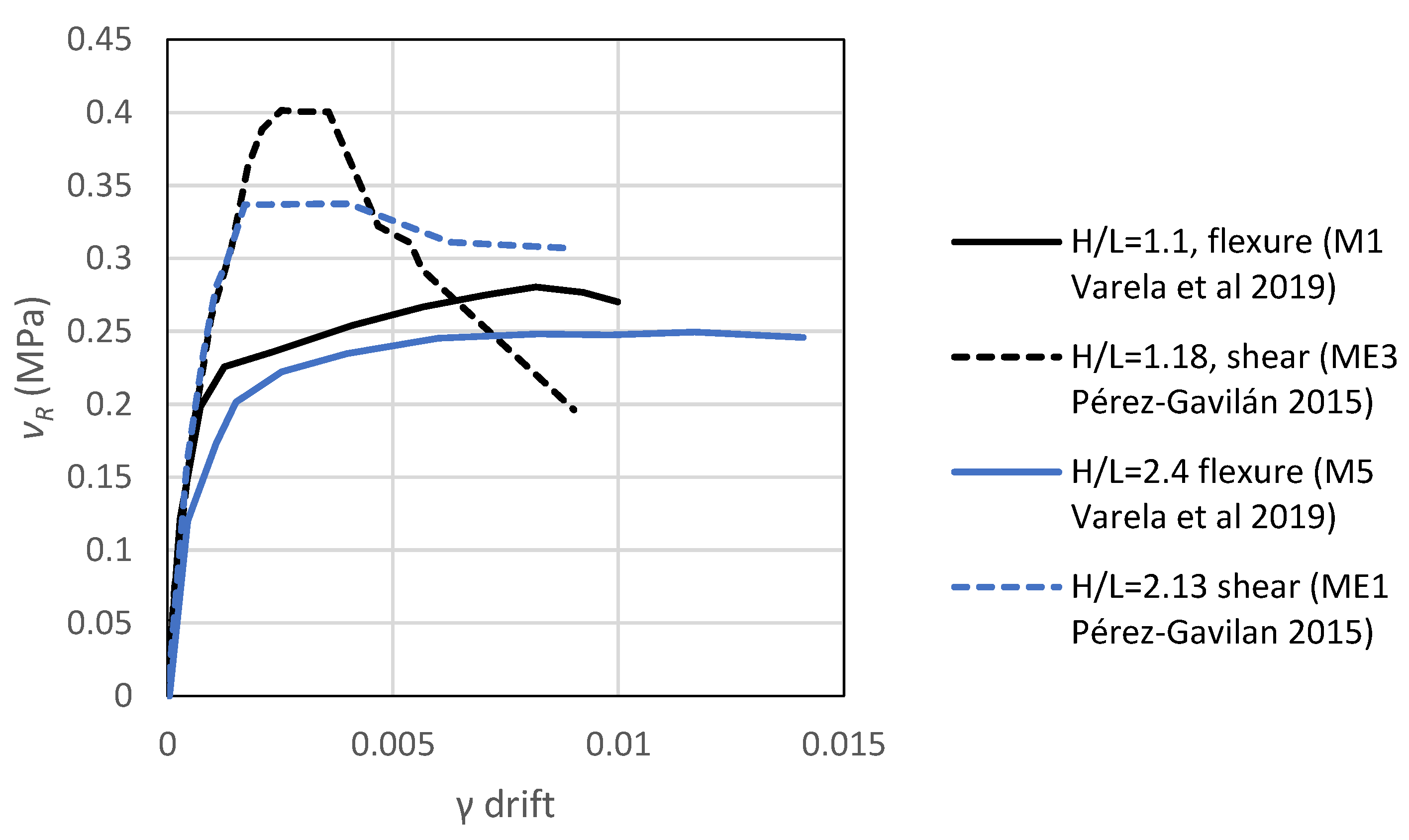
As previously described, under certain circumstances, it is possible to modify the behaviour of CM walls to obtain flexural failure instead of shear failure. It is well known that the flexural failure mechanism is more desirable in terms of ductility and deformation capacity than shear failure. Figure 17 shows the envelopes of the hysteresis curves obtained from reversed cyclic testing of four CM walls; of these, two specimens demonstrated a shear-dominant behaviour [35], while the remaining specimens demonstrated a flexure-dominant behaviour [118]. The envelopes shown in black colour represent the specimens with an H / L value close to 1.0, while the envelopes shown in blue colour represent walls with an the H / L value of 2.0 or higher. It can be observed that the specimens that demonstrated shear behaviour had significantly lower deformation capacity compared to those that exhibited flexure-dominant behaviour. CM walls in taller buildings need to be designed to achieve flexure-dominant behaviour, which is in line with new design trends focused on resilience.
Figure 17. Comparison of the shear strength vs. drift envelope for CM specimens with flexure- [118] and shear-dominant [35] behaviour.

4. Behaviour of CM Walls Subjected to Combined Axial Load and OOP Lateral Loading

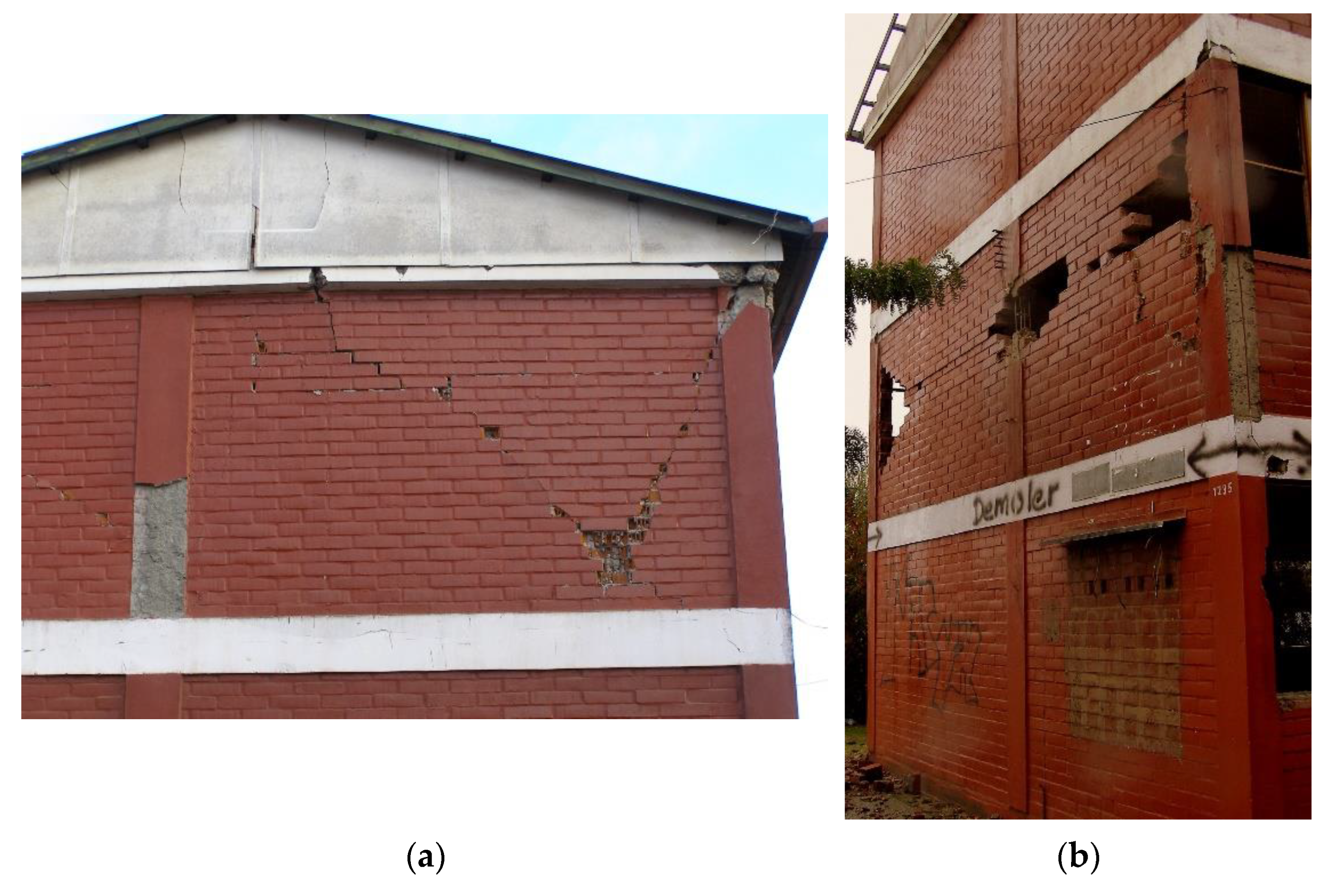
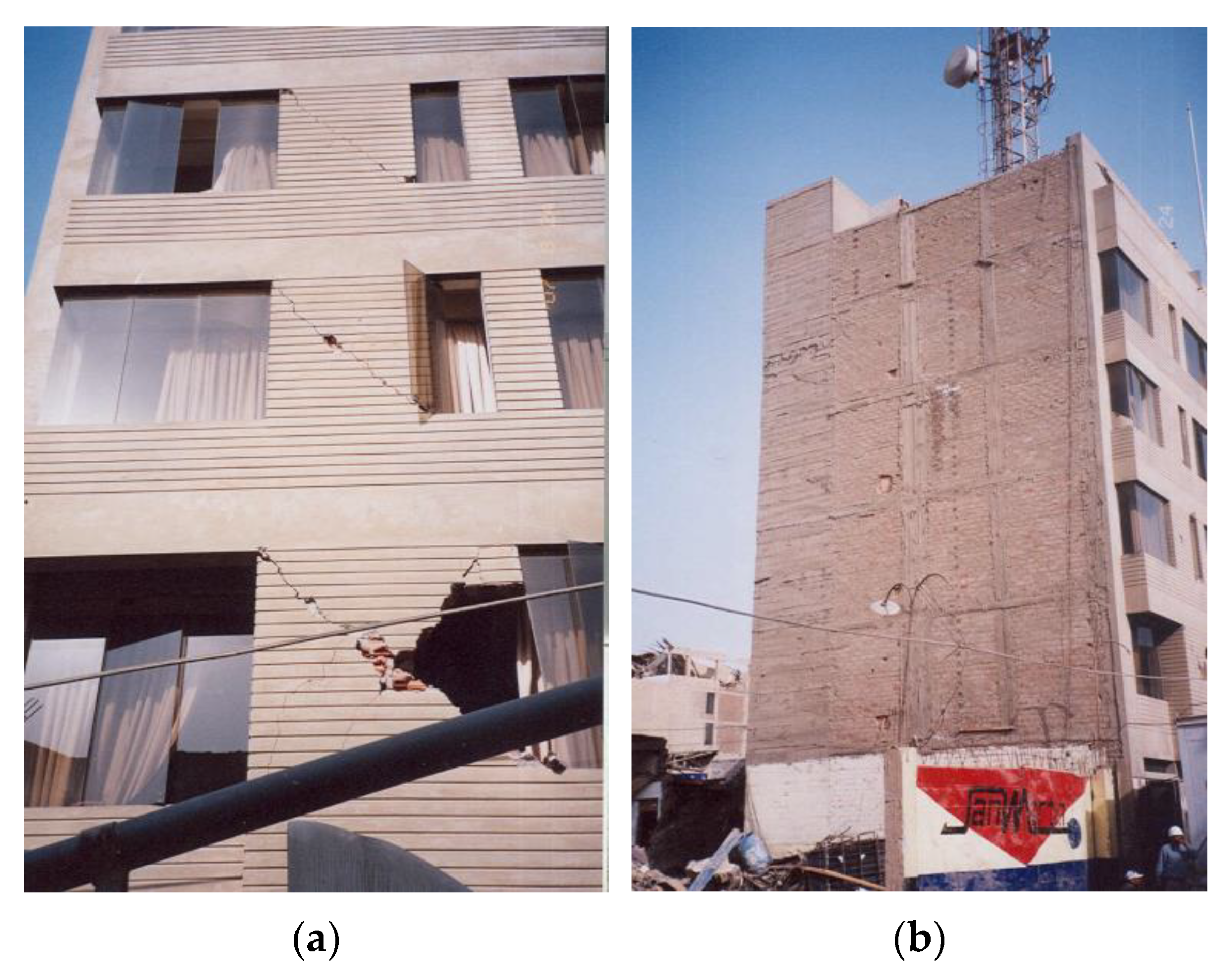
There is scarce evidence regarding the performance of CM walls subjected to OOP ground shaking. CM walls were exposed to the effects of damaging earthquakes in Indonesia and did not experience significant OOP damage, despite the typical storey height being close to 3 m and wall thickness being only 110 to 120 mm, corresponding to a relatively large slenderness ( h / t ratio of 25 to 30). A number of CM walls experienced OOP damage due to the 2010 Maule, Chile earthquake (M8.8) [124]. The failure was most pronounced on upper floor levels, e.g., the top floor of a building with a wooden roof structure in Cauquenes (Figure 18). The same building also experienced significant in-plane damage in CM walls in the longitudinal direction, and had to be demolished.
Figure 18. Damaged CM walls due to OOP seismic effects during the 2010 Maule, Chile earthquake: (a) damage pattern on the top floor of a building with a flexible timber roof; and (b) damaged walls on the second floor of the same building (credit: S. Brzev).
In this section, the behaviour of CM walls subjected to OOP loading is discussed, which depends on several factors, including the boundary conditions, wall aspect ratio, h / L , slenderness ratio, h / t, axial compression level, the stiffness of the RC confining elements, and the type of loading (static/dynamic). It should be noted that in this section, height h denotes the unsupported wall height between two horizontal supports (floor/roof); this is different from in discussions related to in-plane seismic loading (Section 2 and Section 3), where H denoted overall wall height. The main focus of the present discussion is on the behaviour of CM walls under OOP seismic loading, which is different from the response of URM walls. The authors acknowledge the extensive previous experimental and analytical research studies related to the OOP response of URM walls; however, further discussion of this is beyond the scope of this paper.

4.1. Approaches for Estimating the OOP Capacity of CM Walls

Existing approaches for estimating the capacity of masonry walls subjected to gravity and OOP lateral loads are based on different assumptions and result in significantly different predictions, as discussed in this section.

4.1.1. Elastic Flexural Theory

The simplest approach, adopted by several masonry design codes (e.g., [63]), is based on the elastic flexural theory, and the OOP wall capacity depends on the tensile or compressive strength of the masonry (as explained in [96]).
The flexural tensile strength approach considers an elastic uncracked wall section and assumes that the cracking moment corresponding to the flexural tensile strength in the tension zone of the wall has been reached. The wall’s flexural capacity is a product of normal stress due to gravity load and the section modulus of the net cross-sectional area for OOP flexure. Consequently, a higher masonry flexural tensile strength normal to the bed joints results in an increase in the wall’s flexural capacity.
An alternative approach is based on flexural compression capacity, and assumes that the flexural tensile strength has been attained, that is, that the wall has been cracked. The flexural capacity depends on the resulting masonry stress in the compression zone and the eccentricity of the axial load.
These approaches are based on the following assumptions: (i) the wall spans vertically; (ii) there is no gap between the top of the wall and the floor; and (iii) axial load, which contributes to an increased flexural capacity, is present. These approaches result in conservative estimates of OOP capacity that are significantly lower than the corresponding predictions based on the arching mechanism concept.

4.1.2. Arching Mechanism

An arching mechanism may develop in masonry walls that possess rigid supports, in which translation and rotation at the supports are fully restrained. The concept of the arching mechanism was originally developed for URM walls [125], but it has been extended to masonry infills in RC frame structures ([126,127,128]), as well as in CM walls [50].
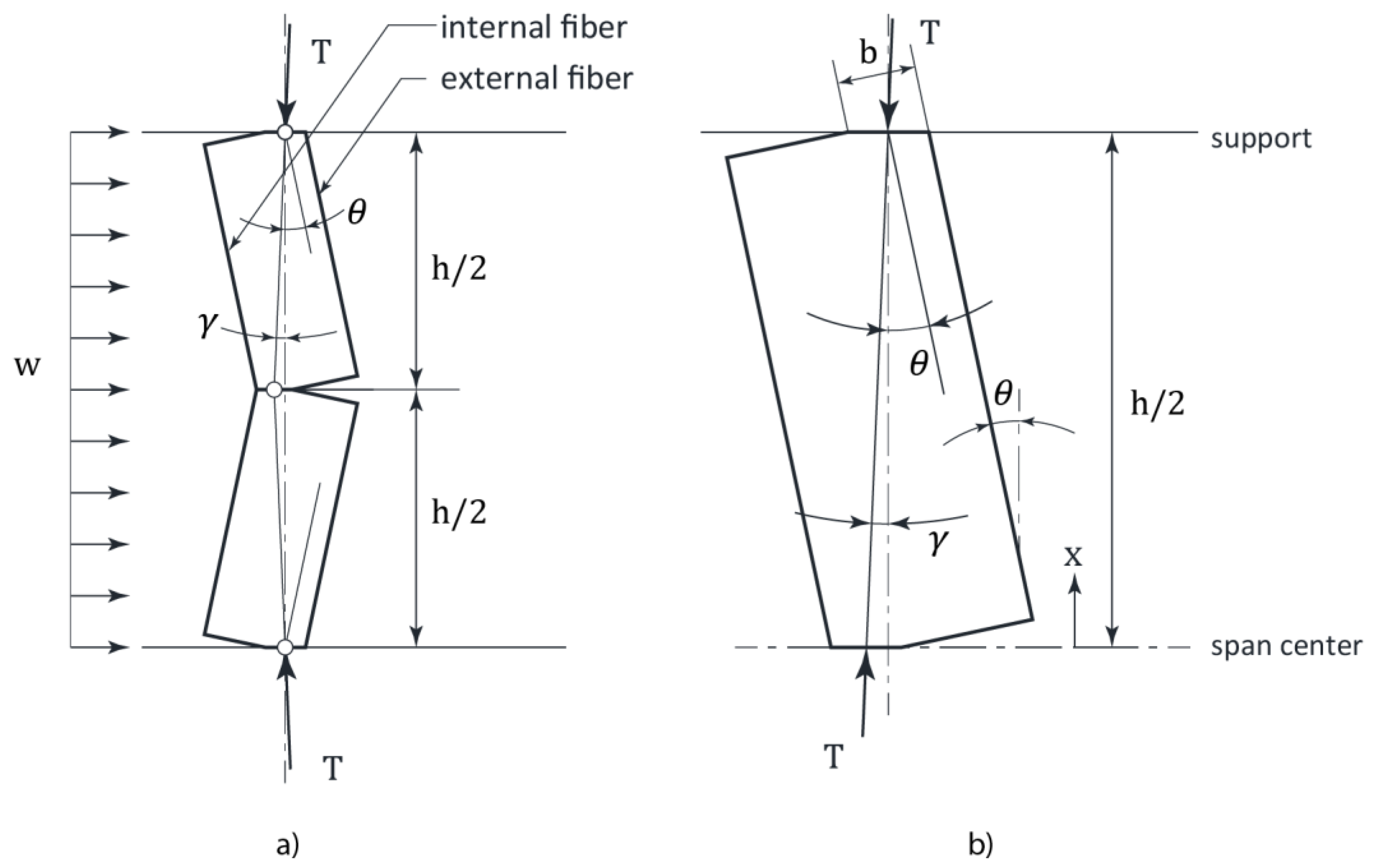
According to the concept of the arching mechanism, two or more rigid segments form in cracked masonry walls subjected to combined gravity loading and OOP lateral pressure with unsupported height/storey height ( h ) and length ( L ). It is expected that horizontal cracks develop at both the mid-height of the wall (interface cracks) and at the top/bottom supports (boundary cracks). Increasing lateral loading at the post-cracking stage causes a rotation of rigid segments and lateral displacements at the mid-height of the wall. As a result, the wall acts as a three-hinged arch (see Figure 19a). The thrust forces ( T ) (also known as strut forces) induce high compression stresses at the hinges (clamping points). The following two failure mechanisms are possible: (i) crushing and (ii) lateral instability (“snap through” mechanism). Crushing may take place at the cracked interface, provided that compressive stress at the clamping points reaches the masonry compressive strength, f m . The ultimate lateral pressure ,   w , can be determined from equilibrium of the horizontal component of the thrust force and the lateral pressure, as follows (Figure 19b):
w h 2 = 2 T sin γ
Figure 19. Arching mechanism in masonry walls: (a) a three-hinged arch and (b) a rigid segment subjected to thrust forces (adapted from [127]).

4.1.3. Experimental Research Studies

Previous experimental research studies have shown that a form of the arching mechanism that is characterised by crushing occurs in walls with relatively low slenderness ( h / t ) ratios. For masonry infills and CM walls, additional factors that determine the chances for crushing at the wall boundaries include the stiffness of the vertical RC elements and the compressive strength of the masonry. Experimental studies have shown that masonry infill walls with rigid boundary frame elements may also be subject to the crushing failure mechanism [128]. An alternative form of the arching mechanism, lateral instability due to excessive horizontal displacements, may be expected in slender walls and/or walls with flexible supports. The wall segments eventually reach an unstable position that culminates in a “snap through” failure.
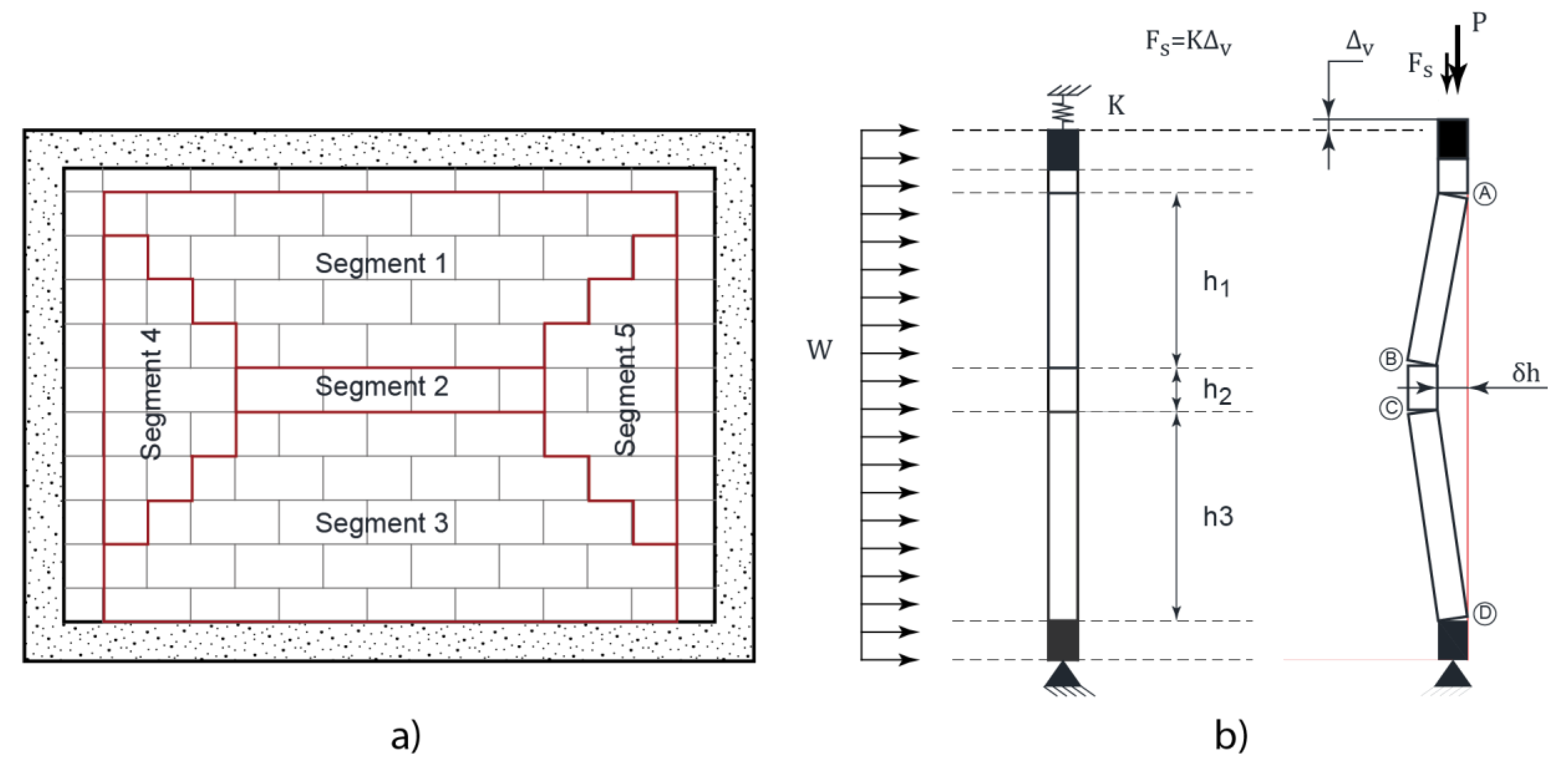
The experimental and analytical research evidence related to the behaviour of CM walls subjected to OOP loading is limited. The majority of experimental studies were performed by the same research group in Mexico, by subjecting CM wall specimens to monotonically increasing uniform pressure [50,129,130,131,132,133]; however, in one test, cyclic OOP load was applied to the top of the specimen [134]. Based on the results of their experimental studies, the researchers developed a one-way spring strut arching method to estimate the OOP strength of CM walls, taking into account the flexibility of the confining elements [50] and the applied axial compression stress (Figure 20). Subsequently, the method was generalised in the form of a bi-directional compression strut mechanism that also took into consideration the torsional stiffness of the RC elements [132].
Figure 20. Failure mechanism for CM walls subjected to monotonic OOP pressure: (a) cracking pattern and (b) one-way strut analytical model that takes into account the flexibility of the supports (adapted from [50]).
The proposed method built on the arching mechanism concept previously applied to masonry infills in RC frames [127], but is different in the assumptions related to the boundary conditions. The method applied to RC frames with infills assumed rigid boundary conditions due to robust beam and column elements, while the bi-directional compression strut mechanism considers the flexible support provided by the RC confining elements.
Based on a review of previous experimental studies, the authors of this paper compiled a database of 32 CM wall specimens from six experimental studies [50,129,130,131,133,134]. In five studies, the specimens were subjected to monotonic static loading, which was applied via air bags. In one case, a cyclic OOP lateral load was applied to the top of the specimen [134]. The key design parameters for these specimens are summarised in Table 2, while more detailed information on each specimen is presented in Table A3, Appendix A. It can be seen from the table that the specimens were characterised by h / L ratios ranging from 0.5 to 2.5, while the h / t ratio ranged from 12.0 to 25.0.
Table 2. Summary of experimental studies on the OOP behaviour of CM walls.

4.2. Effect of Wall Slenderness (h/t) Ratio

Restrictions on wall slenderness expressed in terms of the height-to-thickness ratio, h / t , are prescribed by design codes to prevent damage and/or instability as a result of OOP seismic actions [8]. It appears that the majority of the tested CM specimens were characterised by slenderness ratios lower than the limits set by international codes.
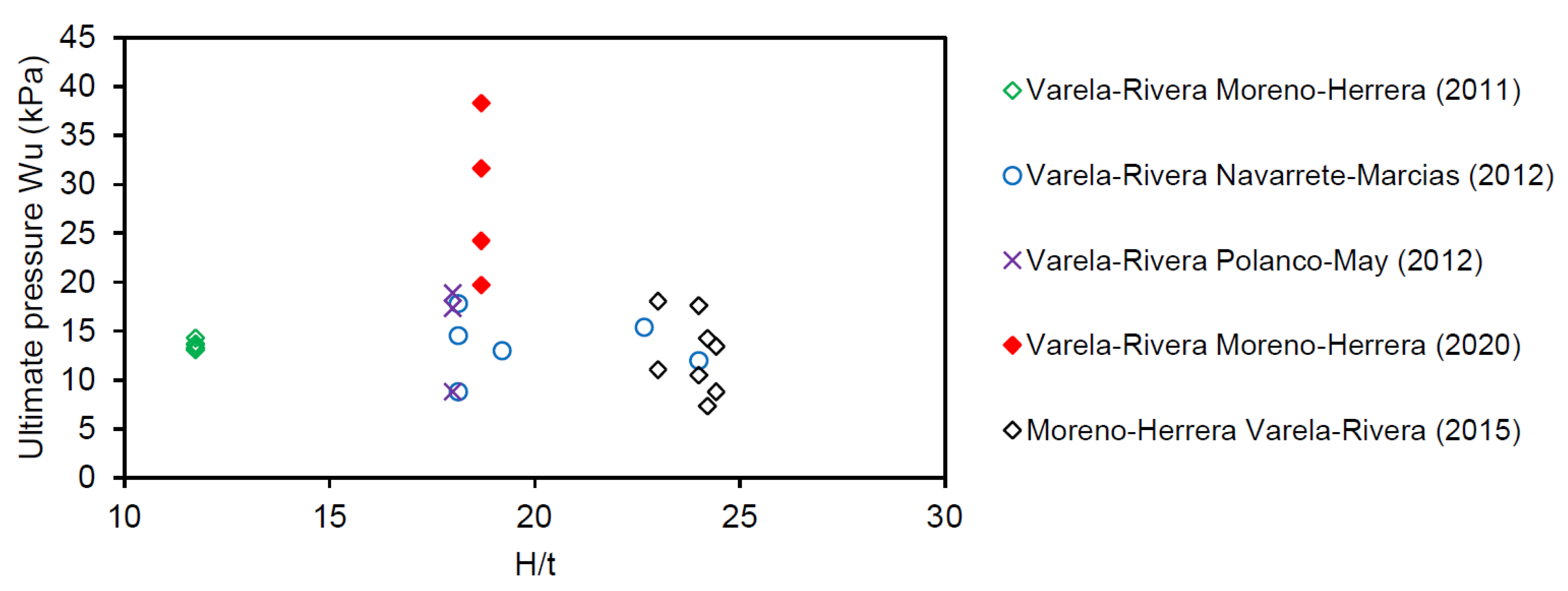
Based on an analysis of the experimental database, 26 out of the 32 specimens were characterised by an h / t ratio in the range from 18 to 25. An analysis of the test results for specimens with h / t values in the range from 12.0 to 25.0 showed a significant scatter with respect to ultimate pressure. There is no clear trend for the relationship between ultimate OOP pressure, w u , and h / t value, as shown in Figure 21.
Figure 21. Ultimate OOP pressure versus h/t ratio for the 32 CM wall specimens included in the experimental database [50,129,130,131,133,134].
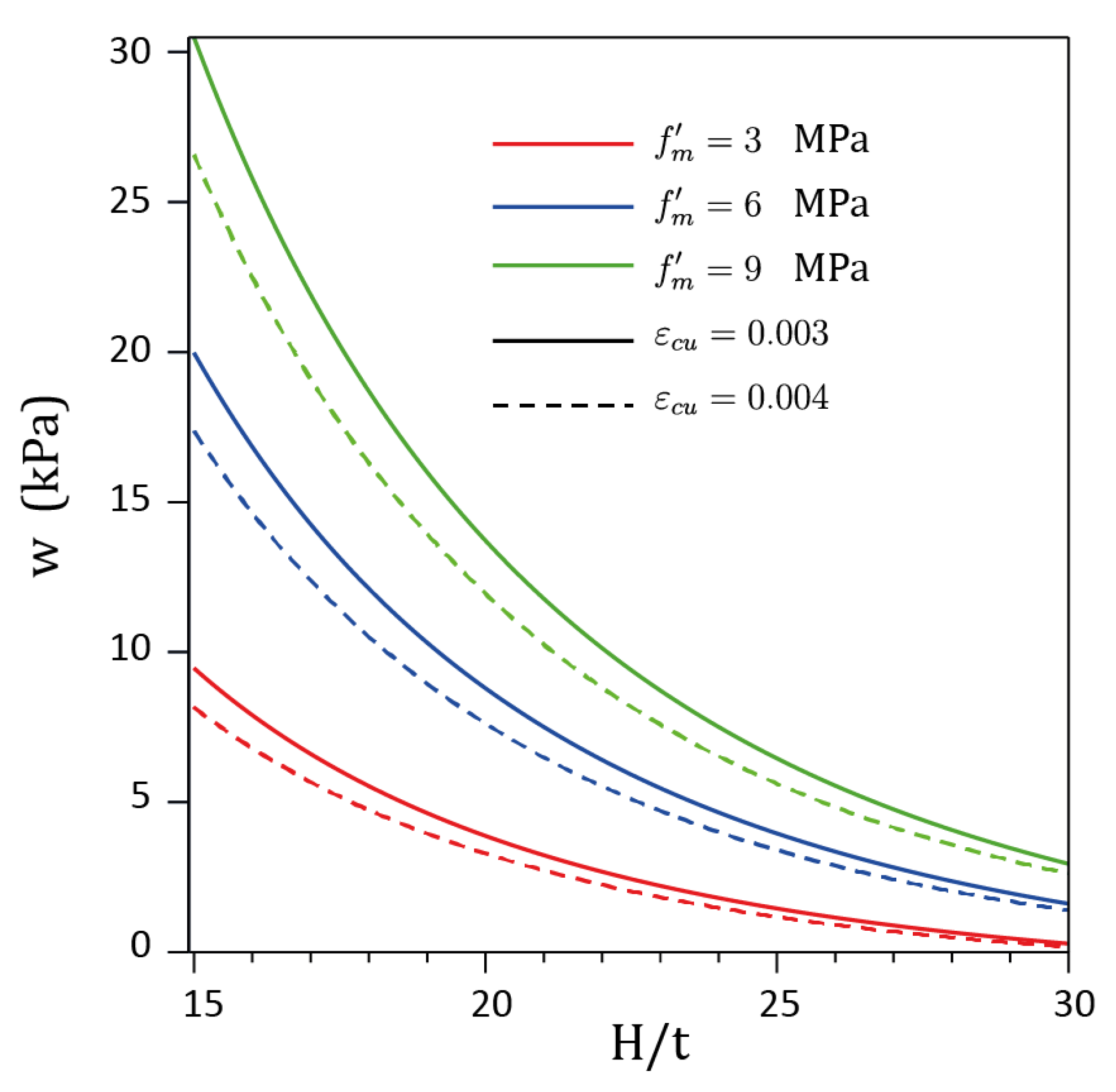
A few analytical models consider slenderness ratio ( h / t ) as the main parameter for predicting the OOP strength of masonry walls. The charts presented in Figure 22, developed on the basis of the analytical model proposed by Angel et al. [127], show a variation in the OOP ultimate pressure depending on the slenderness ratio ( h / t ), the masonry compressive strength f m , and the ultimate masonry compression strain, ε c u . The predictions appear to be on the conservative side compared to the reported experimental data on CM walls [50,129,130,131,133,134] for h / t values less than or equal to 25.
Figure 22. Prediction of the ultimate lateral pressure depending on the wall slenderness ratio, h / t , masonry compression strength f m , and the ultimate masonry strain ε c u , based on the model by Angel [127].
Tu et al. [135] performed an experimental study that involved the testing of two single-storey CM structures that were subjected to OOP excitation using a shaking table. The results showed that the resulting OOP lateral force for the less slender specimen B2 ( h / t = 14.4 ) was six times higher than that for the more slender specimen B1 ( h / t = 29.5 ); this is in agreement with the analytical results shown in Figure 22. For example, the curve corresponding to f m = 9 MPa and ε c u = 0.003 shows that when the slenderness ratio is increased from 15 to 30, there is an increase in the corresponding ultimate pressure from 5.0 to 30.0 kPa.
The effect of slenderness on the OOP behaviour of CM walls and RC frames with infills was studied on three half-scaled CM wall specimens that were subjected to in-plane reversed cyclic loading and subsequent OOP vibrations induced via shaking table [136]. The more slender specimen, S1WF ( h / t = 22.7 ) with a weak RC frame, similar to a CM wall without toothing, exhibited bed-joint sliding masonry failure, which ultimately led to the formation of plastic hinges at the ends of the tie-columns and shear failure at the wall mid-height. On the other hand, a less slender specimen with a more robust RC frame, S3SF ( h / t = 11.0 ), experienced uniformly distributed cracking over the masonry panel and sliding over two distinct horizontal planes. It was observed that the less slender specimen demonstrated superior performance compared to the otherwise similar more slender specimen.

4.3. Effect of Wall Aspect Ratio (h/L)

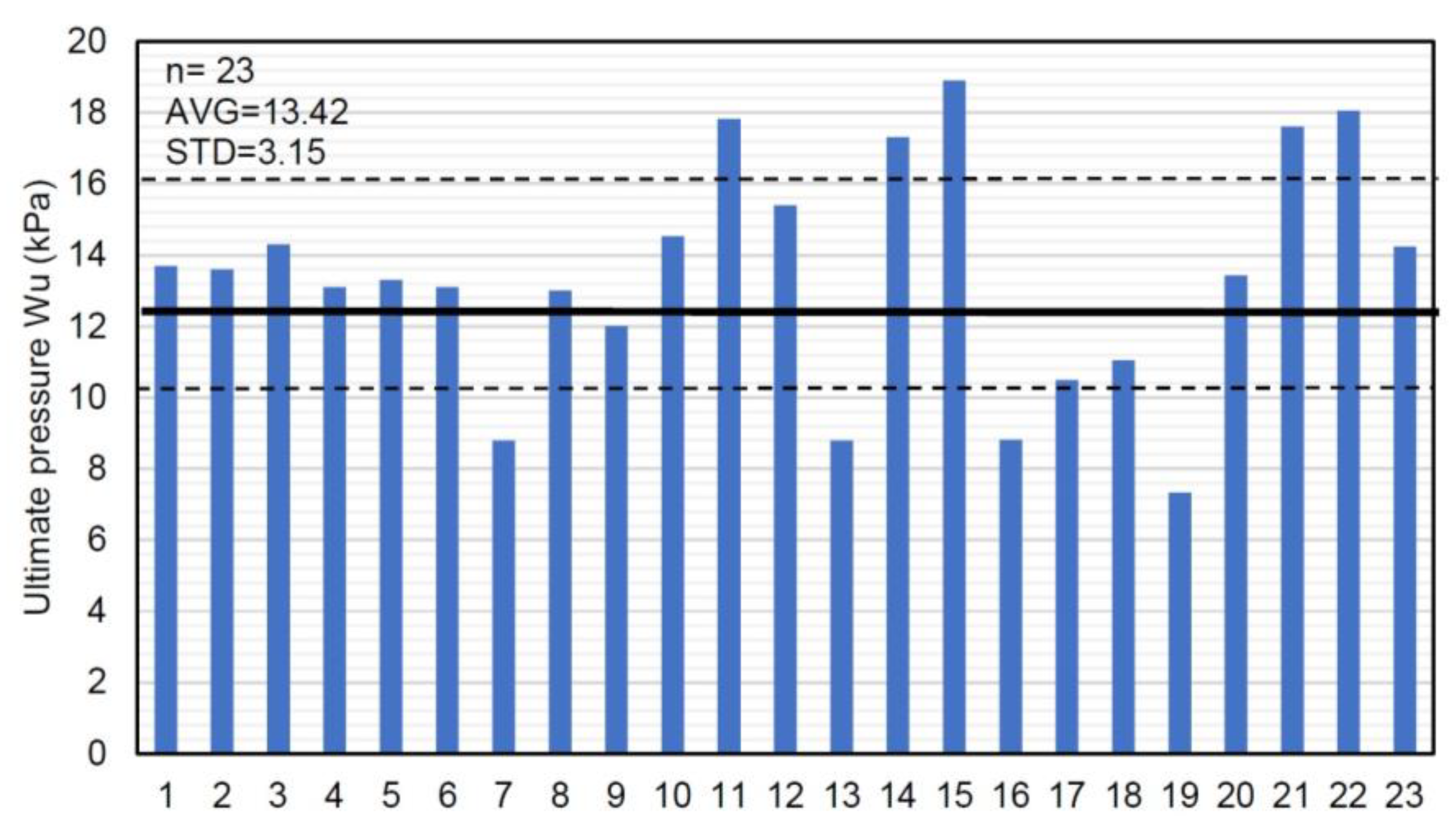
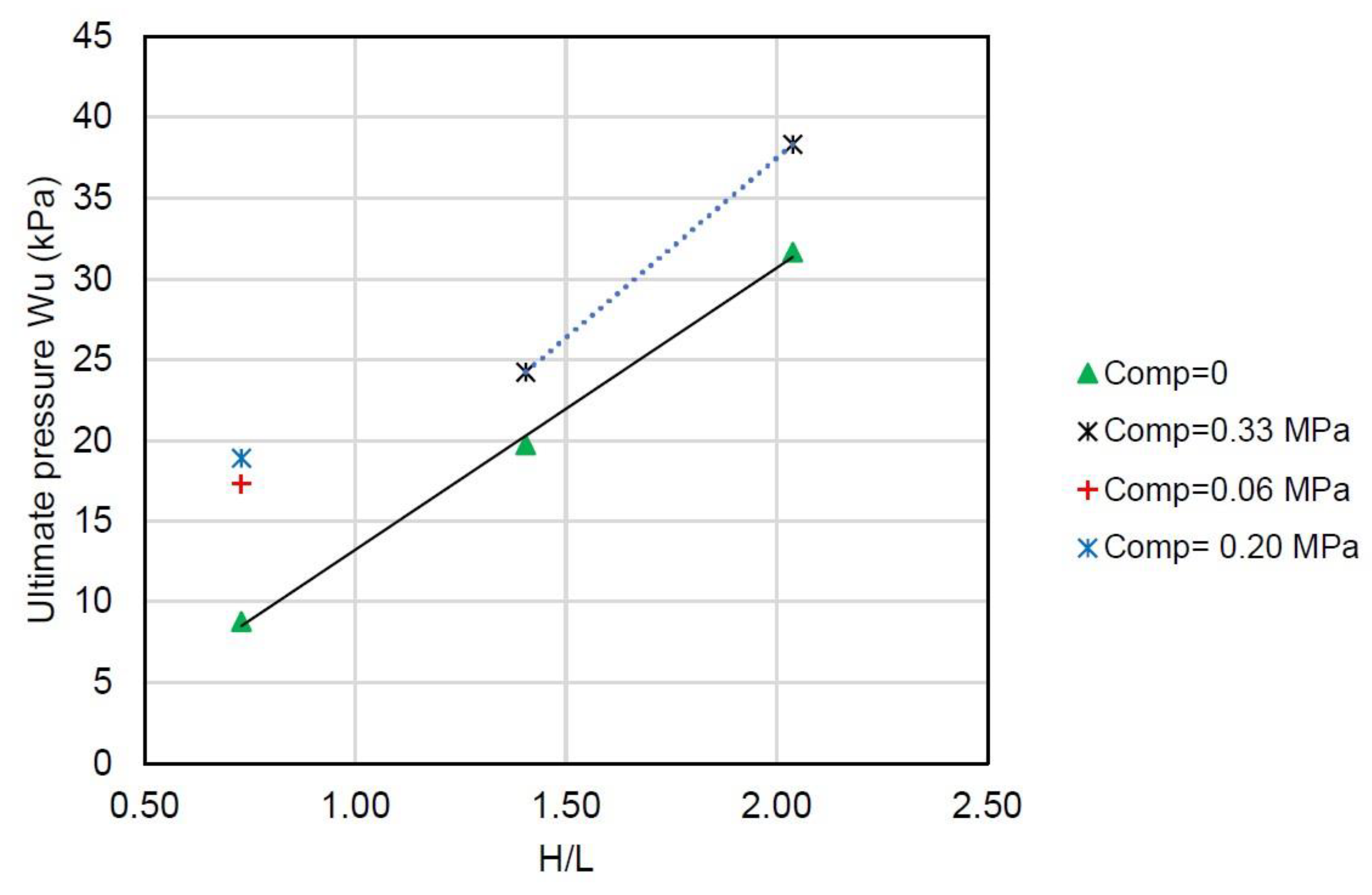
The majority (23 out of 32) of the tested CM wall specimens subjected to uniform OOP pressure were squat walls with an aspect ratio ( h / L ) lower than 1.0 (see Table 2). The results showed that the ultimate pressure values ranged from 8.79 to 18.91 kPa, with an average value of 13.42 kPa (solid line) and a standard deviation of 3.15 kPa (dashed lines) (Figure 23). Varela-Rivera et al. [131] also performed a study on non-squat CM walls (aspect ratios of 1.4 and 2.0) subjected to different levels of axial compression. It was observed that the ultimate pressure increased with increasing aspect ratio (Figure 24).
Figure 23. Effect of wall aspect ratio (h/L) on the OOP behaviour of CM walls: ultimate pressure values for squat CM wall specimens (experimental database included in Table A3).
Figure 24. The effect of h/L ratio and axial compression on the ultimate pressure for CM wall specimens (data from [130,131]).

4.4. Effect of Axial Compression

Varela-Rivera et al. [130] studied the effect of axial compression on the behaviour of CM walls subjected to uniform OOP pressure. Three full-scale squat CM wall specimens with an h/L ratio of 0.73 were subjected to different levels of axial compression ranging from 0 (specimen S-1) to 0.2 MPa (specimen S-3), corresponding to 8% of the masonry compression strength f m . The results showed that the specimens with the application of axial compression achieved approximately double the lateral pressure achieved by specimen S-1, without axial compression. Varela-Rivera et al. [131] also studied the effect of axial compression on the behaviour of CM walls by testing four non-squat wall specimens (aspect ratios of 1.4 and 2.0). All specimens were supported on four sides. Two specimens were subjected to a low axial compression of 0.33 MPa (less than 10% of the masonry compression strength f m ), while the remaining two specimens were not subjected to axial compression. For the specimens with the same h / L ratio (1.4 or 2.0), it was observed that the ultimate pressure increased by 15–20% with increasing axial compression level. The results for selected specimens are presented in Figure 24.

4.5. Effect of the Stiffness of RC Confining Elements

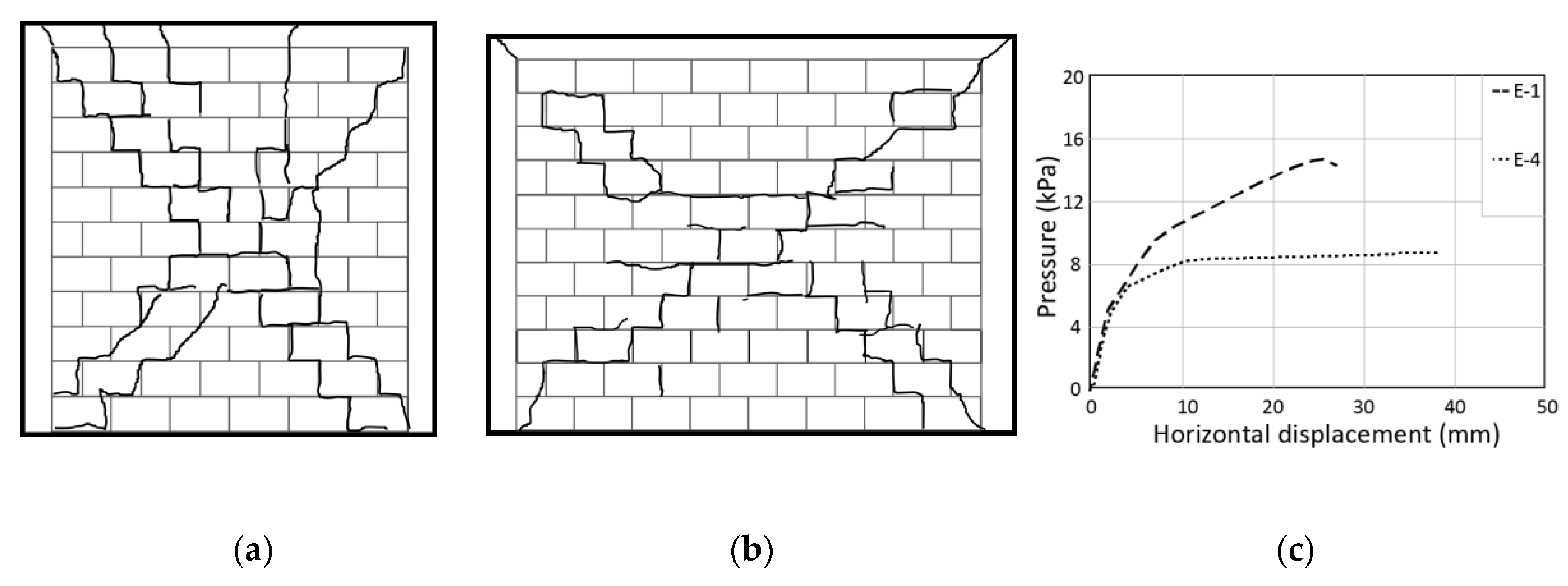
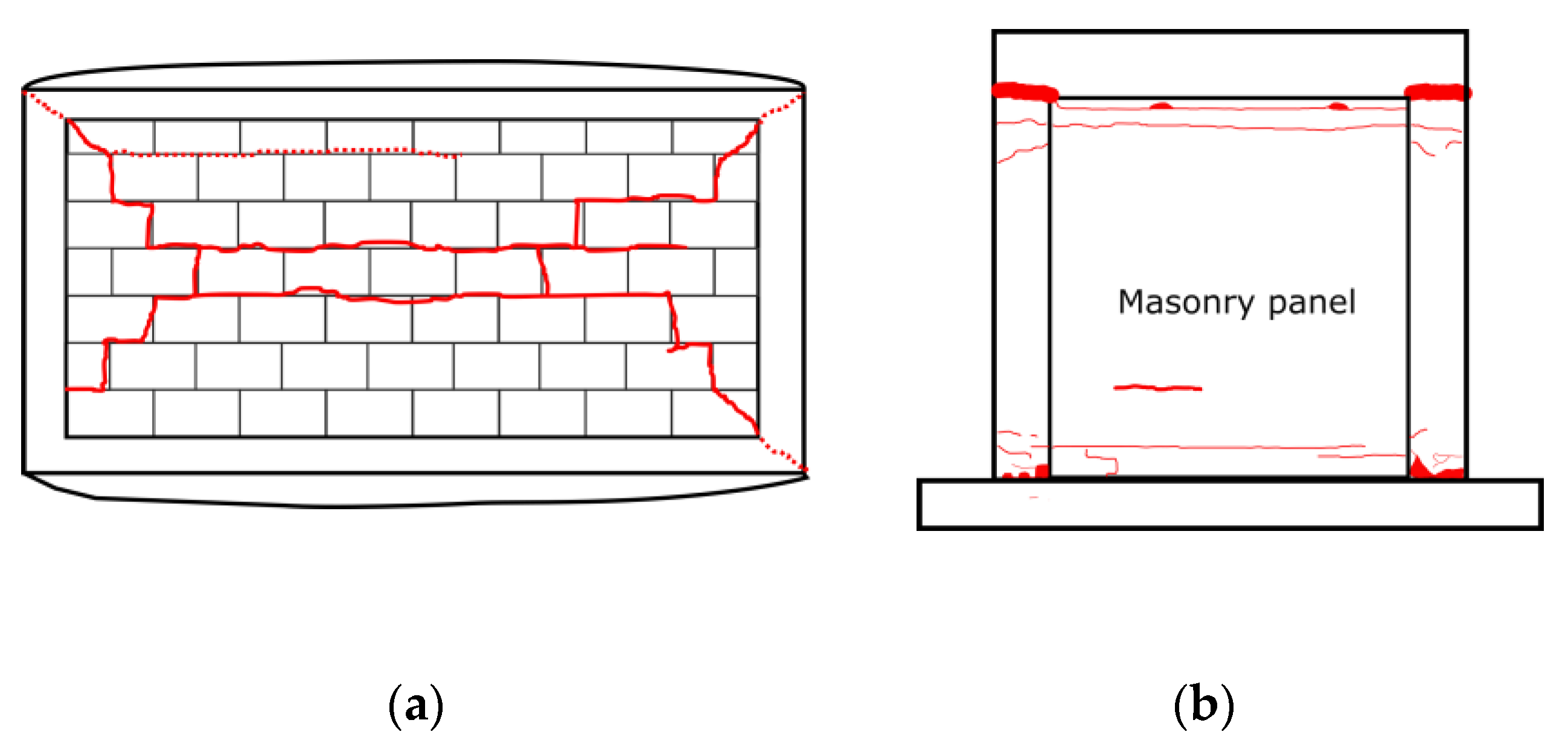
The stiffness of CM confining elements is an important parameter influencing the seismic response of CM walls subjected to OOP seismic effects; however, its effect has not been extensively studied. It has been well established that CM walls subjected to monotonic OOP loading behave similarly to two-way slabs subjected to uniform gravity loading. A common design approach for URM walls subjected to OOP uniform pressure is similar to that for the design of two-way slabs subjected to a uniform gravity load [96]. Experimental studies (e.g., [50]) have shown that the OOP failure mechanism for CM walls also depends on the stiffness of RC confining elements. The failure of CM walls with stiff RC confining elements is characterised by masonry crushing (e.g., specimen E-4, see Figure 25a). Alternatively, a “snap through” failure mechanism characterised by large OOP displacements may be expected in CM walls with flexible RC confining elements, e.g., specimen E-1, see Figure 25b. Figure 25c shows a difference in the ultimate pressure and OOP displacements for the two specimens. It can be seen from the chart that specimen E-4 (crushing failure) attained higher ultimate pressure and smaller lateral displacements than specimen E-1 which underwent “snap through” failure. It can be observed from the chart that the approximate difference in their ultimate displacements was on the order of 40%.
Figure 25. Effect of in-plane stiffness of RC confining elements on the OOP behaviour of CM walls (adapted from [50]): (a) specimen E-4 underwent masonry crushing failure; (b) specimen E-1 was subject to a “snap through” failure mechanism; and (c) lateral pressure versus horizontal OOP displacements for specimens E-1 and E-4.
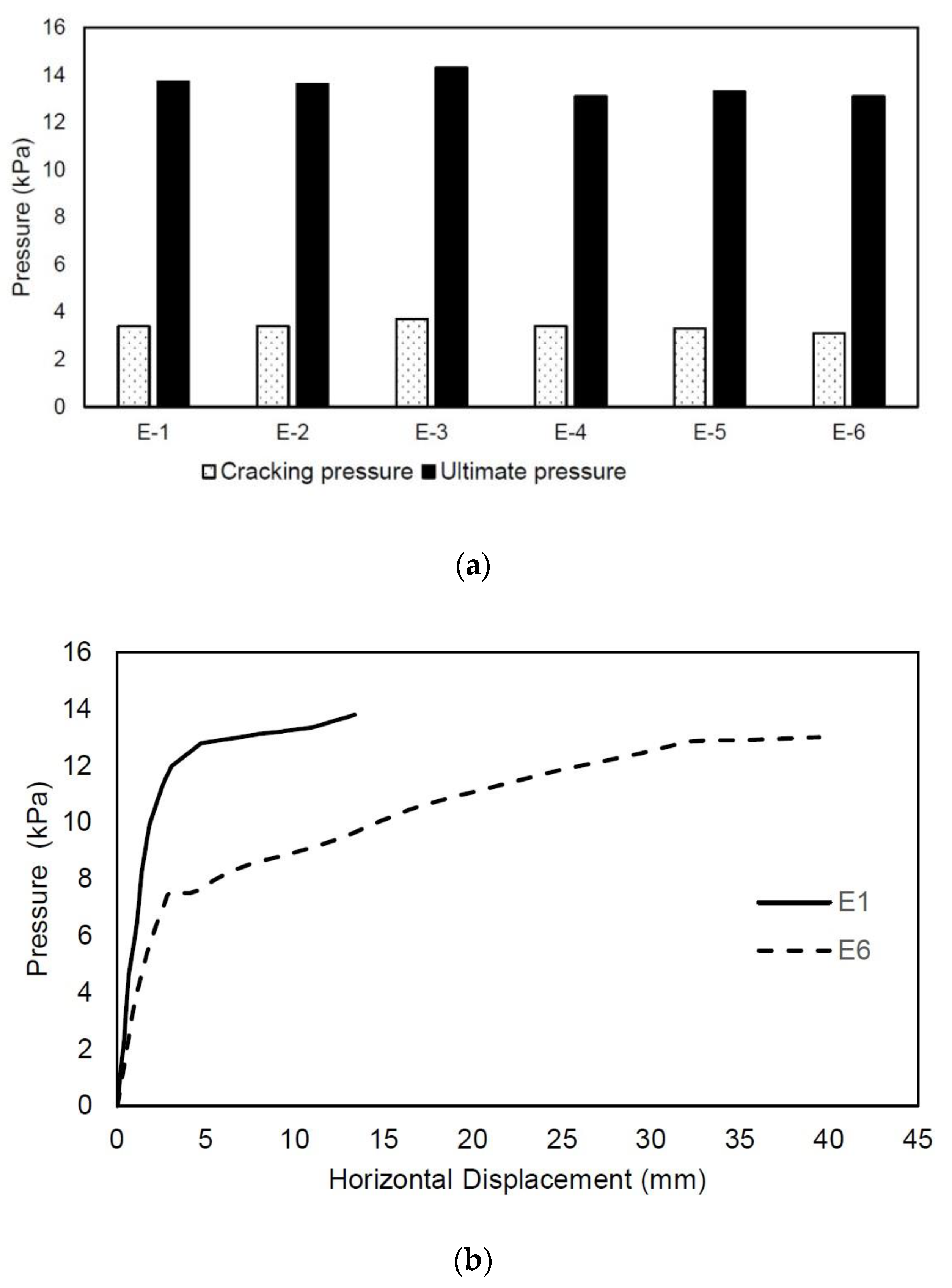
In CM walls supported on all four sides, RC tie-beams are cast integrally with RC floor slabs. In an alternative design scenario, a CM wall can be supported on three sides, while its top edge is supported by an RC tie-beam; this is characteristic of flexible (e.g., wooden) floor or roof diaphragms (see Figure 18a). The effect of the stiffness of confining elements was investigated through an experimental study on six full-size CM wall specimens subjected to increasing monotonic uniform lateral pressure applied via air bags [129]. The specimens were supported on either three or four sides. Figure 26a shows that the magnitude of ultimate pressure was very similar for all specimens (with differences within 10%). Although the magnitude of ultimate pressure was similar for specimens supported on three and four sides, a somewhat different behaviour was observed in the post-cracking stage for specimen E-1 (supported on four sides) compared to specimen E-6 (supported on three sides) (see Figure 26b). In all cases, the ultimate pressure was approximately four times higher than the cracking pressure, which indicates a significant reserve in post-cracking strength.
Figure 26. The OOP behaviour of CM wall specimens under different support conditions: (a) histogram showing the ultimate and cracking pressures for all specimens (data from [129]); and (b) OOP pressure vs. horizontal displacement curves for specimen E-1 supported on four sides and specimen E-6 supported on three sides (adapted from [129]).
Although the results of the experimental studies mentioned in this section are valuable, it is important to note that the studies were performed on single wall panels, which is an idealised scenario. In real buildings, several adjacent wall panels exist at the same floor level, as well as on different floors. Therefore, it is important to take into account the effect of the stiffness of RC confining elements on the OOP capacity of CM walls.

4.6. Difference between Monotonic Static Loading and Dynamic/Seismic Loading

In the majority of previous experimental studies on CM walls subjected to OOP loading, the specimens were subjected to increasing monotonic pressure applied by means of air bags [50,129,130,131,133]. The reported failure mechanism for CM wall specimens supported on four sides was similar to that found in two-way slabs subjected to gravity loading, as shown in Figure 27a [129].
Figure 27. Failure mechanisms for CM walls subjected to OOP loading: (a) monotonic static testing via air bags (adapted from [129]) and (b) dynamic testing via shaking table (adapted from [135]).
However, a study performing testing on single-storey CM buildings using a shaking table [135] showed that CM wall specimens subjected to OOP dynamic excitation developed horizontal cracks close to the wall-to-tie-beam interface at the top of the wall, as well as at the base of the wall (Figure 27b). These cracks extended into the RC tie-columns at higher shaking intensities.
Air bags produce a nearly uniform pressure, which may be appropriate for simulating the effect of wind loading on wall specimens; however, seismic inertial forces cannot be adequately simulated by means of uniform pressure. A simple explanation can be provided by considering the dynamics of a single-degree-of-freedom (SDOF) system [137]. When a structure is idealised as an SDOF system, the equivalent static force F may be expressed as follows:
F = K x = M   ψ   L m   A
where 𝐾 and 𝑀 represent stiffness and mass, respectively, and 𝐴 is ground pseudo-acceleration. Note that the displacement 𝑥 is equal to the product of a shape function, 𝜓, which is independent of time but depends on the boundary conditions, and 𝑧, a time-dependent scalar which corresponds to the displacement of a SDOF model, as follows:
x = ψ z
For a simply supported wall spanning the vertical direction, 𝜓 could be a parabolic or a sinusoidal function with zero displacement at the base and the top, but it cannot be a constant. The difference in shape for the load distribution over the wall height should be incorporated into the results of experimental and analytical studies in which the OOP wall capacity is determined on the basis of the uniform load distribution. A significant decrease in capacity (by more than 20%) was obtained for the model subjected to a non-uniform pressure distribution.

6. Conclusions and Research Gaps

The previous experimental research studies reviewed in this paper contain substantial evidence related to the seismic behaviour of CM walls. Based on the available experimental studies, relevant conclusions and future research needs (shown in italics) are summarised for each major topic.

6.1. In-Plane Shear

In most cases, CM shear walls subjected to in-plane seismic effects demonstrate a shear-dominant behaviour. An experimental database from several past research studies on CM wall specimens subjected to either monotonic or reversed cyclic lateral loading was used to establish critical parameters that influence the in-plane shear strength of CM walls. A statistical analysis of more than 100 experimental data points has confirmed that the masonry shear strength, v m , is proportional to the square root of masonry compression strength, f m ; however, the diagonal compression strength is a better indicator of the shear strength. Another influencing factor is the wall aspect ratio, H / L , which has been accounted for by the f factor, which was proposed as a result of an experimental research study. It was observed that shear–moment interaction due to the applied bending moment at the top of the wall causes a decrease in the masonry shear strength, particularly for walls characterised by a higher aspect ratio. The results of experimental studies have confirmed that masonry shear resistance is also proportional to the level of applied axial compression. The contribution of horizontal joint reinforcement to shear resistance of CM walls was shown to be proportional to the reinforcement ratio and steel yield strength. The results of experimental studies indicated that the effectiveness of horizontal reinforcement in CM walls may be limited, that is, there exists a maximum limit for the amount of such reinforcement in the wall beyond which its effectiveness cannot be increased. The effect of RC tie-columns on masonry shear strength has been studied by several researchers, but the conclusions in terms of the effect of longitudinal reinforcement differ. A statistical analysis of experimental data performed by the authors indicated that the masonry shear strength is proportional to square root of the product of longitudinal reinforcement ratio, steel yield strength, and concrete compressive strength, and the results show that the amount of longitudinal reinforcement in RC tie-columns has a significant influence on the masonry shear strength.
Further experimental research studies are needed on the following topics:
  • Shear strength of walls under tension;
  • The effect of the geometry of masonry units on masonry shear strength (bricks vs. blocks, perforated units);
  • A rational mechanical model for understanding the shear contribution of horizontal reinforcement; and
  • The interaction of in-plane shear and flexure.

6.2. In-Plane Flexure

The flexural failure of CM shear walls subjected to combined axial load and in-plane lateral loading is less common than shear failure; therefore, the experimental research evidence related to in-plane flexural behaviour of CM walls is limited. In general, flexure-dominant behaviour is characterised by yielding of longitudinal reinforcement and crushing of concrete at the base of RC tie-columns. Vertical cracks develop along the masonry-to-tie-column interface in slender CM specimens with higher aspect ratios. A comprehensive experimental study on 28 CM walls performed in Japan [120] showed that the specimens with cantilevered boundary conditions experienced either a shear-dominant or sliding failure mechanism, while the specimens with fixed ends experienced a flexural failure. The study showed that horizontal dowels provided at the masonry-to-tie-column interface are effective at preventing the separation of RC tie-columns from masonry panels. Recent experimental research studies performed in Mexico on CM walls subjected to reversed cyclic loading [118] showed that the specimens with predominant flexural behaviour attained higher displacement ductility at the ultimate stage than the CM walls with predominant shear behaviour; this is a very important consideration for performance-based seismic design. The results of previous experimental studies performed in Mexico [13,122] indicated that the normalised moment resistance of CM walls increases with increasing axial stress level; however, it appears that the effect of higher axial stress level is more important for CM walls with an aspect ratio of 2.0 or higher.
The results of a parametric numerical study performed by the authors indicate that the key parameters influencing the type of failure mechanism (flexure or shear) in CM walls are: axial stress level, masonry shear strength, horizontal reinforcement ratio, wall aspect ratio, and tie-column longitudinal reinforcement ratio. The study showed that the walls with an aspect ratio higher than 1.0 and/or with higher masonry shear and compression strength can be expected to experience a flexural failure. The amount (ratio) of horizontal reinforcement in the masonry panel is probably the most important parameter: the higher the horizontal reinforcement ratio, the higher the chance of flexural failure. An increased amount of horizontal reinforcement leads to increased shear capacity of CM walls.
Further experimental research studies are needed on the flexure-dominant behaviour of CM walls of all types, including different types of masonry units, wall aspect ratios, and axial load levels.

6.3. Out-of-Plane (OOP) Behaviour

The OOP failure mechanism in CM walls subjected to seismic effects is complex, and depends on the type of loading, as shown by experimental studies. Arching mechanisms can be used to estimate the OOP resistance (ultimate pressure) for loadbearing masonry walls, including CM walls. According to the concept of arching mechanism, two or more rigid segments will form in cracked masonry walls that are subjected to a combination of gravity loading and lateral pressure. This mechanism can culminate in masonry crushing, which is characteristic for walls with low slenderness (h/t) ratios, but additional factors include masonry compressive strength and the stiffness of adjacent RC confining elements. An alternative failure mechanism is lateral instability due to excessive horizontal displacements, referred to as “snap-through” failure; this mechanism may be expected in slender CM walls and walls with flexible RC confining elements. Mechanical models based on a bi-directional arching mechanism are more accurate than those based on one-directional models, which tend to be conservative (i.e., predict lower resistance). It is important to note that bi-directional models consider the wall aspect ratio as an indicator of OOP resistance. Past studies indicated that the OOP resistance of CM walls depends on a few parameters, including the wall geometry (height, length, thickness), stiffness of adjacent RC confining elements, and masonry compression strength. A review of past experimental studies on CM walls subjected to monotonic OOP pressure [50,129,130,131,133,134] showed a significant scatter of ultimate pressure for specimens with different slenderness ratios; however, the results of a shaking table study [135] showed that less slender walls have higher OOP resistance, which is in line with the predictions obtained from analytical models [127]. The wall aspect ratio and axial stress level also influence the OOP behaviour of CM walls—experimental studies have shown that the ultimate pressure for CM walls increases with increasing aspect ratio and axial stress level. The stiffness of RC confining elements is a very important parameter that influences seismic response of CM walls. Experimental studies on CM walls showed that walls with stiff RC confining elements experience crushing failure in the masonry, while walls with flexible RC confining elements experience a “snap-through” failure.
Further experimental research studies are needed on the following topics:
  • The OOP response of CM walls constructed using clay bricks and multi-perforated clay blocks;
  • The effect of the stiffness of the RC confining elements on the OOP behaviour of CM walls;
  • A comparison of the OOP behaviour of masonry infills in RC frames and CM walls under reversed cyclic loading;
  • The OOP response of CM walls subjected to reversed cyclic loading, and also dynamic loading (e.g., shaking table tests); and
  • The effect of combined in-plane and OOP loading.

6.4. Openings in CM Walls

Openings in CM walls subjected to seismic effects cause a decrease in their peak strength and stiffness, as evidenced by several experimental studies, as well as reports from past earthquakes. The extent of the decrease in strength depends on the size of an opening relative to the size of a wall panel and the position of opening within the panel. A ratio of the area of an opening relative to the CM panel area, A r , can be used to predict strength decrease in CM walls with openings. Experimental studies have confirmed a beneficial effect of vertical and horizontal RC confining elements around the openings, which are effective at reducing the extent of damage and maintaining the wall’s strength, stiffness, and displacement/drift potential.
Further experimental research studies are needed on the following topics:
  • The in-plane and OOP behaviour of walls with openings, considering different sizes and locations of openings;
  • The effect of the size and location of confining elements in walls with openings; and
  • The behaviour of CM walls with openings in buildings with flexible floor/roof diaphragms.

6.5. Toothing

One of the key features of CM construction is the connection between the masonry panels and the adjacent RC confining elements. It is believed that such a connection is beneficial for enhancing the performance of CM walls subjected to in-plane and out-of-plane seismic effects. The most common connection is in the form of toothing, and consists of a “zig-zag” edge created by masonry units along the masonry-to-tie-column interface. Subsequently, concrete is poured into RC tie-columns, and hence shear keys are formed along the interface. Alternatively, horizontal steel bars (dowels) may be embedded in mortar joints and extended on each side of a RC tie-column by a minimum length required for effective anchorage. The choice of connection depends on the type of masonry unit: toothing may be feasible when bricks are used, while dowelled connections are suitable for CM walls constructed using block units. In some countries, e.g., Argentina, CM walls are traditionally constructed without any connections (vertical edge). Although experimental research studies have been performed focusing on studying the performance of CM walls with different masonry-to-tie-column connections, the evidence is limited. Experimental studies have been performed to determine the effectiveness of the presence of toothed connections in CM walls. Singhal and Rai [147] tested CM walls under in-plane and OOP loading and concluded that toothing is particularly effective at controlling the damage due to OOP seismic effects, and that fine toothing (with smaller tooth sizes) is more effective than coarse toothing arrangements. Other research studies [66,145,146,149] showed that CM specimens with a toothed connection did not show superior performance compared to otherwise similar specimens without a toothed connection. A few researchers have performed comparisons between CM walls with toothed and dowelled connections [148,150], concluding that both connection types (toothing and dowels) are similar in terms of their effectiveness.
Further experimental research studies are needed on the following topics:
  • The toothing length and teeth spacing requirements for CM walls with different types of masonry units (bricks, blocks);
  • A comparison of toothing effectiveness for CM walls constructed using brick and block masonry;
  • The number (size and spacing) of steel dowels required for CM walls without toothing (a common situation in CM with block units); and
  • The response of CM walls with/without toothing under reversed cyclic loading.

6.6. Materials

The mechanical characteristics of masonry materials influence the seismic behaviour of CM walls. Masonry materials, particularly masonry units, vary between countries, and also between different regions within the same country. In the past, solid clay bricks were used for CM wall construction; however, in the last few decades, multi-perforated clay blocks have been widely used, particularly in the Latin American and European countries. Masonry mortar, in terms of the mix proportion and constituent materials (cement, lime, sand), also has a significant effect on the masonry compressive and shear strength. An experimental study on 16 CM walls performed in Mexico [25,27,40] showed that the specimens constructed using traditional hand-made solid clay bricks had relatively low shear resistance, but at the same time a higher displacement capacity (ductility) than the specimens constructed using other types of masonry units. The results of another study on CM wall specimens constructed using machine-made clay bricks characterised by significantly higher compressive strength showed higher shear strength of CM walls, but a rapid post-peak strength degradation and a notably lower displacement ductility. Finally, the specimens constructed using multi-perforated concrete blocks demonstrated the highest strength and a gradual post-peak strength degradation, combined with a reasonably high ductility.
Further experimental research studies should be directed towards masonry assemblage testing more than material testing. From a look at the available studies, the use of materials, clay or concrete, hollow or solid, is dependent on the in-situ availability of products. In addition, it would be interesting to establish how accurately results for the tested masonry assemblages compare to the as-built conditions.

Author Contributions

Conceptualization, J.J.P.G.E., S.B. and M.T.R.; Methodology, J.J.P.G.E., S.B., E.F.E.C., S.G., D.Q. and M.T.R.; Software, J.J.P.G.E. and E.F.E.C.; Validation, E.F.E.C., S.G., D.Q. and M.T.R.; Formal analysis, J.J.P.G.E.; Investigation, J.J.P.G.E., S.B., E.F.E.C., S.G. and D.Q.; Resources, S.B.; Data curation, J.J.P.G.E.; Writing—original draft, J.J.P.G.E., S.B., E.F.E.C., S.G. and D.Q.; Writing—review & editing, M.T.R.; Visualization, E.F.E.C.; Supervision, S.B. All authors have read and agreed to the published version of the manuscript.

Funding

This research received no external funding.

Data Availability Statement

Research data is available in Appendix A.

Acknowledgments

The authors are grateful to Ernesto Treviño and Leonardo Flores for sharing the experimental data and agreeing to use experimental database which they created for this study, and to publish the data in Appendix A. This manuscript is a result of an initiative by the joint Confined Masonry working group formed by the Masonry Society and the Earthquake Engineering Research Institute, and the authors acknowledge the support of these two organizations.

Conflicts of Interest

The authors declare no conflict of interest.

References

  1. Brzev, S.; Mitra, K. Earthquake-Resistant Confined Masonry Construction, 3rd ed.; National Information Center on Earthquake Engineering: Kanpur, India, 2018. [Google Scholar]
  2. Schacher, T.; Hart, T. Construction Guide for Low-Rise Confined Masonry Buildings; Earthquake Engineering Research Institute: Oakland, CA, USA, 2015. [Google Scholar]
  3. Meli, R.; Brzev, S.; Astroza, M.; Boen, T.; Crisafulli, F.; Dai, J.; Farsi, M.; Hart, T.; Mebarki, A.; Moghadam, A.S.; et al. Seismic Design Guide for Low-Rise Confined Masonry Buildings; World Housing Encyclopedia Report, Earthquake Engineering Research Institute: Oakland, CA, USA, 2011. [Google Scholar]
  4. Galvis, F.A.; Miranda, E.; Heresi, P.; Dávalos, H.; Ruiz-García, J. Overview of Collapsed Buildings in Mexico City after the 19 September 2017 (Mw7.1) Earthquake. Earthq. Spectra 2020, 36, 83–109. [Google Scholar] [CrossRef]
  5. Astroza, M.; Moroni, O.; Brzev, S.; Tanner, J. Seismic Performance of Engineered Masonry Buildings in the 2010 Maule Earthquake. Earthq. Spectra 2012, 28, S385–S406. [Google Scholar] [CrossRef]
  6. Confined Masonry Network|Promoting Seismically Safe, Economical Housing Worldwide. Available online: https://confinedmasonry.org/ (accessed on 15 January 2023).
  7. USCB. U.S. and World Population Clock. U.S. Census Bureau; U.S. Department of Commerce: Washington, DC, USA, 2018. [Google Scholar]
  8. Brzev, S.; Reiter, M.; Pérez Gavilán, J.J.; Quiun, D.; Membreño, M.; Hart, T.; Sommer, D. Confined Masonry the Current Design Standards. In Proceedings of the 13 North American Masonry Conference, Salt Lake City, UT, USA, 16–19 June 2019. [Google Scholar]
  9. Marques, R.; Lourenço, P. Structural Behaviour and Design Rules of Confined Masonry Walls: Review and Proposals. Constr. Build. Mater. 2019, 217, 137–155. [Google Scholar] [CrossRef]
  10. Esteva, L. Comportamiento de Muros de Mampostería Sujetos a Carga Vertical; SID 46; Investigación, Instituto de Ingeniería, UNAM: Mexico City, Mexico, 1961. (In Spanish) [Google Scholar]
  11. Madinaveitia, J. Ensayes de Muros de Mampostería Con Cargas Excéntricas; SID 296; Investigación, Instituto de Ingeniería, UNAM: Mexico City, Mexico, 1971. (In Spanish) [Google Scholar]
  12. Madinaveitia, J.; Rodriguez, A. Resistencia a Carga Vertical de Muros Fabricados Con Materiales Usuales En El Distrito Federal; SID 261; Investigación, Instituto de Ingeniería, UNAM: Mexico City, Mexico, 1970. (In Spanish) [Google Scholar]
  13. Meli, R.; Salgado, G. Comportamiento de Muros de Mampostería Sujetos a Carga Lateral; SID 237; Segundo Informe, Instituto de Ingeniería UNAM: Mexico City, Mexico, 1969. (In Spanish) [Google Scholar]
  14. Meli, R.; Hernández, B. Propiedades de Piezas Para Mampostería Producidas En El Distrito Federal; Informe No. 297; Instituto de Ingeniería, UNAM: Mexico City, Mexico, 1971. (In Spanish) [Google Scholar]
  15. Meli, R.; Hernández, O. Efectos de Hundimientos Diferenciales En Construcciones a Base de Muros de Mampostería; SID350; Instituto de Ingeniería UNAM: Mexico City, Mexico, 1975. (In Spanish) [Google Scholar]
  16. Hernández, O.; Meli, R. Modalidades de Refuerzo Para Mejorar El Comportamiento Sísmico de Muros de Mampostería; SID382; Informe de Investigación, Instituto de Ingeniería, UNAM: Mexico City, Mexico, 1976. (In Spanish) [Google Scholar]
  17. Meli, R. Comportamiento Sísmico de Muros de Mampostería, 2nd ed.; SID352; Corregida y Aumentada, Instituto de Ingeniería UNAM: Mexico City, Mexico, 1979. (In Spanish) [Google Scholar]
  18. Bazán, E. Muros de Mampostería Ante Cargas Laterales, Estudios Analíticos. Ph.D. Thesis, UNAM, México City, Mexico, 1980. (In Spanish). [Google Scholar]
  19. Hernández, O.; Guzmán, H. Uso de Aceros de Alto Grado de Fluencia Para Confinar Muros de Tabique Rojo; Laboratorio de Materiales, Instituto de Ingeniería, UNAM: Mexico City, Mexico, 1987. (In Spanish) [Google Scholar]
  20. Hernández, O. Mampostería Reforzada Con Acero de Alta Resistencia: Una Opción Segura y Económica Para La Vivienda de Bajo Costo. In Proceedings of the Simposio Internacional Sobre Seguridad Sísmica en la Vivienda Económica, Mexico City, Mexico, 25–28 February 1991. (In Spanish). [Google Scholar]
  21. Hernández, O.; Guzmán, H. Ensaye Bajo Cargas Laterales Alternadas de Muros Construidos Con El Tabique MULTEX.; Laboratorio de Materiales, Facultad de Ingeniería, Universidad Nacional Autónoma de México: Mexico City, Mexico, 1996. (In Spanish) [Google Scholar]
  22. Hernández, O. Comportamiento de Muros Confinados Construidos Con Tabique TABIMAX Ante Cargas Laterales Alternadas; Laboratorio de Materiales, Instituto de Ingeniería UNAM: Mexico City, Mexico, 1998. (In Spanish) [Google Scholar]
  23. Hernández, O.; Basilio, I. Comportamiento Ante Cargas Laterales Alternadas de Muros Construidos Con Tabique Multiperforado. In Proceedings of the XII Congreso Nacional de Ingeniería Sísmica, Morelia, Michoacán, Mexico, 23–26 November 1999. (In Spanish). [Google Scholar]
  24. Alcocer, S.; Meli, R. Test Program on the Seismic Behavior of Confined Masonry Structures. Mason. Soc. J. 1995, 13, 68–76. [Google Scholar]
  25. Aguilar, G.; Díaz, R.; Vásquez del Mercado, A. Influence of Horizontal Reinforcement on the Behavior on Confined Masonry Walls. In Proceedings of the 11th World Conference of Earthquake Engineering, Acapulco, Guerrero, México, 23–28 June 1996. [Google Scholar]
  26. Alcocer, S.; Zepeda, J.; Ojeda, M. Estudio de La Factibilidad Técnica Del Uso de Tabique VINTEX y MULTEX Para Vivienda Económica; Centro Nacional de Prevención de Desastres (CENAPRED): Mexico City, Mexico, 1997. (In Spanish) [Google Scholar]
  27. Alcocer, S.; Zepeda, J. Behavior of Multi-Perforated Clay Brick Walls under Earthquake-Type Loading. In Proceedings of the 8th North American Masonry Conference, Austin, TX, USA, 3–6 June 1999. [Google Scholar]
  28. Alcocer, S.; Ruiz, J.; Pineda, J.; Zepeda, J. Retrofitting of Confined Masonry Walls with Welded Wire Mesh. In Proceedings of the 11th World Conference on Earthquake Engineering, Acapulco, Guerrero, México, 23–28 June 1996. [Google Scholar]
  29. Flores, L.; Alcocer, S. Calculated Response of Confined Masonry Structures. In Proceedings of the 11th World Conference on Earthquake Engineering, Acapulco, Guerrero, México, 23–28 June 1996. [Google Scholar]
  30. Alcocer, S. Implications Derived from Recent Research in Mexico on Confined Masonry Structures. In Proceedings of the Committee on Concrete and Masonry Structures (CCSM) Symposium; American Society of Civil Engineers: Chicago, IL, USA; 1996. [Google Scholar]
  31. Alcocer, S.; Muriá, D.; Peña, J. Comportamiento Dinámico de Muros de Mampostería Confinada; Universidad Nacional Autónoma de México: Mexico City, Mexico, 1999. (In Spanish) [Google Scholar]
  32. NTC-M. Normas Técnicas Complementarias Para Diseño y Construcción de Estructuras de Mampostería; Gaceta Oficial del Distrito Federal: Mexico City, Mexico, 2004. (In Spanish) [Google Scholar]
  33. NTC-M. Normas Técnicas Complementarias Para Diseño y Construcción de Estructuras de Mampostería; Gobierno de la Ciudad de México: Mexico City, Mexico, 2017. (In Spanish) [Google Scholar]
  34. Pérez Gavilán, J.; Flores, L.; Jean, R.; Cesin, J.; Hernández, O. Relevant Aspects of the New Mexico City’s Code for the Design and Construction of Masonry Structures. In Proceedings of the 16th World Conference on Earthquake Engineering, Santiago, Chile, 9–13 January 2017. [Google Scholar]
  35. Pérez Gavilán, J.; Flores, L.; Alcocer, S. An Experimental Study of Confined Masonry Walls with Varying Aspect Ratios. Earthq. Spectra 2015, 31, 945–968. [Google Scholar] [CrossRef]
  36. Pérez Gavilán, J.; Flores, L.; Manzano, A. A New Shear Strength Design Formula for Confined Masonry Walls: Proposal to the Mexican Code. In Proceedings of the Tenth U.S. National Conference on Earthquake Engineering, Anchorage, AL, USA, 21–25 July 2014. [Google Scholar]
  37. Pérez Gavilán, J.; Cruz, A. Shear Strength of Confined Masonry Walls with Transverse Reinforcement. In Brick and Block Masonry: Trends, Innovations and Challenges—Proceedings of the 16th International Brick and Block Masonry Conference, IBMAC 2016; CRC Press: London, UK, 2016; pp. 2335–2344. [Google Scholar]
  38. Leal, J.; Pérez Gavilán, J.; Castorena, G.; Velázquez, D. Infill Walls with Confining Elements and Horizontal Reinforcement: An Experimental Study. Eng Struct. 2017, 150, 153–165. [Google Scholar] [CrossRef]
  39. Pérez Gavilán, J. The Effect of Shear-Moment Interaction on the Shear Strength of Confined Masonry Walls. Constr. Build. Mater. 2020, 263, 120087. [Google Scholar] [CrossRef]
  40. Cruz, A.; Pérez Gavilán, J.; Flores, L. Experimental Study of In-Plane Shear Strength of Confined Concrete Masonry Walls with Joint Reinforcement. Eng. Struct. 2019, 182, 213–226. [Google Scholar] [CrossRef]
  41. Rubio, P. Contribución Del Refuerzo Horizontal a La Resistencia a Corte de Muros Confinados de Piezas de Arcilla Extruida. Master’s Thesis, Instituto de Ingenieria UNAM, Mexico City, Mexico, 2017. (In Spanish). [Google Scholar]
  42. Lizárraga, J.; Pérez Gavilán, J. Modelación No Lineal de Muros de Mampostería Empleando Elementos de Contacto. Ing. Sísmica 2015, 93, 41–59. (In Spanish) [Google Scholar] [CrossRef]
  43. Lizárraga, J. Comportamiento de Muros de Mampostería Confinada Sobre Elementos Flexibles. Ph.D. Thesis, Instituto de Ingeniería UNAM, Mexico City, Mexico, 2017. (In Spanish). [Google Scholar]
  44. Lizárraga, J.F.; Pérez-Gavilán, J.J. Parameter Estimation for Nonlinear Analysis of Multi-Perforated Concrete Masonry Walls. Constr. Build. Mater. 2017, 141, 353–365. [Google Scholar] [CrossRef]
  45. Pérez Gavilán, J. Análisis de Estructuras de Mampostería, Sociedad Mexicana de Ingeniería Estructural; Sociedad Mexicana de Ingeniería Estructural A.C.: Mexico City, Mexico, 2015. (In Spanish) [Google Scholar]
  46. Gómez, B.; Jean, P.; Pérez, A.; Treviño, E. Edificaciones de Mampostería; LIMUSA: Mexico City, Mexico, 2019. (In Spanish) [Google Scholar]
  47. Alcocer, S.; Casas, N. Shake-Table Testing of a Small-Scale Five-Story Confined Masonry Building. In Proceedings of the Thirteenth North American Masonry Conference, Salt Lake City, UT, USA, 16–19 June 2019. [Google Scholar]
  48. Flores, L.; Pérez Gavilán, J.; Alcocer, S. Displacement Capacity of Confined Masonry Structures Reinforced with Horizontal Reinforcement: Shaking Table Tests. In Proceedings of the 16th World Conference on Earthquake Engineering, Santiago, Chile, 9–13 January 2017. [Google Scholar]
  49. Pérez Gavilán, J. Three Story CM Buildings with Joint Reinforcement: Shaking Table Tests. In Proceedings of the 17 Brick and Block Masonry Conference, Cracow, Poland, 5–8 July 2020. [Google Scholar]
  50. Varela-Rivera, J.; Moreno-Herrera, J.; Lopez-Gutierrez, I.; Fernandez-Baqueiro, L. Out-of-Plane Strength of Confined Masonry Walls. J. Struct. Eng. 2012, 138, 1331–1341. [Google Scholar] [CrossRef]
  51. Svojsik, M.; San Bartolomé, A. Relevant Masonry Projects Carried out in the Structures Laboratory at the Catholic University of Peru. In Proceedings of the 8th World Conference on Earthquake Engineering, San Francisco, CA, USA, 21–28 July 1984. [Google Scholar]
  52. San Bartolomé, A.; Torrealva, D. A New Approach for Seismic Design of Masonry Buildings in Peru. In Proceedings of the Fifth North American Masonry Conference, Urbana-Champaign, IL, USA, 3–6 June 1990. [Google Scholar]
  53. San Bartolomé, A. Construcciones de Albañilería; Fondo Editorial Pontificia Universidad Católica del Perú: Lima, Perú, 1994. (In Spanish) [Google Scholar]
  54. San Bartolomé, A.; Quiun, D.; Torrealva, D. Seismic Behaviour of a Three-Story Half Scale Confined Masonry Structure. In Proceedings of the 10th World Conference on Earthquake Engineering, Madrid, Spain, 19–24 July 1992. [Google Scholar]
  55. San Bartolomé, A.; Quiun, D.; Silva, D. Diseño y Construcción de Estructuras Sismo-Resistentes de Albañilería; Fondo Editorial de la Pontificia Universidad Católica del Perú: Lima, Perú, 2010. (In Spanish) [Google Scholar]
  56. Quiun, D.; Santillán, P. Development of Confined Masonry Seismic Considerations, Research and Design Codes in Peru. In Proceedings of the 16th World Conference on Earthquake Engineering, Santiago, Chile, 9–13 January 2017. [Google Scholar]
  57. Astroza, M.; Andrade, F.; Moroni, M.O. Confined Masonry Buildings: The Chilean Experience. In Proceedings of the 16th World Conference on Earthquake Engineering, Santiago, Chile, 9–13 January 2017. [Google Scholar]
  58. Moroni, M.; Astroza, M.; Tavonatti, S. Nonlinear Models for Shear Failure in Confined Masonry Walls. TMS J. 1994, 12, 72–78. [Google Scholar]
  59. Moroni, M.; Astroza, M.; Acevedo, C. Performance and Seismic Vulnerability of Masonry Housing Types Used in Chile. J. Perform. Constr. Facil. 2004, 18, 173–179. [Google Scholar] [CrossRef]
  60. Moroni, M.; Astroza, M.; Caballero, C. Wall Density and Seismic Performance of Confined Masonry Buildings. TMS J. 2000, 18, 79–86. [Google Scholar]
  61. Moroni, M.; Astroza, M.; Salinas, C. Seismic Displacement Demands in Confined Masonry Buildings. In Proceedings of the 8th North American Masonry Conference, Austin, TX, USA, 6–9 June 1999. [Google Scholar]
  62. Tomaževič, M. Shear Resistance of Masonry Walls and Eurocode 6: Shear versus Tensile Strength of Masonry. Mater. Struct. 2009, 42, 889–907. [Google Scholar] [CrossRef]
  63. Ministerio de Vivienda, Construccion y Saneamiento. Norma Técnica E.070 Albañilería; Servicio Nacional de Capacitación Para La Industria de La Construcción: Lima, Peru, 2018. (In Spanish) [Google Scholar]
  64. Treviño, E.; Larrúa, R.; Flores, L.; Alcocer, S.; Cabrera, Y.; Acevedo, A. Evaluación de Técnicas de Inteligencia Artificial Para La Predicción de La Respuesta de Muros de Mampostería Confinada. In Proceedings of the XIX Congreso Nacional de Ingeniería Estructural, Puerto Vallarta, Jalisco, México, 13–15 November 2014. (In Spanish). [Google Scholar]
  65. Aguilar, G.; Alcocer, S. Efecto Del Refuerzo Horizontal En El Comportamiento de Muros de Mampostería Confinada Ante Cargas Laterales; CI/IEG-10122011; CENAPRED: Mexico City, Mexico, 2001. (In Spanish) [Google Scholar]
  66. González, I. Estudio de La Conexión Columna-Albañilería En Muros Confinados. Civil Engineer Thesis, Facultad de Ciencias e Ingeniería, Pontificia Universidad Católica del Perú, , San Miguel, Peru, 1993. (In Spanish). [Google Scholar]
  67. Pineda, J.A. Comportamiento ante Cargas Laterales de Muros de Mampostería Confinada Reforzados con Malla Electrosoldada. Master’s Thesis, DEPFI, Universidad Nacional Autónoma de México, México City, Mexico, 1996. (In Spanish). [Google Scholar]
  68. Mendoza, J.A. Estudio Experimental de Muros de Mampostería Confinada con y Sin Refuerzo Alrededor de la Abertura. Professional Thesis, Universidad Nacional Autónoma de México, México City, Mexico, 2006. (In Spanish). [Google Scholar]
  69. Vázquez, A. Ensaye Experimental de Viviendas de Mampostería Confinada de un Piso Mediante el Ensaye en Mesa Vibradora. Master’s Thesis, Universidad Nacional Autónoma de México, México City, Mexico, 2005. (In Spanish). [Google Scholar]
  70. Arias, J.G. Ensayos en Mesa Vibradora de un Modelo a Escala 1:2 de Edificio de Mampostería Confinada de Tres Niveles. Master’s Thesis, Universidad Nacional Autónoma de México, México City, Mexico, 2005. (In Spanish). [Google Scholar]
  71. Barragán, R. Ensaye de Una Vivienda a Escala de Dos Niveles de Mampostería Confinada. Master’s Thesis, Universidad Nacional Autónoma de México, México City, Mexico, 2005. (In Spanish). [Google Scholar]
  72. Diez, R.J. Estudio Experimental de Muros de Albañilería Sometidos a Carga Lateral Alternada. Bachelor’s Thesis, Universidad de Chile, Santiago, Chile, 1987. (In Spanish). [Google Scholar]
  73. San Bartolomé, A. Ensayos de Carga Lateral en Muros de Albañilería Confinados—Correlación de Resultados Entre Especimenes a Escala Natural y Probetas Pequeñas. In Proceedings of the XXII Jornadas Sudamericanas de Ingeniería Estructural, Santiago, Chile, 1–4 July 1983. (In Spanish). [Google Scholar]
  74. San Bartolomé, A.; Comportamiento Sísmico de Muros de Albañilería Confinada Reforzados con Canastillas Dúctiles y Electrosoldadas. Blog de San Bartolomé, Pontificia Universidad Católica del Perú. Available online: http://blog.pucp.edu.pe/blog/wp-content/uploads/sites/82/2007/09/Canastilla-Electrosoldada.pdf (accessed on 28 June 2023). (In Spanish).
  75. San Bartolomé, A.; Pehovaz, R.; Comportamiento a Carga Lateral Cíclica de Muros de Adobe Confinados. Blog de San Bartolome, Pontificia Universidad Católica del Perú. Available online: http://blog.pucp.edu.pe/blog/wp-content/uploads/sites/617/2007/04/Adobe-Confinado.pdf (accessed on 28 June 2023). (In Spanish).
  76. Zepeda, J.A.; Alcocer, S. Comportamiento Ante Cargas Laterales de Muros de Ladrillo de Arcilla Perforado y Multiperforado. Informe Técnico, CENAPRED: Mexico City, Mexico, 2001. (In Spanish) [Google Scholar]
  77. Echevarría, G.; San Bartolomé, A. Ensayo de Carga Lateral en Muros de Albañilería Confinados—Efectos de la Carga Vertical. In Proceedings of the VI Congreso Nacional de Ingeniería Civil, Colegio de Ingenieros del Perú, Cajamarca, Perú, 1–3 May 1986. (In Spanish). [Google Scholar]
  78. Pastorutti, O.; San Bartolomé, A. Ensayos de Carga Lateral en Muros de Albañilería Confinados—Efectos del Refuerzo. In Proceedings of the VI Congreso Nacional de Ingeniería Civil, Colegio de Ingenieros del Perú, Cajamarca, Perú, 24–26 November 1986. (In Spanish). [Google Scholar]
  79. Alcocer, S.M.; Marcelino, J. Factibilidad del Uso de Malla de Alambre Soldado y Recubrimiento de Mortero en Muros de Bloque Como Técnica de Rehabilitación, Conjunto Rancho Alegre; Informe interno; Instituto de Ingeniería, UNAM: Mexico City, Mexico, 2003. [Google Scholar]
  80. Urzúa, D.A. Investigación de la resistencia sísmica de muros de mampostería elaborados con materiales típicos de Guadalajara. Master’s Thesis, Universidad de Guadalajara, Guadalajara, Mexico, 1999. (In Spanish). [Google Scholar]
  81. Cosío, C.O. Influencia de la Relación de Aspecto y de la Carga Vertical en la Resistencia Sísmica de Muros de Mampostería Confinada Elaborados con Materiales Típicos de Guadalajara. Master’s Thesis, Universidad de Guadalajara, Guadalajara, Mexico, 2001. (In Spanish). [Google Scholar]
  82. Meli, R.; Zeevaert, A.; Esteva, L. Comportamiento de Muros de Mampostería Hueca Ante Carga Lateral Alternada; Informe No. 156; Instituto de Ingeniería, UNAM: Mexico City, Mexico, 1968. [Google Scholar]
  83. Treviño, E.; Alcocer, S.M.; Flores, L.E.; Larrúa, R.; Zárate, J.M.; Gallegos, L. Investigación Experimental del Comportamiento de Muros de Mampostería Confinada de Bloques de Concreto Sometidos a Cargas Laterales Cíclicas Reversibles Reforzados con Acero Grados 60 y 42. In Proceedings of the Memorias XIV Congreso Nacional de Ingeniería Estructural, Acapulco, Mexico, 29 October–1 November 2004. (In Spanish). [Google Scholar]
  84. Muñoz, F.W. Estudio Experimental del Comportamiento de Muros de Albañilería de Bloques de Hormigón Sometidos a Carga Lateral Alternada. Bachelor’s Thesis, Universidad de Chile, Santiago, Chile, 1992. (In Spanish). [Google Scholar]
  85. Ramírez, V.; Saavedra, C.; San Bartolomé, A. Ensayo a Carga Lateral en Muros con Bloques de Concreto Vibrado—Efectos del Refuerzo. In Proceedings of the V Congreso Nacional de Ingeniería Civil, Colegio de Ingenieros del Perú, Tacna, Perú, 1–3 September 1984. (In Spanish). [Google Scholar]
  86. Quiun, D.; Alferez, K.; Quinto, D. Reforzamiento Estructural de Muros de Albañilería de Bloques Artesanales de Concreto. In Proceedings of the Congreso Chileno de Sismología e Ingeniería Antisísmica IX Jornadas, Concepción, Chile, 16–19 November 2005. (In Spanish). [Google Scholar]
  87. Marinilli, A.; Castilla, E. Evaluación Sismorresistente de Muros de Mampostería Confinada con Dos o Más Machones; Boletín Técnico, Instituto de Materiales y Modelos Estructurales, Facultad de Ingenieria, Universidad Central de Venezuela (UCV): Caracas, Venezuela, 2007. (In Spanish) [Google Scholar]
  88. Castilla, C.E. Evaluación de la Respuesta de Muros Confinados de Bloques de Concreto contra Ciclos Severos de Carga Lateral. Ph.D. Thesis, Universidad Central de Venezuela, Caracas, Venezuela, 1998. (In Spanish). [Google Scholar]
  89. Turnšek, V.; Čačovič, F. Some Experimental Results on the Strength of Brick Masonry Walls. In Proceedings of the 2nd International Brick Masonry Conference, British Ceramic Society, Stoke-on-Trent, UK, 12–15 April 1971. [Google Scholar]
  90. Matsumura, A. Shear Strength of Reinforced Masonry Walls. In Proceedings of the Ninth World Conference on Earthquake Engineering, Tokyo-Kyoto, Japan, 2–9 August 1988. [Google Scholar]
  91. D’Amore, E.; Decanini, L. Shear Strength Analysis of Confined Masonry Panels under Cyclic Loads: Comparison between Proposed Expressions and Experimental Data. In Proceedings of the 9th International Seminar on Earthquake Diagnostics, San José, Costa Rica, 19–23 September 1994. [Google Scholar]
  92. Álvarez, J. Some Topics of the Seismic Behavior of Confined Masonry Structures. In Proceedings of the 11th World Conference on Earthquake Engineering, Acapulco, México, 23–28 June 1996. [Google Scholar]
  93. Zeballos, A.; San Bartolomé, A.; Muñoz, A. Efectos de la esbeltez sobre la resistencia a fuerza cortante de los muros de albañilería confinada, Análisis por elementos finitos. Blog de Angel San Bartolomé, Pontificia Universidad Católica de Perú. Available online: http://blog.pucp.edu.pe/blog/wp-content/uploads/sites/82/2007/05/Esbeltez---Elementos-finitos.pdf (accessed on 28 June 2023). (In Spanish).
  94. Seif ElDin, H.M.; Galal, K. In-Plane Seismic Performance of Fully Grouted Reinforced Masonry Shear Walls. J. Struct. Eng. 2017, 143, 04017054. [Google Scholar] [CrossRef]
  95. Pérez Gavilán, J.; Cardel, J. Shear-Moment Interaction in Confined Masonry Walls: Is It Worth Considering? Bridge Struct. Eng. 2015, 45, 19–28. [Google Scholar]
  96. Drysdale, R.G.; Hamid, A.A. Masonry Structures: Behavior and Design, 3rd ed.; The Masonry Society: Boulder, CO, USA, 2008; p. 750. [Google Scholar]
  97. Voon, K.C.; Ingham, J.M. Experimental In-Plane Shear Strength Investigation of Reinforced Concrete Masonry Walls. J. Struct. Eng. 2006, 132, 400–408. [Google Scholar] [CrossRef]
  98. Anderson, D.; Priestley, M. In Plane Shear Strength of Masonry Walls. In Proceedings of the 6th Canadian Masonry Symposium, Saskatchewan, SK, Canada, 15–17 June 1992. [Google Scholar]
  99. Canadian Standards Association (CSA). Design of Masonry Structures; CSA: Toronto, ON, Canada, 2014. [Google Scholar]
  100. Seif Eldin, H.M.; Galal, K. Influence of Axial Compressive Stress on the In-Plane Shear Performance of Reinforced Masonry Shear Walls. In Proceedings of the 11th Canadian Conference on Earthquake Engineering, Victoria, BC, Canada, 21–24 July 2015. [Google Scholar]
  101. NZS 4230:2004; Design of Reinforced Concrete Masonry Structures. Standards Association of New Zealand (SANZ): Wellington, New Zealand, 2004.
  102. Riahi, Z.; Elwood, J.; Alcocer, S. Backbone Model for Confined Masonry Walls for Performance-Based Seismic Design. J. Struct. Eng. 2009, 135, 644–654. [Google Scholar] [CrossRef]
  103. TMS 402-16 and TMS 602-16; Masonry Designers’ Guide: Based on Building Code Requirements and Specification for Masonry Structures. Masonry Society (U.S.): Longmont, CO, USA.
  104. Wakabayashi, M.; Nakamura, T. Reinforcing Principle and Seismic Resistance of Brick Masonry Walls. In Proceedings of the 8th World Conference on Earthquake Engineering, San Francisco, CA, USA, 2–9 August 1988. [Google Scholar]
  105. Tomaževič, M.; Lutman, M. Seismic Resistance of Reinforced Masonry Walls. In Proceedings of the 9th World Conference on Earthquake Engineering, Tokyo-Kyoto, Japan, 2–9 August 1988. [Google Scholar]
  106. Shing, B.P.; Member, A.; Noland, J.L.; Klamerus, E.; Spaeh, H. Inelastic Behavior of Concrete Masonry Shear Walls. J. Struct. Eng. 1989, 115, 2204–2225. [Google Scholar] [CrossRef]
  107. Shing, B.P.; Member, A.; Schuller, M.; Hoskere, V.S. In Plane Resistance of Reinforced Masonry Shear Walls. J. Struct. Eng. 1990, 116, 619–640. [Google Scholar] [CrossRef]
  108. Sanchez, T.; Flores, L.; Alcocer, S.; Meli, R. Respuesta Sísmica de Muros de Mampostería Confinada Con Diferentes Tipos de Refuerzo; TA658.44 R47; CENAPRED: Mexico City, Mexico, 1992. (In Spanish) [Google Scholar]
  109. Pérez Gavilán, J. Ductility of Confined Masonry Walls: Results from Several Experimental Campaigns in Mexico. In Proceedings of the 13th North American Masonry Conference, Salt Lake City, UT, USA, 16–19 June 2019. [Google Scholar]
  110. Borah, B.; Singhal, V.; Kaushik, H. Experimental Validation of a Design Methodology for Tie-Columns of Confined Masonry Buildings. In Proceedings of the 14th North American Masonry Conference, Omaha, NE, USA, 11–14 June 2023. [Google Scholar]
  111. Meli, R. Behavior of Masonry Walls under Lateral Loads. In Proceedings of the 5th World Conference on Earthquake Engineering, Rome, Italy; 1974. [Google Scholar]
  112. Gouveia, J.; Lourenço, P. Masonry Shear Strength Walls Subjected to Cyclic Loading: Influence of Confinement and Horizontal Reinforcement. In Proceedings of the 10th North American Masonry Conference, St. Luis, MI, USA, 3–6 June 2007. [Google Scholar]
  113. El-Dakhakhni, W.W.; Banting, B.R.; Miller, S.C. Seismic Performance Parameter Quantification of Shear-Critical Reinforced Concrete Masonry Squat Walls. J. Struct. Eng. 2013, 139, 957–973. [Google Scholar] [CrossRef]
  114. Voon, K.C.; Ingham, J.M.; Asce, M. Design Expression for the In-Plane Shear Strength of Reinforced Concrete Masonry. J. Struct. Eng. 2007, 133, 706–713. [Google Scholar] [CrossRef]
  115. Applied Technology Council. Seismic Design Guidelines for Highway Bridges, ATC-6; Applied Technology Council: Berkeley, CA, USA, 1981. [Google Scholar]
  116. Shing, P.B.; Schuller, M.; Hoskere, V.S.; Carter, E. Flexural and Shear Response of Reinforced Masonry Walls. Struct. J. 1990, 87, 646–656. [Google Scholar]
  117. Sveinsson, B.I.; McNiven, H.D.; Sucuoglu, H. Cyclic Loading Tests of Masonry Single Piers, Volume 4: Additional Tests with Height to Width Ratio of 1; Report No UCB/EERC-85/15, University of California Berkeley: Berkeley, CA, USA, 1985. [Google Scholar]
  118. Varela-Rivera, J.; Fernandez-Baqueiro, L.; Gamboa-Villegas, J.; Prieto-Coyoc, A.; Moreno-Herrera, J. Flexural Behavior of Confined Masonry Walls Subjected to In-Plane Lateral Loads. Earthq. Spectra 2019, 55, 405–422. [Google Scholar] [CrossRef]
  119. Paulay, T.; Priestley, M. Seismic Design of Reinforced and Masonry Buildings; John Wiley & Sons, INC.: New York, NY, USA, 1992. [Google Scholar]
  120. Yoshimura, K.; Kikuchi, K.; Kuroki, M.; Nonaka, H.; Kyong, K.; Wangdi, R.; Oshikata, A. Experimental Study for Developing Higher Seismic Performance of Brick Masonry Walls. In Proceedings of the 13th World Conference on Earthquake Engineering, Vancouver, BC, Canada, 1–6 August 2004. [Google Scholar]
  121. Bustos, J.; Zabala, F.; Masanet, A.; Santalucía, J. Estudio Del Comportamiento Dinámico de Un Modelo de Mampostería Encadenada Mediante Un Ensayo En Mesa Vibratoria. In Proceedings of the Anales de las XXIX Jornadas Sudamericanas de Ingeniería Estructural, Punta del Este, Uruguay, 13–17 November 2000. (In Spanish). [Google Scholar]
  122. Varela-Rivera, J.; Fernandez-Baqueiro, L.; Alcocer-Canche, R.; Ricalde-Jimenez, J.; Chim-May, R. Shear and Flexural Behavior of Autoclaved Aerated Concrete Confined Masonry Walls. Struct. J. 2018, 115, 1453–1462. [Google Scholar] [CrossRef]
  123. Tomaževič, M. Earthquake-Resistant Design of Masonry Buildings; Imperial College Press: London, UK, 1999. [Google Scholar]
  124. Brzev, S.; Astroza, M.; Moroni Yadlin, M.O. Performance of Confined Masonry Buildings in the 27 February 2010 Chile Earthquake; A Report Prepared for the Confined Masonry Network; Earthquake Engineering Research Institute: Oakland, CA, USA, 2010. [Google Scholar]
  125. Mcdowell, E.; McKee, K.; Sevin, E. Arching Action Theory of Masonry Walls. J. Struct. Div. 1956, 82, 1–8. [Google Scholar] [CrossRef]
  126. Anić, F.; Penava, D.; Abrahamczyk, L.; Sarhosis, V. A Review of Experimental and Analytical Studies on the Out-of-Plane Behaviour of Masonry Infilled Frames. Bull. Earthq. Eng. 2020, 18, 2191–2246. [Google Scholar] [CrossRef]
  127. Angel, R.; Abrams, D.; Shapiro, D.; Uzarski, J.; Webster, M. Behavior of Reinforced Concrete Frames with Masonry Infills; Technical Report; University of Illinois Engineering Experiment Station, College of Engineering, University of Illinois at Urbana-Champaign: Champaign, IL, USA, 1994. [Google Scholar]
  128. Moghaddam, H.; Goudarzi, N. Transverse Resistance of Masonry Infills. ACI Struct. J. 2010, 107, 461–467. [Google Scholar]
  129. Varela-Rivera, J.L.; Navarrete-Macias, D.; Fernandez-Baqueiro, L.E.; Moreno, E.I. Out-of-Plane Behaviour of Confined Masonry Walls. Eng. Struct. 2011, 33, 1734–1741. [Google Scholar] [CrossRef]
  130. Varela-Rivera, J.; Polanco-May, M.; Fernandez-Baqueiro, L.; Moreno-Herrera, J. Confined Masonry Walls Subjected to Combined Axial Loads and Out-of-Plane Uniform Pressures. Can. J. Civ. Eng. 2012, 39, 439–447. [Google Scholar] [CrossRef]
  131. Varela-Rivera, J.; Moreno-Herrera, J.; Fernandez-Baqueiro, L.; Cacep-Rodriguez, J.; Freyre-Pinto, C. Out-of-Plane Behavior of Confined Masonry Walls with Aspect Ratios Greater than One. Can. J. Civ. Eng. 2020, 48, 89–97. [Google Scholar] [CrossRef]
  132. Moreno-Herrera, J.; Varela-Rivera, J.; Fernandez-Baqueiro, L. Bidirectional Strut Method: Out-of-Plane Strength of Confined Masonry Walls. Earthq. Spectra 2014, 41, 1029–1035. [Google Scholar] [CrossRef]
  133. Moreno-Herrera, J.; Varela-Rivera, J.; Fernandez-Baqueiro, L. Out-of-Plane Design Procedure for Confined Masonry Walls. J. Struct. Eng. 2015, 142, 04015126. [Google Scholar] [CrossRef]
  134. Navarrete-Macias, D.; Varela-Rivera, J.; Fernandez-Baqueiro, L. Out-Of-Plane Behavior of Confined Masonry Walls Subjected to Concentrated Loads (One-Way Bending). Earthq. Spectra 2016, 32, 2317–2335. [Google Scholar] [CrossRef]
  135. Tu, Y.H.; Chuang, T.H.; Liu, P.M.; Yang, Y.S. Out-of-Plane Shaking Table Tests on Unreinforced Masonry Panels in RC Frames. Eng. Struct. 2010, 32, 3925–3935. [Google Scholar] [CrossRef]
  136. Komaraneni, S.; Rai, D.C.; Singhal, V. Seismic Behavior of Framed Masonry Panels with Prior Damage When Subjected to Out-of-Plane Loading. Earthq. Spectra 2011, 27, 1077–1103. [Google Scholar] [CrossRef]
  137. Chopra, A.K. Dynamic of Structures, 5th ed.; Pearson Education: Upper Saddle River, NJ, USA, 2016. [Google Scholar]
  138. Yáñez, F.; Astroza, M.; Holmberg, A.; Ogaz, O. Behavior of Confined Masonry Shear Walls with Large Openings. In Proceedings of the 13th World Conference on Earthquake Engineering, Vancouver, BC, Canada, 1–6 August 2004. [Google Scholar]
  139. Kuroki, M.; Kikuchi, K.; Nonaka, H.; Shimosako, M. Experimental Study on Reinforcing Methods Using Extra RC Elements for Confined Masonry Walls with Openings. In Proceedings of the 15th World Conference on Earthquake Engineering, Lisbon, Portugal, 24–28 September 2012. [Google Scholar]
  140. Eshghi, S.; Pourazin, K. In-Plane Behavior of Confined Masonry Walls with and without Opening. Int. J. Civ. Eng. 2009, 7, 49–60. [Google Scholar]
  141. Singhal, V.; Rai, D.C. Behavior of Confined Masonry Walls with Openings under In-Plane and Out-of-Plane Loads. Earthq. Spectra. 2018, 34, 817–841. [Google Scholar] [CrossRef]
  142. Tu, Y.; Hsu, Y.; Chao, Y. Lateral Load Experiment for Confined and Infilled Unreinforced Masonry Panels with Openings in RC Frames. In Proceedings of the 12th North American Masonry Conference, Denver, CO, USA, 17–20 May 2015. [Google Scholar]
  143. Qin, C.; Gao, Z.; Wu, T.; Bai, G.; Fu, G. Shear Testing and Analysis of the Response of Confined Masonry Walls with Centered Openings Made with Innovative Sintered Insulation Shale Blocks. Soil Dyn. Earthq. Eng. 2021, 150, 106901. [Google Scholar] [CrossRef]
  144. San Bartolomé, A.; Angles, P.; Quiun, D. Seismic Behavior Comparison Of Confined Masonry Walls Of Clay And Concrete Bricks. In Proceedings of the 15th International Brick and Block Masonry Conference, Florianópolis, Brazil, 3–6 June 2012. [Google Scholar]
  145. Vegas, C. Efectos de la Conexión Albañilería—Columna en el Comportamiento Sísmico de Muros de Albañilería Confinada. Civil Engineering Thesis, Facultad de Ciencias e Ingeniería, Pontificia Universidad Católica del Perú, , San Miguel, Peru, 1992. (In Spanish). [Google Scholar]
  146. San Bartolomé, A.; Vegas, C.; Silva, W. Ensayo Dinámico Perpendicular al Plano de Muros de Albañilería Confinados, Previamente Agrietados Por Corte. Blog de Angel San Bartolomé, Pontificia Universidad Católica de Perú. Available online: http://blog.pucp.edu.pe/blog/wp-content/uploads/sites/82/2007/06/Clelia-Wilson.pdf (accessed on 28 June 2023). (In Spanish).
  147. Singhal, V.; Rai, D.C. Role of Toothing on In-Plane and Out-of-Plane Behavior of Confined Masonry Walls. J. Struct. Eng. 2014, 140, 04014053. [Google Scholar] [CrossRef]
  148. Nguyen, L.; Corotis, R.; Schuller, M.; Camata, G. Confined Masonry Shear Walls: Experimental Testing and Analysis. TMS J. 2017, 35, 1–18. [Google Scholar]
  149. Castellano, W.; Torrisi, G.; Crisafulli, F. Experimental Behavior of Masonry Walls with Different Types of Interfaces. Rev. Int. Ing. Estruct. 2020, 25, 261–284. [Google Scholar]
  150. Wijaya, W.; Kusumastuti, D.; Suarjana, M.; Rildova; Pribadi, K. Experimental Study on Wall-Frame Connection of Confined Masonry Wall. Procedia Eng. 2011, 14, 2094–2102. [Google Scholar] [CrossRef]
  151. Kaushik, H.B.; Rai, D.C.; Jain, S.K. Stress-Strain Characteristics of Clay Brick Masonry under Uniaxial Compression. J. Mater. Civ. Eng. 2007, 19, 728–739. [Google Scholar] [CrossRef]
  152. Zabala, F.; Bustos, J.; Masanet, A.; Santalucia, J. Experimental Behavior of Masonry Structural Walls Used in Argentina. In Proceedings of the 13th World Conference on Earthquake Engineering, Vancouver, BC, Canada, 1–6 August 2004. [Google Scholar]
  153. Pérez Gavilán, J.; Gómez, G.; Jean, R.; Gomez, A.; Treviño, T. Capítulo 6. In Edificaciones de mampostería; Limusa: Mexico City, Mexico, 2019. (In Spanish) [Google Scholar]
  154. Meli, R.; Reyes, G. Propiedades Mecánicas de La Mampostería; Reporte de Investigación; SID 288; Instituto de Ingeniería de la UNAM: Mexico City, Mexico, 1971. (In Spanish) [Google Scholar]
  155. Okail, H.; Abdelrahman, A.; Abdelkhalik, A.; Metwaly, M. Experimental and Analitycal Investigation of the Lateral Load Response of Confined Masonry Walls. HBRC J. 2016, 12, 33–46. [Google Scholar] [CrossRef]
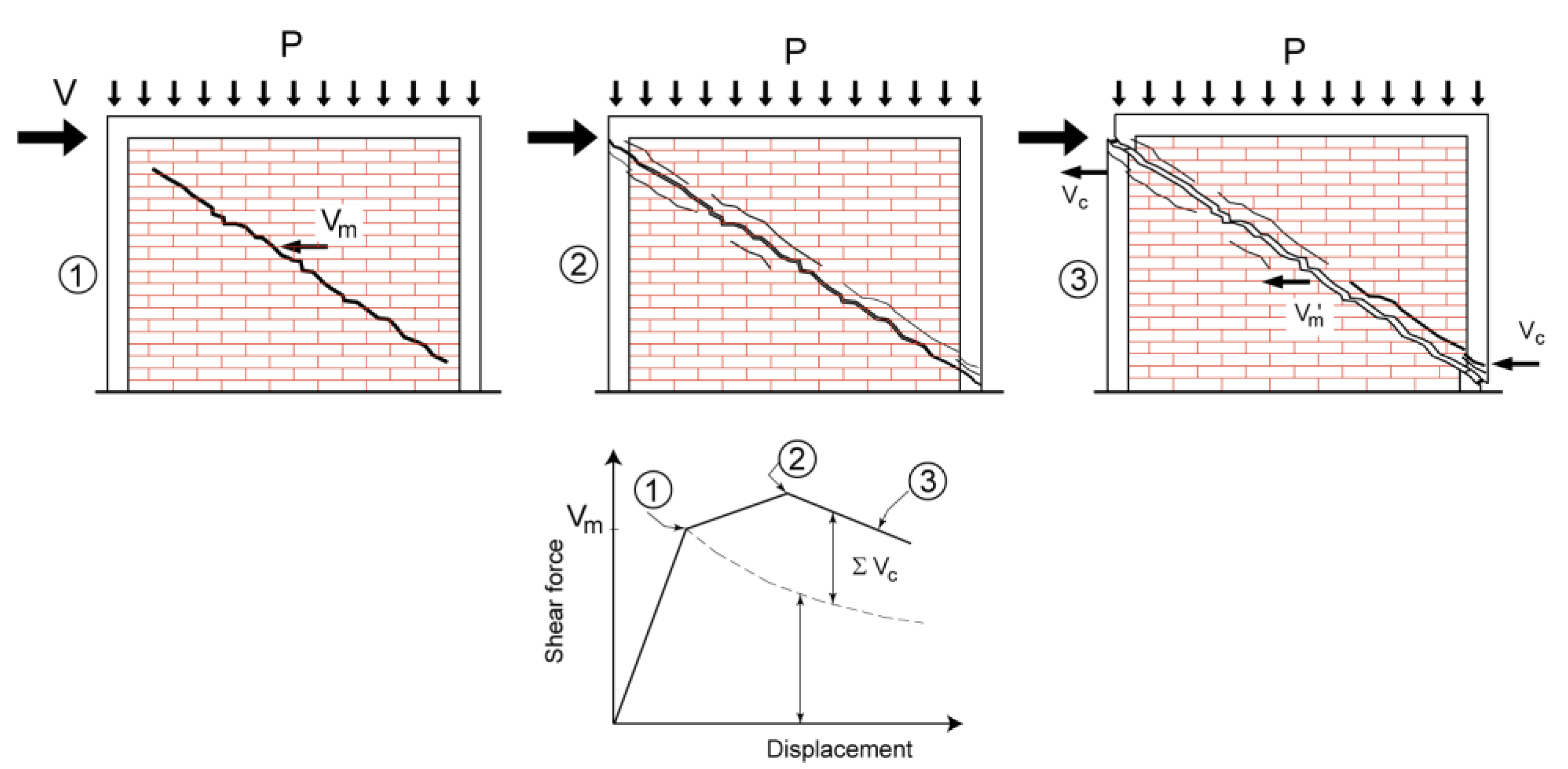
Disclaimer/Publisher’s Note: The statements, opinions and data contained in all publications are solely those of the individual author(s) and contributor(s) and not of MDPI and/or the editor(s). MDPI and/or the editor(s) disclaim responsibility for any injury to people or property resulting from any ideas, methods, instructions or products referred to in the content.

Article Metrics

Citations

Article Access Statistics

Multiple requests from the same IP address are counted as one view.