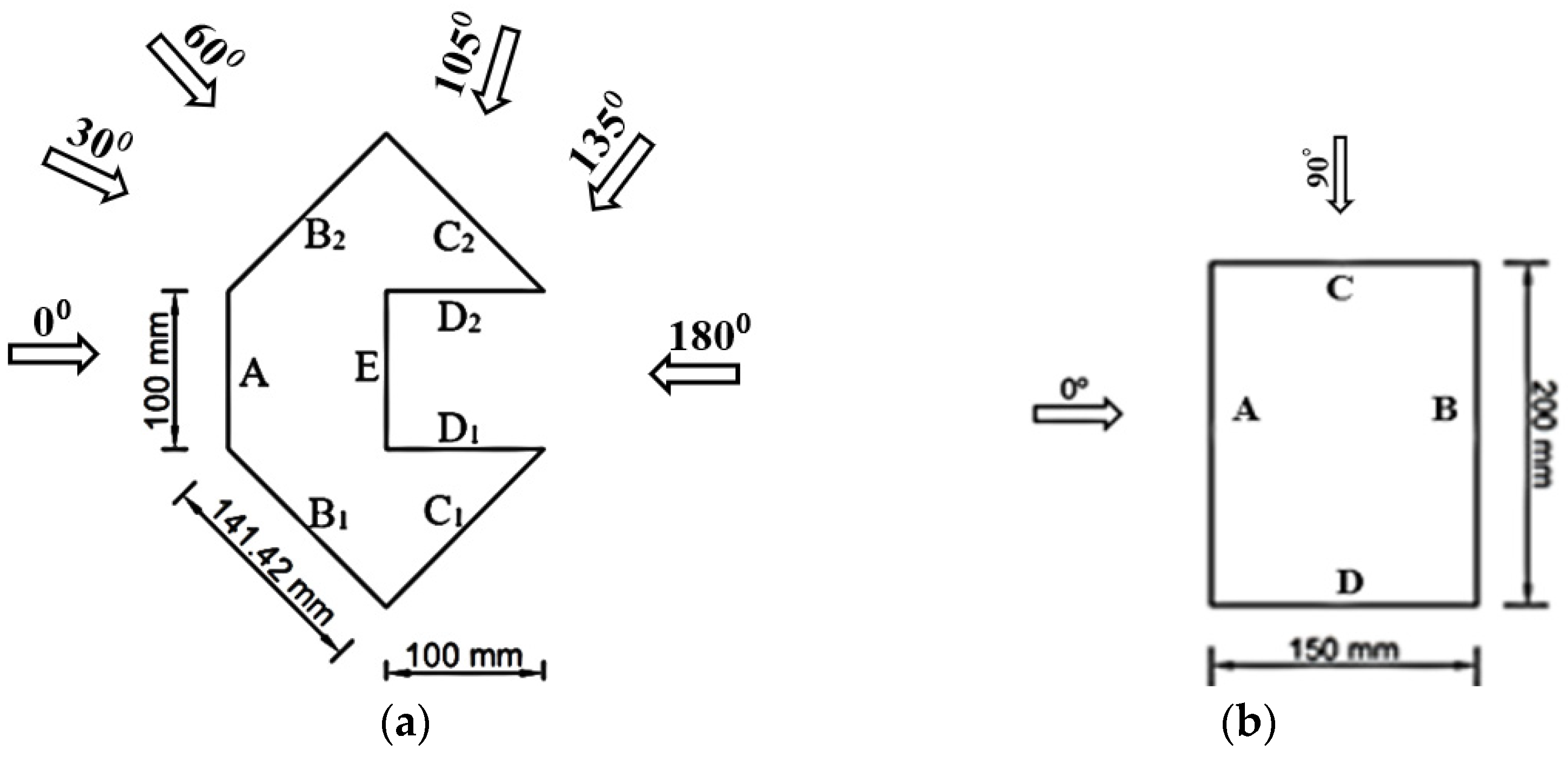
CFD Study of Pressure Distribution on Recessed Faces of a Diamond C-Shaped Building



Abstract
1. Introduction
2. Verification and Validation
3. Numerical Analysis
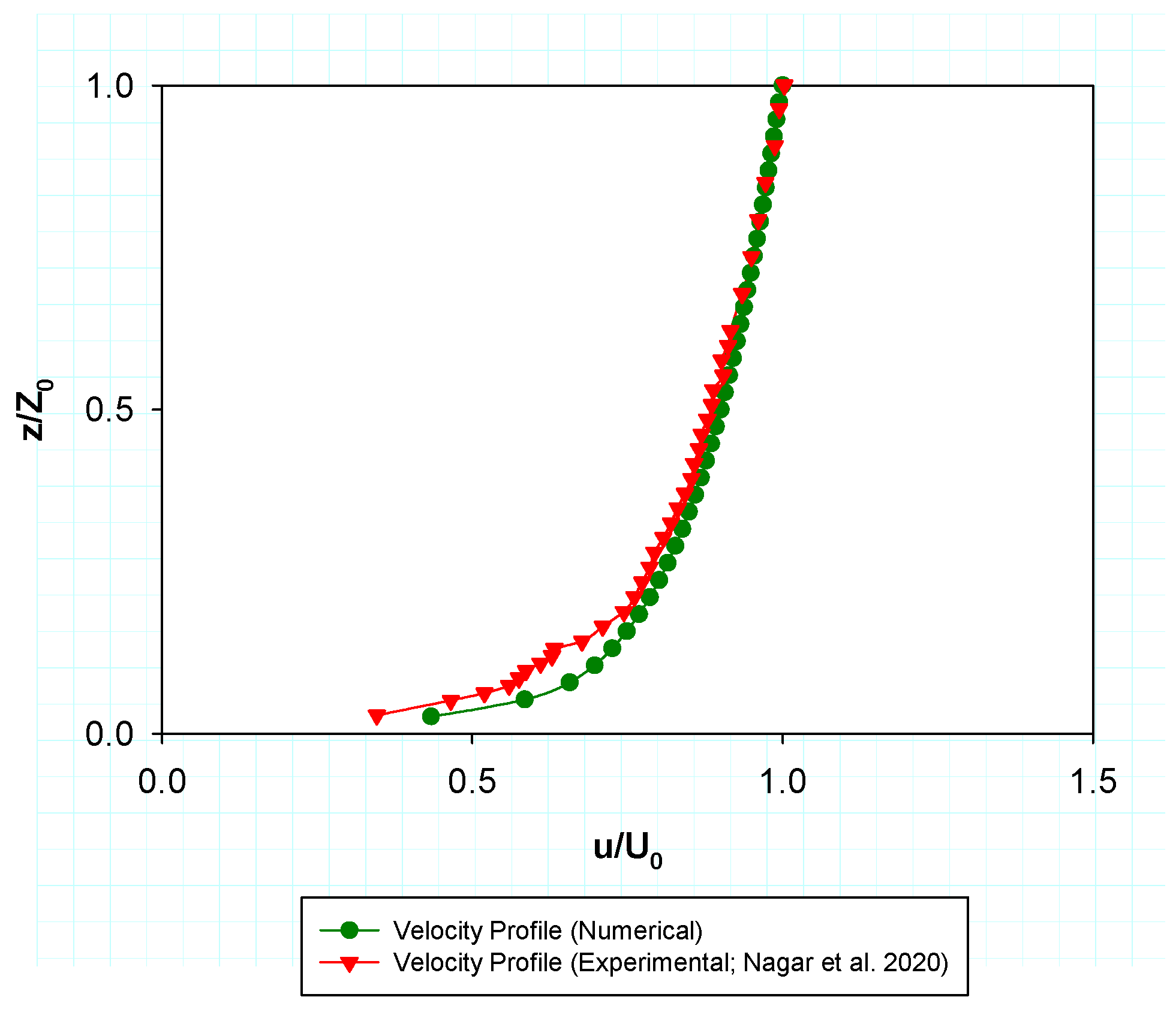
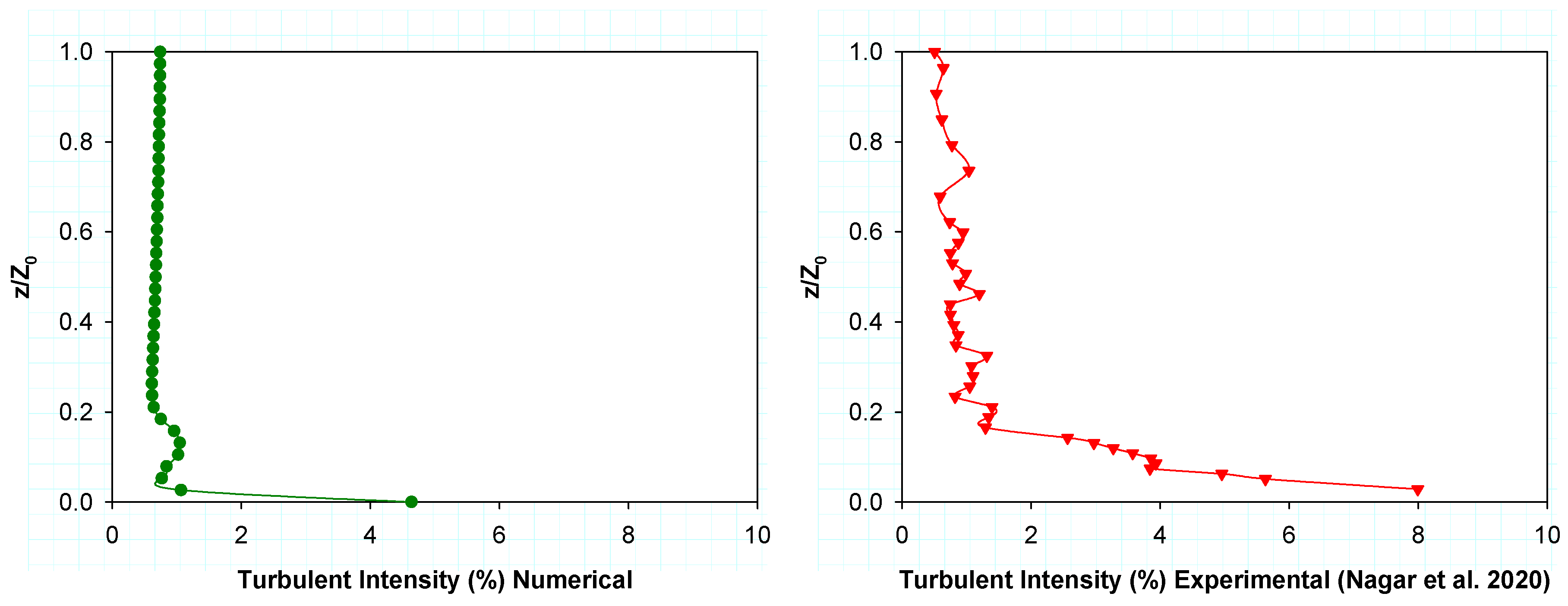
4. Mean Velocity Characteristics
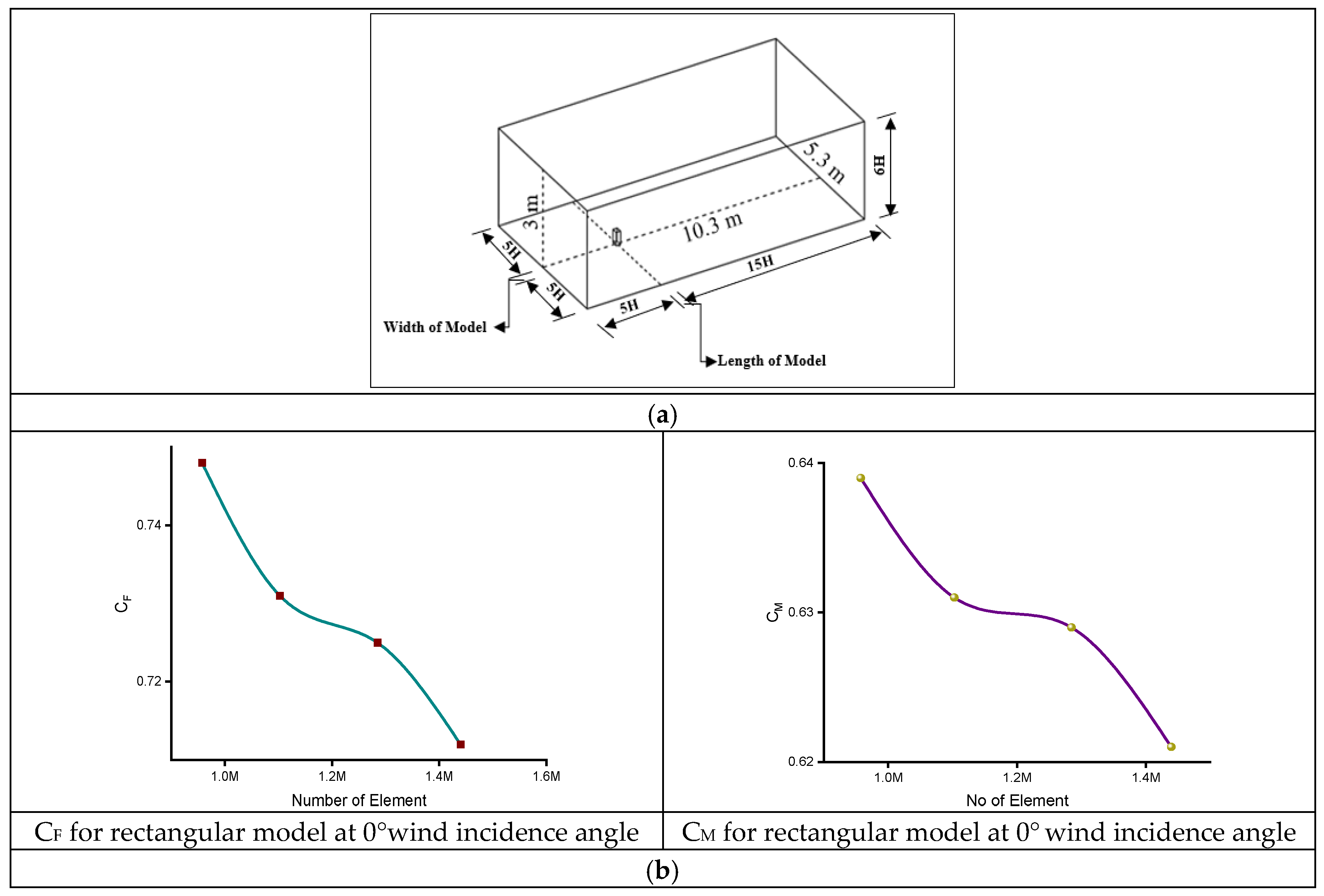
5. Computational Domain and Flow Parameter
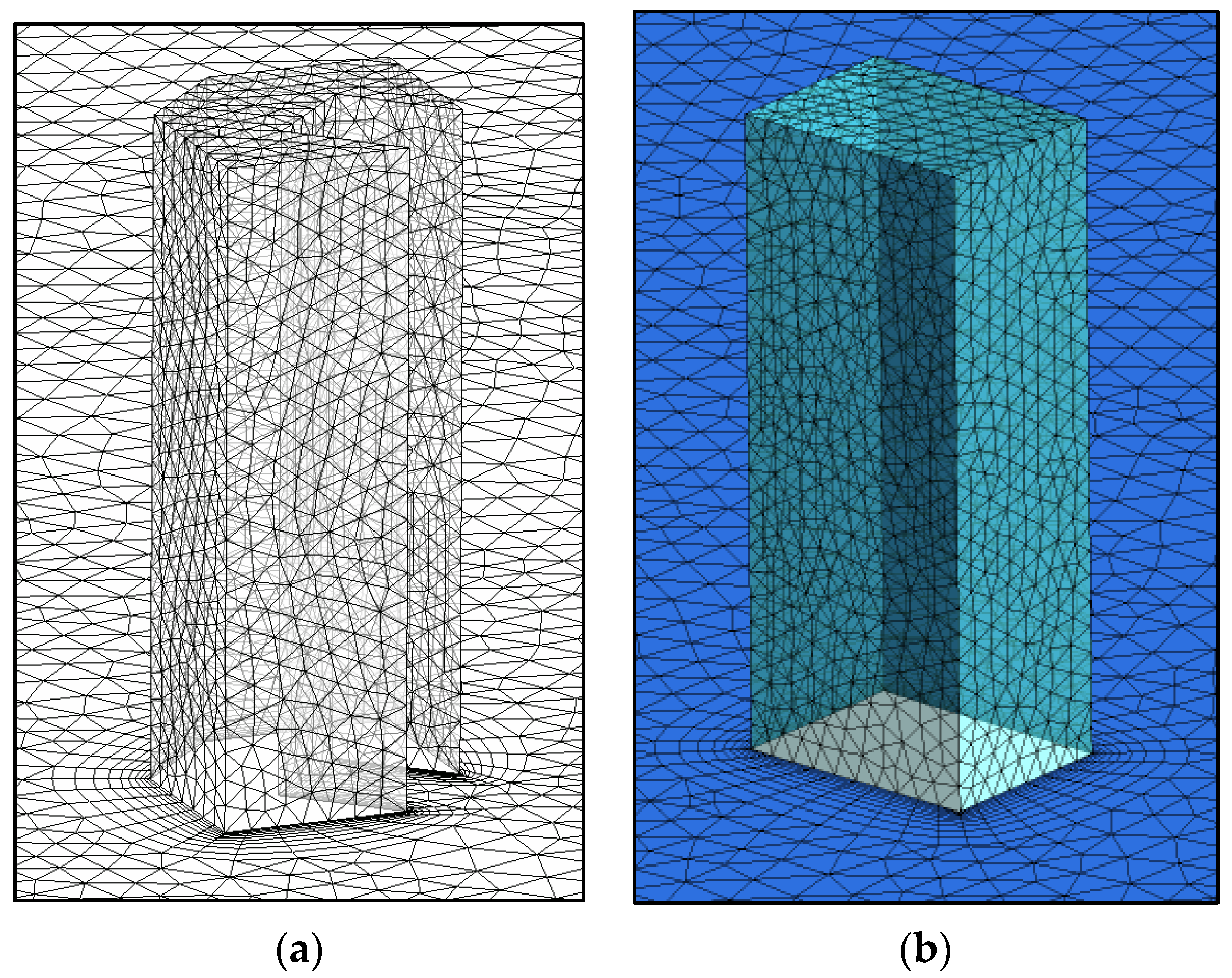
6. Computational Grid and Grid Sensitivity
7. Flow Parameters and Boundary Conditions
8. Result and Discussion
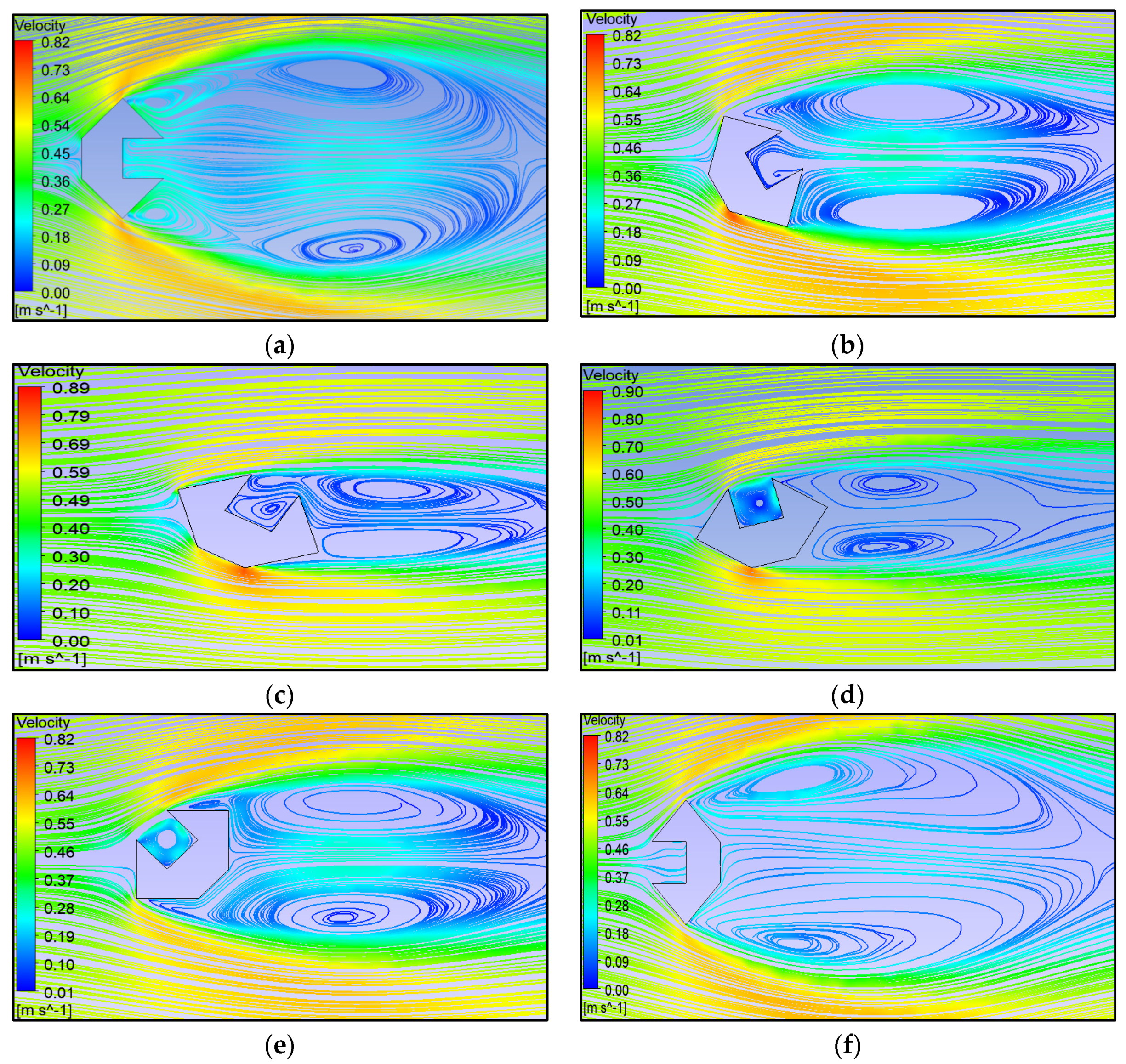
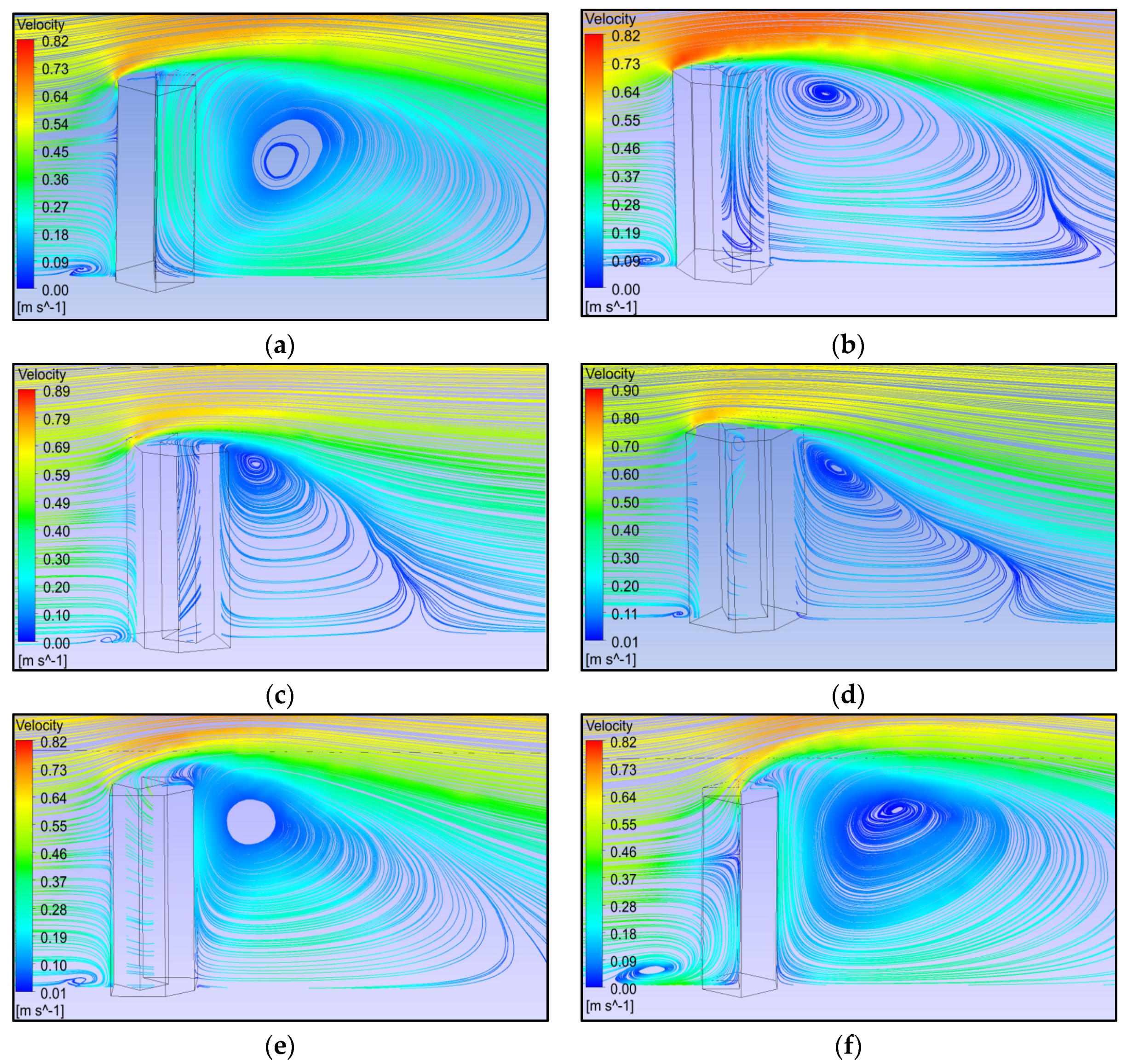
8.1. Flow Pattern
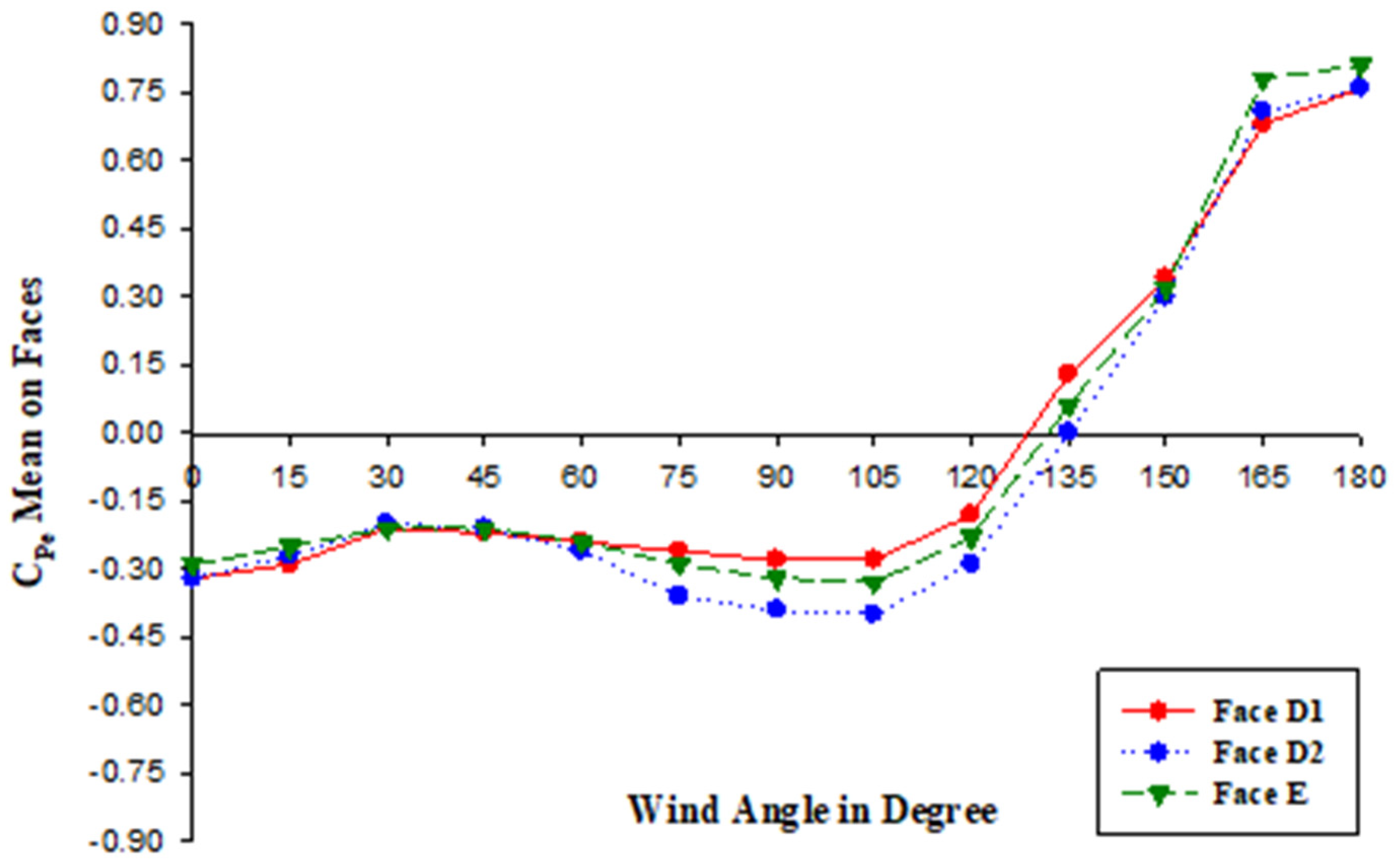
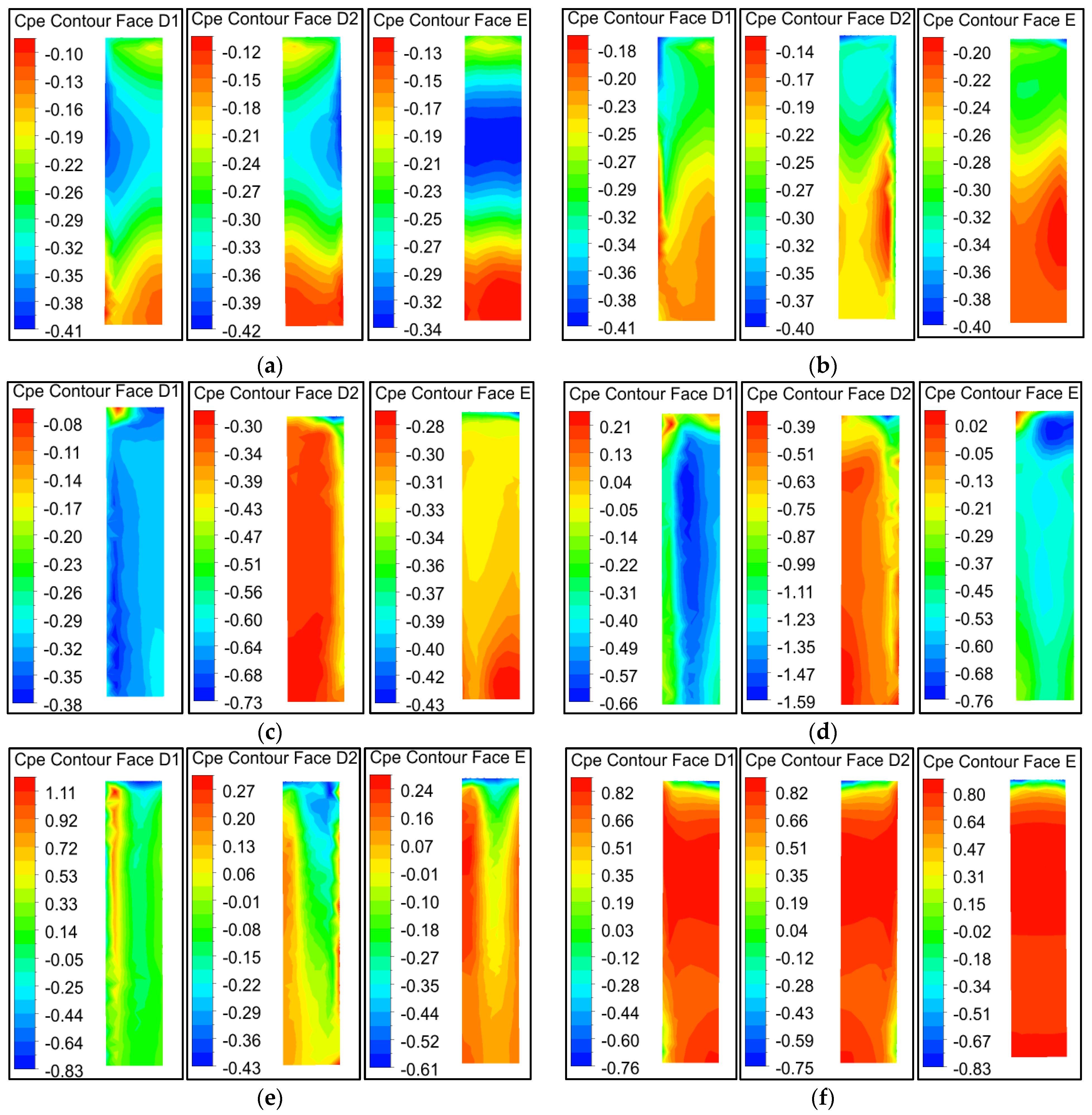
8.2. Pressure Coefficient on Faces
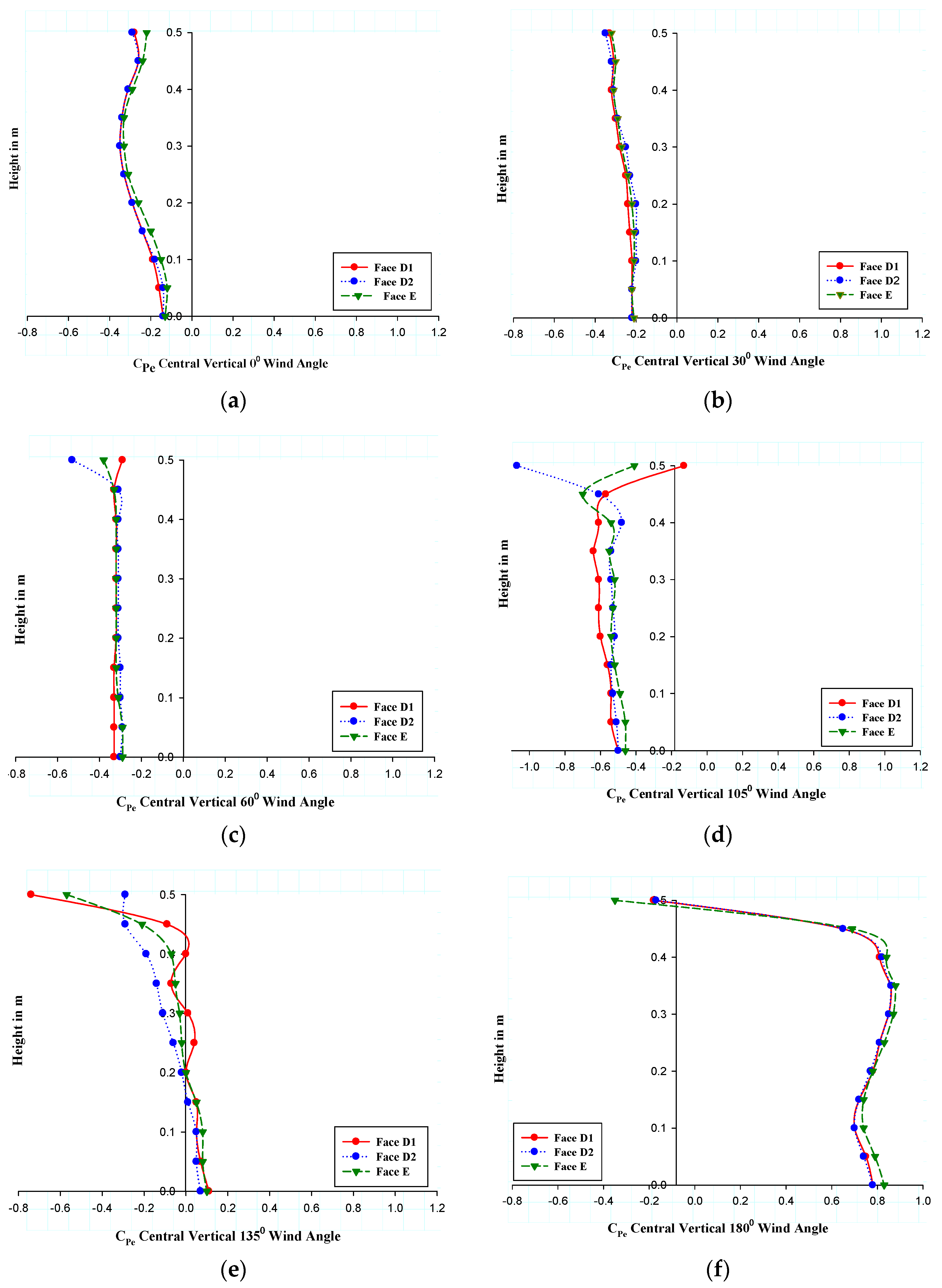
8.3. Pressure along Central Vertical Line
8.4. Comparative Study of Values
9. Conclusions
Author Contributions
Funding
Data Availability Statement
Acknowledgments
Conflicts of Interest
References
- Pradeep, R.K.; Ehsan, V.; Azadeh, S. Computation Fluid Dynamics Approach for Highrise Buildings; Report No. IIIT/TR/2013/-1; Centre for Earthquake Engineering, IIIT Hyderabad: Hyderabad, India, 2013; pp. 1–9. [Google Scholar]
- Dryden, H.L.; Hill, G.C. Wind Pressure on Structures. In Scientific Papers of the Bureau of Standards; NIST: Gaithersbur, MD, USA, 1925; pp. 698–732. [Google Scholar]
- Holmes, J.D. Wind Loading of Structures, 3rd ed.; CRC Press: Boca Raton, FL, USA, 2015. [Google Scholar]
- Taranath, B.S. Wind and Earthquake Resistant Buildings; Marcel Dekker: New York, NY, USA, 2004. [Google Scholar]
- Baines, W.D. Effect of Velocity Distribution on Wind Loads on a Tall Building; AIVC: Surrey, BC, Canada, 1952. [Google Scholar]
- Gomes, M.G.; Rodrigues, A.M.; Mendes, P. Experimental and numerical study of wind pressures on irregular-plan shapes. J. Wind. Eng. Ind. Aerodyn. 2005, 93, 741–756. [Google Scholar] [CrossRef] [Scilit]
- Cheng, C.C.K.; Lam, K.M.; Leung, A.; Cheng, C.C.; Lam, K.; Leung, A.Y. Wind Flow in the Recessed Cavities of a Tall Building. 2009. Available online: https://www.researchgate.net/publication/255566643 (accessed on 5 October 2023).
- Xu, Z.; Yin, J. The Influence of Aeroelastic Effects on Wind Load and Wind-Induced Response of a Super-Tall Building: An Experimental Study. Buildings 2023, 13, 1871. [Google Scholar] [CrossRef] [Scilit]
- Amin, J.A.; Ahuja, A.K. Experimental Study of Wind-Induced Pressures on Buildings of Various Geometries. 2011. Available online: www.ijest-ng.com (accessed on 5 October 2023).
- Amin, J.A.; Ahuja, A.K. Mean interference effects between two buildings: Effects of close proximity. Struct. Des. Tall Spec. Build. 2011, 20, 832–852. [Google Scholar] [CrossRef] [Scilit]
- Tanaka, H.; Tamura, Y.; Ohtake, K.; Nakai, M.; Kim, Y.C.; Bandi, E.K. Experimental Investigation of Aerodynamic Forces and Wind Pressure Acting on Tall Buildings with Various Unconventional Configuration. J. Wind. Eng. Ind. Aerodyn. 2013, 107–108, 179–191. [Google Scholar] [CrossRef] [Scilit]
- Zhao, S.; Zhang, C.; Dai, X.; Yan, Z. Review of Wind-Induced Effects Estimation through Nonlinear Analysis of Tall Buildings, High-Rise Structures, Flexible Bridges and Transmission Lines. Buildings 2023, 13, 2033. [Google Scholar] [CrossRef] [Scilit]
- Kheyari, P.; Dalui, S.K. Estimation of Wind Load on a Tall Building under Interference Effect. Jordon J. Civ. Eng. 2014, 9, 84–101. [Google Scholar]
- Meena, R.K.; Raj, R.; Anbukumar, S. Effect of wind load on irregular shape tall buildings having different corner configuration. Sadhana Acad. Proc. Eng. Sci. 2022, 47, 126. [Google Scholar] [CrossRef] [Scilit]
- Kar, R.; Dalui, S.K. Wind interference effect on an octagonal plan shaped tall building due to square plan shaped tall buildings. Int. J. Adv. Struct. Eng. 2016, 8, 73–86. [Google Scholar] [CrossRef] [Scilit]
- Charisi, S.; Thiis, T.K.; Aurlien, T. Full-scale measurements of wind-pressure coefficients in twin medium-rise buildings. Buildings 2019, 9, 63. [Google Scholar] [CrossRef] [Scilit]
- Yan, B.; Li, Y.; Li, X.; Zhou, X.; Wei, M.; Yang, Q.; Zhou, X. Wind Tunnel Investigation of Twisted Wind Effect on a Typical super-tall building. Buildings 2022, 12, 2260. [Google Scholar] [CrossRef] [Scilit]
- Bairagi, A.K.; Dalui, K. Comparison of Pressure Coefficient between Square and Setback Tall Building Due to Wind Load. In Proceedings of the 11th Structural Engineering Convention, Kolkata, India, 19–21 December 2018; pp. 1–6. Available online: https://www.researchgate.net/publication/329786479 (accessed on 5 October 2023).
- Bhattacharyya, B.; Dalui, S.K. Investigation of mean wind pressures on ‘E’ plan shaped tall building. Wind. Struct. Int. J. 2018, 26, 99–114. [Google Scholar] [CrossRef]
- Nagar, S.K.; Raj, R.; Dev, N. Experimental study of wind-induced pressures on tall buildings of different shapes. Wind. Struct. 2020, 31, 441–453. [Google Scholar]
- Pan, H.; Wu, J.; Fu, J. Monitoring of Wind Effects on a Super-Tall Building under a Typhoon. Buildings 2023, 13, 47. [Google Scholar] [CrossRef] [Scilit]
- Mallick, M.; Mohanta, A.; Kumar, A.; Raj, V. Modelling of Wind Pressure Coefficients on C-Shaped Building Models. Model. Simul. Eng. 2018, 2018, 6524945. [Google Scholar] [CrossRef] [Scilit]
- Amin, J.A.; Ahuja, A.K. Characteristics of wind forces and responses of rectangular tall buildings. Int. J. Adv. Struct. Eng. 2014, 6, 66. [Google Scholar] [CrossRef] [Scilit]
- IS: 875: Part-3:2015; Design Loads (Other than Earthquake) for Buildings and Structures—Code of Practice Part 3 Wind Loads (Third Revision). BIS: New Delhi, India, 2015.
- ASCE/SEI 7−22; Minimum Design Loads and Associated Criteria for Building and Other Structure. 20191-4400. American Society of Civil Engineers: Reston, Virginia, 2017.
- AS/NZS-1170.2 (2002); Structural Design Actions, Part-2: Wind Actions. Standards Australia: Sydney, NSW, Australia; Standards New Zealand: Wellington, New Zealand, 2002.
- EN: 1991-1-4; Eurocode-1: Actions on Structures-Part 1-4: General Actions-Wind Actions. Management Centre: Brussels, Belgium, 2010.
- BS: 6399-2; Loading for Buildings. Code of Practice for Wind Loads (Incorporating Amendment No. 1 and Corrigendum No. 1). British Standards Institution: London, UK, 1997.
- ANSYS Inc. ANSYS CFX-Solver Theory Guide; ANSYS Inc.: Canonsburg, PA, USA, 2009; Available online: http://www.ansys.com (accessed on 5 October 2023).
- Revuz, J.; Hargeaves, D.M.; Owen, J.S. On the Domain Size for the Steady State CFD Modeling of a Tall Building. Wind. Struct. 2012, 15, 313–329. [Google Scholar] [CrossRef] [Scilit]
- Paswan, A.P.; Jayant, B.; Rukhaiyar, A.; Dahiya, K.; Raj, R.; Meena, R.K. Estimations of Wind-Generated Effects on a Regular Tower of Varying Cross-Sectional Shape. J. Inst. Eng. Ser. A 2023. [Google Scholar] [CrossRef] [Scilit]



| As per | Wind Angle | CPe Face A | CPe Face B | CPe Face C | CPe Face D |
|---|---|---|---|---|---|
| ANSYX (CFX) | 0° | +0.70 | −0.28 | −0.60 | −0.60 |
| 90° | −0.60 | −0.60 | +0.68 | −0.27 | |
| IS: 875 (Part 3): 2015 [24] | 0° | +0.8 | −0.25 | −0.8 | −0.8 |
| 90° | −0.8 | −0.8 | 0.8 | −0.25 | |
| ASCE/SEI 7−22 [25] | 0° | +0.8 | −0.5 | −0.7 | −0.7 |
| 90° | −0.7 | −0.7 | 0.8 | −0.5 | |
| AS/NZS-1170.2 (2002) [26] | 0° | +0.8 | −0.5 | −0.65 | −0.65 |
| 90° | −0.65 | −0.65 | 0.8 | −0.5 | |
| EN: 1991-1-4 [27] | 0° | 0.8 | −0.55 | −0.8 | −0.8 |
| 90° | −0.8 | −08 | 0.8 | −0.55 | |
| BS: 6399-2 [28] | 0° | 0.76 | −0.5 | −0.8 | −0.8 |
| Amin and Ahuja 2013 [23] | 90° 90° | −0.8 −0.66 | −0.8 −0.66 | 0.76 0.74 | −0.5 −0.41 |
Disclaimer/Publisher’s Note: The statements, opinions and data contained in all publications are solely those of the individual author(s) and contributor(s) and not of MDPI and/or the editor(s). MDPI and/or the editor(s) disclaim responsibility for any injury to people or property resulting from any ideas, methods, instructions or products referred to in the content. |
© 2023 by the authors. Licensee MDPI, Basel, Switzerland. This article is an open access article distributed under the terms and conditions of the Creative Commons Attribution (CC BY) license (https://creativecommons.org/licenses/by/4.0/).
Share and Cite
Kumar, A.; Meena, R.K.; Raj, R.; Khan, M.I.; Khatib, J.M. CFD Study of Pressure Distribution on Recessed Faces of a Diamond C-Shaped Building. Buildings 2023, 13, 2800. https://doi.org/10.3390/buildings13112800
Kumar A, Meena RK, Raj R, Khan MI, Khatib JM. CFD Study of Pressure Distribution on Recessed Faces of a Diamond C-Shaped Building. Buildings. 2023; 13(11):2800. https://doi.org/10.3390/buildings13112800
Chicago/Turabian StyleKumar, Arun, Rahul Kumar Meena, Ritu Raj, Mohammad Iqbal Khan, and Jamal M. Khatib. 2023. "CFD Study of Pressure Distribution on Recessed Faces of a Diamond C-Shaped Building" Buildings 13, no. 11: 2800. https://doi.org/10.3390/buildings13112800
APA StyleKumar, A., Meena, R. K., Raj, R., Khan, M. I., & Khatib, J. M. (2023). CFD Study of Pressure Distribution on Recessed Faces of a Diamond C-Shaped Building. Buildings, 13(11), 2800. https://doi.org/10.3390/buildings13112800