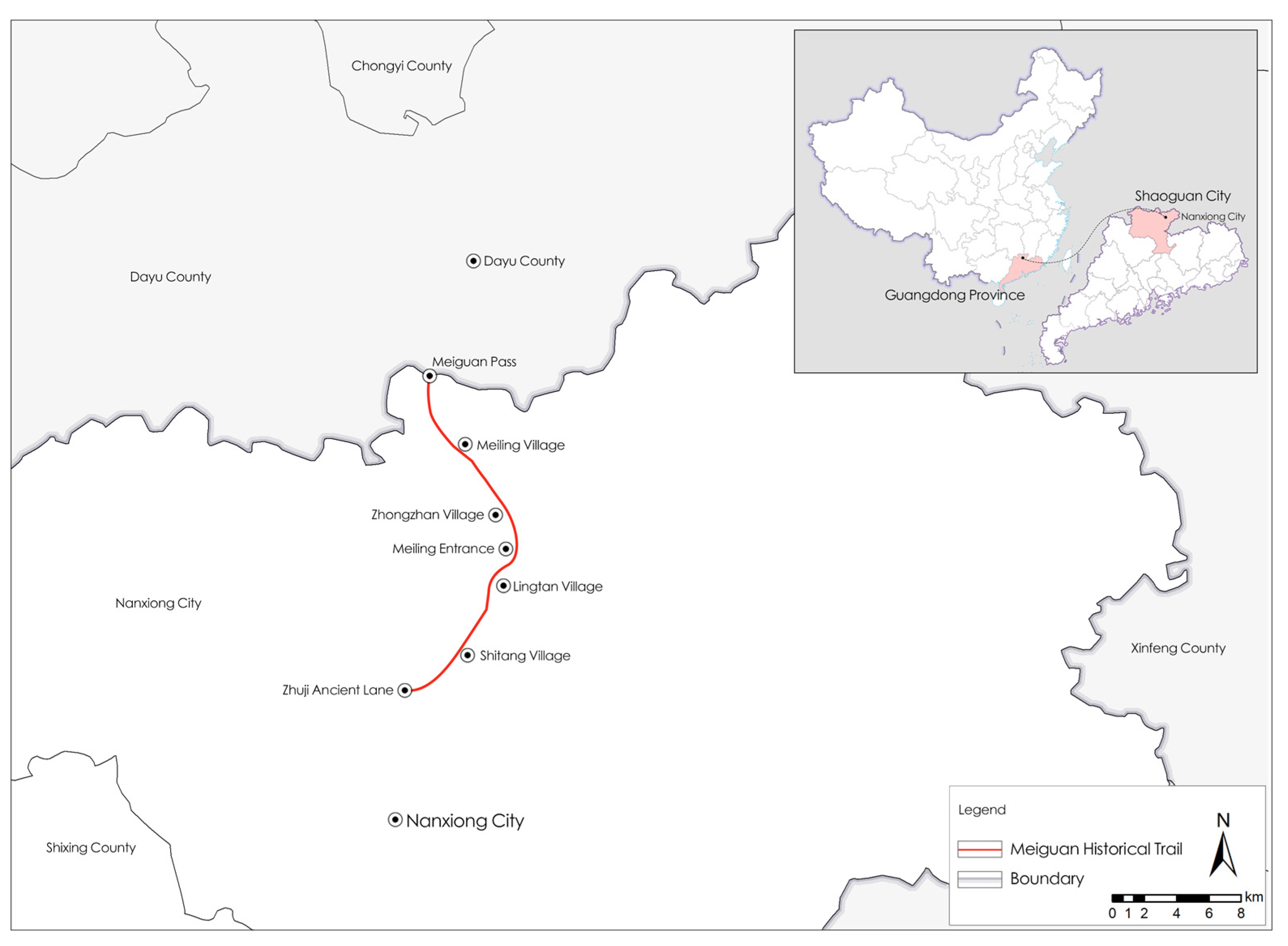
Spatial Reconstruction and Cultural Practice of Linear Cultural Heritage: A Case Study of Meiguan Historical Trail, Guangdong, China


Abstract
1. Introduction
- To illustrate the local government’s efforts to reconstruct the LCH to promote the development of the villages that classify as linear.
- To analyze the dynamic role of culture in this process and explain how residents and tourists react to the reconstruction project of LCH.
- To deepen the understanding of linear cultural heritage production as a rural development location policy. Based on the above objectives, this study not only deepens theoretical research about space production and LCH reuse but also provides a reference for the sustainable development and policy making of LCH.
2. Literature Review
2.1. Linear Cultural Heritage
2.2. Space Production and Cultural Practice
3. Research Context and Methodology
3.1. Description of the Study Area
3.2. Research Design and Data Collection
4. The Cultural Value of LCH in the Government Planning Plans
4.1. Omission of Cultural Value
4.2. Weighting of Cultural Value
- Cultural and ecological restoration transformed the historical trail and the village landscape along it into the initial linear landscape value, integrating it into the linear space of the entire province.
- The restoration and utilization project of the South China Historical Trail strips the value of the Meiguan Historical Trail from a single resource. It is integrated into the entire South China Historical Trail. It is weighted and overlaid, and the value of the Meiguan Historical Trail is best presented in the form of cultural reproduction.
- Part of the value of the historical trail was transferred to the community and tourists. Residents and tourists sensed the cultural value in their experience and practice and even felt they were the heritage owners [46].
5. Cultural Practice in the Spatial Reconstruction of LCH
5.1. Government-Led Cultural Production
5.2. Cultural Identity of Local Residents
5.3. Cultural Consumption of Tourists
6. Conclusions and Discussion
6.1. Academic Implications
6.2. Managerial Implication
6.3. Suggestions for Further Research
Author Contributions
Funding
Data Availability Statement
Conflicts of Interest
References
- Pedrosa, A.; Martins, F.; Breda, Z. Tourism routes: A scoping review. Eur.J.Tour.Res. 2022, 32, 3216. [Google Scholar] [CrossRef] [Scilit]
- Ceginskas, V.L.A.; Kaasik-Krogerus, S.; Lahdesmaki, T.; Makinen, K. Constructing social Europe through European cultural heritage. Eur. Soc. 2021, 23, 487–512. [Google Scholar] [CrossRef] [Scilit] [PubMed]
- Bailey, C.; Thomson, R. Heirs property, critical race theory, and reparations. Rural. Sociol 2022, 87, 1219–1243. [Google Scholar] [CrossRef] [Scilit]
- Byrne, D. Heritage corridors: Transnational flows and the built environment of migration. J. Ethn. Migr. Stud. 2016, 42, 2360–2378. [Google Scholar] [CrossRef] [Scilit]
- Li, L.; Feng, R.; Xi, J. Ecological risk assessment and protection zone identification for linear cultural heritage: A case study of the Ming Great Wall. Int. J. Env. Res. Public Health 2021, 18, 11605. [Google Scholar] [CrossRef] [Scilit]
- Zhang, S.; Liu, J.; Pei, T.; Chan, C.-S.; Wang, M.; Meng, B. Tourism value assessment of linear cultural heritage: The case of the Beijing–Hangzhou Grand Canal in China. Curr. Issues Tour. 2021, 25, 1–23. [Google Scholar] [CrossRef] [Scilit]
- Zhao, Y.; Yan, J.-W.; Li, Y.; Bian, G.-M.; Du, Y.-Z. In-site phenotype of the settlement space along China’s Grand Canal Tianjin Section: GIS-sDNA-based model analysis. Buildings 2022, 12, 394. [Google Scholar] [CrossRef] [Scilit]
- Telfer, D.J. Strategic alliances along the Niagara Wine Route. Tourism Manage. 2001, 22, 21–30. [Google Scholar] [CrossRef] [Scilit]
- Cao, W.; Yu, W.; Xu, J. City vs. Town residents’ place attachment, perceptions and support for tourism development in a linear World Cultural Heritage Site. PLoS ONE 2021, 16, e0258365. [Google Scholar] [CrossRef] [Scilit]
- Ren, H. On value evaluation of tourism resource of cross-regional linear cultural heritage: Taking the routes network of Chang’an-Tianshan Corridor in China as an example. Sci. Geogr. Sin. 2017, 37, 1560–1568. [Google Scholar] [CrossRef]
- Su, X. Heritage production and urban locational policy in Lijiang, China. Int. J. Urban Reg. Res. 2011, 35, 1118–1132. [Google Scholar] [CrossRef] [Scilit]
- Zhou, L.; Wall, G.; Zhang, D.; Cheng, X. Tourism and the (re)making of rural places: The cases of two Chinese villages. Tour. Manag. Perspect. 2021, 40, 100910. [Google Scholar] [CrossRef] [Scilit]
- Lew, A.A. Tourism planning and place making: Place-making or placemaking? Tour. Geogr. 2017, 19, 448–466. [Google Scholar] [CrossRef] [Scilit]
- Gavrilă-Paven, I. Tourism opportunities for valorising the authentic traditional rural space-study case: Ampoi and Mures Valleys microregion, Alba County, Romania. Procedia Soc Behav Sci. 2015, 188, 111–115. [Google Scholar] [CrossRef] [Scilit]
- Della Spina, L. Cultural heritage: A hybrid framework for ranking adaptive reuse strategies. Buildings 2021, 11, 132. [Google Scholar] [CrossRef] [Scilit]
- Ribera-Fumaz, R. From urban political economy to cultural political economy: Rethinking culture and economy in and beyond the urban. Prog. Hum. Geogr. 2009, 33, 447–465. [Google Scholar] [CrossRef] [Scilit]
- Soares, J.-R.-R.; Casado-Claro, M.-F.; Lezcano-González, M.-E.; Sánchez-Fernández, M.-D.; Gabriel, L.-P.-M.-C.; Abríl-Sellarés, M. The role of the local host community’s involvement in the development of tourism: A case study of the residents’ perceptions toward tourism on the Route of Santiago de Compostela (Spain). Sustainability. 2021, 13, 9576. [Google Scholar] [CrossRef] [Scilit]
- Erkan, Y.K. Railway heritage of Istanbul and the Marmaray project. Int. J. Archit. Herit. 2012, 6, 86–99. [Google Scholar] [CrossRef] [Scilit]
- Donohoe, H.M. Sustainable heritage tourism marketing and Canada’s Rideau Canal world heritage site. J. Sustain. Tour. 2011, 20, 121–142. [Google Scholar] [CrossRef] [Scilit]
- Guichard-Anguis, S. Walking through World Heritage Forest in Japan: The Kumano pilgrimage. J. Herit. Tour. 2011, 6, 285–295. [Google Scholar] [CrossRef] [Scilit]
- Snowball, J.D.; Courtney, S. Cultural heritage routes in South Africa: Effective tools for heritage conservation and local economic development? Dev. South. Afr. 2010, 27, 563–576. [Google Scholar] [CrossRef] [Scilit]
- Kuiper, E.; Bryn, A. Forest regrowth and cultural heritage sites in Norway and along the Norwegian St Olav pilgrim routes. Int. J. Biodiv. Sci. Manage. 2012, 9, 54–64. [Google Scholar] [CrossRef] [Scilit]
- Mell, I.C.; Sturzaker, J. Sustainable urban development in tightly constrained areas: A case study of Darjeeling, India. Int. J. Urban Sustain. Dev. 2014, 6, 65–88. [Google Scholar] [CrossRef] [Scilit]
- Brás, J.M.; Costa, C.; Buhalis, D. Network analysis and wine routes: The case of the Bairrada Wine Route. Serv. Ind. J. 2010, 30, 1621–1641. [Google Scholar] [CrossRef] [Scilit]
- Li, F.; Zou, T. National Culture Park: Logical, origins and implications. Tour. Trib. 2021, 36, 14–26. [Google Scholar] [CrossRef]
- Harvey, D. Landscape and heritage: Trajectories and consequences. Landscape Res. 2015, 40, 911–924. [Google Scholar] [CrossRef] [Scilit]
- Vana, M.V.; Malaescu, S. Cultural thematic tourism itineraries: Mediators of success. In Proceedings of the 3rd Global Conference on Business, Economics, Management and Tourism, Rome, Italy, 26–28 November 2015; pp. 642–652. [Google Scholar]
- Wang, L. Value of the Ancient Yunnan-Tibet Tea-Horse Road in the perspective of the heritage corridor. Yunnan Minzu Uni. 2012, 29, 34–38. [Google Scholar] [CrossRef]
- Liang, X. An analysis of the tourism value of World Heritages and study of their exploring model. Tour. Trib. 2006, 21, 11–22. [Google Scholar]
- Thurau, B.; Seekamp, E.; Carver, A.D.; Lee, J.G. Should cruise ports market ecotourism? A comparative analysis of passenger spending expectations within the Panama Canal watershed. Int. J. Tour. Res. 2015, 17, 45–53. [Google Scholar] [CrossRef] [Scilit]
- Mayer, M. To what end do we theorize sociospatial relations? Environ. Plan. D-Soc. Space 2008, 26, 414–419. [Google Scholar] [CrossRef] [Scilit]
- Leary, M.E. The production of space through a shrine and vendetta in Manchester: Lefebvre’s spatial triad and the regeneration of a place renamed Castlefield. Plan Theory Pract. 2009, 10, 189–212. [Google Scholar] [CrossRef] [Scilit]
- Meir, A.; Karplus, Y. Production of space, intercultural encounters and politics: Dynamics of consummate space and spatial intensity among the Israeli Bedouin. Trans. Inst. Br. Geogr. 2018, 43, 511–524. [Google Scholar] [CrossRef] [Scilit]
- Wang, F.; Liu, Y. Revisiting production of space: From Harvey to Foucault. Sci. Geogr. Sin. 2013, 33, 1293–1301. [Google Scholar] [CrossRef]
- Harvey, D. From managerialism to entrepreneurialism: The transformation in urban governance in late capitalism. Geogr. Ann. Ser. B Hum. Geogr. 2017, 71, 3–17. [Google Scholar] [CrossRef]
- Ye, C.; Chen, M.; Chen, R.; Guo, Z. Multi-scalar separations: Land use and production of space in Xianlin, a university town in Nanjing, China. Habitat Int. 2014, 42, 264–272. [Google Scholar] [CrossRef] [Scilit]
- Ye, C.; Ma, X.; Cai, Y.; Gao, F. The countryside under multiple high-tension lines: A perspective on the rural construction of Heping Village, Shanghai. J. Rural Stud. 2018, 62, 53–61. [Google Scholar] [CrossRef] [Scilit]
- Wang, S.W.-H. Commercial gentrification and entrepreneurial governance in Shanghai: A case study of Taikang Road Creative Cluster. Urban Policy Res. 2011, 29, 363–380. [Google Scholar] [CrossRef] [Scilit]
- Sacco, P.L.; Ghirardi, S.; Tartari, M.; Trimarchi, M. Two versions of heterotopia: The role of art practices in participative urban renewal processes. Cities 2019, 89, 199–208. [Google Scholar] [CrossRef] [Scilit]
- Pendlebury, J.; Porfyriou, H. Heritage, urban regeneration and place-making. J. Urban Des. 2017, 22, 429–432. [Google Scholar] [CrossRef] [Scilit]
- Huang, J.; Lu, L. The paradigm transformation of space in tourism destination from perspective of production of space: A new paradigm of space based on emergence of space. Sci. Geogr. Sin. 2015, 35, 47–55. [Google Scholar] [CrossRef]
- Mansvelt, J. Geographies of consumption: Citizenship, space and practice. Prog. Hum. Geogr. 2008, 32, 105–117. [Google Scholar] [CrossRef] [Scilit]
- Wen, S.; Liao, J.; Cai, H.; Chen, X. Spatial reconstruction and cultural practice of the regeneration of historic blocks in the process of urbanization: A case study of Yongqing Fang, Guangzhou City. Prog. Geogr. 2021, 40, 161–170. [Google Scholar] [CrossRef] [Scilit]
- Hitchings, R.; Latham, A. Qualitative methods I: On current conventions in interview research. Prog. Hum. Geogr. 2019, 44, 389–398. [Google Scholar] [CrossRef] [Scilit]
- Li, Y.; Zhang, H.; Zhang, D.; Abrahams, R. Mediating urban transition through rural tourism. Ann. Touris. Res. 2019, 75, 152–164. [Google Scholar] [CrossRef] [Scilit]
- Xu, S.; Liu, Y.; Qian, Y.; Wang, Q. The significance of the West Lake pattern and its heuristic implications for creating China’s heritage tourism economics. Tour. Manag. 2017, 58, 286–292. [Google Scholar] [CrossRef] [Scilit]
- Roxas, B.; Chadee, D. Effects of formal institutions on the performance of the tourism sector in the Philippines: The mediating role of entrepreneurial orientation. Tour. Manag. 2013, 37, 1–12. [Google Scholar] [CrossRef] [Scilit]
- McLennan, C.-l.J.; Ritchie, B.W.; Ruhanen, L.M.; Moyle, B.D. An institutional assessment of three local government-level tourism destinations at different stages of the transformation process. Tour. Manag. 2014, 41, 107–118. [Google Scholar] [CrossRef] [Scilit]
- Zhang, C.; Fyall, A.; Zheng, Y. Heritage and tourism conflict within world heritage sites in China: A longitudinal study. Curr. Issues Tour. 2014, 18, 110–136. [Google Scholar] [CrossRef] [Scilit]
- Zhou, S.; Wu, L.; Zhang, R. An analysis of the relation between festivals and production of space. Geogr. Res. 2015, 34, 1994–2002. [Google Scholar] [CrossRef]
- Cenzatti, M. Landscapes of power: From detroit to Disney world. J. Archit. Educ. 2013, 46, 191–195. [Google Scholar] [CrossRef] [Scilit]
- Taylor, P.J. Book Review: The future of the capitalist state. Prog. Hum. Geogr. 2004, 28, 409–411. [Google Scholar] [CrossRef] [Scilit]
- Brenner, N. New State Spaces: Urban Governance and the Rescaling of Statehood; Oxford University Press: London, UK; New York, NY, USA, 2004. [Google Scholar]
- Guo, W.; Zhu, H. Overlapping and identification of tourism space production. Tour. Trib. 2020, 35, 1–3. [Google Scholar] [CrossRef]
- Liu, Z. Searching for a lost aura: A Naxi Dongba’s spatial practices and space remaking in touristic commoditization. J. Tour. Cult. Chang. 2017, 16, 348–364. [Google Scholar] [CrossRef] [Scilit]
- Qiuju, L.; Minyan, F.; Yingying, C. The production of space in Home Inns under tourism development: A case study of Shuanglang Town in Dali. Sci. Geogr. Sin. 2018, 38, 927–934. [Google Scholar] [CrossRef]
- Wang, L.; Ding, J.; Chen, M.; Sun, Y.; Tang, X.; Ge, M. Exploring tourists’ multilevel spatial cognition of historical town based on multi-source data—A case study of Feng Jing Ancient Town in Shanghai. Buildings 2022, 12, 1833. [Google Scholar] [CrossRef] [Scilit]
- Bradford, D.B.C.A.M.G. Public and private consumption and the city. Urban Stud. 1998, 35, 865–888. [Google Scholar] [CrossRef] [Scilit]
- Mansvelt, J. Geographies of consumption: Engaging with absent presences. Prog. Hum. Geogr. 2009, 34, 224–233. [Google Scholar] [CrossRef] [Scilit]
- Lane, R.; Mansvelt, J. New consumption geographies: Introduction to the special section. Geogr. Res. 2020, 58, 207–213. [Google Scholar] [CrossRef] [Scilit]
- Farrelly, F.; Kock, F.; Josiassen, A. Cultural heritage authenticity: A producer view. Ann. Touris. Res. 2019, 79, 102770. [Google Scholar] [CrossRef] [Scilit]
- Yi, X.; Fu, X.; Yu, L.; Jiang, L. Authenticity and loyalty at heritage sites: The moderation effect of postmodern authenticity. Tour. Manag. 2018, 67, 411–424. [Google Scholar] [CrossRef] [Scilit]
- Winchester, H.; Kong, L.; Dunn, K. Landscapes: Ways of Imagining the World; Routledge: Oxon, UK, 2013. [Google Scholar]
- Su, R.; Bramwell, B.; Whalley, P.A. Cultural political economy and urban heritage tourism. Ann. Touris. Res. 2018, 68, 30–40. [Google Scholar] [CrossRef] [Scilit]
- King, A. Spaces of Global Cultures: Architecture, Urbanism, Identity; Routledge: London, UK; New York, NY, USA, 2004. [Google Scholar]
- Božić, S.; Tomić, N. Developing the cultural route evaluation model (CREM) and its application on the trail of Roman Emperors, Serbia. Tour. Manag. Perspect. 2016, 17, 26–35. [Google Scholar] [CrossRef] [Scilit]


| Number | Gender | Age | Identity | Number | Gender | Age | Identity |
|---|---|---|---|---|---|---|---|
| R1 | M | 45 | Resident, Meiling Village | G7 | M | 42 | Village Committee, Lingtan Village |
| R2 | M | 84 | Resident, Meiling Village | G8 | M | 46 | Management Committee of the Scenic Area, Nanxiong |
| R3 | M | 50 | Resident, Meiling Village | G9 | F | 37 | Management Committee of the Scenic Area, Nanxiong |
| R4 | F | 47 | Resident, Lingtan Village | V1 | F | 24 | Volunteer, Guangzhou |
| R5 | F | 52 | Resident, Lingtan Village | V2 | F | 46 | Volunteer, Guangzhou |
| R6 | M | 41 | Resident, Lingtan Village | V3 | M | 22 | Volunteer, Guangzhou |
| R7 | F | 49 | Resident, Lingtan Village | V4 | F | 39 | Volunteer, Nanxiong |
| R8 | M | 61 | Resident, Lidong Village | V5 | M | 52 | Volunteer, Nanxiong |
| R9 | F | 39 | Resident, Lidong Village | V6 | M | 34 | Volunteer, Guangzhou |
| R10 | M | 46 | Resident, Lidong Village | T1 | F | 41 | Tourist, Shaoguan |
| R11 | M | 49 | Resident, Lingtan Village | T2 | F | 32 | Tourist, Shenzhen |
| R12 | F | 46 | Resident, Zhongzhan Village | T3 | M | 45 | Tourist, Shenzhen |
| R13 | M | 50 | Resident, Zhongzhan Village | T4 | M | 40 | Tourist, Guangzhou |
| R14 | M | 49 | Resident, Zhuji Village | T5 | M | 38 | Tourist, Dongguan |
| R15 | F | 62 | Resident, Jiaowan Village | T6 | F | 41 | Tourist, Huizhou |
| R16 | M | 57 | Resident, Congbei Village | T7 | F | 38 | Tourist, Huizhou |
| R17 | F | 42 | Resident, Congbei Village | T8 | M | 35 | Tourist, Guangzhou |
| G1 | M | 40 | Government staff, Tourism Sector | T9 | M | 54 | Tourist, Shenzhen |
| G2 | M | 38 | Village Committee, Meiling Village | T10 | F | 47 | Tourist, Foshan |
| G3 | F | 42 | Village Committee, Lingtan Village | T11 | F | 53 | Tourist, Jiangxi |
| G4 | M | 29 | Cadres Staying at Villages, Lingtan Village | T12 | F | 40 | Tourist, Jiangxi |
| G5 | M | 64 | Government staff, Tourism Sector (retired) | T13 | M | 25 | Tourist, Shaoguan |
| G6 | F | 37 | Village Committee, Lidong Village | T14 | F | 48 | Tourist, Shaoguan |
Disclaimer/Publisher’s Note: The statements, opinions and data contained in all publications are solely those of the individual author(s) and contributor(s) and not of MDPI and/or the editor(s). MDPI and/or the editor(s) disclaim responsibility for any injury to people or property resulting from any ideas, methods, instructions or products referred to in the content. |
© 2022 by the authors. Licensee MDPI, Basel, Switzerland. This article is an open access article distributed under the terms and conditions of the Creative Commons Attribution (CC BY) license (https://creativecommons.org/licenses/by/4.0/).
Share and Cite
Wu, Z.; Ma, J.; Zhang, H. Spatial Reconstruction and Cultural Practice of Linear Cultural Heritage: A Case Study of Meiguan Historical Trail, Guangdong, China. Buildings 2023, 13, 105. https://doi.org/10.3390/buildings13010105
Wu Z, Ma J, Zhang H. Spatial Reconstruction and Cultural Practice of Linear Cultural Heritage: A Case Study of Meiguan Historical Trail, Guangdong, China. Buildings. 2023; 13(1):105. https://doi.org/10.3390/buildings13010105
Chicago/Turabian StyleWu, Zhicai, Jing Ma, and Heqing Zhang. 2023. "Spatial Reconstruction and Cultural Practice of Linear Cultural Heritage: A Case Study of Meiguan Historical Trail, Guangdong, China" Buildings 13, no. 1: 105. https://doi.org/10.3390/buildings13010105
APA StyleWu, Z., Ma, J., & Zhang, H. (2023). Spatial Reconstruction and Cultural Practice of Linear Cultural Heritage: A Case Study of Meiguan Historical Trail, Guangdong, China. Buildings, 13(1), 105. https://doi.org/10.3390/buildings13010105