The Influence of the Flexural Strength Ratio of Columns to Beams on the Collapse Capacity of RC Frame Structures

Abstract
1. Introduction
2. Building Models
3. Ground Motion Record Selection
4. Collapse Capacity of RC Frames with Different FSRCBs
4.1. Incremental Dynamic Analysis
4.2. Collapse Fragility Curves of the RC Frames with Different FSRCBs
5. Conclusions
- (1)
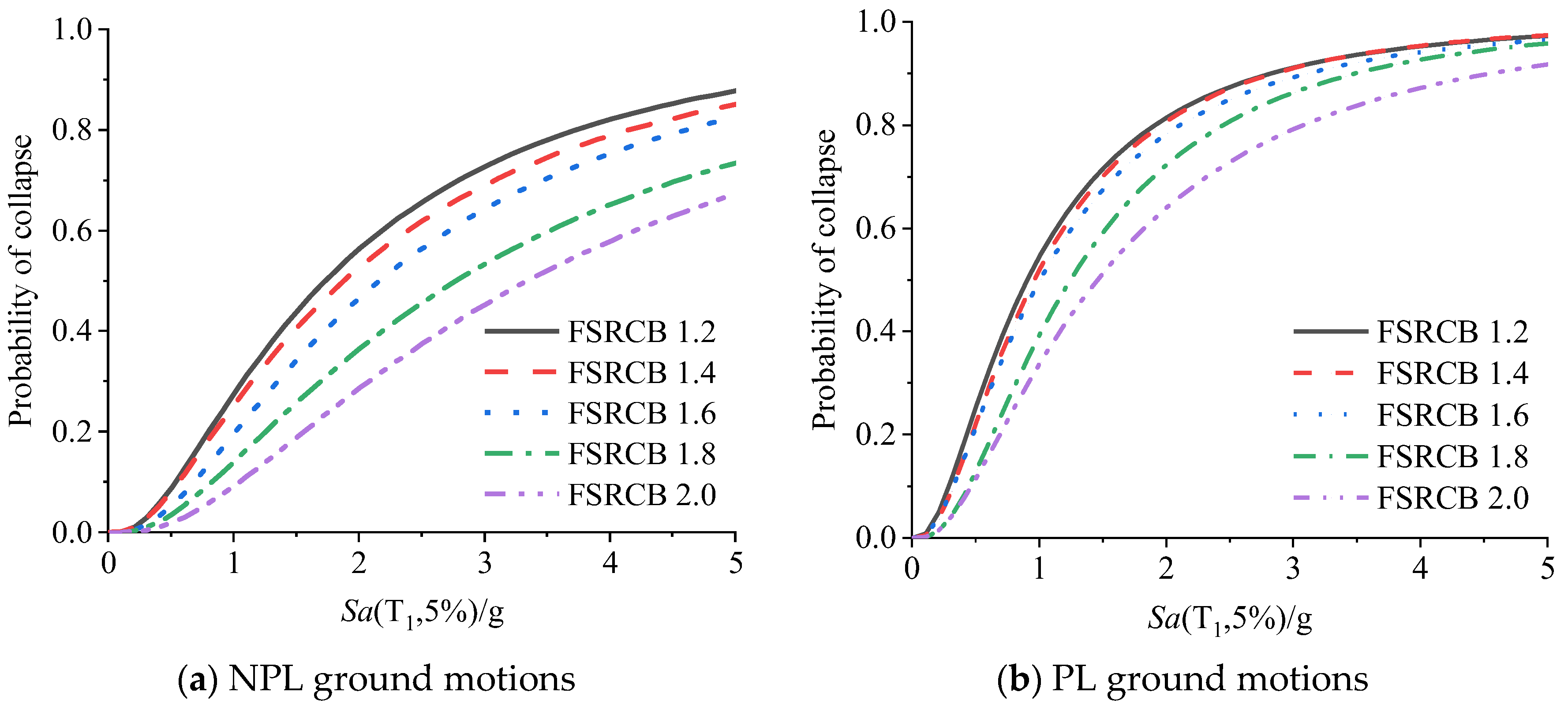
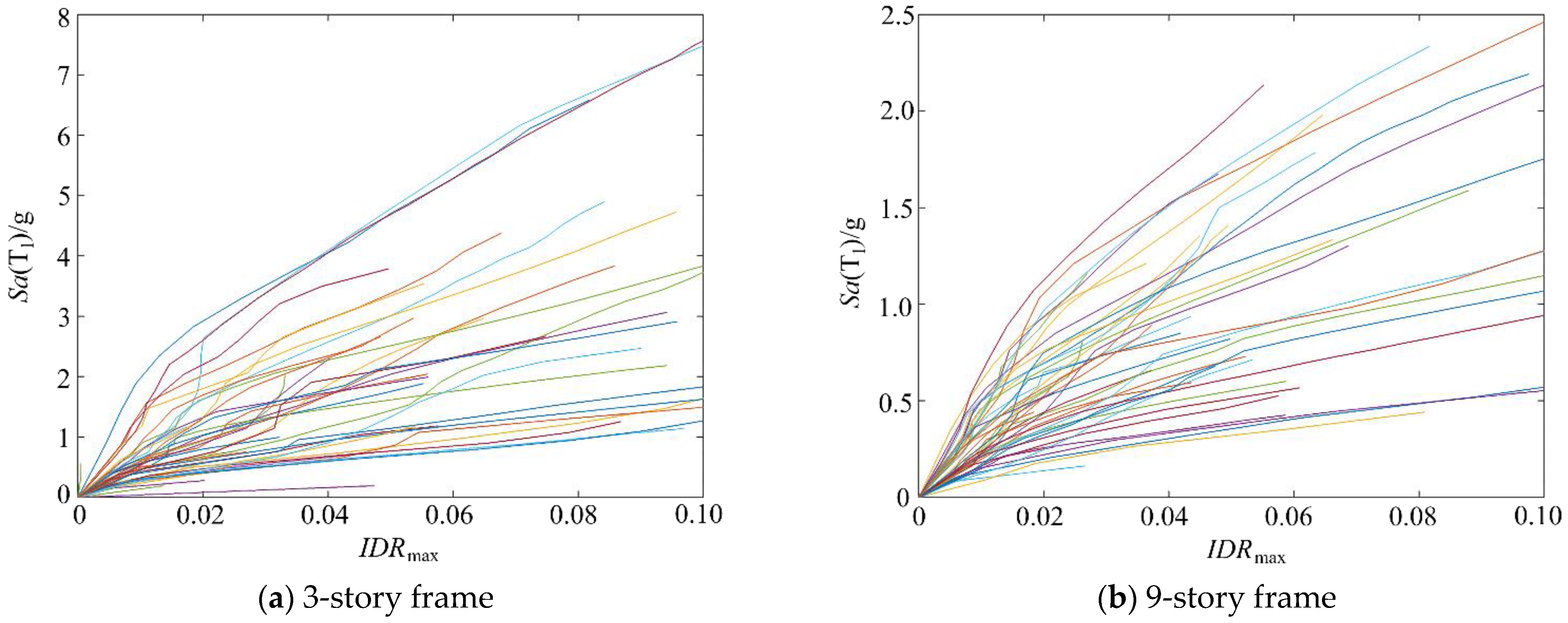
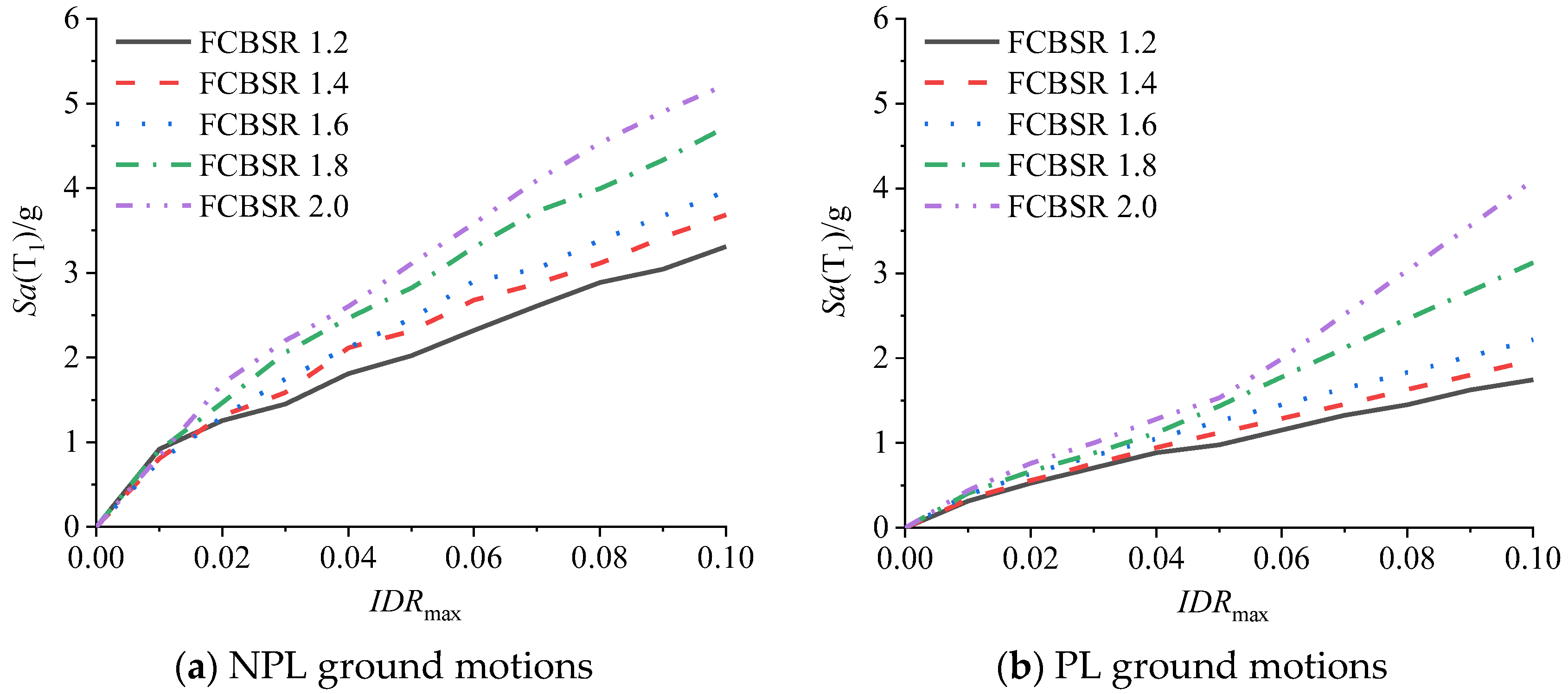
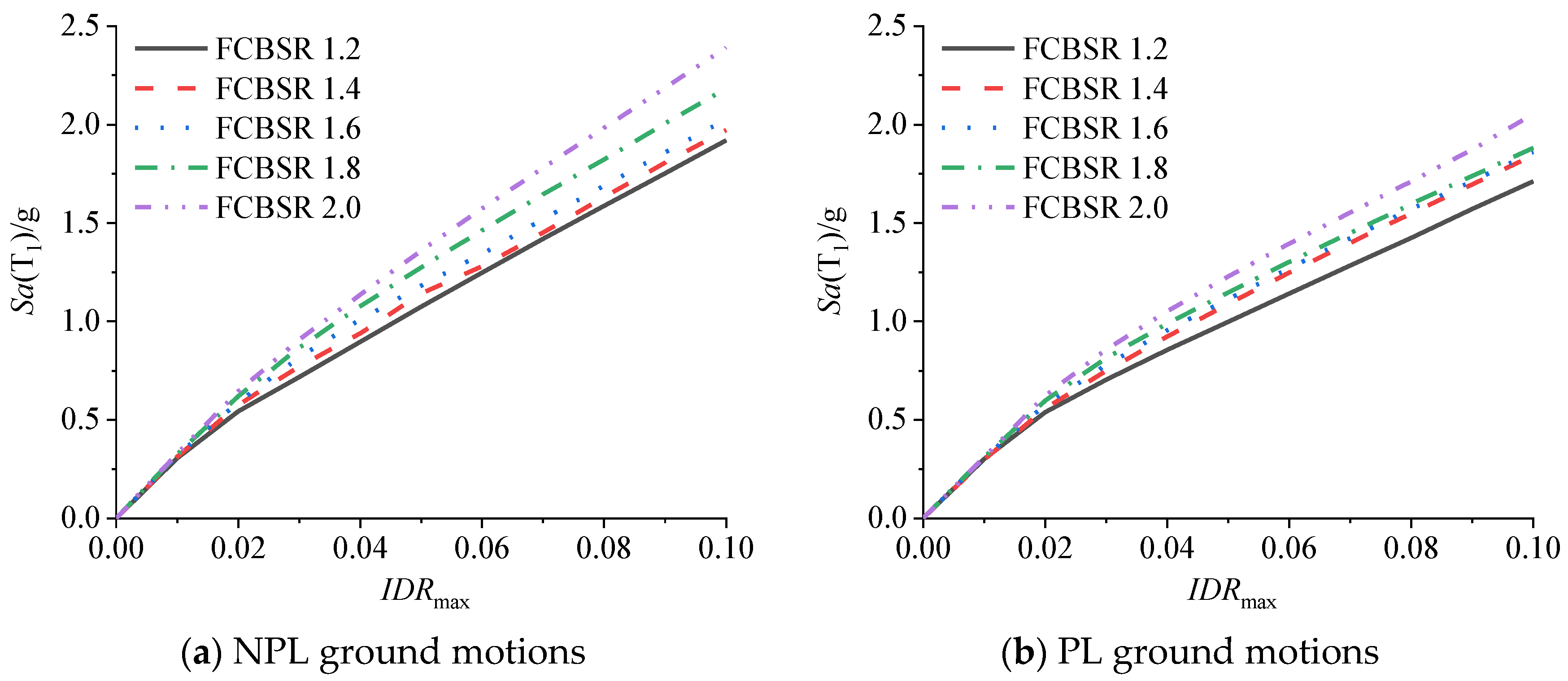
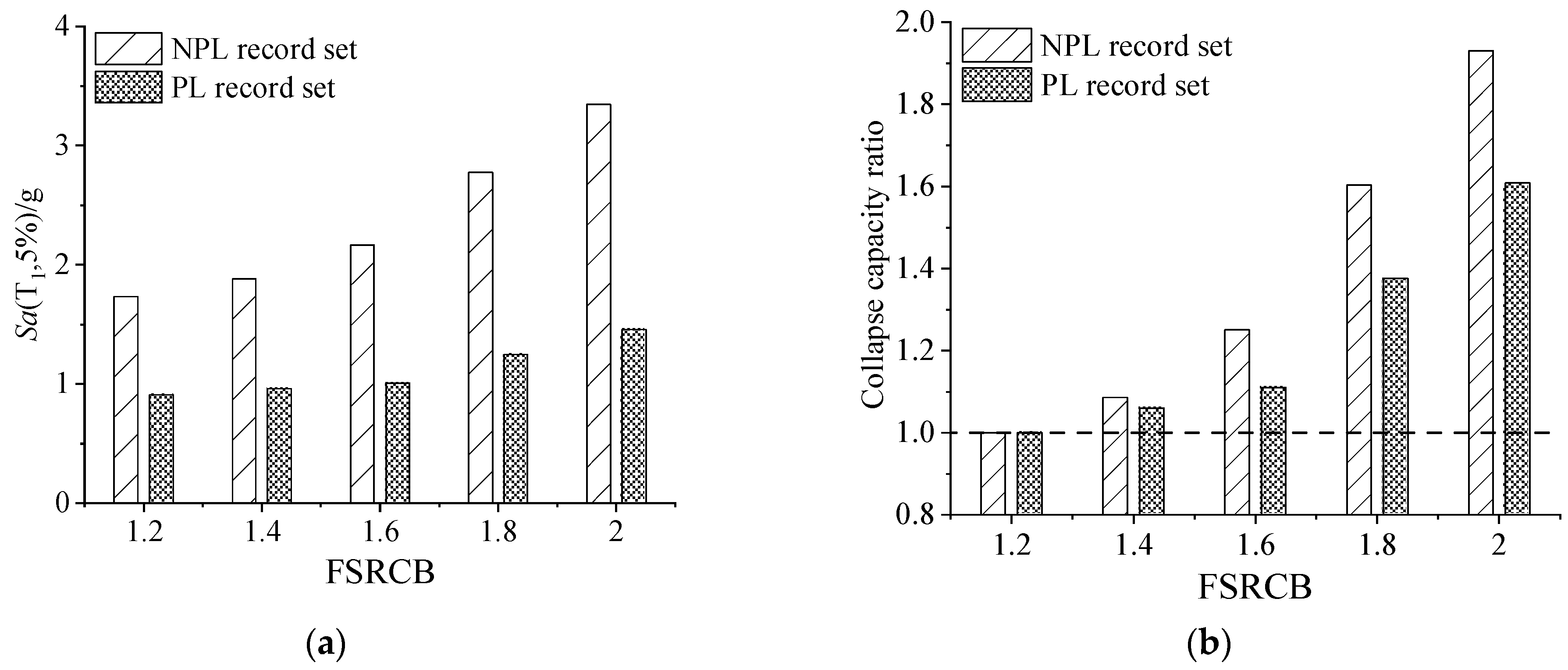
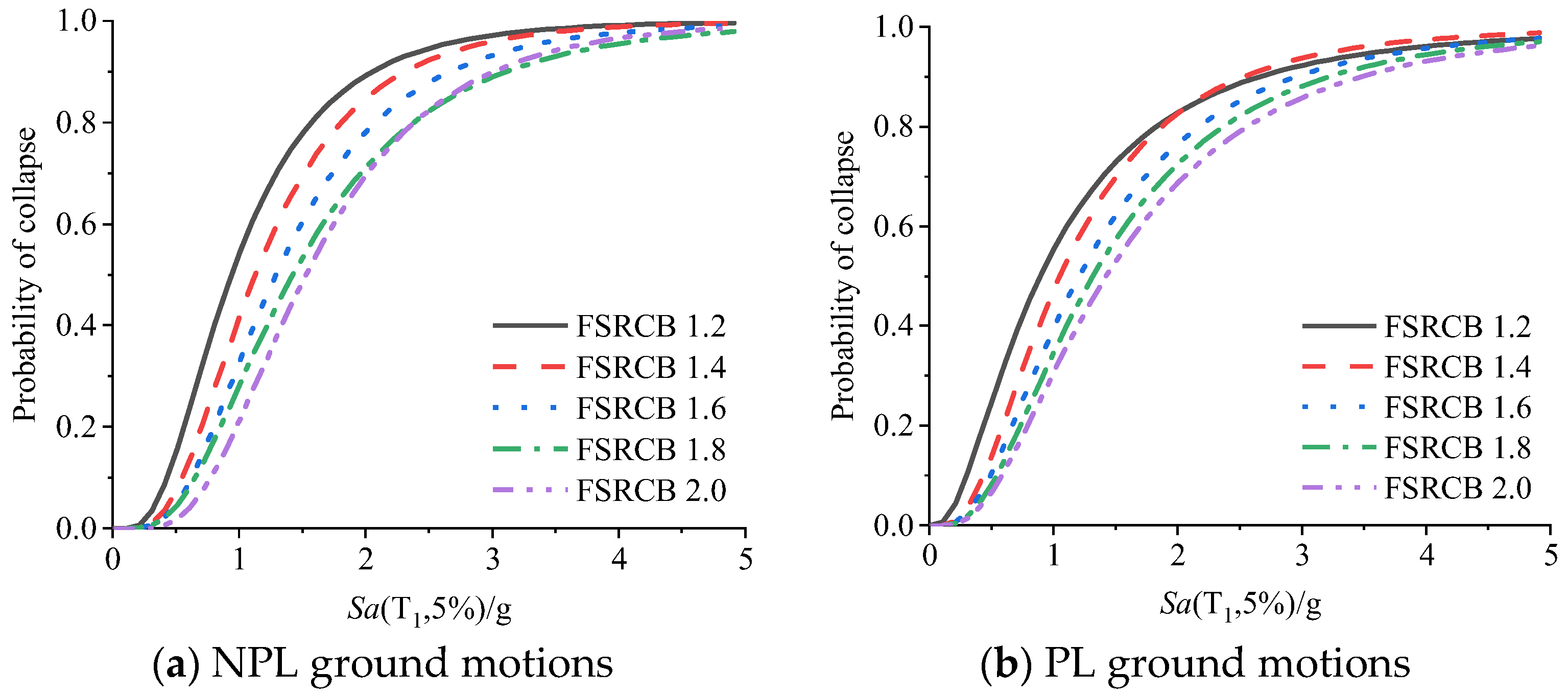
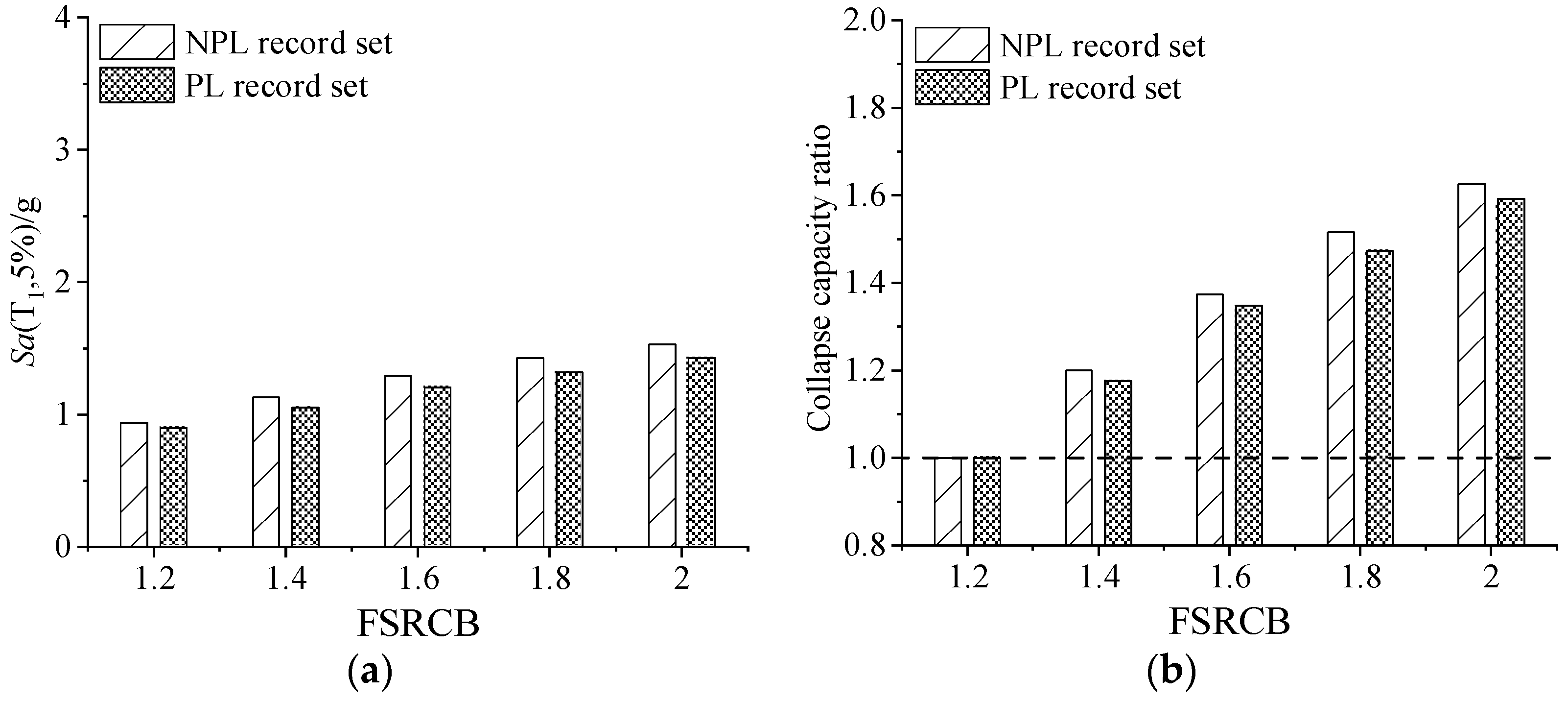
- For both NPL and PL ground motions, the collapse capacities of the RC frames can be improved by increasing the FSRCB of the RC frames. The collapse capacities of the three- and nine-story frames with FSRCB = 2.0 are improved to approximately 1.6–2.0 times those of the frames with FSRCB = 1.2. For NPL ground motions, the collapse capacities are improved up to approximately 2 times when the FSRCB of the three-story frames is increased from 1.2 to 2.0, while for the PL ground motions, the collapse capacities are improved up to approximately 1.5 times when the FSRCB of the three-story frames is increased from 1.2 to 2.0. It is more efficient to improve the collapse capacity of the frames under the excitation of NPL ground motions than those under the excitation of PL ground motions.
- (2)
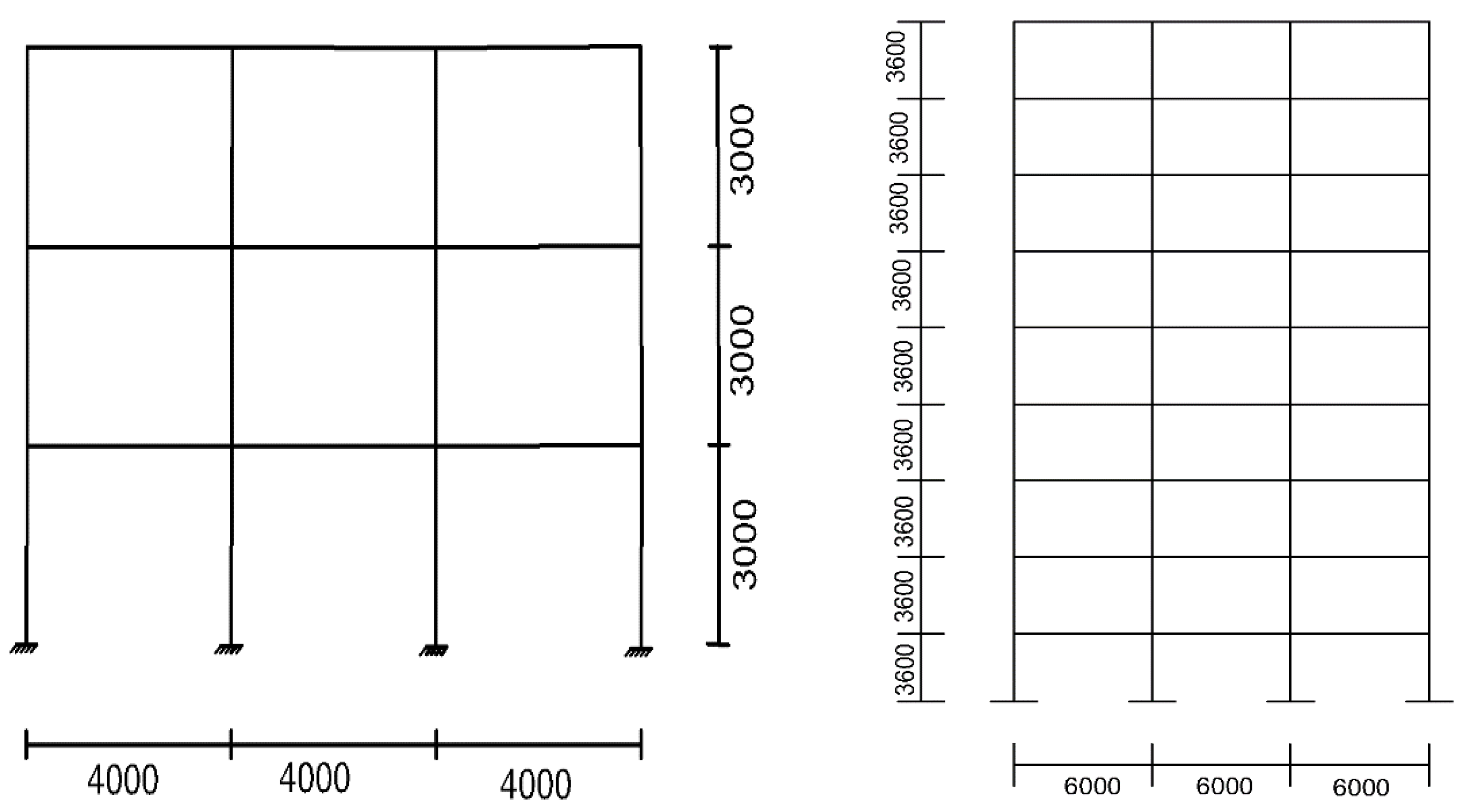
- It is more efficient to improve the collapse capacity for low-rise (three-story) frames than for middle- or high-rise (nine-story) frames. This difference arises because the deformations of the low-rise frame are mainly dominated by the first mode and the higher mode effects are not significant. However, for the middle or high-rise frame, the higher mode effect is stronger, which may cause the inflection point in the columns to move from near the midheight to the column ends and sometimes will cause the column to undergo a single curvature. Thus, compared with low-rise RC frames, it is less efficient to increase the collapse capacity for the middle- or high-rise frames by increasing the value of the FSRCB.
- (3)
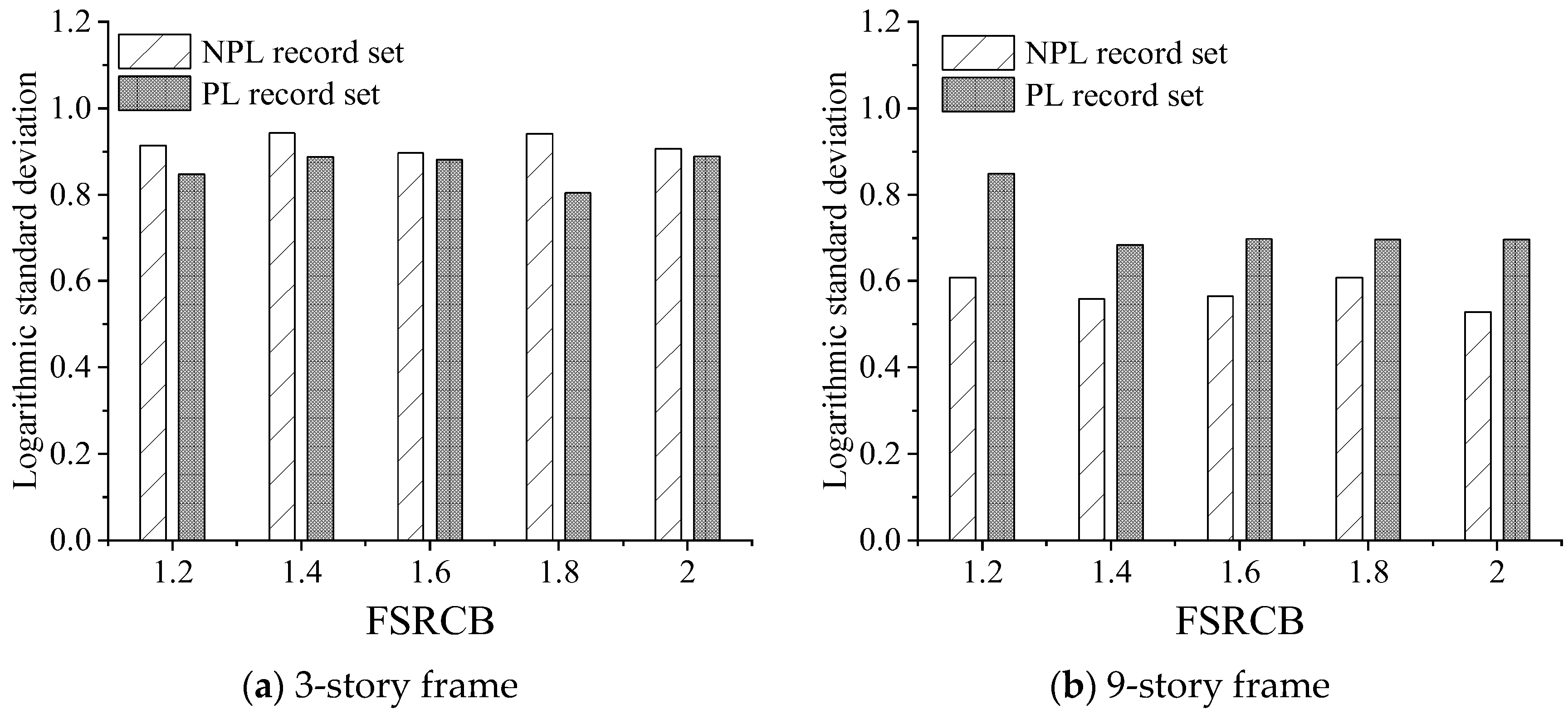
- The uncertainty (logarithmic standard deviation) of the collapse capacity of the RC frame structures designed according to the Chinese seismic codes ranges from 0.5–0.9, which is larger than the maximum logarithmic standard deviation (0.4) proposed by FEMA P695. This means that FEMA P695 may sometimes underestimate the uncertainty of the collapse capacity of the RC frames in China.
Author Contributions
Funding
Data Availability Statement
Conflicts of Interest
References
- Ger, J.; Cheng, F.Y.; Lu, L. Collapse Behavior of Pino Suarez Building During 1985 Mexico City Earthquake. J. Struct. Eng. 1993, 119, 852–870. [Google Scholar] [CrossRef] [Scilit]
- FEMA. Quantification of Building Seismic Performance Factors; Federal Emergency Management Agency: Washington, DC, USA, 2009; Volume 695.
- ACI 318-14; Building Code Requirements for Structural Concrete. ACI Committee 318: Indianapolis, IN, USA, 2014.
- GB 50011-2010; Code for Seismic Design of Buildings, 2016 ed. Ministry of Housing and Urban-Rural Development of the People’s Republic of China; China Architecture & Building Press: Beijing, China, 2016. (In Chinese)
- AISC 2005; Seismic Provisions for Structural Steel Buildings. American Institute of Steel Construction Inc.: Chicago, IL, USA, 2005.
- Eurocode 8, N; Design Provisions for Earthquake Resistance of Structures—Part 1: General Rules, Seismic Actions and Rules for Buildings. European Committee for Standardization: Brussels, Belgium, 2004.
- Gong, M.; Zuo, Z.; Wang, X.; Lu, X.; Xie, L. Comparing seismic performances of pilotis and bare RC frame structures by shaking table tests. Eng. Struct. 2019, 199, 109442. [Google Scholar] [CrossRef] [Scilit]
- Ye, L.; Qu, Z.; Ma, Q.; Lin, X.; Lu, X.; Pan, P. Study on ensuring the strong column-weak beam mechanism for RC frames based on the damage analysis in the Wenchuan earthquake. Build. Struct. 2008, 38, 52–53. [Google Scholar]
- Sun, B.; Zhang, G. The Wenchuan earthquake creation of a rich database of building performance. Sci. China Technol. Sci. 2010, 53, 2668–2680. [Google Scholar] [CrossRef] [Scilit]
- Zhao, B.; Taucer, F.; Rossetto, T. Field investigation on the performance of building structures during the 12 May 2008 Wenchuan earthquake in China. Eng. Struct. 2009, 31, 1707–1723. [Google Scholar] [CrossRef] [Scilit]
- Arslan, M.; Korkmaz, H. What is to be learned from damage and failure of reinforced concrete structures during recent earthquakes in Turkey? Eng. Fail. Anal. 2007, 14, 1–22. [Google Scholar] [CrossRef] [Scilit]
- Gong, M.; Yang, Y.; Xie, L. Seismic damage to reinforced concrete frame buildings in Lushan M7.0 earthquake. Earthq. Eng. Eng. Vib. 2013, 33, 20–26. [Google Scholar]
- Gong, M.; Lin, S.; Sun, J.; Li, S.; Dai, J.; Xie, L. Seismic intensity map and typical structural damage of 2010 Ms 7.1 Yushu earthquake in China. Nat. Hazards 2015, 77, 847–866. [Google Scholar] [CrossRef] [Scilit]
- Bondy, K.D. A More Rational Approach to Capacity Design of Seismic Moment Frame Columns. Earthq. Spectra 2019, 12, 395–406. [Google Scholar] [CrossRef] [Scilit]
- Lee, H.-S. Revised Rule for Concept of Strong-Column Weak-Girder Design. J. Struct. Eng. 1996, 122, 359–364. [Google Scholar] [CrossRef] [Scilit]
- Park, R.; Paulay, T. Reinforced Concrete Structures; John Willey and Sons: New York, NY, USA, 1975. [Google Scholar]
- Nakashima, M.; Sawaizumi, S. Column-to-Beam Strength Ratio Required for Ensuring Beam-Collapse Mechanisms in Earthquake Responses of Steel Moment Frames. In Proceedings of the 12th World Conference on Earthquake Engineering, Auckland, New Zeland, 30 January–4 February 2000. [Google Scholar]
- Medina, R.A.; Krawinkler, H. Strength Demand Issues Relevant for the Seismic Design of Moment-Resisting Frames. Earthq. Spectra 2019, 21, 415–439. [Google Scholar] [CrossRef] [Scilit]
- Choi, S.W.; Kim, Y.; Lee, J.; Hong, K.; Park, H.S. Minimum column-to-beam strength ratios for beam–hinge mechanisms based on multi-objective seismic design. J. Constr. Steel Res. 2013, 88, 53–62. [Google Scholar] [CrossRef] [Scilit]
- Zaghi, A.E.; Soroushian, S.; Itani, A.; Maragakis, E.M.; Pekcan, G.; Mehrraoufi, M. Impact of column-to-beam strength ratio on the seismic response of steel MRFs. Bull. Earthq. Eng. 2014, 13, 635–652. [Google Scholar] [CrossRef] [Scilit]
- Zuo, Z.; Gong, M.; Sun, J.; Zhang, H. Seismic performance of RC frames with different column-to-beam flexural strength ratios under the excitation of pulse-like and non-pulse-like ground motion. Bull. Earthq. Eng. 2021, 19, 5139–5159. [Google Scholar] [CrossRef] [Scilit]
- Wang, X.; Zhao, W.; Kong, J.; Zhao, T. Numerical Investigation on the Influence of In-Plane Damage on the Out-of-Plane Behavior of Masonry Infill Walls. Adv. Civ. Eng. 2020, 2020, 6276803. [Google Scholar] [CrossRef] [Scilit]
- Kong, J.; Su, Y.; Zheng, Z.; Wang, X.; Zhang, Y. The Influence of Vertical Arrangement and Masonry Material of Infill Walls on the Seismic Performance of RC Frames. Buildings 2022, 12, 825. [Google Scholar] [CrossRef] [Scilit]
- Zhang, H.; Kuang, J.; Yuen, T.Y. Low-seismic damage strategies for infilled RC frames: Shake-table tests. Earthq. Eng. Struct. Dyn. 2017, 46, 2419–2438. [Google Scholar] [CrossRef] [Scilit]
- Zhai, C.; Kong, J.; Wang, X.; Chen, Z. Experimental and Finite Element Analytical Investigation of Seismic Behavior of Full-Scale Masonry Infilled RC Frames. J. Earthq. Eng. 2016, 20, 1171–1198. [Google Scholar] [CrossRef] [Scilit]
- Ruggieri, S.; Porco, F.; Uva, G. A practical approach for estimating the floor deformability in existing RC buildings: Evaluation of the effects in the structural response and seismic fragility. Bull. Earthq. Eng. 2020, 18, 2083–2113. [Google Scholar] [CrossRef] [Scilit]
- Caprili, S.; Nardini, L.; Salvatore, W. Evaluation of seismic vulnerability of a complex RC existing building by linear and nonlinear modeling approaches. Bull. Earthq. Eng. 2012, 10, 913–954. [Google Scholar] [CrossRef] [Scilit]
- Kim, C.-S.; Park, H.-G.; Truong, G.T. Column-to-beam flexural strength ratio for performance-based design of RC moment frames. J. Build. Eng. 2022, 46, 103645. [Google Scholar] [CrossRef] [Scilit]
- Liel, A.B.; Haselton, C.B.; Deierlein, G.G. Seismic Collapse Safety of Reinforced Concrete Buildings. II: Comparative Assessment of Nonductile and Ductile Moment Frames. J. Struct. Eng. 2011, 137, 492–502. [Google Scholar] [CrossRef] [Scilit]
- Ruggieri, S.; Porco, F.; Uva, G.; Vamvatsikos, D. Two frugal options to assess class fragility and seismic safety for low-rise reinforced concrete school buildings in Southern Italy. Bull. Earthq. Eng. 2021, 19, 1415–1439. [Google Scholar] [CrossRef] [Scilit]
- Jalayer, F.; Franchin, P.; Pinto, P.E. A scalar damage measure for seismic reliability analysis of RC frames. Earthq. Eng. Struct. Dyn. 2007, 36, 2059–2079. [Google Scholar] [CrossRef] [Scilit]
- Choi, S.W.; Park, H.S. Multi-objective seismic design method for ensuring beam-hinging mechanism in steel frames. J. Constr. Steel Res. 2012, 74, 17–25. [Google Scholar] [CrossRef] [Scilit]
- Kara, L.D.; Joseph, M.B. Seismic Evaluation of Column-to-Beam Strength Ratios in Reinforced Concrete Frames. ACI Struct. J. 2002, 98, 843–851. [Google Scholar] [CrossRef] [Scilit]
- El-Mandouh, M.A.; Omar, M.S.; Elnaggar, M.A.; El-Maula, A.S.A. Cyclic Behavior of High-Strength Lightweight Concrete Exterior Beam-Column Connections Reinforced with GFRP. Buildings 2022, 12, 179. [Google Scholar] [CrossRef] [Scilit]
- Sococol, I.; Mihai, P.; Petrescu, T.-C.; Nedeff, F.; Nedeff, V.; Agop, M. Analytical Study Regarding the Seismic Response of a Moment-Resisting (MR) Reinforced Concrete (RC) Frame System with Reduced Cross Sections of the RC Beams. Buildings 2022, 12, 983. [Google Scholar] [CrossRef] [Scilit]
- Ning, N.; Qu, W.; Ma, Z.J. Design recommendations for achieving “strong column-weak beam” in RC frames. Eng. Struct. 2016, 126, 343–352. [Google Scholar] [CrossRef] [Scilit]
- Maosheng, G.; Zhanxuan, Z.; Jing, S.; Riteng, H.; Yinan, Z. Influence of the column-to-beam flexural strength ratio on the failure mode of beam-column connections in RC frames. Earthq. Eng. Eng. Vib. 2021, 20, 441–452. [Google Scholar] [CrossRef] [Scilit]
- Ghorbanzadeh, M.; Khoshnoudian, F. The Effect of Strong Column-Weak Beam Ratio on the Collapse Behaviour of Reinforced Concrete Moment Frames Subjected to Near-Field Earthquakes. J. Earthq. Eng. 2020, 26, 4030–4053. [Google Scholar] [CrossRef] [Scilit]
- Sattar, S.; Liel, A.B. Collapse indicators for existing nonductile concrete frame buildings with varying column and frame characteristics. Eng. Struct. 2017, 152, 188–201. [Google Scholar] [CrossRef] [Scilit]
- Goulet, C.A.; Haselton, C.B.; Mitrani-Reiser, J.; Beck, J.L.; Deierlein, G.G.; Porter, K.A.; Stewart, J.P. Evaluation of the seismic performance of a code-conforming reinforced-concrete frame building—from seismic hazard to collapse safety and economic losses. Earthq. Eng. Struct. Dyn. 2007, 36, 1973–1997. [Google Scholar] [CrossRef] [Scilit]
- Ye, L.; Song, S. Calculation of design methods for flexure and axial strength of RC columns in Chinese and American codes. J. Archit. Civ. Eng. 2008, 25, 56–63. [Google Scholar]
- Vamvatsikos, D.; Cornell, C.A. Incremental dynamic analysis. Earthq. Eng. Struct. Dyn. 2002, 31, 491–514. [Google Scholar] [CrossRef] [Scilit]
- Vamvatsikos, D.; Cornell, C.A. Applied Incremental Dynamic Analysis. Earthq. Spectra 2004, 20, 523–553. [Google Scholar] [CrossRef] [Scilit]
- Open System for Earthquake Engineering Simulation (OpenSees). Available online: https://opensees.berkeley.edu/wiki/index.php/Command_Manual (accessed on 22 June 2022).
- Spacone, E.; Filippou, F.C.; Taucer, F.F. Fibre Beam-Column Model for Non-Linear Analysis of R/C Frames: Part I. Formulation. Earthq. Eng. Struct. Dyn. 1996, 25, 711–725. [Google Scholar] [CrossRef] [Scilit]
- Li, S.; Zuo, Z.; Zhai, C.; Xie, L. Comparison of static pushover and dynamic analyses using RC building shaking table experiment. Eng. Struct. 2017, 136, 430–440. [Google Scholar] [CrossRef] [Scilit]
- Li, C.; Kunnath, S.; Zhai, C. Influence of Early-Arriving Pulse-Like Ground Motions on Ductility Demands of Single-Degree-of-Freedom Systems. J. Earthq. Eng. 2018, 24, 1337–1360. [Google Scholar] [CrossRef] [Scilit]
- Shahi, S.K.; Baker, J. An Efficient Algorithm to Identify Strong-Velocity Pulses in Multicomponent Ground Motions. Bull. Seism. Soc. Am. 2014, 104, 2456–2466. [Google Scholar] [CrossRef] [Scilit]
- Jäger, C.; Adam, C. Influence of Collapse Definition and Near-Field Effects on Collapse Capacity Spectra. J. Earthq. Eng. 2013, 17, 859–878. [Google Scholar] [CrossRef] [Scilit]
- FEMA-351; Recommended Seismic Evaluation and Upgrade Criteria for Existing Welded Steel Moment-Frame Buildings. Federal Emergency Management Agency: Washington, DC, USA, 2000; Volume 351.
- Zareian, F.; Krawinkler, H.; Ibarra, L.; Lignos, D. Basic concepts and performance measures in prediction of collapse of buildings under earthquake ground motions. Struct. Des. Tall Spéc. Build. 2009, 19, 167–181. [Google Scholar] [CrossRef] [Scilit]
- Liel, A.B.; Haselton, C.B.; Deierlein, G.G.; Baker, J.W. Incorporating modeling uncertainties in the assessment of seismic collapse risk of buildings. Struct. Saf. 2009, 31, 197–211. [Google Scholar] [CrossRef] [Scilit]
- Zuo, Z.; Li, S. Discussion of “Experimental Investigation of Seismic Uncertainty Propagation through Shake Table Tests” by Peng Deng, Shiling Pei, John W. van de Lindt, and Chao Zhang. J. Struct. Eng. 2019, 145, 2. [Google Scholar] [CrossRef] [Scilit]
- Ibarra, L.; Krawinkler, H. Variance of collapse capacity of SDOF systems under earthquake excitations. Earthq. Eng. Struct. Dyn. 2011, 40, 1299–1314. [Google Scholar] [CrossRef] [Scilit]



| FSRCB | Abeam/Transverse Rebar | Acolumn/Transverse Rebar |
|---|---|---|
| 1.2 | 1206/Φ8@100/150 | 905/Φ8@100/150 |
| 1.4 | 1206/Φ8@100/150 | 1231/Φ8@100/150 |
| 1.6 | 1206/Φ8@100/150 | 1608/Φ8@100/150 |
| 1.8 | 1206/Φ8@100/150 | 2034/Φ8@100/150 |
| 2.0 | 1206/Φ8@100/150 | 2544/Φ8@100/150 |
| FSRCB | Abeam/Transverse Rebar | Acolumn/Transverse Rebar |
|---|---|---|
| 1.2 | 1885/Φ8@100/150 | 2011/Φ8@100/150 |
| 1.4 | 1885/Φ8@100/150 | 2512/Φ8@100/150 |
| 1.6 | 1885/Φ8@100/150 | 2842/Φ8@100/150 |
| 1.8 | 1885/Φ8@100/150 | 3471/Φ8@100/150 |
| 2.0 | 1885/Φ8@100/150 | 4163/Φ8@100/150 |
Publisher’s Note: MDPI stays neutral with regard to jurisdictional claims in published maps and institutional affiliations. |
© 2022 by the authors. Licensee MDPI, Basel, Switzerland. This article is an open access article distributed under the terms and conditions of the Creative Commons Attribution (CC BY) license (https://creativecommons.org/licenses/by/4.0/).
Share and Cite
Gong, M.; Liu, B.; Zuo, Z.; Sun, J.; Zhang, H. The Influence of the Flexural Strength Ratio of Columns to Beams on the Collapse Capacity of RC Frame Structures. Buildings 2022, 12, 1219. https://doi.org/10.3390/buildings12081219
Gong M, Liu B, Zuo Z, Sun J, Zhang H. The Influence of the Flexural Strength Ratio of Columns to Beams on the Collapse Capacity of RC Frame Structures. Buildings. 2022; 12(8):1219. https://doi.org/10.3390/buildings12081219
Chicago/Turabian StyleGong, Maosheng, Bo Liu, Zhanxuan Zuo, Jing Sun, and Hao Zhang. 2022. "The Influence of the Flexural Strength Ratio of Columns to Beams on the Collapse Capacity of RC Frame Structures" Buildings 12, no. 8: 1219. https://doi.org/10.3390/buildings12081219
APA StyleGong, M., Liu, B., Zuo, Z., Sun, J., & Zhang, H. (2022). The Influence of the Flexural Strength Ratio of Columns to Beams on the Collapse Capacity of RC Frame Structures. Buildings, 12(8), 1219. https://doi.org/10.3390/buildings12081219