Article

FEM-Based Evaluation of the Point Thermal Transmittance of Various Types of Ventilated Façade Cladding Fastening Systems
Department of Construction Materials and Technologies, Faculty of Civil Engineering, Budapest University of Technology and Economics, Műegyetem rkp. 3, 1111 Budapest, Hungary
*
Author to whom correspondence should be addressed.
Buildings 2022, 12(8), 1153; https://doi.org/10.3390/buildings12081153

Submission received: 10 July 2022 / Revised: 28 July 2022 / Accepted: 29 July 2022 / Published: 2 August 2022

Abstract

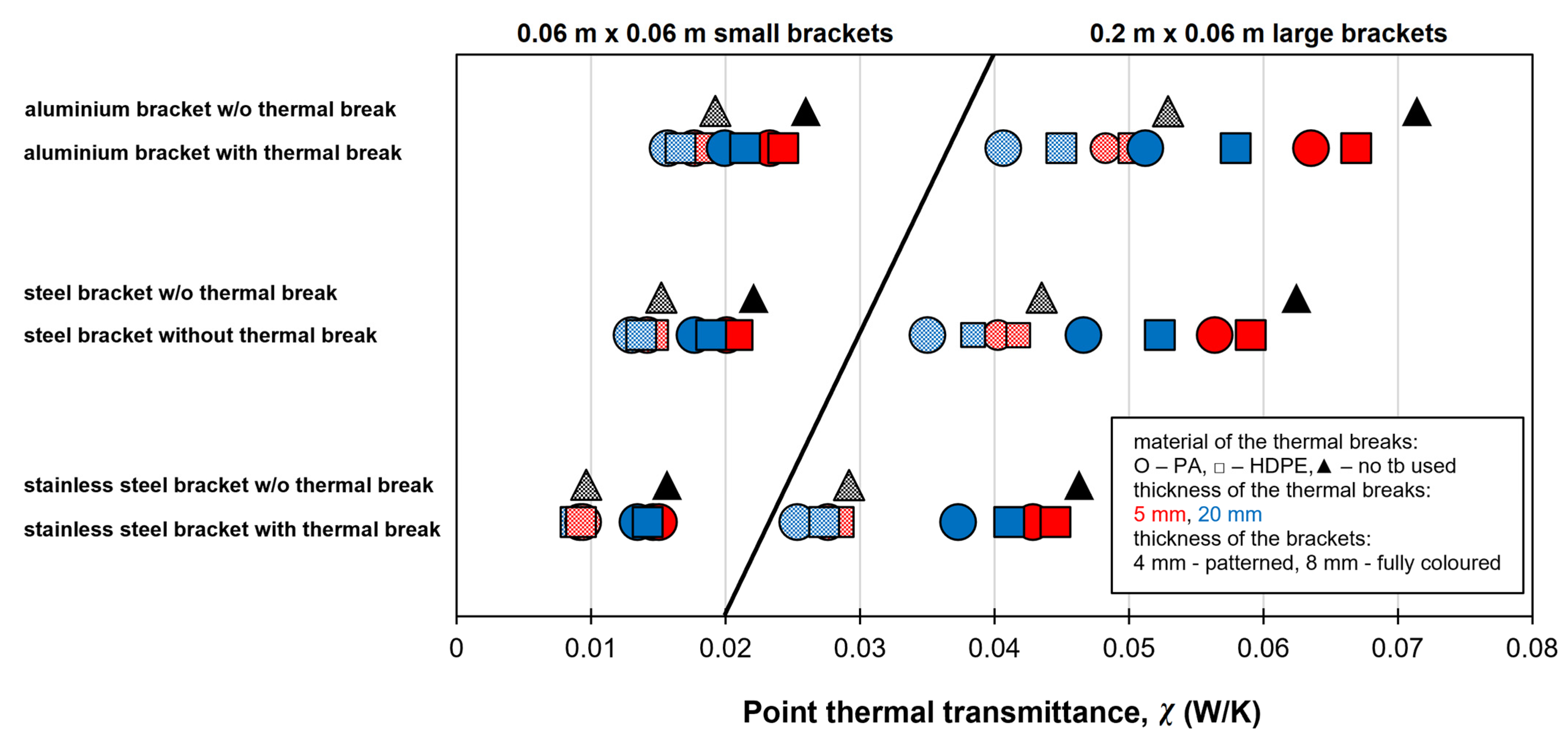
The prevalence of ventilated façade systems is not only due to their aesthetic properties but also due to the fact they provide mechanical and acoustic protection for the façade and reduce the energy demand of the building. However, it is essential to mention that the point thermal bridges of the fastening system with brackets and anchors are often neglected during simplified energy performance calculations and practical design tasks. The reason practitioners do not consider the brackets in the calculation is the lack of standards for the simplified calculation of point thermal transmittances, or there being no comprehensive, manufacturer-independent thermal bridge catalogue available. This study aims to evaluate the point thermal transmittances created by the brackets and anchors of the ventilated façade claddings by using 3D numerical thermal modelling. A broad point thermal bridge catalogue was created, considering multiple factors of the ventilated facades. The FEM-based results show that thermal breaks/isolators could reduce the point thermal transmittances by only 2 to 28%, depending on the material of the brackets and the isolators. The brackets’ material and geometrical properties/parameters could cause up to 70% of difference between corrected and uncorrected thermal transmittance values, as well as significant differences between the results if the brackets were applied to different kinds of masonry walls or reinforced concrete walls.
Keywords: building physics; point thermal bridges; ventilated facade claddings; brackets and anchors; thermal break; three-dimensional numerical thermal modelling building physics; point thermal bridges; ventilated facade claddings; brackets and anchors; thermal break; three-dimensional numerical thermal modelling