Improved Metaheuristic Algorithm Based Finite Element Model Updating of a Hybrid Girder Cable-Stayed Railway Bridge



Abstract
1. Introduction
2. Model Updating Assisted with the Kriging Model
3. Improvement Strategy of Metaheuristic Algorithm
3.1. Metaheuristic Algorithm
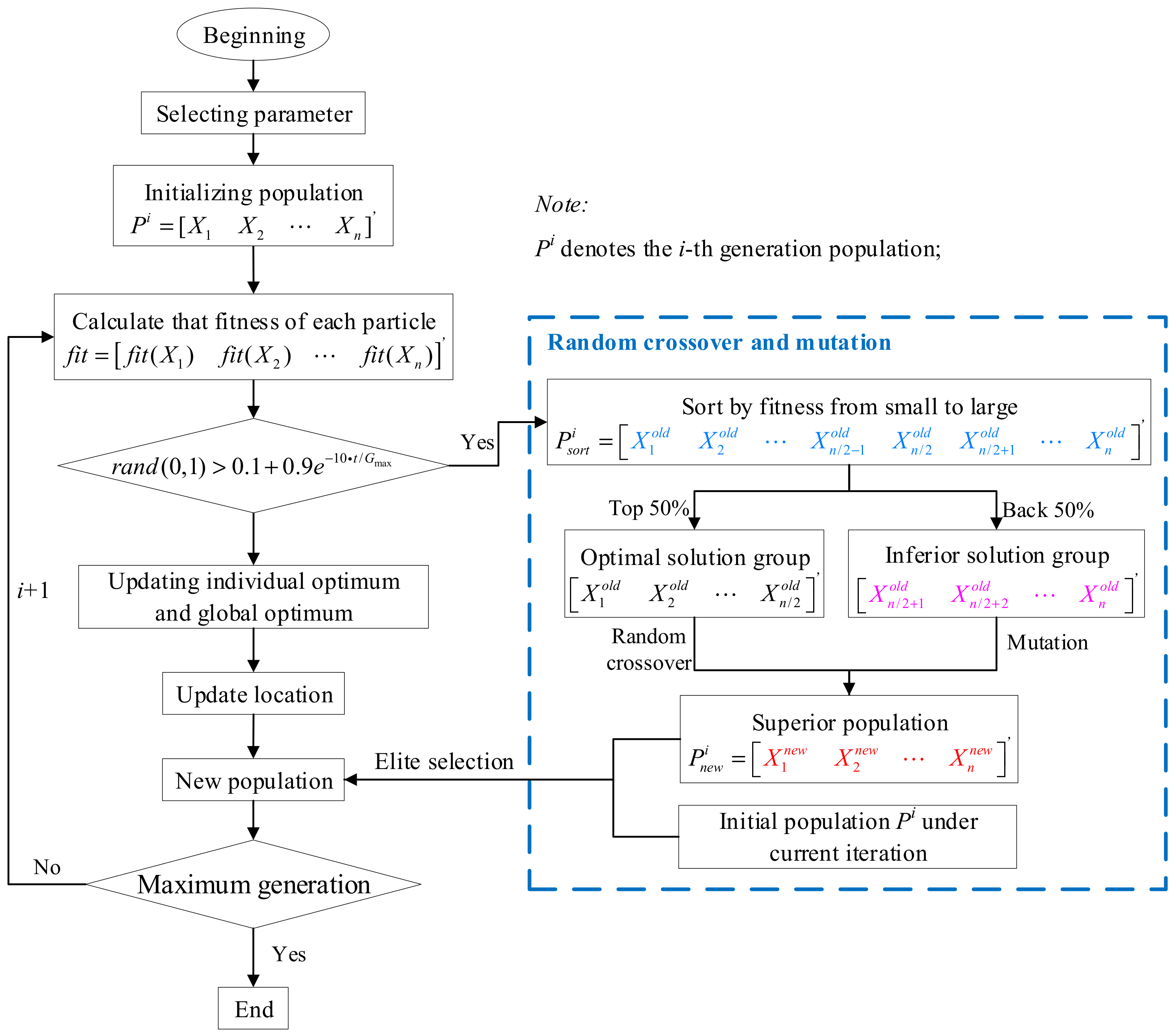
3.2. Improvement Strategy
3.3. Algorithm Procedure
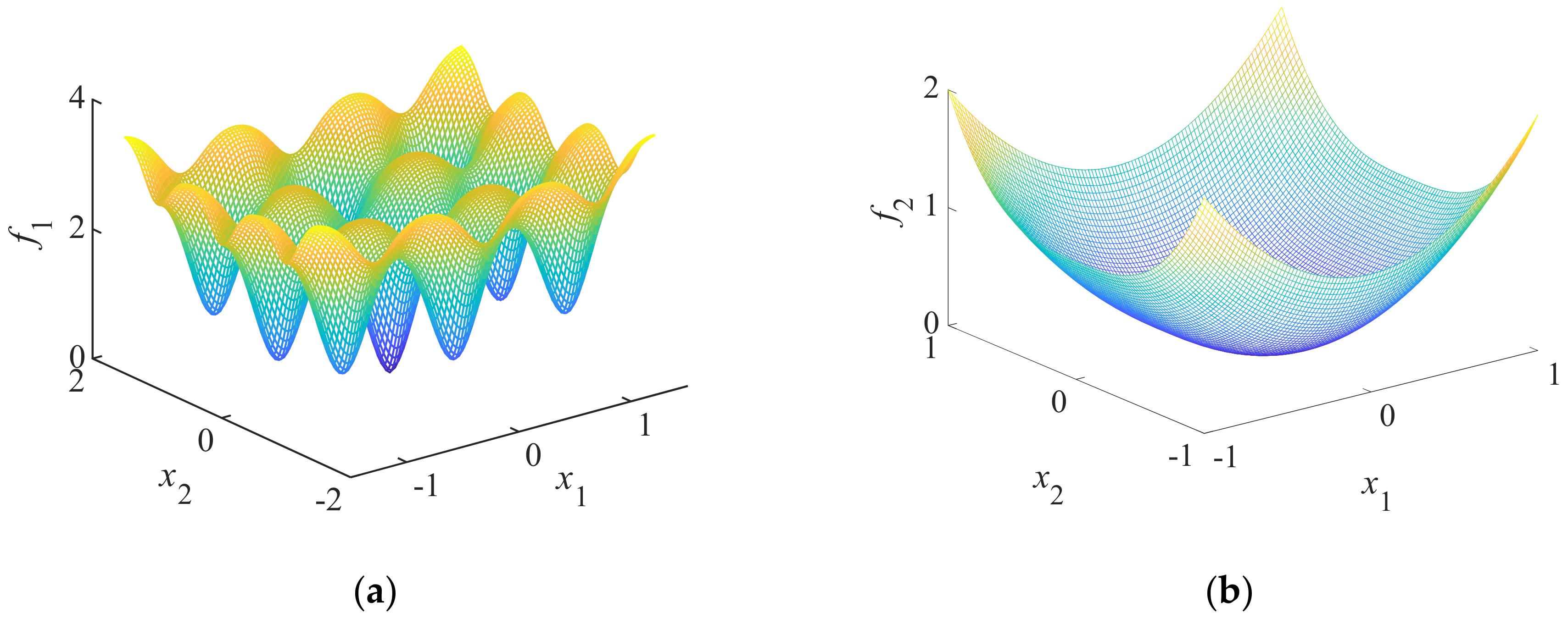
3.4. Benchmark Functions
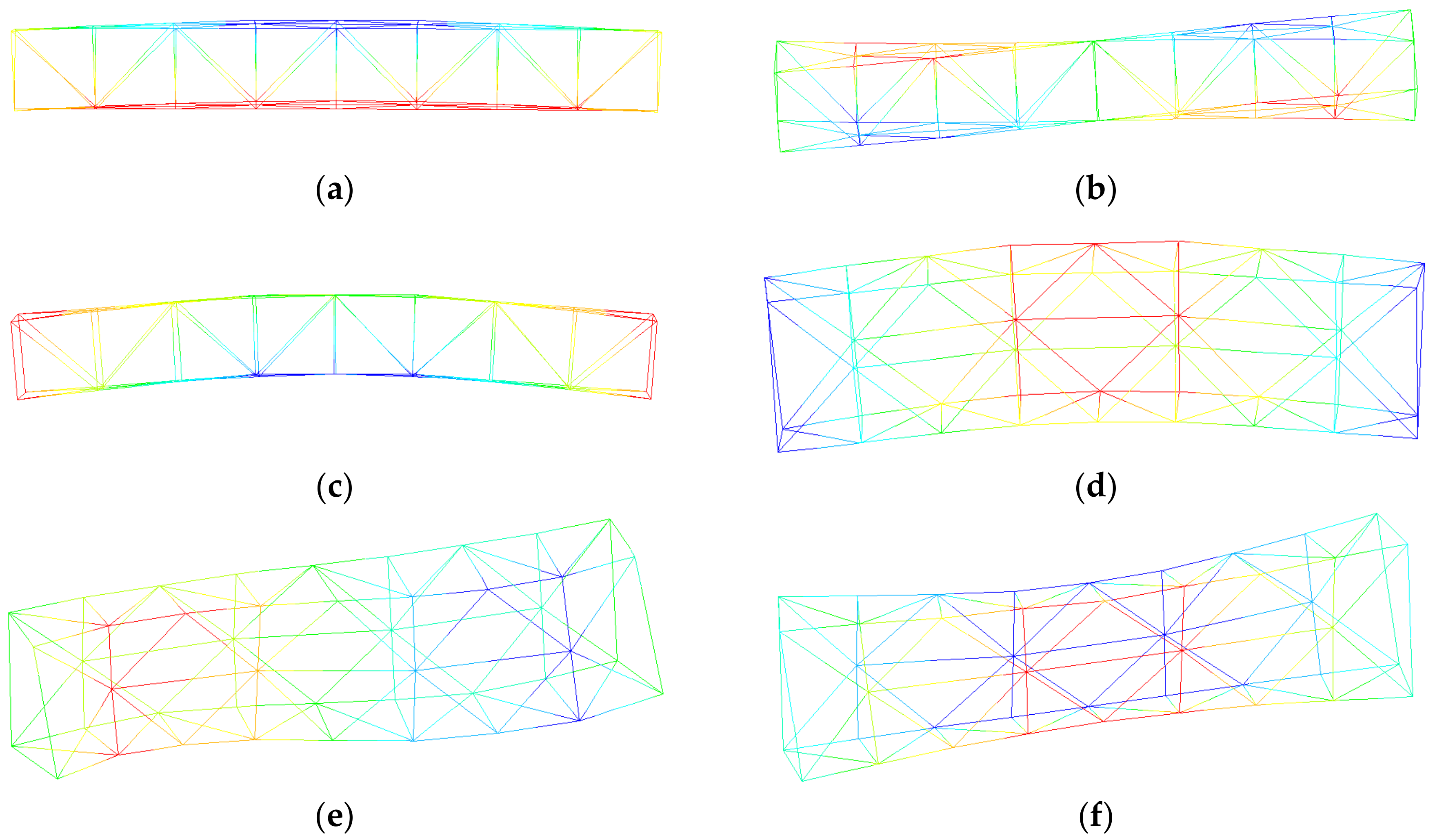
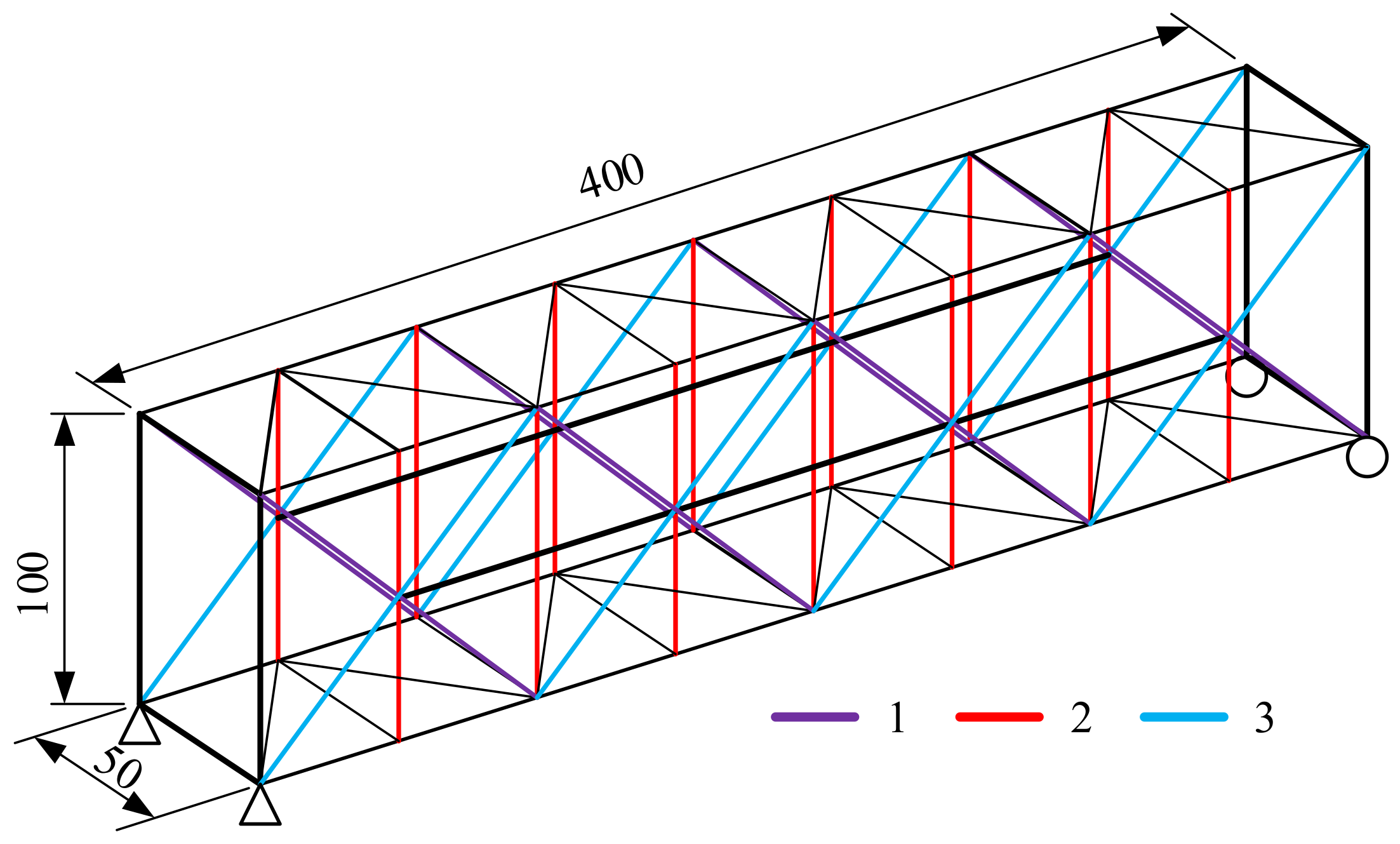
4. Numerical Simulation
5. Case Study: FE Model Updating of a Cable-Stayed Bridge
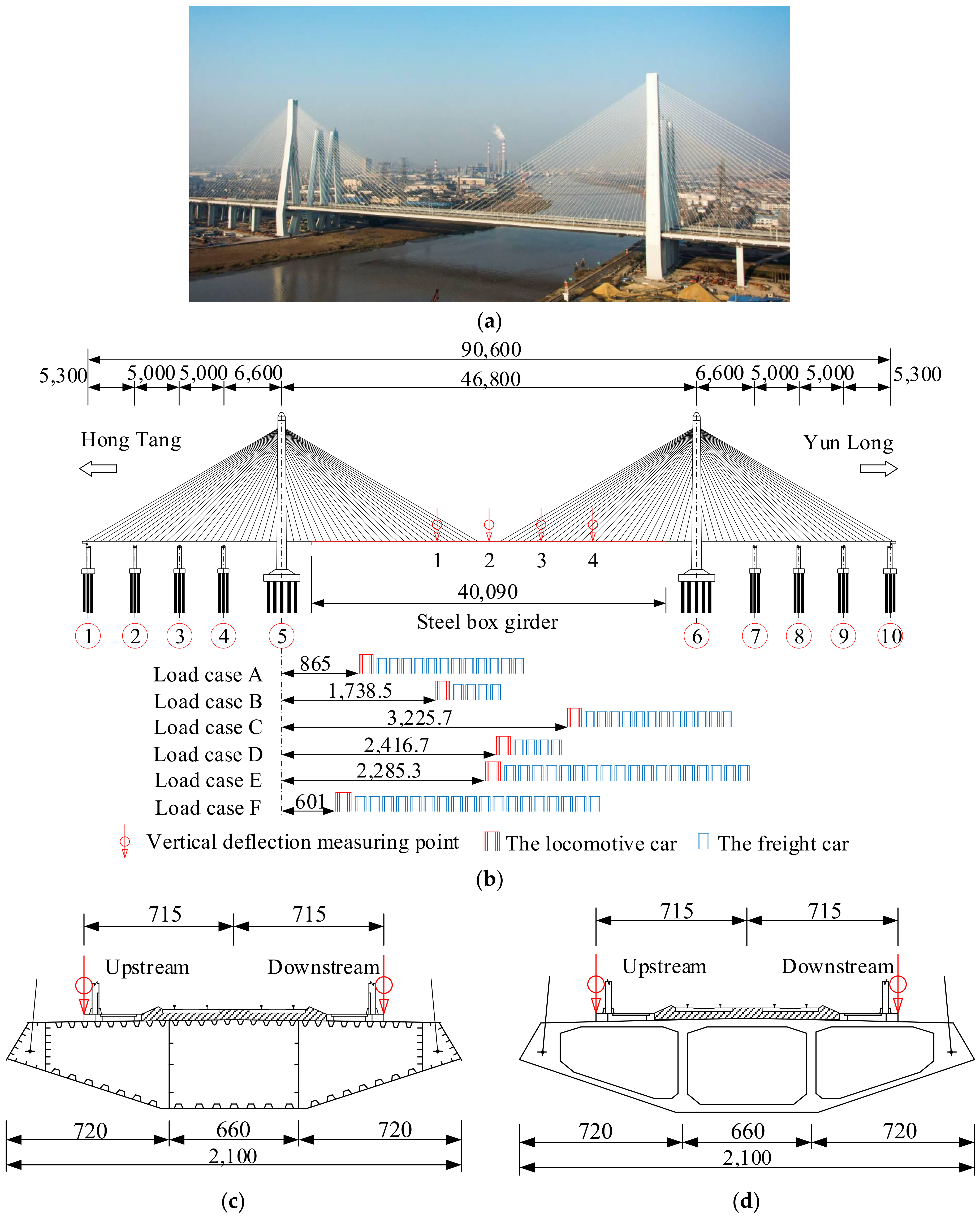
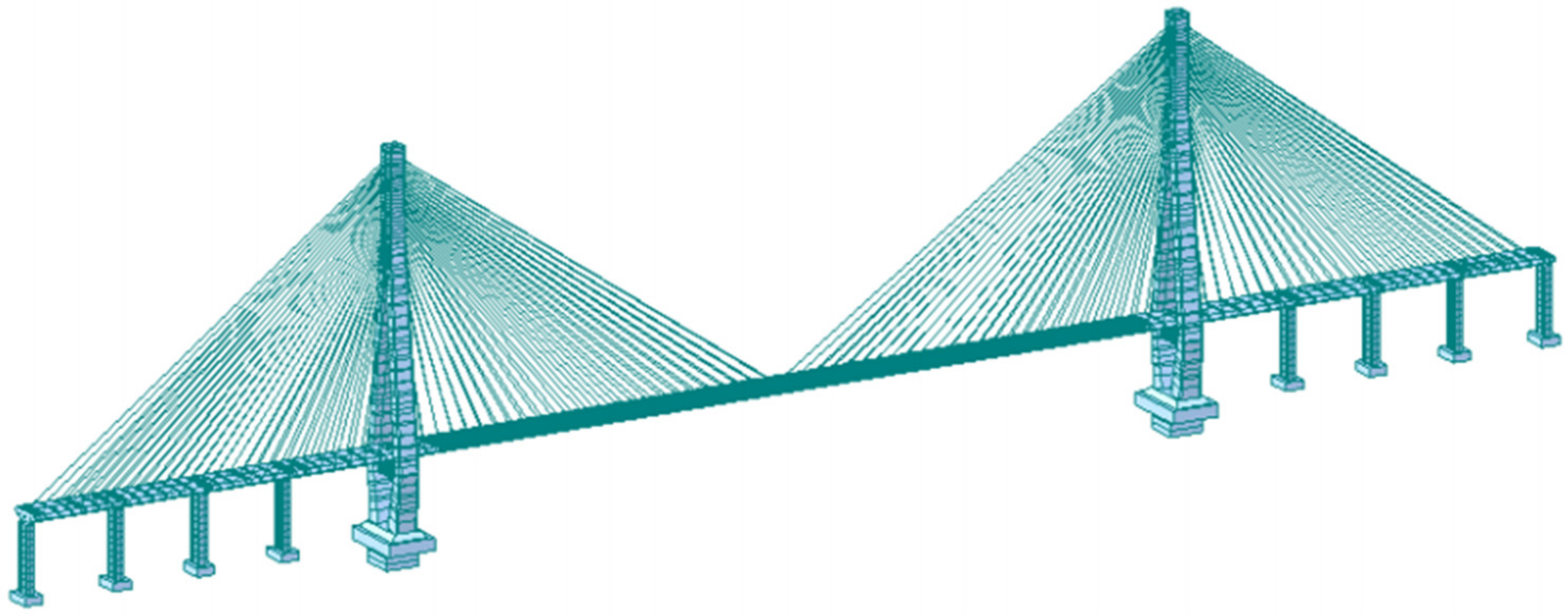
5.1. Bridge Description
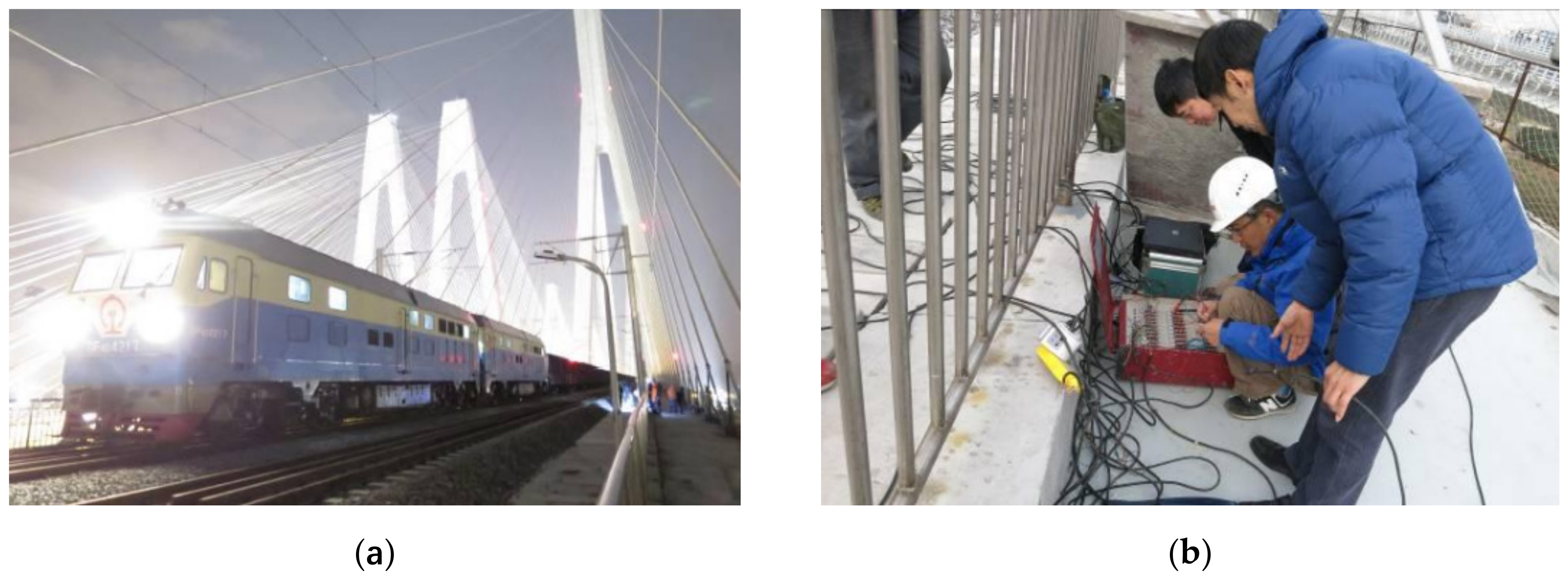
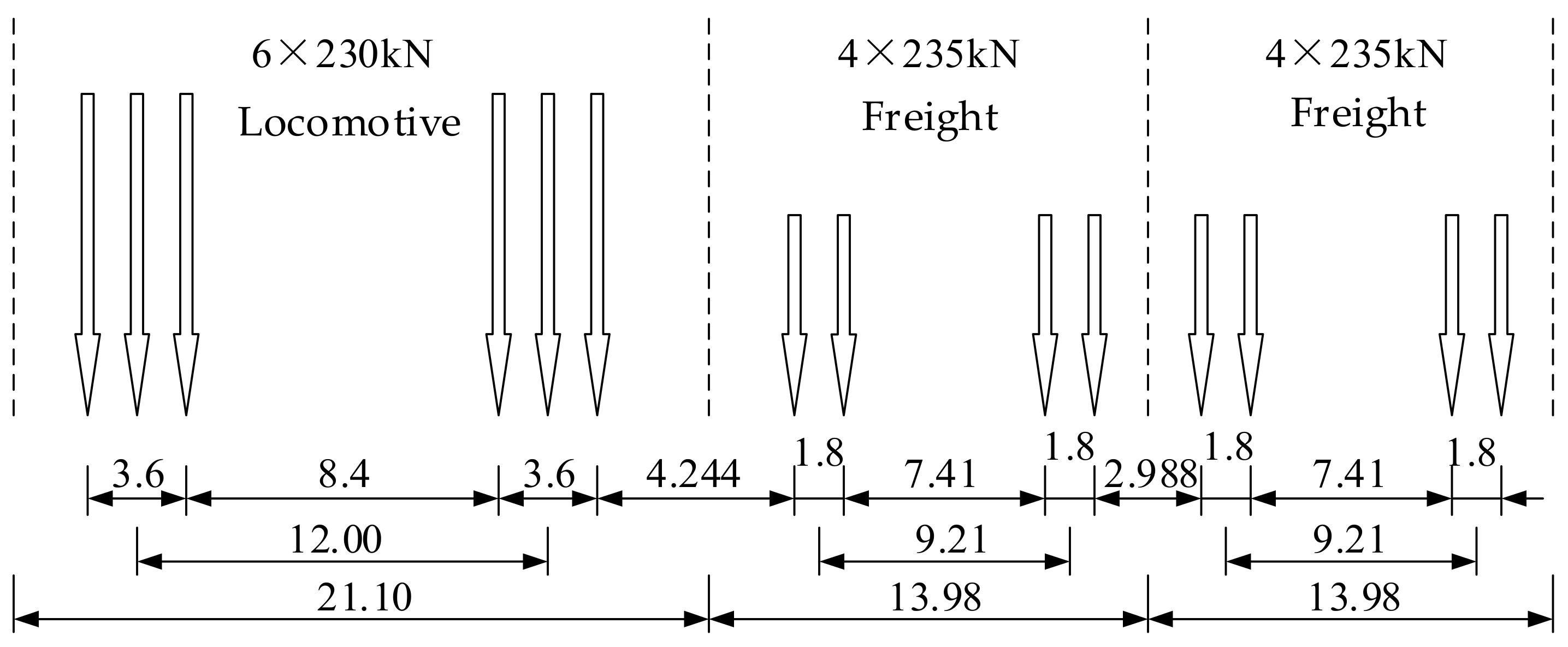
5.2. In Situ Tests and Experimental Results
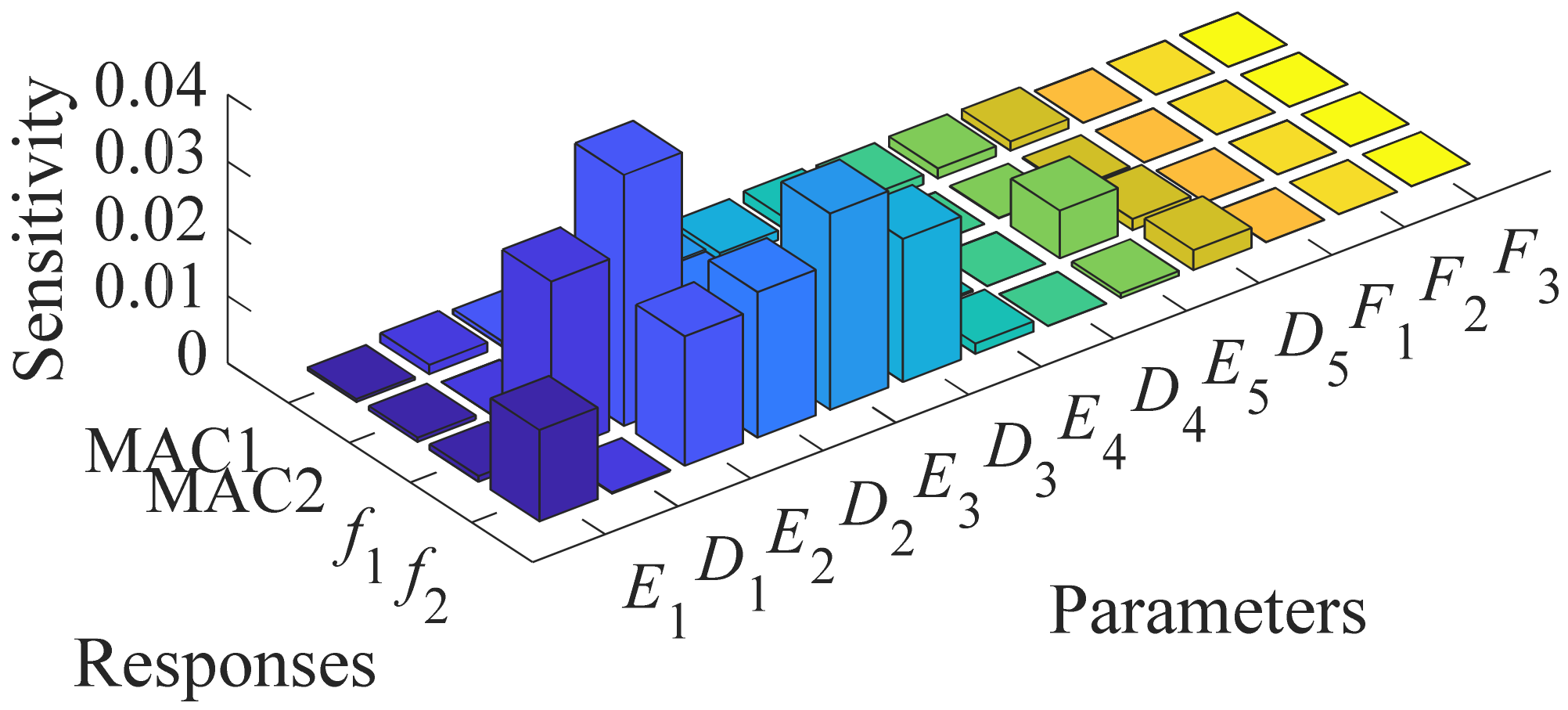
5.3. Selection of Updating Parameters
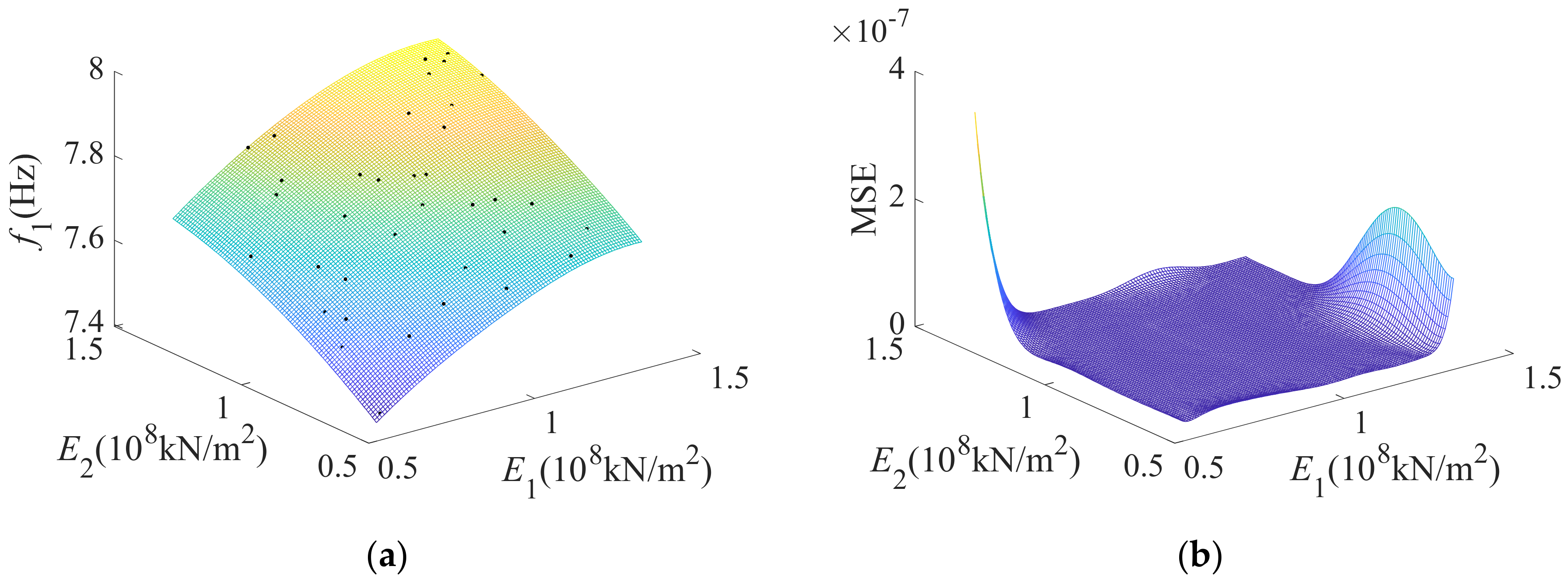
5.4. Kriging Model Construction
5.5. Objective Function
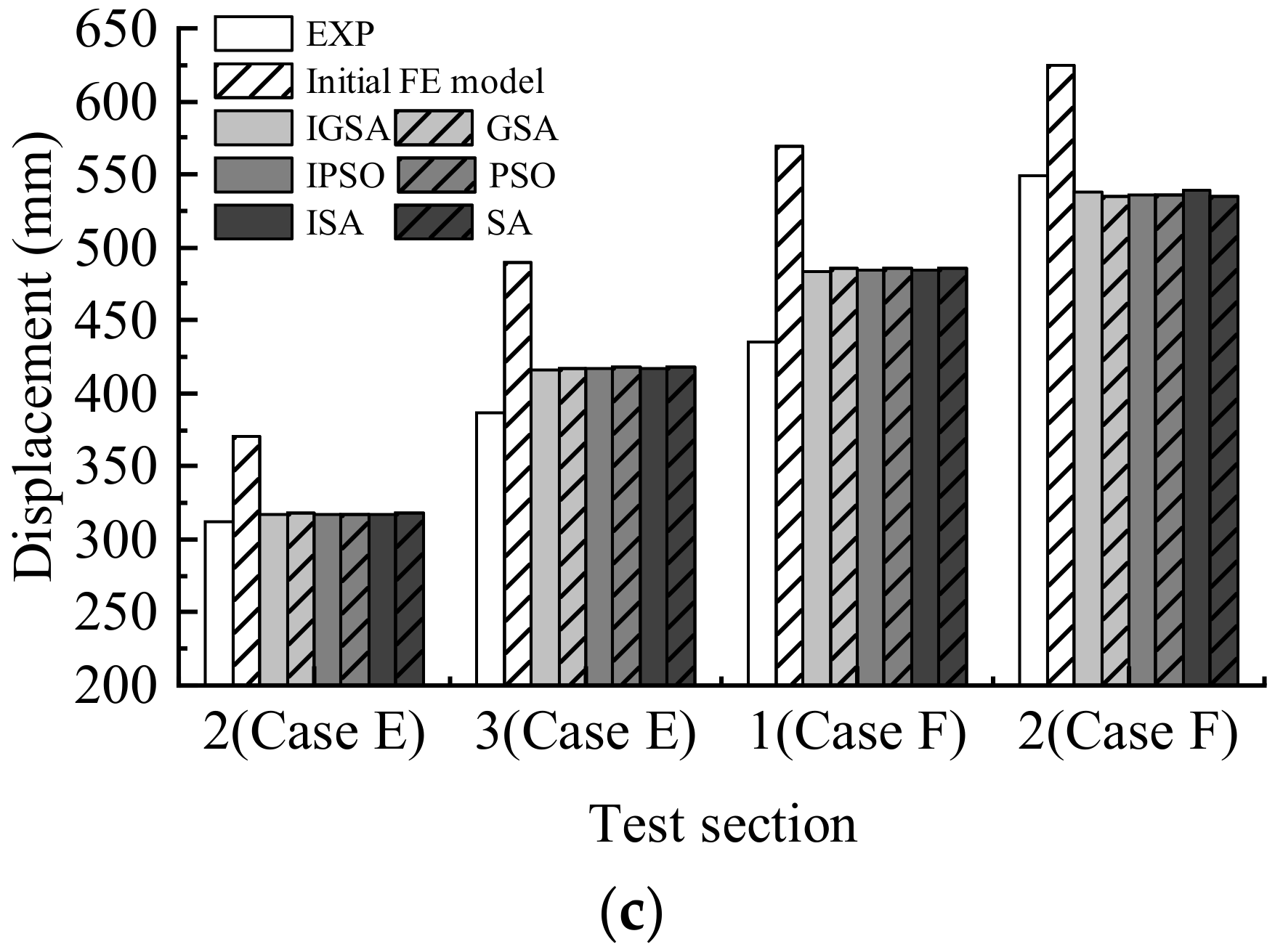
5.6. Discussion on the Updating Results
6. Conclusions
- (1)
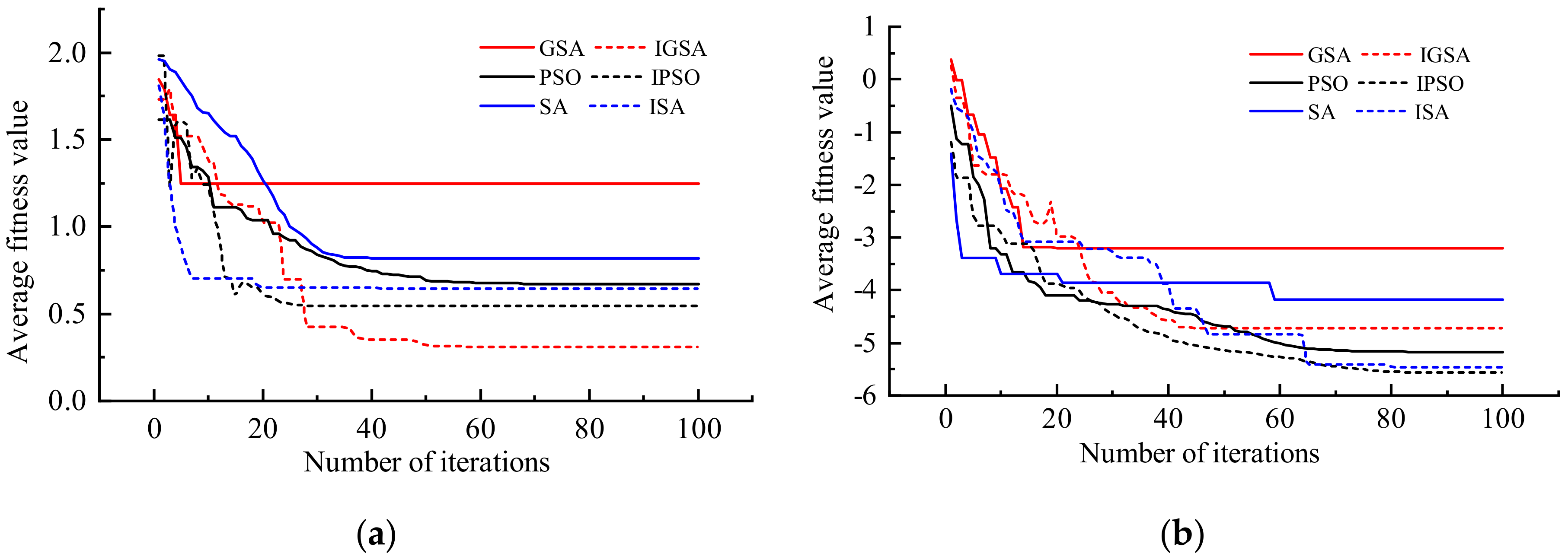
- The proposed improvement strategy can effectively improve the accuracy and the global convergence of standard metaheuristic algorithms. The random crossover and mutation operations are mainly introduced during later-stage searching and aim to improve the algorithm’s accuracy;
- (2)
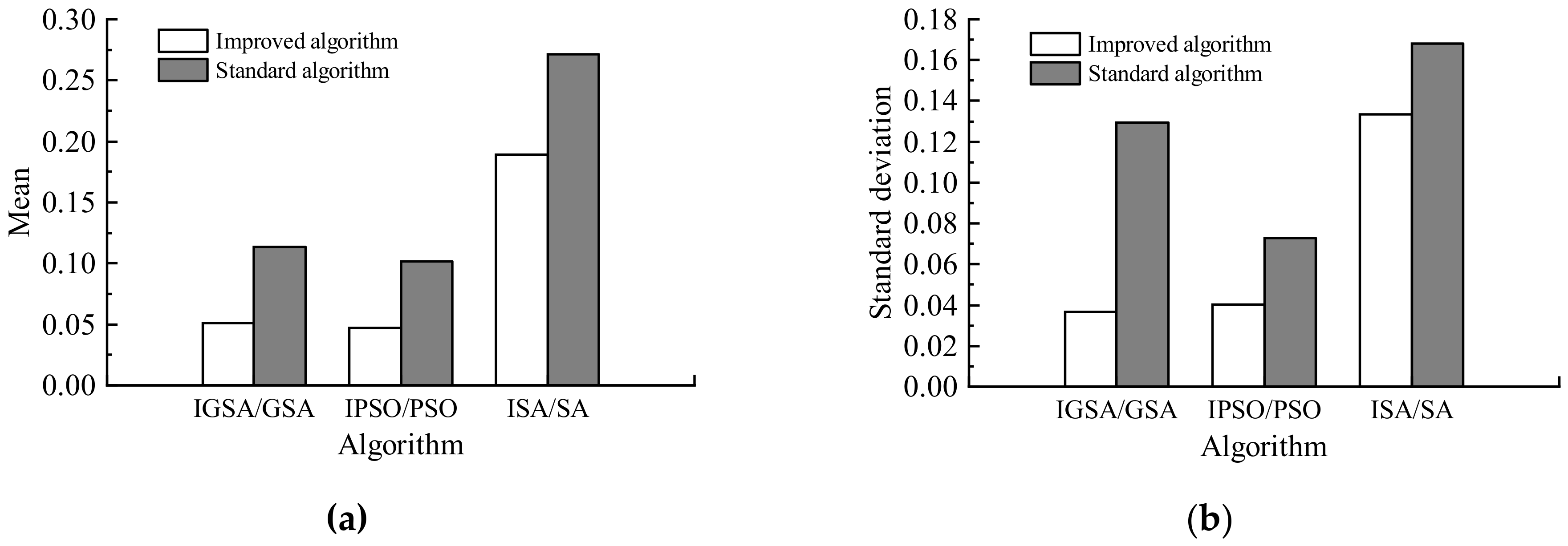
- The numerical investigation of the two benchmark functions showed that the improved algorithms had better global convergence and stability than the standard algorithms. The updated truss model with the improved algorithms showed higher prediction accuracy than the standard algorithm;
- (3)
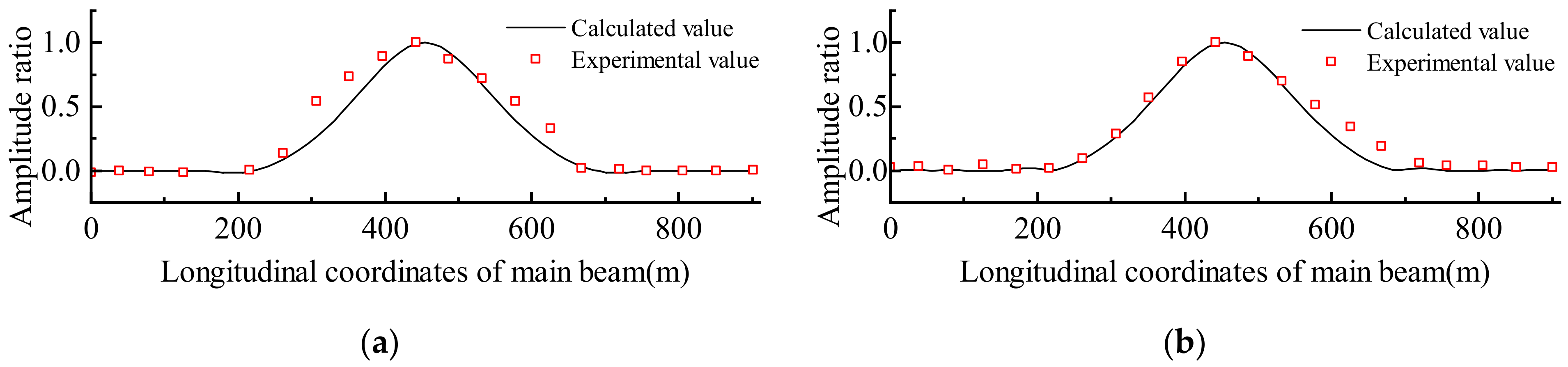
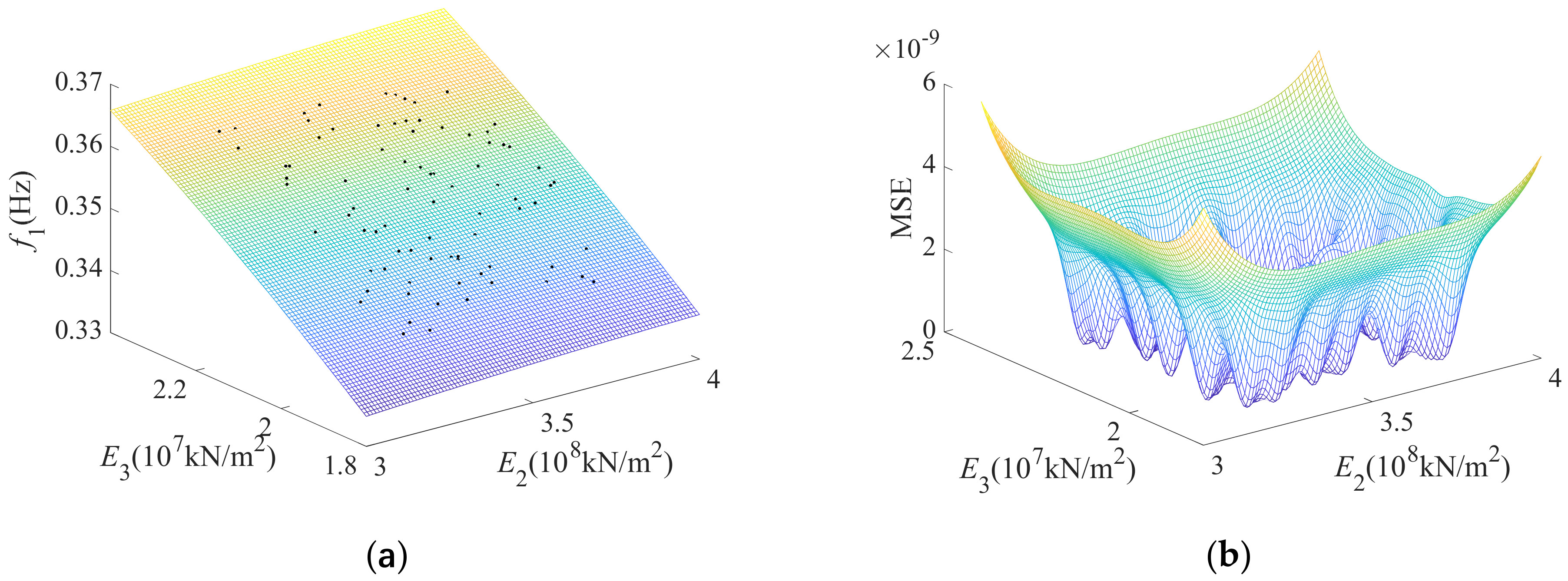
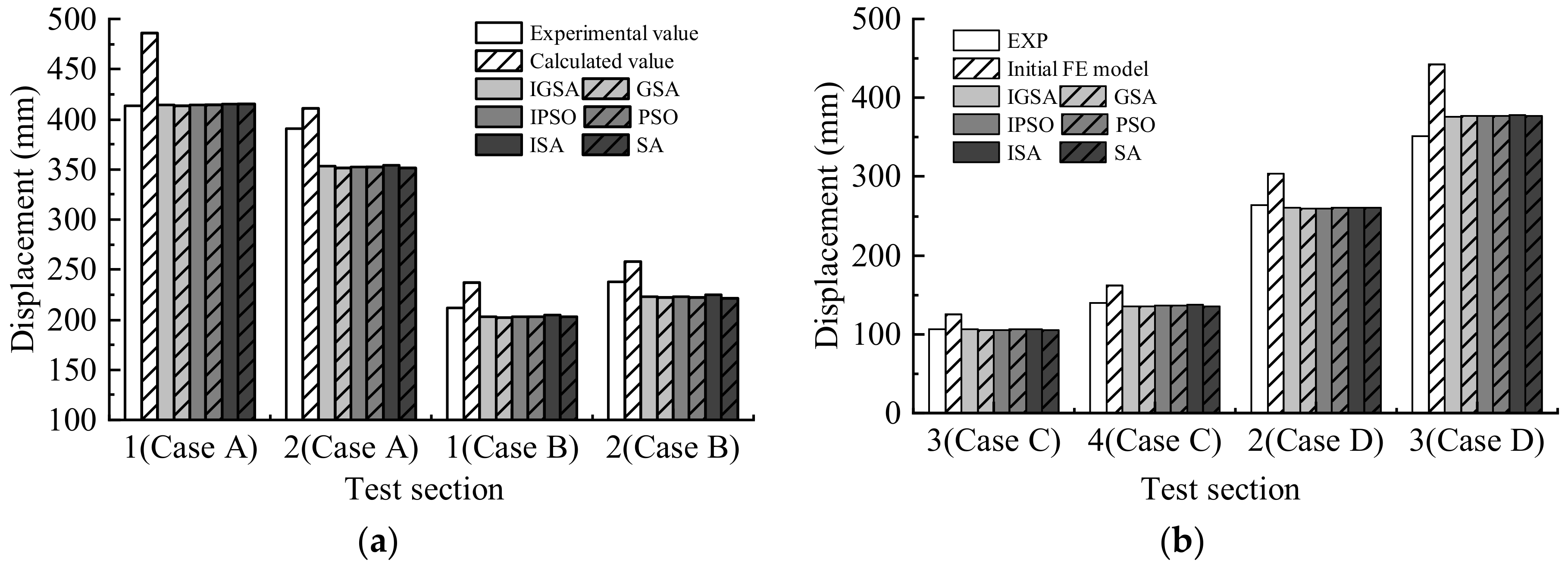
- The discrepancies between the calculated and experimental values of displacement and frequency of the cable-stayed bridge were much smaller after model updating. The updated models with the improved algorithm had smaller relative errors than those obtained with the standard algorithms. In the IGSA algorithm, for example, the relative error in displacement was significantly reduced, with the maximum relative error reduced from 30.94% to 11.33% and the relative error in first-order frequency reduced from 11.03% to 4.21%, indicating that the updated model can better represent the actual structure.
Author Contributions
Funding
Institutional Review Board Statement
Informed Consent Statement
Data Availability Statement
Conflicts of Interest
References
- Hao, S. I-35W bridge collapse. J. Bridge Eng. 2010, 15, 608–614. [Google Scholar] [CrossRef] [Scilit]
- Keary, H.; Sara, J. Fault tree analysis of Schoharie creek bridge collapse. J. Perform. Constr. Facil. 2007, 21, 320–326. [Google Scholar]
- Joel, M.; Diogo, R.; Carlos, S.; Rui, C. Model updating of a dynamic model of a composite steel-concrete railway viaduct based on experimental tests. Eng. Struct. 2018, 164, 40–52. [Google Scholar]
- Yang, Y.; Chen, Y. A new direct method for updating structural models based on measured modal data. Eng. Struct. 2009, 31, 32–42. [Google Scholar] [CrossRef] [Scilit]
- Zhou, L.; Wang, L.; Chen, L.; Ou, J. Structural finite element model updating by using response surfaces and radial basis functions. Adv. Struct. Eng. 2016, 19, 1446–1462. [Google Scholar] [CrossRef] [Scilit]
- Ren, W.; Chen, H. Finite element model updating in structural dynamics by using the response surface method. Eng. Struct. 2010, 32, 2455–2465. [Google Scholar] [CrossRef] [Scilit]
- Simoen, E.; De, R.G.; Lombaert, G. Dealing with uncertainty in model updating for damage assessment: A review. Mech. Syst. Signal Process. 2015, 56, 123–149. [Google Scholar] [CrossRef] [Scilit]
- Klein, S.; Pluim, J.P.W.; Staring, M. Adaptive stochastic gradient descent optimisation for image registration. Int. J. Comput. Vis. 2009, 81, 227–239. [Google Scholar] [CrossRef] [Scilit]
- Cuadros Angela, P.; Arce Gonzalo, R. Coded aperture optimization in compressive X-ray tomography: A gradient descent approach. Opt. Express 2017, 25, 23833–23849. [Google Scholar] [CrossRef] [Scilit]
- Hurtado, J.E.; Robinett, R.D. Convergence of Newton’s method via Lyapunov analysis. J. Guid. Control. Dynam. 2005, 28, 363–365. [Google Scholar] [CrossRef] [Scilit]
- Jiang, J.; Shui, P. Design of 2D oversampled linear phase DFT modulated filter banks via modified Newton’s method. Signal Process. 2012, 92, 1411–1421. [Google Scholar] [CrossRef] [Scilit]
- Nickabadi, A.; Ebadzadeh, M.M.; Safabakhsh, R. A novel particle swarm optimization algorithm with adaptive inertia weight. Appl. Soft Comput. 2011, 11, 3658–3670. [Google Scholar] [CrossRef] [Scilit]
- Liu, Y.; Huang, S.; Huang, J.; Liang, W. A Particle Swarm Optimization-Based Maximum Power Point Tracking Algorithm for PV Systems Operating Under Partially Shaded Conditions. IEEE Trans. Energy Convers. 2012, 27, 1027–1035. [Google Scholar] [CrossRef] [Scilit]
- Karaboga, D.; Gorkemli, B.; Ozturk, C.; Karaboga, N. A comprehensive survey: Artificial bee colony (ABC) algorithm and applications. Artif. Intell. Rev. 2014, 42, 21–57. [Google Scholar] [CrossRef] [Scilit]
- Alatas, B. Chaotic bee colony algorithms for global numerical optimization. Expert Syst. Appl. 2010, 37, 5682–5687. [Google Scholar] [CrossRef] [Scilit]
- Gao, Y.; Guan, H.; Qi, Z.; Hou, Y.; Liu, L. A multi-objective ant colony system algorithm for virtual machine placement in cloud computing. J. Comput. Syst. Sci. 2013, 79, 1230–1243. [Google Scholar] [CrossRef] [Scilit]
- Tabakhi, S.; Moradi, P.; Akhlaghian, F. An unsupervised feature selection algorithm based on ant colony optimization. Eng. Appl. Artif. Intell. 2014, 32, 112–123. [Google Scholar] [CrossRef] [Scilit]
- Rashedi, E.; Nezamabadi-Pour, H.; Saryazdi, S. BGSA: Binary gravitational search algorithm. Nat. Comput. 2010, 9, 727–745. [Google Scholar] [CrossRef] [Scilit]
- Rashedi, E.; Nezamabadi-Pour, H.; Saryazdi, S. Filter modeling using gravitational search algorithm. Eng. Appl. Artif. Intell. 2011, 24, 117–122. [Google Scholar] [CrossRef] [Scilit]
- Huang, M.; Gül, M.; Zhu, H. Vibration-Based Structural Damage Identification under Varying Temperature Effects. J. Aerosp. Eng. 2018, 31, 04018014. [Google Scholar] [CrossRef] [Scilit]
- Huang, M.; Lei, Y.; Li, X.; Gu, J. Damage Identification of Bridge Structures Considering Temperature Variations-Based SVM and MFO. J. Aerosp. Eng. 2021, 34, 04020113. [Google Scholar] [CrossRef] [Scilit]
- Boussaid, I.; Lepagnot, J.; Siarry, P. A survey on optimization metaheuristics. Inform. Sci. 2013, 237, 82–117. [Google Scholar] [CrossRef] [Scilit]
- Blum, C.; Roli, A. Metaheuristics in combinatorial optimization: Overview and conceptual comparison. ACM Comput. Surv. 2003, 35, 268–308. [Google Scholar] [CrossRef] [Scilit]
- Ding, Z.; Fu, K.; Deng, W.; Li, J.; Lu, Z. A modified Artificial Bee Colony algorithm for structural damage identification under varying temperature based on a novel objective function. Appl. Math. Model. 2020, 88, 122–141. [Google Scholar] [CrossRef] [Scilit]
- Yang, F. Autonomous vehicle routing problem solution based on artificial potential field with parallel ant colony optimization (ACO) algorithm. Pattern Recognit. Lett. 2018, 116, 195–199. [Google Scholar]
- Jiang, Y.; Hu, T.; Huang, C. An improved particle swarm optimization algorithm. Appl. Math. Comput. 2007, 193, 231–239. [Google Scholar] [CrossRef] [Scilit]
- Marzband, M.; Ghadimi, M.; Sumper, A.; José Luis Domínguez-García, c. Experimental validation of a real-time energy management system using multi-period gravitational search algorithm for microgrids in islanded mode. Appl. Energy 2014, 128, 164–174. [Google Scholar] [CrossRef] [Scilit]
- Wang, F.; Wang, J.; Chen, X. Evacuation entropy path planning model based on hybrid ant colony-artificial fish swarm algorithms. In Proceedings of the 2nd International Conference on Advanced Electronic Materials: Computers and Materials Engineering, Changsha, China, 3 April 2019. [Google Scholar]
- Hu, H.; Cui, X.; Bai, Y. Two kinds of classifications based on improved gravitational search algorithm and particle swarm optimization algorithm. Adv. Math. Phys. 2017, 2017, 2131862. [Google Scholar] [CrossRef] [Scilit]
- Huang, M.; Cheng, X.; Lei, Y. Structural damage identification based on substructure method and improved whale optimization algorithm. J. Civ. Struct. Health 2021, 11, 351–380. [Google Scholar] [CrossRef] [Scilit]
- Luo, J.; Huang, M.; Xiang, C.; Lei, Y. Bayesian damage identification based on autoregressive model and MH-PSO hybrid MCMC sampling method. J. Civ. Struct. Health 2022, 12, 361–390. [Google Scholar] [CrossRef] [Scilit]
- Echard, B.; Gayton, N.; Lemaire, M. AK-MCS: An active learning reliability method combining Kriging and Monte Carlo Simulation. Struct. Saf. 2011, 33, 145–154. [Google Scholar] [CrossRef] [Scilit]
- Yang, X.; Guo, X.; Ouyang, H.; Li, D. A Kriging Model Based Finite Element Model Updating Method for Damage Detection. Appl. Sci. 2017, 7, 1039. [Google Scholar] [CrossRef] [Scilit]
- Wang, J.; Wang, C.; Zhao, J. Frequency response function-based model updating using Kriging model. Mech. Syst. Signal Process. 2017, 87, 218–228. [Google Scholar] [CrossRef] [Scilit]
- Zhang, J.; Au, F.T.K.; Yang, D. Finite element model updating of long-span cable-stayed bridge by Kriging surrogate model. Struct. Eng. Mech. 2020, 74, 157–173. [Google Scholar]
- Mao, J.; Wang, H.; Li, J. Bayesian Finite Element Model Updating of a Long-Span Suspension Bridge Utilizing Hybrid Monte Carlo Simulation and Kriging Predictor. KSCE J. Civ. Eng. 2020, 24, 569–579. [Google Scholar] [CrossRef] [Scilit]
- Deb, K.; Pratap, A.; Agarwal, S.; Meyarivan, T. A fastand elitist multiobjective genetic algorithm: NSGA-II. IEEE Trans. Evol. Comput. 2002, 6, 182–197. [Google Scholar] [CrossRef] [Scilit]
- Li, H.; Zhang, Q. Multiobjective optimization problems with complicated pareto sets, MOEA/D and NSGA-II. IEEE Trans. Evol. Comput. 2009, 13, 284–302. [Google Scholar] [CrossRef] [Scilit]
- Kao, Y.; Zahara, E. A hybrid genetic algorithm and particle swarm optimization for multimodal functions. Appl. Soft. Comput. 2008, 8, 849–857. [Google Scholar] [CrossRef] [Scilit]
- Liu, W.; Gao, W.; Sun, Y.; Xu, M. Optimal Sensor Placement for Spatial Lattice Structure Based on Genetic Algorithms. J. Sound Vib. 2008, 317, 175–189. [Google Scholar] [CrossRef] [Scilit]
- Zhong, J.; Gou, H.; Zhao, H.; Zhao, T.; Wang, X. Comparison of several model updating methods based on full-scale model test of track beam. Structures 2022, 35, 46–54. [Google Scholar] [CrossRef] [Scilit]
- Wang, F.; Xu, Y.; Sun, B.; Zhu, Q. Updating Multiscale Model of a Long-Span Cable-Stayed Bridge. J. Bridge Eng. 2018, 23, 04017148. [Google Scholar] [CrossRef] [Scilit]








| Algorithm | f1 | f2 | ||
|---|---|---|---|---|
| Mean | Standard Deviation | Mean | Standard Deviation | |
| IGSA | 5.50 × 10⁻² | 7.43 × 10⁻³ | 2.72 × 10⁻⁶ | 9.43 × 10⁻⁶ |
| GSA | 6.71 × 10⁻¹ | 1.83 × 10⁻² | 6.77 × 10⁻⁶ | 2.53 × 10⁻⁵ |
| IPSO | 3.10 × 10⁻¹ | 1.38 × 10⁻² | 1.89 × 10⁻⁵ | 2.92 × 10⁻⁵ |
| PSOGA | 4.41 × 10⁻¹ | 2.57 × 10⁻¹ | 5.43 × 10⁻⁶ | 2.49 × 10⁻⁵ |
| PSO | 1.25 | 2.51 × 10⁻² | 6.32 × 10⁻⁴ | 6.31 × 10⁻⁵ |
| ISA | 6.52 × 10⁻¹ | 4.91 × 10⁻³ | 3.46 × 10⁻⁶ | 3.39 × 10⁻⁵ |
| SA | 8.22 × 10⁻¹ | 6.58 × 10⁻³ | 6.51 × 10⁻⁵ | 2.27 × 10⁻⁴ |
| IAFSA | 5.74 × 10⁻¹ | 9.01 × 10⁻³ | 3.15 × 10⁻⁵ | 3.52 × 10⁻⁵ |
| AFSA | 6.31 × 10⁻¹ | 5.92 × 10⁻³ | 9.02 × 10⁻⁵ | 7.58 × 10⁻⁵ |
| IABC | 5.67 × 10⁻² | 4.62 × 10⁻³ | 3.00 × 10⁻⁶ | 9.45 × 10⁻⁶ |
| ABC | 1.79 | 9.72 × 10⁻³ | 9.62 × 10⁻⁶ | 1.93 × 10⁻⁵ |
| Parameters | E1 (100 GPa) | E2 (100 GPa) | E3 (100 GPa) | Relative Error (%) | |||
|---|---|---|---|---|---|---|---|
| Damaged Model | 0.7 | 0.7 | 1.3 | - | |||
| Initial model | 1 | 1 | 1 | 42.86 | 42.86 | −23.08 | |
| Updated model | IGSA | 0.705 | 0.714 | 1.282 | 0.71 | 2.00 | −1.38 |
| GSA | 0.738 | 0.682 | 1.280 | 5.43 | −2.57 | −1.54 | |
| IPSO | 0.727 | 0.740 | 1.320 | 3.86 | 5.71 | 1.54 | |
| PSO | 0.740 | 0.771 | 1.315 | 5.71 | 10.14 | 1.15 | |
| ISA | 0.700 | 0.695 | 1.311 | 0.00 | −0.71 | 0.85 | |
| SA | 0.703 | 0.673 | 1.342 | 0.43 | −3.86 | 3.23 | |
| Frequency | f1 (Hz) | f2 (Hz) | f3 (Hz) | f4 (Hz) | f5 (Hz) | f6 (Hz) | Relative Error (%) | ||||||
|---|---|---|---|---|---|---|---|---|---|---|---|---|---|
| Damage Model | 7.50 | 15.72 | 19.57 | 23.67 | 31.42 | 33.68 | - | ||||||
| Initial model | 7.63 | 16.65 | 20.18 | 25.16 | 32.54 | 34.32 | 1.73 | 5.92 | 3.12 | 6.29 | 3.56 | 1.90 | |
| Updated model | IGSA | 7.50 | 15.71 | 19.61 | 23.71 | 31.45 | 33.67 | 0.00 | −0.06 | 0.20 | 0.17 | 0.10 | −0.03 |
| GSA | 7.50 | 15.72 | 19.61 | 23.71 | 31.46 | 33.68 | 0.00 | 0.00 | 0.20 | 0.17 | 0.13 | 0.00 | |
| IPSO | 7.54 | 15.87 | 19.69 | 23.88 | 31.59 | 33.91 | 0.53 | 0.95 | 0.61 | 0.89 | 0.54 | 0.68 | |
| PSO | 7.55 | 15.96 | 19.76 | 24.01 | 31.70 | 34.00 | 0.67 | 1.53 | 0.97 | 1.44 | 0.89 | 0.95 | |
| ISA | 7.50 | 15.7 | 19.57 | 23.65 | 31.41 | 33.70 | 0.00 | −0.13 | 0.00 | −0.08 | −0.03 | 0.06 | |
| SA | 7.50 | 15.71 | 19.54 | 23.61 | 31.37 | 33.74 | 0.00 | −0.06 | −0.15 | −0.25 | −0.16 | 0.18 | |
| Algorithm | IGSA | GSA | IPSO | PSO | ISA | SA |
|---|---|---|---|---|---|---|
| Mean | 2.56 × 10⁻⁴ | 5.20 × 10⁻⁴ | 1.91 × 10⁻⁴ | 8.16 × 10⁻⁴ | 9.64 × 10⁻¹ | 9.72 × 10⁻¹ |
| Standard deviation | 7.61 × 10⁻³ | 1.65 × 10⁻² | 1.74 × 10⁻³ | 2.00 × 10⁻² | 1.04 × 10⁻¹ | 1.36 × 10⁻¹ |
| Test Cases | Test Section | Experimental Value (mm) | Initial FE Model (mm) | Relative Error (%) | ||
|---|---|---|---|---|---|---|
| Upstream | Downstream | Mean | ||||
| A | 1 | 414.00 | 412.60 | 413.30 | 486.21 | 17.64 |
| 2 | 394.60 | 386.60 | 390.60 | 410.60 | 5.12 | |
| B | 1 | 211.00 | 213.00 | 212.00 | 237.14 | 11.86 |
| 2 | 240.00 | 236.30 | 238.15 | 258.12 | 8.39 | |
| C | 3 | 102.00 | 110.00 | 106.00 | 125.73 | 18.61 |
| 4 | 139.00 | 139.60 | 139.30 | 161.31 | 15.80 | |
| D | 2 | 263.00 | 264.30 | 263.65 | 304.01 | 15.31 |
| 3 | 353.00 | 350.40 | 351.70 | 442.41 | 25.79 | |
| E | 2 | 313.00 | 311.80 | 312.40 | 370.15 | 18.49 |
| 3 | 386.00 | 386.80 | 386.40 | 489.42 | 26.66 | |
| F | 1 | 435.00 | 434.50 | 434.75 | 569.27 | 30.94 |
| 2 | 555.00 | 542.40 | 548.70 | 624.84 | 13.88 | |
| Vibration Mode | Experimental Value (Hz) | Initial FE Model (Hz) | MAC | Relative Error (%) |
|---|---|---|---|---|
| 1 | 0.390 | 0.347 | 0.936 | −11.03 |
| 2 | 0.490 | 0.456 | 0.947 | −6.94 |
| Parameters | Initial Value | Updated Value | Updating Rate (%) | ||||||||||
|---|---|---|---|---|---|---|---|---|---|---|---|---|---|
| IGSA | GSA | IPSO | PSO | ISA | SA | IGSA | GSA | IPSO | PSO | ISA | SA | ||
| E2 | 3.55 | 4.23 | 4.35 | 4.17 | 3.83 | 3.20 | 4.60 | 19.15 | 22.54 | 17.46 | 7.89 | −9.86 | 29.58 |
| D2 | 2.50 | 2.78 | 2.65 | 2.72 | 2.59 | 2.72 | 2.60 | 11.20 | 6.00 | 8.80 | 3.60 | 8.80 | 4.00 |
| E3 | 2.10 | 2.42 | 2.42 | 2.39 | 2.29 | 2.29 | 2.31 | 15.24 | 15.24 | 13.81 | 9.05 | 9.05 | 10.00 |
| D3 | 7.85 | 7.25 | 8.14 | 7.66 | 7.07 | 7.07 | 7.19 | −7.64 | 3.69 | −2.42 | −9.94 | −9.94 | −8.41 |
| E5 | 2.00 | 2.52 | 2.46 | 2.47 | 2.50 | 2.48 | 2.55 | 26.00 | 23.00 | 23.50 | 25.00 | 24.00 | 27.50 |
| D5 | 8.45 | 9.89 | 9.43 | 9.40 | 8.56 | 7.92 | 9.75 | 17.04 | 11.60 | 11.24 | 1.30 | −6.27 | 15.38 |
| Load Case | A | B | C | D | E | F | |||||||
|---|---|---|---|---|---|---|---|---|---|---|---|---|---|
| Test Section | 1 | 2 | 1 | 2 | 3 | 4 | 2 | 3 | 2 | 3 | 1 | 2 | |
| Initial error (%) | 17.64 | 5.12 | 11.86 | 8.39 | 18.61 | 15.80 | 15.31 | 25.79 | 18.49 | 26.66 | 30.94 | 13.88 | |
| Relative error (%) | IGSA | 0.34 | −9.51 | −4.08 | −6.36 | −0.02 | −2.76 | −1.01 | 6.81 | 1.35 | 7.64 | 11.33 | −2.00 |
| GSA | 0.01 | −9.96 | −4.48 | −6.84 | −0.14 | −2.66 | −1.49 | 7.10 | 1.85 | 7.94 | 11.75 | −2.48 | |
| IPSO | 0.29 | −9.73 | −4.07 | −6.36 | −0.36 | −2.04 | −1.41 | 7.16 | 1.62 | 7.94 | 11.35 | −2.29 | |
| PSO | 0.36 | −9.77 | −4.19 | −6.67 | 0.27 | −2.17 | −1.25 | 7.22 | 1.62 | 8.04 | 11.66 | −2.28 | |
| ISA | 0.40 | −9.32 | −3.45 | −5.46 | 0.50 | −1.28 | −1.35 | 7.42 | 1.62 | 7.99 | 11.38 | −1.85 | |
| SA | 0.58 | −9.99 | −4.27 | −7.05 | −1.00 | −2.81 | −1.37 | 7.28 | 1.69 | 8.23 | 11.64 | −2.56 | |
| Frequency | f1 (Hz) | f2 (Hz) | Relative Error (%) | ||
|---|---|---|---|---|---|
| Experimental Value | 0.390 | 0.490 | |||
| Initial FE model | 0.347 | 0.456 | −11.03 | −6.94 | |
| Updating models | IGSA | 0.374 | 0.479 | −4.10 | −2.24 |
| GSA | 0.366 | 0.474 | −6.15 | −3.27 | |
| IPSO | 0.371 | 0.485 | −4.87 | −1.02 | |
| PSO | 0.369 | 0.476 | −5.38 | −2.86 | |
| ISA | 0.370 | 0.486 | −5.13 | −0.82 | |
| SA | 0.370 | 0.479 | −5.13 | −2.24 | |
Publisher’s Note: MDPI stays neutral with regard to jurisdictional claims in published maps and institutional affiliations. |
© 2022 by the authors. Licensee MDPI, Basel, Switzerland. This article is an open access article distributed under the terms and conditions of the Creative Commons Attribution (CC BY) license (https://creativecommons.org/licenses/by/4.0/).
Share and Cite
Qin, S.; Yuan, Y.; Gan, Y.; Wang, Q. Improved Metaheuristic Algorithm Based Finite Element Model Updating of a Hybrid Girder Cable-Stayed Railway Bridge. Buildings 2022, 12, 958. https://doi.org/10.3390/buildings12070958
Qin S, Yuan Y, Gan Y, Wang Q. Improved Metaheuristic Algorithm Based Finite Element Model Updating of a Hybrid Girder Cable-Stayed Railway Bridge. Buildings. 2022; 12(7):958. https://doi.org/10.3390/buildings12070958
Chicago/Turabian StyleQin, Shiqiang, Yonggang Yuan, Yaowei Gan, and Qiuping Wang. 2022. "Improved Metaheuristic Algorithm Based Finite Element Model Updating of a Hybrid Girder Cable-Stayed Railway Bridge" Buildings 12, no. 7: 958. https://doi.org/10.3390/buildings12070958
APA StyleQin, S., Yuan, Y., Gan, Y., & Wang, Q. (2022). Improved Metaheuristic Algorithm Based Finite Element Model Updating of a Hybrid Girder Cable-Stayed Railway Bridge. Buildings, 12(7), 958. https://doi.org/10.3390/buildings12070958