1. Introduction
Planning in construction is an indispensable process that spans throughout the project’s life cycle and aims to achieve the project’s objectives related to time, cost, quality, safety, health, profitability, and customer satisfaction [
1,
2]. Planners and schedulers have always highlighted the importance of planning for organizing work, reducing risk, facilitating communication, and maintaining good control, as well as reaching their desired objectives [
3]. However, traditional planning practices cannot develop plans and procedures for all possible scenarios and eventualities [
4]. Inherent uncertainty, risk, and increasing level of complexity of construction projects lead to interrelating types of uncertainties that challenge traditional planning methods [
5]. As deviations from existing plans cannot be fully avoided and certain decisions are required to manage unplanned circumstances [
6], improvisation is sometimes necessary as a much-needed resort for addressing the issues of uncertainty, dynamism, and complexity in construction projects [
7].
Described as the “act of dealing with the unexpected without having the luxury of preparation” [
8], improvisation is an intentional but extemporaneous, rational decision-making skill. It is the decision-making process of reacting to unexpected uncertainties in a spontaneous but rational manner. It is usually due to time pressure and in the absence of the optimal information or resources [
9]. Improvisation has been studied in various fields, but it was jazz theorists who have adopted the initial interpretation of improvisation. Later, typologies have been developed elucidating its different types and attributes in multiple organizational settings, such as new product development [
10], crisis management [
11], and teamwork [
12].
Although construction is known to comprise ubiquitous uncertain, dynamic, and highly variable circumstances [
13,
14], few studies have attempted to address the phenomenon of improvisation in construction. A previous research study has defined improvisation in construction as a deliberate decision-making process that is usually used when speed is required to meet a deadline, planned procedures fail to meet the requirements, pre-planned strategies fail to manage a sudden problem, and standardized procedures fail to catch up with daily ameliorations and progress [
8]. Another study has modeled improvisation in construction as a decision-making process and explained its different stages [
15]. Moreover, one study described the act of improvising as having to change the location, task, or work method as a result of disruption in the jobsite [
16].
While causes and some influencing factors of improvisation in construction have been examined in previous studies, the overall behavior of several improvisers working together on a single construction project has not been tackled yet. Additionally, the impacts of different improvisational capabilities of planners who work in different trades within a construction project, as well as the level of the unexpected uncertainty associated with that project on the total improvisational outcome, have not been investigated yet. Therefore, a focused research study about how the improvisational behaviors of different planners and the type of the construction project affect the overall improvisational outcome is required to guide construction professionals and the industry to better enhance their improvisational performance and staff planners accordingly.
Therefore, the aim of this study is to predict the outcomes of construction planning processes from an improvisational perspective by better understanding the dynamics of improvisational practices within a group of different construction planners with different improvisation skills. It seeks to identify how different variations of improvisational parameters related to the planners’ assortment and type of construction projects influence the improvisational outcome. To achieve this objective, an agent-based simulation model is developed that portrays improvisational practices within a construction project. It depicts parameters relating to planners, projects, and problems that influence the improvisational means of planners. Moreover, the model identifies how different variations of improvisational parameters influence emergent improvisational outcomes. The developed model’s inputs were validated through data from five large construction projects. Additionally, linear regression models that predict the results of improvisational practices were developed through conducting simulation experiments. The main contribution of this study lies in guiding construction planners and decision makers to better manage the problems of unexpected uncertainty through enhancing the overall improvisational performance in construction planning.
2. Literature Review
2.1. Improvisation
Improvisation involves reacting to the unexpected and unforeseen [
17]. In an attempt to understand the basics of musical improvisation, a model developed by Pressing [
18] was influential in viewing improvisation as a set of generation, selection, and execution of novel (melodic) processes. Moreover, the model propounded the powerful impact of experience on the improvised tones where improvisational fluency of musicians is seen as a result of their expertise, experience, and practice that automates some attentional cognitive processes.
Organizational improvisation may be performed by either an organization as a whole or its individual members [
19]. For individuals, improvisation appears as an act of surpassing standard routines to develop a novel solution to a problem under consideration [
19]. Organizations often consider improvisation as a deviation from normal plans, a potential source of risk, and something that should be avoided or controlled. However, the role of improvisation has expanded to include resolving problems and helping organizations co-evolve with their changing environments [
19,
20]. Therefore, research studies have been performed in organizations to study different attributes and influencing factors of improvisation, and they accordingly use this information to enhance an organization’s performance.
Studies of organizational management have investigated different aspects of improvisation and related practices, and they have produced various definitions. Analysis of these different definitions of improvisation presented in the literature suggest four criteria to produce a comprehensive understanding. Some scholars define improvisation based on the method used to improvise. For example, improvisation is the generation of new solutions and combinations under wicked conditions [
9], meaning problems that do not have formulation, stopping rule, and/or answers that are not “true/false”. Other scholars have explained improvisation as the action of formulating and implementing solutions simultaneously [
21], thus emphasizing the time aspect of improvisation. Many researchers have focused on the spontaneity of improvisation and interpreted it as deliberate and extemporaneous organizational actions [
22]. Some studies related improvised actions to innovation, therefore linking improvisation with creativity and originality [
23].
Researchers have also studied various attributes influencing improvisation, such as degree of improvisation, novelty, and time pressure. In addition, research has shown that training, experience, education, teamwork, situational awareness, information flow, organizational culture, and authority mitigation influence the improvisational performance in organizations [
7,
12,
24].
2.2. Managing Uncertainties in Construction
In most construction projects, no matter how well-prepared the activity plans are, improvisation at one point or another is inevitable [
25]. Aiming to better manage uncertainties associated with the construction environment, Abdelhamid et al. suggested using the OODA (observe, orient, decide, and act) loop along with Last Planner System
® as a viable option that aids self-managed construction teams in managing unexpected situations [
26]. Desai and Abdelhamid proposed the input control method to manage uncertainties in construction projects, such as building capabilities and securing enough experience and knowledge [
27].
Hamzeh et al. [
28] categorized planning failures into three groups. The first involves failing in executing planned tasks because of shortcomings in identifying and removing constraints on time, while the second includes failing because of lack of proper anticipation and planning. The third group includes failures caused by uncertainties that cannot be foreseen. To eliminate failures due to time constraint and lack of proper planning, managers typically focus on improving planning procedures. To manage uncertainty, improving improvisational skills is required [
28]. While some studies addressed improvisation in construction projects, none have been found to provide a deep understanding of different types of improvisation employed in construction, its behaviors, and the quality of the resulting improvised actions. Thus, a profound study of improvisation is required before condoning it as a necessary companion to construction planning.
2.3. Improvisation in Construction
Few studies have investigated improvisation in construction projects compared to other psychological factors. Although the reasons for improvisation in construction and its influencing factors have been explored in previous studies, overall behavior of a group of improvisers in construction working together has not been addressed yet. Different improvisational capabilities of planners who work in different trades within a construction project, as well as the level of the unexpected uncertainty associated with that project, highly influence the improvisational outcome. Therefore, a research study focused on how the improvisational behaviors of different types of planners and types of construction projects affect overall improvisational outcome is required in order to guide construction professionals and the industry to better enhance improvisational performance and allow organizations to staff planners accordingly.
Hamzeh et al. [
15] modeled improvisation in construction as a decision-making process and described its different stages. In another study, Hamzeh et al. [
8] defined improvisation in construction as a deliberate decision-making process that is employed when planned procedures fail to meet requirements, speed is required to meet a deadline, pre-planned strategies fail to manage a suddenly arising problem, and/or standardized procedures fail to catch up with the progress. Statistical analyses conducted in this study highlighted common types of problems requiring improvisation, showed the impacts of some personal and organizational characteristics on the results of improvisation, and found that “Failure in execution” and “Seeing opportunities to improve sound and ready tasks” were the most common triggers for construction improvisation [
8]. Degree of novelty and level of complexity were also identified as criteria for evaluating the significance of associated problems requiring improvisation.
The result of individual improvisation is quantified through two outcome indices: (A) the level of emerging waste, which is defined as an activity or action that does not create any value to the planned product or the final task’s completion [
29], and (B) task completion, representing the extent to which a planner used improvisation to complete or solve the task under consideration [
8]. Study results showed that personal traits including risk taking, high level of experience, communicating with others, and reacting well to time pressure have considerable impact on the task completion status and the level of emerging waste during improvisation. Additionally, organizations with employee empowerment, good record keeping, and appropriate authority assignment to experienced employees in the field have greater chances of sound improvisation [
8].
In another study by Menches and Chen (2013) [
16], the authors performed testing through ecological momentary assessment (EMA), revision, and retesting to better understand how and under what conditions some workers perform improvisation efficiently to overcome some barriers faced on the jobsite. EMA methodology allows capturing the workers’ action and decisions in near real time after jobsite disruptions.
2.4. Simulation and Agent-Based Modeling (ABM) in Construction
Modeling is the act of projecting or imagining a certain occurrence, situation, or incident in an individual’s mind and then formulating it explicitly [
30]. Ingalls defined simulation as “the process of designing a dynamic model of an actual dynamic system for the purpose either of understanding the behavior of the system or of evaluating various strategies for the operation of a system” [
31]. Simulation is typically utilized to imitate a real-life system’s operation through the creation of a simplified surrogate model representing it.
Agent-based modeling (ABM) is an approach used to model complex systems for the purpose of understanding, explaining, or analyzing how they work. In construction, researchers have used ABM because of its ability to address the inherently complex and non-linear nature of construction operations [
32]. For instance, in order to provide an accurate cost estimation of a project during early stages, Bernhardt et al. [
33] developed a cost model that requires a set of inputs and provides a nearly precise value. On the other hand, modelers have always emphasized enhancing construction safety and thus simulated several scenarios for that purpose. For instance, Palaniappan et al. [
34] modeled the reasons for construction site accidents in addition to interactions among various project factors, in an effort to improve on-site safety performance. Workers’ absenteeism has been studied by modeling their mental processes and individual behaviors while considering the workers as the main agents of the system [
35].
This study adopts ABM to analyze and simulate improvisational practices within a construction project in order to describe how individuals use improvisation. It also examines how different types of influencing factors related to the project and improvisers themselves shape overall improvisational performance.
3. Methodology
To address the research objectives, a stepwise research methodology was designed. First, based on a review of previous studies that address the topic of improvisation, a conceptual framework was developed to describe the process of improvisation at the level of different individuals working together and interacting with one another within the same construction project. Based on this framework, an agent-based computer simulation model of the improvisation process was built. Next, an analytical hierarchy process (AHP) survey was developed and implemented for the purpose of quantifying certain behavioral rules or decision-related rules in the model. After analyzing the survey results and inserting computed factors into the model, model verification was performed based on procedures suggested by Bennett et al. (2013) [
36]. Then, the model and its inputs were validated employing four of the validation techniques advocated by Sargent (2013) [
37]. Several scenarios involving different combinations of improvisers and project-related parameters were then simulated. Results, discussion, and conclusions about the emergent behavior during the improvisation process are presented after the methodology section.
4. Conceptual Framework
A conceptual framework was developed for describing the improvisation process at the level of individuals working and interacting with one another on the same construction project. This framework also aims to illustrate the impacts of different factors relating to improvisers and projects on the overall improvisational performance.
Improvisation in construction, similarly to other organizational settings, is usually observed in case of emergent, unplanned, and/or unexpected situations [
8]. In this study, individuals in charge of supervising, executing, or planning for construction tasks are called “planners”, who must plan regardless of their organizational position and may need to improvise to address a problem and unplanned or unexpected work. Accordingly, in this context, planners are viewed as potential improvisers, being the individuals who perform improvisation tasks. When they need to improvise, their success in solving a given problem depends on different influencing factors, which are addressed in the proposed framework.
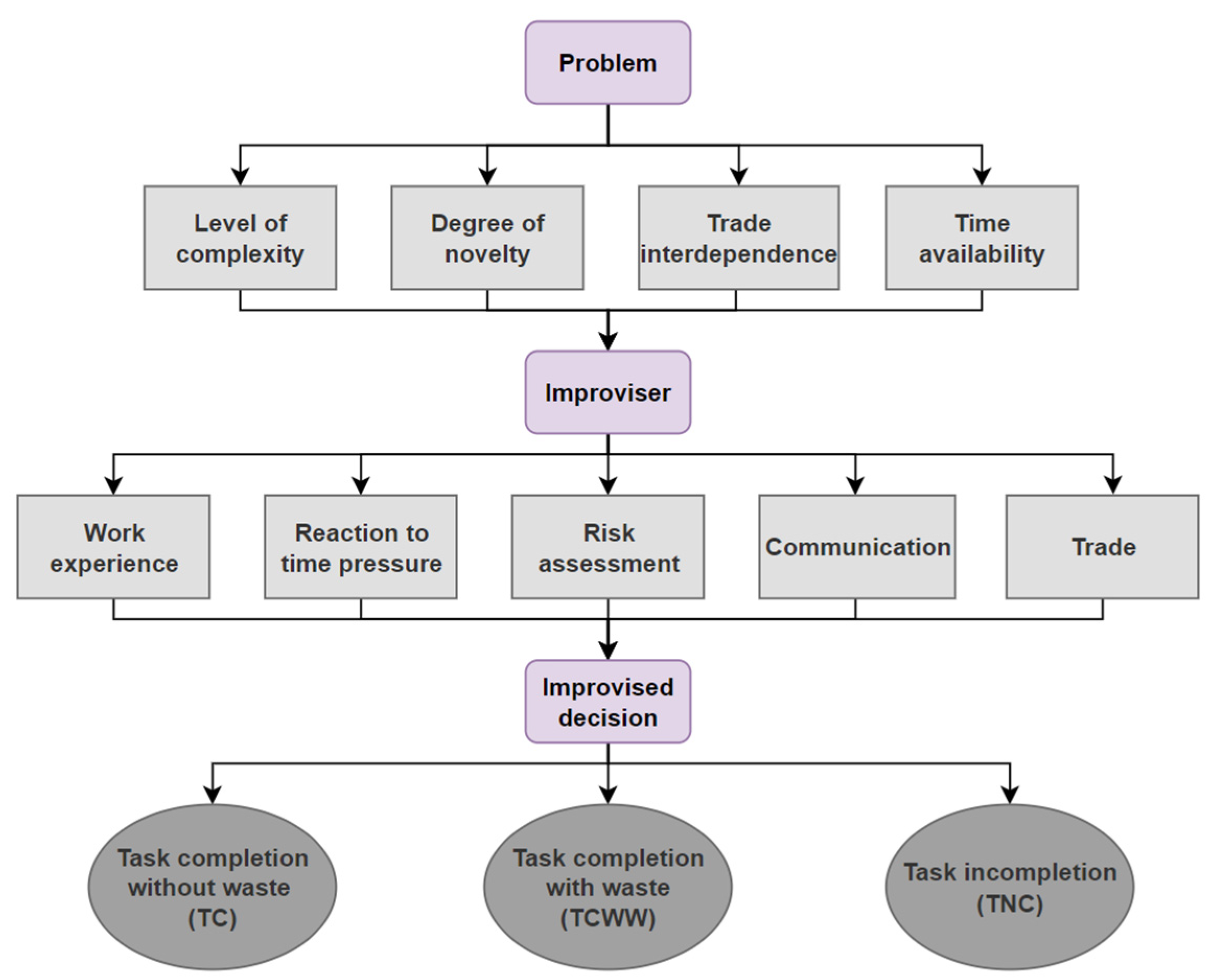
Different types of influencing factors affect the way individuals improvise in construction and shape their improvisational outcomes, which include a set of problem-related factors including: (a) level of complexity, which is the extent to which the problem is undefined or unclear, and the complexity of the methods required to resolve the problem via improvisation; (b) degree of novelty of the problem at hand; (c) trade interdependence, which is the number of trades on which a given problem depends; and (d) time availability, or the amount of available time to generate an improvised action or decision in order to resolve a problem [
8]. Another type of influencing factors is related to the improvisers themselves. Previous studies [
8] show that the following are significant influencing factors for improvisation in construction: planners’ (a) years of work experience, (b) ability to react well to time pressure, (c) risk taking, (d) ability to communicate with others, and (e) organizational background, which is the type of organizations they have been active with.
The type of construction project in which improvisation is analyzed also plays a vital role in impacting the improvisational process. Several distributions describe the level of unforeseen uncertainty: (a) distribution of different kinds of problems inducing varying degrees of improvisational requirements; (b) the distribution of improvisers with varying personal criteria; and (c) distribution of types of improvisors and problems initiating improvisation among different trades in a project.
After identifying influencing factors, improvisers complete a decision-making process and generate their improvised decisions or actions accordingly. In this model, the success of an improvised decision or action is measured by level of emergent waste, which is the amount of waste produced as a result of improvisation, and task completion status, which is the level of task completion or problem resolution after the improvised decision or action occurs. For each incident of improvisation, improvisers may have one of the following outcomes: (a) task completion without waste (TC), (b) task completion with waste (TCWW), or (c) task incompletion (TNC).
Figure 1 illustrates this conceptual framework, showing the main dynamics of the improvisation process in construction.
5. Agent-Based Simulation Model
After developing a conceptual framework, ABM is used to model the dynamics of improvisation among a group of individuals in construction using agent-based simulation.
Agent-based modeling (ABM) is an approach used to model complex systems for the purpose of understanding, explaining, or analyzing how they work. “Agents” are considered the main constituents of these systems; they are autonomous and interact among each other and with their environment. A set of static and/or dynamic attributes usually distinguishes them. An agent assesses its environment, interacts with the other agents and the environment, and makes decisions [
38]. Agents with different dynamic attributes behave differently; however, the overall behavior of the system cannot be predicted. Hence, simulation is required to determine the inclusive emergent behavior of the existing system [
39]. Agents are the essential elements of an ABM model; they are typically defined as being (a) autonomous, because they operate without the intervention of humans, (b) social, because they interact with other agents and their environment through specified algorithms, (c) reactive, because they are responsive to the changes in the environment, and (d) goal-directed, because they perform actions and make decisions in order to achieve certain goals [
40].
The improvisation process and interactions are too complex and non-linear to be modeled through regular analytical mathematics, whereas ABM allows continuous modeling and simulation of interactions among different agents with various attributes and behaviors in a common environment. ABM uses a reductionist approach to convert real-world processes or phenomena into simplified and understandable models, and it allows identification of emergent behaviors resulting from multiple individual behaviors. In this study, the overall improvisational outcome in a given construction project is the aggregation of all individual outcomes within that project. The following subsections describe aspects of the agent-based model.
The main environment is the construction project where construction individuals perform their work and consists of two types of agents: (a) the planner, who is a potential improviser, and (b) the problem that initiates improvisation.
5.1. Agent Groups: Improvisers
As noted in the Introduction, five improviser-related factors influence improvisation in construction: work experience, reaction to time pressure, risk assessment, ability to communicate, and organizational background. These were used as criteria for classifying improvisers. To quantify these criteria, a Likert scale ranging from one (“Lowest”) to five (“Highest”) was used.
Table 1 presents the designation of one of three levels for each criterion based on its Likert rating. Adding these five scores for a total score per improviser yielded three classifications: a total score greater than 17.5 was classified as “Good improviser” (G), 7.5–17.5 as “Medium” (M), and less than 7.5 as “Not Good” (NG).
The distribution of improvisers related to trades involved in the project is identified next. This model assumes there are three different trades within a typical project: A, B, and C. Improvisers may work in either one or more than one trade. For more than one trade, a person is classified as Common.
Next, corresponding behavioral states during improvisation were determined. Each improviser completes a decision-making process to generate an improvised outcome when a problem requiring improvisational efforts occurs.
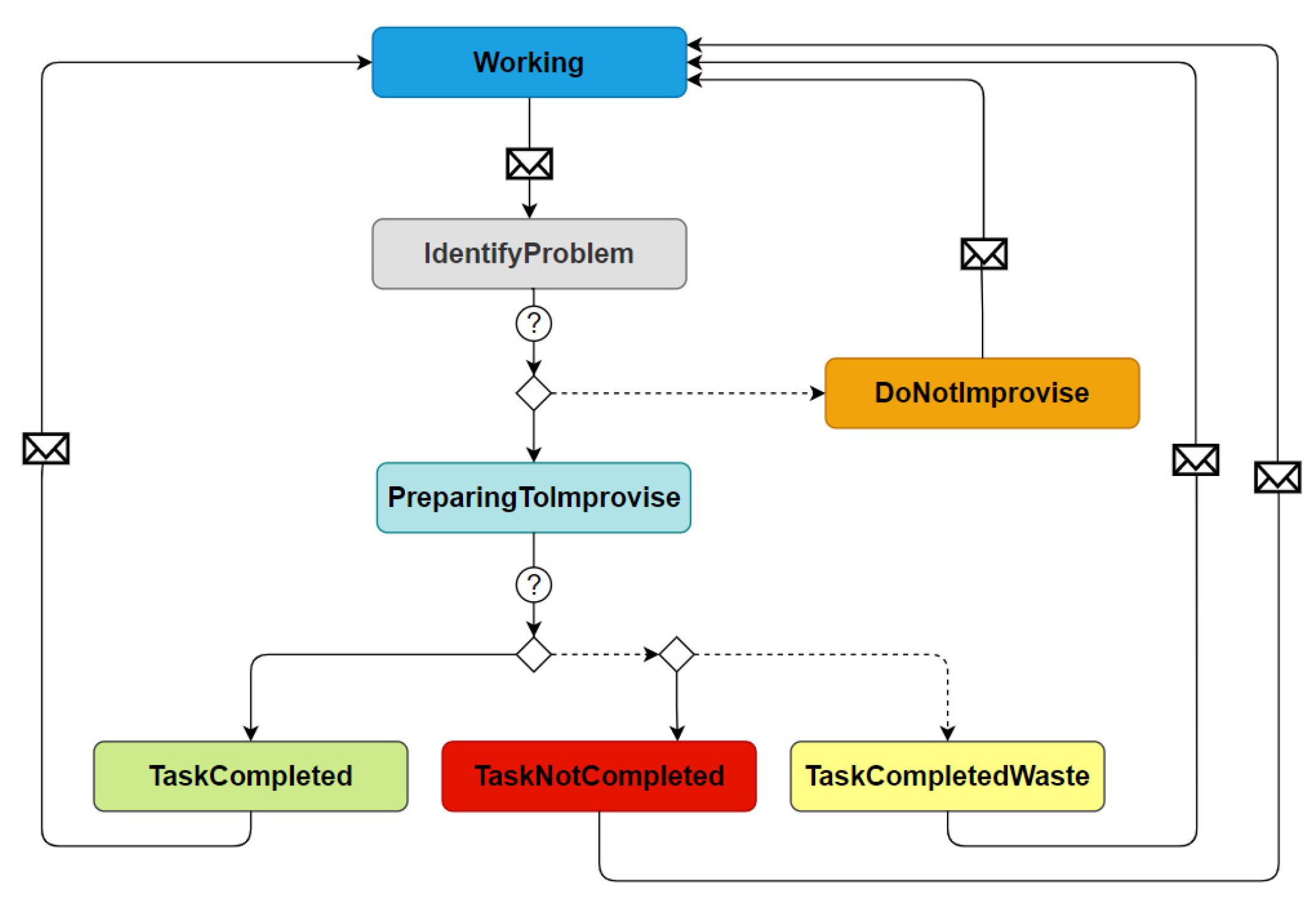
Figure 2 shows the state chart of an improviser in the simulation model. Initially, an improviser is in the “Working” state. When an issue arises, they move into a state of “Identifying the problem”, during which they analyze the problem at hand. Based on the analysis, they either identify the need to improvise, which is the “Preparing for an improvised decision” state, or they fail to identify the need to improvise and go back to “Working”. After preparing for improvisation, an improviser’s decisions may solve the problem with (TCWW) or without (TC) producing waste, or they might not solve the problem (TNC).
Transitions between states follow a probabilistic path, but probability value depends on the classification of the improviser as G, M, or NG. The probability of moving from “Identify problem” to “Preparing to improvise” is greatest for G improvisers and least for NG improvisers. Regarding the transition from “Preparing to improvise” into the outcome state of TC, TCWW, or TNC, the conditioned probability depends not only on the improviser’s type but also on the type of problem that occurs. This transition is explained in detail after depicting the problem–agent group.
5.1.1. Initial Experience
Each agent or improviser has a given initial experience according to their type (G, M, or NG) based on their past improvisational knowledge. This initial experience can change as agents experience new improvisational tasks. They may even work or collaborate with other improvisers within the project. For modeling, this range was divided equally into three sub-ranges that each correspond to one group of improvisers: G = 3.6–5.0, M = 1.5–3.5, and NG = 0.0–1.4.
5.1.2. Self-Experience
Self-experience reflects the aspect of improvisational experience that the improviser attains. Thus, it depends on how much the improviser encounters problems that require improvisational efforts as well as past improvisational outcomes, such as whether an improviser has completed several improvisational tasks without producing waste (TC; most effective in increasing self-experience), completed tasks with waste (TCWW), or could not completing any improvisational tasks (TNC; least effective). Moreover, the change in the score of the self-experience differs based on the improviser type. NG improvisers have the greatest potential to learn, since they lack the required improvisational knowledge, while G improvisers learn the least.
Table 2 depicts the equations describing how experience changes according to the type and the number of past improvisational outcomes.
5.1.3. Interaction among Improvisers
Improvisers working together can attain experience through interacting with each other where an interaction score of a given improviser would increase as they interact with another improviser in the same trade, called the “interactor”. Increase in the interaction score depends on both improviser and interactor. The model assumes that the most beneficial interaction occurs when an NG improviser interacts with a G improviser, and the least beneficial interaction occurs when a G improviser interacts with an NG interactor.
Table 3 presents different types of interactions. Each type of interaction occurs for each improviser in the model at a certain Poisson rate, where the score of interaction increases by one of the presented factors depending on the type of interaction.
5.1.4. Effect of Change in Experience on Improviser’s Behavior
Increase in self-experience and interaction score also increases improvisers’ total improvisation experience, which in turn enhances the behavior of an improviser by an increase in the probability of a TC result and a decrease in the probability of a TCWW or TNC result. In this model, the probabilities change by a decimal factor
K (see Equation (1)), which is less than one. This factor is calculated based on an exponential learning equation derived analytically by several researchers [
41] to account for the exponential learning effect. Accordingly,
K greatly depends on the total experience, which is the sum of the initial experience, self experience, and interaction scores. As the experience increases,
K increases exponentially. The rate of its increase decreases with time and reaches an upper asymptotic limit
E.
5.1.5. Improvisers’ Parameters and Variables in AnyLogic
Identifying the improvisers’ parameters and variables is essential for the rationale of the model. The type of an improviser (G, M, or NG), the trade in which the person works (A, B, C, or “Common”), and the initial experience (random value from the pre-defined score range) is three main static parameters for the “improviser” agent.
The score of self-experience, interaction score, total experience (sum of initial experience, self-score, and interaction score), number of faced problems, number of TC, TCWW, and TNC outcomes, and the factor
K are variables for improvisers. Moreover, the “interactor” is an improviser-type variable and is selected randomly by each improviser at a certain Poisson rate. Data sets were created to track how the variables related to the experience of an improviser change during the time of simulation. The data sets “Self-Score”, “Interaction”, “Total Experience”, and “Learning Value” are used to regularly store the changing variables of self-experience score, interaction, total experience, and
K, respectively.
Table 4 presents the improvisers’ agent parameters, variables, and related events along with their types and initial values in the simulation model.
5.2. Agent Group: Problems
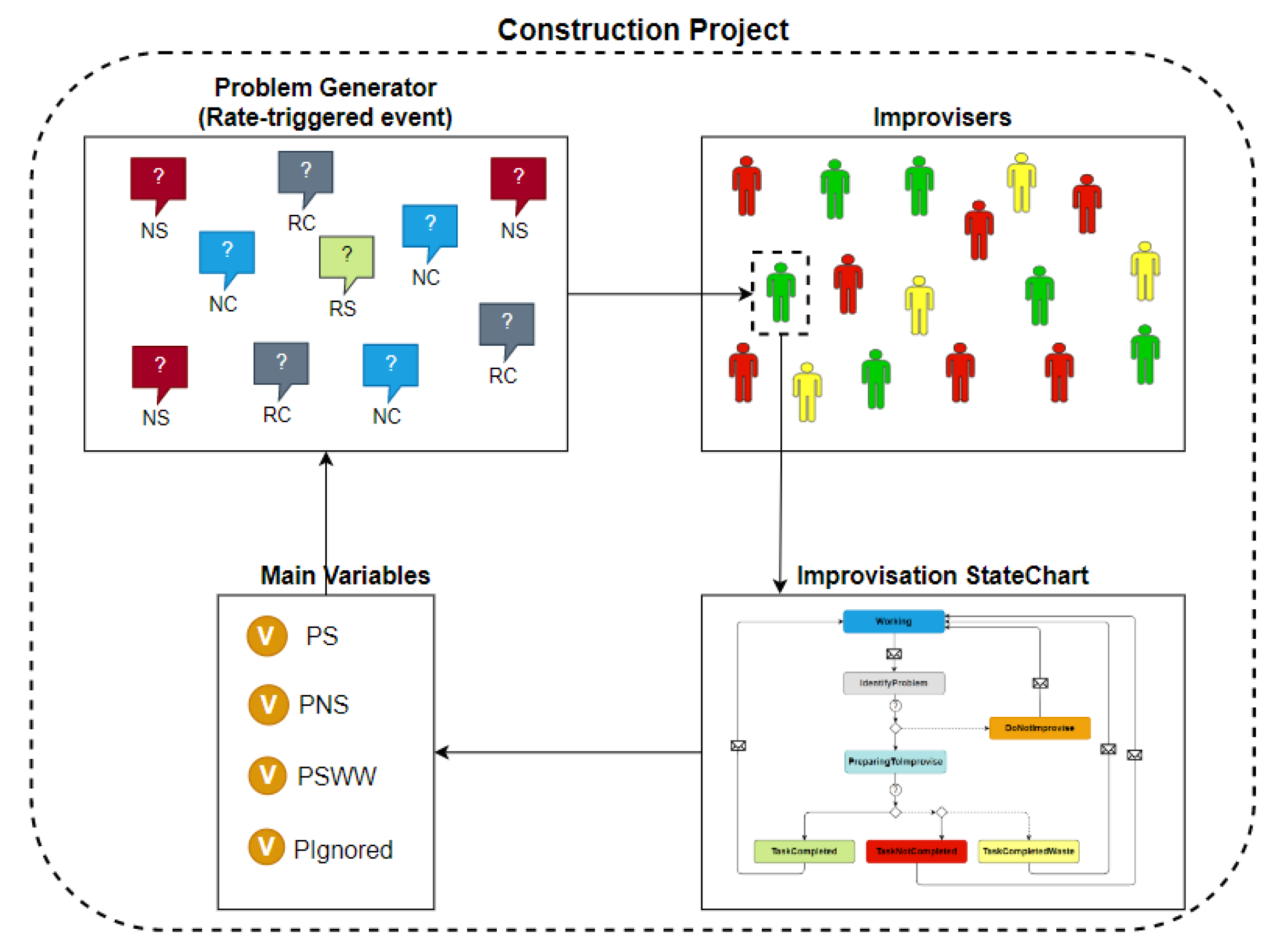
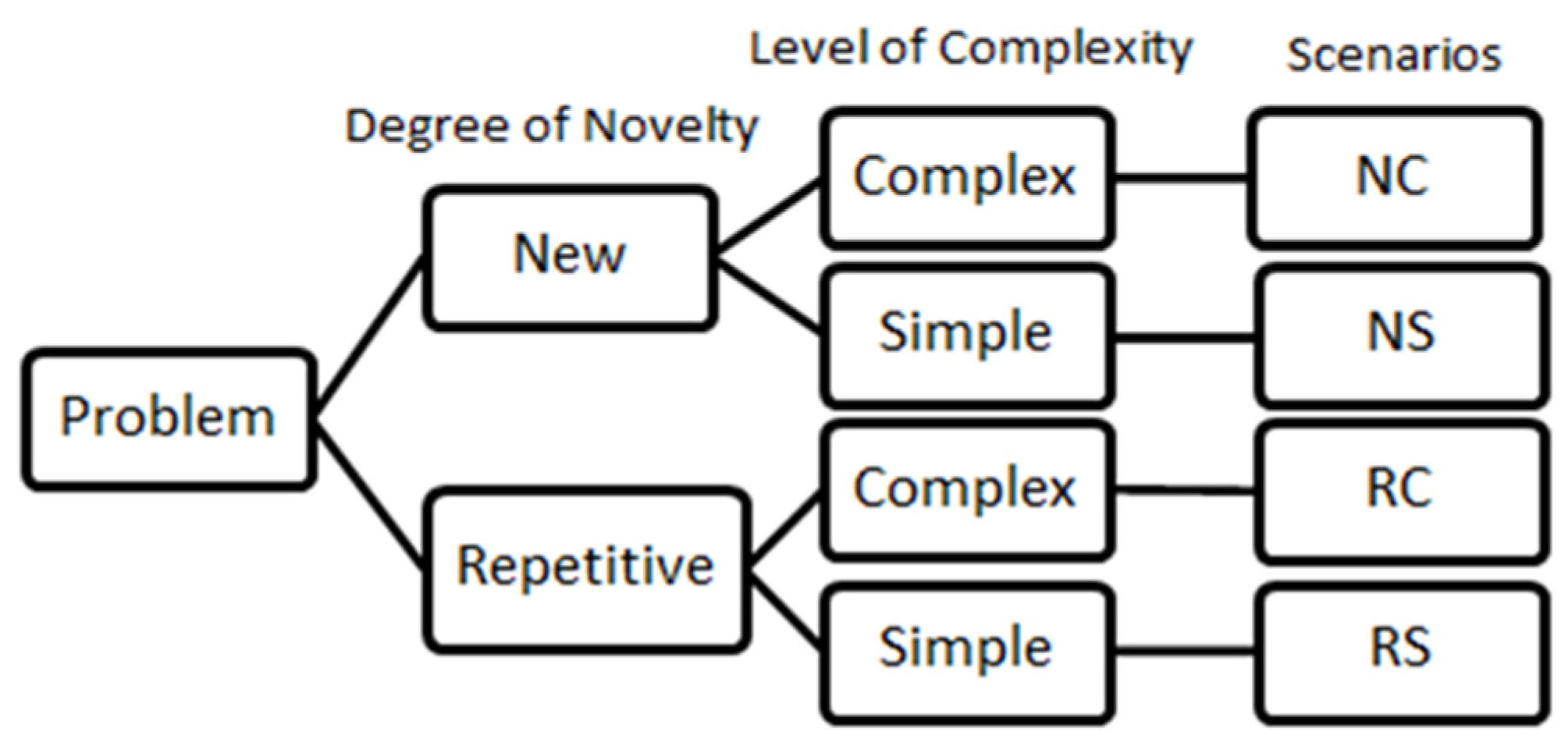
Problems that require improvisational efforts to be resolved in a construction project are modeled as agents forming an agent group or population. In reference to the conceptual model, such problems have a set of criteria that determines its significance or complication. These criteria are: level of complexity, degree of novelty, trade interdependence, and time availability. Analysis of the time needed for an improviser to solve different types of problems is out of the study’s scope. Hence, the model does not consider the “time availability” as a parameter for a problem that requires improvisation. Instead, the model assumes that all problems impose the same time pressure on improvisers to come up with a solution. The author considers the degree of novelty and level of complexity as classification criteria to differentiate between different types of problems. For the degree of novelty, problems that never happened before are classified as “New”; however, in cases where similar problems or instances happened during past operations, problems are considered to be “Repetitive”. Regarding level of complexity, problems are categorized in the model into either “Simple” or “Complex”. Therefore, according to such classification, the possible types of problems are new and complex (NC), new and simple (NS), repetitive and complex (RC), and repetitive and simple (RS), as shown in
Figure 3.
Another related parameter is the type of trade in which a problem occurs. A problem may occur in a single trade (A, B, or C) or in more than one trade (Common). In the ABM model, the proportions of each type of problems (NC, NS, RC, RS) and the proportions of each type of problems’ trades (A, B, C, Common) are defined through custom probability distributions.
Upon generation of a problem, it is directly in the state of “Detected”. Subsequent states are determined based on the selected improviser’s outcome of TC, TCWW, or TNC.
5.3. Main Environment: Construction Project
The main environment includes the agent groups, variables, parameters, events, collections, and plots necessary for the model’s rationale and setup. The main environment of the proposed model is a construction project in which all improvisers work and interact together, and different types of problems are generated.
Several events are present in the main environment: (a) “Problem initiator”, (b) “Update problem”, which is a cyclic event that updates the values of variables, and (c) “End”, which stops the simulation as the project’s duration ends.
Important variables related to the improvisers’ behavioral-state charts are defined in the main environment, since they depend on both types of agents: improvisers and problems. These variables are as follows:
PImprovise: probability of an improviser to identify the need for improvisation; hence, the state changes from “Identify problem” to “Preparing to improvise”.
PCompleted: probability of an improviser to solve a problem without producing wastes, hence changing to “TC”.
PNotCompleted: probability of an improviser not to solve a problem (moving to “TNC”).
PWaste: probability of an improviser to solve a problem while producing waste (moving to “TCWW”).
Variables are updated whenever a problem is generated, and an improviser is selected to solve that problem. They depend on the type of generated problem and the type of the selected improviser. The model inputs include: project duration; rate of problem’s occurrence; size of improvisers’ population; percentage of G improvisers per trade; percentage of M improvisers per trade; percentage of NG improvisers per trade; problem-type probability distribution; problem-trade probability distribution. The model outputs include: total percentage of TC; total percentage of TNC; total percentage of TCWW; and improvisational profile of improvisers.
Figure 4 shows the flow of the process in the simulation model.
6. Survey Implementation and Analysis
AHP can be used to assign weights to multiple factors contributing to a given problem. It is a measurement method based on pair-wise comparisons and dependent on judgments to derive priority weights. In this study, the aims of using a survey were to quantify (1) the effect of improvisational practices of TC, TNC, and TCWW on the self-experience score of an improviser, hence determining the coefficients of the equations shown in
Table 2, and (2) the probabilities of possible improvisational outcomes.
The survey is divided into four main sections and starts with a brief introduction about the research topic. The survey explains the scaling system adopted from [
42] and used to answer the survey questions.
Section 1 of the survey addresses the effect of improvisational practices TC, TNC, and TCWW on an improviser’s experience.
Section 2,
Section 3 and
Section 4 are designed for G, M, and NG improvisers, respectively, and are used to compare the effect of improviser type and problem type on outcome probabilities. In these sections, respondents are asked to compare the impact of different types of problems on the likelihood of three possible outcomes: TC, TCWW, or TNC.
Table 5 summarizes the criteria compared and the specific goal for each question in the survey.
Construction experts were asked to complete the survey through semi-structural interviews. A total of 20 construction experts participated in the survey. About 60% had more than 10 years of experience in construction management, and 40% had more than 3 years of work experience.
Data gathered from the responses comprise pair-wise comparisons for multiple criteria. First, individual comparison judgements from participants are combined to produce a single comparison matrix. Next, proper mathematical procedures are applied in order to estimate the target weights per criterion. In this study, RStudio along with Excel functions were used to perform analysis and compute the weights.
After computing the corresponding weights, they were analyzed and included in the model’s rationale. Regarding
Section 1 of the survey addressing improvisers’ experience, the effect of TC, TCWW, and TNC on the experience of different types of improvisers is quantitatively described through considering the computed weights of importance.
Table 6 presents the equations related to the experience of improvisers (based on those in
Table 2). Note that the weights of importance obtained from the survey are embedded in the coefficients of the equations. For
Section 2,
Section 3 and
Section 4 of the survey, weights related to the likelihood of improvisers to finish with TC, TNC, and TCWW are quantified according to the resulted weights of importance for each simulated project.
7. Model Verification and Validation
7.1. Verification
Five procedures are followed to verify the developed simulation model as per Bennett et al. (2013) [
36]. First, the model’s aim, scale, and scope are assessed. In this study, the aim of the simulation model was modeling the improvisation process in construction projects to predict the outcomes of different improvisational practices. Second, the data are characterized for testing and calibration. For this project, the input data were verified through obtaining real data from five large projects, as discussed in the following section. Third, visual performance is analyzed to detect non-modeled behavior. Fourth, basic performance criteria are selected, which for this study are the correlation coefficients and the corresponding regression analysis. Finally, advanced and refined methods are considered to ensure delivery of the intended objectives from the simulation model.
7.2. Validation
A combination of four approaches to determine the validity of a model is applied as per Sargent (2013) [
37]. One approach applied in this study is animation, where the model’s operational behavior is graphically displayed over a short time interval, allowing for better visualization of the flow of the model’s behaviors and decisions.
Another approach is face validation, where experts of the original system are consulted in order to validate the developed system’s logic and the inputs and outputs’ reasonability.
An extreme conditions test is applied by inserting the worst possible inputs (e.g., greatest percentage of NG improvisers) and the best possible inputs (e.g., greatest percentage of G improvisers). The results of each scenario reflect the expected outcomes. In the worst scenario, the percentage of TCN is greatest, while in the ideal scenario, the percentage of TC is greatest.
Finally, parameter variability–sensitivity analysis is applied. This approach consists of changing the values of the inputs of the model to determine the impact on the output [
37], as shown in the following section “Simulation Experiments”.
To investigate improvisation practices in real-life projects and validate the inputs of the developed model, improvisation data for actual projects are used. Data for this study were acquired from a previous research study where an extensive survey was conducted among construction employees on five large construction projects to explore the dynamics of improvisation in construction [
8,
15].
Table 7 presents the main inputs and outputs of the model in each project. The output represents the overall percent of TC and TCWW in each project after one year of work, with a passion-based rate of one problem per day. The acquired data are utilized as input validation for the developed simulation model, from which the classification of improvisers as G, M, or NG is used in the simulation experiments.
The collected data describe the personal criteria and organizational backgrounds of the main improvisers on each project. Accordingly, improvisers are classified into G, M, and NG based on the scores of their improvisation-related criteria. Therefore, the distribution of improvisers’ types in each project is used as input for model runs. In addition, the analysis of data related to the distribution of the types of problems revealed that the previously mentioned types of problems are equally distributed for all projects except for the healthcare project (Project 5), where the likelihood of occurrence of NC problems is about 0.5. For inputs related to the problem-trade and improviser-trade distributions in each project, the available data did not consider the effect of the trades in the analysis of improvisation. Therefore, the authors did not differentiate between trades while running the model for each project.
7.3. Simulation Experiments
For further analysis, three main simulation experiments were designed and implemented using the proposed ABM model. These experiments aimed at studying the effect of changing the distribution of improvisers’ types on the overall improvisational outcomes and examining the potential of developing significant regression models that predict the expected portions of different improvisational outcomes. Experiments 1, 2, and 3 focused on changing the percentage of G, M, and NG improvisers, respectively, while keeping other influencing factors intact. This is achieved by changing the percentage of one type of improviser from 0 to 100 percent by increments of 10 percent while keeping the other two types equally distributed.
Table 8 summarizes the inputs of the three experiments. Note that each distribution of improvisers is considered a single simulation that is repeated 50 times with a new random-number seed to account for the stochastic nature of the improvisation process. In all experiments, the project duration is 1 year, the rate of problems’ occurrence is one per day, the number of improvisers is 15, and problem types and problem trades are equally distributed. In these experiments, the percentages of TC and TCWW are the response variables of interest, since these are the preferred outcomes for construction professionals (rather than failure). Once the anticipated portions of TC and TCWW are computed, other portions related to either not completing or ignoring an improvisational task can be inferred.
After running different scenarios while varying the percentage of each type of improviser at a time, the percentages of TC and TCWW were recorded over one year. Before analyzing any potential regression model, Pearson correlation factors between the percentage of TC and the percentage of each of G, M, and NG improviser were calculated. A similar calculation was performed for the TCWW.
To check for any potential multi-collinearity problem, the variance inflation factor (VIF) is computed for each case. VIF quantifies the severity of multi-collinearity in ordinary least squares regression analysis, providing an index that measures how much the variance of an estimated regression coefficient increases because of collinearity.
The following are the equations of the linear regression models:
8. Results and Discussion
8.1. Survey Data
Analysis of results from
Section 1 of the survey showed that G improvisers learn the most from the tasks that they fail to complete through improvisation (high TNC coefficient) and the least from the tasks that they successfully complete (low TC coefficient). This can be interpreted to mean G improvisers have high knowledgeability in improvisation and can only improve when they fail to properly improvise and then learn from their mistakes. Conversely, NG improvisers ultimately learn the most from the tasks that they have completed successfully through improvisation. M improvisers will gain the same experience from the three possible outcomes.
8.2. Discussion of Validation
As noted, the model’s inputs were validated by considering the scenarios of five large projects. In each project, improvisers who are responsible for executing the work are classified based on their job titles (managers or laborers) and improvisational capabilities (G, M, or NG).
After running simulation experiments for each project, several outcomes are reported. As shown in
Table 7, for Projects 1 and 2, manager improvisers are more than laborer improvisers. The percentage of G improvisers in Project 1 is greater than that in Project 2; however, the results related to TC and TCWW are not much affected since the change in the types of improvisers occurs only between G and M improvisers, where the portion of NG improvisers is constant among both projects. For Project 3, the laborers dominate as the percentage of managers drops to 40%. The resultant number of TC has considerably decreased since the percentage of NG improvisers has increased by an increment of 20%, in comparison to Project 2. However, the percentage of overall TCWW in Project 3 remains constant as that in Project 2; this means that the increase in the number of NG improvisers has a much greater effect on the outcomes of TC than TCWW. Most improvisers in Project 4 were managers and G improvisers. Consequently, about 85% of the improvisational tasks were completed successfully without producing wastes (TC), and about 6% of the tasks were completed with waste (TCWW). Project 5 was a healthcare-type project, where the likelihood of occurrence of NC problems initiating improvisation was nearly 0.5. Although 80% of improvisers were managers, and about 50% of improvisers were classified as G, only 40.7% of improvisational tasks were successfully accomplished (TC), and 20.6% were completed with waste (TCWW), while the remaining 38.7% were not completed (TNC). This was due to the abundance of NC problems that may initiate improvisation in projects where special and complicated systems are executed. Findings from Project 5, described as a healthcare project with an abundance of new and complex problems, may be compared to findings of a previous study by Menches and Chen (2013), where an idiographic study of a journeyman electrician working on a hospital renovation project was conducted [
16]. In their study, results showed that during the disruption experiences leading to improvisations, the subject either improvised a new task by performing an entirely new task or improvised their work method by performing the same task in a non-standard way. The first case of improvising a new task relates to the current study’s findings of task completion (TNC), while the second case of improvising a new work method relates to the current study’s findings of waste emergence (TCWW) as new methods may generate wastes in time, materials, or both, despite the fact that the task itself was successfully completed. In other words, TNC is represented by the instances when the subject reported improvising an entirely different task, while TCWW is represented by the instances when the subject reported improvising new work methods. Both TNC and TCWW validate the current study’s findings from Project 5, showing relatively low TC values compared to those of TCWW and TNC combined.
Finally, it is worth mentioning that in cases where managers dominate, the percentage of G improvisers was greater than for NG and M improvisers.
8.3. Discussion of Simulation Experiments’ Results
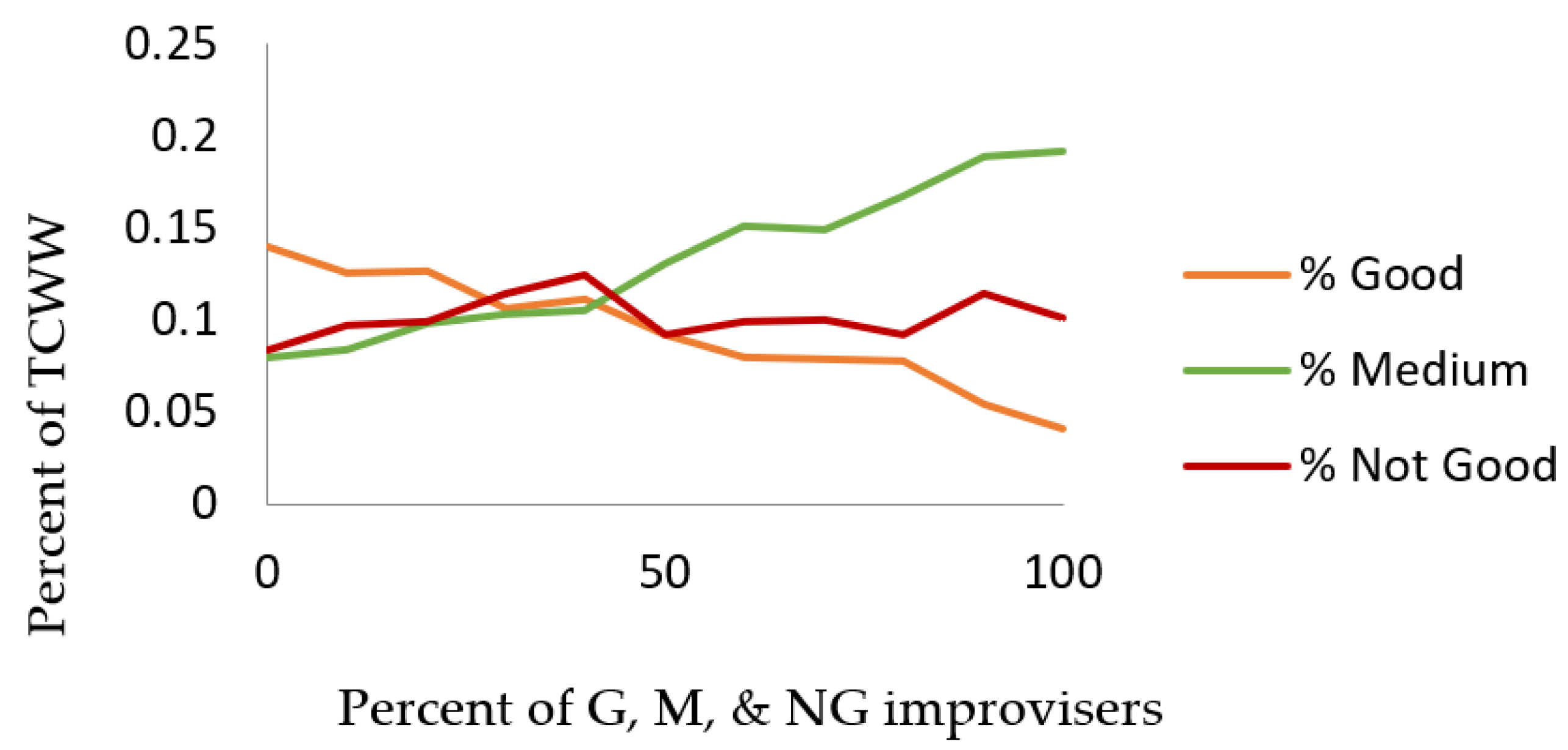
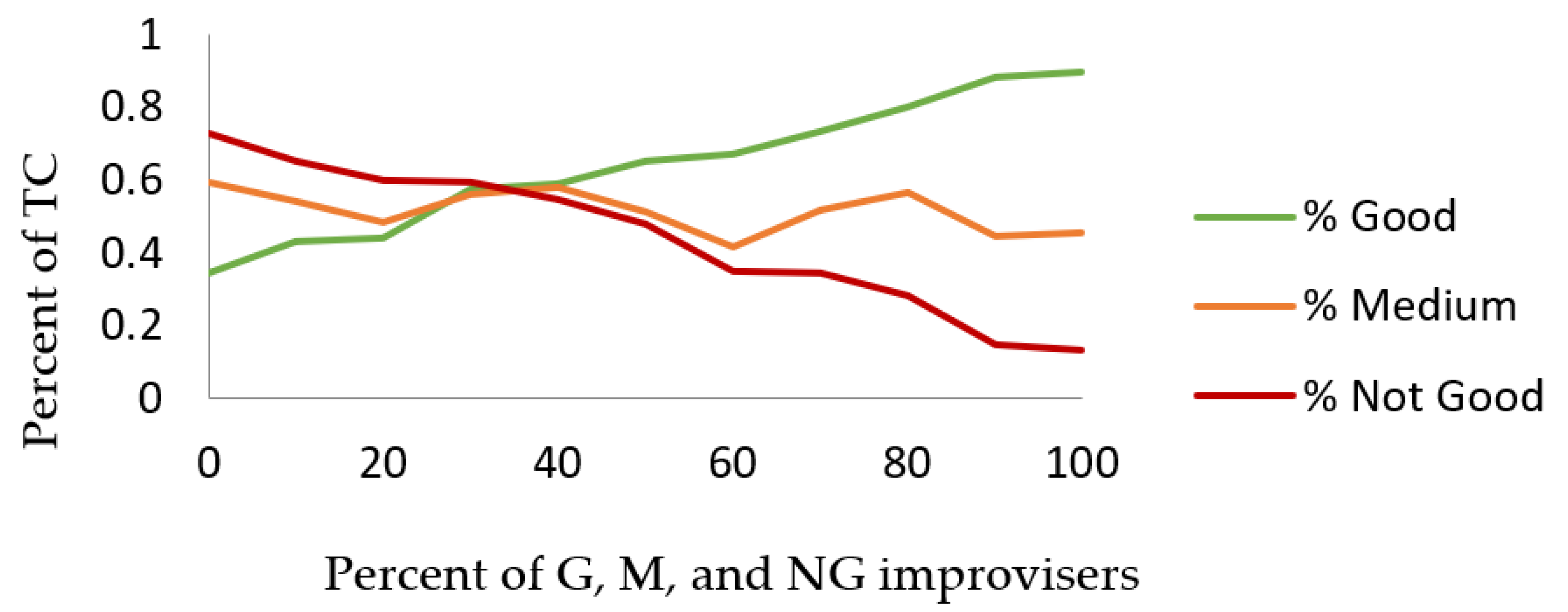
Results show that TC was positively correlated with the percent of G improvisers and negatively correlated with the percent of NG improvisers. However, poor negative correlation is detected between TC and the percent of M improvisers. Regarding TCWW, the percent of G and M improvisers has strong negative and positive correlations, respectively. Low correlation was calculated for the percent of NG versus the percent of TCWW. Zooming into correlations related to G improvisers, the strong positive correlation observed between the percent of TC and G improvisers and the strong negative correlation observed between the percent of TCWW and G improvisers conform with results obtained in a previous study conducted by Hamzeh et al. (2018) [
8]. In that study, workers’ level of improvisation represented by experience and type of organization they belong to was found to have a significant impact on the task completion status and the level of emerging waste. Workers with higher improvisation scores were found to be able to practice improvisation with a higher task completion stratus and lower levels of emerging wastes than those with lower improvisation scores.
Table 9 summarizes the corresponding correlation factors. To visualize the calculated correlation factors and identify the potential type of regression between the response variables and predictors, the percent of TC and TCWW are each plotted against the percent of G, M, and NG improvisers, as shown in
Figure 5 and
Figure 6, respectively.
The corresponding plots between the percent of G and TC, NG and TC, G and TCWW, and M and TCWW show a linear relationship between each response variable and predictor, indicating that these relationships can be modeled through linear regression. Therefore, the significance of potential linear regression models and the corresponding hypotheses were tested and analyzed. The following are the tested hypotheses:
Hypothesis 1. Percentages of G and NG improvisers on a construction project are significant predictors of the percent of TC.
Hypothesis 2. Percentages of G and M improvisers on a construction project are significant predictors of the percent of TCWW.
The null hypothesis is that all regression coefficients equal zero. After running the regression test, the results show that the F value is significant for both Hypotheses 1 and 2, where the corresponding p values are much less than alpha (0.05). In addition, t-tests for the linear regression coefficients are significant, with 95% confidence interval. The interaction between predictors was tested in both hypotheses and was not significant. Moreover, after establishing the linear regression models, the residuals and standardized residuals were plotted to check the underlying assumptions of linear regression. The plots show that residuals are nearly normal, linear, and have constant variance, with no great leverage points observed. For both linear regression models, the VIF values were less than two, which ensures that multi-collinearity is negligible.
The percent of TC is nearly 50% when all improvisers are of “M” type (i.e., the percentages of G and NG improvisers are zero). As the percent of G improvisers increases by increments of 10% while holding that of NG improvisers constant, the percentage of TC increases by around 4.5%. For every 10% increment increase in the population of NG improvisers, while keeping the proportion of G improvisers constant, the percent of TC decreases by around 3%. Therefore, the impact of being a G improviser is slightly higher than that of being an NG improviser.
The percent of TCWW is nearly 10% when all improvisers are “NG” (i.e., the percentages of G and M improvisers are zero). As the percent of G improvisers increases by increments of 10% while keeping that of M improvisers constant, the percentage of TC decreases by around 0.6%. However, for every 10% increase in the population of M improvisers, while keeping the proportion of G improvisers constant, the number of TC increases by around 0.7%. Therefore, it can be inferred that improviser type has a much more intense impact on the percent of TC than on TCWW. This result builds upon the results obtained by the study by Hamzeh et al. (2018), where the improviser type was found to have an impact on the task completion status and the level of waste emergence, without specifying the extent to which each type impacts both indices. With the detailed analysis conducted in the current study, a better insight into the dynamics of improvisational practices and their impacts on both task completion and waste emergence was attained. Based on these findings, considerable changes in the number of G and M improvisers should be made to increase the number of emergent TCWW. However, a small increase in the population of G and NG improvisers is capable of considerably changing the proportion of emerging TC.
These linear regression models can be used to anticipate the proportions of the problems requiring improvisational efforts and ending up either successfully solved or solved with waste. Note that these equations predict the percent of TC and TCWW given that the distribution of improvisers’ type is after one year of construction. However, to use these two models, an important caveat is needed, which is that the different types of problems are classified based on how the level of complexity and degree of novelty are equally probable during construction and equally distributed between different trades. Hence, no specific type of problems has a distinctive weighing factor over the other. This caveat is there to cater to the standard or normal scenario where every problem has the same likelihood to occur. If a specific type of problem initiating improvisation has a higher likelihood than others, one can change the distribution of the type and trade of problems and then re-run the same scenarios and analysis so that the linear regression models will be adjusted accordingly.
9. Conclusions
Planning and control in construction are essential for enhancing the performance of construction projects and mitigating problems related to uncertainty. Unfortunately, problems related to unexpected uncertainties and shortcomings of planning methods are bound to happen in any construction project. Therefore, one of the main issues that construction personnel encounter sometimes is the inability to stay on the pre-planned track during construction due to unexpected uncertainty, unforeseen conditions, or even insufficient or improper planning. As a result, more time and effort are invested to come up with solutions that would overcome such problems. In such cases, improvised solutions may be developed to minimize losses and to maintain control of the construction process. The aim of this study was to predict the outcomes of construction planning processes from an improvisational perspective by better understanding the dynamics of improvisation. The contribution of this study lies in guiding construction planners and decision makers to better manage the problems of unexpected uncertainties through enhancing the overall improvisational performance on a construction project.
The proposed ABM model was developed to study the improvisation process at the level of a group of individuals working within different trades and interacting together on the same project. The simulation model includes several types of parameters that greatly influence the improvisational outcomes of the group. Interactions between improvisers and the construction project, between improvisers and problems, and among improvisers themselves are consider in the model. After setting out the ABM model, a survey was conducted among construction experts to quantify certain behaviors related to improvisers. Additionally, the developed model’s inputs were validated using data from five large-sized projects. Moreover, simulation experiments were conducted, and linear regression modeling was performed to anticipate the overall improvisational outcomes in a given project. The major findings of the study include the fact that managers are more likely to improvise than laborers, high numbers of NG improvisers decrease that of successfully completed tasks but have no substantial impact on the number of tasks completed with waste, and NC problems in complicated projects tend to hinder the successful completion of tasks.
This study imposes several practical implications and recommendations that aim to enhance the management of unforeseen uncertainty in a construction project through advancing the practice of improvisation. Planners and decision makers are advised to consider the improvisational capabilities as well as the expected level of uncertainty for a given project while predicting its performance. The following are several recommended practices which decision makers can adopt to better enhance the overall improvisational performance in a project:
Improvisational capabilities of all construction planners in a given firm can record, continuously update, and provide corresponding classification to be used for future assignments.
For construction projects associated with greater potential levels of unforeseen uncertainties, a group of construction planners with suitable improvisational capabilities can be staffed to properly manage such uncertainties.
Random assignment of improvisational capabilities within a team of planners without considering their trades’ requirements in a construction project cannot be made, since it may not necessarily improve the emergent improvisational performance at the level of that project.
In case of shortage of G improvisational capabilities, staffing for a project can ensure a fair distribution of improvisational capabilities within each team so that the benefits of interaction upon improvisation are recorded.
Finally, several limitations of this research study are worth mentioning so that future research work can be recommended. The main limitation of the proposed agent-based model is the use of deterministic probabilities to describe certain behaviors of improvisers (agents). Instead, probability distributions should be used to account for all possible random behaviors. Identifying such probability distribution is beyond the scope of this study and should be addressed in a future study. Moreover, the developed model does not consider the time spent by each improviser (agent) to improvise, so time analysis was also not included in this study. Future research could address incorporating time analysis into the study for a more comprehensive and realistic analysis. Moreover, only the inputs of the model were validated because of the limitations of available data. Further data collection and more AHP responses are required to enhance the validity of the developed model.
For future research, this model can be applied in more case studies to validate the model’s output and analyze improvisation in more types of construction projects so that more recommendations for the industry can be achieved. The developed model could be enhanced if probability distributions related to improviser behaviors are identified and entered, rather than the deterministic approach. Furthermore, future research is recommended to identify other influencing factors related to the improvisational performance of a group of construction planners and incorporate the time factor in the developed agent-based model. Future research work could also focus on analyzing the relation between the improvisational outcomes in a construction project and certain corresponding key performance indicators related to time or cost.
Author Contributions
Conceptualization, H.A. and F.H.; methodology, H.A.; software, H.A.; validation, H.A., formal analysis, H.A. and L.S.; resources, F.H.; data curation, H.A.; writing—original draft preparation, H.A. and L.S.; writing—review and editing, L.S.; visualization, H.A. and L.S.; supervision, F.H.; project administration, F.H.; funding acquisition, F.H. All authors have read and agreed to the published version of the manuscript.
Funding
This study is partially funded by the civil engineering department at American University of Beirut (AUB). It is also partially funded by the Natural Sciences and Engineering Research Council of Canada (NSERC) Alliance grant ALLRP 549210-19.
Institutional Review Board Statement
Not applicable.
Informed Consent Statement
Not applicable.
Data Availability Statement
Not applicable.
Acknowledgments
All findings and conclusions expressed in this paper are those of the authors and do not reflect those of the contributors.
Conflicts of Interest
The authors declare no conflict of interest.
References
- Sakal, M.W. Project alliancing: A relational contracting mechanism for dynamic projects. Lean Constr. J. 2005, 2, 67–79. [Google Scholar]
- Lucko, G.; Su, Y. Singularity functions as new tool for integrated project management. In Proceedings of the Creative Construction Conference, Prague, Czech Republic, 21–24 June 2014; Volume 85, pp. 414–420. Available online: http://2015.creative-construction-conference.com/wp-content/uploads/2015/01/CCC2014_G_Lucko.pdf (accessed on 31 March 2019).
- Akrani, G. Importance of Planning—Why Planning is Important. 2012. Available online: http://kalyan-city.blogspot.com/2012/02/importance-of (accessed on 16 August 2022).
- Woods, D.D.; Hollnagel, E. Prologue: Resilience Engineering Concepts. In Resilience Engineering; CIC Press: Cambridge, MA, USA, 2017; pp. 1–6. [Google Scholar]
- Marle, F. A structured process to managing complex interactions between project risks. Int. J. Proj. Organ. Manag. 2014, 6, 4–32. [Google Scholar] [CrossRef] [Scilit]
- Chelariu, C.; Johnston, W.J.; Young, L. Learning to improvise, improvising to learn: A process of responding to complex environments. J. Bus. Res. 2002, 55, 141–147. [Google Scholar] [CrossRef] [Scilit]
- Trotter, M.J.; Salmon, P.M.; Lenné, M.G. Improvisation: Theory, measures and known influencing factors. Theor. Issues Ergon. Sci. 2013, 14, 475–498. [Google Scholar] [CrossRef] [Scilit]
- Hamzeh, F.R.; Faek, F.; AlHussein, H. Understanding improvisation in construction through antecedents, behaviours and consequences. Constr. Manag. Econ. 2019, 37, 61–71. [Google Scholar] [CrossRef] [Scilit]
- Ciborra, C.U. Notes on improvisation and time in organizations. Account. Manag. Inf. Technol. 1999, 9, 77–94. [Google Scholar] [CrossRef] [Scilit]
- Moorman, C.; Miner, A.S. The Convergence of Planning and Execution: Improvisation in New Product Development. J. Mark. 1998, 62, 1–20. [Google Scholar] [CrossRef] [Scilit]
- Roux-Dufort, C.; Vidaillet, B. The Difficulties of Improvising in a Crisis Situation—A Case Study. Int. Stud. Manag. Organ. 2003, 33, 86–115. [Google Scholar] [CrossRef] [Scilit]
- Vera, D.; Crossan, M. Improvisation and innovative performance in teams. Organ. Sci. 2005, 16, 203–224. [Google Scholar] [CrossRef] [Scilit]
- Tepeli, E.; Taillandier, F.; Breysse, D. Multidimensional modelling of complex and strategic construction projects for a more effective risk management. Int. J. Constr. Manag. 2021, 21, 1218–1239. [Google Scholar] [CrossRef] [Scilit]
- Boateng, A.; Ameyaw, C.; Mensah, S. Assessment of systematic risk management practices on building construction projects in Ghana. Int. J. Constr. Manag. 2020, 1–10. [Google Scholar] [CrossRef] [Scilit]
- Hamzeh, F.R.; Alhussein, H.; Faek, F. Investigating the Practice of Improvisation in Construction. J. Manag. Eng. 2018, 34, 04018039. [Google Scholar] [CrossRef] [Scilit]
- Menches, C.L.; Chen, J. Using ecological momentary assessment to understand a construction worker’s daily disruptions and decisions. Constr. Manag. Econ. 2013, 31, 180–194. [Google Scholar] [CrossRef] [Scilit]
- Weick, K.E. Improvisation as a Mindset for Organizational Analysis. Organ. Sci. 1998, 9, 543–555. [Google Scholar] [CrossRef] [Scilit]
- Pressing, J. Improvisation: Methods and Models to Appear in: Generative Processes in Music; Oxford University Press: Oxford, UK, 1987. [Google Scholar]
- Hadida, A.L.; Tarvainen, W. Organizational Improvisation: A Consolidating Review and Framework. Int. J. Manag. Rev. 2015, 17, 437–459. [Google Scholar] [CrossRef] [Scilit]
- Hollnagel, E.; Woods, D.D.; Leveson, N. Resilience Engineering: Concepts and Precepts; Ashgate Publishing, Ltd.: Farnham, UK, 2006; Available online: https://books.google.ca/books?hl=en&lr=&id=rygf6axAH7UC&oi=fnd&pg=PP1&dq=Hollnagel,+E.,+Woods,+D.D.,+and+Leveson,+N.+(2006),+Resilience+Engineering:+Concepts+and+Precepts,+Ashgate,+Aldershot,+UK.&ots=iq8zQX6W8a&sig=6G3DA0Dy1mWDBtlcf3ntzgez4cc&redir_esc=y# (accessed on 16 August 2022).
- Perry, L.T. Strategic improvising: How to formulate and implement competitive strategies in concert. Organ. Dyn. 1991, 19, 51–64. [Google Scholar] [CrossRef] [Scilit]
- E Cunha, M.P.; Da Cunha, J.V.; Kamoche, K. Organizational improvisation: What, when, how and why. Int. J. Manag. Rev. 1999, 1, 299–341. [Google Scholar] [CrossRef] [Scilit]
- Magni, M.; Proserpio, L.; Hoegl, M.; Provera, B. The role of team behavioral integration and cohesion in shaping individual improvisation. Res. Policy 2009, 38, 1044–1053. [Google Scholar] [CrossRef] [Scilit]
- Klein, G. Flexecution as a paradigm for replanning, part 1. IEEE Intell. Syst. 2007, 22, 79–83. Available online: https://ieeexplore.ieee.org/stamp/stamp.jsp?arnumber=4338498 (accessed on 16 August 2022).
- Rebolj, D.; Babič, N.Č.; Magdič, A.; Podbreznik, P.; Pšunder, M. Automated construction activity monitoring system. Adv. Eng. Inform. 2008, 22, 493–503. [Google Scholar] [CrossRef] [Scilit]
- Abdelhamid, T.S.; Schafer, D.; Mrozowski, T.; Jayaraman, V.; Howell, G.; El-Gafy, M.A. Working through unforseen uncertainites using the OODA loop: An approach for self-managed construction teams. In Proceedings of the IGLC 17: 17th Annual Conference of the International Group for Lean Construction, Taipei, Taiwan, 15–17 July 2009; pp. 573–582. [Google Scholar]
- Desai, A.P.; Abdelhamid, T.S. Exploring crew behavior during uncertain jobsite conditions. In Proceedings of the 20th Annual Conference of the International Group for Lean Construction, San Diego, CA, USA, 18–20 July 2012. [Google Scholar]
- Hamzeh, F.R.; Morshed, F.A.; Jalwan, H.; Saab, I. Is improvisation compatible with look ahead planning? An exploratory study. In Proceedings of the 20th Conference of the International Group for Lean Construction, San Diego, CA, USA, 18–20 July 2012. [Google Scholar]
- Jasti, N.V.K.; Kodali, R. Lean production: Literature review and trends. Int. J. Prod. Res. 2015, 53, 867–885. [Google Scholar] [CrossRef] [Scilit]
- Epstein, J.M. Why Model? J. Artif. Soc. Soc. Simul. 2008, 11, 12. [Google Scholar]
- Ingalls, R.G. Introduction to simulation. In Proceedings of the 2011 Winter Simulation Conference (WSC), Phoenix, AZ, USA, 11–14 December 2011; pp. 1343–1348. [Google Scholar]
- Gilbert, N.; Troitzsch, K. Simulation for the Social Scientist; McGraw-Hill Education: Buckingham, UK, 2005; ISBN 0335216005. Available online: http://jasss.soc.surrey.ac.uk/3/3/reviews/schertler.html (accessed on 16 August 2022).
- Bernhardt, K.L.S.; Pearce, A.R.; Garvin, M.J. Sustainability and socio-enviro-technical systems: A prototype agent based model to generate inputs for costing capital facilities. Proc. Winter Simul. Conf. 2011, 3412–3420. [Google Scholar] [CrossRef] [Scilit]
- Palaniappan, S.; Sawhney, A.; Janssen, M.A.; Walsh, K.D. Modeling construction safety as an agent-based emergent phenomenon. In Proceedings of the 24th International Symposium on Automation and Robotics in Construction, Brighton, UK, 19–21 September 2007; pp. 375–382. [Google Scholar]
- Ahn, S.; Lee, S.H. Development of model of workers’ mental processes related to absence norm as behavior rule in agent-based simulation. Proc. Winter Simul. Conf. 2011, 3479–3487. [Google Scholar] [CrossRef] [Scilit]
- Bennett, N.D.; Croke, B.F.W.; Guariso, G.; Guillaume, J.H.A.; Hamilton, S.H.; Jakeman, A.J.; Marsili-Libelli, S.; Newham, L.T.H.; Norton, J.P.; Perrin, C.; et al. Characterising performance of environmental models. Environ. Model. Softw. 2013, 40, 1–20. [Google Scholar] [CrossRef] [Scilit]
- Sargent, R.G. Verification and validation of simulation models. J. Simul. 2013, 7, 12–24. [Google Scholar] [CrossRef] [Scilit]
- Yuksel, M.E. Agent-based evacuation modeling with multiple exits using NeuroEvolution of Augmenting Topologies. Adv. Eng. Inform. 2018, 35, 30–55. [Google Scholar] [CrossRef] [Scilit]
- Macal, C.M.; North, M.J. Agent-Based Modeling and Simulation. In Proceedings of the Winter Simulation Conference, Austin, TX, USA, 13–16 December 2009; pp. 86–98. [Google Scholar]
- Gan, V.J.L.; Cheng, J.C.P. Formulation and analysis of dynamic supply chain of backfill in construction waste management using agent-based modeling. Adv. Eng. Inform. 2015, 29, 878–888. [Google Scholar] [CrossRef] [Scilit]
- Estes, W.K. Toward a statistical theory of learning. Psychol. Rev. 1950, 57, 94–107. [Google Scholar] [CrossRef] [Scilit]
- Saaty, T.L. How to make a decision: The analytic hierarchy process. Eur. J. Oper. Res. 1990, 48, 9–26. [Google Scholar] [CrossRef] [Scilit]
| Publisher’s Note: MDPI stays neutral with regard to jurisdictional claims in published maps and institutional affiliations. |
© 2022 by the authors. Licensee MDPI, Basel, Switzerland. This article is an open access article distributed under the terms and conditions of the Creative Commons Attribution (CC BY) license (https://creativecommons.org/licenses/by/4.0/).