Rate Constants of the Initial Reduction of a Single Iron Ore Pellet by CO-H2 Gas Mixture


Abstract
1. Introduction
2. Theoretical Background
3. Experimental
4. Results and Discussion
4.1. Influences of Temperature and Gas Composition
4.2. Influences of Carbon Deposition
4.3. Rate-Controlling Step of Initial Reduction in a Hematite Pellet
4.4. Rate Constant of the Reduction in a Hematite Pellet and Its Temperature Dependence
5. Summary
- (1)
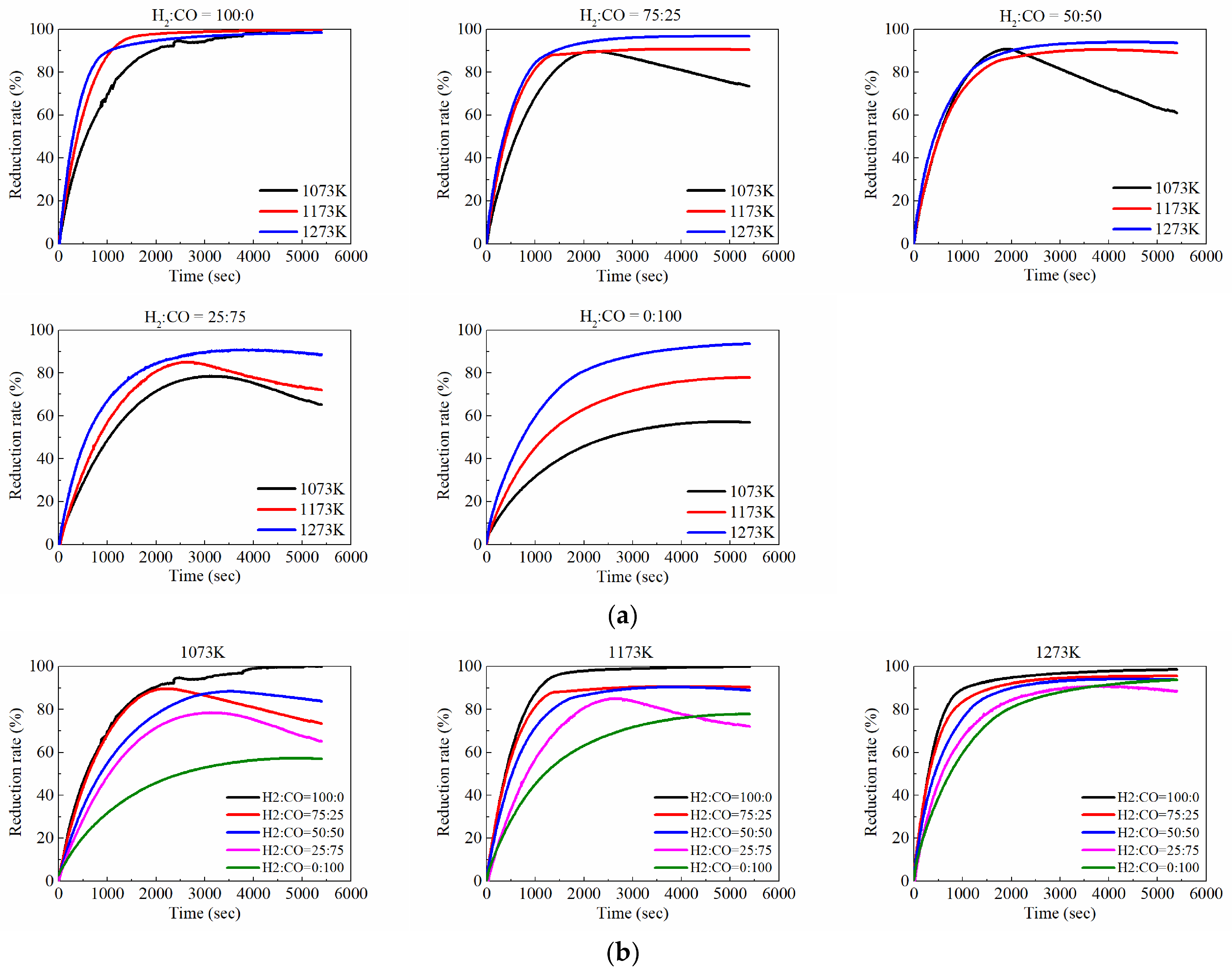
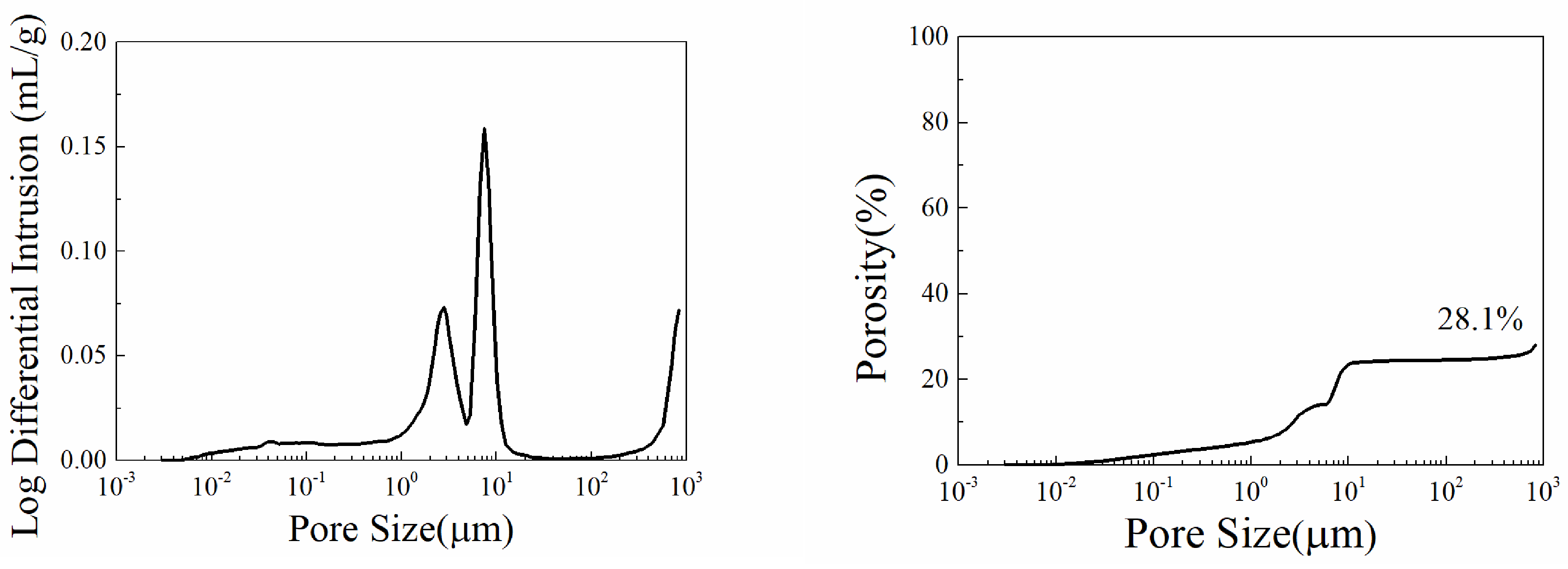
- The macroscopic reduction rate significantly accelerated with elevated temperatures and increased H2 fractions, inherently benefiting from the superior diffusivity of H2. Based on the mean free path evaluations, bulk diffusion was confirmed as the dominant gas transport mechanism within the porous pellets.
- (2)
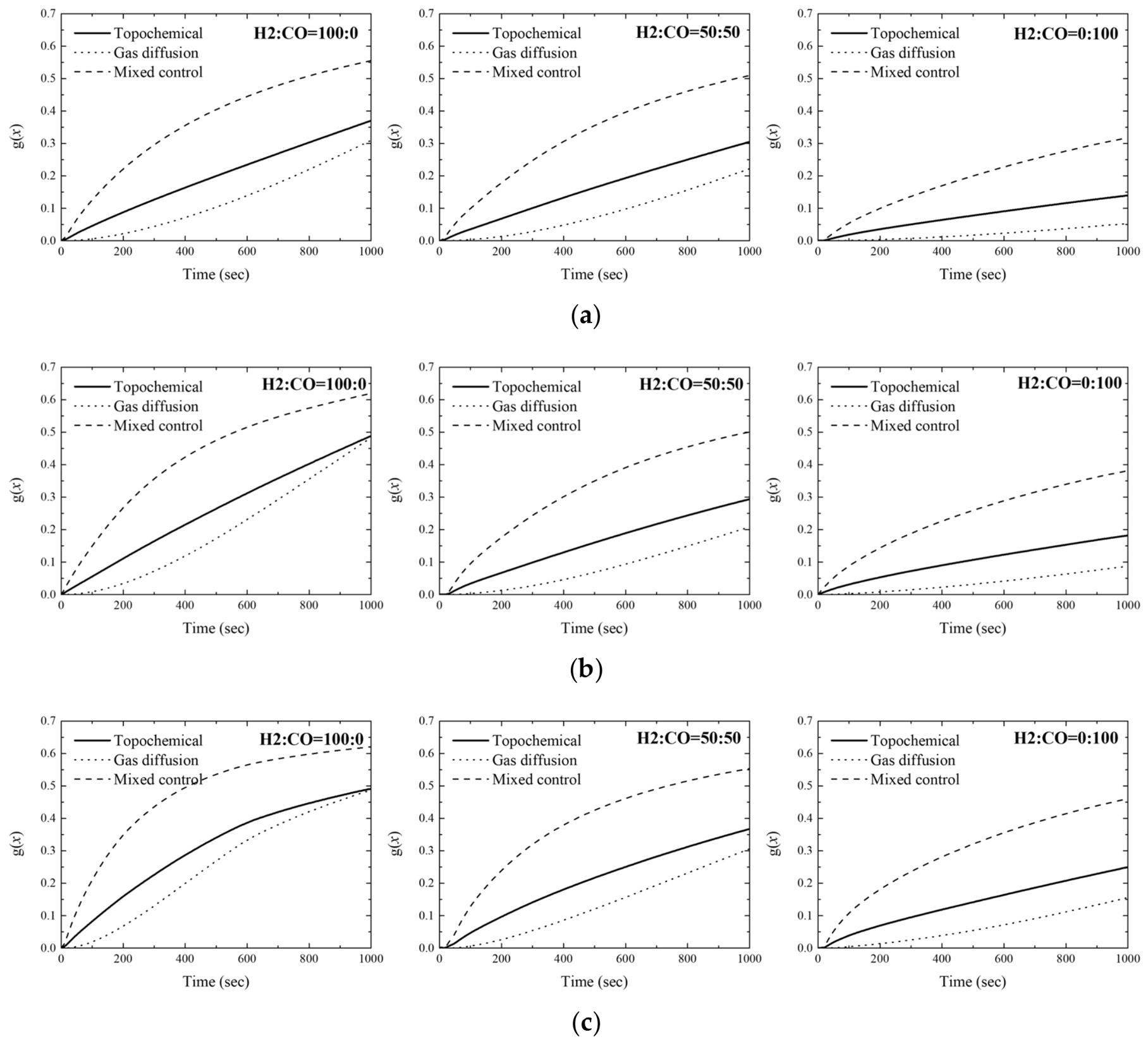
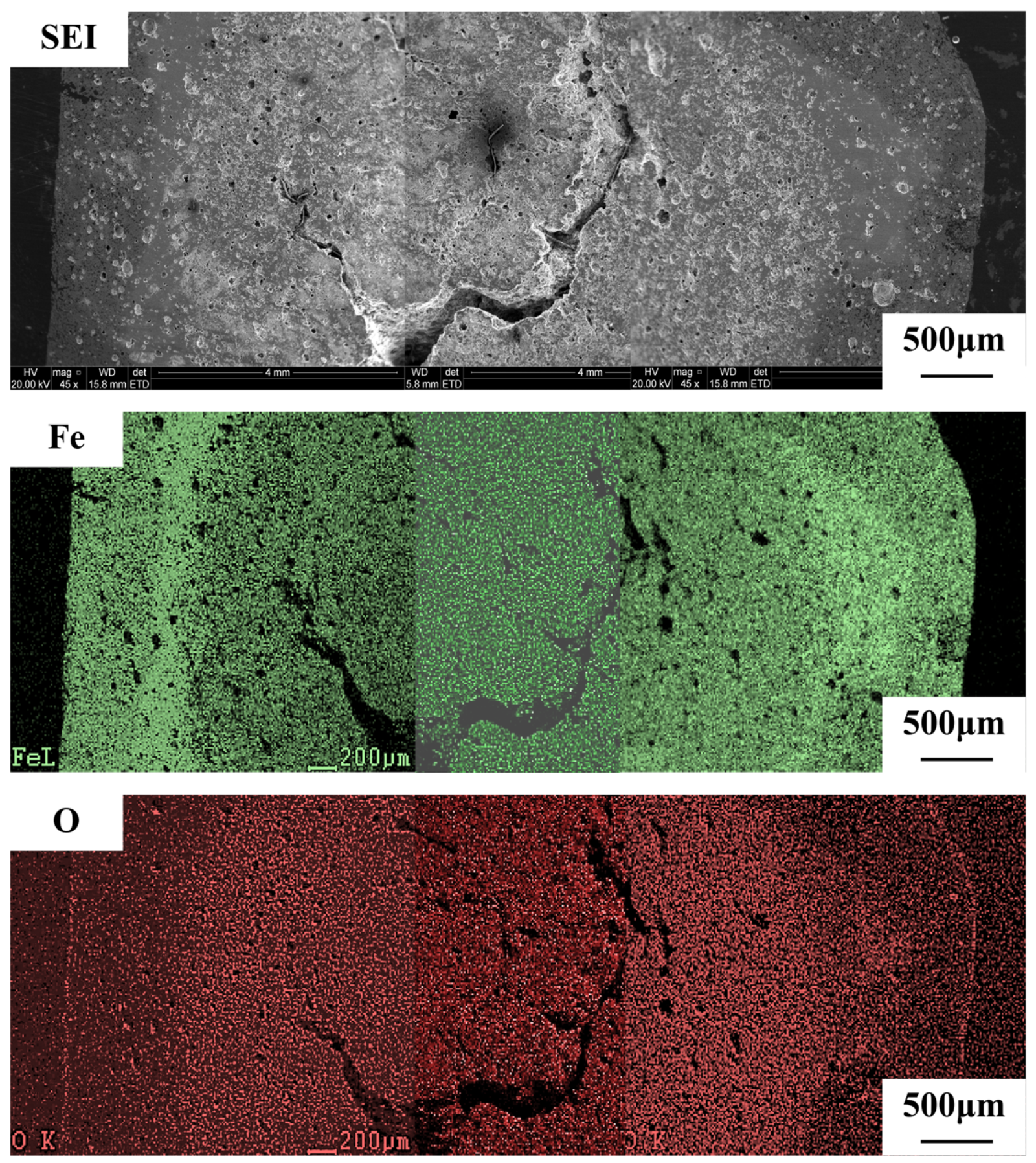
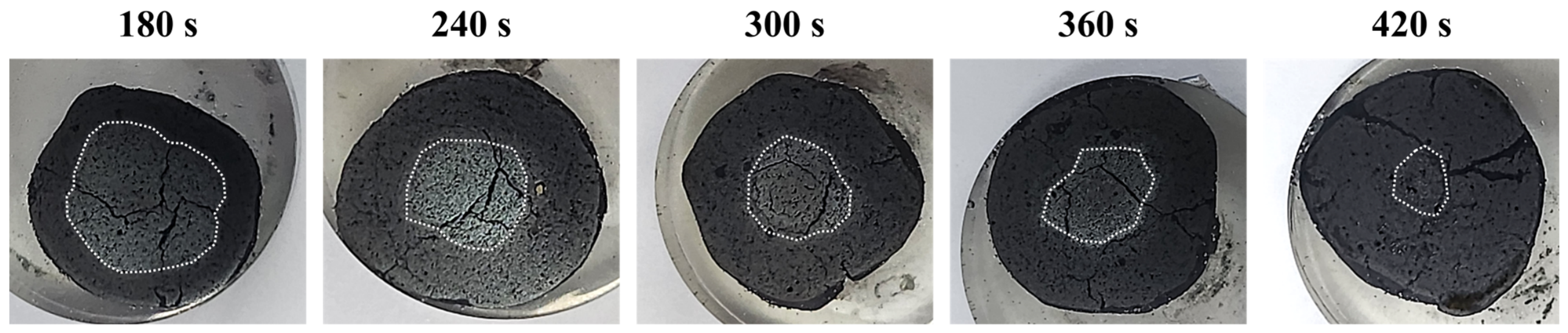
- Kinetic modeling coupled with cross-sectional macroscopic observations verified that the initial reduction stage is primarily governed by the topochemical reaction at the receding interface. This mechanism effectively incorporates the sequential intermediate phase transformations from hematite to wüstite.
- (3)
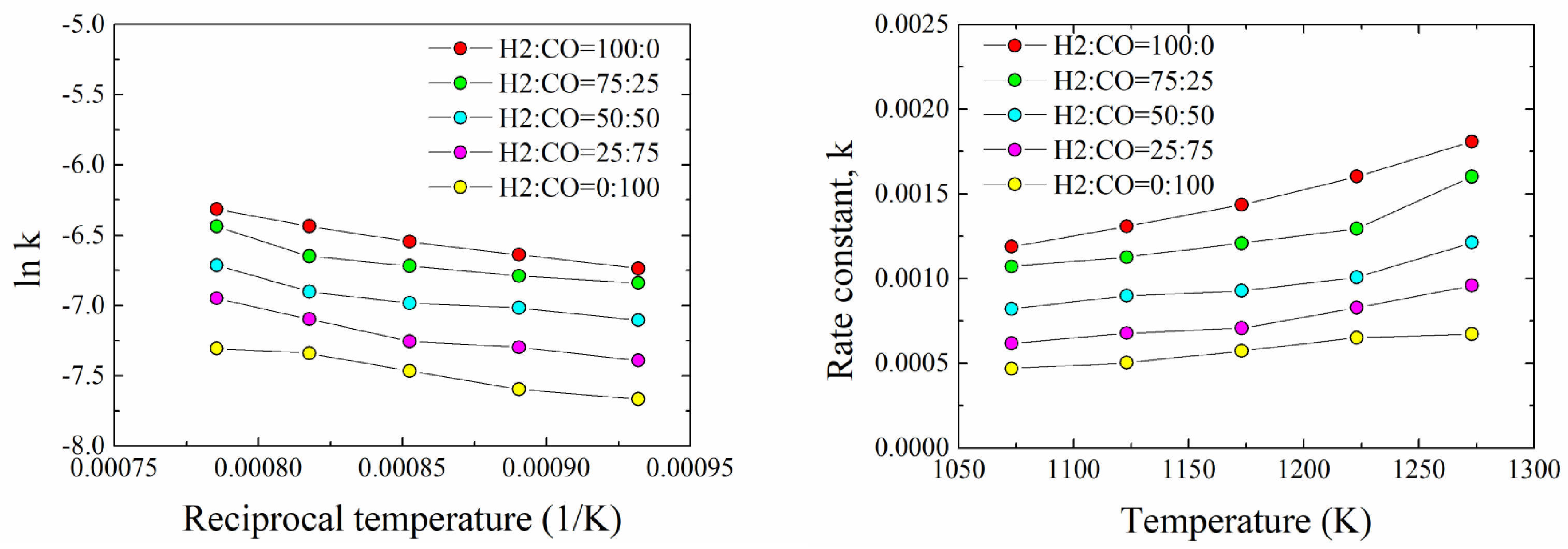
- The apparent rate constants, for the overall initial reduction were derived in the range of 0.47~1.81 × 10⁻³ kg/m2·s. Accordingly, the apparent activation energies () were calculated to range from 20.0 to 24.3 kJ/mol.
- (4)
- Notably, the apparent activation energy remained largely independent of the H2:CO gas mixing ratio, strongly indicating that the fundamental interfacial chemical reaction dictates the overall rate regardless of the specific gas atmosphere. Furthermore, the relatively low activation energies are physically well-justified by the high initial porosity of the hematite pellets, which facilitates easier intraparticle gas transport.
Author Contributions
Funding
Data Availability Statement
Conflicts of Interest
References
- Celada, J.; Skelly, J. The HyL Process (STEEL SYMP.1963/TECHNICAL PAPER/B.6). In Proceedings of the United Nations Interregional Symposium on the Application of Modern Technical Practices in the Iron and Steel Industry to Developing Countries, Prague, Czech Republic, 11–16 November 1963. [Google Scholar]
- Twidwell, L.G. Direct Reduction: A Review of Commercial Processes; Report No. EPA-600/2-80-036; U.S. Environmental Protection Agency, Industrial Environmental Research Laboratory: Research Triangle Park, NC, USA, 1980. [Google Scholar]
- Towhidi, N.; Szekely, J. Reduction kinetics of commercial low-silica hematite pellets with CO-H2 mixtures over temperature range 600–1234 °C. Ironmak. Steelmak. 1981, 6, 237–249. [Google Scholar]
- Shams, M.; Valipour, M.S. Analysis of the performance of a shaft furnace for the direct reduction of iron ore. Appl. Math. Model. 2012, 36, 6211–6224. [Google Scholar]
- Quintero, R.; Martinez-Vera, E. Operating Experiences and Results of HYL III Plants. In Proceedings of the ISS Ironmaking Conference Proceedings; Iron & Steel Society: Warrendale, PA, USA, 1984; Volume 43. [Google Scholar]
- Takenaka, Y.; Kimura, Y.; Narita, K.; Kaneko, D. Mathematical Model of Direct Reduction Shaft Furnace and Its Application to Actual Operations. Comput. Chem. Eng. 1986, 10, 67–75. [Google Scholar] [CrossRef] [Scilit]
- Zuo, H.B.; Wang, C.; Dong, J.J.; Jiao, K.X.; Xu, R.S. Reduction kinetics of iron oxide pellets with H2 and CO mixtures. Int. J. Miner. Metall. Mater. 2015, 22, 688–696. [Google Scholar] [CrossRef] [Scilit]
- Tsay, Q.T.; Ray, W.H.; Szekely, J. The modeling of hematite reduction with hydrogen plus carbon monoxide mixtures: Part I. The behavior of single pellets. AIChE J. 1976, 22, 1064–1072. [Google Scholar] [CrossRef] [Scilit]
- Valipour, M.S.; Saboohi, Y. Numerical investigation of isothermal reduction of hematite pellet with H2, CO and H2-CO mixtures. Ironmak. Steelmak. 2007, 34, 121–128. [Google Scholar]
- Towhidi, N.; Szekely, J. The influence of carbon deposition on the reduction kinetics of commercial grade hematite pellets with CO, H2, and N2. Metall. Trans. B 1983, 14, 359–367. [Google Scholar] [CrossRef] [Scilit]
- El-Geassy, A.A. Gaseous reduction of iron ore pellets under conditions of carbon deposition. ISIJ Int. 1998, 38, 334–343. [Google Scholar]
- Pineau, A.; Kanari, N.; Gaballah, I. Kinetics of reduction of iron oxides by H2 and CO mixtures. Thermochim. Acta 2006, 447, 89–100. [Google Scholar] [CrossRef] [Scilit]
- Hayashi, S.; Iguchi, Y. Factors affecting the sticking of iron ore pellets during reduction. ISIJ Int. 1992, 32, 962–971. [Google Scholar] [CrossRef] [Scilit]
- Walker, P.L. Carbon formation from carbon monoxide-hydrogen mixtures over iron catalysts: II. Rates of carbon formation. J. Phys. Chem. 1959, 63, 140. [Google Scholar] [CrossRef] [Scilit]
- Turkdogan, E.T. Catalytic effect of iron on decomposition of carbon monooxide: I. Carbon deposition in H2-CO mixtures. Metall. Trans. 1974, 5, 11. [Google Scholar] [CrossRef] [Scilit]
- Heidari, A.; Niknahad, N.; Iljana, M.; Fabritius, T. A Review on the Kinetics of Iron Ore Reduction by Hydrogen. Materials 2021, 14, 7540. [Google Scholar] [CrossRef] [Scilit] [PubMed]
- Turkdogan, E.T.; Vinters, J.V. Gaseous reduction of iron oxides: Part, I. Reduction of hematite in hydrogen. Metall. Mater. Trans. B 1971, 2, 3175–3188. [Google Scholar] [CrossRef] [Scilit]
- El-Geassy, A.A.; Shehata, K.A.; Ezz, S.Y. Mechanism of Iron Oxide Reduction with Hydrogen/Carbon Monoxide Mixtures. Trans. Iron Steel Inst. Jpn. 1977, 17, 629–635. [Google Scholar] [CrossRef] [Scilit]
- Bonalde, A.; Henriquez, A.; Manrique, M. Kinetic analysis of the iron oxide reduction using hydrogen-carbon monoxide mixtures as reducing agent. ISIJ Int. 2005, 45, 1255–1260. [Google Scholar] [CrossRef] [Scilit]
- Corbari, R.; Fruehan, R.J. Reduction of iron oxide fines to wustite with CO/CO2 gas of low reducing potential. Metall. Mater. Trans. B 2010, 41, 318–329. [Google Scholar] [CrossRef] [Scilit]
- Sohn, I.; Jung, S.M. Effect of metal additions to the reduction of iron oxide composite pellets with hydrogen at moderate temperatures. Steel Res. Int. 2011, 82, 1345–1354. [Google Scholar] [CrossRef] [Scilit]
- Yi, L.; Huang, Z.; Peng, H.; Jiang, T. Action rules of H2 and CO in gas-based direct reduction of iron ore pellets. J. Cent. South. Univ. 2012, 19, 2291–2296. [Google Scholar] [CrossRef] [Scilit]
- Kapelyushin, Y.; Xing, X.; Zhang, J.; Jeong, S.; Sasaki, Y.; Ostrovski, O. Effect of Alumina on the Gaseous Reduction of Magnetite in CO/CO2 Gas Mixtures. Metall. Mater. Trans. B 2015, 46, 1175–1185. [Google Scholar] [CrossRef] [Scilit]
- Qie, Y.; Lyu, Q.; Liu, X.; Li, J.; Lan, C.; Liu, X. Effect of hydrogen addition on reduction behavior of iron oxides in gas-injection BF. ISIJ Int. 2017, 57, 404–412. [Google Scholar] [CrossRef] [Scilit]
- Kazemi, M.; Pour, M.S.; Sichen, D. Experimental and Modeling Study on Reduction of Hematite Pellets by Hydrogen Gas. Metall. Mater. Trans. B 2017, 48, 1114–1122. [Google Scholar] [CrossRef] [Scilit]
- Mckewan, W.M. Kinetics of iron oxide reduction. Trans. Metall. Soc. AIME 1960, 218, 2–6. [Google Scholar]
- Kawasaki, E.; Sanscrainte, J.; Walsh, T.J. Kinetics of reduction of iron oxide with carbon monoxide and hydrogen. AIChE J. 1962, 8, 48–52. [Google Scholar] [CrossRef] [Scilit]
- Yang, H.Y.; Kim, H.S. Study on the kinetics of direct reduction of sintered ferric oxide-lime pellets. J. Korean Inst. Met. 1972, 10, 25–38. [Google Scholar]
- Kang, T.I. Study of Reduction Kinetics and Properties of Iron Oxides for COREX Process. Master’s Thesis, The University of New South Wales, Kensington, Australia, 2000. [Google Scholar]
- Abd Elhamid, M.H.; Khader, M.M.; Mahgoub, A.E.; El Anadouli, B.E.; Ateya, B.G. Autocatalytic Reduction of Hematite with Hydrogen under Conditions of Surface Control: A Vacancy-Based Mechanism. J. Solid State Chem. 1996, 123, 249–254. [Google Scholar] [CrossRef] [Scilit]
- Nasr, M.I.; Omar, A.A.; Hessien, M.M.; El-Geassy, A.A. Carbon monoxide reduction and accompanying swelling of iron oxide compacts. ISIJ Int. 1996, 36, 164–171. [Google Scholar] [CrossRef] [Scilit]
- Moon, I.J.; Rhee, C.H.; Min, D.J. Reduction of hematite compacts by H2-CO gas mixtures. Steel Res. 1998, 69, 302. [Google Scholar] [CrossRef] [Scilit]
- Mondal, K.; Lorethova, H.; Hippo, E.; Wiltowski, T.; Lalvani, S.B. Reduction of iron oxide in carbon monoxide atmosphere-reaction controlled kinetics. Fuel Process. Technol. 2004, 86, 33–47. [Google Scholar] [CrossRef] [Scilit]
- Kuila, S.K.; Chaudhuri, S.; Chatterjee, R.; Ghosh, D. Reduction of Magnetite Ore Fines with Hydrogen. In Proceedings of the International Conference on Chemical Engineering, Dhaka, Bangladesh, 29–30 December 2014; pp. 81–85. [Google Scholar]
- Barde, A.A.; Klausner, J.F.; Mei, R. Solid state reaction kinetics of iron oxide reduction using hydrogen as a reducing agent. Int. J. Hydrogen Energy 2016, 41, 10103–10119. [Google Scholar] [CrossRef] [Scilit]
- El-Geassy, A.A. Rate Controlling Step in the Reduction of Iron Oxides; Kinetics and Mechanism of Wüstite-Iron Step in H2, CO and H2/CO Gas Mixtures. IOP Conf. Ser. Mater. Sci. Eng. 2017, 229, 012002. [Google Scholar] [CrossRef] [Scilit]
- Oh, J.; Noh, D. The reduction kinetics of hematite particles in H2 and CO atmospheres. Fuel 2017, 196, 144–153. [Google Scholar] [CrossRef] [Scilit]
- Bai, M.-H.; Long, H.; Ren, S.-B.; Liu, D.; Zhao, C.-F. Reduction Behavior and Kinetics of Iron Ore Pellets under H2–N2 Atmosphere. ISIJ Int. 2018, 58, 1034–1041. [Google Scholar] [CrossRef] [Scilit]
- Tang, Q.; Huang, K. Determining the kinetic rate constants of Fe3O4-to-Fe and FeO-to-Fe reduction by H2. Chem. Eng. J. 2022, 434, 134771. [Google Scholar] [CrossRef] [Scilit]
- Cheng, Q.; Guo, H.; Yan, B. Kinetics and microstructural evolution of iron oxide pellets reduced by H2/CO mixtures: Implications for hydrogen-based direct reduction. Int. J. Hydrogen Energy 2026, 205, 153100. [Google Scholar] [CrossRef] [Scilit]







| Fe2O3 | FeO | SiO2 | Al2O3 | CaO | MgO | T-Fe | O | |
|---|---|---|---|---|---|---|---|---|
| wt% | 94.1 | 0.3 | 2.6 | 0.4 | 2.5 | 0.1 | 65.6 | 28.26 |
| Temperature | H2:CO Ratio | Kinetic Models | ||
|---|---|---|---|---|
| Topochemical | Gas Diffusion | Mixed Control | ||
| 1073 K | 100:0 | 99.86% | 97.17% | 89.08% |
| 75:25 | 99.98% | 96.31% | 97.55% | |
| 50:50 | 99.92% | 96.63% | 97.99% | |
| 25:75 | 99.91% | 96.29% | 98.68% | |
| 0:100 | 99.74% | 96.91% | 98.92% | |
| 1173 K | 100:0 | 99.90% | 97.60% | 96.18% |
| 75:25 | 99.97% | 96.78% | 97.04% | |
| 50:50 | 99.89% | 96.82% | 97.99% | |
| 25:75 | 99.60% | 97.92% | 97.53% | |
| 0:100 | 99.29% | 98.19% | 97.71% | |
| 1273 K | 100:0 | 98.36% | 99.50% | 93.01% |
| 75:25 | 99.26% | 99.15% | 94.33% | |
| 50:50 | 99.53% | 98.45% | 96.22% | |
| 25:75 | 99.51% | 98.48% | 96.25% | |
| 0:100 | 99.42% | 98.01% | 97.90% | |
| H2:CO Ratio | 1073 K | 1123 K | 1173 K | 1223 K | 1273 K |
|---|---|---|---|---|---|
| 100:0 | 11.9 × 10⁻⁴ | 13.1 × 10⁻⁴ | 14.3 × 10⁻⁴ | 16.0 × 10⁻⁴ | 18.1 × 10⁻⁴ |
| 75:25 | 10.7 × 10⁻⁴ | 11.3 × 10⁻⁴ | 12.1 × 10⁻⁴ | 12.9 × 10⁻⁴ | 16.0 × 10⁻⁴ |
| 50:50 | 8.21 × 10⁻⁴ | 9.12 × 10⁻⁴ | 9.27 × 10⁻⁴ | 9.71 × 10⁻⁴ | 12.1 × 10⁻⁴ |
| 25:75 | 6.17 × 10⁻⁴ | 6.77 × 10⁻⁴ | 7.07 × 10⁻⁴ | 8.27 × 10⁻⁴ | 9.59 × 10⁻⁴ |
| 0:100 | 4.69 × 10⁻⁴ | 5.03 × 10⁻⁴ | 5.72 × 10⁻⁴ | 6.50 × 10⁻⁴ | 6.71 × 10⁻⁴ |
| H2:CO Ratio | Activation Energy (J/mol) |
|---|---|
| 100:0 | 23,631.7 |
| 75:25 | 21,146.8 |
| 50:50 | 20,095.5 |
| 25:75 | 24,358.2 |
| 0:100 | 22,201.0 |
| Raw Materials | Temperature (K) | Reducing Gas | Particle Size (µm) | Activation Energy (kJ/mol) | Rate Controlling Step | Final Product Phase | Source |
|---|---|---|---|---|---|---|---|
| Hematite (Fe2O3) | 1073~1473 | Pure CO | 9000 | 64 | Chemical reaction at metal-oxide interface | Metallic iron (Fe) | [28] |
| Calcium Ferrites | 1173~1373 | Pure CO | 10,000 ~10,800 | 61.1 ~69.5 | |||
| Hematite (Dense) | 973~1373 | 100~0% H2 + CO 0~100% | 9800 | 31.6 ~53.6 | Chemically controlled & Mixed control | α-Fe, Fe3C | [18] |
| Hematite (Porous) | 973~1373 | 100~0% H2 + CO 0~100% | 10,800 | 9.5 ~21.5 | Gaseous diffusion controlled | ||
| Hematite (sintered pellets) | 573~773 | H2 (0.65 atm) | 13,000 | 30.1 | Surface chemisorption | Fe3O4 | [30] |
| Hematite (Fe2O3) briquette | 973~1373 | Pure CO | d8000 h8000 | 15.0 ~28.9 | Mixed control (gaseous diffusion/interfacial reaction) | Metallic iron (Fe) | [31] |
| Hematite (Fe2O3) briquette | 1073~1223 | Pure CO | 17,800 | 19.8 | Mixed control (interfacial reaction→ gaseous diffusion) | Metallic iron (Fe) | [32] |
| Hematite (Fe2O3) briquette | 1073~1223 | Pure H2 | 17,800 | 42.1 | |||
| Hematite (Fe2O3) | 1073~1173 | Pure CO | 1.2, 58.6 | 10.0 ~14.7 | Reaction controlled kinetics | Metallic iron (Fe) | [33] |
| Hematite (α-Fe2O3) | 493~953 | Pure H2 | 1~2 | 75.9 | Nucleation and Growth (2- and 3D) & Phase-boundary-controlled reaction | Fe3O4 | [12] |
| Hematite (α-Fe2O3) | 493~953 | 10% H2 + 90% N2 | 1~2 | 94.8 | |||
| Hematite (α-Fe2O3) | 493~953 | Pure CO | 1~2 | 114.1 | |||
| Magnetite (Fe3O4) | 493~953 | Pure H2 | 1~2 | 39 ~88 | Nucleation and Growth (2- and 3D) & Phase-boundary-controlled reaction | Metallic iron (α-Fe) | [12] |
| Magnetite (Fe3O4) | 493~953 | 10% H2 +90% N2 | 1~2 | 35.9 ~103 | |||
| Magnetite (Fe3O4) | 493~953 | Pure CO | 1~2 | 40.3 ~114.2 | α-Fe, Fe3C | ||
| Magnetite (Ore fines) | 973~1173 | H2 (0.5~1 atm) | 75~180 | 11~33 | Pore diffusion | Metallic iron (Fe) | [34] |
| Magnetite (MSPS *) | 1073~1273 | Pure H2 | 63~75 | 47.2 | Phase boundary controlled | Wüstite (FeO) | [35] |
| Wüstite (MSPS *) | 1073~1273 | Pure H2 | 63~75 | 29.7 | Metallic iron (Fe) | [35] | |
| Wüstite (FeO) | 1173~1373 | 0~100% H2 + CO | 50~150 | 53.8 ~134.0 | Interfacial chemical reaction | Metallic iron (Fe) | [36] |
| Wüstite (SiO2-doped) | 1173~1373 | 0~100% H2 + CO | 50~150 | 28.3 ~58.4 | |||
| Hematite (Fe2O3) | 823~1573 | Pure H2 /Pure CO | 0.74 (mean) | 13.5 (H2), 2.3 (CO) | Phase-boundary-controlled reaction | Metallic iron (Fe) | [37] |
| Hematite (iron ore pellets) | 1033~1273 | 75% H2 + 25% N2 | 10,000 ~12,500 | 41.0 | Interfacial chemical reaction | Metallic iron (Fe) | [38] |
| Magnetite (Fe3O4) | 773~823 | 5~20% H2 + Ar | 0.03 | 40.1 ~50.6 | 1-dimensional nucleation and growth | Metallic iron (Fe) | [39] |
| Wüstite (FeO) | 973~1123 | 5~20% H2 + Ar | 0.03 | 23.9 ~29.0 | |||
| Hematite (Fe2O3) | 1123 ~ 1273 | H2 + CO +10% Ar | 9900~10,100 | 47.7 | Spherical Shrinking Model | Metallic iron (Fe) | [40] |
Disclaimer/Publisher’s Note: The statements, opinions and data contained in all publications are solely those of the individual author(s) and contributor(s) and not of MDPI and/or the editor(s). MDPI and/or the editor(s) disclaim responsibility for any injury to people or property resulting from any ideas, methods, instructions or products referred to in the content. |
© 2026 by the authors. Licensee MDPI, Basel, Switzerland. This article is an open access article distributed under the terms and conditions of the Creative Commons Attribution (CC BY) license.
Share and Cite
Lee, J.; Yoo, H.-J.; Kim, H.; Kang, Y. Rate Constants of the Initial Reduction of a Single Iron Ore Pellet by CO-H2 Gas Mixture. Metals 2026, 16, 1045. https://doi.org/10.3390/met16091045
Lee J, Yoo H-J, Kim H, Kang Y. Rate Constants of the Initial Reduction of a Single Iron Ore Pellet by CO-H2 Gas Mixture. Metals. 2026; 16(9):1045. https://doi.org/10.3390/met16091045
Chicago/Turabian StyleLee, Jieon, Hong-Jae Yoo, Hyuk Kim, and Youngjo Kang. 2026. "Rate Constants of the Initial Reduction of a Single Iron Ore Pellet by CO-H2 Gas Mixture" Metals 16, no. 9: 1045. https://doi.org/10.3390/met16091045
APA StyleLee, J., Yoo, H.-J., Kim, H., & Kang, Y. (2026). Rate Constants of the Initial Reduction of a Single Iron Ore Pellet by CO-H2 Gas Mixture. Metals, 16(9), 1045. https://doi.org/10.3390/met16091045