Sequential Structural and Casting Simulation Approach for the Fabrication of Ni–Al–Bronze Submarine Mast Cover

Abstract
1. Introduction
2. Design and Analysis
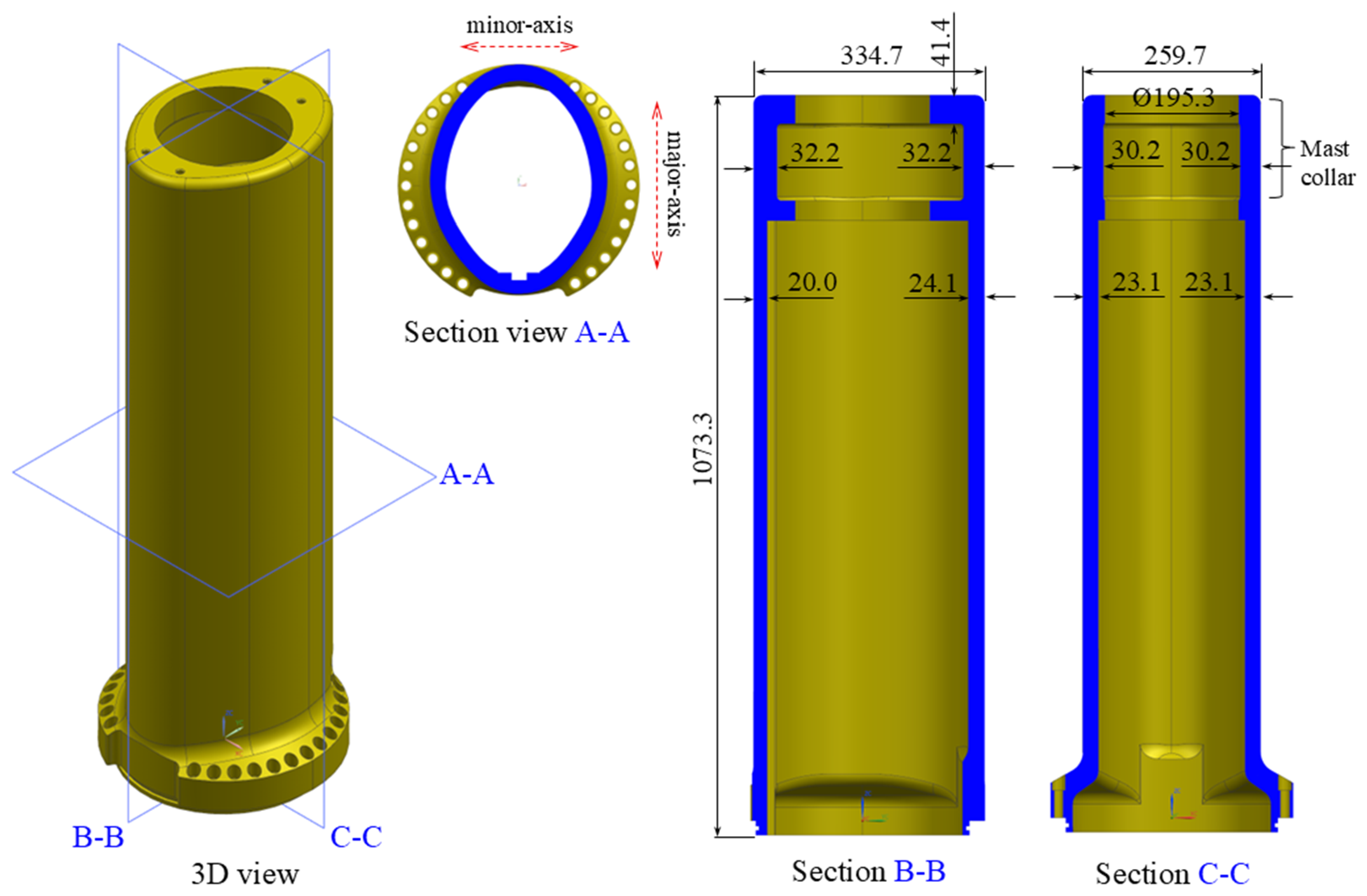
2.1. Geometric Design
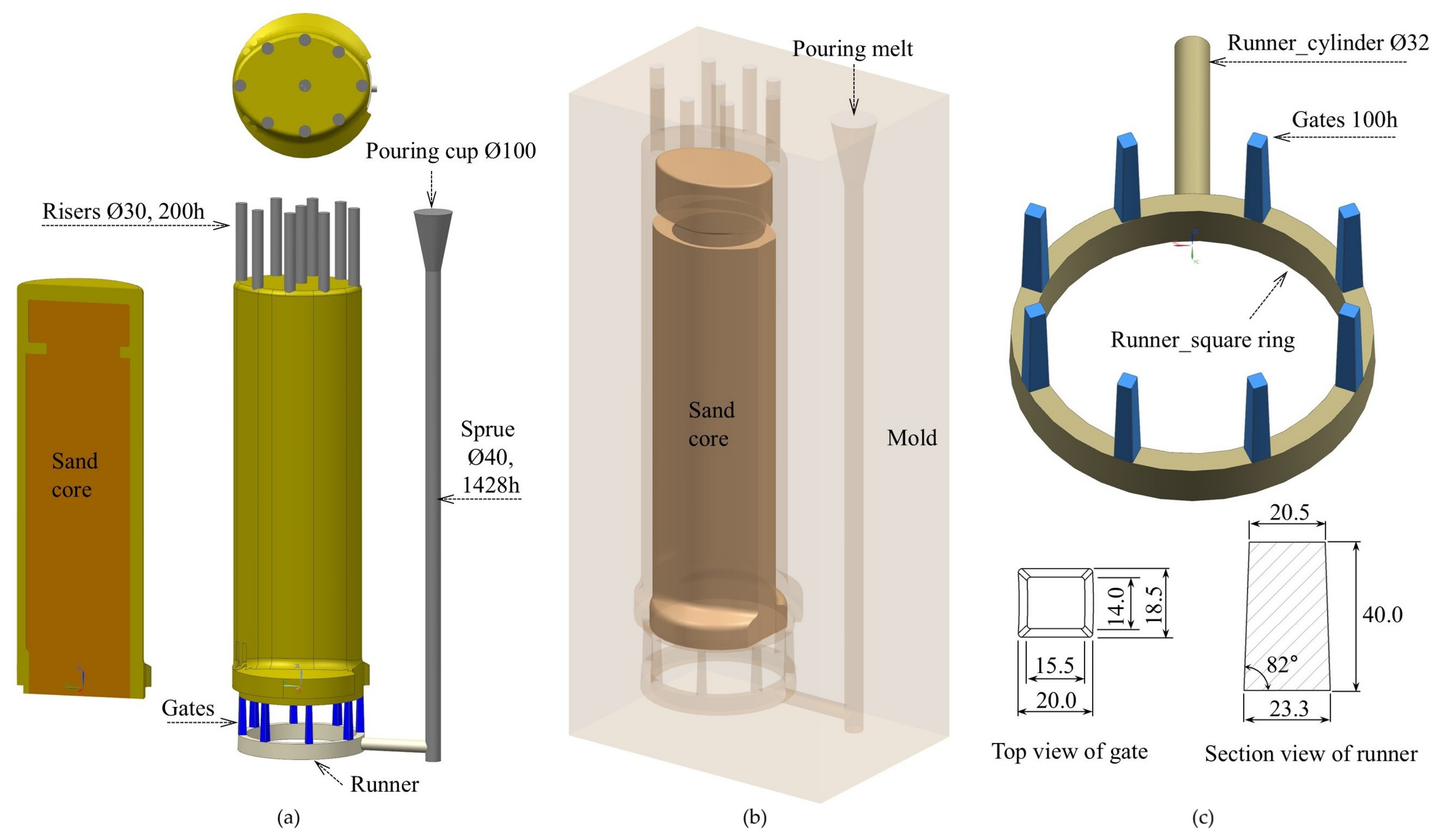
2.2. Casting Process Design
3. Computational Methods and Experimental Conditions
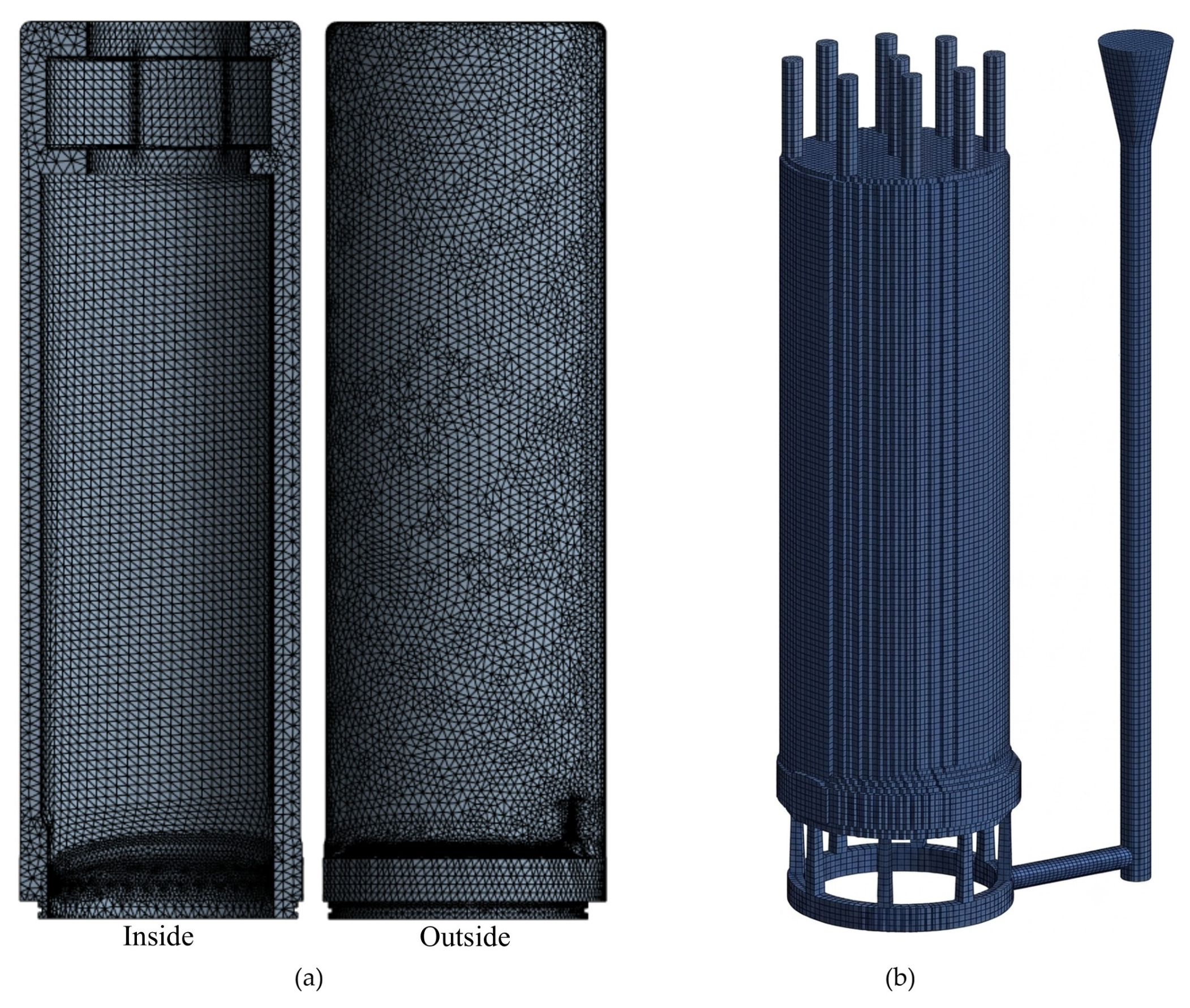
3.1. Structural Analysis
3.2. Casting Process Simulation Setup
3.3. Experimental Conditions for Sand Casting
4. Results and Discussion
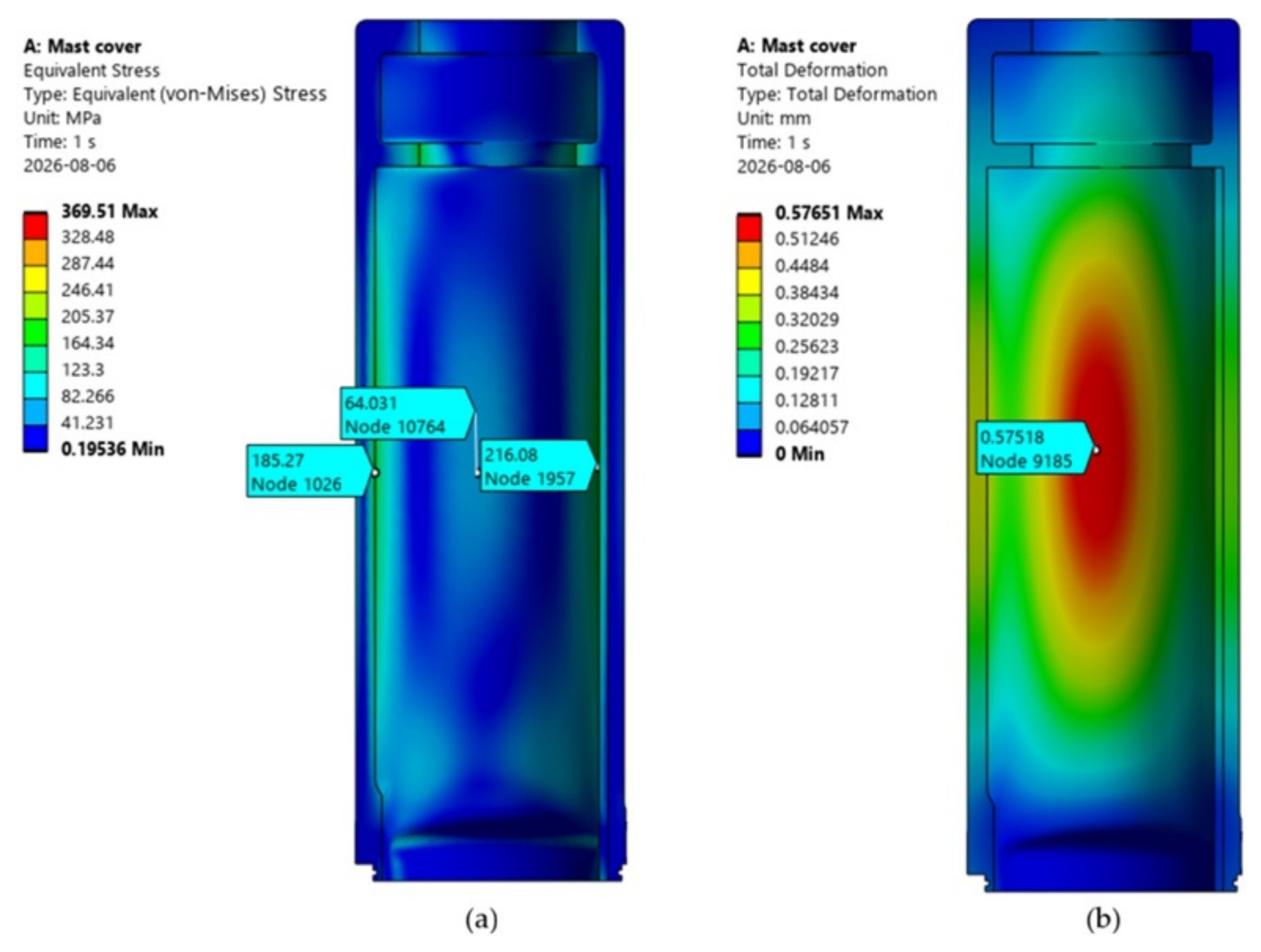
4.1. Structural Analysis
4.2. Casting Process Simulation
4.3. Prototype Sand Casting
5. Conclusions
- (1)
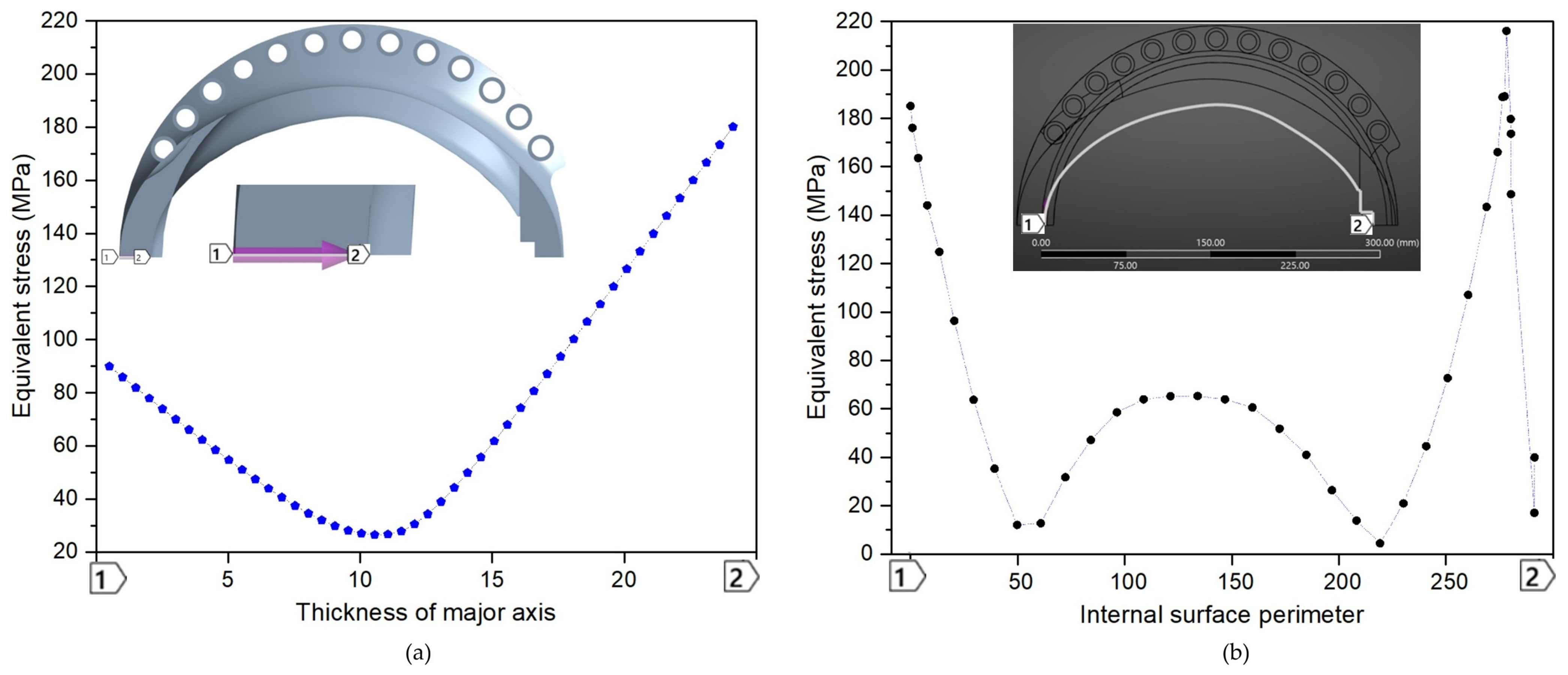
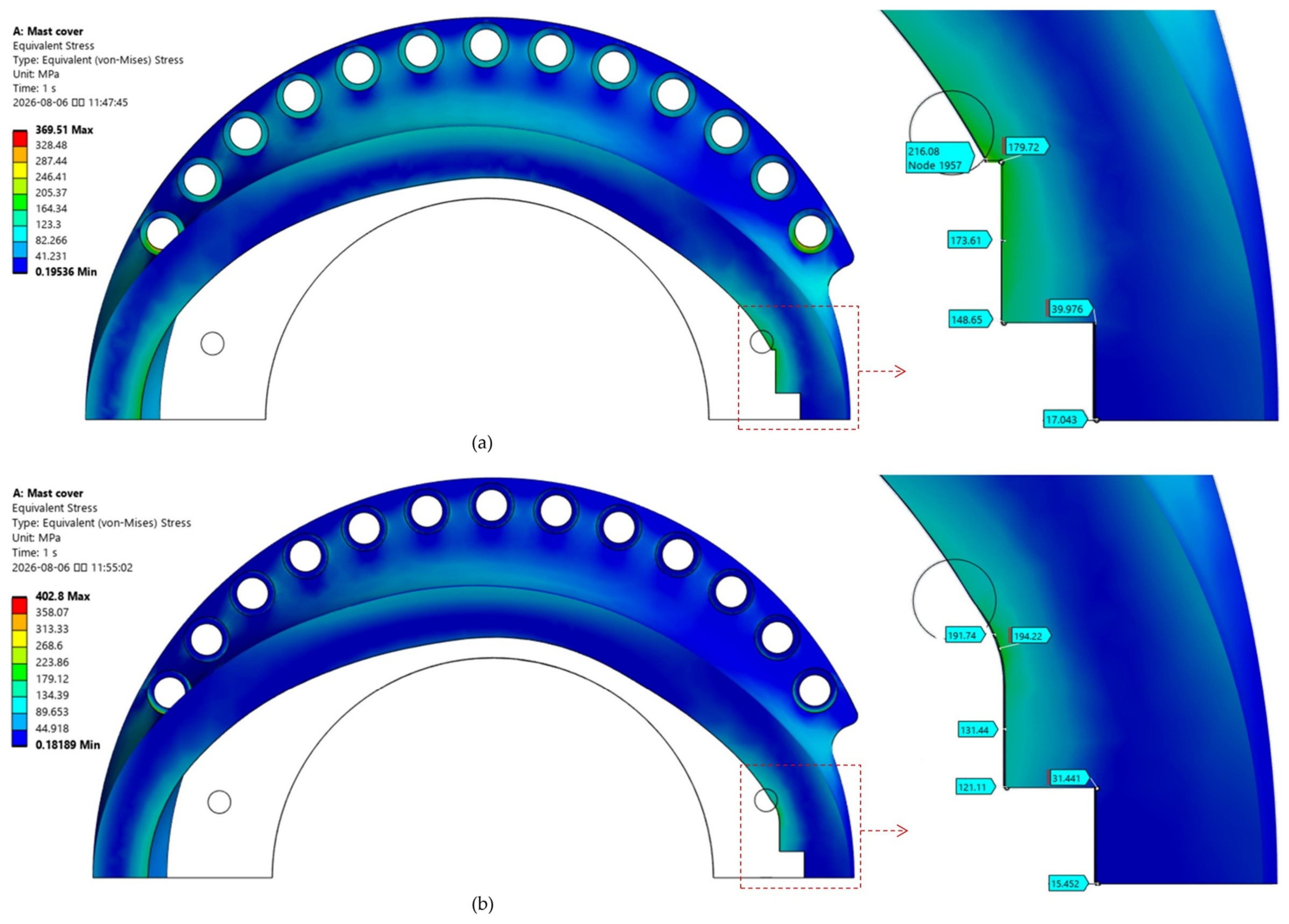
- Under maximum operating hydrostatic pressure (7.0 MPa, 600 m depth), equivalent stress in the mast cover was concentrated along the inner surface of the major-axis elliptical section, reaching a peak stress of 216.0 MPa at a sharp stepped corner. Applying an optimized fillet radius at this stepped region reduced the peak equivalent stress to 194.0 MPa. This secured a safety factor of 2.01 relative to the nominal yield strength (390.0 MPa), confirming that the structure operates strictly within the elastic deformation regime under deep submergence.
- (2)
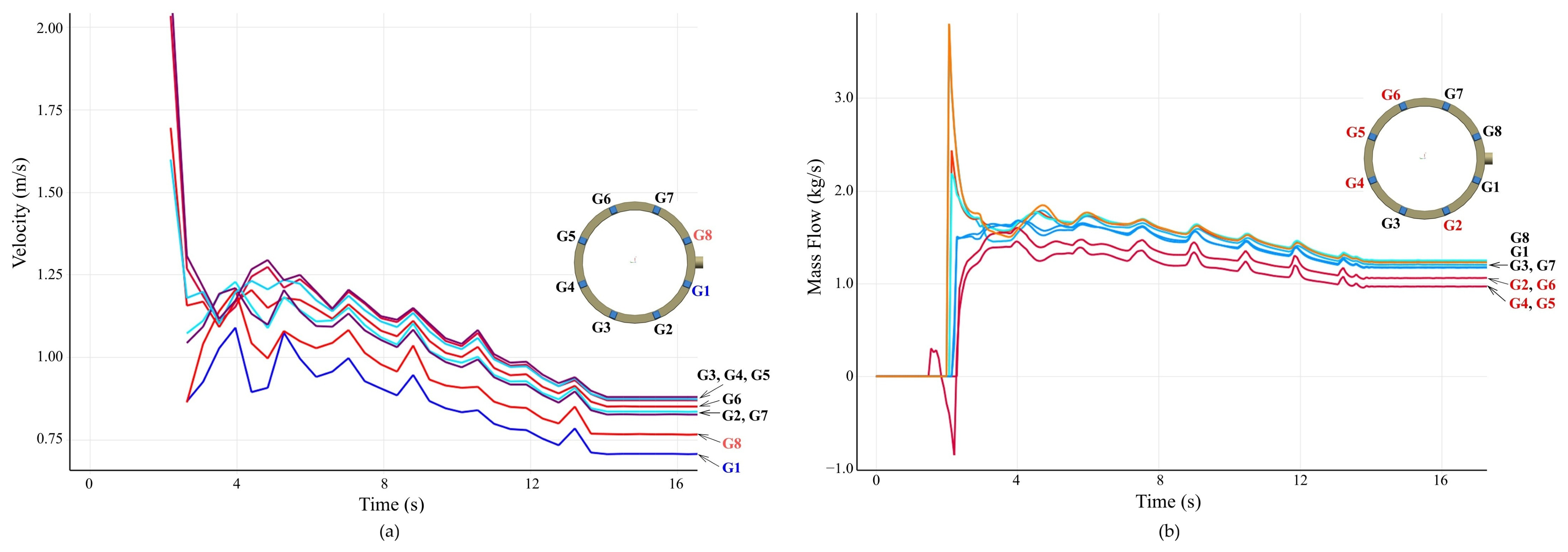
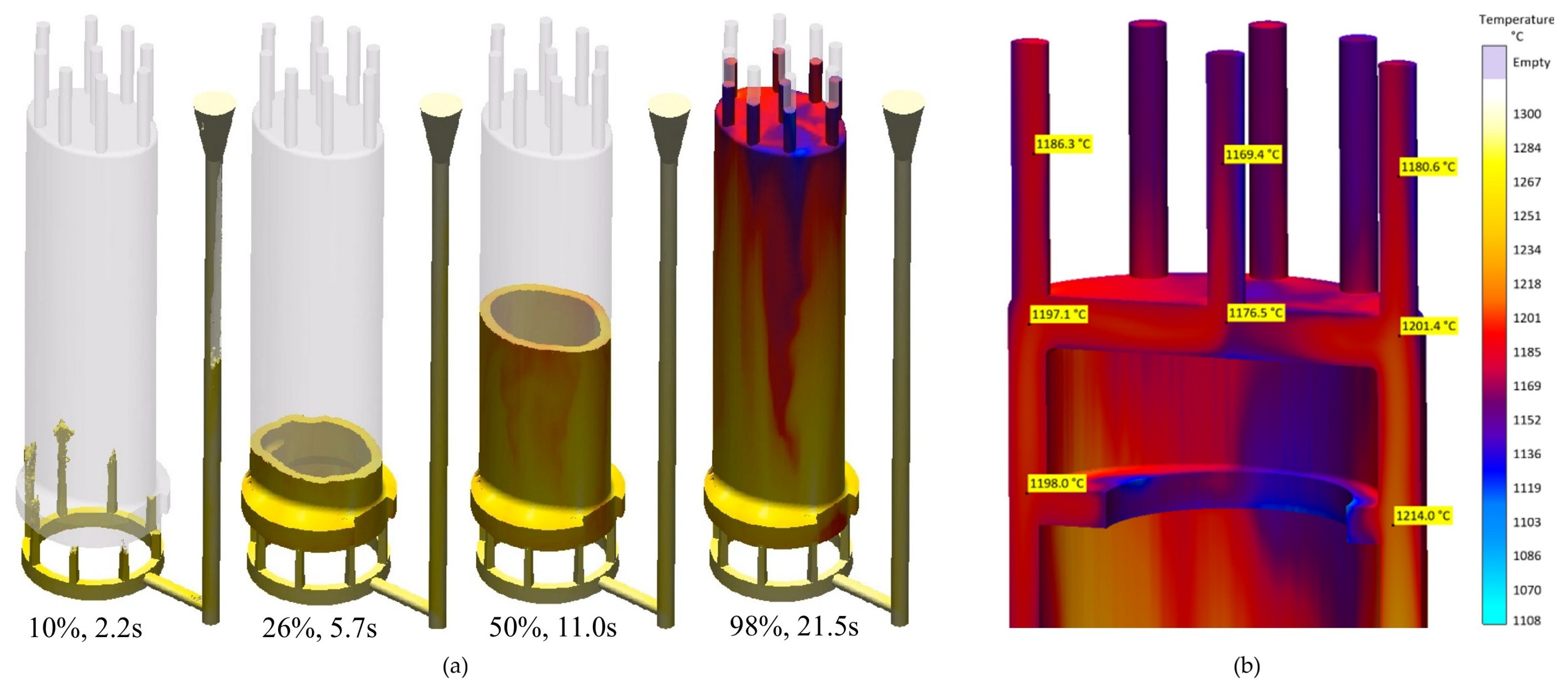
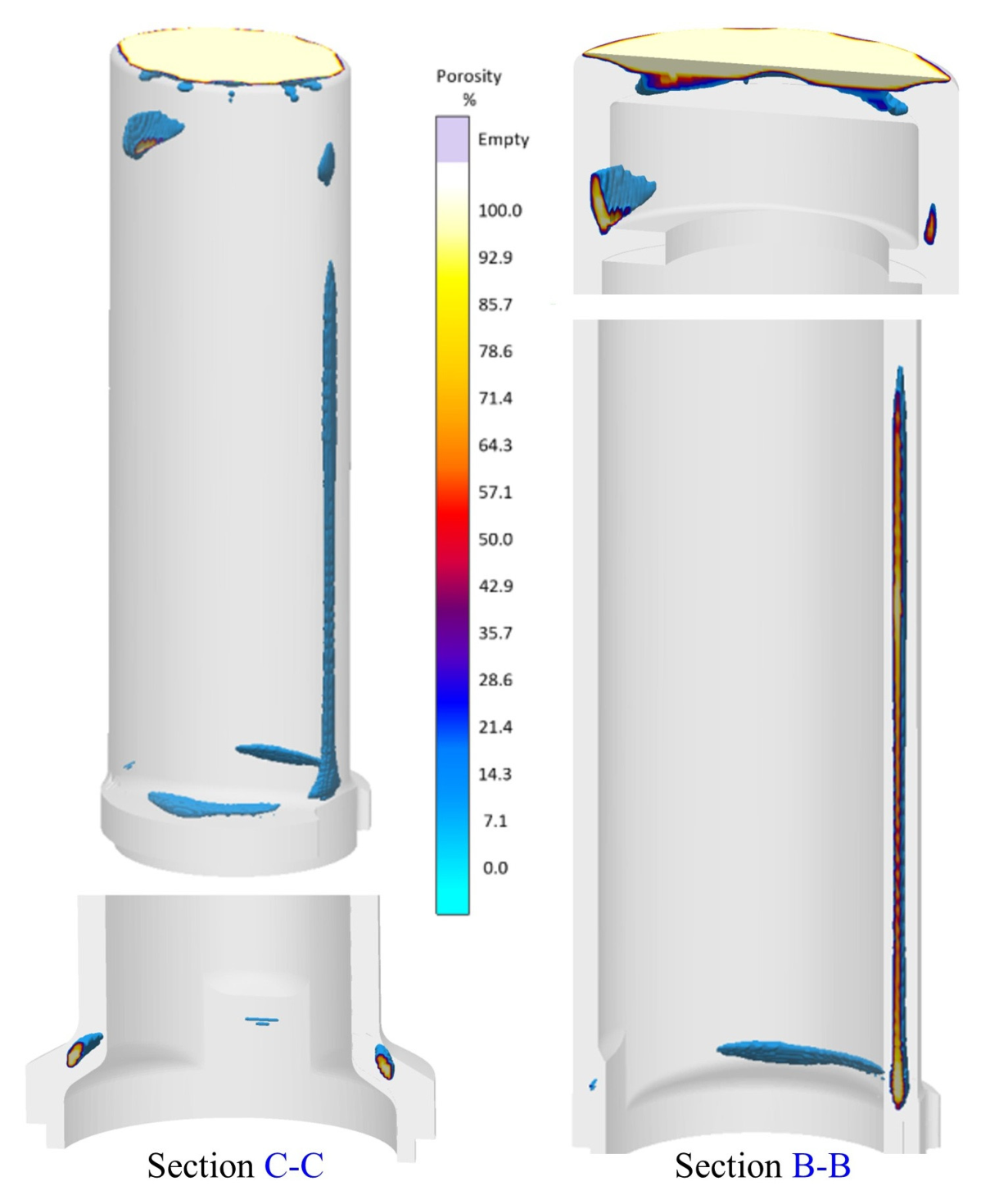
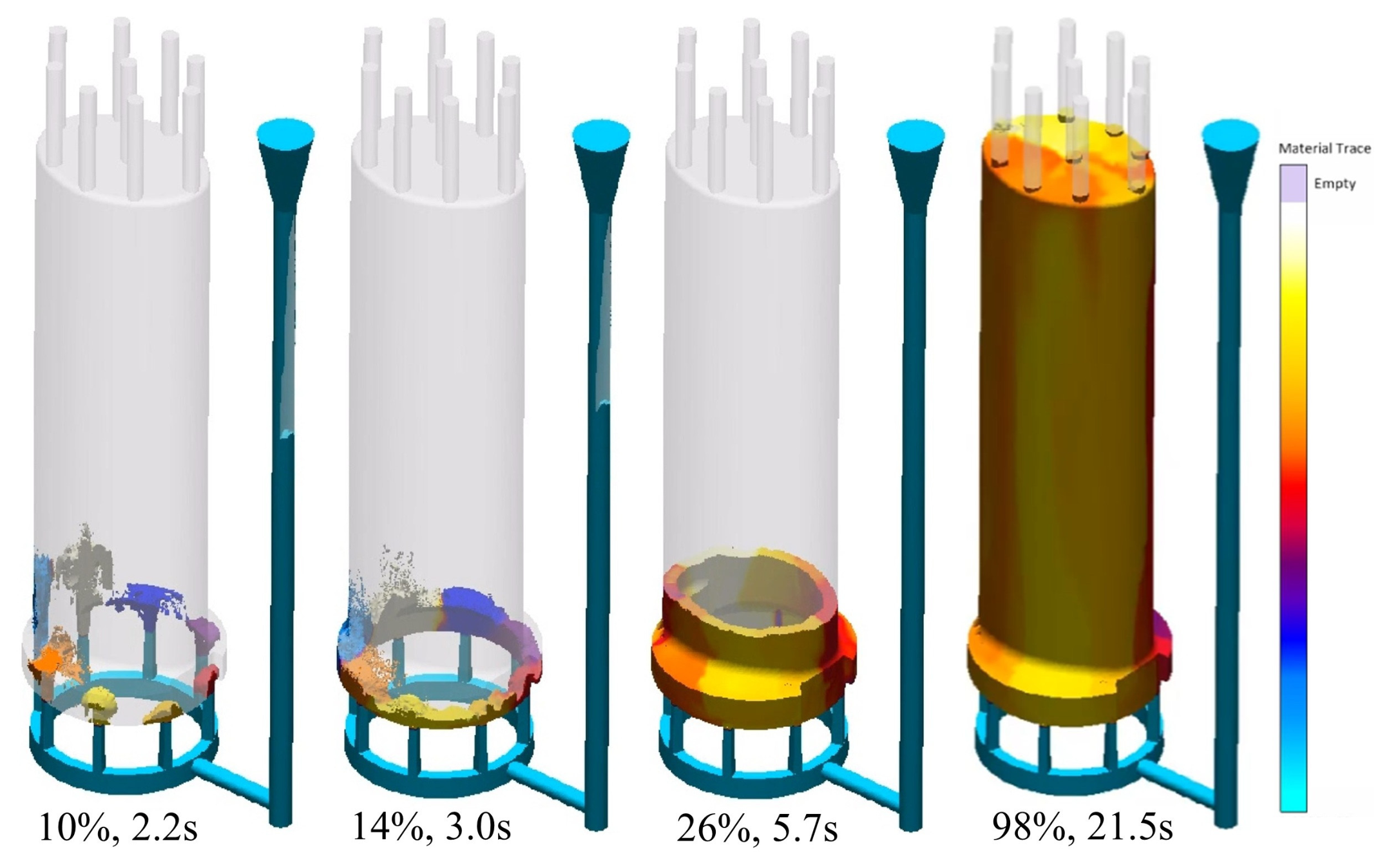
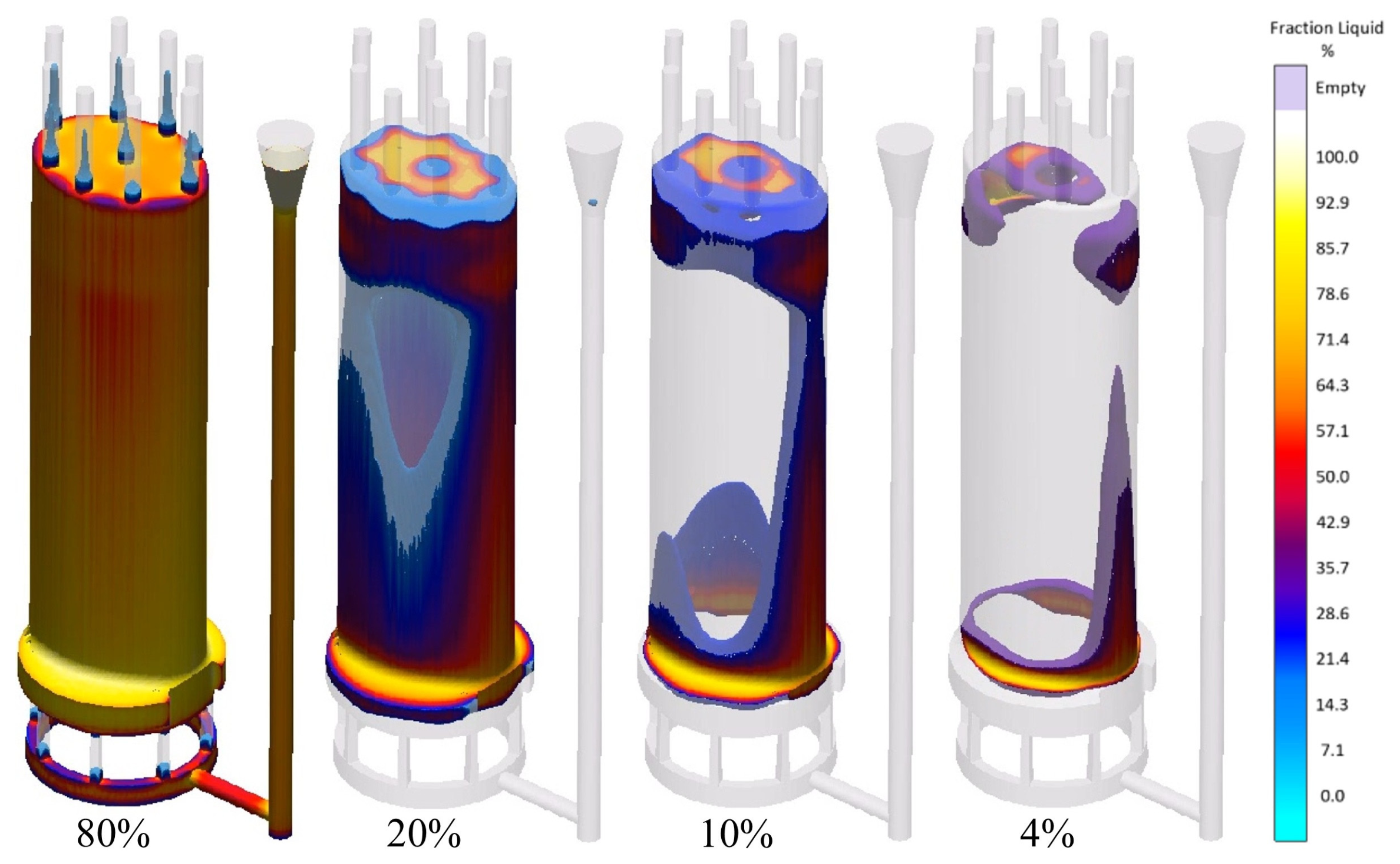
- MAGMA5 fluid flow and solidification simulations confirmed that the unpressurized bottom-gating system (S:R:G = 1.00:2.88:4.80) achieved smooth laminar filling with gate velocities below 1.25 m/s and temperatures above the solidus range (1197~1214 °C), preventing misrun defects. To suppress thermal centers and shrinkage porosity predicted by the simulation, process modifications enlarging the riser diameter from Ø30 mm to Ø60 mm and applying metallic chills at the bottom flange were implemented in the actual casting trial. Remaining porosity (>50%) at the top collar was strategically assigned within the machining allowance (Ø195.3 mm through-hole) and eliminated during post-processing.
- (3)
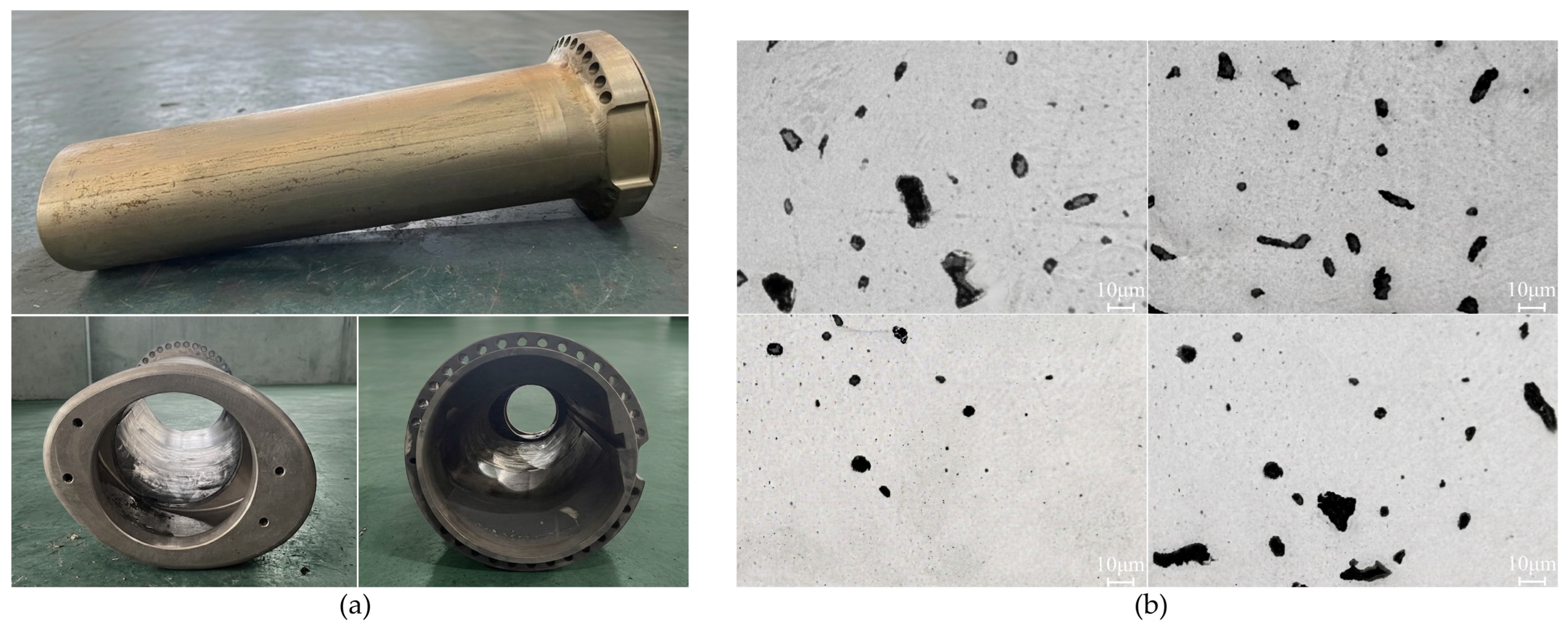
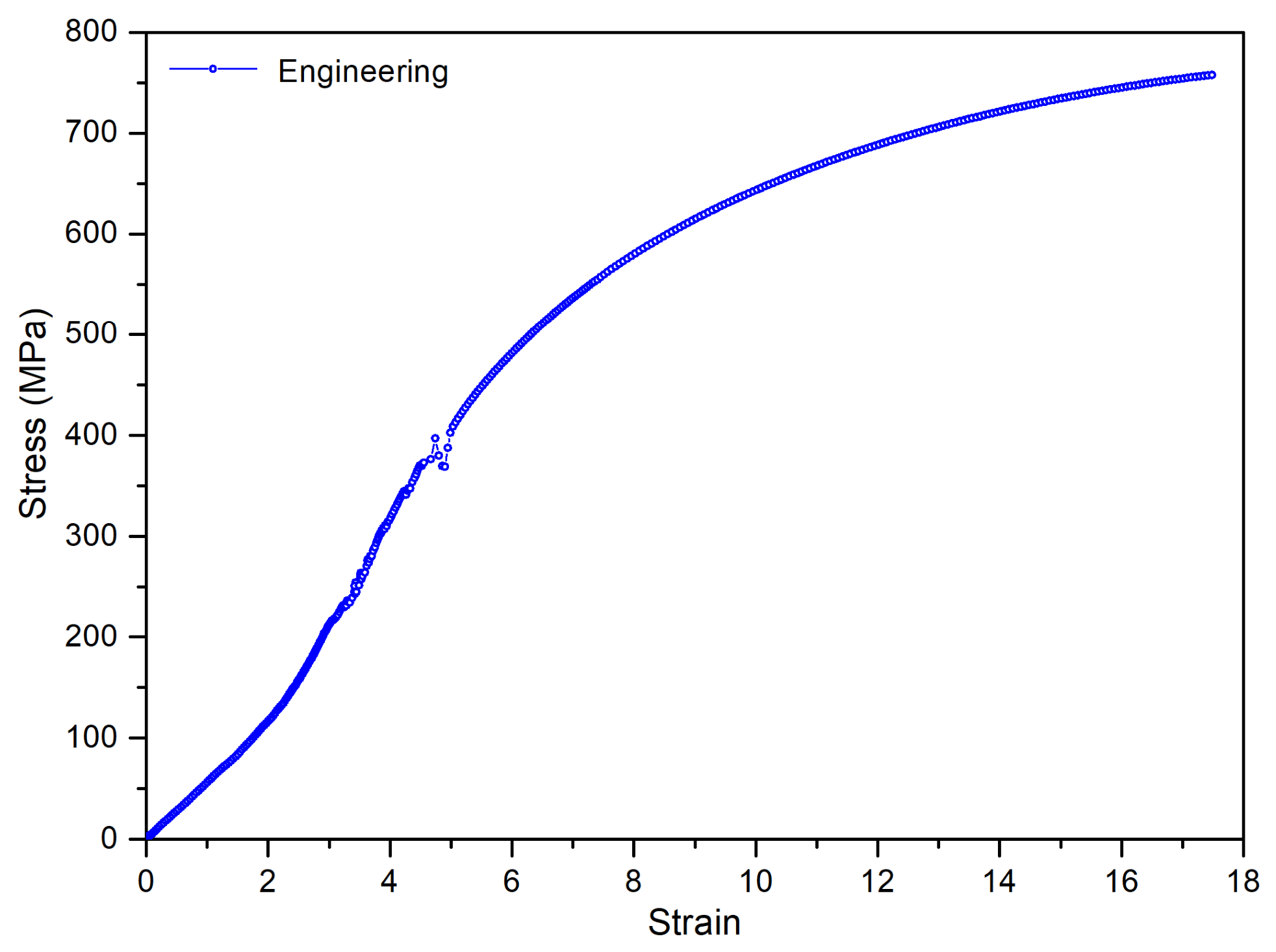
- The full-scale sand-cast NAB prototype fabricated using the modified process parameters demonstrated high dimensional fidelity with the 3D CAD model. Mechanical testing yielded an average yield strength of 392.5 MPa, ultimate tensile strength of 757.8 MPa, elongation of 17.9%, and hardness of 197 HB, fully satisfying and exceeding the ASTM B505 specification requirements.
Funding
Data Availability Statement
Conflicts of Interest
References
- Jones, M.C. Give Credit Where Credit Is Due: The Dutch Role in the Development and Deployment of the Submarine Schnorkel. J. Mil. Hist. 2005, 69, 987–1012. [Google Scholar] [CrossRef] [Scilit]
- Rao, K.C.; Nataraj, D.; Chakradhar, K.S.; Ujwala, G.V.; Sudhir, B.; Lakshmunaidu, M.; Dadi, H.S. An Integrated Dual Antenna for Multi-Band Satellite Communication Applications. Eng. Technol. Appl. Sci. Res. 2025, 15, 23707–23713. [Google Scholar] [CrossRef] [Scilit]
- Conway, A.S.; Ranmuthugala, D.; Renilson, M. The effect of geometry on the surface waves generated by vertical surface–piercing cylinders with a horizontal velocity. Proc. Inst. Mech. Eng. Part M J. Eng. Marit. Environ. 2017, 233, 14–26. [Google Scholar] [CrossRef] [Scilit]
- Smith, M.J.; Macadam, T.; MacKay, J.R. Integrated modelling, design and analysis of submarine structures. Ships Offshore Struct. 2015, 10, 349–366. [Google Scholar] [CrossRef] [Scilit]
- Feng, B.; Feng, C.; Zhong, J.; Zhou, Y. Revolutionizing naval stealth: Advanced composite mast design unveiled. Ships Offshore Struct. 2025, 20, 1–16. [Google Scholar] [CrossRef] [Scilit]
- Mouritz, A.P.; Gellert, E.; Burchill, P.; Challis, K. Review of advanced composite structures for naval ships and submarines. Compos. Struct. 2001, 53, 21–42. [Google Scholar] [CrossRef] [Scilit]
- Liu, Z.; Wang, G.; Rui, X.; Miao, Y.; Wu, G. Analysis of submarine mast vibration response by transfer matrix method for multibody systems. In Proceedings of the 1st International Conference on Mechanical System Dynamics (ICMSD 2022), Nanjing, China, 24–27 August 2022. [Google Scholar] [CrossRef] [Scilit]
- Xu, C.; Peng, Y.; Chen, L.-Y.; Zhang, T.-Y.; He, S.; Wang, K.-H. Corrosion behavior of wire-arc additive manufactured and as-cast Ni-Al bronze in 3.5 wt% NaCl solution. Corros. Sci. 2023, 215, 111048. [Google Scholar] [CrossRef] [Scilit]
- Wang, L.; Liu, K.; Li, J.; Geng, S. A Review on Corrosion Behavior and Surface Modification Technology of Nickel Aluminum Bronze Alloys: Current Research and Prospects. Adv. Eng. Mater. 2025, 27, 2401779. [Google Scholar] [CrossRef] [Scilit]
- Tan, Y.; Xie, H.; Feng, X.; Huang, S.; Zhang, W.; Peng, L.; Wang, W.; Zhao, Y. Effect of Al/Ni Ratio on the Microstructure and Properties of Nickel–Aluminum Bronze Alloys. Materials 2024, 17, 1330. [Google Scholar] [CrossRef] [Scilit] [PubMed]
- Wharton, J.A.; Barik, R.C.; Kear, G.; Wood, R.J.K.; Stokes, K.R.; Walsh, F.C. The corrosion of nickel-aluminum bronze in seawater. Corros. Sci. 2005, 47, 3336–3367. [Google Scholar] [CrossRef] [Scilit]
- Basumatary, H.; Wood, R.J.K. Synergistic effects of cavitation erosion and corrosion for nickel aluminium bronze with oxide film in 3.5% NaCl solution. Wear 2017, 376–377, 1286–1297. [Google Scholar] [CrossRef] [Scilit]
- Campbell, J. Entrainment defects. Mater. Sci. Technol. 2006, 22, 127–145. [Google Scholar] [CrossRef] [Scilit]
- Riedler, M.; Michelic, S.; Bernhard, C. Formation of shrinkage porosity during solidification of steel: Numerical simulation and experimental validation. IOP Conf. Ser. Mater. Sci. Eng. 2016, 143, 012035. [Google Scholar] [CrossRef] [Scilit]
- Kelley, A. Microporosity Formation Analysis of Low-Lead and Leaded Copper Alloys. Master’s Thesis, University of Alabama at Birmingham, Birmingham, Alabama, 2017. All ETDs from UAB. 2120. [Google Scholar]
- Majidi, H.S.; Beckermann, C. Effect of Pouring Conditions and Gating System Design on Air Entrainment During Mold Filling. Int. J. Met. 2019, 13, 255–272. [Google Scholar] [CrossRef] [Scilit]
- Teke, I.T.; Ertaş, A.H. Integrating prestress simulation and literature insights to assess mold design effects in sand-cast components. J. Intell. Manuf. Spec. Equip. 2025, 6, 248–272. [Google Scholar] [CrossRef] [Scilit]
- Liu, J.; Lei, H.; Gao, W.; Liu, H.; Wu, Z.; Pu, Q. Effect of Casting Residual Stress on Fatigue Life of Aluminum Alloy Sub-frame. J. Hunan Univ. Nat. Sci. 2018, 45, 28–34. [Google Scholar] [CrossRef]
- Hsu, C.Y.; Liang, C.C.; Shiah, S.W.; Jen, C.Y. A study of stress concentration effect around penetrations on curved shell and failure modes for deep-diving submersible vehicle. Ocean Eng. 2005, 32, 1098–1121. [Google Scholar] [CrossRef] [Scilit]
- Vernengo, G.; Gaggero, S.; Villa, D.; Mazzarello, G.; Gualeni, P. Free surface hydrodynamics of submarine masts configurations. Prog. Mar. Sci. Technol. 2022, 6, 271–278. [Google Scholar] [CrossRef] [Scilit]
- Jeyamohan, K.; Bandara, C.S.; Jayasinghe, J.A.S.C. Vortex Shedding-Induced Fatigue Analysis for High-Mast Lighting Towers. In 12th International Conference on Structural Engineering and Construction Management; Dissanayake, R., Mendis, P., Weerasekera, K., De Silva, S., Fernando, S., Konthesingha, C., Eds.; Springer: Singapore, 2022. [Google Scholar]
- Khan, M.K.; Nagarajan, V.; Sha, O.P. Steady and dynamic load measurements over a generic submarine hull form with various appendage configurations. Proc. Inst. Mech. Eng. Part M 2025, 239, 577–607. [Google Scholar] [CrossRef] [Scilit]
- Zhang, T.; Wang, B.; Wu, W.; Chu, Y. Numerical analysis of post-cyclic ultimate bearing capacity of helical anchors in clay. Ocean Eng. 2026, 352, 124583. [Google Scholar] [CrossRef] [Scilit]
- Wang, L.; Zhang, L.; Chen, H.; Zhang, T.; Yi, J.; Zhang, J.; Zhou, T.; Chen, L.; Xu, Y.; Tian, Y.; et al. Combined effects of anchor geometry and soil spatial variability on the probabilistic pullout capacity of helical anchors. Comput. Geotech. 2026, 200, 108482. [Google Scholar] [CrossRef] [Scilit]
- Bekele, B.T.; Bhaskaran, J.; Tolcha, S.D.; Gelaw, M. Simulation and experimental analysis of re-design the faulty position of the riser to minimize shrinkage porosity defect in sand cast sprocket gear. Mater. Today Proc. 2022, 59, 598–604. [Google Scholar] [CrossRef] [Scilit]
- Mohamad, M.; Amroune, S.; Miri, R.; Benchekkour, A.; Galoyan, K. Design Optimization Methodology of Submarine Using Multilevel Numerical CFD Models. FME Trans. 2025, 53, 280–288. [Google Scholar] [CrossRef] [Scilit]
- Niu, S. Ellipse phenomenon and oval phenomenon found in fault diagnoses of tower-mast structures and experimental verification. Structures 2023, 57, 105135. [Google Scholar] [CrossRef] [Scilit]
- Choi, W.S.; Chang, H.S.; Lee, Y.S.; Kim, S.I. A Study on Improvement of Submarine Attack Periscope Operation Performance using Installing Protector on Sail. J. Korea Acad.-Ind. Cooper. Soc. 2021, 22, 199–206. [Google Scholar] [CrossRef]
- Mashiri, F.R.; Zhao, X.L.; Grundy, P. Stress concentration factors and fatigue behaviour of welded thin-walled CHS–SHS T-joints under in-plane bending. Eng. Struct. 2004, 26, 1861–1875. [Google Scholar] [CrossRef] [Scilit]
- ASTM B505/B505M-18; Standard Specification for Copper-Alloy Sand Castings for General Applications (UNS C95800 Nickel-Aluminum Bronze). ASTM International: West Conshohocken, PA, USA, 2018.
- Campbell, J. Complete Casting Handbook: Metal Casting Processes, Techniques and Design, 2nd ed.; Butterworth-Heinemann: Oxford, UK, 2015; pp. 615–650. ISBN 9780444635099. [Google Scholar]
- Ravi, B. Metal Casting: Computer-Aided Design and Analysis; PHI Learning Pvt. Ltd.: New Delhi, India, 2010; pp. 1–120. ISBN 9788120327269. [Google Scholar]
- MatWeb Material Property Data. Nickel Aluminum Bronze; UNS C95800; MatWeb LLC: Blacksburg, VA, USA, 2024. [Google Scholar]
- Cadet, G.; Paredes, M. Convergence analysis and mesh optimization of finite element analysis related to helical springs. Mech. Ind. 2024, 25, 22. [Google Scholar] [CrossRef] [Scilit]
- Burcher, R.; Rydill, L. Concepts in Submarine Design; Cambridge University Press: Cambridge, UK, 1994; pp. 120–145. [Google Scholar] [CrossRef] [Scilit]
- Kotschi, R.M.; Loper, C.R., Jr. Design of t and x sections for castings. AFS Trans. 1974, 82, 535–542. [Google Scholar]
- Voller, V.R.; Prakash, C. A fixed grid numerical modelling methodology for convection-diffusion musky region phase change problems. Int. J. Heat Mass Transf. 1987, 30, 1709–1719. [Google Scholar] [CrossRef] [Scilit]
- Szeliga, D.; Kubiak, K.; Ziaja, W.; Cygan, R.; Suchy, J.S.; Burbelko, A.; Nowak, W.J.; Sieniawski, J. Investigation of casting–ceramic shell mold interface thermal resistance during solidification process of nickel based superalloy. Exp. Therm. Fluid Sci. 2017, 87, 149–160. [Google Scholar] [CrossRef] [Scilit]
- JIS Z 2241:2011; Japanese Industrial Standards of Metallic Materials Tensile Testing Method of Test at Room Temperature. Japanese Standards Association: Tokyo, Japan, 2011.







| Mechanical Property | Density | Young’s modulus | Poisson’s ratio | Yield strength |
| 7.58 g/cm3 | 115 GPa | 0.328 | 390 MPa | |
| Mesh | Number of meshes | Number of nodes | ||
| 152,964 | 249,091 | |||
| Boundary condition | Load | Support | ||
| Static pressure 7.0 MPa | Fixed support at 26 bolt holes | |||
| Property | CuAl10Ni | Standard NAB |
|---|---|---|
| Density | 7.60 g/cm3 | 7.64 g/cm3 |
| Thermal conductivity (20 °C) | 36.5 W/m·K | 36.0 W/m·K |
| Thermal expansion coefficient (20~300 °C) | 16.2 μm/m·°C | 16.2 μm/m·°C |
| Specific heat capacity | 435 J/kg·K | 439 J/kg·K |
| Liquidus temperature | 1108 °C | 1060 °C |
| Solidus temperature | 1070 °C | 1040 °C |
| Material | Casting | Mold | ||||
| CuAl10Ni | Furan | |||||
| Heat transfer coefficient | Casting to mold | Mold and environment | ||||
| 8000 W/(m2·K) | 1000 W/(m2·K) | |||||
| Mesh | Number of metal cells | Number of control volumes | ||||
| 484,585 | 5,320,510 | |||||
| Boundary condition | Initial Pouring Temperature | Initial Mold Temperature | ||||
| 1300 °C | 20 °C | |||||
| Filling method | Inlet diameter | Filling time | ||||
| Gravity pouring | 100 mm | 22 s | ||||
| Al | Ni | Fe | Mn | Si | Pb | Cu | Liquidus Temperatures | Solidus Temperatures |
|---|---|---|---|---|---|---|---|---|
| 8.91 | 4.45 | 4.04 | 1.17 | 0.04 | 0.02 | Bal. | 1070 °C | 1010 °C |
| Yield Strength | Ultimate Tensile Strength | Elongation | Hardness |
|---|---|---|---|
| 392.5 ± 10 MPa | 757.8 ± 12 MPa | 17.9 ± 3% | 197 ± 17 HB |
Disclaimer/Publisher’s Note: The statements, opinions and data contained in all publications are solely those of the individual author(s) and contributor(s) and not of MDPI and/or the editor(s). MDPI and/or the editor(s) disclaim responsibility for any injury to people or property resulting from any ideas, methods, instructions or products referred to in the content. |
© 2026 by the author. Licensee MDPI, Basel, Switzerland. This article is an open access article distributed under the terms and conditions of the Creative Commons Attribution (CC BY) license.
Share and Cite
Jin, C.K. Sequential Structural and Casting Simulation Approach for the Fabrication of Ni–Al–Bronze Submarine Mast Cover. Metals 2026, 16, 1044. https://doi.org/10.3390/met16091044
Jin CK. Sequential Structural and Casting Simulation Approach for the Fabrication of Ni–Al–Bronze Submarine Mast Cover. Metals. 2026; 16(9):1044. https://doi.org/10.3390/met16091044
Chicago/Turabian StyleJin, Chul Kyu. 2026. "Sequential Structural and Casting Simulation Approach for the Fabrication of Ni–Al–Bronze Submarine Mast Cover" Metals 16, no. 9: 1044. https://doi.org/10.3390/met16091044
APA StyleJin, C. K. (2026). Sequential Structural and Casting Simulation Approach for the Fabrication of Ni–Al–Bronze Submarine Mast Cover. Metals, 16(9), 1044. https://doi.org/10.3390/met16091044