Article

Liquid–Vapour Phase Transition and Thermodynamics of Antimony–Sodium Alloys

Institute of Metallurgy and Ore Beneficiation, Satbayev University, 050010 Almaty, Kazakhstan
*
Author to whom correspondence should be addressed.
Metals 2026, 16(9), 1036; https://doi.org/10.3390/met16091036 (registering DOI)
Submission received: 14 July 2026 / Revised: 15 September 2026 / Accepted: 16 September 2026 / Published: 18 September 2026

Abstract

Crude antimony containing 8–9 wt.% sodium and, in some cases, up to 25–26 wt.% sodium is obtained during the carbothermic reduction of sodium antimonate through crucible smelting. The boundaries of vapour–liquid equilibrium on the Sb–Na phase diagram were constructed to assess the possibility of using distillation processes to refine crude antimony from sodium. The boundaries of the liquid–vapour phase transitions were calculated at atmospheric pressure and under vacuum conditions (133 Pa). The presence of the incongruently evaporating compound Na3Sb makes it possible to divide the binary Sb–Na system into two quasi-binary systems: Sb–Na3Sb and Na3Sb–Na. In this study, we established that the separation of antimony and sodium (the Sb–Na3Sb system) using distillation at atmospheric pressure is technically difficult because of the high boiling temperatures of the melts in the Sb–Na3Sb system (1635–2617 °C) and the very narrow temperature range of the vapour–liquid equilibrium field under vacuum. Molten sodium and trisodium antimonide (the Na3Sb–Na system) can be separated both at atmospheric pressure and under vacuum when the sodium concentration in antimony exceeds 90 at.% Na (approximately 63 wt.%). However, the first case requires temperatures of up to 1570 °C, whereas vacuum conditions require a temperature of approximately 600 °C. Under these conditions, the vapour phase will consist of almost pure sodium, while antimony will accumulate in the still residue in the form of Na3Sb. In this paper, we also present calculated thermodynamic functions, namely, the entropies and enthalpies of mixing and evaporation of antimony–sodium melts, which will supplement the existing database of physicochemical data.

1. Introduction

Experts predict that antimony, which belongs to the group of relatively rare metals, will become one of the most scarce by the middle of the century [1,2]. To address this concern, the authors of recent studies have focused on the recovery of antimony from industrial by-products of metallurgical production, in particular, sodium antimonate [3,4,5,6,7,8], which is generated during antimony extraction in the process of refining crude lead [9].
Carbothermic reduction is, from a technical standpoint, the simplest process for extracting antimony from this raw material. However, the highly reducing atmosphere produces crude antimony with a sodium content of up to 8–9 wt.%; in some cases, when smelting is performed in closed graphite crucibles, the sodium content of antimony can reach 25–26 wt.%. Therefore, refining crude antimony to remove sodium impurities presents a major challenge.
A vacuum distillation process may represent one potential method to separate such a system into metals, since the saturated vapour pressures of antimony and sodium at the boiling point of the latter (1166 K) differ by two orders of magnitude, 379 and 101,325 Pa, respectively [10]. Such separation can be assessed theoretically based on the positions of the vapour–liquid equilibrium boundaries on the phase diagram of the Sb–Na system. The boiling temperatures of alloys and the corresponding vapour-phase compositions, which represent the phase-transition boundaries, are calculated for molten metallic systems based on vapour-pressure values above melts of different compositions. Temperature–concentration dependences of the partial saturated vapour pressures of the components are used to determine these boundaries. No such dependences have been found for the antimony–sodium system.
Relatively few research groups have conducted thermodynamic investigations of the antimony–sodium system over the past century, as evidenced by the following works [11,12,13,14,15,16,17,18,19,20]. In some studies [14,18], the authors determined sodium activities by measuring the electromotive forces of concentration cells. These activities can be used to calculate the partial saturated vapour pressure of sodium and the thermodynamic functions of formation of intermetallic compounds. In another study [13], the authors determined the vapour pressure using a Knudsen effusion cell. The above works are characterised by very low thermodynamic activity values, indicating interaction between sodium particles and antimony. The method of recording polarisation curves in pulsed galvanostatic mode was employed in [17] to determine the thermodynamic properties of sodium–antimony compounds formed from the pure components.
In a previous study [20], the Sb–Na binary system was optimised based on published experimental data, including thermochemical properties and phase equilibrium. A very significant deviation from the law of ideal solutions and a sharp change in the curvature of the liquidus line around the Na3Sb intermetallic compound were noted.
Data published to date remain insufficient to calculate the boundaries of the liquid–vapour phase transition. In this regard, based on the available experimental data, we determined polynomial dependencies for the activity coefficients of antimony and sodium over the entire range of component concentrations. We subsequently determined the temperature–concentration dependencies of the partial vapour pressures of antimony and sodium to establish the boundaries of the liquid–vapour (L + V) field and calculate the thermodynamic functions of formation and evaporation of liquid alloys in the Sb–Na system.

2. Calculation Methods

The boiling temperature of alloys was taken as the temperature at which the total saturated vapour pressure of the components of the binary system is equal to atmospheric pressure (101,325 Pa) or another pressure (0.133–2.667 kPa) assumed for a technological vacuum process. We determined the composition of the vapour phase, namely, the concentrations of sodium y N a and antimony y S b over the melts at the boiling temperature of a melt with a specified component ratio, as the ratio of the partial pressure of sodium or antimony to the total vapour pressure over the melt: y N a ( S b ) [ m o l e f a c t i o n ] = p ¯ N a ( S b ) / ( p ¯ N a + p ¯ S b ) , where p ¯ N a is the partial vapour pressure of sodium, Pa, and p ¯ S b is the partial vapour pressure of antimony, Pa.
To calculate the temperature–concentration dependence of the partial vapour pressure of sodium on the alloy composition, experimental data from studies [14,20] were used. The calculation methodology was as follows. As the temperature dependence of the vapour pressure in the ln p ¯ N a T 1 coordinates is linear, the values of the partial vapour pressures of saturated sodium vapour in alloys of the same concentration at different temperatures were described using the following equation: ln p ¯ N a = B + A × T 1 . Thereafter, the values of coefficients A and B for each alloy were approximated using polynomial function of the sodium concentration in the original alloy. As a result, an empirical temperature–concentration relationship for the sodium vapour pressure ln p ¯ N a = f ( T , x N a ) was obtained, depending on its concentration in the alloy. Here, T is the temperature, K, and x N a is the mole fraction of sodium in the alloy.
The partial vapour pressure of antimony over an antimony–sodium alloy was determined as follows: p ¯ S b = p S b o × a S b = p S b o × γ S b × x S b , where p S b o is the saturated vapour pressure over elemental antimony; a S b is the activity of antimony in the alloy; γ S b is the activity coefficient of antimony; and x S b is the concentration of antimony in the alloy, equal to x S b = 1 x N a .
The activity coefficient of antimony was calculated by numerical integration of the Gibbs–Duhem equation using the auxiliary function α N a = ln γ N a / x S b 2 proposed by Darken [21]. After transformation [22] and substitution into the equation ln γ S b = ln γ N a a t x N a = 1 ln γ N a a t x N a x N a x S b d ln γ N a , this function relates ln γ N a and ln γ S b in a form convenient for numerical integration: ln γ S b = ln γ N a × x N a × x S b x S b 2 + x N a = 0 x N a ln γ N a ( 1 x N a ) 2 d x N a .
The vapour pressures of the components of the quasi-binary systems (i and j) identified during the study were calculated in a similar manner.
The energy functions of alloy formation were determined from the following dependence: Δ G ¯ i ( j ) M = R T ln a i ( j ) , where Δ G ¯ i ( j ) M is the partial Gibbs energy of mixing of components i and j; ai(j) is the thermodynamic activity of components i and j in their alloys. ai(j) was determined as the ratio of the partial pressure of components i and j over the alloy to the vapour pressure over the pure element or compound at the same temperature: a i ( j ) = p ¯ i ( j ) / p i ( j ) o . Based on this dependence, the partial entropy of mixing of the alloy ( Δ S ¯ i ( j ) M ): Δ G ¯ i ( j ) M T P = Δ S ¯ i ( j ) M was determined, followed by the enthalpy of mixing ( Δ H ¯ i ( j ) M ): Δ H ¯ i ( j ) M = Δ G ¯ i ( ) M + T × Δ S ¯ i ( j ) M .
We calculated the integral values of the entropy and enthalpy of mixing by summing the fractional contributions of the partial functions in the initial alloy: Δ S i j M = x i Δ S ¯ i M + x j Δ S ¯ j M and Δ H ¯ i j M = x i Δ H ¯ i M + x j Δ H ¯ j M .
The partial evaporation functions were determined according to the following relationship: Δ G ¯ i ( j ) V = R T ln p ¯ i ( j ) , where Δ G ¯ i ( j ) V is the partial Gibbs energy of evaporation of components i and j. Hence, Δ G ¯ i ( j ) V T P = Δ S ¯ i ( j ) V , Δ H ¯ i ( j ) V = Δ G ¯ i ( j ) V + T × Δ S ¯ i ( j ) V , where Δ S ¯ i ( j ) V and Δ H ¯ i ( j ) V are the partial values of the entropy and enthalpy of evaporation of components i and j.
We calculated the integral thermodynamic functions of evaporation of the quasi-binary systems in the same manner as the corresponding functions during solution formation.

3. Results and Discussion

The experimental data from previous work [14] in the range 0 < x N a < 0.5 were used to calculate the partial pressure values of sodium, with minor adjustment to the activity values at sodium concentrations approaching zero. This adjustment was necessary because, at x N a = 0, the sodium activities at 850 K and 950 K were 3.02 × 10⁻⁶ and 7.26 × 10⁻⁶, respectively, whereas they should be identical and equal to zero.
In addition, based on the optimised data from previous work [20], the Gibbs free energy of formation of Na3Sb at 900 K was found to be –46.5 kJ/mol. When an intermetallic compound is present in a binary system, the activities of the first and second components intersect at one point, and the composition of the alloy at this point corresponds to the stoichiometry of the intermetallic compound, as occurs, for example, in ref. [23] for the Sb–Mg system. This approach makes it possible to calculate the activity of sodium at x N a = 0.75: Δ G N a S b M = x N a × Δ G ¯ N a M + x × Δ G ¯ S b M = R T ( 0.75 ln a N a + 0.25 ln a S b ) . At the point of intersection, where a N a = a S b = a and Δ G N a S b M = R T ln a = 46,500 J/mol, the sodium activities were determined to be 1.39 × 10⁻⁴ at 850 K and 2.77 × 10⁻³ at 950 K. These values made it possible to accurately describe sodium activities over the entire concentration range of the Na–Sb system.
When sodium activities were approximated by polynomials, followed by determination of the activity coefficients of antimony and the values of the partial vapour pressures of sodium and antimony, the latter were described using the following expressions:
ln p ¯ N a [ P a ] = ( 109,983 x N a 4 209,808 x N a 3 + 109,039 x N a 2 + 613 x N a 22,011 ) × T 1 23.42 x N a 4 + + 59.859 x N a 3 21.248 x N a 2 17.679 x N a + 24.463 + ln x N a
ln p ¯ S b [ P a ] = ( 109,983 x S b 4 376,768 x S b 3 + 484,699 x S b 2 308,225 x S b + 73,556 + 29,199 ln x S b ) × T 1 23.42 x S b 4 + 65.048 x S b 3 32.922 x S b 2 61.34 x S b + 72.942 + 26.722 ln x S b
The activity values determined in experiments [14,18] and calculated by our group using the approximating dependencies are presented in Table 1.
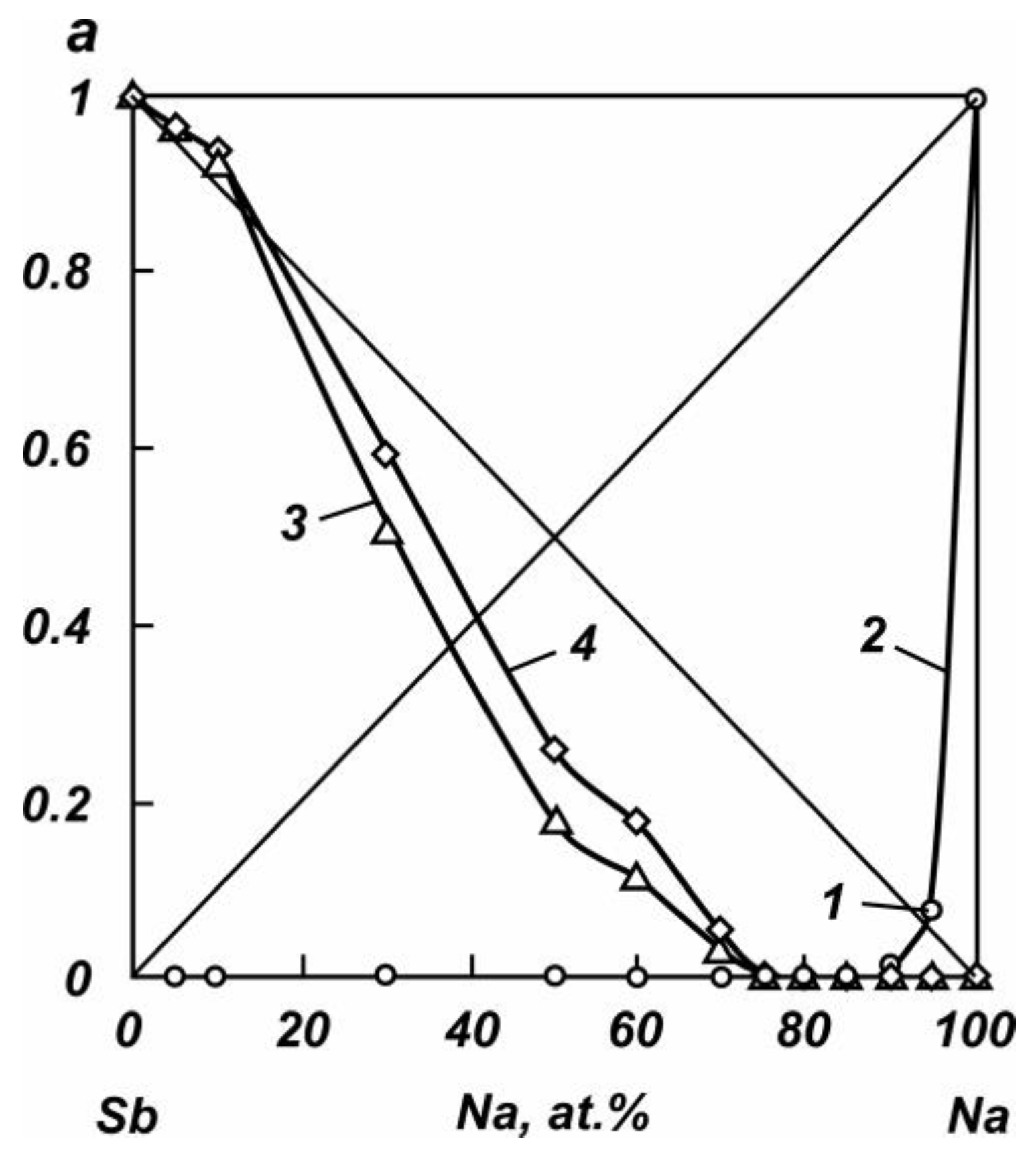
From the data presented in Table 1, it is clear that the values obtained by approximation differ from the experimental data only in the fourth or fifth decimal place, indicating a fairly accurate agreement.
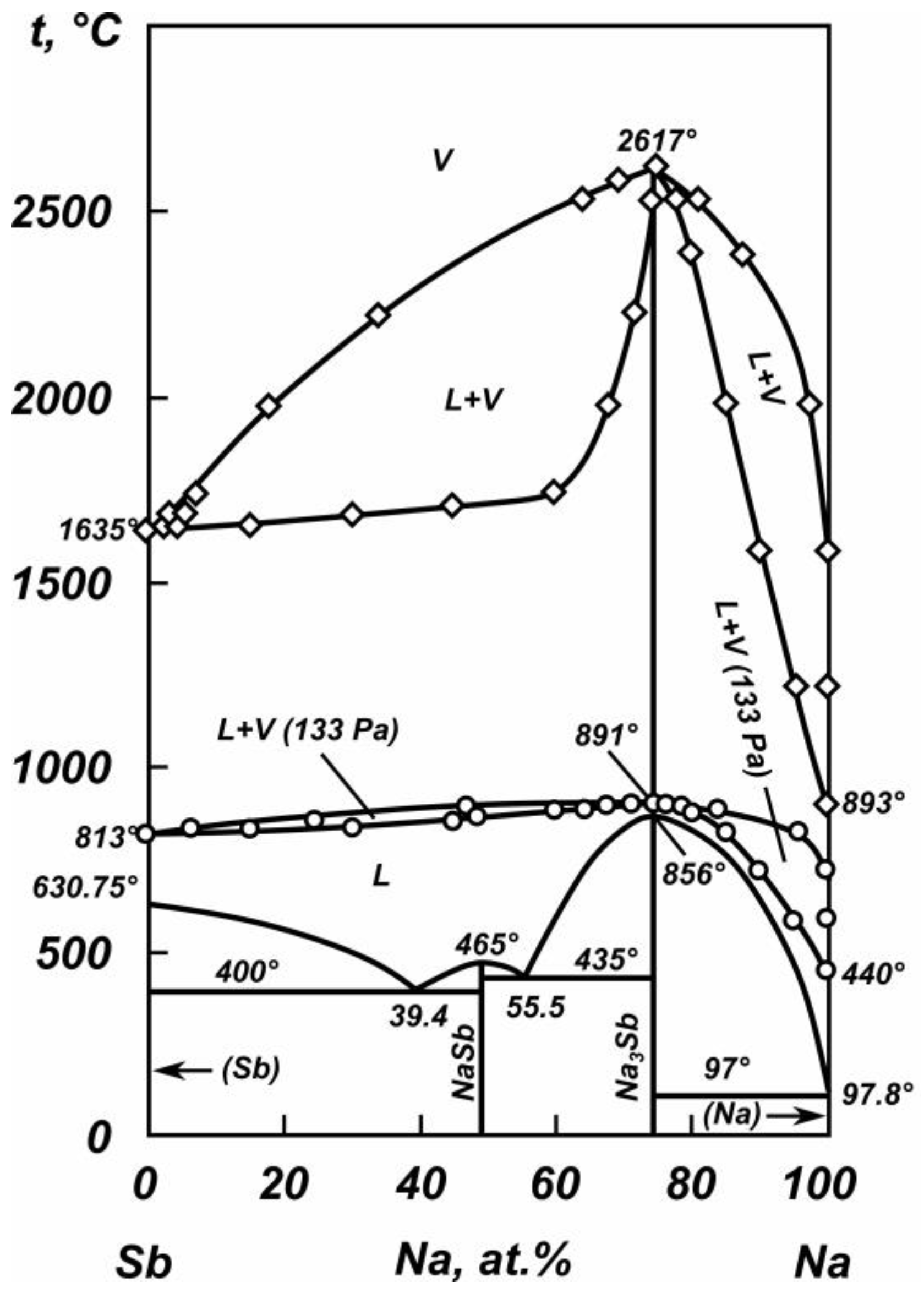
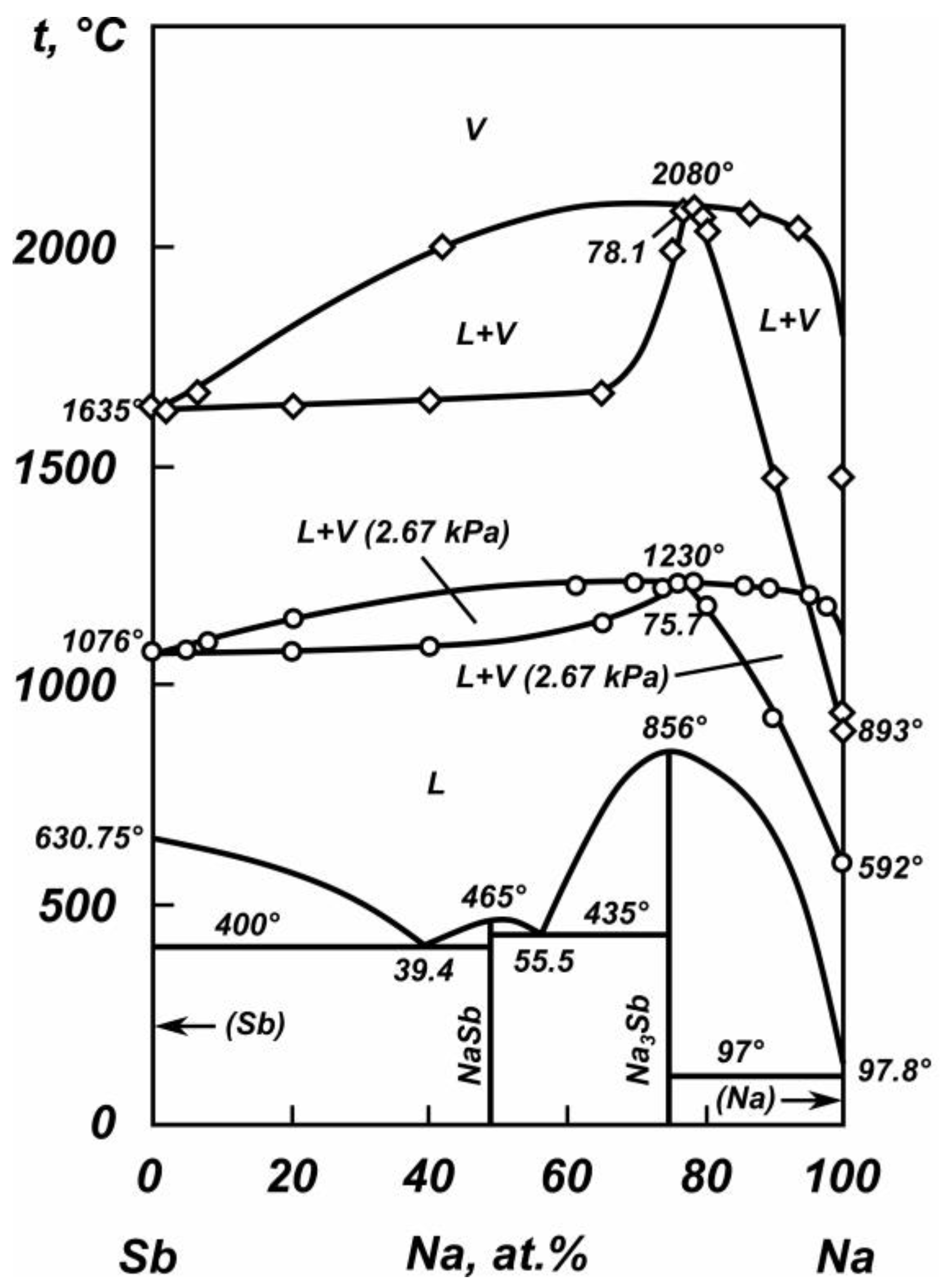
Based on Equations (1) and (2), the boiling temperatures of alloys of the antimony–sodium system and the vapour-phase composition corresponding to each temperature were calculated, as shown in Figure 1.
Analysis of the positions of the curves at atmospheric pressure and under vacuum (2.667 kPa) across the alloy compositions in the phase diagram reveals maxima of the boiling temperatures and the corresponding vapour-phase compositions, which correspond approximately to the stoichiometric composition of the intermetallic compound Na3Sb, namely, 78.1 at.% and 75.7 at.%, respectively. The peak-shaped boiling temperature curves do not correspond to those for azeotropic mixtures, which exhibit smooth curvature at the azeotropic point. The activity values of sodium and antimony exhibit a significant deviation from the law of ideal solutions, which indicates a very strong interaction between the components of the alloy and, indirectly, the presence of the Na3Sb compound. Furthermore, the activities of antimony and sodium are close to zero near the composition corresponding to the stoichiometry of the intermetallic compound (Figure 2). The activity curves of antimony show a noticeable change in the curvature of the lines at a sodium concentration corresponding to the NaSb compound, which may also indicate the presence of an antimony–sodium compound.
Temperature peaks at 2080 °C and 1230 °C are a characteristic features of a congruently evaporating compound that divides the binary phase diagram into two quasi-binary systems, as is the case, for example, in ref. [24]. Therefore, the peaks of the boiling curves of the alloys—2080 °C at atmospheric pressure and 1230 °C at 2.667 kPa—can be attributed to the sublimation points of crystalline Na3Sb. This observation is consistent with the fact that the experiments were performed at temperatures of 850–950 K (577–677 °C), which are below the melting point of the compound, 856 °C (1129 K). The deviation in the peak compositions is due to experimental errors, the approximation of the results, and their extrapolation to the high-temperature region.
The availability of data of two temperatures and the corresponding vapour-pressure values, in addition to the linear dependence of vapour pressure in the coordinates ln p N a 3 S b o S T 1 made it possible to express the sublimation pressure of Na3Sb as follows: ln p N a 3 S b o S [ P a ] = 17.958 15,134 × T 1 , where p N a 3 S b o S is the sublimation pressure of the intermetallic compound. The sublimation enthalpy was therefore found to be 125.8 kJ/mol, the sublimation entropy 53.5 J/(mol × K), and the sublimation temperature 2353 K (2080 °C).
The vapour pressure over the liquid compound was determined as follows. The vapour pressure of evaporation and the sublimation pressure at the melting point of the compound (1129 K) are equal: ln p N a 3 S b o S [ P a ] = 17.958 15,134 × T 1 = ln p N a 3 S b o V , where ln p N a 3 S b o V is the saturated vapour pressure of the compound over liquid alloys. Since the enthalpies of evaporation and sublimation are related by the equation: Δ H N a 3 S b V = Δ H N a 3 S b S Δ H N a 3 S b m [21] (p. 41) (where Δ H N a 3 S b V is the enthalpy of evaporation; Δ H N a 3 S b S is the enthalpy of sublimation; Δ H N a 3 S b m is the enthalpy of melting of the intermetallic compound), and coefficient A in the ln p N a 3 S b o V [ P a ] = B A × T 1 equation is related to the enthalpy of evaporation by the dependence A = Δ H N a 3 S b V / 8.3143 , the evaporation vapour pressure of Na3Sb was calculated and expressed as follows: ln p N a 3 S b o V [ P a ] = 15.997 12,920 × T 1 . The value of the enthalpy of melting of Na3Sb was taken from [15] and was taken as Δ H N a 3 S b m = 18.4 kJ/mol.
The enthalpy of evaporation, determined based on the vapour-pressure dependence over the liquid intermetallic compound, is 107.4 kJ/mol; the entropy is 37.2 J/(mol × K); and the boiling temperature is 2890 K (2617 °C).
The low value of the entropy of evaporation, 37.2 J/(mol × K), indicates, in accordance with Trouton’s rule, the presence of associated antimony and sodium species in the vapour phase, which in turn indirectly confirms the congruent evaporation of Na3Sb.
Based on extensive previous research on the behaviour of components in molten systems, including those containing intermetallic compounds, it was assumed that the activity of antimony in the liquid Sb–Na3Sb system and that of sodium in the Na3Sb–Na system remained equal to those in the antimony–sodium system. The partial saturated vapour pressures of the components in the quasi-binary systems were calculated. Based on these results, the boundaries of the liquid–vapour phase transition—above which Sb–Na melts, at atmospheric pressure (101.3 kPa) and a pressure of 0.133 kPa—were determined (Figure 3).
The simplest process for extracting antimony from the specified raw material is carbothermic reduction. Because of the highly reducing atmosphere, crude antimony is obtained with a sodium content of up to 8–9 wt.% (31.5–34.4 at.% in the Sb–Na binary system); in some cases, the sodium content in antimony can reach 26 wt.% (65.0 at.%). Therefore, refining the crude antimony to remove sodium impurities presents a major challenge.
The sodium contents given above, namely, 8–9 wt.% (31.5–34.4 at.%), and, in some cases, 26 wt.% (65.0 at.%) in crude antimony, demonstrate that sodium is associated with antimony in the form of Na3Sb.
The boiling temperature of trisodium antimonide and its alloys with antimony at atmospheric pressure is very high, making boiling under conventional metallurgical production conditions impractical.
The separation of antimony and Na3Sb by distillation under these conditions cannot be achieved using conventional methods. In addition, the vapour above the melts of the Sb–Na3Sb system contains both Sb and Na3Sb in comparable amounts. Thus, at a sodium content of 15 at.% (3.2 wt.%) in the alloy, the vapour phase under equilibrium conditions will contain 4.1 at.% (0.8 wt.%) sodium in combination with Na3Sb. Under actual operating conditions, namely, in a dynamic evaporation mode, the sodium content present as trisodium antimonide in the vapour phase will be higher than the specified content.
Reducing the pressure over the alloy to 133 Pa makes the distillation process possible at moderate temperatures of 813–891 °C. However, the liquid–vapour coexistence field is very narrow in terms of temperature and does not exceed 135 °C at a sodium content of 50 at.% in the alloy. This narrow temperature range requires numerous distillation–condensation cycles to separate antimony and Na3Sb. This limitation is illustrated by the distillation of an alloy containing 67.5 at.% Na under vacuum. At a boiling point of 889 °C, the equilibrium condensate has a sodium concentration of 64.2 at.% Na. Under actual operating conditions, the degree of separation will be even lower.
The separation of molten sodium and trisodium antimonide is possible both at atmospheric pressure and under vacuum at a sodium concentration of more than 90 at.% (approximately 63 wt.%). However, the former requires temperatures of up to 1570 °C, whereas vacuum conditions require a temperature of approximately 600 °C. Under these conditions, the vapour phase will consist of almost pure sodium, while antimony will accumulate in the still residue in the form of Na3Sb.
Thus, the boundaries of the liquid–vapour phase transition, calculated based on experimental studies of the thermodynamic properties of the antimony–sodium system, enable us to conclude that purification of crude antimony from sodium by distillation is not possible, whereas purification of sodium from antimony under vacuum is possible at an alkali–metal concentration of more than 90 at.% Na (approximately 63 wt.%). In addition, during vacuum distillation of sodium, when the sodium concentration decreases below 90 at.% and trisodium antimonide accumulates in the still residue, crystallisation of the intermetallic compound from the melt may occur, which may complicate the technological process.
The vapour-pressure values of the components in the quasi-binary systems, which were obtained during the determination of the liquid–vapour phase-transition boundaries, made it possible to calculate thermodynamic activities values and, on this basis, the thermodynamic functions, namely, the entropy and enthalpy of alloy formation.
The activities of the components of the quasi-binary systems were determined as follows: ln a S b ( N a 3 S b ) = ln p ¯ S b ( N a 3 S b ) ln p S b ( N a 3 S b ) o in the first case and ln a N a ( N a 3 S b ) = ln p ¯ N a ( N a 3 S b ) ln p N a ( N a 3 S b ) o in the second case.
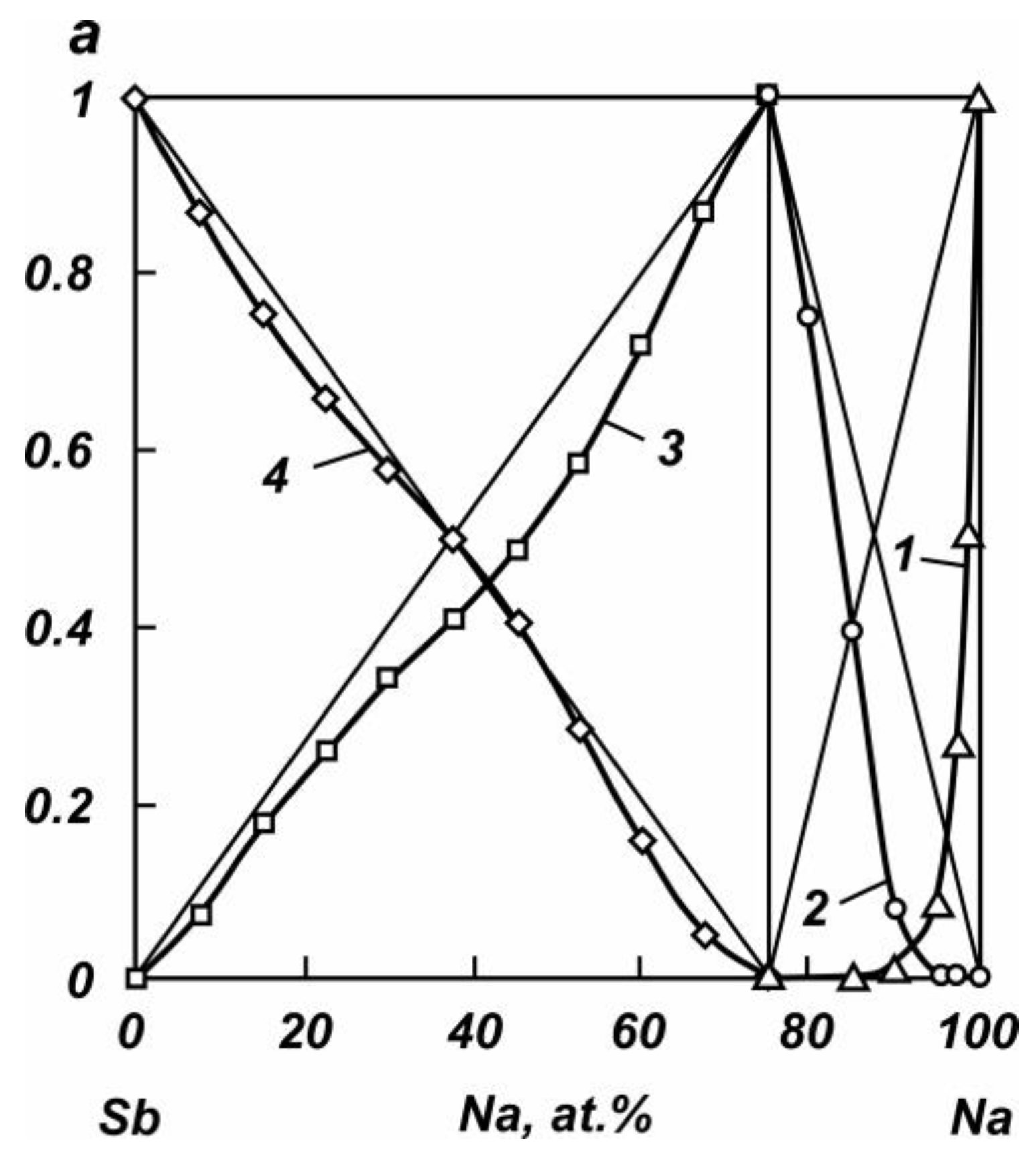
The activities of the components in the quasi-binary systems Sb–Na3Sb and Na3Sb–Na at a temperature of 1133 K (860 °C) are shown in Figure 4.
The activities of Sb and Na3Sb in the Sb–Na3Sb system are close to the straight diagonal corresponding to an ideal solution. This observation, together with the similarity between of the boiling temperatures of antimony and trisodium antimonide under vacuum (133 Pa) and the corresponding vapour-pressure values, confirms the difficulty of separating the components by distillation.
Sodium recovery from sodium-rich alloys in the Na3Sb–Na system is technologically feasible.
In the Sb–Na3Sb system, the partial pressures of antimony and trisodium antimonide are described by the following equations:
ln p ¯ S b [ P a ] = ( 22,343 x S b 4 62,991 x S b 3 + 58,356 x S b 2 15,442 x S b 19,021 ) × T 1 27.133 x S b 4 + 77.563 x S b 3 74.443 x S b 2 + 23.5 x S b + 20.821 + ln S b
ln p ¯ N a 3 S b [ P a ] = ( 22,343 x N a 3 S b 4 56,172 x N a 3 S b 3 + 43,013 x N a 3 S b 2 8551 x N a 3 S b 13,553 + 1669 ln x N a 3 S b ) × T 1 27.133 x N a 3 S b 4 + 67.146 x N a 3 S b 3 51.005 x N a 3 S b 2 + 10.333 x N a 3 S b + 16.656 0.229 ln x N a 3 S b
where p ¯ S b is the partial saturated vapour pressure of antimony, Pa; x S b is the mole fraction of antimony in the alloy; and x N a 3 S b is the mole fraction of trisodium antimonide, provided that 0 < x S b < 1 and x S b + x N a 3 S b = 1 .
In the Na3Sb–Na system, the dependence of the partial pressures of sodium and Na3Sb on the composition in the melt is as follows:
ln p ¯ N a [ P a ] = ( 2795 x N a 3 118 x N a 2 926 x N a 13,935 ) × T 1 + 1.719 x N a 2 + 3.188 x N a + 17.068 + ln x N a
ln p ¯ N a 3 S b [ P a ] = ( 2795 x N a 3 S b 3 + 12,457 x N a 3 S b 2 23,751 x N a 3 S b + 1169 + 7221 ln x N a 3 S b ) × T 1 + + 1.719 x N a 3 S b 2 10.064 x N a 3 S b + 24.342 + 7.626 ln x N a 3 S b
where p ¯ N a 3 S b is the partial pressure of Na3Sb, Pa, and x N a 3 S b is the mole fraction of trisodium antimonide, provided that 0 < x N a < 1 and x N a + x N a 3 S b = 1 .
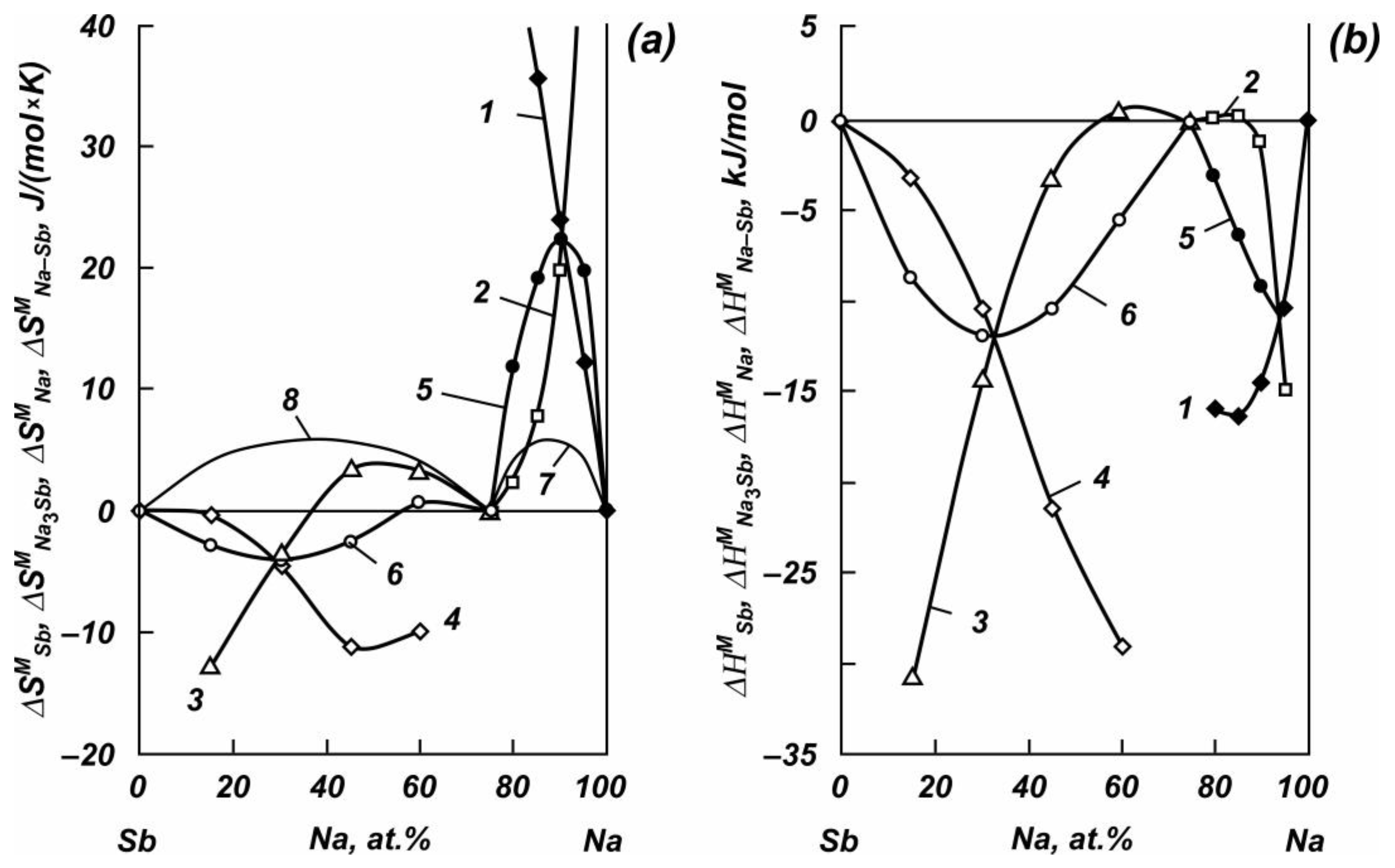
The partial and integral entropies of mixing in the Sb–Na3Sb and Na3Sb–Na systems were determined using the above-mentioned relationships and are presented in Figure 5.
The integral entropy of formation in both systems deviates from that predicted by the law of ideal solutions, which indicates a significant contribution from excess functions. The integral entropy of mixing in the Sb–Na3Sb system is a negative over almost the entire concentration range; this behaviour is typical of solutions in which the components interact in the liquid phase and atoms become ordered. The integral entropy in the Na3Sb–Na system is positive and significantly exceeds that for an ideal system, which corresponds to disordering.
The values of the integral enthalpies of formation of alloys in the Sb–Na3Sb and Na3Sb–Na systems are negative over the entire concentration range of the components; therefore, the mixing process that proceeds is exothermic.
The values of the partial thermodynamic functions of evaporation, namely, entropy ( Δ S ¯ S b V , Δ S ¯ N a 3 S b V , Δ S ¯ N a V ) and enthalpy ( Δ H ¯ S b V , Δ H ¯ N a 3 S b V , Δ H ¯ N a V ), and the integral values for the entire antimony–sodium system, Δ S S b N a V and Δ H S b N a V , are presented in Table 2 and Table 3.
The decrease in the integral entropy of evaporation to 35.41–37.17 J/(mol × K) as the alloy composition approaches the stoichiometric composition of the intermetallic compound (75 at.%) indicates, in accordance with Trouton’s rule, an increase in the amount of associates in the vapour phase, namely, Na3Sb molecules.
The integral enthalpy of evaporation is relatively high for alloys of antimony and trisodium antimonide because of the higher boiling temperature of these components, and the dependence curve exhibits a minimum corresponding to the Na3Sb composition.

4. Conclusions

The boundaries of the liquid–vapour phase-transition fields of the antimony–sodium system were calculated based on published experimental data. Based on indirect evidence, it was established that trisodium antimonide (Na3Sb) is a congruently evaporating intermetallic compound. Na3Sb divides the Sb–Na system into two quasi-binary systems: Sb–Na3Sb and Na3Sb–Na. The low entropy values for the sublimation of the compound, 53.5 J/(mol × K), and evaporation, 37.2 J/(mol × K), indicate, in accordance with Trouton’s rule, the presence of associated antimony and sodium species in the vapour phase and indirectly confirm the congruent evaporation of Na3Sb.
The positions of the liquid–vapour phase-transition boundaries of the antimony–sodium system indicate that purification of crude antimony from sodium by distillation is not possible; whereas, purification of sodium from antimony under vacuum is possible at a sodium concentration of more than 90 at.% Na (approximately 63 wt.%). We have established that distillation separation of antimony and sodium at atmospheric pressure is technically difficult because of the high boiling temperatures of the melts of the Sb–Na3Sb system (1635–2617 °C) and the very narrow temperature range of the vapour–liquid equilibrium field under vacuum.
Molten sodium and trisodium antimonide in the Na3Sb–Na system can be separated both at atmospheric pressure and under vacuum when the sodium concentration in the alloy exceeds 90 at.% Na (approximately 63 wt.%). However, the former requires temperatures of up to 1570 °C, whereas vacuum conditions require a temperature of approximately 600 °C. In addition, during vacuum distillation of sodium, when its concentration decreases below 90 at.% and trisodium antimonide accumulates in the still residue, crystallisation of the intermetallic compound from the melt may occur, which will complicate the technological process. Under these conditions, the vapour phase will consist of almost pure sodium, while antimony will accumulate in the still residue in the form of Na3Sb.
The value of the integral entropy of formation in both systems indicates a significant contribution from excess functions. The integral entropy of mixing in the Sb–Na3Sb system is a negative value over almost the entire concentration range. The integral entropy in the Na3Sb–Na system is positive and significantly exceeds that for an ideal system, which corresponds to disordering.
The values of the integral enthalpies of formation of alloys in the Sb–Na3Sb and Na3Sb–Na systems are negative over the entire concentration range of the components; therefore, the mixing process is exothermic.
The decrease in the integral entropy of evaporation to 35.41–37.17 J/(mol × K) as the alloy composition approaches the stoichiometric composition of the intermetallic compound (75 at.%) indicates an increase in the amount of associates in the vapour phase, namely, Na3Sb molecules.
The integral enthalpy of evaporation exhibits a minimum as a function of concentration at the composition corresponding to Na3Sb.

Author Contributions

Conceptualisation, V.V. and B.K.; methodology, V.V., S.T. and A.N.; investigation, V.V., B.K., S.T., A.N. and X.L.; data curation, V.V., B.K., S.T., A.N. and X.L.; writing—original draft preparation, V.V., B.K., S.T., A.N. and X.L.; writing—review and editing, V.V., A.N. and X.L.; visualisation, S.T., A.N. and X.L.; project administration, B.K. All authors have read and agreed to the published version of the manuscript.

Funding

This research was funded by the Science Committee of the Ministry of Science and Higher Education of the Republic of Kazakhstan, grant number BR24992757.

Data Availability Statement

The original contributions presented in this study are included in the article. Further inquiries can be directed to the corresponding author.

Conflicts of Interest

The authors declare no conflicts of interest.

References

  1. Anderson, G.G. The Metallurgy of Antimony. Geochemistry 2012, 72, 3–8. [Google Scholar] [CrossRef] [Scilit]
  2. Dembele, S.; Akcil, A.; Panda, S. Technological Trends, Emerging Applications and Metallurgical Strategies in Antimony Recovery from Stibnite. Miner. Eng. 2022, 175, 107304. [Google Scholar] [CrossRef] [Scilit]
  3. Timofeev, K.P.; Korolev, A.A.; Maltsev, G.I.; Voinkov, R.S. Processing of sodium antimonate to produce commercial antimony. Non-Ferr. Met. 2025, 1, 21–25. [Google Scholar] [CrossRef] [Scilit]
  4. Volodin, V.; Trebukhov, S.; Nitsenko, A.; Burabayeva, N.; Linnik, X. Distribution of Antimonium Chalcogenides under Conditions of Vacuum Thermal Processing of Mattes. Kompleks. Ispol. Miner. Syra 2023, 326, 88–95. [Google Scholar] [CrossRef] [Scilit]
  5. Berdikulova, F.; Seidakhmetova, N.; Mazulevsky, E.; Kovzalenko, T.; Ondiris, B. Features of Antimonate Concentrate Reduction in Alkaline Melts under Carbon-Neutral Smelting Conditions. Metals 2026, 16, 265. [Google Scholar] [CrossRef] [Scilit]
  6. Dosmukhamedov, N.; Zholdasbay, E. The Solubility of Cu, Pb, As, Sb of Copper-Lead Matte in the Slag. Kompleks. Ispol. Miner. Syra 2020, 312, 31–40. [Google Scholar] [CrossRef] [Scilit]
  7. Akilbekova, S.; Moldabayeva, G.; Myrzalieva, S.; Seidakhmetova, N. To the Question of Pyrometallurgical Technology for Processing Antimony-Gold-Bearing Ores and Concentrates. Kompleks. Ispol. Miner. Syra 2025, 340, 77–86. [Google Scholar] [CrossRef] [Scilit]
  8. Volodin, V.; Kenzhaliev, B.; Trebukhov, S.; Nitsenko, A.; Tuleutay, F.; Linik, X.; Sukurov, B. Distribution of Metals During Carbothermic Reduction of Antimony from Sodium Antimonate. Materials 2026, 19, 1848. [Google Scholar] [CrossRef] [Scilit]
  9. Smirnov, M.P. Lead Refining and Processing of Intermediates; Metallurgizdat: Moscow, Russia, 1977; 280p. [Google Scholar]
  10. Malyshev, V.P.; Turdukozhaeva, F.M.; Ospanov, E.A.; Sarkenov, B. Evaporation and Boiling of Simple Substances; Scientific World: Moscow, Russia, 2010; 304p. [Google Scholar]
  11. Mathewson, C.H. Natrium-Blei-, Natrium-Kadmium-, Natrium-Wismut- und Natrium-Antimonlegierungen. Z. Anorg. Chem. 1906, 50, 171–198. [Google Scholar] [CrossRef] [Scilit]
  12. Morozova, M.P.; Bolshakova, G.A.; Lukinykh, I.I. Enthalpy of Formation of Sodium Compounds with Elements of the Main Subgroup of Group V. Zhurnal Obs. Khimii 1959, 29, 3144–3145. [Google Scholar]
  13. Voronin, G.F.; Siu, N.T.; Gerasimov, Y.I. Thermodynamic Properties of Intermetallic Compounds of Sodium and Antimony. Zhurnal Fiz. Khimii 1967, 41, 1468–1471. [Google Scholar]
  14. Morachevsky, A.G.; Bykova, M.A.; Rozova, T.T. Thermodynamic Properties of Liquid Sodium-Antimony Alloys. Zhurnal Prikl. Khimii 1970, 7, 1611–1612. [Google Scholar]
  15. Voronin, G.F. Thermodynamic Properties of Compounds of Sodium with Antimony, Bismuth, Tellurium and Potassium with Bismuth, Calculated from Data for Liquid Alloys. Zhurnal Fiz. Khimii 1971, 45, 2100–2101. [Google Scholar]
  16. Redslob, H.; Steinleitner, G.; Freyland, W. Transition to Semoconducting Characteristics in Liquid Alkalimetal-Antimony-Alloys. Z. Fur Naturforschung A 1982, 37, 587–593. [Google Scholar] [CrossRef] [Scilit]
  17. Klebanov, E.B.; Shesterkina, I.I.; Morachevsky, A.G. Thermodynamic Poperties of Sodium and Antimony Compounds. Izv. Vyss. Uchebnykh Zaved. Tsvetnaya Metall. 1985, 2, 115–117. [Google Scholar]
  18. Voronin, G.F.; Mukhamedzhanova, N.M.; Siu, N.T. Thermodynamic Properties of Sodium and Antimony Compounds. Vestn. Mosk. Univ. Seriya 2 Khimiya 1987, 28, 508–509. [Google Scholar]
  19. Sangster, J.; Pelton, A.D. The Na—Sb (Sodium-Antimony) System. J. Phase Equilibria 1993, 14, 250–255. [Google Scholar] [CrossRef] [Scilit]
  20. Liu, Y.; Xu, J.; Kang, Z.; Wang, J. Thermodynamic Descriptions and Phase Diagrams for Sb-Na and Sb-K Binary Systems. Thermochim. Acta 2013, 569, 119–126. [Google Scholar] [CrossRef] [Scilit]
  21. Darken, L.S.; Gurry, R.W. Physical Chemistry of Metals; McGraw-Hill Book Company: New York, NY, USA; Toronto, ON, Canada; London, UK, 1953; 570p. [Google Scholar]
  22. Morachevsky, A.G. Thermodynamics of Molten Metal and Salt Systems; Metallurgiia: Moscow, Russia, 1987; 240p. [Google Scholar]
  23. Eckert, C.A.; Irwin, R.B.; Smith, J.S. Thermodynamic Activity of Magnesium in Several Highly-Solvating Liquid Alloys. Metal. Trans. B 1983, 14, 451–458. [Google Scholar] [CrossRef] [Scilit]
  24. Volodin, V.; Nitsenko, A.; Trebukhov, S.; Linnik, X.; Gapurov, Y. Thermodynamics of Formation and Liquid-Vapor Phase Transitions of Antimony alloys with Selenium and Sulfur. Materials 2024, 17, 125. [Google Scholar] [CrossRef] [Scilit]
Figure 1. Curves of alloy boiling temperatures and vapour composition over the alloys in the Sb–Na system according to experimental data.
Metals 16 01036 g001
Figure 2. Activities of antimony (3–4) and sodium (1–2) at 850 K (1–3) and 950 K (2–4) based on experimental data.
Metals 16 01036 g002
Figure 3. Complete phase diagram of the antimony–sodium system.
Metals 16 01036 g003
Figure 4. Dependences of thermodynamic activity on composition: 1, sodium; 2, 3, trisodium antimonide; 4, antimony.
Metals 16 01036 g004
Figure 5. Partial (1–4) and integral (5–8) values of the entropy (a) and enthalpy (b) of mixing in the antimony–sodium system: 1, sodium; 2, 3, trisodium antimonide; 4, antimony; 7, 8, integral entropy of the ideal system.
Metals 16 01036 g005
Table 1. The experimental and calculated values of sodium activity in the sodium–antimony system.
Na Content in the Alloy, at.%The Activity Values of Sodium at Temperature, K:
850 [14]950 [14]850 [20]950 [20]850
[Calculated]
950
[Calculated]
106.48 × 10−61.64 × 10−5--5.14 × 10−61.54 × 10−5
201.50 × 10−53.70 × 10−5--1.48 × 10−53.46 × 10−5
303.46 × 10−58.36 × 10−5--4.91 × 10−58.68 × 10−5
407.99 × 10−51.89 × 10−4--1.34 × 10−41.89 × 10−4
501.84 × 10−44.26 × 10−4--2.65 × 10−43.24 × 10−4
75--1.39 × 10−42.77 × 10−47.30 × 10−49.06 × 10−4
Table 2. Partial and integral entropy of evaporation of antimony–sodium alloys.
Na Content in the Alloy, at.% Δ S ¯ N a V , J/(mol × K) Δ S ¯ N a 3 S b V , J/(mol × K) Δ S ¯ S b V , J/(mol × K) Δ S S b N a V , J/(mol × K)
0--73.5573.55
15-50.0473.9269.14
30-40.8678.0363.17
45-33.8684.8154.24
60-33.8383.5543.78
75-37.17-37.17
8038.5734.61-35.41
8551.3529.11-38.00
9062.8817.28-44.64
9574.57−11.65-57.33
10086.88--86.88
Table 3. Partial and integral enthalpies of evaporation of antimony–sodium alloys.
Na Content in the Alloy, at.% Δ H ¯ N a V , kJ/mol Δ H ¯ N a 3 S b V , kJ/mol Δ H ¯ S b V , kJ/mol Δ H S b N a V , kJ/mol
0--139.31139.31
15-138.37142.39141.59
30-121.75149.56138.44
45-110.49160.63130.55
60-106.81168.31119.11
75-107.42-107.42
80117.25107.27-109.27
85117.61107.17-111.34
90115.81109.20-113.17
95110.75122.44-113.09
100101.30--101.30
Disclaimer/Publisher’s Note: The statements, opinions and data contained in all publications are solely those of the individual author(s) and contributor(s) and not of MDPI and/or the editor(s). MDPI and/or the editor(s) disclaim responsibility for any injury to people or property resulting from any ideas, methods, instructions or products referred to in the content.