Article

Influence of Heat-Treatment Temperature on Microstructure and Mechanical Properties of Selective-Laser-Melted GH3536 Superalloy


1
School of Materials and Engineering, Jiangsu University of Technology, Changzhou 213001, China
2
Institute of Laser Engineering, Beijing University of Technology, Beijing 100124, China
3
Beijing Power Machinery Institute, Beijing 100074, China
*
Authors to whom correspondence should be addressed.
Metals 2026, 16(9), 1029; https://doi.org/10.3390/met16091029
Submission received: 31 August 2026 / Revised: 10 September 2026 / Accepted: 13 September 2026 / Published: 16 September 2026
(This article belongs to the Special Issue Laser Powder Bed Fusion for High-Performance Metallic Materials)

Abstract

For laser additive manufacturing components, subsequent heat treatment is crucial for regulating the material microstructure and properties. This paper investigates the evolution of microstructure and precipitates in GH3536 nickel-based superalloy fabricated by selective laser melting (SLM), subjected to heat treatment at temperatures ranging from 980 °C to 1280 °C for a duration of 1 h, and further explores the underlying mechanisms governing the resultant effects on mechanical properties. In the 980 °C-1 h specimen, a large number of Mo-rich M6C type carbides are distributed along the grain boundaries and between the dendrites. Exposure to 1080 °C results in the coarsening of grain-boundary carbide particles. For the 1180 °C-1 h specimen, the carbides are completely dissolved into the matrix. At 1080 °C and below, the SLMed columnar grain morphology persists. At 1180 °C, the alloy attains a recrystallized fraction of 49.7%, accompanied by a subgrain proportion of 49.8%. The recrystallized grains exhibit a polygonal morphology, with an average aspect ratio of 2.51, which contains a large number of annealing twins. The formation of numerous subgrains could be attributed to the microstructural inhomogeneity and the solute drag effect. At 1280 °C, the recrystallized fraction increases to 89.8%, and the grains coarsen to 40.8 µm in diameter. The grain aspect ratio and texture intensity do not monotonically decrease with temperature. As the temperature increases, the hardness gradually decreases from 251.8 ± 13.5 HV (as-SLMed) to 176.3 ± 5.5 HV. The sequential occurrence of recovery and recrystallization leads to the progressive decrease in yield strength and increase in elongation. The influence of back stress, the Hall–Petch relationship and solid solution strengthening on the yield strength is discussed. For the 1280 °C-1 h specimen, elongation increases to 67.4%, indicating the excellent grain boundary thermal stability and interfacial bonding strength.

1. Introduction

GH3536 superalloy (Hastelloy X) is a solid-solution-strengthened high-temperature alloy mainly composed of Ni, Cr, Fe, and Mo. It features excellent high-temperature oxidation resistance, corrosion resistance, and weldability, maintaining good mechanical properties at 900 °C and capable of short-term operation at up to 1080 °C [1]. It is widely used in combustion chambers of aerospace engines, in components in the combustion zones of gas turbines, and in the petrochemical industry [2]. Selective laser melting (SLM) technology, as a rapid and precise additive manufacturing technique, has been employed to fabricate complex and dense high-temperature alloy parts [3].
During the SLM forming process, significant thermal gradients and extremely fast solidification rates result in an inhomogeneous microstructure with epitaxial growth, defects, and micro-component segregation, leading to anisotropic mechanical properties. These microstructure characteristics and high thermal residual stresses are unfavorable for the application of high-temperature alloys [4,5]. Therefore, heat treatment is an important subsequent process of SLM technology, used to regulate the material structure and precipitated phases, eliminate segregation, reduce residual stress, and thereby optimize the mechanical properties of the material [6].
Keshavarzkermani et al. [7] found that during the solid solution treatment at 1177 °C, the SLMed GH3536 alloy underwent recrystallization, resulting in the replacement of the original columnar crystal structure with equiaxed crystals. The higher degree of recrystallization reduced the anisotropy of the alloy’s mechanical properties, leading to a decrease in strength and an increase in ductility. Qiao et al. [8] found that the 1175 °C/1h heat treatment promoted the precipitation of Mo-rich carbides in the SLMed GH3536 alloy, causing the subgrain boundaries to dissolve and reducing the local plastic deformation degree of the material. Yuan’s [9] research indicated that after heat treatment, the grains transformed into equiaxed crystals, and the shapes of the precipitated phases at the grain boundaries gradually became more regular and smaller. Ultimately, the strength and plasticity of the Hastelloy X alloy formed by SLM were well balanced. The mechanism of microstructure evolution on tensile properties in SLMed GH3536 superalloys in the range of room temperature to 1000 °C was reported by Zhou et al., exhibiting isotropic tensile properties along the X, Z, and 45° directions [10]. Zhang et al. [11] studied the influence of different solution temperatures on the microstructure of Hastelloy X alloy and found that carbides began to dissolve into the matrix when the solution temperatures reached 1070~1100 °C. Sanchez-Mata et al. [12] discovered that solution treatment at 1177 °C could adjust the distribution of carbide precipitation and significantly reduce the dislocation density of the SLMed Hastelloy X alloy, thereby enabling the alloy to achieve higher ductility.
The above studies have shown that the mechanical properties of the alloy after heat treatment are related to factors such as the degree of recrystallization, grain size, dislocation density, and the content and distribution of precipitated phases. However, most existing studies on heat treatment have been confined to temperatures near the recrystallization regime, and limited information is available on the microstructure evolution and corresponding mechanical properties of SLMed GH3536 over a broader temperature range. In this work, heat treatments are conducted over a broad temperature range from 980 °C to 1280 °C, covering the entire spectrum of microstructural evolution, including carbide precipitation/dissolution, recovery, recrystallization, and grain growth. The temperature-dependent microstructural evolution is quantitatively studied using scanning electron microscopy (SEM) and electron backscatter diffraction (EBSD). The microhardness and tensile properties of GH3536 are tested, and the influencing mechanism of heat-treatment temperature on mechanical properties is discussed. The non-monotonic decrease in grain aspect ratio and texture intensity with increasing temperature is analyzed, and the possible mechanisms responsible for extensive subgrain formation and non-equiaxed growth of recrystallized grains are proposed. The influence of back stress, the Hall–Petch relationship and solid solution strengthening on the yield strength is discussed. This work aims to provide a reference for the laser selective melting heat treatment process.

2. Materials and Methods

2.1. Material Preparation

In this study, GH3536 powder produced by Ningbo Zhongyuan Advanced Materials Technologies Co., Ltd. (Ningbo, China) using argon atomization method was used as the raw material for SLM. The chemical compositions of the powder batch were determined by inductively coupled plasma optical emission spectrometry (ICP-OES) from Thermo Fisher Scientific Co., Ltd., Waltham, MA, USA, and provided by the supplier; they are listed in Table 1. The particle size is distributed in the range of 15∼53 μm with a D10, D50 and D90 of 19.8 μm, 34.7 μm, and 55.8 μm, respectively. The test blocks and test rods were printed using the BLT-S320 laser selective melting equipment from Bright Laser Technologies Co., Ltd., Xi’an, China, with the following optimized process parameters: laser power 300 W, scanning speed 1000 mm/s, scanning spacing 0.09 mm, layer thickness 0.06 mm, and a 67° strip scanning mode.

2.2. Experimental Methods

The samples prepared by SLM were subjected to heat treatment using the SJF1400 vertical lifting furnace from Boyuntong Instrument, Nanjing, China. The samples were held at 980 °C, 1080 °C, 1180 °C, and 1280 °C for 1 h with a heating rate of 10 °C/min, followed by water cooling.
The microstructure and crystal orientation of the alloys were characterized and analyzed using a Zeiss Sigma 500 high-resolution field-emission scanning electron microscope (FEG-SEM) from Carl Zeiss AG, Oberkochen, Germany, equipped with a Nordlys Max3 electronic backscatter diffraction (EBSD) system and energy dispersive spectroscopy (EDS) from Oxford Instruments, Abingdon, UK. The size of the printed block sample is 10 × 10 × 10 mm3. The vertical sections of the cube-shaped samples were ground with silicon carbide sandpaper and manual polished with an OPS (silica suspension) for EBSD characterization. The characterization areas for each specimen were consistently positioned at the center of the longitudinal section. The EBSD data was collected at a magnification of 200 times with a step size of 2.5 μm. The collected data was post-processed using the HKL-EBSD Channel 5 software. The misorientation within the range of 2° to 15° was defined as low-angle grain boundaries (LAGBs), while those greater than 15° were defined as high-angle grain boundaries (HAGBs). Samples for SEM characterization (secondary electron mode) required pre-corrosion with a HCl + HNO3 (3:1) solution for 8 to 15 s.
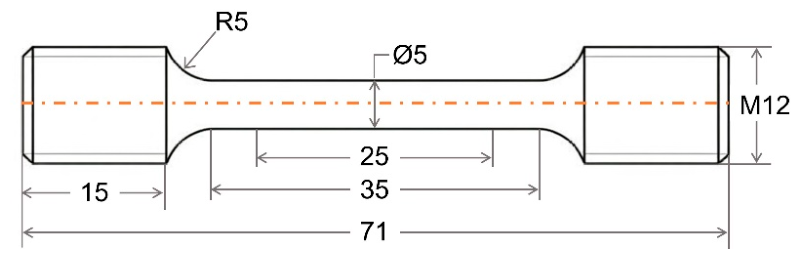
Following the ASTM E384 standard [13], microhardness measurements were performed under a load of 300 g and a loading time of 10 s by the HVS-1000A Vickers hardness tester from Zhongte technology Co., Ltd., Dongguan, China. Ten randomly selected points in the central region of the longitudinal section of the bulk specimens were measured to calculate the average hardness. The tensile samples were tested using the SANS-5705 electronic universal testing machine from MTS Systems (Shanghai, China) Co., Ltd. according to the ASTM-E8M standard [14], using a Y25/5N extensometer (Haiying Point Inspection Equipment Co., Ltd., Shanghai, China) with a 25 mm gauge length and ±5 mm travel for strain measurement. The deformation rate before yield was 0.25 mm/min, and it increased to 2.5 mm/min after yielding. The corresponding strain rates were 1.7 × 10⁻⁴ s−1 and 1.7 × 10⁻³ s−1 respectively. Three measurements were conducted for each sample to calculate the average tensile properties. Figure 1 shows the schematic diagram with specific dimensions (mm) of the tensile specimen.

3. Results and Discussion

3.1. Microstructure of the SLMed GH3536

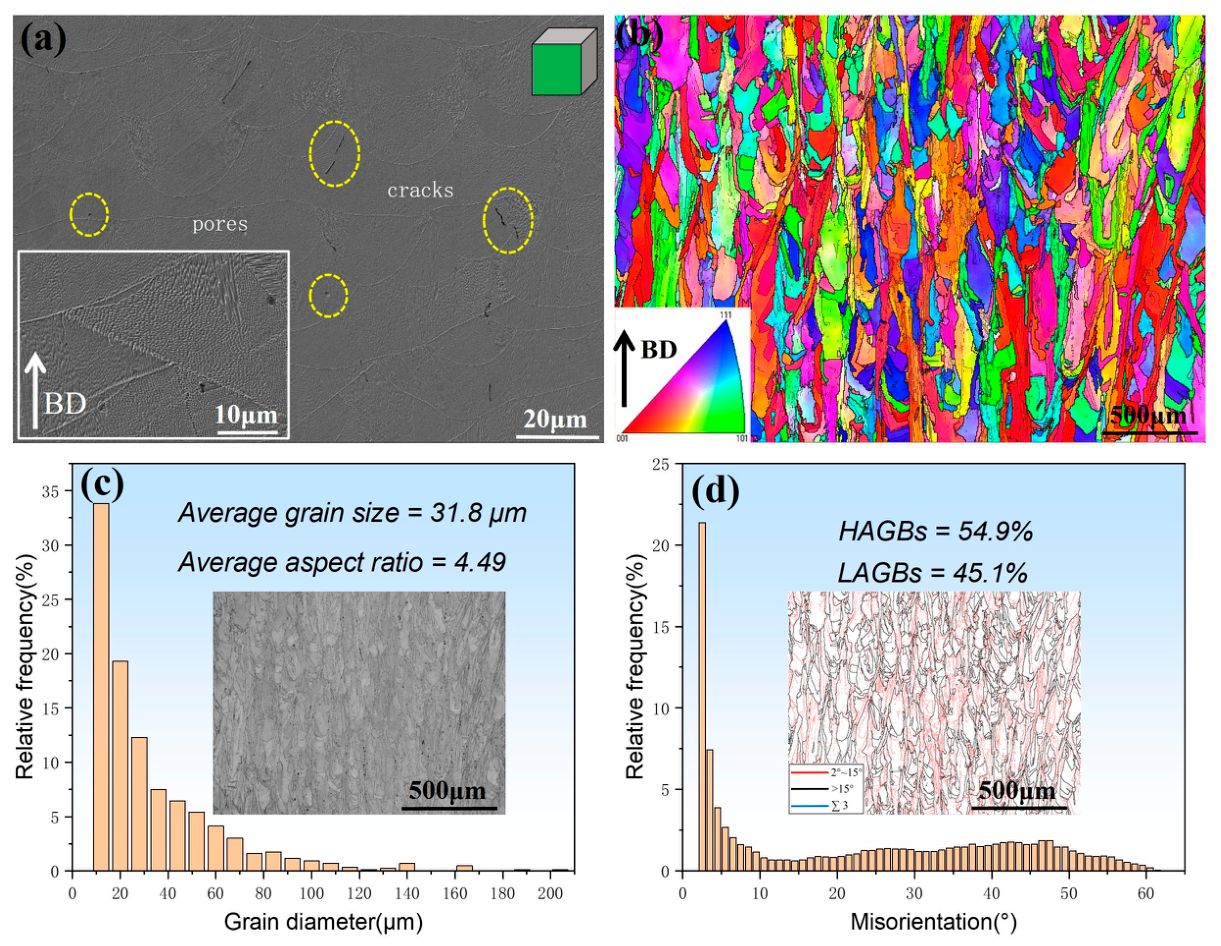
Figure 2 shows the microstructure characterization of the longitudinal cross-section in the SLMed GH3536 alloy. Figure 2a presents a “fish scale”-shaped characteristic structure formed by the superposition of semi-elliptical molten pools of various sizes. This is mainly due to the different cooling rates of the heat-affected zone during the laser scanning process and the remelting effect. The different shapes of the molten pools between layers are the result of the scanning direction being deflected by 67° layer by layer. The molten pool is dotted with micro-cracks and pores of various sizes. When the laser beam is focused on the powder to form a molten pool, rapid solidification occurs within the molten pool, generating a high thermal gradient and extremely fast cooling rate [15]. The interior of the molten pool shows a fine cellular microstructure, which is a typical microstructure in laser additive manufacturing of nickel-based superalloys [16]. It is noticed that no precipitated phases are observed in the SLMed GH3536. In the color code orientation map of Figure 2b, a large number of columnar grains are observed to extend through multiple melt pools along the building direction (BD), showing an epitaxial growth feature. This is mainly due to the significant temperature gradient from the bottom to the surface of the melt pool, which provides sufficient overcooling conditions for the epitaxial growth of grains. The EBSD results were processed and statistically analyzed to obtain the distribution of grain sizes and the distribution of grain boundary misorientation, as shown in Figure 2c,d. According to the statistics, the average aspect ratio of these grains is as high as 4.49, and the equivalent average grain diameter (AGD) is 31.8 μm. The proportion of LAGBs is 45.1%, in which the misorientation angles of grain boundaries are mainly concentrated in the small range of 2° to 3°, accounting for 22% of the total. This indicates the quite high dislocation density in the SLMed alloy.

3.2. Effect of Heat-Treatment Temperature on Microstructure

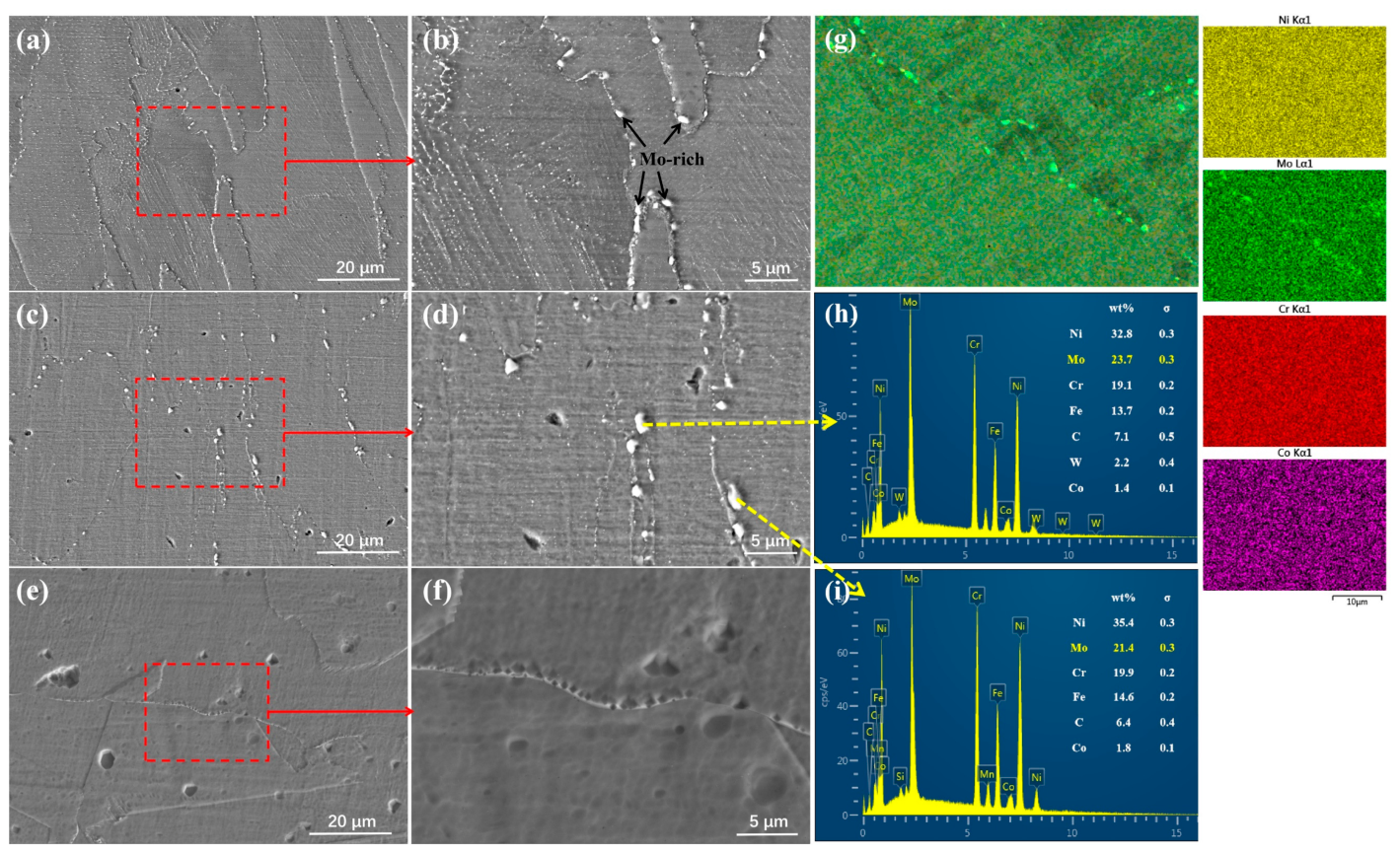
Figure 3 shows scanning electron micrographs and the elements distribution of heat-treated GH3536. As seen in Figure 3a, when the heat-treatment temperature is 980 °C, numerous irregular white granular precipitates with diameters ranging from approximately 200 nm to 1 μm are present along grain boundaries. Discontinuous distributions of smaller white precipitates are also observed in the interdendritic regions. According to phase diagrams, Wu et al. indicated that Mo6C forms within the temperature range of 900 °C to 1170 °C, while Cr23C6 forms between 600 °C and 940 °C [17]. The maps of elements distribution by EDS (Figure 3g) indicate the precipitates are rich in Mo element. In addition, the Mo contents of the white particles are detected to be around 20–24 wt.% (Figure 3h,i), which is much higher than the 9.35 wt.% in the parent material. Meanwhile, the element C is also enriched in the particles. Therefore, the white precipitates are identified as Mo-rich M6C. At 980 °C, Cr-rich M23C6-type carbides tend to dissolve into the matrix and cannot stably exist, whereas M6C precipitates extensively [18]. When the heat-treatment temperature reaches 1080 °C, as shown in Figure 3c, granular carbides remain abundant along grain boundaries, but their sizes have significantly increased compared to those at 980 °C, indicating carbide coarsening. Meanwhile, it is noted that the number of fine, dispersed M6C carbides in the interdendritic regions has markedly decreased. According to Ostwald ripening theory, smaller particles have higher surface curvature and greater solubility than larger ones. At 1080 °C, the high thermal activation energy enables a large number of small, unstable M6C particles to dissolve into the matrix [19]. The released solute atoms—such as Mo, W, and C—then diffuse and deposit onto the surfaces of larger M6C particles, leading to significant coarsening of the M6C particles [20]. As shown in Figure 3e, when the temperature reaches 1180 °C, no precipitated phases are observed, indicating that solute atoms have completely dissolved into the matrix. Water quenching further suppresses the reprecipitation of carbides during cooling.
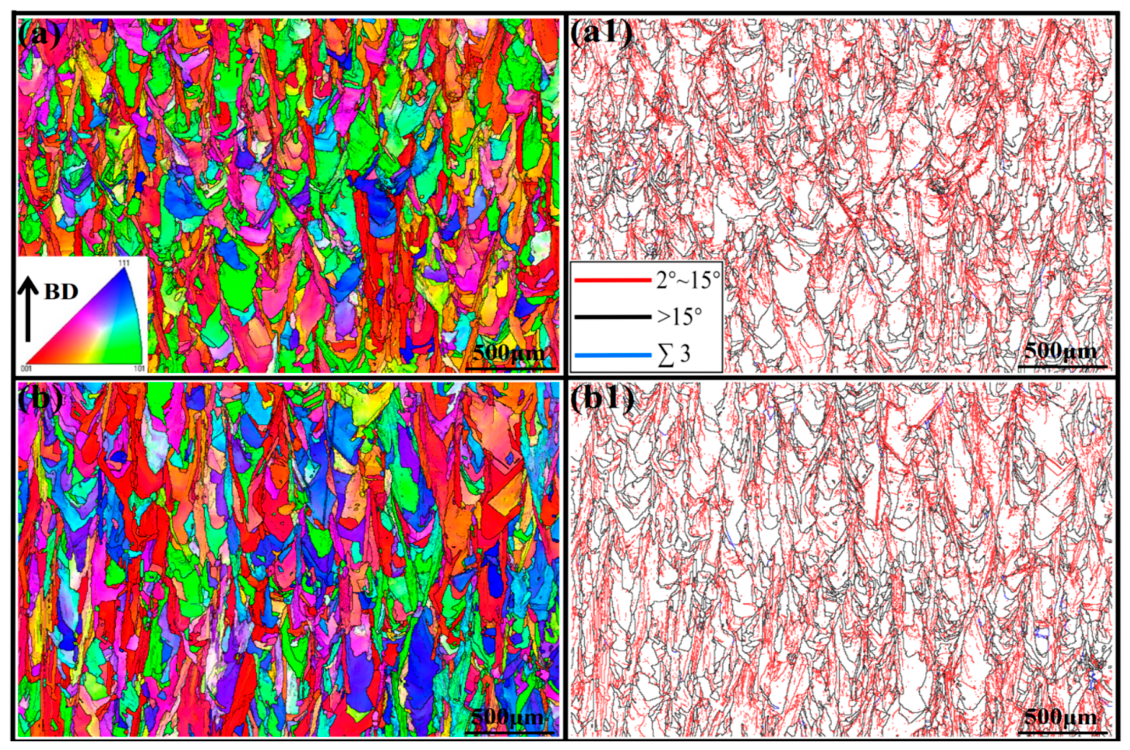
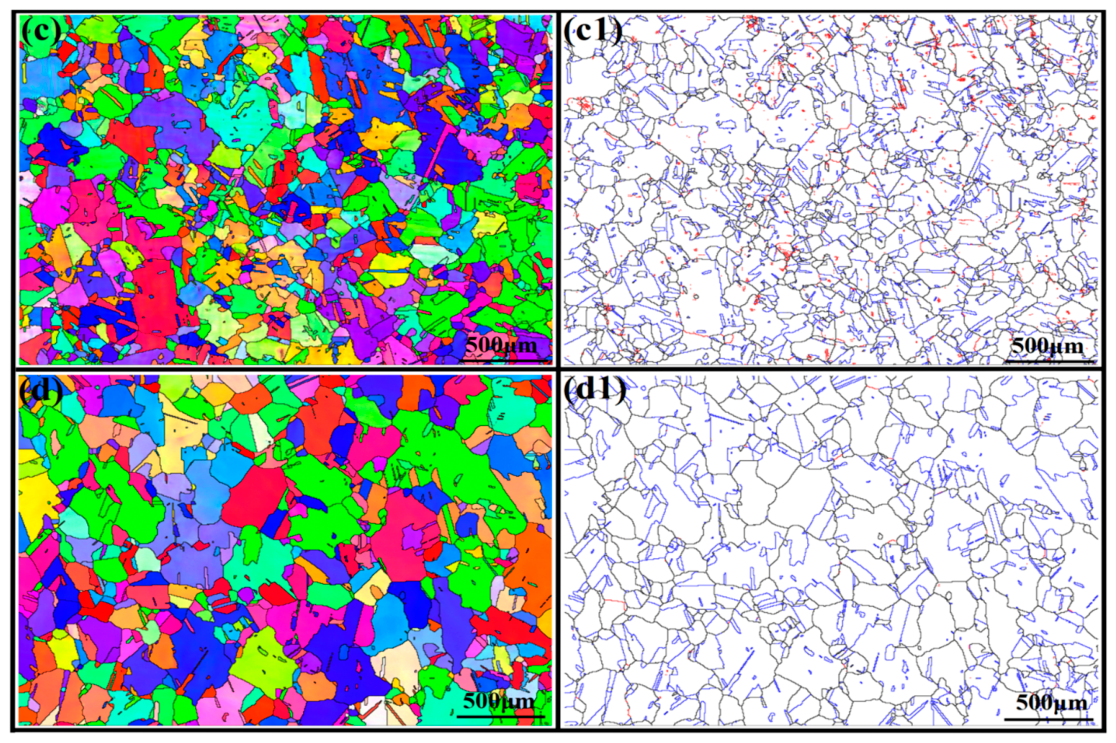
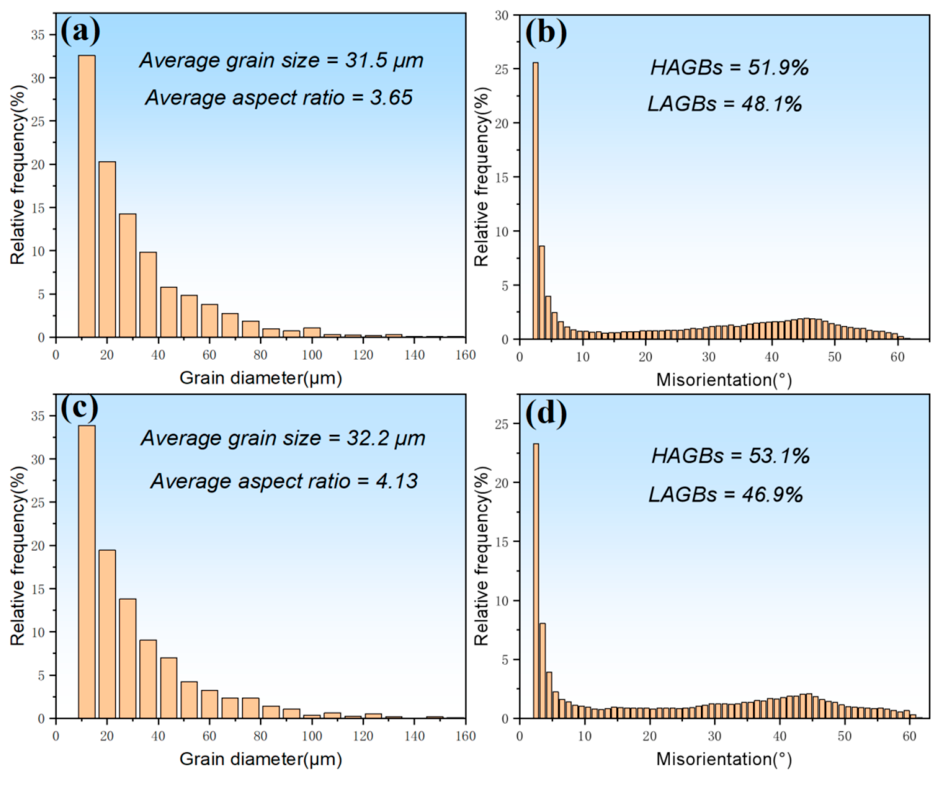
To further study the evolution law of the microstructure with heat-treatment temperature, a quantitative analysis of the microstructure was carried out using EBSD technology. Figure 4 gives the color code orientation maps and the corresponding grain boundary maps of the GH3536 alloy at different heat-treatment temperatures. Figure 5 plots the grain size statistics and grain boundary misorientation statistics. From Figure 4a,b, it can be seen that after heat treatment at 980 °C and 1080 °C, the microstructure essentially retains the SLMed morphology, still being columnar crystals growing along BD. Correspondingly, the grain boundary maps in Figure 4(a1,b1) show a large number of red LAGBs, accounting for 48.1–46.9% (Figure 5b,d), and their equivalent grain sizes of 31.5–32.2 μm (Figure 5a,c) are also very close to that of SLMed, indicating that the temperature of 1080 °C is insufficient to cause a transformation in the microstructure. It is worth noting that the aspect ratios of the grains treated at 980 °C and 1080 °C are 3.65 and 4.13, respectively. The dip-then-rise in aspect ratio is most likely related to the morphological evolution of the prior columnar grain during recovery. At 980 °C, abundant M6C carbides precipitate along grain boundaries, generating a strong pinning effect. The boundaries are thus restricted to minor local transverse bulging [21], which enlarges the apparent width of the columnar grains and lowers the average aspect ratio. At 1080 °C, the carbides coarsen and partially dissolve, relieving the pinning. Driven by the tendency to minimize the total interfacial energy, the boundaries preferentially migrate by longitudinal straightening [22], thereby increasing the aspect ratio.
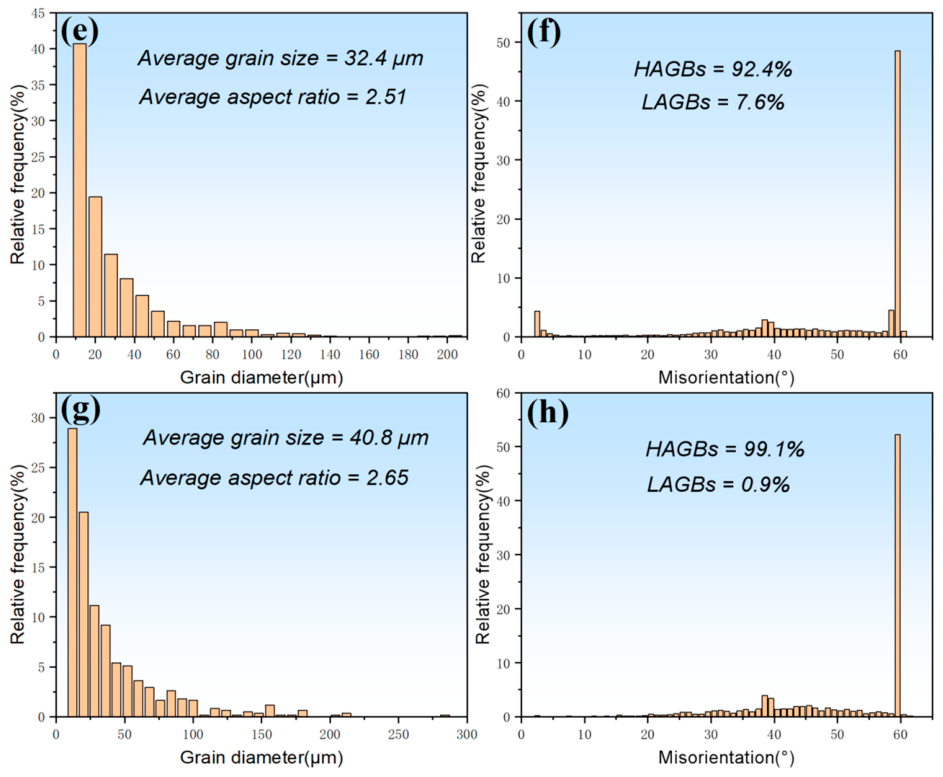
When the temperature reaches 1180 °C, as shown in Figure 4c, the SLMed columnar grains are replaced by polygonal grains, which show a marked non-uniformity in size. This indicates that the materials prepared by laser selective melting could undergo static recrystallization in subsequent heat treatment, due to its original microstructure with high-density dislocations and stored energy [23]. Figure 4(c1) reveals a large number of Σ3 twin boundaries with an misorientation of 60°, accounting for 49.4% (Figure 5f). The proportion of LAGBs is only 7.6%, indicating that the dislocation density has been significantly reduced. For face-centered cubic metals with low stacking fault energy, recrystallization usually leads to the formation of annealing twins [24]. During the heat treatment process, adjacent subgrains in the original structure gradually increase their misorientation through dislocation motion, evolving from LAGBs to HAGBs; subsequently, HAGBs rapidly migrate, sweeping across the deformed matrix, leaving undistorted grains; at the same time, the recrystallized grains form a large number of Σ3 twin boundaries through the “growth twin” mechanism during their growth process [25]. It is noteworthy that the average aspect ratio of the grains is 2.51 (Figure 5e), which is not equiaxed but has an elongated polygonal morphology. The non-equiaxed growth is attributed to the spatially anisotropic constraint on grain boundary mobility [26]. When the temperature continues to rise to 1280 °C (Figure 4d), the proportion of Σ3 grain boundaries reaches 52.6%, the recrystallized grains significantly coarsen, with an AGD of 40.8 μm, and there are several unusually large grains. Even with a significant increase in recrystallization degree, the average aspect ratio remains 2.65 (Figure 5g).
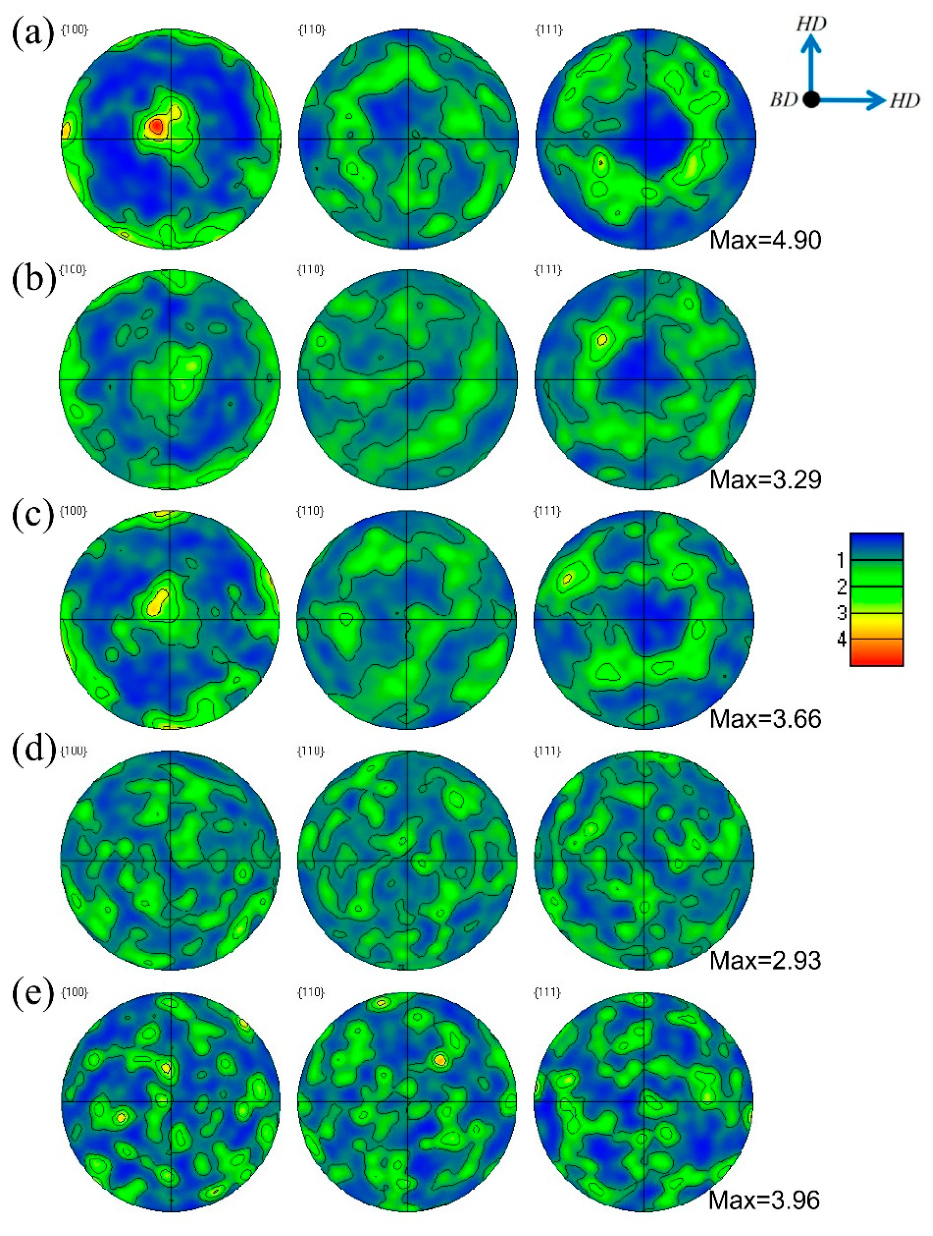
Figure 6 shows the pole figures of the samples in different states. As can be seen from Figure 6a, the SLMed state microstructure has a typical <100> fiber texture of FCC metals [27], which is parallel to BD, with a maximum pole density (MPD) of 4.9. After heat treatment at 980 °C and 1080 °C (Figure 6b,c), the samples retain the preferred orientation of the SLMed state, while the MPD values are 3.29 and 3.66 (close to BD), respectively. It is discovered that the texture intensity does not monotonically decrease with temperature. Between 980 °C and 1080 °C, it first decreases and then increases. This pattern is consistent with the change pattern of the grain aspect ratio in Figure 5. The increase in aspect ratio and texture intensity from 980 °C to 1080 °C can be attributed to subgrain/grain boundary migration and subgrain coalescence along the building direction, which are facilitated by recovery, as well as the partial dissolution/coarsening of carbides [28]. Subgrain coalescence reduces the misorientation within individual columnar grains. This further enhances the concentration of the main poles in the pole map, manifesting as an increase in the maximum pole density. After heat treatment at 1180 °C for 1 h (Figure 6d), the original <100> fiber texture has been eliminated by recrystallization. The measured MPD is 2.93; however, this value does not indicate a specific strong texture but rather arises from the abnormal growth of a few grains with high boundary mobility [29]. The MPD of 3.96 for the 1280 °C-1 h specimen is also a reflection of the abnormal growth effect in the pole figures.
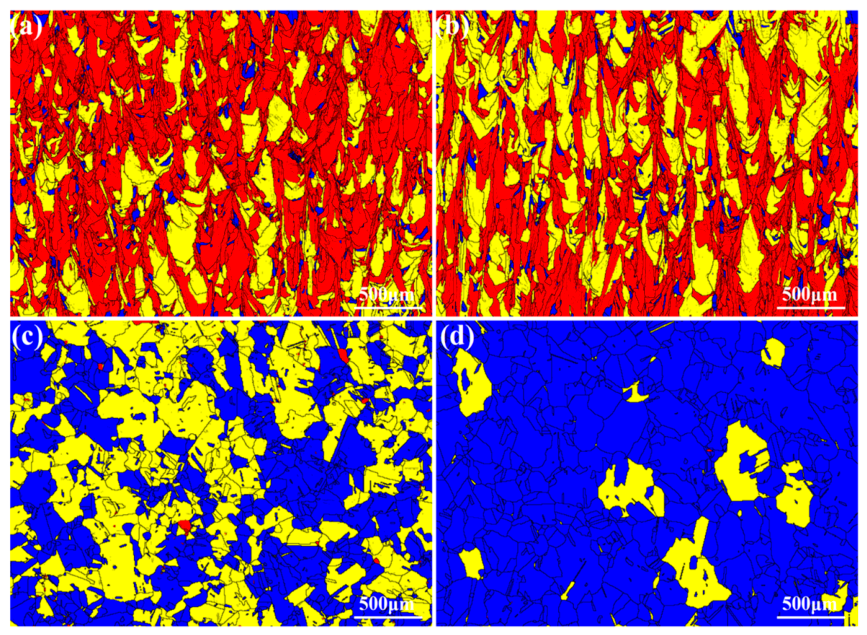
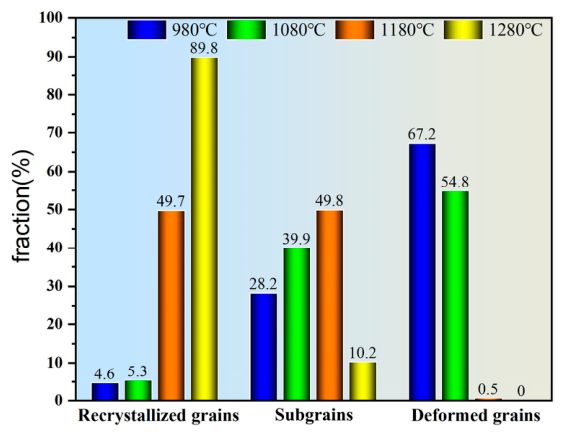
Figure 7 shows the recrystallization maps of the GH3536 alloy at different heat-treatment temperatures, and Figure 8 gives the volume fractions of recrystallized grains, subgrains and deformed grains at different temperatures. In this study, GOS angles of 1.5° and 7° were used as thresholds to distinguish recrystallized grains, subgrains, and deformed grains, which are represented in blue, yellow, and red, respectively. From Figure 7a,b, it can be seen that the recrystallized grains are very few (~5%) at heat-treatment temperatures of 980 °C and 1080 °C, which is due to the fact that the recrystallization temperature of the GH3536 alloy has not been reached. The microstructure remains dominated by deformed grains, accounting for 67.2% and 54.8%, respectively, while subgrains constitute 28.2% and 39.9%. As temperature increases, deformed grains decrease and subgrains increase, indicating a higher degree of high-temperature recovery. During this stage, dislocations rearrange themselves, forming low-angle grain boundaries that divide originally heavily deformed large grains into numerous fine, internally clean subgrains, resulting in polygonization [30]. With prolonged time, subgrains continuously merge and grow, while the deformed grains are gradually consumed [31]. Although a high-temperature recovery occurs, there are a large number of carbides in the alloy at 980 °C and 1080 °C (as shown in Figure 3a,b), which pin the grain boundaries and hinder the occurrence of recrystallization.
When the heat-treatment temperature reaches 1180 °C, deformed grains almost disappear, and significant recrystallization occurs with a fraction of 49.7%. It is worth noting that the fraction of subgrains is also as high as 49.8%. This is significantly different from the typical static recrystallization microstructure after cold deformation. The formation of numerous subgrains could be attributed to the following factors [32]: (1) The extreme inhomogeneity of the initial microstructure—non-uniform dislocation distribution leads to uneven driving forces during heat treatment, causing recrystallization to preferentially occur in high-energy regions such as grain boundaries and melt pool boundaries, whereas low-energy regions (within grains) lack sufficient driving force for complete recrystallization and instead relieve stress through recovery mechanisms, forming stable subgrain structures. (2) The solute drag effect—the oversaturated solute atoms segregate to the migrating subgrain boundaries and recrystallization fronts, that severely reduces the boundary mobility. When the heat-treatment temperature increases to 1280 °C, the recrystallized fraction rises to 89.8%, while the subgrain fraction decreases to 10.2%. This indicates that at elevated temperatures, subgrains continuously grow and merge into high-angle grain boundaries, thereby transforming into fully recrystallized grains.

3.3. Effect of Heat-Treatment Temperature on Mechanical Properties

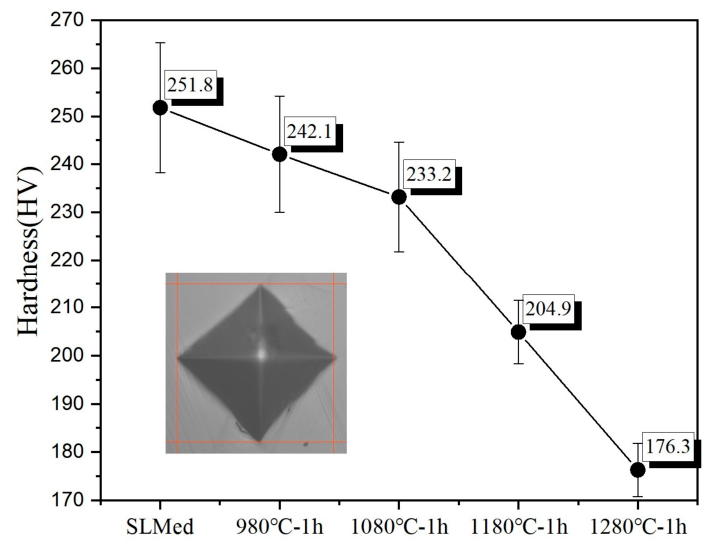
Figure 9 shows the micro-Vickers hardness of SLMed and heat-treated GH3536 alloys. The average hardness of the SLMed GH3536 alloy is 251.8 ± 13.5 HV. As the heat-treatment temperature increases from 980 °C to 1280 °C, the average hardness value gradually decreases from 242.1 ± 12.2 HV to 176.3 ± 5.5 HV. The decrease in hardness is mainly attributed to the occurrence of recovery and recrystallization successively with the increase in temperature. During that time, the dislocation density in the alloy sharply decreases, and the cellular crystal/branch crystal structure disintegrates. Above 1180 °C, the coarsening of recrystallized grains further reduces the hardness.
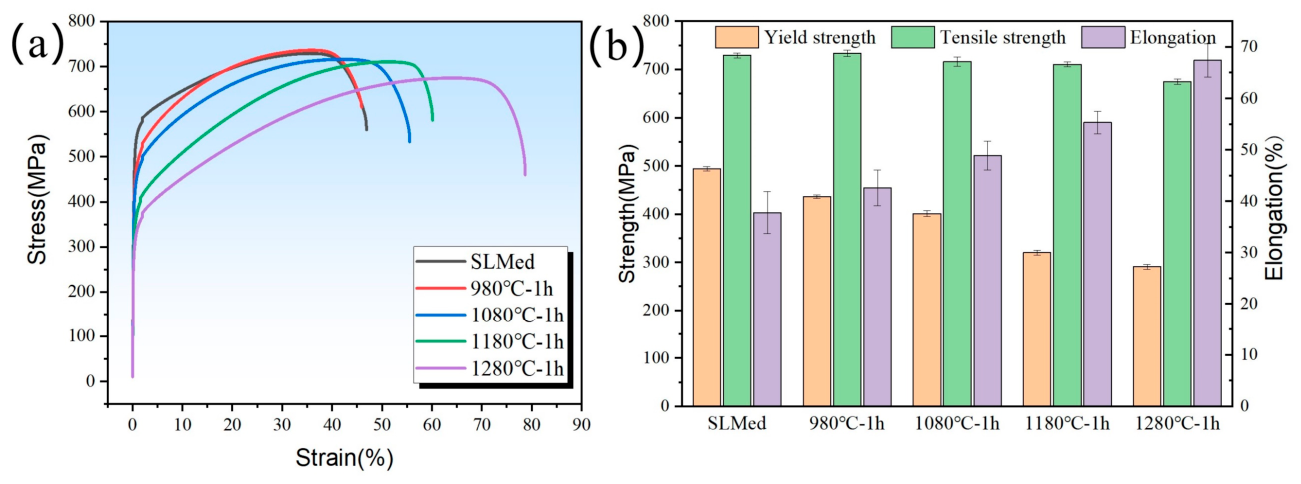
Figure 10 presents the engineering stress–strain curves and the average tensile properties of the GH3536 alloy along the vertical direction at room temperature. The yield strength (YS), tensile strength (TS) and elongation (EL) of the SLMed specimens are 494.0 ± 4.3 MPa, 729.1 ± 4.9 MPa, and 37.8 ± 4.1%, respectively. The SLMed GH3536 exhibits high strength, mainly attributed to its high-density dislocations, fine cellular microstructure, and over-saturated solute atoms. The high back stress generated by the accumulation of geometrically necessary dislocations (GNDs) at the cell wall/subgrain boundaries may also be one of the reasons [33]. The <100>//BD texture gives it significant mechanical property anisotropy, with typically higher strength and lower plasticity in the horizontal direction [34]. Additionally, the SLMed alloy has significant residual stress, often accompanied by some defects such as pores, cracks or incomplete fusion, which are prone to become crack initiation points when subjected to loads, leading to sudden fracture [35]. Therefore, thermal isostatic pressing and heat treatment are required to eliminate the defects and regulate the microstructure and properties.
As the heat-treatment temperature increases from 980 °C to 1080 °C, the YS decreases from 436.2 ± 3.8 MPa to 401.1 ± 6.0 MPa, the TS decreases slightly from 733.5 ± 6.5 MPa to 716.2 ± 9.4 MPa, and the EL increases from 42.6 ± 3.5% to 48.9 ± 2.8%. As mentioned in Section 3.2, the heat treatments at 980 °C and 1080 °C have a very limited effect on the grain morphology and average size of SLMed GH3536. Therefore, the contribution of the Hall–Petch effect (σHP) to the yield strength is essentially a constant value. Consequently, it can be inferred that the significant reduction in YS is mainly attributed to the release of back stress (−Δσρ) and the loss of solid solution strengthening (−Δσss) caused by solute precipitation [36]. For the 1180 °C-1 h specimen, the occurrence of partial recrystallization results in a reduction in YS to 320.0 ± 4.8 MPa and an increase in EL to 55.3 ± 2.2%. Considering that its average grain size (32.4 μm) is still close to the SLMed (31.8 μm), it indicates that the effect of σHP on the YS is limited. Although carbide dissolution increases the σss, its increment (+Δσss) is much smaller than the decrease in strength (−Δσρ) caused by dislocation elimination and back stress release. Observing Figure 10a, it can be seen that heat treatment reduces the yield-to-tensile ratio and increases the uniform elongation, indicating that the strain-hardening capacity of the alloy is enhanced [37]. This makes the material more resistant to local plastic instability and the initiation of cracks, and improves its fatigue performance. After 1 h solution treatment at 1280 °C, the YS and TS of the alloy decrease to 290.5 ± 5.2 MPa and 674.8 ± 5.9 MPa respectively, and the EL increases to 67.4 ± 3.2%. During this process, the recrystallization fraction increases to 89.8%, and the grain size grows to 40.8 μm. The further reduction in YS is attributed to the decrease in σHP caused by grain coarsening, as well as the further decrease in σρ. The higher elongation indicates that GH3536 still has good grain boundary thermal stability and interfacial bonding strength in the ultra-high temperature range.

4. Conclusions

(1)
The SLMed GH3536 alloy exhibits a columnar grain structure with an average aspect ratio of 4.49, features a <100>//BD fiber texture with a texture intensity of 4.90, and has a LAGBs fraction of 45.1%. No precipitates are observed in the SLMed alloy. The YS, TS and EL are 494.0 ± 4.3 MPa, 729.1 ± 4.9 MPa, and 7.8 ± 4.1%, respectively. The high strength is primarily attributed to its high dislocation density (back stress), fine cellular substructure, and supersaturated solute atoms.
(2)
In the 980 °C-1 h specimen, a large number of Mo-rich M6C-type carbides are observed distributing along grain boundaries and interdendritic regions. After the 1080 °C-1 h heat treatment, a significant fraction of the fine and dispersed carbides undergo dissolution back into the matrix, whereas the M6C carbide particles at grain boundaries coarsen, indicating that the Ostwald ripening phenomenon might have occurred. After the 1180 °C-1 h solution treatment, the carbides are completely dissolved into the matrix.
(3)
From 980 °C to 1080 °C, the columnar grain morphology formed by SLM is retained, the fraction of deformed grains reduces, and subgrains increase, indicating an enhanced degree of recovery. Nevertheless, the presence of abundant carbides pins grain boundaries and hinders the occurrence of recrystallization. The grain aspect ratio and texture intensity do not monotonically decrease with temperature. The increase in aspect ratio and texture intensity from 980 °C to 1080 °C can be attributed to subgrain/grain boundary migration and subgrain coalescence along the building direction, which are facilitated by recovery, as well as the partial dissolution/coarsening of carbides.
(4)
The recrystallization fraction of the 1180 °C-1 h specimen reaches 49.7%, accompanied by a subgrain fraction of 49.8%. The recrystallized grains exhibit a polygonal morphology, with an average aspect ratio of 2.51, which contains a large number of annealing twins. The non-equiaxed growth is attributed to the spatially anisotropic constraint on grain boundary mobility. The formation of numerous subgrains could be attributed to the microstructural inhomogeneity and the solute drag effect. At 1280 °C, the recrystallization fraction increases to 89.8%, with significant grain coarsening.
(5)
As the temperature rises, recovery and recrystallization occur successively. The hardness gradually decreases from 251.8 ± 13.5 HV for the SLMed alloy to 176.3 ± 5.5 HV. Under the combined influence of back stress release, solid solution strengthening and the Hall–Petch effect, the yield strength gradually decreases. Heat treatment reduces the yield-to-tensile ratio and enhances the uniform elongation, indicating an improvement in the strain-hardening capability of the alloy. The 1180 °C-1 h specimen exhibits YS and EL of 320.0 ± 4.8 MPa and 55.3 ± 2.2%, respectively. For the 1280 °C-1 h specimen, the YS and TS decrease to 290.5 ± 5.2 MPa and 674.8 ± 5.9 MPa respectively, while the EL increases to 67.4 ± 3.2%. Such high elongation suggests that even after 1 h of exposure at 1280 °C, GH3536 retains excellent grain boundary thermal stability and interfacial bonding strength.

Author Contributions

Conceptualization, Y.Z. and X.W.; Methodology, R.L. and J.B.; Investigation, S.S. and Y.Z.; Resources, J.B.; Data curation, J.L. and S.S.; Writing—original draft, R.L. and J.L.; Writing—review & editing, R.L.; Supervision, X.W.; Funding acquisition, J.B. All authors have read and agreed to the published version of the manuscript.

Funding

This work is supported by the National Key R&D Program of China (No. 2024YFB4608804).

Data Availability Statement

The original contributions presented in this study are included in the article. Further inquiries can be directed to the corresponding authors.

Conflicts of Interest

Author Jie Bai was employed by the Beijing Power Machinery Institute. The remaining authors declare that the research was conducted in the absence of any commercial or financial relationships that could be construed as a potential conflict of interest.

References

  1. Chen, N.; Zheng, D.; Niu, P.; Li, R.; Yuan, T. Laser powder bed fusion of GH3536 nickel-based superalloys: Processing parameters, microstructure and mechanical properties. Mater. Charact. 2023, 202, 113018. [Google Scholar] [CrossRef] [Scilit]
  2. Min, S.; Zhang, H.; Liu, H.; Zhang, K.; Huang, A.; Hou, J. Influence of defects on high-temperature oxidation performance of GH3536 superalloys fabricated by laser powder bed fusion. Addit. Manuf. Lett. 2022, 3, 100064. [Google Scholar] [CrossRef] [Scilit]
  3. Yeung, H.; Lane, B.; Fox, J. Part geometry and conduction-based laser power control for powder bed fusion additive manufacturing. Addit. Manuf. 2019, 30, 100844. [Google Scholar] [CrossRef] [Scilit] [PubMed]
  4. Gu, D.; Shi, Q.; Lin, K.; Xi, L. Microstructure and performance evolution and underlying thermal mechanisms of Ni-based parts fabricated by selective laser melting. Addit. Manuf. 2018, 22, 265–278. [Google Scholar] [CrossRef] [Scilit]
  5. Huang, Z.; Zhai, Z.; Lin, W.; Chang, H.; Wu, Y.; Yang, R.; Zhang, Z. On the orientation dependent microstructure and mechanical behavior of Hastelloy X superalloy fabricated by laser powder bed fusion. Mater. Sci. Eng. A 2022, 844, 143208. [Google Scholar] [CrossRef] [Scilit]
  6. Cheng, X.; Du, Z.; Chu, S.; Wu, J.; Dong, J.; Wang, H.; Ma, Z. The effect of subsequent heating treatment on the microstructure and mechanical properties of additive manufactured Hastelloy X alloy. Mater. Charact. 2022, 186, 111799. [Google Scholar] [CrossRef] [Scilit]
  7. Keshavarzkermani, A.; Esmaeilizadeh, R.; Enrique, P.D.; Asgari, H.; Zhou, N.Y.; Bonakdar, A.; Toyserkani, E. Static recrystallization impact on grain structure and mechanical properties of heat-treated Hastelloy X produced via laser powder-bed fusion. Mater. Charact. 2021, 173, 110969. [Google Scholar] [CrossRef] [Scilit]
  8. Qiao, G.; Zhang, B.; Bai, Q.; Dilnoza, Y. Effect of Heat Treatment on Microstructure and Residual Stress of GH3536 Superalloy Fabricated by Selective Laser Melting. J. Mater. Eng. Perform. 2021, 30, 8892–8900. [Google Scholar] [CrossRef] [Scilit]
  9. Yuan, Z.; Chang, F.; Chen, A.; Li, F.; Ma, R.; Bai, J.; Zheng, J. Microstructure and properties of SLM-Hastelloy X alloy after different hot isostatic pressing + heat treatment. Mater. Sci. Eng. A 2022, 852, 143714. [Google Scholar] [CrossRef] [Scilit]
  10. Zhou, B.; Huang, S.; Wang, T.; Wang, C.; Chen, B. Investigation of High-Temperature Tensile Properties and Fracture Mechanisms of GH3536 Alloy Fabricated by Selective Laser Melting. Metals 2025, 15, 381. [Google Scholar] [CrossRef] [Scilit]
  11. Zhang, W.; Zheng, Y.; Liu, F.; Wang, D.; Liu, F.; Huang, C.; Li, Q.; Lin, X.; Huang, W. Effect of solution temperature on the microstructure and mechanical properties of Hastelloy X superalloy fabricated by laser directed energy deposition. Mater. Sci. Eng. A 2021, 820, 141537. [Google Scholar] [CrossRef] [Scilit]
  12. Sanchez-Mata, O.; Wang, X.; Muñiz-Lerma, J.A.; Attarian Shandiz, M.; Gauvin, R.; Brochu, M. Fabrication of Crack-Free Nickel-Based Superalloy Considered Non-Weldable during Laser Powder Bed Fusion. Materials 2018, 11, 1288. [Google Scholar] [CrossRef] [Scilit] [PubMed]
  13. ASTM E384-22; Standard Test Method for Microindentation Hardness of Materials. ASTM International: West Conshohocken, PA, USA, 2022.
  14. ASTM E8/E8M-24; Standard Test Methods for Tension Testing of Metallic Materials. ASTM International: West Conshohocken, PA, USA, 2024.
  15. Wang, L.; Liao, C.; Yang, R.; Xiong, Y.; Li, T. Transformation mechanism of carbides in solution treatment and high-temperature tensile performance of GH3230 superalloy fabricated via laser powder bed fusion. Mater. Today Commun. 2025, 44, 112025. [Google Scholar] [CrossRef] [Scilit]
  16. Liu, F.; Cheng, H.; Yu, X.; Yang, G.; Huang, C.; Lin, X.; Chen, J. Control of microstructure and mechanical properties of laser solid formed Inconel 718 superalloy by electromagnetic stirring. Opt. Laser Technol. 2018, 99, 342–350. [Google Scholar] [CrossRef] [Scilit]
  17. Wu, S.; Dai, S.B.; Heilmaier, M.; Peng, H.Z.; Zhang, G.H.; Huang, S.; Zhang, X.J.; Tian, Y.; Zhu, Y.M.; Huang, A.J. The effect of carbides on the creep performance of Hastelloy X fabricated by laser powder bed fusion. Mater. Sci. Eng. A 2023, 875, 145116. [Google Scholar] [CrossRef] [Scilit]
  18. Marchese, G.; Bassini, E.; Aversa, A.; Lombardi, M.; Ugues, D.; Fino, P.; Biamino, S. Microstructural Evolution of Post-Processed Hastelloy X Alloy Fabricated by Laser Powder Bed Fusion. Materials 2019, 12, 486. [Google Scholar] [CrossRef] [Scilit] [PubMed]
  19. Tomus, D.; Tian, Y.; Rometsch, P.A.; Heilmaier, M.; Wu, X. Influence of post heat treatments on anisotropy of mechanical behaviour and microstructure of Hastelloy-X parts produced by selective laser melting. Mater. Sci. Eng. A 2016, 667, 42–53. [Google Scholar] [CrossRef] [Scilit]
  20. Chu, T.; Xu, H.; Cui, H.; Lu, F. Research on the coarsening mechanism of precipitations and its effect on toughness for nickel-based weld metal during thermal aging. J. Mater. Res. 2019, 34, 2705–2713. [Google Scholar] [CrossRef] [Scilit]
  21. Doherty, R.D.; Hughes, D.A.; Humphreys, F.J.; Jonas, J.J.; Juul Jensen, D.; Kassner, M.E.; King, W.E.; McNelley, T.R.; McQueen, H.J.; Rollett, A.D. Current issues in recrystallization: A review. Mater. Today 1998, 1, 14–15. [Google Scholar] [CrossRef] [Scilit]
  22. Bizana, G.B.; Kalidindi, S.R.; Barrales-Mora, L.A. Data-driven quantification of grain boundary structures and their correlation with migration kinetics. Acta Mater. 2026, 315, 122403. [Google Scholar] [CrossRef] [Scilit]
  23. Wang, Y.; Li, S.; Ma, R.; Du, H.; Yao, J.; Shi, Y.; Yin, Z.; Dong, X.; Liu, X. The effect of laser power on the microstructure and mechanical properties of LPBF Hastelloy X in as-built and heat-treated states. Mater. Charact. 2025, 227, 115320. [Google Scholar] [CrossRef] [Scilit]
  24. Ren, Q.; Chen, J.; Lu, J.; Cheng, X.; Zhang, Y.; Zhang, Z. In-situ study of microstructure and mechanical properties of GH3536 alloy manufactured by selective laser melting at 750 °C. Mater. Sci. Eng. A 2024, 900, 146452. [Google Scholar] [CrossRef] [Scilit]
  25. Liu, C.; Chen, Z.; Tang, X.; Guo, L.; Cheng, Y.; Fan, G. Effect of low-temperature annealing on the mechanical anisotropy and microstructure of Selective Laser Melting (SLM) AlSi7Mg alloy. J. Mater. Res. Technol. 2026, 40, 4093–4106. [Google Scholar] [CrossRef] [Scilit]
  26. Li, S.; Liu, J.; Zhao, H.; Lv, J.; Ma, L.; Tan, Y.; Li, P. Evidence of carbide-assisted in situ-directional recrystallization of GH4099 superalloy fabricated by laser powder bed fusion. J. Mater. Sci. Technol. 2025, 215, 99–110. [Google Scholar] [CrossRef] [Scilit]
  27. Kangazian, J.; Kermanpur, A.; Shamanian, M.; Sadeghi, F.; Badrossamay, M.; Foroozmehr, E. Microstructure and hot tensile behavior of Hastelloy X superalloy laser powder-bed fusion-fabricated through different scanning patterns. Mater. Sci. Eng. A 2023, 867, 144717. [Google Scholar] [CrossRef] [Scilit]
  28. Xu, J.; Brodin, H.; Peng, R.L.; Luzin, V.; Moverare, J. Effect of heat treatment temperature on the microstructural evolution of CM247LC superalloy by laser powder bed fusion. Mater. Charact. 2022, 185, 111742. [Google Scholar] [CrossRef] [Scilit]
  29. Chen, K.; Li, H.; Lim, C.H.; Jia, N.; Yan, W. Fine grains within narrow temperature range by tuning strain-induced boundary migration dominated recrystallization for selective laser melted Inconel 718. Scr. Mater. 2022, 219, 114882. [Google Scholar] [CrossRef] [Scilit]
  30. Yao, J.; Wu, J.; Su, J.; Wu, H.; Wang, Z.; Wang, W.; Tan, L.; Huang, L.; Liu, F. Effect of heat treatment temperature on the microstructure and properties of high Ti/Al ratio nickel-based superalloys fabricated by laser powder bed fusion. Intermetallics 2025, 187, 109020. [Google Scholar] [CrossRef] [Scilit]
  31. Kajima, Y.; Takaichi, A.; Kittikundecha, N.; Nakamoto, T.; Kimura, T.; Nomura, N.; Kawasaki, A.; Hanawa, T.; Takahashi, H.; Wakabayashi, N. Effect of heat-treatment temperature on microstructures and mechanical properties of Co–Cr–Mo alloys fabricated by selective laser melting. Mater. Sci. Eng. A 2018, 726, 21–31. [Google Scholar] [CrossRef] [Scilit]
  32. Huang, S.; Chen, B.; Liu, W.; Zhou, B.; Zhang, X.; Zeng, Q.; Guo, S. Effect of Heat Treatment on Microstructure and Properties of GH3536 Fabricated by Selective Laser Melting. Metals 2022, 12, 1184. [Google Scholar] [CrossRef] [Scilit]
  33. Deirmina, F.; Adegoke, O.; Col, M.D.; Pellizzari, M. Effect of layer thickness, and laser energy density on the recrystallization behavior of additively manufactured Hastelloy X by laser powder bed fusion. Addit. Manuf. Lett. 2023, 7, 100182. [Google Scholar] [CrossRef] [Scilit]
  34. Liu, J.; Zhang, Y.; Zhu, B.; Cheng, L.; Li, S.; Wang, Y.; Bai, J.; Ma, R. Static recrystallization behavior and mechanical properties of GH3536 superalloy by selective laser melting. J. Mater. Eng. 2025, 53, 142–151. [Google Scholar]
  35. Kareem, S.; Anaele, J.; Adewole, T.; Ibekwe, I.; Olayiwola, M.; Bodunrin, M. Additive manufacturing of superalloys via selective laser melting: Process–structure–property relationships, defect control, and industrial prospects. Prog. Addit. Manuf. 2026, 11, 3677–3722. [Google Scholar] [CrossRef] [Scilit]
  36. Li, X.; Li, G.; Zhang, M.-X.; Zhu, Q. Novel approach to additively manufacture high-strength Al alloys by laser powder bed fusion through addition of hybrid grain refiners. Addit. Manuf. 2021, 48, 102400. [Google Scholar] [CrossRef] [Scilit]
  37. Montero-Sistiaga, M.L.; Liu, Z.; Bautmans, L.; Nardone, S.; Ji, G.; Kruth, J.-P.; Van Humbeeck, J.; Vanmeensel, K. Effect of temperature on the microstructure and tensile properties of micro-crack free hastelloy X produced by selective laser melting. Addit. Manuf. 2020, 31, 100995. [Google Scholar] [CrossRef] [Scilit]
Figure 1. Specific dimensions of the barbell-shaped tensile specimen.
Metals 16 01029 g001
Figure 2. Microstructure characterization of the longitudinal cross-section in the SLMed GH3536 alloy. (a) SEM map. (b) Color code orientation map. (c) Grain size statistics. (d) Statistics of grain boundary misorientation.
Metals 16 01029 g002
Figure 3. SEM images of GH3536 heat-treated at 980 °C (a,b), 1080 °C (c,d) and 1180 °C (e,f); EDS map and its element distribution of 980 °C-1 h specimen (g); spectrum with chemical composition of precipitates (h,i).
Metals 16 01029 g003
Figure 4. Color code orientation maps and the corresponding grain boundary maps of the GH3536 alloy at different heat-treatment temperatures: (a,a1) 980 °C; (b,b1) 1080 °C; (c,c1) 1180 °C; (d,d1) 1280 °C.
Metals 16 01029 g004aMetals 16 01029 g004b
Figure 5. Grain size statistics and grain boundary misorientation statistics at different heat-treatment temperatures: (a,b) 980 °C; (c,d) 1080 °C; (e,f) 1180 °C; (g,h) 1280 °C.
Metals 16 01029 g005aMetals 16 01029 g005b
Figure 6. Pole figures of GH3536 alloys heat-treated at different temperatures: (a) SLMed; (b) 980 °C; (c) 1080 °C; (d) 1180 °C; (e) 1280 °C.
Metals 16 01029 g006
Figure 7. Recrystallization maps of GH3536 alloys heat-treated at different temperatures: (a) 980 °C; (b) 1080 °C; (c) 1180 °C; (d) 1280 °C. Red: deformed grains; yellow: subgrains; blue: recrystallized grains.
Metals 16 01029 g007
Figure 8. The volume fractions of recrystallized, sub- and deformed grains at different temperatures.
Metals 16 01029 g008
Figure 9. Vickers hardness of SLMed and heat-treated GH3536.
Metals 16 01029 g009
Figure 10. The stress–strain curves (a) and the average tensile properties (b) of SLMed and heat-treated GH3536 alloys along the vertical direction.
Metals 16 01029 g010
Table 1. Chemical compositions of GH3536 powder (mass fraction, %).
NiCrFeMoCoWAlSiMn
Bal.21.1018.609.351.930.400.080.100.01
Disclaimer/Publisher’s Note: The statements, opinions and data contained in all publications are solely those of the individual author(s) and contributor(s) and not of MDPI and/or the editor(s). MDPI and/or the editor(s) disclaim responsibility for any injury to people or property resulting from any ideas, methods, instructions or products referred to in the content.