1. Introduction
The increasing demand for lightweight structural materials with enhanced mechanical performance and thermal stability has driven the development of advanced alloy design strategies. Among these, multicomponent alloy concepts have emerged as a promising approach, inspired by the compositional complexity paradigm originally introduced in high-entropy alloys (HEAS). Rather than relying on a single dominant strengthening mechanism, these alloy design strategies exploit the synergistic interaction of multiple alloying elements to tailor phase formation, microstructural stability, and mechanical performance [
1]. Recent studies have also extended these concepts to aluminium casting alloys and high-pressure die casting (HPDC) systems, highlighting the growing interest in applying compositional complexity principles to lightweight alloys processed by industrial routes [
2]. Unlike conventional HEAs, aluminium multicomponent alloys must simultaneously preserve low density, good castability, and compatibility with established high-productivity manufacturing technologies. Consequently, alloy development is not only governed by configurational complexity but also by the careful selection of alloying additions capable of promoting thermally stable strengthening phases while maintaining satisfactory processing characteristics. Recent advances in multicomponent aluminium alloys have demonstrated that this approach offers considerable potential for improving the mechanical performance and thermal stability of cast aluminium alloys without sacrificing their industrial applicability [
3].
More recently, integrated computational alloy design approaches combining CALPHAD thermodynamic modelling, machine learning, and experimental validation have become increasingly important for accelerating the development of advanced aluminium casting alloys and guiding alloy optimisation before experimental fabrication [
4,
5].
Besides computational alloy design, tailoring the microstructure has become another key strategy for improving the overall performance of aluminium alloys. For example, hybrid reinforcement introduced by friction stir processing has been reported to simultaneously enhance strength, ductility, and wear resistance in Al5052 alloys. Although the processing route differs substantially from HPDC, these findings further demonstrate that careful control of microstructural features is essential for achieving a balanced combination of mechanical and tribological properties in aluminium-based materials [
6].
In this context, HPDC is characterised by rapid solidification under applied pressure, leading to pronounced microstructural refinement [
7]. Under these conditions, the formation of coarse equilibrium phases is reduced, while metastable and non-equilibrium intermetallics are favoured, often resulting in enhanced mechanical performance [
8]. Cooling rates on the order of 10
2 °C/s significantly reduce grain size and/or secondary dendrite arm spacing and modify solute redistribution during solidification. Consequently, the resulting microstructures deviate markedly from equilibrium predictions, making phase identification and analysis of solidification pathways essential for understanding structure–property relationships [
9]. Similarly, studies on other cast alloy systems have demonstrated that alloy composition and cooling rate act synergistically in determining phase constitution and microstructural evolution during solidification, highlighting the importance of jointly considering both parameters when designing advanced casting alloys [
10]. Moreover, the increasing service temperatures of automotive components, particularly in electrified vehicles, have further highlighted the limitations of conventional Al–Si–Cu HPDC alloys and the growing need for thermally stable strengthening phases capable of retaining mechanical performance at elevated temperatures [
11].
From a compositional perspective, Al–Mg alloys exhibit excellent ductility and fracture resistance in the as-cast condition, although their limited castability restricts their industrial application. In contrast, Al–Si-based alloys dominate HPDC applications due to their superior fluidity and ability to produce complex geometries, with alloys such as AlSi9Cu3 being widely used. However, these alloys typically suffer a significant reduction in hardness at temperatures above 100–150 °C, mainly due to precipitate coarsening and solute redistribution within the aluminium matrix [
12,
13].
A potential strategy is to combine the advantages of both systems. The addition of magnesium (Mg) promotes the formation of Mg
2Si (at the expense of free silicon), modifying both the morphology and distribution of second-phase particles. In particular, Mg additions of approximately 3 wt.% can be sufficient to suppress the formation of the acicular primary Si phases, favouring the formation of Mg
2Si particles [
14] instead. The characteristics of these particles strongly depend on the alloy composition, especially on maintaining an appropriate Mg/Si ratio close to the stoichiometric requirement for Mg
2Si formation. When Mg and Si contents are sufficiently high, the alloy composition may shift towards the hypereutectic region of the Al–Mg
2Si pseudo-binary system, leading to the formation of primary Mg
2Si prior to α-Al solidification [
15]. These particles are particularly beneficial for high-temperature performance due to their high melting temperature, low density, high hardness, and relatively high elastic modulus. Furthermore, compared to acicular silicon, Mg
2Si provides a more favourable morphology, reducing stress concentration and enhancing matrix strengthening.
Copper (Cu) addition promotes the formation of θ-Al
2Cu and S-Al
2CuMg strengthening phases [
15], whose stability is strongly influenced by the Mg content. Given the limited solubility of Cu in aluminium (around 4 wt.%), compositions close to this threshold are typically preferred to increase solid-solution and precipitation strengthening, while avoiding the formation of coarse intermetallics. However, in highly alloyed systems, lower Cu contents may be more effective [
16]. For instance, in AlSi10Mg alloys, the addition of 2 wt.% Cu has been reported to increase pore size [
17], whereas in Al–Cu–Mg systems, increasing the Cu content from 4 to 8 wt.% led to improvements of approximately 30% in UTS at room temperature (RT), and up to 62% at 300 °C, attributed to the formation of a higher density of fine strengthening phases [
18]. Similarly, in Al–Mg alloys, the increased Cu content up to 6 wt.% has been associated with grain refinement, as well as simultaneous improvements in strength and ductility [
19].
Zinc (Zn) is another promising alloying element. It helps modify the solidification process by reducing dendritic structures, promoting a more equiaxed morphology, and increasing the fraction of eutectic phases [
20]. In Al–Mg–Cu alloys, Zn stimulates the precipitation of coherent T-Mg
32(Al,Zn)
49 phases, while suppressing S-Al
2CuMg and β-Al
3Mg
2 phases and promoting the dispersion of θ-Al
2Cu [
21]. The combined addition of Zn and Cu has shown particularly promising results. In Al–Mg alloys, the addition of approximately 6 wt.% Cu and 6 wt.% Zn led to the formation of MgZn
2 and Al
2CuMg phases, resulting in improved mechanical performance [
22]. This final phase has been reported to improve the thermal stability of high-entropy alloys or multicomponent Al–Mg–Si–Cu alloys [
23]. MgZn
2 phases provide significant strengthening, particularly in the form of metastable η′ phases due to their high coherency and resistance to dislocation motion; however, their thermal stability is limited, as η′ tends to transform into the equilibrium η phase at elevated temperatures [
24].
The Zn/Mg ratio plays a critical role in determining phase formation. At low Mg contents or low Zn/Mg ratios, strengthening is primarily associated with η-MgZn
2 formation [
22]. In contrast, higher Mg contents favour the formation of T-type phases, such as T-Mg
32(Al,Zn)
49. Additional phases, including T-Al
2Mg
3Zn
3, T-Al
2Mg
3Zn
3Cu
3-x, or η-type Mg(Zn,Cu,Al)
2, may also precipitate depending on the composition [
25,
26]. These more complex Zn-containing phases generally exhibit enhanced thermal stability compared to metastable η′ precipitates, due to their compositional complexity and reduced diffusion kinetics. Higher Zn contents combined with lower Mg and Cu levels promote MgZn-rich phases instead of S-Al
2CuMg [
27]. Since η-MgZn
2 dissolves more readily during heat treatments, coarse Al
2CuMg particles may act as crack initiation sites [
28]. Furthermore, Cu contents above approximately 2.5 wt.% tend to favour the S-phase formation rather than dissolution in the matrix or precipitating as in T-type phases [
25].
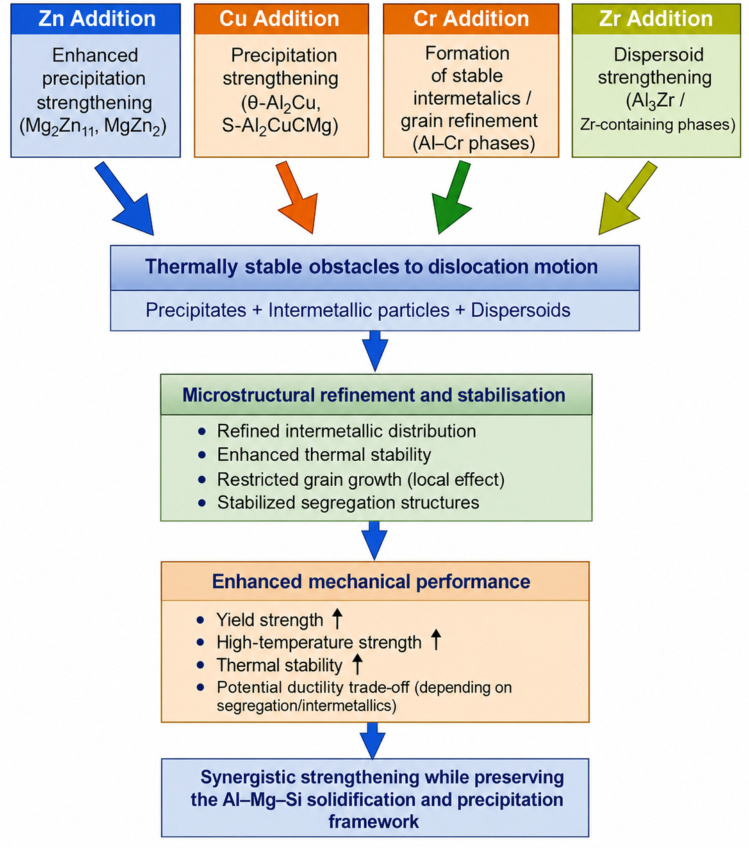
Microalloying additions such as zirconium (Zr) and chromium (Cr) further influence microstructural stability. Zr promotes the formation of thermally stable Al
3Zr dispersoids within the α-Al matrix, enhancing recrystallisation resistance and high-temperature stability [
29]. However, due to its very low solubility in aluminium, high processing temperatures may be required, limiting its widespread application. In addition, Zr can form intermetallics such as Al
3Zr or (Al,Si)
3(Zr,Ti) during early solidification stages, whose morphology strongly affects mechanical properties. Typically, additions are limited to around 0.2 wt.% to avoid undesirable interactions with other elements [
30]. Cr, on the other hand, contributes to matrix strengthening and improves structural stability at elevated temperatures. It can also refine the microstructure and increase tolerance to Fe impurities compared to Al–Si–Mn systems [
31]. However, Cr is rarely used in Al–Si alloys due to its tendency to form coarse intermetallic sludge particles in interdendritic regions, which can deteriorate mechanical properties [
32,
33].
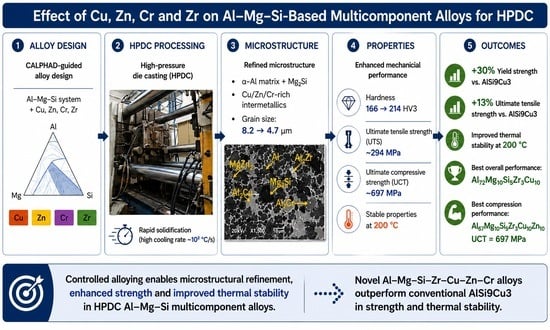
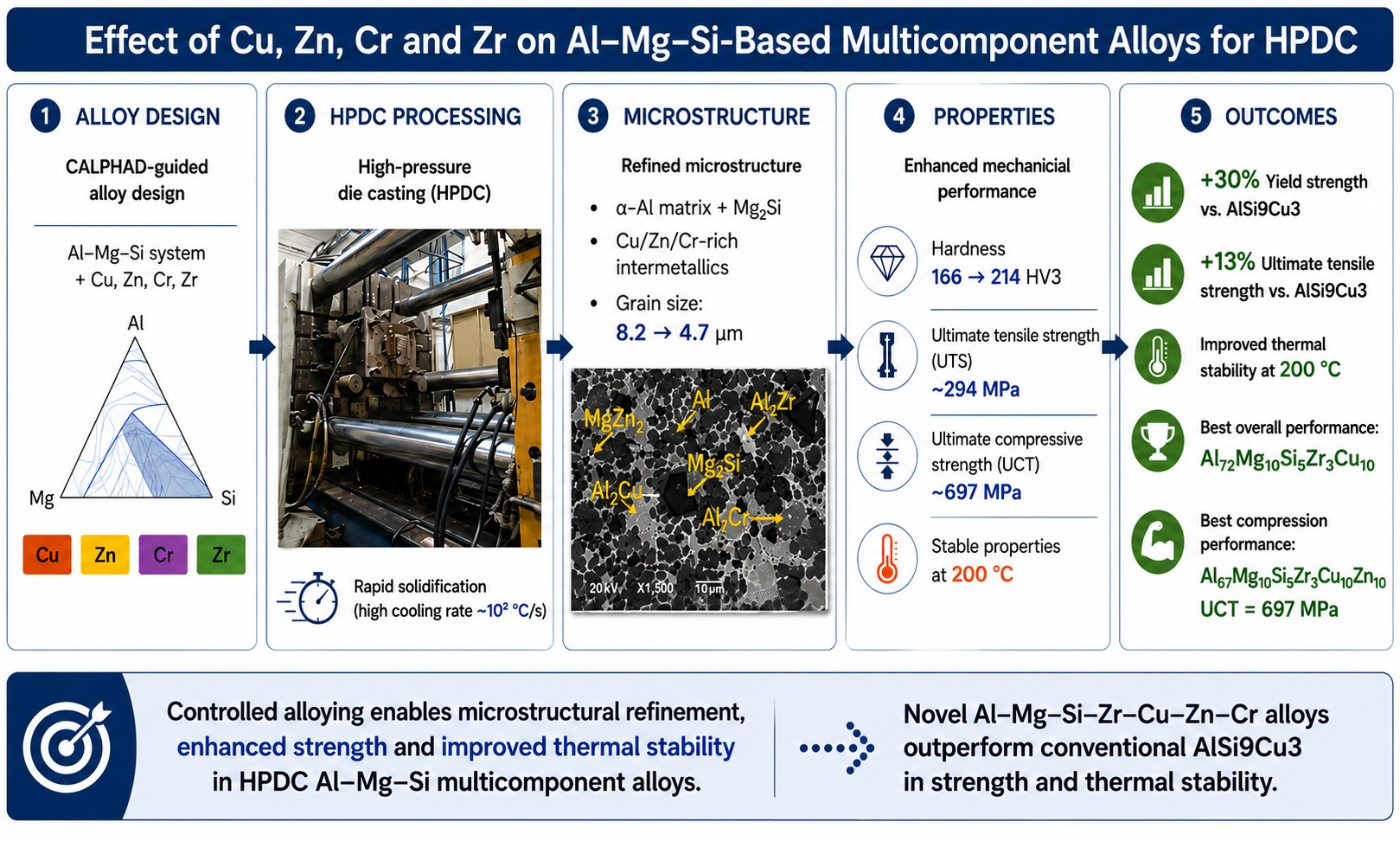
Table 1 summarises the latest representative multicomponent and HEA-inspired aluminium casting alloys reported in the literature, together with their processing route, main objective, and the remaining research gap addressed in each study. As can be seen, although several studies have explored compositionally complex aluminium alloys, most of them have been produced by gravity sand or die casting. In contrast, HPDC studies remain predominantly focused on conventional aluminium alloys or on systems containing only a limited number of alloying additions. Consequently, the development of compositionally complex aluminium alloys specifically designed for HPDC applications is still at an early stage. To the best of the authors’ knowledge, no previous study has systematically investigated the combined addition of Cu, Zn, Cr and Zr in Al–Mg–Si alloys processed by HPDC while simultaneously evaluating the influence of each alloying element on phase evolution, microstructure, and mechanical behaviour. Therefore, the present work aims to bridge this gap by combining a compositionally complex alloy design with HPDC processing and comprehensive thermodynamic, microstructural, and mechanical characterisation.
3. Results and Discussion
3.2. Solidification Behaviour and Thermal Analysis
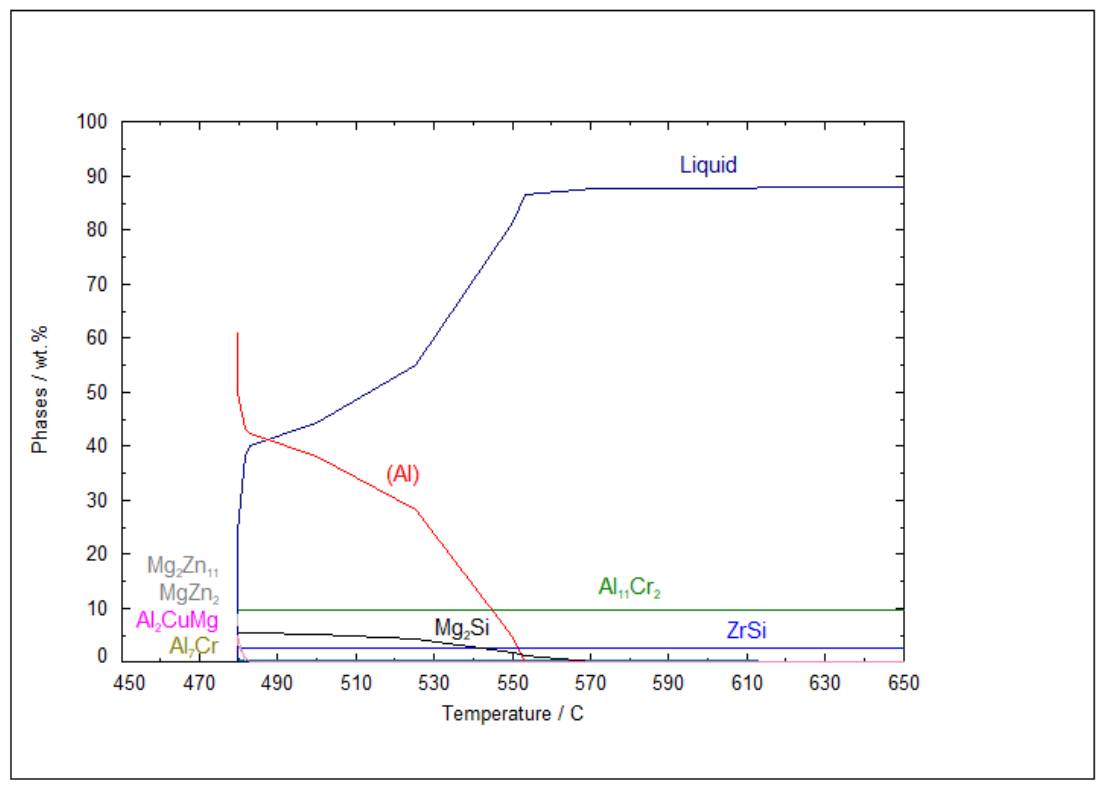
Figure 3 shows a representative Scheil solidification for the H4 alloy, calculated using its experimentally measured chemical composition; however, the complete set of predicted phases, based on their experimentally measured chemical compositions, is summarised in
Table 4.
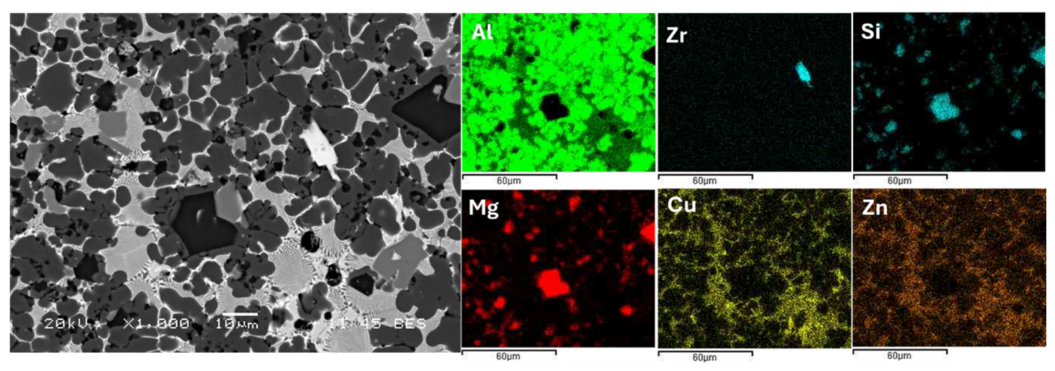
For all alloys, solidification was dominated by the formation of the FCC α-Al matrix, which remained the major constituent, accounting for approximately 59–74 wt.% depending on the alloy composition and solidification conditions. The solidification sequence was initiated by the precipitation of primary Zr-containing phases (ZrSi), followed by Mg2Si and, in the Cr-containing alloys, Cr-rich intermetallics such as Al11Cr2 and Al7Cr. Although the fundamental Al–Mg–Si solidification framework was preserved throughout the alloy series, the progressive addition of Zn and Cr substantially modified the secondary phase constitution, particularly during the final stages of solidification.
Thermodynamic calculations predicted that the first solidification reactions occurred between approximately 1100 and 1130 °C with the precipitation of ZrSi, well before the nucleation of the α-Al matrix. The aluminium-rich FCC phase subsequently formed between approximately 574 and 545 °C, while the remaining Cu-, Zn- and Cr-containing intermetallics precipitated over a broad temperature range that extended to lower temperatures. This wide solidification interval reflects the increasing alloying complexity and the progressive enrichment of the remaining liquid during solidification.
As expected, equilibrium calculations predicted a larger number of stable intermetallic phases than Scheil simulations. Under Scheil conditions, the predicted phase assemblage became considerably simplified owing to the limited diffusion in the solid state, favouring segregation-driven phase selection and suppressing the formation of several low-temperature equilibrium phases. This behaviour is fully consistent with the rapid solidification conditions characteristic of high-pressure die casting.
For the H1 (Al–Mg–Si–Zr-Cu) alloy, both equilibrium and Scheil predictions showed a relatively simple solidification sequence, dominated by Mg2Si and α-Al, together with the early precipitation of ZrSi. Under equilibrium conditions, additional Al3Zr particles were predicted to form during the later stages of solidification, while Cu mainly precipitated as Al7Cu and Al2CuMg. Under Scheil conditions, the phase assemblage became simpler, with Al2CuMg remaining the only significant Cu-containing intermetallic, whereas Al7Cu and Al3Zr were suppressed. Only a minor fraction of MgZn2 was predicted under Scheil conditions, which is consistent with the low residual Zn content measured in this alloy. Overall, the small differences between equilibrium and Scheil calculations indicate limited microsegregation and confirm that the solidification behaviour of H1 is primarily governed by the Al–Mg–Si system, with minor contributions from Cu- and Zr-containing intermetallics.
The introduction of Zn in H2 (Al–Mg–Si–Zr-Cu-Zn) substantially increased the complexity of the system. In addition to ZrSi, Mg2Si, and the FCC matrix, equilibrium calculations predicted the formation of several Zn-containing intermetallic phases, including MgZn2, Mg2Zn11, and AlCuZn, together with Cu-rich phases such as Al7Cu and Al2CuMg. Under Scheil conditions, the phase assemblage was simplified, with the MgZn2 and Mg2Zn11 fractions (19%) becoming the dominant Zn-bearing phases, whereas AlCuZn and Al7Cu were suppressed. This behaviour reflects the suppression of some low-temperature equilibrium phases under rapid solidification while maintaining the preferential segregation of Mg and Zn in the remaining interdendritic liquid.
For the H3 (Al–Mg–Si–Zr-Zn–Cu–Cr) alloy, the addition of 1 wt.% Cr modified the solidification behaviour by promoting the precipitation of primary Cr-rich intermetallics, mainly Al11Cr2 and Al7Cr, which formed before or during the early stages of α-Al solidification owing to the extremely low solubility of Cr in aluminium.
Equilibrium calculations also predicted the formation of additional Zn-containing phases, including MgZn2, Mg2Zn11, MgZn2Al, and AlCuZn, together with Cu-rich intermetallics. Under Scheil conditions, the predicted phase assemblage became less complex, with Al11Cr2 remaining the main Cr-rich phase, while the fraction of Al7Cr was considerably reduced and several low-temperature equilibrium phases were suppressed. Simultaneously, MgZn2 and Mg2Zn11 became the dominant Zn-containing intermetallics, reflecting the progressive enrichment of Zn and Mg in the remaining liquid during non-equilibrium solidification.
For the H4 (Al–Mg–Si–Zr–Cu–Zn–Cr, 3 wt.% Cr) alloy, the higher Cr content produced the greatest modification of the solidification sequence. Equilibrium calculations predicted a marked increase in the fraction of primary Cr-rich intermetallics, particularly Al11Cr2 and Al7Cr, together with Zn-containing phases such as MgZn2, Mg2Zn11, MgZn2Al, and AlCuZn, as well as Cu-rich phases, including Al2CuMg and Al7Cu. Under Scheil conditions, the phase assemblage was considerably simplified, with Al11Cr2 remaining the dominant primary Cr-rich phase, whereas Al7Cr was predicted to form only in trace amounts (<1 wt.%) during the initial stages of solidification. The suppression of several equilibrium phases together with the preferential formation of MgZn2 and Mg2Zn11 illustrates the strong influence of rapid HPDC solidification on phase selection. Furthermore, the substantial increase in the predicted fraction of Cr-rich intermetallics is consistent with the larger and more numerous primary Cr-containing particles observed experimentally in this alloy.
Overall, the comparison between equilibrium and Scheil calculations clearly demonstrated the strong influence of rapid solidification on phase selection. Whereas equilibrium calculations predicted a larger variety of stable intermetallic landscapes, the Scheil simulations indicated that non-equilibrium solidification favours a reduced phase assemblage dominated by the FCC α-Al matrix together with Mg2Si, Cr-rich intermetallics, and Mg–Zn phases. This behaviour is consistent with the limited solid-state diffusion expected under high-pressure die casting conditions and provides a solid thermodynamic framework for interpreting the evolution of the microstructure as a function of alloy composition.
Cooling Curves and Phase Formation Temperatures
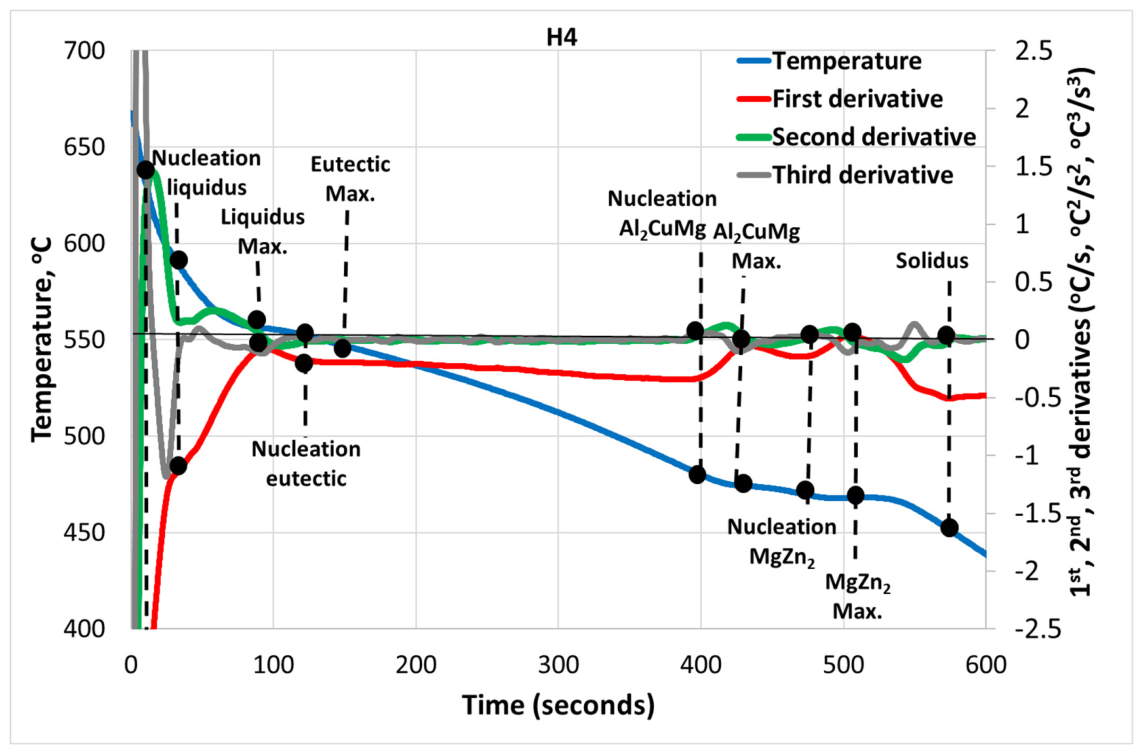
Figure 4 illustrates a representative cooling curve and the associated phase transformations for H4, and
Table 5 summarises the solidification temperatures obtained for the corresponding phases in the four experimental multicomponent alloys. Thermal analysis results revealed systematic changes in the solidification behaviour of the studied alloys as a function of alloying additions.
Alloy H1 showed the simplest solidification path, with a relatively narrow solidification interval and a final post-eutectic event around 502–505 °C, consistent with the formation of Cu-rich intermetallics such as Al2Cu and Al2CuMg. In addition, eutectic reactions occurred relatively close to the liquidus temperature, indicating a limited solute redistribution during solidification.
The addition of Zn in H2 shifted both the eutectic and post-eutectic reactions to lower temperatures and significantly decreased the solidus temperature, indicating enhanced solute enrichment in the interdendritic liquid and a broader solidification interval. The appearance of additional post-eutectic reactions, which were absent or less pronounced in H1, suggested the formation of Zn-rich intermetallic phases during the final stages of solidification, which is in agreement with the calculated appearances of Mg2Zn11, AlCuZn, and MgZn2.
For H3 alloy, the higher preliminary nucleation temperature was consistent with the early formation of Cr-rich intermetallic compounds predicted by Thermo-Calc. However, the subsequent liquidus and eutectic events were expected to remain close to those of H2-H4, indicating that Cr mainly affected the early stages of solidification, while the later stages were still governed by the segregation of Zn-, Mg-, and Cu-rich phases in the residual liquid.
In H4 alloy, the higher Cr content further modified the solidification path by promoting the early formation of Cr-rich intermetallic phases. The low solidus temperature, comparable to that of H2 and H3, indicated a strong tendency toward microsegregation. Unlike H1, the post-eutectic reactions occurred over a broader temperature range and without clear recalescence, suggesting a more gradual, diffusion-controlled formation of intermetallic phases. This behaviour is consistent with strong solute segregation and with the diffusion-controlled phase formation in the residual liquid.
Overall, the progressive decrease in solidus temperature from H1 to H4 indicated an increasing tendency toward microsegregation as the alloying complexity increased. These thermal analysis results support the thermodynamic predictions and provide experimental validation of the increasingly complex solidification sequences expected in the multicomponent alloys processed by HPDC.




 ,
,