1. Introduction
Fe–Cr–Ni austenitic stainless steels are widely used in demanding engineering environments because they offer a favorable combination of corrosion resistance, strength, and thermal stability [
1,
2,
3,
4,
5,
6]. However, their solidification behavior is strongly affected by alloy composition. In some grades, a certain amount of δ-ferrite can remain after solidification or subsequent thermal processing, which may alter the phase stability and make the microstructural evolution during high-temperature exposure more complex [
7,
8,
9]. The 24Cr–14Ni stainless steel is widely applied in welding electrode core wires and industrial furnace components due to its high chromium and silicon contents [
10,
11]. This stainless steel is a high-Cr, Si-containing alloy. Because Si is a δ-ferrite stabilizer, it promotes the formation and retention of δ-ferrite in the microstructure [
12,
13,
14,
15]. With an increasing amount of δ-ferrite, more potential sites become available for σ phase precipitation, thereby increasing the likelihood of the δ → σ phase transformation.
During aging at intermediate temperatures, retained δ-ferrite may lose its stability and undergo decomposition. This process often produces σ phase and secondary austenite, γ
2, through a eutectoid-like transformation [
16,
17,
18,
19]. Since the reaction requires redistribution of alloying elements, its kinetics are strongly influenced by diffusion behavior, chemical partitioning, and local compositional variations within the microstructure [
20,
21,
22].
The σ phase is regarded as a critical secondary phase in stainless steels because its formation can seriously impair material performance. In high-Cr stainless steels, σ phase tends to form preferentially at δ/γ interfaces and within retained δ-ferrite, where local enrichment of ferrite-stabilizing elements, particularly Cr and Si, facilitates nucleation and growth [
23,
24,
25,
26,
27]. Its precipitation is controlled by the combined effects of alloy composition, aging temperature, and holding time. In general, σ phase forms during thermal exposure within the range of about 600–1000 °C, with more pronounced precipitation occurring when diffusion-assisted elemental redistribution becomes sufficiently active [
24,
25].
Aging-induced microstructural evolution can markedly change the mechanical and corrosion performance of stainless steels. Although σ phase precipitation may raise hardness, the brittle character of this phase usually reduces ductility and toughness [
28,
29,
30]. At the same time, Cr consumption during σ phase formation can locally deplete the surrounding matrix, thereby lowering corrosion resistance, especially against pitting and intergranular corrosion [
31,
32,
33]. For this reason, the kinetics of σ phase formation and its spatial distribution are important factors in understanding the degradation behavior of aged stainless steels [
34].
Although σ phase precipitation in stainless steels has been widely reported [
28,
29,
30,
31,
32,
33,
34], the temperature-dependent transition between σ phase precipitation and dissolution remains insufficiently understood, particularly in 24Cr–14Ni stainless steel. Most previous studies [
28,
29,
30,
31,
32,
33,
34] have emphasized σ phase formation within a limited aging temperature range, while less attention has been given to how σ phase stability changes when the aging temperature is increased from the precipitation regime to the dissolution regime. Therefore, the novelty of this study lies in systematically clarifying the σ phase evolution over 700–1000 °C and linking the observed precipitation/dissolution behavior with JMAK kinetic parameters and apparent activation energy. This approach provides a more comprehensive understanding of the temperature-dependent transformation mechanism of σ phase in 24Cr–14Ni stainless steel.
This study investigates σ phase precipitation and the associated phase transformations in 24Cr–14Ni stainless steel, a material used for welding electrode cores, during aging at 700–1000 °C. This temperature range is relevant to the thermal exposure that may occur during the heating and cooling stages of welding. In the as-cast condition, the alloy contains retained δ-ferrite and dendritic elemental segregation, both of which can provide favorable regions for σ phase formation during subsequent thermal exposure. However, σ phase stability may change considerably with aging temperature. At intermediate temperatures, σ phase precipitation is expected to occur preferentially in δ-ferrite-containing regions, whereas at higher temperatures the σ phase may lose stability and gradually dissolve into the surrounding matrix. Therefore, σ phase evolution in 24Cr–14Ni stainless steel is hypothesized to proceed through two temperature-dependent regimes rather than a single continuous pathway: precipitation-dominated behavior at 700–800 °C and dissolution-dominated behavior at 900–1000 °C. To test this hypothesis, σ phase fraction, microstructural evolution, JMAK kinetics, and apparent activation energy were examined over the aging temperature range of 700–1000 °C. The results are expected to provide a basis for predicting the post-welding microstructure and related properties of this welding electrode core material.
3. Results and Discussion
3.3. Concentration Profiles and WDS Analysis of δ, σ, and γ Phases in 24Cr–14Ni Stainless Steel Aged at 800 and 1000 °C
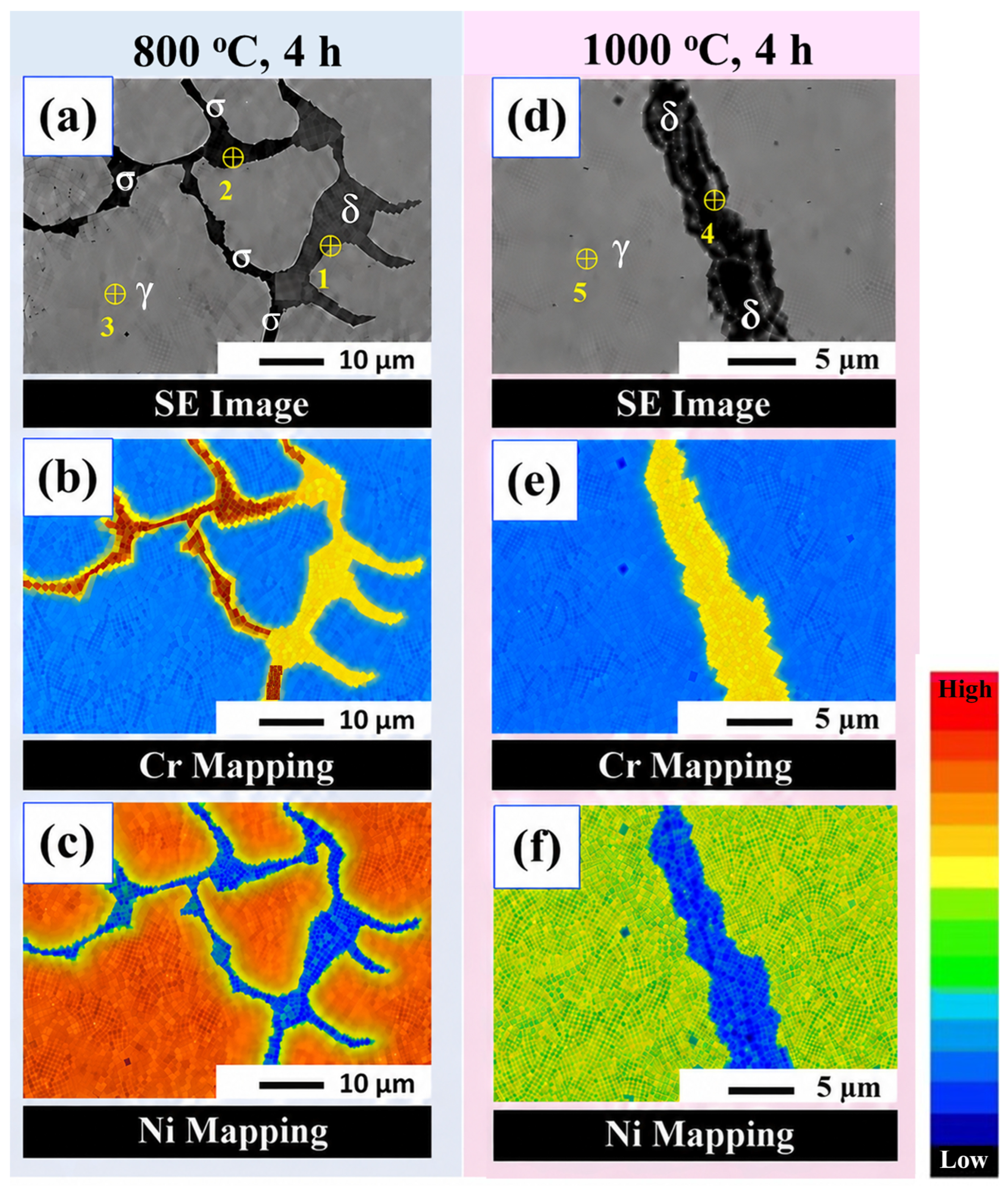
EPMA elemental mapping and WDS quantitative analysis were performed on the specimens aged for 4 h at 800 and 1000 °C. The 4 h condition was selected as a representative intermediate aging time to compare the temperature-dependent phase constitution and elemental partitioning under a fixed aging duration. The purpose of this analysis was to support phase identification and to distinguish the elemental characteristics of the σ, δ, and γ phases, rather than to describe the complete time-dependent microstructural evolution at each aging temperature. To further compare the elemental diffusion and enrichment behavior of 24Cr–14Ni stainless steel aged at 800 °C and 1000 °C, EPMA elemental mapping of Cr and Ni was performed for the δ, σ, and γ phases, as shown in
Figure 4.
Figure 4a,d present the secondary electron images of the specimens aged at 800 °C and 1000 °C, respectively. As shown in
Figure 4a, σ phase precipitates within the network-like δ-ferrite at 800 °C, indicating that the δ → σ transformation occurs during aging. In contrast, no obvious σ phase precipitation is observed at 1000 °C, and the microstructure mainly consists of δ-ferrite and γ phase. This suggests that the phase transformation at this temperature is dominated by the δ → γ transformation.
For the specimen aged at 800 °C for 4 h, the σ phase region exhibits pronounced Cr enrichment. This result suggests that σ phase preferentially precipitates in retained δ-ferrite regions where Cr is locally enriched. Once σ phase forms, its Cr content becomes higher than that of the surrounding δ-ferrite, as supported by the Cr mapping in
Figure 4b. By contrast, after aging at 1000 °C for 4 h, the Cr distribution between δ-ferrite and γ phase becomes more homogeneous. This behavior indicates that σ phase precipitation is largely suppressed at this temperature, while partial dissolution of δ-ferrite and the δ → γ transformation become more dominant. Accordingly, the microstructural evolution at 1000 °C is mainly governed by the δ → γ transformation rather than by continued σ phase precipitation, as shown in
Figure 4e.
The Ni mapping at 800 °C, shown in
Figure 4c, reveals that Ni is not enriched in either δ-ferrite or σ phase. This is because both δ and σ phases are Cr-rich and Ni-depleted phases. Instead, Ni enrichment is mainly observed around the δ and σ phases, indicating that these surrounding regions correspond to the γ phase. This result is consistent with the fact that austenite is the primary Ni-rich and relatively Cr-depleted phase in austenitic stainless steels. A similar trend is observed in the Ni mapping at 1000 °C. However, the Ni distribution in the γ phase becomes more homogeneous than that at 800 °C, which is associated with the higher aging temperature approaching the solution-treatment range of stainless steel. Under this condition, δ-ferrite becomes less stable and tends to dissolve into the γ matrix, while σ phase precipitation is effectively suppressed, as shown in
Figure 4f. Therefore, the EPMA mapping results clearly indicate that aging at 800 °C promotes Cr enrichment and σ phase precipitation within δ-ferrite, whereas aging at 1000 °C leads to a more homogeneous Cr and Ni distribution and favors the δ → γ transformation rather than σ phase formation.
Table 2 summarizes the WDS quantitative analyses of points 1–5 marked in the SEI images of
Figure 4a,d. The δ-ferrite phase is characterized by relatively high Cr and Si contents, as indicated by the measurements at points 1 and 4. In particular, the σ phase shows the highest Cr concentration among the examined phases, with a Cr content of approximately 40.59 wt.% at point 2. This result implies that σ precipitation occurs preferentially in the Cr-enriched regions of δ-ferrite during the δ → σ transformation. By contrast, the γ phase, serving as the matrix phase of the 24Cr–14Ni austenitic stainless steel, contains the highest Ni content, as observed at points 3 and 5.
The difference between the specimens aged at 800 and 1000 °C provides useful evidence for the temperature-dependent change in transformation behavior. At 800 °C, σ phase is clearly present in the retained δ-ferrite/inter-dendritic regions, where a marked Cr enrichment is observed. This suggests that the δ-ferrite to σ phase transformation is favored at this temperature. After aging at 1000 °C, however, σ phase precipitation becomes much less apparent, and the Cr distribution between δ-ferrite and γ phase is more homogeneous. This indicates that the stability of σ phase is reduced at 1000 °C, while partial dissolution of δ-ferrite and the δ → γ transformation become more prominent. These observations support the view that the dominant transformation changes from σ phase precipitation at 800 °C to σ phase suppression and δ/γ-related transformation at 1000 °C.
3.4. Isothermal Transformation Kinetics and JMAK Modeling of σ Phase
The isothermal transformation kinetics of the σ phase in the 24Cr–14Ni stainless steel were systematically quantified utilizing the classic Johnson–Mehl–Avrami–Kolmogorov (JMAK) phenomenological framework.
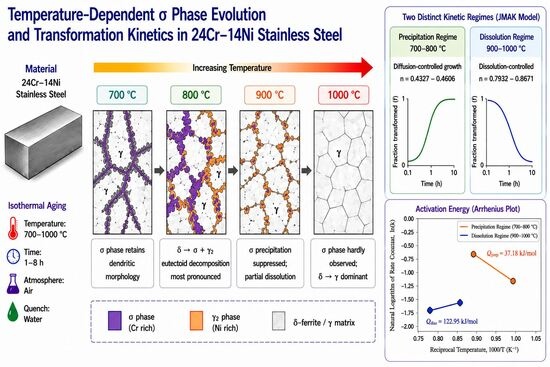
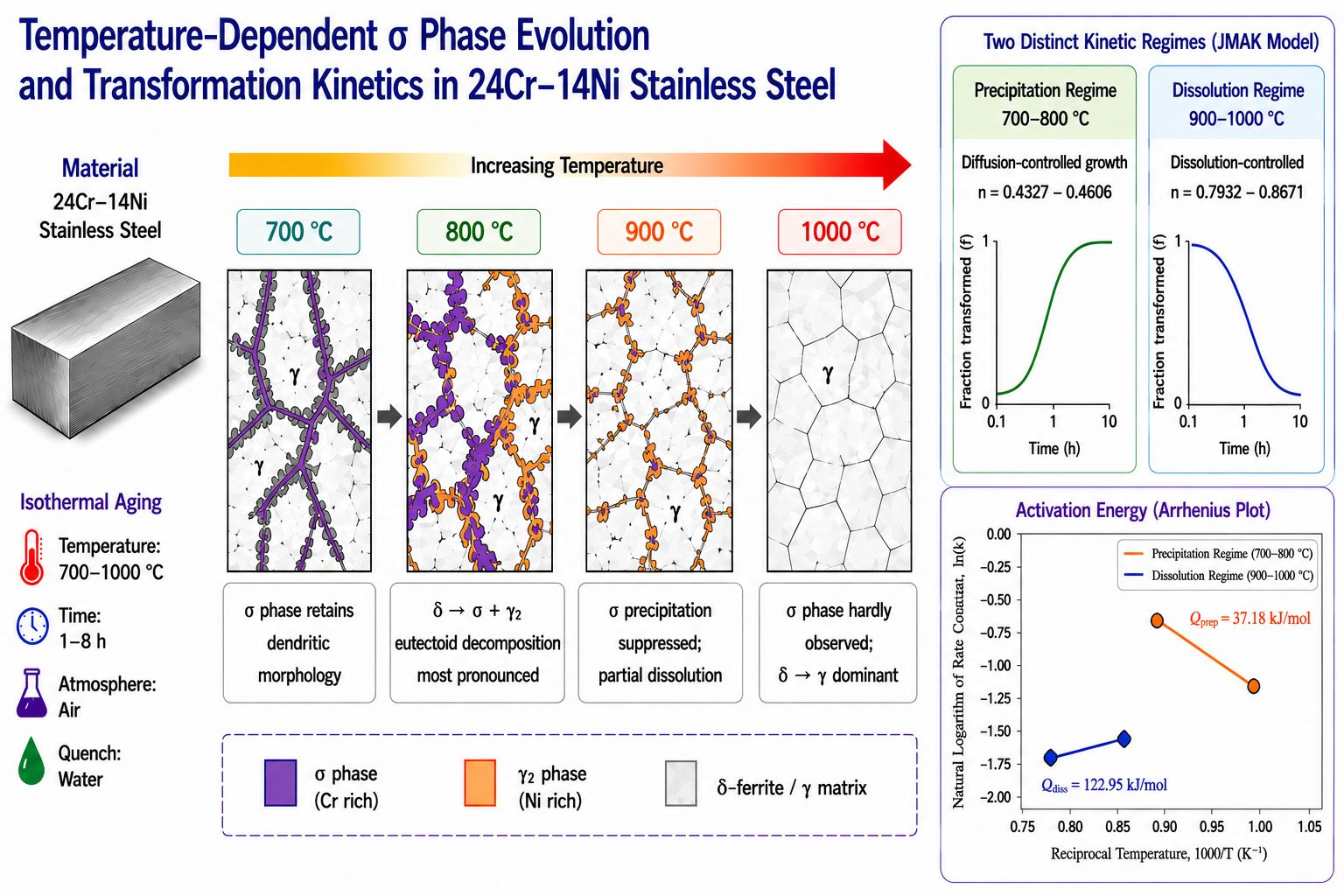
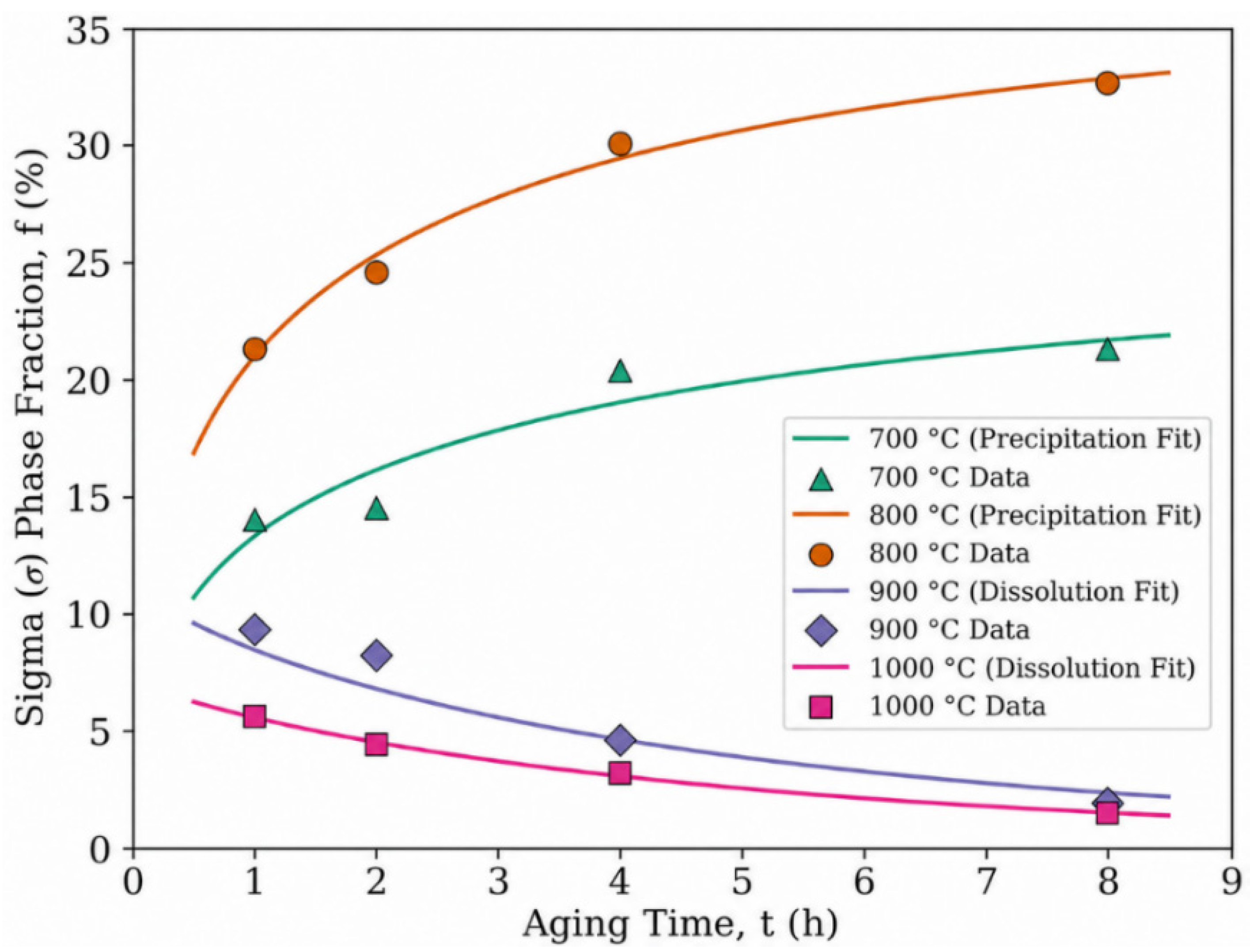
Figure 5 delineates the instantaneous σ phase fraction (f) as a function of aging time across the investigated temperature spectrum (700–1000 °C), where two opposite thermodynamic tendencies are explicitly captured. At lower aging temperatures (700 and 800 °C), the volume fraction of the σ phase increases monotonically over time, signifying a conventional precipitation and growth process. In stark contrast, when the aging temperature transitions to higher regimes (900 and 1000 °C), the σ phase exhibits a progressive decay, revealing a high-temperature diffusion-controlled dissolution back into the austenite matrix.
To mathematically correlate these concurrent phenomena, the non-linear regression curves were successfully constructed and superimposed on the experimental data points (
Figure 5). For the precipitation regime (700 and 800 °C), the growth kinetics were successfully tracked by the standardized JMAK equation, as illustrated by Equation (1) [
37,
38]:
while the high-temperature dissolution kinetics (900 and 1000 °C) were fitted via the exponential decay formulation, as indicated in Equation (2):
where f(t) denotes the volume fraction of the sigma phase at a given isothermal holding time t(s). The parameters f
σ,max and f
σ,0 represent the maximum equilibrium volume fraction and the initial volume fraction of the σ phase, respectively. The term k is the kinetic rate constant (s
−n) dependent on the transformation temperature, while n is the dimensionless Avrami exponent associated with the specific nucleation and growth mechanisms.
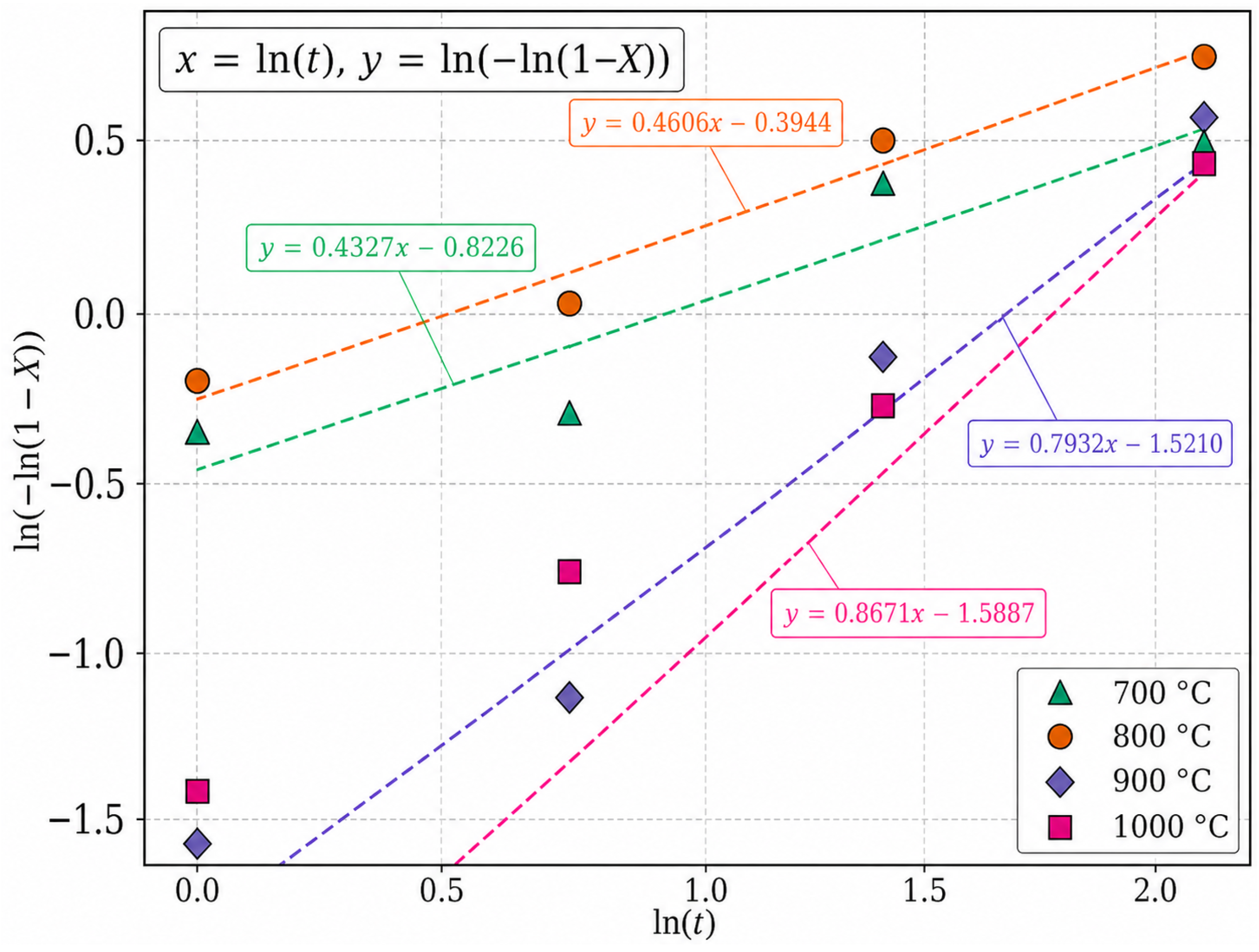
The reliability of the JMAK fitting is shown by the linear regression results in
Figure 6. Here, X denotes the transformed fraction of the σ phase, calculated from the normalized σ phase fraction obtained by metallographic image analysis. For the linearized JMAK plot, y is defined as ln[−ln(1 − X)], while x is defined as ln(t), where t is the aging time. With this definition, the slope of the fitted line gives the Avrami exponent n, and the intercept is related to the rate constant k. The linearized plots exhibit good fitting linearity, with coefficients of determination R
2 higher than 0.98. In the precipitation regime at 700–800 °C, the n values are 0.4327 and 0.4606, respectively, both close to 0.5. This suggests that σ phase precipitation is mainly controlled by diffusion-assisted growth, with nucleation sites being limited or rapidly consumed at the early stage of aging. After this stage, the growth of σ phase is mainly restricted by the diffusion of ferrite-stabilizing elements, especially Cr, toward the σ phase region.
Conversely, upon entering the dissolution regime (900–1000 °C), the Avrami exponent undergoes a significant inflation, reaching 0.7932 at 900 °C and stabilizing at 0.8671 at 1000 °C. This near-unity value (n ≈ 1.0) underscores a fundamental mechanistic shift. Above the σ-solvus temperature, the tetragonal lattice of the σ phase becomes thermodynamically unstable, prompting its collapse. The near-unity exponent strongly implies that the dissolution kinetics are no longer constrained by conventional multi-directional impingement but are instead controlled by interfacial reaction kinetics or one-dimensional boundary-controlled atomic retraction back into the face-centered cubic (FCC) austenite matrix.
The linearized JMAK fitting further clarifies the kinetic origin of the temperature-dependent sigma phase transformation. In the plots of ln[−ln(1 − X)] against ln(t), the slope represents the Avrami exponent n, while the intercept corresponds to ln k. The fitted equations for the precipitation regime were y = 0.4327x − 0.8226 at 700 °C and y = 0.4606x − 0.3944 at 800 °C, where y = ln[−ln(1 − X)] and x = ln(t). The relatively low n values at these two temperatures suggest that σ phase precipitation is mainly controlled by diffusion-assisted growth rather than continuous nucleation. This is consistent with the microstructural observation that σ phase preferentially develops from δ-ferrite regions, where nucleation sites are likely limited or rapidly consumed during the early stage of aging. The larger k value at 800 °C further indicates that the precipitation reaction is accelerated by enhanced atomic mobility.
At higher aging temperatures, the fitting equations changed to y = 0.7932x − 1.5210 at 900 °C and y = 0.8671x − 1.5887 at 1000 °C. These parameters were obtained from the modified JMAK-type expression used for the dissolution regime; therefore, they should be interpreted as apparent dissolution kinetics rather than σ phase growth kinetics. The decrease in σ phase fraction with increasing aging time, together with the higher n values and lower apparent k values, indicates that the dominant transformation process shifts from diffusion-controlled precipitation to diffusion-assisted dissolution. These kinetic features support the proposed mechanism that σ phase formation is favored at 700–800 °C, whereas σ phase becomes unstable and gradually dissolves at 900–1000 °C.
Funding
This research received no external funding.
Data Availability Statement
The original contributions presented in this study are included in the article. Further inquiries can be directed to the corresponding author.
Acknowledgments
The author gratefully acknowledges the Department of Materials and Optoelectronic Science at National Sun Yat-sen University for technical support in the EPMA and WDS analyses.
Conflicts of Interest
The author declares that they have no conflicts of interest.
References
- Lo, K.H.; Shek, C.H.; Lai, J.K.L. Recent Developments in Stainless Steels. Mater. Sci. Eng. R Rep. 2009, 65, 39–104. [Google Scholar] [CrossRef] [Scilit]
- Gunn, R.N. Duplex Stainless Steels: Microstructure, Properties and Applications; Woodhead Publishing: Cambridge, UK, 1997. [Google Scholar]
- Padilha, A.F.; Rios, P.R. Decomposition of Austenite in Austenitic Stainless Steels. ISIJ Int. 2002, 42, 325–327. [Google Scholar] [CrossRef] [Scilit]
- Rashidi, S.; Chatterjee, A.; Pandey, A.; Gupta, R.K. High-Temperature Oxidation Behavior of an Additively Manufactured Alumina-Forming Austenitic Stainless Steel. Corros. Mater. Degrad. 2025, 6, 47. [Google Scholar] [CrossRef] [Scilit]
- Rashidi, S.; Choi, J.P.; Stevenson, J.W.; Pandey, A.; Gupta, R.K. Effect of Aluminizing on the High-Temperature Oxidation Behavior of an Alumina-Forming Austenitic Stainless Steel. JOM 2019, 71, 109–115. [Google Scholar] [CrossRef] [Scilit]
- Zhan, J.; Li, M.; Huang, J.; Bi, H.; Li, Q.; Gu, H. Thermal Fatigue Characteristics of Type 309 Austenitic Stainless Steel for Automotive Manifolds. Metals 2019, 9, 129. [Google Scholar] [CrossRef] [Scilit]
- Li, Y.M.; Liu, Y.C.; Liu, C.X.; Li, C.; Li, H.J.; Gu, Z.H.; Hua, B.B. Mechanism for the Formation of Z-phase in 25Cr-20Ni-Nb-N Austenitic Stainless Steel. Mater. Lett. 2018, 233, 16–19. [Google Scholar] [CrossRef] [Scilit]
- Padilha, A.F.; Tavares, C.F.; Martorano, M.; Chen, Y.; Zhang, H. Delta Ferrite Formation in Austenitic Stainless Steel Castings. Mater. Sci. Forum 2012, 730–732, 733–738. [Google Scholar] [CrossRef] [Scilit]
- Elmer, J.W.; Allen, S.M.; Eagar, T.W. Microstructural Development During Solidification of Stainless Steel Alloys. Metall. Mater. Trans. A 1989, 20, 2117–2131. [Google Scholar] [CrossRef] [Scilit]
- Lin, D.-Y.; Liu, G.-L.; Chang, T.-C.; Hsieh, H.-C. Microstructure development in 24Cr–14Ni–2Mn stainless steel after aging under various nitrogen/air ratios. J. Alloys Compd. 2004, 377, 150–154. [Google Scholar] [CrossRef] [Scilit]
- Lin, D.-Y.; Wu, W.; Lin, C.-H.; Hsieh, H.-H. The effect of aging on the intergranular corrosion of a 24Cr-14Ni-0.7Si stainless steel for welding in architecture. Steel Res. 2001, 72, 277–280. [Google Scholar] [CrossRef] [Scilit]
- Xie, A.; Chen, S.; Chen, S.; Jiang, H.; Rong, L. Austenite decomposition behavior adjacent to δ-ferrite in a Si-modified Fe–Cr–Ni austenitic stainless steel during thermal aging at 550 °C. Acta Mater. 2024, 272, 119948. [Google Scholar] [CrossRef] [Scilit]
- Setia, P.; Venkateswaran, T.; Tharian, K.T.; Jain, J.; Singh, S.S.; Shekhar, S. Influence of Si content on the microstructure and mechanical properties of silicon stainless steel. Mater. Sci. Eng. A 2022, 829, 142141. [Google Scholar] [CrossRef] [Scilit]
- Chen, Y.; Wei, S.; Wu, D.; Lu, S. Mechanism of δ-ferrite decomposition in high Si-bearing austenitic stainless steel weld metal during aging at 550 °C. Mater. Sci. Eng. A 2023, 876, 145163. [Google Scholar] [CrossRef] [Scilit]
- Chen, W.-B.; Ding, X.-B.; Zhai, L.-H.; Zhou, J.-M.; Zhu, J.-J.; Zhu, Q.-C.; Jiang, L.; Li, Z.-J.; Dai, Z.-M. Effect of δ-ferrite decomposition on the tensile properties of one modified 316H stainless steel: Experimental investigations and crystal plastic finite element simulations. Mater. Sci. Eng. A 2024, 915, 147224. [Google Scholar] [CrossRef] [Scilit]
- Lippold, J.C.; Kotecki, D.J. Welding Metallurgy and Weldability of Stainless Steels; Wiley-Interscience: Hoboken, NJ, USA, 2005; pp. 141–244. [Google Scholar]
- Chen, T.H.; Weng, K.L.; Yang, J.R. The Effect of High-Temperature Exposure on the Microstructural Stability and Toughness Property in a 2205 Duplex Stainless Steel. Mater. Sci. Eng. A 2002, 338, 259–270. [Google Scholar] [CrossRef] [Scilit]
- Hsieh, C.C.; Wu, W. Overview of Intermetallic Sigma (σ) Phase Precipitation in Stainless Steels. ISRN Metall. 2012, 2012, 732471. [Google Scholar] [CrossRef] [Scilit]
- Chun, E.J.; Baba, H.; Nishimoto, K.; Saida, K. Precipitation of Sigma and Chi Phases in δ-Ferrite of Type 316FR Weld Metals. Mater. Charact. 2013, 86, 152–166. [Google Scholar] [CrossRef] [Scilit]
- Dos Santos, D.C.; Magnabosco, R. Kinetic Study to Predict Sigma Phase Formation in Duplex Stainless Steels. Met. Mater. Trans. A 2016, 47, 1554–1565. [Google Scholar] [CrossRef] [Scilit]
- Kroeker, P.; Theska, F.; Miskovic, D.; Haghdadi, N.; Primig, S. Microstructure Evolution and Sensitization of Additively Manufactured Duplex Stainless Steel During Aging Heat Treatments. Addit. Manuf. 2026, 118, 105100. [Google Scholar] [CrossRef] [Scilit]
- Nilsson, J.O. Super Duplex Stainless Steels. Mater. Sci. Technol. 1992, 8, 685–700. [Google Scholar] [CrossRef] [Scilit]
- Tan, H.; Jiang, Y.; Deng, B.; Sun, T.; Xu, J.; Li, J. Effect of Annealing Temperature on the Pitting Corrosion Resistance of Super Duplex Stainless Steel UNS S32750. Mater. Charact. 2009, 60, 1049–1054. [Google Scholar] [CrossRef] [Scilit]
- Villanueva, D.M.E.; Junior, F.C.P.; Lesley, R.; Padilha, A.F. Comparative Study on Sigma Phase Precipitation of Three Types of Stainless Steels: Austenitic, Superferritic and Duplex. Mater. Sci. Technol. 2006, 22, 1098–1104. [Google Scholar] [CrossRef] [Scilit]
- Inácio, L.K.D.P.; Wolf, W.; Leucas, B.C.B.D.; Stumpf, G.; Santos, D.B. Microtexture Evolution of Sigma Phase in an Aged Fine-Grained 2205 Duplex Stainless Steel. Mater. Charact. 2021, 171, 110802. [Google Scholar] [CrossRef] [Scilit]
- Sourmail, T. Precipitation in Creep Resistant Austenitic Stainless Steels. Mater. Sci. Technol. 2001, 17, 1–14. [Google Scholar] [CrossRef] [Scilit]
- Ye, D.; Li, J.; Jiang, W.; Su, J.; Zhao, K. Effect of Cu Addition on Microstructure and Mechanical Properties of 15%Cr Super Martensitic Stainless Steel. Mater. Des. 2012, 41, 16–22. [Google Scholar] [CrossRef] [Scilit]
- Liao, L.H.; Zhao, Z.X.; Xu, F.H.; Zhang, W.; Li, J.Y. Influence of N on Precipitation Behavior and Transformation Kinetics of Super Austenitic Stainless Steels After Isothermal Ageing at 900 °C. J. Mater. Res. Technol. 2022, 19, 3670–3684. [Google Scholar] [CrossRef] [Scilit]
- Berezovskaya, V.V.; Merkushkin, E.A.; Mamchits, K.A. Structure and Phase Transformations in High Nitrogen and High Interstitial Steels of Different Alloying Systems—Short Review. Defect Diffus. Forum 2021, 410, 167–172. [Google Scholar] [CrossRef] [Scilit]
- Wang, R.G. Precipitation of Sigma Phase in Duplex Stainless Steel and Recent Development on Its Detection by Electrochemical Potentiokinetic Reactivation: A Review. Corros. Commun. 2021, 2, 41–54. [Google Scholar] [CrossRef] [Scilit]
- Fonseca, G.S.d.; Mendes, P.S.N.; Silva, A.C.M. Sigma Phase: Nucleation and Growth. Metals 2019, 9, 34. [Google Scholar] [CrossRef] [Scilit]
- Haghdadi, N.; Laleh, M.; Kosari, A.; Moayed, M.H.; Cizek, P.; Hodgson, P.D.; Beladi, H. The effect of Phase Transformation Route on the Intergranular Corrosion Susceptibility of 2205 Duplex Stainless Steel. Mater. Lett. 2019, 238, 26–30. [Google Scholar] [CrossRef] [Scilit]
- Dos Santos, D.C.; Magnabosco, R.; De Moura-Neto, C. Influence of Sigma Phase Formation on Pitting Corrosion of an Aged UNS S31803 Duplex Stainless Steel. Corrosion 2013, 69, 900–911. [Google Scholar] [CrossRef] [Scilit]
- Silva, D.D.S.; Lima, L.S.D.C.; Araújo, A.J.M.; Silva, V.D.; Raimundo, R.A.; Damasceno, I.Z.; Simões, T.A.; Gomes, R.M. The Effect of Microstructural Changes on Mechanical and Electrochemical Corrosion Properties of Duplex Stainless Steel Aged for Short Periods. Materials 2020, 13, 5511. [Google Scholar] [CrossRef] [Scilit] [PubMed]
- Hsieh, C.-C.; Wang, H.-S. Phase Transformation of δ → σ in 24Cr-14Ni Stainless Steels Under Nitrogen Atmospheric Aging Treatment. Metals 2026, 16, 462. [Google Scholar] [CrossRef] [Scilit]
- Hsieh, C.-C.; Wu, W. Discussing the precipitation behavior of σ phase using diffusion equation and thermodynamic simulation in dissimilar stainless steels. J. Alloys Compd. 2010, 506, 820–825. [Google Scholar] [CrossRef] [Scilit]
- Johnson, W.A.; Mehl, R.F. Reaction kinetics in processes of nucleation and growth. Trans. AIME 1939, 135, 416–442. [Google Scholar]
- Kolmogorov, A.N. A statistical theory of the recrystallization of metals. Bull. Acad. Sci. USSR Math. Ser. 1937, 1, 355–359. [Google Scholar]
- Laidler, K.J. The development of the Arrhenius equation. J. Chem. Educ. 1984, 61, 494–498. [Google Scholar] [CrossRef] [Scilit]
- Flynn, J.H. Temperature dependence of the rate of reaction in thermal analysis: The Arrhenius equation in condensed phase kinetics. J. Therm. Anal. 1990, 36, 1579–1593. [Google Scholar] [CrossRef] [Scilit]
- Magnabosco, R. Kinetics of sigma phase formation in a duplex stainless steel. Mater. Res. 2009, 12, 321–327. [Google Scholar] [CrossRef] [Scilit]
- Patel, A.; Pawar, R.; Mishra, S.; Sonawane, S.; Ghosh, P.K. Kinetic studies on thermal denaturation of C-phycocyanin. Indian J. Biochem. Biophys. 2004, 41, 254–257. [Google Scholar] [PubMed]
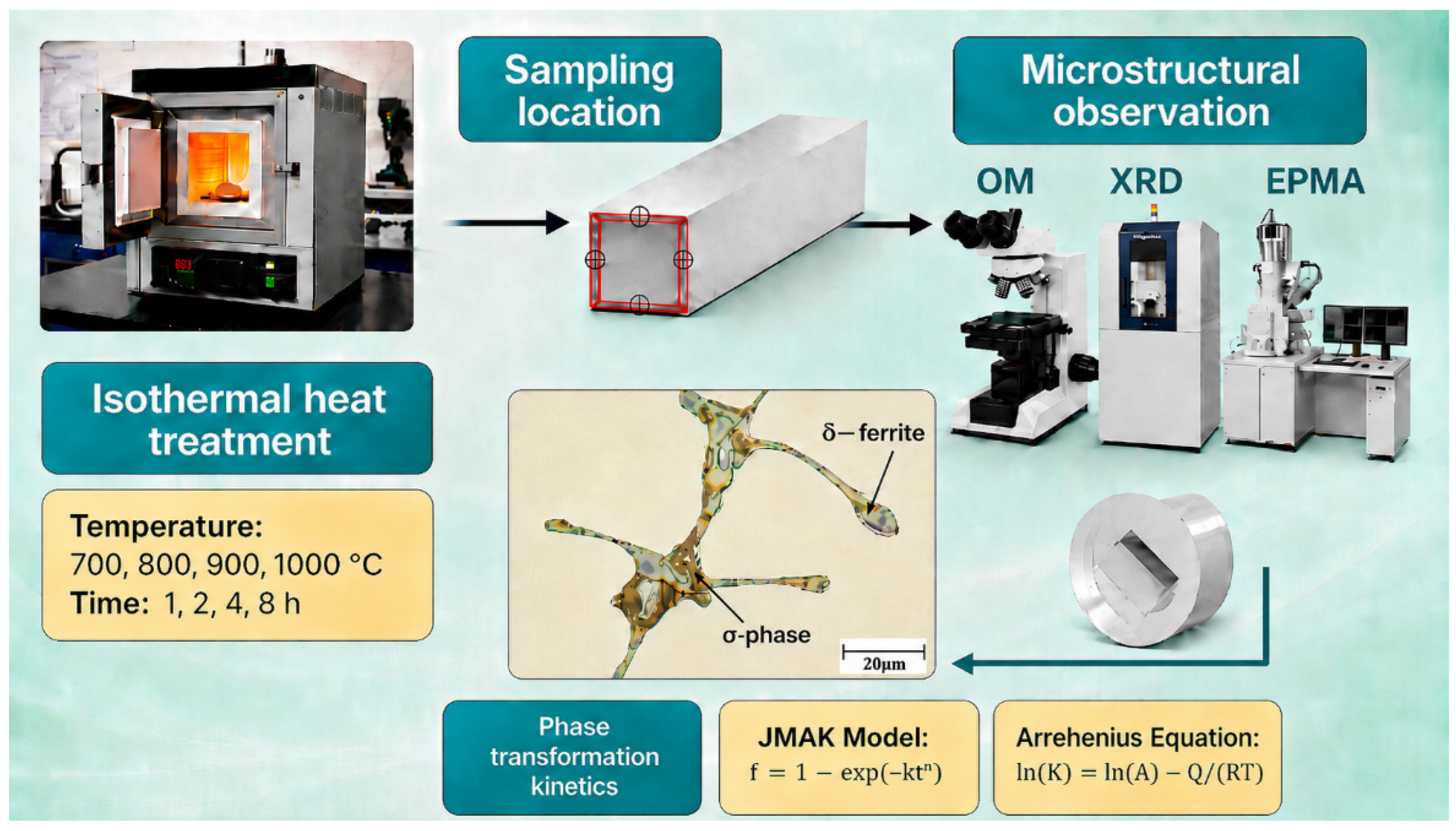
Figure 1.
Schematic illustration of the experimental procedure used in this study. Note: The red rectangle marks the sampling location in the 24Cr–14Ni stainless steel billet.
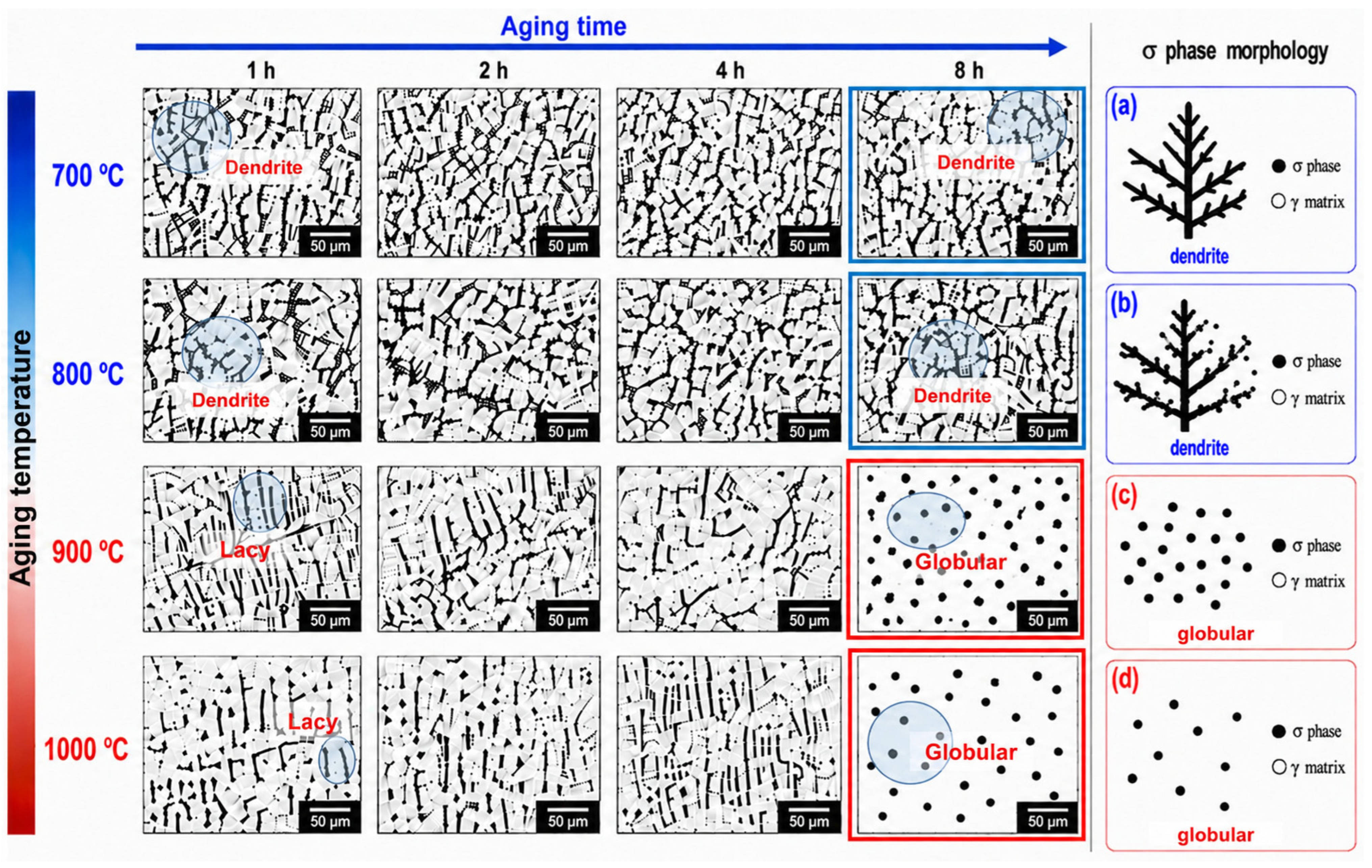
Figure 2.
Morphological development of σ phase at different aging temperatures and times (a,b): dendritic morphology; (c,d): globular morphology.
Figure 3.
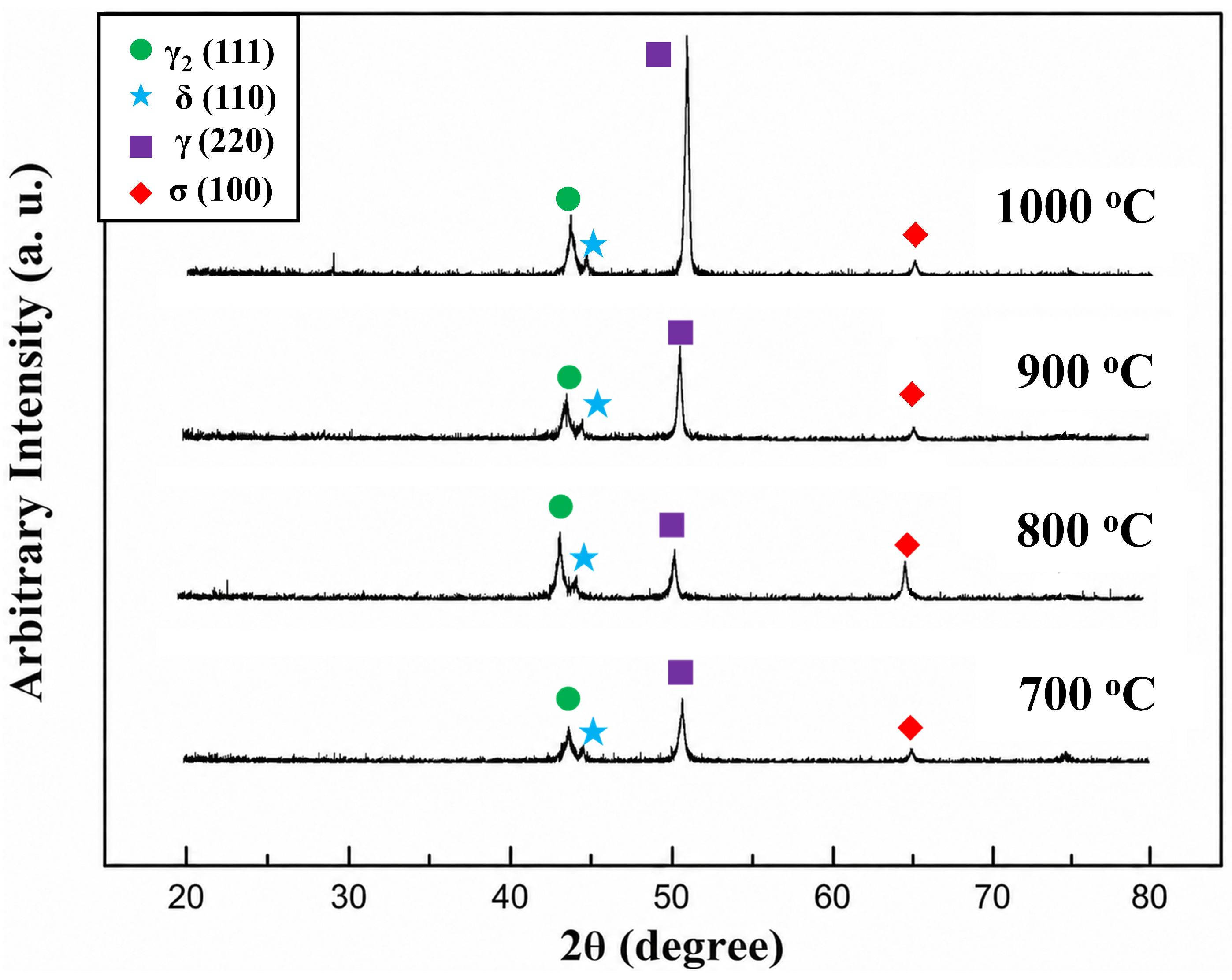
XRD analysis of constituent phases in 24Cr–14Ni stainless steels at different aging temperatures for 4 h.
Figure 4.
EPMA mapping and WDS analyses of δ, σ, and γ phases in 24Cr–14Ni stainless steels (a,d): SE image (b,e): Cr mapping, (c,f): Ni mapping at 800 °C (light blue rectangle) and 1000 °C (light purple rectangle), respectively, for 4 h. Note: δ: ferrite; σ: sigma phase; γ: austenite; ⊕: Elemental analysis point.
Figure 5.
Isothermal evolution curves of the σ phase fraction in 24Cr–14Ni stainless steel at different aging temperatures. The solid lines represent the non-linear JMAK mathematical fitting curves tracking low-temperature precipitation growth (700 °C, 800 °C) and high-temperature structural dissolution (900 °C, 1000 °C).
Figure 6.
Standardized JMAK linearized plots of ln(−n(1 − X)) versus ln(t) for the σ phase transformation in 24Cr–14Ni stainless steel. The dashed lines demonstrate the linear regression segments utilized for extracting the Avrami exponents (n) and global kinetic rate constants (K).
Figure 7.
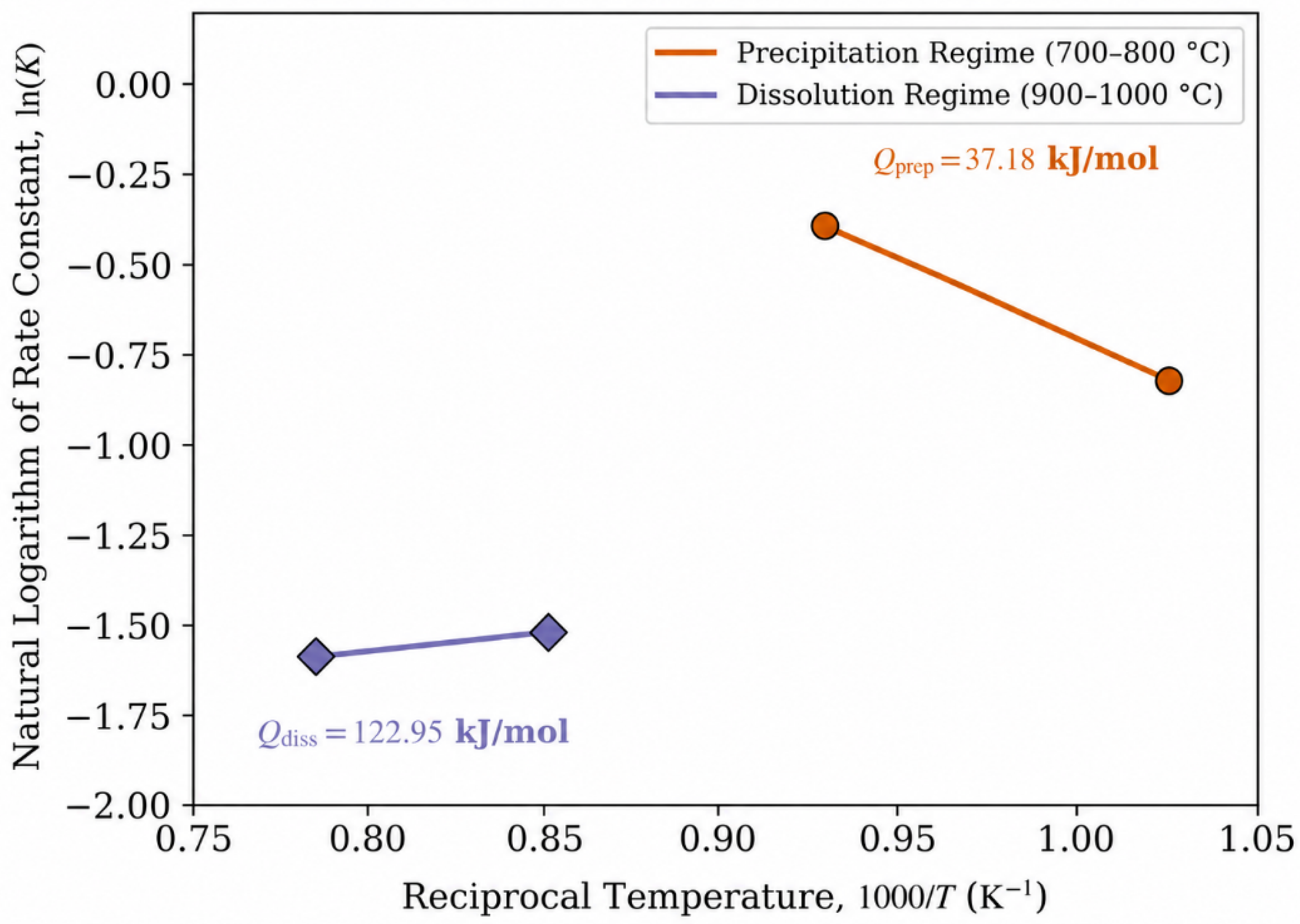
Arrhenius plots of ln(K) versus 1000/T for the σ phase transformation in 24Cr–14Ni stainless steel, showing distinct linear regression segments and calculated apparent activation energies (Q) for the low-temperature precipitation growth regime (700–800 °C) and high-temperature dissolution regime (900–1000 °C).
Table 1.
Chemical composition of the 24Cr–14Ni stainless steel used in this study.
| Material | Element (wt.%) |
|---|
24Cr–14Ni
Stainless Steel | Cr | Ni | C | Si | Mn | P | S | Mo | Cu | Fe |
| 24.59 | 14.34 | 0.03 | 0.75 | 1.70 | 0.01 | 0.01 | 0.15 | 0.22 | Bal. |
Table 2.
WDS quantitative analysis of the δ, σ, and γ phases in 24Cr–14Ni stainless steel after aging at 800 and 1000 °C for 4 h.
| Temperature (oC) | Point | Element (wt.%) | Cr | Ni | Si | Mo | Mn | C | Cu | Fe |
|---|
| Phase |
|---|
| 800 °C | 1 | δ | 34.70 | 5.12 | 0.56 | 0.36 | 1.34 | 0.06 | 0.01 | 57.85 |
| 2 | σ | 40.59 | 5.09 | 0.30 | 0.42 | 1.24 | 0.06 | 0.01 | 52.29 |
| 3 | γ | 19.86 | 14.21 | 0.38 | 0.10 | 1.61 | 0.05 | 0.26 | 63.53 |
| 1000 °C | 4 | δ | 31.18 | 7.12 | 0.85 | 0.17 | 1.71 | 0.55 | 0.10 | 58.32 |
| 5 | γ | 22.88 | 12.63 | 0.72 | 0.10 | 1.83 | 0.71 | 0.15 | 60.98 |
Table 3.
Summary of the JMAK kinetic parameters, apparent activation energies, and dominant kinetic mechanisms of σ phase precipitation and dissolution in 24Cr–14Ni stainless steel aged at 700–1000 °C.
| Temperature (°C) | Maximum/Initial σ Phase Fraction, fσ,max/fσ,0 (%) | [a] Rate Constant,
k (h−1) | [a] Avrami Exponent, n | [b] Apparent Activation Energy, Q (kJ/mol) | Transformation Behavior | Dominant Kinetic Mechanism |
|---|
| 700 | 26.41 | 0.4393 | 0.4327 | 37.18 | Precipitation | Diffusion-controlled σ phase growth with limited nucleation |
| 800 | 37.12 | 0.6741 | 0.4606 | 37.18 | Precipitation | Diffusion-controlled σ phase growth with enhanced atomic mobility |
| 900 | 11.39 | 0.2185 | 0.7932 | 122.95 | Dissolution | Diffusion-assisted σ phase dissolution |
| 1000 | 7.15 | 0.2042 | 0.8671 | 122.95 | Dissolution | Thermally activated σ phase dissolution |
| Disclaimer/Publisher’s Note: The statements, opinions and data contained in all publications are solely those of the individual author(s) and contributor(s) and not of MDPI and/or the editor(s). MDPI and/or the editor(s) disclaim responsibility for any injury to people or property resulting from any ideas, methods, instructions or products referred to in the content. |