1. Introduction
Designing hybrid materials with enhanced transformation enthalpy and tunable magnetic properties represents a key objective in the development of advanced multifunctional systems for thermomechanical applications. Severe plastic deformation (SPD) techniques provide an effective route for tailoring the microstructure of metallic materials by producing ultrafine-grained or even nanocrystalline structures through intense plastic deformation under high hydrostatic pressure [
1,
2]. The resulting high density of lattice defects—including dislocations, vacancies, stacking faults, twins, and grain boundaries—plays a central role in controlling microstructure–property relationships. SPD has become a powerful strategy for developing advanced functional materials with tailored mechanical and physical properties [
3,
4,
5]. Beyond grain refinement and the associated strength enhancement through the Hall–Petch mechanism [
6], SPD can significantly influence phase transformations and modify a wide range of functional properties, including electrical [
7], thermoelectric [
8], magnetic [
9], and corrosion behavior [
10].
Among SPD techniques, high-speed high-pressure torsion (HSHPT) is particularly attractive because it enables both the consolidation of dissimilar materials and the refinement of coarse-grained microstructures into ultrafine-grained or nanocrystalline states [
11,
12,
13]. The process combines high pressure with intense plastic deformation at high strain rates, leading to extensive grain refinement and the accumulation of crystalline defects that strongly influence microstructure–property relationships. Besides improving mechanical properties, HSHPT can also modify functional behavior; for example, changes in magnetic response, including shifts in Curie temperature and reduced magnetization in the austenitic state, have been reported [
13]. These effects highlight the strong coupling between deformation-induced microstructural evolution and the physical properties of functional alloys.
Shape memory alloys (SMAs) can recover a predefined shape through a reversible martensitic transformation (MT) between austenite and martensite [
14]. This diffusionless transformation underlies the shape memory effect and enables applications in actuators, sensors, and damping systems [
15,
16]. Among SMAs, NiTi remains the most widely used system due to its excellent functional stability and mechanical performance, which are preserved across different length scales and structural configurations [
17,
18,
19,
20,
21,
22]. Deformation-induced microstructural changes have been shown to influence both transformation thermodynamics and functional responses, including magnetic behavior where applicable [
23,
24,
25]. Heusler-type magnetic shape memory alloys, which are usually described by the general formula X2YZ [
26], may in some cases exhibit a martensitic transformation coupled with magnetic order. The prototypical system Ni
2MnGa displays magnetic-field-induced strains of up to 10%, as reported by Kari Ullakko et al. [
27]. However, their intrinsic brittleness remains a major limitation for practical applications [
28]. For this reason, the search for new Heusler alloys exhibiting martensitic transformation has intensified in recent years, encompassing systems such as Co–Ni–Ga [
29,
30], Ni–Mn–(In, Sn, Sb) [
31,
32,
33,
34,
35,
36], Ni–Fe–Ga-based [
37,
38,
39] and all-
d-metal alloys [
40,
41,
42,
43]. In particular these alloys have attracted increasing attention due to their favorable combination of structural and magnetic properties, making them promising candidates for multifunctional applications. It is generally accepted that martensitic transformation temperatures in these systems are highly sensitive to a wide range of parameters, including processing route, chemical composition and atomic ordering, internal stresses, and thermal treatments. As a result, various synthesis and processing strategies have been explored to optimize both the magnetic and mechanical performance of Heusler-type alloys [
44,
45].
To improve the performance of these materials’ specific properties, increasing attention has been directed toward SMA-based composites that combine complementary functionalities, leading to improved mechanical strength, fracture toughness, damping capacity, and superelastic performance [
46,
47,
48]. In particular, composites integrating conventional SMAs with Heusler-type alloys offer promising routes for coupling thermoelastic and magnetic responses within a single material system. Nevertheless, the effect of severe plastic deformation on the interplay between martensitic transformation, magnetic behavior, and interfacial structure in such hybrid systems remains insufficiently understood, especially regarding its impact on transformation enthalpy.
NiTi/NiFeGa bilayer composites provide a suitable platform to address these aspects. By combining the shape memory behavior of NiTi with the magneto-structural characteristics of NiFeGa, these systems enable multifunctional responses relevant for applications in sensors, actuators, and MEMS devices [
48]. Processing by HSHPT is expected to induce ultrafine-grained structures and strong interfacial coupling, which may significantly influence both transformation energetics and magnetic properties. In this context, the present study investigates a NiTi/NiFeGa bilayer hybrid composite processed by HSHPT, with particular emphasis on the origin of the enhanced transformation enthalpy and the modification of magnetic properties. The observed functional response is attributed to the microstructural characteristics of the composite, particularly the refined structure and interface characteristics.
2. Materials and Methods
The ingot with nominal composition Ni
57Fe
18Ga
25 (at.%.) shape memory alloy was prepared by arc melting under an argon protective atmosphere using high-purity elements (99.99%, purchased from Alfa Aesar, Karlsruhe, Germany). The melting procedure was repeated five times to ensure chemical homogeneity. Subsequently, the ingot was subjected to a thermal treatment in high vacuum at 1223 K for 25 h, followed by quenching in iced water. The alloy was cut into specimens of appropriate dimensions and subjected to severe plastic deformation (SPD) using the high-speed high-pressure torsion (HSHPT) technique. A detailed study of the alloy’s behavior under SPD conditions was previously reported in [
49]. The HSHPT method represents a variation in the classical high-pressure torsion (HPT) technique, in which the material is simultaneously subjected to compressive and torsional strains. The HSHPT process and equipment have been described in detail in earlier works [
11,
12], and it is recognized as an advanced SPD technique derived from conventional HPT [
3].
Thin Ni57Fe18Ga25 (at.%) and Ni50.3Ti49.7 (at.%) discs, with dimensions of ϕ13.05 × 1.37 mm and ϕ22.30 × 1.28 mm, respectively, were first obtained by HSHPT from the initial bulk samples. The two discs were subsequently stacked in a sandwich configuration and processed by HSHPT to produce the hybrid composite. To achieve simultaneous bonding and structural refinement, the SPD parameters were carefully selected. The rotational speed of the upper punch was set to approximately 900 rpm, while an initial pressure of 20 bar was applied by the lower punch. The compressive force was monitored using the Hottinger Spider 8 equipment(Hottinger Baldwin Messtechnik, Darmstadt, Germany), with the hydrostatic pressure reaching values of ~1 GPa. The deformation parameters were controlled via a PLC XC 200 EATON system (Syracuse, NY 13208, USA). In this process, friction between the anvils and the sample is generated by the high-speed rotation of the upper anvil, contributing to the imposed shear strain. To obtain ultrafine-grained structures, three main deformation parameters were controlled: (i) the rotational speed of the upper punch (~900 rpm), (ii) the hydrostatic pressure (~1 GPa), and (iii) the friction conditions arising from the high pressure and relative displacement between the sample and anvils. The specimens were initially pressed at 5 MPa at room temperature (RT), followed by the application of a pressure of ~1 GPa, resulting in the formation of the hybrid material. The entire HSHPT process is very short, with a duration ranging from about 7 s for the first cycle to approximately 2 s for the third cycle. The resulting hybrid materials have the form of truncated conical specimens with a diameter of approximately 30 mm and a thickness of about 0.26 mm.
The effective strain of the hybrid composite was calculated using the following relation:
where
hi and
hf denote the initial and final thicknesses of the hybrid composite, respectively. The cumulative strains experienced by the individual layers were: ε
cumNiTi = 3.74 and ε
cumNiFeGa = 3.2, respectively.
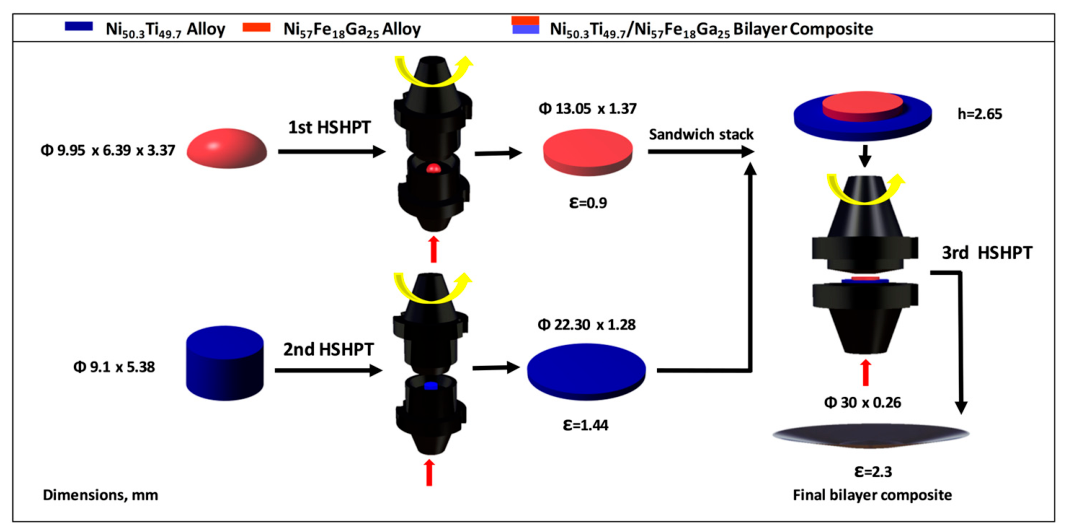
Figure 1 schematically illustrates the fabrication route, including the initial dimensions of the NiTi and NiFeGa specimens and the successive HSHPT processing steps. The hybrid composite was produced through three consecutive HSHPT operations.
The strain relationships commonly employed for conventional High-Pressure Torsion (HPT) require the specimen kinematics to be fully defined throughout the deformation process. In conventional HPT, this condition is satisfied because the angular displacement of the specimen is prescribed by the rotation of the upper anvil, allowing the imposed strain to be determined from the known number of rotations. Consequently, the torsional shear strain and the corresponding equivalent strain can be calculated using the well-established relationships reported in the HPT literature, as comprehensively reviewed by Zhilyaev and Langdon [
1].
The torsional shear strain is expressed as
where (N) is the number of rotations, (r) is the radial position and (h) is the final specimen thickness. The corresponding equivalent von Mises strain is given by
whereas, for large plastic deformations, the logarithmic (true) strain accounting for the reduction in specimen thickness may be written as
which, for
reduces to
However, the direct application of these relationships to the HSHPT process is not rigorous. Unlike conventional HPT, HSHPT is characterized by extremely high rotational speeds, severe plastic deformation, frictional heating, and partial slippage at the specimen–anvil interface. Under these conditions, the effective angular displacement experienced by the specimen cannot be determined experimentally and does not necessarily coincide with the angular displacement prescribed by the rotation of the upper anvil. Consequently, the effective number of rotations experienced by the material remains unknown. Since the effective angular displacement cannot be determined experimentally, neither the equivalent von Mises strain nor the logarithmic strain expressions that include the torsional contribution can be rigorously evaluated without introducing additional assumptions regarding the actual deformation kinematics of the specimen. In the present work, no such assumptions were introduced because they cannot be validated experimentally. Therefore, the imposed deformation was quantified exclusively by the logarithmic true strain associated with the experimentally measured thickness reduction,
where h
i and h
f denote the initial and final specimen thicknesses, respectively.
It should be emphasized that this expression is not an empirical relationship. Rather, it represents the exact definition of the Hencky (true) strain for uniaxial compression and depends exclusively on experimentally measured quantities. Therefore, the calculated value is rigorously defined within the framework of continuum mechanics. Nevertheless, because the torsional contribution cannot be quantified without knowledge of the effective angular displacement of the specimen, the calculated value should be regarded as an experimentally verifiable lower bound for the total strain imposed during the HSHPT process rather than as the total equivalent strain developed within the material. Accordingly, the adopted methodology avoids introducing experimentally unverifiable assumptions while providing a rigorous, reproducible and experimentally verifiable lower-bound estimate of the imposed deformation.
Due to the specific kinematics of the HSHPT process, the resulting specimens exhibit a truncated cone geometry, characterized by a gradual variation in thickness along the generator. The thickness decreases from the central region towards the periphery as a direct consequence of the non-uniform strain distribution generated by the combined action of compressive loading and torsional deformation. Accordingly, the imposed strain increases radially, reaching its maximum at the specimen periphery. This strain gradient gives rise to three distinct regions, each exhibiting characteristic microstructural features associated with the local deformation level. The central region experiences relatively low deformation, whereas the intermediate and, particularly, the peripheral regions are subjected to substantially higher strain, resulting in more pronounced grain refinement and microstructural evolution. All subsequent investigations presented in this work were performed on specimens extracted from the peripheral region of the truncated-cone samples, where the imposed deformation is greatest. This approach ensures that the analyses were carried out on the most refined and representative microstructure produced under HSHPT conditions, consistent with previous studies on similar systems [
50].
Scanning electron microscopy (SEM) as employedusing a ZEISS Gemini 500 microscope (Carl Zeiss, Oberkochen, Germany) to investigate the grain structure and the integrity of the interfacial bonding in the cross-section of the Ni50.3Ti49.7/Ni57Fe18Ga25 bi-layer composite. Energy-dispersive X-ray spectroscopy (EDX) was used to evaluate the chemical composition across the composite thickness, with particular emphasis on the interface between the two constituent alloys.
Two independently fabricated hybrid specimens, designated Hybrid_1 and Hybrid_2, were processed under identical HSHPT conditions. Hybrid_1 was used as the reference specimen for comprehensive microstructural, calorimetric, and magnetic characterization, whereas Hybrid_2 was investigated by differential scanning calorimetry (DSC) to assess the reproducibility of the transformation behavior.
Differential scanning calorimetry (DSC) measurements were performed using a Netzsch DSC 204 F1 Phoenix calorimeter (NETZSCH, Selb, Germany) equipped with Proteus software. 2007 Although the DSC measurements were performed over the temperature range of 193–673 K, the martensitic transformation occurred between approximately 300 and 420 K. Therefore, only the temperature interval of 273–473 K, encompassing the complete transformation, is presented and discussed in this work. After completing the transformation cycles, the samples were heated to 673 K and held for 20 min inside the DSC chamber to perform an in situ post-deformation heat treatment. All DSC experiments were conducted at a constant heating/cooling rate of 20 K/min under a protective helium atmosphere. The DSC measurements enabled the determination of the characteristic transformation temperatures and the corresponding transformation enthalpies.
Magnetic measurements were performed using a Quantum Design SQUID magnetometer (San Diego, CA, USA), operating in the Reciprocal Space Option (RSO) mode. The magnetic field was applied along the longitudinal direction of the samples in order to minimize demagnetization effects.
To facilitate the interpretation of the calorimetric and magnetic responses of the hybrid composite, the volume fractions of the two constituent layers were estimated from the specimen geometry based on the well-defined interface separating them. The corresponding mass fractions were then calculated from the measured specimen masses and the experimentally determined densities of the two alloys. These values provide a quantitative basis for interpreting the measured transformation enthalpy and magnetic response of the hybrid composite in terms of the relative contributions of the NiTi and NiFeGa constituents.
The calculated volume and mass fractions for the investigated hybrid composite are summarized in
Table 1. These values provide a quantitative framework for interpreting the calorimetric and magnetic responses of the hybrid composite in terms of the relative contributions of the NiTi and NiFeGa constituents.
The calculated densities are in good agreement with literature values reported for NiTi (≈6.45 g/cm
3) [
51] and NiFeGa Heusler alloys (≈7.68 g g/cm
3), depending on composition) [
52]. This agreement supports the reliability of the estimated volume and mass fractions.
The authors used an AI-based language model (ChatGPT, version 5.5, OpenAI) to assist in improving the clarity, structure, and linguistic expression of the manuscript. All scientific content, results, and interpretations were developed, verified, and approved by the authors. The authors have reviewed and edited the output and take full responsibility for the content of this publication.
4. Discussion
The microstructural analysis provides essential insight into the origin of the modified transformation and magnetic behavior observed in the NiTi/NiFeGa hybrid composite. SEM (
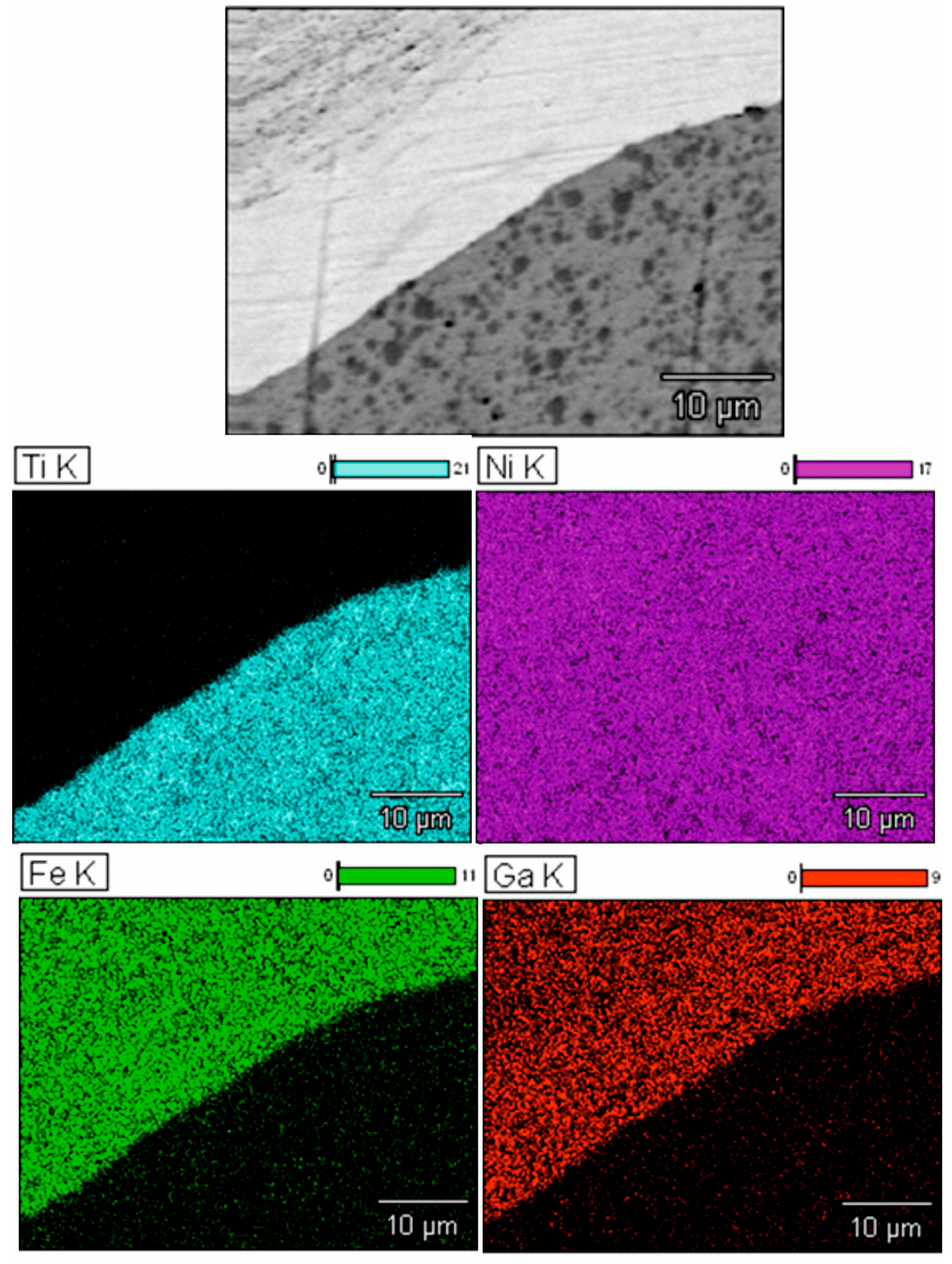
Figure 1) reveals a continuous, well-defined interface between the two constituent layers, while EDX elemental mapping and line-scan analyses (
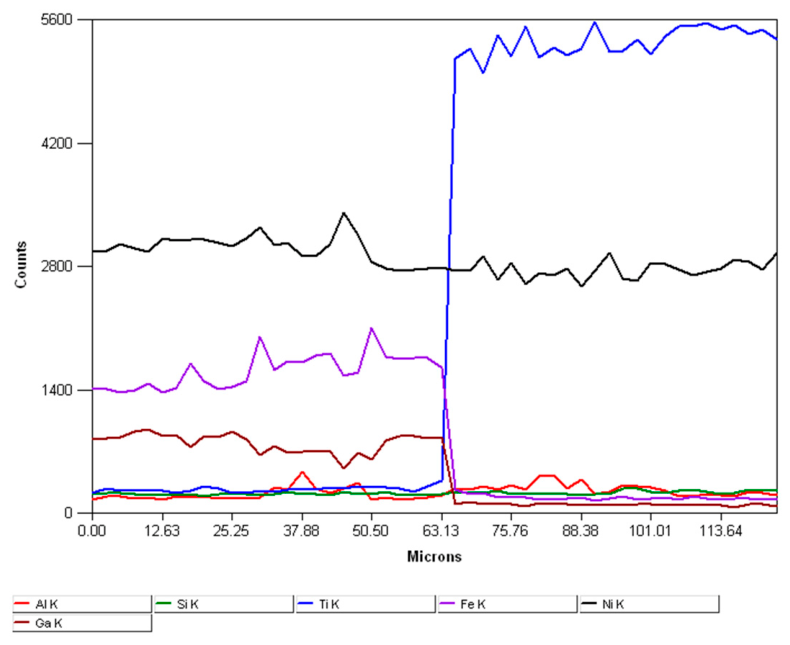
Figure 2) confirm a sharp compositional transition across the interface. Titanium remains confined to the NiTi layer, whereas Fe and Ga are localized within the NiFeGa layer, with Ni present in both alloys, as expected. No continuous diffusion zone or intermetallic reaction layer is detected within the spatial resolution of the SEM/EDX technique, demonstrating that the HSHPT processing conditions preserve the chemical integrity of the constituent layers despite the severe plastic deformation. Consequently, bonding between the two dissimilar alloys is achieved primarily through intimate interfacial contact under high pressure rather than through extensive thermally activated interdiffusion.
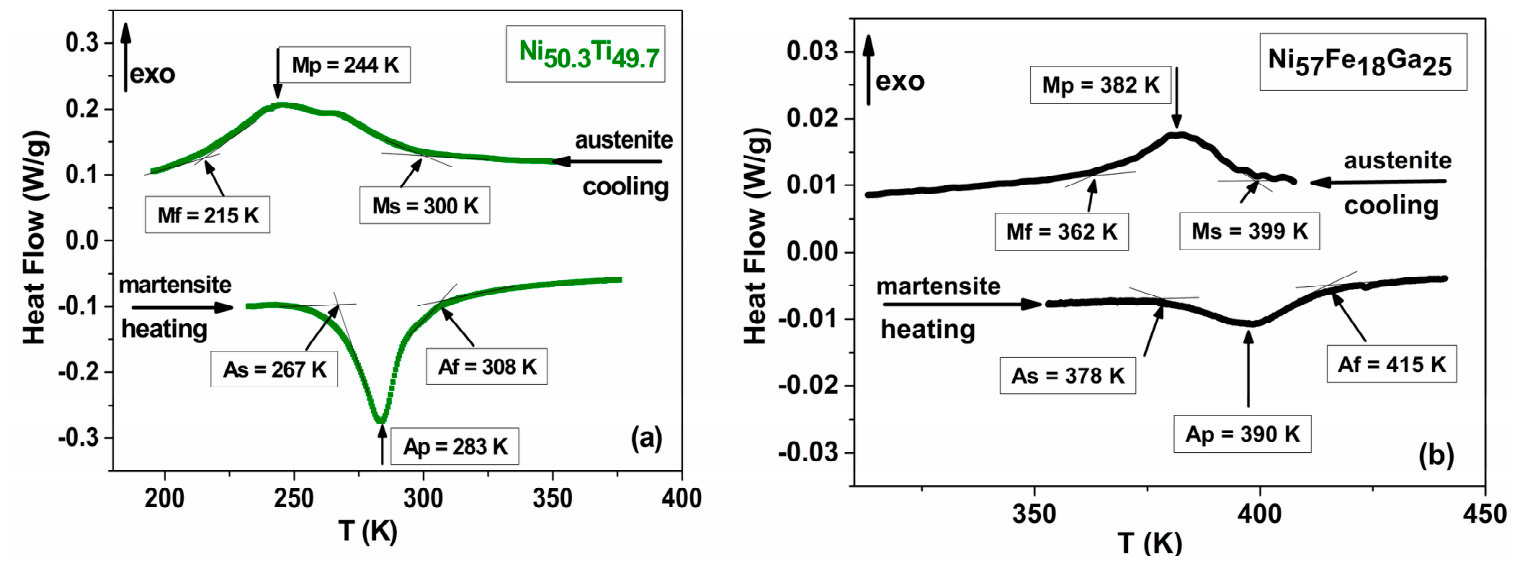
Particularly noteworthy is that two chemically distinct alloys, whose martensitic transformations are separated by approximately 135 K in the initial state, exhibit a single dominant calorimetric transformation after HSHPT processing while retaining a chemically sharp interface. This observation strongly suggests that the transformation behavior is governed predominantly by mechanical coupling between the constituent layers rather than by chemical homogenization.
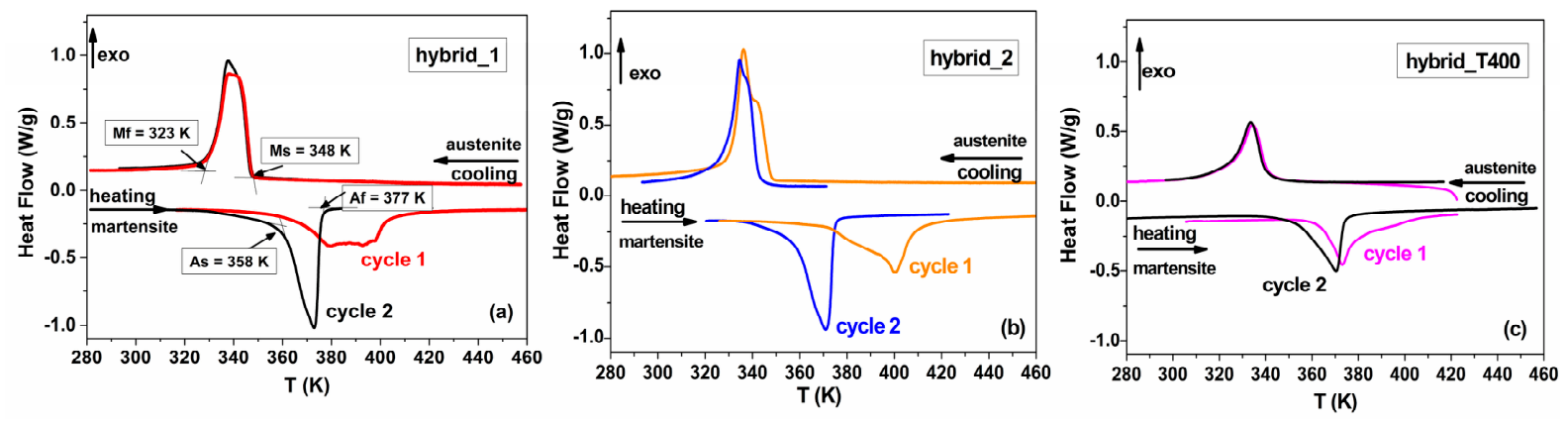
The upward shift of the first reverse transformation peak observed in the first DSC cycle (
Figure 5) is characteristic of the martensite stabilization effect (the phenomenon in which previously deformed martensite transforms back to austenite at higher temperatures than undeformed martensite). Consistent with the classical martensite stabilization effect, the upward shift is observed only during the first reverse transformation, whereas subsequent DSC cycles recover the normal transformation temperatures. Initially, this effect was interpreted in terms of the additional elastic and irreversible energies stored during deformation, which increase the thermodynamic driving force required for reverse transformation [
54]. More recent studies have shown that the effect cannot be fully explained solely by plastic deformation. Instead, martensite reorientation, detwinning, and the associated damage or loss of coherency of martensite interfaces have been proposed as the major contributing mechanisms responsible for reducing interface mobility and increasing the overheating required for the first reverse transformation. Furthermore, the magnitude of the stabilization effect has been shown to increase with the volume fraction of martensite, consistent with an increased probability of martensite–martensite interface interactions [
55,
56,
57].
The present HSHPT-processed hybrid exhibits a similar upward shift of the first reverse transformation peak. However, unlike conventionally deformed monolithic NiTi alloys, the present material contains a highly defected ultrafine-grained microstructure together with mechanically constrained NiTi/NiFeGa interfaces. Therefore, the observed thermal response is likely governed by the combined effects of classical martensite stabilization and the additional interfacial constraints introduced by the HSHPT process. Although most mechanistic investigations have been performed on NiTi alloys, martensite stabilization has also been reported in several other shape memory alloy systems, including TiNiHf [
58], CoNiAlFe [
59], and CoNiGa [
60], indicating that it represents a general feature of thermoelastic martensitic transformations rather than a phenomenon specific to NiTi.
The calorimetric results reveal a substantial increase in transformation enthalpy in the hybrid composite compared with the reference NiTi alloy, accompanied by broader transformation peaks and a significant increase in thermal hysteresis (Af − Ms). Together with the emergence of a single dominant transformation despite the initially well-separated transformation temperatures of the constituent alloys, these features indicate that the martensitic transformation is strongly influenced by the mechanical interaction between the two layers. The increased hysteresis is consistent with the presence of additional energy barriers arising from interfacial constraints and the high density of defects introduced during severe plastic deformation. Furthermore, the difference between the forward (QA–M) and reverse (QM–A) transformation enthalpies reflects the non-equilibrium and dissipative character of the transformation cycle. This behavior can be attributed to irreversible processes such as interface friction, dislocation motion, and defect rearrangement, which contribute to energy dissipation during the transformation.
Considering the mass fractions of the two constituent layers, namely 73.1 wt.% NiTi and 26.9 wt.% NiFeGa, the transformation enthalpy expected for a bilayer in which the two alloys transform independently can be estimated using a simple rule of mixtures. Based on the transformation enthalpies measured for the individual constituents (
Table 1), the expected value is approximately 9 J/g. In contrast, the experimentally measured transformation enthalpy of the hybrid reaches approximately 20 J/g, more than twice the value predicted by the rule of mixtures. This pronounced enhancement demonstrates that the calorimetric response of the hybrid cannot be interpreted as a simple superposition of the independent transformations of the NiTi and NiFeGa layers. Instead, it provides strong evidence for a cooperative transformation process promoted by the mechanical coupling established at the interface together with the highly deformed microstructure generated during HSHPT processing.
The non-equilibrium microstructure generated by HSHPT gives rise to a distribution of local transformation barriers, which is reflected in the broad and non-uniform DSC peaks observed during the first heating cycle. Following the initial thermal cycle, partial structural relaxation occurs, leading to a reduction in the asymmetry between QA–M and QM–A together with modifications of the transformation temperatures and thermal hysteresis. The reduced difference between the forward and reverse transformation enthalpies further supports a decrease in the dissipative contribution associated with irreversible processes such as defect rearrangement and interface friction.
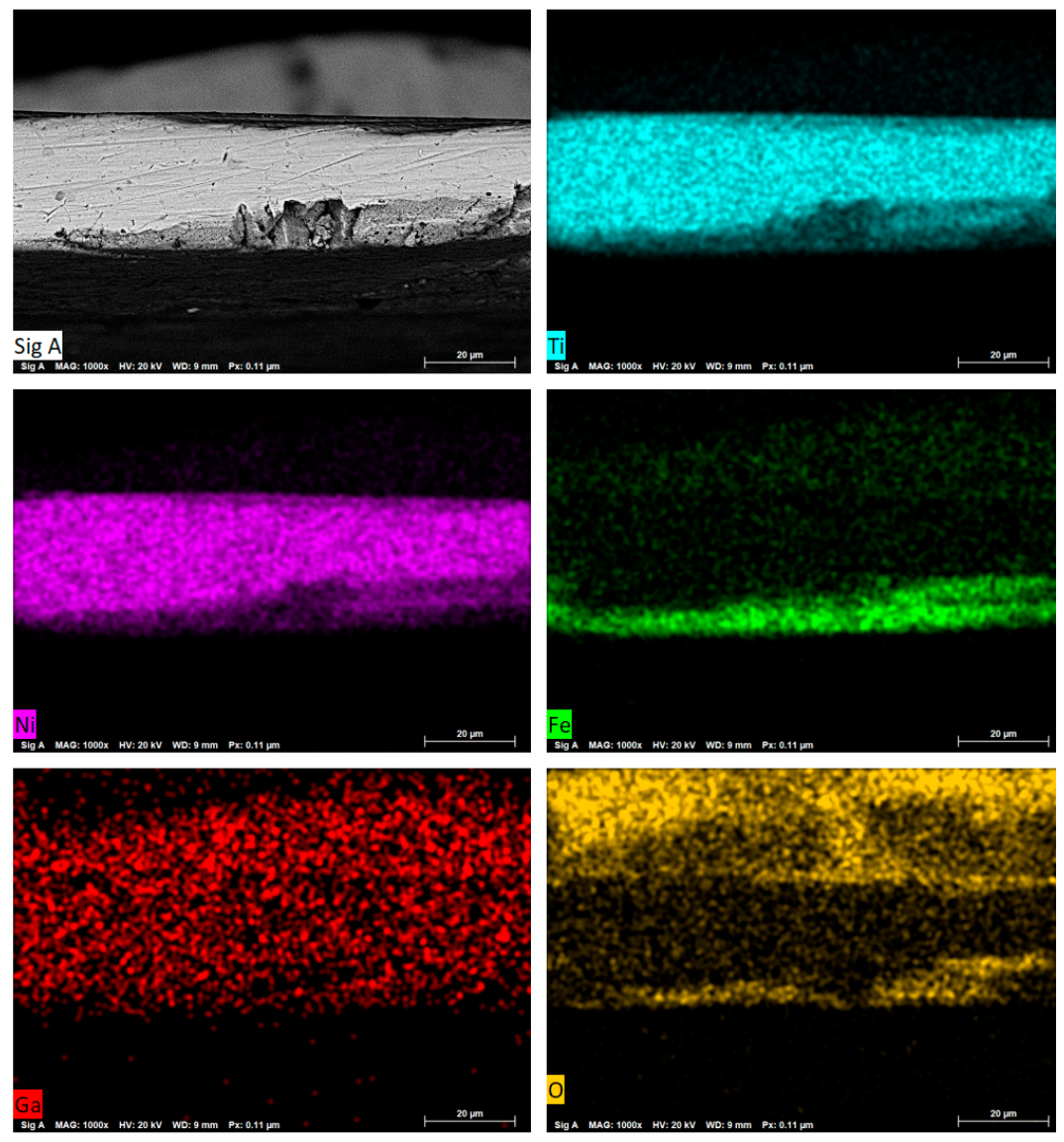
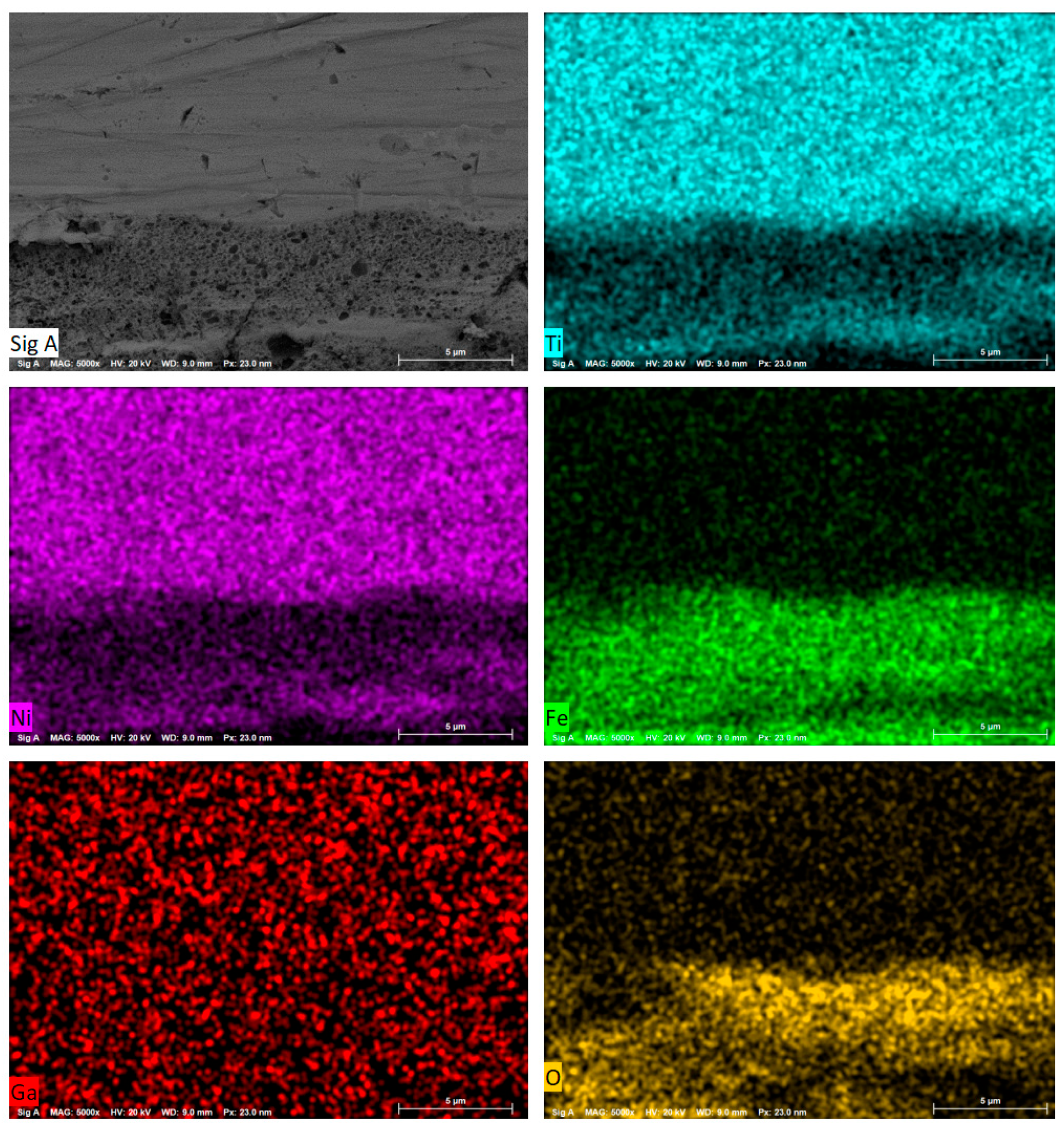
Although post-deformation heat treatment at 673 K reduces both the transformation enthalpy and the thermal hysteresis, the transformation enthalpy remains significantly higher than that of the reference NiTi alloy, indicating that the effects of interfacial mechanical coupling and the HSHPT-induced microstructure are only partially relaxed. SEM observations after annealing reveal localized microstructural heterogeneities within the NiTi layer that may be consistent with precipitation-related phenomena, while the EDS elemental maps indicate that the chemical partitioning between the constituent layers remains essentially unchanged and oxidation is limited. Taken together, these observations suggest that annealing at 673 K primarily promotes partial microstructural relaxation accompanied by localized structural evolution, rather than extensive interfacial reactions or chemical homogenization.
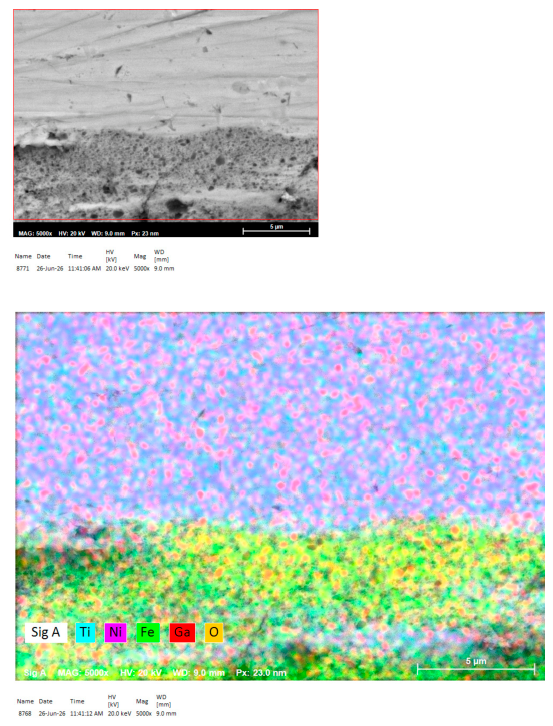
The heat treatment at 673 K promotes partial relaxation of the highly deformed HSHPT microstructure, as evidenced by the stabilization of the DSC response. However, the observed reduction in transformation enthalpy is unlikely to be governed solely by defect relaxation. Higher-magnification SEM observations reveal localized heterogeneities within the NiTi layer that may be consistent with precipitation-related phenomena commonly reported for Ni-rich NiTi alloys, while the oxygen maps indicate only limited oxidation following the DSC thermal treatment. Although the present SEM/EDS observations do not permit an unambiguous identification of the underlying phases, the absence of a continuous interfacial reaction layer and the preservation of the elemental partitioning indicate that the thermal exposure did not promote extensive chemical homogenization across the NiTi/NiFeGa interface. Instead, the combined effects of partial structural relaxation and localized microstructural evolution are likely to contribute to the irreversible reduction in the transformable austenite fraction and the corresponding decrease in transformation enthalpy after thermal exposure.
This behavior suggests that the microstructural features introduced during HSHPT, including interfacial mechanical coupling and deformation-induced defects, are only partially relaxed and continue to influence the transformation energetics. The broader and less uniform endothermic response observed during the first heating further supports partial relaxation of the HSHPT-generated non-equilibrium microstructure during annealing at 673 K. Combined with the SEM/EDS observations, these results indicate that the heat treatment promotes partial microstructural relaxation accompanied by localized microstructural evolution, while preserving the chemical partitioning between the NiTi and NiFeGa layers without extensive chemical homogenization.
The reproducibility of the calorimetric response is confirmed by the DSC measurements performed on a second independently fabricated hybrid specimen (Hybrid_2), which exhibits comparable transformation temperatures and transformation enthalpies to those of Hybrid_1. Minor differences in peak shape are observed, most likely reflecting the inherent variability associated with the non-equilibrium microstructure generated during the HSHPT process.
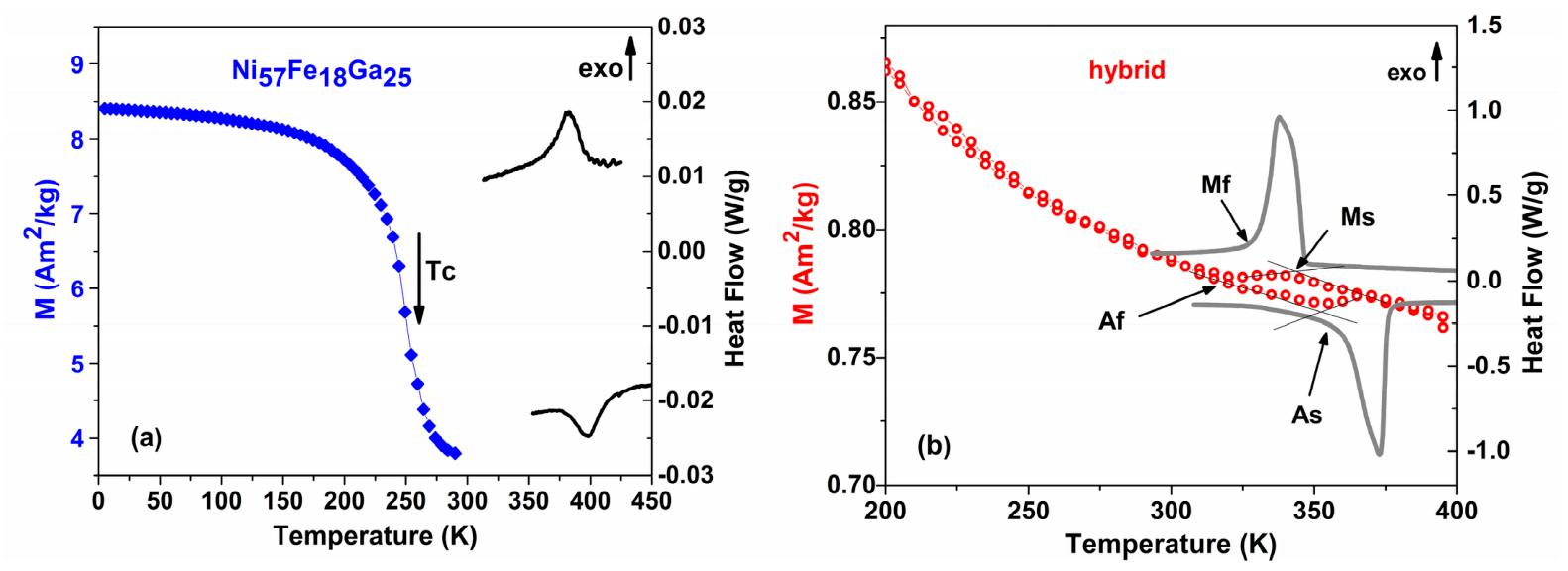
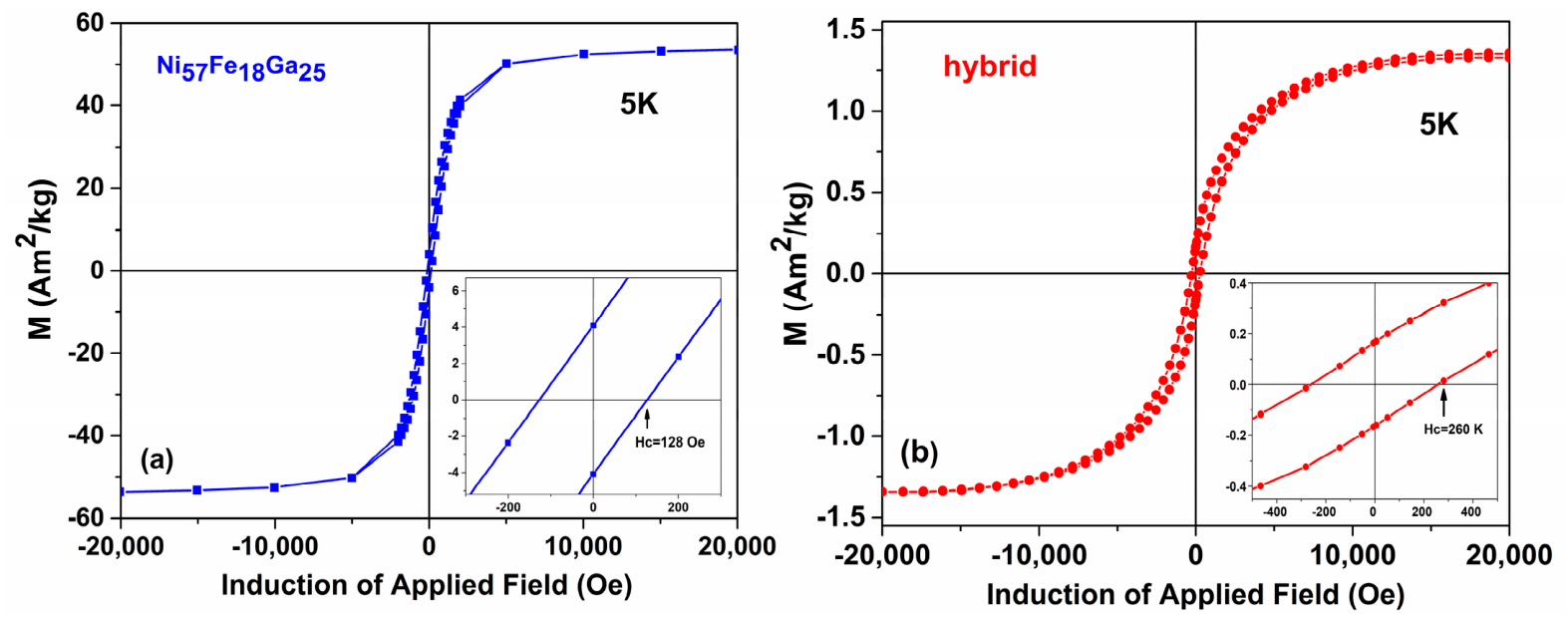
The magnetic measurements provide independent evidence that the functional response of the hybrid composite is strongly modified by HSHPT processing. Part of the reduction in the measured saturation magnetization is naturally associated with the dilution effect arising from the NiTi layer, which accounts for approximately 73 wt.% of the hybrid composite. However, this compositional effect alone cannot account for the nearly forty-fold decrease in saturation magnetization relative to the reference NiFeGa alloy. The results therefore indicate that HSHPT processing also substantially reduces the intrinsic specific magnetization of the NiFeGa constituent. This reduction is most likely associated with the high density of deformation-induced defects generated during HSHPT, which alter the local atomic environment of the magnetic atoms and consequently weaken the exchange interactions, leading to a lower net magnetic moment. Remarkably, the magnetic anomaly occurs within the same temperature interval as the cooperative martensitic transformation, despite the strong magnetic dilution and the fact that the NiFeGa constituent is not a ferromagnetic shape memory alloy.
Field-dependent magnetization measurements at low temperature reveal an increase in coercivity in the hybrid composite compared with the parent NiFeGa alloy. This behavior is consistent with enhanced domain-wall pinning arising from the high density of deformation-induced defects, the refined microstructure, and the mechanically constrained interface generated during HSHPT processing. Furthermore, the more rounded hysteresis loop observed for the hybrid composite indicates a more gradual approach to magnetic saturation, suggesting a broader distribution of local magnetic environments associated with structural disorder and interfacial constraints.
Taken together, these results demonstrate that the primary consequence of HSHPT processing in the present system is not chemical homogenization, but the formation of a defect-rich, mechanically coupled bilayer architecture. This microstructural state introduces additional elastic and interfacial energy contributions that enhance the transformation enthalpy and increase the thermal hysteresis while simultaneously modifying the magnetic response. The persistence of a well-defined magnetic anomaly within the temperature interval of the cooperative martensitic transformation further supports the close interplay between the structural and magnetic responses in the hybrid composite.
Although NiTi and NiFeGa undergo martensitic transformations in distinct temperature ranges, the HSHPT-processed bilayer behaves as a mechanically coupled system. Interfacial mechanical coupling, together with the defect-rich microstructure generated during HSHPT, promotes a cooperative transformation response in which each constituent influences the transformation behavior of the other, resulting in an integrated thermomagnetic response.
One of the most remarkable observations of the present study is that the hybrid composite exhibits a single dominant DSC transformation peak despite being composed of two chemically distinct alloys whose characteristic transformation temperatures differ by approximately 135 K. In the hybrid, this common transformation occurs approximately 95 K above the transformation of the reference NiTi alloy and approximately 40 K below that of the reference NiFeGa alloy.
Moreover, the thermomagnetic measurements indicate that the magnetic response associated with the NiFeGa constituent evolves within the same temperature interval as the cooperative calorimetric transformation. Together, these observations suggest that the two constituent alloys no longer transform independently after HSHPT processing. Instead, they exhibit a cooperative transformation response mediated by interfacial mechanical coupling and the defect-rich microstructure generated during severe plastic deformation.
Although the present results provide strong evidence for a cooperative transformation mediated by mechanical coupling following HSHPT processing, the underlying microscopic mechanisms remain to be fully elucidated. Previous TEM studies on HSHPT-processed NiTi/NiFeGa hybrids have demonstrated the formation of ultrafine-grained, defect-rich microstructures together with high-quality interfaces, without evidence of interfacial reaction layers [
53]. Nevertheless, dedicated TEM investigations of the hybrid materials examined in the present work, combined with systematic studies on bilayers composed of alloys exhibiting different transformation temperatures, will be required to determine whether the observed synchronized transformation is a general consequence of HSHPT-induced mechanical coupling or a phenomenon specific to the present alloy combination. Such studies would provide valuable insight into the extent to which mechanically mediated cooperative transformations can be generalized to other hybrid shape-memory systems.
Taken together, the DSC and SEM/EDS results indicate that annealing at 673 K primarily promotes partial relaxation of the HSHPT-induced non-equilibrium microstructure, accompanied by localized microstructural evolution that may be consistent with precipitation-related phenomena, while preserving the chemical partitioning of the constituent layers without extensive interfacial chemical homogenization.
Author Contributions
Conceptualization, C.G., F.T. and G.G.; methodology, C.G. and F.T.; software, M.T.; validation, C.S., C.G., D.B., M.T., I.A., F.T. and G.G.; formal analysis, M.T.; investigation, C.S., C.G., I.A. and F.T.; resources, D.B., F.T. and G.G.; data curation, C.S., I.A., F.T. and D.B.; writing—original draft preparation, C.S. and F.T.; writing—review and editing, F.T. and G.G.; visualization, C.S., C.G., D.B., M.T., F.T. and G.G.; supervision, D.B., F.T. and G.G.; project administration, C.S., F.T. and G.G.; funding acquisition, D.B., C.S., F.T. and G.G. All authors have read and agreed to the published version of the manuscript.
Funding
This research was funded by the Romanian Ministry of Research, Innovation and Digitization, Romania, Core Program Project, grant number PC2-PN23080202, Contract no. 28N/12.01.2023. The APC was funded by “Dunărea de Jos” University of Galati, Romania, through the doctoral grant research SD-SFI Core fund of PhD student Cristian Ştefănescu.
Data Availability Statement
The original contributions presented in this study are included in the article. Further inquiries can be directed to the corresponding author.
Acknowledgments
During the preparation of this manuscript the author(s) used ChatGPT, version 5.5, OpenAI, for the purposes of improving the clarity, structure, and linguistic expression of the manuscript. The authors have reviewed and edited the output and take full responsibility for the content of this publication.
Conflicts of Interest
The authors declare no conflicts of interest. The funders had no role in the design of the study; in the collection, analyses, or interpretation of data; in the writing of the manuscript; or in the decision to publish the results.
Abbreviations
The following abbreviations are used in this manuscript:
| SPD | severe plastic deformation |
| UFG | ultrafine-grained |
| HSHPT | high-speed high-pressure torsion |
| SMAs | Shape memory alloys |
| MT | Martensitic transformation |
| SEM | Scanning electron microscopy |
| EDX | Energy-dispersive X-ray spectroscopy |
| DSC | Differential scanning calorimetry |
References
- Zhilyaev, A.P.; Langdon, T.G. Using high-pressure torsion for metal processing: Fundamentals and applications. Prog. Mater. Sci. 2008, 53, 893–979. [Google Scholar] [CrossRef] [Scilit]
- Azushima, A.; Kopp, R.; Korhonen, A.; Yang, D.Y.; Micari, F.; Lahoti, G.D.; Groche, P.; Yanagimoto, J.; Tsuji, N.; Rosochowski, A.; et al. Severe plastic deformation (SPD) processes for metals. CIRP Ann. 2008, 57, 716–735. [Google Scholar] [CrossRef] [Scilit]
- Edalati, K.; Ahmed, A.; Akrami, S.; Ameyama, K.; Aptukov, V.; Asfandiyarov, R.N.; Ashida, M.; Astanin, V.; Bachmaier, A.; Beloshenko, V.; et al. Severe plastic deformation for producing Superfunctional ultrafine-grained and heterostructured materials: An interdisciplinary review. J. Alloys Compd. 2024, 1002, 174667. [Google Scholar] [CrossRef] [Scilit]
- Valiev, R.Z.; Islamgaliev, R.K.; Alexandrov, I.V. Bulk nanostructured materials from severe plastic deformation. Prog. Mater. Sci. 2000, 45, 103–189. [Google Scholar] [CrossRef] [Scilit]
- Kawasaki, M.; Figueiredo, R.B.; Langdon, T.G. Twenty-five years of severe plastic deformation: Recent developments in evaluating the degree of homogeneity through the thickness of disks processed by high-pressure torsion. J. Mater. Sci. 2012, 47, 7719–7725. [Google Scholar] [CrossRef] [Scilit]
- Estrin, Y.; Vinogradov, A. Extreme grain refinement by severe plastic deformation: A wealth of challenging science. Acta Mater. 2013, 61, 782–817. [Google Scholar] [CrossRef] [Scilit]
- Kommel, L.; Hout, J.B.; Shahreza, O. Effect of hard cyclic viscoplastic deformation on the microstructure, mechanical properties, and electrical conductivity of Cu-Cr alloy. J. Mater. Eng. Perform. 2022, 31, 9690–9702. [Google Scholar] [CrossRef] [Scilit]
- Rogl, G.; Zehetbauer, M.J.; Rogl, P.F. The effect of severe plastic deformation on thermoelectric performance of skutterudites, half-Heuslers and Bi-tellurides. Mater. Trans. 2019, 60, 2071–2085. [Google Scholar] [CrossRef] [Scilit]
- Weissitsch, L.; Wurster, S.; Stückler, M.; Müller, T.; Krenn, H.; Pippan, R.; Bachmaier, A. Synthesis of hard magnetic α-MnBi phase by high pressure torsion and field assisted annealing. J. Magn. Magn. Mater. 2023, 584, 171082. [Google Scholar] [CrossRef] [Scilit]
- Grosdidier, T.; Novelli, M.; Weiss, L. Surface severe plastic deformation for improved mechanical/corrosion properties and further applications in the bio-medical and hydrogen sectors. Mater. Trans. 2023, 64, 1695–1708. [Google Scholar] [CrossRef] [Scilit]
- Gurǎu, G.; Gurǎu, C.; Potecaşu, O.; Alexandru, P.; Bujoreanu, L.G. Novel high-speed high pressure torsion technology for obtaining Fe-Mn-Si-Cr shape memory alloy active elements. J. Mater. Eng. Perform. 2014, 23, 2396–2402. [Google Scholar] [CrossRef] [Scilit]
- Gurǎu, G.; Gurǎu, C.; Bujoreanu, L.G.; Sampath, V. A Versatile Method for Nanostructuring Metals, Alloys and Metal Based Composites. IOP Conf. Ser. Mater. Sci. Eng. 2017, 209, 1. [Google Scholar] [CrossRef] [Scilit]
- Gurǎu, G.; Gurǎu, C.; Tolea, F.; Sampath, V. Structural Change in Ni-Fe-Ga Magnetic Shape Memory Alloys after Severe Plastic Deformation. Materials 2019, 12, 1939. [Google Scholar] [CrossRef] [Scilit] [PubMed]
- Otsuka, K.; Wayman, C.M. Shape Memory Materials; Cambridge University Press: Cambridge, UK, 1998. [Google Scholar]
- Furuya, Y.; Shimada, H. Shape memory actuators for robotic applications. Mater. Des. 1991, 12, 21–28. [Google Scholar] [CrossRef] [Scilit]
- Nespoli, A.; Besseghini, S.; Pittaccio, S.; Villa, E.; Viscuso, S. New Developments on Mini/Micro Shape Memory Actuators. Sens. Actuators 2010, A158, 149–160. [Google Scholar] [CrossRef] [Scilit]
- Ma, G.Y.; Wang, J.; Di, T.D.; Fu, Y.Q.; Wang, Z.X.; Hao, Y.B.; Niu, F.Y.; Wu, D.J. Effect of heat treatment on microstructure, phase transformation behavior and shape memory effect of NiTi shape memory alloy manufactured by additive manufacturing. J. Alloys Compd. 2025, 1035. [Google Scholar] [CrossRef] [Scilit]
- Wang, M.L.; Chu, K.J.; Ren, F.Z. Grain size-dependent wear mechanisms in nanocrystalline NiTi shape memory alloys. J. Mater. Sci. Technol. 2026, 264, 28–36. [Google Scholar] [CrossRef] [Scilit]
- Liu, Z.Z.; Li, L.X.; Li, Y.; Tang, L.T.; Mao, C.L.; Xiao, H.; Yang, K.Y.; Li, P.P.; Liang, P.; Yu, Z.L. Comparison of microstructural characteristics, phase transformation and wear behavior of Ni50.8Ti49.2 shape memory alloy fabricated by LPBF versus conventional casting. Intermetallics 2025, 181, 108694. [Google Scholar] [CrossRef] [Scilit]
- Farvizi, M.; Akbarpour, M.R.; Ahn, D.H.; Kim, H.S. Compressive behavior of NiTi-based composites reinforced with alumina nanoparticles. J. Alloys Compd. 2016, 688, 803–807. [Google Scholar] [CrossRef] [Scilit]
- Chu, K.; Ren, F. Fatigue-resistant NiTi micropillars with small hysteresis fabricated by micro severe plastic deformation. Mater. Charact. 2024, 208, 113637. [Google Scholar] [CrossRef] [Scilit]
- Shi, X.B.; Ma, Z.Y.; Zhang, J.S.; Ding, H.L.; Guo, F.M.; Liu, Y.; Cui, L.S. Grain size effect on the martensitic transformation temperatures of nanocrystalline NiTi alloy. Smart Mater. Struct. 2015, 24, 072001. [Google Scholar] [CrossRef] [Scilit]
- Kyianytsia, A.; Ponçot, M.; Letoffe, A.; Boule, P.; Migot, S.; Ghanbaja, J.; Cinar, I.; de Lima Miranda, R.; Bechtold, C.; Kierren, B.; et al. Magnetic anisotropy switching induced by shape memory effect in NiTi/Ni bilayer. Appl. Phys. Lett. 2019, 115, 222402. [Google Scholar] [CrossRef] [Scilit]
- Kveglis, L.I.; Noskov, F.M.; Volochaev, M.N.; Nyavro, A.V.; Filarowski, A. Magnetic Properties of Nickel-Titanium Alloy during Martensitic Transformations under Plastic and Elastic Deformation. Symmetry 2021, 13, 665. [Google Scholar] [CrossRef] [Scilit]
- Nayak, P.; Sen, I. Impact of thermal treatments on small-scale deformation behavior of NiTi-based shape memory alloy for miniaturized applications. J. Mater. Sci. 2026, 61, 9314–9331. [Google Scholar] [CrossRef] [Scilit]
- Graf, T.; Felser, C.; Parkin, S.S.P. Simple rules for the understanding of Heusler compounds. Prog. Solid State Chem. 2011, 39, 1–50. [Google Scholar] [CrossRef] [Scilit]
- Ullakko, K.; Huang, J.K.; Kantner, C.; O’Handley, R.C.; Kokorin, V.V. Large magnetic-field-induced strains in Ni2MnGa single crystals. Appl. Phys. Lett. 1996, 69, 1966. [Google Scholar] [CrossRef] [Scilit]
- Caputo, M.P.; Berkowitz, A.E.; Armstrong, A.; Müllner, P.; Solomon, C.V. 4D printing of net shape parts made from Ni-Mn-Ga magnetic shape-memory alloys. Addit. Manuf. 2018, 21, 579–588. [Google Scholar] [CrossRef] [Scilit]
- Kishi, Y.; Craciunescu, C.; Sato, M.; Okazaki, T.; Furuya, Y.; Wuttig, M. Microstructures and magnetic properties of rapidly solidified CoNiGa ferromagnetic shape memory alloys. J. Magn. Magn. Mater. 2003, 262, L186–L191. [Google Scholar] [CrossRef] [Scilit]
- Guo, Z.; Liu, X.H.; Xiao, J.L.; Tang, L.; Wang, H.Z.; Zhang, S.Z.; Yi, X.Y.; He, X.C. Effect of Ti doping on mechanical properties and elastocaloric effect in CoNiGa shape memory alloys. J. Alloys Compd. 2025, 1049, 185386. [Google Scholar] [CrossRef] [Scilit]
- Hernando, B.; Llamazares, J.L.S.; Santos, J.D.; Sánchez, M.L.; Escoda, L.; Suñol, J.J.; Varga, R.; García, C.; González, J. Grain oriented NiMnSn and NiMnIn Heusler alloys ribbons produced by melt spinning: Martensitic transformation and magnetic properties. J. Magn. Magn. Mater. 2009, 321, 763–768. [Google Scholar] [CrossRef] [Scilit]
- Huang, X.M.; Zhao, Y.; Hao, X.W.; Xiang, H.Y.; Yang, J.H.; Wang, C.W.; Yang, W.Y.; Zhang, C.P.; Zhao, B.R.; Ma, J.; et al. Enhanced deep-freezing magneto- and elasto-caloric effects by modifying lattice anharmonicity and electronic structures. Acta Mater. 2025, 296, 121302. [Google Scholar] [CrossRef] [Scilit]
- Cugini, F.; Gallo, L.; Garulli, G.; Olivieri, D.; Trevisi, G.; Fabbrici, S.; Albertini, F.; Solzi, M. In-operando test of tunable Heusler alloys for thermomagnetic harvesting of low-grade waste heat. Acta Mater. 2025, 288, 120847. [Google Scholar] [CrossRef] [Scilit]
- Rodríguez-Crespo, B.; Rio-López, N.A.; Lázpita, P.; Ceballos, S.; Ríos, M.; Domenech, D.; Rodriguez-Velamazán, J.A.; López-García, J.; Chernenko, V.; Porro, J.M.; et al. Impact of magnetic, atomic and microstructural ordering on the magnetocaloric performance of powdered NiCoMnSn metamagnetic shape memory ribbons. Mater. Des. 2024, 245, 113279. [Google Scholar] [CrossRef] [Scilit]
- Elphick, K.; Frost, W.; Samiepour, M.; Kubota, T.; Takanashi, K.; Sukegawa, H.; Mitani, S.; Hirohata, A. Heusler alloys for spintronic devices: Review on recent development and future perspectives. Sci. Technol. Adv. Mater. 2021, 22, 235–271. [Google Scholar] [CrossRef] [Scilit] [PubMed]
- Hernández, F.A.; Olmos, L.; Mihalcea, E.; Jimenez, O.; Avila-Olivera, J.A. The influence of mechanical milling on microstructural evolution during sintered NiMnSb alloy powders. MRS Adv. 2026, 11, 481–485. [Google Scholar] [CrossRef] [Scilit]
- Li, Y.; Jiang, C.B.; Liang, T.; Ma, Y.Q.; Xu, H.B. Martensitic transformation and magnetization of Ni-Fe-Ga ferromagnetic shape memory alloys. Scr. Mater. 2003, 48, 1255–1258. [Google Scholar] [CrossRef] [Scilit]
- Tolea, F.; Nita, M.; Tolea, M. Thermal memory effect in NiFeGa and NiMnGa shape memory ribbons: Toward maximum-temperature recording applications. J. Alloys Compd. 2025, 1043, 184056. [Google Scholar] [CrossRef] [Scilit]
- Pataky, G.J.; Ertekin, E.; Sehitoglu, H. Elastocaloric cooling potential of NiTi, Ni2FeGa, and CoNiAl. Acta Mater. 2015, 96, 420–427. [Google Scholar] [CrossRef] [Scilit]
- Bachagha, T.; Sunol, J.J. All-d-Metal Heusler Alloys: A Review. Metals 2023, 13, 111. [Google Scholar] [CrossRef] [Scilit]
- Villa, F.; Villa, E.; Righi, L.; Ruggieri, P.; Bennato, N.; Battiston, S.; Passaretti, F.; Casati, R. Effect of the thermal processing on the microstructural, functional and mechanical properties of cast polycrystalline NiMnTi alloys. J. Alloys Compd. 2024, 1000, 175099. [Google Scholar] [CrossRef] [Scilit]
- Ren, H.J.; Cai, R.; Zhang, X.Y.; Sun, W.; Liu, J.; Li, G.W.; Wei, Z.Y. Realization of ferromagnetic strain glass in all-d-metal Heusler NiCoMnTi alloys. APL Mater. 2026, 14, 041105. [Google Scholar] [CrossRef] [Scilit]
- Beckmann, B.; Koch, D.; Pfeuffer, L.; Gottschall, T.; Taubel, A.; Adabifiroozjaei, E.; Miroshkina, O.N.; Riegg, S.; Niehoff, T.; Kani, N.A.; et al. Dissipation losses limiting first-order phase transition materials in cryogenic caloric cooling: A case study on all-d-metal Ni(-Co)-Mn-Ti Heusler alloys. Acta Mater. 2023, 246, 118695. [Google Scholar] [CrossRef] [Scilit]
- Qian, J.F.; Liu, E.K.; Feng, L.; Zhu, W.; Li, G.J.; Wang, W.H.; Wu, G.H.; Du, Z.W.; Fu, X. Unusual magnetic anisotropy in the ferromagnetic shape-memory alloy Ni50Fe23Ga27. Appl. Phys. Lett. 2011, 99, 252504. [Google Scholar] [CrossRef] [Scilit]
- Tolea, F.; Sofronie, M.; Crisan, A.D.; Enculescu, M.; Kuncser, V.; Valeanu, M. Effect of thermal treatments on the structural and magnetic transitions in melt-spun Ni-Fe-Ga-(Co) ribbons. J. Alloys Compd. 2015, 650, 664e670. [Google Scholar] [CrossRef] [Scilit]
- Beygelzimer, Y.; Estrin, Y.; Kulagin, R. Synthesis of hybrid materials by severe plastic deformation: A new paradigm of SPD processing. Adv. Eng. Mater. 2015, 17, 1853–1861. [Google Scholar] [CrossRef] [Scilit]
- Beloshenko, V.A.; Voznyak, A.V.; Voznyak, Y.V.; Savchenko, B. New approach to production of fiber reinforced polymer hybrid composites. Compos. Part B Eng. 2017, 112, 22–30. [Google Scholar] [CrossRef] [Scilit]
- Lester, B.; Baxevanis, T.; Chemisky, Y.; Lagoudas, D. Review and Perspectives: Shape Memory Alloy Composite Systems. ACTA Mech. 2015, 226, 3907–3960. [Google Scholar] [CrossRef] [Scilit]
- Gurǎu, G.; Gurǎu, C.; Tolea, F.; Sampath, V. Structural evolution of the NiTi/NiFeGa smart hybrid material during severe plastic deformation. Dig. J. Nanomater. Biostructures 2019, 14, 539–546. [Google Scholar]
- Popescu, B.; Gurǎu, C.; Gurǎu, G.; Tolea, M.; Sofronie, M.; Tolea, F. Martensitic Transformation and Magnetic Properties of Ni57Fe18Ga25 Shape Memory Alloy Subjected to Severe Plastic Deformation. Trans. Indian Inst. Met. 2021, 74, 2491–2498. [Google Scholar] [CrossRef] [Scilit]
- Otsuka, K.; Ren, X. Physical metallurgy of Ti-Ni-based shape memory alloys. Prog. Mater. Sci. 2005, 50, 511–678. [Google Scholar] [CrossRef] [Scilit]
- Nath, H.; Phanikumar, G. Microstructural, Magnetic and Electrical Properties of Ni2FeGa Heusler Alloys. Trans. Indian Inst. Met. 2016, 69, 1389–1396. [Google Scholar] [CrossRef] [Scilit]
- Gurǎu, C.; Gurǎu, G.; Tolea, F.; Popescu, B.; Banu, M.; Bujoreanu, L.-G. The Effect of the In-Situ Heat Treatment on the Martensitic Transformation and Specific Properties of the Fe-Mn-Si-Cr Shape Memory Alloys Processed by HSHPT Severe Plastic Deformation. Materials 2021, 14, 4621. [Google Scholar] [CrossRef] [Scilit] [PubMed]
- Kato, H.; Yasuda, Y.; Sasaki, K. Thermodynamic assessment of the stabilization effect in deformed shape memory alloymartensite. Acta Mater. 2011, 59, 3955–3964. [Google Scholar] [CrossRef] [Scilit]
- Belyaev, S.; Resnina, N.; Iaparova, E.; Ivanova, A.; Rakhimov, T.; Andreev, V. Influence of chemical composition of NiTi alloy on the martensite stabilization effect. J. Alloys Compd. 2019, 787, 1365–1371. [Google Scholar] [CrossRef] [Scilit]
- Belyaev, S.; Resnina, N.; Ivanova, A.; Ponikarova, I.; Iaparova, E. Martensite Stabilization Effect in the Ni50Ti50 Alloy After Preliminary Deformation by Cooling Under Constant Stress. Shape Mem. Superelasticity 2020, 6, 223–231. [Google Scholar] [CrossRef] [Scilit]
- Belyaev, S.; Resnina, N.; Ponikarova, I.; Iaparova, E.; Rakhimov, T.; Ivanova, A.; Tabachkova, N.; Andreev, V. Damage of the martensite interfaces as the mechanism of the martensite stabilization effect in the NiTi shape memory alloys. J. Alloys Compd. 2022, 921, 166189. [Google Scholar] [CrossRef] [Scilit]
- Meng, X.L.; Cai, W.; Zheng, Y.F.; Rao, Y.B.; Zhao, L.C. Two-way shape memory effect induced by martensite deformation and stabilization of martensite in T36Ni69Hf15 high temperature shape memory alloy. Mat. Lett. 2003, 57, 4206–4211. [Google Scholar] [CrossRef] [Scilit]
- Eftifeeva, A.; Panchenko, E.; Yanushonite, E.; Tagiltsev, A.; Ryzhakova, V.; Steshenko, I.; Chumlyakov, Y. Orientation dependence of stress-inducedmartensitestabilizationand two-way shape memoryeffect in CoNiAlFe single crystals. J. Alloys Compd. 2026, 1059, 187137. [Google Scholar] [CrossRef] [Scilit]
- Chernenko, V.A.; Pons, J.; Cesari, E.; Zasimchuk, I.K. Transformation behaviour and martensite stabilization in the ferromagnetic Co-Ni-Ga Heusler alloy. Scr. Mat. 2003, 50, 225–229. [Google Scholar] [CrossRef] [Scilit]
Figure 1.
Schematic illustration of the fabrication route for the NiTi/NiFeGa hybrid composite, including the initial specimen dimensions and the successive HSHPT processing steps. The dimensions indicated in the schematic are given in millimeters.
Figure 2.
EDX elemental maps across the NiTi/NiFeGa interface. Ti is confined to the NiTi layer, whereas Fe and Ga are localized within the NiFeGa layer. Ni is present in both layers, as expected from the alloy compositions. The clear spatial separation of elements indicates the absence of interfacial mixing at the microscale. Reprinted from Ref. [
49].
Figure 3.
EDX line scan performed perpendicular to the NiTi/NiFeGa interface, showing an abrupt compositional transition between the two layers. The Ti signal decreases sharply upon crossing into the NiFeGa region, while Fe and Ga increase correspondingly. No extended mixed-composition region is observed, indicating the absence of significant interdiffusion within the spatial resolution of the technique. Reprinted from Ref. [
49].
Figure 4.
Differential scanning calorimetry (DSC) curves of the reference alloys (a) Ni50.3Ti49.7 and (b) Ni57Fe18Ga25.
Figure 5.
Differential scanning calorimetry (DSC) curves of HSHPT-processed hybrid composites. (a) Hybrid_1 sample; (b) Hybrid_2 sample measured as an additional specimen for reproducibility assessment; (c) Hybrid_T400 sample after post-deformation heat treatment at 673 K for 20 min.
Figure 6.
Representative cross-sectional SEM micrographs and corresponding EDS elemental maps of the NiTi/NiFeGa hybrid specimen after post-deformation heat treatment at 673 K for 20 min (Hybrid_T400), illustrating the elemental distribution across the bilayer interface.
Figure 7.
Higher-magnification cross-sectional SEM micrograph and corresponding EDS elemental overlay of the NiTi/NiFeGa hybrid specimen after post-deformation heat treatment at 673 K for 20 min (Hybrid_T400), showing localized contrast features within the NiTi layer in the vicinity of the interface.
Figure 8.
Cross-sectional SEM micrographs and corresponding EDS elemental maps (Ti, Ni, Fe, Ga, and O) of the NiTi/NiFeGa hybrid specimen after post-deformation heat treatment at 673 K for 20 min (Hybrid_T400), illustrating the preserved bilayer architecture and elemental partitioning following thermal exposure.
Figure 9.
(a) Temperature dependence of magnetization (left) and DSC scans of the NiFeGa reference alloy; (b) Thermo-Magnetic Response of HSHPT-Processed NiTi/NiFeGa Hybrid Composite.
Figure 10.
Magnetic hysteresis (M–H) curves measured at 5 K: (a) Ni57Fe18Ga25 reference alloy; (b) hybrid sample. The hybrid exhibits significantly reduced magnetization compared to the reference alloy, indicating magnetic dilution. Insets show the low-field region, highlighting the coercive field (Hc).
Table 1.
Geometrical, physical, and calculated parameters of the NiTi/NiFeGa hybrid composite used for estimating the relative contributions of the constituent layers to the calorimetric and magnetic responses.
| Constituent | Mass
(g) | Volume
(mm3) | Density
(g/cm3) | Volume Fraction
(%) | Mass Fraction
(%) |
|---|
| Ni50.3Ti49.7 | 2.17 | 349.91 | 6.20 | 77.06 | 73.06 |
| Ni57Fe18Ga25 | 0.80 | 104.18 | 7.68 | 22.94 | 26.94 |
| Total | 2.97 | 454.09 | - | 100 | 100 |
Table 2.
Ms, Mf, Mp denote martensite start, finish and peak temperatures; As, Af, Ap denote austenite start, finish and peak temperatures; (Af − Ms) defines the thermal hysterezis; QA–M corresponds to the enthalpy of the forward (austenite → martensite) transformation, while QM–A corresponds to the reverse transformation, Qm denotes the average transformation enthalpy.
| Sample | Ms//Mf//Mp
(K) | As//Af//Ap
(K) | Af-Ms
(K) | QA–M
(J/g) | QM–A
(J/g) | Qm
(J/g) | Hc
(Oe) | Ms
(Am2/Kg) |
|---|
| Ni50.3Ti49.7 | 308//215//244 | 251//325//282.6 | 17 | 14.32 | 10.41 | 12.365 | | |
| Ni57Fe18Ga25 | 399//360//382 | 376//420//398 | 21 | 0.685 | 0.512 | 0.6 | 128 | 54 |
| Hybrid_1 cycle 1 | 348//323//340 | 358//408//390 | 60 | 24.68 | 19.4 | 22.04 | | |
| Hybrid_1 cycle 2 | 348//323//337 | 333//378//373 | 30 | 24.9 | 24.23 | 24.56 | 260 | 1.4 |
| Hybrid_2 cycle 1 | 349//325//336 | 371//420//400 | 81 | 23.6 | 18.8 | 21.2 | | |
| Hybrid_2 cycle 2 | 346//315//335 | 335//377//371 | 31 | 23.5 | 22.4 | 22.95 | | |
| HybridT400 cycle 1 | 351//300//334 | 357//415//374 | 64 | 14.63 | 16.2 | 15.42 | | |
| HybridT400 cycle 2 | 351//300//333 | 341//377//371 | 26 | 15.1 | 15.27 | 15.185 | | |
| Disclaimer/Publisher’s Note: The statements, opinions and data contained in all publications are solely those of the individual author(s) and contributor(s) and not of MDPI and/or the editor(s). MDPI and/or the editor(s) disclaim responsibility for any injury to people or property resulting from any ideas, methods, instructions or products referred to in the content. |



 ,
,