Article

Influence of Process Parameters on the Forming Quality and Metal Flow Characteristics of the Billet During Hot Extrusion of an Automotive Luggage Rack

1
Faculty of Mechanical Engineering and Mechanics, Ningbo University, Ningbo 315211, China
2
Department of Mechanical Engineering, University of Birmingham, Birmingham B15 2TT, UK
3
School of Materials Science & Engineering, Shanghai Jiao Tong University, Shanghai 200240, China
4
Faculty of Mechanical Engineering, Lublin University of Technology, Nadbystrzycka 36, 20-618 Lublin, Poland
*
Author to whom correspondence should be addressed.
Metals 2026, 16(6), 637; https://doi.org/10.3390/met16060637 (registering DOI)
Submission received: 9 May 2026 / Revised: 5 June 2026 / Accepted: 6 June 2026 / Published: 9 June 2026
(This article belongs to the Special Issue Rolling and Forming of Alloys and Steels)

Abstract

Automotive roof racks are important lightweight accessories for vehicles, and their extrusion performance is affected by the coupled effects of material hot deformation behavior, die flow resistance and billet surface layer transport. In this study, Al-0.9Mg-0.6Si alloy samples were subjected to hot compression tests at 350–500 °C and strain rates of 0.01–10 s−1. The corrected true stress–true strain data were used to establish and validate an Arrhenius-type constitutive model, which was then implemented in HyperXtrude to simulate the hot extrusion of an automotive roof rack profile. The hot working map showed that the main rheological instability region was located at high strain rates, and the preferred processing window was 437–500 °C and 0.01–0.6 s−1. EBSD analysis showed that hot compression refined the microstructure relative to the initial average grain size of 173.147 μm, and the most uniform grain size distribution was obtained at 500 °C and 0.1 s−1. The ODF results indicated strengthened {111}<121> and <110>//TD texture components after compression. The finite-element results showed that the standard deviation of outlet velocity (SDV), used here as an index of outlet flow uniformity, increased with ram speed, billet preheating temperature and die preheating temperature, but decreased with increasing container temperature. Finally, grain size and texture measurements from butt discard samples were compared with simulated surface layer flow paths, supporting the predicted difference between simple axial flow and complex recirculating flow near the die.

1. Introduction

Aluminum alloys possess properties such as light weight, low cost, corrosion resistance, ease of processing, and good thermal and electrical conductivity, making them widely used in transportation, construction, electronics, packaging, and marine engineering [1]. Car roof racks are components installed on the roof of a vehicle to provide support, typically used to secure luggage and equipment. With rapid advancements in science and technology and economic development, aluminum alloy hot-extruded car roof racks have become an indispensable product in people’s lives and work. Compared to traditional steel roof racks, aluminum alloy profile roof racks effectively reduce vehicle weight and fuel consumption.
Due to varying cooling rates in different parts of as-cast bars, compositional segregation occurs on the surface relative to the interior. Homogenization heat treatment is typically performed on as-cast bars to mitigate this segregation. Du et al. [2] proposed that segregation is a common problem in casting, and homogenization is the main method for optimizing it; conductivity testing can quickly evaluate the homogenization effect. Li et al. [3] proposed that ultrasonic treatment of molten aluminum alloys can improve the as-cast microstructure and shorten the homogenization time. Wang et al. [4] proposed that central segregation in six-series aluminum alloys during twin-roll casting is mainly caused by the growth of columnar crystals and the enrichment of solute along dendrite gaps towards the central region under the separation force of the rolls. Wu et al. [5] proposed that macroscopic segregation is a common defect in directly cooled cast aluminum alloy ingots, which may affect ingot performance and quality.
Extrusion production lines in enterprises typically operate on fixed processes, making changes to a single extrusion production line relatively costly. Finite-element simulation (FEM) can provide theoretical guidance for extrusion production through low-cost trial and error. Ye et al. [6] performed finite element simulation of battery-box aluminum alloy profiles, analyzed the causes of warpage based on the exit velocity distribution, and proposed optimization schemes involving portholes, flow-blocking structures, and bearing lengths.   Wang et al. [7] conducted simulation analysis on the effects of process parameters such as extrusion speed and die preheating temperature on extrusion forming characteristics such as aluminum alloy profile exit temperature, extrusion flow stress, and extrusion pressure, and verified the simulation experimentally. Zhou et al. [8] demonstrated through simulation that the equivalent stress and deformation of profile components are related to the cooling rate, and that the temperature reduction in air-cooled quenched profiles is more gradual compared to water-spray quenching. Liu et al. [9] proposed through simulation that extrusion speed and die temperature have a more significant impact on the root mean square deviation of the flow velocity at the exit section. Zeng et al. [10] studied the influence of process parameters such as extrusion speed, bar preheating temperature, extrusion barrel preheating temperature, and die preheating temperature on the root mean square deviation of the flow velocity at the profile exit section through FEM simulation. These studies indicate that die exit velocity uniformity is closely related to forming stability, but it should be interpreted together with other technological quantities when evaluating the overall quality of extruded profiles.
Abnormal components such as oxide films, segregation layers, and impurities on the ingot surface can flow into the profile interior, affecting the surface quality and mechanical properties of the profile. Therefore, research on the flow behavior of the surface metal of the billet is of great practical significance. Chen et al. [11] established a three-dimensional transient numerical model for tracking the surface metal of the billet during the extrusion process of three wide-section profiles. By simulating the physical field quantities of the deformed metal and the flow law of the surface metal of the billet, they provided a reasonable method for predicting the minimum residual length. Hatzenbichler et al. [12] proposed that the production efficiency of unlubricated extrusion of aluminum alloys is limited by the rear-end defects that appear at the center of the extruded profile at the end of the extrusion cycle. Negozio et al. [13] simulated the front and rear-end defects of AA6063 and AA6082 composite alloy billets using simulation software and then compared and analyzed them with experimental results. Liu et al. [14], based on micro-complex hollow profiles, revealed for the first time the formation mechanism and optimization strategy of the rear-end defects on the surface of micro-complex hollow profiles.
Current research mostly focuses on parameters such as deformation, velocity, temperature, grain size, stress, strain, and weld quality at the exit of simple solid profiles, with less attention paid to the flow behavior of the surface metal in hollow profiles. Since extrusion takes place within a closed extrusion cylinder, finite-element simulation software is a powerful research tool. This study simulates the flow behavior of the surface metal in billets using the HyperXtrude 2024 (Altair Engineering Inc., Troy, MI, USA) finite-element simulation method and verifies the results through characterization, providing theoretical guidance for improving material utilization in the aluminum alloy extrusion industry.
The central hypothesis of this work was that the process window derived from hot-compression behavior could be coupled with extrusion FEM to explain both outlet flow uniformity and the transport path of the billet surface layer. Therefore, the study was organized around one continuous research line: first, the constitutive model and hot working map defined the material response and stable deformation window; second, these material parameters were introduced into the extrusion FEM to evaluate outlet velocity uniformity through SDV; third, the predicted surface layer flow paths were compared with grain size and texture evidence from the butt discard. This structure connected constitutive modeling, process window analysis, numerical simulation and EBSD verification into a single framework rather than treating them as independent analyses.

2. Methods

2.1. Profile and the Design of Die

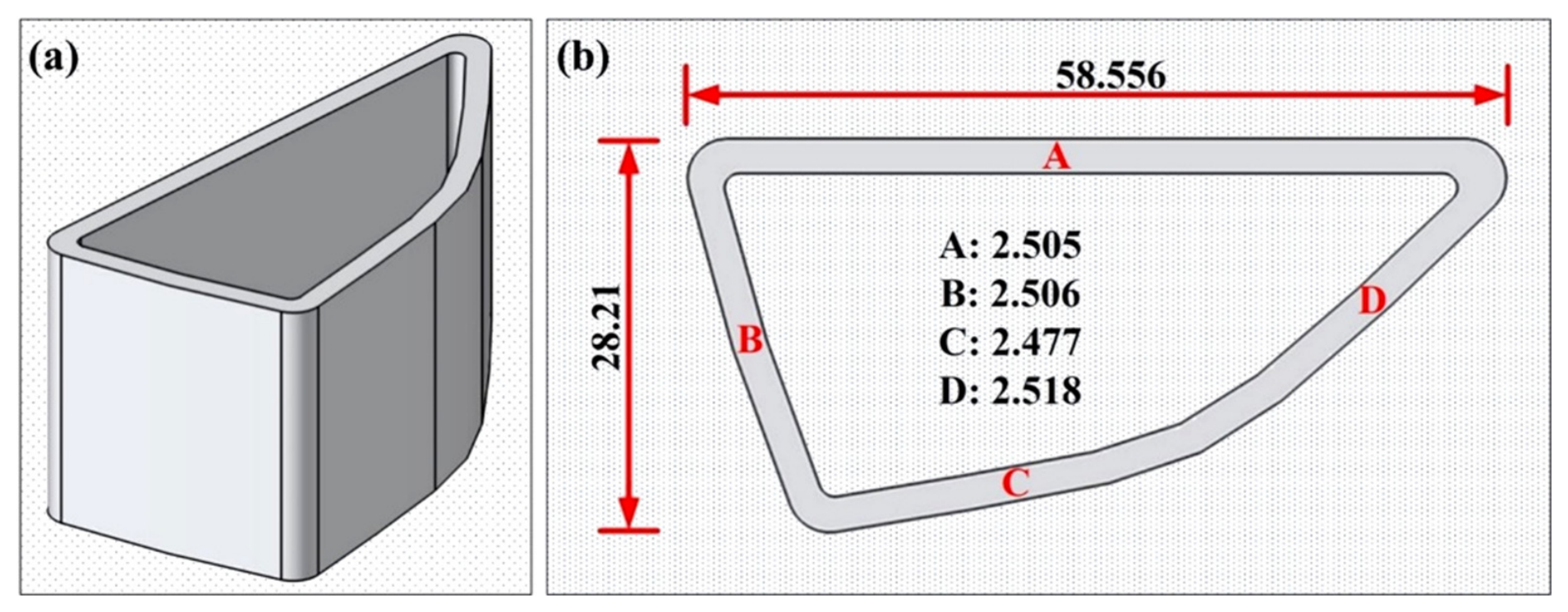
Figure 1 shows the design of the car roof rack. Figure 1a presents the 3D model of the vehicle roof rack, and Figure 1b presents the cross-sectional dimensions of the profile. The profile had one hollow cavity, and its cross-section was approximately triangular. The maximum dimensions of the profile section were 28.21 mm × 58.556 mm. The wall thicknesses at positions A, B, C and D were 2.505 mm, 2.506 mm, 2.477 mm and 2.518 mm, respectively. Therefore, the profile had a relatively uniform wall thickness of approximately 2.5 mm.
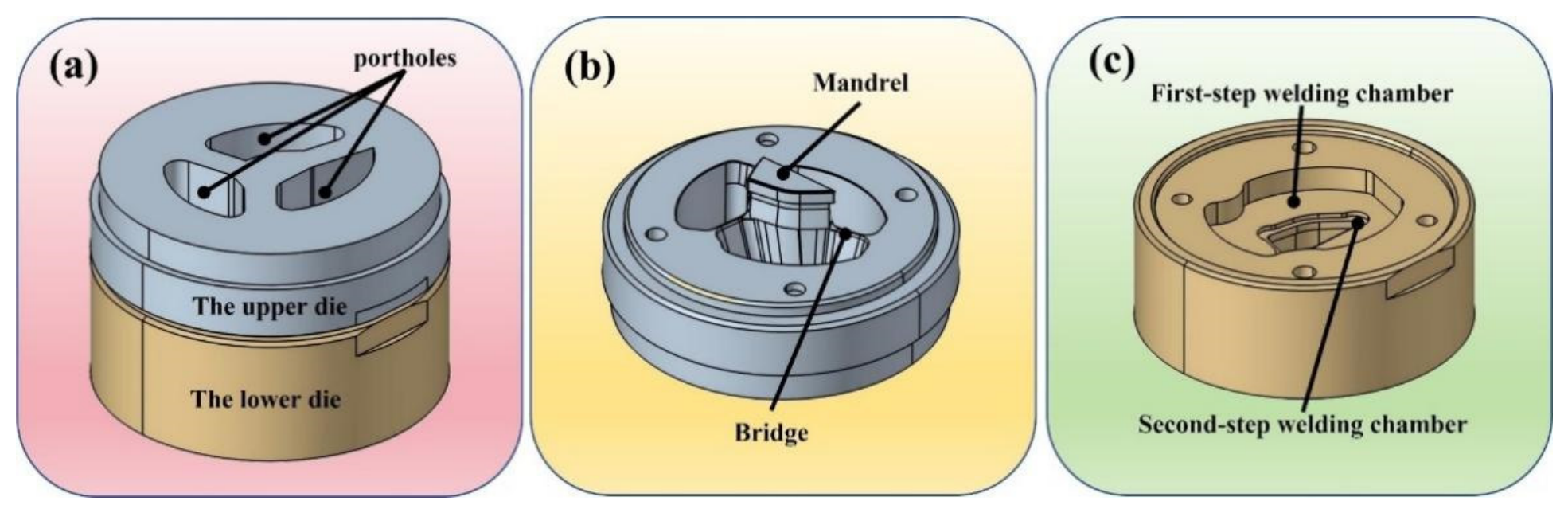
Based on the model and dimensions of the vehicle roof rack in Figure 1, the corresponding porthole die was designed as shown in Figure 2. Figure 2a presents the overall structure of the porthole die. Figure 2b presents the upper die, which contained three portholes, three bridges and a mandrel. Figure 2c presents the lower die, which contained the first-step welding chamber, the second-step welding chamber, the bearing and the empty blade.

2.2. Numerical Simulation of Al-0.9Mg-0.6Si

The metallic elements in this aluminum alloy were measured using a high-performance inductively coupled plasma emission spectrometer (Perkin Elmer avio560, Waltham, MA, USA), and the results are listed in Table 1.
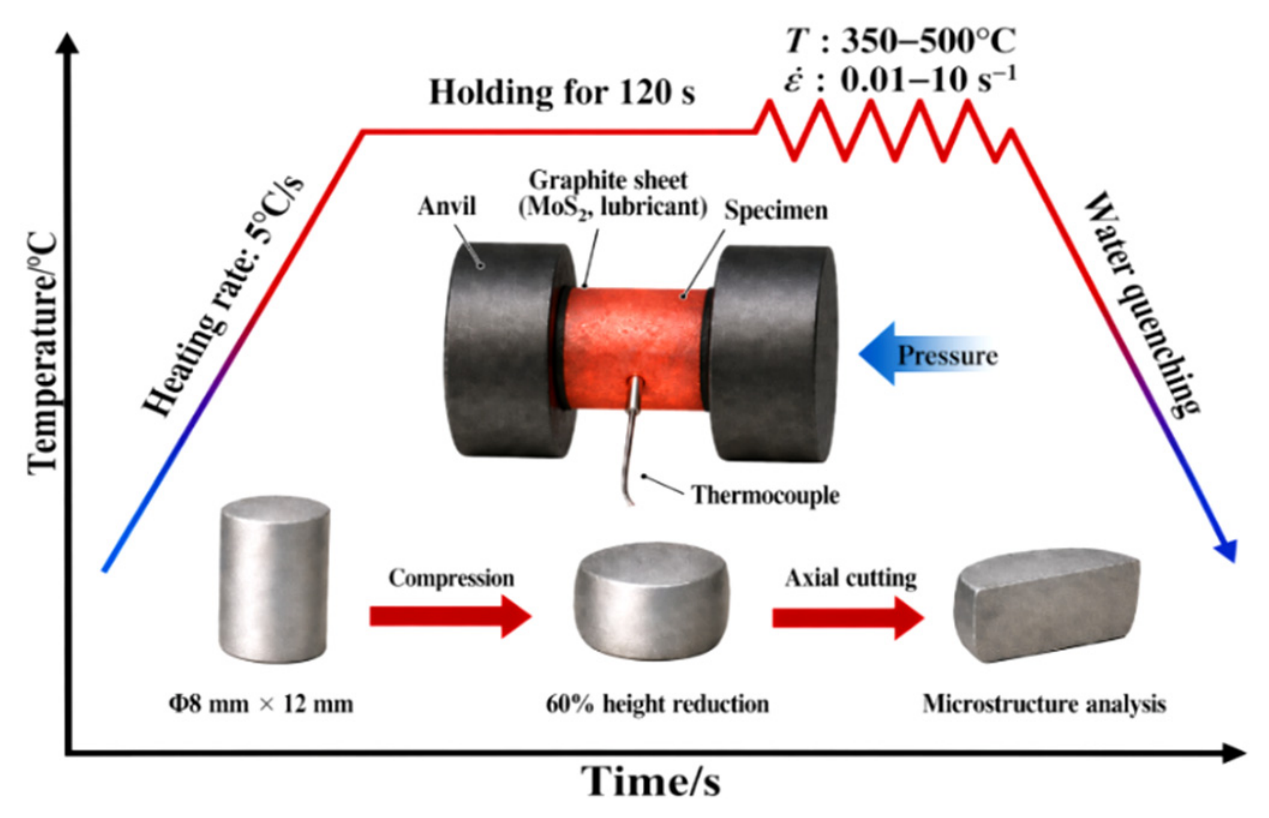
To make the finite-element simulation closer to the real extrusion condition, hot compression tests were conducted on the heat-treated cast billet, as shown in Figure 3. Cylindrical specimens with dimensions of ϕ 8 mm × 12 mm were selected and subjected to isothermal hot compression tests on a Gleeble-3500 thermal simulation testing machine (Dynamic Systems Inc., Poestenkill, NY, USA). Based on the material processing characteristics of Al-Mg-Si alloys and the actual production parameters used by the enterprise, the deformation temperatures were set to 350 °C, 400 °C, 450 °C and 500 °C, and the strain rates were set to 0.01 s−1, 0.1 s−1, 1 s−1 and 10 s−1 [15]. Molybdenum disulfide and graphite flakes were used as lubricants. Before testing, each specimen was heated to the target temperature at 5 °C/s and held for 2 min to homogenize the temperature and microstructure. The maximum compression reduction was set to 60%. After compression, the specimens were water quenched and then sectioned along the axial direction. Electron backscatter diffraction (EBSD) was performed using a Gemini 300 scanning electron microscope (Carl Zeiss AG, Oberkochen, Germany) to characterize the compressed samples.
The finite-element model used to simulate the hot extrusion of the vehicle roof rack consisted of a steady-state extrusion model and a transient extrusion model. The steady-state extrusion model was used to simulate the mechanical characteristics of the extruded product, whereas the transient extrusion model was used to analyze the extrusion process and the flow behavior of the billet surface layer. For the steady-state extrusion simulation, the model was divided into six regions: profile, bearing, pocket, welding chamber, porthole, and billet. The mesh was generated according to the geometric characteristics of each region. The profile and bearing regions were meshed using three-node elements, while the remaining regions were meshed using four-node elements. The steady-state extrusion finite-element model contained 649,055 elements. For the transient extrusion simulation, a 2 mm thick billet surface layer was added to the billet surface for tracking the surface metal flow during extrusion [14]. The transient extrusion finite-element model adopted the same meshing strategy and contained 660,940 elements [16,17,18,19,20,21,22,23].
Sellars et al. [24] proposed a constitutive model to describe the flow stress of Al-0.9Mg-0.6Si alloy as a function of deformation temperature and strain rate, as shown in Equation (1). In this work, σ f ( ε ˙ , T ) represents the stress at different temperatures and strain rates. α represents the stress constant. The inverse function of the hyperbolic sine function is arcsinh. A represents the material constant, Q represents the hot deformation activation energy, R is the universal gas constant (8.314 J/(mol·K)), and n represents the stress exponent. T is expressed in K, and the specific constitutive parameters of Al-0.9Mg-0.6Si alloy were determined from the hot compression tests.
σ f ( ε ˙ , T ) = 1 α a r c s i n h { ε ˙ + ε ˙ 0 T A e Q R T 1 n }
To investigate the influence of different process parameters on the outlet flow uniformity and forming stability of the automotive roof rack, a single-factor test scheme was designed, as shown in Table 2. Ram speed, billet preheating temperature, die preheating temperature and container preheating temperature were selected as the four factors affecting material flow at the die exit [25]. The ram speed was set to three levels: 3 mm/s, 6 mm/s and 9 mm/s. The billet preheating temperature was set to three levels: 440 °C, 490 °C and 540 °C. The die preheating temperature was set to three levels: 370 °C, 420 °C and 470 °C. The container preheating temperature was set to three levels: 430 °C, 480 °C and 530 °C.
The standard deviation of velocity (SDV) [25,26] at the die exit was used to quantitatively describe outlet velocity uniformity, as shown in Equation (2). As discussed by Zhang et al. [25], metal flow during hot extrusion is complex and is affected by extrusion pressure, temperature gradient, strain, stress and die resistance. In extrusion simulations, several indices, including SDV, the standard deviation of temperature and the standard deviation of grain size, can be used to describe forming-related heterogeneity; among them, SDV at the die exit is widely used to characterize the outlet flow uniformity of aluminum profiles. A non-uniform outlet velocity distribution may increase the risk of twisting, cracking or other instability-related defects. In this equation, v z i was the flow velocity at any sampling node along the extrusion direction, v z a v e was the average flow velocity across all sampling nodes, and N was the number of sampling nodes. A lower SDV therefore represents a more homogeneous outlet velocity distribution and more coordinated metal flow at the die exit. Nevertheless, SDV is used in this work only as an outlet flow uniformity index for comparing process parameters, rather than as a complete measure of the overall quality of the extruded profile.
S D V = i = 1 N ( v z i v z a v e ) 2 / N

2.3. Extrusion of Billet Experiment

Process parameter 1 was selected as the representative reference condition for the extrusion experiment to examine the simulated billet surface layer flow characteristics. The ram speed was 6 mm/s, the billet preheating temperature was 490 °C, the die preheating temperature was 480 °C, and the container preheating temperature was 420 °C. The process parameters are listed in Table 3.
To quantify the main effect of each extrusion parameter on outlet flow uniformity, a single-factor simulation scheme was established with process parameter 1 as the reference condition. One parameter was varied in each group while the remaining parameters were maintained at their reference levels. Processes 2–3, 4–5, 6–7, and 8–9 were assigned to examine ram speed, billet preheating temperature, die preheating temperature, and container preheating temperature, respectively. This scheme enabled direct comparison of the parameter effects on SDV under the same baseline condition, without considering parameter interactions at this stage.
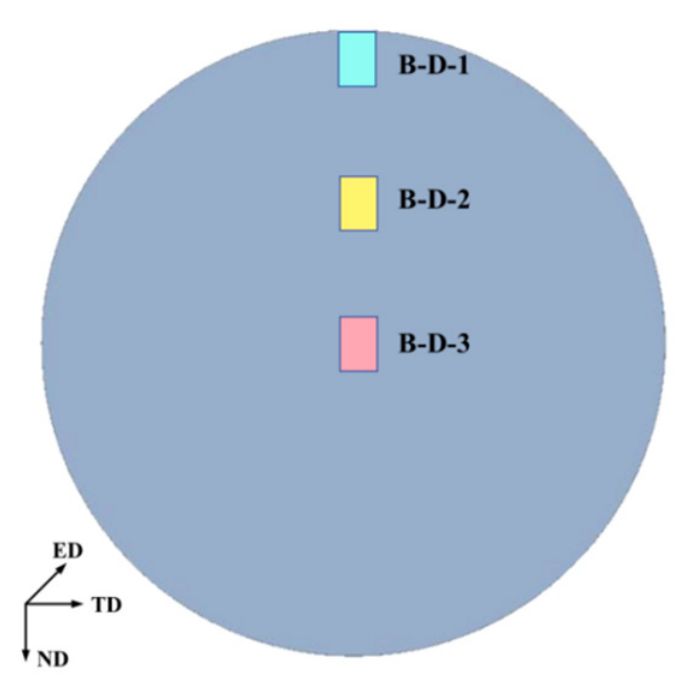
To further verify the simulated metal flow behavior inside the billet during hot extrusion, EBSD characterization was performed on samples taken from the butt discard. The sampling locations are shown in Figure 4. The sample located at the circumferential position was designated as B–D–1, the sample located at the center was designated as B–D–3, and the sample located between these two positions was designated as B–D–2.
Figure 4. Sampling positions of the butt discard used for EBSD analysis: B-D-1, B-D-2, and B-D-3.
Metals 16 00637 g004

3. Results and Discussion

3.1. Constitutive Model of Al-0.9Mg-0.6Si Alloy

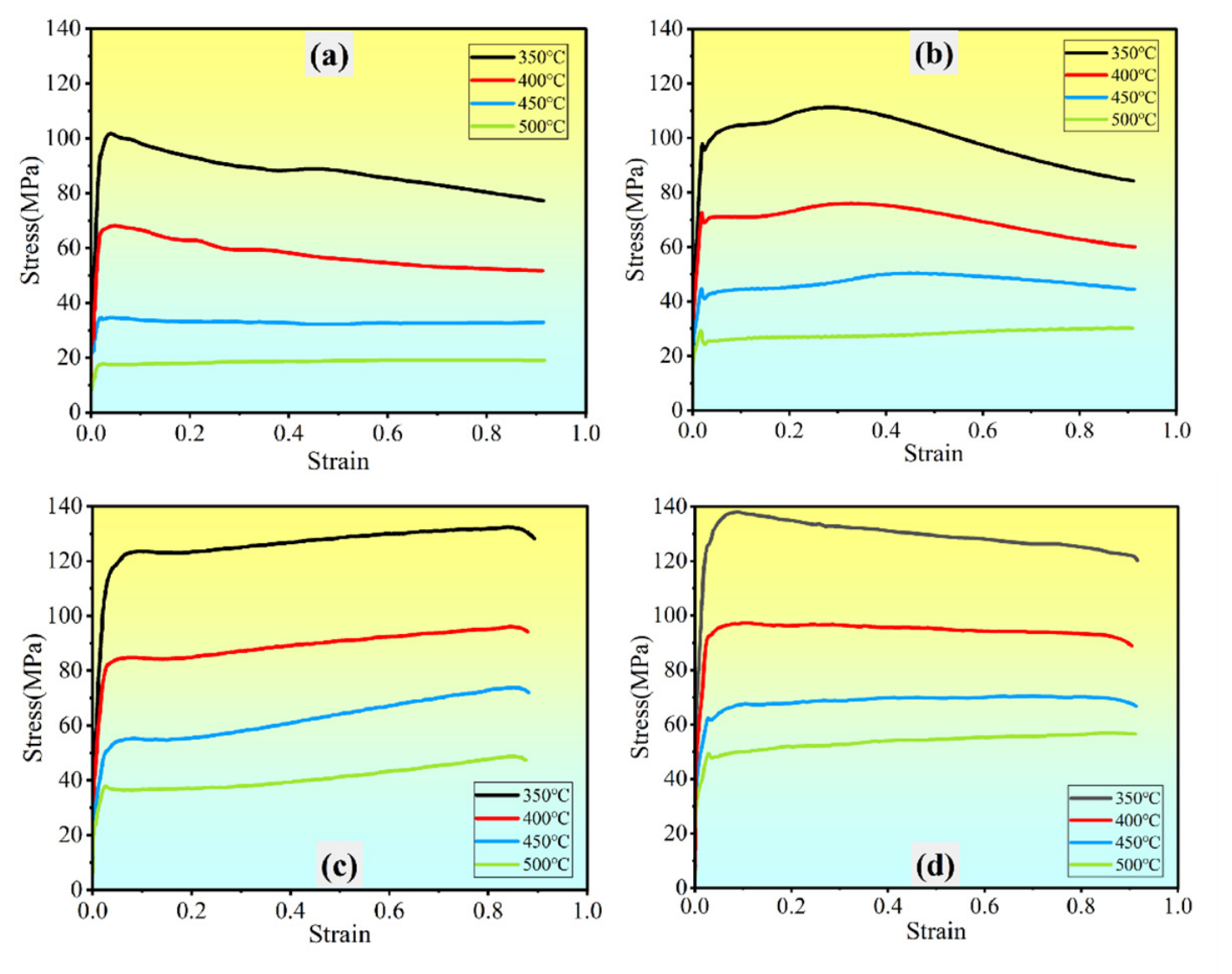
Figure 5 shows the true stress–true strain curves of the Al-0.9Mg-0.6Si alloy at different strain rates. When the compression reduction reaches 60%, the true strain reaches approximately 0.9. At a fixed strain rate, the curves show a similar temperature-dependent trend: the flow stress decreases as the deformation temperature increases, because thermal activation promotes dynamic recovery and local recrystallization. This tendency can be quantified by the mean stress values listed in Table 4. For example, at 0.01 s−1, the mean stress decreases from 89.83 MPa at 350 °C to 18.42 MPa at 500 °C, while at 10 s−1, it decreases from 131.52 MPa to 53.32 MPa over the same temperature range. At a fixed temperature, the mean stress increases with strain rate because the shorter deformation time suppresses softening. Consequently, although the curves in Figure 5a,d have similar overall shapes, their stress levels differ systematically with temperature and strain rate. For example, at 450 °C, the mean stress increases from 32.83 MPa at 0.01 s−1 to 69.07 MPa at 10 s−1.
According to the temperature correction method proposed by Yang [27], the stress–strain curves of hot compression were corrected. The mean stress values corresponding to strains between 0.1 and 0.7 were used as the basis for establishing the Arrhenius equation [27]. The average thermal compression stress at different temperatures and strain rates is shown in Table 4.
The Arrhenius constitutive model proposed by Sellars et al. [24] describes the relationship between temperature, strain rate, and flow stress during the hot deformation of materials, as shown in Equation (3).
ε ˙ = A sinh ( α σ ) ] n e x p ( Q / R T ) = A 1 σ n 1 exp ( Q / R T ) , α σ < 0.8 A 2 exp ( β σ ) e x p ( Q / R T ) , α σ > 1.2
In this equation, ε is the strain rate, in units of s−1; A is the structural factor, in units of s−1; α is the stress level parameter, in units of mm2/N; σ is the flow stress, in units of MPa; n is the stress exponent; R is the molar gas constant, with a value of 8.314 J/(mol·K); T is the deformation temperature, in units of K; Q is the thermal deformation activation energy, in units of kJ/mol; and n1, β, A1, and A2 are material parameters. The relationship between n1, β, and α is given by α = β/n1.
The values of α, n, Q, and A were determined using linear fitting with the least-squares method. Taking the natural logarithm of both sides of Equation (3) yields Equations (4) and (5).
ln ε ˙ = ln A 1 + n 1 ln σ Q R T
l n ε ˙ = l n A 2 + β σ Q R T
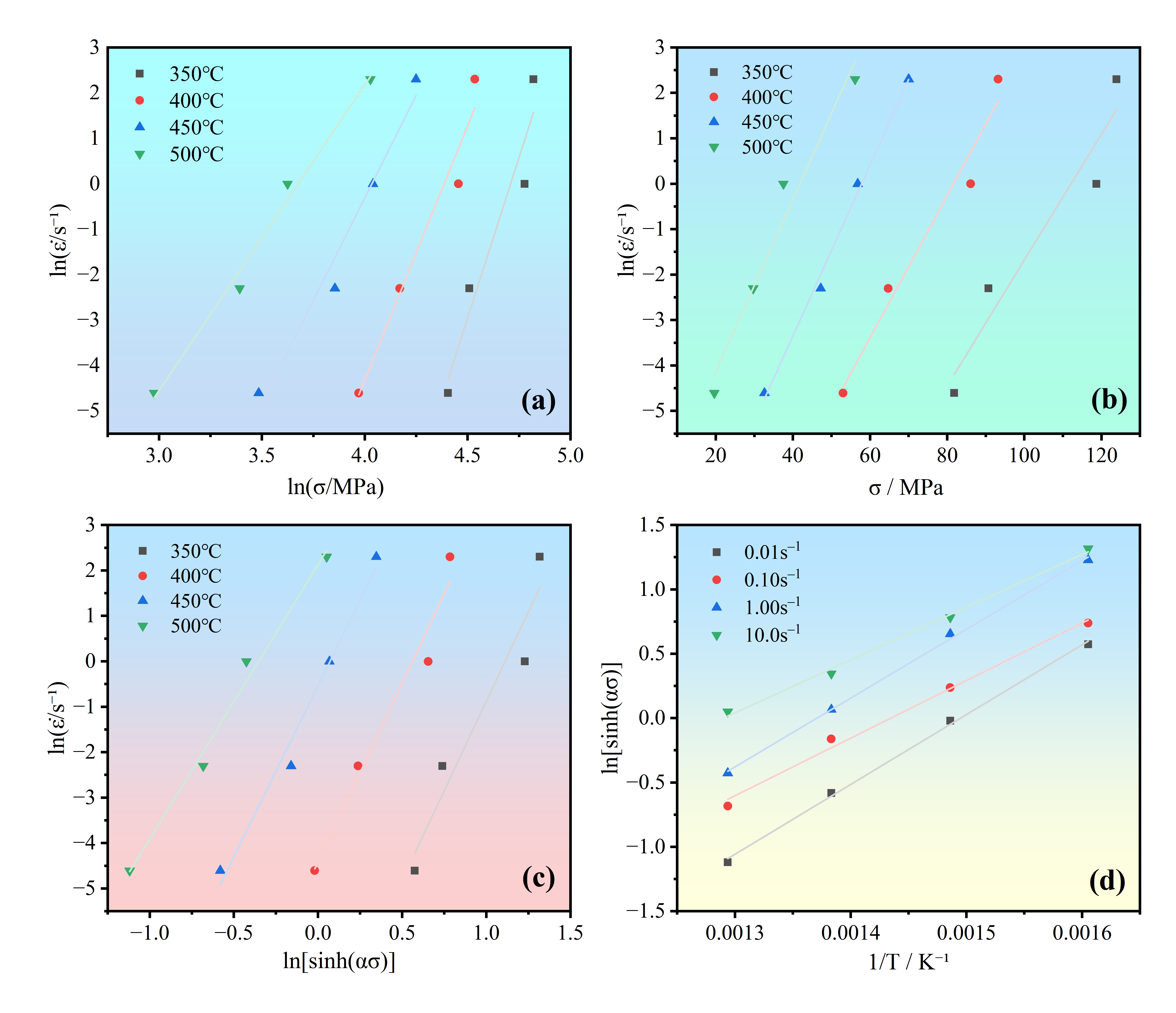
By substituting the mean stress values at different strain rates and the same temperature into Equations (4) and (5), the relationship curves of ln( ε ˙ ) − ln(σ) and ln( ε ˙ ) − σ at a specific temperature can be plotted, as shown in Figure 6a,b.
Based on the data in Figure 6a,b, the fitting results show that the average value of n1 is 10.2718325, and the average value of β is 0.1681075. The stress level parameter α = β/n1 = 0.016365872 mm2/N.
Assuming that the thermal deformation activation energy Q is independent of temperature, taking the natural logarithm of both sides of Equation (1) yields Equation (6).
l n ε ˙ = l n A Q R T + n l n [ s i n h ( α σ ) ]
By substituting the mean stress values at the same temperature but different strain rates into Equation (6), a relationship curve of ln( ε ˙ ) − ln[sinh(ασ)] at a specific temperature is plotted, as shown in Figure 6c. Linear fitting of the data points yields the slope n, with an average value of 6.03549. Equation (7) can be obtained from variation Equation (6).
l n [ s i n h ( α σ ) ] = ( l n ε ˙ l n A + Q R T ) / n
Substituting the value of n into Equation (7), the relationship curve of ln[sinh(ασ)] − 1/T at a specific strain rate is plotted as shown in Figure 6d. Through linear fitting, the slope of the straight line is found to be 4099.33657. The average value of the thermal deformation activation energy Q is 205,700.9 J/mol. Equation (8) is derived from Equation (1).
Z = ε ˙ e x p ( Q R T ) = A [ s i n h ( α σ ) ] n
Taking the natural logarithm of both sides of Equation (8) yields Equation (9).
l n Z = l n A + n l n [ s i n h ( α σ ) ]
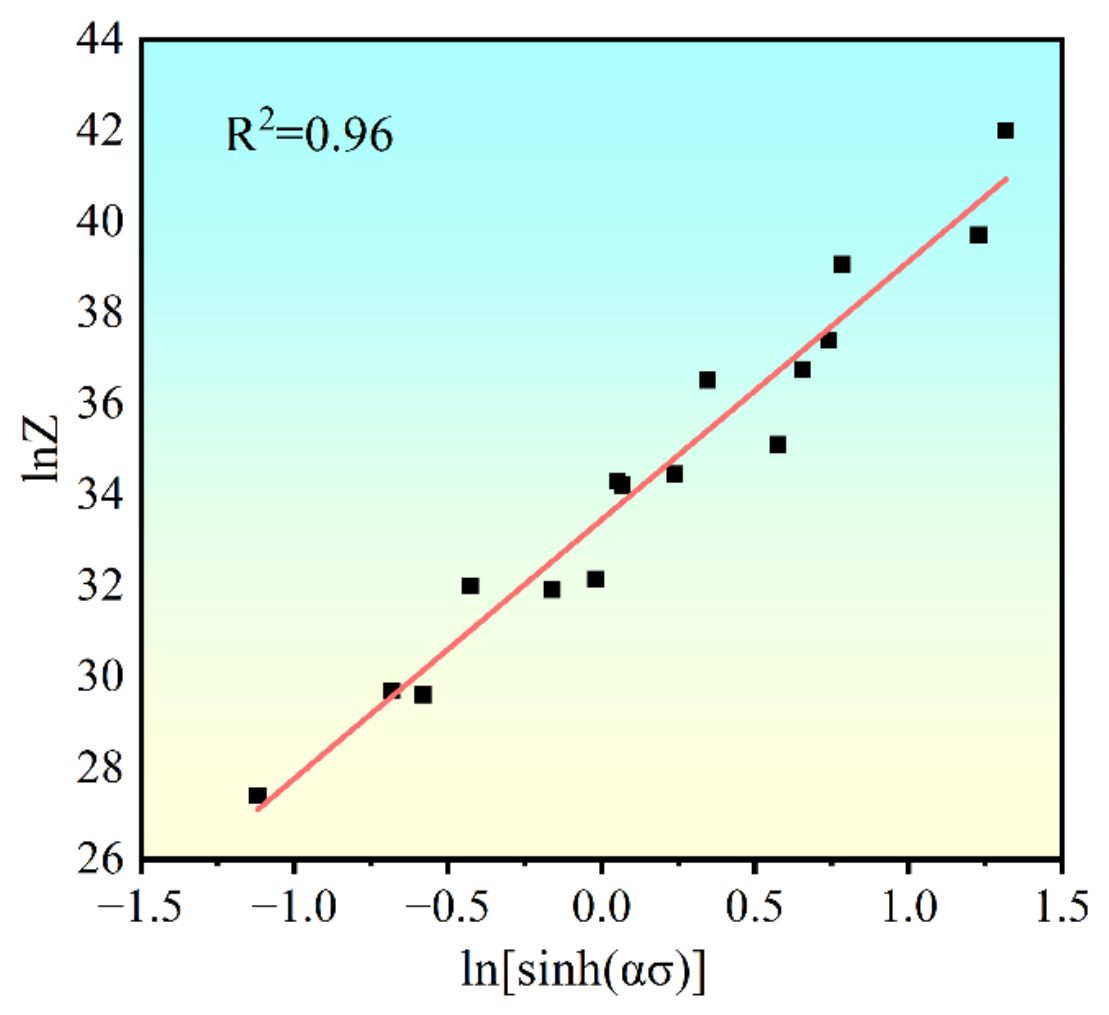
The relationship curves of ln[sinh(ασ)]-lnZ under all hot compression conditions are shown in Figure 7. A high correlation coefficient of 96% indicates a strong linear relationship between lnZ and ln[sinh(ασ)]. The intercept value of the fitted line corresponds to the value of ln A, and the calculated value of ln A is 33.45635. A = 3.38773 × 10¹⁴ s−1 can be calculated.
The predictive accuracy of the constitutive model was further evaluated by comparing the calculated stresses with the experimental mean stresses in Table 4. Using alpha = 0.016365872 mm2/N, n = 6.03549, Q = 205,700.9 J/mol and A = 3.38773 × 10¹⁴ s−1, the model gave a correlation coefficient of 0.956, an RMSE of 10.893 MPa, an MAE of 8.577 MPa and an AARE of 12.589%. These results indicate that the model captures the main temperature- and strain rate-dependent variation in flow stress, while some deviation remains at low strain rate and low temperature.
By substituting the fitted parameters into Equation (3), the Arrhenius constitutive equation of the Al-0.9Mg-0.6Si alloy was obtained, as shown in Equation (10).
ε ˙ = 3.38773 × 10 14 [ sinh ( 0.016365872 σ ) ] 6.03549 e x p ( 205700.9 / 8.314 T )

3.2. Hot Working Property of Al-0.9Mg-0.6Si Alloy

In dynamic material models, the energy absorbed by the material, as shown in Equation (11), is primarily dissipated through two mechanisms. One is the energy consumed by plastic deformation of the material, denoted by G. The other is the energy consumed by the evolution of the material’s microstructure during deformation, denoted by J.
P = σ ε ˙ = G + J = 0 ε ˙ σ d ε ˙ + 0 σ ε ˙ d σ
rate in s−1. The expression for the strain rate sensitivity index m is shown in Equation (12).
m = d J d G = ε ˙ d σ σ d ε ˙ = l n σ l n ε ˙
Murty [28] proposed a rheological instability criterion of arbitrary type, where G can be transformed into Equation (13). In the formula, ε ˙ m i n generally represents the minimum strain rate value obtained from the experiment, with units of s−1.
G = 0 ε ˙ m i n σ d ε ˙ = 0 ε ˙ m i n σ d ε ˙ + ε ˙ m i n ε ˙ m i n σ d ε ˙ = ( σ ε ˙ m + 1 ) ε ˙ = ε ˙ m i n + ε ˙ m i n σ d ε ˙
The power consumed by the evolution of the material’s microstructure during hot deformation can be characterized by defining a dimensionless energy dissipation efficiency parameter η [29], as shown in Equation (14).
η = 2 J P = 2 1 G P = 2 m m + 1
Theoretically, the higher the energy dissipation rate η , the easier the material processing. However, instability phenomena may occur at high energy dissipation rates; therefore, the energy dissipation rate η alone cannot fully reflect the quality of material processing. Further supplementation of the hot working diagram is needed, and Equation (15) is obtained based on the instability criterion ξ proposed by Murty [29].
ξ = l n ( m m + 1 ) l n ϵ ˙ + m < 0
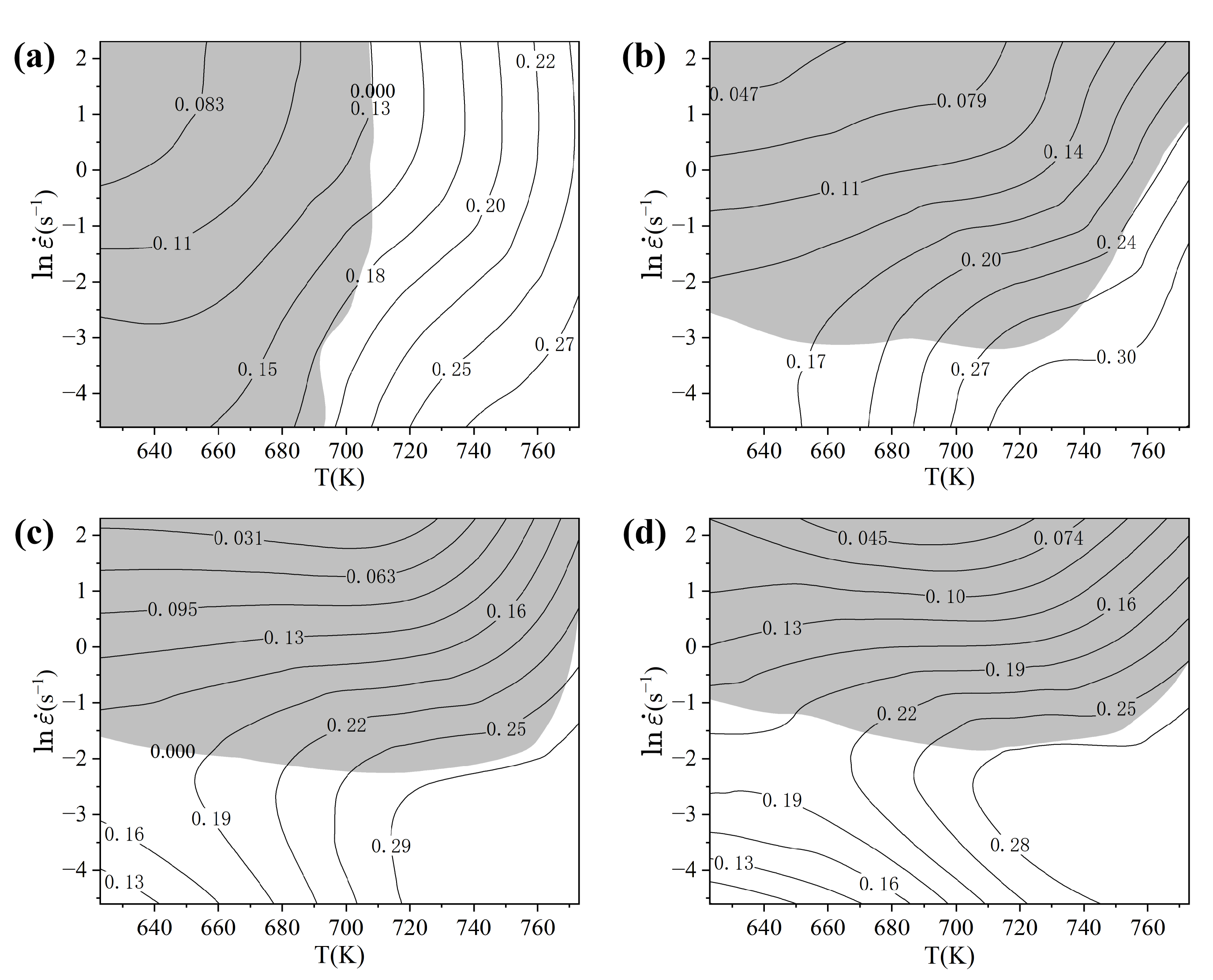
According to Equations (14) and (15), the hot working map of the Al-0.9Mg-0.6Si alloy at different strains is shown in Figure 8.
The values in Figure 8 represent the energy dissipation rate, and the shaded area represents the rheological instability region. When the strain is 0.2, the deformation temperature is between 437 °C and 500 °C, the strain rate is between 0.01 s−1 and 10 s−1, and the energy dissipation rate is between 20% and 27%. At a strain of 0.2, the instability region is mainly concentrated in the low temperature region. When the strain is 0.4, the deformation temperature is between 400 °C and 500 °C, the strain rate is between 0.01 s−1 and 1 s−1, and the energy dissipation rate is between 20% and 30%. At a strain of 0.4, the instability region is mainly concentrated in the high strain rate region. When the strain is 0.6, the deformation temperature is between 407 °C and 500 °C, the strain rate is between 0.01 s−1 and 1 s−1, and the energy dissipation rate is between 20% and 29%. At a strain of 0.6, the instability region is mainly concentrated in the high strain rate region. When the strain is 0.8, the deformation temperature is between 424 °C and 500 °C, the strain rate is between 0.01 s−1 and 0.6 s−1, and the energy dissipation rate is between 20% and 28%. At a strain of 0.8, the instability region is mainly concentrated in the high strain rate region. The rheological instability region is mainly concentrated in the high strain rate region. At lower deformation temperatures, thermoviscoplastic instability may occur, leading to adiabatic shear and a narrower processing window in the low temperature region. At low temperatures and high strain rates, the heat generated by deformation within the material cannot diffuse to other areas in a short time, resulting in uneven temperature distribution, which ultimately affects the microstructure distribution of the alloy during plastic deformation, leading to a lower energy dissipation rate in this region. Therefore, the optimal process parameter range for this Al-0.9Mg-0.6Si alloy is a deformation temperature from 437 °C to 500 °C and a strain rate from 0.01 s−1 to 0.6 s−1.
It should be emphasized that the processing map was established based on isothermal hot compression tests and therefore reflects the intrinsic hot working response of the Al-0.9Mg-0.6Si alloy under controlled deformation conditions. In contrast, the actual extrusion process is non-isothermal and involves heterogeneous local strain rate and temperature distributions, particularly in the portholes, welding chamber, and bearing region. Therefore, the stable processing domain of 437–500 °C and 0.01–0.6 s−1 should be regarded as a material-level reference window rather than a direct description of all local extrusion conditions. In the present extrusion scheme, the billet preheating temperature of 490 °C falls within this stable temperature range, supporting its selection for the subsequent extrusion simulation and experimental verification. A more quantitative correlation between the processing map and the local extrusion conditions requires further extraction of local temperature and effective strain rate histories from the finite-element model.
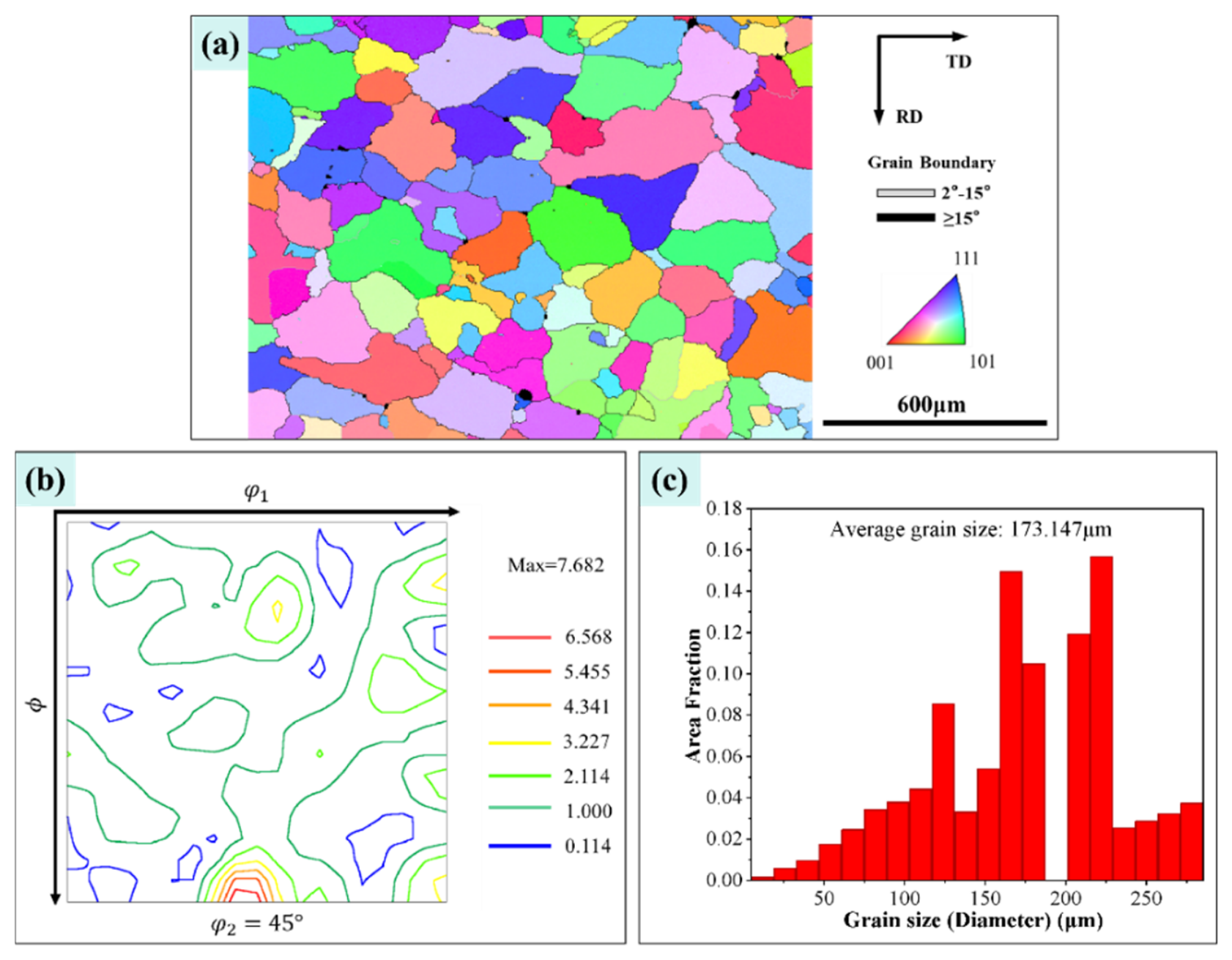
Figure 9 shows the initial microstructure of the Al–0.9Mg–0.6Si alloy. Figure 9a shows the inverse pole figure (IPF) map of the alloy. The fractions of low-angle grain boundaries and high-angle grain boundaries are 5.6% and 94.3%, respectively, and the average grain size is 173.147 μm. Figure 9b shows the orientation distribution function (ODF) map, indicating that the alloy exhibits a {110}<223> texture with a maximum texture intensity of 7.682. Figure 9c shows the grain size distribution of the alloy, in which a relatively high fraction of grains ranges from 120 μm to 230 μm.
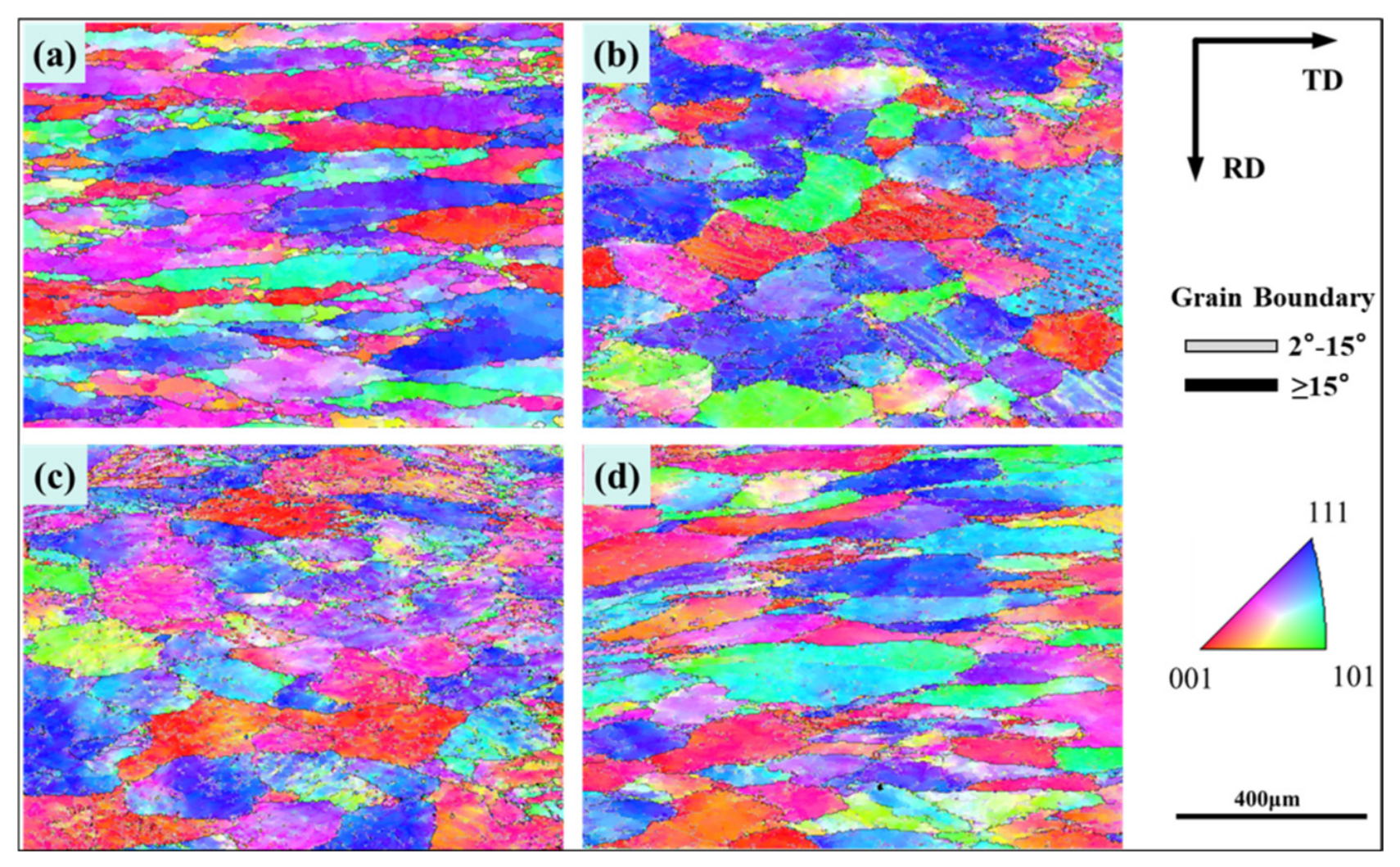
Figure 10 shows the microstructures of samples deformed under different temperatures and strain rates. Compared with the initial grain structure, the hot-compressed samples show different degrees of grain flattening, elongation and local refinement. The grains in Figure 10b are small, elongated, and relatively evenly distributed. This is because, under the conditions of 350 °C and 0.01 s−1, the aluminum alloy has low thermal activation energy and driving force, and its stacking fault energy is high, which does not meet the conditions for dynamic recrystallization [30]. The grains in Figure 10a,d show clear compression-induced deformation. Under 500 °C and 0.1 s−1, fine and relatively uniform grains appear, indicating that dynamic recrystallization occurs under a high energy dissipation condition. Under 450 °C and 0.1 s−1, dynamic recrystallization is also initiated. However, due to the lower thermal activation and non-uniform local deformation, a mixed structure consisting of fine recrystallized grains and locally coarser grains is produced. This indicates partial recrystallization accompanied by local abnormal grain growth, rather than a completely uniform recrystallized structure. In Figure 10c, the central region contains smaller fibrous grains, whereas the end regions contain larger grains, which is attributed to the non-uniform deformation distribution during compression.
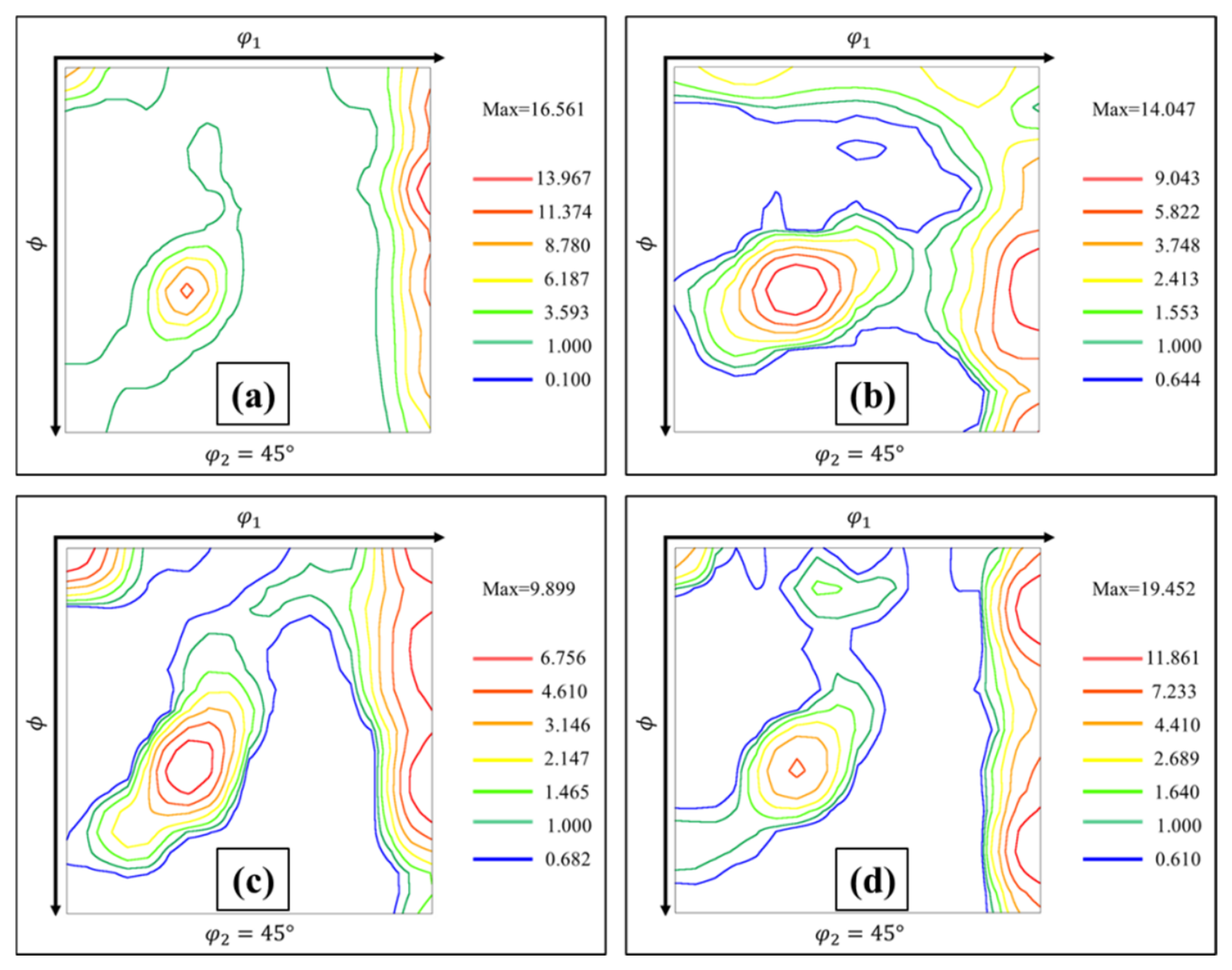
Figure 11 shows the preferred orientation of the crystals after hot compression under different conditions. Compared to the disordered arrangement of crystals in the initial sample, the crystals in the sample after hot compression show a clear preferred orientation along {111} <121> and <110>//TD. In Figure 11a, the crystal exhibits {001} <110> texture, {111} <121> texture, and <110>//TD texture, with texture strengths of 9.1, 11.4, and 16.561, respectively. In Figure 11b, the crystal exhibits {111} <121> texture and <110>//TD texture, with texture intensities of 12.8 and 14.04, respectively. In Figure 11c, the crystal exhibits {001} <110> texture, {111} <121> texture, and <110>//TD texture, with texture strengths of 9.0, 9.1, and 9.899, respectively. In Figure 11d, the crystal exhibits {001} <110> texture, {111} <121> texture, and <110>//TD texture, with texture strengths of 5.9, 7.5, and 19.452, respectively.
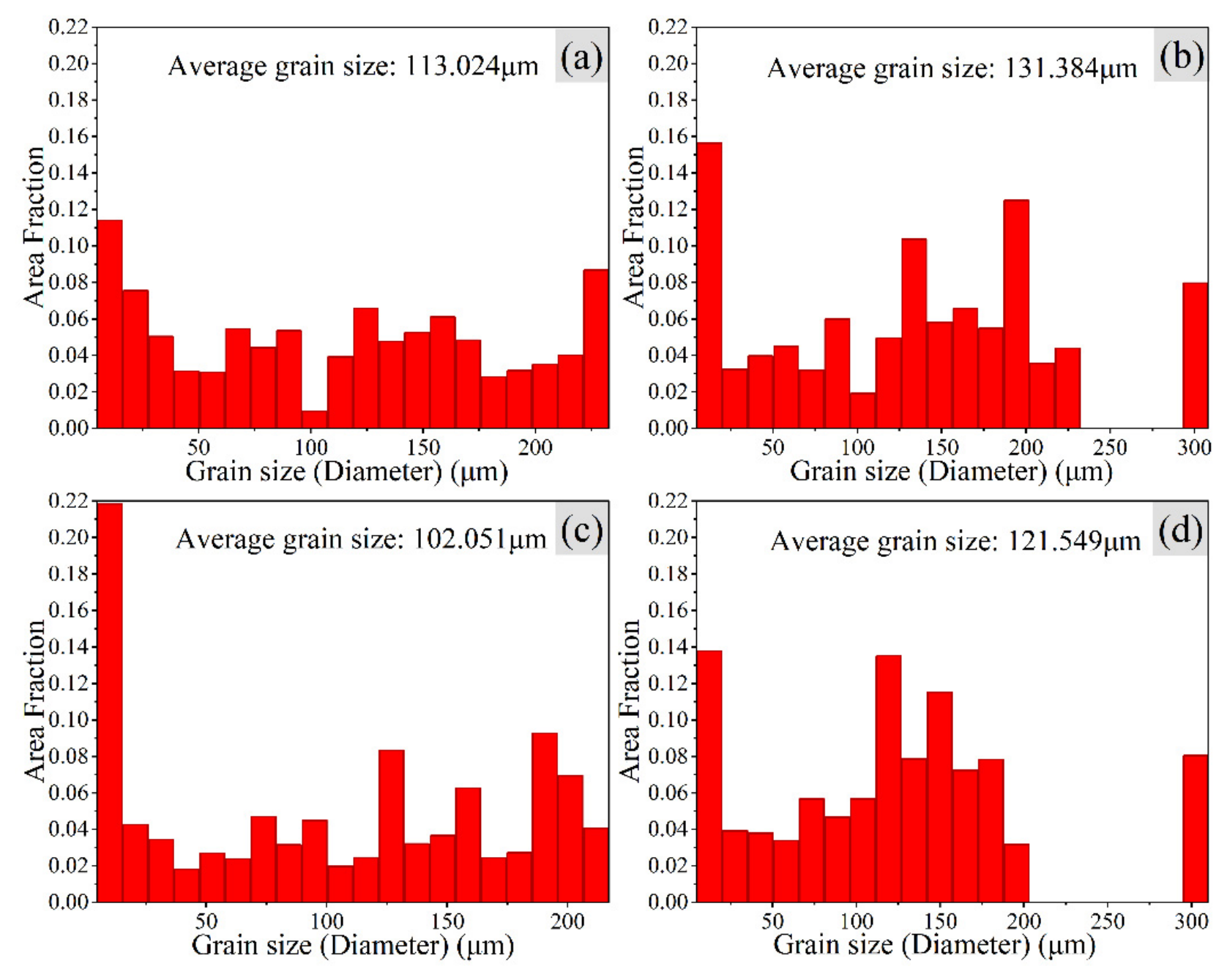
Figure 12 shows the grain size distribution after hot compression under different conditions. Compared with the initial sample, the grain size is reduced to different degrees after hot compression. The distribution is most uniform under 500 °C and 0.1 s−1, where dynamic recrystallization is more complete. Under 350 °C and 0.01 s−1, deformation is insufficient for complete recrystallization, while under 450 °C and 0.1 s−1, partial recrystallization coexists with local abnormal grain growth.

3.3. Effect of Process Parameters on Outlet Flow Uniformity

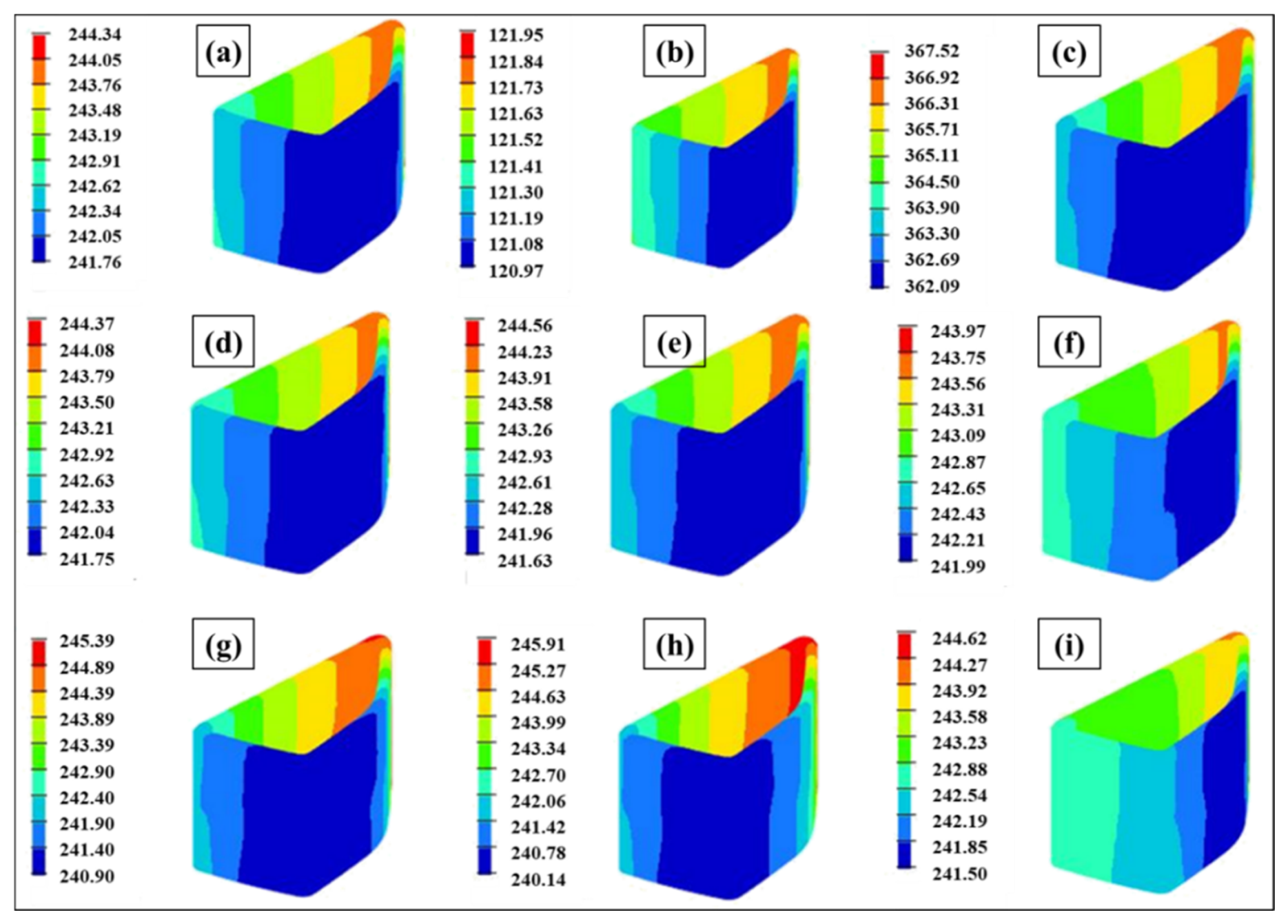
Equation (10) was substituted into HyperXtrude for finite-element simulation. Figure 13 shows the velocity distribution of the metal flow at the die exit under the nine extrusion parameter sets listed in Table 2. Under most process conditions, the nodal flow velocity of the automotive roof rack cross-section was approximately between 240 mm/s and 245 mm/s. In contrast, the metal flow velocity in Figure 13b was between 120.97 mm/s and 121.95 mm/s, while that in Figure 13c was between 362.09 mm/s and 367.52 mm/s. The small velocity range within each die exit section indicates relatively coordinated outlet flow under the simulated conditions. However, this result should be interpreted as evidence of outlet flow uniformity rather than as direct proof of complete profile quality, because dimensional accuracy, weld quality, surface condition, extrusion force and defect occurrence were not quantitatively measured in this part of the work.
To calculate SDV, 51,000 nodes were randomly selected from the profile cross-section in Figure 13. The die exit section was isolated in the post-processing procedure, and the corresponding extrusion direction velocity of each selected node was exported from the HyperXtrude results. The SDV values were then calculated from the exported nodal velocities according to Equation (2), as shown in Table 5.
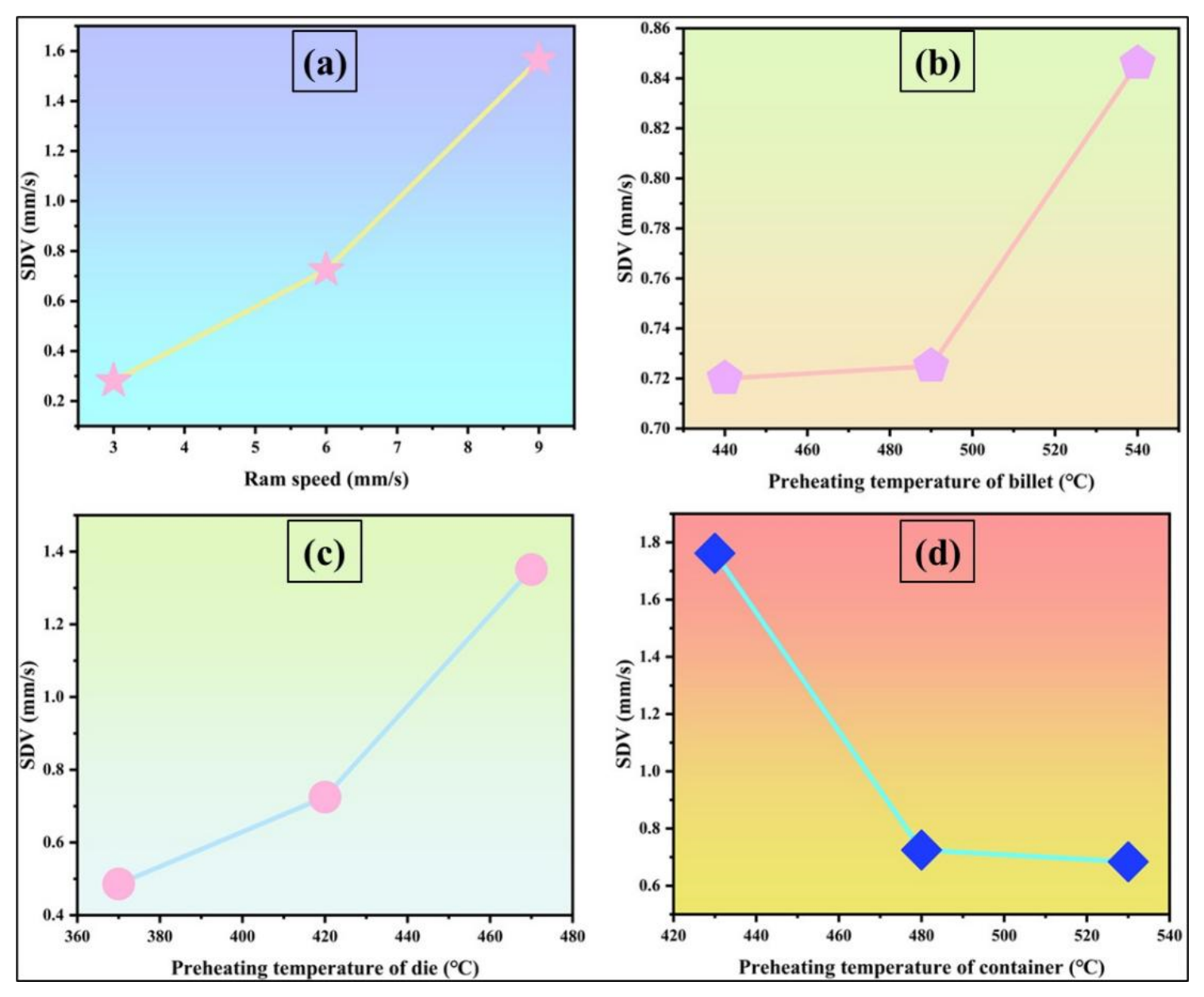
In Figure 14a, as the ram speed increased, the SDV showed an upward trend, indicating that the outlet velocity became less uniform. A higher ram speed increased the deformation rate and reduced the time available for stress relaxation, which enlarged local differences in flow resistance near the portholes, welding chamber and bearing. In Figure 14b, increasing the billet preheating temperature slightly increased SDV because the lower flow stress made the material more sensitive to local die geometry and bearing resistance. In Figure 14c, increasing the die preheating temperature also increased SDV, which could be attributed to reduced frictional constraint and a stronger local velocity gradient at the exit. In contrast, Figure 14d shows that increasing the container temperature decreased SDV. A hotter container reduced the billet-container thermal gradient and improved the coordination of material flow before the billet entered the die, thereby improving outlet velocity uniformity.
The single-factor simulation results showed different sensitivities of SDV to the four investigated parameters. As the ram speed increased from 3 to 9 mm/s, SDV increased from 0.281 to 1.566 mm/s, giving the largest variation range of 1.285 mm/s. Increasing the container preheating temperature from 430 to 530 °C reduced SDV from 1.762 to 0.684 mm/s, corresponding to a variation range of 1.078 mm/s. The die preheating temperature also showed a clear influence, with SDV increasing from 0.486 to 1.351 mm/s as the die temperature increased from 370 to 470 °C. In contrast, the billet preheating temperature had a relatively limited effect, and SDV changed only from 0.720 to 0.846 mm/s when the billet temperature increased from 440 to 540 °C. Therefore, the influence of the four parameters on outlet flow uniformity followed the following order: ram speed > container preheating temperature > die preheating temperature > billet preheating temperature.
The stronger influence of ram speed can be attributed to the intensified velocity difference across the hollow profile section at a higher imposed flow rate. During porthole-die extrusion, the billet metal is divided by the bridges, flows through the portholes, rejoins in the welding chamber, and finally passes through the bearing region; therefore, insufficient residence time at higher ram speed makes it more difficult to compensate for local flow resistance differences caused by the asymmetric profile geometry. The opposite effects of die and container temperatures indicate that the local thermal boundary conditions play different roles in regulating metal flow. A higher die temperature may alter the local flow resistance near the welding chamber and bearing region, whereas a higher container temperature can reduce the thermal gradient between the billet surface and core before the material enters the die, thereby promoting more coordinated outlet flow. Accordingly, SDV was used in this study as an engineering index of outlet flow uniformity for process comparison. A comprehensive profile quality assessment, however, requires additional evidence related to dimensional accuracy, bending or twisting, weld quality, surface condition, temperature field, stress–strain state, defect occurrence and extrusion force stability.

3.4. Metal Flow Characteristics of the Billet

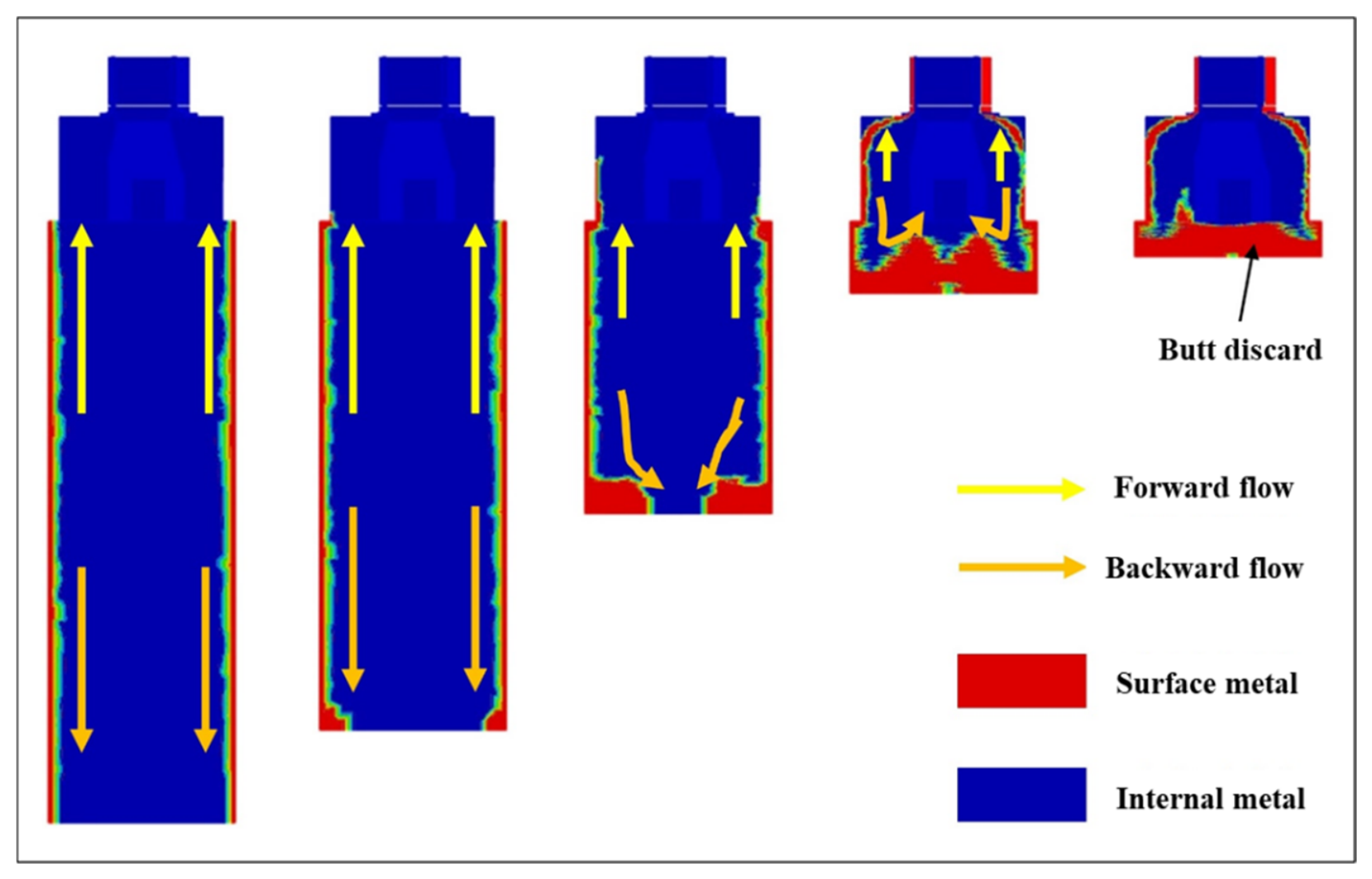
The 3D model shown in Figure 2 was imported into HyperXtrude, and the constitutive model established in Equation (10) was used to construct the transient finite-element model for billet surface layer tracking. Process parameter 1 was selected as the representative reference condition for the transient extrusion simulation and butt discard characterization. This condition corresponded to the central level of the single-factor parameter scheme and provided a stable baseline for examining the billet surface layer flow behavior. The simulation was performed using process parameter 1 listed in Table 2, and the corresponding result is shown in Figure 15. The following analysis discusses the evolution of surface layer metal flow and its correspondence with the microstructural characteristics of the butt discard.
At the initial stage of extrusion, the billet surface metal did not flow into the profile. As extrusion progressed, the billet surface metal exhibited two flow patterns: one portion flowed along the extrusion direction, whereas another portion flowed opposite to the extrusion direction and accumulated in front of the extrusion die. At the final stage of extrusion, the surface metal flowing along the extrusion direction entered the profile from the edge regions, which may induce surface defects. In contrast, the surface metal flowing opposite to the extrusion direction converged from both sides in front of the extrusion die.
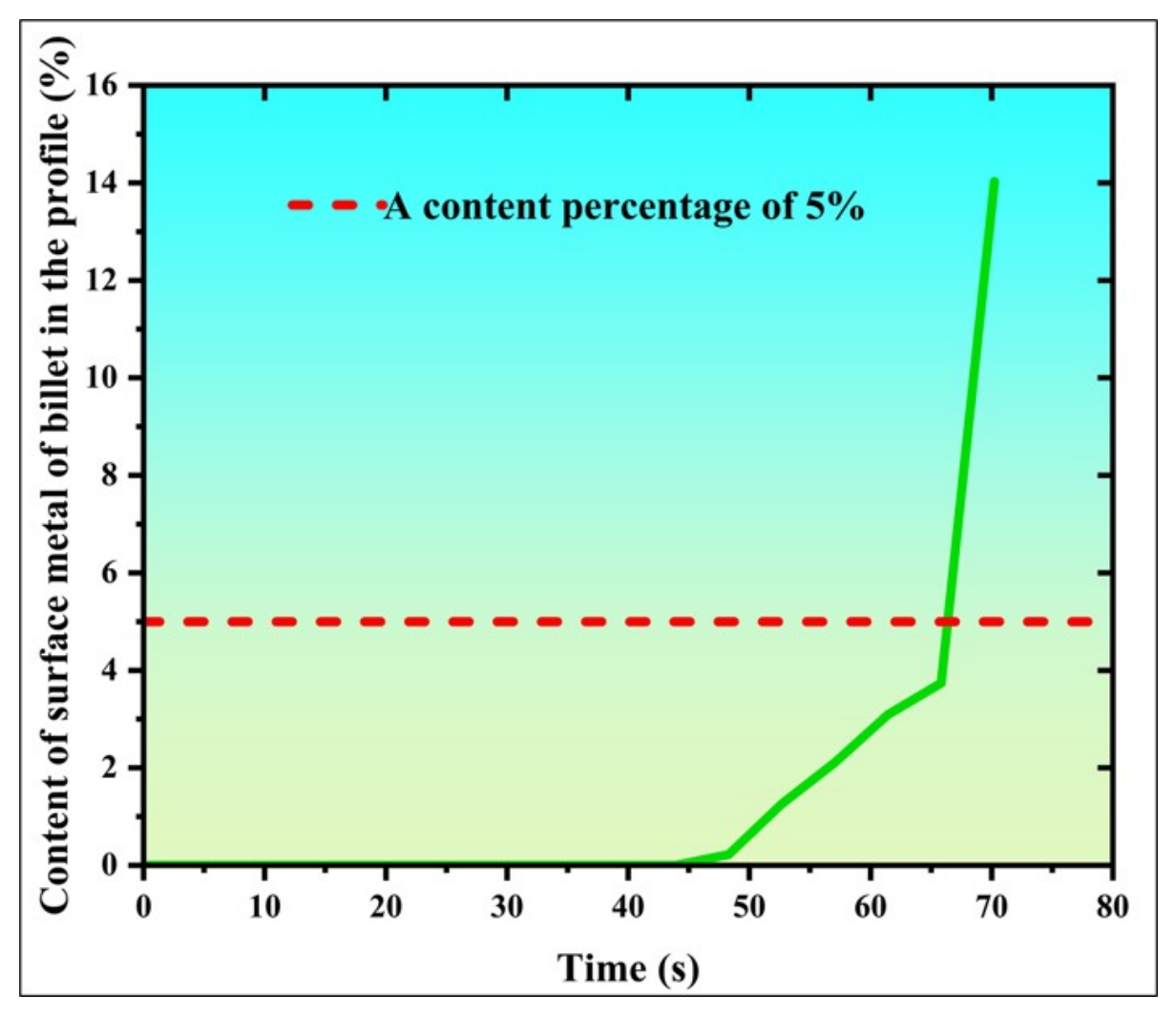
Liu et al. [14] proposed that the profile quality can be considered acceptable when the impurity content in the profile does not exceed 5%. Figure 16 shows the content of metal originating from the billet surface in the extruded profile. According to the simulation, when the extrusion time reached 65 s, the remaining billet was not extruded into the profile and was regarded as butt discard, which was subsequently cut off and treated as waste material. In Figure 16, the green curve represents the simulated content of metal originating from the billet surface in the extruded profile as a function of extrusion time, while the red dashed line indicates the 5% surface-metal-content criterion.
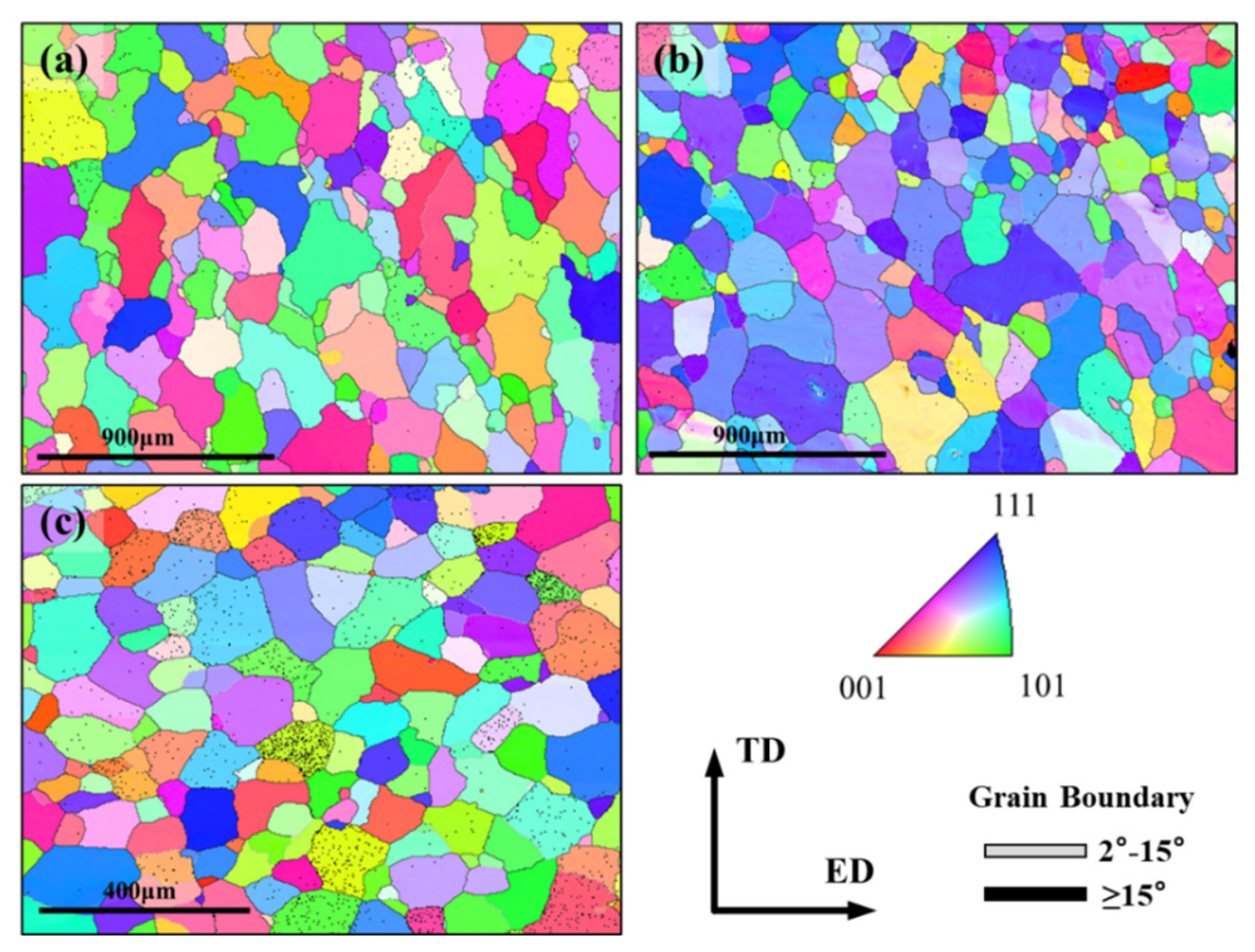
To verify the metal flow characteristics of the billet simulated in Figure 15, samples B–D–1, B–D–2, and B–D–3 were taken from the butt discard according to Figure 4. Figure 17 shows the microstructure of specimens at different locations in the butt discard. In Figure 17a, the average grain size of B–D–1 is 217.514 μm. In Figure 17b, the average grain size of B–D–2 is 194.926 μm. In Figure 17c, the average grain size of B–D–3 is 104.736 μm.
Chen [11] proposed that, during the extrusion process, the surface of the billet comes into contact with the extrusion die, causing severe shear deformation and lattice distortion of the surface grains. This provides the driving force for dynamic recrystallization and grain growth. This phenomenon of abnormal grain growth forming coarse grains on the surface is called the extrusion coarse grain ring effect, and when these abnormally large grains flow into the extruded profile, they can affect the performance of the profile.
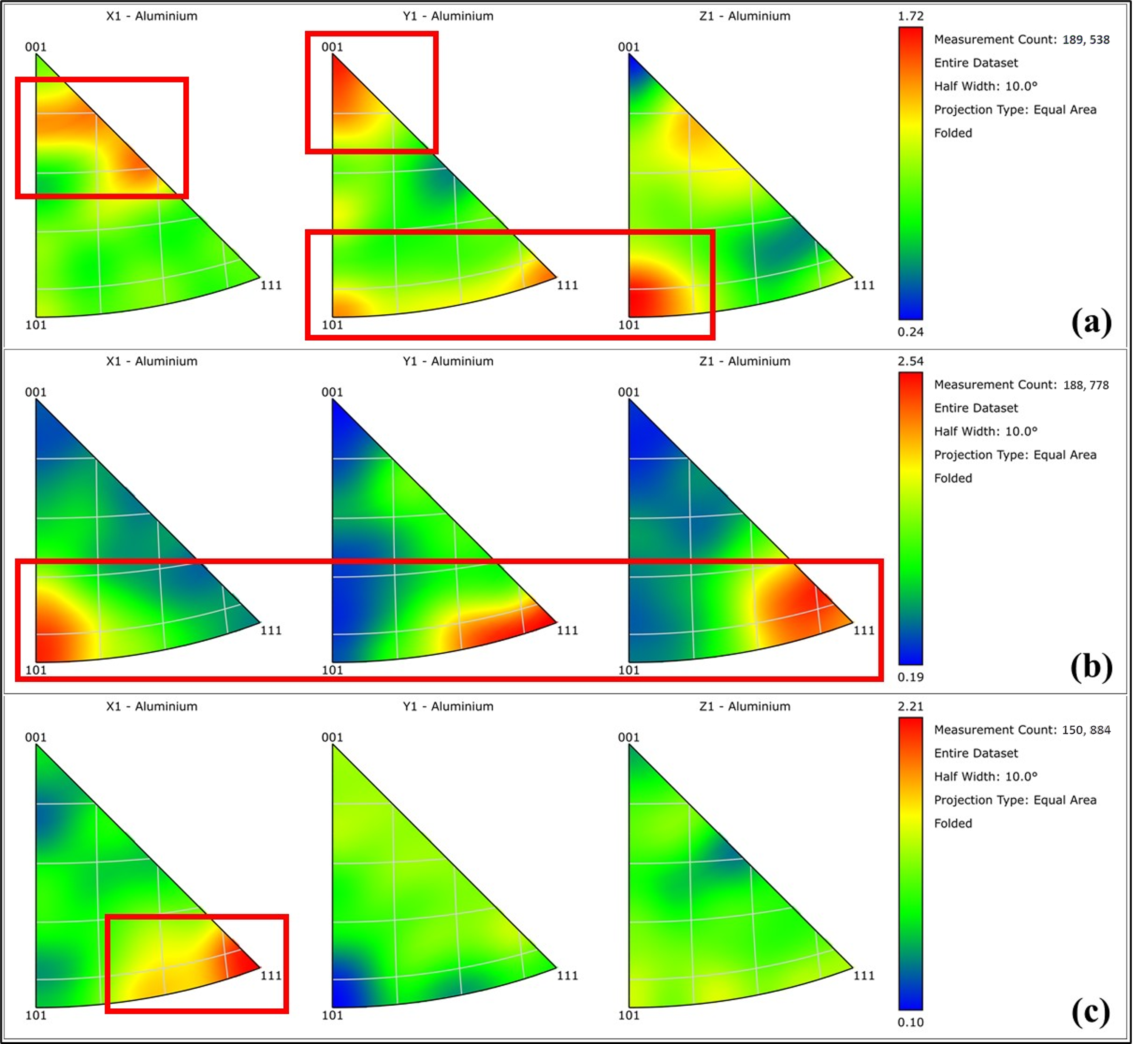
Based on the above analysis, samples B–D–1 and B–D–2 are located in the red region of Figure 15, whereas sample B–D–3 is located in the blue region. According to the simulated flow characteristics, the blue region mainly follows a simple path along the extrusion direction, while the red region experiences a longer and more complex path involving shearing, stagnation and local recirculation near the die. This difference in deformation path is expected to affect grain size, boundary misorientation and texture intensity in the butt discard.
To examine the simulated metal flow characteristics within the billet, the inverse pole figures of three butt discard samples were compared with the simulated flow regions in Figure 15. Figure 18a,b show orientation peaks in multiple directions, whereas Figure 18c show a dominant peak along the extrusion direction (ED). The multiple texture peaks in B–D–1 and B–D–2 were consistent with complex local deformation and changing flow directions in the red region of Figure 15. In contrast, the stronger ED–related fiber texture in B–D–3 corresponded to the simpler axial flow path in the blue region. Therefore, the EBSD texture characteristics provided qualitative microstructural evidence for the simulated metal flow trend. However, this comparison should be regarded as indirect validation of the FEM–predicted flow tendency rather than full quantitative validation of the numerical model, because extrusion force, profile exit temperature, outlet velocity, dimensional accuracy, defect occurrence and the exact surface layer position were not quantitatively measured in the present experiment.

4. Conclusions

The hot compression behavior of Al–0.9Mg–0.6Si alloy, the influence of extrusion parameters on die exit flow uniformity, and the billet surface layer flow during hot extrusion were investigated by hot compression tests, constitutive modeling, finite–element simulation and EBSD characterization. The main conclusions are as follows:
(1)
The flow stress of Al–0.9Mg–0.6Si alloy decreases with increasing deformation temperature and increases with increasing strain rate. The established constitutive model can describe the main variation in flow stress, with a correlation coefficient of 0.956, RMSE of 10.893 MPa, MAE of 8.577 MPa and AARE of 12.589%. The hot processing map indicates a preferred processing range of 437–500 °C and 0.01–0.6 s−1, while the instability region is mainly concentrated at high strain rates.
(2)
The standard deviation of outlet velocity, SDV, was used to evaluate die exit flow uniformity. Within the investigated parameter range, SDV increases with increasing ram speed, billet preheating temperature and die preheating temperature, and with decreasing container preheating temperature. This indicates that higher ram speed, higher billet and die temperatures, and lower container temperature tend to reduce outlet flow uniformity. Among these factors, ram speed, die preheating temperature and container preheating temperature have the most significant effects on SDV. However, SDV should be regarded only as an indicator of die exit velocity uniformity, rather than a complete criterion for profile quality.
(3)
The simulated billet surface layer exhibits two characteristic flow modes during extrusion. One part flows toward the die exit and may enter the profile near the end of extrusion, while another part flows backward and accumulates near the die region. EBSD results from the butt discard provide qualitative support for this flow behavior: regions with complex simulated flow paths show multi-directional texture components, whereas the region with simpler axial flow shows a stronger ED fiber texture.
The present work still has limitations in the quantitative validation of the finite-element model. The comparison between simulated flow paths and EBSD texture characteristics provides an indirect metallurgical validation, but direct quantitative comparisons with extrusion force, profile temperature, profile geometry, outlet velocity, defect formation and the actual position of the contaminated surface layer were not fully established. Future work will focus on these quantitative validations and extend the proposed method to more complex hollow aluminum profiles within the identified hot working window.

Author Contributions

Methodology, X.S.; Software, H.X.; Validation, K.E. and Z.P.; Formal analysis, C.S.; Investigation, D.Z.; Resources, D.Z.; Data curation, H.X. and K.E.; Writing—original draft, A.C.; Writing—review & editing, A.C. and X.S.; Visualization, C.S.; Supervision, Z.P.; Funding acquisition, X.S. All authors have read and agreed to the published version of the manuscript.

Funding

This study was funded by the National Natural Science Foundation of China (No. U23A20629), the National Natural Science Foundation of China (No. 52375346), Ningbo International Science and Technology Cooperation Projects (2025Z221).

Data Availability Statement

The original contributions presented in this study are included in the article. Further inquiries can be directed to the corresponding author.

Conflicts of Interest

The authors declare no conflict of interest.

References

  1. Xie, J.X.; Liu, J.A. Theory and Technology of Metals Extrusion; Metallurgical Industry Press: Beijing, China, 2012. [Google Scholar]
  2. Du, J.; Zhang, Q.J.; Song, X.C.; Ran, Y.; Yang, F.; Liang, R. Segregation analysis of 5083 aluminium alloy ingot. Alum. Fabr. 2025, 35–38+51. [Google Scholar] [CrossRef]
  3. Li, Q.Y.; Shi, Z.M.; Liu, J.; Xiong, S.; Li, J. Influence of ultrasonic melt treatment and cooling rate on homogenization heat treatment of 2024 aluminum alloy. Chin. J. Nonferrous Met. 2025, 35, 1458–1472. [Google Scholar]
  4. Wang, B. The Segregation Behavior, Microstructure Evolution and Mechanical Properties of Twin-Roll Casting Al-Mg-Si Alloys. Ph.D. Thesis, Jilin University, Changchun, China, 2023. [Google Scholar]
  5. Wu, Z.Y.; Xiong, X.G.; Huang, X.; Deng, X.; Zhang, P.; Liang, S.; Tang, C.; Jiang, W.; Zhen, Y.; Liu, H. A brief discussion on the causes and control methods of macrosegregation in DC casting of large size aluminum alloy ingots. Pop. Sci. Technol. 2023, 25, 85–88+113. [Google Scholar]
  6. Ye, Z.; Wang, K.Y.; Ru, Z.Y.; Zhang, Y.J.; Wang, J. Optimization of extrusion die for aluminum profile product of battery box based on finite element method. Die Mould Technol. 2022, 6, 26–31. [Google Scholar]
  7. Wang, X.J.; Su, K.; Li, S.P.; Zhang, L. Research on Extrusion Forming Characteristics of Aluminum Alloy Profiles Based on HyperXtrude. Hot Work. Technol. 2022, 51, 102–104, 108. [Google Scholar] [CrossRef]
  8. Zhou, X.J.; Guo, X.L.; Dong, D.; Wang, S.L.; You, F.H.; Wang, Z.M. Simulation Study on On-line Quenching Process of 6005A Aluminum Alloy Extruded Profile. Aerosp. Manuf. Technol. 2019, 3, 7–13. [Google Scholar]
  9. Liu, G.Y.; Gao, S.Z.; Zhu, D.M. Analysis of extrusion law of large-scale and small-scale hollow thin-wall aluminum profiles for rails. J. South China Univ. Technol. (Nat. Sci. Ed.) 2025, 53, 45–55. [Google Scholar]
  10. Zeng, W.H.; Wei, G.; Deng, X.L.; Chen, G. Influence of extrusion technological parameters on velocity and temperature distributions at the exit of hollow aluminum profile with corner and long cantilever. Forg. Stamp. Technol. 2017, 42, 52–61. [Google Scholar]
  11. Chen, M.M. Investigation of the Billet Skin Flow Behavior and Butt Discard Microstructure in the Hot Extrusion Process of Aluminum Alloy. Ph.D. Thesis, Shandong University, Jinan, China, 2016. [Google Scholar]
  12. Hatzenbichler, T.; Buchmayr, B.; Umgeher, A. A numerical sensitivity study to determine the main influence parameters on the back-end defect. J. Mater. Process. Technol. 2007, 182, 73–78. [Google Scholar] [CrossRef]
  13. Negozio, M.; Pelaccia, R.; Donati, L.; Reggiani, B.; Tomesani, L.; Pinter, T. FEM validation of front end and back end defects evolution in AA6063 and AA6082 aluminum alloys profiles. Procedia Manuf. 2020, 47, 202–208. [Google Scholar] [CrossRef]
  14. Liu, Y.D.; Wang, X.L.; Xu, J.; Shan, D.; Guo, B. Formation mechanism and optimization strategy of surface back-end defects in miniature complex hollow extruded profile. J. Mater. Process. Technol. 2022, 308, 117726. [Google Scholar] [CrossRef]
  15. Zhang, D.W.; Xu, H.J.; Xu, S.; Chen, K.; Li, Z.; Zuo, J.; Shu, X. The formation mechanism and microevolution of front and rear end defects based on die structure optimization for the extrusion of a 6063 aluminum alloy profile with complex cross-section. Arch. Civ. Mech. Eng. 2026, 26, 20. [Google Scholar] [CrossRef]
  16. Van Rens, B.J.E. Finite Element Simulation of the Aluminum Extrusion Process: Shape Prediction for Complex Profiles. Ph.D. Thesis, Eindhoven University of Technology, Eindhoven, The Netherlands, 1999. [Google Scholar] [CrossRef]
  17. Chanda, T.; Zhou, J.; Duszczyk, J. FEM analysis of aluminum extrusion through square and round dies. Mater. Des. 2000, 21, 323–335. [Google Scholar] [CrossRef]
  18. Assaad, W.; Geijselaers, H.J.M.; Huetink, J. Boundary conditions applied on bearing corner in direct aluminum extrusion. Int. J. Mater. Form. 2009, 2, 77–80. [Google Scholar] [CrossRef]
  19. Koopman, A.J. Analysis Tools for the Design of Aluminium Extrusion Dies. Ph.D. Thesis, University of Twente, Enschede, The Netherlands, 2009. [Google Scholar]
  20. Lesniak, D.; Zasadzinski, J.; Libura, W. FEM numerical and experimental study on dimensional accuracy of tubes extruded from 6082 and 7021 aluminum alloys. Materials 2023, 16, 556. [Google Scholar] [CrossRef]
  21. Hwang, Y.M.; Hsu, I.P. Die design and finite element analysis of welding seams during aluminum tube extrusion. Metals 2023, 13, 911. [Google Scholar] [CrossRef]
  22. Donati, L.; Reggiani, B.; Pelaccia, R.; Negozio, M.; Di Donato, S. Advancements in extrusion and drawing: A review of the contributions by the ESAFORM community. Int. J. Mater. Form. 2022, 15, 41. [Google Scholar] [CrossRef]
  23. Torres Zanardi, J.M.; Scarabino, A.; Bacchi, F.; Principi, L. Industrial application of numerical models for aluminium extrusion. arXiv 2022, arXiv:2206.12389. [Google Scholar] [CrossRef]
  24. Sellars, C.M.; McTegart, W.J. On the mechanism of hot deformation. Acta Metall. 1966, 14, 1136–1138. [Google Scholar] [CrossRef]
  25. Zhang, D.W.; Xu, H.J.; Xu, S.; Tong, F.; Chen, K.; Li, Z.; Zuo, J.; Shu, X. Metal flow behavior and energy consumption model during the extrusion process of a 6063 aluminum alloy profile with complex cross-section. J. Mater. Res. Technol. 2024, 33, 9911–9925. [Google Scholar] [CrossRef]
  26. Zeng, W.H.; Wei, G.; Deng, X.L.; Chen, G. Numerical Simulation of Extrusion Process and Optimization of Die Structure for the Hollow Aluminium Profile with Long Cantilever. J. Plast. Eng. 2017, 24, 108–115. [Google Scholar]
  27. Yang, Z. Investigation of Deformation Behavior and Design of Forging Process for Aluminum Alloy Axis Box. Ph.D. Thesis, Shandong University, Jinan, China, 2018. [Google Scholar]
  28. Piao, R.X.; Zhu, W.J.; Ma, L.; Hu, B. Characterization of hot deformation of near alpha titanium alloy prepared by TiH2-based powder metallurgy. Materials 2022, 15, 5932. [Google Scholar] [CrossRef]
  29. Murty, S.V.S.N.; Rao, B.N. On the dynamic material model for the hot deformation of materials. J. Mater. Sci. Lett. 1999, 18, 1757–1758. [Google Scholar] [CrossRef]
  30. Li, L.J. Study on High Thermal Conductivity of 6063 Aluminum Alloy. Ph.D. Thesis, Guangxi University, Nanning, China, 2015. [Google Scholar]
Figure 1. The design of profile: (a) the three-dimensional structure of profile, and (b) the cross-section size of profile (unit: mm).
Metals 16 00637 g001
Figure 2. The design of die: (a) overall structure of porthole die, (b) the upper die and (c) the lower die.
Metals 16 00637 g002
Figure 3. Thermal compression solution.
Metals 16 00637 g003
Figure 5. Stress–strain curves of Al-0.9Mg-0.6Si alloy under different strain rate conditions: (a) 0.01 s−1, (b) 0.1 s−1, (c) 1 s−1 and (d) 10 s−1.
Metals 16 00637 g005
Figure 6. Parameter fitting of the Arrhenius constitutive equation: (a) ln( ε ˙ ) − ln(σ), (b) ln( ε ˙ ) − σ, (c) ln( ε ˙ ) − ln[sinh(ασ)] and (d) ln[sinh(ασ)] − 1/T.
Metals 16 00637 g006
Figure 7. Linear fitting of ln[sinh(ασ)] − lnZ.
Metals 16 00637 g007
Figure 8. Hot working maps under different strain conditions: (a) ε ˙ = 0.2, (b) ε ˙ = 0.4, (c) ε ˙ = 0.6 and (d) ε ˙ = 0.8.
Metals 16 00637 g008
Figure 9. The microstructure of the initial Al–0.9Mg–0.6Si alloy: (a) inverse pole figure, (b) orientation distribution function and (c) grain size distribution.
Metals 16 00637 g009
Figure 10. IPF maps of Al–0.9Mg–0.6Si alloy after hot compression: (a) 500 °C and 0.1 s−1, (b) 350 °C and 0.01 s−1, (c) 400 °C and 10 s−1 and (d) 450 °C and 0.1 s−1.
Metals 16 00637 g010
Figure 11. ODF maps of Al–0.9Mg–0.6Si alloy after hot compression: (a) 500 °C and 0.1 s−1, (b) 350 °C and 0.01 s−1, (c) 400 °C and 10 s−1 and (d) 450 °C and 0.1 s−1.
Metals 16 00637 g011
Figure 12. Grain size distribution of Al-0.9Mg-0.6Si alloy after hot compression: (a) 500 °C and 0.1 s−1, (b) 350 °C and 0.01 s−1, (c) 400 °C and 10 s−1 and (d) 450 °C and 0.1 s−1.
Metals 16 00637 g012
Figure 13. Velocity distribution of metal flow at the die exit under different extrusion parameters: (ai) the processes of 1 to 9 illustrated in Table 2. (Unit: mm/s).
Metals 16 00637 g013
Figure 14. The influence of process parameters on SDV: (a) ram speed, (b) billet preheating temperature, (c) die preheating temperature and (d) container preheating temperature.
Metals 16 00637 g014
Figure 15. The flow characteristics of the billet during the extrusion process.
Metals 16 00637 g015
Figure 16. Simulation of butt discard.
Metals 16 00637 g016
Figure 17. IPF maps of different positions of butt discard: (a) sample B–D–1, (b) sample B–D–2 and (c) sample B–D–3.
Metals 16 00637 g017
Figure 18. Inverse pole figure maps of different positions of butt discard: (a) sample B–D–1, (b) sample B–D–2 and (c) sample B–D–3.
Metals 16 00637 g018
Table 1. Chemical composition and mass fraction of Al-Mg-Si alloy.
Chemical CompositionSiFeCuMnMgCrZnTiAl
Mass fraction (%)0.6330.4030.2450.4230.9210.0260.2430.0113Matrix
Table 2. Single-factor extrusion simulation scheme.
Process NumberRam
Speed
(mm/s)
Preheating Temperature of Billet
(°C)
Preheating Temperature of Die
(°C)
Preheating Temperature of Container
(°C)
16490420480
23490420480
39490420480
46440420480
56540420480
66490370480
76490470480
86490420430
96490420530
Table 3. Extrusion process parameters.
ParametersValue
Ram speed6 mm/s
Billet dimensionsϕ 125 mm × 500 mm
Diameter of container134.525 mm
Preheating temperature of billet490 °C
Preheating temperature of container420 °C
Preheating temperature of die480 °C
Material of dieAISI H13
Material of billetAl-0.9Mg-0.6Si
Extrusion ratio40.4593
Table 4. Mean stress during hot compression.
Serial NumberStrain Rate/s−1Temperature/°CMean Stress/MPa
10.0135089.83197
20.0140058.99223
30.0145032.8259
40.0150018.41714
50.1350105.1721
60.140072.7037
70.145047.72788
80.150027.64126
91350126.3486
10140088.40622
11145060.51513
12150039.48994
1310350131.5218
141040095.73585
151045069.06635
161050053.32467
Table 5. Process parameters and SDV values at the die exit for different extrusion processes.
ProcessRam Speed (mm/s)Billet Temperature (°C)Die Temperature (°C)Container Temperature (°C)SDV (mm/s)
164904204800.725
234904204800.281
394904204801.566
464404204800.720
565404204800.846
664903704800.486
764904704801.351
864904204301.762
964904205300.684
Disclaimer/Publisher’s Note: The statements, opinions and data contained in all publications are solely those of the individual author(s) and contributor(s) and not of MDPI and/or the editor(s). MDPI and/or the editor(s) disclaim responsibility for any injury to people or property resulting from any ideas, methods, instructions or products referred to in the content.