Study on the Synergistic Recovery of Zinc and Iron from Cold-Bonded Briquettes Prepared from High-Zinc Blast Furnace Dust



Abstract
1. Introduction

2. Materials and Methods
2.1. Raw Material Composition


2.2. Experimental Procedure
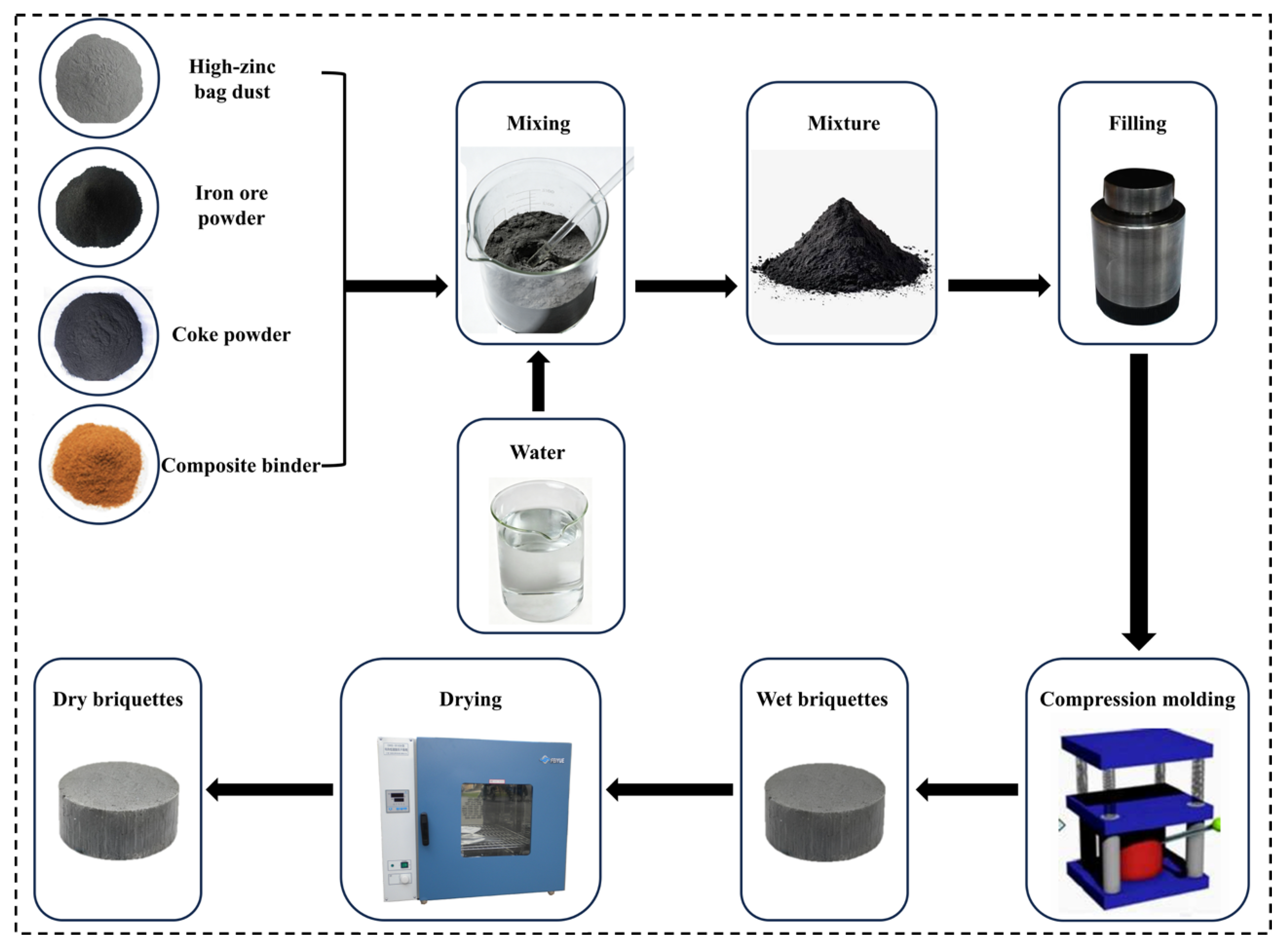
2.2.1. Cold-Bonded Briquette Preparation Process

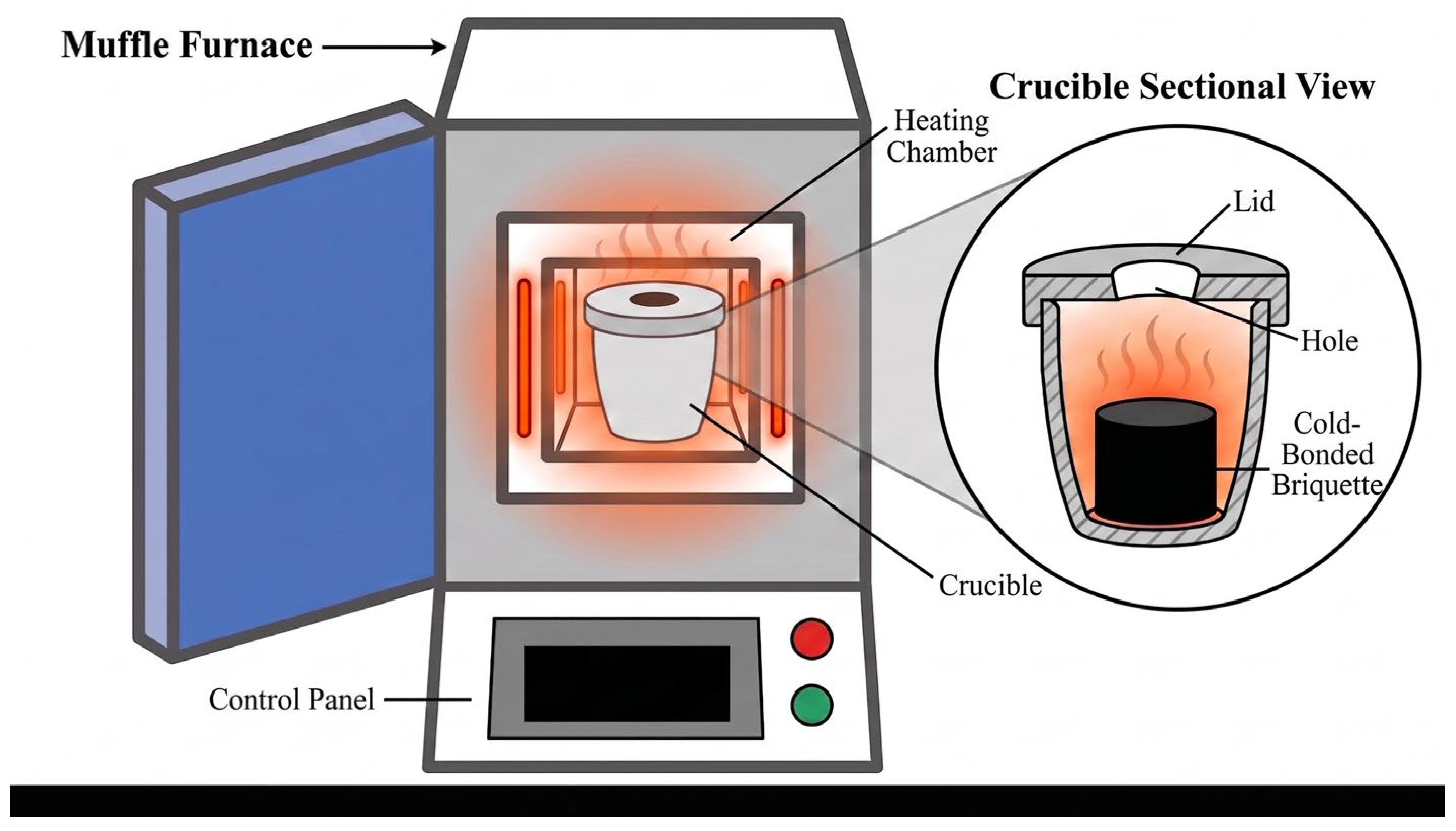
2.2.2. High-Temperature Reduction Experimental Procedure

2.3. Performance Testing Methods
2.3.1. Post-Reaction Compressive Strength
2.3.2. Mass Loss Ratio
2.3.3. TFe Grade
2.3.4. De-Zincing Rate
2.3.5. Kinetic Models
3. Results
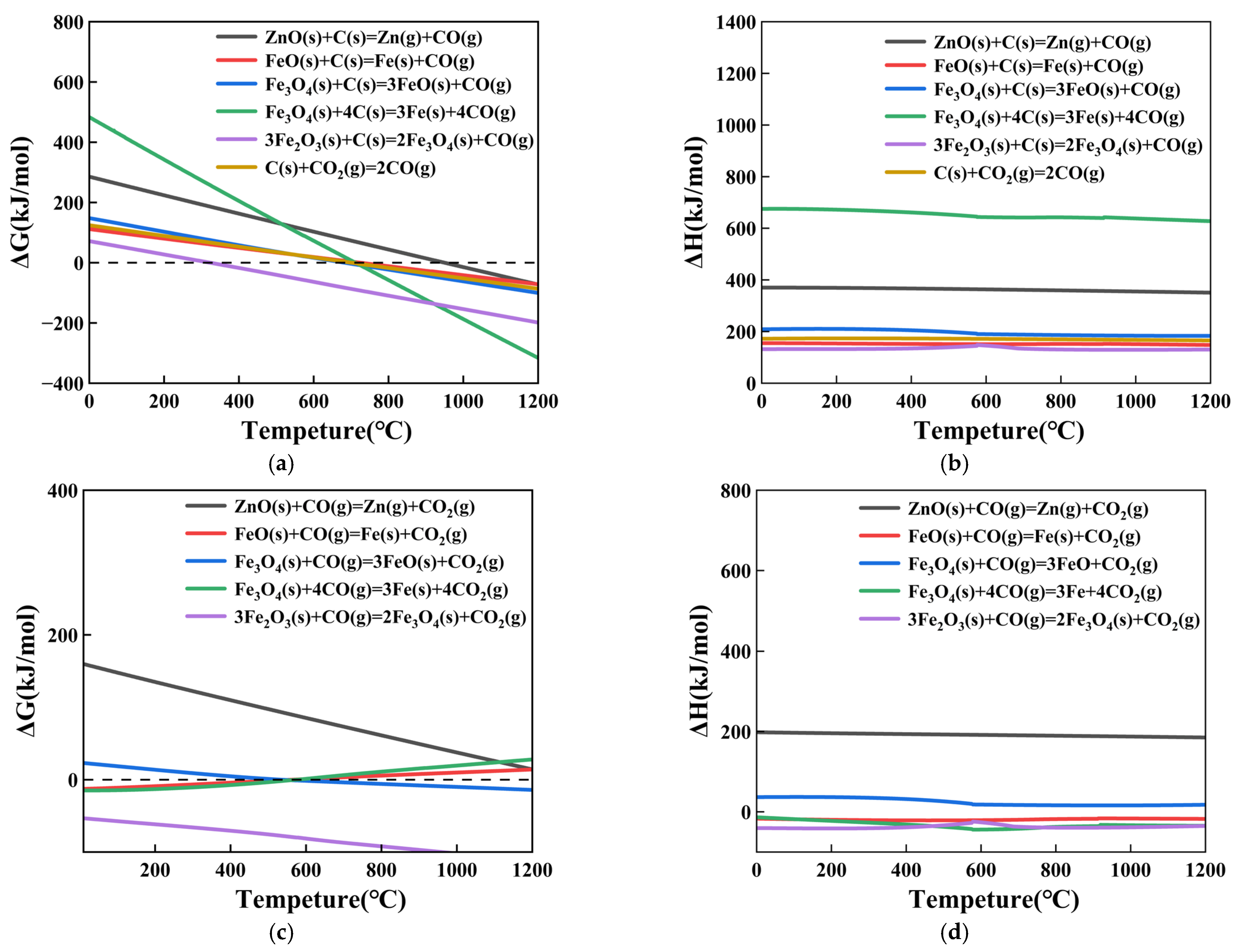
3.1. Thermodynamic Analysis

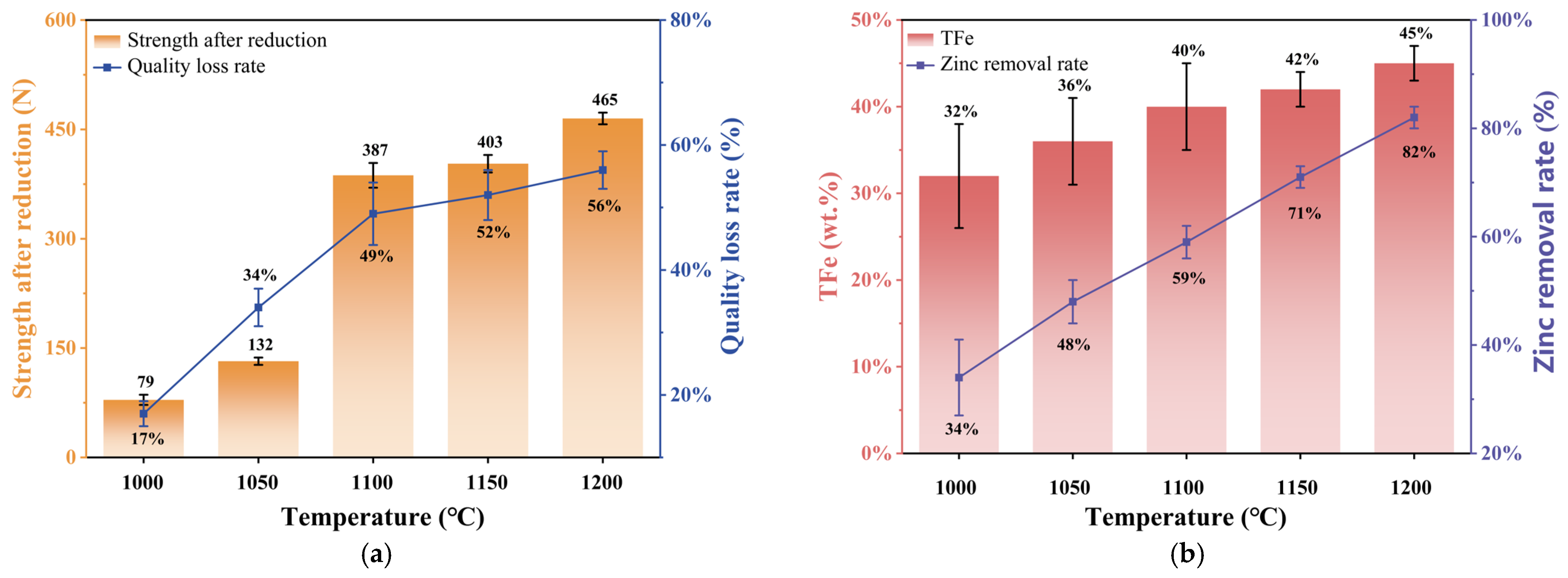
3.2. Effect of Reduction Temperature on the High-Temperature Reduction Behavior of Cold-Bonded Briquettes

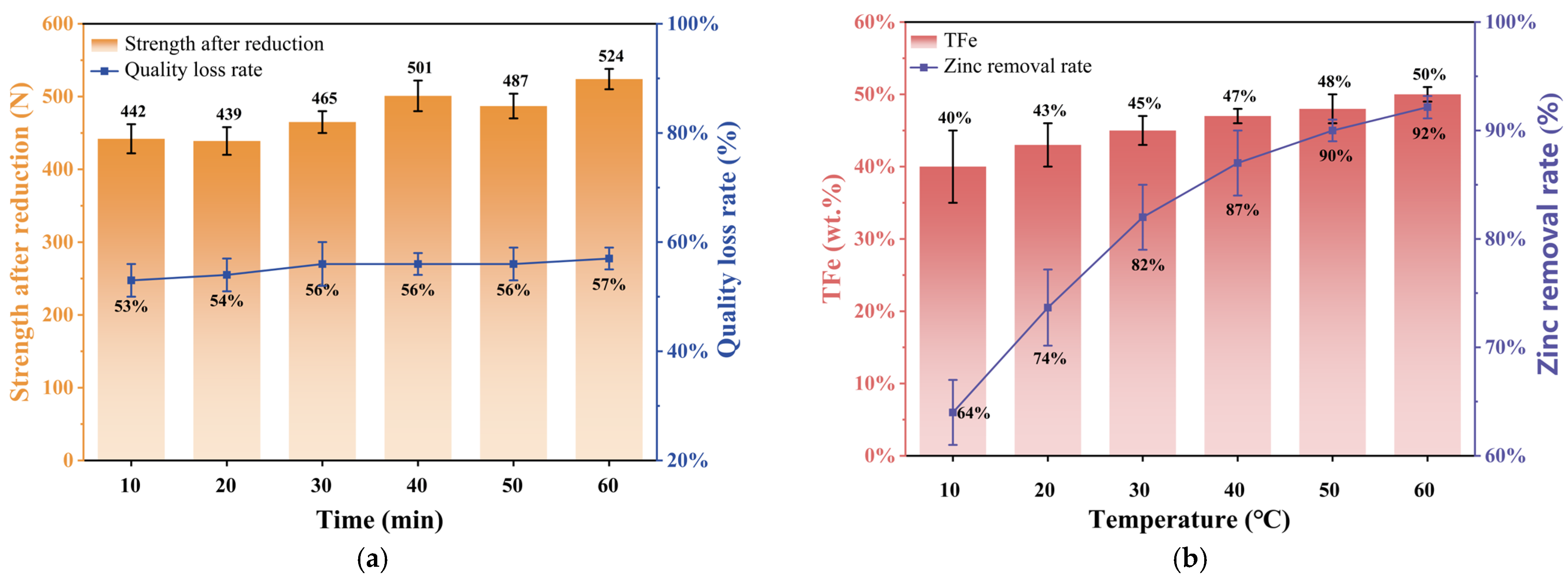
3.3. Effect of Reduction Time on the High-Temperature Reduction Behavior of Cold-Bonded Briquettes

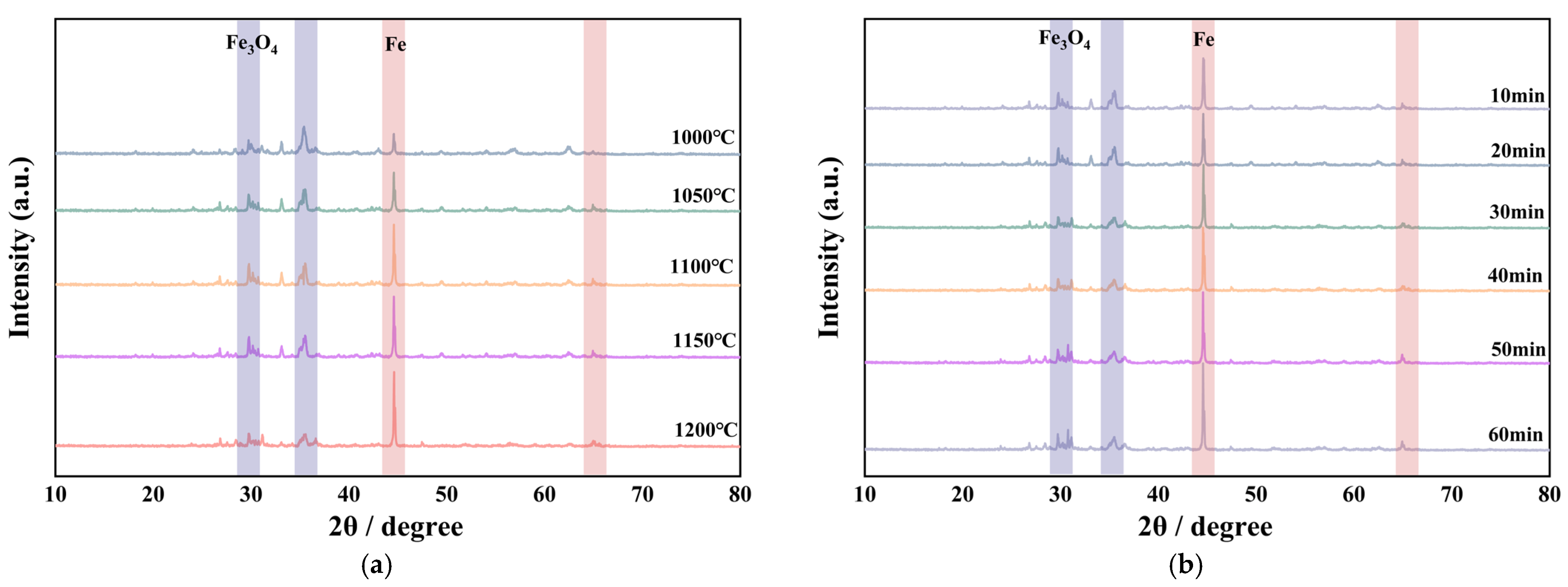
3.4. Phase Analysis of Reduced Briquettes

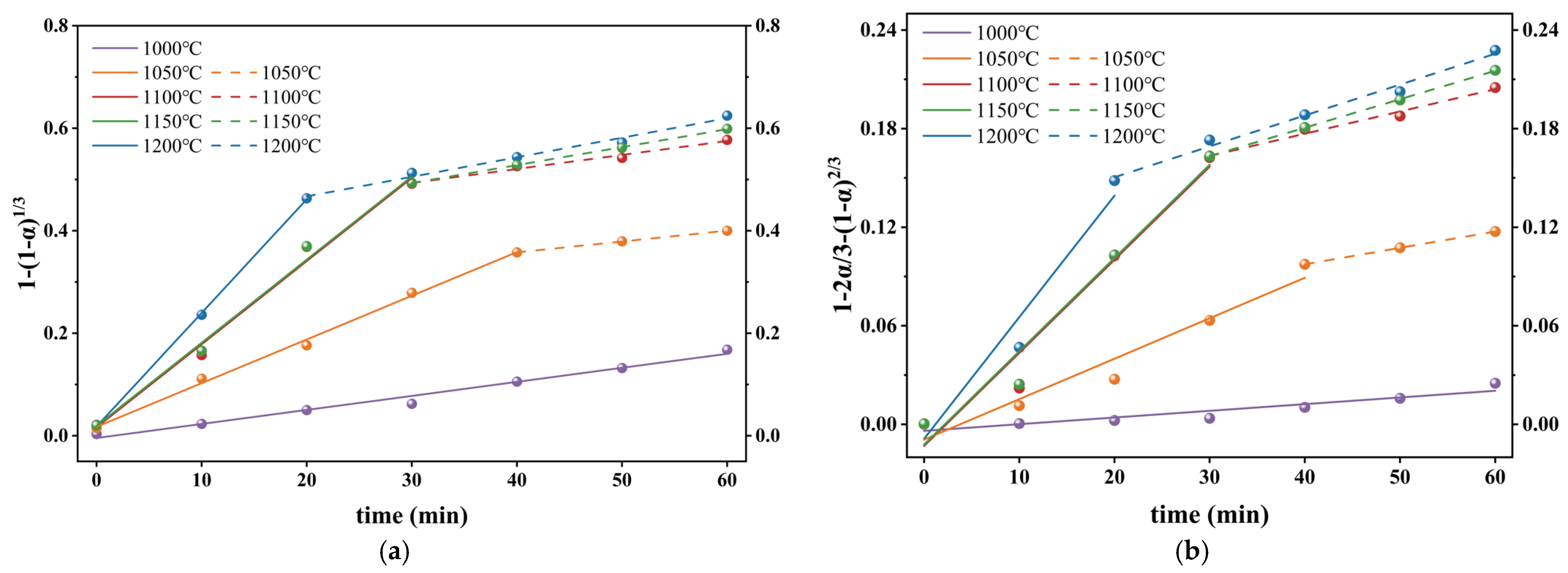
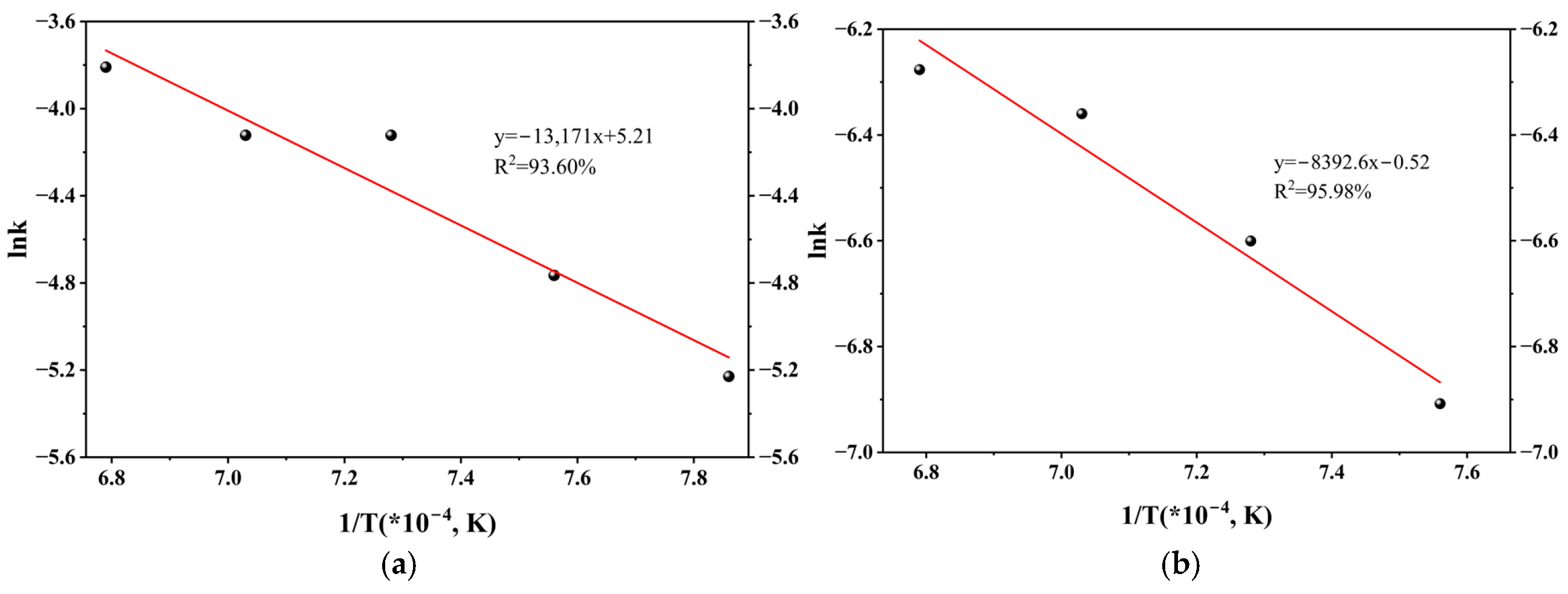
3.5. Kinetic Analysis

4. Conclusions
- (1)
- The enthalpy change for the direct reduction of ZnO is about 380 kJ/mol, and its theoretical onset temperature is 951 °C. This reaction is strongly endothermic. In contrast, iron oxides can be reduced gradually at lower temperatures. Based on the thermodynamic analysis, the high-temperature reduction temperature should be above 1000 °C to ensure both the reduction and removal of Zn and the reduction of iron oxides.
- (2)
- During high-temperature reduction, the briquette strength first decreased and then increased. In the 1100–1200 °C range, the reduction degree of the iron oxides increased in the middle and later stages of the reaction (30–60 min), and the metallization degree of the system continued to rise. The formation of metallic iron may be an important reason for the strength recovery, allowing the final strength of the reduced briquette to recover to 524 N.
- (3)
- Reduction at 1200 °C for 60 min was the optimal process condition. Under these conditions, the de-zincing rate reached 92%, and the TFe grade was enriched to 50 wt.%, meeting the requirements for Grade 5 products in the national standard GB/T 32545-2016, Classification of Iron Ore Products. This shows that by adding a small amount of iron ore powder, it is possible to efficiently remove zinc while also increasing the TFe grade of the reacted briquette, so that it can directly meet the requirements for use as an ironmaking raw material.
- (4)
- The reduction process in this system involved a change in the kinetic mechanism. In the initial stage, it was controlled by interfacial chemical reaction, with an activation energy of 109.10 kJ/mol. In the middle and later stages, the formation of newly generated metallic iron increased the resistance to gas diffusion, and the control mechanism shifted to three-dimensional internal diffusion, with an activation energy of 69.78 kJ/moL.
Author Contributions
Funding
Data Availability Statement
Conflicts of Interest
References
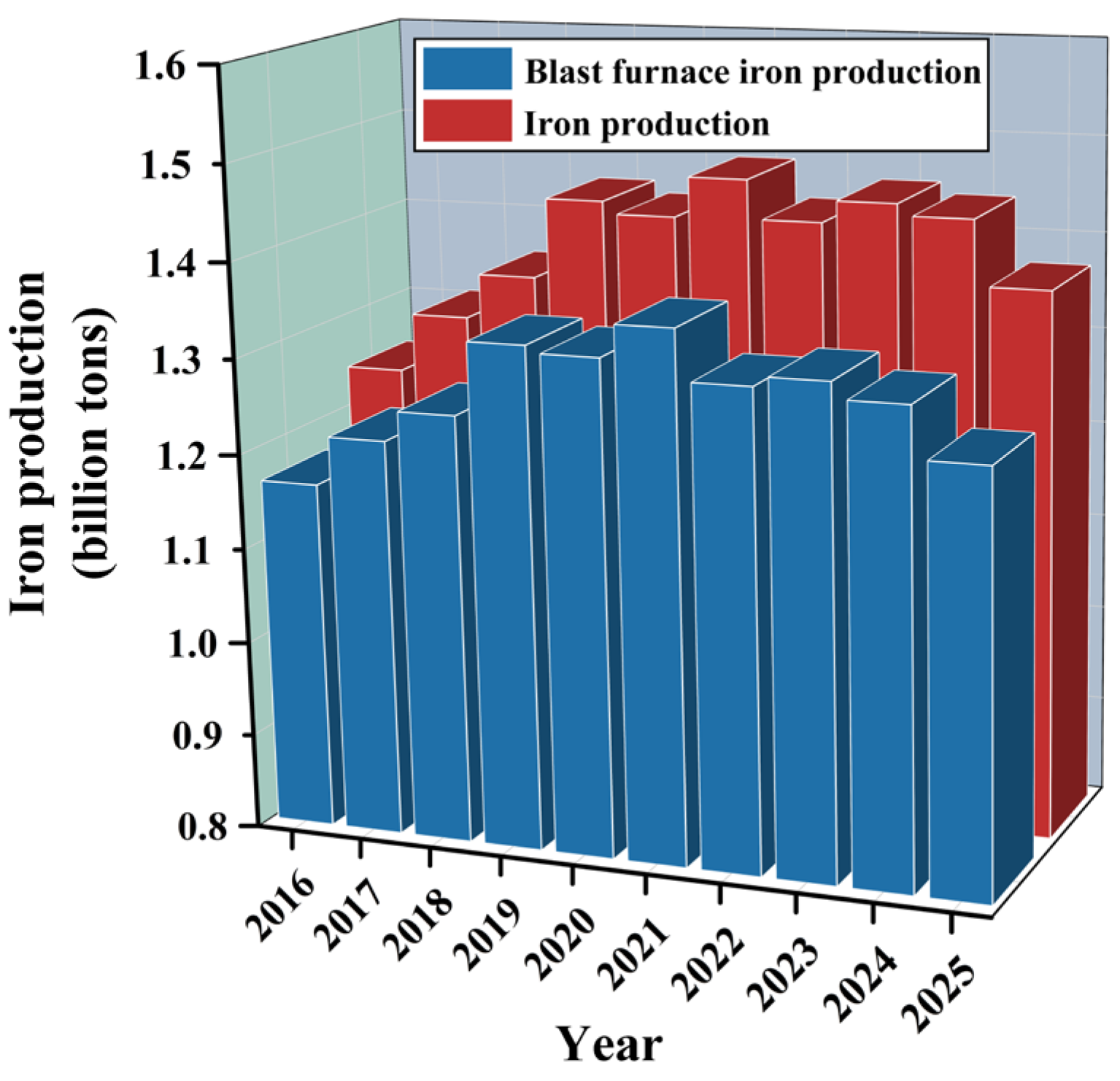
- World Steel Association. World Steel in Figures 2025; World Steel Association: Brussels, Belgium, 2025; Available online: https://worldsteel.org/data/world-steel-in-figures/world-steel-in-figures-2025/ (accessed on 1 May 2026).
- Zhang, J.; Zhang, Y.; Long, Y.; Tian, C.; Du, P.; Ren, Q. Characterization of Physical and Chemical Properties of Multi-Source Metallurgical Dust and Analysis of Resource Utilization Pathways. Metals 2024, 14, 1378. [Google Scholar] [CrossRef]
- Wen, S.; Shen, S.; Gao, L.; Zhang, J.; He, Z. An effective strategy for preparing fluxed metallized pellets from hazardous blast furnace dust by a deep self-reduction technology: Synergistic mechanism and consolidation behavior. J. Environ. Chem. Eng. 2025, 13, 116188. [Google Scholar] [CrossRef]
- Ma, X.Y.; Peng, J.; Zhang, F.; Chang, H. Analysis of the technical status of valuable element extraction from blast furnace dust. China Foundry Mach. Technol. 2021, 56, 53–56. [Google Scholar]
- Ye, F.; Li, M.; Su, S.; Xia, H.; Wei, C.; Li, X.; Deng, Z. Separation and recovery of zinc from blast furnace dust via coordination leaching of Cl− and hydrolysis of NH4+. Sep. Purif. Technol. 2024, 330, 125361. [Google Scholar] [CrossRef]
- Gao, X.; Chai, Y.; Luo, G. Process and mechanism of preparing metallized blast furnace burden from metallurgical dust and sludge. Sci. Rep. 2024, 14, 9760. [Google Scholar] [CrossRef] [PubMed]
- Wang, L.; Chen, C.; Li, Z.; Lyu, W.; Liu, X.; Wang, H.; Nie, Y.; Wang, L.; Liu, S.; Xue, N. Recovery of zinc from blast furnace dust via ultrasonic-enhanced crotonic acid leaching: Leaching kinetics and mechanism. Ultrason. Sonochem. 2025, 120, 107489. [Google Scholar] [CrossRef] [PubMed]
- Li, H.W.; Wang, K.; Kang, H.J. Measures for reducing alkali metal and zinc load in Jingtang blast furnace. Ironmaking 2021, 40, 37–39. [Google Scholar]
- Grudinsky, P.I.; Yurtaeva, A.A.; Volkov, A.I.; Dyubanov, V.G. A study on processing of blast furnace dust and sludge using reduction roasting and magnetic separation. Izv. Ferr. Metall. 2024, 67, 531–541. [Google Scholar] [CrossRef]
- Blesa, F.; Flores, I.; Dias, F. Briquettes composed of LD converter steel mill wastes and blast furnace dust to produce primary iron and liquid steel. Chem. Eng. Trans. 2024, 111, 115–120. [Google Scholar] [CrossRef]
- Mousa, E.A.; Babich, A.; Senk, D. Reduction behavior of cold-bonded briquettes produced from iron ore fines and steelmaking dusts. ISIJ Int. 2013, 53, 16–22. [Google Scholar] [CrossRef]
- Mantovani, M.C.; Takano, C. The strength and reduction of cold-bonded briquettes of iron and carbon bearing wastes. ISIJ Int. 2000, 40, 224–231. [Google Scholar] [CrossRef]
- Ren, J.; Xu, C.C.; Aisaiti, C.; Ahmed, M.; Cao, S.; Lu, C.; Zhang, D.; Helle, M.; Yu, Y. Evolution and mechanistic study of hot compressive strength of cold-bonded iron ore briquettes during reduction under simulated blast furnace conditions. Powder Technol. 2026, 479, 122529. [Google Scholar] [CrossRef]
- GB/T 212-2008; Proximate Analysis of Coal. Standardization Administration of the People’s Republic of China: Beijing, China, 2008.
- Abdelrahim, A.; Nguyen, H.; Illikainen, M.; Kinnunen, P.; Iljana, M.; Illikainen, M.; Fabritius, T. Development of cold-bonded briquettes using by-product-based ettringite binder from ladle slag. J. Sustain. Metall. 2022, 8, 468–478. [Google Scholar] [CrossRef]
- Li, Y.; Qiu, D.; Li, M.; Xiong, Y.; Fabritius, T.; Cao, S.; Li, A.; Elsherbiny, A.A.; Ren, J.; Wei, H.; et al. Analysis of the Softening-Melting Mechanism of Cold-Bonded Briquette from Return Sinter Fines. J. Clean. Prod. 2025, 487, 144581. [Google Scholar] [CrossRef]
- GB/T 32545—2016; Classification of Iron Ore Product Grades. Standards Press of China: Beijing, China, 2016. Available online: https://openstd.samr.gov.cn/bzgk/std/newGbInfo?hcno=8601B06862242360C1469695BF55689E (accessed on 1 May 2026).
- Luo, G.; Peng, Z.; Gao, K.; Fan, W.; Tian, R.; Yi, L.; Rao, M. Preparation of Metallized Pellets for Steelmaking by Hydrogen Cooling Reduction with Different Cooling Rates. Materials 2024, 17, 4362. [Google Scholar] [CrossRef] [PubMed]
- Wang, Y.; Peng, J.; Liu, S.; Luo, G.; Zhang, F.; An, S. Effects of Magnesium Mineral on the Reduction and Expansion Performances of Baiyun Ebo Iron Pellets. Metals 2024, 14, 116. [Google Scholar] [CrossRef]
- Wang, G.; Wu, J.Y.; Sun, G.J.; Karasev, A.; Ren, Z.; Zhang, X.; Ning, X.; Wang, C. Influence of reduction process on structural evolution and mechanical properties of bio-char-containing briquettes. ISIJ Int. 2026, 66, 13–23. [Google Scholar] [CrossRef]
- Liu, D.H.; Wang, X.Z.; Zhang, J.L.; Liu, Z.; Jiao, K.; Liu, X.; Wang, R. Study on the controlling steps and reduction kinetics of iron oxide briquettes with CO-H2 mixtures. Metall. Res. Technol. 2017, 114, 611. [Google Scholar] [CrossRef]
- Li, Y.; Ren, J.; Wei, H.; Khan, I.U.; Omran, M.; Fabritius, T.; Shu, Q.; Wang, C.; Zang, Y.; Yu, Y. Reduction kinetics of cold-bonded briquette prepared from return fines of sinter with carbon monoxide and coke. Steel Res. Int. 2023, 94, 2300057. [Google Scholar] [CrossRef]

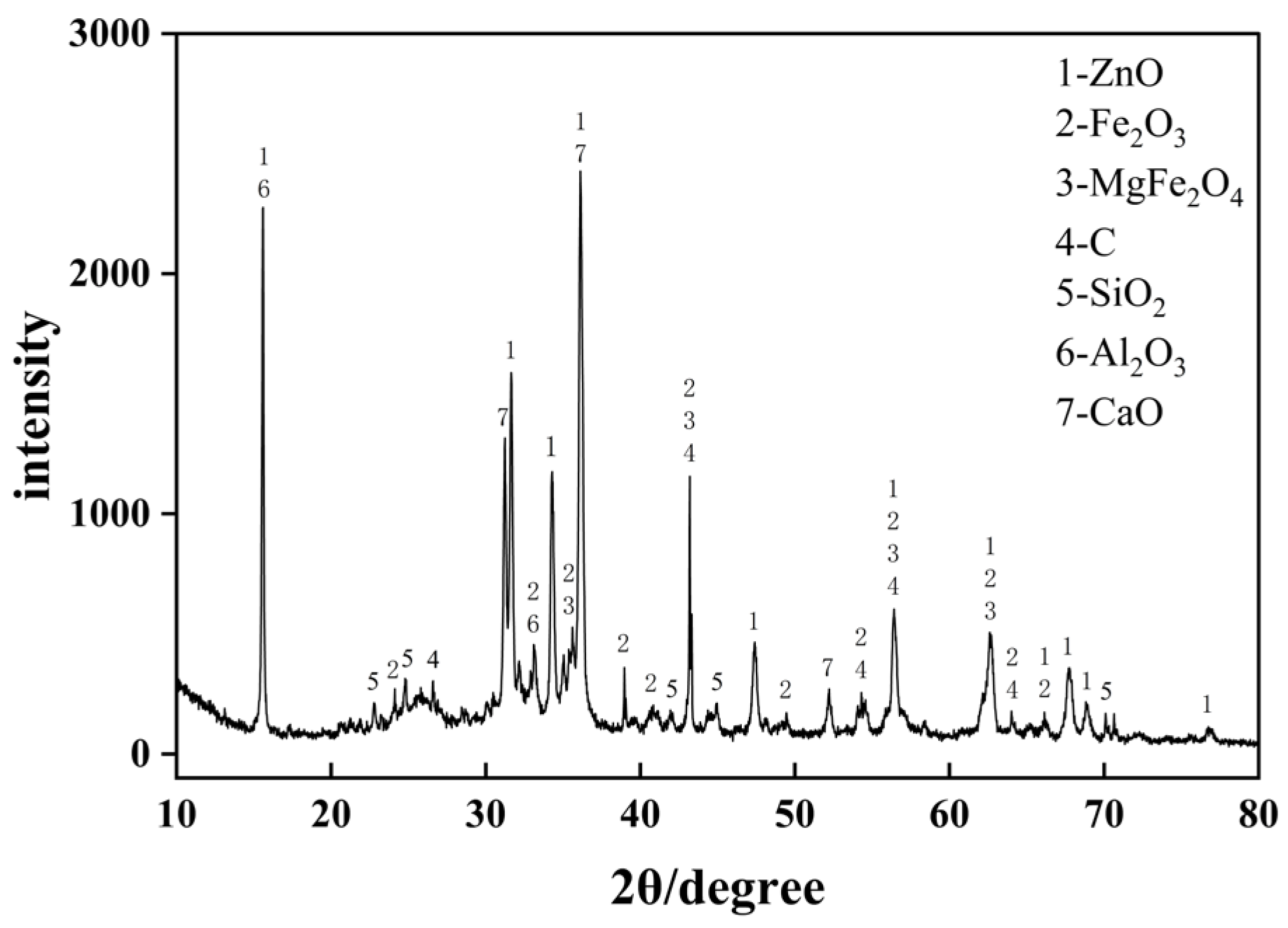
| Components | Zn | K2O | Na2O | C | Cl | Fe | SiO2 | CaO | MgO | Al2O3 |
|---|---|---|---|---|---|---|---|---|---|---|
| wt.% | 33.79 | 1.26 | 0.55 | 10.01 | 4.28 | 16.96 | 4.32 | 2.04 | 3.58 | 1.48 |
| Components | TFe | Fe3O4 | FeO | SiO2 | CaO | Al2O3 | TiO2 | MgO | S | P |
|---|---|---|---|---|---|---|---|---|---|---|
| wt.% | 65.25 | 59.91 | 28.17 | 7.98 | 0.16 | 0.16 | 0.01 | 0.38 | 0.024 | 0.0078 |
| Components | FCd | Vd | Ad |
|---|---|---|---|
| wt.% | 86.89 | 1.70 | 11.41 |
| Mechanism Category | Model Code | G(α) | No. |
|---|---|---|---|
| Interfacial chemical reaction control | R2 | (3) | |
| R3 | (4) | ||
| One-dimensional/ two-dimensional diffusion control | D1 | (5) | |
| D2 | (6) | ||
| Three-dimensional internal diffusion control | D3 | (7) | |
| D4 | (8) | ||
| Nucleation and growth control | A2 | (9) | |
| A3 | (10) | ||
| Reaction order control | F1 | (11) |
| Mechanism | No. | 1000 °C R2 | 1050 °C R2 | 1100 °C R2 | ||
|---|---|---|---|---|---|---|
| 0~60 min | 0~40 min | 40~60 min | 0~30 min | 30~60 min | ||
| Interfacial chemical reaction | Equation (3) | 98.93% | 99.57% | 99.57% | 98.64% | 98.16% |
| Equation (4) | 99.01% | 99.67% | 99.67% | 98.95% | 98.15% | |
| One/two-dimensional diffusion | Equation (5) | 96.82% | 97.76% | 97.76% | 97.14% | 97.97% |
| Equation (6) | 94.83% | 95.78% | 95.78% | 96.48% | 98.15% | |
| Three-dimensional internal diffusion | Equation (7) | 91.94% | 92.77% | 92.77% | 94.36% | 98.05% |
| Equation (8) | 93.91% | 94.83% | 94.83% | 95.94% | 98.64% | |
| Nucleation and growth | Equation (9) | 96.68% | 97.27% | 97.27% | 98.32% | 98.12% |
| Equation (10) | 93.63% | 94.21% | 94.21% | 96.46% | 98.14% | |
| Reaction order | Equation (11) | 98.71% | 98.25% | 98.25% | 98.69% | 98.01% |
| Mechanism | No. | 1150 °C R2 | 1200 °C R2 | ||
|---|---|---|---|---|---|
| 0~30 min | 30~60 min | 0~20 min | 20~60 min | ||
| Interfacial chemical reaction | Equation (3) | 98.77% | 99.87% | 99.92% | 98.74% |
| Equation (4) | 99.18% | 99.67% | 99.88% | 98.76% | |
| One/two-dimensional diffusion | Equation (5) | 97.68% | 97.78% | 99.29% | 98.02% |
| Equation (6) | 97.02% | 98.98% | 96.94% | 98.73% | |
| Three-dimensional internal diffusion | Equation (7) | 94.78% | 99.80% | 92.75% | 98.41% |
| Equation (8) | 96.45% | 99.89% | 95.61% | 98.82% | |
| Nucleation and growth | Equation (9) | 98.14% | 98.91% | 99.11% | 98.62% |
| Equation (10) | 95.99% | 98.94% | 97.38% | 98.25% | |
| Reaction order | Equation (11) | 99.03% | 96.75% | 99.01% | 98.22% |
Disclaimer/Publisher’s Note: The statements, opinions and data contained in all publications are solely those of the individual author(s) and contributor(s) and not of MDPI and/or the editor(s). MDPI and/or the editor(s) disclaim responsibility for any injury to people or property resulting from any ideas, methods, instructions or products referred to in the content. |
© 2026 by the authors. Licensee MDPI, Basel, Switzerland. This article is an open access article distributed under the terms and conditions of the Creative Commons Attribution (CC BY) license.
Share and Cite
Wei, T.; Yu, Y. Study on the Synergistic Recovery of Zinc and Iron from Cold-Bonded Briquettes Prepared from High-Zinc Blast Furnace Dust. Metals 2026, 16, 618. https://doi.org/10.3390/met16060618
Wei T, Yu Y. Study on the Synergistic Recovery of Zinc and Iron from Cold-Bonded Briquettes Prepared from High-Zinc Blast Furnace Dust. Metals. 2026; 16(6):618. https://doi.org/10.3390/met16060618
Chicago/Turabian StyleWei, Taida, and Yaowei Yu. 2026. "Study on the Synergistic Recovery of Zinc and Iron from Cold-Bonded Briquettes Prepared from High-Zinc Blast Furnace Dust" Metals 16, no. 6: 618. https://doi.org/10.3390/met16060618
APA StyleWei, T., & Yu, Y. (2026). Study on the Synergistic Recovery of Zinc and Iron from Cold-Bonded Briquettes Prepared from High-Zinc Blast Furnace Dust. Metals, 16(6), 618. https://doi.org/10.3390/met16060618