Review

Determining Forming Limit Curves via Small Punch Test and Digital Image Correlation: A Bibliometric Analysis

by
Erik López Vargas
1,
Luis Alejandro Alcaraz-Caracheo
1,*,
Israel Aguilera Navarrete
2,
Ismael Ruíz López
3,
José Alfredo Padilla Medina
1,
Allan Giovanni Soriano Sánchez
1,
Juan Prado Olivarez
1,
Saúl Martínez Díaz
4 and
Alejandro Israel Barranco Gutiérrez
1,*
1
Departamento de Ingeniería Electrónica, Tecnológico Nacional de México, Instituto Tecnológico de Celaya, Celaya 38010, Mexico
2
SECIHTI-CIATEC, Leon 37545, Mexico
3
Engineering PEMSA Forjas CIE AUTOMETAL, Celaya 38020, Mexico
4
División de estudios de Posgrado e Investiagación, Tecnológico Nacional de México, Instituto Tecnológico deLa Paz, La Paz 23080, Mexico
*
Authors to whom correspondence should be addressed.
Metals 2026, 16(6), 603; https://doi.org/10.3390/met16060603 (registering DOI)
Submission received: 4 April 2026 / Revised: 26 May 2026 / Accepted: 28 May 2026 / Published: 31 May 2026
(This article belongs to the Special Issue Sheet Metal Forming Processes)

Abstract

The experimental determination of Forming Limit Curves, standardized by ISO 12004-2 and ASTM E2218, remains the conventional framework for evaluating sheet metal formability, whereas the Small Punch Test, supported by ASTM E3205, has traditionally evolved as a miniaturized mechanical tensile characterization technique. The incorporation of Digital Image Correlation into both methodologies has significantly expanded the capabilities of full-field deformation analysis and experimental characterization. In this context, the present study examines the extent to which the Small Punch Test, particularly when combined with Digital Image Correlation, may be conceptually integrated into the framework of reduced-scale formability characterization. A structural bibliometric analysis of 129 documents published between 2004 and 2026 was conducted through journal analysis, author analysis, collaboration networks, and conceptual structure analysis. Three search equations were employed to capture the dimensions associated with Forming Limit Curves and Digital Image Correlation integration, geometrical scaling of formability tests, and the convergence between Small Punch Test and Digital Image Correlation methodologies. The results reveal a consolidated Forming Limit Curve research domain strongly centered on the Nakajima test and Digital Image Correlation based strain measurement techniques, whereas the Small Punch Test remains structurally separated from the dominant scientific core. Nevertheless, conceptual analyses indicate thematic convergence between experimental miniaturization, geometrical scaling, and optical full-field characterization approaches. These findings suggest that the integration between Small Punch Test and Digital Image Correlation constitutes a promising but still insufficiently explored research direction within the broader framework of formability assessment.

1. Introduction

The experimental determination of the formability of sheet metals is an essential component in the design and optimization of industrial forming processes. The Forming Limit Curve (FLC) constitutes the conventional tool used to establish safe deformation states and those associated with localized instability phenomena such as necking or surface fracture. Its experimental determination is performed through standardized methodologies, particularly by means of Nakajima or Marciniak type tests, internationally regulated by ISO 12004-2 [1] and in the United States context, by ASTM E2218 [2], which define the procedure for the experimental determination of Forming Limit Curves (FLCs) through surface strain measurement. Although the term Forming Limit Diagram (FLD) is also commonly used in the literature to refer to this concept, the term FLC will be adopted throughout this work for the sake of terminological consistency.
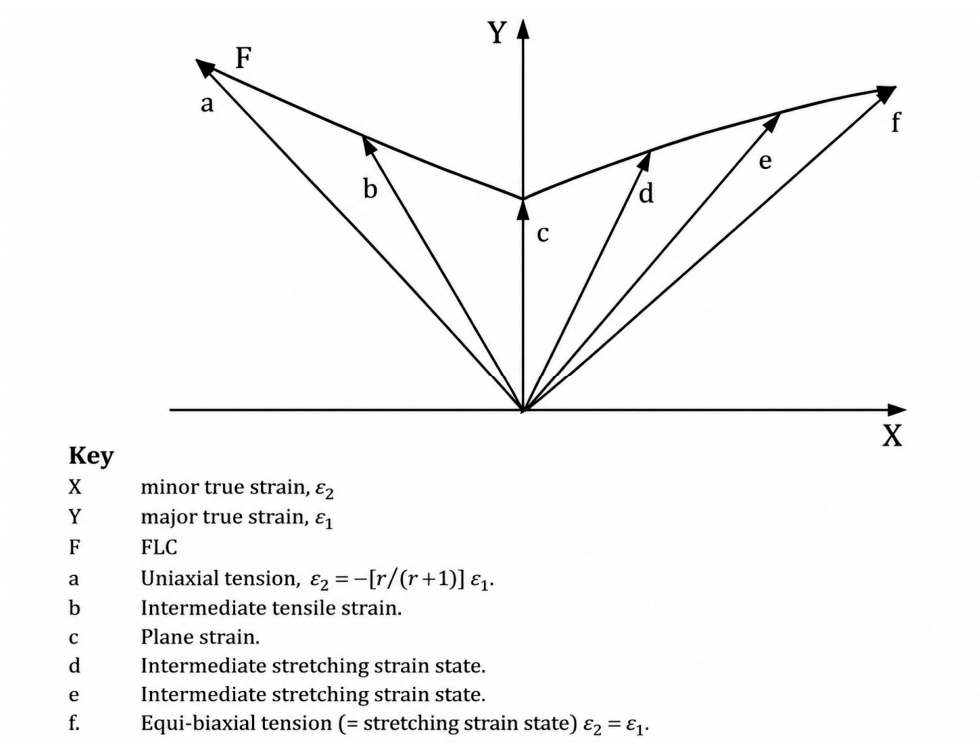
The FLC is constructed by plotting pairs of critical principal strains ε 1 ε 2 at which unstable necking of the material initiates, Figure 1. With the advancement of optical strain measurement techniques, Digital Image Correlation (DIC) has been widely integrated into these standardized tests, enabling the capture of full-field strain measurements with high spatial and temporal resolution. The application of DIC in formability studies has been reported in multiple works [3,4,5,6].
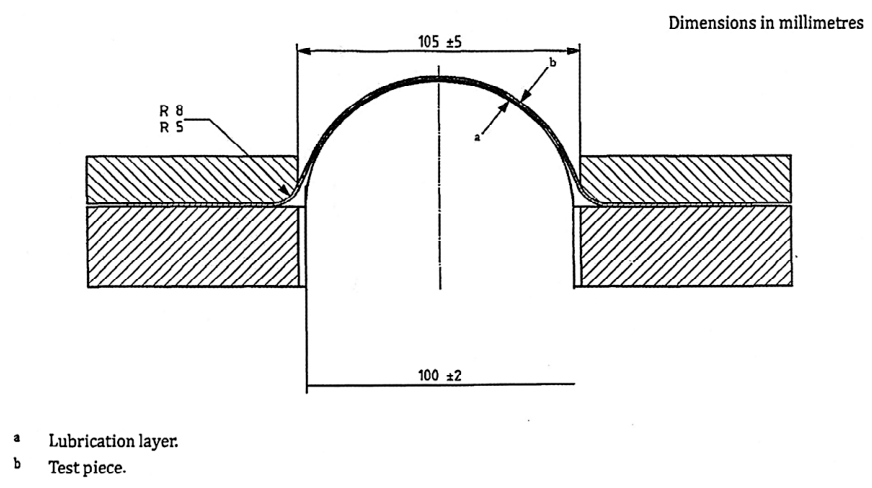
However, although the FLC normative framework is widely consolidated, its experimental implementation requires specimens of relatively large dimensions, specialized equipment, and considerable amounts of material. Conventional FLC determination requires the use of standardized specimens and tooling configurations, such as the hemispherical punch setup illustrated in Figure 2, with characteristic specimen dimensions ranging approximately from 130 to 300 mm in their longest direction and thicknesses typically between 0.5 and 3 mm. In addition, obtaining a representative curve requires performing multiple tests under different deformation paths in order to adequately cover the complete strain space. The number of required tests is not strictly defined and depends on factors such as material availability and the desired precision of the curve; nevertheless, accurate characterization commonly involves approximately 15 to 35 or more tests. Consequently, the experimental campaign may require considerable quantities of material, specialized forming equipment, and extensive testing time.
Furthermore, the experimental procedure requires specialized equipment capable of applying high blank holder and punch forces while maintaining stable deformation conditions throughout the test. The setup also demands specimen lubrication and avoids friction conditions as much as possible to ensure that the strain paths remain within acceptable validity criteria and fracture occurs near the dome apex. In modern implementations, the procedure is commonly complemented with Digital Image Correlation (DIC) systems for full-field deformation measurement and necking detection.
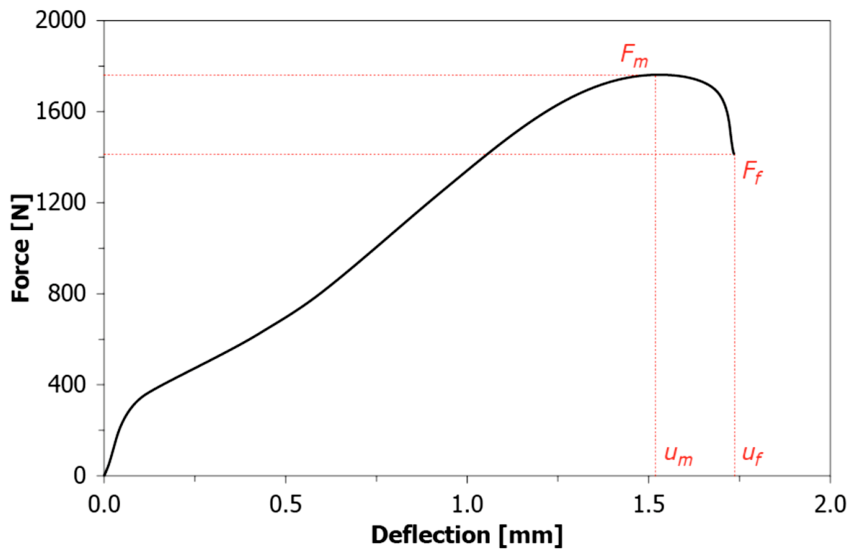
In the context of situations where material availability is limited, the literature has, for several years, explored reduced-scale experimental configurations to characterize mechanical properties using minimal amounts of material [7]. Among the methodologies that have gained increasing attention within this experimental miniaturization approach is the Small Punch Test (SPT), which has become established as a technique for estimating mechanical tensile properties using miniaturized specimens, typically of 10 × 10 × 0.5 mm. The development of the SPT was driven by a research group dedicated to the analysis of radioactive materials. They were looking for a method to evaluate the degradation of the mechanical properties of nuclear reactor vessels that required handling the minimum amount of irradiated material [8]. It is important to note that the SPT is also supported by international standardization through ASTM E3205 [9], which establishes standardized guidelines for its execution and interpretation. In this methodology, the specimen is deformed by a hemispherical punch while the applied force and central deflection are continuously recorded, generating a characteristic force–deflection curve (Figure 3). From this curve, characteristic parameters such as the elastic–plastic transition force, the maximum force, and the corresponding deflections can be identified and subsequently correlated with conventional tensile properties, including yield strength and ultimate tensile strength, through empirical or analytical relationships.
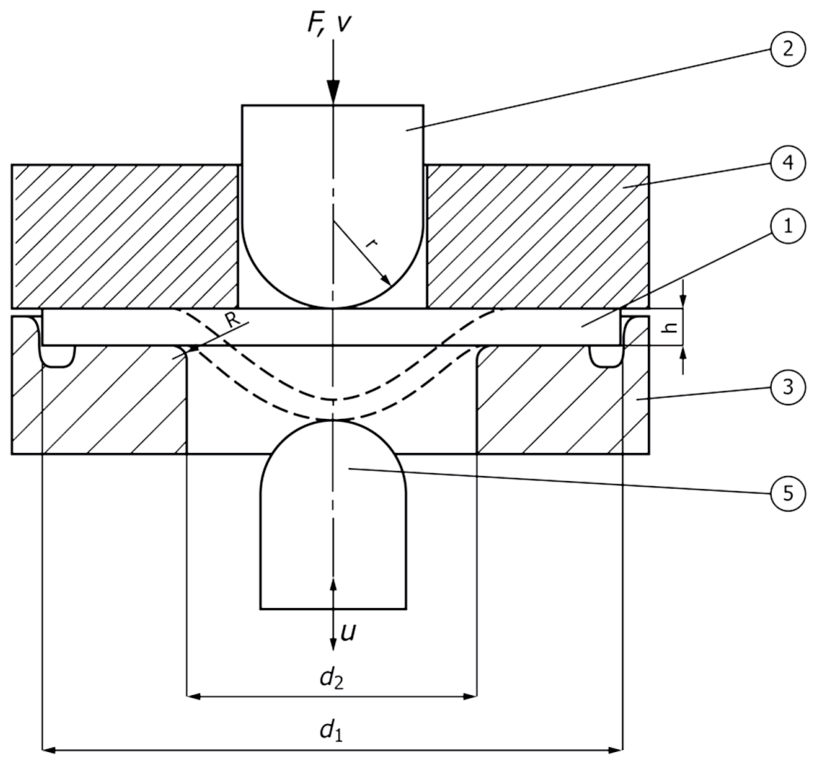
The SPT still remains under active research in order to achieve more accurate estimations of mechanical properties, since, unlike conventional tensile tests, the SPT generates complex and non-homogeneous deformation states that cannot be fully characterized through a single deflection measurement point. For this reason, similarly to the Nakajima test, the SPT has increasingly incorporated advanced optical techniques such as DIC, enabling not only to monitor the central deflection point, but also to analyze a series of measurement points distributed along a radial distance from the specimen center, where strain localization and thickness reduction are actually concentrated during the Small Punch Test deformation process [10,11]. On the other hand, in notched configurations, it has also been employed to monitor notch mouth opening displacement associated with crack initiation and fracture characterization [12]. Additionally, the SPT presents similarities in its experimental configuration with the Nakajima test used in the determination of FLC, since both are based on deformation induced by a punch that generates multiaxial stress states in thin sheets, see Figure 4. Although they differ in scale and specific purpose, all these similarities suggest a conceptual convergence between both methodologies.
In this context, and in order to understand the scientific and technological structure of the experimental FLC field, this work develops a structural bibliometric capturing the FLC-DIC integration, geometric scaling of FLC, and SPT–DIC convergence. This approach allows diagnosing the organization of scientific knowledge and evaluating the relative positioning of the SPT within the broader framework of experimental formability evaluation.
It is imperative to acknowledge that the objective of this study is not to prove the experimental equivalences between configurations or to ascertain direct mechanical correspondences between conventional FLC approaches and miniaturized methodologies. Moreover, the intention is not to provide a comparative evaluation of their technical performance. Instead, the focus is on examining how these research lines are structured within the broader scientific landscape, identifying patterns of interaction, thematic relevance, fragmentation, and possible convergence, with particular attention to the positioning of the Small Punch Test (SPT).
In conceptual terms, this approach makes it possible to answer the following questions: Does the SPT appear integrated into the core of the formability field, or does it remain as a parallel or isolated field? Is miniaturization treated as a methodological extension of the FLC or as an independent line? Does the SPT–DIC convergence constitute an emerging technological front or a niche that is not yet consolidated?
In this way, the bibliometric analysis does not seek to replace experimental evidence, but rather to provide a structural map of knowledge that allows contextualizing the relative position of miniaturized configurations within the normatively consolidated field of the experimental determination of FLC.

2. Materials and Methods

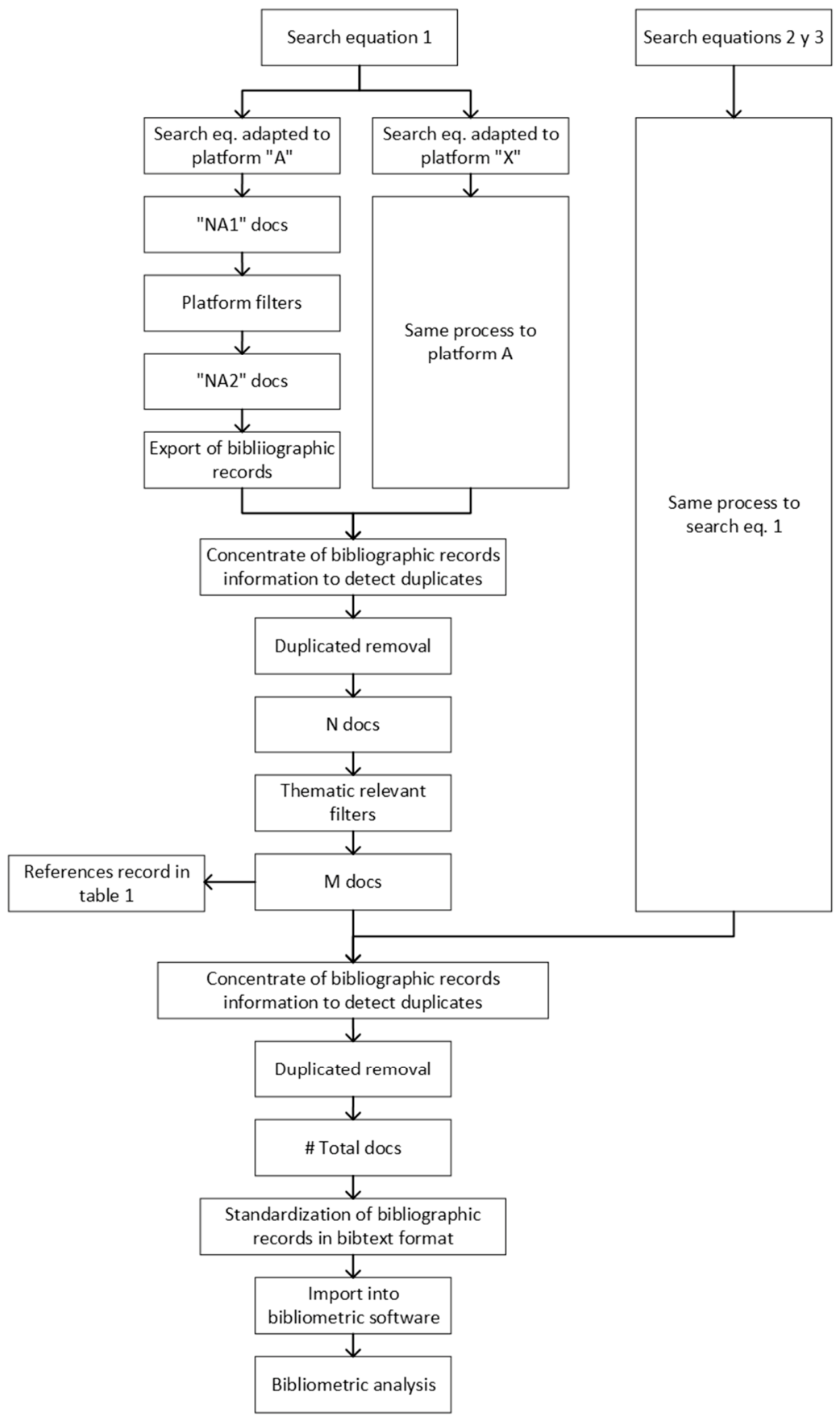
Figure 5 summarizes the general methodological workflow adopted for the development of the bibliometric analysis. The process was structured in sequential stages, beginning with the formulation of three independent search equations designed to capture different thematic dimensions of the study. Each search equation was subsequently adapted to the syntax and operating conditions of the selected scientific databases, where platform-specific filters were applied and the corresponding bibliographic records were exported. Once the records associated with each equation were obtained, an initial process of bibliographic information consolidation and duplicate detection between platforms was carried out, followed by a thematic screening stage based on relevance criteria, resulting in a refined set of references associated with each search equation. Subsequently, the filtered bibliographic records derived from all search equations were unified into a single database, where a second duplicate detection and removal procedure was performed in order to construct the final documentary corpus. Finally, the resulting records were standardized in BibTeX format and imported into bibliometric analysis software version 4.3.0 for the generation of the corresponding scientific mapping and structural analyses.

2.1. Search Equation Design

The construction of the search equations was based on the identification of specific experimental and methodological axes through preliminary exploratory searches, terminology normalization, and the analysis of recurrent concepts within the literature related to sheet metal formability, Digital Image Correlation (DIC), and Small Punch Testing (SPT). Under this framework, the equations were intentionally formulated to represent three predefined conceptual dimensions: (i) the metrological integration of DIC into the conventional Forming Limit Curve (FLC) framework, (ii) the geometrical miniaturization and scaling of formability-related experimental configurations, and (iii) the technological convergence between standardized Small Punch Testing and advanced full-field optical measurement techniques. This structure enabled the generation of comparable bibliographic subsets while reducing interpretive subjectivity in the thematic organization of the corpus.
The formulation of each search equation combined two complementary components: (a) a core group of descriptors associated with the target experimental methodology, and (b) a secondary group of descriptors associated with either optical measurement techniques, geometric scaling conditions, or standardized miniaturized testing configurations. Synonymous expressions, hyphenated variants, plural forms, and terminology commonly used across different indexing platforms were incorporated in order to improve retrieval robustness and reduce platform-dependent bias during database querying.

2.1.1. Equation (1): Metrological Integration (FLC–DIC)

This equation was formulated to identify literature associated with the incorporation of advanced full-field optical measurement techniques, particularly Digital Image Correlation (DIC), into the conventional experimental framework used for Forming Limit Curve (FLC) determination. The selected descriptors focus on the intersection between standardized formability evaluation methodologies and optical deformation measurement approaches, allowing the identification of studies centered on strain field characterization, necking detection, and deformation limit assessment under the classical FLC paradigm. In this context, the equation represents the metrological dimension of the study, emphasizing the integration of full-field optical measurement techniques into conventional formability assessment methodologies.
(“forming limit diagram*” OR “forming-limit diagram*” OR “forming limit curve*” OR “forming-limit curve*” OR “fracture limit curve*” OR “fracture-limit curve*”) AND (“digital image correlation*” OR “digital-image correlation*” OR “image matching” OR “digital-assisted image correlation*” OR “digital-assisted image correlation*”)

2.1.2. Equation (2): Geometrical Scaling Applied to FLC

This equation was designed to isolate the literature associated with geometrical scaling phenomena and experimental miniaturization strategies applied to formability-related configurations. The selected descriptors incorporate terminology linked to reduced punch geometries, sub-sized specimens, and miniaturized testing configurations, allowing the identification of studies where scale reduction may alter deformation paths, curvature effects, strain localization behavior, or experimental boundary conditions associated with conventional FLC methodologies.
(“small punch” OR “small-punch” OR “small punch test” OR “small-punch test” OR “small punch testing” OR “small-punch testing” OR “punch curvature*” OR “punch-curvature*” OR “punch radius” OR “punch-radius” OR “punch-radii” OR “punch radii” OR “punch diameter*” OR “punch-diameter*” OR “miniaturized punch” OR “miniaturized-punch” OR “small diameter*” OR “small-diameter*” OR “small radius” OR “small-radius” OR “small radii” OR “small-radii” OR “sub sized specimen*” OR “sub-sized specimen*” OR “small specimen*” OR “small-specimen*” OR “miniaturized specimen*” OR “miniaturized-specimen*” OR “small sample*” OR “small-sample*” OR “sub sized sample*” OR “sub-sized sample*” OR “miniaturized sample*” OR “miniaturized-sample*” OR “miniaturized device” OR “small device”) AND (“forming limit diagram*” OR “forming-limit diagram*” OR “forming limit curve*” OR “forming-limit curve*” OR “fracture limit curve*” OR “fracture-limit curve*”)

2.1.3. Equation (3): Technological Convergence Between Standardized Miniaturization and Advanced Optical Measurement (SPT–DIC)

This equation was formulated to identify literature located at the intersection between standardized Small Punch Testing methodologies and advanced full-field optical measurement techniques, particularly Digital Image Correlation (DIC). Unlike the geometrical scaling dimension represented in Equation 2, this axis specifically focuses on SPT configurations supported by formal standardization frameworks such as ASTM E3205 [9], enabling the assessment of whether DIC integration within SPT has evolved as an isolated application trend or as a structurally connected experimental subdomain within the broader formability field.
(“small punch” OR “small-punch” OR “small punch test” OR “small-punch test” OR “small punch testing” OR “small-punch testing”) AND (“digital image correlation*” OR “digital-image correlation*” OR “image matching” OR “digital assisted image correlation*” OR “digital-assisted image correlation*”)

2.2. Application of Search Equations to Databases, Platform Filters, and Exporting of Bibliographic RECORDS from Databases

The search equations were applied in different scientific literature databases that host the major journal publishers in the field of engineering. The databases used were Scopus, Web of Science, ScienceDirect, SageJournals, MDPI, Taylor and Francis, and SpringerLink. Likewise, a search was carried out using Google Scholar and the SciELO publisher, specifically for documents written in English. Due to differences in search engine architecture and query restrictions among databases, the search equations were adapted according to the syntax requirements, search operators, and maximum character limits permitted by each platform. The exact search equations implemented in each database are provided in Appendix A.
The document sections in which the term search was performed were title, keywords, and abstract. Initially, the direct application of each search equation generated a set of preliminary records identified as NA1 documents. Subsequently, platform-specific filters were applied in order to retain only articles and reviews written in English, excluding documents related to conferences, books, and book chapters, among others. After this filtering stage, the resulting refined records were identified as NA2 documents, following the methodological workflow presented in Figure 5 (the number of documents obtained during the filtering stage for each platform and search equation is presented in Appendix B).
The bibliographic records of the documents from each database were exported in BibTeX format or in another format allowed by the platform. Subsequently, the bibliographic records were organized into a single file in order to identify repeated documents and thus avoid duplication of information. It is important to clarify that the bibliographic records from the Web of Science database were retained when duplicates existed in other databases, since this platform provides a greater amount of information. In this way, the Web of Science database concentrated more than 90% of the information used.

2.3. Thematic Filters and Corpus Refinement

Once the N consolidated and non-duplicated documents were obtained from all databases, a thematic screening process was carried out in order to refine the bibliographic subsets associated with each search equation. This stage consisted of a manual review of titles, abstracts, keywords, and, when necessary, the full text of the documents, with the objective of verifying their thematic correspondence with the experimental dimension represented by each search equation. After the duplicate removal stage, a total of N unique documents were retained for the subsequent thematic screening process (the number of documents obtained during the filtering stage for each platform and search equation is presented in Appendix B).
For Equation (1) (FLC–DIC metrological integration dimension), the screening process focused on retaining studies explicitly related to sheet metal formability and deformation limit evaluation. Consequently, documents employing Digital Image Correlation (DIC) in unrelated research areas, such as structural monitoring, civil engineering, biomechanics, or general material characterization outside formability analysis, were excluded.
For Equation (2) (geometrical scaling and experimental miniaturization dimension), the thematic filter prioritized studies addressing reductions in tooling geometry or specimen dimensions associated with formability-related experimental configurations, including reduced punch diameters, miniaturized specimens, or scaled testing devices. However, documents explicitly centered on the standardized Small Punch Test (SPT) configuration were intentionally excluded from this subset in order to preserve the conceptual separation between geometrical miniaturization approaches and the specific technological framework represented by Equation (3).
Finally, for Equation (3) (SPT–DIC technological convergence dimension), only studies explicitly associated with the Small Punch Test configuration were retained. In this case, the screening process verified that the retrieved documents corresponded specifically to SPT-based experimental methodologies combined with Digital Image Correlation or related full-field optical measurement techniques.
The documents retained after thematic screening were subsequently categorized in a classification table according to the search equation from which they were retrieved, with the purpose of distinguishing the different conceptual and technological dimensions considered in the study, see Table 1.
This categorization was not used to construct the bibliometric networks, but rather as an interpretative tool to analyze the relative distribution of each dimension within the corpus and to facilitate the identification of patterns of thematic density and structural connectivity observed in the different analyses.
The combination of network analysis and thematic classification made it possible to evaluate the relative weight of each technological dimension and its degree of articulation with the core of the field.
During the thematic screening stage, the main sources of irrelevant retrieval were associated with ambiguities related to experimental testing configurations and terminology linked to different punch-based methodologies. In contrast, no significant thematic deviations were observed regarding the use of Digital Image Correlation terminology, which remained consistently associated with optical full-field deformation measurement techniques across the retrieved literature.

2.4. Corpus Construction and Standardization of Bibliographic Records for Bibliometric Analyses

The construction of the bibliometric corpus consisted of the integration of the refined document subsets obtained from the three search equations described in the previous sections. This integration process resulted in a unified bibliographic collection intended for subsequent bibliometric processing and scientific mapping analyses.
Due to the conceptual overlap between the different search dimensions, an additional duplicate detection and removal procedure was performed during this stage, since some documents were retrieved simultaneously by more than one search equation. When duplicate records were identified, preference was given to the bibliographic entries containing the largest amount of metadata information. This criterion was adopted in order to maximize the completeness and consistency of the bibliometric information used during the subsequent analyses.
Likewise, although most databases allowed direct exportation in BibTeX format, some records retrieved from complementary platforms were available in alternative bibliographic formats. In such cases, the records were converted to BibTeX in order to standardize the complete corpus into a homogeneous bibliographic structure. The BibTeX format was selected because it is one of the native formats supported by bibliometric analysis software and also because it corresponds to the format containing the largest proportion of the retrieved records across the consulted databases.
After the integration, duplicate removal, and format standardization procedures, a single consolidated BibTeX file containing all bibliographic records was obtained. This unified file constituted the final corpus introduced into the bibliometric analysis software.

2.5. Bibliometric Tools and Procedures

The bibliometric analysis was carried out using the Bibliometrix package [138], a bibliometric analysis library implemented in the R programming environment [139]. The analyses and visualization generation were performed through the Biblioshiny interface executed within the RStudio® environment version 4.4.1. Bibliometrix version 4.3.0 was selected because it provides an open-source and reproducible framework for processing bibliographic databases in BibTex format and generating co-occurrence networks, co-citation analysis, collaboration networks, and thematic maps within a single analytical environment.
First, annual scientific production was evaluated by analyzing the temporal evolution in the number of publications in order to identify phases of growth, stability, or thematic emergence. This analysis provides an overview of the degree of maturity of the field of study.
Subsequently, Bradford’s Law was applied to identify the core journals of the domain, with the purpose of determining the level of concentration of scientific production within a reduced set of sources. This procedure makes it possible to evaluate the degree of thematic dispersion of the field, since a strong concentration in a few journals usually indicates disciplinary consolidation, whereas greater dispersion may reflect thematic transversality or fragmentation.
Likewise, local citations at the author level were calculated within the analyzed corpus, which made it possible to identify the researchers with the greatest structural influence in the field of study. This indicator considers only the citations that authors receive within the set of analyzed documents, which makes it possible to distinguish those who play a central role in the conceptual construction of the specific field investigated. In this way, it is possible to differentiate authors who have a strong influence within the thematic corpus considered from those who, although they have a high impact at the global level in the scientific literature, do not necessarily occupy a central position within the particular field analyzed. In parallel, scientific collaboration networks at the author level were constructed in order to analyze cooperation patterns and the existence of possible specialization clusters.
Additionally, keyword co-occurrence networks were developed using author keywords. These networks made it possible to generate conceptual maps of the investigated field, facilitating the identification of dominant thematic cores, emerging research lines, and potential connections between different technological fields, particularly among concepts associated with Forming Limit Curve (FLC), Digital Image Correlation (DIC), geometrical scaling of FLC, and Small Punch Test (SPT). To further examine the conceptual structure of the field, a thematic analysis based on the relationship between centrality and density was applied, which allowed themes to be classified into four categories: motor themes (high centrality and high density), basic themes (high centrality and low density), emerging or declining themes (low centrality and low density), and highly specialized or niche themes (low centrality and high density). This procedure is particularly useful for evaluating the relative positioning of certain technological approaches within the field, making it possible, for example, to determine whether SPT constitutes a central, emerging, or peripheral topic within the research domain associated with the determination of Forming Limit Curves.

3. Results

Table 2 summarizes the principal bibliometric indicators associated with the analyzed corpus. The final database comprised 129 documents published between 2004 and 2026, distributed across 67 scientific sources. The dataset accumulated a total of 3850 cited references, with an average of 18.07 citations per document and a document average age of 6.91 years. In terms of authorship structure, the corpus involved 477 authors, with an average collaboration index of 4.36 co-authors per document and an international co-authorship rate of 31.88%, reflecting a predominantly collaborative research field.

3.1. Scientific Production

The final corpus was composed of 129 documents published between 2004 and 2026. Although the final corpus may appear moderate in size compared with broader bibliometric studies, the present work focuses on a highly specialized intersection between Forming Limit Curves, Digital Image Correlation, geometric miniaturization approaches, and the Small Punch Test. Therefore, the obtained dataset was considered sufficiently representative to identify structural relationships, thematic evolution, and emerging research trends within this specific domain.
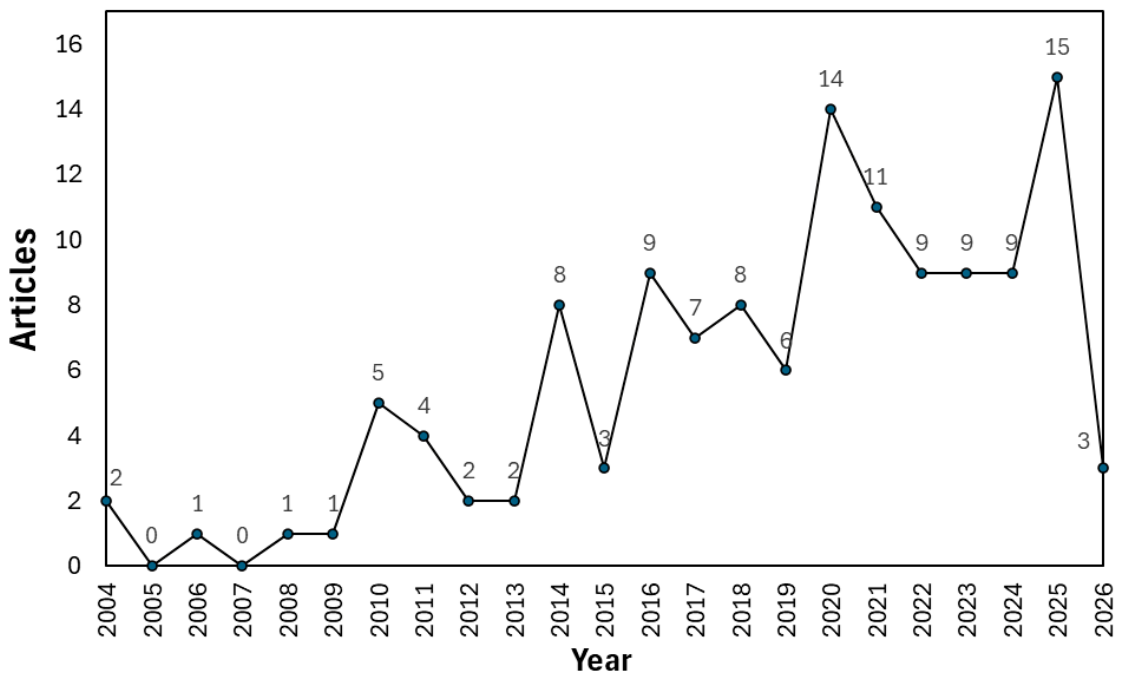
In general terms, in Figure 6 can be observed that during the first years of the interval (2004–2010), scientific production was relatively low and showed fluctuations, with values ranging from zero to only a few articles per year. This stage may be interpreted as an initial or exploratory phase of the field, in which studies appeared in an isolated manner and a clearly structured line of research had not yet been consolidated.
From 2011 to 2014, a progressive increase in the number of publications began to be observed, suggesting a growing scientific interest in the topic. This growth becomes more evident from 2016 onward, a period in which annual production consistently exceeds several articles per year.
The most notable growth is observed between 2020 and 2022, where the maximum production values within the corpus are reached, with approximately 15 articles per year. This behavior indicates a phase of consolidation and expansion of the field.
In the most recent years, a slight variation in the number of publications can be observed. The apparent decrease in 2026 does not necessarily reflect a real reduction in scientific activity but may be attributed to the fact that the year is still incomplete within the database, and therefore some articles have not yet been indexed.
Overall, the general trend shown in the figure evidences a sustained growth in scientific interest in the study domain, which suggests that the field has evolved from an initial stage of exploration toward a phase of greater consolidation and research development.

3.2. Identification of Core Journals (Bradford’s Law)

The analysis of sources through Bradford’s Law made it possible to identify the concentration of the scientific production of the corpus in a relatively reduced set of journals, evidencing the existence of a clearly defined editorial core within the studied domain.
Table 3 presents the Bradford distribution of the analyzed sources, where “Freq” corresponds to the number of documents published by each journal within the corpus, “Cumfreq” represents the cumulative frequency of publications, and “Zone” indicates the Bradford grouping according to source productivity. In this context, Bradford Zone 1 groups the journals with the highest concentration of publications, corresponding approximately to the first third of the analyzed articles.
The journals “Journal of Materials Engineering and Performance”, “Journal of Materials Processing Technology”, and “International Journal of Mechanical Sciences” present the highest publication frequencies within the analyzed corpus, followed by “International Journal of Material Forming”, “International Journal of Advanced Manufacturing Technology”, and “Materials”. Together, these journals constitute the editorial core of the investigated domain according to Bradford Zone 1.
These journals are characterized by publishing research related to sheet metal forming processes, mechanical modeling of plastic behavior, experimental deformation measurement techniques, and failure criterion development, which explains their strongly dominant editorial role within the investigated domain. Their strong presence in the corpus suggests that the scientific development of the FLC–DIC field is strongly articulated around journals specialized in materials and manufacturing technologies.
On the other hand, the analysis also reveals the presence of journals belonging to other areas of specialization that appear in later Bradford zones, such as “Materials Science and Engineering: A”, “Experimental Mechanics”, “Materials and Design”, and “Metals”, which maintain a relevant presence, although with a lower concentration of publications within the corpus.
When analyzing the thematic distribution of the sources, it is also observed that studies related to the Small Punch Test (SPT) tend to be published in journals such as “Journal of Nuclear Materials” and “International Journal of Pressure Vessels and Piping”, located in peripheral zones of the Bradford analysis. These journals are mainly oriented toward the mechanical characterization of materials subjected to extreme conditions, nuclear engineering, and structural integrity analysis, fields in which the SPT has been widely used due to its ability to evaluate mechanical properties using small-sized specimens.
This editorial distribution suggests the existence of a partial segmentation between the classical field of sheet metal formability and the domain of mechanical characterization using miniaturized techniques. While research on FLC and DIC is concentrated in journals specialized in manufacturing processes and the plastic behavior of materials, studies associated with the SPT tend to be disseminated in journals oriented toward structural engineering and the characterization of materials in nuclear or high-reliability applications.

3.3. Local Citation Analysis

The analysis of local citations by author made it possible to identify the researchers who exert the greatest influence within the analyzed corpus. In this context, local citations refer to the number of times an author is cited by other documents belonging exclusively to the analyzed dataset, rather than by the global scientific literature. This indicator is particularly useful for recognizing the authors who conceptually structure the specific field of study, independently of their overall citation impact or h-index within the broader scientific community.
An extract of the results is shown in Table 4. It can be observed that the authors with the highest number of local citations are Lin J (13 citations), Carsley J.E. (8), and Min J (8), followed by Huh H, Park N, and Yoon J.W., each with six citations. These researchers constitute the dominant intellectual core of the field, since their works are recurrently used as references within the studies that make up the corpus. In particular, their contributions are mainly related to the experimental and methodological development of the determination of Forming Limit Curves (FLCs), including the use of Digital Image Correlation (DIC). Likewise, in the table, those authors whose research is linked to the study of tooling reduction or geometrical variations in the punch are identified with an asterisk (*), which constitutes a line of research closely connected with the conceptual core of the field. The presence of these authors within the group with the highest local citations suggests that studies related to the influence of test geometry and experimental conditions are strongly articulated with the dominant conceptual basis of sheet formability.
In contrast, the authors associated with the development of the Small Punch Test (SPT) show a significantly lower presence within the local citation network. As shown in the table, Vijayanand V.D. registers only one local citation, while Karthik V presents no citations within the analyzed corpus. These authors, marked with a double asterisk (**), represent research linked to the application of the SPT combined with optical measurement techniques (DIC).
The low presence of these authors within the local citation count indicates that, although the Small Punch Test appears within the analyzed corpus of documents, its conceptual influence within the specific field of FLC determination is still limited. This result suggests that the SPT has evolved mainly within the field of the mechanical characterization of materials using miniaturized specimens, rather than as a methodology integrated into the classical experimental framework for evaluating forming limits.

3.4. Scientific Collaboration Networks

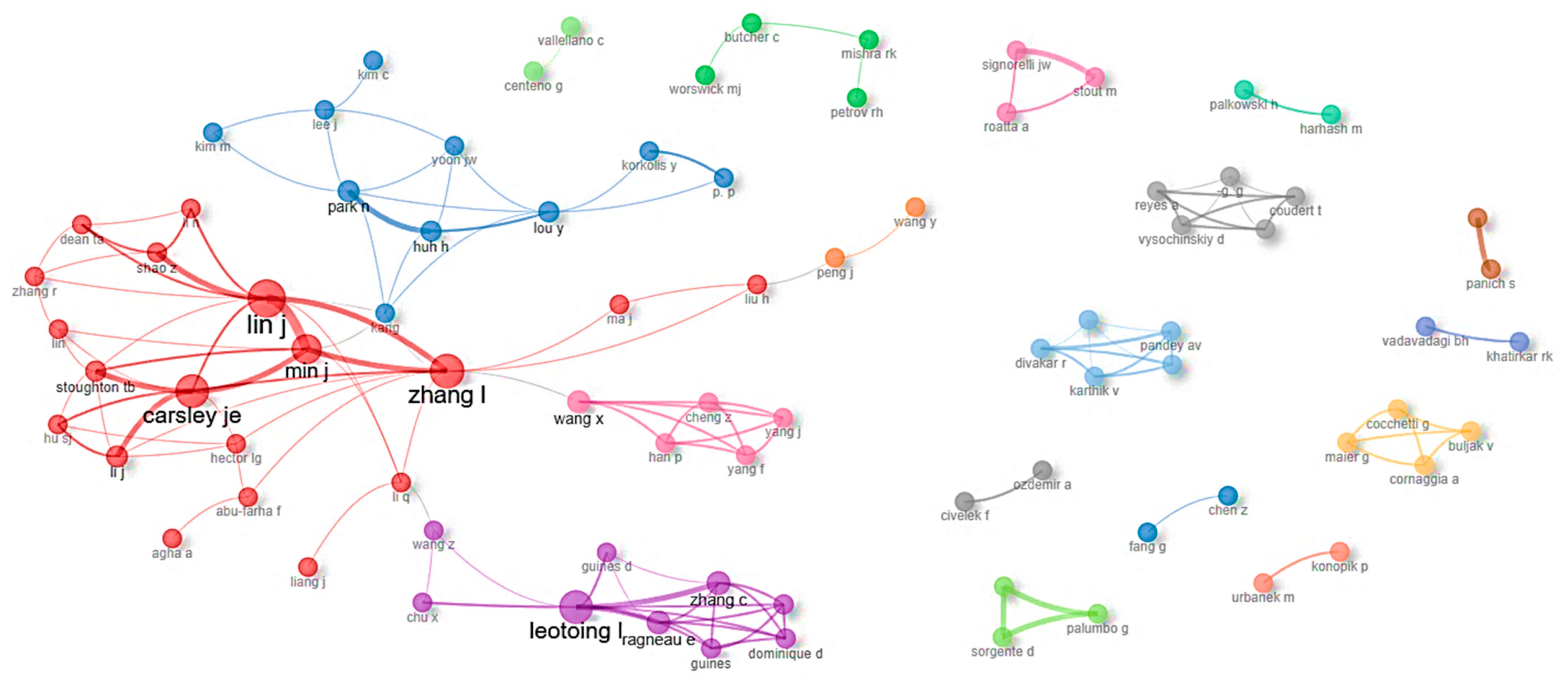
The co-authorship network, Figure 7, reveals the existence of relatively defined scientific communities within the analyzed domain. In this type of visualization, each node represents an author and the links indicate collaborative relationships established through co-authored publications. Node size reflects the relative number of collaborations associated with each author within the analyzed corpus, while the colors make it possible to identify collaboration clusters corresponding to research groups or scientific communities with similar thematic interests.
A dominant cluster associated with the experimental development of the Forming Limit Curve (FLC) using Digital Image Correlation (DIC) techniques and studies related to the influence of punch geometry and tooling reduction is identified. This cluster appears marked in red and presents the highest density of connections within the network, indicating a high level of collaboration among its members. Within this group, authors such as Lin J, Min J, Zhang I, and Carsley J.E. stand out, appearing as larger and more centrally connected nodes due to their higher collaborative participation within the corpus. The central position of these authors suggests that they play a relevant role in the structuring of this scientific community.
From this main core, other secondary clusters are connected, represented by colors such as blue, yellow, pink, and purple, which group authors working on topics related to sheet metal formability, including numerical modeling, fracture criteria, strain path analysis, and applications in different materials. Although these groups present a certain thematic specialization, their connection with the main cluster indicates that they are part of the same scientific ecosystem centered on FLC research.
On the other hand, relatively isolated clusters from the main core are also observed, suggesting the existence of research lines that evolve with less interaction with the central community of the field. Among them, a group linked to studies on experimental miniaturization and the Small Punch Test (SPT) stands out, located toward the central right area of the figure and represented in light blue, where authors such as Karthik V and collaborators appear. This group presents a lower density of collaborative links with the dominant cluster, indicating that collaborations between researchers in the field of conventional formability and those working on miniaturized configurations are relatively limited.
Additionally, the presence of multiple small and isolated clusters at the periphery of the network suggests that there are research teams working more independently or in specific thematic niches, without significant interaction with the dominant scientific community of the field.
Overall, the network structure indicates that the investigated domain is organized around a well-consolidated collaborative core centered on FLC and DIC research, while other lines of research, such as experimental miniaturization, develop in partially separated communities. The limited interaction between the FLC cluster and the SPT cluster, therefore, suggests a segmentation between scientific communities.

3.5. Keyword Co-Occurrence Networks

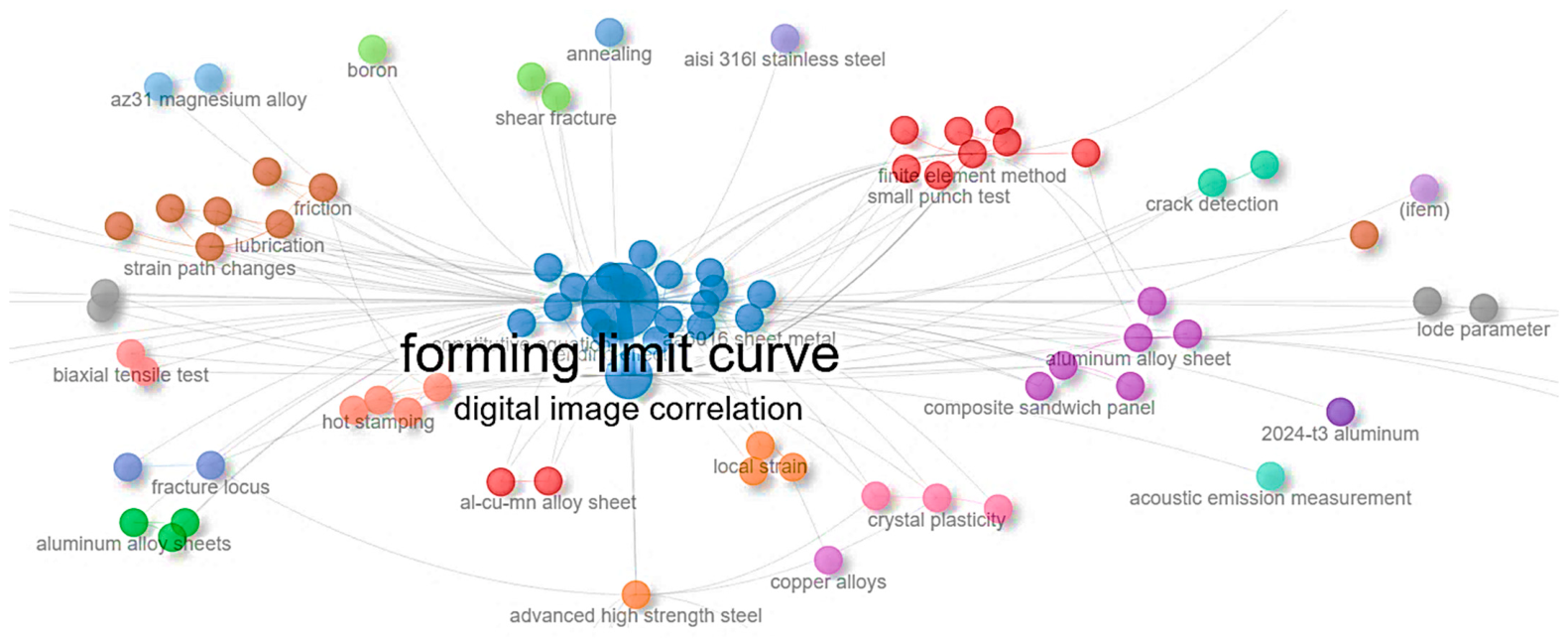
The keyword co-occurrence network shown in Figure 8 represents the conceptual relationships among the most frequently used terms within the analyzed corpus. In this type of network, each node corresponds to a keyword and its size reflects its frequency of occurrence, while the connections make it possible to identify thematic groups or conceptual clusters within the field.
Prior to network construction, a keyword normalization process was performed through the implementation of synonym and exclusion lists. Variations referring to equivalent concepts (for example, “FLC”, “FLD”, “forming limit curve”, and “forming limit diagram”) were standardized in order to avoid conceptual fragmentation within the network. Additionally, non-informative or overly generic terms that did not contribute to the thematic interpretation were removed from the analysis. These normalization and exclusion lists are provided in the database and were consistently applied in analyses involving author keywords.
At the center of the network, a highly dense conceptual core dominated by the terms “forming limit curve” and “digital image correlation” can be observed, both of which present the largest node sizes and the greatest number of connections with other terms. This behavior confirms that research in the analyzed domain is mainly articulated around the experimental determination of sheet metal formability limits through optical deformation measurement techniques. Associated with this core are terms such as “criterion” and “localized necking”, which represent the mechanical and methodological foundations used to identify the point of instability during formability tests. The strong interconnectivity among these concepts reflects that they constitute the dominant conceptual framework of the field, particularly in studies based on Nakajima tests and the use of Digital Image Correlation (DIC) to monitor the evolution of deformation.
On the other hand, thematic clusters are observed around the central core. Among them, the red cluster stands out, where the Small Punch Test (SPT) appears associated with concepts of numerical modeling and mechanical characterization. Although its position is peripheral, it shows a clear conceptual link with the domain of formability, particularly with the core related to forming limit curves and digital image correlation, indicating a thematic affinity for the study of formability limits. However, its structural role is secondary, reflecting a development still focused on tensile mechanical characterization, with a progressive transition towards formability applications.
Similarly, the brown cluster groups terms such as “friction”, “lubrication”, and “strain path changes”, which are related to experimental factors associated with punch geometry and contact conditions. Although they are not part of the central core, their proximity indicates that they constitute a relevant technical subfield within the study of formability, especially in research aimed at improving experimental accuracy and understanding the influence of test conditions.
In addition to these clusters, the network shows other thematic groups associated with specific material types (for example, aluminum alloys, copper, or advanced steels), as well as complementary experimental methods and constitutive models used to describe plastic behavior. Overall, the structure of the network shows that the field is organized around a clearly defined conceptual core, centered on the determination of Forming Limit Curves through DIC, while several peripheral research lines, such as experimental miniaturization, the influence of friction, or the study of specific materials, connect to this core by contributing methodological developments or particular applications within the domain of formability.

3.6. Thematic Analysis (Centrality vs. Density)

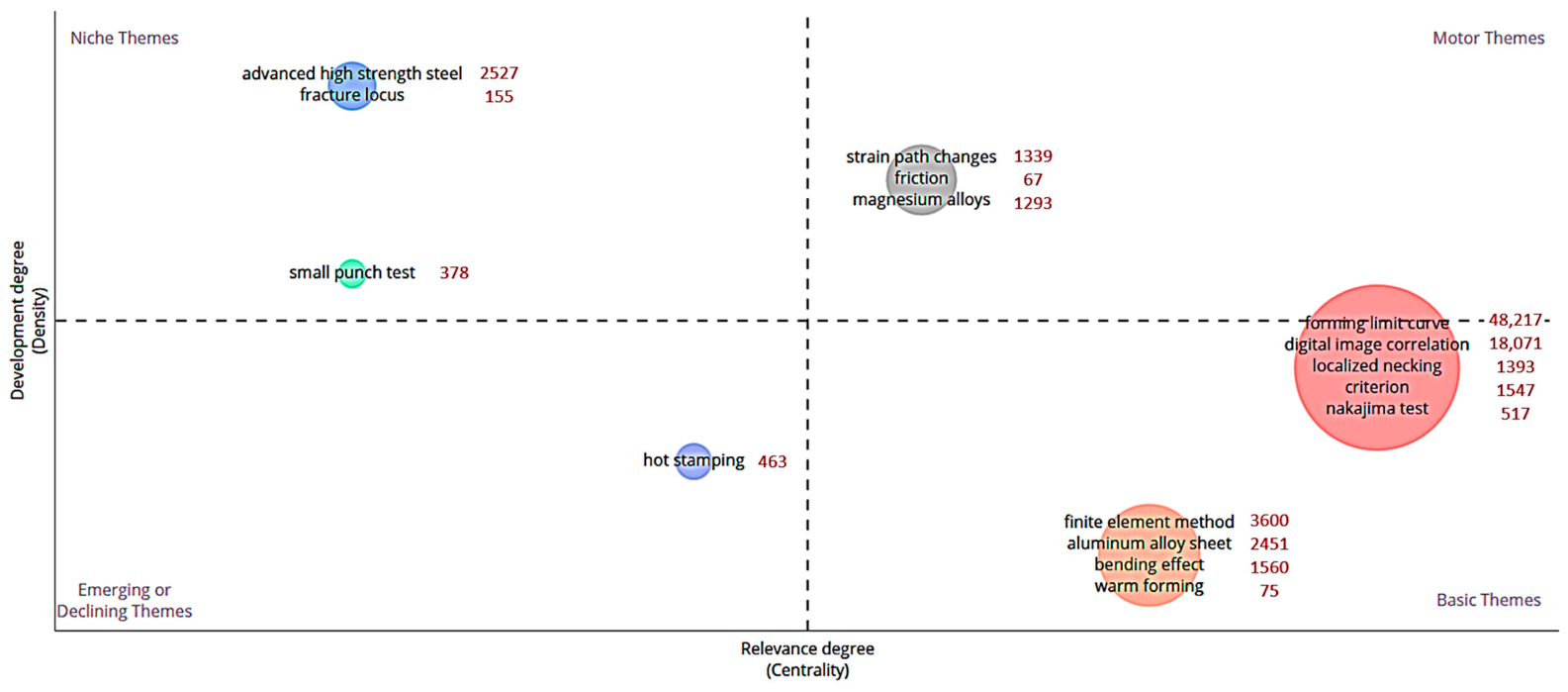
Figure 9 shows the thematic analysis of the document corpus. It is important to point out to the reader that creating this graph and the one corresponding to Figure 8 required meticulous prior keyword research. The main difficulty lies in the high sensitivity of bibliometric analysis to terminological variability, as the tool cannot distinguish between synonyms, hyphenation, different word orders, or variations such as plurals, which hinders the quantification of similar terms. Likewise, the analysis may be affected by ambiguous terms that do not provide a specific context within the corpus, making their exclusion important. Therefore, the bibliometric tool used allows for the inclusion of a list of synonyms to be considered, as well as a list of terms to be excluded from the analysis. The text files used to generate the graphs in Figure 8 and Figure 9 are included in the database.
Considering these methodological refinements, Figure 9 shows that, in the right zone of the thematic map, corresponding to high centrality themes, a dominant cluster emerges, composed of the terms “forming limit curve”, “digital image correlation”, “localized necking”, “criterion”, and “Nakajima test”. The location of this set with high centrality and moderate density indicates that it constitutes the conceptual and methodological core of the research field, since these themes are not only highly connected with the rest of the topics in the domain but also present a degree of internal development. The joint presence of forming limit curve, digital image correlation, localized necking, and Nakajima test within the same cluster confirms that research in this field is mainly structured around the experimental determination of formability limits using advanced optical techniques. In other words, the bibliometric analysis shows that the integration between classical formability tests and modern full-field deformation measurement methods constitutes the dominant axis of development within the studied field.
Likewise, two additional groups of terms appear in gray and yellow in the same right zone of the thematic map, indicating that they correspond to well-developed topics with strong connections to the rest of the research field. In other words, these topics not only exhibit a consolidated conceptual structure but also play a significant role in the articulation of different research lines within the domain of sheet metal formability. In particular, the terms “strain path changes” and “friction” are associated with the reduction in the geometric scale of the Nakajima test, which indicates an active and structurally relevant line of research within the field of formability, with strong interaction with experimental approaches aimed at reducing the geometric scale of the tooling.
In contrast, the term “small punch test” appears located in the upper left quadrant, corresponding to the Niche Themes. This quadrant groups themes with high density but low centrality, which means that they are specialized topics that have reached a certain degree of maturity within their own scientific community, but which are not yet fully integrated with the dominant research streams. It means that the SPT has evolved predominantly within the domain of tensile mechanical characterization employing small specimens, but its connection with the conceptual core dominated by FLC, DIC, and localized necking has not yet been fully developed.

4. Discussion

4.1. Structural Consolidation of the FLC–DIC Field

The different bibliometric analyses carried out make it possible to observe that the field associated with the experimental determination of Forming Limit Curves (FLCs) presents a relatively consolidated scientific structure. The sustained growth of scientific production, together with the editorial concentration identified through Bradford’s Law, indicates that research in this area is mainly articulated within a reduced set of journals specialized in materials processing and mechanical behavior. Consistently, the keyword co-occurrence and thematic map analyses reveal a clearly defined conceptual core, dominated by the terms “forming limit curve”, “digital image correlation”, “localized necking”, “criterion”, and “Nakajima test”. This suggests that the experimental determination of formability limits through formability tests, supported by full-field optical deformation measurement techniques, constitutes the central axis of this study. In addition, the local citation analysis and the co-authorship network show the presence of recurrent authors and research groups associated with the experimental and methodological development of FLC using digital image correlation, which suggests the existence of a relatively cohesive community with well-established methodological foundations.
The consolidation of this bibliometric core can be understood from the technical evolution of DIC within conventional FLC determination. Early contributions mainly incorporated DIC as a digital alternative or complement to conventional post-fracture grid-based strain measurements. In one of the earliest works identified in the corpus, Pires et al. [13] used DIC to evaluate strain distributions during drawing tests and to construct forming limit diagrams, with particular attention to image correlation procedures, virtual grids, and full-field strain analysis. At this stage, DIC was still largely presented as an emerging measurement technique. However, subsequent works progressively incorporated DIC into more complex formability experiments, including warm forming, rate-dependent testing, and hybrid experimental–numerical frameworks [16,20,21]. This gradual transition indicates that DIC appears to have evolved from a strain measurement tool toward a broader experimental support framework capable of monitoring deformation history during formability testing.
This transition became especially relevant in Nakajima, Marciniak, and related punch stretch configurations, where the critical experimental challenge is not only to measure the final strain state but also to identify the onset of localized necking. Compared with conventional circle grid analysis, DIC made it possible to follow the evolution of the strain field over the specimen surface and to reconstruct deformation paths prior to fracture. Sriram et al. [17] compared different techniques for determining FLCs in advanced high-strength steels and emphasized the ability of DIC to obtain the complete deformation history of the sample, reducing the dependence on visual inspection or operator experience. Similarly, Chen et al. [3] highlighted the value of full-field strain measurement during punch stretch testing, showing that DIC allows continuous monitoring of the deformation process instead of relying only on the initial and final states. Wang et al. [4] later systematized the use of DIC for measuring forming limit strains and compared different DIC-based approaches, evidencing that the discussion increasingly shifted from strain acquisition itself toward the objective identification of limit strains.
Within this context, one of the most important signs of methodological consolidation is the development of DIC-based criteria for detecting localized necking. The analyzed literature shows that the integration of DIC did not merely increase spatial resolution; rather, it contributed to reframing the experimental problem from final strain measurement toward the identification of localized necking as a spatially and temporally evolving instability. Different approaches have been proposed, including strain rate-based criteria, second-derivative methods, thickness control methods, strain-path transition criteria, surface geometry measurements, curvature-based procedures, and bifurcation-based interpretations [24,43,48,49,67,74,106,117]. These contributions are directly aligned with the central position of the terms “localized necking” and “criterion” in the keyword co-occurrence network, since they represent the methodological foundation through which DIC data are converted into forming limit points.
Several works illustrate this methodological evolution. Zhang et al. [24] compared different necking criteria for numerical and experimental FLC prediction, showing that local criteria based on the evolution of deformation are more suitable than global indicators such as punch force. Vysochinskiy et al. [43] addressed the problem of multiple local necks, highlighting that standard procedures may become difficult to apply when localization is not concentrated in a single well-defined necking band. Min et al. [48,49] further developed methods to compensate for process-dependent effects and to detect localized necking from surface geometry measurements, reinforcing the idea that DIC can provide information beyond in-plane strain values alone. More recent contributions continued this refinement by proposing thickness variation methods [67], deformation analysis inside the necking instability [74], bifurcation-based criteria [106], and curvature-based detection methods applied to Marciniak, Nakajima, and stretch-bend tests [117]. Taken together, these studies support the interpretation that DIC has become an important methodological platform for improving the objectivity of limit strain identification in many FLC-related investigations.
Although the bibliometric core is strongly associated with conventional FLC determination, the reviewed literature also shows that the FLC–DIC field is not restricted to a single experimental configuration. DIC has been progressively extended to several formability-related tests because these configurations share a common experimental need: to measure heterogeneous strain fields, follow strain-path evolution, and identify localized deformation or fracture under different loading conditions. In-plane biaxial and cruciform tests, for instance, have been developed to obtain better control over biaxial strain paths and to reduce some of the contact-related limitations associated with hemispherical punch tests [20,41,51,57]. Similarly, modified or sub-sized specimen configurations have been used to investigate the influence of reduced-scale, thickness reduction, punch radius, and strain gradients on forming limits [77,90,91]. In this context, DIC can be interpreted as a methodological bridge between conventional FLC testing and broader experimental strategies for evaluating formability under controlled or non-standard conditions.
The expansion of DIC toward other formability tests also reflects the growing recognition that a conventional necking-based FLC may not be sufficient to describe all failure modes relevant to sheet forming. For example, bending, stretch-bending, hemming, and hole-flanging involve different combinations of membrane stretching, bending, through-thickness strain gradients, edge cracking, and localized fracture. Studies on bending and stretch-bending have shown that curvature and strain gradients may substantially modify the apparent limit strains, requiring criteria that differ from those used in conventional membrane stretching [31,100,113,117]. Likewise, investigations of hole expansion and stretch-flangeability indicate that edge formability may be governed by mechanisms that are not fully represented by a standard FLC [97]. In this sense, DIC contributes not only to the construction of FLCs but also to the identification of the experimental conditions under which the FLC should be complemented by additional formability indicators.
A parallel development within the corpus is the transition from necking-based forming limits toward fracture-oriented and damage-based descriptions. This trend is particularly relevant for advanced high-strength steels, aluminum alloys, magnesium alloys, and materials that may fail by fracture with limited or non-obvious localized necking. In these cases, DIC has been used to obtain local strain histories up to fracture and to calibrate or validate fracture forming limit diagrams, fracture loci, and ductile damage models [34,37,53,58,60,64,72,76,85,109,115,126,133,134,137]. Park et al. [37,53,58] incorporated anisotropic fracture criteria into forming limit analysis, considering loading path effects and stress state dependence. Panich et al. [60] and Lou and Yoon [64] further advanced fracture-based descriptions by incorporating stress triaxiality, anisotropic yield functions, and fracture loci into the analysis of sheet metal failure. More recent studies extended this line toward PEPS-based forming and fracture limit descriptions, anisotropic ductile fracture criteria, and damage models suitable for non-proportional or multistage forming paths [126,133,134,137]. These works show that part of the DIC-supported FLC literature has progressively moved beyond strain measurement and has become integrated with constitutive modeling, damage accumulation, and fracture prediction.
Another relevant feature of the field is the increasing attention to process sensitivity. Several studies indicate that the measured forming limit may depend not only on the material but also on the experimental configuration and forming conditions. Friction, lubrication, punch curvature, punch diameter, sheet thickness, through-thickness strain gradients, strain rate, temperature, and cooling rate can alter the strain path, localization behavior, and fracture mode [15,16,22,55,61,63,77,80,111,117,125,130]. Zhang et al. [55] demonstrated the role of friction in Nakajima testing and showed that nonlinear strain paths can arise even in apparently conventional test conditions. Farahnak et al. [77] compared Nakajima and cruciform testing and showed that thickness reduction and contact conditions influence the measured FLC. DiCecco et al. [117] later compared different limit strain detection methods across Marciniak, Nakajima, and stretch bend tests, emphasizing that double necking, bending, and local surface curvature can affect the reliability of conventional procedures. These contributions collectively suggest that DIC has improved measurement capability and has also helped reveal the process-sensitive nature of many experimentally determined forming limits.
The same process-sensitive perspective is observed in studies conducted under non-ambient or industrially relevant forming conditions. Warm forming, hot stamping, and cryogenic forming studies have used DIC to measure forming limits under conditions where optical access, speckle stability, thermal radiation, temperature control, strain rate sensitivity, and cooling history become part of the experimental challenge [16,38,41,51,83,84,93,110,130]. For instance, Shao et al. [41,51] developed biaxial testing systems for generating FLCs under hot stamping conditions, integrating thermal control with full-field strain measurement. Yuan et al. [83] used DIC to evaluate cryogenic formability and transform experimental limits into stress-based descriptions. Samadian et al. [130] more recently combined stereo DIC with non-isothermal hot stamping experiments and M-K modeling, showing that forming temperature, punch speed, cooling rate, and strain rate history influence the FLC. These studies reinforce the idea that, under advanced forming conditions, FLCs may need to be interpreted as process-sensitive limits rather than purely fixed material curves.
The analyzed literature also shows that DIC has expanded the FLC framework toward scale-sensitive formability. Studies on ultra-thin sheets, foils, and micro/meso forming indicate that conventional macroscopic assumptions may become insufficient when sheet thickness approaches the scale of the microstructure. Xu et al. [35] reported geometry and grain size effects on the forming limit of sheet metals in micro-scaled plastic deformation, showing that size effects modify localization and formability. More recent studies on TA1 titanium foils and duplex Cu-Zn alloys used DIC-based Holmberg or combined Holmberg–Nakajima testing to relate forming limits to thickness, grain size, t/d ratio, phase fraction, dislocation activity, and microstructural evolution [121,122,131]. These contributions suggest that DIC appears particularly valuable at reduced scales because it enables the identification of heterogeneous deformation fields that cannot be adequately represented by global displacement or load measurements alone.
Finally, recent evidence also suggests that DIC can support industrial diagnosis of formability degradation. Kondás et al. [136] investigated deformation aging in DC01 steel using several methods, including tensile tests extended with DIC, deep drawing cup tests, and Nakajima tests. Their results showed that conventional tensile tests were not sufficiently sensitive to detect aging in modern cold formable steels, whereas DIC strain maps revealed local strain heterogeneity and initial Lüders-line structures from early aging stages. The same study showed that aging affected the right wing of Nakajima-based FLCs and that the use of aged FLC data in forming simulations could predict cracking in a component that remained safe when the fresh material FLC was used. This contribution broadens the role of DIC from laboratory-based limit strain determination toward industrial monitoring of time-dependent material degradation and process robustness.
Therefore, the structural consolidation of the FLC–DIC field should not be interpreted as methodological uniformity. On the contrary, the analyzed literature shows a progressively diversified field in which DIC operates as a recurring experimental framework connecting conventional FLC determination, localized necking detection, strain path analysis, fracture characterization, process-sensitive formability, and scale-dependent testing. The bibliometric centrality of FLC, DIC, localized necking, and criterion is therefore consistent with the technical evolution of the field: DIC can be understood not only as a measurement technique, but also as part of the methodological basis through which forming limits are detected, interpreted, and compared across different formability-related testing conditions. This explains why the FLC–DIC domain appears as a consolidated core within the analyzed corpus, while simultaneously continuing to expand toward fracture-based, process-dependent, and scale-sensitive descriptions of sheet metal formability.

4.2. Experimental Miniaturization as a Structural Axis of the Researching Field

The bibliometric results associated with the second search dimension suggest that geometric scaling and experimental miniaturization constitute a differentiated axis within the broader field of sheet metal formability. Unlike the FLC–DIC dimension, which is mainly organized around optical full-field strain measurement and localized necking detection, this group of studies is more closely related to the mechanical and methodological implications of reducing tooling dimensions, specimen size, or sheet thickness, particularly associated with experimental variables such as friction, strain path changes, and punch curvature. These topics appear connected to the conceptual core, although with lower centrality, suggesting that they constitute a complementary methodological line aimed at understanding the influence of tooling geometry and contact conditions on the determination of forming limit curves. The analyzed literature indicates that reducing punch diameter, punch radius, specimen dimensions, or sheet thickness may modify the relative influence of bending, curvature, through-thickness strain gradients, contact pressure, friction, nonlinear strain paths, and fracture-related mechanisms.
The relevance of punch geometry and contact conditions was already evident in early work by Lee et al. [14], who investigated thin clamped plates under hemispherical punch indentation and showed that punch radius, friction, stress triaxiality, and local strain history affect fracture initiation under punch-induced deformation. Although this study was not focused on miniaturized FLD testing, it provides an important antecedent for understanding why punch-based formability limits are sensitive to tool geometry and contact conditions. This issue was later addressed more directly by Fictorie et al. [22], Chu et al. [80], and Peng et al. [91], who studied the influence of punch diameter or punch curvature on FLC determination. In general, these works reported that smaller punch diameters or increased out-of-plane/bending effects can shift the measured FLC toward higher strain levels. However, they also indicate that such increases should not be interpreted automatically as higher intrinsic material formability, since they may be associated with curvature, contact pressure, strain path evolution, or bending-induced stabilization.
A central contribution to the interpretation of these effects was provided by Min et al. [48], who proposed a procedure to compensate for curvature, nonlinear strain paths, and through-thickness pressure using DIC-based deformation histories. Their analysis showed that differences between Marciniak, conventional Nakajima, and reduced punch Nakajima tests can be partially rationalized when these process-dependent effects are explicitly considered. This interpretation is consistent with the work of Affronti and Merklein [61], who showed that the hemispherical punch in Nakajima testing introduces bending and biaxial pre-straining effects that depend on the material thickness to punch radius ratio. Similarly, Cheong et al. [63] showed that severe through-thickness strain gradients may delay or suppress tensile instability, making fracture-related limits more relevant under severe bending conditions. Taken together, these studies suggest that reducing the punch radius or diameter modifies the mechanical nature of the test by increasing the relative role of bending, pressure, and strain gradients.
In parallel, several studies developed miniaturized or sub-sized experimental systems to make formability testing feasible for limited material availability, ultra-thin sheets, or laboratory-scale equipment. Leonard et al. [62] designed a miniaturized Marciniak–Kuczynski device with DIC for laboratory-scale FLD determination, showing that reduced equipment can provide useful forming limit data when the deformation mode and carrier blank behavior are properly controlled. Sudarsan et al. [69] developed a sub-size LDH setup with a 30 mm hemispherical punch for 200 µm thick SS304 sheets and showed that, at this scale, grid size, stretching direction, punch size, and punch speed may influence the resulting FLD. Ayachi et al. [81] further demonstrated that for 0.1 mm-thick copper and copper–beryllium sheets, conventional Nakazima tool dimensions and standard testing procedures are no longer directly valid, requiring reduced-scale tooling, adapted specimen geometry, and suitable evaluation methods. In a more application-oriented context, Haldar et al. [103] used a small-scale stretch forming setup with a 30 mm punch to evaluate the formability of micro plasma arc-welded AISI 316L thin sheet joints, illustrating that reduced setups can also be applied to heterogeneous thin sheet systems.
The question of transferability between standard and reduced configurations is therefore central. Rubešová et al. [90] directly compared standard and sub-sized Nakajima specimens made of 22MnB5 steel and emphasized that the interchangeability of standard and miniaturized results had not been proven. Their miniaturized specimens produced higher strain values, which were attributed to changes in the material thickness to punch diameter ratio and bending conditions. Notably, the best agreement between standard and miniaturized tests was obtained for the fracture forming limit diagram rather than for the conventional FLD.
Overall, the studies grouped in this dimension support the interpretation derived from the bibliometric analysis; that is, geometric scaling and experimental miniaturization constitute a differentiated but complementary methodological axis within the broader field of sheet metal formability. The reviewed literature shows that this axis is not limited to the practical use of smaller tools or sub-sized specimens, but is mainly associated with the mechanical and methodological implications of reducing punch diameter, punch radius, specimen size, or sheet thickness. In agreement with the lower but still connected centrality observed in the bibliometric structure, these studies remain linked to the FLC domain through variables such as punch curvature, friction, strain-path evolution, bending severity, contact pressure, and through-thickness strain gradients.

4.3. DIC Integration into Standardized Small Punch Test Configurations

The bibliometric analyses reveal a differentiated positioning of the Small Punch Test (SPT) within the field. From an editorial and authorship perspective, the SPT does not constitute a component of the prevailing core, which is predominantly characterized by the establishment of limit curves (FLCs) and Digital Image Correlation (DIC). The analysis of co-authorship networks and local citation patterns indicates that researchers working on SPT tend to organize into relatively independent clusters, with limited integration into the main scientific community focused on sheet metal formability. However, a divergent trend becomes evident at the conceptual level. Keyword co-occurrence analysis and thematic mapping indicate that the SPT maintains strong connections with key topics such as experimental miniaturization, geometric scaling device and digital image correlation, although it must be approached with caution because the mechanical boundary conditions of the SPT are substantially different from those of standardized Nakajima tests.
The three studies included in the SPT–DIC subset show a coherent but still incipient methodological progression from full-field deflection mapping to strain localization analysis, and finally to fracture initiation monitoring in notched SPT specimens. DIC implementation in SPT configurations has mainly focused on enriching the conventional force–deflection response through spatially resolved measurements that are difficult to obtain using traditional SPT instrumentation.
In the first identified contribution, Vijayanand et al. [10] integrated in situ DIC with the Small Punch Test to overcome the limitations of single-point deflection or punch displacement measurements. By mapping the full-field out-of-plane deflection of the specimen and combining these data with inverse finite element analysis, they showed that multi-point DIC-based deflection information improved the estimation of tensile properties compared with a single-point optimization approach. Thus, DIC was introduced in this context as a tool for improving the interpretation of heterogeneous SPT deformation rather than as a direct method for determining forming limit curves.
This approach was extended by Shaik et al. [11], who used stereo-DIC to measure strain distributions on the lower surface of SPT specimens. Their results showed that the maximum equivalent plastic strain shifts from the specimen center during early bending stages toward a characteristic radial location, approximately 0.6–0.8 mm from the center, where strain localization, instability and cracking develop. By combining DIC-based strain measurements with finite element stress estimation at this location, they proposed a methodology for constructing stress–strain curves from SPT data.
More recently, Shaik et al. [12] applied 3D-DIC to notched SPT specimens to track notch mouth opening displacement, δSPT. They reported that the maximum δSPT occurred at approximately 0.61–0.62 mm from the specimen center, coinciding with the crack initiation region confirmed by SEM observations.
Taken together, these studies are consistent with the bibliometric positioning of SPT–DIC as an emerging and weakly consolidated line within the analyzed corpus. Rather than showing a direct convergence with conventional FLC determination, the available evidence indicates that SPT–DIC is evolving along a different methodological trajectory. In the current corpus, DIC does not convert the SPT into a direct FLC test; instead, it provides access to local deformation and fracture-related indicators, such as deflection fields, radial strain localization, and notch-opening evolution, which complement the conventional force–deflection response.

4.4. Structural Positioning of SPT with Respect to FLC–DIC

From the bibliometric and technical analyses carried out in this study, the SPT–DIC dimension can be positioned as a peripheral but conceptually relevant line within the broader discussion on miniaturized formability assessment. In this sense, the SPT–DIC field should not be interpreted as a direct extension of conventional FLC determination, but neither should it be considered completely disconnected from it. The technical discussion developed in the previous sections shows that the transition from conventional FLC testing toward reduced-scale configurations is not governed only by specimen or tooling miniaturization, but also by changes in bending severity, contact pressure, through-thickness gradients, strain-path evolution, and fracture-related mechanisms. These same factors are inherent to the SPT configuration, where deformation evolves through bending, membrane stretching, localized thinning, radial strain localization, and final fracture. Therefore, SPT–DIC can be interpreted as a neighboring reduced-scale characterization route whose potential integration with FLC–DIC depends on whether these mechanical differences can be quantified, corrected, or systematically related to conventional formability indicators.
The three SPT–DIC studies identified in the corpus support this cautious positioning. They show that DIC can enrich SPT interpretation by mapping full-field deflection, identifying characteristic radial locations of strain localization, and tracking notch mouth opening displacement associated with fracture initiation. Nevertheless, these contributions are still oriented toward tensile property estimation, stress–strain reconstruction, and fracture characterization, rather than toward the direct determination of FLCs. Thus, the current evidence supports the methodological potential of SPT–DIC, but not yet its equivalence with standardized Nakajima-based FLC testing.
Accordingly, the structural position of SPT–DIC within the analyzed corpus may be described as promising but still incipient. Its main contribution at this stage is not to replace conventional FLC methodologies, but to open a possible research pathway for evaluating whether local deformation and fracture indicators obtained from standardized SPT configurations can be correlated with FLC or other formability-related criteria. Future work should therefore prioritize direct experimental comparisons between SPT–DIC and standardized Nakajima tests under controlled material, thickness, lubrication, punch geometry, and strain-path conditions. Only through this type of validation could SPT–DIC move from a complementary reduced-scale mechanical characterization technique toward a more integrated role in miniaturized formability assessment.

5. Limitations

The present study is subject to several limitations inherent to bibliometric analyses. First, the obtained corpus depends on the search equations, database coverage, indexing criteria, and filtering strategies employed during the document selection process. Although synonym normalization and thematic filtering procedures were implemented to reduce ambiguity, some relevant studies may have remained outside the final dataset due to differences in terminology, indexing practices, or database accessibility.
Additionally, the bibliometric results primarily reflect structural and conceptual relationships within the scientific literature and should not be interpreted as direct experimental validation of the equivalence between Small Punch Test (SPT) methodologies and conventional Forming Limit Curve (FLC) determination techniques. While the analysis identifies a growing conceptual proximity between experimental miniaturization approaches, Digital Image Correlation (DIC), and formability evaluation methodologies, the mechanical transferability between reduced-scale tests and standardized Nakajima methodologies remains an open research problem requiring further experimental and numerical validation.

6. Conclusions

Bibliometric analysis shows that the field associated with the experimental determination of Formability Limit Curves (FLCs) has a consolidated scientific structure, primarily centered on the Nakajima test and the use of Digital Image Correlation (DIC) as the dominant field. From an editorial and authorship perspective, the Small Punch Test (SPT) remains relatively disconnected from this core, developing mainly within the tensile mechanical characterization. However, from a conceptual level, the SPT is strongly associated with topics such as experimental miniaturization, geometric scaling, and digital image correlation techniques, indicating that, despite its limited structural integration, it is aligned with the fundamental principles of formability assessment.
In this context, the SPT may be interpreted as a promising research direction within the framework of reduced-scale experimental approaches for formability-related characterization under limited material availability conditions. Nevertheless, the present study does not establish the SPT as a validated alternative to standardized Nakajima-based FLC determination, since important methodological and mechanical differences remain insufficiently understood and experimentally validated.
Overall, the results suggest that the integration between reduced-scale punch methodologies and DIC techniques constitutes an emerging line of research with potential relevance for future formability assessment strategies. Consequently, further experimental and numerical studies will be necessary to evaluate the mechanical equivalence, applicability, and limitations of these approaches within the conventional FLC framework.

Author Contributions

Conceptualization, E.L.V., L.A.A.-C. and A.I.B.G.; methodology, I.A.N. and S.M.D.; software, E.L.V. and I.A.N.; validation, I.R.L. and J.A.P.M.; formal analysis, J.A.P.M. and A.G.S.S.; investigation, A.G.S.S.; resources, A.I.B.G.; data curation, J.P.O.; writing—original draft preparation, E.L.V.; writing—review and editing, A.I.B.G. and I.R.L.; visualization, I.A.N. and J.P.O.; supervision, S.M.D.; project administration, L.A.A.-C.; funding acquisition, A.I.B.G. and S.M.D. All authors have read and agreed to the published version of the manuscript.

Funding

Secretaría de Ciencias, Humanidades, Tecnología e Innovación (SECIHTI): Becas Nacionales-Rizoma application number 66d8a1ce1e5e424deb855649; Tecnológico Nacional de México en Celaya: Doctorado en Ciencias en Ingeniería Electrónica-Project number CF-2023-I-98.

Data Availability Statement

The data presented in this study are available on request from the corresponding author. (The data are not publicly available due to the bibliographic records are subject to database access and redistribution restrictions).

Acknowledgments

The authors thank CIATEC for their support in the development of bibliometric searches.

Conflicts of Interest

The authors declare no conflicts of interest. The funders had no role in the design of the study; in the collection, analyses, or interpretation of data; in the writing of the manuscript; or in the decision to publish the results.

Abbreviations

The following abbreviations are used in this manuscript:
DICDigital Image Correlation
FLCFormability Limit Curve
SPTSmall Punch Test

Appendix A

This appendix presents the specific search equations implemented in each scientific database consulted during the bibliographic retrieval process. Due to differences in search engine structure, syntax compatibility, and character limitations among platforms, the search equations were adapted accordingly while preserving the conceptual consistency of the study. The tables also indicate the document sections explored in each database, such as title, keywords, and abstract fields. In this context, the asterisk (*) acts as a wildcard. This means that it replaces one or more unknown words in the place where is inserted.
Table A1. Search Equation (1) applied to each database.
DatabasesSectionsSearch Equation Applied
SCOPUSTitle, keywords and abstract.(“forming limit diagram*” OR “forming-limit diagram*” OR “forming limit curve*” OR “forming-limit curve*” OR “fracture limit curve*” OR “fracture-limit curve*”) AND (“digital image correlation*” OR “digital-image correlation*”OR “image matching” OR “digital assisted image correlation*” OR “digital-assisted image correlation*”)
WEB OF SCIENCE
SAGE JOURNALS
MDPI
TAYLOR AND FRANCIS
SCIELOTitle
SCIENCE DIRECTTitle, keywords and abstract.(“digital image correlation?” OR “digital-image correlation?” OR “image matching” OR “digital assisted image correlation?”) AND (“forming limit diagram?” OR “forming-limit diagram?” OR “forming limit curve?” OR “forming-limit curve?” OR “fracture limit curve?”)
SPRINGER LINKTitle(“forming limit diagram*” OR “forming limit curve*” OR “fracture limit curve*”) AND (“digital image correlation*” OR “image matching” OR “digital assisted image correlation*”)
GOOGLE SCHOLARTitleallintitle: (“digital image correlation”||”digital image correlations”||”image matching”||”digital assisted image correlation”) (“forming limit diagram”||”forming limit diagrams”||”forming limit curve”||”forming limit curves”||”fracture limit curve”||”fracture limit curves”)
Table A2. Search Equation (2) applied to each database.
DatabasesSectionsSearch Equation Applied
SCOPUS
WEB OF SCIENCE
SAGE JOURNALS
MDPI
TAYLOR AND FRANCIS
Title, keywords and abstract.(“small punch” OR “small-punch” OR “small punch test” OR “small-punch test” OR “small punch testing” OR “small-punch testing” OR “punch curvature*” OR “punch-curvature*” OR “punch radius” OR “punch-radius” OR “punch-radii” OR “punch radii” OR “punch diameter*” OR “punch-diameter*” OR “miniaturized punch” OR “miniaturized-punch” OR “small diameter*” OR “small-diameter*” OR “small radius” OR “small-radius” OR “small radii” OR “small-radii” OR “sub sized specimen*” OR “sub-sized specimen*” OR “small specimen*” OR “small-specimen*” OR “miniaturized specimen*” OR “miniaturized-specimen*” OR “small sample*” OR “small-sample*” OR “sub sized sample*” OR “sub-sized sample*” OR “miniaturized sample*” OR “miniaturized-sample*” OR “miniaturized device” OR “small device”) AND (“forming limit diagram*” OR “forming-limit diagram*” OR “forming limit curve*” OR “forming-limit curve*” OR “fracture limit curve*” OR “fracture-limit curve*”)
SCIELOTitle
SCIENCE DIRECTTitle, keywords and abstract.(“small punch” OR “punch curvature?” OR “punch radius” OR “punch diameter?” OR “sub sized specimen?” OR “sub-sized specimen?”) AND (“forming limit diagram?” OR “forming limit curve?”)
SPRINGER LINKTitle(“small punch” OR “small punch test” OR “small punch testing” OR “punch curvature*” OR “punch radius” OR “punch radii” OR “punch diameter*” OR “miniaturized punch” OR “small diameter*” OR “small radius” OR “small radii” OR “sub sized specimen*” OR “small specimen*” OR “miniaturized specimen*” OR “small sample*” OR “sub sized sample*” OR “miniaturized sample*” OR “miniaturized device” OR “small device”) AND (“forming limit diagram*” OR “forming limit curve*” OR “fracture limit curve*”)
GOOGLE SCHOLARTitleallintitle: (“small punch”||”punch curvature”||”punch radius”||”punch diameter”||”miniaturized punch”||”sub sized specimen”||”small specimen”||”miniaturized specimen”||”small sample”||”sub sized sample”) (“forming limit diagram”||”forming limit curve”||”fracture limit curve”)
Table A3. Search Equation (3) applied to each database.
DatabasesSectionsSearch Equation Applied
SCOPUSTitle, keywords and abstract.(“small punch” OR “small-punch” OR “small punch test” OR “small-punch test” OR “small punch testing” OR “small-punch testing”) AND (“digital image correlation*” OR “digital-image correlation*”OR “image matching” OR “digital assisted image correlation*” OR “digital-assisted image correlation*”)
WEB OF SCIENCE
SAGE JOURNALS
MDPI
TAYLOR AND FRANCIS
SCIELOTitle
SCIENCE DIRECTTitle, keywords and abstract.(“small punch” OR “small-punch” OR “small punch test” OR “small-punch test” OR “small punch testing” OR “small-punch testing”) AND (“digital image correlation?” OR “image matching “)
SPRINGER LINKTitle(“small punch” OR “small punch test” OR “small punch testing”) AND (“digital image correlation*” OR “image matching” OR “digital assisted image correlation*”)
GOOGLE SCHOLARTitleallintitle: (“small punch”||“small punch test”) (“digital image correlation”||“digital image correlations”||“image matching”||“digital assisted image correlation”)

Appendix B

This appendix presents the quantitative results obtained during the application of the search equations across the different scientific databases consulted. The tables summarize the number of initial records retrieved, the reduction produced by the application of platform-specific filters, and the final consolidation of bibliographic records after duplicate removal and thematic relevance screening.
Table A4. Database filtering results for Equation (1).
DatabaseNumber of Initial Docs
(NA1)
Number of Docs After Platform Filters
(NA2)
SCOPUS164139
WEB OF SCIENCE144101
SAGE JOURNALS44
MDPI1010
TAYLOR AND FRANCIS11
SCIENCE DIRECT4747
SPRINGER LINK32
GOOGLE SCHOLAR2525
SCIELO10
# Total of docs obtained in the concentration of bibliographic records without duplicates (N)147
# Total of docs after thematic relevant filters (M)123
Table A5. Database filtering results for Equation (2).
DatabaseNumber of Initial Docs
(NA1)
Number of Docs After Platform Filters
(NA2)
SCOPUS4532
WEB OF SCIENCE3729
SAGE JOURNALS11
MDPI44
TAYLOR AND FRANCIS44
SCIENCE DIRECT99
SPRINGER LINK00
GOOGLE SCHOLAR11
SCIELO00
# Total of docs obtained in the concentration of bibliographic records without duplicates (N)32
# Total of docs after thematic relevant filters (M)14
Table A6. Database filtering results for Equation (3).
DatabaseNumber of Initial Docs
(NA1)
Number of Docs After Platform Filters
(NA2)
SCOPUS1510
WEB OF SCIENCE1812
SAGE JOURNALS11
MDPI00
TAYLOR AND FRANCIS11
SCIENCE DIRECT11
SPRINGER LINK11
GOOGLE SCHOLAR22
SCIELO11
# Total of docs obtained in the concentration of bibliographic records without duplicates (N)12
# Total of docs after thematic relevant filters (M)3

References

  1. ISO 12004-2; Metallic Materials—Determination of Forming-Limit Curves for Sheet and Strip—Part 2: Determination of Forming-Limit Curves in the Laboratory. ISO: Geneva, Switzerland, 2021.
  2. ASTM E2218; Standard Test Method for Determining Forming Limit Curves. ASTM International: West Conshohocken, PA, USA, 2023.
  3. Chen, X.; Xie, X.; Sun, J.; Yang, L. Full Field Strain Measurement of Punch-stretch Tests Using Digital Image Correlation. SAE Int. J. Mater. Manuf. 2012, 5, 345–351. [Google Scholar] [CrossRef]
  4. Wang, K.; Carsley, J.E.; He, B.; Li, J.; Zhang, L. Measuring forming limit strains with digital image correlation analysis. J. Mater. Process. Technol. 2014, 214, 1120–1130. [Google Scholar] [CrossRef]
  5. Vadavadagi, B.H.; Bhujle, H.V.; Khatirkar, R.K. Forming Limit Diagrams of Low-Carbon Steels Obtained Using Digital Image Correlation Technique and Enhanced Formability Predictions Incorporating Microstructural Developments. J. Mater. Eng. Perform. 2020, 29, 6066–6077. [Google Scholar] [CrossRef]
  6. Wang, Y.; Sha, A.; Li, X.; Jia, C.; Hao, W. Experimental Study on the Forming Limit of GH605 Superalloy Sheet Using Digital Image Correlation. J. Mater. Eng. Perform. 2021, 30, 1420–1429. [Google Scholar] [CrossRef]
  7. Arunkumar, S. Overview of Small Punch Test. Met. Mater. Int. 2020, 26, 719–738. [Google Scholar] [CrossRef]
  8. Manahan, M.P.; Argon, A.S.; Harling, O.K. The development of a miniaturized disk bend test for the determination of postirradiation mechanical properties. J. Nucl. Mater. 1981, 104, 1545–1550. [Google Scholar] [CrossRef]
  9. ASTM 3205; Standard Test Method for Small Punch Testing of Metallic Materials. ASTM International: West Conshohocken, PA, USA, 2026.
  10. Vijayanand, V.D.; Mokhtarishirazabad, M.; Peng, J.; Wang, Y.; Gorley, M.; Knowles, D.M.; Mostafavi, M. A novel methodology for estimating tensile properties in a small punch test employing in-situ DIC based deflection mapping. J. Nucl. Mater. 2020, 538, 152260. [Google Scholar] [CrossRef]
  11. Shaik, A.R.; Pandey, A.V.; Karthik, V.; Kolhatkar, A.; Abhishek, G.; Divakar, R. Application of Digital Image Correlation to Small Punch Test for Determination of Stress–Strain Properties. Trans. Indian Inst. Met. 2024, 77, 3879–3892. [Google Scholar] [CrossRef]
  12. Shaik, A.R.; Karthik, V.; Pandey, A.V.; Divakar, R. Fracture toughness estimation from notched small punch test using 3D-DIC. Int. J. Press. Vessel. Pip. 2026, 220, 105737. [Google Scholar] [CrossRef]
  13. Pires, G.; Robert, M.; Arrieux, R. Studies on drawing of the aluminium A5052 alloy in the thixocast condition. J. Mater. Process. Technol. 2004, 157, 596–603. [Google Scholar] [CrossRef]
  14. Lee, Y.; Woertz, J.; Wierzbicki, T. Fracture prediction of thin plates under hemi-spherical punch with calibration and experimental verification. Int. J. Mech. Sci. 2004, 46, 751–781. [Google Scholar] [CrossRef]
  15. Casari, F.; Tassan, M.; Messina, A.; Molinari, A. Effect of punch diameter, grid dimension, and lubrication on forming limit diagram. J. Test. Eval. 2006, 34, 24–30. [Google Scholar] [CrossRef]
  16. Palumbo, G.; Sorgente, D.; Tricarico, L. The design of a formability test in warm conditions for an AZ31 magnesium alloy avoiding friction and strain rate effects. Int. J. Mach. Tools Manuf. 2008, 48, 1535–1545. [Google Scholar] [CrossRef]
  17. Sriram, S.; Huang, G.; Yan, B.; Geoffroy, J.L. Comparison of forming limit curves for advanced high strength steels using different techniques. SAE Int. J. Mater. Manuf. 2009, 2, 472–481. [Google Scholar] [CrossRef]
  18. Zhang, C.; Leotoing, L.; Zhao, G.; Guines, D.; Ragneau, E. A methodology for evaluating sheet formability combining the tensile test with the M-K model. Mater. Sci. Eng. A 2010, 528, 480–485. [Google Scholar] [CrossRef]
  19. Palumbo, G.; Sorgente, D.; Tricarico, L. A numerical and experimental investigation of AZ31 formability at elevated temperatures using a constant strain rate test. Mater. Des. 2010, 31, 1308–1316. [Google Scholar] [CrossRef]
  20. Zidane, I.; Guines, D.; Leotoing, L.; Ragneau, E. Development of an in-plane biaxial test for forming limit curve (FLC) characterization of metallic sheets. Meas. Sci. Technol. 2010, 21, 055701. [Google Scholar] [CrossRef]
  21. Zhang, C.; Leotoing, L.; Guines, D.; Ragneau, E. Experimental and numerical study on effect of forming rate on AA5086 sheet formability. Mater. Sci. Eng. A 2010, 527, 967–972. [Google Scholar] [CrossRef][Green Version]
  22. Fictorie, E.; van den Boogaard, A.H.; Atzema, E.H. Influence of punch radius in a Nakazima test for mild steel and aluminium. Int. J. Mater. Form. 2010, 3, 1179–1182. [Google Scholar] [CrossRef]
  23. Tobon, J.D.; Silverstein, C.; Rueda, J.; Guessous, L.; Yang, L. A Study of Anisotropy and Post-Necking Local Fracture Strain of Advanced High Strength Steel with the Utilization of Digital Image Correlation. SAE Int. J. Mater. Manuf. 2011, 4, 1099–1106. [Google Scholar] [CrossRef]
  24. Zhang, C.; Leotoing, L.; Zhao, G.; Guines, D.; Ragneau, E. A comparative study of different necking criteria for numerical and experimental prediction of FLCs. J. Mater. Eng. Perform. 2011, 20, 1036–1042. [Google Scholar] [CrossRef]
  25. Li, J.; Hu, S.J.; Carsley, J.E.; Lee, T.M.; Hector, L.G.; Mishra, S., Jr. Postanneal Mechanical Properties of Prestrained AA5182-O Sheets. J. Manuf. Sci. Eng.-Trans. ASME 2011, 133, 061007. [Google Scholar] [CrossRef]
  26. Djavanroodi, F.; Abbasnejad, D.S.; Nezami, E.H. Deep Drawing of Aluminum Alloys Using a Novel Hydroforming Tooling. Mater. Manuf. Process. 2011, 26, 796–801. [Google Scholar] [CrossRef]
  27. Davidkov, A.; Jain, M.K.; Petrov, R.H.; Wilkinson, D.S.; Mishra, R.K. Strain localization and damage development during bending of Al-Mg alloy sheets. Mater. Sci. Eng. A-Struct. Mater. Prop. Microstruct. Process. 2012, 550, 395–407. [Google Scholar] [CrossRef]
  28. Dos Santos Freitas, M.C.; Moreira, L.P.; Velloso, R.G. Experimental analysis and theoretical predictions of the limit strains of a hot-dip galvanized interstitial-free steel sheet. Mater. Res. 2013, 16, 351–366. [Google Scholar] [CrossRef][Green Version]
  29. Li, J.; Carsley, J.E.; Stoughton, T.B.; Hector, L.G.; Hu, S.J., Jr. Forming limit analysis for two-stage forming of 5182-O aluminum sheet with intermediate annealing. Int. J. Plast. 2013, 45, 21–43. [Google Scholar] [CrossRef]
  30. Martinez-Donaire, A.J.; Garcia-Lomas, F.J.; Vallellano, C. New approaches to detect the onset of localised necking in sheets under through-thickness strain gradients. Mater. Des. 2014, 57, 135–145. [Google Scholar] [CrossRef]
  31. Mishra, A.; Thuillier, S. Investigation of the rupture in tension and bending of DP980 steel sheet. Int. J. Mech. Sci. 2014, 84, 171–181. [Google Scholar] [CrossRef]
  32. Huang, G.; Sadagopan, S.; Schreier, H. Determination of Forming Limit and Fracture Limit Curves Using Digital Image Correlation. SAE Int. J. Mater. Manuf. 2014, 7, 574–582. [Google Scholar] [CrossRef]
  33. Rohatgi, A.; Soulami, A.; Stephens, E.V.; Davies, R.W.; Smith, M.T. An investigation of enhanced formability in AA5182-O Al during high-rate free-forming at room-temperature: Quantification of deformation history. J. Mater. Process. Technol. 2014, 214, 722–732. [Google Scholar] [CrossRef]
  34. Pack, K.; Ahn, K.; Huh, H.; Lou, Y. Fracture modelling of DP780 sheets using a hybrid experimental-numerical method and two-dimensional digital image correlation. Int. J. Mater. Prod. Technol. 2014, 48, 34–46. [Google Scholar] [CrossRef]
  35. Xu, Z.T.; Peng, L.F.; Lai, X.M.; Fu, M.W. Geometry and grain size effects on the forming limit of sheet metals in micro-scaled plastic deformation. Mater. Sci. Eng. A 2014, 611, 345–353. [Google Scholar] [CrossRef]
  36. Hütsch, L.L.; Hütsch, J.; Herzberg, K.; dos Santos, J.F.; Huber, N. Increased room temperature formability of Mg AZ31 by high speed Friction Stir Processing. Mater. Des. 2014, 54, 380–388. [Google Scholar] [CrossRef]
  37. Park, N.; Huh, H.; Nam, J.B.; Jung, C.G. Anisotropy effect on the fracture model of DP980 sheets considering the loading path. Int. J. Automot. Technol. 2015, 16, 73–81. [Google Scholar] [CrossRef]
  38. Bagheriasl, R.; Worswick, M.J. Formability of AA3003 brazing sheet at elevated temperatures: Limiting dome height experiments and determination of forming limit diagrams. Int. J. Mater. Form. 2015, 8, 229–244. [Google Scholar] [CrossRef]
  39. Sun, T.; Liang, J.; Guo, X.; Ren, M.; Wang, L. Optical Measurement of Forming Limit and Formability of Cu/Al Clad Metals. J. Mater. Eng. Perform. 2015, 24, 1426–1433. [Google Scholar] [CrossRef]
  40. Srivastava, A.; Bower, A.F.; Hector, L.G.; Carsley, J.E.; Zhang, L.; Abu-Farha, F. A multiscale approach to modeling formability of dual-phase steels. Model. Simul. Mater. Sci. Eng. 2016, 24, 025011. [Google Scholar] [CrossRef]
  41. Shao, Z.; Li, N.; Lin, J.; Dean, T.A. Development of a New Biaxial Testing System for Generating Forming Limit Diagrams for Sheet Metals Under Hot Stamping Conditions. Exp. Mech. 2016, 56, 1489–1500. [Google Scholar] [CrossRef]
  42. Saxena, K.K.; Drotleff, K.; Mukhopadhyay, J. Elevated temperature forming limit strain diagrams of automotive alloys Al6014-T4 and DP600: A case study. J. Strain Anal. Eng. Des. 2016, 51, 459–470. [Google Scholar] [CrossRef]
  43. Vysochinskiy, D.; Coudert, T.; Hopperstad, O.S.; Lademo, O.G.; Reyes, A. Experimental detection of forming limit strains on samples with multiple local necks. J. Mater. Process. Technol. 2016, 227, 216–226. [Google Scholar] [CrossRef]
  44. Li, J.; Xu, W.; Xie, X.; Siebert, T.; Yang, L. Experimental study of FLD0 for aluminum alloy using digital image correlation with modified ISO method. Int. J. Mater. Res. 2016, 107, 245–253. [Google Scholar] [CrossRef]
  45. Zhang, L.; Lin, J.; Min, J.; Ye, Y.; Kang, L. Formability Evaluation of Sheet Metals Based on Global Strain Distribution. J. Mater. Eng. Perform. 2016, 25, 2296–2306. [Google Scholar] [CrossRef]
  46. Seymen, Y.; Guler, B.; Efe, M. Large Strain and Small-Scale Biaxial Testing of Sheet Metals. Exp. Mech. 2016, 56, 1519–1530. [Google Scholar] [CrossRef]
  47. Gao, X.L.; Min, J.Y.; Zhang, L.; Li, Q.C.; Lian, C.W.; Lin, J.P. Prediction and Experimental Validation of Forming Limit Curve of a Quenched and Partitioned Steel. J. Iron Steel Res. Int. 2016, 23, 580–585. [Google Scholar] [CrossRef]
  48. Min, J.; Stoughton, T.B.; Carsley, J.E.; Lin, J. Compensation for process-dependent effects in the determination of localized necking limits. Int. J. Mech. Sci. 2016, 117, 115–134. [Google Scholar] [CrossRef]
  49. Min, J.; Stoughton, T.B.; Carsley, J.E.; Lin, J. A Method of Detecting the Onset of Localized Necking Based on Surface Geometry Measurements. Exp. Mech. 2017, 57, 521–535. [Google Scholar] [CrossRef]
  50. Charoensuk, K.; Panich, S.; Uthaisangsuk, V. Damage initiation and fracture loci for advanced high strength steel sheets taking into account anisotropic behaviour. J. Mater. Process. Technol. 2017, 248, 218–235. [Google Scholar] [CrossRef]
  51. Shao, Z.; Li, N.; Lin, J.; Dean, T. Formability evaluation for sheet metals under hot stamping conditions by a novel biaxial testing system and a new materials model. Int. J. Mech. Sci. 2017, 120, 149–158. [Google Scholar] [CrossRef]
  52. Chen, Z.; Fang, G.; Zhao, J.Q. Formability Evaluation of Aluminum Alloy 6061-T6 Sheet at Room and Elevated Temperatures. J. Mater. Eng. Perform. 2017, 26, 4626–4637. [Google Scholar] [CrossRef]
  53. Park, N.; Huh, H.; Lim, S.J.; Lou, Y.; Kang, Y.S.; Seo, M.H. Fracture-based forming limit criteria for anisotropic materials in sheet metal forming. Int. J. Plast. 2017, 96, 1–35. [Google Scholar] [CrossRef]
  54. Boba, M.; Butcher, C.; Panahi, N.; Worswick, M.J.; Mishra, R.K.; Carter, J.T. Warm forming limits of rare earth-magnesium alloy ZEK100 sheet. Int. J. Mater. Form. 2017, 10, 181–191. [Google Scholar] [CrossRef]
  55. Zhang, L.; Min, J.; Carsley, J.E.; Stoughton, T.B.; Lin, J. Experimental and theoretical investigation on the role of friction in Nakazima testing. Int. J. Mech. Sci. 2017, 133, 217–226. [Google Scholar] [CrossRef]
  56. Huang, L.; Shi, M. Forming Limit Curves of Advanced High Strength Steels: Experimental Determination and Empirical Prediction. SAE Int. J. Mater. Manuf. 2018, 11, 409–418. [Google Scholar] [CrossRef]
  57. Yuan, W.N.; Wan, M.; Wu, X.D.; Cheng, C.; Cai, Z.Y.; Ma, B.L. A numerical M-K approach for predicting the forming limits of material AA5754-O. Int. J. Adv. Manuf. Technol. 2018, 98, 811–825. [Google Scholar] [CrossRef]
  58. Park, N.; Huh, H.; Yoon, J.W. Anisotropic fracture forming limit diagram considering non-directionality of the equi-biaxial fracture strain. Int. J. Solids Struct. 2018, 151, 181–194. [Google Scholar] [CrossRef]
  59. Vysochinskiy, D.; Coudert, T.; Hopperstad, O.S.; Lademo, O.G.; Reyes, A. Experimental study on the formability of AA6016 sheets pre-strained by rolling. Int. J. Mater. Form. 2018, 11, 541–557. [Google Scholar] [CrossRef]
  60. Panich, S.; Liewald, M.; Uthaisangsuk, V. Stress and strain based fracture forming limit curves for advanced high strength steel sheet. Int. J. Mater. Form. 2018, 11, 643–661. [Google Scholar] [CrossRef]
  61. Affronti, E.; Merklein, M. Analysis of the bending effects and the biaxial pre-straining in sheet metal stretch forming processes for the determination of the forming limits. Int. J. Mech. Sci. 2018, 138, 295–309. [Google Scholar] [CrossRef]
  62. Leonard, M.E.; Ugo, F.; Stout, M.; Signorelli, J.W. A miniaturized device for the measurement of sheet-metal formability using digital image correlation. Rev. Sci. Instrum. 2018, 89, 085114. [Google Scholar] [CrossRef]
  63. Cheong, K.; Butcher, C.; Dykeman, J. The Influence of the Through-Thickness Strain Gradients on the Fracture Characterization of Advanced High Strength Steels. SAE Int. J. Mater. Manuf. 2018, 11, 541–552. [Google Scholar] [CrossRef]
  64. Lou, Y.; Yoon, J.W. Alternative approach to model ductile fracture by incorporating anisotropic yield function. Int. J. Solids Struct. 2019, 164, 12–24. [Google Scholar] [CrossRef]
  65. Taylor, S.; Masters, I.; Li, Z.; Kotadia, H.R. Comparison of Formability and Microstructural Evolution of C106 Copper and 316L Stainless Steel. JOM 2019, 71, 2721–2727. [Google Scholar] [CrossRef]
  66. Paul, S.K.; Roy, S.; Sivaprasad, S.; Tarafder, S. Forming Limit Diagram Generation from In-Plane Uniaxial and Notch Tensile Test with Local Strain Measurement through Digital Image Correlation. Phys. Mesomech. 2019, 22, 340–344. [Google Scholar] [CrossRef]
  67. Iquilio, R.A.; Cerda, F.M.C.; Monsalve, A.; Guzmán, C.F.; Yanez, S.J.; Pina, J.C.; Vercruysse, F.; Petrov, R.H.; Saavedra, E.I. Novel experimental method to determine the limit strain by means of thickness variation. Int. J. Mech. Sci. 2019, 153–154, 208–218. [Google Scholar] [CrossRef]
  68. Chen, B.; Pan, B. Through-thickness strain field measurement using the mirror-assisted multi view digital image correlation. Mech. Mater. 2019, 137, 103104. [Google Scholar] [CrossRef]
  69. Sudarsan, C.; Banker, K.H.; Hazra, S.; Bhagat, R.; Panda, S.K. Experimental investigations on forming limit diagram of ultra thin SS 304 steel: Effect of circular grid size, sheet orientation, punch size and deformation speed. Adv. Mater. Process. Technol. 2019, 5, 25–38. [Google Scholar] [CrossRef]
  70. Sun, G.; Zhang, W.; Wang, Z.; Yin, H.; Zheng, G.; Li, Q. A novel specimen design to establish the forming limit diagram (FLD) for GFRP through stamping test. Compos. Part A Appl. Sci. Manuf. 2020, 130, 105737. [Google Scholar] [CrossRef]
  71. Small, N.R.; Williams, D.K.; Roy, R.; Hazra, S.K. Accounting for the effect of heterogeneous plastic deformation on the formability of aluminium and steel sheets. Int. J. Adv. Manuf. Technol. 2020, 109, 397–410. [Google Scholar] [CrossRef]
  72. Pérez Caro, L.; Schill, M.; Haller, K.; Odenberger, E.L.; Oldenburg, M. Damage and fracture during sheet-metal forming of alloy 718. Int. J. Mater. Form. 2020, 13, 15–28. [Google Scholar] [CrossRef]
  73. Kim, M.; Hong, S. Determination of the forming limit for a ZIRLOTM sheet with high anisotropy. Materials 2020, 13, 5743. [Google Scholar] [CrossRef] [PubMed]
  74. Roatta, A.; Stout, M.; Signorelli, J.W. Determination of the Forming-Limit Diagram from Deformations within Necking Instability: A Digital Image Correlation-Based Approach. J. Mater. Eng. Perform. 2020, 29, 4018–4031. [Google Scholar] [CrossRef]
  75. Ghosal, P.; Paul, S.K. Effect of specimen orientation to the rolling direction on uniaxial tensile forming and failure limits. Proc. Inst. Mech. Eng. Part B J. Eng. Manuf. 2020, 234, 1598–1603. [Google Scholar] [CrossRef]
  76. Li, F.F.; Fang, G.; Qian, L.Y. Forming limit analysis of Mg-2Zn-1.2Al-0.2Ca-0.2RE alloy sheet using ductile fracture models. Int. J. Damage Mech. 2020, 29, 1181–1198. [Google Scholar] [CrossRef]
  77. Farahnak, P.; Urbánek, M.; Konopík, P.; Džugan, J. Influence of thickness reduction on forming limits of mild steel DC01. Int. J. Mater. Form. 2020, 13, 371–381. [Google Scholar] [CrossRef]
  78. Zhang, R.; Shao, Z.; Lin, J.; Dean, T.A. Measurement and Analysis of Heterogeneous Strain Fields in Uniaxial Tensile Tests for Boron Steel Under Hot Stamping Conditions. Exp. Mech. 2020, 60, 1289–1300. [Google Scholar] [CrossRef]
  79. Ha, J.; Fones, J.; Kinsey, B.L.; Korkolis, Y.P. Plasticity and Formability of Annealed, Commercially-Pure Aluminum: Experiments and Modeling. Materials 2020, 13, 4285. [Google Scholar] [CrossRef] [PubMed]
  80. Chu, X.; Wang, Z.; Chen, C.; Lin, S.; Leotoing, L. Experimental investigation of punch curvature influence in Nakazima test and numerical FLD prediction of AA5086. Ferroelectrics 2020, 565, 12–25. [Google Scholar] [CrossRef]
  81. Ayachi, N.; Guermazi, N.; Pham, C.H.; Manach, P.Y. Development of a Nakazima Test Suitable for Determining the Formability of Ultra-Thin Copper Sheets. Metals 2020, 10, 1163. [Google Scholar] [CrossRef]
  82. Chaimongkon, T.; Panich, S.; Uthaisangsuk, V. Anisotropic fracture forming limit curve and its applications for sheet metal forming with complex strain paths of aluminum sheet. Int. J. Adv. Manuf. Technol. 2021, 115, 3553–3577. [Google Scholar] [CrossRef]
  83. Yuan, S.; Cheng, W.; Liu, W. Cryogenic formability of a solution-treated aluminum alloy sheet at low temperatures. J. Mater. Process. Technol. 2021, 298, 117295. [Google Scholar] [CrossRef]
  84. Yu, Q.; Liang, J.; Li, Q.; Li, C. Development of measurement equipment and experimental and numerical simulation studies for warm forming limits of high-strength steel. Materials 2021, 14, 2373. [Google Scholar] [CrossRef]
  85. Yang, Z.; Zhao, C.; Dong, G.; Chen, Z. Experimental calibration of ductile fracture parameters and forming limit of AA7075-T6 sheet. J. Mater. Process. Technol. 2021, 291, 117044. [Google Scholar] [CrossRef]
  86. Bertinetti, M.A.; Roatta, A.; Nicoletti, E.; Leonard, M.; Stout, M.; Signorelli, J.W. How Strain-Rate Sensitivity Creates Two Forming-Limit Diagrams: Bragard-Type Versus Instability-Strain, Correlation-Coefficient-Based Temporal Curves. J. Mater. Eng. Perform. 2021, 30, 4183–4193. [Google Scholar] [CrossRef]
  87. Harhash, M.; Palkowski, H. Incremental sheet forming of steel/polymer/steel sandwich composites. J. Mater. Res. Technol. 2021, 13, 417–430. [Google Scholar] [CrossRef]
  88. Barnwal, V.K.; Lee, S.Y.; Choi, J.; Kim, J.H.; Barlat, F. On the fracture characteristics of advanced high strength steels during hydraulic bulge test. Int. J. Mech. Sci. 2021, 190, 106032. [Google Scholar] [CrossRef]
  89. Vadavadagi, B.H.; Bhujle, H.V.; Khatirkar, R.K. Role of Texture and Microstructural Developments in the Forming Limit Diagrams of Family of Interstitial Free Steels. J. Mater. Eng. Perform. 2021, 30, 8065–8078. [Google Scholar] [CrossRef]
  90. Rubešová, K.; Rund, M.; Rzepa, S.; Jirková, H.; Jeníček, Š.; Urbánek, M.; Kučerová, L.; Konopík, P. Determining forming limit diagrams using sub-sized specimen geometry and comparing FLD evaluation methods. Metals 2021, 11, 484. [Google Scholar] [CrossRef]
  91. Peng, D.; Chen, S.; Darabi, R.; Ghabussi, A.; Habibi, M. Prediction of the bending and out-of-plane loading effects on formability response of the steel sheets. Arch. Civ. Mech. Eng. 2021, 21, 74. [Google Scholar] [CrossRef]
  92. Jung, S.H.; Bae, G.; Kim, M.; Lee, J.; Song, J.; Park, N. Effect of natural aging time on anisotropic plasticity and fracture limit of Al7075 alloy. Mater. Today Commun. 2022, 31, 103553. [Google Scholar] [CrossRef]
  93. Zhang, R.; Shi, Z.; Yardley, V.A.; Lin, J. Experimental studies of necking and fracture limits of boron steel sheet under hot stamping conditions. J. Mater. Process. Technol. 2022, 302, 117481. [Google Scholar] [CrossRef]
  94. Das, A.; Kumar, B.; Ahmed, S.N.; Paul, S.K.; Mandal, G.K. Formability study of bake hardening steel and its correlation with microstructure. Proc. Inst. Mech. Eng. Part B J. Eng. Manuf. 2022, 236, 882–893. [Google Scholar] [CrossRef]
  95. Ailinei, I.I.; Galatanu, S.V.; Marsavina, L. Influence of anisotropy on the cold bending of S600MC sheet metal. Eng. Fail. Anal. 2022, 137, 106206. [Google Scholar] [CrossRef]
  96. Kumar, P.; Tandon, P. Investigating the capability of the Lemaitre damage model to establish the incremental sheet forming process. Arch. Civ. Mech. Eng. 2022, 22, 1–18. [Google Scholar] [CrossRef]
  97. Kardes Sever, N. Material characterisation for strength and formability limits of DP 1180 sheet. Can. Metall. Q. 2022, 61, 282–291. [Google Scholar] [CrossRef]
  98. Iquilio Abarzua, R.; Hernandez-Duran, E.; Nguyen-Minh, T.; Kestens, L.A.I.; Valin Rivera, J.L.; Castro Cerda, F.M. Microstructure, Anisotropy and Formability Evolution of an Annealed AISI 430 Stainless Steel Sheet. Steel Res. Int. 2022, 93, 2100114. [Google Scholar] [CrossRef]
  99. Elibol, C.; Wapande, S.H. Numerical and experimental formability analysis of aluminum 3105 sandwich panels produced by continuous hot-press forming. Mater. /Mater. Test. 2022, 64, 11–23. [Google Scholar] [CrossRef]
  100. Panich, S.; Kalawong, P. Development of bending limit strain and stress curves of bendability prediction for assembling automotive body panels. J. Adv. Mech. Des. Syst. Manuf. 2022, 16, JAMDSM0013. [Google Scholar] [CrossRef]
  101. Luiz, V.D.; de Matos Rodrigues, P.C. Failure analysis of AISI 430 stainless steel sheet under stretching and bending conditions. Int. J. Adv. Manuf. Technol. 2022, 121, 2759–2772. [Google Scholar] [CrossRef]
  102. Liu, X.; Di, B.; Yu, X.; Liu, H.; Dhawan, S.; Politis, D.J.; Kopec, M.; Wang, L. Development of a Formability Prediction Model for Aluminium Sandwich Panels with Polymer Core. Materials 2022, 15, 4140. [Google Scholar] [CrossRef]
  103. Haldar, V.; Biswal, S.K.; Pal, S. Formability study of micro-plasma arc-welded AISI 316L stainless steel thin sheet joint. J. Braz. Soc. Mech. Sci. Eng. 2022, 44, 1–16. [Google Scholar] [CrossRef]
  104. Agha, A.; Abu-Farha, F. A Method for Measuring In-Plane Forming Limit Curves Using 2D Digital Image Correlation. SAE Int. J. Mater. Manuf. 2023, 16, 281–291. [Google Scholar] [CrossRef]
  105. Xu, T.; Li, F.; Wang, X.; Zhang, G. Characterization of Anisotropic Fracture Behavior of 7075-T6 Aluminum Alloy Sheet under Various Stress States. J. Mater. Eng. Perform. 2023, 32, 3230–3252. [Google Scholar] [CrossRef]
  106. He, J.; Feng, Y. Determining Localized Necking in Polycrystalline Sheet Metals Using the Bifurcation Phenomenon in Strain Evolution. Crystals 2023, 13, 272. [Google Scholar] [CrossRef]
  107. Elsayed, A.; Gonzalez, D.; Yakushina, E. Development of the Forming Limit Diagram for AA6016-T4 at Room Temperature Using Uniaxial Tension of Notched Samples and a Biaxial Test. Crystals 2023, 13, 1134. [Google Scholar] [CrossRef]
  108. Jedidi, M.Y.; Valle, V. Experimental investigation to determine necking of commercially pure titanium sheets using a time-of-flight camera and Heaviside-digital image correlation. Opt. Lasers Eng. 2023, 164, 107529. [Google Scholar] [CrossRef]
  109. Kim, C.; Bong, H.J.; Lee, K.S.; Lee, M.G.; Lee, J. Simulation-Free Identification of the Reduced Hosford–Coulomb Ductile Fracture Criterion for Nimonic Sheets Assisted by the Virtual Fields Method. JOM 2023, 75, 5494–5504. [Google Scholar] [CrossRef]
  110. Hua, W.; Harhash, M.; Ziegmann, G.; Carradò, A.; Palkowski, H. Stretching and Forming Limit Curve of Steel–Glass Fibre Reinforced and Non-Reinforced Polyamide–Steel Sandwich Materials. Appl. Sci. 2023, 13, 6611. [Google Scholar] [CrossRef]
  111. Szalai, S.; Csótár, H.; Kurhan, D.; Németh, A.; Sysyn, M.; Fischer, S. Testing of Lubricants for DIC Tests to Measure the Forming Limit Diagrams of Aluminum Thin Sheet Materials. Infrastructures 2023, 8, 32. [Google Scholar] [CrossRef]
  112. Magalhaes, D.C.C.; Huitron, S.A.E.; Marrero, J.M.C.; Cintho, O.M.; Kliauga, A.M.; Sordi, V.L. The Effect of Preheating Temperature on the Forming Limit Diagram of AA1050/AA7050 Al Multilayered Sheets Produced by Accumulative Roll Bonding (ARB). Adv. Eng. Mater. 2023, 25, 2201092. [Google Scholar] [CrossRef]
  113. Mensah, D.; Pitkin, N.; Miles, M.P.; Fullwood, D.T.; Knezevic, M.; Kinsey, B. The Effect of Specimen Width on the Deformation Behavior and Formability of cp-Ti Grade 4 Sheets During Uniaxial and Cyclic Bending Under Tension Loading. Materials 2024, 17, 5756. [Google Scholar] [CrossRef]
  114. Pereira, R.; Peixinho, N.; Costa, S.L. A Review of Sheet Metal Forming Evaluation of Advanced High-Strength Steels (AHSS). Metals 2024, 14, 394. [Google Scholar] [CrossRef]
  115. Baral, M.; Ripley, P.W.; Lou, Y.; Korkolis, Y.P. Anisotropic ductile fracture of a stainless steel under biaxial loading: Experiments and predictions. Int. J. Plast. 2024, 175, 103927. [Google Scholar] [CrossRef]
  116. Iquilio, R.; Fehrmann, K.; Núñez Sepúlveda, S.; Tesser, E.; Valín, M.; Valín, J.L. Evaluating the Plastic Anisotropic Effect on the Forming Limit Curve of 2024-T3 Aluminum Alloy Sheets Using Marciniak Tests and Digital Image Correlation. Appl. Sci. 2024, 14, 8082. [Google Scholar] [CrossRef]
  117. Dicecco, S.; Cheong, K.; Khameneh, F.; Deng, Z.; Worswick, M.; Butcher, C. Formability Characterization Using Curvature and Strain-Rate-Based Limit Strain Detection Methods Applied to Marciniak, Nakazima, and Stretch-Bend Tests. Metals 2024, 14, 1164. [Google Scholar] [CrossRef]
  118. Gholami, M.D.; Davoodi, B.; Hashemi, R. The effect of heat treatment on anisotropy behavior and formability of three-layer composite sheets using digital image correlation method. J. Mater. Sci. 2024, 59, 21173–21188. [Google Scholar] [CrossRef]
  119. Zisong, Z.; Habibi, M. AI-assisted prediction of St14 steel sheets formability: Neural-fuzzy systems and crystal plasticity assessments. Structures 2024, 65, 106633. [Google Scholar] [CrossRef]
  120. Civelek, F.; Ozdemir, A. Evaluation of Formability Criteria for Sheet Metal Materials. J. Polytech.-Politek. Derg. 2024, 27, 1617–1631. [Google Scholar] [CrossRef]
  121. Yu, Y.; Liu, T.; Fang, T.; Zhang, L.; Chen, W.; Zhang, X.; Wang, X. Experimental and modeling studies on the mesoscale forming limit of the duplex Cu-Zn alloy considering the n-phase fraction. J. Alloys Compd. 2025, 1044, 184474. [Google Scholar] [CrossRef]
  122. Yang, J.; Han, P.; Yang, F.; Chi, H.; Cheng, Z.; Wang, X. Revealing the mechanism of size effect on the forming limit of TA1 pure titanium foil at micro/meso scale through microstructure evolution. J. Alloys Compd. 2025, 1040, 183706. [Google Scholar] [CrossRef]
  123. Borrego-Puche, M.; Martinez-Donaire, A.J.; Silva, M.B.; Martins, P.A.F.; Vallellano, C. A novel incremental sheet forming test for evaluating the fracture forming limit under tension-compression loading. Thin-Walled Struct. 2025, 209, 112885. [Google Scholar] [CrossRef]
  124. Suntaxi, C.; López-Fernández, J.A.; Centeno, G.; Vallellano, C. Novel test designs for assessing the shear fracture forming limit in thin-walled tubes. Thin-Walled Struct. 2025, 210, 113048. [Google Scholar] [CrossRef]
  125. Novak, V.; Taticek, F.; Stejskal, O.; Trzepiecinski, T.; Zaba, K. Effect of Strain Rate on the Formability Prediction of Cold-Rolled DX56D+Z100-M-C-O Steel Sheets. Materials 2025, 19, 99. [Google Scholar] [CrossRef]
  126. Amree, C.; Jantarasricha, T.; Panich, S. Formability and fracture prediction using polar effective plastic strains and fracture loci with application in multi-step forming processes. Int. J. Adv. Manuf. Technol. 2025, 140, 3099–3141. [Google Scholar] [CrossRef]
  127. Thum, F.; Korkisch, M.; Trauth, A.; Sause, M.G.R. Combination of in-/and ex-situ damage detection methods to investigate the forming behavior of fiber-metal-laminates. Compos. Part A-Appl. Sci. Manuf. 2025, 188, 108562. [Google Scholar] [CrossRef]
  128. Basak, S.; Panda, S.K. Numerical and experimental analyses on failure limits of DP600 steel sheets during two-stage forming processes. Int. J. Adv. Manuf. Technol. 2025, 140, 837–857. [Google Scholar] [CrossRef]
  129. Ma, J.; Xiang, H.; Wei, J.; Yang, L. Experimental and numerical investigation of forming limit diagrams in welded tube hydroforming under different loading speeds. Proc. Inst. Mech. Eng. Part C-J. Eng. Mech. Eng. Sci. 2025, 239, 8293–8306. [Google Scholar] [CrossRef]
  130. Samadian, P.; George, R.; Chiriac, C.; Yau, C.; Butcher, C.; Worswick, M.J. Non-isothermal forming limits of press-hardening steels during hot stamping. J. Mater. Process. Technol. 2025, 340, 118857. [Google Scholar] [CrossRef]
  131. Han, P.; Yang, J.; Yang, F.; Cheng, Z.; Wang, X. Study on the forming limit of TA1 pure titanium foils based on digital image correlation: Experiments and predictive models. Mater. Sci. Eng. A-Struct. Mater. Prop. Microstruct. Process. 2025, 932, 148267. [Google Scholar] [CrossRef]
  132. Cruz, M.d.N.; Nikhare, C.P.; Chemin Filho, R.A.; Marcondes, P.V.P. Sheet metal formability analysis by accessible and reliable digital image correlation system. Int. J. Adv. Manuf. Technol. 2025, 137, 2307–2317. [Google Scholar] [CrossRef]
  133. Liu, C.; Chu, X.; Xu, Q.; Chen, J.; Yue, Z.; Leotoing, L. Establishment and verification of anisotropic ductile fracture criteria applicable to AA6016-T4 incremental forming. Eng. Fract. Mech. 2025, 316, 110906. [Google Scholar] [CrossRef]
  134. Jaimin, A.; Kotkunde, N.; Singh, S.K.; Suresh, K. Damage models for forming limit prediction of AZ31B alloy: An experimental and simulation-based approach. Eng. Fail. Anal. 2025, 170, 109314. [Google Scholar] [CrossRef]
  135. Civelek, F.; Ozdemir, A. An In-Depth Study on the Impact of Test Parameters on the Erichsen Index and Punch Force. J. Polytech.-Politek. Derg. 2025, 28, 1623–1636. [Google Scholar] [CrossRef]
  136. Kondas, B.; Kovacs, Z.P.; Bubonyi, T.; File, M.; Nemes, D.; Mertinger, V. Reinterpretation and demonstration of deformation ageing in cold-formable steels. Prod. Eng.-Res. Dev. 2026, 20, 50. [Google Scholar] [CrossRef]
  137. Panich, S.; Amree, C. Ductile fracture criteria assessment on AA2024-T3 aluminum alloys sheet using digital image correlation technique and analytical calculation. J. Strain Anal. Eng. Des. 2026, 61, 93–110. [Google Scholar] [CrossRef]
  138. Aria, M.; Cuccurullo, C. bibliometrix: An R-tool for comprehensive science mapping analysis. J. Informetr. 2017, 11, 959–975. [Google Scholar] [CrossRef]
  139. R Core Team. R: A Language and Environment for Statistical Computing; R Foundation for Statistical Computing: Vienna, Austria, 2024. [Google Scholar]
Figure 1. Forming Limit Curve with six different strain paths. Reprinted with permission from Ref. [1]. Copyright 2021 ISO.
Metals 16 00603 g001
Figure 2. Tool used for the Nakajima test. Reprinted with permission from Ref. [1]. Copyright 2021 ISO.
Metals 16 00603 g002
Figure 3. Force-Specimen Deflection recorded during an SP Test of a ductile material. Reprinted with permission from Ref. [9]. Copyright 2020 ASTM International.
Metals 16 00603 g003
Figure 4. Cross-Sectional Scheme of the Test Rig (1-Test Specimen, 2-P, 3-Receiving Die, 4-Clamping Die, and 5-Deflection Measurement Rod). Reprinted with permission from Ref. [9]. Copyright 2020 ASTM International.
Metals 16 00603 g004
Figure 5. Flowchart of methodology.
Metals 16 00603 g005
Figure 6. Annual scientific production.
Metals 16 00603 g006
Figure 7. Collaboration network.
Metals 16 00603 g007
Figure 8. Co-occurrence network by author keywords.
Metals 16 00603 g008
Figure 9. Thematic map (numerical centrality values indicated in maroon).
Metals 16 00603 g009
Table 1. Documents analyzed by bibliometric software.
YearFLC—DIC
(Equation (1))
Scaled FLC
(Equation (2))
SPT—DIC
(Equation (3))
2004[13][14]
2006 [15]
2008[16]
2009[17]
2010[18,19,20,21][22]
2011[23,24,25,26]
2012[3,27]
2013[28,29]
2014[4,30,31,32,33,34,35,36]
2015[37,38,39]
2016[40,41,42,43,44,45,46,47][48]
2017[49,50,51,52,53,54,55]
2018[56,57,58,59,60][61,62,63]
2019[64,65,66,67,68][69]
2020[5,70,71,72,73,74,75,76,77,78,79][80,81][10]
2021[6,82,83,84,85,86,87,88,89][90,91]
2022[92,93,94,95,96,97,98,99,100,101][102,103]
2023[104,105,106,107,108,109,110,111,112]
2024[113,114,115,116,117,118,119,120] [11]
2025[121,122,123,124,125,126,127,128,129,130,131,132,133,134,135]
2026[136,137] [12]
Table 2. Principal bibliometric indicators of the corpus.
CategoryDescriptionValue
Main Information About DataTimespan20042026
Sources (Journals, Books, etc)59
Documents129
Annual Growth Rate %1.86
Document Average Age6.89
Average citations per doc18.39
References3398
Document ContentsKeywords Plus (ID)276
Author’s Keywords (DE)425
AuthorsAuthors444
Authors of single-authored docs3
Authors CollaborationSingle-authored docs3
Co-Authors per Doc4.39
International co-authorships %33.33
Document Typesarticle126
article; proceedings paper2
review1
Table 3. Sources by Bradford’s Law.
SourceRankFreqCumfreqZone
Journal of materials engineering and performance110101
Journal of materials processing technology210201
International journal of mechanical sciences39291
International journal of material forming48371
International journal of advanced manufacturing technology57441
Materials66501
Materials science and engineering: A76562
Experimental mechanics84602
Materials and design94642
Metals104682
Journal of nuclear materials2321002
International journal of pressure vessels and piping3811153
Table 4. Most locally cited authors.
AuthorLocal Citations
Lin J *13
Carsley Je *8
Min J *8
Huh H6
Park N6
Yoon Jw6
Dean Ta5
Shao Z5
Stoughton Tb *5
Castro Cerda Fm4
Vijayanand **1
Karthik V **0
* Authors associated with geometrical scaled FLC. ** Authors associated with SPT-DIC.
Disclaimer/Publisher’s Note: The statements, opinions and data contained in all publications are solely those of the individual author(s) and contributor(s) and not of MDPI and/or the editor(s). MDPI and/or the editor(s) disclaim responsibility for any injury to people or property resulting from any ideas, methods, instructions or products referred to in the content.