Article

Preparation of a Porous Silica-Based Composite Resin Functionalized with Amidoxime Groups for Simultaneous Uranium and Vanadium Extraction from Simulated Seawater

1
School of Nuclear Science and Technology, University of South China, 28 Changsheng West Road, Hengyang 421001, China
2
Key Laboratory of Advanced Nuclear Energy Design and Safety, Ministry of Education, Hengyang 421001, China
3
Institute of Nuclear Fuel Cycle and Materials, School of Mechanical Engineering, Shanghai Jiao Tong University, Shanghai 200240, China
*
Authors to whom correspondence should be addressed.
Metals 2026, 16(6), 591; https://doi.org/10.3390/met16060591 (registering DOI)
Submission received: 13 April 2026 / Revised: 21 May 2026 / Accepted: 25 May 2026 / Published: 28 May 2026
(This article belongs to the Section Extractive Metallurgy)

Abstract

The sustainable development of nuclear energy requires a secure long-term uranium supply. Seawater uranium extraction offers a nearly inexhaustible resource; however, its commercialization is limited due to high costs. To improve economic viability, this study proposes a synergistic strategy for simultaneously recovering uranium and vanadium using amidoxime-based adsorbents, with vanadium as a valuable co-product. Herein, a porous silica-supported poly(amidoxime) adsorbent was synthesized and characterized. The material possesses a well-developed porous structure with a specific surface area of 49.8 m2 g−1. Spectroscopic analyses confirmed the successful grafting of amidoxime groups onto the silica framework, whereas X-ray photoelectron spectroscopy revealed that uranium adsorption occurs via coordination with nitrogen and oxygen donor atoms. Batch experiments demonstrated rapid adsorption equilibrium within 2 h and a maximum Langmuir uranium capacity of 48.5 mg g−1 at 45 °C. The adsorbent exhibited high selectivity toward uranium over vanadium and competing ions at near-neutral pH. Dynamic column experiments demonstrated efficient stepwise separation using 0.1 mol L−1 HNO3 for uranium and a Na2CO3–H2O2 system for vanadium, even in simulated seawater containing high concentrations of competing ions. Under the controlled model conditions employed, this study demonstrates a promising adsorbent and a feasible co-recovery strategy that may contribute to enhancing the economic feasibility of seawater uranium extraction, warranting further validation in natural seawater.

1. Introduction

Nuclear energy has attracted increasing global attention as a clean and efficient energy source due to its high energy density and relatively low generation cost [1]. The rapid expansion of nuclear power in recent years has further highlighted the growing demand for nuclear fuel [1]. Uranium is a non-renewable resource and the primary fuel for nuclear reactors, and without the development of alternative supply routes, terrestrial reserves may eventually become insufficient to sustain the long-term growth of nuclear energy [2]. Consequently, considerable attention has been paid to exploring alternative uranium sources, including recovery from spent nuclear fuel, uranium-containing wastewater, and natural water systems. Among these, extraction from seawater is widely considered one of the most promising strategies for alleviating future uranium shortages [2,3].
Seawater contains ~4.5 billion tons of dissolved uranium, more than 1000 times greater than the known terrestrial reserves. If uranium extraction from seawater could be realized on an industrial scale, it would provide a virtually inexhaustible resource to support the long-term development of nuclear energy. However, practical implementation remains extremely challenging due to the very low uranium concentration in seawater (approximately 3 μg L−1) [4] and the coexistence of competing ions at much higher concentrations. These factors considerably complicate the selective recovery of uranium. Moreover, seawater is a complex biogeochemical system with a high propensity for marine biofouling—the colonization of microorganisms such as bacteria and algae on adsorbent surfaces—which can block active sites, compromise long-term stability, and ultimately reduce uranium extraction efficiency [5]. The development of anti-biofouling materials has become an important research direction in seawater uranium extraction in recent years [6,7]. Furthermore, the economic feasibility of seawater uranium extraction must be benchmarked against conventional terrestrial mining practices to ascertain its practical viability. Techno-economic analysis has been recognized as an essential component for evaluating next-generation adsorbent materials and extraction technologies.
To address this challenge, various adsorbent materials have been developed, including layered double hydroxides or sulfides [8,9,10], porous organic polymers (POPs) [11], covalent organic frameworks (COFs) [12], metal–organic frameworks (MOFs) [13,14], porous network membranes, functional polymer fibers [15,16,17,18], and bio-based adsorbents derived from proteins [14,19,20]. These materials incorporate diverse functional groups to enhance affinity toward uranyl ions. Despite substantial progress, extraction costs remain higher than those of conventional terrestrial mining [21,22]. Among these adsorbents, amidoxime-functionalized materials have consistently demonstrated the most promising performance and practical potential.
Amidoxime-based adsorbents have been investigated for seawater uranium extraction since the late 1970s, with pioneering work in Japan by Sugasaka and coworkers leading to kilogram-scale uranium recovery by the early 2000s [23,24,25,26,27]. Amidoxime ligands possess strong coordination ability toward uranyl ions [28,29,30,31], exhibiting excellent selectivity in seawater environments. The maximum uranium adsorption capacity of these materials can exceed 1000 mg g−1 in laboratory solutions [32,33], although capacities measured in real seawater typically reach only 5–10 mg g−1 [17,34], depending on the material structure and exposure conditions. Most other adsorbent classes exhibit uptake capacities below 5 mg g−1 in natural seawater [3], indicating that even the best-performing amidoxime-based materials experience a remarkable reduction in capacity under real seawater conditions. Moreover, amidoxime ligands often exhibit even stronger affinity toward vanadium species than toward uranium [26,35,36,37]. Vanadium ions therefore preferentially occupy a large fraction of active adsorption sites, substantially reducing adsorbent utilization for uranium recovery and increasing the overall extraction cost.
To address these economic challenges, most investigations have focused on improving adsorbent selectivity toward uranium [38,39]. However, an alternative strategy is to simultaneously recover multiple valuable metals rather than targeting uranium alone [40,41]. Such an approach could improve adsorption site utilization without excessively relying on extreme selectivity, while generating additional economic value through the recovery of coexisting metals. Besides uranium, seawater contains potentially valuable elements such as Li, Zn, Al, Ni, V, Ti, Mn, Cu, and trace amounts of Au [3,42]. Co-recovery of several of these elements could partially offset the cost of uranium extraction.
Several studies have explored this possibility. Yu et al. investigated crown-ether-based adsorbents for lithium extraction from seawater, with uranium and vanadium recovered as by-products [43,44]. Takahiro et al. reported that amidoxime-based adsorbents could enable group separation of metal ions including Cu/Fe/U from Mg/Ca/Ni/Zn in seawater systems [26]. Although these studies have provided valuable insights, systematic investigations into multi-element co-recovery from seawater remain limited.
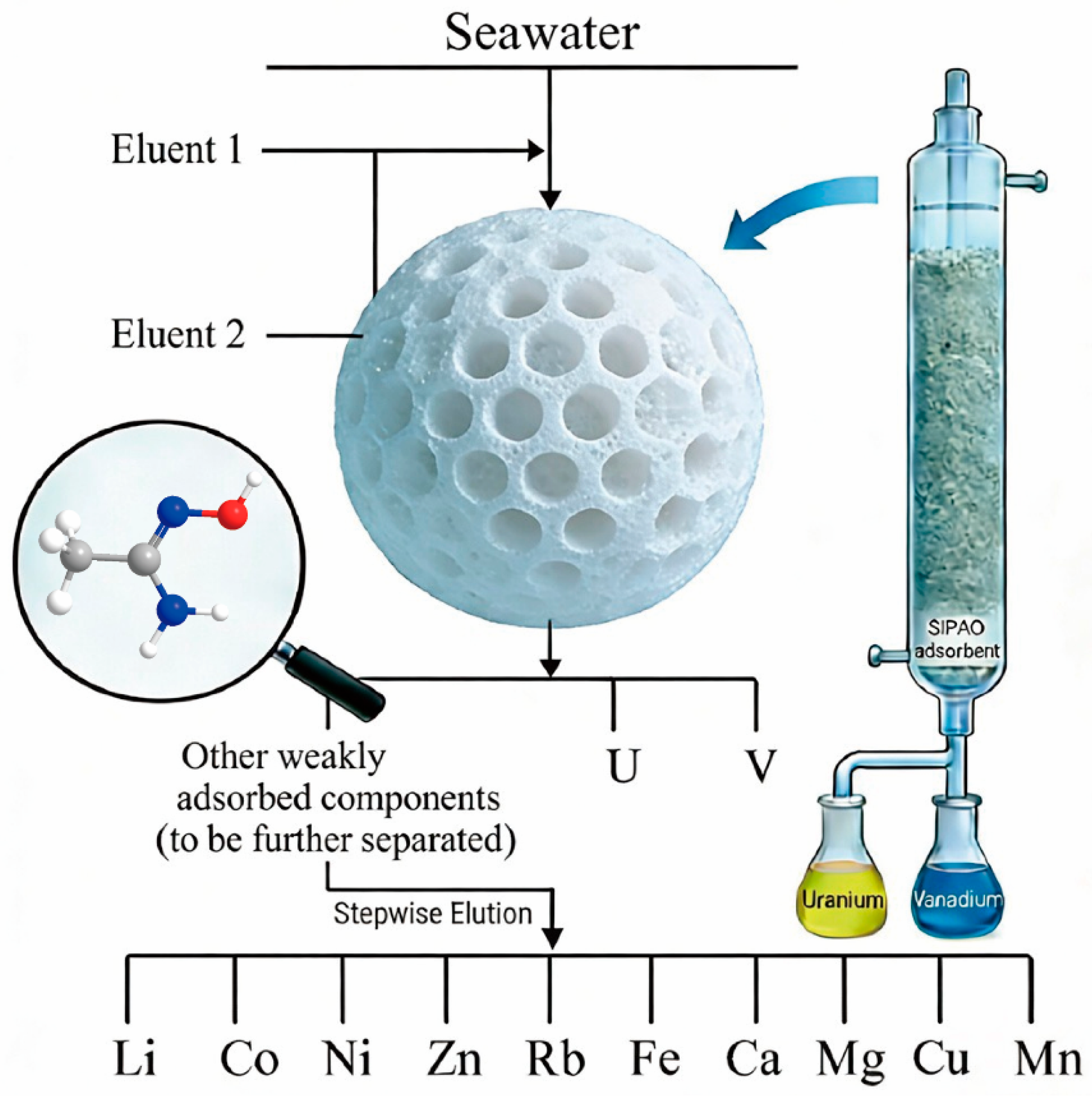
Previous studies have shown that amidoxime-based adsorbents typically exhibit relatively strong affinity toward uranium and vanadium in seawater, whereas their interactions with most other metal ions are comparatively weak [3]. Based on this selectivity pattern, we propose a conceptual process for simultaneous multi-metal recovery from seawater, as illustrated in Figure 1. The first critical step involves co-adsorption and subsequent separation of uranium and vanadium, the two major strongly adsorbed elements. Vanadium is an economically valuable metal extensively used in high-strength alloy steel production, catalysis, and energy storage. The remaining weakly adsorbed components may be removed through preliminary group separation and further processed in subsequent steps.
To explore the simultaneous adsorption and separation of uranium and vanadium in seawater media, a porous silica-supported amidoxime resin with rapid adsorption and desorption kinetics was synthesized and characterized in this work. The material exhibits favorable chromatographic separation properties. Batch experiments were conducted to systematically investigate the adsorption behavior of uranium and vanadium in aqueous solutions and identify optimal adsorption and desorption conditions. Classical adsorption models were applied to analyze the experimental data and provide preliminary insights into the adsorption mechanisms. Finally, dynamic column separation experiments were conducted, and uranium and vanadium were successfully separated from the tenfold-diluted simulated seawater employed as a model system in this work. It should be noted that this study is designed as a proof-of-concept investigation. The primary objectives are to evaluate the intrinsic adsorption properties of the SiPAO adsorbent and demonstrate the feasibility of sequential uranium/vanadium separation under controlled laboratory conditions. The experimental environment is intentionally simplified relative to natural seawater. Accordingly, the results reported herein reflect the material’s potential under model conditions and are not intended to be directly extrapolated to field-scale seawater extraction performance.

2. Materials and Methods

2.1. Chemicals and Materials

All chemicals used in this study were of analytical grade and used as received unless otherwise specified. Porous silica (SiO2, 75–150 μm, porosity 69%) was employed as the inorganic support. Acrylonitrile (AN, 99%), divinylbenzene (DVB, 55%), acetophenone, diethyl phthalate, azobisisobutyronitrile (AIBN), hydroxylamine hydrochloride (NH2OH·HCl, ≥98.5%), anhydrous sodium carbonate (Na2CO3), absolute ethanol, uranyl nitrate hexahydrate (UO2(NO3)2·6H2O), sodium metavanadate (NaVO3, used as a soluble V(V) precursor for preparing the stock solution; upon dissolution and equilibration at seawater-relevant pH, the dissolved vanadium species convert to vanadate oxyanions, predominantly as HVO42− and H2VO4 [45]), and thiourea were purchased from Macklin Biochemical Technology Co., Ltd., Shanghai, China. Hydrogen peroxide (H2O2) was purchased from Shanghai Hushi Laboratory Equipment Co., Ltd., Shanghai, China. The inhibitor in AN was removed prior to use by vacuum distillation at 75 °C, and the purified monomer was collected for subsequent polymerization. The inhibitor in DVB was removed by washing with 5% aqueous sodium hydroxide solution followed by ultrapure water until neutral. Data processing and graphing were performed using Origin 2021 (OriginLab Corporation, Northampton, MA, USA).
Simulated seawater was prepared based on the average ionic composition of natural seawater reported in the marine chemistry literature, in which several conservative ions (e.g., Na+, Cl, Mg2+, SO42−, and Ca2+) dominate the dissolved salts. To simplify adsorption evaluation while maintaining representative ionic proportions, a tenfold-diluted seawater system was adopted. The rationale for the experimental conditions is as follows. The uranium and vanadium feed concentrations of 0.5 mg/L were selected to enable reliable ICP-OES quantification and to allow kinetic, isotherm, and desorption measurements to be completed within experimentally accessible timescales. This concentration is consistent with or more conservative than those employed in comparable proof-of-concept studies on amidoxime-functionalized adsorbents: Ren et al. (2023) evaluated branched fibrous amidoxime adsorbents using 500 μg/L (0.5 mg L−1) uranium in simulated seawater; Oyola et al. (2016) screened amidoxime-grafted fibers at 330 μg L−1 to 8 mg L−1 uranium, establishing the two-stage “simulated seawater screening → natural seawater validation” workflow; and Xu et al. (2017) directly compared simulated (3.6 μg L−1) and natural (2.6 μg L−1) seawater, demonstrating that adsorption capacity under simulated conditions (2.51 mg/g) is markedly higher than that in natural seawater (0.13 mg/g), highlighting the inherent difference between mechanism-oriented and real-environment performance [46,47,48]. The tenfold uniform dilution of the seawater matrix was adopted to reduce charge-shielding and intense competitive interference from the high ionic strength of natural seawater (~3.5% salinity) while still retaining the principal competing ions (Na+, Mg2+, Ca2+, and carbonate species) to partially preserve the competitive adsorption environment. The use of simplified model solutions for mechanism-oriented investigations is a recognized approach in seawater uranium adsorbent development.
The concentrations of the major cations were set as follows (in mg L−1): Na (1075), Mg (129), and Ca (41.2). The corresponding anions were introduced to maintain ionic balance: Cl (1900 mg L−1), SO42− (265 mg L−1), and HCO3 (14 mg L−1), consistent with approximately one-tenth of the typical seawater composition. Trace metal ions were added at the following concentrations: Fe (0.5 mg L−1), Cu (0.5 mg L−1), U (0.5 mg L−1), and V (0.5 mg L−1). The pH was adjusted to 8.0 using NaHCO3 to reproduce the weakly alkaline carbonate-buffered conditions of natural seawater. It should be noted that the pH adjustment here is performed solely to prepare a controlled model solution with consistency and reproducibility, and is not proposed as a pretreatment step for natural seawater. In practical seawater uranium extraction operations, pH adjustment of natural seawater is not advisable, as it would significantly increase process costs. Ultrapure water with a resistivity of 18.2 MΩ was used throughout all experiments.

2.2. Preparation of SiPAN and SiPAO

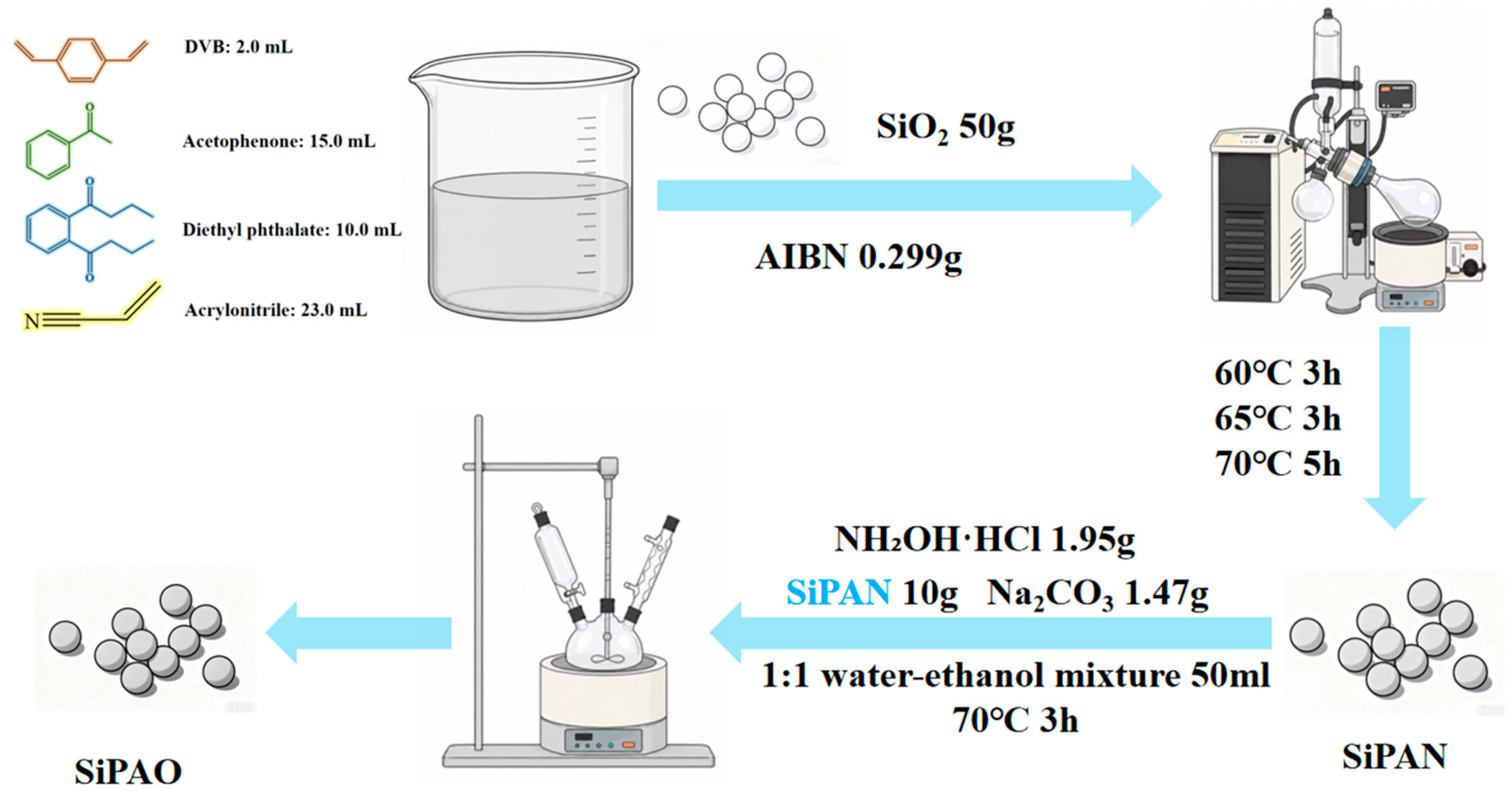
The silica-supported poly(amidoxime) (SiPAO) adsorbent was prepared via a two-step procedure, as illustrated in Figure 2. In the first step, silica-based polyacrylonitrile (SiPAN) was prepared. Mesoporous SiO2 (50 g) was placed in a rotary flask, purged with nitrogen, and degassed under reduced pressure. A monomer solution consisting of acrylonitrile (23.0 mL), acetophenone (15.0 mL), diethyl phthalate (10.0 mL), divinylbenzene (2.0 mL), and AIBN (0.2985 g) was prepared and introduced into the flask. The mixture was homogenized to ensure complete impregnation of the silica support. Polymerization was carried out under a nitrogen atmosphere with sequential heating at 60 °C for 3 h, 65 °C for 3 h, and 70 °C for 5 h. After polymerization, the resulting SiPAN was washed alternately with acetone and deionized water and dried prior to further modification.
In the second step, SiPAO was prepared. SiPAN (10 g) was dispersed in a mixed solvent of ethanol and deionized water (25 mL each) in a 100 mL three-necked round-bottom flask. Hydroxylamine hydrochloride (1.946 g) was added to the suspension, and the mixture was stirred vigorously. Anhydrous sodium carbonate (1.469 g) was then added portionwise until no significant gas evolution was observed. The flask was equipped with a mechanical stirrer, two reflux condensers connected in series to a cold trap, and placed in a water bath. The amidoximation reaction was carried out at 70 °C under reflux with continuous stirring for 3–4 h. After completion, the product was filtered, thoroughly washed with deionized water until the filtrate reached neutral pH, and dried in a vacuum oven at 45 °C for 24 h.

2.3. Characterization

Fourier transform infrared (FTIR) spectra were recorded using a Shimadzu FTIR spectrometer (Shimadzu, Kyoto, Japan) over the range of 400–4000 cm−1 with KBr pellets. Thermogravimetric and differential scanning calorimetry (TG–DSC) analyses were performed on an STA 449 F3 Jupiter instrument (Netzsch, Selb, Germany) under an oxygen atmosphere from 25 °C to 800 °C at a heating rate of 10 °C min−1. Nitrogen adsorption–desorption isotherms were measured at 77 K using a Micromeritics ASAP 2020 analyzer (Micromeritics, Norcross, GA, USA). The specific surface area was calculated using the Brunauer–Emmett–Teller (BET) method, and the pore volume and pore size distribution were determined using the Barrett–Joyner–Halenda (BJH) method. The morphology and elemental distribution of the adsorbents were examined by scanning electron microscopy coupled with energy-dispersive X-ray spectroscopy (SEM–EDS). Elemental compositions (C, H, N, and O) were determined using a Vario EL Cube elemental analyzer (Elementar, Langenselbold, Germany). XPS measurements were conducted on a Thermo ESCALAB 250Xi instrument (Thermo Fisher Scientific, Waltham, MA, USA) using Al Kα radiation.

2.4. Batch Adsorption Experiments

Batch adsorption experiments were carried out in sealed glass bottles. A solid–liquid ratio that maintains a relatively high adsorption capacity while keeping the residual metal concentration easily detectable was determined through preliminary experiments. The detailed results are provided in the Supplementary Materials (Figure S1). The experimental conditions were as follows: 30 mL of solution and 0.03 g of SiPAO adsorbent, corresponding to a solid–liquid ratio of 1 g L−1. Stock solutions of uranium and vanadium were prepared by dissolving (UO2(NO3)2·6H2O) and NaVO3 in deionized water or simulated seawater, respectively. Initial metal concentrations in the kinetic and isotherm experiments ranged from 10 to 250 mg L−1.
The effect of solution pH on metal adsorption was investigated over a pH range of 3–10, adjusted using 0.1 mol L−1 HNO3 or NaOH solutions. Unless otherwise specified, all other adsorption experiments were conducted at pH 8.0 ± 0.1. The pH-dependent experiments serve only for mechanistic validation and operating condition optimization and should not be interpreted as a recommendation for pH adjustment in natural seawater uranium extraction processes. Adsorption kinetics were studied by varying the contact time from 5 min to 4 h under optimal pH conditions for U(VI) and V(V). Isotherm experiments were conducted at 25 °C, 35 °C, and 45 °C with an equilibrium time of 3 h, and the thermodynamic behavior was further evaluated over a temperature range of 25–65 °C.
To assess adsorption selectivity, competitive adsorption experiments were performed using multicomponent solutions containing U, V, Fe, Cu, Al, Ca, Co, Mg, Ni, K, and Li ions, each at 0.1 mmol L−1. After adsorption, the suspensions were filtered through 0.45 μm membrane filters, and the residual metal concentrations were determined by inductively coupled plasma optical emission spectroscopy (ICP-OES, PerkinElmer Optima 8000, PerkinElmer, Waltham, MA, USA). The adsorption efficiency, adsorption capacity, distribution coefficient, and separation factor were calculated according to Equations (1)–(4).
An adsorption inhibition strategy was employed to screen suitable eluents for the desorption of U(VI) and V(V), in which the suppression of metal adsorption in different chemical media served as an indirect indicator of potential suppression effect. A mixed feed solution containing 15 mg L−1 U(VI) and 15 mg L−1 V(V) was prepared by mixing appropriate volumes of standard uranium and vanadium stock solutions and adjusting the pH to 7. For each experiment, 0.03 g of SiPAO adsorbent was added into a mixture of 20 mL feed solution and 10 mL candidate eluent solution, corresponding to a solid–liquid ratio of 0.03 g per 30 mL. The suspensions were shaken at 25 °C for 3 h to reach equilibrium.
Three types of eluents were evaluated: HNO3, hydrochloric acid (HCl), and thiourea solutions, each at five concentration levels (0.1, 0.5, 1, 2, and 5 mol L−1). Ultrapure water was used as a control. After equilibration, the suspensions were filtered, and the resulting solutions were diluted fivefold with 2.5% HNO3 prior to analysis. Uranium and vanadium concentrations were determined by ICP analysis, and the adsorption efficiency of each metal was calculated by comparing the initial and final concentrations. A marked decrease in adsorption efficiency relative to the ultrapure water control was considered indicative of effective suppression effect.
Adsorption   efficiency   ( E ) :   E = C 0 C e C 0 × 100 % ,
Adsorption   quantity   ( Q ) :   Q = C 0 C e m × V ,
Distribution   coefficient   ( K d ) :   K d = C 0 C e m × V m ,
Separation factor (SFA/B): SFA/B = KdA/KdB,
where C0 (mg L−1) and Ce (mg L−1) denote the initial and postadsorption concentrations, respectively, and V (mL) and m (g) denote the solution volume and the mass of SiPAO, respectively. The removal efficiency was calculated in the same manner as the adsorption efficiency.
Additional details about the batch experiments are provided in the Supplementary Materials, including the mathematical models used in this work: the pseudo-first-order (PFO) kinetic model, the pseudo-second-order (PSO) kinetic model, the intraparticle diffusion (IPD) kinetic model, the Langmuir isotherm model, and the Freundlich isotherm model.

2.5. Dynamic Column Experiments

Dynamic column adsorption experiments were carried out using a laboratory-scale chromatographic separation system consisting of a peristaltic pump, a glass column (ϕ × h = 0.5 cm × 30 cm), and a fraction collector. The column was packed with 2.46 g of SiPAO adsorbent under dry packing conditions.
The feed solution was the same tenfold-diluted simulated seawater described in Section 2.1, with trace metal ions (U, V, Fe, and Cu) added at 500 μg L−1 each. The pH was adjusted to 8.0 using NaHCO3 to reproduce the weakly alkaline carbonate-buffered conditions of natural seawater.
Prior to adsorption, 50 mL of ultrapure water was pumped through the column to equilibrate the system and remove residual air from the packed bed. The feed solution was then continuously introduced in a downward flow mode at a constant flow rate of 0.5 mL min−1 using the peristaltic pump. Effluent samples were collected at fixed time intervals using the fraction collector.
After the column reached saturation, it was rinsed with 50 mL of ultrapure water to remove residual feed solution. Sequential desorption was then performed to selectively recover uranium and vanadium. Uranium was first eluted using 0.1 mol L−1 HNO3 (100 mL), followed by flushing with 20 mL of ultrapure water adjusted to pH 8. Vanadium was subsequently desorbed using a mixed solution of 0.5 mol L−1 Na2CO3 and 1 L−1 H2O2. Metal ion concentrations in the influent and effluent were determined by ICP-OES. Detailed experimental parameters and operating procedures for all column experiments are provided in Section S2 in the Supplementary Materials.

3. Results

3.1. Characterization

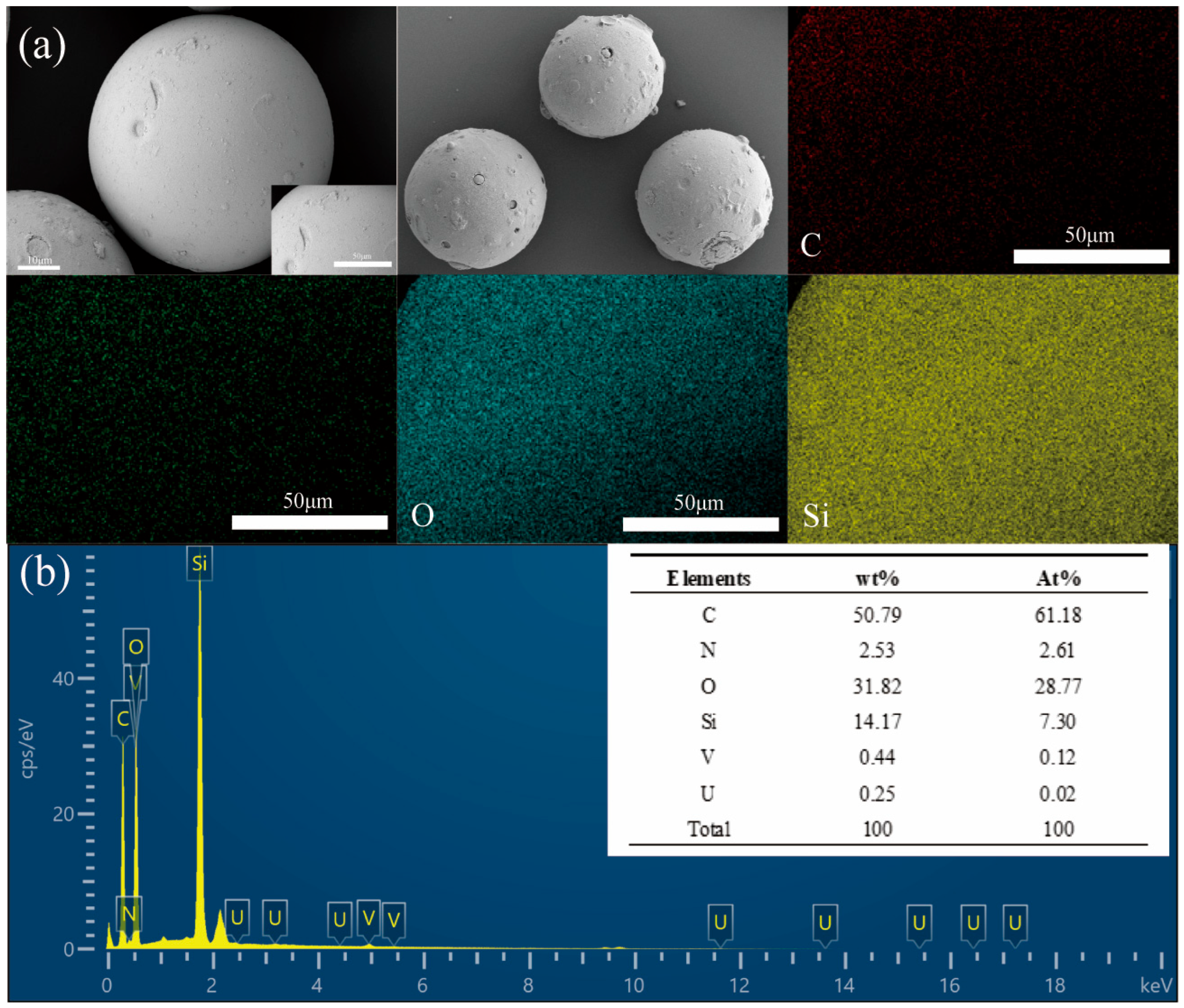
The morphology and elemental composition of the SiPAO adsorbent were characterized through SEM–EDS, as shown in Figure 3.
As shown in Figure 3a, the SiPAO adsorbent exhibits a spherical morphology with a particle size of approximately 100 μm and a visibly textured surface. Elemental mapping of C, O, and Si confirmed the homogeneous distribution of these elements across the adsorbent surface, indicating successful grafting of poly(amidoxime) onto the porous silica support.
Figure 3b presents the EDS spectrum and quantitative elemental analysis of the SiPAO adsorbent after adsorption. Characteristic peaks of U and V are clearly observed, demonstrating effective uptake of U(VI) and V(V). The quantitative results reveal that the adsorbent is mainly composed of C (50.79 wt%), O (31.82 wt%), and Si (14.17 wt%), consistent with the chemical structure of silica-supported poly(amidoxime). The presence of U (0.25 wt%) and V (0.44 wt%) further confirms the successful loading of target metal ions onto the adsorbent surface.
SEM observations confirmed the macroscopic spherical morphology and surface texture of the as-prepared SiPAO adsorbent. The porous nature and pore structure parameters are primarily evidenced by the N2 adsorption–desorption (BET) results (see Table 1), which revealed an average pore size of 37.8 nm—typical of a mesoporous structure conducive to the mass transfer of metal ions and exposure of active sites. No obvious cracking or structural destruction was observed, indicating that the silica-based support maintained good structural stability after polymerization and amidoximation.
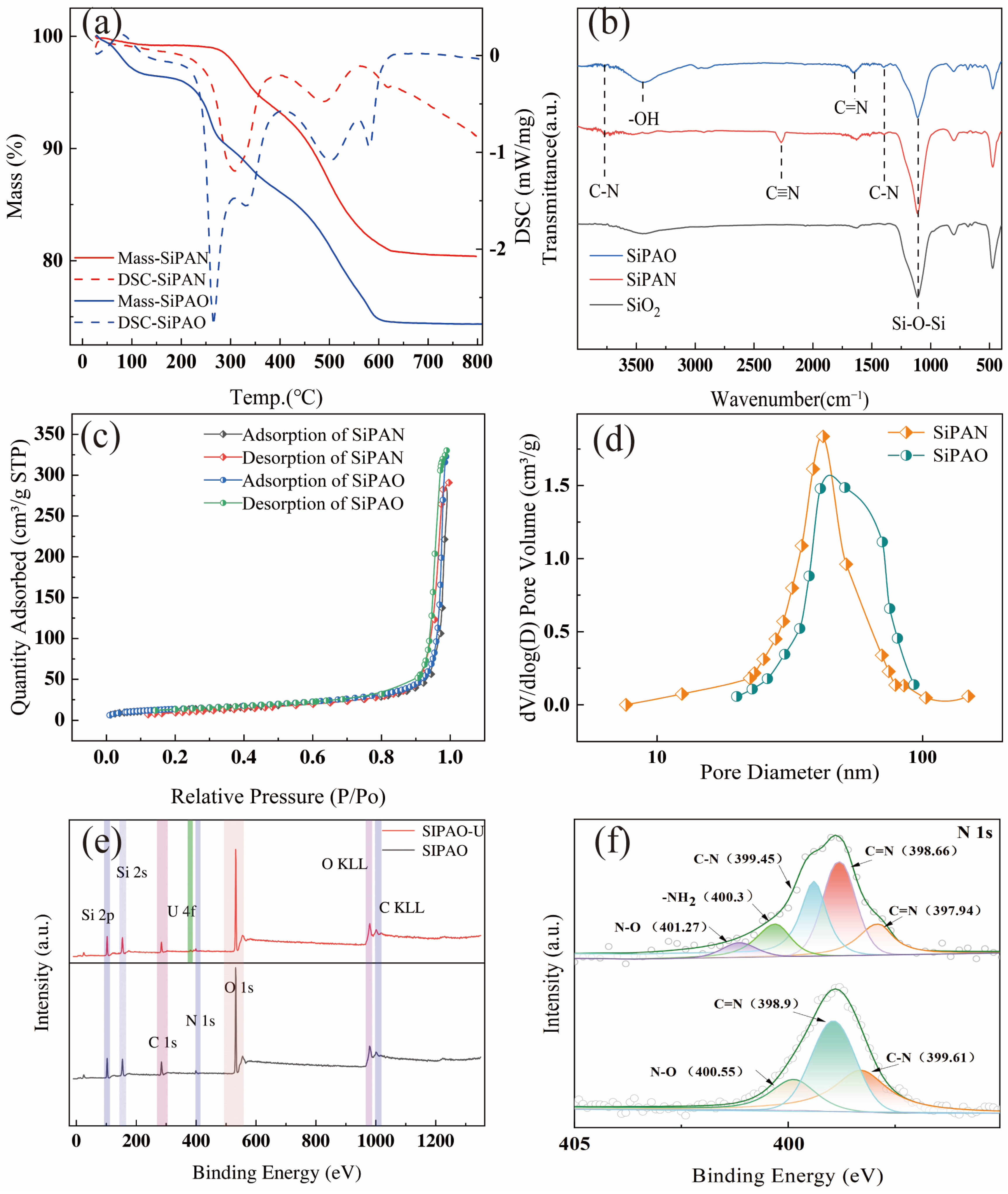
The thermal behavior and organic content of the materials were examined by TG–DSC analysis (Figure 4a). SiPAN exhibited a total mass loss of approximately 19.4% upon heating to 800 °C. The slight weight loss below 150 °C is attributed to the removal of physically adsorbed water and residual solvent. The major weight-loss stage between 250 °C and 400 °C corresponds to thermal degradation and structural transformation of the polyacrylonitrile (PAN) chains immobilized on the silica framework, accompanied by a pronounced exothermic peak centered at approximately 327 °C in the DSC curve, characteristic of intramolecular cyclization of nitrile groups. After amidoximation, SiPAO showed a total mass loss of ~23.4% at 800 °C, with a broader and slightly shifted decomposition region, indicating the successful introduction of amidoxime functional groups. The increased mass loss relative to SiPAN further confirms the conversion of nitrile groups into amidoxime ligands, introducing additional oxygen- and nitrogen-containing functional groups.
FTIR spectroscopy was used to track functional group evolution during synthesis and after uranium adsorption (Figure 4b). Pristine SiO2 exhibited broad absorption bands at approximately 1100 and 800 cm−1, corresponding to the asymmetric and symmetric stretching vibrations of Si–O–Si, respectively. After polyacrylonitrile grafting, SiPAN displayed a distinct peak at 2240 cm−1, attributed to C≡N stretching. Following amidoximation, the C≡N band disappeared and new peaks appeared at ~1650 cm−1 (C=N stretching), 1380 cm−1 (C–N stretching), and ~930 cm−1 (N–O stretching), along with a broad band at 3000–3400 cm−1 corresponding to O–H and N–H vibrations.
The porous structure parameters of SiPAN and SiPAO were determined by N2 adsorption–desorption measurements (Figure 4c,d). Both samples exhibited typical type IV isotherms with H1-type hysteresis loops, indicating mesoporous structures. The detailed pore structure parameters are listed in Table 1. The specific surface area of SiPAN was 22.8 m2 g−1, increasing to 49.8 m2 g−1 after amidoximation, whereas the pore volume and average pore size decreased slightly. The pore size distribution curves confirm that both samples possess narrow mesopore distributions centered at 3–4 nm. The enhanced specific surface area and well-developed porous structure provide SiPAO with more accessible active sites and improved mass transfer.
XPS analysis was performed to investigate the surface chemical composition and coordination interactions between the functional groups and uranium (Figure 4e,f). The survey spectra of SiPAO displayed characteristic peaks of C 1s, N 1s, O 1s, and Si 2p/2s, confirming the coexistence of the organic functional layer and the silica framework (Figure 4e). After uranium adsorption, additional U 4f peaks appeared in the SiPAO–U spectrum, directly evidencing the successful capture of uranium. No significant changes were observed for the Si-related peaks, indicating that the silica support remains structurally stable during adsorption.
High-resolution N 1s spectra were analyzed to gain deeper insight into the chemical states of nitrogen-containing functional groups (Figure 4f). For pristine SiPAO, the N 1s spectrum can be deconvoluted into components attributed to C=N (~398.9 eV), C–N (~399.6 eV), and N–O (~400.5 eV). After uranium adsorption, the N 1s spectrum of SiPAO–U exhibited noticeable changes: the relative intensities and binding energies of the nitrogen species were altered, and an additional component at lower binding energy (~398.6 eV) was assigned to C=N groups coordinated with uranium species. The original C=N peak showed slight shifts, reflecting the coexistence of free and coordinated amidoxime groups. Slight variations in the N–O binding energy were also observed, suggesting its possible involvement in coordination. These changes are attributed to the interaction between uranyl species (UO22+) and the amidoxime ligands, leading to the formation of stable five-membered chelate rings [31]. The broadening and evolution of the N 1s peaks after adsorption suggest multiple coexisting coordination environments, indicating that uranium binding may occur through different modes on the heterogeneous adsorbent surface. Overall, the XPS results confirm the successful introduction of amidoxime functional groups onto the silica support and provide strong evidence for coordination between uranium and the nitrogen/oxygen donor atoms, which accounts for the strong adsorption affinity toward U(VI) [49].
To further clarify the chemical structure of the functional groups, elemental analysis (EA) was conducted. In amidoxime-functionalized materials, open-chain amidoxime (AO) and cyclic imide-dioxime (IDO) may coexist, with distinct N/O atomic ratios: the theoretical value for AO (-C(NH2)=NOH) is close to 2:1, whereas IDO has a lower ratio (~3:2) due to higher oxygen content. The N/O ratio of SiPAO is approximately 2.09, close to the AO stoichiometric value, suggesting that the bulk functional group composition trends toward AO. It should be noted that the N/O ratio only reflects the overall composition and does not preclude the coexistence of minor IDO species. Previous studies have established that IDO forms tridentate κ3 complexes with UO22+ through a conjugated system with delocalized electron density and is the key active site for uranium adsorption from natural seawater [50].
However, two additional factors critical to practical separation processes must be considered when evaluating the functional group composition: elution stability and binding selectivity. Astheimer et al. (1983) [23] demonstrated that open-chain AO is stable in 1 M HCl, whereas cyclic IDO is unstable under identical conditions—a primary cause of capacity fading over multiple cycles. Joshi (2021) [51] investigated the solution coordination chemistry of both ligands using multinuclear NMR, yielding findings of direct relevance to this work: (1) upon the addition of V(V) to a UO22+-IDO system, vanadium effectively displaces uranium already coordinated to IDO, forming a complete V–IDO complex, indicating that IDO-rich materials face severe vanadium competition in real seawater; (2) open-chain AO does not react with V(V) at all, consistent with the XAFS-based findings of Ivanov et al. (2017) [36]; and (3) open-chain AO is capable of forming a complete and stable complex with UO22+ under appropriate pH conditions, albeit with slower kinetics.
It should be noted, however, that the above comparison between AO and IDO is discussed within the context of the diluted model seawater system used in this proof-of-concept study, not under natural seawater conditions. Taken together, the AO-rich composition of the present material is functionally consistent with the central objective of this work-sequential separation and recovery of U and V. This study aims to demonstrate a strategy of synergistic co-recovery with stepwise elution, rather than maximizing single-metal adsorption capacity. Within this framework, elution stability and binding selectivity are more critical than ultimate capacity: the stability of AO in acidic eluents ensures sorbent reusability over repeated cycles, while its inherent inertness toward V(V) suppresses vanadium competition at the source, facilitating efficient U/V separation through mild stepwise elution.

3.2. Batch Adsorption Experiments

3.2.1. Effect of pH on U(VI) and V(V) Adsorption

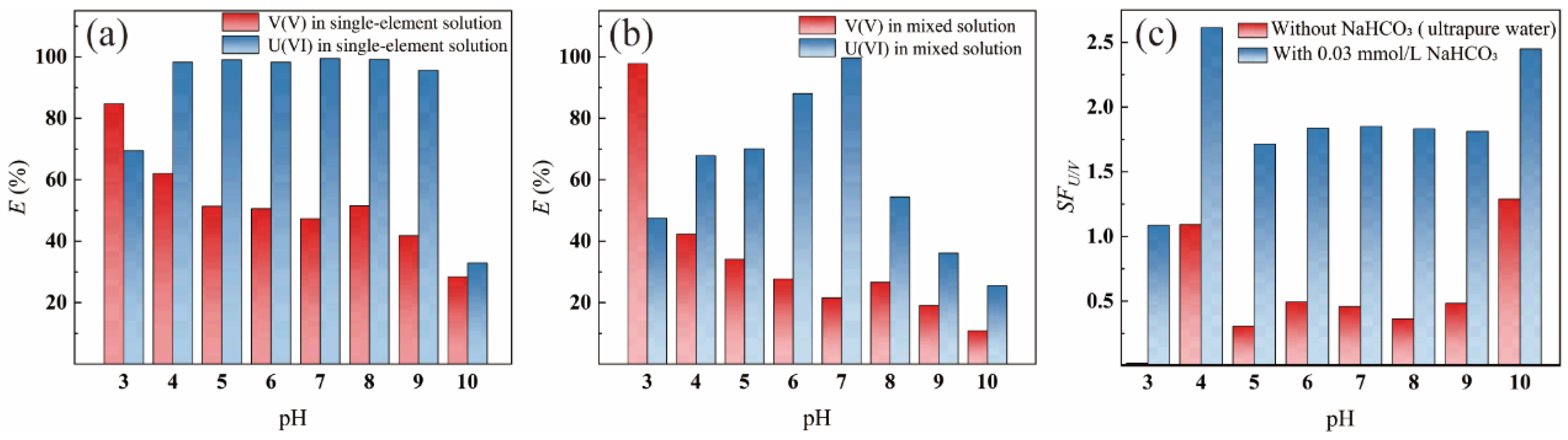
The effect of pH on the adsorption of U(VI) and V(V) is illustrated in Figure 5a–c. Detailed experimental parameters are provided in Section S1(1) in the Supplementary Materials. As shown in Figure 5a, in the single-component system, the adsorption efficiency of U(VI) increases sharply from pH 3 to pH 4 and remains nearly quantitative (>95%) within the pH range of 4–9. This trend is mainly attributed to the protonation–deprotonation behavior of amidoxime groups and the speciation of uranyl ions. Under strongly acidic conditions, high H+ concentrations compete with UO22+ for coordination sites on the amidoxime ligands, suppressing adsorption. As pH increases, deprotonation of the amidoxime groups enhances their coordination ability toward uranyl ions, promoting the formation of stable chelate complexes between UO22+ and the N–O donor atoms. Consequently, nearly complete uranium adsorption is achieved at pH ≥ 4. Similar pH-dependent behavior has been widely reported for amidoxime-functionalized materials used for uranium extraction from seawater [52]. In contrast, V(V) adsorption decreases gradually with increasing pH. This behavior is closely related to vanadium speciation changes in aqueous solution. At lower pH values, vanadium exists mainly as cationic or weakly polymerized species that readily interact with adsorption sites. At higher pH, vanadium predominantly transforms into tetrahedral oxyanion species such as HVO42− and VO43−, which exhibit weaker affinity toward amidoxime ligands and are less effectively adsorbed [53,54].
When U(VI) and V(V) coexist in the mixed system (Figure 5b), the adsorption efficiencies of both elements decrease relative to the single-component system, confirming competitive adsorption. Nevertheless, U(VI) maintained a higher adsorption efficiency than V(V) across the investigated pH range. This suggests that although vanadium is often reported to strongly compete with uranium for amidoxime binding sites, the coordination interaction between uranyl ions and amidoxime ligands can still dominate under certain conditions. Amidoxime groups form stable bidentate coordination structures with uranyl ions through both oxime oxygen and amino nitrogen atoms, resulting in strong complexation [55]. Vanadium species compete for the same functional groups but differ in coordination structure and stability constants, leading to the partial suppression of adsorption for both elements. Vanadium has been identified as one of the most significant competing elements during uranium extraction with amidoxime-based adsorbents.
Figure 5c compares the separation factor between uranium and vanadium in ultrapure water and in the presence of bicarbonate. The addition of NaHCO3 markedly increases the separation factor (SFU/V), indicating improved selectivity toward uranium. This can be attributed to the formation of uranyl–carbonate complexes such as UO2(CO3)22− and UO2(CO3)34− in bicarbonate-containing solutions [56]. These complexes can still interact with amidoxime ligands through ligand-exchange mechanisms, whereas vanadium species exhibit weaker coordination under similar conditions, thereby enhancing uranium selectivity [57].
Overall, these results indicate that uranium adsorption by SiPAO is strongly dependent on pH and competitive conditions. Nearly complete U(VI) adsorption is achieved at pH ≥ 4 in single-component systems, while the coexistence of vanadium introduces competitive effects that reduce the adsorption efficiencies of both metals. The presence of bicarbonate markedly improves U/V separation. Considering both adsorption efficiency and separation selectivity, near-neutral conditions were selected as the optimal pH range for subsequent experiments [4].
For practical seawater uranium extraction, pH adjustment is not advisable as it would increase the process costs; therefore, the pH-dependent experiments presented here serve only for mechanistic understanding (see Section 2.1). All subsequent experiments were conducted at pH 8.0 ± 0.1.

3.2.2. Adsorption Kinetics

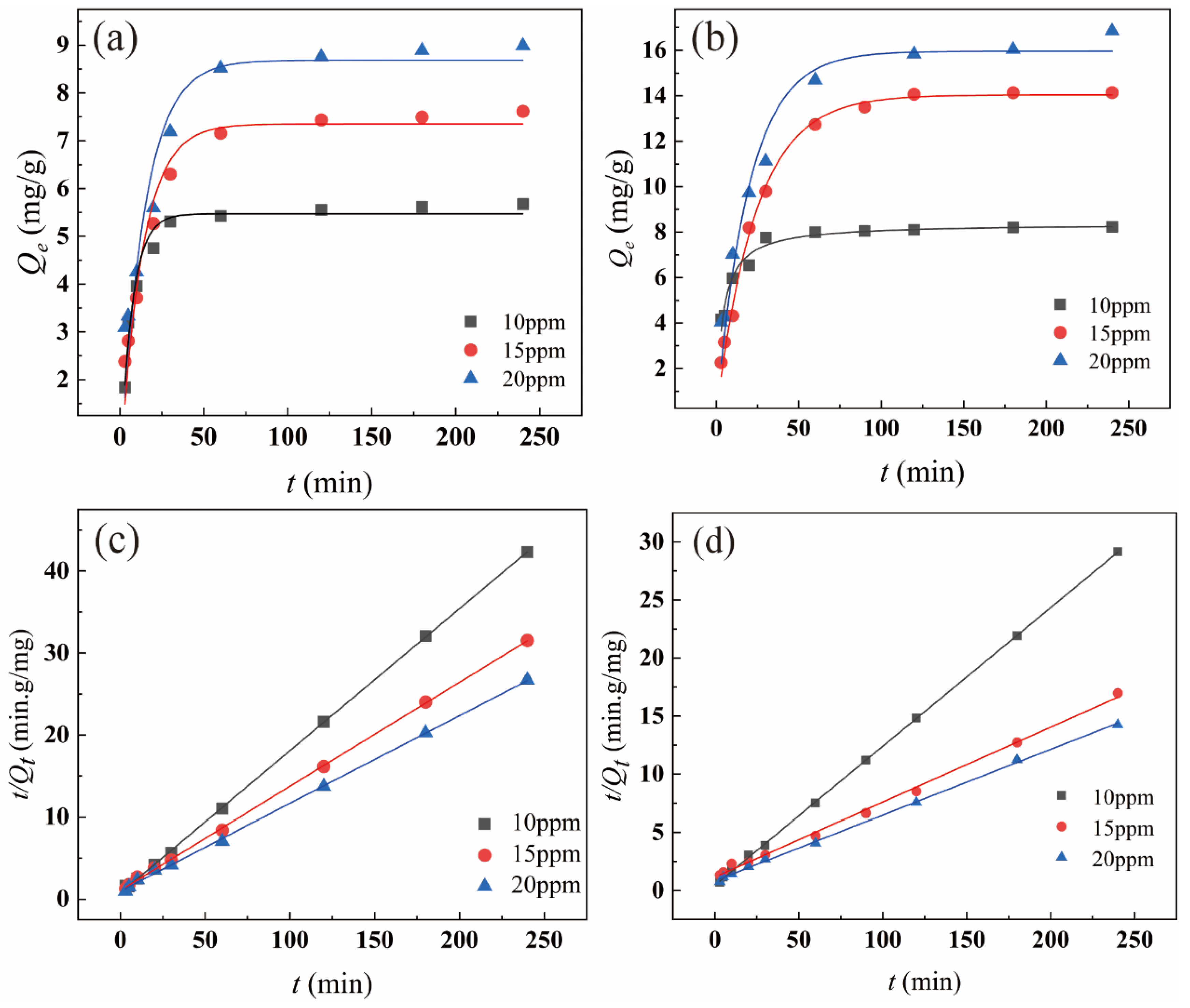
The adsorption kinetics of U(VI) and V(V) on SiPAO were investigated at initial concentrations of 10, 15, and 20 mg L−1. As illustrated in Figure 6, rapid uptake occurred within the first 50 min, during which more than 80% of the equilibrium adsorption capacity was achieved. This initial fast stage is attributed to the abundance of accessible active sites on the external surface and within the mesoporous structure. The adsorption rate then gradually decreased as the system approached equilibrium, likely due to increased diffusion resistance and site saturation.
The kinetic data were fitted using both the PFO and PSO models. Detailed experimental parameters, linear fitting plots, and model parameters are provided in Section S1(2) and Table S3 in the Supplementary Materials. The PSO model provided a markedly better fit than the PFO model, as evidenced by higher correlation coefficients (R2 = 1.0 for all concentrations) and closer agreement between the calculated and experimental equilibrium adsorption capacities (qe,cal ≈ qe,exp). This result indicates that the overall adsorption rate is primarily governed by chemisorption involving electron sharing or exchange between the uranyl/vanadate ions and the amidoxime functional groups. However, the rate-controlling step and adsorption affinity are not necessarily governed by the same mechanism. Although the PSO model better describes kinetic behavior, spectroscopic evidence (FTIR and XPS) and equilibrium isotherm characteristics confirm that the strong adsorption affinity originates from coordination interactions between metal ions and the nitrogen/oxygen donor atoms of the amidoxime groups. Similar distinctions between kinetic control and binding mechanisms have been reported for other amidoxime-based uranium adsorbents.

3.2.3. Adsorption Isotherms

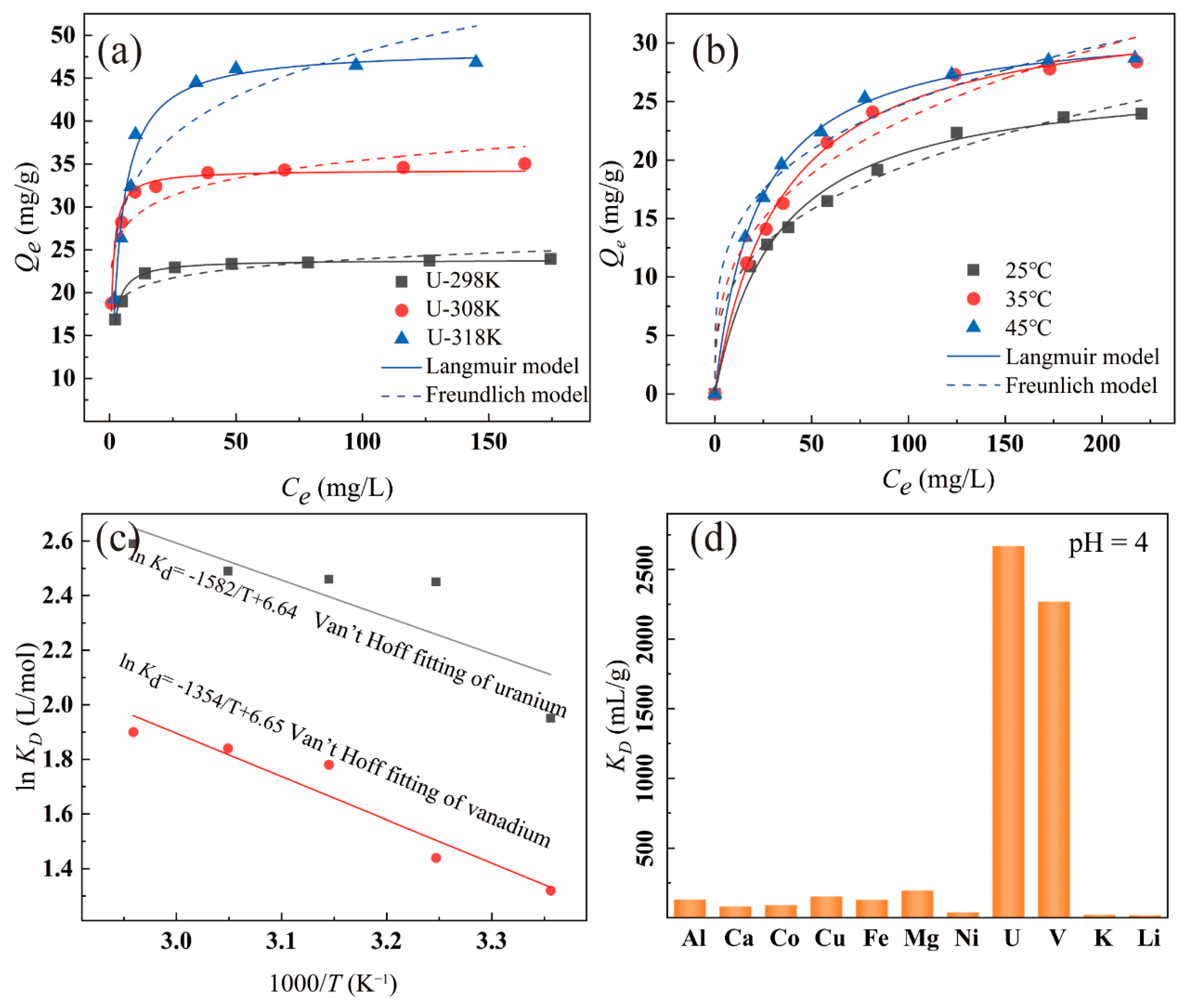
Adsorption isotherms for U(VI) and V(V) on SiPAO were obtained at 25 °C, 35 °C, and 45 °C and analyzed using the Langmuir and Freundlich models (Figure 7a,b). Detailed experimental parameters and fitting models are provided in Section S1(3) in the Supplementary Materials. For both metal ions, the Langmuir model yielded higher correlation coefficients (R2 > 0.97) than the Freundlich model, indicating monolayer adsorption on energetically uniform sites. Fitting parameters are summarized in Table S2 of Section S3 in the Supplementary Materials.
The maximum adsorption capacities (Qm) increased with temperature, reaching 48.5 mg g−1 for U(VI) and 26.8 mg g−1 for V(V) at 45 °C. This temperature dependence suggests an endothermic process, consistent with coordination-driven adsorption involving ligand rearrangement and dehydration effects. The obtained capacities are comparable to or exceed those reported for many amidoxime-functionalized silica and polymeric adsorbents under similar conditions.

3.2.4. Adsorption Thermodynamics

The thermodynamic behavior of U(VI) and V(V) adsorption onto SiPAO was investigated at temperatures ranging from 298 to 338 K (Figure 7c). Detailed experimental parameters and calculation formulas are provided in Section S1(4) in the Supplementary Materials. The adsorption capacities of both metal ions increased gradually with temperature, indicating that elevated temperature favored adsorption. The thermodynamic parameters, including Gibbs free energy change (ΔG°), enthalpy change (ΔH°), and entropy change (ΔS°), were evaluated using the van’t Hoff equation, and the results are summarized in Table S3. The negative ΔG° values obtained for both U(VI) and V(V) across the entire temperature range confirm the spontaneous nature of adsorption, with progressively more negative values at higher temperatures suggesting enhanced thermodynamic driving forces. The positive ΔH° values demonstrate endothermic adsorption, consistent with the improved performance at elevated temperatures. The magnitude of ΔH° falls within the typical range for coordination-driven chemisorption. The positive ΔS° values indicate increased randomness at the solid–liquid interface, mainly attributed to the dehydration of hydrated metal species and release of coordinated water molecules during inner-sphere complex formation with amidoxime groups. The van’t Hoff plot for U(VI) exhibited good linear correlation, reflecting stable uranyl speciation under seawater-relevant conditions. In contrast, moderate linearity was observed for V(V), which can be ascribed to the coexistence of multiple vanadate species and heterogeneous binding environments, yielding apparent rather than intrinsic thermodynamic parameters [54,58]. Overall, the thermodynamic results confirm that the adsorption of U(VI) and V(V) onto SiPAO is a spontaneous, endothermic, and entropy-driven process, consistent with the kinetic, isotherm, and spectroscopic analyses [28].

3.2.5. Adsorption Selectivity of SiPAO

The adsorption selectivity of SiPAO toward U(VI) in the presence of various coexisting metal ions was systematically evaluated at pH = 4, a condition relevant to natural water and industrial wastewater environments. Detailed experimental parameters are provided in Section S1(5) in the Supplementary Materials. The distribution coefficients (Kd) of 12 metal ions (U(VI), V(V), Ni(II), Mg(II), Al3+, Ca2+, Co2+, Cu2+, Fe3+, K+, and Li+) were calculated and are plotted in Figure 7d.
The Kd value of U(VI) reached 2500 mL g−1, exceeding that of V(V) (the second highest, ~2200 mL g−1) and surpassing those of other competing ions by orders of magnitude (e.g., Ni(II) ~200 mL g−1, Mg(II) ~150 mL g−1, and all remaining ions below 100 mL g−1). This pronounced difference in Kd values demonstrates that SiPAO exhibits outstanding selective adsorption toward U(VI) even in the presence of high concentrations of coexisting ions.
The excellent selectivity can be rationalized by the specific coordination mechanism between amidoxime groups and uranyl ions: the dual functional groups (–C(NH2)=NOH) form stable bidentate chelates with UO22+ through the oxime oxygen and imine nitrogen atoms, whereas other metal ions (such as pentavalent V(V) or divalent transition metals) form only weaker, less specific complexes with the amidoxime ligands. This strong and selective binding affinity endows SiPAO with considerable potential for the efficient separation and recovery of U(VI) from complex aqueous matrices under the conditions tested, although performance under real seawater conditions may differ due to ultratrace uranium concentration and stronger carbonate competition.

3.3. Preliminary Screening of Eluents via Adsorption Inhibition

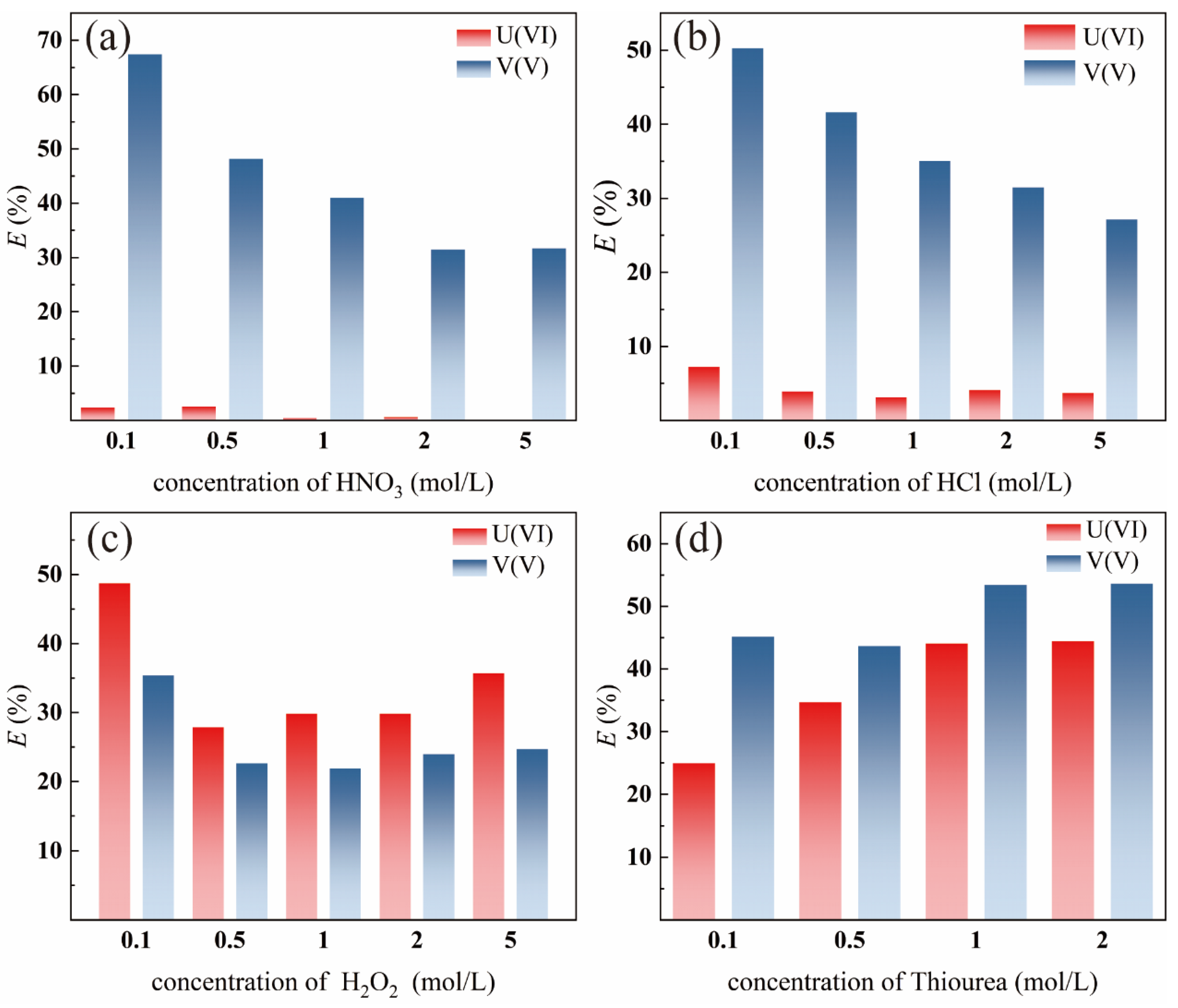
To rapidly identify chemical media capable of suppressing U(VI) and V(V) binding to the amidoxime groups, adsorption inhibition screening was conducted as a preliminary step to select candidate eluents for subsequent column separation. Detailed experimental parameters are provided in Section S1(6) in the Supplementary Materials. The results are summarized in Figure 8.
As shown in Figure 8a, nitric acid markedly suppressed uranium adsorption over the investigated concentration range. Even at 0.1 mol L−1 HNO3, the adsorption efficiency of U(VI) decreased sharply to only a few percent, indicating strong inhibition under acidic conditions. This can be attributed to protonation of the amidoxime functional groups and the competition of protons with uranyl ions for coordination sites. The protonated ligand environment weakens the coordination between UO22+ and the amidoxime groups, resulting in effective uranium desorption. In contrast, vanadium adsorption is only moderately affected by nitric acid, remaining at relatively higher levels. This difference suggests that dilute nitric acid can preferentially desorb uranium while leaving a substantial fraction of vanadium retained on the adsorbent.
The desorption behavior in the Na2CO3–H2O2 system is shown in Figure 8c. The adsorption efficiencies of both uranium and vanadium decreased relative to the neutral solution, but the effect was more pronounced for vanadium at certain peroxide concentrations. Carbonate ions favor the formation of stable uranyl–carbonate complexes such as UO2(CO3)34−, weakening uranium–amidoxime coordination and leading to the partial inhibition of uranium adsorption. Meanwhile, hydrogen peroxide oxidizes vanadium species and promotes the formation of soluble peroxovanadate complexes, which exhibit weaker affinity toward the adsorbent surface, resulting in a marked reduction in vanadium adsorption. The combined carbonate–peroxide system therefore shows promising potential for vanadium desorption.
The adsorption behavior in thiourea solutions is illustrated in Figure 8d. Compared with the acidic and oxidative systems, thiourea showed only limited suppression of both uranium and vanadium adsorption. Although thiourea can act as a complexing ligand for certain metal ions, its interaction with uranyl ions and vanadium oxyanions was relatively weak under the investigated conditions. The adsorption efficiencies of both metals remained comparatively high even at elevated thiourea concentrations, indicating that thiourea is not an effective eluent in this system.
Overall, the results demonstrate that dilute nitric acid is highly effective for uranium desorption, whereas the carbonate–peroxide system preferentially affects vanadium species. Based on these inhibition screening results, 0.1 mol L−1 HNO3 and the Na2CO3–H2O2 system were selected as candidate eluents for uranium and vanadium, respectively, and were subsequently validated in dynamic column experiments.

3.4. Dynamic Adsorption and Separation Experiments

The dynamic adsorption and separation performance of SiPAO was further evaluated using a fixed-bed column system, with the corresponding breakthrough and elution behaviors shown in Figure 9 and Figure 10.
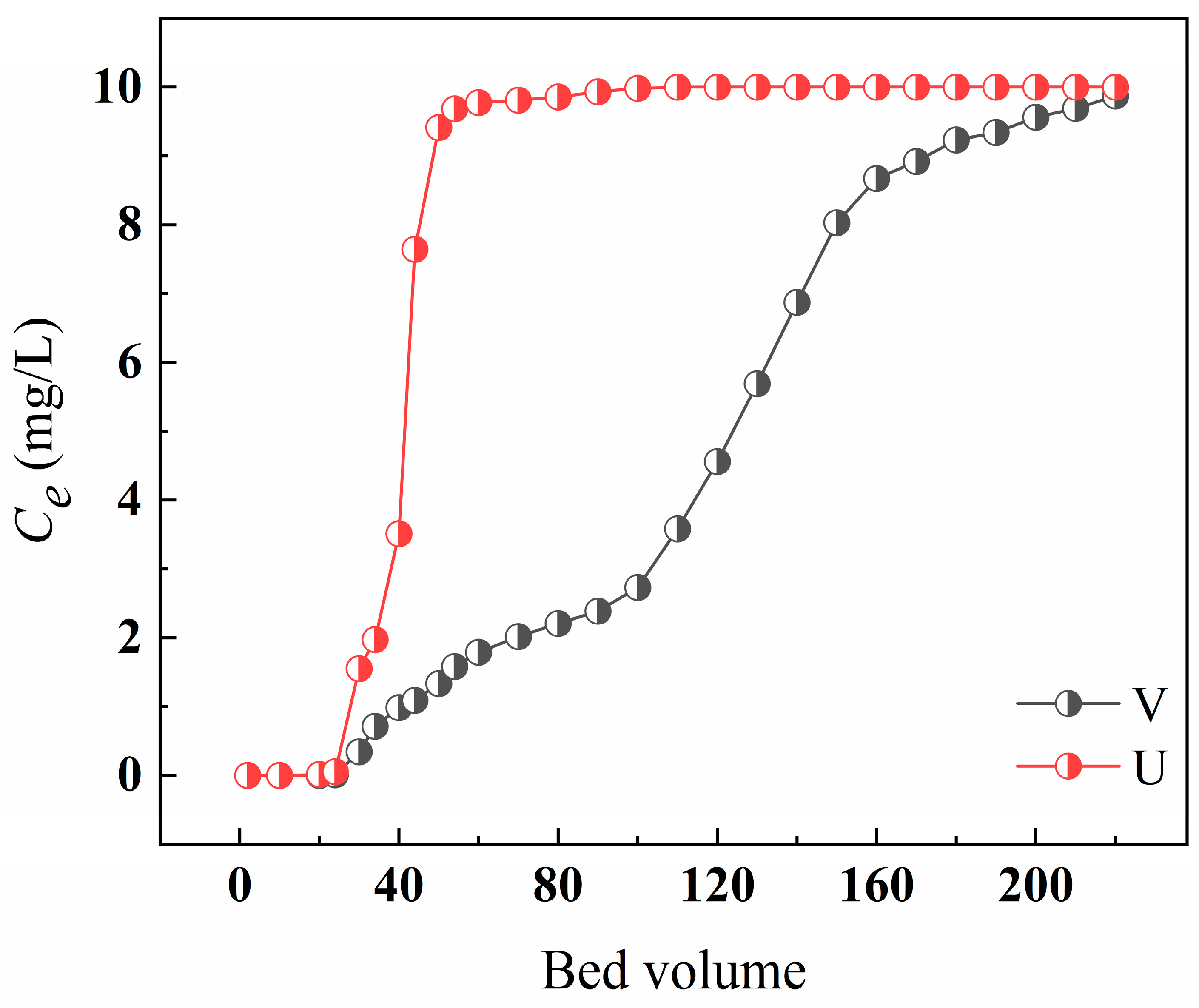
As shown in Figure 9, the breakthrough curves from the mixed U–V solution revealed distinct dynamic behaviors. Uranium was effectively retained on the column and remained nearly undetectable in the effluent until the processed volume reached approximately 250–300 mL, after which its concentration increased sharply, indicating progressive saturation of the adsorption sites. Vanadium, in contrast, exhibited earlier breakthrough at smaller processed volumes. This difference demonstrates that uranium displays stronger dynamic retention on SiPAO, allowing partial separation from vanadium during the loading stage.
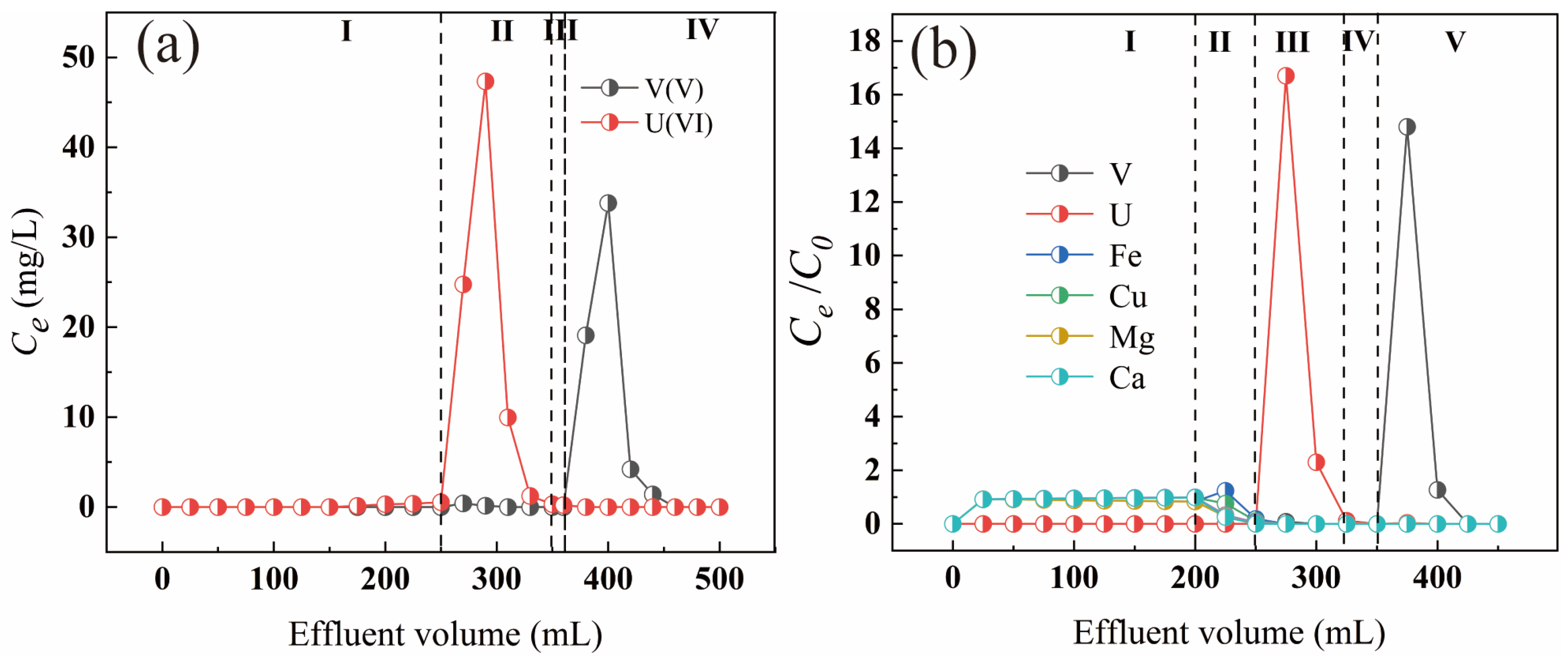
The sequential elution behavior is presented in Figure 10a. A stepwise elution strategy was adopted based on the batch desorption screening results. Uranium was first desorbed using 0.1 mol L−1 HNO3, producing a sharp peak centered at approximately 270–300 mL. Vanadium was subsequently desorbed using 0.1 mol L−1 Na2CO3 and 1 mol L−1 H2O2, generating a second peak at larger effluent volumes (approximately 380–420 mL). The two peaks were clearly separated, confirming effective uranium–vanadium separation through sequential chemical desorption. Eluting uranium first with nitric acid is advantageous, as it prevents co-elution with vanadium in the subsequent oxidative step.
In contrast to the batch inhibition screening described in Section 3.3—which serves only to identify potent eluent candidates—the column experiments represent a standard desorption evaluation: the adsorbent bed was first saturated, rinsed with water to remove unbound species, and then subjected to sequential elution.
To evaluate performance under more realistic conditions, dynamic experiments were conducted using simulated seawater containing multiple coexisting ions (Figure 10b). Most competing ions (Fe, Cu, Na, Mg, Ca) showed negligible retention and were rapidly washed out. Uranium and vanadium were successfully eluted as distinct peaks using 0.1 mol L−1 HNO3 and the Na2CO3–H2O2 system, respectively. The SiPAO column maintained good selectivity toward uranium and vanadium even in the presence of high concentrations of background ions [59].
Overall, these dynamic column experiments demonstrate that SiPAO enables efficient sequential separation of uranium and vanadium from simulated seawater containing competing ions.

3.5. Comparison with Other Amidoxime-Based Adsorbents

To benchmark the overall performance of SiPAO against recently reported amidoxime-based adsorbents, a systematic comparison is provided in Table 2. The comparison encompasses adsorption capacity, kinetics, experimental conditions (uranium feed concentration, solution matrix, and solid-to-liquid ratio), and distinctive functional features of eight representative adsorbents.
Several trends emerged from this comparison. First, with respect to adsorption kinetics, SiPAO reached equilibrium within 2 h under simulated seawater conditions. This is substantially faster than the equilibration times reported for most comparable materials tested in natural seawater (where kinetics are inherently much slower due to ultratrace uranium concentration and carbonate complexation), which typically require days to weeks (e.g., 14 days for AFNH [60], 25 days for PAO-pSer [61], 30 days for AO-HAP [62], and 49 days for PAO-Co [63]). Even when compared with materials tested under pure uranium solutions, the kinetics of SiPAO remain competitive—PACNC [64] and AO-HAP reach equilibrium in approximately 50 and 20 min, respectively, in high-concentration uranium solutions, whereas SiPAO achieves equilibrium within 2 h in a diluted seawater matrix containing competing ions.
Second, the maximum Langmuir adsorption capacity of SiPAO (48.5 mg g−1 at 45 °C) was obtained from pure uranium solution. While this value is lower than the capacities reported for some high-surface-area or synergistically functionalized materials tested under similar conditions (e.g., PACNC at 962.2 mg g−1, AFNH at 945.2 mg g−1, AO-HAP at 865.3 mg g−1), it is comparable to or exceeds those of several amidoxime-grafted fiber adsorbents. It should be noted that the primary objective of SiPAO is not to maximize single-metal adsorption capacity, but to enable sequential U/V separation.
Third, and notably, SiPAO achieves sequential elution separation of uranium and vanadium through a stepwise desorption strategy—using 1 mol L−1 HNO3 for uranium followed by a Na2CO3–H2O2 system for vanadium. The concept of separating U and V on amidoxime-based materials has precedent: Suzuki et al. previously demonstrated fractional elution of uranium and vanadium from amidoxime-grafted polymer fibers using HCl of different concentrations [26]. However, that work was conducted in batch mode and was aimed at analytical determination rather than preparative separation. The present work translates this concept onto a chromatographic platform, enabled by the rigid silica framework that provides mechanical stability for fixed-bed column operations. The use of porous silica beads as a chromatographic support for metal-selective ligands in seawater extraction has been demonstrated by Tachibana et al., who used crown ether-embedded silica for the separation of Li, V, and U [43]. However, the combination of amidoxime functionality with a silica chromatographic support for U/V sequential separation has rarely been explored. While several compared materials demonstrate favorable U/V selectivity in terms of distribution coefficients or mass ratios (e.g., UHMWPE-DAMO with a U/V mass ratio of 20.5 in simulated seawater [65], PACNC with a U/V Kd ratio of approximately 8), the stepwise recovery of the two metals through controlled elution under dynamic column conditions distinguishes SiPAO from the majority of existing amidoxime-based adsorbents, which are predominantly designed for batch-mode single-metal recovery.
In summary, while the adsorption capacity of SiPAO under pure uranium solution conditions is moderate relative to some high-performance adsorbents, its combination of rapid kinetics in a complex aqueous matrix, robust cyclability, and—most importantly—the unique capability for sequential U/V elution separation distinguishes it from existing materials and aligns with the proof-of-concept objectives of this work. A detailed tabulation of the compared data is available in Table 2.
Table 2. Comparison of recently reported amidoxime-based adsorbents for uranium extraction from seawater.
AdsorbentMax Capacity (mg/g)U ConcentrationMatrixSolid/Liquid RatioTime
SiPAO48.5 (Langmuir, 45 °C)0.5 mg L−1Tenfold-diluted simulated seawater1 g L−12 h
AFNH [60]945.2 (pure U)/
1.70 (simulated seawater)/
5.93 (natural seawater, 14 days)
10–200 mg L−1 (pure U)/
0.2 mg L−1 (simulated)/
3.3 µg L−1 (natural)
Pure U solution, simulated seawater, natural seawater0.1 g L−1~100 min (pure U)/
14 days (natural)
CGPA [66]263.86 (pure U, 318 K)/
90.1% extraction
10–100 mg L−1 (pure U)/
3.3 µg L−1 (natural)
Pure U solution, natural seawater0.3 g L−1~200 min (pure U)
PAO-pSer [61]227.27 (pure U)/
24.99 (simulated seawater)/
3.89 (natural seawater, 25 days)
50 mg L−1 (pure U)/
3.3 µg L−1 (natural)
Pure U solution, simulated seawater, natural seawater~100 min (pure U)/
25 days (natural)
PACNC [64]962.2 (pure U, 308 K)10–900 mg L−1 (pure U)Pure U solution, simulated seawater, natural seawater10 mg/90 mL50 min (pure U)
PAO-AMP-A [67]403.9 (pure U)/
123.6 (8 mg L−1 spiked)/
204.6 (20 mg L−1 spiked)/
3.7 (natural, 20 days)
8–20 mg L−1 (spiked)/
3.3 µg L−1 (natural)
Pure U solution, spiked seawater, natural seawater5 mg/200 mL~75 h (pure U)/
20 days (natural)
PAO-Co [63]687 (pure U, 128 mg L−1)/
443 (simulated, 16 mg L−1)/
9.7 (natural, 49 days)
8–128 mg L−1 (simulated)/
3.3 µg L−1 (natural)
Simulated seawater, natural seawater (with/without biofouling)5 mg/500 mL34 h (simulated)/
49 days (natural)
UHMWPE-DAMO [65]0.41 (simulated, 24 h)/
0.19 (natural, 15 days)
3.3 µg L−1 (natural)/
33–150 µg L−1 (simulated)
Simulated seawater, natural seawater0.1 g/5 L24 h (simulated)/
15 days (natural)
AO-HAP [62]865.3 (pure U)/
6.25 (natural, 30 days)
5–180 mg L−1 (pure U)/
3.3 µg L−1 (natural)
Pure U solution, simulated seawater, natural seawater0.1 g L−1~20 min (pure U)/
30 days (natural)

4. Conclusions

Herein, a porous SiPAO was synthesized and evaluated for the selective recovery of U(VI) and V(V) from tenfold diluted simulated seawater. SiPAO exhibited outstanding adsorption performance at near-neutral pH (7.0–8.0), achieving rapid equilibrium within 2 h. The Qm derived from the Langmuir model reached 48.5 mg g−1, showing high selectivity over various coexisting ions. Static inhibition studies identified 0.1 mol L−1 HNO3 and a Na2CO3–H2O2 system as effective eluents for the fractional desorption of U(VI) and V(V), respectively. The performance of the SiPAO-packed column was demonstrated through dynamic fixed-bed experiments, where uranium and vanadium were separated with distinct elution peaks. The rigid silica framework provided the required mechanical strength for stable column operations, preventing particle deformation during high-pressure flow. Unlike conventional amidoxime-based adsorbents designed for batch-mode single-metal recovery, the SiPAO material functions as a chromatographic stationary phase, enabling the sequential separation and recovery of uranium and vanadium under dynamic flow conditions. Under the simplified model seawater conditions employed in this proof-of-concept study, this work offers a promising adsorbent and a feasible sequential elution strategy for the efficient co-recovery of uranium and vanadium from such matrices. Future studies employing unspiked natural seawater are needed to validate the practical feasibility of the SiPAO adsorbent under real marine conditions.

Supplementary Materials

The following supporting information can be downloaded at: https://www.mdpi.com/article/10.3390/met16060591/s1. Additional batch and column experimental details, kinetic and isotherm model fitting parameters (Section S1); Table S1: Parameters obtained by fitting the data of adsorption kinetics with the PFO and PSO model; Table S2: Parameters obtained by fitting the data of adsorption isotherms of U/V with the Langmuir model and the Freundlich model; Table S3: Thermodynamic parameters for U(VI) and V(V) adsorption at different temperature; Figure S1: Effect of solid–liquid ratio on the adsorption of U(VI) and V(V) by SiPAO.

Author Contributions

Conceptualization, L.C. and S.N.; methodology, J.J., L.C. and S.N.; validation, J.J., F.Z. and D.Z.; formal analysis, J.J., D.H. and J.Z.; investigation, J.J., F.Z., D.Z., S.W., Z.Z. and X.L.; resources, L.C., S.N. and Y.W.; data curation, J.J.; writing—original draft preparation, J.J.; writing—review and editing, L.C., S.N. and Y.W.; visualization, J.J.; supervision, L.C. and S.N.; project administration, L.C. and S.N.; funding acquisition, L.C. and S.N. All authors have read and agreed to the published version of the manuscript.

Funding

This research was funded by the National Natural Science Foundation of China, grant numbers 22350710186 and U23B20167. The APC was funded by the authors.

Data Availability Statement

The original contributions presented in the study are included in the article/Supplementary Materials. Further inquiries can be directed to the corresponding authors.

Acknowledgments

The authors would like to thank the staff at the Analytical and Testing Center of University of South China for their assistance with the FTIR and ICP-OES measurements, and the staff at Shiyanjia Lab for their assistance with the SEM-EDS and XPS measurements.

Conflicts of Interest

The authors declare no conflicts of interest.

References

  1. Fukaya, Y.; Goto, M. Sustainable and safe energy supply with seawater uranium fueled HTGR and its economy. Ann. Nucl. Energy 2017, 99, 19–27. [Google Scholar] [CrossRef]
  2. Xie, Y.; Liu, Z.Y.; Geng, Y.Y.; Li, H.; Wang, N.; Song, Y.P.; Wang, X.L.; Chen, J.; Wang, J.C.; Ma, S.Q.; et al. Uranium extraction from seawater: Material design, emerging technologies and marine engineering. Chem. Soc. Rev. 2023, 52, 97–162. [Google Scholar] [CrossRef]
  3. Abney, C.W.; Mayes, R.T.; Saito, T.; Dai, S. Materials for the Recovery of Uranium from Seawater. Chem. Rev. 2017, 117, 13935–14013. [Google Scholar] [CrossRef] [PubMed]
  4. Saito, T.; Brown, S.; Chatterjee, S.; Kim, J.; Tsouris, C.; Mayes, R.T.; Kuo, L.J.; Gill, G.; Oyola, Y.; Janke, C.J.; et al. Uranium recovery from seawater: Development of fiber adsorbents prepared via atom-transfer radical polymerization. J. Mater. Chem. A 2014, 2, 14674–14681. [Google Scholar] [CrossRef]
  5. Lim, Y.J.; Goh, K.; Goto, A.; Zhao, Y.L.; Wang, R. Uranium and lithium extraction from seawater: Challenges and opportunities for a sustainable energy future. J. Mater. Chem. A 2023, 11, 22551–22589. [Google Scholar] [CrossRef]
  6. Liu, A.; Li, C.Y.; Su, Z.; Yuan, H.Z.; He, W.W.; Zhang, L.F.; Cheng, Z.P. Ultratrace Uranium Removal by Covalent Organic Frameworks on an In-Situ-Decorated Sponge as Integral Materials. Acs Appl. Mater. Interfaces 2024, 16, 53324–53332. [Google Scholar] [CrossRef]
  7. Han, H.W.; Hu, J.T.; He, X.; Gao, Q.H.; Hu, L.J.; Zhang, F.; Zhang, K.; Cheng, X.L.; Liu, J.X.; Wu, G.Z. Development of renewable anti-biofouling UHMWPE fiber-based adsorbents functionalized with amidoxime and polyguanidine salt for uranium extraction from seawater. Sep. Purif. Technol. 2025, 364, 10. [Google Scholar] [CrossRef]
  8. Ma, S.L.; Huang, L.; Ma, L.J.; Shim, Y.; Islam, S.M.; Wang, P.L.; Zhao, L.D.; Wang, S.C.; Sun, G.B.; Yang, X.J.; et al. Efficient Uranium Capture by Polysulfide/Layered Double Hydroxide Composites. J. Am. Chem. Soc. 2015, 10, 3670–3677. [Google Scholar] [CrossRef]
  9. Manos, M.J.; Kanatzidis, M.G. Layered Metal Sulfides Capture Uranium from Seawater. J. Am. Chem. Soc. 2012, 134, 16441–16446. [Google Scholar] [CrossRef]
  10. Feng, X.; Ding, X.S.; Jiang, D.L. Covalent organic frameworks. Chem. Soc. Rev. 2012, 41, 6010–6022. [Google Scholar] [CrossRef]
  11. Li, Z.N.; Meng, Q.H.; Yang, Y.J.; Zou, X.Q.; Yuan, Y.; Zhu, G.S. Constructing amidoxime-modified porous adsorbents with open architecture for cost-effective and efficient uranium extraction. Chem. Sci. 2020, 11, 4747–4752. [Google Scholar] [CrossRef] [PubMed]
  12. Sun, Q.; Aguila, B.; Earl, L.D.; Abney, C.W.; Wojtas, L.; Thallapally, P.K.; Ma, S.Q. Covalent Organic Frameworks as a Decorating Platform for Utilization and Affinity Enhancement of Chelating Sites for Radionuclide Sequestration. Adv. Mater. 2018, 30, 1705479. [Google Scholar] [CrossRef] [PubMed]
  13. Rani, L.; Srivastav, A.L.; Kaushal, J.; Shukla, D.P.; Pham, T.D.; van Hullebusch, E.D. Significance of MOF adsorbents in uranium remediation from water. Environ. Res. 2023, 236, 116795. [Google Scholar] [CrossRef] [PubMed]
  14. Wu, Y.; Xie, Y.H.; Liu, X.L.; Li, Y.; Wang, J.Y.; Chen, Z.S.; Yang, H.; Hu, B.W.; Shen, C.; Tang, Z.W.; et al. Functional nanomaterials for selective uranium recovery from seawater: Material design, extraction properties and mechanisms. Coord. Chem. Rev. 2023, 483, 215097. [Google Scholar] [CrossRef]
  15. Xu, X.; Xu, L.; Ao, J.X.; Liang, Y.L.; Li, C.; Wang, Y.J.; Huang, C.; Ye, F.; Li, Q.N.; Guo, X.J.; et al. Ultrahigh and economical uranium extraction from seawater via interconnected open-pore architecture poly(amidoxime) fiber. J. Mater. Chem. A 2020, 8, 22032–22044. [Google Scholar] [CrossRef]
  16. Ling, C.J.; Liu, X.Y.; Yang, X.J.; Hu, J.T.; Li, R.; Pang, L.J.; Ma, H.J.; Li, J.Y.; Wu, G.Z.; Lu, S.M.; et al. Uranium Adsorption Tests of Amidoxime-Based Ultrahigh Molecular Weight Polyethylene Fibers in Simulated Seawater and Natural Coastal Marine Seawater from Different Locations. Ind. Eng. Chem. Res. 2017, 56, 1103–1111. [Google Scholar] [CrossRef]
  17. Seko, N.; Katakai, A.; Hasegawa, S.; Tamada, M.; Kasai, N.; Takeda, H.; Sugo, T.; Saito, K. Aquaculture of uranium in seawater by a fabric-adsorbent submerged system. Nucl. Technol. 2003, 144, 274–278. [Google Scholar] [CrossRef]
  18. Xu, X.; Zhang, H.J.; Ao, J.X.; Xu, L.; Liu, X.Y.; Guo, X.J.; Li, J.Y.; Zhang, L.; Li, Q.N.; Zhao, X.Y.; et al. 3D hierarchical porous amidoxime fibers speed up uranium extraction from seawater. Energy Environ. Sci. 2019, 12, 1979–1988. [Google Scholar] [CrossRef]
  19. Hamza, M.F.; Roux, J.C.; Guibal, E. Uranium and europium sorption on amidoxime-functionalized magnetic chitosan micro-particles. Chem. Eng. J. 2018, 334, 124–137. [Google Scholar] [CrossRef]
  20. Anirudhan, T.S.; Divya, L.; Suchithra, P.S. Removal and recovery of uranium(VI) by adsorption onto a lignocellulosic-based polymeric adsorbent containing amidoxime chelating functional group. Toxicol. Environ. Chem. 2009, 91, 1237–1252. [Google Scholar] [CrossRef]
  21. Kim, J.; Tsouris, C.; Mayes, R.T.; Oyola, Y.; Saito, T.; Janke, C.J.; Dai, S.; Schneider, E.; Sachde, D. Recovery of Uranium from Seawater: A Review of Current Status and Future Research Needs. Sep. Sci. Technol. 2013, 48, 367–387. [Google Scholar] [CrossRef]
  22. Kim, J.; Tsouris, C.; Oyola, Y.; Janke, C.J.; Mayes, R.T.; Dai, S.; Gill, G.; Kuo, L.J.; Wood, J.; Choe, K.Y.; et al. Uptake of Uranium from Seawater by Amidoxime-Based Polymeric Adsorbent: Field Experiments, Modeling, and Updated Economic Assessment. Ind. Eng. Chem. Res. 2014, 14, 6076–6083. [Google Scholar] [CrossRef]
  23. Astheimer, L.; Schenk, H.; Witte, E.; Schwochau, K. Development of sorbers for the recovery of uranium from seawater. Part 2. The accumulation of uranium from seawater by resins containing amidoxime and imidoxime functional groups. Sep. Sci. Technol. 1983, 18, 307–339. [Google Scholar] [CrossRef]
  24. Schenk, H.J.; Astheimer, L.; Witte, E.G.; Schwochau, K. Development of sorbers for the recovery of uranium from seawater. 1. Assessment of key parameters and screening studies of sorber materials. Sep. Sci. Technol. 1982, 17, 1293–1308. [Google Scholar] [CrossRef]
  25. Katragadda, S.; Gesser, H.D.; Chow, A. The extraction of uranium by amidoximated orlon. Talanta 1997, 45, 257–263. [Google Scholar] [CrossRef] [PubMed]
  26. Suzuki, T.; Saito, K.; Sugo, T.; Ogura, H.; Oguma, K. Fractional elution and determination of uranium and vanadium adsorbed on amidoxime fiber from seawater. Anal. Sci. 2000, 16, 429–432. [Google Scholar] [CrossRef][Green Version]
  27. Ladshaw, A.P.; Wiechert, A.I.; Das, S.; Yiacoumi, S.; Tsouris, C. Amidoxime polymers for uranium adsorption: Influence of comonomers and temperature. Materials 2017, 10, 1268. [Google Scholar] [CrossRef] [PubMed]
  28. Xu, C.F.; Su, J.; Xu, X.; Li, J. Theoretical studies on the complexation of uranyl with typical carboxylate and amidoximate ligands. Sci. China-Chem. 2013, 56, 1525–1532. [Google Scholar] [CrossRef]
  29. Abney, C.W.; Mayes, R.T.; Piechowicz, M.; Lin, Z.; Bryantsev, V.S.; Veith, G.M.; Dai, S.; Lin, W. XAFS investigation of polyamidoxime-bound uranyl contests the paradigm from small molecule studies. Energy Environ. Sci. 2016, 9, 448–453. [Google Scholar] [CrossRef]
  30. Witte, E.G.; Schwochau, K.S.; Henkel, G.; Krebs, B. Uranyl complexes of acetamidoxime and benzamidoxime—Preparation, characterization, and crystal-structure. Inorganica Chim. Acta-F-Block Elem. Artic. Lett. 1984, 94, 323–331. [Google Scholar] [CrossRef]
  31. Vukovic, S.; Watson, L.A.; Kang, S.O.; Custelcean, R.; Hay, B.P. How Amidoximate Binds the Uranyl Cation. Inorg. Chem. 2012, 51, 3855–3859. [Google Scholar] [CrossRef] [PubMed]
  32. Das, S.; Oyola, Y.; Mayes, R.T.; Janke, C.J.; Kuo, L.J.; Gill, G.; Wood, J.R.; Dai, S. Extracting Uranium from Seawater: Promising AI Series Adsorbents. Ind. Eng. Chem. Res. 2016, 55, 4103–4109. [Google Scholar] [CrossRef]
  33. Chi, F.T.; Hu, S.; Xiong, J.; Wang, X.L. Adsorption behavior of uranium on polyvinyl alcohol-g-amidoxime: Physicochemical properties, kinetic and thermodynamic aspects. Sci. China-Chem. 2013, 56, 1495–1503. [Google Scholar] [CrossRef]
  34. Das, S.; Brown, S.; Mayes, R.T.; Janke, C.J.; Tsouris, C.; Kuo, L.J.; Gill, G.; Dai, S. Novel poly(imide dioxime) sorbents: Development and testing for enhanced extraction of uranium from natural seawater. Chem. Eng. J. 2016, 298, 125–135. [Google Scholar] [CrossRef]
  35. Sun, Y.; Liu, R.R.; Wen, S.X.; Wang, J.W.; Chen, L.; Yan, B.J.; Peng, S.Y.; Ma, C.; Cao, X.Y.; Ma, C.X.; et al. Antibiofouling Ultrathin Poly(amidoxime) Membrane for Enhanced U(VI) Recovery from Wastewater and Seawater. Acs Appl. Mater. Interfaces 2021, 13, 21272–21285. [Google Scholar] [CrossRef]
  36. Ivanov, A.S.; Leggett, C.J.; Parker, B.F.; Zhang, Z.C.; Arnold, J.; Dai, S.; Abney, C.W.; Bryantsev, V.S.; Rao, L.F. Origin of the unusually strong and selective binding of vanadium by polyamidoximes in seawater. Nat. Commun. 2017, 8, 1560. [Google Scholar] [CrossRef]
  37. Wang, C.Z.; Wu, Q.Y.; Lan, J.H.; Chai, Z.F.; Wu, G.Z.; Shi, W.Q. Complexation of vanadium with amidoxime and carboxyl groups: Uncovering the competitive role of vanadium in uranium extraction from seawater. Radiochim. Acta 2017, 105, 541–553. [Google Scholar] [CrossRef]
  38. Huang, C.; Xu, L.; Xu, X.; Ma, L.; Bao, H.L.; Liao, J.; Wang, J.J.; Han, J.G.; Xu, G.; Huang, D.M.; et al. Highly amidoxime utilization ratio of porous poly(cyclic imide dioxime) nanofiber for effective uranium extraction from seawater. Chem. Eng. J. 2022, 443, 136312. [Google Scholar] [CrossRef]
  39. Xu, M.Y.; Han, X.L.; Hua, D.B. Polyoxime-functionalized magnetic nanoparticles for uranium adsorption with high selectivity over vanadium. J. Mater. Chem. A 2017, 5, 12278–12284. [Google Scholar] [CrossRef]
  40. Diallo, M.S.; Kotte, M.R.; Chot, M. Mining Critical Metals and Elements from Seawater: Opportunities and Challenges. Environ. Sci. Technol. 2015, 49, 9390–9399. [Google Scholar] [CrossRef] [PubMed]
  41. Ou, M.R.; Lu, J.P.; Li, W.Y.; Huang, Z.X.; Xu, S.Y.; Xu, X.P. Biosorbent with ultrahigh uranium/vanadium selectivity via sodium alginate-mediated amino-alkylation polyamidoxime for uranium extraction from seawater. Int. J. Biol. Macromol. 2025, 331, 10. [Google Scholar] [CrossRef]
  42. Sodaye, H.; Nisan, S.; Poletiko, C.; Prabhakar, S.; Tewari, P.K. Extraction of uranium from the concentrated brine rejected by integrated nuclear desalination plants. Desalination 2009, 235, 9–32. [Google Scholar] [CrossRef]
  43. Tachibana, Y.; Kalak, T.; Tanaka, M. Chromatographic Purification of Lithium, Vanadium, and Uranium from Seawater Using Organic Composite Adsorbents Composed of Benzo-18-Crown-6 and Benzo-15-Crown-5 Embedded in Highly Porous Silica Beads. Acs Omega 2022, 7, 27410–27421. [Google Scholar] [CrossRef] [PubMed]
  44. Tachibana, Y.; Tanaka, M.; Nogami, M. Crown ether-type organic composite adsorbents embedded in high-porous silica beads for simultaneous recovery of lithium and uranium in seawater. J. Radioanal. Nucl. Chem. 2019, 322, 717–730. [Google Scholar] [CrossRef]
  45. Wu, F.; Owens, J.D.; Huang, T.Y.; Sarafian, A.; Huang, K.F.; Sen, I.S.; Horner, T.J.; Blusztajn, J.; Morton, P.; Nielsen, S.G. Vanadium isotope composition of seawater. Geochim. Cosmochim. Acta 2019, 244, 403–415. [Google Scholar] [CrossRef]
  46. Oyola, Y.; Dai, S. High surface-area amidoxime-based polymer fibers co-grafted with various acid monomers yielding increased adsorption capacity for the extraction of uranium from seawater. Dalton Trans. 2016, 45, 8824–8834. [Google Scholar] [CrossRef]
  47. Xu, L.; Hu, J.T.; Ma, H.J.; Ling, C.J.; Wang, M.H.; Shen, R.F.; Guo, X.J.; Wang, Y.N.; Li, J.Y.; Wu, G.Z. Amidoxime-based adsorbents prepared by cografting acrylic acid with acrylonitrile onto HDPE fiber for the recovery of uranium from seawater. Nucl. Sci. Tech. 2017, 28, 45. [Google Scholar] [CrossRef]
  48. Ren, W.N.; Feng, X.X.; He, Y.L.; Wang, M.L.; Hong, W.F.; Han, H.W.; Hu, J.T.; Wu, G.Z. Branched fibrous amidoxime adsorbent with ultrafast adsorption rate and high amidoxime utilization for uranium extraction from seawater. Nucl. Sci. Tech. 2023, 34, 12. [Google Scholar] [CrossRef]
  49. Bai, X.; Wang, P.; Feng, R.; Pan, J.M.; Sun, Y.H. Underwater-adhesive and mechanically reinforced porous amidoxime hydrogel for fast and selective uranium extraction from seawater. Desalination 2025, 615, 11. [Google Scholar] [CrossRef]
  50. Tian, G.X.; Teat, S.J.; Zhang, Z.Y.; Rao, L.F. Sequestering uranium from seawater: Binding strength and modes of uranyl complexes with glutarimidedioxime. Dalton Trans. 2012, 41, 11579–11586. [Google Scholar] [CrossRef]
  51. Joshi, R. Binding Study of Vanadium and Uranium Complexes with Amidoxime Ligands at different pH. Chemistryselect 2021, 6, 11095–11102. [Google Scholar] [CrossRef]
  52. Zhang, A.Y.; Uchiyama, G.; Asakura, T. The adsorption properties and kinetics of uranium(VI) with a novel fibrous and polymeric adsorbent containing amidoxime chelating functional group from seawater. Sep. Sci. Technol. 2003, 38, 1829–1849. [Google Scholar] [CrossRef]
  53. Wang, D.; Wilhelmy, S.A.S. Vanadium speciation and cycling in coastal waters. Mar. Chem. 2009, 117, 52–58. [Google Scholar] [CrossRef]
  54. Ivanov, A.S.; Bryantsev, V.S. Assessing ligand selectivity for uranium over vanadium ions to aid in the discovery of superior adsorbents for extraction of UO22+ from seawater. Dalton Trans. 2016, 45, 10744–10751. [Google Scholar] [CrossRef]
  55. Kelley, S.P.; Barber, P.S.; Mullins, P.H.K.; Rogers, R.D. Structural clues to UO22+/VO2+ competition in seawater extraction using amidoxime-based extractants. Chem. Commun. 2014, 50, 12504–12507. [Google Scholar] [CrossRef] [PubMed]
  56. Endrizzi, F.; Leggett, C.J.; Rao, L.F. Scientific Basis for Efficient Extraction of Uranium from Seawater. I: Understanding the Chemical Speciation of Uranium under Seawater Conditions. Ind. Eng. Chem. Res. 2016, 55, 4249–4256. [Google Scholar] [CrossRef]
  57. Pan, H.B.; Liao, W.S.; Wai, C.M.; Oyola, Y.; Janke, C.J.; Tian, G.X.; Rao, L.F. Carbonate-H2O2 leaching for sequestering uranium from seawater. Dalton Trans. 2014, 43, 10713–10718. [Google Scholar] [CrossRef]
  58. Mehio, N.; Johnson, J.C.; Dai, S.; Bryantsev, V.S. Theoretical study of the coordination behavior of formate and formamidoximate with dioxovanadium(v) cation: Implications for selectivity towards uranyl. Phys. Chem. Chem. Phys. 2015, 17, 31715–31726. [Google Scholar] [CrossRef] [PubMed]
  59. Ladshaw, A.; Kuo, L.J.; Strivens, J.; Wood, J.; Schlafer, N.; Yiacoumi, S.; Tsouris, C.; Gill, G. Influence of Current Velocity on Uranium Adsorption from Seawater Using an Amidoxime-Based Polymer Fiber Adsorbent. Ind. Eng. Chem. Res. 2017, 56, 2205–2211. [Google Scholar] [CrossRef]
  60. Wang, Y.; Jiang, Y.; Zhang, Y.; Liu, X.; Sun, S.; Qin, S.; Huang, J.; Chen, B. Construction of amidoxime-functionalized magnetic hydroxyapatite with enhanced uranium extraction performance from aqueous solution and seawater. Chemosphere 2023, 343, 140257. [Google Scholar] [CrossRef]
  61. Zuo, L.; Xu, Z.; Li, F.; Luo, M. Serine phosphate-amidoxime bifunctional gel adsorbent for highly selective uranium recovery from seawater. J. Radioanal. Nucl. Chem. 2026, 335, 997–1008. [Google Scholar] [CrossRef]
  62. Wang, Y.; Zhang, Y.; Liu, X.; Sun, S.; Chen, B. Design of amidoximized hydroxyapatite for extracting uranium from seawater. Radiat. Phys. Chem. 2024, 217, 111512. [Google Scholar] [CrossRef]
  63. Sun, W.Y.; Feng, L.J.; Zhang, J.C.; Lin, K.; Wang, H.; Yan, B.J.; Feng, T.T.; Cao, M.; Liu, T.; Yuan, Y.H.; et al. Amidoxime Group-Anchored Single Cobalt Atoms for Anti-Biofouling during Uranium Extraction from Seawater. Adv. Sci. 2022, 9, 9. [Google Scholar] [CrossRef]
  64. Gan, J.; Zhang, L.; Wang, Q.; Xin, Q.; Xiong, Y.; Hu, E.; Lei, Z.; Wang, H.; Wang, H. Phosphorylation improved the competitive U/V adsorption on chitosan-based adsorbent containing amidoxime for rapid uranium extraction from seawater. Int. J. Biol. Macromol. 2023, 238, 124074. [Google Scholar] [CrossRef]
  65. Li, R.; Qiu, L.; Gao, Y.; Zhang, M.; Xing, Z.; Wu, G. Amidoximated UHMWPE fiber using diaminomaleonitrile as a precursor possessing excellent selectivity for uranium over vanadium in natural seawater. Radiat. Phys. Chem. 2022, 196, 110139. [Google Scholar] [CrossRef]
  66. Ye, X.; Chi, R.; Wu, Z.; Chen, J.; Lv, Y.; Lin, C.; Liu, Y.; Luo, W. A biomass fiber adsorbent grafted with phosphate/amidoxime for efficient extraction of uranium from seawater by synergistic effect. J. Environ. Manag. 2023, 337, 117658. [Google Scholar] [CrossRef]
  67. Lv, L.; Deng, T.; Wang, L.; Peng, H.; Chen, H.; Li, X.; Chi, F. Hydrophilic modification and synergistic interaction of phosphate-amidoxime adsorbent for enhanced uranium extraction from seawater. Desalination 2025, 600, 118491. [Google Scholar] [CrossRef]
Figure 1. Schematic of the stepwise separation and recovery of U(VI) and V(V) from seawater using the SiPAO adsorbent.
Metals 16 00591 g001
Figure 2. Flowchart illustrating the preparation process of the SiPAO adsorbent.
Metals 16 00591 g002
Figure 3. (a) SEM image and corresponding elemental mapping of C, O, and Si for the SiPAO adsorbent. (b) EDS spectrum and quantitative elemental composition of the SiPAO adsorbent after U(VI) and V(V) adsorption.
Metals 16 00591 g003
Figure 4. (a) TG–DSC curves of SiPAN and SiPAO; (b) FTIR spectra of SiO2, SiPAN, SiPAO; (c) N2 adsorption–desorption isotherms of SiPAN and SiPAO; (d) pore size distributions of SiPAN and SiPAO; (e) XPS survey spectra of SiPAO and SiPAO–U; (f) high-resolution N 1s spectra of SiPAO and SiPAO–U.
Metals 16 00591 g004
Figure 5. Adsorption performance and selectivity of SiPAO toward uranium and vanadium: (a) adsorption efficiency of SiPAO for U(VI) and V(V) in single-component solutions; (b) adsorption efficiency of SiPAO for U(VI) and V(V) in a binary U–V mixed solution; (c) separation factor of SiPAO for U(VI) over V(V) in ultrapure water and bicarbonate systems.
Metals 16 00591 g005
Figure 6. Adsorption kinetics and pseudo-second-order kinetic fitting for U(VI) and V(V) on SiPAO. (a) Adsorption capacity of U(VI) at different initial concentrations (10, 15, and 20 mg L−1) as a function of contact time. (b) Adsorption capacity of V(V) at different initial concentrations (10, 15, and 20 mg L−1) as a function of contact time. (c) Pseudo-second-order kinetic linear fitting for U(VI). (d) Pseudo-second-order kinetic linear fitting for V(V).
Metals 16 00591 g006
Figure 7. Adsorption isotherms, thermodynamic analysis, and selectivity evaluation for U(VI) and V(V) on SiPAO. (a) Adsorption isotherms of U(VI) at 298, 308, and 318 K with Langmuir and Freundlich model fittings. (b) Adsorption isotherms of V(V) at 298, 308, and 318 K with Langmuir and Freundlich model fittings. (c) Van’t Hoff plots for the thermodynamic parameters of U(VI) and V(V) adsorption. (d) Distribution coefficients (Kd) of U(VI), V(V), and coexisting metal ions at pH = 4.
Metals 16 00591 g007
Figure 8. Inhibition potency of U(VI) and V(V) from SiPAO using different eluents: (a) HNO3 solution; (b) HCl solution; (c) Na2CO3–H2O2 system; (d) thiourea solution.
Metals 16 00591 g008
Figure 9. Breakthrough curves of U(VI) and V(V).
Metals 16 00591 g009
Figure 10. Column adsorption of uranium and vanadium: (a) chromatographic separation profiles of U(VI) and V(V) with regions I–IV representing: I—feed solution, II—U eluent, III—pH buffer, IV—V eluent; (b) separation of U(VI) from V(V) and other major coexisting ions in simulated seawater with regions I–V representing: I—feed solution, II—washing solution, III—U eluent, IV—pH buffer, V—V eluent.
Metals 16 00591 g010
Table 1. BET specific surface area, pore volume, and pore size of SiPAN and SiPAO.
SiPANSiPAO
BET Surface Area22.8 m2/g49.8 m2/g
Pore Volume0.524 cm3/g0.510 cm3/g
Pore Size46.5 nm37.8 nm
Disclaimer/Publisher’s Note: The statements, opinions and data contained in all publications are solely those of the individual author(s) and contributor(s) and not of MDPI and/or the editor(s). MDPI and/or the editor(s) disclaim responsibility for any injury to people or property resulting from any ideas, methods, instructions or products referred to in the content.