Review

Electrically Assisted Processing of Metallic Materials: Coupled Mechanisms, Microstructure Evolution, and Service Performance

1
School of Mechatronics Engineering and Automation, Foshan University, Foshan 528225, China
2
CIMC Offshore Co., Ltd., China International Marine Containers Co., Ltd. (CIMC) Group, Shenzhen 518000, China
3
Advanced Materials Institute, International Graduate School at Shenzhen, Tsinghua University, Shenzhen 518055, China
*
Author to whom correspondence should be addressed.
Metals 2026, 16(6), 578; https://doi.org/10.3390/met16060578
Submission received: 19 April 2026 / Revised: 19 May 2026 / Accepted: 22 May 2026 / Published: 25 May 2026

Abstract

Electrically assisted processing of metallic materials has emerged as a promising paradigm for reducing deformation resistance while concurrently tailoring microstructure and service-related properties under coupled electrical, thermal, and mechanical fields. This review focuses on deformation-dominated and surface-strengthening scenarios, examining recent advances from three interconnected perspectives: fundamental mechanisms, microstructural evolution, and property responses. Available evidence suggests that Joule heating typically constitutes the dominant contribution under high-duty-cycle or near-steady-state current conditions, whereas non-thermal electroplastic effects become increasingly pronounced under short-pulse, high-current-density, and temporally decoupled loading regimes. Current assistance can accelerate recovery and recrystallization, refine grain structure, modify crystallographic texture, and alter phase transformation and precipitation kinetics. Additionally, it can relax or redistribute residual stresses while reducing flow stress and forming forces. In select hybrid surface treatments, these microstructural modifications translate into enhanced resistance to fatigue, wear, and corrosion. Nevertheless, the available evidence precludes a single universal explanation, given that current crowding, defect-selective heating, electron–dislocation interactions, and magnetic effects operate concurrently, with their relative importance varying across material systems and processing conditions. Moving forward, establishing a unified framework that links electrical parameters, defect evolution, microstructure, and performance is imperative, with focused efforts on the quantitative delineation of thermal and non-thermal contributions, predictive constitutive modeling, residual stress stability, and industrial scalability.

1. Introduction

The continuous pursuit of lightweight design and structural integrity in modern manufacturing has imposed unprecedented demands on the efficient and precise fabrication of high-performance metallic components. Industries spanning aerospace, automotive engineering, nuclear energy, and offshore structures increasingly require materials combining exceptional specific strength with superior corrosion resistance, damage tolerance, and long-term reliability under extreme service conditions [1,2,3]. Ultra-high strength steels, titanium alloys, nickel-based superalloys, and lightweight magnesium alloys have emerged as critical enablers for these sectors, offering remarkable mechanical properties that facilitate significant weight reduction and enhanced functional performance [4,5,6]. However, the very attributes that render these materials attractive, their high strength-to-weight ratios and excellent environmental resistance, also make their processing challenging using conventional manufacturing technologies. Their inherent characteristics—including high flow stress, limited room-temperature ductility, pronounced work hardening, and strong deformation anisotropy—substantially increase forming loads, accelerate tool wear, and lead to cracking and dimensional inaccuracies during shaping [7,8].
Traditional thermomechanical processing routes, particularly hot and warm forming, have historically served as the primary strategies for overcoming these challenges. These methods rely upon external thermal activation, typically via furnace heating or induction, to reduce flow stress and enhance material plasticity by increasing dislocation mobility and promoting dynamic recovery and recrystallization [9,10]. Nevertheless, the efficacy of conventional thermomechanical processing remains limited by inherent constraints that render it increasingly insufficient to address the dual imperatives of environmental sustainability and dimensional precision in modern manufacturing. The global heating of workpieces consumes substantial energy and generates significant greenhouse gas emissions. Furthermore, prolonged exposure to elevated temperatures promotes severe surface oxidation, decarburization, and microstructural degradation including abnormal grain growth, thereby compromising both mechanical properties and corrosion resistance [11,12]. Moreover, the inevitable thermal gradients and non-uniform cooling during and after forming induce complex residual stress distributions, which frequently exhibit detrimental tensile components at critical surface locations, rendering components susceptible to fatigue failure, stress corrosion cracking, and dimensional instability during service [13,14]. These shortcomings have motivated intensive research into alternative processing paradigms capable of achieving the requisite formability and microstructural control with superior energy efficiency, precision, and environmental compatibility.
Against this background, Electrically Assisted Manufacturing (EAM) has emerged as a transformative forming technology that overcomes the inherent limitations of conventional thermomechanical processing through innovative multifield coupling mechanisms. By introducing high-energy pulsed electric current directly into the deformation zone, either via direct passage through the workpiece or through strategically configured electrodes, EAM leverages the electroplastic effect to achieve significant reductions in flow stress and substantial improvements in ductility at temperatures considerably lower than those required for conventional hot working [15,16]. The physical foundation of this technology lies in the synergistic interplay of multiple coupled phenomena. The Joule heating effect facilitates localized thermal activation through resistive dissipation, generating rapid temperature increases concentrated at microstructural defects such as dislocations, grain boundaries, and phase interfaces characterized by elevated electrical resistivity [17,18]. Simultaneously, the electron wind effect, arising from momentum exchange between directionally drifting electrons and dislocation cores, provides a substantial athermal contribution. This mechanism promotes dislocation unpinning, enhances slip system activity, and accelerates dynamic recovery and recrystallization through non-thermal pathways [19,20]. This dual-mode action enables EAM to achieve processing windows and microstructural outcomes unattainable through purely thermal or purely mechanical stimulation.
The advantages of EAM extend well beyond immediate forming benefits. The localized and transient nature of energy input minimizes macroscopic thermal excursion, thereby suppressing surface oxidation and preserving fine microstructural features that underpin superior strength and toughness [21,22]. Moreover, the electric current exerts a marked effect on key phenomena including phase transformation kinetics, precipitation behavior, and texture evolution, enabling deliberate microstructural engineering for targeted property profiles [23,24]. In addition, the unique stress states and thermal histories associated with current-assisted deformation facilitate the generation of deep, high-amplitude residual compressive stress features that are highly beneficial for service performance, particularly in fatigue-critical applications [25,26]. Collectively, these attributes establish EAM as a potentially transformative technology for manufacturing high-performance components with enhanced reliability and extended service life.
Despite substantial experimental progress demonstrating the efficacy of EAM across a wide range of material systems, including aluminum alloys, magnesium alloys, titanium alloys, steels, and nickel-based superalloys, the underlying physical mechanisms remain subjects of ongoing debate and theoretical refinement. A persistent challenge lies in quantitatively deconvolving the thermal and athermal contributions to the observed flow stress reduction and ductility enhancement, a task complicated by considerable variability in experimental designs and interpretive frameworks across the literature [27,28]. Although the electron wind theory offers an intuitively compelling explanation and is frequently invoked, it faces critical scrutiny regarding both the magnitude of predicted forces relative to lattice friction and certain directional predictions that appear inconsistent with in situ observations [29,30]. Concurrently, the roles of concomitant phenomena, such as the skin effect governing current distribution across the workpiece cross-section and the magnetoplastic effect inducing auxiliary stress fields, require rigorous evaluation to delineate genuine physical contributions from negligible secondary effects [31,32]. Resolving these mechanistic uncertainties is essential for developing predictive process models and optimizing electrical parameters tailored to specific material—process combinations.
Equally critical, yet comparatively underexplored, are the implications of EAM for long-term service performance, the very factors that ultimately underpin the economic viability and safety assurance of engineered components. This stands in marked contrast to the extensive documentation of its forming behavior. Although the residual stress fields generated during current-assisted processing are generally acknowledged as beneficial, they exhibit complex spatial distributions and thermal stability characteristics that are highly sensitive to processing history and subsequent thermal exposure [33,34]. The interplay between these residual stresses and microstructurally refined features governs critical service performance metrics, including resistance to fatigue crack initiation and propagation, fracture toughness under both static and dynamic loading, wear resistance in tribological applications, and resistance to environmental degradation. Elucidating these relationships through a unified framework that links residual stress evolution to service performance constitutes a crucial step toward the deliberate design of EAM processes tailored to meet specific performance targets [35,36].
Compared with prior reviews that mainly summarize electroplasticity, individual process routes, or broad electrically assisted manufacturing applications [11,16,21,28,37], the present review focuses on the discussion of metallic materials in deformation-related and service-oriented electrically assisted processing. Emphasis is placed on three interconnected issues: how the main electrical effects compete under different conditions, how this competition shapes microstructural evolution in representative alloy families, and under what circumstances these changes translate into reliable improvements in mechanical and service performance. By analyzing the literature along this chain—from mechanism to microstructure and then to performance—this review seeks to clarify where current understanding is relatively firm and where important disagreements remain. Accordingly, electrically assisted rolling, drawing, tension and compression, bending, annealing, crack healing, and hybrid surface-strengthening treatments are discussed in detail, whereas other electrically driven routes are mentioned only when they help explain the underlying physics.
Given that the response to electrical assistance varies considerably across alloy systems, Table 1 provides a concise overview of the metallic material groups most frequently discussed in this review, along with their primary advantages and key considerations under electrically assisted processing.

2. Fundamental Physical Mechanisms of Electrically Assisted Manufacturing

Electrically assisted manufacturing has emerged as a transformative approach for enhancing the formability and reducing the flow stress of metallic materials via the application of electric current during deformation. While the macroscopic benefits, such as reduced forming forces and enhanced ductility, are well documented, the underlying microscopic mechanisms remain inherently complex and tightly coupled. The imposition of electric current fundamentally alters both the mechanical response and microstructural evolution of metals, establishing EAM as a prominent research frontier in advanced manufacturing. The primary physical mechanisms identified in the literature encompass the electroplastic effect (EPE), Joule heating, the skin effect, and the magnetoplastic effect. Nevertheless, the plasticizing effect induced by electric current stems from the intricate interplay of dominant factors and their quantitative contributions under varying processing conditions. To elucidate the intrinsic governing principles governing material performance evolution under electrical assistance, this section systematically reviews the principal mechanisms from a multi-physics coupling perspective. Emphasis is placed on the theoretical foundations of the electroplastic effect, Joule heating, the skin effect, and the magnetoplastic effect, including their operational characteristics, synergistic interactions, and practical limitations under realistic processing conditions, thereby establishing a theoretical basis for subsequent process analysis and experimental interpretation.
A useful way to view these coupled effects is through irreversible thermodynamics, in which electrical work, mechanical work, and heat flow are treated as interacting driving forces rather than as separate stimuli. From this perspective, current does more than raise temperature: it also alters how energy is distributed among lattice heating, defect storage, dynamic recovery, and interfacial migration. This helps explain why specimens with similar bulk temperatures can still exhibit different microstructural responses when the pulse schedule, defect density, or deformation path changes [80,81,82].

2.1. Electroplastic Effect

The fundamental physical basis of electrically assisted manufacturing resides in the profound alterations to both the mechanical response and microstructural evolution of metallic materials when high-density electric current, particularly in pulsed form, is applied during deformation. A substantial fraction of the observed reduction in flow stress and enhancement in ductility cannot be attributed solely to the temperature rise associated with Joule heating. This phenomenon, termed the electroplastic effect, represents one of the most extensively debated and mechanically critical phenomena in the field of EAM [18,83]. Since the seminal systematic investigations by Troitskii and Likhtman in the 1960s [83], numerous theoretical models have been proposed to elucidate the underlying mechanisms of EPE. Contemporary understanding posits that EPE is not a singular physical process but rather a complex coupling of multiple mechanisms operating under electro-thermo–mechanical fields. The primary mechanisms encompass the electron wind effect, the magnetoplastic effect, direct electron-dislocation interactions, and localized thermal activation (often termed athermal or non-thermal effects to distinguish them from bulk Joule heating).
The electron wind effect constitutes the most classical and intuitively compelling theoretical framework for explaining the electroplastic effect. Upon the application of electric current to a metallic conductor, conduction electrons acquire a directional drift velocity ( v e ). Within a deforming crystal lattice, these drifting electrons undergo momentum exchange not only with lattice ions but also, critically, with dislocations, the linear defects that mediate plastic deformation. This momentum exchange exerts an additional driving force on dislocations motion, designated as the electron wind force ( F e w ) [15].
The theoretical foundation of this mechanism rests upon the quantification of the electron wind force per unit dislocation length. Molotskii [15] and subsequent studies have proposed various mathematical formulations for this force. A classical expression establishes a direct proportionality between the electron wind force and the current density ( j ) [19]:
F e w = N d e j = τ e w b
where represents the dislocation resistivity (the contribution of unit-length dislocation to electrical resistance), N d is the dislocation density, e denotes the electron charge, j is the current density, τ e w represents the equivalent shear stress induced by electron wind, and b is the Burgers vector. Equation (1) reveals a linear relationship between the electron wind force and current density, implying that achieving a significant electroplastic effect requires high current densities.
An alternative class of models conceptualizes the electron wind phenomenon as a manifestation of electron drag, offering a more refined treatment of the relative dynamics between conduction electrons and mobile dislocations [32]:
F e w = B e ( v e v d ) b
where B e denotes the electron–dislocation drag coefficient, v e represents the electron drift velocity, and v d signifies the dislocation velocity. When the electron drift velocity exceeds the dislocation velocity ( v e > v d ), the electron wind drives dislocation motion; conversely, when v e < v d , it manifests as a resistive drag. The electron drift velocity is given by the following equation:
v e = j n e
where n denotes the conduction electron number density. Under typical high current densities employed in EAM, v e can reach the order of 1 m/s, which is substantially higher than dislocation velocities (10−5~10−3 m/s) during conventional thermomechanical processing. This velocity disparity ensures that the electron wind predominantly exerts a propulsive effect on dislocation motion [21].
The electron wind effect furnishes a coherent microscopic physical picture: directionally drifting electrons transfer momentum to dislocations, thereby assisting them in overcoming short-range obstacles (such as the Peierls–Nabarro barrier and forest dislocations) and consequently reducing the mechanical stress requisite for dislocation glide [18]. Within the framework of thermally activated slip, the electron wind force may be construed as an effective supplement to the applied shear stress ( τ e x t ), increasing the effective stress ( τ e f f = τ e x t + τ e w ) acting on dislocations. Even a modest increment in effective stress can precipitate a substantial reduction in macroscopic flow stress at constant strain rate [84].
However, the electron wind hypothesis faces mounting experimental and theoretical challenges as the dominant mechanism of electroplasticity. First, classical estimates of the electron wind force are typically yield values on the order of 10−5 N/m, a magnitude theoretically deemed insufficient to drive dislocations past lattice friction or strong obstacles such as precipitates and grain boundaries [22]. Second, the pure electron wind model predicts that dislocation migration should align parallel to the electron flow direction, a prediction contradicted by recent in situ transmission electron microscopy (TEM) observations. For instance, Li et al. [23] reported that electric pulses induced migration of Σ3{112} incoherent twin boundaries in gold nanocrystals in a direction perpendicular to current flow. Furthermore, anomalous texture evolution and phase transformation sequences induced by electric current in certain alloys defy explanation solely through directional electron–dislocation interactions. These controversies collectively indicate that, although the electron wind effect constitutes a contributing factor, it is by no means the exclusive source of electroplasticity.
In a related vein, Dubinko and Klepikov proposed the “hot dislocations” and non-equilibrium fluctuation model [85]. This model posits that under electric current, the electron gas, lattice vibrations (phonons), and dislocations constitute three weakly coupled subsystems. Owing to direct electron–dislocation interactions, the effective temperature of dislocations ( T d ) can be markedly higher than the average lattice temperature (T). Since the thermally activated rate for dislocations to overcome obstacles depends exponentially on T d , even a modest increase in T d substantially enhances the dislocation jump probability, thereby accelerating the creep rate. This mechanism provides a promising framework for unifying the understanding of the electroplastic effect and electron-irradiation-enhanced plasticity.
Taken together, the available evidence suggests that electroplasticity is best viewed as a condition-dependent contribution rather than a universal athermal effect. Results from temporally coordinated loading, micro-machined decoupling structures, and low-average-temperature tests show that some stress reductions and defect rearrangements cannot be explained by bulk temperature alone. At the same time, these experiments do not eliminate local thermal assistance at defect-rich sites. A more balanced reading of the literature is therefore that electron-mediated depinning and defect-selective heating can coexist within the same pulse event, with their relative importance shifting with pulse duration, current density, and thermal diffusion length.

2.2. Joule Heating Effect

Although the electroplastic effect is frequently defined in terms of athermal mechanisms, Joule heating is invariably present in practical experiments and interacts synergistically with electrical and magnetic effects. While a macroscopic temperature rise indeed induces classical thermal softening, numerous experiments demonstrate that the stress drop caused by the EPE substantially exceeds that attributable solely to the measured macroscopic temperature increase [18,32]. This discrepancy necessitates examination of thermal effects at the microscopic scale.
From a micro-mechanistic perspective, Joule heating originates from inelastic scattering between conduction electrons and the crystal lattice during their directional drift through the material [86,87]. This process continuously converts electron kinetic energy into lattice vibrational energy, ultimately manifesting as macroscopic temperature elevation and attendant material softening. Quantitatively, this phenomenon is described by Joule’s Law, first formulated in 1841:
W = I 2 R = U I
where W denotes the power dissipation, I the electric current, R the electrical resistance, and U the voltage drops. In EAM research, the temperature rise and its attendant thermal effects are commonly quantified through equivalent energetic formulations. The most prevalent expression is the energy-to-temperature conversion equation [25]:
Δ T = W Δ t m c p = J 2 ρ Δ t c p ρ m
where J denotes the current density, ρ is the electrical resistivity, c p is the specific heat capacity, ρ m is the mass density, and Δ t is the pulse duration. This formulation serves as a baseline model for evaluating macroscopic thermal effects, however, under realistic processing conditions, numerical methods—particularly finite element analysis—are typically employed to solve the coupled electro-thermal conduction equations, thereby yielding more accurate spatiotemporal temperature distributions [26].
Macroscopic Joule heating denotes thermally induced softening throughout the workpiece or in large regions resulting from substantial temperature elevation upon current passage, constituting the primary mechanism for deformation resistance reduction. This phenomenon is the most intuitive and readily quantifiable manifestation of current-assisted deformation; consequently, it dominated early electroplasticity research. To isolate the contribution of macroscopic Joule heating, extensive efforts have been directed toward quantifying its proportion in flow stress reduction. Despite material- and process-dependent variations, Joule heating is generally acknowledged to account for 40–90% of the observed softening, frequently representing the dominant mechanism [27]. Under continuous current or long-pulse conditions, materials attain sufficient thermal equilibrium times, thereby maximizing the Joule heating contribution [28]. Wang et al. [29] reported that approximately 90% of flow stress reduction under continuous current is attributable to Joule heating. Conversely, under short-pulse (microsecond to millisecond) and high-current-density conditions, although instantaneous local temperatures may reach substantial values, the overall average temperature rise remains limited. In such regimes, the Joule heating contribution diminishes yet remains significant [30].
Micro-Joule heating originates from the spatial heterogeneity of electrical resistivity in polycrystalline metallic materials. The local volumetric power dissipation density, denoted as p(r), follows directly from the classical description of Joule heating together with Ohm’s law, and can therefore be expressed as follows:
p ( r ) = j 2 ρ ( r )
where j denotes the current density, and ρ(r) is the spatially varying electrical resistivity. In actual microstructures, resistivity is not a uniform material property but exhibits substantial spatial variation associated with crystallographic defects. Grain boundaries, dislocation cores, phase interfaces, and precipitate–matrix interfaces all exhibit elevated electrical resistivity relative to the perfect crystal lattice due to enhanced electron scattering at these structural discontinuities [78,79]. This resistivity heterogeneity establishes the fundamental condition for micro-Joule heating: regions of higher electrical resistance undergo preferential power dissipation under identical current flow. Ruszkiewicz et al. [37,88] systematically investigated this phenomenon through coupled mechanical–thermal–electrical finite element models that resolved distinct microstructure domains, including grains, grain boundaries, and precipitates. Their analysis incorporated temperature- and dislocation-density-dependent electrical resistivity to assess microscale Joule heating theory as a predictor of transient electroplastic effects in 7075-T6 aluminum alloy. The modeling revealed pronounced temperature gradients across microstructural features, with grain boundaries experiencing markedly higher local temperatures than grain interiors under equivalent current densities.
While the temporal characteristics of macroscopic Joule heating in metallic workpieces typically span timescales of seconds to minutes, governed by thermal mass and heat transfer conditions, micro-Joule heating at defect sites exhibits fundamentally different kinetics, with response times ranging from microseconds to milliseconds [83]. This rapid thermal response originates from the exceedingly small thermal mass of the localized heated volumes, such as dislocation cores with nanometer-scale diameters or grain boundary regions merely a few atomic layers thick. Consequently, micro-Joule heating can effectively track the temporal profile of pulsed current inputs, generating transient temperature spikes during individual pulses that subsequently dissipate rapidly via thermal conduction into the surrounding lattice.
This also means that Joule heating cannot be separated from non-thermal effects by bulk temperature measurement alone. More informative approaches include temporally decoupled loading protocols, microstructured specimens that separate current path from bulk heating, high-speed thermal measurements, and electro-thermal–mechanical simulations carried out under matched thermal histories. Even then, interpretation remains difficult because transient hotspots at grain boundaries, dislocation tangles, or phase interfaces may influence deformation while remaining invisible to conventional bulk thermometry.
From a modeling standpoint, the field has progressed from phenomenological thermal-softening descriptions to coupled electro-thermal–mechanical finite element models and crystal-plasticity formulations. The former are effective for predicting current distribution, temperature rise, and macroscopic force reduction, but they tend to underestimate transient softening when current alters defect mobility beyond measurable bulk heating. Crystal-plasticity and internal-variable approaches are more suitable for representing slip-system activity, dislocation storage, and recovery under current, yet most existing models still introduce the electrical contribution through fitted mobility or activation terms. A next-generation predictive framework will likely require nonequilibrium thermodynamic state variables, such as dislocation density, stored energy, and configurational temperature, so that electrical, thermal, and mechanical dissipation can be treated within a unified constitutive description.

2.3. Skin Effect

The skin effect describes the phenomenon wherein high-frequency alternating current concentrates near the conductor surface, resulting in diminished current density in the interior; it thus functions as a critical regulator of current distribution [31]. As a current distribution phenomenon, it directly governs the uniformity of the electroplastic action zone: during pulsed current loading, current flow concentrates near the workpiece surface, potentially inducing disparities in microstructural evolution and mechanical response between surface and interior regions [28].
For a cylindrical conductor carrying sinusoidal current at angular frequency ω, the radial current-density distribution can be approximated by an exponential decay from the surface toward the interior. This expression is derived from the classical electromagnetic treatment of the skin effect in conductors, in which alternating current progressively concentrates near the surface and decreases with increasing distance from the surface over a characteristic skin depth δ. Accordingly, the current density J(r) may be written in the following approximate form:
J ( r ) = J s e R r δ
where Js denotes the current density at the surface, R represents the conductor radius, and δ signifies the skin depth, defined as the distance over which the current density decays to 1/e (~37%) of its surface value.
The classical skin depth is expressed as follows [89]:
δ = 2 ρ ω μ = 2 ω μ σ
where ρ is the electrical resistivity, σ = 1/ρ is the electrical conductivity, and μ = μ0μr is the absolute magnetic permeability.
From a materials science perspective, the skin effect induces a gradient in mechanical properties. Surface layers experience a higher intensity of both Joule heating and the electroplastic effect relative to the core. This results in a “soft shell” enclosing a “hard core,” a configuration advantageous for surface finish improvement and the suppression of surface crack initiation. Higher angular frequencies yield diminished skin depths, thereby confining current more tightly to the surface. Consequently, high-frequency pulses in EAM can produce exceedingly steep current and temperature gradients through the thickness. For ferromagnetic materials (characterized by high relative permeability μ r ), the skin depth may be orders of magnitude smaller than in non-magnetic materials at equivalent frequencies. This implies that identical electrical pulse will generate substantially more pronounced skin-effect-related fields and gradients in steels and Ni-based alloys compared to Al or Cu alloys. In electrically assisted manufacturing, high-density pulsed currents (typically 102–104 A/mm2) with frequencies ranging from tens of Hz to several kHz are commonly employed. Under such conditions, the skin effect transcends its roles as a parasitic electromagnetic phenomenon to become a governing mechanism that dictates the distribution of electrical, thermal, and mechanical fields. From an energetic standpoint, the skin effect reflects the system’s minimization of magnetic energy: current preferentially flows where the magnetic field intensity is lowest, i.e., near the surface, thereby reducing the total magnetic energy stored within the system.
The current-decay and skin-depth relations employed above correspond to the classical electromagnetic formulation summarized in Refs. [31,33]. For the pulse frequencies commonly used in EAM, the skin effect rarely acts as an independent softening mechanism; instead, its importance lies in controlling where Joule heating and electroplastic interactions are spatially concentrated, especially in thin sections, ferromagnetic alloys, and high-frequency surface treatments.

2.4. Magnetoplastic Effect

The magnetoplastic effect represents a mechanism with a well-established theoretical foundation; however, it is commonly regarded as possessing limited practical significance within the multi-physical coupling context of electrically assisted manufacturing. In addressing the limitations of the electron wind theory, Molotskii and colleagues proposed that the electroplastic effect may be conceptualized as a specific manifestation of the magnetoplastic effect, wherein the magnetic field is self-generated by the electric current [15]. The theoretical core of this framework resides in a spin-dependent depinning mechanism.
The fundamental premise posits that dislocations may be pinned by paramagnetic obstacles, such as impurity atoms bearing unpaired electrons or radiation-induced defects. The dislocation core and the obstacle can constitute a “radical pair,” whose binding energy is contingent upon their collective spin state. Upon passage of an electric current through the specimen, a circumferential magnetic field is generated in accordance with Ampère’s law. This field can induce singlet–triplet transitions within the radical pair, thereby diminishing the binding energy of the dislocation–obstacle complex and facilitating dislocation depinning [90]. Consequently, dislocation mobility increases and macroscopic yield stress decreases—the essence of the magnetoplastic effect.
For a cylindrical conductor carrying uniform axial current, this model predicts a radial magnetic compression pressure P(r) directed toward the axis, expressed as follows [27]:
P ( r ) = μ 0 j 2 4 ( a 2 r 2 )
where μ 0 denotes the vacuum permeability, j is the current density, α is the conductor radius, and r is the radial position. This pressure field maximizes at the longitudinal axis and vanishes at the surface. Through the material’s Poisson effect, this radial pressure distribution translates into an axial stress component aligned with the current direction. For plastic deformation analysis, attention typically focuses on its contribution to equivalent axial softening or hardening. A commonly employed simplified expression directly yields the axial stress increment induced by magnetic compression (which serves as a correction to the yield stress) [27]:
Δ σ p i n c h = v μ 0 j 2 a 2 2
where v represents the material’s Poisson’s ratio. Fan et al. applied this formulation to Inconel 718 alloy, obtaining Δσpinch values of only a few megapascals under conditions of j = 5 × 10³ A/mm2 and specimen radius α = 15 μm. Their study further quantified the contributions of alternative mechanisms, including Joule heating and electron wind force, to stress reduction; the magnetoplastic effect accounted for merely approximately 0.4% of the total stress reduction [20]. This result clearly demonstrates that the mechanical contribution of magnetic compression is practically negligible in electrically assisted manufacturing processes designed to substantially reduce flow stress and may generally be disregarded. The magnetoplastic effect provides robust support for explaining several aspects of electroplasticity. It accounts for why EPE efficiency varies with the magnetic state and impurity content of the material [90], and why significant EPE can be observed in orientations or materials where the electron wind force has no resolved shear stress on the active slip systems [23].
Accordingly, Equation (11) in this review is adapted from the classical pinch-effect treatment of Okazaki et al. [27]. In practical EAM for bulk metallic deformation, the magnetoplastic or pinch contribution is better regarded as a secondary or niche effect whose main significance is interpretive rather than dominant. It becomes comparatively more relevant only when specimen dimensions are very small, current density is extremely high, magnetic permeability is large, or the process intentionally couples electrical current with surface or electromagnetic treatments.
For clarity, Table 2 compares the primary effects most frequently invoked in EAM and illustrates how their roles vary with processing conditions.

2.5. Predictive and Constitutive Modeling

From the standpoint of process design, predictive modeling forms the link between mechanism discussion and practical application. Existing work already spans coupled electro-thermal–mechanical finite element models, crystal-plasticity formulations, and internal-variable constitutive descriptions. Wang et al. [29] reproduced the coupled thermal and stress response of AZ31 during electrically assisted micro-tension. Yang et al. [17] proposed a crystal-plasticity framework for electropulsing-induced plasticity; and Gao et al. [78] developed an electro-thermal-mechanical crystal-plasticity model for a Ni-based superalloy. Together, these studies show that current assistance is better treated as a factor that modifies local slip, recovery, and heterogeneity rather than as a purely thermal boundary condition.
Even so, constitutive modeling is still at an early stage. Many current models rely on fitted softening coefficients, effective activation terms, or homogenized temperature fields, which limit their transferability across alloys and pulse schedules. Only a small number of formulations attempt to treat current crowding, defect-scale heating, dislocation-density evolution, and strain-rate sensitivity within the same framework. More robust models will likely need to combine crystal-plasticity or continuum-dislocation ideas with thermodynamic state variables that can be checked against measurable microstructural evidence, not only against macroscopic force reduction.
The main experimental and modeling approaches currently used to separate thermal and non-thermal contributions are summarized in Table 3.
To keep this discussion grounded, Table 4 provides an approximate comparison of the relative contributions reported or inferred for representative process windows.

2.6. Discussion

One of the main points of disagreement in the EAM literature is how much weight should be assigned to the electron wind effect. Studies by Li et al. [23] and Gu et al. [34] suggest that electrically induced plastic responses can persist beyond what is expected from bulk temperature alone, whereas the reassessment by Krishnaswamy et al. [22] argues that the classical magnitude and directional assumptions of the electron wind force are often overstated. These conclusions are not necessarily incompatible. In many cases, they reflect differences in specimen geometry, pulse duration, temperature resolution, initial defect state, and the type of evidence being used—whether that is macroscopic temperature, local current distribution, dislocation response, or the final stress–strain curve.
A broader limitation is that only a small number of studies follow current distribution, local temperature, defect evolution, and mechanical response within the same experiment. As a result, many mechanism assignments remain indirect. At present, it seems more reasonable to regard mechanism dominance as process-window-dependent than to treat any single effect as universally decisive. This is also why results from thin foils, micropillars, or highly idealized coupons should be extrapolated to industrial rolling, drawing, machining, or joining only with caution and, ideally, with model-based support.

3. The Effect of EAM on Microstructural Evolution

Beyond immediate softening, EAM alters defect storage, interface mobility, and local thermodynamic driving forces, thereby reshaping grain structure, texture, phase evolution, and residual stress. The following sections therefore focus on the microstructural carriers of property change rather than repeating the macroscopic softening narrative.
In addition to the initial microstructural state, the strength response under EAM is also influenced by stacking fault energy (SFE), a dependence particularly pronounced in face-centered cubic (FCC) alloys [91,92]. SFE governs dislocation dissociation width, cross-slip propensity, and the competition between dislocation slip and deformation twinning, thereby dictating how pulsed current modulates flow stress and work hardening. High-SFE materials generally exhibit enhanced recovery-dominated softening under pulsed current, whereas low-SFE counterparts display more complex strength responses due to the greater contribution of planar slip, deformation twinning, or transformation-induced hardening [93,94,95]. Specifically, electrically assisted deformation of 5052 aluminum alloy reduces dislocation density and attenuates pinning by second-phase particles [93], whereas in SUS304 stainless steel, electric current alters the dominant deformation mode and the concomitant strength–ductility balance [96]. Thus, SFE serves as a critical parameter for rationalizing the material-dependent strength evolution under pulsed current.

3.1. Grain Refinement and Recrystallization Kinetics

Grain refinement represents one of the most prevalent and representative microstructural evolution phenomena during EAM. Numerous studies demonstrate that pulsed electric current application not only reduces flow stress but also modulates critical microscopic processes, including dislocation motion, recrystallization nucleation, and grain boundary migration, thereby promoting fine-grained structures. This phenomenon is generally ascribed to the synergistic coupling of the electron wind effect and Joule heating. The electron wind effect modifies the atomic force state within defect-enriched regions and facilitates dislocation glide, thereby promoting dislocation rearrangement and annihilation. Concurrently, Joule heating enhances atomic diffusion and interfacial mobility via localized or bulk thermal activation, thus accelerating recovery and recrystallization kinetics. Recent evidence indicates that current-induced effects cannot be fully rationalized solely by macroscopic temperature elevation. Rather, preferential interaction between electric current and defect-enriched regions appears instrumental in enabling rapid microstructural refinement.
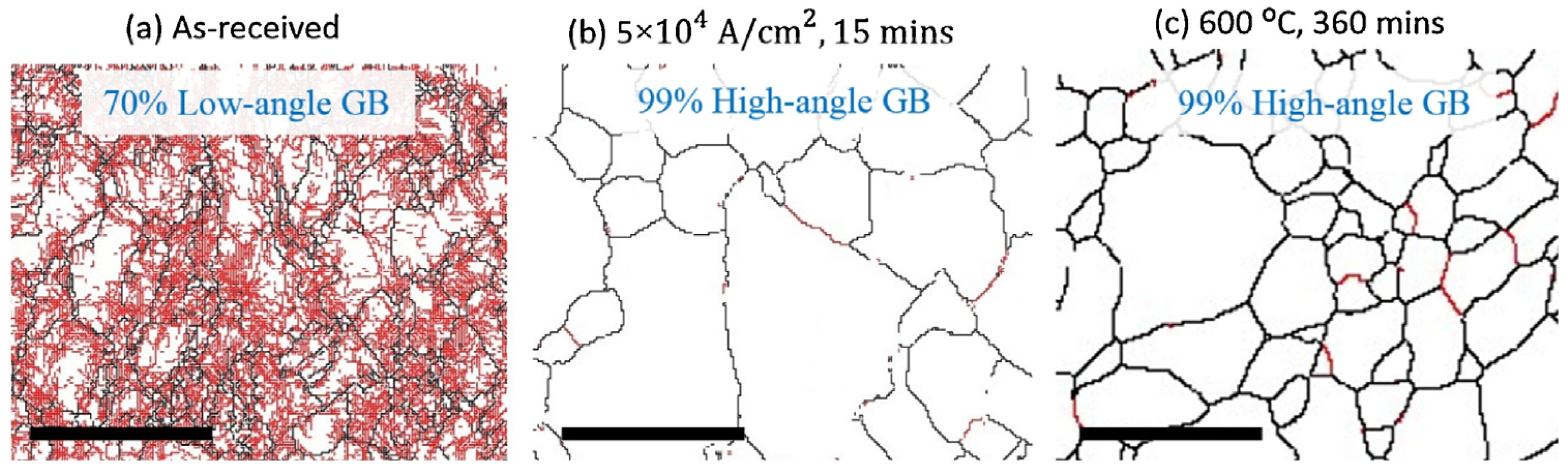
From a recrystallization kinetics standpoint, current-assisted grain refinement originates fundamentally from accelerated dislocation-mediated microstructural transformations. Pulsed electric current intensifies dislocation multiplication, glide, cross-slip, and annihilation, thereby expediting the transition from deformed microstructures to subgrain configurations and ultimately to fully recrystallized grains. Jeong et al. [62] employed ultra-low-carbon steel to systematically compare recrystallization behavior under electric current treatment versus isothermal heat treatment. Their findings revealed substantially accelerated recrystallization kinetics under electrical assistance, implicating non-thermal contributions through altered effective activation energies or modified defect evolution pathways. In parallel, Waryoba et al. [97] demonstrated in zirconium alloys that moderate current densities enable preferential coupling between electron wind effects and defect-concentrated regions, facilitating annealing-like microstructural modifications at markedly reduced thermal budgets. Figure 1 illustrates that electric-field annealing promotes rapid evolution of low- and high-angle grain boundaries, accelerating defect reconfiguration and grain-boundary migration to expedite recrystallization kinetics. Collectively, these observations substantiate that electric current imparts directionally selective acceleration to defect dynamics and grain boundary processes, thereby diminishing the activation energy barrier for recrystallization.
Magnesium alloy systems exhibit exceptionally pronounced grain refinement responses to electrical assistance. Shan et al. [38] reported that pulsed electric treatment precipitated accelerated static recrystallization in cold-drawn AZ31 alloy wires, engendering ultrafine grain development coupled with marked attenuation basal texture. Building upon these findings, Gao et al. [39] established that judiciously selected duty cycles and treatment durations promote static recrystallization and grain refinement whilst expediting dissolution of β-Mg17Al12 precipitates. Nevertheless, excessive duty cycles or prolonged treatment durations may induce abnormal grain coarsening, thereby delineating the constrained parametric envelope within which pulsed current effectively mediates grain refinement.
Dynamic grain refinement under pulsed current assistance has emerged as a focal research domain distinct from static thermal treatments. In the electrically assisted rolling of AZ31 magnesium alloy, deliberate parametric selection, elevated frequency coupled with abbreviated pulse duration, constrained macroscopic Joule heating to negligible levels (~7.1 °C peak temperature elevation). Despite minimal thermal excursion, dynamically recrystallized grain fractions substantially exceeded those in conventionally hot-rolled equivalents, accompanied by basal texture attenuation and mechanical property enhancement [40]. These findings compellingly demonstrate that grain refinement in this regime is principally mediated by athermal mechanisms, specifically current-accelerated dislocation dynamics and enhanced recrystallization nucleation. Analogous behavior manifests across diverse magnesium alloy compositions. For instance, AZ31B subjected to sequential pre-straining and induction-coupled pulsed current treatment exhibits pronounced dislocation annihilation and accelerated dynamic restoration kinetics [41]. Similarly, in the electroplastic processing of Mg-13Gd-4Y-2Zn-0.5Zr rare-earth alloy, pulsed current promotes dissolution of deleterious intermetallic phases, thereby engendering microstructural conditions conducive to grain refinement [42].
In aluminum alloy systems, substantial evidence has demonstrated that electric current can promote grain refinement. For instance, in studies of pulsed current-assisted rolling of 2024 aluminum alloy, the electron wind effect was suggested to provide an additional driving force for microstructural evolution, thereby accelerating the dynamic recrystallization process [47]. During subsequent aging treatments, the refined microstructure further interacts with precipitation strengthening phases, enabling the material to achieve an improved balance between strength and ductility. Similarly, in Al–Cu–Li alloys, the introduction of electrically assisted recrystallization annealing allows recrystallization to be completed within a relatively short time, resulting in a uniform fine-grained microstructure while significantly reducing the duration required for conventional heat treatments [48].
From a broader perspective across material systems, the current-induced promotion of recrystallization and grain refinement is not limited to light alloys. As mentioned earlier, studies on ultra-low-carbon steels have shown that, under comparable thermal histories, samples subjected to electric current treatment generally exhibit higher recrystallized fractions than those undergoing conventional heat treatment alone. Similar phenomena have also been observed in zirconium alloys during low-temperature current annealing, where the electron wind effect is believed to preferentially interact with defect-enriched regions, thereby enabling defect elimination and microstructural rearrangement at relatively low energy consumption [97]. Based on the existing literature, the current-promoted grain refinement process can generally be attributed to three primary mechanisms. First, electric current can reduce the resistance to dislocation depinning and slip, thereby improving the efficiency of defect rearrangement. Second, it can increase the probability of recrystallization nucleation, allowing regions with high stored energy to transform more readily into new grains. Third, electric current may enhance grain boundary migration and atomic diffusion, thereby accelerating the establishment of fine-grained microstructures [62].

3.2. Crystallographic Texture Modification

Texture is an important microstructural feature that describes the distribution of crystallographic orientations in polycrystalline materials. Its evolution plays a crucial role in determining the anisotropy, plastic deformation behavior, and formability of metallic materials. During conventional plastic deformation processes, pronounced deformation textures are often formed due to the non-uniform activation of slip systems and the selective deformation of grains with different orientations. Typical examples include the fiber textures commonly observed during rolling and the strong basal textures frequently developed in hexagonal close-packed (HCP) metals. By introducing pulsed electric current or continuous current, EAM not only alters the macroscopic deformation behavior of materials but may also influence grain orientation evolution and the mechanisms of texture formation. Existing studies have shown that the application of electric current can modify dislocation motion, slip mechanisms, and recrystallization behavior, thereby leading to phenomena such as texture weakening, texture randomization, or even texture reconstruction.
In magnesium alloy systems, the influence of EAM on texture evolution appears particularly significant. Because magnesium alloys possess a hexagonal close-packed crystal structure, plastic deformation is typically dominated by basal slip and deformation twinning, which readily leads to the formation of strong basal textures and consequently limits material ductility. Previous studies have shown that pulsed current treatment can significantly modify this texture evolution behavior. For example, Shan et al. [38] reported that, during pulsed current treatment of cold-drawn AZ31 magnesium alloy, static recrystallization was promoted and grain refinement occurred, accompanied by a pronounced weakening of the basal texture. The authors suggested that electric current accelerates recrystallization nucleation by facilitating dislocation motion and defect rearrangement, thereby altering the orientation selection mechanism of recrystallized grains. Similarly, Zhou et al. [41] found in their study on AZ31B magnesium alloy subjected to a combined process of pre-straining and electromagnetic induction pulsed current treatment that the pulsed current suppressed {10–12} deformation twinning while promoting the activation of non-basal slip systems. As a result, the basal texture was weakened, and the ductility of the material was improved. These findings indicate that electric current may significantly influence texture evolution in magnesium alloys by modifying the competitive relationship between slip and twinning mechanisms.
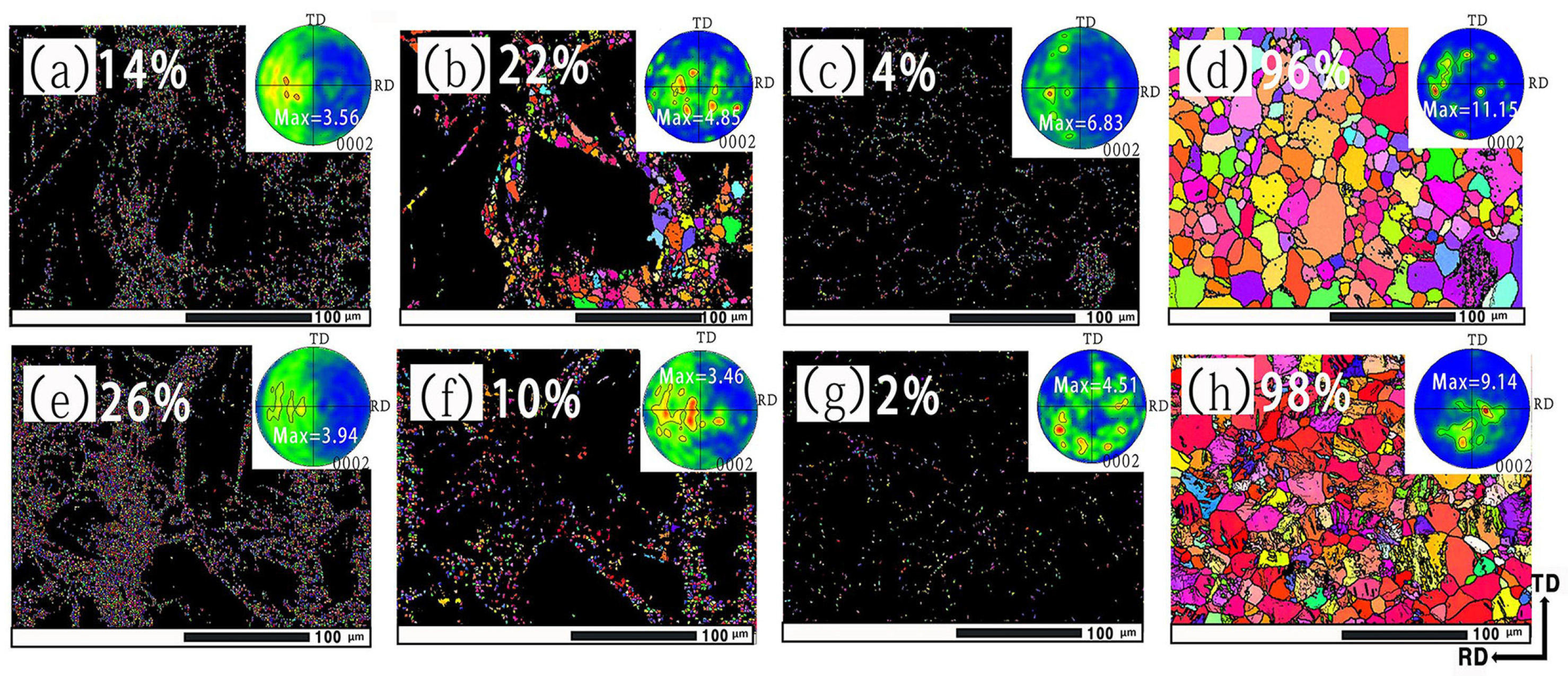
Similar texture modifications have also been reported in other material systems. For instance, Deng et al. [43] found in their study of Mg–Zn–Gd alloys that pulsed electric current could regulate the distribution of grain orientations and suppress the preferential growth of grains with basal orientations, thereby enabling a certain degree of texture control. The authors suggested that pulsed current promotes recrystallization and grain rotation, allowing some non-basal oriented grains to be retained and gradually become dominant in the microstructure. Figure 2 further demonstrates that electropulsing alters the orientation selection during recrystallization, allowing off-basal grains to be retained and to grow competitively, thereby contributing to texture tailoring in the Mg–Zn–Gd alloy.
In ferrous materials, electric current may similarly influence texture evolution. For instance, Fan et al. [63] investigated the effect of high-energy pulsed current treatment on pre-deformed SUS304 stainless-steel ultrathin strips and observed that the application of electric current weakened the {111} fiber texture and, to some extent, mitigated the material’s anisotropy. Electron backscatter diffraction (EBSD) analysis indicated that the pulsed current promoted the recovery of dislocation structures and the recrystallization process, thereby altering the original deformation texture. Similar observations have been reported in studies on pulsed current-induced recrystallization in cold-rolled SUS304 stainless steel, where a notable reduction in texture intensity was detected following current treatment. These findings suggest that electric current may facilitate recrystallization, leading to a more randomized distribution of grain orientations [64].
In titanium alloy systems, current-induced texture modification has also been reported. Yan et al. [98] investigated the effect of pulsed current treatment on the surface of electron-beam-melted Ti-6Al-4V alloys and found that the electric pulses altered the crystallographic orientation distribution and induced texture reconstruction. The authors attributed this phenomenon primarily to the promotion of localized recrystallization and grain rotation under the action of pulsed current.
From a mechanistic perspective, the influence of electric current on texture evolution can generally be interpreted from several aspects. Pulsed electric current facilitates dislocation motion through the electron wind effect and can reduce the resistance to dislocation slip to a certain extent. Consequently, the activation conditions of different slip systems may be modified, allowing grains to undergo orientation rotation along different deformation paths. Moreover, pulsed current often accelerates dynamic recovery and recrystallization processes, which may alter the orientation selection mechanism of recrystallized grains, thereby leading to the weakening or randomization of the original texture. In addition, several studies have suggested that electric current may modify the competitive relationship between deformation twinning and slip, further influencing the formation and evolution of texture.

3.3. Phase Transformation and Precipitation Behavior

Electric current not only alters the dislocation structures and recrystallization behavior of materials but may also significantly influence phase transformation kinetics and transformation pathways. Pulsed electric current, through rapid Joule heating, the electron wind effect, and the activation of diffusion processes, can modify atomic migration, interface mobility, and local thermodynamic conditions. As a result, certain phase transformations may occur at lower temperatures or within shorter time scales, and microstructural transformations that are difficult to achieve under conventional heat treatment conditions may be substantially accelerated. Overall, the regulation of phase transformation behavior under electric current treatment is primarily manifested in several aspects, including the acceleration of the α→β phase transformation, the control of martensitic reverse transformation, the evolution of precipitation phases, and dynamic precipitation occurring during deformation processes.
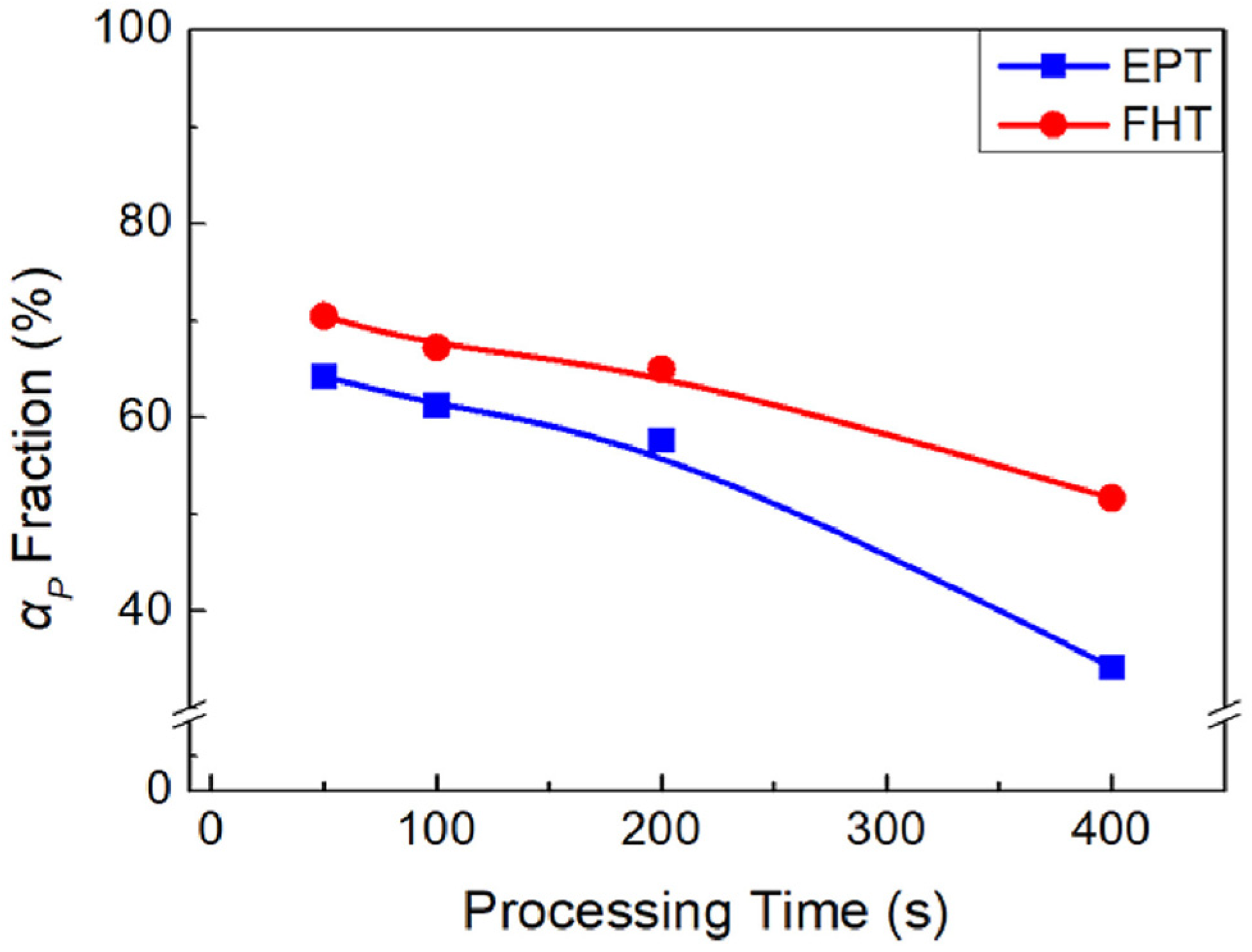
In titanium alloys, the promotion of the α→β phase transformation by pulsed electric current is particularly representative. Huang et al. [53] reported that in their study of Ti-6Al-4V alloy, the α→β transformation can occur at relatively lower temperatures and within shorter time periods under pulsed current treatment, exhibiting higher transformation efficiency compared with conventional thermal treatments. Subsequent investigations on elemental diffusion between the α and β phases in Ti-6Al-4V have further demonstrated that pulsed current enhances the diffusion rates of Al and V, thereby providing experimental evidence for the accelerated α→β transformation [54]. Kim et al. [55] further noted that pulsed current not only promotes the phase transformation itself but may also influence static recrystallization, dislocation migration, and grain growth processes, resulting in a coupled evolution between phase transformation and microstructural refinement. Figure 3 shows a pronounced reduction in the αp fraction after electropulsing treatment, confirming that pulsed current not only promotes phase transformation but also drives coupled microstructural evolution in Ti–6Al–4V alloy. Similar phenomena have also been observed in TA15 alloy, where it has been shown that the degree of α→β transformation increases with increasing current density or treatment temperature [56]. These findings suggest that the role of pulsed current is not limited to rapid heating but may also alter phase transformation kinetics by enhancing diffusion and interface migration processes.
In ferrous materials, pulsed electric current also exhibits a certain capability to regulate martensitic transformation and its reverse transformation behavior. Xu et al. [65] reported that in their study of low-alloy steels, pulsed current treatment can suppress carbide precipitation during martensite tempering and enable a near diffusionless rapid α′→γ reverse transformation in 22MnB5 steel. During this process, the size, morphology, and crystallographic orientation of the original prior-austenite grains can be largely preserved after the reverse transformation, indicating that pulsed current may provide a potentially reversible pathway for controlling martensitic transformation. Similar phenomena have also been observed in martensitic stainless steels. For instance, Fu et al. [66] found in their study of AISI 420 steel that pulsed current quenching and pulsed current tempering can significantly increase the volume fraction of retained austenite. This behavior is believed to be associated with the promotion of carbon diffusion from martensite to austenite under pulsed current, thereby inducing austenite reverse transformation.
In aluminum alloys, pulsed current exhibits a characteristic rapid response in the evolution of precipitation phases. Wei et al. [49] reported that in their study of as-cast 2024 aluminum alloy, high-energy pulsed current significantly accelerates the spheroidization of the S phase (Al2CuMg). The underlying mechanism involves not only the dissolution of second-phase particles but also the cooperative evolution of particle coarsening. Similarly, Chen et al. [50] observed in their investigation of 7150 aluminum alloy that pulsed current aging more readily promotes the formation and growth of precipitates compared with conventional furnace aging. Further analysis suggests that pulsed current may accelerate the formation of strengthening phases by increasing the atomic diffusion coefficient and reducing the activation energy for precipitation. However, it may also simultaneously promote microstructural softening. Therefore, in aluminum alloys, the role of pulsed current in precipitation evolution is more likely associated with the reconfiguration of precipitation kinetics rather than a single strengthening effect.
Furthermore, in certain alloy systems, pulsed electric current may directly participate in the formation and evolution of second phases during plastic deformation. For example, Wang et al. [99] reported that in their study on warm extrusion of AZ91 magnesium alloy, the introduction of pulsed current significantly alters the dynamic precipitation behavior and microstructural evolution pathways of the material. The authors suggested that, under pulsed current-assisted extrusion conditions, the dynamic precipitation and dissolution processes of the β-Mg17Al12 phase are coupled with deformation-induced microstructural evolution. In other words, under pulsed current treatment, precipitation processes may no longer occur solely during subsequent aging treatments but may instead take place concurrently with deformation. This concurrent evolution can further influence dynamic recrystallization, grain boundary migration, and ultimately the mechanical properties of the material.

3.4. Residual Stress Evolution and Relaxation

Residual stress represents a critical factor governing the structural stability, fatigue life, and service reliability of metallic materials. Conventional manufacturing processes invariably generate complex residual stress fields within materials, arising from inhomogeneous plastic deformation and temperature gradients. In electrically assisted manufacturing (EAM), the application of pulsed electric current facilitates dislocation motion and defect recovery through the synergistic action of the electron wind effect and Joule heating, thereby accelerating stress relaxation and modifying the residual stress distribution.
Pulsed current treatment has been demonstrated to effectively alleviate residual stresses in metallic materials. Xiang et al. [67] investigated the effects of pulsed electric current on residual stress states in metals, observing significant reductions in both surface and bulk residual stresses post-treatment. The degree of stress reduction exhibited a strong dependence on the initial residual stress magnitude and the applied electrical parameters. The authors attributed this phenomenon to the electron wind effect, which facilitates dislocation slip and localized plastic deformation, thereby accelerating stress relaxation.
Analogous phenomena have been documented across diverse engineering materials. Pan et al. [68] investigated quenched 45 steel components subjected to pulsed current treatment, achieving approximately 50% residual stress reduction while concomitantly decreasing treatment duration, with negligible variation in material hardness. In welded structures, pulsed electric current has proven effective in mitigating welding-induced residual stresses; X-ray diffraction analysis of 316L stainless-steel joints treated with low-frequency pulsed current revealed stress reductions of approximately 40% [69]. These findings indicate that pulsed current treatment constitutes an efficient approach for residual stress management, presenting a viable alternative to conventional tempering or thermal processing under appropriate conditions.
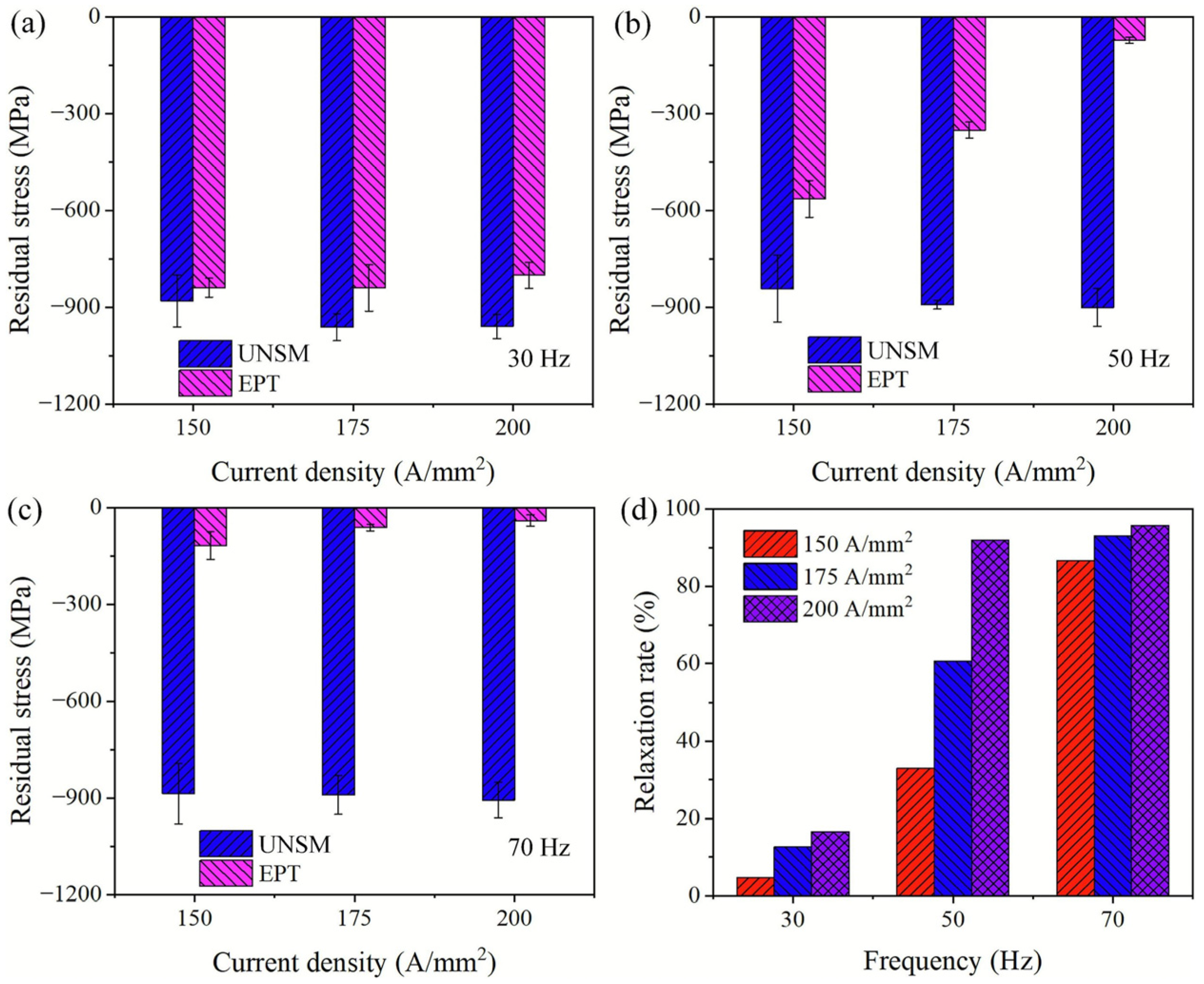
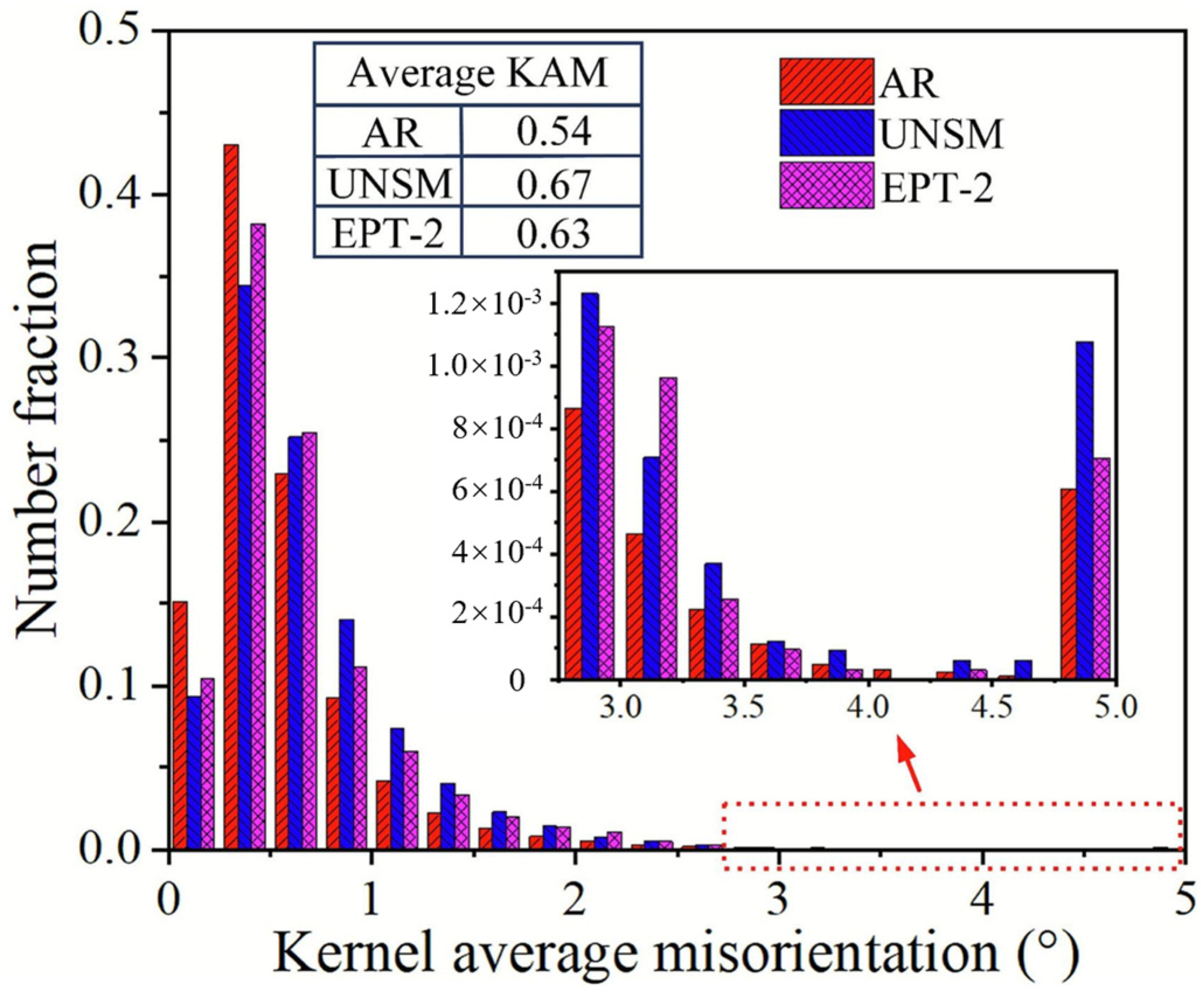
Comparable effects have been documented in titanium alloys. Tang et al. [57] reported that pulsed electric current application to fine-grained Ti–6Al–4V alloys substantially reduced compressive residual stresses, achieving maximum relaxation rates approaching 90% (Figure 4). Concomitantly, microstrain levels decreased, as indicated by reduced kernel average misorientation (KAM) values and diminished fractions of high-misorientation regions (Figure 5). These findings further demonstrate that pulsed current can profoundly alter the internal stress state of materials by facilitating microstrain relaxation associated with defect structures.
From a mechanistic perspective, residual stress relaxation induced by pulsed current primarily originates from electron wind-driven dislocation motion and localized plastic deformation arising from transient thermal effects. Under electric current, dislocations undergo facilitated glide, rearrangement, and annihilation, thereby promoting internal stress redistribution and gradual stress relaxation [100]. Consequently, through judicious control of current density, pulse frequency, and treatment duration, EAM constitutes an effective approach for residual stress regulation.

3.5. Discussion

The overall microstructural trend is clear: current can accelerate recrystallization, modify texture, and change phase evolution. What is much less clear is the relative weight of the different driving factors in each alloy and process window. Comparisons across the literature are often weakened by differences in heating rate, thermal gradient, strain path, pulse description, and contact condition, as well as by the fact that much of the evidence remains ex situ rather than time-resolved.
For this reason, it is not surprising that some studies emphasize athermal grain refinement whereas others mainly attribute similar observations to rapid thermal recovery, diffusion enhancement, or precipitate dissolution. More synchronized electrical and thermal measurements, together with in situ diffraction or EBSD, would make these comparisons more convincing. Until such evidence becomes common, microstructural conclusions are better interpreted as specific to a given process window rather than automatically generalizable.

4. The Effect of EAM on Mechanical Properties

Mechanical property changes under EAM are downstream consequences of electrically modified defects and phase evolution. The following discussion therefore concentrates on how current-assisted changes in grain size, dislocation density, precipitation, and residual stress translate into hardness, strength, and fracture behavior, with particular attention to non-monotonic or state-dependent responses.

4.1. Hardness Evolution

Hardness serves as a critical metric of a material’s resistance to localized plastic deformation. Its evolution is governed by grain size, dislocation density, precipitation state, and residual stress distribution. During EAM, pulsed electric current modulates defect structures and microstructural evolution pathways via the synergistic electron wind effect, Joule heating, and electro-thermo-mechanical coupling. Consequently, hardness changes are typically non-monotonic, reflecting the interplay of strengthening and softening mechanisms. Specifically, grain refinement, dislocation accumulation, and phase-transformation strengthening tend to increase hardness, whereas dynamic recovery, recrystallization, and precipitate coarsening promote softening. Thus, hardness evolution under EAM conditions fundamentally represents the competitive interaction among multiple microstructural mechanisms.
From the perspective of strengthening mechanisms, grain refinement constitutes a primary mechanism of hardness enhancement. Pulsed electric current facilitates dislocation glide and modifies atomic bonding configurations in defect-dense regions, thereby accelerating recrystallization nucleation and promoting fine equiaxed grain formation. The Hall–Petch relationship dictates that reduced grain size enhances resistance to localized plastic deformation, manifesting as increased hardness. For instance, Xu et al. [44] reported that pulsed current-assisted rolling of AZ31 magnesium alloy produced significant grain refinement concomitant with enhanced hardness and strength. Similarly, Lee et al. [45] observed that electrically assisted tensile deformation of AZ31B magnesium alloy promoted dynamic recrystallization and fine grain formation, resulting in appreciable increase in hardness.
Beyond grain refinement, dislocation structure evolution governs hardness variation. Pulsed electric current facilitates dislocation glide and rearrangement, engendering increasingly complex dislocation networks. Elevated dislocation density intensifies dislocation–dislocation interactions, thereby enhancing resistance to localized plastic deformation and increasing hardness. Conrad et al. [18] demonstrated that the electron wind effect diminishes dislocation motion resistance while promoting dislocation multiplication, consequently altering work-hardening characteristics. Under specific electro-assisted deformation conditions, high-density dislocation configurations and subgrain structures may further augment material hardness.
Phase transformation and precipitation behavior also exert pivotal influence on hardness evolution under EAM conditions. In specific alloy systems, pulsed electric current can alter phase transformation kinetics or precipitation dynamics, thereby modifying local strengthening states. For instance, pulsed current treatment promotes α→β phase transformation in titanium alloys and modifies precipitation behavior in aluminum alloys, potentially enhancing local hardness [50]. Conversely, when electric current induces dissolution of strengthening phases or precipitate coarsening, the precipitation strengthening effect diminishes, leading to material softening. Thus, the impact of phase transformations and precipitation on hardness is governed by the initial microstructural state and applied electrical parameters.
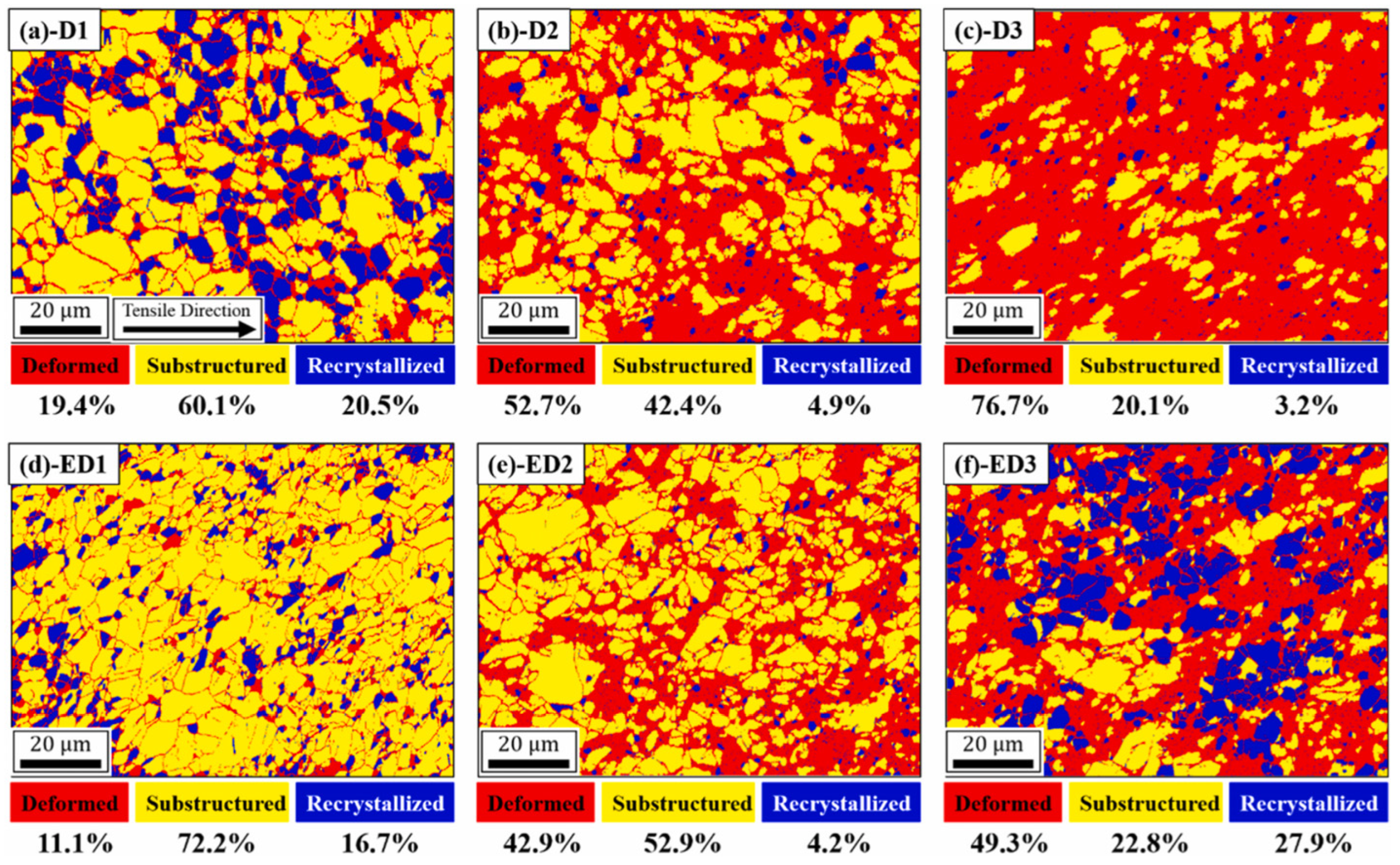
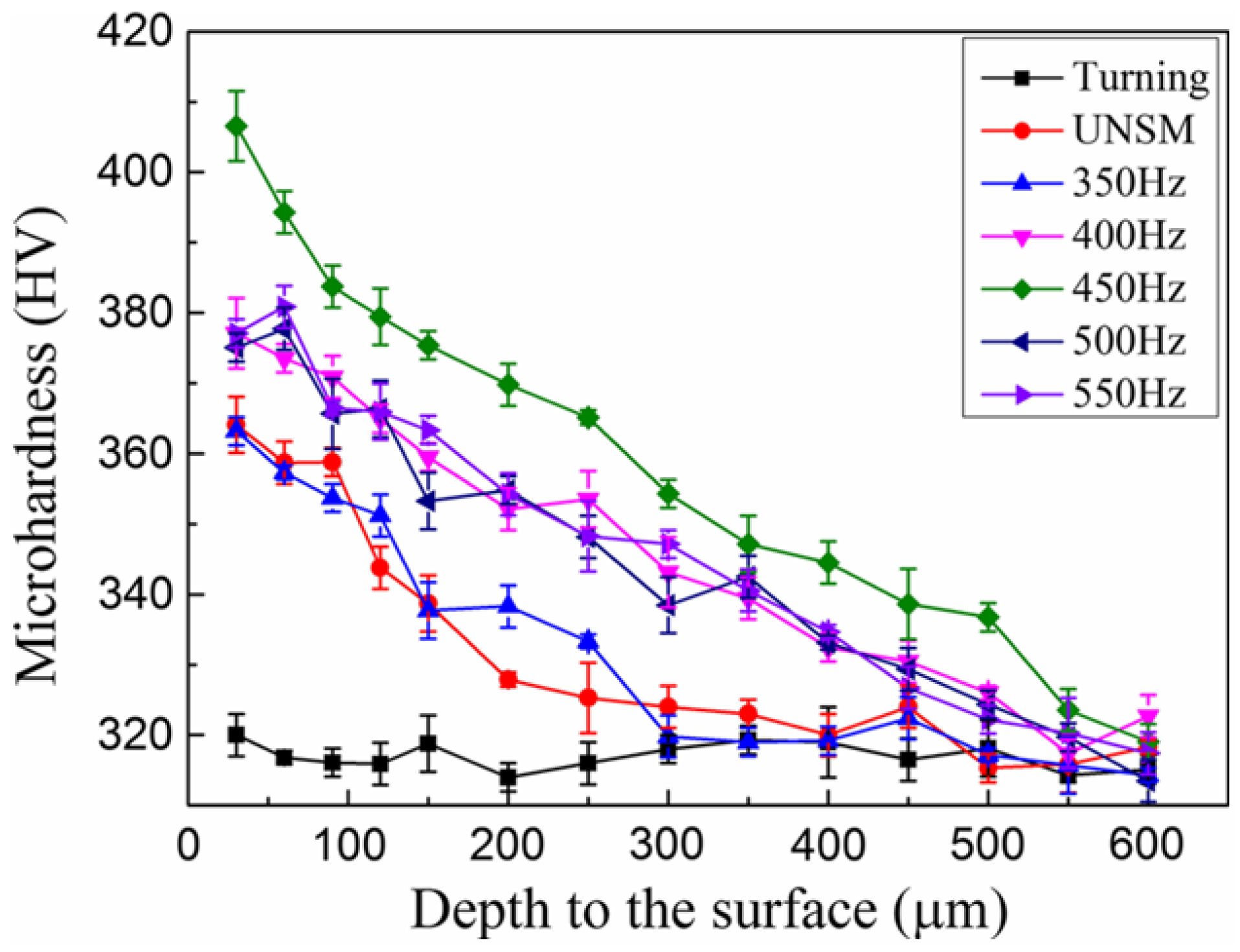
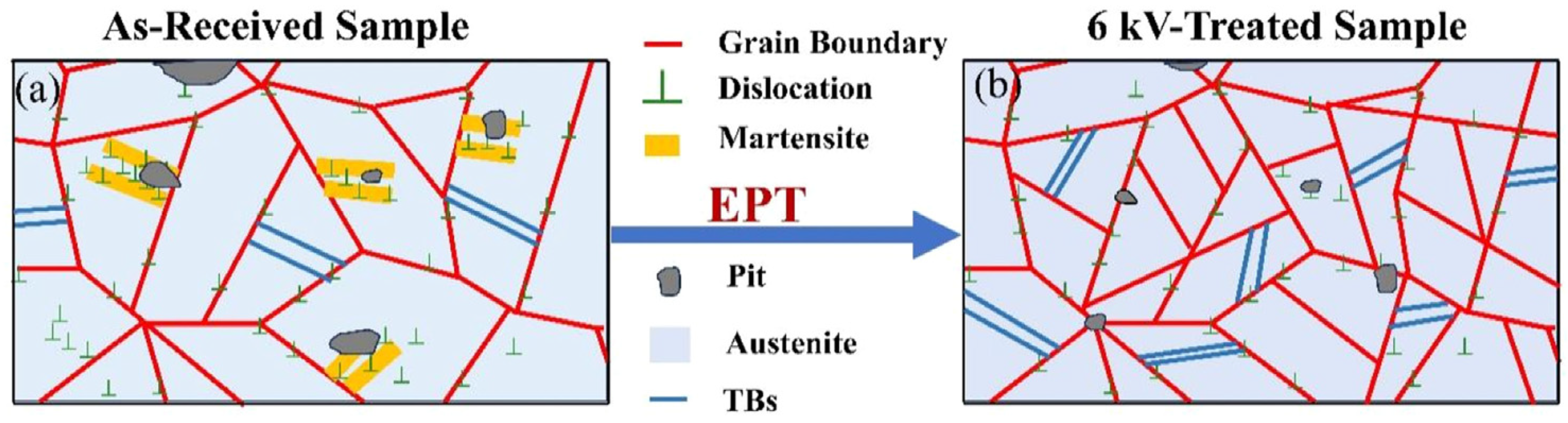
Conversely, softening represents a prevalent hardness response under electro-assisted processing conditions. Materials exhibiting high dislocation densities or substantial stored deformation energy undergo accelerated dislocation annihilation, dynamic recovery, and recrystallization when subjected to pulsed electric current, concomitant with stored energy release and defect density reduction. Under these circumstances, hardness decreases when recovery or recrystallization dominates microstructural evolution, even when partial grain refinement occurs. For instance, Fan et al. [63] demonstrated that pulsed current treatment of pre-deformed SUS304 stainless steel facilitated recovery of deformation-induced dislocation structures and, in severely pre-deformed specimens, induced localized static recrystallization (Figure 6), as manifested by decreased deformed grain fractions and increased substructured and recrystallized grain populations. This microstructural transition indicates softening attributable to diminished strain hardening. Additionally, pulsed current-induced residual stress relaxation may affect microhardness measurements, particularly in materials with gradient surface structures or localized heat-affected zones, where this effect is amplified.
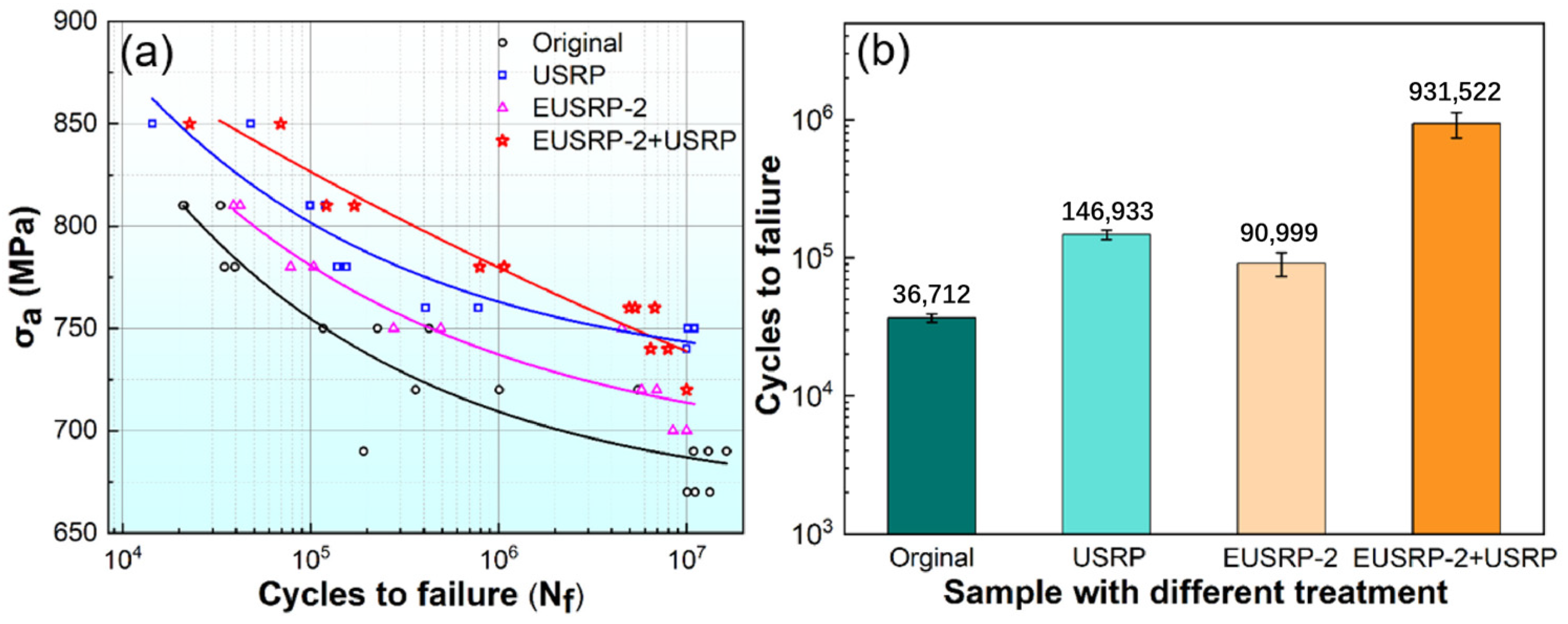
In hybrid processing configurations, pulsed electric current is frequently integrated with surface strengthening techniques such as ultrasonic surface rolling and nanocrystalline surface modification. These combined treatments typically generate a nanocrystalline strengthened layer and compressive residual stress layer near the material surface, producing pronounced surface hardening [101]. However, this strengthening primarily stems from severe plastic deformation-induced nanostructure formation, whereas pulsed electric current serves an auxiliary function in facilitating dislocation motion and microstructural evolution. Consequently, evaluating EAM effects on hardness necessitates discriminating between microstructural changes directly attributable to electric current and those resulting from mechanical surface strengthening.

4.2. Strength and Flow Stress Reduction

Under EAM conditions, the most prominent alteration in material mechanical behavior is the reduction in yield strength, flow stress, and overall deformation resistance. This phenomenon is widely recognized as the macroscopic manifestation of the electroplastic effect. Extensive research has demonstrated that pulsed electric current modifies critical deformation mechanisms—including dislocation glide, dynamic recovery, and dynamic recrystallization—through the synergistic interplay of the electron wind force, Joule heating, and their coupled interactions. Consequently, plastic deformation can be initiated and sustained under reduced external loading, ultimately resulting in decreased flow stress and forming resistance. Conversely, pronounced grain refinement can substantially enhance material strength. According to the Hall–Petch relationship, the yield strength of a polycrystalline material scales inversely with the square root of the average grain size, as the increased grain boundary density effectively impedes dislocation motion. The Hall–Petch equation is expressed as follows:
σ y = σ 0 + k y d 1 2
The electron wind force can provide an additional driving force for dislocation motion, enabling dislocations to readily overcome obstacles such as solute atoms, second-phase particles, and dislocation tangles, thereby reducing the resistance to dislocation glide. Concurrently, the localized temperature rise induced by Joule heating reduces the critical resolved shear stress of the material and accelerates dynamic recovery and recrystallization kinetics. The relative contributions of these two mechanisms may vary across different material systems; however, their synergistic effect is generally manifested as an instantaneous reduction in flow stress, a decreased work-hardening rate during deformation, and, in certain cases, enhanced ductility concomitant with strength reduction. Recent investigations increasingly indicate that the observed strength alterations under EAM conditions do not stem exclusively from thermal softening; instead, they originate from the intricate interplay between thermal and athermal mechanisms.
Magnesium alloys represent a prototypical material system for investigating the electroplastic effect. Lee et al. [45] conducted pulsed current-assisted uniaxial tensile and compressive experiments on AZ31B magnesium alloy sheets, integrating these experiments with thermo-electro-mechanical coupled finite element analysis to elucidate the underlying deformation mechanisms. The results demonstrated that a pronounced instantaneous drop in flow stress occurred upon the application of pulsed current. However, numerical simulations revealed that thermal softening induced solely by temperature elevation was insufficient to account fully for the observed experimental behavior, thereby indicating that the current-induced enhancement of plastic deformation encompasses a significant athermal contribution. This study thus furnished relatively direct evidence for the flow stress reduction induced by pulsed electric current. Consistent findings have emerged from subsequent investigations examining AZ31B under high-frequency pulsed current conditions. Zhao et al. [102] performed tensile experiments employing short-pulse-width, high-frequency pulsed current and observed that once the current density exceeded a critical threshold, the flow stress of the material decreased substantially and exhibited a stress response distinctly different from that attributable to Joule heating alone. Based on these findings, the authors proposed that a discernible athermal electroplastic effect operates in AZ31B under high-frequency pulsed current conditions. Collectively, such studies underscore that pulsed current can dynamically modulate the flow stress of materials during deformation.
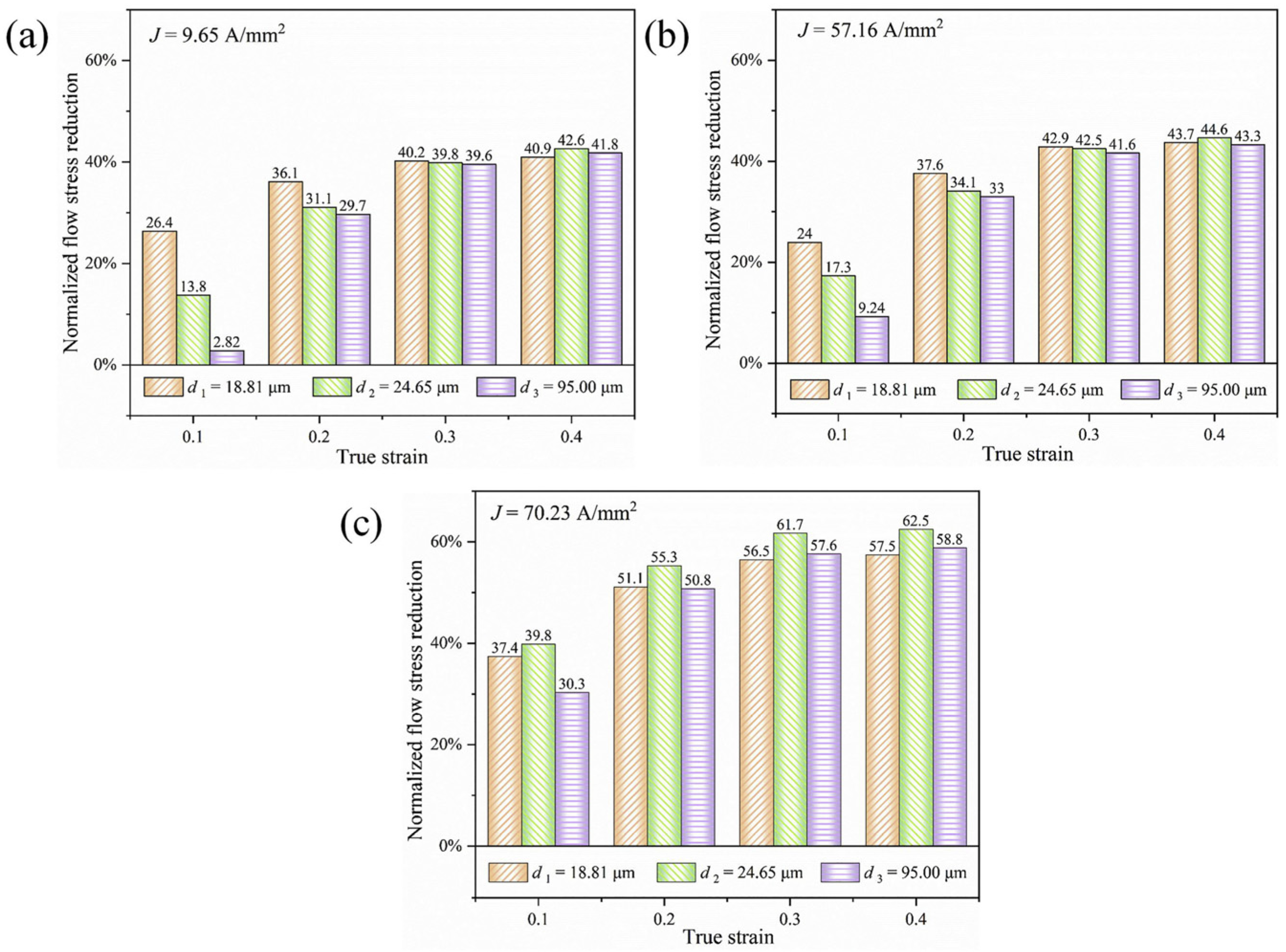
Beyond uniaxial tension, the influence of pulsed current on bending deformation resistance exhibits analogous characteristics. Chu et al. [46] investigated pulsed current-assisted V-bending of AZ31B magnesium alloy and reported that pulsed current substantially reduced the bending force and springback, with the effect demonstrating pronounced sensitivity to current frequency. Microstructural characterization revealed that pulsed current facilitated dynamic recrystallization and modified the fracture mode. Although this study primarily addressed forming performance, the reduction in bending load fundamentally reflects a decrease in the instantaneous deformation resistance of the material. Comparable phenomena have been documented in ferrous alloys. Ren et al. [1] reported in their investigation of high-energy pulsed current-assisted rolling of ultrathin 08Al carbon steel strips that the introduction of pulsed current markedly enhanced the plastic deformation capability of the material and substantially influenced the deformation behavior during rolling. High-energy pulsed current improved deformation compatibility by promoting dislocation motion and microstructural evolution, thereby diminishing the overall deformation resistance of the material. Investigations on stainless steels further corroborate this trend. More direct quantitative evidence for stainless steel was provided by Du et al. [103], who performed pulsed-current-assisted micro-compression of 304 stainless-steel sheets with initial grain sizes of 18.81, 24.65, and 95.00 μm. As shown in Figure 7, the normalized flow-stress reduction increased with current density and plastic strain. At a true strain of 0.2, the reduction rose from about 29.7–36.1% at 9.65 A/mm2 to 33.0–37.6% at 57.16 A/mm2 and further to 50.8–55.3% at 70.23 A/mm2. At a true strain of 0.4, the corresponding reduction reached approximately 39.6–42.6%, 43.3–44.6%, and 57.5–62.5%, respectively. These data demonstrate that pulsed current can markedly lower the flow stress of stainless steel during deformation, with the softening becoming especially pronounced at higher current density.
It should be noted that the influence of EAM on material strength exhibits pronounced dependence on the initial microstructural state. Kim et al. [51] investigated the electrically assisted uniaxial tensile behavior of Al–Mg–Si alloys under various heat-treatment conditions and observed that the effects of pulsed current on flow stress and ductility do not conform to a monotonic trend. In specimens subjected to solution treatment and natural aging, both flow stress and elongation increased, whereas in artificially aged specimens both parameters decreased concomitantly. Integrated analyses employing SEM, XRD, and TEM indicated that electric current modified damage evolution in the vicinity of precipitates as well as dislocation behavior. Consequently, when elucidating the influence of EAM on strength, variations in the initial microstructural state of the material must be rigorously considered. This material-state dependence is further manifested in investigations on Al–Mg alloys. Electrically assisted tensile experiments on AA5083-H111 have demonstrated that pulsed current can enhance fracture strain and alter the manifestation of the Portevin–Le Chatelier (PLC) effect, partially suppressing PLC bands and extending both the uniform and localized deformation stages. Although this study primarily addressed plastic behavior, the results nevertheless indicate that pulsed current can modify the stress–strain response and dislocation evolution mechanisms, thereby influencing both strength and deformation stability [52].

4.3. Fracture Toughness and Crack Healing

Fracture toughness characterizes the resistance of a material to crack propagation and constitutes a critical metric for assessing the reliability of structural materials. Recent investigations have demonstrated that EAM can not only modify the plastic deformation behavior of materials but may also influence crack propagation to a considerable extent by modulating the stress state at the crack tip and the surrounding microstructural evolution. Unlike conventional heat treatment or mechanical strengthening approaches, pulsed electric current can alter dislocation motion and localized plastic deformation behavior through electro-thermo-mechanical coupling effects, thereby affecting the fracture response of materials.
Pulsed current may induce localized temperature elevation in the vicinity of the crack tip, resulting in the formation of a plastic zone within a characteristic region and causing partial crack-tip blunting. Concurrently, the electron wind force can facilitate dislocation glide and migration, enabling more coordinated plastic deformation at the crack tip and thereby diminishing the driving force for crack propagation. Furthermore, the transient thermal stresses or compressive stresses generated by pulsed current may, under certain conditions, promote crack closure, further reducing the effective stress intensity factor at the crack tip. The synergistic interplay of these mechanisms suggests that EAM possesses the potential to enhance the fracture toughness of materials under appropriate conditions [28].
In recent years, pulsed current-induced crack healing has gradually emerged as a prominent research frontier in electro-assisted manufacturing. For instance, Kumar et al. [70] applied pulsed current treatment to steel specimens containing fatigue cracks and observed that, under appropriate electrical parameters, the cracks exhibited substantial closure and even localized healing. Microstructural characterization revealed that recrystallization occurred in the crack region under the influence of pulsed current, resulting in the formation of a fine-grained microstructure. Concurrently, localized micro-welding structures were observed along the crack interfaces, which effectively suppressed further crack propagation. These findings indicate that localized Joule heating, the electron wind force, and thermally induced compressive stresses generated by pulsed current may operate synergistically during the crack-healing process.
In addition to crack healing, pulsed current may also modify crack propagation behavior. Yu et al. [71] reported that the fatigue crack growth rate in stainless steel was significantly reduced after the application of high-density pulsed current. Meanwhile, pronounced plastic deformation and microstructural changes were observed in the crack-tip region, which delayed crack propagation and improved fatigue life. Similar observations were reported by Tang et al. [72] in their study of fatigue crack growth in austenitic stainless steels, where high-density pulsed current treatment was found to reduce the crack propagation rate. The authors suggested that the localized temperature rise and transient compressive stresses induced by pulsed current altered the stress field at the crack tip, thereby reducing the effective stress intensity factor.
Furthermore, EAM may indirectly influence material toughness by regulating microstructural evolution. Cai et al. [73] investigated pulsed current treatment of fatigue-cracked 316L stainless steel and found that pulsed current promoted microstructural reconstruction in the crack region and accelerated dislocation rearrangement. As a result, a relatively stable fine-grained structure formed near the crack tip, enhancing the material’s resistance to crack propagation. Figure 8 shows that electropulsing treatment induces pronounced crack closure and local metallurgical healing in the crack region, supporting the view that pulsed current promotes microstructural reconstruction and enhances resistance to crack propagation. A similar trend has also been observed in titanium alloys. Zhang et al. [74] reported that pulsed current treatment could extend the fatigue life of commercially pure titanium specimens and promote crack healing, which was mainly attributed to localized temperature rise and stress redistribution induced by pulsed current.
It should be noted, however, that the influence of pulsed current on material toughness is not always beneficial. Under certain conditions, excessively high current densities or inappropriate electrical parameters may lead to electrically induced embrittlement. For instance, Zeng et al. [26] observed in their study on pulsed current treatment of 316L stainless steel that, with increasing current density, the fracture mode gradually transitioned from ductile fracture to cleavage fracture. Microstructural analysis indicated that pulsed current could lead to the refinement of dislocation cell structures and an increase in deformation twins, thereby altering the fracture mechanism of the material. Therefore, in electro-assisted manufacturing processes, it is necessary to carefully control current density, pulse frequency, and treatment duration to avoid potential embrittlement risks.

4.4. Discussion

Although flow-stress reduction is one of the most consistent observations in EAM, the responses of hardness, strength, ductility, and fracture resistance are far less uniform. This is especially true in alloys where recrystallization softening competes with grain refinement, precipitation strengthening, twin-related hardening, or residual-stress relaxation. As a result, apparently similar electrical parameters can lead to quite different property changes when the initial microstructure or loading mode changes.
Another common limitation is that many studies report improvements under a single condition without statistical scatter, confidence intervals, or constitutive back-calibration. The literature is therefore stronger in phenomenological observation than in transferred parameters. More rigorous comparison will require standardized reporting of current waveform, temperature rise, strain rate, contact condition, and initial microstructure, together with models that can be checked against both macroscopic stress response and microstructural evidence.

5. The Effect of EAM on Service Performance

Service performance provides the most demanding test of whether electrically assisted processing delivers durable benefit rather than transient softening alone. This section therefore concentrates on wear, corrosion, fatigue, and related engineering metrics that connect near-surface microstructure and residual stress to in-service reliability.
From an engineering standpoint, the most persuasive evidence for application value does not come from isolated tensile tests, but from processing routes that simultaneously reduce forming or machining difficulty and deliver service-relevant benefits after processing. Representative examples include current-assisted rolling and drawing of Mg, Al, and steel products [1,38,47]; electropulsing-assisted turning of steels, where lower cutting forces and tool wear are accompanied by better surface integrity [104]; room-temperature residual-stress relaxation in welded joints [69]; and hybrid surface-strengthening routes such as EP-UNSM, EP-USRP, or electric-pulse-assisted laser shock processing, which combine current-induced defect activation with surface nanostructuring [58,59,60,61,75,76,77,105,106,107]. At the same time, industrial transfer remains constrained by current distribution nonuniformity, electrode or contact durability, temperature measurement at high strain rates, process repeatability, and the incomplete predictability of long-term residual-stress stability.
Representative process routes and the main service-related outcomes reported for them are summarized in Table 5.
Where explicit numerical improvements are available, selected examples are collected in Table 6.

5.1. Tribological Behavior and Wear Resistance

Wear resistance is one of the key indicators used to evaluate the service reliability of engineering materials and is typically assessed through parameters such as the coefficient of friction (COF), wear rate, wear volume, and wear scar morphology. In recent years, studies have shown that EAM can not only modify the microstructural characteristics and mechanical properties of materials but may also significantly influence their tribological behavior. The application of electric current can alter defect structures and plastic deformation characteristics near the material surface, thereby affecting the shear response at the contact interface as well as the material removal mechanisms during wear. Consequently, the influence of EAM on wear resistance is generally manifested through reductions in the friction coefficient, decreases in wear rate, and modifications of wear mechanisms.
From the perspective of friction behavior, EAM can reduce the average coefficient of friction during sliding contact under certain conditions while also improving friction stability. For example, studies on electrically assisted forming have shown that pulsed electric current can reduce the interfacial friction resistance between aluminum alloys and forming dies, thereby improving sliding conditions at the contact interface and reducing friction fluctuations. Kim et al. [51] reported in their investigation of electrically assisted deformation behavior of Al–Mg–Si alloys that the application of electric current promotes dislocation glide and reduces interfacial shear resistance, enabling the material to exhibit a lower coefficient of friction during forming processes. Similar phenomena have also been observed in magnesium alloys, where pulsed electric current refines the grain structure and enhances plastic flow capability near the material surface, thereby reducing the interfacial shear stress during sliding and improving friction stability [100].
In addition to variations in the coefficient of friction, EAM can also exert a significant influence on wear rate and wear volume. Wear rate, typically evaluated by the amount of material removed per unit load and sliding distance, is an important indicator for assessing wear resistance. In ferrous materials, pulsed current treatment can modify the dislocation structure and microstructural state of the surface layer, thereby enhancing the load-bearing capacity of the surface and reducing wear rate. For example, Fard et al. [110] investigated the influence of pulsed current treatment on the microstructure and properties of medium-carbon steel and found that pulsed current promoted microstructural homogenization and improved the wear resistance of the material, leading to a significant reduction in wear volume. Similar trends have also been observed in titanium alloys. Ye et al. [58] reported in their study of electrically assisted ultrasonic nanocrystalline surface modification of Ti-6Al-4V alloy that the treatment reduced the coefficient of friction and wear volume, thereby improving the wear resistance of the material. As shown in Figure 9, EP-UNSM produces a substantially higher near-surface hardness and a deeper hardened layer than conventional UNSM, which provides a direct microstructural basis for the reduced friction coefficient and wear volume observed in Ti–6Al–4V alloy. In stainless steels, pulsed current treatment can likewise improve the stability of the surface microstructure by modifying defect structures and recrystallization behavior, thereby reducing the amount of material removed during wear to some extent [98].
Morphological alterations of wear scars provide further evidence of enhanced wear resistance. Scanning electron microscopy examinations reveal that EAM-treated materials typically exhibit shallower, narrower wear tracks with significantly attenuated characteristic damage features, including ploughing grooves, delamination, and adhesive tearing. Investigations on titanium alloys and steels demonstrate that pulsed current treatment facilitates the formation of a stabilized surface deformation layer, thereby suppressing material spallation and reducing wear track depth during sliding wear [44,58]. Furthermore, pulsed current enhances surface microstructural uniformity and diminishes porosity defects, consequently improving surface integrity and mitigating wear damage [111].
In some cases, EAM may also lead to a transition in wear mechanisms. Under dry sliding conditions, conventional metallic materials typically exhibit a combination of adhesive wear, abrasive wear, and fatigue wear mechanisms. However, under electro-assisted processing conditions, changes in surface microstructure and residual stress states may shift the wear mechanism toward relatively milder forms. For instance, studies on Ti-6Al-4V alloys have shown that pulsed current-assisted surface modification can transform the wear mechanism from severe adhesive wear to milder abrasive wear or oxidative wear, thereby reducing the material removal rate [58]. Similar phenomena have also been reported in magnesium alloys and steels, which are generally attributed to grain refinement, dislocation rearrangement, and the introduction of compressive residual stresses. These factors enhance the stability of the surface microstructure and suppress crack initiation during wear.
Furthermore, in engineering applications, pulsed current is frequently integrated with complementary processing techniques, such as electrical discharge machining (EDM) or laser surface treatment. Such hybrid processing strategies enable further optimization of surface microstructure and residual stress states, yielding more pronounced enhancements in friction coefficients, wear rates, and wear morphology. For instance, investigations on EDM of Ti-6Al-4V alloys demonstrate that parameter optimization significantly reduces specific wear rates and improves overall tribological performance [112].

5.2. Corrosion Resistance and Passivation

Corrosion resistance serves as a key indicator of the service reliability of metallic materials in aggressive environments. Under electrically assisted manufacturing (EAM) conditions, its improvement is most directly manifested as reduced corrosion current density, elevated polarization resistance, and enhanced passive-film stability. Typically, pulsed current ameliorates corrosion behavior through the reduction of microstructural and compositional heterogeneities, the promotion of surface densification, and the attenuation of local electrochemical activity. Consequently, the material exhibits diminished susceptibility to passive-film breakdown and localized corrosion.
One of the most direct manifestations of corrosion improvement under pulsed current is the reduction in corrosion current density. In Ti-6Al-4V, Jiang et al. [59] reported that pulsed current combined with laser shock peening significantly decreased the corrosion current density, with the optimum condition exhibiting a reduction of approximately 73.2% relative to the untreated sample. This improvement was attributed to a refined and more compact surface structure, which facilitated the formation of a denser passive film. A similar trend was observed in AZ31 magnesium alloy treated by pulsed current-assisted laser shock forming, where the decrease in corrosion current density was accompanied by an increase in electrochemical impedance, indicative of a more corrosion-resistant surface state [105]. In both cases, the essential point is that pulsed current shifts the electrochemical response toward reduced corrosion activity, although the underlying structural mechanisms differ between the two materials.
Another important manifestation is the stabilization of the passive film and the corresponding increase in polarization resistance. In Ti-6Al-4V treated by EP-LSP, the refined surface microstructure and phase modification promoted the formation of a denser and more stable passive film, thereby suppressing the penetration of corrosive media into the substrate [59]. A similar improvement was reported for high-purity magnesium following electro-assisted laser shock peening, where electrochemical testing and corrosion morphology analysis confirmed that the treated surface exhibited superior corrosion resistance [106]. Although the specific material responses differed, both cases demonstrate that pulsed current can enhance corrosion resistance through the stabilization of the surface protective layer and the reduction of localized attack susceptibility.
Beyond the improvement of general electrochemical indicators, pulsed current can further mitigate localized corrosion by suppressing local galvanic effects. In selective laser melted Ti-6Al-4V, Yan et al. [60] demonstrated that pulsed current treatment suppressed elemental redistribution—a phenomenon typically intensified during conventional heat treatment—thereby diminishing compositional differences between adjacent phase regions and attenuating local galvanic coupling. In 304 stainless steel, the reduction of strain-induced martensite, coupled with grain refinement and increased twin boundary density, decreased corrosion susceptibility in simulated marine environments [75]. In AZ91 magnesium alloy, pulsed current promoted the dissolution and redistribution of the β-Mg17Al12 phase, thereby alleviating localized corrosion associated with second-phase heterogeneity [107]. Collectively, these findings support the view that the corrosion benefit of pulsed current primarily resides in the reduction of local electrochemical heterogeneity rather than in a simple bulk heating effect. Figure 10 schematically summarizes the associated microstructural changes and corrosion-mechanism evolution induced by electropulsing treatment.

5.3. Fatigue Life Extension and Crack Retardation

Fatigue life serves as a critical indicator of the long-term service reliability of structural materials subjected to cyclic loading. Under electrically assisted manufacturing conditions, its improvement is generally manifested as extended fatigue life, delayed crack initiation, and reduced crack growth rates. Typically, pulsed current enhances fatigue performance through the optimization of surface integrity, the deepening of the strengthened layer, and the stabilization of residual compressive stress states. Consequently, fatigue damage evolves at a reduced rate, attributable either to postponed crack nucleation or to retarded subsequent crack propagation.
One of the most direct manifestations of fatigue improvement under pulsed current is the marked extension of fatigue life. In AISI 304 stainless steel, Wang et al. [76,77] reported that EP-USRP produced a more refined ultrafine-grained surface structure, higher surface microhardness, and stronger compressive residual stresses than conventional USRP, resulting in a significant enhancement of rotating-bending fatigue strength. A similar yet more pronounced effect was observed in Ti–6Al–4V ELI alloy, where the electrically assisted ultrasonic surface rolling process generated a gradient deformation layer approximately 400 μm thick, accompanied by reduced surface roughness and elevated compressive residual stresses; as confirmed by the S–N curves and the fatigue-life comparison at 780 MPa presented in Figure 11, the fatigue life was increased by approximately 25-fold [61]. These results indicate that, for both stainless steel and titanium alloys, pulsed current can substantially enhance fatigue resistance when coupled with surface strengthening processes, provided that the resulting surface state is optimized for cyclic loading.
Another important manifestation is the postponement of crack initiation. In commercially pure titanium treated by EP-USRP, Ye et al. [113,114] found that pulsed current further reduced surface roughness and promoted the formation of a gradient nanocrystalline structure, which shifted the crack initiation site from the free surface to the subsurface region, thereby delaying crack nucleation. In Ti–6Al–4V alloy, related studies on USRP-treated specimens [115,116,117,118] also demonstrated that a deep compressive residual stress layer and improved surface integrity are highly effective in suppressing early fatigue damage. In this context, the role of pulsed current is not merely to strengthen the surface, but to render the strengthened layer more effective in postponing the onset of fatigue cracking.
In addition to delaying crack initiation, pulsed current can further improve fatigue performance by reducing crack growth rates. Several studies have demonstrated that high-density pulsed current can directly retard crack propagation by lowering the effective driving force at the crack tip. In stainless-steel systems, pulsed current treatment was reported to reduce crack growth rates and enhance fatigue life through modification of the local state near the crack tip [109]. Related investigations on fatigue-damaged or pre-cracked steel and stainless-steel specimens further revealed that pulsed current may induce crack closure, partial healing, or microstructural reconstruction in the crack region, thereby suppressing further crack advance. A similar trend was observed in aluminum alloy 2014-T6, where electropulsing improved fatigue resistance through retardation of crack growth [108]. Collectively, these studies indicate that pulsed current can improve fatigue performance not only by extending the crack-initiation stage, but also by decelerating the subsequent propagation stage once a crack has formed.

5.4. Discussion

Compared with deformation softening, service-performance improvement is supported by fewer but generally more application-oriented studies. The strongest quantified gains are currently reported in hybrid surface processes rather than in bulk electrically assisted deformation alone, as illustrated by residual-stress relaxation approaching 90% in fine-grained Ti64, corrosion-current reduction of about 73.2% in EP-LSP-treated Ti-6Al-4V, and roughly 25-fold fatigue-life extension in EP-USRP-treated Ti-6Al-4V ELI. These results are encouraging, but they still depend strongly on residual-stress stability, surface integrity, and subsequent thermal exposure.
Industrial translation is still limited by component geometry, current-uniformity control, electrode durability, safety, and the lack of component-scale validation under realistic service conditions. In other words, the literature already shows that EAM can improve service properties, but it does not yet prove that these benefits are always durable, economical, or directly scalable from laboratory coupons to complex parts. More work is especially needed on corrosion-fatigue coupling, the thermal stability of compressive stress layers, and component-level performance benchmarks.

6. Conclusions and Prospects

6.1. Conclusions

Electrically assisted manufacturing, an emerging electro-thermo-mechanically coupled processing technology, has demonstrated considerable potential for reducing deformation resistance, controlling microstructural evolution, and enhancing the service performance of high-strength, refractory metallic materials. This review critically synthesizes recent advances in the physical mechanisms, microstructural evolution, mechanical responses, and service performance of this processing paradigm. Current evidence suggests that the electroplastic effect originates from the interplay of multiple mechanisms, with Joule heating and athermal electroplastic effects serving as the dominant softening sources in most metallic systems. Concurrently, the skin effect and magnetoplasticity primarily influence the spatial distribution and relative intensity of these responses. At the microstructural level, pulsed current significantly modifies defect structures and evolution pathways, encompassing enhanced dislocation mobility, accelerated recrystallization, grain refinement, crystallographic texture evolution, and altered phase transformation and precipitation kinetics. These microstructural modifications ultimately translate into macroscopic property variations, notably reduced flow stress, and enhanced formability, while the evolution of hardness, strength, and toughness is governed by the interplay among grain refinement, dislocation accumulation, dynamic recovery, and phase transformation. Beyond immediate processing effects, EAM affects long-term service performance through surface microstructure refinement and compressive residual stress layer formation, effects that typically correlate with enhanced wear and corrosion resistance as well as extended fatigue life. Collectively, available evidence precludes a single universal softening mechanism; rather, EAM should be conceptualized as a competing-mechanism framework in which the dominant contribution varies with current waveform, component scale, alloy resistivity, initial defect state, and thermal boundary conditions. This accounts for the observation that ostensibly similar current densities can elicit softening, accelerated recrystallization, residual-stress relaxation, or even embrittlement across different material systems and processing conditions.

6.2. Future Research Trends and Prospects

Notwithstanding significant recent progress, a number of fundamental scientific and engineering challenges remain outstanding. A principal challenge pertains to the quantitative delineation of thermal and athermal contributions to the electroplastic effect, in view of their contested relative significance across diverse materials and processing conditions. Addressing this challenge necessitates temporally and spatially decoupled experiments, in situ characterization, high-resolution thermal metrology, and multiscale, multiphysics modeling. A second priority concerns the elucidation of multiscale microstructural evolution under coupled multifield conditions, particularly in precipitation-strengthened alloys, metastable alloys, welded joints, and additively manufactured metallic components. Establishing robust quantitative linkages among electrical parameters, microstructural evolution, residual stress, and service response is essential for practical implementation, requiring the integration of data-driven approaches with physics-based electro-thermal–mechanical and crystal-plasticity models rather than their isolated application. In terms of topic maturity, purely qualitative attribution of all softening solely to electron wind or magnetoplasticity has become progressively less convincing, except in well-defined material systems. In contrast, the most active emerging research drivers are likely to include service-oriented hybrid processes, current-assisted defect healing, electrically controlled phase selection in metastable alloys, and in situ monitoring strategies capable of concurrently tracking current waveform, defect kinetics, and residual-stress evolution. From an engineering perspective, large-scale adoption continues to face challenges regarding current distribution uniformity, thermal management, electrical contact reliability, process safety, and equipment integration. This suggests that future breakthroughs will hinge equally on advances in quantitative process control and further mechanistic refinement.

Author Contributions

X.L. and G.S.: Supervision, Project administration, Funding acquisition, Writing—Review and Editing. Y.L. and M.W.: Methodology, Formal analysis, Writing—Original Draft, Visualization. L.C. and L.L.: Conceptualization, Investigation, Resources, Data Curation. All authors have read and agreed to the published version of the manuscript.

Funding

This work was financially supported by the Guangdong Provincial Ocean Economy Development Special Fund (GDNRC [2024]32).

Data Availability Statement

No new data were created or analyzed in this study.

Conflicts of Interest

Authors Lijie Chen and Lianhao Liu were employed by the company CIMC Offshore Co., Ltd. The remaining authors declare that the research was conducted in the absence of any commercial or financial relationships that could be construed as potential conflicts of interest.

Abbreviations

The following abbreviations are used in this manuscript:
EAMElectrically assisted manufacturing
EPEElectroplastic effect
EPTElectropulsing treatment
UNSMUltrasonic nanocrystalline surface modification
EP-UNSMElectropulsing-assisted ultrasonic nanocrystalline surface modification
USRPUltrasonic surface rolling process
EP-USRPElectropulsing-assisted ultrasonic surface rolling process
SEMScanning electron microscopy
TEMTransmission electron microscopy
EBSDElectron backscatter diffraction
IPFInverse pole figure
KAMKernel average misorientation
COFCoefficient of friction
PLCPortevin–Le Chatelier
FCCFace-centered cubic
HCPHexagonal close-packed
SFEStacking fault energy
LAGBsLow-angle grain boundaries
HAGBsHigh-angle grain boundaries

References

  1. Ren, Z.; Xu, Y.; Chen, J.; Li, H.; Yuan, R.; Wang, Z.; Wang, T.; Liu, X. Mechanism of high-energy pulsed current-assisted rolling of 08AL carbon steel ultra-thin strip. J. Iron Steel Res. Int. 2024, 31, 416–427. [Google Scholar] [CrossRef]
  2. Zhan, L.; Li, R.; Wang, J.; Xue, X.; Wang, Y.; Lv, Z. Thermoelectric coupling deep drawing process of ZK60 magnesium alloys. Int. J. Adv. Manuf. Technol. 2023, 126, 3005–3014. [Google Scholar] [CrossRef]
  3. Dmitriev, S.V.; Morkina, A.Y.; Tarov, D.V.; Khalikova, G.R.; Abdullina, D.U.; Tatarinov, P.S.; Tatarinov, V.P.; Semenov, A.S.; Naimark, O.B.; Khokhlov, A.V.; et al. Effect of repetitive high-density current pulses on plastic deformation of copper wires under stepwise loading. Spectr. Mech. Eng. Oper. Res. 2024, 1, 27–43. [Google Scholar] [CrossRef]
  4. Liu, J.; Ma, X.; Xu, F.; Chen, J.; Wang, L.; Zhou, Y.; Guo, J. Local buckling behaviour of Q690 high strength steel cold-formed round-ended oval hollow section stub columns under axial compression: Experimental investigation, numerical modelling and design. Eng. Struct. 2024, 318, 118683. [Google Scholar] [CrossRef]
  5. Wang, Q.; Liu, J.; Yang, R. High temperature titanium alloys status and perspective. J. Aeronaut. Mater. 2014, 34, 1–26. [Google Scholar] [CrossRef]
  6. Tur, E.; Öztürk, F. AZ31 Magnesium Alloy in the Aerospace Industry: A Review on the Effect of Composition, Microstructure, and Mechanical Properties on Alloy Performance. Kocaeli J. Sci. Eng. 2024, 7, 109–130. [Google Scholar] [CrossRef]
  7. Karbasian, H.; Tekkaya, A.E. A review on hot stamping. J. Mater. Process. Technol. 2010, 210, 2103–2118. [Google Scholar] [CrossRef]
  8. Ambrogio, G.; Filice, L.; Gagliardi, F. Formability of lightweight alloys by hot incremental sheet forming. Mater. Des. 2012, 34, 501–508. [Google Scholar] [CrossRef]
  9. Xu, Y.; Hu, X.; Zhang, X.; He, Z. Cold-hot integrated precision bending of ultra-high strength steel welded tube without springback compensation. J. Mech. Eng. 2023, 59, 353–363. [Google Scholar] [CrossRef]
  10. Gudur, S.; Simhambhatla, S.; Reddy, N.V. Residual stress reduction in wire arc additively manufactured parts using in-situ electric pulses. Sci. Technol. Weld. Join. 2023, 28, 193–199. [Google Scholar] [CrossRef]
  11. Dash, A.; Liu, Y.; Yoshida, H.; Mücke, R.; Gerstein, G.; Herbst, S.; Nürnberger, F.; Maier, H.J.; Han, H.N.; Lin, S.K.; et al. Electroplasticity of metals and ceramics: Current status. Annu. Rev. Mater. Res. 2025, 55, 151–174. [Google Scholar] [CrossRef]
  12. Pawlikowski, K.; Sitko, M.; Perzyński, K.; Madej, Ł. Towards a Direct Consideration of Microstructure Deformation during Dynamic Recrystallisation Simulations with the Use of Coupled Random Cellular Automata—Finite Element Model. Materials 2024, 17, 4327. [Google Scholar] [CrossRef] [PubMed]
  13. Franceschi, A.; Stahl, J.; Kock, C.; Selbmann, R.; Ortmann-Ishkina, S.; Jobst, A.; Merklein, M.; Kuhfuß, B.; Bergmann, M.; Behrens, B.-A.; et al. Strategies for residual stress adjustment in bulk metal forming. Arch. Appl. Mech. 2021, 91, 3557–3577. [Google Scholar] [CrossRef]
  14. Maaß, F.; Hahn, M.; Tekkaya, A.E. Adjusting residual stresses by flexible stress superposition in incremental sheet metal forming. Arch. Appl. Mech. 2021, 91, 3489–3499. [Google Scholar] [CrossRef]
  15. Molotskii, M.I. Theoretical basis for electro- and magnetoplasticity. Mater. Sci. Eng. A 2000, 287, 248–258. [Google Scholar] [CrossRef]
  16. Lu, B.; Tang, K.; Wu, M.; Yang, Y.; Yang, G. Mechanism of Electropulsing Treatment Technology for Flow Stress of Metal Material: A Review. Alloys 2024, 3, 96–125. [Google Scholar] [CrossRef]
  17. Yang, Y.; Qin, R.; Dong, Y.; Wang, J.; Ye, C. Crystal plasticity modeling of electropulsing induced plasticity in metals. Int. J. Plast. 2023, 171, 103828. [Google Scholar] [CrossRef]
  18. Conrad, H. Electroplasticity in metals and ceramics. Mater. Sci. Eng. 2000, 287, 276–287. [Google Scholar] [CrossRef]
  19. Troitskii, O.A. Electromechanical Effect in Metals. ZhETF Pis’ma Red. 1969, 10, 18. [Google Scholar]
  20. Fan, Y.; Fan, H.; Hao, Z. Effect of pulsed current on plastic deformation of Inconel 718 under high strain rate and high temperature conditions. J. Alloy Compd. 2023, 943, 169150. [Google Scholar] [CrossRef]
  21. Lv, Y.; Chen, G.; Zhang, B.; Li, H.; Huang, J. Application of electroplastic effect in mechanical processing. Int. J. Adv. Manuf. Technol. 2024, 135, 25–48. [Google Scholar] [CrossRef]
  22. Krishnaswamy, H.; Tiwari, J.; Amirthalingam, M. Revisiting electron-wind effect for electroplasticity: A critical interpretation. Vacuum 2024, 221, 112937. [Google Scholar] [CrossRef]
  23. Li, X.; Zhu, Q.; Hong, Y.; Zheng, H.; Wang, J.; Wang, J.; Zhang, Z. Revealing the pulse-induced electroplasticity by decoupling electron wind force. Nat. Commun. 2022, 13, 6503. [Google Scholar] [CrossRef] [PubMed]
  24. Tan, H.; Wu, X.; Hu, S.; Ren, Y.; Du, Y.; Zhao, Q.; Sun, L.; Yang, F.; Hu, W. High-performance organic semiconductor near-infrared and shortwave-infrared photodetectors: A materials and device roadmap. Chem. Sci. 2025, 16, 21705–21744. [Google Scholar] [CrossRef]
  25. Guan, L.; Tang, G.; Chu, P.K. Recent advances and challenges in electroplastic manufacturing processing of metals. J. Mater. Res. 2010, 25, 1215–1224. [Google Scholar] [CrossRef]
  26. Zeng, Z.; He, J.; Xiang, Z.; Sun, Q.; Wu, Y.; Wang, S. Embrittlement of 316L stainless steel in electropulsing treatment. J. Mater. Res. Technol. 2020, 9, 10669–10678. [Google Scholar] [CrossRef]
  27. Okazaki, K.; Kagawa, M.; Conrad, H. An evaluation of the contributions of skin, pinch and heating effects to the electroplastic effect in titanium. Mater. Sci. Eng. 1980, 45, 109–116. [Google Scholar] [CrossRef]
  28. Liu, J.; Jia, D.; Fu, Y.; Kong, X.; Lv, Z.; Zeng, E.; Gao, Q. Electroplasticity effects: From mechanism to application. Int. J. Adv. Manuf. Technol. 2024, 131, 3267–3286. [Google Scholar] [CrossRef]
  29. Wang, X.; Xu, J.; Shan, D.; Guo, B.; Cao, J. Modeling of thermal and mechanical behavior of a magnesium alloy AZ31 during electrically-assisted micro-tension. Int. J. Plast. 2016, 85, 230–257. [Google Scholar] [CrossRef]
  30. Ben, D.; Yang, H.; Ma, Y.; Shao, X.; Pang, J.; Zhang, J. Rapid hardening of AISI 4340 steel induced by electropulsing treatment. Mater. Sci. Eng. A 2018, 725, 28–32. [Google Scholar] [CrossRef]
  31. Silvério, E.T.; Macedo Junior, J.R. Measuring and Modeling the Skin Effect for Harmonic Power Flow Studies. Energies 2023, 16, 7913. [Google Scholar] [CrossRef]
  32. Sprecher, A.F.; Mannan, S.L.; Conrad, H. Overview no. 49: On the mechanisms for the electroplastic effect in metals. Acta Metall. 1986, 34, 1145–1162. [Google Scholar] [CrossRef]
  33. Grimm, T.J.; Mears, L.M. Skin effects in electrically assisted manufacturing. Manuf. Lett. 2022, 34, 67–70. [Google Scholar] [CrossRef]
  34. Gu, S.; Kimura, Y.; Yan, X.; Liu, C.; Cui, Y.; Ju, Y.; Toku, Y. Micromachined structures decoupling Joule heating and electron wind force. Nat. Commun. 2024, 15, 6044. [Google Scholar] [CrossRef]
  35. Stolyarov, V.; Misochenko, A. A Pulsed Current Application to the Deformation Processing of Materials. Materials 2023, 16, 6270. [Google Scholar] [CrossRef]
  36. Felber, F.S.; Wessel, F.J.; Wild, N.C.; Rahman, H.U.; Fisher, A.; Fowler, C.M.; Liberman, M.A.; Velikovich, A.L. Ultrahigh magnetic fields produced in a gas-puff Z pinch. J. Appl. Phys. 1988, 64, 3831–3844. [Google Scholar] [CrossRef]
  37. Ruszkiewicz, B.J.; Grimm, T.; Ragai, I.; Mears, L.; Roth, J.T. A Review of Electrically-Assisted Manufacturing With Emphasis on Modeling and Understanding of the Electroplastic Effect. J. Manuf. Sci. Eng. 2017, 139, 110801. [Google Scholar] [CrossRef]
  38. Shan, Z.; Zhang, Y.; Liu, Y.; Zhang, Q.; Fan, J.; Wang, B.; Yun, X.; Xu, B. Effect of Electropulsing on the Microstructure and Mechanical Properties of AZ31 Alloys Manufactured by Cold Drawing. JOM 2024, 76, 6877–6888. [Google Scholar] [CrossRef]
  39. Gao, X.; Yan, R.; Zou, J.; Huang, Y.; Huang, Z. Electrical Pulse-Induced Microstructural Evolution and Strength–Ductility Synergy Mechanism in AZ31 Magnesium Alloy. J. Mater. Eng. Perform. 2025, 35, 18240–18249. [Google Scholar] [CrossRef]
  40. Huang, W.; Wang, B.; Wang, L.; Su, D.; Zhang, Q.; Fan, J.; Li, W.; Dong, H. Athermal Influence of High-Density Pulsed Electric Current on the Mechanical Properties and Microstructure of AZ31 Alloy during Rolling. J. Mater. Res. Technol. 2025, 37, 2788–2800. [Google Scholar] [CrossRef]
  41. Zhou, C.; Wang, S.; Li, R.; Chen, X.; Deng, Y.; Gao, Z.; Cui, X. Enhanced Ductility of AZ31B Magnesium Alloy Through a Combined Pre-Stretching and Electromagnetically Induced Electric Pulse Treatment Process. J. Magnes. Alloys 2025, 18, 101914. [Google Scholar] [CrossRef]
  42. Wang, D.; Qin, S.; Guo, C.; Chen, H.; Xiao, L.; Ren, W.; Sun, J.; Wang, P.; Hao, L.; Huang, H. Deformability Enhancement of Rare Earth Magnesium Alloy during Electroplastic Rolling. Mater. Sci. Eng. A 2025, 934, 148325. [Google Scholar] [CrossRef]
  43. Deng, Z.; Li, X.; Wang, S.; Li, X.; Chen, D.; Xiao, X. Texture Tailoring of a Cold-Rolled Mg–Zn–Gd Alloy by Electropulse Treatment: The Effect of Electropulse and Gd Element. Mater. Charact. 2022, 190, 112046. [Google Scholar] [CrossRef]
  44. Xu, C.; Li, Y.; Rao, X.; Wang, Q. Effect of Electropulsing Rolling on Microstructure and Mechanical Properties of AZ31 Magnesium Alloy. Trans. Nonferrous Met. Soc. China 2014, 24, 3777–3784. [Google Scholar] [CrossRef]
  45. Lee, J.; Kim, S.J.; Lee, M.G.; Song, J.H.; Choi, S.; Han, H.N.; Kim, D. Experimental and Numerical Study on the Deformation Mechanism in AZ31B Mg Alloy Sheets under Pulsed Electric-Assisted Tensile and Compressive Tests. Metall. Mater. Trans. A 2016, 47, 2783–2794. [Google Scholar] [CrossRef]
  46. Chu, X.R.; Wang, L.; Lin, S.X.; Yue, Z.M.; Gao, J. Experimental Investigation on Formability of AZ31B Magnesium Alloy V-Bending under Pulse Current. Acta Metall. Sin. 2018, 31, 1249–1257. [Google Scholar] [CrossRef]
  47. Liu, F.; Zhu, F.; Yang, W.; Wang, Q.; Tu, Y. Improved Mechanical Properties of 2024 Aluminum Alloys by Electric Pulse Assisted Rolling and Subsequent Aging. Mater. Des. 2025, 254, 114053. [Google Scholar] [CrossRef]
  48. Xue, S.; Xu, Z.; Xu, J.; Wang, C.; Shan, D.; Guo, B. Microstructure Evolution and Recrystallization Kinetics of Al–Cu–Li Alloy during Thermo-Mechanical Treatment with Overaging and Electrically Assisted Annealing. J. Alloys Compd. 2023, 967, 171801. [Google Scholar] [CrossRef]
  49. Wei, L.; Xu, X.; Zhao, Y.; Yan, X.; Zhou, Y.; Yu, Y.; Wu, Z. Rapid Spheroidization Process of S Phase (Al2CuMg) in the As-Cast 2024 Al Alloy Induced by High-Energy Electropulsing. Materials 2023, 16, 6939. [Google Scholar] [CrossRef]
  50. Chen, K.; Zhan, L.; Zhang, Y.; Liu, P. Effects of Electropulsing Aging on the Mechanical Properties and Microstructure of 7150 Aluminum Alloy. J. Alloys Compd. 2025, 1010, 177568. [Google Scholar] [CrossRef]
  51. Kim, M.J.; Lee, M.G.; Hariharan, K.; Hong, S.T.; Choi, I.S.; Kim, D.; Oh, K.; Han, H.N. Electric Current-Assisted Deformation Behavior of Al–Mg–Si Alloy under Uniaxial Tension. Int. J. Plast. 2017, 94, 148–170. [Google Scholar] [CrossRef]
  52. Cerny, A.; Grabner, F.; Arnoldt, A.R.; Kunschert, G.; Mayr, J.; Zickler, G.A.; Österreicher, J.A. Mechanisms of Electrically Assisted Deformation of an Al–Mg Alloy (AA5083-H111): Portevin–Le Chatelier Phenotype Transformation, Suppression, and Prolonged Necking. Mater. Sci. Eng. A 2024, 910, 146865. [Google Scholar] [CrossRef]
  53. Huang, J.; Xu, Z.; Deng, Y.; Peng, L. Electropulsing-Induced α to β Phase Transformation of Ti–6Al–4V. J. Manuf. Sci. Eng. 2019, 141, 111012. [Google Scholar] [CrossRef]
  54. Li, X.N.; Xu, Z.; Huang, J.; Peng, L.; Guo, P. Effects of Electropulsing Treatment on the Element Diffusion between Ti6Al4V and Commercially Pure Titanium. J. Manuf. Sci. Eng. 2020, 142, 051002. [Google Scholar] [CrossRef]
  55. Kim, M.; Lee, S.H.; Yu, J.; Cheon, S.; Byun, S.; Lee, C.S.; Lee, T. Enhanced Kinetics of Microstructural Evolution in Ti–6Al–4V through Electropulsing Treatment. J. Mater. Res. Technol. 2023, 26, 8500–8508. [Google Scholar] [CrossRef]
  56. Li, M.; Zu, Y.; Chen, G.; Zhou, W.; Fu, X.; Li, X. Enhanced α→β Phase Transition of Ti–6Al–2Zr–1Mo–1V Alloy by Electropulsing. J. Mater. Sci. 2024, 59, 13265–13284. [Google Scholar] [CrossRef]
  57. Tang, C.; Fan, R.; Zhang, Y.; Huang, B.; Ye, Y.; Duan, H.; Wang, J.; Ding, H.; Ye, C. Electropulsing-Driven Rapid Residual Stress Relaxation in Fine-Grained Ti64 Alloy. Mater. Charact. 2025, 231, 115926. [Google Scholar] [CrossRef]
  58. Ye, Y.; Wang, H.; Tang, G.; Song, G. Effect of Electropulsing-Assisted Ultrasonic Nanocrystalline Surface Modification on the Surface Mechanical Properties and Microstructure of Ti–6Al–4V Alloy. J. Mater. Eng. Perform. 2018, 27, 2394–2403. [Google Scholar] [CrossRef]
  59. Jiang, R.; Zhang, S.; Qin, X.; Wang, R.; Zhang, Z.; Zhang, Y.; Zhang, W.; Wang, Z. Effects of Electro-Pulsing Combining Laser Shock Peening on the Microstructure and Corrosion Resistance of Ti–6Al–4V Alloy. Int. J. Adv. Manuf. Technol. 2024, 134, 2607–2622. [Google Scholar] [CrossRef]
  60. Yan, X.; Xu, X.; Zhou, Y.; Wu, Z.; Wei, L.; Zhang, D. Constructing a Novel Bi-Lamellar Microstructure in Selective Laser Melted Ti–6Al–4V Alloy via Electropulsing for Improvement of Strength and Corrosion Resistance. J. Mater. Sci. Technol. 2024, 193, 37–50. [Google Scholar] [CrossRef]
  61. Sun, P.; Qu, S.; Duan, C.; Hu, X.; Li, X. Improving the High Cycle Fatigue Property of Ti6Al4V ELI Alloy by Optimizing the Surface Integrity Through Electric Pulse Combined with Ultrasonic Surface Rolling Process. J. Mater. Sci. Technol. 2024, 170, 103–121. [Google Scholar] [CrossRef]
  62. Jeong, K.; Jin, S.; Kang, S.; Park, J.; Jeong, H.; Hong, S.; Cho, S.H.; Kim, M.; Han, H.N. Athermally Enhanced Recrystallization Kinetics of Ultra-Low Carbon Steel via Electric Current Treatment. Acta Mater. 2022, 232, 117925. [Google Scholar] [CrossRef]
  63. Fan, W.; Ren, Z.; Wei, S.; Liu, Q.; Wang, T.; Wu, G. Effect of High Energy Electric Pulse on Microstructure and Mechanical Properties of Pre-Deformed SUS 304 Ultra-Thin Strip. Mater. Sci. Eng. A 2024, 893, 145364. [Google Scholar] [CrossRef]
  64. Wang, Z.; He, G.; Liu, X.; Zhou, Z.; Liao, Y.; Liu, Y.; Zhou, R.; Wu, Y.; Meng, Q. Electropulsing-Induced Recrystallization of Cold-Rolled SUS304 and Effects of Duration on Mechanical Properties. Mater. Sci. Technol. 2025, 41, 917–933. [Google Scholar] [CrossRef]
  65. Xu, X.; Fu, X.; Wu, C.; Wu, Z.; Wei, L.; Yu, Y.; Yang, X.; Tian, T. Rapid Reversion of Martensite in Low-Alloy Steel under Electropulsing Treatment: Exploring Feasibility of Reversible Transformation. Mater. Charact. 2024, 217, 114436. [Google Scholar] [CrossRef]
  66. Fu, X.; Xu, X.; Zhao, Y.; Chen, D.; Wu, Z.; Yan, X.; Zhou, Y.; Yu, Y. Retain the Austenite via Diffusion Control under Electropulsing to Improve the Mechanical Properties of AISI 420 Stainless Steel. J. Mater. Res. Technol. 2024, 29, 1665–1674. [Google Scholar] [CrossRef]
  67. Xiang, S.; Zhang, X. Residual Stress Removal under Pulsed Electric Current. Acta Metall. Sin. 2020, 33, 281–289. [Google Scholar] [CrossRef]
  68. Pan, L.; Chu, B.; Wang, B.; Xu, Z. Regulation of Residual Stress of Carbon Steel Parts by Electropulsing Treatment and Tempering. Heat Treat. Met. 2021, 46, 119–123. [Google Scholar] [CrossRef]
  69. Haque, A.; Sherbondy, J.; Warywoba, D.; Hsu, P.; Roy, S. Room-Temperature Stress Reduction in Welded Joints through Electropulsing. J. Mater. Process. Technol. 2022, 299, 117391. [Google Scholar] [CrossRef]
  70. Kumar, A.; Paul, S.K. Healing of Fatigue Crack in Steel with the Application of Pulsed Electric Current. Materialia 2020, 14, 100906. [Google Scholar] [CrossRef]
  71. Yu, T.; Deng, D.; Wang, G.; Zhang, H. Crack Healing in SUS304 Stainless Steel by Electropulsing Treatment. J. Clean. Prod. 2016, 113, 989–994. [Google Scholar] [CrossRef]
  72. Tang, Y.; Hosoi, A.; Morita, Y.; Ju, Y. Restoration of Fatigue Damage in Stainless Steel by High-Density Electric Current. Int. J. Fatigue 2013, 56, 69–74. [Google Scholar] [CrossRef]
  73. Cai, Q.; Zhou, M.; Bagherpour, E.; Hosseini, S.; Mendis, C.; Chang, I.; Assadi, H. New Insight into Crack-Healing Mechanism via Electropulsing Treatment. Metall. Mater. Trans. A 2023, 54, 2960–2974. [Google Scholar] [CrossRef]
  74. Zhang, S.; Choi, H.; Wang, J.; Liu, Z.; Han, H.N.; Hong, S.T. Rapid Crack Healing and Fatigue Life Extension in Single-Edge Notched Pure Titanium via Electropulsing Treatment. Int. J. Fatigue 2025, 198, 108967. [Google Scholar] [CrossRef]
  75. Tong, X.; Qin, C.; Ma, H.; Pan, Y.; Xiao, A.; Jiang, B.; Yang, W.; Deng, Y. Simultaneously Enhancing Corrosion Resistance and Mechanical Properties of 304 Stainless Steel via Electropulsing Treatment. Surf. Interfaces 2025, 77, 108041. [Google Scholar] [CrossRef]
  76. Wang, H.; Song, G.; Tang, G. Effect of Electropulsing on Surface Mechanical Properties and Microstructure of AISI 304 Stainless Steel during Ultrasonic Surface Rolling Process. Mater. Sci. Eng. A 2016, 662, 456–467. [Google Scholar] [CrossRef]
  77. Wang, H.B.; Yang, X.H.; Li, H.; Song, G.L.; Tang, G.Y. Enhanced Fatigue Performance and Surface Mechanical Properties of AISI 304 Stainless Steel Induced by Electropulsing-Assisted Ultrasonic Surface Rolling Process. J. Mater. Res. 2018, 33, 3827–3840. [Google Scholar] [CrossRef]
  78. Gao, J.; Li, H.; Sun, X.; Zhang, X.; Zhan, M. Electro-thermal-mechanical coupled crystal plasticity modeling of Ni-based superalloy during electrically assisted deformation. Int. J. Plast. 2022, 157, 103397. [Google Scholar] [CrossRef]
  79. Liu, Y.; Tan, X.; Chen, Y.; Zhu, X.; Wang, W.; Luo, L.; Wu, Y. Microstructure evolution of the rolled tungsten during the current-assisted annealing treatment. Int. J. Refract. Met. Hard Mat. 2024, 121, 106639. [Google Scholar] [CrossRef]
  80. Huang, M.; Rivera-Diaz-del-Castillo, P.E.J.; Bouaziz, O.; van der Zwaag, S. Irreversible thermodynamics modelling of plastic deformation of metals. Mater. Sci. Technol. 2008, 24, 495–500. [Google Scholar] [CrossRef]
  81. Vinogradov, A.; Yasnikov, I.S.; Estrin, Y. Irreversible thermodynamics approach to plasticity: Dislocation density based constitutive modelling. Mater. Sci. Technol. 2015, 31, 1664–1672. [Google Scholar] [CrossRef]
  82. Chowdhury, S.R.; Roy, D.; Reddy, J.N.; Srinivasa, A. Fluctuation relation based continuum model for thermoviscoplasticity in metals. J. Mech. Phys. Solids 2016, 96, 353–368. [Google Scholar] [CrossRef]
  83. Troitskii, O.A.; Likhtman, V.I. The anisotropy of the action of electron and γ-radiation on the deformation of zinc single crystals in the brittle state. Dokl. Akad. Nauk. SSSR 1963, 148, 332–334. [Google Scholar]
  84. Li, H.; Jin, F.; Zhang, M.; Ding, J.; Bian, T.; Li, J.; Ma, J.; Zhang, L.; Wang, Y. Decoupling electroplasticity by temporal coordination design of pulse current loading and straining. Mater. Sci. Eng. A 2023, 881, 145435. [Google Scholar] [CrossRef]
  85. Dubinko, V.I.; Klepikov, V.F. Kinetic mechanism of the electroplastic effect in metals. Bull. Russ. Acad. Sci. Phys. 2008, 72, 1188–1189. [Google Scholar] [CrossRef]
  86. Yuan, X.; Yan, C.; Zhang, S.; Yang, Y.; Zhou, S.; Huang, P.; Xia, D. Flash joule-heating technology for material manufacturing, processing, and emerging applications. AIChE J. 2026, 72, e70215. [Google Scholar] [CrossRef]
  87. Jha, A.K.; Sengupta, S. Thermal fluctuation driven structural relaxation in undeformed glasses: Unraveling the evolution of mechanical stability. Phys. Rev. E 2026, 113, 015421. [Google Scholar] [CrossRef]
  88. Ruszkiewicz, B.J.; Mears, L.; Roth, J.T. Investigation of Heterogeneous Joule Heating as the Explanation for the Transient Electroplastic Stress Drop in Pulsed Tension of 7075-T6 Aluminum. J. Manuf. Sci. Eng. 2018, 140, 091014. [Google Scholar] [CrossRef]
  89. Yu, Z.; Shi, G. Mechanisms of electroplasticity-assisted nano-cutting of polycrystalline SiCp/Al composites: A molecular dynamics simulation study. J. Appl. Phys. 2025, 138, 215102. [Google Scholar] [CrossRef]
  90. Molotskii, M.; Fleurov, V. Spin effects in plasticity. Phys. Rev. Lett. 1997, 78, 2779–2782. [Google Scholar] [CrossRef]
  91. Christian, J.W.; Mahajan, S. Deformation Twinning. Prog. Mater. Sci. 1995, 39, 1–157. [Google Scholar] [CrossRef]
  92. Khan, T.; Kirk, T.; Vazquez, G.; Singh, P.; Smirnov, A.V.; Johnson, D.D.; Youssef, K.; Arroyave, R. Towards Stacking Fault Energy Engineering in FCC High Entropy Alloys. Acta Mater. 2022, 224, 117472. [Google Scholar] [CrossRef]
  93. Xiao, A.; Huang, C.; Liu, H.; Cui, X.; Wang, S. Deformation Mechanism of 5052 Aluminum Alloy Using Electrically Assisted Electromagnetic Forming. Met. Mater. Int. 2022, 28, 2483–2497. [Google Scholar] [CrossRef]
  94. Kuang, J.; Du, X.; Li, X.; Yang, Y.; Luo, A.A.; Tang, G. Athermal Influence of Pulsed Electric Current on the Twinning Behavior of Mg-3Al-1Zn Alloy during Rolling. Scr. Mater. 2016, 114, 151–155. [Google Scholar] [CrossRef]
  95. Xu, S.; Xiao, X.; Zhang, H.; Cui, Z. Electroplastic Effects on the Mechanical Responses and Deformation Mechanisms of AZ31 Mg Foils. Materials 2022, 15, 1339. [Google Scholar] [CrossRef]
  96. Li, X.; Wang, S.; Zhao, S.; Ding, W.; Chen, J.; Wu, G. Effect of Pulse Current on the Tensile Deformation of SUS304 Stainless Steel. J. Mater. Eng. Perform. 2015, 24, 5065–5070. [Google Scholar] [CrossRef]
  97. Waryoba, D.; Islam, Z.; Wang, B.; Haque, A. Low Temperature Annealing of Metals with Electrical Wind Force Effects. J. Mater. Sci. Technol. 2019, 35, 465–472. [Google Scholar] [CrossRef]
  98. Yan, X.; Xu, X.; Zhou, Y.; Wu, Z.; Wei, L.; Zhang, D. Surface Electropulsing-Induced Texture Evolution in Electron Beam Melted Ti–6Al–4V Alloy for Biomedical Application. Surf. Coat. Technol. 2024, 479, 130509. [Google Scholar] [CrossRef]
  99. Wang, B.; Xu, G.; Ren, R.; Zhang, Q.; Shan, Z.; Fan, J. Effect of Electropulse on Dynamic Precipitation and Microstructure of AZ91 Magnesium Alloy during Warm Extrusion. Acta Metall. Sin. 2025, 61, 129–142. [Google Scholar] [CrossRef]
  100. Zhang, X.; Xiang, S.; Yi, K.; Guo, J. Controlling the Residual Stress in Metallic Solids by Pulsed Electric Current. Acta Metall. Sin. 2022, 58, 581–598. [Google Scholar] [CrossRef]
  101. Zhang, H.; Zhao, J.; Liu, J.; Qin, H.; Ren, Z.; Doll, G.L.; Dong, Y.; Ye, C. The Effects of Electrically Assisted Ultrasonic Nanocrystal Surface Modification on 3D-Printed Ti–6Al–4V Alloy. Addit. Manuf. 2018, 22, 60–68. [Google Scholar] [CrossRef]
  102. Zhao, J.; Ren, Z.; Zhang, H.; Wang, G.X.; Dong, Y.; Ye, C. Electroplasticity in AZ31B Subjected to Short-Duration High-Frequency Pulsed Current. J. Appl. Phys. 2019, 125, 185104. [Google Scholar] [CrossRef]
  103. Du, M.; Meng, B.; Liu, Y.Z.; Pan, F.; Wan, M. Flow Characteristics and Microstructural Evolution in Pulsed Current Assisted Micro-Scaled Compression of Stainless Steel Sheet. J. Mater. Res. Technol. 2021, 15, 4397–4414. [Google Scholar] [CrossRef]
  104. Xu, Z.; Wang, H.; Sun, Z.; Ye, Y.; Tang, G. Effect of electropulsing-assisted turning process on AISI 5120 cementation steel. Mater. Sci. Technol. 2017, 33, 1454–1460. [Google Scholar] [CrossRef]
  105. Sun, Y.; Liu, H.; Ma, Y.; Zhang, H.; Wang, X. Effect of Electric Pulse-Assisted Laser Shock Peening on the Microstructure and Corrosion Resistance of High-Purity Magnesium. J. Mater. Eng. Perform. 2022, 31, 6595–6605. [Google Scholar] [CrossRef]
  106. Liu, H.; Sun, Y.; Ma, Y.; He, Y.; Wang, X. Improvement of Formability and Corrosion Resistance of AZ31 Magnesium Alloy by Pulsed Current-Assisted Laser Shock Forming. Int. J. Adv. Manuf. Technol. 2022, 120, 6531–6545. [Google Scholar] [CrossRef]
  107. Zhang, L.; Wang, Y.; Pei, Y.; Huang, Z.; Zou, J.; Cheng, Y.; Gao, X. Effect of Pulse Current Treatment on Anode Corrosion and Discharge of AZ91 Magnesium Alloy. J. Mater. Eng. Perform. 2025, 34, 9403–9411. [Google Scholar] [CrossRef]
  108. Yin, Y.; Chen, H.; Morita, Y.; Toku, Y.; Ju, Y. Effect of Electropulsing Treatment on the Fatigue Crack Growth Behavior of Copper. Materials 2018, 11, 2168. [Google Scholar] [CrossRef] [PubMed]
  109. Babutskyi, A.; Mohin, M.; Chrysanthou, A.; Xu, Y.; Lewis, A. Effect of Electropulsing on the Fatigue Resistance of Aluminium Alloy 2014-T6. Mater. Sci. Eng. A 2020, 772, 138679. [Google Scholar] [CrossRef]
  110. Fard, R.A.; Kazeminezhad, M. Effect of Electropulsing on Microstructure and Hardness of Cold-Rolled Low Carbon Steel. J. Mater. Res. Technol. 2019, 8, 3114–3125. [Google Scholar] [CrossRef]
  111. Yan, X.; Xu, X.; Wu, C.; Zhao, Y.; Li, D.; Zhou, Y.; Wu, Z.; Wei, L. A Novel Electropulsing Treatment to Improve the Surface Strength and Repair the Pore of Additively Manufactured Ti–6Al–4V Alloy. Surf. Coat. Technol. 2023, 458, 129364. [Google Scholar] [CrossRef]
  112. Philip, J.T.; Kumar, D.; Mathew, J.; Kuriachen, B. Experimental Investigations on the Tribological Performance of Electric Discharge Alloyed Ti–6Al–4V at 200–600 °C. J. Tribol. 2020, 142, 061702. [Google Scholar] [CrossRef]
  113. Ye, Y.; Li, X.; Sun, Z.; Wang, H.; Tang, G. Enhanced Surface Mechanical Properties and Microstructure Evolution of Commercial Pure Titanium under Electropulsing-Assisted Ultrasonic Surface Rolling Process. Acta Metall. Sin. 2018, 31, 1272–1280. [Google Scholar] [CrossRef]
  114. Ye, Y.; Kure-Chu, S.Z.; Sun, Z.; Li, X.; Wang, H.; Tang, G. Nanocrystallization and Enhanced Surface Mechanical Properties of Commercial Pure Titanium by Electropulsing-Assisted Ultrasonic Surface Rolling. Mater. Des. 2018, 149, 214–227. [Google Scholar] [CrossRef]
  115. Liu, C.; Liu, D.; Zhang, X.; Liu, D.; Ma, A.; Ao, N.; Xu, X. Improving Fatigue Performance of Ti–6Al–4V Alloy via Ultrasonic Surface Rolling Process. J. Mater. Sci. Technol. 2019, 35, 1555–1562. [Google Scholar] [CrossRef]
  116. Liu, C.; Liu, D.; Zhang, X.; Yu, S.; Zhao, W. Effect of the Ultrasonic Surface Rolling Process on the Fretting Fatigue Behavior of Ti-6Al-4V Alloy. Materials 2017, 10, 833. [Google Scholar] [CrossRef]
  117. Wang, N.; Zhu, J.; Liu, B.; Zhang, X.; Zhang, J.; Tu, S. Influence of Ultrasonic Surface Rolling Process and Shot Peening on Fretting Fatigue Performance of Ti–6Al–4V. Chin. J. Mech. Eng. 2021, 34, 90. [Google Scholar] [CrossRef]
  118. Wang, H.; Song, G.; Tang, G. Evolution of Surface Mechanical Properties and Microstructure of Ti–6Al–4V Alloy Induced by Electropulsing-Assisted Ultrasonic Surface Rolling Process. J. Alloys Compd. 2016, 681, 146–156. [Google Scholar] [CrossRef]
Figure 1. Grain boundary structure showing LAGBs and HAGBs in the following: (a) as-received, (b) electric-field annealed, and (c) thermal-annealed specimens. Red boundaries are LAGBs (2° ≤ θ ≤ 10°), and black boundaries are HAGBs (θ > 10°). Scale bar is 10 μm. Reprinted with permission from Ref. [97]. Copyright © 2019 Elsevier.
Metals 16 00578 g001
Figure 2. Inverse pole figure (IPF) maps and (0001) pole figures of (a) nuclei subset and (b) growing nuclei subset of cold rolled ZG11 after electropulsing treatment (EPT) for 6 min, (c,d) EPT for 9 min, (e,f) heat treatment (HT) for 9 h, and (g,h) HT for 14 h. Reprinted with permission from Ref. [43]. Copyright © 2022 Elsevier.
Metals 16 00578 g002
Figure 3. Microstructural characteristics of Ti–6Al–4V alloys subjected to either electropulsing treatment or furnace heat treatment: the fraction of αp grains varied with processing time. Reprinted from Ref. [55], licensed under CC BY 4.0.
Metals 16 00578 g003
Figure 4. Residual stress relaxation for different EPT parameters. (a) 30 Hz; (b) 50 Hz; (c) 70 Hz; (d) Relaxation rate for different EPT parameters. Reprinted with permission from Ref. [57]. Copyright © 2025 Elsevier.
Metals 16 00578 g004
Figure 5. Kernel average misorientation (KAM) angle distribution of the AR, UNSM, and EPT-2. Reprinted with permission from Ref. [57]. Copyright © 2025 Elsevier.
Metals 16 00578 g005
Figure 6. Recrystallization distribution of samples under different pre-deformation and electric pulse treatments: (a) D1, (b) D2, and (c) D3: without electrical pulse treatment; (d) ED1, (e) ED2, and (f) ED3: with electrical pulse treatment. The red color indicates large strain deformed grains, the yellow color indicates substructured grains, the blue color represents recrystallized grains, and the number below the color column represents the proportion of grain types. Reprinted with permission from Ref. [63]. Copyright © 2023 Elsevier.
Metals 16 00578 g006
Figure 7. Normalized flow stress reductions under the diverse current densities of (a) 9.65 A/mm2, (b) 57.16 A/mm2, and (c) 70.23 A/mm2. Reprinted from Ref. [103], licensed under CC BY 4.0.
Metals 16 00578 g007
Figure 8. Scanning electron microscopy (SEM) backscattered images showing the changes in fatigue crack characteristics before and after EPT as a function of the number of pulses at low (a), high (b), and medium (c) current densities. Reprinted from Ref. [73], licensed under CC BY 4.0.
Metals 16 00578 g008
Figure 9. Cross-sectional micro-hardness distribution within the strengthened layer induced by UNSM and EP-UNSM. Reprinted with permission from Ref. [58]. Copyright © 2018 Springer Nature.
Metals 16 00578 g009
Figure 10. Schematic diagram for changes in microstructure and corrosion mechanism caused by EPT. Reprinted with permission from Ref. [75]. Copyright © 2025 Elsevier.
Metals 16 00578 g010
Figure 11. (a) Stress-life(S-N) curves for different specimens; (b) fatigue life of different specimens at 780 MPa. Reprinted with permission from Ref. [61]. Copyright © 2024 Elsevier.
Metals 16 00578 g011
Table 1. Metallic material groups that show the clearest benefits from electrically assisted processing.
Material GroupTypical Advantages Under EAMMain Sensitivity or LimitationRepresentative References
Mg alloysMarked flow-stress reduction; basal-texture weakening; recrystallization acceleration; improved bending and rolling formabilityHigh sensitivity to pulse schedule; overheating or over-treatment may cause grain coarsening or unstable texture evolution[38,39,40,41,42,43,44,45,46]
Al alloysLower deformation resistance; accelerated recrystallization; precipitation control; PLC suppression or modification; aging-process shorteningResponse depends strongly on initial precipitate state and stored strain energy[47,48,49,50,51,52]
Ti alloysAccelerated alpha-to-beta transformation; crack healing; residual-stress control; strong fatigue and corrosion gains in hybrid surface treatmentsLow thermal conductivity and phase sensitivity complicate separation of thermal and athermal contributions[53,54,55,56,57,58,59,60,61]
Steels and stainless steelsAthermal recrystallization assistance; residual-stress relaxation; martensite-control potential; crack-healing capability; fatigue improvement in surface-strengthened statesEmbrittlement or fracture-mode changes may occur under unsuitable current density or pulse duration[26,57,62,63,64,65,66,67,68,69,70,71,72,73,74,75,76,77]
Ni-based and refractory alloysPotential for high-temperature softening; coupled modeling development; rapid microstructural response under currentAvailable evidence is still limited and the safe process window before local overheating is narrow[20,78,79]
Table 2. Comparison of the main mechanisms discussed in electrically assisted processing of metallic materials.
MechanismConditions of Highest RelevanceTypical ManifestationsMain Limitation or ControversyRepresentative References
Joule heatingContinuous current; long pulse; high duty cycle; limited heat dissipationBulk thermal softening; recovery and recrystallization; enhanced diffusion and phase kineticsWell established, but bulk thermometry may underestimate defect-scale hotspots[25,29,37,86,88]
Athermal electroplasticityShort pulse; high current density; synchronized or decoupled loading; low average temperature riseTransient stress drop; dislocation depinning; altered twinning and recrystallization kineticsDifficult to separate from defect-selective Joule heating; contribution is material- and timescale-dependent[22,23,32,34,84]
Skin effectHigh frequency; thin sections; ferromagnetic alloys; surface-localized current pathsThrough-thickness current crowding; surface-biased heating and microstructural evolutionRedistributes current rather than directly reducing flow stress[31,33]
Magnetoplastic or pinch effectVery high current density; small cross section; magnetic materials or hybrid electromagnetic loadingAuxiliary magnetic pressure; spin-dependent depinning in specific defect statesUsually minor for macroscopic softening in conventional EAM windows[15,20,27,90]
Coupled interpretationMost practical EAM conditionsSimultaneous force reduction; microstructure change; and residual-stress evolutionSingle-mechanism attribution often oversimplifies observations[17,28,37,78]
Table 3. Approaches used to distinguish Joule heating from non-thermal electroplastic contributions.
StrategyUnderlying PrincipleWhat It Can RevealMain LimitationRepresentative References
Temporally coordinated current loading and strainingShift current pulses relative to deformation and compare stress response under similar bulk heatingWhether stress drops persist when bulk thermal overlap is reducedDoes not fully eliminate defect-scale heating[23,84]
Micro-machined or geometry-decoupled specimensSeparate current path, electron-wind direction, and heating distribution through tailored specimen geometryDirectional and local-current effects beyond uniform bulk heatingMay not represent bulk forming geometry or industrial contact conditions[23,34]
Matched-temperature control with external heatingCompare electrically assisted tests with furnace- or resistance-heated controls at similar average temperatureFirst-order estimate of thermal versus electrical contributionCannot capture transient hotspots or current-crowding effects[27,37,88]
High-speed infrared or resistance-based thermal metrologyMeasure transient temperature evolution during or immediately after current pulsesWhether measured bulk or surface temperature can explain the observed softeningSpatial resolution, emissivity, and subsurface heating remain problematic[29,37,88]
Coupled electro-thermal-mechanical and crystal-plasticity simulationInfer local fields that cannot be measured directly and test matched thermal historiesMechanism plausibility and local-field sensitivityConclusions remain model-dependent and require experimental calibration[17,29,37,78,88]
Table 4. Approximate relative contributions of the main effects under representative process windows.
Process WindowJoule HeatingAthermal ElectroplasticitySkin EffectMagnetoplastic or Pinch EffectBasis of Synthesis
Continuous current or long pulse with quasi-steady heatingTypically dominant; often about 70–90% of softening in reported casesMinor to secondaryUsually negligible unless frequency is highGenerally below 1%[27,28,29,30,37,88]
Short pulse; high current density; low average temperature riseStill important; often about 40–70% or insufficient alone to explain the full stress dropSecondary to significant, and sometimes essential for interpretationUsually weak to moderateGenerally below 1%[22,23,28,30,34,84]
High-frequency, thin-section, or ferromagnetic surface-localized processingModerate but spatially concentratedConditional and geometry-sensitiveCan become the key distributor of where the effect actsUsually minor[20,31,33]
Defect-rich microstructural hotspots or micro-scale specimensBulk contribution may appear low while micro-Joule hotspots are mechanically effectiveOften inferred but difficult to isolate unambiguouslyGeometry-dependentNegligible in most reported cases[23,34,37,88]
Table 5. Representatives electrically assisted processing routes and their main service-related outcomes.
Process RouteRepresentative Material GroupsMain Reported BenefitsMain Practical LimitationRepresentative References
Rolling, drawing, tension, bendingMg alloys, Al alloys, steels, Ti alloysLower flow stress or forming load, enhanced ductility, accelerated recrystallization, and texture weakeningThermal nonuniformity, contact resistance, and current-delivery scale-up[1,2,38,39,40,41,42,43,46,47,48,51,52,103]
Machining, turning, grindingCarburizing steels, stainless steels, cast irons, particle-reinforced alloysReduced cutting force and tool wear, improved surface quality, and lower frictionCurrent routing through the tool-workpiece system, insulation, and reproducibility[21,89,104]
Welded joints and additively manufactured componentsCarbon steels, stainless steels, WAAM structuresResidual-stress relaxation, distortion mitigation, and crack-healing potentialGeometry-dependent current crowding and narrow post-treatment window[10,69,70,71,72,73]
Hybrid surface strengtheningTi alloys, stainless steels, Mg alloysHigher surface hardness, deeper compressive layer, improved wear, fatigue, and corrosion resistanceBenefit depends strongly on pulse schedule and subsequent stress stability[58,59,60,61,75,76,77,105,106,107]
Corrosion- and fatigue-oriented post-treatmentTi alloys, stainless steels, Mg alloysPassive-film stabilization, crack retardation, and life extensionProperty gains are not universal; over-treatment may embrittle or relax beneficial stresses[26,59,60,61,75,76,77,105,106,107,108,109]
Table 6. Selected quantified service-performance improvements reported for electrically assisted processing or hybrid electropulsing-based treatments.
Service MetricMaterial and ProcessQuantified OutcomeInterpretive NoteRepresentative References
Residual stress relaxationFine-grained Ti-6Al-4V under electropulsingMaximum relaxation rate approaching 90%Demonstrates rapid redistribution of stored strain energy and microstrain[57]
Corrosion current densityTi-6Al-4V treated by electropulsing combined with laser shock peeningApproximately 73.2% reduction versus untreated conditionIndicates denser passive film and more compact surface layer[59]
Fatigue lifeTi-6Al-4V ELI treated by EP-USRP at 780 MPaApproximately 25-fold increaseShows strong retardation of crack initiation under optimized surface integrity[61]
Gradient strengthened layer thicknessTi-6Al-4V ELI treated by EP-USRPApproximately 400 μmProvides the microstructural basis for the fatigue-life increase[61]
Disclaimer/Publisher’s Note: The statements, opinions and data contained in all publications are solely those of the individual author(s) and contributor(s) and not of MDPI and/or the editor(s). MDPI and/or the editor(s) disclaim responsibility for any injury to people or property resulting from any ideas, methods, instructions or products referred to in the content.