


Abstract
5G communication commercialization is accelerating in many countries. At present, a large number of communication materials are deployed to transmit millimeter waves for 5G base stations. However, it brings huge energy consumption due to the shortcomings of the current materials. Therefore, a novel soft magnetic material with high magnetic permeability and low dielectric constant is urgently needed to reduce the energy loss of 5G base stations. In this work, a series of CoBiNi alloys were prepared using the hydrothermal reduction method, with bismuth (Bi) as the dopant. The results indicate that Bi can regulate the magnetic permeability of soft magnetic materials; the permeability of the Co20Bi5Ni75 alloy fluctuates stably around 1.50 within the frequency range of 14.00–18.00 GHz. The saturation magnetization exhibits an upward trend with increasing Bi doping, with the Co20Bi5Ni75 sample reaching a saturation magnetization of 73.11 emu/g. The coercivity and residual magnetization characteristics confirm that Co20Bi5Ni75 is a typical soft magnetic material. The microwave return loss (RL) of the Co20Bi5Ni75 alloy was consistently higher than −6.89 dB across the 1.00–18.00 GHz frequency range when the sample thickness was 5 mm. The increased magnetic permeability of the Co20Bi5Ni75 alloy is attributed to the ability of Bi3+ to suppress carrier migration, thereby increasing the resistivity of the crystal structure and consequently improving the material’s magnetic permeability. These findings provide new insights into the preparation of high-permeability soft magnetic materials.
1. Introduction
In today’s Internet of Things era, the development of 5G communication drives the explosion of mobile data traffic, cloud services and hyper-realistic media enabled by big-data analysis [1,2,3]. Compared with 4G communication, the 5G millimeter-wave communication operates at a higher frequency band and has weaker diffraction capability, resulting in significantly increased base station energy consumption. As a result, conventional electromagnetic materials can no longer balance signal transmission efficiency with low energy consumption requirements [4,5,6,7]. Therefore, developing novel soft magnetic materials with high permeability and low magnetic loss is the core key to achieving efficient and low-power operation of 5G base stations. In order to realize low-power signal transmission in 5G-based stations, the soft magnetic materials simultaneously need to meet four basic properties of low dielectric constant, low dielectric loss, high magnetic permeability and low magnetic loss as far as possible. Among these, permeability and magnetic loss are the two core indicators that determine the energy efficiency of 5G communication transmission.
The magnetic permeability of soft magnetic materials may be achieved by optimizing their intrinsic material parameters, thereby overcoming Snoek’s limit. In recent years, a significant amount of research has explored various feasible methods for achieving this breakthrough through the modulation of relevant parameters [8,9,10,11,12]. Ceramic ferrites as magnetic cores have been widely used in high-power and high-frequency inductors due to their low cost and relatively low magnetic losses around 100 KHz [13,14]. However, conventional ferrite soft magnetic materials are constrained by the Snoek limit, resulting in low permeability at high frequencies, making them unsuitable for high-frequency application scenarios in 5G.
In contrast, CoNi-based metallic alloys offer advantages such as high saturation magnetization, tunable permeability, and easily controllable microstructure, making them highly promising candidate materials for high-frequency soft magnetic applications [15,16]. Kurlyandskaya et al. found that the CoNi alloy has a wide range of physical and chemical properties in the fields of microwave absorption and magnetic resonance imaging agents. The applications of CoNi alloys depend on two factors: composition and morphology, which together determine their intrinsic magnetic moment, magnetic permeability and magnetic properties [17,18,19,20,21]. Liu et al. [9] synthesized CoNi alloys of different shapes by using surfactants as structure-directing, the results indicated that surfactants play a crucial role in enhancing the magnetic permeability of cobalt–nickel alloys.
Moreover, saturation magnetization (Ms) is an internal parameter of the material, which is determined by the number of unpaired electrons outside the core of the soft magnetic materials. Meanwhile, the Ms values of multiphase materials are usually higher than those of monophase materials [22,23]. For example, Fe-Co, Fe-Ni, and Fe-Si-Al composites have higher Ms values than the monophase materials such as Fe, Co, Ni, Si, and Al. Importantly, the doping of critical metals may significantly enhance the magnetic permeability of alloy materials. Current research indicates that dopants such as Al, Cr, V, Bi and rare-earth ions are employed in CoNi-based ferrite systems. In particular, Bi3+ has a noticeably larger ionic radius (1.17 Å at a coordination number of 6), which is far greater than that of Fe3+ and other transition metal ions [24]. Where Bi3+ primarily substitutes for Fe3+ at the octahedral B sites in the spinel lattice, this size mismatch introduces local lattice distortion and alters the cation distribution [25]. Furthermore, contrary to the expectation that the dilution of non-magnetic Bi3+ would simply reduce the magnetic susceptibility, an appropriate amount of Bi3+ substitution can improve magnetic permeability through microstructural optimization. Sertkol et al. (2022) found that Bi3+-substituted Co0.5Ni0.5BixFe2−xO4 nanofibres exhibited enhanced coercivity and rectangularity at x = 0.04, indicating an improved domain structure [24]. Similarly, Alqarni et al. (2022) reported that in a Co-Ni spinel ferrite synthesized via hydrothermal synthesis, Bi3+ doping significantly modified the magnetic domain configuration; the coercivity of the samples was tunable within the range of 101 to 1038 Oe depending on the Bi content, and Bi0.04 doping led to the formation of a single-domain structure with uniaxial symmetry, a configuration that enhances magnetic permeability [26].
In addition, Mohammad et al. prepared thin films of luteium-iron garnet substituted by bismuth element (Bi) with low coercivity. It has a wide range of potential applications in next-generation integrated optics, magneto-photonics and magnetic field sensors [27,28]. In addition, Bi atoms could inhibit the movement of charge carriers and increase the resistivity of the crystal structure, thereby improving the magnetic permeability. By introducing bismuth trioxide, Attia Aslam et al. prepared nanoscale powder materials of CoFe2O4 and Sr2NiMnFe12O22 [29]. In this context, Bi2O3 acted as a scattering center for carriers, hindering carrier hopping between octahedral sites and suppressing the electronic transition mechanism between Fe2+ and Fe3+ ions. This enhances the resistivity of the composite material and significantly improves its magnetic permeability properties [30,31].
In summary, appropriate Bi3+ doping induces lattice distortion, which promotes the magnetic domain transition from a multi-domain state to a single-domain configuration and facilitates cation redistribution between the A-site and B-site. This optimization effectively tailors the magnetic anisotropy and domain wall dynamics, thereby significantly improving the initial permeability of the prepared nanoferrites [32,33].
Therefore, Bi atoms and their corresponding crystal structure played an important role in overcoming Snoek’s limit of soft magnetic materials. In this work, a series of CoBiNi alloys with different Bi contents was prepared by the hydrothermal reduction method. These results indicated that the magnetic permeability of CoBiNi alloys could be adjusted by adjusting the doping content. The magnetodielectric properties of the series of cobalt–bismuth–nickel alloys were tested, including the real and imaginary parts of the dielectric constant, as well as the real and imaginary parts of the magnetic permeability; simultaneously, the microwave reflection loss (RL) and effective absorption bandwidth of the alloys were verified. This research provides new insights for the development of high-permeability, low-loss soft magnetic materials.
2. Experimental
2.1. Materials
Nickel acetate tetrahydrate (C4H6NiO4·4H2O, AR, 98.0%), cobalt acetate tetrahydrate (C4H6CoO4·4H2O, AR, 99.5%), ethylene glycol (C2H6O2, EG, 99%), sodium hydroxide (NaOH, AR, 96%), absolute ethanol (C2H5OH, ≥99.7%) and diethylenetriamine (C4H13N3, DETA, AR) were purchased from Sinopharm Chemical Reagent Co., Ltd. (Shanghai, China). Bismuth nitrate pentahydrate (Bi(NO3)3·5H2O, AR, 99.5%) was supplied by Shanghai Qiangshun Chemical Co., Ltd. (Shanghai, China).
2.2. The Preparation Process of Co20BiXNi80−x
Co20BiXNi80−x (X = 1, 2, 5, 10) alloys were prepared in a solvothermal reduction system as follows: C4H6NiO4·4H2O, C4H6CoO4·4H2O and Bi(NO3)3·5H2O were used as precursors and dissolved in a 40 mL C2H6O2 solution; The NaOH concentration was 0.75 mol·L−1. The precursor concentration was 0.75 mol·L−1. The Co20BixNi80−x (X = 1, 2, 5, 10) mixture was dissolved by ultrasound at room temperature, and 1 ml of diethylenetriamine (DETA) was added, then transferred into a Teflon-lined stainless steel autoclave (100 mL capacity). The autoclave was sealed and maintained at 200 °C for 6 h, then cooled to room temperature. The blackish-gray solid product at the bottom of the reactor was collected and washed twice with anhydrous ethanol, followed by a single wash with deionized water. Finally, the samples were dried in a vacuum oven at 60 °C, achieving a dry sample yield of over 85%.
2.3. Characterization
The morphologies and sizes of the Co20BiXNi80−x (X = 1, 2, 5, 10) alloys were characterized by a field-emission scanning electron microscope (SEM, Regulus8100, Hitachi, Tokyo, Japan). The distribution of elements of the Co20BiXNi80−x (X = 1, 2, 5, 10) alloys was characterized by energy dispersive spectroscopy (EDS, Regulus8100, Hitachi, Tokyo, Japan). The structure of the Co20BiXNi80−x (X = 1, 2, 5, 10) alloys was examined by X-ray diffraction (XRD) with a Cu K radiation source at room temperature (D/max-2200/PC, Rigaku, Tokyo, Japan). The density of the samples was measured by the Archimedes drainage method. The valence state of the element was measured by X-ray photoelectron spectroscopy (Nexsa, Thermo Fisher, Waltham, MA, USA). The magnetic properties of the Co20BiXNi80−x (X = 1, 2, 5, 10) alloys were determined with a magnetometer (MPMS-VSM, Quantum Design Company, San Diego, CA, USA). Dielectric constant (ε′), dielectric constant (ε″), magnetic permeability (μ′) and magnetic loss (μ″) values of the samples were measured by a Vector network analyzer (E5080B, Keysight, Santa Rosa, CA, USA). The samples were prepared by homogeneously mixing paraffin wax with composites (mass:ratio = 7:3) and then pressed into toroidal-shaped samples (øout = 7.0 mm, øin = 3.0 mm).
3. Results and Discussion
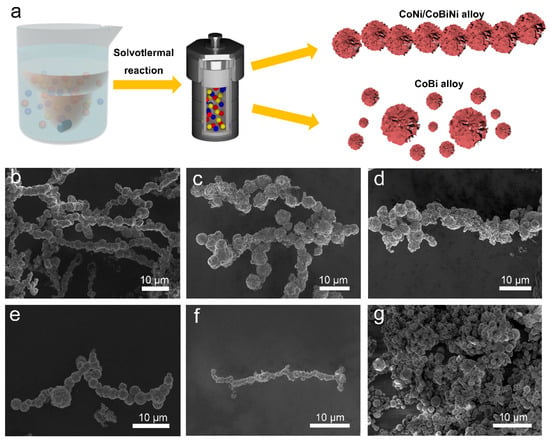
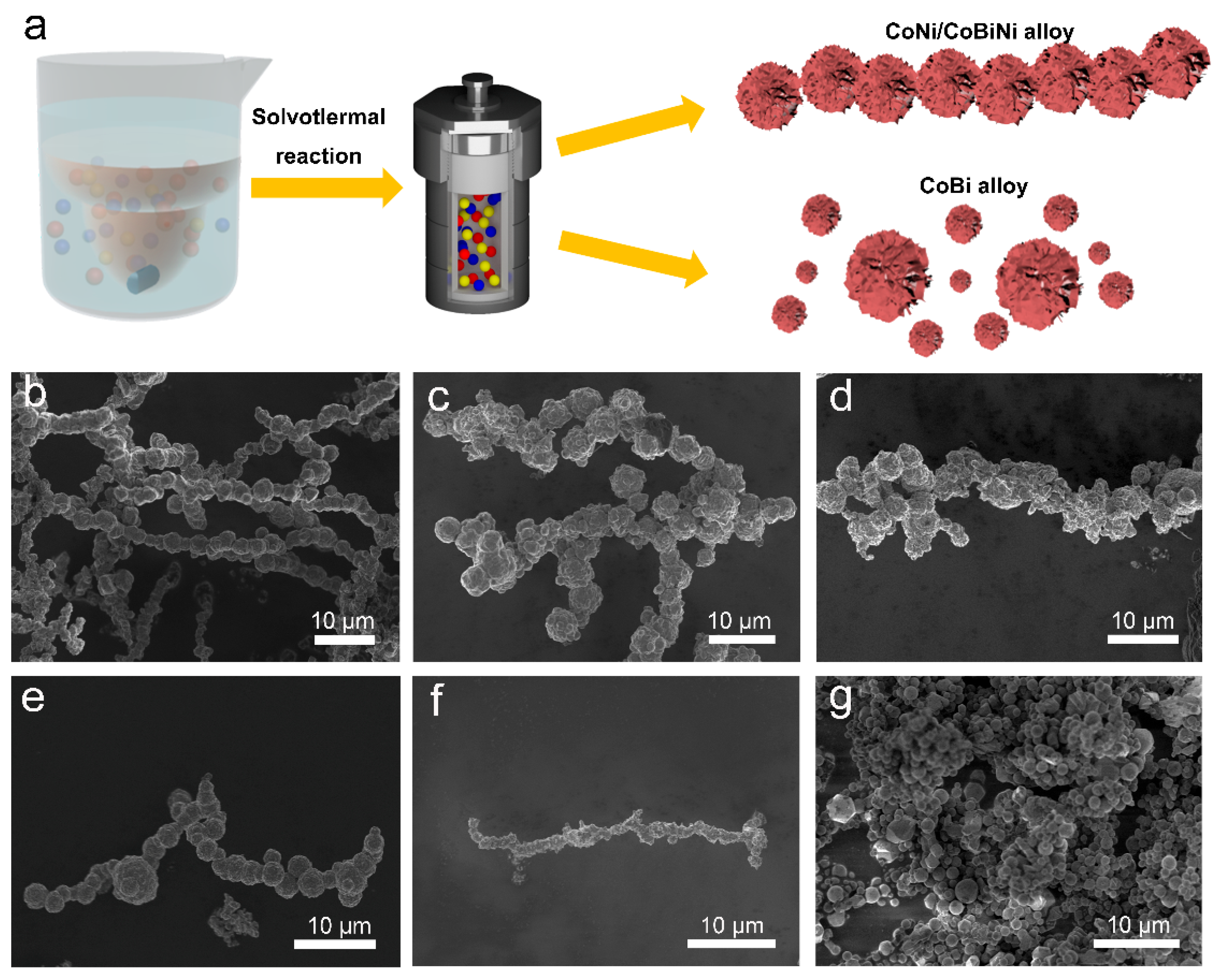
The synthesis process of a series of CoBiNi alloys with different Bi contents was illustrated in Figure 1a. As the content increases, both the microstructure and grain size of the cobalt-bismuth-nickel alloy will change. EDS mappings illustrate the existence of Co, Ni and Bi elements in Figure S1. Simultaneously, the difference in Co, Ni and Bi contents needs further analysis during the preparation of the Co20Bi5Ni75 sample. The EDS spectrum is used to test the contents of these elements in the Co20Bi5Ni75 sample, as listed in Table S1. Co contents in three parts of the Co20Bi5Ni75 sample are 7.76%, 15.06% and 5.93%, respectively. Ni contents for those are 87.06%, 83.00% and 93.73%, respectively. Meanwhile, Bi is 5.17%, 1.93% and 0.33%, respectively. Co, Ni and Bi contents at different ports vary greatly, which is consistent with the previous results in Figure S1. SEM images indicate that the Co20Ni80 alloy presents a chain-like structure (Figure 1b). The length of a single Co20Ni80 crystal is about 80 μm. In the presence of DETA surfactant, the Co20Ni80 microspheres self-assemble into a chain-like structure with multiple branches. The preparation conditions of Co20Bi1Ni79, Co20Bi2Ni78, Co20Bi5Ni75, Co20Bi10Ni70 and Co20Bi80 are the same as those of the Co20Ni80 alloy. A series of CoBiNi alloys all exhibit the chain-like shape. Among them, the diameters of the Co20Bi1Ni79 and Co20Bi2Ni78 alloys are not obviously different from that of Co20Ni80, whose diameter is below 1μm, especially in the microspheres’ edges. It may be caused by the addition of Bi atoms. With the increase in Bi content, the Co20Bi5Ni75 alloy is assembled into a chain-like structure with a diameter of about 2 μm microspheres in Figure 1e. Its length is about 20 μm. As shown in Figure 1f, the Co20Bi10Ni70 alloy is also assembled into a chain-like structure with a diameter of about 1.5 μm and loses the microsphere shape. Meanwhile, there are also some large particles with a rough surface in the Co20Bi10Ni70 alloy. As the Bi content increases, the particle size decreases significantly, indicating that Bi atoms inhibit the growth of CoNi grains [26]. The microstructure of Co20Bi80 alloy is spherical (Figure 1g) with a smooth surface and non-uniform particle size. Meanwhile, the minimum diameter of the observed particles is approximately 500 nm.
Figure 1.
(a) Schematic illustration of the synthetic process of a series of CoBiNi alloys. SEM images of (b) Co20Ni80, (c) Co20Bi1Ni79, (d) Co20Bi2Ni78, (e) Co20Bi5Ni75, (f) Co20Bi10Ni70 and (g) Co20Bi80.
According to SEM and EDS elemental mapping results, Bi exhibits a non-uniform distribution in the CoBiNi alloys with local elemental enrichment. Such an inhomogeneous distribution induces local composition fluctuation and heterogeneous interfacial structure, which regulates magnetic domain movement and magnetic exchange coupling, and consequently affects the magnetic permeability and coercivity. To quantitatively reveal the inhibitory effect of Bi on CoNi grain growth, the average crystallite size of all samples was calculated from XRD patterns via the Scherrer equation. With the increase in Bi content, the grain sizes of Co20Ni80, Co20Bi1Ni79, Co20Bi2Ni78, Co20Bi5Ni75 and Co20Bi10Ni70 are 171 Å, 146 Å, 132 Å, 130 Å and 128 Å, respectively. The results showed that the crystallite size gradually decreases with increasing Bi content, confirming that Bi doping can effectively restrain the grain growth of CoNi alloy. The variation trend is consistent with the particle size evolution observed from SEM images, which further verifies the grain refinement effect of Bi doping. Furthermore, the lattice parameters were calculated according to XRD peak shifts. Due to the larger atomic radius of Bi compared with Co and Ni, Bi incorporation induces obvious lattice distortion and lattice strain, which modulates the electronic structure and serves as an important intrinsic factor for optimizing magnetic properties.
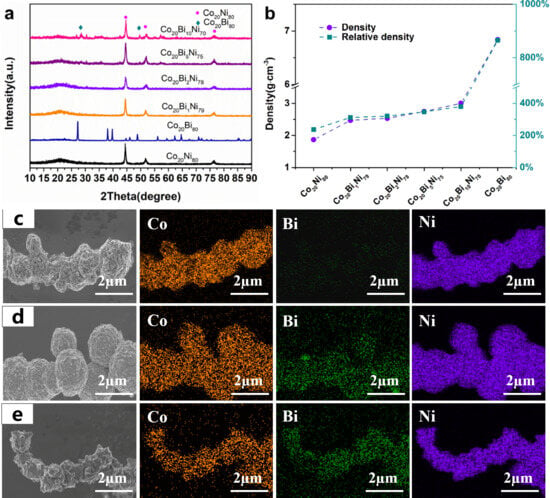
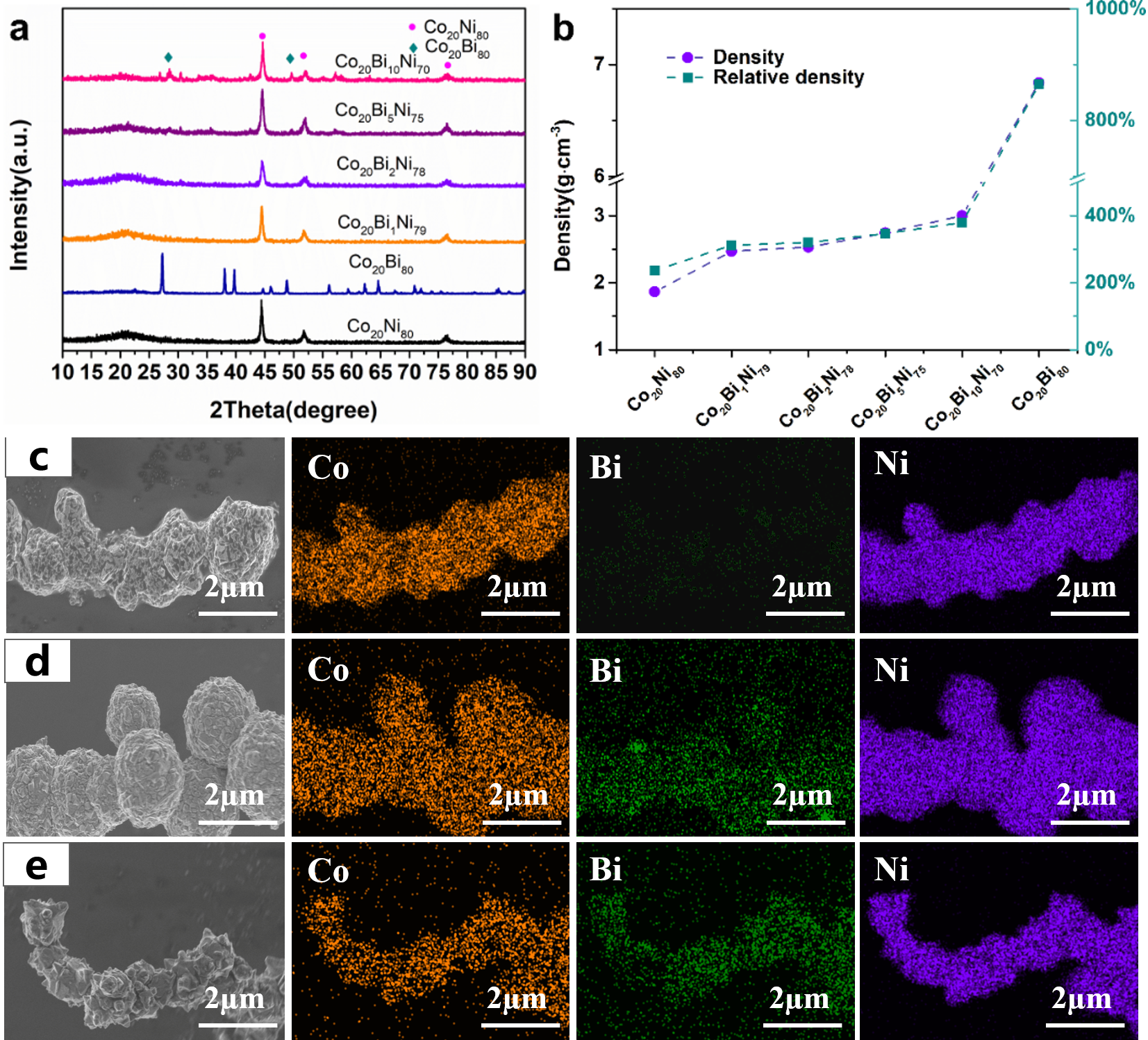
The crystal structures of Co20Ni80, Co20Bi1Ni79, Co20Bi2Ni78, Co20Bi5Ni75, Co20Bi10Ni70 and Co20Bi80 alloys are characterized by XRD. As shown in Figure 2a, the diffraction peaks appear at 44.5°, 51.8° and 76.7°, corresponding to the (111), (200) and (220) crystal planes, respectively. It indicates the face-centered cubic (fcc) structure of CoNi alloys. In addition, the diffraction peaks of Co20Bi80 alloy at 27.1° and 48.7° correspond to the (012) and (202) crystal planes, respectively. Similarly, the diffraction peaks of a series of CoBiNi alloys at 27.1° and 48.7° also correspond to (012) and (202) crystal planes. Meanwhile, the characteristic peaks of Co20Ni80 alloy are located at 44.5°, 51.8° and 76.7° for (111), (200) and (220) crystal planes. Moreover, the diffraction peak intensities of the CoBiNi alloy series increase with the rise in Bi content. As shown in Figure 2b, the bulk density of CoBiNi alloys also increases with increasing Bi content, and the relative density of alloy samples follows the same trend, verifying that Bi atoms can improve the compactness of the crystal structure [34]. The EDS spectrum indicates that the Co20Bi5Ni75 contains several elements (Figure S1). By detecting the distribution of these elements, the elemental distribution characteristics of the CoBiNi alloy series can be clarified. EDS mapping of Co, Ni and Bi elements is used as tracers to characterize the composition of Co20Ni80, Co20Bi5Ni75. Co20Bi10Ni70 samples. As shown in Figure 2c, only Co and Ni elements are found in the Co20Ni80 sample, with no Bi element observed. Comparatively, as shown in Figure 2d,e, Co, Ni and Bi elements are all distributed in the EDS mapping of Co20Bi5Ni75 and Co20Bi10Ni70 samples. Combined with XPS analysis, the binding energies of the Bi 4f and 4f5/2 orbitals were found to be 158.27 eV and 163.58 eV, respectively, indicating that Bi has successfully replaced the magnetic host cations, incorporated into the lattice, and formed a lattice solid solution.
Figure 2.
(a) XRD patterns of Co20Ni80, Co20Bi80, Co20Bi1Ni79, Co20Bi2Ni78, Co20Bi5Ni75 and Co20Bi10Ni70 alloys. (b) Density of Co20Ni80, Co20Bi1Ni79, Co20Bi2Ni78, Co20Bi5Ni75, Co20Bi10Ni70 and Co20Bi80 alloys. (c–e) SEM image and EDS mapping results of Co20Ni80, Co20Bi5Ni75 and Co20Bi10Ni70 alloys.
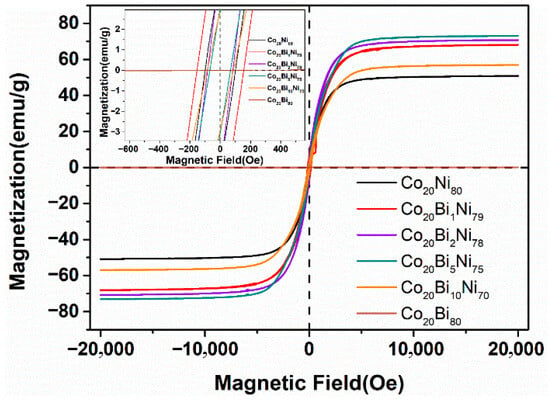
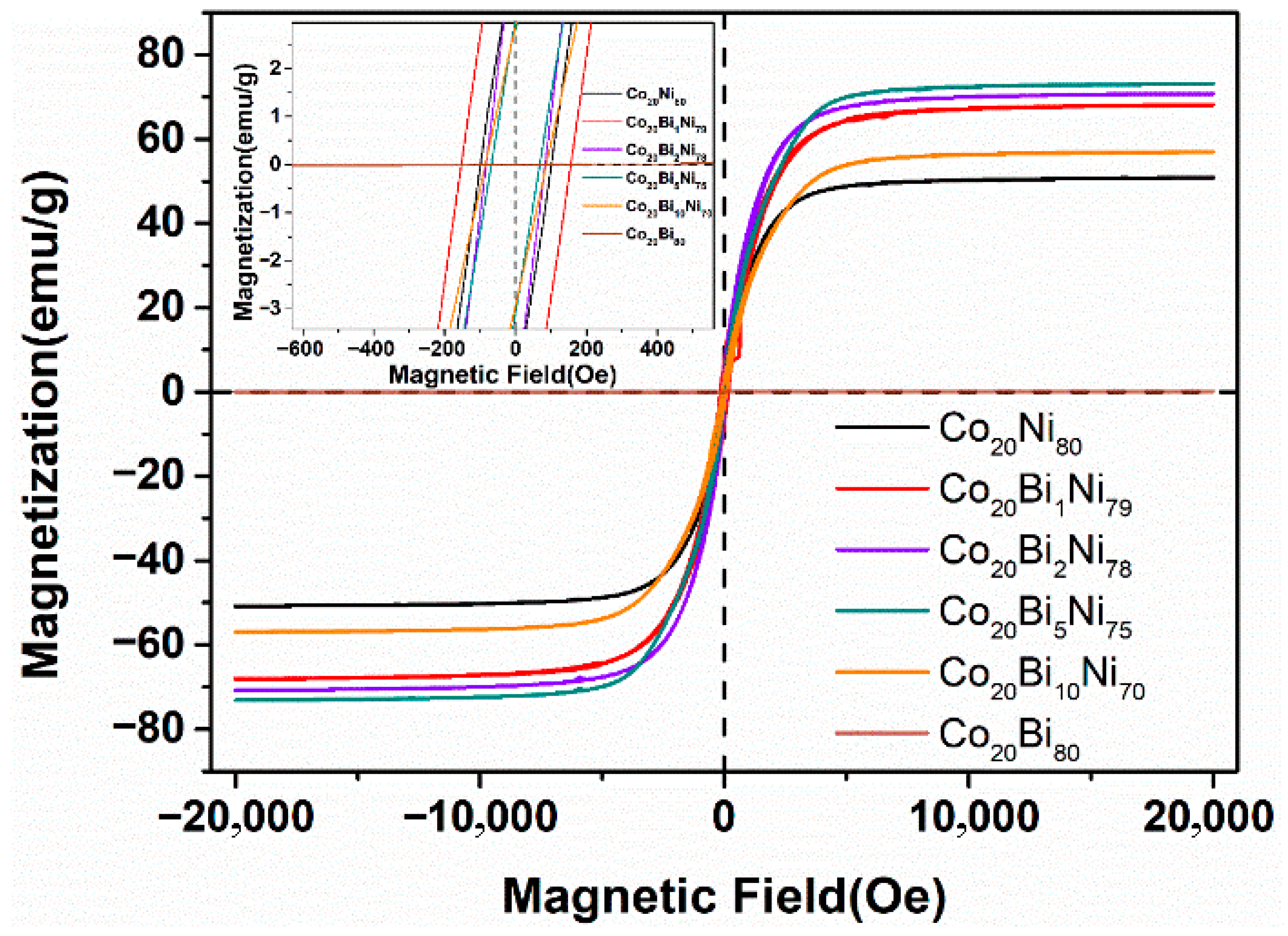
The hysteresis loops of a series of CoBiNi alloys measured at 300 K show typical ferromagnetic properties (Figure 3). The saturation magnetizations (Ms) of Co20Ni80, Co20Bi1Ni79, Co20Bi2Ni78, Co20Bi5Ni75, Co20Bi10Ni70 and Co20Bi80 alloys are 50.81 emu g−1, 68.05 emu g−1, 70.78 emu g−1, 73.11 emu g−1, 56.91 emu g−1 and 0.05 emu g−1, respectively. The coercive force (Hc) values of the six samples are 100.59 Oe, 153.80 Oe, 80.98 Oe, 66.28 Oe, 87.36 Oe and 14.47 Oe, while the remanent magnetization (Mr) of the six samples are 4.44 emu g−1, 7.14 emu g−1, 4.80 emu g−1, 2.82 emu g−1, 2.81 emu g−1 and 0.002 emu g−1 in sequence. Compared with other alloys, the Ms value of the chain-like Co20Bi5Ni75 alloy is the highest due to the existence of multiphases. In addition, the microsphere size of Co20Bi5Ni75 alloy is smaller than that of Co20Ni80. The interface area of microspheres in Co20Bi5Ni75 alloy increases correspondingly, which strengthens the interfacial exchange coupling effect between these microspheres, thus effectively enhancing the Ms values [35]. Among all the samples, Co20Bi1Ni79 alloy has the largest coercivity, followed by Co20Ni80 alloy, due to its large shape anisotropy and large particle size [20]. However, Co20Bi5Ni75 alloy has the lowest coercivity of 66.28 Oe, which is attributed to its small particle size [9]. The residual magnetization of all five main alloys is relatively low, indicating that these materials are typical soft magnetic materials.
Figure 3.
Hysteresis loops of Co20Ni80, Co20Bi1Ni79, Co20Bi2Ni78, Co20Bi5Ni75, Co20Bi10Ni70 and Co20Bi80 alloys measured at 300 k.
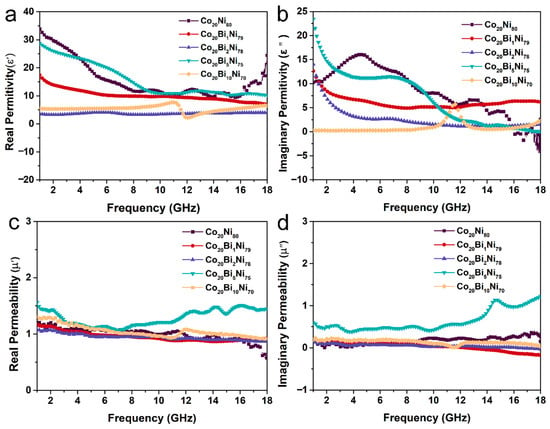
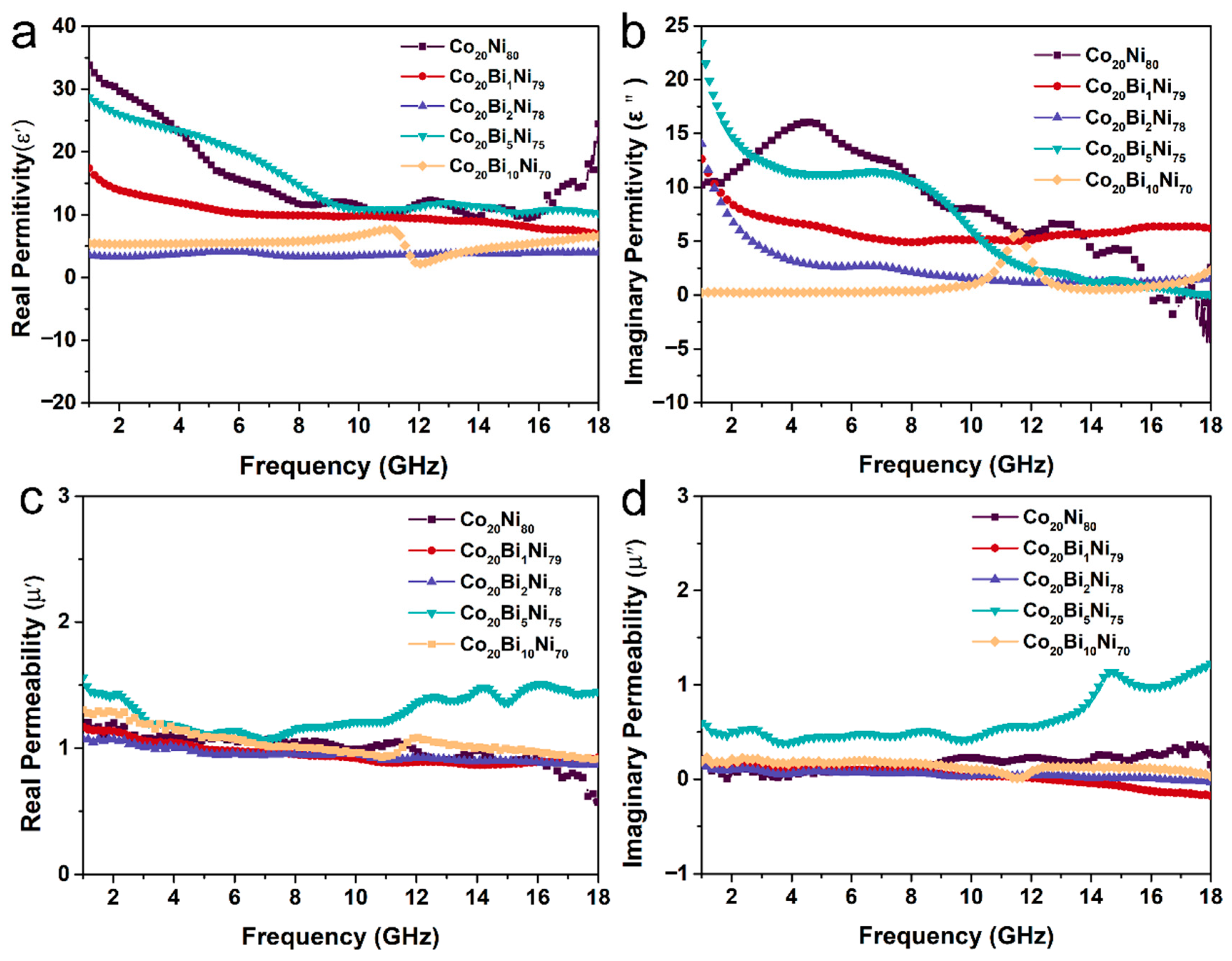
Figure 4 presents the four magnetic and dielectric properties of Co20Ni80, Co20Bi1Ni79, Co20Bi2Ni78, Co20Bi5Ni75 and Co20Bi10Ni70 alloys. Figure 4a shows the real permittivity ε′ of five alloy materials. It is obvious that the ε′ of Co20Ni80 decreases at 1.00–18.00 GHz, which is mainly caused by the motion hysteresis of charged ions under an alternating electric field, resulting in the magnetic moment relaxation phenomenon. The ε′ of materials reflects their polarization capability [8,36], and a higher ε′ corresponds to a higher polarization degree. After the doping of Bi atoms, the ε′ values of Co20Bi1Ni79, Co20Bi5Ni75, Co20Bi2Ni78 and Co20Bi10Ni70 are significantly lower than those of Co20Ni80 at 1.00–18.00 GHz. The ε′ value of Co20Bi5Ni75 also decreases with increasing frequency, and remains stable at approximately 10.26 in the range of 9.56–18.00 GHz. This phenomenon is attributed to the incorporation of Bi atoms, which increases the material’s resistivity and reduces the electron hopping probability in the crystal structure. As shown in Figure 4b, the imaginary permittivity (ε″) of Co20Ni80 reaches 15.98 at 4.53 GHz, and exhibits obvious fluctuations across the entire tested frequency band of 1.00–18.00 GHz. After the addition of the Bi element, the ε″ value of Co20Bi1Ni79 and Co20Bi2Ni78 remains stable. In the range of 1.00–18.00 GHz, the ε″ values of Co20Bi5Ni75 alloy fluctuate slightly from 23.04 to 0.56, while obvious sharp fluctuations appear at 1.00–2.00 GHz and 8.00–10.00 GHz, respectively. The ε″ peak value of Co20Bi10Ni70 alloy is approximately 5.80 at 11.63 GHz.
Figure 4.
(a) ε′ of a series of CoBiNi alloys. (b) ε″ of a series of CoBiNi alloys. (c) μ′ of a series of CoBiNi alloys. (d) μ″ of a series of CoBiNi alloys.
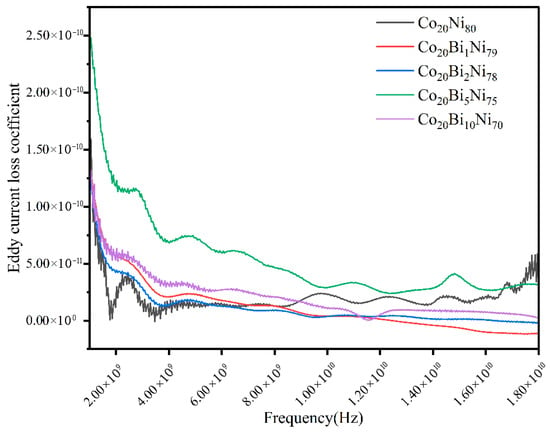
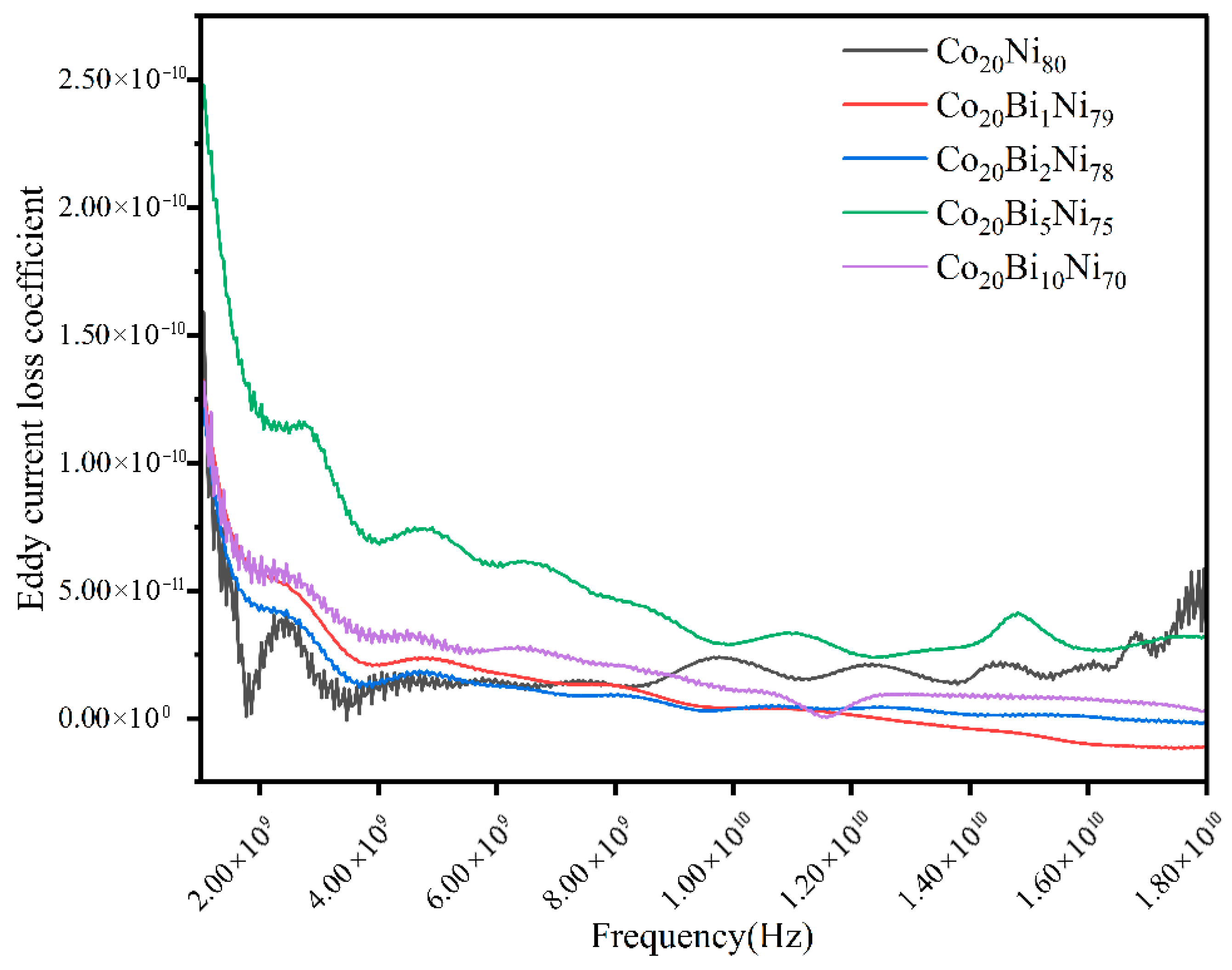
To further clarify the magnetic loss mechanism, the eddy current loss coefficient C0 = μ″(μ′)−2f−1 was calculated, and the results are presented in Figure 5. Theoretically, if eddy current loss dominates the magnetic loss, C0 should remain constant over the measured frequency range. However, all samples in this work show obvious frequency-dependent C0 values, demonstrating that eddy current loss is not the dominant magnetic loss mechanism within 1–14 GHz. Only Co20Ni80 exhibits evident C0 fluctuation above 14 GHz, indicating a minor contribution of eddy current loss at high frequencies. With the increase in Bi content, the C0 value decreases gradually and becomes more stable. Combined with SEM, EDS, XRD and XPS results, the evolution of electromagnetic properties is closely related to microstructure characteristics: Bi doping refines grain size, inhibits grain growth, and maintains the chain-like self-assembled morphology; the non-uniform distribution of Bi induces local composition fluctuation and increases electrical resistivity, which effectively suppresses long-range electron migration and eddy current effect. Therefore, magnetic loss is mainly dominated by natural resonance and exchange resonance, which is intrinsically determined by the chain-like structure, grain size effect and inhomogeneous Bi distribution of CoBiNi alloys.
Figure 5.
Frequency dependence (1–18 GHz) of the eddy current loss coefficient C0 = μ″(μ′)−2f−−1 for Co20NixBiy samples with different Bi contents.
Figure 6c,d separately present the μ′ and μ″ curves of Co20Ni80, Co20Bi1Ni79, Co20Bi2Ni78, Co20Bi5Ni75 and Co20Bi10Ni70 alloys. The μ′ value of Co20Ni80 remains about 1.17 within the frequency range of 1.00–18.00 GHz. When the Bi doping content is increased to 1% and 2%, the μ′ values of Co20Bi1Ni79 and Co20Bi2Ni78 are still maintained at around 1.17 throughout the tested frequency band of 1.00–18.00 GHz, respectively. As the Bi content increases to 5%, the μ′ values of Co20Bi5Ni75 fluctuate around 1.50 in the range of 14.00–18.00 GHz, which may be attributed to the combined effect of eddy current loss, anomalous loss and enhanced polarization ability caused by the incorporation of Bi atoms [36]. The μ″ values of Co20Ni80, Co20Bi1Ni79 and Co20Bi2Ni78 basically fluctuate within the scope of 0–0.30 at 1.00–18.00 GHz. During the same range, the μ′ values show a continuous decreasing trend, which is caused by eddy current losses and abnormal losses at high frequency. The μ″ value of the Co20Bi5Ni75 alloy fluctuates around 0.50 at the frequency range of 1.00–12.00 GHz. Similarly, the μ″ value increases in the range of 12.00–18.00 GHz and finally reaches 1.21 at 18.00 GHz.
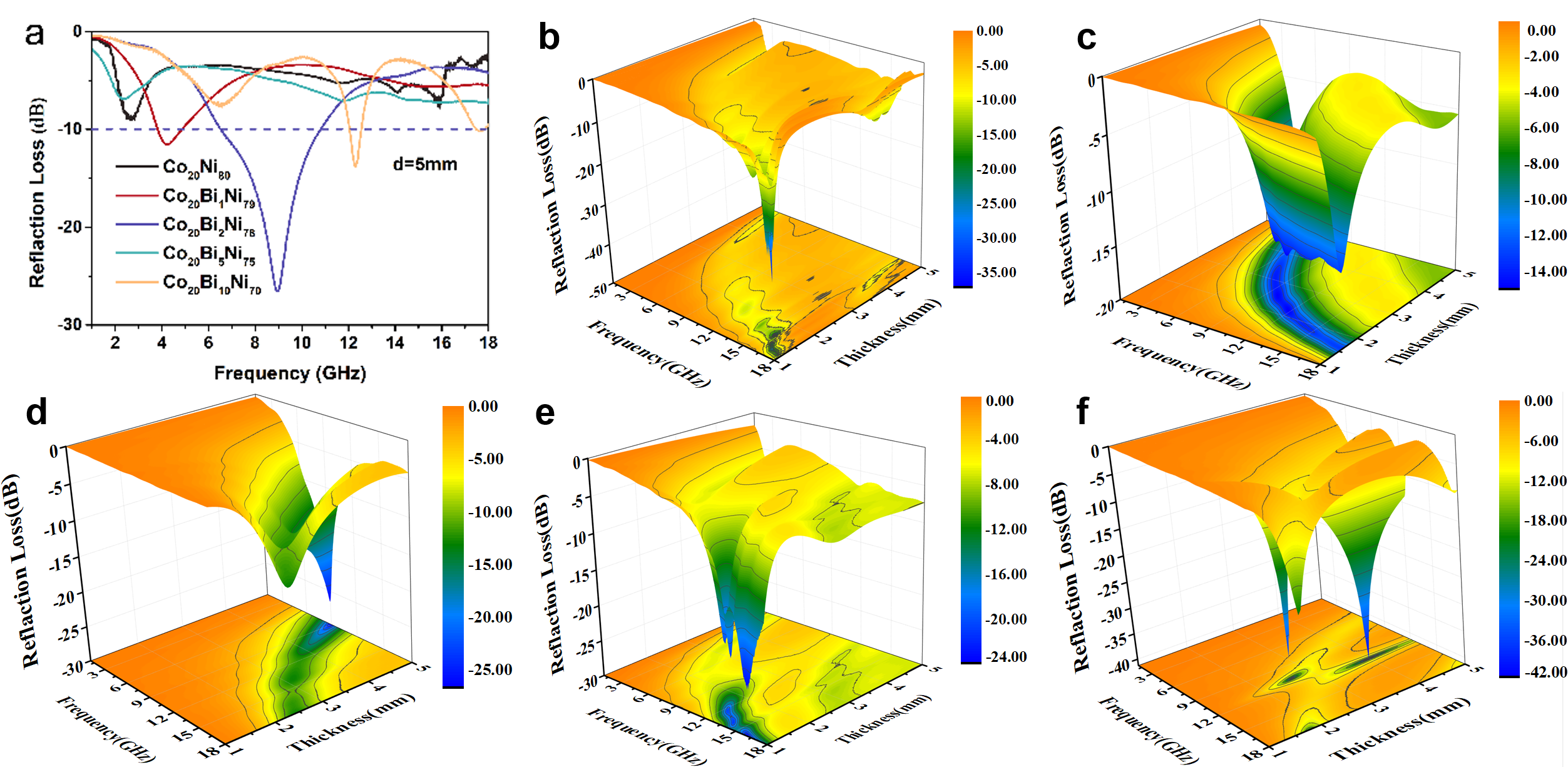
Figure 6.
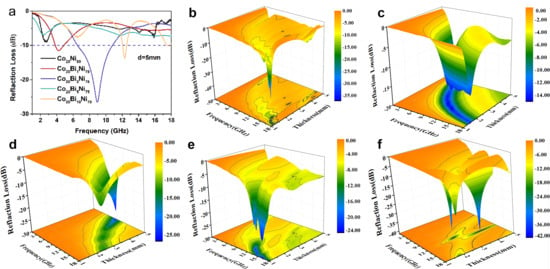
(a) RL curves of five samples at the same thickness of 1mm; 3D plots of RL for (b) Co20Ni80, (c) Co20Bi1Ni79, (d) Co20Bi2Ni78, (e) Co20Bi5Ni75 and (f) Co20Bi10Ni70.
According to the above electromagnetic parameters, the RL values of the five alloys were calculated, as shown in Figure 6a. The Co20Ni80 sample exhibits no microwave absorption capacity at a thickness of 1 mm. The RL value of the Co20Bi5Ni75 sample exceeds −6.89 dB at 2.34 GHz under a thickness of 5 mm. Therefore, Bi atoms can effectively improve the signal transmission efficiency for 5G communication. To further illustrate the effect of Bi atoms on microwave absorption performance, the correlation between absorption performance and frequency for alloy samples with different thicknesses was systematically calculated. Figure 6b–f show the 3D RL curves of CoNi, Co20Bi1Ni79, Co20Bi2Ni78, Co20Bi5Ni75 and Co20Bi10Ni70 samples with different thicknesses. Co20Ni80 has a maximum RL value of 36.98 dB at 1.5 mm thickness due to its high real permittivity. As shown in Figure 6c, the RL values of Co20Bi1Ni79 alloy are −14.82 dB at 11.97 GHz with a thickness of 2.15 mm. The RL values of Co20Bi2Ni78 alloy are −26.47 dB at 8.90 GHz with a thickness of 2.15 mm (Figure 6d). Significantly, with the increase in Bi content, the Co20Bi5Ni75 alloy delivers an optimal RL value of −23.75 dB at a thickness of 1.00 mm, and its corresponding effective absorption bandwidth reaches 5 GHz (Figure 6f). Similarly, the RL value of Co20Bi10Ni70 alloy is −36.88 dB at 10.86 GHz under a thickness of 2.60 mm. Combined with the magnetic properties and microwave absorption performance, moderate doping of Bi atoms is beneficial to improve the microwave absorption properties of the soft magnetic materials.
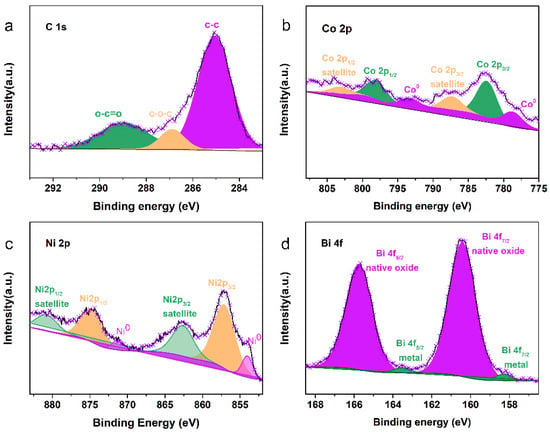
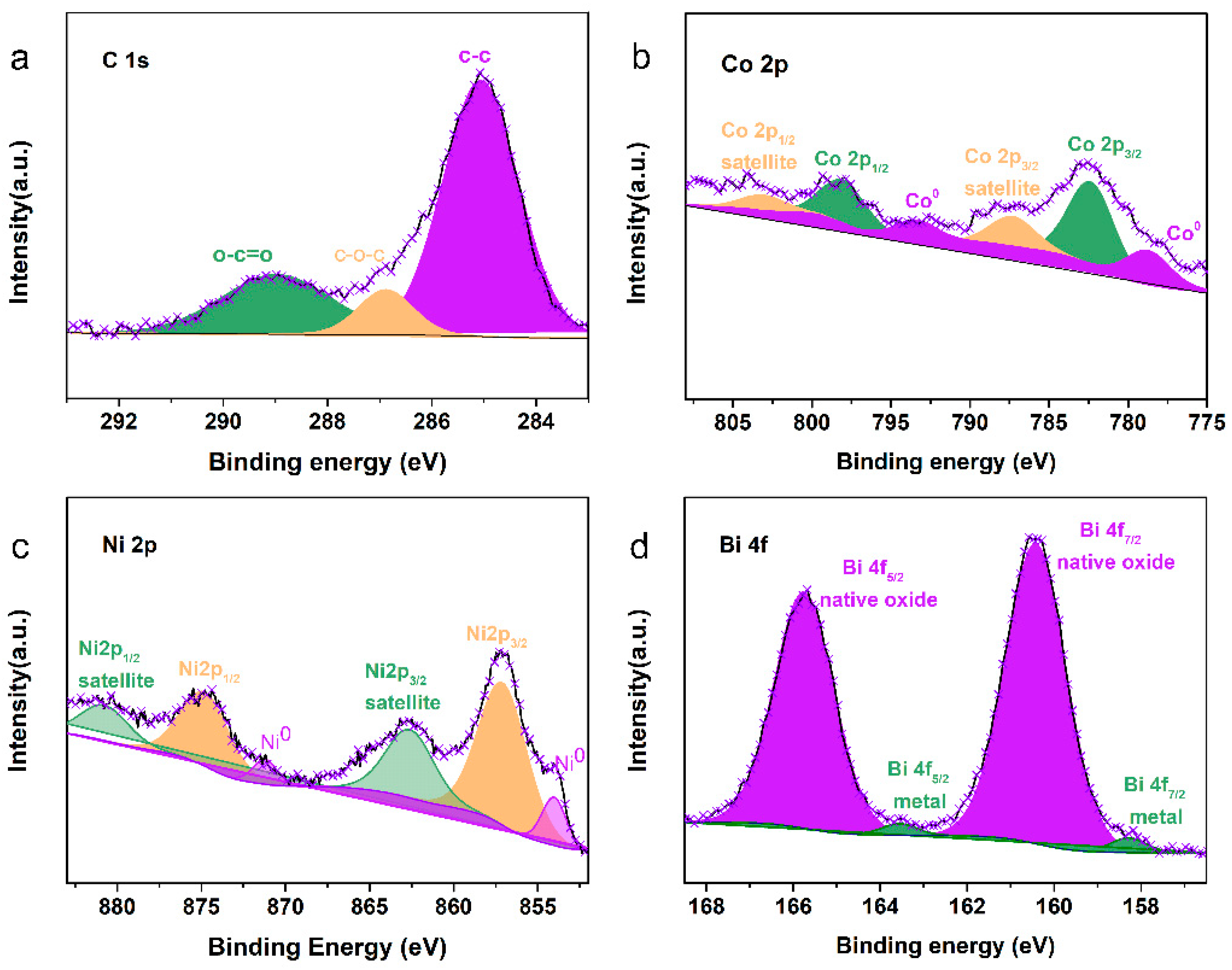
To further clarify the regulatory effect of Bi doping, Figure 7 displays the full XPS survey and high-resolution spectra of the Co20Bi5Ni75 alloy. Figure 7a shows the three characteristic peaks of the C1s spectrum, which correspond to C-C (284.91 eV), C-O-C (286.03 eV) and O-C=O (288.86 eV), respectively. The high-resolution Co 2p spectrum confirms the coexistence of metallic Co and Co2+ ions. The peaks located at 778.75 eV and 793.33 eV are assigned to Co 2p3/2 and Co 2p1/2, respectively. These results verify that the main valence state of Co is metallic Co, while the peaks at 782.65 eV and 798.25 eV belong to Co2+ ions. According to the Ni 2p spectrum in Figure 7c, the peaks at 853.85 and 871.20 eV are assigned to the characteristic peaks of Ni0 for Ni 2p3/4 and Ni 2p1/2, respectively. In addition, the peaks at 859.30 and 875.02 eV indicate the presence of Ni2+ ions. In Figure 7d, the Bi 4f spectrum contains two peaks located at 158.27 eV for Bi0 4f7/2 and 163.58 eV for Bi0 4f5/2. Furthermore, there are two more peaks at 160.45 eV and 165.81 eV, which correspond to Bi3+ 4f7/2 and Bi3+ 4f5/2, respectively. These XPS results further demonstrate that the Co20Bi5Ni75 sample contains abundant Co2+, Ni2+ and Bi3+ ions besides the corresponding metallic elemental valence states. This result indicates that Bi exists in two coexisting chemical states in the as-prepared alloy; part of Bi is present in the form of metallic clusters, while the rest exists in the oxidized state as Bi3+. The Bi3+ species may originate from surface oxidation during material preparation or air exposure, and may also segregate at the grain boundaries or surface regions of the alloy. Furthermore, it should be noted that the XPS analysis was only performed on representative samples. For other compositions in the series (e.g., samples with different Bi contents or Co/Ni ratios), the chemical state and relative proportion of Bi may vary with composition and preparation conditions, which constitutes one limitation of this study. The movement of charge carriers among them causes interface polarization and reduces magnetic properties. Based on the available XPS results, we speculate that Bi3+ may act as carrier scattering centers to locally increase the resistivity of the material, thereby exerting an indirect influence on magnetic permeability.
Figure 7.
(a) C 1s XPS spectrum of Co20Bi5Ni75; (b) Co 2p XPS spectrum of Co20Bi5Ni75; (c) Ni 2p XPS spectrum of Co20Bi5Ni75; (d) Bi 4f XPS spectrum of Co20Bi5Ni75.
4. Conclusions
In this work, a series of CoBiNi alloys were successfully fabricated via a simple structural template combined with a hydrothermal reaction method. The effect and mechanism of Bi doping on regulating the magnetic permeability of the materials were revealed. Adjusting the Bi content can effectively modulate the compactness and magnetic properties of the alloys. Among them, the Co20Bi5Ni75 sample exhibits the optimal magnetic permeability, reaching 1.5 at 16.56 GHz. Furthermore, microwave reflection loss (RL) and saturation magnetization characterizations demonstrate that Co20Bi5Ni75 possesses excellent microwave absorption capacity and high saturation magnetization. With a sample thickness of 5 mm, its RL value remains higher than −6.89 dB within the frequency range of 1.00–18.00 GHz. Based on the XPS results, it is preliminarily speculated that the superior magnetic permeability of CoBiNi alloys is attributed to Bi content, which hinders the migration of charge carriers and increases the material resistivity, thereby improving the magnetic permeability. These provide a reference for the design and development of functional materials with tunable magnetic permeability.
Supplementary Materials
The following supporting information can be downloaded at: https://www.mdpi.com/article/10.3390/met16050539/s1, Table S1. EDS data of Co20Bi5Ni75 sample; Figure S1. (a) SEM images and EDS mapping results of Co20Bi5Ni75; Figure S2. (a) Real permittivity (ε′) of Co20Bi80 alloy. (b) Imaginary permittivity(ε″) of Co20Bi80 alloy. (c) Real permeability (μ′) of Co20Bi80 alloy. (d) Imaginary permeability (μ″) of Co20Bi80 alloy; Figure S3. (a) RL curves of Co20Bi80 at the same thickness of 5 mm; Figure S4. 3D representations of reflection loss of Co20Bi80.
Author Contributions
Conceptualization, X.G. and G.Z.; methodology, X.G. and L.Z.; software, G.Z. and X.L.; validation, X.G., X.L. and M.S.; formal analysis, L.Z.; investigation, X.G., X.L. and M.S.; resources, L.Z. and M.S.; data curation, X.G. and G.Z.; writing—original draft preparation, X.G.; writing—review and editing, L.Z. and S.Z.; visualization, X.G.; supervision, L.Z. and S.Z.; project administration, S.Z.; funding acquisition, L.Z. All authors have read and agreed to the published version of the manuscript.
Funding
This research is supported by the Natural Science Research of Jiangsu Higher Education Institutions of China (21KJB430033).
Data Availability Statement
The original contributions presented in this study are included in the article/Supplementary Materials. Further inquiries can be directed to the corresponding authors.
Acknowledgments
This research is also supported by Changshu 3F Zhenfu New Materials Co., Ltd. (China) and Changshu 3F Zhonghao Chemical Materials Co., Ltd. (China).
Conflicts of Interest
Author Gaoda Zheng was employed by the company Changshu 3F Zhonghao New Chemical Materials Co., Ltd. The remaining authors declare that the research was conducted in the absence of any commercial or financial relationships that could be construed as a potential conflict of interest.
References
- Ilderem, V. The technology underpinning 5G. Nat. Electron. 2020, 3, 5–6. [Google Scholar] [CrossRef] [Scilit]
- Pawlak, R.; Krawiec, P.; Zurek, J. On Measuring Electromagnetic Fields in 5G Technology. IEEE Access 2019, 7, 29826–29835. [Google Scholar] [CrossRef] [Scilit]
- Yu, H.; Lee, H.; Jeon, H. What is 5G? Emerging 5G Mobile Services and Network Requirements. Sustainability 2017, 9, 1848. [Google Scholar] [CrossRef] [Scilit]
- Gao, F.; Gao, P.; Zhu, W.-T.; Zhang, C.-X.; Meng, X.-K.; Shan, R.-H. 5G evolution promoting innovation of antenna systems. Front. Inf. Technol. Electron. Eng. 2020, 21, 188–194. [Google Scholar] [CrossRef] [Scilit]
- I, C.-L.; Han, S.; Bian, S. Energy-efficient 5G for a greener future. Nat. Electron. 2020, 3, 182–184. [Google Scholar] [CrossRef] [Scilit]
- Pedram, M.; Wang, L. Energy Efficiency in 5G Cellular Network Systems. IEEE Des. Test 2020, 37, 64–78. [Google Scholar] [CrossRef]
- Zhang, X.; Jiao, Y.C.; Weng, Z.B.; Zhang, Y.X.; Feng, S. Wideband magneto-electric dipole antenna with a claw shaped reflector for 5G communication systems. Microw. Opt. Technol. Lett. 2019, 61, 2098–2104. [Google Scholar] [CrossRef] [Scilit]
- Liu, Q.; Cao, Q.; Bi, H.; Liang, C.; Yuan, K.; She, W.; Yang, Y.; Che, R. CoNi@SiO2 @TiO2 and CoNi@Air@TiO2 Microspheres with Strong Wideband Microwave Absorption. Adv. Mater. 2016, 28, 486–490. [Google Scholar] [CrossRef] [Scilit] [PubMed]
- Liu, Q.; Xu, X.; Xia, W.; Che, R.; Chen, C.; Cao, Q.; He, J. Dependency of magnetic microwave absorption on surface architecture of Co20Ni80 hierarchical structures studied by electron holography. Nanoscale 2015, 7, 1736–1743. [Google Scholar] [CrossRef] [Scilit] [PubMed]
- Long, C.; Xu, B.; Han, C.; Chen, Z.; Guan, J. Flaky core-shell particles of iron@iron oxides for broadband microwave absorbers in S and C bands. J. Alloys Compd. 2017, 709, 735–741. [Google Scholar] [CrossRef] [Scilit]
- Tyagi, S.; Baskey, H.B.; Agarwala, R.C.; Agarwala, V.; Shami, T.C. Development of hard/soft ferrite nanocomposite for enhanced microwave absorption. Ceram. Int. 2011, 37, 2631–2641. [Google Scholar] [CrossRef] [Scilit]
- Wei, H.; Zhang, Z.; Hussain, G.; Zhou, L.; Li, Q.; Ostrikov, K. Techniques to enhance magnetic permeability in microwave absorbing materials. Appl. Mater. Today 2020, 19, 100596. [Google Scholar] [CrossRef] [Scilit]
- Jiang, C.; Li, X.; Ghosh, S.S.; Zhao, H.; Shen, Y.; Long, T. Nanocrystalline Powder Cores for High-Power High-Frequency Applications. IEEE Trans. Power Electron. 2020, 35, 10821–10830. [Google Scholar] [CrossRef] [Scilit]
- Kubacki, R.; Ferenc, J.; Przesmycki, R.; Wnuk, M. The Nanocrystalline FeSiBCuNb Finemet Absorption Properties at Microwaves. IEEE Trans. Electromagn. Compat. 2012, 54, 93–100. [Google Scholar] [CrossRef] [Scilit]
- Choi, K.; Jung, C.; Yi, S. Improved thermal stability of FeNiCo-based nanocrystalline soft magnetic alloys enabled by Ni segregation in the amorphous matrix. J. Alloys Compd. 2025, 1014, 178690. [Google Scholar] [CrossRef] [Scilit]
- Adamczyk, J.M.-T.; Barrick, E.J.; Pearce, C.J.; Delaney, R.E.; Ury, N.; Dillon, R.P.; Monson, T.C.; Carroll, J.D.; Susan, D.F.; Valdez, N.R.; et al. Functional Grading Between Soft-Magnetic Fe–Co/Fe–Ni Alloys and the Effect on Magnetic and Microstructural Properties. ACS Appl. Eng. Mater. 2024, 2, 818–828. [Google Scholar] [CrossRef] [Scilit]
- Sun, G.; Wu, H.; Liao, Q.; Zhang, Y. Enhanced microwave absorption performance of highly dispersed CoNi nanostructures arrayed on graphene. Nano Res. 2018, 11, 2689–2704. [Google Scholar] [CrossRef] [Scilit]
- Feng, W.; Yang, L.; Cao, N.; Du, C.; Dai, H.; Luo, W.; Cheng, G. In situ facile synthesis of bimetallic CoNi catalyst supported on graphene for hydrolytic dehydrogenation of amine borane. Int. J. Hydrogen Energy 2014, 39, 3371–3380. [Google Scholar] [CrossRef] [Scilit]
- Rafique, M.Y.; Pan, L.; Iqbal, M.Z.; Rafi ud, d.; Qiu, H.; Farooq, M.H.; Guo, Z.; Ellahi, M. Fabrication of CoNi alloy hollow-nanostructured microspheres for hydrogen storage application. J. Nanoparticle Res. 2013, 15, 1768. [Google Scholar] [CrossRef] [Scilit]
- Liu, Q.; Guo, X.; Wang, T.; Li, Y.; Shen, W. Synthesis of CoNi nanowires by heterogeneous nucleation in polyol. Mater. Lett. 2010, 64, 1271–1274. [Google Scholar] [CrossRef] [Scilit]
- Ahmed, J.; Sharma, S.; Ramanujachary, K.V.; Lofland, S.E.; Ganguli, A.K. Microemulsion-mediated synthesis of cobalt (pure fcc and hexagonal phases) and cobalt-nickel alloy nanoparticles. J. Colloid Interface Sci. 2009, 336, 814–819. [Google Scholar] [CrossRef] [Scilit] [PubMed]
- Sirvent, P.; Berganza, E.; Aragón, A.M.; Bollero, A.; Moure, A.; García-Hernández, M.; Marín, P.; Fernández, J.F.; Quesada, A. Effective high-energy ball milling in air of Fe65Co35 alloys. J. Appl. Phys. 2014, 115, 17B505. [Google Scholar] [CrossRef] [Scilit]
- Yu, R.H.; Basu, S.; Zhang, Y.; Xiao, J.Q. Magnetic domains and coercivity in FeCo soft magnetic alloys. J. Appl. Phys. 1999, 85, 6034–6036. [Google Scholar] [CrossRef] [Scilit]
- Sertkol, M.; Güner, S.; Almessiere, M.; Slimani, Y.; Baykal, A.; Gungunes, H.; Alsulami, E.; Alahmari, F.; Gondal, M.; Shirsath, S.; et al. Effect of Bi3+ ions substitution on the structure, morphology, and magnetic properties of Co–Ni spinel ferrite nanofibers. Mater. Chem. Phys. 2022, 284, 126071. [Google Scholar] [CrossRef] [Scilit]
- Almousawi, M.; Aridi, A.; El Sayed, M.Y.; Abdallah, A.; Labban, W.; Habchi, R.; Awad, R. Synthesis, structural characterization, and magnetic properties of La3+-and Bi3+-Doped Co–Ni–Zn–Cu ferrite nanoparticles. Ceram. Int. 2025, 51, 31870–31891. [Google Scholar] [CrossRef] [Scilit]
- Alqarni, A.N.; Almessiere, M.; Güner, S.; Sertkol, M.; Shirsath, S.E.; Tashkandi, N.; Baykal, A. Structural and magnetic properties of hydrothermally synthesized Bi-substituted Ni–Co nanosized spinel ferrites. Ceram. Int. 2022, 48, 5450–5458. [Google Scholar] [CrossRef] [Scilit]
- N. V., S.; Vinayakumar, K.B.; Nagaraja, K.K. Magnetoelectric Coupling in Bismuth Ferrite—Challenges and Perspectives. Coatings 2020, 10, 1221. [Google Scholar] [CrossRef] [Scilit]
- Krenev, V.A.; Drobot, N.F.; Fomichev, S.V. Bismuth: Reserves, applications, and the world market. Theor. Found. Chem. Eng. 2015, 49, 532–535. [Google Scholar] [CrossRef] [Scilit]
- Aslam, A.; Islam, M.U.; Ali, I.; Awan, M.S.; Irfan, M.; Iftikhar, A. High frequency electrical transport properties of CoFe2O4 and Sr2NiMnFe12O22 composite ferrites. Ceram. Int. 2014, 40, 155–162. [Google Scholar] [CrossRef] [Scilit]
- Ashiq, M.N.; Iqbal, M.J.; Najam-ul-Haq, M.; Hernandez Gomez, P.; Qureshi, A.M. Synthesis, magnetic and dielectric properties of Er–Ni doped Sr-hexaferrite nanomaterials for applications in High density recording media and microwave devices. J. Magn. Magn. Mater. 2012, 324, 15–19. [Google Scholar] [CrossRef] [Scilit]
- Iqbal, M.J.; Khan, R.A.; Mizukami, S.; Miyazaki, T. Tailoring of structural, electrical and magnetic properties of BaCo2 W-type hexaferrites by doping with Zr–Mn binary mixtures for useful applications. J. Magn. Magn. Mater. 2011, 323, 2137–2144. [Google Scholar] [CrossRef] [Scilit]
- Rahman, M.M.; Hasan, N.; Tabassum, S.; Rashid, M.H.-O.; Rashid, M.H.; Arifuzzaman, M. Bi3+ doped nanocrystalline Ni–Co–Zn spinel ferrites: Tuning of physical, electrical, dielectric and magnetic properties for advanced spintronics applications. Ceram. Int. 2024, 50, 44585–44597. [Google Scholar] [CrossRef] [Scilit]
- Almessiere, M.A.; Slimani, Y.; Gungunes, H.; Gondal, M.A.; Hassan, M.; Shirsath, S.E.; Baykal, A. Bi3+ and V3+ co-substituted Ni-Co spinel ferrites: Synthesis, optical, magnetic characterization and hyperfine interaction. Mater. Sci. Eng. B 2022, 284, 115905. [Google Scholar] [CrossRef] [Scilit]
- Yu, Z.; Sun, K.; Li, L.; Liu, Y.; Lan, Z.; Zhang, H. Influences of Bi2O3 on microstructure and magnetic properties of MnZn ferrite. J. Magn. Magn. Mater. 2008, 320, 919–923. [Google Scholar] [CrossRef] [Scilit]
- Xu, C.; Wang, L.; Li, X.; Qian, X.; Wu, Z.; You, W.; Pei, K.; Qin, G.; Zeng, Q.; Yang, Z.; et al. Hierarchical Magnetic Network Constructed by CoFe Nanoparticles Suspended Within “Tubes on Rods” Matrix Toward Enhanced Microwave Absorption. Nano-Micro Lett. 2021, 13, 47. [Google Scholar] [CrossRef] [Scilit]
- Shi, X.; You, W.; Li, X.; Wang, L.; Shao, Z.; Che, R. In-situ regrowth constructed magnetic coupling 1D/2D Fe assembly as broadband and high-efficient microwave absorber. Chem. Eng. J. 2021, 415, 128951. [Google Scholar] [CrossRef] [Scilit]
Disclaimer/Publisher’s Note: The statements, opinions and data contained in all publications are solely those of the individual author(s) and contributor(s) and not of MDPI and/or the editor(s). MDPI and/or the editor(s) disclaim responsibility for any injury to people or property resulting from any ideas, methods, instructions or products referred to in the content. |
© 2026 by the authors. Licensee MDPI, Basel, Switzerland. This article is an open access article distributed under the terms and conditions of the Creative Commons Attribution (CC BY) license.