
Effect of Surface Layer Removal After Ultrasonic Surface Rolling Processing on the Tension–Tension Fatigue Performance of AZ31B Magnesium Alloy

Abstract
1. Introduction
2. Experiment Methods
3. Result and Discussion
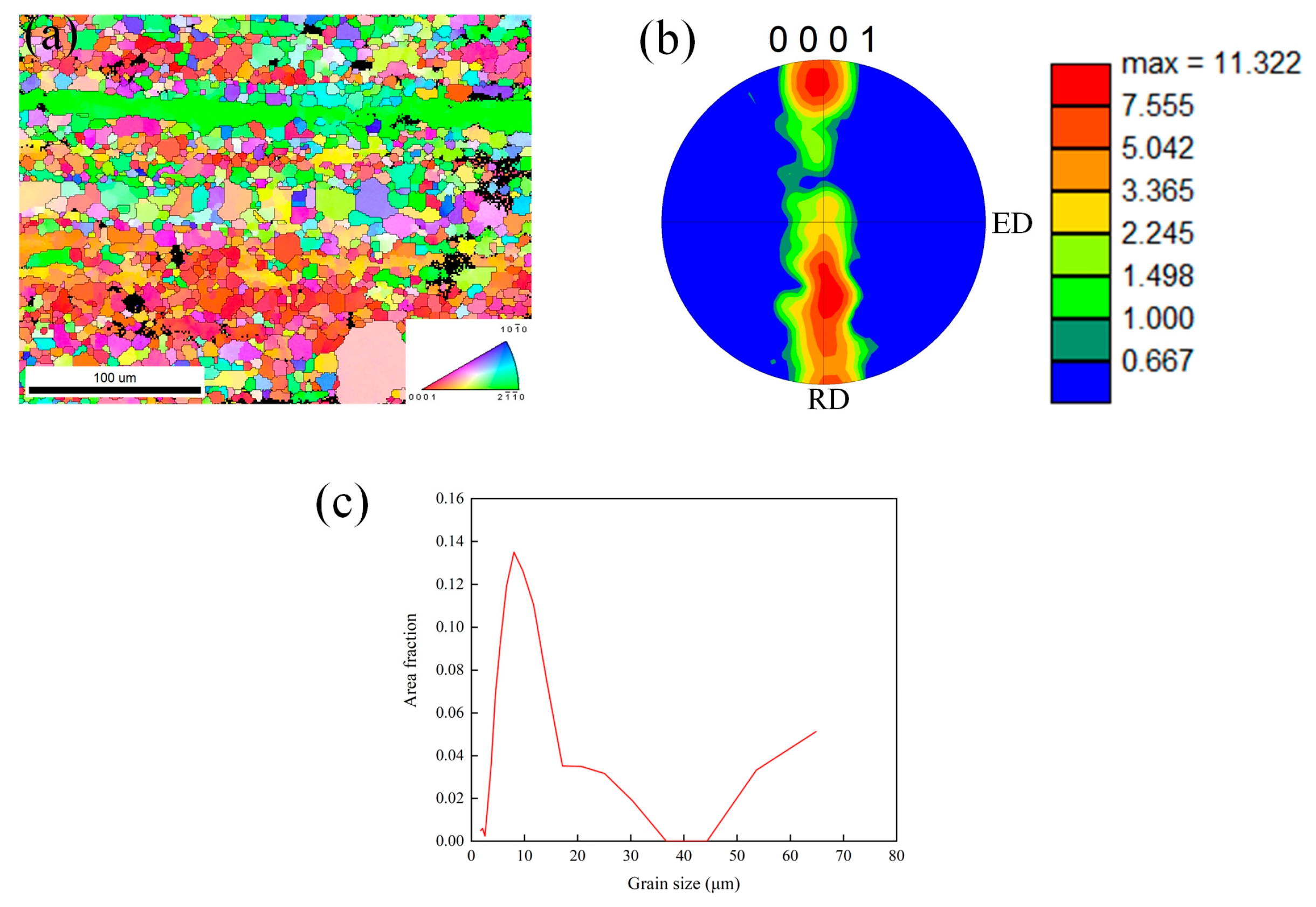
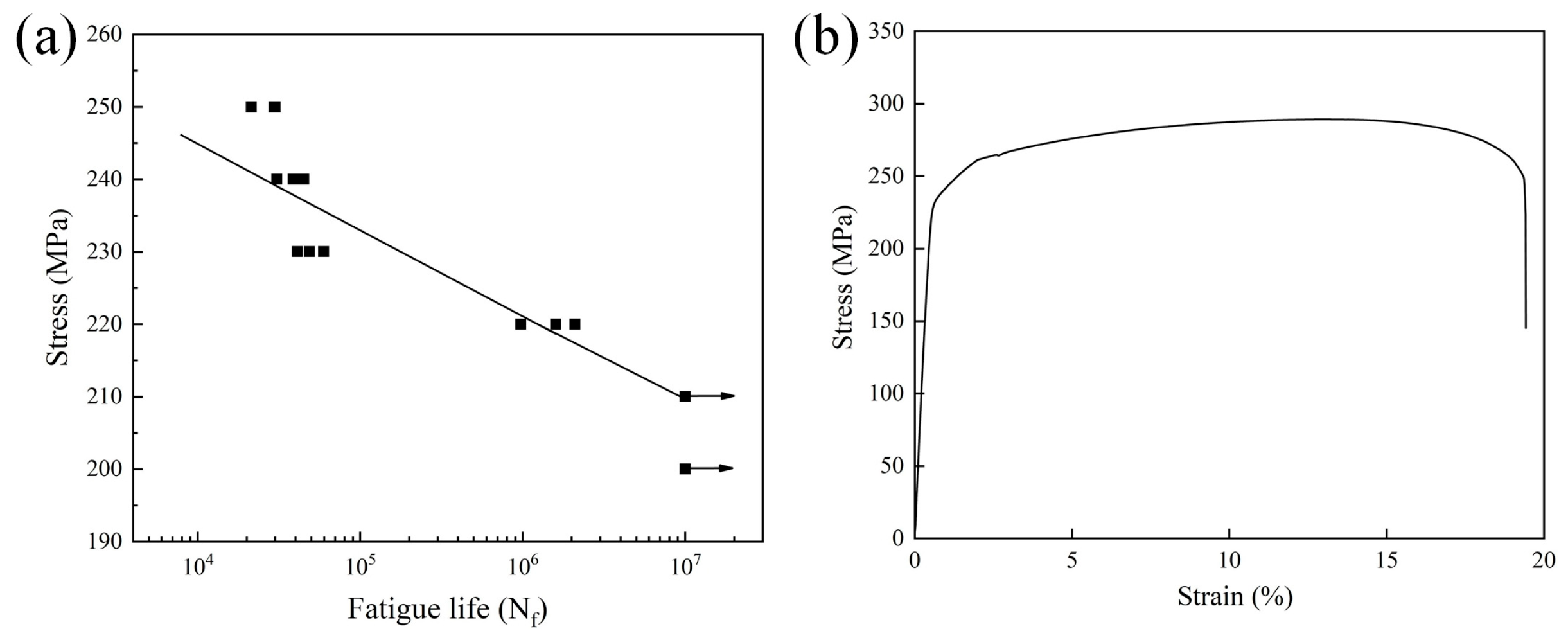
3.1. Initial Materials
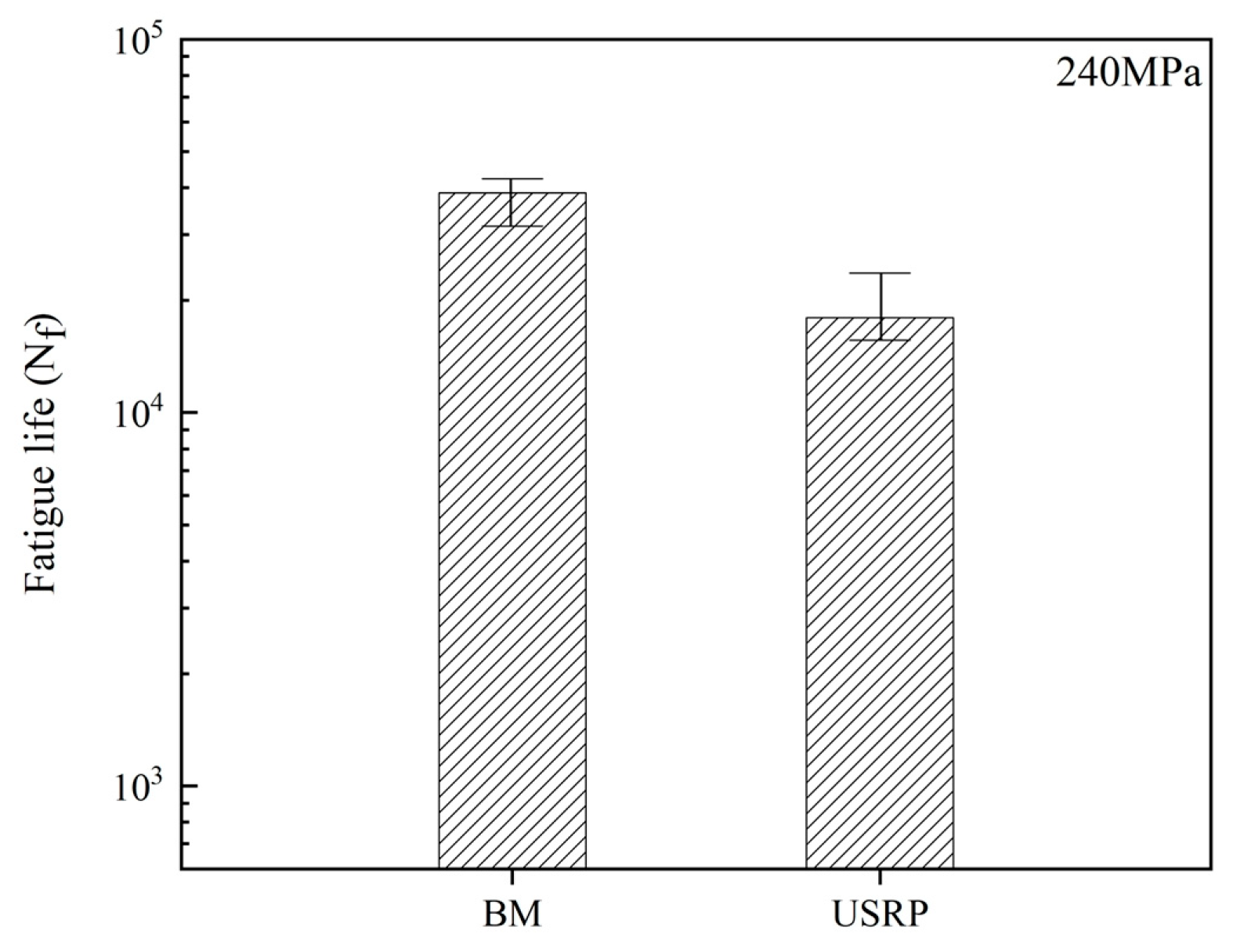
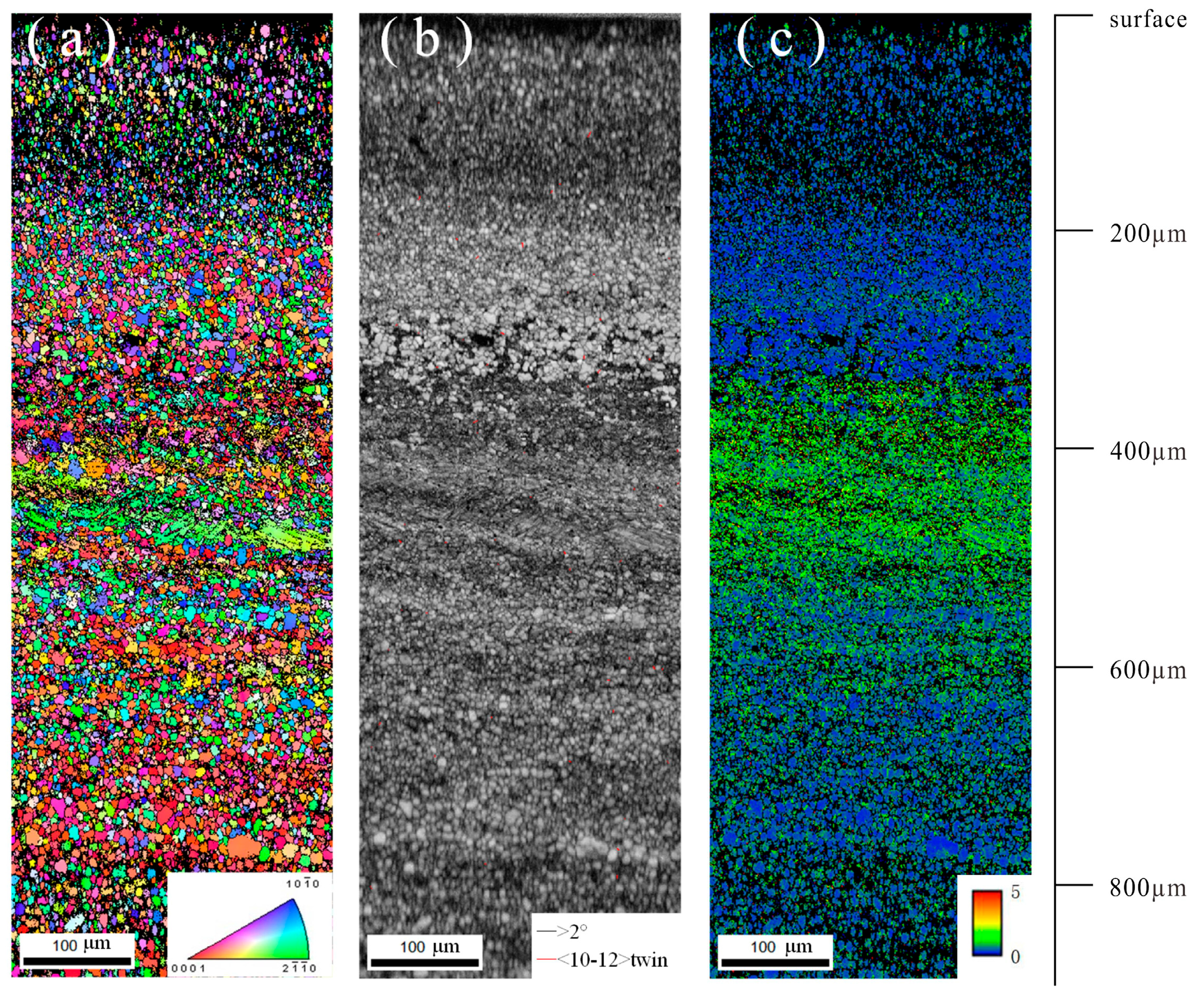
3.2. Effect of USRP on Microstructure Evolution and Mechanical Property
3.3. Effect of Surface Layer Removal on Microstructure Evolution and Mechanical Property
4. Conclusions
- (1)
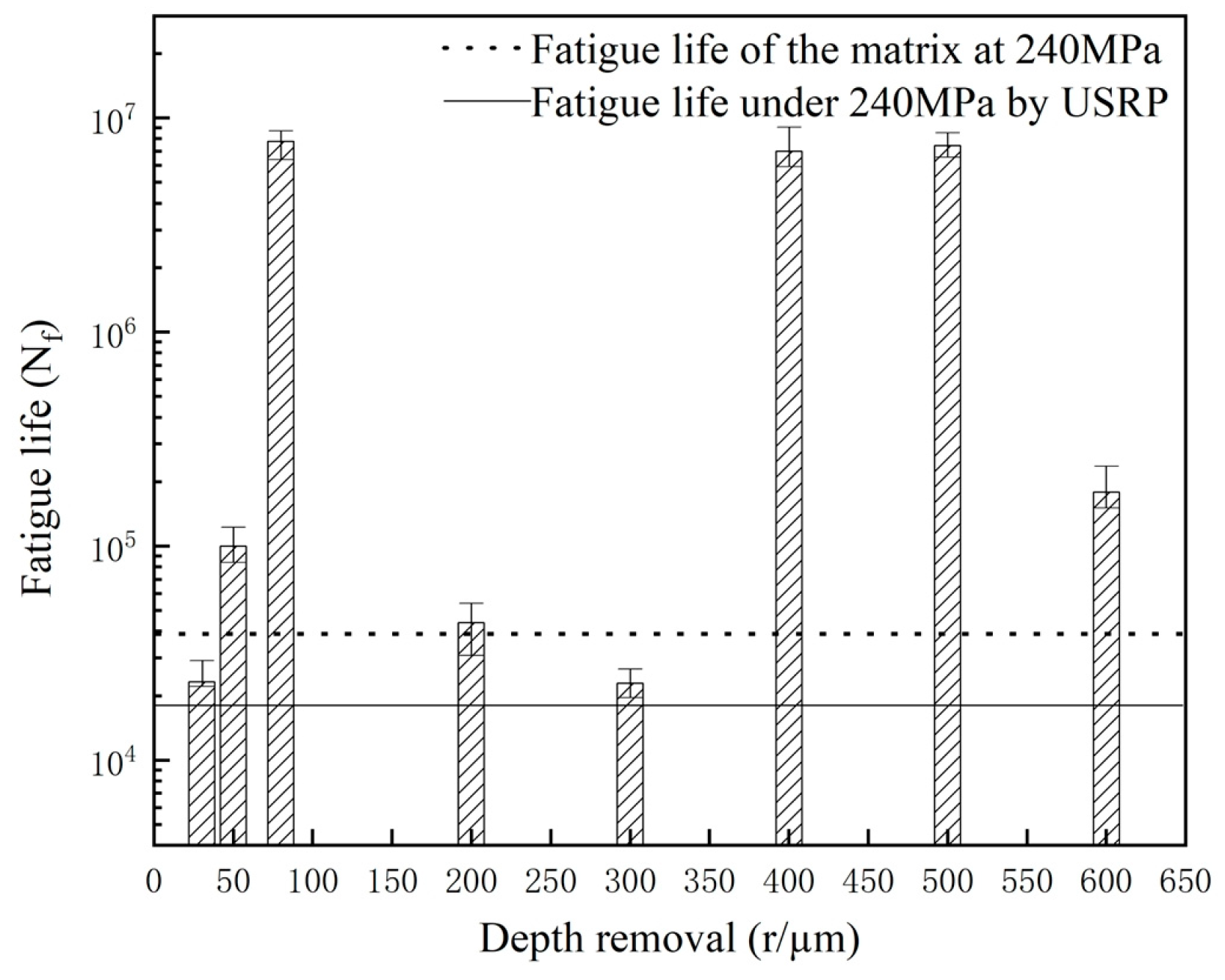
- Fatigue life exhibits a significant and non-monotonic dependence on removal depth. The as-rolled state shows limited improvement, while removing specific surface layers leads to dramatic fatigue life enhancement—by up to two orders of magnitude—demonstrating that the subsurface gradient structure, rather than the immediate surface, governs fatigue behavior.
- (2)
- Optimal fatigue resistance is achieved after removing approximately 80 μm of the surface material under the specific test conditions employed in this study (stress amplitude 240 MPa, stress ratio R = 0.1, room temperature). At this depth, fatigue life reaches a maximum of 7.79 × 10⁶ cycles. This improvement results from eliminating the severely deformed, defect-rich surface layer and exposing a refined, recrystallized subsurface zone that effectively resists crack initiation and propagation.
- (3)
- A secondary fatigue life peak occurs after removing 400–500 μm of material. At 400 μm removal, fatigue life reaches 7.00 × 10⁶ cycles, and at 500 μm removal, a comparable life of 7.42 × 10⁶ cycles is observed. This recovery is attributed to the exposure of a deeper plastically deformed region containing high dislocation density and a favorable residual compressive stress field, which strongly suppresses crack initiation under cyclic loading.
- (4)
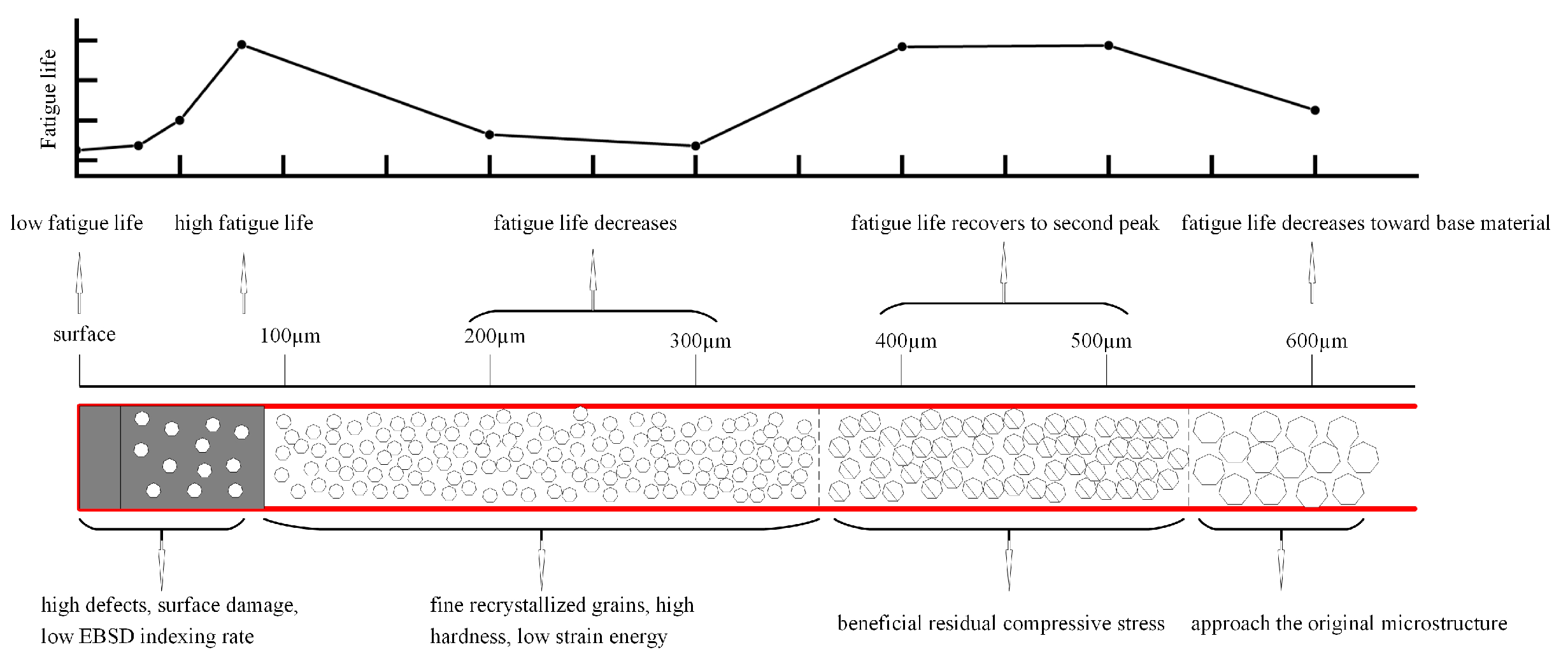
- The fatigue response is structurally layered, governed by the gradient microstructure introduced by USRP. The variation in fatigue life with removal depth reflects the sequential exposure of distinct microstructural zones—each with unique combinations of grain morphology, defect concentration, and residual stress state—highlighting the importance of integrated surface–subsurface design in fatigue-resistant engineering.
Author Contributions
Funding
Data Availability Statement
Conflicts of Interest
References
- Miura, H.; Maruoka, T.; Yang, X.; Jonas, J.J. Microstructure and mechanical properties of multi-directionally forged Mg–Al–Zn alloy. Scr. Mater. 2012, 66, 49–51. [Google Scholar] [CrossRef] [Scilit]
- Joost, W.J.; Krajewski, P.E. Towards magnesium alloys for high-volume automotive applications. Scr. Mater. 2017, 128, 107–112. [Google Scholar] [CrossRef] [Scilit]
- Prasad, S.V.S.; Prasad, S.B.; Verma, K.; Mishra, R.K.; Kumar, V.; Singh, S. The role and significance of Magnesium in modern day research-A review. J. Magnes. Alloys 2022, 10, 1–61. [Google Scholar] [CrossRef] [Scilit]
- Agnew, S.R.; Duygulu, Ö. Plastic anisotropy and the role of non-basal slip in magnesium alloy AZ31B. Int. J. Plast. 2005, 21, 1161–1193. [Google Scholar] [CrossRef] [Scilit]
- Basu, S.; Dogan, E.; Kondori, B.; Karaman, I.; Benzerga, A.A. Towards designing anisotropy for ductility enhancement: A theory-driven investigation in Mg-alloys. Acta Mater. 2017, 131, 349–362. [Google Scholar] [CrossRef] [Scilit]
- Ye, H.; Sun, X.; Liu, Y.; Rao, X.X.; Gu, Q. Effect of ultrasonic surface rolling process on mechanical properties and corrosion resistance of AZ31B Mg alloy. Surf. Coat. Technol. 2019, 372, 288–298. [Google Scholar] [CrossRef] [Scilit]
- Tong, J.L.; Zheng, Y.H.; Yang, S.K.; Li, X.B.; Liu, L.X.; Xiang, D.H.; Gao, G.F. Research on the Surface Characteristics of TC4 Titanium Alloy Subjected to Eccentric Ultrasonic Surface Rolling Process. J. Mater. Eng. Perform. 2025, 1–17. [Google Scholar] [CrossRef] [Scilit]
- Geng, J.L.; Yan, Z.F.; Zhang, H.X.; Liu, Y.Q.; Dong, P.; Yuan, S.; Wang, W.X. Microstructure and Mechanical Properties of AZ31B Magnesium Alloy via Ultrasonic Surface Rolling Process. Adv. Eng. Mater. 2021, 23, 2100076. [Google Scholar] [CrossRef] [Scilit]
- Wang, S.; Yu, T.; Pang, Z.; Yin, X.; Liu, X. Effect of Repeated Processing Passes during Ultrasonic Rolling on Fatigue Performance and Corrosion Resistance of Ti6Al4V Alloy. Metals 2023, 13, 1719. [Google Scholar] [CrossRef] [Scilit]
- Wang, H.B.; Song, G.L.; Tang, G.Y. Enhanced surface properties of austenitic stainless steel by electropulsing-assisted ultrasonic surface rolling process. Surf. Coat. Technol. 2015, 282, 149–154. [Google Scholar] [CrossRef] [Scilit]
- Ma, X.Q.; Xu, S.B.; Xue, X.M.; Zhao, X.H.; Pan, Y.F.; Li, J.N.; Zheng, W. Effect of Multi-pass Ultrasonic Surface Rolling Process on Surface Properties and Microstructure of GCr15 Steel. J. Mater. Eng. Perform. 2025, 34, 17354–17366. [Google Scholar] [CrossRef] [Scilit]
- Wu, L.J.; Lv, Y.X.; Zhang, Y.L.; Yang, L.J.; Yang, Y.F.; Li, A.H. Surface integrity and rolling contact fatigue behavior of 18CrNiMo7-6 steel subjected to ultrasonic surface rolling process. Eng. Fail. Anal. 2024, 162, 108442. [Google Scholar] [CrossRef] [Scilit]
- Liang, C.; Yan, H.; Yin, Y.; Hu, H.; Li, L. Effect of Ultrasonic Surface Rolling Step Size on the Wear and Corrosion Behavior of Shot-Peened Cr8 Steel. Metals 2026, 16, 51. [Google Scholar] [CrossRef] [Scilit]
- Jiang, L.K.; Feng, X.W.; Wu, H.C.; Su, G.S.; Yang, B. Improved Microstructure of 316LN Stainless Steel Performed by Ultrasonic Surface Rolling. Metals 2025, 15, 545. [Google Scholar] [CrossRef] [Scilit]
- Yang, H.M.; Yang, K.; Wei, G.B.; Li, R.G. Optimization of Surface Layer Properties of Mg-9Li-1Zn Alloy by Ultrasonic Surface Rolling Process and its Impact on Corrosion Behavior. Acta Metall. Sin. (Engl. Lett.) 2025, 38, 1421–1435. [Google Scholar] [CrossRef] [Scilit]
- Zheng, G.Y.; Luo, X.; Kou, Z.D.; Huang, B.; Yang, Y.Q. Microstructural evolution of Al-Zn-Mg-Cu alloy during ultrasonic surface rolling process. Mater. Charact. 2022, 194, 112418. [Google Scholar] [CrossRef] [Scilit]
- Huang, L.S.; Liu, Y.; Wu, J.H.; Guo, Y.X.; Feng, M.L.; Lian, J.M.; Zhou, M.H.; Huang, H. Effect of ultrasonic surface rolling process on microstructure, mechanical properties, and wear resistance of Mg-1.9Mn-0.3Ce alloy. J. Alloys Compd. 2025, 1034, 181372. [Google Scholar] [CrossRef] [Scilit]
- Xu, F.M.; Huang, L.S.; Liu, G.H. Effect of ultrasonic surface rolling process on the surface properties of Mg-Gd-Zn-Zr alloy. Mater. Lett. 2024, 365, 136398. [Google Scholar] [CrossRef] [Scilit]
- Han, J.; Wang, C.; Song, Y.M.; Liu, Z.Y.; Sun, J.P.; Zhao, J.Y. Simultaneously improving mechanical properties and corrosion resistance of as-cast AZ91 Mg alloy by ultrasonic surface rolling. Int. J. Miner. Metall. Mater. 2022, 29, 1551–1558. [Google Scholar] [CrossRef] [Scilit]
- He, J.H.; Geng, X.; Dong, Q.S.; Zhang, Y.; Zhang, X.B. Simultaneously improving mechanical properties and corrosion resistance of Mg-3Gd-1Zn-0.4Zr alloy via ultrasonic surface rolling. J. Alloys Compd. 2025, 1038, 182897. [Google Scholar] [CrossRef] [Scilit]
- Wang, S.; Li, W.; Chen, L.B.; Luo, L.; Meng, G.; Chang, G.Q.; Liu, Q.D. Formation mechanism of surface gradient microstructure and mechanical properties evolution of Mg-Y-Nd-Gd-Zr alloy by ultrasonic rolling. J. Mater. Res. Technol. 2024, 30, 6482–6497. [Google Scholar] [CrossRef] [Scilit]
- Yang, Z.L.; Liu, Y.D.; Tang, Y.; Li, W.; Zhang, S.; Wang, H.J.; Ran, X. Effect of USRP on corrosion properties of Mg-Y-Nd-Gd-Zr magnesium alloy. Mater. Chem. Phys. 2025, 344, 131042. [Google Scholar] [CrossRef] [Scilit]
- Yu, D.L.; Zhang, D.F.; Dai, Q.W.; Lan, W.; Peng, J.; Xu, J.Y.; Qi, F.G.; Pan, F.S. Effect of stress ratio on high cycle fatigue properties in Mg-6Zn-1Mn alloy. Mater. Sci. Eng. A-Struct. Mater. Prop. Microstruct. Process. 2018, 711, 624–632. [Google Scholar] [CrossRef] [Scilit]
- Tsushida, M.; Shikada, K.; Kitahara, H.; Ando, S.; Tonda, H. Relationship between fatigue strength and grain size in AZ31 magnesium alloys. Mater. Trans. 2008, 49, 1157–1161. [Google Scholar] [CrossRef] [Scilit]
- Begum, S.; Chen, D.L.; Xu, S.; Luo, A.A. Low cycle fatigue properties of an extruded AZ31 magnesium alloy. Int. J. Fatigue 2009, 31, 726–735. [Google Scholar] [CrossRef] [Scilit]
- Gao, J.; Wang, S.B.; Cai, J.X.; Xin, W.L.; Yan, Z.F. Study on the synergistic strengthening mechanism of pre-tension deformation and surface mechanical rolling treatment on the fatigue performance of AZ31B magnesium alloy. J. Magnes. Alloys 2025, 13, 4500–4516. [Google Scholar] [CrossRef] [Scilit]
- Xu, X.C.; Liu, D.X.; Zhang, X.H.; Liu, C.S.; Liu, D.; Zhang, W.C. Influence of ultrasonic rolling on surface integrity and corrosion fatigue behavior of 7B50-T7751 aluminum alloy. Int. J. Fatigue 2019, 125, 237–248. [Google Scholar] [CrossRef] [Scilit]
- Lan, S.L.; Qi, M.; Zhu, Y.F.; Liu, M.X.; Bie, W.B. Ultrasonic rolling strengthening effect on the bending fatigue behavior of 12Cr2Ni4A steel gears. Eng. Fract. Mech. 2023, 279, 109024. [Google Scholar] [CrossRef] [Scilit]
- Yang, J.; Liu, D.X.; Ren, Z.C.; Zhi, Y.L.; Zhang, X.H.; Zhao, R.M.; Liu, D.; Xu, X.C.; Fan, K.F.; Liu, C.S.; et al. Grain growth and fatigue behaviors of GH4169 superalloy subjected to excessive ultrasonic surface rolling process. Mater. Sci. Eng. A 2022, 839, 142875. [Google Scholar] [CrossRef] [Scilit]
- Wang, X.; Chen, L.; Liu, P.; Lin, G.; Ren, X. Enhancement of Fatigue Endurance Limit through Ultrasonic Surface Rolling Processing in EA4T Axle Steel. Metals 2020, 10, 830. [Google Scholar] [CrossRef] [Scilit]
- GB/T 3075-2021; Metallic Materials — Fatigue Testing — Axial Force-Controlled Method. Standards Press of China: Beijing, China, 2021.
- Yazdanmehr, A.; Jahed, H. On the Surface Residual Stress Measurement in Magnesium Alloys Using X-Ray Diffraction. Materials 2020, 13, 5190. [Google Scholar] [CrossRef] [Scilit]
- Liu, R.X.; Song, Y.F.; Wang, Y.Z.; Yan, H.; Zhao, L.Y.; Chen, R.S. High strength AZ31 magnesium alloy sheets without sacrificing ductility enabled by ultrasonic surface rolling processing introducing micro/ nano-gradient structure. J. Alloys Compd. 2025, 1036, 181718. [Google Scholar] [CrossRef] [Scilit]
- Ma, C.; Zhang, C.H.; Zhu, W.G.; Zeng, X.K.; Xie, Z.H.; Wang, X.Y. Effect of Ultrasonic Surface Rolling Process on Pre-corrosion Fatigue Behavior of Zr705 Alloy. Rare Met. Mater. Eng. 2024, 53. [Google Scholar] [CrossRef]
- Chen, L.T.; Wang, Y.S.; Xu, S.H.; Zhang, M.Y.; Zheng, G.H. The Effect of USRP-Composite DLC Coating on Bearing Fatigue Life. Coatings 2025, 15, 616. [Google Scholar] [CrossRef] [Scilit]
- Liu, Y.D.; Li, W.; Sun, Y.D.; Chen, L.B.; Chang, G.Q.; Deng, G.S. Effect of ultrasonic surface rolling process on microstructure and properties of rolled Mg-Y-Nd-Zr alloy. J. Mater. Sci. 2023, 58, 9362–9381. [Google Scholar] [CrossRef] [Scilit]
- Liu, R.X.; Li, X.H.; Song, Y.F.; Wang, Z.J.; Zhao, L.Y.; Ning, F.Q.; Yan, H.; Chen, R.S. The effect of ultrasonic surface rolling process on the gradient microstructure and wear resistance of AZ31 thin sheet. J. Magnes. Alloys 2025, 13, 5077–5090. [Google Scholar] [CrossRef] [Scilit]
- John, M.; Ralls, A.M.; Dooley, S.C.; Thazhathidathil, A.K.V.; Perka, A.K.; Kuruveri, U.B.; Menezes, P.L. Ultrasonic Surface Rolling Process: Properties, Characterization, and Applications. Appl. Sci. 2021, 11, 10986. [Google Scholar] [CrossRef] [Scilit]
- Zhao, X.H.; Zhang, Y.J.; Liu, Y. Surface Characteristics and Fatigue Behavior of Gradient Nano-Structured Magnesium Alloy. Metals 2017, 7, 62. [Google Scholar] [CrossRef] [Scilit]
- Serrano-Munoz, I.; Mishurova, T.; Thiede, T.; Sprengel, M.; Kromm, A.; Nadammal, N.; Nolze, G.; Saliwan-Neumann, R.; Evans, A.; Bruno, G. The residual stress in as-built Laser Powder Bed Fusion IN718 alloy as a consequence of the scanning strategy induced microstructure. Sci. Rep. 2020, 10, 14645. [Google Scholar] [CrossRef] [Scilit]
- Zhao, W.D.; Liu, D.X.; Zhang, X.H.; Zhou, Y.; Zhang, R.X.; Zhang, H.; Ye, C. Improving the fretting and corrosion fatigue performance of 300M ultra-high strength steel using the ultrasonic surface rolling process. Int. J. Fatigue 2019, 121, 30–38. [Google Scholar] [CrossRef] [Scilit]
- Xu, S.B.; Wang, Y.R.; Sun, K.W.; Zhou, H.L.; Pan, Y.F.; Lin, X.J.; Li, T.T.; Li, T.H.; Xu, C.; Zheng, W.; et al. Ultrasonic Surface Rolling Process with Multi-Parameter Coupling for Surface Integrity and Fatigue Life Enhancement of 20CrNiMo Steel. J. Mater. Eng. Perform. 2025, 35, 9. [Google Scholar] [CrossRef] [Scilit]




| Element | Mg | Al | Zn | Mn |
|---|---|---|---|---|
| Content, wt./% | 96.44 | 2.43 | 0.75 | 0.38 |
Disclaimer/Publisher’s Note: The statements, opinions and data contained in all publications are solely those of the individual author(s) and contributor(s) and not of MDPI and/or the editor(s). MDPI and/or the editor(s) disclaim responsibility for any injury to people or property resulting from any ideas, methods, instructions or products referred to in the content. |
© 2026 by the authors. Licensee MDPI, Basel, Switzerland. This article is an open access article distributed under the terms and conditions of the Creative Commons Attribution (CC BY) license.
Share and Cite
Wang, Z.; Meng, J.; Chen, Q.; Li, S.; Wang, F.; Sun, J. Effect of Surface Layer Removal After Ultrasonic Surface Rolling Processing on the Tension–Tension Fatigue Performance of AZ31B Magnesium Alloy. Metals 2026, 16, 533. https://doi.org/10.3390/met16050533
Wang Z, Meng J, Chen Q, Li S, Wang F, Sun J. Effect of Surface Layer Removal After Ultrasonic Surface Rolling Processing on the Tension–Tension Fatigue Performance of AZ31B Magnesium Alloy. Metals. 2026; 16(5):533. https://doi.org/10.3390/met16050533
Chicago/Turabian StyleWang, Zhonglei, Jie Meng, Qingqiang Chen, Shunlong Li, Fei Wang, and Jie Sun. 2026. "Effect of Surface Layer Removal After Ultrasonic Surface Rolling Processing on the Tension–Tension Fatigue Performance of AZ31B Magnesium Alloy" Metals 16, no. 5: 533. https://doi.org/10.3390/met16050533
APA StyleWang, Z., Meng, J., Chen, Q., Li, S., Wang, F., & Sun, J. (2026). Effect of Surface Layer Removal After Ultrasonic Surface Rolling Processing on the Tension–Tension Fatigue Performance of AZ31B Magnesium Alloy. Metals, 16(5), 533. https://doi.org/10.3390/met16050533