Article

Investigation of Hot Deformation Behavior and Microstructure Evolution of Ti-3Al-2.5V-0.5Ni Alloy


1
State Key Laboratory of Nonferrous Structural Materials, China GRINM Group Co., Ltd., Beijing 100088, China
2
GRIMAT Engineering Institute Co., Ltd., Beijing 101407, China
3
General Research Institute for Nonferrous Metals, Beijing 100088, China
4
GRINM (Guangdong) Institute for Advanced Materials and Technology, Foshan 528051, China
*
Authors to whom correspondence should be addressed.
Metals 2026, 16(4), 404; https://doi.org/10.3390/met16040404
Submission received: 6 March 2026 / Revised: 2 April 2026 / Accepted: 2 April 2026 / Published: 6 April 2026
(This article belongs to the Special Issue Advanced Ti-Based Alloys and Ti-Based Materials)

Abstract

This study systematically investigates the hot deformation behavior and microstructure evolution of Ti-3Al-2.5V-0.5Ni alloy under compression at temperatures ranging from 800 °C to 1010 °C and strain rates ranging from 0.1 s−1 to 10 s−1, with a maximum deformation of 75% (with a corresponding true strain of 1.4). An Arrhenius-type constitutive equation was developed, and a hot processing map was established using a dynamic material model (DMM). Microstructural evolution was characterized using electron backscatter diffraction (EBSD). A hot processing map delineated stable and unstable regions. Regions with high power dissipation efficiency (η) were identified at deformation temperatures of 850–880 °C with strain rates of 0.1–10 s−1, and at 940–960 °C with strain rates of 1.5–10 s−1. These regions show high recrystallization fraction and good processing performance. The instability zone was observed at about 900 °C and high strain rate, which should be avoided during processing. The microstructure analysis of different power dissipation efficiency regions was carried out in detail. The results show that the power dissipation efficiency is about 0.38 at the deformation temperature of 950 °C and the strain rate of 0.1 s−1, accompanied by high dynamic recrystallization. However, when the deformation condition is 800 °C and 10 s−1, the power dissipation efficiency is lower than 0.18, the degree of recrystallization is limited, and a large number of dislocations accumulate. In summary, the large strain rolling of Ti-3Al-2.5V-0.5Ni alloy should be processed in the high-temperature α + β phase region (850–900 °C) and low-to-medium strain rate range of 0.1–5 s−1. The process conditions can promote high recrystallization fraction, good processability, and weakened crystallographic texture, thereby minimizing the anisotropy of the final sheet. This study provides theoretical guidance for the optimization of industrial hot processing parameters of the alloy.

1. Introduction

The development environment of oil and gas wells under complex working conditions and deep-well drilling conditions is increasingly stringent, and the market has put forward higher requirements for the mechanical properties and corrosion resistance of coiled tubing. Titanium alloy has become a key choice for oil well pipe materials due to its high specific strength, excellent mechanical properties, corrosion resistance, low elastic modulus, and good processing performance [1,2]. The development of new titanium alloy materials with high corrosion resistance and excellent mechanical properties for oil well tubing is crucial to the development of the oil and gas industry. However, the research and application of medium-strength titanium alloy coiled tubing materials with a strength of 80 ksi (552 MPa) are relatively limited. As a near-α titanium alloy with low-aluminum equivalent, Ti-3Al-2.5V, exhibits excellent mechanical stability at high temperatures and can resist corrosion in most acidic environments [3]. However, the strength of Ti-3Al-2.5V is low, and its corrosion resistance still needs to be further improved [4]. The addition of Ni can significantly improve the corrosion resistance and mechanical properties of titanium alloys [5]. However, the research on the thermal processing properties of new titanium alloy materials is still insufficient [6,7].
It was well established that thermomechanical processing conditions—such as deformation temperature, strain rate, and strain—play a critical role in determining the final microstructure and mechanical properties of alloys [8]. Accurate control of process parameters such as deformation temperature, strain rate, and deformation amount, combined with optimization of subsequent heat treatment, can achieve effective microstructure modification, thereby significantly improving the overall performance of the alloy. Thermal simulation experiments play a key role in predicting material processing properties and optimizing processes. The accurate constitutive equation established by analyzing the experimental data can provide a reliable theoretical basis for thermomechanical processing simulation. The core lies in establishing a quantitative relationship between flow stress (σ), deformation temperature (T), strain rate ( ε · ), and true strain (ε) [9,10,11].
The Arrhenius constitutive equation containing hyperbolic sine functions accurately describes the plastic deformation process controlled by thermal activation at high temperatures. The optimal processing window can be determined by the processing map to avoid the generation of micro cracks and macro defects. By observing the microstructure of the power dissipation efficiency η region and the instability region, it can be found that the high-η region corresponds to the beneficial microstructure such as dynamic recrystallization, while the instability region is associated with the defective microstructure. The aforementioned method has been widely applied in various titanium alloy systems. Li et al. [11] systematically analyzed the hot deformation behavior and micro-structural evolution of β-type titanium alloy Ti-6Cr-5Mo-5V-4Al in the single-phase region, established a full strain constitutive equation, and predicted the flow stress. The optimal hot working interval was obtained from the hot processing diagram. Under conditions of high deformation temperature and low strain rate, discontinuous re-crystallization was observed in the micro-structure, whereas continuous dynamic re-crystallization occurred in the region of high strain rate. As the dissipation efficiency factor decreased, the deformation mechanism transitioned from discontinuous re-crystallization to continuous re-crystallization, and ultimately to dynamic recovery and flow localization. Li et al. [12] studied the micro-structural evolution of the Ti-5Al-2Sn-2Zr-4Mo-4Cr alloy during hot deformation and found that lamellar and equiaxed α phase promoted β grain dynamic re-crystallization (DRX) through different mechanisms. During the deformation process, the spheroidization of lamellar α phase reduces the hindrance to dislocations, which is conducive to the absorption of surrounding dislocations by small angle grain boundaries (LAGBs) in β grains. The spheroidization process increases the cumulative misorientation, forms fine dynamic recrystallization grains, and improves the dynamic recrystallization degree of β grains.
During the hot-rolling process of sheets, deformation mainly occurs in the extension of the rolling direction (RD) and the compression in the thickness direction (ND), which is a typical plane strain state. The plane strain compression experiment strictly restricted the deformation in the width direction by using a long and narrow rectangular mold, reproducing the plane strain conditions of hot-rolling. Therefore, in this study, plane strain compression tests were conducted to simulate the deformation behavior during the hot-rolling process of Ti-3Al-2.5V-0.5Ni alloy sheets.
In this study, the behavior and mechanism of the Ti-3Al-2.5V-0.5Ni alloy during hot deformation under different conditions were analyzed. The hot compression tests of the alloy specimens were carried out in a temperature range of 800 °C–1010 °C and a strain rate from 0.1 s−1 to 10 s−1. By analyzing the influence of temperature change and strain rate change on the stress of the compression process, the constitutive equations of the α + β phase region and β phase region are established. Different deformation flow behaviors, flow softening mechanisms, and microstructure evolution were discussed. In addition, a thermal processing map was drawn to reveal the thermal processing performance, and the instability area that should be avoided in the thermal processing process was pointed out. The results indicate that hot working of the Ti-3Al-2.5V-0.5Ni alloy should be performed in the higher-temperature α + β phase region (850–950 °C) at low-to-medium strain rates (0.1–5 s−1). These conditions promote a high recrystallization fraction, favorable workability, and a weakened crystallographic texture, thereby minimizing anisotropy in the final sheet products.

2. Materials and Methods

The nominal composition of the material is Ti-3Al-2.5V-0.5Ni (mass fraction, wt. %). The ingot was prepared with 93.5 kg grade 0 sponge titanium (purity ≥ 99.7%) as the basic raw material. Al-55V (2 kg, containing 55 wt. % V), Ti-50Ni (1 kg, 50 wt. % Ni), Al-80V alloy (1.75 kg, 85 wt. % V), and aluminum bean (1.75 kg, >99.95 wt. %) master alloys were used for batching and electrode pressing. The ingot was prepared using two-step vacuum consumable arc melting. Finally, an ingot with a diameter of 400 mm and a mass of 100 kg was prepared. The chemical composition analysis was carried out on the surface of the ingot, and the analysis results are shown in Table 1.
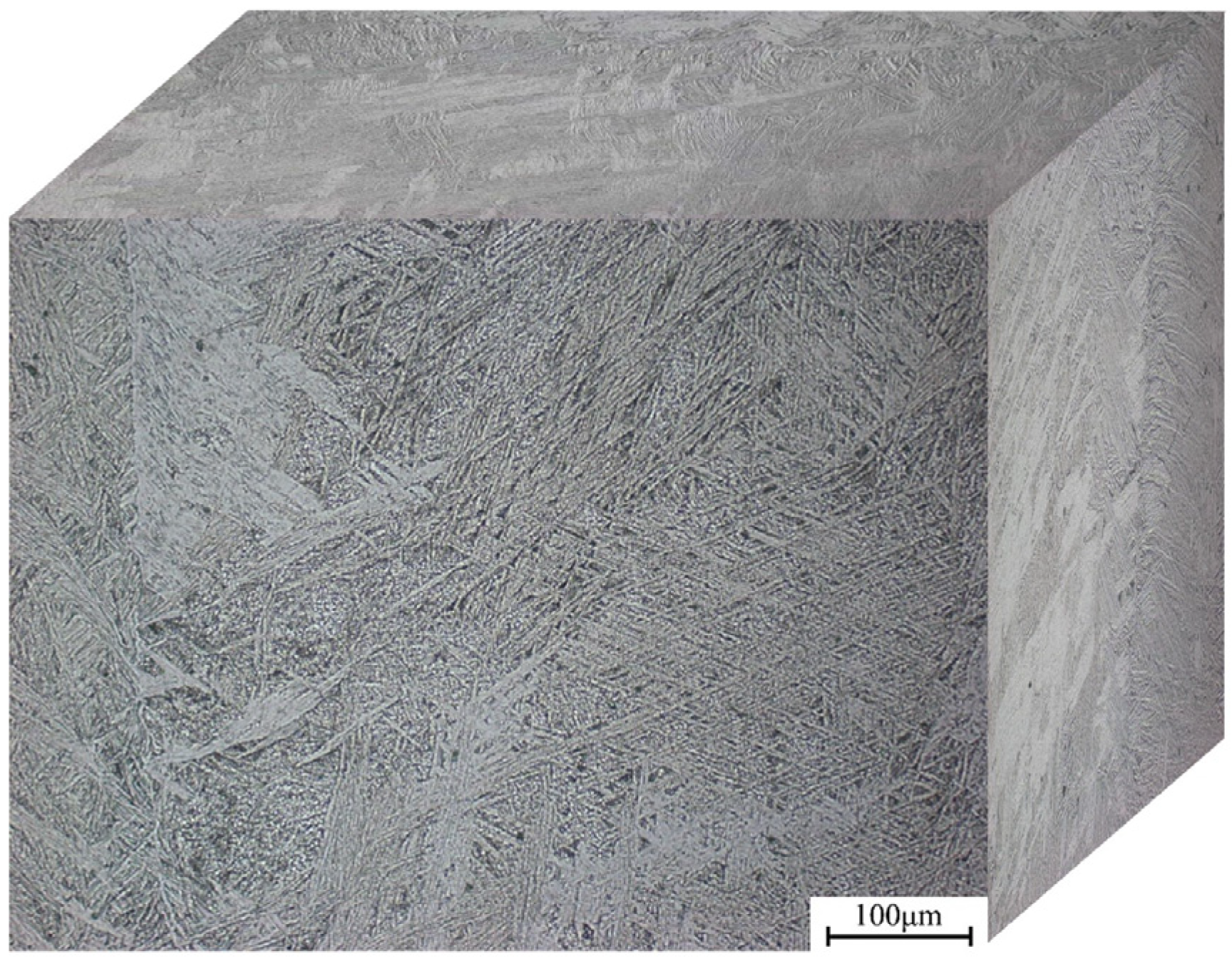
After multi-pass forging and annealing in the single-phase region, the initial slab material for this study, measuring 300 mm × 90 mm × 830 mm, was obtained. The original microstructure of the material is shown in Figure 1, which is a typical Widmanstätten structure. On the grain boundary of the coarse primary β grain, there is a relatively complete continuous grain boundary α phase. In the primary β grain, the coarse lamellar α and β phases were alternately arranged in the β phase transformation microstructure.
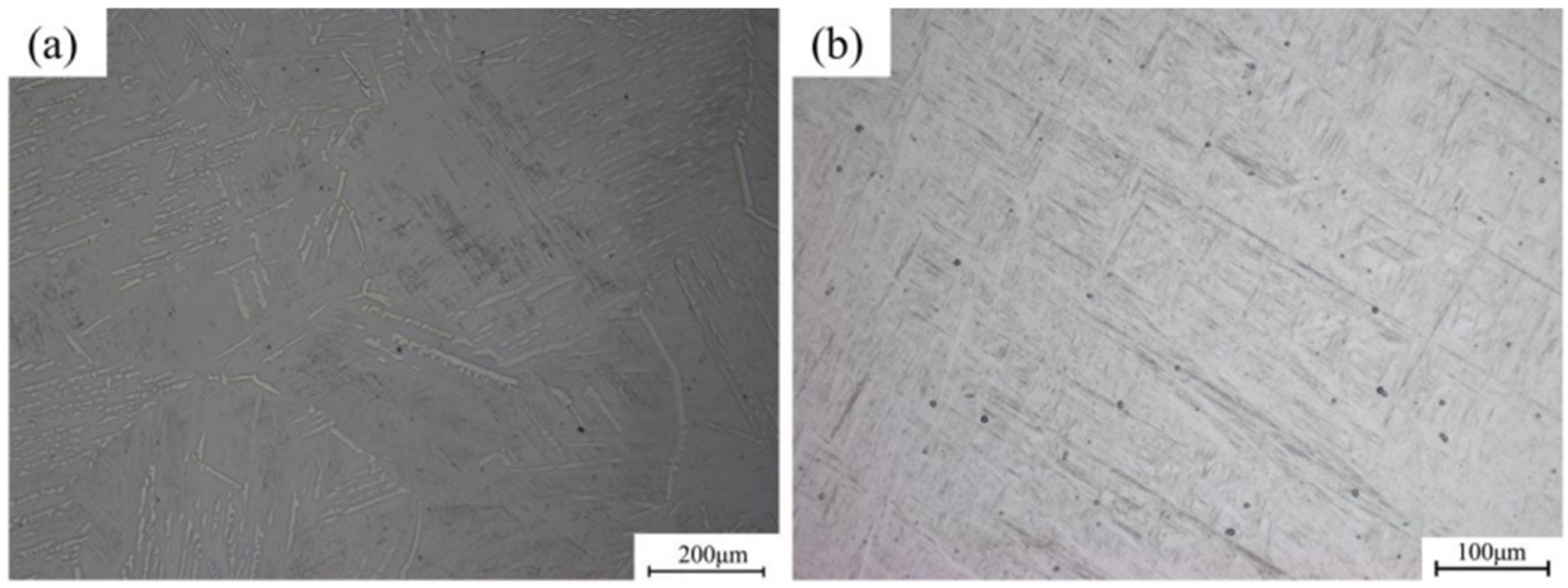
The phase transformation temperature of the alloy was determined using the quenching metallographic method. Specimens were held at 890 °C, 900 °C, 910 °C, and 920 °C for 1 h and subsequently water-quenched; the corresponding microstructures are shown in Figure 2. Based on metallographic observation and phase fraction analysis, the volume fraction of primary α phase was greater than 5% at 890 °C, but decreased to below 5% at 900 °C. Thus, the phase transformation temperature of the Ti-3Al-2.5V-0.5Ni alloy was determined to be between 890 °C and 900 °C.
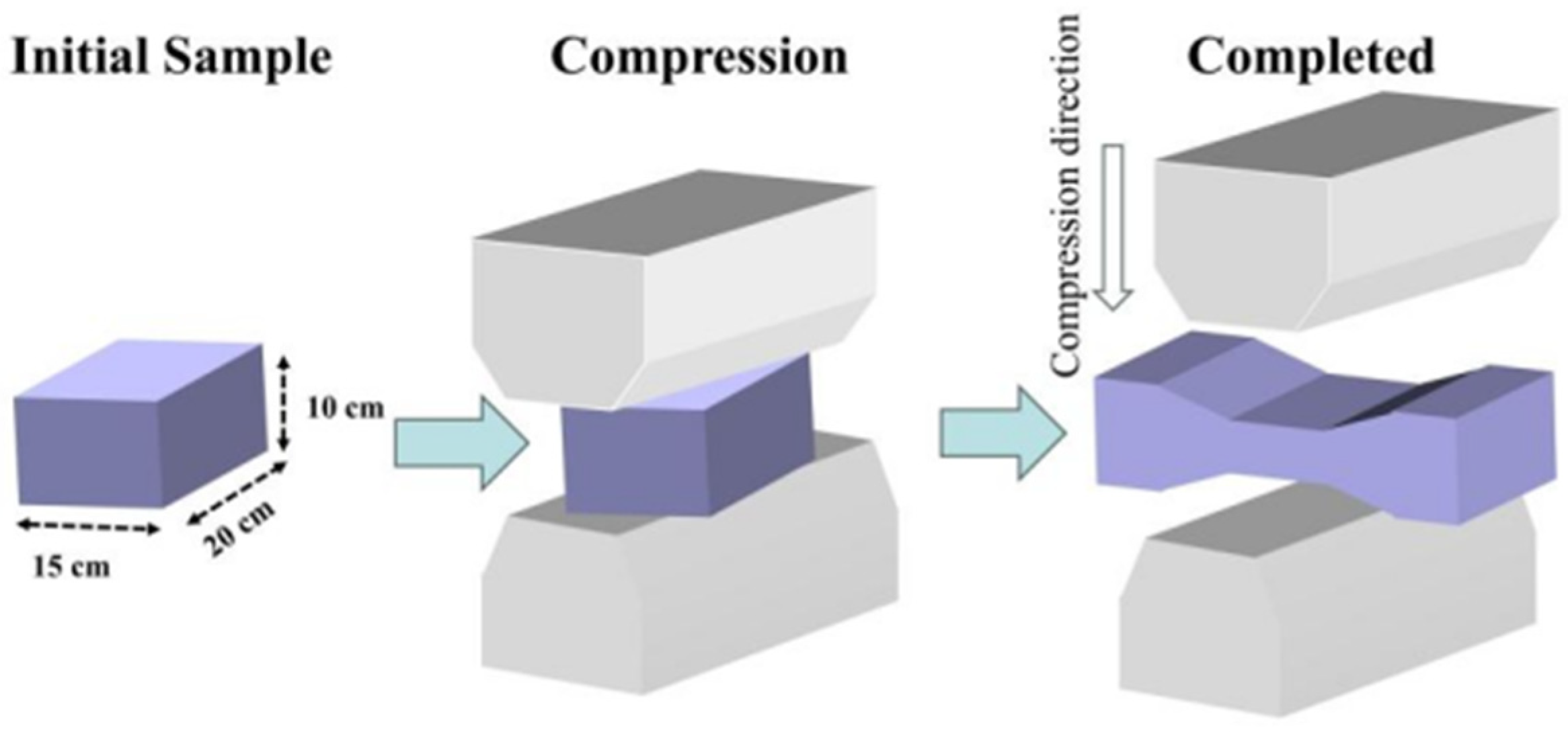
Rectangular specimens measuring 20 mm (L) × 15 mm (W) × 10 mm (H) were cut from the original forged billet, with the long side L parallel to the rolling direction (RD) of the plate and the height H direction parallel to the compression direction (ND). All surfaces were polished before the plane strain compression test. The plane strain compression test was completed on the Gleeble-3800 thermal simulation testing machine (Dynamic Systems Inc., Poestenkill, NY, USA), and the specimen placement method is shown in Figure 3. The contact surface between the specimen and the anvil of the thermal simulator is lubricated with graphite sheets to reduce the friction between the end face and the anvil and minimize the possibility of uneven deformation. The heating rate is 10 °C/s, the specimen was held at the target temperature for 5 min, and then the heated specimen was compressed. The thermocouple was welded in the middle of the side of the specimen and connected to the sensor to monitor and record the temperature, strain, and other information during the deformation process. After the compression was completed, the specimen was rapidly cooled in air. Three compression tests were repeated under each test condition, and the average value was used for analysis.
After the compression, the specimens were cut along the compression direction by WEDM (LA500A, Suzhou Sanguang Science & Technology Co., Ltd., Suzhou, China). The cutting surface was polished with 240-2000 mesh silicon carbide sandpaper. The electrolyte composed of 5% perchloric acid and 95% glacial acetic acid was used for electrolytic polishing to remove the surface stress. The electrolytic voltage was 75 V, and the specimens were analyzed by EBSD (Xplore 30, JEOL Ltd., Akishima, Tokyo, Japan). The electron backscatter diffractometer equipped on the JSM-F100 field emission scanning electron microscope (JEOL Ltd., Akishima, Tokyo, Japan) was used for observation and analysis. The acceleration voltage was 20 kV, and the step size was 0.2 μm. EBSD images and grain orientation distribution information were obtained using TSL OIM software (Version 7.0).

3. Results

3.1. Deformation Behavior

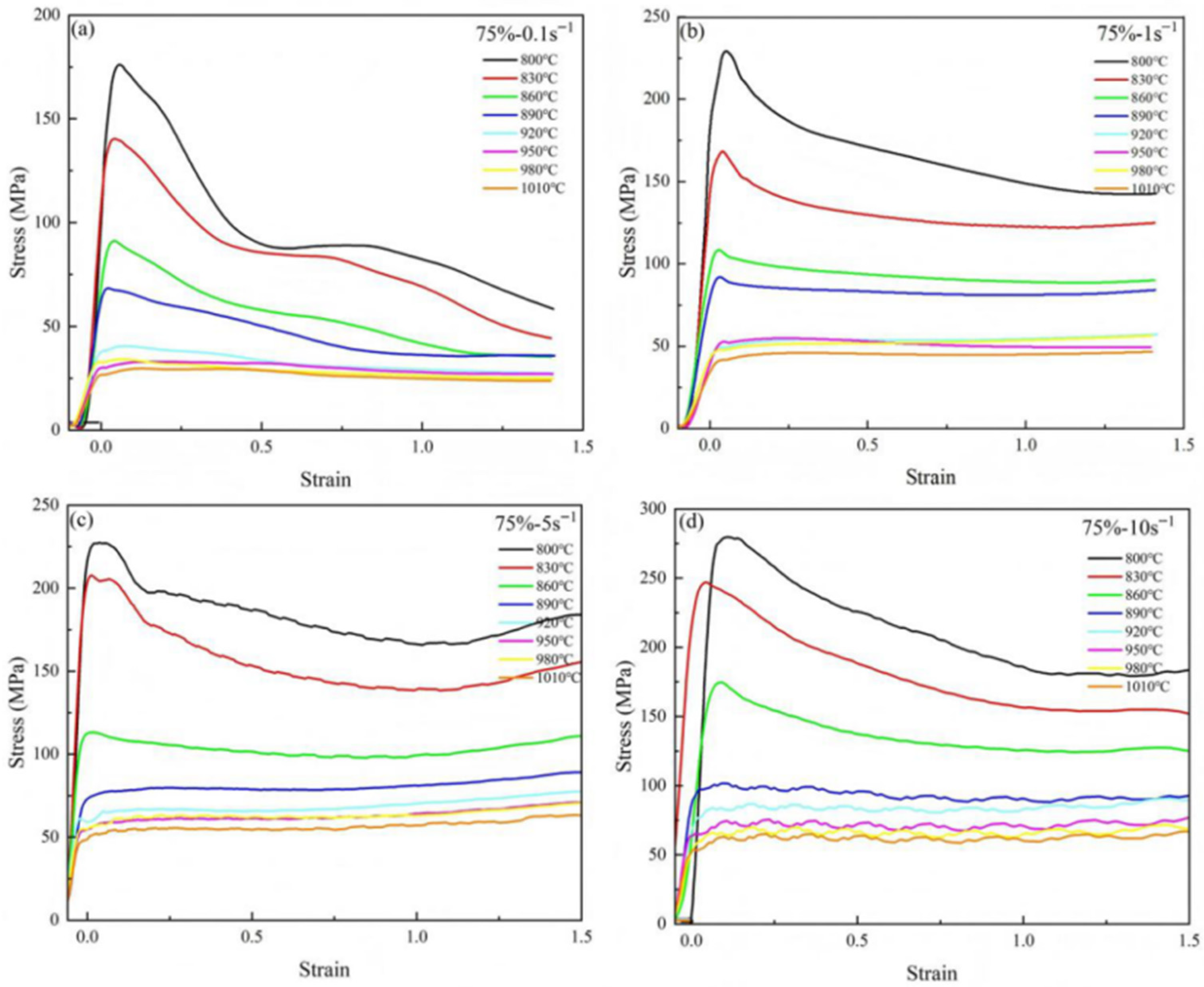
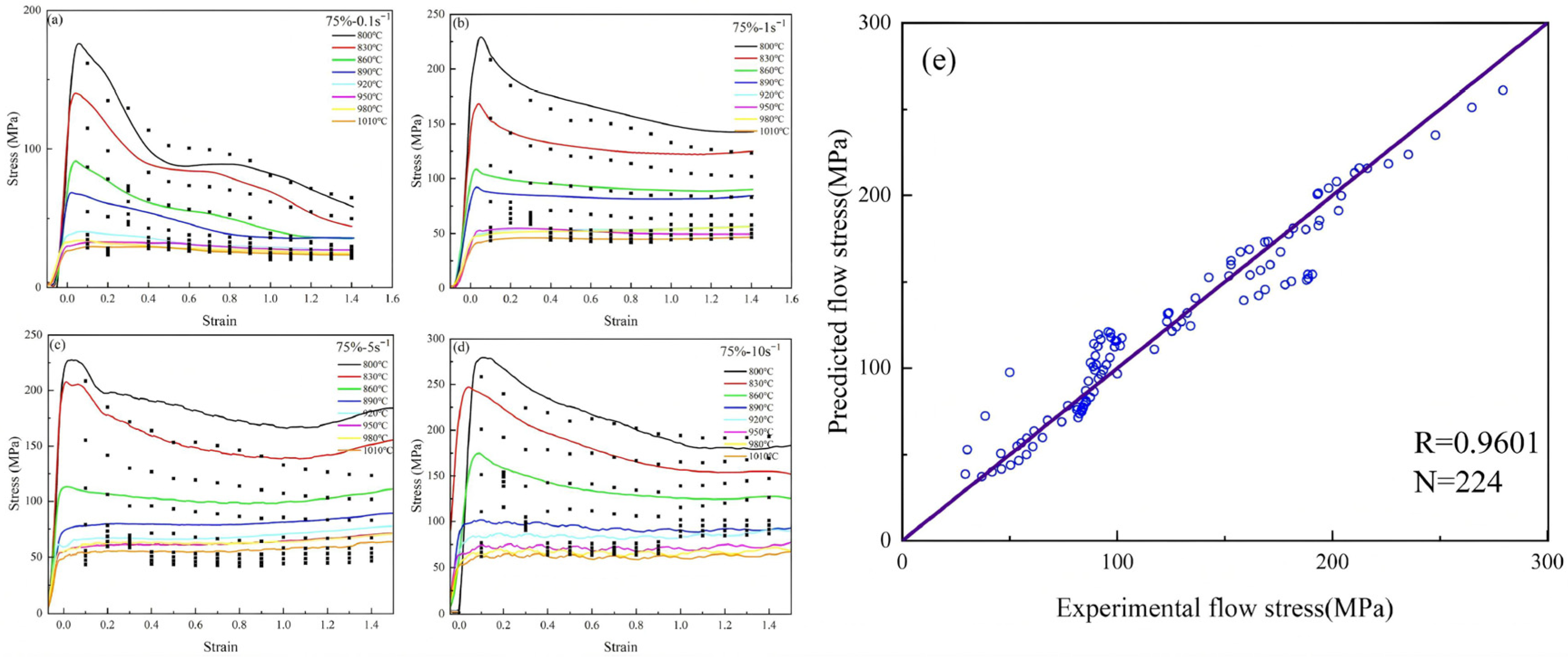
Figure 4 depicts the true stress–true strain curves during the isothermal compression process under conditions of temperature ranging from 800 °C to 1010 °C and strain rate from 0.1 s−1 to 10 s−1. The specimens were compressed to a deformation amount of 75%, corresponding to a true strain of 1.4. In the initial stage of all curves, the flow stress increases rapidly with strain, indicating a typical work hardening stage. This increase in stress is attributed to the rapid increase in dislocation density, entanglement, and pile-up within the material during deformation. As strain increases, the slope of the curve decreases, gradually reaching a peak, exhibiting a significant softening phenomenon, and entering a dynamic softening stage [13]. At deformation temperatures ranging from 800 °C to 860 °C, the flow stress reached a peak and then decreased significantly, showing a flow softening phenomenon. At this time, DRX dominated, and the newly formed recrystallized grains had extremely low dislocation density, replacing the old grains with high dislocation density and severe hardening, leading to a decrease in macroscopic flow stress. When the deformation temperature ranged from 890 °C to 1010 °C, the flow stress reached a peak and then decreased insignificantly, with work hardening and dynamic softening reaching equilibrium; significant dynamic recovery (DRV) occurred. Through the cross-slip and climb of dislocation processes, dislocations of opposite signs annihilated each other, and those with the same signs rearranged to form regular subgrain boundaries, effectively counteracting the proliferation of dislocations and maintaining the dislocation density near a stable equilibrium value. At a constant strain rate, the higher the temperature, the stronger the softening effect, and the lower the deformation resistance. At a constant temperature, the higher the strain rate, the more dominant the work hardening effect, and the higher the flow stress.

3.2. Effect of Deformation Parameters on Flow Stress

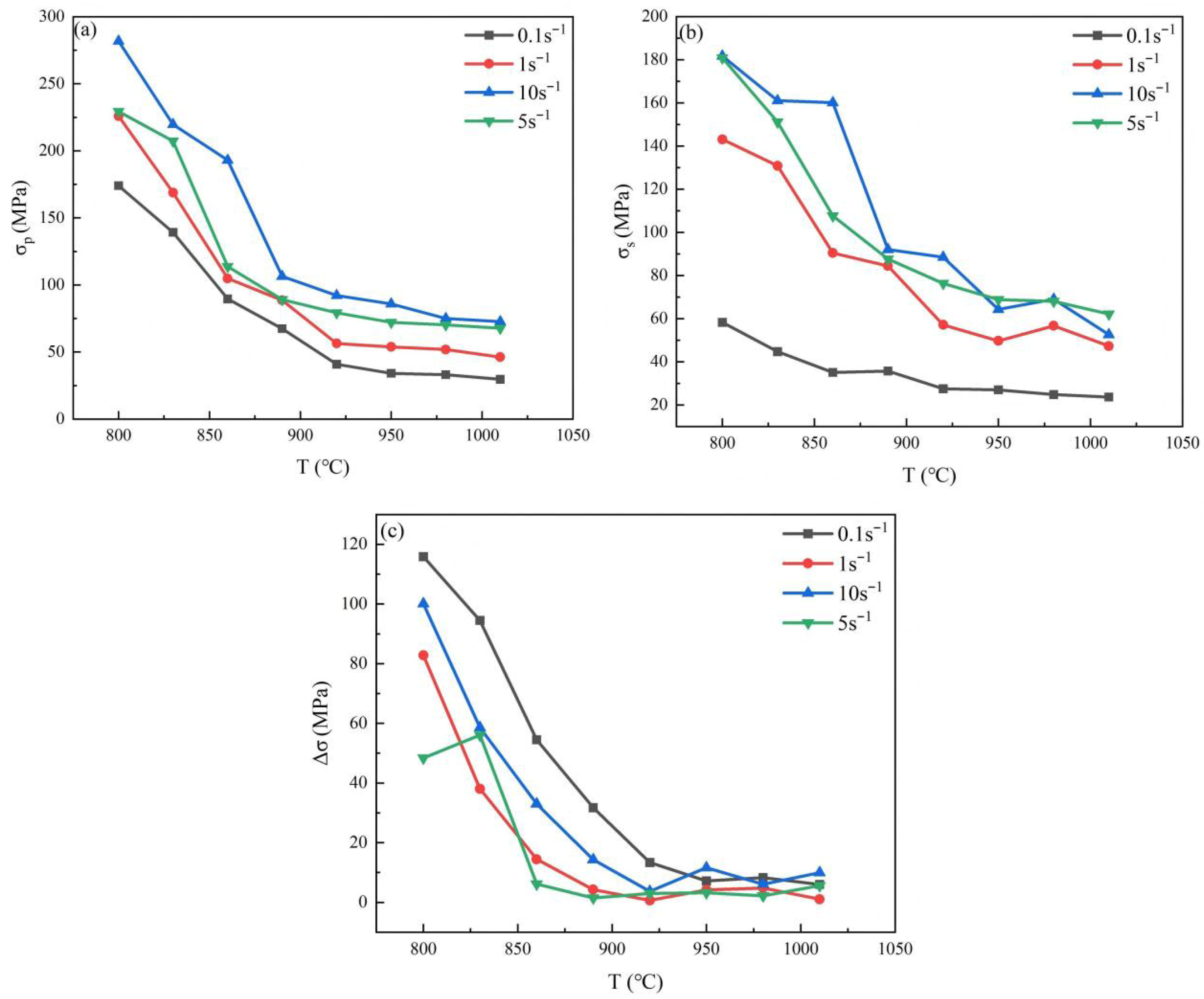
As shown in Figure 4, the stress of the alloy decreases with the increase in temperature when the strain rate is constant. When the deformation is 75%, the steady-state stress (σs) is defined as the flow stress when the true strain is 1.4, and the degree of flow softening (Δσ) is the difference between the peak stress (σp) of the alloy and the stress when the true strain is 1.4. Figure 5 shows the influence of the change in compression deformation parameters on σp, σs, and Δσ. In the high-temperature β phase region, the dynamic recovery (DRV) efficiency is high, and dislocations are prone to rearrangement and annihilation. At the beginning of deformation, DRV can almost simultaneously counteract work hardening. At this time, the work hardening rate is low, and a significant peak stress may not be observed. The curve quickly transitions directly to steady-state flow (σp ≈ σs), and the degree of flow softening decreases. At medium and low temperatures (α + β phase region), the DRV ability of the α phase is weaker, and a large number of dislocations accumulate, leading to a high work hardening rate and a rapid increase in flow stress to a high peak value (σp). Once DRX begins, a large number of new grains with low dislocation density form, causing the flow stress to drop sharply from a high peak value to a steady-state value. The magnitude of Δσ is an intuitive indicator of the severity of DRX. As the temperature increases, Δσ decreases, indicating a gradual transition in the dominant softening mechanism from DRX to DRV.

3.3. The Constitutive Modeling

Numerous studies on various materials have shown that temperature and strain rate are the two main influencing factors in thermal compression [12,14]. The Arrhenius model, as shown in Equation (1), is a semi-empirical model widely used to describe the relationship between deformation parameters and stress in metals and alloys. Zener and Hollomon introduced the temperature–compensated strain rate parameter, Z, to explain the effects of the above two factors on thermal processing, as shown in Equation (2) [15,16,17,18,19]:
ε · = f σ p exp Q R T
Z = ε · exp Q R T = f σ p = A 1 σ p n 1 , for   α σ p < 0.8 A 2 exp β σ p , for   α σ p > 1.2 A sinh α σ p n , for   all   σ p
where ε · is the strain rate (s−1); σp is the peak stress; Q is the apparent activation energy of the thermal process (J·mol−1); R is the universal gas constant (8.314 J·mol−1·K−1); T is the absolute deformation temperature (K); A, A1, A2, n1, α, and β are material constants; and α = β/n1, and n is the stress exponent. Equation (2) provides three different expressions describing the relationship between the parameter Z and the peak stress, and the hyperbolic sine function could well describe their relationship in all stress ranges [20,21]. The logarithm of Equation (2) was taken to calculate each parameter in the above equation. Among the three models, the power-law model described the deformation mechanism at low stress levels, typically associated with viscous slip of dislocations. The exponential model agreed well with experimental data at high stress levels, but severely underestimated the flow stress at low stress levels. The hyperbolic sine model was a phenomenological model that considered thermal deformation as a process controlled by thermal activation, with the activation energy Q related to the stress level.
ln Z = ln ε · + Q R T = ln A 1 + n 1 ln σ p , ln A 2 + β σ p , ln A + n ln [ sinh ( α σ p ) ] ,
As shown in Equation (3), n1, β, and n exist as coefficients of the stress term [22]. Therefore, we can calculate these constants by partial differentiation of the stress term in Equation (3):
n 1 = ln ε · ln σ p T , β = ln ε · σ p T , n = ln ε · ln [ sinh ( α σ p ) ] T
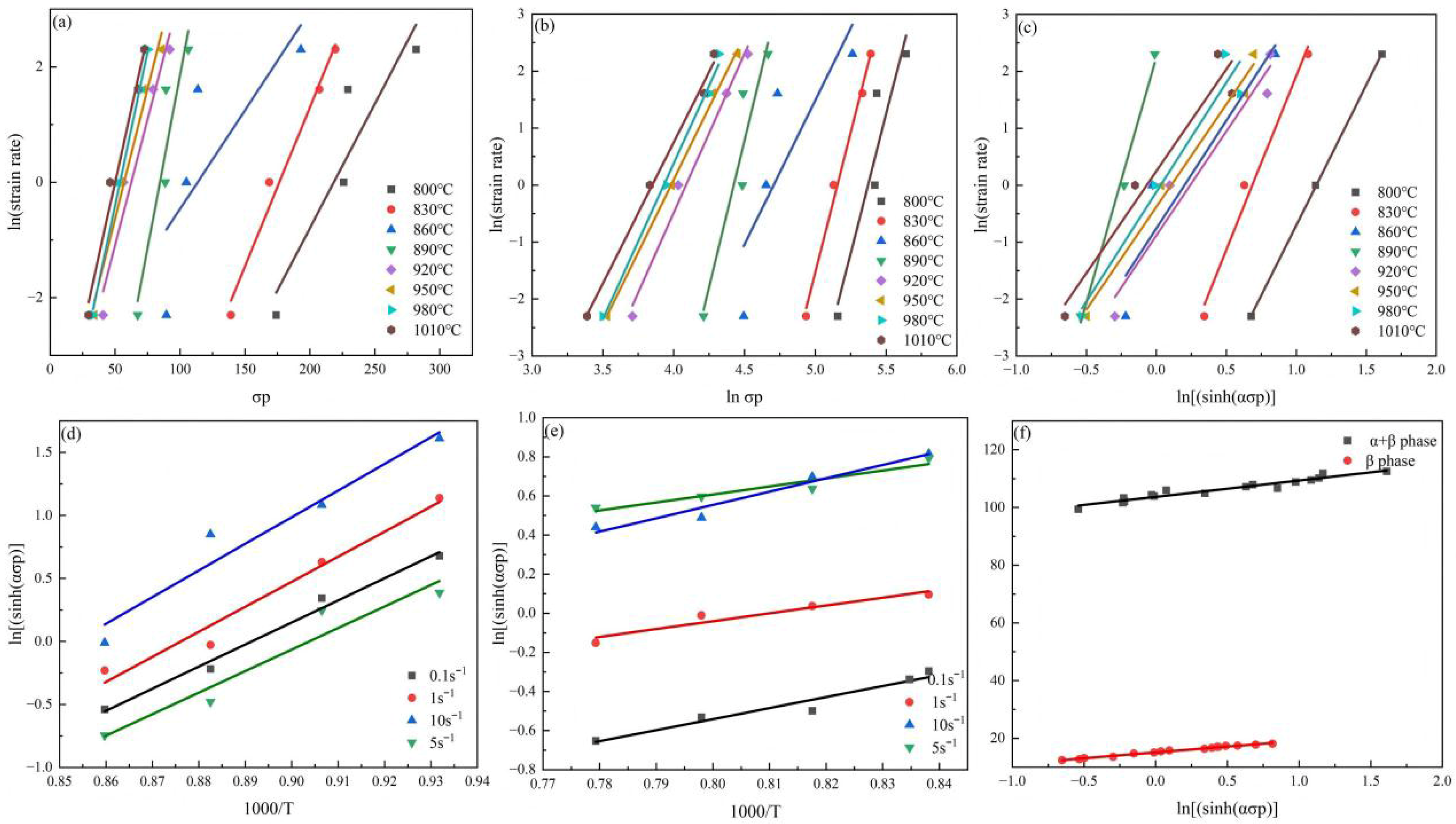
As shown in Equation (4), n1, β, and n can be expressed as ratios at a given temperature, where all data are derived from the calibration curve. The material constants were determined at each temperature and then averaged, and all material parameters for different phase regions were calculated separately [20,21,23]. n1 and β were obtained from the linear regression in Figure 6, where, in the α + β phase region, n1 = 8.38357 and β = 0.04314, and in the β phase region, n1 = 5.26745 and β = 0.10181. Furthermore, for the α + β phase region, α = 0.005146 can be calculated, and for the β region, α = 0.01933(α = β/n1). Similarly, n can be calculated by the aforementioned method from the curve in Figure 6, where the n value in the α + β phase region is 6.11573, and in the β phase region, the n value is 3.67114.
For a certain strain rate, the expression for Q can be given by taking the partial derivative of the third equation in Equation (3), as follows:
Q = R n ln [ sinh ( α σ p ) ] ( 1 / T ) ε · = R ln ε · ln [ sinh ( α σ p ) ] T ln [ sinh ( α σ p ) ] ( 1 / T ) ε · = R n k
Based on R and the obtained n, we only needed to calculate k through linear regression, as shown in Figure 6d, to obtain Q according to Equation (5). The Q value in the α + β phase region was 983.3463 kJ·mol−1, and in the β phase region it was 156.9192 kJ·mol−1.
Using the calculated material parameters, the Z parameter for the α + β phase region and the β phase region can be expressed as follows (α + β phase region Equation (6) and β phase region Equation (7)):
Z = ε · exp 983.3463 / R T = 1 . 0847 × 10 10 sinh 0.005146 σ p 6 . 11573
Z = ε · exp 156.9192 / R T = 3 . 3632 × 10 6 sinh 0.01933 σ p 3.67114
P = k 0 + k 1 ε + k 2 ε 2 + k 3 ε 3 + k 4 ε 4 + k 5 ε 5
Generally, strain significantly affects individual material constants; however, the above calculation process only used peak stress to determine the Arrhenius model. To better account for the influence of various factors on the flow stress during hot deformation, the effect of the strain variable was further discussed. The values of n, Q, ln A, and α, corresponding to all strain values from 0 to 1.4, were calculated with a step size of 0.1. The material constants varied significantly with increasing strain, indicating that the influence of strain on the constitutive equation of the material cannot be ignored. Studies have shown that polynomial fitting can be used to obtain the functional relationship between material constants and strain [24]. In this study, a fifth-order polynomial equation provided a good fit to the data, as shown in Equation (8). The coefficients of the polynomial equations are presented in Table 2 and Table 3.
σ = 1 α ln Z A 1 n Z A 2 n + 1 1 2
Among them, P represents the material constant and k is the polynomial coefficient. After calculating these material parameters, the stress value can be predicted by Equation (9) based on the derivation of the hyperbolic sine function, which expresses the flow stress as a function of Z [25,26]. Thus, the stress values at various strains for the Ti-3Al-2.5V-0.5Ni alloy can be calculated. In this section, the calculated stress values in the α + β phase region for true strains ranging from 0.1 to 1.4 were obtained. The calculated stress values were compared with the experimental stress values to evaluate the fitting accuracy of the constitutive equation. Figure 7 shows the degree of agreement between the experimental and calculated stresses. Most of the calculated stress values closely match the experimental ones, although some discrepancies exist between the calculated and experimental stresses. This indicates that the Arrhenius model adequately describes the flow stress of the Ti-3Al-2.5V-0.5Ni alloy. In addition, the correlation coefficient (R) and the average absolute error (∆) were used to evaluate the accuracy of the prediction [22,27]:
R = i = 0 n ( σ E σ ¯ E ) ( σ P σ ¯ P ) i = 0 n ( σ E σ ¯ E ) 2 i = 0 n ( σ P σ ¯ P ) 2
Δ = 1 N 1 N σ E i σ P i σ E i × 100 %
where σE is the experimental stress, σp is the predicted stress, σ ¯ E and σ ¯ p are the average values of σE and σp, respectively, and N is the number of data points. As shown in Figure 7, the experimental data and predicted data are in good agreement. The correlation coefficient (R) calculated using Equation (10) is 0.9601 and the average absolute error (∆) calculated using Equation (11) is 11.83%. These results further support that the Arrhenius model established for the Ti-3Al-2.5V-0.5Ni alloy in this study exhibits good predictive capability.

3.4. Hot Processing Map

During the thermal processing of metals, parameters such as temperature and strain rate need to be selected to avoid defects such as cracks and cavities within the material. Hot processing maps were commonly used to comprehensively evaluate the processing performance of materials, aiming to optimize the best processing parameters. Prasad et al. [22] proposed the Dynamic Material Model (DMM), which generates processing maps by superimposing a plastic instability map onto a power dissipation map. Using thermodynamic laws, the total power input (P) of the system during thermal compression can be described as follows [28,29]:
P = σ ε · = G + J = 0 ε · σ d ε · + 0 σ ε · d σ
where G represents the power dissipation caused by plastic deformation and J represents the power dissipation caused by microstructural evolution. The following Equation (13) can be used to calculate the introduced power dissipation efficiency (η):
η = J J max 2 m m + 1
where m is the exponent of strain rate sensitivity, and m can be expressed using Equation (14):
m = d J d G ε · d σ σ d ε · ( ln σ ) ( ln ε · ) ε , T
Based on the principle of maximum entropy production, the plastic instability parameter ξ( ε · ) is represented by Equation (15) [30,31]:
ξ ( ε · ) = lg ( m / ( m + 1 ) ) lg ε · + m 0
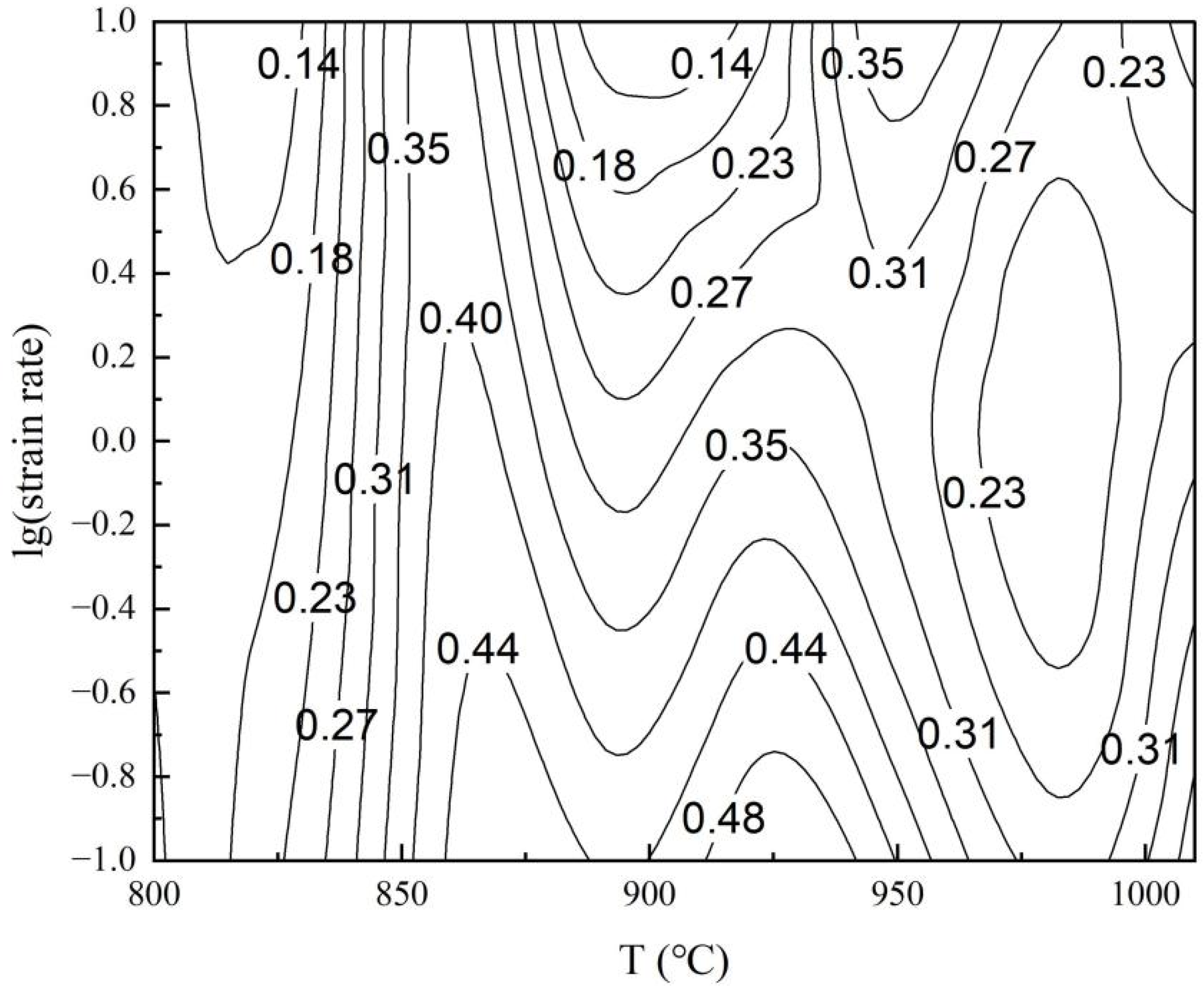
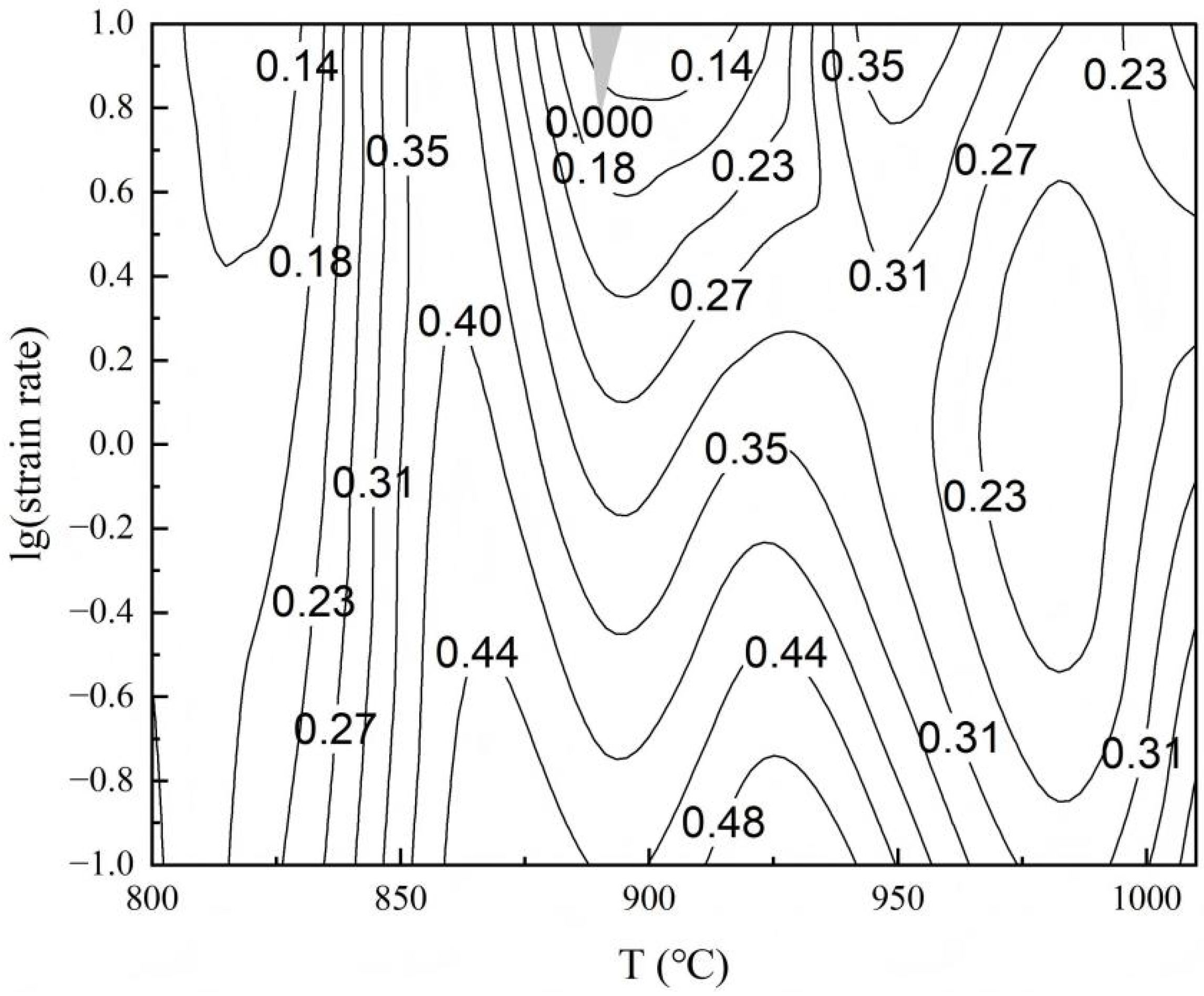
After calculation and interpolation of power efficiency (η) and instability parameter (ξ), the power distribution diagram and instability distribution diagram under different deformation conditions were constructed, respectively. The power dissipation distribution map of η was drawn in the temperature–strain rate coordinate system. These figures reveal the energy efficiency distribution for microstructure transformation under different processing parameters. Figure 8 shows the power dissipation distribution diagram. The isolines in the figure correspond to the η value, and the isoline intervals represent different power efficiency levels. Figure 8 indicates that there are a large number of high-value regions of η, which increase significantly with the increase in strain rate and temperature.
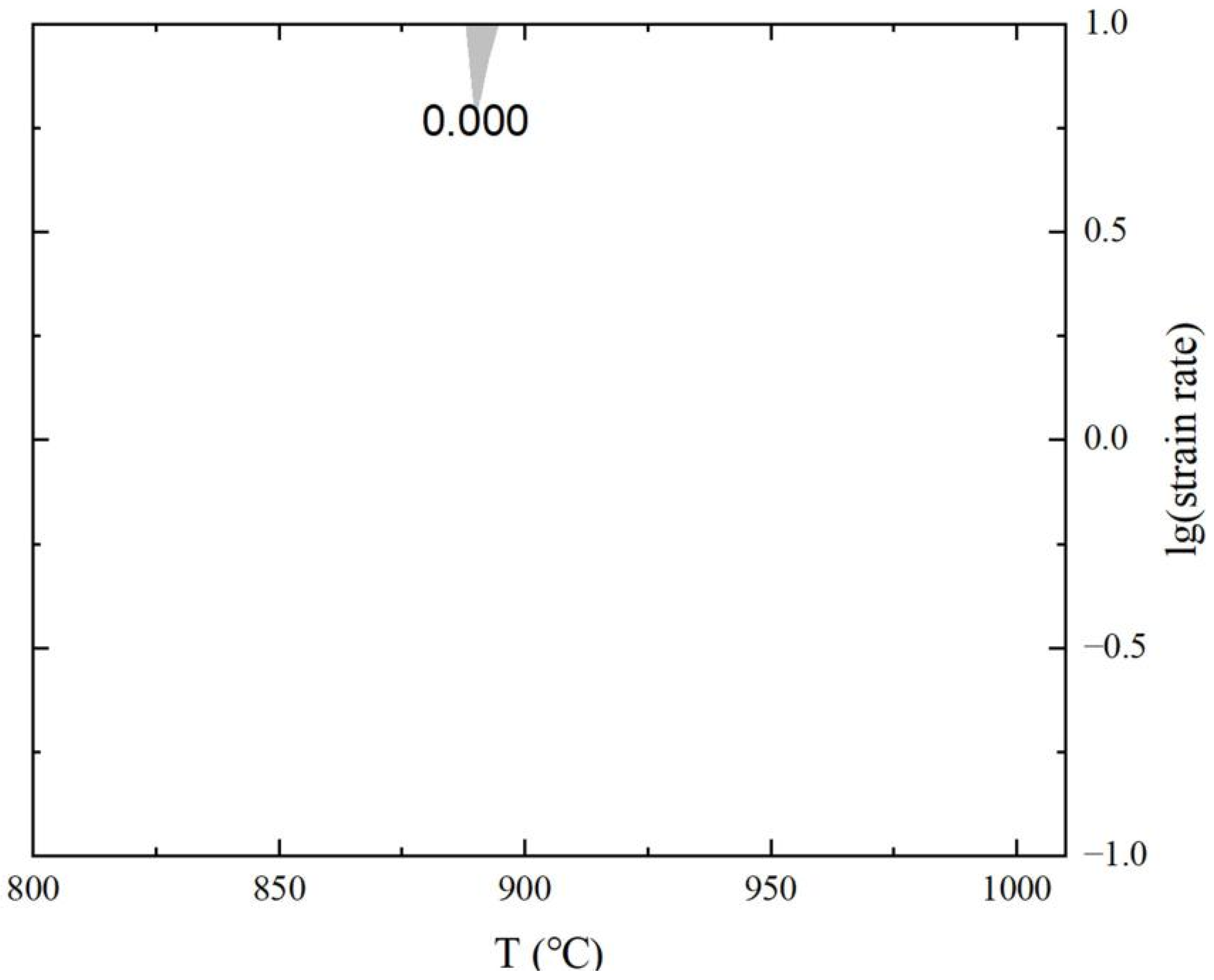
On the same temperature–strain rate map, the region where ξ( ε . ) < 0 is plotted and indicated by shading. The ductility instability map is shown in Figure 9, which clearly shows that high stacking-fault energy marks the processing instability zone. The unstable zone is indicated in gray. The power dissipation map and instability map of the Ti-3Al-2.5V-0.5Ni titanium alloy are superimposed, ultimately yielding the hot processing map, as shown in Figure 10.
As shown in Figure 10, there is an unstable region with a deformation temperature between 890 °C and 895 °C and a deformation rate from 2.2 s−1 to 10 s−1. Higher dissipation power (η > 0.3) can be observed in the deformation temperature range of 850–950 °C and deformation rate from 0.1 s−1 to 1 s−1, and the temperature range of 950–980 °C and deformation rate from 1.5 s−1 to 10 s−1 [19,32,33]. The hot processing map shows that these conditions have better thermal processing performance. In the unstable region, the material cannot smoothly dissipate the input energy through uniform plastic deformation or microstructure evolution, so it will lead to the concentrated release of energy in the local region and induce defects. The higher η value in the stable region usually indicates a stronger tendency of crystal structure evolution, which induces a stable flow process [34,35].

4. Discussion

4.1. Relationship Between Power Dissipation Efficiency (η) and Microstructure

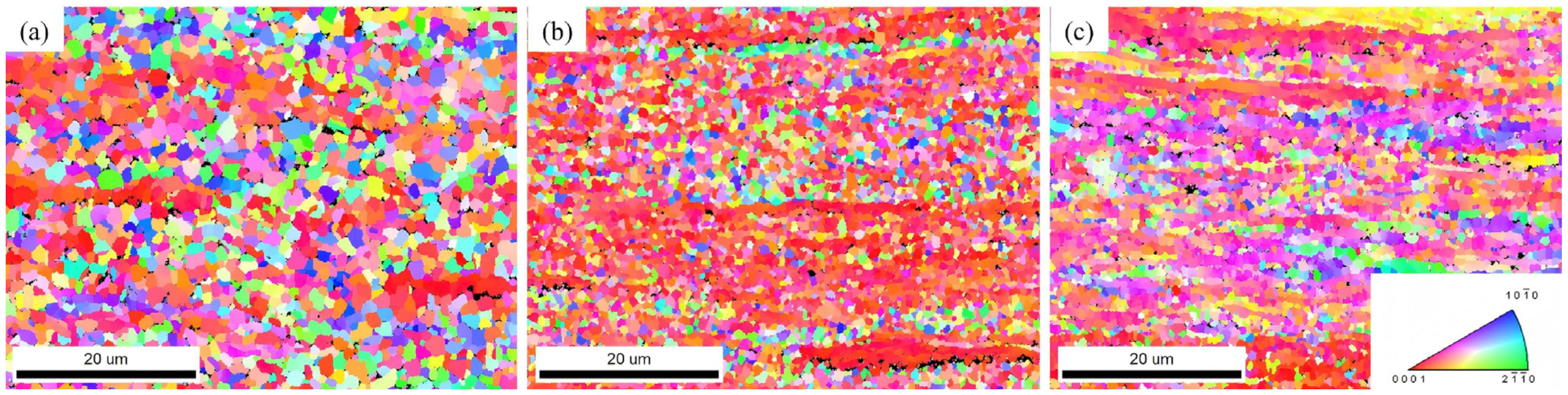
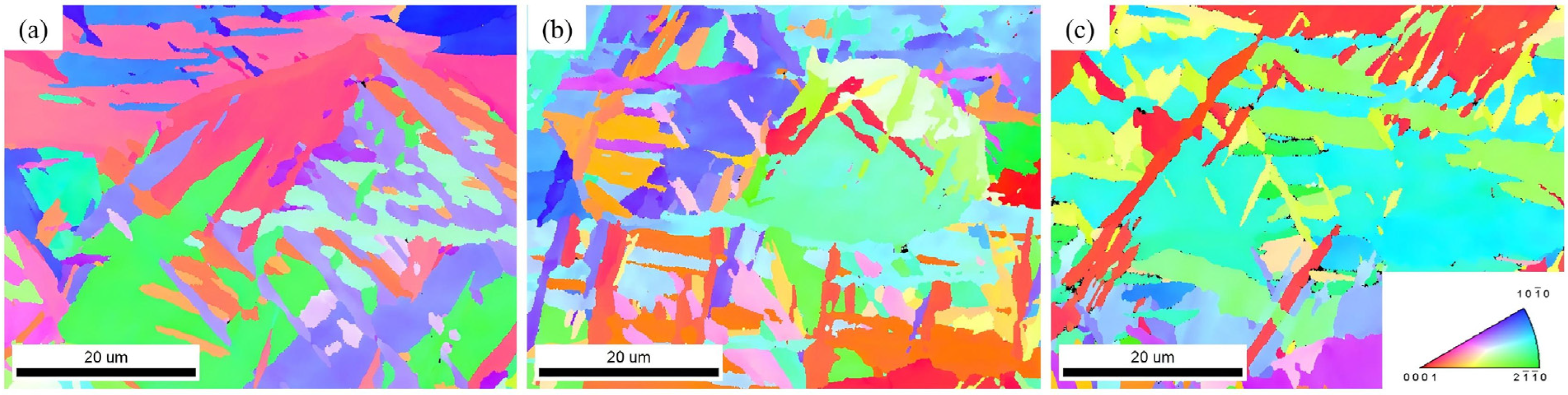
It can be seen from the hot processing map (Figure 10) that several typical regions show a higher power dissipation efficiency η value. In order to further explore the difference in thermal deformation behavior between regions with different η values, specific regions were selected, and detailed microstructure characterization was carried out by using the crystallographic data obtained by EBSD. The power dissipation efficiency (η) is relatively low (0.17 < η < 0.18) when the deformation temperature is 800 °C, and the strain rate is 1 s−1 to 10 s−1. Figure 11 is the inverse pole figure (IPF) of Ti-3Al-2.5V-0.5Ni alloy deformed to 75% at 800 °C and strain rates of 0.1 s−1, 1 s−1, and 10 s−1, respectively. As shown in Figure 11a, the lamellar α grains are broken during the deformation process, forming a large number of fine equiaxed grains. It can be seen from Figure 11b,c that, with the increase in strain rate, extremely fine equiaxed grains are formed in the alloy and the size of equiaxed α grains decreases significantly.
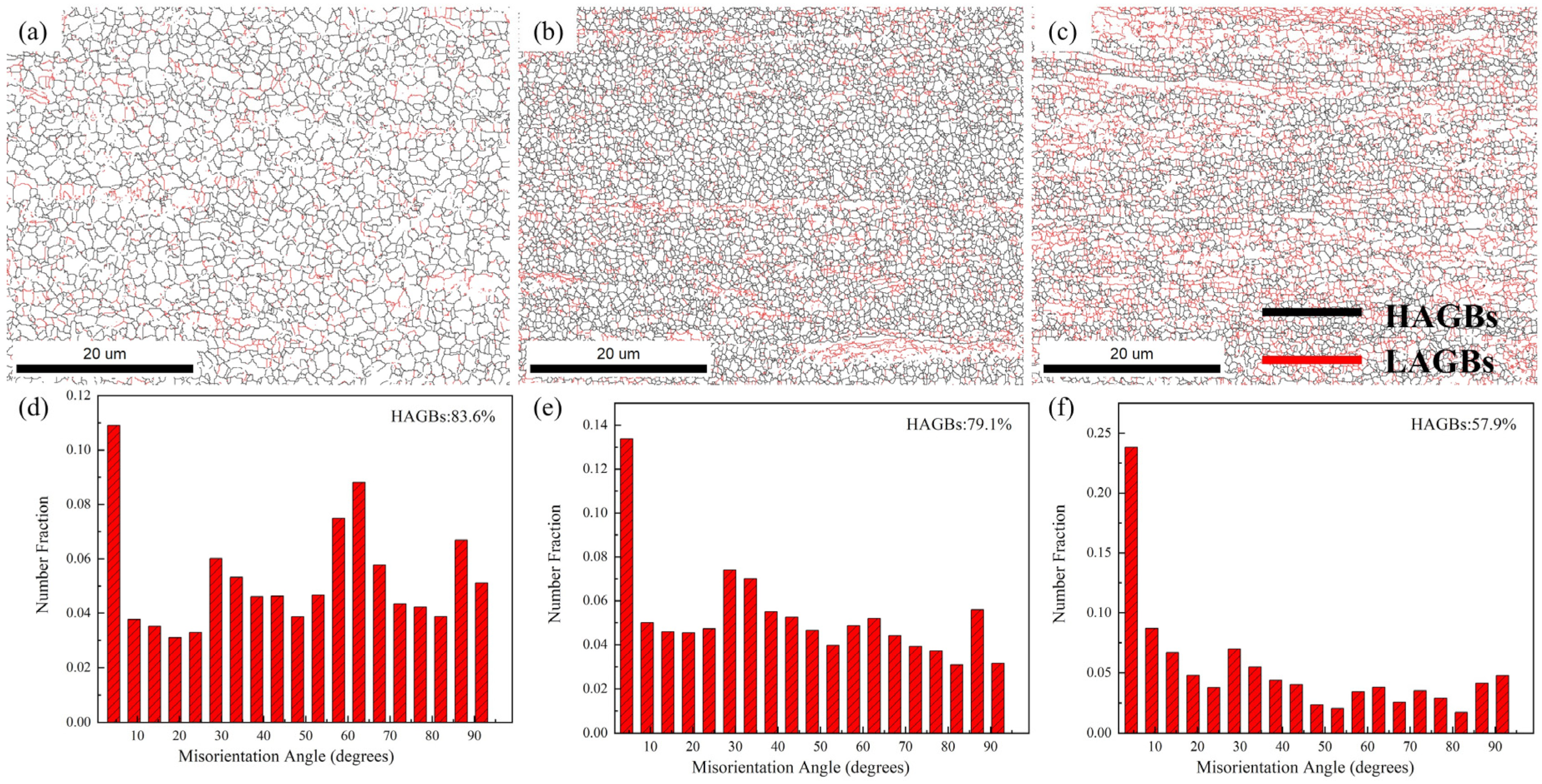
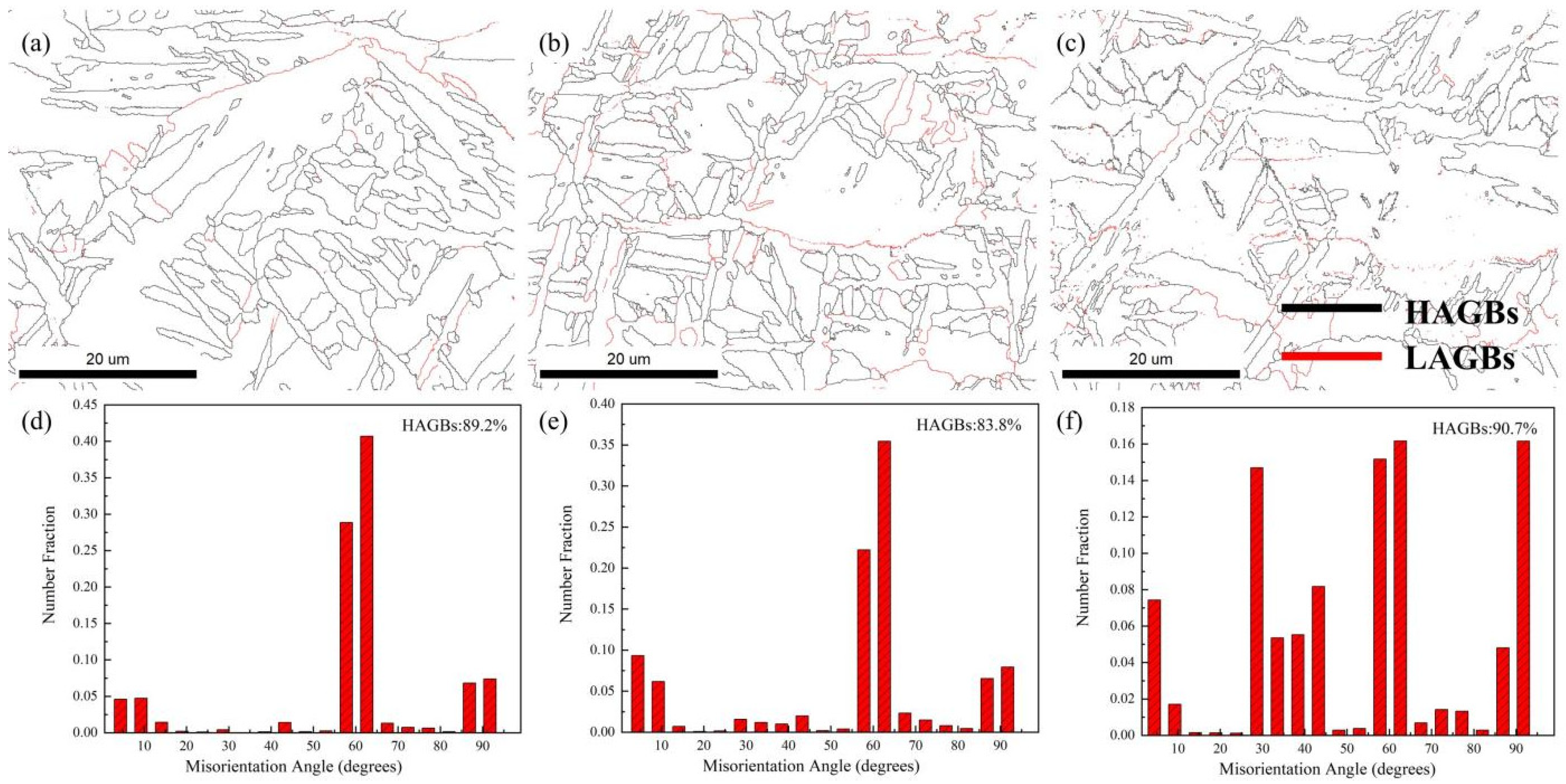
GB (Grain Boundary) maps are shown in Figure 12. As shown in Figure 12a,d, the proportion of HAGBs was 83.6%. DRX caused the transformation of LAGBs into HAGBs; LAGBs were distributed within the deformation zones of the grains. In fully recrystallized regions, most grain boundaries are high-angle grain boundaries (HAGBs), with few LAGBs observed. As depicted in Figure 12b,e, the proportion of HAGBs was 79.1%. The decrease in the proportion of HAGBs also indicated a reduction in the degree of DRX, and the microstructure exhibited a mixed structure of deformation and partial DRX. As shown in Figure 12c,f, the proportion of HAGBs was 57.9%, at which the degree of DRX was significantly inhibited. The content of LAGBs in the microstructure increased significantly, and they were evenly distributed.
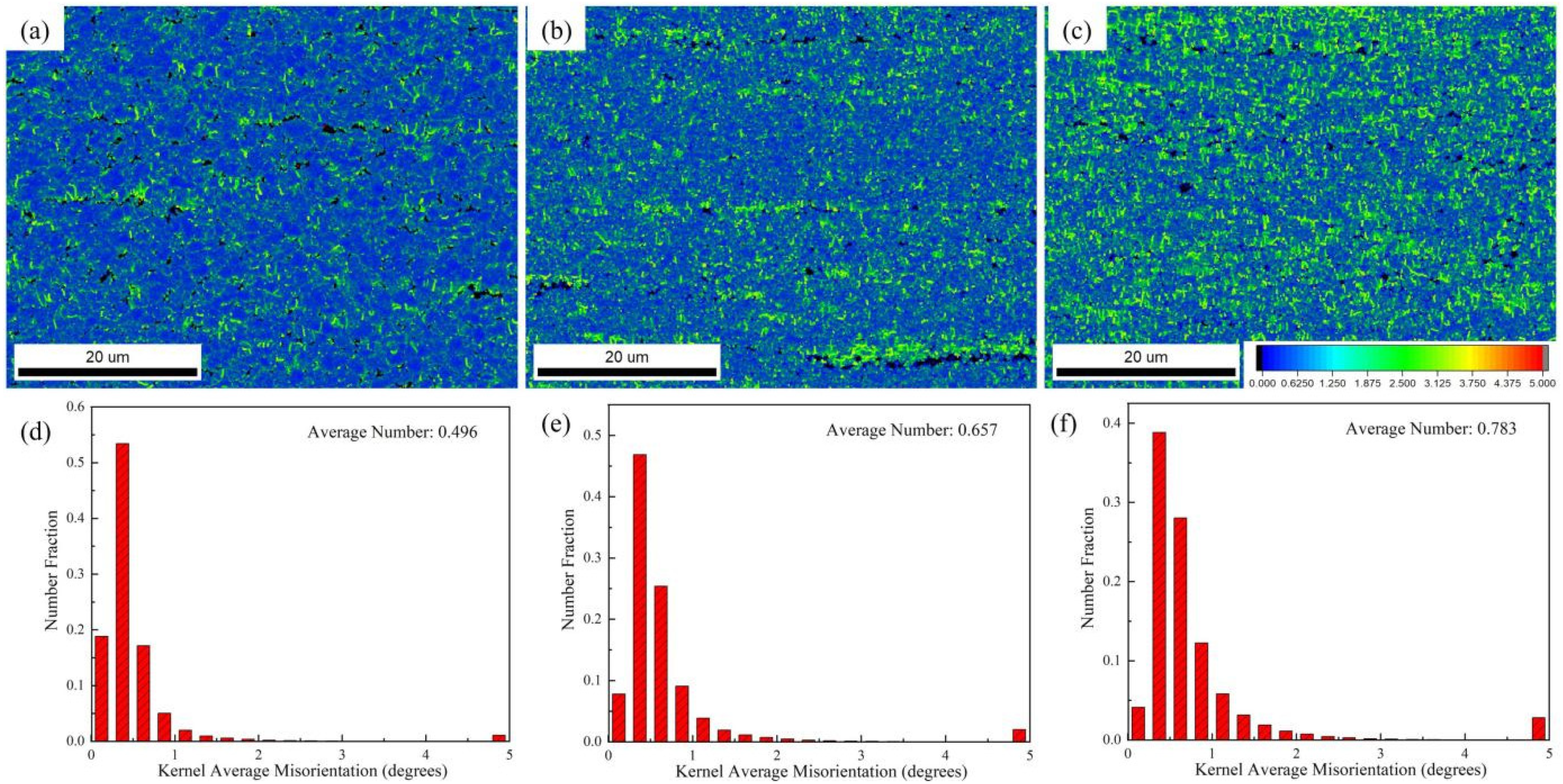
The Kernel Average Misorientation (KAM) map represents the average misorientation between a given point and its nearest neighbors, reflecting the degree of local plastic strain and lattice distortion. As illustrated in Figure 13a–c, low KAM values are represented with blue in the figure, corresponding to grains that had undergone complete DRX, resulting in very uniform intra-grain orientation and small misorientation angles with neighbors. Higher KAM values are represented with green in the figure, corresponding to undeformed deformation regions that had undergone plastic deformation, accumulating high-density dislocations, causing severe bending and distortion of the lattice, and local orientation changes. From Figure 13d–f, as the strain rate increased, the area fraction of regions with high KAM values increased, distributed near LAGBs. At this time, the proportion of dynamic recovery increased, and high strain rates promoted dislocation movement. Insufficient DRV formed a large number of unstable, dislocation-rich LAGBs, which became the concentration points of high strain energy, manifesting as high-KAM-value regions surrounding the small-angle grain boundaries on the KAM map.
DRX can eliminate dislocations, reduce dislocation density, and generate equiaxed grains to improve the processing performance of materials. At 800 °C, the DRV ability of the α phase is weak. After dislocation proliferation, it is difficult to annihilate and rearrange through an effective recovery mechanism, resulting in a large accumulation of dislocations and an extremely high work hardening rate. Both dynamic recrystallization and dynamic spheroidization, which are efficient energy dissipation processes that can significantly refine the microstructure, are strongly inhibited. The energy release efficiency of dynamic recovery is much lower than that of dynamic recrystallization. Most of the energy is dissipated in the form of heat or stored in the material in the form of high dislocation density defect energy. Therefore, the energy cannot be effectively converted, resulting in a relatively low value of power dissipation efficiency η.
The deformation temperature is the most critical parameter affecting energy dissipation efficiency η. Temperature changes the atomic migration ability and phase state, which fundamentally determines the energy dissipation mechanism and leads to significant changes in η. When deformed at 950 °C and a strain rate of 0.1–10 s−1, the alloy is in the high η region (η > 0.30). In the full β phase region at 950 °C, the BCC structure exhibits a higher stacking fault energy. DRV is the main softening mechanism when deformed at a medium and low strain rate of 0.1–1 s−1. The dynamic recovery process consumes relatively less energy and can effectively control the dislocation density. During the deformation process, dislocations form sub-grain boundaries through cross-slip and climbing, and finally reach steady-state flow stress. As shown in Figure 14a–c, the rapid cooling after deformation transforms the original fine dynamic recrystallization β grains into lamellar clusters. There are clear substructures in the microstructure after deformation, and no obvious recrystallized nuclei are observed. As shown in Figure 15a–c, the proportion of HAGBs corresponding to different strain rates at 950 °C is higher. LAGBs rapidly absorb dislocations by slip and climb, accelerating the transformation of subgrains to high-angle grain boundaries.
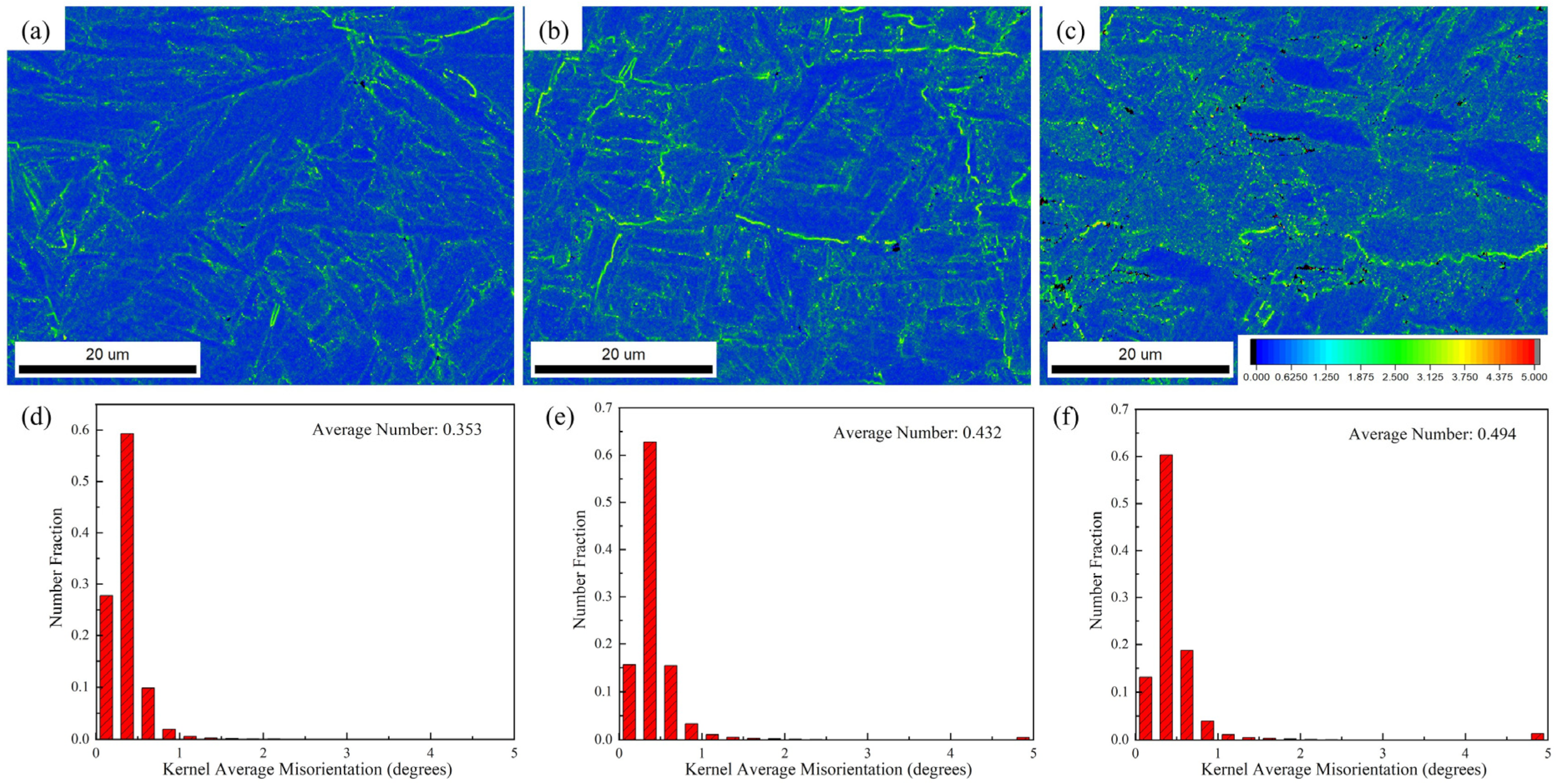
From Figure 16c,f, it can be observed that an increase in strain rate led to an increase in dislocation density (as indicated by the KAM value), providing a strong thermodynamic driving force for grain boundary migration. Due to the sufficient stored energy driving force provided by the high strain rate and the inhibition of the grain boundary bulging required for discontinuous dynamic recrystallization (DDRX) by the high stacking fault energy of the BCC structure, the dominant mechanism during deformation at 10 s−1 was more likely continuous dynamic recrystallization (CDRX) or geometric dynamic recrystallization (GDRX) induced by the large deformation.

4.2. Recrystallization Behavior

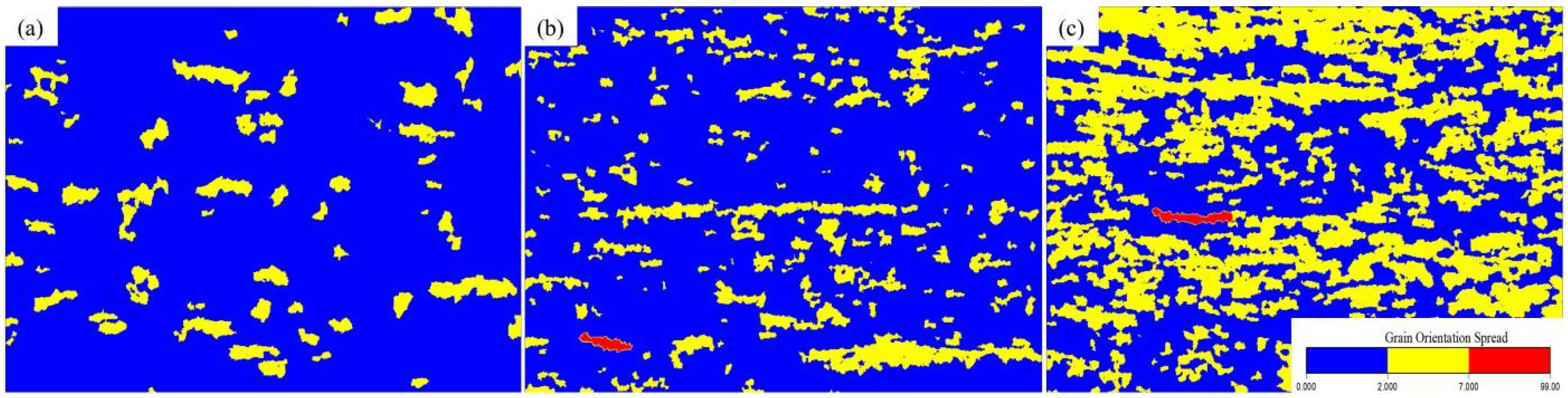
DRX can be further quantified by grain orientation spread (GOS). The dislocation density in the fully recrystallized grains is extremely low; the orientation of each point in the grains is almost the same as the average orientation, and the GOS value is extremely low. There are a large number of dislocations and secondary structures in the deformed grains. The orientation of each point in the grains is significantly different from the average orientation, and the GOS value is higher. The GOS value of partially recrystallized or restored grains is between the above two cases.
Figure 17 was constructed based on data obtained at a deformation temperature of 800 °C over a strain rate range from 0.1 s−1 to 10 s−1. In Figure 17, the region with a GOS value of 7° was represented in red. As the strain rate increased from 0.1 s−1 to 10 s−1, the area corresponding to low GOS values progressively shrank, indicating a marked decrease in the degree of DRX. At low strain rates, the longer deformation time provided sufficient opportunity for dislocations to form subgrain boundaries through DRV. These subgrain boundaries further absorbed dislocations and transformed into HAGBs, which served as nucleation sites for DRX. In contrast, at high strain rates, while the extent of DRX increased, the grain structure remained incompletely reorganized. Under such conditions, the material accumulated substantial deformation energy; however, only partial DRX occurred.

4.3. Texture Evolution Under Different Deformation Parameters

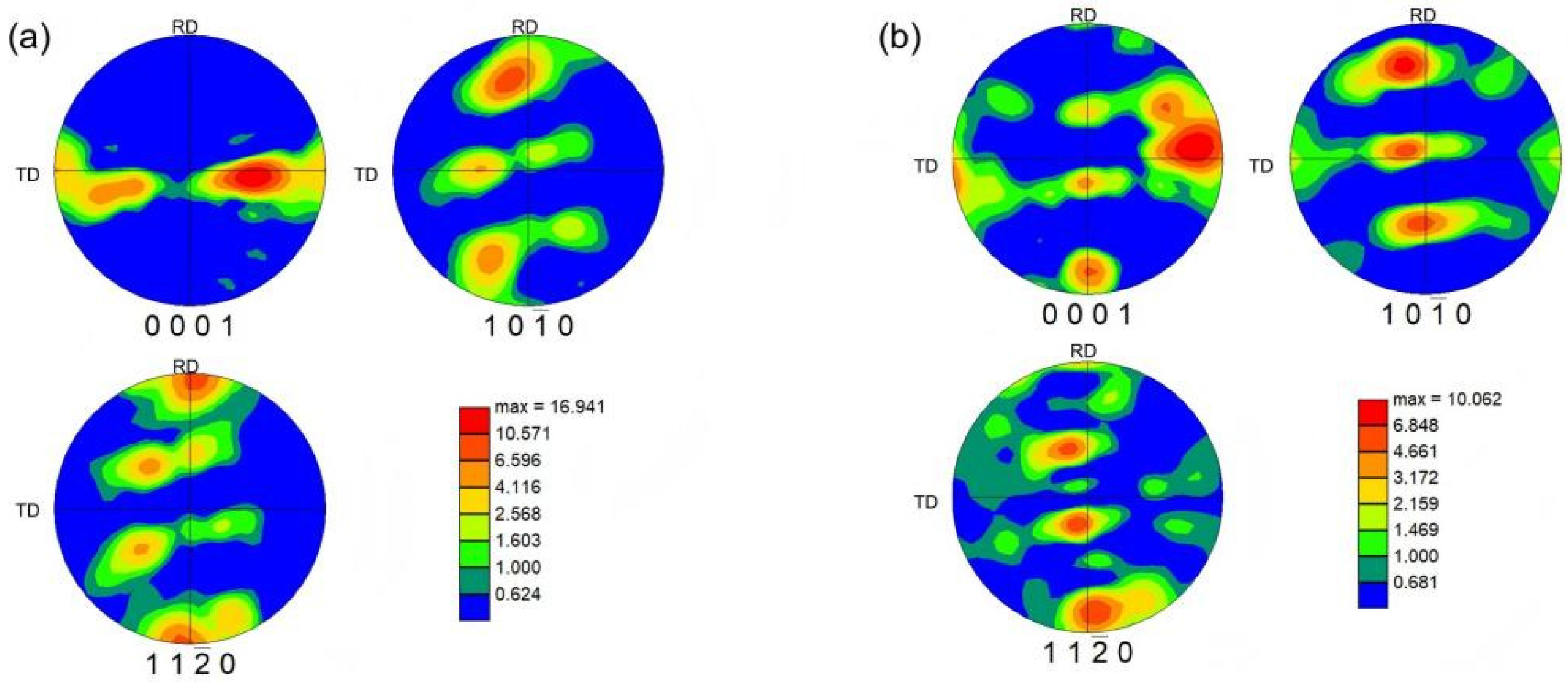
The texture evolution law of the α phase in Ti-3Al-2.5V-0.5Ni alloy was crucial to the anisotropy and mechanical properties of the hot-rolled sheets. To obtain a uniform, equiaxed, and weakly textured microstructure, the sheets should undergo severe deformation rolling in the upper part of the α + β phase region. A sufficiently large deformation amount was the fundamental driving force for driving dynamic spheroidization and DRX, combined with an appropriate strain rate to control temperature rise and rapid cooling after rolling to retain the dynamically spheroidized micro-structure after high-temperature deformation. In order to fully summarize the influence of specific parameters on the texture evolution of the α phase during the rolling process, the effects of different deformation parameters on texture are discussed through the results of plane strain compression experiments, further obtaining ideal hot-rolling parameters for sheets.

4.3.1. Effect of Deformation Temperature

High-temperature rolling in the α + β phase field can increase the volume fraction of β phase and promote the synergistic deformation of α and β phases. When the temperature decreases, the content of the α phase increases and becomes the main bearing phase. A large number of basal textures will be formed during high-temperature rolling in the α + β phase region. The main slip systems for α-Ti with a HCP structure were basal slip {0001}<11 2 ¯ 0>, prismatic slip {10 1 ¯ 0}<11 2 ¯ 0>, and pyramidal <c+a> slip {11 2 ¯ 2}<11 2 ¯ 3>. At lower temperatures, basal and prismatic slip predominated, and the c-axis was difficult to deform, resulting in a preferred orientation of the c-axis towards the transverse direction (TD), i.e., a T-type texture. The pole figures at 75% deformation, strain rate of 10 s−1, and temperatures of 800 °C and 830 °C are shown in Figure 18. Deformation at 800 °C resulted in a stronger T-type texture; at this time, the β phase volume fraction was lower, and its coordination effect on α phase deformation during plastic deformation was limited, unable to effectively disrupt the preferred orientation formed by α phase slip. Deformation at 830 °C, with a higher temperature, significantly increased the β phase volume fraction, weakening the texture through β phase coordination. Deformation was more evenly distributed between the α and β phases. β phase deformation did not produce a strong single orientation like α phase, avoiding excessive orientation of α phase grains towards specific preferred orientations. Additionally, the degree of dynamic spheroidization of α phase increased, with dislocations accumulating in α lamellae to form sub-grain boundaries. β phase penetrated along the interfaces or shear bands of α lamellae, ultimately fragmenting and spheroidizing continuous α lamellae into smaller, equiaxed α grains with slightly different orientations. The dynamic spheroidization process fragmented large, single-orientation α grains into multiple small, equiaxed grains with slightly different orientations, directly weakening the original α phase deformation texture. Therefore, to obtain a sheet with better isotropy and weaker texture, rolling should be performed in the higher-temperature region of the α + β phase region, accompanied by sufficient deformation to fully stimulate the dynamic spheroidization process. During the rolling process in the two-phase region, the texture intensity was first enhanced and then weakened as the temperature increased. The temperature range from 800 °C to 830 °C coincidentally passed through the peak intensity temperature point corresponding to the transition of deformation mechanism.

4.3.2. Effect of Strain Rate

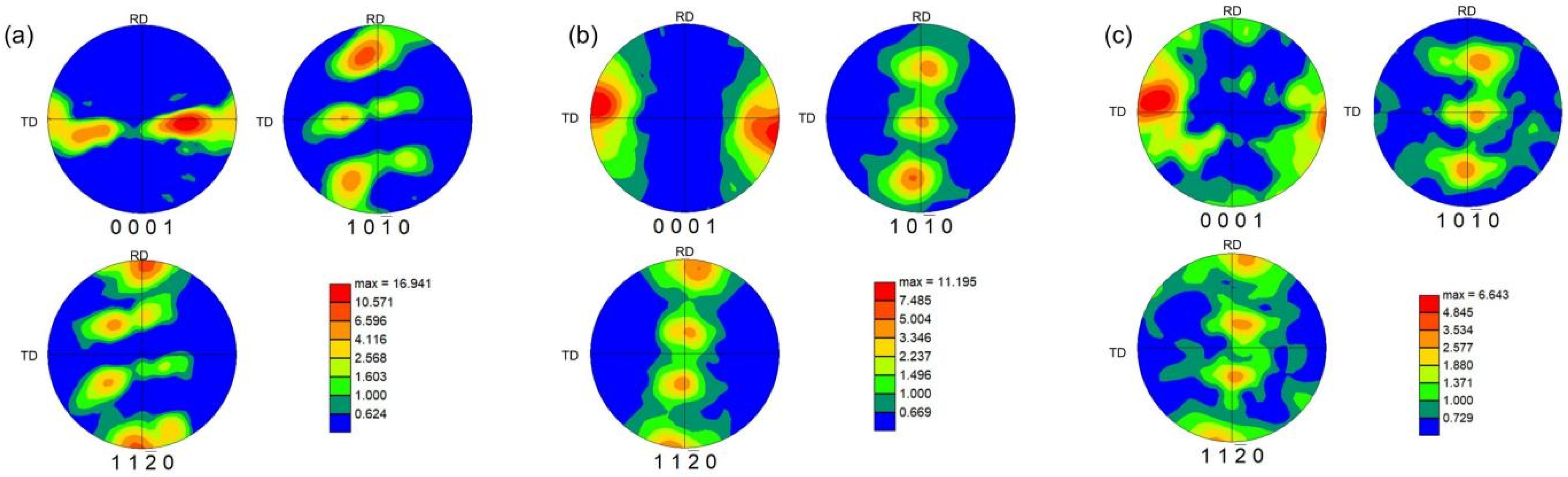
Strain rate is a key parameter controlling the evolution of deformation texture intensity. At lower temperatures, a lower strain rate promotes the development of new, randomly oriented grains via DRX, thereby effectively weakening the texture.
Figure 19 is the pole figure drawn in the range of 75% deformation, 800 °C temperature, and 0.1 s−1 to 10 s−1 strain rate. The pole figures at different strain rates show obvious T-shaped texture characteristics, and the texture intensity decreases significantly with the decrease in strain rate. The rolling of the α + β dual-phase region at a strain rate of 0.1 s−1 can provide sufficient time for dislocation diffusion, cross-slip, and climb, and the dynamic recovery is more sufficient. The internal strain energy is reduced, and the energy that drives the grain rotation is released. The low strain rate makes the β phase obtain a fully coordinated deformation time, the stress distribution is more uniform, and the texture is weakened, and the recrystallization process is more thorough, so that the new grains without distortion nucleate and grow in the severely distorted region. At a lower deformation temperature and a high strain rate of 10 s−1, the α phase slip and DRX process are inhibited, resulting in an increase in texture strength. Low-temperature rolling in the α + β dual-phase region and reducing the strain rate become an effective means to weaken the texture, which provides an important reference for accurately controlling the anisotropy of titanium alloy sheets.
When the hot deformation temperature exceeds the phase transformation temperature, air cooling after deformation results in a lamellar colony structure transformed from β grains. This type of microstructure exhibits strong anisotropy [36], which, during actual hot-rolling, can lead to significant differences in the transverse and longitudinal properties of the hot-rolled sheet, thereby affecting its service performance. Therefore, to obtain a hot-rolled sheet with an equiaxed microstructure that minimizes the difference between transverse and longitudinal properties, the hot-rolling process should be conducted in the α + β phase region. Analysis of the effect of deformation parameters on the evolution of pole figures in the α + β phase region revealed that the texture intensity weakens during hot deformation under conditions of relatively high temperature (850 °C) and low strain rates (0.1–5 s−1). Therefore, based on a comprehensive assessment of the high η region in the hot processing map, the Ti-3Al-2.5V-0.5Ni alloy is recommended to be hot-worked in the high-temperature α + β phase region at low strain rates.

5. Conclusions

In this paper, the hot deformation behavior and microstructure evolution of Ti-3Al-2.5V-0.5Ni alloy were studied. By establishing the constitutive equation and observing the microstructure, the deformation mechanism of the alloy during hot deformation was revealed, and the following conclusions were drawn:
(1)
The true stress–strain curve of Ti-3Al-2.5V-0.5Ni titanium alloy shows significant dynamic recrystallization characteristics in the α + β phase region, and shows dynamic recovery characteristics in the β phase region. Higher deformation temperature, lower strain rate, and larger strain can promote a higher degree of recrystallization of α flake grains. As the degree of recrystallization increases, the power dissipation efficiency η value increases synchronously, thereby improving the processing performance.
(2)
The constitutive equations of the α + β phase region and β phase region were fitted by the Arrhenius model and hyperbolic sine model, respectively. The hot processing map of Ti-3Al-2.5V-0.5Ni titanium alloy was established by DMM. The high η region is mainly distributed in 850–880 °C with strain rates of 0.1–10 s−1 and at 940–960 °C with strain rates of 1.5–10 s−1. The recrystallization rate is high, resulting in excellent processing performance. In the temperature range of about 900 °C, there is an unstable zone at high strain rate, which should be avoided during processing.
(3)
Deformation was performed at a temperature of 800 °C, during which the power dissipation efficiency (η) was relatively low. When the deformation temperature was raised to 950 °C, deformation occurred in the high η region (η > 0.30). EBSD analysis of the specimens revealed a lamellar microstructure after air-cooling.
(4)
The influence of varying deformation parameters on texture evolution during plane strain compression was studied. It was found that hot-rolling should be conducted in the higher-temperature α + β phase region (850–900 °C) at low-to-medium strain rates (0.1–5 s−1) to obtain sheets with a weaker texture and reduced anisotropy in transverse and longitudinal properties.

Author Contributions

Conceptualization, J.S., Y.Y. and S.H.; methodology, J.S., Y.Y. and W.Y.; software, X.O.-Y., B.F.; validation, J.S.,Y.Y. and Y.L. (Yanfeng Li); formal analysis, J.S., Y.L. (Yanfeng Li); investigation, Y.Y., Y.L. (Yumeng Luo); writing—original draft preparation, J.S.; writing—review and editing, J.S., Y.Y., Y.L. (Yumeng Luo), X.O.-Y., B.F., W.Y. and S.H.; visualization, J.S.; supervision, Y.L. (Yanfeng Li), W.Y. and Y.L. (Yumeng Luo); project administration, X.O.-Y., B.F., Y.Y., W.Y. and S.H. All authors have read and agreed to the published version of the manuscript.

Funding

This research received no external funding.

Institutional Review Board Statement

Not applicable.

Informed Consent Statement

Not applicable.

Data Availability Statement

The original contributions presented in this study are included in the article. Further inquiries can be directed to the corresponding author(s).

Conflicts of Interest

All authors were employed by State Key Laboratory of Nonferrous Structural Materials, GRIMAT Engineering Institute Co., Ltd., General Research Institute for Nonferrous Metals and GRINM (Guangdong) Institute for Advanced Materials and Technology. All authors declare that this research was conducted in the absence of any commercial or financial relationships that could be construed as potential conflicts of interest.

References

  1. Christie, M.; Gavin, B. Titanium as an Alternative to Conventional Coiled Tubing: A North Sea Case Study. In Proceedings of the SPE/ICoTA North American Coiled Tubing Roundtable, Montgomery, TX, USA, 1–3 April 1997. [Google Scholar] [CrossRef]
  2. Fu, Y.R.; Gu, S.Q.; Song, H.M.; Li, L.; Li, J.; Liu, X.J.; Yang, W.S. Application Status and Prospect of Titanium Alloy Pipe in Exploration and Development of High Sour Natural Gas. China Pet. Mach. 2018, 46, 116–124. [Google Scholar] [CrossRef]
  3. Yang, X.R.; Wang, Z.L.; Dai, Y.; Li, B.W.; Jin, Z.; Luo, L.; Liu, X.Y.; Wang, J.Z. Evolution of Microstructure, Macrotexture and Mechanical Properties of High Strength Biomedical TA4 Pure Titanium during Multipass ECAP. J. Mater. Res. Technol. 2024, 28, 3976–3987. [Google Scholar] [CrossRef]
  4. Zhang, C.L.; Zhang, J.Y.; Bao, X.Y.; Li, J.; Zhang, D.D.; Liu, G.; Sun, J. Hierarchically Ordered Coherent Interfaces-Driven Ultrahigh Specific-Strength and Toughness in a Nano-Martensite Titanium Alloy. Acta Mater. 2024, 263, 119540. [Google Scholar] [CrossRef]
  5. Fukushima, O.; Yoneyama, T.; Doi, H.; Hanawa, T. Corrosion Resistance and Surface Characterization of Electrolyzed Ti-Ni Alloy. Dent. Mater. J. 2006, 25, 151–160. [Google Scholar] [CrossRef]
  6. Zhao, E.; Sun, S.; Zhang, Y. Recent Advances in Silicon Containing High Temperature Titanium Alloys. J. Mater. Res. Technol. 2021, 14, 3029–3042. [Google Scholar] [CrossRef]
  7. Li, W.; Li, S.S.; Huang, Z.T.; Tang, G.Y.; Zhang, G.M.; Yu, H. Research on the Anisotropic Mechanism of Plastic Behavior during Tensile Process of Textured Pure Titanium. Mater. Sci. Eng. A 2024, 894, 146153. [Google Scholar] [CrossRef]
  8. Haghdadi, N.; Zarei-Hanzaki, A.; Roostaei, A.A.; Hemmati, A.R. Evaluating the Mechanical Properties of a Thermomechanically Processed Unmodified A356 Al Alloy Employing Shear Punch Testing Method. Mater. Des. 2013, 43, 419–425. [Google Scholar] [CrossRef]
  9. Li, Y.F.; Xu, X.F.; Wei, L.M.; Fan, Y.B.; Xie, J.; Wu, S.T.; Zeng, X. Optimization of Ti-3Al-2.5V Titanium Tubes by Differential Heating Push-Bending Based on a Modified Johnson−Cook Constitutive Model. Mater. Today Commun. 2024, 41, 110951. [Google Scholar] [CrossRef]
  10. Lin, Y.C.; Huang, J.; He, D.G.; Zhang, X.Y.; Wu, Q.; Wang, L.H.; Chen, C.; Zhou, K.C. Phase Transformation and Dynamic Recrystallization Behaviors in a Ti55511 Titanium Alloy during Hot Compression. J. Alloys Compd. 2019, 795, 471–482. [Google Scholar] [CrossRef]
  11. Li, C.M.; Huang, L.; Zhao, M.J.; Guo, S.Q.; Li, J.J. Hot Deformation Behavior and Mechanism of a New Metastable β Titanium Alloy Ti-6Cr-5Mo-5V-4Al in Single Phase Region. Mater. Sci. Eng. A 2021, 814, 141231. [Google Scholar] [CrossRef]
  12. Li, L.; Li, M.Q.; Luo, J. Mechanism in the β Phase Evolution during Hot Deformation of Ti-5Al-2Sn-2Zr-4Mo-4Cr with a Transformed Microstructure. Acta Mater. 2015, 94, 36–45. [Google Scholar] [CrossRef]
  13. Lu, L.; Zhang, Y.; Zhou, F.; Song, K.; Li, S. Study on Microstructure Evolution of Ti-6Al-3Nb-2Zr-1Mo Alloy with Bimodal Structure during Hot Compression in the near β Region. J. Mater. Res. Technol. 2021, 15, 1747–1758. [Google Scholar] [CrossRef]
  14. Liu, D.K.; Huang, G.S.; Gong, G.L.; Wang, G.G.; Pan, F.S. Influence of Different Rolling Routes on Mechanical Anisotropy and Formability of Commercially Pure Titanium Sheet. Trans. Nonferrous Met. Soc. China 2017, 27, 1306–1312. [Google Scholar] [CrossRef]
  15. Ding, S.; Khan, S.A.; Yanagimoto, J. Flow Behavior and Dynamic Recrystallization Mechanism of A5083 Aluminum Alloys with Different Initial Microstructures during Hot Compression. Mater. Sci. Eng. A 2020, 787, 139522. [Google Scholar] [CrossRef]
  16. Souza, P.M.; Beladi, H.; Singh, R.P.; Hodgson, P.D.; Rolfe, B. An Analysis of the Constitutive Models for Forging of Ti6Al4V Alloy Considering the Softening Behavior. J. Mater. Eng. Perform. 2018, 27, 3545–3558. [Google Scholar] [CrossRef]
  17. Lin, Y.; Chen, X.M. A Critical Review of Experimental Results and Constitutive Descriptions for Metals and Alloys in Hot Working. Mater. Des. 2011, 32, 1733–1759. [Google Scholar] [CrossRef]
  18. Johnson, G.R.; Cook, W.H. A Constitutive Model and Data for Metals Subjected to Large Strains, High Strain Rates and High Temperatures. Eng. Fract. Mech. 1985, 21, 31–48. [Google Scholar] [CrossRef]
  19. Xu, Y.; Hu, L.; Sun, Y. Deformation Behaviour and Dynamic Recrystallization of AZ61 Magnesium Alloy. J. Alloys Compd. 2013, 580, 262–269. [Google Scholar] [CrossRef]
  20. Ye, Y.; Han, Y.; Zhang, S.; Le, J.; Chen, F.; Zhang, J.; Shen, C.; Huang, G.; Xin, S.; Lu, W.; et al. Transitions of Deformation Mechanisms in New Metastable β-Titanium Ti-1500G Alloy. Mater. Des. 2025, 251, 113663. [Google Scholar] [CrossRef]
  21. Lu, T.; Dan, Z.-H.; Li, T.-J.; Dai, G.-Q.; Sun, Y.-Y.; Guo, Y.-H.; Li, K.; Yi, D.-Q.; Chang, H.; Zhou, L. Flow Softening and Microstructural Evolution of near β Titanium Alloy Ti-35421 during Hot Compression Deformation in the α+β Region. J. Mater. Res. Technol. 2022, 19, 2257–2274. [Google Scholar] [CrossRef]
  22. Cai, J.; Li, F.; Liu, T.; Chen, B.; He, M. Constitutive Equations for Elevated Temperature Flow Stress of Ti-6Al-4V Alloy Considering the Effect of Strain. Mater. Des. 2011, 32, 1144–1151. [Google Scholar] [CrossRef]
  23. Sahoo, S.K.; Panigrahi, S.K. Comparative Study on High Temperature Deformation Behavior and Processing Maps of Mg-4Zn-1RE-0.5Zr Alloy with and without In-Situ Sub-Micron Sized TiB2 Reinforcement. J. Magnes. Alloys 2022, 10, 3520–3541. [Google Scholar] [CrossRef]
  24. Samantaray, D.; Mandal, S.; Bhaduri, A.K. Constitutive Analysis to Predict High-Temperature Flow Stress in Modified 9Cr–1Mo (P91) Steel. Mater. Des. 2010, 31, 981–984. [Google Scholar] [CrossRef]
  25. Yang, Y.; Wang, H.; Feng, Z.; Shi, Q.; Yang, B.; Chen, M.; Qi, H.; Wang, X. Study on the Warm Deformation Behavior and Microstructure Evolution of the MDIFed Ti–6Al–4V Titanium Alloy. J. Mater. Res. Technol. 2024, 33, 8929–8943. [Google Scholar] [CrossRef]
  26. Rezaei Ashtiani, H.R.; Shahsavari, P. A Comparative Study on the Phenomenological and Artificial Neural Network Models to Predict Hot Deformation Behavior of AlCuMgPb Alloy. J. Alloys Compd. 2016, 687, 263–273. [Google Scholar] [CrossRef]
  27. Wang, J.W.; Liu, Y.; Liu, B.; Wang, Y.; Cao, Y.K.; Li, T.C.; Zhou, R. Flow Behavior and Microstructures of Powder Metallurgical CrFeCoNiMo0.2 High Entropy Alloy during High Temperature Deformation. Mater. Sci. Eng. A 2017, 689, 233–242. [Google Scholar] [CrossRef]
  28. Prasad, Y.; Gegel, H.; Doraivelu, S.; Malas, J.; Morgan, J.; Lark, K.; Barker, D. Modeling of dynamic material behavior in hot deformation: Forging of Ti−6242. Metall. Trans. A 1984, 15, 1883–1892. [Google Scholar] [CrossRef]
  29. Jiang, H.; Tian, S.; Guo, W.; Zhang, G.; Zeng, S. Hot Deformation Behavior and Deformation Mechanism of Two TiAl-Mo Alloys during Hot Compression. Mater. Sci. Eng. A 2018, 719, 104–111. [Google Scholar] [CrossRef]
  30. Qin, C.G.; Jiang, B.; Hu, M.L.; Wang, Y.; Xu, H.Y.; Guo, Y.; Ji, Z.S. Study on Hot Deformation Behavior and Dynamic Recrystallization Mechanism of Recycled Al–Zn–Mg–Cu Alloy. J. Mater. Res. Technol. 2024, 33, 4725–4738. [Google Scholar] [CrossRef]
  31. Liu, X.; Sun, Y.; Zhang, X.; Li, H.; Li, Z.; He, L. Thermal Deformation Behavior and Microstructure Evolution of Fe−8.5Mn−1.5Al Light−Weight Medium Manganese Steel. J. Mater. Res. Technol. 2023, 26, 6053–6066. [Google Scholar] [CrossRef]
  32. Chen, Z.S.; Feng, Z.X.; Yan, W.J.; Guo, B.H. Analysis of the Microstructure and Hot Deformation Behavior of Ti-5Al-5Mo-5V-1Cr-1Fe Alloy with Equiaxed Starting Microstructure in the (α+β) Two-Phase Region. J. Alloys Compd. 2025, 1040, 183479. [Google Scholar] [CrossRef]
  33. Ma, L.; Han, X.; Zhang, J.; Li, W. Elucidating the Influence of Temperature and Strain Rate on Superplasticity and Microstructure Evolution of Near-α TNW700 Titanium Alloy. Mater. Sci. Eng. A 2023, 871, 144924. [Google Scholar] [CrossRef]
  34. Huang, L.; Li, C.M.; Li, C.L.; Hui, S.X.; Yu, Y.; Zhao, M.J.; Guo, S.Q.; Li, J.J. Research Progress on Microstructure Evolution and Hot Processing Maps of High Strength β Titanium Alloys during Hot Deformation. Trans. Nonferrous Met. Soc. China 2022, 32, 3835–3859. [Google Scholar] [CrossRef]
  35. Li, J.L.; Wang, B.Y.; Huang, H.; Fang, S.; Chen, P.; Shen, J.X. Unified Modelling of the Flow Behaviour and Softening Mechanism of a TC6 Titanium Alloy during Hot Deformation. J. Alloys Compd. 2018, 748, 1031–1043. [Google Scholar] [CrossRef]
  36. Chen, W.; Lv, Y.P.; Zhang, X.Y.; Chen, C.; Lin, Y.C.; Zhou, K.C. Comparing the Evolution and Deformation Mechanisms of Lamellar and Equiaxed Microstructures in near β-Ti Alloys during Hot Deformation. Mater. Sci. Eng. A 2019, 758, 71–78. [Google Scholar] [CrossRef]
Figure 1. Initial microstructure of Ti-3Al-2.5V-0.5Ni titanium alloy.
Metals 16 00404 g001
Figure 2. Microstructure of Ti-3Al-2.5V-0.5Ni titanium alloy quenched at (a) 890 °C and (b) 900 °C.
Metals 16 00404 g002
Figure 3. Specimen placement and isothermal compression process.
Metals 16 00404 g003
Figure 4. True stress–true strain curves of Ti-3Al-2.5V-0.5Ni titanium alloy with 75% deformation under different deformation conditions: (a) 0.1 s−1; (b) 1 s−1; (c) 5 s−1; (d) 10 s−1.
Metals 16 00404 g004
Figure 5. The influence of different deformation parameters on peak stress, steady-state stress, and flow softening: (a) peak stress; (b) steady-state stress; (c) flow softening.
Metals 16 00404 g005
Figure 6. Relationship curves between different parameters: (a) ln ε · -σ; (b) ln ε · -lnσ; (c) ln ε · -ln[sinh(ασ)]; (d) α + β phase ln[sinh(ασ)]-1000/T; (e) βphase ln[sinh(ασ)]-1000/T; (f) lnZ-ln[sinh(ασ)] curve.
Metals 16 00404 g006
Figure 7. Comparison between experimental and calculated flow stresses of Ti-3Al-2.5V-0.5Ni titanium alloy in the α + β phase region at a deformation level of 75%: (a) 0.1 s−1; (b) 1 s−1; (c) 5 s−1; (d) 10 s−1; (e) correlation analysis.
Metals 16 00404 g007
Figure 8. Power dissipation map of Ti-3Al-2.5V-0.5Ni titanium alloy.
Metals 16 00404 g008
Figure 9. Instability map of Ti-3Al-2.5V-0.5Ni titanium alloy.
Metals 16 00404 g009
Figure 10. The hot processing map of Ti-3Al-2.5V-0.5Ni titanium alloy.
Metals 16 00404 g010
Figure 11. IPF maps with 75% deformation: 800 °C (a) 0.1 s−1; (b) 1 s−1; (c)10 s−1.
Metals 16 00404 g011
Figure 12. GB maps with 75% deformation: 800 °C (a,d) 0.1 s−1; (b,e) 1 s−1; (c,f) 10 s−1.
Metals 16 00404 g012
Figure 13. KAM maps with 75% deformation: 800 °C (a,d) 0.1 s−1; (b,e) 1 s−1; (c,f) 10 s−1.
Metals 16 00404 g013
Figure 14. IPF maps with 75% deformation: 950 °C (a) 0.1 s−1; (b) 1 s−1; (c) 10 s−1.
Metals 16 00404 g014
Figure 15. GB maps with 75% deformation: 950 °C (a,d) 0.1 s−1; (b,e) 1 s−1; (c,f) 10 s−1.
Metals 16 00404 g015
Figure 16. KAM maps with 75% deformation: 950 °C (a,d) 0.1 s−1; (b,e) 1 s−1; (c,f) 10 s−1.
Metals 16 00404 g016
Figure 17. GOS maps with 75% deformation: 800 °C (a) 0.1 s−1; (b) 1 s−1; (c) 10 s−1.
Metals 16 00404 g017
Figure 18. The pole figures (PF) of deformation degree of 75% and a strain rate of 10 s−1 were obtained at (a) 800 °C and (b) 830 °C.
Metals 16 00404 g018
Figure 19. PF diagram of 800 °C with 75% deformation: (a) 10 s−1; (b) 1s−1; (c) 0.1 s−1.
Metals 16 00404 g019
Table 1. Chemical composition of alloy ingots.
Elements (wt %)AlVNiCNHO
Ti-3Al-2.5V-0.5Ni3.132.590.460.0110.0180.00220.056
Table 2. Polynomial fitting coefficients of α, n, Q, and lnA for Ti-Al-2.5V-0.5Ni alloy in the α + β phase region.
αnQlnA
k00.008167.573741111.84199117.64946
k1−0.01431−12.59702−1049.7781−106.03242
k20.110083.05013−6960.91369−775.8126
k3−0.2429928.7074722,583.010232481.73955
k40.22527−35.23131−23,551.87182−2580.48136
k5−0.0747811.795888267.25898904.88943
Table 3. Polynomial fitting coefficients of α, n, Q, and lnA for Ti-Al-2.5V-0.5Ni alloy in the β phase region.
αnQlnA
k00.020942.01813−90.942272.40162
k1−0.0171847.094944170.64183205.81883
k20.1069−251.26985−19,178.56383−790.89046
k3−0.25557559.0160538,262.571231378.82074
k40.29079−562.09564−35,030.23154−1127.11471
k5−0.12521210.017912,047.55601346.94976
Disclaimer/Publisher’s Note: The statements, opinions and data contained in all publications are solely those of the individual author(s) and contributor(s) and not of MDPI and/or the editor(s). MDPI and/or the editor(s) disclaim responsibility for any injury to people or property resulting from any ideas, methods, instructions or products referred to in the content.